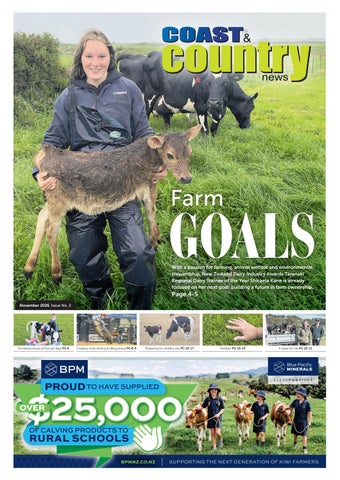
Farm
GOALS With a passion for farming, animal welfare and environmental stewardship, New Zealand Dairy Industry Awards Taranaki Regional Dairy Trainee of the Year Shicaela Kane is already focused on her next goal: building a future in farm ownership.
Page 4-5
November 2026 Issue No. 2
Donations boost school pet days PG 6
Cowboy roots drive bull riding revival PG 8-9
Preparing for wildfire risk PG 16-17
Fertiliser PG 18-19
A lease for life PG 20-21
PROUD TO HAVE SUPPLIED
$25,000 $25 0
OVER
OF CALVING PRODUCTS TO
RURAL SCHOOLS
BPMNZ.CO.NZ
SUPPORTING G THE NEXT GENERATION OF KIWI FARMERS
COAST & COUNTRY NEWS
Page 2
Discovering the realities of farm life As city kids, we weren’t exposed to life and death. We were sheltered from it. It wasn’t discussed. When Cindy, the old calico cat, got sick, we were told she’d gone away for a while to get better. It was a long recuperation because, five years later, Cindy still hadn’t returned home. One day, my statesmanlike, besuited grandfather was holding court from his buttoned, rolled-arm Chesterfield chair, as he always did. Then, one day, he wasn’t. He was gone. Why? Where? No one explained. When I asked, all I got was a “shush”. How did that help my understanding of the life cycle? Shortly after, Nanna, a gracious woman with a twinkle in her eye, who occupied a much less fussy fireside chair and held far fewer opinions, also vanished. No explanation. Just gone. I didn’t ask this time. Both had simply been written out of the script.
Maeve
Delivering 12,000 copies to your target audience of farmers, growers & lifestylers every month.
www.coastandcountrynews.co.nz Contact us for advertising: ads@thesun.co.nz Coast & Country News is part of NZME - New Zealand Media & Entertainment. We keep Kiwis in the know! Some pages may contain sponsored content.
It was the same when this boy from the ’burbs went to reconnect with Maeve, the house cow at the farm. We met Maeve last month: a ‘mulberry’, almost-black Jersey with a matching black switch at the end of her tail and friendly, big brown eyes. When she saw me, she would sashay over, those big flanks steaming in the morning chill. It looked as though she was about to spontaneously combust. Maeve, an Irish name meaning “intoxicating”. She certainly was that. A grand sight. Then she would ruminate and stare. Nothing needed to be said. She was my cow. We had an understanding. How many city kids had a cow? But then I didn’t. “I’ll come with you,” said The Hat when I abandoned my porridge to go and see Maeve. “You might be about to learn some hard farm facts.” What the hell? He was being unusually protective as he laid a big, calloused hand on my shoulder. Then came a loud “POP!” I sensed the day was about to get a whole lot worse before it had properly started. In Maeve’s paddock, under the macrocarpa, stood a white truck with a crane, like a tow truck.
Maeve was an almost fully black cow that stole Hunter Wells’ heart. Photo / David Fairey
Reality
I was struck by a bout of dizziness. My stomach heaved. An uncontrollable urge to vomit or faint. Or both. A body’s normal reaction to blood being spilled and trauma. Certainly a city kid’s body. A cattle carcass was splayed on a gambrel hook attached to the crane while a butcher went about his gory business. Maeve’s beautiful big brown eyes stared accusingly from a severed head on the ground beside the truck. “Why did you let that happen?” she seemed to be asking. The ruminating had stopped. There was a huge, heavy-duty plastic tub brimming with viscera. And I was brimming with tears. All the while, that big, heavy, calloused farmhand patted my shoulder reassuringly. I didn’t want reassurance. I wanted Maeve. “Way of the farm boy,” said The Hat. I wasn’t sure I liked the way of the farm. I just wanted to cry. And I did. ADVERTORIAL
High Country Heritage & West Coast Explorer Tours in 2027
Travellers will have the chance to venture deep into some of the South Island’s most striking high-country landscapes when two guided 4WD tours hit the road in 2027. The six-day High Country Heritage tour will run in February, April and November, following a 1250km route from Blenheim down the spine of the South Island. The journey takes travellers through sheep and cattle stations and conservation reserves, with overnight stops in Hanmer Springs, Methven, Fairlie, Omarama, Cromwell and Cardrona. Day one includes a journey through the eastern side of Molesworth Station, providing an early taste of the remote high-country country that features throughout the tour. A second option, the five-day West Coast Explorer, will run in April and November, although the April 2027 tour is already fully booked. Beginning in Hanmer Springs, the route showcases the
dramatic contrast between the rain-soaked forests of the West Coast and the drier eastern high country. Its first day takes travellers through Molesworth Station and St James, with the wider itinerary focusing on beech forests, rivers and valley floors. The tour includes two nights in Murchison, one night in Westport and two nights in Reefton, giving travellers time to experience the region’s rugged terrain and historic townships. Both itineraries are guided 4WD experiences, and participating vehicles must have all-terrain tyres and lowrange capability. Each vehicle is supplied with a radio so travellers can follow commentary throughout the journey. Accommodation and meals are included, with motel stays and restaurant dining, while lunches are served either at station homesteads or picnic-style on properties along the route.
Spaces available on tours in 2027
For more information please contact NZ Adventures Please phone Mobile 027 550 6727 or 027 4354 267 Email: info@nzadventures.co.nz
Or visit our website www.nzadventures.co.nz
Look forward to hearing from you
COAST & COUNTRY NEWS
Page 3
Wool industry extends welfare training after shearers’ sentencing for abuse forward. Tom says it strugglea to fill gaps in the industry because of a lack of funding, and NZQA options have fallen “off the rails” over the years for different reasons. He says it’s important to bolster training for the industry’s sake. “When the end users see these things, then they tend not to buy wool, and if we start losing sheep numbers, we start losing jobs.” New Zealand’s formal wool training landscape is facing changes going into 2027, with some NZQA level three qualifications in shearing, wool handling and pressing being retired without replacement, though
Disclaimer: This article contains graphic details and images about animal abuse.
New Zealand’s wool industry will continue to fund a specialised animal welfare training programme for shearers, in light of lamb abuse cases in the wool shed. Government and industry set up the “animal welfare and calm sheep handling” pilot in late 2025, in response to a Ministry for Primary Industries (MPI) investigation into shearing practices across Aotearoa. Two shearers have been sentenced as part of the investigation, and two more are still before the courts facing charges. A video exposé by People for the Ethical Treatment of Animals (PETA) in late 2024 sparked MPI’s investigation into the matter. It featured 560 hours of video footage taken inside wool sheds across Aotearoa, and revealed violent treatment of sheep by shearers. Some examples showed sheep being thrown and slammed onto wooden floors, shearers striking sheep with their tools or fists, and restraining sheep by the neck with their feet.
Improving animal welfare
A handful of local companies and organisations agreed to fund the animal welfare course again after a request by its training provider Elite Wool Industry Training due to high demand for it. Ross McIsaac, the chief executive of one funder, the New Zealand Wool Collective, says the first course trained up 480 shearers, and the extension could help another 400 students. “Obviously that behaviour is really not acceptable. So while the vast, vast majority of people in the shed are doing the right thing, it highlighted the need to deliver more training around what our responsibilities are
with looking after animals, and also what the expectations are of our customers as well.” MPI contributed $25,000 to the pilot last year, but not towards this second round. MPI’s compliance and response director, Glen Burrell, says it’s continuing to support the sector by funding the Wool Collective, and also this year’s cadets at Zentera, formerly the New Zealand Merino Company. “The pilot was developed and designed to improve animal welfare knowledge, strengthen industry capability, and support the adoption of good practice across the wool harvesting workforce,” Glen says. “We welcome industry investment in initiatives that contribute to these outcomes and continue to encourage industry-led initiatives that build workforce capability and support positive animal welfare outcomes.” The New Zealand Shearing Contractors’ Association, PGG Wrightson, Zentera (formerly the New Zealand Merino Company), the Wool Research Organisation of New Zealand and the collective would fund the extension.
Sustainable national training Elite Wool Industry Training founder and director Tom Wilson say the incidents has galvanised the industry to act. “There’s probably just the odd individual, and we’re all getting tarred with the same brush really, and it’s not true,” he says. “But we have to address it because it has been brought to the fore, and this is a good chance for us to do it.” Tom says it wants a new system up and running with animal welfare embedded into it that could also be marketed. “We want all of this as a lead-in and [it] should be embedded in a national, consistent training programme that’s sustainable going
advanced wool classing would be available at level four and five. Meanwhile, Ross says it’s important shearers have the skills and understanding necessary to do the job, while helping maintain the industry’s reputation. “We’ve got to be able to demonstrate that our wool is produced and harvested responsibly and ethically if we want to keep supplying different brands and different markets,” he says. “Otherwise, we could see people start to turn away from wool, so there’s a really big Monique Steele / RNZ risk there.”
COAST & COUNTRY NEWS
Page 4
Persistence nce pays off for award Earlier this year, Shicaela Kane achieved a goal she had been chasing for three years when she was named the New Zealand Dairy Industry Awards Taranaki Regional Dairy Trainee of the Year.
Having finished third and second in previous competitions, the 24-year-old’s persistence and hard work finally paid off. Alongside the regional title, she collected three merit awards, including the DairyNZ Practical Skills Award and the Ōkato Veterinary Centre Farming Knowledge Award. For Shicaela, success has come through determination and hard work, qualities that continue to drive her ambitions within the dairy industry.
Born for it
Raised on a dairy farm, she understands the realities of the job better than most. Early starts, winter mud, wet weather and long days are all part of farm life, but none of it has dampened her enthusiasm for an industry she is passionate about. Before returning to farming fulltime, Shicaela spent a year working at Taranaki Veterinary Centre, an experience that strengthened her interest in animal welfare and agricultural health. “Getting the opportunity to go out on farms with the vets really piqued my interest in animals and farming,” she says. When the opportunity arose to work as a farm assistant for her dad, Dominic Schuler, on his 92ha, 300-cow dairy farm
Shicaela Kane was named the Dairy Trainee of the Year for the Taranaki region.
in Hāwera, she jumped in boots and all. Now in her fourth season on the farm, Shicaela works alongside her father and brother. With everyone focused on their own responsibilities, it is always great to stop for a cuppa and a catch-up during the day, she says.
Making an impact
Her role is a varied one, encompassing daily milking, feeding out, setting up feed breaks, maintaining fertiliser application records, and overseeing animal health and treatment recording. She also values the quieter tasks, particularly riparian planting and
environmental work. “I like to feel I am making a positive impact on the environment, even in a small way,” she says. While milking remains a significant part of her daily routine, raising calves is what she enjoys most. “I love seeing them grow and develop,” she says.
Leaky spout making you pout?
Call the professionals Continuous Spouting in three different profiles Traditional Spouting | Traditional Box Gutter External Fascia & Spouting Systems in either Pre-Painted Steel or Timber Downpipes | Rainwater Heads | Gutter Guard | Made to measure on-site A range of profiles and 16 colours in colorcote steel, aluminium or copper NZ's only compliant bracket | Written 10 years ‘no leaks’ guarantee
06 344 8304 or 0800 50 50 52 officelni@rainaway.co.nz www.rainaway.co.nz 23 Cooks Street, Whanganui
Office/Showroom: 7 Gladstone St, Fielding
Ph: 0800 272 363 www.apbelectrical.co.nz e: sales @apbelectrical.co.nz
COAST & COUNTRY NEWS
Page 5
winning Hāwera dairy trainee “It is great to see the number of women who are entering the dairy sector nowadays.” However, she is quick to acknowledge there can still be challenges. The hardest thing is proving you are capable of almost every aspect of the job on a dairy farm, even the physical side. “You just have to find how to manage some of the tasks in your own way,” Shicaela says. Outside her day-to-day farming responsibilities, Shicaela has established herself as a leader within the rural sector. She enjoys being chairwoman of the South Taranaki Young Farmers
Club and is an active member of the Dairy Leaders Network. “Networking is an important aspect of the job; meeting like-minded people who you can discuss dairying with helps lift the load,” she says. “Both organisations provide opportunities for professional development, networking and industry engagement.” For Shicaela, these connections are invaluable. “I enjoy sharing the same vision of the farmer-led network to heelp encourage and influence other farmers to make a positive imp pact on the environment to ensure we have a sustainable future in dairy farm ming.”
Future focus
Within the next five years, she hopes to progress into a 50:50 sharemilking position, a significant milestone that would move her closer to achieving her ultimate goal of farm ownership. Looking ahead, Shicaela has no shortage of ambition and has her goals clearly marked. At the same time, she continues to invest in her professional development. She is nearing completion of her Level 4 New Zealand Apprenticeship in Agriculture Dairy Farming and has completed DairyNZ animal body condition scoring accreditation. While her career remains a major focus, Shicaela understands the importance of maintaining balance, especially in a profession known for its demanding workload. The demands are not always physical, but relate to early mornings and a busy schedule. When time allows, she enjoys socialising with friends, relaxing at the beach and spending time out with her dog. She acknowledges how easy it is to stay on the farm but understands looking after yourself is important too. For a young farmer with clear goals, a strong work ethic and a passion for agriculture, the future looks bright. Winning the Taranaki Regional Dairy Trainee of the Year title was a significant achievement, but for Shicaela it is simply another milestone on a journey that is just beginning. This hard-working young dairy trainee is going to be someone to follow; she is certainly focused on making her mark in the dairy industry.
On the job.
Shicaela with a lamb.
Designer Style at Raumati Beach You will find I Love Labels tucked away in Margaret Road, part of the very stylish fashion precinct that is Raumati Village. If fashion, interior décor, giftware, real estate and eateries to suit all palettes are what you crave - look no further! Within the scented interior, I Love Labels has a beautifully curated array of International fashion labels as well as many of the better known and adored fashion labels of NZ; all at greatly reduced prices to suit any budget and taste. Coral McLean (owner) and her small team of staff greet their customers old and new with a smile and helpful advice. They also offer in-house wardrobe cleanouts and one-on-one fashion advice and planning. Open 7 days with both Instagram & Facebook pages, shopping for designer labels has never been easier. Coral’s background of over fifty years in hospitality, media and retail make for the best possible mix that she is happy to pass on to her customers. Her boutique focuses on quality over quantity and supports two wonderful charities ›“ HUHA Animal Charity & Dress 4 Success, both of whom she has an established relationship with and believes in paying it forward where you can. If you are interested in becoming a consignee go to www.ilovelabels.co.nz and click on “Sell With Us”.
10 Margaret Road, Raumati Village 027 578 1692 info@ilovelabels.nz | www.ilovelabels.nz
Page 6
COAST & COUNTRY NEWS
Calf pack donation helps to make rural school pet day a success
A nationwide school giveaway by Tokoroa-based company Blue Pacific Minerals has helped rural schools boost their annual calf club and pet day events, with one South Taranaki pupil taking home top honours and a prize valued at $170. Blue Pacific Minerals, a New Zealandowned company known for developing products from the natural mineral zeolite, donated 150 calf packs specialised feed, bedding and a probiotic paste - to rural schools this year as part of a community initiative aimed at supporting agricultural education and calf club activities. Schools were invited to explain why they deserved a calf pack and how it would be used. The response exceeded expectations. “We sent out emails to our customers and used social media and the promotion went live on a Thursday afternoon and, unbelievably by Friday morning, we had already received 150 entries,” Blue Pacific Minerals marketing manager Suzy Downey says.
Origins
The company traces its origins to an entrepreneurial farmer who discovered zeolite on farmland near Tokoroa. What began as a solution for cow lameness on farm races has evolved into a business supplying natural products to industries ranging from agriculture
and equine care to water filtration and environmental spill management in more than 20 countries. Among the schools to receive a calf pack was Mokoia Primary School near Hāwera. The small rural school, which has just 24 pupils, held its annual pet day on September 19 and expanded the event to include children from neighbouring schools. Animals arriving for judging included calves, lambs, goats, chickens, dogs, cats and guinea pigs, while pupils also showcased a range of projects linked to the school’s study of ancient Egypt. Parents organised a bake sale, local stallholders attended and a police officer brought a patrol car for pupils to explore. The highlight of the day was the supreme award, won by Ezra Rutten and his calf Tedda. His prize was one of the Blue Pacific Minerals calf packs.
Strong support
Mokoia Primary office administrator Monica Van Zyl said the event drew strong support from the wider community. “We have never seen our parking paddock so full of cars; it was wonderful. “We wanted to draw in the wider community as they are so supportive of our country school and it really was a fantastic day. It was fun for all the community, young and old.” Another recipient of the giveaway was Whenekura School, located between the Pātea and Whenuakura rivers in
Mokoia Primary School’s Supreme Award winner Ezra Rutten, with his calf Tedda.
South Taranaki. Downey said supporting school pet days was a natural fit for the company. “Pet days are a major event on any rural school calendar, and Blue Pacific Minerals has enjoyed being
part of it,” she said. With hundreds of pupils benefiting from the initiative this year, the company is already looking forward to supporting rural schools again in 2027. Kem Ormond
BY
make every mouthful count this summer Ask Probiotic Revolution about adding Cultron to your summer feeding plan. Cultron supports fibre digesting rumen bacteria, helping cows make better use of their feed. Wearable data showing 24 - 30 day intervals from calving to first heats Lincoln University tests showing a 20% increase in acetate
SCAN HERE TO FIND OUT MORE ABOUT CULTRON
Longer rotations build pasture cover Mature pasture can be harder to digest Cultron supports fibre digestion Cultron helps cows make better use of their feed.
Chris 027 459 1061 Matt 021 234 1713 Stuart 021 247 7405
Brooke, Southland
www.probioticrevolution.co.nz
P Page 8
COAST & COUNTRY NEWS
Cowboy C oy leads push The oold saying, “He rides like he was b born in the saddle”, is often reserved for those rare horsemen wh hose skill seems instinctive. For Fraser Babbington, it’s a fitting description.
Long before he became one of New Zealan nd’s most accomplished bull riderrs, Fraser was growing up on sheeep and beef farms, developing a natural affinity with horses and livestock. At 17, while working on a station in Australia’s Northern Territory, friends challenged him to climb aboard a bull. He entered an amateur rodeo that same weekend and finished third, sparking a career that would ttake him to the highest levels of the sporrt. Alread dy a talented horseman, Fraser has represen nted New Zealand in equestrian showjum mping at the 2002 World Youth Challen nge. But it was bull riding that would ssoon become his focus.
Profe essionally
Fraser Babbington grew up on sheep and beef farms.
By thee age of 21, he was competing professionally fulltime in Australia before testing h himself against the best in the United States. Success followed quickly. He claaimed the Australian Pro Rodeo Association Bull Riding Title in 2013 and thee Australian Professional Bull Riders ttitle in 2015. His acchievements reached another level
In December 2023, Fraser returned to the showjumping arena aft fter t a 19-year break.
in 2016 when he qualified for his first PBR World Finals in Las Vegas, finishing the season ranked 38th in the world. Believed to be the only New Zealander to reach the prestigious event, he returned to the World Finals again in 2017. While many athletes concentrate on a single discipline, Fraser has never strayed far from his love of horses. When he was not riding bulls, he could often be found showjumping or breaking in young horses. That passion was on full display in December 2023 when he returned to
the showjumping arena after a 19-year absence. The comeback was remarkable. Riding three horses at the National Young Horse Show, he won the FourYear-Old Championship and was named the event’s Leading Rider.
Rural roots
After retiring from professional bull riding in 2019, Fraser returned to his rural roots at Matawai, near Gisborne. Alongside partner Emma Gibson, he established High Country Performance Horses, building a business that
COAST & COUNTRY NEWS
Page 9
for professional bull riding combines horse training, stockmanship and the practical skills gained from a lifetime in agriculture. Despite stepping away from professional competition, his commitment to bull riding never faded. Fraser is now focused on creating opportunities for the next generation of riders and raising the profile of the sport in New Zealand. In 2025, he helped establish the PBR Tasman Cup, a transtasman competition featuring New Zealand and Australian riders alongside the Cartown Kiwi Super Classic at Manfeild Park in Feilding. His latest project is even more ambitious.
Bull Riders NZ, owned by Fraser, his cousin Josh Mossman and Emma, is organising a Professional Bull Riding New Zealand Tour for 2026 under the sanctioning of PBR Australia. The tour will showcase some of the country’s best bucking bulls and riders, with competitors travelling from as far south as Outram for three North Island events.
December action
The action begins at Kihikihi Speedway in Waikato on December 5 before heading to Urenui in Taranaki on Decemb ber 12. Th The tour concllud des at Manfeild on December 18 and 19. Fraser is also working to attract international competitors from
traditional bull-riding powerhouses including the United States, Canada and Brazil. He believes New Zealand has plenty to offer visiting riders beyond the arena. Red stag hunting, pig hunting and deep-sea fishing provide unique opportunities for overseas competitors looking to combine competition with a Kiwi adventure. Importantly, points earned on the New Zealand tour will count towards PBR Australia standings, giving Kiwi riders the chance to gain an early start on the new season and potentially open doors to bigger opportunities in Australia, the United States and beyond.
For Fraser, the mission is about more than prizemoney and titles. It is about building pathways for young riders, growing the sport and ensuring professional bull riding has a strong future in New Zealand. After a career that has taken him from rural New Zealand to the bright lights of Las Vegas and back again, one thing remains unchanged: the country boy who climbed aboard a bull on a dare has never lost his connection to the land. As the saying goes, you can take the boy out of the country, but you can’t take the country out of the cowboy.
Fraser riding at a PBR event in Townsville. Photo / Supplied
Country Calendar to be honoured as New Zealand screen legend
New Zealand’s longest-running television programme, Country Calendar, has been named the recipient of the 2026 Screen Legend Award at the New Zealand Screen Awards, recognising its remarkable contribution to television over six decades. First screened on March 6, 1966, the show began as a rural news and information programme for farmers. Over time it has evolved into a much-loved institution, documenting life in rural New Zealand through stories of farming families, innovators, communities and changing industries. Known for its observational storytelling, stunning landscapes and authentic characters, Country Calendar has remained one of the country’s most-watched
programmes and a fixture in Kiwi homes across generations. Producer Dan Henry said the programme had become part of how New Zealand sees itself, highlighting the resilience, ingenuity and humour of rural communities. He said every episode reminded viewers that behind the landscapes and livestock were people, families and communities with stories worth telling. Celebrating its 60th anniversary in 2026, Country Calendar is only the second television programme to receive the Screen Legend honour, following Shortland Street in 2019. It will be recognised at the New Zealand Screen Awards in Auckland on November 19.
! #"
Proudly distributed by ZTR Mowers, 25 Nature Place, Tauranga | P. 021 0259 6095 | www.ztrmowers.co.nz
Kem Ormond
Page 10
COAST & COUNTRY NEWS
Wood cou uncil uses education An industry body wants to improve perceptions and social connections into forestry.
Southern North Island Wood Council CEO Erica Kinder.
Erica Kinder, chief executive of the Southern North Island Wood Council (SNIWC), has been co-ordinating events and organising board activities since 2018 from her home in Masterton. “When I started with the SNIWC, which is one of eight wood councils that have formed around New Zealand now, we only had one annual event and that was our Forestry Awards. “Next year we will host [for the fourth year running], the Golden Loader competition at the Central Districts Field Days, our Forestry Awards, continue the running of Discover Forestry, our educational forestry programmes, as well as planning new face-to-face events for our members like ‘A Day at the Races’.” Launched in 2015, the Southern North Island Wood Council has a membership of more than 25 forestry companies, log transport companies, sawmills, nurseries, contractors and other forestry associations that are all based across the lower North Island. It is the largest geographical wood council region in New Zealand, covering Taranaki, Wellington, Rangitīkei, Tararua, Wairarapa and Manawatū regions, which can make co-ordination a challenge for events, says Erica. The SNIWC is a non-profit organisation, with its own constitution and rules, and is governed by an executive committee acting as a board, elected from the members at each annual meeting to represent their interests. Membership is voluntary and open to any company or individual with an interest in the local wood industry. Erica has been in the industry since she left college at age 18, becoming interested when a representative of the University of Canterbury brought along brochures on the sector to the boarding school she attended.
University degree
*
+ , -
e l e brating C h t r o W s I e f i L ' $" % (
In a class of 50, she was one of only three women studying towards a Bachelor of Forestry at the Christchurch campus at that time. After completing the degree, Erica ran log logistics operations for 15 years before having a break to raise a family and then linking up with the SNIWC. She says as well as promoting forestry within their region, the SNIWC has a goal of bringing their forestry community together. “Often forestry workplaces are long distances from towns and isolated, and bringing forestry teams together allows connections, discussions and renewed friendships that can foster
collaboration within the industry. “The bad reputation that forestry has developed in the New Zealand media, especially in farming communities, has discouraged forestry staff from promoting themselves or their workplaces, with many workers keeping their heads down.” She says the SNIWC provides opportunities for forestry staff to participate in local community events and showcase their jobs proudly, boosting the morale and productivity of these workplaces. Discover Forestry was launched by the SNIWC six years ago and, with industry funding, has now delivered feel-good forestry and wood-based educational programmes across New Zealand. “This has been a real showcase of the pride our members have in forestry,” Erica says. “Discover Forestry started with a few school days locally, but has grown to involve five staff and more than 100 events across New Zealand. “The board has supported the idea that we can only change perceptions through education, and then set out to do just that. “We have all realised the lack of a national promotional effort in this area, and anything currently in the public arena is not in the right format to attract the next generation of foresters.”
Wider audience
“We talk about the forests and where they have come from and it’s amazing how little the children know. “They think we just cut down trees, but really we are forest farmers, planting and looking after them and consider ourselves stewards of the land.” Erica says one of the key focuses for her and the SNIWC generally is to break down misinformation about what forestry is. “This is especially critical in secondary schools, where students are beginning to look at career options. “Working in forests isn’t any longer about a man on the ground with a chainsaw.” “The harvesting process is handled by extremely sophisticated machinery, needing operators with fine motor skills and clever heads.” Erica says she has been surprised to see that the issue about getting the real message through to students is more about educating teachers who themselves have preconceived ideas about what goes on in the forest. “We’ve found students are actually really keen to learn about forestry and to consider it as a viable career path.”
We sort your potholes and ruts.
''
&") # !
Steve Edwards
Fast, efficient and reliable repair to existing gravel driveways and laneways. SMOOTHER FINISH
SAFER SURFACE
Stu Carey 022 522 7887
info@countryruts.nz
BETTER RESULTS
www.countryruts.nz
COAST & COUNTRY NEWS
Page 11
Summer pasture planning starts now The recipe for pasture management and supplementary feed use during a dry spell is simple: plan, be prepared, monitor and adjust accordingly, says industry body DairyNZ.
Farm Systems Team Manager Steve Veix says farmers should be tracking key metrics and making regular adjustments, including decisions on supplementary feed inputs, culling and extending grazing rotations. “Pre- and post-graze covers are generally good indicators of whether farmers are getting it right, particularly whether cows are entering pasture at the target pre-graze cover and achieving the target post-graze residual.” Steve says supplementary feed inputs should be used to protect grazing residuals and maintain appropriate rotation speeds into autumn as pasture growth rates slow. It is important that farmers consider the return on purchased feed inputs to ensure their use remains profitable. “Culling and drying off will also reduce feed demand.”
Assessments
Completing regular pasture assessments to monitor APC (average pasture cover) and growth rates is critical to determining whether additional feed may be required and identifying that need early, he says. “There are a whole lot of variables for farmers to monitor, and it is important that this is an ongoing process.” Steve Veix says regularly monitoring pasture, feed quality and cow condition, and making proactive, timely decisions, give farmers more options to reduce
possible impacts on both production and profitability. “While seasonal conditions will vary across the country, early planning is one of the most effective ways farmers can reduce the impact of a dry summer on cows, pasture and farm performance.”
established early, while soil moisture still supports favourable yields.” Steve says farmers should protect pasture during dry periods by avoiding over-grazing, as this can directly impact pasture growth rates post-grazing. Alongside this, continued overgrazing can lead to reduced sward persistency. Pasture monitoring “Maintaining appropriate grazing residuals is critical to preserving plant Steve recommends that dairy farmers regularly monitor pasture growth as part of energy reserves and encouraging quicker good feed budgeting, alongside monitoring recovery, particularly as soil moisture returns after a drier period,” he says. weather forecasts and having a summer “In dry conditions, management plan in slower pasture growth place before conditions often means rotation become challenging. Maiintaining lengths need to be “If there is grazing appropriate grazing extended to allow pastures pressure, this can to reach the optimal twoincrease the possibility residuals is critical and-a-half to three-leaf of over-grazing, which can delay pasture growth to preserving plant stage before grazing.” response rates.
Summer feed
energy reserves and encouraging quicke er re ecovery.
“Summer feed planning is critical.” He says farmers should regularly monitor pasture availability in relation to demand to identify any looming feed shortages in the feed wedge early. “The early identification of true feed deficits will enable farmers to adjust feed demand and/or purchase additional supplementary feed, provided it remains profitable. “Summer crop options such as turnips, chicory, plantain or fodder beet may also provide an option to fill a feed deficit period. However, these need to be part of the seasonal feed budget plan and
Summer forecast
Earth Sciences New Zealand (ESNZ) meteorologist Chester Lampkin says the lower North Island will see continued impacts from a very strong El Niño and warm sea surface temperatures to the west of New Zealand, leading to a warm, windy, and variable spring and early summer. Looking ahead into the start of summer, he says the period through December is likely to remain warm, with an overall tendency toward drier-than-normal conditions. However, western areas, particularly Taranaki and Manawatū-Whanganui (from Palmerston North to Stratford), may see rainfall closer to normal, with a
Steve Veix, Farm Systems Team Manager, DairyNZ. small chance of above-normal totals due to frequent westerly fronts and windy periods. By contrast, Chester says the Tararua District and Wairarapa are likely to experience drier-than-normal conditions. “Our official forecast indicates likely below-normal rainfall for eastern parts of the North Island, with normal to below-normal rainfall most likely for the Manawatū-Whanganui and Taranaki regions. “All areas are most likely to experience above-normal temperatures through December.” He says early indications for January suggest a continued pattern of strong westerly winds, warmer-than-average temperatures, and normal to below-normal rainfall for most of the North Island. The pattern favours long periods without widespread, beneficial rainfall across the north and east of the North Island.
Steve Edwards
PROTECTION MADE M TO LAST. DESI GNED FOR YOUR MAK E & MODEL 2026+ RELE EASES OUT NOW
SHOP NOW AT
BULLBBARS
NUDGE BARS
LOAD-CARRYING RACKS
ALIARC.CO.NZ
Page 12
Fonterra raises milk price forecast
Is farming keeping you fit — or wearing you out? Farmers are some off the mostt physically active people I see in practice. But there’s an important difference between being active and having a body that is moving well. Farming builds strength and endurance, but it also involves repetition — climbing in and out of vehicles, lifting, bending, fencing, driving machinery and working in awkward positions, often favouring the same side.
Try a stocktake
Your body is incredibly good at adapting. Sometimes too good. You may gradually turn more easily one way, lose movement through a hip or upper back, or start compensating for an old knee, shoulder or back injury without really noticing. Your brain and nervous system are constantly
Fonterra has lifted its forecast Farmgate Milk Price for the 2026/27 season, citing stronger global demand for key dairy products and a solid start to the season.
receiiviing inform mattion n from m yourr joiints an nd muscles to coordinate balance, movement and reaction. If an area becomes stiff or restricted, the body often finds another way to get the job done. Try a quick stocktake: can you squat comfortably? Turn your head equally both ways? Reach both arms overhead? Balance on either leg for 20 seconds? Does one side feel noticeably tighter?
Habits
A few simple habits can help: change sides when carrying where possible, get out of the ute and move every hour, spend five minutes a day opening up your hips and upper back, and address persistent stiffness before it becomes pain. My chiropractic philosophy is simple: don’t wait for something to break down before you look after it. The goal isn’t just to keep farming today. It’s to keep your body capable enough to farm, play and enjoy life for years to come.
The co-operative has increased the forecast midpoint from $9.50 per kilogram of milk solids (kgMS) to $9.75kgMS. At the same time, it has narrowed the forecast range from $8.50-$10.50kgMS to $9.00-$10.50kgMS, reflecting greater confidence in market conditions. Chief executive Richard Allen said improving demand for whole milk powder (WMP) and skim milk powder (SMP) had been the main driver behind the revised forecast. Prices for both products have strengthened in recent Global Dairy Trade events, with WMP up about 5% and SMP rising about 7%. Allen said sustained demand from Southeast Asia, the Middle East, Africa and China had supported the higher outlook. He also pointed to a strong start to the season, with Fonterra's sales book already well contracted despite record milk collections. The revised forecast is likely to provide a boost for dairy farmers, with many continuing to benefit from favourable market conditions and strong international demand for New Zealand dairy products. Fonterra also announced an increase in its Organic Milk Price forecast. The midpoint has risen from $14.30kgMS to $15.25kgMS, while the forecast range has moved from $13.30-$15.30kgMS to $14.50-$16.00kgMS. Allen said Fonterra would continue monitoring factors that could influence global dairy supply and demand but remained focused on maximising returns for farmer shareholders through its scale and market flexibility.
TREES FOR FARMS
ADDITIONAL INCOME: Stock shelter, Erosion control, Truffle income, Animal fodder, Fireproof Cork, and Natives Litherland Truffles | www.truffles.nz info@021garden.co.nz | 021 327 637
LIFE IS BUSY. DON’T MISS THE MOMENTS!
KIWI GREEN PLUMBING & DRAINLAYING LTD
Between work, family and everything in between, it’s easy to put yourself last. But your wellbeing matters too. From everyday aches and pains to questions about your spinal health, the team at Great Minds Chiropractic is focused on supporting your health and wellbeing
Your health matters too. Book your appointment today. 0800 111 354
gmc-chiropractors.co.nz New Plymouth, Stratford, Hawera, Waverley, Whanganui, Palmerston North, Feilding & Levin
gmchironz Follow us for tips and updates!
Specialists in Septic & Water Tank Installations & Maintenance 30 years combined experience in the industry. Trusted Family name Servicing the Lower North Island from Manawatu to the Wellington Region & across to the Wairarapa. Council Approved Septic Tank Systems. The widest range of solutions for the widest range of properties. • Septic Tank Systems • Septic Maintenance & Servicing • Water Tanks & Pumps • Emergency Call Outs
0800 424 783 or 027 243 6866 kiwigreenplumbing@gmail.com
Page 13
Waverley A & P Show hosts 104th show One of New Zealand’s longestrunning agricultural and pastoral shows is set to return this month, with organisers promising a celebration of rural life, local produce and community spirit.
The annual Waverley Show will be held at Dallison Park on Chester St in Waverley, Taranaki, on November 17. Entry will be free, with organisers expecting a strong turnout from the local community and visitors. The event traces its roots back to 1909, when the first A&P Show was held in the South Taranaki township to promote agricultural excellence and strengthen community connections. While 117 years have passed since that inaugural event, this year will officially be the association’s 104th show. The discrepancy reflects interruptions caused by major events such as the two World Wars and the 1918 influenza pandemic. Preparations are well underway, with chairperson Leeanne Morrison saying organisers are looking forward to another successful day. “We just need the weather to play ball.” This year’s theme, “Paddock to Plate”, will be reflected in a farmers market featuring local producers
selling organic vegetables, fresh bread, mushrooms, cheese and meat products. Traditional competitions remain at the heart of the show, with horse events, sheepdog trials, pet lamb and calf competitions, trade lamb classes and more than 47 trade exhibits scheduled throughout the day. Families are also catered for, with free inflatable attractions for children. Leeanne says the show has evolved over the years to meet changing public expectations. “We have had to adapt the show over the years to cater for the changes in public demand, and it is great to see the trade section is full this year,” she says. A major attraction this year will be the Home Industries Royal Event, showcasing top entries in baking, preserves, flowers, arts and crafts, photography and children’s artwork. Royal Events were introduced in 2001 to allow A&P associations around the country to highlight and promote a specific section of their show programme. Among the more unusual competitions is the popular eggjudging section, where entrants submit three hen eggs to be assessed for cleanliness, shell hardness, yolk colour, freshness and signs of fertilisation. Leeanne, who has judged the section for the past three years,
Waverly Show organisers are anticipating a strong turnout at the event on November 17. Photos / Ryan Morrison
says it remained one of the most popular categories in the Home Industries division. While organising the annual event is both rewarding and demanding, Leeanne says the
committee is keen to attract new members to help ensure the show’s future. “Some of our committee members have been involved for 50-plus years, and they are
getting close to retiring from the job and would like to see younger community members carry on the wonderful work that has been done for over 100 years,” she says. Kem Ormond
" $ & ! " ' " $ & !
% ### %
COAST & COUNTRY NEWS
Page 14
Kellogg programme builds rural networks Participation in the prestigious Kellogg Rural Leadership Programme has been a “great learning experience” for a Lower North Island-based rural business professional.
Hamish Alabaster, Taranaki area manager with FMG Insurance, is coming to the end of his six-month stint with 23 others from around the country selected for the June cohort. There are currently two intakes of up to 24 scholars each year. The Kellogg Rural Leadership Programme has been developing leaders for the rural and agri-food sector since 1979. The New Zealand Rural Leadership Trust Programme, which runs the Kellogg scheme, says cohorts are carefully selected to maximise diversity across industries, level of experience, geographical location, gender and ethnicity. “The residential format of the programme creates cohort networks and friendships across the country and industries through the mix of farmers, growers, producers and agribusiness professionals.” Hamish says he learnt about the programme through FMG, one of the rural leadership initiative’s strategic partners. “I am extremely grateful to FMG for the encouragement and support needed to complete the Kellogg Rural Leadership Programme.” He also gained first-hand knowledge from his manager, Jason Rolfe, who previously completed the Kellogg programme. “He encouraged me to have a crack, so I put my name in the mix. “I was also interested in the chance to connect with people from different parts
of the rural sector and learn from their experiences and challenges.” Hamish says the application process for the Kellogg programme involved putting together information around his background, leadership experience and what he hoped to get out of the programme.
In Wellington, participants heard from representatives from the Ministry for Primary Industries (MPI), other government agencies and business leaders. The role of journalism was also discussed in a communication workshop, with Māori land and governance. The Kellogg cohort also heard from Research project Associate Minister There was also a focus of Agriculture on identifying an area Mike Butterick and of interest or topic to former Minister of research through the Agriculture Damien programme and how the O’Connor. learning could be applied Hamish Alabaster back into his work role. says the programme The programme has lived up to his includes a mix of theory expectations … ”and sessions, workshops, probably more”. industry engagement and It has involved “a a research project. Participants spent 10 lot” of study outside days in Lincoln in June, the phases at Lincoln Hamish Alabaster. five days in Wellington in and in Wellington. September and will return to Lincoln later “Touch wood I’m going good,” he says. this month. Hamish and the other Kellogg Rural The first stint at Lincoln covered Leadership Programme participants are topics including leadership skills/style, required to complete a 15,000-word report presentation and research skills, Māori agri, on their research project. plus business perspectives from a variety of He expected this to take 180-200 hours rural leaders. of work. Participants then chose a research project, Of his own leadership, Hamish says with Hamish looking at identification of the most important thing is to be leadership skills most commonly associated “authentically yourself ”. with leaders in the rural sector. “That has been a common theme which He says a common theme was has come through.” development of “soft skills” such as Hamish says he has also learnt that he communication, listening and motivation. could improve his discipline around time “I found that these are more important management. than hard skills like qualifications.”
Current role
At FMG in Taranaki he manages a team of 10. Hamish has been with the company for five years, three as a rural relationship manager and the last two as area manager. After the Kellogg programme is complete, he wants to implement what he has learnt at his workplace. “Influence and lead the team better, and continually grow, both personally and professionally, building stronger networks and developing skills that will better support the people I work alongside in helping me contribute positively to the industry moving forward.” Hamish says he has enjoyed being part of the programme and thoroughly recommends it to others. “The writing has been the toughest part.” He says he has gleaned some “gold nuggets” from other members of the cohort. “You are around 23 different individuals from around the country,” says Hamish. “Strangers become friends.” He was required to submit his research project report at the end of last month, with a 15-minute presentation to the cohort and programme leaders scheduled later this month. Reports will be marked, with successful participants then graduating from the course. “There are two elements to pass the programme, the research project and presentation,” says Hamish. The Kellogg Rural Leadership Programme now has more than 1200 alumni from Steve Edwards around the country.
THE LONG GRASS MOWER
BUILT FOR ORCHARDS.
CONTACT US FOR A FREE DEMO! TRIMAXMOWERS.CO.NZ
FEED MANAGEMENT,, HAY & SILAGE
Page 15
Family, technology drive e 52 years of growth their tractor and baler to woork making hay for neighbouring farmss. It was a common rural stoory of the era, with family members poolin ng resources and taking advantage of opp portunities within their local communiities. Six years later, Maurice boought out his brother’s share of the busineess for $5000, creating what would becom me Wolland Contracting.
Machinery
Wolland Contracting Ltd marked 52 years in business this year. Their machinery has changed over that time, from small tractors to the big John Deere, as well as the trucks.
From a 40-horsepower tractor and a $5000 buyout deal to GPS-guided machinery capable of handling some of the region’s biggest agricultural jobs, Wolland Contracting has witnessed enormous change over its 52 years in business. The family-owned contracting company has become a familiar part of the Tararua farming landscape since founder Maurice Wolland bought out his brother’s share of their contracting operation in 1974 and set out on his own. Today, the machinery is bigger, more sophisticated and more efficient than Maurice could have imagined when he began, but the values underpinning the business remain largely unchanged.
For Maurice and wife Christine, family and community have always been at the heart of the company’s success. “We couldn’t do it without them,” Christine says of the support provided by their children and grandchildren over the years. The couple also acknowledge the contribution of the many loyal staff members who have worked alongside them through the decades. “Family and staff have played a huge role in helping us get to where we are today.” The changes Maurice has seen since first entering the workforce in the late 1960s are significant. After leaving college in 1968, he began milking cows before his parents encouraged him and his brother to put 19 97 74 4 20 02 26 6
! ' ' % ' ' ' ( #' ) ( " ' ' " ' % '
! ' ( % ' ' & ' % ' % ' ( % % ' ' ' ( & ' ' '
' $'
His first tractor was a Ford d 5000 producing about 40 horsepower, paired with a new baler. As demand for agriculturaal contracting services increased, Maurice expanded both his machinery fleet an nd the range of services he could offer. A year later, l he h sold ld the h Ford and purchased a Case 970 with around 90 horsepower. The tractor cost $15,000 at the time, a figure Maurice estimates would be roughly ten times higher in today’s market. The Case quickly attracted attention. It was the first large tractor in the Pahiatua area and provided the extra power needed for larger-scale work. “You need the right equipment if you are taking on larger jobs,” Christine says. By 1976, the business had grown enough to justify purchasing a second tractor, an International 1086 producing 150 horsepower, along with employing a full-time driver. The addition opened the door to more silage work for local farmers, prompting further investment in specialised machinery including a fine-chop forage harvester and mower-conditioner. Not every equipment purchase delivered
the desired results. The International eventually proved expensive to operate due to gearbox issues, and in 1983 Maurice replaced it with a John Deere 4440. The decision marked the beginning of a long association with the John Deere brand. “We’ve stuck with John Deere ever since,” Maurice says. As farming systems evolved, so too did the services Wolland Contracting offered. The business adapted to growing demand for baleage, initially operating conventional balers before investing in a John Deere round baler.
Growth
Wolland Contracting has continued to grow and evolve, offering services ranging from cultivation and cropping to grass harvesting, hay, baleage, silage and trucking. Maurice’s decades of experience also remains a valuable resource. While many rural contracting businesses have come and gone over the years, the Wolland family remains committed to supporting the farming community that has supported them. As another busy season approaches, with farmers preparing for potentially challenging summer conditions, Wolland Contracting is once again gearing up to help rural clients make the most of the opportunities and challenges ahead. Fifty two years after Maurice first struck out on his own, the company continues to prove that while machinery may change, strong relationships, hard work and community commitment never go out of Kem Ormond style.
COAST & COUNTRY NEWS
Page 16
NZTA changes WoF rules New Warrant of Fitness (WoF) and Certificate of Fitness A (CoF A) rules came into effect on November 1, with NZ Transport Agency Waka Kotahi saying modern vehicles no longer need inspections as frequently. Under the changes, new cars will require their first WoF when they are four years old. Cars aged between four and 14 years will move to a two-yearly WoF cycle, while vehicles older than 14 years and motorcycles more than four years old will continue to require annual inspections.
The two-year WoF cycle will be introduced in stages, starting with vehicles first registered on or after November 1, 2019. Rental vehicles requiring a CoF A will need inspections annually. WoF and CoF A checks will also include warning lights for advanced driver assistance systems such as lanekeep assist and automatic emergency braking. Drivers face tougher penalties from November 1, including fines increasing from $200 to $350 for a WoF expired by more than two months.
Wairarapa fire danger:
SOLID UTE SETUPS. SERIOUS VALUE.
BUILD YOUR OWN ADVENTURE HEAVY DUTY UTE TRAYS, CANOPIES, SERVICE BODIES & ACCESSORIES TO SUIT YOUR LIFESTYLE
100% NZ OWNED
SCAN HERE
TO FIND THE RIGHT SETUP FOR YOU
NZ UTE SOLUTIONS • PH: 021 220 8232 38B CRYERS RD, EAST TAMAKI, AUCKLAND INFO@NZUTE.CO.NZ • WWW.NZUTE.CO.NZ
A cross-sector group has advised farmers on how to handle a potential dry spell. Wairarapa Catchment Collective partners (Ministry for Primary Industries’ on-farm support, Greater Wellington and Mountains to Sea), Beef + Lamb New Zealand, Fire and Emergency New Zealand and the Rural Support Trust recently hosted a summer preparedness webinar - Experience and Expertise. The webinar heard that while the El Nino weather system is strong, a severe Wairarapa drought is not locked in. “The current event is tracking about 0.5°C stronger than 1982-1983 at its peak, then expected to decline rapidly after January. “Unlike past events, seas around New Zealand are warm, which may limit drying. “Greater Wellington’s read for the Wairarapa is ‘borderline dry’, with strong spring westerlies and gusts the most consistent signal. The collective says feeding is the number one animal health issue in a dry spell. “Body condition score ewes early and often, keep beef heifers on track for 60 per cent of mature weight at mating and 80 per cent at calving, and watch for ryegrass staggers, pneumonia in lambs, heat stress,
salt toxicity and grain overload.
Fire danger
The webinar also heard that fire danger will build from November, peaking January-March. “Around 97% of wildfires are caused by people. “Make your RAPID number visible, keep a 4m x 4m driveway clearance, keep dams accessible, and manage vegetation in the 0-10m and 10-30m zones around buildings.” The Ministry for Primary Industries recommended farmers have a written plan with dated decision points. “Set key decision dates, know your levers, review the plan with trusted advisors and keep it current.” The webinar also heard about the importance of farmers protecting their capital stock. “Look after breeding stock and you confine the financial hit to one year. Let them slip and it drags into two. “Keep your banker informed with updated budgets and cash flow forecasts.” Most importantly, the collective advised farmers to look after themselves, their staff and neighbours. “Stress narrows decision-making. “Keep your networks going, get off the farm, and check on people who may be
COAST & COUNTRY NEWS
Page 17
Farmers urged to prepare for wildfire risk facing a dry for the first time. “Rural Support Trust is a phone call away.”
Summer advice
Start by creating a priority list for the different stock classes on your farm, which mobs have the highest priority and highest feed demand? How big is your feed deficit and what can you do to address this? What is your current pasture cover and what do you think your pasture cover should be at this time of year? Create a plan of action to address the feed deficit. Big feed deficits will require big decisions. A proactive grazing plan will be essential once the feed deficit is addressed. Use your farm paddock map as a
planning tool to create a practical grazing plan. By forward thinking to lambing and calving, you can allocate paddocks to each stock class at that time. Once you have determined the allocated areas for all stock classes as at lambing and calving you can then work back to the current time and start planning the autumn/winter rotational grazing programme.
Lessons from past droughts
When pasture covers are low then pasture-growth rates are also low and so it’s worth remembering the old adage that ‘grass grows grass’. Consider what rotation length is required to build pasture covers. In practice, it can be tough on livestock
in the short-term, so you need to keep the long-term goal in mind i.e. creating feed for lambing and calving when ewes and cows will recover quickly and productively. Rotational grazingg allows you to ration your feed far more effectively than set stocking. Temporary fencing is a cost effective, practical method of controlling pasture intake for cattle. Nitrogen boosted pasture is the most cost-effective supplementary feed but obviously requires moisture to activate. Theoretically, there should be plenty of nitrogen stored in the soil following drought conditions, but practical farmer experience has shown nitrogen application is a valuable way of getting pasture covers back sooner.
The only way for nitrogen to work is when it’s on the ground and not in the fertiliser bin. If you need nitrogen book it in and get it on ASAP. Breeding stock are very sensitive to underfeedingg in earlyy lactation,, so it is important to plan early. When feed is short, it is better to ration feed before lactation than during lactation. Post-calving feeding is much more important than pre-calving feeding. Once calved or lambed, breeding stock need to be fully fed and will recover quickly and productively. Finishing and trading stock are flexible stock classes and can take some short-term reduction in feeding or alternatively could be sold store. Steve Edwards
Feeding is the number one animal health issue in a dry spell. Photo / Andrew Warner
)*
Mini Baleage • Conventional Hay • Topping • Mulching
Contact Jonathan 027 892 2669 villafieldcontracting@gmail.com
/
&& 0 && # ! !%
/ # ! # ! !%
(-' # ! # ! !%
2 2 /
322/
&& 0 && # ! !%
322/ 45 & $ & " / / 322/ 45 & $ & " 5 45 % 322/ 45 & $ & ! $ & "
!,! '+(' $$ ( $,(' ,! "*# *!,! "& #$ (& "*# *!,!)*! +, (' *!,! ( '1
NEW ZEALAND’s ONLY HOMEGROWN DURUM WHEAT FLOUR, FROM OUR FAMILIES TO YOURS. GROWN HERE, GROWN RIGHT. Durum is one of the world’s oldest cultivated grains. High in Protein, Fibre and Antioxidants and Lower GI. Buy from our online store www.wgcgrains.co.nz
*( - #'" )*(.# #'" )*! +, (' *!,! )*( - ,+ +-))$#!+ ' '' ( '& ' ' ' ''&
(! # $ # " ! $ !" #" ' $ # " " "# "#" " " % !" " !"
FERTILISER
Page 18
Fertiliser tips to deal with the big dry
When you farm or grow anything, planning is second nature. But with El Niño conditions being forecast to continue through summer, this might be more important than ever.
S Split application time
How will you cope with extended dry periods or drought should these occur? One way is to make sure crops and pasture are growing strongly before the dry hits, taking advantage of any rain we might still get by applying some carefully timed fertiliser. Drystock farmers for example, may like to reconsider their fertiliser plans and apply some spring fertiliser to ensure growth into autumn. And wherever silage, baleage or hay has been made, a post-harvest dressing applied now will support pasture recovery and a faster return to the rotation.
Although autumn is traditionally the time for drystock farmers to dress their pastures, in a season where dry weather is forecast, it may work well to split fertiliser application times across different farm areas. For example, pastures used for finishing beef and lambs could benefit from an early dressing of nitrogen and sulphur since plants are actively growing, and soil reserves can be lower at this time of year. In a case like this, DAP (diammonium phosphate) could be the choice. But while it can create a flush of growth very quickly, DAP won’t provide the extended growth needed to build a pre-drought feed wedge going into summer. However, if you choose a fertiliser blend containing both fast-acting and controlled-release nutrients, you can address immediate nitrogen and sulphur
Apply some spring fertiliser to get pasture growing strongly before the dry hits.
shortages while also supporting sustained pasture growth for several months. A phosphate source that can provide a slower nutrient release is dicalcic phosphate (Dical or DCP). Unlike DAP, the phosphate in Dical is not soluble but is released more slowly into the soil. It is also less acidic around the granule, making it less prone to being ‘locked up’ by iron and aluminium ions in the soil. When rain finally comes, the phosphate in dicalcic fertilisers remains available.
A little inventive
A further reason to be a little inventive and find alternatives to applying DAP for late spring growth is that DAP is expensive and is likely to be so for the next few seasons. In NZ, we import all our DAP. So a weak $NZD doesn’t help this situation. But a major contributing factor to the high price of DAP is the extremely high international cost of sulphur in the form of sulphuric acid, significant quantities of which are required in its manufacture. A cost-effective alternative to DAP would be a blend of dicalcic phosphate, polymer coated urea (PCU), and sulphate of ammonia (SOA). Adding the SOA to the blend provides a cheaper form of sulphur and some ammonia, a quick-aacting form of nitrogen that is less susceptible to volatilisation.
Another example where being a little inventive may pay off concerns potash. Potash drives clover growth and the natural nitrogen cycle. Since potash has not suffered the same inflationary impacts as sulphur, nitrogen, and phosphate, it might work well to apply a small amount of potash and nitrogen when a rain event is forecast.
Post-harvest fertiliser
Recently harvested paddocks where nutrients have been removed should be fertilised now to avoid a drop in soil fertility, a slow recovery and a delayed return to the grazing round. Any exposed soil allows weed seeds to quickly germinate and establish. Nutrients likely to be needed are potash, phosphates, sulphur, and magnesium. A small amount of nitrogen will also help the pasture quickly recover the soil. You can find all these nutrients in the correct ratios in Fertco’s Post-Harvest Blend. As always, we recommend soil testing before application. With weather forecasters already reporting drier-than-normal conditions in many regions, you might like to consider taking advantage of w h a t e ve r r a i n d o e s f a l l by a p p l y i n g some fertiliser now.
Put back with Fertco’s
Post-harvest Blend Formulated to replace the nutrients removed with your silage, baleage, or hay crops High in potassium for stronger ryegrass and clover recovery Added nitrogen to boost pasture regrowth
Independent Funeral Director
Analysis N
8.3
P 2
K
22.2
S
1.8
Mg 4.7
Ca 5.6
Visit our website or call us for more information!
0800 232 733 | fertco.co.nz
“Where compassion meets care” Phone: 06 560 3054 • Email: Info@gardenview.co.nz Website: www.gardenview.co.nz
FERTILISER
Page 19
Why both dolomite and lime may be required The movement away from the reliance on synthetic nitrogen for sustained pasture growth is gaining momentum. The price of urea is the primary driver, and increasingly high responses are already required for its use to be cost-effective. Nitrogen fixed by clover is the alternative. It’s low cost, and the superior quality of clover relative to grasses for lactating and rapidly growing animals is never debated. All lamb fatteners appreciate that as a single provider of nutrition, clover is the ultimate. Growth rates of all young ruminants are fastest when fed a diet of clover-dense pasture. A large part of the reason for this is the much higher calcium concentration in clovers relative to grass. Grass
typically does not exceed 0.7% calcium while clover contains close to twice that, with mature red clovers up to 2.5%. A further reason is that the digestibility of clover is higher, which means animals can physically eat more kilograms of pasture in a twenty-fourhour period. A question often asked by those contemplating growing more clover in their pasture is: does it have to be planted?
No easy answer
We are yet to find a situation where clover does not flourish when the right nutrient conditions are met, although broadcasting seed may well provide peace of mind. Clovers flourish in soils where pH is
close to 6.3, often reached when the Base Saturation calcium levels are 65–70%. Lime is required to lift soil pH levels from a typical grassland 5.8 and as a rule of thumb, 2.5 tonne/ha of high-quality ag lime is a good start. The extra calcium applied will necessarily reduce the availability of magnesium and this is where dolomite becomes a serious consideration. Intensive dairy operations require animals to ingest extra magnesium regularly and as the late Professor Tom Walker of Lincoln University stated, “...If my diet were deficient... I would rather correct it by daily increments...” Dolomite from Golden Bay, the site of the only dolomite mine in the country, contains 11.5% magnesium and 24% calcium, with a similar liming effect as the same amount of lime. Although based on some soil test models, a heavy dressing is recommended, experience over the past 30 years shows that 220kg/ha is sufficient for plant magnesium levels to lift to between 0.22 and 0.25%, the level necessary for optimum animal performance.
A truck and trailer load of 30 tonnes is sufficient to cover 136ha. Where this is not enough to cover all available hectares, targeting lambing and calving paddocks along with the better performing areas provides a marked lift in overall farm performance. Dolomite is an ancient seabed deposit and therefore carries with it a wide range of trace minerals. Although at very low concentrations, they do help replace those lost through weathering and drainage over past years.
Benefits Unlike more soluble magnesium fertilisers where any beneficial effect is limited to a few months, the benefits of dolomite last a minimum of twelve months. This means that an autumn application ensures very few clinical calcium/ magnesium related issues in late winter and spring, and any animals that may require extra support are normally quickly restored to full health. For more information call 0800 436 566 (4Dolomite)
Receiving the required intake of magnesium in every mouthful of high-quality pasture is the most cost-effective way to ensure calcium/magnesium related metabolic disorders are minimised. Dolomite applied once a year achieves that. Looking for swift, efficient insulation for your home, rental property or new build? Whether you’re upgrading your existing insulation or building new, we offer reliable service and great value. Call or email now to discuss your insulation requirements. matesratesinsulation@hotmail.com | 027 972 1069 www.matesratesinsulation.co.nz
NZ’s Finest Magnesium Fertiliser Call 0800 436 566 for application rate & pricing or visit www.dolomite.co.nz
COAST & COUNTRY NEWS
Page 20
Committed for the long haul
Grace Bradley and Simon Wood with their working dogs.
In March, the Māori trust, Waipa-Ranui Incorporation, started the process to find a new lessee for their 1120ha, steep to rolling sheep and beef farm in Waingaro, northeast of Raglan in the Waikato. They were seeking exceptional farmers who would match their mission – “To administer and protect our taonga tukuiho, to promote economic, social and cultural development for
future whanau”. PGG Wrightson rural and lifestyle sales consultant Richard Thomson was approached by the Board of Trustees to conduct the tender process. “While the goal was to get the land leased, the focus was on the people who would be taking over the care of the land,” Richard says. “The response was huge with 200 enquiries, more than 50 people attended five open days, and I presented 14 offers to the Trust Board. This was
A calm,
shortlisted to four who had face to face interviews with the Trust Board.” “The Trust Board accepted Simon Wood and Grace Bradley’s tender,” Trust Board negotiator Quinton Moore says. “They had done their homework in researching the land and soil conditions along with the output ratio to what the farm was capable of carrying in terms of stock units. “We could see that they possessed good values, morals
and a work ethic which aligned with our vision and aspirations for protecting and caring for our farm for future generations. “We are extremely happy with our selection and are looking forward to a great future ahead for all.”
A solid background Simon and Grace originate from Taranaki and were born into dairy farming families. Grace has completed some Primary ITO courses. She was given two working dogs by
the late Neil Hadland, which she says gave her a huge step up for her first proper job on a Hereford stud. She loves the lifestyle, dogs and horses. Simon has worked on sheep and beef farms since his teens, building experience and knowledge as he went. He is grateful for ongoing support from ANZCO’s Danny Smith. The pair still have a lease block in Hawke’s Bay and manage both blocks between them and a worker, Henry Cox. “Henry approached me in
iet place to say goodbye
Cambridge Funerals, a welcoming funeral home tucked away in the heart of Cambridge. Recently refreshed, the space has a gentle, modern feel — light, uncluttered, and thoughtfully furnished so you can take things at your own pace, comfortably. Our viewing room offers a peaceful place to spend time with your loved one, and our relaxed meeting area is where we’ll sit together and talk through the kind of farewell that feels right for your family.
We’re available 24/7 - whenever you need us 2 Albert Street, Cambridge | 07 827 7649 | 0800 920 222 | info@cambridgefunerals.co.nz
COAST & COUNTRY NEWS NE
Dogs eager to be working at WaipaRanui farm.
Hawkes Bay for work, and I jokingly said if he found me another lease block I’d give him work. Less than 24-hours later he sent me a Facebook post of the Waingaro tender,” Simon says.
A 20-year lease Simon and Grace took over the Waingaro property on June 1 and hit the ground running. They brought in 2000 breeding Romneys, breeding cows and trade steers “to get animals on the ground straight away”. Their pride in the land is evident, and the property is stunningly beautiful hill country with 360-degree views
including Whāingaroa harbour and Raglan. “The 20-year lease gives us time to spend money and actually see the results. We can really focus on the land and improving it and making it more productive,” Simon says. The tracks and races are in good condition and extend all through the 530 hectares of effective land. Natural springs fill tanks that are gravity-fed to troughs and there are troughs along all the ridgelines.
Future plans While not against technology, Simon
Page 21
Simon Wood and Grace Bradley have five working dogs each and others in training. Photos / Catherine Fry
prefers to check on stock personally by driving around the farm. “I’d rather see the stock frequently and regularly drive around the farm so we immediately see issues with fences, gates, water and stock where they shouldn’t be.” Grace takes it one step further and when the job is suitable, she uses one of her four horses which take her where vehicles can’t go. The couple have five working dogs each and use different dogs for different jobs. They also have other young dogs and pet dogs. Experienced working dog triallist and breeder Kevin O’Connor, Grace’s
cousin, helps on the farms and Grace says he has taught her a lot about how to use dogs. “I’m breeding using his 50-year-old bloodlines and I love working with the dogs, especially when I’m on horseback.” Immediate plans include some re-grassing, a summer rape crop, re-metalling some of the tracks, reducing wild goat numbers and tackling gorse. “Longer term we want to move towards stocking with traditional breeds of Romney for the sheep and Angus and Hereford for the cows.”
Catherine Fry
Expert asbestos removal for cladding, vinyl flooring, textured ceilings, decramastic tiles, and asbestos-cement roofing – done safely and professionally. asbestosrnz@gmail.com 027 570 1777
MEET THE TEAM
Page 22
Meet the team: Connecting our Editoria al Letitia
Steve
Letitia has worked as a journalist for 19 years and has been the editor of Coast & Country News for several years. She has worked in both radio and print for a number of years. Letitia comes from a rural background, having grown up in the Bay of Plenty and Waikato.
Steve has been a community newspaper journalist for 40 years, most recently with New Farm Dairies, Coast & Country News Upper North Island and now the Lower North Island Edition. He grew up on a dairy farm in the Waikato and started with the local town newspaper after secondary school.
Kem
Hunter
Kem has experienced most aspects of media, including radio, printing and publishing, over the past 30-plus years. The ink is embedded under her nails, so she says! Originally from Hawke’s Bay, she writes a regular vegetable gardening and Historic rural column for the NZ Herald’ d’s’ rural section The Country.
Hunter is a journalist for The Weekend Sun, based in the Bay of Plenty. With more than 50 years of experience in the industry, Hunter has seen it all. He shares his experiences as a city boy working on a farm during his teenage years in his monthly Coast & Country News column, which appears each month on page 2.
Editor
Journalist
Journalist
Columnist
Commercial Manawatū-Whanganui Nikki
Alison
David
Nikki knows what hard work looks like, having spent 30 years farming before swapping gumboots for media. Originally from Ōpunake, she brought that down-to-earth drive to her career, first with MediaWorks and now 11 years (and counting) with NZME.
With over 35 years’ experience across marketing and media, Alison brings a wealth of knowledge and a strong understanding of what makes advertising work. Alison loves getting to know the people behind them and creating solutions tailored to their goals.
With 11 years in his role, David is a familiar and trusted face in the Whanganui community. Known for his strategic thinking and approachable style, he thrives on crafting effective advertising solutions for businesses in Whanganui and across New Zealand, whether they’re just starting out or well-established.
Gené
Clare
Lara
Media Specialist | Whanganui
Media Specialist | Wairarapa
With over 20 years’ experience in marketing and communications, Clare brings expertise and energy to our team. She’s made a lasting impact through her fresh ideas and dynamic approach to problem-solving. After relocating to Whanganui four years ago, Clare has immersed herself in the local business community.
Having grown up in the Wairarapa, Lara brings local knowledge, strong community connections, and a genuine passion for helping local businesses thrive. Over the past four years as an Account Manager at NZME, she has enjoyed building lasting relationships with clients and helping businesses grow across the Wairarapa region and beyond.
General Sales Manager | Lower NI
OneRoof Senior Account Manager Whanganui
One of NZME’s most experienced account managers, Gené has worked on special publications, features and team leader roles, on both daily and weekly publications, and managed some of the larger client portfolios.
Shona
Sales Manager | Lower NI
Senior Media Specialist | Whanganui
Commercial Leader | Manawatū
Senior Media Specialist | Manawatū
Kieran
Kaushik
With over 21 years in local media, Shona knows the Manawatū community and what it takes to make advertising work. She has worked across print, radio and digital, giving her a wealth of knowledge and experience when it comes to finding the right advertising solution.
With over 10 years’ experience across marketing and communications, Kieran brings a wealth of knowledge and a strong understanding of the advertising landscape.
As an OneRoof Media Specialist, Kaushik combines market insight with a client-focused approach to deliver effective property marketing solutions. His knowledge, professionalism, and commitment to results help clients achieve their goals.
OneRoof Media Specialist | Manawatū
MEET THE TEAM
Page 23
communities through rural news Commercial Taranaki Colleen
Matt
Margie
Colleen has spent more than 20 years with NZME, building one of the strongest client bases across the Taranaki region. She is known for her deep local knowledge and and a proven track record of delivering outstanding results.
With a rural background and experience at the Taranaki Daily News and Bell-Booth, Matt brings valuable industry insight, strong local connections, and a practical understanding of the agricultural sector and its clients.
Margie has built an extensive network across her decades working in the media landscape. Her strong relationships, industry knowledge, and client-focused approach make her a trusted partner for businesses throughout the region.
Carli
Julie
Carli brings strong market knowledge and a passion for helping clients succeed. Her collaborative approach and focus on effective property marketing ensure campaigns deliver meaningful results and audience engagement.
Julie has spent more than 20 years with NZME and is a key coordinator supporting commercial operations across Taranaki and Whanganui. Julie’s organisation, industry knowledge, and collaborative approach play a vital role in supporting clients and teams.
Senior Media Specialist | Taranaki
OneRoof Media Specialist | Taranaki
Senior Media Specialist | Taranaki
Media Specialist | Taranaki
Media Coordinator | Taranaki
Commercial Bay of Plenty Cade
Kathy
Nikki
With 22 years in print media, including 19 running rural community newspapers, Cade has built his career connecting local businesses with the communities they serve. Now, as Sales Team Leader for the Sun Media team, Cade brings a grassroots approach and passion for print to every campaign.
Kathy has been part of Coast & Country News since day one, dedicating the past 26 years to helping it grow into the trusted rural publication it is today. In that time, she has built strong community relationships and gained a deep understanding of the people, businesses and stories that make it unique.
With more than 40 years in the media industry, Nikki brings a wealth of experience and a genuine passion for rural communities to Coast & Country News. After beginning a career in radio sports journalism in 1985 and later joining NZME in 2012, Nikki became part of the Coast & Country News team this year as a Rural Specialist.
Sharon
Jo
Ben
Having worked with Coast & Country News for the past 10 years, Sharon is passionate about connecting rural businesses with their communities. With roots in Feilding’s Milson Line and a childhood spent on sheep and beef stations and dairy farms, she has a genuine understanding of rural life.
With 11 years of print media experience, Jo has built a strong background in publishing, advertising and community storytelling. Jo’s career began with APN moving into features at NZME before working across The Weekend Sun and Coast & Country News.
Ben is passionate about helping local businesses connect with their communities and achieve meaningful growth through effective advertising solutions. He enjoys building client relationships and understanding their unique goals to create tailored marketing strategies and deliver results across a range of platforms.
Sales Team Leader | Bay of Plenty
Media Specialist | Bay of Plenty
Sales Operations Manager | Bay of Plenty
Media Specialist | Bay of Plenty
SERVICE TO OFFER? SOMETHING TO SELL?
Let people know by advertising in the Coast & Country News classified section
Book your space today! Phone 0800 CCNEWS (0800 226 397)
Rural Media Specialist | Bay of Plenty
Media Specialist | Bay of Plenty
Get Ready for Xmas with these Mega Deals PETROL WATER BLASTERS
HEATERS %
%
%
%
/! #'-#39 !#00 4:39 D(#9(7 > D(#9 (99-3+8 D(#9-3+ 7(# 2 (249( 1439740 ,7 -2(7
/! #'-#39 !#00 4:39 D(#9(7 !-9, 7-54' 9#3' > D(#9 (99-3+8 D(#9-3+ 7(# 2 (249( 1439740 ,7 -2(7
/! #'-#39 B7(( 9#3'-3+ D(#9(7 > D(#9 (99-3+8 D(#9-3+ 7(# 2 (249( 1439740 ,7 -2(7
/! #'-#39 1(-0-3+ D(#9(7 > D(#9 (99-3+8 D(#9-3+ 7(# 2 (249( 1439740
D5 4=(7A#8( 4947 334;- :25 97 D48( > 1 4@@0(8 C:33 #3&( 3&0:'('
D5 D43'# 4947 9#0-#3 142(9 :25 97 D48( > 1 4@@0(8 C:3 #3&( 3&0:'( 3&0:'('
3& C
3& C
3& C
3& C
%
3& C
3& C
$ "
$ "
<-+-9#0 3;(79(7 C(3(7#947 A0(&97-& 9#79 4947 ! #> D@ 4= -0 ,:9 <4=3 > > :90(98 (98 !-7( 9#79 (#'? (249( (? 9#79-3+ #-3 14;(7 A< #3(0 -+,99 % '#59(7 (7
<(0:>( C(3(7#947 ! #> 4=(7 4=(7(#8( D A0(&97-& 4947 D4:8( (#'? #3(0 43+ #3+( B:(0 #3/ > > !(#9,(75744) :90(98
3& C
3& C
3& C
CHIPPERS
A0(&97-& 4947 142(9 :25 D48( ((0 =-9, D48( C:3 #3&( 4@@0(8 %7:8, 3&0:'('
/! A0(&97-& 4947 142(9 :25 :7)#&( 10(#3(7 <7#-3 10(#3-3+ D48( B->(' %7:8, :7$4 #3&( #7-4 #3&( C:3 ((0 =-9, 97 D48( C:3 #3&( 4@@0( 3&0:'('
A0(&97-& 4947 142(9 :25 D48( ((0 =-9, 97 D48( C:3 #3&( 4@@0(8 %7:8, 3&0:'('
-7 #3/ D A0(&97-& 4947
"
#
3& C
3& C
3& C
3& C
#> 1,-55-3+ 1#55#&-9? D 4=(7(#8( 4947 %(09 <7-;( 4= D-9&, B0?=,((0 1,-55(7
3& C
"
-7 #3/ D 4=(7(#8( (9740 4947
3& C
ELECTRIC WATER BLASTERS
!
"
3& C
% %
!#9(7 7#38)(7 :25 4=(7(#8( 4947 #> B04= #> D(#' #'
* (':&(7 D-+, 7(88:7( :25 -3+0( 25(00(7 D43'# C" 4947 #> B04= #> D(#'
3& C
SPRAYERS SPRA
97 549 57#?(7 <1 :25 97 D48(
3& C
97 #3/ &7(= 3 -' !--9, 97#-3(7 %#8/(9 <:#0 4947 <(2#3' :25 %#99(7? (#'8 !-9, 00-+#947 10-58 97 D48( &2 57#? !#3' !-9, '.:89#$0( 4@@@0(
97 4-39 57#?(7 3& C C :25 40? #3/ 4@@0(8 '.:89#$0( (0-() !-9, C#:+( '.:89#$0( /-' B7#2( -(&( B40'-3+ %442 (249( =-9&, D#3'+:3 !-9, 97 D48( '.:89#$0( D(-+,9
541D TE RAPA RD, HAMILTON
, ,7(''-3+ 1,-55-3+ ##&::2 1,-55-3+ 1#5#&-9? ,7(''-3+ 1#5#&-9? , %(09 <7-;( D 4947 %( 1425#&9 <(8-+3 A#8? 947#+( B0?=,((0 1,-55(7
#
WATER PUMPS
COMPRESSORS
<-+-9#0 3;(79(7 C(3(7#947 ! #> 4=(7 && (&4-0 9#79 4947 A< 1439740 #3(0 B:(0 #3/ > 14;(7(' :90(98
D5 4=(7A#8( A0(&97-& 9#79 4947 334;- :25 97 D48( > 1 4@@0(8 C:3 #3&( 3&0:' 3&0:'(' '('
3& C
$
3& C
"
GENERATORS
*ALL PRICES INCLUDE GST
3& C
MAROLEX SPRAYERS
97 D#3' :25 57#?(7 $50
3& C
97 57-+,9 :25 57#?(7 $149
$
97 57-+,9 :25 57#?(7 $165
97 %#&/5#&/ 57#?(7 -9,-:2 -43 #7- 5((' 57#?(7 -6:-' B04=(7 -3 97 57#? <-89#3&( D7 !47/ -2( D7 1,#7+( -2(
97 57-+,9 :25 57#?(7 $170 97 %#&/5#&/ 57#?(7 $220 97 %#&/5#&/ 57#?(7 $240 97 %#&/5#&/ 57#?(7 $250
97 549 57#?(7 <1 43 <(2#3' :25 97 D48( 4@@0( 97 B40'-3+ %442 2
3& C
sales@bepressure.co.nz 07 849 0000
WWW.BEP.KIWI
FOLLOW US