January 2012 Issue No. 137 Bay of Plenty & Waikato Farm, Orchard & Rural Lifestyle news
on ol
yc
system age
Ne w
c
Ph (07) 578 0030
su
an
is a gi ng water
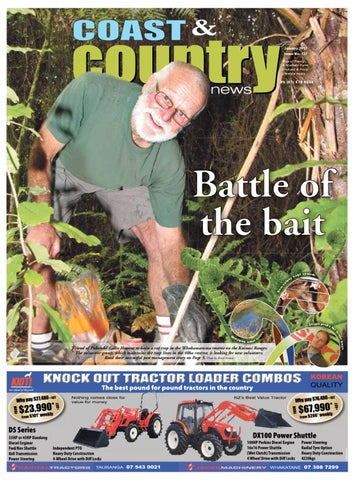
‘Friend of Puketoki’ Colin Hewens re-baits a rat trap in the Whakamarama reserve on the Kaimai Ranges. The volunteer group, which maintains the trap lines in the 40ha reserve, is looking for new volunteers. Read their successful pest management story on Page 3. Photo by Sheryl Brown.
fo r
ys r tra we fe
M
es
Zespri preps
COAST & COUNTRY
Page 2
Coast & Country
Kiwifruit harvest hump for New Year; hope on horizon Happy New Year to all our Coast & Country readers. Let’s hope 2012 brings a booming season for all our key primary industries – sufficient rainfall and sunshine hours, a steady dairy payout and an answer to Psa. By Sheryl Brown
In this New Year edition of Coast & Country we bring you a tale from the bush – looking at some of the great work volunteers are doing in the Puketoki Reserve in the Bay of Plenty Kaimai Ranges. I also caught up with Zespri and their market approach for dealing with the potential 50 per cent drop in the harvest in the next few months. Reporter Andrew Campbell writes about the scientific debate in dealing with the Psa-V
kiwifruit disease. There is good news for the industry though as the root stock is showing to be tolerant to Psa-V. Reporter Phillipa Yalden looks at a new colony egg farming system set to be introduced to New Zealand – something the SPCA is pecking holes in. Freelancer Sue Edmonds takes on water as the Waikato Regional Council puts Variation 6 in place and DairyNZ launch Smart Water field days.
The Wildside team also took to the water this month, spear in hand, and has some tips for the divers out their in Coast & Country land. Coast & Country is your only specialised rural newspaper, delivering from Franklin to Gisborne, covering the entire Bay of Plenty, Waikato, King Country and Central Plateau. This year the team at Coast & Country is focused on delivering our readers an informative, balanced newspaper, which reports on the important issues in the region.
What’s the new cost of A piece of positive news for kiwifruit growers came as 2011 came to a close – with an indication the root stock Bruno is ‘tolerant’ to Psa-V. In response to that, there is potential the new Gold varieties, which are also showing to be more tolerant to Psa, may be a good option for growers to graft this winter. Zespri spokesperson Dave Courtney says there is set to be an industry-wide discussion in February or March involving the new G3 variety and the potential of grafting it this coming winter. As more information comes to light about the potential ‘resistance’ of the new variety to Psa, the industry will need to discuss the logistics around getting the budwood to growers, including the finances involved.
Resilience to Psa
“Gold 3 is showing some resilience to Psa-V,” says Dave, “certainly more than Hort 16A”. “Based on that, there are some people in the industry thinking that should we swap across.” Dave says the issue of the cost of new licences to growers will be part of the discussion. The license prices vary from year to year, depending on numerous factors, including demand and the release mechanism used by Zespri, says Dave. In 2001, growers paid an average of $25,520 per hectare for
Gold3 and $3100 per hectare for Green14. The last time Hort16A licences were allocated was 222 hectares in 2008, with an average tender price of $26,165 per hectare. “The responsibility is now for Zespri to
urgently establish how a swap-out arrangement from 16A to a new variety can occur,” says Kiwifruit Vine Health Inc general manager John Burke. “Zespri is very mindful of growers’ financial situation and ability to pay for things like licences – the sooner we get the industry back on track with Gold supply to the markets, the better off everyone will be. “The cost, if any – bearing in mind it could be a free swap out – will be built into the impact analysis figures we’re doing. “The mechanism by which growers will be able to get hold of G3 for example, will be worked out in the New Year between Zespri and growers.” There are about 700 hectares of newly commercialised Gold varieties planted already. About 98-99 per cent of kiwifruit vines have Bruno root stock, so the fact it is tolerant is a “very important” find, says John. John says it is a relief as they can realistically contemplate replacing
Gold 16A on Bruno stumps with new varieties this winter, which is a far better proposition than replanting. “That’s been a critical component to having a recovery pathway around being able to regraft onto those Bruno,” says John. “Otherwise, we might perhaps be looking at pulling them out and starting again, which is a huge project.” John is stepping down form his role as general manger early this year once a replacement has been found. (Read more on Page 13). “As a grower I’m quite happy to see things where they’re at and being able to look at a recovery pathway where I can graft stumps next winter – getting back on track is really important.
Resistance or tolerance “Three weeks ago I was contemplating just pulling stumps out and growing grass and a lot of growers were, because what we didn’t know was how good our Bruno root stock is in terms of its resistance or tolerance.” The new Gold varieties, G3 and G14, also appear to be exhibiting field tolerance to Psa-V that is consistent with their cane bioassay ranking, however, more field observational work is required to confirm this, says John. “This recognises there are further ‘bridges to cross’ over the remaining season in terms of confirming G3 and G14 survival on Bruno stumps – as well as putting some science behind the assertion that reduction of inoculum levels and hence recovery, will be significantly assisted by the removal of 16A.”
Te Puke 106th
A&P SHOW Saturday 11th February 2012
A&P Showground , Paengaroa, Te Puke (opposite Kiwi 360 on SH2)
PH 07 578 0030
COAST & COUNTRY
Friends of the forest
Colin Hewens sets a mustelid trap. These traps have helped catch six stoats and five ferrets in the Puketoki Reserve. The trap has two eggs inside to lure ferrets and stoats. They have to go in through two holes and eventually when they put weight on the pad – “he’s a gonner” .
Puketoki Reserve in the hills of Whakamarama, between Tauranga and Katikati, is 40 hectares of flourishing native bush thanks to eight guardians watching over it. The ‘Friends of Puketoki’ attend their appointed trap lines regularly, eradicating possums, rats, ferrets and stoats, and in return for their dedication, watch in awe as the native plant and wildlife population thrives. Two of the guardians are moving away from the area, however, and the group is in need of two keen volunteers to attend the trap lines. The work involves about an hour and a half every two weeks, baiting and setting the traps, with two months off during winter. The group is willing to train anyone interested in helping.
Walking the line
To get an insight into the job, I walked the number three trap line in the Puketoki Reserve with volunteer worker Colin Hewens. The retired school teacher is quick on his feet, jumping streams and navigating his way off the beaten track through the bush to each trap location. His love of the bush is evident; reeling off plant names and identifying the bird calls. “It’s always been a favourite place of mine,” says Colin. He knows the trap line without fault; the job a routine which he does every fortnight and weekly during spring sometimes when rat populations tend to increase and bait starts going more quickly.
MS1284
Page 3
Checking and baiting each trap takes about half an hour each time – depending on what is found there, and there is a lot less found in traps these days. In the six years since the ‘Friends of Puketoki’ programme was set up, a total of 392 possums have been killed, with the first 56 dead in the first month. Since then, 16 has been the maximum killed in any one month and now the average is down to about four possums per month. Colin says most of those are juvenile, coming in from surrounding properties looking for a new home; “suckers” as he calls them. Warrior traps are used to catch them.
Non-toxic baits
“We use non-toxic cinnamonflavoured bait – the trap kills them within 100 seconds.” Colin puts in new bait if needed and then smears a blue paste on the bark of the tree leading up to the trap. “It’s flour, sugar and colouring. Possums are apparently attracted to the blue colour.” He then shakes a cinnamon/flour mixture over the paste. If he does find a dead possum in the trap, he hangs the carcass in a fork of a tree. “Then the maggots fall down and the birds eat them. Otherwise, if you leave them on the ground the maggots can burrow down into the soil and pupate, eventually emerging as adults again and you get more flies. “We like to envision North Island Robins underneath a hanging possum having a picnic.” When the traps were put in six
years ago there was only one pair of North Island Robins. “Listening to the bush back then, it was dead, silent.” At a count last November, there were 11 North Island Robins. The bird numbers are estimated four times a year in a five minute survey. “We listen for five minutes at five different spots around the reserve and count the bird calls. “The riroriro, rainbird, is the most common bird. “We have quite a few tuis, there are bellbirds, kingfishers, we get some kakas come over from Tuhua (Mayor) Island in the winter looking for food too.” Colin recently stopped to talk to a group of periodic detention workers who were building the gravel track and steps through the bush. “I told them what a great job they were doing; that people would be able to walk along and look at the bush instead of having to look at their feet so they didn’t trip over. “I talked to them about the work I did and then I heard a North Island Robin and then one actually flew down and landed next to us. “One of the workers then spotted another one; its mate had flown down too.
rat baits, sufficient to kill more than 350 fully grown rats. “We seldom ever see dead rats in here though (now),” says Colin. With Wild about New Zealand, the volunteers put down black Tracker tunnels, which use a pre-inked tracking card to survey populations of small animals. Lures are placed on the inked centre of the card inside the tunnel and while an animal eats the lure, it stands on the inked section. The ink is transferred from their feet to either end of the card where the tracks of the animal are recorded. Colin says ‘rat paw prints’ are down from being on 100 per cent of the
tracker pads to five per cent, while wetas went up from five per cent to 60 per cent in the first two years. “The wetas have just got bigger because the rats aren’t eating them.” To emphasise the decrease in rat population, Colin points out the blanket of native seedlings growing on the ground cover, which he says didn’t exist six years ago. “The rat population was so big – that as soon as seeds hit the ground, they’d be eaten.” Anyone interested in becoming a Friend of Puketoki please phone Colin on (07) 552 6771 or Terry on (07) 552 6222.
My New Year’s Resolution
Purchase a Hot Spring Spa and relax this summer with a BeefEater BBQ
EBBQ E R F r e t a E f Bee $ 99 valued at 21
or Spa s Acctoethessasmoe varlueie *
Life changing chance
“I hope that was a life changing moment for them.” The Friends of Puketoki got started with the help of Wild about New Zealand. It is funded by the Western Bay of Plenty District Council and the Bay of Plenty Regional Council, which supply traps and bait. “We have fed about 10,600 Ditrac
Ford Spa Pools. 34 Chapel Street, Tauranga Tel: 07-578 5866 www.spa-pools.co.nz Terms & Conditions *BBQ offered may be different then BBQ shown. BBQ or accessories valued at $2199 free with every Hot Spring Spa purchase. Deal may vary. Check details in-store. All packages are subject to availability and Hot Spring Spas reserves the right to change specifications and contents. Offer available for a limited time.
Page 4
COAST & COUNTRY
Coast & Country
Hayward vines industry backbone... New Zealand kiwifruit growers are expected to produce 50 per cent of last year’s Gold kiwifruit volume in the next harvest due to the impact of Psa-V.
Gold – Hort 16A – is suffering the worst impact from the vine bacterial disease spreading its way through kiwifruit orchards. The worst hit region, Te Puke, will struggle to get 30 per cent of its Gold orchards through to harvest this year.
Kiwifruit Vine Health Inc general manager John Burke says Gold orchards are “limping through to harvest”. “A lot of them are just limping, limping to port. “We estimate only about 30 per cent of the Gold in Te Puke will make it through to harvest. “Most of the Gold outside of Te Puke in the Bay of Plenty will make it through. “The prognosis for Gold is we’ll have to replace it.” News that Hayward (Green) vines are proving more resistant to Psa-V is a ray of hope for the kiwifruit industry. Zespri is estimating Green volume to be down 10-15 per cent, which is largely seasonal impact, after record numbers of trays last year. Green is not the biggest money maker, however. Gold is. Although the industry will be relieved to hear Hayward is standing up to Psa, Gold is required for the industry to keep its pinnacle status. In the 2010/11 harvest, some 21.1 million trays of Gold earned an orchard gate return of $83,785 million per hectare and made $276.6 million for Zespri (total fruit and service payments). This is compared to the 69.9 million trays of Green which pulled in $32,234 million OGR per hectare and made $550.9 million for Zespri. Zespri profited $1.014 billion for New Zealand grown export earnings in 2010/2011, a total of $883.3 million in total fruit and service payments from a combined 98.1 million trays sold (including Gold, Green, Green Organic and other varieties).
Marketing Green
The good news for Green growers is Zespri general manager for grower and government relations Simon Limmer says they can expect
Zespri’s Simon Limmer expects a possible 50 per cent drop in Gold kiwifruit volumes this harvest. a better return on trays than last season. Simon says Green is strong enough to carry the industry through until there is more Gold variety available.
“The Green has been the cornerstone of kiwifruit for many, many years. Gold has transformed the industry. “I think going forward, to be successful, we do need both. “Hayward will always be the cornerstone of the industry we believe, but we also really believe that the role of new varieties is going to be
significant. “We’ve just got that difficult window that we’re going through now with Psa.” Simon says ensuring a viable Green industry is one of Zespri’s principal focuses. “We know that Green is a more difficult prospect in terms of both productivity and in-market returns, that’s the reality of Hayward.” The biggest drivers for Green are providing consistently good tasting fruit, says Simon. “That’s probably the most important thing, that’s what we’ve stressed for many, many years, and it’s been pretty successful.” Simon says the key for Zespri now is focusing on maintaining strong relationships with market distributors as they prepare for a decrease in the number of Gold trays available.
F QUOREE TES!
COAST & COUNTRY
PH 07 578 0030
Page 5
...but Gold still must for future success
Future marketing
Simon says Zespri will continue to drive its new markets in South East Asia and China, which have been “a significant grower area for
us over the last few years” as well as portraying the nutritional benefits of kiwifruit. He says Zespri is learning more and more about the health and nutritional attributes inherent in kiwifruit and driving those attributes is going to be key. “We know that the future is about a portfolio of products; that’s been well documented in terms of the new cultivar strategy we have, so this is probably a little bit of a hiccup from a Zespri perspective. “We invest heavily in the markets and significant drop back in volume is going to be important for us.
belief in the future of kiwifruit. “The industry is absolutely committed and believes in the future of the Gold variety and kiwifruit in general, and we will little by little see those recovery
pathways becoming more evident. “This is a pretty significant hiccup for us, but we will look back in a couple of year’s time, I’m hoping, with some satisfaction as to where we’ve got to.”
Time to Get Your Gear Covered
New markets
So opening up new markets, also encouraging people to be consuming more regularly and then driving the attributes that we know are really important. Simon says Zespri has been observing the impact of Psa on Hayward crops overseas. “No Hayward industry has been materially impacted by Psa. “It is susceptible to Psa, but it doesn’t have by any means the same level of vulnerability that the Gold or Hort 16A has, so that’s comforting, that’s really
ABCC111219
“The Green volumes are fairly typical volumes, that’s not a major impact on us, the fact that we don’t have Gold in the mix, it kind of has an affect with the relationships with some distributors who like to have a mix of Zespri products. “It’s just a matter of us striking a balance now to ensure that the dialogue with the markets is still: ‘look, it is going to be a bit of a lull for a year or two, but we’re going to be coming back in the future with Gold volumes’ – we will need all that market power in the future.” Simon says Zespri has yet to go into many market discussions with distributors about the impending low Gold volumes. “Until we know exactly where we are going to be, we haven’t had too many discussions at this stage, but we know that Gold has been a really strong performer, not only for us and for growers, but also for our in-market partners. “If we go into a decline in terms of volumes, which we are doing, we want to make sure that we have those markets ready to go again in the future when the solution is starting to come online.” Simon says the upside in having a slightly smaller crop this year is it allows Zespri to optimise the market mix.
good,” says Simon. “But we also believe strongly that there is a future for Gold and the other varieties as well. “There’s been a bit of talk about the Gold variety – the potential end of Gold – I believe there is a real focus and belief that we will come through it from a Gold perspective.” Simon says Zespri will continue to work hard on research, ensuring they are working as hard and as quickly as possible to find various solutions on alternative varieties and alternative products. “Time is the biggest challenge for us, but also the most informing factor right now. “We just need to get through the coming months and see where we are at to understand what the impact is going to be on the various different cultivators that we have. “We just don’t have enough knowledge at the moment and we’re going as fast as we can.” Simon says even though Zespri’s worst expectations have been met in the face of Psa, there is strong
Fully constructed or kitset assembly with the choice of clear-span structures in timber or steel. At Aztech we listen to your individual requirements and specialise in creating building solutions that are built within your budget whilst exceeding your expectations. Contact us today for your FREE information pack. FREEPHONE 0800 298 324 EMAIL sales@aztechbuildings.co.nz
www.aztechbuildings .co.nz
COAST & COUNTRY
Page 6
Coast & Country
Government considers new colony egg system
HAY - SILAGE & STRAW SUPPLIES
NEW SEASONS SPRING BALAGE AVAILABLE NOW GRASS BALAGE, LUCERNE BALAGE, SORGHUM BALAGE, BULK MAIZE SILAGE CONTRACTS AVAILABLE Delivered direct off the paddock to your farm at reduced prices
Free range system.
A government review of egg farming practices in New Zealand could mean the introduction of a new colony egg farming system, but the SPCA say it is still not good enough. B.O.P, WAIKATO, HAWKES BAY, MANAWATU SECURE YOUR SUPPLEMENT FOR THE COMING SEASON HAY & BALAGE, PEA VINE HAY, LUCERNE HAY, RED CLOVER SORGHUM & CEREAL BALAGE, THRASHED RYE GRASS BARLEY STRAW, WHEAT STRAW, PEA STRAW, OAT STRAW
NEW THIS SEASON: CERTIFIED ORGANIC HAY FREE RECYCLING OF BALE WRAP AVAILABLE TO ALL OUR CLIENTS
PRODUCERS AND SUPPLIERS OF QUALITY HAY PRODUCTS
JASON HILL 0274 585 295 Email: hay_man@xtra.co.nz
In a move to phase out current cage egg farming practices, the National Animal Welfare Advisory Committee is considering introducing a new furnished colony cage system to allow the hens greater engagement in natural behaviours. The furnished colony cages have been tried in Europe and as of January 1 this year, all cage farmers in the European Union are required to implement these new cage systems. In New Zealand, 89 per cent of raw eggs are produced using conventional cage systems, with the remaining 11 per cent coming from free range and barn farming. NZ Egg Production Federation senior executive officer Kerry Mulqueen says the new colony system is widely accepted internationally and will allow hens more space and increased ability to scratch, perch and nest.
“Overall, they have more colony size. The older systems do not allow for a nest box, perch or scratch pad. They can also house more birds per square metre, but is it is still a more intensive way of farming than free range and barn systems.” New Zealand law currently allows hens to be kept in cages of 550 square cm – approximately the size of an A4 piece of paper. The new furnished colony system comes in different sizes of up to 750 Sqcm total area per bird. “That is the total area, so if you have got 60 birds, then you need 60 times 750sqcm and that includes the nest box and perches.” Juliette Banks from the Royal New Zealand SPCA says the new colony system is still a cage-based system and the organisation is completely against it. “A cage is still a cage as far as we are concerned. We do not support it and do not agree with it. “We don’t believe any animals should live in a cage, no matter what the size. “It is just a dispensation that the poultry industry has been given against the Animal Welfare Act to allow it.” In Europe, where the colony cage
system is widely used, Juliette says consumers are not supporting it, which has caused a great financial impact on the European industry. “People are turning away from colony cage systems in Europe. Now there is a financial impact, but they have the benefit of being able to sell the cages to other countries close by. “We don’t have that possibility here; no one will take them if we bring them in.” Juliette says the new colony system is a 20 year financial investment for the country and once it is introduced, farmers will not easily be able to switch to free range methods. “We are already seeing the market shifting from caged right into cage free.” “If the industry allows it and the government passes it, we are going to see 20 years of having those cages in New Zealand. “We know consumers are becoming far more educated and conscious of how their food products are made and farmed – in 20 years time no one is going to want those cages, so our industry is going to be stuck with the financial burden.”
PH 07 578 0030
COAST & COUNTRY
Marketing method, not farming The furnished colony system costs up to 50 per cent more than conventional cage systems, for 20 per cent less hens. Kerry says the introduction of this system can not therefore happen immediately and will require significant investment by individual operators. “We get various figures on the cost, but it is
colony cages is approximately the same as establishing a barn system. “It just costs a bit more to run the barn, which is minimal.” NAWAC is currently reviewing submissions and putting a Code of Conduct to present to the Minister of Agriculture and Fisheries, who will then consider the economic aspects of the submission. “NAWAC has put it out for public draft and received submissions,” says Juliette. “NAWAC has indicated the EU standards of colony cages will be acceptable from a welfare point of view.
rming l cage egg fa Conventiona being used in s system . New Zealand estimated to be between 40 to 50 per cent more than existing cages. “If you had 1000 hens in a barn at present, you are going to have 800 in the new colony system.” “A lot of equipment in the existing systems can be transferred across.” To build the new colony system from scratch to house 40,000 birds Kerry estimates the cost will be more than $2million. “That is for the basic model; then you can add in the whole range of extras. It depends on what you add into the system.”
Options for farmers
Kerry says farmers have three options: They can decide to pull out of farming, introduce the new colony cage system or convert to free range or barn systems. “The world is moving away from existing cages to these other forms of systems. What may happen is a lot of the smaller operators who exist at present and may have been farming for the last 20 to 30 years will exit the industry and possibly won’t take the capital plunge to go higher.” Juliette says the cost of installing these
Barn system. “If you have cages at present and this law is brought in you will have a certain number of years before the current cages become prohibited.” Kerry says the period of implementation will depend on the economic ability of farmers to introduce these systems and on the ability to supply these new colony systems. “These new systems are mostly manufactured in Europe. No one in New Zealand manufactures them and with the phase-in period happening in Europe next year the companies making these cages are flat out, they could not actually supply them at the present moment.” Juliette says the industry is placing too much emphasis on introducing new fur-
nished systems when issues like labelling are going unnoticed. Juliette says there is currently no legislation in New Zealand for labelling on eggs to tell people whether or not they are free range. “Consumers are very confused about what type of eggs they are getting. Anyone can claim to be free range.”
Blue Tick Programme
The SPCA Blue Tick programme is an accreditation scheme that certifies farms that humanely farm, including barn and free range eggs. “We have defined what these farming methods mean because there is not a legal definition of any farming method. Free range is just a marketing term, it is not a farming method.” The programme includes independent annual audits and spot auditing to ensure farmers are undertaking the required practices. “That, along with the SPCA name which is a very trusted brand, gives consumers a guarantee that consumers know what they are getting.” Juliette says currently an individual farmer can run both battery and free range farm and may be mixing eggs within a packet, giving consumers no insurance they are receiving free range. “There are no auditing or management systems to make sure this is not happening – you can not guarantee you are getting a free range system. With Blue Tick our auditing system goes from paddock to plate.” Juliette has been working in the Blue Tick programme for the last 18 months and says the programme is “racing ahead”. “We are seeing a real move towards Blue Tick from consumers, knowing and demanding it, farmers are approaching us. “Not everyone can join Blue Tick as our standards are high and so they are having to change their farming practices to ensure they meet these standards and improve the welfare of animals.” By Phillipa Yalden
Page 7
COAST & COUNTRY
Page 8
Coast & Country
Questions over Psa management A scientific show down is being arranged for February next year to debate interpretations on the Italian Psa research.
current Psa management strategies may be in error. “It was a solid meeting,� says David. “We are going to have another in the New Year where we are going to discuss science. “Nathan had a proposition and we didn’t really get the opportunity to debate some of that.� David says in science, there is often two sides to the story. “Nathan got his opportunity to tell us what he thought and we ran
Independent scientist Nathan Balasingham met with Seeka and Satara chief executives, a couple of growers and Zespri Psa innovation manager David Tanner in December, to give his interpretation of the results – which he says indicates
HOUSE & LAND
UNDER $400,000? INCLUDING PERMIT FEES, FLOOR COVERINGS, DRAPES & BLINDS, HEATING, DRIVEWAYS, PATHWAYS & FENCES
Featured Plan:
Hillsview Subdivision Tauranga $379,000 Phone for details of packages in your area
Up to
95% Finance
Superior ZogÂŽ steel
GoldsealÂŽ 10 year
frame technology
completion &
with 50 year guarantee
defects warranty
NEW SHOWHOME Excelsa Village, Papamoa Open Tues & Thurs 2-4pm & Sundays 11am - 3pm or by appointment call 07 985 6336
PA N 1 0 2 1 2 2 7
Call 0800 22 22 56 R to Ro toru ru ua Taur Ta u an ur anga ga a
By Andrew Campbell
out of time to really get into the debate. “We are wanting to have more scientists in the room when we have that debate next time round. “Science can be interpreted a number of ways and we believe there are some other interpretations from that paper. We think the paper is really, really good work. But we do think the nuances in the way he has interpreted the paper could be different.
0 7 34 5 30 77 0 7 5 7 7 9 93 4
A DIVISION OF GOLDEN HOMESÂŽ
“We will further discuss that when we have more specialists in the room, rather than just Nathan presenting his view, which is all we got.� The February meeting will be hosted by Seeka. The Italian research showing Psa-V is resistant to copper and antibiotics is being used to challenge Kiwifruit Vine Health’s management of the industrywide crisis. Orchard experience shows spraying copper and antibiotics on vines is not producing positive results says Nathan. “As well, orchardists have reported phytotoxic or plant poisoning problems from antibiotic sprays, but their reports have been ignored or blamed on poor spray application technique.� There’s no point running around spraying all these pesticides on top of the plant, you only make it worse says Nathan. “The immunity to streptomycin and copper is now part of the chromosomal gene it carries it through all the differentiations and versions, but the important thing is when you spray antibiotics and you know the organism is one that’s already resistant, what you are causing is you are taking off all the weaklings
and leaving the local heavies. You are making them heavier and heavier, so they become superbugs.� With copper, the effect is similar says Nathan. Psa-V’s natural mild resistance to copper is stimulated. “That is why I want to get these guys around the table and point all these things out, because KVH are just skirting around and clouding the whole issue. “That’s why I’m sick of them. The sort of damage that’s happening in the field is absolutely incredible.� He’s got photos of leaf damage that looks just like Psa damage. The Italian scientists’ also find the current virulent form of Psa-V has the ability to breakdown essential oils that the plant produces, stores and uses as a natural chemical defence. Nathan says it means the practice of removing vine foliage is a bad strategy as it removes the “factory� that produces these essential, protective oils. “They (KVH) know very little about the immune systems in plants and they are just monkeying around with products that are really damaging the whole plant’s system,� says Nathan.
JORDAAN
PH 07 578 0030
COAST & COUNTRY
Page 9
Copper just building immunity? “It’s weakening it and soon our green plants will fall over. If they continue what they are doing the green plants will fall over.” KVH general manager John Burke couldn’t make the meeting. I think there is a difference of opinion among some scientists over what Nathan is saying and it’s based around Nathans interpretation of the Italian scientists work,” says John. “Dave Tanner – he has had a discussion with Nathan, I couldn’t make that meeting. “Whatever Dave has said I will run with. “There’s obviously a difference of opinion there. We would rather work through those interpretation issues – try and get on the same page.” Nathan says a range of tools are already available and scientific evidence exists to abandon some of the current risky orchard management practices. “Field evidence has already accumulated to show orchardists who have been using these materials, have reduced the level of fertiliser applications, stopped girdling and unnecessary foliar fertiliser applications. These orchardists are beginning to see more resilient and healthier vines in their orchards. “We can now fight the organism in the right jungle – cornered within the vine.” Nathan’s approach is backed up by Katikati orchardist Peter Hope who credits Nathan’s approach with the reason his orchard, the two he manages, his neighbours and his cousin’s in Te Puke are all, so far, Psa-free. “I do think Nathan’s on the right track,” says Peter. “KVH does need to be challenged a bit. There’s science being done all around the world that says the opposite of what KVH are telling us to do. There’s a bit of conflicting information there I think. “Growers all over now are saying they are not going to use copper any more because they have seen the effects of copper on their plants. “Copper is detrimental to the plant and yet the advice is still to stick copper on
and there’s guys out there who are just suffering really badly. “They are told to put copper on and they look at their orchard and say they can’t afford to put copper on any more because of damage it’s doing to my plant.” Peter says all copper is doing is weakening the plant. “We don’t want weak plants, when the leaves are spotting and get all this black stuff on them and the leaves are cupping, it’s weakening your plant and you just don’t want that.”
He’s been using Nathan’s product for five years. “We started using it because we were talked into girdling the Gold one year and the following year all the vines were packed up. All the vines were really sad, they were horrible so a Tauranga advisor recommended Nathans’ elicitor brew. “Five years ago we started using it and the health of the orchards, two we manage and our own is just tremendous. “No Psa, not even a sign of anything. It’s good and healthy, same as my cousin in Rangiuru road. He’s sitting there with a nice healthy orchard and all around him everybody’s got it and are pulling their vines out. There’s got to be something in there.”
Nathan’s held two public meetings in Te Puke and one in Katikati explaining his approach to growers. KVH also has grower meetings. “At these meetings at KVH it’s the stuff they don’t tell you that’s important,” says Peter. “There’s a lady in US, Bobbie Bassler and her and a bunch of young scientists, their job to find a replacement for penicillin, their job was to find out all about bacteria. One of the things they did find is bacteria communicate with each other, they talk to each other in groups, as individuals and they can count. When you attack them with something like copper or key strepto all they do is send a signal out to the other ones. They secrete themselves a ‘spray suit’ then they split down the middle and divide. All this happens within an hour and so there’s more bacteria after you spay than before because they multiply until they are even stronger. “To me no different to Psa. If we don’t kill it properly,
all we are doing is making it immune and we are just strengthening it all the time.” He recommends an 18 minute video, which he says gives a most fascinating insight into bacteria. http://www.ted.com/talks/bonnie_bassler_on_how_ bacteria_communicate.html “It’s absolutely brilliant to watch and you get a better understanding of what bacteria are about. And when you listen to that and you listen to what these scientists in Italy are saying, the strain that’s affecting our vines here has immunity to copper and streptomycin. “It is frustrating and I think a lot of growers are getting frustrated. They are all deciding not to use copper any more they have all seen the effect. They are all turning away from it. I think KVH need to know about that. “I reckon they are looking down the wrong rabbit hole and coming up with the wrong answers.” By Andrew Campbell
5
3
3
2
Page 10
FACIAL ECZEMA & FLY CONTROL
Coast & Country
Start prevention zinc treatment Facial Eczema is a disease which causes lowered production and sometimes death from liver damage. Fungal spores produced by the fungus Pithomyces chartarum growing on pasture produce a toxin which when ingested by cattle damage the liver and bile ducts.
The damaged liver cannot rid the body of wastes and a breakdown product of chlorophyll builds up in the body causing sensitivity to sunlight, which in turn causes inflammation of the skin. Symptoms: The first sign of FE is a drop in milk production occurring soon after the intake of toxic spores (subclinical FE). Cows are restless at milking time, seek shade and lick their udder. Another drop in production occurs when physical symptoms (clinical FE) become obvious. Exposed unpigmented or thin skin thickens and peels. Watch white areas, teats, inside the hind legs and the udder and udder support area. Effects: Not all animals affected with FE show physical symptoms (ie. clinical FE) although liver damage has occurred. Milk production of animals with subclinical FE can be depressed by up to 50 per cent. It is estimated for every three in 100 cows showing clinical FE, about 70 per cent of the herd may have subclinical FE.
Badly damaged liver tissue will not regenerate. Chronic wasting and or death may occur at the time of damage or months later when the animal is under stress, eg calving. Occurrence: The fungus produces spores when grass minimum temperatures are above 12 degrees for two or three nights and humidity is high (usually January to May). The fungus grows on soft litter at the base of the pasture so hard grazing during danger periods increases the risk of spore intake as does topping, which increases the build up of soft litter. Early exposure to low levels of spores will sensitise animals. They then get FE at lower spore intakes than animals not previously exposed to spores. FE damage can occur from long term intake of low numbers of spores, short term intake of high numbers or a combination of both. The appearance of clinical FE results from spore ingestion 10-20 days earlier. Start FE Control Early: Ideally start Zinc treatment two to three
vet’s view with Ravensdown Vet Gavin Goble
weeks before the spore growth danger period for maximum protection. Spore counting: Spore numbers vary within and between paddocks, so spore counting is the only accurate way to detect danger periods and map ‘hot spots’ vs safe areas on the farm. Pasture samples should be from at least five places in the paddock. The young spores are the most damaging, so detection of a rapidly increasing spore count is essential. Pastures may be toxic once spore counts reach more than 40,000. Long-term grazing of pastures with lower spore counts is also dangerous. Zinc treatment: Treatment should begin, at the latest, as soon as weather conditions favour spore growth and or at the first sign of rising spore counts. For a full list of treatment options and doses visit www.dairynz.co.nz and search ‘facial eczema’.
Effects of tapeworm in lambs Results from new trials may cause some re-thinking on the possible effects of tapeworm on lamb growth rates.
Pelletised Ultra-Fine
LIME
Available Now!
Tapeworm – Moniezia expansa – is a common parasite in young lambs. It is seen as white segments in the lambs’ faeces, after which they naturally develop immunity to this parasite regardless of treatment. Treating lambs for tapeworm has always been controversial as until now, numerous trials have shown no positive live-weight response to tapeworm treatment. There is a widespread belief, however, that they cause a smelly scour that is attractive to flies (hence leaves lambs more prone to flystrike) and many farmers believe it can reduce growth rates or even cause lamb deaths. The visual nature of tapeworm segments seen in the faeces also drives the decision to drench. The stance by many advisers on treating for tapeworm in lambs, at or before weaning, has been that if a farmer perceives this as an issue, then treatment may be warranted – but no growth rate response is guaranteed.
Treating for tapeworm is more expensive, about double the cost of a non-tape (roundworm-only) product, as a specific narrow-spectrum drug called praziquantel is needed to effectively remove tapeworm. Most tapeworm drenches containing praziquantel have the words ‘Tape’ or ‘Plus Tape’ in the name to distinguish them from a roundworm-only drench. Information from a recent set of trials, however, has just been released showing a significant response to pre-wean drenching for tapeworm and roundworm (triple drench plus praziquantel), versus just treating for roundworm (triple drench) and a control group who were not drenched at all. Key findings were that the addition of praziquantel to the pre-wean drench, although variable, gave an average 24g/day live-weight gain advantage over the group that received a roundworm-only drench, which is statistically significant and economically worthwhile. There was also a reduction in dags when praziquantel was used over the straight roundworm drench. Note that in this case, a triple combination roundworm drench was used, but the same results would be expected by using any drench that is fully effective and this is dependent on the farm’s drench resistance status.
PH 07 578 0030
COAST & COUNTRY
Page 11
Is it really worth it kiwifruit growers? Hi Sheryl, Firstly let me introduce myself, my name is Grant McAlpine, I have been a passionfruit grower for about 13 years. The articles you wrote in the Coast & Country about tamarillos, passion fruit and kiwifruit were extremely good, but somehow the message did not come out as to the full repercussions the Psa virus will have, especially on the passionfruit growers. As you will be aware we are a very small industry, in the 13 years I’ve been a grower, the size of the industry has not changed, production figures have remained relatively stable. Some may argue that we need to grow, to get out there with our increased volumes and challenge the world. I’m sorry, but with passionfruit it just doesn’t work like that. From your article, ‘Considering crop changes’, there seems to be some potential growers who would disagree. They seem to think they can produce bucket loads of passionfruit, send it abroad and get bucket loads of money in return. They obviously have done their research on net returns and they seem to be aware of market saturation. It’s about now that these few potential growers need to sit down, preferably in a quiet corner, wipe the ‘dollar sign’ from their eyes and seriously rethink their strategies.
Jumping on the bandwagon
Fighting costs
At the end of the day there is no difference between a kiwifruit grower and a passionfruit grower, both striving to keep the wolf from the door, fighting the continuing compliance costs that some pumped up government official decides to throw at us, good old ‘Mother Nature’, and let’s don’t forget the recession. As growers we are the same, but as industries, well its like chalk and cheese. The resources that the kiwifruit industry has at their disposal are obviously enormous and it’s for that one reason I ask Mr Potential Grower to stay within your own industry. What Psa has done to you, you will do the same to the whole passionfruit industry. Psa is a Kiwifruit industry problem; don’t make it a passionfruit industry problem. And just one final point to consider, don’t be fooled, if we go down, you’ll be coming with us, is it really worth it? NB. These comments and views are not necessarily held by the passionfruit industry. Grant McAlpine, Industry committee member.
THREE BROTHERS
If growing passionfruit is so good and lucrative, how come we are so small? Don’t you think every Tom, Dick and Harry would have hopped on and joined the fun, many have tried, but sadly they have fallen by the way. Passionfruit is an extremely intensive crop; it requires complete dedication, resilience, fortitude and a dose of good luck along the way. So Mr Potential Grower lets go over the research that you have so painstakingly done, you’ve successfully produced your passionfruit, now what are you going to do with it? You’ve found some new markets, markets that won’t interfere with the other growers in the industry, great. You’re exporting to Asia you say, don’t you think we’ve been down that road before? Will you still be exporting to Asia at $5kg, when the rest are getting $10kg in the USA? I think not. So you are exporting to Asia, what about the fruit that fails to make the export grade? Put it on the local market of course. It’s about now that our dear friends in the USA tell us to stop sending fruit because they have a massive log jamb, fruit sitting in coolers with no buyers. So it’s about now that all the NZ passionfruit is sold on the local market, guess what happens? See, it was a good idea for you to sit in a quiet corner and clear those eyes, because if you hadn’t, you would have got this one wrong. I can not help but get the impression that Mr Potential Grower thinks he will be isolated from the rest of the passionfruit industry, doing his own ‘thing’. He got this one wrong. As I have tried to emphasise, because the industry is so small, every extra kilogram of fruit put on the market will in some way have an effect. Small changes in volumes are absorbed, but those small changes will still have some impact. It may only take one grower to start a bit earlier than expected to cause a decline in prices or at the other end, that one grower may have a bit more fruit than expected therefore maintains a higher output for a longer period causing the markets to stall. Just an added reminder, we are not on a pool system, we haven’t got the luxury of that safety net. Now let’s put some figures on the table. If one Mr Potential Grower plants 2500 vines, at a volume return of 18kg/vine, remember these are being planted in fairly good ground. That equals 45,000kgs of fruit. Working on an 80 per cent export pack out, that equals 18,000 trays exported, leaving 9000kgs local market. Put these figures against the present industry figures and all I can say is “you’ve gotta be joking”. Remember this is just one Mr Potential Grower that’s
‘done all the research’, how many more are out there? We’ve done some figures; now let’s look at the percentages. I do not profess to be too accurate in this area, but I do think it may offer a clear insight into the overall effect that this devastating disease will have on the passionfruit grower. The reports that I have read suggest 100 per cent of Gold will be affected, the Green will suffer less. May I suggest that the unaffected or partially affected orchards that remain may even see their returns improve. Irresponsible kneejerk reactions by some Mr Potential Grower will decimate 100 per cent of the passionfruit industry. Their actions will affect every passionfruit grower in New Zealand. Then to top it all off, they are only going to be in passionfruit for a couple of years until Mr Zespri develops a new root stock, then they will bugger off leaving a trail of destroyed passionfruit growers – talk about being used and abused, it’s nothing short of commercial vandalism. I read articles of government assistance and I might add that I agree totally, I read articles of help lines for growers in need; great. But where has the help or assistance for passionfruit growers been, growers that have had their crops wiped out by ‘Blackleg’? Where is the help or assistance for growers who may have only half their orchard producing, the other half is dead? Don’t get me wrong, I sincerely sympathise with the kiwifruit growers and any associated businesses that have been affect by the Psa virus.
THREE BROTHERS
HORTICULTURE
Page 12
Coast & Country
Grower and community pastoral and financial support There are four main work streams for Psa control, management and ultimately the required solution. These work streams are: 1. Biosecurity Controls to contain and limit the spread of Psa as much
as is possible. A key part of this is the implementation of a National Pest Management Strategy in 2012. 2. Psa Research and Development followed by grower extension/tech transfer passing on what has been discovered. This programme has seen new and effective sprays being developed that are
making a difference. 3. Developing a Pathway Back to Prosperity, based on Research and Development and on orchard observations. The first step here is to find tolerant root stocks and varieties that will keep the industry functioning. 4. Grower support and welfare to support those in need, to keep skills in the Bay of Plenty and to enable us to have a viable industry and community while kiwifruit recovers. This article focuses on grower and community support. It makes suggestions that apply to anyone dealing with Psa, be they a grower, kiwifruit worker or an associated business. In December, support seminars were run throughout the Bay of Plenty providing advice and information on tax issues, financial decision making, the financial advocates’ panel, an update on the work with banks, what support is on offer from Work and Income and how to detect and
manage stress. These meetings were open to everyone in the community. In Katikati, for example, about 100 people attended the seminar with about half that number being made up by people who do not grow kiwifruit. In addition, drop-in clinics and courses teaching techniques to deal with stress have been run. Community organisations and the local churches have provided incredible support. If you, your family or someone you work with needs assistance, your first call should be to your GP as they can assist with medication and counselling. There is also the Depression Helpline (8am to midnight) on 0800 111 757, Lifeline on 0800 543 354 and for growers, the Rural Support Trust on 0800
787 254. In extreme circumstances the police on 111. The advice given during the support seminars included using your networks of friends and colleagues, talking about the Psa crisis and encouraging others to talk about it, staying active, the importance of sleeping well, getting time away from the Psa crisis and, most importantly, developing your plan to get out of the crisis. There was a pack of papers and handy information and contact numbers given out at each of the seminars. Financial planning and managing your relationship with the bank were also part of the seminar series. There is a useful financial planning tool developed by Fruition Horticulture and a panel of financial advocates to assist you manage your bank. If you need this assistance or a copy of the information package handed out at the seminars or a copy of the slides that were used, contact NZKGI’s office toll free 0800 232 505 or 07 574 7139 or email info@nzkgi.org.nz
MAF reviews Psa import
ORGANIC CERTIFICATION LEADING THE WAY IN ORGANIC TRACEABILITY We offer:
We certify to:
Global market access
AsureQuality Organic Standard
Integrated services e.g. GLOBALG.A.P & BRC
IFOAM
National coverage
NZFSA Official Organic Assurance Programme
Our own residue testing laboratory
USDA National Organic Program
Competitive pricing
Japanese Agricultural Standard ®
Freephone 0508 00 11 22 www.organiccertification.co.nz
My Name is Neil Woodward. I am a director of Z-Contracting- we are family run business, our team consists of three, being myself, my son and my brother. Our organisation has been established for over 18 years. I have been involved in applying crop protection programmes within the horticultal industry since 1966. We specialise within the kiwi fruit industry, We have the equipment to spray orchards with our two Atom sprayers and one recently purchased Tracatom Formula tractor which is also available for mulching and mowing.
The Ministry of Agriculture and Forestry is commissioning an independent review of its importing rules as part of ongoing work into how the kiwifruit vine disease Psa entered New Zealand. Director General Wayne McNee says the review is a sensible step to ensure MAF’s systems are as good as they can be. It is welcomed by the kiwifruit industry which had requested the inquiry. Wayne says in order to help the kiwifruit industry manage the disease’s spread, MAF has looked into a number of possible ways the bacterium could have entered New Zealand and has produced a report summarising the results of those investigations. “The report does not identify a definite means of introduction, but does find there are a number of potential pathways, including people, equipment, and pollen.” Since the tracing report was
finalised last month, MAF has completed additional preliminary research that shows live Psa bacteria can be found in kiwifruit pollen taken from inside closed flowers. MAF's importing rules at the time of the Psa outbreak permitted imports of overseas kiwifruit pollen by the kiwifruit industry and others under strict conditions. Pollen importation is now banned says Kiwifruit Vine Health general manger John Burke. “But the review isn’t about that – it’s about the process. The actual tracing report gives various pathways into how we could have got Psa-V into the country. “We’re conscious of the fact that because the Ministers asking for a review around pollen importation everyone will put one and one together and get five and say well pollens the vector – but that’s not necessarily the case. “Why we asked for a review was because of the processes – we’re concerned that there are proper processes in place around the importation of any material in relation to any primary sector.” The MAF Psa-Pathway tracing report is at: http://www.biosecurity. govt.nz/files/pests-anddiseases/psa-tracing-report. pdf
Our Atoms are set up with radar speed sensors, this combined with fully automated sprayer controllers and three nozzle rings enhances application efficiency and accuracy. We also use a quad bike for strip weed spray applications. We hold all certificates needed to meet Globalgap compliance. We look at all challenges to help ensure we protect your crop with excellence.
216 Pongakawa Bush Road Te Puke
To contact us: Phone: 021 907 621 E-mail: zcl@zanadu.co.nz
HORTICULTURE
PH 07 578 0030
KVH boss stepping aside KVH general manager John Burke.
The man who led the kiwifruit industry’s fight back against Psa is stepping down from the helm. Kiwifruit Vine Health general manger John Burke helped establish the independent entity after the Psa vine bacterial disease was first found on an orchard in November 2010. “I’m not pulling out for stress,” says John. “When I took on the job it was for a year’s contract. “My brief was to take it through to a certain stage and I’ve done that. “It’s sort of been more like a project manager role, getting everything up and running and putting in place all the foundations; building blocks for how we want to run things going forward. “It’s been a highly stressful job, but it’s also been very challenging and rewarding.”
Handing over
John says KVH has done a huge amount of work in the last 12 months and for him it is a matter of handing things over at the right time. “We’ve done a heck of a lot of work in setting up KVH and all the operational aspects of dealing with Psa and integrating that into the industry. “It’s been a total team effort, both by KVH and the industry to get things up and running and things are up and running really well now.” A new general manger is planned to be appointed in the new year with John carrying on his duties in the interim. He will continue to be involved in the financial advocacy side of KVH. “I’ve been involved in looking at the recovery pathways for growers and the industry and I’ll carry on doing that in the interim and then bringing in a new person to take over the running of the core operational of KVH. “Tied into that is doing the impact analysis report, which is due out in February. “There will be a bit of ongoing work around that so I’ll be focusing on that.” The impact analysis report includes potential recovery pathways and examining whether or not that recovery pathway can be assisted and what the cost benefit of that will be. John says KVH’s future role will be around biosecurity, not just dealing with Psa, but all the pests and disease risk to the kiwifruit industry. “I think with the lessons we’ve learnt around the incursion and how to manage it, I think we owe it upon ourselves and the rest of the primary sectors of New Zealand to lead the way in terms of our relationships with MAF biosecurity and how we manager our border controls and are prepared for incursions.”
John says the kiwifruit industry needs to embrace a general industry agreement with MAF. “We feel, as a living case study – that could serve as an example for other primary sectors (to set up a GIA). “Our country is so exposed and so reliant on our primary sector, it’s important we make that work really well.”
Industry in action
John says one of the more rewarding aspects of his job has been seeing the cohesiveness of the industry in action. “KVH is not a big organisation, it’s very small, and what we’ve achieved in the last 12 months is pretty substantial, but it’s been done through a cohesive industry effort. “So that’s what’s rewarding for me, it’s seeing everyone come together and put their shoulders to the grindstone when they’ve needed to. “KVH, we’ve got a great little team here, who have been working in really stressful circumstances, but a lot of it’s been facilitation and harnessing the strength and resources from within, right across our industry; that’s with growers, post harvesters and with Zespri.” John says the role of the next general manager will be more operational than set up – but they are taking the challenge on at a good time. “We are now starting to see a recovery pathway. “What we’ve been dealing with for 12 months is a whole lot of unknowns; and the needing to deal with a whole lot of questions. “We’re just starting to gather momentum where we are answering some questions, we can see a potential recovery pathway and– we’ve still got some bridges to cross – but if we can cross those bridges we’re going to be back on track within the next two or three years hopefully.” By Sheryl Brown
Page 13
Page 14
HORTICULTURE
Coast & Country
Susceptibility to infectious diseases Peter Lester of Quantum Laboratories
from the lab The body’s first line of defence against infection is the skin, mucous membranes and digestive tract lining. Bacteria can usually not penetrate the skin unless there is a break or wound in it. Three factors make it possible for bacteria, as tiny as they are, to kill a beast; their prodigious rate of multiplication, in which they can increase in numbers to countless billions within a few hours placing a tremendous burden on the tissue; their ability to destroy the tissues of the body, thus interfering with the body’s functions; and the most deadly attack – the formation of toxins. As with any disease, the animal must first be exposed to a pathogen to acquire the necessary acquired immunity. Because we know certain diseases do not return twice in a lifetime, we expose ourselves to various forms of the disease so that the body will produce the necessary antibodies. This line of defence is known as acquired immunity and is the last line of defence against
infection. Back in the 18th century, people exposed themselves to smallpox early in life in order to have it at their convenience and get it over with. It was later discovered that people who contracted cowpox, a similar pathogen, became immune to smallpox. The person who has gained immunity to smallpox, however, is no more immune to measles than any other disease. This shows us that the immune reaction is specific. The action of acquired immunity is dependent on the production of specific proteins, called antibodies. In the presence of some foreign protein, termed an antigen, the body reacts specifically with its antigen destroying or neutralising it. As this response is produced by the body’s exposure to the pathogen in the first instance through the production of specific proteins, it stands to reason then that the animal must first be provided with the tools necessary for the production of the specific proteins, including the required activator ions. Such protein formations are
Add an avo’ to dinner The New Zealand Avocados Growers’ Association is making a significant push into the Australian market by using creative techniques and the latest technology to help sell this year’s record-breaking New Zealand crop and continue to drive consumption of the popular super fruit. A new mobile phone application providing recipes is being utilised through Australia and New Zealand’s largest online recipe community allrecipes.com.au. The app is known as the ‘Dinner Spinner’ and works by letting the user search for recipes by dish type, ingredient or preparation times. They can literally shake their mobile phone to bring up a random selection of recipes and avocado recipes are to star as the feature ingredient through December and January, which coincides with the biggest sales time for the fruit. NZAGA has secured extensive space on the All Recipes website to feature avocado recipes and advertising to in turn drive consumer to the addavavo. com website. Almost three million trays of avocados
very specific; they require the assistance of protein catalysts or enzymes and each enzyme has only one function. The formation of these enzymes is also very specific: The temperature must be right; the pH of the substrate must be right; the specific activator ions must present; and the presence of nitrates. Nitrites and Non Protein Nitrogen will slow down or inhibit the formation of the specific enzyme. Stress or lack of it will enhance or retard the animal’s defences. If for some reason we create an environment that is foreign to an environment that would be termed ‘normal’ we also increase the need for the animal to adjust to the new set of conditions. Such adjustments may require increases in energy, protein, minerals or vitamins. In the main we are dealing with ruminating mammals, this means we are first and foremost dealing with bacteria, which, in the main, are beneficial. In dealing with bacteria we must understand that these little critters are environment specific. That is, changes in their environment will also change the violability and population mix.
are expected to be exported to Australia by the end of March. The NZAGA is currently spending $500,000 on a marketing campaign to persuade Australian consumers to ‘Add An Avo’ to their daily diets. Australians consume about 3.1kg of avocados per capita – significantly more than New Zealanders who eat 1.9kg. “Australia is our largest avocado export market so it’s worth putting in as much effort as possible because New Zealand growers have harvested 20 per cent more Hass avocados this year than ever before,” says NZAGA communications manager Midge Munro. NZAGA chief executive Jen Scoular says the organisation has run marketing campaigns in Australia for the last three years, but the 2011-12 season has seen the largest commitment of resources. “In addition to targeting consumers directly, we are advertising in foodie magazines and providing information and recipes to the Australian media which they can use to create stories and help spread the ‘Add An Avo’ message.” “We utilise the marketing material used by the Australian industry during the winter season, so consumers are receiving the consistent ‘Add An Avo’ message all year round,” says Jen.
AVOCADOS
PH 07 578 0030
Page 15
Flexibility ensures success Orchardists looking to get more business out of their agribusiness are turning to Aongatete Avocados Limited for the advantage. When it comes to flexible orchard management, AAL is leading the way. During the last three years, its managed orchard operations have steadily increased on the back of a reputation for quality service and excellent results. The key difference is a ‘pick and choose’ model of orchard management. From only assisting with daily maintenance tasks, to full responsibility for implementing the latest technologies and methods, growers have
the flexibility to decide just how much assistance they require from AAL. “The owners we work with range from experienced orchardists to those that enjoy the rural lifestyle, but choose not to be hands on in the running of their orchard,” says AAL client services manager Brien James. “It’s important that we offer a programme that provides options for this diverse range of clients.” The export market continues to provide avocado growers with the best returns, so maximising the fruit that gets to that market is the overriding focus of the AAL programme. AAL can undertake compliance and registration activities on behalf of clients. With increasing costs, smaller orchards are under greater pressure to be profit-
able – efficiencies in the AAL structure help owners achieve improved profitability. The AAL team are all growers themselves and can be trusted to use their experience and knowledge to run your business as successfully as they run their own. With so many people choosing to own an avocado orchard for the lifestyle, the AAL orchard management programme ensures the lifestyle is profitable as well as enjoyable.
The perfect cutting avocado pole picker Judy Prior and Kevin McNamara have 50 avocado trees on their lifestyle block just south of Katikati, which they manage using organic principles. Their orchard is too small to justify the use of a Hydralada for picking and thinning the out of reach avocados. They have found the 3m extension pole picker perfect for the job, which eliminates the need for a ladder. “This picker was advertised in a Tree Crop Association newsletter and had a swivel head that could either hold or drop fruit, so we tracked down the importers in Auckland and bought one to try. “The swivel head is great when picking those avocados where the stem comes out the side of the fruit and not the top.” While activating the cutting head from the handle either, cut and let the fruit fall or hold it and lower the fruit into a picking bin.
“We thin fruit to avoid rub marks where fruit touch, this also assists in reducing thrip damage to lessen places for the insects to hide and also decreases fruit-loading in years of a
heavy crop. ‘We like to do our own picking and we have found this Avocado Fruit Picker is ideal for the task, so much so we became local agents.”
Page 16
FERTILISER
Coast & Country
Soil sustainability is vital Maximising economic efficiency and protecting the environment requires the sustainable management of Waikato soils.
Soil management is sustainable when it lets us get what we need today without compromising the capacity of the soil to provide for future needs. Waikato Regional Council’s latest soil quality survey information has revealed several interesting issues in terms of the extent and direction of changes in soil condition. The council measured eight primary properties to assess soil quality: Chemical and biological characteristics were assessed by total carbon (C) content, total nitrogen (N), potentially mineralisable N, phosphorus (Olsen P), soil acidity (pH), aggregate stability and derived measurements such as the C:N ratio. Soil physical condition was assessed using dry bulk density and macroporosity (a measure of pore spaces in soil). These soil physical measurements provided measures of soil compaction, the stability of soil aggregates, the amount of space between soil aggregates (pores) and the density of the soil.
to nutrients, both nitrogen and phosphorus, degrading surface and groundwater quality. In the Waikato, overly high fertility (N and P) still remains an issue on dairy and some drystock sites. Wise use of fertiliser in these systems can increase agricultural yields and maintain nutrient balance. Excess fertiliser use can lead to degradation of water and air quality, biodiversity, ecosystem services and human health. Numerous management practices can threaten soil sustainability. These include over-cultivation, under or over-fertilisation, indiscriminate use of pesticides and other agri-chemicals, clearing natural vegetation, intensive farming practices, and, very importantly, failure to maintain soil organic matter levels. Also, practices which contribute to erosion can naturally cause soil problems.
Soil monitoring
Impacts on soil
In the last six years, including the latest 2010-11 results, of 145 sites monitored by the council: • 31 met all soil quality targets – 21 per cent average over six years, down from an average of 26 per cent over the five years till 2009-10. • 50 failed one target – 34 per cent average, the same as previous five years’ average. • 64 sites failed two or more targets – 44 per cent average, up from the 40 per cent average of the previous five years. Of the 30 sites sampled in 2010-11, 13 were on dairy soils, five on cropping and horticulture soils, eight on drystock soils, three were on native vegetation and one site was supporting plantation forestry. Compaction on dairy and drystock sites in the Waikato remains a particular concern. Compaction reduces the number and size of pores available for water and gas movement in soil. It reduces aeration, nutrient uptake, root growth and distribution and potentially decreases infiltration and increases runoff. The most sensitive indicator of compaction is macroporosity. Previous research reveals that macroporosity below 10 per cent will inhibit pasture growth. While New Zealand’s pastoral farming systems are very efficient at generating produce, they can lead
The impacts of poor soil management have sometimes become so severe in many parts of the country that the adoption of sustainable soil management practices is of crucial importance for future generations. Also, farmers – particularly dairy farmers – face a new environmental issue with recent research showing some dairy soils are losing more carbon and nitrogen than dry stock and hill country areas. Dairy farms on certain (non-allophanic) soils have lost an average of one tonne of soil carbon per hectare a year in some parts of the country. Biologically active carbon is the most important part of the soil carbon and how it is distributed through the soil profile is equally important. Soil carbon is found primarily in organic forms, which make up soil organic matter. Management practices that increase in soil organic carbon, such as reduced tillage, use of more organic amendments and greater use of mixed farming, may help to improve soil bio-diversity as well as soil sustainability. The Kyoto Protocol might also influence soil sustainability in the near future. Under the protocol, agricultural soils are highlighted for possible future inclusion as a biospheric sink for carbon. If agricultural soils were to be used as carbon sinks, there would be a greater need and responsibility by farmers and land managers to increase the soil organic carbon content of their soils. Carbon concentration in New Zealand appears to be ranging
PRESCOTT
Bulk r e Fertiliz
from 100-200 tonnes/ha. It has been estimated if soil carbon increased by 0.2 per cent on the country’s 14 million ha of grazing land that would represent a carbon trading value of $5 billion at $20 a tonne.
Maintain soil structure
Soil organic matter (SOM) helps to maintain soil structure, retain soil moisture, prevent erosion and can act as a reservoir for nutrients and as a source or sink for carbon. Increasing levels of SOM is likely to enhance soil biological processes and soil sustainability. Soil carbon is mostly found in the decomposed remains of plant and animal matter and in soil microbes. Soil carbon shouldn’t be confused with soil organic matter. About 40-50 per cent of SOM by weight is soil carbon. The rest of SOM is made of hydrogen, oxygen, nitrogen, phosphorous sulphur and trace elements. Land uses that could enhance carbon sequestration and improve soil sustainability include best agricultural management practices which have potential to restore soil carbon. In order to achieve increases in soil carbon content, it would be necessary to achieve the maximum uptake of various land management practices that contribute to soil sustainability.
Full the technical report on ‘Soil Quality in the Waikato Region’ visit www.waikatoregion.govt.nz By Bala Tikkisetty Waikato Regional Council
TRAILERS
For 40 years, people have been putting their trust in Prescott Trailers, just ask an owner, they aren’t hard to find – better still, give us a call or come and visit our factory and see our full range. Strong, durable and lightweight, Prescott Trailers are built to last a lifetime. Whether you need a trailer for the farm or road, for your boat or orchard, we can design and manufacture to your requirements
Ph 0800 888 323 Prescott Trailers Ltd.
29 Station Rd, Te Puke www.prescotttrailers.co.nz
FERTILISER
PH 07 578 0030
Page 17
Goat compost works wonders 9 tonnes/ha, with magic results. Not only did the pastures grow, but the carbon beneath them grew hugely too. Jeff and Fiona have been biological farmers ever since they took over the farm six years ago. Ron McLean, who runs the northern end of Golden Bay Dolomite and has long run trucking businesses, became interested in not just selling the Graham’s surplus compost, but adding things to it to create better soils for other farmers where soil tests had shown deficiencies. So a partnership was formed which also included another local businessman. Both Ron and Jeff had become interested in the theories of Neal Kinsey, a soil specialist from Missouri. Ron had attended one of Neal’s three day courses in Australia, arriving back a firm convert. These days, the Golden Bay Dolomite company sponsors Neal to come and deliver such courses in New Zealand, with the next one booked for Taupo in March. For more information visit www.nealkinseynz.co.nz
Take a waste product – untreated radiata shavings – provide it as bedding for 480 goats housed indoors and you have the basis for some great compost containing lots of carbon and microbes.
Taking samples
It’s steaming in that windrow. Jeff Graham at his Pukeatua farm. The dairy goat farm, now run by Fiona and Jeff Graham at Pukeatua Peak, brought the goats indoors about five years ago. Now, the goats like their bedding to be clean, which involves spreading new shavings twice a week. They call this ‘changing the sheets’ and Fiona says the milk take goes up on clean sheets days.
When the litter in the sheds gets to about half a metre deep, the whole lot is cleaned out and they start afresh.
Growing waste
But with so many goats (now in three aligned sheds, grouped according to age and stage), the pile of waste just grew and grew. Eventually Jeff spread it on the whole farm at
The ‘compost plus’ business is now called Kiwi Fertilisers. All the samples they take from client soils are sent to Missouri for analysis and these come back with defined recommendations for what’s needed and the amounts of each. Ron and Jeff then blend custom mixes, starting with the compost and its hefty dose of carbon and microbes, plus adding any of guano phosphate, dicalcic phosphate, potassium sulphate, sulphur, Golden Bay Dolomite, Super Fine Ag Lime Flour, Organibor Boron and trace elements as needed. To make the compost, the shed litter is laid out in long windrows and paramagnetic
NE
W
NE NE NENE NE W W WW W
a range of smart fertilisers engineered by Dr Bert Quin for pasture yield, nutrition, and performance. Backed by of science notfertilisers mystery! a range smart a smart range of smart fertilisers a range aofrange of fertilisers smart fertilisers a range of smart fertilisers
engineered Dr Bert Quin engineered by Dr Bert Quin engineered engineered by by Drby Bert by Dr Quin Bert Quin engineered Dr Bert Quin or pasture yield, nutrition, and performance. for pasture yield, nutrition, and performance. sture for pasture yield, nutrition, yield, nutrition, andand performance. and performance. pasture yield, nutrition, performance. Backed by science not mystery! Backed by science not mystery! Backed Backed by science by science not mystery! not mystery! Backed by science not mystery! for more info
www.fertme.co.nz 0800 FERTME (337 863) forinfo more infoinfoinfo for more for more for more for more info
www.fertme.co.nz www.fertme.co.nz www.fertme.co.nz www.fertme.co.nz www.fertme.co.nz (337 863) (337 863) (337 863) (337 863) (337 863) 0800 FERTME 0800 FERTME 00 0800 FERTME FERTME 0800 FERTME
rock dust is spread on top. The temperature in each is measured each day and when it reaches 57 degrees, they use a big compost turner, repeating the process until it all cools down, when it is then screened and stockpiled ready for sale. Compost tends to absorb lots of water, so rainy days see the windrows covered and the final pile also has a bright green cover these days. The first time they folded this cover back they discovered about a million tiger worms, which live only in compost, in a writhing layer on top of the pile. Well made stuff. By Sue Edmonds
FEED MANAGEMENT
Page 18
Coast & Country
Alligator weed found at Ruapuke Beach A new Waikato outbreak of one of the world’s worst weeds has been discovered at Ruapuke Beach, south of Raglan.
BAY BIG
BALES Cultivation Square Baling Ripping
Grass Seeding Silage bales for sale
Te Puke & surrounding areas Contact Craig: 07 542 0576 or 0274 778 819
Alligator weed – an aquatic and land-based pest plant – is a serious threat to waterways, wetlands and productive farm land. Under the region’s pest management strategy it is targeted for total eradication at an annual cost of $220,000. It’s believed the new infestation at Ruapuke – spotted by a Department of Conservation officer familiar with the plant – may have been spread by fishermen using contaminated nets says Waikato Regional Council biosecurity officer Wendy Mead. “We will be ensuring that this small site of alligator weed is removed promptly. “We would ask that west coast beach users keep a lookout for alligator weed this summer following this discovery.” Alligator weed does not set seed in New Zealand, but is spread by bits of the plant being moved around. Stems can break easily and it only takes a small fragment breaking off to form a new plant. It is being spread around the region by soil movement, contaminated agricultural equipment – such as diggers and harvesters – and by water users such as eel fishermen or other boat users. “So boaties and other users of freshwater
rivers and wetlands are asked to make sure any boats or other gear is free of weeds before moving between waterways and farmers are asked to make sure agricultural contractors have weed-free gear before entering their property. If fishermen seek approval to catch eels on farmers’ properties it is vital that they only use nets and hinaki that are completely clear of any weed material.” Wendy says alligator weed is fast growing and difficult to eradicate, particularly if it becomes established on land. “Alligator weed is currently of limited distribution in the Waikato. The main infestation is in the Waikato River delta area and there are small amounts in the Waikato River from Huntly downstream, in Lake Whangape and more recently in a stream near Waihi. “It is also present in small amounts in Hamilton and at a few sites on cropping and dairy farms. “The council is carrying out intensive control at all these sites and in most cases infestations are down to very low densities.”
The aquatic form of alligator weed with flowers and reddish stems.
Alligator weed is difficult to identify as it can be quite variable. It has leaves arranged in opposite pairs along the stem. The stem is hollow and often reddish green. Stem and leaf sizes vary. They can be compact in lawns or grazed pasture or much larger when growing in water. During summer, alligator weed produces a clover-like white, papery flower. For more information about alligator weed and other pests visit www.waikatoregion.govt.nz/alligatorweed or phone 0800 BIOSEC (246 743).
DairyNZ introduce forage value index From mid-year, farmers will be able to rate the different perennial ryegrass cultivars in terms of expected profit, thanks to the DairyNZ Forage Value Index.
The DairyNZ FVI is a major outcome from a new industry-operated forage evaluation system currently being developed by DairyNZ and the New Zealand Plant Breeding and Research Association. DairyNZ principal scientist and project leader Dr David Chapman says until now, farmers have had limited information on the expected profit of sowing new perennial ryegrass cultivars. “Dairy cattle have had a well-developed breeding worth system, but pastures have fallen behind in the economic evaluation stakes. “This situation is about to change.” The traits included in the DairyNZ FVI are seasonal pasture production (winter, early spring, late spring, summer and autumn), metabolisable energy concentration and persistence. Each perennial ryegrass cultivar will have a DairyNZ FVI and associated trait values and reliabilities. Economic values, which are the expected change in profit for every unit change in a trait value, are a key component of the evaluation system. Using farm system models, the Forage Evaluation Team – representatives from DairyNZ, NZPBRA and Lincoln University – found that for the upper North Island, extra feed in autumn had the highest predicted economic values, followed closely by summer and early spring. The value of extra feed during these periods was double the value of extra feed in late spring. In the lower North Island, Canterbury and Southland, extra feed was most valuable in winter, early spring and autumn. According to the seed industry,
National Forage Variety Trial data analysed by the team, since 1991, the trend for genetic gain in perennial ryegrass has been greatest for summer pasture production (+27 kg DM/ha/year), followed by autumn (+20 kg DM/ha/year), winter and late spring (both at +5 kg DM/ha/ year). There has been no increase in early spring pasture production during this time. “This result is not surprising as we have been breeding for cultivars that produce less seed head, to improve spring quality,” says NZPBRA technical committee member Graham Kerr. Genetic gains in total production of +50-55 kg DM/ha/year or +1000 kg DM/ha since 1990 are being realised. Assuming efficient harvesting by dairy cows and persistence of DM yield, these changes in seasonal and total production are worth an estimated increase in profit of $20/ha/year. “When yield data from NFVT trials and other sources are spliced with the economic values, we have a way of calculating economic merit of a cultivar,” says David. “The DairyNZ FVI brings this all together so that the perennial ryegrass cultivars with the best seasonal and total growth characteristics will rise to the top of rankings within a region.” He says the DairyNZ FVI will also rate persistence and the scheme will steadily strengthen during the next three years, as further testing is done to improve reliability of cultivar trait values and in turn their economic merit values.
PH 07 578 0030
RURAL DRIVER
Page 19
New SUV has real attitude The all-new Ford Kuga Titanium brings a lot of attitude and style into the soft-roader market.
The engineers at Ford have been getting more confident during recent years, taking what was once a pretty staid line up of cars and casting some magic to create some exceptional vehicles. The recent announcement of the Ford Ranger as Ute of the Year comes close on the heels of the revamped Territory launch, along with the new Ford Focus release. The New Year also heralds the arrival of the exciting new Mondeo range. Another recent addition to the stable is the Ford Kuga, which Rural Driver was lucky enough to take for a spin just before Christmas. Think of a Ford Focus on steroids and you’ll be pretty close to the Kuga’s make-up. It comes complete with the de-tuned turbo engine out of the stonkingly fast XR5 Focus, lifted up into an SUV profile and sitting on big 19 inch alloys. This SUV is no ‘slug’, bringing a bit of attitude into the softroader market combined with some highly practical features that still make it an ideal shopping basket around town – or something to be reckoned with on the open road. Given how crowded the smaller SUV market is, Ford have got smart and pitched into the top end with just the one premium Titanium model. It is fully kitted out with all the extras and features that the name implies.
Rocketing performance
The model we tested, with its Duratec turbo petrol engine, still manages to pull out 147kW despite being ‘detuned’ from its XR5 version and is matched to a five speed auto transmission that includes a manual sports mode, befitting its rocketing all-wheel drive performance. That power usually goes to the front wheels, with inputs to the rear only when you need it in slippery or twisty conditions. With the same class-setting Control Blade suspension as the
Focus, but sitting 80mm higher, you appreciate the elevated driving position, which does not sacrifice handling to the ‘weeble-wobble’ that afflicts many SUV’s. The Kuga retains an excellent control and balance on twisty bitumen and with the ability to fourwheel-drive it, there is a good sense of security that encourages it to be pushed a little harder into corners. The Kuga has been well praised in Europe for its notable handling and open road dynamics and it is welcoming to see how well that transfers to New Zealand’s quite different driving environment.
Strong DNA
In some respects, the Kuga shares the good points of its big brother the Ford Territory. Its DNA comes through in the strong distinctive styling and it has a squat, no nonsense look about it that belies just how much higher it sits than its Focus bones may imply. It also sports the same extensive kit Territory Titanium buyers would expect, with the full complement of electronic media hook ups, including USB and MP3 inputs, Bluetooth and an eight speaker stereo system. The front seats are heated for those days heading from the snow, you also get full leather trim and a tastefully finished interior of black plastics and alloy. The dash layout will hold no surprises for anyone who has driven a Focus, with the trip computer
Ford Kuga Titanium
Engine: 2.5L Duratec petrol, 5 cylinder turbo Power: 147kW @ 6000rpm Transmission: 5 speed auto Steering: Electric-hydraulic power assisted Front suspension: Independent and MacPherson struts Rear suspension: Independent Control Blade and multilink system Wheels: 19 inch alloys Safety: Multiple airbags including thorax, front and pelvis, ABS, EBD and DSC for roll-over prevention Other Features: Bluetooth, handy under-floor cabin storage spaces, heated front seats, fold-out rear tray tables Price: $53,990 Available at: Ultimate Motor Group, Cnr Hewletts Rd and Totara Street, Mt Maunganui. Phone 07 579 1080 Contact: Paul Jackson – 0275 888 232 or Chris Frost – 021 945 801
nicely presented up front between the two main dials and easily scrolled through with the wand next to the steering wheel. Some nice practical features include the fold-out tray tables in the rear and the under floor storage compartments that can be useful for hiding valuables while spending a day at the beach. If you’ve been looking for an SUV with a bit of attitude and a snarl under its bonnet, then the Kuga may be the wheels for you. It has taken three and a half years to get here from Europe, but the highly regarded power plant and sure fire on-road handling mean it is a wait that has been worth it. Its performance and high spec level put it in a different class to the everyday models – and we suspect that is where most Kuga drivers will want to be. By Richard Rennie
Top quality interior specifications include heated leather seats and a full complement of electronic wizardry.
Engineered to exceed your expectations
For just $44,990* you could be driving a new Falcon XR6, complete with 6-speed transmission, 17” alloys and sports body kit. You wouldn’t want to miss out on that. Visit your Ford Dealer today.
*Price shown excludes on road costs. Offer available until March 31, 2011.
ford.co.nz umg.co.nz
RURAL DRIVER
Page 20
Coast & Country
Exclusivity to Italian hort tractors Agtek Ltd is the new exclusive distributor of Landini products in New Zealand for the Italian tractor manufacturer Argo Tractors SpA, starting in January. The agreement includes the post sale and spare parts service for McCormick products and will become a dedicated reference
point also for McCormick end users. “We are extremely satisfied to announce this distribution agreement with Agtek Ltd,” says Argo Tractors export sales director Mario Ribolla. “New Zealand is a most important market to our company and finding a company with the same ethos as our own is a strategic result in order to increase Landini Agtek Ltd is the new exclusive distributor of Landini products from Italian manufacturer Argo Tractors SpA.
market share.” Mario says Argo Tractors is a company proud of its history. “We have been producing tractors for well over 120 years and have been selling tractors in New Zealand for more than 30 years. “We are renowned for reliability and our after sales service.”
L NOTICE XTRA COMFORTS, DS’LL ALL ASLEEP.
Landini Success
Agtek managing director Gayne Carroll was instrumental in the original success of Landini in New Zealand so knows the product well and has a strong passion for it. He says the opportunity to join forces with Agtek was simply a natural progression for both companies. “Between us we will build a new nationwide after-sales network that is dedicated to providing the after sales service that our customers deserve.”
ADDLINE TRANSPORT LTD
The New Zealand tractor market is acquiring a growing familiarity with tractors manufactured by Argo Tractors and, as such, is one of the few manufacturers able to boast that none of its product are built or assembled in developing countries and its end users can be assured of its quality coming from countries like Italy.
Competitive prices
“With this joint front we have been able to establish strong competitive prices and an excellent warranty programme,” says Gayne. Agtek Ltd headquarters in Tauranga in the Bay of Plenty is representing the Landini full range from 25 up to 225 HP including open field, crawler, isodiametric and specialised tractors for vineyards or orchards.
YOU’LL NOTICE YOU’LL NOTICE THE EXTRA COMFORTS, THE EXTRA COMFORTS, THE KIDS’LL THE KIDS’LL JUST FALL ASLEEP. JUST FALL ASLEEP.
NE O T S A L THE ALL-NEW
M{ZD{
BT-50 M{ZD{ BT-50
THE ALL-NEW
THE ALL-NEW
YOU’LL NOTICE BT-50
M{ZD{
YOU’LL NOTICE
YOU’LL NOTICE
Redeveloped from the ground up, the all-new Mazda BT-50 is now as comfy, spacious and easy to drive as a car but still has all the power and convenience of a ute. Family trips can be fun again with heaps of storage on hand for all the tents and toys while the car-like ride Redeveloped from the ground up, the all-new Mazda BT-50 is now as comfy, spacious and comfort means the smiles stay on the faces - even around the curliest of corners. Add in a easy to drive as a car but still has all the power and convenience of a ute. Family trips can host of advanced safety technologies plus features like Cruise Control and Bluetooth® and be fun again with heaps of storage on hand for all the tents and toys while the car-like ride
the ground up, the all-new Mazda BT-50 is now as comfy, spacious and
RURAL DRIVER
PH 07 578 0030
Page 21 Andrew Gorringe of Gorringe Bros Ltd.
It’s been a ‘Great’ year
The feature-packed Great Wall V200 Ute is available as a double cab or as a single cab chassis, starting from just $20,990 plus ORC.
The popularity of the Great Wall vehicle range has grown steadily since its launch into the New Zealand market in 2009, with sales exceeding the manufacturer’s expectations for 2011.
These include leather seats, Bluetooth, DVD player, reversing camera and an electric driver’s seat. The ability to shift to 4WD ‘on-the-fly’ and the recent crash tests, which resulted in a 4 Star ANCAP Safety Rating, are also strong points in the X240’s favour. The Tauranga dealership for Great Wall, Ingham“Customers are appreciating the variety and outSears, reports increased levels of enquiry across the standing value that Great Wall utes and SUV’s offer,” range this year. This is in line with nationwide figures says Ingham-Sears sales consultant Grant McFlinn. that have seen sales grow to between 60 and 70 vehi“Whether it is for recreational or commercial use, as cles each month. This sales growth was aided by the a farm or orchard workhorse or for family use – there release of new models during 2011 and an increase is a vehicle in the range to suit.” in the number of dealers now selling the product “With pricing substantially cheaper than any throughout the country. equivalent vehicle on the market, yet still with the The first new model to reach the local market in latest technology and excellent safety features, it is no 2011 was the V200 double cab ute, equipped with a wonder that interest is growing from all sectors of the newly developed and very fuel-efficient, common-rail community, from retirees to business owners.” diesel engine. Available also in a single or double cab Grant says just about everyone who walks onto the chassis version, the new V200 utes have been making yard to view Great Wall vehicles for the first time are steady inroads into the market and are becoming more amazed at the amount of features that are packed into popular among buyers who have traditionally stayed them, for such a relatively small price. The X240 with Japanese brands in the past. For more4WD information about pricing and the Great The new ‘facelifted’ model of the X240 SUV has also Wall vehicle range visit Grant or Jason Smith at captured local interest and boasts plenty of state-ofIngham-Sears, 55 Totara Street, Mount Maunganui or the-art technology and passenger comfort features. visit www.inghamdriven.com
w w w. g r e a t w a l l a u t o . c o . n z DEALER DETAILS
+ORC Metallic paint an optional extra.
+ORC
Metallic paint an optional extra.
+ORC
Metallic paint an optional extra.
+ORC
OB1257
OB1257 OB1257
0
OB1257 OB1257
V200
V24
Metallic paint an optional extra.
+ORC Metallic paint an optional extra.
+ORC
Metallic paintMetallic an optional paintextra. an optional ex
Page 22 Orchard tractOrs
MACHINERY & EQUIPMENT
New weather tool for growers Continuing warm wet weather is bad news for kiwifruit orchardists battling the Psa-V infection.
sMaLL tractOrs & MOWErs
aG tractOrs
Coast & Country
direction of potential aerosol flow out of these regions in response to these weather events. Access to the information is available only to orchardists who are registered users of the KVH website. Significant periods of prolonged wind Since the revised KVH website was and rain increase the likelihood of Psa-V launched in August, KVH says visitor numinfection by way of leaf wetness and physical bers have been increasing by the week. damage. The site now registers 6000 separate Under KVH’s recommended regime, procomputers accessing the site each month tectant spray programmes need to provide with an average of 20,000 user visits sufficient orchard coverage, including all and 100,000 page hits. People from 45 new growth with particular attention paid countries are visiting the website. to ‘infection periods’. Meanwhile the infection continues An infection period is defined as a proto spread. As at mid December, longed two-three days of leaf wetness. there was a total of 927 orchards NIWA has provided kiwifruit growconfirmed with Psa-V. The ers an air parcel streamline forecast majority of infected orchards tool, which is only available on the are in the Te Puke region, Kiwifruit Vine Health Incorpo773. rated website – on the grower-only The other Psa-V orchards pages. detected with infected The tool animates predicted vines are in Tauranga, 58, weather events during two-day and Whakatane, 46, Opotiki, 27, six-day forecast periods compressed Katikati, 10, Waihi, 10 and in time. The forecasts enable growFranklin, 3. ers to follow hourly wind-speed KVH operations assistant Liarna Fraser and Zespri innovation and direction. leader Psa R&D Greg Clark looking at the new weather map tool. By Andrew Campbell It also shows accumulated surface precipitation as a continuum or range between all New Zealand kiwifruit growing regions. The animated forecasts show the upstream path of air flow from the ground – in conjunction with precipitation – that is, the air movement responsible for aerosol development and airborne bacterial spread. The tool enables growers to view weather events impacting high risk areas and priority zones and to pinpoint the
Reflections on Waikato Innovation Park In its short, nine-year existence ‘The Park’, as it is colloquially known, has become something of a national icon and certainly something for the citizens of Waikato to be proud of.
It was established through the vision and leadership of a small coiterie of scientists and business people in 1992, through the backing of Hamilton City Council, the WEL Trust and central government, each chipping in $2 million. For that sum, this region created a spectacular core facilities building on the Tainui-owned Ruakura campus adjacent to AgResearch for the purpose of encouraging agritechnology firms – those that make gear and software for farming and food processing. The original building was a design landmark in encouraging innovation through interaction by way of shared space. Of course, an innovation park isn’t a building. It is the sum of the environment of 50 entrepreneurial companies operating in the facility. Something here works because although the rent isn’t cheap, The Park is full to the gunwhales with tenants. I am fortunate to have been a member of the Board of Directors for seven years and assist its mercurial and dynamic chief executive Derek Fairweather develop the vision of its founders. One of the most important keys to its success has been the consistent backing provided by the Hamilton City Council; the council has continued to support The Park through thick and thin, most recently
with a further $2.4 million capital injection that was central to erection of the second building. The council’s faith in The Park and the wider Ruakura precinct has been augmented by that of central covernment through successive Cabinet Ministers, NZ Trade and Enterprise and the Ministry of Economic Development, all of whom have been highly supportive, along with the Katolyst Trust that holds the majority of shares as a cornerstone and solid owner. The Park simply could not have existed without local and central government action. In the last five years, we have doubled the size of The Park – a single building doesn’t make a park, but two do, sort of. There is now a third under construction, the dairy industry good 500kg/hour spray drier. But it is not all about real estate and tenants. Innovation Waikato is also about helping innovative agritechnology firms in The Park and the wider region prosper. To do that it has helped business people create a venture investment fund, Greenfields. It allocates central government funding for technology development. It showcases new agritechnologies from local firms on dairy, sheep and beef farms. It stimulates collaboration between education and research, particularly in dairy farming and it is too leading a consortium of agritechnology firms overseas to establish turn-key, New Zealand-style, dairy and beef farms in (we hope) numerous countries. This sort of support is intangible – you can’t drive past it or work in it – yet it is important. The Park is part of the broader, world-class agritechnolgy cluster in The Waikato.
DAIRY
PH 07 578 0030
Page 23
Record entries for Dairy Industry Awards The New Zealand Dairy Industry Awards has received a record number of entries for its 2012 competitions, with 525 entries in total. National convenor Chris Keeping says it is an excellent result and up from 497 entries in the 2011 awards and the previous record of 508 set for the 2010 awards. The awards are supported by
national sponsors Westpac, DairyNZ, Ecolab, Federated Farmers, Fonterra, Honda Motorcycles NZ, LIC, Meridian Energy, Ravensdown and RD1, along with industry partner AgITO. Chris says a total of 148 entries were received in the sharemilker/ equity farmer contest, 158 entries in the farm manager contest and 219 in the dairy trainee contest. The Northland region has the most sharemilker/equity farmer entrants
for the first time with 20. Of the 148 entrants, 16 are equity farm managers, 64 are 50 per cent sharemilkers and 68 are lower order sharemilkers. Waikato is the strongest region overall, topping the tally with 73 entries in the three contests says Chris. After a slow start, the Bay of Plenty entries are well up from last year, with nine sharemilker/equity farmer entrants, 13 farm managers and 14 dairy trainees.
“What is also really pleasing is the number of first time entrants in the awards, with 384 people entering for the first time this year. “Some of our finalists and winners last year had entered the awards three, four and even five times. Each time they gain from the experience and strive to do better for them personally and their business. So the large number of first time entrants bodes well for the awards’ future.” She says entrants are invited to
attend information evenings in January to help prepare for judging, which begins later this month. The first of the regional awards dinners and winners are announced in late February. All regional winners progress to the national finals in Auckland on May 12, 2012. For further information on the awards visit www.dairyindustryawards.co.nz.
Planning career paths for futures in the dairy industry DairyNZ has released an upgrade of its popular Career Pathways tool, providing a one-stop shop for career-planning tools and resources in time for the New Year. Having goals and plans in place gives you a better chance of success says DairyNZ’s people and business team leader Geoff Taylor. “The start of a new year is a great time to reassess what you want in your career in the dairy industry, set some goals and decide on practical steps to get you there. “DairyNZ’s Career Pathways Tool helps people assess career options and navigate step-by-step through the process of career planning. “It’s a real time-saver – we’ve worked hard to put everything in one place to make it easy to use. “For someone totally new to the dairy industry, there’s an interactive guide to what happens on a dairy farm during the year and a description of options such as sharemilking, equity
partnerships, on-farm roles such as herd manager and farm assistant and nearfarm roles such as scientists and rural professionals.” Tools to help build a CV, manage money, set goals and determine the learning and training needed to achieve those goals are included in the Career Pathways Tool. Information about different career options, video interviews with people at various stages of careers and in different roles in the dairy industry and selfassessment guides to help understand current skillset, values and communication styles, all help to support decision-making and practical actionplanning. Geoff says the tool is also an excellent resource for employers. “Good people management makes good business sense – employers are using the Career Pathways Tool with their staff to help them make informed decisions and develop and grow into their next role. “
BIOLOO
COMpOStING tOILEtS • No ground or water pollution • No water or chemicals required • No Bad Smells • No need for outside contractors for servicing • As used by the Department of Conservation • Water tanks and grey systems also available
ND NEW ZEALA IGNED MADE & DES Freephone 0800 BIO LOO
(246 566)
Email Web
vanb@wave.co.nz www.bioloo.co.nz
tWO SIZES AVAILABLE – FAMILY & LARGE
DAIRY
Page 24
Coast & Country
Good water management takes a greater importance The Environment Court ruling on Waikato Regional Council’s Variation 6 to the Regional Plan will mean many farmers in the region will be thinking about their water use.
Innovative Design Improves Efficiency Ezi-flo pit gates completely clear exit ways and cannot be touched by cows leaving the milking area.
The fully galvanised gates are available in kitset for speedy installation
0800 226974
2 C OW S H E D
Ph Jim 07-850 5971 Mob. 0274 936 693 Ph Chris 07-849 3630 Mob. 0274 936 692 P.O. Box 10 188, Te Rapa, Hamilton www.dairybuilders.co.nz
ezi-flo
PITGATES
Gord Stewart is a specialist in water use and conservation. He is assisting DairyNZ with the Smart Water Use on Dairy Farms programme.
Dairy farms will generally be allowed to take 15 cubic metres of water a day per certificate of title for dairy shed water, but takes above this will require a resource consent. Resource consent conditions for both surface and ground water takes mean you will need to build a case around water-use efficiency to have a consent granted. You’ll want to show council the process you’ve gone through to assess your water use efficiency and any proposals to reduce your water take to meet your needs. You’ll also need adequate metering and data collection infrastructure for your take. The Smart Water Use programme has been put together by farmers and has resources and practical information to help conserve water. It covers off these two key areas above to help you build a case for your take.
Meet resource consents
Here are three simple things you can do to help meet resource consent conditions: (1) Set up an alert system; an alert system can let you know water is running when it shouldn’t be – from a leaking line or overflowing trough. All farms are different, so you’ll need to decide what works best for you. Here are some proven options: • A pilot light or an LED spot-
light on a pump that sends water from storage out onto the farm can serve as a visual alert. If the pump is running for an extended time when it shouldn’t be, you can turn it off and go look for the cause. • A pressure gauge on the line supplying water out to paddocks registering lower than normal is a good sign water is being lost somewhere in the system. You can also get hold of a water flow indicator. Talk to your water supply specialist about these inexpensive, easy-toinstall items. (2) Track your water use; the Smart Water Use resources include a ‘tracking water use’ form. You can use it to manually record your use. You can also include comments that may be useful in identifying any out of the ordinary water use (e.g. weather conditions, leaks discovered). For on-site storage, something like the Prosol wireless tank level monitor can be useful. It transmits up to 200m to a receiver plugged into a standard electrical outlet. For tanks in remote locations, there is a feature allowing you to dial into a website to check tank levels. For more information visit www.prosol.co.nz (3) Look for efficiencies; there’s a Smart Water Use assessment workbook that you can use to identify opportunities for improvement around your farm. Once you’ve found ways to make your water
go further put them in your Smart Water Use action plan. You may find a small change can have a huge effect on your water use.
Cleaning yards
When it comes to cleaning the yard, pre-wetting it before milking on sunny days will help prevent dung from drying out and hardening. A scraper or squeegee can be used to scrape effluent off the yard prior to hosing. A scrapper attachment on the four wheeler can do the same thing. Alternatively, a rubber scrapper or chain run through an old yard hose on the bottom of the backing gate will help smear and break up pats. Any one of these actions prior to hosing can cut water use and wash-down time by as much as 50 per cent. Reusing green water from the settled pond for yard wash-down brings further savings. But there are food safety regulations involved here, so be sure to get the details from your supply company if you’re taking this step. Finally, DairyNZ is planning a series of Smart Water Use sessions for dairy farmers in the Bay of Plenty in February and is planning to run events in the Waikato. Keep a look out for dates, venues and times at www.dairynz.co.nz/smartwateruse
DAIRY
PH 07 578 0030
Choose crop paddocks early January is the ideal time to monitor the farm to determine which paddocks can go into crop later in the year, says Bill Webb. “When the farmers are doing their rounds now, they can really see the paddocks aren’t performing as well.” Bill says it is a good time to make the decision “while it is fresh in your mind, reviewing which paddocks look weedy or open”. Farmers could select paddocks that are under performing or those which have hard to kill summer active grasses like Kikuyu and Mercer; this gives three oppor-
tunities to control when putting through a crop programme. “It’s time to spray them out this summer, put them into an annual at autumn and then put them into turnips or maize in spring.” Bill says farmers always need to be thinking ahead on which supplements need to be feeding out. “During January the quality of the grass starts to drop off, along with the protein levels,” says Bill. Supplements with good protein levels include Lucerne silage and peavine hay, although farmers need to be aware of what they are buying, says Bill. “Be mindful of fully feeding the cows and getting a ‘bang for your buck’ when buying in feed.
Help with claims insuring futures with Theresa Pharo Financial Advisor
A new year is upon us and with that comes the opportunity to make changes, tidy up those loose ends, review and plan for a risk-free 2012. Farm and family insurance policies often get overlooked and are sometimes left at the bottom of a drawer for years. Old polices can have excellent benefits, but they can also be expensive and be inappropriate for your current needs. Another very important consideration is, who do you have looking after these polices for you? Do you have a qualified advisor to help you if you ever do need to make a claim? I had an interesting experience in 2011. I had been asked to meet with two new clients to review their current policies and from that meeting came the remark; “We are not interested in Trauma cover because it does not pay out”. It happens, he had had a heart attack the year before and was told by the insurance company that his trauma cover would not pay out because his heart attack did not qualify. After hearing their story, I asked if I could on their behalf go through the claim process again, as I felt that they had been wronged. Within a month of putting in another claim and sourcing all the information this insurance company required, I succeeded in getting the claim paid out. We now have two very happy people with $68,000 in their bank account. It is amazing how many people do not have someone in place to look after these issues for them. If you have a financial advisor, they should be offering you a review of your insurances every year. It is very important you make the time to do this. If your advisor is absent or you have taken out polices with an institution (such as a bank), then you need to engage a good financial advisor. Most of us need all the help we can get at claim time when dealing with large anonymous institutions. Theresa is a qualified professional advisor, with a keen interest to help, whatever the situation maybe. She is accepting new clients by referral, if you would like an initial consultation free of charge to discuss your needs phone 0800 838 676 or email theresa@planwsie.co.nz. A copy of Theresa’s Disclosure Statement is available free of charge upon request, phone 0800 838 676 or email info@planwise.co.nz
“Making sure the weights are there, but the feed values are there as well. “It’s all very well buying a bale of silage, but it’s got to have quality.” Bill Webb Feed Solutions still has good quality maize silage for sale, so anyone interested in buying supplements can get in contact. The 20 cent increase in payout was a good Christmas present from Fonterra for farmers, says Bill, and he says hopefully the payout will stay up there in 2012. “We wish our clients a prosperous season and a happy new year and we look forward to catching up with them in this year.” By Sheryl Brown
Page 25
DAIRY
Page 26
Coast & Country
Waikato gets water decision
Water in the Waikato River works hard once it leaves Taupo. A spokesman for Waikato Regional Council estimated that every drop gets used at least seven times before it reaches the sea. Admittedly, it probably goes through several hydro schemes, but also through a lot of dairy sheds and municipal water and wastewater systems, to count just a few. Since October 2007, when the now well-known Variation 6 was
first mooted, the council has been fending off claims and counterclaims, sitting through uncounted late night meetings and finally through weeks and weeks of time in the Environment Court. The document itself has gone through umpteen versions, sometimes with the text buried in so many amendments and strikeouts as to be virtually unrecognisable. The claimants were many, even towards the end, with up to 19 objecting parties wanting to press their arguments during the court hearings.
The final ‘clean copy’ of Variation 6 compiled by council was handed to the Judge for his decision on August 8, 2011 and the determination released on November 30 contained probably fewer words than any other paper during the whole process. There is a huge table contained in the Variation document (Table 3-5) which gets mentioned on nearly every page. It contains figures for every part of the Waikato, Waipa and Coromandel catchments, showing what percentage of water must be retained in each water-
way, based on a one in five year, seven day low flow rate – or Q5 flow as it has become known – which will both maintain stream and river ecosystems and allow for power generation. The remaining percentage is what is calculated to be available for farming, horticulture, municipal supplies etcetera. The judicial decision did make one concession to farming in the region above the Karapiro dam, by increasing the usable percentage of flow from 3.6 per cent to five per cent. Given the huge dairy conversions which have been made in that area, this may go some way to mollifying those who made the conversions without being sure there would be enough water to grow pasture and service them. The Judge did state during the court hearing, however, they would be wise to make provision to store ‘winter take’ water at times of high flow and low drawdown. So what are the changes for farmers? Stock drinking water is still a permitted activity until a catchment becomes fully allocated, whereas shed washdown and cooling water has changed to being a ‘controlled activity’ requiring a resource consent. Getting these will involve fencing all waterways on farm, installing water meters, monitoring for leaks and keeping weekly records of take to be supplied to WRC. Using more than 15m3 of water/day will require some good excuses. The base date on which calculations are to be made is October 15, 2008 and the threshold of 15m3 of water per day is calculated on the needs of approximately 260 dairy cows.
The other significant change is a clear definition of the words ‘property’ and ‘site’. For resource consent purposes, for both surface and groundwater, property means ‘one or more allotments contained in a single certificate of title and also includes all adjacent land that is in the same ownership, but contained in separate certificates of title’. Site means ‘one or more allotments contained in a single certificate of title’. Given the significant number of matters (about 24), which have to be covered in approving a resource consent, compiling the documentation may well involve using expert outside assistance. It will be a hassle for farmers, but they do have until 2015 to get the consent applications in. When they are feeling hard done by, however, have a thought for the WRC people who will have to assess, check, calculate by catchment and approve or reject around 2000 consents. They received 100 applications in the first week after the determination. In the meantime, those same staff are enjoying a measure of praise for their ‘fair and objective’ efforts during five years commented on by the Judge in his decision, where a measured criticism of the less objective approaches taken by many of the opposing experts in court was also included. There’s a lot of work for everyone ahead, but from a sustainability point of view, the fact that water in the region will no longer be something taken for granted, is perhaps a significant step. To read the ‘clean copy’ Variation visit http://www.waikatoregion.govt.nz/ Council/Policy-and-plans/Rules-andregulation/Water-allocation-variation/ By Sue Edmonds
Your local rural news, delivered free every month to RD addresses thoughout the Bay and Waikato.
DAIRY
PH 07 578 0030
Page 27
Down to timing and luck Soon after purchasing our first farm, a neighbour informed us we should be wary of working in with the neighbour on the other side when it came to hay making as he nearly always managed to get his hay wet.
lambing, calving or fawning, there is always surplus income for further farm and personal development. For these operators, rain has
arrived just as required, pastures are presently buzzing with bees as clovers steadily dominate the sward. The few weeds are being easily
dealt with, all stock are close to ideal condition and the systems are in place for relief staff to take over while a well- deserved break is savoured.
Proven Designs, Proven Profits
Waikato Dairy Builders are specialists in the design and construction of herringbone dairy sheds. A Waikato Dairy Builders shed is designed to maximise milking efficiency and provide better profitability.
• We have built hundreds of high producing sheds • Completed to your requirements and budget • Innovation, workmanship and experience Ph Jim 07-850 5971 Mob. 0274 936 693 Ph Chris 07-849 3630 Mob. 0274 936 692 0800 P.O. Box 10 188, Te Rapa, Hamilton
WAIKATO DAIRY BUILDERS
www.dairybuilders.co.nz It had happened so frequently it had become part of the local folk lore. Our observation was that he always planned to cut at the start of a forecasted period of fine weather, but because his gear was stored under old macrocapa trees and had not been serviced since last used, it inevitably took two or three days to drag it out and get it functioning again. By then, the next spell of wet weather was closing in and invariably rain arrived before baling. Every spring there are reports of farmers struggling with lack of pasture, thin animals, stock losses due to adverse weather conditions and the lack of availability of suitable supplementary feed. Yet there are farmers that every year thoroughly enjoy spring and are invigorated by the challenges. They always have sufficient feed to fully feed their stock, nearly always that feed is in the areas of the farm that are most easily utilised, stock are carrying sufficient condition to be able to comfortably withstand all but the very worst of weather and there is always a further option if both Plan A and B need modifying.
Extra cover
They are also the operators, that because of the extra pasture cover carried into winter, are first to close areas for harvesting and in the case of silage, have it harvested early in November before major seed head development. With the inevitable December rainfall, there is the option of closing a
2 C OW S H E D
smaller area for hay. This is then able to be harvested by mid-January, with grazing intervals lengthened to about the ideal 30 days with the rest of the season settling into a relaxed routine with plenty of time for family and recreation.
Key to success
The key to their success is due to two things. They know their pasture cover at any point in time is due to decisions made six months previously. The amount of feed available in mid-September is closely linked to the amount of feed on hand in mid-March. Although there are differences between seasons, they are usually remarkably small, with the total amount of annual pasture grown seldom deviating more than five per cent from the norm and, with sound management, this difference can be comfortably catered for.
Controlling costs
The second part of their success and enjoyment of farming comes from knowing their profit is from the effective and efficient utilisation of high quality pasture and the control of costs. With animal ill-health costs minimised and animals of their own accord maintaining a 12 month interval between
“E S I programmes consistently out-perform fertiliser N driven programmes with more total DM grown containing more energy resulting in higher levels of animal production.”
DoloZest and CalciZest 0800 843 809 Bio-Gro certified # 5146
226974
or visit www.esi.org.nz
DoloZest/CalciZest based fertiliser programmes deliver higher energy levels in every mouthful. This means: more rapid weight gain over winter less weight loss after calving.
Page 28
EFFLUENT & IRRIGATION
Coast & Country
Smart water use ideas for Bay farmers Whether we have another summer drought or not, the way we use water on dairy farms or on orchards, can no longer be a matter we take for granted. Many of us probably still think New Zealand is a lightly populated country with regular and copious rainfall and endless free water is a right. Well, compared to some countries, we’re still relatively well off in our ability to turn on taps and find water coming out. But there are insidious changes happening that we have been turning a blind eye to. First there are more of us and more of us live in cities. Secondly, our farming activities have not only intensified, but there are expectations that we shall continue to move along that track, including irrigating pastures and crops when it either doesn’t rain when expected or we are in a dry part of the country.
Thirdly, there is climate change, which is already producing unexpected weather events all round the world, including in New Zealand. Until recently, there has been a ‘first come, first served’ approach to water allocation around the country, whether requiring resource consents or not. Recent stock takes have discovered that, with everyone taking a bit more than they used to, some areas are now over allocated, our visible streams and invisible aquifers are taking a hit and when we get a summer ‘dry’, there’s no effective way to share water equably.
Larger herds
Dairy farmers milk cows all summer and with herds getting larger, cleaning down plant and shed takes more water to achieve. But how much water is getting used at each shed and is what’s available being used most efficiently? Many farmers would only have a very vague idea, particularly those with bores or handy streams and no water meters. Those with council reticulated supply may be more aware because they probably have to pay for it. But the others are also paying, in electricity to pump the stuff up and then big effluent ponds to put the dirty water in, before more pumping to get rid of it – and we haven’t mentioned what leaks cost yet.
Swapping ideas
e We servic of all makes pumps
DairyNZ began introducing Smart Water Use on Farms about a year ago, beginning around the Waikato and then more recently in the Hauraki area, where 60 farmers turned up for their local session to hear and swap ideas. DairyNZ also compiled one of their very useful free self-assessment kits to get people analysing their existing systems. Now Gord Stewart, Smart Water Use manager, is taking the concept to the Bay of Plenty in February,
with five sessions in Reporoa, Te Puke, Katikati, Edgecumbe and Galatea. They are now known as Smart Water Use Ideas Exchanges. With many Bay of Plenty farmers using reticulated water, at each session there will be water officers from the relevant councils who will talk about their local situation, where they get water from, how they store and circulate it and whether their systems are holding up or, as in some cases, needing hugely expensive expansion. Then Wayne Berry, a consulting officer for DairyNZ who is also a dairy farmer, will explain how examining his
own farm system and making some relatively inexpensive changes has already saved him amazing amounts of money. He will also expound on how the ideas can be retrofitted into different shed systems and get farmers to share their own ideas.
Reserve a spot
You’ll need to reserve a spot at a session near you. First visit www.boprc. govt.nz for details on when and where and then either phone 07 349 6825 or email natalee.swinyard@dairynz.co.nz It could be a financially rewarding experience. By Sue Edmonds
PH 07 578 0030
EFFLUENT & IRRIGATION
Effluent management plan A must for all farmers At King Farm Services, an Effluent Management Plan can be designed to suit your property and situation. Plans must comply with current and future environmental requirements. Site visit and inspection of land lay out pay a vital part in the planning. There are several storage solutions, so you can have options to as to what system suits your individual requirement. Kings can provide you with your own plan. This is your Prevention/Action Plan. Pump Failure – what happens if your
Statistics New Zealand has put out its provisional Agricultural Production Statistics. At 30 June 2011. The number of dairy cattle was 6.2 million, four per cent higher than 2010.
pump fails? What plan do you have to avoid tank overflow? Irrigator Breakdown – Power outage, adverse weather conditions are just a few examples that may cause effluent to spill. Kings are equipped to provide all that is required from design and supply to installing and the experienced team can fit and install your system. Kings also have a full trenching service available. Agents for Reid & Harrison, Nu Medic and Trac Map, to name a few trusted and reliable suppliers. King Farm Services is conveniently located in Edgecumbe, servicing the area from East Cape to Katikati and inland as far as Murapara.
0 7
5 4 1
Page 29
3 4 0 2
Page 30
COUNTRY LIVING
Coast & Country
Tour luxurious potential retirement villas Take a tour around luxurious and spacious villas – the brand new additions to Omokoroa Country Estate. The villas are the first to be built in the final stages of the estate’s development and will be the last build on the estate’s property. The villas all feature double garages and can be used as a two bedroom and a study or three bedroom home. Other features include warm double glazing, HRV systems and heat pumps, with modern kitchen and bathroom facilities. With a stylish brick and title exterior, many of the north facing villas offer exquisite views of the harbour. Omokoroa Country Estate is conveniently located next door
to the brand new Omokoroa Centre, with direct access to the medical centre, hairdresser, green grocer and chemist to name a few. Villa residents also have access to the many facilities that Omokoroa Country Estate offers, including bowls, billiards and snooker, table tennis and the ever popular thermal heated indoor swimming pool and spa. The estate is also a short walk to the beach and golf clubs in the area. For those who don’t want a small retirement unit, these villas offer a spacious alternative, with beautiful gardens and views. Take a sneak peak at the new villa plans and sites on Sunday, November 27 and Monday, November 28 from 10am until 3pm.
Inside the brand new villas - stylish and spacious.
Timely reminders for estate planning Do you know that more than 50 per cent of those killed in 9/11 had no will? Think about the ramifications for those left behind.
I am a trustee of a farm, where one of the settlers had been advised he had a tumour growing in his head. It is pushing on his brain and will require complicated and very risky surgery. Did this event get their attention and focus or what – it put the blow torch squarely on what had been done, but more importantly, what was not completed. Interestingly, some of the decisions around asset ownership were more about taxation issues rather than asset protection. If you have a family trust, attention to it does not stop once the Trust deed is signed. There are a number of things that need to be done annually to ensure the proper management governance of your trust. The other documentation that must be aligned with your family trust is: • Your will – your will deals with your personal estate, who is to get what of your personal effects and forgiving debt to the Trust. • Transferring your power to appoint or remove a trustee. • Donations, funeral arrangements, etc. • Memorandum of Wishes – this
o
safe link
YOUR PERSONAL MEDICAL ALARM
should have been done when the Trust was formed, but is often overlooked. It sets out your intentions for the Trust and how you want it to look when you are gone. It is really guidance to your future trustees who should already know what you want anyway. You can change this at anytime. • Enduring Power of Attorney – you need to have one of these documents signed as well. It covers your personal care and welfare. You are giving a third person (the attorney) the power to act or make decisions on your behalf about your life. You would generally appoint a close family or friend with your Power of Attorney. It should be somebody whom you trust and know could make objective decisions under pressure. All this needs to be sorted, approved and formalised by your lawyer. For some reason, many of us avoid the reality of formalising such documents. We will never die, have a stroke, car accident or major accident – yeah right. Ensure you both have signing rights on all accounts so that in the event of an untimely death, the
spouse can access the accounts for money. Ensure the passwords for everything are stored and available and known to both parties. Ensure you have the Power of Attorney for each other, not just your solicitor. It is not until somebody we know well or love, has something go wrong that we look at our own set-up. Avoiding life’s realities and procrastination with regard to adequate estate planning can leave your loved ones and friends in a real mess. Included in this process should be a meeting with your insurance agent to ensure he has all your bases covered too. Finally, in my opinion, the best way to get all this sorted, is to call a meeting of your professionals, your accountant, solicitor, trustees, financial advisor and all go through the issues to ensure you have the best estate plan possible for your personal circumstances. These are the opinions of Don Fraser of Fraser Farm Finance. Any decisions made should not be based on this article alone and appropriate professional assistance should be sought Don Fraser is the Principal of Fraser Farm Finance and a consultant to the Farming Industry. Contact him on 021 777 675.
PH 07 578 0030
COUNTRY LIVING
Page 31
Agricultural aircraft popular at airshow To rural residents, its part of the rural scenery and nothing unusual, but urban dwellers are fascinated by one of the most requested aircraft for the January Tauranga airshow.
the Sky – Tauranga City Airshow have been asked many times if Derek is going to fly the Fletcher. The answer is yes – the organisers hope so. The Auckland Anniversary Weekend airshow is a display unique in New Zealand. As well as displaying vintage, classic and military aircraft, the Tauranga airshow goes back to its roots and includes aircraft from the Sport Aircraft Association New Zealand (SAANZ). Reputed to be ‘90 per cent of the fun at 10 per cent of the cost’ of classic aircraft, more than 100 sport aircraft are expected to be at the airshow. The aircraft may be built in back yards, garages or hangars, but they are not a poor relation of the classic aircraft in performance. The T-51 Thunder Mustang ‘Tigers Blood’ flown by TV celebrity chef Simon Gault is three quarters the size of the WWll P-51, but it can climb at twice the rate and has the same
Local rural communities are very familiar with the early morning sight and sound of the Super Air Fletcher FU-24 flown by well known Bay of Plenty pilot Derek Williams. Derek’s displays at recent airshows have been very popular and organisers of the upcoming Classics of
Was that you?
Definitely not! TASTI DINNER SELECT MEATS IS ENRICHED with YUCCA.
Vne (never exceed airspeed) at 439 knots. Newcomers to airshows may be surprised to see military vehicles and re-enactors in some of the displays. The finale each day in particular, features re-enactors and vehicles including Willys Jeeps, Armoured Personnel Carriers and large trucks. There is plenty of entertainment on the ground for the whole family, ranging from mini jeeps and the largest inflatable slide in the world, to a V8 Supercar Simulator and trade sites displaying a wide range of interests, including various car and caravan dealers, aviation businesses, jewellery, hats, possum and merino knitwear, glassware, pottery, beading kits, homemade fudge, kitchen processors, outdoor furniture and much more.
Tickets and information are available from Classic Flyers NZ phone 07 5724000 or visit www.tcas.co.nz
COUNTRY LIVING
Page 32
Coast & Country
Support for working women Bras for women of all sizes, big and small are now on offer with Emkays New Zealand designed and manufactured range. Co founder Kylie Gibbard endured years of uncomfortable bras, so with the help of partner Darrell Stratton and some Kiwi ingenuity, they designed a bra to suit the active lifestyle of New Zealand women. Both farmers by trade, the Emkay bra had to meet crucial criteria to fulfil their requirements with every part of
the design and components undergoing years of testing and trials. Wearers no longer have to endure underwire rubbing, ribcage chafing or under-breast rashes. The shoulder straps are positioned so they never fall off the wearers shoulders and the German engineered underwires are much stronger than conventional ones so are less likely to break. The Spanish lingerie fabric comes in four vibrant colours, is soft against the skin and is machine washable. Emkays unique support system is
Come and see the Emkay girls in store for free fittings: Jan 23: Azzurra Fashions, Hamilton – 1.30pm-3.30pm Jan 24: Jaggers, Matamata – 1.30-3.30pm Jan 26: Ca Va, Mount Maunganui – 9.30-11.30am Bronze Willow, Katikati – 1.30-3.30pm
what truly makes a difference with its design, offering great support, style and comfort.
Feb 10: In house, Taupo – 10am-12.30pm Seduction Lingerie, Rotorua – 2.30-4.30pm Feb 11: In House, Tauranga – 9.30-11.30am Fashion Works, Whakatane – 1-3pm
Farmers told to watch crops for cannabis Farmers are being asked to watch out for any suspicious activity around crops with the cannabis growing season already under way. Police says culprits use crops to hide the growing operation, with many plants grown in rural areas. Detective Sergeant John Miller says farmers and other rural residents need to be vigilant at this time of year, as cannabis growers often steal equipment to use in their plots. “Equipment can include quad bikes, electric fence units and fertiliser.
Beams & Timber Direct Ltd (BTD)
AZZURRA
F
A
S
H
I
O
N
S
“Cannabis growers are also known to cut fences so they can get to their plots.” Rural supply companies should be on the look out for people who are not regular customers, buying large amounts of fencing equipment and plant nutrients. John says farmers and other rural residents should take note of any unusual vehicles, people coming and going and unusual lights at night. “If people notice suspicious activity they should get vehicle registration numbers and other vehicle details such as make, model and colour. “Take note of the location and time the activity is occurring.
BRONZE WILLOW
“If people haven’t got a legitimate reason for being in the area, then they are likely to be cannabis growers.” John says police are appealing to the public not to ‘turn a blind eye’ to cannabis growing; it has a harmful effect on everyone in the community from the damage it causes to young people, to associated crime such as burglary. “People who grow cannabis can also be dangerous and will go to any lengths to protect their plots, such as booby traps and poison.” Anyone with information about suspicious activity should contact their local police station.
b o u t i q u e
Hamilton 581 Victoria St phone 07 839 1611
b o u t i q u e
PH 07 578 0030
COUNTRY LIVING
Page 33
Sustainable water for the garden With summer droughts becoming regular and the water table in my well getting lower each year, I thought it was time I took some of my own advice on water use and made the most of what falls before the drought hits. The original core of my house was built in 1915, but there seems to have been various add-ons, both in the 1940s and also sometime just before I bought it 14 years ago. This has resulted in odd rooflines, lots of bits of guttering and no less than six downpipes on the house and a further three on the garage and carport. As usual it was a case of DIY as cheaply as possible. Last summer I finally created a donkey-proof place for a veg-
etable garden, but it was miles from the only outside tap. So I visited a place which cleans and sells big plastic drums and for $10 brought home an intact one – no matter that it was bright blue. This was installed under a garage downpipe which drained half the roof and it filled remarkably quickly when we had a day or two of rain. Bailing with a bucket, transferring the water to a can and giving every veggie plant a drink most days is a bit labour intensive. But the water is free, doesn’t affect the well and the veggie crop was huge. Not one to do things by halves, this year I went for three. But last year’s one had taken me a day and a half with a hand-saw to remove the top. The thought of trying to do three with my newly busted shoul-
ders didn’t bear thinking about. I rang the drum man and asked if he removed tops. No. Oozing charm from every pore (a la the My Fair Lady song) I stressed the enormous effort involved last time. He asked if I had a jig saw. No and if I did I’d be very nervous about using it by myself. We chatted some more and I told him about my shoulders. “Oh well, just for you, I’ll cut the tops off for you when you come to collect.” What would be a good time for him? Two pm. I’ll be there with trailer. So he did and I duly admired his skill and told him all about water butts, which he’d never heard of. Then the drums and the trailer followed me home and I only had to redo the rope ties twice on the
Learn how to save water and save time When time is money, save both with the most advanced water tank indicating system available – designed to monitor, adapt and organise your water tank with touch screen ease. Smart Water Technology’s Wireless Tank Level System accurately records how much water is in your water tank and when the levels are getting low. The information is transmitted back to a handy LCD touch screen installed in your home or mounted on your desk, so you don’t have to physically check the tank. Transmitting up to a range of 4km line of sight, each full colour LCD touch screen has the ability to monitor up to four tanks and each tank is able to be connected to more than one screen. For farmers, this means you can install an LCD at home, in the milking shed and at the office as long as they are within the range – more powerful aerials can be added for further distances. The system can also be paired with a pump controller, which can be programmed or manually operated through
the LCD screen to turn the pump on or off. The Smart Water system learns how much water you use on an average basis after one week of installation. Keeping track has never been easier and this allows you to monitor any unexpected changes in the water usage – whether you have a leak in a pipe, you ran a garden hose to water that day or your summer guests are having one too many long showers. Smart Water Technology’s system is the only one in the country that works off a pressure sensor, delivering the most accurate readings so you never have to second guess your water levels. One farmer saved up to an hour a day, seven days a week with the system because now he doesn’t have to make the long quad bike trip across the farm just to check the tanks. Smart Water Technology’s system is designed and made in New Zealand and will revolutionise your tank water monitoring. Taking just 15 minutes to install, why not save more of your precious time?
way and only one drum bounced right off. On Saturday, with rain forecast for Sunday, I discovered that some downpipes were glued on and some not. The latter, which mostly drained only small roof areas, got the job and with a bit of measuring and sawing, plus a scramble through my ‘spare parts’ in the garage, I had two installed by tea time. During the evening I suddenly remembered the veggie garden one was full and that the pipe feeding it could be turned around. So out in the dark, humping the third drum alongside, a twist of the pipe and I was done. The next day it duly rained. Two got a quarter full and the other half, but by the end of two days rain two were over half and the other one full. A friend even presented me with an extra watering can to spread the water round everywhere. Guilt-free watering this summer.
COAST &
Bay of Plenty and Waikato’s own rural newspaper.
Free to the region’s rural residents. PH 07-578 0030
Page 34
COUNTRY LIVING
Coast & Country
Profit from subdivision rights Transferable Subdivision or Development Rights allow landowners to take advantage of their subdivision rights without actually losing the land. The purchaser of these rights can gain the ability to subdivide a property that otherwise doesn’t qualify for subdivision and these transfers are becoming more popular. Generally, these transfers can only be made within a particular local authority and not from one district to another, although with the split of the old Franklin District between Auckland, Waikato and Hauraki, it can actually happen now. Perhaps in the future transfers will be allowed on a regional basis. I believe we will see much more subdivision happening through this method in the future as rural district councils continue changing their rules to stop further lifestyle and small rural blocks being created. Those who have already gained
approval for rural lots will be able to choose between developing them on site and losing the land or selling these ‘titles’ to others for good money. For the receiving person, this may be the only way left to subdivide. These Subdivision Rights are purchased through real estate agents or privately from the vendor and the price generally relates to the value of the new title being produced. Most councils specify either which locality the additional titles can be brought into or which areas they can’t. In general, the rights are transferred into less sensitive areas from the more sensitive areas. Factors such as ecology, effects of intensive farming practices, noise, productivity of land and traffic effects are all taken into account. Some councils have actual zones mapped out to receive these additional titles. These transferrable rights can be created through protecting ecological, cultural or landscape features of value to the community on your land. Otherwise you might have more than one existing title, approval
for more or the right to subdivide (for the time being) – these can all sometimes be transferred for a good profit. These subdivisions are a little more complex than normal; however, there are opportunities for those prepared to pursue them. Each particular property has individual property rights according to the local District Plan, so specific analysis is required on a case-by-case basis. We are involved with subdivisions across the wider Bay of Plenty, Waikato and Coromandel areas and see the straight forward opportunities for rural subdivision disappearing fast, so if you are interested to find out how the changes or transferable subdivision rights may affect you, please feel free to give me a call. Brent Trail, managing director of Surveying Services, specialises in resource consent applications for subdivisions across the Waikato and Bay of Plenty.
Enriched workspace a productivity winner How can you cost effectively increase your employee’s productivity by 30 per cent? If employees increase their productivity within their work environment, then everyone benefits. The business they work for will thrive, hopefully they
will be rewarded accordingly by their employer and they will enjoy a sense of achievement. A British researcher Dr Craig Knight visited New Zealand recently and informed us that it is really quite simple to ensure employees are 30 per cent more productive. The answer is to allow employees to
Waterless Dehydrating Odourless Toilet
e or m o h r o f
elsewhere
• Total installation is above the floor • The villa toilet can be installed in both warm and cold locations • As little as 1 cent per hour to run • 5 year guarantee
Lewis Gray Limited Lewis Gray Limited
• Complies with AS/NZS 1546.2.2008
40G William Pickering Drive, PO Box 302060, North Harbour. Ph (09) 415 3348 Fax (09) 415 3396 www.lewisgray.com Email: sales@lewisgray.com
choose plants and art work to enrich their workspace. The results of Craig’s research are contrary to a recently held view by many employers, being that minimalist work spaces, free of distractions, lead to improvements in productivity. Craig says his research shows the opposite is true. Craig says that historically there has been no real psychology behind the development of the office space, which has resulted in pseudo-psychology filling the void, with no science to back up assertions. By contrast, his views are backed up by eight years of research at the University of Exeter. Craig says that when you enrich a space, people’s sense of well being increases by about 30 to 40 per cent. People become more comfortable and content and their productivity goes up by about 32 per cent, with no loss of accuracy. He says that “it’s almost a shame that the figures are that big because they seem unrealistic”. Craig’s research consistently showed the more control people had over their work space, the happier and more motivated they were in their jobs. Relating Dr Craig Knight’s research to our everyday lives, it makes sense for employers to allow their staff to create their own identity in their environment. The result of such an approach is increased productivity with no decrease in accuracy. This is arguably the most cost effective strategy for a business to increase productivity by 30 to 40 per cent. This article is intended as a point of reference and should not be relied on as a substitute for professional advice. Specialist advice should always be sought in relation to any particular circumstances and no liability will be accepted for any losses incurred by those relying solely on this article. For more information on the benefits of an empowered workspace visit www.prism-identity.com
COUNTRY LIVING
PH 07 578 0030
SPOT the
Habitat for wetland wildlife can be created from infilled depressions or former watercourses by shallow excavation and planting of margins and seasonal control of predators.
difference?
The Bay of Plenty has one of the highest rates of skin cancer in the world.
A slice of nature at home Have you dreamed of being visited by kereru, hearing the calls of tui and bellbirds or having resident quail and pheasants? Perhaps you want to protect a stand of native bush or enhance a pond for ducks and other wetland birds or simply do something to offset your carbon footprint? Many rural and semi-rural properties have patches of scrub, forest remnants, wet or boggy gullies or difficult to manage areas that could be developed into attractive habitats. These areas might be quite small on any one property, but collectively and in a broader landscape context, can provide significant opportunities for both plants and animals and stepping stones for their movement from one area to another. Wildlands helps landowners to identify the potential in their properties and develop plans for restoring natural values and enhancing forest and wetland remnants no matter how small or large. Wildland Consultants is an ecological consultancy committed
to providing high quality ecological information, advice and technical services to a wide range of clients. Plans are tailored to the needs and goals of individual landowners and can address such things as how to control weeds, how to create a wetland if it’s feasible to do so, what to plant and how best to control rats and stoats or other pests. In addition to preparing prescriptions and work plans, Wildlands can sometimes help landowners to find funding and if requested, can undertake all of the physical works. Wildlands has been providing ecological consulting services to a wide range of clients for more than 25 years. Services include inventories and monitoring of natural areas from the shoreline to the mountains, rare and threatened species surveys, assessment of effects, input to a wide range of Resource Management Act undertakings and ecological restoration. Wildlands staff are just as willing to assist lifestyle block enthusiasts as they are to provide advice to managers of large natural areas and can offer a wide range of expertise, practical skills and experience.
Chickens growing in numbers The farmer's son was returning from the market with the crate of chicken's his father had entrusted to him, when all of a sudden the box fell and broke open. Chickens scurried off in different directions, but the determined boy walked all over the neighborhood scooping up the wayward birds and returning them to
Page 35
the repaired crate. Hoping he had found them all, the boy reluctantly returned home, expecting the worst. "Pa, the chickens got loose," the boy confessed sadly, "but I managed to find all twelve of them." "Well, you did real good, son," the farmer beamed. "You left with seven."
Often moles that people least expect are the most dangerous. The SKINCENTRE uses Skin Scan™ for full body mole mapping conducted by experienced physicians, not technicians. Early detection is the most important step in the successful treatment of skin cancer. Call today for a priority booking.
Skin Scan™ Dr James Spreadborough
Dr Paul JM Salmon
MBBS Dip Dermatology
BhB MBChB FRACP FACMS FAAD
171 Cameron Road, Tauranga Phone 07 578 5788 www.skincancercentre.co.nz
FORESTRY
Page 36
Coast & Country
Christchurch an innovative opportunity Government bodies, be they local or central government, are rarely known for bold decisive or innovative decisions. This is a great shame because sometimes opportunities present themselves
and brave innovative thinking is required to take advantage of these opportunities. A perfect example is the rebuild of Christchurch after the two tragic earthquakes. The CBD has been laid to waste and is
We’ll get you
more money for your trees
Do you have trees ready to be harvested in the next 2 years? Woodmetrics’ competitive tendering process is your best option to realise your investment and our complete sale management process will ensure you get paid — why take the risk?
For further information,visit www.woodmetrics.co.nz
now a blank canvas just waiting for a rebuild plan. To its credit, the local government has called for ideas on how this can be done and is suggesting they have an open mind on what the city can look like. One of the really exciting opportunities is to rebuild the city out of wood. The technology exists to build low rise multi-storey buildings up to 10 stories or so using locally made LVL (Laminated Veneer Lumber) beams instead of the traditional steel and concrete beams. The post tensioning building system is much the same. The advantages of using wood to rebuild Christchurch are enormous. Wooden buildings have only 20 per cent of the weight of their steel and concrete
equivalent. This is a lot less weight shaking and waving during the next inevitable earthquake event. Wooden buildings can be carbon neutral or even carbon positive as they store carbon indefinitely within the building structure. Obviously, the spin-offs to the forest and timber industries would be invaluable. This would be the ultimate value-added use for our timber, which would otherwise leave the shores for Asia in unprocessed log form. If this innovation is going to happen it will take some courageous decision-making by the powers that be. Politicians and bureaucrats like to hide behind the traditional safe options, rather than expose their rear ends to any potential hot irons if it goes wrong. This is one time, however, when a bold stand could really make a difference. Just as Napier became a showcase for art deco architecture when it was rebuilt after the 1931 earthquake, Christchurch could become a showcase to the world as it pioneers modern timber building technology. Go on politicians and bureaucrats – be brave.
Planting natives in hill country Be prepared — call 0800 96 63 63 now to talk about your trees with Peter Harington, your Regional Manager.
Some hill country land just isn’t suitable for farming. In some places it erodes away, while in others the amount of pasture it produces simply isn’t worth the cost of fertilising it. In areas like those around Lake Taupo, where land use and its effects are being put under the microscope and capped, some farmers have found they don’t have a choice when it comes to retiring hill country. Well there’s always good old P.radiata, but plantations don’t have much of an understorey, leaving soil exposed and at some stage, harvesting them would not be at all nice for the environment. So why not natives? Well everyone says they grow too slowly, the seedlings cost a lot, not all nurseries produce good quality plants and if the weeds get away they can disappear. The process required some different thinking, so the Lake Taupo Protection Trust got Tane’s Tree Trust, working in cahoots with local landowners, Opus, Scion, Future Forests Research and the Waikato Regional Council, to set up some trials in hill country around Waihaha, on the western side of Taupo. First they trialled growing a variety of shrubby natives, with some in polythene planter bags, some in root trainer pots and some grown in the open, to be transported as bare rooted plants. Not only did they study how well each species took to its surroundings and grew upwards and outwards, but they also carefully costed the whole operation.
When the time came to move the nursery-raised babies to their hill country location, there were quite large differences in the costs of transporting them. Comparing how many could be transported in a 1m3 space, they found they could get 800 open ground plants (three layers of boxes), only 120 bagged ones (two layers of trays) and 720 in root trainer pots (two layers of baskets). When they arrived at the planting sites they measured how long it took to plant them out. The bare rooted ones needed to be done sooner than the others, before they dried out. Each person planting could handle 50 at a time and each one took 0.9 minutes to get in the ground. The bagged ones were chunky and each person could only take 12 at a time and they took twice as long (1.8 minutes) each to remove from the bag and plant. The root trainers could be carried in a basket containing 48, but they too had to be removed from the pot and took 1.6 minutes each to plant. By this time, each plant had cost about $1.10 for open ground and root trainer pots and $3.40 for the bagged ones and in the first two years of the trial they grew at the same rates. The trial aims to plant podocarps among the shrubs, once the shrubs have provided sufficient shelter. They are still facing a measure of weed control round the seedling shrubs, however and this year’s trial plantings will explore different treatments for this, as well as a range of site preparation treatments. If the thought had occurred to you that sowing kanuka seed might be easier and cheaper all round, well the jury is still out. On one research site in the first year none came up and in the second only a few, despite help from herbicides, different cultivation and even spreading some kanuka duff containing mycorrhiza, although they had slightly better results on some other sites. By Sue Edmonds
COAST & COUNTRY
PH 07 578 0030
Page 37
Fun family day out Saturday 21 January
Te Puke A&P’s 106th annual show is on Saturday, February 11 from 9am.
A PERFECT 3 bedroom home, warm and dry for winter with fireplace and full insulation. Absolutely gorgeous outlook and cool breezes for Summer! Fantastic family home or for first home buyers - ideal location in Brookfield. Fully fenced on a 716m2 section situated within easy walking distance to Brookfield shops, Schools, PreSchools & parks. Separate single garage with power. Located in a quiet cul-de sac in a great neighbourhood, this home is a must see to see the potential. View some photos on TradeMe #405 700 583 or phone Daphne 027 552 6283 today! Price Slashed to Sell was $330 now only $295,000 FANTASTIC LIFESTYLE BLOCK AT PIKOWAI Within easy commuting to Tauranga, Te Puke and Whakatane this 4 bedroom brick home is in paradise! Beautiful sea and rural views 6 acres grazing land, horse pens, heaps of shedding, butchery and chiller for own use single garage with sleepout/ office big games room or can be converted to extra double garage, chook house, drenching race for the cattle. 11.5 x 4.5 metre in ground swimming pool which is fully decked and fenced. This is a beautiful home and comes with a share in the community woolshed, tennis courts and cattle yards. Own water scheme. Fantastic community to belong to - be in quick! Price of house has been slashed! to $550,000 - urgent sale. Ph 027 281 7427 today.
A great family fun day, which includes motorbike riders completing a difficult endurocross course, 23 new western riding classes, Chelsea’s dog show, chainsaw sculpturing, a ladies gumboot throwing competition and a digger competition. Already there are trade sites being booked covering all different categories, plus a food court and catering facility is available offering hot chips, hotdogs, burgers, corn fritters, seafood, donuts, sandwiches, pies, sausage sizzles – along with bar facilities and a wide variety of assorted refreshments and coffee wagons available to quench your thirst throughout the day. On-site will also be the home industries section including arts, crafts, baking, vegetables, sewing, knitting, needlework, crochet, patchwork, teddy bears, recycled art and amateur photography as well as the Hargreaves Charitable Trust Children’s Competition with so many categories to choose from. There will be front-seat viewing of shearing, competitive horse classes, harness and miniature horses, beef, dexter and dairy cattle, sheep classes, highland dancing, a pet corner with birds, rabbits, kittens and puppies available to purchase, alpacas, Miss & Master Competitions and much more. Little Entertainment Company is at the show providing rides for the little ones as well as a new form of entertainment including air boards for others to try. Also, the Fire Brigade is once again putting on a massive demonstration for public awareness for all to see. The Te Puke A&P show, Saturday, February 11 at the A&P Showgrounds, Paengaroa, Te Puke. Adults $10, Children (under 13 years) $2, and under 5s free. For schedules or to view more information visit www.ras.org.nz or phone Kim 07 533 3129.
house for sale
house sitters
HOUSE SITTERS FREE available from the 29th Jan 2012 to the7th Feb, 7th March to the 4th May 2012, and then from the 21st June onward. Very active retired couple would love to look after your property, life style block, farm, stock (cattle, sheep, horses, chooks, alpacas, pigs, etc) and all types of pets. We have been housesitting for 2yrs and have ref and police clearance. Contact on flyandsissy@hotmail.com or Ph 021-047-5807
trades & services
GORSE SPRAYING do you have a gorse problem? Ph today for a FREE quote for all gorse control. Scott 0274 624 769 TREE FELLING, PRUNING & Removal/chipping. No job to big or small. Phone Scott 0274 624 769
D
DOMINION incubators LIMITED
Thursday 26 January
Putaruru Biz Start - Plaza Theatre Putaruru, 59 Kensington St, Putaruru 11am – 1pm. Banking basics: Be the person the banks are willing to lend money to. Ph Amy 027 483 2205 or email: amy. johnson@dairynz.co.nz
0800 382 828
Saturday 28 January
Rotorua A&P Show - Rotorua A&P Showgrounds, Western Road, Ngongotaha Jan 28 and 29 both 8.30am – 5pm, featuring equestrian, dairy and beef cattle, calf club, alpaca and more. Food and trade sites, children’s races and fun activities. A great family day out. Ph 07 357 2979 or email: rotoruashow@xtra.co.nz
To list your rural event please email: julie@thesun.co.nz with Rural Event in the subject heading.
TRANSPORTABLE
www.gorringebros.co.nz
for sale
PULLETS Brown Shaver. Point of lay, good layers. Ph 07 824 1762
Tauranga A&P Show - Tauranga Racecourse Jan 21 & 22 9am – 4pm. Amusements, many different animals to see and touch, Trade exhibitors suitable for introducing city people to the aspects of rural lifestyles available in the Bay, music, exciting, affordable family entertainment. All the fun of the fair. 548 1703 or email: tauranga_aandp@xtra.co.nz
Keep your cows in milk over summer Plan your summer crops now • Pasture Sprayout
• •
Cultivation & Seeding Direct Drilling
We do the complete job. Book early—Call us on 07 549 1075
Daily 7am - 5pm from Tauranga 24hr Overnight Hapuka 6.30pm - 6.30pm
KITSET
FULL CONTRACT
HUNT, FISH, EAT
Page 38
Coast & Country Smartwave 4.8 Centre console
Rail spear gun
Reef fish
Spare the dummies; spear the ‘good eatin’ Spearfishing is probably the most rewarding form of hunter/gatherer pursuits. Because the spearfisher is stalking his prey in the fish’s environment, it seems a much more balanced contest than many forms of hunting. The statistics bear that out. Spearfishing and diving has its share of fatalities and mishaps. Just recently a spearo failed to surface after nailing a kingfish. So it’s important to remember safety first, because as a landlubber wearing rubber, the human is a fish out of water. Done right, however, it is great fun, exciting and can really bring home the bounty. The other rewarding aspect of spearfishing comes from the satisfaction of being in complete control of the selection. You know exactly what you are getting, how big it is, how many you take and there’s no compulsion to land anything. Some of the best dives are those not measured by the weight of the bag, but the quality of the experience. Having said that, my diving is definitely for the purposes of hunting and gathering. The sightseeing trips are fine, but there’s only so many pretty things to see before I need to kill and eat something. Cruising over coral reefs looking at the nice nemos is wonderful…for a while. But give me a stretch of wild New
Zealand coast any day where I know what I’m looking at and what I can take and eat. Having just returned from Fiji and some magical snorkelling experiences, I couldn’t wait to get back into a 5mm wetsuit and 16 degree water with half the visibility and get a feed. The opportunity arose in mid November and it was one of those outings not notable for the number of fish speared, but the quality and highly rewarding experience. The swell had been zero for several days, little rain for a week or so, the wind offshore and the visibility around the coast superb. The water was still a little chilly, so being a wuss, I opted for the thicker winter weight suit. Movement might not be quite as free as the 2/3mm summer gear, but toasty warm, knowing that if necessary, I can spend hours in the water without that creeping chill factor. It’s also worth
remembering the safety value of being warmer than you need – you never know when a quick snorkel might turn into an epic swim, due any number of unforeseen circumstances. We headed out to a favourite reef off the Bay of Plenty coast and dropped the pick just off the rock that lies a couple of metres below the surface at low tide. Visibility was about 30 feet, almost too good for spearfishing, since the prey tend to see a spearo approaching too soon. There was, however, an incredible abundance of fish life. On the reef, we prefer to use a moderate length, single rubber rail gun. It is long enough to have good accuracy and a bit of punch, without being too slow to turn and point. It is ideal for our target species – the likes of greenbone, snapper, dory and occasionally blue moki, kings and porae. For bigger customers such as kingies, I use a longer gun, with a shark clip attached to the float. This gun has more stopping power and more range. With the float clipped on, it can be dropped if all hell The new range of Smartw ave boats are just the thing for and fishos wanting a har divers dworking craft. Mastertech Marine in Tau the agent for Smartwave riko is pol ylene vessels, in sizes ran yethging from 2.4m to 4.8m. The SW4800 centre con perfect little dive boat. sole is the Tou durable, it is soft riding gh and and quiet, so you won’t be spooki ng or wildlife. All models the fish are and buoyancy tested and swamp certified,
with the twin-skinned hul with polyurethane foam ls injected so they are unsinkable. The features on the 480 impressive. A ton of roo 0 are m, and stable, good grab rail beamy excellent duckboards on s and the stern for boarding. It’s rated to take up to 60 power and goes well wit horseh The 4800 is available as a 40hp. an open boat, cuddy cabin vers ion or the centre console as pictured.
The Smartwave SW480
0
Pak N Save
PH 07 578 0030
HUNT, FISH, EAT
Page 39
True art form of hunting and gathering
breaks loose. Getting a clean shot is really important for bigger fish, as you ideally want them stunned with a shot to the spine or just behind the head. Anywhere else means you’re in for a long, thrashing ride. Kingies also have a habit, if they’re not prone, to encircle the spearo’s legs with your own line – and that can be embarrassing at the least and fatal at the worst. But that’s a topic for another day. On our recent dive, it was Butterfish City and easy to pick and choose. Greenbone are one of the most underated fish, possibly because they are not known as a commercial species. Their heads are small and the fillets come off long and plump. You get a lot of edible fillet for the size of the fish, more so than a lot of other species that seem all head. The flesh is white and firm. With four in the bag, we decided that was enough for dinner and decided to see what else was about. There were a few kahawai buzzing in and out, plus a few snapper on the fringes, but too careful for us. The excellent visibility meant they spotted us and darted long before we were close to gun range. No sign of any johns this trip, but they are always very hard to spot. There were red moki by the truck-
decided to dive down after crossing the top to have a poke around for crays. Off to my right a couple of long, wispy fins twitching amongst the kelp caught my attention – the unmistakeable features of a very nice porae. Not to be confused with parore, the porae is similar to the shape of a snapper, but the colouring of a terakihi. They are distinguished by the large lips, for munching little sea critters and the long pectoral fins. They aren’t too hard to spear, but not in the same level as the weed munchers. We rate the eating value very highly and love the flakey flesh, similar l snapper lurks
load and the big ones are neat to watch. They’re on the ‘don’t touch’ list, not just because they’re rubbish eating, but also too easy to shoot. Ditto a lot of the weed munching clan.
A smal in the kelp.
There’s plenty more better eating and keeping fish about, that provide a challenge to hunt, without picking on the dummies. Heading back to the boat, we swam across another large rock nearly breaking the surface and I
Baked whole porae The Porae was rather large, so rather than filleting it I decided to bake it whole. After gutting and removing the head, I scored both sides and seasoned inside and out with salt and pepper. Drizzle the fish with lemon juice, olive oil and a dash of balsamic vinegar. Placed thinly sliced lemon, tomato and onion inside the cavity, add parsley and
a couple of bay leaves, dot with butter. Drizzle olive oil in base of pan and some white wine, I baked it in my large chef ’s choice dish on the top of a wood-fired oven. It should take about 40 minutes depending on size of fish and oven temperature. The leftover baked fish is great for kedgerees or fishcakes. - Claire.
It’s simple fun, adrenalin pumpto bluenose. ing at times, plus great for fitness. I positioned over the top of the The diver can go as hard out or as porae and dispatched him with leisurely, as their ability or mood a nice clean shot just behind the dictates. head. It stopped him literally It’s the purest form of fishing, in dead in his tracks. The spear had that it gives the spearo a unique gone into bone and I couldn’t ability to exactly select the target dislodge it while in the water, and specimens – or just watch so the whole fish and spear were bundled onto the float and towed them swim by for another day. back. We could have carried on and filled the bin, but with a policy of only taking what we’ll eat and not filling the freezer, we decided a cold woodie was the next target and headed home to the smoker. It was one of those text book perfect days; great weather, superb snorkelling, good company and enough fish. Spearfishing with a bit of planning doesn’t need to be complicated and I wonder if a lot of divers, having gone down Pretty slow , a big mouth and not that clever. the scuba route, find it all too And the John Do ry is on the righ t. much of a hassle. Spearfishing takes you back to the grassroots of the hunter-gatherer attitude.
SHOP SINKERS - LURES - DIVE WEIGHTS - HOOKS - TRACES - JIG HEADS - RODS & REELS + MORE Wholesalers, Manufacturers & Retailers 07 884 7492 - 027 673 1865 smileyosborn@hotmail.com No 4565 SH 26 Te Aroha
Prize Pack up for Grabs!
Pictures and details can be emailed (high resolution jpgs) to contest@thesun.co.nz “Country Camera” or posted to Coast & Country, PO Box 240, Tauranga. Please include a name, address and phone number with every entry.
NER
COAST & COUNTRY
Page 40
WIN
Coast & Country Left is grandson Nathan, aged five on the farm in Papamoa, desperately wanting to do the crutching too! From Stella Cressey of Te Puke.
HiFLO PUMPS HiFLO PUMPS & IRRIGATION LTD Above: Harry Dickson, almost four, with his best mate ‘Sweetie’. Left, My Son Dominic. From Paula Eveleigh of Otorohanga.
GRUNDFOS ®
HiFLO PUMPS HiFLO PUMPS & IRRIGATION LTD Libby Wills (10 months in the photo) with our pet lamb Hagrid. It seems she felt her need was greater than the lamb’s for the bottle. From Kylie Goddard of Rotorua.
This is Riley and Pip helping Poppa feed out to the cows. Riley comes and stays with us and loves going out to help with the cows. From Christine Batters of Te Kauwhata.