INSIDE 012
Issue No. 140
April 2
Bay of Plenty & Waikato Farm, Orchard & Rural Lifestyle news
DAIRY AWARDS DAIRY FARMING HISTORY EFFLUENT RURAL DRIVER NEW PRODUCTS HORTICULTURE HUNT, FISH, EAT
Ph 07 578 0030
12 13-17 18-19 20-21 24-26 28-29 30-31 44-45
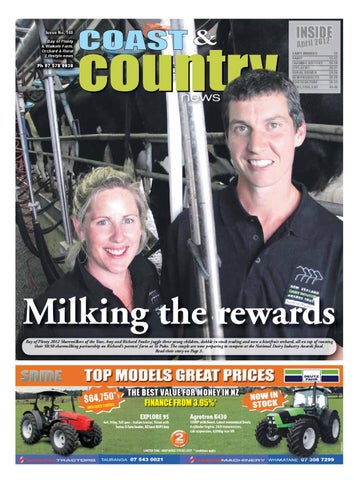
Milking the rewards Bay of Plenty 2012 Sharemilkers of the Year, Amy and Richard Fowler juggle three young children, dabble in stock trading and own a kiwifruit orchard, all on top of running their 50:50 sharemilking partnership on Richard’s parents’ farm at Te Puke. The couple are now preparing to compete at the National Dairy Industry Awards final. Read their story on Page 3.
+GST
$64,7LO5AD0ER* INCLUDES
THE BEST VALUE FOR MONEY IN NZ
COAST & COUNTRY
Page 2
PRESCOTT
TRAILERS
For 40 years, people have been putting their trust in Prescott Trailers, just ask an owner, they aren’t hard to find – better still, give us a call or come and visit our factory and see our full range. Strong, durable and lightweight, Prescott Trailers are built to last a lifetime. Whether you need a trailer for the farm or road, for your boat or orchard, we can design and manufacture to your requirements
Ph 0800 888 323 Prescott Trailers Ltd.
29 Station Rd, Te Puke www.prescotttrailers.co.nz
Coast & Country
Following the yellow risk road
Grafting Gold3 is not without risk, nothing ever is for growers, but it’s better than looking at a row of stumps in the ground. Those are the words of New Zealand Kiwifruit Growers Incorporated president Neil Trebilco, one of the industry heads who announced in March that Zespri is committed to releasing more licences for Gold3. Offering the licences at $8000 a hectare, as opposed to a normal average of $12,000/ha, Zespri is also stating growers are able to pay a 20 per cent deposit and not pay the remainder until the crop is in production. “This is a fantastic day for growers, this is the first cornerstone of regrowing. But it’s a significant cornerstone,” says Neil. “It does indicate to growers that we have a future. “There is some risk around this, growers know that. We knew that when we first started off with the existing Gold variety HORT16A, back in 1998. “But it’s a whole lot better than looking at stumps in your ground, and I know there are a lot of growers in the Te Puke region right now, they’ve got stumps – but know they know come winter time they’ll be able to put
something back on top of those stumps and be back in business.” There is still a tough road ahead for growers though, says Neil. “Financially, they’ll be without crops, therefore without any income for at least a couple of years. “But at least now they’ve got something they can get their hands on and start growing and see that there is a future.” In this issue of Coast & Country, read about the 10 years of work and research that has gone into bringing the new cultivar Gold3 to the market on Page 5-7. Also in the April issue of Coast & Country, we meet the winners of the Bay of Plenty Sharemilkers of the Year title who are heading to represent the Bay at the National Dairy Industry Awards in May. Sue Edmonds went to the DairyNZ effluent expo, and also found out about what international groups are doing about effluent and water. Reporter Hamish Carter takes a look at boosting kiwi numbers in the wild and also visits the solar barn to find out how to live more sustainably. Duck Shooting season is nearly here, so get some hunting and fishing tips from our regular Hunt, Fish and Eat feature. Farming at Ohinepanea in the centre of the Bay of Plenty has come a long way from early days when the first MacDougall land owner survived by corralling wild pigs into a gully until he had sufficient numbers to lead them to the market by following a trail of maize. Dairy farmer Bruce MacDougall is the third generation to work the land here and spoke to Coast & Country about the challenges which faced his farming forefathers.
Read their story on page 18-19.
COROMANDEL
FRANKLIN COUNTY
HAMILTON TE AWAMUTU
TAURANGA
ROTORUA
TAUPO TAUMARUNUI
PRE-CAST CONCRETE & STEEL CONSTRUCTION SPECIALISTS WHAKATANE
GISBORNE
PH 07 578 0030
COAST & COUNTRY
Milking white gold Quality family time is just as much a driving force for sharemilkers Richard and Amy Fowler as the amount of ‘white gold’ in their vat.
The winners of the Bay of Plenty 2012 Sharemilker of the Year aim to spend good family time together, while also being able to be ‘hands-on’ - without being tied to the cowshed. With that in mind the couple are putting their heads down and are now being rewarded for their persistence and hard work, taking out the top award at the BOP Dairy Industry Awards in March – a title that has earned them more than $14,000 in cash and prizes. The Fowlers entered the Bay of Plenty Sharemilker/Equity Farmer of the Year competition two years previously, with not even a merit award to their name. They believe their success this year can be put down to a more precise presentation to the judging panel. “What we do is quite unique,” says Richard, “we learnt you can’t expect to pour information at the judges and expect them to digest it all and understand it. “So getting that into a tidy, concise presentation was key.” The couple are in their fifth season of farming, after meeting at Lincoln University and going on to work in the corporate world – Richard for Landcorp and Amy for Sport Bay of Plenty. In those five years since turning their hand to farming on Richard’s parents farm in Te Puke, they have continued to grow, moving quickly from lowerorder sharemilking to 50:50, buying a kiwifruit orchard and acquiring new lease land, all while growing their family with three children in quick succession. Hadleigh, 3, Grace, 18 months, and Briar, one month, are the driving forces that push the Fowlers to work efficiently. “That was the big push to go a bit bigger,” says Richard. “At 260 cows, I was pretty much on my own with a bit of help over the spring, and I had lots of other commitments on the board of Young Farmers, I was spending way too much time milking cows. “So we leased another block and went up another 100 cows which justified another full-time labour unit.” Richard has always dabbled in stock trading since high school and it is this that helped the Fowlers grow their herd quickly and progress their operation to where it is now. “I trade in empty cows, it’s been a
Page 3
Richard and Amy Fowler with children Hadlee, 2, Grace, 18 months, and Briar, born just 10 days before the regional awards’ dinner.
means for us to get into a herd of cows cheaply. “The stock trading gives us more of a capacity – sharemilking is still the engine house.” Richards sells on average 100-150 cows a year, which he buys as empties and then gets in calf. “We sold mum and dad’s herd, which was a really good herd – but the BW of our herd is about the same. “Our reproduction is not as good, which we expected, but the milk solids are about the same – 300kgMS a cow, which on this country I’m pretty happy with.” They now milk 345 cows doing 120,000kgMs on the rolling-to-steepland, up from the 260 cows they started with. They have also switched some cows to winter milking, which they say has helped grow equity by retaining stock in the system. The Fowlers says winning the title was not the ultimate goal, and the both recommend all farmers give the Dairy Industry Awards a go. “We’d encourage people to enter the competition because you get rewarded for doing something you love,” says Amy. “It’s not a hard thing showing what you love doing. You’re not having to try to adhere to anyone else’s expectations.” “I went into this saying we weren’t going to change things just to win the competition,” says Richard. “But as a consequence of doing the competition, it’s showed us where we
can be better and we’ve grown as a consequence of it. “As farmers, there is not that many opportunities for someone to come into your business and give you feedback. It’s a gift I reckon.” Richard and Amy are working through a succession process with Richards’s parents, but plan to try and buy another farm first in a few years’ time. The couple are now looking to the National Dairy Industry Awards final, in Auckland in May where they will compete against the other regional sharemilkers and equity farmers from across the country.
COAST & COUNTRY
Page 4
Coast & Country
Finding our little kiwi battlers Maori legend has it that Mount Otanewainuku is a chiefly mountain. Set high on the Western Bay of Plenty above Oropi, the unlogged native forest is a rare gem thanks to the tireless work of locals to protect it, stretching back to the 1920s. History records a series of episodes when the neighbouring farming community battled to save the area from milling. But the threat moved from the forest to its birdlife in recent decades, prompting the formation of the Otanewainuku Kiwi Trust 10 years ago with the mission to restore the native North Island little brown kiwi population in the 1200 hectare forest. Hopes were high in March, when Governor General Sir Jerry Mateparae released four kiwi chicks into Otanewainuku Forest. But knowing the ups and downs the trust has already faced, the gathered crowd of trust members and volunteers are literally not counting their chicks before they hatch. Trust member and DOC kiwi project manager Dave Wills admits the trust has had its “fair share of bad luck with the birds”. Shortly after the first four adult kiwis were released in 2006, female Tutaki was run over on the road. Two years ago, two of the four kiwi
juveniles that were introduced drowned in a creek. Efforts are made to keep the birds away from the road by releasing them into distant burrows, but Dave says there will always be a high risk of losing some juveniles – with a 50 per cent mortality rate through misadventure (such as the drowning in creeks) in the wild. “So it’s very difficult for us to say that we are going to build up the population this quickly because there are all of these parameters.” Before the latest release, the trust knew of six – possibly seven – released kiwis in the forest. The eggs for the latest chicks came from the Whirinaki Kiwi Project (Urewera), which shares half of its eggs with the Otanewainuku trust. The Trust has the option to get six chicks from Whirinaki every year, along with another four-six in total from two other kiwi reserves in return for supplying transmitters for the birds. “The potential is for putting a lot of birds in there, but of course for all the birds that go in there is a lot more work for the volunteers to do to monitor them, so we have to work our way into it.” Originally, the trust had focused on trying to find remnant kiwis around the Western Bay area to repopulate the forest, but after four years of scouring the region, they have yet to find a kiwi to relocate, so changed the focus to
A DOC review bringing in kiwis on kiwi creches, from outside the which has been area. put on hold, will “We figured that determine if a the remnant kiwis creche in Otanewere the best birds wainuku is feasible. to put in there Dave says with all because we were the support behind trying to rekindle the project – from the Western Bay voluntary pest population but control to monitorwe haven’t found ing kiwi movements any,” says Dave. – he is confident the The urgency kiwi population will for action to eventually become preserve kiwi in One of the kiwis released by the Governor well established. He Otanewainuku General at Mount Otanewainu ku. says the thousands was highlighted of hours of volunwhen wildlife tary work done has surveys found a transformed the forest and helped revive many major drop in numbers due to predators from native birds including robins, tomtits, whitehe50 in 1986 to five in 2005. ads, grey warblers and recently kokakos which Dave would like to see a ‘kiwi creche’ eventuhave been reintroduced. ally developed to introduce the young birds to To monitor the new kiwis sponsorship is the bush environment after being incubated and hatched at Rainbow Spring’s Kiwi Encoun- sought for transmitters. For more details email ter. Currently, all young are sent to the nearest stephen.parr@gmail.com creche at Cape Sanctuary (Cape Kidnappers) For more details on the trust visit where they grow to 1kg (about six months) www.kiwitrust.org before they can be released into Otanewainuku.
Hunting for kiwis Do you think you have kiwis on your property? DOC kiwi project officer Dave Wills would love to hear from you.
For every $100 spent on fencing products from our selected suppliers, you could win a 50” Panasonic HD Plasma TV and Home Entertainment System!
2.5mm HT Wire •
•
Premium grade wire protected by zinc aluminium XTRALIFE coating, offers twice the life of class 3 galvanisation. Normal 25kg coil approximately 650 metres. 10% extra coils approximately 715 metres.
44188
The more you spend, the more entries you get. There’s one 50” HD Plasma TV and DVD Home Entetainment System to be won - so your chances are good, as there is one in every store! So start your fencing job by buying your products from Farmlands - where it really does pay to shop. Phone 0800 FARMFONE (0800 327 636) for your closest Farmlands store.
Farmlands Trading Society Limited FAR21107
For Terms & Conditions visit www.farmlands.co.nz/competitions
EVERYONES PRicE E
$
92.95
Pricing valid intil 30 April 2012
10 % a ExTE r PEr wir coil
HOT
DEAL!
Dave knows people can be attached to the idea of having their very own living breathing national emblem in the back paddock – and promises not to sweep in and take them against your wishes. With the remnant kiwi population in the Western Bay of Plenty virtually wiped out, estimated to be as low as 20 birds, for five years, DOC have been looking for any birds to help protect them however they can. Dave urges people to contact him if they believe they have heard a kiwi so he can come out to assess whether it is - and try to find it. “If a population is there, we will encourage them to do pest control or discuss if they are happy to have the kiwi taken to Otanewainuku or another area so that we can spread the gene pool,” says Dave. “I can understand if people don’t want us to take the kiwi when they have been listening to the kiwi for years.” Despite checking out many reports of kiwis from rural property owners, Dave
and his team have had no luck finding any – but he is certain there are some out there. “We know that there are some birds here. A good portion those we can’t say they weren’t here. “Sometimes the kiwi dogs have shown a lot of interest, but they find nothing – it could have been juveniles that were travelling or the timeframe could have been too long.” Dave says they believe kiwis are living around Oropi and in the Kaimai range. He says the best indication of kiwis is hearing their distinctive high pitched whistle and encourages anyone who thinks they have heard a kiwi to listen to recordings of the birdcall as they are often mistaken. “The whistle goes up and down, it’s almost like the name ‘kiwi’. We always ask them how many repeats there were in the whistle. If there were any less than nine repeats it’s unlikely they were kiwi, but we still want to hear from them just in case.” Recordings of kiwi bird calls can be heard on the DOC website at www.doc.govt.nz/conservation/nativeanimals/birds/land-birds/kiwi/kiwi/ facts/kiwi-song/ If you think you have heard a kiwi contact Dave, phone 027 651 9390. By Hamish Carter
COAST & COUNTRY
PH 07 578 0030
Page 5
Zespri continues mining for gold The new gold set to be mined in the Bay of Plenty has taken 10 years to extract and mould, ready for the market. Gold3 is the new golden kiwifruit Zespri is pinning its hopes on to resurge the gold rush after the industry has taken a big hit from the Psa-V crisis. Zespri has indicted it is going to release more licences of Gold3 in May to replace the industry’s money winner HORT16A, which is dying from Psa-V infection. The cultivar, which Zespri first grew from a seedling 10 years ago and has since spent millions on testing its desirable traits, has not only ticked all the boxes, it has also proven itself as resistant to the crushing bacterial vine disease Psa-V. The grower-owned organisation will be sighing with relief. “Gold3 was selected 10 years ago from the seeding population,” says Zespri innovation manager Bryan Parkes. “It’s a long process – it’s basically mining for gold – literally. “You start with lots of rubble and eventually distil it down until you’ve got the best of the best and then choose the winner.” Bryan says Gold3 is one of 88,000 cultivars Zespri is currently trialling. It has made it through to commercial release
Zespri’s Bryan Parkes.
only after spending years going through various tests and screening stages, and at the investment of millions of dollars. The bonus is Gold3 has also shown to be tolerant to Psa-V, which Zespri has had to now factor into its new cultivar testing programme. “So it’s been tested against 45 other members of the same species to understand its tolerance against those,” says Bryan. “One of those of course was 16A – 16A was at the bad end, in fact, it was as bad as any of the others. “The G3 is at the far better end of the spectrum.” From the 88,000 different plants Zespri has grown from seed, Zespri has so far screened 30,000-40,000 at the fruiting stage; 80 of those have been taken forward to go through further trials and then 10 were selected for growers to grow in a testing situation on orchards. Gold3 was one of those 10. Bryan says they expect to find a number of superior tolerant cultivars in the future, better than Gold3, but it is a few years away. The cultivars that will prove to be superior to Gold3, may be 10 years down the track. “Some are fruiting now, so it might be five years away. It takes five years to go from a seed to a fruiting plant, then it basically takes another five years to go from a fruiting plant to testing it through two other stages. The big wait is going from a seed to a fruiting seedling. “The two other stages is testing it in bigger and bigger areas with consumers and supply chain.” Bryan says of the Gold cultivars that were tested, the G3 was “right up there”. “There are some Golds that are as good as Gold3 and they’re just fruiting for the first time and we haven’t yet assessed the fruit.
“There is a small chance one of those will be as good as or an alternative to Gold3, but less likely because Gold3 was very good for all the other traits as well; like taste and storage. “Those ones would be 2-3 years away, but then it’s a lower chance of happening.” Bryan says there are also some red fruiting varieties in the programme that are as good as the Gold3 from a tolerance perspective. “But then again we have to understand all of the other commercial traits – there is no point planting out a cultivar that’s entirely resistant to Psa that produces little marbles of bad tasting fruit. “You’re better off to wait for the thing that has good taste, good yield and is tolerant enough to Psa.” Zespri’s new cultivar programme is the biggest in the world says Bryan, “and the likelihood that better cultivars will come out with superior disease resistance and other desirable high traits, is quite a high chance with those massive numbers we’re putting in the front end.” By Sheryl Brown
F QUOREE TES!
Read more about Zespri’s cultivar programme on Page 6-7.
Quads, ATVs & 2 Wheeled Farm Bikes • Parts • Sales • Service •
2006 Honda CRF230 (2 Wheeler) 2Wheeled Farm Bike!
2005 Yamaha AG200 (2 Wheeler) 2WheelerWith KickStart!
Now
$2,400
2005 Yamaha YFM 250 Bruin 250cc Quad Bike!
Now
$3,400
2006 Honda CRF230 (2 Wheeler) 2Wheeled Farm Bike!
Now
2006 Polaris Ranger 500 LegalThree Seater!
Now
$3,450
Ranger® 400
Only One Left! 455cc True Farming Machine! Saving of$1,085! Kit Includes: Has had 2 Services and still has 18 Month Warranty!
$14,900Inc GST
Ranger® Diesel
(Ex Demo With Accessories)
Only One Left! True Workhorse! 907.2kg Towing Capacity!
Kit Includes:
Tow Kit • Screen • Roof Has also had 3 Services and still has 18 Month Warranty!
$23,000Inc GST That’s a
Only Two Left! 455cc True All Wheeled Drive! Independent Rear Suspension! Kit Includes: Tow Kit • Horn • Bull Bar Kit • Dog Mat • Seat Cover • Mud Flaps
Massive
$3,500
$8,495
$11,250Inc GST
Saving!
2009 Honda MUV700 (Side by Side) Great Condition, FantasticValue
Sportsman 400
(with Action Farmkit)
Last One!
Now $17,750
2011 Honda DusterXR125 (2 Wheeler) Just In! Only 200kms
Now
$2,800
Constantly changing list of used stock!
Ask About FREE On Site Demos for Both New and Used Machines!
www.actionequipment.co.nz
Katikati
Tauranga
108 Main Road
15 Glasgow Street
(07) 549 2260
(07) 578 2263
Hamilton 1 Gallagher Drive
(07) 957 9150
kES on SEE MorE Bi
a d E MMEE: Tr dEr ThE na un
acTionMEn
COAST & COUNTRY
Page 6
Coast & Country
Investing more into the future Zespri spends $5-6million annually on its new cultivar programme, says the organisation’s innovation manager Bryan Parkes. “It’s in the hundreds of thousands on a per year basis – that is in the exploratory stages. “And then you go into the test marketing stage – where you’re rolling it out with its own boxing and advertising and branding – and that gets into the millions from that point on. “You don’t test one cultivar at a time though, you throw away all the others and arguably amortise the cost into the one that you take forward.” Bryan says the testing process starts by waiting for the seedlings to start producing fruit. “We look for the size of the fruit – some of them produce marbles – we look at the shape of the fruit and the regularity of the fruit. “The external appearance is a factor and there are some inconsistent shapes and rather ugly shapes. “Then we look at the dry matter of the fruit, the taste potential of the fruit, the storage of the fruit – how well it sores once it’s been harvested – and we look at the yield potential of the fruit – how much fruit could it produce per hectare as an estimation.” The fruit then goes into trials with expert panels; Bryan compares this with a wine tasting approach. The fruit then undergoes consumer surveys and eventually is tested on the export market. Gold3 has been tested in all of Zespri’s key markets, with very good feedback, says Bryan. “It was tested with consumer panels to get the understanding of liking; so that was done in Europe and in Asia, including China, Japan, Spain and Germany.
“A lot of our key markets and markets that have different taste preferences.” The money, time and research that go into the Zespri’s new cultivar system are ultimately to reduce the risk to growers. Bryan says you could launch a new variety without doing all the test work, but you just end up with a very high chance of failure. “A lot of cultivars fail, that’s probably a starting point – and if you’re a company that just wants to get the cultivar out there, you could launch a whole lot of cultivars and if it falls over it’s the growers fault – it didn’t cost you much to release it cause you didn’t invest much, and if it fails, it’s not your problem. “We’re at the other end of the spectrum. When we release cultivars and it fails, we’re in there with the grower, sharing the pain.” That is why Zespri invests in the appropriate amount of work, says Bryan. “It’s a logical investment – it’s not without risk of course – but the more you invest into quality and understanding what you have upfront, the less chance that it will fail in the market.”
Zespri publishes a prospectus with each cultivar it releases. “It explains all of the traits that we know about the cultivar; where it grows, how it grew in different regions throughout the country, yield potential; size potential. Bryan says it is about due diligence, growers need to understand what risk they’re taking; and by providing all of that information to them, they can make a robust decision.
“I haven’t seen an ENZA prospectus on their cultivar (ENZAGold),” says Bryan. “So it’s either there and not widely known or being shared, or the data isn’t robust to put it in a prospectus. “Don’t know. But if I was a grower I’d want to see some information about that cultivar before I started planting it.”
New 125 Hp Massey Ferguson 5460 with Stoll FS30 Front End Loader 1006
• 4cyl 125 Hp (Boost to 135Hp). • 16 forward x 16 reverse • Dyna4 [4 change on the move speeds] transmission. • Clutchless power shuttle for ease of use and versatility. • 100 Lpm hyd flow. • Stoll FS30 front end loader with third service and multifastner which allows easy mounting. • 440/65RX28” front & 540/65RX38” rear tyres.
All for the special price of $105,000 + Gst AGCO Finance available from 4.99% over 36 months with 30% Deposit [terms & conditions may apply] Call the boys today to put a deal to you. Morrinsville 07 889 7055
Rotorua
Mike Chris
Nick 021 349 816 Mike 021 998 819 Pilch 021 908 123
021 735 665 021 526 138
07 345 8560
Paeroa Graeme 021 862 169
Full Range of Quality Farm Machinery | www.piakotractors.co.nz
07 862 9064
PH 07 578 0030
COAST & COUNTRY
Difference of research Bryan says to his understanding, Turners & Growers has been selling the ENZAGold fruit overseas. “I haven’t seen the data and I’m not aware they’ve got a lot of data to circulate, but they may have and they’re just not sharing it. “I believe they’ve started selling it, but I haven’t seen any data round how it’s performing. “Only rumour mill
of how good it tastes – which I can’t really comment on; people’s views on how good or bad it tastes or stores or handles. “I guess that’s the difference. We’re spending, in the new cultivar area, in the order of $5-6million a year, so it’s a massive programme. “And having a new cultivar is kind of irrelevant. “I could leave Zespri and grow some seedlings in my backyard and have a cultivar with a few thousand dollars of my time and say ‘look I’ve got a great cultivar’. “But the difference in quality between something that’s coming out of a $6million per year programme and something that came out of my backyard are likely to be extremely different.” Ultimately it’s the grower’s choice on what cultivar they grow, says Bryan. There is still a lot to learn about growing G3 says Bryan. Zespri has a stage after they release a commercial cultivar called ‘post release optimisation’ to reach maximum potential. “In the case of HORT16A we’ve spent millions of dollars to improve its taste and yield and storage, over time,” says Bryan. “And Gold3 is clearly at that stage at the moment. We know it’s right in the good
zone, what we need to understand is what buttons it has that we can push and what happens when we push various buttons; to optimise its value to growers and the quality of the fruit.” Bryan says Zespri is also committed downstream to the consequences of what happens to the fruit, so is spending millions of dollars to optimise G3’s performance. “So it’s the same story as 16A – getting to the point of release is one story, optimising its performance in the market and through on-orchard and supply chain is still even more expense and an on-going commitment. “We’re working with the growers because they’re the best in the world to understand the different techniques that it responds the best to for growing.” One of the great things about the kiwifruit industry is they’re incredibly collaborative in sharing information and learning with each other, so the whole industry learns, says Bryan. “So if a grower found out how to do something with Gold3, that they’d say ‘I do this and improve the taste’, they don’t seem to sit on the data and try to make lots of money out of it themselves, they often tell their neighbours and tell us what they’ve learnt. “It’s industry learning as opposed to an individual learning that knowledge and exploiting that knowledge by themselves.”
Page 7
COAST & COUNTRY
Page 8
Coast & Country
Consultant sweeps up regionals Sam Williams is the fourth returning Grand Finalist in 2012 after he won the Waikato/Bay of Plenty Regional Final for The National Bank Young Farmer Contest in March.
Sam cruised to victory at the Mystery Creek Events Centre – winning by a margin of nearly 30 points. The 27 year old last competed at the Grand Final in 2010 in Gore. Also heading back for their second chance at Grand Final is Otago/Southland’s Pete Gardyne, Aorangi’s Andrew Scott and Tasman’s Michael Lilley.
HiFLO PUMPS HiFLO PUMPS & IRRIGATION LTD
Sam competed against Andrew and Pete in Gore and is keen to catch up with them in Dunedin in May. He’s also excited to get another chance at Grand Final and is looking forward to being protected from the elements in the Forsyth Barr Stadium on the Practical Day. “Hopefully it won’t be as cold as it was in Gore – and there should be less mud too!” Sam had a year off from the contest last year. “After Gore I knew I’d be back – I just wasn’t sure when. But it was good to have a year off and it’s paid off – I’ve done quite a few different things in the last 12 months.” That included heading to the USA for five weeks as part of a group study exchange with Rotary International.
GRUNDFOS ®
Sam Williams competing at the Grand Final in 2012.
HiFLO PUMPS HiFLO PUMPS & IRRIGATION LTD
This gave Sam the chance to grow his knowledge by experiencing different farming systems on a very different scale to New Zealand. Sam has also been a member of toastmasters for the last couple of years and admits that his speech delivery on Saturday night was a bit better than it was a couple of years ago. The experiences he’s had in the last 12 months were evident in the Waikato/ Bay of Plenty regional final. Not only did he convincingly win a spot at Grand Final; he also took out the Lincoln University Agri-growth Challenge, the AGMARDT Agri-business Challenge and the Ravensdown Agri-skills Challenge. Sam holds a Bachelor of Agricultural Science (Honours) from Lincoln University and is an Agribusiness consultant based in
Sam Williams wins the Waikato/ BoP Young Farmers Competition. Otorohanga. He also helps out on the farm he part owns with his parents. Sam has a share in 134ha of the 366ha block. The operation includes a 360 cow dairy unit, 280 ewes are lambed and maize is grown for silage. Sam says the variety of his day-to-day job has helped give him the knowledge to cope with the variety of skills tested in the contest. “There’s a lot to it. My financial knowledge helped with the exam in the morning and the modules were quite varied – it was the whole package.” Sam has been a member of the North King Country Club for six years and has held various positions within New Zealand Young Farmers at Club, district and regional level. Sam took away more than $10,000 worth of prizes for his efforts. The generous prize pack included a Honda XR125 two-wheeled farm bike valued at $4000, a $1500 Lincoln University Scholarship, $1000 cash and $500 towards a capability development programme from AGMARDT, $1000 worth of Ravensdown quality fertiliser products, $1000 from The National Bank, clothing valued at $750 from Swanndri and Silver Fern Farms provided a package of quality produce valued at $500. Dwayne Cowin was second followed by Dan Brice who also won the Silver Fern Farms Agri-sport Challenge. Fourth place went to Brett Steeghs. The AgriKidsNZ and TeenAg regional competitions also took place at the Mystery Creek Events Centre. The top three teams from each competition were also invited to head to Grand Final in Dunedin on May 25. Representing the Waikato/Bay of Plenty AgriKidsNZ contingent are: The Gumboot Gang from Morrinsville Intermediate, Blue Lightening from St Peter’s Cambridge and Ngahinapouri School and the Mighty Milkers from Te Kuiti Primary School. Ben Brogden (St Paul’s Collegiate) and Brendon Masters (Bethlehem College) were first in the TeenAg Competition followed by Dasham Singh and Kalbir Singh from Te Awamutu College. Third place went to Josh Hill and William Malcolm from Forest View High School.
Sam Williams is heading to compete at the Young Farmers Grand Final in Dunedin in May.
COAST & COUNTRY
PH 07 578 0030
Page 9
Thanks for all the entries for the Coast & Country competition to win a copy of the Rural Women’s recipe book ‘A Good Harvest’. Congratulations to Danielle Schaad and Nicola Johnson. Because we got such tasty sounding recipes we thought we would share a couple of others with our readers. Attached is a recipe I have put together and is very well tried and tested. It came about out of a need to find a few uses for the beautiful passionfruit coming off our vine by the bucket load. What I like about this recipe is that it’s super simple and can go from a child’s lunchbox, to feeding a work shed of blokes, and is great just to have with a cuppa and the paper (if you can find the time!). I just love everything about rural cooking and hope I am one of the lucky ones to win the book! Danielle Schaad
White chocolate & passionfruit slice Ingredients 140g butter 220g white chocolate melts 3/4 cup caster sugar (or splenda if you prefer) 1 cup desiccated coconut 2 large eggs, lightly beaten
1 cup sifted self-raising flour 1/2 cup passionfruit pulp (about 8 fresh passionfruit) Icing sugar for dusting Method Heat oven to 170 degrees – 150 degrees for fan bake. Line a slice tin with non-stick baking paper. Place butter and white chocolate in a large heatproof bowl and melt in microwave, stirring every 30 seconds, or over a saucepan of simmering water. Stir until smooth. Mix caster sugar into melted chocolate mixture, followed by coconut, then eggs. tir in flour and lastly, fold in the passionfruit pulp. Pour the mixture into the prepared slice tin and bake for 30-35 minutes or until golden and firm. Cool in tin, then remove and slice into bars or squares. Dust with icing sugar to serve. Great by themselves or with a dollop of whipped cream on the side. Makes 12 good size pieces.
This is my favourite Plum Chutney recipe, it’s really yummy with cheese.
Plum Chutney
Reduce heat and simmer for 30-60 minutes until slightly thickened and syrupy. Put into jars and seal. Too easy! Nicola Johnson
Ingredients 600g plums, stoned and chopped 1 cup of brown sugar, not packed 1 cup of cider vinegar 1 granny smith apple, peeled and grated 1 red onion, finely chopped 1tsp ground ginger 1tsp allspice 1tsp ground cumin 3/4 tsp cinnamon 1/2 tsp chilli paste 1.4 tsp freshly grated nutmeg 1/4 tsp salt Method Put all ingredients into a large pot and bring to the boil.
Zucchini Pickles
THREE BROTHERS
Ingredients 2 pounds zucchini, sliced thinly 2 medium onions 1/4 cup salt 2 cups white vinegar 1 cup sugar 2 tsp yellow mustard seed 1 tsp celery seed 1 tsp turmeric 1/4 tsp mustard powder Method Slice onions, place in a large bowl with zucchini, toss with salt and cover with ice water and stand for two hours. Drain thoroughly. Combine remaining ingredients in a saucepan, bring to the boil. Simmer for five minutes. Pour vinegar mixture over zucchini and onions, tossing to coat. Stand for two hours and then bring to boil and cook for 15 minutes. Pack into sterilised jars and seal. Lovely pickle worth the fiddle of it! Alison Sutherland.
Tomato Sauce
Ingredients 12 pounds of tomatoes 3oz salt 1 1/2 pints vinegar 3 pounds of sugar 4 onions 3 ozs ground all spice Method Cut tomatoes, tie up spices, put all together and boil for three hours. Put through colander and bottle when cold. M E Miller
THREE BROTHERS
Page 10
FOREST & WOODLOT OWNERS
FORESTRY
Coast & Country
A volatile market As we move into autumn, it is a good time to look at the market again.
ABLE TASMAN FORESTRY SERVICES LTD
This time last year, the market was on a record high and we thought, or hoped, that it might last forever like that. Such is the nature of the forestry markets, that was never going to happen. Sure enough, as we went into winter last year the rampedup supply which had responded to the high prices created a flood which swamped the Chinese market with excess stocks which still have not really cleared. Because China is the dominant log market now in the Pacific Rim, the log stocks in China tend to dictate the entire Pacific log market price. Right now, the Chinese log yards are holding about two months supply of logs, which is sufficient to keep the price suppressed. The Chinese winter, followed by the Chinese New Year in Febru-
ary, has meant the uptake has not kept up with supply. Everyone hopes that now summer is coming and production and building are ramping up after the Chinese New Year, that these stocks will be whittled down during the next few months.
Exchange rates
The Chinese log stocks are not the only determinant of log prices paid to New Zealand forest owners. The international currency exchange rates all have a bearing on the wharf gate price as well. With the US dollar holding within a band between 82 cents and 84 cents in recent months, the log industry is no different to any other of the New Zealand commodity export products which are hurting at this exchange rate.
Freight costs
Then there is the ocean freight rates which have a large bearing on the price paid for logs in New Zealand. As a high-volume, low
weight product, the shipping rates will always be a large component of the delivered price to China. Shipping rates are usually set by the general supply and demand for shipping services around the world, especially the handy size break bulk vessels used for logs. Currently global shipping rates are very low and New Zealand is getting reasonably good rates to China as a result. These rates, however, are volatile and there is upward pressure building on these rates now. The sum total of all these variables has been reasonably steady log prices for the last three months. While there is a reasonable amount of optimism for a slight improvement in the months ahead, there is also justified nervousness about the volatile market we have to work with.
Living with wood NZ Wood is a major promotional and development programme to promote New Zealand forests and wood resources to improve our economy, society and our whole way of life.
We’ll get you
more money for your trees
Do you have trees ready to be harvested in the next 2 years? Woodmetrics’ competitive tendering process is your best option to realise your investment and our complete sale management process will ensure you get paid — why take the risk?
For further information,visit www.woodmetrics.co.nz
Be prepared — call 0800 96 63 63 now to talk about your trees with Peter Harington, your Regional Manager.
Its latest campaign ‘Living with Wood’ is encouraging the use of wood for a range of different outdoor features, from practical applications such as decks, retaining walls, sheds and fences to more decorative structures such as gazebos and pergolas. There are a number of different species of wood that can be used for different features, and some of these will require treatment to aid their longevity. The ‘Living with Wood’ booklet includes examples of using wood outdoors, for framing and cladding, structural, and interior. Order a free copy of ‘Living with Wood’ at www.nzwood.co.nz
PH 07 578 0030
COAST & COUNTRY
Page 11
The good life living sustainably Honey is one of the home comforts of living sustainably for William Robinson. Photos by Bruce Barnard.
Goats, free-range chooks, composting toilets and solar power. Oropi couple Karen and William Robinson chuckle at the stereotype sustainable living often conjures. “A lot of people think they are going to a bunch of hippies who are going to be wearing jandals and won’t have any power,” says Karen. “But we do have computers, the TV, the internet, a fridge and freezer. “We’ve got a teenage boy so we’ve got a play station.” The couple who live off the land as much as they can, opened up their 12 acre property for tours for Tauranga Environment Centre’s sustainability month in March, sharing their advice and experiences since embarking on their sustainable quest six years ago. “We love talking to people about our experiences – including the time the generator blew up and there was oil all over the shed. “It has its challenges, but we believe it’s
definitely worthwhile.” Ironically, the voyage to become fully sustainable began almost as a challenge when they learnt it would cost $15,000 to install a transformer to get power to their new property. They were setting up their own slice of paradise, a home with a large garden and livestock, when they decided to take the next step by generating their own power. “We thought we could do better by putting in our own generator,” says Karen. “We had a lot of people around us saying that we wouldn’t be able to do it, so we saw it as a challenge.” But when the price of fuel jumped the next year, they decided to take the plunge into solar panels and a wind generator. For a total investment of $30,000 – excluding William’s own labour for installing the equipment – the property was wired with photovoltaic panels, wind generation and backup batteries. “We don’t have huge amounts to spend on these things, so we have done a lot of
research find out what has worked for other people.” William, a practical car mechanic by trade, has improvised solutions along the way, keeping costs down by using second-hand materials and doing the work himself. An example is the
structure supporting his solar array which he has built so it is easily adjusted to keep the panels directly facing the sun’s rays through the day. He calculated it helps generate an extra 40 per cent. One of his next projects is automating it to follow the sun. Power is just part of the sustainable story on the ‘Solar Barn’. William and Karen’s vehicles are fuelled with recycled cooking oil and an evergreen orchard area is irrigated by treated grey water. William, who runs his car mechanic business from the property, has a strong interest in hybrid and sustainably fuelled cars. He has converted both of their cars to run off biofuel – recycled vegetable oil which is double filtered after getting if from fish and chip shops. His engine has been converted to run on 100 per cent, while Karen’s Nissan Torano is a 70:30 mix with diesel. When Karen is not working in her dressmaking business, she can be found running the household, out in the garden, or tending to her poultry (Red Shavers for eggs,
Orpingtons for meat and a few turkeys), her goats and house cow. By growing their own fruit and vegetables, honey, eggs, milk, and most of their meat and making their own cheese and preserves, they are now 80 per cent sustainable in their food – but aim to be 100 per cent within five years. Karen loves growing great food for a fraction of the cost and says even city residents can enjoy the same benefits by converting lawn to a large garden, fruit trees and chickens. “I make everything from scratch. My pasta, pesto, my hummus, cheeses and bread – we also make our own sausages. I get great satisfaction that my family and friends who visit here get feed very well. “If you are willing to do the hard yards of having a vege patch, well you can get fed very well for very little expense.” Following the success of the solar barn tours, they will soon offer a range of workshops on sustainable topics. For more details visit www.thesolarbarn.com By Hamish Carter
Kitset Buildings Easy to assemble kitset buildings • Durable treated timbers & corrugated iron roofing • Pre-cut & semi assembled with a built tough guarantee • Great range of sizes & designs available - call today!
Freight FREE Kitsets nationwide!
Livestock Shelters Hen Houses
Storage Sheds
Call us today!
Kitset Cabins
Wood Sheds
0800 688 767
www.outpostbuildings.co.nz
Page 12
DAIRY INDUSTRY AWARDS
Coast & Country
Striving for recognition from the dairy shed The winners of the 2012 Waikato Sharemilker/Equity Farmer of the Year, Barry and Nicky McTamney, take the next step in their dairy farming career in June when they enter an equity partnership.
The couple took out the top award and collected more than $15,000 in prizes at the Waikato Dairy Industry Awards held at the Bledisloe Hall, Mystery Creek in March. The other big winners on the night were Thomas White, who took out the Waikato Farm Manager of the Year title, and Mark Jacobs, the 2012 Waikato Dairy Trainee of the Year.
Barry and Nicky McTamney are currently 50:50 sharemilking 275 cows for the MacLennan Family Trust on an 82ha farm near Otorohanga. In June, they will become equity partners and managers of a 500-cow farm at Maihiihi and they plan to purchase it outright within 10 years. Te Awamutu lower order sharemilkers Hamish and Katie Flett placed second in the Waikato Sharemilker/ Equity Farmer of the Year contest, winning $8500 in
William Bryan, 4, enjoys the goods from dad’s (Rob Bryan) vat.
FREE FARM
MAP QUOTE Is your farm really as big as you think it is? It could be costing you money.
Don’t waste your time with an inaccurate farm map. Call GPS-it today. Accurate measurement of effective area Accurate feed budgeting Maximise your farm’s potential
BECAUSE SIZE MATTERS
0800 2 GPSIT
www.gpsit.co.nz
prizes, and Te Awamutu equity farm managers James Kinston and Jennie Macky were third, winning $4500. Waikato Farm Manager of the Year, Thomas White, is contract milking 390 cows for his parents, Philip and Maree White, on their 112ha Putaruru farm. He won $10,000 in cash and prizes. It was the first time Philip, aged 23 years, had entered the awards. “I entered for the opportunity to benchmark myself and to get feedback from the judges on my strengths and weaknesses.” Pukeatua contract milkers Nathan and Vanessa McCluskie placed second in the farm manager contest, winning $5100 in prizes. Third place went to Andrew Satherley, a Waharoa farm manager. He won $1500 in prizes. It has been a goal of the 2012 Waikato Dairy Trainee of the Year, Mark Jacobs, to enter the dairy awards for the past two years. This year he entered and won, taking
The theme of the Bay of Plenty Dairy Industry Awards was ‘White Gold’ which entrants had to demonstate in a photo.
nt ker entra Sharemil Collins. Gregory
Dairy Trainee Scott Wilks pans for some white gold. The winners of the 2012 Bay of Plenty Sharemilker/ Equity Farmer of the Year, Richard and Amy Fowler, were joined by other big winners Grant Clark, Farm Manager of the Year, and Brandon Law, the 2012 Bay Jude Lepper of Plenty Dairy Trainee of -B white gold fo lackett, 2 1/2 digs for the Year. r dad Thom as Blackett. All three winners are working on family farms. Te Puke lower order home $5500 in prizes. Mark, aged sharemilker Rob Bryan placed 25, is currently herd manager on a second in the contest winning 400-cow farm owned by Sir Patrick $7150 in prizes, and Tony and Hogan at Cambridge. Aimee Parton, also lower order Waihou farm assistant Ben sharemilking at Te Puke, were third Schnackenberg, 25, was second in winning $5250. the Waikato dairy trainee contest Waimana contract milker Grant and Cambridge farm assistant, Mike Clark gained the recognition he was Shaw, aged 22, was third. They won after in winning the Bay of Plenty $800 and $450 respectively. Farm Manager of the Year title and All the winners will now compete collecting $6800 in cash and prizes. for the New Zealand Sharemilker/ It was the first time Grant had Equity Farmer of the Year, New entered the contest, doing so to prove to himself that he deserved Zealand Farm Manager of the Year to be in his position. “I now know and New Zealand Dairy Trainee of that I’m on the right track to the Year titles and a prize pool of improve the farm’s performance.” nearly $140,000 in Auckland on May 12.
DAIRY
PH 07 578 0030
A rural handshake
Page 13
JORDAAN
No longer enough for business
I know I have written and talked about this matter repeatedly before, but it never ceases to amaze me how we all continue to get caught out in regard to lack of detail. I have put the royal “we” in here because I too need to watch out for detail neglect. A recent example of this is where a father and son purchased a farm together and the son spent all his money developing the farm. Dad agreed to wipe off the debt to his son. Both failed to record that detail. Dad died, and the remaining family are now lining up, through their lawyers to get more of the ‘farm cake’. Where does that leave the son? Another example of this detail neglect is where a farmer was dependant on a block of leased land to compliment his dairying business. I had suggested that the lease needed formalising on many occasions, but this formal lease (which was to include a purchase option) was neglected as the owner was related. The owner/relative died and the tenant was given an option to purchase the property at price which they did not agree to. The property was subsequently sold to someone else at less than the price offered in the first instant. Now they are wondering what happened and why their business is struggling on the smaller area of land. It is crazy stuff, but once again, identifies how important it is to have everything that has been agreed to verbally, put in writing. Further to this, do not expect your lawyer and accountant to take responsibility for this detail. They need to be instructed to do so, but do not rely on them. If nothing happens, follow it up. Interestingly enough, Trustees, and clients for that matter, must instruct or tell their professionals to complete certain tasks for them – in writing. Hinting and suggesting do not meet the criteria. As I always say, the best idea is to call a meeting of all your stakeholders annually and go through every-
thing, including what must be detailed. The days of a handshake being sufficient are sadly over. Detailing agreements or changes to agreements must be put in writing. Recently, a tenant and landlord signed a lease. The rates are normally paid for by the tenant. This clause was inadvertently crossed out, the lease was signed, and the landlord was out of pocket by the rates bill annually. Attention to detail in this circumstance would have made a big difference. If you alter the sharemilking agreement, record it in writing. In the future, we are going to get all contractors that come onto our property to sign in and out. It will prevent two hours of contracting at up to $180 per hour being charged to us as half a day of 4.5 hours. We hear stories all the time of losses and arguments over things that were agreed to verbally, but never put in writing. We are moving towards a litigious and pedantic world, where everything has to be detailed and recorded. If regional councils are after you or you are being sued, written historical records can be your best defence. Finally, this is a really simple message.The devil is always in the detail – rural and otherwise – and a handshake is not sufficient proof of agreement any more. So get detail sorted, straight away, and signed off by both parties. Failure to do so, will see the detail devil ‘biting you in the butt’.
Proven Designs, Proven Profits
Waikato Dairy Builders are specialists in the design and construction of herringbone dairy sheds. A Waikato Dairy Builders shed is designed to maximise milking efficiency and provide better profitability.
Heading to nationals He is currently milking 450 cows for his father, Bernie Clark, and his goal is to be sharemilking 1000 cows in or around Waimana within six years. Te Puke farm manager Joshua Wadsworth placed second in the farm manager contest, winning $3600, and Galatea farm manager Shaun Bicknell was third, winning $1800 in prizes. In his first full season dairy farming, Whakatane 19-year-old farm assistant Brandon Law has won the 2012 Bay of Plenty Dairy Trainee of the Year title and $5300 in prizes. “I was encouraged by my
parents and employers, Alan and Wendy Law, to enter and after looking at the information about the competition I thought it would be a great opportunity to meet some new people and get a feeling of where I am in the industry compared to other trainees.” Te Puke herd manager Scott Wilks was second in the dairy trainee contest, winning $650 in prizes and Whakatane herd manager Thomas Blackett placed third, winning $350. All the winners will now compete for the New Zealand Sharemilker/Equity Farmer of the Year, New
Zealand Farm Manager of the Year and New Zealand Dairy Trainee of the Year titles and a prize pool of nearly $140,000 in Auckland on May 12.
• We have built hundreds of high producing sheds • Completed to your requirements and budget • Innovation, workmanship and experience Ph Jim 07-850 5971 Mob. 0274 936 693 Ph Chris 07-849 3630 Mob. 0274 936 692 0800 P.O. Box 10 188, Te Rapa, Hamilton
WAIKATO DAIRY BUILDERS
www.dairybuilders.co.nz
226974 2 C OW S H E D
DAIRY
Page 14
Coast & Country
Slugging along as the slugs approach Contractors are over the rain that has been pelting down constantly on the Bay of Plenty. It has put a stall on maize harvesting and contractors such as Bill Webb are getting behind. “I am up to the eyeballs with rain. I don’t want to see another
drop of rain for 10 days to two weeks at least.” Harvesting started off late this season because there hadn’t been enough sunlight hours for the crops to mature, so it was going to be a later season to begin with, says Bill. “And then we’ve been plagued with wet weather since we started.” Because it’s so wet on the swamp land,
the machines are not able to get through the workload. “We got a couple off last week, with duals on the tractors, front and back, and duels on the harvester. We were doing half loads – and we still got stuck. “It’s slow going, hard on the gear, hard on the guys, costly to get off – it’s frustrating work.” Productivity is halved instantly, says Bill. “Your productivity drops to buggery – so all this maize is ready to do and you’re mucking around on the swamps trying to chew the stuff off… inefficiently because it’s so wet and boggy. “There is water still in the paddocks we’re trying to harvest.” On top of that it makes a mess of the farmers’ paddocks and puts them behind with regressing plans. Farmers will have to wait for the
paddocks to dry out to cultivate and sow new grass. So the grasses may not do as well this season, hopefully it stays warm because if it stays wet and then turns cold the grass will stop growing, says Bill. “Farms need to make sure the utilisation of their pasture is well managed. “And they should be trying to build a feed wedge up ahead of them – building their covers up so at least if it turns cold they’ve got some good feed ahead of them.” Bill Webb Feed Solutions has still got good quality hay, silage and straw available. Farmers should start planning and spraying out crop paddocks for next spring to get rid of the kikuyu and mercer grasses and “those nasty weeds”, says Bill. Farmers need to be wary of slugs
when planting new grasses says Bill. “Those paddocks that have patches of kikuyu and mercer grass are a good haven for slugs. “Last year we had a couple of jobs that had a lot of slugs in the kikuyu areas and they just wiped out the new grass – but where there was just rye grass, the grass grew beautifully.” Bill says check slug numbers by putting down a wet sack overnight and counting the slug numbers in the morning. “You need to put slug bait down otherwise you will have a problem with slugs, this is only my view based on my experience. “Especially with these moist conditions, the slugs will just be absolutely loving these conditions – slugs will potentially be a big problem this year, that’s what I foresee anyway.”
Affordable effluent stimulation Positive farmer experiences are showing ‘Etherics 7’ from BDMax to be a very effective, yet affordable option for stimulating effluent ponds.
011-81
“Blimmin fantastic, the pond activity was good to start with, but it took off. good smell, good everything,” says Nick Collins.
Ask for
Nigel Potter says they used Etherics 7 in their effluent pond and noticed various results from using it. “One of the first was a definite reduction in odour, then when it came time to spread it, we saw a lot less crusting and found that the crust there was, broke up easier than we have previously been use to. “Once it had gone onto the pasture and the cows were allowed back on, we noticed that they seemed to like the area treated with Etherics 7, as they ate the grass lower there than the rest of the ground they had access to. “We also noticed how well the grass grew.” Norman Bell harvested the grass and made silage from a paddock treated with Etherics 7 effluent. “It is a dense crop and is better than the field next door, which is not mine, but I know it had fertiliser on, as well as slurry, whereas the Etherics7 field had no fertiliser just treated slurry,” says Norman. “Both fields have been harvested by the same contractor. He uses a haybob rowing machine. I usually put five rows into one, before the forage harvester goes along. “In the Etherics 7 field, I could only get four rows into one, because the crop is heavier.”
DAIRY
PH 07 578 0030
Page 15
Advice on nutrition for soils and animals
US soil expert Neal Kinsey and one of his Australian consultants Peter Norwood were recently in New Zealand, delivering a three day course to interested farmers at Taupo.
They also addressed a one-day seminar in Hamilton run by eCOGENT, which also looked at the sequestering of soil carbon and the potential for trading it. Kinsey studied soil science under Dr William Albrecht, Emeritus Professor of Soils at the University of Missouri, whose work over four decades in many countries produced a raft of publications on sound agriculture. Neal’s baseline adage is “You can’t manage what you can’t measure, and the basics of soil science must include chemistry, physics and
biology to be effective”. To achieve soil balance, Neal avers “you must first build the house for the soil biology”, in other words – get the soil structure right to allow nature to do its part. Base saturation is achieved when the percentages of calcium, magnesium and sodium match the correct percentages needed for the total exchange capacity (TEC) of that particular soil. Then feed the soil, which is the plant’s stomach, with the right minerals for the crop grown. A growing number of New Zealand biological farmers are now having their soil tests sent to Missouri to the laboratories run by Kinsey Agricultural Services. Anyone interested
Shipping containers ultimate storage There is a noticeable increase in the use of modified shipping containers for innovative storage solutions, as demand for safe and secure storage intensifies. Royal Wolf has been providing costeffective, quality and practical, long-life container solutions for more than 16 years. Shipping containers are providing a flexible and viable alternative for storage, as people choose to have their storage solution under their own control and on their own site. People today want goods and services to come to them. There is no reason why storage should be any different. Royal Wolf portable storage containers are available in a range of sizes and offer the perfect solution to many storage problems. Flexible rental options and
the ease with which containers can be delivered to either home or work site, are driving the current demand. Whether it’s for household furniture, farming equipment, community groups, schools or sporting associations, Royal Wolf ’s general-purpose containers are inexpensive, safe, secure and ideal for that extra storage space. Royal Wolf containers can be specified to meet general purpose, refrigerated or hazardous goods requirements. In addition to solving storage solutions, Royal Wolf regularly modify shipping containers by adding doors, internal walls, windows, electricity and water supply, built-in cupboards and floor coverings. This can transform a shipping container into a construction site office, temporary accommodation unit or a home office. With 26 facilities Australasia-wide, Royal Wolf has the solution to all your container storage needs.
in finding out more can phone 0800 KINSEY (0800 546 739) where they will be put in touch with their nearest agent around the country. Peter Norwood is a man of many parts, living in Victoria. A sheep farmer, animal nutritionist, agronomist, who also runs a hay and silage making business, he’s recently added hair mineral testing to his activities. While Neal’s soil tests and fertiliser recommendations get the soil and plant life corrected, the hair testing shows up mineral deficiencies or imbalances in stock, which can account for low production or ill thrift. Peter can look at stock and have a fair idea of what your soil is short of, or overdosed on. And wearing his nutritionist
hat, he can help sort out problems such as lameness in cows, which may be due to the form in which supplements are being fed. For instance, kibbled maize which has been crushed too fine, until it is floury, can pass straight through the rumen and provide a hefty dose of alkali to the intestine, and sore feet may well result. Animals, like us, are what they eat – and getting the diet balanced can make a great difference to production and profitability. Peter Floyd described the research his group has been doing on what is needed to sequester carbon in soil. It’s not just a case of flinging on lime, or other fertiliser elements. In fact, what happens in the soil itself is just 40 per cent of what is needed, with 30 per cent related to what’s in and what happens to pasture, and 30 per cent related to how the animals are managed on that pasture.
Page 16
DAIRY
Coast & Country
Drenching dairy cow at dry-off to show some production and health benefits. There is a lot of debate in the scientific Scientific experiments in the 1980s showed community as to the merits of treating adult that milk solids in Friesian dairy cows averdairy cows for worms. aged across 47 dairy farms in New Zealand, While there is concern that drenching whole herds may increase the rate of development of drench resistant parasite populations, there is also some compelling evidence
increased by 4.3kg/cow/season after drenching with oral ‘white drench’ at dry-off and pre-calving (and this was before the advent of more effective pour-on drenches). At the end of a long milking season, many dairy cows will be somewhat ‘run-down’ and may have significant numbers of productionlimiting parasites. Worms compete for nutrients, thereby reducing the cow’s ability to increase body condition score during the dry period and put cows on the ‘back foot’ going into calving and the new season. Cows which have a BCS less than five at calving will produce less milk during lactation, will take longer to cycle and are less likely to get back in calf. Parasites left uncontrolled ultimately will
vet’s view with Ravensdown Vet Gavin Goble BVSc MRCVS
result in reduced profitability for the farmer. Drenching cows at or shortly after dry-off can be beneficial for dairy cows by increasing their ability to make best use of quality feeds during the dry-off period to increase BCS, reducing the levels of larval contamination on pastures and ensuring the inhibited stage of Ostertagia ostertagi does not result in Type II Ostertagiosis in the spring.
All cows, including heifers, can potentially benefit from a drench at dry-off, but if a farmer does not want to treat the entire herd (for cost and/or resistance reasons) then the targeted treatment of the most ‘at-risk’ animals is recommended. At-risk cows include the poorer conditioned, older and youngest cows in the herd, as well as high producers, ‘stressed’ cows and cows that have had some medical condition or disease during the season. If lice are present, however, all cows in the herd should be treated. Most pour-on anthelmintics (endectocide or mectin family) are effective against both worms and lice.
The importance of using sulphur With focus steadily shifting away from phosphorus as the driver of pasture growth, particularly on the low anion storage capacity (ASC) pumice-based soils in the Bay of Plenty, Eco-Logic Soil Improvement is increasingly asked about sulphur and its importance. Sulphur is a component of protein and therefore an essential element for optimum pasture performance. A technical sheet released some years ago by the Whatawhata Research Centre stated, “Sulphur is
essential for plants and animals. Approximately 10-15kg S/ha/year is removed by animals. Further losses can occur by leaching, especially on low S retentive soils”. Sulphur is an anion (negatively charged) and on soils where the ASC soil test reading is less than 65 per cent, annual inputs of sulphur are recommended. On sand or pumice-based soils such as those at Galatea where the ASC readings are often about 35 per cent, careful and regular monitoring of the soil sulphur status is important.
Soil bacteria
Sulphur can be applied either as sulphate sulphur, which is readily available for plant uptake, or in the elemental form, which is finely ground sulphur that needs to be worked on by soil bacteria (thiobacillus) to become plant available. In more than 20 years of work on the low ASC soils of the Bay of Plenty, we have found that 30kg of finely ground elemental sulphur applied annually ensures plant growth is not restricted, in all but the longest periods of excessively wet conditions. The speed at which sulphate sulphur is leached from low ASC soils is dependent on the amount of rain that falls. In short periods of excessively heavy rain, a relatively high percentage of plant available sulphur may be leached beyond plant roots. While soil temperatures are sufficiently warm enough for rapid growth, plant available sulphur will be quickly replen-
ished from previously applied elemental sulphur held in the organic matter of the soil. On low ASC soils the quantity and quality of the elemental sulphur applied each year is more important than the soil test figures for sulphate and organic sulphur as these may often be less than 10 mg/kg, however, this does not necessarily mean that sulphur availability is restricting growth.
Soil testing
Some years ago a property to which sufficient elemental had been applied for the previous four years, was soil tested in early spring after a very wet winter while soil temperatures were still low. Sulphur levels were predictably low and we were informed that high rates of sulphur had been applied to correct the perceived deficiency. As a result of the excessive sulphur applied, pasture production for that season was significantly less than had been enjoyed in the previous four years. Excessive sulphur inputs send plants into the reproductive phase which means that they are continually attempting to go to seed. Little foliage is produced before digestibility is lost. All soil test data needs careful interpretation and that requires people with experience and local knowledge.
Innovative Design Improves Efficiency Ezi-flo pit gates completely clear exit ways and cannot be touched by cows leaving the milking area.
The fully galvanised gates are available in kitset for speedy installation
0800 226974
2 C OW S H E D
Ph Jim 07-850 5971 Mob. 0274 936 693 Ph Chris 07-849 3630 Mob. 0274 936 692 P.O. Box 10 188, Te Rapa, Hamilton www.dairybuilders.co.nz
ezi-flo
PITGATES
DAIRY
PH 07 578 0030
Page 17
The billion dollar scheme Milk, its products and its export, may grab the headlines on the dairy industry most often. But the creation of better cows has been the back room engine, which has made it all possible. Every cow has a father as well as a mother, and finding and choosing and breeding those bulls has proven to be the best way of passing on the good genes to as many potential mums as possible. In 1961, it was called the LIC Sire Proving Scheme. These days, it’s known worldwide as Premier Sires. In the 1940s, dairy farmers used 60,000 bulls of varying quality to mate the national herd. Some produced better daughters than their dams, some maintained the status quo, and about 42 per cent created cows of lesser quality. These days, with artificial breeding the product from the elite herd of 20 to 30 bulls chosen each year is inseminated into three of every four dairy cows across the country. The ‘latest and greatest’ bull, bearing the wonderful name of Howies Checkpoint will probably become the ‘dad’ of about 250,000 progeny this year. In 1909, the average cow produced 118kg of milk solids
in a season. These days, it’s 334kg and climbing. Before Pat Shannon, the ‘last man standing’ of the original five people involved in creating and improving the simplicities and complexities of what’s involved ‘pops his clogs’, LIC’s communications manager Clare Bayly has put it all together in a book entitled The Billion Dollar Scheme. The original five were Olive Castle, Sir Arthur Ward, Dr Patrick Shannon, Jeff Stitchbury and Harvey Tempero. All, apart from the redoubtable Pat Shannon, have now died, but their bright ideas, hard work and long service are now recorded for posterity. Until now, the critical input of Olive Castle to the early days of the scheme has never been formally recognised. Pat never gives up and at 83 still turns up to work two days a week. The product of the scheme has earned a whopping $17 billion for New Zealand in its 50 years. There have, over time, been a huge number of people involved, from the farmers who produce the bull calves offered for selection, to the teams who care for them, test them, and choose the best, and then the loyal and long serving staff who collect the semen, and prepare the millions of straws each year for inseminations into every herd in the country. This book tells their stories and represents a massive effort in tracking down, interviewing and photographing people who have been or are involved at every stage. Shareholders of LIC will all be sent a copy. For others with an interest in a significant piece of our history, they can contact Clare Bayly at LIC, who will organise for them to receive a copy. By Sue Edmonds
‘The billion dollar scheme; Dr Pat Shannon helped start LIC’s breeding history.
Demand the best. Demand a Devan
EVERY big tank purchased gets a FREE night at Wairakei Resort in Taupo! Just mention this ad befor e 30th April 2012 to receiv e your free night Tanks must be 10,000 litres or larger
0800 5000 26
www.devan.co.nz
Page 18
FARMING THROUGH THE GENERATIONS
Coast & Country
A tale of farming history If you know a family that would be a great story to profile in ‘Farming Through The Generations’ please phone 07 578 0030 or email sheryl@thesun.co.nz
The Scottish name MacDougall has been present in the Pukehina, Ohinepanea region of the Bay of Plenty for more than a century. Samuel Honey MacDougall left Scotland around the 1870s, first going to Canada looking for opportunities. He returned to Glasgow disappointed with Canada and sailed to New Zealand where he took a clerical job in Timaru. While there, he heard of the big gold discovery in Victoria, Australia and took off following the crowd trying to make their fortunes on the fields of Ballarat or Bendigo. But he had no success says grandson Bruce MacDougall. He did find work on a farm though which must have been a new experience for him says Bruce.
“Apparently according to my father, while in Austold that sometimes the pigs were loaded on a scow at tralia, he had heard that the government were going to Tauranga to go to Auckland. It was important to either drain the Rangitikei swamp in the Bay of Plenty and have a no moon or a full moon night – Bruce does he thought he could come back to New Zealand and not know which. It must have been a bit like the pied farm there. He was a little too early, by more than 30 piper, but with pigs says Bruce. “Anybody who has years.” Having worked with sheep and cattle in Austried to get a pig to go in a certain direction will realise tralia though, Samuel had some stock knowledge and what a task this pig droving must have been.” he found work droving, Bruce believes mainly sheep Samuel bought better boars in to breed with and from the Hawkes Bay across the central plateau to the improve the quality of the wild pigs, but newly drained and setbecause they were farm-reared and theretled farmland fore tamer, they were soon caught and in the Waikato. eaten by neighbours. There were very There were few, and only poor fences then and the tales of difnew boars were picked up sometimes ficulty getting eight kilometres away. stock across the Pigs were not affected by bush sickMohaka river ness because they dug into the ground with its ability to and ate the roots where cobalt was. flood quickly. Later it was found that if cattle or Samuel met sheep could have part of their time his future wife eating the trees in the bush they could Rhoda Walker, remain healthy, hence the term ‘bush ll. ga acDou whose father sickness’. Trees because of their deeper uce and Sue M Br developed land at rooting system must have Monavale, south contained enough cobalt of Cambridge, to maintain stock health T h er e was a lo while Rhoda was out visiting her aunt’s says Bruce. Farmers then t of work w ork the b house at Welcome Bay. alternated stock between ush land. to Samuel bought land at Pukehina in the grass areas and the 1892 and the pair married in 1895. bush blocks on the heavier Samuel owned a lot of land and leased a soils further in-land, and lot more, some in partnership with the the animals thrived. Walker family. The country was light Samuel’s brother Alfred volcanic soil which grew only runty tea followed him out from tree or fern. The coastal valleys were Scotland and built a house wet boggy swamps, generally too wet on Rogers Road by the for horses to cross. To make things beach. worse, even when you got grass to “That house is still standgrow, the cattle and sheep just wasted ing,” says Bruce, built from away says timber that was ‘delivered’ by Bruce – it passing boats. a cure for Stock thrived once found. was bush “They dropped timber off ‘bush sickness’ was sick, caused and it just floated ashore – by a cobalt what they got, they got – a bit deficiency like the Rena really. in the vol“I believe much of it was Kauri that was canic soil. milled at Thames.” The remedy Alfred and his family moved to Canada was not before WW1, but during his time while discovered farming here, he also harvested flax. for more “They used it to make ropes. Ropes were than 40 years a very necessary article when horses did the so to survive work of tractors and cars. There was a flax financially Samuel set mill just this side of Te Puke, just by Waitangi there.” up a trap in a steep gully and fed maize out to bring Back up on the hill, Samuel and Rhoda had two in wild pigs. Mobs of wild horses roamed and a horse sons, Ian and Ron, who were always dressed in colourcarcase dragged into the gully was particularly effective ful clothes and tall red hats so they could be easily seen as bait. When the pig numbers were high enough, they amongst the fern. Ian was killed at Ypres in the WW1. would load a dray with maize and at night take off “He was 20 years old and died only days after arrivthrough the fern tracks and poor roads to Tauranga or ing at the front– one of those tragic stories,” says Rotorua to sell them, the pigs following a trail of maize Bruce. Shortly after they had been being thrown periodically from the dray. Bruce was notified of their son’s death, Samuel and
PH 07 578 0030
FARMING THROUGH THE GENERATIONS
Page 19
A chance meeting of fate Rhoda gained a little girl. Peggy was nearly 22 months old when her mother died and her Aunt Rhoda adopted her into the family. She helped the family live again after the loss of their son says Bruce. Later in life, Peggy happily lived with the Otways at Trelawney thoroughbred stud and there she bottle-reared an orphaned foal whose mother had also died. It was sold to Australians who named it after her as she had nurtured it and MacDougall later e ad m ll went on to win ouga Rhoda MacD and Ron, the Melbourne n, Ia ns so her Cup. so she could ts ha d re r wea Bruce’s father the bush. in em th ot sp Ron helped on the farm when he was old enough. His first job was ploughing the big hills with a single furrow horse plough. They sowed grass seed by hand over the hills, but
within a few years the tea tree was coming back and beating the grass. This was to be a recurring problem until fertiliser applications and then later manuka blight gave grass a competitive chance. Ron married Winnie Muir whose family lived outside of Te Puke on No 4 Road, and the couple had three boys, Ian, Ted and Bruce. Ian is now living in Te Puke and Ted is still on the farm in the family homestead and has an orchard with both kiwifruit and avocado and grazes cattle. “Growing up, we had horses,” says Bruce. “and we only came home when we got hungry.
“Kids then rode their horses from the marae at Otamarakau by the beach to school at Pukehina. The school had a horse paddock for them and that was normal.” A lot of the surrounding land had been subdivided to give to returning servicemen and Bruce remembers there being a lot more families and children around when he was growing up. “There were a lot more people in the country than there are now, and of course people then had more children, no television and no pill probably helped that.” Bruce and his brothers used to help with the lambing beat and the older boys trapped and sold rabbit skins for their pocket money. “We had traps for entrance to the burrows, but where there were big warrens you put nets over all the entrances and then put the pet ferret Mickey down into the warren to chase all the rabbits out. Mickey generally caught one and then you had to wait till he had eaten before he would surface and you could take him home. I think the skins were sometimes worth good money. “There were lots of rabbits and one of the gullies behind the hill had so many burrows in it that you always dismounted and led your horse through it instead of riding so that the horse could not break a leg.” Bruce’s father also had milking cows and Bruce started milking with his brother Ian after leaving school. “I was on wages and then later 50:50. The dairy company then only took the cream and then the dairy company started collecting whole milk – that was a good thing, it made life a lot simpler.” Before the dairy company bought the milk whole, all the farmers had pigs to get rid of the whey. “Pigs were a pain in the butt,” says Bruce, “and we probably didn’t have very good facilities for them, certainly not by present day standards. “Pigs were also a reservoir for TB – it stayed in the pigs – so the herds became a lot healthier when the pigs went and then TB was eliminated.” Bruce left to go on his OE, working on a boat from Napier taking cattle and sheep for the World Bank to Chile. He worked on a large dairy unit in the south of Chile where some of the Hereford bulls from the ship had been purchased, before travelling to London where he met Sue, his future wife, waiting for a bus. “We’d both gone to England on our OE and that’s where we met – it was fate,” says Bruce. The couple went to Melbourne to marry and then returned to New Zealand to start milking about 250 cows on the family farm at Otamarakau. “I had never been on a farm before,” says Sue. The city girl soon grew to love it though and the couple raised four children; Anna, Hamish, Samuel and Monique. “That’s the best part of living on a farm,” says Sue, “is bringing up children. “It has been a wonderful district; people have been very supportive of each other, particularly when the
children were young. Playcentre, the school and hall were the centre pieces of our social life in those days and the friendships have carried on through the years.” None of the four children are farming, but were brought up to be independent and do their own thing, and they have done that says Bruce. “The two daughters live in Tauranga with their families, and we appreciate having them close by.” “Farming has been very good to our children; they all got through university and have gone their different ways” Samuel Honey MacDougall came Because there are no children to take out from Scotland to farm the hills over the farm, Bruce sold the herd about at Pukehina in the Bay of Plenty. five years ago and put a on a 50:50 sharemilker. “I’ve done 50 years though, so I’m looking to “It’s hard work, constant – at move into another phase of life. It frees you up to times a lot of stress, but you are do what you should be doing in your 70s. able organise yourself and there “I’m not as fit as I used to be, however, I is stress in any job that’s worth wouldn’t want to have nothing to do.” doing. Bruce spends more time in his avocados now “I also get a certain satisfaction and is still around to help with farm maintenance in producing an essential food jobs. in a world where there are many During his 50-plus years of farming, the princigoing hungry. It has been good ples have never changed says Bruce. to us.” “Farming is still the same thing; you’ve got to Bruce and Sue are considering grow the maximum grass, feed the cows and get the next stages of their married the milk out. life and where the future will “You’ve still got the problems of climate, take them. exchange rates and costs, but against that it’s a By Sheryl Brown regular income and you are your own boss.
Page 20
EFFLUENT
Coast & Country
Lessons to save water, ease effluent Farmers attending the Effluent Expo at Mystery Creek pored over squirters, sprayers and flingers of multiple sizes, shapes and capacities. Others took the opportunity to see what the much-touted Storage Calculator program could tell them. And most took the opportunity to attend at least one of the useful seminars being presented in the background. Wayne Berry and Gord Stewart from DairyNZ grabbed another opportunity to give dairy farmers some tips and tricks on how to get the most out of the water in and around farm dairies, and we thought we should pass some of them on to our readers. Waikato Regional Council’s new Variation 6 is going to put a whole new slant on how much water you get to use, how much you can use more than once, and how much you are actually using right now. So getting clued up on these things could make getting that resource consent much cheaper and easier. Rainwater – problem or opportunity? Check the annual rainfall for your area, measure your dairy shed roof and calculate just how much rainwater could be harvested for yard washing. Wayne calculated his at 230cu.m a year, and it isn’t counted in the 15cu.m/day allocation. Buying a tank to put it in is a snip. Making separate drainage arrangements or putting it in the effluent pond is daft. Plate cooler water – does it run all the time or only when milk is being cooled? With a few natty solenoids fitted, you can pump only when the milk is flowing.
And if you save it in another tank, you can use it again for other things. The amount of water being used for this might surprise you. The old calculation was that it took 2.5 litres of water to cool one litre of milk. Run the water into a bucket and time it against how long you keep it running during milking. Yard washing with hoses – how much are you actually using to do this or how much is your worker using, and how efficiently? Take a 200l drum and a stopwatch, or one with a second hand. Fill the drum from the hose and time it. Then time how long it normally takes to wash the yard. A quick calculation will tell you how many litres (or cu.m) you are using to do it. Maybe a change of nozzle is called for, or just a lesson in how to wash concrete efficiently (ie not squirting it from 10 metres away). How is your nozzle/pump relationship? Remember that what’s needed is high volume at low pressure to make best use of the time taken. With your effluent pond nearby, there’s been a change of rule which will allow you to use ‘green water’ from the pond to yard wash – just as long as you keep it well away from the milking area and platform and don’t use a hand-held hose for it. And if you haven’t got one of those dribbly things on your backing gate, but use a chain, putting the chain inside an old piece of hose will make it much more efficient at scraping. A final thought. Make sure everyone who milks is trained in how your shed water is managed, and recycle water as often as is practical – not for plant washing of course. Just think of how much money you’ll save on power, time and water. By Sue Edmonds
PH 07 578 0030
EFFLUENT
Page 21
First effluent accredited companies IrrigationNZ has announced the first round of companies who have passed through the industry’s new farm dairy effluent system design accreditation programme. Four companies share the recognition of being the first to achieve accredited designer status. They are AgFirst, Opus International Consultants, WaterForce and HiTech Enviro solutions. The accreditation scheme was developed with investment from DairyNZ with industry partners IrrigationNZ and the New Zealand Milking and Pumping Trades Association to give farmers confidence in the quality of design advice they receive from providers
of effluent system services. IrrigationNZ manage the scheme. IrrigationNZ chief executive Andrew Curtis says the process is particularly thorough and the four accredited companies presented very good designs and processes for assessment. “The standard accredited companies have to meet is high and is set out in the FDE Design Standards and Code of Practice. “They put their work to a panel of experts for assessment of their competency and we are confident they will provide a high level of service to their clients. There is also a heavy emphasis on displaying that they have skills around areas like effluent characterisation and block allocation, soil and climate considerations, understanding regulations and legislation, hydraulic design, pond storage requirements and nutrient management. “They also have to show they can integrate this infor-
DairyNZ on hunt for New Zealand’s prize effluent ponds DairyNZ is searching for prize dairy effluent storage ponds in the first ever New Zealand Prize Pond 2012 Awards. Farmers, who are keeping their effluent storage ponds as low as possible, are being asked to send DairyNZ a photo of it to be in to win one of two DairyNZ Prize Pond 2012 Awards. DairyNZ project manager for effluent Dr Theresa Wilson says low ponds have storage capacity which reduces the risk of running into problems when the seasons change. “We’re after the two best operational dairy effluent storage ponds that meet relevant consents and the requirements of your farm. And we want to see that you are keeping it low. “When the wet weather starts, it’s good to know you’ve got as much free storage as possible in your effluent storage pond.” Enter the competition to be in to win: • A catered barbecue for you and 10 of your mates with former All Black prop, TV sport commentator,
radio personality and farmer, Richard Loe • A polo shirt with Keep it Low! cartoons on it • A magnetic fridge pond gauge. All entrants who meet the requirements will receive a prize pond pack. To enter, send a photo of your pond to keepitlow@ dairynz.co.nz by March 30 2012. Visit dairynz.co.nz/prizepond for competition details. Winners will be announced in April.
mation into a farm system and provide a high standard of service.” NZMPTA’s Maria Scott says the organisation backs the scheme because their members want to demonstrate to their clients they can design systems that optimise the nutrients in effluent and can meet regulatory requirements. “We want to congratulate the first round of companies that have achieved accreditation status. It should give their clients confidence in their skills. “It’s also important to note that accredited companies also sign an agreement stating all their designs, from the date
of accreditation, will be consistent with the Farm Dairy Effluent Design Code of Practice and Standards.” DairyNZ project manager for effluent services Dr Theresa Wilson encourages farmers to check the accreditation website www.effluentaccreditation.co.nz before contracting an effluent system designer for an up–to-date list of accredited suppliers. “This list is expected to grow as companies pass through the review process. If you’re looking at upgrading your system, do it once and do it right by using an accredited design company.”
Page 22
ENRICHING THE ENVIRONMENT
Coast & Country
International river foundation Sediment Farmers can rest assured that we aren’t the only country having to tackle polluted rivers. Others have already been at it for years.
An interesting speaker at the recent Landcare in Action conference was Matthew Reddy, chief executive of the International River Foundation, based in Brisbane, but working in 35 countries. The Foundation brings a range of diverse skills to assist in the cleanup of many of the world’s most polluted rivers and their catchments. Not only do they assist community and official groups with the complexity of the problems to be faced, but they now also organise and sponsor two of the world’s most prestigious environmental awards – the Australian Riverprize and the Thiess International
Riverprize, with the latter worth $350,000, awarded with no tags to encourage those involved to take their skills to other rivers. Past winners have been the Thames River in England, a river once declared ‘dead’. After 16 years of concerted efforts, the Thames is now revived, with increasing fish populations.
Another winner has been the Danube River, which runs through 14 countries, eight within the EU and six outside it. In his speech, Matthew commented, “If Landcare Groups in New Zealand say they are finding it difficult to deal with the variety of different local government organisations, they should try dealing with the border authorities of 14 countries!” Until this conference, rivers in New Zealand have not been on the Foundation’s radar. Having learned about what is being done here, however, Matthew says they would be able to supply experience and expertise for some of our river cleanups, such as the Waikato, as they had done work on dairying catchments elsewhere. The Waikato River may not yet be at death’s door, but those involved in cleaning it up will surely welcome some experienced advice from the Foundation. By Sue Edmonds
Matthew Reddy with Darryl Ebenezer of Landcare Sunshine Coast.
ANIMAL BEDDING AND WOODCHIP SUPPLY GREENWASTE MULCHING SPECIALISING IN:
WOODCHIP FOR:
• Land Clearance • Tree Felling • Efficiently processes
• Animal Bedding • Wintering pads • Great for calf sheds
whole trees and logs • Natural or coloured mulching • Available for Landscaping
and Stables • Stand off pads for cows • General mulching Equestrian Bedding
Call Green Waste Recycling Ltd: 0274 400 171 craig@greenwaste.co.nz
watch from water report Beef + Lamb New Zealand congratulated the Parliamentary Commissioner for the Environment, Jan Wright, on her report on the science of water quality released in March. The report provides an excellent resource for anyone with an interest in water quality issues, says Beef + Lamb New Zealand chairman Mike Petersen. “Commissioner Wright and her team have done a very good job of putting the current state of New Zealand’s waterways into an historical context – showing how the economic and environmental values of the past have led us to where we are today.” Mike praises the report for explaining the science “in a plain and easy to understand fashion”. Of major interest to the sheep and beef sector is the section on sediment. It recognises that erosion is a natural process, but that too much or accelerated erosion has a significant impact on water quality. Beef + Lamb New Zealand has researched the impact of sheep and beef farming on the environment, as well as seeking out independent information and working with environmental NGOs says Mike.
“We conclude the best thing we can do to help sheep and beef farmers meet their environmental responsibilities is to focus on sediment and phosphorus management. “As an industry good, levy-funded body we obviously cannot compel sheep and beef farmers to take any specific action. “However we are able to provide them with tools, information and services to help them farm sustainably and profitably.” This year, Beef + Lamb New Zealand is reworking its Land and Environment Planning Toolkit to reflect this focus. The toolkit will be available in modules so sheep and beef producers can easily choose the tools and management techniques that best suit their particular farm and priorities. “Sheep and beef producers have always played an important role as stewards of the land and continue to do so,” says Mike. “We now need to meet the challenge of continuing to improve productivity and efficiency while meeting the increasing societal expectations of care for the environment.” The full report; ‘Water quality in New Zealand: Understanding the science’ can be downloaded at http://www.pce. parliament.nz/publications/all-publications/ water-quality-in-newzealand-understandingthe-science/
PH 07 578 0030
ENRICHING THE ENVIRONMENT
Page 23
Caring for the land: Following Australia Well the Aussies may have started doing it 10 years earlier, but there are some heartening stories coming out about what our farmers and community groups are achieving with the help of the NZ Landcare Trust, since it began here in 1996. A conference, Landcare in Action, held in Hamilton last month, was a cheerful affair which focused on what can be achieved with cooperation and coordination between communities and agencies focused on local projects. In the spirit of cooperation and coordination, there were 18 representatives of Landcare in Australia, who took the time to come and find out what we are doing, and to share experiences. They began in Brisbane in 1986 and now have 4000 mainly rural Landcare and 2000 Coastcare groups spread across the country, with some groups also operating in cities to improve environmental issues. They’ve also gone international, as in 2008 Australian Landcare International was formed and now operates in 16 countries. Chief executive Rob Youl advises that they work with communities on individual problems,
support the introduction of a Landcare approach within local communities, and connect Australian groups with new projects in other countries. But our lot had some good stories to tell too, with smart farmers around the country such as Doug Avery of Marlborough, Andrew Hayes of Waikato and Grant and Bernie Weller of Southland sharing details of the changes they’ve made and how successful these have proved in not only improving the environment, but the bottom line as well. Community-based groups around the country also shared their stories. In the Coromandel and at Whangarei Heads they are building up brown kiwi populations through extensive pest trapping. In Marlborough, runoff and sediment from farming operations was making life difficult for aquaculture operations, so they changed a few systems upstream to get things clearer when river meets sea. The area of the Raglan Harbour and catchment has been transformed with a million plantings, resulting in hugely improved catches for recreational fishermen in the harbour. They can be devilishly inventive too. In the Whakaupoko area, they use ‘chew cards’ which are double-layered plasticised cards, baited with peanut butter in between. When collected, the various
Bay schools show off sustainability leaders Nine Bay of Plenty High Schools are competing in the regional finals of Enviro Challenge 2012 – an education-forsustainability programme for high schools developing world-class sustainability leaders. Participating school teams have been preparing for the event since February, which will take place on April 2 at Papamoa College. Schools will be demonstrating their sustainability initiatives and their current performance in a number of core sustainability areas including waste, travel, energy and water use, and the school’s carbon footprint. Debates, quizzes, sustainability audits and video presentations are just some of the components of the dynamic and interactive day. The programme has additional emphasis this year, as students gear up to input into the world’s largest ever sustainability conference – Rio+20, being held in Rio De Janiero in Brazil in June. Two of the eight ambassador students selected on the day will be traveling to Rio in the New Zealand Youth Delegation where they will be showcasing the sustainability solutions of young New Zealanders to the rest of the world. Enviro Challenge is a not-for-profit education for
sustainability initiative funded by the Enviro Challenge New Zealand Charitable Trust with support in the Bay of Plenty from Western Bay of Plenty District Council and Envirostate. Regional finalists: Rotorua; John Paul College and Western Heights High School: Tauranga and Western Bay of Plenty; Bethlehem College, Aquinas College, Te Puke High School, Katikati College, Papamoa College: Eastern Bay of Plenty; Whakatane High School and Trident High School. The Enviro Challenge Day is at Papamoa College on April 2 from 10am till 2pm.
chomping habits of rats, mice, possums and birds can be identified, and trapping organised accordingly. They’ve caught 5000 possums to date. The Trust has its main base in Hamilton, sharing a building below the University with staff of Landcare Research. It’s not a big organisation, but it is being hugely effective at facilitation, getting communities and local landowners, government organisations and funding agencies to work together, with groups of local volunteers doing the practical, on-ground stuff.
An interesting feature of the Trust is the broad makeup of its board, which incorporates senior members from all the major organisations involved with land. The list includes the Ecologic Foundation, Fish & Game New Zealand, Federated Mountain Clubs, Federated Farmers, Forest & Bird, Rural Women and the Federation of Maori Authorities. Such a mixture provides a ‘balanced’ approach to their facilitation activities and could well be seen as a model for other groups to follow. By Sue Edmonds
Page 24
COAST & COUNTRY
Coast & Country
Unrivalled style and comfort It may have been about for 18 months or so, but BMW’s 5 Series Sedan range continues to impress by bringing the future of sophisticated driving into the present. The 5 Series has already won a host of motoring awards since its release onto the local market, including the NBR Supreme Car of the Year and Autocar Magazine Luxury Car of the Year for 2011. BMW has also now introduced two six-cylinder diesel engines, the 520d and the 535d and two new Touring variants to the line-up. Rural Driver was fortunate enough to enjoy a drive in the 535d this month, and we discovered that this beautiful piece of German engineering delivers unrivalled performance plus very impressive economy. Powered by superbly quiet, yet powerful diesel engines, the 520d and 535d currently account for about two thirds of 5 Series sales. Coupled with BMW’s EfficientDynamics technology, which includes auto stop/ start, brake energy regeneration and intelligent lightweight construction, remarkable fuel consumption figures are achieved. It seems people who can afford such a luxury machine do seek out economy and the BMW has that in spades - along with plenty of power! The 535d delivers a rare five stars out of six fuel economy rating, which would almost get you from Tauranga to Wellington and back on a single tank. It is pure luxury on the smell of an oily rag, and shows how far diesel technology has come when you can get this sort of performance and economy just by driving a bit more carefully. As an interesting comparison, the 535d delivers more power than the 545 petrol model offered 10 years ago.
Elegant design and innovative technology
BMW designers have given the new 5 Series a ‘planed-down’ look through the bonnet, giving it a lower profile and accentuating the distinctive ‘scalloped’ look though the side panels - cleverly disguising the fact this is a relatively large car, wrapped in an appealing design package. The muscular ‘rear-end’ and graceful roofline complete the unmistakeable look of superior class.
Handling is pure BMW, direct, responsive and engaging.
The all-new BMW 535d SE offers the ultimate luxury driving experience. conditioning with individual controls for the driver and front passenger, a rear seat entertainment system, active seats and soft close doors, all contribute to a feeling of ultimate luxury.
Dynamic and efficient
Interior refinement is complemented with a range of sophisticated technology to raise the driving experience to the highest level. Inside, space is generous, both up front and in the rear, even if its exterior looks disguise that fact. The whole cabin design is well crafted, offering a simple layout that is easy on the eye, and the mind, when it comes to understanding the technology sitting behind it. That technology is called ConnectedDrive, an intuitive and easily managed system that provides a raft of innovative driver assistance systems, including a selfsteering parking assistant, surround view, collision warning with application of the brakes and active cruise control. There’s also lane change and lane departure warning, a heads-up display, night vision, and a back-up camera. The driving experience is further enhanced with more sophisticated features offered as standard. Neat functions like keyless comfort start, automatic air
supreme sportiness and an even higher standard of motoring comfort all in one. You can also literally adjust the car’s performance to suit your mood, from frugal and careful, to selecting settings that will deliver an involved, exciting driving experience. It’s your choice! In frugal or EcoPro mode, reduced fuel consumption is helped by the automatic adjustment of air conditioning and transmission ratios in conjunction with the reduction in power. The downside of some European luxury cars is that you have to kit them up with multiple and expensive extras. This is not the case with the BMW 5 Series. The 535d comes with the M Series sports kit, which includes 19 inch alloys, Xenon headlights, a rear view camera and Sat Nav included - to name but a few of the many features. Overall this is a car worth aspiring to. It may be understated to look at, but drive it and you won’t want to go back to anything you had before. It is refined, but still with some ‘animal grunt’ under the bonnet, and with its genuinely well-engineered handling and power delivery, the 5 Series sets a new high bar for all European brands.
There is a great sense of classic power you get when driving a straight six that sends its torque to the back wheels instead of the front. The engine has character, and the car produces superior handling and performance. With the power delivered through a superb eight-speed transmission (yes eight) any ‘peakiness’ between ratios is removed, keeping the engine flexible and willing at all times. And you can forget any of that temperate breathlessness that diesels once BMW 535d SE experienced as the revs M Series Sedan increased, the 5 Series is Engine: 3.5 Litre 6 cylinder all about even torque right Twin Turbo Diesel across the rev range. Transmission: 8 Speed Handling is pure BMW Automatic - direct, responsive and Performance: 0-100kph in completely engaging. It 6.0 seconds may be a luxury machine, Safety features: Multiple but that does not mean Airbags, Anti-lock Braking you need feel restrained, System, Dynamic Stability straight backed and prim Control, Dynamic Traction about driving the 535d. Control. Advanced suspension Features: Full M Series technologies also ensure
By Richard Rennie
SPECS
Sports Kit, iDrive suite of features including a Heads-Up Display,
Auto Start-Stop Function, Parking Assist, Rear-View Camera, Sat Nav, Auto 4-Zone Climate Air Conditioning and much, much more. Fuel consumption: 6.1L/100km combined (claimed) Price: $151,000 Test Drive at: Coombes Johnston BMW, 113 Hewletts Rd, Mount Maunganui. Phone: (07) 575-5280. Contact: Clive Holmes or Tony Amos
An M-Series Sports Kit enhances the elegant exterior design, while the cabin is spacious.
COAST & COUNTRY
PH 07 578 0030
Page 25
Coombes Johnston BMW
Hamilton Tauranga
YOU WON’T FIND ANOTHER BMW FINANCE OFFER 1/2 AS GOOD. 1/3 1/3 1/3 NOW 2013
0%
2014 INTEREST
BMW 5 SERIES*. • BMW CONNECTEDDRIVE INCLUDING: – Navigation – In-Car Internet – Head-Up Display – 360o Top-View Camera
1/3 1/3 1/3
• 7 SEATS—3RD ROW SEATING
NOW 2013
0%
2014 INTEREST
• BMW PERFORMANCE AERODYNAMIC KIT
1/3 = $47,417*
• 20” BLACK ALLOY WHEELS OR 20” TWO-TONED SILVER WHEELS • NOW AVAILABLE IN 4 COLOUR OPTIONS
*Subject to BMW Financial Services lending criteria. Offer based on X5 Performance Drive Away price $142,000. Finance offer based on a hire purchase agreement consisting of 1/3 deposit 1/3 due on month 12 and 1/3 due on month 24 with an interest rate of 0% and a $250 booking fee. Offer expires 31/05/2012.
1/3 = $37,550^
M O O m-Z
O O Z om
m
zoo
• HEAD UP DISPLAY • OPTIONAL IN-CAR INTERNET • NAVIGATION • BEST IN CLASS FUEL EFFICIENCY
*Optional extras shown. ^Subject to BMW Financial Service lending criteria. Offer based on a BMW 520d sedan drive away price $112,400. Finance offer based on a 24 month hire purchase agreement consisting of a 1/3 deposit 1/3 due in month 12 and 1/3 due in month 24. An interest rate of 0% and a $250 booking fee applies. Offer expires 31/05/2012.
Coombes Johnston BMW 575 Te Rapa Road, Hamilton, (07) 846 8888. 113 Hewletts Road, Mount Maunganui, (07) 575 5280. www.coombesjohnstonbmw.co.nz
OM O Z om zoO M M -ZO
• 8 SPEED AUTOMATIC TRANSMISSION
BMW1631
BMW X5 PERFORMANCE EDITION.
Page 26
COAST & COUNTRY
FACTORY WARRANTY
Coast & Country
MACHINERY & EQUIPMENT
PH 07 578 0030
Page 27
Training and education in Agriculture Qualifications and training for the myriad components of the ‘agriculture sector’ have multiplied somewhat since 1992 when the new National Qualifications, including those run by the AgITO, were set up.
Along the way, the original concept, whereby the skills and knowledge contained in a specific qualification’s components would be clear to every-
one, including employers, has become somewhat blurred. While most of the components of training are still guided by the wording of NZQA approved Unit Standards, the individual quirks of human nature, and the complexities of funding have seen the number of different qualifications balloon out to about 170 Certificates and Diplomas just for Agriculture. About 85 of these are supervised by the AgITO, and cover such diverse groupings as wool, pastoral (a huge collection), rural servicing, rural resale, water, equine and a clump covering pork, poultry and apiculture. The rest are usually referred to as ‘local qualifications’, taught by private providers,
polytechnics and offshoots of the major industry components. And it’s not just happened in agriculture. Last year, the Minister of Tertiary Education ordered a full review of qualifications by industry/sector to ensure the correct alignment of training and education to industry needs and expectations. As usual, they have given it a mnemonic – TRoQ. As things have moved on in education ideas, the view these days is not just to have everything aimed at specific unit standard outputs, but to ‘contextualise’ learning at higher levels to deliver against more ‘real life’ outcomes. The process has been under way for about six months, but the membership of the various working parties (six alone
for Agriculture) was only finalised in January this year. Their first task was to prepare a plan for how each party will conduct their review, as usual based on what exists, what is needed, and lots of consultations, to be handed in by February 2012. Between then and May 31, each qualification relating to that working party must be reviewed, and a comprehensive report prepared summarising changes, discontinuations, details of each new one, and a round-up of what is proposed and when each part will be done by. Full implementation is currently planned to be completed by May 31, 2014. So what will this mean for farmers? Theoretically the content of qualifica-
tions will be clearer, the training will be what is needed, potential employees will have the right skills for the job, and the churn of staff coming and going will be slowed from the current estimated 1.6 years’ tenure to something more economically viable for all parts of the industry. It’s also hoped that the intellectual and business skills which are needed for farming today will become more widely realised by the population at large, and will attract the calibre of entrants which are so sorely needed. If the government is serious about getting research findings into practice and onto farms, we may even get some science graduates who are prepared to work in relevant fields. By Sue Edmonds
Autumn quad bike safety monitoring The Department of Labour is keeping quad bike safety firmly in its sights for 2012 and started its autumn campaign in March to challenge unsafe quad bike use on farms. The department’s quad bike safety campaign has four key safety steps: • ensure riders are trained and experienced • always wear a helmet • never let kids ride adult quad bikes • choose the right vehicle for the job Inspectors are returning to some of the 880 farms visited in 2011. Where the inspectors find on-going unsafe behaviour, farmers may find themselves with an infringement fee. Earlier this year, The Department of Labour released its annual workplace fatality and serious
Orchard tractOrs
sMaLL tractOrs & MOWErs
aG tractOrs
harm statistics for 2011 – where 41 workers died, compared to 77 in 2010 which included the loss of 29 men in the Pike River tragedy. Of the deaths last year, 15 were in the agriculture industry – more than a third of all deaths. The majority of these deaths involved vehicles or machinery – four were quad bike accidents. These statistics are too high and reinforce the need for a quad bike safety campaign says The Department of Labour. The campaign in 2012 involves inspectors out on farms across New Zealand once again, returning to a number of farms where enforcement notices were issued in 2011 – to ensure safety is a priority. The first round of farm visits is planned from March where there will be a strong focus on the prevention of accidents through competency and training.
Dear Editor, In response to an article which featured in the March edition. "ACC and the Department of Labour are going to be inspecting farms in autumn to remind people of the dangers of not adhering to safety rules while riding quad bikes..." We wish to make the following correction: ACC is not involved in visiting farms. We have no enforcement
or inspection powers. The quad bike safety campaign to which you refer is a Department of labour initiative. This is solely done by qualified Department of Labour Inspectors. ACC do support the DOL campaign and have produced educative resources and media around prevention of quad bike claims. Kind regards Stephanie Melville, lead media advisor, ACC
NEW PRODUCTS
Page 28
Put a positive ‘SPIN’ on your next fertiliser application
Coast & Country
Accredited to fly right Eltham’s Beck Helicopters has achieved certification to a new agricultural aviation environmental safety programme.
we’re flying over rivers.” Alan says Aircare will reduce the exposure of waterways to contamination by fertilisers and sprays. Because Beck Helicopters has 40-plus years of experience in the application Launched last year, Aircare is an inteof solid fertiliser by helicopter, clients grated environmental safety and flight are assured of an even and consistent safety programme developed by the New ground coverage in a very short time. Zealand Aviation Industry Association. When using Beck’s precision applicaBeck Helicopters recently gained tion method of spreading, there is no accreditation to the Aircare environmenwastage of fertiliser into bush or other tal management system, which covers non-productive areas – this alone saves the aerial application of agrichemicals, money. fertiliser and vertebrate toxic agents and Becks has made a long-term commitnoise abatement. ment by having fertiliser application Company owner Alan Beck says Aircare equipment purpose designed and built Beck Helicopers has accreditation demonstrates the industry’s to meet the conditions. This includes commitment to environmental safety and long-term commitments its fertiliser spreading bucket with its to meeting fertiliser was the biggest change he had seen in his unique electric/hydraulic control spin40-year agricultural aviation career. application conditions. ner system giving a very even spread. A member of the NZAIA council, Alan It takes just one phone call to have says the Aircare programme had been your fertiliser shifted from your closest developed in consultation with regional councils. store to your farm – no loading off the Companies accredited to the programme are indeground, no bins, no airstrips, no wet fertiliser, no waste. pendently audited with auditors inspecting GPS records Simply load from the tanker track or any other convenand fertiliser weigh dockets. ient location. It’s the most cost-effective method of applying one of “They can see where we flew, how heavy the load was, the largest annual farm investments. where we put it on and where we shut off, such as when
An appealing finish Beams & Timber Direct Ltd has added to the BTD Interlock Fence range by recently adding a stylish new gate design.
Beams & Timber believe the gate compliments its BTD Interlock Fence and this new gate is visually appealing, both as a pedestrian gate or as double driveway gates for vehicle entrance ways. Beams & Timber Direct Ltd is now producing high quality
wooden bollards. The bollards are produced with a range of options. Topped, routered collars, holes for chains and chamfered edges, machined or bandsawn finish option are available in a range of sizes and lengths. Along with the gates, the bollards can be made to a customer’s specification and can be shipped New Zealand wide.
Western style horseback attire Hoofcamp Saddlery located in the heart of Whakatane, is your ‘One-Stop Horse Shop’.
Beams & Timber Direct Ltd (BTD)
Now importing a new range of Western attire, including awesome western hats of various styles, shapes and colours from pink or purple for the little girls and leopard coloured, blue, black and straw coloured selection for adults. There is a large range of t-shirts with lovely horse pictures printed on the front, including wild mustangs, mares, foals and many more, with all sizes ranging from small children through to adult. Hoofcamp’s other new venture is
having available a float for hire or lease. It is a modern float with extra room in the front for gear. Hoofcamp also offers sales and servicing on floats. Hoofcamp Saddlery are known throughout the extended Bay of Plenty as a business which
covers all disciplines of riding. They have a huge equestrian range for the pony club rider, the showjumper or dressage rider and also cater for the western rider with imported western saddles and bridles. Bitless bridles made to order and their own design of bareback pad made for the mini pony or full size for the larger horse. Their range of Fibre Fresh Horse feed is the best priced in the area and they now stock the extensive Pryde’s Horse feed range. They also sell home grown horse hay and balage. Due shortly is the Cavallino winter range of horse covers. These covers have the unique extra insert to allow for movement over the neck.
PH 07 578 0030
NEW PRODUCTS
Page 29
Recycling tyres for environment Former Environment Minister Nick Smith announced in March the government will provide funding of $133,000 to the Product Stewardship Foundation to explore recycling options for used tyres. “This funding will be used to work with tyre industry importers and retailers to identify the best way for New Zealand to recycle and re-use our used tyres,” says Nick. “We have a significant environmental problem in New Zealand with the disposal of about four million tyres annually at the end of their useful life – 85 per cent of those tyres end up in landfills where they leach contaminates
that pose a long-term risk to the environment. “We need to find economic ways in which these used tyres can be put to better use.” Ray Austen of Carbon Recovery sees the announcement as great news. He says it will give a real boost to the recycling efforts of his company as they begin to introduce new tyre derived products into the marketplace. “For the last year, we’ve been producing a high quality rubber chip, which has a number of reuse options. “Until now, most of our tyre chips have been going off-shore as a replacement for coal used in high heat facilities such as cement kilns.” Tyres are made from oil and have been used as an alternative fuel around the world for more than 30 years. The
Tyre chips being loaded into containers at the Waharoa factory near Matamata.
carbon content per unit of energy is less than coal and petroleum coke, offering potential reductions in greenhouse gas emissions. The rubber chip, however, has also found a new home in shooting ranges here in New Zealand says Ray. “It’s a great new product for the marketplace that gives old tyres a new life. “Gun clubs love it as it absorbs the impact better than other materials.” Carbon Recovery is trying to refine the rubber chip to use in horse arenas and is looking at introducing it as standoff pads for the dairy industry.
“It would give the cows a soft footing during the wet winter. It drains well and would last for years instead of one season.” Currently the sawdust and metal used for standoff pads go to the landfill after each season. “We see an opportunity to have our rubber chip hosed off and reused for several seasons,” says Ray. Carbon Recovery Ltd can recycle all tyres from motorbikes to giant mining tyres. The Bay of Plenty and Waikato-based tyre-recycling company has a nation-wide network offering scrap tyres collections to tyre shops, bus companies, trucking companies and council recycling centres and transfer stations.
HORTICULTURE
Page 30
Coast & Country
Minister checks in on Psa-V It’s unfortunate Coast & Country got to speak to Primary produce minister David Carter before his visit to David Marshall’s Te Puke orchard.
The Marshall orchard has a Zespri Psa-V infected Hort16A on one side of the windbreak and the flourishing Enza Gold Crop on the other. David Carter met with Zespri and Kiwifruit Vine Health in the morning before visiting the orchards after lunch. Before making the orchard visit, David Carter told Coast & Country the government will continue to support Zespri as long as the majority of growers support do, and that KVH with $25 million of government backing is the agency which has responsibility for decisions over Psa-V. “I certainly want to have a good look at the some of the science that backs any variety that claims that it is showing a high degree of resistance to Psa,” says David. “Because the industry would not be well served if
it was to jump to any variety, unless the science truly backed that it did show a good level of resistance. “KVH now wants to find the best varieties showing the highest levels of resistance to Psa for the good of the kiwifruit industry, so if there are any varieties out there that promoters think will pass that test, it would be best to collaborate with KVH immediately for the betterment of the kiwifruit industry.” When Psa-V was first discovered in Te Puke orchards 16 months ago, David says the government immediately backed the industry with $25 million, which the industry put into setting up KVH and the various research efforts under its umbrella. “So from the government’s point of view, KVH is the only organisation that I expect to do the work in analysing which potential varieties show a high degree of resistance to Psa,” says David. Orchard visit organiser Rob Thode says it was a really good meeting with the minister from a grower angle. The meeting was attended by several Enza growers looking at the Psa-V issue in terms of better market access for their fruit. Under the regulations, Zespri is the only exporter that can sell kiwifruit to the world outside Australasia. There is provision in the regulations for collaborative marketing, but Zespri has never done that. “In the past, Zespri has done its absolute best to ensure that collaborative marketing does not work,’ says Rob. “One of the things that would be beneficial to growers in general would be to have some kind of checks on Zespri to make it behave a little less like a monopoly and more like the company that it really could become, a true New Zealand success story.”
At the moment, Zespri has been failing in quite a number of areas says Rob. “Green returns have just been lousy for ages. “Last year, Zespri threw away four million trays of class one green, which really is a failure of imagination. Its job is marketing and they are throwing our fruit away. “It’s just unacceptable, and most growers feel that way.” Rob also wants the government to declare Psa-V an adverse event. When
asked about that, David Carter says ‘adverse events’ are climatic events. He acknowledges the government has been approached to extend adverse events to biosecurity issues. Declaring Psa-V an adverse event is the only mechanism the government has to provide disaster relief for growers in general says Rob. “That’s a huge issue for growers,” says Rob. “It’s been 16 months now. Yes, the government did come up with some
Te Puke grower Rob Thode has grafted Enza Red. He met with minister David Carter to discuss market potential for the kiwifruit industry.
COSIO COSIO INDUSTRIES
ULTRA-PRO WHITE WINDBREAKS ECO-NET & KIWI-NET The Professionals Choice
BENEFITS
Enhances cane growth Increases production Larger fruit size Makes orchard warmer increases dry matter prior to picking
Comes complete with eyelets or can be hemmed with drawcord for pulling wire through. Custom made to your requirements. Contact us for your nearest stockist.
Cosio Industries Ltd, P.O.Box 15014, New Lynn Auckland Email : sales@cosio.co.nz 27-33 Lansford Crescent, Avondale, Auckland Website : http://www.cosio.co.nz Ph 09 820 0272 Fax 09 820 0274
My Name is Neil Woodward. I am a director of Z-Contracting- we are family run business, our team consists of three, being myself, my son and my brother. Our organisation has been established for over 18 years. I have been involved in applying crop protection programmes within the horticultal industry since 1966. We specialise within the kiwi fruit industry, We have the equipment to spray orchards with our two Atom sprayers and one recently purchased Tracatom Formula tractor which is also available for mulching and mowing.
early help. But now we are talking about a hugely bigger impact of Psa – it’s spread beyond the Bay of Plenty, and likely eventually to the rest of the country. “Affected growers need some relief from the government, especially as the government is the keeper of the borders. “The whole situation is bizarre. We have truly one of New Zealand’s greatest agricultural disasters and we are 16 months in and the government is still to act for growers in general. “You have got to ask the question: What if something more serious happens? The minister did say Psa was inevitable – which is not the best thing. “If Psa is inevitable, does that mean foot and mouth is inevitable? Is the country inevitably going to be ruined by biosecurity failures?” By Andrew Campbell
Our Atoms are set up with radar speed sensors, this combined with fully automated sprayer controllers and three nozzle rings enhances application efficiency and accuracy. We also use a quad bike for strip weed spray applications. We hold all certificates needed to meet Globalgap compliance. We look at all challenges to help ensure we protect your crop with excellence.
216 Pongakawa Bush Road Te Puke
To contact us: Phone: 021 907 621 E-mail: zcl@zanadu.co.nz
PH 07 578 0030
HORTICULTURE
Page 31
Decision made: Go with G3 Zespri has announced the start of a recovery pathway from the devastating vine-killing disease Psa-V involving the wide-scale release of a newly commercialised gold kiwifruit variety, known as Gold3.
Zespri chairman John Loughlin says it marks a major milestone for the industry. “For 18 months, Psa has had a devastating impact on the Zespri Gold HORT16A variety, destroying the livelihoods of orchard owners and putting those communities relying on the kiwifruit industry under significant pressure. “In that time, everyone has worked incredibly hard to understand the disease and establish a viable pathway out of Psa, which will return the industry to its long-term growth path. “Today is the culmination of this work and marks the turning point at which the industry begins to rebuild.” Since Psa was confirmed in New Zealand in November 2010, it has infected more than 40 per cent of the country’s kiwifruit hectares. The level of infection in orchards ranges from lowlevel leaf-spotting symptoms to entire orchards having to be cut out. Psa has been particularly devastating on Hort16A, with about a third of the country’s Hort16A orchards predicted to be cut out by the end of the 2012 harvest due to infection.
Recovery pathway
John says because of the extreme vulnerability of Hort16A to Psa, the recovery pathway is focused on moving current Hort16A growers across to growing Gold3, which is showing good Psa tolerance combined with proven characteristics to make it a commercial success. Those key commercial qualities include taste, quality and consistency, storage and market performance. Gold3 has naturally high orchard yields, appears easier to manage through the supply chain than Hort16A, stores well late in the season and delivers a good eating experience to consumers, with positive responses received through in-market consumer sensory work over consecutive seasons. While no variety is fully resistant to Psa, Gold3 appears to be showing a good level of tolerance, compared to Hort16A and 45 other varieties from the same kiwifruit species. Under the recovery pathway, Zespri announced all current Hort16A growers will be able to access Gold3 licences if they choose to graft across. Once a grower has grafted across it will take up to three years for them to return to full production. A further 400 hectares of Gold3 are being released to allow other growers the opportunity to diversify their orchards into different varieties of kiwifruit and in doing so diversify their income streams. “Zespri is being very clear to growers that this pathway is not without risk,” says John. “We do not have all the knowledge on either the Psa or the commercial performance of Gold3. However, based on what is known to date we are confident this
response to Psa has been as focused and coordinated as possible. “Once again our industry structure has overwhelmingly proven its benefit to all growers.” Kiwifruit Vine Health, the panindustry body established to manage the industry response to Psa, says the wide release of Gold3 is a major step in the recovery pathway.
KVH spokesman Terry Richards says this is a significant step, but that the hard work continues for the industry as the disease remains a long-term risk for all kiwifruit growers. “Our focus going forward is to continue to get best available scientific knowledge and practical information to growers about minimising the impact of Psa on orchards.”
KVH’s John Burke, left, and grower Colin Jenkins inspect the stumps where Colin cut off infected HORT16A vines and is now preparing for grafting. pathway is realistic and gives the industry its best chance of coming out of Psa.” New Zealand Kiwifruit Growers President Neil Trebilco says while the release of the pathway signalled fresh hope for growers, there was still some distance to go before the industry recovered from Psa.
Lost income
“There will be more orchardists who will need to cut their orchards out, which means they will be without income for at least a further year until their Gold3 vines begin to produce a crop. “While it is great to be talking about a starting point, we have to remember that many growers will be hurting for some time yet. “That we have got to this point is because of our unified industry structure, which has ensured that the
Call Andrew
2 Mulch Services
0274 991 349
Darryl Isaac Ltd
Page 32
KIWIFRUIT
Coast & Country
Changing face of kiwifruit growers’ forum This time of year is always busy for growers and everyone who works in the kiwifruit industry. Preparations for the kiwifruit season are well advanced with picking about to commence. Changes in the industry include NZ Kiwifruit Growers’ Forum on March 8 amending NZ Kiwifruit Growers’ Rules to open membership of NZ Kiwifruit Growers Incorporated to everyone who grows and owns a kiwifruit crop that is submitted to an exporter. Most growers own the land on which their grow crop is grown. But about 30 per cent of the crop that is grown is not grown by the owner of the land. Leaseholders, joint ventures and structures set up for tax purposes all fit into this category. NZ Kiwifruit Growers is an incorporated society that was set up in the 1990s primarily as a landowners’ forum to represent the owners of kiwifruit orchards. The industry has
changed since that time. During the last few years, we have received feedback from those who are in the business of growing kiwifruit, but who do not own the land that the orchard is on. As a result, at last year’s AGM, members set an objective of looking into the status and membership rights of growers who grow the crop, but who do not own the land on which kiwifruit is grown. A grower poll was run to get landowners’ views on expanding NZ Kiwifruit Growers membership and 77 per cent of landowners supported this change to our rules. Another rationale for making this change is NZ Kiwifruit Growers funding from April 1 to be through a commodity levy under which growers – both landowner and the growers of the crop – will pay the NZ Kiwifruit Growers levy. If you pay NZ Kiwifruit Growers levy to fund the organisation’s operations, the position is you should be entitled to be a member and have a say in how your levy money is spent.
So once the changes to the rules are registered, NZ Kiwifruit Growers members will not only be owners of the land on which kiwifruit is grown. Members will also include everyone who is in the business of growing kiwifruit for export, on land that is owned by someone else. How it will work in practise is NZ Kiwifruit Growers voting will be split into ‘Land Votes’ and ‘Fruit Votes’. Every tray of kiwifruit exported will have one fruit vote and one land vote. Most growers will receive two voting forms because they own the land and the fruit. In leasehold and similar arrangements, the landowner will receive the land votes form and the leaseholder will receive the fruit votes form. What this achieves is all growers of the crop now have membership and voting rights. But most importantly, it retains NZ Kiwifruit Growers heritage of being of a landowners’ forum, while recognising that the industry has changed since NZ Kiwifruit Growers was established last century. NZ Kiwifruit Growers is
now able to fully represent everyone who grows kiwifruit. This positions NZ Kiwifruit Growers in a fully representative position to advocate for growers on all the current and future industry issues. This includes the current industry discussion on: • The conditions for replacing Psa-infected Hort16A. • Ensuring other growers have the opportunity to also graft and plant new varieties. • Development with government and banks of a support package for growers who are replacing their Psa-infected Hort16A. So we can now give full effect to NZ Kiwifruit Growers mission: To represent, protect and enhance the commercial and political interests of New Zealand kiwifruit growers.
Sold on stringing up kiwifruit vines Supavine Is a patented stringing system designed to maximise fruit yields and reduce labour costs with easier winter pruning. Grower Peter Crossan from Kaituna says he now has 12,000 trays on .7 ca/ ha. “I’m impressed with how even I can grow the canopy. In the first year of developing the G3 block, I was able to maximise the use of the entire canes and fill in the gaps. “I installed SupaVine in January 2011 after grafting in July 2010. A third
of the graft didn’t take, but I made up for it using Supavine. “With TeePees, I would have lost this advantage.” Neil and Gaye Magnus from Katikati have 1.2 canopy hectares of G3 and installed SupaVine on their orchard in September 2010. “We are really impressed with its ease of use. “This year will be our 33rd crop of kiwifruit. The first under SupaVine with G3. “It has meant easier orchard management in general and also less winter work. It is very quick and easy pruning. “SupaVine is a one-off cost that can pay for itself 10 times over. We are sold on it and wouldn’t consider growing a crop without it now.” Grower Jan Kerkmeester from Tauranga says SupaVine has given them a full, even canopy which maximises production area. “It lets the light through beautifully due to having the exact amount of replacement canes in the canopy, with the new season’s canes growing up the strings into the sunlight. “We have bigger and stronger canes. A dark and dense canopy is a thing of the past. “It has made pruning so much faster and easier.” Trevor Douglas from Te Puke says it is so easy to use and has made life on the orchard simpler. “Apart from that, the labour costs are reduced. We have found
that where 10-12 people might have been required for pruning and vine management, we can do the same tasks now with just four, and even in faster time.” Supervine cuts out the need for specialist pruners because everything that’s not on the string gets pruned – the selection has already been made. “It takes out the guesswork and gets rid of summer pruning. “I can now prune a 25 square metre bay in five minutes. Since SupaVine was introduced to our orchard, we have experienced increased fruit volumes each year and high dry matter levels.” There is a noticeable increase in bud nodes which are closer because of increased sunlight. “We are able to push replacement cane growth directly from the leader and are able to clean up the leaders without losing canopy coverage.” During the first five years, the reject rate fell significantly from 28 per cent to about 12.5 per cent because of the way the fruit is protected by the new season’s canes. “Wind damage is minimised due to the canes being attached to the strings. Compared with TeePees, SupaVine Poles go in every second bay rather than every bay and instead of cutting off the last metre of cane, the entire cane growth is usable and able to be tied down. “It makes laying of new canes effortless as there is no bending. Supavine eliminates wastage with the reusable string. It’s a winner.”
CHICKEN FERTILISER & LIME cken certified organic chi We sell standard & manure. ctive, all year round It is a natural, cost effeture, maize crops, pas for r ilise fert .K N.P small blocks. market gardens and ead. spr and t car , ply We sup le in bags or bulk. Wood shavings availabshavings for bulk Free delivery of wood orders. and cart Also available: Supply l Lime l Metal l Sand
ORGANICS
PH 07 578 0030
Page 33
Thinking outside the sunshine Nitrate accumulation cannot be entirely swept under the carpet as a lack of sunshine.
While a lack of sunlight contributes, the conversion of nitrate to full proteins is a far more intricate chemical and biological process than is commonly understood or appreciated and while sunshine, or the lack of it, contributes to the transformation of incoming nitrates to full blown proteins, a lack of sunlight on its own is a very small cog in a very complex wheel. Was there an application of fertilisers containing nitrogen applied to the farm? This must be first the foremost question: “Did the farm receive nitrogen from the bag?” if so, “When was this applied?” and “What was the nutrient status of the soil to which it was applied?” To boost pastures with N at any time is an irrational and unwise practice. Nitrogen is only a symbol or precursor to the formation of protein substances, all other systems must be up and running at the time N is applied, and it seldom if ever is. Only Mother Nature has the ability to do that, given the right tools. The net effect of the application of nitrogen
outside nature’s window is the production of poorly formed amide nitrogen compounds or, as revealed here, the accumulation of nitrates resulting in death. Soils boosted with Nitrogen oxidise much of the humus while many of all of the plant nutrients are purged as well. Farmers see this purging as plummeting pH levels and in an attempt to re-establish the pH they are encouraged to apply lime. The soils pH is only a measure of the presence or absence of Hydrogen, it is not an indication for the need for lime. The pH does not measure the nutrients lost and these must now be addressed. Like your fuel gauge in your car does not indicate the level of fuel in the tank, just the absence of air, the tank may well be full of water – the pH measures the presence of Hydrogen in the soil, not the lack of calcium. Low soil pH indicates high levels of Hydrogen; it is a reverse logarithmic scale of the Hydrogen ion concentration. Note, the concentration of Hydrogen only, is not an indication for the need for lime. The soil has lost calcium, magnesium, potassium, sodium, iron, manganese, copper, zinc, cobalt and nickel, all essential to plant growth. Soils low in potassium (K) and/or iron (Fe)
tend to be more prone to nitrate accumulation in plants growing on them than when these elements are in adequate supply and the application of urea is suppressing both, along with some of all of the others. If nature is provided with the necessary tools, the production of nitrogen via biological processes will coincide with the availability of the all other systems necessary and required for the growth cycle, (natures cycle at work). Try to push nature outside her natural window and the net result is death. Nitrogen availability is a result of the nitrogen cycle, not something you buy out of a bag. The advent of nitrification inhibiters is only going to further limit nature’s intricate processes. Nature’s tools embrace a good balanced chemistry including a balance in all nutrients necessary for a wholesome biological process, and comprise 17 essential nutrient elements. The soil physics must not be too compacted, too acid, too alkaline or in any way chemical hostile to biological procreation and decay. Our obsession with N, P and K, especially N, has culminated in this disaster, and is just now revealing itself. This, by the way, is just the tip of a very, very big iceberg and much, much more is to come.
An organic volunteering experience WWOOF New Zealand is part of a world wide community that promotes awareness of ecological farming practices by providing volunteers with the opportunity to live and learn on organic properties. WWOOF is an enjoyable, educational and safe way to explore and get to know the people in the country. WWOOF New Zealand provides experiences in organic living from large farms to family gardens, organic orchards and vineyards, urban organics etcetera. WWOOF also provides an intercultural exchange that promotes understanding and tolerance. WWOOF volunteers live with families and get hands-on experience with organic practices, including cooking and preserving, wine, cheese and bread making, companion planting, worm farming, composting and a whole
lot more. Volunteers like “giving something back to the country I am volunteering in”. WWOOF hosts are organic farmers. Hosts enjoy passing on their knowledge of sustainable and organic practices. Organic production is also labour intensive and hosts appreciate having a helping hand on their land. Hosts like the “world coming to me” by opening up their homes and sharing their organic lifestyle with others. As a host, in return for your visitor’s assistance on your organic property, you provide adequate meals and clean, dry accommodation. The exchange is based on half a day’s help which can range from 4-5 hours depending on the situation. People choose to volunteer for a variety of reasons. Primarily they want to experience and learn about life on organic farms, meet New
Zealand families and have a homely environment while they are traveling. To ensure the service continues to provide this service hosts should: • Be able to provide experiences in a variety of organic farming techniques. • Be able to provide a welcoming and safe environment for their volunteers. • Aim to provide organic food. • Aim to make educational resources available to volunteers to back up the practical experience gained on the farm. For more information on becoming a WWOOF host visit www. wwoof.co.nz
ORGANIC CERTIFICATION LEADING THE WAY IN ORGANIC TRACEABILITY We offer:
We certify to:
Global market access
AsureQuality Organic Standard
Integrated services e.g. GLOBALG.A.P & BRC
IFOAM
National coverage
NZFSA Official Organic Assurance Programme
Our own residue testing laboratory
USDA National Organic Program
Competitive pricing
Japanese Agricultural Standard ®
Freephone 0508 00 11 22 www.organiccertification.co.nz
Page 34
FERTILISER
Coast & Country
Overcoming Psa starts with balanced soils Kiwifruit growers should be wary of doing the same things they’ve done in the past if they don’t want the same results. Take for example, Psa-V says Kiwi Fertiliser’s Tim Jerram.
Kiwifruit orchards infected with Psa-V would show better resistance with balanced soils.
Tim says growers need to look at their soil and work to fix the balance of nutrients and minerals, in order to grow more resistant, healthy vines – so they don’t keel over to Psa or any other pest or disease. “They’re trying to kill Psa, but the soil is still deficient in nutrients. The disease
will come back again if nothing else changes.” In contrast to many orchards in the Bay of Plenty, the 20-plus kiwifruit orchards Tim and Brett Petersen have been fertilising with a Kiwi Fertiliser regime for several years, are yet to suffer from Psa, including Tim’s own orchard in Katikati. “My neighbours have Psa-V and one has cut out one of his blocks of Gold. I’m directly in the path of the wind and there is nothing on my orchard. “I’ve got a little block of Gold, and the rest is Green.” When his neighbours were hit by Psa, Tim was getting called two or three times a week to warn him about different sprays going on. “I couldn’t work out what the strategy was. “Growers were just grabbing at straws and spraying things on and hoping things were going to improve. “There are a lot of growers in that basket. There is nothing that they can hang their hat on that this is going to work.” Tim is putting the resistance of his and other orchards down to having balanced soils, with excellent mineral levels, after having testing his soil during the years and administering the right fertiliser for his soil’s needs. “You’ve got to put back in what you are taking out – what’s going out the farm gate. But you need to start doing that from a balanced state, not a deficient one.” All growers or farmers who start with Kiwi Fertiliser should start with a Kinsey soil test. Tim says some kiwifruit orchards are lacking almost everything when it comes to trace elements. Their goal is to lift the overall mineral level to ‘excellent levels’ says Tim, which can take between 24-36 months for some minerals and up to five years for others. Girdling is a question-
able approach growers should be thinking about more closely too says Tim and Brett. “Girdling goes against the natural order of things,” says Brett. “In normal circumstances, about 60 per cent of sugars manufactured in the leaf go to the roots and 50 per cent of that goes into the soil to feed the microbes. In turn, the microbes make the minerals available to the plant. “Girdling stops that from happening.” But its pseudo-economic reasoning that is behind girdling says Tim. “Growers do it to spend the least amount of money to get results. “Plant-wise it leaves a lot to be desired, and through fixing the soil and growing more healthy, resistant plants, they will achieve those results and more, naturally anyway.” Rob Martin is pretty new to growing kiwifruit. He has had his orchard at Te Teko for six years, growing half a hectare of Gold and 5ha of Green. Psa has made Rob stand back at look at the ‘whole picture’ and that has led him to using Kiwi Fertiliser on his orchard. “From a global perspective, the only thing making sense to me is a well-balanced biological approach,” says Rob. “The object is to build a plant that is going to have a strong immune system and resist any disease or pest. “From a new grower’s perspective, it’s been difficult being challenged by Psa, and I can’t make any sense out of the direction coming out of the scientific side of things. “There is no logical way forward there for me – what they’re working on – with the copper etcetera. That is how they try to kill it, rather than looking at why the disease is there in the first place. It is not logical that a disease can attack a truly healthy organism.”
JORDAAN
PH 07 578 0030
FERTILISER
Page 35
Actively out spraying gorse and enjoying it Frequently people look at my grey hair and ask me why am I still actively out there spraying gorse and brushweeds? You can see them thinking – “Who would voluntarily pull long hoses up and down steep and uneven hillsides in scorching hot conditions if they did not have to?” Well, for me personally, it is my career of choice – and I know I am really good at it, probably because I enjoy it. Boom Spraying would appear to be considerably easier, sit in the cab and drive, but it takes concentration and wide chemical knowledge to get it right each time and there really is so much more that can go wrong. It is now so diverse, from pasture clean-ups and spray outs to animal health and fertiliser applicaGeoff Patterson still enjoys getting out and spraying tion. gorse. Having moved with his wife Jocelyn to Ngatea, My wife and I moved to the Waikato to be near Geoff is keen to get on top of the gorse in the area. family and enjoy the endless fishing options that Specialists in Brushweeds and Pasture Control
the area provide. We love it. Jocelyn, my wife, is delighted with the friendliness of the people in the Ngatea community. We both get immense pleasure from following all the activities our grandsons are involved in also. It has been the right move for us both. We are grateful to those who have welcomed us so generously. Developing a new client base was a daunting prospect when we arrived. During the years since I was first registered as a Chemical Applicator in 1976,
chemicals and methods of application may have changed a little, but the same basic principles apply. Do the job right and guarantee it. The rest seems to take care of itself. So if you see a red spray vehicle, the head behind the wheel is grey and there is a cute little blonde cuddling the driver – that will be me. Give us a toot and stop for a chat. (No the blond is not my wife, but Bella our Golden Retriever!) Supplied by Geoff Patterson, AgMan
Improving East Coast Ballance Agri-Nutrients is reinforcing its commitment to the East Coast with a new purpose-built $3.5 million service centre in Gisborne. Development of the custom-designed service centre will better service the growing farm nutrition needs of a wide range of Ballance customers throughout the region from Wairoa, in northern Hawkes Bay, to East Cape. Customers of Ballance subsidiary Altum will also benefit with their orders to be processed and despatched from the new purpose-build site due to open on July 1. Three key features of the new service centre are improved access, faster turnaround and the capability to store a greater range of bulk products on site. Importantly, the service centre will offer improved mixing and blending services to the region. Ballance supply chain development manager Neil Miller says the move from Crawford Road to Aerodrome Road just outside Gisborne puts the service centre closer to its customers and is easier to access.
NE
W
NE NE N W W
All Work is Fully Guaranteed
a range of smart fertilisers engineered by Dr Bert Quin for pasture yield, nutrition, and performance. Backed by of science notfertilisers mystery! a range smart a smart range of smart fertilisers a range aofrange of fertilisers smart fertilisers a range of smart fertilisers
engineered Dr Bert Quin engineered by Dr Bert Quin engineered engineered by by Drby Bert by Dr Quin Bert Quin engineered Dr Bert Quin for pasture yield, nutrition, and performa for pasture yield, nutrition, and perfo for for pasture for pasture yield, nutrition, yield, nutrition, andand performance. and perform pasture yield, nutrition, performanc Backed by science not mystery! Backed by science not myste Backed Backed by science by science not mystery! not mystery Backed by science not mystery! for more info
Bulk r e Fertiliz
www.fertme.co.nz 0800 FERTME (337 863) forinfo more infoinfoinfo for more for more for more for more info
www.fertme.co.nz www.fertme.co.n www.fertme.co.nz www.fertme.co.nz www.fertme.co.nz (337 863 (337 (337 863) (337 868 (337 863) 0800 FERTME 0800 FERTME 0800 0800 FERTME FERTME 0800 FERTME
RURAL CONTRACTORS
Page 36
Coast & Country
Managing the farm’s new pastures dairy nz By Chris Glassey, DairyNZ farm systems specialist
New pastures are not fully established until they have survived their first summer. Careful grazing management must be applied during this period to assist with establishment and persistence.
The same newly established pasture soon after the first grazing by mature cows.
HAY - SILAGE & STRAW SUPPLIES Newly sown pasture just before grazing, May 20, 2011 seven weeks from sowing.
NEW SEASONS SPRING BALAGE AVAILABLE NOW GRASS BALAGE, LUCERNE BALAGE, SORGHUM BALAGE, BULK MAIZE SILAGE CONTRACTS AVAILABLE Delivered direct off the paddock to your farm at reduced prices
For ryegrass pastures, the first grazing can usually be six to eight weeks after sowing. A well-timed first grazing allows light to reach clover seedlings and promotes ryegrass tillering, improving overall sown plant density and increasing competition with emerging weeds. Grass should be first grazed when the plants pass the ‘pluck’ test. This is when the plant breaks off rather than pulls out by the
roots when grasped between thumb and forefinger and plucked, simulating grazing. Choose dry conditions for the first grazing. Young (lighter) dairy stock are usually not available to graze new pasture. A large number of older cows grazing for a short time (one to two hours) is often the most practical option. Observe the herd carefully, so only the top 2-3cm of leaves are grazed, before shifting the mob to other feed. This practice also fits well with managing the risk of nitrate poisoning when grazing new pastures.
Weed control
B.O.P, WAIKATO, HAWKES BAY, MANAWATU SECURE YOUR SUPPLEMENT FOR THE COMING SEASON HAY & BALAGE, PEA VINE HAY, LUCERNE HAY, RED CLOVER SORGHUM & CEREAL BALAGE, THRASHED RYE GRASS BARLEY STRAW, WHEAT STRAW, PEA STRAW, OAT STRAW
NEW THIS SEASON: CERTIFIED ORGANIC HAY FREE RECYCLING OF BALE WRAP AVAILABLE TO ALL OUR CLIENTS
PRODUCERS AND SUPPLIERS OF QUALITY HAY PRODUCTS
JASON HILL 0274 585 295 Email: hay_man@xtra.co.nz
Weed seedlings struggle to survive in a strong new pasture so good management is the best defence against weeds. Weed control starts with the old pasture by maintaining good control and avoiding weed seed build-up in the soil. If this hasn’t been done, then just before or after the first grazing is the ideal time for applying herbicide to control emerging weeds. Clover seedlings will probably be present, so the correct selection and use of herbicide is critical to success. More than 50 per cent ground cover is required to avoid excessive herbicide damage to seedlings, and clover plants need at least two trifoliate leaves present. Some weed seedlings such as fathen, nightshade and red root can be eliminated by grazing without the use of herbicides.
Nitrogen fertiliser
Establishing pastures will benefit from 20-25kg N/ ha applied in the autumn before soil temperatures drop below eight degrees. This stimulates tillering and helps the pasture thicken up and compete with weeds. Restrict nitrogen applications to new pastures in the first 12 months after sowing. The risk is that new pastures get too long and the ryegrass shades the slower growing clover seedlings, reducing their survival.
Subsequent grazings
New pasture can be difficult to manage. It grows rapidly and needs more frequent grazing than established pasture. Graze new grass on a different, usually faster, rotation length to the rest of the farm, using the 2.5 leaf development stage as a guideline. During wet conditions, avoid grazing or remove cows before pugging the soil. During the first summer, be wary of cows grazing to low residuals – <1500kg DM/ha. The highly palatable tetraploid ryegrasses and others containing novel endophytes (for example AR1, AR37) are particularly susceptible. During dry periods, remove cows from new pastures at the target residual.
RURAL CONTRACTORS
PH 07 578 0030
Two fat ladies resting their feet.
Keeping up the maintenance
I’m limed! At last! Having spent much of the last few weeks attending events where lime was claimed as the basis of good pasture management, the 12 bags sitting in my garage weren’t being a lot of use to my pastures. So with rain imminent, I rang my lovely neighbour and arranged for a liming session the next morning. Of course it rained all night and hasn’t since, but who cares? It’s on. Two bags and a bag of all-purpose fert for the paddock that got missed last time. Three bags each for the two hay paddocks, and two for the fourth one. And a lot of whizzing up and down on his ATV by my neighbour. Despite the land round here being as flat as a pancake, I was terribly impressed to see that he was wearing an ATV helmet, and congratulated him on his good sense. Having once
or twice had lessons on ATV riding myself, and been appalled at the unsteadiness the lack of a differential can make, I just wish more farmers and their workers would wake up to bike safety. The only paddock still to be limed was the very small one beside the house, which was where the tribe were holed up while it was done. This is my winter sacrifice paddock, which has been badly pugged for the last two winters. And does it show! Heaps of weeds, uneven surface, and it obviously doesn’t taste very nice. I’m too cowardly to even march out with my brix meter, as the results would no doubt be shameful. I’m sure it will take some nice composty fertiliser and more lime to really bring the worm count up, and I’ll do it when the budget stretches to it, really I will. Perhaps I’ll encourage myself by digging some nice Visual Soil Assessment holes and doing some ‘base level’ counting.
The difficulty when you have a small area and small paddocks, and not much dosh, is that those driving spreader trucks avoid you like the plague, and there has to be some pennies in the piggy bank too. I can well see why fertiliser comes off farmers’ budgets when times are tight. In other news from my piece of paradise, my nearly 13-year-old cow Sally got up the other morning and hobbled towards me, with a very sore back foot. I rushed for a big wet cloth and she obligingly let me lift the foot and wash it. I watched at intervals during the day and it certainly didn’t put her off her food. Since then, I’ve been feeling for hot or tender spots when she’s lying down each day, and removing what gets caught between her toes. As a gal who has never had a drench or an antibiotic in her life, I’m sure her innate immunity will fix whatever it was. I did wonder how many cows around the country would be as obliging as Sally. By Sue Edmonds
New migrant dairy guides launched Immigration and Associate Primary Industries Minister Nathan Guy has launched two new guides to help migrant dairy workers and their employers work together more successfully. “Migrant workers make up a small, but significant part of the dairy industry workforce, filling the gaps where there are not enough New Zealanders available. “There are now about 1500
migrant dairy workers in the country, making up six per cent of the workforce. The majority come from the Philippines and demand has increased in recent years as it has proved difficult to attract and retain local workers in some parts of rural New Zealand. The guides cover topics including employment and immigration law, keeping safe, working with animals, changeable weather, Kiwi slang and expressions, and adapting to rural life. “The guides have come out of the
Migrant Dairy Workers Initiative, in response to concerns about the welfare of migrant dairy farm workers and their families.” Industry partners such as Federated Farmers, Rural Women and DairyNZ have all contributed to the brochures. For copies of the guides or more information visit www.ssnz.govt.nz/ dairyfarming/ The guide for workers will also be available in Tagalog (for Filipino workers) and Spanish (for South American workers) in early April.
Page 37
Page 38
RURAL WHAKATANE
Coast & Country
Buffer zones a lightning rod Rural people will have heard and read in recent weeks about Transpower’s attempts to get 64 metre buffer zone corridors established along national grid lines. They are working this imposition through the district plans of councils, which regulate land use under the RMA. Locally, Federated Farmers is opposing buffer zone provisions in the Western Bay district, with an important hearing date set for April 17. Whakatane and Waikato district councils have also proposed buffer zones at an early stage of their district plan review process. Transpower advises that their aim is to introduce these 64 metre corridors across the country – which would result in many thousands of hectares of regulated farmland. The buffer zones will restrict landowners’ ability to use their land within these buffer zones – which comprise a highly restricted inner corridor – 24 metres – and other restrictions in a 24– 64 metre outer corridor. A number of activities are caught up in these restrictions, such as earthworks, subdivision, and the building of structures. Federated Farmers has raised strong concerns about this restriction on property rights, believing the buffer zones – especially in the outer corridor – to be excessive to the purpose of safety and
security. Our arguments have been countered with the claim that there is no threat to existing farm practices, but the issue is much bigger than that. Firstly, there is the significant uncertainty for any landowner where a wide corridor of their land is identified in the district plan as having a special status. The inevitable uncertainties around whether resource consent is required for this or that activity all add up to reduced enjoyment of the landowner’s property, more bureaucratic challenges, and a lower property value at market. Further, there is the fact that Transpower’s national grid lines occupy a great deal of farmland without payment of compensation or rental to the landowner. Already the landowner provides the land upon which the towers and poles sit, and have limited ability to use the surrounding land and land underneath the wires. Statutory right of access to maintain the lines is already granted in law, and restrictions in the NZ Electrical Code of Practice, the Electricity Act and hazards and trees regulations, along with common sense, provide security for the line. Transpower’s desire to take more rights by way of a community-owned planning process is proving a lightning rod for many landowners.
Submissions closing on rates hike Whakatane farmers are being reminded to get in submissions on the council Long Term Plan which currently outlines a potential 17 per cent hike in rates for farmers. The Whakatane District Council is proposing to remove targeted rates and introduce a more general rates take. The Uniform Annual General Charge will be a district-wide flat charge on all ratepayers that supports the capital value general rate in funding community services, excluding roading. Farmers will be required to pay a uniform annual general charge on all their titles that are not in common ownership. The average rural rate increase was
originally proposed to be 30 per cent, but after a meeting between Federated Farmers and the mayor, was scaled back. Federated Farmers senior policy advisor Nigel Billings says they don’t see any genuine ground for the change. “The purpose is a political one, that is driven out of expenditure and debt difficulties. “And we’re concerned that if they get away with this, if they go in under the umbrella of ‘we’ll have a simple rating system’ what they deliver is a big increase for farmers and constrained rates in urban areas, and that will be attractive to other councils also in difficult financial situations.” Nigel says Federated Farmers is encouraging as many farmers as possible to make their own submissions. Submissions are due April 13. To make a submission visit www.whakatane.govt.nz
PH 07 578 0030
WINTER WARMTH
Page 39
Soaking up plenty of health benefits Ford Spa Pools has been selling and servicing spa pools from their Chapel Street premises since 1980. They have been authorised dealers for HotSpring Portable Spas since 1990.
Get the great health benefits of a spa from the family-owned business that knows a thing or two about the right one for you.
Exclusive to us
“We stock the HotSpring range of spas exclusively as we have found they continue to be the most luxurious, reliable and energy-efficient spa available in New Zealand,” says owner Jason Ford. The health benefits of spas are well known and Jason says customers buy spas for many different reasons; stress relief, aches and pains, arthritis, insomnia, or just for family fun. “My four-year-old son thinks he’s Jacques Cousteau. He wears a mask and snorkel in our spa more often than not! Kids always love spas.”
Ford Spa Pools offer a complete installation service. All the home owner needs to supply is a solid level surface or deck to place the spa on and Ford Spa Pools delivery team take care of the rest. “All our spas are completely self-contained with no plumbing connections,” says Jason. “You just fill it with a hose and plug into a normal household power point. “Our customers are often surprised at how easily we do the installation.”
Plus extras
Ford Spa Pools also supply new spa or pool covers and have two experienced spa and pool servicemen, both qualified electricians, who can repair any brand of spa or pool pump, or electrical equipment quickly and efficiently.
trade in your
Jason Ford, owner of Ford Spa Pools in Tauranga stocks the HotSpring range of spas.
A fix for any spa need
By Sheryl Brown
Matt Digby can get to tbe bottom of pool and spa repairs – he’s been in business for 18 years and can source pretty much any part required. Matt started his own company, MD Pools and Spas, in Tauranga eight years ago and has been focusing on spas in the last few years since the recession hit. “There has been a big increase in the last three or four years since the recession. “People want to stay at home and entertain now.” Spas are definitely more on peoples’ radar for therapeutic reasons too, says Matt. “There has been a big demand from people with arthritis or other health problems. “I also sell a lot of spas to sports people, especially triathletes, they are very therapeutic – they help you sleep and relax your muscles.” The key to keeping a spa economical is cleaning and maintaining it on a regular basis, says Matt. “You should be cleaning your filter once a week and checking your water once a week. “That keeps the cost down and you won’t get wear and tear on the filter and motor. “We can give you advice on the best way of running your spa or pool.” MD Pools and Spas is a mobile service – driving to customers from Papamoa all the way up to Whangamata. “We come to you,” says Matt, “and just like my logo on my van states – ‘I can fix that’ – I can fix anything.” Matt sells a vast range of spas and can source most parts – from jets, covers, filters etc. Matt valets pools, sells all the extras such as covers, filters, chemicals, and can recommend a good pool builder too. MD Pools and Spas also repairs spa baths.
l o o p a p s old for a
a Hot Spring Sp
ls Tubs, paddling poo buckets accepted
m Sanitising Syste ACE Salt Water fitted with an
or
$ off that’s at least 3500 tter
the cosy 3-seater Jetse
or a minimum $3500 off the big family-sized Sovereign
3500 minimum trade in on now
$
a limited . Trade-in deal offered for Terms and Conditions apply for details. g stores only. See in store time and at participatin
Visit www.fordspapools.co.nz
Ford Spa Pools 34 Chapel Street, Tauranga
66 or call (07) 578 58
Affordably Priced Power Savers Butler Multi
Wagener Fairburn
High-Performance Hot Water Heater
Traditional Style Woodrange
All your hot water, plus room heating and a cooking top. Multi Fuel.
NZ manufacturers of solid fuel
Stoves, Cookers & Lion Wetbacks
Enjoy unbeatable home cooking, all your hot water plus room heating.
www.wagenerstoves.co.nz Handcrafted by Wagener StoveS “Lion” Ltd 5 Allen Bell Drive, Kaitaia, NZ. Ph/Fax: (09) 408 2469
Page 40
COUNTRY LIVING
Coast & Country
Burn dry wood Rotorua residents are being challenged to make sure their wood is good – get it now and give it time to season. Burning dry, seasoned wood means warmer homes and less air pollution. Bay of Plenty Regional Council has issued this challenge to residents to get ready for winter now as part of a long-term programme to improve Rotorua’s air quality.
Planning ahead
Strategic development group manager Fiona McTavish says about 50 per cent of Rotorua residents planned in advance to make sure their wood was dry by
says Fiona. “Whether you source your own wood, or buy it, it is important that you get good firewood early, stack it properly and let it dry. “Wood takes at least six months to season or dry properly. Burning wet or green wood creates more air pollution.” getting it well before the winter months arrived. “But we want even more people to plan ahead for winter – so that everyone can benefit. “By planning ahead, you can make sure the wood you burn in winter to heat your home is dry and ready to burn.” Burning dry wood means homes are warmer and our air is cleaner
Pollination
Pollution caused by burning wet wood and inefficient home fires can cause adverse health effects. The most vulnerable being the elderly, the very young, and those who already have respiratory problems, such as asthma, says Fiona. For more information on how to store wood correctly and clean wood burning tips visit www.boprc.govt.nz
How to help staff adapt to change One thing is certain in life, and that is things will change. Many people find change unsettling and this is particularly true in the workplace. If your business is to continue to grow, however, it must constantly evolve. So how do you manage to encourage your employees to embrace change? The first thing to do is to ensure your staff is part of the process of change. They need to understand what is happening and why. Further, seeing change as being positive is a message which needs to be communicated from the top down. If employees see their leaders embracing change, they will be more likely to view it positively. There are a number of other simple steps that will assist your organisation to introduce change expediently and positively, these are: • Tell your employees why your organisation needs to
make changes. Make this a positive reason. • Sever your employees’ connection with the old way of doing things. Tell your employees that continuing with the old way of doing things is hindering the growth of the company. • Assist your employees to make the transition from the old to the new. • Reinforce the new way of doing things. • Keep your employees updated about your plans. Providing information on a need-to-know basis is not helpful. Whenever possible, communicate face to face. Ensure your messages are consistent. Check what others in the organisation are saying – you should all be saying the same thing. Change is here to stay. Businesses that do not embrace change are unlikely to remain in years to come. It is a valuable skill to know how to implement change, and be able to engage your employees to embrace the change in a positive way. If you have any employment queries that you would like assistance with, please email Wendy directly, wendy@accordservices.co.nz This article is intended as a point of reference and should not be relied on as a substitute for professional advice. Specialist advice should always be sought in relation to any particular circumstances and no liability will be accepted for any losses incurred by those relying solely on this article.
COUNTRY LIVING
Coast & Country
Page 41
Youthful focus agricultural careers Young New Zealanders are being encouraged to take up careers in the agricultural sector.
edge about everything involved with farming, from pasture to the plate, with special focus on the supply chain story. “We need innovative young people to lead the industry so it’s sustainable for future generations and Young people are needed in the the experience days work as a platform agricultural sector of New Zealand to get the right people interested,” more than ever which is why NZYF says Roz. has united with DairyNZ and Lamb The first experience day is at Te New Zealand to create the Get Ahead Awamutu on March 27, followed by Careers Programme. Rotorua on March 29 and Auckland By the year 2050, the agricultural on April 3. A full schedule of the Get industry will need to produce double Ahead Careers Programme is available the amount of food that it produces from www.getahead.co.nz now. Scott Heasley, a livestock procure“Agriculture is a very different indus- ment buyer at Wilson Hellaby, has try to a generation ago – there are volunteered to be profiled on the so many options now,” says business website. development manager for NZ Young To Scott, it’s important to get Farmers Roz Lever. involved in initiatives such as Get “Agriculture has moved beyond the Ahead to help the next generation typical on-farm roles.” of young farmers that are coming The programme uses an experience through. day to provide students with knowl“I remember it happened to me at school; some of the older guys would come in and help you out. It inspired Scott Heasley, a livestock procurement me to succeed and I know we all buyer at Wilson Hellaby, has volunteered want to see the younger ones coming to be profiled on the website. through.”
New subdivision rules have little weight Last month, I wrote that it was business as usual for those wanting to subdivide in the Waikato District. This has raised significant interest from some who have seemingly received contrary advice from council planners. I admit, it is not that clear cut and is still subject to legal argument.
My comments were based upon recent experience of how other councils and planners have interpreted the latest Resource Management legislation. Rules that are still the subject of submissions and appeals to the Environment Court cannot have the same status as those that have been through the full public process. When new rules are announced, they have very little, if any, weight at all. An exception to this is rules that protect air, soil, water, flora and fauna – or relate to historic features or aquaculture. These rules have immediate effect as soon as the changes are publicly notified. Therefore, because all the proposed changes to the rural subdivision rules have been appealed you can argue that the proposed rules have little weight, because they are still going through the public process. The question is ‘how much weight do they have?’ Unfortunately, different councils have varying attitudes so we just have to work through it case by case. Hauraki District Council is also going through this process and is currently making decisions on submissions. They have advised that currently little weight can be given to the rules that are subject to submissions and are approving subdivisions under the old rules. Following their deliberations on submissions, the rules
will be adopted only if there are no appeals lodged. Whilst under appeal, council have indicated that “there is an argument that little weight can be given to the Proposed Plan provisions”. Once appeals are lodged with the Environment Court, there is a lengthy process before the issue is resolved so we will have to work through each application on its merits, making a professional judgement as to how each scenario complies with both sets of rules and which set has the most weight at the time. If you have considered subdivision in the past, you may like to seek another opinion now before the proposed changes are bedded in too much. I am betting that the proposed rule changes throughout the region have the potential to be very restrictive, considering Environment Waikato has a predisposition to all rural properties being over 40ha and will be pushing that point in hearings. Other districts including Matamata Piako, Waipa and Thames Coromandel, are all reviewing rules following Western Bay of Plenty earlier and, short of local body reorganisation, the outlook is not looking good. If you are interested in finding out how the changes may affect you, feel free to give me a call. Brent Trail, managing director of Surveying Services, specialises in resource consent applications for subdivisions across the Waikato and Bay of Plenty.
GO KARTS DIRECT
www.driftgokarts.co.nz
GO KARTS DIRECT
www.driftgokarts.co.nz
COAST & COUNTRY
Page 42
Coast & Country
Stories of real New Zealanders ‘Wish Me Luck – New Zealand Families at War’ is a DVD from South Coast Productions capturing war stories, experienced and told by everyday New Zealanders.
capturing New Zealand’s heritage. They founded South Coast Productions with the purpose of capturing stories from the back country – stories about real New Zealanders. South Coast Productions now shoot entirely in high definition using a range of cameras to achieve the desired results. Dave McCarlie also shoots underwater footage on HD. They have invested in modern film transfer equipment and has already transferred many archival films. Some of these have been used in subsequent productions. SCP has digitised irreplaceable film and integrated it with modern footage to recapture the characters that have made New Zealanders unique. Many of the interviews are now irreplaceable and belong to an era that has passed into history. For example the three DVDs produced on the venison industry are the only comprehensive record in the country.
The stories are told by soldiers in the thick of battle and of the families at home waiting and praying for their sons, husbands and fathers to return. The DVD shows the impact on ordinary New Zealanders of a world at war. Remarkable stories of courage and endurance from Merchant seaman
Abundant Health Pat Harris who lost a foot in icy waters of the North Atlantic, to soldiers like double DCM medal winner Eric Batchelor and or Albert Hamlin captured in the desert by General Rommel. Eight years ago Dave Asher and Dave McClarlie teamed up to produce documentaries on the deer industry. Since then, they have completed 30 DVDs
Coast & Country has a copy of the DVD ‘Wish Me Luck – New Zealand Families at War’ to give away to a lucky reader who can tell us why South Coast Productions was founded? Email your answer to Sheryl@thesun.co.nz or post to No 1 The Strand, Tauranga, 3140.
Do you have an ‘itis’? If you have a health problem that ends with ‘itis’ it is an inflammatory disease.
SPOT the
difference?
The Bay of Plenty has one of the highest rates of skin cancer in the world. Often moles that people least expect are the most dangerous. The SKINCENTRE uses Skin Scan™ for full body mole mapping conducted by experienced physicians, not technicians. Early detection is the most important step in the successful treatment of skin cancer. Call today for a priority booking.
Skin Scan™ Dr James Spreadborough
Dr Paul JM Salmon
MBBS Dip Dermatology
BhB MBChB FRACP FACMS FAAD
171 Cameron Road, Tauranga Phone 07 578 5788 www.skincancercentre.co.nz
The term arthritis describes various inflammatory joint diseases. More specifically, bursitis describes the inflammation of the fluid filled sac (bursar) in joints. Tendonitis is inflammation of tendons and so on. If you have an ‘itis’ you have unwanted inflammation. I remember about 15 years ago having bursitis in my elbow. Goodness me it hurt. My elbow was swollen, hot to touch, red and very painful. In my case, this was caused by an infection and needed IV antibiotics. Following this, I had a weakness in my elbow which lasted till about 10 years ago when I started adopting seriously anti-inflammatory diets and supplements. The four main indicators of inflammation are; swelling, redness, heat and pain. This is of course what we can feel and observe. Inflammation goes a lot deeper than that. Our immune system responds to real – or imaginary – threats by sending a cocktail of chemicals with exotic names including prostaglandins, histamine, complement and cytokines. These chemicals cause a series of events that include dilation of blood vessels, which increases blood flow. This extra blood flow causes both heat and redness. These inflammatory chemicals then cause capillaries to become more permeable causing protein rich fluid
to leak into tissue spaces. With joints, this causes swelling, stiffness and of course pain. They also attract white blood cells to help clear out pathogens and dead tissue. This inflammatory response is critical when needed to repair damage or fight off bugs. It is unwanted when it occurs in otherwise healthy tissue. It is even worse when it is triggered to fix something it cannot repair. This is generally what happens with osteoarthritis. The joint tissue has eroded and the immune system thinks this is something it needs to fix and inflames the joint unnecessarily. Anti-inflammatory medicines such as diclofenac or ibuprofen block the unwanted inflammation reducing the symptoms. Even better, is when you can coax the immune system into shutting down the unwanted inflammation. There are many naturally occurring compounds including antioxidants and some fats that actually switch inflammation off and bring sanity to inflamed tissue. If you have an ‘itis’ it is essential you adopt the dietary changes and supplements that can reduce inflammation and your ‘itis’ may reduce or even disappear. To join my weekly newsletter visit www.johnarts.co.nz or visit www.abundant. co.nz John Arts is the founder of Abundant Health. To contact John phone 07 578 9051 or 0800 423 559. To read more from John visit www.sunlive.co.nz
COAST & COUNTRY
Coast & Country
Easy, affordable new homes delivered
Ezyline Prebuilt Homes are an ideal solution to farm workers’ accommodation, a holiday bach or simply a good rental – which can be prebuilt and delivered to the site. Ezyline Prebuilt Homes is a family-owned housing company specialising in building affordable transportable homes. Principal of the company Wallace Stewart says he started Ezyline to make building homes easy for people and at a cheaper cost. “In this day and age, there should be no need for people to live in cold, damp inefficient homes. The aim is to eliminate these types of problems,” says Wallace.
A man's car stalled on a country road one morning. When the man got out to fix it, a cow came along and stopped beside him. "Your trouble is probably in the carburetor," said the cow.
“This is one of the advantages of purchasing newly built homes. “These homes are suitable for first homes, farm cottages, beach bachs, office accommodation or anything the client may require. “Property investors can buy a three bedroom as a small rental to put on a block of land to get a return.” The homes can be built on-site in the Tauranga region, but generally Wallace and his team build the homes and then transport them. “We’ve transported homes as far as Taumarunui and Hastings.” The standard plans start with a one-bedroom design of about 50Sqm through to a four-bedroom about 101Sqm. “By using tried and true construction
Startled, the man jumped back and ran down the road until he met a farmer. The amazed man told the farmer his story. "Was it a large red cow with a brown spot over the right eye?" asked the farmer. "Yes, yes," the man replied. "Oh! I wouldn't listen to Bessie," said the farmer. "She doesn't know a thing about cars."
methods and being flexible with the designs, we are able to accommodate most clients’ needs,” says Wallace. “The aim of Ezyline Prebuilt Homes is to provide a solid, well-constructed, well insulated, modern home at an affordable price.” Wallace has more than 35 years experience and, along with his sons, started Ezyline Prebuilt Homes as another division alongside of Coastline Homes of Tauranga, a multi award winning housing company in the higher price bracket. Ezyline Prebuilt Homes are constructed by this same award winning team. With the homes being transportable, this allows the team to provide these skills to the whole of the North Island.
Waterless Dehydrating Odourless Toilet
elsewhere r o e m o h for
• Total installation is above the floor • The villa toilet can be installed in both warm and cold locations • As little as 1 cent per hour to run • 5 year guarantee
Lewis Gray Limited Lewis Gray Limited
• Complies with AS/NZS 1546.2.2008
40G William Pickering Drive, PO Box 302060, North Harbour. Ph (09) 415 3348 Fax (09) 415 3396 www.lewisgray.com Email: sales@lewisgray.com
Page 43
HUNT, FISH, EAT
Page 44
Coast & Country
Hunters: Getting ready to take aim Duck Season is not far away for those of us who suffer from the commonly known ‘Duck Fever’ that has us lying awake at night thinking of opening weekend and catching up with friends and family at the maimai. We also think of what else we can do to attract our wary mallard into our ponds before they fly off to check out the neighbours’ ponds – never to return!
Here are some starting points: A good Duck Call
The Gun
As much as the electronic calls are good, it is hard to beat a well blown duck caller. To turn a duck and entice them into range, I would recommend a nice raspy Hammond or Duck Commander (Old Raspy) call. Both are easy to blow. Listen to your electronic calls – it’s a very good way to get the right call at the right moment.
Buy the best you can this year, especially as the prices of quality shotguns have come down. Beretta & Bennelli shotguns are at great prices. Every year, we see someone’s opening day spoilt by buying a cheap quality shotgun that fails after a few seasons of high powered steel shot going through it.
A well set Decoy Spread
Decoy Movement
But don’t forget to leave some clear water for the ducks to land – 30-40m shots are the recommended distance for steel shot.
Add to your spread some movement – flapping, splashing, moving decoys. How this is achieved is what we Kiwi hunters love to invent. My shooting partner this year has what he thinks will be the best invention yet – an electric outboard motor geared down with some old bike gears, a few pulleys and rope to make the ultimate duck racetrack. I think he is up to version three so far! Works well apart from the odd weed obstacle. However, we will still have our trusty Wonder Duck, Mojo Duck, Splasher Flasher and Gusher Ducks out on the pond in case version four of the “Super Attractor Duck Race Track” doesn’t work.
Update from Fish & Game Eastern Region – it looks like we are in for a mixed bag. The juveniles count indicates a good opening weekend, which is promising, as this is what we mainly harvest. However, the adult bird count is down. This could be because of the crazy season with birds spread out in paddocks feeding, or a late moult. So, to safe guard next season, they have integrated a six week season this year for the Eastern Region. One tip from Fish & Game – quite a few of the birds banded during the duck counts were from local populations and they recommend that some time put into a predator trapping programme would return some good results for the local duck population. Best of luck for opening weekend from Russell and the team at Tauranga Hunting & Fishing. By Russell Summers, Tauranga Hunting & Fishing
The Roar
And yes, for our deer hun ters, this is the time of much anticipation abo ut “that trophy stag”, or the one that has escaped them for several years! Easter weekend falls right in year’s roar. Take care to iden the middle of this tify your targets. Wear blaze so fellow hun ters can see you. Know where your mates are. actually tell you where you The new GPS’s can r hun Check out the new electron ting partner is! ic Cass Creek Deer Call – it covers stag, hind , fawn, also red, sika and fellow calls all on the one call. The word is that the hind call works very well on those wary stags!
Coast & Country
HUNT, FISH, EAT
Be a more successful duck hunter…here’s how Want to learn more about successfully attracting ducks to improve your tally? Go to Fish & Game’s Duck Hunters Day on April 22 for some practical tips provided in realistic hunting situations and up-skill before the coming season. This is a free demonstration day with these topics covered: • Pond decoy layouts – do’s and don’ts. • Field decoy layouts, including mallards, parries, Canada geese and layout blinds. • Stream decoy layouts and decoy transportation tips. • Duck calling. • Gun fitting and patterning: What is it and how to do it (no live firing). • Dog retrieving displays and skills advice (dogs from Rotorua Gun Dog Club only). • Predator and pest animal trapping tips and guidance. • Maimai preparation. The day begins at 10am with an introductory presentation from highly experienced ‘big water’ and ‘field’ waterfowl hunter Kevin Hutchinson from the Waikato. This is followed by field sessions on different topics, giving you a range of options. Bring your own lunch or buy from the sausage sizzle during the mid-day break.
The field sessions then continue with the programme timed to finish about 2.30pm. Thanks to great support from sponsors, there will be four multiple-draw raffles to help recover costs. So bring along some money for the raffles and play the odds to win some great prizes. The day is also about introducing young people to the sport, and a youth competition is being run throughout the day. If you know a kid who wants to enter for the chance of winning a new shotgun and other great prizes, visit www.fishandgame.org.nz/eastern and click on the ‘Hunting’ link to get a completed entry sent in promptly. The youth prize presentation is held at the close of the programme. The Duck Hunters Day is at 10am, Sunday, April 22 at the Rotorua Gun Dog Club grounds, 20kms south-west of Rotorua on SH30 (Rotorua-Tokoroa highway). Turn up before the 10am start and bring a 4WD as the entrance track may be muddy. Bring a camping seat to relax while the prizes are presented, some wet weather gear, as the day will be on rain or shine – we’re hunters after all. For more information contact John Meikle, Fish & Game officer, 021-375480 or email jmeikle@fishandgame.org.nz
Page 45
Saving species: Best Fish Guide Forest & Bird has launched the latest edition of its Best Fish Guide to help New Zealanders choose seafood that is sustainably fished and to ensure fresh fish is always available. The 2012-2013 Best Fish Guide helps consumers play a key role in keeping the oceans healthy and the fishing industry profitable and sustainable into the future. Forest & Bird’s main concerns about New Zealand’s fisheries are the unsustainable levels of fishing for some species, damaging fishing methods such as bottom trawling, and the unacceptable by-catch of threatened species including New Zealand sea lions, Maui’s dolphins and seabirds says Forest & Bird marine conservation advocate Katrina Subedar. “Using the Best Fish Guide gives consumers the power to make a change,” says Katrina. “They can put pressure on the big supermarkets to stock more ecologically sustainable seafood. The fishing industry would have to respond by using more sustainable fishing methods. Kiwi consumers can also reduce pressure on the heavily fished species we are most concerned about by using the guide when
they shop.” Katrina says hoki – New Zealand’s most important commercially fished species – is ranked slightly better in the latest guide. This reflects improving stock levels, but there are still concerns over the environmental impacts of bottom trawling and threatened seabird and fur seal by-catch associated with the fishery. “Tuna is a great example of the value of the guide. Lots of New Zealanders enjoy tuna, but we need to make the right choices. Southern and Pacific bluefin tuna have one of the worst rankings, but albacore and skipjack tuna are better choices.” The level at which snapper is commercially fished, however, may not be sustainable longterm. “It’s one of the worst-ranked species,” says Katrina. “We’re deeply concerned at the level at which snapper is being commercially fished, for example, in one region, snapper has been fished down to between 8 and 12 per cent of the original population. “There are also adverse effects on other marine life from the bottom trawling, and the fact there’s no up-to-date quantitative stock assessment.” Commercial snapper fisheries also hook significant levels of by-catch, including globally threatened black petrels.
Page 46
COAST & COUNTRY
Thursday 5 April
Tuesday 17 April
Rural Ladies Social Group South Waikato
New to the area? Looking to meet new people? Come along and see what we have to offer. First Thursday of the month at Okoriore Pub NR Tirau from 7pm. For a chat, socializing, guest speakers. Ph Sian 021 0236 6566 or Kay 021 687 578
B+LNZ Better Bull Buying Workshop
At Storth Oaks, Otorohanga, funded by farmer levies. This one day workshop demonstrates the value of improved genetics in a beef operation. Starting from 8.45am and finishing around 3.30, this promises to be a mix of practical yard demonstrations amongst the theory. Facilitated by first class presenters Christian Duff and Andrew Byrne from Southern Beef Technology Services in Australia. Ph Erica 07 839 0286
Whakatane Biz Grow
0800 382 828
At EastBay Reap, 21 Pyne St, Whakatane 7pm. This is an open group focused on up-skilling farmers who want to progress further in the dairy industry. We will be
Coast & Country
drawing on the experience of established farmers, rural professionals and members of the group. Ph Cameron 027 288 8238 or email: cameron.bierre@dairynz.co.nz
Thursday 19 April Putaruru Biz Start
At Plaza Theatre Putaruru, 59 Kensington Street 11am – 1pm. Get the best from others. Tips and tools for managers, learn to deal with conflict and how to correct behavior. This group is fully subscribed – registrations are now open for 2012 groups. Register at www.dairynz.co.nz/progressiongroups Ph Amy 027 483 2205 or email: amy.johnson@dairynz.co.nz
To list your rural event please email: julie@thesun.co.nz with Rural Event in the subject heading.
entertainment
FISHING TRIPS FOR EVERYONE, no oil or debris, just fresh fish and good fun! Rod hire & bait combos available www.taurangamarinecharters. co.nz Ph 07 552 6283.
for sale
PULLETS Brown Shaver. Point of lay, good layers. Ph 07 824 1762
house for sale
LIMITED TIME ONLY !
www.gorringebros.co.nz
e We servic of all makes pumps
A PERFECT 3 bedroom home, warm and dry for winter with fireplace and full insulation. Absolutely gorgeous outlook and cool breezes for Summer! Fantastic family home or for first home buyers - ideal location in Brookfield. Fully fenced on a 716m2 section situated within easy walking distance to Brookfield shops, Schools, PreSchools & parks. Separate single garage with power. Located in a quiet cul-de sac in a great neighbourhood, this home is a must see to see the potential. View some photos on TradeMe #405 700 583 or phone Daphne 027 552 6283 today! Price Slashed to Sell was $330 now only $295,000 FANTASTIC LIFESTYLE BLOCK AT PIKOWAI Within easy commuting to Tauranga, Te Puke and Whakatane this 4 bedroom brick home is in paradise! Beautiful sea and rural views 6 acres grazing land, horse pens, heaps of shedding, butchery and chiller for own use single garage with sleepout/ office big games room or can be converted to extra double garage, chook house, drenching race for the cattle. 11.5 x 4.5 metre in ground swimming pool which is fully decked and fenced. This is a beautiful home and comes with a share in the community woolshed, tennis courts and cattle yards. Own water scheme. Fantastic community to belong to - be in quick! Price of house has been slashed! to $550,000 - urgent sale. Ph 027 281 7427 today.
trades & services
Keep your cows in milk over summer Plan your summer crops now • Pasture Sprayout
• •
Cultivation & Seeding Direct Drilling
We do the complete job. Book early—Call us on 07 549 1075
GORSE SPRAYING do you have a gorse problem? Ph today for a FREE quote for all gorse control. Scott 0274 624 769 TREE FELLING, PRUNING & Removal/chipping. No job to big or small. Phone Scott 0274 624 769 ADVERTISE YOUR BUSINESS or listings in Coast & Country. Phone us today! 07 578 0030
Coast & Country
COAST & COUNTRY
Page 47
Thousands turn out for open farm day Despite patches of rain, hundreds of people turned out to the annual Federated Farmers’ Farm Day in Welcome Bay in March. Located at the 127 hectare farm of Andrew and Robyn McLeod on Welcome Bay Road in Tauranga, the Farm Day is a chance for Bay of Plenty residents and visitors to see what really goes on beyond the farm gate. Last year’s event attracted about 800 people and Kim Cawte from Federated Farmers says they had more than 500 people through in the first hour of the event this year. “We are seeing a lot of big groups coming through. “There are a lot of people from Tauranga, but also we are getting people from Korea, USA, Calgary, Auckland – we had some missionaries come through.” At the farm open day, people got to get up close as cows were milked. There were also sheep shearing demonstrations, horse riding, gumboot throwing, sheep herding and plenty of children’s activities, including the ever popular lolly in the haystack. Papamoa resident Cole Henry brought his family along for the day and says it is a great family event. “It’s a good family day out – it’s something a bit different. The kids are really enjoying it, I think they like the horse rides the best.” The McLeods have 400 Friesian cows on their Bay of Plenty farm, last year producing just under two million litres of milk. Each year, six farms throughout New Zealand open their gates to the public as part of the annual event and in the last three years, more than 12,000 people have visited a farm in their area.
Regular & Reliable
COAST & COUNTRY
Page 48 Ethan Hemingway, 15 months, getting up close and personal with a boar in Napier (it is stuffed).
Coast & Country
Right: Katikati A&P Show, the Junior Lead Rein Side Saddle Demonstration: Liz Ward with daughter Kate Downes from Katikati. Kate is the fourth generation of her family to ride at this show.
Sent in by mum, Janice McDonald.
Lucy Hemingway-Davies, 5, just adores being with the kids on the Roache’s goat farm in Putaruru. Sent in by dad, Jason Hemingway.
Prize Pack up for Grabs! Pictures and details can be emailed (high resolution jpgs) to contest@thesun.co.nz “Country Camera” or posted to Coast & Country, PO Box 240, Tauranga. Please include a name, address and phone number with every entry.
This is Chelsea with our two Dobermans Kaiser and Britta. P & J Mulhern.
Kate Downes, 4, Kasey McKenna, 6, from Danniverke and Lexi Nolan, 6, from Hamilton. These three girls went through the same events as the adults did and drew quite a crowd with cheers of support from the sideline.