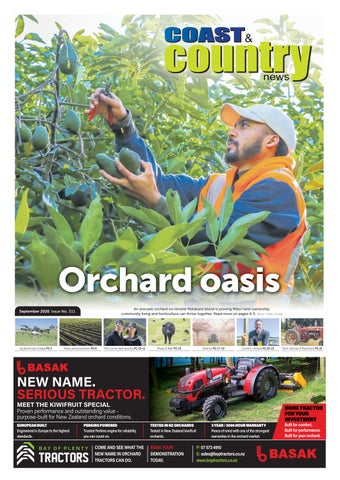
Orchard oasis An avocado orchard on remote Matakana Island is proving Māori land ownership, community living and horticulture can thrive together. Read more on pages 4-5. Photo / Kelly O’Hara
September 2026 Issue No. 311
Ag drone rule change PG 3
Maize yield protection PG 8
Hill country beef grazing PG 10-11
Sheep & Beef PG 16
Kiwifruit PG 17-19
Country Lifestyle PG 20-23
Farm Vehicles & Machinery PG 25
0 0 0 # 00 20 1 0#
#
0 , 00 2 20 0 0 #2 , # # ,
,0 ,
0 ) " ) &'*( *&() & %/ --- &'*( *&() & %/
+!"* &( &$ &(* +!"* &( ' ( &($ % +!"* &( .&+( &( (
COAST & COUNTRY NEWS
Page 2
The art of “hoiking” It was the day I went to “finishing school,” the day I got the crash course on rural etiquette from The Hat.
PU UKEKOHE TA AURANGA HAMILTON
TAUPŌ
Delliveriing 31,000 copies GISBORN NE to your target audience of farmers, growers & lifestylers every month.
www.coastandcountrynews.co.nz Editor: editor@coastandcountrynews.co.nz Advertising: ads@thesun.co.nz Coast & Country News is part of NZME - New Zealand Media & Entertainment. We keep Kiwis in the know! Some pages may contain sponsored content.
Because, as I learned, they think differently, do differently, on the farm. “And because you are unnecessary and irritating,” observed The Hat one morning when I walked in for breakfast - freshly showered, hair slicked down, a crease in my shorts and a fresh hankie Mum had ironed into a triangle, as she always did. Just the sight of me had The Hat shuddering, nodding incredulously and scratching at the hoary, brindled growth that was threatening to overrun his entire face. “Good God, man, you’re not going to a school ball. You’re going out on a farm. And you won’t need a ‘hankie’.” Outside, he proceeded to demonstrate why.
The art of hoiking
“If the dust and dirt clog the pipes, as they can do on a farm, you just hoik the stuff.” Hoik? What’s hoik? Then he expectorated.
Hoiked. Spat. Violently. Spectacularly. An Exocet missile of farm goob fired off into wherever. That kind of impressed a young boy. He could also have his signature soggy cigarette butt wedged in one corner of his mouth and fire ‘gobs’ of spittle, flakes of tobacco or bits of breakfast bacon rind from the other. Like a sniper’s bullet. You never knew it was coming. And always with enough velocity and accuracy to carry the offending matter at least a couple of metres from wherever he was or whatever he was doing. The Hat had lots of cool tricks. But never so much as an “excuse me, please.” I tried to “hoik” and “gob” one day, but ended up with a snail trail of saliva right down the front of my very “city” swish, Ming blue, cable-pattern jumper. The Hat loathed that jumper - he did only earthy tones. That’s perhaps another story.
No hankie required
“Similarly with your nose,” said The Hat. He blocked one nostril with a finger and then, with a snort, exploded the contents of the other into the dust at his feet. I winced, and he enjoyed my disgust.
“Hankies ironed by your mother are redundant, really.” Manners meet the farm “Sorry, Sir,” I said. “Pffft!” scoffed The Hat. “Stop apologising. It’s annoying. And spare the honorifics - ‘Sir’ makes me feel old, or superior, or both.” Gosh. Fifteen years of urban social grooming cast to the rural winds. “Sorry, Sir!” Dad always taught us manners. We call someone older either Mr or Sir until we’re invited to do otherwise. He said if we don’t show care and respect for others, we may as well all go back to the jungle.” The Hat pondered that while stoking life into that cigarette butt, but the sodden vegetable matter wouldn’t combust. “But look around,” he said eventually. “This is the jungle.” He heaved with laughter. “Yes,” I replied smugly. “This is the jungle and me, me Tarzan.” The comment flew right over the curious Hat’s fedora. “What?”
Time and place
“It’s about time and place,” he explained. “The place for etiquette is not standing in a paddock of belching, farting Corriedales in a stinking hot nor’wester. But the moment we walk through the back door at the end of the day, we become gentry.” Then he nodded emphatically and clapped me on the back to drive home his point.
COAST & COUNTRY NEWS
Page 3
Agriculture drone use reform to cut operator certification wait New Zealand’s rural agriculture drone users are welcoming a reform to drone regulations they say will drive innovation, efficiency and lift compliance in the industry. Associate Transport Minister James Meager said on August 20 that the Government will scrap requirements for lower-risk routine drone operations to apply and wait for certification before starting work “which can take up to nine months and cost thousands of dollars”. “Only a notification to the Civil Aviation Authority [CAA] ahead of time will be needed,” says James. “This will cover routine activities such as spraying of pesticides and herbicides and the distribution of fertiliser, lime, seeds and manures across cropland, pasture, orchards, vineyards, market gardens and forests.”
No longer fit-for-purpose
The reform will make agricultural drone use for spraying cheaper, faster, and more efficient, James says. “Drones have become an everyday tool in modern agricultural spraying, offering precise application of pesticides and fertiliser that helps minimise product wastage, while also reaching tricky terrain safely and efficiently,” he says. “However, farmers, growers and foresters have been clear that the current certification process is impractical and no longer fit-for-purpose. Existing rules have not kept pace with the evolving technological landscape. Farmers have told us about routine spraying operations being held up due to costly and complex regulatory roadblocks. This must change.” James says he’s directed officials to overhaul the rules and create a simpler
pathway, while maintaining critical public safety and environmental protections. The Ministry for Cities, Environment, Regions and Transport and the Civil Aviation Authority are jointly progressing the work. The change will come into effect mid-2027, following detailed design and engagement.
Accelerate innovation
The Agricultural Drone Association (ADA) is welcoming the move to ensure routine lower-risk agricultural drone work will no longer require an Unmanned Aircraft Operator Certificate (UAOC). This change will replace a long approval process with advance notification to the Civil Aviation Authority (CAA), says ADA president Craig Simpson. New Zealand usually leads in agricultural technology adoption but current regulation has slowed drone uptake “and put us behind the rest of the world,” Craig says. “[The CAA] were working hard with a rule that didn’t allow them to move quickly. This change will help accelerate the innovation we are internationally known for.” ADA represents 130 members, about half of New Zealand’s certificated agricultural drone operators, most of them professional contractors. “The change removes an approval queue rather than a safety requirement. Pilots will still need pilot certification, chemical handling competency and in-field assessment,” Craig says. “This is fit-for-purpose regulation, not deregulation,” he says. “But, when compliance is achievable, more operators comply, and that’s what actually makes the skies safer. “For contractors it means that once
This may be your most relaxed calving season so far! The Lely Calm automates the calf feeding to support growth and development from calf to cow. More flexibility for you, better quality of life for them! Scan the QR-code for more information
Find out more on lely.com/nz/solutions/feeding/calm
Bright farming is yours by choice
A drone used for agricultural spraying. Photo / File
you’ve done the training and proved you’re competent, you can get on wiith h routiine agricultural work instead of spending another 8 or 10 months waiting on an operator certificate.” Craig is now urging operators in the certification queue to keep going, since the current rules apply until mid-2027. “We’ll be working with CAA to try and speed up the current queue.” James says this reform builds on earlier changes allowing drones under 25kg to be used for mapping, monitoring and
stock shifting without certification or notiifi ficatiion. “We are now looking at ways to extend that flexibility to larger drones.” However, high-risk or complex drone operations, and spraying from planes and helicopters, will remain subject to existing requirements. “I’m confident this will strike the correct balance, so regulation is right-sized and proportionate to risk. Public consultation will also provide another layer of certainty,” he says.
COAST & COUNTRY NEWS
Page 4
Inside Opureora Orchard, Matakana
“The space is aptly named ‘Te Whare Manaaki’, a place of welcome, hospitality, While avocado blocks in the Bay of and community,” Pania says. Plenty are commonplace, the location The trust’s immediate history goes back to May 1998, when a hui was called of one is particularly unique. on the island by the Tauranga Moana Opureora Orchard is on the southwestern Māori Trust Board for all registered tip of Matakana Island and occupies owners/shareholders in five blocks, 8ha within a 10ha land block known as including Opureora. Opureora 1B7B3. Board members were trustees of the It is Māori freehold land owned and blocks transferred to them by the Māori operated by Opureora 1B7B3 Land Trust, Trustees’ Office, and they wanted to with orchard operations separated into its hand responsibilities back to the rightful own business structure, and trustees’ focus owners/shareholders. on governance. A new land trust was formed to govern Trustee Pania Wilson says there are Opureora 1B7B3 in January 2000, and about 800 avocado trees planted in the in 2004 trustees, with the agreement of 8ha site, alongside 10 homes in the the shareholders, entered into a joint Papakāinga (intentional communal living venture lease agreement for 18 years on ancestral Māori land – “a nurturing to establish an avocado orchard with a place to return to”). well-known orchardist family business It also includes an orchard shed from Katikati. which was recently renovated into “We were introduced to avocados an accommodation space for use by by the joint venture partner who shareholders and their whānau, as well as approached the chair of our land trust at orchard workers during picking season, and the time,” Pania says. three bays for storage of orchard vehicles, Ideal location resources, tools and equipment. “The orchardist had kiwifruit and avocado crops in Katikati but said the climate on Matakana Island is up to three NATIVE LOGS OR BUSH BLOCKS degrees warmer, making an ideal location Suitable for settting up to grow avocados.” Logging Permits & Pllans Across the Island, the main fruits and With thee everchanging laws by M.A.F the time to acct is now vegetables grown commercially are or possiblly miss out forever. avocado, blueberry, corn and kiwifruit. • Top Prices Guaranteed • Advance Payments Avaiilablle • Extensive Forestry Experience • Referennces “Operations/orchard manager Raatu For more inffo & evalluation on youur forest contact: Samuels keeps good relations with our distributor, who provides great, trusted MIKE PRIOR SAWMILLING LTD PH 07 552 6612 OR 0274 585 250 advice and guidance as we’ve been with
him since the joint venture 18-year lease agreement ended in 2023, and our land returned lock, stock and barrel – but also $40,000 in deficit,” Pania says. “However, th he trustees, our orchard team and whānau rolled our sleeves up and, working with a distributor who gets our vision and why we do what we do, we are happy to advise the business is doing okay, despite the challenges, including some of the severest weather events we have ever experienced.”
The fruit is taken to market using the Matakana Ferry II, a ferry/barge service which operates between Matakana Island and Ōmokoroa. This travell accounts for up to Th “Th 20% of our business costs, but we have no choice if that’s the only way to get product off the Island and into the marketplace,” Pania says. “There have been discussions about a collective investment in our own ferry
Shareholder Pania Wilson with Popsy the dog. Photos / Kelly O’Hara
WANTED
Sales, Parts & Service: 07 843 7237 • sales@acmd.co.nz agandcivilmachinery.co.nz
@agandcivil
COAST & COUNTRY NEWS
Page 5
Island’s 8ha avocado bloock “Despite our relativee isolation and challengees to access necessary heaalth and social services, our whānau are resilient an nd resourceful. “We have te reo Māoori experts, environmentaal warriors, experts in regenerative planting, fishermen, entrepreneu urs, carpenters, nurses, law wyers, y teachers, accountants, plumbers, drainlayers,, farmers and orchardistts.”
Shareholders Pania Wilson and Noel Samuels.
Steve Edw wards
Michael Tavares working in the avocado orchard on the island.
Serious machinery for serious work. service, and perhaps that will become a reality one day. “But for now the focus is on the business, and our shareholders/owners.” The off-season presents a time to clear and refresh the orchard through pruning and weeding. Raatu Samuels lives on the island and contracts one to two locals for orchard care, but for the current harvest the owners have commissioned professional contractors from the mainland. Pania says the land trust does not have shares in any other business on the island. “However, there is a connection of our shareholders to the other land blocks and that is through whakapapa (our genealogy).”
Pania says everything from people to product comes over on the barge, while the island hosts its store, post office and health clinic. There are five marae on Matakana and Rangiwaea islands: Opureora, Kutaroa, Oruarahi/Te Rangihouhiri, Rangiwaea, Oponui, and five hapū (subtribes): Ngāi Tuwhiwhia, Ngāti Tauaiti, Ngāi Tamawhariua, Te Whānau a Tauwhao, and Te Ngare. All five belong to Ngāi Te Rangi Iwi.
Matakana Island
Matakana is a long, flat island, 20km in length and about 3km wide, forming a sand barrier between Tauranga Harbour and the South Pacific. It protects the entrance to Tauranga Harbour and stretches from Bowentown to Mount Maunganui. Matakana Island has two distinct parts – 2023ha of farm and orchard land – including Opureora 1B7B3 land block – on the inner harbour (where most of the population lives) and 4047ha of forest-covered coastal land exposed to the Pacific Ocean. Combined with nearby Rangiwaea Island, it has a population of more than 300 people.
Golden Bay Dolomite NZ’s Finest Magnesium Fertiliser
call 0800 436 566 or visit www.dolomite.co.nz
0800 022 044 Tree Chipping • Stump Grinding • Land Clearing Mulching • Waste Processing • Orchard Removal
O
John Bertrand Collectables Buying in Waikato and Coromandel Next Week
nce again, the gold and collectables buyers from Wellington company John Bertrand Collectables are visiting Waikato and Coromandel next week. Mr Tony Grant from the company says, “If you are downsizing or wanting to dispose of things because they no longer serve any purpose to you or your family bring them in”. “Next week will be a great opportunity to have any items you want to sell assessed by our buyers” said Mr Grant. Particularly wanted are Gold and Silver (in any of its forms) and Collectables such as Coins, Banknotes, War Medals, Old Wind-up Watches and other interesting Small Collectables. “We are keen buyers, especially of the items in the list below” said Mr Grant. “Nothing is too small for our consideration. We are just as happy buying 1 item as we are buying 1,000 Mr Anthony (Tony) items” he said. The buyers will W. Grant be in Waikato and Coromandel next week. (see details below). Fellow of the Royal Numismatic As Tony Grant points out “If you Society of New Zealand Incorporated Director and Buyer are in doubt about any items John Bertrand (Collectables) Ltd you may wish to sell, bring Author of the John Bertrand them along for an instant NZ Coin & Banknote Catalogue appraisal.”
Gold & Silver At Very High Prices
O
ver the last couple of years, we have seen a sharp increase in the price of precious metals. The gold price in New Zealand is still at historically high levels. So, gather up all your unwanted items and make an appointment to see the buyers. Tony Grant says “We can buy gold items in all forms, including Jewellery (Rings, Chains, Brooches etc.), Coins (Sovereigns and the like), Alluvial (River Gold), virtually anything, even Gold Teeth! We also need all Sterling Silver including Cups, Tea Services, Cutlery and Old Coins” he said.
T
Interesting Small Collectables Wanted
he buyers from John Bertrand (Collectables) Ltd, visiting Waikato and Coromandel next week, are happy to look at any interesting items, for example vintage pocket and wristwatches such as Rolex, Men’s Omega, Breitling and gold watches etc. Also wanted, pre 1950’s picture postcards, Maori and Pacific artefacts, old fountain pens and other small antique or historical items. “If you have something unusual which you would like to sell, please bring it into one of our venues, we would like the chance to at least have a look at it” said Tony Grant, buyer for the Company. “We will consider anything which may be of interest to a collector” he said.
Some Big Dollars in Early Banknotes
E
arly New Zealand Banknotes dated before 1932 are currently fetching big money! This is according to Mr Tony Grant, author of the John Bertrand New Zealand Coin & Banknote Catalogue. Mr Grant is in Waikato and Coromandel next week on a buying trip for John Bertrand (Collectables) Ltd and would be very keen to see any of these issues. “We will pay at least $300 for any undamaged Ten Shilling or One Pound
banknote from a New Zealand trading bank dated 1932 or before. Denominations of five pounds and higher would be worth from $700. “Any banknote dated prior to 1900 would be worth at least $1000” said Mr Grant. Also purchased are any Reserve Bank of New Zealand pre-decimal issues, especially 50 Pound notes. All overseas banknotes are also wanted, especially early Pacific Island issues.
C
ADVERTISEMENT Collectors Need War Medals
urrently, throughout NZ and the world there is a big demand by collectors for war medals. These cover all wars right through from the New Zealand Land Wars and the Boer War, to the First and Second World Wars and the later Korea and Vietnam conflicts. New Zealand Servicemen and Women first served overseas in the Boer War in South Africa around 1900 and the war medals awarded for this service are needed by the buyers, as are any other Medals from early New Zealand and the New Zealand Wars. General service medals from both the First and Second World Wars will also be purchased, but as can be imagined these were awarded in fairly large numbers. “If a group of medals has any special award for bravery such as the Military Medal, Military or Flying Cross or other medals for Distinguished Conduct or Meritorious Service, these can add great value to a group” stated Mr Tony Grant, buyer for John Bertrand (Collectables) Ltd. “Many families have old medals, some dating back to early Imperial days, that they are not sure what to do with. These are better off in the hands of collectors who will look after them. We will be happy to look at any war medals whatsoever, just bring them in to venues” he said.
D
Old Coins Can Toss Up a Rarity
o you have a bunch of old coins sitting around in your drawers and cupboards? You just never know what rarities may be lurking there. The advice from Tony Grant from John Bertrand (Collectables) Limited is to “bring them in and let us have a look”. “No need to sort anything out just bring them in ‘as is’ and please don’t clean them! We can go through coin accumulations and collections fairly quickly” he said. The buyers are particularly keen to purchase pre1946 New Zealand Silver Coins and World Silver Coins. “In any event we will buy All Coins,” said Mr Grant.
JOHN BERTRAND (COLLECTABLES) ARE BUYING NOW!! GOLD & SILVER
OLD GOLD
TOKENS
• Racing Cups • A&P Show Cups • Sports Cups • Presentation Keys & Trowells • Show Pieces • Sterlling Sillver Tea Sets • Sterlling Sillver Cutllery • Scrap Golld & Sillver *No EPNS or Silver Plated items Please*
• Unwanted Jewelllery or Broken Ring gs gs • Golld Chains • Golld Watch Cases • Allluviall (River) Golld • Dentall Golld • Golld Coins • Golld Racing & Trophy Cups
COINS • Alll Golld & Sillver Coins • Golld Sovereigns • Golld Hallf Sovereigns • NZ Sillver Coins 1946 & Before • Allso wanted NZ & Worlld Coins after 1946 • Australlian Sillver Coins to 1963 • Engllish Sillver Coins to 1946 • NZ 1935 “Waitangi Crown” • USA Coins up to 1964 • Olld Colllections & Accumullations of Worlld Coins • Modern Colllector’s Coins & Sets • NZ Reserve Bank Sets *No Pennies or Halfpennies Please*
BANKNOTES
• NZ & Australlian “Tradesmen’s” Tokens • NZ Transportation Tokens • Raillway Passes • Tram Tokens (not Dunedin Tramways) • Presbyterian Church Communion Tokens • Bread Tokens • Theatre, Cafe, Discount Tokens etc • Any other tokens rellating to earlly New Zealland
COLLECTABLES
WRIST & POCKET WATCHES • Golld & Sillver Pocket Watches • Any Rollex Watches • Omega Gents Watches • Any Breitlling, Jaegar Le Coulltre, Vacheron & Constantin, Patek Phillippe, or IWC Watches • Moon Phase Watches • Chiming or Allarm Watches (Pocket or Wrist) • Millitary Watches • Divers Watches • Alll other pre 1950s wind up watches (parts vallue onlly) *No Quartz or Battery Operated Watches Please*
• NZ & Australlian “Trading Bank” Notes pre 1932 (e..g.. Bank of New South Walles, Bank of NZ etc) • Reserve Bank of NZ Pre--Decimall Notes • Any £20, £50 or £100 Notes • Hong Kong & Mallayan Banknotes • Australlian Pre Decimall Notes • Australlian “Star” Notes • Earlly Fijian and Samoan Banknotes • NZ Traders Promissary Notes (1840s) • NZ Government Debentures • NZ Banknotes overprinted for use in Fiji, Cook Isllands etc • Postall Notes • Alll other Worlld Banknotes
• Allbums & Accumullations of Pre 1920s Postcards (used or unused) • Olld Fountain Pens • Smalll Chinese & Japanese Antiques
WAR MEDALS ETC • The New Zealland Wars & Boer War Medalls • 1st Worlld War Medalls • 2nd Worlld War Medalls, Stars etc • Orders and Decorations • Korea & Vietnam Medalls • Antarctic or other Pollar Medalls • Fire Brigade Medalls • Lodge Medalls • Shooting Medalls • Millitary Badges and alll other Millitary Medalls • Golld returning Fob Medalls or “Tokens of Honour” from residents of smalll town New Zealland
HISTORICAL MEDALS • A&P Show - Golld, Sillver & Bronze Medalls • Commemorative Medalls & Medallets • Prize Medalls (Golld & Sillver) • Sports Medalls (Golld & Sillver) • Life Saving Medalls • Shipwreck Medalls • Coronation Medalls • etc, etc, etc
No item too small for our consideration
JOHN BERTRAND (COLLECTABLES) LTD OUR BUYERS ARE IN YOUR AREA NEXT WEEK
WE WANT TO BUY – CASH-IN NOW
ACACIA BAY
Sun 6 Sept
Community Hall, 2 Wakeman Road
1 pm to 3 pm
CHARTWELL
Mon 7 Sept
Cooperating Church Hall, 126 Comries Road
9 am to 10.30 am
TE AWAMUTU
Mon 7 Sept
Library Meeting Room, 2 Selwyn Lane
11.30 am to 1 pm
HAMILTON EAST
Mon 7 Sept
St Andrews Link Community Centre, Purdie Hall, 4 Te Aroha Street
2 pm to 3.30 pm
TE KAUWHATA
Tues 8 Sept
St John Ambulance Room, 4 Baird Avenue
9 am to 10.30 am
ROTOTUNA
Tues 8 Sept
Chapel Hill Community Church, Meeting Room, 2 Cate Road
11.30 am to 1 pm
PUTARURU
Tues 8 Sept
St Paul’s Church Lounge, 64 Kensington Street
2.30 pm to 4 pm
HAMILTON
Wed 9 Sept
Scots Presbyterian Church Hall, Corner Cunningham & Vardon Roads
9 am to 10.30 am
CAMBRIDGE
Wed 9 Sept
St Andrews Church Parish Hall, Corner Hamilton Road & Victoria Street
11.30 am to 1 pm
MORRINSVILLE
Wed 9 Sept
Rotary Community Centre Lounge, 45 Canada Street
2 pm to 3.30 pm
TE AROHA
Thurs 10 Sept
St John Ambulance Training Rooms, 33 Burgess Street
9 am to 11 am
PAEROA
Thurs 10 Sept
War Memorial Small Hall, 144 Normanby Road
12 noon to 2 pm
THAMES
Fri 11 Sept
Thames Citizens Band Hall, 301a Queen Street
9.30 am to 12 noon
COROMANDEL TOWN
Fri 11 Sept
Coromandel Citizens Hall, 455 Kapanga Road
2 pm to 4 pm
WHITIANGA
Sat 12 Sept
Whitianga Town Hall Supper Room, 24 Monk Street
9 am to 10.30 am
TAIRUA
Sat 12 Sept
St Francis House, 244 Main Road
12 noon to 1.30 pm
WHANGAMATA
Sat 12 Sept
Whangamata Baptist Church Lounge, 301 Port Road
2.30 pm to 4 pm
MATAMATA
Sun 13 Sept
Headon Events Centre, Rose Yorke Room, 47 Western Street
9 am to 11 am
TAUPO
Sun 13 Sept
1 pm to 3 pm
NO APPOINTMENT NECESSARY Pllease note: If you selll anything to us, suitablle ID is required.. Pllease allso bring your bank account detaills for the deposit of funds for larger purchases..
John Bertrand The Trusted Name In Numismatics Since 1965! John Bertrand (Collectables) Limited T: 04 232 9832 • E: info@bertrand.co.nz Level 1 Harcourt’s Building, 215 Main Road, Tawa, Wellington 5028 PO Box 323, Wellington 6140
Members of the Australasian Numismatic Dealers Association and the New Zealand Numismatic Dealers Association
COAST & COUNTRY NEWS
Page 7
Waikato farmer tours China’s dairyy ggiant A long-time Waikato organic dairy the milking cows are kept indoors all year with feed – lucerne and maize – cut farmer has seen first-hand the mind- round, and carried to them. boggling scale of the The unit also included calf-rearing facilities. Herd houses are fully temperaturesector in China.
Gavin Fisher, who has run a certified organic dairy farm near Te Aroha for 27 years, joined a study tour which took in a 100,000 cow/15,000ha operation on the fringes of Ulan Buh Desert, part of the Gobi Desert region in Inner Mongolia. Providing China with a third of its organic dairy – mostly infant formula and UHT milk – needs, Shengmu organic dairy farm has only been developed since 2013. Gavin says the Shengmu dairy farm influences the entire region, with organic decisions made on a regional scale. With its organic herd, Shengmu also boasts 47,000 non-organic milking cows, including a beef fattening operation which runs about 3500 beef animals, all housed. They are concentrating on mainly wagyu and angus genetics, says Gavin. Some of the vast property is also used for commercial cropping – pumpkins and liquorice. The 10-strong organic study tour was run by Buy Pure New Zealand and IFOAM (International Federation of Organic Agriculture Movements) Asia, a group that promotes regional organic markets.
The tour
Gavin learnt about the tour from Brendan Hoare, managing director of Buy Pure New Zealand, who he knew had “really good connections” in China. Along with Shengmu farm, the tour took in a trade expo and supermarkets to see where the Chinese organic products ultimately go on sale to the public. “There is a huge difference in price compared with non-organic, but organic is a big seller,” says Gavin. “They are prepared to pay a premium.” He says online sales are also a big focus, promoted through social media “influencers”. A four-hour flight from Shanghai, the Shengmu operation has a separate dairy company’s factories nearby which process its organic and non-organic milk into mainly UHT, powder and some yoghurt. Gavin and the tour group visited one of the organic dairy units the vast property is divided into. It milks 8500 cows in two 90-cow rotary bail units that sit side by side in a single shed.
controlled, with desert temperatures dropping to minus 20C in winter and hitting 40C in summer. The unit the tour visited has a staff of 50, working in shifts, and milks 8500 cows in two 90 rotary bail units that sit side by side in a single shed. Cupping is done manually but removing is automated. The farm runs off solar power, with most farm vehicles electric. Through advanced technology and solidliquid separation, Gavin says every ounce of manure is transformed into value, with compost rebuilding fragile soils and liquid nutrients delivered via precision irrigation straight to crops. “Methane from waste powers operations, solar infrastructure fuels the farm, and machinery is shifting toward electrification, creating an efficient selfsustaining ecosystem.” “It’s designed for efficiency,” says Gavin. “It’s self-contained and off the grid.”
Sound planning
Along with significant investment, he says plenty of thought and detail has been put into the project. “They have shown the ability to scale-up,” he says. “New Zealand could learn a lot by that, just by getting on with it.” • LOGGING • TREE REMOVAL • EARTHMOVING
TREES - LOGS WANTED
Above: Gavin Fisher, left ft, t receiving a gift ftt on behalf of the study tour group from frr a dairy factory the group visited in China. Left: A rotary milking shed on Shengmu organic dairy farm in China. Photos / Supplied Gavin says in future years the owners want to double the size of the operation. The current property is extensively irrigated, with water primarily sourced from the nearby Yellow River. He says the desert development involved the planting of a billion trees and grasses planted in grids to counter sand encroachment. “There’s good soil under the sand.” Excess sand was sold off for roading in the development stage of the farm. All China’s dairy products are sold on the home market, with New Zealand continuing to be a major exporter there of both organic and non-organic dairy line. Gavin says even with developments like Shengmu, New Zealand still has a competitive advantage in dairying through its
favourable climatic conditions and associated outdoor production, and GE (Genetic Engineering)-free status. With long-time dairying industry connections, he says China has gained knowledge from New Zealand through innovation, expertise and innovation. Back home at Elstow, Gavin and his wife Sheryn run 165 cows, plus a number of deer and beef cattle, on a 74ha third-generation family farm – Mountain View Organics – which he has milked on for 46 years. Over the years, the Fishers have planted a diverse range of trees on the property – shade, shelter and nutrient recycling – including fruit trees (feijoas and olives). They also have their own brand – Off the Planet Organics – selling free-range eggs and fruit produce locally. Steve Edwards
KEEP YOUR PK & FERT BUNKERS DRY WITH POWERTARPS Powertarps - New Zealand’s leading retractable tarp supplier
Call for free wood lot appraisal Mark: 0274 426 785
Continuous milking
The farm runs Holstein-Friesians from Australian genetics, with cows milked three times a day and operating 24/7. Cows average about 43 litres of milk/cow/ day, which Gavin says is about double the New Zealand production. With nutritionists and veterinarians on-site,
ORCHARD COMPOST AVAILABLE NOW Quality orchard compost. Ideal for kiwifruit and avocado growers. Hill Labs report available. • Competitively Priced • Available in Bulk
Phone: 02 7 2 7 9 3059
We specialise in high quality mesh and PVC covers to suit farm bunkers. All covers are easily operated from the ground, eliminating health and safety concerns. IF YOU WANT A TARPING SYSTEM THAT IS SAFE & STANDS THE TEST OF TIME, CALL US NOW P: 021 041 7052 sales@powertarps.co.nz
powertarps.co.nz
Page 8
COAST & COUNTRY NEWS
Protect yourr maize silage investment Despite the cost of growing a maize silage crop rising about 30% in the last four years, growers should not be tempted to cut corners which could result in a reduced yield.
“When you are growing a high-cost, high-input crop, doing the basics right is more important than ever,” Corson Maize national research manager Mike Turner told a Foundation for Arable Research (FAR) maize winter workshop. From 2021-2022 to 2025-2026, his analysis showed that total maize silage costs, from spray out to covering the silage stack, rose from $4026 per hectare to $5143/ha. Fertiliser/lime and seed related inputs both recorded the biggest increase, at about 41%. “When costs are going up you need to protect that investment and yield at harvest.” Mike says that base fertiliser increased from $450/ha in 2022 modelling to $850/ha now. “In comparison, the cost of a soil test is very cheap. So, if you are getting your fertiliser spend wrong, either too much or too little, it can have a big impact on costs.”
Basics right
When growers get the basics right, a higher yield dilutes their costs, Mike says. For example, a 17 tonne of drymatter/ha maize silage crop equates to 31.9 cents a kg of drymatter. At 25 tonnes/ha this falls to 21.7 cents/kg/DM and at 28 tonnes/ha 19.4 cents/kg/DM. “Yield spreads cost across more kg of feed. This is the strongest reason for growers to protect crop establishment and the basics. Most costs in a maize silage crop are fixed. So, the only real way to offset that is to get a good yield.” When choosing a Comparative Relative Maturity (CRM) hybrid for silage, growers need to be aware that while silage yields increase for longer-maturing hybrids, so can the risk, especially in environments that can get dry and disease pressured. Some growers choose a CRM out of habit, he says. “It is worth asking your seed supplier about what hybrid best
Growers on good-sstructured soils could consider their cultivation intensity. Photos / Supplied This allows side-dress N suits your system? “Shorter Shorter CRM is not about giving up yield potential, it is about providing a more reliable return applications to be better matched and a less risky yield. A crop that finishes cleanly, dries to crop demand and soil N supply, down, stands well and meets the harvest window usually improving profitability, van Tilburg protects margin better than a theoretical top-yield option.” says. Predictions of a super El Niño weather pattern In a FAR maize grain production producing hot, dry conditions later this season means it trial at the Corson Research site at is recommended that growers without good moistureNewstead, near Hamilton, large FAR senior maize researcher holding soils shorten their CRM to get their crop well differences in soil N supply between Rene van Tilburg. into grain fill or dry down phase before it comes under plots in 2024-2025 resulted in sidetoo much pressure. Some hybrids can better cope with dry dress N inputs ranging from just 75 kg to 360 kg SustaiN/ha. Soil conditions later in the season. A lower plant population testing showed the soil supplied from $599 to $1016 worth of N at a could also be considered, Mike says. SustaiN price of $1400/tonne. FAR senior maize researcher Rene van Tilburg says Despite these large differences in N inputs, grain yields remained that growers need to factor soil nitrogen into their input remarkably similar, with all treatments producing about 16 tonne/ calculations and if they are applying more nitrogen ha of grain. than what their crop can take up, they are wasting The result saved $446 to $805/ha if no allowance had been made money. “Maximise your soil N; use it or lose it.” Growers for soil N, with the lowest SustaiN rate having one of the higher generally make some allowance for soil N, but often this is yields though not significantly so, indicating no yield penalty for anecdotal and what they have always done, rather than being using the soil N tools. based on actual soil test results. Instead, growers should measure nitrogen supply rather Cultivation intensity than guess it and trust the result. Growers are recommended to use a Mineral N test to Growers, particularly on good-structured soils, can also consider determine soil N as well as a Potentially Mineralisable their cultivation intensity, saving diesel and machinery costs and Nitrogen (PMN) test, which indicates how much N may labour, van Tilburg says. become available during the growing season. “FAR work shows no yield penalty moving to strip till or no-till on sites with high quality soil. However, transitioning to strip-till or no-till has its challenges and may not be practical for many growers, van Tilburg says. Instead, a pass in a conventional system may be eliminated or a reduction in cultivation depth and subsequent increase in speed made instead. “A key point when making any of these changes is to ensure a seed bed that will result in consistent seed depth and good seed to soil contact.” FAR trials show that the combination of reduced cultivation intensity and use of Mineral N and PMN testing have the potential to save $300 or more per hectare, he says.
(& '" * )( '
+" -,)" +
+ ! . . . ! %.
$. . # . . #
You don’t have to do it alone. With local advice, science-backed support and the products you need when you need them, Ravensdown helps keep your plans on track. From the everyday decisions to the unexpected moments, you’ve got a trusted team right by your side.
Call 0800 100 123 or talk to your agri manager today.
COAST & COUNTRY NEWS
Page 10
Hill country beef grazing: Practical
Being part of a grazing research project has shown the owners of a traditional hill country sheep and beef farm that they can improve their property’s profitability and environmental health simultaneously. New Zealand’s Bioeconomy Science Institute has run hill country grazing research since 2024. Lead scientists Lisa Box and Tracy Dale started the project under the Ag Research banner before it was amalgamated into the institute. “There are three case studies running
through to June 2027 and Tracy and I are the leads for one on the 660ha (413ha effective) traditional hill country sheep and beef farm of Jon and Fiona Sherlock at Otorohaea, Waikato,” says Lisa.
A crossroads
The institute is investigating how New Zealand farms can adapt to changing Social, Environmental, Cultural and Economic (SECE) pressures. “The Sherlocks were concerned about the future of their generational farming business and were considering options to move forward from the lack of profitability.”
The 2026 Ballance Farm Environment Trust Awards’ Waikato Supreme Champions Jon and d Fiona Sherllockk are partiiciipatiing in a graziing projject wiith h New Zealland d Institute for Bioeconomy Science. Photo / Supplied
ALL PLANTS $7.50 EACH
Oropi Road nursery is open 10am-2pm every Friday, Saturday & Sunday Hundreds of varieties and thousands of plants to choose from, all proudly propagated right here in the Bay of Plenty. Family owned and operated for over 20 years.
kererugardens.co.nz 07 543 1577 341 Oropi Road, Tauranga
Pine trees were considered, and while profitable they weren’t what the Sherlocks wanted. “Like many hill country farmers, we were at a crossroads. We realised that tweaking what we were already doing wasn’t going to be enough, we needed a genuine step change in profitability, not just incremental increases in productivity,” says farm owner Jon Sherlock. “We wanted to find a way to keep farming, improve the business, and achieve better environmental outcomes without selling up or simply converting the farm to forestry.”
Door to change opens
In May 2025, the Sherlocks were one of three farms that won a year of using the Halter collar system for virtual fencing, pasture management and health monitoring. “This allowed a transition to an intensive bull beef system as the virtual fencing could be put in place where using sticks and string fencing would not be as doable on the steep country. “[The] 215 hectares have been virtually fenced and set aside for rotationally
grazing 950 R1 bulls. The sheep remain on other areas of the farm,” says Lisa. The virtual fencing positioning was very specific, fencing off erosionprone, steep land and waterways either regenerating or will be planted in natives or permanent exotics. “We have social scientists working with the Sherlocks to track and understand their decisions.” The approach is integrated as they try to see how any changes affect environmental outcomes and farm activities. “It was a big shift in our thinking and required careful planning,” says Jon, “but once we could virtually fence areas that had never been practical before, it completely changed how we looked at our hills. “We could match grazing to the capability of the land rather than being limited by permanent fencing.”
Data from all aspects
The project was a complete change in design of the Sherlock’s hills, and baseline images and data were recorded when the cattle went in. The initial baseline and ongoing data includes: drone images of cover; visual
COAST & COUNTRY NEWS
Page 11
research for farmers
assessments of the soil; tree diversity; vegetation cover; stream health including eDNA samples and water quality samples; and pasture quality management. The Sherlocks had committed to using virtual fencing past their first free year. The system has enabled them to push the cattle further up the hills into steeper land, expanding the area for grazing. The research will continue into 2027, but preliminary results from visual stream assessments show no degradation of waterways and the physical look of the land isn’t obviously degrading. “The cattle have performed exceptionally well. We’re seeing productivity gains on our hill country that we never thought was possible,” says Fiona. “Just as importantly the land looks healthier, the pastures are changing, and the animals seem happier and more content.” The Sherlocks feel they now have the confidence that improving profitability and improving the environment can go hand-in-hand. The virtual fencing has become an essential management tool for them and they wouldn’t want to farm this system without it.
Importance of research
Lisa says this research is hugely important for other farmers who are at an impasse on how they move forward with increasingly unprofitable businesses and ever-changing environmental legislation. “Our findings will hopefully enable other farmers with steep country to expand their enterprises into the hill country. “It is hoped that the case study will
Jon and Fiona Sherlock on their Waikato hill country farm. Photo / NZFET / Alan Gibson
help farmers design a farm system that allows profit which doesn’t involve a whole farm change, while also supporting SECE,” says Lisa. The Sherlocks believe this is only the beginning and see opportunities to continue refining grazing management, improve pasture quality, and retire the least productive land into biodiversity projects. “Our goal is to produce more from the right areas while improving environmental outcomes across the whole farm,” says Fiona. The Sherlocks have shown that profitability and environmental improvements don’t have to compete. By farming the best land better and allowing the less productive land to do what it does best, they can achieve both. The Sherlocks were Waikato Regional Supreme winners at 2026’s Ballance Farm Catherine Fry Environment Awards.
• Slashes your power account • Heats hot water* • Centrally heats your home (underfloor or radiators) • Airs and dries your clothes • Heats your spa pool • Mains pressure (if required) • PV & Solar Compatible • 100% NZ owned and manufactured • houses • Marae • wineries • glass houses • swimming pools • dairy sheds • camping groundss • shearing quarters • restaurants • sport complexes • spa pools • factories • packing sheds • motels • etc. Off Grid Home options available
ENGINEERED REPRO SUCCESS BETTER RUMEN FUNCTION MORE AVAILABLE ENERGY
STRONGER TRANSITION BETTER REPRO CONDITIONS The average time from calving to first heat was 24 days which was 16 days quicker than the district average. chris - otago Halfway through spring calving in our organic system, we’ve had just one mastitis case and reduced our 10-day average SCC from 260,000 to 156,000. Fraser - Te Awamutu
Immune modulation. Boosts immune resilience by providing multiple strains of micro-encapsulated bacteria.
Combining multiple strains of bacteria with Cultron (4500 metabolites identified) With better digestion and health cows have more energy for delivering calves and retained membranes. By supporting immunity and optimising digestion pre-calving, it can reduce the severity and impact of sub-clinical ketosis.
Chris 027 459 1061 Matt 021 234 1713
www.probioticrevolution.co.nz
Stuart 021 247 7405
HORTICULTURE HORTICULTUR
Page 13
Get more from m your orchard flo oor
For high-value g horticultural crops p like kiwifruit and avocado, the orchard floor can offer far more than groundcover.
designed to support g pp soil biology gy and carbon, phosphate scavenging, nd beneficial insects, fungal activity an water infiltration.
“A well-chosen cover crop and complementary nutrition system can protect soil, provide organic matter and stimulate microbial activity, while supporting orchard productivity at peak demand,” says a Pastoral Improvements spokesperson. Pastoral Improvements’ orchard mixes are tailor-made for New Zealand horticultural systems, the spokesperson says. The Kiwifruit Orchard Floor Mix is a perennial-based, low-maintenance blend suited to established and preestablishment orchards, with robust growth that can be mulched or cultivated back into the soil. The Avocado Orchard Floor Mix is
“A healthy, diverse orchard floor creates c a strong foundation, but crop nutriition is also key. “Foliar fertiliser provides a targeteed way hment to supply nutrients during establish and periods of rapid growth, or durring nt environmental stress, when nutrien demand is high or root uptake mayy be limited. “Integrating foliar nutrition within your i growing system can help improve nutrient efficiency, strengthen establishment and support more consistent production throughout the year.” Black Gold provides premium microbial feed to support soil biology and nutrient cycling, while Seaweed Biostimulant
Benefits
The orchard floor could be an untapped goldmine with the right cover crop and nutrition strategy. Photo / Supplied
KōFERT Bio-Base and Bio-Plus are designed to optimise root growth and resilience. Rapid Boost NPKS and Black Gold NPK offer readily available nutrients for crops needing a quick response.
“Every orchard is different. The right approach starts with understanding what your soil and crop need, then choosing the best input for the job.” For more information see Pastoral Improvements advert on this page.
Growers get clearer picture of armyworm threat Four years after fall armyworm was first detected in New Zealand, researchers say growers now have a much better understanding of how to manage the destructive maize pest. Foundation for Arable Research (FAR) biosecurity officer Ash Mills says uncertainty surrounded the pest’s arrival in 2022, with much of the available information based on overseas experience rather than New Zealand conditions. “Many assumptions were based on overseas experience. Four years later, we have a much clearer understanding of where the pest fits within our maize production systems and what remains unknown.” Fall armyworm is regarded as one of the world’s most significant maize pests and can cause substantial damage to crops if left unchecked. Ash leads a three-year Ministry for Primary Industries Sustainable Food and Fibre Futures project investigating the long-term management of fall armyworm. The project has focused on understanding where the pest occurs, when it becomes economically important, how it can be controlled, how it fits within existing maize pest programmes and what further research is needed. A nationwide surveillance system has been established using pheromone traps, field scouting and seasonal monitoring. Grower resources, identification guides and the website fallarmyworm.nz have also been developed.
However, Ash says researchers quickly discovered that while trapping adult moths was relatively straightforward, predicting crop damage remained far more challenging. “We also learned that effective surveillance depends on growers and advisers regularly inspecting crops, which remains one of the biggest practical challenges.” Research has shown that fall armyworm management needs to be integrated into existing pest management programmes, with particular attention paid to crops during early vegetative growth stages, when yield potential is most vulnerable. “When larvae are detected early, management options are generally effective and straightforward. As larvae grow and move deeper into the plant, control becomes more difficult.” Research is continuing into how the pest survives New Zealand winters, what drives seasonal population changes and whether new populations are arriving from Australia. Bioeconomy Science Institute entomologist Scott Hardwick says monitoring shows fall armyworm can produce three to four generations a year in the Far North and warmer eastern regions of the North Island, while cooler southern regions generally produce one to two generations. Far North entomologist Jenny Dymock, who has monitored fall armyworm near Kaitaia for four years, advises maize growers to sow crops in November rather than December to avoid damage from secondgeneration larvae.
! $ % ! ' ' ( ! "& ! !" ' ( & # ! " " " % # ! " " ! ! ' ( &
FERTILISER
Page 14
Farmers call for simpler nitrogen reporting Dairy farmers are “self-capping” nitrogen fertiliser use, says an industry leader.
Waikato Federated Farmers’ dairy section chair Matthew Zonderop says farmers are “fiscally prudent enough” to gauge their respective nitrogen application. “It’s not a lolly scramble with that stuff.” His comments came after Parliament heard almost 40% of dairy farmers are not meeting the legal requirement to report nitrogen fertiliser use. Rules under the National Environmental Standards for Freshwater limit the amount of synthetic nitrogen fertiliser farmers can apply to pasture, to help protect water quality in rivers, lakes, and groundwater.
This means a cap of 190kg of synthetic nitrogen per hectare per year on each hectare of grazed pasture. Farmers can log reports via an N-cap reporting tool commissioned by Te Uru Kahika, the organisation representing the country’s 16 regional councils. Customers of fertiliser companies Ravensdown and Ballance AgriNutrients can have reports submitted on their behalf, while such data is also required from Fonterra suppliers. The N-cap is one of the rules that could be removed as part of the proposed Government reforms of the Resource Management Act. Matthew says reporting can be “painfully difficult” for farmers, through archaic tools. He says, in any case, it would not be economical to apply more than 100-110kg of
IT’S GRO OW TIME E.
Limited monitoring
Good Advice. Better Results. Ag Lime • Custom Blends Soil Testing • Perssonalised Advice
0800 40 10 40
•
sales@rorisons.co.nz
•
nitrogen per hectare annually. This relates to pasture needs across most of the country, and increased costs of fertiliser and application because of the Middle East conflict. Matthew says dairy farmers should conduct soil tests to gauge the amount of nitrogen available and what, if any, is needed. Across the agricultural sector in general, he believes an N-cap is still needed so as to not “saturate the environment”. “The best way is to look at nationwide data and find a median – happy ground – balancing agriculture with the environment.” Bay of Plenty Federated Farmers’ dairy section chair Margaret Wright says farmers are involved in running a business, and although most are motivated to farm for much deeper reasons than pure financial ones, the business does need to be profitable. The use of feed budgets to plan for shortfalls determine what level of synthetic nitrogen may be required to boost pasture growth in shoulder seasons, she says. “While nitrogen may be the most economic way to boost feed supply it does come at significant – and increasing – cost. From the reporting side of things, the duplication of supplying this information is the most frustrating part of it,” Margaret says. “We report this stuff to our milk processor, regional council and Statistics NZ…all in a different format. It’s a mission getting it done when surely it should only need doing once through an information sharing structure.”
rorisons.co.nz
Bay of Plenty Regional Council acting compliance manager Steve Pickles says while reporting is required, compliance monitoring and follow-up was limited because resources have generally been focused on higher-risk environmental activities. “Our compliance approach is to remind farmers to submit their N-Cap records before the end of the reporting period and to discuss N-cap reporting requirements during onsite farm visits throughout the year. “However, we do not actively follow up with farmers who fail to submit records.” Steve says the basis for this approach is that almost 100% compliance with the 190kg/ha/ year limit is achieved by BOP farmers who have submitted their records. For 2024/25, about 62% of BOP farmers completed their reporting. Based on reported data, exceeding the N-cap appears to be rare in the region. “We didn’t receive any reports of exceedances of the national limit for those periods.” Waikato Regional Council required a Official Information Act request for comment. “The data that has been provided to us would indicate that, for the 2024/25 reporting period, 60 per cent of Waikato dairy farmers required to report their N use had done so,” says the WRC. “The 2025/26 reporting period is sitting at around 54%. This figure is provisional, as June reporting
Waikato Federated Farmers’ dairy section chair Matthew Zonderop. Photo / Supplied
Bay of Plenty Regional Council Acting Compliance Manager Steve Pickles. Photo / Supplied
figures are still to be received.”
An industry shift
DairyNZ would like to see a shift to Freshwater Farm Plans if they can deliver the same or better environmental outcomes. “Farm plans can target risk where it matters most, rather than applying the same rules to every farm regardless of its circumstances,” policy and government relations general manager Roger Lincoln says. DairyNZ previously outlined how the N-cap requirements could be improved, including the cap be applied as an average across the effective farmed area as opposed to a cap for every hectare, remove the requirement to provide receipts annually and amend reporting timeframes to align with the farming calendar. Roger says farmers have been operating under increasingly stringent regional and national freshwater requirements and have responded with substantial investment and on-farm change. This included a 30% reduction in fertiliser use in the past decade, more precise nutrient management, improved irrigation and effluent systems, extensive riparian planting and waterway fencing, and widespread adoption of Steve Edwards FEPs.
POND AND DAM LINERS
NA ATIO ON WIDE
Durable and UV resistant, HDPE Liners Comprehensive Material and Installation Warranties QA Documentation specific to your project
info@aspectlining.co.nz
0800 464 235
www.aspectlining.co.nz
FERTILISER
Page 15
Plan now for high crop yields Fertiliser is essential for growing high-yielding annual crops. We’re sure you already know this. No doubt you’re also aware that not just any fertiliser will do. You need the right fertiliser at the right rate suited to the crop or crops you’ve chosen to plant. But this need not be a problem. Armed with a recent soil test to calculate the nutrients needed, and access to fertiliser products that reduce issues around application, crop planting can be a straightforward task.
Soil tests a must
Regular soil tests are always important, but to give your crop every opportunity to reach its potential, they’re essential. Knowing the current nutrient status of the soil is the starting point for working out what is actually needed to meet crop demand during the growing season. This not only applies to the specific nutrients required, but also to the amounts needed. If you haven’t had a soil test in the last couple of years, book one soon. At Fertco, we know soil sampling and testing is another job you just don’t need at this time of the year. But you can get a Fertco field rep to come and do it for you. We don’t charge for the sampling and subsequent advice. You only pay for the lab analysis. A field rep is trained to know which tests are the most relevant for your crop. For example, if you are planning a maize crop, it will be useful to have a sulphate-S test and an available-N test alongside a basic soil profile test. This is because maize is a ‘hungry’ crop and these two elements must be present in sufficient quantities.
Our fertiliser reps also know which tests are relevant for particular growing situations. For instance, if you intend to crop your effluent blocks, they’re likely to have high nitrogen and potassium levels so tests for these nutrients should be included. In NZ, trace elements can be deficient in some soils, so a herbage test can be useful too since this is often the best way to guard against deficiencies that could limit crop yield.
Saving money
But soil and herbage tests aren’t just about achieving a high-yielding crop. They can also save you money since they remove any guesswork and assumptions made about what is needed. You won’t apply the wrong nutrients. And you won’t need to apply an excess as insurance against poor crop performance. Equipped with soil test results and information about your specific crop requirements, you can then work out which nutrients are needed. But choosing the right fertiliser should also take into account the growing conditions at your place. In many cases, a pre-formulated fertiliser mix, specific to the crop being grown, will be a great starting point. For example, our Fertco 2-step Maize Programme is designed to yield 25t or more per hectare from a base dressing applied before planting and a second and final dressing applied at sowing. It contains all essential macronutrients, secondary nutrients, and trace elements specific for maize. Because it includes controlled release nutrients that reduce the number of applications needed, it is ideally suited to areas that tend to be wet.
Wh Whatever h crop you intend to grow this season, plan now to make sure it’s successful.
Another example is our Fertco Smart B l d controlledll d Brassica B Base. IIt includes release nitrogen to match germination and growth rate patterns, so there’s no need to side-dress. It’s also seed-safe so can be applied when seeds are sown. With these kinds of fertilisers, there is less nutrient wastage from leaching and less
soil damage from machinery compaction. B h are granulated l d products, d h Because they they are also more accurately spread. So planning for a successful crop starts with a soil test, but it’s equally important to select the fertiliser that best fits your situation. When you’re busy, don’t hesitate to get some help with this task.
2-Step
Maize Programme A smarter way with maize
Yields of 25t - 30t/ha reported by growers ST
ST
EP
1
Fertco Smart Maize Base 25 • Spread and incorporate prior to planting • Rate determined by soil test • NPK + Ca, Mg, S, and traces
EP
2
Fertco Smart Starter for maize or chicory
• Drilled in at planting time • Both fast and controlled release N • N and P Controlled release form of N means no side dressing required and plants are never short of nitrogen at critical times. There is less wastage to the environment and your pocket. No waiting for the weather or contractors. Plant & shut the gate!
0800 232 733 | fertco.co.nz
SHEEP & BEEF
Page 16
The yearling arling advantage
62nd Annual Hereford Bull Sale
Wednesday 23rd September 2026, 12noon ON FARM - LUNCHEON PROVIDED 660 Ngaroma Rd, 26km off SH3, Sth East of Te Awamutu.
Also available online on 50 TOP YEARLING BULLS & 62 2-YEAR OLD BULLS Full EBV details in catalogue. Bulls ideal for Beef & Dairy. Sound bulls with exceptional temperament. Selection of Short Gestation & Low Birth Weights. Free local delivery OR Grazing till 1st Nov Payment 20th October 2026
KELVIN & CYNTHIA PORT M: 022 648 2417 E: kelvin@bushydowns.co.nz Web: www.bushydowns.co.nz
Waikite Valley breeders Mark and Jake Stokman are preparing for their 17th annual Spring Yearling Bull Sale, confident this year’s offering is the most uniform and highest-quality draft they have produced.
The Stokmans made an early decision when establishing their registered Angus herd to sell all bulls as yearlings rather than as two-year-olds, believing the younger bulls provide practical and economic advantages for commercial cattle farmers. Yearling bulls have become an important part of the beef industry, offering buyers a more affordable entry point while still delivering strong genetic performance. Farmers can use them over either heifers or cows, they are easier to handle, and they provide an extra year of working life compared with older bulls. Purchasing yearling bulls also allows breeders to access the latest genetics a year sooner. The sale, set for Wednesday, September 16, will feature one of the largest selections of yearling Angus bulls available this spring. Every bull has undergone fertility testing, HD50K genomic DNA testing and parent verification, ensuring buyers can purchase with confidence. The sale comes at a time when demand for quality Angus genetics remains strong. June 2026 two-year-old Angus sales averaged more than $15,500, while
Stokman Angus BREEDING CATTLE MORE PROFITABLE - FROM CONCEPTION TO CARCASS OPEN to inspectDAY b Thursd ulls 3 Septemay b from 11a er m to 4pm
122 Bulls & 20 Heifers Sell Wednesday 16 September - 1 pm start 1708 Te Kopia Road - Waikite Valley, Rotorua Fertility Tested
Short Gestation
Elite Calving Ease
Quiet Temperament
Well Grown - suitable for heifers & cows “The numbers speak for themselves - Our 2026 sale bulls: 81% are in the top 50% for Calving Ease, 60% in the top 50% for growth. That’s what we call breeding curve benders.”
Mark Stokman 027 640 4028 Jake Stokman 027 787 4008 email: mtkiwi@farmside.co.nz facebook: Stokman Angus Farm web: Stokmanangus.com
Jake Stokman will offer one of their largest and most uniform line-ups of Angus yearling bulls at the 17th Stokman Angus Spring Yearling Sale this month. Photo / Supplied
Stokman Angus bulls averaged $7000 at their 2025 sale, offering what the breeders say is a cost-effective alternative. Stokman Angus is recognised for breeding short-gestation, easy-calving cattle while maintaining above-average
growth performance. The stud places a strong emphasis on maternal genetics, believing that the foundation of quality bulls lies in quality cows. For more information, see Stokman Angus’ advert on this page.
Beef herd grows as sheep numbers continue to decline New Zealand’s livestock mix is continuing to shift towards beef production, with cattle numbers rising and sheep numbers falling, according to Beef + Lamb New Zealand’s latest Stock Number Survey.
The survey estimates the national beef cattle herd increased 3.3% to 3.96 million head between June 30, 2025, and June 30, 2026, while total sheep numbers fell 2.0% to 22.78 million. Beef + Lamb New Zealand chair Kate Acland says strong returns, good feed availability and farmer preference for trading and finishing cattle have supported growth in beef numbers. “The 2025-26 season was generally positive for New Zealand sheep and beef farmers, with strong livestock prices, improved wool returns, and good feed availability across much of the country,” she says.
Numbers
Despite the drop in sheep numbers, the national lamb crop is forecast to remain largely unchanged at 19.75 million head, down just 0.3%, supported by an estimated ewe lambing percentage of 132.3%. Kate says favourable pasture growth over summer and autumn helped maintain stock condition, while stronger farm-gate returns allowed some farmers to increase fertiliser use, reduce debt and improve their financial position. However, she says some regions continued to face challenges, with high store livestock prices and rising input costs squeezing margins.
The survey found beef cattle numbers increased across both islands. In the North Island, the herd grew 3.2% to 2.71 million head, with Taranaki-Manawatū recording the biggest increase at 6%. NorthlandWaikato-Bay of Plenty was up 2.3%. In the South Island, beef numbers increased 3.6% to 1.25 million head, led by a 6.7% rise in Southland. Meanwhile, sheep numbers declined in every region. Northland-Waikato-Bay of Plenty recorded the largest fall, down 6.3%, while the North Island flock overall dropped 3.0% to 11.14 million head. The South Island flock fell 1.1% to 11.64 million head.
Land use and livestock
Kate says the figures reflected a long-term change in land use and livestock farming across New Zealand. “Total sheep numbers have fallen 46% since 2000-01, while beef cattle numbers have increased in each of the past three years,” she said. She says the reduction in sheep numbers has been driven by factors including dairy conversions, forestry and native planting, retirement of grazing land, urban development and changing farm economics. Kate says the results highlighted the continued strength of the red meat sector, which research shows generates $48.7 billion in spending across the economy annually, supports one in every 20 jobs and earns $12.8 billion in export revenue each year. “The world has an insatiable appetite for New Zealand beef, and these results show farmers are responding to strong market signals while continuing to produce highquality red meat for consumers around the globe,” she says.
KIWIFRUIT
Page 17
Reduced waiting times for substance assessments Growers, farmesr and rural businesses are getting faster access to products they need to protect crops, manage pests and remain competitive, Environment Minister Nicola Grigg says.
The latest Environmental Protection Authority (EPA) performance report shows good progress in reducing wait times for hazardous substances assessments, with the number of applications awaiting assessment halving since July 2024.
“For years, farmers and growers have told us they were frustrated by lengthy approval processes that delayed access to new products and innovations. We listened, and we’re seeing real progress,” Nicola says. “Since the start of the term, the EPA has made substantial improvements in processing applications, reducing the assessment backlog and getting decisions made faster while maintaining New Zealand’s robust environmental and health protections.” The EPA completed 66 hazardous substances
assessments in 20 025/2026, its highest annuaal total since 2018/2019, and reduced the number of appliccations awaiting assessment by moore than onethird during the past year. “These productts play an important role in n helping farmers, growers and other industries managge weeds, pests and invasive speccies, protect productivity, and d continue producing high-quality goods for New Zealand d and overseas markets,” Nicolaa says. The Governmeent is also progressing reforrms to the Hazardous Substtances and
New Organisms Act to create a more efficient and responsive regulatory system. “The proposed changes will streamline application processes and ensure farmers and growers can access the innovations they need to remain globally competitive, while maintaining the strong environmental safeguards New Zealanders expect,” Nicola says. The Primary Production Select Committee is expected to report back on the Hazardous Substances and New Organisms Amendment Bill in September.
The buzz about better kiwifruit pollination A specialist kiwifruit pollination agritech will showcase its Bay of Plenty-based business later this month.
Kiwi Pollen is hosting its annual Spring Field Day on Wednesday, September 16, at Kairanga Orchard, 38 Mark Road, Te Puke. Chief executive Monica Roach says the event, which runs from 10am to 1pm, is open to the public and will be of interest to both established orchardists and newcomers to the kiwifruit sector. The Kiwi Pollen team will be speaking about kiwifruit pollination, its wet and dry application products and services, along with consultant Shane Max from GroWise. Kiwi Pollen produces male kiwifruit pollen from flowers sourced from a mix of leased male orchards and Hayw yward w variety fruiting orchards.
It is packaged at the Te Puke-based company’s plant and sold to kiwifruit orchardists across the North Island. The company also produces precisionengineered machinery for wet and dry pollen application, which are exported globally. “The Spring Field Day is the perfect opportunity to learn how to maximise your orchard’s productivity and achieve exceptional yields this kiwifruit season,” says Monica. “Discover our reliable solutions for effective pollination, designed to improve dry matter and increase orchard gate return, bringing your harvest to new heights. “A At Kiwi Pollen, our wealth of expertise and unwavering passion allows us to truly understand the challenges growers face.” For more information, see Kiwi Pollen’s advert on this page.
Kiwi Pollen CEO Monica Roach. Photo / Jamie Troughton, Dscribe Media Services
07 573 0085
KIWIFRUIT
Page 18
Wild kiwifruit control ramps up While commercial kiwifruit is a boon for the economy – particularly in the Bay of Plenty – the wild variety is a serious plant pest.
“Wild kiwifruit are a serious threat to the environment,” says Chris McKay, Bay of Plenty Regional Council biosecurity officer responsible for the wild kiwifruit programme. “These fast-growing climbers can form dense, heavy mats that overwhelm and strangle trees, eventually causing them to collapse or die. “They can also smother forestry plantations and native bush, disrupting natural ecosystems. “Their ability to thrive across a wide range of temperatures and habitats makes them particularly difficult to control. They can also be hosts for pests that impact the industry.” Wild kiwifruit is classified as a “progressive containment species” by the regional council within the Bay of Plenty Regional Pest Management Plan (RPMP), which aims to prevent them from spreading, reduce the distribution,
or eradicate them within parts of the region over time.
Joint programme
While landowners or occupiers are responsible for the control of progressive containment species on their property under the RPMP, in 2020, industry body Kiwifruit Vine Health (KVH) and the Bay of Plenty Regional Council developed a joint management plan for wild kiwifruit over ten years. As part of the agreement, the regional council and KVH work collaboratively to support landowners by engaging contractors to control wild kiwifruit at a subsidised cost to help them meet the requirements of the RPMP. KVH coordinates the administration involved in the running of the programme as well as managing the control component, while also contributing annually towards control and surveillance costs. Bay of Plenty Regional Council contributes $120,000 annually to support KVH in managing the control programme and currently spends an additional $60,000 per annum in surveillance and small-scale control work. In 2025-26 financial year, Bay of Plenty Regional Council completed more than 180 inspections of wild kiwifruit infestations which are known to be on 1000 properties across the region. “While the pest plant cover is recorded as 358,687m² the likelihood is that the true coverage is much higher due to birds
The canopy of wild kiwifr fruit r can be huge. Photo / Bay of Plenty Regional Council Inset: Bay of Plenty Regional Council biosecurity officer Chris McKay (top) and Kiwifr fruit r Vine Health chief executive Leanne Stewart. Photos / Supplied
depositing seed in relatively inaccessible gullies, native bush, scrub land and pine plantations,” Chris says. “Continued surveillance and control efforts will be required on an ongoing basis to achieve the long-term goal of progressively containing wild kiwifruit. “The public are asked to report any infestations and landowners are encouraged to control any vines on their property or seek out advice in the case of multiple plants being present.”
Biosecurity risk
KVH – the kiwifruit industry’s dedicated biosecurity organisation works collaboratively with industry organisations, regional councils and landowners to manage wild kiwifruit populations in all growing regions (in both the North and South Islands) to reduce biosecurity risk. Chief executive Leanne Stewart says the reason wild kiwifruit vines are a biosecurity risk to New Zealand’s kiwifruit industry is that they can act as a reservoir for pests and diseases, undermining eradication and control efforts on commercially productive vines. “They are also a threat to our environment,” she says. “Wild kiwifruit vines are vigorous climbers, and if left uncontrolled, can form dense heavy blankets of vines that strangle trees, causing them to die or collapse.”
Bay of Plenty problem
In the Bay of Plenty particularly, Stewart says a significant increase in the population of wild kiwifruit was recorded in the mid to late 1990s and a control programme in the region began in 2000.
“Over time, KVH and the BOPRC have continued to work together, with landowners, to manage this pest plant and contribute costs.” KVH has also partnered with Zespri and the Kiwifruit Breeding Centre. “Through their significant contributions, the programme has been able to expand and control wild kiwifruit infestations previously left unchecked,” Leanne says. “The programme has achieved significant success over the years through ongoing surveillance and control, with thousands of wild vines removed and infestations identified and managed. “Over the last year alone (our 2025/26 reporting period), 12,506 individual vines on 91 properties were destroyed, including 10,430 individual vines in the Bay of Plenty on 78 properties - no small task for landowners and our contractors. “However, wild kiwifruit has not been eradicated and continued vigilance remains important. “Wild vines continue to emerge from seed spread by birds and human activity, which is why ongoing control, surveillance and public awareness are still required.” Growers are asked to remove unpicked fruit from vines and mulch as soon as possible. Leanne says this prevents mass feeding by birds and allows the fruit to compost as quickly as possible. “If anyone knows the location of any unrecorded wild kiwifruit infestations, we ask they contact their local regional council or unitary authority with details so the infestation can be assessed and programmed for control or visit www.kvh.org.nz for more information.” Steve Edwards
POLLINATORS YOU CAN TRUST
Want to achieve maximum yield from your orchard? All Terrain Pollination (2017) Ltd use a wet pollen application system for spraying pollen directly onto the flower and developed specifically for the New Zealand Kiwifruit industry to assist growers in achieving maximum results.
Christopher: 027 945 2993 • Robyn: 027 322 1332 Check out our website for more info
pollination.nz
WEATHER HARDY
WORK MORE DAYS & FOR LONGER
SYNERGY WITH HONEYBEES ALTERNATE PEAKS OF ACTIVITY IMPROVED SPEED & EFFICIENCY
BETTER CROSS-POLLINATION UP TO 20X BETTER IN SOME CROPS
2 - 3X FASTER ON FLOWERS DEPENDABLE ACTIVITY INSULATED BOX AVAILABLE
KIWIFRUIT
Page 19
Top honour for kiwifruit innovator Long-serving kiwifruit researcher and cultivar developer Dr Mike Currie has been recognised with the 2026 Kiwifruit Innovation Award.
Mike received the award for his significant contributions to orchard management and the development of some of New Zealand’s most successful kiwifruit varieties. The award acknowledges Dr Currie’s work over several decades in improving orchard productivity, fruit quality and cultivar development, creating lasting benefits for growers both in New Zealand and across Zespri’s international growing regions. One of his most influential achievements has been helping develop and promote girdling as an orchard management
technique to improve fruit size and dry matter levels. Initially introduced to support organic growers, the practice was quickly adopted more widely and has since become an important component of the Taste Zespri programme.
Current position
Mike is currently head of clonal evaluation (Stage 2) at the Kiwifruit Breeding Centre, a joint venture between Zespri and the Bioeconomy Science Institute. Throughout his career, he has played a key role in developing and advancing a number of commercially important kiwifruit cultivars, including Hort16A (Zespri Gold), Gold3 (Zespri SunGold), Red19 and Red80 (Zespri RubyRed). Kiwifruit Ki ifr it N New Zealand chair and award judge Samaantha Sharif says Mike’s research h has fundamentally shaped modern kkiwifruit production systems. “His rresearch has fundamentally shapeed modern kiwifruit production systems and con ntributed to the global success and d reputation of New Zealand’s kiw wifruit industry,” Samantha says. “M Mike is widely respected for his ability to communicate high hly technical information and coommitment to finding practical solutions that deliver value for growers and the wider industry. “His work spans research, grower extension and mentoring, and cultivar Dr Mike Currie with his wife Alison Duffy. development, and the Photo / Jamie Troughton, Dscribe Media
!
! ! ! !
Awards
Last year’s award was presented to Eastern Bay of Plenty kiwifruit grower and harvest contractor Brett Wotton for introducing covers for picking bags, an initiative credited with helping improve fruit quality across the industry.
Past recipients have also included Kanako Inomata, recognised for creating the KiwiBrothers brand mascots, Dr Annette Richardson for her work improving budbreak, Dr Steve Green for advances in water and nutrient management, Cathy McKenna for pest management innovations and Russell Lowe for his contribution to kiwifruit breeding, including the first commercialised red kiwifruit cultivar. The latest award reinforces Mike’s standing as one of the industry’s most influential researchers, whose work has helped shape the growth and success of New Zealand kiwifruit both at home and around the world.
Kiwifruit Pollination Taking beehive placement bookings now for the 2026 season
Get in touch to find out more:
027 820 1315
kowan@eyersapiaries.co.nz
impact of that work will continue to be felt across the industry for many years to come.” The Kiwifruit Innovation Award was established in 2015 by former Kiwifruit New Zealand chairman Sir Brian Elwood. It recognises individuals who have demonstrated outstanding innovation through initiatives that solve industry challenges or create lasting value for growers.
! !
! ! !
Page 20
BoP academic receives top quantity surveying honour A Bay of Plenty academic who has helped shape the region’s next generation of quantity surveyors has been recognised with a national industry award for her contribution to the profession.
Toi Ohomai Institute of Technology senior academic staff member in Engineering and Built Environment, Emmolina May, has received the 2026 President’s Citation from the New Zealand Institute of Quantity Surveyors (NZIQS). The President’s Citation recognises individuals who have made an extraordinary contribution to the quantity surveying profession and NZIQS through leadership, service and a commitment to advancing the industry.
Emmolina received the award from NZIQS president Stu Watson during the institute’s annual conference in Auckland in July. The recognition reflects years of work building stronger links between education and industry while preparing students for careers in New Zealand’s construction sector. Through her teaching and industry engagement, Emmolina has worked to ensure graduates leave with the practical skills and knowledge needed by employers, while also promoting quantity surveying as a career pathway.
Acknowledgement
In announcing the award, NZIQS acknowledged her leadership and willingness to give back to the profession,
( )! * * ! + !
Emmolina May and NZIQS president Stu Watson. Photo / Supplied
saying her contribution would have a lasting impact on the industry. The institute also recognised her professional practice across a range of sectors, her efforts to promote contractual awareness and fairer dispute resolution, and her advocacy for a more diverse and inclusive quantity surveying workforce. Toi Ohomai engineering and built environment programme manager Rachel Beaton says the national recognition is a fitting acknowledgement of the momentum Emmolina had created through industry collaboration in recent years. “It is wonderful to see Emmolina’s contributions to the industry acknowledged at a national level,” Rachel says. “Her dedication to promoting educational pathways, strengthening relationships with industry stakeholders, and creating meaningful and engaging opportunities for our ākonga is truly making a difference.” Emmolina says she’s honoured to receive the citation. “It reflects my work across industry leadership, education and advocacy
for quantity surveying as a profession, and highlights the value Toi Ohomai Institute of Technology brings to the wider construction and quantity surveying profession,” she says.
Award
The award comes as the quantity surveying sector continues to play a key role in New Zealand’s construction industry, helping manage project costs, contracts and procurement across major developments. More than 550 quantity surveyors, industry leaders and partners from New Zealand and overseas attended the NZIQS Annual Conference in Auckland from July 1 to 3. The event focused on emerging industry trends, knowledge sharing and strengthening professional relationships across the sector. For Toi Ohomai, the recognition shines a spotlight on the contribution tertiary education providers can make in developing the future workforce and strengthening ties between academic training and industry needs.
Park’s annual plant sale date set! Save the date greenfingers!
" $ ' " " % &
# #
Te Puna Quarry Park’s annual spring plants sale will be held on October 11 from 10am-1pm. The outdoor event held at the Western Bay of Plenty park located on Te Puna Quarry Rd will boast an exciting array of garden plants – vegetables and flowers – plus seedlings, house plants and pots, garden tools, local crafts, textiles, jams and gifts. The event is a fundraiser for the volunteer-run park, which boasts 17 special gardens and outdoor artworks galore among dog and family-friendly trails on 25ha. The park is open all day, every day, and admission is free.
Te Puna Quarry Park started life as a rock quarry in the early-1900s, through until 1979. The Te Puna Quarry Park Society was formed in 1993, and three years later began developing the park into the treasure it is today. Attendees are encouraged to bring cash to make purchases at the October sale. Food and refreshments will be for sale too. Proceeds raised will go towards park maintenance. Find out more on the Te Puna Quarry Park Facebook page. Volunteers muck in at the park Tuesday mornings 8.30am-noon, and a smaller group meets Thursday mornings. To get involved, just turn up! Or phone Ian Cross on 021 490 609.
NZ Native Flora Ltd www.nznativeflora.co.nz
· Specialists in Native revegetation and sustainable land use · Specialist in Small blocks / subdvisions · Design and Planting areas such as Wetlands Streams / Rivers, Erosion Areas, Hillsides Ponds
SEE US ON FACEBOOK Brett Thompson - Bachelor of Parks, Recreation & Tourism Wayne Thompson - Director • Sharon Thompson - Director Selection of specimen trees available
Ph 07 543 4406 Cell 021-366 480
Page 21
Champion brewery pours kiwifruit brew Scott Taylor savouring a glass of Golden Gooseberry Gose, a limited-edition beer made using golden fruit, r at Neck of the kiwifr Woods in Tauranga. Photo / Kelly O’Hara
A Bay of Plenty breewery is raising n’s most famous a glass to the region ndcrafted golden fruit, launching a han kiwifruit beer at New Zealand’s biggest based Neck of the beer festival. Te Puna-b Woods unveiled its Goolden Gooseberry Gose at Beeervana. The brewery’ss Golden Gooseberry Goose was created exclusively forr the Wellington beer festival, which opened on August 21. The release also marked the Bioeconomy Science Institute of New Zealan nd’s 100 years of publicly fun nded science, recognising thee research that helped establish kiwifruit as one of the country’’s most successful horticultural exxports. Founder Scottt Taylor says producing the beer has been a labour-intensivve process. “Every single fruit is cut in half, scooped out
by hand and pulped before it goes into the brew. “I’d been wanting to make a beer like this for a while, and when the chance came up to use golden kiwifruit, it felt like the perfect beer to launch at our first Beervana.” More than 100kg of kiwifruit has gone into the brew, with vanilla added to balance the fruit’s tartness. “Golden kiwifruit has a bright, fresh character that works beautifully in a sour beer,” Scott says. “The vanilla balances the fruit’s acidity and gives the beer a fuller, creamier finish without overpowering that distinctive kiwifruit flavour.” Scott transformed a former Te Puna cafe into the Neck of the Woods brewpub and has been brewing under the label for about nine months. Before launching the brewery, he brewed at Auckland-based Deep Creek.
High Country Heritage Tours return for 2027 Four-wheel-drive enthusiasts and South Island explorers have two chances to experience New Zealand’s spectacular high country landscapes in 2027, with NZ Adventures announcing vacancies on its popular High Country Heritage Tours. Th Thee six-d day guided tours will run from February 9-14 and April 8-13, taking participants on a 1250km journey through the eastern alpine foothills from Blenheim to Cardrona. The route travels through a mix of high country stations and conservation estate tracks, with overnight stays in Hanmer Springs, Methven, Fairlie, Omarama and Cromwell before finishing at the iconic Cardrona Hotel near Wānaka. Accommodation is provided throughout the tour, with motel and hotel stays included, along with most breakfasts and evening meals at nearby restaurants.
Lunches are a mix of station-catered meals and picnics. To enhance the experience, each vehicle is equipped with a radio, allowing travellers to listen to commentary along the route, ask questions and share observations during the journey. NZ Adventures says the tour is suitable for competent drivers in well-equipped four-wheel-drive hiclles fi fittted d wiith low-range transmiissiion and d alllveh terrain tyyres in good condition. Billed as an ideal introduction to both the South Island and NZ Adventures’ range of guided tours, the High Country Heritage experience showcases the scale of New Zealand’s largest island, its diverse landscapes and the hospitalityy of the communities along the way. For more information, see NZ Adventures’ advert on this page.
The Beervana debut comes just weeks after Neck of the Woods collected the Champion New Zealand Microbrewery of the Year title at the New Zealand Brewers Guild NZ Beer Awards. The brewery also picked up several people’s choice awards this year. Scott says the Golden Gooseberry Gose was intended as a tribute to the Bay of Plenty and the region’s kiwifruit growers. Beervana manager Ryan McArthur says the festival was excited to welcome the newly crowned champion brewery. “Beervana has always been about bringing together New Zealand’s most creative brewers and giving people the chance to taste beers they simply won’t find anywhere else,” he says. “A champion brewery making its Beervana debut with a beer brewed from rescued local produce is exactly the sort of creativity and craftsmanship we love to celebrate.” Spaces available on tours in 2027
For more information please contact NZ Adventures
Participants on NZ Adventures’ High Country Heritage Tour experience some of the South Island’s most spectacular high country landscapes and historic backcountry routes. Photo / Supplied
Please phone 03 218 8569 Mobile 027 550 6727 or 027 4354 267 Email: info@nzadventures.co.nz
Or visit our website www.nzadventures.co.nz
Look forward to hearing from you
SOMETHING FOR EVERYONE
KATIKATI
GIFTS,VARIETYOFSEEDLINGS, HOMEHANDYMANINCLUDINGPAINTS Afterpay Option available
Open 7 Days Mon - Fri 8am-5pm | Sat - 8.30am - 4pm | Sun - 9am - 4pm 58 Main Road | Phone 07 549 0777 | Free local delivery Katikati
Page 22
Drone spraying proves its place on large-scale jobs A 230-hectare forestry spraying job completed by Taurangabased Agrodrone has shown just how capable modern agricultural drones have become on large-scale operations. Using an XAG P150 Max spray drone, the work covered extensive forestry blocks, including steep and difficult terrain where ground-based machinery would be far less practical. For Agrodrone owner Michael Visser, the size of the job made good planning just as important as the flying itself.
“On a job this size, you quickly realise the drone is only one part of the operation. You need to have your water, chemical, batteries and refilling all running smoothly. When everything comes together, you can cover a surprising amount of ground in a day.” The forestry project also highlighted one of the biggest advantages of drone spraying: the ability to work efficiently over terrain that is difficult to access while still applying product accurately. That capability was demonstrated again recently when Agrodrone sprayed 42 hectares of gorse near Te
NO MORE BLOCKED GUTTERS! Keeping your gutters clear all year round
15 Year Guarantee
Suitable for any type of roof
Tauranga-based Agrodrone has completed a 230ha forestry spraying project using an XAG XA A P150 Max agricultural drone. Photo / Supplied
Lower Waikato River trout contest returns The Lower Waikato River Trout Contest returns next month, and just like last year it will boast $7000 in spot prizes and awards.
The 2026 contest will run from October 8 to 11 – during week two of the school holidays – so young and old alike can get involved. Anglers will be permitted to fish the Waikato River from below Karapiro Dam to Waikato Heads from
Keeps out leaves, birds, pests & hail Prevents water damage
Puke in a single day. Michael says the type of workk coming through is changing as landowners become more familliar with what larger agricultural drrones can do. “We started out doing a lot off smaller and harder-to-reach areeas, but now we’re seeing more peop ple consider drones for full-scale joobs.” For Agrodrone, the 230-hectaare forestry project was a major milestone and another sign of how quickly drone spraying is develooping in New Zealand. For more information, see Agrodrone’s advert on this pagee.
Locally owned & operated!
Call Martin on 0275 787 807 martin@gutterprotect.co.nz www.gutterprotect.co.nz
dawn on October 8 to 3pm on October 11. Entry is $40 per adult aged 18-plus, $15 per junior aged 17 and under, and teams of four cost $20. All contestants must have 2026/2027 New Zealand Fish & Game licences and abide by F&G rules. The contest will have a range of categories for juniors and adults, including first, second and third heaviest brown trout, a team contest, a catch and release competition, a photo competition, and an average weight prize for all fish weighed. Weigh-ins will be held at Te Rapa and Cambridge Waikato Hunting & Fishing stores 9am-5pm and 7.30pm-9pm at Taupiri Tavern daily. Prizegiving will be held at Taupiri Tavern on October 11 from 4.30pm. Every contestant is urged to attend with many spot prizes on offer, raffles, and a free barbecue. To find out more information or enter the community event, visit: https://crossrhodesband. com/waikato-river-trout-contest
EXCELLENCE BY EXPERIENCE • We pay for pines • Comprehensive clean up • Guarantee price on completion
SERVICES: • Forestry Spraying • Gorse & Weed Control • Crop Spraying • Fertiliser & Seed Spreading • Heavy Lifting • Roof Treatments 0275916616 | info@agrodrone.co.nz | Agrodrone.co.nz Tauranga, Bay of Plenty
We have markets for most species of trees. For an evaluation on your trees call . MARCUS@BAXCONTRACTORS.CO.NZ
CALL MARCUS PAPRZIK: 027 495 3108 WWW.BAXCONTRACTORS.CO.NZ
Page 23
Think Berberine, think blood sugar Your body has finely tuned systems for turning food into usable energy. Carbohydrates are broken down into glucose, or blood sugar, which enters the bloodstream. The pancreas then releases insulin, the hormone that helps move glucose from the blood into cells, where it can be used for fuel. Too much blood sugar and insulin resistance in cells can become a serious problem. Surplus glucose can attach to proteins and fats in the bloodstream, forming harmful compounds causing inflammation and tissue damage. This damage is a real concern in prediabetes and Type 2 diabetes, particularly when it affects blood vessels and nerves. While we can store some blood sugar as glycogen, excess glucose (blood sugar) is converted into triglycerides, a type of fat, and released into the bloodstream to be stored as body fat. This is why weight gain and raised triglyceride levels can be signs of poor blood sugar control. Thee best way to support healthy blood Th sugar control is to follow a diet low in sugar and carbohydrates, while focusing
Queen of gardening, Kat Knight. Photo / Supplied
on low-starch plant foods, healthy fats, and protein. For more information, contact me for an email copy of my Healthy Eating Guide. Two supplements can be helpful while making these diet changes: a high-quality, water-soluble berberine extract and the mineral chromium polynicotinate. Berberine and chromium both play key roles in blood sugar metabolism. Berberine supports AMPK (AMPactivate protein kinase), often described as the body’s “energy switch”. AMPK helps maintain healthy blood sugar balance by reducing further glucose production and encouraging glucose to move out of the bloodstream and into cells for energy. Chromium supports insulin receptor function, helping cells take up glucose more effectively. Choose a water-solublle berberine extract where possible, as it may improve absorption and reduce th he digestive discomfort sometimes asssociated with standard berberine extrracts. John Arts (Adv.Dip.Nut.Med) is a qualified nutritional medicine practitioner. To read more by John and find out more about the Abundant Health products, visit www.healthhouse.co.nz, call 0800 140 141, or email john@healthhouse.co.nz.
Affffo fordable gardening blooms in Oropi Affordability is the key at Bay of Plenty-based Kereru Gardens.
All plants sell for just $7.50 each at the Oropi nursery run by Kat Knight. “I want to get people back into gardening,” says Kat. “Make it a joy rather than a chore.” Kat sells a wide variety – more than 300 - of outdoor plants including New Zealand natives and non-natives, climbers, deciduous, evergreen, perennials, shrubs, flax and grasses, plus hedges. The operation is a real family affair, with Kat’s parents running a nursery at Katikati since in 1991. “I was born into it,” says Kat. Her family bought the Oropi property in 2002, which Kat took over three
years ago, after completing a Bachelor of Landscape Architecture degree in 2019 “We are primarily shrubs, and super affordable.” Plants begin life from cuttings on-site at the nursery, while Kat can also source stock from her parents’ nursery. Developed from a greenfield site, Kereru Gardens is an open nursery, with some shadehouses, plus a small indoor section. Kat, the self-professed Queen of Gardening, also hosts group tours and runs workshops at the nursery Kereru Gardens is open on Fridays, Saturdays and Sundays from 10am to 2pm. For more information, see Kereru Gardens’ advert on this page. Steve Edwards
Berberine Balance
A smarter way to take berberine Berberine has become one of the most talked-about natural ingredients for supporting healthy blood sugar balance, weight management and overall metabolic health. Unfortunately, traditional berberine extracts are poorly absorbed, often require high daily doses, and can cause digestive discomfort in some people.
Health House’s new Berberine Balance features Metaberine® Each capsule provides 200mg of Metaberine®, a new generation of berberine developed using patented BioSOLVE® technology (optimising water solubility). This advanced extract is designed to be absorbed more efficiently than standard berberine extracts, allowing a much lower daily dose.
Berberine Balance combines modern ingredient technology with one of the world's most researched botanical ingredients to provide a well-absorbed and well-tolerated option for everyday use.
Supports: Normal blood glucose metabolism Healthy fat metabolism Your body's natural metabolic balance Natural energy and general wellbeing
ALL PLANTS $7.50 EACH
Can interact with prescrip ption medications for blood sugar management such as metformin, and certain blood thinn ners.
$69ea 60 capsules per bottle
Chromium Each capsule combines Metaberine® with chromium polynicotinate. Chromium is an essential trace mineral that also complements the benefits of berberine. Always read the label and use as directed. If symptoms persist see your healthcare professional.
Oropi Road nursery is open 10am-2pm every Friday, Saturday & Sunday Hundreds of varieties and thousands of plants to choose from, all proudly propagated right here in the Bay of Plenty. Family owned and operated for over 20 years.
Free delivery IN NEW ZEALAND
Call free on
0800 140 141
www.healthhouse.co.nz
Health House | Private Bag 12029, Tauranga 3143, New Zealand Retail Store / Head Office | 1 Whakakake Street, Tauriko, Tauranga 3110
kererugardens.co.nz 07 543 1577 341 Oropi Road, Tauranga
AVOCADOS
Page 24
El Niño – expect the unexpected For avocado growers, weather has always been part of the equation.
But as El Niño and increasingly variable weather patterns bring greater swings in temperature and rainfall, understanding and preparing for extreme weather events is becoming an ever more important part of orchard management. Frost is one of the clearest examples. El Niño weather patterns bring clear skies, which allow for more heat loss at night, colder night temperatures and a higher risk of frost. It is not simply how cold it gets that determines the level of damage, but how low
the temperature falls and how long the frost lasts. A mild frost of about -0.5°C for three or four hours may cause little damage. A heavy frost of -3°C lasting 12 hours or more, however, can be devastating. Consecutive frost events can compound the damage, making preparation and early intervention critical.
Plan, reduce risk
The good news is that frost is a weather event that can be forecast, right? This gives growers an opportunity to plan before the risk arrives. Understanding the characteristics of each orchard is an
Frost damage on an avocado tree. Photo / stock image
Progrowers LTD Hamish McKain General Manager/Avocado Grower Services 027 220 2005 hamish.mckain@dms4kiwi.co.nz Willie Herder Avocado Grower Services 027 667 3849 willie.herder@dms4kiwi.co.nz Ivona Kopecka Avocado Grower Services 027 266 4901 ivona.kopecka@dms4kiwi.co.nz
Warrenn Sargent AvoGreen Manager 027 900 0292 warrenn.sargent@dms4kiwi.co.nz Matt Royackers Avocado Grower Services 027 200 0788 matt.royackers@dms4kiwi.co.nz Toni Morrison Avocado Grower Services 027 265 4469 toni.morrison@dms4kiwi.co.nz
important first step; identify cold spots that leave trees most vulnerable to frost, namely low-lying areas where cold air becomes trapped. There are several approaches to reducing frost risk, all at different price points, including cold-air drainage from those cold spots, wind machines, frost cloths, sprays, water application and foliar applications. Orchard floor management can also play a role; keeping the floor short allows the soil to absorb heat during the day and release it overnight.
After a frost
Knowing what to do after a frost is just as important. Severely damaged trees should not be pruned immediately, as further frost may still occur. Once the risk has passed, damaged growth can be assessed and removed. Growers should also watch for secondary issues, including disease, and carefully consider whether frost-damaged fruit is
suitable for harvest, as severely affected fruit may not ripen normally. The broader lesson is that extreme weather requires a proactive approach, and we see this globally, particularly in Europe, where they battle extreme heat and droughts; the best response starts with understanding the risks before they occur.
Practical action
At Trevelyan’s, our Avocado Team works alongside growers to turn knowledge into practical action. Using data and experience, the team develops tailored solutions to help mitigate risk and maximise fruit quality, sharing this knowledge as we learn more, so that growers can make informed, timely decisions. We cannot control the weather. But with good information, careful planning and the right expertise, we can be better prepared for what it brings, and in the case of fruit loss due to environmental factors, we can come alongside our growers and support them as we get the orchard back on track; after all, isn’t that what partnership is all about?
Local? Global? Growers, we’ll help get your Avos there. 07 573 0085
FARM VEHICLES & MACHINERY
Page 25
Cambridge vintage tractor collector preserves friend’s 1957 Farmall “I have my dad Wally’s David Brown Cropmaster and I’m the second owner of a motorised New Holland 281 baler with its own motor, similar to one that a contractor used on dad’s Waitoa farm.” In the early 2000s, Karl bought his first old tractor, a 1957 McCormick International Farmall Super BM from the estate sale of his friend Cambridge maize contractor, Ross Paton, who was a keen American WWII military vehicle and vintage tractor collector. Ross stored his vintage vehicles in the old Leamington Dairy Factory on the Cambridge greenbelt. Karl wanted to preserve the Farmall because it belonged to a friend and was linked to Cambridge’s history. Karl Schwitzer with his 1957 McCormick International Farmall Super BM. “I also bought Photo / Catherine Fry a lifetime supply The Cambridge Karl Schwitzer of of V belts that man is a Ross had hung Schwitzer Contracting is member of the over the walls used to driving stateWaikato Vintage of the old dairy of-the-art, modern-day Machinery Club factory. A Waipā Karl Schwitzer likes to keep his older and has several machinery but he district council tractors running well, but with the older tractors and bodywork kept original. Photo / Catherine Fry member laughed also has a soft spot for implements. and said I’d vintage machines. “I believe old gear should be need a big shed to store them all. They saved, preserved and used. As a younger man, he suggested that I leased the old dairy Keeping a machine running saves factory, and I was there for 18 years.” travelled the world building it from the scrap heap,” says Karl. This Farmall Super BM was a USA cowsheds, including a stint “I call my older machines my in Switzerland, where his “M” model made in England and rainbow fleet as they are all different family is from. brands and colours.” In Switzerland he discovered Menzi Karl’s interests span older machinery Muck machines. In particular, the Menzi he has a connection to or has driven Muck spider excavators, which have four himself in the past. He keeps them in independently operated legs. Karl has their “original clothes”, preferring to imported those machines and loves concentrate on their mechanical parts. using them.
has narrow row-crop front wheels. It continued to live in the old factory until Karl’s business moved to Kaipaki in 2024 and is used each Christmas holidays by Karl and his son, Sam, to mow and bale their own paddocks for hay. “Our motto is ‘if it starts, use it’, and the Farmall is usually paired with the New Holland baler which purrs like a Bernina Sewing Machine.” Nowadays, Karl looks for rarer, harderCatherine Fry to-find machines.
Let me show you how we can work with you.
EXCAVATORS
• 6 Tonne • 13 Tonne • 16.5 Tonne
Sam Schwitzer baling hay with his father’s Farmall Super BM and an old baler. Photo / Supplied
• Farm Drainage • Dams/Ponds • Demolition • Swimming Pools • House Sites • Roading • Landscaping • Bulldozing • General Excavating
• Fu l l y e xp e ri e n ce d Ow n e r/Op e ra to r •
• Subdivisional Works • Farm races and tracks • Pile Driving • 4x4 Dump Truck • Hole Drilling • Onsite topsoil screening • Screen topsoil available
Page 26
DAIRY
Māori land: Where does surveying fit in? For many whānau, whenua is about far more than land. It represents whakapapa, identity, connection and a place for future generations.
So when the conversation turns to building, developing, dividing or making better use of Māori land, there can be much more to consider than simply where a new boundary should go. From a land surveying perspective, understanding the whenua, its title and ownership structure is an important first step.
Title first
Māori land can have complex ownership structures, with land often held by multiple owners, trusts, incorporations or other
arrangements. Unlike a straightforward residential subdivision, there can be a number of interests and people involved in decisions about how the land is used. Before any survey work begins, we want to understand what the existing title looks like, who has an interest in the land and what the landowners are hoping to achieve.
Where does a surveyor fit in?
A surveyor’s role is much more than measuring a piece of land. We look at the existing title, boundaries, occupation, access, topography and practical constraints of the site, then work with landowners and other professionals to develop a plan that can actually work. For Māori land, this may involve working alongside the Māori Land Court, planners,
lawy wyers y and engineers. Where a partition is proposed, for example, a licensed surveyor prepares the survey plan that supports the application. The Māori Land Court considers matters including ownership interests, the proposed blocks and access arrangements. This is why good surveying advice is best sought early – before decisions are made about where a boundary should sit.
Access can be critical
One of the first questions we ask when looking at any potential development is simple: How will people get there? Access can become particularly important where blocks are landlocked or existing access arrangements do not provide for future development. A proposed boundary may look logical on a plan, but if it leaves a new block without practical legal access, it may not achieve what
the owners intended. Understanding access early can save considerable time and expense later.
Start with outcome
One of the most useful conversations a surveyor can have with landowners is not about where they want the boundary. It is about what they want the whenua to achieve. Is the intention to provide homes for whānau? Enable future development? Improve access? Or simply make better use of existing whenua? Once the end goal is clear, the appropriate pathway becomes easier to identify. Every block of whenua is different, and there is no one-size-fits-all approach. For us, good surveying starts with understanding the land, the people connected to it and what they want it to become.
The lay of the land as spring begins Everyone seems to be talking about the record-breaking El Niño that’s been developing since July, evidenced by the highest global sea-surface temperatures ever recorded for that month.
Locals have also pointed to recent wind patterns and wide-reaching high-pressure systems stretching from Australia across to New Zealand as signs that it could be setting us up for a dry summer. July was one of our driest on record, with only about 7mm of rain, while August brought some of the coldest weather we have experienced for many years, including -6°C frosts around Tauranga.
Terrible
The combination has been terrible for grass growth, and I think most people are starting to believe this El Niño is for real. I’m already fielding plenty of calls for grass and maize silage. If we don’t get a good spring flush before the summer dry arrives, there may be a few farmers needing to take evasive action. Those -6°C frosts were particularly damaging to some avocado orchards, turning healthy green leaves brown and ruining next year’s potential crop on one of my mate’s orchards. The only positive is that if he decides to pull the trees out and plant kiwifruit, the frost has at least reduced the opportunity cost of doing so in the first year!
A gold rush
Speaking of kiwifruit, it really is a gold rush out there. The hectares being planted continue to increase while the number of dairy farms in the Bay of Plenty dwindles. The big question is whether support services, cool stores and labour supply can keep pace with the expansion. Meanwhile, in the South Island, the conversion of about 30 arable farms in Canterbury to dairying will have significant flow-on effects. Even more arable blocks are likely to become dairy support, meaning grain imports will need to increase or substitutes used.
We may also see shortages of barley and wheat straw, which are heavily utilised by the dairy industry, and potentially stronger demand for quality, clean hay.
Maize planting
We are on the cusp of another maize planting season. This year, we’ll be making sure we plant early, and I know some growers are looking at shorter-maturity hybrids. For those buying in maize, the question is where pricing will sit given the increases in diesel and fertiliser. Indicatively, my calculations suggest prices would need to be about 2c/kg DM higher than last season. The economy still doesn’t have much life in it and, with the political polls heading the way they are, I’m not overly confident our economic environment will get the help it needs after the election. I can’t help but think the recovery is going to be drawn out. From a market perspective, dairy farmers enjoyed another lift in the Global Dairy Trade (GDT) index on 18 August, up 2.3%, giving more confidence that Fonterra’s forecast is on track to be maintained.
Beef!
What impresses me most, however, is the continued strength in beef prices. So much so that I’ve decided to diversify and become a proper beef farmer myself! I’ve thoroughly enjoyed a couple of days at the saleyards buying stock and, after all the hype around cow wearables, I’ve signed up for 120 collars with Halter. Store stock prices are following the beef market upwards. I witnessed one pen of black white-faced yearling steers reach $6.84/kg liveweight. It was only a couple of years ago that the hook weight price for a prime animal was below that. I’ve maximised my purchases before prices rise any further and look forward to the spring grass finally starting to grow. We’re still selling our high-spec calf meal, locally grown and at a fair price. If you need some, or any other supplementary feed, please give me a call.
DAIRY
Page 27
Phosphate or lime? The spring fertiliser dilemma Lime or phosphate this spring?
That was the question posed by a farmer recently. The answer depends on several issues and takes a little time to answer. In the case of this particular property, there has been a history of above-maintenance phosphorus applications over the past 10 years. A recent test showed Olsen P figures ranged from 34 to 50. With the Olsen test measuring immediately plant-available phosphorus, more of the same will not enhance pasture performance.
Tests
The answer to the question of the accuracy of the Olsen test as a measure of the requirement for phosphorus is that a single figure cannot be relied on. It is trends over time, with knowledge of fertiliser history and the physical structure of the soil, that removes guesswork from the decision-making process. A Total Phosphorus test provides a useful indicator of past inputs. Based on a historic study, soils throughout the country naturally contain around 500kgP/ha in the top 15cm and any measure above that indicates a history of above-maintenance inputs. There was no total P figure for this property, so we had to rely on the known history of phosphorus inputs with pH figures and calcium as measured by Base Saturation.
pH levels were generally below 6.1 with corresponding Calcium Base Saturation results below 50%. The reason for those measures being important is that when a pH of 6.3 is reached, the phosphorus for plant uptake becomes increasingly available and a Ca Base Saturation of 60%+ is usually required. The short answer to the question of phosphorus or calcium was that an application of lime is likely to provide the best bang for buck this season.
Timing
The timing of the application is midOctober to early November because lime stimulates clover growth over summer. Grasses seldom contain more than 0.7% calcium while clovers often contain 1.2% or more depending on maturity. Extra calcium in the diet enhances milk production and growth of young animals – a valuable component to an animal’s diet. With extra clover in the sward, more total pasture is produced as grasses develop a seed head usually early in November. Clover helps cover the soil, reducing the loss of moisture and the baking of the soil surface over summer. Another advantage to a clover-dense pasture over summer is that mature clover is highly digestible, allowing for a genuine 30-day grazing interval to be achieved. Before it is claimed that the above argument is anti-phosphorus, it is essential to acknowledge that phosphorus
Utilising a grazing cage is an effective way to monitor pasture growth rates and inform smarter fertilising decisions. Photo / Supplied
is an essential element contributing to both the growth of pasture and the formation of plant sugars. Soluble sugars in pasture can be measured using a handheld refractometer. Grasses seldom contain 10% or more and when they do, the feed is normally highly fibrous.
However, clovers over summer often contain 15% soluble sugar, the reason that lambs fatten most rapidly on a clover-rich diet and dairy cow production is maximised. For more information, call Peter on 027 495 0041 or 0800 843 809.
Fertiliser prices rising?
Use what you already have. We focus on improving how your soil works - not just what you add. CalciZest. Calcium, bio carbons and selected microbes to support soil biology, plant growth and long-term soil health. DoloZest. A natural dolomite-based conditioner enhanced with Zest technology to improve magnesium availability and help build soil humus. Manyy soils already contain signficant nutrient reserves. The key is unlocking them. • Im mprove nutrient efficiency • Suppo ortt soiil biiology and sttru uctture • Reduce rellian nce on costly inputs Locally developed. Proven in New Zealand conditions.
Phone Peter 027 495 0041, Brett 027 257 1343 or call 0800 843 809 www.functionalfertiliser.co.nz Back local. Farm smarter.
angus GENUINE BULLS FROM GENUINE HILLS
SAVE THE DATE
ON FARM SALE
MONDAY SEPTEMBER 21ST FROM 11.30AM Great constitution with added calving ease and performance 50 top 2-year-olds 80 yearlings selected for heifer mating Fraser Crawford 07 828 5755 • 0272 85 95 87
NZ D Designed i d Fil Filtration Systems for the Removal of iRon and Manganese and Other Rural Problems • Results guaranteed • Fully automated • NZ designed systems tailored to suit your water needs • Latest in electronic technology , wireless & alert systems • Servicing the Waikato, Bay of Plenty, Taranaki & Gisborne CALL TODAY FOR YOUR NO OBLIGATION FREE SITE ASSESSMENT & QUOTATION* (*water test report costs not included)
Phone: 0800 109 202 www.ironfiltration.co.nz
COAST & COUNTRY NEWS
Page 28
University student recognised with water scien n c e s p r i ze
A passion for freshwater ecosystems, nurtured in the streams of Taranaki and strengthened through research at the University of Waikato, has earned Alexandria White the 2026 Waikato Regional Council Prize in Water Science. The annual award, established by Waikato Regional Council in 1989, recognises outstanding academic achievement by a third-year University of Waikato student studying water science papers through the School of Science. The prize comprises $750 in book vouchers and is awarded on the recommendation of the dean. Alexandria was formally recognised at July’s Waikato Regional Council meeting, where councillors acknowledged her academic excellence and commitment to freshwater science.
Outstanding example
Waikato Regional Council chair Warren Maher says the award celebrates the next generation of environmental scientists whose work will help address some of New Zealand’s most important freshwater challenges. “Alexandria’s achievements are an outstanding example of the talent and dedication we have coming through our
tertiary institutions,” Warren says. “Fresh water is one of our region’s most valuable natural resources and ensuring its long-term health relies on skilled scientists who can bring new knowledge, innovation and passion to the field. Alexandria has demonstrated all of those qualities.” Warren says the council is proud to support and encourage emerging scientists through the long-running prize. “For more than three decades this award has recognised exceptional students and highlighted the importance of water science to our communities and environment. “We congratulate Alexandria on her success and look forward to seeing the contribution she makes to freshwater management and environmental protection in the years ahead.”
Early love
Originally from Hāwera, Alexandria developed a love of waterways from an early age, spending time exploring streams, catching and releasing eels, and learning about aquatic life. A high school field trip investigating water quality from source to sea sparked a particular interest in stream invertebrates and freshwater ecosystems, she says. Choosing to study at the University of Waikato because of its strong
freshwater science proggrammes and research opportunities, Alexandria has already contributed to significant research projects.
nce career Freshwater scien As a summer research h student, she investigated carbon deccomposition in streams across differentt land uses. She later worked on researcch examining the impacts of rudd on foood webs in lakes near Waiuku. Joining the council meeting online from her new home in Wellington, Alexandria says these experiences have reinforced her desire “to build a career in freshwater science”. Having recently completed her degree, the 21-year-old has just started working for Greater Wellington Regional Council in a role focused on monitoring freshwater ecosystems and is considering undertakin ng a master’s degree in thee near future.
Alexandria Wh White h in her element. Photo / Supplied
DRIVEPERFORMANCE DRIVE PUMA