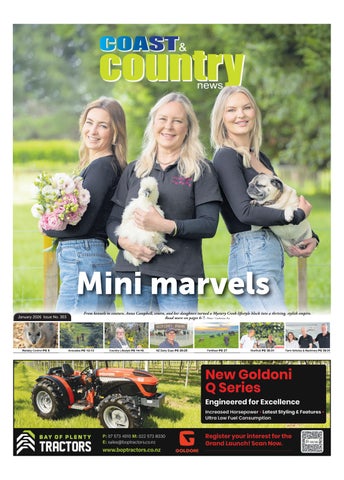
Mini marvels January 2026 Issue No. 303
Wallaby Control PG 9
From kennels to couture, Anna Camp pbell, centre, and her daugghters turned a Myysteryy Creek liffestyyle block into a thrivingg, styylish emp pire. Read more on pages 6-7. Photo / Catherine Fry
Avocados PG 12-13
Country Lifestyle PG 14-16
NZ Dairy Expo PG 20-25
Fertiliser PG 27
Kiwifruit PG 30-31
Farm Vehicles & Machinery PG 30-31
Page 2
COAST & COUNTRY NEWS
“Ever driven a tractor?” asked The Hat. His voice was weird because his head was cocked and mouth twisted as he tried to reignite a spitsodden stub, the last vestiges of a Park Drive rollie. This Boy Scout Cub could tell him there could be no combustion. A fire needs fuel and oxygen and there ain’t no oxygen in that spitball. There was more likelihood of a flash bushfire. Because the match flame was licking close to great festoons of hair that billowed from his nasal passages. Where’s the extinguisher? How do you call the Rural Fire Service? “I would like to report an inferno up a farmer’s nose. It’s threatening to spread to the tablecloth and the curtains.” How could he breathe? How could he smell? Perhaps some 245T would beat back those clumps?
Driving lesson
A tractor? Have I ever driven a tractor? Of course I have. I am 14 years old and live in the city. We gallivant around on John Deeres, Massey Fergusons and New Hollands all the time. The 1960s city girls in their minis and shift dresses love going to Bible class dances as pillion passengers on a tractor. No! I had never driven a tractor. Or a car. The Hat obviously wasn’t sensing my cynicism, or was just ignoring a rude pup, because next moment I’m in the driver’s seat and he’s the driving instructor. Good luck with this. “It’s easy,” he said. So is splitting the atom if you’re Ernest Rutherford and you know how to do it. I hate it when you ask someone for help and they tell you “it’s easy”! If it were easy you wouldn’t be asking for help. There aren’t enough pedals. Only two – clutch and brake. There’s harrumphing from The Hat. “The accelerator is that wand sticking out from the steering column.” Really? And two gear levers? “Don’t worry about the small one. That’s the ratios.” Yep, I know
ratios. Basic maths – shows how many times one number contains another. And the common trig ratios are sine, cosine and tangent. “What?” asked The Hat. I suspect he was tiring of my urban smart-assedness. An urban “boy” was due a good rural slap if he didn’t pull his city head in. And why is the gear lever between your legs? Because the only thing between your legs when driving a car is your manhood. “You’re making this difficult,” said The Hat. “It’s not like a piano when you have to bring all the notes together,” comforted The Hat. “You play just one note at a time. Key, start, clutch, gear, accelerator, go, steer, brake, stop. Then do it all again.”
Proud moment
I liked his analogy. “You’ll get the hang … maybe.” And he wandered off to try re-re-reignite the stub. He just left me to it. An hour later when I drove the Massey Ferguson round the corner of the woolshed without dinging anything, The Hat erupted with laughter. And disbelief I suspect. And he gobsmacked me when he gave me a kind of blokey hug with those long, sinewy and deceptively strong arms. I had never seen him hug his own kids, so I felt kind of proud and privileged. And did I get a whiff of a full cooked breakfast, lived-in clothes, cigarette smoke, and something toxic like weed spray? Or was it sheep dip? Or diesel? It was just his own distinctive natural animal smell and wasn’t unpleasant. I was softening to him.
Hunter Wells
Page 3
COAST & COUNTRY NEWS
Farmers call for unified national pest strategy Federated Farmers is calling for a national pest strategy as rising numbers of feral animals hammer farm pasture, fences and native bush.
The lobby and advocacy group says the current fragmented approach, with responsibility divided by land tenure and function, is holding back progress. “Farmers are constantly reporting bigger mobs of feral deer, wild pigs eating lambs, and huge flocks of Canada geese and ducks fouling farmland and waterways,” says Federated Farmers meat and wool chair Richard Dawkins. Other pests include possums, wallabies, goats, rats, stoats, hares and rabbits and the extent of the damage depends on the land use and whether it is attractive to that particular pest.
Central leadership
“There are different attitudes as to what constitutes as a pest. One farmer may not mind deer on their land, but their neighbour has a bio-diverse, regeneration block which cost a lot to plant, and they don’t want possum, deer and wallabies on their land,” says Brent. Initially, large pine forestry blocks use pest control to safeguard their young trees and once they are established, they stop. With many owners being overseas, Brent questions what their plan is as their pest populations flourish and spill over into productive farmland. One farmer backs on to DoC land and has a QEII block which is progressively degenerating from Federated Farmers constant invasions of deer, possum Waikato provincial and rats. president Phil Sherwood. Brent himself has automated traps and bait stations all over his farm and they are expensive to run as they require constant emptying and re-baiting. He has some deer shooters he works with to keep the population down, and is finding that wallabies are spreading into his area.
“We need action that covers all pest species, all land tenures, and brings every stakeholder into one co-ordinated effort.” The Department of Conservation (DoC), regional councils, Biosecurity New Zealand (MPI), the Environmental Protection Authority (EPA) and OSPRI (targeting TB vectors – mainly Federated Farmers Bay of possums), all have roles. Plenty provincial president “Responsibility is split across Brent Mountfort. these multiple agencies, with no central leadership or clear lines of accountability,” says Richard. “The result is gaps, inefficiencies and inconsistent coverage, with productive land paying the price.” Richard says climate change and emissions factors are another reason Federated Farmers wants action. “Our food producing sector is being asked to make big cuts in emissions, but what about the methane and nitrous oxide coming from pests like Federated Farmers meat deer, goats and pigs? and wool chair Richard “That’s surely having a serious impact Dawkins. Photos / Supplied on NZ’s greenhouse gas inventory, especially when you consider that feral animals are also smashing our native forests, regenerating scrub and grasslands.” Federated Farmers want to build a national pest inventory to confirm and quantify how fast pest animal populations are rising and what regions are worst affected, because “you can’t manage what you don’t measure”.
on my property which cost $60,000. It feels like we are all trying to combat the issue individually rather than working together,” says Brent. Federated Farmers Waikato provincial president Phil Sherwood is aware of the frustrations farmers in his area face when pests invade their land. “Deer are smart, can jump fences, and travel great distances. They can decimate an establishing maize crop, and that is the season’s livelihood gone. It’s not just pasture and trees that are at risk,” says Phil. Once it becomes known that a property has pest issues, farmer face requests from hunters. As the land is
private and a working farm, letting strangers on your land has health and safety implications and puts stock at risk. “DoC issue permits and monitor who is on their land and when. Poachers will enter private land with no permission and have no respect for fencing or stock.” Phil acknowledges some good organisations are there such as the NZ Deer Stalkers Association which promote good hunting protocols with skilled marksmen; and the Wild Game Recovery Trust, which hooks up with communities to supply them with wild venison.
Catherine Fry
34 Chapel St, Tauranga www.SpaShop.co.nz
Pasture and disease
“It’s not black and white. People want deer available for their freezers and it’s definitely a food source for many,” says Brent. “Hunters tend to shoot stags, and not the hinds. Shooting nine stags and leaving one standing means that the one stag can mate with numerous hinds so numbers still increase as the offspring will be 50/50 male and female.” It’s not just the physical damage the pests do by eating stock’s pasture or native trees, they are also vectors of disease and bring them into stock animal populations. Deer can move ticks around, possum can carry TB and feral cats can spread a disease that causes mass abortions in sheep. “I’ve put up 1.2km of deer fencing
UP TO
25% OFF
*
Selected Spa Pool Packages
Farmer perspectives
Federated Farmers Bay of Plenty provincial president Brent Mountfort receives regular feedback and information from the region’s farmers.
Call us today...
*Promotional pricing and savings are based on Hot Spring Spas New Zealand Ltd recommended retail price (RRP) and includes GST. Purchase from Hot Spring® Spas 'UP TO 25% OFF Campaign’ receive the specified discount. Discounts cannot be used in conjunction with any other offer, promotion or previous valid quotation and is not redeemable for cash. Delivery conditions may apply. Installation of a spa pool must comply to NZBC F9 throughout New Zealand and is the responsibility of the purchaser to check with relevant local body authorities for further information. For full promotional terms and conditions, please visit: https://hotspring.co.nz/terms-and-conditions/promotion
Page 4
COAST & COUNTRY NEWS
Shade that fits. Every home is different, and your shade should match. With Archgola, we customise each canopy to fit your style and space just right.
Let’s make your space, yours. Get in touch today.
ARCHGOLA.CO.NZ
Outside is better.
Page 5
COAST & COUNTRY NEWS
New industrial park to bring growth to Putāruru
Proposed mock-up of new Better Eggs Grading Floor. Photos / Supplied
For seven decades the van der Heyden famiily have lived d in th he viiciiniity off th he Waikato town of Putāruru after brothers Harry and Pieter van der Heyden, along with their wives, Justina and Rita, emigrated from the Netherlands in the mid-1950s to create a better life for the future generations. Harry’s grandson, CEO of Better Eggs, Gareth van der Heyden has huge admiration for his grandparents’ contribution to the area through their dairy and egg farming ventures. The van der Heyden family is now developing 40 hectares of industrial zoned family land, continuing the family’s desire to invest in future generations.
Humble beginnings and hard work
“My grandparents arrived on HMS Waterman, with not much more than their suitcases, and went dairy farming,” says Gareth. Harry and Justina worked hard to expand their family interests and six of their seven children ended up with dairy farms in the area. Pieter and Rita started Heyden Farms Poultry in 1976, wh hich h th heir son Paull assumed d responsib billity for in
Raukawa Charitable Trust chair Kataraina Hodge and Sir Henry van der Heyden turning the first sod aft fter t a blessing of the new van der Heyden Commercial Development.
1,900
$
A blessing of the land, with representatives from all the key stakeholders took place on September 30, 2025. “I’m actually excited about what businesses might come in and bring growth, prosperity and employment to the area. It could be anything from manufacturing to data storage, the opportunities are endless,” says Gareth. Catherine Fry
Serious machinery for serious work.
Walking alongside the community
South Waikato has been hit hard by recent industry closures, including two wood manufacturing plants in Tokoroa, so this
0800 022 044 Tree Chipping • Stump Grinding • Land Clearing Mulching • Waste Processing • Orchard Removal
Get ready to enjoy your summer with an air conditioner in your bedroom!
ASTH07KNCA COMFORT RANGE HEAT PUMP
ONLY
the early 1990s Gareth’ss father was one of the dairy farming sons and Gareth was raised on a dairy farm with three siblings. “My parents Henry and Jocelyn invested with Dad’s cousin Paul in Heyden Farms 20 years ago. My sister Erica and I started working in the egg business in 2016, and along with our two siblings have financial interests in both the poultry and dairy ventures.” When the 40 hectares of land on the south side of Putaruru was rezoned as industrial by South Waikato District Council, the van der Heyden family saw developing this site into an industrial park as beneficial for the community as a whole. “The council are very keen for us to develop it, and members of the family and family associates have gone into the venture together.” Better Eggs will be the first tenant, leasing three of the eight hectares available in stage one. “Better Eggs has grown and we aim to build a new packing, processing, warehouse and distribution facility by winter 2027.”
new investment into industrial ventures will provide opportunities for businesses to be close to the Port of Tauranga, Ruakura inland port and right by State Highway 1 – the main road north and south, and the main trunk rail line. Gareth says local iwi Raukawa and South Waikato Council were “fantastic to work with and we were all on the same page”.
INC. GST
INCLUDING BACK-TO-BACK INSTALLATION
Page 6
COAST & COUNTRY NEWS
Flowers, feathers, fur babies and fashion: Twenty years ago when Anna Campbell bought a house on 10 acres in the Mystery Creek area outside Hamilton, her goal was to provide a home for herself and her two daughters Claudia and Eleanor – teenagers at the time – and start a dog-boarding kennels just for little, chihuahua-type dogs. Fast-forward to 2025 and the property has homes for each daughter, a successful dog-boarding and daycare business for small dog breeds and Claudia has her own floristry business. The kennels, houses and barn take up about one acre, leaving another nine where the family have had a lot of fun breeding miniature farm animals that
are black and white. The three women love fashion and are regular entrants and winners in the horse-racing industry’s Fashion in the Field competitions.
black ears, noses and eyelashes. There is a good market for miniature cattle.” Anna breeds black and white silkie and frizzle designer chickens. A few silvers and greys have been allowed in. Anna Anna discovered Fashion in the Miniature Galloway Field competitions cattle have all the when she started to attributes of full-size watch a friend’s son Galloways, but in a racing horses. smaller package. “Now all three of “For a lifestyle block, us enter as we all love miniature cows do a fashion. Eleanor and good job eating the grass I work around the and there’s less pugging. Eleanor’ss house started the black and white kennels and farm and We always befriend all theme on the property. Photo / Catherine Fry it’s so nice to spend time our animals by handhunting for outfits and accessories, perfecting our feeding them so we can move them between hair and makeup and getting all dressed up.” paddocks,” says Anna. They clearly have an eye for colours and detail, The property easily supports a bull, five cows as they win regularly both in New Zealand and and two calves. overseas. Prizes include cash and other “lovely” “We definitely breed for cuteness, aiming for things, including jewellery and travel. compact Belted Galloways or the white ones with
• Buy 10, receive 12. First order of 10 receive a free service kit. • 3 models available - all the one price • Nearly indestructible • Proudly 100% NZ manufactured Providing a lifetime guarantee on the body of the ballcock
Claudia Campbell, Anna Campbell and Eleanor Campbell. Photo / Catherine Fry
AVOJECT®SYRINGE The proven low pressure method for effective phytophthora control in avocado trees. The AvoJect® are high quality syringes with a small tip to minimise tree damage. E: info@avoject.co.nz | W: avoject.co.nz
COAST & COUNTRY NEWS
Page 7
How three women built a stylish rural life
always had black and white animals!” says Eleanor. She bred dwarf babydoll sheep, a small, docile, friendly breed of sheep with a distinctive, teddy bear-like face. They go through the paddocks after the mini Galloways and are an effective part of the paddock rotation. Eleanor won her first Fashion in the Anna Campbell with her black and white Field competition Miniature Galloways. Photo / Catherine Fry when she was 14, but was too young to compete in the finals at “To give back to an Claudia sources Ellerslie with the prize being a car. industry that gives us her flowers from Since turning 18, Eleanor has won numerous all so much pleasure, Auckland and buys I’ve been helping weekly top ups from competitions and travelled overseas. At the 2023 organise the events at some “amazing Te Rapa races, where Waikato growers”. it all started for us.” “I have chillers in the home barn Claudia and my Cambridge Anna’s elder studio. I meet daughter Claudia prospective brides Claudia Campbell at her appreciates art. She and run classes from flower truck in Cambridge. has a Bachelor in art, the studio.” Photo / Catherine Fry majoring in fine art, Claudia also enjoys and has studied interior design. Fashion in the Field but happily “I enjoy painting, design and lets Anna and Eleanor dress her and architecture. I sold my paintings at their choices have resulted in some markets and worked in a Hamilton good wins. florist for four years learning how to Eleanor be a florist,” says Claudia. Anna’s younger daughter Eleanor She lives in a tiny home on the has worked alongside her for 12 property and loves living rurally, years at the kennels. describing herself She completed a as “someone who’s communications happy to get her course at Wintec hands dirty but and runs the equally at home in a administration and city art gallery”. accounts side, as well “In 2018, I bought as being hands-on a small truck and with the dogs. converted it into a Eleanor started travelling art gallery/ the tradition of florist business.” everything being Seven years on, black and white when Claudia still sells she had her small flowers from her house built. She loves flower truck and interiors and fashion. studio in Cambridge “When I got two and she’s gained pigs, silkie chickens quite a following as and dogs all in black a wedding florist, Eleanor and Anna at the and white, it became working throughout 2023 Melbourne Cup Carnival. Photo / Supplied a thing that we the North Island.
Melbourne Cup Carnival she won the Fashions on the Field Best Dressed Award wearing an altered Solace London gown and a hat by New Zealand milliner Monika Neuhauser. “That was crazy and very unexpected. I won $50,000 in cash, about four TVs, a magnum of vintage champagne and other great prizes.” Eleanor is getting married in early-2026 to dairy farmer Andrew Fullerton, and we can be sure that the bride, her mother and her sister will all be stunningly attired. Catherine Fry
Page 8
COAST & COUNTRY NEWS
André Rieu live in Maastricht!
by John Cooney
N
ext time you’re in London, once you’ve eyeballed Trafalgar Square, Buckingham Palace and Big Ben, you’ve gotta get out in the country. Why? Because there’s more to Ye Olde England than just the City of London …
beaten track (as we’re gonna do in June/July 2026) you’re soon oohing-and-aahing at fairytale villages, thatch-roofed cottages, flower-smothered gardens, leafy woodland lanes, pubs with weird names, cathedrals with pointy roofs, medieval castles and knights in shining armour.
I mean, not far along the M4 are some of the sweetest, loveliest corners you can find in this “green and pleasant land”. And when you wander off the
We’ll fall in love with the honey-coloured village of Woodstock … explore stunning Blenheim Palace … feel the ‘Downton Abbey’ vibes in old
Bampton town … enjoy a walkabout in exotic Hidcote Manor … get all floral at Kiftsgate Court … discover magical Broadway … and relive some Roman history in Bath. We’ll meander through idyllic hamlets – like St Ives, Doc Martin’s Port Isaac, and Singleton (where ‘The Repair Shop’ is filmed). We’ll soak up the seaside magic of Padstow. And we’ll roam more bloomin’ gardens
than you can shake a gumboot at: like Sissinghurst, Trebah, Heligan and Great Dixter. We’ll finish with a Midlife Madness flourish, crossing the Channel for a spectacular live ANDRÉ RIEU concert, in his hometown of Maastricht, Holland!
B
e quick! This tour’s almost FULL! Call us on 0800 323 333 or visit
www.midlifemadness.tours.
0800 323 333 – www.midlifemadness.tours
COAST & COUNTRY NEWS
Page 9
Wallaby control ramped up in central North Island A joint effort is being used to control pest wallabies – and ultimately eradicate them – from the central North Island. Native to Australia, wallabies were first introduced to Kawau Island in the Hauraki Gulf by former New Zealand Governor Sir George Grey around 1870. They were then subsequently released near the Rotorua Lakes area in 1912. Central North Island wallaby programme leader Davor Bejakovich says the pests are now present across 200,000 hectares in the central North Island, and it is estimated that if no control work is done, undertaken their spread one-third of the island could be impacted by the spread of wallabies within 50 years. The Bay of Plenty and Waikato regional councils are part of the Tipu Mātoro National Wallaby Eradication Programme. Davor says this is a collaborative effort between Biosecurity New Zealand, iwi, the Department of Conservation, Forest & Bird, Federated Farmers, Land Information New Zealand, farmers, researchers, landowners and communities. “The programme’s success relies on first preventing their spread from areas where they are already established, which is known as the containment area, and progressively working inwards with control over time.” In the central North Island, the containment area falls mostly in the Bay of Plenty region but crosses the border into the Waikato around Rotorua. Davor says wallabies have a huge appetite for many of our native flora, which prevents forest regeneration in the long term,
changing the forest structure, and reducing their ability to support our native birds and other wildlife. “Wallabies also love pasture grasses, which means they compete with livestock for food.”
Significant impact
He says the impact on plantation forests can also be significant. “Timberlands, who manage the Kāingaroa forest, estimate that the one metre of growth normally expected in the first year from plantings can be reduced by half when browsed by wallabies. “If we don’t stop the spread of wallabies, they will have even more significant impacts on lost our native ecosystems and lost farm and forestry production.” Because as wallabies are nocturnal and cautious, Davor says, they can be hard to find and control. “Current programme activity is focused on surveillance and control of ‘satellite’ populations in areas outside of the containment area, in buffer areas within containment at critical locations of potential spread, and to reduce reinvasion where we have undertaken successful control. “Given wallabies are active primarily between dusk to dawn, the use of thermal optics mounted on firearms and thermal and IR cameras mounted to drones has been a game-changer during night-shooting operations.” He says contractors, with specially trained wallaby indicator dogs and trail cameras, are used to locate and determine the extent of wallaby populations.
“It can be like finding a needle in a haystack when you are potentially looking for only one or just a few in sometimes difficult terrain.” Where wallaby populations are confirmed outside of the containment area, councils work
The Central North Island Wallaby Containment Area (and fence). Photos / Supplied
A dama wallaby.
Unwanted
with the landowners to plan and deliver wallaby control – currently at no cost to landowners. In the longer term, Davor says, the focus is on strategically targeting wallaby populations inside the containment area. “With the help of landowners, iwi, and community groups, the aim is to progressively reduce the size of the containment area while simultaneously researching and developing new tools for eradicating wallabies.”
Wallabies are classified as an “unwanted organism” under New Zealand’s Biosecurity Act 1993 – making it illegal to hold, breed, display, move or transport them without specific authorisations. There are also rules in the Bay of Plenty and Waikato’s regional pest management plans that make it illegal to keep live wallabies. Davor says it is important to remember that wallabies are pests, not pets. Sightings can be reported online at: reportwallabies.nz. Depending on the location, in relation to the containment area, the sighting may result in detector dogs or trail cameras Steve Edwards being used, says Davor.
www.ttuffplastics.c co.n nz
07 348 4966
info@tuffplastics.co.nz
Page 10
COAST & COUNTRY NEWS
Waikato farmer using genetics to ‘solve problems’ Alastair Reeves’ father taught him that farmers can use genetics to solve problems.
The Waimai Valley farmer is carrying on the line of Romney sheep his father started breeding in the 1950s. “They’re still here probably because they are fit for purpose. They suit our environment, they’re hardy, they produce meat, they produce wool
and that’s essentially what’s paid the bills over the last six years so that’s a testament to the breeders that have gone before us,” he told RNZ’s Country Life. But Alastair has also turned his eye to new sheep traits sought after by the modern farmer. He and his wife Ann run the 800-hectare farm, finishing bull beef and running a sheep genetics business. Their children are the fourth
Alastair and his wife Ann breed two types of sheep - the classic New Zealand Romney, and another breed they developed themselves in 2016, the Waimai CharaBlack. Photos / Gianina Schwanecke / Country Life
Hand Feed and pet all our different animals get up close and personal • Large picnic area and playground d • Coffee on site
generation on this bit of whenua (land), north of Raglan.“Dad had a huge focus on ezcema tolerance. He was one of the first breeders to start doing that,” Alastair says. “That was just an issue within Waikato and the Upper North Island, that’s just spreading down the country now. “What we learned with the whole eczema trait is that genetics can actually solve problems.” Another trait he’s begun breeding for is low methane – a greenhouse gas produced in the rumen, part of the four-chambered stomach of ruminant animals like sheep and cattle.
Check website for operating hours and more info
136 Link Road, Oruanui, Taupo
Office: 07 378 7979 / Bev: 021 284 7979
www.lilliputtaupo.co.nz
Complex issue
21 Hakarimata Rd, Ngaruawahia
www.outback4x4.co.nz
Alastair says methane emissions are a complex issue facing the sector. “All I know as a geneticist is I’m here to produce the best genetics for my clients. I want those genetics to make them as profitable as they can receive.” While methane reduction boluses and vaccines are in development, Alastair sees these as another ongoing expense for farmers. Genetics is a “green way” of mitigating the impacts of methane, but one that he says takes time. “If we can reduce the methane and at the same time improve the productivity of our livestock, that would be a really positive thing and so that’s what we’re trying to do.” In 2020, Waimai Romney became one of the first flocks in New Zealand to methane test its rams, running 192 rams through AgResearch’s Portable Accumulation Chamber (PAC) trailer. Since then, they’ve cut methane emissions by 3.2% while improving productivity. During the past 10 years, they’ve also been
Alastair Reeves, of Waimai Romney.
developing their own breed – the Waimai Charablack. It’s a mix of the French Charolais – which has good marbling and makes “lovely” eating – and the Hampshire, an “old traditional breed”. They’ve focused on good growth as well as a good “marbled lamb product” equivalent to the “wagyu of lamb”. Alastair says this means farmers can get premium prices, adding value to the same quantity of lambs. He says there have been a lot of changes on farm since his father and grandfather’s day. It has been a tough couple of years for the sector, with farmland being converted to forestry putting pressure on rural communities, especially hill country and sheep farmers. But there are positive signs too, with wool prices improving and strong global demand for protein, and in spite of the challenges, Alastair still loves what he does. “It’s a phenomenal product. It’s grass-fed and the world wants it.” Gianina Schwanecke/RNZ
Page 11
H O RT I C U LT U R E
Farm finances go digital with Growpay A long-time rural business leader known for his “get over to Morrinsville” advertising catchphrase is now telling farmers to “go to GrowPay”.
Ross Hyland, who formerly fronted Morrinsvillebased stockfood company SealesWinslow, has launched farm finance and payments app GrowPay. “It’s all about driving better deals for farmers and orchardists,” says Ross. “It’s giving choice.” The innovative financial services platform has been almost five years in the making. “There was a real gap in the market,” says Ross. He says farmers have been feeling “disconnected” from existing options, particularly considering fluctuating cashflows. Partnering with Mastercard, GrowPay founder Ross Hyland, right, with Chris Higgens, contract Heartland Bank, Speirs Finance milker on his parents’ Walton dairy farm. Photo / Steve Edwards and Xceda, Ross says the app allows farmers to access a seasonal funding, livestock trading, capital wide range of lending, deposit and marketplace livestock, technology and asset finance loans, products, allowing them to access capital, while with terms and interest rates developed with the maintaining competitive rates, importantly with lifecycle of farms in mind. terms better aligned with the farmer’s cashflows. “This helps reduce stresses on farmers and He says GrowPay has already formed a their families. partnership with Mobil and will be launching its On the flipside, he says a range of deposit own fuel card in coming months. products will be available for cash surpluses, often experienced following harvest, packhouse receipts Partnerships or killing sheets, allowing surpluses to be put Other partnerships include Aon Agri for to work. insurance, plus animal health, automotive and “GrowPay has farming in its DNA, with a ag-chem, along with others as the app builds out mantra of ‘how can we make farmers lives better, its on-line marketplace. how can we deliver better deals, and how can As part of the digital offering, Ross says farmers we link our farming communities through the will be able to sell agricultural products between digitisation of agriculture. themselves, while also accessing purchasing “The digital world is coming and coming fast, benefits from suppliers due to GrowPay’s ability to but NZ farmers have proven time and time again aggregate volume. how they can adapt, roll with the punches and “The digital wallet also provides for a streamlined pick up on new technologies. payments system,” he says. “This is the first “The opportunity to make our farms more genuine digital farm finance and payments efficient and more profitable is incredibly exciting, offering in New Zealand that’s specifically not just for individual farms, but for whole targeting farmers, orchardists and the wider communities and the wider economy.” agricultural community. For more information, see Growpay’s advert Ross says the app’s lending products include Steve Edwards on this page.
CANOPY BIRDNET Heavy knitted birdnet
• Commercial birdnet for overhead structures • Knitted HDPE with reinforced edges • 16mm diamond mesh
HortNZ appoints Ripeka Evans to board Horticulture New Zealand has appointed Ripeka Evans to its board as an independent director. Ripeka brings more than 40 years of strategic leadership and governance experience across a range of sectors including media, technology, investment, infrastructure, primary industries, property, tertiary education, health, business and Māori development. She is currently deputy chair and a director of TVNZ and is a director of Tupu Tonu - the Ngāpuhi Investment Fund, Wellington Regional Council Holdings and Greater Wellington Rail. “Ripeka’s appointment reflects Horticulture New Zealand’s commitment to strong, values-based governance that represents the ambition and innovation that defines the
horticulture industry,” says Bernadine Guilleux, chair of Horticulture New Zealand. “Ripeka also brings connectedness and practical primary sector experience to the Horticulture New Zealand board. As a shareholder and kaitiaki (steward) of kiwifruit orchards, she understands the realities and responsibilities of food production and supply for NZ. “Her knowledge and experience of primary industries, infrastructure and government, coupled with her governance expertise, will strengthen Horticulture New Zealand’s ability to represent growers’ interests at every level. “She is particularly focused on innovation and intergenerational growth.”
GROWPAY GrowPay’s Brand New App Means Better Deals for Farmers
It’s the Go-to Online App for Farmers for all their finance and payment needs
www.growpay.io Ross Hyland 021 942900 Mark Brown 027 2769661
HD CANOPY BIRDNET Bee friendly birdnet • Heavy duty knitted birdnet for overhead structures • 75gsm, knitted HDPE with reinforced edges • 16mm diamond mesh
• UV treated for NZ conditions • 5m & 10m widths available in 50gsm Black & White • 15m & 20m widths available in 75gsm Black only • Other sizes available on indent
• Blue & white mesh helps reduce stress to bees • UV treated for NZ conditions • 5m & 10m width available • Other sizes available on indent
0800 109 093 | sales@cosio.co.nz | www.cosio.co.nz
PRO-RATA UV
Professional crop protection
Page 12
AVO C A D O S
Avocado growers brace for Like other rural sectors, the avocado industry is facing huge changes in land ownership. A recently released white paper from Rabobank reveals that during the next decade, more than half of all New Zealand farm and orchard owners – about 17,320 farmers and growers – will reach the age of 65. At current land values, the transition of these farmers’ operations represents a conservative estimate of more than $150 billion in farming assets that will depend on a successful succession process. NZ Avocado chief executive Brad Siebert says this shift will bring both opportunities and challenges for growers and the wider industry. This will reshape how farming and horticultural businesses are owned, financed and managed,
including within the avocado industry, he says. For existing growers, Brad says this change is already being felt. “Some are planning succession, others are considering scaling, selling or partnering to stay competitive. “Where family succession is possible, new generations often bring a fresh focus on technology, sustainability and diversified income. “Where it’s not, the likely outcome is consolidation through larger managed businesses or through alternative land use.”
Industry dynamics
Brad says that while this can bring investment and efficiencies, it also shapes the dynamics of industry decision-making to meet different needs. “These shifts bring both opportunity and pressure,” he says.
“Land use intensity, productivity and regulatory compliance will continue to influence what is viable. “Access to finance, enabling trade and regional policy settings and how confident new and existing growers feel about future returns will all affect the pace and scale of change. “What matters most for our industry is that grower needs, whether you own 2 hectares or 50, are clearly heard and represented. “As ownership patterns evolve, the industry’s role in advocating for growers’ political and economic interests will be to support its members through the transition, not simply react to it. “Ultimately, it’s not just who owns the orchards that will define our future, but how growers choose to shape their businesses and the land th hey depend d on.”” Brad says collaboration across
industry stakeholders will be key to keeping the industry resilient, informed, market-driven and proud of its roots. “The next chapter of our industry will be defined by how well we adapt.” Rabobank New Zealand CEO Todd Charteris says findings from the white paper highlight the extent of the succession challenge ahead for the agricultural sector. “Succession is not a moment in time – it’s a process that takes years of planning, conversation and adaptation,” he said.
New models
“The traditional model of passing the farm to the next generation is under pressure, but there are new and innovative models emerging that can hellp famillies stay connected d to their land.”
• Aerial Survey • Aerial Lifting • Agricultural Seeding • Agricultural Spraying • Agricultural Topdressing • Charters and Sightseeing • Fire Fighting • Frost Control
�
• Photography and Filming
for Facial Eczema Spraying
An avocado orchard in the Bay of Plenty. Photo / NZME
Local? Global? Growers, we’ll help get your Avos there. 07 573 0085
Page 13
AVO C A D O S
$150b shift Todd says data collected for the white paper found only one in three farmers have a formal succession plan in place. “A further 17% have discussed succession with the relevant parties, but nothing is documented, leaving exactly 50% who had neither discussed succession nor commenced a succession plan.” He says the research also found that one-third of farmers intend to pass their farm to their children, yet 39% reported having no children seriously interested in farming. “For many Kiwi farmers, the dream is that one of the kids will take over the farm. The flipside is that it can also be experienced as a feeling of pressure or a sense of responsibility by the next generation. “Taking over the family farm involves committing to decades of indebtedness in a sector that is subject to volatility and uncertain returns. “It remains a big call for a 20-something and their bank.” While this is the case, Todd says, data collected for the paper suggests the financial obstacles to farm ownership have plateaued in recent years. “With total package values for farm employees keeping pace with the increase in land valuations over the period 20112024, the succession cliff appears less steep recently. “However, the challenges to get on the ladder remain high, particularly with the increased scale of farming and need to increase margins to support borrowing.” The paper also highlighted several increasingly prominent succession models, including hybrid ownership models and
corporate structures, which are being adopted to help farming families stay connected to the land. “A number of New Zealand’s largest-scale, most productive and environmentally responsible farming businesses are either fully corporate or run under Māori-owned incorporation models,” says Todd. “If we get this right, we can unlock new pathways for young Kiwis who are passionate about farming – whether they’re farming mad, farming curious or farming adjacent – to own a share of a greater pie.” He says most of the farmers spoken to in the process of compiling the white paper had been looking at succession for years, and all of them wish they’d started the p process earlier.
Hornet scare in Bay of Plenty The Ministry for Primary Industries has refuted concerns of yellow-legged hornets reaching the Bay of Plenty.
This follows a social media post of a suspected nest in Paengaroa last month. People are asked to report suspected yellowlegged hornet nests to MPI as the first port of call. The Ministry for Primary Industries entomologists assessed the image and said it was not a yellow-legged hornet nest. Commissioner North Mike Inglis says Biosecurity NZ was aware of the public publishing photos or comments on social media, claiming a new discovery in a different region of New Zealand. “Our entomologists assess all photos sent to MPI through our notification process. “No queen hornets or nests have been found outside of the Glenfield and Birkdale areas on Auckland’s North Shore.” He said these comments of new discoveries are misleading and cause concern for the
An example of a queen Asian yellow-legged hornet in the early stages of nest building.
country’s beekeepers. “We remind people that if they suspect they have found a hornet or its nest to contact MPI through the online reporting tool or the 0800 number, and our entomologists are the best placed to advise.” Photos can be reported by calling the exotic pest and disease hotline on 0800 809 966 or online at report.mpi.govt.nz.
Proud to be associated with
Steve Edwards
AVOCADOS NZ Avocado CEO Brad Siebert. Photo / Supplied
• Exceptional Packing Facilities
• Harvest Flexibility
• Complete Orchard Management
• New water blaster facility
• AvoGreen Service
• Technical Advice and Support
Contact: Hamish McKain - General Manager/Avocado Grower Services 027 220 2005 • hamish.mckain@dms4kiwi.co.nz
Warren Sargent - AvoGreen Manager 027 900 0292 • warren.sargent@dms4kiwi.co.nz
Willie Herder - Avocado Grower Services 027 667 3849 • willie.herder@dms4kiwi.co.nz
Matt Royackers - Avocado Grower Services 027 200 0788 • matt.royackers@dms4kiwi.co.nz
Ivona Kopecka - Avocado Grower Services 027 266 4901 • ivona.kopecka@dms4kiwi.co.nz
Toni Morrison - Avocado Grower Services 027 265 4469 • toni.morrison@dms4kiwi.co.nz
Proudly supporting local growers and their community.
DOMESTIC AVOCADO PACKING AND MARKETING
Available January - March
Secure your spot now www.justavocados.co.nz John Emett
Kyra Fielden
027 476 9087 john@justavocados.co.nz
027 257 5028 co.nz kyra@justavocados.co.nz
Grower Services (Northland, Tāpora and South Auckland)
Grower Services (Bay of Plenty, borne) ne) Coromandel and Gisborne)
Page 14
101 years of A&P in Katikati Something for everyone is promised at the 101st Katikati A&P Show on February 1.
Show secretary Sheryl Smith says the volunteer organising committee started work on the 2026 event – February 1 at Uretara Domain – straight after last year’s spectacular centenary show. Dairy cattle competitions are making a comeback this year, plus regular equestrian events and the traditional home industries section. Younger show patrons can tackle
a vertical bungy and rock-climbing wall while enjoying a variety of rides – donkey and train – a scarecrow competition and puppet show. Featured events include everything from mussel shucking to highland dancing and a sheep agility show, plus action from the Katikati Olympic Freestyle Wrestling Club and a woodchopping demonstration. Classic cars and vintage tractors will again be on display, along with musical entertainment and dancing, arts and crafts. Trade sites will showcase
agricultural machinery and local charity groups, plus food vendors, electric cars and scooters. Sheryl says the A&P Show is a great day out for the whole family. “There’s all the fun of the fair.” The 100th show last year was a showstopper with more than 4000 people attending. Sheryl says the organising committee is tremendously proud that the 2025 Katikati A&P Show has been nominated in the Community Event section of the Western Bay Community Awards. This recognises a communityled event that not only excelled in its planning and delivery but
Sheep racing with jockeys at the Katikati A&P Show. also made a positive impact on the community by creating memorable experiences and strengthening communal ties. Winners will be announced on
March 19. This year’s Katikati A&P Show is on Sunday, February 1, 2026, from 9am-3.30pm. For further information, see Katikati A&P’s advert on this page. Steve Edwards
! $ % ! ' '
The Katikati A&P Show will be held at Uretara Domain next year. Photos / Merle Cave
( ! "&
Farmers urged to ‘take a moment’
!
!" ' ( & # ! " " " % # ! " " ! ! ' ( &
Farmers are being urged to “take a moment” as the sector heads into the traditional peak period for injuries and fatalities.
up,” says Lindy. “Some have invested in new technology and crush protection devices to design out risk, while others have strengthened visitor and induction processes to ensure people Safer Farms, the industry-led can get where they need to go safely. organisation dedicated to fostering “More farms are also building simple a safer farming culture across New ‘stop and think’ moments into the Zealand, is encouraging farmers to day so plans are shared, risks are pause, think through a plan, share it understood and everyone knows who Farmer and Safer with others and set the job up right is around them. Farms chair Lindy before getting underway. “These aren’t big or complicated Nelson. Photo / Supplied “Summer’s always busy, and this year changes. It’s about taking a moment is no different,” says Lindy Nelson, farmer and and asking: what’s happening today? What’s chair of Safer Farms. changed? Who’s around? And am I, or the people “For the first time in several years, many farmers I’m working with, tired, stressed or stretched are generating a cash profit. Red meat and dairy too thin?” prices are stronger, and now is the time to invest in With young people home for the holidays and the things that keep us safe, strong, and resilient, visitors unfamiliar with farms, Lindy says checking whether that’s crush protection devices, improved in with each other, making sure the right gear is systems, or simply better planning. being used for the job, and supporting someone “Many farmers know the dreadful feeling when who is fatigued can make all the difference. they hear of a serious injury or fatality involving a “Farming is demanding, and nobody farmer in their area.” understands the risks better than farmers ACC data show the average time away from work themselves,” says Lindy.s following a serious vehicle-related farm injury is 82 “This is simply a reminder that the moments days, time that places pressure on families, finances we take now to plan, to share and to check in, and the wider farm operation. are what help ensure we all get through the “Many farming businesses are already stepping summer safely.”
top-upturtle.co.nz
AUTOMATIC POOL & SPA TOP-UP VALVE Show Day will feature the ever popular Horse Events and there will be entertainment for all age groups to enjoy whether it be rides; wood chopping demonstrations; music, dancing, cultural events or the trade sites for you to peruse and enjoy. In the Hall the winning entries in the many Home Industries competition categories will be displayed.
We look forward to seeing you there!
Ask about it at your local pool store! For more info:
p: 07 880 9090,e: info@top-upturtle.com
Page 15
How Bea turned bottling into a business
The young lemon tree is already giving Bea Spragg ggs g lemons. Photos / Catherine Fry
In 2018, Bea Spraggs wound up her catering business and moved with her husband and children to the Waitetuna Valley near Raglan.
bottling it, along with other local people’s excess fruit, which was a great way to meet people.” Bea had for a long time worked in cafes and then her catering business, and is an experienced cook.
The family had no definite plan in mind as to what they would do next, they just has a desire to set up some sort of sustainable business from home. “We’d always lived out of town and the three-acre block, with its Waitetuna River boundary and mature fruit trees, ticked all the boxes, including proximity to Hamilton,” says Bea. “I enjoyed the little break but as our many trees on the new property came into fruit I started
Growers market
Prior to Covid-19, Bea had been getting to know likeminded local people who were interested in starting a growers’ market in Raglan, supplying the community with their produce and products. “We had Zoom meetings through the lockdowns and were getting organised to hit the ground running once we were out of lockdown.”
For two seasons Bea made and sold preserves, marmalades, pickles, sauces, relishes and oils at the Raglan Growers’ Market and Hamilton Farmers’ Market. More fruit trees were planted around the property, especially heirloom varieties, ensuring a self-sufficient source of fruit in future.
Managing the property
“As I got more serious about growing a preserving business, we invested in turning our kitchen into a certified commercial kitchen.” The shed was quickly overrun with five extra-large freezers so Bea can keep preserving out of season, providing consistent
products. The house h has b been taken k over b by utensils and boxes of preserves, p and the roof has an array of new soolar panels to soften the electricity bill. Frost in the valley stoops Bea growing certain fruit and vegettables. She’s happy to outsource for some iteems such as tamarillos, within the Waikato, soo she knows the fruit is spray-free. “I use blood and bon ne, and sheep and chicken poo as fertiliser, and dig it into the soil around A August and plant in October/Novvember. We have great soil, fulll of big worms. “If needed, I spray pests p with boiled garlic and d chilli solution and I spray dissolved bakingg soda on fungal issues like mildew.” Bea sells her preserves at the Cambridge and Clevedon Farmers Markets and online from her website. During lockdown Bea perfected a Spicy Indian Carrot Chutney recipe using carrots she was unable to sell, which Catherine Fry won Bronze at the 2024 New Zealand Artisan Awards.
NO MORE BLOCKED GUTTERS! Keeping your gutters clear all year round
15 Year Guarantee Keeps out leaves, birds, pests & hail Prevents water damage
Suitable for any type of roof
Call Martin on 0275 787 807 martin@gutterprotect.co.nz www.gutterprotect.co.nz
DoC: Rat numbers may double by 2090 without $150M Rat numbers could double by 2090 if climate change gets really bad, says the Department of Conservation (DoC) as it hunts urgently for $150 million in extra revenue. DoC has told MPs it needs this much more money each year to “not go backwards”. Director-General Penny Nelson says the $360m spent annually on biodiversity would be inadequate when faced with the range of the greatest threats to species and ecosystems – wilding pines, goats and deer, and pests and diseases. “What we’re seeing through some of the research that we’ve done in terms of climate change impacts, under a high-climate scenario, we’re potentially looking at
having, I think, rat populations doubling by 2090.” Modelling showed it would take $2 billion a year to ensure nature would thrive, but that was unrealistic and the department was having to prioritise spending. DoC is also intent on finding commercial ways to generate more revenue. Penny says the country needs a change of mindset about nature. Economists have put a price tag on natural capital of $134b, she added. “If we don’t invest in nature-based assets, the country will look vastly different in the next 20 to 50 years. “If we don’t invest that in the next 10 to 20 years, NZ will be really different.” DoC told RNZ it would soon publish a report on the likely climate change impacts on the demography of ship rats, mice, RNZ hedgehogs, rabbits, hares and wasps.
Design and Build with confidence
Locally owned & operated!
Like us on Facebook
Septi-CureTM is:
Cost Effective Easy To use Improves Soakage Reduces Solids and Scums Eliminates Nasty Odours Reduces Costly Pump-outs
A satisfied customer in Hamilton has been using Septi-Cure for over five years. He says this allows them to have an odour free septic tank with low maintenance costs. He also says that his service person is amazed at how well Septi-Cure works, keeping their tank in very good condition. *Results may vary
Before*
After*
Breakthrough Product Developed for your Also Available at: Septic Tank Scan for more info
www.highmarkhomes.co.nz
y
@highmarkhomesnz
Call Ryan for your free site visit!
021 388 626
0800 109 202
www.ecoworld.co.nz
Page 16
Kiwis denied Wayleggo Cup New Zealand’s hopes of reclaiming the prestigious Wayleggo Cup at the Pro Plaan Trans-Tasman Sheepdog Test Series were dashed for another year. Despite a strong line-up and receent domestic success, the Kiwi team m fell short against Australia in the fiercely contested two-test event in October. Beetween 1985 and 2024, New Zeaaland have won 22 times and Ausstralia 15 times. The New Zealand team consisted Th of Lloyd Smith and Code, Ben Milllar and King, Leo Jecentho and d Jake, and Dan, Mark Copland (cap ptain) and Guy and Brian Dicckison (reserve). Foollowing a successful 2025 in New w Zealand Sheepdog Triaal Association competitions, Leoo Jecentho and his heading dog Jakee competed with the
Leo Jecentho with his heading dog Jake. Photo / NZSDTA Supplied
New Zealand team. “The tests include two sections using Australian rules and two using New Zealand rules and that levels the playing field as the Australians work on flat land, whereas we do drives and work hill country,” says Leo Jecentho. “The first day we were 10 points behind but still had a chance. On the second day, two of us didn’t pen and that cost us the second test.” In 2025, Leo and Jake performed well in New Zealand sheep dog trials. - Waikato Championships: 1st in both the Long Head and the Short Head. - North Island Championships: 2nd in the Long Head and 5th in the Short Head. - South Island Championships: 4th in the Long Head and 1st in the Short Head. - New Zealand Championship Final: 4th in the Long Head and 1st in the Short Head.
Leo has retired his last champion heading dog Tess, and she’s had one litter of puppies. He has kept one to train up for himself. His current heading dog Jake is now three-and-a-half and has the genetics of Smoke, one of Leo’s best dogs. “I got Jake when he was six months old and by the time he was one it looked like he’d be alright.” Judging by Jake’s results from 2025, it looks like seasoned breeder and trainer Leo consistently picks good dogs. “Jake gets on with the sheep and doesn’t get stupid with them. He instinctively knows where to be at the right time but still listens to me for fine tuning.” When asked whether modern technology could one day replace sheepdogs, he said they’re probably working on something but he can’t see dogs going anyw ywhere w soon. Catherine Fry
Explore New Zealand’s back country in style and comfort
For those seeking to experience New Zealand’s rugged beauty beyond the tourist trail, NZ Adventures’ 4x4 Tours offers an unforgettable journey through the South Island’s most spectacular landscapes.
Tour dates have just been set for 2027
Owned and operated by Robbie and Connie Crickett, the company specialises in guided back-country tours that combine adventure with comfort. “Our views are unrivalled,” say the couple, who ensures every trip is both scenic and safe. The only requirement for participants is that vehicles are fitted with all-terrain tyres and a low-range transmission. Each vehicle is equipped with a radio for commentary and two-way One of NZ Adventures’ vehicles during a tour. Photo / Supplied communication, while accommodation option, begins in Blenheim and crosses iconic Cromwell. The West Coast Tour, held in April is in motels and meals are enjoyed in Molesworth Station, Mackenzie Basin, and and November, offers a completely different local restaurants. Lake Benmore, finishing in Cardrona just in time experience, winding through beech forests and Popular itineraries include the sixhistoric mining tracks from Hanmer Springs to for Easter. day Trax of Gold Tour, tracing historic For seasoned adventurers, the Big Sky Tour Greymouth. mining and pastoral routes from With NZ Adventures’ Adventures 4x4 Tours, the journey is delivers challenging terrain and highlights such Fairlie through South Canterbury and as Macetown and the Hunter Hills, while the as memorable as the destination. Otago. The High Country Heritage For more information, see NZ Adventures five-day 46 South Tour explores the remote Tour, offered as a six or seven-day advert on this page. Catlins and Fiordland before heading north to
Let me show you how we can work with you.
For more information please contact NZ Adventures Please phone 03 218 8569. Mobile 027 550 6727 or 027 4354 267 Email: info@nzadventures.co.nz
Or visit our website www.nzadventures.co.nz
Look forward to hearing from you
EXCAVATORS
• 6 Tonne • 13 Tonne • 16.5 Tonne
daniel@pgohort.co.nz
07 280 6561
Tirau
• Farm Drainage • Dams/Ponds • Demolition • Swimming Pools • House Sites
• Roading • Landscaping • Bulldozing • General Excavating • Subdivisional Works
• Pile Driving • Farm races and tracks • 4x4 Dump Truck • Hole Drilling
• Fu l l y e xp e ri e n ce d Own e r/Ope ra to r •
Page 17
DA I RY
Dairy prices expected to weaken
When homegrown is best
rates over 3%,” report co-author RaboResearch senior agricultural analyst Emma Higgins said. “Not to be outdone, New Zealand farmers have been setting new milksolid records each month from May to September 2025, with the peak month of October the thirdhighest output on record.” South America was also shaping up to deliver a significant annual volume increase and output from the big seven producers (the EU, the US, New Zealand, Australia, Brazil, Argentina and Uruguay) is forecast to finish 2025 up 2.2% year-on-year.
Global dairy prices are expected to weaken after “stunning” global milk production growth in the second half of 2025, agribusiness banking specialist Rabobank says. In a report for the fourth quarter, Rabobank said global milk production growth is estimated to have peaked in the third quarter of 2025, with fourth-quarter growth likely to be not far behind. “The EU and UK posted their strongest growth since 2017 for the month of October, while surging US October milk flows posted their fifth consecutive month of growth
The rura Th al secttor plays a big partt in NZ’s economy. Photo / Supplliedd
In 1988, almost 40 years ago, a Buy NZ Made movement was introduced and remains in place today. The triangular logo of a stylised kiwi with Buy NZ Made & Keep Your country Working underneath became widespread, and the message had immediate appeal. At that time the country was unable to pay its bills without regular devaluations which provided short term relief but increased interest rates and the price of all imported goods – ultimately making meat, milk, and wool more difficult to sell. That ushered in the era of Rogernomics and the rapid removal of all subsidies to the rural sector. In the short term there was real upheaval with many farms being sold at hugely reduced prices with the impact on farming communities and families still felt today. New Zealand needed to become competitive and as a nation we responded and have enjoyed decades of growth and relative prosperity.
Local v import
Buying local makes sense when quality and price are comparable with those of imported goods, which introduces the concept of value. Value is what you receive for your money and that is not always immediately obvious. It is worth bearing in mind the old adage: ‘If you pay too much you lose a little money, that is all, when you pay too little, you risk purchasing something not fit for purpose’. There is little land in either island that is sufficiently low in magnesium for a growth response from applied magnesium. Emeritus Professor of Soil Science from Lincoln University, Tom Walker, wrote in Dolomite a first-
class source of magnesium, “what grassland farmers must appreciate is that Mg, like Co and Se may be necessary on many soils for the sake of health rather than to improve pasture growth”. He went on to say that: “It makes good sense to me to correct animal deficiencies through the soil and the plant”. Golden Bay Dolomite is the only magnesium product that is genuinely effective for a minimum of twelve months. Applied at any time at a rate of 250kg/ha magnesium deficiencies in fully fed healthy animals occur only very occasionally and are easily treatable. Containing 24% calcium summer pasture growth also benefits as clovers contain appreciably more calcium than grasses.
Optimum soil
A tonne of dolomite has the same influence on soil pH as a tonne of high-quality ag lime reducing the amount of lime required to maintain optimum soil pH at little above 6.0. Soon after an application the amount of other magnesium supplements can be steadily reduced with many customers finding that there is only a requirement for extra during cold wet periods at calving. Magnesium also aids with the uptake of phosphorus by plants resulting in higher soluble sugars. Any increase in sugars enhances palatability resulting in higher animal intake and more even grazing. Again, from Prof Walker, “… in my view dolomite is the ideal material to use on acid soils low in magnesium” – a compelling argument for an early season application. Call 0800 436 566 for more information and a quote.
& (' ' (' * ' * (
( " ( ( " ( * ( ' (' "( %))
#
'
' "
" $( ' " ' "
Record cow productivity helps drive strong season New Zealand dairy farmers are achieving more with fewer cows, shown through record milk production per cow and continued genetic progress. The latest New Zealand Dairy Statistics 2024/2025 report, released by DairyNZ and Livestock Improvement Corporation (LIC), reveals total milksolids production rose 2.9% in 2024/2025 to 1.94 billion kilograms, despite a 0.5% fall in cow numbers to 4.68 million. The lift was driven by recordhigh productivity per cow, with the average cow producing 414 kilograms of milksolids, which is up 14kg from last season.
DairyNZ chief executive Campbell Parker says the results reflect farmers’ strong focus on performance and adaptability despite a range of challenges over the past few years. “Farmers continue to focus on doing things smarter and driving productivity, including managing their herds more efficiently, improving feed use, and leveraging science and technology to lift production per cow, while also responding to higher milk prices last season,” says Campbell. “The trend towards fewer, larger herds is continuing, but the focus on highperforming, healthy animals remains strong, with fewer cows producing more milk. It’s a real credit to
farmers’ skill, resilience, and ongoing investment in herd improvement and farm management. That combination of efficiency and innovation keeps New Zealand dairy farming at the forefront internationally.” Meanwhile, herd improvement activity strengthened notably in 2024/2025, with farmers continuing to invest in data and genetics to support longterm gains. A total of 3.84 million cows were herd-tested, which is a 5% increase from last season, with 82% of the national herd now tested in 2024/25. The proportion of cows mated to artificial breeding (AB) also increased slightly to 81.5%.
(( ( ( * ) ( ! ( ' * ' ( ( ( ' ( '
Page 18
DA I RY
Summer chats about your family land Summer brings families together in ways the rest of the year rarely does.
Long lunches, beach trips and latenight catch-ups create the perfect opportunity for conversations that don’t happen during busy work weeks. And somewhere between the sunburn, the shared meals and the relaxed holiday pace, the topic of family land, inheritance or whether it’s time to subdivide often starts to surface. These discussions matter. Land
carries history, identity and emotion, whether it’s a farm that’s been in the family for generations, a Coromandel bach everyone still calls ‘home’ or a section that’s grown in value over time. The challenge is that summer gatherings aren’t always the calmest backdrop.
MAXIMISE YOUR NUMBER OF SALEABLE SECTIONS Check out our
SUBDIVISION SPECIALISTS SITE SURVEYS AND BOUNDARIES
Google reviews
Waikato Thames/Coromandel Bay of Plenty
All results guaranteed 100%
0800 268 632
surveyingservices.co.nz
Kids are tired from the beach, someone’s burnt the onions on the barbecue, and emotions can run high before the serious talk even begins.
Timing
Choosing the right moment helps. A quiet morning coffee or an easy afternoon on the deck can lead to a better conversation than trying to tackle the topic when everyone’s distracted or overtired. It also pays to acknowledge that land isn’t just an asset, it’s a place filled with memories, work and milestones. Once everyone’s on the same page emotionally, the practical side becomes easier. Before getting into options or ideas, it’s important to be clear about who actually owns the land and what documents exist. Wills, trust deeds and titles provide the backbone for any meaningful discussion. From there, families can begin exploring what the land really means to each person. Some want to keep it in the family long-term, others may be thinking about financial pressure or life changes. Understanding those perspectives often brings more clarity than people expect. If subdivision is raised, it helps to remember that while it can
Land holds stories. Whether Wh h it’s a farm passed down through generations,, it’s more than soil;; it’s leggacyy. and stepping back for a breather be a great solution, it’s also a if things get tense can keep the complex one. Every district has different rules around zoning and discussion constructive rather than overwhelming. minimum lot sizes, and costs like The most important takeaway surveying, council approvals and is that these conversations are legal work can add up quickly. long-term in nature. Even if no Fairness is another factor. Not decisions are finalised during the all parts of a property hold equal summer break, simply opening value, so finding a balanced the door to the topic is progress. approach often requires open, It sets the foundation for future honest discussion rather than a planning and ensures everyone straight 50/50 split. understands the direction the Money family is heading. Money can feel like an awkward At Surveying Services, we see topic, but transparency goes a every day how meaningful family long way. Rates, insurance and land is to those connected to it. maintenance don’t disappear, and If your family chooses to explore if shared ownership continues, subdivision or wants clarity on future costs need to be discussed. what’s possible, our team is here In some situations, financial with practical guidance and local offsets or alternative arrangements expertise. can help keep things equitable. Summer conversations about No matter how practical the land might not feel light and conversation, emotions will breezy, but they often become always play a part. Family land some of the most constructive carries decades of memories, talks a family can have, a chance and it’s completely normal for to honour the past, plan for the feelings to surface. Listening future and make sure everyone fully, letting each person speak feels heard along the way. Advertisement
The smaXtec bolus has been a game-changer for our dairy farm Daniel Bradbury runs a 600-cow dairy farm in Te Awamutu and has been using the smaXtec system for two years. The bolus sits in the cow’s reticulum and delivers precise insights from inside the animal — without being affected by weather, mud, or external factors like traditional sensors. It measures internal body temperature with unmatched accuracy (±0.01°C), tracks water intake and drinking cycles, monitors rumination based
on reticulum contractions, and captures overall activity. This reliable, real-time data means Daniel can spot potential health issues long before anything is visible. Alerts come straight through to his phone or computer, giving him the chance to step in early and keep his cows on track. Since introducing smaXtec, Daniel has seen major improvements in his transition cow management. “The ability to track rumination post calving and receive temperature alerts for early signs of milk fever has been invaluable,” he explains. With smaXtec, he can
now intervene before cows even go down. The calving alert has also proven its worth. Thanks to the system, Daniel was able to save both a cow and her calf: “One of the standout features is the calving alert, which was also a great help when one of our cows calved a month early at grazing,” he says. During the dry cow period, smaXtec has helped Daniel manage his herd even more effectively. As he puts it: “Using the data over the dry cow period meant that we could better manage our feeding to really set the cows up for calving and for the season. Overall, the smaXtec bolus has been a game-changer for our
farm, offering peace of mind and enabling more proactive, efficient care.” Keen to learn more? Head to our website at www. smaxtec.com/en/new-zealand/ for more info, or get in touch with Nick Heffer, Sales Manager for the Upper North Island. You can reach him at nick.heffer@smaxtec.com or give him a call on 021 741 022 — he’s always happy to have a chat.
Page 19
DA I RY
What to expect from 2026
New rules for small-scale butchers
The Government is looking to cut red tape for small meat processors and is also exploring how homekill meat could be made suitable for sale. From next year, small-scale meat processors will be subject to reduced meat sampling and testing requirements – compared to their larger, export-focused counterparts. About six to 12 of New Zealand’s small operators who process between 200-2000 farmed animals each year will be affected by the new rules announced this week. They currently have to test 60 carcasses for things like salmonella
or E. coli. That will be reduced to 30 in the first season and 12 in subsequent seasons, from April next year. Food Safety Minister Andrew Hoggard says micro-abattoirs told officials the testing rules were unnecessarily restrictive and costly. “Not reducing the safety at all, but certainly reducing the costs quite massively for [operators], which has been a barrier for a number of them either getting started or trying new operations,” he said. The new meat testing rules for micro-abattoirs will come into force in April. -RNZ
Dairy farmers can expect a strong cashflow next year thanks to Fonterra’s divestment of its consumer and associated businesses to Lactalis. On the political front, although National is As we head into a new year, it’s natural to currently under-performing in the polls, I suspect reflect on what lies ahead for agriculture and they will claw back enough support to form a the wider economy. government again with the help of minor parties. Many urban voters are weary of the cost-of-living After a strong run through 2025, I believe crisis, but if fiscal conditions improve and public we’re nearing the end of the current cycle of high agricultural prices. Global Dairy Trade results have sentiment lifts, the political mood may shift. The recent progress on replacing the Resource softened, beef prices have eased slightly (though remain relatively high), and interest rates appear to Management Act is promising, and we can expect have lifted off the bottom. My view is that farmers a flood of new policy announcements from both sides as the election approaches. should consider locking in interest rates for three or more years and, where possible, secure the value Technology of their produce through tools such as Fixed Milk Technology will continue to reshape agriculture Prices or Milk Price Futures. Make the most of at a rapid pace. While technology evolves 2026 while it still looks to be a profitable year, as exp ponentially, businesses adapt much more leaner times may follow. slowly, and keeping up is a constant Prices challenge. AI is now the biggest global driver of change, and its influence on Even with commodity prices agriculture will be significant. Halter potentially easing, dairy farmers in – New Zealand’s leader in wearable particular will still see strong cashflow cow technology – is close to closing thanks to Fonterra’s divestment of its the information loop by integrating consumer and associated businesses satellite-based pasture measurement to Lactalis. Those payouts, expected with collar data on animal health and mid-year, should help maintain solid heat detection, virtual fencing, and spending at Fieldays in June. eventually milk production data. Weather will, as always, play a AI will then interpret all this major role in farm performance. information and recommend Some are predicting another drought, management decisions to optimise but I’m leaning toward an average productivity and profit. Farmers may soon be summer. We’ve had reasonable rainfall leading up able to look at their phone for real-time direction to Christmas with 451ml of rain here at the yard on what to adjust on-farm. since September compared to 296.5ml for the At this rate, intuition may no longer be same period last year, and there’s nothing yet to required. Sometimes I wonder whether the signal an extreme season. Global uncertainty will remain a constant theme. smarter our technology gets, the less sharp we become as a society? The risk of fresh geopolitical disruptions is high, As 2026 begins, I hope it brings prosperity, whether through tariff shocks, supply chain good health, and happiness to you and your interruptions, or broader instability. As a country, family. One final reminder: stay safe out there. our priority must be resilience – ensuring we can Too many tragic on-farm accidents occur every withstand whatever surprises come our way. The year. Look after yourselves, and go well. only certainty right now is uncertainty.
NZ Designed Filtration Systems for the Removal of iRon and Manganese and Other Rural Problems CANVAS COVER
STEEL CLADDING
COST EFFECTIVE RETRACTING ROOF SYSTEM Can be retrofitted to existing concrete wood or block bins Unique space saving sectional design
Canvas or steel cladding options Winch system for easy access Keeps feed or fertiliser dry Kitset options available
• Results guaranteed • Fully automated • NZ designed systems tailored to suit your water needs • Latest in electronic technology , wireless & alert systems • Servicing the Waikato, Bay of Plenty, Taranaki & Gisborne
CALL TODAY FOR YOUR NO OBLIGATION FREE SITE ASSESSMENT AND QUOTATION* (*water test report costs not included)
Phone: 0800 109 202 www.ironfiltration.co.nz
Page 20
N Z DA I RY E X P O
NZ Dairy Expo 2025: key sessions, The third edition of the NZ Dairy Expo is getting ready to roll.
Bedford Park in Matamata will revert from rugby to rural on February 18-19. Last year’s expo attracted 130 exhibitors, and organiser Amanda Hodgson says the “full house” sign will be up at 165 this time around. Returning exhibitors were given first choice for their spot next month, and a waiting list was drawn up for newcomers to claim the limited remaining sites. Amanda says every new exhibitor goes through a selection process in which she personally calls
them to make sure they know it’s a dairy farmer audience only. “This keeps the show focused and high quality – no random vendors just trying to sell stuff.” She says exhibitors must be directly linked to on-farm production or productivity. “If something doesn’t fit, we review it. The goal is to keep the expo full of value for farmers.” Amanda says exhibitors are all dairy-related. “The NZ Dairy Expo is a genuine grassroots event, focused on connecting the heart of the dairy industry-farmers and industry professionals in a relaxed setting that encourages meaningful conversations, with the goal of turning these into valuable business opportunities.
The NZ Daiiry Expo is backk at Bed Th dford d Parkk in Matamata. Photo / Steve Edwards
Unlike bigger, more commercial events, Amanda says the expo is about presence, genuine engagement, and building lasting relationships. She says the expo is designed with the farming community in mind. “Our goal is to create an environment where exhibitors can engage with farmers who are there to make informed decisions and investments.”
Evolving needs
Amanda says the expo is committed to addressing the evolving needs of the dairy industry, providing a dynamic platform for learning, collaboration, and the exchange of ideas, all aimed at helping farmers thrive in a changing world while ensuring the responsible management of resources. “It is a cornerstone of progress in the dairy sector, offering practical solutions and innovative approaches
NEW ZEALAND
DAIRY EXPO
for the future.” Agri-Women’s Development Trust general manager Julia Jones is MC for both days of the expo. Each morning, she will host a 40-minute Q&A session on cow wearables alongside Kirsty Ashcroft, from Anexa Veterinary Services, Morrinsville. Amanda says this is a hot topic right now, and the session will dive into everything from collars and ear tags to boluses – covering the pros and cons, practical tips, and what’s coming next in this space. “It’s a great chance for farmers to ask questions and hear realworld experiences about how these technologies can improve herd management and productivity.” In the afternoon, the focus shifts to breeding for the modern farming environment with Mark Benns, from Your Wingman. Amanda says this session will explore why breeding decisions
WEDNESDAY 18th & THURSDAY 19th FEBRUARY 2026 8.30am - 3pm BEDFORD PARK, MATAMATA
180+ DAIRY-FOCUSED BUSINESSES ALL IN ONE PLACE Check out the all exhibitors - www.nzdairyexpo.co.nz nzdairyexpo
Free tickets for farmers here
Grassroots - 0% Bullsh*! - 100% Dairy Farming
N Z DA I RY E X P O
times and farmerr registration need to be made years ahead of infrastructure changes, and how strategic planning can future-proof your herd for efficiency, sustainability, and profitability. “Expect practical advice and plenty of discussion on genetics, animal health, and long-term farm goals. The NZ Dairy Expo is proudly focused on productivity, efficiency and innovation within the New Zealand dairy industry, she says. “Our focus is sharp and that’s what makes this expo valuable to the right audience.” She stresses that the Dairy Expo is not a “hard sell” of aggricultural equipment. “It showcases what farmers need – weekly, monthly and yearly.” Exhibitors cover a wide cross section of big and small businesses offering a
Page 21
range of goods and services related to the dairy industry. This includes farm machinery suppliers, excavation contractors, effluent disposal and water supply specialists. Added to this are dairy farm technology advisers covering everything from milking to mating, including animal health and welfare. Advisers, farm consultants, feed suppliers and nutritionists will also be on hand.
Community benefit
A percentage of proceeds from the expo will aggain go to United Matamata Sp ports Club (UMS) for allowing the event to be held on Bedford Park. This is ploughed back into junior rugby by way of new equipment including balls and training gear.
NZ Dairy Expo organiser Amanda Hodgson. Photo / Steve Edwards
A fulll house is expectted d att the NZ Daiiry Expo nextt montth. Phhoto / Steve Eddwardds
The balance is used for future UMS projects. Amanda says it is great to “give back” to the local community which has supported the expo. Amanda says February is a relatively quiet time on the farm, making it the best time to connect with dairy farmers. “They’re not quite so under the pump.” February weather also came into consideration for repeating the date.
The two-day expo on February 18-19 will again run on farmer-friendly time: 8.30am to 3pm. Entry is free, but organisers want farmers to register to ensure the right facilities, services and resources are in place for everyone. Details are kept private and will not be shared. Register at: https://nzdairyexpo.co.nz/ Steve Edwards farmer-registration/ Advertorial
“Switching to Goodwood was the best decision we ever made” That’s the feedback from farmers right across the Waikato and Bay of Plenty — and its exactly why Goodwood continues to be the local favourite for calf sheds and compost barns. With bases in the Bay of Plenty and Waikato, Goodwood offers a tailored range of bedding options — from kiln-dried chip for calf sheds to specialised blends for compost barns. Every load is clean, consistent, and proven to keep calves (and cows) dry, healthy, and comfortable through the busiest parts of the season. Farmers say it best: “We’re really happy with both the product and the delivery. We’ll definitely be recommending you to others!” “Everything is perfect. Like normal. Thank you!!! Great product !!” “Great service & product” And the bonus? It’s not just good bedding — it’s good for the planet. This year alone, choosing Goodwood helped divert over 10,000 tonnes of untreated wood from landfill, turning what would release harmful methane into bedding that keeps sheds warm, dry, and sustainable. It’s a story farmers are proud to share, especially when reporting back to their dairy providers. Because Goodwood controls the full process — recycling, screening, and manufacturing
GOODWOODNZ.CO.NZ
on site — every load arrives clean, reliable, and ready to go. And the team? Local, straightup good people who make things easy: fast delivery, honest communication, and stock on hand when you need it. For farmers across the central North Island, it’s simple: healthier calves, drier barns, and a sustainable choice that actually performs.
0508 4 GOODWOOD (0508 446 639)
See us at The Dairy Expo, visit goodwoodnz.co.nz, or call 0508 446 639. Goodwood - your local bedding team for Waikato & BOP.
SALES@GOODWOODNZ.CO.NZ
Page 22
N Z DA I RY E X P O
Grazing & Robotic milking..
Grazing meets robotics For generations, the imagge of New Zealand dairy has been iconic and largely unchanged: herds moving calmly through lush green paddocks in the early morning mist.
.. a perfect fit Grazing-based robotic milking is being adopted by dairy farmers around the world. If you’re seeking greater efficiency on your farm, more quality time with your family, and reliable labour relief, milking robots offer a compelling solution. Visit us during the NZ Dairy Expo to learn more.
Bright farming is yours by choice Find out more on lely.com/nz/campaigns/grazing or scan the QR-code above
It’s a system built on low inputs and high quality, the envy of the global dairy industry. But as labour shortages are biting harder and the demand for work-life balance grows louder, farmers are increasingly asking a simple question: how do we protect the way we farm while making it sustainable for the people doing the work? The answer, for many, no longer lies in choosing between grazing and automation. Across the world – and increasingly here at home – farmers are proving that pastoral farming and robotic milking are not opposites, but natural partners. The outdated assumption that automatic milking only works in fully housed European systems is quietly disappearing. In its place, a new generation of pasture-based robotic farms is emerging, where cows continue to graze while technology takes the pressure off farmers. At the forefront of this shift is Lely, a brand that successfully implements pasture-based robotic milking. Cows thrive on choice and routine. Modern automatic milking allows cows to follow their natural rhythm, voluntarily visiting the robot as they move between paddocks.
The robot becomes a gateway – access to fresh grass, suppllements, and d comffort – turning millking from a labour-intensive task into an efficient cowdriven process. For the New Zealand farmer, this is a game-changer. The narrative is shifting from “how do I get cows to the shed?” to “how do I optimise my day?” The benefits of Lely’s precision engineering combined with our grass-fed advantage are hard to ignore. Reliable labour relief: With staffing becoming the industry’s biggest headache worldwide, robots offer a staff member that never calls in sick or sleeps in. Data-driven decisions: You aren’t just getting milk; you’re getting real-time health and quality data on every animal, every milking. Flexibility: perhaps the most compelling argument is the return of flexibility. Instead of being tied to the pit, farmers can attend their kids’ rugby games, manage the business side of the farm, or simply rest. “As we head into the future of dairy farming, we don’t have to sacrifice our grazing identity to embrace efficiency. We can have both. The green grass remains, but the way we harvest its potential is becoming smarter, simpler, and surprisingly, a lot more human,” says Alexis Johnston, Account Manager.
! "% "& "$
! " ! ! ! ' ! #
Page 23
N Z DA I RY E X P O
Marking 50 years of backing Kiwi farmers FarmChief Machiner Machinery has hit a rare milestone in New Zealand agriculture.
Fifty years of backing farmers, standing in the mud with them, and supplying gear that earns its keep. It’s not a flashy celebration, but a practical one, shaped by the same mindset that built the business in the first place: get the job done, support people well, and keep improving. The anniversary comes at a time of steady growth. The Waikato branch has been expanding fast, driven by demand from farmers who want reliable support close to home. That region is full of operators who put their gear through real work every day, and FarmChief has leaned in by growing its team, stocking more equipment, and building relationships that go deeper than a quick sale.
Growth
Across the country, the range has grown too. Effluent management systems that help make the most of every nutrient. Diet feeders that deliver consistent, wellmixed feed without fuss. Drills and seeding gear built to handle New Zealand conditions, from direct drilling through to grass renovation. And the cultivation lineup keeps expanding, with power harrows, discs, speed discs and rollers covering everything
from early early-season season ground work to fast paddock turnarounds. In the middle of all this growth comes something new: the Einbock PneumaticStar Tyne Airseeder. FarmChief has taken over New Zealand distribution, and it fits neatly into what farmers are asking for. More flexibility. More precision. More ways to improve paddock performance without adding unnecessary complexity. The PneumaticStar brings a smart airseeding system, adaptable tines, and the ability to handle cover crops, grass work and light cultivation in one pass. It’ss built for farmers who want a machine that earns its spot in the shed, not one that needs to be treated with kid gloves. With FarmChief now distributing it, support and parts are backed by a team that understands the pressure of weather windows and peak workload.
A Professional grassland seeder PneumaticStar-Pro-STI in action. Photos / Supplied
Experience
What’s clear after 50 years is that FarmChief has kept its feet on the ground. The company started small, stayed close to its customers, and learned from every season. That approach hasn’t changed. Farmers are busy. They want gear that works,
h honest advice, d i and d someone who h answers the h phone h when things get tight. FarmChief ’s mix of products reflects those expectations. It’s not about having the biggest catalogue. It’s about having the right tools, the right support, and the right people behind them.
The growing popularity of the full range shows where farming is heading. Effluent needs to be managed well. Feed needs to be delivered efficiently. Soil needs the right attention at the right time. And farms need equipment that carries its load without letting them down. Fifty years is a big number, but FarmChief isn’t treating it as a finish line. It’s more like a marker on a long track. With the Waikato expansion, the wider range, and new additions like the PneumaticStar, the company is setting up for the next chapter. The work continues. And if the past half-century is anything to go by, FarmChief will keep backing New Zealand farmers with practical solutions, solid gear, and a commitment that holds up season after season.
Einböck PneumaticStar Tyne Airseeder
Featured at the NZ Dairy Expo: Site A7
0800 327 624 www.farmchief.co.nz
Page 24
N Z DA I RY E X P O
Innovative dairy feed solutions PPP Industries specialises in dairy shed feed systems for both herringbone and rotary sheds, designed for milking cows, goats, and sheep.
Since designing and installing New Zealand’s first in-shed feed system in 1967, PPP has continued to innovate, ensuring our systems evolve with advancing technology and changing farmer needs.
Feed systems
Our feed systems are built to handle a wide range of feed types, including more challenging materials such as Palm Kernel Expeller (PKE). To complement our systems, we offer a comprehensive range of silo sizes, as well as milling and storage solutions to suit individual farm requirements.
Silos
PPP offers a range of silo sizes from 17 tonnes up to 36 tonnes, designed to meet the diverse needs of modern farming operations. Each silo is equipped with sight glasses and a safety cage on the ladder to ensure ease of use and operator safety. To assist with the handling of harder-to-flow products such as Palm Kernel Expeller (PKE), our silos can
PPP Industries Ltd
One of PPP Industries’ silos. Photo / Supplied
be fitted with automated vibrator systems that help maintain consistent material flow and prevent blockages.
Augers
PPP provides a selection of flexible auger sizes designed to efficiently convey feed from the silo to the milking parlour as part of our complete feed system solutions. We also offer silo loading options, allowing farmers to purchase bulk feed loads and have them loaded directly into the silo, improving convenience and reducing handling time.
Service and spare parts
Recognising that feed systems play a vital role in modern farm management, PPP offers a 7-daya-week call-out service to ensure ongoing system reliability and support. With a network of more than 18 agents covering New Zealand from Kaikohe to Invercargill, we provide prompt and dependable assistance whenever it’s needed. PPP also stocks a comprehensive range of spare parts compatible with all major feed systems used in New Zealand – including flexible augers, PVC bends, drive units, sensors, and more.
Dairy efflu luent systems
Silage inoculant
Our commitment
In 2002, PPP expanded into effluent management, supplying reliable equipment to dewater livestock waste. Our systems have been successfully installed on dairy and pig farms, as well as at truck wash stations and meat processing facilities across New Zealand. PPP’s effluent solutions help farmers meet environmental standards while improving overall farm efficiency.
In 2013, PPP began importing and supplying grass and maize silage inoculants developed in the USA. Offered at a competitive price, our inoculants have been widely adopted by farmers across both the North and South Islands, helping to improve silage quality and feed value.
FEED SYSTEMS
FEED & GRAIN SILOS
FEED SYSTEM SILOS
Dairy Shed Equipment Meal Feeding Made Easy PPP have been manufacturing feed systems since 1967. As New Zealand’s leading nationwide supplier of inshed feed systems, we provide quality and costeffective equipment for dairy farming operations involved with cows, sheep, or goats. With silos or hoppers used for storage, animal feed is conveyed via flexi augers into dispensers or motorised dispensers in-shed. In addition to standard feed systems, PPP have also developed practical and efficient mineral & molasses systems.
Standard & Non-Standard Options Available
Every feed system has a silo. These range in size from 27m³ (9ft ) to 59m³ (12ft) All Feed system silos come with the following attributes: • 60 degree base cone • Site glass • Ground operated lid opener • Safety cage on ladder • Bag out chute Optional Extras • Stainless steel blower tube if required • Load cells if required • Multiple silos can be linked up to a single auger line • Feed Mills
www.pppindustries.co.nz | sales@pppindustries.co.nz salles@pppindustries co nz |
Designers, Manufacturers and Installers of Innovative Agricultural Equipment since 1962 Specialists in In-shed Feeding Systems, Meal and Grain Storage Silos
At PPP Industries, we are dedicated to delivering reliable, innovative, and efficient agricultural solutions. Our long-standing history, continuous product development, and commitment to supporting New Zealand farmers have made PPP a trusted name in the agricultural industry.
0800 901 902
Page 25
N Z DA I RY E X P O
Advertorial
Innovation That Makes Farming EZY®
Wearable management including attachment and removal is now a key part of animal handling The new Technipharm Collar care Wearables Integration Headbail™ will by on show at Dairy Expo 2026
Across New Zealand’s dairying and livestock sector, the pressures on farm businesses have never been greater. Labour is harder to find, compliance expectations are higher, and efficiency is no longer optional. It is essential. That is where TechniPharm® continues to step
up, delivering practical on farm innovations that genuinely Make Farming EZY®. For decades, TechniPharm® has worked alongside farmers to engineer solutions that reduce workload, improve animal welfare, and future proof farm infrastructure. From cleaner
yards to smarter stock handling and digital ready systems, the focus is simple. Make everyday farming tasks safer, faster, and more reliable. Dungbuster® Smarter Cleaner Safer Automated yard cleaning has moved from a nice to have to an essential part of modern dairy operations. Dungbuster®, New Zealand’s leading automated yard cleaning system, continues to set the benchmark. Using automated high pressure sweeping, Dungbuster® can reduce manual yard work by up to 90 percent, freeing up valuable staff time. It delivers consistently cleaner yard surfaces, supporting better cow flow and reducing lameness risk, while ensuring effluent is collected and managed correctly to support environmental compliance. For farmers focused on cleaner cows, safer yards, and reliable labour savings, Dungbuster® remains the gold standard. Teat Spray Automation and Hoofcare Health Outcomes That Count Animal health sits at the core of TechniPharm® innovation. Automatic teat spray systems ensure consistent, accurate application at every milking. This supports udder health, reduces mastitis risk, and gives farm teams confidence that best practice is applied every time. Hoofcare, often an unseen driver of lost production, is another key focus. From practical hoofcare handlers through to advanced electric and hydraulic systems, TechniPharm® designs equipment that minimises stress on animals while improving access for treatment. The result is healthier cows, reduced lameness, and improved herd longevity. Smart Yards® Speed Safety and Stockmanship
“WE MAKE FARMING EZY”
iBeef 0800 80 90 98 WWW.TECHNIPHARM.CO.NZ
Modern yards need to work harder than ever. TechniPharm® Smart Yards® are engineered with animal first flow principles, advanced design geometry, and heavy duty construction built to last decades rather than seasons. Available for both beef and dairy operations, Smart Yards® deliver faster processing times, safer working environments, and custom configurations to suit any farm layout or terrain. This is infrastructure designed once and designed right. New Product Wearables Integration Headbail™ As digital livestock technology becomes part of everyday farming, infrastructure must keep pace. TechniPharm® has introduced the Wearables Integration Headbail™, purpose built for the safe fitting, removal, and servicing of animal wearables such as Halter® devices. With ergonomic access zones, animal calming geometry, high visibility work areas, and compatibility with Smart Yards® and existing handling systems, it bridges the gap between traditional stockmanship and next generation data tools. Always Ahead Always Innovating Always Farming EZY® From cleaner yards and healthier cows to safer staff and digital ready infrastructure, TechniPharm® continues to deliver solutions that support New Zealand farmers today and into the future. If it does not Make Farming EZY®, it is not TechniPharm®. For more information 0800 80 90 98 www.technipharm.co.nz TH2174 15/10/25
“we make farming ezy”
iDairy 0800 80 90 98
“we make farming ezy”
WWW.TECHNIPHARM.CO.NZ
Page 26
E D U C AT I O N
New dairy pilot opens pathway for young farmers Following the success of Growing Future Farmers’ Sheep and Beef Foundations two-year, on-farm training programme, GFF have launched a dairy pilot programme with Fonterra.
Students are expected to start on farms in March 2026. Growing Future Farmers (GFF) chief executive Wendy Paul says the GFF Sheep and Beef Foundations programme has had 175 graduates since its inception in 2020.
There are around 125 first and second year students on a little more than 100 farms at any one time as part of the programme. “The Dairy Pilot programme will be open to 10 students, with an initial 10 farmer trainers [all Fonterra Shareholders] taking them on to their Waikato, King Country or Bay of Plenty Fonterra farm,” says Wendy.
A collaborative approach
The GFF Dairy programme is being co-designed with Fonterra to reflect their shared values, recognising the
FREE pest control business
set up to help you with the control of pests on and around your property. Run by three local BOP guys that are willing to help out • Goats • Pigs • Turkeys • Peacocks • Deer • Wallabies
027 755 8572
caleb.waikoha@gmail.com
Growing future Farmers launches a Dairy Pilot Programme in 2026.
legacy of dairy farming in New Zealand and ensuring the training is fit for the unique demands of dairy farming. Farmer trainers will host a student for 40 to 44 weeks each year, offering structured on-farm experience, mentorship, and accommodation that meets New Zealand Healthy Homes standards. GFF students (aged 16 to 20) will spend four days a week on-farm and one day studying or gaining both technical skills and industry insight. The pilot is part of Fonterra’s broader Careers in Dairy strategy, a long-term commitment through to 2040 to support future workforce needs and highlight the diversity of opportunities across the co-operative. “It was always part of the vision that the model used for the Sheep and Beef programme could go out to other sectors, but we needed to prove it first,” says Wendy. “By 2023 there was a readiness to consider a dairy option with people asking when it would happen. Farmers, Fonterra and others in the industry could see the need for establishing a homegrown pipeline of talent moving into the dairy sector.” GFF met with Fonterra during Fieldays in June 2024 to start exploring the idea of pilot options in dairy.
Farm Source Group director Anne Douglas, left, and Growing Future Farmers chief executive Wendy Paul. Photos / Supplied
Adaptation
“We are developing a programme that we can adapt and improve on the go after receiving continuous feedback from our farmer trainers and the students. “Year one will be similar to the Beef and Lamb programme, but for example as there is no dog training involved, we are supplementing with more base-level farm skills that are specific to the dairy industry.” If you are interested in the Dairy Pilot or future opportunities within GFF, contact them at: info@growingfuturefarmers.co.nz Catherine Fry
Page g 27
F E RT I L I S E R
A new year brings new ideas If you make New Year resolutions, l you’re ’ participating in a practice that’s more than 4000 years old!
According to National Geographic, the ancients celebrated solstice and the New Year by thanking their gods for a successful harvest and offering sacrifices to ensure an equally successful one in the coming season. The Babylonians vowed to be better rulers, while the Romans focused on starting the New Year with a clean slate. Today, our New Year resolutions tend to be more personal. But the New Year break can be a useful time to pause and reflect on how the grass is growing at your place. At Fertco, we don’t exactly make New Year resolutions, but we do take time out to mull over recent happenings in the fertiliser world and prepare for any challenges that might be coming our way.
Industry pressure
It’s no secret that the fertiliser industry worldwide is facing increased pressure to manufacture products that are more sustainable; we must feed a growing human population while mitigating damage to the environment. At home here in New Zealand, the pressure to source better fertiliser and methods of applying it are coming from our overseas customers, our communities, and local authorities. While we can’t control much of this, we can choose how we respond. Sometimes this means going against the norm and trying something new. That is exactly what our founders did 25 years ago when they set up Fertco to manufacture a sustainable, highanalysis dicalcic phosphate fertiliser which they believed would improve soil, plant, and animal health.
Sustainable phosphates
Dicalcic phosphate fertiliser is a slow-release phosphate fertiliser with
a liming effect when it iis used d regularly. r l rl It is not water-soluble like Super is. The nutrients are released more slowly in response to increased microbial activity in the soil which is triggered by the same soil conditions that stimulate plant growth. This makes it more efficient. Less is wasted so it is a sustainable option when phosphates are needed. Nowadays, we’ve innovated further by granulating all of our dicalcic phosphate fertilisers (marketed as ‘KingPhos’, ‘SeaPhos’, and ‘RePlenish’). This makes them even more efficient because granules are safer and more accurately applied away from waterways and raceways. Again, less is wasted.
The dawning of a new year is a good time to pause and reflect. Photo / Supplied
our responsibility to source better fertiliser products and find better practices so that our farmers and growers can meet their obligations and remain profitable while producing the
food we all need. However, while innovation is a core value for Fertco, we won’t market products that aren’t backed by robust, peerreviewed research and sound
scientific knowledge. This is our response to the challenges we face, and the pressures faced by our farmers and growers. What will your response be?
Sustainable nitrogen
Another innovative fertiliser that is sustainable is our polymercoated urea (PCU), also known as a ‘smart’ fertiliser which we market as ‘NSmart’, ‘44 Magnum’ and ‘N-durance’. PCU is a controlledrelease fertiliser because it has been manufactured to have a predictable pattern of nutrient release. The biodegradable coating protects the urea in the granule so that the nutrients are released gradually and only when there is sufficient moisture in the soil. Wastage is reduced so less is needed to get the same results.
Other products
Recently, we’ve sourced controlledrelease sulphur fertiliser (‘Super S’), and organic fertilisers made from by-products of the leather industry (‘Protamin’) and the sugar cane industry (‘Phosta K’, ‘Phosta N’). We expect more products like these to become available in the very near future.
Celebrating 25 years
Innovative response
Innovation and trying new ways of doing things has always been the Fertco way. We see that it is
as champions of sustainable fertiliser
POND AND DAM LINERS
NA ATIO ON WIDE
Durable and UV resistant, HDPE Liners Comprehensive Material and Installation Warranties QA Documentation specific to your project
KingPhos
44 Magnum
• Controlled release dicalcic phosphate • Manufactured in Te Awamutu • Use regularly to lift soil pH
• Controlled release nitrogen • Both fast and sustained release • Added sulphur boosts growth
P 5
S 4
Ca 30
pH 6.5
N
29
S
14.5
To find out more contact us on 0800 232 733 or go to www.fertco.co.nz to find your local field rep.
info@aspectlining.co.nz
0800 464 235
www.aspectlining.co.nz
0800 232 733 | fertco.co.nz
Page 28
K I W I F RU I T
Reducing synthetic fertilisers, pesticides When Norman Higgins joined Jordaan Contracting in 2023, he brought a wealth of knowledge around improving soil health and ideas of how to add this to the company’s traditional contracting work, which includes kiwifruit orchards.
Norman was a dairy farmer in South Africa for 18 years, where he had reduced his inputs to calcium, sulphur and micronutrients, which are often lacking in South African soils.
Putting it into practice
“I’ve also studied with the Soil Food Web School, under Dr Elaine Ingham and her mentors, so I’m trained in microscopy to look at microbes in soil and what steps are needed to bring back soil health,” says Norman. “It’s not an easy route but you can improve soil health by adding beneficial soil microbes, attracting beneficial insects and organisms to grow and protect the crops. “We can slowly move away from using harmful synthetic fertilisers, herbicides and pesticides and try to increase soil productivity naturally.”
Male Kiwifruit Pollen
$7000
+ GST
021 795 830 rtpollen@xtra.co.nz www.rtpollen.co.nz
Norman uses a grid sampling area of a quarter-hectare in orchards. The samples show what nutrients are available in the soil, any excesses that need eliminating, and what needs improving. A combination of geospatial software from Revive Soil Solutions NZ, Precision Farming and Trimble Software Solutions is used to map the orchard, feed in the soil-testing data and calculate the required inputs.
Right equipment
Giltrap AgriZone BOP sales consultant Ryan Turner was approached to provide specific, practical equipment to achieve variable rate spread applications. “This included a Case IH Quantum 85v orchard tractor. The Case IH Quantum series is renowned for its compact design, power, and operator comfort, making it ideal for navigating tight orchard rows while maintaining performance,” says Ryan. “Paired with a Giltrap Engineering Orchard Spreader and linked with GPS and electronic spreader control, Jordaan now have purposebuilt machinery to deliver efficient, variable, even nutrient application across their clients’ orchards operations.” Norman says that with the modifications to the spreader and by connecting to their
Japie Jordaan, left ft, t and Norman Higg ggins g under the kiwifr fruit r canopy with their Case IH Quantum 85v orchard tractor and Giltrap Engineering Orchard Spreader. Photos / Supplied software, using satellite and seconds and Norman says that means they can follow progress GPS positioning, they operate very closely. Soil deficiencies can the variable spreader to deliver be targeted in specific areas and single-line products according plants are fed exactly what they to the variable rate maps. require for that season; there’s Proof of placement is no leaching; it’s environmentally generated every one to two friendly; and fertiliser usage is 30-40% less, while yields and profitability improve. “It’s a very hard sell and orchard owners will often give us their worst-performing orchard to trial. By the third season those orchards are vastly improved, and owners consistently add more hectares to those that are entrusted to us, as their confidence in our system grows.”
Quality compost Windrows of trial compost on lease land to get the methodolog y right for resource consent for commercial use.
Once the chemical imbalance in the soil is sorted, Norman wants to use a high-quality
Page 29
K I W I F RU I T
and herbicides in orrchards compost to help restore the soil microbiology. “In healthy natural systems, diverse soil microbes are as abundant as they are in quality compost. A good-quality compost needs to have the right fungal to bacterial ratio and the ideal ratio for orchards is between 2:1 to 5:1. “We haven’t found a commercial compost that fits our criteria. Under a microscope they have low B:F ratios, protozoa, fungi and beneficial nematode counts.” Using their own test blocks, Norman has been making his own compost tea, which kickstarts the soil microorganisms and adds more diversity to the system. “I’ve been using local wood chip, chicken litter and green matter. We’re very particular that the woodchip and green
matter is from land that hasn’t been sprayed with pesticide or herbicide. “It goes through a thermophilic composting process where it gets hot enough to kill diseases and pathogens, but not so hot as to kill beneficial micro-organisms.” Norman is waiting for resource consent to come through on a property so the company can start making organic compost commercially available and use this on clients’ orchards and cropping land. On the company’s leased maize and pasture test blocks, it has eliminated synthetic phosphates and is using some nitrogen during the shoulder seasons, when the soil microbes are still dormant. “A compost tea with seaweed, fish, humic acid and fulvic acid stimulates the soil biology.
Macro aggregates made by the soil fungi allow the soil to be free-draining and improved carbon levels hold on to water and nutrients.” Norman is using multi-species cover crops after the maize to fast-track soil health. “I also encourage orchard multispecies cover cropping under the canopy. This autumn we will have an orchard seed drill in the fleet that can plant cover crops under the canopy. It takes time to build soil health and taking the step to rely more on your soil health to support your plants is a big one.”
Giltrap AgriZone BOP supplied Case IH Quantum 85v orchard tractor and Giltrap Engineering Orchard Spreader.
Catherine Fry
Ensuring quality pollination Wet supplementary pollination is being offered as an innovative solution to optimise kiwifruit production, says All Terrain Pollination. By suspending pollen in liquid and distributing it evenly across orchards, this approach guarantees consistent, high-quality pollination – even when faced with unpredictable weather, environmental stressors, or hive availability challenges. Why wet pollination? The pollination window is short and critical, says a company spokesperson. “Year on year presents unique challenges for growers. Unpredictable weather and environmental stressors threaten the consistency and quality of traditional pollination methods, synchronisation issues as well as availability of hives. “Wet pollination, in conjunction with hives, however, provides a reliable solution, delivering consistent results regardless of external conditions. This method not only improves fruit quality but also enhances crop uniformity, critical for maximising market value.” Traditional pollination methods can be impacted by timing issues and external conditions. Wet pollination, used alongside hives, provides a dependable alternative that enhances crop outcomes regardless of seasonal variability. All Terrain Pollination operates a fleet of
Want to achieve maximum yield from your orchard? Kiwifr fruit r orchards are an important asp pect in the Bayy off Plentyy.
specialised vehicles and a dedicated team prepared to meet your pollination needs promptly and effectively. Clear communication and rapid response are at the heart of our service. Don’t let seasonal challenges affect your harvest. Partner with All Terrain Pollination and secure your wet pollination service today to ensure a successful, high-yield kiwifruit harvest. For more information, see All Terrain Pollination’s advert on this page.
All Terrain Pollination (2017) Ltd use a wet pollen application system for spraying pollen directly onto the flower and developed specifically for the New Zealand Kiwifruit industry to assist growers in achieving maximum results.
Christopher: 027 945 2993 • Robyn: 027 322 1332 Check out our website for more info
pollination.nz
07 573 0085
Page 30
FA R M V E H I C L E S & M AC H I N E RY
Land Cruiser boosts oosts Rural Support in BOP
The Rural Support Trust Bay of Plenty has received a major boost to its operations with the official handover of a newly signwritten Toyota Land Cruiser 70, generously sponsored by Pacific Toyota. The handover event at Pacific Toyota Tauranga last month. Representatives from Pacific Toyota and the Miles Group were in attendance. The Land Cruiser 70 will significantly enhance the trust’s ability to support farmers, growers, and rural families across the region. Rising demand for Rural
Support Trust services means the vehicle will play a vital role in enabling the regional coordinator to safely reach remote areas, transport equipment for wellbeing workshops and community events, and respond rapidly during adverse weather events. “At Pacific Toyota, we’re committed to supporting the communities we serve, Jodie Craig and Miles especially those in rural Mander unveiling the Bay and remote areas,” Pacific of Plenty Rural Support Toyota chief executive Chris Trust Toyota Land Bussenschutt says. Cruiser 70. Photo / Bijou Johnson “The Rural Support Trust does vital work reaching people in some of our most isolated areas, – a vehicle renowned for its toughness – to often in challenging conditions. help them continue their essential work..” Regional coordinator Jodie Craig is We’re proud to provide them with a Toyota Land Cruiser 70 grateful for the partnership.
KUBOTA’S LIFEST YLE RANGE
ZD1221 30 HP Kubota 3-Cylinder Diesel Engine Cutting Height 25-127 mm, rear delivery Shaft Drive Deck & Hydraulic Deck Lift
Concep pt desiggn off the new Rural Sup pport Trust Bayy off Plentyy Toyyota Land Cruiser 70, proudly sponsored by Pacific Toyota.
CO M P E T I T I V E F I N A N C E AVA I L A B L E across the BX & Z Series
“We’re incredibly grateful to Pacific Toyota for standing alongside our rural community and recognising the importance of the work we do. This Land Cruiser 70 will allow us to be there when and where our communities need us most.” The Land Cruiser 70, a modern take on Toyota’s legendary off-road workhorse, is built to tackle New Zealand’s toughest terrain. During recent fl floooding in the Eastern Bay of Plentyy, trust staff navigated damaged rural roads to check on isolated farmers. The new vehicle will strengthen the trust’s response capabilityy and support the wider emergency management
network during future adverse events. The Rural Support Trust provides free, confidential assistance across three core areas: • One-on-one support for individuals and families. • Community connection and wellbeing activities that reduce isolation. • Adverse event readiness, response, and recovery. Thee sponsored Land Cruiser features Th branding from the Rural Support Trust, Pacific Toyota, FMG, and Barfoot & Thompson, reflecting a collaborative commitment to strengthening rural communities.
BX2380 $22,500 * +GST Fitted with LA344 Loader and RCK60 Mid-mount mower 23HP Kubota diesel engine Switching between mowing lawns & front end loader work has never been easier. The BX loader can be attached without leaving the driver’s seat
07 573 9107 4 Te Puke Quarry Road, Te Puke www.rrtractors.co.nz
Deluxe reclining high back seat, spacious operator area, cruise control and easy to reach controls *Image without mower deck. Price includes mower deck.
KUBOTA.CO.NZ
The team at Pacific Toyota presented the Rural Support Trust with the Land Cruiser 70 in December. Photo / Bijou Johnson
What We Offer • Geothermal Production Well Drilling • Geothermal Bore servicing and testing – boost performance and lifespan • Water well drilling services • CCTV Bore Inspections All things drilling
GET IN TOUCH
PH: 0800 374 5548 E: enquiries@buwelldrillers.co.nz
Page 31
FA R M V E H I C L E S & M AC H I N E RY
Keeping things as original as possible From milking cows to moving earth, Bryan and Viv Southall have carved out a life full of grit and passion. After decades in dairying and 15 years of contracting, the couple have swapped the farm for a half-hectare lifestyle block – complete with a towering, two-storey home and a 252sqm “man shed” that houses their growing collection of classic vehicles. Among the treasures is Bryan’s pride and joy: a 1939 Ford flathead truck with a storied past in coal exploration and water well drilling – a piece of history he’s determined to keep authentic. “We lived in a caravan for four years during the build, so we’re very happy to be finally moved into the house and all the vehicles housed downstairs. I’m just starting to put out all my memorabilia on shelves,” says Bryan. His parents had Valiants, a Ford flathead truck and a Bedford truck. Bryan’s Ford flathead truck was bought from Brown Bros (NZ) Ltd in 2013. A mechanic gave him the heads up that it would be for sale. The owner knew Bryan would keep
it standard and not rip it to pieces to make a hot rod. “This particular 1939, 3-tonne Ford flathead V8 was imported from the United States and known as the barrel-nose model due to its distinctive front grille shape. They were made for two years, in 1938 and 1939.” The petrol engine offers 95hp and has a four-speed crash gearbox, which requires double-clutching to change gear. The front axle has two wheels, and the rear axle has dual wheels. “Brown Bros used the truck right up until 1984. That was the last rego, which is still stuck on the windscreen. It had sat in a shed for nearly 30 years.” The truck was used as a support vehicle for Brown Bros water well drilling activities, and it was part of the early coal exploration for the Huntly coalfields. Bryan has no plans to carry out a full restoration. He appreciates the history of the truck, and loves the patina of the
Known as the barrel nose model for its distinctive front grille. Photos / Catherine Fry
bodywork and original signwriting. “I’ll just do the bare minimum to get it going again and compliant with modern requirements so we can start taking it to truck shows. I want to keep everything as authentic and original as possible.” Bryan and Viv’s son Ken enjoys tinkering on old vehicles and has two cars of his own in the shed. The Southalls hope Ken’s son continues the family passion of classic vehicles further down the track.
MORRINSVILLE: 07 889 7055
Bryan Southall prefers to keep as much of his Ford flathead truck in original condition, only restoring where he needs to.
#' % # !
&# -* ' % ! (# ' ) +$ .!&$ % $ ! %!&# !! $ # # !# # $"!#% % !
%% $! - ! % * ' % ! $ ! , ))) % * ' % ! $ ! ,
ROTORUA: 07 345 8560
NORTHLAND: 09 438 1319
MATAMATA: 07 888 6292
TAUPO: 07 378 4533
Page 32
COAST & COUNTRY NEWS
Rams could help tackle curly research questions Could ram brains shed light on the long-term impacts of sportspeople suffering repeated head blows? That’s a question Dr Helen Murray from the University of Auckland’s Centre for Brain Research will investigate after receiving the inaugural Dame Rosie Horton Fellowship. The $283,000 fellowship will allow Helen to see whether the brains of headbutting rams can be used to gain a better understanding of how repeated head injuries affect the brain. “We needed a proper model of repeated head injuries, then I met a ram breeder at the national Fieldays in June and she told me how frequently rams headbutt each other. “Noone has ever done this type of research before, so it’s a very blue-sky idea, but sheep have a lot of promise as a model of repeated head injury,” says Helen. Centre for Brain Research geneticist Professor Russell Snell has used sheep for research on Huntington’s disease and Alzheimer’s disease, so this also inspired Helen’s project.
Cameras and collars
She plans to use surveillance cameras and activity tracking collars to observe rams headbutting at the University’s Ngapouri Research Farm. “We will need to measure how frequently each ram headbutts, and to have a control group of non-headbutting sheep to compare with. “After the rams are euthanised, we plan to examine their brains to see if they have any signs of changes that resemble the
degenerative brain conditions we see in humans who have had repetitive brain injuries,” Helen says. Repeated blows to the head are often experienced by rugby players, boxers and other athletes, family violence victims, and military personnel. This increases their risks of later developing brain diseases, such as chronic traumatic encephalopathy, people with CTE. Alzheimer’s and Parkinson’s Currently, CTE can diseases, and frontotemporal only be diagnosed after dementia, says Helen. death, but Helen and “New Zealanders have Chelsie’s insights take such a passion for contact them a step nearer to Dr Helen Murray from the sports, so a lot of people in being able to detect University of Auckland’s Centre the country are experiencing CTE in living patients. for Brain Research. Photo / Supplied repetitive head impacts – it’s “Once we can identify something that affects pretty much anyone the signature of degenerative brain disease in who plays a contact sport. people who have these repeated head knocks, “By looking at what’s going on in the we can develop blood tests and brain scans to brain, we want to be able to figure out who diagnose it as early as possible. is most at risk.” “That would allow people to take steps to prevent damage getting worse and helps pave Brain research the way to developing treatments,” she says. The research on headbutting rams will Helen hopes the ram brains might offer new expand the work Helen has been doing insights into how repetitive injuries affect the during the past four years, using human brain over time. “They are good models of repeated injury brain tissue donated to the Neurological because they headbutt aggressively, can live for Foundation New Zealand Human Brain about 10 years, and have the same folded brain Bank and international brain banks. structure as humans.” Early last year, Helen and PhD student Chelsie Osterman made a breakthrough Personal experience in understanding Chronic Traumatic Encephalopathy (CTE), by examining Helen’s personal experiences motivated her to tissue from brains donated by former rugby launch New Zealand’s first research programme dedicated to understanding the impacts of players and other sportspeople. repeated brain injuries. They found a unique signature of During her 12 years playing ice hockey for inflammatory markers in the brains of
#&" ' ' ' ' '
$ '
%!
#
the New Zealand Ice Fernz, she saw teammates suffering the effects of repeated concussions. A former Ice Fernz captain, the 35-year-old still plays for the Auckland Steel national women’s league team. When Centre for Brain Research Director Distinguished Professor Sir Richard Faull and Professor Maurice Curtis launched the New Zealand Sports Human Brain Bank in 2019, Helen put her passions for sport and brain research together. “As an athlete, I know that if there was a test to see how your brain is handling collisions, that would be valuable information, because right now, we have no idea,” Helen says. The research could help identify exactly what makes head blows lead to long-term brain conditions for some players, while others remain healthy. “We want to figure out how many people are affected and how to develop meaningful policies to improve sport safety,” she says. Michael Horton established the Dame Rosie Horton Fellowship to continue his late wife’s legacy of supporting medical research and other social causes. After completing her Neurological Foundation Senior Research Fellowship, Helen will take up the Dame Rosie Horton Fellowship late next year.