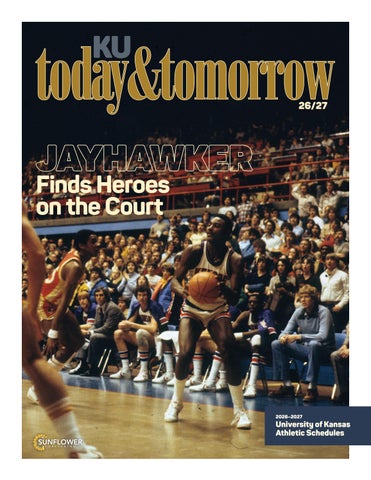
26/27
JAYHAWKER
Finds Heroes on the Court
2026–2027
University of Kansas Athletic Schedules
See full 2026–27 season online Thu • 7:30
An Evening
NOV 5 2026
with
David Sedaris Bestselling author and humorist Mon • 7:30
OCT 26
Chart-topping a cappella group
2026
Fri • 7:30
An Evening with Lyle Lovett
NOV 13 2026
and his
Small Large Band Iconic singer-songwriter Thu • 7:30
NOV 12 2026
:30 2027 Mon • 7
FEB 8
Thu • 7:30
JAN 28 2027
0 Tue • 7:0
FEB 9
musical -winning rd a w A y n The 9x To Contains explicit language
Mon • 7:30
Rhiannon Giddens
MAR 1 2027
Grammy- and Pulitzer Prize-winning folk musician Tue • 7:30
FEB 16 2027
Harvard’s beloved blonde takes the Broadway stage
2026–27 TICKETS ON SALE NOW! Free on-site parking for performances.
a letter F R O M
Jean Teller / EDITOR Shelly Bryant / ART DIRECTOR Leslie Clugston Andres / COPY EDITOR Alex Tatro / ADVERTISING DESIGNER Joanne Morgan / ADVERTISING EXECUTIVE
JMORGAN@SUNFLOWERPUB.COM
Bill Uhler / PUBLISHER Bob Cucciniello / DIRECTOR facebook.com/Sunflower Publishing
KU TODAY AND TOMORROW is a publication of Sunflower Publishing, a division of Ogden Publications, Inc. and Ogden Newspapers of Kansas.
26-27
|
KU
TODAY
&
TOM OR R OW
T H E
E D I T O R
Hello, Jayhawkers! It’s the beginning of a new school year, and there are relaxed seniors (well, some of them are, I’m sure) looking forward to graduation in December or next May. We also welcome the not-so-relaxed first-year students, hoping to find the right classroom and hoping to make a good impression, all while wondering if they’ll ever learn where everything is on campus! Welcome to each and every one of you. KU Today & Tomorrow aims to help you learn more about the University of Kansas. Within these pages, you will find wide-ranging articles produced by our friends at KU News Service; perhaps you’ll find something about your field of study, perhaps you’ll find something intriguing, and perhaps you’ll find something you’d like to pursue. We’ve included an article that updates one from last year: The KU Positive Psychotherapy Clinic has expanded to provide services across the state. Turn to page 20 for details. Another article explores a warning system for tornadoes and severe weather, a topic every Kansan knows something about. Find it on page 14. We also have an article on research aimed at strengthening wind-safety codes for manufactured homes; turn to page 10. Did you know that KU’s research helps boost Kansas communities while helping fuel the state’s economy? Learn more on page 6. Four articles address health issues. One, from the KU Cancer Center, focuses on expanding treatments for blood cancers (page 22); another spotlights the HOPE on Wheels bus, staffed by the Masonic Cancer Alliance, as it travels to rural communities (page 24). A KU study suggests estrogenbased hormone therapies may help protect brain health in older women. Find that article on page 16. Learn more about electrocardiogram privacy concerns and how AI makes a difference on page 18. And we have a personal account from sports writer David Garfield as he recalls his childhood heroes, all Jayhawker basketball standouts. Turn to page 26 for David’s trip down memory lane. We also have, on page 31, the preliminary schedules for the KU football team, the men’s and women’s basketball teams, and the volleyball team. These are accurate as of press time but are subject to change. Whatever your status on campus or whatever your interest, you’ll find something fascinating in this year’s KU Today & Tomorrow. Enjoy! Jean
3
ADD THESE TO YOUR COLLECTION
NOW OFFERING: BA IN MUSIC PRODUCTION & TECHNOLOGY
Flexible curriculum tailored for students passionate about music production, technology, and entrepreneurship Diverse range of commercial genres: from singer/songwriter to video game production
www.framewoodslawrence.com
819 Massachusetts St | Lawrence KS 785.842.4900
Designed as the ideal pathway for aspiring professionals in popular music. Culminates in a comprehensive portfolio: including original songs, business plans, mixes, and collaborations. Ideal for double majors in other music and creative fields, business, or professional performance.
TOPICS INDUSTRY OPERATIONS & INFRASTRUCTURE
Recording, Touring, Copyright, Publishing, Merchandising, Subscriptions, Budgets, & more!
Serving Lawrence and Shawnee Kansas
TWO OFFICES TO SERVE YOU! WAKARUSA ORAL SURGERY & SHAWNEE ORAL SURGERY OFFER A FULL RANGE OF ORAL SURGERY PROCEDURES Dr. Justin Labart
ARTISTIC & CREATIVE ENDEAVORS All genres from classical to punk rock to hip-hop 4901 Legends Drive, Lawrence KS 66049 785-856-6010
PROFESSIONAL DEVELOPMENT
Personal assessment/skills inventory, Business planning
785-864-3436 Murphy Hall 1530 Naismith Drive Lawrence, KS 66045
music.ku.edu music@ku.edu
6844 Silverheel Street, Shawnee, KS 66226 913-441-7868
CARING, COMPASSIONATE STAFF Extractions • Wisdom Tooth Removal • Implants Corrective Surgery • General Anesthesia
visit us at www.wakashaw.com
The bus, HOPE on Wheels, is part of a health outreach program from the University of Kansas Cancer Center and its outreach network, the Masonic Cancer Alliance.
6
GROWING RESEARCH
KU research growth boosts Kansas communities, fuels economy.
10
TARGETING CODES
PHOTOGRAPH COURTESY the Masonic Cancer Alliance
Research targets outdated wind-safety codes for manufactured housing
26-27
14
FORECASTING TORNADOES
Warn-on-Forecast System can increase lead times for severe weather, study finds.
16
HORMONE THERAPIES
Study finds estrogen-based hormone therapies could protect brain health in older women.
|
KU
TODAY
&
TOM OR R OW
18
what’s inside
ELECTROCARDIOGRAM PRIVACY
24
HOPE ON WHEELS
Researchers unveil method for safeguarding privacy of electrocardiograms using AI.
The Masonic Cancer Alliance, the outreach network of KU Cancer Center, has added a bus to better serve rural communities.
20
26
KU Positive Psychotherapy Clinic doubles number of clinicians, provides service across Kansas.
KU players were heroes to one youngster growing up in Lawrence.
CLINIC EXPANDS
COURTING CHILDHOOD MEMORIES
22
EXPANDING CANCER TREATMENT
CAR T-cell treatment has been a game changer for blood cancers. Now researchers hope to expand access and explore its use in solid tumors.
on the cover
Tony Guy played for the Kansas Jayhawks from 1978 to 1982 and was drafted in the second round by the Boston Celtics, the 23rd pick in the 1982 NBA draft. Photograph courtesy Spencer Research Library,, https://digital.lib.ku.edu/ku-uaphotos/20107
5
Growing Research KU research growth boosts Kansas communities, fuels economy. A R T I C L E BY
Mindie Paget, KU Office of Research
6
RESEARCH AND DEVELOPMENT EXPENDITURES spanning all University of Kansas campuses climbed to $610.6 million in fiscal year 2025, surpassing the previous record of $546.1 million by 12% and marking a full decade of sustained research growth. This surge in research activity is powering impact well beyond the university — bringing new discoveries, talent, and economic activity to communities across the Sunflower State and beyond. “As one of America’s leading research universities, KU is tackling the toughest challenges of our time — and doing so in ways that strengthen our communities and fuel the state’s economy,” says Matthias Salathe, KU’s chief research officer. “Our researchers are imagining — and building — a better future,” says Shelley Hooks, vice chancellor for research. “Whether improving human health, protecting our environment, or advancing technologies that make our communities more secure and resilient, their work is driving real-world impact while cultivating tomorrow’s workforce and drawing major investment to Kansas.” Last year alone, research expenditures at KU supported the salaries of 5,696 people. Additionally, the university spent $87.7
KU
TO DAY
&
TO M O RROW
|
26 -27
disabilities; and designing better support tools for rural clinics to care for people with cancer. A majority of KU’s externally funded research — nearly 70% in 2025 — is supported by federal agencies like the National Science Foundation and National Institutes of Health. KU researchers win grant dollars from these agencies through competitions designed to identify the most innovative ideas for addressing societal challenges. Other sources of KU research funding include state and local governments, private businesses and nonprofit foundations.
ILLUSTRATION COURTESY University of Kansas
A collage of images shows researchers in an engineering lab; researchers at a Kansas roadside; and researchers in a KU faculty office.
million in 78 Kansas counties on research-related goods and services in fiscal year 2025, according to a report from the Institute for Research on Innovation & Science. Vendors in 22 of those counties received more than $122,000 in purchases. Among research funded during fiscal year 2025 was one of the largest grants ever received at KU, a $31 million National Institutes of Health grant to coordinate clinical trials for infants and children in rural and underserved areas. KU also received a $26 million National Science Foundation grant to launch EARTH, a research center focused on solving the technical, environmental, and economic challenges of creating a sustainable refrigerant life cycle. Additional projects included advancing seismic imaging tools to detect underground hazards that threaten public safety in Kansas and military operations worldwide; developing therapies and improving care delivery for pediatric facioscapulohumeral muscular dystrophy (FSHD); building teacher capacity to promote early language learning in infants and toddlers with and at risk for
26-27
|
KU
TODAY
&
TOM OR R OW
Advancing health, economic impact Additional reporting by the Institute for Research on Innovation & Science (IRIS) shows that KU contributed $601 million to the U.S. economy between FY 2020 and FY 2024, with spending from research funding flowing to more than 4,200 vendors and subcontractors over that time. 1,076 of those vendors were small businesses, according to KU spending data that could be matched with specific vendors and contractors. The IRIS reports encompass research spending across all KU campuses. That includes the KU Medical Center in Kansas City, Kansas, where research ultimately contributes to life-changing medical advances. “As an academic medical center, KU Medical Center offers clinical trials to patients who might otherwise not have access to certain treatments,” Salathe says. “Clinical research at the medical center continues to grow each year, not only contributing to the economy, but also making us a destination for trial locations and study participants looking to receive investigational therapies.” During the last five years, the number of clinical trials conducted at KU Medical Center has grown by 27%, and clinical trial revenues nearly doubled — reaching $67.8 million — in FY 2025. These trials include investigatorinitiated studies as well as partnerships with pharmaceutical and medical device companies. KU’s research-related economic impact extends beyond the data captured in IRIS reporting. For example, 58 active startup companies have spun out of KU or are based on KU technologies, and more than half of those companies are located in Kansas. Through the university’s relationship with KU Innovation Park, KU researchers help attract businesses to Lawrence, Kansas City and the surrounding area — companies like Merck, Icorium, and Security Benefit — that want to be close to KU researchers and students. The park system includes 77 companies and accounts for 811 privatesector jobs and $53.8 million in annual direct payroll. Influencing rankings, AAU membership KU’s substantial research activity has helped sustain its membership in the Association of American Universities since 1909, and the university’s annual research expenditures affect its standing in the National Science Foundation’s
7
“Our researchers are imagining — and building — a better future. Whether improving human health, protecting our environment, or advancing technologies that make our communities more secure and resilient, their work is driving real-world impact while cultivating tomorrow’s workforce and drawing major investment to Kansas.”
–Shelley Hooks
Higher Education Research and Development (HERD) Survey. KU ranked 41st among public universities for research and development expenditures and 49th among public universities for federally funded R&D in the latest HERD survey, which is based on fiscal year 2024 data. The university also claimed the No. 1 spot among public universities in federally financed R&D expenditures in non-science and engineering fields and ranked first among public universities for overall R&D in education. KU ranked in the top 50 among publics in overall R&D in the following fields and subfields: • No. 1 in Education • No. 3 in Non-Science & Engineering Fields • No. 3 in Social Work • No. 16 in Geological and Earth Sciences • No. 23 in Life Sciences, not elsewhere classified • No. 27 in Health Sciences • No. 27 in Sciences, not elsewhere classified • No. 35 in Chemical Engineering • No. 36 in Communication and Communications Technologies • No. 36 in Psychology • No. 37 in Aerospace, Aeronautical, and Astronautical Engineering • No. 41 in Life Sciences • No. 45 in Geosciences, Atmospheric Sciences, and Ocean Sciences • No. 49 in Civil Engineering • No. 49 in Atmospheric Science and Meteorology • No. 49 in Chemistry
Landscape LAWRENCE
Landscape Design and Installation Lawn Care Irrigation Backflow Device Testing Tree and Shrub Care Drainage Outdoor living Walls and Patios Accent Lighting And More!
785-843-4370
KU ranked in the top 50 among publics in federally funded R&D in the following fields and subfields: • No. 1 in Non-Science & Engineering Fields • No. 2 in Education • No. 2 in Social Work • No. 8 in Humanities • No. 11 in Visual and Performing Arts • No. 15 in Communication and Communications Technologies • No. 30 in Geological and Earth Sciences • No. 30 in Health Sciences • No. 34 in Anthropology • No. 34 in Aerospace, Aeronautical, and Astronautical Engineering • No. 36 in Psychology • No. 43 in Civil Engineering • No. 44 in Chemistry • No. 46 in Astronomy and Astrophysics • No. 47 in Economics • No. 47 in Life Sciences • No. 48 in Atmospheric Science and Meteorology • No. 48 in Chemical Engineering KU’s fiscal year 2025 research expenditures will be used to determine the university’s 2026 ranking in the NSF HERD survey. IRIS is a national consortium of research universities using data to understand, explain and improve higher education and research. IRIS reports are based on administrative data that KU supplies to IRIS, which are then merged with other public and private datasets.
Fresh Local $aving$
23rd & Louisiana | Lawrence, Kansas | checkersfoods.com Like us on Facebook @CheckersFoods!
Research targets outdated wind-safety codes for manufactured housing A R T I C L E BY
Brendan M. Lynch, KU News Service
10
KU
TO DAY
&
TO M O RROW
|
PHOTOGRAPH COURTESY WiSH Project
Targeting Codes
A UNIVERSITY OF KANSAS ENGINEER will use a hurricane simulator, dubbed the “Wall of Wind,” to make it plain to federal regulators why the nationwide building code for manufactured homes needs an update. Millions of Americans in need of affordable housing live in single- and double-wide mobile homes across the United States. The government and industry refer to this housing stock as “manufactured housing.” These manufactured homes are disproportionately damaged or destroyed in major wind events, according to federal disaster data. “These are factory-built units — commonly single-wide or double-wide — that are permanently attached to a steel chassis,” says Elaina Sutley, Diane M. Darwin Chair’s Council associate professor of civil, environmental and architectural engineering at the University of Kansas, who is leading the research. “The issue becomes that much more important when considering who lives in manufactured housing. These homes often serve lower-income populations who may not have the resources to recover if they lose their home.” The KU investigator says that, unlike other building types, which follow codes developed through national consensus processes and are adopted locally, manufactured housing is governed by a federal code that limits states’ and municipalities’ power to amend local codes. “Manufactured homes fall under a unique federal building code overseen by the U.S. Department of Housing and Urban Development,” Sutley says. “Even regions with high wind risk, like Florida, can’t independently strengthen requirements for
26 -27
From top: When an EF1 tornado hit Largo, Florida, it severely damaged this manufactured home; photo by Nicholas Krasznavolgyi/Wikimedia Commons; an EF2 tornado hit Eldorado, Illinois, causing this manufactured home to slide off its foundation; photo courtesy National Weather Service/Wikimedia Commons.
An EF2 tornado damaged a double-wide manufactured home in North Fort Myers, Florida, in October 2024. Courtesy National Weather Service/Wikimedia Commons
the homes themselves. They can modify the installation requirements, which is one of the reasons we’re focusing on this aspect in our testing program.” Wind-safety codes governing the design of manufactured homes haven’t changed since 1994. Part of the problem in modernizing HUD building codes has been a lack of supporting research showing inadequacies in the current regulations. Changes in the code are reviewed by the Manufactured Housing Consensus Committee, a federal advisory panel that makes recommendations to HUD, which must then go through a formal rulemaking process. Sutley says she hoped her findings will influence this process. “Wind engineering and building standards have advanced significantly, with newer codes for other building types updated as recently as 2022 and moving toward 2028 revisions,” she says. “Despite these advances, manufactured housing hasn’t kept pace. A lack of research has contributed to the stagnation. Efforts to study and improve these standards have historically faced skepticism. In early research proposals, we faced peer reviews that stated ‘you’ll never change manufactured homes’ and ‘manufactured homes aren’t engineered’ as reasons to not fund our research. We persisted, and we have since made headway in this space, but there is more to be done.” Sutley and her collaborators are now eight years into this research, and the penultimate tests were conducted in May 2026. She’s the principal investigator in the Wind Safe Manufactured Housing (WiSH) Project, an effort to put hard data to a common-sense problem: Mobile homes that are not well tethered to the ground are dangerous in high winds. The WiSH Project includes William Collins, Stanley T. and Phyllis W. Rolfe Chair’s Council Associate Professor of civil, environmental and architectural engineering; and two graduate students from KU, as well as researchers from the University of Alabama, Florida International University, and Texas Tech University (https://CEAE. KU.edu/disasterhopelab/wish-project).
12
This past May, Sutley’s KU group traveled to FIU, home of the “Wall of Wind,” a 12-fan system that can simulate up to Category 5 hurricane-force winds (157-plus mph). There, she tested three “specimens” of manufactured homes against mounting wind speeds. “The Wall of Wind facility at FIU provides a rare opportunity to test full-scale manufactured homes under realistic conditions,” Sutley says. “Unlike most wind labs, it allows testing outdoors, where homes can be installed on actual ground with real anchoring systems. This is critical for studying how installation methods perform under high winds. Indoor facilities can’t replicate these conditions because they lack soil for anchor installation.” The KU researcher used the Wall of Wind to conduct controlled experiments, measuring wind pressures, structural response, and failure points under varying conditions. In April, Sutley described the testing this way: “Testing will begin with setup and instrumentation, followed by a series of controlled experiments,” she said. “Some tests will focus on measuring wind pressures to validate computational models. Others will involve higher wind speeds to observe physical damage. At wind speeds exceeding 100 miles per hour, nonstructural elements such as skirting and siding are expected to fail. At higher speeds, potentially up to 150 miles per hour, entire units may detach from their supports.” Sutley hopes the experiments will support extending the more stringent codified wind requirements for manufactured homes in Florida and the Gulf Coast to the entire United States, meaning manufactured homes throughout the country would then be anchored to the ground, helping them to withstand non-hurricane winds and earthquakes. But changes to federal standards would likely take several years, as updates must move through committee review and federal rulemaking processes. This research is supported by funding through the Florida Division of Emergency Management, the National Science Foundation, the U.S. Department of Housing and Urban Development, and the Federal Emergency Management Agency, as well as support from the Applied Technology Council. But full-scale testing remains expensive, Sutley says. “Costs include travel, instrumentation, installation and demolition, as well as funding for graduate students to analyze the data,” she says. “Additional support is needed to complete the research and to translate findings into industry practice. This includes developing outreach materials and engaging stakeholders beyond academia.” The KU researcher says the project is seeking a broad range of partners, including industry participants, disaster recovery stakeholders and individuals with personal connections to manufactured housing. For more information on supporting the project, email enjsutley@ku.edu.
KU
TO DAY
&
TO M O RROW
|
26 -27
Proud to be
rFor Serving Serving Serving ce Fo Lawren nLawren cece ce ForFor re LawLawren ServingOver s Over Over 30 30 30 Years Years Years r ar Fo Ye Serving Serving Serving ce Lawren Lawren Lawren 30 n cece ce For ForFor g rLawre inve ServO sYears 3030 30 Years Years ar Ye 30Over rOver OveOver
part of
LAWRENCE.
Dr. Brad Dr.Adams Brad Adams Dr. Kailah Adams Dr. Kailah Dr. Kailah Willms Willms Willms Newkirk Newkirk NewkirkDr. Brad Dr. Nealy Dr. Nealy Dr. Nealy Dr. Kailah Willms Dr. Brad Adams Dr. Dr. Dr. Brad Brad Brad Adams Adams Adams irk Dr. Dr. Dr. Kailah Kailah Kailah Willms Willms Willms Newkirk Newkirk Newkirk Nealy Dr. Nealy Dr.wk Dr. Nealy Ne Dr. Nealy Dr. Kailah Willms Dr. Brad Adams Newkirk Fillings Fillings Dr. Nealy /Fillings / Same / Same Same Day Day Day Crowns Crowns Crowns / Cleanings / Cleanings / Cleanings / Veneers / Veneers / Veneers
Dr. Lacey Randa Dr. Lacey Randa
Drs. Drs. Drs. Newkir Newkir Newkir k, k, k, Adams, Adams, Adams, Willms Willms Willms &McGuir & McGuir McGuir reseses es ui cG Drs. Drs. Drs. &and Newk Newk Newk ssand irk, irk, irk, Adam Adam Adam m s s&M ill and Willm Willm Willm W lm s, il m W da d A , n a rk s ki Drs. Drs. Drs. Newkir Newkir Newkir m ew k, k, k, Adams, Adams, Adams, a N Willms Willms Willms d . & & & McGuir McGuir McGuir rs reseses es A , D ui k cG ir, A k Drs. Drs. &and Newk Newk Newk ew irk, irk, irk, Adam Adam Adam N .N sassand sM illsm and Willm Willm Willm rs W lm DDDrs. s, il m W da d n rk ki m ew a d . rs A ce 785-843785-843For ForFor 2636 2636 2636 irwnks /,Cle/aniReferr785-843rce Cro Fo ew e Dayk ece / Sam 36 rsing. s N w al Rew 26nc DFill 3-sre La g 84ard
Experience Experience Experience d, comprehen d, comprehen d, comprehen sive, sive, sive, friendly friendly friendly dentistry dentistry dentistry for for all all all ages. & Randa ages. Drs. Newkirk, Adams, Willms, es.ages. agMcGuire allfor dly dentistry for en fri e, Implants Implants Implants siv en reh Experience Experience Experience mp d, d, d, comprehen comprehen comprehen co sive, sive, sive, , friendly friendly friendly dentistry dentistry dentistry nts ed for for for pla all all nc ages. ages. Im rie s Whitening Whitening Whitening pe Drs. Newkirk, Adams, Willms, eerRewards / Invisalign / Invisalign / Invisalign Ex es. all ages. & Randa / Referral / Referral Referral Rewards / Ven all agMcGuire ngs for ry / Cleani/dly sDay ist wnCrowns ntRewards de Fillings e/Day /Fillings /Cro Same Same Same s/ Veneers Day Day Crowns Crowns fri //en / Cleanings Cleanings Cleanings / Sam sFillings / Veneers /ard e,lign Veneers Implants Implants Implants Rew siv Filling en err/al Ref reh mp co , isa nts ed Inv / / Invisalign ing s Impla Whitening Whitening Whitening iten eerRewards /today! / Invisalign Invisalign Experienc Wh /ngs / / Referral Referral Referral Rewards Rewards / Ven Call Call Call Serving Serving Serving our our our office office office Lawren Lawren Lawren today! today!
in 5lign rv 78 isaat Inv Se y! /us Over Over Over 30 30 30 da Years Years or or or to visit visit visit ustoday! at atServing eus 4111 4111 4111 Wh W. W. W. 6th 6th 6th Street Street Street fic Call Serving Serving tal.comm m our our our ofing office office office freestatedental.co freestatedental.co Lawren Lawren Lawren today! today! edenfreestatedental.co riten m ce 785-843785-843785-843For For For stat ou 2636 2636 2636 sYears free llCall ar CaCall rce Ye Fo 30 ece rLa nc et ve re re 36 O St w 26 h 36t . g 84 W in 511 rv 78 41 Se y! at Over Over Over 30 30 30 da Years Years Years us or or or to visit visit visit us us us at at at e sit 4111 4111 4111 W. W. W. 6th 6th 6th vi omm m Street Street Street fic tal.c or of freestatedental.co freestatedental.co freestatedental.co eden r m stat ou s free ar office: Visitstate-of-the-art Call our our state-of-the-art state-of-the-art Ye office:office: rSt30 et veVisit reour OVisit
h ss Drs. Drs. Drs. . 6tAdam Newk Newk Newk WAdam irk, irk, irk, Adam sdand and and Willm Willm Willm ss s s lm ilWillm or visit us at 4111 W n a s m a Drs. Drs. Drs. Newk Newk Newk d irk, irk, irk, A Adam Adam Adam , s s s and and and k Willm Willm ir Drs. Drs. Drs. k Newk Newk Newk irk, irk, lm Adam Adam Adam ew irk, s s s il and and and Willm Willm Willm N . W ss ss ss s rs d n DDrs. lm a il s W m d a n d a A s , k m a ir Drs. Drs. Newk Newk Newk d k irk, irk, irk, A Adam Adam Adam , ew s s s Fillings Fillings Fillings and and and Willm Newkirk lms s s D ilWillm s Willm W ng rs.. N dDay lli nDay Drs Fi aSame sSame am d A , Or Or Or Visit Visit UsVisit Us Us at: k at:at: ir Same Day k Crowns Crowns Crowns ew Fillings Fillings Fillings at: N ns Us . it ow rs Vis Cr Or D ay s tatedental Dlli ng ewww.frees mCleaning Fi Sa www.frees www.frees tatedental tatedental .com m .com co al. Cleaning Cleaning Or Or Or Visit Visit nts UsVisit Us Us sat: sat:.com at: office: e-a f-th 4111 W 6th W WrtStreet 6th 6th Street Street e-o stat4111 Visit our4111 eet office: Str VisitVisit Visit 6th ourAnd our our state-of-the-art state-of-the-art state-of-the-art W now office: office: 4111 And And now now open open open in in Dein De Soto: De Soto: Soto: ce: offi rt e-a f-th 4111 4111 4111 W 33391 33391 6th 6th : Street Lexington Lexington Lexington Street Street e-o Ave Ave C C Ave C Soto stat DeW our33391 in6th nW Visit And ope now
eetC Str Ave on 6th ingt W Lex 411191 333 And And Andopen now now now open open in in De Soto: Dein De Soto: Soto: 33391 33391 33391 : C Ave C Lexington Lexington Lexington Ave C Soto DeAve And now open in Ave C 33391 Lexington
de Same Same Same Day Day Day ta Crowns Crowns es fre at: s Crowns w.Cl ns Us ng ww niitte ow Vis ea Cr Or ay D e m Sa www.frees www.frees www.frees tatedental tatedental tatedental .com Veneers Veneers Veneers m .com al. Cleaning Cleaning Cleaning nt s s s.com de te ta es s fre ne ngs co ww Ve Experienced Experienced Experienced nier , comprehens , comprehens , comprehens eaall ive,ive, ive, friendly friendly friendly dentistry dentistry dentistry forw. for for allCl all Dr. Brad Dr.Adams Brad AdamsDr. Kailah Adams Dr. Kailah Dr. Kailah Willms WillmsWillms Newkirk Nealy NewkirkDr. Brad Dr. Nealy Dr. Nealy Dr. Newkirk
Dr. Kailah Willms ms Dr.Bra Dr.d Brad Dr. Ada Brad Brad AdamsDr. Kailah Adams Adams Dr. Kailah Dr. Kailah Willms WillmsWillms Newkirk Dr. Nealy Newkirk Dr. Nealy Dr. Nealy Dr. Newkirk Newkirk Dr. Nealy Kailah Willms Dr. d Adams Dr. Bra Fillings Fillings Fillings / / / Same Same Same Day Day Day Crowns Crowns Crowns / Cleanings / Cleanings / Cleanings / Veneers / Veneers / Veneers Implants Implants Implants Newkirk Dr. Nealy Whitening Whitening Whitening / Invisalign / Invisalign / Invisalign
Implants Implants Implants Veneers Veneers Veneers ts an s pl erng Im ne Ve Whiteni Whiteni Whiteni ngng Implants Implants Implants ng nits te hi an W pl Im Invisalig Invisalig Invisalig n n ng n Whiteni Whiteni ng nng lig sa ng viWhiteni ni In te hi W Crowns Day e s Referral Referral Referral 36 Sam ard Rewards Rewards Rewards / s or or or 26 visit visit visit Rew us us us ing at at at 34111 4111 4111 al W. W. W. Invisalig Invisalig Invisalig FillCall 6th 6th 6th err Street Street 84 n ds n 5-Street / Ref Call Call our our our 78 office office office ligny! today! today! isatoday! 785-843-2 785-843-2 785-843-2 da 636 636 to ing e Re fic/ Inv Whriten of lignwnar fe636 Re Inrrvialsa Callorou et re St Referral Referral Referral 36 h Rewards Rewards Rewards or or 26 6t visit visit visit . us us us at at at 34111 4111 4111 W W. W. W. 6th 6th 6th Street Street Street 84 11 541 78 at y!Call us e toda it fic wards Re Call Call Our Our Our Office Office rral Today! Today! r of feToday! ouvis ReOffice Callor y! h Street da 6t(785) To W.(785) e ic ff O (785) ur 843-26 843-26 843-26 O 36 36 36 l or visit us at 4111 Call alCall Our Our Our CCall Office Office Office Today! Today! Today! 36 y! 26 da 3To3636 84 e6th )843-26 ic ff6th 85 O (785) (785) (785) ur 843-26 843-26 O 36 l(7 4111 4111 4111 Cal W W W 6th Street Street Street 36 3-h26 84 )4111 Street e0ars 85 6t Years (74111 W 11 0 Y0eaYrs 41 4111 W W W 6th 6th 6th Street Street Street r ovr eorver3rov3er 3
ages. ages. ages. stry for all ages. denti dly Experienced Experienced Experienced en , comprehens , comprehens , comprehens fri ive, ive, ive, friendly friendly friendly , dentistry dentistry dentistry ive for for for all all all ages. ages. ages. ns he / / / Referral Referral Referral Rewards Rewards Rewards pre ts ed, com ncFillings eers Implanall Experie Ven ages. Fillings /Fillings / Same / Same Same anings Day Day Days // Crowns Crowns Crowns / Cleanings / Cleanings Cle Cleanings //de /nti / Veneers Veneers Veneers Implants Implants Implants str e Day Crown sy for dly Sam ard / en s fri Rew ing , al Fill ive err ns Whitening Whitening Whitening Ref / / / / Invisalign Invisalign Invisalign he Call Call Call /785-843-2 / Referral our our our Referral Referral office office office Rewards Rewards Rewards lign/today! pre today! isatoday! 785-843-2 785-843-2 com 636 636 / Inv ts 636 ing lan iten eers Imp Experienced, Wh / Cleanings / Ven
freestatedental.com freestatedental.com freestatedental.com om freestatedental.c freestatedental.com freestatedental.com freestatedental.com om freestatedental.c
reet ntal www. www. www. State.de freest freest hate.de ate.de ntal ntal W 6t 4111freest l nta e .d te a st e re .f www. www. www. freest freest freest w ate.de ate.de ate.de w ntal ntal ntal w ntal www.freestate.de
fo fo fo aYrs e0arrs Y sears 0v3Ye0erY rver3ro ovr eofo 0 3ea 3 forfo r e for ov Years r 30 e v o for
We live here We work here.
We’re here for you! Experience local banking
that puts you first.
Scan or visit TruityCU.org/GoFarther
to open an account today!
The Official Credit Union of KU Alumni
Forecasting Tornadoes Warn-on-Forecast System could increase lead times for severeweather warnings, study finds.
A R T I C L E BY
RESEARCHERS AT THE UNIVERSITY OF KANSAS have shown the National Severe Storms Laboratory’s Warnon-Forecast System (WoFS) has potential to help weather forecasters issue warnings to emergency managers and the general public well before tornado formation. Their study appears in the peer-reviewed journal Weather and Forecasting. The current lead time on issuing tornado warnings is about 15 minutes. The difference could save lives and property across the Great Plains (the classic “Tornado Alley”) and other areas like the tornado-prone Southeast. “Right now, when we do any kind of warnings or forecasts of tornadoes and severe weather, we use a warn-on-detection paradigm,” says co-author David Rahn, professor of geography & atmospheric science at KU. “If we see rotation in real time on radar, or if a storm spotter reports that a tornado is happening, that is when warnings are issued. Typically, we know severe weather is coming days in advance. Three or four days out, we may know Kansas is going to have some sort of severe weather outbreak. As we get closer, we refine the forecast as models update. We narrow things down to watches, but we do not warn until danger is imminent or occurring.” The idea behind the WoFS is to increase lead time by not just warning on detection, but warning on predictions and forecasts of the event, according to Rahn. Today’s tornado
14
warnings rely on radar data and regional spotters. By contrast, WoFS synthesizes observational data in real time and runs high-resolution simulations to gauge uncertainties and produce guidance for tornado and severe weather threats well before they form. “The goal is to increase lead times well beyond the typical 15 minutes,” he says. “In some cases, this system can push lead times up to an hour before the event actually occurs.” As of today, the WoFS is in the experimental phase. Rahn and his colleagues analyzed 41 supercells resulting in reports of tornadoes of at least EF1 (on the Enhanced Fujita scale for tornado strength) or non-tornadic “significant hail” on the Great Plains. They aimed to determine the specific characteristics that could help determine whether a storm resulted in a tornado or was just a dangerous supercell with large hail. “The environment has to be just right to produce a tornado,” Rahn says. “One major finding is that the size and extent of pockets of environmental factors are better indicators than just maximum values. If you only look at a single maximum value, you may not see differences between tornadic and non-tornadic storms. But if you look at larger, well-defined areas of enhanced storm-relative helicity, those are markers of better-developed storms, which have a higher chance of tornado genesis.”
KU
TO DAY
&
TO M O RROW
|
PHOTOGRAPH COURTESY Lane Pearman, Wikimedia Commons
Brendan M. Lynch, KU News Service
26 -27
ILLUSTRATION COURTESY David Rahn
A tornado touches down near Dodge City on May 24, 2016. The current lead time on issuing tornado warnings is about 15 minutes. More lead time from the Warn-on-Forecast System could save lives and property across the Great Plains and beyond, KU researchers found.
Researchers analyzed how a tornado-producing storm moved and changed over one hour. Colors represent low-level wind rotation near the ground, black outlines show radar intensity, and blue lines mark the air flowing into the storm.
The KU researcher says storm-relative helicity is a lowlevel corkscrew motion fed into the storm. “It’s like a spiraling football that, when it encounters the storm updraft, gets tilted vertically,” Rahn says. “That vertical rotation is what tornadoes tap into. The stronger and more extensive that motion is, the more likely a tornado becomes.” Other factors that increased the likelihood of tornado genesis include lower cloud bases, stronger low-level wind shear, and small pockets of enhanced rotation near the storm’s inflow region. Because WoFS models these exact parameters at very fine spatial scales, they become signals of tornado formation up to an hour before a tornado forms. The end users of WoFS will be forecasters with the National Weather Service, but the system also will be broadly available for free to meteorologists and the public. “It’s primarily developed for National Weather Service forecasters, but it is cloud-based and accessible in real time,” Rahn says. “The National Weather Service is a public service, so its products are typically public and free. That is one of the benefits of having a National Weather Service that is not monetized and is for the public good.” Rahn’s co-authors were lead author Jerod Kaufman, a KU graduate student now working for the National Weather
26-27
|
KU
TODAY
&
TOM OR R OW
Service; David Mechem, KU professor of geography & atmospheric science; Patrick Burke of the National Severe Storms Laboratory; Montgomery Flora of the National Severe Storms Laboratory; and Corey Potvin of the University of Oklahoma and the National Severe Storms Laboratory. “The lead author was my master’s student, and this was his thesis project,” Rahn says. “He now works at the Wichita National Weather Service, which is a nice example of research transitioning into operations. This is cutting-edge research that integrates operational meteorology into the classroom. It shows how graduate research can transition directly into realworld forecasting and public service.” As the WoFS continues to undergo evaluation in liveforecasting scenarios, the hope is that it will eventually save lives and property. Warnings can be issued to the public with more time for people to seek safety, while emergency services will have more opportunity for preparation. “One major benefit of longer lead times is informing emergency managers at the county level,” Rahn says. “With more time, they can position resources, coordinate hospitals, and prepare search-and-rescue operations. The mission of the National Weather Service is to protect lives and property. An hour of lead time versus 15 minutes is extremely useful for everybody.”
15
Hormone Therapies Study finds estrogen-based hormone therapies could protect brain health in older women. A R T I C L E BY
RESEARCHERS FROM THE UNIVERSITY OF KANSAS have shown a link between reproductive hormone exposure throughout life and brain health in 459 women aged 65 to 80. They discovered older women who had used hormonal birth control in young adulthood were more likely to have larger volumes in brain regions vital to memory, cognition, and information processing. They recently shared their findings in NeuroImage, a peerreviewed journal. “It’s showing a protective effect — using estrogen-based hormone therapies was beneficial for the brain in older women,” says co-lead author Amber Watts, professor of psychology at KU and frequent collaborator with KU Alzheimer’s Disease Research Center scientists. “What’s unique about this paper is we looked at the use of hormone-based medications both in early adulthood and in midlife, and the use of both of those was associated with brain health in older adult women.” The KU researcher says evidence suggested it may be the lifetime accumulation of estrogen exposure, first from birth control and later from menopausal hormone therapy, that provides the beneficial effect. So, the KU team examined three possibilities for hormone exposure: • Use of hormonal birth control • Use of menopausal hormone therapy (MHT) during menopause • Natural hormone exposure, estimated by how late menopause occurred. “A lot of the research work has just looked at menopause hormones specifically and not really looked at what happens earlier in your life,” Watts says. “When your brain is first developing, say in adolescence, there are a lot of hormone changes happening then. People haven’t really given much thought to what implications that might have for brain health in the long term.” Most American women of childbearing age use birth control, according to the Centers for Disease Control and Prevention “I don’t think people really stop and think about that,” Watts says. “When they think about taking birth control
16
for the purpose of either regulating their cycles or for contraception, I don’t think what people are thinking about is, ‘How will this affect my health later?’” The KU researcher says the findings should prompt both healthcare providers and people who take birth control to think about long-term implications. Women make up nearly two-thirds of Alzheimer’s disease patients, according to the Alzheimer’s Association. According to Watts, understanding if reproductive hormones protect the aging brain might eventually inform strategies for reducing dementia risk and improving healthy cognitive aging. “Estrogen is neuroprotective,” she says. “It’s beneficial for white matter integrity. It helps protect neurons and strengthens neural connections. It is also important for vascular function. One of the things we get wrong about estrogen is people think of estrogen as this thing that has to do with reproduction. But really, estrogen is very important for a lot of different body systems. It’s important for the brain, it’s important for the heart, it’s important for bone density, and it’s important for the immune system.” Watts and her co-authors also found women experiencing menopause at a later age — meaning they were exposed to natural ovarian hormones for a longer period — had a thicker cortex in multiple brain regions vulnerable to Alzheimer’s disease. The KU researcher says the new evidence in general should support use of hormone therapy during menopause. “There’s been a controversy over hormone therapy use. There was a study back in 2002 called the Women’s Health Initiative, and its results scared everybody out of using estrogen therapy,” Watts says. “For a long time, people stopped prescribing and using those therapies, thinking that it was going to lead to negative outcomes. Since then, there’s been
KU
TO DAY
&
TO M O RROW
|
PHOTOGRAPHS COURTESY Amber Watts
Brendan M. Lynch, KU News Service
26 -27
Brain scans highlighting areas (in red and green) where women who started menopause at an older age tended to have a thicker outer layer of the brain, known as the cortex. The graph displays this relationship for one region of the brain, the left middle occipital gyrus, where later menopause was associated with greater cortical thickness.
a lot of revisiting of those findings and discovering that there were some problems with them and that they didn’t apply to everyone.” The new investigation lines up with Watts’ recent research into hormones and brain health in women, an area that remains under-researched. A related paper by Watts published last year showed birth control and hormone therapy were associated with cognitive outcomes. “People who underwent early surgical removal of the ovaries definitely benefited from exposure to hormone therapy,” she says. Going forward, Watts’ team is recruiting for new menopause-related studies. She encouraged women who might be interested in participation to complete a short survey to help determine whether they are eligible. “It’s a topic that women are very excited about, and every time I talk about it, I have a line of people waiting to ask me more questions,” she says. “I think it’s something that people care about.” Watts’ collaborators were co-lead author Robyn Honea, along with Jeffrey Burns, co-director of the University of Kansas Alzheimer’s Disease Research Center, and Eric Vidoni, associate director of the Clinical Core for KU’s Alzheimer’s Disease Research Center. Other co-authors were Shannon Donofry of RAND and the University of Pittsburgh; Hayley Ripperger, Sarah Aghjayan,
26-27
|
KU
TODAY
&
TOM OR R OW
George Grove, and Anna Marsland of the University of Pittsburgh; Chaeryon Kang and Swathi Gujral of the University of Pittsburgh School of Medicine; M. Ilyas Kamboh of the University of Pittsburgh School of Public Health; Cristina Molina-Hidalgo and Haiqing Huang of the AdventHealth Research Institute; Lauren Oberlin of the AdventHealth Research Institute and Weill Cornell Medicine; Bradley Sutton of the Beckman Institute for Advanced Science and Technology at the University of Illinois Urbana-Champaign; Arthur Kramer of the Beckman Institute and Northeastern University; Edward McAuley of the Beckman Institute and the University of Illinois Urbana-Champaign; Charles Hillman of Northeastern University; and Kirk Erickson of the University of Pittsburgh and the AdventHealth Research Institute.
17
Electrocardiogram Privacy Researchers unveil method for safeguarding privacy of electrocardiograms using AI. Brendan M. Lynch, KU News Service
A COMMON MISPERCEPTION EXISTS THAT electrocardiograms (ECGs) simply contain data about heart activity. However, modern ECGs enhanced with artificial intelligence (AI) can contain data about a patient’s sex, age, race, and even exact identity derived from ECG signals, raising fresh privacy concerns. To address these worries, researchers from the University of Kansas have developed a Privacy-Preserving Variational Autoencoder, or PP-VAE, to protect to protect personally sensitive data. “Modern AI systems may infer sensitive traits from ECG signals, including approximate age ranges and other personal soft-biometrics from the signals,” says Fairuz Shadmani Shishir, a doctoral student in electrical engineering & computer science at KU who led the study. “Our goal was to develop a method that preserves clinically useful information in ECGs while reducing the exposure of sensitive personal attributes such as age, sex and demographic details.” Shishir and a KU Medical Center research team detail their new method in a recent issue of Scientific Reports. “We proposed an AI-driven model that analyzes ECG signals to predict clinically important outcomes such as left ventricular ejection fraction (LVEF), which is an indicator of heart abnormalities and early mortality risk,” he says. “At the same time, the model is designed to reduce the exposure of sensitive biometric information, including age, sex and demographic characteristics derived from ECG signals.” Shishir says the research was necessary because in the health care sector, companies and medical institutions often share ECGs and other health information across organizations. “Protecting patient privacy is essential when sharing medical data,” he says. “Our goal was to enable secure sharing of clinically useful ECG information without unnecessarily exposing sensitive personal attributes.” Shishir and his collaborators from KU Medical Center reduced identifiability of soft biometrics using independent convolutional neural network models while retaining clinically useful predictions such as left ventricular hypertrophy and five-year mortality. “These findings demonstrate the effectiveness of our approach for retaining ECG data while protecting patient privacy,” the authors wrote.
18
Shishir’s co-authors included Sumaiya Shomaji, assistant professor in the Department of Electrical Engineering & Computer Science at KU; Amit Noheria, associate professor in the Department of Cardiovascular Medicine at KU Medical Center; and Christopher Harvey and Amulya Gupta from the Department of Cardiovascular Medicine at KU Medical Center. The researchers argue their method could help hospitals and research institutions share ECG data safely, allowing collaboration and AI development without compromising patient privacy. “In our experiments, we compared our model’s performance to other state-of-the-art models,” Shishir says. “We demonstrated that our model has competitive performance compared with other machine-learning approaches. The model performs well in predicting heart disease and early mortality risk while revealing less biometric information from ECG signals.” Further, the KU innovation could help reduce bias in medical care that can lead to underdiagnosis and undertreatment of marginalized groups and women. “Bias is an important issue to address,” Shishir says. “In our models, we aimed to include balanced proportions of male and female patients, as well as balanced representation among white, nonwhite, and other racial groups. This was one way we attempted to minimize bias. At the same time, our model was trained using data from KUMC, and although we validated it on public datasets, future work will involve training on datasets from different regions around the world. This will help us better evaluate bias and improve the model’s ability to generalize across populations.” Before the technology can be widely adopted, the researchers say building trust and accessibility would be vital. “We believe there are two key reasons people should use it,” Shishir says. “First, the model is designed to generalize across patients in the United States. Second, we plan to make the model publicly available so that anyone can use it. Making the model publicly available follows common practices in the AI field. Institutions will be able to use our model and potentially build their own versions trained on their own datasets. Our goal is to release the model publicly in the future.” The researchers also acknowledged the American Heart Association’s support of this work.
KU
TO DAY
&
TO M O RROW
|
PHOTOGRAPH COURTESY Fairuz Shadmani Shishir
A R T I C L E BY
26 -27
Lead author Fairuz Shadmani Shishir at a poster session with his faculty adviser and co-author Sumaiya Shomaji, assistant professor in the Department of Electrical Engineering & Computer Science at the University of Kansas.
26-27
|
KU
TODAY
&
TOM OR R OW
19
KU Positive Psychotherapy Clinic doubles number of clinicians, provides service across Kansas.
A R T I C L E BY
Mike Krings, KU News Service
Clinic Origins In 2020, the Positive Psychotherapy Clinic was set to open in KU’s School of Education & Human Sciences, but the COVID-19 pandemic forced operations to go online. Within two years, clinic leaders not only learned providing the counseling virtually was a viable option but also successfully provided more than 800 hours of counseling. “Since we started in 2020, we have worked with over 400 clients in 48 counties in Kansas. Our reach has become much greater than we originally imagined it could be,” says Brian Cole, associate professor of educational psychology and director of training in the counseling psychology doctoral program. “We’re finding, across the board, that this approach works. When we check in with folks after they’ve completed the protocol, they have maintained their gains.” In the last six months alone, 79 clients have completed the clinic’s nineweek protocol. About 70% saw significant improvement in their symptoms. That rate is higher than the national average, and at nine weeks, comes at a faster pace than the national average as well, Cole says. Positive Psychotherapy Traditional psychotherapy focuses on deficits, or the problems in a person’s life that may be causing symptoms like depression. Positive psychology instead focuses on a person’s strengths, what they do well, and what is going right in their life to address situations that may be causing the issues. The approach was pioneered by the late Rick Snyder and the late Shane Lopez, both former faculty members at KU. Clinicians help clients focus on strengths and positive aspects of their lives, set goals for improvement, and learn and practice skills to work toward improvement. Cole and Kristen Hensley, associate professor of the practice and training director of the counseling psychology
20
KU
TO DAY
&
TO M O RROW
|
PHOTOGRAPH Adobe Stock/Pakhnyushchyy
Clinic Expands
WHAT STARTED AS A WAY to give counseling psychology graduate students experience by seeing clients at the University of Kansas has grown to a telehealth clinic powerhouse helping people across the state address anxiety, depression, stress, and other mental health concerns by focusing on their strengths and what is right in life. The KU Positive Psychotherapy Clinic has doubled the number of clinicians providing service to people across the state, all while seeing improvements in clients as early as the first session. Data show clients experience significant gains sooner and at higher percentages than the national average.
26 -27
master’s program, have analyzed data from 166 clients who completed the nine-week therapy protocol between 2023 and 2025. Results showed depression, anxiety, general symptom distress, relationship distress, and school/work distress were significantly lower after session eight than at the beginning. Clinicians also perform a follow-up session with clients one month after completion, and data showed the gains were maintained after the program. Analysis also showed that throughout the program, anxiety started to improve by session two, depression started to improve by session three and the comprehensive symptom distress measurement saw improvement after the very first session. The latter measure also showed improvement each week of therapy.
“Since we started in 2020, we have worked with over 400 clients in 48 counties in Kansas. Our reach has become much greater than we originally imagined it could be.”
–Brian Cole
In addition to helping individuals make improvements, the clinic has boosted its numbers. This year, clinicians saw clients from 27 Kansas counties, bringing the total to 48 counties from which the clinic has served clients. Residents from more than 300 miles from KU’s Lawrence campus have received services, and some live near the borders with Nebraska, Colorado and Oklahoma or in rural areas in between. Many people who have completed the clinic’s programming have recommended it to others, Cole says. “Folks are finding us in all sorts of ways,” Cole says. “At first, it was mostly social media, but now people are sharing this resource all over the state. In 2020, most were folks in Lawrence who saw a post on Reddit, but now we have people from all over, which is great because these are people we would not have reached otherwise, and the majority of Kansans live in a mental health desert.” Increasing Services The clinic has been able to serve more Kansans by expanding its numbers. Hensley doubled the size of the counseling psychology master’s program, and students are now providing services during both spring and summer, rather than only during the summer as they did originally. Twenty clinicians provided services again this spring, beginning just after spring break. So far, 55 graduate students have
26-27
|
KU
TODAY
&
TOM OR R OW
trained in the clinic and provided therapy while gaining their required 280 hours of service. Those graduates have gone on to careers across the state, taking their positive psychology experience to community hospitals, private practice, VA hospitals, and correctional facilities, Cole says. Cole, Hensley, and students presented data on the clinic’s success at the American Psychological Association convention in August 2025, the third consecutive year they have presented. They are also in the process of publishing research on the clinic’s work. In the future, clinic leaders hope to grow to about 200 clients a year, expand into offering group sessions and continue to grow in providing service to rural Kansas, in part by hiring a work-study student to recruit in those areas. In the meantime, anyone interested can learn more and sign up for the clinic online. Clients must be adults living in Kansas. “The clinicians have done amazing work,” Cole says. “I think there are a lot of different ways we can go from here. When we started, we thought we’d see low to moderate levels of stress in clients, but it’s actually been moderate to high. Fortunately, we’ve had great success dealing with that and helping people reduce those levels. It’s been very encouraging, seeing students find out they are capable of a lot, and that positive psychology can address serious issues.”
Expanding Cancer Treatment CAR T-cell treatment has been a game changer for blood cancers. Now researchers hope to expand access and explore its use in solid tumors.
A R T I C L E BY
Kristi Birch, KU Med Center
22
IT’S BEEN NEARLY 10 YEARS since the U.S. Food and Drug Administration (FDA) approved the first chimeric antigen receptor T-cell (CAR-T) therapy to treat a type of leukemia. Today, there are seven FDA-approved CAR T-cell therapies, and the results have been revolutionary for various types of blood cancer. During CAR T-cell therapy, white blood cells known as T-cells are removed from the patient’s blood, genetically re-engineered in the lab and grown in large numbers. These supercharged immune cells are then infused back into the patient’s bloodstream so they can find cancer cells and destroy them. CAR T-cell treatments have produced dramatic results, even eliminating cancer in some people with advanced disease. “We have seen patients who had absolutely no chance of being cured, historically, (who are) now living years in continued complete remission for a number of blood cancers — a broad array of non-Hodgkin’s lymphomas, multiple myeloma, and acute leukemias,” says Joseph McGuirk, D.O., division director of the Hematologic Malignancies and Cellular Therapeutics program at The University of Kansas Cancer Center, the only cancer treatment center in the region offering all seven CAR T-cell therapies. “It’s been a real paradigm shift in a number of blood cancers that we care for.”
KU
TO DAY
&
TO M O RROW
|
26 -27
PHOTOGRAPH Adobe Stock/Funny
CAR T-cells are white blood cells genetically engineered with chimeric antigen receptors (CARs) that hunt and destroy cancer.
But there is still much work left to be done with CAR T-cell therapy. Researchers at KU Cancer Center are working to expand the use of CAR-T, not only in terms of which malignancies this kind of therapy can treat but also in terms of expanding patients’ access to it. Their research has shown that the overwhelming majority of people eligible for CAR T-cell therapy do not receive it. “Only 10% to 20% of patients who might benefit and be cured by these therapies are actually receiving them in the United States, and that’s not acceptable,” says McGuirk. CAR T-cell treatment is available only at centers capable of managing the process of creating and administering the treatment, and not all physicians are sufficiently educated about who is eligible for CAR-T. Also, there are logistical challenges for many patients, including those who live hours away from a center offering CAR T-cell treatment and might not be able to afford the gas and lodging to get it. “We have a lot of work to do to improve these problems in access: education of referring providers and their teams, education to the public … patients contending with socioeconomic challenges,” says McGuirk. “We have a rural population that we serve in the middle of the country, so we’re intent and working hard to knock those barriers down so patients can get these therapies.” Meanwhile, KU researchers also are working to improve the effectiveness of existing CAR T-cell therapies. “Our current CAR T-cell constructs are sort of like a ’90s Toyota pickup, right?” says Marc Hoffmann, M.D., director of the lymphoma program at KU Cancer Center. “They’re definitely going to get you there, but there are probably nicer ways to travel … adding in a turbocharger, giving them something that’s a little bit nicer, a better spoiler…. They work fine, but there’s so much potential to have them work better, and we’re just starting to understand how to make that happen.” And researchers are looking to expand the use of CAR T-cells to treat solidtumor cancers, rather than just blood cancers. “It’s a complex problem with CAR T-cell therapy targeting solid tumors,” says David Akhavan, M.D., Ph.D., assistant professor of radiation oncology at KU Cancer Center. “The CAR-T has to infiltrate the tumor. Often, it’s in a metabolic competition: the nutrients that the T-cell needs, the tumor cell also needs, so the T-cell is often at a loss. There are also immunosuppressive cells that actively suppress the CAR T-cell.” One approach the researchers are exploring to create a treatment for solid tumors is by genetically modifying the T-cells so that in addition to sprouting chimeric antigen receptors (CARs), the T-cells also secrete cytokines. “This genetic modification … allows the CAR T-cells to expand within the body and more effectively attack the tumor cell,” Akhavan says. However, cytokines often produce difficult side effects. “So the question is, how can we modify CAR T-cells such that they can secrete cytokines and really have an anti-tumor effect without the long-term toxicity?” To that end, the KU scientists have created a technology that loads the CAR T-cell with a polymer that releases a drug to enhance the cytokine potential. However, the drug is released only for about two weeks, which the researchers theorize will be long enough to allow the cytokine to be effective without causing toxicity. Regardless of the obstacles, research on improving and expanding CAR T-cell treatment continues. Work in this area was highlighted earlier this year on an Open Mics episode produced by The University of Kansas Health System (www.YouTube. com/watch?v=jlzkSWif8NA&t=154s). “We are in a revolution in cancer therapeutics right now, and a lot of that is based on our better understanding of the immune system and leveraging that knowledge to develop novel therapies like CAR T-cell therapy,” says McGuirk. “It’s an extraordinarily promising time.”
26-27
|
KU
TODAY
&
TOM OR R OW
David Akhavan, M.D., Ph.D., assistant professor of radiation oncology at KU Cancer Center
Marc Hoffmann, M.D., director of the lymphoma program at KU Cancer Center
Joseph McGuirk, D.O., division director of the Hematologic Malignancies and Cellular Therapeutics program at KU Cancer Center
23
The Masonic Cancer Alliance, the outreach network of KU Cancer Center, has added a bus to better serve rural communities.
A R T I C L E BY
Kay Hawes, KU Med Center
24
KU
TO DAY
&
TO M O RROW
|
PHOTOGRAPHS COURTESY the Masonic Cancer Alliance
Hope on Wheels
THE UNIVERSITY OF KANSAS CANCER CENTER and its outreach network, the Masonic Cancer Alliance, recently announced a new effort to provide cancer screening throughout the cancer center’s catchment area. Known as HOPE on Wheels: Health Outreach, Prevention, and Education, a 42-foot bus will help ensure that geography isn’t a barrier to detecting cancers earlier. “This mobile medical unit is more than a cancer screening clinic on wheels. As its name says, it’s hope on wheels, delivering access and the power of early detection across Kansas and western Missouri,” says Roy Jensen, M.D., vice chancellor and director of KU Cancer Center. “It helps ensure that no matter where someone lives, they have the chance to catch cancer early. We’re incredibly grateful to the Kansas Masonic Foundation and the Cinelli Family Foundation for making this vehicle a reality.” The arrival of the bus was announced live on Open Mics, a show produced and livestreamed by The University of Kansas Health System (www.MedicalNewsNetwork.org/news/openmics-3-18-26). The bus will increase the capacity of the Masonic Cancer Alliance to host free screening events throughout the cancer
26 -27
HOPE on Wheels, funded in part by the Kansas Masons, will deliver access and the power of early detection across Kansas and western Missouri. RIGHT The Masonic Cancer Alliance will offer screenings for skin cancer, prostate cancer and breast cancer on-site as well as provide cancer risk assessments and tobacco-cessation education.
“This mobile medical unit is more than a cancer screening clinic on wheels. As its name says, it’s hope on wheels, delivering access and the power of early detection across Kansas and western Missouri.” –Roy Jensen, M.D.
center’s catchment area and simultaneously provide educational materials related to the cancer center’s priority outreach and research areas. The bus includes a mammography room, exam space, a screening and dressing area, a medical refrigerator, a bathroom, and a phlebotomy station. “For rural communities, a mobile cancer screening vehicle brings care closer to home,” says Ronald Chen, M.D., MPH, director of community outreach and engagement at KU Cancer Center. “It cuts down long drives, removes barriers, eases the burden on families and makes early detection possible. It’s a practical, meaningful step toward healthier communities.” Using the bus, the Masonic Cancer Alliance will offer skin cancer screenings, prostate cancer screenings, breast cancer screenings, take-home colorectal cancer screening kits, and tobacco-cessation education throughout all of Kansas and 18 counties in western Missouri. The University of Kansas Health System is providing fellowship-trained oncologists for mammography services. Funding for the bus and its operation has come from the Kansas Masonic Foundation and the Cinelli Family Foundation.
26-27
|
KU
TODAY
&
TOM OR R OW
“Cancer has impacted countless families across Kansas, and access to early detection can make all the difference,” says Robert A. Shively, executive director of the Kansas Masonic Foundation. “In the more than two decades that KU Medical Center teams have conducted free cancer screenings around the state, Kansas Masons have been there to fund this important service. Kansas Masons are proud to help expand access to these lifesaving screenings and play a meaningful role in improving outcomes for neighbors across the state.” “The Cinelli Family Foundation is truly privileged to collaborate with the University of Kansas Cancer Center and the Masonic Cancer Alliance in delivering this mobile cancer screening van to communities across our beloved state of Kansas,” say Eric Ryan and Janet Cinelli, co-executive directors of the Cinelli Family Foundation. Additional details, such as information about what communities the bus will visit and how to obtain screenings, can be found at the Masonic Cancer Alliance website (www. MasonicCancerAlliance.org).
25
C C M
Courting Childhood Memories By David Garfield
KU players were heroes to one youngster growing up in Lawrence.
27
Rick Suttle A 6-foot-10 center and prep All-American from East St. Louis, Illinois, Suttle was my first childhood hero when I was just 6 years old. He averaged a team-high 16.3 points per game his sophomore year (1972–73) before completely sacrificing his game as a “Super Sub” the following Final Four season, averaging 11.3 points in KU’s balanced attack. Sitting in section 2, row 4, seat 3, next to my father in Allen Fieldhouse, Rick appeared to be a regal Greek god, larger than life. I remember Suttle’s feathery 12-foot jump shot inside the free-throw line swishing through the net. Suttle — named one of the top players of the 20th century in the St. Louis area by the St. Louis Post-Dispatch — always kept his teammates loose. “I can still see Rick,” teammate Dale Greenlee says. “He was late for practice. We had a pregame meal, and Rick was supposed to sing his school song for punishment. I remember him going, ‘I don’t know it.’ We said, ‘So pick a song.’ He leaves the room and came in singing, ‘Hello, Dolly!’ He’s waving the handkerchief like Louis Armstrong. He had us roaring. Probably everyone in the room remembers that.” After finishing KU, Suttle enjoyed a long, successful career in Argentina and Belgium. Norm Cook Cook became my second hero as I watched in awe and wonder, his 6-foot-8, 210-pound chiseled, frame galloping up and down the court. Cook had the most remarkable freshman debut in school history against Murray State on December 1, 1973, shooting 10 of 10 from the field for 21 points with nine rebounds.
28
“Cook is the quick, big talented forward with finesse who can shoot, rebound, assist, block shots, can do it all,” Lawrence Journal-World columnist Bill Mayer wrote afterward. “He has all it takes to be a superstar by the time his four KU seasons are wrapped up.” Cook, who averaged 11.4 points per game and was named Big Eight Freshman of the Year, led KU (14.8 ppg) his junior season and scored 1,004 career points. He next jumped to the NBA and was a first-round pick by the Boston Celtics, who had long coveted Cook. After playing in just 27 games during his career with Boston and the Denver Nuggets, his NBA career suddenly ended as Cook was diagnosed with paranoid schizophrenia. He died at age 53 in 2008. I cried that night reading the devastating news. Greenlee, who attended Cook’s funeral, has fond memories of his teammate and friend. “Norman was probably one of the nicest guys you’ll ever meet,” Greenlee says. “Norman was a very quiet, unassuming person. For him to have that tremendous talent and be so unassuming was really amazing. Six-nine, could shoot from 20 feet out. … A lot of us would be full of themselves if they had that kind of God-given talent, but Norman really wasn’t. He was a very, very regular guy.” John Douglas I’ll never forget pacing in my bedroom on February 16, 1977, listening to the radio as the voice of the Jayhawks Tom Hedrick broadcast the KU vs. Iowa State game from Hilton Coliseum. This was one of the most magical nights of my life. Douglas, a 6-foot-2 guard nicknamed “The Franchise” by Hedrick,
KU
TO DAY
&
TO M O RROW
|
PHOTOGRAPHS COURTESY Spencer Research Library,, https://digital.lib.ku.edu/ku-uaphotos (9)
In The Natural, Bernard Malamud wrote that “without heroes, we are all plain people and don’t know how far we can go.” As a deeply impressionable and bright-eyed boy growing up in Lawrence eight minutes from Allen Fieldhouse, I had countless Kansas basketball heroes. Four players, in particular, showed me how far I could go in my fandom and life. They made me believe in magic, miracles and the unlimited possibilities of the mind and human spirit.
26 -27
Norm Cook
Rick Suttle
Tony Guy John Douglas 29
erupted for 46 points with 19 of 30 field goals, breaking Wilt Chamberlain’s school record for most points in a conference road game. “John Douglas did everything but put a drum on his back, a harmonica in his mouth and cymbals between his knees Wednesday night,” wrote the Journal-World’s Chuck Woodling. “Douglas was a one-man band, all right, scoring 46 points to help the Jayhawks escape cellar-dwelling Iowa State, 91-89, in overtime.” Chris Barnthouse tipped in a missed 20-footer by Douglas at the buzzer for the game-winning basket. Hedrick recalled what Barnthouse said on the bus afterward: “‘Today, John Douglas and Chris Barnthouse combined for 48 points. Of course, John had 46 and I had two.’ Everybody laughed. They couldn’t quit laughing.” Douglas averaged a team-high 19.2 points per game that junior season and was named first-team All-Big Eight and Honorable Mention All-American. He averaged 6.7 points in 67 games during 1981–83 for the San Diego Clippers.
Tony, Rick, Norm and “The Franchise”: Thank you, my heroes, for the enduring, heartfelt memories. You made my childhood a much brighter place.
PHOTOGRAPHS COURTESY Spencer Research Library,, https://digital.lib.ku.edu/ku-uaphotos (4)
Tony Guy My all-time favorite Jayhawk, Guy was my dad’s friend and racquetball partner the summer of 1982, after his senior year, before he was a second-round
draft pick by the Celtics. I’ll never forget meeting Tony at our house and how humble and gracious he was. Every day, when I look at my framed photographs of Tony, I say, “He’s a great person.” Guy, a 6-foot-6 guard and McDonald’s All-American, exploded for a career-high 36 points in KU’s 88-71 upset over No. 3 Arizona State in the second round of the 1981 NCAA Tournament. Guy shot 13 of 15 from the field and 10 of 12 at the charity stripe. “This is the greatest moment of my life,” Guy said afterward. He also took a freshman named Michael Jordan of North Carolina to school in Jordan’s first college game, a 74-67 UNC win at Charlotte, North Carolina, on ESPN on November 28, 1981, during Guy’s senior year. Guy outscored Jordan 18 to 12. “I had a real good first half,” Guy said. “I remember I was at the free-throw line and (James) Worthy was yelling over to Mike: ‘Hey, don’t go for his ball fakes.’ He was really coaching Mike on how to defend and guard me.” Guy started 115 of 117 games and concluded his stellar career as KU’s No. 5 all-time leading scorer (1,488 points). Guy, who played in the Continential Basketball Association (CBA) and Switzerland, has been a State Farm agent in Kansas City, Missouri, since 1987.
30
KU
TO DAY
&
TO M O RROW
|
26 -27
athletic schedules
2026–2027 MEN’S BASKETBALL DATE
OPPONENT
Oct. 16
Pittsburg State (exhib.)
LOCATION Lawrence
TIME
TV
TBA
TBA
Oct. 21
Louisville (exhib.)
Lawrence
TBA
TBA
Oct. 25
Duke (exhib.)
Lawrence
TBA
TBA
Nov. 2
Fordham
Lawrence
TBA
TBA
Nov. 6
Middle Tennessee
Lawrence
TBA
TBA
Nov. 10
Kentucky
State Farm Champions Classic, Chicago
TBA
TBA
Nov. 17
UNLV
Players Era, Las Vegas, NV
TBA
TBA
Nov. 18
Auburn/West Virginia
Players Era, Las Vegas, NV
TBA
TBA
Nov. 19
TBD
Players Era, Las Vegas, NV
TBA
TBA
Nov. 23
Denver
Lawrence
TBA
TBA
Nov. 27
Villanova
Lawrence
TBA
TBA
Dec. 1
Northern Iowa
Lawrence
TBA
TBA
Dec. 6
Missouri
StorageMart Border Showdown, T-Mobile Center, KCMO
TBA
TBA
Dec. 12
UConn
TBA
TBA
TBA
Dec. 19
Ohio State
CBS Sports Classic, Madison Square Garden, NYC
TBA
TBA
Dec. 22
Indiana State
Lawrence
TBA
TBA
Dec. 29
New Orleans
Lawrence
TBA
TBA
2026–2027 WOMEN’S BASKETBALL DATE
OPPONENT
Oct. 22
Northeastern State (exhib.)
LOCATION
TIME
TV
Lawrence
6:30 p.m.
TBA
Oct. 29
Washburn (exhib.)
Lawrence
6:30 p.m.
TBA
Nov. 3
Omaha
Lawrence
6:30 p.m.
TBA
Nov. 7
Drake
Lawrence
TBA
TBA
Nov. 10
Oral Roberts
Lawrence
6:30 p.m.
TBA
Nov. 14
Nebraska
MarketBeat Invitational, Sanford Pentagon, Sioux Falls, SD
TBA
TBA
Nov. 18
Minnesota
The Barn, Minneapolis
TBA
TBA
Nov. 22
South Dakota State
28.5 Hoops Invitational, T-Mobile Center, KCMO
TBA
TBA
Nov. 26
Washington State
Cancun Challenge, Hard Rock Hotel Rivera Maya, Cancun
3 p.m.
TBA
Nov. 27
Miami, Ohio
Cancun Challenge, Hard Rock Hotel Rivera Maya, Cancun
5:30 p.m.
TBA
Dec. 3
Missouri State
Lawrence
6:30 p.m.
TBA
Dec. 6
Kansas City
Lawrence
2 p.m.
TBA
Dec. 10
North Dakota State
Lawrence
6:30 p.m.
TBA
Dec. 13
Northwestern
Lawrence
2 p.m.
TBA
Dec. 16
Lindenwood
Lawrence
6:30 p.m.
TBA
TIME
TV
2026 FOOTBALL DATE
OPPONENT
LOCATION
Sept. 4
Long Island University
Lawrence
7 p.m.
ESPNU
Sept. 11
Missouri
StorageMart Border Showdown, Lawrence
7 p.m.
FOX
Sept. 19
Arizona State University
Union Jack Classic, London, England
11 a.m.
FS1
Oct. 3
Middle Tennessee
Lawrence
TBA
TBA
Oct. 10
Utah
Salt Lake City
TBA
TBA
Oct. 17
Kansas State
Dillons Sunflower Showdown, Manhattan
TBA
TBA
2026 FOOTBALL (cont.) TIME
TV
Oct. 24
DATE Baylor
OPPONENT
Lawrence
LOCATION
TBA
TBA
Oct. 31
Texas Christian University
Fort Worth
TBA
TBA
Nov. 7
University of Central Florida
Lawrence
TBA
TBA
Nov. 14
West Virginia
Morgantown, WV
TBA
TBA
Nov. 21
Brigham Young University
Lawrence
TBA
TBA
Nov. 28
Oklahoma State
Stillwater, OK
TBA
TBA
TIME
TV
2026 VOLLEYBALL DATE
OPPONENT
LOCATION
Aug. 22
Creighton
Horejsi Family Volleyball Arena, Lawrence
Aug. 28
Pittsburgh
Opening Spike Classic, Pittsburgh, PA
5:30 p.m.
ESPN2
Aug. 30
Stanford
Opening Spike Classic, Pittsburgh, PA
1:30 p.m.
ESPNU
Sept. 3
Lipscomb
Lipscomb Tournament, Nashville
6 p.m.
TBA
Sept. 4
Florida State
Lipscomb Tournament, Nashville
3 p.m.
TBA
Sept. 8
Wichita State
Horejsi Family Volleyball Arena, Lawrence
6 p.m.
TBA
Sept. 11
South Dakota State
Kansas Invitational, Horejsi Family Volleyball Arena, Lawrence
1 p.m.
TBA
Sept. 13
Tulsa
Kansas Invitational, Horejsi Family Volleyball Arena, Lawrence
2 p.m.
TBA
Sept. 15
Wichita State
Charles Koch Arena, Wichita
6 p.m.
TBA
Sept. 18
Ole Miss
Jayhawk Classic, Horejsi Family Volleyball Arena, Lawrence
6 p.m.
TBA
Sept. 20
Grand Canyon University
Jayhawk Classic, Horejsi Family Volleyball Arena, Lawrence
2 p.m.
TBA
Sept. 25
University of Houston
Horejsi Family Volleyball Arena, Lawrence
6 p.m.
TBA
Sept. 27
Texas Tech
United Supermarkets Arena, Lubbock, TX
1 p.m.
TBA
Oct. 1
Utah
Horejsi Family Volleyball Arena, Lawrence
6 p.m.
TBA
Oct. 2
Brigham Young University
Horejsi Family Volleyball Arena, Lawrence
6 p.m.
TBA
Oct. 11
University of Central Florida
Orlando, FL
12 p.m.
TBA
Oct. 15
Kansas State
Dillons Sunflower Showdown, Morgan Family Arena, Manhattan
6:30 p.m.
TBA
Oct. 18
Arizona State
Allen Fieldhouse, Lawrence
TBA
TBA
Oct. 23
Texas Christian University
Schollmaier Arena, Fort Worth, TX
6:30 p.m.
TBA
Oct. 25
Baylor
Ferrell Center, Waco, TX
2 p.m.
TBA
Oct. 30
Kansas State
Dillons Sunflower Showdown, Allen Fieldhouse, Lawrence
TBA
TBA
Nov. 1
Iowa State
Hilton Coliseum, Ames, IA
2 p.m.
TBA
Nov. 5
Baylor
Horejsi Family Volleyball Arena, Lawrence
6 p.m.
TBA
Nov. 8
Cincinnati
Horejsi Family Volleyball Arena, Lawrence
1 p.m.
TBA
Nov. 12
Colorado
CU Events Center, Boulder, CO
8 p.m.
TBA
Nov. 15
Texas Christian University
Horejsi Family Volleyball Arena, Lawrence
TBA
TBA
Nov. 20
West Virginia
Horejsi Family Volleyball Arena, Lawrence
6 p.m.
TBA
Nov. 25
Arizona
McKale Center, Tucson
TBA
TBA
Nov. 27
Arizona State
Desert Financial Arena, Tempe, AZ
TBA
TBA
1 p.m.
TBA
SAME DAY CARE.
3211 South Iowa St., Suite 100 Lawrence Open 7 days/week 785-505-5475
SCHEDULE YOUR SAME-DAY APPOINTMENT ONLINE