







Brown’s Nautical Almanac - Available Now Full-colour edition with updated layout and tables
Thomas’ Stowage 10th Edition - Available Now Regarded as the definitive reference in the loading, carriage and discharge of cargo
Meteorology 6th Edition - Available Now Now incorporating recent examples of marine forecasts and charts
Marine Heavy Lift and Rigging Operation - Available Now
A vital tool in handling shipping today
Hansen’s Ex-Meridian Tables - Available Now Used by mariners when a near miss occurs to still calculate their latitude
Practical Ship Handling - Available Now
For trainee pilots and ships’ officers who aspire to be pilots
info@skipper.co.uk | www.skipper.co.uk
over the last 50 years! We also have other photographers
our website. We hope you like the site and have made it even
us by opening a FREE account!
order
Don’t have access to the internet - then you can still send for a list at the address below.*
We are always looking for collections of good quality images either to purchase or use on a commission basis. Contact us if you are thinking of disposing of a collection.
•We have separate lists for Shipping, Railway and Aviation Photos
•Each list is £3.95. Please specify which list you require and make cheques payable to Mr D Smith.
Orders, lists and a sample print* is available from: Mr D Smith, 2 Briain Way, St Johns Road, Clacton-on-Sea, CO16 8LR. Email: mail@phototransport.com
Published By:
Sundial Magazines Ltd.
Sundial House, 17 Wickham Road, Beckenham, Kent BR3 5JS
EDITORIAL
Editor: Nigel Lawrence
E: editor@shippingtandy.com
The Editor welcomes the submission of editorial material which should be accompanied by return postage and submitted to the address above. Sundial Magazines Ltd. accepts no responsibility for loss or damage to materials supplied.
If you have a question or query you wish to raise with the Editor they should be writing to the Sundial Magazines address. The Editor is not based at the Tandy Media offices and asks for all enquirers to appreciate this fact and be patient. Please understand that the staff at Sundial Magazines do not have access to the information you require and therefore cannot answer your questions on the phone. Sundial Magazines cannot undertake research into specific or general queries.
Picture Guidelines: Please do not send originals and ensure your name and address is on all material submitted. All digital images should be at least 300dpi and with a print size width of 21cm. They can be sent by email but only individually.
SUBSCRIPTIONS
Subscriptions, back issues and binders are available from Shipping T&Y.
Annual subscription rates:
UK £56 Europe £73, Rest of the World £78.50 We accept cheques and postal orders in Sterling made payable to Shipping T&Y and can also accept most credit/debit cards.
Shipping T&Y subs, Trinity House, Sculpins Lane, Essex CM7 4AY, UK
T; 01371 853638
E: shippingmag@ecosubs.co.uk
ADVERTISING
Advertising Manager: Simon Briant
T: 01273 594455
E: simon@sdbmarketing.co.uk
Shipping T&Y reserves the right to suspend or refuse any advertisement without giving reasons. Whilst every care is taken to avoid mistakes Shipping T&Y cannot be liable in any way for any errors or omissions. Nor can the publishers accept responsibility for the bona fides of advertisers.
COPYRIGHT
All articles, images and illustrations published in Shipping Today & Yesterday are strictly copyright of the authors and the publisher and may not be reproduced in any form without prior written permission. All photos are the property of the Editor unless otherwise stated.
© Shipping T&Y 2025

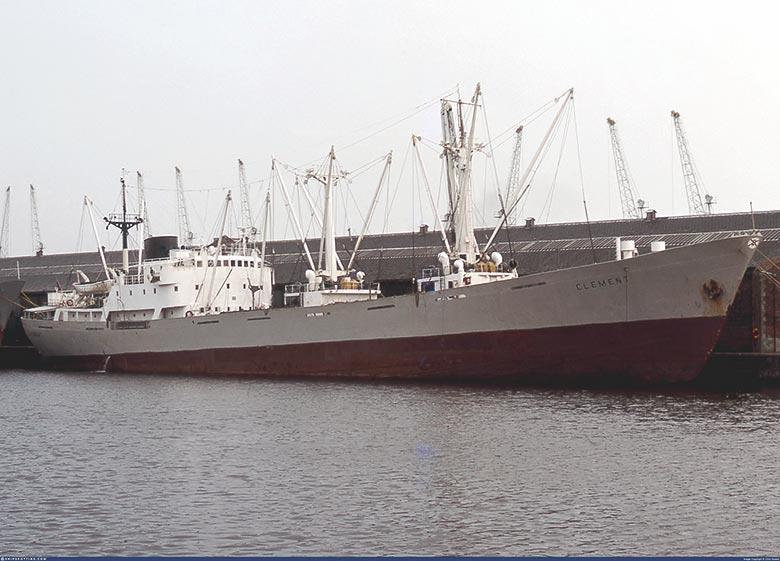

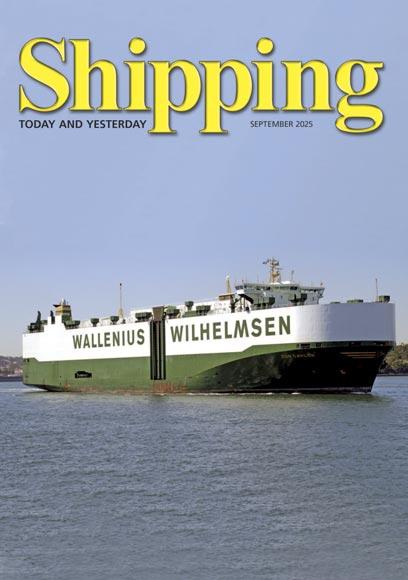
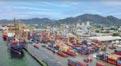
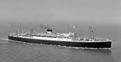
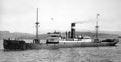
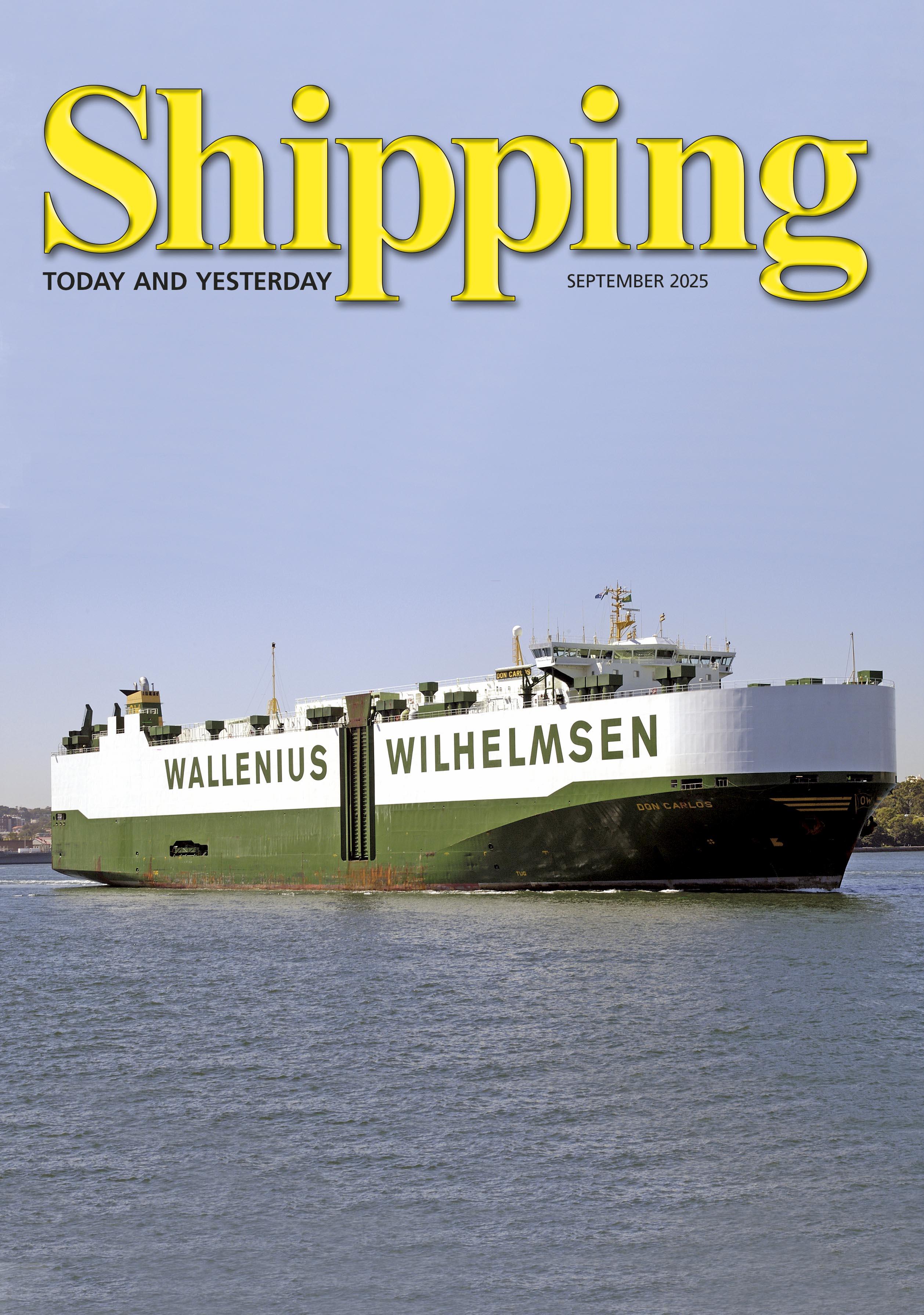
56,893gt PTCC Don Carlos of Wallenius Lines arriving at Sydney in December 2002. She was built in 1997 by Daewoo at Okpo. In 2006 she was lengthened by 28.8 metres.

On 3rd June a fire broke out on the 46,800gt/2006-built car carrier Morning Midas off the Alaskan coast, forcing the 22 crewmembers to be evacuated from the 183m long ship by lifeboat. They were collected by the Cosco Hellas. The Morning Midas was carrying 3,159 vehicles including 65 fully electric vehicles (EVs) and 681 partial hybrid electric vehicles and was en-route from Yantai, China, to Lázaro Cárdenas, Mexico, when smoke was first detected on a deck housing EVs. The ship was operated by Zodiac Maritime and the incident occurred roughly 260 nautical miles southwest of Adak Island, Alaska, about 1,040 nautical miles from Anchorage. Several container vessels, including the 32,827gt/2003-built and 3,600 TEU Manukai and the 109,149gt/2006-built and 9,469 TEU Cosco Hellas altered course to assist. The recent rise in electric vehicles equipped with lithium-ion batteries poses a potential fire risk aboard vehicle carriers and this is a cause for concern across the industry until full firefighting systems to deal with these are developed and installed. Zodiac Maritime has appointed Resolve Marine to lead salvage operations and despite the crew’s activation of emergency firefighting protocols, and deployment of onboard fire suppression systems, the intensity of the fire overwhelmed these efforts. The first salvage tug, carrying specialists and specialized equipment, was expected to arrive at the scene around 9th June in the form of the 423gt/2016-built Gretchen Dunlap with two additional vessels expected in the following 2 weeks with Resolve Marine leading salvage operations. A tow line was attached to the ship to control her movement. The ship also had approximately 350t of marine gas oil and 1,530t of very low sulphur fuel oil in her bunkers. The 997gt/1994-built specialist tug Garth Foss then took over from the Gretchen Dunlap on 15th June, which had been present since 9th June, with visual inspections and thermal scans over the following days revealing that the fire had apparently burned out. The tow line was also transferred over. However, 8 days after the ship was expected to arrive in Mexico, the Morning Midas sank on 23rd June in international waters of the North Pacific, nearly 3 weeks after the fire began. The ship gave up her fight at approximately 16.35 local time in waters approximately 5,000m deep and 360 nautical miles from land. Damage from the initial fire was exacerbated by heavy weather and progressive water ingress that ultimately led to her demise. The 2 salvage tugs equipped with pollution control equipment remained on site monitoring for any signs of pollution or debris. As an additional precautionary measure, a specialised pollution response vessel was sent to the location.

The 42,532gt/2005-built Wan Hai 503 suffered multiple explosions and a fire in her cargo of containers on 9th June when around 130 nautical miles northwest of Kochi, India. The crew of 22 were ordered to abandon ship with all but 4 being rescued from life rafts. Those missing included two Taiwanese nationals, one from Myanmar, and one from Indonesia. The burning ship drifted to 42 nautical miles off Beypore, Kerala and had 2,128t of fuel and hazardous cargo aboard, so posed an environmental risk. The ship was towed by salvage tugs to 35 nautical miles off the Indian coastline and the fire was extinguished. The vessel was then held 50 nautical miles from the shore until a decision about her future was made.
All 23 crewmembers aboard the 19,495gt/1997-built and 32,900dwt bulk carrier Run Fu 3 were rescued after abandoning their sinking ship in the Indian Ocean. The 172m vessel had departed Singapore and was sailing towards Togo when she began sinking due to an unknown source of cargo hold flooding. The crew escaped on life rafts and were rescued by another bulk carrier, the 31,540gt/2011-built Maple Harbour. The evacuated crew had done everything possible to save the ship, but to no avail. The ship was owned by Zhangjiagang Oceanicwit Shipping and went to her grave around 500 nautical miles south of the Maldives. The rescued crew was taken by ship to Port Louis.
On 17th June two oil tankers collided and caught fire near the Strait of Hormuz, where electronic interference had surged during the conflict between Iran and Israel, but there were no injuries to the crews nor spillage from either vessel. Interference had disrupted navigation systems near the vital sea route between Iran and Oman, which handles about a fifth of the world’s oil, whilst Iran and Israel were firing missiles at each other. The UAE coast guard said it had evacuated 24 people from the 84,598gt/2002-built Adalynn to Khor Fakkan port after the incident 24 nautical miles off its eastern coast. Personnel on the second tanker, the 156,452gt/2020built Front Eagle, were reported safe with no pollution seen after a fire on her deck. The Front Eagle was loaded with 2 million barrels of Iraqi crude oil and was en-route to Zhoushan in China whilst the Adalynn, a Suezmax-class tanker owned by Global Shipping Holding Ltd. had no cargo and was sailing towards the Suez Canal in Egypt. Tracking systems revealed that the Front Eagle was moving southbound at a speed of 13.1 knots when she executed a starboard turn, resulting in a collision with the aft port side of the Adalynn, which was proceeding southeast at 4.8 knots.
In our last edition we published the news that the container ship MSC Elsa 3 had sunk off the coast of Kerala, India in heavy seas. With her were 640 containers, among them 13 packed with hazardous chemicals and over 450 metric tonnes of marine fuel, causing serious concern about the environment damage that this is likely to cause. Fortunately all the crew were safely rescued.
However, we have to look more closely at the reasons why the sinking occurred. The 28 year old MSC Elsa 3 was owned by the Mediterranean Shipping Company of Switzerland but registered under the flag of convenience of Liberia, which is renowned for not have such strict regulations as some other jurisdictions.
The ship had some previous issues involving incidents in Yemen and Nigeria. Before her final voyage an inspection in India had revealed five deficiencies, including a ballast water system failure which ultimately led to her listing at 28 degrees.
This sinking once again brings up the topic of Flags of Convenience. Something should done to enforce jurisdictions such as Liberia, Panama and the Marshall Islands to adhere to stricter regulations regarding the vessels under their flags. Currently these countries allow ships to be registered under lenient scrutiny, low taxes and cheaper labour requirements. These flags shield companies from legal scrutiny and environmental obligations.
The time has come to tighten up ship registration in order to stop ships with faults setting sail. The current situation puts the world's seafarers at risk and their wellbeing should be the priority for all shipowners. editor@shippingtandy.com
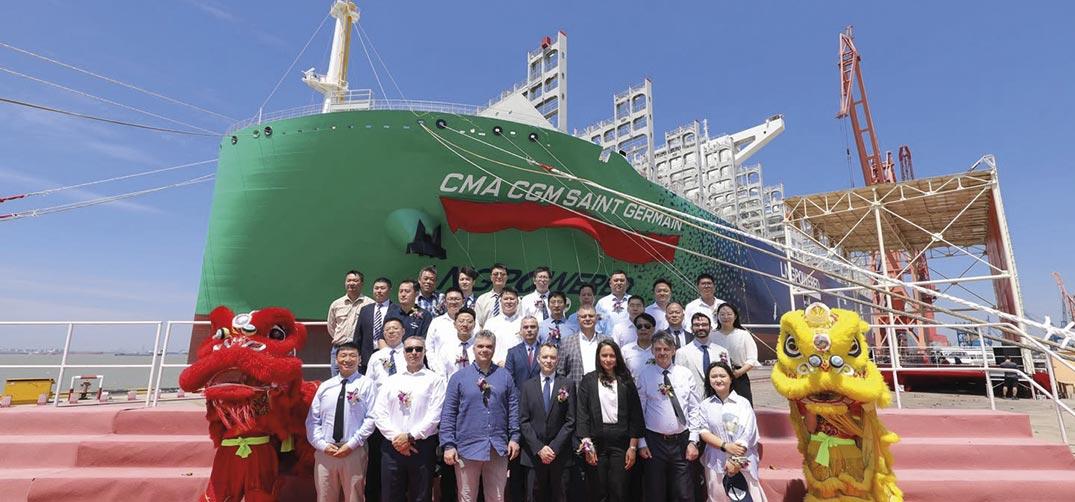
CMA CGM Group took delivery of a new container vessel from China's Hudong-Zhonghua Shipbuilding on 6th June, namely the 237,742gt/2025-built CMA CGM Saint Germain (above), the second in a new series of 4 container vessels that each have a capacity of 24,000 TEU and a dual-fuel propulsion system that can also run on LNG. The CMA CGM Seine, the lead ship in the series, was delivered by Hudong-Zhonghua earlier in 2025. This class is an upgraded version of the Jacques Saade Class of ships. The Bureau Veritas-classed newbuild has a length of 399m, a beam of 61.30m, a draught of 14.50m and a hull depth of 33.50m, making these ships some of the largest dual-fuel container vessels in the world. The 23,872 TEU capacity can also include up to 2,200 reefer containers. Each ship has a WinGD W12X92DF-2.0 dualfuel engine fed by GTT Mark III membrane-type LNG fuel tanks with a total capacity of 18,600m3. When operating solely on LNG, the ship can sail up to 20,000 nautical miles on a single voyage. To address the critical sloshing challenges in large-volume LNG bunker tanks, computational fluid dynamics simulations were conducted. The verified pressure data was relayed to the design unit for structural strength checks, ensuring the safety of the cargo containment system and hull support structure.
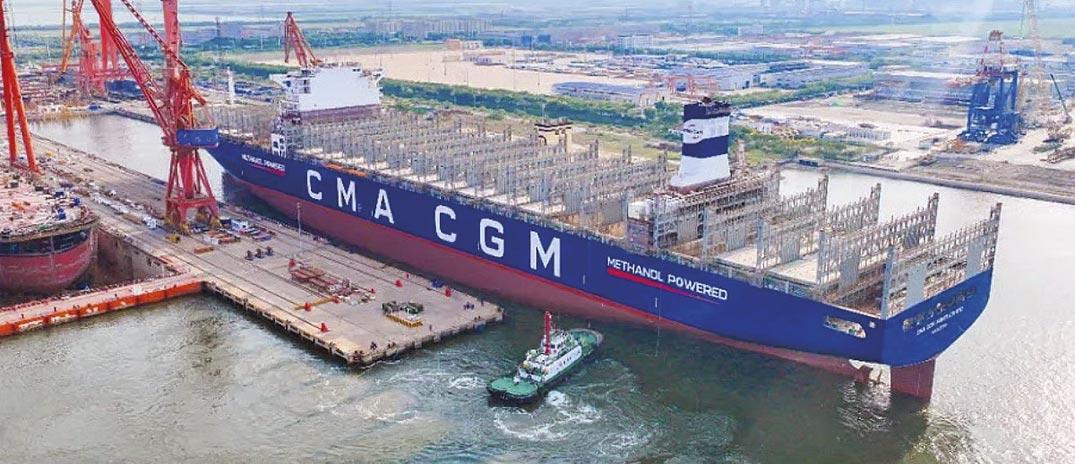
On 23rd June China's Dalian Shipbuilding Industry Company floated out the new 155,613gt/2025-built CMA CGM Monte Cristo at its Tianjin facilities (above). The ship is in the second batch of 6 from a total order of 12 vessels, each with a capacity for 16,136 TEU, and is 366m long with a 51m beam and a dualfuel propulsion system that can run on methanol as well as conventional fuel oil. The maximum cargo capacity includes up to 1,000 refrigerated containers.
CMA CGM reportedly unveiled plans in June to return to Suez Canal transits for its India-Middle East-Mediterranean (MEDEX) service. The company was the first among major operators to confirm a routing change back to the traditional Suez Canal passage, despite ongoing industry concerns about Red Sea security. Schedules indicated that the first vessel to take the Suez route would be the 111,249gt/2008-built CMA CGM Pelleas, departing Nhava Sheva on 7th June and transitting the canal on 28th June. The 91,410gt/2006-built CMA CGM Nabucco and 90,931gt/2010-built CMA CGM Titus were also scheduled to follow in early July. The MEDEX service includes 10 CMA CGM vessels, but the geopolitical risks remained.
Hapag Lloyd took delivery of the 24,000 TEU Genova Express on 15th May as the 11th vessel in a series of 12. Hot on her heels came the Wilhelmshaven Express, the 12th and final vessel in this eco-efficient Hamburg Express Class on 10th June. Built by Hanwha Ocean in South Korea and flying the German flag, the 23,664 TEU capacity ship is 400m long with a 61m beam. The ship promptly set off on her maiden voyage and arrived in Shanghai on 12th June, with further calls at Tanjung Pelepas and Tangier Med. Like her sister ships, the final class member is powered by dual-fuel engines capable of running on LNG.
HMM of South Korea launched a new weekly intra-Asia container service on 19th June connecting Northern China and Indonesia, jointly operated with Singapore-based shipping companies Pacific International Line (PIL) and X-Press Feeder. The first departure was from Tianjin, China and 5 containerships with capacities of 4,000 to 5,000 TEU will be deployed with a total round trip taking 35 days. The port rotation is Tianjin, Qingdao, Xiamen, Singapore, Jakarta, Surabaya, Singapore and return to Tianjin. Through this new service, HMM plans to strengthen its competitiveness on Indonesian routes and create synergies by connecting with transPacific and European routes. This new loop extends a broader trend of co-operation between mainline and regional carriers on intra-Asia lines, echoing recent alliances involving Yang Ming, Ocean Network Express, Evergreen Marine and others.
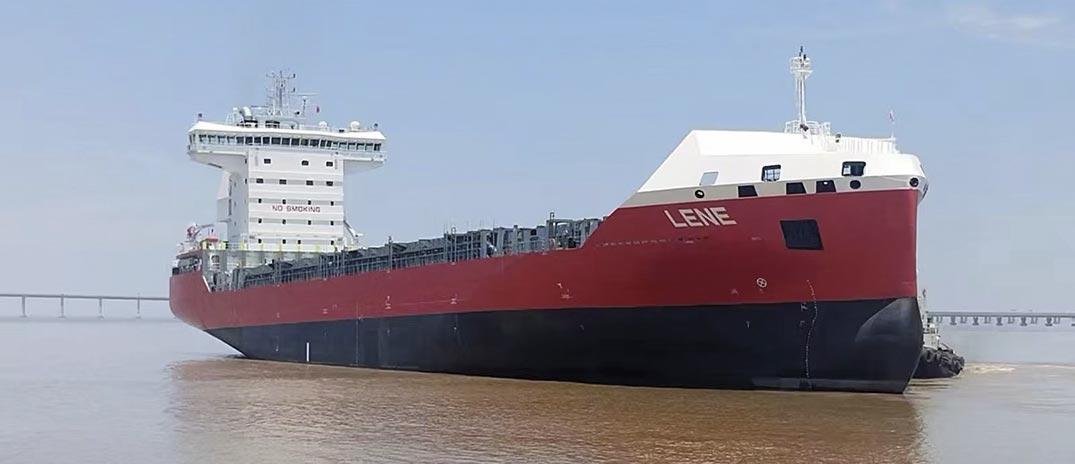
Langh Ship of Finland took delivery of a new container vessel during a ceremony in Zhoushan, China, in June. The 14,974gt/2025-built Lene (above) is the second ship in a new series of three 1,200 TEU capacity feeder containerships built by PaxOcean Zhoushan. The design work was undertaken by Langh Ship in collaboration with China State Shipbuilding Corporation subsidiary Shanghai Merchant Ship Design and Research Institute. Like her elder sister Ingrid, the Lene is optimised for carrying 45-foot containers, both in the holds and on deck. Among the unique features of the Ingrid and Lene are the hatch covers, which can be opened in three sections along the beam of the vessel.
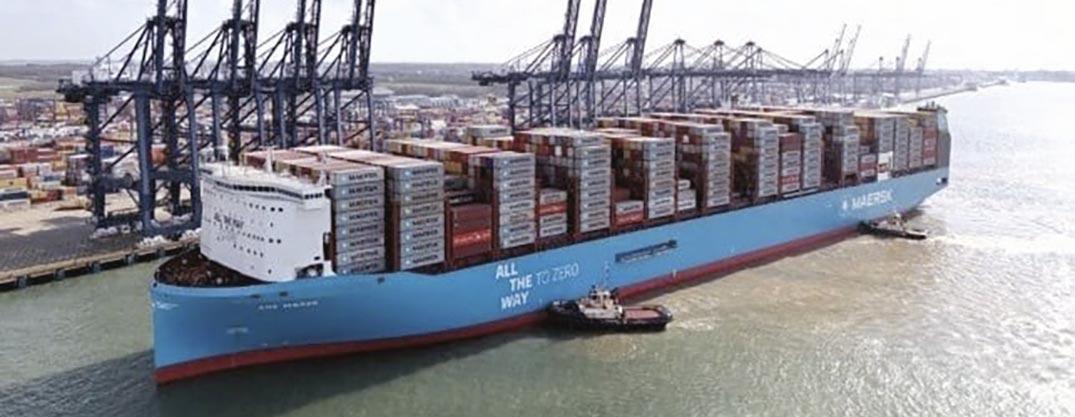
Maersk Line took delivery of the 172,093gt/2025-built Axel Maersk (above) on 27th May, the 12th vessel in its first series of large dual-fuel methanol containerships. Delivery of the new vessel took place in South Korea just 17 months after the naming of the first ship in the class. The ship is named after Axel
Peder Maersk Uggla, a grandson of Ane Maersk Mc-Kinney Uggla, chair of the A.P. Moller Foundation and the naming inspiration for the first vessel of the class. Maersk went with names starting with “A” for the entire class, Ane, Alette, Antonia, Alexandra, Alva, Astrid, Angelica, A.P. Møller, Axel, Albert, Adrian, and Arthur Maersk. The Axel Maersk departed for Shanghai where she arrived on 4th June on her maiden voyage. Each vessel is 337m long with a capacity of 16,000 TEU and the deckhouse is sited forward at the bow. Days later the 25,723gt/2025built and 2,086 TEU capacity Maersk Namsos was delivered from Japan's Imabari Shipbuilding on 4th June. The containership is 171.9m long with a 32.20m beam, a hull depth of 16.8m and a service speed of approximately 18 knots. The ship is fitted with 3 deck cranes, enabling cargo operations at ports without handling equipment. A significant number of reefer containers can be loaded both on deck and in the hold plus the vessel can transport dangerous goods in line with the International Maritime Dangerous Goods (IMDG) Code. The newbuild also includes a double-tiered bridge design to facilitate container stacking. On 20th June the first of six 172,500gt/2025-built and 17,480 TEU capacity methanol-powered containerships for A.P. MollerMaersk was named.
The company’s newest and largest dual-fuel ship had the name Berlin Mærsk bestowed upon her during a ceremony at Hyundai Heavy Industries’ shipyard in Ulsan, South Korea. The newbuild represents Maersk’s 14th dual-fuel ship and marks the first in a series of 6 sister vessels ordered from HHI for delivery in 2025. The Berlin Mærsk commenced service on 7th July on Maersk’s AE3 route connecting Eastern Asia with Northern Europe, with her inaugural port call being Shanghai.
Maersk Line has set its ambition to achieve net-zero greenhouse gas emissions by 2040 and, to date, has ordered 25 methanol dual-fuel newbuild containerships. These include twelve 16,000 TEU and six 17,000 TEU capacity ships from Hyundai Heavy Industries with deliveries in 2024 and 2025. Additionally, six 9,000 TEU ships are on order at Yangzijiang Shipbuilding in China for delivery in 2026 and 2027.
The chartered 73,934gt/2006-built Maersk Puelo was detained at Southampton by the MCA for a time in June until necessary repairs were made to allow her to return to sea.
Mediterranean Shipping Company (MSC) has become the first shipping company to deploy its mega ships to the African continent. The company made history in late April and early May when the service was inaugurated with two of the 24,000 TEU capacity newbuilds calling at Ghana, Togo, Cote d’Ivoire, and Cameroon as part of the African Express. The move is in response to a surge in the Asia-West Africa trade. The 228,786gt/2021-built MSC Diletta was the first such ship on the African Express, call at Lomé, Togo, initially. She was followed by the 236,080gt/2023built MSC Turkiye On 25th May the naming and delivery of the 106,463gt/2025-built MSC Leila took place, the first 11,500 TEU capacity and LNG dual-fuel container vessel built by Changhong International Shipyard for MSC. The ship was officially named by Ms. Zhang Fuying, Deputy General Manager of MSC Logistics (Shanghai), who also performed the ceremonial rope cutting. With 36 LNG dual-fuel containerships under construction for MSC, Changhong has become MSC’s largest global shipbuilding partner in this sector.
At the time of writing, the 236,184gt MSC Irina was still being described as the world’s largest containership in terms of TEU capacity (24,346 TEU) and made headlines when she called at Vizhinjam International Seaport, India, for the first time, due again on 10th June. The ship is 399.9m long with a 61.3m beam and is plying the Asia-Europe trade.
Whilst escaping the headlines at the time, the 149,525gt/2020-built MSC Aries was released by the Iranian
authorities after 369 days on 17th April and arrived Antwerp on 21st June. The ship was seized by Iran's Islamic Revolutionary Guard Corps Navy and detained at Bandar Abbas after routinely transiting the Strait of Hormuz. The incident was thought to be a retaliatory move after a military attack by Israel at the time, with a false claim of the ship being stopped due to violations of maritime regulations. Vague connections to Israel were clearly the reason but these were tenuous considering the action taken. The crew was allowed to leave in May 2024, comprising mostly Indian nationals, whilst the entirely needless situation rumbled on.
Ocean Network Express (ONE) announced on 17th June the naming of the 140,233gt/2025-built ONE Singapore, the 6th vessel in a series of 20 ammonia/methanol ready container vessels. The ceremony took place at the Hiroshima Shipyard of Imabari Shipbuilding Co. Ltd. in Japan, marking another milestone in ONE's fleet expansion program. The 13,900 TEU ship is another demonstration of ONE's commitment to sustainable shipping practices. Following the successful integration of the 139,588gt/2025-built ONE Sparkle, ONE’s first owned newbuilding, and subsequent sister vessels, the ONE Singapore will strengthen the company's service offerings on the trade lanes where she will be deployed.
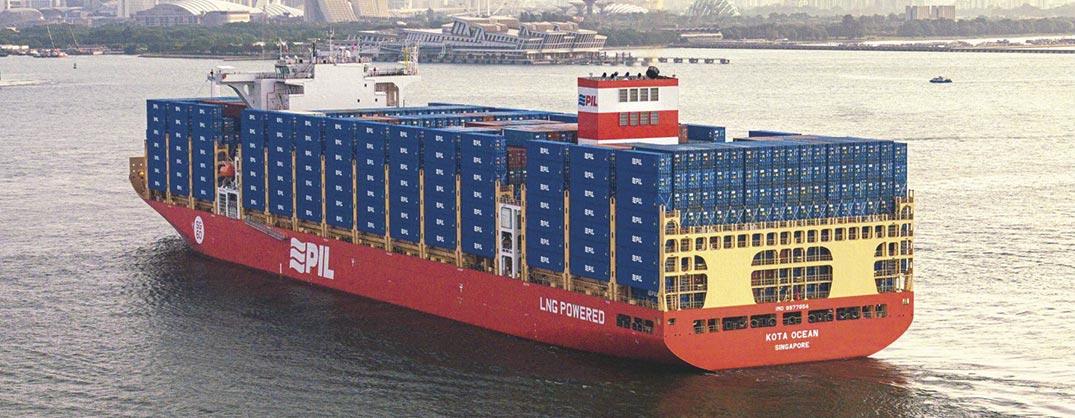
Pacific International Lines (PIL) formally named its newest container vessel, the 78,384gt/2025-built Kota Ocean (above), in a ceremony at the PSA Terminal in Singapore on 6th June. The ship is the sixth LNG dual-fuel vessel in the PIL fleet as well as the second in a series of four 8,200 TEU capacity ships ordered by the company. The lead ship of the series, the Kota Oasis, was handed over in early May by China's Yangzijiang Shipbuilding. Besides being LNG-powered, the Kota Ocean is capable of using bio-methane fuels and is also equipped with WinGD’s XDF engine with intelligent control by exhaust recycling to reduce methane emissions. The new ship also features a full-spade type rudder with twisted leading edge, a rudder bulb, a pre-swirl stator and an optimised hydrodynamic hull form with anti-fouling coatings. The 78,384gt/2025-built and 8,200 TEU capacity Kota Ocean, the second in a series of four vessels, and PIL’s sixth LNG dual-fuel containership, was named by Ms Ho Ching, Chairman of Temasek Trust in a ceremony held at PSA’s terminals in Singapore on 6th June. The Kota Ocean will be deployed on the trade between Asia and West Africa connecting from China to Singapore to Ghana, Togo, Nigeria and Ivory Coast. PIL has another 12 vessels on order, including two 8,200, five 13,000 and five 9,000 TEU capacity ships.
Seatrade of The Netherlands has placed a newbuilding order for a series of up to eight 2,800 TEU capacity vessels at Huanghai Shipbuilding in China. The initial contract covers 2 confirmed vessels, scheduled for delivery in 2027, with options for 6 additional ships. Financial terms have not been disclosed. The company currently has 10 ships from the same shipyard, each with a 1,800 TEU capacity, over 600 reefer plugs and geared with 40 tonne cranes. The latest newbuild series will be the company’s largest in TEU capacity and will provide over 1,000 reefer plugs per vessel. Seatrade ships have been regular callers at the likes of Dover and Portsmouth.
BBC Chartering confirmed on 4th June that Chinese shipbuilder Taizhou Sanfu Heavy Industry had completed conducting sea trials of a new triple-deck cargo ship ordered by Germany’s Briese Group for the transport of bulk, heavy lift, and project cargo. The 15,629gt/2025-built BBC Sao Paolo was ordered by Briese for operation under a long-term time charter by its subsidiary BBC Chartering for worldwide trading.
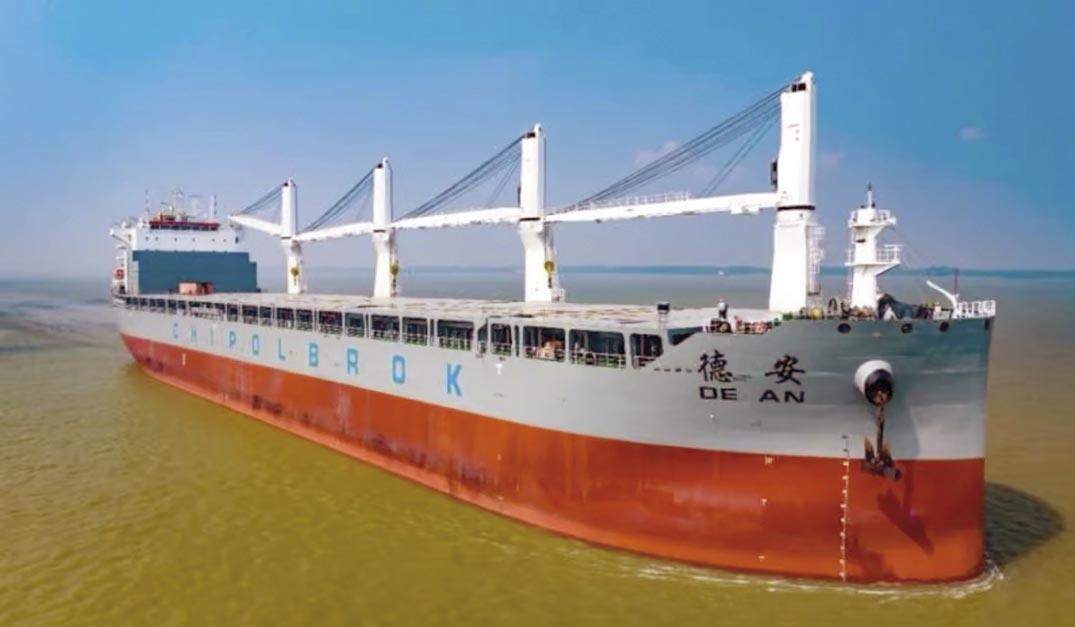
Chipolbrok, a Chinese/Polish Joint Stock Shipping Company took delivery of a new heavy lift vessel built by China's Taizhou Kouan Shipbuilding on 17th June. The 39,309gt/2025-built De An (above) is the 7th ship in a series to be handed over to Chipolbrok. Design work on the vessel was undertaken by China State Shipbuilding Corporation's Shanghai Merchant Ship Design and Research Institute in compliance with DNV and Polish Register of Shipping rules.
CLI of Germany has awarded Dutch shipbuilder Royal Bodewes a contract for the construction of a new cargo vessel that will be deployed on the regular shipping route between Canada, The Netherlands and the UK. The completed multi-purpose cargo vessel will have a deadweight of almost 8,500 tonnes and will feature advanced environmental and fuel efficiency technologies. The ship will be fitted with one MAN methanol-ready main engine and two deck cranes, each with a lifting capacity of 80 tonnes, making her ideal for heavy-duty cargo operations. The ship will also be equipped with sail-assisted propulsion technology.
ESL Shipping announced at the end of May that it had signed a €70 million loan agreement with Svenska Skeppshypotek as part of the financing of ESL Shipping’s investment in a series of four methanol-powered 17,000 dwt handysize vessels. The loan has a maturity of 15 years, and it is expected to be drawn in 2027 and 2028. The new 1A ice class vessels can be operated fossil-free by using green methanol and are top of the market in terms of cargo capacity, technology and innovation. The total value of the four ships is approximately €186 million, and this investment takes place during the years 2024-2028. The new vessels are built in Nanjing, China, at China Merchants Jinling Shipyard (Nanjing) Co. Ltd. and are scheduled to enter service from late 2027 with the 4th ship in this series scheduled to enter service in the first half of 2028.
On 17th June subsidiary company AtoB@C took delivery of the 4,135gt/2025-built Biomar, bringing the number of 5,400dwt plug-in hybrid newbuildings in the fleet to 7. (See Newbuild of the Month August 2025 for the Terramar). In conjunction with the delivery of the Biomar, the construction of the final vessel in the 12-ship series, the Luxomar, also commenced on 17th June with a steel-cutting ceremony. The eighth vessel, Ventumar, was launched on 30th May and was undergoing outfitting in June.
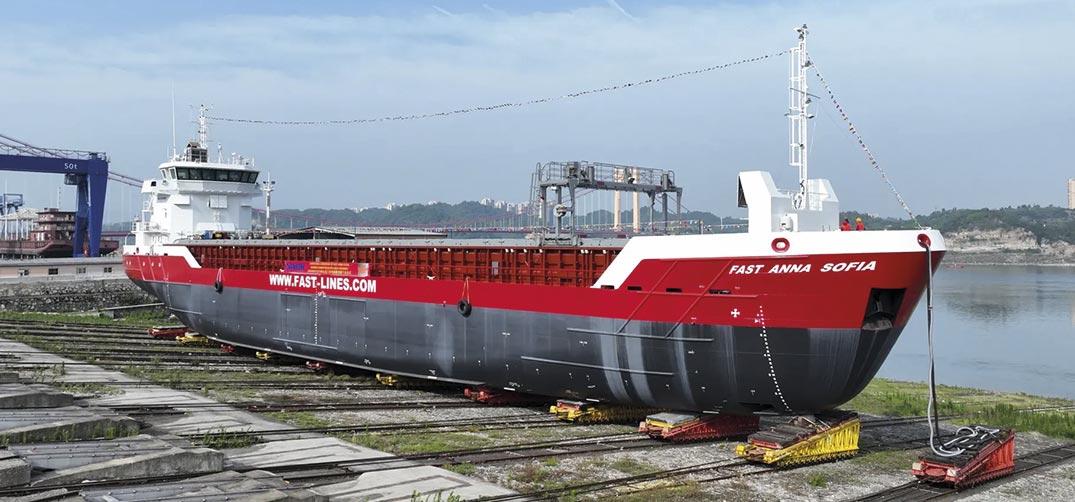
Fast Lines (Belgium) witnessed the launch of the Fast Anna Sofia, the second of a trio of 2,518gt/2026-built Damen Combi Freighters (CF) 3850 on 30th May in China (above). This followed the launch of the first example on 19th May. The two companies had signed a contract for two vessels in October 2023 and Fast Lines took the option of a third vessel in 2024. The CF 3850 vessels will be the first newbuilds to enter the Fast Line fleet, a family-owned total logistics company that has its headquarters in Belgium, with offices in the UK, Republic of Ireland and Poland.
Union Maritime (UML) took delivery of its newest Aframax product tanker on 16th June, the 62,730gt/2025-built Brands Hatch. The delivery came just 5 days after the ship's formal naming ceremony at the facilities of China State Shipbuilding Corporation subsidiary Shanghai Waigaoqiao Shipbuilding. The newbuild has a length of 249.95m, a beam of 44m, and a total cargo capacity of approximately 800,000 barrels of various types of crude oil products. The ship is also fitted with a trio of 37m wing sails, which can be retracted when necessary. These sails were designed by Bar Technologies and supplied by the China Merchants Group's subsidiary CM Energy Tech. A 69,250gt PCTC also carrying the name Brands Hatch was delivered to Zodiac Maritime Agencies Ltd. in March 2025.
Vertom Group took delivery of the 4,766gt/2025-built Vertom Joyce from the Thecla Bodewes Shipyard at Kampen on 28th May. The ship is the 8th 7,280dwt state-of-the-art LABRAX dry cargo vessel to be delivered to the builder’s longstanding partner Vertom Group. The Vertom Joyce offers exceptional cargo-handling capabilities and operational efficiency. She is 118.60m long with a beam of 14.30m and features a spacious full-box cargo hold of 329,700 cubic feet.
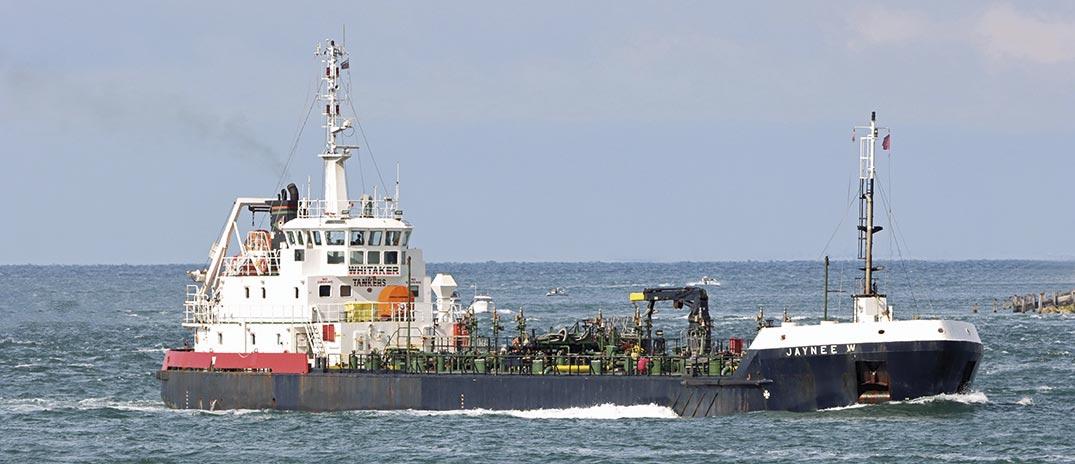
Whitaker Tankers’ 1,689gt/1996-built products/bunker tanker Jaynee W (above) has been sold to Selim Shipping Ltd. and renamed Blue Star. The ship headed off to the warmer waters of Dakar in May having been a regular sight at Poole, Portsmouth, Guernsey, Southampton and Fawley since her delivery. The 75m long/12.50m beam ship began life as Yard No. 340 and was built by Yorkshire D.D. Co. Ltd. Her place in the south coast fleet was taken by 2,159m/2004-built Whitstar.
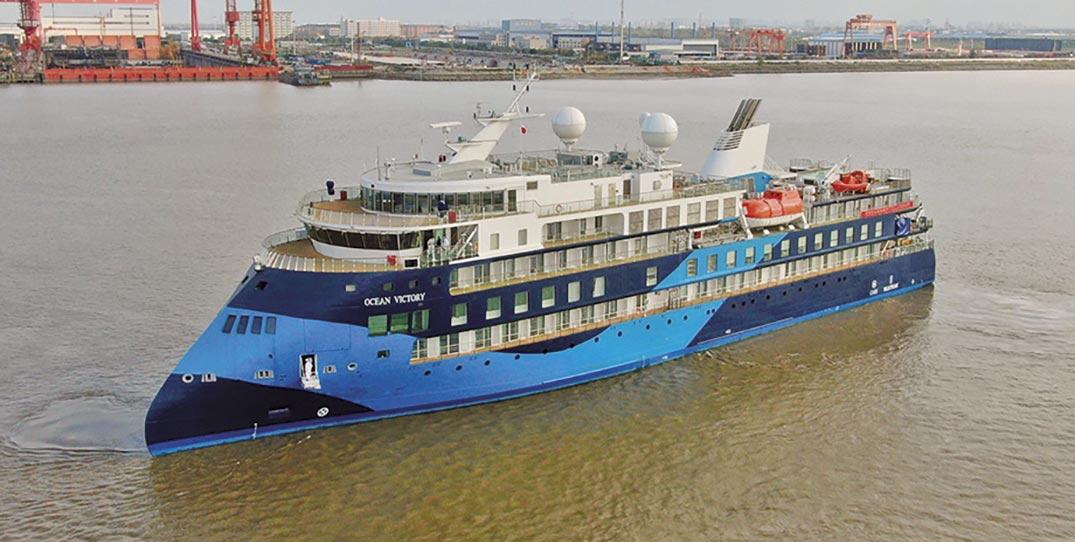
Alma Cruises announced at the beginning of June that it had ceased operations, citing a “unilateral and unjustified termination of the charter contract by the ship’s owner.” The new Spanish operator had chartered the 8,181gt/2021-built Ocean Victory (above) for summer cruising in the Mediterranean, but experienced difficulties just a few weeks into the first season. The ship was collected from Malaga by Sunstone Ships, the Owners, and taken to Gibraltar, reportedly still with Alma Cruises’ goods and equipment aboard.
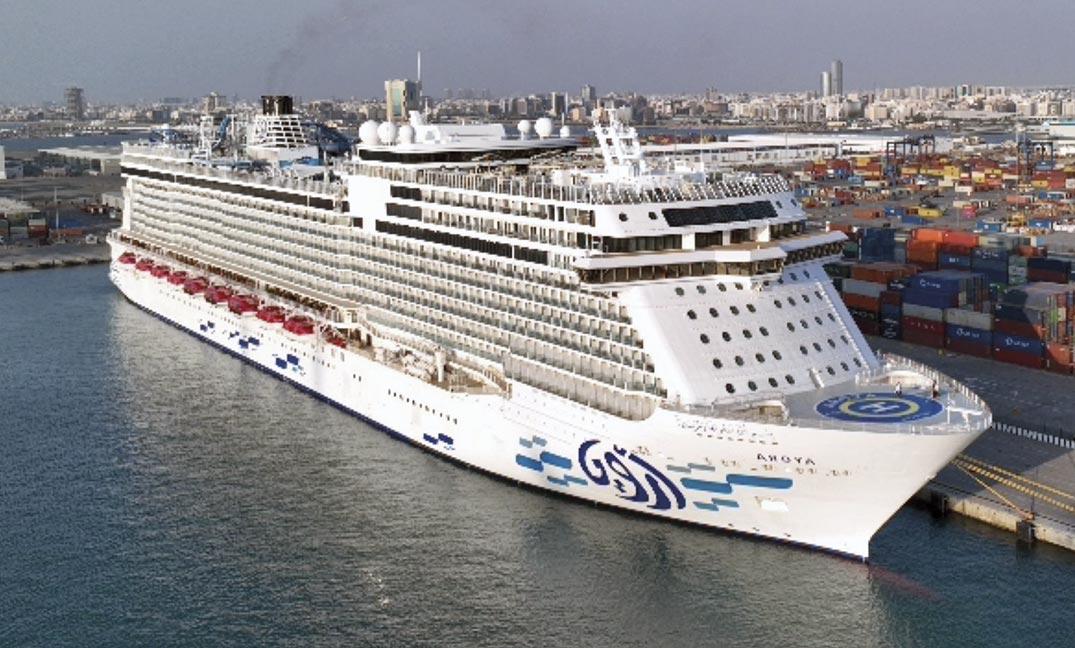
AROYA Cruises announced on 30th June that the Mediterranean season maiden voyage had departed on 28th June from Galataport Istanbul for a 7-night journey through the Eastern Mediterranean aboard the 150,695gt/2017-built Aroya (above).
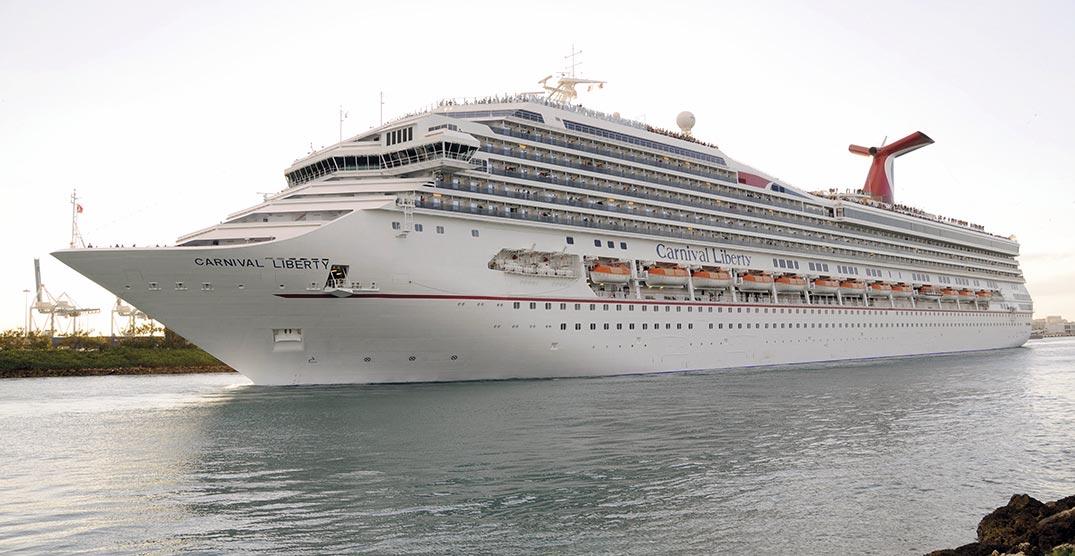
Carnival Cruise Line’s 110,428gt/2005-built Carnival Liberty (above) relocated to the Chantier Naval de Marseille shipyard during June to finish routine work that was started at the Navantia shipyard in Spain. This move was necessary due to a workers’ strike in Cadiz with a group of local workers also attempting to detain the vessel before she was released and sailed on 22nd June. Reports suggested that Carnival’s executive vice president of maritime and new builds, Ben Clement, travelled to Cádiz to negotiate with strikers to get the ship moved. The ship had originally entered drydock at the Navantia shipyard in Cádiz in late May for scheduled drydock work. The ship resumed her cruise schedule in the Western Caribbean and the Bahamas from 6th July 2025.
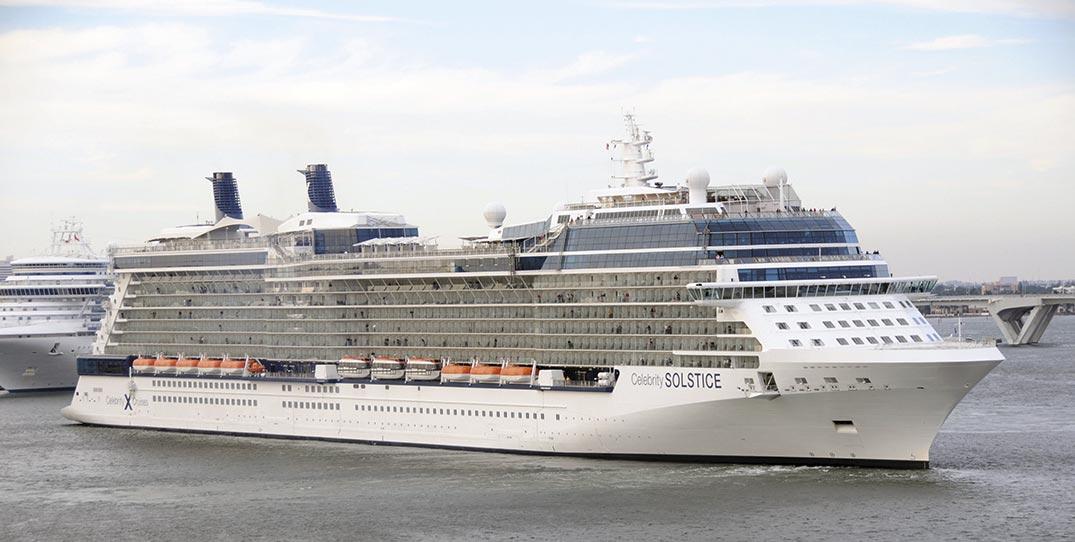
Celebrity Cruises’ 121,878gt/2008-built Celebrity Solstice (above) will be the first ship to receive investment as part of a £250 million program to revitalise the Solstice Class ships from March 2026. The company is modernising each ship by introducing 8 new experiences, including 4 unique-to-sea spaces, revamped favourites, and ship-wide upgrades.
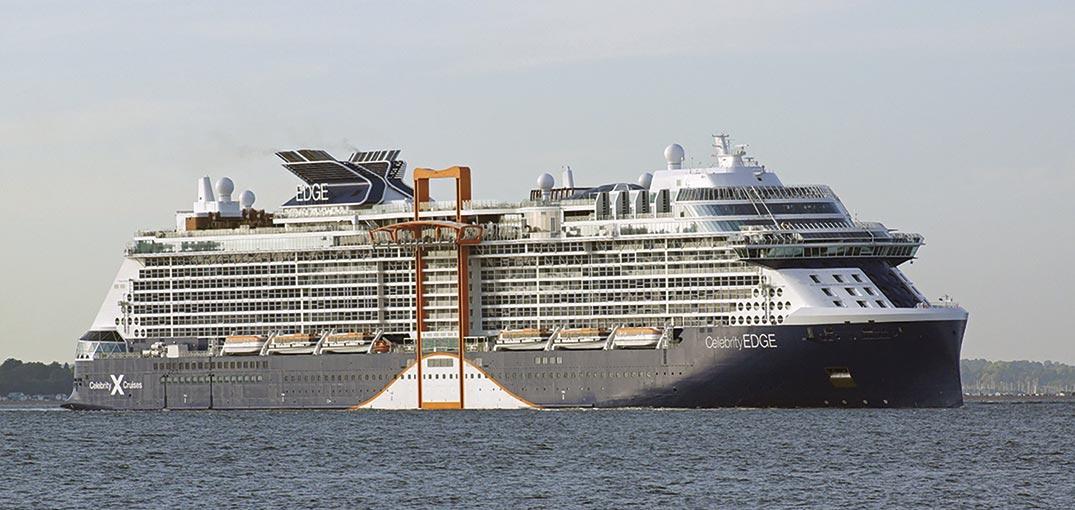
On 19th June the 130,818gt/2018-built Edge Class ship Celebrity Edge (above) was caught up in a sudden storm whilst moored in Juneau, Alaska, with the ferocity of the winds causing the ship to break her moorings and drift away from the berth. The captain and crew acted quickly to return the ship to her berth.
Cunard Line’s 90,901gt/2010-built Queen Elizabeth arrived in Alaska on 12th June to begin her North American residency, which includes a maiden season of Caribbean voyages starting in October 2025. A plaque-and-key ceremony celebrated the first arrival in Seattle where the Cunard ship ise based between June and September. Cunard had recently celebrated its 185th anniversary and the Queen Elizabeth delivered the brand to a new region, for two exclusive seasons of luxurious voyages of seven to 12 nights.
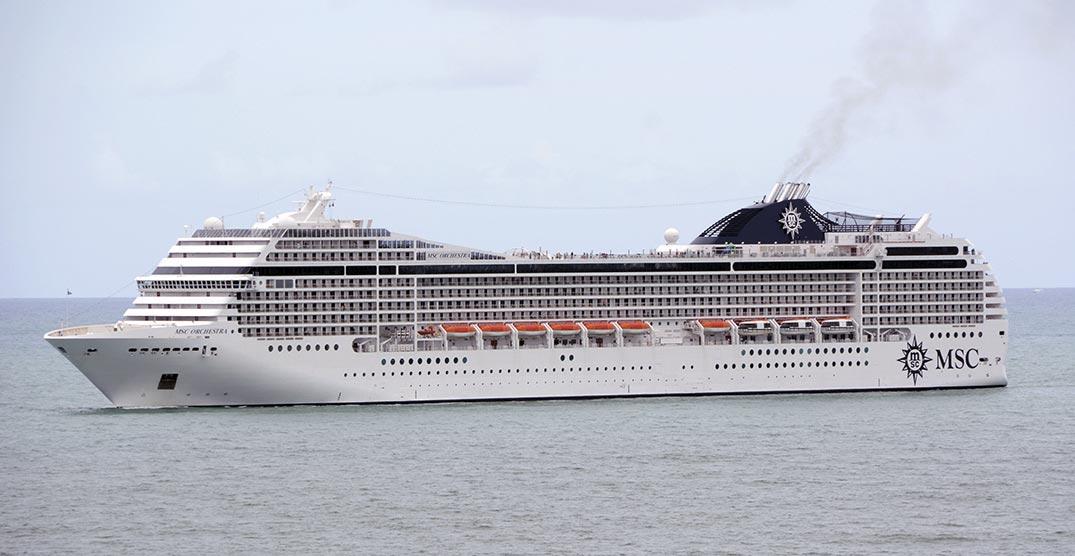
MSC Cruises’ 92,409gt/2007-built MSC Orchestra (above) saw some cruises cancelled after a technical issue in June. The engine room issue was identified, power interruptions were experienced, and cancellations were then necessary to allow for further assessment and necessary repairs to the electrical switchboard system. The ship was deployed in the Western Mediterranean offering a 7-night cruise to Spain, Italy and France when the issue arose. The ship was 10 hours late returning to Genoa where she was subject to an assessment and repairs.
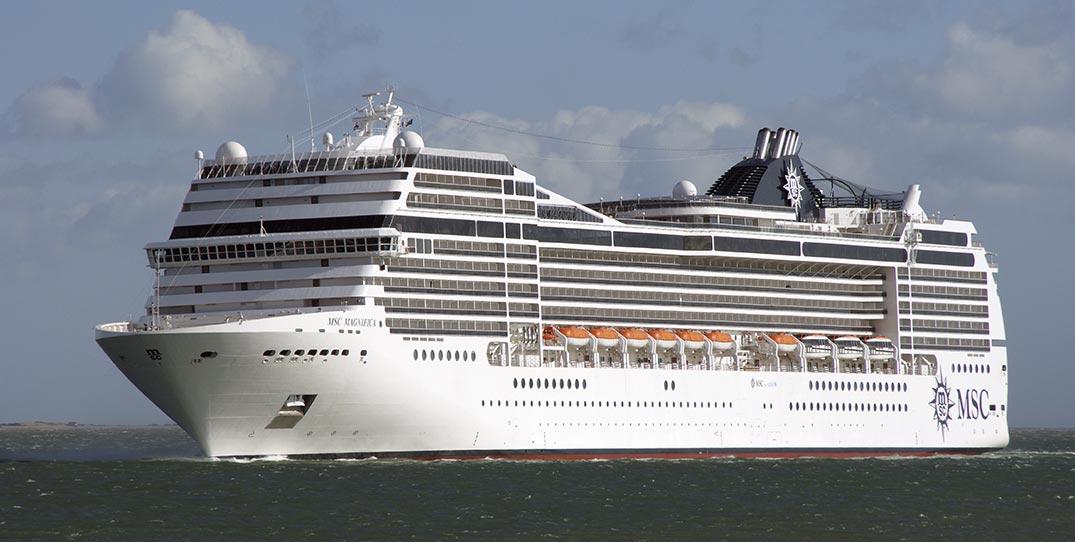
The 95,213gt/2010-built MSC Magnifica (above) will see her guest capacity reduced during the upcoming refurbishment, with 80 standard staterooms making room for 63 larger suites. Announced in late May, the refit will add MSC Cruises’ premium experience, the Yacht Club, to the ship. This ship-within-a-ship concept will offer not only staterooms but also private lounge and restaurant, as well as an exclusive sun deck and larger suites. Located on decks 12, 14, and 15, there will be 63 new Yacht Club suites. A total of 24 deluxe balcony cabins will be removed on Deck 12 for 12 new Yacht Club grand suites, with 2 inside cabins converted into Yacht Club interior suites. Deck 14 will receive 24 Yacht Club deluxe suites in place of 24 Aurea premium suites with 8 deluxe balcony cabins also making way for a quartet of Yacht Club grand suites. Deck 15 will see 18 Aurea premium suites swapped out for 18 Yacht Club deluxe suites whilst 2 premium suites are removed in favour of a larger Yacht Club royal suite and 2 deluxe balcony cabins are being converted into Yacht Club grand suites. The MSC Magnifica’s Yacht Club will also feature a new private lounge on the site of the ship’s gym on deck 13 whilst a specialty restaurant is being installed on deck 7 and a Deck 16 sun terrace is being converted into a private pool area for Yacht Club guests. Due to the changes, a new fitness centre will be installed where the nightclub was.
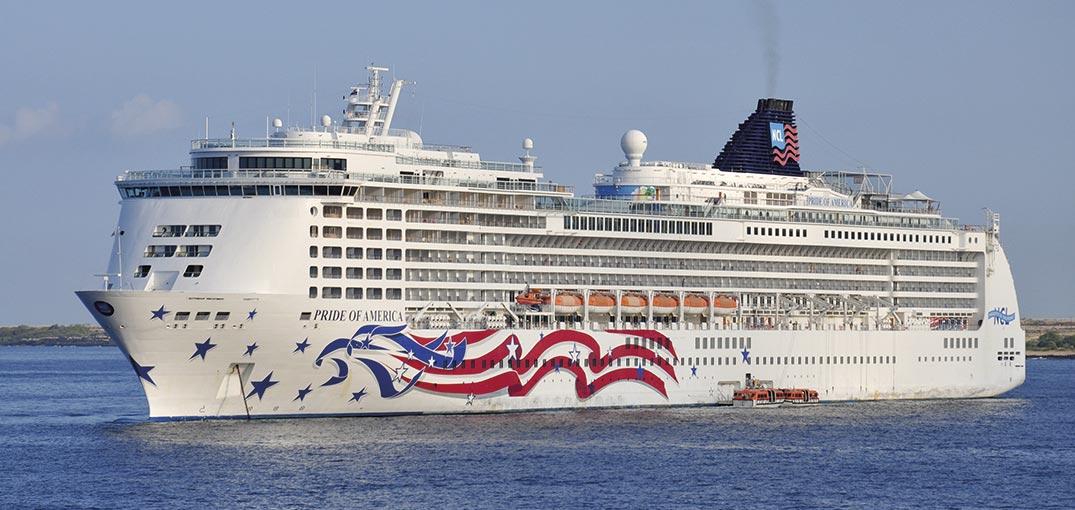
Norwegian Cruise Line’s 80,439gt/2005-built Pride of America (above) resumed service on 7th June in Honolulu after undergoing a routine drydocking from late April. The 2,100-guest capacity ship then welcomed guests back to resume her schedule of 7-night cruises in Hawaii. The Pride of America offers interisland cruises that feature visits to Kahului, Hilo, Kailua Kona and Nawiliwili. The Pride of America underwent a series of updates to her public areas and staterooms including the addition of a Starbucks to the Capitol Atrium on Deck 5, as well as a new pickleball court within the sports complex. The ship also debuts new youth areas on Deck 6 where the S/S America Library, Internet Café and Chapel once were. Further changes to Deck 6 include a new, smaller library and card room in the area previously occupied by the Shuffles Card Room.
NYK Cruises’ 52,265gt/2025-built Asuka III arrived at her new home of Yokohama Port, Japan, on 2nd June with a firework display that night to welcome the ship. The Asuka III was built by Meyer Werft in Papenburg, followed by a lengthy delivery voyage.
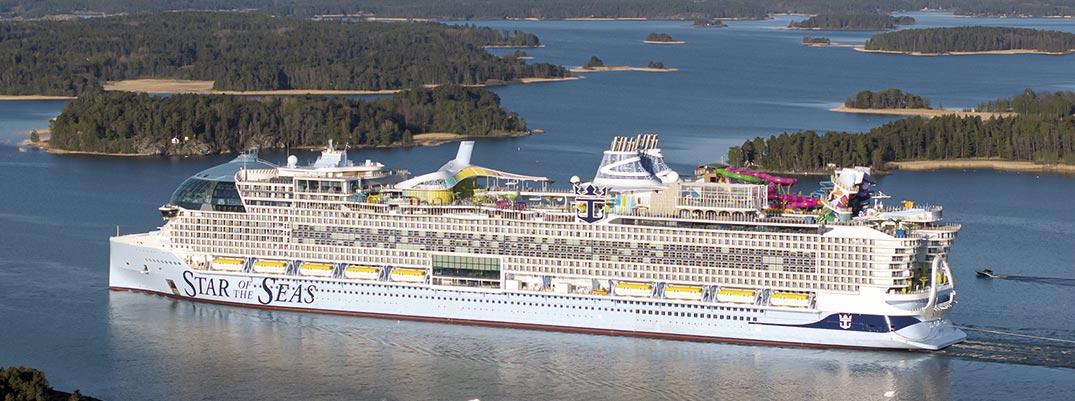
Royal Caribbean International’s 248,663gt/2025-built Star of the Seas (above) completed her sea trials in June after 8 days at sea. The company has named music legend Diana Ross as the godmother of the ship, which was expected to make her debut in August 2025. The official naming ceremony was held in the AquaTheatre located in the AquaDome neighborhood when the ship arrived in Port Canaveral. The ship offers 7-night cruises in the Eastern and Western Caribbean and also entered service earlier than previously scheduled with an additional preview sailing offered on 16th August from Port Canaveral. Preview sailings had already been added prior to this, with the ship’s official maiden voyage scheduled for 31st August, a 7-night cruise to the Western Caribbean. The ship is the second member of the Icon Class with a third, the Legend of the Seas, set to enter service in mid-2026 in the Western Mediterranean.
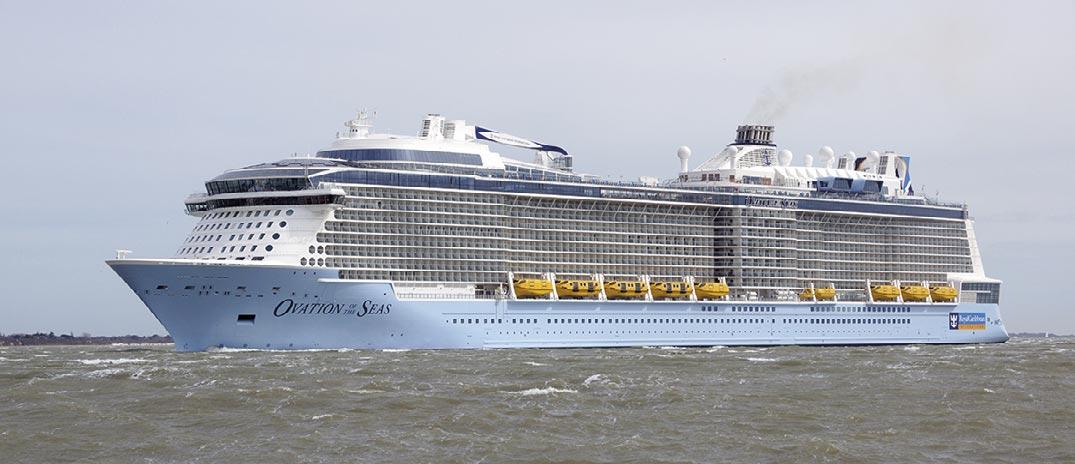
On 18th June Royal Caribbean announced that 2026 would see the revealing of a trio of refurbished ships in the form of the 168,666gt/2016-built Ovation of the Seas (above), 226,963gt/2016-built Harmony of the Seas and 155,889gt/ 2007-built Liberty of the Seas. The work follows on from the successful “amplification” of the 226,637gt/2010-built Allure of the Seas. Work on the Ovation will include a revamped pool deck with private casitas and a new whirlpool, Giovanni’s Italian Kitchen, Izumi Teppanyaki, the Pesky Parrot tiki bar, the Sound Cellar (making its Quantum Class debut), an expanded Casino Royale plus new accommodations. The ship will serve Alaska after her makeover.
The ship will be operating in Europe in summer 2026 after her refit before moving to Port Canaveral (Orlando), Florida for winter 2026.
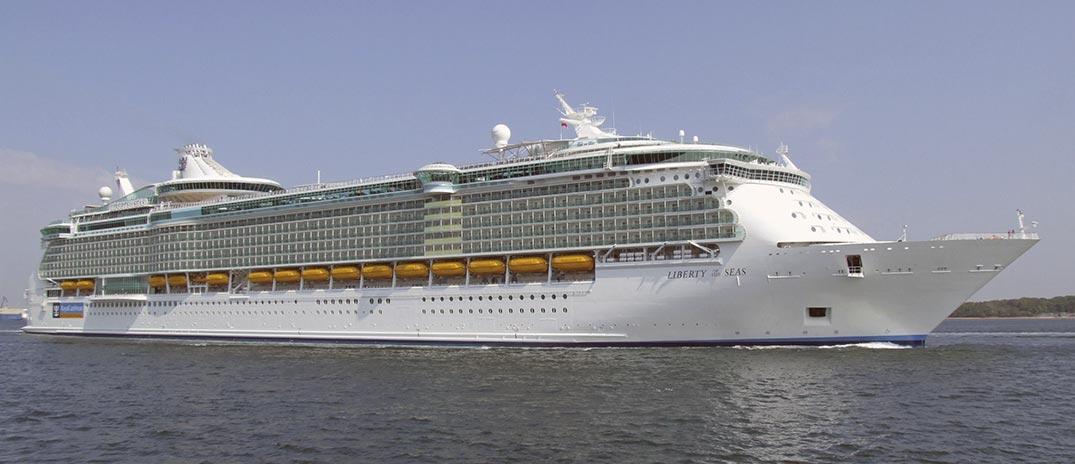
The Liberty of the Seas (above) will call Southampton home in summer 2026 with her makeover. This appears to be the Liberty’s first return to Southampton since her delivery voyage showcase call in 2007.
Oceania Cruises’ 85,900gt/2027-built Oceania Sonata had her steel cut on 4th June as the first of two ships in the brand’s revolutionary new Sonata Class. The celebration, held at the Fincantieri-Marghera shipyard in Venice, Italy, heralded the next stage in the evolution of the Oceania Cruises brand of exceptional small-ship luxury experiences. The Oceania Sonata will be followed by her sister ship, the Oceania Arietta, in 2029. These groundbreaking new vessels will be the most spacious and amenity-rich in the fleet. Marking the ninth ship in the Oceania Cruises fleet, the Oceania Sonata will embark on her maiden voyage in summer 2027. She is described as a masterpiece of design, created to deliver a symphony of unforgettable experiences. This occasion also reflected Oceania Cruises’ partnership with Fincantieri, from which came the Marina, Riviera, Vista, and the 67,700gt/2025-built Allura, which made her debut in July. The Oceania Sonata will have a passenger capacity of 1,450. Interestingly, the references to the new ship include the prefix of Oceania whereas the fleet to date has not carried this, simply Allura etc.
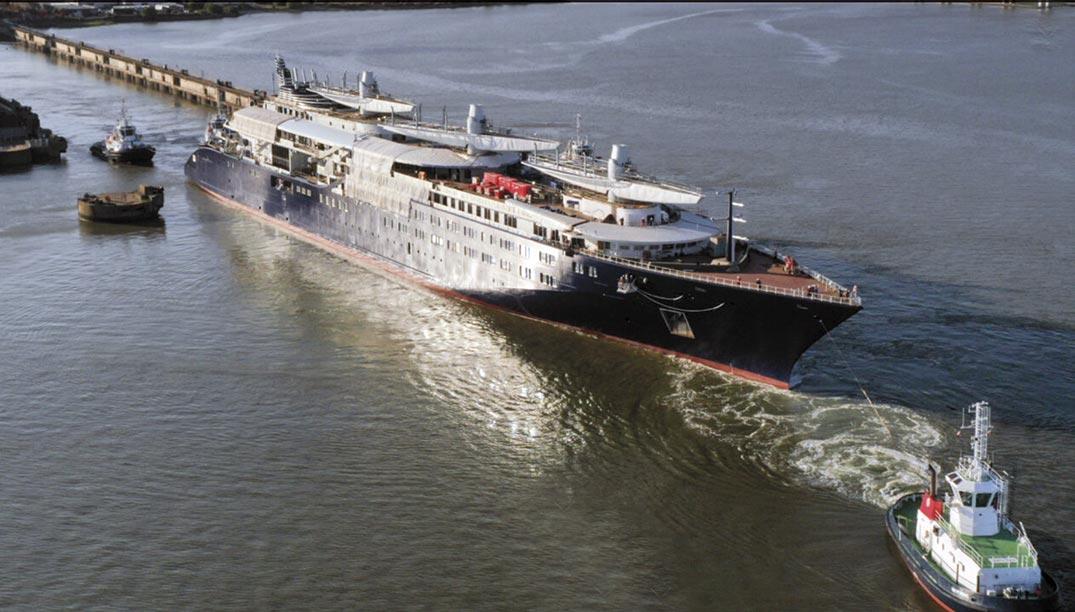
Orient Express Sailing Yachts has celebrated a key construc tion milestone of its first ship, the largest sailing yacht in the world, namely the 25,200gt/2027-built Orient Express Corinthian (above). The newbuild was floated out at the Chantiers de l’Atlantique shipyard in St. Nazaire, France, on 16th June. The ship, which is the first in a series of Accor-operated luxury sailing yachts, is equipped with a Bio-Sea ballast water treatment system supplied by France-based Bio-UV Group. The Orient Express Corinthian is 220m long and is the first sailing yacht to deploy the shipbuilder’s in-house designed SolidSail wind sail system, which features three 100m-tall lightweight masts that will be rigged with 1,500m2 Solid Sail/AeolDrive rigid but foldable sails. The scheduled maiden voyage from Marseille is on 6th June 2026. A second ship, the Orient Express Olympian, is scheduled for delivery in 2027. The ship will have 54 suites ranging from 45m2 to 230m2, each one framed by expansive picture windows or terraces. The sail propulsion system is complemented by a hybrid system powered by LNG.
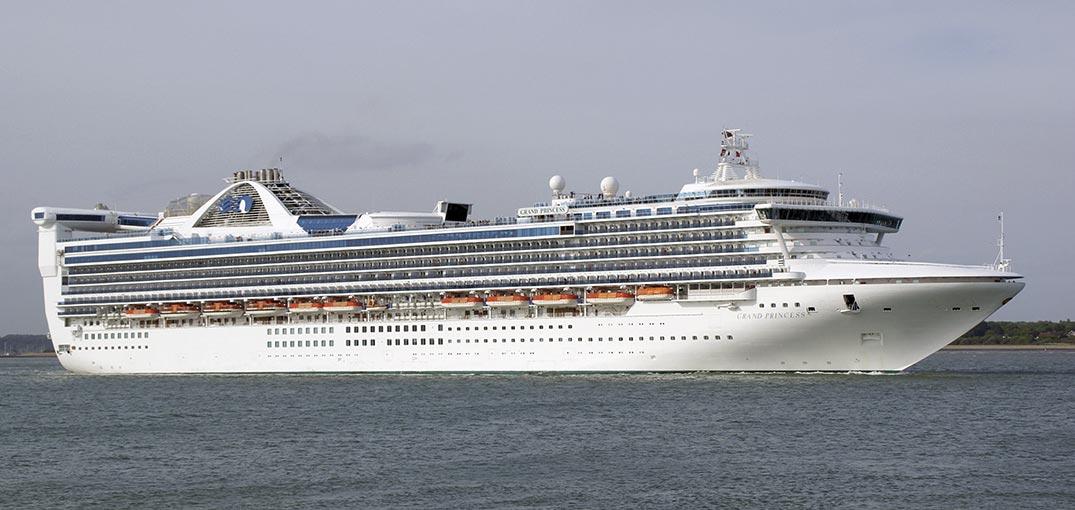
Princess Cruises’ 107,517gt/1998-built Grand Princess (above) is expected to take over Princess Cruises’ year-round itineraries in Australia and the South Pacific. She will replace the 113,561gt/2006-built Crown Princess, which is currently based in Sydney. The Grand will offer summer cruises from Australia and
New Zealand in March 2027 after a winter season sailing from Brisbane. Upon completing her Australian schedule, the Crown Princess is set to reposition to the Caribbean for the 2026-2027 winter, sailing from San Juan plus Fort Lauderdale-Los Angeles itineraries.
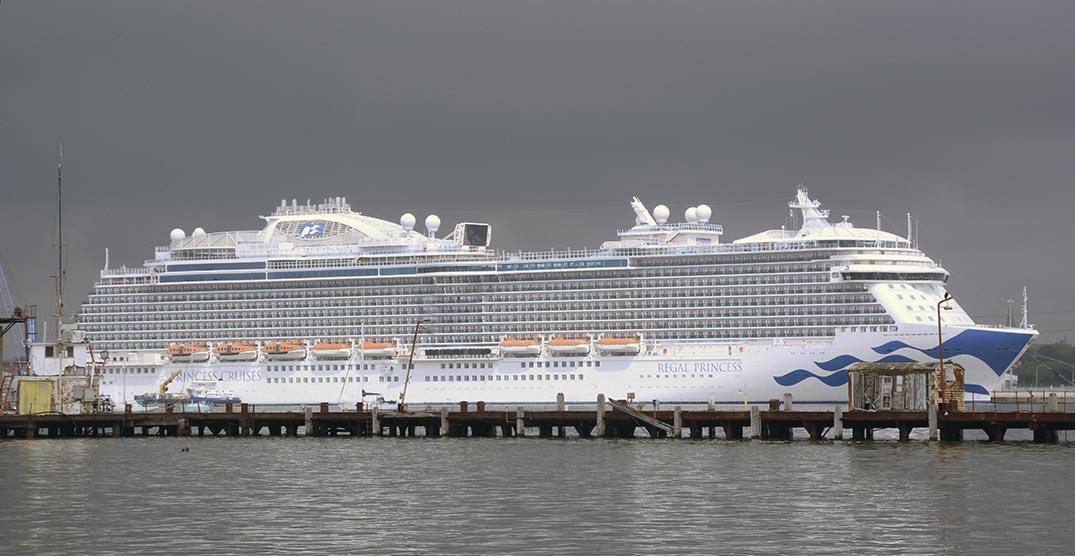
The 2026-27 winter season in Australia features two ships, with the Grand Princess being joined by the 142,714gt/2014-built Regal Princess (above) for cruises departing from Brisbane and Sydney. The latter ship had an engine block replacement during her 25th April 2025 visit, which went into early May at Damen Shiprepair in Rotterdam, The Netherlands. One diesel generator had failed when the ship headed back to the USA from Southampton in 2024 with the dry docking planned when repairs could not be completed aboard the ship. Whilst in dry dock, an opening in the hull was cut, a bulkhead was also trimmed, and skidding tracks were put in place to remove the errant unit and install a replacement. The process was then reversed to return the ship to sea. The Regal Princess welcomed guests back on 9th May in Southampton during her 2025 season.
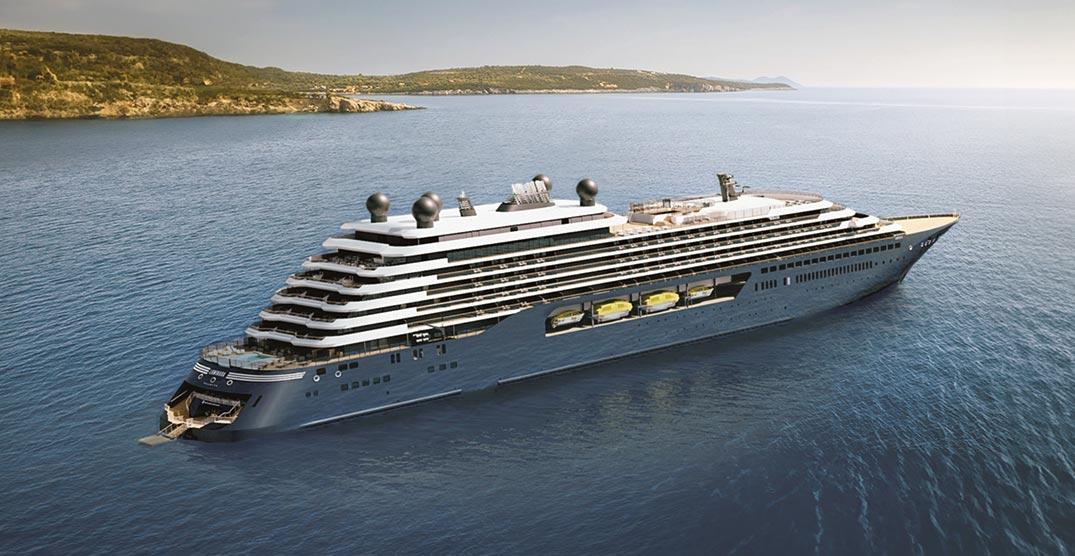
The Ritz-Carlton Yacht Collection’s 48,072gt/2025-built Luminara (above) was delivered from Chantiers de l'Atlantique on 3rd June as the second of two 242m long, 456-passenger ultra-luxury dual-fuel LNG cruise vessels for the luxury operator. The delivery ceremony was attended by leaders from The RitzCarlton Yacht Collection, including Ernesto Fara, President, along with Laurent Castaing, General Manager of Chantiers de l’Atlantique. Also present to mark the occasion was Captain Magnus Bengtsson, who will guide Luminara through her inaugural season in the Mediterranean, which began on 3rd July with a voyage from Monte Carlo to Civitavecchia. The Luminara, named after the Latin word for “light,” was designed in collaboration with leading design firms and showcases public spaces envisioned by Toronto-based Chapi Chapo Luxury Division, suites appointed by London-based design firm AD Associates, and lighting crafted by DPA. Sculptural lighting and curved architectural lines evoke the movement of water, creating harmony between the yacht’s refined interiors and the sea beyond. The refined exterior was shaped by Helsinki-based studio Aivan, reflecting the elegance and fluidity of private yacht design. The Luminara offers 5 restaurants, 7 bars, a wine vault, and collaborations with award-winning chefs Fabio Trabocchi and Michael
Mina. Other amenities include a panoramic pool area on Deck 10 with two jacuzzis, The Art Bar, a new onboard destination for café service and destination-inspired treats set against sweeping ocean views and the brand’s signature Marina, complete with a spacious terrace and dynamic floating platform where guests can swim, unwind, and enjoy water sports at select ports.
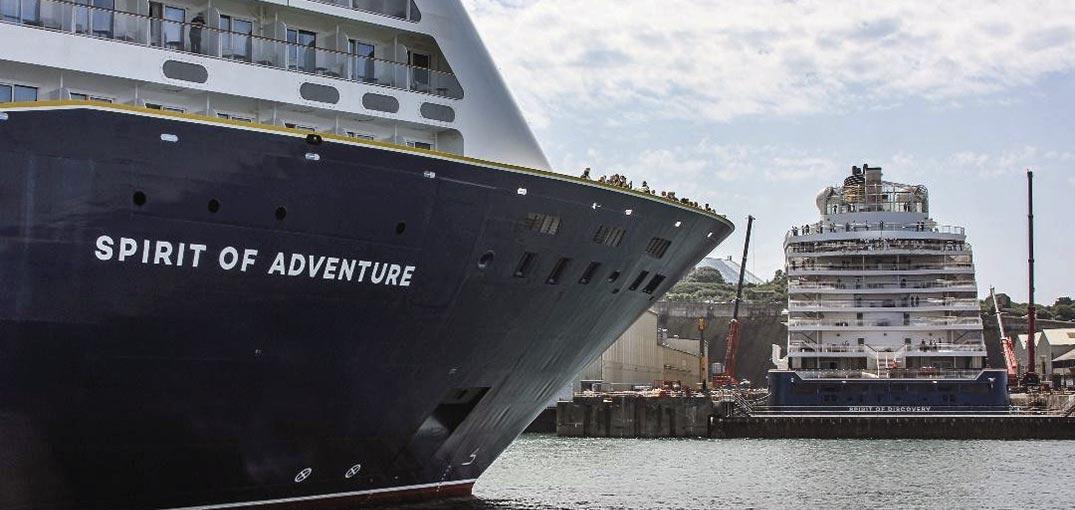
SAGA Cruises notched up a milestone occasion at the port of Falmouth on 20th June when the Spirit of Adventure arrived at the port on a special mission unlike anything the port had seen before. Inward bound from Cobh, Ireland, SAGA and the ship's master, Captain Kim Tanner, decided to undertake a cruise that included entering Falmouth harbour to allow the guests onboard to see 58,119gt/2019-built sistership Spirit of Discovery in drydock there 9above). With Falmouth pilot Capt. Nick Gilbert onboard the Spirit of Adventure, the 58,119gt/2020-built ship proceeded to Carrick Roads, turned in the Cross Channel and then went into the Docks Basin. Crews on both vessels waved to each other whilst the guests on the Spirit of Adventure enjoyed a oneoff experience. What a superb thing to do for all involved! The Spirit of Discovery emerged from dry dock on 27th June and departed Falmouth the next day to resume her cruises.
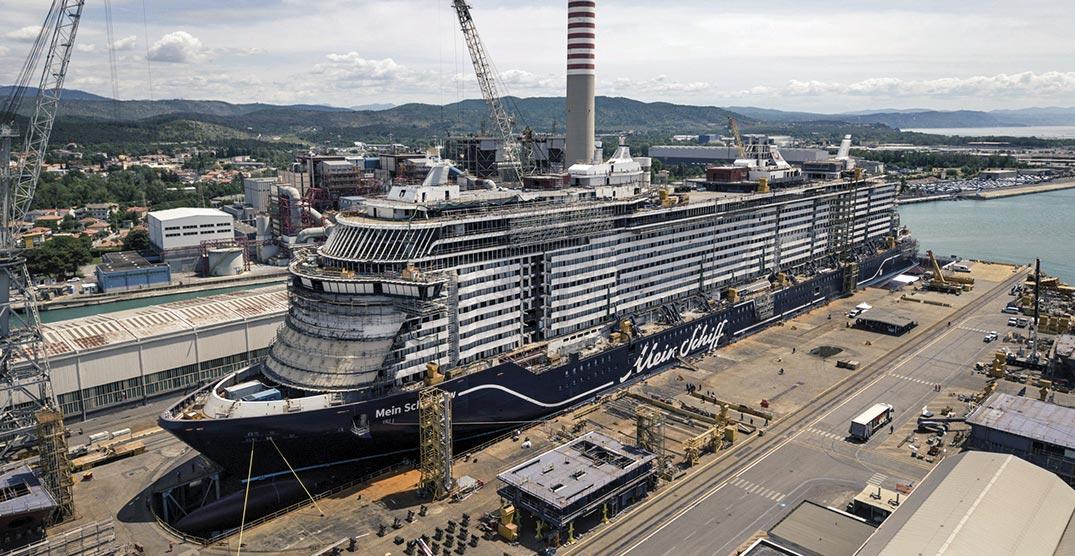
TUI Cruises’ 157,651gt/2026-built Mein Schiff Flow was floated out at Fincantieri’s Monfalcone Shipyard at the end of May (above). This is the second of two cruise ships for TUI, and a sistership to the 157,651gt/2025-built Mein Schiff Relax, delivered in February 2025. Fincantieri and TUI Cruises, a joint venture between TUI AG and Royal Caribbean Cruises, celebrated the launch of the second of two next-generation InTUItion class ships, designed for dual-fuel operation (LNG and MGO). The ship is scheduled to enter service in mid-2026. The launching ceremony was attended Daniele Fanara, Senior Vice President New Building and After Sales of the Fincantieri Merchant Ships Division, and by Cristiano Bazzara, Director of the Monfalcone shipyard, and Wybcke Meier, CEO of TUI Cruises. The InTUItion Class project was developed by Fincantieri, enhancing the modernity and sustainability characteristics that TUI Cruises, a company with one of the most advanced fleets from an ecological point of view, is known for. Featuring an innovative product configuration, the project places energy efficiency at its core, aiming to reduce operational consumption and minimise environmental impact, in compliance with the latest regulations. The ship will be able to use LNG and is future-proofed with the ability to
utilise low-emission fuels such as bio- or e-LNG, marking a significant step towards climate-neutral cruising. The Mein Schiff Flow will feature catalytic converters meeting Euro 6 standards, a steam turbine, using the residual heat from the diesel generators, as well as an electrical shore-power connection. All this will ensure almost emission-free operations while in port (about 40% of operating time). The newbuild is also to be equipped with an innovative and highly efficient waste treatment system capable of transforming organic materials into recyclable components through a thermal process.
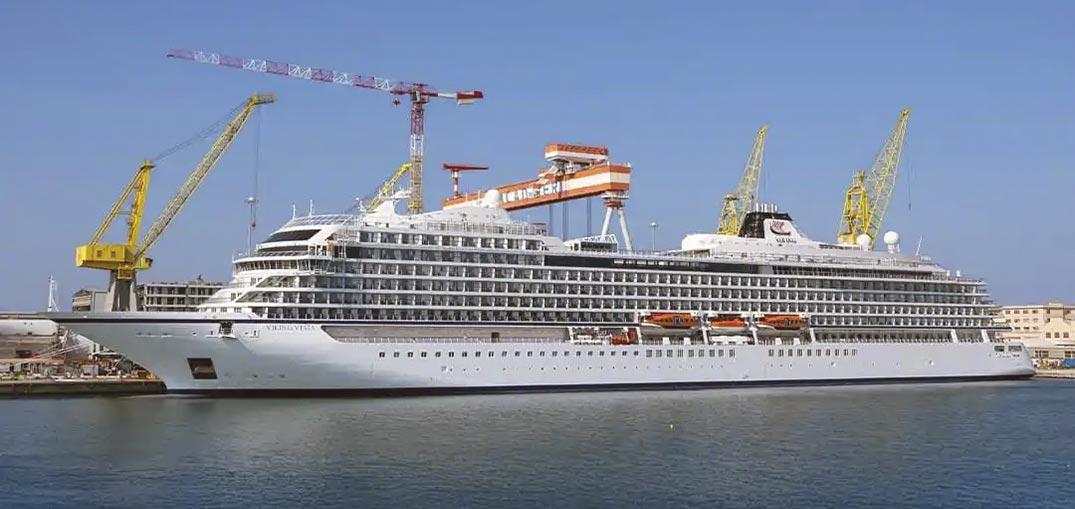
Viking announced on 26th June that the 54,30gt/2025-built Viking Vesta (above), the second of a new series of cruise ships that Fincantieri is building for Viking, had been delivered at the Ancona shipyard. The ceremony was attended by Torstein Hagen, Chairman and CEO of Viking and by Luigi Matarazzo, General Manager of the Fincantieri Merchant Ships Division. The Viking Vesta is equipped with 499 cabins and can accommodate 998 passengers on board. The ship is the 14th ship delivered by Fincantieri to Viking, including the two expedition cruise vessels built by the Norwegian subsidiary Vard. The strong and long-lasting relationship between Fincantieri and Viking encompasses 28 ships to date.
The companies had also previously announced the first cruise ship in the world to be powered by hydrogen stored onboard for both propulsion and onboard electricity generation, the Viking Libra, with delivery scheduled for late 2026. This ship is also currently under construction at the yard in Ancona and will be capable of navigating and operating with zero emissions, allowing it to access even the most environmentally sensitive areas.
Her sister ship, the Viking Astrea, under construction at the same yard and set for delivery in 2027, will feature the same innovative hydrogen-based technology. The Viking Vesta was christened on 29th June during a traditional ceremony in Split, Croatia. Serving as ceremonial godmother of the Viking Vesta was the Norwegian journalist, Lene Tangevald-Jensen. The ship then continued her inaugural season sailing in Europe. In keeping with the naming tradition, during the ceremony Lene used a Viking broad axe to cut a ribbon that allowed a bottle of Norwegian aquavit to break on the ship’s hull.
Virgin Voyages’ 108,192gt/2020-built Scarlet Lady returned to the Western Mediterranean as part of Virgin Voyages’ summer deployment in Europe on 18th May, arriving in Barcelona from the USA. During a 2-month period, the Scarlet Lady offered a series of 7-11 night itineraries before repositioning to Portsmouth and Reykjavik in late July for various cruise itineraries. Before returning to PortMiami for the winter in mid-October, the ship returns to the Mediterranean in late September for a short autumn season. As part of her 2025-26 winter deployment, the Scarlet Lady will offer 4 and 5 night cruises to the Caribbean and the Bahamas. The 108,232gt/2022-built Resilient Lady is also offering cruises in Europe this summer (Eastern Mediterranean) with the new 108,232gt/2023-built Brilliant Lady also earmarked for Portsmouth calls.
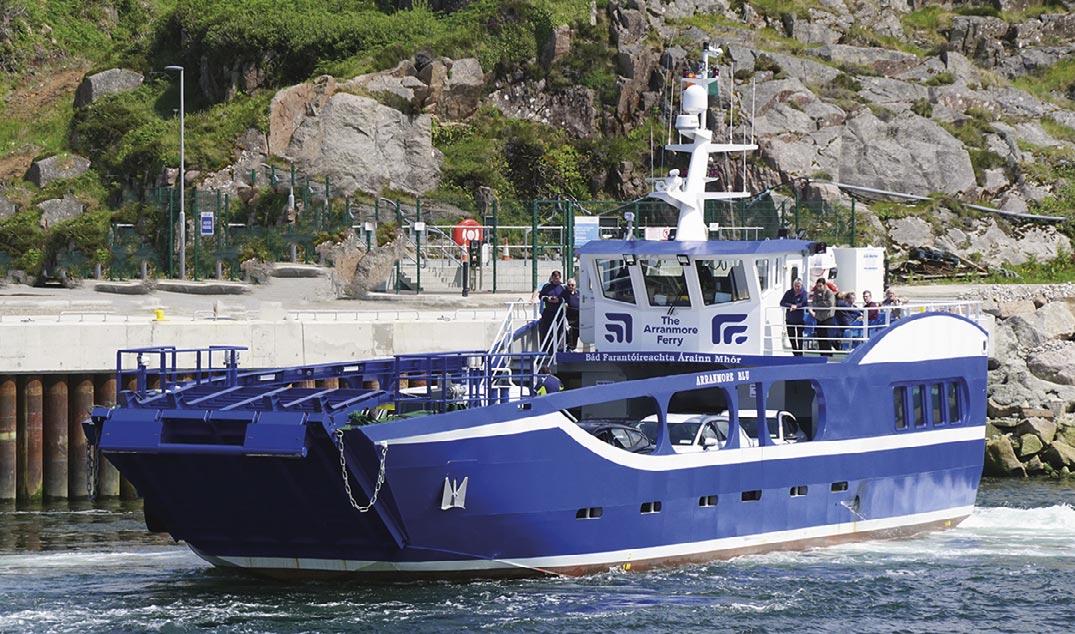
The Arranmore Ferry’s new 134.70gt/2024-built Oileán Class ferry Arranmore Blu (see Newbuild of the Month June 2025) was introduced onto the Burtonport-Arranmore service from 5th June in place of the former CalMac Island Class ferry Morvern, built 1973, which remains in the fleet. The vessel (above) was then officially introduced to both the operation and invited guests on 27th June. The blessing of the ferry was carried out by Father Pat Ward from Arranmore Island and Reverend Steve Dougal (MD of Century Marine) from Folkestone, Kent. Danny Boyle, uncle of company founder Seamus Boyle, broke the bottle and Deputy Charles Ward cut the ribbon (from Arranmore Island and a member of the Irish parliament).
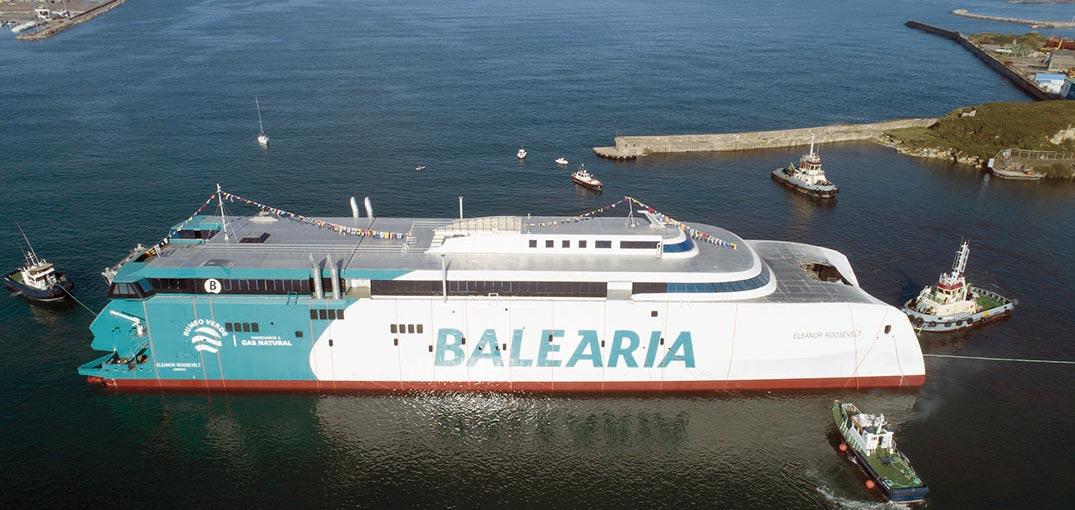
Baleària is to name its third LNG-powered fast ferry after Mercedes Pinto, in recognition of a prominent 20th-century Spanish writer resident in Tenerife. The new craft is scheduled to launch in September 2025 at the Astilleros Armon Gijon shipyard. The fast ferry Mercedes Pinto will join the company's series of high-speed vessels powered by LNG, namely the 12,262gt/2021built Eleanor Roosevelt and the 12,729gt/2024-built Margarita Salas, maintaining similar characteristics to her sisters.
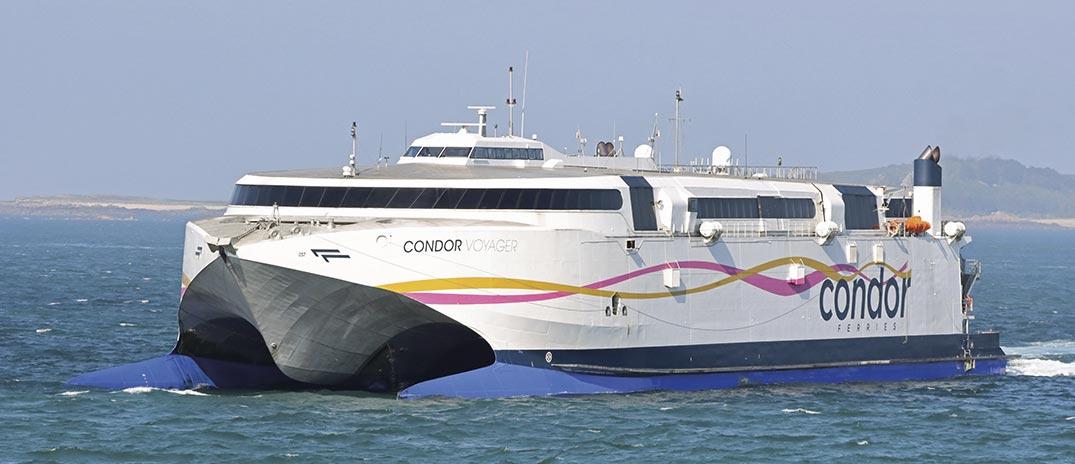
Brittany Ferries conveyed a record number of day trippers from St. Malo to St. Peter Port on 29th May aboard the 6,581gt/2000built Condor Voyager, around 740, marking the busiest single day for continental arrivals to the Island. The figures mirror the current trend of a significant increase in continental visitors to Guernsey from the beginning of this summer’s schedule. Foot passengers are 191% ahead of last year and overall forward bookings are 123% above the same period. It is a shame however that the post-27th March schedules rule out the previously available day trips from Poole.
The company also announced in June that it will be reinstating a daily passenger and freight winter service between Poole and Cherbourg from 14th December 2025 to 29th March 2026. The route will be served by the 14,000gt/1999-built Commodore Clipper, supporting freight and passenger traffic throughout the winter period. The ‘Clipper has operated Portsmouth-Le Havre and Portsmouth-Cherbourg-Rosslare-Cherbourg sailings since March and this is expected to continue when the ship is available, and when not required as the back-up Portsmouth-Guernsey ship. The 20,133gt/1992-built Barfleur will return to PooleCherbourg on 29th March 2026.
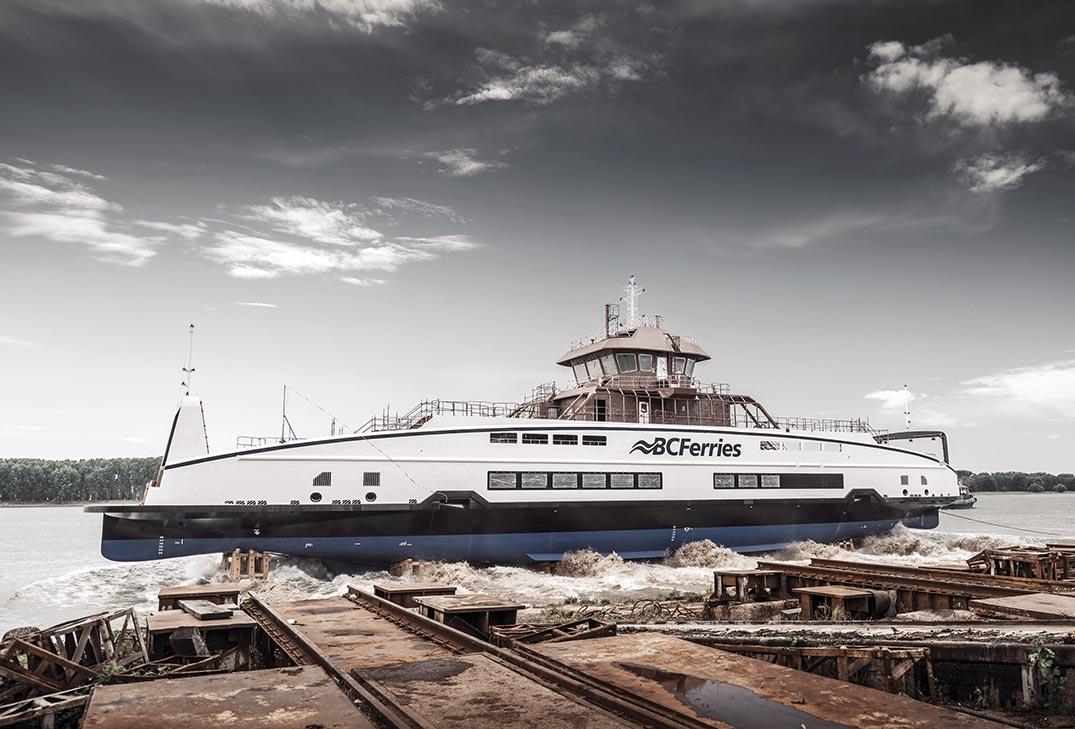
BC Ferries’ latest Damen Ro-Ro 8117 E3 Island Class ferry was launched on 22nd May at Damen Shipyards Galati in Romania, the 7th Damen vessel to sail in the Canadian organisation’s fleet. The keel laying for the 9th ferry was also completed on this occasion as well as the steel cutting for the 10th Island Class vessel. BC Ferries announced in June that it had selected China Merchants Industry Weihai Shipyards (CMI Weihai) to build four double-ended New Major Vessels (NMVs) following a rigorous global procurement process that included a public Request for Proposals, comprehensive bid evaluations, international site visits, and independent third-party reference checks. Each vessel will be 172m long and capable of carrying up to 2,100 passengers and 360 vehicles.
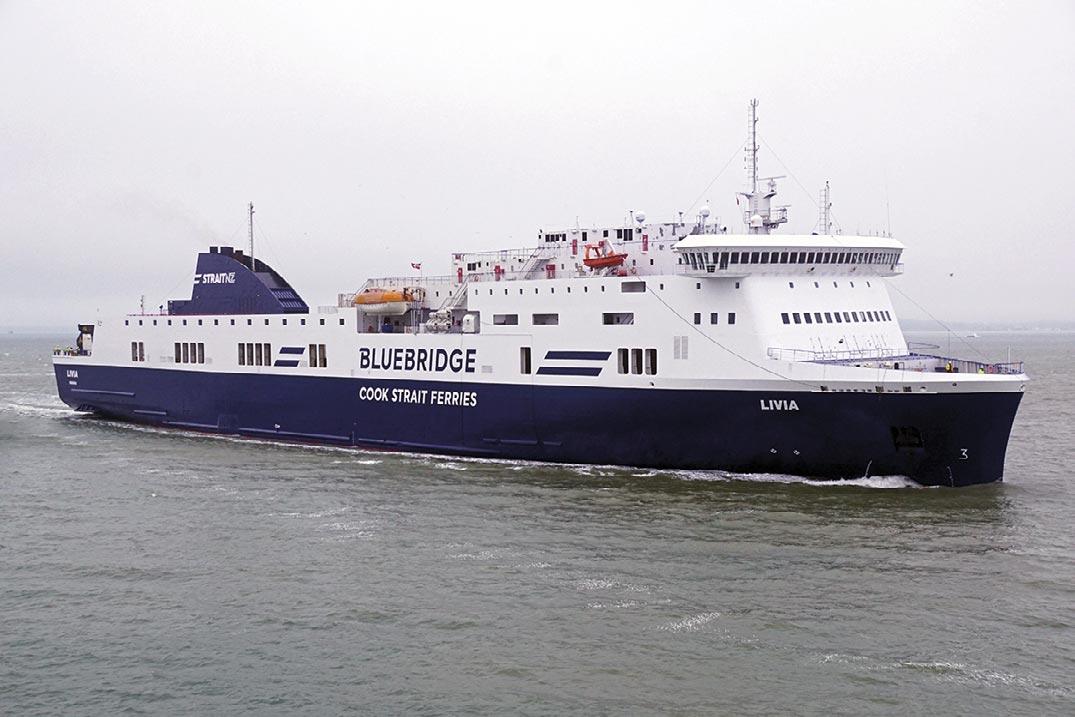
Bluebridge Cook Strait Ferries has acquired the 26,904gt/2008-built Stena Livia (ex-Etretat/Norman Voyager) and has been renamed Livia for her new life with Bluebridge in New Zealand. The ship was replaced on the Baltic services by the 27,522gt/2006-built Stena Horizon from Rosslare-Cherbourg. She will join the 27,414gt/2007-built Connemara on WellingtonPicton, another ex-Brittany Ferries/LD Lines and Visentini-built ship. The Livia’s cancelled Portsmouth call was re-scheduled to 29th May and she departed that afternoon bound for the Panama Canal (above). The ship will replace the 21,856gt/1997-built Strait Feronia.
CalMac confirmed on 3rd June that the charter of the 2,991gt/2019-built Alfred had been extended for a further 5 months to back up the lifeline fleet until the end of October 2025. With the delay to the newbuilds 5,861gt Isle of Islay, 5,861gt Loch Indaal and 7,272gt Glen Rosa, coupled with the problems affecting major fleet members. It was also revealed that the 7,040gt/2025-built Glen Rosa's funnels were removed for engine installation works in May, but the openings were not securely covered and there was rainwater ingress that caused flooding within the ship when a tarpaulin came loose.
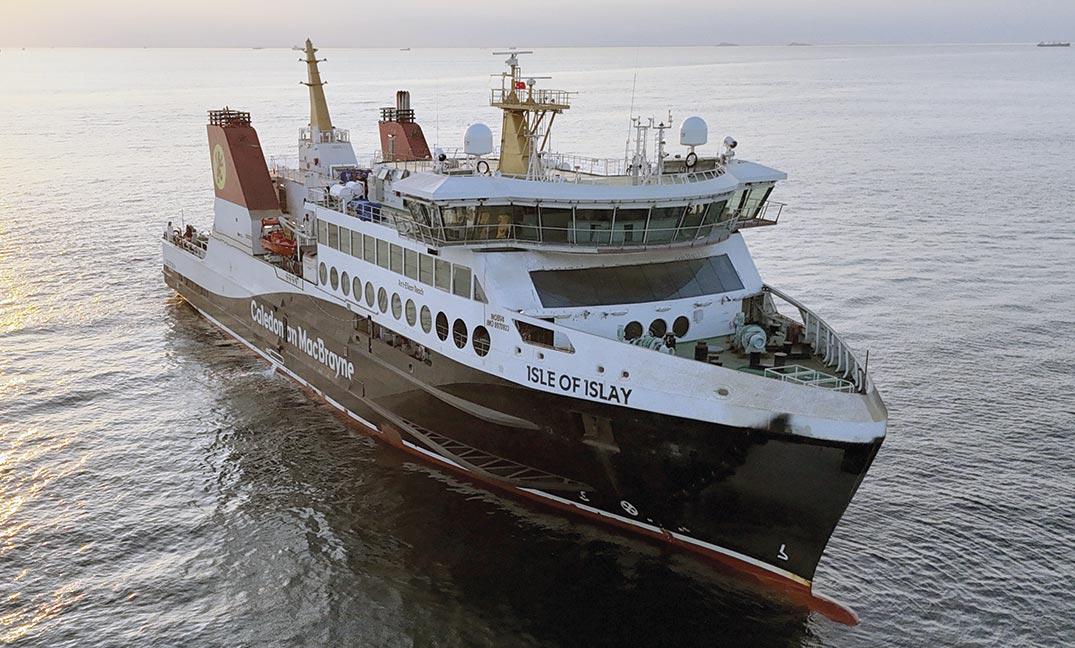
The Isle of Islay completed her first phase of sea trials in the Sea of Marmara 22nd-30th May by Cemre Marin Endustri in Yalova, Turkey (above). A second round of sea trials were scheduled for later in the summer, following the installation of the vessel’s battery system and harbour acceptance tests of the hybrid system came loose.
The return to service of the 5,221gt/1993-built Caledonian Isles in mid-June was delayed and further delayed after her £11 million of repairs due to gearbox pressure issues related to the variable thrust propeller system. These were discovered during sea trials. The ship hadn’t carried passengers since January 2024. Further trials from Ardrossan, and the arrival of a specialist from Kongsberg, sought to find the source of the issues and the ship went to the James Watt Dock at Greenock again on 2nd July.
The 4,719gt/1988-built Isle of Mull was released from James Watt Dock, Greenock, on the morning of 29th June following the installation of her new marine evacuation systems that began in May. Prior to this the ship’s passenger capacity had been limited to 45 for several weeks. The ship had been turned outside of the dock on 16th June to permit work on the starboard side equipment.
The Isle of Mull was back at Oban late afternoon but soon found herself on the Oban/Mallaig-Lochboisdale service when crewing permitted as well as Oban-Craignure 7th-21st July. This date period was specific due to the Alfred needing her annual maintenance and the Caledonian Isles also being unavailable. Also, on 9th-11th July the Lord of the Isles moved from Mallaig/Oban-Lochboisdale for urgent cylinder head works on her main engines.
The general fleet reshuffle to cater for everything saw the Isle of Arran assist the Glen Sannox (operating Ardrossan-Brodick) except 9th-11th July when the ship also covered services on both Arran and Islay. An amended 7,272gt/2024-built Glen Sannox timetable operated on a single-vessel service on these days. Islay was served by the 5,626gt/2011-built Finlaggan and 3,504gt/1989-built Lord of the Isles throughout (except 9th-11th July).
Mull had reduced capacity, with the 1,599gt/2003-built Coruisk and 1,160gt/2015-built Loch Frisa covering when the Isle of Mull was operating to South Uist via Oban. Where possible, the Isle of Mull called in at Mull en-route to and from South Uist to add capacity to the island.
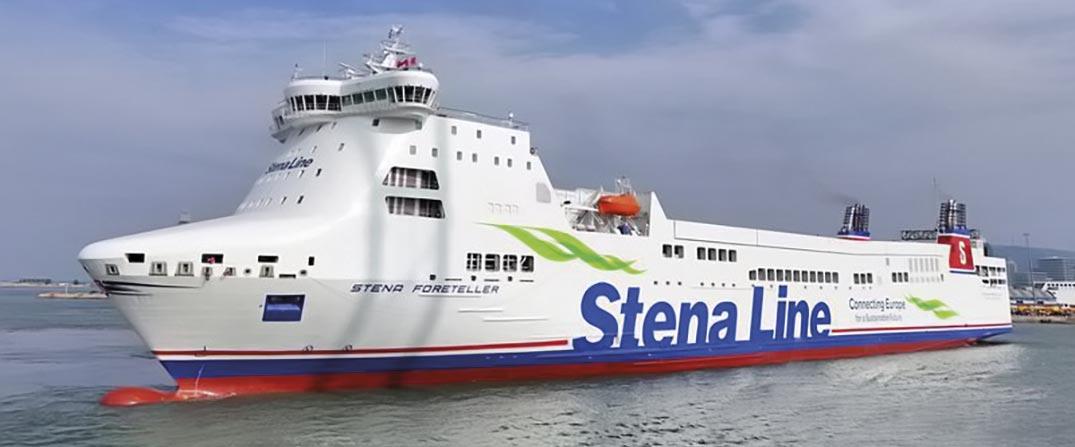
Stena Line’s 30,238gt/2001-built Stena Foreteller (above) was redelivered on 22nd June from the Chinese shipyard CMI Weihai to swap places with the Stena Forerunner in July on the Rotterdam Europoort-Immingham route, which will then undergo the same conversion. The ‘Foreteller received a 4th cargo deck, boosting capacity by 30% and increasing lane metres from 3,000 to 4,000. Stena Line also announced in June a £17 million investment into developments at the 12 Quays Terminal in Birkenhead to future-proof the operations by increasing freight parking capacity by 200 spaces and improving traffic flow.
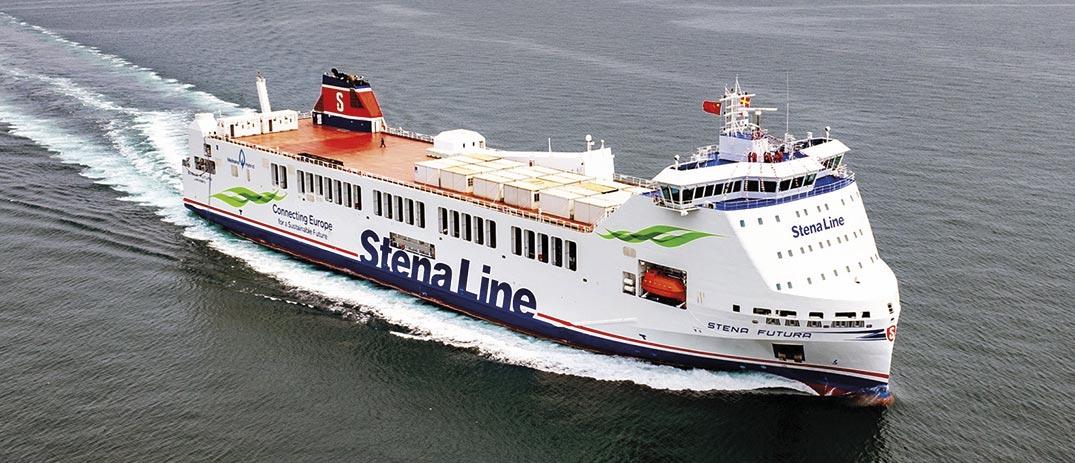
On 25th June came the news that the new 20,835gt/2025-built hybrid HeyshamMax Ro-Ro Stena Futura (above) had successfully completed its sea trials in China. The vessel was on schedule to enter service on the Belfast-Heysham route in late Summer.
That same day Stena Line was disappointed by the announcement that the reopening of Terminal 3 (T3) at Holyhead Port would be delayed by two weeks. Whilst Stena Line has operated a full sailing schedule since the reopening of Terminal 5 in January of this year, timetable adjustments were necessary as T3 remained closed for essential repairs. The normal schedule was expected to resume on 15th July.
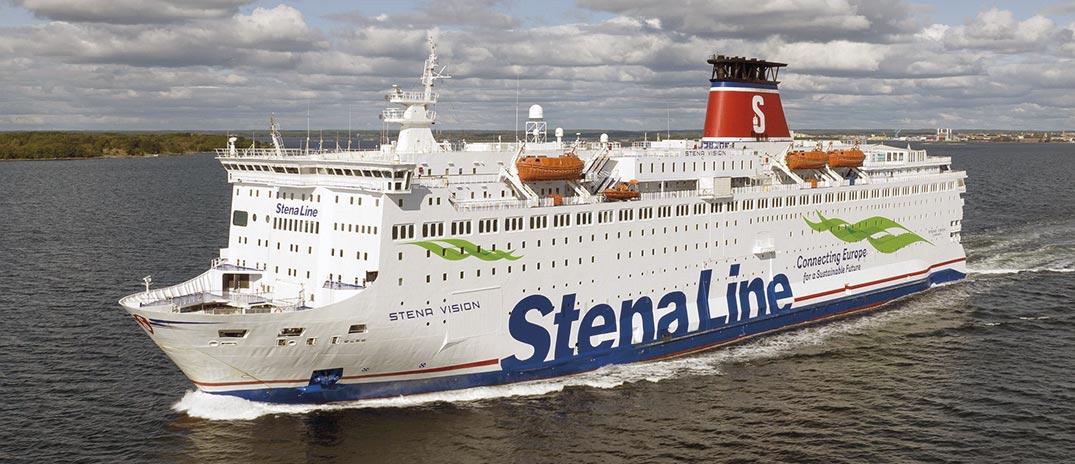
Five days later, Stena Line announced plans to withdraw its Rosslare-Cherbourg service following a strategic route review. From 30th September 2025, the ferry operator intends to withdraw service with the last sailing departing Cherbourg on 29th September, arriving in Rosslare the next day. The 39,191gt/1987-built Stena Vision (above) will be withdrawn from service whilst an additional freight vessel will be added to the Dublin-Liverpool route, most likely one of the 2 ships being replaced at Heysham, the 13,017gt/1996-built Stena Hibernia/Stena Scotia.
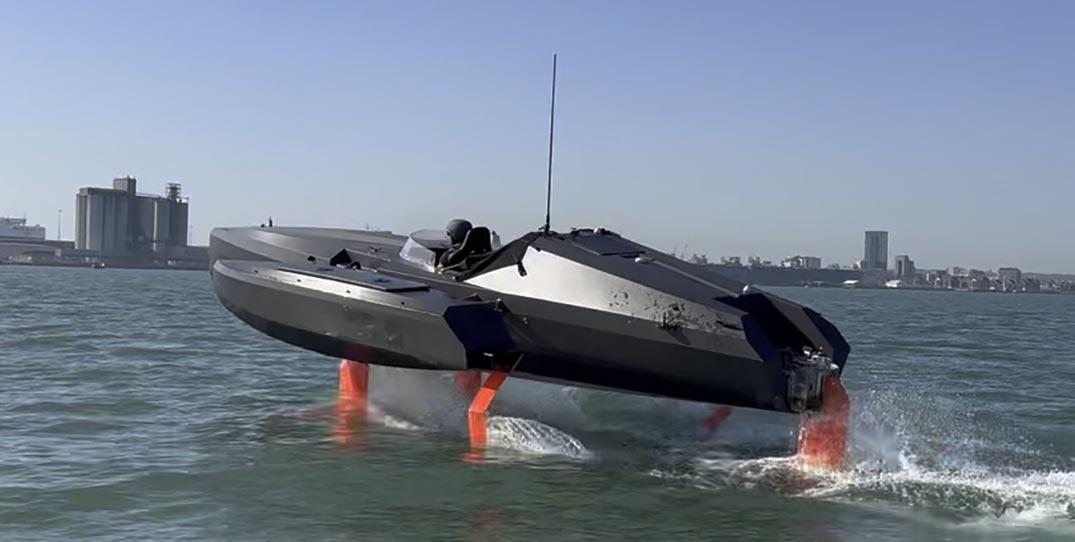
Chartwell Marine’s TriFoiler Demonstrator proved a success at Seawork 2025 on 10th-12th June. The electric trimaran (above), developed in partnership with Southampton Solent University and Newcastle Marine Services, under the UK Government’s Clean Maritime Demonstration Competition (CMDC3), had concluded initial sea trials on Southampton water following a successful on-time, on-budget launch in March. Set out to explore the feasibility of zero-emission passenger ferries, sea trials revealed the TriFoiler is 5 times cheaper to run than an equivalent fossil fuel powered monohull vessel of the same size and displacement. The project was part-funded by a £1.86 million grant via the UK SHORE programme, a Department for Transport (DfT) initiative delivered by Innovate UK, part of UK Research and Innovation (UKRI). Pairing a lightweight trimaran hull with electric propulsion, the TriFoiler achieves high efficiency and manoeuvrability at both high and low speed.
DFDS’ 4,995gt/1997-built Tarifa Jet visited St. Peter Port for the first time on 12th June for berthing trials prior to commencing a Mondays only interisland Jersey-Guernsey service from 16th June. The service is described as a trial until the end of August, compared to the regular/daily operation of such a service by Condor Ferries until 26th March. The two island's governments clashed again over inter-island services after choosing different ferry operators, thus reducing the travel links between Guernsey and Jersey overall.
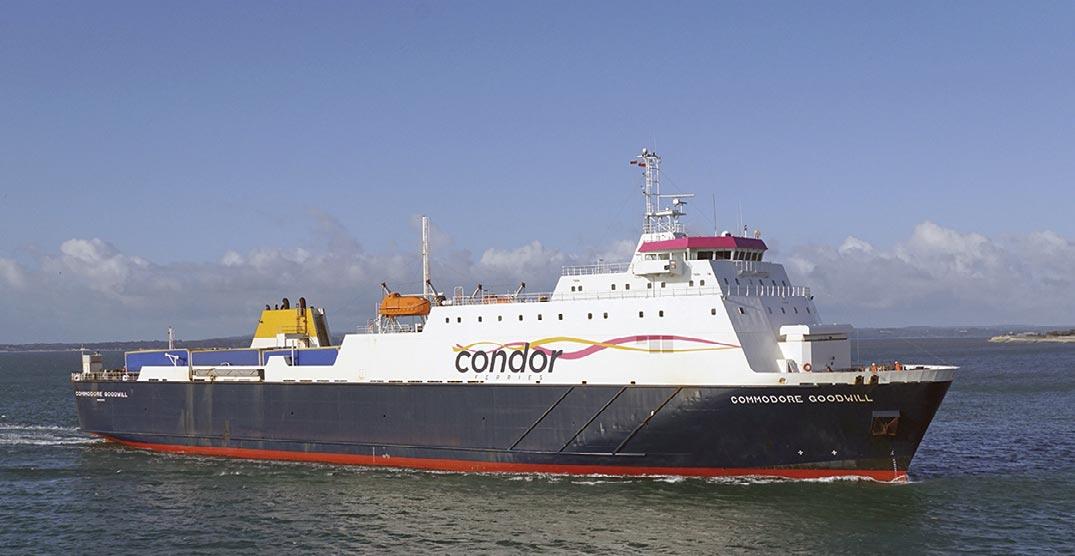
As from 18th June the 11,166gt/1996-built Commodore Goodwill (above) passed to DFDS ownership, and she was renamed Caesarea Trader. The intention to acquire her was announced in late April but was only confirmed in June. The 1,250 lanemetre capacity ship had been laid up at Le Havre since 27th March and will replace the 7,606gt/1998-built Arrow, which is on a 12-month charter to DFDS.
In June DFDS celebrated 150 years since the first EsbjergUK sailing in 1875. Now only a freight route sadly, the link handles over 100,000 trailers annually (1.5 million lanemetres). Originally carrying cattle, later Danish exports like bacon, butter, and eggs, passenger services ran from 1925 to 2014, but freight has always been the core business. The 33,313gt/2014-built Ark Dania and Ark Germania offer 6 weekly departures to Immingham (a 18.5hr crossing) with Harwich no longer served by Esbjerg services.
La Méridionale announced the names of its two next-generation hybrid Ro-Pax ships under construction at the CMI Jinling Weihai yard and are set to enter service in 2027, namely Albanova and Azura. Drawing inspiration from Corsica's nickname, the "Isle of Beauty," these vessels will proudly represent both the company and the island's vibrant heritage. Incredibly, the workforce planned a 48-hour strike for 27th June that was reportedly a protest against the naming of the company’s next two ships. Just how shallow can a reason for industrial action be?
Interestingly, CMA CGM could be preparing to end its involvement in the company after just two years as sole shareholder. La Méridionale was acquired by CMA CGM from the STEF Group in spring 2023. The two newbuilds ordered that same year in China could well remain with CMA CGM and not be part of any sale.
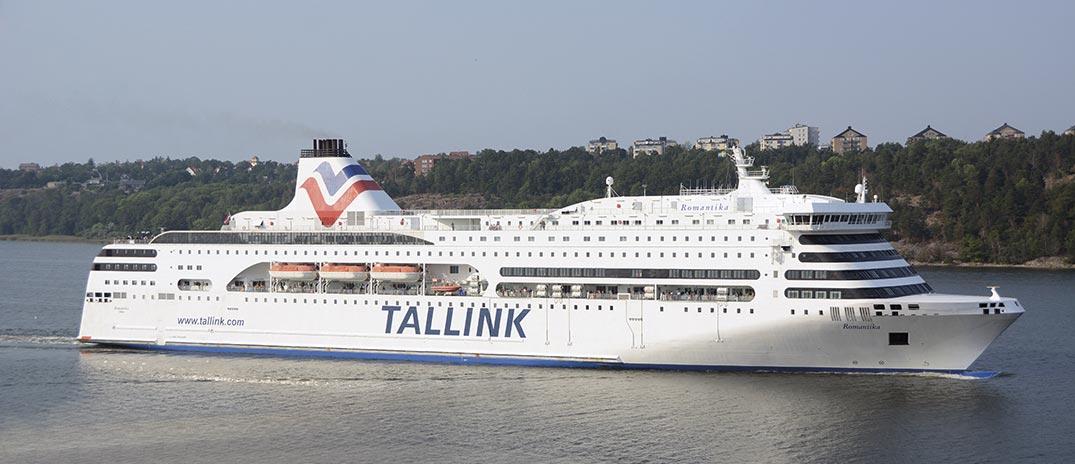
Madar Maritime Company has chartered the 40,803gt/2002built Ro-Pax ferry Romantika (above) from AS Tallink Grupp with a 9-month charter agreement with Algeria’s state-owned operator signed from 31st May, including the vessel and technical crew. The charter includes two optional 6-month extensions.
Smyril Line’s 36,976gt/2003-built Norrona has been fitted with a new brine-based firefighting system by Skansi Offshore and Knud E. Hansen offering a simple, eco-friendly solution to EV fires. All three of the company’s ships will be fitted with this. Unlike traditional fire suppression methods, which act externally and often fail to extinguish the core fire, the brine system targets the battery directly from inside the vehicle. In a fire event, one window is penetrated, and cold, saturated brine is delivered into the cabin. This allows the fluid to pool around the battery compartment, rapidly cooling the cells, limiting oxygen exposure, suppressing flammable materials, and even short-circuiting and depowering the battery.
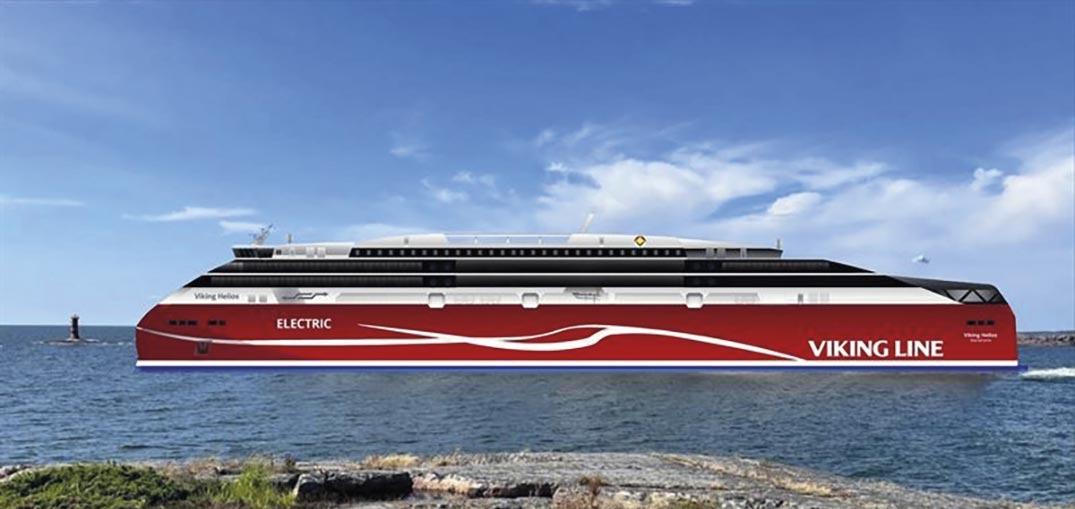
Viking Line has unveiled the Viking Helios (above), the World’s largest electric passenger-car ferry for the Helsinki-Tallinn route. The company is preparing to launch a completely emission-free service between Helsinki and Tallinn with the new groundbreaking vessel concept being proof that a green maritime corridor across the Gulf of Finland could be realised as early as the 2030s. If this does indeed become reality, the Viking Helios would be 195m long with a 30m beam, 100% electric with a 85-100 MWh battery capacity, a 30mW charging power requirement and a speed of 23 knots. Capacity would be for 2,000 passengers, 650 cars and 2,000 lane metres of cargo.
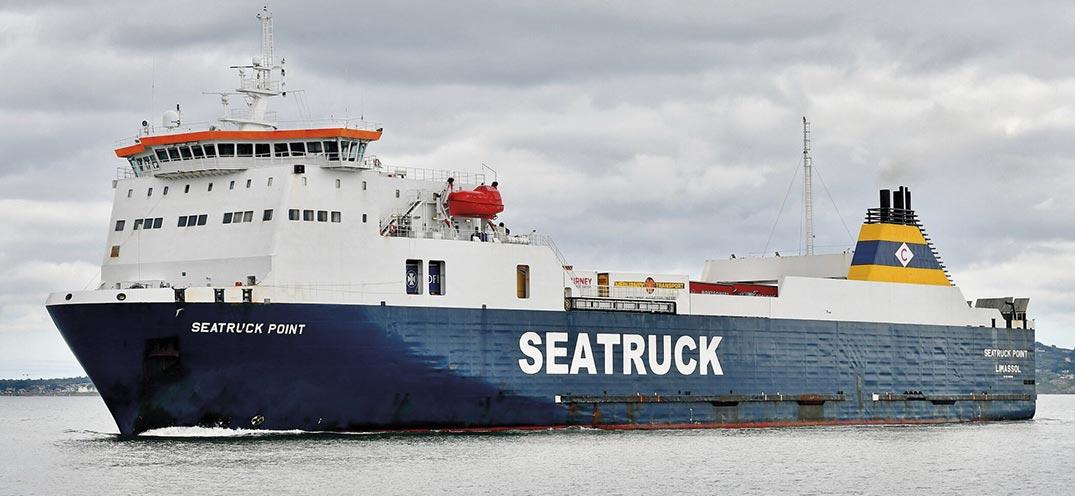
CLdN’s 14,759gt/2008-built Seatruck Point (above) departed Warrenpoint for the final time on 30th May following her sale by the new owner of Seatruck Ferries. Built as the Clipper Point, the ship was the first of 4 sisterships that really put Seatruck on the map, the others being Clipper Panorama/Pace/Pennant, all later renamed with the Seatruck prefix. Now the Santa Marcela 2, the former Seatruck Point sailed from Harland & Wolff in Belfast on 20th June after dry docking, bound for the Panama Canal and her new owners, Transportación Marítima de California. The company also bought the 14,759gt/2008-built Seatruck Panorama in 2024 and renamed her Santa Rita. The ‘Point was the first of the Spanish-built “P Class” and was the last to leave the fleet.
CLdN’s newly delivered 77,678gt/2025-built, 234m long and 8,000 lanemetre capacity Ro-Ro ship Chaumine achieved her debut call at Dublin on 30th May.
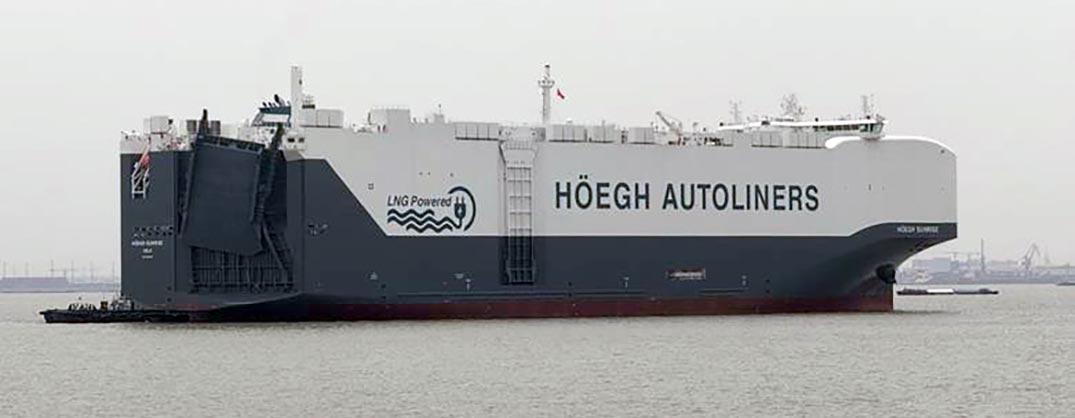
Höegh Autoliners has taken delivery of the 84,135gt/2025-built Höegh Sunrise (above) from China Merchants Heavy Industry in China. The ship has a capacity of 9,100 CEU, is the 5th vessel in Höegh Autoliners' Aurora Class (which will comprise 12 ships when completed in 2027) and she departed the shipyard on 22nd May bound for Kobe, Japan, from where she loaded cargo for Europe. The ship was formally named in a ceremony in Shizuoka, Japan, on 20th June. The Höegh Aurora and Höegh Borealis, the first two ships, were delivered in 2024. The newbuild has a length of 199.92m, a beam of 37.62m, a draught of 10.80m, a deadweight of over 25,000t and 14 freight decks including five hoistable examples. All decks have been laid out to house electric vehicles, and these are also strengthened to allow transport of heavier project cargo if needed.
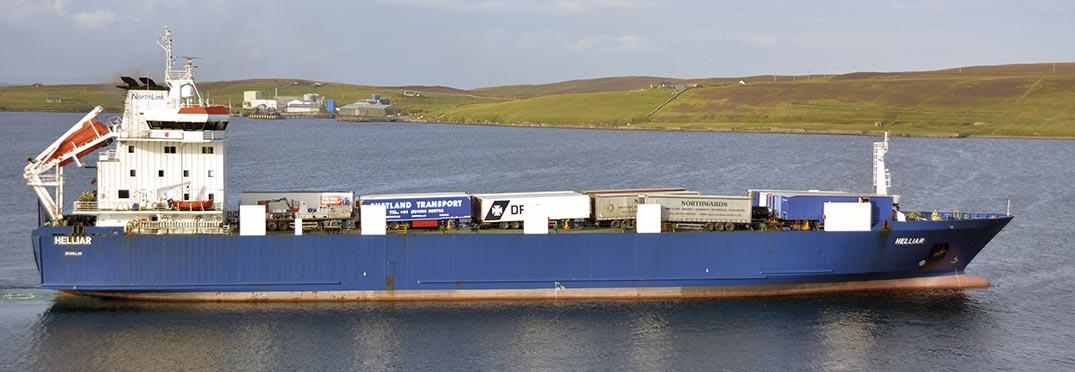
Northlink’s new Northern Isles freight vessels will be the Freighter-Flex design and procurement commenced in June. These 140m ships will be able to carry 200 passengers in cabins in the peak seasons on the Aberdeen to Kirkwall/Lerwick route. The new vessels will replace the 7,606gt/1997 and 1999-built Helliar (above) and Hildasay, on the service operated by Serco NorthLink Ferries. The new vessels will have increased freight and passenger capacity, and higher operating speeds.
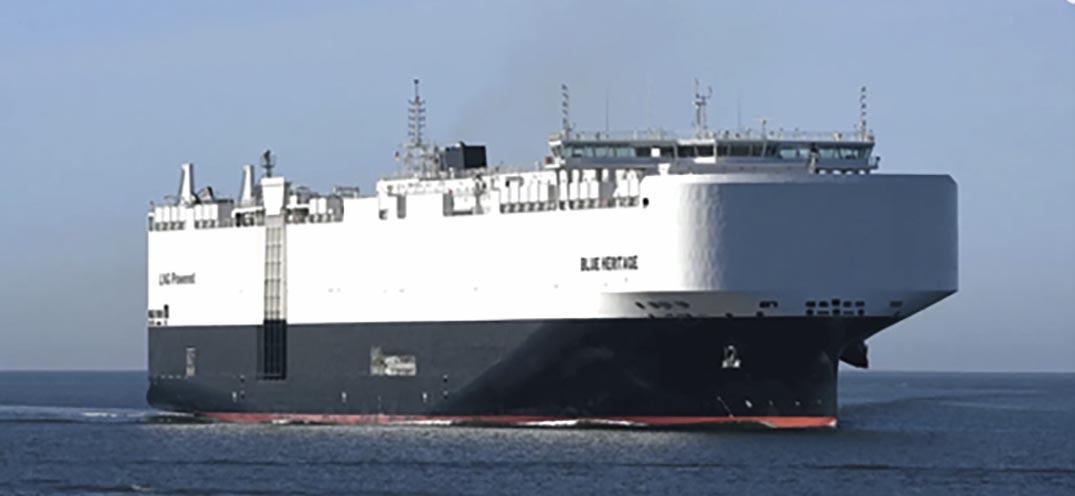
United European Car Carriers (UECC) has expanded its fleet by incorporating the 69,250gt/2025-built and dual-fuel LNGpowered Pure Car and Truck Carrier (PCTC) Blue Heritage (above). The Blue Heritage is a 200m long vessel with a capacity of 7,000 car equivalent units (CEUs) across 12 decks, four of which are hoistable and suitable for high & heavy (H&H) cargoes. This is a sister ship to the Blue Aspire and both vessels are equipped with dual-fuel LNG engines capable of running on liquefied biomethane (LBM). The new ship increases the number of UECC vessels on the North-South route to 7, enabling a sailing frequency of every 4.5 days from Turkey to Northern Europe. This route now encompasses 12 ports, including Vlissingen, Zeebrugge, Cuxhaven, Vigo, Yarimca, Efesan, Autoport, Portbury, Sagunto, Livorno, Piraeus, and back to Vlissingen.
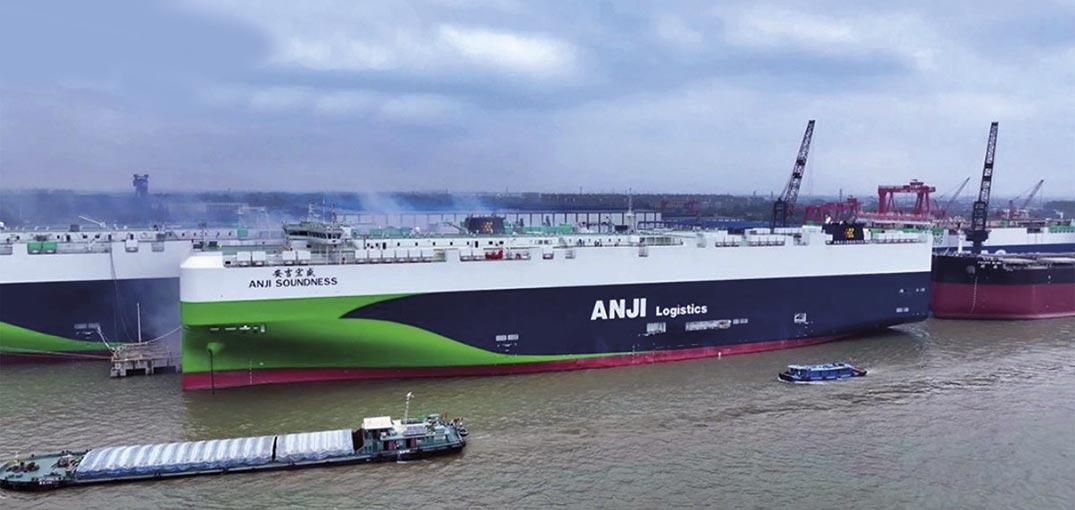
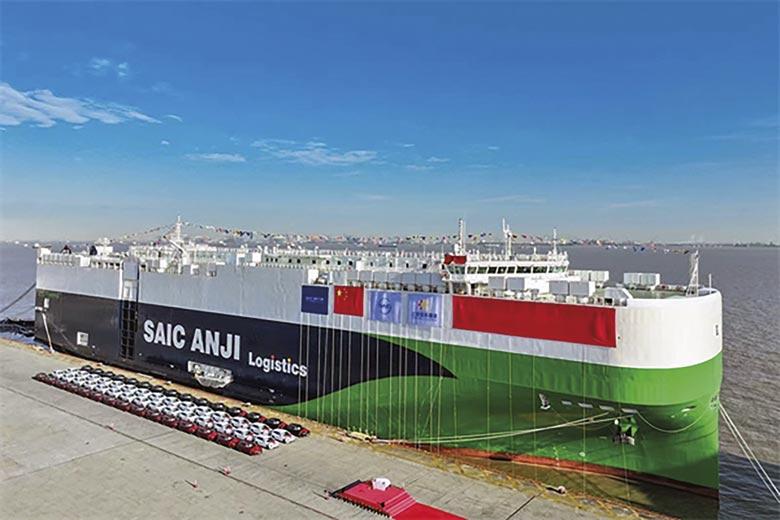
Meanwhile the SAIC Group through subsidiary Anji Logistics took delivery of the new 87,008gt/2025-built PCTC Anji Soundness (above) from China Merchants Jinling Shipyard (Nanjing) on 13th June. The ship is 228m long with a beam of 37.80m and a total capacity of 9,500 CEUs.
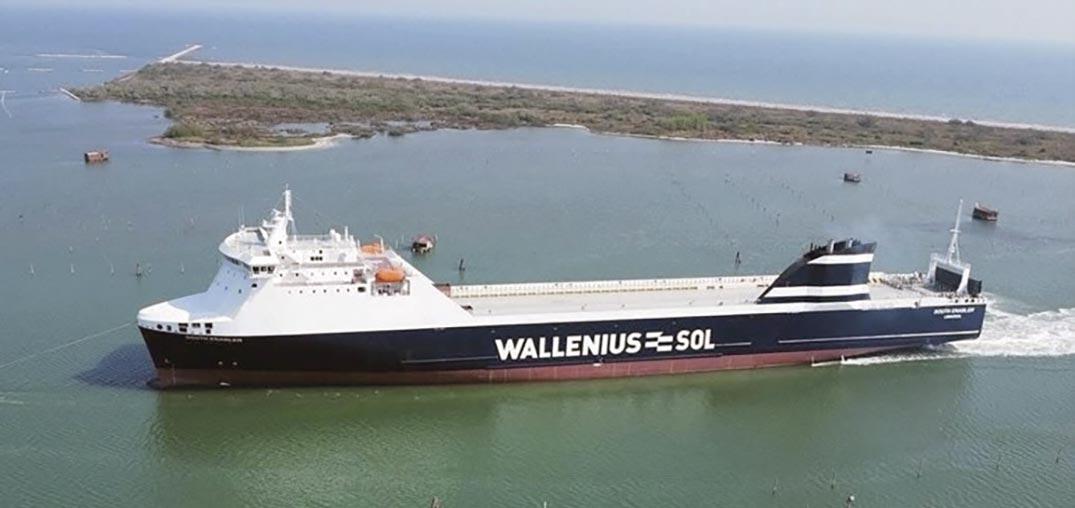
Wallenius SOL has taken delivery of the 26,519gt/2025-built RoRo vessel South Enabler (above) from the Visentini Shipyard in Italy. The company purchased Mann Lines Logistics in February 2025, and this included the acquisition of the new vessel under construction. The South Enabler was officially delivered on 11th June 2025 and arrived in Zeebrugge 4 days later.
The ship replaces the 24,133gt/2017-built ML Freya which has passed to Grendi Trasporti Marittimi to replace the 18,205gt/1999-built Estraden (a previous Mann Lines ship). The ML Freya repositioned to Cagliari from Zeebrugge where she was renamed Grendi Star for a new long-term charter serving Sardinia. The new South Enabler will be calling at Bremerhaven, Zeebrugge, Tilbury, Cuxhaven, Paldiski, and Turku.
by Andrew Cooke

Andrew Cooke
In the early 1980s the need for a reliable sea link between Victoria (Australia) and Tasmania was identified with TT-Line introducing the 19,212gt/1975-built Abel Tasman on 1st July 1985, a German-built ship named after the Dutch explorer who first sighted Tasmania in 1642. The ship was delivered to Germany’s TT-Line as the Nils Holgersson. When the Abel Tasman entered service across the Bass Strait, she quickly became popular. TT-Line Tasmania was established by the Tasmanian government's Department of Transport to provide passenger and vehicle transport across Bass Strait after the Australian National Line (ANL) ceased operating the service. The Abel Tasman served until 1994 before becoming the Pollux for Ventouris Ferries in Greece followed by the Theofilos of NEL Lines in 1995 and was sold for scrap as the Ilos to Aliaga, Turkey, in 2022.
The 31,356gt/1986-built Spirit of Tasmania took over the service in 1993, being acquired from TT Line in Germany, having been delivered to their Trelleborg-Travemunde service as the cruiseferry Peter Pan. The ship remained in service until 2002 and passed to Fjord Line as the Fjord Norway in 2003. In 2006 she passed to DFDS as Princess of Norway (Bergen-Newcastle) and then Princess Seaways 2011 to date. She can be found on the Newcastle-Ijmuiden service today. The service also entertained homegrown fast ferries in the form of the 3,241gt/1993-built Incat 030 (ex-Condor 10, now Tiger laid up in Dubai), the 5,007gt/1997-built Incat 45 Tascat (ex- Condor Rapide, now HSC Champion Jet 3), the 5,617gt/1997-built Incat 046 Devil Cat (sank as the redundant T&T Express) and the 5,209gt/1998-built Incat 050 Devil Cat (now the IoMSPCo. Manannan).
The 29,338gt1998-built Spirit of Tasmania I and Spirit of Tasmania II formed the next generation of Ro-Pax ships in 2002, replacing the Spirit of Tasmania. The former Superfast IV and Superfast III came from the Attica Group’s Superfast ferry fleet and brought a new level of luxury to the Bass Strait, boasting state-of-the-art facilities and increased capacity. Each ship could accommodate up to 1,400 passengers and 500 vehicles, making them two of the largest ferries in
the Southern Hemisphere. The 23,663gt/1995-built Superfast II became the Spirit of Tasmania III 2003-2006 but her addition to the fleet was not entirely successful. The ship entered service 15th January 2004 on TT Line/Spirit of Tasmania's new Sydney to Devonport route with low passenger numbers and rising fuel costs leading to the Government of Tasmania's decision to terminate the service in August 2006. The ship was sold to Corsica Sardinia Ferries as their Mega Express Four.
On 23rd October 2022 the Australian port for the service moved from Port Melbourne to Geelong and, prior to this, on 9th Jan 2017, the company announced the intention to order two 212m long, 2,000 passenger/2,519 lanemetre/1,714 car capacity newbuilds from German shipyard Flensburger Schiffbau-Gesellschaft GmbH & Co. KG (FSG), established in 1872, and designed by Foreship. The order was scheduled for the first half of the 2018 with delivery in 2021. The newbuilds being substantially larger with 43% more passenger capacity and 39% more freight space, equating to 500 additional passengers, 115 more vehicles and 85 extra freight trailers. However, on 27th February 2020 TT Line Co. PTY Ltd signed a Memorandum of Understanding with Rauma Marine Constructions (RMC) in Finland after TT-Line Tasmania and FSG mutually agreed to cancel the existing contracts due to the financial crisis that FSG was embroiled in.
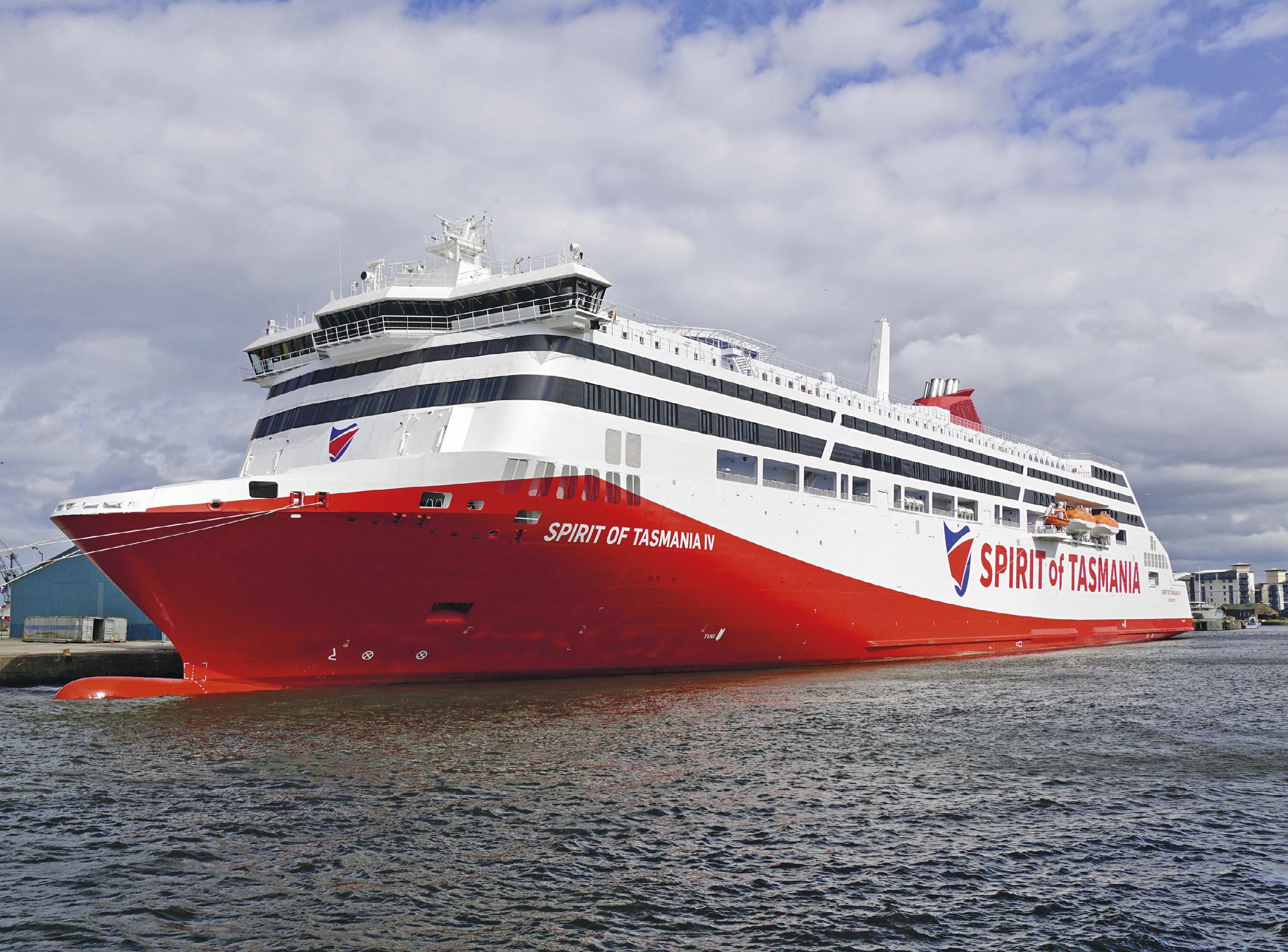
The deliveries were set for 2022/23, but the Covid pandemic and subsequent manning/supply chain issues did nothing to help the project. The contract was eventually signed for the newbuilds Spirit of Tasmania IV/V in April 2021. The steel cutting ceremony for Yard No. 6009 took place at RMC’s Rauma shipyard on 28th February 2022, the keel was laid on 28th October 2022 and the ship was launched (floated out) on 27th October 2023. The Spirit of Tasmania IV was christened at the launch by the vessel’s godmother, Deborah Grainger from Australia. The christening was undertaken using sparkling wine produced in Tasmania, Jansz Vintage Cuvee. Shipbuilding in Rauma began in the 16th century when local craftsmen established the town’s first shipyard, or “varvi.”
During the golden age of sail, Rauma’s shipwrights created Finland’s most impressive sailing fleet of the 19th century. The legendary schooner Uljas, built in 1891, exemplified this proud tradition. This legacy of Uljas continues beneath the Baltic waters off Valkiakari, where the town ceremonially laid her to rest in 1950. RMC was founded in 2014 as Finland’s only fully domestically owned shipbuilder on this scale. RMC was established following various corporate transformations for the yard that began in the 1990s. Operating as Rauma Yards, Finnyards, Aker Finnyards, and Aker Yards, the shipyard maintained its excellence in specialised vessels. During this period, numerous car and passenger ferries that now connect communities throughout Europe were born. The second vessel, Spirit of Tasmania V, was launched on 19th July 2024 and was christened by the Governor of Tasmania, Her Excellency the Honourable Barbara Baker AC.
The fourth generation 47,994gt Spirit of Tasmania IV is 212.107m long with a beam of 31.00m, a 7.15m draught, a deadweight of 6,869t and a net tonnage of 20,494t. The new vessels have an increased capacity for passengers of 30% from 1,400 to 1,800 and the number of cabins has increased from 222 to 301, but perhaps the most significant difference is the 59.8% increase in vehicle lanes for passenger and freight vehicles. Unlike the third-generation ships, all vehicle lanes have extra height and can accommodate caravans and campervans.
The increased size of the vessels is impressive, equating to 600 cars (1,598 CEU lanemetres) and 214 trailers (2,569 lanemetres based on one trailer being 12m long). Forward on Deck 3 starboard is a trailer lift for lowering one 12m stores trailer at a time to the hold on Deck 1 to replenish the ship’s stores via a service lift. The main vehicle deck is Deck 3 with a 4.60m clearheight and 1,290 lanemetre capacity (107 trailers). The clearheight allows for the conveyance of high cube containers. There is a central casing with four 3.50m wide lanes each side. MacGregor supplied all ramps and hoistable car decks and portside on Deck 3 is a tiltable ramp to Deck 5 whilst the stern access is via two ramps and one at the bow behind the clamshell doors. Deck 5 has a 4.80m clearheight and a 1,261 lanemetre capacity for freight (106 trailers). There is a 5-lane, 22m long weather deck section aft, a ramp provides stern access and bow access is across the bow and through a weather door. Deck 7 is a cars-only garage with a 2.80m clearheight, 8 lanes wide with a centre casing and 1,273 lanemetre capacity for CEUs (car equivalent units). Access at the bow is via a hinged weather door on each side and via ramps at the stern. There are three areas for motorbike lashings, electric charging points for 20 EVs on the starboard side and an emergency tiltable ramp to Deck 5 on the same side. Above Deck 5 are two hoistable mezzanine car decks, each side having 2 lanes of 113m and 86m long. This movable Deck 6 offers 396 lanemetres for CEUs and a clearheight of 2.20m when in use. CBG Systems supplied lightweight panelised A60 structural fire protection to the bulkheads between the Deck 7 car garage and the outside MESareas on both sides. The routes to these maritime evacuation system access zones also offer lifejacket lockers.
The new ships, the first conventional newbuilds for TT- Line Co. PTY Ltd, are optimised hydrodynamically for the intended use as a high service speed LNG dual-fuel Ro-Pax design.
The newbuilds share the hull design of Tallink’s 50,629gt/2022built MyStar, which has a service speed of 27 knots, whilst the Spirit of Tasmania IV/V need to maintain a service speed of 26 knots to stay on schedule during the voyage. The ships also comply with the SafeReturn to-Port regulations with the required backup bridge located on Deck 11. The machinery spaces are located on Deck 1 and the main engines consist of four Tier-III compliant 9-cylinder Wärtsilä 46DF engines, each with an output of 10,305 kW at 600 rpm. The auxiliary machinery includes three Wärtsilä 20DF engines, each producing 1,440 kW at 1,000 rpm.
The LNG fuel arrangement comprises two 400m3, tank-type Cbased Wärtsilä LNGPac systems with the tanks being located forward
on Deck 1. Initially the new ships will bunker from tanker trailers during the port stay in Devonport, but in the longer term, LNG bunkering will also be possible in Geelong once the infrastructure is in place. The berths also use an auto mooring system from Cavotec, to be upgraded with shore power transfer as both new ships will be shorepower enabled.
The main engines are linked to a pair of reduction Gearboxes 600/144 RPM driving two Kamewa variable pitch propellers. Manoeuvrability is assisted by two 2,200 kW Kongsberg bow thrusters and two 1,100 kW Kongsberg stern thrusters. The pair of SKF S7000 fin stabilisers have a larger surface area to maximise their effectiveness in the sea conditions that the Bass Strait can generate. The design service speed is 26 knots whilst the maximum speed during the sea trials was 31.5 knots. Essentially, these ships have enough installed power to maintain the schedule on the 242-nautical-mile crossing in the range of sea states to be expected. Two shaft generators are provided to handle the hotel loads etc. whilst the ship is at sea, whilst all three auxiliary engines are online when all four thrusters are at work during port manoeuvres. The heat energy from the cooling water is utilised for heating domestic hot water in the same way as the heat energy is recovered from the auxiliary engines' exhaust gases using the WasteHeat-Recovery principle. Kongsberg has supplied the equipment package for the navigation bridge on Deck 10.
The interior designs of the Spirit of Tasmania IV/V are by Figura, a Gothenburg-based architectural firm specialising in ferry interiors. The Tasmanian government stipulated that a substantial part of the vessels’ inventory should be sourced in Tasmania, but fitting out a ship in Northern Europe to Tasmanian requirements has its complications in terms of logistics to name but one factor. The variety of materials and furnishings used was impacted so the furniture was sourced in Australia and delivered to Finland for installation.
Other home-sourced components reportedly included tabletops in several public rooms from Fairbrother Joinery in Devonport, Tasmania. The majority of public rooms fill the entirety of Deck 8 and overlooking the bow is the large Tasmanian Market Kitchen, a pay-on-entry buffet restaurant, in which there is a centrally located free-flow servery area and a centrepiece in the form of a large copper sculpture. Along the starboard side aft of the buffet is the 23-seater Driver’s Lounge whilst on the port side is the 94-seater Leatherwood Restaurant adjoining the buffet lounge. Leatherwood is a species of tree endemic to Tasmania. Next to the restaurant is the 18-seat Thylacine Room (named after the extinct Tasmanian tiger) for private dining/conference use.
Moving aft beyond a stairs lobby, the next area offers the 34-seater library, known as The Den, on the port side with a café servery, guest services, tourism hub, toilets and even two prison strongrooms. The café counter services the large Mid Café which, as the name suggests, is midships. A sizeable shop is also sited on the aft side of the café area plus 2 reclining seat lounges. Beyond the next stairs lobby is the 29-seat The Zone teen lounge port side.
The funnel casing is in the centre here and installed around it is The Family Lounge, Kids Play Area, 61-seat Cinema 1, 43-seat Cinema plus the Tasting Bar/Lounge known as the Huon Lounge. The Huon valley is at the centre of Tasmania’s apple growing industry. Further aft, beyond a stairwell, is the 38-seat Family Lounge 2 on the port side and the 60-seat Maatsuyker Bar on the starboard side. There is a large terrace lounge on the stern, which is also part of the Maatsuyker Bar. This bar area is named after Maatsuyker Island, an island located close to the south coast of Tasmania, Australia. Above on Deck 9 aft is the standard 122 reclining seat lounge and four categories of cabins, including 18 pet cabins. All cabins were made and installed by Almaco with categories A, B & C on Deck 9 plus two F Suites overlooking the bow. Pets can also be transported in the pet kennel on Deck 6, which has video cameras that offer passengers traveling with pets the ability to access a live video link via an app during the crossing. Deck 10 aft features the 167-seat Cradles Lounge with a variety of seating.
Adjoining this on the port side is the 49-seat Business Class recliner lounge and some category A cabins. On the starboard side are 12 deluxe cabins with double beds, inboard of which is a small 18-seat lounge for the exclusive use of their occupants.
The remaining two thirds of Deck 10 consists of the crew/officer accommodation including cabins and a large day/mess room. Above on Deck 11 are well-equipped officer and crew recreation rooms (22 and 39 seats respectively) whilst the stern areas of Decks 9/10 have outdoor areas. The Scandinavian influence to the décor and colour palette on board is prevalent but to a finish that is easy on the eye. The theme throughout has been styled to reflect Australian and Tasmanian culture and history.
In the run up to the completion of the Spirit of Tasmania IV it became clear that the berth modifications in Devonport were way behind schedule, with rapidly escalating costs whilst Geelong was already prepared. This is delaying the ship’s entry into service until mid-2026 onwards. As would be expected, the delays and costs sparked a political row in Tasmania, with criticisms of the government's handling of the entire project.
The ferry operator initially attempted to lease the vessels to generate revenue while they waited for the new berth, but these negotiations failed. Options included housing refugees or being chartered out to European operators to earn some revenue. However, the interior of the Spirit of Tasmania V/IV was not due to be completed until the ships reached Hobart so that curtailed the potential revenue earning proposals.
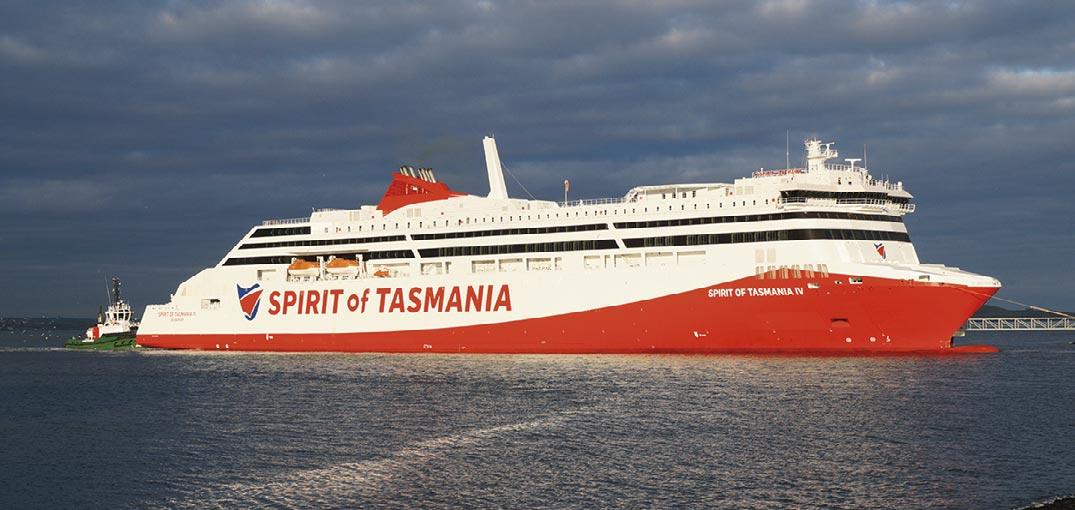
A temporary home was sought for the Spirit of Tasmania IV as she had to leave Rauma before the winter sea ice season. A suitable berth at the port of Leith in Scotland was identified and the ship arrived there on 3rd December 2024 for warm lay-up. In May 2025, the Spirit of Tasmania V’s sea trials revealed a technical issue with the LNG fuel system so, as a precautionary measure, the planned departure of the Spirit of Tasmania IV from Leith to Hobart on 26th May 2025 was delayed.
Also, during systems testing, the two bow and two stern thrusters were all powered up aboard the Spirit of Tasmania IV in port on 15th April and the resulting suction generated dredged up a gas bottle from the bottom of the harbour, which went into one of the thrust units. This failed to trigger an emergency shut down according to a statement released, instead a vibration was felt one hour into the testing. It was hoped that any repairs could be done in situ whilst the costs of the LNG system modifications to both ships were covered under warranty with RMC.
On 6th June TT-Line confirmed that technical modifications were underway on both Spirit of Tasmania newbuilds to fix issues with their LNG systems following a successful rectification of the fault at the RMC shipyard. The Spirit of Tasmania IV ventured out on further sea trials 19th-21st June and then bid farewell to Leith bound for Tasmania on 30th June.
Sistership Spirit of Tasmania V was handed over from RMC in Rauma on 25th June and was expected to follow her sister direct to Tasmania.
Special thanks must go to Hanna-Kaisa Koskinen at RMC Finland for kindly supplying information plus Bruce Peter and Kieran Lewis for some of the imagery.
Contract Signed: April 2021
Steel Cutting Ceremony: 28th February 2022 (December 2022 SoT V)
Keel Laid: 28th October 2022
Launched: 27th October 2023 (22nd July 2024 SoT V)
Sea Trials: First concluded 24th June 2024, second series in July (April-June 2025 for SoT V)
Delivery: 12th September 2024
Laid up at Leith December 2024 after departing Rauma
Route Operated: Geelong (Victoria)-Devonport (Tasmania)
Crossing Time: 9.5-11.5 hours (242-nautical-miles)
Designer: RMC
Interior Designer: Figura
Contract Shipyard: Rauma Marine Constructions OY (RMC), Rauma, Finland
Yard No: 6009
Former Project Name: Rauma 6009
Registered Owner: TT Line Co. PTY Ltd, Spirit of Tasmania Terminal, The Esplanade, East Devonport Devonport TAS 7310 Australia
Ship Manager: TT Line Co. PTY Ltd
Operator: TT Line
IMO: 9936587
Vessel Type: Ro-Ro Passenger Ship Class: Lloyd’s Register
Hull Notations: Machinery: |LMC UMS, BWTS, LFPF(GF,NG), NAV1, IBS, PCAC2,2 Hull: 100A1 Roll On-Roll Off Passenger Ship, Movable Decks, ShipRight(SDA, CM, ACS(B)), *IWS, LI, ECO
Machinery Notations: |LMC UMS, BWTS, LFPF(GF,NG), NAV1, IBS, PCAC2,2
Flag: Australia
Port of Registry: Devonport
Length Overall: 212.107m
Length bp: 192.593m
Beam Overall: 31.00m (Moulded)
Draught: 7.15m (Design)
Hull Depth: 9.90m (to Deck 3)
Depth: 31.00m
Gross Tonnage: 47,994
Deadweight: 6,869
Net Tonnage: 20,494
Main Engines: 4 × Wärtsilä 9L46DF
Power Output: 4x 10,305kW (41,220kW)
Gearboxes: 2x Reduction Gearboxes 600/144 RPM.
Auxiliary Engines: 3x Wärsila 6L34DF, 1,377kW (4,131 kW) 2x twin
Propulsion Gear: 2x Kamewa variable pitch propellers
Exhaust Gas Emission Abatement: 2x Exhaust gas boilers, Alfa Laval
Fuel: MGO + LNG
LNG Storage: 2x 400cbm type C LNG-tanks
Bow Thrusters: 2x 2,200 kW, Kongsberg
Stern Thrusters: 2x 1,100 kW, Kongsberg
Rudders: 2x CXP Promas/Kongsberg
Stabilisers: 1 pair, SKF, S7000
Design Service Speed: 26 knots
Trials Speed (Max): 31.5 knots
Passenger Capacity: 1,800
Crew: 81
Car Capacity Overall: 1,598 lanemetres
Freight Capacity (HGVs): 2,569 lanemetres
Car Capacity: 600
Trailer (Freight) Capacity: 214
Passenger Cabins: 301
Reclining Seats: 165
Passsenger Beds: 1,172
Crew Cabins: 81
Crew Beds: 81
Lifts: 3x Passenger/2x Service Lifts
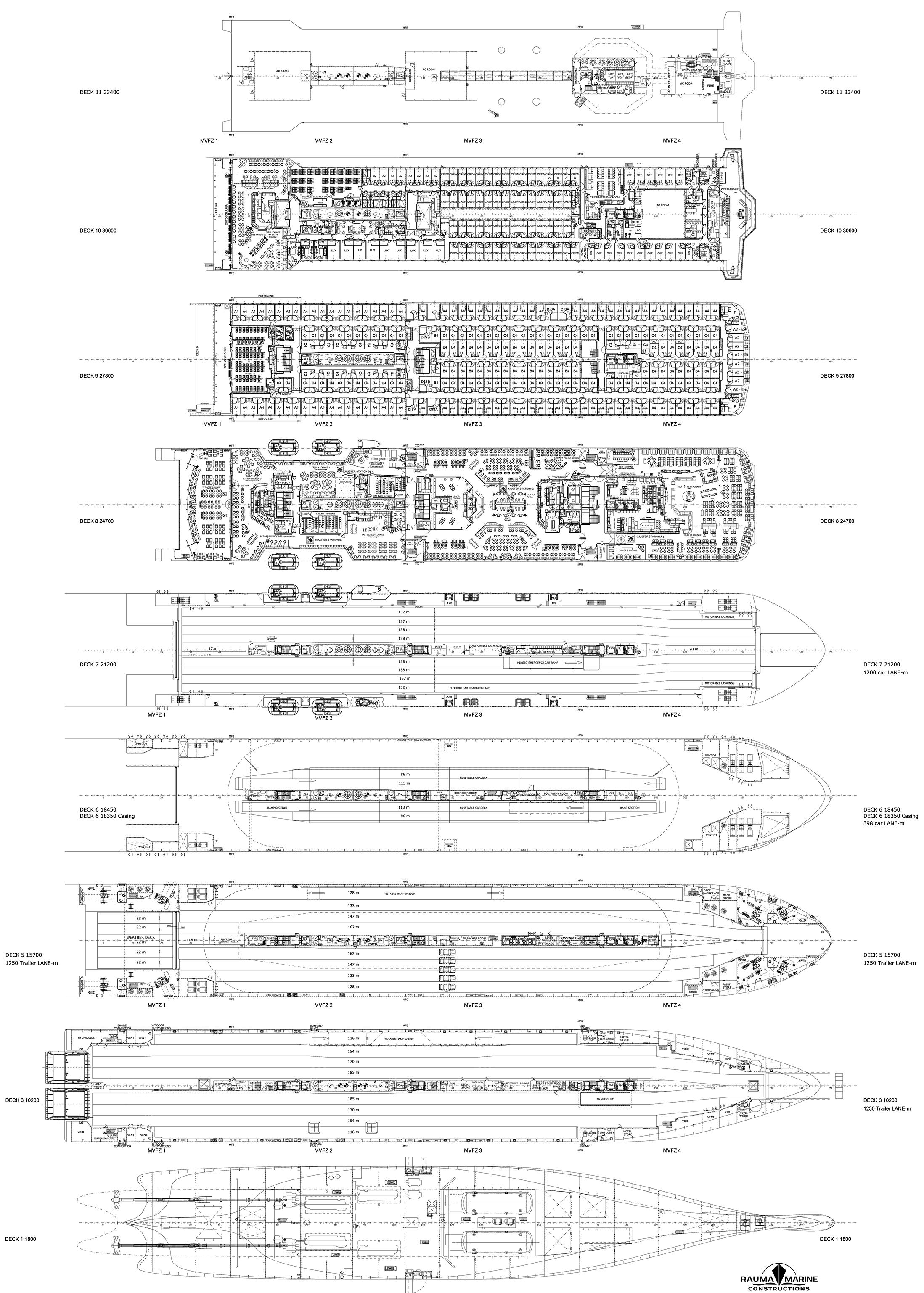

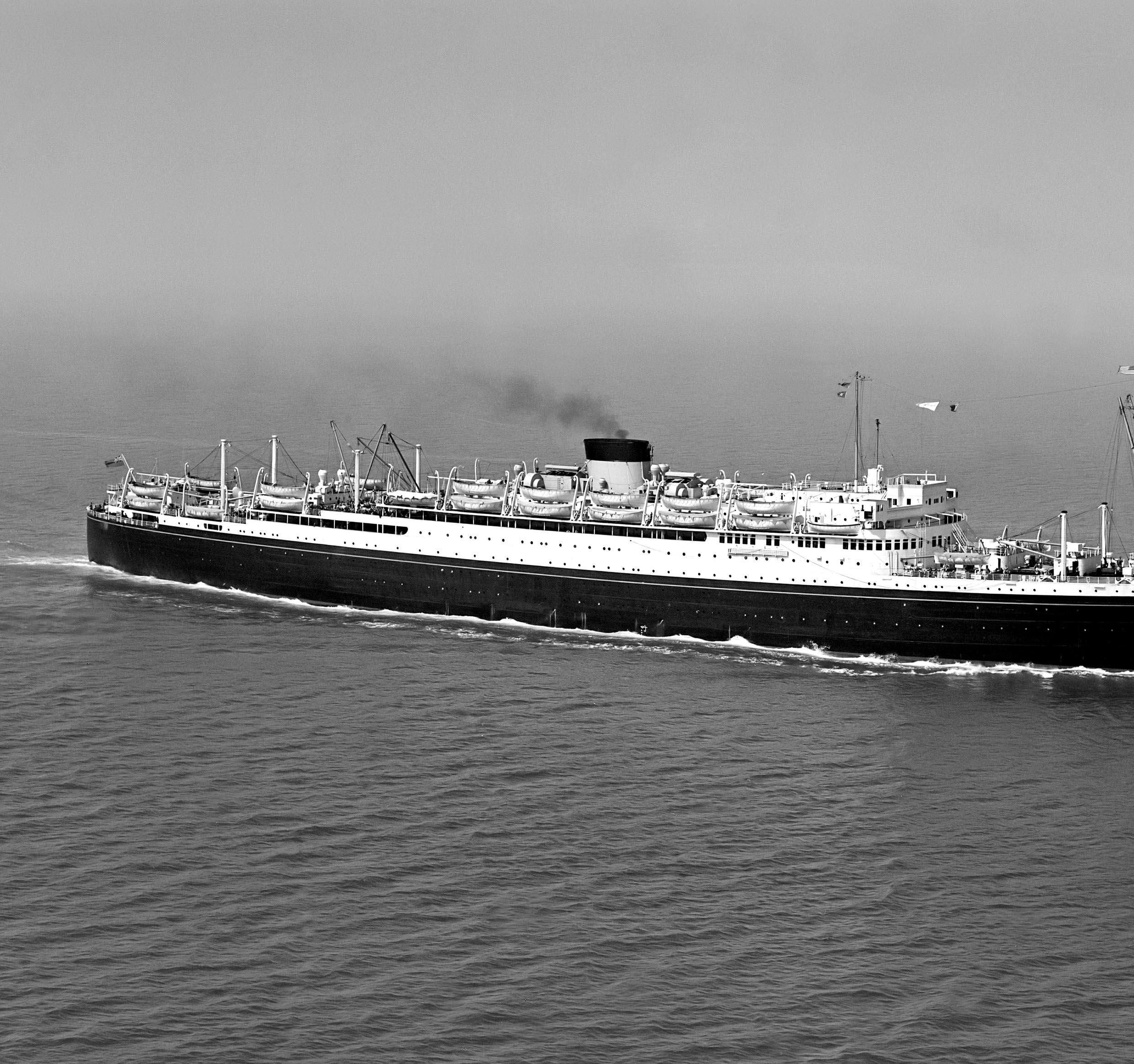
The motor vessel Georgic was the last in a long line of ships owned by the White Star Line, the origins of the Company going back to 1845.
However, it is first necessary to relate this brief, summary of the history of the Line, John Pilkington and Henry Wilson, who, initially operated chartered ships via their agency from Liverpool to the east coast of the USA, founded the Company in 1845.
Following the discovery of gold in Australia the Company focused on trade to and from that continent, acquiring its first steam ship, Royal Standard, in 1863.
In 1864 the White Star Line merged with the Black Ball Line and the Eagle Line becoming the Liverpool, Melbourne & Oriental Steam Navigation Company Ltd. The merger was not a success and the White Star Line broke away to concentrate on the Liverpool to New York service.
Further financial troubles ensued, and, in January 1868 Thomas Ismay purchased the company and set about recovering its full potential. This included finance from Gustav C. Schwaber on the condition that any new ships would be built by his nephew’s company, Harland & Wolff at Belfast. This was agreed, and a long association with the two companies began. Ships were built “at cost” plus a percentage for profit. Oceanic (1) of
3,707 gross tons was completed in 1871 and was the first with a name ending in “ic” which was the pattern for the subsequent names for company vessels.
Thomas Ismay died in 1897 and the mantle was taken on by his oldest son, J. Bruce Ismay, who was later to survive the sinking of the Titanic in 1912. The finances of the company became stretched with the construction of new tonnage, including the “Big Four” – Celtic (20,904grt/1901), Cedric (21,035grt/1903), Baltic (23,994grt/1904) and Adriatic (24,540grt/1907) and the company was bought by J. Pierpoint Morgan, a wealthy American businessman. Thus control of the White Star Line passed out of British hands in 1902 when it entered the ranks of a huge American shipping empire known variously as the Morgan Combine, the American Shipping Trust and the International Mercantile Marine Company (IMM).
This was the brainchild of J. Pierpoint Morgan who was a financial wizard and was determined to gain the monopoly in the Western Ocean for the United States. Soon the White Star, American, Red Star, Atlantic Transport, Inman, Dominion and Leyland Lines had come under his control, plus an understanding with Holland America, Hamburg America and North German Lloyd shipping companies.
Ismay retained his position as managing director and the extra investment meant that three luxury Atlantic liners could be built to attract the more wealthy passengers as well as catering for the substantial immigrant trade. These were the three Olympic Class ships, Olympic, Titanic and Britannic (2).
In the mid 1920s relations with the American parent company (IMM) soured and on the 1st January 1927 the White Star Line was bought by the Royal Mail Steam Packet Company, headed by Lord Kylsant. In 1928 a new diesel engined 60,000 ton “super liner” Oceanic (3) was ordered from Harland & Wolff, unfortunately the following year, the Great Depression put an end to the project. What work had been carried out on the ship was scrapped on the stocks.
At the same time as the Oceanic was ordered a second, smaller ship, to act as a consort, was also ordered, Britannic (3), with a gross tonnage of 26,943 tons. She was launched on 6th August 1929 making her maiden voyage on the 28th June 1930 from Liverpool to Belfast, Glasgow and New York. The ship was propelled by B & W diesel engines giving her speed of 18 knots and a passenger capacity of 1,542 in three classes.
The company made its first deficit in 1930 and from then on matters went rapidly
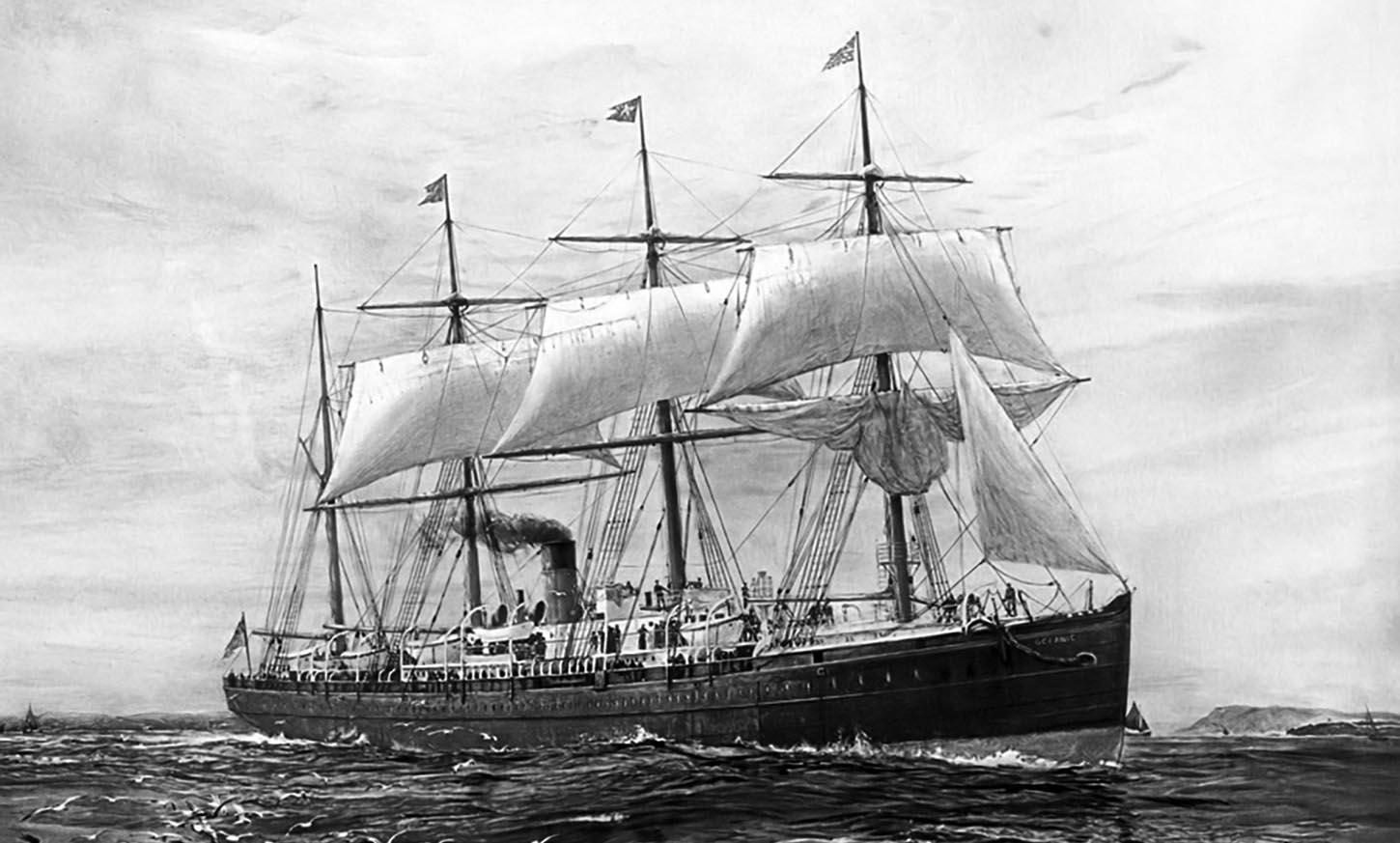
Left: The Georgic in the English Channel in June 1952.
Above: The 3,808grt Oceanic was built in 1871 by Harland & Wolff at Belfast. She was the first ship to have the “ic” suffix to her name which White Star subsequently continued. She was broken up on the Thames in February 1896 by Shipbreaking Co. Ltd.
Below: One of the White Star Line’s big four was the 24,540grt Adriatic which was built in 1907 by Harland & Wolff at Belfast. On 5th March 1935 she arrived at Osaka to be broken up.
(The late Allan Green collection)
Bottom: The Georgic as built with two funnels. She was completed on 10th June 1932 by Harland & Wolff at Belfast.
downhill, and on 10th May 1934, forced by the Government, the White Star Line merged with Cunard, to become the Cunard White Star Line. This also ensured the completion of Yard No 534, for Cunard, at the yard of John Brown on the Clyde, the 81,237grt Queen Mary.
The remaining ships in the White Star Line continued to be painted in the company colours and fly the White Star pennant above the Cunard house flag. On 1st July 1950 Cunard finally took over the White Star Line completely, however both house flags continued to be flown until 1968 when the last White Star ship, the tender Nomadic, was withdrawn from service.
In order to maintain a regular cross Atlantic service a sister to Britannic was ordered from Harland & Wolff and laid down in July 1929. Yard No 896 was to become Georgic (2). Work proceeded slowly and the ship was launched on 12th November 1931, her trials took place on 4th June, with invited guests being taken to the shipyard of Harland & Wolff on the specially chartered Ulster Monarch. Georgic was handed over on 10th June 1932, making her maiden voyage on the 25th June. Attempts to expedite construction in April 1931 to enter service before the end of May failed to materialise. This was to cater for an estimated 25,000 Americans attending a
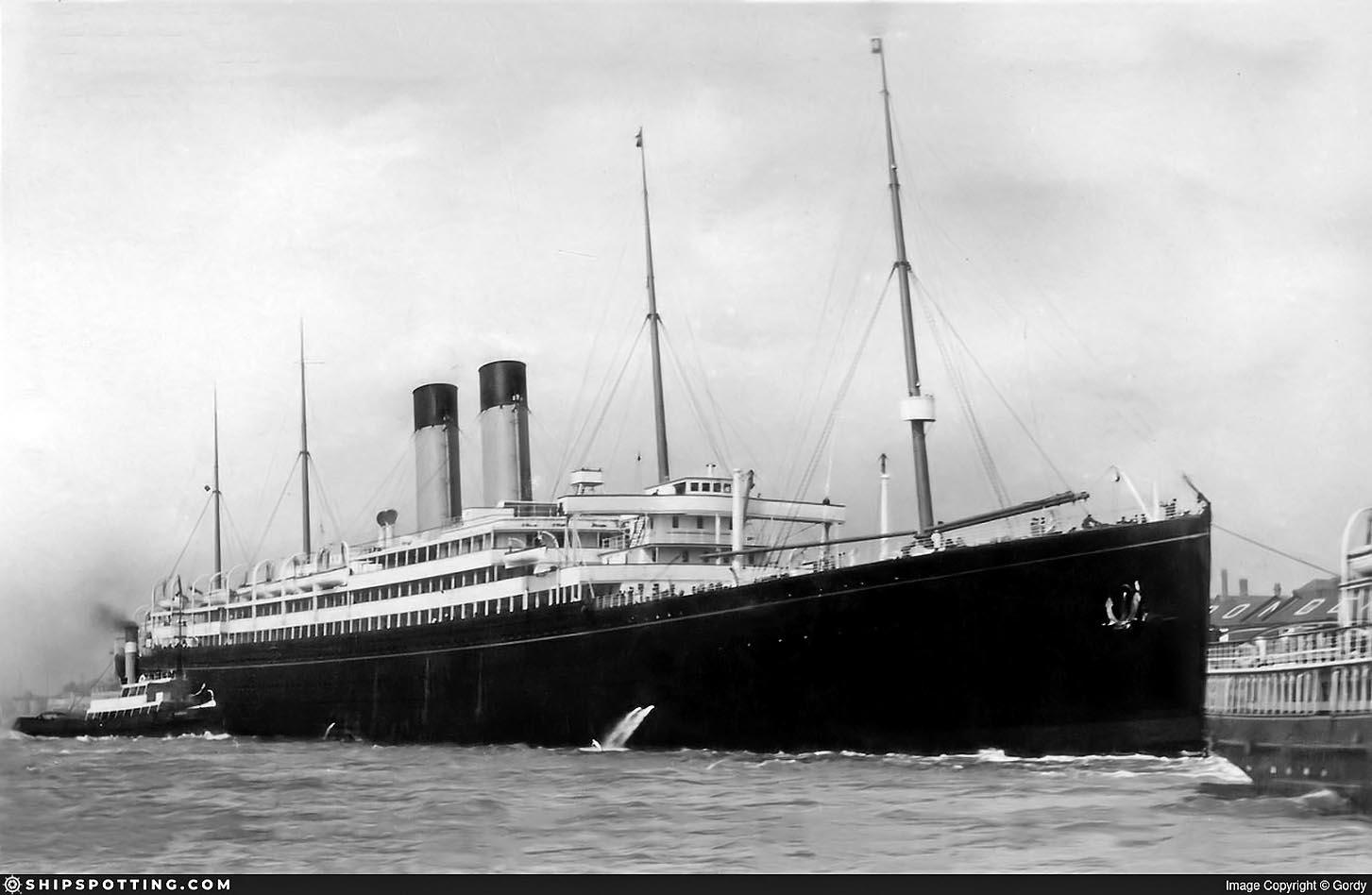
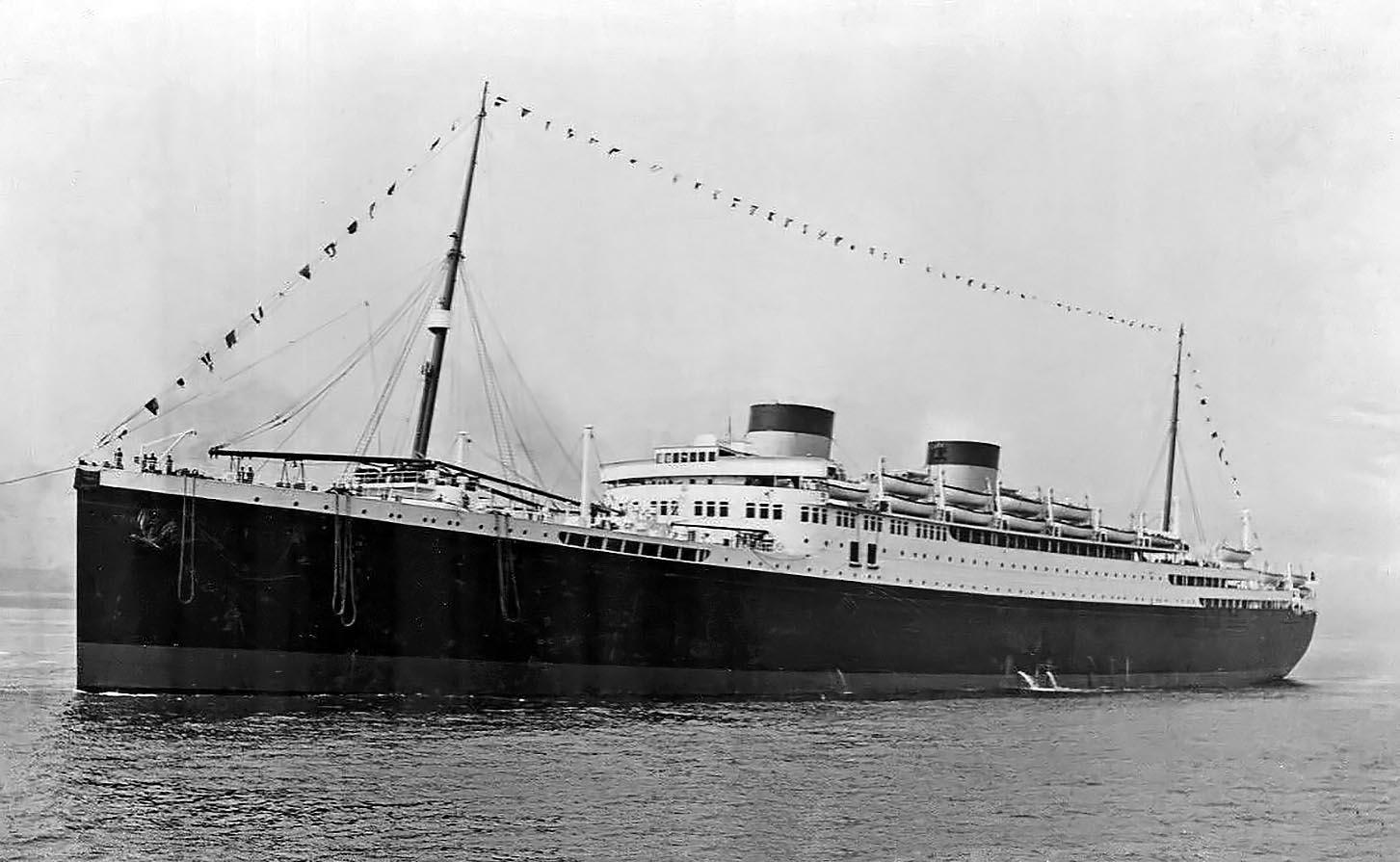
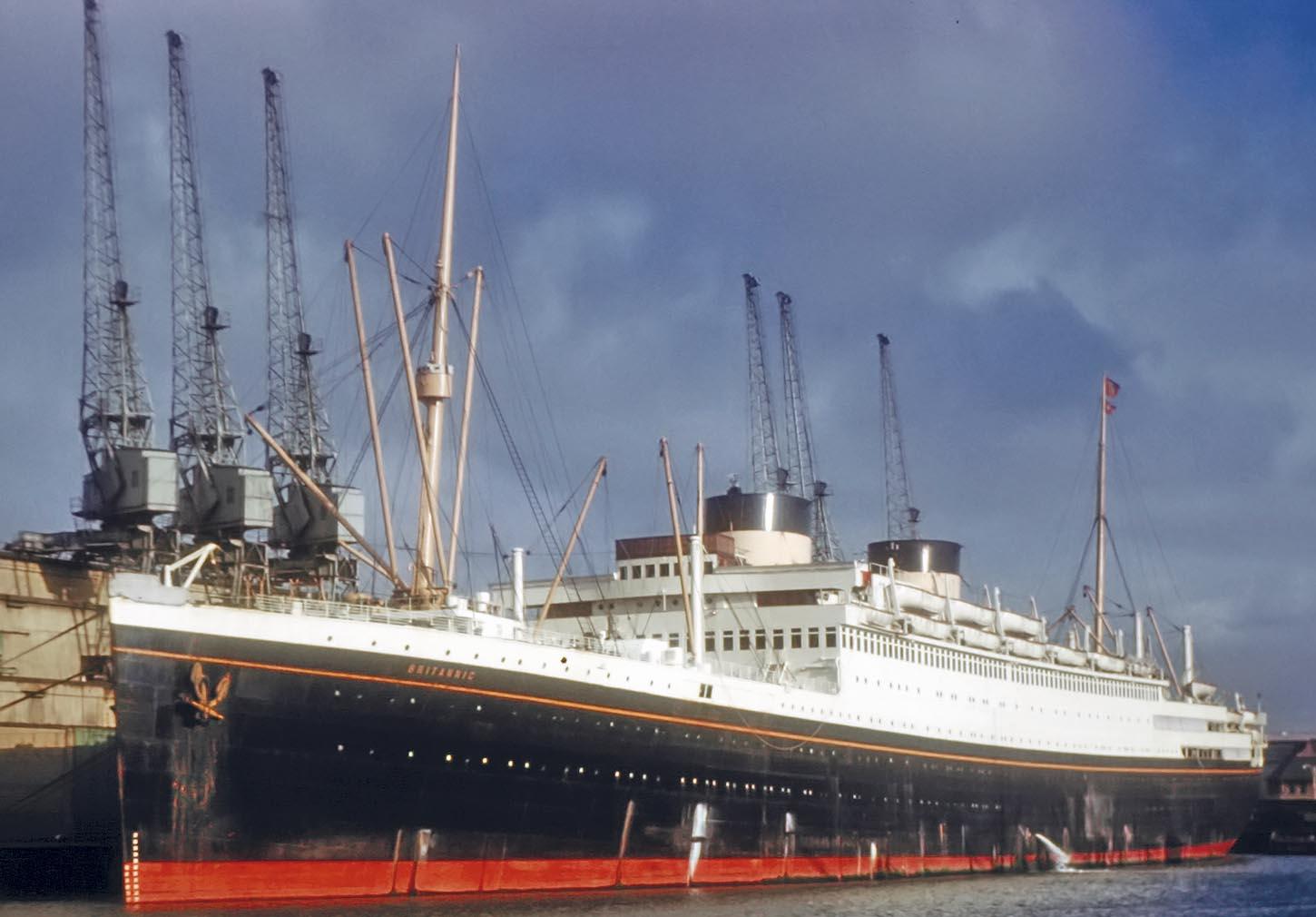
Above: Georgic’s elder sister was the 26,943grt Britannic which was completed on 21st June 1930 by Harland & Wolff at Belfast. On 19th December 1960 she arrived at Inverkeithing to be broken up by T.W. Ward. (Don Smith/photo-transport.com)
Below: The Georgic in her wartime grey livery following her major refit.
Bottom: Other liners that assisted in the evacuation of troops from St. Nazaire included the 20,001grt Oronsay of Orient SN Co. She was built in 1925 by John Brown at Clydebank. On 9th October 1942 she was torpedoed 800 miles WSW of Monrovia by the Italian submarine Archimede when serving as an auxiliary transport. (Chris Howell)
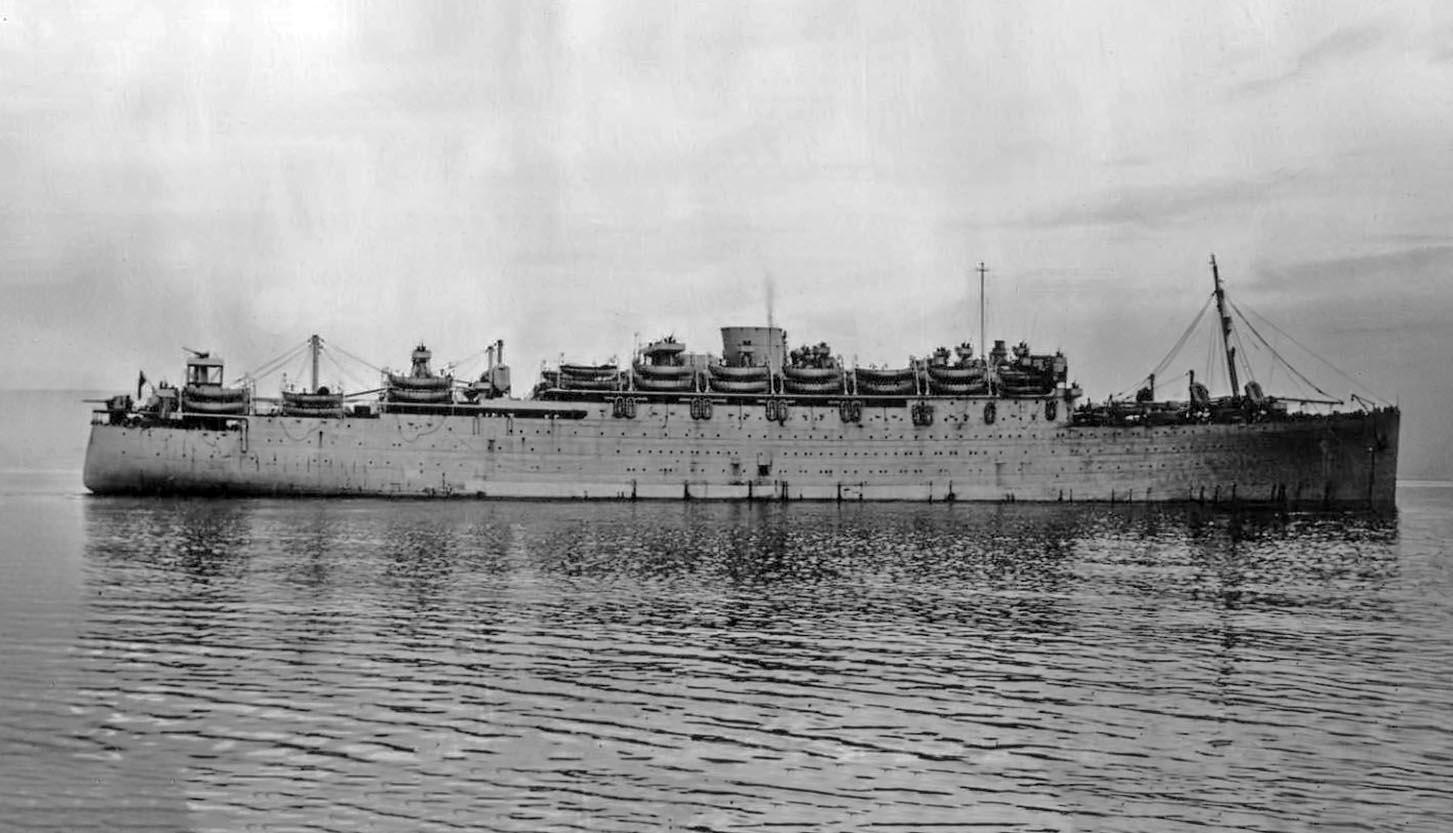
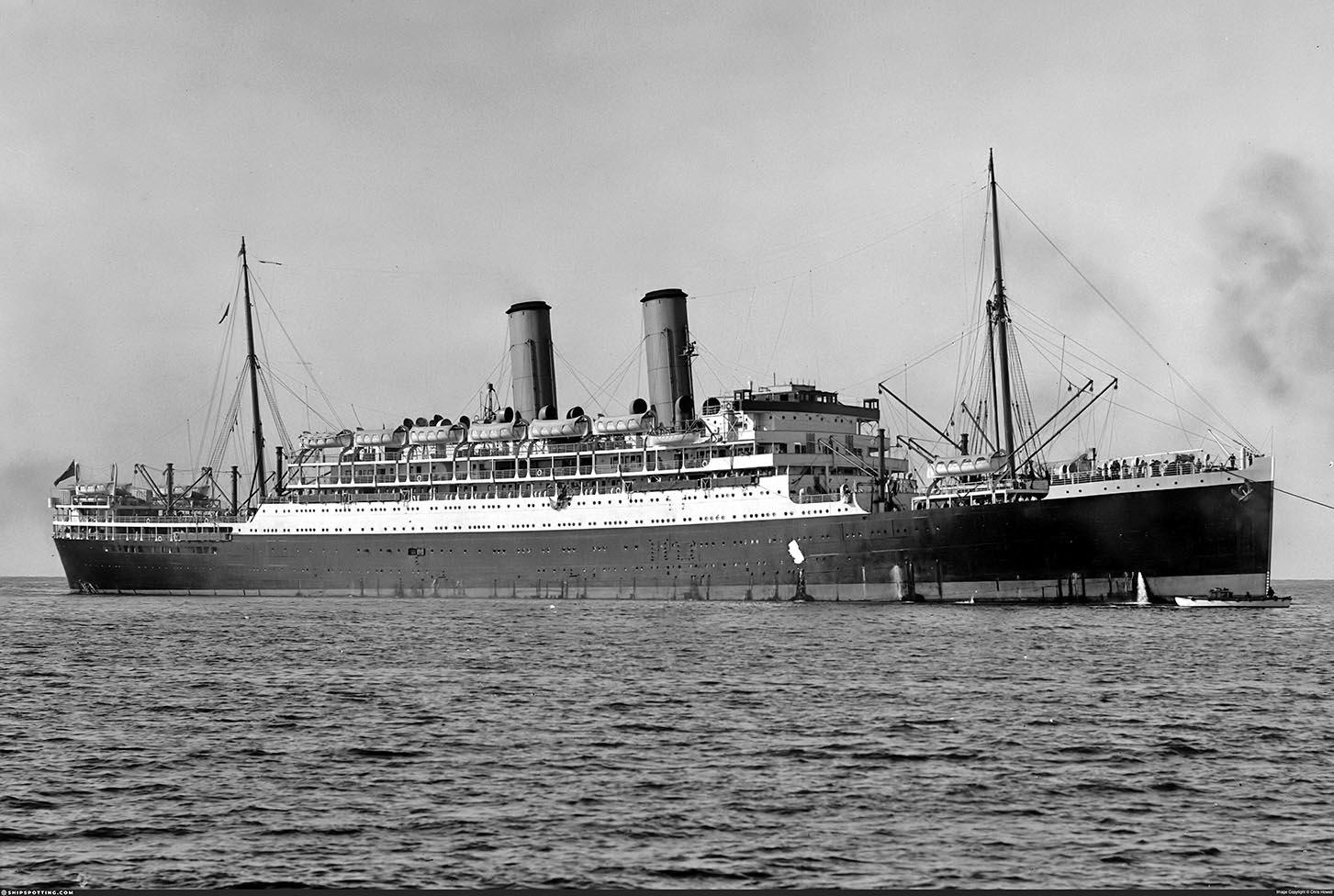
religious conference in Dublin later in June, thus an opportunity was missed.
Tonnage: 27,759 gross tons. 16,839 net. Length: 682.8 ft., beam 82.4 ft., draught 35 ft.
Engines: 2 – 10 cyl, four stroke, double acting Burmeister & Wain diesel engines built by Harland & Wolff. 20,000 ship with 2 screws. Speed: 18 knots. 19.8 knots on trials on the 4th June 1932.
Accommodation for 1,542 passengers. 479 cabin class. 557 tourist class and 506 third class.
Crew: 500.
Both Britannic and Georgic were “Cabin Class” vessels, modern in appearance and could be recognised as coming from the Harland & Wolff shipyard, as with Union Castle ships built there in the 1920s, having diesel engines with two squat funnels, the forward one being a dummy.
Georgic had an almost straight bow, cruiser stern, two raked masts and six Samson posts, two forward and four aft. She had two squat funnels, running parallel with her main deck. The forward funnel was a dummy having the radio room and engineers smoking room contained inside. The bridge was round, whereas, her sister Britannic was flat. The engines of both Britannic and Georgic were identical with two 10,000 shp Harland & Wolff, B & W oil engines. At the time of completion their oil engines had the largest individual power in marine service.
Cylinder diameter was 840 mm, the stroke 1,500 mm and the engines ran at 110 rpm for 17 knots. The main engines were of the air-injection type. Four independent air compressors were provided in a special auxiliary room forward of the main engine room. Each of these machines was driven by a 4-cylinder oil engine of trunk piston design. The cylinders being 500 mm in diameter. Also in the auxiliary room were four more oil engines driving electric generators to provided electric power for the ship with a combined capacity of 2,000 kW, plus there was also a 75 kW emergency generator.
Georgic had two Clarkson exhaust gas boilers for the main engines, and two smaller boilers for the auxiliary machinery, one for the exhaust from the generator engines and the other from the compressor diesel engines.
The main boilers had a heating surface of 1.000 sq. ft. being 16 ft. in height and 9 ft. in diameter. The vertical exhaust box measured 4 ft. The two auxiliary boilers were 6 ft. 9 ins. in diameter and a height of 11 ft. 6 ins. with the exhaust box 1 ft. 3 ins., heating surface was 300 sq. ft.
The boilers were all of the, then, new Clarkson jointless type and produced 5,000 lbs. of steam per hour from each main boiler at a pressure of 100 lbs. per sq. in. and 1,850 lbs. per hour from each auxiliary boiler.
Georgic was flush decked with a combined bridge and superstructure extending for 403 feet over the vessel’s length to the stern. There were eight steel decks clear of the machinery spaces and the sun deck above the promenade deck had a tennis court.
Both deck and engine officers were accommodated in a large deckhouse on the boat deck with an electric lift to the engine room, with deck officers accommodation being adjacent to the wheelhouse. This area was called Bridge “A” deck.
The main public rooms were on the promenade deck and right forward was the captain’s suite with the officers mess room behind it. Forward of the promenade deck, extending the full width of the ship was the spacious Palm Court, which had a huge dance floor and grand piano.
Just aft of the Palm Court was a lobby with a lift in the centre and two timber stairwells to the sides. Aft of the lobby was a large lounge with a central dome, a stage and a dance floor.
Looking aft along the port side was the “Long Gallery,” whilst on the starboard side there was an office, followed by another central lobby with doors to the outside decks and toilets. Next was positioned the card room followed by a third (aft) lobby with two further exits to the promenade deck. Far aft was the smoking room, which was open to the veranda and cocktail bar. Amidships on C deck was a large dining room with a dome.
Georgic was designed as a “Cabin Class” ship and the facilities and degree of comfort afforded was at least equal to any contemporary de-luxe liner, her interiors being of The Art Deco style. The ship’s hull had twelve main bulkheads, with eight holds, two of which were refrigerated.
Georgic sailed on her maiden voyage from Liverpool on 25th June 1932, calling at Cobh, Boston and New York. The passage was made in rough weather, however she still arrived in New York 12 hours ahead of schedule. In December 1932 her sailing from Liverpool was brought forward by two days to fit in with the arrangements for the Christmas mails to the USA.
After her maiden voyage Georgic continued on the Trans Atlantic service, but during the winter months the vessel operated popular “One Class” luxury cruises from New York to the West Indies and South America.
Early in 1933 the ship temporarily replaced the Olympic on the Southampton, Cherbourg to New York service, whilst the older liner was being refitted, including an overhaul of her engines. Following the completion of the refit, Georgic returned to the Liverpool to New York service.
The popularity of being Cabin Class vessels for both Britannic and Georgic, literally, kept the White Star Line afloat during the early 1930s at the time of the Great Depression. The slower diesel-engined ships
were more economical to run than the steam powered vessels, and the savings were passed down to the passengers and consequently fares were cheaper.
The French Line with their diesel powered Lafayette (25,178grt/1930) and Champlain (28,094grt/1932) together with United States Lines turbine powered Manhattan (24,289grt/1932) and Washington (24,289grt/1933) also operated on the Cabin Class principal and, too, were successful.
In October 1933 Georgic discharged a record cargo of fruit at Liverpool from the USA. This consisted of 42,568 barrels of apples and about 10,000 barrels of pears and grapefruit representing 3,000 tons, some of which had been transported to New York from Canada.
In 1934 the White Star Line merged with Cunard, and the following year both Georgic and Britannic were transferred to operate from the King George V dock in London. The sailing to New York was now via Cobh, Galway and Boston. The new service began on 3rd May 1935 making Georgic the largest ship to use the Thames, being slightly larger than the Shaw Savill liner, Dominion Monarch which was 27,155 grt compared with 27,759 grt for Georgic and 26,943 grt for Britannic.
Great Britain declared war on Germany on 3rd September 1939, and Georgic made five round trans Atlantic voyages with fare paying passengers before being requisitioned as a troop ship in March 1940.
After discharging at Liverpool the ship sailed up to the Clyde, on 19th April, all the luxury fittings were removed and within a month the vessel had been adapted for the carriage of 3,000 troops.
At the end of May 1940 Georgic assisted with the evacuation of British troops from Norway following the failure of that campaign. The troops, from Andesfjord and Narvik were landed on the Clyde. As soon as the servicemen had been put ashore, Georgic sailed south to assist with Operation Aerial the evacuation of troops from St Nazaire. She was the largest ship assigned to the Operation, sailing from St. Nazaire on 17th June and arriving at Liverpool with 3,982 troops the following day. The ship was under repeated air attacks and was extremely lucky not to have been hit. Sailing for a similar rescue mission to La Pallice, she was ordered back before reaching that port.
Other liners that successfully evacuated troops from St. Nazaire included the Canadian Pacific's Duchess of York (20,021grt/1929), the Orient Liner Oronsay (20,001grt/1925), which was hit, but survived and the Polish ships Batory (14,287grt/1936) and Sobieski (11,030grt/1939). The troops were ferried out the larger ships by French tugs and the RN destroyers HMS Beagle and HMS Havelock.
Unfortunately on 17th June, the Cunard White Star liner, Lancastria (16,243grt/1922) was bombed and sunk with the loss of
between 2,000 and up to 3,000 men. This was the single worst disaster in British Maritime history and was kept secret until after the war, and even now the full extent of the loss is not fully known.
Georgic also provided lifeboats to assist in Operation Dynamo, the evacuation of troops from Dunkirk from 27th May to 5th June 1940, and Operation Cycle the evacuation of troops from St. Valery and Le Havre from 10th June to 13th June 1940.
From July to September 1940 the ship sailed to Iceland, then to Halifax, Nova Scotia, collecting Canadian troops who were transported to the Middle East via the Cape as transit of the Mediterranean and Suez Canal was too dangerous. Other journeys to the Middle East from Glasgow and Liverpool were also undertaken. Sailings between Liverpool to New York and Canada were made too with some evacuees on the westbound passage. Georgic transported approximately 25,000 troops, mainly to the Middle East.
Georgic sailed from the Clyde to the Middle East via the Cape on 22nd May 1941 with the 50th Northumberland Infantry Division bound for Port Tewfik, Egypt in the Gulf of Suez. The ship was under the command of Captain A.G. Greig OBE, RNR, and was part of a convoy that had been left almost unprotected, the escorts being taken away to assist in the hunt for the German battleship Bismarck. The German ship was eventually sunk on 27th May 1941 by gunfire from the RN battleships HMS King George V and HMS Rodney before being finished off by torpedoes from the cruiser HMS Dorsetshire.
The actor James Robertson Justice was an RNR officer onboard Georgic and his flamboyant manner and natural acting talents went some way to keep up the spirits of those onboard.
The convoy passed Gibraltar and the Azores and safely docked in Freetown, Ghana to take on stores and fuel. A further stop was made at Durban, and Georgic carried on with the now depleted convoy to Aden, arriving at Port Tewfik on 7th July, where the troops on board were disembarked. The ship had been carrying 31 nurses of the Queen Alexandra’s Imperial Military Nursing Service who also disembarked and boarded a train at Suez for the No.1 General Hospital at Ismailia.
Georgic was then to take onboard about 800 Italian women and children internees. On 14th July, whilst waiting to embark these passengers the vessel was attacked by German aircraft based on Crete. The aircraft had been sweeping the area for targets and upon sighting the unprotected liner pressed home the attack.
Following several near misses, two bombs hit the ship. The first glanced off the ship’s side and exploded in the water causing a massive amount of damage next to No. 4 hold. The second bomb hit the aft section of
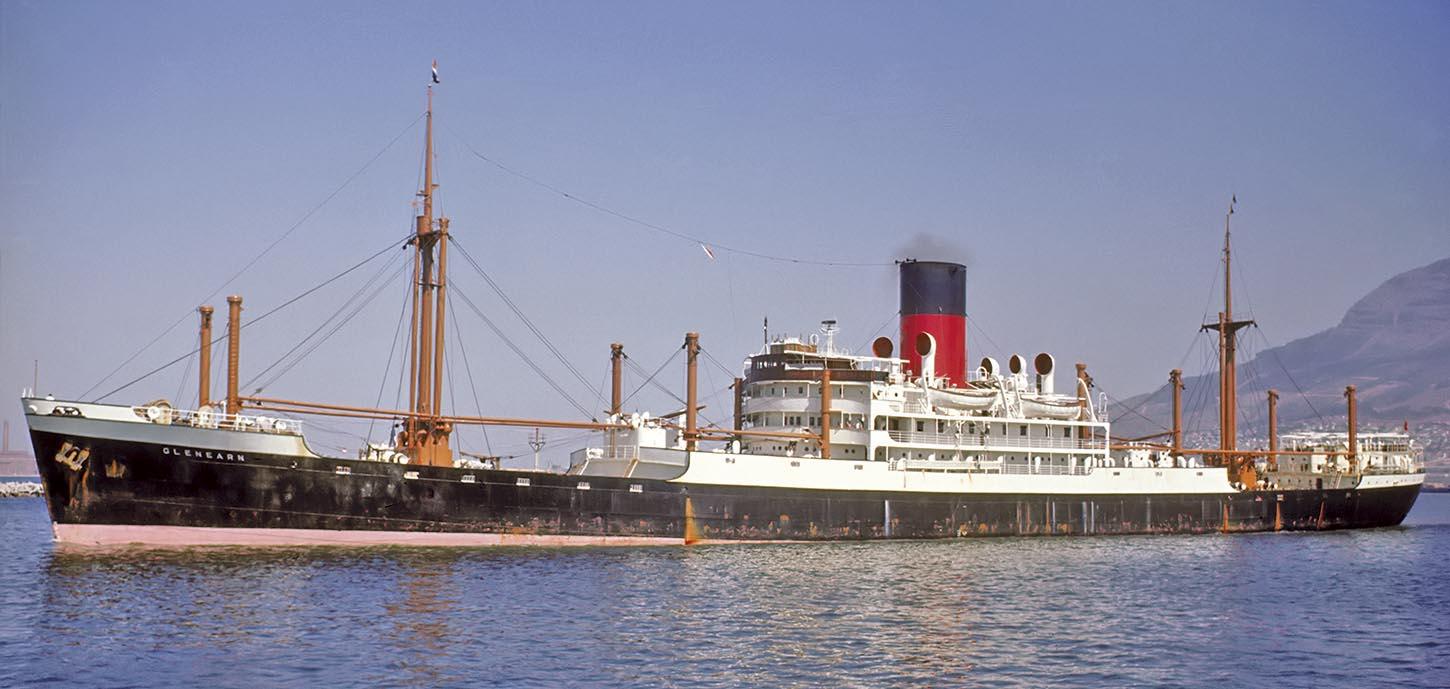
Above: The 9,784grt Glenearn was built in 1938 by Caledon Shipbuilding & Engineering at Dundee for Glen Line. On 11th December 1970 she arrived at Kaohsiung to be broken up by Tung Cheng Steel & Iron Works. ((Malcolm Cranfield - Trevor Jones collection
Below: The 7,255grt Clan Campbell of Clan Line towed the Georgic to Port Sudan in December 1941 together with the Ellerman liner City of Sydney. She was built in 1937 by Greenock Dockyard at Cartsdyke East. On 23rd March 1942 she was bombed and sunk near Malta with the loss of 10 lives.
(John B. Hill collection)
the boat deck, penetrating some five decks down. The first bomb caused severe flooding and the second, that exploded in a lift shaft, also caused extensive damage to No. 5 hold.
The subsequent fire ignited fuel from the broken fuel tanks, and the fire spread quickly igniting ammunition stored aft of the hold. This resulted in an explosion, which engulfed the after part of the ship.
Despite the extensive damage, engineers on board the ship heroically managed to restart the engines and on 16th July her Master, Captain Greig managed to manoeuvre the blazing ship out into the middle of Suez Bay and on to a sandbank. As a result the busy shipping channel was not blocked.
On the after deck near to No. 5 hatch was a German tank, captured in the desert, that was being transported to the UK to be examined. A barge was brought alongside and members of the Norfolk Regiment managed to place slings around the tank and winch it over the side on the barge. This was a very hazardous procedure as the ship was still blazing with ammunition exploding all around.
(John B. Hill collection)
Bottom: After temporary repairs were carried out in Port Sudan the Georgic was towed to Karachi by the 5,981grt Recorder of T. & J. Harrison assisted by the tug St. Sampson. She was built in 1930 by Cammell, Laird at Birkenhead. In 1950 she was sold to Audax SS Co. of Hong Kong and renamed Audax and in 1951 she joined Pacific Union Maritime Corporation of Panama as Ocean Star. In 1952 she was acquired by Hachiuma Kisen KK and renamed Ocean Maru and in 1960 she moved to Hokuyo Suisan KK as Seiyo Maru. the following year she was converted into a crab cannery ship, then on 10th December 1971 she arrived at Kaohsiung to be broken up by Tung Ho Steel & Iron Co.
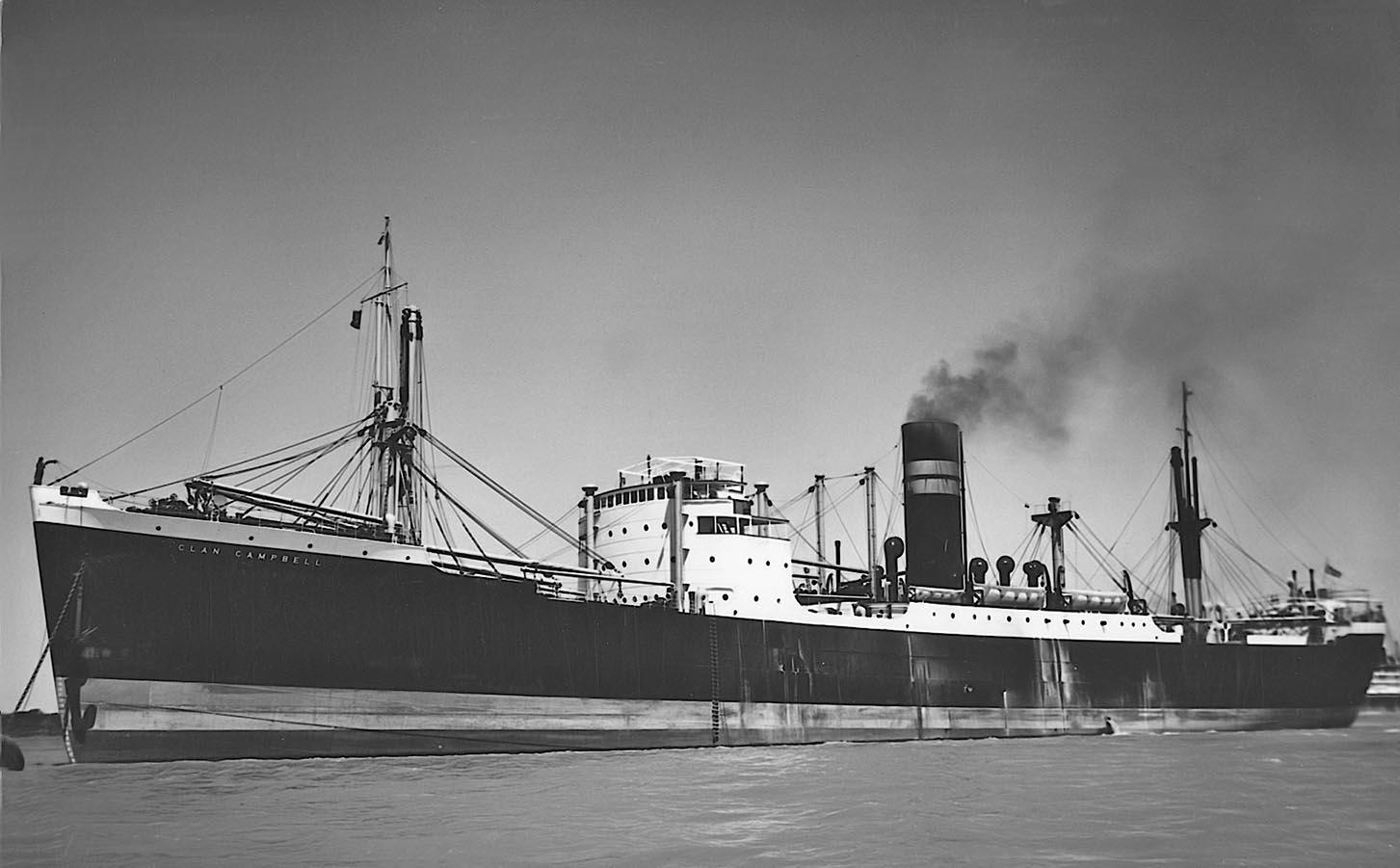
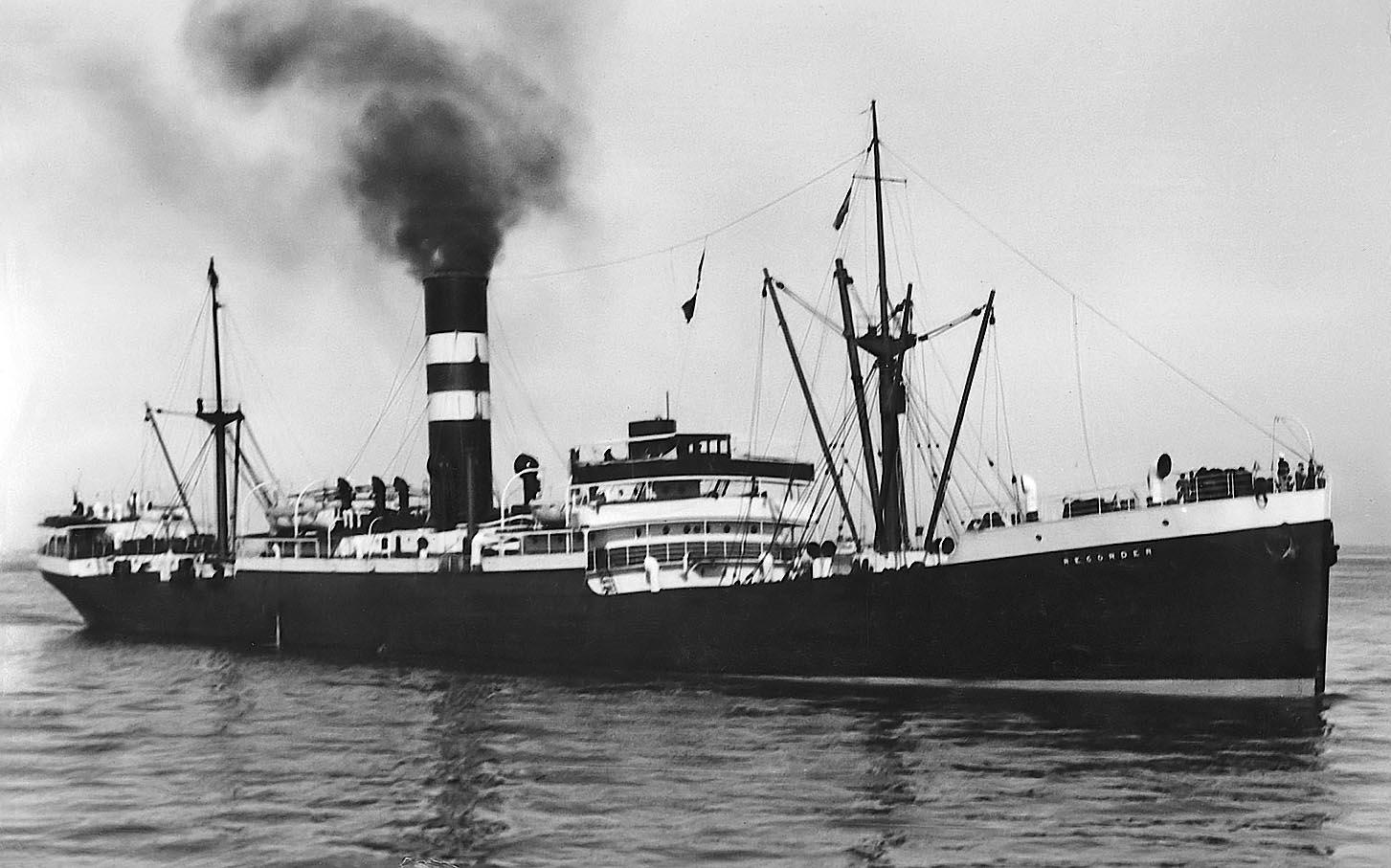
Whilst carrying out the manoeuvre to get her away from the main channel, she collided with the Infantry Support Ship HMS Glenearn. As a result of the collision Georgic twisted her bow. Fire had also spread to the upper decks and the liner began to sink. As the fire swept forward through the midships superstructure including the accommodation and upon reaching the bridge the order was given to abandon ship, all those onboard escaped in the ship’s lifeboats.
Glenearn, herself, became stuck on the sandbank, and it was necessary to be towed off by the Australian light cruiser HMAS Hobart (ex HMS Apollo) (7,105 tons displacement, built 1934).
Glenearn was built by the Caledon S/B & Engineering Co. Ltd., Dundee (Yard No 368) for the Glen Line (A. Holt & Co., managers), Liverpool. She was a handsome, modern looking motor ship, and completed in 1938 with a gross tonnage of 9,784. Diesel engines producing 12,000 bhp, two shafts, to give a speed of 18 knots
On 15th October 1939 the vessel was requisitioned as a Fast Fleet Supply Ship and converted to that role by Palmers at Hebburn on the Tyne. On 25th April 1940 she was commissioned as HMS Glenearn. However, just over two months later on 2nd July 1940 she was again converted, this time to an Infantry Support Ship, carrying landing craft. Her sisters, Glengyle (8,957grt/1939) and Glenroy (8,959grt/1939) were similarly fitted out in the Infantry Support role. All three vessels survived the war and were retuned to commercial service.
Glenearn was one of the best-equipped vessels of the type and her armament included two-twin 4 inch A.A. mounting on the fo’c’sle and another on the poop along with High Angle Directors.
German bombers damaged Glenearn during the evacuations of Greece and Crete however she managed to evacuate 50,673 troops.
On 10th June 1941 the Glenearn had arrived in a damaged state at Suez, and following the collision with Georgic eventually made it to Colombo to be repaired. She was present at the D-Day landings and was transferred to the Pacific Fleet in 1945, being released from naval duties in July 1946. The vessel was converted back to commercial service by Smiths Dock on the Tyne and returned to her owners in December 1947 being employed on UK to Far East voyages until broken up at Kaohsiung in 1970.
Her Battle Honours included, Greece 1941, Libya 1941, Mediterranean 1941, and Normandy 1944.
Georgic settled by the stern and came to rest on the sandbank, where thee fires were left to burn out over the next two or three days. The ship listed heavily on her port side and took several weeks to cool down.
Although the engine rooms were partially flooded with 18 feet of water and the ship gutted by fire an assessment was made on 14th September and concluded that Georgic was salvageable. The holes in the hull were temporarily plugged and water pumped out and consequently although still a wreck she was now dry. Whilst still anchored the temporary plugs were replaced with more permanent cement boxes to make her more seaworthy.
Georgic was still without power, light or accommodation and as there were no tugs available the vessel had to be towed by two cargo vessels. On 2nd December 1941, Georgic was taken in tow, stern first by the Clan Campbell (7,255grt/1937) and City of Sydney (7,000grt/1930) to Port Sudan where they arrived on 14th December. The United States had entered the war during this period after the Japanese attack on Pearl Harbour.
Further repairs were carried out at Port Sudan to make her more seaworthy and after eight weeks the vessel was taken in tow on 5th March 1942 by the ss Recorder (5,981grt/ 1930) and the hired naval tug St. Sampson (451grt/1919) steering at the stern, en route to Karachi. The three ships hit heavy weather and Recorder battled to bring Georgic’s bow into the wind and eventually had to heave to. During these manoeuvres the tug St. Sampson suffered damage and began to sink on 7th March, the crew being picked up by the hospital ship Dorsetshire (9,645grt/ 1920) which was in the vicinity at the time.
After twelve hours Recorder and Georgic managed to resume, their journey, having been joined by the Nils E. Moller, (Shanghai) tug Pauline Moller (422grt/1918) and the British India vessel Haresfield (5,299grt/1919) eventually reaching Karachi on 31st March 1942. Haresfield succumbed to a torpedo from the Japanese submarine I-29 on the 9th September 1943 whilst en route from Aden to
Colombo. I-29 was sunk by the US Submarine USS Sawfish in the Balintang Channel on 26th July 1944.
Further temporary repairs, not requiring a dry dock, were carried out in Karachi. With only limited resources Georgic had her engines and generators put back into working order, her stem made straight and limited crew accommodation rebuilt. The repairs were not completed until 11th December 1942, following which Georgic sailed, under her own power, at a speed of 11 knots, for Bombay arriving on 13th December. The ship was then placed in a dry dock to have her hull cleaned and further repairs carried out. She was under repair for just over a year, sailing for Liverpool on 20th January 1943. The vessel was loaded with 5,000 tons of pig iron as ballast arriving at Liverpool on 1st March 1943 managing to make 16 knots. In addition £10,000 freight money was earned for the carriage of the pig iron.
Georgic sailed for her builder’s yard at Belfast, but due to congestion in the port the vessel had to wait until 5th July 1943 before work could commence. During the next 17 months the ship was completely re built, to carry out the tasks as a troopship, the work being completed in 17 months by 12th December 1944.
The ship that emerged looked completely different to the one that had left the Belfast yard in 1932. The forward (dummy) funnel had been removed, together with the aft mast and the forward mast reduced in height.
Now taken over by the Ministry of War Transport (MoWT) she was handed over on 16th December 1944, with Cunard White Star Line as managers. In 1946 the owners became, simply, the Ministry of Transport (MoT).
1945 was a busy year for the rebuilt Georgic. She trooped to Italy, the Middle East and India, returning to Liverpool on Christmas day, 1945 with troops from the Far East. These included General Sir William Slim who had been Commander in Chief of South East Asia.
The new year of 1946 saw Georgic repatriating 5,000 Italian prisoners of war, before heading off to the Far East. In June 1946 homeward bound from Bombay trouble erupted onboard between civilian women and service women, and this led to the exclusion of civilians on troop ships, unless there was no alternative transport available. Georgic continued on trooping duties for the next two years.
In 1948 the need for troop ships dropped dramatically, however the need for ships to take immigrants to Australia and New Zealand increased. The ship was then to be restored for civilian service, but also available for further trooping duties if necessary.
In September 1948 Georgic was put in for a refit at Palmers yard at Hebburn on the Tyne. The vessel was to be upgraded to
enable her to be a passenger-carrying vessel suitable for the Australian or Trans Atlantic service once again, rather than just a troopship or migrant vessel. She was to carry 1,962 passengers in one class.
Following the refit Georgic emerged in White Star colours once again with black hull, red boot topping a thin yellow line placed high around the hull. Her superstructure was all white and a single yellow and black funnel. Her interiors were now more of a basic standard and nowhere near the luxury standards of before the war.
The vessel lost her somewhat elegant, balanced looks now with the single funnel, and reconfigured masts, no main mast, short, raked fore mast and two masts just aft of the bridge for flag hoists. On the boat deck, promenade deck and A deck she carried 36 lifeboats in double tiers.
From 11th January 1949 to 19th November 1955 Georgic operated on the UKAustralia migrant service, during the winter. The vessel was managed by Cunard, who had taken over the White Star Line completely in July 1950, but under charter to the Australian government.
The vessel departed Liverpool on Tuesday 11th January 1949 for the first voyage to Australia with 1,994 passengers. This consisted of 1,529 adults and 465 children, and the ship sailed via the Suez Canal, calling at Port Said as well as Suez.
After leaving the Canal, Georgic took on fuel at Aden before making the long run through the Indian Ocean to Fremantle for Perth in Western Australia, arriving there on 6th February,1949.
After sailing from Fremantle the vessel sailed across the southern part of Australia heading east for the “Southern Ocean” and sailing along the “Great Australian Bight.” Although the seas on this part of the voyage could be rough and the weather inclement, on this trip the weather remained fine and the children onboard had a fine time able to play on the outside decks.
Passing the City of Adelaide Georgic headed for Melbourne, arriving there on 12th February, where she disembarked some of the passengers.
Georgic sailed from Melbourne later the same day and headed north along the east coast to Sydney arriving there on Valentines Day, 14th February. Here the remaining passengers were disembarked, and the ship returned without any passengers to England.
From 1950 through to 1954, during the “Atlantic high season” in the summer Cunard chartered Georgic back from the Ministry of Transport to operate a “Third Class” service from Liverpool or Southampton to New York. This was carried out in conjunction with her sister Britannic to enable the high demand for the Trans Atlantic crossing to be met.
The Georgic was chartered in 1950 for six such round voyages, following which,
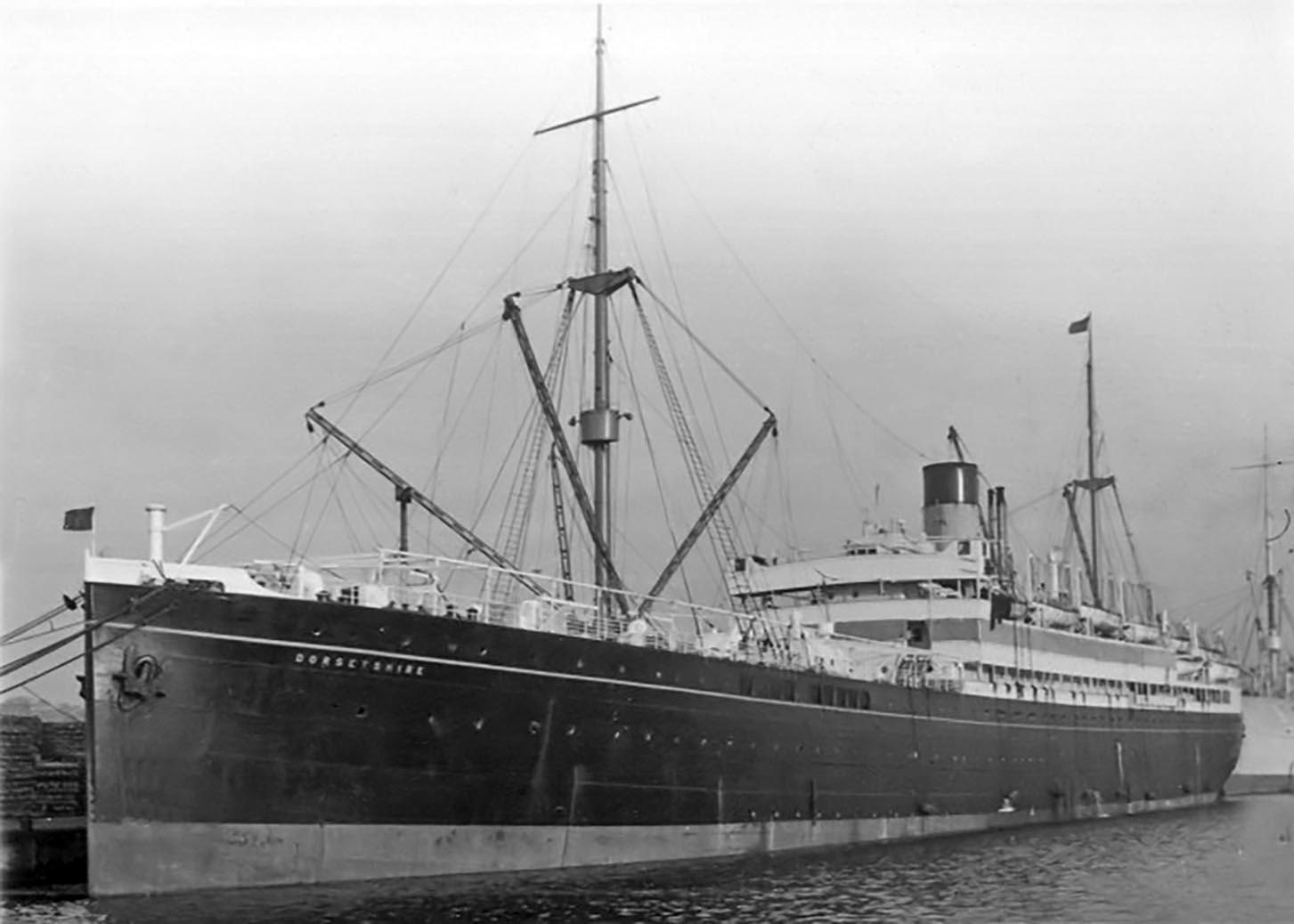
Above: In the tow of the Georgic to Calcutta the 451grt tug St. Sampson sank and her crew were rescued by the 9,645grt Dorsetshire of Bibby Line which was a hospital ship at the time. The Dorsetshire was built in 1920 by Harland & Wolff at Belfast. On 1st February 1954 she arrived at Newport to be broken up by John Cashmore. (John B. Hill collection)
Below: The Georgic in her post war days with just the one funnel. (The late Allan Green collection)
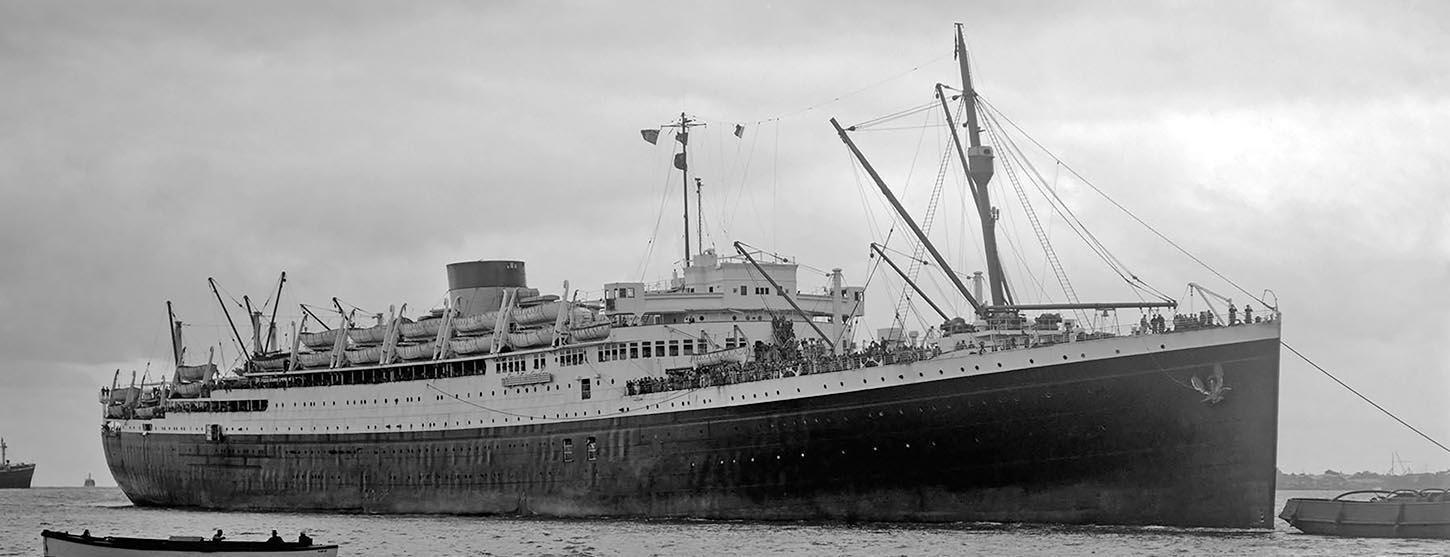
until 1954, she made seven round voyages annually.
The second voyage to Australia sailed from Liverpool on 8th April 1949, and when she returned to Liverpool the vessel was utilised for another trooping voyage departing from that port on 8th July 1949 sailing to Hong Kong.
Upon her return from the Far East, Georgic was prepared for her third Australian voyage. However, during the trip she damaged a propeller and in November 1949 had to be dry docked in the Captain Cook Dry Dock in Sydney, where a new propeller was fitted. Following completion of the repairs the vessel headed back to Liverpool.
The fourth voyage to Australia sailed late in January 1950 following the previous itinerary, and calling at Melbourne on 17th February, and Sydney on 19th February 1950. The vessel sailed on the 20th February heading for Jakarta in the Dutch East Indies collecting Dutch nationals returning to the Netherlands, via Liverpool where she arrived on 29th March 1950.
Following her next, fifth, round Australian voyage, Georgic commenced her next charter
with Cunard on the Liverpool to New York service during the summer months, returning to the Australian route in December 1950.
Georgic sailed from Liverpool early in December 1950, however during the voyage 49 cases of smallpox were identified and when the vessel arrived at Woolloomooloo, Sydney on 8th January 1951, the ship was placed in full quarantine. The quarantine was lifted on 14th January and Georgic sailed the next day, 15th January for Liverpool via Melbourne, Aden and Port Said, arriving home on 14th February 1951. Taken up again on her trooping duties, before returning to the Cunard charter, now with seven round transatlantic voyages, Southampton to New York and back.
During the winter months, November 1953 to April 1955 Georgic again took up trooping duties, bringing back Commonwealth troops from the Korean War. She was returned to the Cunard charter once these duties were complete. February 1954 saw the ship sailing to Hong Kong again, returning via Singapore, Colombo, Aden, Suez and Port Said arriving back at Liverpool on 12th March 1954. In January 1955 Georgic sailed for Egypt to
collect troops from Port Said, calling at Famagusta, Cyprus on her way back to Liverpool where she arrived on the 19th January 1955. Mid March saw Georgic sailing to Kure in Japan to collect more troops the voyage taking the ship via Hong Kong, Singapore, Colombo, Aden and Port Said back to Liverpool where she docked on 16th April 1955.
The engines of Georgic began to show their age and heavy use and The Ministry of Transport had decided that the career of Georgic was coming to an end. The vessel was offered for sale, however the Australian government put her retirement into abeyance by chartering the vessel for two more voyages.
She departed from Liverpool on 21st May 1955 sailing for Sydney via the Suez Canal, arriving at the Australian port on 23rd June 1955.
Sadly during this voyage when in the Red Sea the heat below decks became intolerable and as a result five young children died, and were buried at sea. Measures were then taken to ensure that the remaining youngsters did not succumb to the same fate.
The next voyage to Australia, departing Liverpool on 24th August 1955, was via the Cape, cognizance of the overpowering conditions in the Red Sea having been taken, the vessel passing through Fremantle on 29th September 1955. Georgic then sailed for Melbourne, arriving on the 4th October and Sydney on the 6th October.
In Sydney 3,000 Australian troops of the Royal Australian Regiment were taken onboard to sail to Malaya where there was trouble, which needed armed intervention. Georgic then sailed to Singapore to await orders, before being directed to Vung Tau in Vietnam to rescue soldiers of the French Foreign Legion. These soldiers were being withdrawn from Vietnam and returned to their home bases, and taken to Algiers and Marseilles via Aden and Suez. Georgic arrived empty back in Liverpool on 19th November 1955, and was withdrawn from service and laid up at her berth.
At the beginning of December Georgic sailed for the Clyde, her crew leaving the ship on the 12th December 1955 to await the tow to the breakers yard. The vessel was laid up at Kames Bay at the Isle of Bute and in January 1956 she was sold to Shipbreaking Industries at Faslane for £430,000 where she arrived a month later on 1st February 1956. The hull of the ship was beached on 23rd October 1956. In addition to metal to be melted down, she had yielded 19,124 tons of saleable material with 3,171 tons of rubbish.
So came the end of the last liner built for the White Star Line, although her sister Britannic would soldier on until 1960, and of course the Cherbourg tender Nomadic (1,273grt/1911) is still available to visit at “Titanic Belfast”.
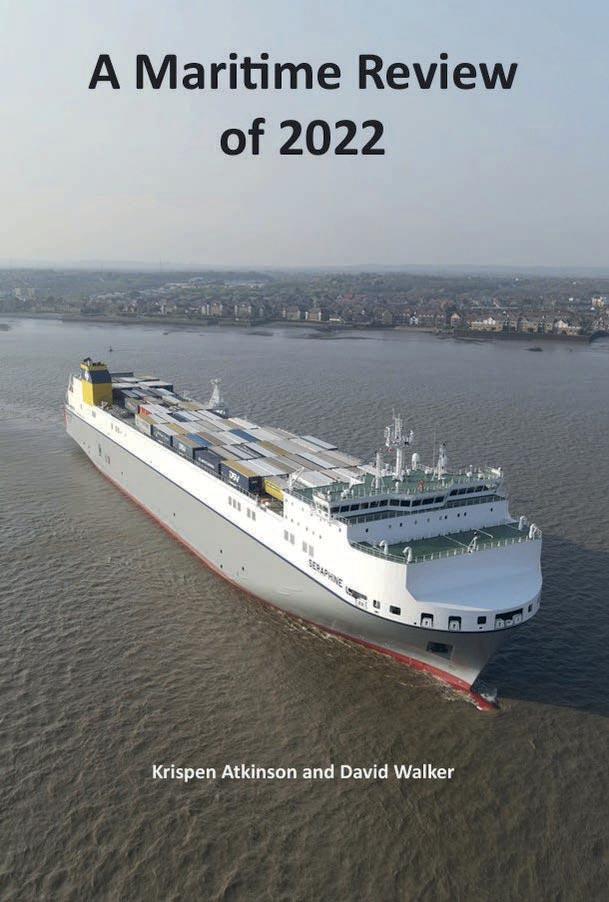

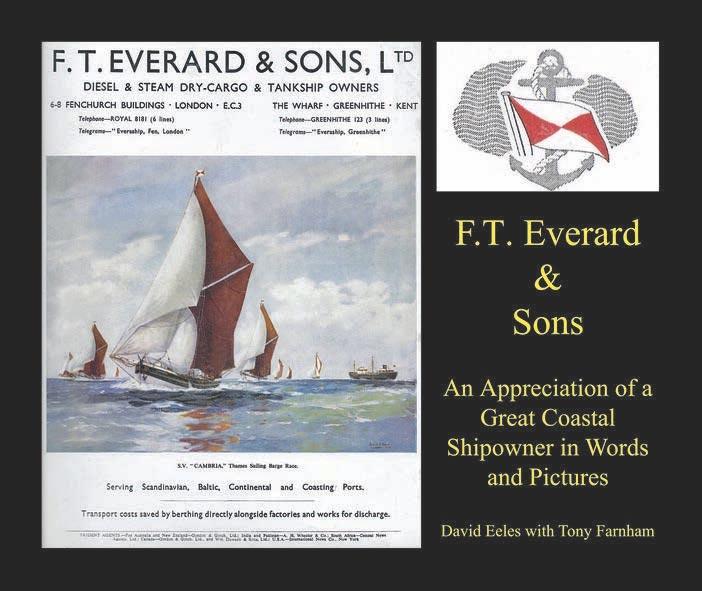
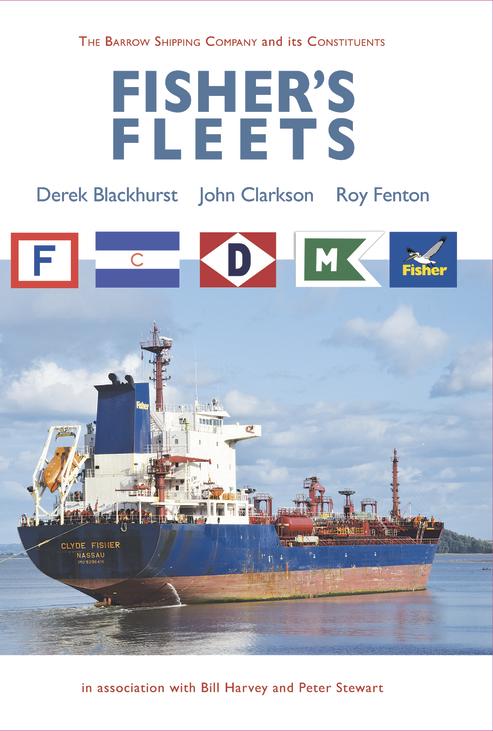




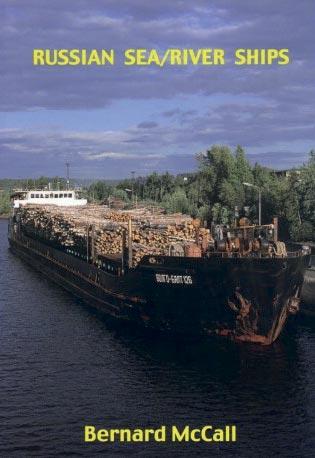
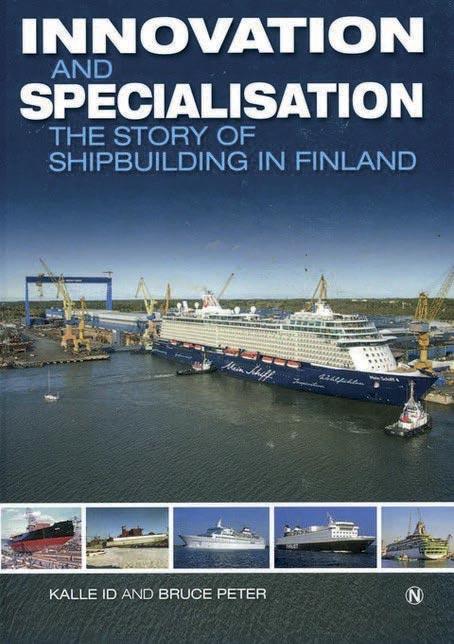


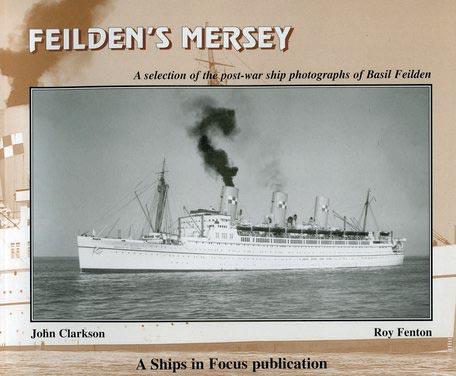

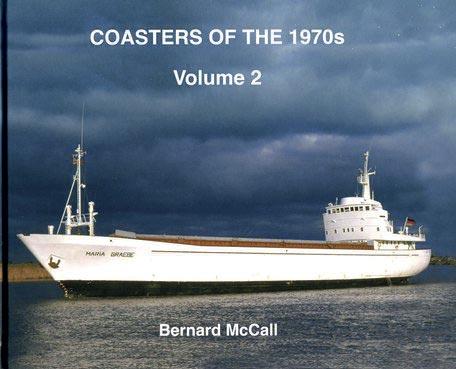






FEATURE by Ken Williams
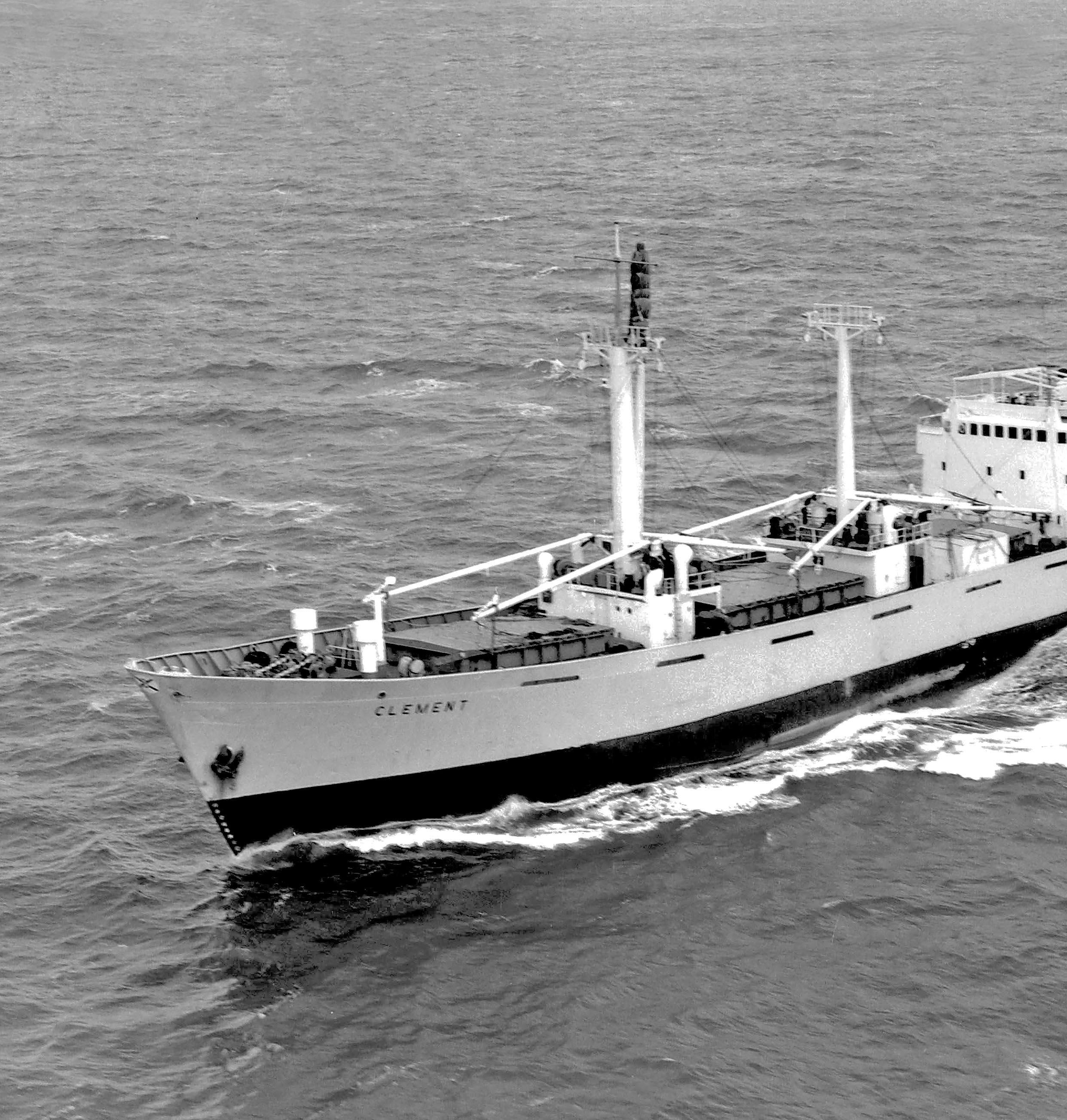
Whilst on leave between voyages I would sometimes visit the Norwich Reference Library to glance through the pages of the latest Lloyd's List for any interesting job vacancies. The back page usually featured box advertisements containing the sailing schedules of the major shipping companies.
One particular advert that always caught my eye was the Booth Line sailings to the River Amazon and the north coast of Brazil. The ports of call looked very interesting and many of them I had not heard of before.
In October 1972, I wrote a letter to the Booth Steamship Company's head office in Liverpool to enquire if they had a vacancy for a 4th engineer on one of their ships. A favourable reply came back to say that a permanent position would soon become available on the Clement in New York and that in the meantime, would I stand by one of their ships in port?
I immediately accepted the job offer and joined the Crispin berthed in the Manchester Docks. She was of 1,816grt and built in 1956 at a Dutch shipyard primarily for the Booth Line's New York to the River Amazon service.
The ship had a full complement of four engineers who were there solely to take her along the Manchester Ship Canal to Liverpool. We were not signed on any Articles of Agreement. The routine watchkeeping duties, such as transferring oil and looking after the generators were performed by two 24-hour men who alternated between one being onboard for 24 hours whilst the other was at home. My time onboard was mostly spent familiarising myself with the engine room prior to our departure for Liverpool.
During our long passage down the Manchester Ship Canal, we were on continuous standby and to relieve some of the mon-
otony, one of the engineers brought down below a small bag of Brazil nuts from the cargo to eat. We amused ourselves by breaking open the nuts on the engine-room plates with the aid of our 'shifters' which is what we called the adjustable spanners.
In Liverpool, a shoreside gang came aboard to open up parts of the main engine for overhaul and survey. Since the dock labour force was heavily unionised we were not allowed to do any maintenance work that could infringe local demarcation of work agreements. As a consequence, we mainly congregated in the 2nd engineer's cabin during the day and enjoyed the lively club scene at night.
In early December 1972, I flew out to join the 1,902grt Clement berthed in Brooklyn, New York. The ship had spent many years engaged on the New York to West Indies and River Amazon run and after the forthcoming voyage to Brazil was to
Left: The Clement (4) on which the author sailed to the Amazon. (FotoFlite
Above: The 3,965grt Crispin (1) was built in 1907 by Sir Raylton Dixon & Co. at Middlesbrough. On 29th March 1917 she was torpedoed and sunk by U-57 off Waterford while on a voyage from Norflok Va. to Avonmouth with a cargo of horses. Eight crew were killed together with 686 horses.
(National Museums Liverpool
Below: The 5,050grt Crispin (3) was built in 1935 by Cammell, Laird at Birkenhead. On 3rd February 1941 she was torpedoed by U-107 and sank the following day west of Ireland. Twenty lives were lost.
(John B Hill collection)
Bottom: The 4,472grt Crispin (3) was built in 1951 by William Pickersgill & Sons at Southwick. From 1953 until 1966 she operated for Austasia Line as Mandowi before returning to Booth as Dunstan. In 1967 they renamed her Rubens and in 1973 she was sold to George Kalogeras of Piraeus and was renamed Irini K.
On 24th April 1974 she arrived at Istanbul to be broken up by Tubec Selik Sanayii. (FotoFlite
return to the UK. She was completed in 1959 by Norderwerft Koser & Meyer at Hamburg and lengthened by her builders five years later to 354 ft. Her propulsion was by an eight cylinder, two-stroke Sulzer diesel engine rated at 2,400 bhp which gave the vessel a speed of around 13 knots.
The Clement had a complement of some 25 men comprising a master, three mates, a radio officer, four engineers, an electrician, and a chief steward who were all on UK Articles of Agreement, while the ratings were recruited from the West Indies, particularly Barbados, and signed a separate employment contract with the Company.
On my arrival onboard, I was warmly greeted by John, the 4th Engineer, whom I was relieving. He was so overjoyed to see me that he could not hand over the job quick enough. It appeared that he had taken a lot of stick from the other engineers and was now anxious to return home to Lancashire. The
Above: The 1,816grt Crispin (4), in which the author sailed, was built in 1956 by Van Duijvendijk's at Lekkerkerk. In 1974 she was sold to Armadora Maritima Salvadorefia SA of San Salvador and was renamed Ana and in 1980 she moved to Intercontinental Maritima SA of Peru as Andino. She was broken up at Callao during 1993. (FotoFlite)
Below: The 1,227grt Clement (1) was built in 1877 by Laird Bros. at Birkenhead as the Barbary for David MacIver. She joined Booth Line in 1882. In 1897 she was sold to Cia de Cabotagem do Grao Para of Brazil and was renamed Tocantins and in 1898 they renamed her Marajo. She was hulked in Brazil in 1913.
Bottom: The 3,445grt Clement (2) was built in 1896 by Robert Napier & Sons at Govan East as the La Plata for Royal Mail Lines. She joined Booth Line in 1900 then in 1915 she moved to H. & C. Grayson Ltd. and was renamed Freshfield. On 5th August 1918 she was torpedoed and sunk by UC-25 NNE of Cape Colonne while on a voyage from Messina to Taranto in ballast. Three lives were lost.
(John B Hill collection)
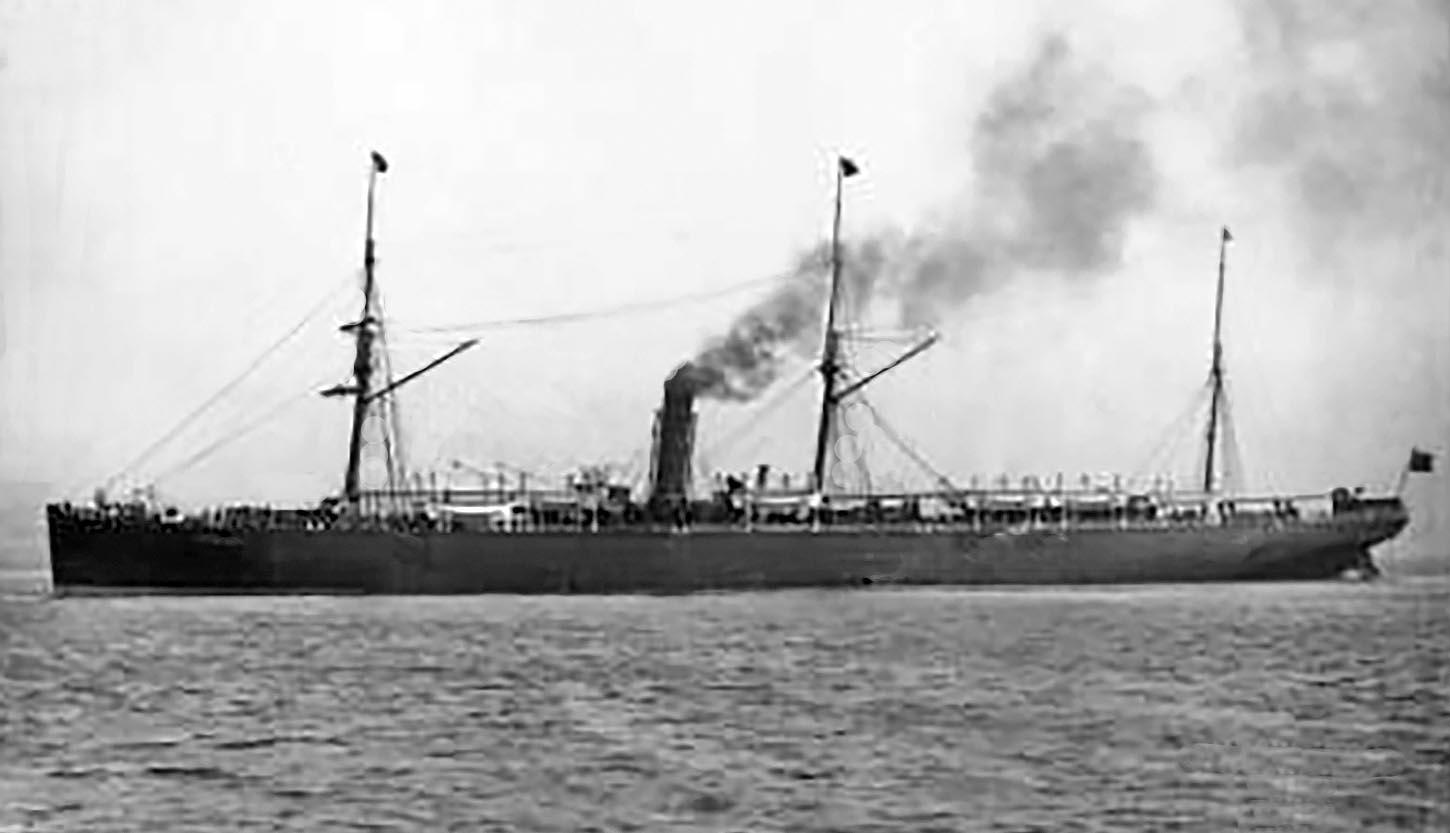
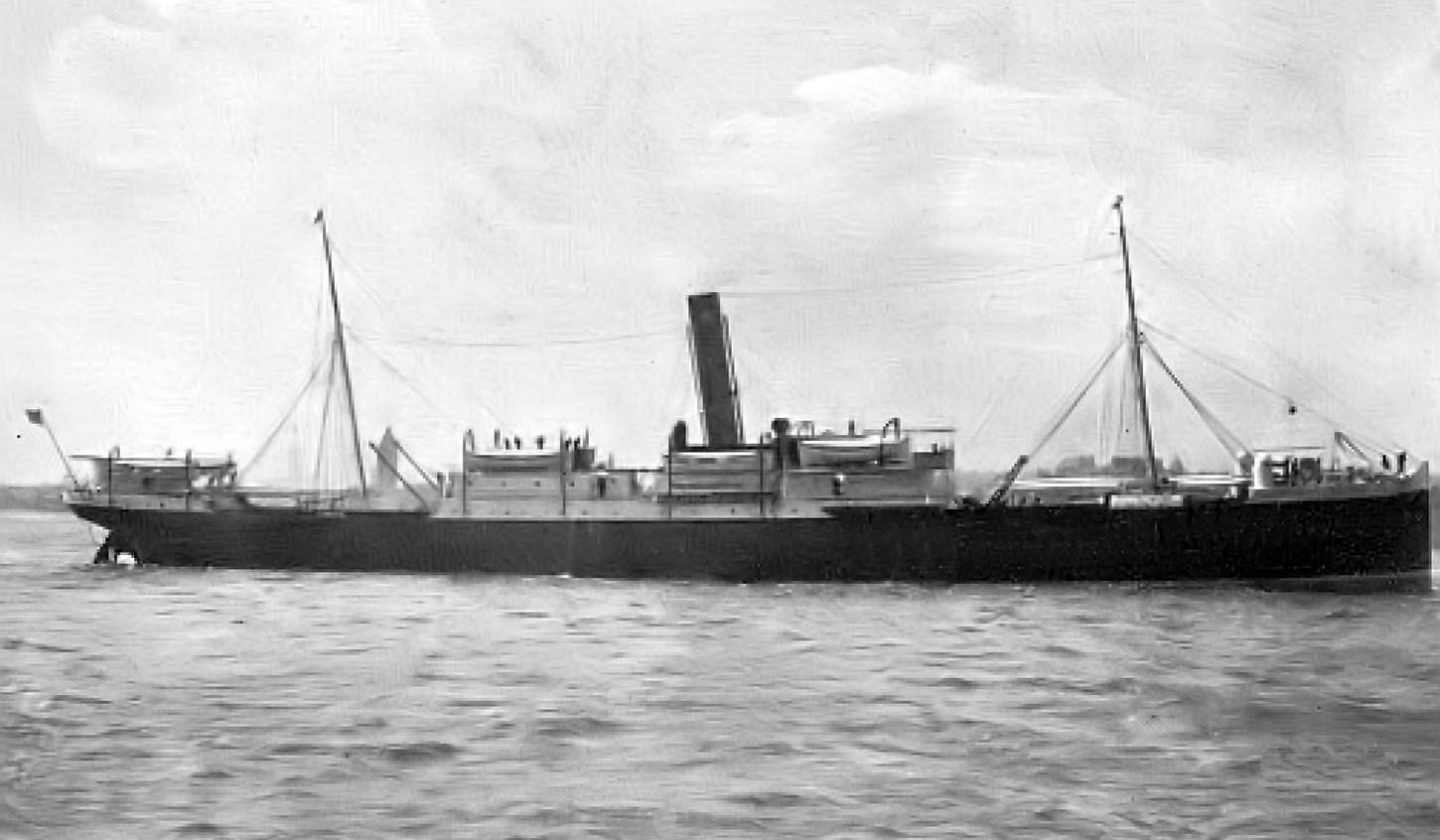
3rd Engineer, Roy Bushall, had remained onboard for over three years, without leave, in order to qualify for complete exemption from the UK's high tax regime. Roy had initially joined the ship to escape an engagement breakup back home in Preston. In his cabin stood a row of vitamin supplements which I thought was a forewarning of the standard of food to be expected. Sharing the same lobby as me was the 2nd engineer's cabin that was occupied by Brian Kenefick from Blackpool, who had served many years on the Booth Line passenger ships and had a host of amusing stories to tell. He was a good practical engineer and I would later learn a lot from him.
At the forward end of the engineers' alleyway was the cabin of Mr Dodd, the Chief Engineer, who was by far the oldest man onboard at 68 years-old. It was rumoured that his wife and stepdaughter had sent him back to sea in order to maintain their lifestyles. I later met the Electrician, Charlie Giles, from Liverpool where he had once been an amateur boxing champion. The engine room was permanently manned by three donkeymen from Barbados, on continuous watches of four hours on and eight hours off.
New York was where most of the mainengine overhauls were carried out with the assistance of shoreside labour, leaving only the routine maintenance work to do in the heat of the Amazon. After nearly a week alongside, we sailed to Philadelphia where our stay was much longer than expected due to many of us going down with some type of flu virus.
The ship remained in port until we were all deemed fit enough to leave for Miami to pick up some frozen products for the West Indies. It was now my job to get the cargo refrigeration plant up and running.
We sailed from Miami on Christmas Eve with boxes of frozen chickens for the Caribbean islands of Antigua, Guadalupe, Martinique, St. Lucia, Barbados, St. Vincent, Grenada, and Trinidad.
Some of the discharges were done in no more than five hours while others were overnight stays. On arrival at Barbados, a small group of men would wait patiently outside the 2nd engineer's cabin in the hope of finding a permanent job in the engine room. There were no such vacancies on offer, as our crew down below proved themselves to be steady and reliable.
On entering the mouth of the River Amazon, a cause for concern was that the main-engine lubricating oil (LO) pressure fell to below its normal reading, strongly indicating that the main LO pump would require our immediate attention on arrival at Belem.
Thanks to our heavy-handed way of removing the defective gears from inside the pump, its casing fractured! Upon hearing of this mishap, the Chief Engineer hit the roof
and was heard to exclaim, “We will never get out of here now!” He later came down below, in a more relaxed frame of mind, and said to me that there was a record of these spare pump parts being onboard. I quickly located the new pump gears, but the casing could not be found anywhere. Meanwhile, the fractured casing together with the new pump gears were fitted back on the main engine. As a precaution, the standby LO pump would be kept running until Manaus where the new casing being flown out from the engine manufactures in Switzerland should have arrived.
At Belem, a few Brazilian passengers embarked for the over 800 mile passage upriver to Manaus. They were housed in the officers' accommodation on the boat deck with shared sanitary facilities. Some of the passengers were unfamiliar with our toilet flushing arrangement and tended not to put toilet paper down the pan for fear of blocking the system, which was, no doubt, the normal practice in their home environment. It took some time for Wally, our Bajan steward, to convince them that there was no need to drop used toilet paper adjacent to the pan for him to pick up, and that our pneumatic system was more than capable of flushing away all toilet tissue.
The passengers dined at the captain's table in the wood-veneered dining saloon fitted with louvred doors. The Captain had served many years with the Royal Navy and carried the title of Lieutenant-Commander Clark RN (retired).
He was a stickler for dress code in the saloon, which we were not used to, and whenever one of us entered the dining area he would instantly stop eating his meal to look for any uniform irregularities. If there was something amiss, he would inform the Chief Engineer sitting adjacent to him who would later knock on your cabin door to express the Captain's displeasure.
Navigation up the Amazon had its hazards, such as logs floating downstream, which required the watchkeeping engineer to be stationed near the manoeuvring platform at all times, in case the main engine had to be stopped immediately in order to prevent the ship being disabled by a log drifting in the path of a rotating propeller. Needless to say, a spare propeller was always part of the ship's inventory.
In the 'narrows,' just above Belem, people in wooden canoes would frantically paddle out to our passing ship, shouting and waving, in anticipation that something useful would be thrown over the side. We prepared bags of secondhand clothes to be dropped to them, which were eagerly retrieved from the river. Even our empty beer cans were fished out of the water and taken back to their villages.
In Manaus, a former Booth Line 3rd engineer, named Gordon, would visit the
ship. Brian knew him quite well from his early days with the Company, and had various goods bought for him in New York that were unobtainable in Manaus. Gordon had married into a well-connected local family and was running a successful ship-repair business.
We were invited to an all-night drinking party at his family home. His wife did not join us but preferred to retire early. Gordon was in his mid-thirties but looked a lot older. He put this down to the oppressive humid climate and his ultimate goal was to start a new business with his wife in the more agreeable climate of south Brazil.
It was quite normal for us to arrive back onboard the ship in the early hours of the morning for our alcohol induced sleep. Inside, the accommodation at night could become uncomfortably hot and too humid to be able to sleep properly with the only means of relief being a small cabin fan blowing air at ambient temperature over the bunk. Thankfully, the bedding was changed every week. It was always a pleasant feeling to have the smell of fresh clean sheets and towels again.
Almost without exception, all the ships I have sailed on in tropical waters suffered from some degree of cockroach infestation. In New York, a specialist company came onboard to chemically spray the crevices and voids found inside the accommodation. But this was only a palliative.
After a few weeks they were soon back in full force crawling around the cabins. Another irritant was the number of mosquitoes. Although the accommodation was fitted with metal screens there were always a few mosquitoes that evaded these measures to disturb a good night's rest.
Manaus rapidly developed from a small trading settlement during the rubber boom of the late 19th century. Its main attraction was the large, impressive opera house built to entertain the residents of this once affluent city.
Late one afternoon, the Radio Officer and I visited the now dilapidated opera house and managed to climb into the dome of the building to get a magnificent view of the surrounding city. At the grand entrance to the opera house were still a number of surviving rubber-coated bricks installed to deafen the sound of horse-drawn carriages, so as not to disturb the performance inside. Tourism in Manaus was still in its infancy with the only tourists seen being a small group flown in from America.
As I initially feared, the food served onboard was not going to be a culinary delight, especially towards the end of the voyage. We usually gave the main course a miss and survived on the soup, the dessert or what was offered on the cheeseboard. Roy sometimes joined us at mealtimes, but preferred to eat selected items from the provi-
sion store, topped up with his own supply of vitamin pills. Fortunately for us, there were plenty of good restaurants in Brazil at a reasonable price.
After a few days berthed in Manaus, we sailed down river to a small logging port to load sawn timber from a nearby sawmill. Our next destination was Santana, situated in the Amazon delta, arriving there on a Sunday. That night, after a few beers onboard, Brian, Charlie, Ian the 2nd Mate, and I decided to take a walk up the road to find some sort of entertainment. We found a bar open and ordered a bottle of Bacardi with some PepsiColas. On their two pool tables we played billiards for about an hour.
But unknown to us, a charge would be levied each time a pocketed ball was retrieved from a metered pull-out drawer below the table. Playing billiards, rather than pool, led to us being presented with a large bill which we flatly refused to pay.
However, after some prolonged haggling with the bar owner a final price was agreed, but in the meantime he had sent for the police.
On leaving the bar we were met with a truck full of steel-helmeted police who ordered us back into the bar for questioning. The owner had now grossly increased the original bill at which we strongly protested to the police.
Despite settling the inflated bill, we were still beaten across our backs with long batons and forced to climb into the back of an open truck, before being driven to a remote prison. There, we were stripped of money and all valuables and led to a large, stone-floored cell holding other prisoners. Then we were ordered to sit down on the bare floor with our backs to the wall.
After a little while, Brian, who had been beaten the most, collapsed on his side and started groaning. The police came in with their batons ready to silence us. We called out 'medico,' which they ignored and left. Brian continued to groan even louder, at which time a vehicle was heard to pull up outside. We were ushered out of the cell to an awaiting taxi to take us back to the ship. On our way out I indicated to the duty officer at the desk that I wanted our personal belongings back. He refused point blank until Brian, being gently carried out horizontally by Charlie and Ian, gave out some extra cries of pain. This induced the officer to return the sequestered items, which I promptly stuffed into my trouser pockets, before hurrying out the door. At the ship, we helped Brian up the accommodation ladder and at the top he pushed us away and said, “Get off me you fools, lets get the beers in!”
Our next port of call was Belem to finish loading the rainforest products, including bales of rubber, Brazil nuts, rosewood oil, and sawn hardwoods (especially mahogany) from the vast Amazon basin. From there we
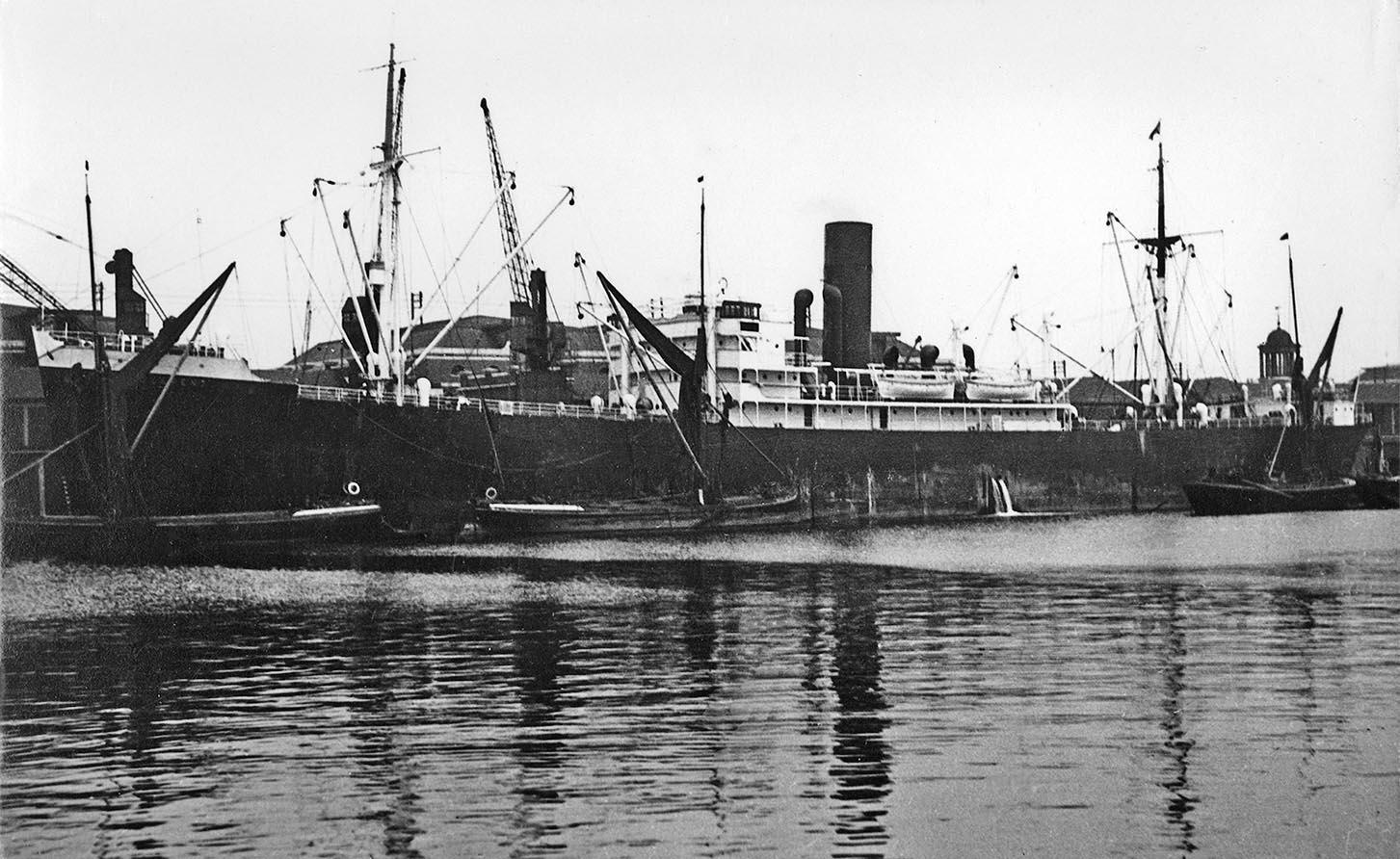
Below: The 1,902grt Clement (4) berthed in Liverpool in 1977. She was built in 1959 by Norderwerft at Hamburg. In 1978 she was sold to Dalin Maritime Corporation of Honduras and renamed Element and in 1981 she joined Sari Penampang Sdn Bhd as Pacific Samudra. In 1995 they renamed her Gedung Emas and later that year she moved to Bethany Mulia Shipping of Honduras as Indra Intan 2. She was deleted from the register in July 2010. (Charlie Hill)
Bottom: The Clement in her later years as Pacific Samudra of Sari Penampang Sdn Bhd, Malaysia.
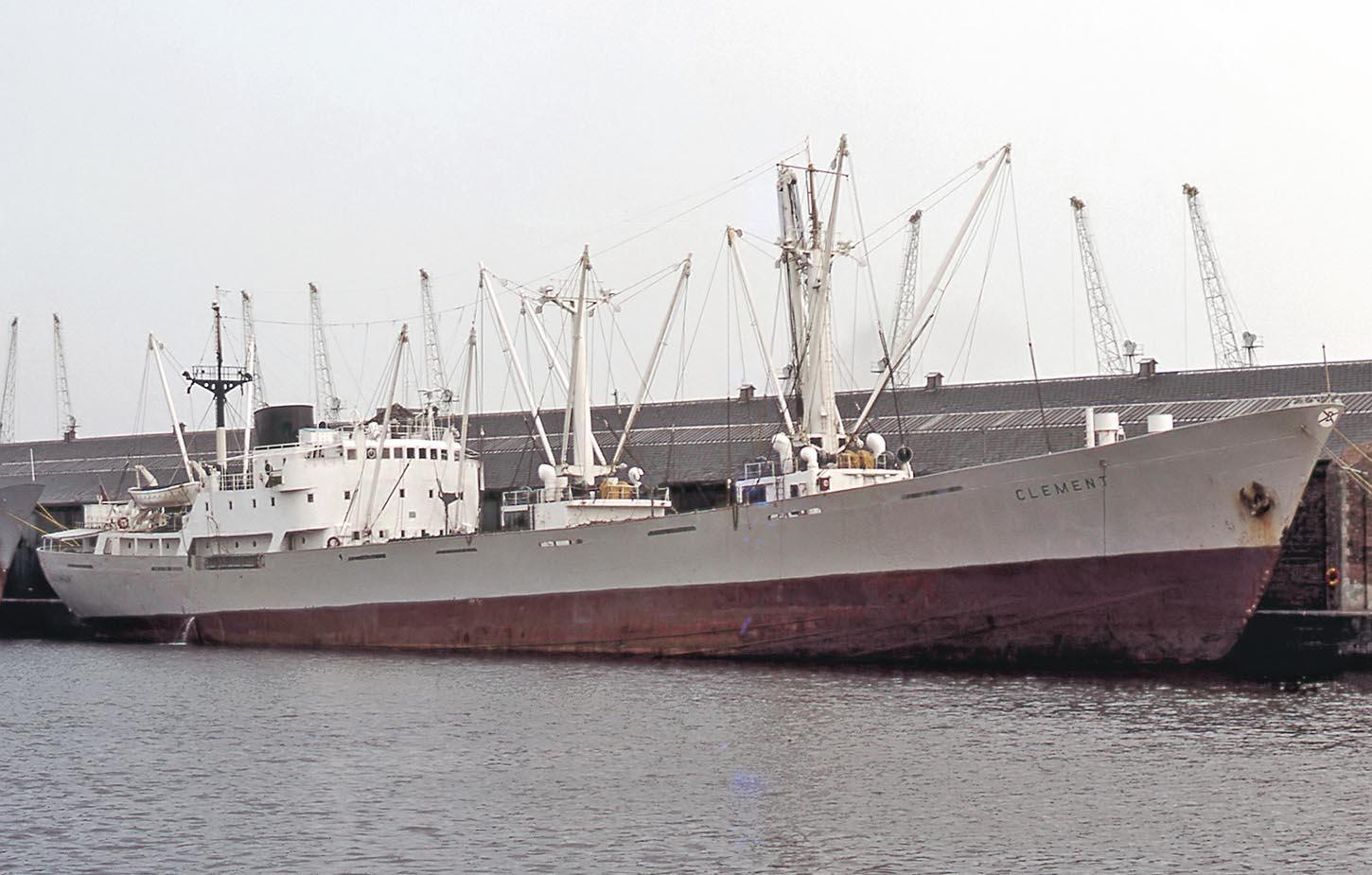
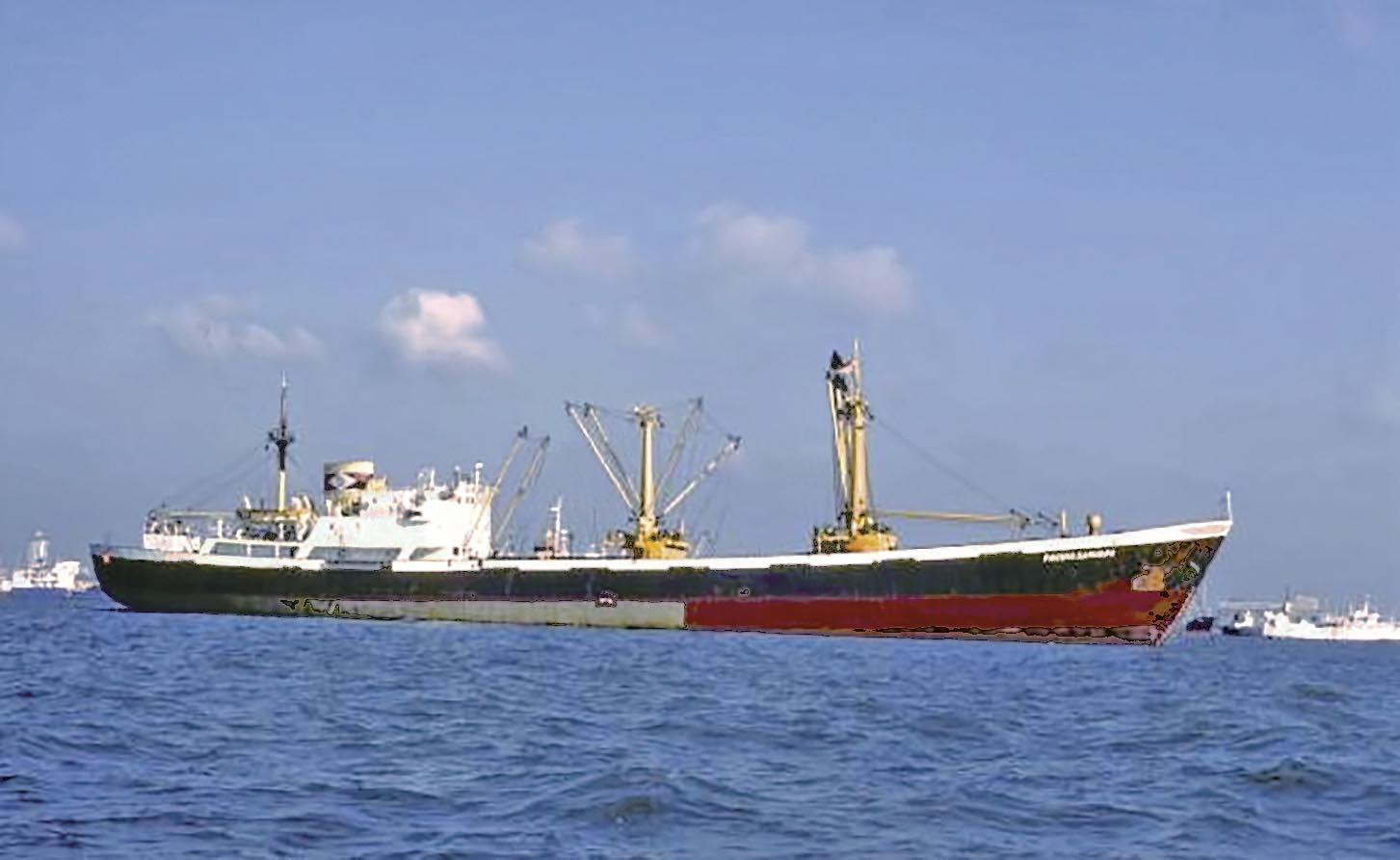
sailed along the Brazilian coast calling at Fortaleza and Natal. In Fortaleza, the main attraction on a Sunday afternoon appeared to be the ships moored along the quayside. It was not uncommon to see many unmarried couples being chaperoned by an older relative in the crowd strolling by the ship.
While off the north coast of Brazil, smoke was seen billowing from the deck cargo. The fire was quickly put out by the crew. It was later believed that the probable cause of the fire was an un-extinguished cigarette from the 3rd engineer's cabin. He had a habit of flicking his discarded butts out of the porthole where the wind could have swept them back on to the ship.
On the voyage back to the UK from Natal, Brian and I were given the task of recording the engine-room inventory. One afternoon, in the steering flat, we were trying to identify the various machinery parts packed in the wooden cases.
To our astonishment, we discovered the long lost main engine oil pump casing, the one that had been specially flown out from Switzerland at great expense. We looked at each other and Brian said, “Quick, give me a hand!” We carried the box with the casing inside up to the poop deck and then tossed it straight over the side.
Our next port of call was Las Palmas in the Canary Islands for bunkers, and an opportunity to sell the non-ferrous scrap metal from the engine room. Las Palmas was known to be a good place to sell scrap metal, and on our arrival waiting on the quayside was a man keen to negotiate a price for our scrap brass and copper pipes. There was, I believe, an unwritten custom at sea that the proceeds of the scrap metal from the machinery spaces was the engineers' perk, whereas the sale of the empty oil drums were for the donkeymen.
From Las Palmas we sailed to Dublin to spend four days alongside discharging cargo, before our departure to Liverpool where the voyage ended.
In March 1973, we signed off for the last time using our old discharge books containing a record of the seaman's character for conduct and ability.
An entry of VG (Very Good) was the norm, but anything else, namely VNC (Voyage Not Completed) or DR (Declined to Report) would have been detrimental for any seaman finding a berth in another ship. The replacement discharge books were issued, free of charge, with the space for conduct and ability entries deleted so as to comply with the International Labour Organization Convention.
In 1977, the Booth Line terminated the New York-Amazon run as competition from South American companies increased and the amount of cargo on offer diminished, thus bringing a service spanning almost a century to a final close.
Subscribe to Shipping Today & Yesterday by direct debit and save £10.60* on the normal shop price. Every month you will receive your personal copy usually before it’s on sale in the shops, offering you maritime news, historical articles & regular features from the world of merchant shipping.








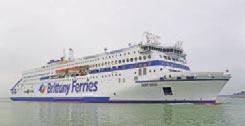
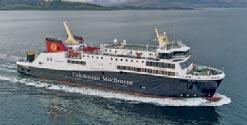
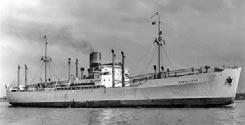



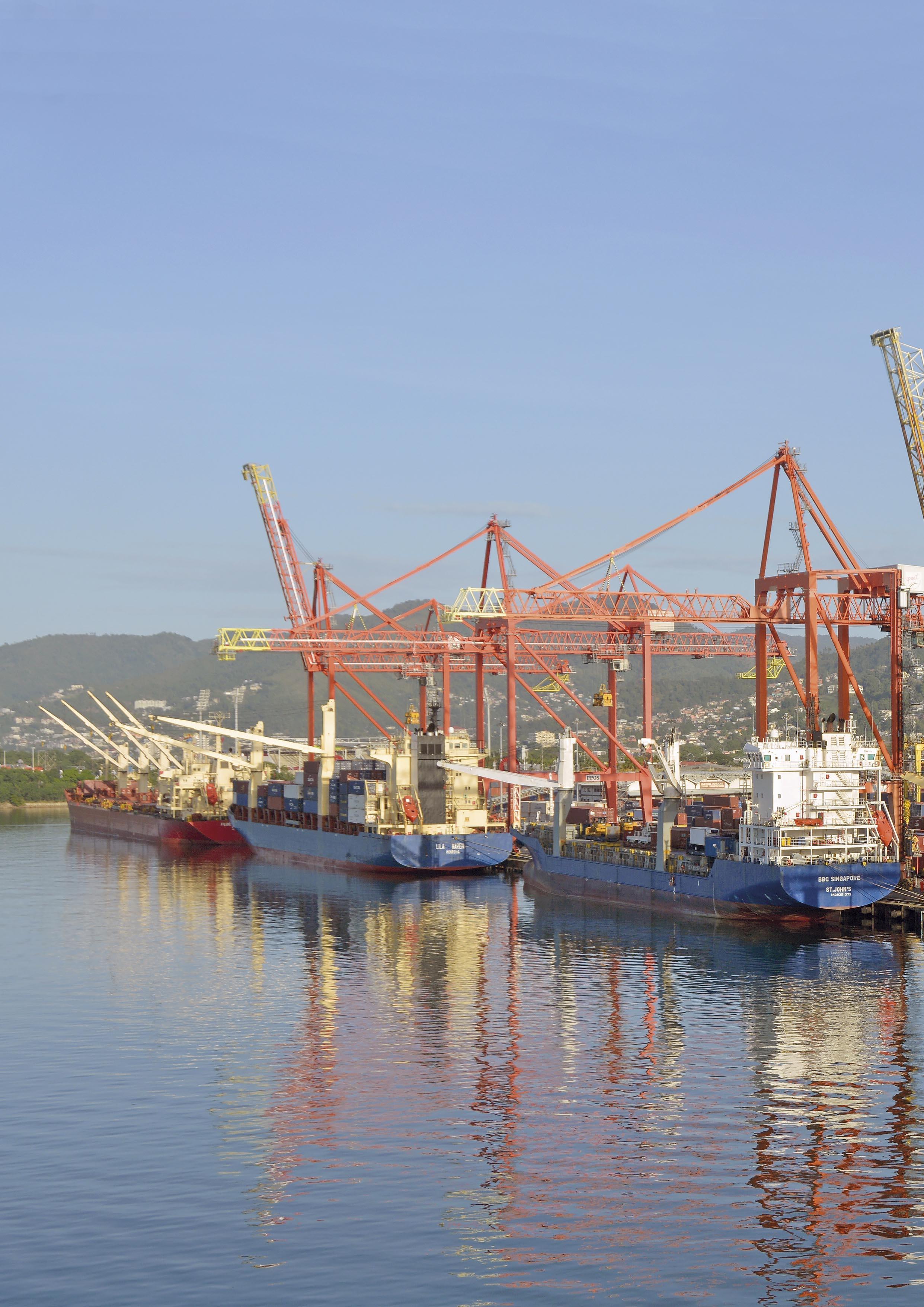
A good line up of ships at Port of Spain in December 2023. From left to right are the Federal Swift of Fednav, the Lila Haren of Jungerhans Maritime Services GmbH, the BBC Singapore of Briese Heavylift GmbH and the Aurora of Aalto Shipping Co.
The 24,240gt Federal Swift was built in 2012 by Zhejiang Ouhua Shipbuilding at Zhoushan.
The 16,129gt Lila Haren was launched in 2002 by Jiangsu Yangzijiang at Jiangyin as the Corona J for Jungerhans Maritime Services GmbH but immediately chartered to Maersk as Maersk Rio Grande. She reverted to Corona J in 2008 and was renamed Lila Haren in April 2023.
The 8,472gt BBC Singapore was built in 2008 by YS Heavy Industries at Yeosu as the Team Partner for Weser Bereederungs GmBH. Later that year she was renamed S. Arctic while on charter and in June 2009 she became Sloman Supplier while on charter to Amas Iscindo Utama. In September 2009 she was renamed Sawu Sea before reverting to Team Partner in September of that year. She became BBC Singapore in 2022.
The 5,052gt Aurora was built in 2002 by Bodewes at Hoogezand as the Wisaforest for Feederlines BV. In 2015 she was renamed Veendiep before becoming Aurora in 2018. In January 2024 she was sold to Vulcania Srl and renamed ASG Kherson.
Photo: Nigel Lawrence
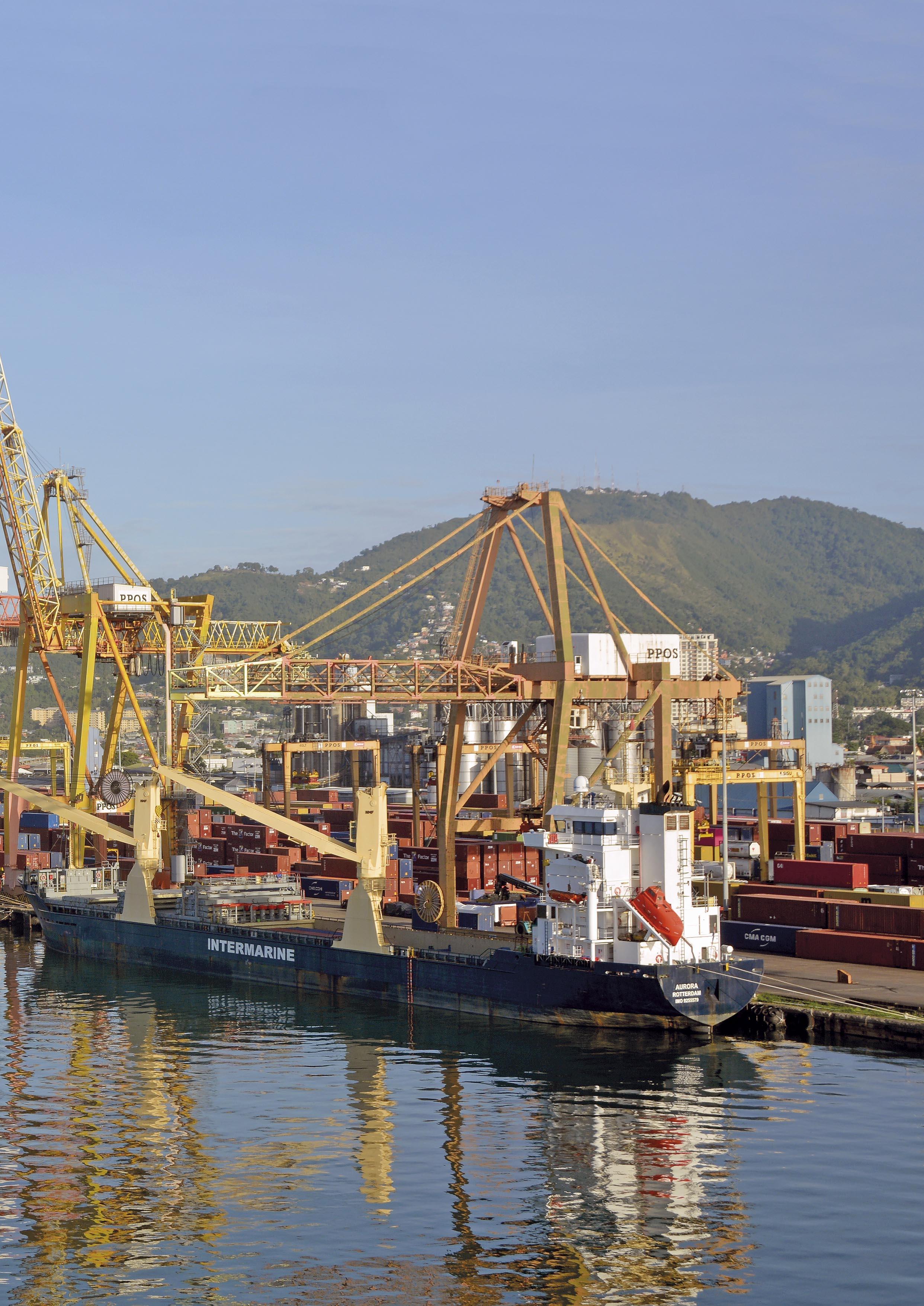

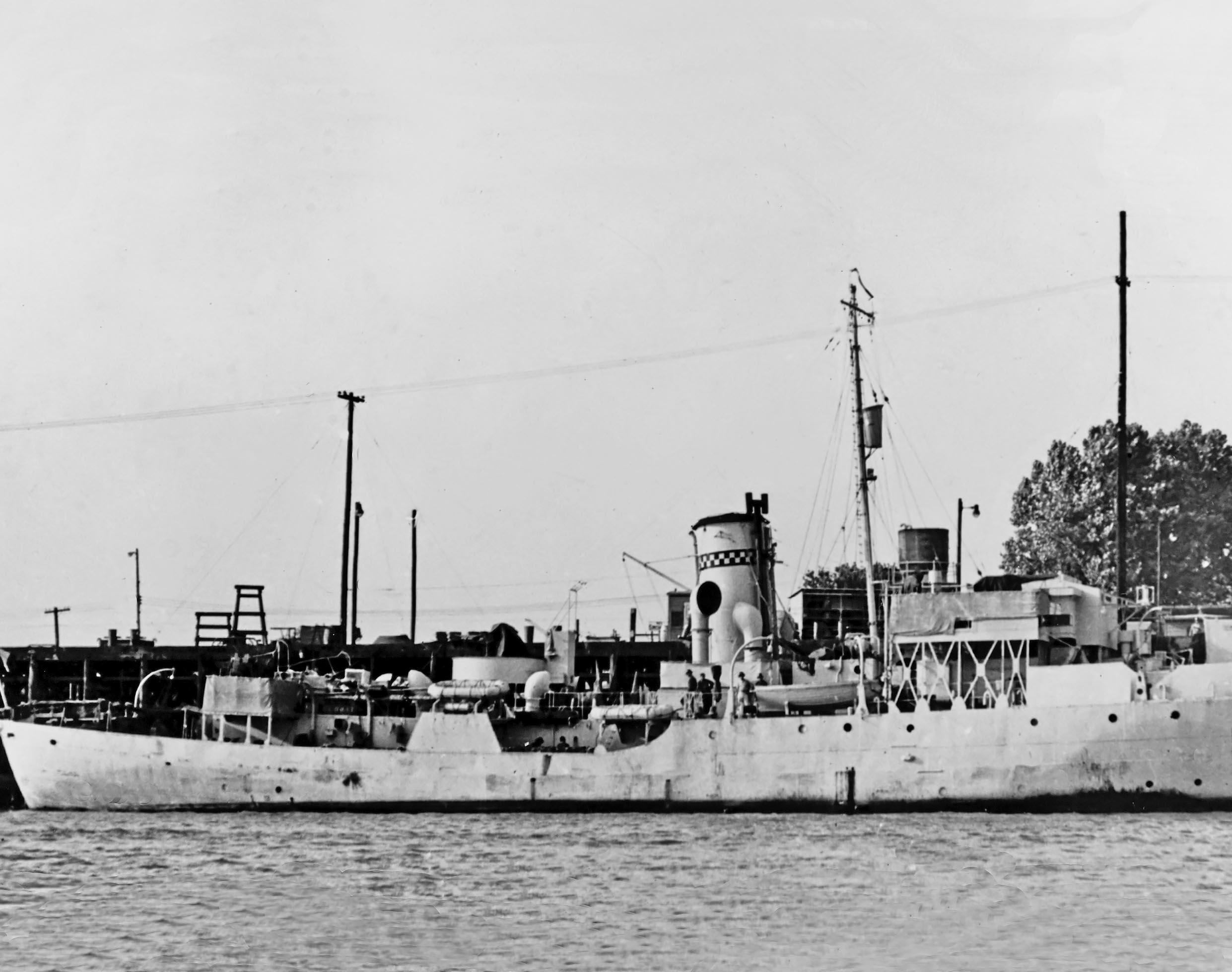
Never intended for the navies they were to serve with distinction, the destroyer HMS Harvester (H19) and the Free French corvette Aconit (K58) were involved in an epic battle where 18 German U-Boats including those from Group Neuland, Wildfang, and Burggraf attacked Convoy HX228 in the North Atlantic. One was to survive the other was to not.
HMS Harvester (H19) was one of six destroyers ordered in pairs by the Brazilian Government. The first two Harvester (to be named Jurua), and Hurricane (H06) (to be named Japarua.) These two were to be built by Vickers Armstrong at Barrow, and were ordered on the 6th December 1937. The others, Havant (H32) (Javary) and Havelock (H88) (Jutahy) from J.S. White, and Hesperus (H57) (Jurena) and Highlander (H44) (Jaguaribe) from Thornycroft.
All were requisitioned on 5th September 1939, two days after the start of WWII. HMS Havant and HMS Hesperus had already been launched whilst the others were nearing launch stage.
Generally similar to the Royal Navy H Class destroyers, but on No. 4 gun, a 4.7” single mount was removed to allow for a further 110 depth charges to be carried. Their displacement was slightly greater and with better accommodation for the officers. The ships also had shorter funnels, which gave them a more modern and streamlined appearance.
A further two destroyers of the class were ordered by Turkey, and built at Vickers, Barrow, but also taken over by the Royal Navy. These were HMS Inconstant (H49) ex Turkish Muavenet, and HMS Ithuriel (H05) ex Turkish Gayret. The former survived the war and was returned to the Turkish Navy and sold for scrap in 1960, whilst the latter became a total loss and was scrapped in 1945.
Details of HMS Harvester
Displacement 1,350 tons (1,860 full load). Dimensions: 323 feet long, beam 33 feet, draught 8.5 feet.
Machinery: Three Admiralty 3 drum boilers. 2 shafts. Parsons SR geared turbines. SHP 34000 = 35.5 knots (31.5 knots at full load). Oil fuel 455 tons. Range 5,500/1,250 nm at 15/35 knots.
Armament: Three Mk IX 4.7” (3x1) guns, eight 0.5” (2x4) AA guns and eight 21 inch MK VIII Torpedo Tubes with Mk IX torpedoes. The aft bank of torpedo tubes were removed after Dunkirk and replaced with a 12 pdr AA gun.
HMS Harvester was laid down on 3rd June 1938, to be named Jurua, and was launched on 29th September 1939 as HMS Handy. However she was renamed Harvester in January 1940 to avoid confusion with HMS Hardy (H97) the Royal Navy “H” Class leader. This destroyer was beached on 10th April 1940 after suffering battle damage during the Battle of Narvik. The wreck was
still visible in the early 1960s. HMS Harvester was commissioned on 23rd May 1940.
After a brief period of working up at Portland the destroyer joined the 9th Destroyer Flotilla and immediately took part in Operation Dynamo, the evacuation from Dunkirk, transporting troops from the beaches back to the UK. During the Operation she received machine gun damage on 1st June 1940, which required a few days of repairs at Chatham.
The troops the vessel evacuated were as follows:-
On 29th May 272 troops evacuated to Dover.
On 30th May the destroyer had a lucky escape at 23.06 hours when a torpedo passed down her port side, 15 feet from the stern and another one narrowly missed her bow.
Two trips on 31st May carrying 808 troops to Dover and a further 533 troops to Dover. On 1st June 576 troops were evacuated to Dover.
Operation Cycle was put into effect at 13.20 hours on 9th June 1940 and was the evacuation from St. Valery and Le Havre. HMS Harvester was ordered to sail along with nine other destroyers, and on the 12th June rescued 78 troops from St. Valery landing them at Portsmouth the following day.
From 9th to 16th June the destroyer assisted in the Evacuation of St. Jean de Luz and Bayonne although she didn’t carry any

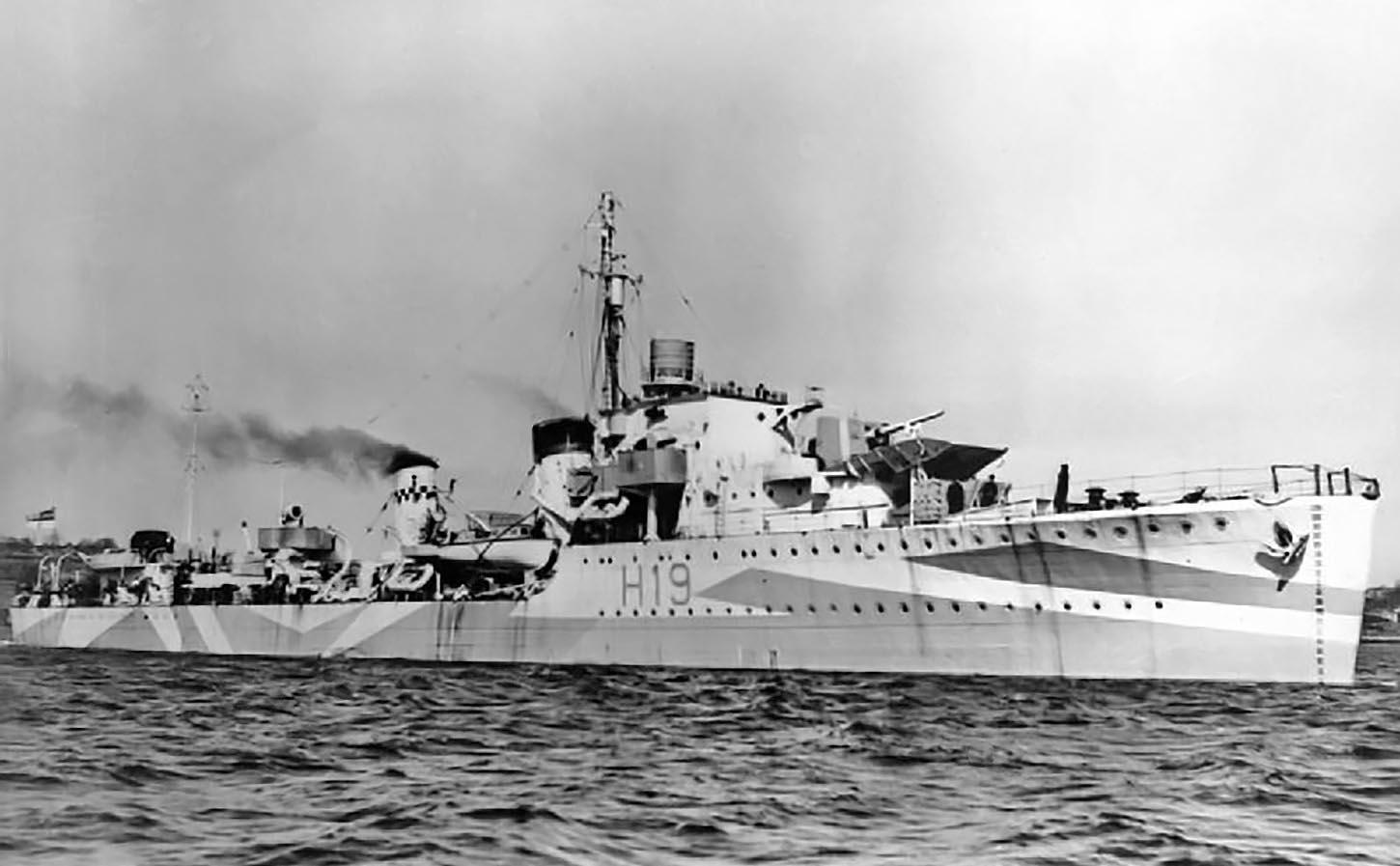
Below: The 14,694grt Blue Star Liner Arandora Star was torpedoed by U-47 on 2nd July 1940 with the loss of 805 lives, many of whom were German and Italian prisoners of war. The Arandora Star was built in 1927 by Cammell, Laird at Birkenhead. She was escorted from St. Jean de Luz to Liverpool by HMS Harvester in June 1940.
Bottom: U-47 and her commander Gunter Prien gained fame when it entered Scapa Flow and sank the battleship Royal Oak on 14th October 1939 with the loss of 833 lives.
evacuated troops herself. The destroyer escorted the Blue Star liner ss Arandora Star (14,694grt/built 1927) carrying Polish Troops, to Liverpool.
Tragically on 2nd July 1940 Arandora Star was torpedoed about 75 miles off the Bloody Foreland, Ireland by U-47 commanded by Gunther Prien, who had torpedoed the battleship HMS Royal Oak at Scapa Flow in 1939.
Arandora Star was en route to St. John’s. Newfoundland carrying Italian, and German internees plus German prisoners of war bound for internment camps in addition to crew and guards. A total of 805 out of 1,673 souls on board perished, these included the master, Captain Moulton, 12 officers, 42 crew and 37 military guards.
The U-Boat was of the Type VIIB and had been completed by Germaniawerft, Kiel in December 1938. (Yard No 582). U-47 went missing on 7th March 1941, her fate never fully known.
On 25th June HMS Harvester joined the Western Approaches Command at Liverpool for Atlantic convoy duties and was deployed with HMS Highlander (H44), Volunteer (I71) and Whirlwind (H41) for Atlantic convoy defence including escorting convoy WS1 from Clyde to the Western Approaches. This convoy included the Cunard liners, Aquitania, Mauretania and Queen Mary taking troops to the Middle East.
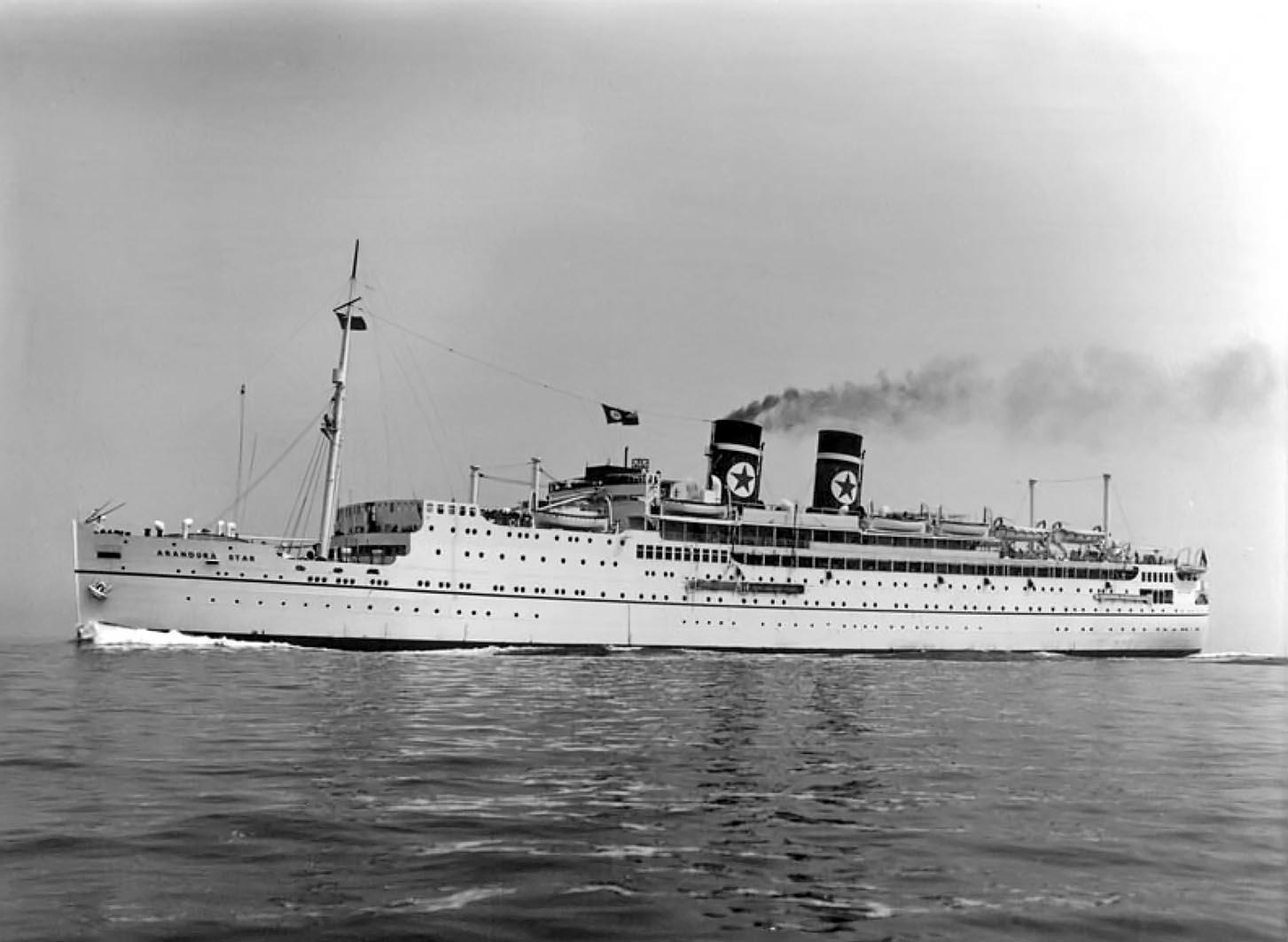
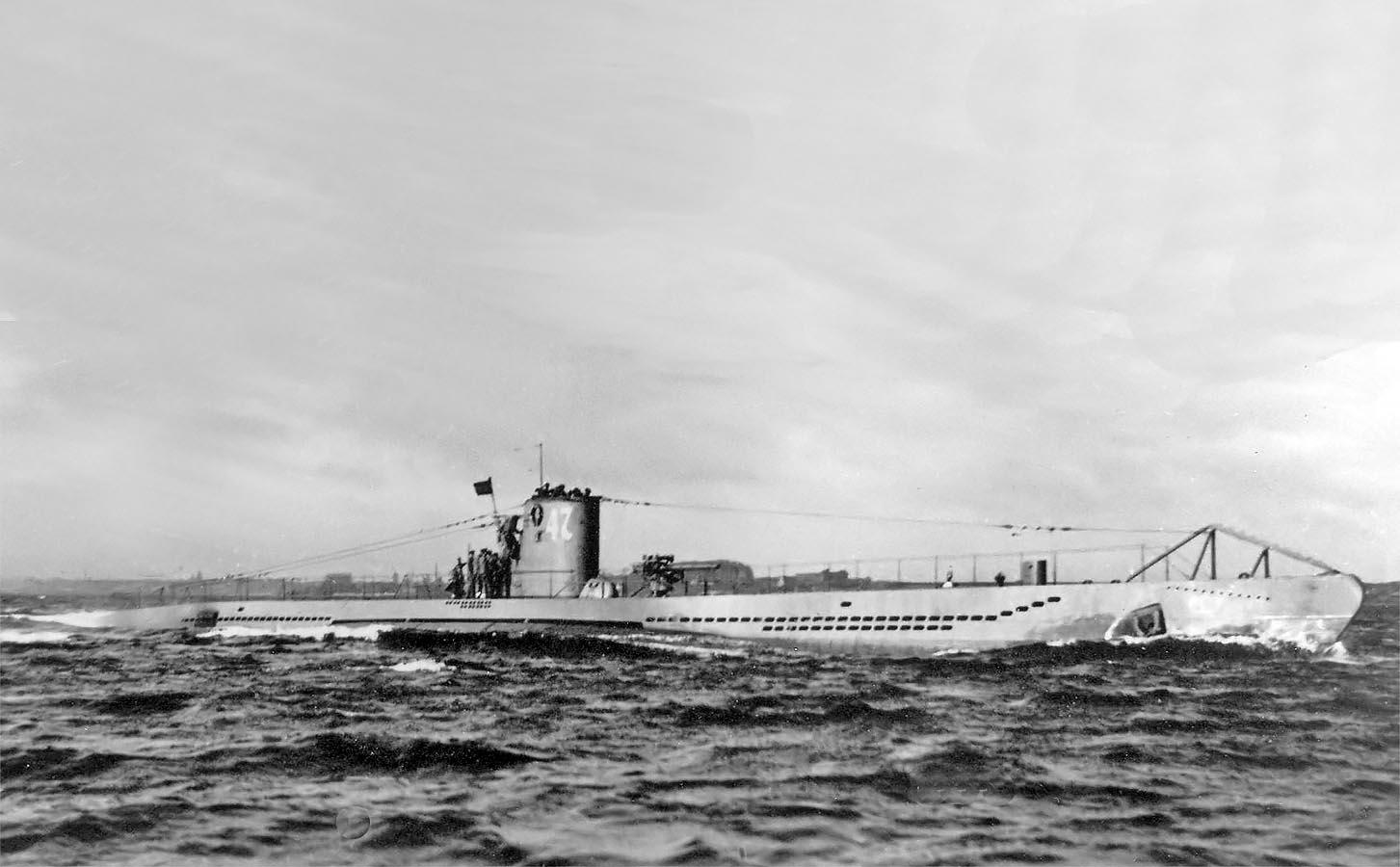
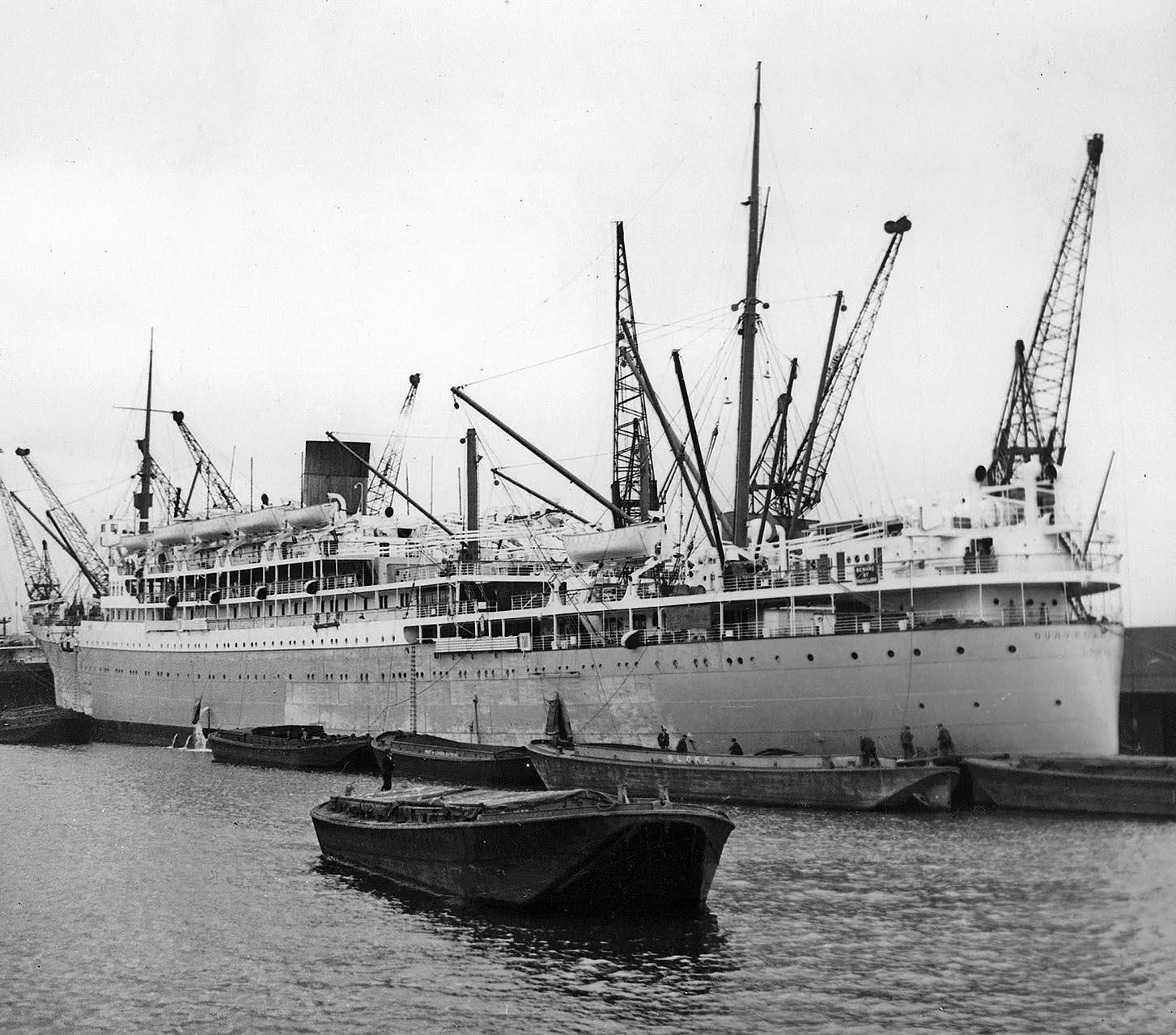
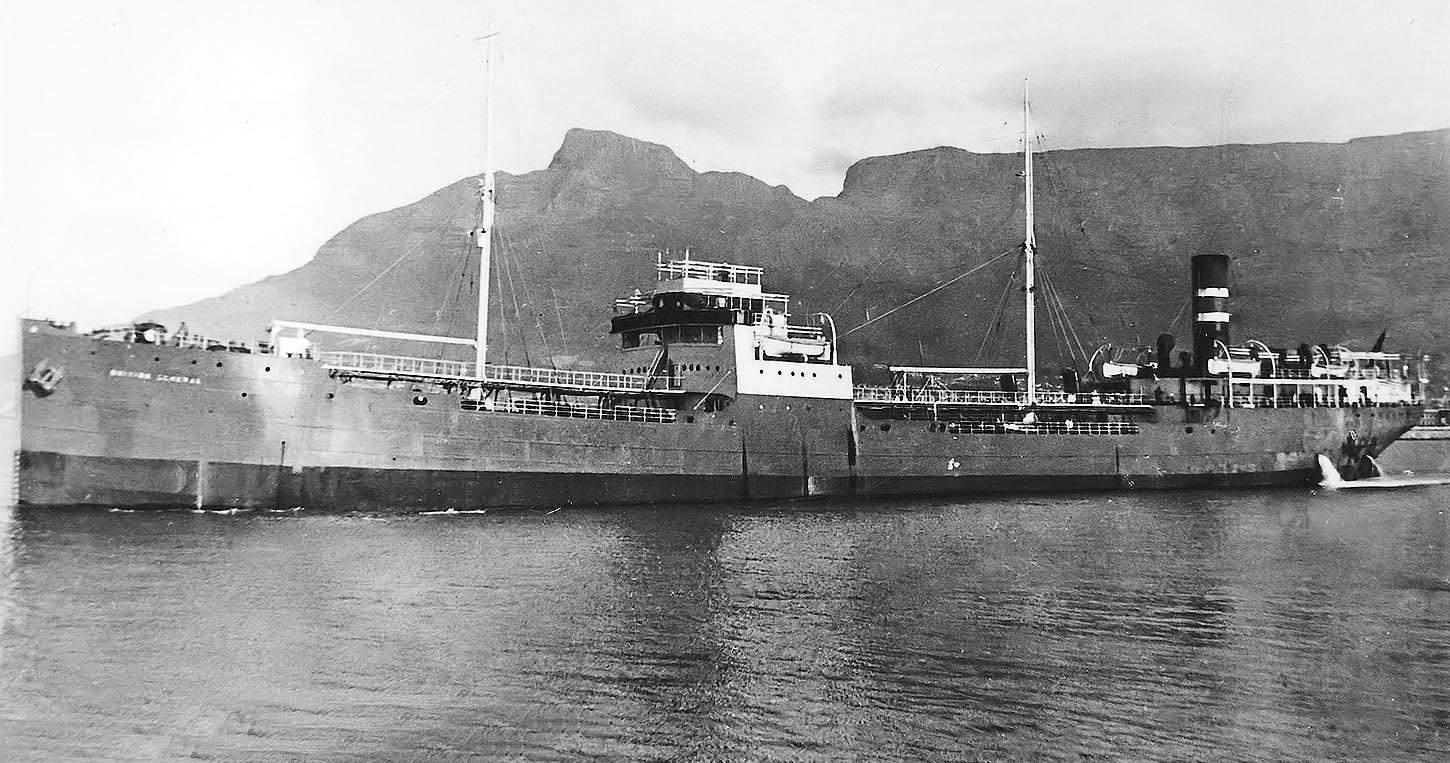
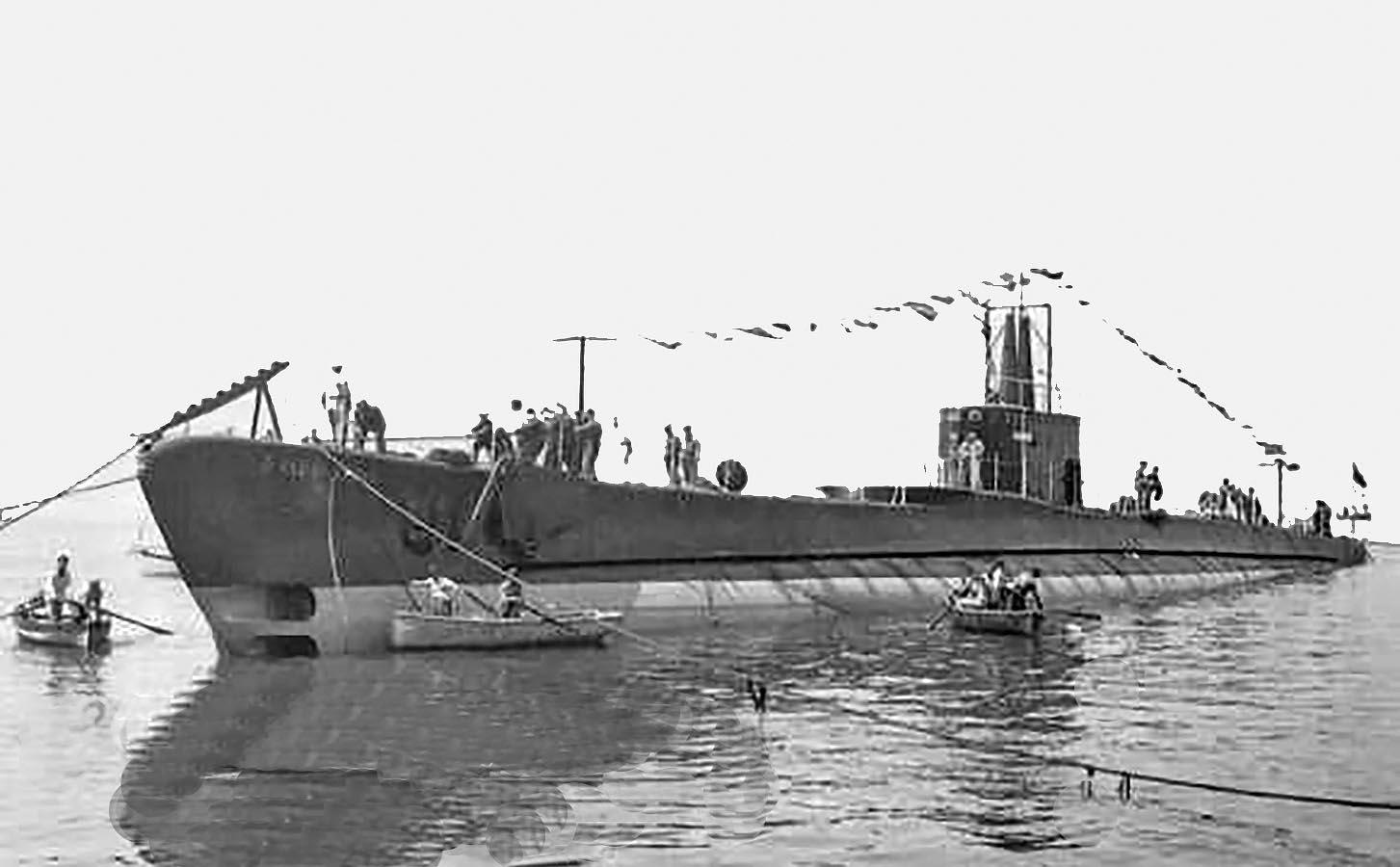
From July to September 1940 the destroyer carried out escort duties in the Western Approaches with the 9th Destroyer Flotilla. On 29th August HMS Harvester arrived at Greenock with 90 survivors from the Armed Merchant Cruiser HMS Dunvegan Castle (15,007grt/built 1936) which had been sunk by the German UBoat U-46, under the command of Engelbert Endrass, two days earlier.
At 21.47 hours the Armed Merchant Cruiser was struck by a torpedo to be followed by two more at 30 and 40 minute intervals.
The ship stayed afloat for 7 hours, however 27 lives were lost.
U-46 was a Type VIIB U-Boat completed in 1938 and built by Germaniawerft, Kiel as yard No. 581. The submarine survived the war, was decommissioned in October 1943 and scuttled on 5th May 1945.
From the 8th to 18th September, together with five other destroyers, HMS Harvester was attached to the Portsmouth Command on anti-invasion duties, and on 14th September 1940 bombarded Cherbourg along with HMS Highlander (H44), HMS Beagle (H30) and HMS Bulldog (H91).
On 7th October 1940 the destroyer carried out a search for the BP tanker British General (6,985grt/built 1922) that had been torpedoed, however the search had to be abandoned due to lack of fuel, and she only just made it to Londonderry.
The tanker had been torpedoed by U37, commanded by Victor Oehrn, at 18.55 hours on 6th October 1940. A second torpedo was put into the ship at 23.10 hours.
However the ship did not sink and a further two torpedoes were fired at 20.00 hours on 7th October when gunfire proved to be ineffective.
Her Master, 45 crew members and a gunner were lost.
U-37 was a Type IXA large ocean going UBoat of 1,153 tons (submerged). The vessel was built by Deschimag AG Weser, Bremen (Yard No. 942) and commissioned on 4th August 1938.
During her eleven War Patrols U-37 sank 54 merchant ships (201,442grt) one warship HMS Penzance (1,025 tons) and damaged the merchant ship Dunster Grange (9,494grt/1928 built).
The submarine survived the war to be scuttled on 5th May 1945 in Norway.
On 30th October along with HMS Highlander HMS Harvester participated in the sinking of U-32 in position 55º37'N and 12º9'W north west of Irleand. The submarine was despatched by depth charges and gunfire from the destroyers.
U-32 was a Type VII U-Boat and had been completed in 1937 by Deschimag AG, Weser, Bremen (Yard No 913). The submarine had left Lorient on 24th October under the command of Oberleutnant H. Jenisch. Nine members of the crew were lost and thirty-three rescued.
On 6th November 1940 whilst escorting convoy HX 64 along with HMCS Ottawa (H60) HMS Harvester was responsible for the sinking of the Italian Submarine Commandante Faà Di Bruno. Originally it was believed that the Italian submarine had been sunk by HMS Havelock but after the war it was confirmed that the loss was down to HMS Harvester and HMCS Ottawa.
Comandante Faà Di Bruno was a Marcello Class submarine of 1,315 tons submerged. She had eight 21 inch torpedo tubes and sixteen torpedoes, two 100mm guns and a crew of fifty eight. The vessel was completed on 23rd October 1939 by OderoTerni-Orlando, at Muggiano.
The submarine sailed on her final and only mission from Bordeaux on 31st October 1940 being assigned to patrol off the west coast of Scotland. She was the first Italian submarine to be lost in the Atlantic and was under the command of Cap. Corv. Aldo Erinci. She was also the first submarine to be sunk by a Royal Canadian vessel, this time under the command of Commander E.R. Mainguy.
Altogether thirty-two Italian submarines operated in the Atlantic between 1940 and 1943 of which sixteen were lost, three in 1940, seven in 1941, two in 1942 and four in 1943. At one point near the end of 1940 the Italian Navy had more submarines in the Atlantic than the German Navy.
The Italian submarines were based at Bordeaux and came under the control of the German Admiral, Karl Donitz. Initially the Italians were eager to help, but not very competent, but by December 1940 the German Admiral began to despair of them, saying that they were, “Inadequately disciplined, and unable to remain calm in the face of the enemy”. When tasked with sending back weather reports the radio messages were often garbled and unreadable.
Although the Italian submarines were responsible for the sinking of a number of Allied vessels their impact on the overall battle was not significant.
On 5th November 1940 HMS Harvester picked up 19 survivors out of 55 onboard from the mv Silverpine (5,066grt/built 1924). The vessel had been a straggler from convoy OB 252 and had been sunk by the Italian Submarine Argo. The submarine had been completed in August 1937 by Cantieri Riuniti dell’Adriatico, Monfalcone. The vessel had a submerged displacement of
1,018 tons and carried six 21 inch torpedo tubes (ten torpedoes), one 3.9 inch gun and 4 four 13.2 mm guns. She had a crew of six officers and forty ratings. Argo was scuttled on the 11th September 1943 to avoid being captured by the Germans.
On 3rd February 1941 121 survivors from the armed boarding vessel HMS Crispin that had been torpedoed by U-107 (Korveten Kapt. Gunter Hessler) on 3rd February 1941 were picked up by HMS Harvester. The ship had been originally owned by the Booth SS Co. Ltd. of Liverpool and had been requisitioned by the Admiralty in 1940 as an Armed Boarding Vessel. Twenty of her crew were lost. Her CO was Acting Commander B. Maloney DSO, DSC, RNR was lost.
U-107 was a Type IXB U-Boat built by Deschimag AG, Weser, Bremen (Yard No 970) and completed in October 1940. She was sunk on 16th August 1944 in the Bay of Biscay by depth charges from an RAF Sunderland. All 58 of her crew were lost. During her career and 16 war patrols, the UBoat sank 37 merchant ships (207,375 gross tons), 2 auxiliary warships (10,411 gross tons) 3 merchant ships damaged (17,392 gross tons) and one auxiliary warship damaged (8,246 gross tons).
HMS Harvester rescued the crew of an RAF Whitley on 7th February 1941. The aircraft had been an escort for convoy SC20.
The destroyer went into refit from 18th March to 18th April 1941 at the yard of her builder, Vickers Armstrong, at Barrow. Following the refit she joined Force H at Gibraltar, and participated in two operations to Malta. However the C in C Mediterranean, Admiral Somerville, regarded Harvester as lacking in anti aircraft defences for the Mediterranean and the ship was reallocated to the Newfoundland Escort Force, joining the 14th Escort Group on 1st July 1941.
HMS Harvester operated with this Group for the next three months before rejoining the Western Approaches Command as part of the Special Escort Force and the 28th Escort Group.
The ship was refitted at Dundee from 30th January to 16th April 1942 when she was converted to an Escort Destroyer. A Hedgehog anti submarine mortar replaced No.1 4.7” gun forward and the ship conducted sea trials of her Type 271 Radar.
During May 1942 HMS Harvester resumed her duties as Senior Officers Ship of the Mid Ocean Escort Force, Escort Group B-3.
The destroyer was again refitted at Liverpool from 12th December 1942 to 11th February 1943, leaving Londonderry four days later as an escort for Convoy ON167. However she was to survive barely a further 3 weeks.
HMS ACONITE
When it became inevitable during 1938/39 that there would be a war with Germany it was apparent that there was a desperate need for escort vessels.
To overcome this deficiency there was no alternative but to adopt a simple design in which merchant ship builders could accommodate the building of such ships. Elimination of such complex systems as gunnery fire control, turbines, reduction gearing etc. was necessary.
In 1939 Smith’s Dock on the Tees submitted a sketch plan for a coastal escort based on their whaler Southern Pride. This was accepted with an increase of hull length of 30 feet to provide extra space and improved internal sub division, steam powered oil fired reciprocating engines provided the minimum required speed of 16 knots.
There were two groups of the Class, 225 ordered during 1939-40, and a further 69 ships of a modified design which were slightly larger and carried an enhanced armament.
HMS Aconite (K58) (English spelling) was one of the first group and was ordered on 31st August 1939 from shipbuilders Ailsa at Troon, who also built her reciprocating steam engines. The ship was laid down on 25th March 1940, launched on 31st March 1941 and completed on 23rd July 1941.
Details of HMS Aconite
Displacement: 940 tons (1,180 full load) Length: 205.5 feet, beam 33 feet, draught 13.25 feet
Machinery: 2 SE cylindrical boilers, one shaft, reciprocating engines. IHP 2750 = 16 knots. Bunkers 230 tons. 5,000 nm at 10 knots
Armament: One 4 inch gun, four 0303 Lewis guns, two MkII depth charge throwers, two depth charge rails with 40 depth charges
Complement: 29 (coastal), 47 (Ocean) 53/84 (war)
Immediately on completion the ship was allocated to the Free French Navy and renamed Aconit (French spelling) under the command of Lieutenant de Vaisseau Jean Levasseve and assigned to the Clyde Escort Group on 17th August 1941, joining the Newfoundland Forces - Mid Ocean Escort Group.
A total of 8 other Flower Class Corvettes were transferred from the Royal Navy, two of which were torpedoed and lost to U-Boats. Sixteen more were ordered from UK yards before France capitulated and six were ordered from French Yards, four being taken over by the German Navy and two scrapped on the stocks.
Apart from one, La Bastiaise, lost to a mine off Hartlepool on her trials with the loss of 65 lives, the remaining were taken over by the Royal Navy following completion.
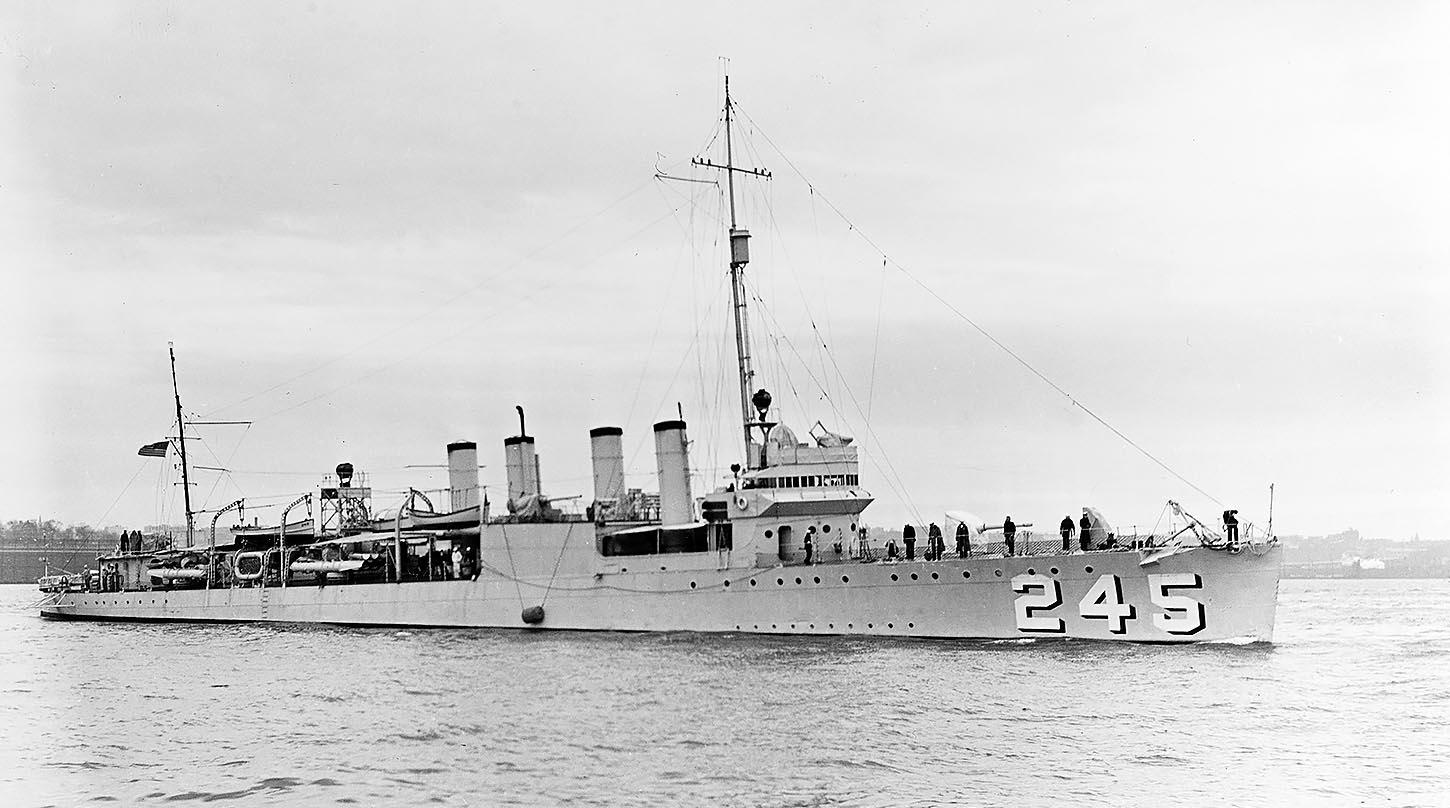
Above: USS Reuben James destroyer was sunk by U-552 off Iceland while escorting convoy HX 156. She was the first US Navy ship to be sunk in WW2. She had been built in 1920 by New York Shipbuilding at Camden (NJ). 115 lives were lost.
Below: The 5,412grt Tucurinca of Elders & Fyffes was sunk by U-221 on 10th March 1943 while on a voyage from Halifax to Avonmouth in convoy HX 228 with the loss of one crew member. The Tucurinca was built in 1926 by Alexander Stephen at Linthouse.
Bottom: The 6,565grt Andrea F. Luckenbach of Luckenbach Shipping Co. was another victim of U-221 while in convoy HX 228. Twenty two people lost their lives. The Andrea F. Luckenbach was built in 1919 by Bethlehem Steel Corporation at Quincy. HMS Harvester rescued 60 of the crew but she herself was later torpedoed and sunk by U-432 with the loss of 183 lives. Aconit arrived and sank U-432 with depth charges, gunfire and ramming
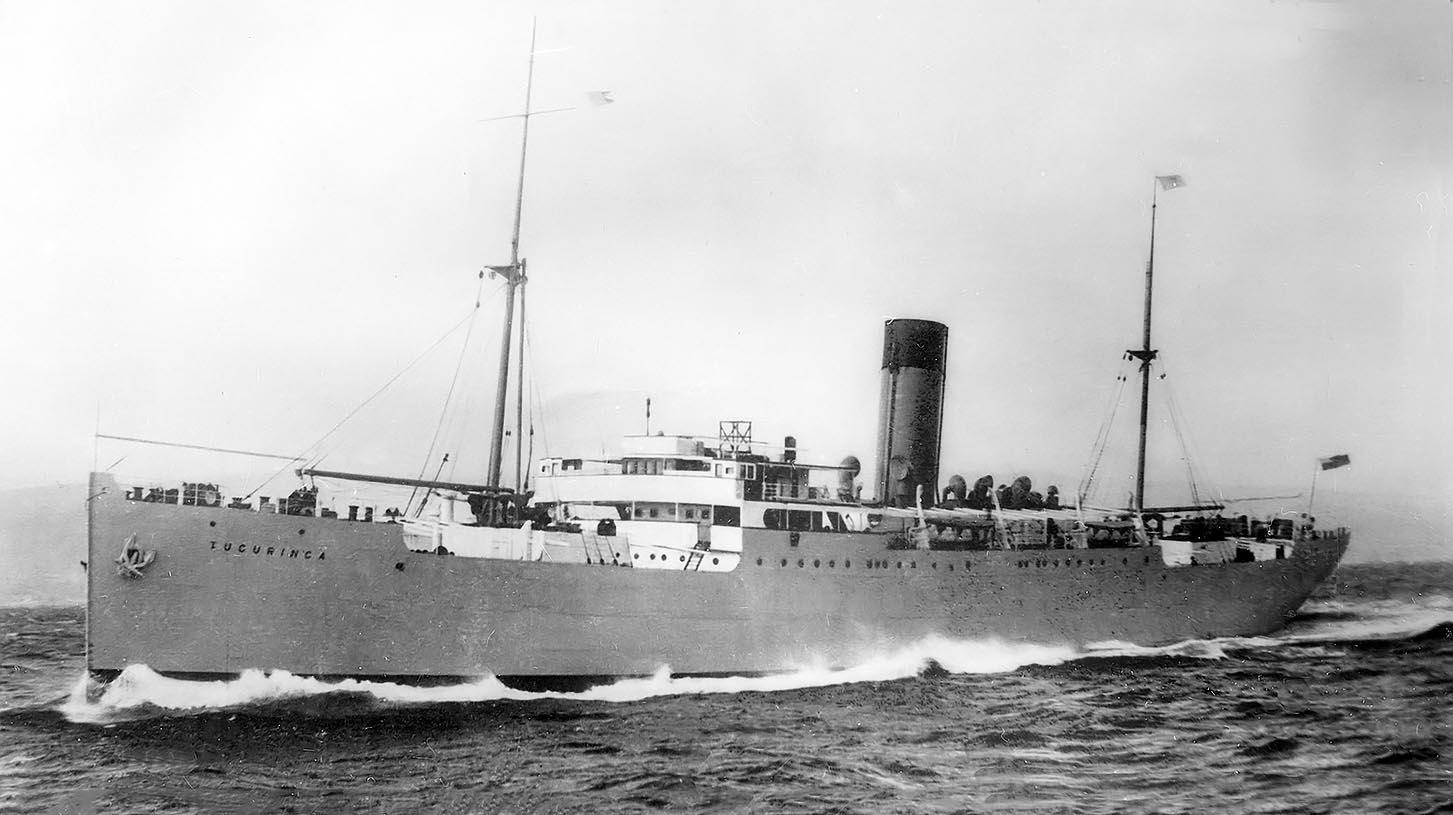
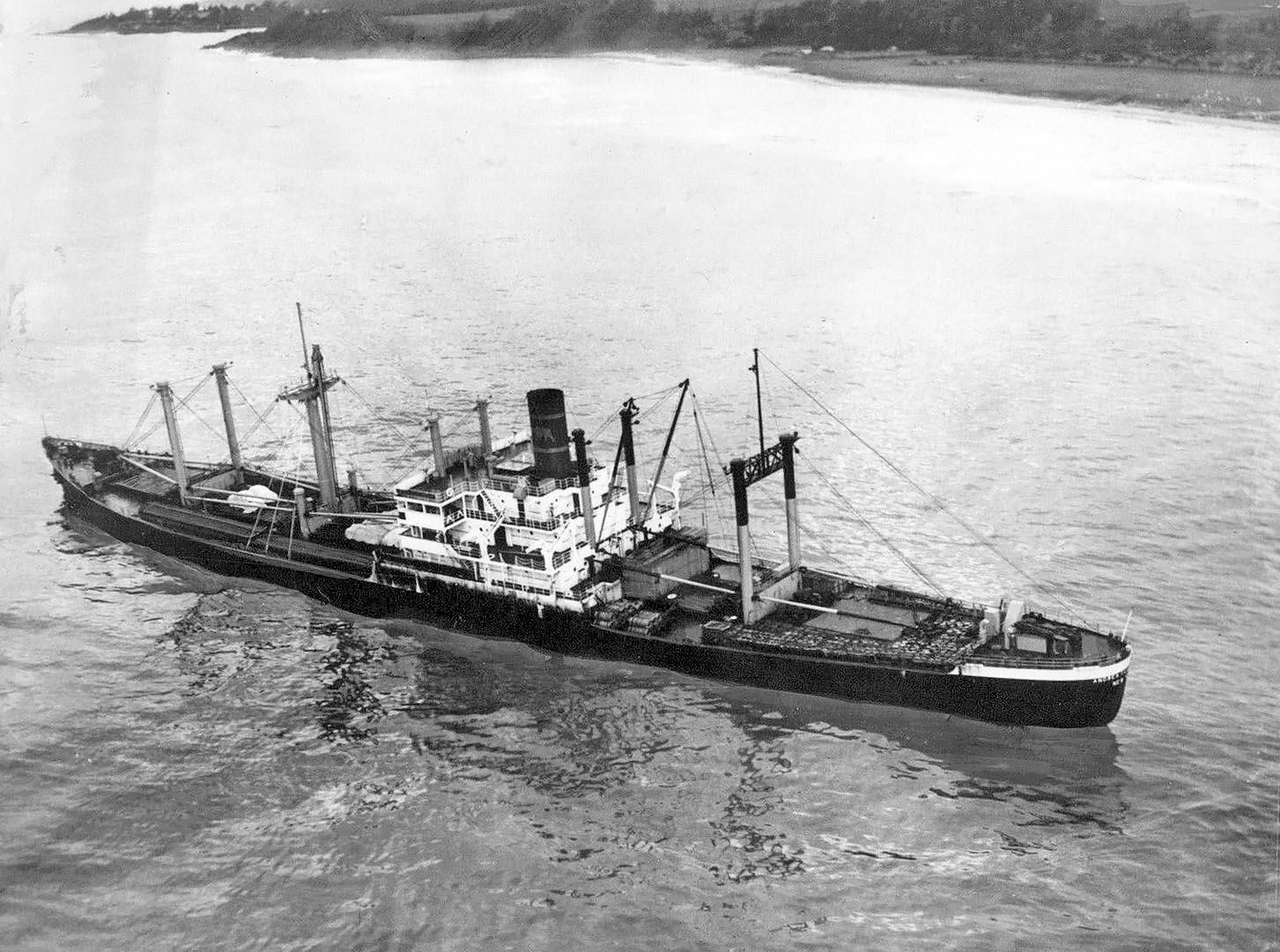
The Mid Ocean Escort Force was the organisation of anti submarine escorts for the trade convoys between Canada and Newfoundland and the British Isles.
Initially the USA provided escorts before that country entered the war, the destroyer USS Kearny (DD432) was torpedoed by the German submarine U-568 on 17th October 1941 hitting the destroyer on the starboard side killing eleven and injuring twenty-two seamen. The destroyer went to the aid of a British convoy under attack from a U-Boat pack and dropped depth charges throughout the night. Following the torpedo hit the destroyer managed to make it to port in Iceland where temporary repairs were carried out. She later sailed to Boston, Massachusetts where she was fully repaired, surviving the war to be scrapped in 1971.
U-568 was a standard Type VIIC Class UBoat built by Blohm and Voss (Yard No 544) at Hamburg, commissioning on 1st May 1941. Royal Navy destroyers in the Mediterranean sank her on 28th May 1942. On 31st October 1941 the World War I era destroyer USS Reuben James (DD245) was torpedoed and sunk by U-552 under the command of Kapitanleutnant Erich Topp. The destroyer, commanded by Lt. Commander Heywood Lane Edwards, was hit forward and her entire bow was blown off when a magazine exploded. Of a crew of seven officers and 136 crew plus one passenger 115 were killed. No officers survived.
U-552 was a Type VIIC U-Boat completed in December 1940 and built by Blohm and Voss at Hamburg (Yard No 528). She survived the war and was scuttled on 5th May 1945 at Wilhelmshaven.
When the US officially entered the war the US escort groups typically consisted of five destroyers plus US Coast Guard vessels that rotated in and out of the Group.
The “B” Group was generally made up of RN, RCN and Free French warships. Initially Escort Group B-3 was made up of HMS Harvester, the former US destroyer HMS Georgetown (I40), HMS Bulldog (H91), Corvettes Heartsease (ex Pansy)(K15), and Narcissus (K74), plus the Free French “Flowers” Lobelia (K05) and Renoncule.
The low endurance of the destroyers HMS Georgetown and Bulldog caused them to be replaced by the destroyers HMS Escapade (H17) and Polish manned destroyers Burza (H73) and Garland (H37). The Flower Class corvette Orchis (K76) replaced HMS Heartsease (K15) and the four Free French “Flowers”, Aconit, Lobelia, Rononcule and Roselys were added.
Fourteen convoys were escorted without loss, whilst Convoy ON167 lost two ships and Convoy HX 228 lost four merchant ships as well as HMS Harvester.
HX228 was an eastbound North Atlantic convoy, consisting of 60 merchant ships plus escort. It sailed from New York on 28th February 1943 with the destination being Liverpool, where it arrived on 15th March 1943. They carried cargoes of war materials.
Ocean Escort Group B3 joined the convoy at St. Johns, Newfoundland, the senior RN officer was Commander AA (Harry) Tait in HMS Harvester.
The other ships of the escort included HMS Escapade, ORP’s Burza and Garland, plus the Flower Class corvettes HMS Narcissus and the FNFL ships, Aconit, Renoncule and Roseys. The US escort aircraft carrier USS Bogue (CVE9) plus two World War I era destroyers USS Belknap (DD251) and Badger (DD126) backed up the Group.
The carrier group had sailed from the Naval Station Argentia, a US base in Newfoundland on 5th March 1943.
There were three U-Boat patrol lines to attack the convoy with a total of eighteen UBoats in the packs. The first contact was made on 10th March by U-336 in heavy weather. The state of the weather caused USS Bogue and her two destroyer escorts to return to Argentia as it was too dangerous to fly off aircraft, and as a result these ships took no part in the action.
On the evening of 10th/11th March the first U-Boat attacks took place. U-221 attacked three ships, sinking two ammunition ships, Tucurinca (5,412grt/built 1926) and Andrea F. Luckenbach (5,656grt/built 1919) plus damaging a third, the Liberty Ship, Lawton B. Evans (7,197grt/built 1943).
Escorts counter attacked and the UBoats had to withdraw to repair the damage. U-221 was a standard Type VIIC boat and was sunk on 27th September 1943 South West of Iceland by depth charges dropped by RAF aircraft. All of her crew were lost. She was built by Germaniawerft AG at Kiel (Yard No 651) and completed in May 1942. During her career she sank eleven merchant ships totalling 69,589 tons and ten landing craft being carried as cargo. In addition she damaged one further ship, Lawton B. Evans.
U-444 and U-757 both fired torpedoes at William C. Gorgas (7,197grt/built 1943) which dropped back from the convoy and sank later. U-757 was a Type VIIC U-Boat completed in February 1942 at Kriegsmarinewerft, Wilhelmshaven (Yard No 140). She was sunk on 8th January 1944 in the North Atlantic by British and Canadian escort vessels. All of her crew were lost.
U-757 also fired on the ammunition ship Brant County (5,001grt/built 1915). The ship which was carrying 900 tons of TNT caught fire and exploded about a minute after she sank. The flying debris seriously injured several of the crew of U-757 and disabled her starboard engine and batteries. The commander of the submarine, Oblt. Frederich Deetz, had to abandon the patrol and return to base at St. Nazaire.
However the ammunition ship had actually been sunk by U-86, hitting the ship with one torpedo at 05.03 hours on 11th March 1943.
U-757 was a Type VIIC U-Boat built by Kriegsmarinewerft (Yard No 140) and commissioned on 28th February 1942. The U-Boat was sunk on 8th January 1944 by British frigate HMS Bayntum and the RCN Corvette HMCS Camrose. All crew were lost.
U-86 was a Type VIIB U-Boat launched in May 1941 and commissioned on the 8th July 1941 being built by Flenderwerft at Lubeck (Yard No 282). Initially under the command of Kapitanleutnant Walter Schug. The submarine was sunk on 29th November 1943 by destroyers HMS Tumult and HMS Rocket.
At sunrise on 11th March 1943 HMS Harvester came upon the debris field from the William C. Gorgas, but before boats could be launched to rescue survivors U-444 was spotted several miles away, and the submarine immediately crash dived. The destroyer dropped a spread of depth charges, which forced the U-Boat to the surface. When it was about 500 yards ahead, HMS Harvester worked up to 27 knots and rammed the U-Boat, causing damage to the destroyer’s bow. The submarine passed under the destroyer causing damage to her propellers and the two vessels became locked together and remained so for about an hour.
When the destroyer and submarine broke free the Free French Corvette Aconit saw that the U-Boat was still afloat, and proceeded to ram it causing it to sink. Aconit picked up three survivors and HMS Harvester picked up one.
HMS Harvester limped behind the convoy at 9 knots and picked up survivors from the William C. Gorgas. During the morning of 11th March 1943 the remaining propeller of HMS Harvester broke and Aconit was requested to attend and stand by the destroyer, which was now at a standstill.
At 12.05 a torpedo from U-432 struck HMS Harvester, and a few minutes later by a second. The destroyer blew up and split in two, sinking immediately. Nine officers, including her captain, who was extremely competent and highly regarded, and 174 ratings were lost.
Aconit, which was on the horizon saw the explosion and raced to the scene.
U-432’s First Lieutenant, Leutnant Zur See Josef Brohl, following his capture, explained that two torpedoes were fired because the Captain, Eckhardt could not be certain that the first had made contact.
Although it was normal practise to surface or go up to periscope depth following an attack, to see what was around, Eckhardt
refused stating that he was going to submerge for lunch. Both the first lieutenant and the coxswain protested, but to no avail.
U-432 submerged to 20 metres and the officers gathered together for a glass of champagne to celebrate their victory, whilst the crew had lunch. The hydrophone operator was busy washing the champagne glasses and was not paying attention to his duties.
At 12.36 Aconit commenced an anti submarine search gaining contact at 12.49 and at 12.52 the corvette fired a pattern of 10 Mk VII depth charges set at 100 and 225 feet.
As a result of the attack the main lighting system on the submarine failed and the motors were put out of action, the main switchboard bursting into flames. The UBoat then went down by the stern, sinking to about 310 metres, however there was only minimal water entry. When at 240 metres those on the submarine heard Aconit drop another pattern of depth charges forcing U432 to the surface.
At 13.10 hours Aconit saw U-432 surface and fired a pattern of twenty-three 4inch shells, and during the course of the action raked U-432 with machine gun fire. Several seamen and the captain were killed by the gunfire. The engineer remained onboard and scuttled the submarine by opening the vents.
There were twenty survivors from U432, including the first lieutenant, who swam in the water for up to half an hour before being picked up.
At 13.14 Aconit attempted to get into a position to board the U-Boat with a view to capturing it. However a large wave threw the corvette against the hull of the submarine and she sank immediately. Aconit then rescued the survivors still swimming in the water.
Eight War Patrols were undertaken during her career, sinking twenty merchant ships (67,991 gross tons), 1 warship (Harvester of 1,350 tons) with two merchant ships damaged (15,666 gross tons).
U-432 was a standard Type VIIC U-Boat built by Schichau-Werke, Danzig. Yard No 1473, commissioning on 26th April 1941. She displaced 769 tons on the surface and was armed with five 21 inch torpedo tubes (four forward and one aft) carried up to fourteen torpedoes or twenty-six mines. On the deck she was armed with one 8.8 cm gun with 220 rounds and one 2 cm AA gun.
Twin diesel engines gave her a maximum surface speed of 17.7 knots, and her electric motors gave her a maximum submerged speed of 7.6 knots. On the surface the vessel had a range of 8,500 nautical miles at ten knots, and 80 nautical miles at four knots submerged.
Kapitänleutnant Hermann Eckhardt was appointed to U-432 in January 1943 which was his first seagoing command. He was not popular or highly regarded by the crew,
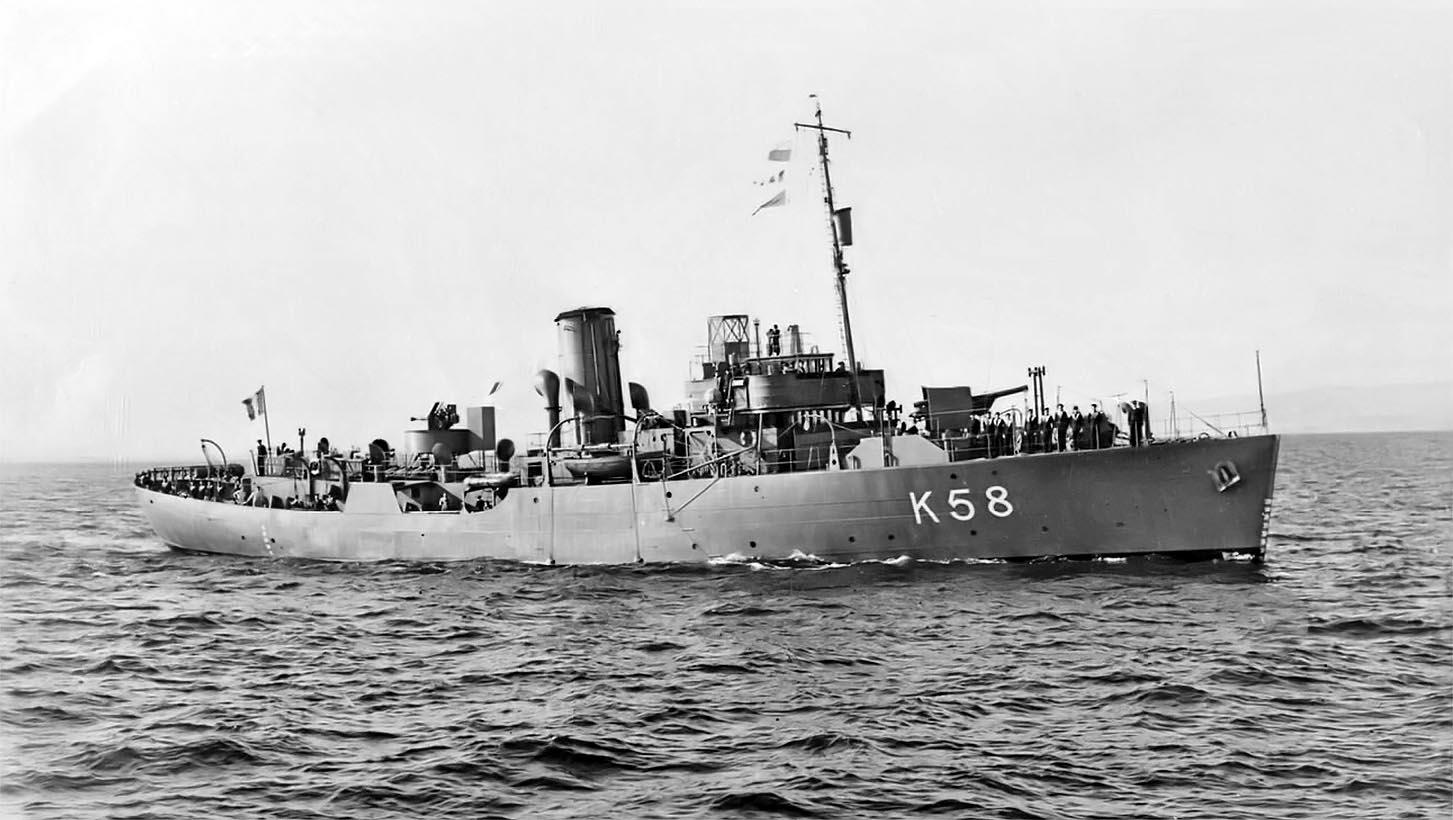
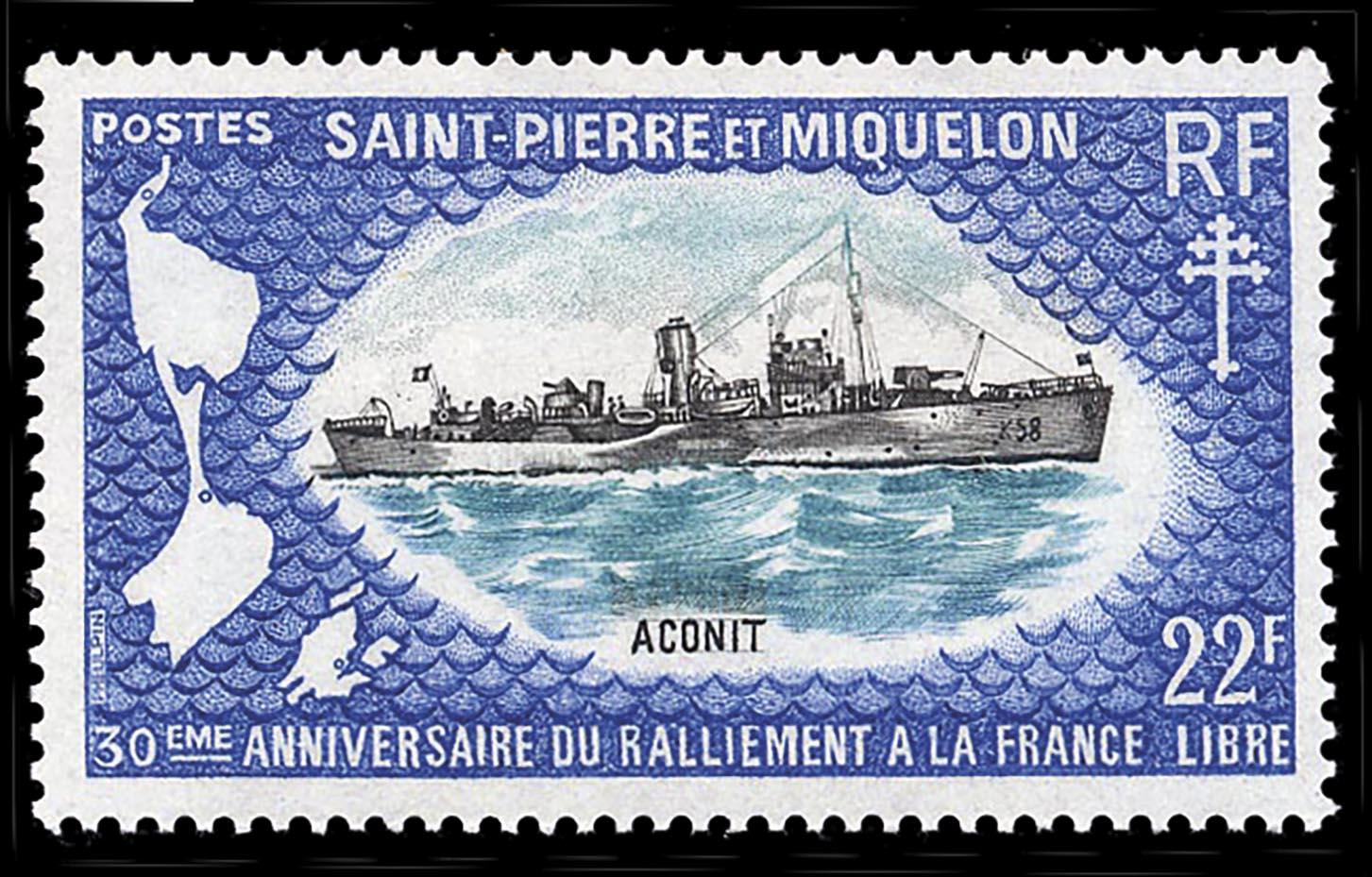
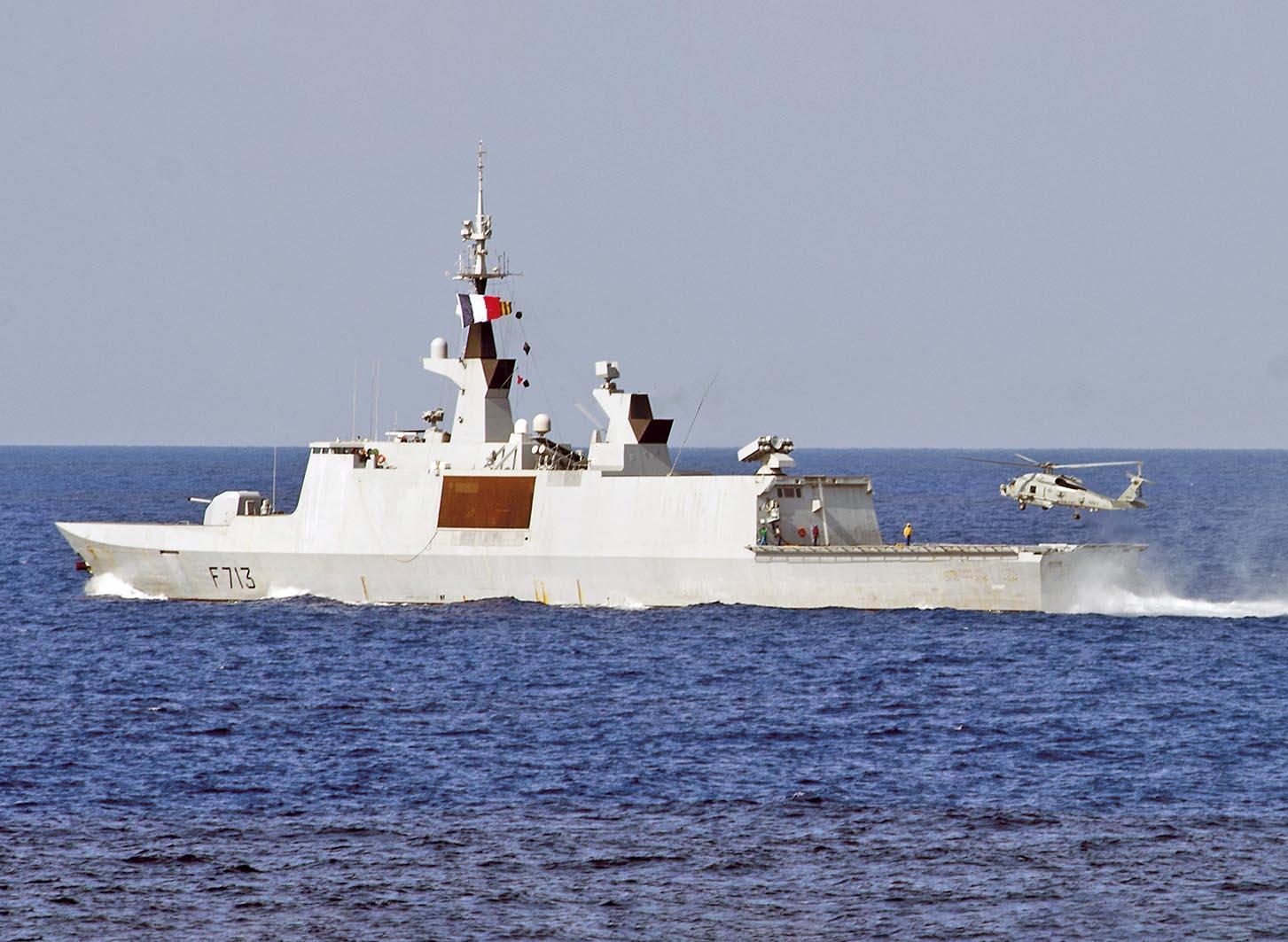
which consisted of four officers (including the captain) fifteen chief and petty Officers and twenty-seven ratings.
Casualties included three officers, four chief and petty Officers and nineteen ratings. Survivors were one officer, eleven chief and petty officers and eight ratings.
From 1st to 12th April 1943 Aconit underwent repairs in Glasgow and on the 21st April 1943 General Charles de Gaulle came aboard the ship and awarded the corvette and her commander the Croix de la Liberation.
Major repairs took place from 1st September to 10th October 1943 and her commander was replaced by Lieutenant de vaisseau Le Miller. She rejoined the Battle of Atlantic attacking a German U-Boat on 13th December 1943.
The first months of 1944 Aconit spent in Casablanca and Gibraltar carrying out convoy escort duties. During the Normandy Landings Aconit was attached to the 108th Escort Group along with Free French ships, Aventure, Escarmouche and Renoncule. Minor repairs took place in April 1945 before she returned to convoy escort work until 5th June 1945, the official date for the end of naval operations in European waters.
Following the end of the war Aconit was briefly used for training purposes before being given back to the Royal Navy on 30th April 1947 and renamed HMS Aconite.
In July the ship was sold to United Whalers of London for whaling purposes and rebuilt by Harland and Wolff at Belfast as a buoy boat (towing vessel) and renamed Terje 11. In 1951 the vessel was converted to a whale catcher and strengthened to work in ice, this lasted until the 1959/60 whaling season when the company gave up whaling.
In August 1960 Christian Salvesen, still with five converted former Flower Class Corvettes purchased the ship and renamed her Southern Terrier. The ship then worked for three seasons supporting the whale factory ship Southern Harvester.
Later she was chartered to Anders Jahre’s A/S Kosmos supporting the whale factory ship Kosmos IV until laid up in Norway in 1964. The ship was sold for scrap and broken up in Belgium in 1967.
In her honour, three further French ships have been named Aconit. The latest is a general-purpose stealth frigate with the pennant number F713. Originally to be named Jaureguiberry she was renamed in 1996 before launch, and commissioned on 6th June 1999, and is currently in service.
HMS Harvester was the second ship of the name to serve in the Royal Navy, the first a minesweeping sloop displacing 1,320 tons was launched on 2nd November 1918 by Barclay Curle and was sold out for commercial service in August 1922.
The destroyer HMS Harvester won the Battle Honours, Dunkirk 1940 and Atlantic 1940-1943, there have been no further ships to carry the name, which died with her in the dark waters of the Atlantic in March 1943.
Code: BO1EAZMT18
Tel: 01473 421742
Email: dick.brooks@hotmail.co.uk

To become a member of our society,
Dave
2 Briain Way, St Johns Road, Clacton-on-Sea, CO16 8LR, UK
Email: daviddonaldsmith@btinternet.com www.thamesshipsociety.org.uk





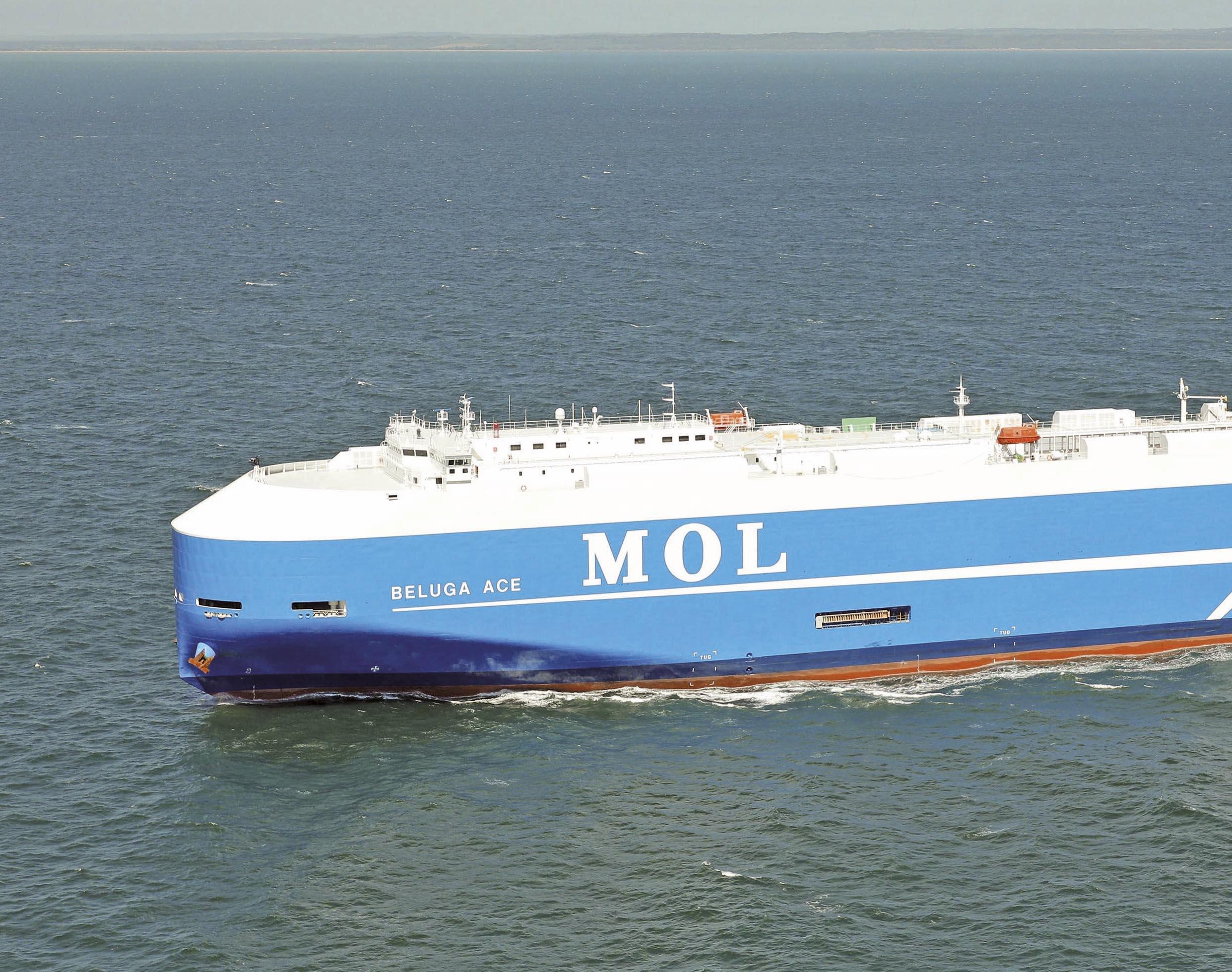
The first specialised car carriers evolved from bulk carriers, and their evolution continues today as the industry continues to upsize, reduce emissions and increase safety.
The Norse Variant and the Anita, combined bulk and car carriers that were carrying coal to Europe, both sank in the same March 1973 storm. 61 lives were lost.
Both vessels experienced extreme weather including 15 metre significant wave heights and winds of around 60 knots. Hatch covers were damaged by dynamic forces, and the flooded cargo holds led to the loss of stability. The vessels had stowed tweendecks which were used to carry cars on the return voyage, and it is possible that they broke their lashings, piercing the hatch covers.
On vessels such as these, the cars were loaded individually by crane, and this mode of transport dominated the early years of the trade the 1950s and 1960s. However, incidents such as the loss of Norse Variant and Anita, along with the growing volume of cars traded globally, brought change.
There was growing interest in the shipping of heavy vehicles, and this led to the development of the pure car truck carrier (PCTC) with hoistable cargo decks. This enabled flexible clearance between decks which was partnered with reinforced truck decks to handle the heavier loads.
By the 1980s, dedicated PCTCs were rapidly replacing the dual-purpose converted vessels and crane-loading car carriers that had pioneered the trade.
These earlier vessels took various forms. The world’s, first purpose-built car carriers, the 78.2-metre Rigoletto and Traviata, built by Kieler Howaldtswerke, were delivered to Wallenius Lines in 1955. The vessels had four decks with a capacity for 290 cars. In 1965, MOL build the car/bulk carrier Oppama Naru which with an onboard crane that was able to load 100 cars per hour instead of the 15 which was more typical.
The earliest dedicated roll-on/roll-off (ro/ro) vessel was the 75.6-metre Aniara built by Swedish yard Lödöse Varf in 1963. This vessel demonstrated the higher efficiency of driving vehicles onboard but, like the earlier vessels, had limited capacity (240 cars). In 1971, the 2,000 vehicle ro/ro Kanada Maru was capable of loading 250 cars per hour.
Vessel conversions continued at this time, one being the conversion of the passenger liners Amazon, Aragon and Arlanza in the early 1970s. Most of the accommodation space was converted to carry cars with the bridge located above and a new funnel and sponsons fitted. The 584 foot vessels could then carry 3,000 cars.
In 1984, the Atlantic Container Line consortium took delivery of the car/container carrier Atlantic Concert which had a 614 car and 2,104 TEU container capacity.
The growing global car trade soon led to increasingly large vessels. In 1968, “K” Line took delivery of the car/bulk carrier Toyota Maru No. 1, a 1,250-vehicle capacity vessel. Vessel capacity continues to increase with today’s newbuildings. Höegh Autoliners' Höegh Aurora became the world's largest PCTC on delivery in August 2024. The vessel was the first of 12 Aurora Class vessels being built by China Merchants Heavy Industry. Featuring 14 decks, including five liftable decks, the ship can carry up to 9,100 car equivalent units (CEU), including electric vehicles on all decks. Later in 2024, BYD Auto launched the 9,200 CEU, 219 metre BYD Shenzhen.
Vessels over 200 metres in length can be referred to as large car truck carriers (LCTCs), and in 2024, Wallenius Wilhelmsen announced it was upsizing four of its 12 Shaper class vessels from 9,300 to 11,700 CEUs, increasing their length from 228 to 238 metres.
The first Shaper vessel is expected to be delivered in 2026, the larger ones in 2027. The idea is to create economies of scale that will enable more efficient operations and lower supply chain emissions.

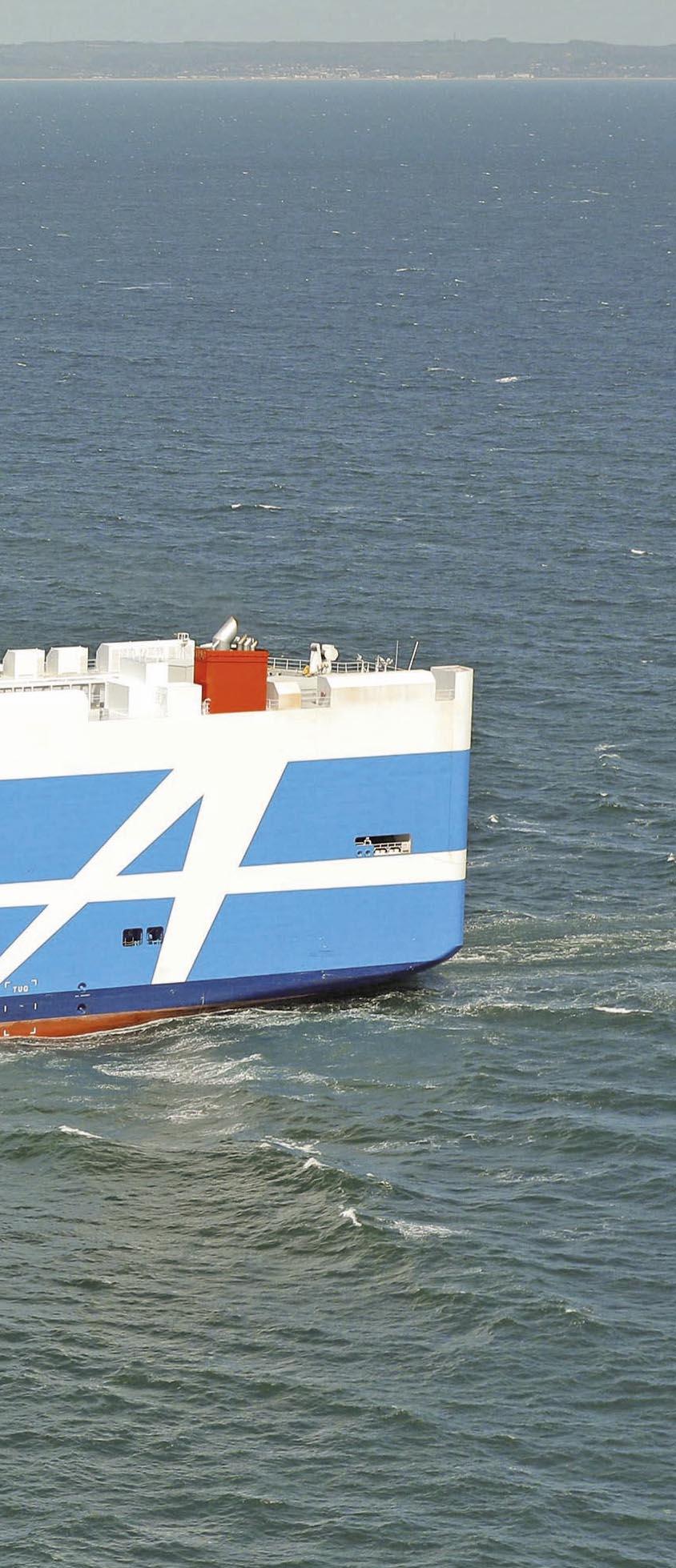
Decarbonisation has been an important design trend for PCTCs alongside increasing vehicle carrying capacity. In March 2018, MOL built its first FLEXIE series vessel, Beluga Ace, with six liftable decks to accommodate highcar-height cargoes such as construction machinery. The vessel included a range of features to boost energy efficiency including an optimised hull form and improved propeller design. The design reduced CO2 emissions by 13.7% compared to conventional ships.
In 2021, Wallenius Wilhelmsen took delivery of the 7,700 CEU Nabucco, a HERO class vessel that features reduced energy consumption by dramatically improving the cargo to ballast ratio. An increased beam (36.5 metres) provides better stability, so there is less need for ballast water. In addition, an optimized hull diminishes drag and wave resistance, improving fuel efficiency, while the engine has been tuned for low-load operation to reduce fuel consumption.
Dual-fuel LNG propulsion has been adopted widely across the industry to further reduce CO2 emissions. Guangzhou Shipyard International delivered H Line’s first LNGpowered PCTC, the 7,000 CEO Glovis Solar, in 2024. This was followed by the Glovis
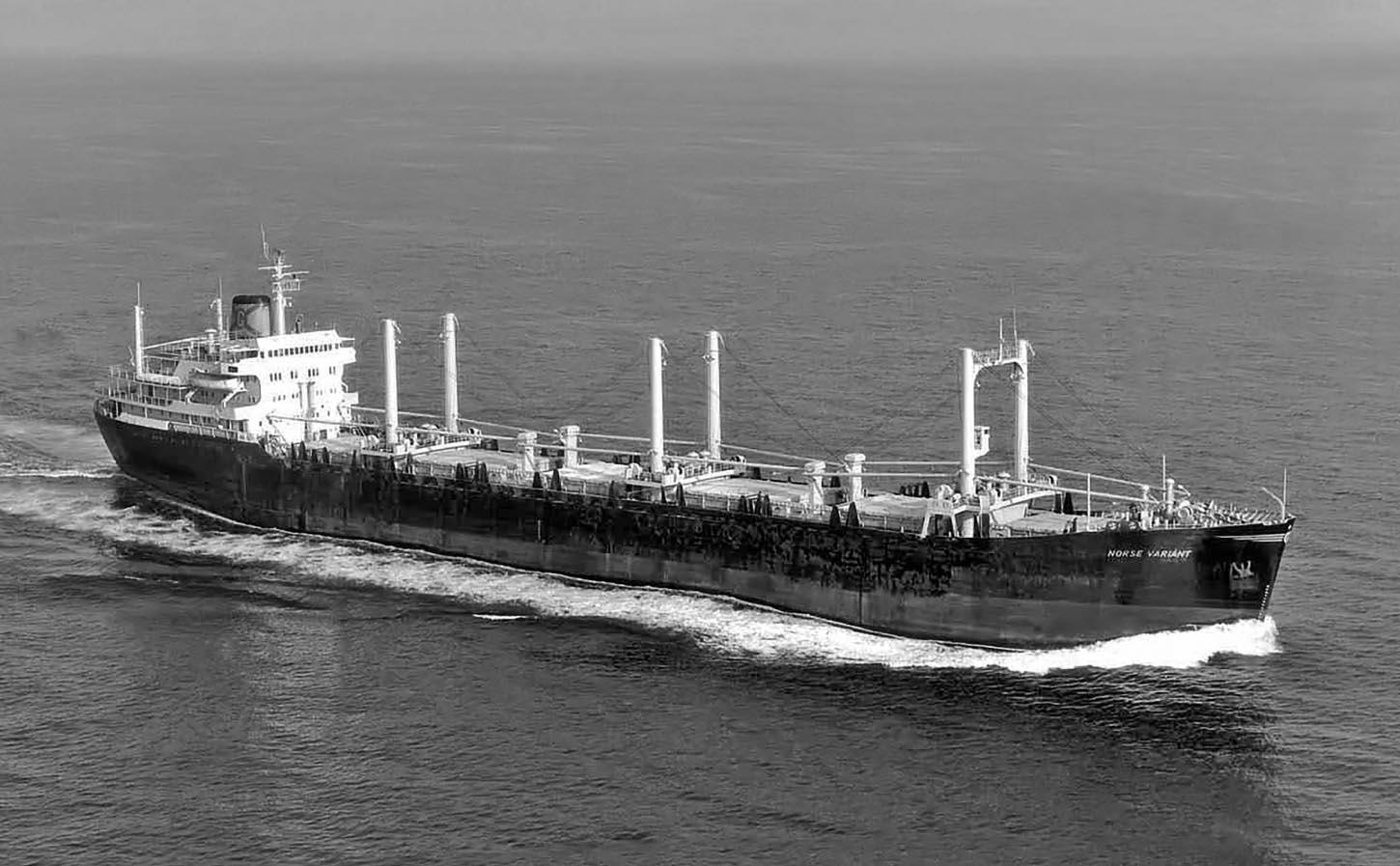
Left: The 63,115gt Beluga Ace of MOL was built in 2018 by Minaminippon at Ozai.
Above: The 13,194grt Norse Variant of I/S Norse Lady was built in 1965 by Uddevallavarvet at Uddevalla. On 22nd March 1973 she broke in two and sank in a hurricane a day after leaving Newport News bound for Glasgow. Just one of her 30 crew survived.
Below: The 12,946grt Anita of Erling H.Samuelsens Rederi A/S was built in 1966 by Tangen Verft at Kragero as the Belline for K/S Belline, becoming Anita in 1971. On 21st March 1973 she sailed from Newport News two hours after the Norse Variant and went missing the following day with the loss of her entire crew of 32.
Bottom: The 1,899grt Traviata was built in 1955 by Howaldtswerke at Kiel for Wallenius Lines. In 1968 she moved to Grimaldi and was renamed Rigoletto. On 21st April 1981 she arrived at La Spezia to be broken up by CN Santa Maria.
(All photos by FotoFlite)
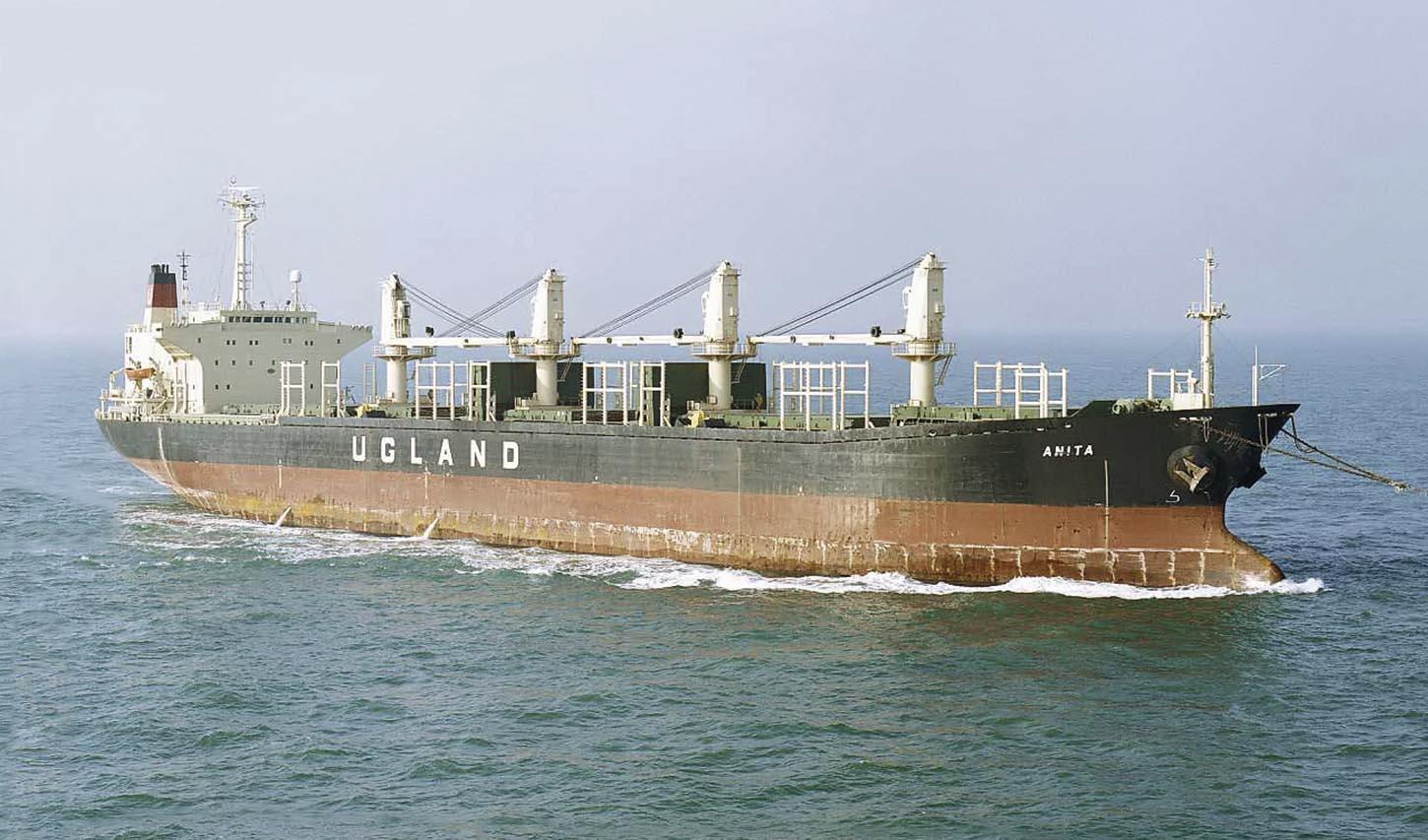
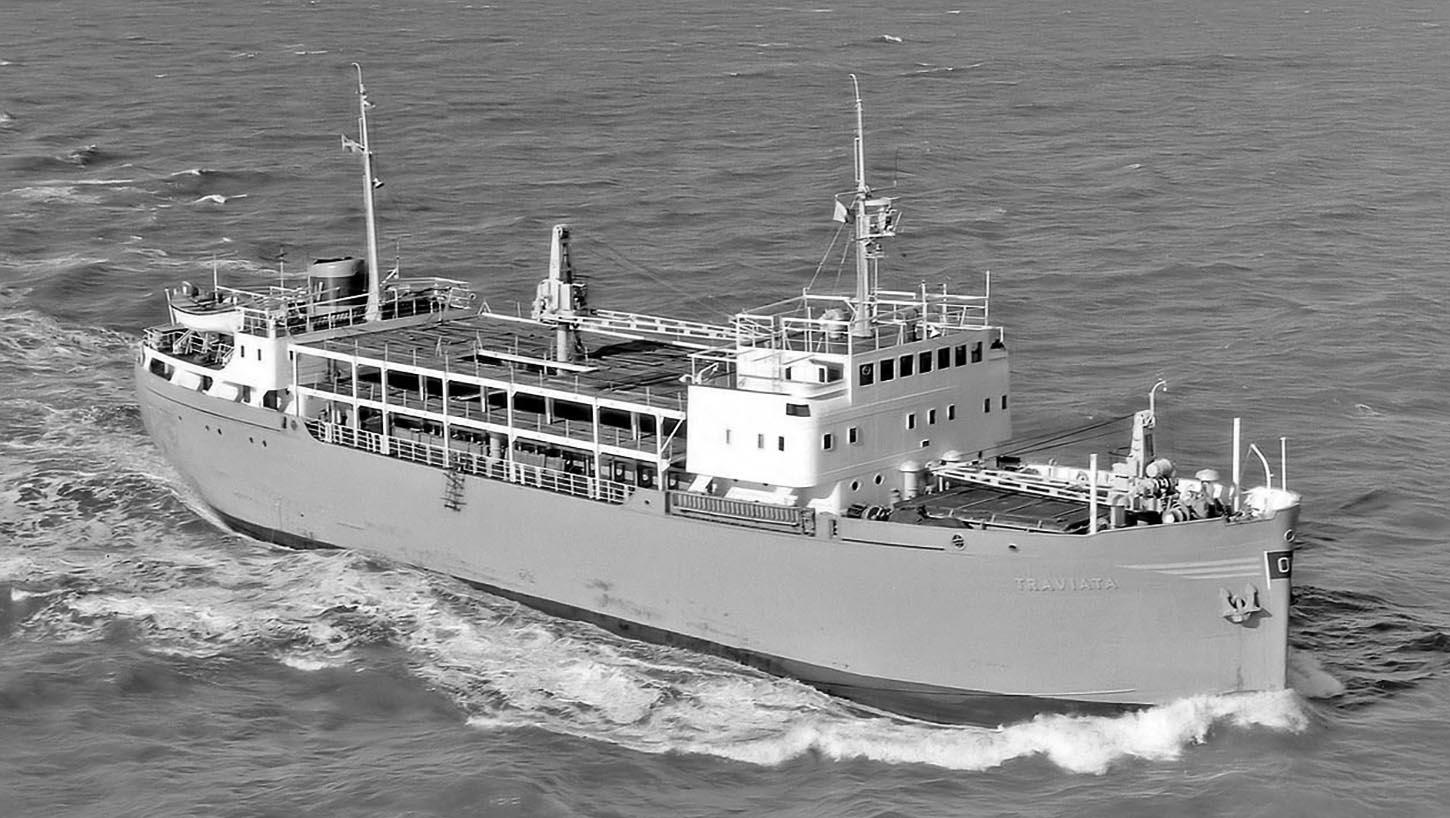
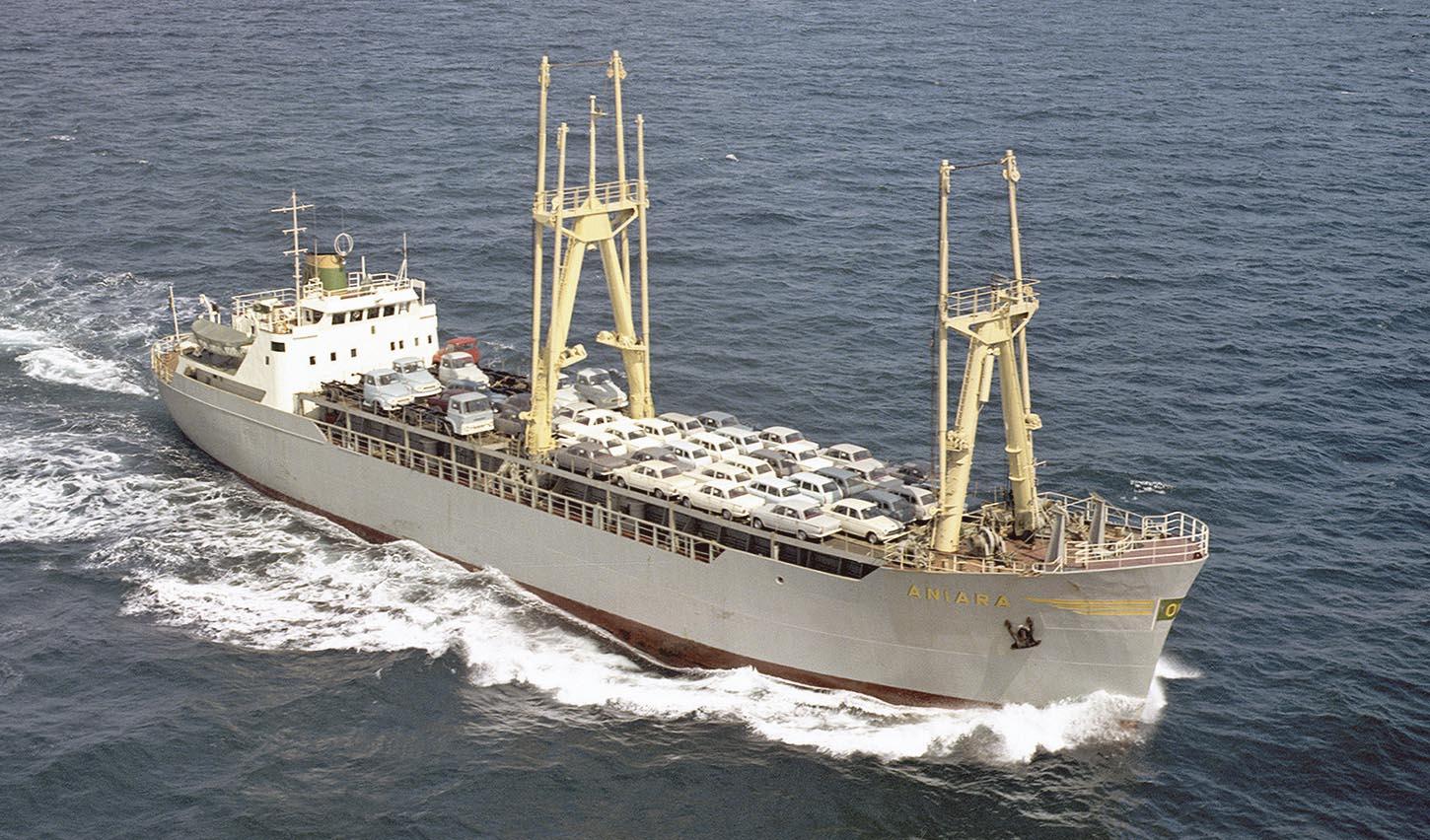
Above: The 1,718grt Aniara was built in 1963 by Lödöse Varf, Sweden for Rederi A/B Wallstar of Stckholm.In 1971 she joined Halidon Co. Ltd. of Bermuda, initially as Apollo New Brunswick then from 1972, Roro New Brunswick. In 1975 she was sold to Marina Mercante Nicaraguense SA of Nicaragua and was renamed Leon, her name changing to Ciudad de Leon later that year. In 1980 she became Aniara again before joining Welcome Maritime of Grand Cayman as Choroni in 1984. On 18th July 1984 she capsized at San Juan, Puerto Rica and was broken up at Santo Domingo the following year. (FotoFlite)
Below: The 25,435gt Atlantic Concert was built in 1984 by Kockums MV at Malmo for Atlantic Container Line/Wallenius. In 1987 she was lengthened by 26.7 metres and renamed Concert Express before reverting to Atlantic Concert in 1994. On 12th September 2016 she arrived at Alang to be broken up by Harikrishna Steel Corporation. (FotoFlite)
Bottom: The 12,411grt Toyota Maru No. 1 was built in 1968 by Kawasaki at Kobe for K Line. In 1979 they renamed her Pioneer No. 1 before she joined Jupiter Shipping of Malta as Seamaster in 1983. On 14th November 1985 she arrived at Alang to be broken up by Apollo Vikas Steel. (Walter E. Frost)
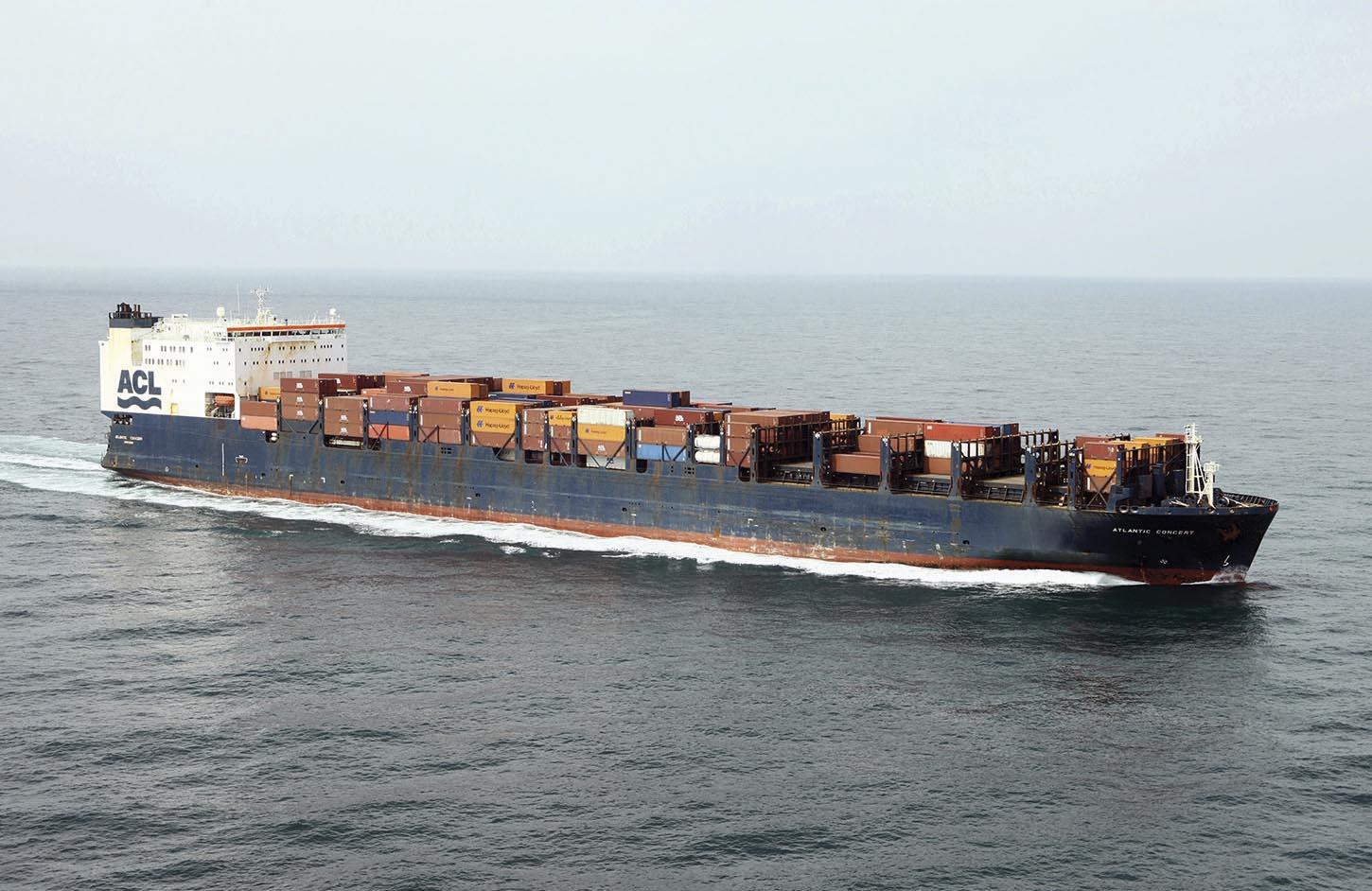
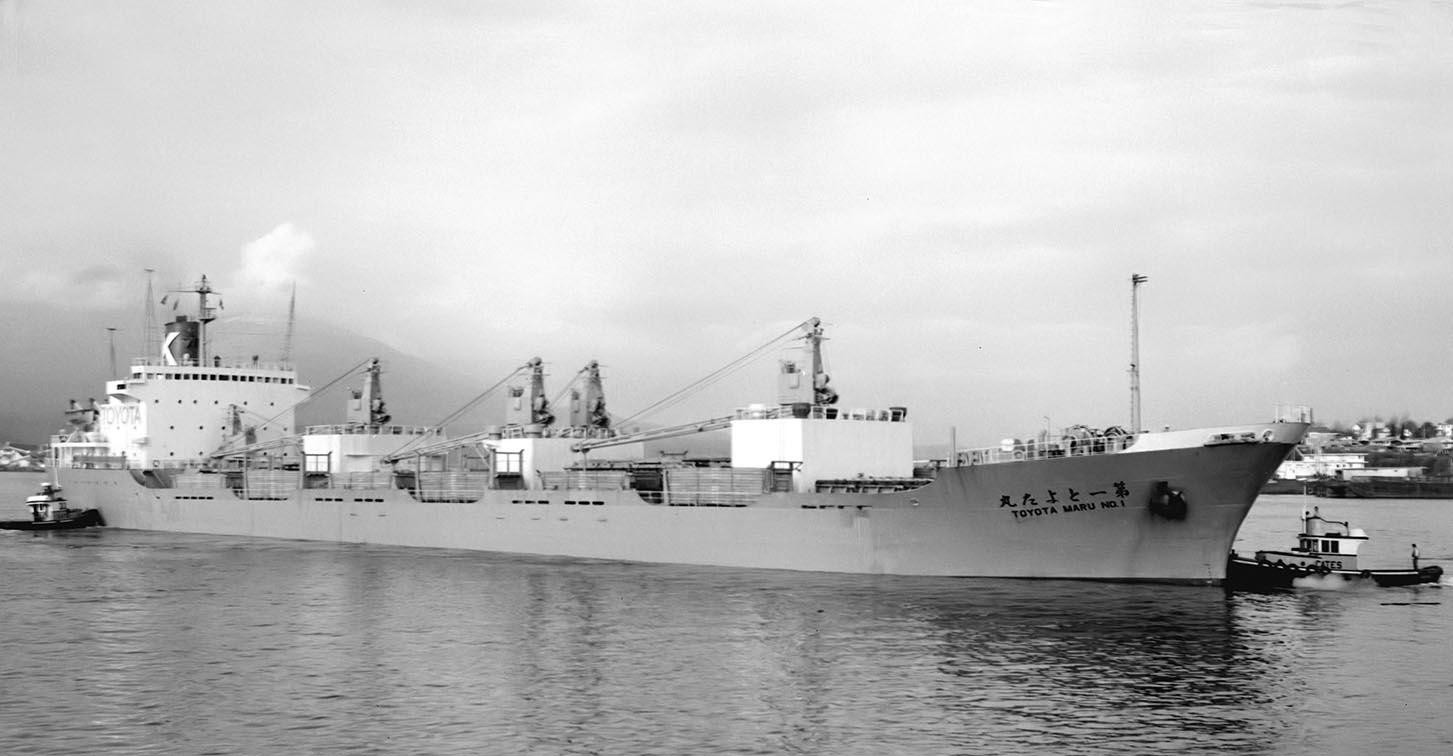
Sunshine. Two more similar vessels are expected to be delivered this year, and two 8,600 CEU vessels are also on order.
Also in 2024, the dual-fuel LNG 7,600 CEU SAIC Anji Sinceritywas built by China State Shipbuilding to transport new Chinese vehicles from SAIC Motor, Dongfeng Motor and Yutong to Europe.
CMA CGM Group moved to battery hybrid dual-fuel LNG propulsion with the 2024 delivery of sister ships CMA CGM Monaco, CMA CGM Daytona, and CMA CGM Monza. The propulsion system is a hybrid arrangement consisting of lithium batteries and two MAN IMO Tier III, LNG dual-fuel engines fed by two 2,000m3 tanks. The 200 metre vessels have 12 vehicle decks with a total capacity of 7,000 CEUs. The vessels have both fixed and movable decks to permit the carriage of larger vehicle types such as buses.
In January 2025, China’s plug-in hybrid electric vehicle manufacturer BYD took delivery of its first self-built 7,000 CEU dualfuel LNG PCTC, BYD Hefei, from Guangzhou Shipyard International. The 200 metre vessel has a shaft generator and dragreducing hull coating to achieve a 30% reduction in CO2 emissions. Another vessel is on order. The delivery came after the earlier introduction of the LNG-powered 7,000 PCTC duo BYD Explorer No. 1 and BYD Changzhou, built by Yantai Raffles Shipyard.
PCTC owners have also started adopting new fuels. In 2023, China Merchants Heavy Industry ordered six small-bore, sevencylinder methanol-burning gensets for two 9,300 CEU PCTCs for China Merchants Energy Shipping (CMES). The gensets will accompany a MAN B&W 7S60ME-LGIM (Liquid Gas Injection Methanol) main engine for the vessels which are due for delivery in 2025 and 2026. The contract includes an option for another four vessels.
Wallenius Marine released a design for the world’s first wind-powered PCTC in December 2024. PCTCs are considered well suited for wind propulsion because they are comparatively lightweight, don’t travel at very high speeds, and typically have an open deck area that is suitable for sails, often with the superstructure in front so there are no line-of-sight issues.
The company’s Oceanbird concept was developed in partnership with the KTH Royal Institute of Technology and SSPA/RISE, with support from the Swedish Transport Administration. To develop the rigid wing sails used in the design into a marketable product, Wallenius and Alfa Laval formed the new company AlfaWall Oceanbird in December 2021.
The hull is optimized for sailing with a larger beam for increased stability, and the hull shape is optimized for low resistance in
waves and reduced drift. Larger rudders and fins boost manoeuvring safety by reducing drift, and specialized software used for the control of wings, propulsion, and rudders, as one system. The vessel is expected to commence sailing in late 2026.
Safety has remained a focus for the industry, and modern PCTCs are compartmentalised to limit the spread of flooding or fire. Ventilation ensures exhaust fumes and evaporating fuel does not accumulate in the vessel hold, and vessels are fitted with fire detection and fixed and portable fire suppression systems.
Still, there have been a number of highprofile incidents, such as the June 2020 fire onboard the Höegh Xiamen caused by an electrical fault from an improperly disconnected battery in a used vehicle. The crew noticed smoke coming from the ventilation system while preparing to depart the Port of Jacksonville in the US. They discovered a fire on deck 8 which had been loaded with used vehicles. The fire spread to other decks and continued to burn for eight days. The US National Transport Safety Branch (NTSB) concluded many of the vehicles loaded onto the vessel had batteries that were not disconnected and secured in accordance with procedures which increased the risk of electrical arcing and component faults.
Other incidents include the Felicity Ace fire on February 2022 which occurred while the vessel was sailing approximately 90 nautical miles southwest of the Azores. In this case, all 22 crew members abandoned ship safely. The ship was reportedly carrying some 4,000 vehicles, including some electric vehicles and luxury brands like Porsches, Bentleys, and Lamborghinis, along with VW and Audis. The fire continued to burned until the ship sank about two weeks later on 1st March 2022.
More recently still, a fire broke out onboard the Fremantle Highway in July 2023 while the vessel was sailing north of the Netherlands. One crew member died and several others were injured.
In 2024, classification society ClassNK released guidance to assist in the safe evacuation of crew members from vehicle carriers in the event of a cargo hold fire. Vehicle carriers often have accommodation areas and life-saving equipment, such as lifeboats and liferafts, positioned above cargo holds, with ventilation ducts for the holds located close to the accommodation spaces. As a result, flames and smoke from a cargo hold fire can affect these critical areas and evacuation routes. In collaboration with shipping companies and shipyards, ClassNK analysed the risks and suggested countermeasures such as spraying water on the decks, installing thermal insulation under lifeboats, and adding evacuation equipment to the forward mooring decks.
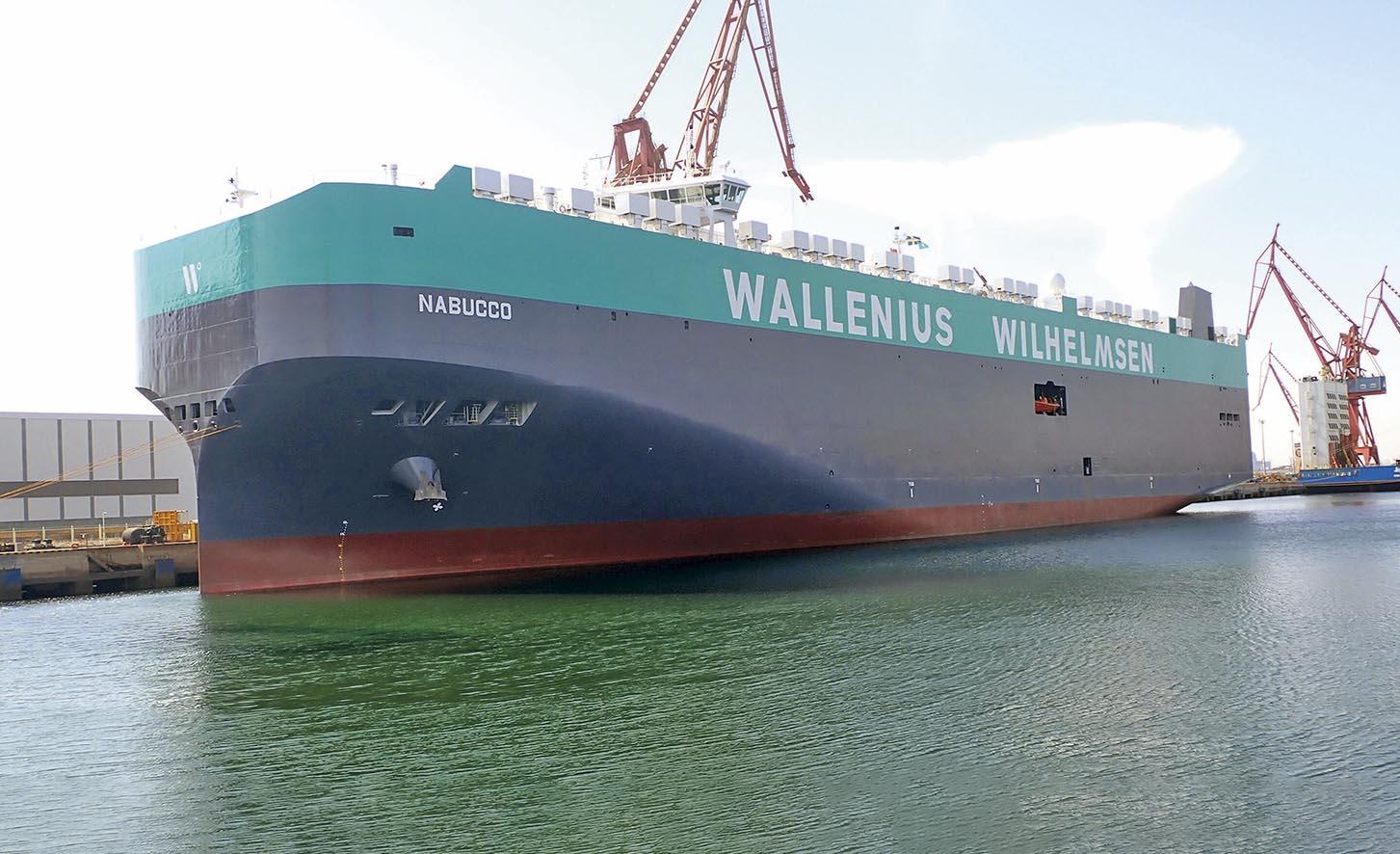
Below: The SAIC Anji Sincerity of SAIC Motor Corporation was built in 2024 by Jiangnan Shipyard and China Shipbuilding Trading Co., Ltd., both subsidiaries of China State Shipbuilding Corporation
Bottom: The 69,542gt BYD Hefei of BYD was built in 2025 by Guangzhou Shipbuilding International, a subsidiary of China State Shipbuilding Corporation. (BYD)
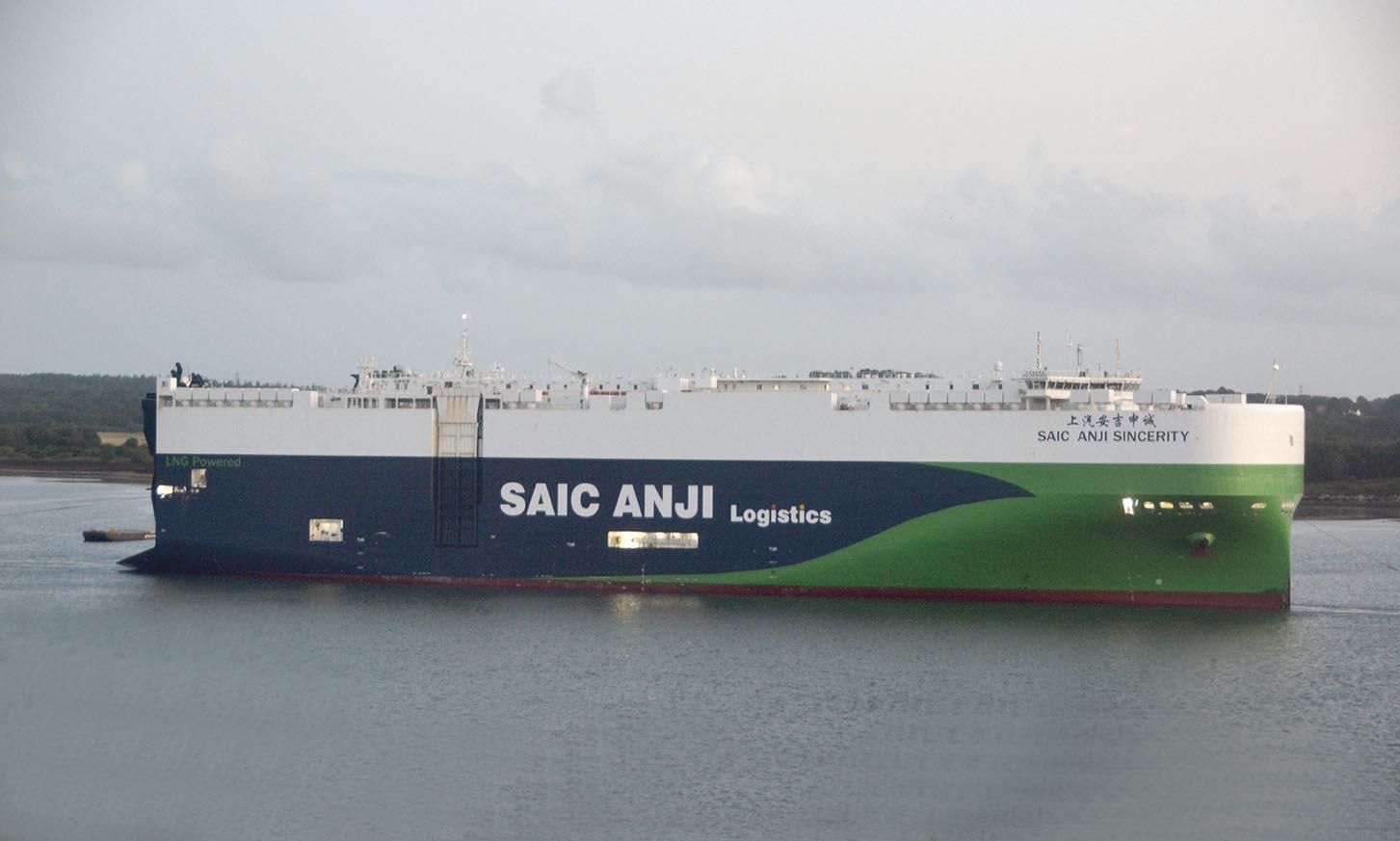
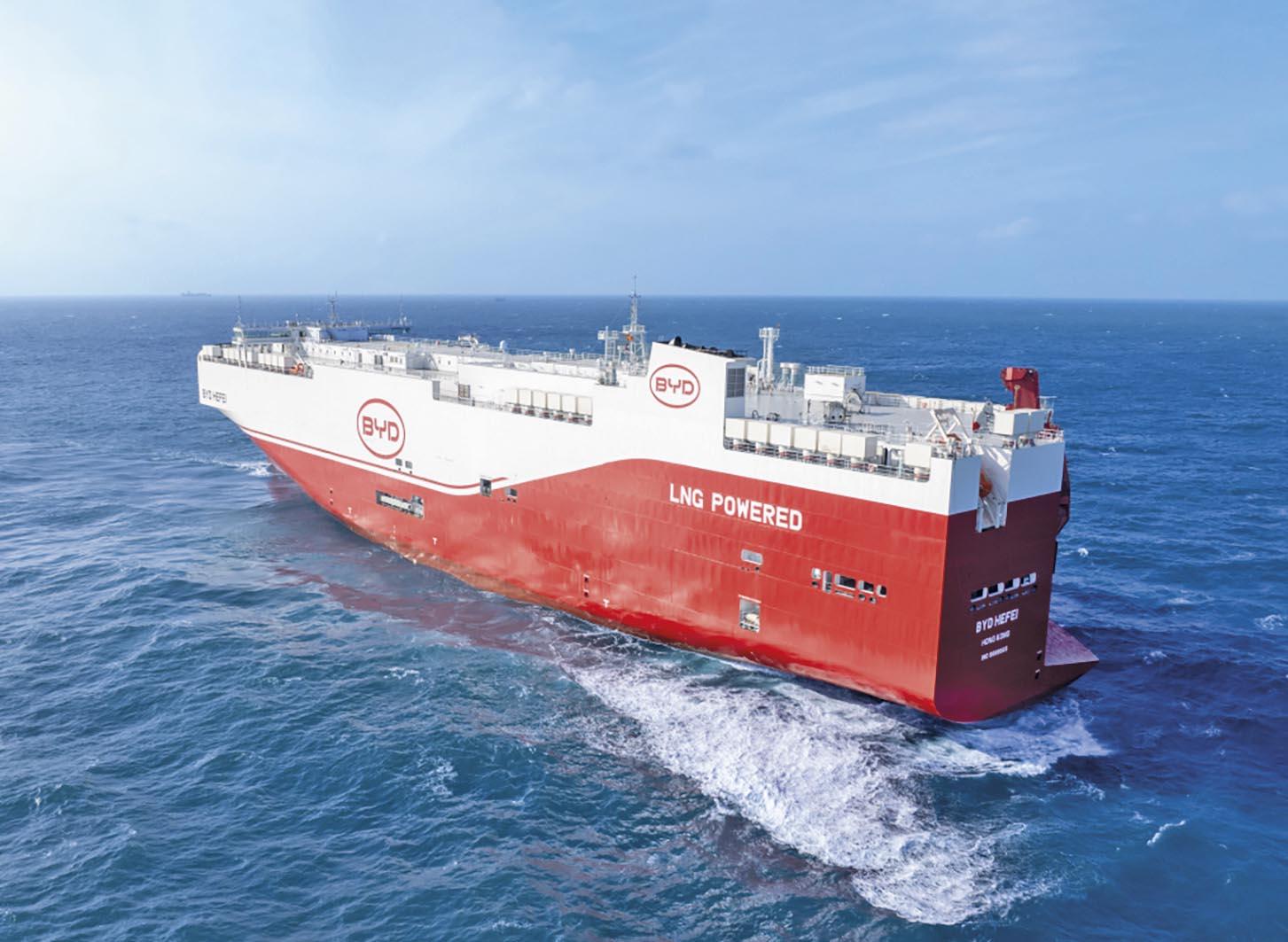
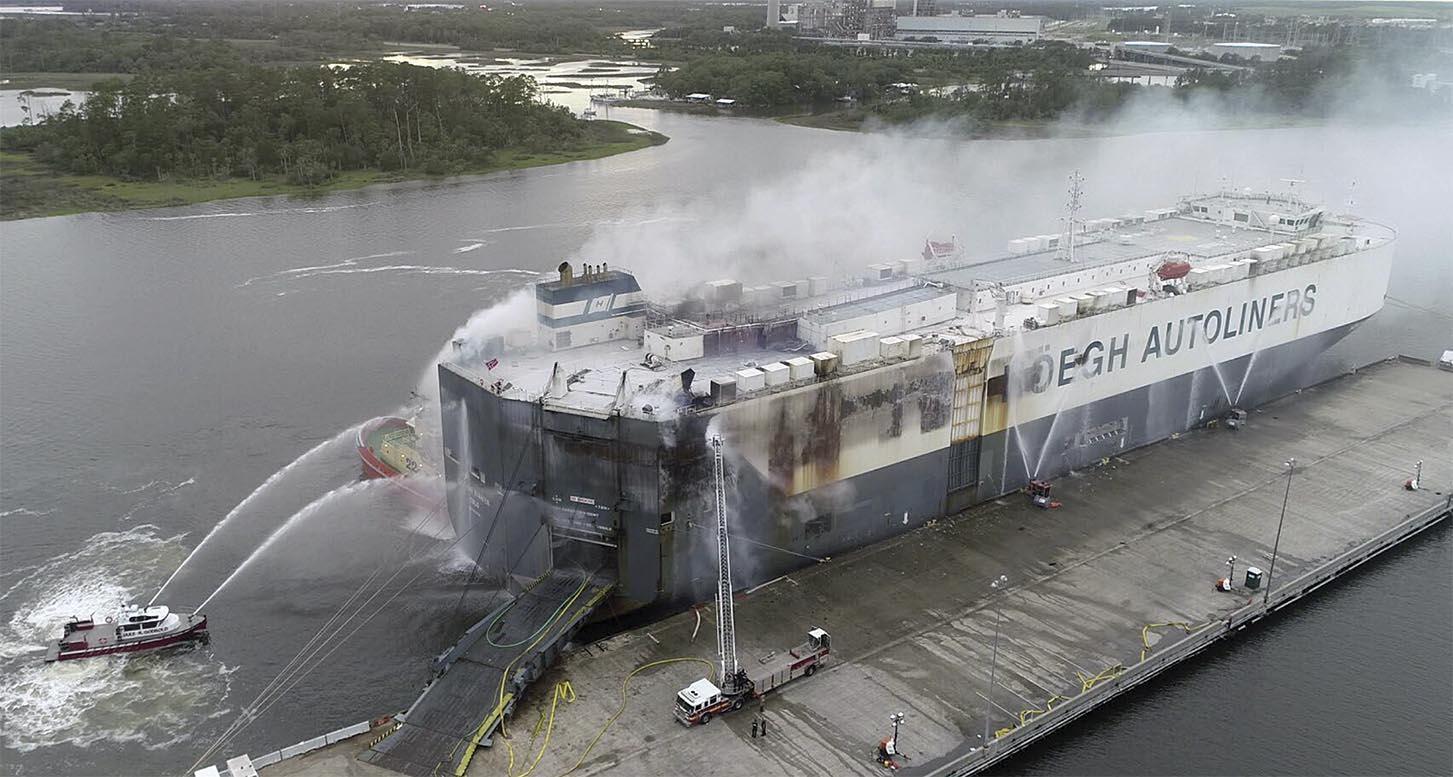
Above: The 47,232gt Höegh Xiamen caught fire while berthed in Jacksonville on 4th June 2020. She was towed to Aliaga to be broken up, arriving there on 5th October 2020. (JFRD)
Below: The 60,118gt Felicity Ace was built in 2005 by Shin Kurushima at Osaka for MOL. On 16th February 2022 she caught fire and sank 220nm SW of The Azores. (MOL/Boskalis)
Bottom: The 59,525gt Fremantle Highway of K Line was built in 2014 by Imabari Zosen at Marugame. On 25th July 2023 off the Dutch coast a serious fire broke out onboard, thought to be caused by an electric car. After initially being towed to Eemshaven she was then towed to Rotterdam.She was eventually sold to Qingshan Shipyard Group of Xiamen, China for €11 million, and renamed Floor. (Wikipedia)
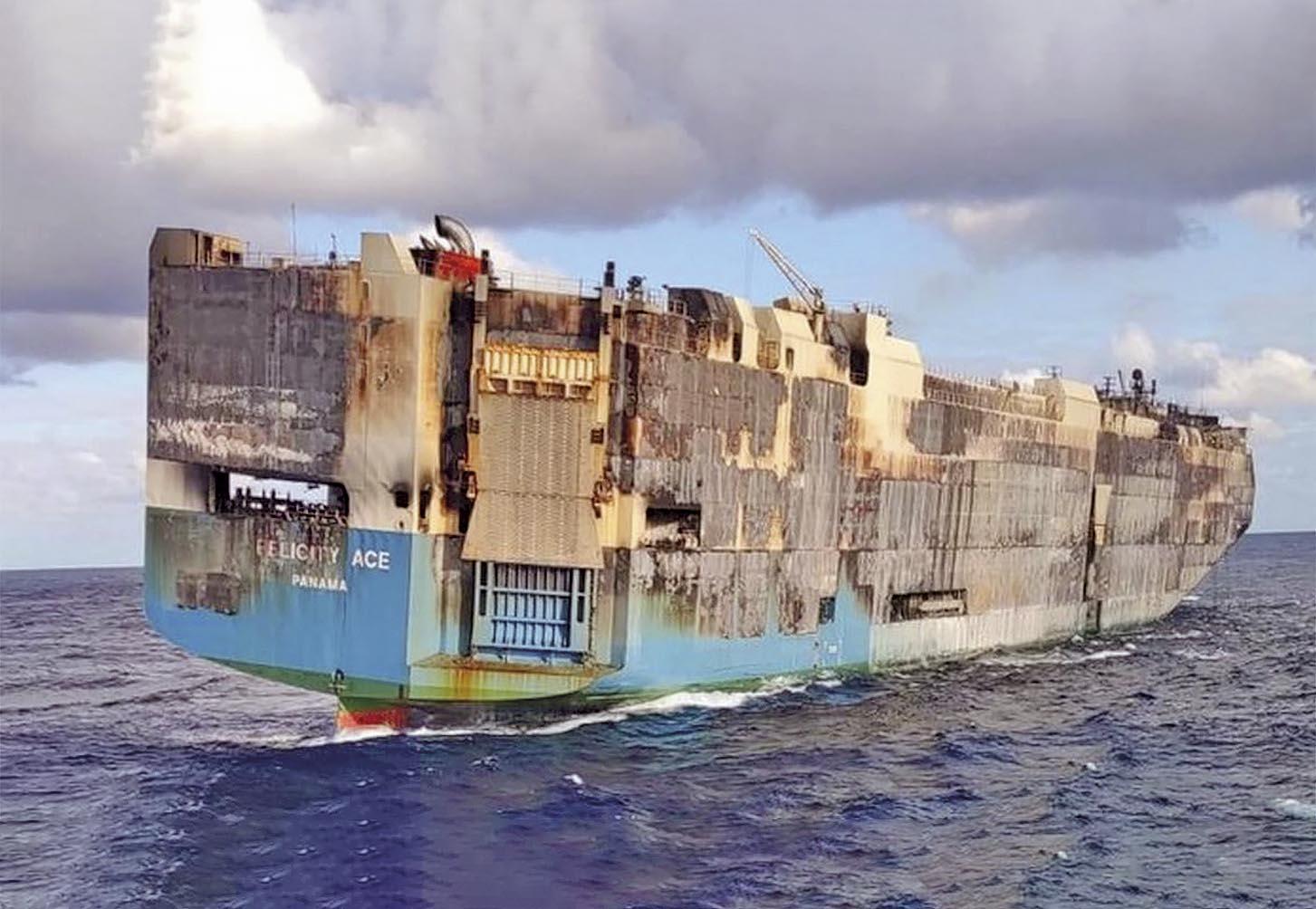
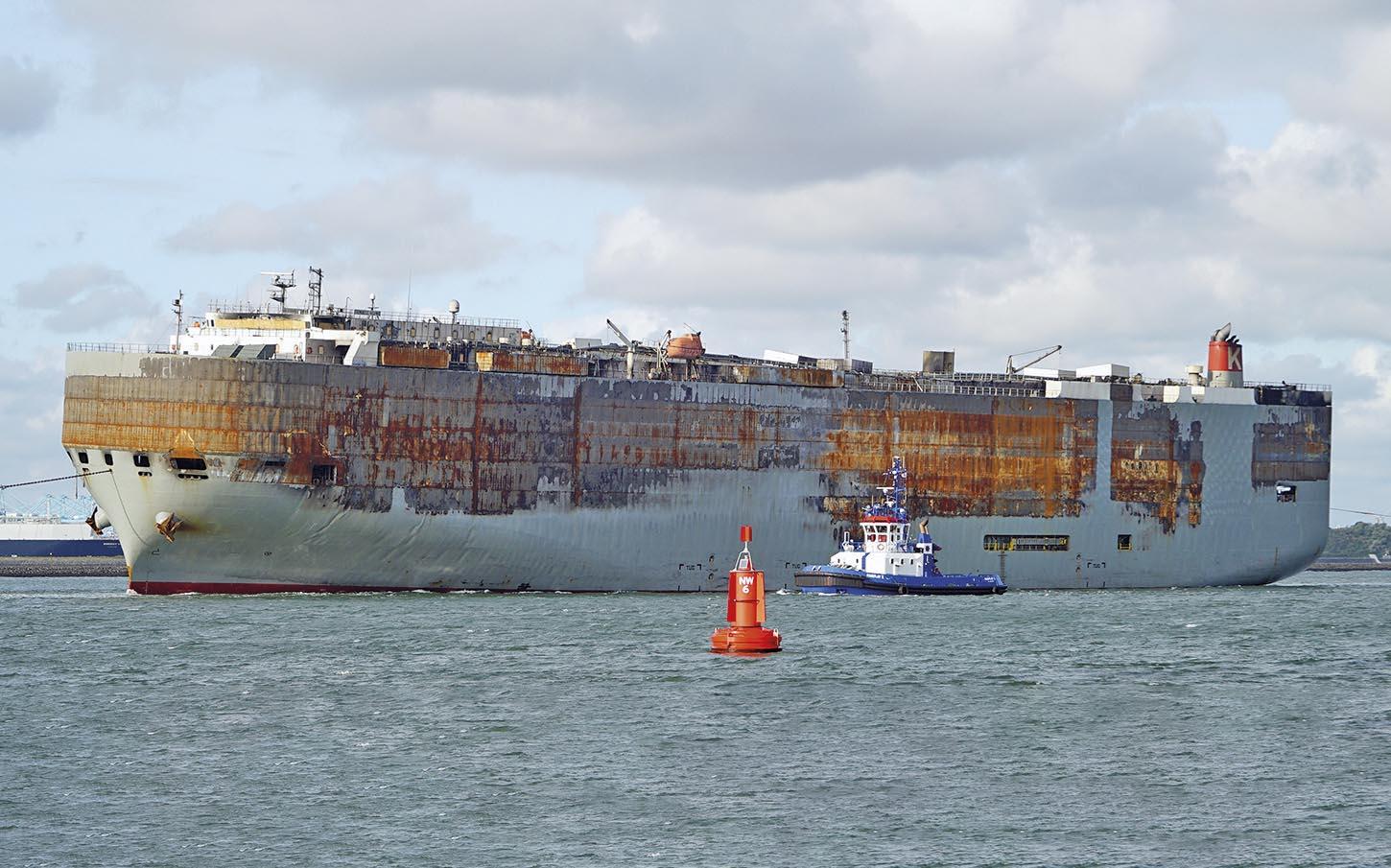
Höegh Autoliners took delivery of its first Aurora class vessel Höegh Aurora from China Merchants Heavy Industry in 2024. The 9,100 CEU Höegh Aurora is the first of 12 multi-fuel-ready vessels ordered which have DNV’s “ammonia ready” and “methanol ready” notations. The second, Höegh Borealis, is also now in operation.
The vessels will have 1,500m2 of solar panels on the top deck, reducing electricity production from the generators by up to 30-35%.
They are expected to cut CO2 emissions per car transported by up to 58% from the current industry average.
The first Aurora Class vessels are running on LNG, biofuels and lowsulphur oil. From 2027, the aim is that the last four of the 12 Aurora Class vessels will be running on green ammonia, reducing emissions by close to 100%.
Höegh Autoliners has partnered with several of the world’s leading ammonia producers to ensure the supply and usage of green ammonia inculding Yara Clean Ammonia, Norwegian North Ammonia, and Sumitomo Corporation.
Through its membership of the First Movers Coalition, Höegh Autoliners has also committed to powering at least 5% of its deep-sea operations with green ammonia by 2030. The goal is to run its fleet on at least 100,000 metric tonnes of green ammonia by that year.
In 2021, the world’s first LNG-powered battery hybrid PCTC, the 3,600 CEU Auto Advance sailed from Jiangnan Shipyard. By the end of 2024, with the delivery of Blue Aspire, UECC had five dual-fuel LNG vessels, three with battery hybrid capabilities, along with another two due to be delivered in 2024.
In another CO2 emissions reduction measure, luxury vehicle manufacturer JLR signed up to join UECC’s “Sail for Change” initiative.
JLR is the fourth vehicle manufacturer participating in the initiative in which bioLNG supplied by Titan Clean Fuels is being bunkered on UECC’s five dual-fuel LNG PCTCs operating in the European shortsea trade.
JLR, which produces the Range Rover, Defender, Discovery and Jaguar brands, will deliver electric models of all its luxury vehicles by 2030 and aims to achieve net-zero emissions across its full value chain by 2039 through the decarbonization of its manufacturing, operations, and supply chain, as well as vehicle emission reductions.
UECC is also exploring the use of zero-carbon fuels such as hydrogen and ammonia as part of its goal of net-zero operations by 2040.
COSCO SHIPPING Specialized Carriers celebrated the delivery of its 7,000 CEU dualfuel LNG PCTC, Gan Jiang Kou, in 2024. This vessel is among nine customized PCTCs developed in collaboration with Guangzhou Shipyard International and is operated by Guangzhou Yuanhai Automobile Shipping, a joint venture subsidiary under COSCO SHIPPING Specialized Carriers. It is typical of the advanced PCTCs sailing today.
The Gan Jiang Kou is 200 metres long with a moulded beam of 38 meters and a depth of 14.8 meters. Its design draft stands at 8.6 meters, expandable to a maximum draft of 10 meters. Powered by a two-stroke dualfuel LNG main engine and complemented by a fixed-pitch propeller, three dual-fuel generators, a bow thruster, and a semisuspended twisted rudder, the ship achieves a speed of 19 knots. Additionally, it features two 1,675m3 LNG tanks, utilizing both fuel oil and natural gas to comply with IMO TIER III NOx emission standards. The onboard natural gas capacity ensures uninterrupted operation throughout the entire voyage.
The vessel features a versatile cargo configuration with 12 car decks, comprising eight fixed and four liftable decks. Its starboard side is fitted with both stern and side doors, facilitating the transport of cars, vans, freight-loaded trailers, and heavy trucks. All the 12 decks are designated for fuel vehicles and lithium battery vehicles, and the 11th and 12th decks are equipped to handle new energy vehicles powered by hydrogen and natural gas.
Armed Houthis stormed the Galaxy Leader via helicopter on 19th November 2023 taking the car carrier and its crew hostage. The vessel was sailing near Hodeida, Yemen, at the time and headed for India. It was targeted due to its Israeli connection. It is owned by Galaxy Maritime, a subsidiary of Ray Car Carriers which is co-owned by an Israeli businessman. It was the Houthis’ first highprofile attack on global shipping following the start of the Israel-Gaza war.
The crew of 25, including 17 Filipinos, three Ukrainians, two Bulgarians, two Mexicans, and one Romanian were held in Yemen for over a year until finally being released on 22nd January 2025. The vessel was anchored off the port of Saleef and reportedly turned into a tourist destination during that time.
Some high-profile accidents have demonstrated the vulnerability of PCTCs to stability issues. On 8th September 2019, the 7,400 CEU PCTC Golden Ray capsized while transitting outbound through St. Simons Sound near Brunswick, Georgia, in the US. All 23 crewmembers and one pilot onboard were rescued, including four engineering crew who were trapped in the vessel for
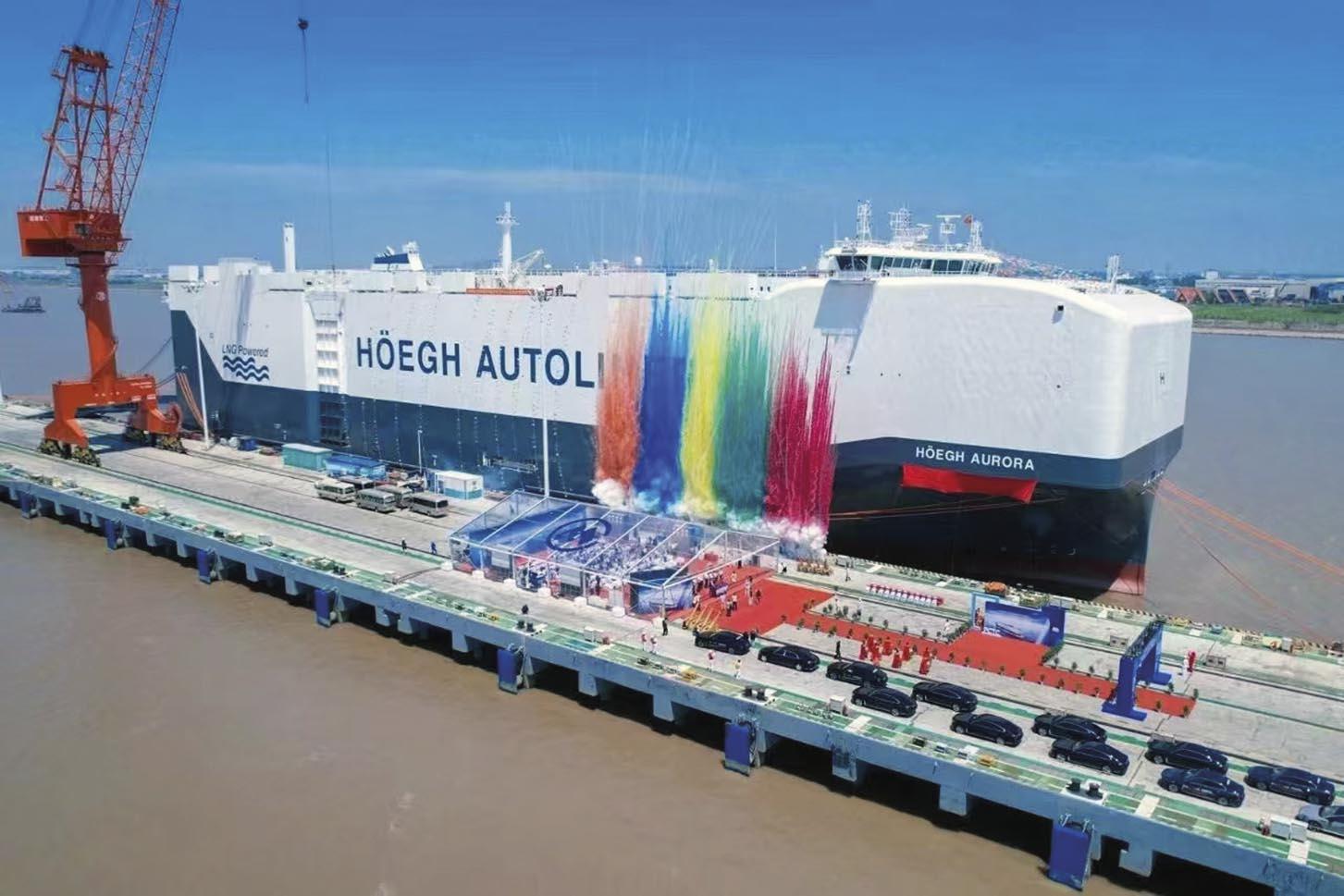
Bottom:
68,252gt Gan
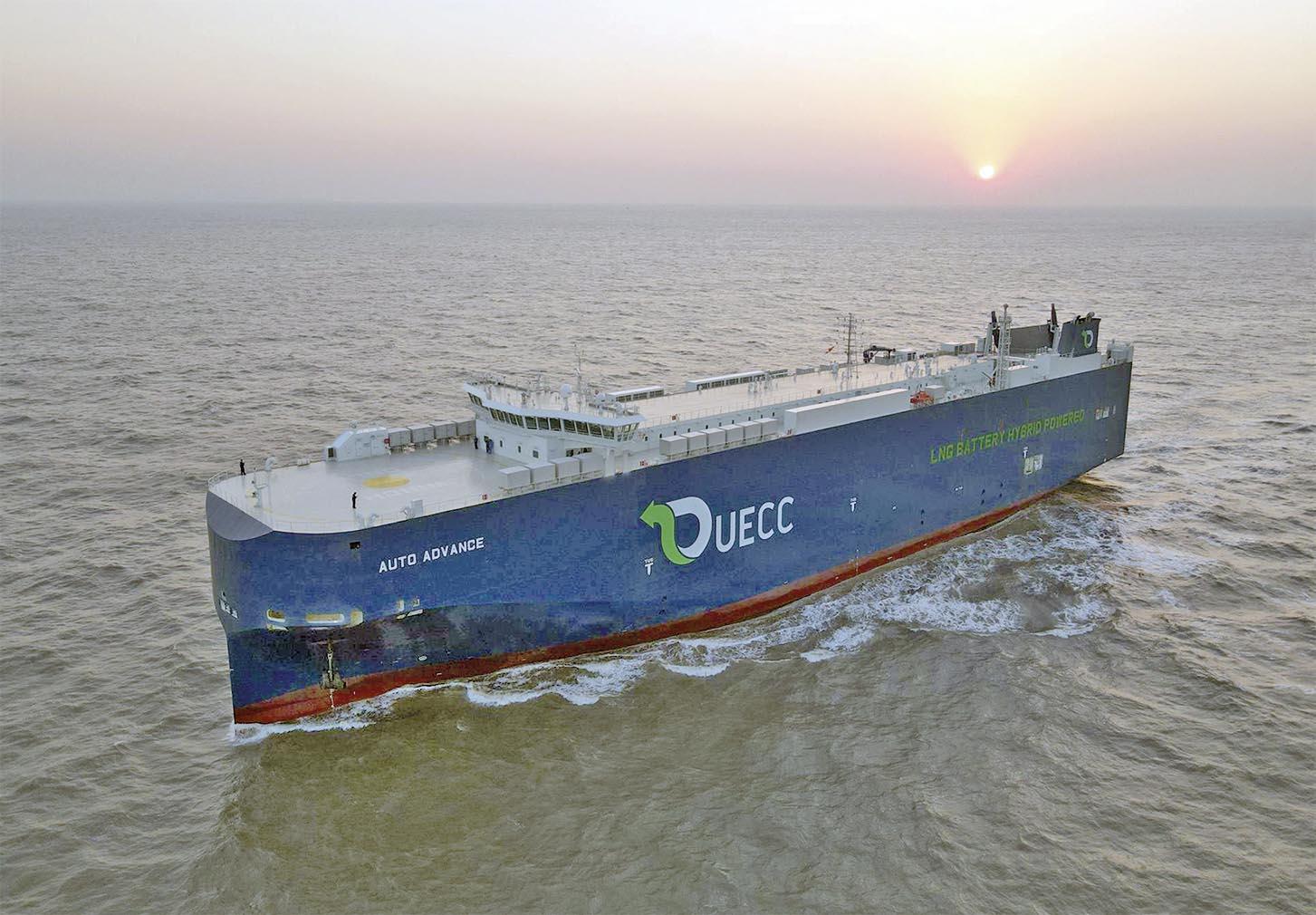
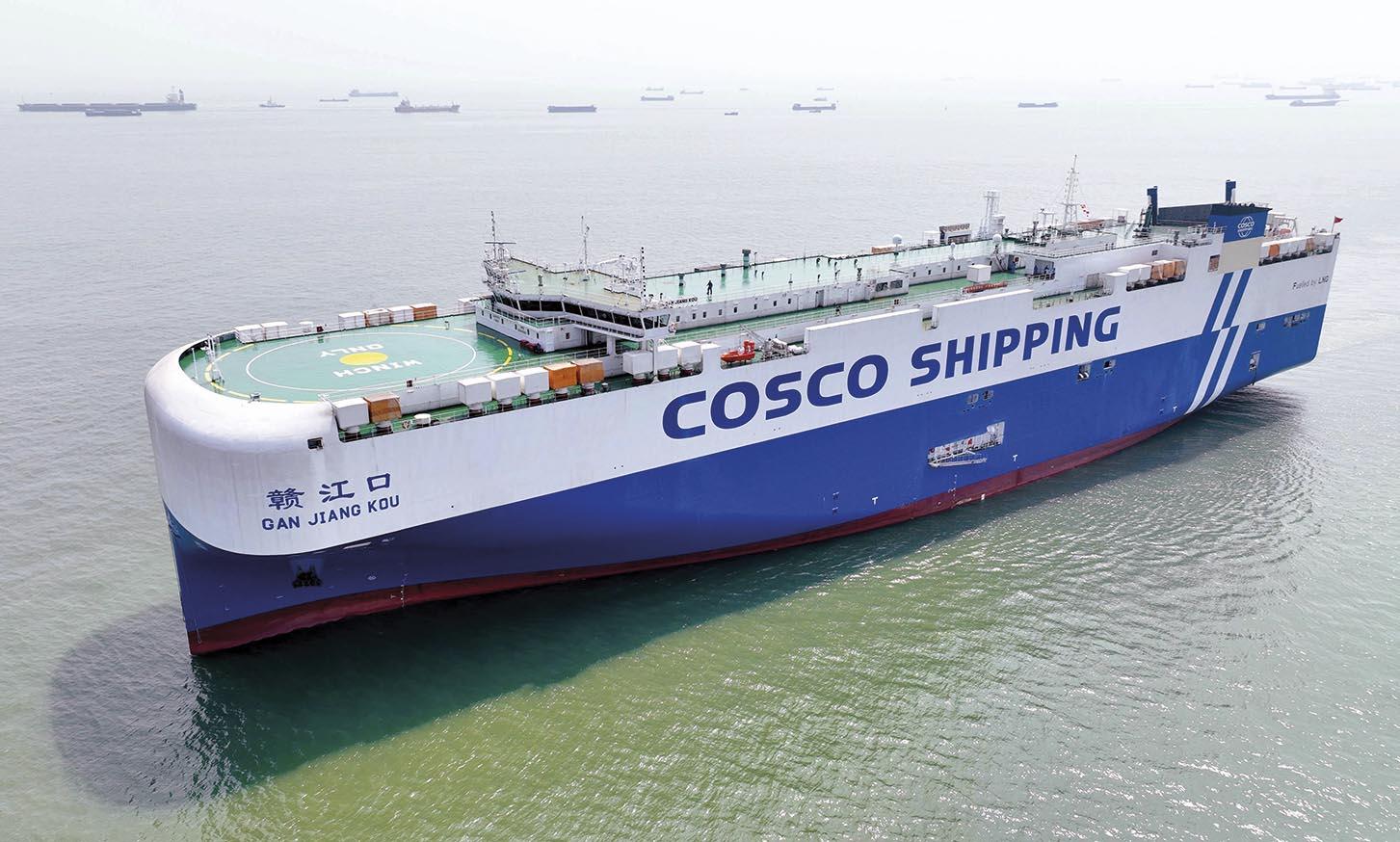
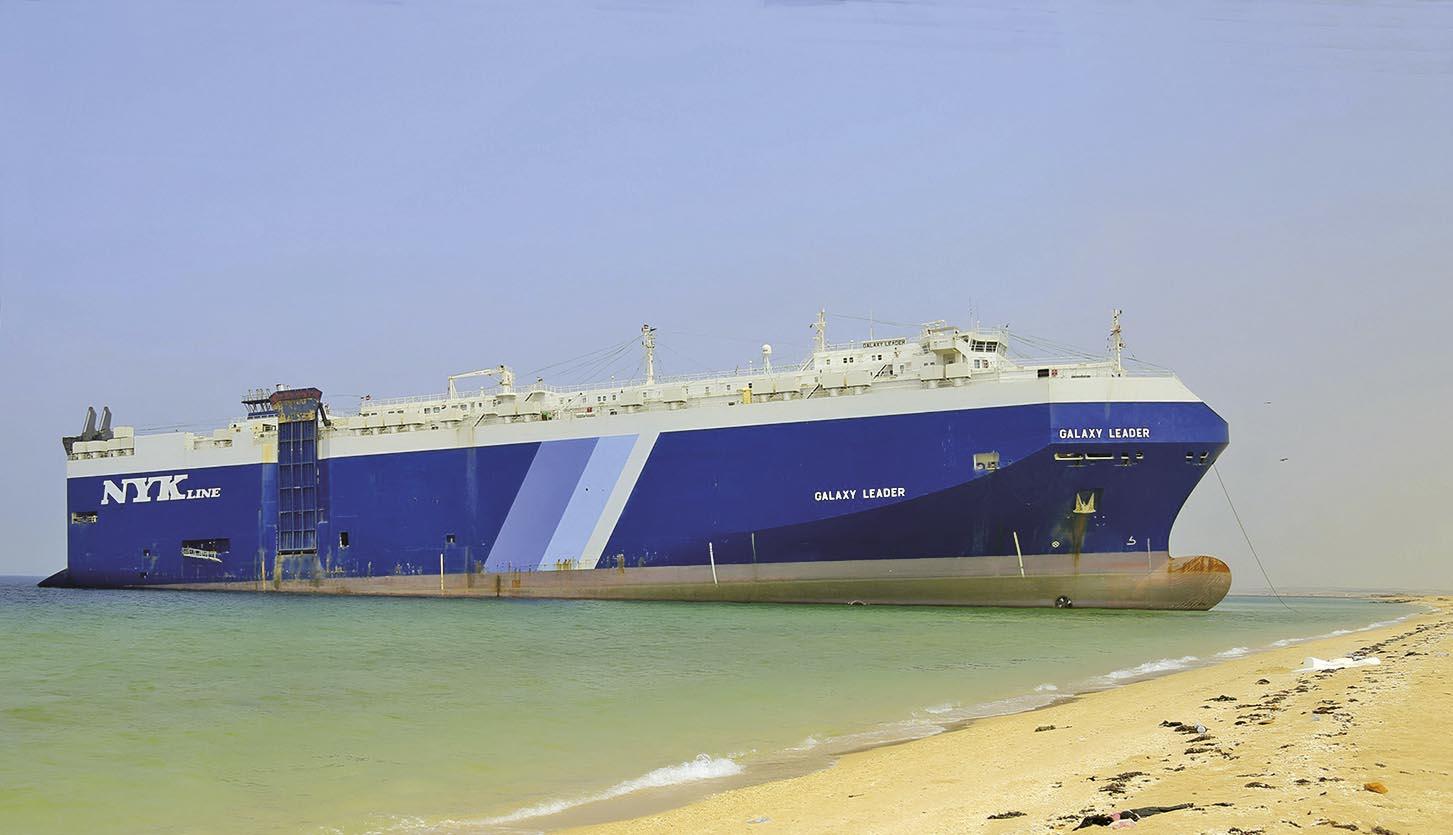
nearly 40 hours. Two crew sustained serious injuries.
Less than 40 minutes after leaving port, the vessel began to heel rapidly to port during a 68 degree turn to starboard. Despite attempts by the pilot and crew to counter the heel, the rate of turn to starboard increased, and the vessel reached a heel of 60 degrees to port in under a minute before it grounded outside of the channel.
Above: The 47,650gt Galaxy Leader of NYK was built in 2002 by Stocznia at Gdynia. On 19th November 2023 she was hijacked by Houthi rebels off Yemen. She and her crew were taken to Yemen where they were kept captive until being released on 22nd January 2025.
(Eren Topcu)
Below: The 71,178gt Golden Ray was built in 2017 by Hyundai at Ulsan. She caught fire and capsized on 8th September 2019 in St. Simons Sound, off Brunswick, Georgia. She was broken up in situ.
(US Coast Guard)
The US National Transport Safety Board (NTSB) determined the probable cause of the capsizing was the chief officer’s error entering ballast quantities into the stability calculation program which led to his incorrect determination of the vessel’s stability and resulted in the Golden Ray having an insufficient righting arm to counteract the forces developed during the turn. Contributing to the accident was the vessel operator’s lack of effective procedures in their safety management system for verifying stability calculations.
Bottom: The 51,770gt Höegh Osaka was built in 2011 by Hashihama Zosen at Tadotsu as the Maersk Wind, joining Höegh immediately. On 3rd January 2015 she ran aground on the Brambles Bank off the Isle of Wight. The ship was eventually re-floated.
(HM Coastguard)
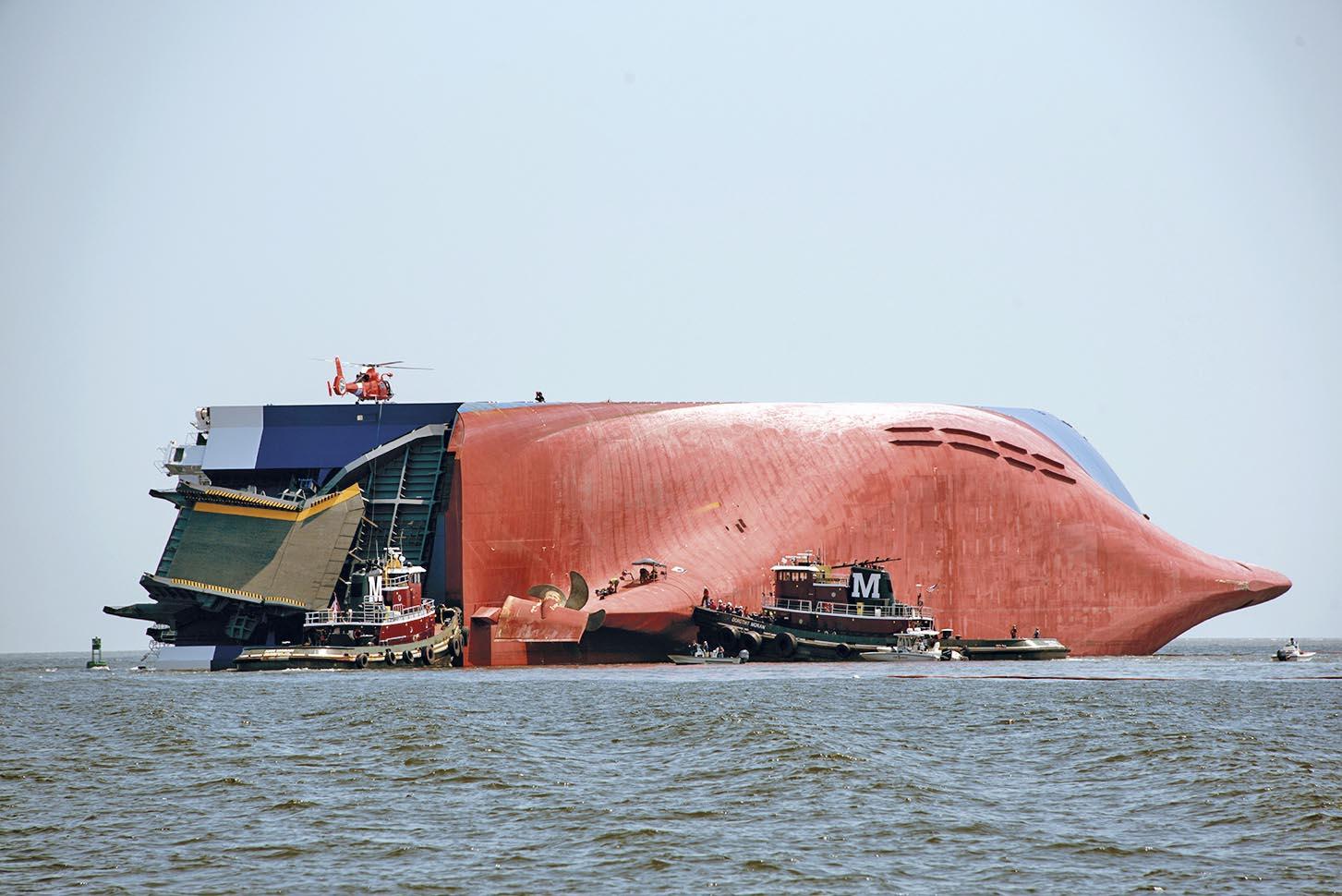
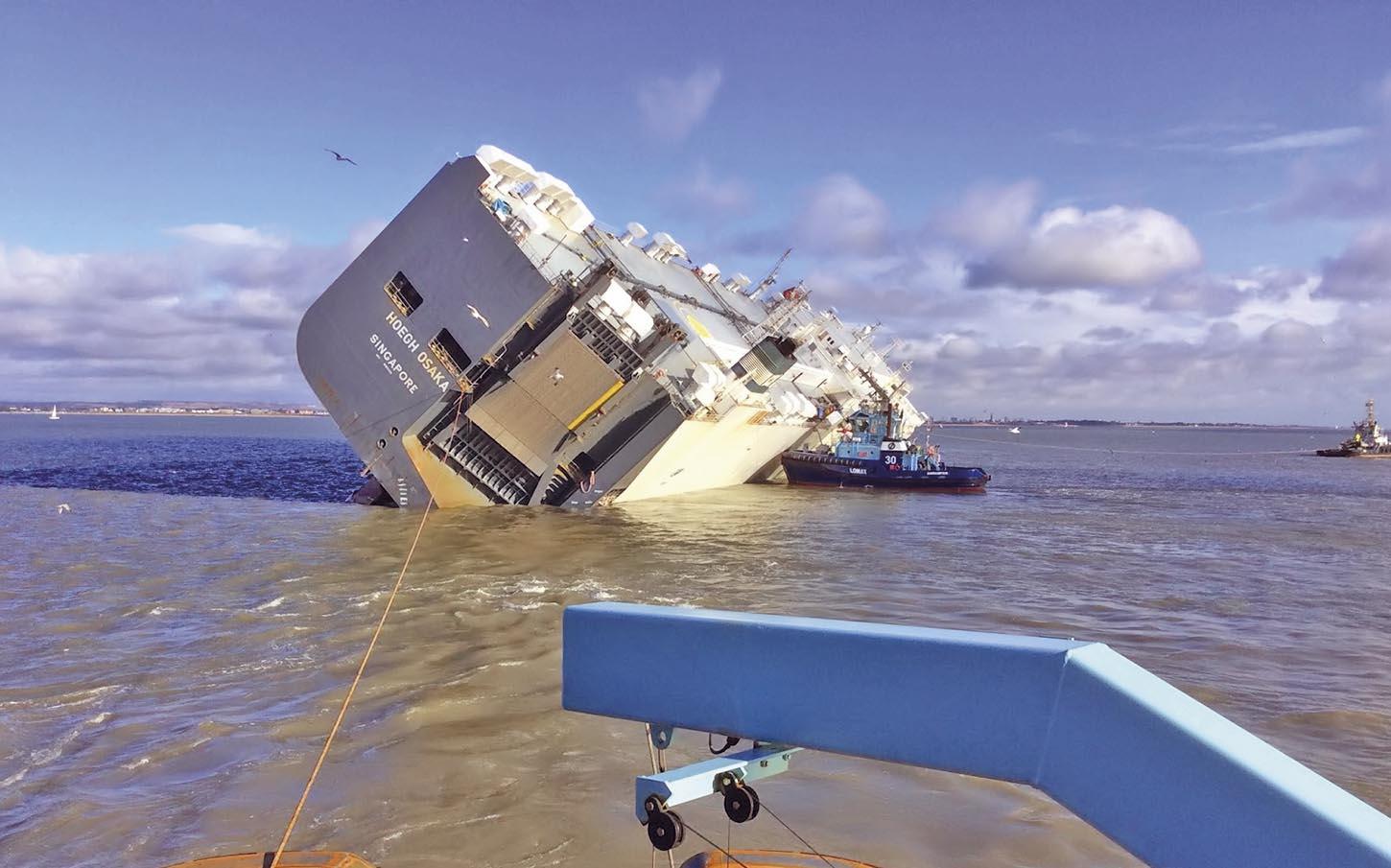
The NTSB concluded the Golden Ray did not meet international stability standards at departure and possessed less stability than the chief officer calculated. According to the NTSB, after the vessel capsized, open watertight doors allowed flooding into the vessel which blocked the primary egress from the engine room where four crewmembers were trapped. Two watertight doors had been left open for almost two hours before the accident. No one on the bridge ensured that the doors were closed before departing the port.
The Golden Ray sustained significant damage due to fire, flooding and saltwater corrosion and was declared a total loss estimated at $62.5 million. An estimated $142 million worth of cargo, including more than 4,100 vehicles, was also lost.
Another stability related accident occurred on 3rd January 2015 when the Singapore registered PCTC Höegh Osaka was departing Southampton. It developed a significant starboard list when turning to port around the Bramble Bank. As the list increased to over 40 degrees, the ship lost steerage and propulsion and subsequently drifted aground on Bramble Bank. A cargo shift as the ship listed resulted in a breach of the hull and consequent flooding. All crew were safely evacuated from the ship and surrounding waters. There was no resulting pollution, and the ship was later salvaged.
UK’s Marine Accident Investigation Board (MAIB) determined that the vessel had inadequate stability which had not been identified prior to departure. The cargo loading plan had not been adjusted for a change to the ship’s usual journey pattern, and the number of vehicles due to be loaded according to the pre-stowage plan was significantly different from than that of the final tally. The estimated weight of cargo was also less than the actual weight. Crucially, the assumed distribution of ballast onboard bore no resemblance to reality, which resulted in the ship leaving Southampton with a higher centre of gravity than normal.
Through restless centuries I have powered Heroic onslaughts by commanders Of the great empires.
Across the ages, man has longed to unravel The mystique that shrouds me. The scholars of science reach
For me to uncover secrets of the past. Pioneering men seeking out new lands Deemed me the crowning conquest.
Mighty industries flourish because of me And dynasties shaped, by men Who wove their steel through me.
For entrenched within, like incipient gems, I meld the very elements with which kingdoms Power prosperity. Yet no man can own me.
Agile and self-replenishing I am a mirror of the heavens, Nestling every rhythm, in cycles rippling.
To the unwitting I am formidable. But the same seek solace in me; In the soft, soothing songs
That dance through my being.
I am the cradle of life for billions.
Yet, for all my elegance, I am now bereft. Wounded. The turning tides, so harsh, Have left me ravaged; in anguish.
How I yearn to be cherished again. Grant me the dignity I deserve. That dignity which was once unspoken, Then, almost broken.
To survive, I must search reach clutch At new ways to reinvent myself. A mere ritual since times long past.
Except these are dark days And I face ferocious thunders ahead. Yes, I am wrenched by the unknown.
Though known by many names, I am unique. That I might look invincible Is simply part of the mystique.
Beyond the drifted ocean, A heroine’s grief; Spoken.





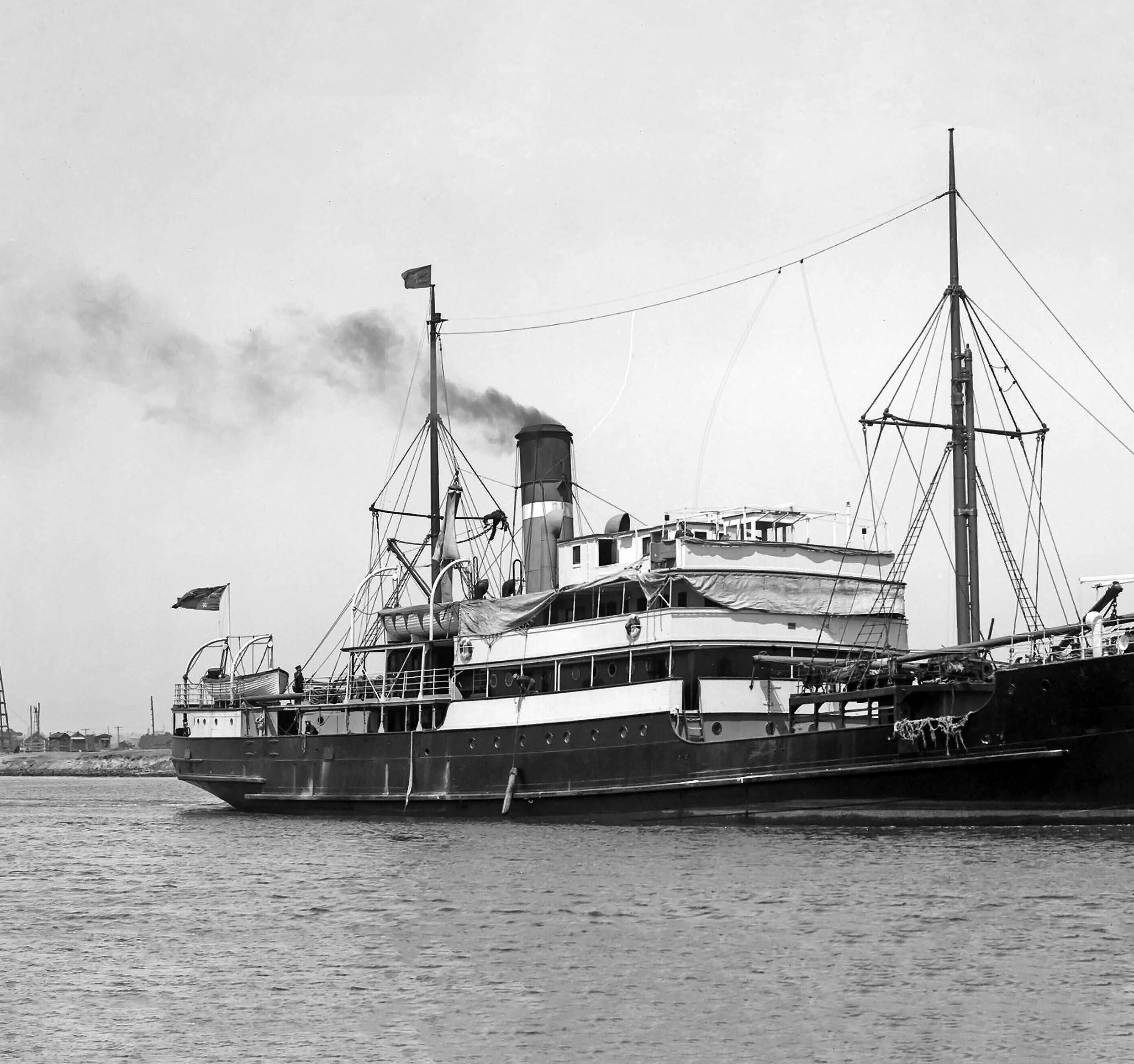
Formed in 1915 as a limited company by Irish immigrant John Burke, in 1921 the company commenced servicing various ports on the Queensland coast with a subsidy from the Queensland Government. Its home ground was primarily Queensland calling at ports between Brisbane, Cape York, and Thursday Island.
Its fleet of vessels after 1915 were the SS Kallantina (1921), SS Palmer (1924), SS Canonbar (1926-1949), SS Poonbar (1928), SS Wandana (1931-1948), SS Tinana (1932), SS Bidelia (1935-1955), SS Alagna (19391955), MV Elsanna (1948-1956), MV Nyora (1953-1963), MV Wyrallah (1954-1960), MV Waiben (1957-1964) and MV Kuranda (19591963).
With the outbreak of WW2 in 1939, the ships continued to trade along the coast, thus contributing to the war effort. Several of its vessels were requisitioned by the Australian Government for service during WW2 the most prominent being the Wandana to service Thursday Island which was a military area and the Canonbar which served in the United States Small Ships Command from 1943 to the end of the war.
The Wyrallah was requisitioned by the RAN in 1940 as an anti-submarine patrol
vessel and later commissioned in 1942 as the HMAS Wilcannia, the name change being to avoid confusion with the newly commissioned HMAS Whyalla. In 1954 she returned to the John Burke Fleet and resumed the name of Wyrallah.
Other prominent vessels of the fleet during this war time period were the Bidelia (1935-1955) and the Alagna (1939-1955) both vessels maintaining the important war time cargo side of the business.
The Nyora was built in Germany in 1935 as the Adrian. In 1945 she was seized by the allies and passed to the UK MoWT as the Empire Conifer.
In 1946 she was allocated to the Australian Department of Shipping and Transport as the Empire Conifer and in 1948 was sold to Australia and renamed Nyora. In 1953 she was sold to John Burke Limited as the Nyora where she remained for 10 years until sold in 1963.
In 1948 the Elsanna commenced a passenger/cargo service along the Queensland coast until she was sold in 1956. The passenger service was resumed in 1957 with the Waiben.
In 1958 I served in the Waiben as ordinary seaman, in 1962 as able seaman and in
1963 as bosun. In 1960 I served on the Wyrallah as able seaman.
In 1964 the government subsidy was withdrawn resulting in the company no longer being able to offer this regular passenger service along the Queensland coast and awarded it to Cairns based company K. Holland Shipping on the basis that they would be able to offer a better service by sea, road and rail.
This decision meant that there was no longer a regular passenger service along the Queensland coast. The loss of the subsidy was a severe blow to the company but new mining developments on Cape York helped them carry on. However, it was decided in 1969 to sell the family company to the powerful Dillingham Corporation.
John A. Burke, grandson of the founder, died in 1972. Coastal shipping was now unprofitable and the company tried to expand into the New Guinea trade and the company's ships were re-registered in New Guinea to save money.
The John Burke, the only vessel to be named after the Burkes was renamed Nuigini Kula. This new venture was not successful and the company was wound up in 1990 after 102 years of operation.
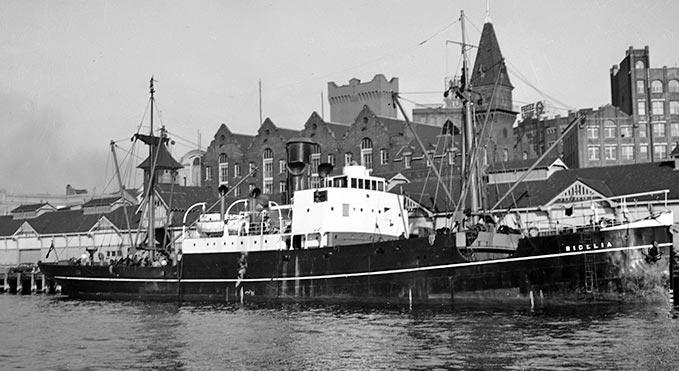
My brother Graham Bevis served on the Bidelia (above) as deck boy and has told me of an incident where the stern of the ship managed to become stuck under the wharf while berthing in its usual berth in the Brisbane River. He sent me the article and photo that appeared in the daily newspaper the Courier Mail.
It appears the vessel swung round during berthing and because of the state of the tide at the time the stern was just low enough to be forced under the wharf where it became lodged.
No amount of effort using the engines would free it, so it was left in this jammed position overnight until the next low tide (there was only a small tidal range) was sufficiently low enough for the stern to scrape out from under the wharf.

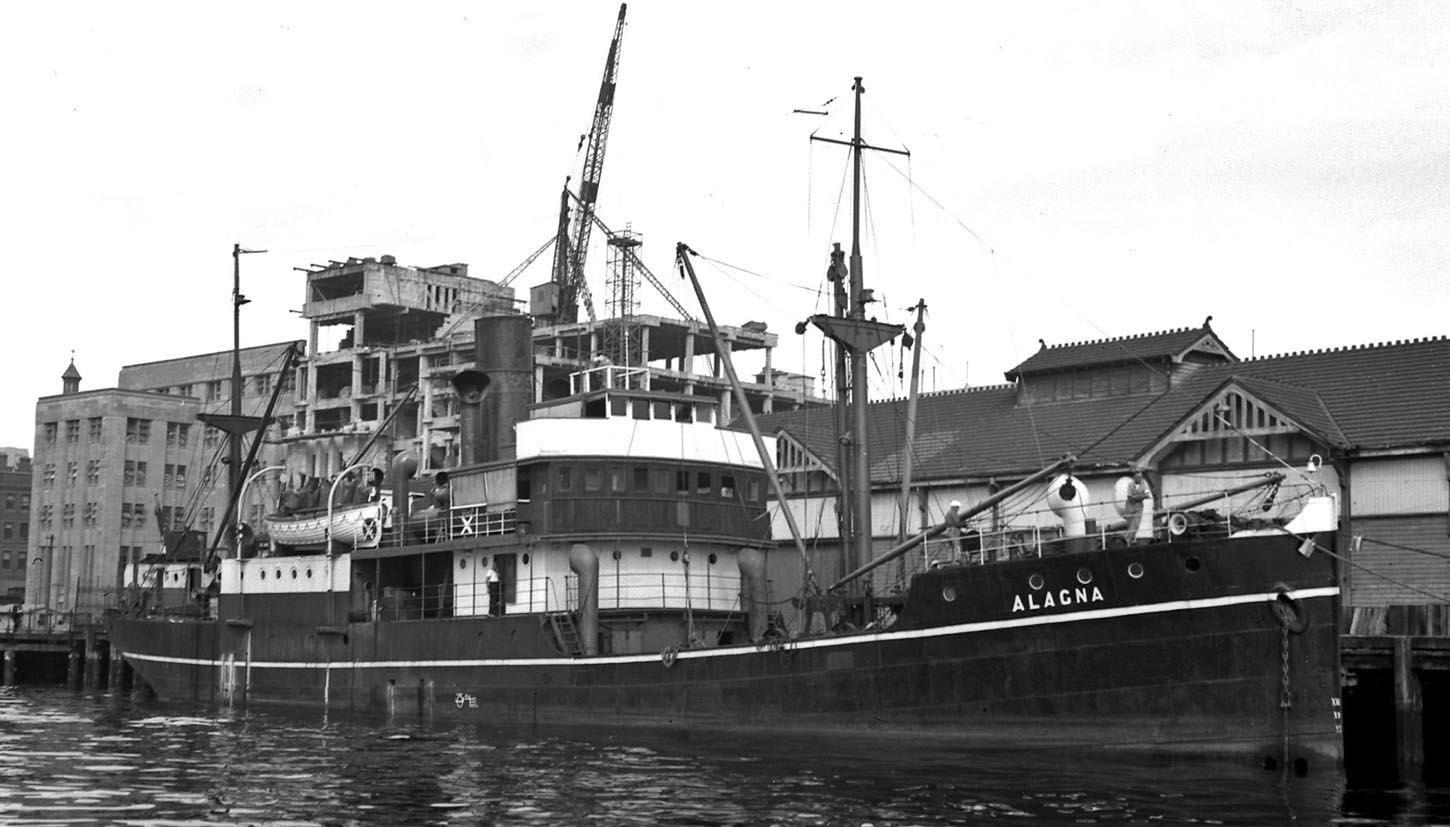
Left: The 909grt Wandana was built in 1913 by Mackie & Thomson at Govan. She was broken up at Brisbane in September 1953. (The late Allan Green collection )
Above: The 736grt Alagna was built in 1928 by Grangemouth Dockyard as the Malake for Burns, Philp & Co. She joined John Burke in 1939 and was broken up at Brisbane in July 1955.
(Russell Priest collection - David Finch/Nautical Association of Australia)
Below: The 1,378grt Waiben, on which the author served, was built in 1940 by Caledon Shipbuilding and Engineering at Dundee as the Morialta for the Adelaide SS Co. She joined John Burke in 1957. In 1964 she was sold to Soc. Maritime Caledonienne of Noumea and renamed Jacques del Mar and in 1968 she joined Seaview Navigation as Longlife, her name being changed to Royal Martin in 1970. In 1973 she moved to Empire Navigation of Panama as Island Pearl, then on 23rd December 1973 she sank while on a voyage from Phnom Penh to Singapore with a cargo of rubber and cartridge scrap.
Bottom: Another of the author’s ships the 1,049grt Wyrallah was built in 1934 by Burmeister & Wain at Copenhagen.. After her war service she sailed as Wyrallah until 1961 then became Colorado del Mar of Soc. Maritime Caledonienne, Tamata (1964), Colorado del Mar (1966), Wyrallah (1967), Union Pacific (1969), Ocean Life (1972), Sri Mahkota (1973) and Sinar Surya (1977). On 22nd March 2004 she arrived at Chittagong to be broken up. (Russell Priest collection - William Volum/Nautical Association of Australia)
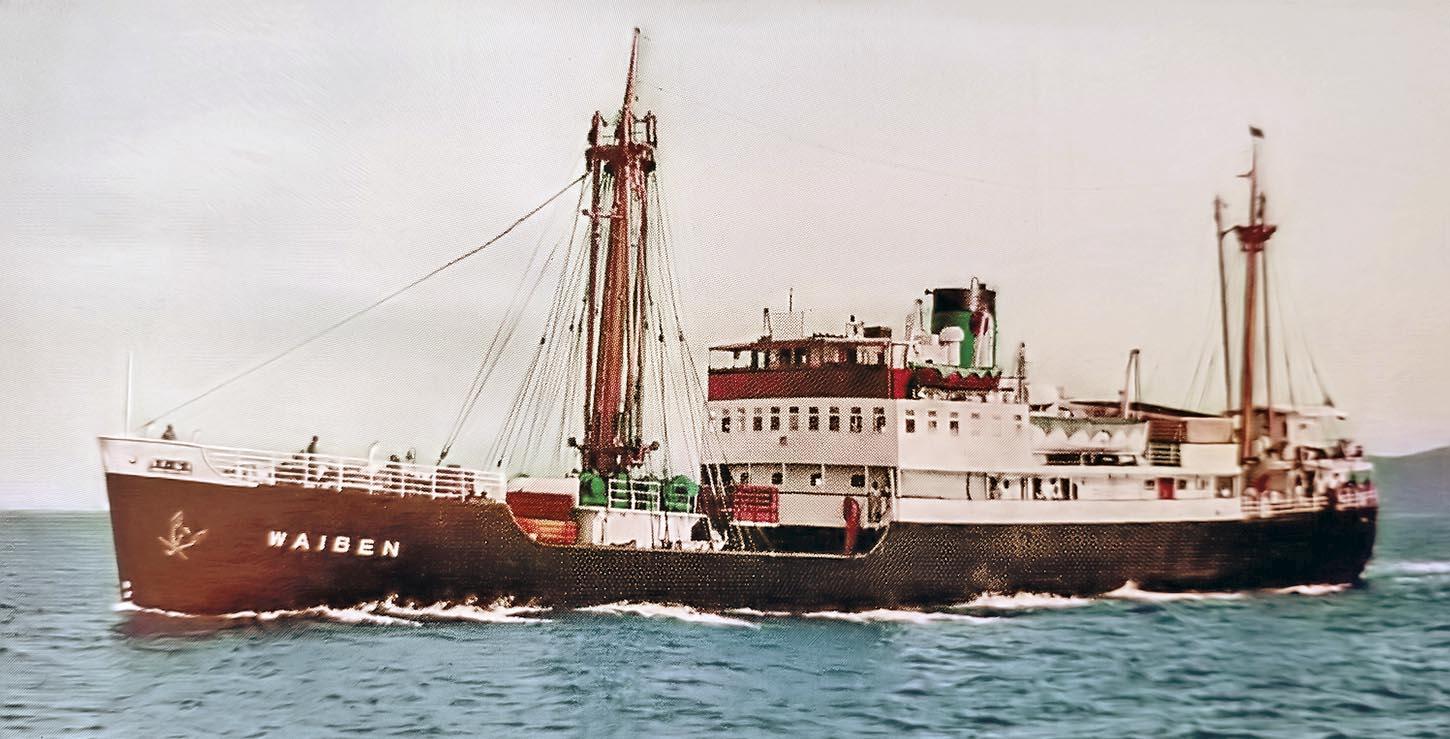
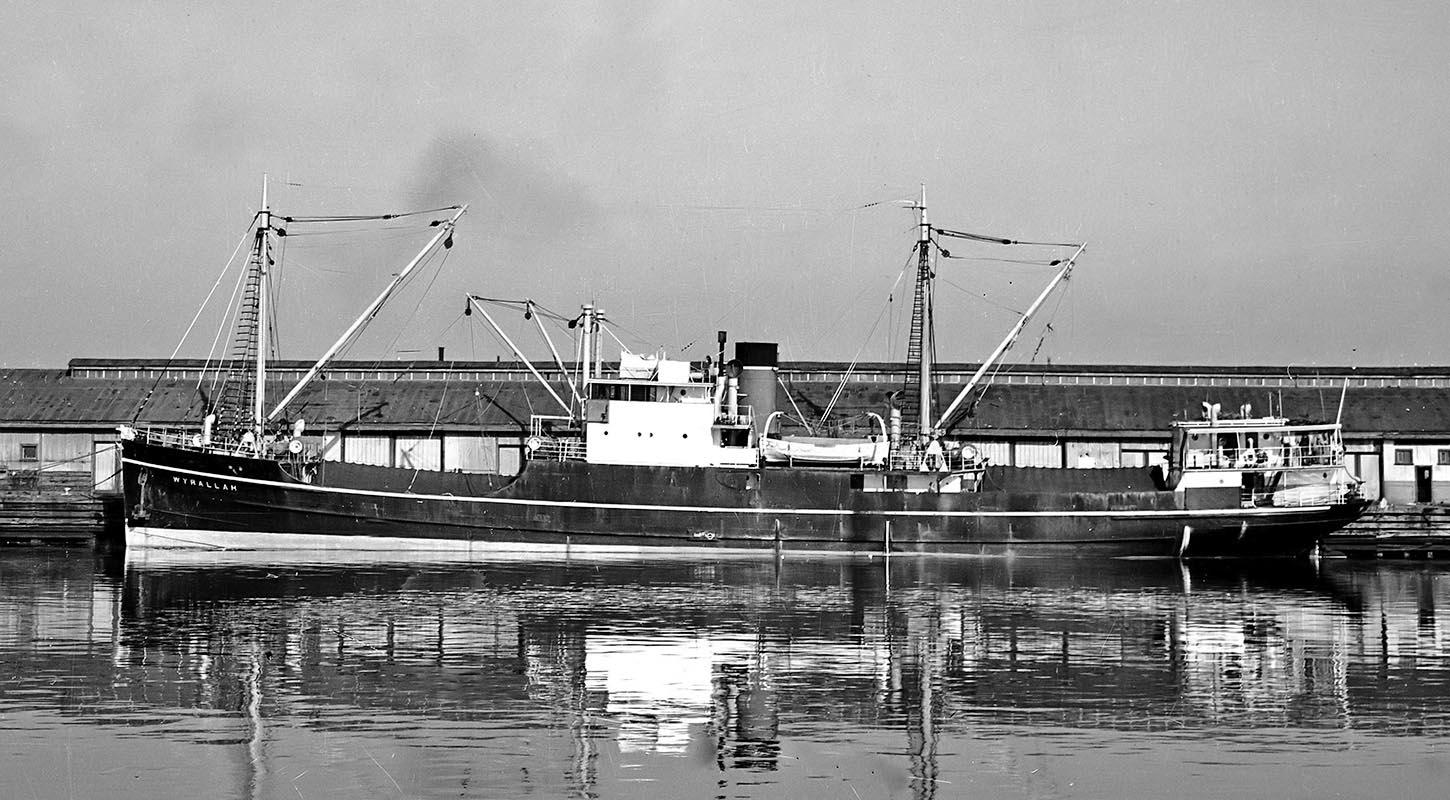

This month we complete our tribute to Letterkenny-born Irish artist John Baird. As described last month, at a young age John was fascinated by the sight of the small coasters, most of them Dutch, which made the long journey up the lough to the River Swilly. At the head of the navigable river two quays at Port Ballyraine, a suburb of Letterkenny, served the extensive hinterland of Donegal mainly with cargoes of timber and coal.
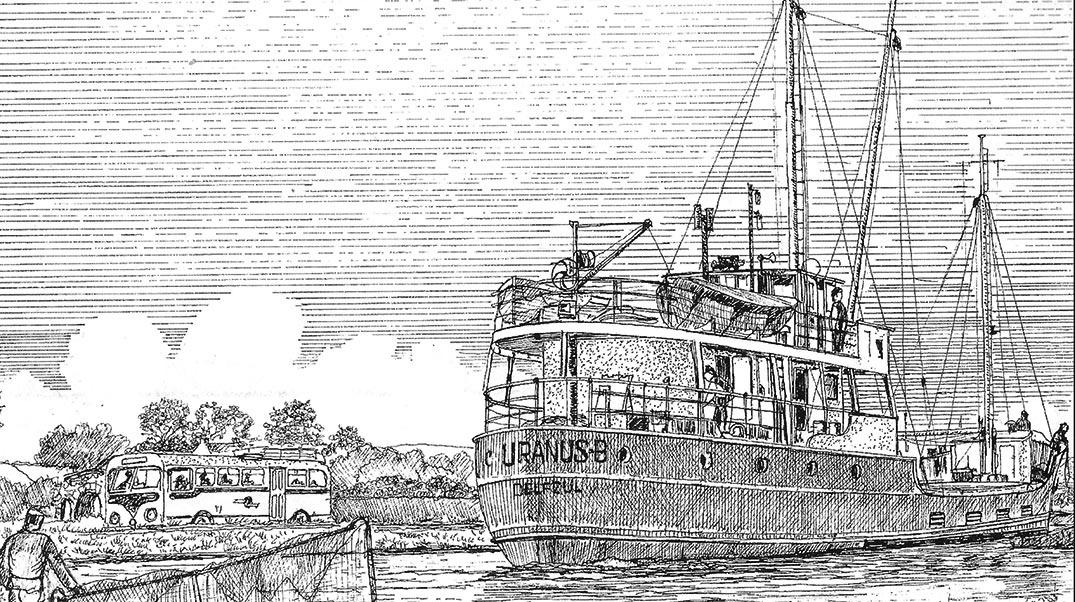
The drawing (above) from John Baird’s delightful book “The Port” shows a regular visitor to Ballyraine that Baird knew well, including her captain/owner Kees de Boer and his wife. The Uranus B had been completed in 1935 by Gebr. Niestern at Delfzijl and is seen here making her way up the Swilly and causing the local loop fishermen to temporarily suspend operations. She was bringing salt in, probably in 1960. The Uranus B was also captured by the evocative lens of the late Geoff Williams at Bristol in the Welsh Backs (above right) where she was unloading a cargo of bagged vegetables, probably potatoes, for the family firm. Another typical Dutch visitor to Ballyraine was the 384 grt Pavo, portrayed by John (right). She had been built in 1960 at Foxhol as the Pavonis for Groningen owners Salomens and Wildeman. In 1975 her name was shortened to Pavo for new owner A. Broewer. She was a common sight around the British Isles, and local maritime photographer and maritime historian Tom Walker took this superb photograph (right) of her under her original name passing the Marine Parade at Shaldon on her way to Teignmouth, probably bringing in timber from Finland. Eventually in 1992 she was sold to Belize-flag owners as the Phoenix but Lloyds deleted her in 2002.
John Baird painted a very similar Dutch coaster also with a timber cargo in his characteristic style in the shape of the 498 grt Tempo (below left). She was built in the Noord Nederlandshe shipyard in Groningen itself for Groningen owners in 1953. In 1959 she became the Scheldestroom, in 1962 the Tuskar before moving to Greek ownership in 1971 as Elpis She was broken up in 1988. The well-known Wagenborg fleet had several small coasters which reflected the British practice of having a bridge amidships, albeit without the usual raised quarterdeck. Baird illustrates the 1954 built 499 grt Kroonborg (below right) which became the Tanja Holwerda in 1973. She was built at Delfzijl by Neistern, later becoming Jenson II and Cicelia
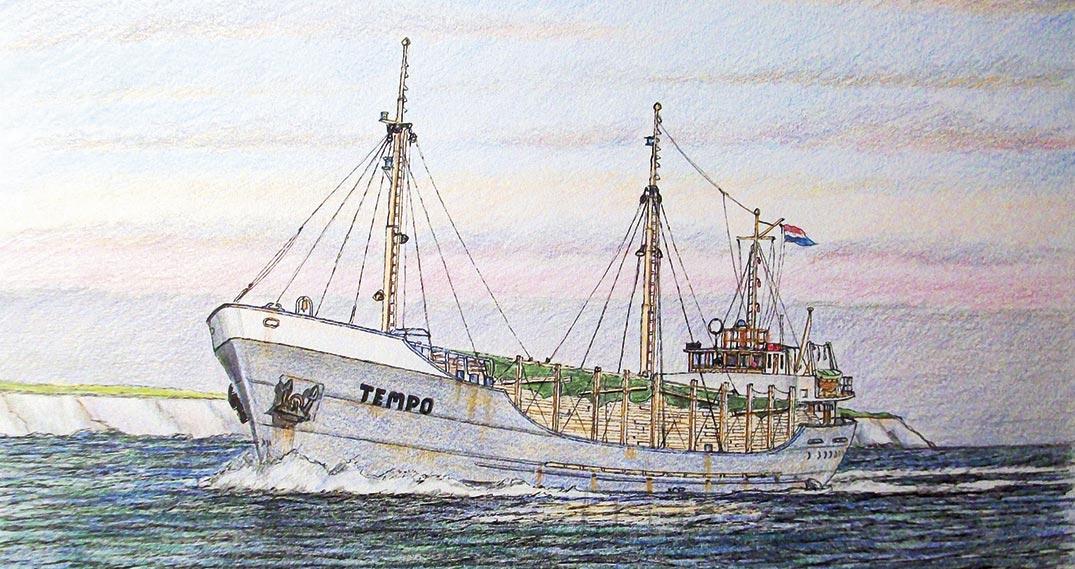
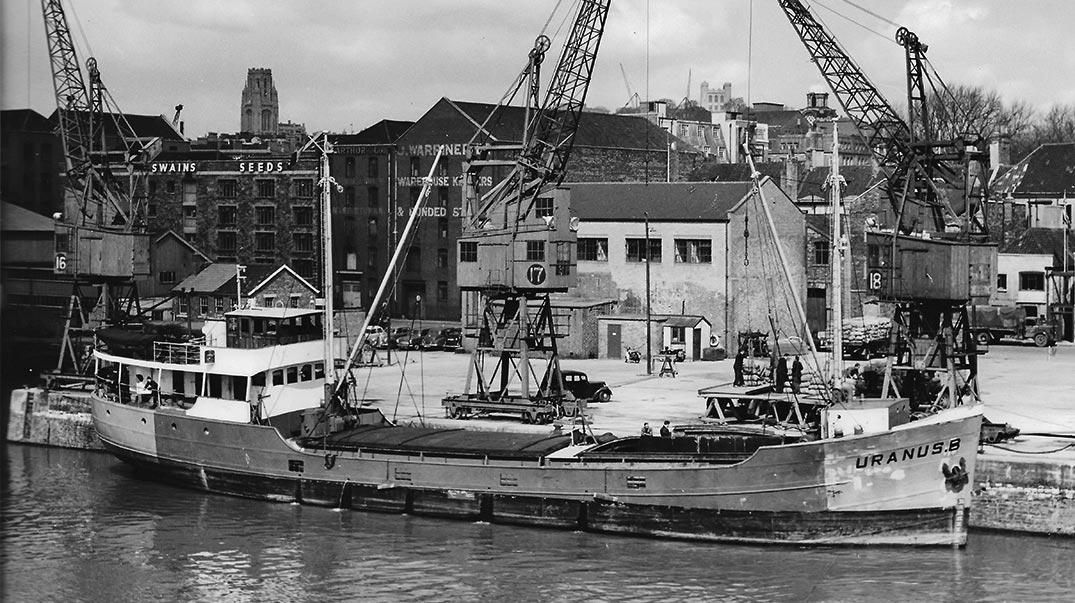
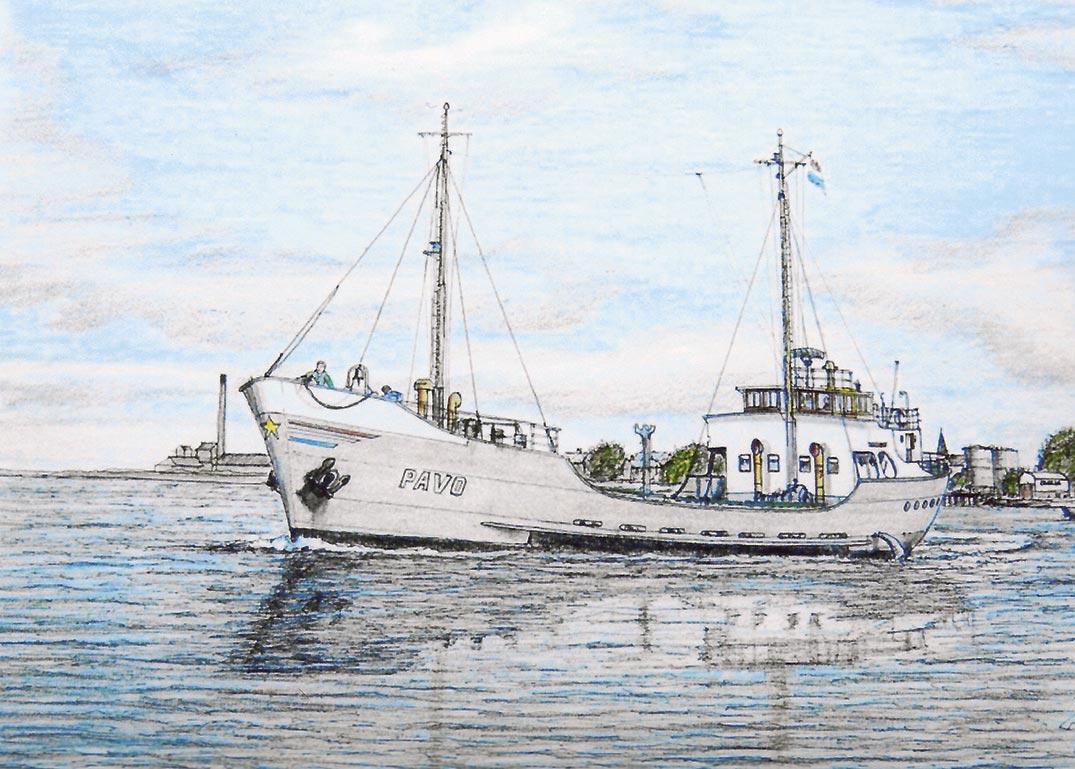
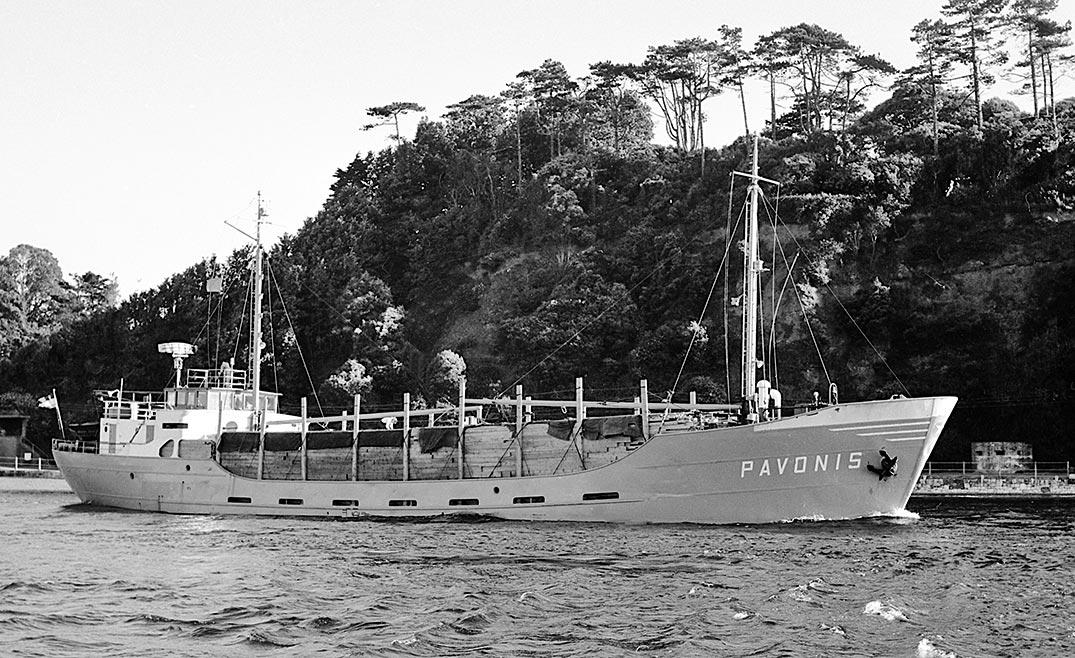
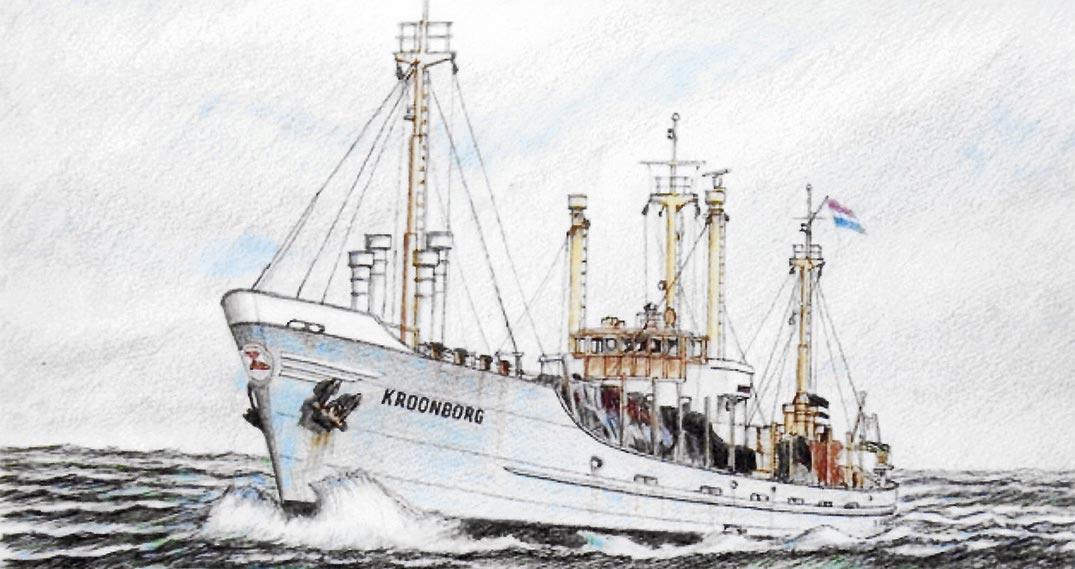
In the immediate post-war years one name almost came to be synonymous with Dutch coasters, that of the Carebeka company. As the excellent book on this company published by the WSS in 1995 explains, Carebeka (short for CApitien-REder-BEvrachtingKAntoor) was formed in 1939 after a long period of gestation by a group of Groningen-based captain-owners who were unhappy with the way brokers seemed to be able to play captain-owners off against each other to lower the freight rates and take advantage of their inability to combine running a ship with obtaining good freights. It was intended to be a sort of co-operative brokers’ office representing initially 20 owners. In 1957 Carebeka entered a new phase of its existence when it ordered a new coaster from the Pattje yard at Waterhuisen, to be named, not surprisingly, Carebeka Results were sufficiently encouraging for more ships to be ordered, and in 1970 the company took the unusual step of buying a 1,289 grt coaster with goal-post masts that had been built by the Stocznia Gdansk in Poland for Norwegian owners as the Lionel in 1967. The larger size of Carebeka VI (above by Baird) reflected the wider trading areas that poor freight rates in N. Europe had compelled Dutch owners to seek work in, namely the Southern European and Mediterranean areas. However the change in direction into ownership seems to have weakened the company and the Carebeka VI was sold in 1982 and in 1983 Carebeka filed for bankruptcy. The Carebeka VI went on to take eight more names before succumbing to the breaker’s torch at Aliaga in 2010. Under one of them, Eurolady, she became quite well known at Teignmouth in the clay trade.
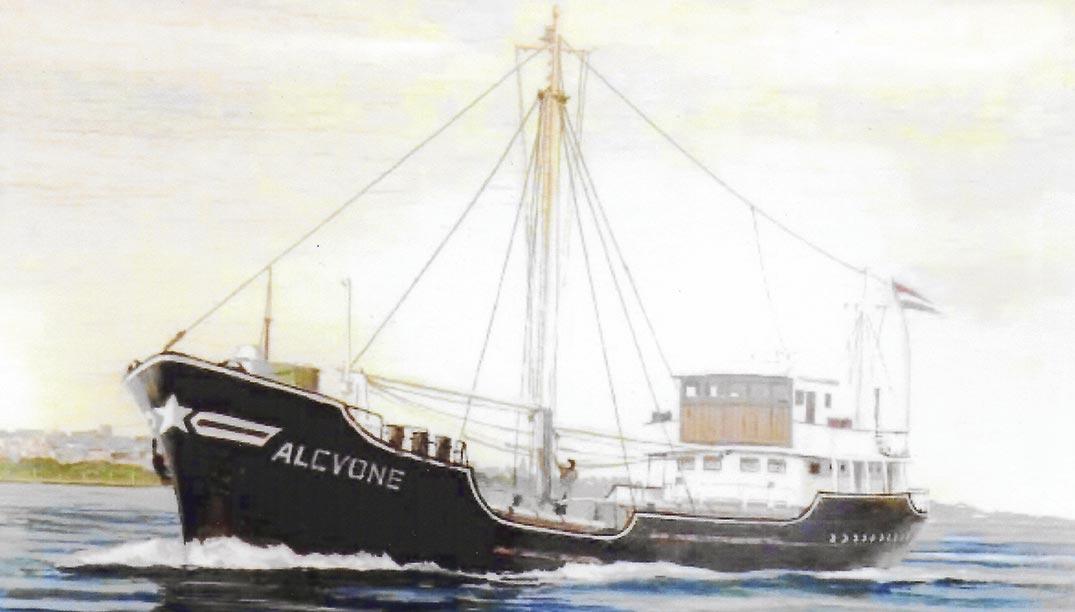
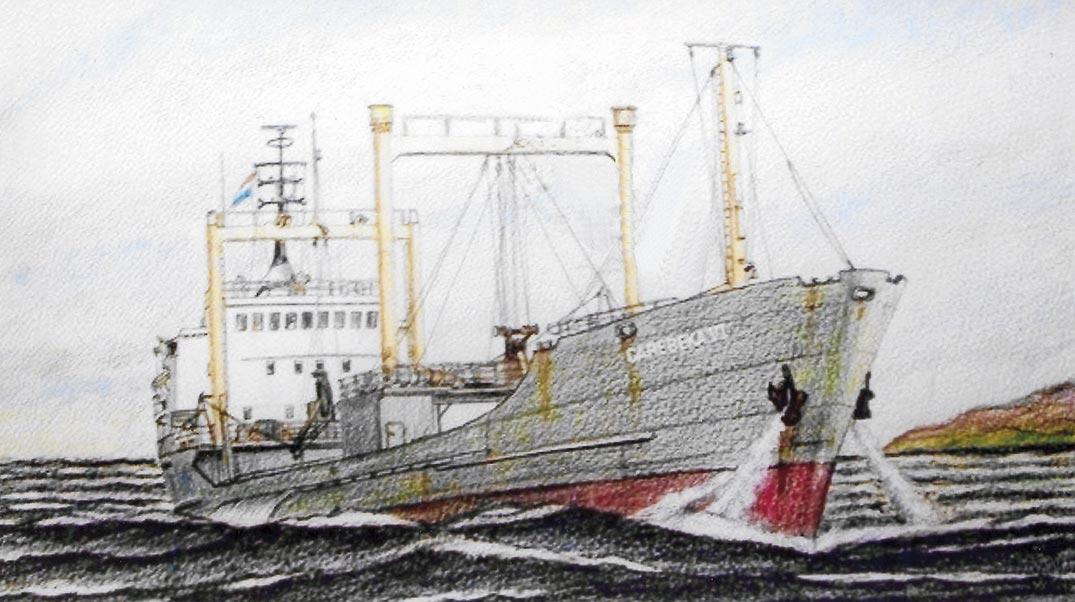
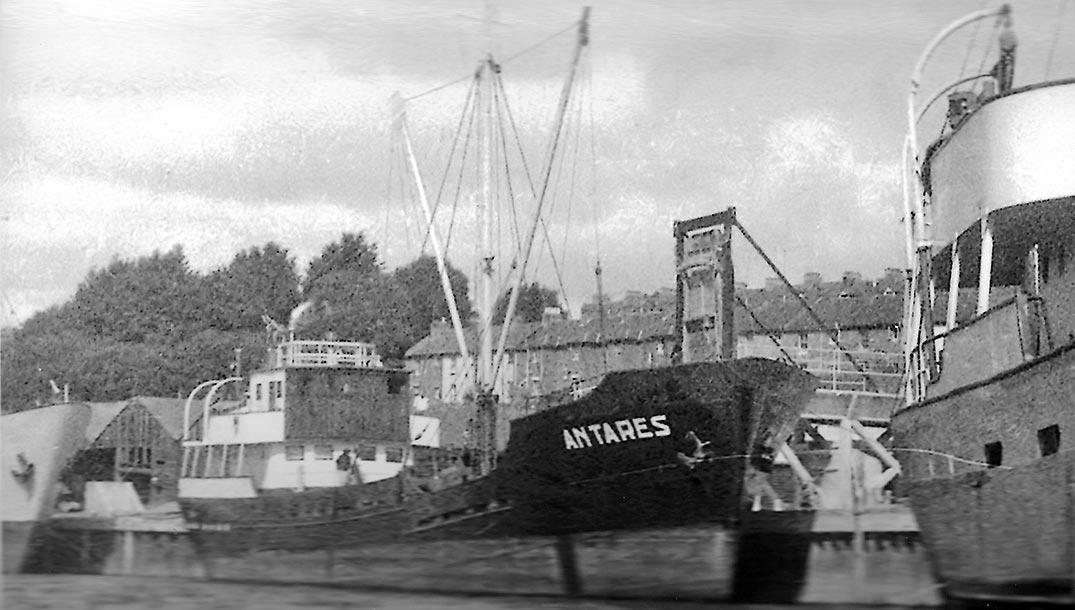
One of the first ships to be managed by the new Groningen-based Carebeka organisation was the Alcyone of 1938 belonging to D. Schothorst of Zuidbroek. He sold her in 1951 and replaced her with the 1949 built of 364 grt (Scheepswerf Apol at Wirdum) Julia which, in partnership with J. Steenstra, he renamed Alcyone (above left). She presumably traded to Ireland and Baird has captured her good looks (above right). Before becoming the Alcyone in 1963, she had traded from 1954 as the Antares, as captured (above right) by the 13 year-old Tom Walker in August 1961 from a rowing boat in the Teign at Teignmouth, with the “small ramp” behind. The 1939 built Dutch Cawi is on the right.
Some ships were such regular visitors to Irish ports that they altered their name to reflect their trading pattern. Such a vessel was the 299 grt Buncrana Trader illustrated below by John Baird. He would have been very familiar with her as Buncrana is just a few miles to seaward of Letterkenny in Lough Swilly. She had been completed in 1953 at the Hamburg yard of Pohl & Jozwiak as the Jan Keiken This small shipyard hit the headlines in the 1980s when it was threatened with bankruptcy and the City authorities refused to bail it out despite its reputation for being one of the few shipyards to employ and train females as machine fitters. They featured on a mural at Hamburg (right). They also got involved with the works council and the protest campaign (far right, courtesy studio Thomas Kummerow). The banner reads, “We want to continue working, without shipyards no port”.
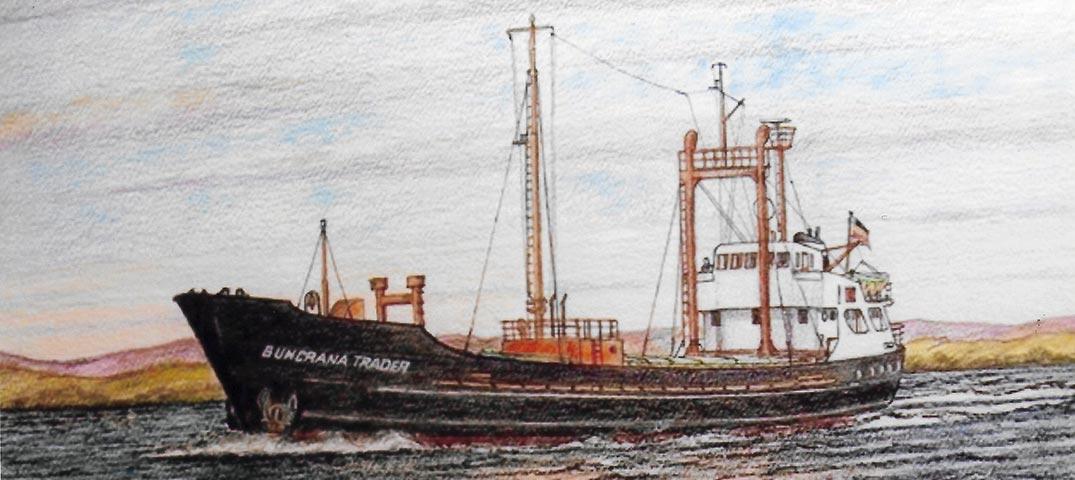
The Jan Keiken became the Ute Parchmann in 1958, the Else Wolf in 1967 and the Buncrana Trader in 1972 (above left by Baird). She went under the Cypriot flag in 1975 and was wrecked near Crete in 1976. Another frequent visitor was the Stadeland (right) of 1951. She was built by the Lurssen yard at Vegesack for Johannes Jäger of Hamburg. She became the Eintracht in 1965 before also going to Cyprus and she was detroyed by fire in 1975.


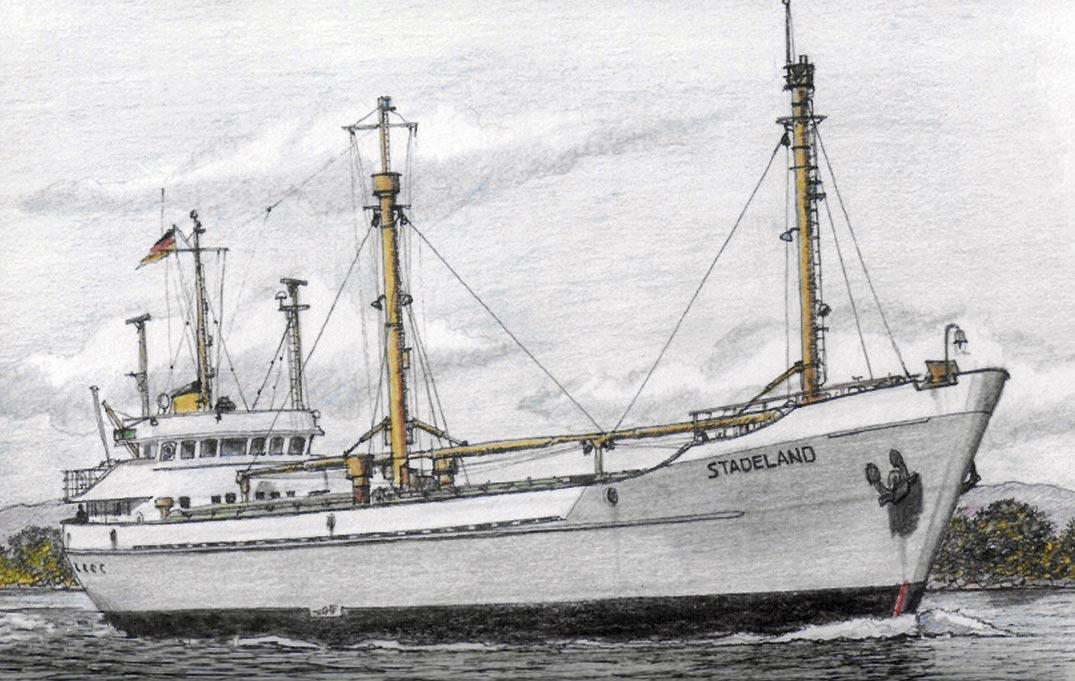
What a pleasure it is to be able to illustrate a ship from a British coaster company that is not only still in existence but which has a pedigree of over 100 years. G.T. Gillie & Blair are a Newcastle-based organisation and their website indicates that they still have eight ships under management. However I notice that most are now trading under different names, including their two Yorkshire Dry Dock veterans from 1992/3, the Sea Kestrel (ex Hoo Kestrel) and the Sea Mithril (ex Bowcliffe),which seem to be trading in that graveyard of ex-British coasters, the Bosphorus area. Back in the day they had a simpler naming scheme all ending in “Firth”. Gillie & Blair followed many other British coaster companies in turning to Dutch yards in the 1950s for their new tonnage, and the Olna Firth of 1957, (right) by John Baird, came from the prolific Bodewes yard at Martinshoek. She had a good innings but went under the Greek flag in 1975 as the Stilianus, and Sky in 1985, after which her existence was in doubt.
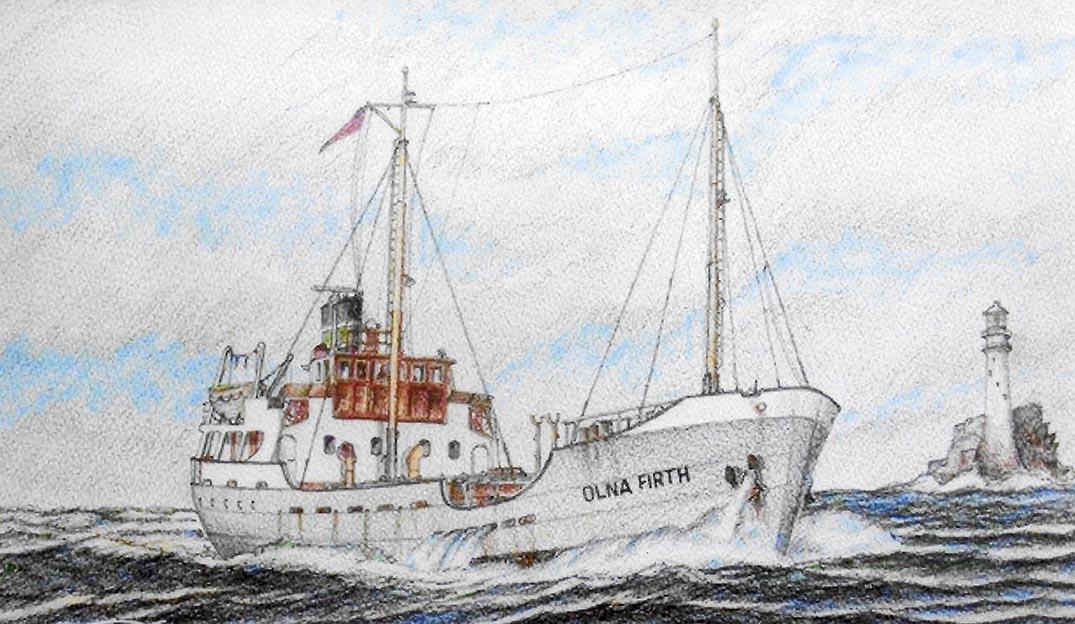
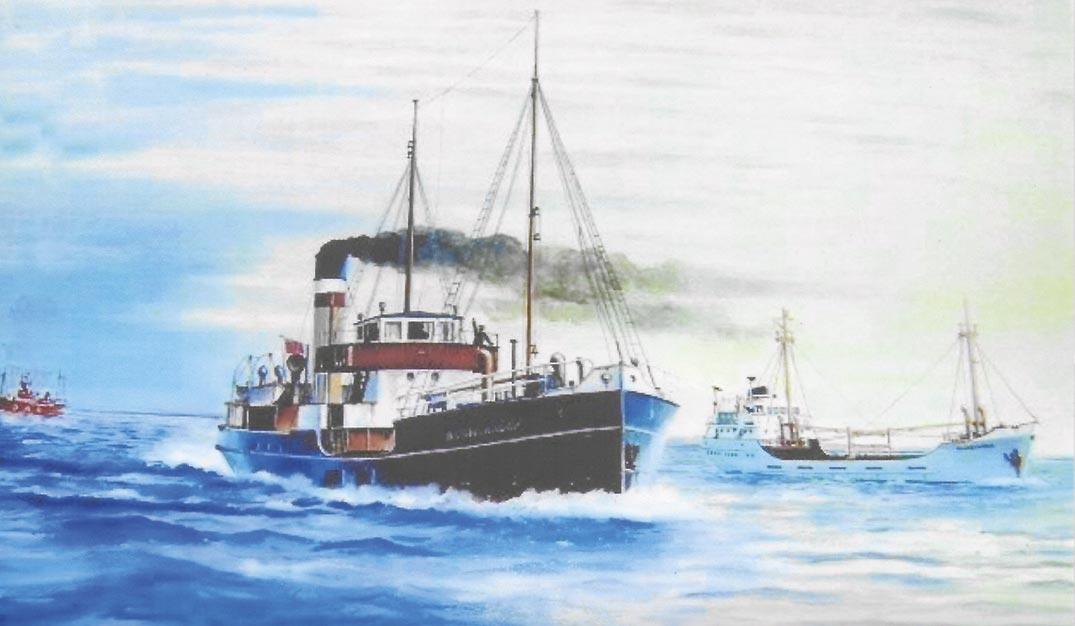
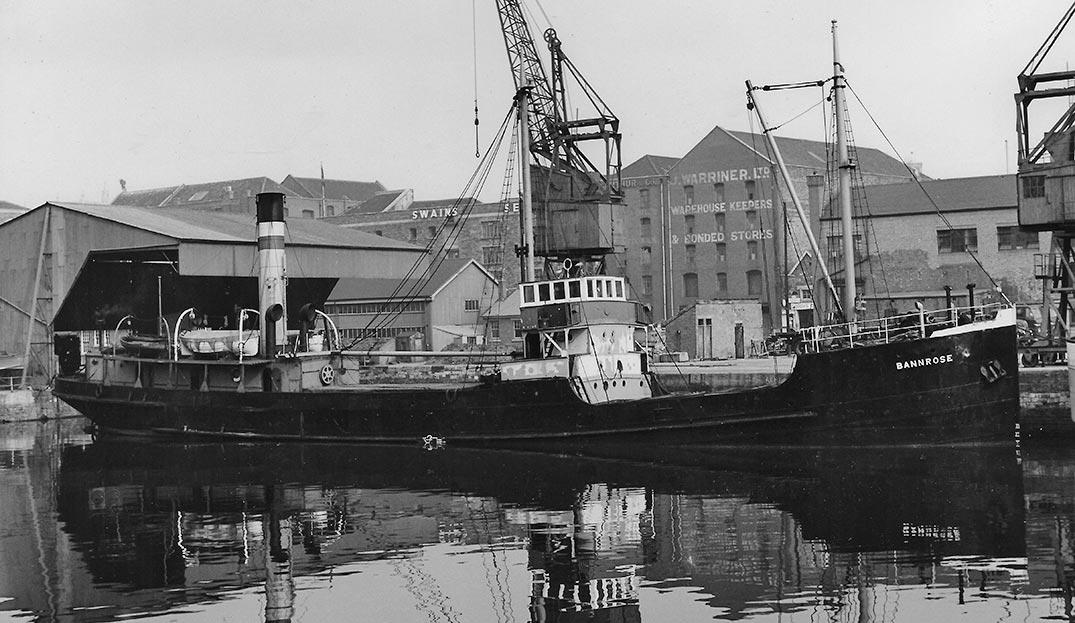
Another British company, which had such close trading links with Northern Ireland that they gave some of their coasters the prefix “Bann” after the longest river in Northern Ireland which takes the waters of Lough Neagh to the sea near Coleraine, was S.W. Coe & Co. of Liverpool. They operated some fine-looking steamers after most owners had moved on, including the 489 grt Banntrader, shown above left in a John Baird painting which illustrates his use of ordinary gloss household paint as it was cheaper and his skill could make it work as well as oils. The Banntrader was built as early as 1920 as the Beauly Firth by John Lewis at Aberdeen for the aforementioned Gillie & Blair company. In 1923 she came under the aegis of the General Steam Navigation Co. as their Ortolan, until picked up by Coe in 1950. They squeezed another 12 years out of her and she was broken up in 1962. Her fleetmate Bannrose was captured by Geoff Williams in the Welsh Backs at Bristol (above right), probably unloading potatoes in sacks for his wholesale vegetable company. Another product of the John Lewis yard, she had been completed in 1925 as the Ribblemere, becoming Holburn Head in 1930. Another late acquisition, she joined the Coe fleet in 1954 and was broken up in 1971. Baird shows the type of vessel which eventually replaced these old steamers in the background of his Banntrader painting, the 748 grt Blackthorn was built for sister company the Thorn Line at Westerbroek in 1959. Interestingly, Baird notes that most of the crews of these vessels hailed from the Donegal area.
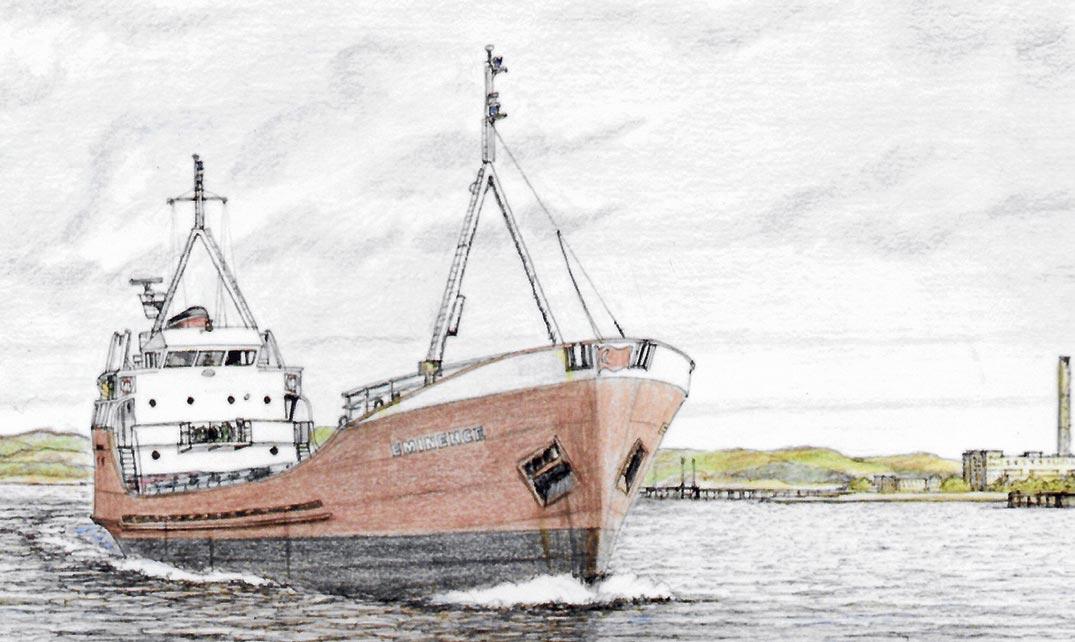
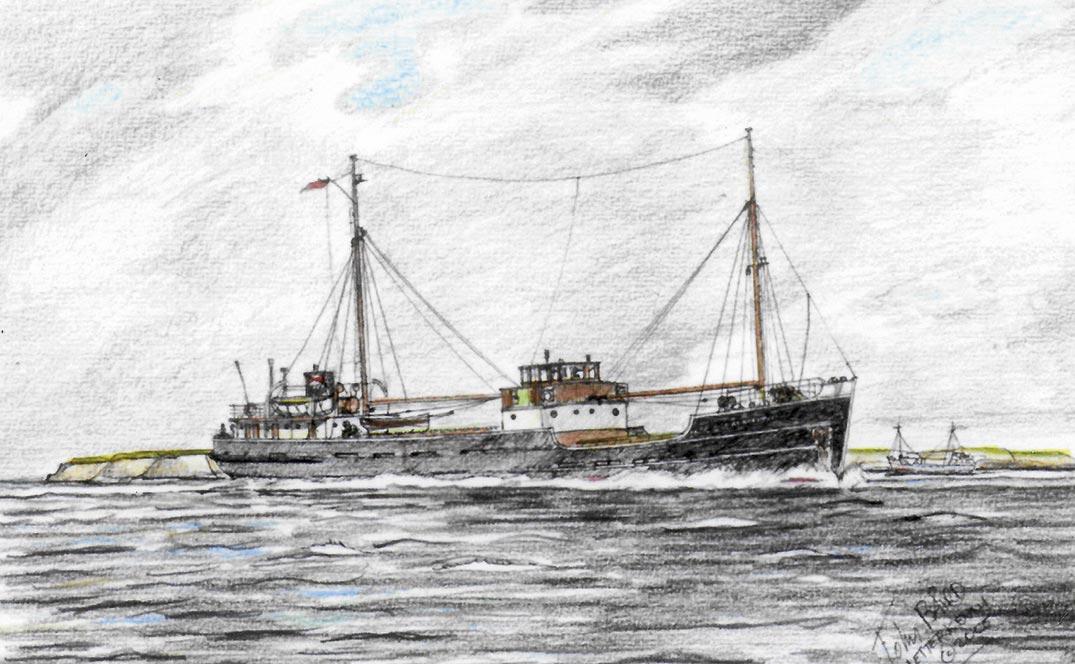
I thought it was strange that a vessel from the Medway-based fleet of the London & Rochester company (Crescent Line) should feature in the oeuvre of John Baird until I read in Ken Garrett’s excellent Ships in Focus 2010 publication Crescent Line that she was a regular on a contract the company had to supply the power station at Yelland near Bideford with coal that eventually mostly came from Ayr, making her a fixture on the Irish Sea. Refreshingly, she was not built in a Dutch yard, but at Goole, no doubt influenced by Crescent’s local competitors and co-owners Everards who were having a very similar series of ships built there. The 999 grt Eminence (above left) was completed in 1967. Capt. Garrett reported that the company’s finance director, John Reynolds, described the Eminence as the company’s biggest ever money spinner! She went on to serve two other British companies well. In 1984 she became Carisbrooke Shipping’s Mary C, and in 1988 the Lady Mary for Thomas Watson, also Rochester-based. Incidentally it is a measure of how much these power station and gasworks coal contracts meant to coastal shipping firms when one learns that Crescent’s contract for the Yelland station required 5,000 tons a week to be moved from the Killoch colliery at Ayr, using the Crescence (2) and Quiescence (1) as well as the Eminence Although local rivals Everards did not get that contract, they had plenty of others, and it is not surprising, given their ubiquitous presence all around the British coast, that Baird was required to draw an Everard coaster, probably the Austerity of 1947, as seen (above right).
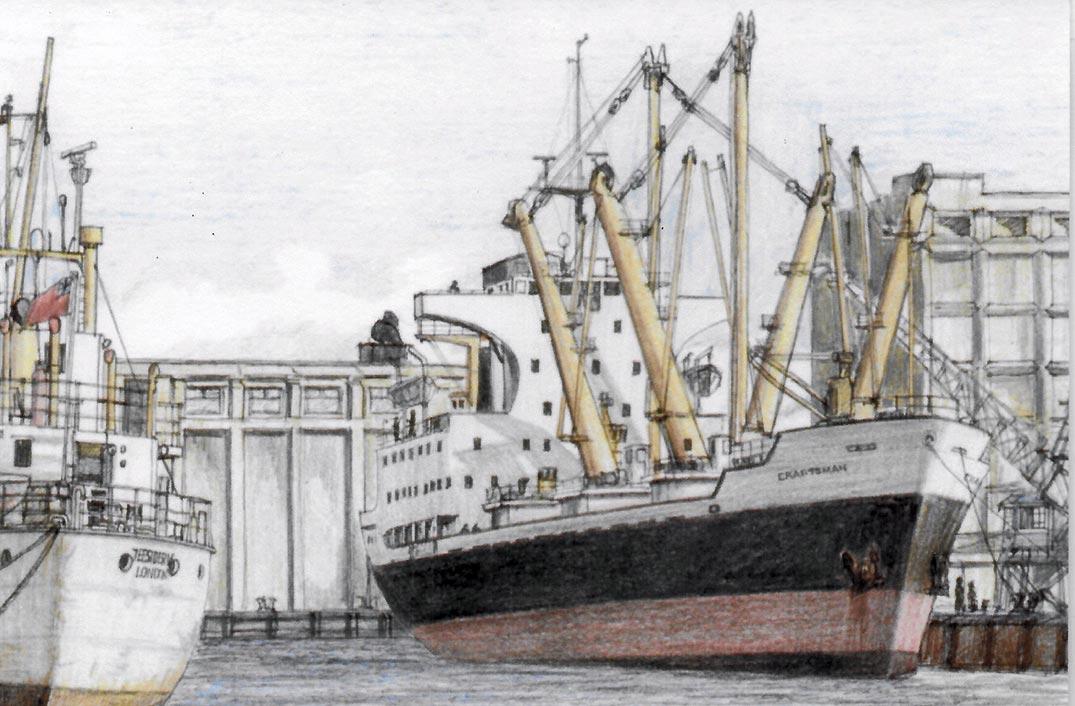
John Baird painted a wide variety of subject as well as coasters, including fishing boats, local scenes, aircraft and motor vehicles, and he did occasionally paint larger ships. The scene (abov), probably located in Manchester or Liverpool docks, features Harrison’s Craftsman. This ship represented a bit of a milestone. T. & J. Harrison had been good customers of the Doxford yard at Sunderland in the post-war years, having no fewer than 20 vessels built there up until 1971. However the Craftsman of 1972 was to be the last ship they had built in Britain, let alone Doxfords. Doxfords had developed, with Harrisons (The Charente S.S. Co.), a bit of a niche market in the shape of heavy lift ships fitted with Stülcken derricks, aimed at the burgeoning market for moving oil industry machinery, pipes and electrical transformers. The Craftsman was the culmination of this process and her set of two such cranes enabled her to lift 500 tons in tandem. She also sported a rather distinctive bridge structure. She was actually contracted with Sunderland Shipbuilders, which was an amalgamation of the shipyards on the Upper Wear, and the Craftsman was built at the former James Laing yard at Deptford. Sadly, it was not without a little dose of the sort of labour trouble that had already led to Harrisons building some ships in the Netherlands and Denmark. Her delivery was delayed by six months. In fact she proved to be the last traditional cargo liner the company had built. Faced with the looming reality of containerisation, the company knew it would have to join a consortium to be part of that revolution, but hoped to retain its identity by entering the bulk carrier market. Their next ships were 16,000 ton bulkers built in Japan. However the Craftsman seems to have had her admirers, as she took centre stage in a colourful commemorative stamp (above right) produced by Kenya to celebrate the 25th anniversary of the I.M.O. in 1983 (left). Sadly, the good artist is not credited.
In the 1960s the B.P. Tanker Co. took delivery of fourteen 16,000 dwt “Bird” class product tankers mainly from Belfast and Clyde shipyards. They were designed to ship refined products from the main BP refineries at the Isle of Grain, Grangemouth and Llandarcy (Swansea) to oil depots all around the British and Continental coasts. No doubt the British Curlew, featured (right) by John Baird, would have been a regular visitor to Belfast Lough. She was one of two sisters completed by Alexander Stephen of Linthouse, Glasgow in 1960. In 1976 she was sold to Hong Kong owners and renamed Wenjiang, under which named she was shelled at Basrah during the Iraq-Iran war and declared lost on 1981.
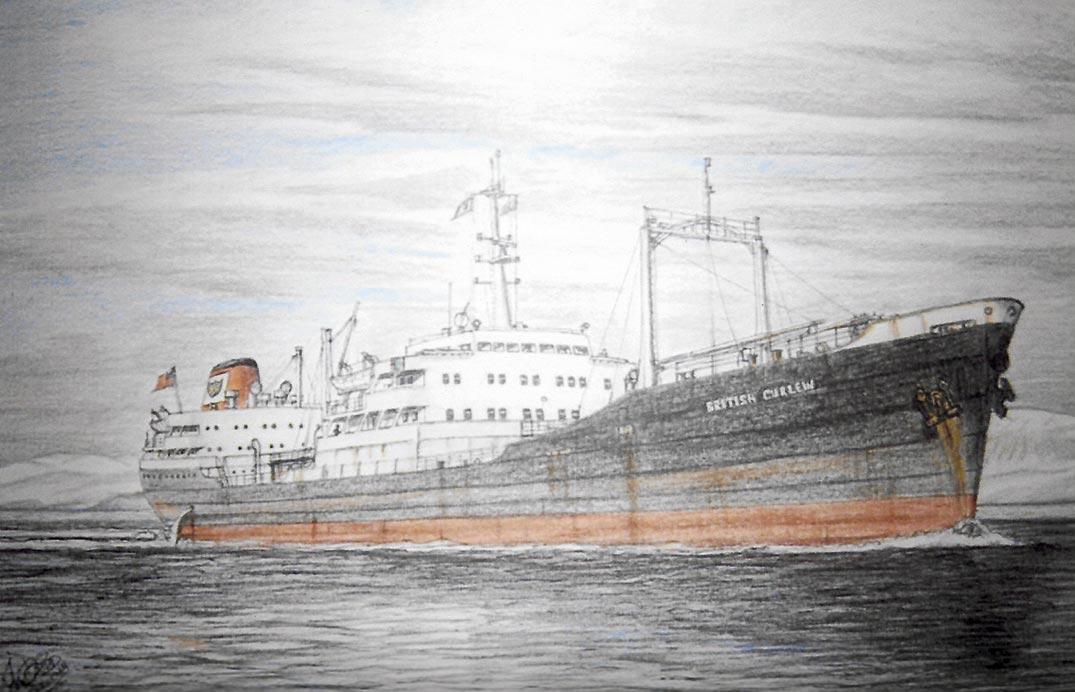
The paintings here give some idea of the range of John Baird’s talent, and the extent to which he has single-handedly recorded the everyday life in times gone by, around his home in Donegal, and is recognised and honoured there for the work he has done. For most of that time he has had the invaluable support of his dear wife, Jane, who sadly passed away recently. Here’s sláinte to you both, and thank you.
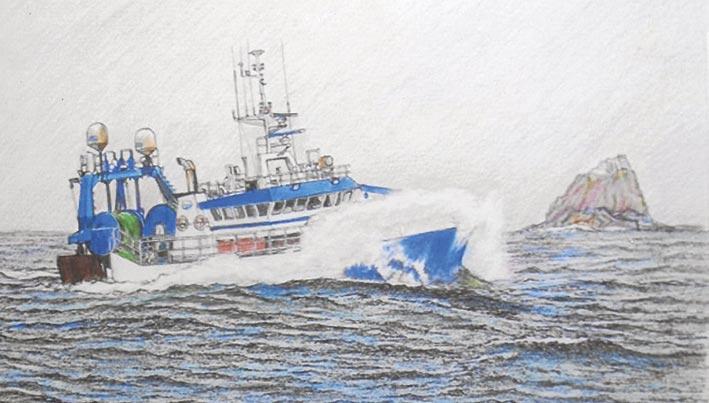

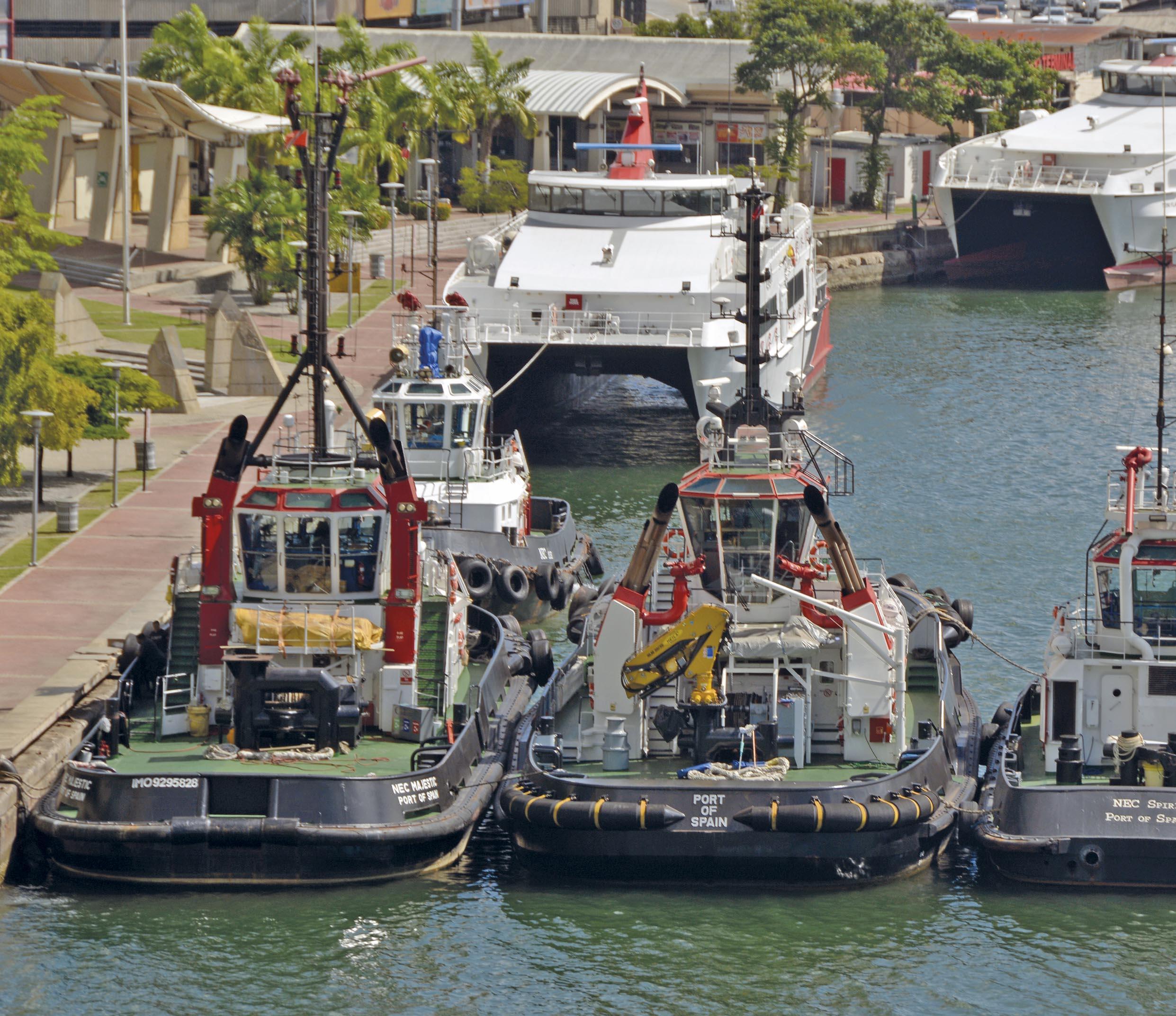

The history of Trinidad and Tobago is one of colonialism, slavery and occupation. That all changed post World War Two as independence from the British Crown and massive inward investment into infrastructure projects has led to the creation of a booming economy, mostly based on tourism but beneath that thin exterior is a heartbeat of industry and one of the biggest and most successful of these can be found at the capital city’s port, Port of Spain.
Before European explorers discovered the America’s, the area now known as Port of Spain was inhabited by the indigenous Caribs and Arawaks, whose communities engaged in fishing, agriculture and limited trade. The Spanish were the first to colonise Trinidad in 1498 renaming the settlement from the indigenous tribes name to Puerto de los Hispanioles. For the next one hundred years the Spanish would travel to Trinidad and Tobago to carry the spoils of their colonialism back to Spain and invested limited resources into the islands. It wasn’t until the late 16th century that the Spanish truly began to realise the potential of their possession. In 1560 the town of San José de Oruña was founded and soon became the first capital of
Trinidad. Port of Spain began to emerge as a significant settlement in the early 17th century, primarily serving as a port for the island's burgeoning agricultural economy.
The European wars of the 18th century spread to the Caribbean and in 1797 the British captured Trinidad when a fleet under the command of Sir Ralph Abercromby invaded on 18 February. The Spanish Governor, Don José María Chacón, surrendered the island shortly after the invasion. viewing the natural harbour and resources as a vital addition to the British Empire.
The British realising the strategic importance of what they had captured invested heavily in firstly defending it from reprisal attacks from the Spanish or French and secondly to develop the infrastructure and to expand it into a major trading outpost. Such was the speed of development that the town of Port of Spain doubled in size within just a few years and quickly became the most important community in Trinidad. Such was its growing importance that Port of Spain soon assumed the title of the capital of Trinidad from San José de Oruña, modern day Saint Joseph. The 19th century saw further expansion of key projects within Port
of Spain and with these developments the city saw a huge influx of people from Europe, Africa and other Caribbean islands drawn by the prospect of regular, well paid work, particularly in the port district.
Two commodities were driving all this activity, sugar and cocoa. This trade was enhanced in 1876 with the completion of the Trinidad Government Railway that linked sugar and cocoa growing communities across the island like never before further enhancing trade with the rest of the world. By the end of the 19th century, Port of Spain was one of the leading commercial centres in the Caribbean. A third trade was also present at Port of Spain. Slavery.
Port of Spain played a significant role in the transatlantic slave trade during the Spanish and British colonial periods, serving as both a transit and destination point for enslaved Africans brought to Trinidad. The first slaves taken from Africa to the Caribbean arrived on the islands during the Spanish rule between the 16th and 18th centuries, they joined the enslaved natives of the islands (the Kalinago and Taino people). The Spanish brought with them European diseases that wiped out large swathes of the indigen-
ous people as did the Spanish cruel treatment of the people. To replace these slaves, they shipped in enslaved Africans to replace them. Trinidad, unlike Barbados and Jamaica, was somewhat slow to develop plantations and remained relatively sparsely populated during this time. In 1783 Spain issued the Cedula of Population in an effort to encourage French Catholic settlers to the island, many of whom had escaped the Haitian Revolution, bringing their African slaves with them. These settlers established the cocoa and sugar plantations which required more and more slaves to work them. The port of Port of Spain quickly expanded to accommodate an increasing number of ships with their human cargoes. With the arrival of the British in 1797 the slave trade continued to thrive as the demand for cotton, sugar and cocoa across the expanding Empire continued to grow. The passing of the Abolition of the Slave Trade Act (1807) initially had little effect as many illegal traders continued to trade in human misery and servitude. This encouraged the Royal Navy to establish patrols of the Caribbean to halt this illegal trade. Port of Spain was one of the primary locations where ‘liberated Africans’ were taken after being
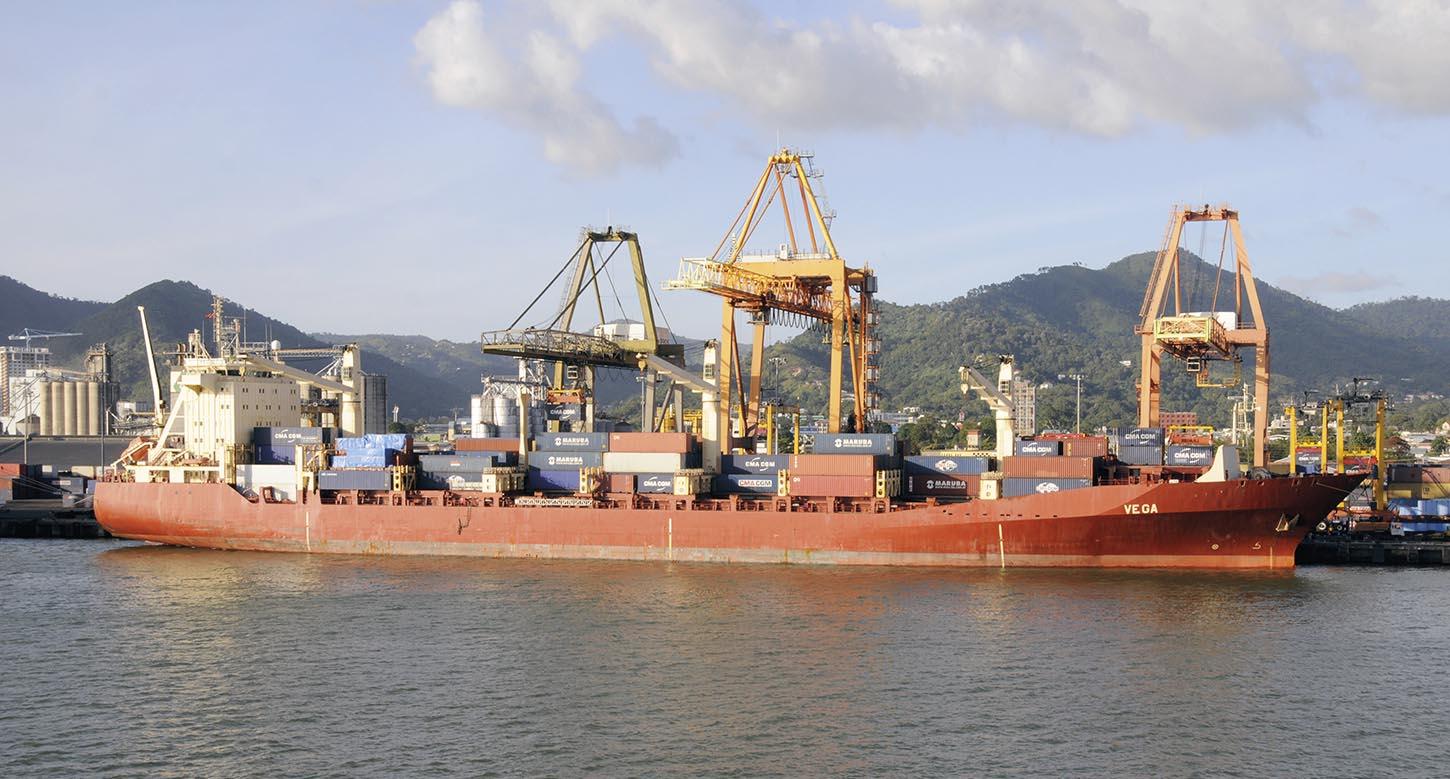
Left: The port’s tugs with two fast ferries in the background. From left to right are the NEC Majestic, NEC Pride and NEC Spirit of National Energy Corporation. The fast ferries are the Friendship and the Trini Flash.
Above: The 23,722gt contaner ship Vega of Alpha Ship Management docked at Port of Spain in February 2009. She was built in 2001 by Gdanska-Gdynia. In 2000 she was chartered to Maersk as Maersk Valparaiso reverting to Vega in 2008. In 2015 she became AS Vega of Wilhelmsen Ahrenkiel Ship and on 16th June 2020 she arrived at Alang to be broken up by Ark Shipbreaking under the name of Ega.
Below: The 22,801gt Maruba Asia NSB Niederelbe arriving at Port of Spain in 2009. She was built in 2008 by Aker MTW at Wismar. In 2011 she reverted to her launch name of Conti Daphne and in 2015 she moved to Uniteam Marine Shipping GmBH as Louisiana Trader. In 2022 she joined Transmar International as Transmar Legacy.
Bottom: Car carriers are also regular visitors to Port of Spain. Here we see the 26,746gt Eurasian Brilliance of Eukor. She was built in 1985 by Sumitomo at Oppama as the Dairyu Maru. In 1992 she became Robin Crest before joining Eukor in 1994. She later sailed as Eastern Bridge between 2000 and 2003 before becoming Euroasian Brilliance again. On 3rd June 2009 she arrived at Alang to be broken up.
(All photos by Nigel Lawrence)
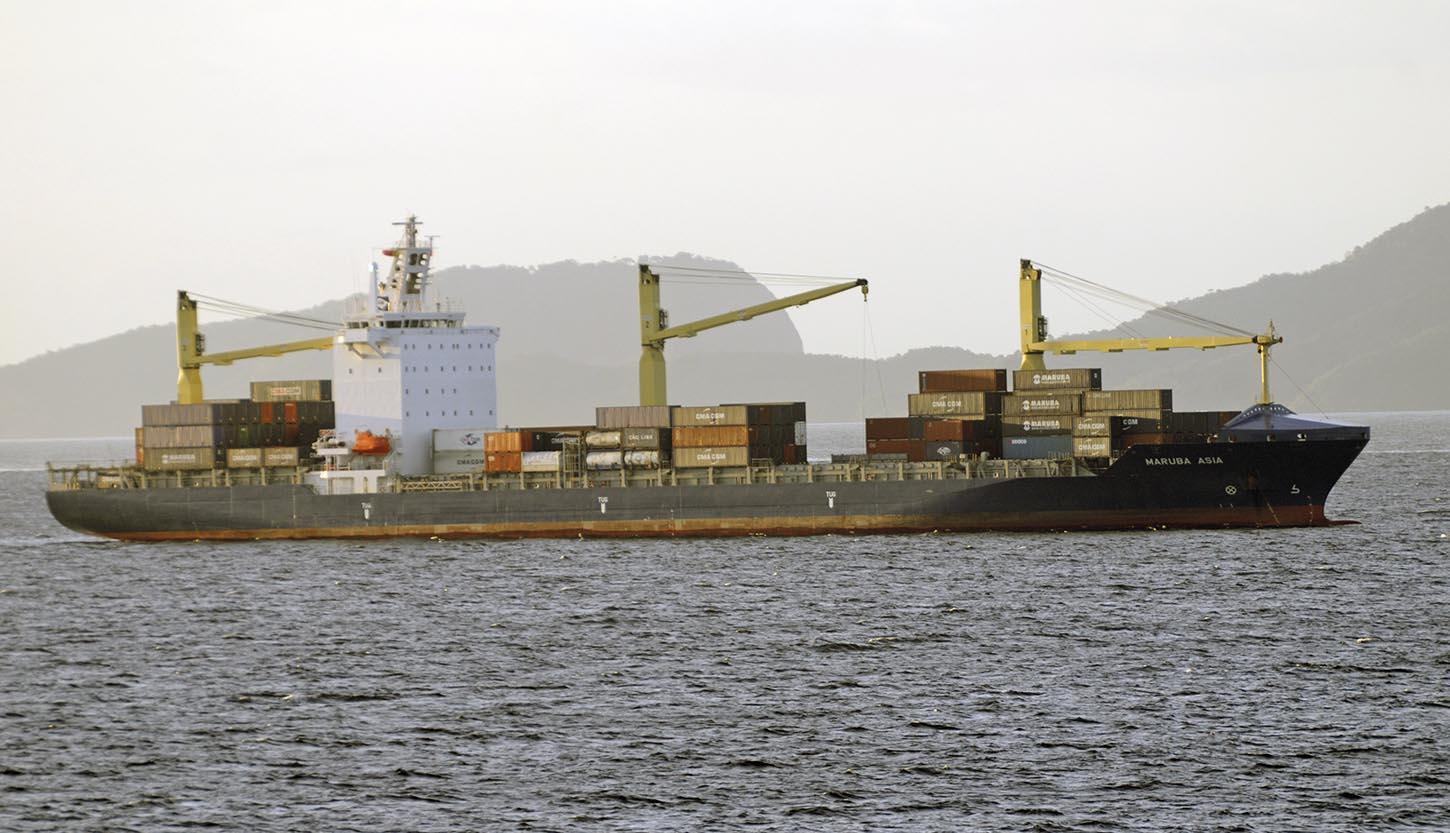
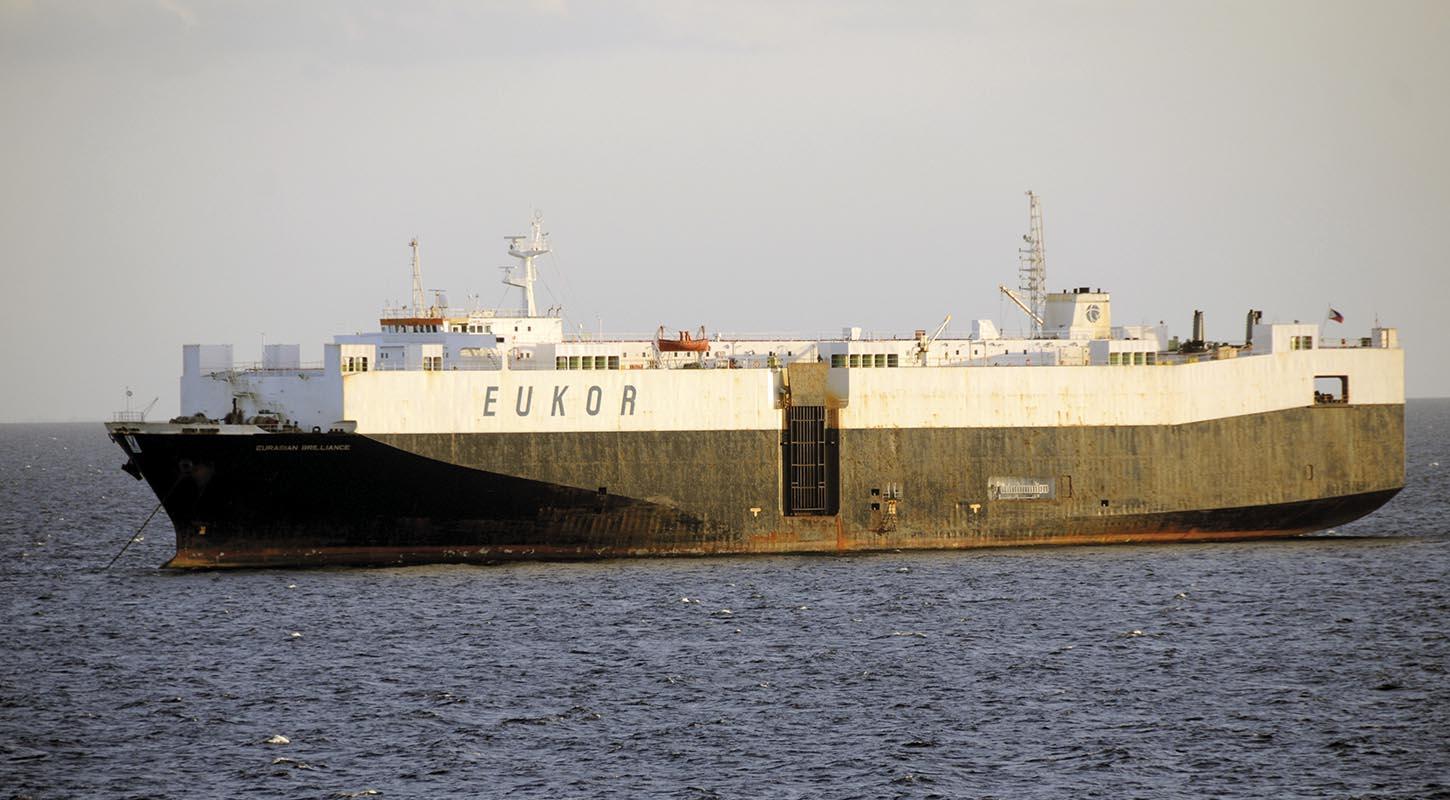
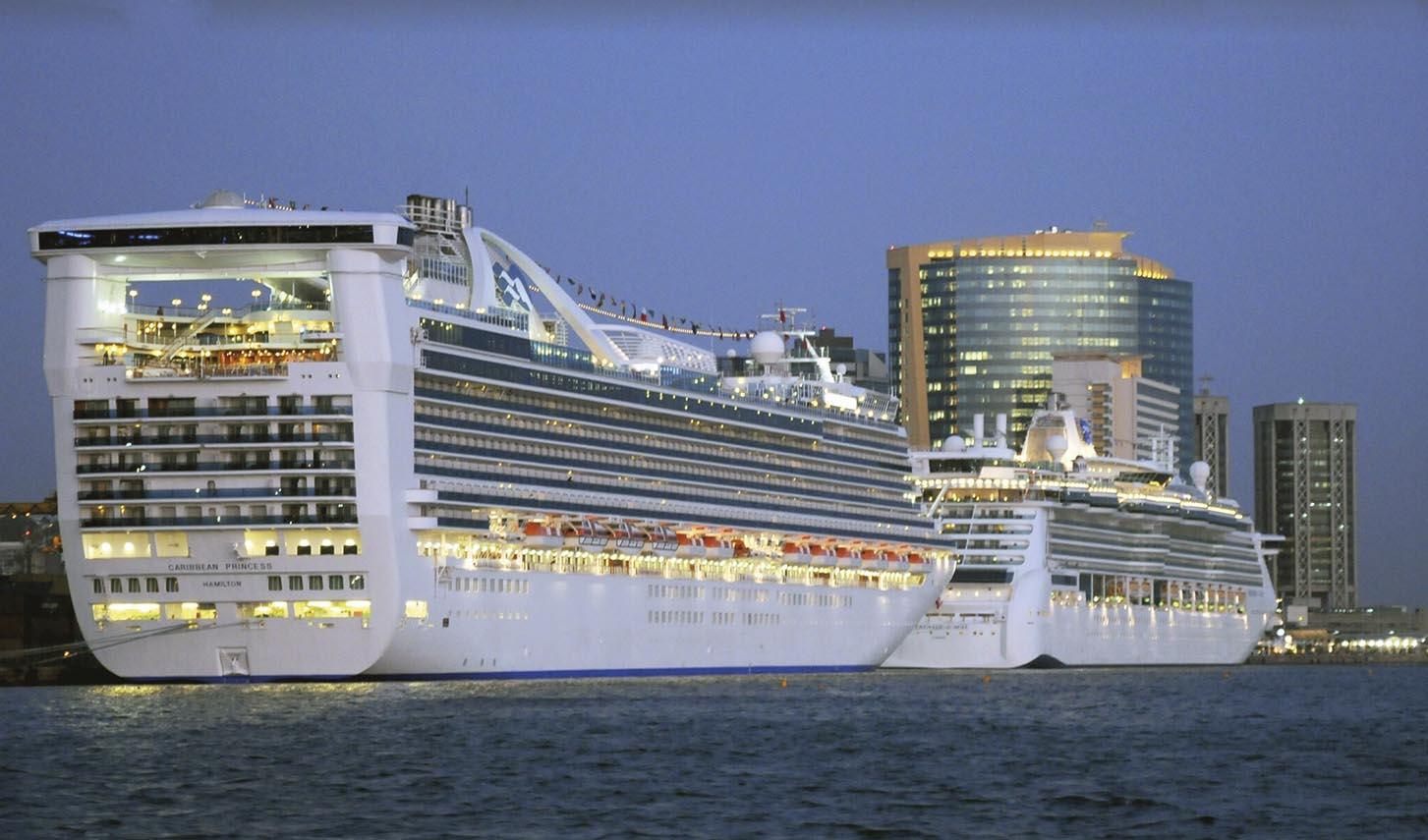
Above: The cruise terminal at Port of Spain showing the 112,894gt Caribbean Princess of Princess Cruises and Royal Caribbean’s 90,090gt Serenade of the Seas. The Caribbean Princess was built in 2004 by Fincantieri Italiani at Monfalcone and the Serenade of the Seas was built in 2003 by Jos L. Meyer at Papenburg. (Trinidad Ports)
Below: The 110,338gt Hoegh Giant of Hoegh LNG AS was built in 2017 by Hyundai at Ulsan. She is seen here anchored off Port of Spain in December 2023. (Nigel Lawrence)
Bottom: The 60,683gt drilling ship Noble Voyager of Maersk Drilling at Port of Spain in December 2023. She was built in 2015 by Samsung at Koje. (Nigel Lawrence)
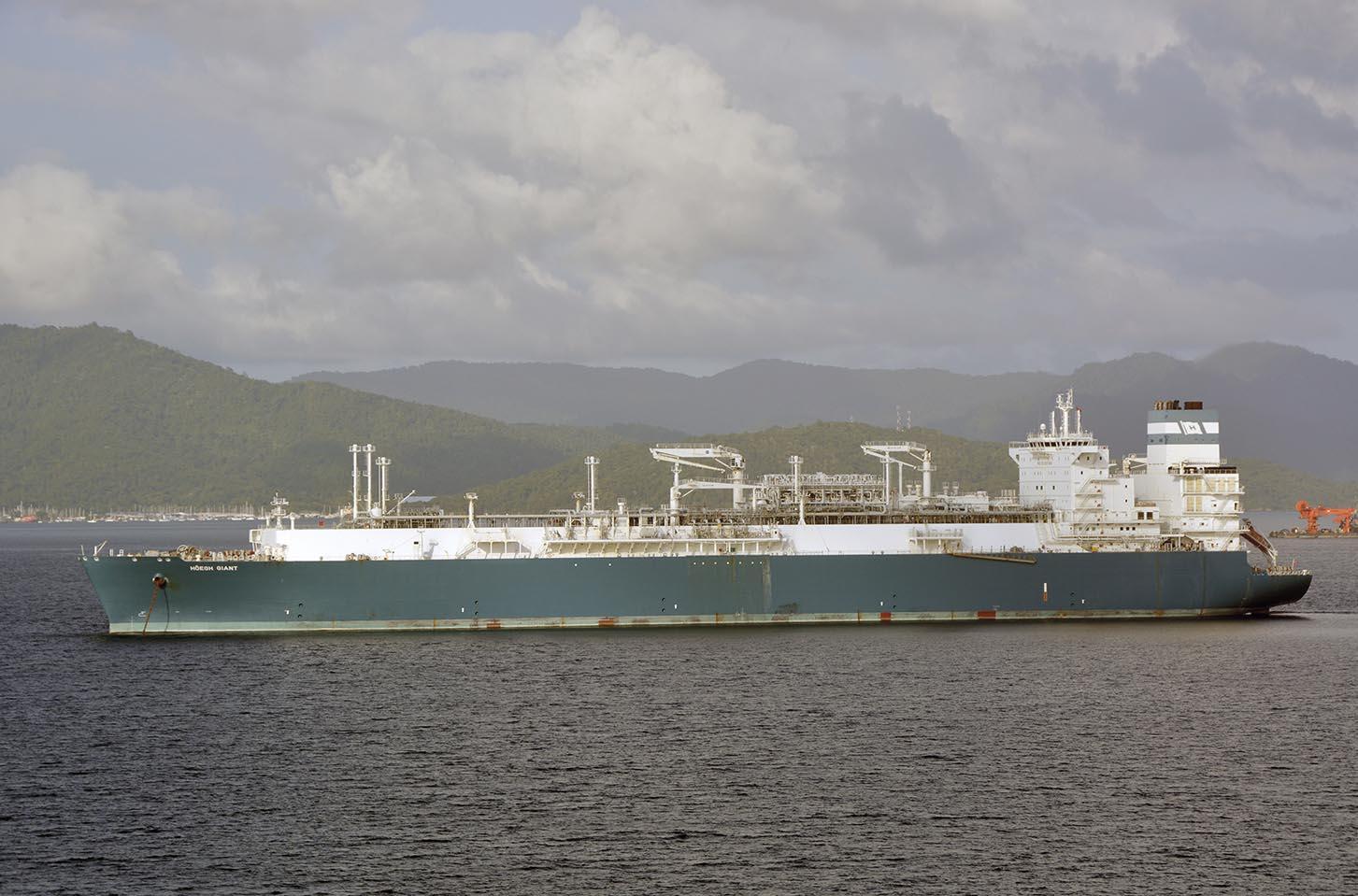
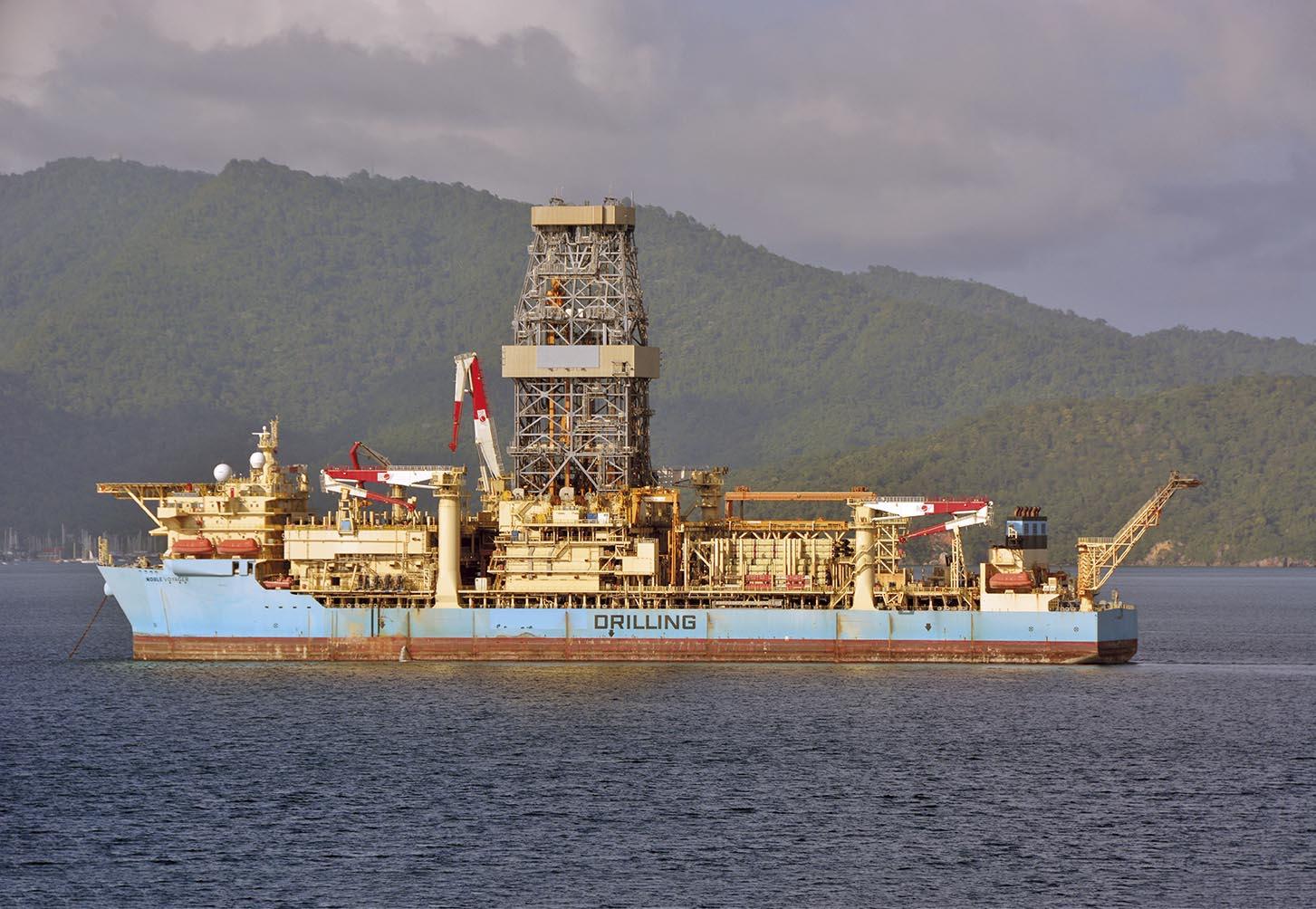
freed from the slave traders. Unfortunately, many of them would then be forced into indentured labour. Between 1807 and 1834 slave trading continued illegally but many freed slaves would go on to create new lives, communities and industries in Port of Spain. The early 19th century saw a large scale investment into Port of Spain. In 1803 the first in a series of land reclamation projects began that extended the town and as a consequence the port facilities southwards. The tidal areas were infilled with material taken from the Laventile Hills. In 1845 more work was undertaken by indentured Indian labourers and in the 1870s another project to claim more land back from the sea began. With the turn of the 20th century modernisation projects included significant dredging and more reclamation work in 1906. The port area continued to be developed firstly with the introduction of electricity and improved water supply and later further enhancements to public transportation across Port of Spain. New docks, quays, warehouses and cargo handling facilities were added and the approaches to the wharves were dredged to allow ever increasingly larger vessels to dock alongside. In 1935 the Deep Water Harbour Scheme commenced with dredging operations conducted offshore to raise material from the seabed which was subsequently deposited on land south of Woodbrook. The reclaimed land initially was called Docksite, but during World War Two would be taken over by American forces as a base for their naval operations from the island.
Oil was discovered on the island of Trinidad and in its coastal waters in the late 19th century and this, probably more than any other event, changed the course of the island’s history and development. The substance we called oil, had, however, been ‘discovered’ much earlier by the local people of the islands in 1498, who used it to waterproof their canoes. Later Christopher Columbus found the Pitch Lake in La Brea, the largest natural deposit of asphalt in the world. In 1595 Sir Walter Raleigh also used pitch from the same deposit to caulk his ships. At the time no commercial extraction was contemplated or achieved. The first oil well drilled on the island was in the Aripero area in 1857, but production of oil was minimal. Several attempts to commercially extract the island’s oil resources continued until around 1900 without much success. These would have to wait until 1908 when Trinidad’s first commercial oil well was drilled at Guayaguayare by the Trinidad Petroleum Company and two years later the first significant oil refinery was established at Point Fortin by Trinidad Leaseholds Ltd.
The extraction of oil expanded rapidly as demand grew during the First World War and into the 1920s with the arrival of companies
such as the Apex Trinidad Oilfields Ltd., BP and Shell and the refinery at Pointe-à-Pierre was expanded to process larger quantities of crude oil which was shipped globally through the port. Oil from Trinidad was a critical commodity during World War Two. Post war Trinidad’s large oil reserves continued to be discovered and extracted. The 1950s were a boom time for the oil industry in Trinidad with the island nation becoming one of the Caribbean’s leading producers. The oil crisis of the 1970s became a boon to the island as they could charge increased prices for their oil as supply from more traditional sources dried up. In the 1980s the oil boom was in decline as the industry shifted to natural gas and in the 2000s Trinidad and Tobago became one of the world’s leading exporters of liquefied natural gas (LNG) onboard huge specially built ships. At the same time exports of crude oil continued to decline. The oil and gas industries still provide valuable income for the islands of Trinidad and Tobago, but the focus is now more on developing renewable energy sources and diversification and managing the existing oil and gas fields.
The First World War played only a minor role in the history of Port of Spain, other than sending supplies of sugar, cocoa, fruits and other materials to Europe for processing and consumption. That being said the port did make it a valuable and safe location for naval ships to refuel and resupply, particularly as large deposits of oil had been discovered on Trinidad. In 1917 as the United States entered the war in Europe they created a long logistical chain that stretched across the North Atlantic that included Port of Spain.
During the Second World War, with its far greater global impact, the effects of war were felt in Trinidad and Tobago. The island’s strategic location immediately lent it to becoming a base for Allied forces. Thousands of troops and supplies poured into the islands and to accommodate these shipments the port facilities were further expanded. On 2nd September 1940 as Great Britain was at its lowest ebb during the Battle of Britain and faced the prospect of losing the war to Nazi Germany, signed the Destroyers for Bases Agreement with the United States.
The island of Trinidad was of strategic importance to the United States Navy and in exchange for old, tired, American destroyers the British allowed the United States to create a naval base on Trinidad and other islands in the Caribbean and elsewhere. On 1st June 1941 the U.S. Navy commissioned Naval Base Trinidad, also known as NAS Port-ofSpain, transforming the port into a major naval operating base equipped with shiprepair facilities, a fuel depot, and a supply depot under the command of Admiral Jonas H. Ingram.
This development enhanced the Allies'
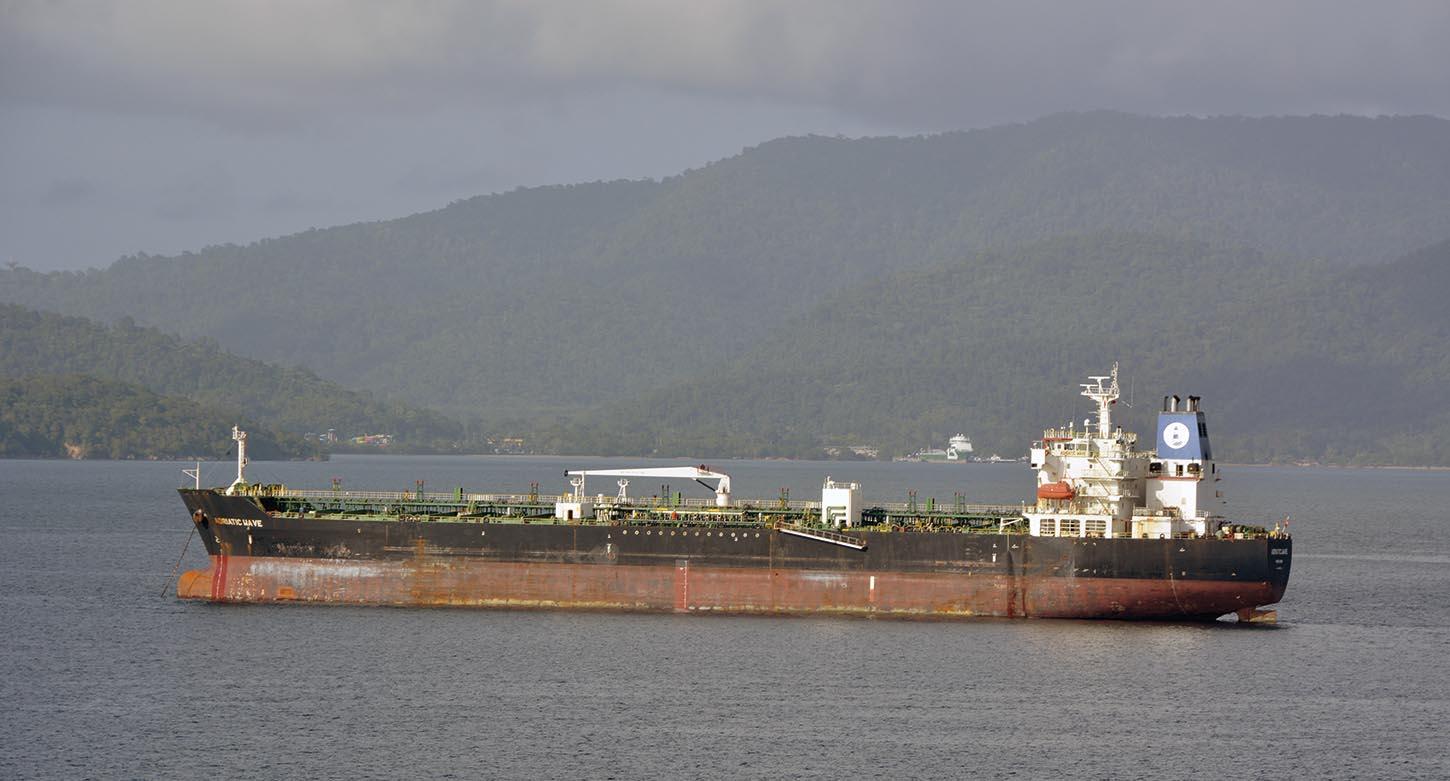
Three vessels anchored off Port of Spain waiting for available berths
Above: The 51,476dwt tanker Adriatic Wave of Heroic Scutum Inc. was built in 2009 by STX Shipbuilding at Jinhae. In 2024 they renamed her Seaways Wave.
Below: The 11,473gt Amoenitas of SAL Heavy Lift was built in 2010 by Kouan Shipbuilding at Taizhou as the Palanpur for Harren & Partners. Soon after completion she was chartered to Hyundai as Hyundai Phoenix before reverting to Pelanpur in 2012. She joined SAL Heavy Lift in 2014.
Bottom: The 158,532dwt tankerPetalidi of TMS Tankers was built in 2012 by Samsung at
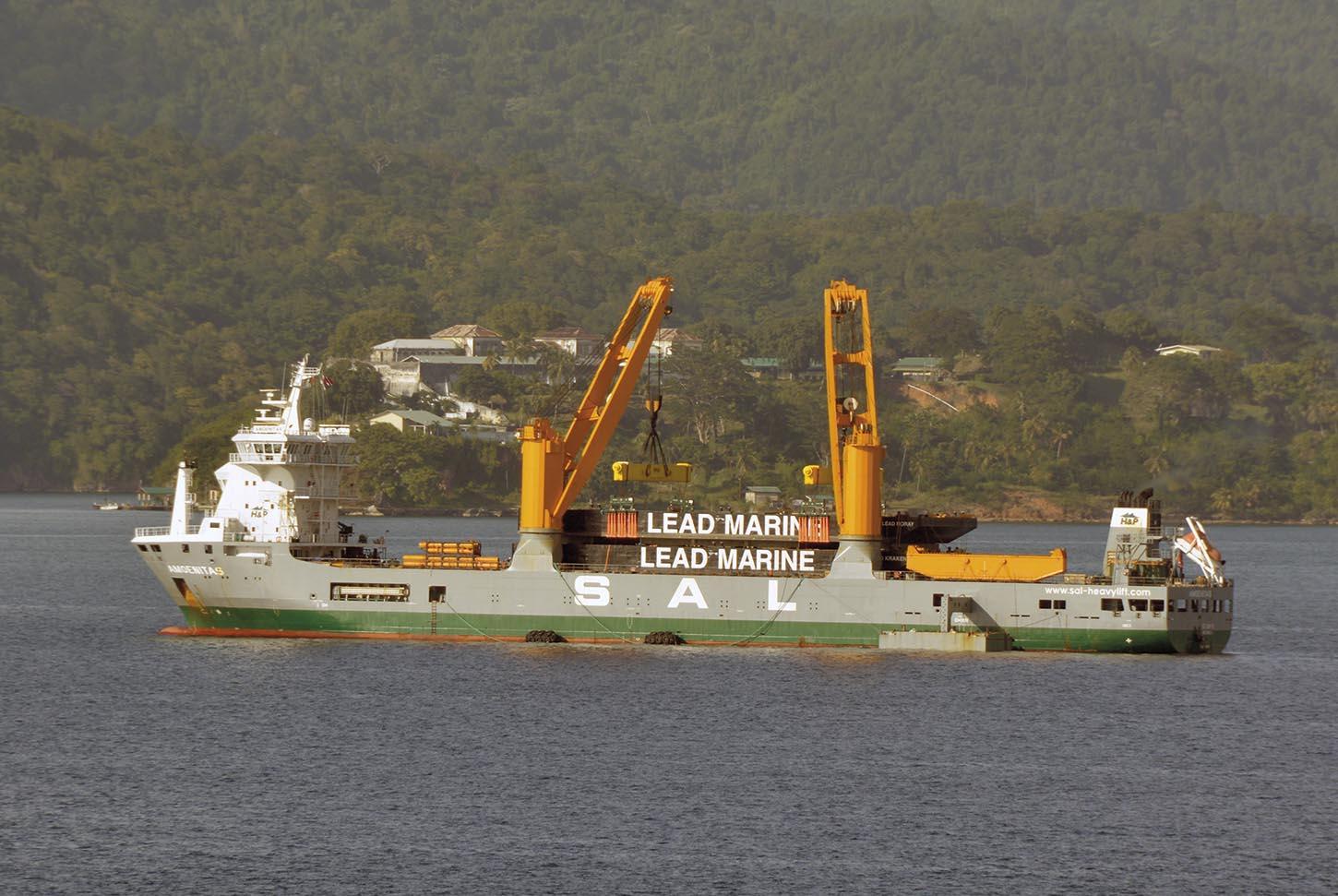
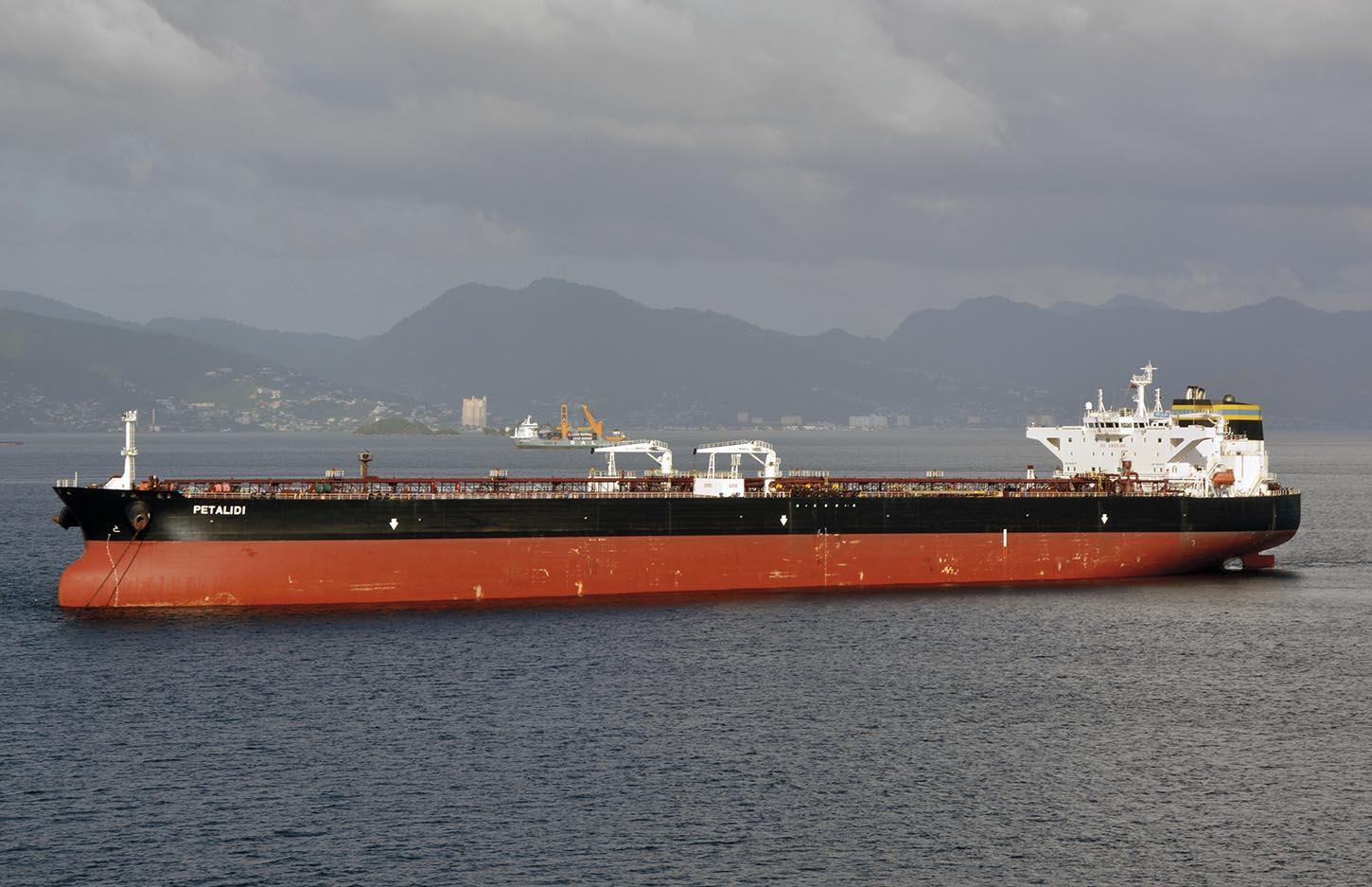
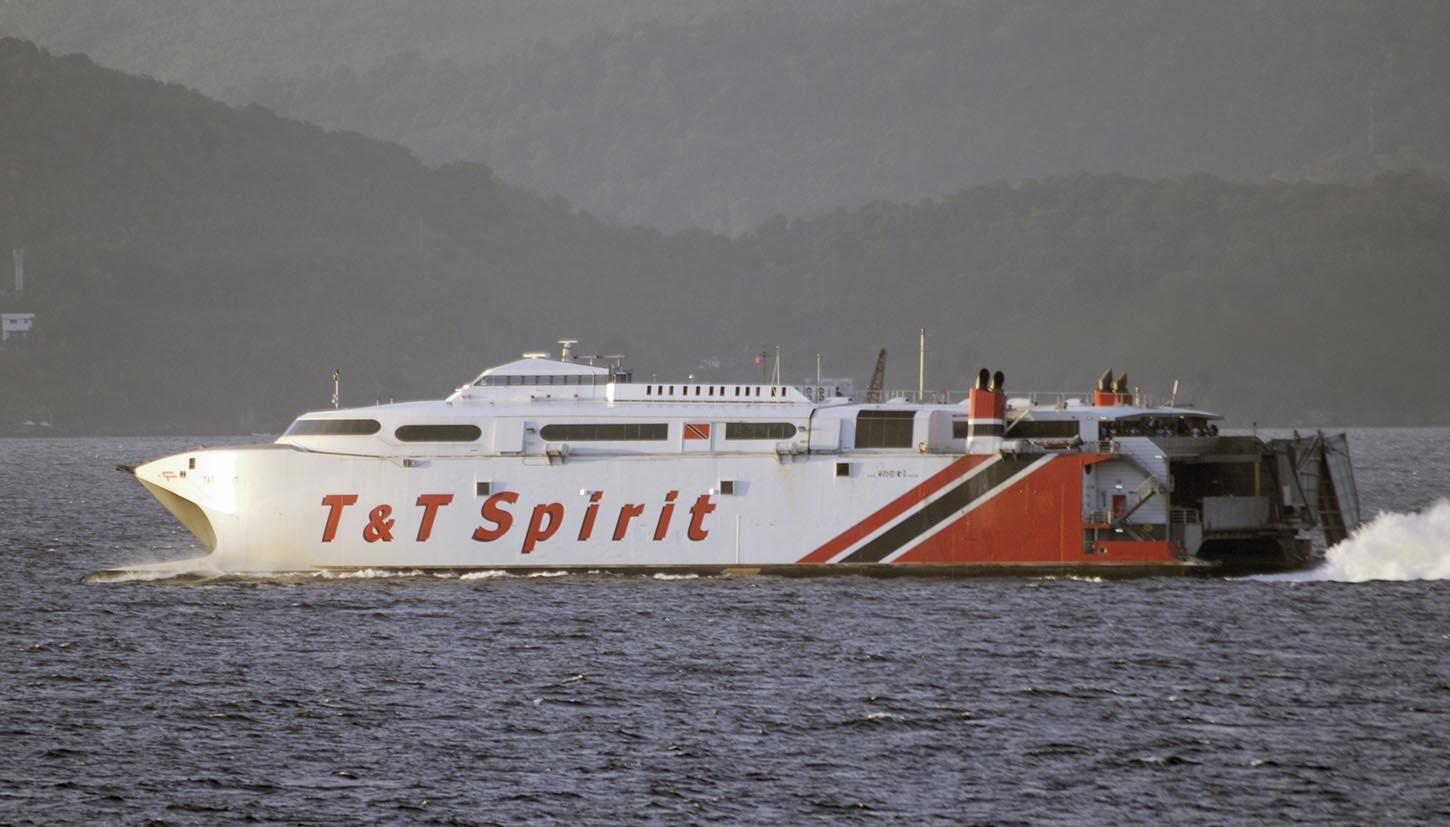
Above: The 6,558gt T & T Spirit of Trinidad and Tobago Government was built in 2002 by Incat at Hobart as the Spearhead, becoming T & T Spirit in 2007. She is seen here leaving Port of Spain in February 2009.
Below: The 6,726gt Buccoo Reef arriving at Port of Spain in December 2023. She was built in 2021 by Incat at Hobart.
Bottom: The 19,963gt Cabo Star operated as a Ro-Ro vessel for a service between Trinidad and Tobago by Bridgemans Trinidad was built in 1988 by Lenina at Gdansk as the Finnforest for Finnlines. Later that year she was renamed Antares and in 2016 she became Cabo Star.
(All photos by Nigel Lawrence)
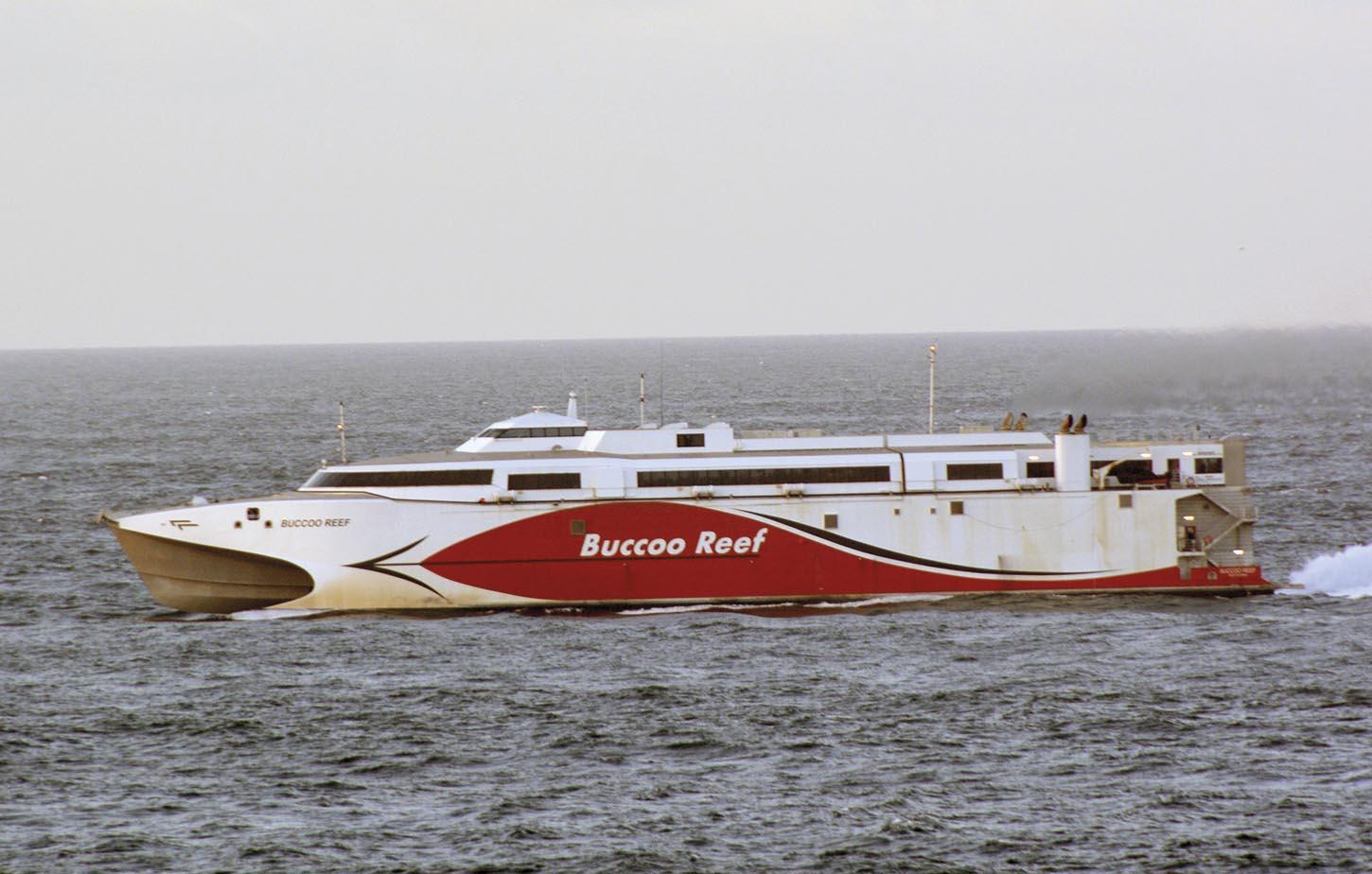
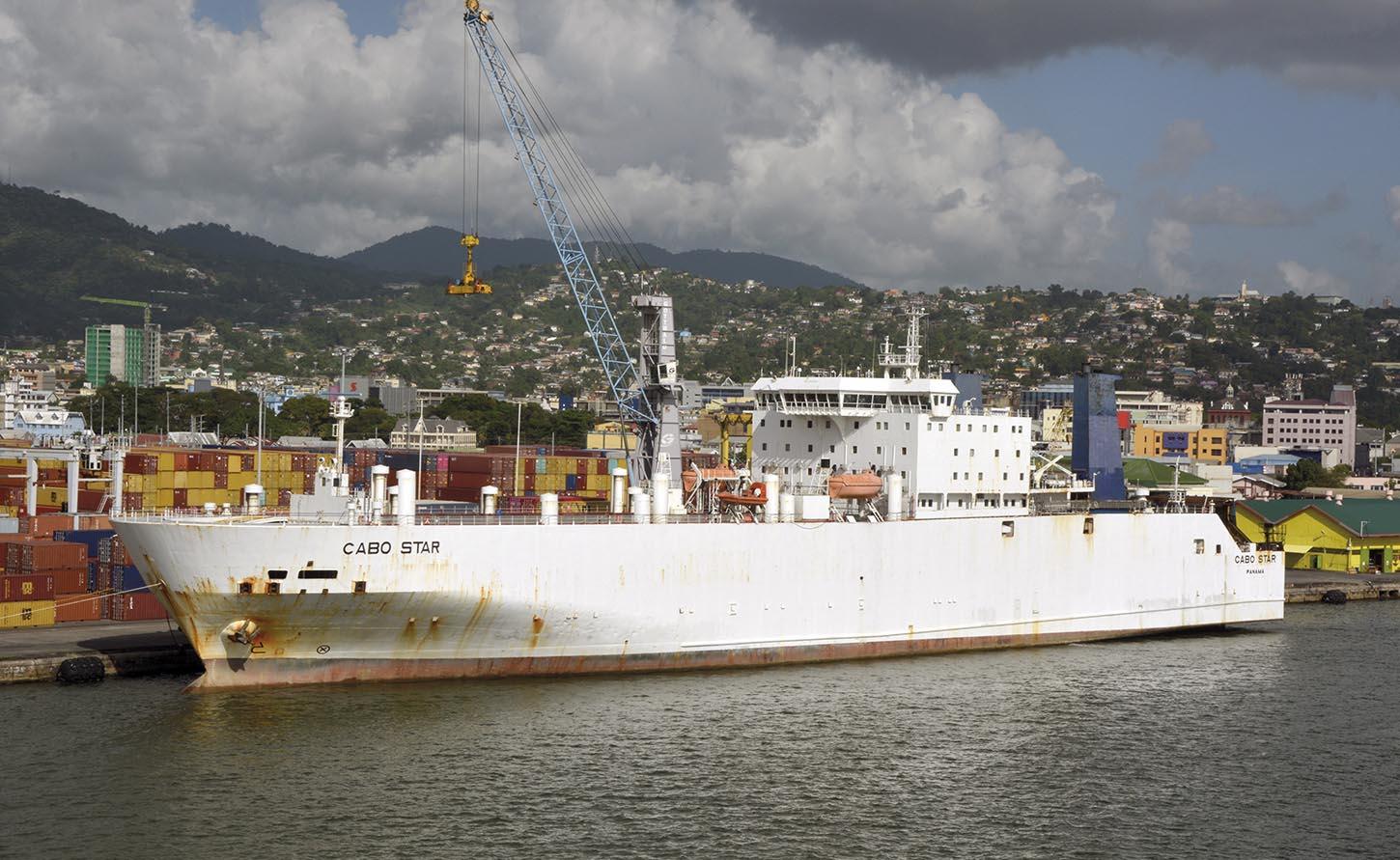
ability to conduct anti-submarine warfare and protect vital shipping lanes in the Caribbean. Throughout the next four years of war the base was home to a variety of naval aircraft conducting anti-submarine patrols of the Caribbean looking for German U-boats. Such was the importance of the facilities on Trinidad that at its height in 1942 135,000 American service personnel were stationed on Trinidad. Many were in the port district repairing, re-storing and maintaining naval vessels.
The post-war era was marked by economic challenges and social change. The decline of the sugar industry and the rise of oil as a key economic driver transformed Trinidad's economy. Port of Spain adapted to these changes, with the development of new industries and the expansion of the service sector.
In the 1950s interconnectivity between the port and areas inland was vastly improved with the construction of the Beetham Highway opening up the interior of the islands to the possibility of trade and increasingly towards tourism. By 1962 tourist trade was becoming of vital importance to Trinidad and Tobago and the first cruise ship facilities were opened soon thereafter.
Life on Trinidad and Tobago is, usually, placid and calm, but in 1990 there was an attempted military coup by the Jamaat al Muslimeen. This uprising caused disruption to the usual operation of the port, but only temporarily and within weeks the port was back to its usual status. A similar occurrence happened in 2005 when a series of small bombs were exploded in Port of Spain leading to improved and heightened security measures to be introduced at the port facilities.
In 2002 the government of the islands introduced the high speed catamaran T& T Spirit on the route between Port of Spain and Scarborough. Six years later the Port of Spain International Waterfront Project was completed that allowed the increasingly large cruise ships preferred by modern cruise lines to use the port and increase the islands appeal to tourism.
With a nation comprising of two separate islands and even further afield across the Caribbean such as the Grenadines, it was imperative that a reliable and regular ferry service be established. One of the first operators was the Royal Mail Steam Packet. One of the notable developments in Port of Spain's ferry services was the establishment of regular ferry routes to Tobago. These services facilitated travel and trade between the two islands, further boosting the city's economic growth. The advent of roll-on/roll-off (Ro-Ro) ferries in the latter half of the 20th century revolutionized the industry.
Today, the seaport at Port of Spain remains one of the busiest and most important in the Caribbean, serving as the primary gateway for Trinidad and Tobago's international trade. The port is managed by the Port Authority of Trinidad and Tobago (PATT), which oversees both commercial shipping and passenger services. In 2022, the port handled approximately 420,000 TEUs (Twenty-foot Equivalent Units), making it a key trans-shipment hub for goods moving between the Americas, Europe, and Asia.
Major shipping lines such as Maersk, CMA CGM, and MSC call at the Port of Spain, contributing to its significance in global shipping routes. The seaport is divided into different terminals, with the Port of Spain Container Terminal being the largest. It is equipped with modern gantry cranes and container handling equipment, allowing it to accommodate large Panamax vessels.
Additionally, the port has bulk handling facilities at its general cargo terminal, where commodities such as steel and agricultural products are loaded and unloaded.
In terms of passenger services, the Port of Spain is also an important point of entry for cruise ships. Cruise tourism plays a growing role in Trinidad’s economy, with several international cruise lines, including Royal Caribbean and Carnival, making stops at the port. The Cruise Ship Complex, located in the heart of Port of Spain, was redeveloped to accommodate the rising number of cruise passengers, offering modern amenities and proximity to the city’s attractions.
Ship maintenance and refitting can be undertaken by The Trinidad and Tobago Dry Dock Company Limited (TTDDCL). The company was founded in 2003 at Point Lisas by John O’Sullivan looking to build a business around the large number of ships passing through the Caribbean and to support the oil and ancillary industries in the region.
The company was incorporated as The Trinidad Dry Dock Company Limited (TDDCL) on 27th September 2004, as a private company. The company has ambitious plans to create some of the region’s most impressive dry dock facilities. Two huge graving dock facilities with a total of five dry docks each in the Republic of Trinidad and Tobago and the Co-operative Republic of Guyana. The plans for Trinidad centre on Sullivan Island on the Gulf of Paria. Meanwhile in Guyana, the new facilities there will be located on the Berbice River estuary and be named as the New Amsterdam Dry Dock Industrial Port Complex. The two projects together will boast 199,300 m2 of docking capacity and each will also be colocated with marine and industrial park sites to enhance the interoperability of the port
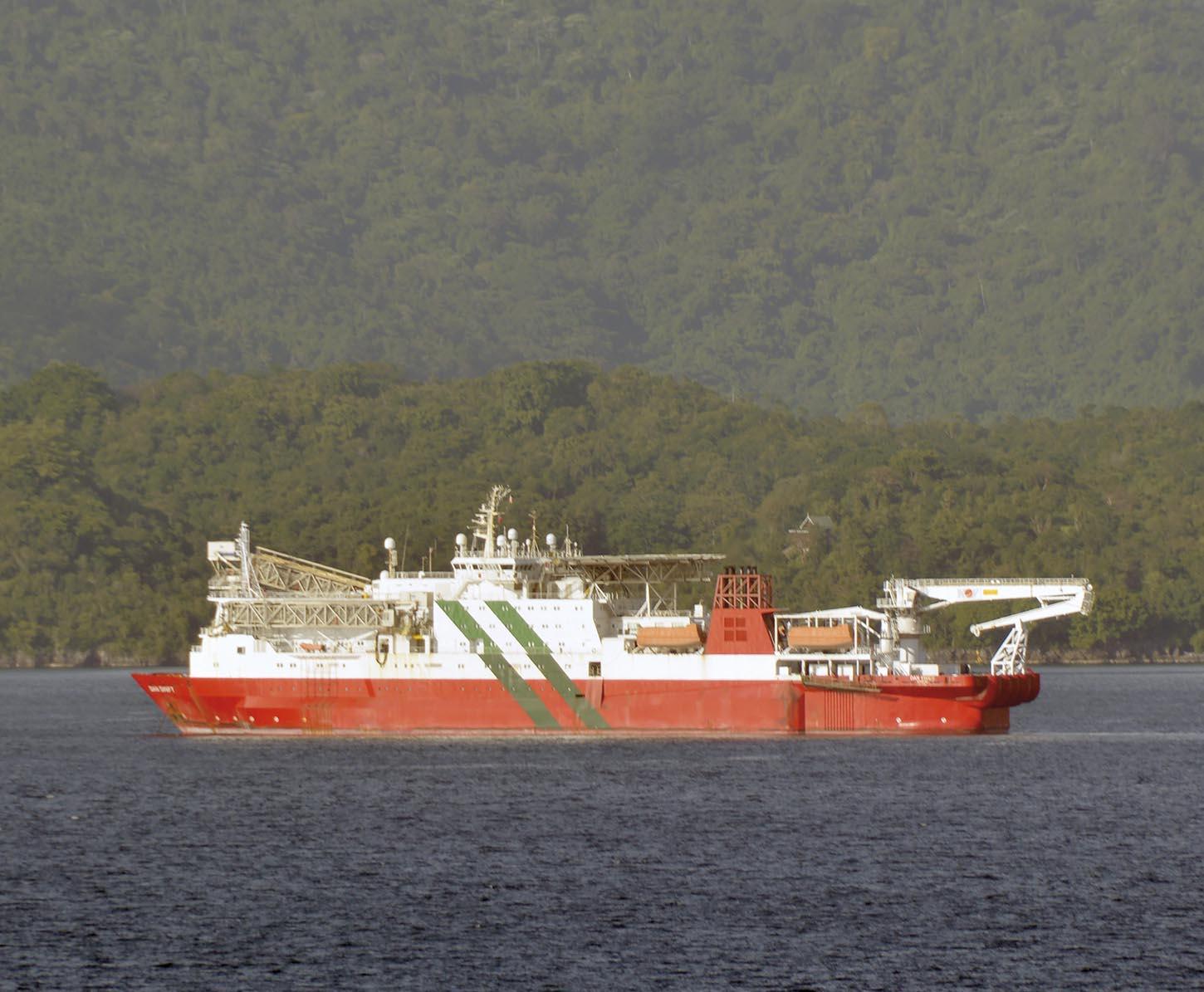
The16,652gt accommodation ship Dan Swift of Wilhelmsen Ship Management was built in 1985 by Danyard Frederikshavn as the RoRo ship Mercandian Continent. In 1996 she became RORO Sentosa and in 2000 she was renamed Sentosa. Later that year she was renamed Kraka before being converted into the accommodation ship Dan Swift in 2009. From 2016 until 2020 she sailed as Safe Swift before reverting to Dan Swift. She is seen here off Port of Spain in 2023. (Nigel Lawrence)
with associated trades and industries. The projects have been financed, in large part, with Chinese money, which has raised concerns, particularly in neighbouring America which is trying to curb the growing number and complexity of Chinese interests in America’s backyard. The Government of Trinidad and Tobago have, however, agreed to partner with the China Harbour Engineering Company (CHEC) to build the La Brea site.
The Prime Minister of Trinidad and Tobago, Dr. Keith Rowley, on 7th September 2018 stated that, "This project will be a huge foreign currency earner as much of the ships that will utilize the facility will pay for services in foreign currency".
Some idea of the extent of the work can be gauged by the fact that the project includes dredging 2.9 million m2 of seabed to create a navigable channel and turning circle, 295,000 m2 of land reclamation work and the construction of two dry docks, 50 berths, and an outfitting pier. Furthermore, there is the construction of workshops, warehousing and associated buildings which it is hoped will create 3,500 direct and 5,700 indirect jobs on the island. Once complete the shipyard will have 2,700 direct jobs and 13,000 indirect jobs.
It is hoped that the facilities will capture repair work on Panamax ships transitting the Panama Canal adding at least US$600million to the nation’s economy every year. The first
steel pilings were erected in 2014 to create the 75-hectare Sullivan Island linked to the mainland by a 4 kilometre causeway. The project continues to be developed at the time of writing.
Strategically positioned along a natural harbour in the capital city of Trinidad, the Port of Port of Spain (PPOS) has 515 metres of berthing space with the maximum length of vessels being 294 metres in length. There are 61 hectares dedicated to cargo operations with dedicated warehousing and large car parking areas for vehicles. It is conveniently accessible from seaside and to the main inland transportation routes. PPOS is equipped to serve the main shipping lanes among the Americas, the Caribbean and trade routes that connect the Atlantic and Pacific oceans via the Panama Canal. PPOS remains 100 percent Government owned and is capable of receiving containerized, break bulk, dry bulk, liquid bulk, ro-ro carrier, LCL and barrel cargoes. dditionally, PPOS owns and operates four Ship to Shore Gantry Cranes (STS) of varying sizes, height, outreach, speed and capacities. Inward investment into the containerisation of Port of Spain means that there has been a steady growth in the numbers of standard sized TEUs through the port from 298,696 in 2015 to 324,575 in 2024. While a fraction for a comparable major container port elsewhere in the world for a small Caribbean island this is a significant number.

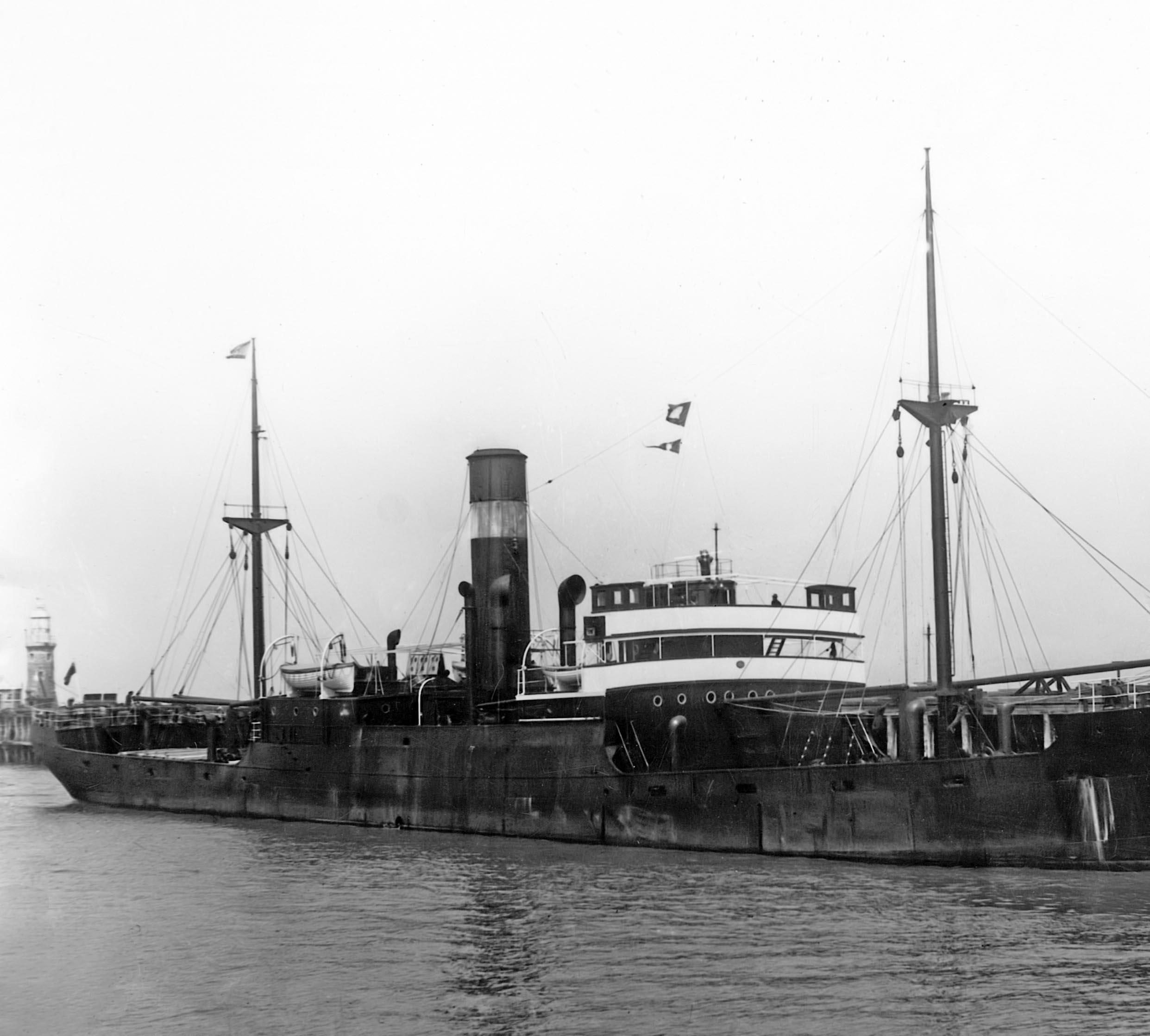
This small Glasgow tramp company was typical of so many other British tramp companies. Its 'Blair' tramps were wellknown for over 50 years in all the major ports of the world, particularly in the Canadian and American trades. It survived two world wars, numerous minor booms and slumps and one depression and succumbed in the early 1960s when the high capital cost of bulk carriers made the traditional tramp uneconomic.
George Nisbet was the prime mover in the three companies that were set up, of which the title company was one, but he took a partner named Calder as Nisbet, Calder & Co. during pre-WWI days. However the first three owned tramps tramps did not have 'Blair' names when the Clydesdale Navigation Co. Ltd. was set up in 1905. Etona and Greatham were two tramps dating from 1890 which were purchased for the Clydesdale company from Bucknall, Nephews of London
and T. Appleby of West Hartlepool, together with the equally old Benedick from Crawford Brothers of Grangemouth for the Northern Navigation Co. Ltd. in 1909.
Despite starting when freight rates were poor, they managed to stay in business and had sold the three old tramps by 1914 to Japanese and Italian owners with Greatham moving to the Middlesbrough fleet of Coombes, Marshall & Co.
They were replaced by a Finnish owned tramp Heros of slightly newer vintage of 1899 for the Clydesdale Navigation Co. Ltd., and the newer Mountfields of 1901 purchased from the Doughty Shipping Co. Ltd. of Hartlepool for the Northern Navigation Co. Ltd. Heros was renamed Blairhall and as such was torpedoed and sunk on 26th July 1918 3.5 miles ENE of Sunderland while on a voyage Middlesbrough to the Tyne in ballast and one crew member lost his life.
Mountfields was renamed Blairmore
before the end of hostilities but was then sold in 1919 and renamed Rosina Topic,with George Nisbet withdrawing from shipowning until 1922. This tramp became the Turkish Altay in 1933, and survived WWII and was still trading in the 1950s when over 50 years old.
When he resumed shipowning George Nisbet went to the Continent to purchase four old tramps, two of them Dutch. Moerdijk and Oostdijk became Blairbeg and Blairlogie respectively, while an old former Russian tramp became Blairholm and the Lloyd Royal Belge owned Ubier became Blairadam. In 1924 his first new tramp Blairgowrie was delivered on a rising market from the Clyde yard of Napier & Miller Ltd.
Three sisters from the same yard were delivered in 1925, Blairatholl, Blairesk and Blairdevon.
Blairatholl and Blairdevon were registered under a new company formed on 13th
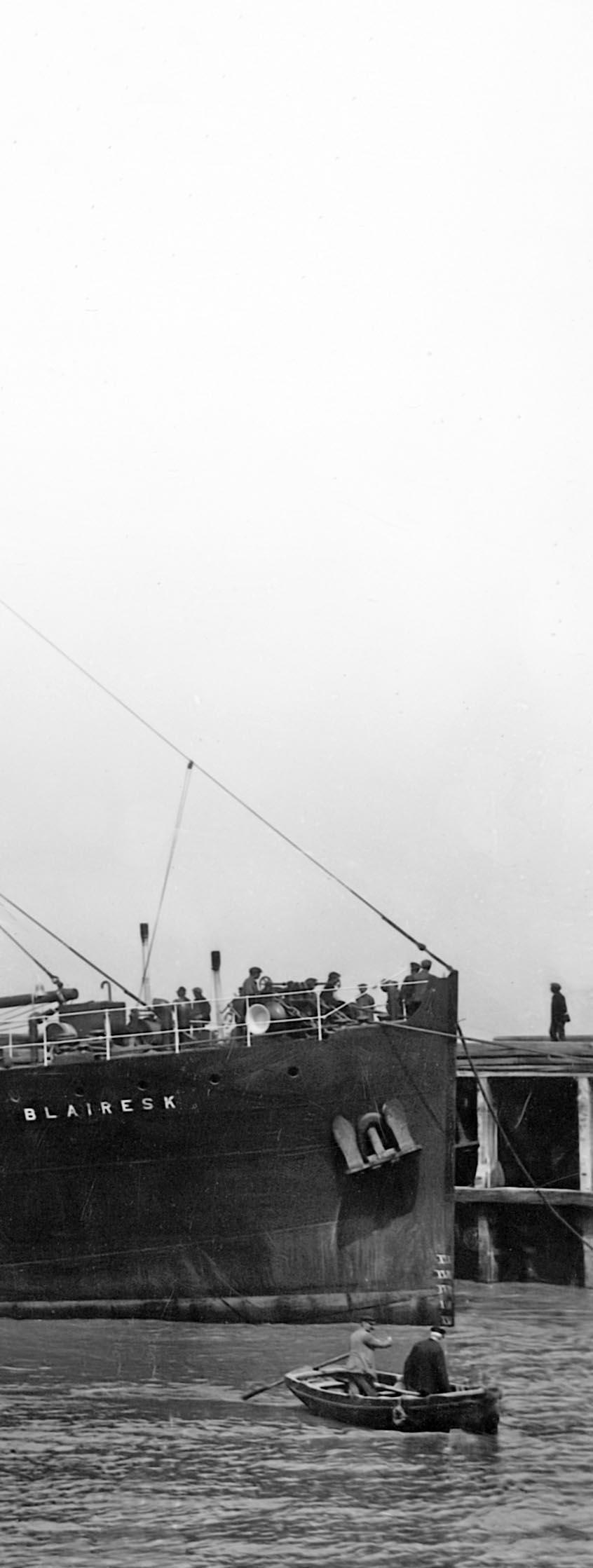
March 1924 with a nominal capital of £100,000 and named after the founder, Nisbet Shipping Co. Ltd. with the other two of the quartet under the Clydesdale and Northern Navigation companies.
Three larger sisters followed in 1928, 1929 and 1930 from the Ardrossan Dockyard, Blairmore, Blairspey and Blairnevis with one each registered under the three companies. Thus a fleet of seven newish tramps and four very old ones was owned at the start of the depression in 1930. The oldest was Blairbeg dating from 1905 and she was sold off as uneconomic to Latvian owners and replaced by a namesake in the shape of the 1917 vintage Clifftower.
The other old tramps were then sold as the depression wore on, with Blairlogie and Blairholm going in 1934 and Blairadam sold to Finnish owners in 1936 when second-hand prices were rising. They were replaced by two newer Cardiff tramps dating from
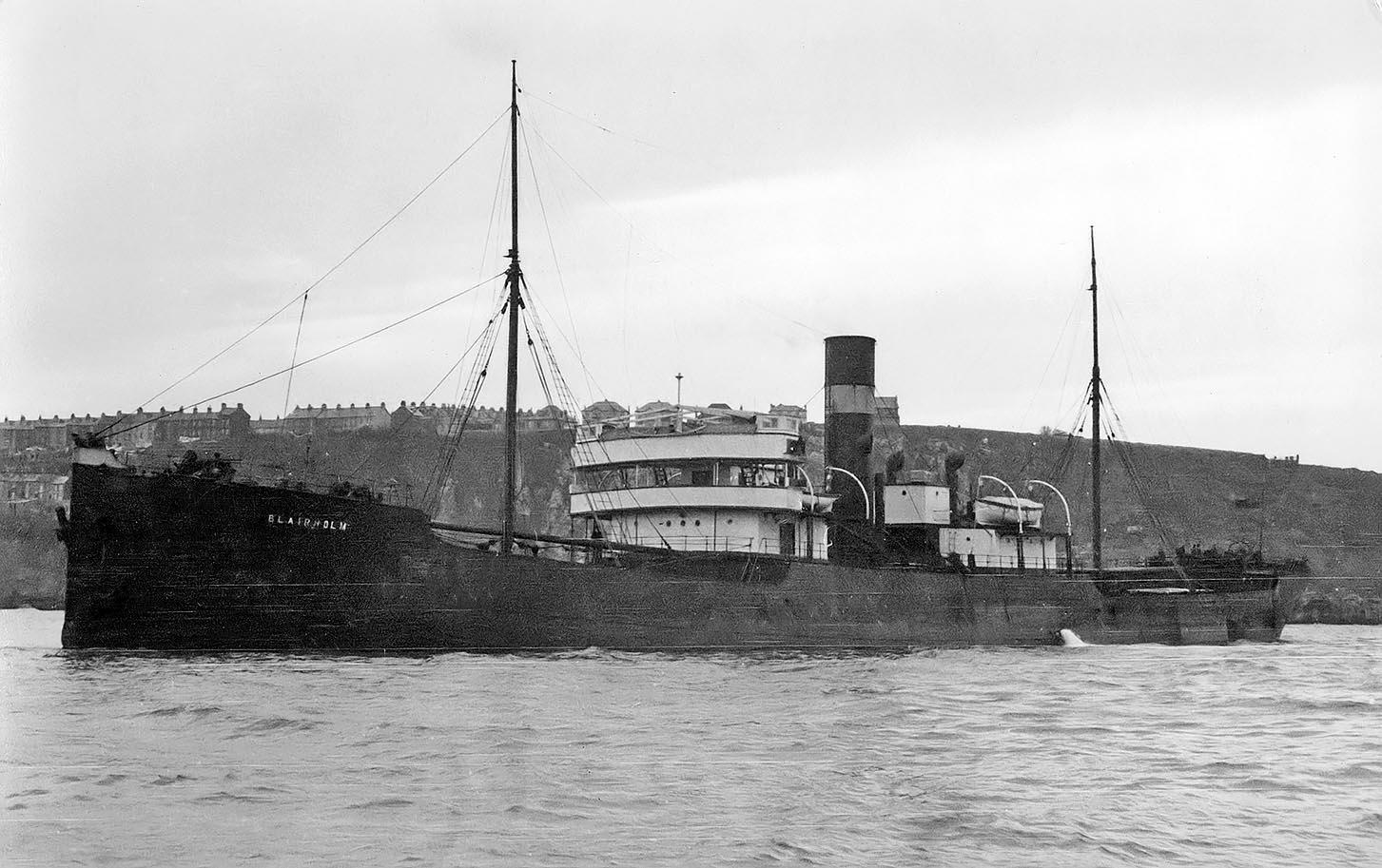
Left: The 3,300grt Blairesk was built in 1925 by Napier & Miller at Old Kilpatrick. In 1952 she was sold to Rudolf Chr. Gribel of Lubeck and renamed Eddi and in 1961 she joined San Gabriele Corporation of Liberia as San Gabriele. She was broken up by G. Riccardi at Savona in August 1970.
Above: The 2,631grt Blairholm was built in 1906 by Blyth Shipbuilding and Drydock Co. at Cowpen Quay as the Aleksandr Kamburov for the Northern SS Co. of Russia. In 1921 she was sold to Soc Maritime et Commerciale de France and renamed San Giacomo and in 1922 she became Korsholm of Danish company Rederi A/S Limfjorden. She joined Nisbet in 1923 and in 1933 she was sold to A. Grozea of Romania and renamed Auratan. The following year she joined another Romanian company, M.N.Valsamakis and was renamed Sf. Nicolae. In 1935 she moved to Th.L.Teryazos of Piraeus as Anna T. and in 1946 she joined Kien Sing SN Co. of Shanghai as Kiensing. On 28th February 1948 she was wrecked off Chilang Point, Viet Nam while on a voyage from Hainan to Kobe with a cargo of iron ore.
Below: The 3,259grt Blairgowrie was built in 1924 by Napier & Miller at Old Kilpatrick. She went missing on 26th February 1935 while on a voyage from Swansea to Boston. All 26 crew were lost.
Bottom: The 3,319grt Blairatholl was built in 1925 by Napier & Miller at Old Kilpatrick. On 27th November 1942 she was in collision with the 4,746grt Norwegian ship John Bakke and sank when on route from New London for the Tyne with a cargo of steel and lumber.
(All photos from the John B. Hill collection)
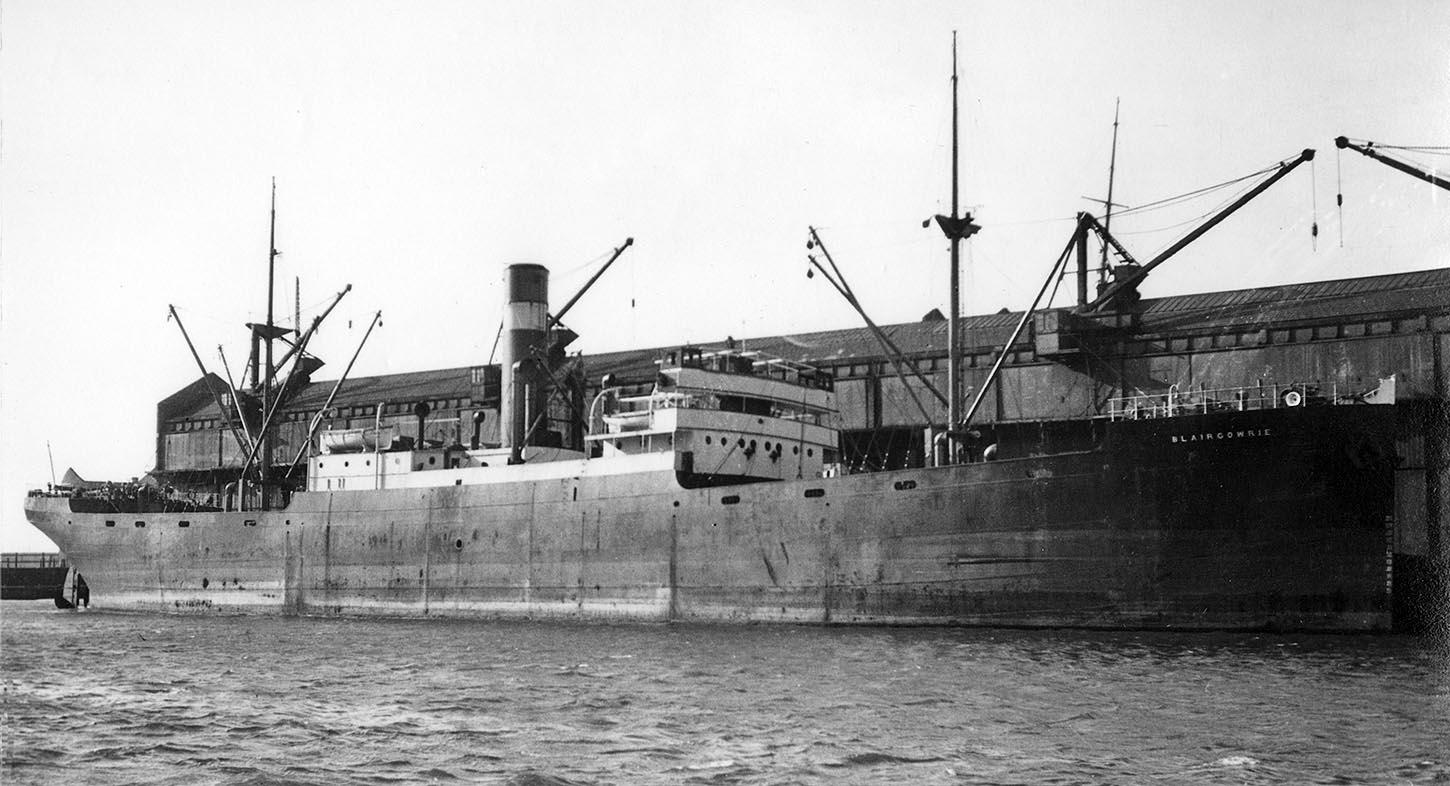
Above: The 3,282grt Blairdevon was built in 1925 by Napier & Miller at Old Kilpatrick. In 1956 she joined Pan-Ocean Navigation as Jennifer Jane and in 1959 they renamed her Dorothea. She was broken up in April 1970 by Hardware Manufacturing Co. at Karachi.
Below: The 4,141grt Blairmore was built in 1928 by the Ayrshire Dockyard Co. She was torpedoed and sunk by U-37 in mid-Atlantic on 24th August 1940.
Bottom: The 4,155grt Blairspey was built in 1929 by the Ardrossan Dockyard. From 1942 to 1946 she was renamed Empire Spey while in service for the Ministry of War Transport. In 1961 she was sold to Marfuente Cia Naviera SA of Beirut and renamed Evandros and on 2nd May 1967 she arrived at La Spezia to be broken up.
(All photos from the John B. Hill collection)
1929/30, Portregis and Portfield, the latter joining the fleet as Grovedene. They were renamed Blairangus and Blairlogie.
Blairgowrie of 1924 under Captain H.A. Preston foundered in mid-Atlantic at the end of February 1935. She was on a voyage from Swansea to Boston with a cargo of anthracite heading into the full fury of an Atlantic gale. The seas pounded down on numbers 1 and 2 holds and stove-in both those hatches, together with another mortal blow aft when the steering gear was carried away. At 6.34pm on 26th February shore stations at Valencia picked up her distress message relayed by the Canadian Pacific cargo-liner Beaverdale and repeated by the large German liner Europa. These two ships proceeded to her position of 48º20'N, 27º01'W in the face of a violent westerly gale picking up the last message from the tramp, “Situation desperate - no steering gear - hold full of water”. A fullscale search by three ships found no trace of Blairgowrie or her 26 crew.
A fleet of nine tramps was being operated in 1939 and they were joined around the time of the outbreak of hostilities by the Newcastle tramp Sutherland from the large fleet of B.J. Sutherland. She was a Readhead built tramp completed the previous year.
Three of these ten tramps were then to be lost due to enemy action:-
11.9.1939 Blairlogie
Torpedoed and sunk by U-30 off NW Ireland on a voyage from Portland (Me) with scrap iron and steel.
24.8.1940 Blairmore
Torpedoed and sunk by U-37 in mid-Atlantic on a voyage from Sydney (NS) to Tyne with pitprops, 4 lost
21.9.1940 Blairangus
Torpedoed and sunk by U-48 in mid-Atlantic on a voyage from Botwood and St. John (NF) to Methil with pitprops, 7 lost
The war was only a week old when U-30, which had torpedoed and sunk the first ship of the war, the Donaldson liner Athenia, came across Blairlogie in the early hours of 11th September. Lt. Lemp was more careful this time and observed International Law by waiting for the crew to abandon ship before despatching her by gun and torpedo. He even supplied the lifeboats with a bottle of Schnapps and some cigarettes, and stayed with the boats until dawn firing red stars into the air at intervals until the crew were rescued by a neutral American ship.
Blairbeg was sold in 1940 to Connell & Grace Ltd. of Newcastle and renamed Fellside, but was sunk on 17th July that year on a voyage in ballast from the Tees to Sydney(NS) with the loss of 12 crew.
Blairatholl foundered off Newfoundland on 26th November 1942 after a collision while on a voyage from New York to the Tyne with steel and timber. Blairnevis was badly damaged by an E-boat torpedo on 24th November 1941 off Southwold in Suffolk but made port and was repaired. She did not survive the war however, for she was sunk by collision in 1945.
Blairmore was lost in the first convoy SC1 to sail from Sydney on Cape Breton Island for the U.K., and Blairangus was lost the following month in the faster HX72 convoy. Blairspey had her bows blown off when two torpedoes exploded during the night of 18th October 1940 in convoy SC7 which lost 20 ships out of 35 that had sailed. Her pitprop cargo helped her to stay afloat and she was towed into the Clyde by the salvage tug Salvonia and repaired. She became Empire Spey under M.O.W.T. control but returned to the company under her old name in 1946. Blairclova was repaired after being damaged by bombing when 20 miles NE of Holyhead on 10th August 1940, as was Blairnevis after being damaged by E-boats off Suffolk.
George Nisbet had died during the war and the reins of the company were taken up by Douglas R. Nisbet. The fleet in 1946 thus consisted of the survivors, Blairspey of 1929, Blairclova of 1938, Blairesk of 1925 and Blairdevon also of 1925.
Blairdevon was the only tramp registered under the Nisbet Shipping Co. Ltd. in 1946, which made a profit of £12,633 that year allowing a dividend of 8% to be paid.
Fort Langley was taken on bare-boat charter, and the German Hansa 'B' type Empire Frome was managed when completed in 1948 for the Ministry until sold in 1953 to Submarine Cables Ltd., London for conversion into the cable-layer Ocean Layer.
Blairesk was sold to German owners in 1951 and renamed Eddi, and eventually broken up in Italy in 1970.
Her sister Blairdevon was kept until 1955 when sold to Pan-Ocean Navigation Co. SA. and renamed Jennifer Jane, eventually being broken up as Dorothea in 1970 at Karachi.
The remaining two tramps Blairclova and Blairspey under the Clydesdale Navigation and Northern Navigation companies respectively lasted until 1961 when they became uneconomic compared to the bulk-carrier and were sold off.
Blairspey was sold to Lebanese shopowners and renamed Evandros and arrived at La Spezia for breaking up in May 1967.
Blairclova was renamed Ocean Venture but traded for only one more year for she was blown aground at Hong Kong during a typhoon on 1st September 1962 and broken up there.
The three Nisbet tramp companies were then placed in liquidation.
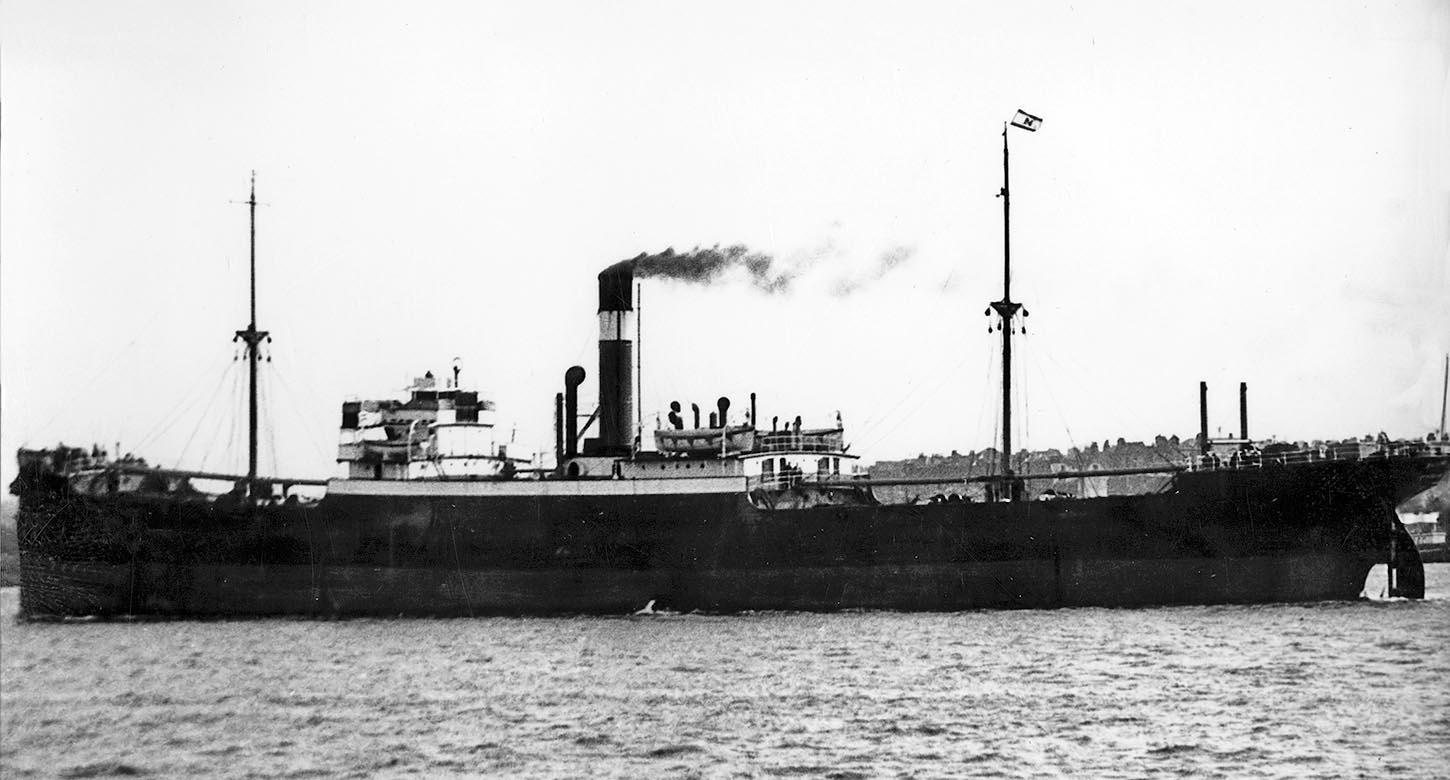
Above: The 3,509grt Blairbeg was built in 1917 by J. Blumer at North Dock as the Clifftower for Hansen Shipping Co. In 1925 she moved to Wyn Shipping of London and was renamed Wynburn before she joined Nisbet in 1932. In 1940 she was sold to Connell & Grace Ltd. of Newcastle and renamed Fellside. On the 17th July 1940 when on route from Middlesbrough to Sydney (NS) in ballast in Convoy OA-184 as a straggler, she was torpedoed by U-43 and sunk. 12 crew were lost from a complement of 33.
Below: The 4,425grt Blairlogie was built in 1929 by Craig, Taylor & Co. at Stockton as the Portfield for Portfield SS Co. of Cardiff. In 1935 she joined Grovedene Shipping, also of Cardiff, and was renamed Grovedene. She joined Nisbet in 1936. On 11th September 1939 she was torpedoed and sunk by gunfire from U-30 in mid-Atlantic while on a voyage from Portland (ME) to the UK with a cargo of scrap iron.
Bottom: The 5,083grt Blairclova was built in 1938 by J. Readhead at South Shields as the Sutherland for B.J. Sutherland & Co. She joined Nisbet in 1939. In 1961 she was sold to Pan-Nourse SS Co. of Panama and was renamed Ocean Venture. On 1st September 1962 she was wrecked at Hong Kong and broken up there.
(All photos from the John B. Hill collection)