Sundial House, 17 Wickham Road, Beckenham, Kent BR3 5JS
EDITORIAL
Editor: Nigel Lawrence
E: editor@shippingtandy.com
The Editor welcomes the submission of editorial material which should be accompanied by return postage and submitted to the address above. Sundial Magazines Ltd. accepts no responsibility for loss or damage to materials supplied.
If you have a question or query you wish to raise with the Editor they should be writing to the Sundial Magazines address. The Editor is not based at the Tandy Media offices and asks for all enquirers to appreciate this fact and be patient. Please understand that the staff at Sundial Magazines do not have access to the information you require and therefore cannot answer your questions on the phone. Sundial Magazines cannot undertake research into specific or general queries.
Picture Guidelines: Please do not send originals and ensure your name and address is on all material submitted. All digital images should be at least 300dpi and with a print size width of 21cm. They can be sent by email but only individually.
SUBSCRIPTIONS
Subscriptions, back issues and binders are available from Shipping T&Y.
Annual subscription rates:
UK £56 Europe £73, Rest of the World £78.50 We accept cheques and postal orders in Sterling made payable to Shipping T&Y and can also accept most credit/debit cards.
Shipping T&Y reserves the right to suspend or refuse any advertisement without giving reasons. Whilst every care is taken to avoid mistakes Shipping T&Y cannot be liable in any way for any errors or omissions. Nor can the publishers accept responsibility for the bona fides of advertisers.
COPYRIGHT
All articles, images and illustrations published in Shipping Today & Yesterday are strictly copyright of the authors and the publisher and may not be reproduced in any form without prior written permission. All photos are the property of the Editor unless otherwise stated.
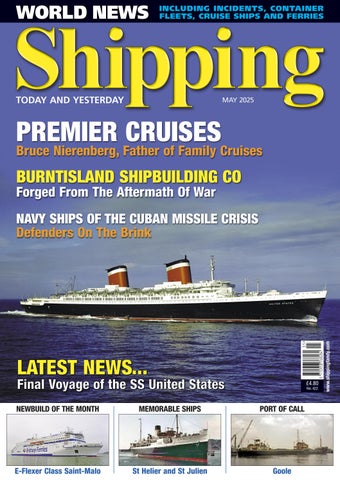
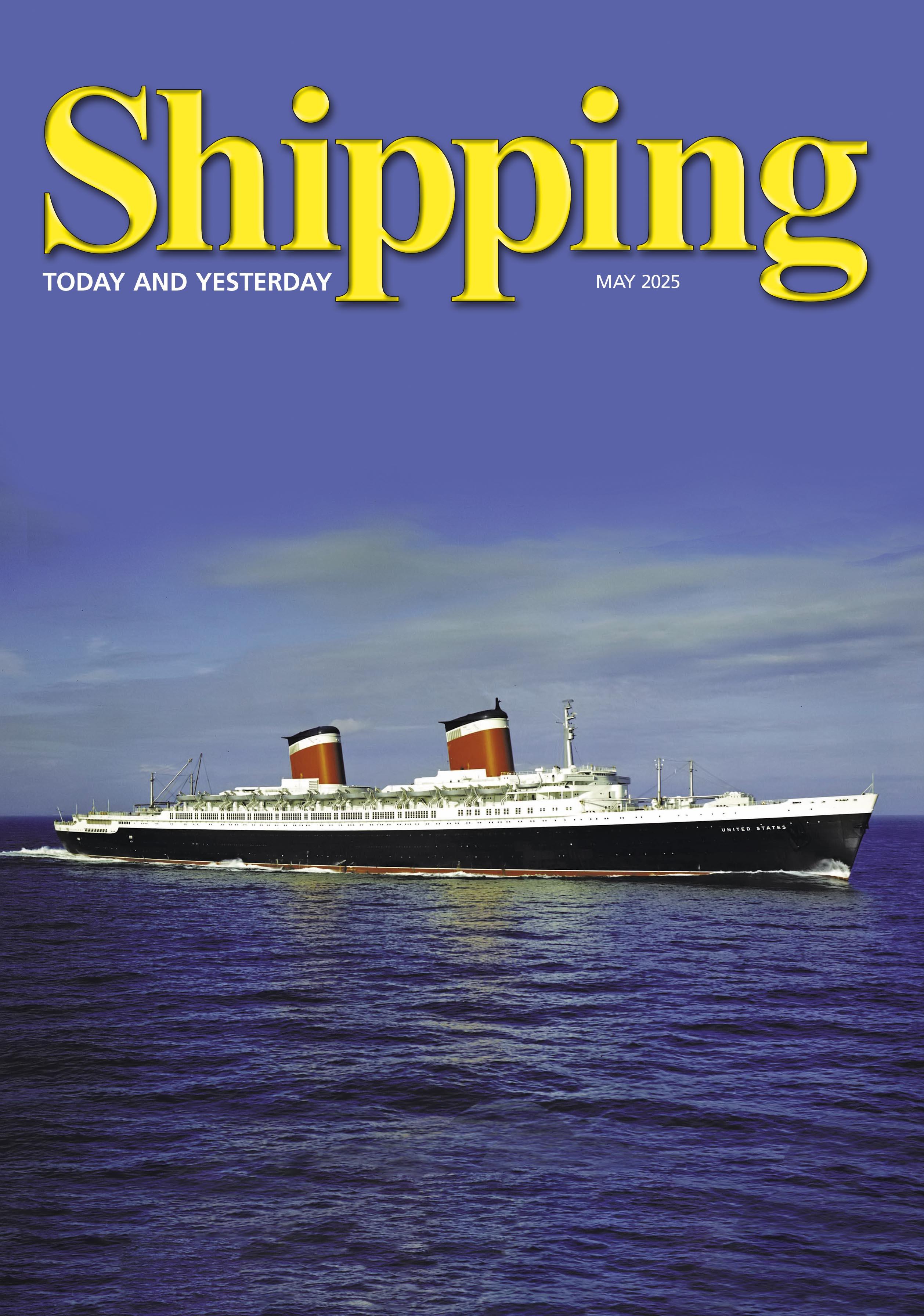
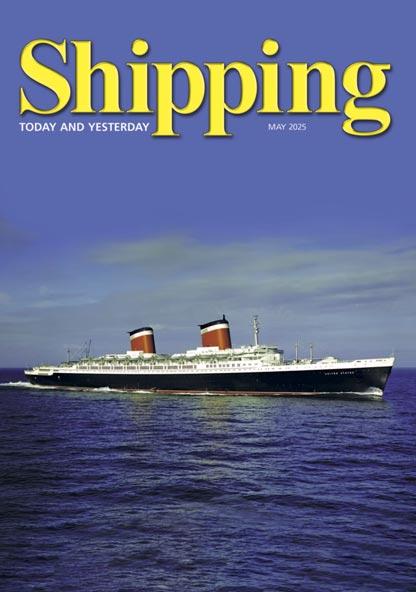
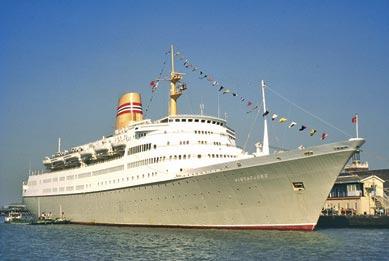
SS United States of United States Line was built in 1952 and is the last transatlantic liner to hold the Blue Riband of the Atlantic. She is now in Mobile, Alabama being prepared to be sunk as an artificial reef.
10
NOTABLE INCIDENTS
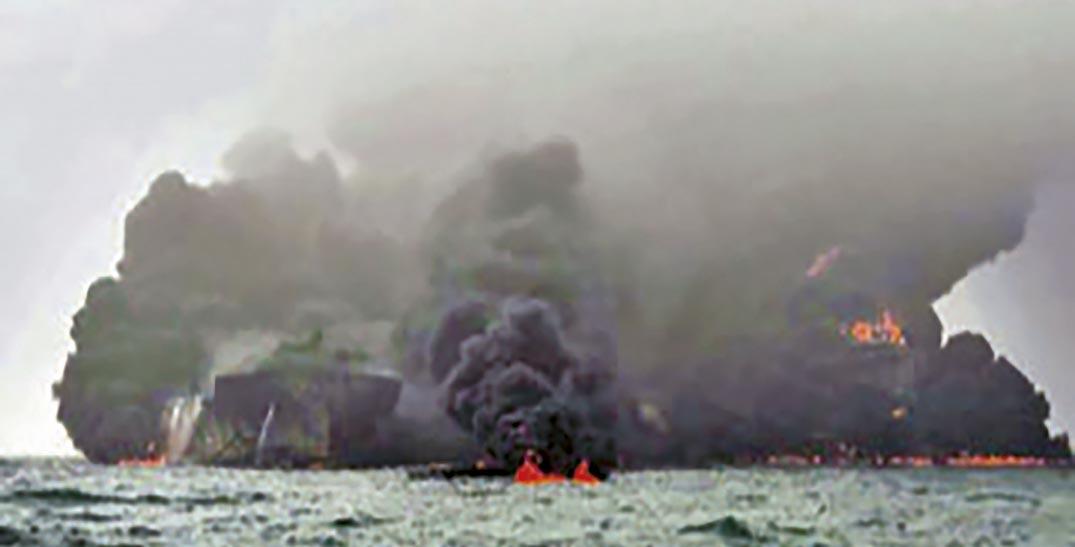
On 10th March the 7,852gt container ship Solong of Ernst Russ Maritime collided with the 47,729dwt moored tanker Stena Immaculate off Spurn Head in East Yorkshire. The tanker was carrying a full cargo of aviation oil and immeditely caught fire. The fire then spread to the Solong (above). Both vessels abandoned ship and one of the crew of the Solong was lost. The remainder of the crew of both ships were safely evacauted. The Stena Immaculate was anchored waiting for the high tide to enable her to dock in Killingholme while the Solong was on a voyage from Grangemouth to Rotterdam. On 14th March the Russian captain of the Solong was charged with gross negligence manslaughter.
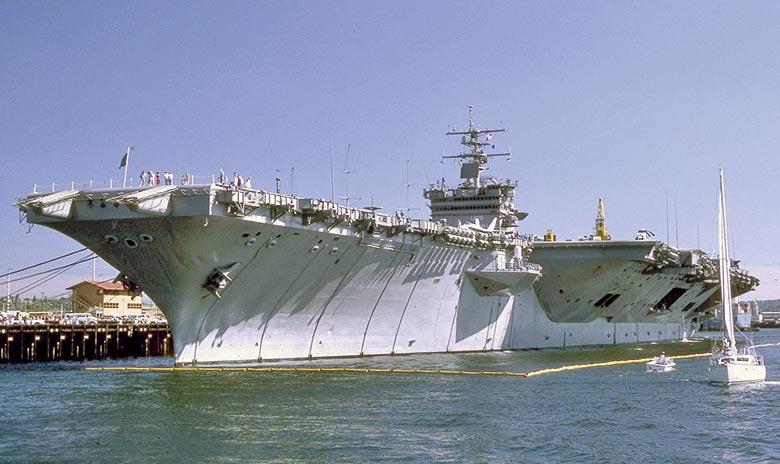
An incident that was under investigation as this column was being completed occurred around midnight on Wednesday 12th February when the US Navy’s nuclear powered aircraft carrier USS Harry S. Truman was struck on her starboard quarter by the starboard bow of the 53,020dwt bulk carrier Besiktas M near Port Said. The Nimitz-class carrier was waiting to enter the Suez Canal at the time. Both ships sustained damage with one of the carrier’s sponsons crushed and her hull pierced above the waterline although there were no reports of injuries, water ingress or pollution being released and they were able proceed under their own power. Subsequently the carrier’s Captain Dave Snowden was relieved of his post due to the Navy’s “loss of confidence in his ability to command”.
A veteran Russian cargo ship carrying 3,000 tonnes of corn suffered a breach of its hull and water ingress as it passed through the Sea of Azov in Russia’s Rostov region on 16th February. The 46-year-old Pavlo Grabovskiy was heading to
EDITOR’S LOG
Samsun Turkey at the time of the incident with images showing the ship surrounded by ice. Reports suggest the ice breakers Kapitan Demidov and Kapitan Chudinov were dispatched to assist and official Russian sources claimed the ship was then taken to port and repaired.
Incidents and intrigue have become synonymous with vessels carrying Russian oil in recent months but reports of explosions onboard tankers indicate a new development in this ongoing saga. In the Russian port of Ust-Luga a so-called shadow-fleet tanker, the 164,500dwt Koala was rocked by three blasts that pierced the hull, with maritime intelligence company Ambrey Analytics suggesting “If confirmed, this strongly suggests that the explosions were caused by limpet mines.” Unconfirmed reports suggest a similar incident at the port back in January went unreported. Then in early February the fully loaded 49,997 dwt Grace Ferrum experienced explosions off the coast of Libya, the link being that she too had come from Ust-Luga.
The targeting of a respected Greek tanker owner with no links to the shadow fleet or breaching sanctions gave the issue a new dimension, especially as one ship was moored at the Italian port of Savona at the time of the incident. Thenamaris’ sixteen year old 109,000dwt LR2 Seajewel was rocked by two explosions below the waterline on the night of 14th to 15th February. In the wake of this suspected attack news emerged of a previously unreported incident almost exactly a month earlier when fleet mate Seacharm suffered an explosion off Turkey when a hole punctured the tanker’s side.
On the morning of 18th February a fire broke out on the 56,000gt Grande Brasile whilst she sailed through the English Channel some 15 miles off Ramsgate. Although reports varied it appears that the initial fire was contained using a CO2 suppression system however the steering and propulsion electromechanical systems were disabled leaving the ship drifting at about 1 knot. The incident prompted a multinational rescue response involving UK Maritime and Coastguard Agency (MCA), RNLI lifeboats, the French firefighting tug Abeille Normandie, the Dutch tug Multratug 35 and various aircraft including HM Coastguard and Belgian Coast Guard helicopters alongside a fixed-wing aircraft from the Dutch Coast Guard. The Grimaldi Group ship had left Antwerp and was on her way to Le Havre at the time of the incident.
The Royal Navy is decommisioning five more ships from the fleet, saying that this is due to a lack of funds for their maintenance and repair. They are also blaming the lack of crew.
The two LPDs (Landing Platform Dock) HMS Albion and HMS Bulwark are to be withdrawn from service as are the Type 23 frigate HMS Northumberland and the two RFA tankers Wave Knight and Wave Ruler.
The two tankers are being decommissioned due solely to a shortage of crews. Both vessels will be put up for sale.
HMS Northumberland was commissioned in 1994 and was due for a major refit. Instead of spending money on this, the Defence Minister John Healey announced that the cost of such a refit would be uneconomical.
The majority of the blame for the situation lies with the Coalition and Tory administrations that consistently underfunded defence. The new Labour government is doing no better with its disingenuous and vague promise to raise UK defence spending to 2.5% of GDP at some unspecified time in the future.
The refit of HMS Bulwark started in 2020 costing £72.1 million so far in addition to £132.7 million spent on maintenance in the past five years. The implications of these losses to the fleet will be felt onshore as well. HMS Northumberland and the two LPDs are all based at Devonport and their departure from the fleet will mean the loss of approximately 1,150 jobs at the dockyard. There will be a further loss of money circulating in the already hard up Devonport area. We need more investment in the Royal Navy and our other forces and must promote the recruitment of more sailors, soldiers and airmen.
editor@shippingtandy.com
CONTAINER FLEETS
Despite the pioneering efforts of American (Savannah) and West German (Otto Hahn) designers and investors half a century ago, nuclear power has never been considered a viable alternative fuel type in commercial shipping. However, that might be about to change. At the New Nuclear for Maritime Houston Summit back in February, HD Hyundai holding company HD Korea Shipbuilding & Offshore Engineering (HD KSOE), unveiled designs for a nuclear-powered 15,000 TEU containership utilising small modular reactor (SMR) technology.
The South Korean conglomerate has plans to develop a marine nuclear demonstration facility at its Future Technology Test Centre. Safety concerns have always been the chief barrier to the technology’s widespread adoption, but HD KSOE is addressing this with its marine radiation shielding system that incorporates a double-tank method comprising stainless steel and light water. It has also been working in tandem with manufacturer TerraPower to develop the next generation of SMRs and global technology firm Baker Hughes thermally efficient carbon dioxidebased propulsion system. Outlining the benefits of nuclear over conventional fuels at the conference, class society ABS’s chairman and CEO Christopher Wiernicki commented, “Not only does it offer zero carbon operations but higher power with faster transit speeds, increased cargo storage due to the elimination of fuel storage and it unlocks the potential for reverse cold ironing where the vessel powers the port. Finally, critically, it eliminates the need to bunker fuel potentially over the entire lifespan of the asset. The economics are compelling over the life of a vessel. When you account for fuel differentials, the cost of compliance and residual value, it costs roughly the same as fossil options, only with zero carbon operations. And it gets much more attractive when compared to the high cost of green fuels”.
Those net zero targets and indeed the whole ‘Green’ agenda were coming under greater scrutiny and could be a collateral victim of newly installed President Trump’s wide ranging policy changes. More immediately the threat of and then imposition of punitive tariffs on US imports from China, the EU and immediate neighbours Mexico and Canada were impacting the container sector. Ahead of the anticipated tariffs American demand and Chinese production was ramped up with Shanghai, the world’s busiest container port handling a record monthly throughput of 5 million TEU in January 2025 on the back of a record year in 2024 when it handled 51.51 million TEU. Commenting on the achievement Port operator Shanghai International Port Group issued a press release, “Ports are the barometer of foreign trade. The performance of Shanghai Port in the first month of the new year reflects the active foreign trade and strong resilience of our country’s economy”. Perhaps inevitably there was a comparable peak in US container imports with Canadian logistics and supply chain management tech specialist Descartes revealing that the January total of 2,487,470 TEU, surpassed the previous record from January 2022 and the number of containers from China alone reached 997,909 TEU just short of the previous record set in July last year.
Whilst newly formed partnerships settled into the new alliance systems that came into effect from 1st February 2025, the Premier Alliance was left waiting a further week until the US Federal Maritime Commission (FMC) finally gave the all Asian group the go-ahead. Partners HMM, Ocean Network Express (ONE), and Yang Ming had been forced to postpone the launch of their new service as the FMC demanded further information.
European shipowners were prominent amongst a plethora of newbuild orders in early February. Leading the way was HapagLloyd who have returned to South Korea’s Hanwha Ocean, formerly Daewoo Shipbuilding & Marine Engineering (DSME) for a series of six LNG dual-fuel 16,800 TEU containerships. Costing approximately $200 million each the ships are scheduled for delivery in 2027 and 2028. Meanwhile compatriots Peter Döhle Schiffahrts have contracted China’s CSSC Guangzhou Shipyard International (GSI) to build up to five 8,400 TEU LNG dual-fuel engine ships for a total investment of just over $600 million with similar delivery dates to the Hapag-Lloyd sextet.
China’s Zhoushan Changhong International Shipyard were the shipyard of choice when Mediterranean Shipping Co (MSC) placed a firm order for four 21,700 TEU newbuilds with options for another four back in February. The LNG dual-fuel megamax vessels are scheduled for delivery through 2027 and 2028 and represent the largest ships in the yard’s history, although they are no strangers to the Swiss-based operator for whom they are building ten 11,500 TEU and 10,300 TEU series ordered in 2023 and a dozen 19,000 TEU LNG dual-fuel megamaxes ordered last August. The new order just adds to the Line’s vast orderbook which consists of over 130 ships offering more than 2 million TEU’s.
Copenhagen based Navigare Capital Partners signed for four 4,300 TEU vessels with China’s Taizhou Sanfu Shipbuilding back in February with options available for two more. Meanwhile France’s CMA CGM was confirmed as the European operator behind the order for a dozen 18,000 TEU containerships from South Korea’s HD Hyundai Heavy Industries (HHI) yet lost no time in firming a deal for an identical order from China’s CSSC. Details of the ship’s propulsion, cost and delivery remained undisclosed.
Not to be outdone by its North European counterparts Greek owner Danaos added two more vessels to its series of 9,200 TEU ships currently on order in China, with the latest additions booked with CSSC-affiliated Huangpu Wenchong Shipbuilding in Guangzhou with a price tag of approximately $105 million per vessel and delivery pencilled in for 2027. Excluding the ships currently under construction the John Coustas-led firms fleet consists of 74 containerships and 10 capsize bulk carriers.
Switching to the Far East, Taiwan’s Evergreen were confirmed by industry analysts Alphaliner as having placed orders for eleven 24,000 TEU ships worth a total of about $3 billion. South Korea’s Hanwha Ocean will build six of the LNG powered megamax vessels with China’s CSSC Guangzhou Shipyard International (GSI) the recipient of the order for the other five. The ships will add 264,000 TEU to an Evergreen fleet which currently stands at 220 vessels with a further 60 'in build'.
The established order could be disrupted by a new player in the market with the Indian government setting out plans to develop a public/privately funded joint venture called Bharat Container Line. This will be a brand new operator with an envisaged fleet of about 100 owned and chartered vessels eclipsing the country’s current largest operator the Shipping Corp. of India (SCI), which operates just four containerships. However, this is by no means the limit of India’s ambitions with finance minister, Nirmala Sitharaman revealing a joint public/private $2.9 billion maritime development fund scheme with the government providing 49% in joint
public/private projects primarily in the shipbuilding and ship repair industry with the goal of putting the country among the top 10 maritime nations by 2030 and the top five by 2047. Container ship big players MSC, Maersk and CMA CGM are amongst the first to seize these opportunities and it was no coincidence when Indian premier Narendra Modi visited the French company’s headquarters for discussions with the company’s chief executive, Rodolphe Saadé during a February tour of Marseille. Meanwhile Maersk signed a memorandum of understanding with India’s Cochin Shipyard to explore ship repair and shipbuilding opportunities starting with afloat repairs for ships up to 7,000 TEU and drydocking for those up to 4,000 TEU. Not to be left out, Soren Toft CEO of the biggest operator of them all MSC, met Piyush Goyal, Union Minister of Commerce and Industry covering multiple investment opportunities from inland terminals to container manufacturing as well as the shipbuilding and ship repair side.
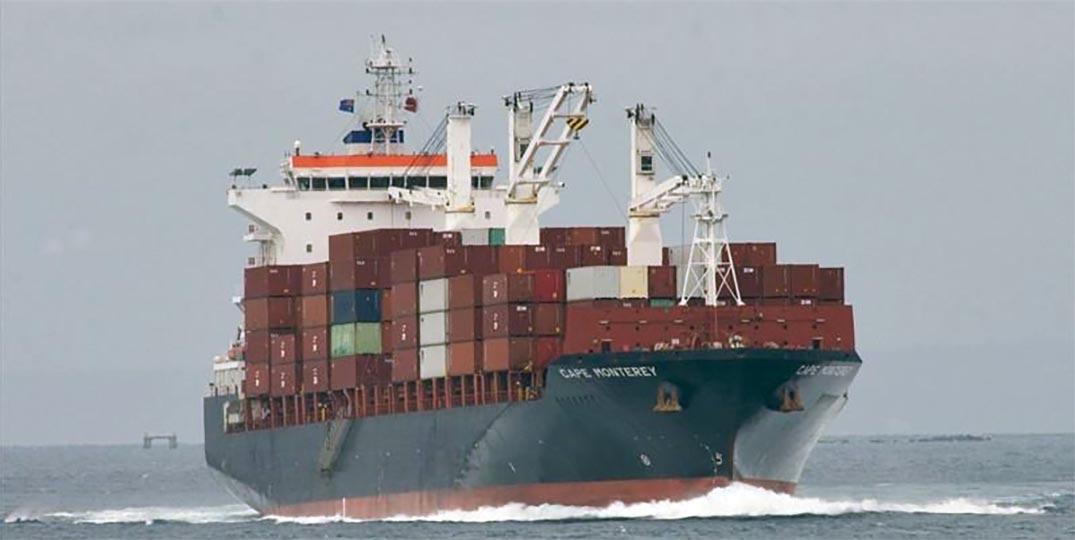
Returning to the present day, CMA CGM were very active in the second hand market back in February. In addition to Cape Shipping’s 2,202 TEU Cape Monterey (above) the French operator bought the 1,924 TEU sisters Delphis Bothnia, Delphis Finland, Delphis Gdansk, and Delphis Riga from Compagnie Maritime Belge’s (CMB) Delphis container division for $120 million. The wide beamed 1A ice-class provide 494 reefer plugs for year round Baltic service.
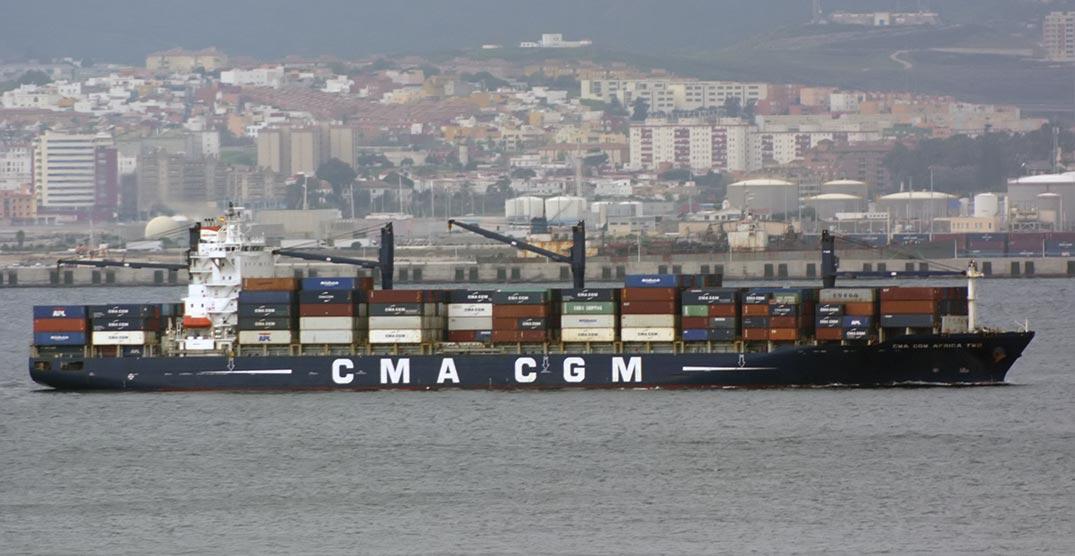
No sooner had the ink dried on that deal than the French company spent $150 million purchasing the chartered 3,650 TEU ships CMA CGM Africa One, CMA CGM Africa Two (above), CMA CGM Africa Three and CMA CGM Africa Four from owners Chartworld Shipping. As the names suggest these vessels operate in somewhat warmer waters.
They might not be directly co-operating on liner services, but MSC and CMA CGM are collaborating by sharing investment in a new terminal at Nador West Med in Morocco’s Marsa Maroc Port. Located on the country’s northeast coastline the terminal will provide an additional 1.2 million TEU capacity once completed. On the development analysts Alphaliner commented, “With four container terminals now in operation at the almost fully built-out Tanger Med port, today the largest container terminal in the Med, Morocco is trying to replicate Tanger’s success story with Nador West Med port as a second West Med hub some 250 km east”.
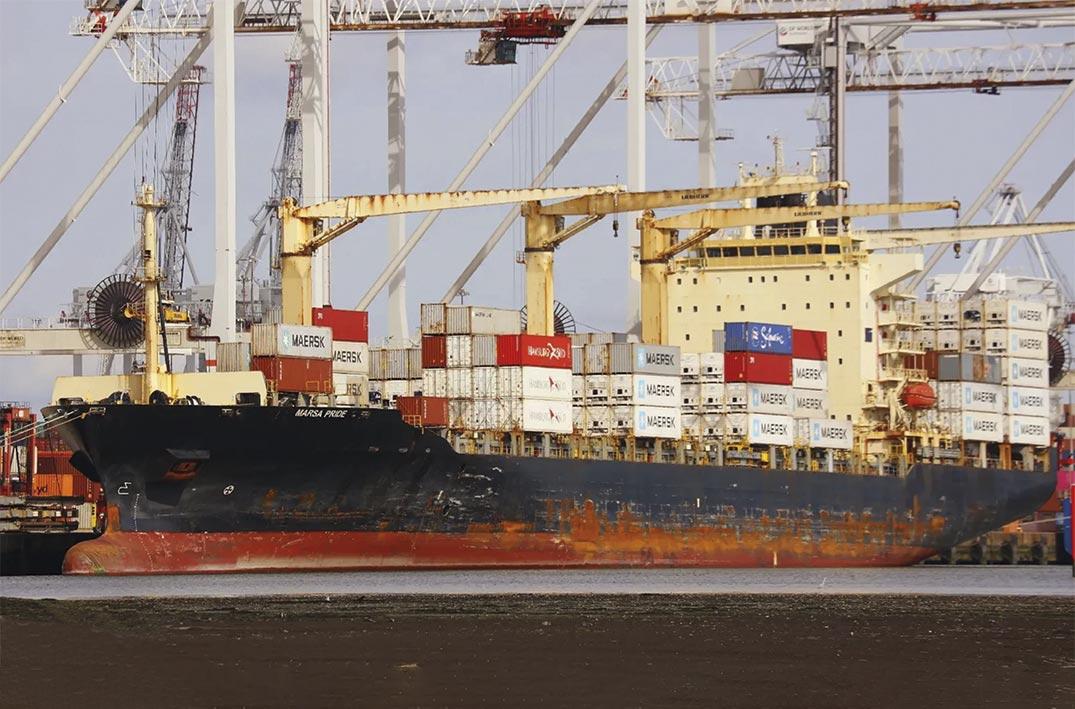
Inevitably there is a tendency to concentrate on the big players in the container business. However, there are numerous smaller operators who provide a perhaps less glamorous but equally significant role, generally on the world’s network of feeder systems. Amongst these is Panda Express Line, a Russian operator with a fleet of ten small container ships which started up in late 2022 to fill the void left when established Lines left in the wake of the country’s invasion of Ukraine. The operator has now introduced Panda Express Line-3 utilising a pair of sub-2,000 TEU ships to connect the Far Eastern port of Vladivostok with the southern Chinese ports of Nansha, Shenzhen, and Xiamen. Another is Marsa Ocean Shipping who operate various services in and around the middle east region and contributed a 2,500 TEU capacity vessel to the FEM1 and FMS service operated in tandem with CStar Line, Global Feeder Shipping and United Global Lines. The service expands Marsa’s operations to the Far East as the rotation starts at Qingdao in China calling at Shanghai, Guangzhou and Nansha before heading to Jeddah in Saudi Arabia and Istanbul returning via the same ports with the exception of Shanghai. Marsa Ocean Shipping operate a fleet of six ships ranging in size from the 26 year old 1,096 TEU capacity Marsa Victory to the 2005 built 2,556 TEU capacity Marsa Pride (above).
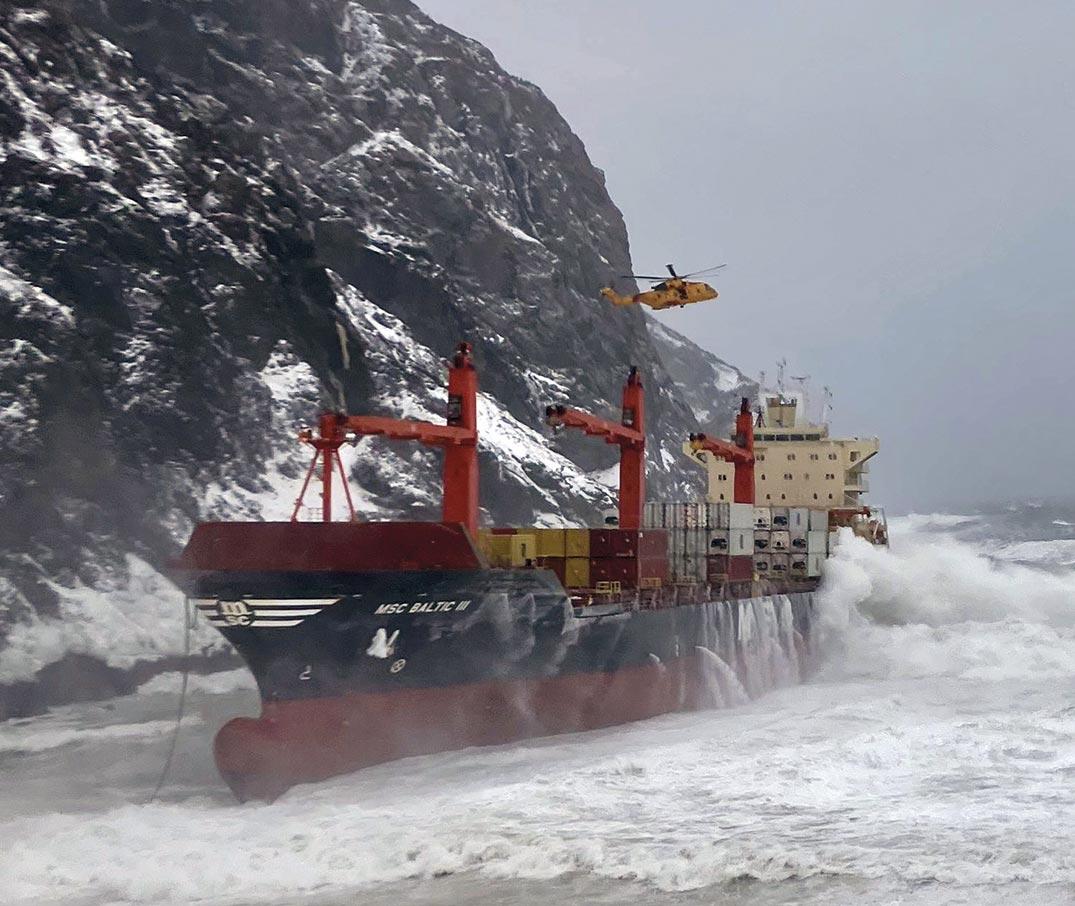
On 15th February the 25,407gt MSC Baltic III, ran aground near Lark Harbour, Newfoundland (above), after losing power in rough seas. The vessel issued a mayday call to the Marine Communications Traffic Services Centre in Port aux Basques on 17th February morning, reporting the power loss and its inability to secure an anchor. The ship subsequently grounded in Wild Cove. The crew of 20 were safely evacuated but the ship is reported to have water ingress and divers have reported that the hull has been deformed.
Nigel Lawrence
Canadian Coastguard
Cape Shipping
Marinetraffic.com/Marko Waite
BULK AND TANKER NEWS
In a month dominated by second hand deals the Norwegian owner Arriva Shipping was ordering afresh, contracting China’s Jiangsu Soho Marine Heavy Industry to build an 8,000 dwt battery hybrid bulker as part of its fleet renewal programme. The ship is identical to the Nor Viking which was delivered in 2022 and another sistership currently in build at Dayang Offshore Equipment and due for delivery in the first 6 months of 2025 and will feature a 2 MW battery hybrid system to reduce emissions and energy use.
Meanwhile China’s Seacon Shipping revealed it had bought no fewer than seven 3,800-3,900 dwt bulkers from Baltic Shipping in a deal worth $66.5 million. The ships in question are Baltic Fin, Baltic Grain, Baltic Moon, Baltic Wind, Baltic Steel, Baltic Sun and Baltic Split which were all built between 2022 and 2024 and handover started in April and was due to be completed in June.
From Greece came news of several disposals. Costamare has sold its 2008 vintage 76,619 dwt panamax Rose whilst Athensbased Globus Maritime divested itself of its 18 year old 53,627 dwt supramax River Globe the oldest ship in its fleet for $8.55m before commissions. The sale comes as part of Globus’ steady fleet renewal programme with three ultramax newbuilds delivered in 2024 and more due by the end of 2026. Another Athens-based operation, Diana Shipping has sold its oldest postpanamax vessel, the 93,193 dwt Alcmene realising just under $12 million with delivery due to have taken place in the first week of March. Meanwhile, bringing down the curtain on their shipping business established back in 1972, Kamsarmax specialists Chronos Shipping sold their last four Japanese built bulkers in early February. The 2012-built, 81,000 dwt Patra followed the 2015-built 82,014 dwt Athina 11, the similar sized 2016-built Volos and the one year younger 80,982 dwt Kleisoura to undisclosed but rumoured to be fellow Greek purchasers netting a total of around $93 million. Star Bulk Carriers were also in the sales game, although the disposal of their 2010 built 57,800 dwt supramax Bittern would have barely registered given its fleet constitutes over 150 vessels.
Staying in the Mediterranean but moving to Israel, Mano Maritime a subsidiary of Moshe Mano’s Mano Holdings Group sold the veteran 20-year old 186,000 dwt capesize Cape Friendship to undisclosed Chinese buyers for around $16 million. Chinese buyers were also pinpointed as having acquired the similar vintage Japanese built 177,656 dwt Cape Heron (built 2005) and Cape Hawk (built 2006) from Zodiac Maritime for a combined $30 million whilst compatriots CHS International Ship Management were confirmed as the takers of the rather newer 2013 built 182,000 dwt K Confidence at the back end of last year in a transaction valued at about $34 million. That capesize is now plying her trade as the Princess Kelly.
Keeping it in the family so to speak, John Fredrikesen’s Golden Ocean Group is reported as acquiring a total of eight capesize bulkers that it currently leases from his ship owning division SFL Corp, namely the 170,000-180,000 dwt Battersea, Belgravia, Golden Beijing, Golden Future, Golden Magnum, Golden Zhejiang, Golden Zhoushan, and KSL China.
Heading for an undisclosed scrapyard in Bangladesh back in late February or early March was EuroDry’s oldest bulker, the 25 year old 75,100 dwt Tasos. The ship was due to realise a fixed price of $476 per ldt and an estimated profit of about $2.1 million.
COSCO Shipping Group’s oil and gas division COSCO Shipping Energy Transportation (CSET) has lined up an investment equivalent to $378.3 million for six new tankers consisting of two aframaxes, two LR2s, and two panamax tankers. Unsurprisingly the orders are to be shared between two COSCO Shipping Heavy Industry yards with the $86 million each 114,200 dwt aframaxes and the $89 million 109,900 dwt LR2s going to COSCO Shipping Heavy Industry Yangzhou whilst the $64 million each panamax crude and product tankers will be constructed at Dalian.
Odfjell, the Norwegian chemical tanker owner and operator contracted three more newbuilds from Japanese yards back in February. The first ship is a 25,000 dwt stainless steel tanker to be built at the Shin Kurushima shipyard. They will be owned outright and are due for delivery in 2026 whilst the pair of 49,000 dwt coated chemical tankers will come from the Yangzi-Mitsui Shipbuilding (YAMIC) yard through long-term charter deals with delivery in 2027 and 2028. In late 2024 Odfjell took delivery of the 26,000 dwt Bow Tiger.
Chinese buyers again dominated the second hand tanker sector paying high premiums for charter-free ships. Greek owners IMS are reported to have more than doubled their money on the 17 year old 106,000 dwt Nemo which they sold for $37 million in February having purchased the vessel for $16 million from Teekay Tankers only four years ago.
Synergy Marine were reported to have sold a pair of 116,100 dwt South Korean built sisters, the Amax Anthem built in 2011 and the one year older Amax Avenue for a reputed $39.5 million each whilst Idan Ofer’s Eastern Pacific Shipping sold the 115,191 dwt Kara Sea for $37 million back in February. Other ships of similar age (in descending order) and value heading to Chinese owners include Stealth Maritime’s 113,000 dwt Crude Centurion, Pantheon Tankers’ 110,000 dwt Sea Falcon, Flynn Ventures’ 105,400 dwt Sofia II and Spring Marine’s 104,000 dwt Lambada. After operations spanning fifty years the sale of the 22 year old steam turbine driven 140,000 m3 Golar Arctic to undisclosed purchasers represents Golar LNG’s departure from the LNG shipping sector as it moves into providing purely floating liquefied natural gas (FLNG) facilities. One such vessel is the former 148,000 m3 Fuji LNG which arrived in China in February for conversion into a MKII FLNG with completion due in 2027.
In other sales news hot on the heels of disposing of the 21 year old Cumbrian Fisher in December 2024, First Ship Leasing Trust (FSL) sold the one year younger 12,984 dwt Clyde Fisher for an undisclosed sum in February.
Selling some of its oldest ships was Teekay Tankers. Although unnamed by the company various sources suggest the vessels in question include the 159,000 dwt sisters Tianlong Spirit, Jiaolong Spirit, Dilong Spirit, and Shenlong Spirit along with the nineteen year old 105,611 dwt LR2 tanker Donegal Spirit.
Viet My Petrol Transportation (Vietmy Trans), the self-explanatorily named tanker owner is leaving the VLCC sector just three years after it entered the market with two previously Greek owned vessels. Having paid a total of $104 million for the 2005 South Korean built duo in 2022 the Hanoi-based outfit realised just $61 million for the disposal of the 308,800 dwt T Cereal and the 318,700 dwt Gold Pearl. Following the sales Vietmy Trans will be left with just a pair of even older LPG carriers.
CRUISE NEWS by Andrew & Donna Cooke
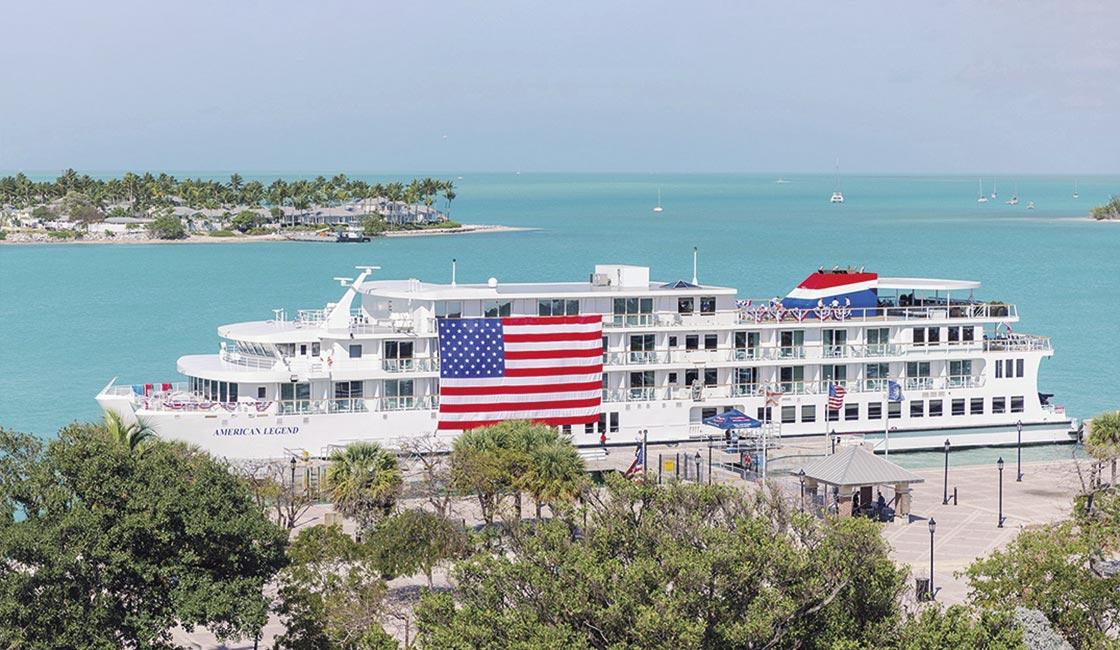
American Cruise Lines announced on 19th February that the American Legend, the newest small ship in the company’s innovative Project Blue series, was officially christened in Key West, Florida, the previous week (above). The event took place at Mallory Square whilst the American Legend was on a call to Key West on one of the company’s 8-Day Florida Gulf Coast and Keys cruises, which sail from/to St. Petersburg in Florida. The ship’s official Godmother, Mayor of the City of Key West, Danise DeeDee Henriquez, joined American Cruise Lines’ President and CEO, Charles B. Robertson, for the traditional bottle breaking on the top deck. The American Legend is an example of the company’s groundbreaking new U.S. fleet for the domestic River and Small Ship cruise market. The ship was operating from Washington, D.C. and, throughout the summer months, will sail a mix of coastal New England itineraries from famous port cities like Boston and New York. The new ship will conclude the year with exclusive Hudson River cruises in September and October, before returning to Florida for cruises in November and December. The American Legend accommodates 100 guests, features 4 decks, and a unique catamaran hull. Like her sister ships, she also offers a superior interior design, private balcony accommodations, a spacious top deck for sightseeing, comfortable lounges inside and out, a main restaurant and casual café, plus a walking track and fitness centre.
Carnival Cruise Line’s 85,920gt/2001-built Carnival Spirit departed Miami on 2nd February bound for Marseille, where she arrived on 13th February for a routine drydocking having completed a final sailing from Mobile. The ship was due to undergo a 3-week overhaul before welcoming passengers back aboard on 16th March from Málaga with calls including Cádiz, Ponta Delgada and King’s Wharf. In late March, the 2,100-guest ship then embarked on a Panama Canal cruise ahead of her summer season in Alaska. The 15-night cruise sailed from Miami to Seattle, visiting four destinations in Colombia, Panama, Costa Rica and Mexico. As part of her 2025 summer deployment, the Carnival Spirit is scheduled to offer a series of 7-night cruises to Alaska and Canada. In October 2025 the ship returns to Mobile to offer 5- to 14-night cruises to the Caribbean and the Bahamas. This was the original vessel in Carnival’s Spirit Class series, and she was built at the Kvaerner Masa-Yards in Finland. The last major upgrade was in 2018.
Carnival Cruise Line is adjusting itineraries for sailings scheduled for 2025 and 2026 onboard four of its ships. The 110,438gt/2004-built Carnival Valor, the 71,909gt/1998-built Carnival Elation, the 110,475gt/2002-built Carnival Conquest and the 133,868gt/2019-built Carnival Panorama are the ships affected.
The 103,881gt/1996-built Carnival Sunshine welcomed guests back in February following a series of enhancements to her public areas and staterooms. After undergoing a drydock at Chantier Naval de Marseille, the ship returned to North America for a year-round operation in Norfolk, Virginia.
CELESTYAL CRUISES UPDATE AND GOODBYE TO THE SONG OF AMERICA
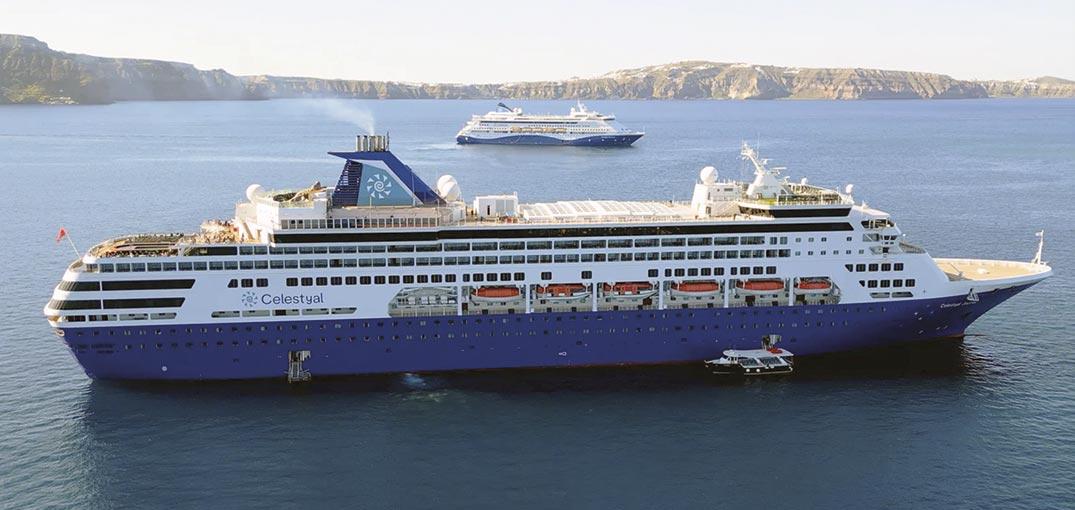
Celestyal Cruises’ 42,289gt/2003-built Celestyal Discovery (above), the former AIDAaura, gained a new upper deck of suites above her bridge in the New Year. The ship had been dry docked in Skaramagas near Piraeus in Greece since November and received the revised company livery.
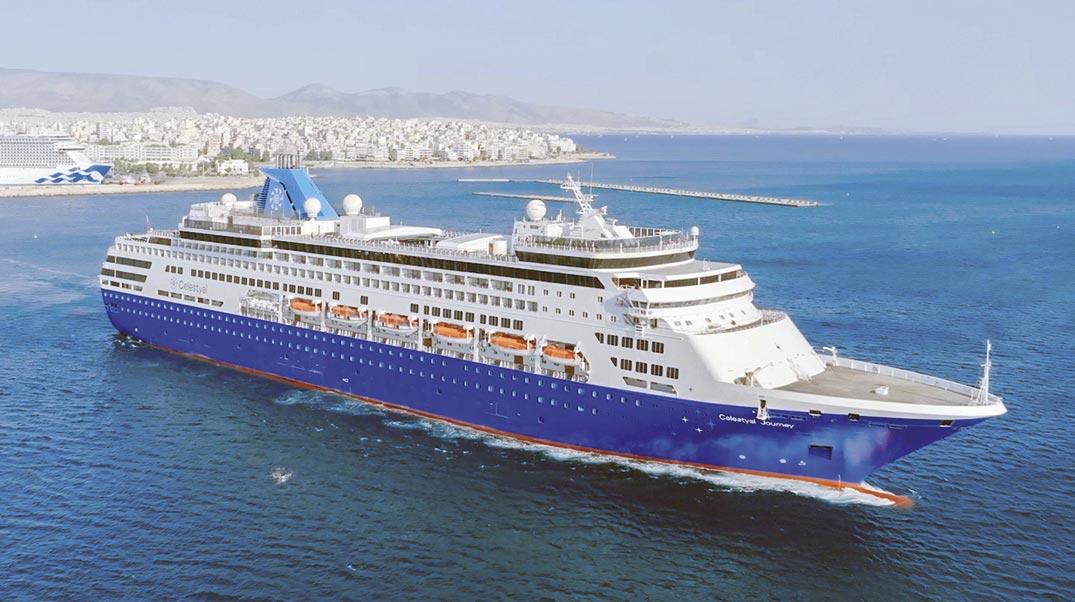
Fleet mate Celestyal Journey (above) emerged from dry dock in Dubai in the new livery in February. The 1,260-passenger capacity ship then operated some Arabian Gulf itineraries before repositioning to Piraeus in April.
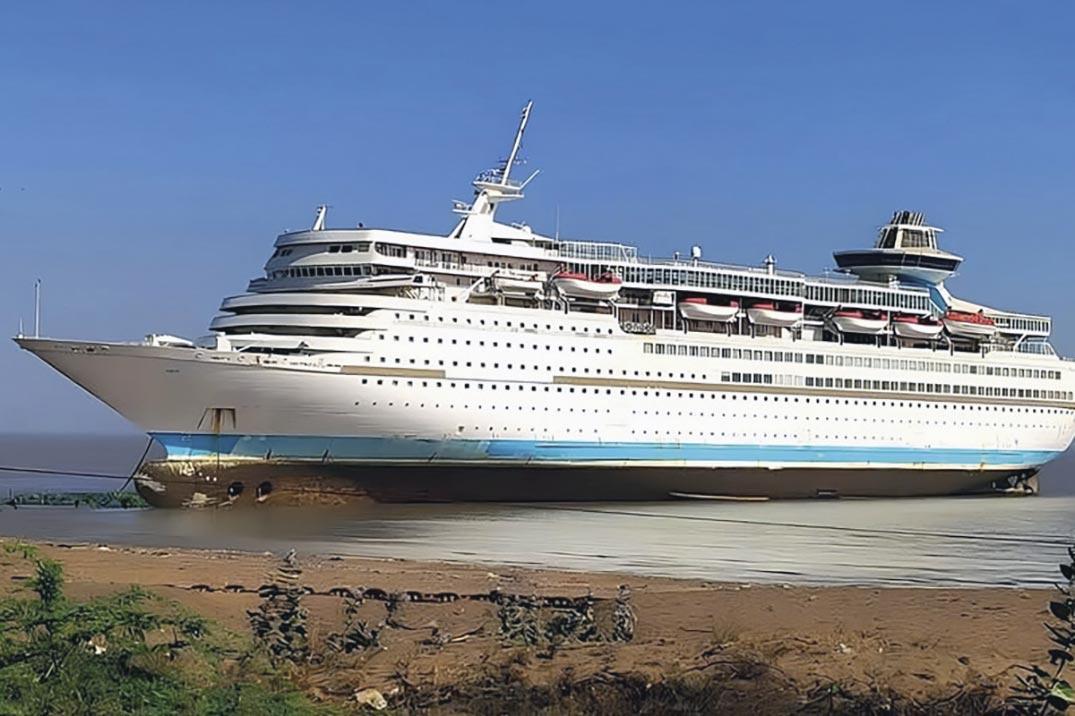
(built as the Song of America for Royal Caribbean Cruises) and latterly employed by Celestyal Cruises as the Celestyal Olympia, arrived at Alang for scrapping at the beginning of February (above). After 8-months laid up in the United Arab Emirates, the ship sailed to Alang as the Fortu, a shortened version of her last name carried, the Bella Fortuna. For the first 15 years the ship served the U.S. market for Royal Caribbean before being sold to UK-based Airtours in 1999. She was renamed Sunbird and, after 5 years, she moved on to Louis Cruise Lines and was promptly chartered to the UK-based cruise line Thomson Cruises. In 2012 Louis Cruise Lines took the ship into its fleet. The company changed to Celestyal Cruises two years later and the ship was renamed again to Celestyal Olympia in 2014 for her final period of employment.
American Cruise Lines
Celestyal Cruises
Celestyal Cruises
CRUISE NEWS
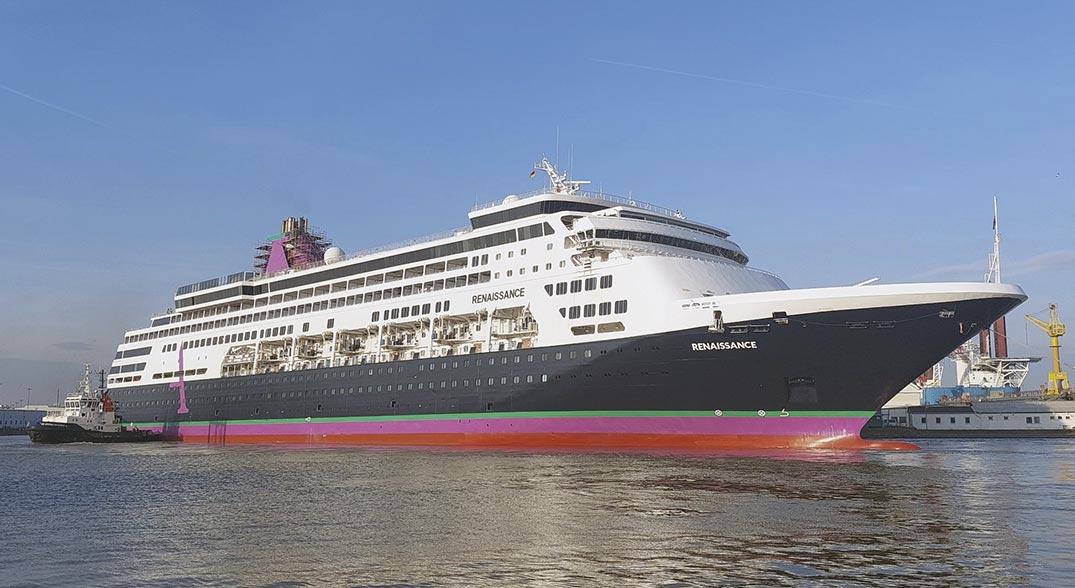
CFC Cruises’ 55,575gt/1993-built Renaissance was refitted at Lloyd Werft in Bremerhaven in January/February and following CFC Cruises’ merger with Ambassador Cruise Line under the Ambassador Group, the Renaissance received her revised Ambassador/CFC livery (above). This change was not well received by a percentage of the supporters of CFC Cruises. The new look ship emerged from dry dock on 21st February. The ship was named Renaissance and re-entered service in June 2023 for CFC. She was built as the Maasdam for Holland America Line and was sold to Seajets in Greece during 2020 as part of the fleet reduction by Carnival Corporation. The ship was renamed Aegean Myth, but did not operate under that name before being re-sold to CFC in 2022.
HX Expeditions’s consortium of new investors completed its acquisition of the cruise line, with a significant new tranche of €140 million of funding, in early February. The new capital will help deliver HX’s global growth strategy and marks the final stage of the separation of the expedition line from Hurtigruten Group. The investment by the Consortium, led by Arini Capital Management, Cyprus. Capital Partners and Tresidor Investment Management will support the development of HX (formerly Hurtigruten Expeditons) allowing it to invest in its fleet. This investment will include upgrades to both the 11,647gt/2007-built Fram and 7,315gt/2015-built Spitsbergen plus cabins, suites, science centres, and restaurant areas aboard the fleet in the second quarter of 2025.
Margaritaville at Sea announced new amenities aboard the 53,015gt/1991-built Margaritaville at Sea Paradise, including upgrades to dining and entertainment. Sailing from the Port of Palm Beach, the refreshed ship will feature popular venues from Margaritaville at Sea Islander, new ports of call, and improved terminal processes starting in late March 2025. In addition to the popular trips to Grand Bahama Island and Key West, the company is sailing to Nassau from the Port of Palm Beach, giving guests another option to enjoy all the enhancements now introduced. Staterooms on the ship also received general upgrades while new facial recognition technology at the Port of Palm Beach speeds up arrival and disembarkation for U.S. passport holders.
Margaritaville at Sea used to trade as Bahamas Paradise Cruise Line and was originally founded as Bahamas Paradise Cruise Line in 2014 using the now scrapped Grand Celebration. In 2018 the Grand Classica joined the fleet, which was built for Costa Cruises as the Costa Classica, later becoming the Costa NeoClassica. In May 2022, the company was rebranded to Margaritaville at Sea following a partnership between Bahamas Paradise Cruise Line and Jimmy Buffett's Margaritaville brand. The Grand Classica was refurbished and renamed the Margaritaville at Sea Paradise. In 2024, a second ship was acquired, the former 85,861gt/2000-built Costa Atlantica, which was refurbished in Belfast and renamed the Margaritaville at Sea Islander.
MSC CRUISES
MSC Cruises has announced its long-term commitment to Port Canaveral, with deployments at the port confirmed through to 2028. The cruise line will bring one of its World-class ships to Port Canaveral, continuing MSC’s commitment to deploying its newest vessels to the U.S.A. MSC’s fourth World-class ship will begin offering year-round, 7-night Caribbean cruises starting with the winter 2026-2027 season. The as yet unnamed ship will join the 205,700gt/2025-built MSC World America as MSC’s second World-class vessel.
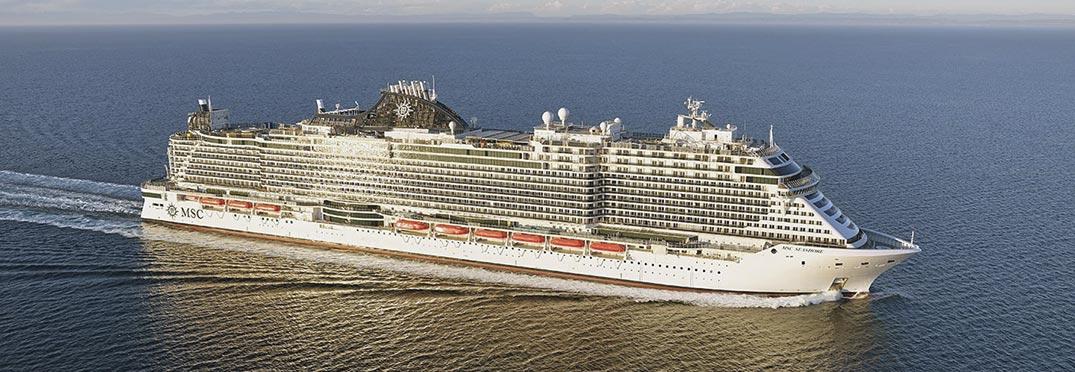
The 170,412gt/2021-built MSC Seashore (above) will also continue to offer year-round 3 and 4 night voyages to The Bahamas and Ocean Cay MSC Marine Reserve.
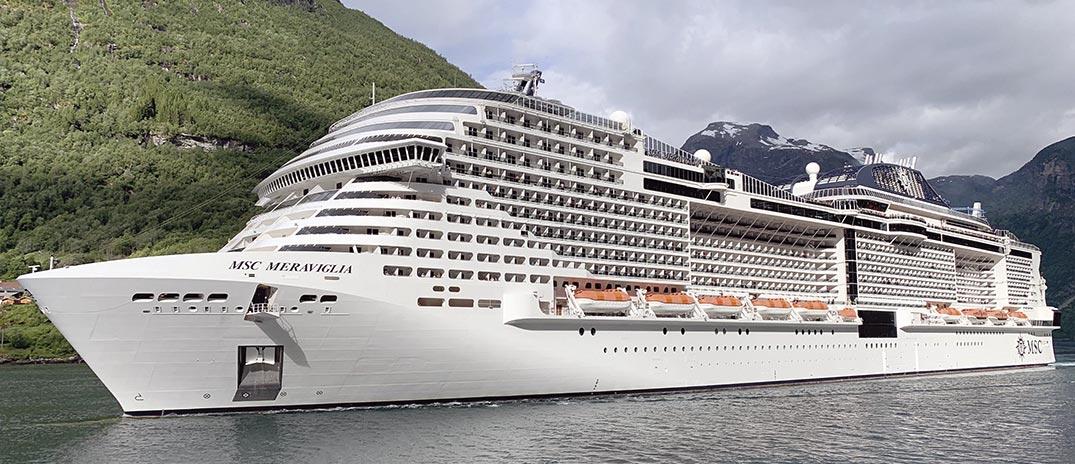
The 171,598gt/2017-built MSC Meraviglia (above) is also set to homeport in New York.
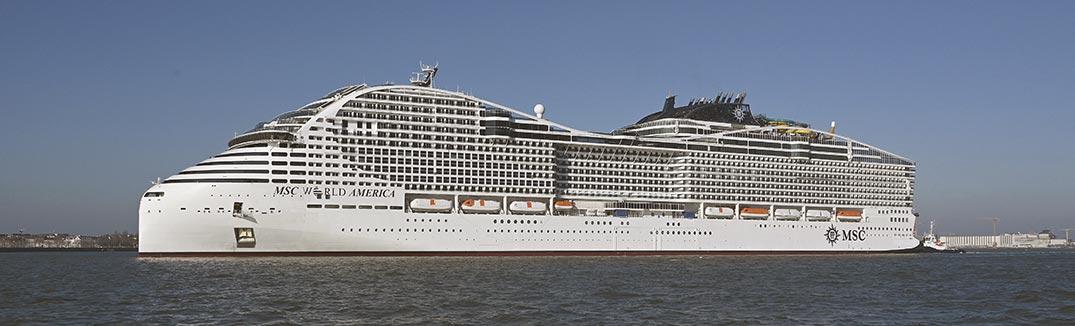
On 19th February came the news that the MSC World America (above) had successfully completed her final deep-water sea trials in the Atlantic Ocean, marking a key milestone ahead of her official debut in Miami in April. The LNG-powered ship will homeport at MSC’s new state-of-the-art terminal in Port Miami, the world’s largest, and is designed with American guests in mind, blending European elegance with tailored experiences across seven unique onboard districts. The MSC World America was officially named on 9th April before embarking on her maiden voyage to Ocean Cay MSC Marine Reserve in The Bahamas.The ship is built with sustainability at its core, featuring LNG propulsion, shore power connectivity, and advanced waste management systems. MSC Cruises is taking its presence in Formula One to the next level by becoming a Premium Partner of BWT Alpine Formula One Team for 2025 and beyond. Already a Global Partner of Formula One, MSC Cruises is strengthening its commitment to motorsport through this new collaboration. The partnership will see MSC Cruises’ branding featured on the BWT Alpine A525 race car, which was unveiled at the F175 Launch at the O2 Arena in London on 18th February. This partnership brings MSC Cruises closer to the heart of world-class racing, with exciting projects planned throughout the F1 season and beyond.
Christian Eckardt
Fincantieri
Darren Holdaway
MSC
CRUISE NEWS by Andrew & Donna Cooke
Norwegian Cruise Line Holdings (NCLH) and Fincantieri announced on 5th February that the Letter of Intent signed on 8th April 2024 had been successfully converted into a firm order for the construction of four new cruise ships for the Norwegian Cruise Line (NCL) brand. This significant agreement, subject to financing and other customary conditions, represents a contract valued at over €2 billion. With a gross tonnage of approximately 226,000gt, these vessels will be the largest ever built for NCL. They will be constructed at Fincantieri’s Monfalcone shipyard, with deliveries scheduled for 2030, 2032, 2034 and 2036. Each ship will feature over 5,100 berths, accommodating more than 8,300 people, including crew, while incorporating the latest standards in comfort, technology and sustainability. This new order strengthens the long-standing partnership between Fincantieri and NCLH. Fincantieri has previously delivered two ships for the NCL brand, the 143,535gt/2022-built Norwegian Prima and 143,535gt/2023-built Norwegian Viva, with the 156,300gt Norwegian Aqua, the first member of the Prima Plus class, set for delivery in 2025. Additionally, three other vessels are currently in various stages of design and construction.
The 168,028gt/2018-built Norwegian Bliss departed Southampton on 2nd February on a trans-Atlantic crossing to Miami, a 13-night cruise following a 2-week refurbishment project at the Damen Shipyard in Brest. Besides a standard maintenance period, the ship also saw the creation of new public areas and venues onboard. Like her sisterships, the 169,116gt/2019built Norwegian Encore and the 167,725gt/2017-built Norwegian Joy, the Norwegian Bliss also saw part of her Observation Lounge replaced with 26 new balcony cabins. On 19th February the 145,655gt/2013-built Norwegian Breakaway arrived Southampton after a voyage from the U.S. and then continued without guests to Damen’s Shipyard in Brest. As part of the refit project, the Norwegian Breakaway was scheduled to undergo regular maintenance and class work, in addition to enhancements to her public areas and cabins. Resuming service in midMarch, the Norwegian Breakaway offered a series of cruises in the Mediterranean before repositioning to New York in November for a winter season of cruises to the Caribbean, Florida and the Bahamas.
Mitsui Ocean Cruises of Japan have purchased a second ship from Seabourn Cruises. The 32,477gt Seabourn Sojourn which was built in 2010 will join her elder sister, the former Seabourn Odyssey, now the Mitsui Ocean Fuji, in 2026. Before entering Mitsui service, the Sojourn will undergo a significant dry dock refurbishment and be reflagged to Japan. Operating under a new name, she will offer a variety of short, domestic itineraries in and around the Sea of Japan.
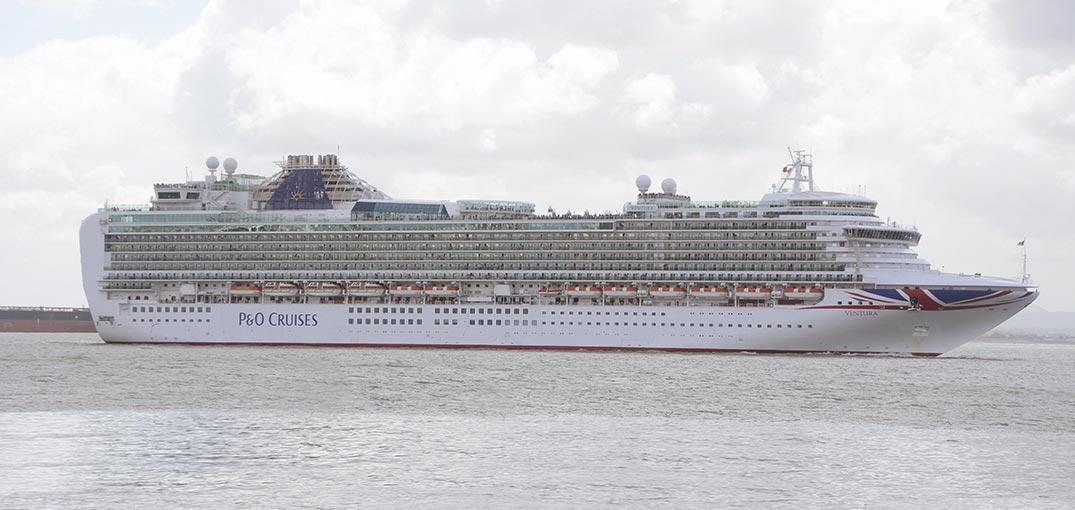
P&O Cruises’ 116,017gt/2008-built Ventura (above) was targeted by protestors in Amsterdam on 9th February. A 67-year-old man from Oosterhout and a 56 year-old woman from Amsterdam were arrested on the evening of their actions after they spraypainted the words "F… Cruises" onto the ship’s hull before being apprehended by authorities. This is part of an increasing desire to needlessly protest against the cruise industry.
SS UNITED STATES ON THE MOVE
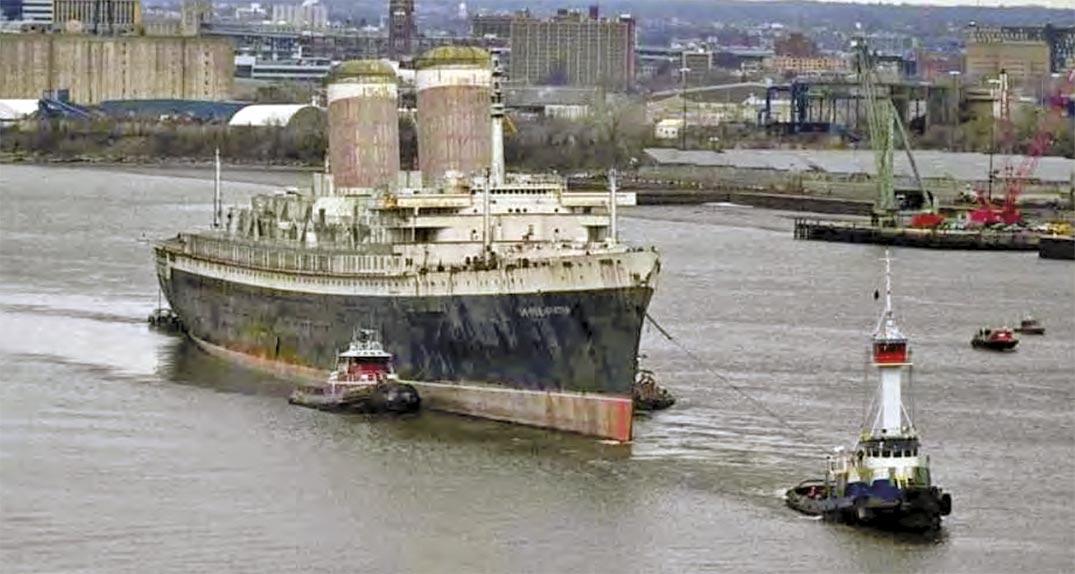
SS United States was finally moved for the first time in around 30 years on the afternoon of 19th February from her berth in Philadelphia, Pennsylvania, bound for Mobile, Alabama (above). Tugs moved her from Pier 82, where she had been since 1996, to Pier 80 on 14th February before being towed down the Delaware River on her one-way voyage. The liner’s new owners, Okaloosa County, Florida, planned the move with the tug Vinik 6 given the task for the voyage of around 14 days on this historic yet inevitable occasion. Upon reaching Mobile, the ship was docked at the Modern American Repair and Recycling Services facility where the remediation work got underway. Loose paint and other contaminants were removed as well as the fuel in her tanks. All the windows and portholes will also be removed and her funnels and radar mast dismantled and handed to the SS United States Conservancy, which will explore incorporating them into a visitor’s centre and museum to be established in the Destin-Fort Walton Beach area. Modifications will also be made to ensure that when the vessel is deployed, she will land upright underwater. The move came 75 years after the keel was laid for the liner in the dry dock at Newport News Shipbuilding & Dry Dock Company.
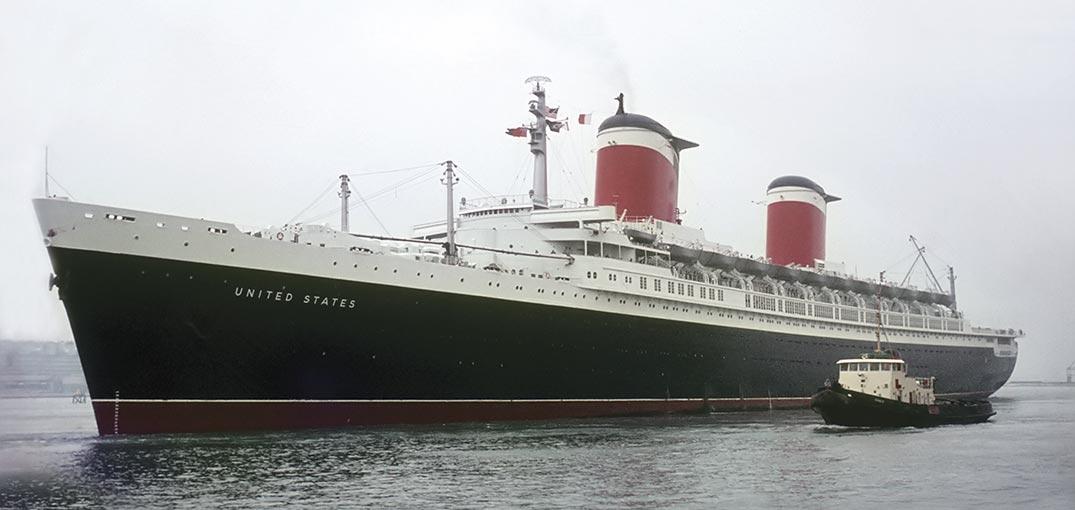
In 1952, at an average speed of 36 knots, the SS United States became the last liner to capture the speed record for an Atlantic crossing. She remained in commercial passenger service seen above leaving Southampton in 1967, and in later years also operated a few cruises, before being retired in 1969.
She passed through a succession of owners between 1980 and 2024, with plans to resume her to service or to convert her into a static attraction. After owning the ship since February 2011, the SS United States Conservancy relinquished ownership after becoming involved in a dispute with the operators of the pier where the ship resided. A court ordered the ship to vacate the pier but as this was not possible, the non-profit operation sold the ship to Okaloosa County in October 2024 for $1 million as part of a $10 million plan to turn the famous ship into the world’s largest artificial reef off Destin-Fort Walton Beach. The ship will benefit her surrounding ecosystem and become home to countless marine species that will thrive from the presence of her structure. The 302m long ship was launched on 23rd June 1951, was 53,329grt and had a capacity for 1,972 passengers.
Nigel Lawrence
Nigel Lawrence
P&O Cruises Australia bid farewell to the 77,441gt/1997-built Pacific Explorer on 18th February after she arrived in Singapore from Fremantle at the end of her last 11-night cruise for the company ahead of her $50 million transformation into the Star Voyager for Resorts World Cruises.
Royal Caribbean International announced on 18th February that the third 248,663gt member of the Icon Class fleet would be named Legend of the Seas. The original 69,472gt Legend of the Seas was built in 1995 as a member of the Vision Class and operates today as Marella Cruises’ Marella Discovery 2. The 21st century Legend of the Seas will sail year-round from Fort Lauderdale, Florida, starting in November 2026 on 6-night Western Caribbean and 8-night Southern Caribbean cruises, including visits to Royal Caribbean’s award-winning Perfect Day at CocoCay in The Bahamas. Prior to her Caribbean debut, the Legend of the Seas will offer summer itineraries in Europe with 7night Western Mediterranean cruises from Barcelona as from July 2026. The ship is being built in Turku, Finland and will join the Icon of the Seas and Star of the Seas, the latter arriving in August 2025. Icon Class highlights on the Legend of the Seas will include Crown’s Edge (part skywalk, part ropes course and part thrill ride) and the largest waterpark at sea, Category 6. Sunseekers can choose from seven pools, including the largest pool at sea, Royal Bay, Swim and Tonic bar and the adults-only Hideaway, featuring a one-of-a-kind infinity pool suspended above the sea.
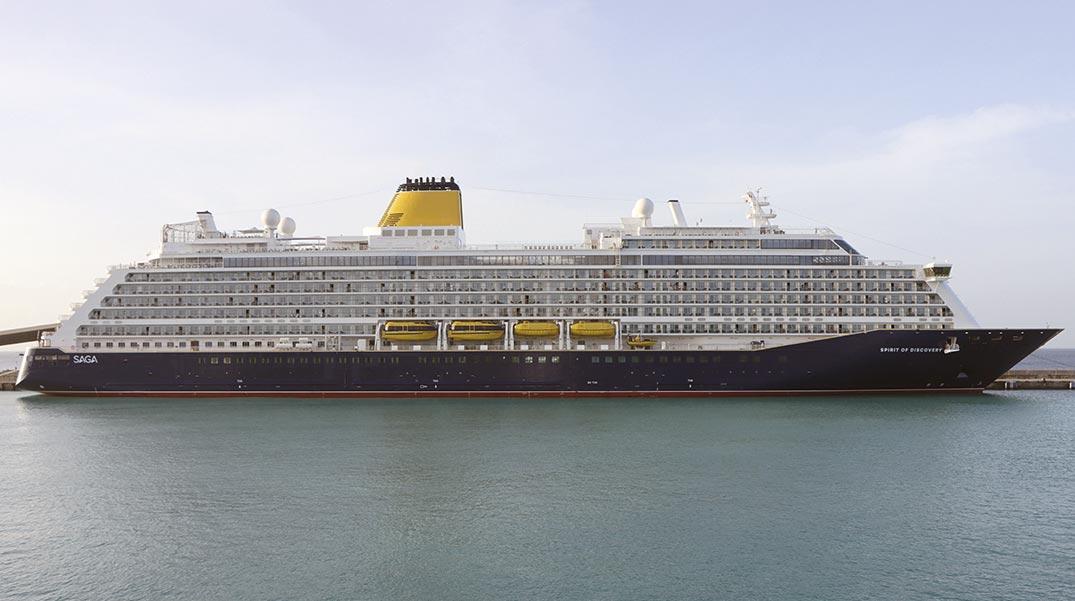
Cruises’ 58,119gt/2019-built Spirit of Discovery (above) will have her refit in June 2025 instead of November 2025. The routine maintenance and hotel upgrades in numerous public areas will be joined by additional technical works.
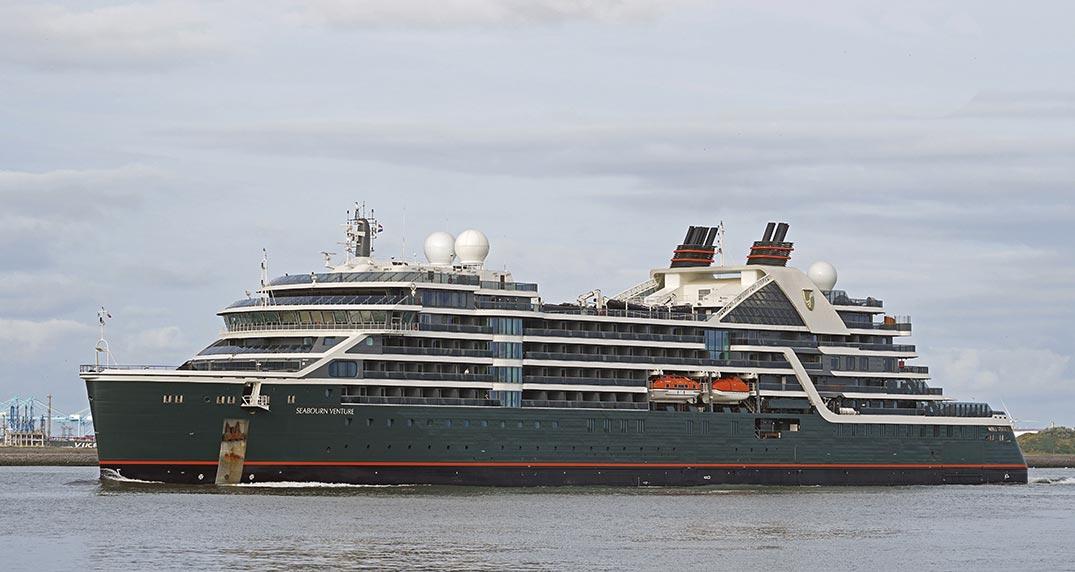
Seabourn’s 23,615gt/2022-built Seabourn Venture (above) was reported as experiencing challenges with her stabilisers in January. The ship had been offering expeditions to Antarctica and the issue caused itinerary changes due to expected sea conditions. A call to South Georgia was cancelled in favour of five additional days in Antarctica and two additional days in the Falkland Islands. The new itinerary was managed so as to cross the Drake Passage in the most optimal weather window. Repairs followed as soon as conditions permitted.
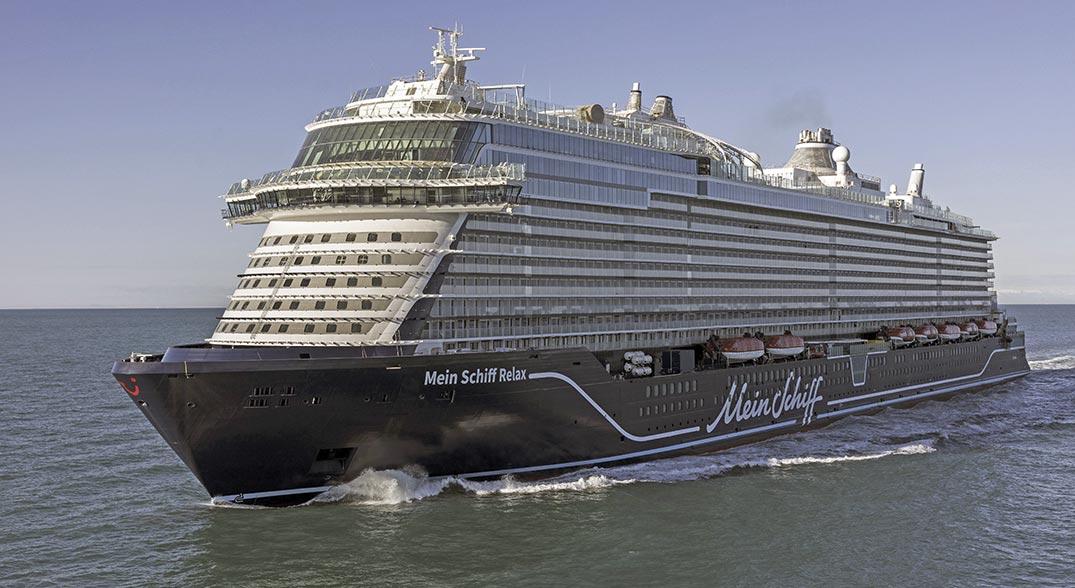
TUI Cruises took delivery of the 157,651gt/2025-built Mein Schiff Relax (above) on 7th February from Fincantieri’s Monfalcone Shipyard. She is the first of two vessels that Fincantieri is building for TUI Cruises, the second being the Mein Schiff Flow, due in 2026. TUI Cruises is a joint venture between TUI AG and Royal Caribbean Cruises and the ship is the first of two InTUItion class new concept cruise ships. These are dual fuel powered (LNG and Marine Gas Oil).
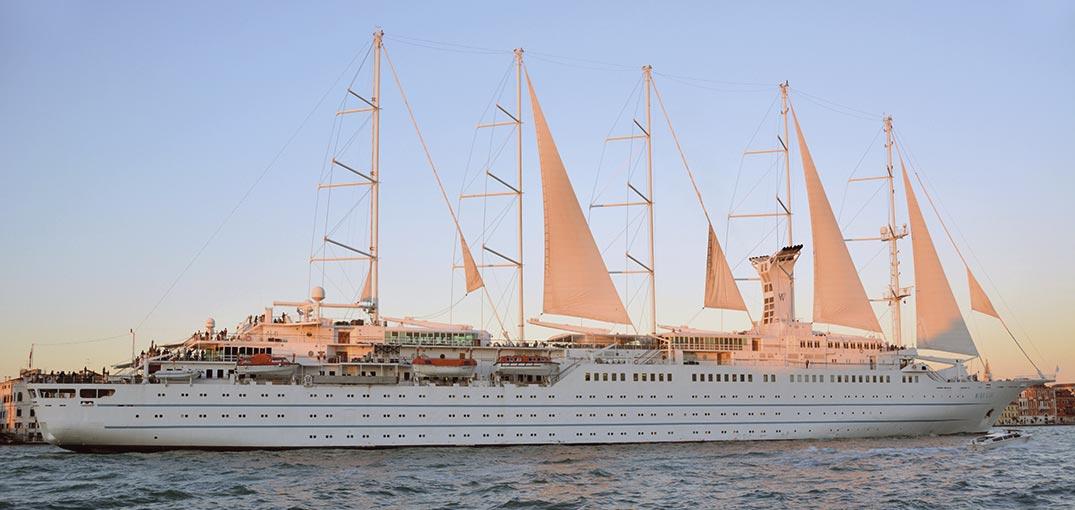
Windstar Cruises’ flagship vessel, the 14,745gt/built 1989 Wind Surf (above) has received a transformation focussed on her common spaces and suites. The upgrades to the 342-guest vessel debut amidst the Wind Surf’s prime Caribbean sailing season, with itineraries including 'Classic Caribbean and Beach Fun and Sun' and 'A Remote Caribbean Getaway'. Joining Windstar’s allsuite, Star Class yachts, the Wind Surf’s renovation also features the brand-new addition of Broadmoor and Sea Island Suites, which are inspired by luxury, five-star sister resorts The Broadmoor in Colorado and Sea Island in Georgia. The full project will be completed in December 2026. All of Windstar’s three Wind Class sailing ships (the Wind Surf, the 14,745gt/1989-built Wind Star, and the 5,736gt/1988-built Wind Spirit) are undergoing redesigns and updates as part of a multi-year initiative. In addition to Wind Surf, Wind Star has already completed phase 1 of improvements with phase 2 slated for April 2026. For Wind Spirit, phase 1 takes place in April 2026 and phase 2 in March 2027.
Paul Gauguin Cruises’ 19,170gt/1997-built Paul Gauguin sailed to Singapore to undergo a multi-million-dollar refurbishment project in February, arriving in Sembawang on 11th February. As part of one of the largest refits taking place in 2025, the ship underwent a 7-week drydock that included upgrades to public areas and cabins plus sustainability upgrades. New technologies introduced to the ship include advanced heat recovery systems, efficient chillers, an Organic Rankine Cycle (ORC) system generating electricity from heat and optimised electric motors. A new seawater treatment system will produce fresh water onboard, while waste management enhancements include a glass crusher and a cardboard compactor for efficient recycling. The 320-passenger capacity ship also received a new livery as a tribute to her parent company, Ponant Explorations. Before arriving back in Tahiti in early May, the ship will operate two itineraries in Southeast Asia.
Saga
Nigel Lawrence
Darren Holdaway
Kees Torn - Wikipedia
FERRY NEWS by Andrew Cooke
AG Reederei Norden-Frisia took delivery on 15th January from Damen Shipyards of Germany’s first all-electric catamaran ferry (E-Kat), capable of taking up to 150 passengers. The craft will operate between Norddeich and Norderney on the East Frisian Wadden Sea. The 32m E-Kat has been designed to operate on a 30-minute route with 28 minutes allowed at each terminus to disembark and embark passengers. Built at Damen shipyards in Poland and the Netherlands, the vessel is driven by two propellers, each powered by a 600kW electric motor. Given the shallow waterways in which she will operate, the ferry has been designed with twin hulls giving a draught of just 1.2m. The aluminium hulls and superstructure ensure that weight has been kept to a minimum, enabling it to operate at speeds of up to 12 knots.
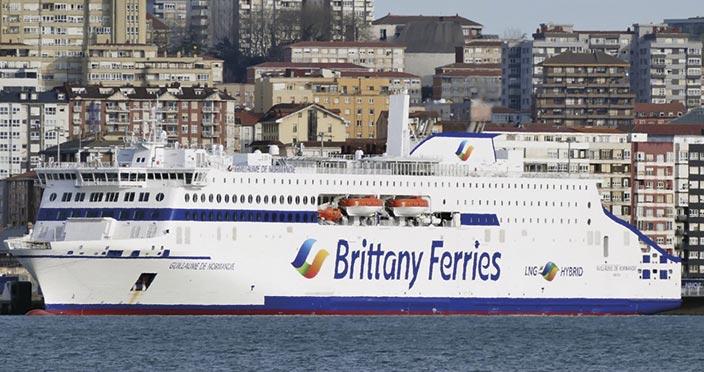
Brittany Ferries’ 20,133gt/1992-built Barfleur departed Gdansk ex-refit on 2nd February bound for Ouistreham. The Guillaume de Normandie arrived in Las Palmas, Gran Canaria, on 14th February before the final leg of her delivery voyage to Santander, where she arrived on 18th February (above) for dry docking at the Astander Shipyard. She enters service on 18th April from Caen to Portsmouth. On 20th February the Guillaume de Normandie officially joined the Brittany Ferries fleet under the French flag during a ceremony in Santander.
The 27,541gt/1992-built Normandie sailed from Portsmouth to Cherbourg on 12th February for a scheduled maintenance layover and her place was taken by the 29,468gt/2009-built Armorique, the latter having stood down from the St. Malo link to make way for the new Saint-Malo. The Normandie was back in service 17th February but retires from the fleet after the overnight Portsmouth-Caen sailing on 17th April. The ship will transfer to La Meridionale for further service in the Mediterranean to Morocco and will be renamed Massilia.
CalMac confirmed on 7th February that the 7,272gt/2024-built Glen Sannox would undergo planned maintenance at Inchgreen dry dock in Greenock from 23rd February to 2nd March, returning to service on 3rd March.
On 14th March it was found that the Glen Sannox had a crack in her hull, and
was withdrawn from service causing chaos on the Arran route. To provide cover for Arran, the 3,296gt/1984-built Isle of Arran, which was previously supporting Mull and operating Oban-Craignure, covered for the Glen Sannox, sailing Troon-Brodick. The beleaguered port of Ardrossan was the subject in February of a discussion regarding being taken over by the Scottish Government. This was prompted by the lack of progress in redeveloping the infrastructure for the services to Arran, which had forced both the new Glen Sannox and the chartered 2,991gt/2019-built Alfred to use Troon instead.
On 5th February came the news that the 4,719gt/1988-built Isle of Mull was expected to continue operating with reduced passenger capacity into the start of the summer season due to issues with her Marine Evacuation System. As a result, the 1,599gt/2003-built Coruisk remained in Oban to support Mull services until 15th May.
At the time of the announcement, work was ongoing with Transport Scotland regarding vessel deployments and what services can be provided to Campbeltown this summer. CalMac is in regular touch with the Campbeltown Ferry Committee and will continue to update them with progress on a fortnightly basis.
Deployment options were then still being considered for Islay between 28th March and 22nd April, and during the 3,626gt/2011-built Finlaggan’s overhaul 23rd April-13th May. Plans for KennacraigIslay due to the delayed newbuild were also hoped to be confirmed in February.
Also, on 5th February came the news that the hybrid ferries built at Port Glasgow for CalMac face a 2-year wait for new batteries. The delays had already forced the Hallaig to revert to diesel power following a battery cell fault in September 2023. It will now be April 2027 before the new batteries are all installed, the last in line being the Catriona.
The cost per ship is reported as £1 million. The 499gt/2013-built Hallaig, the 499gt/2014-built Lochinvar and the 499gt/2016-built Catriona cost a total of £34.4 million to build and were launched 2013-2016.
The original battery manufacturer for the Hallaig and Lochinvar ceased trading and combined with the advancement of battery technology, sourcing, procuring, and designing, a solution has been challenging. Recently, a further seven electric ferries have been ordered by CMAL, despite a lack of adequate battery charging points at certain ports at present.
The 6,753gt/1995-built Isle of Lewis arrived in Aberdeen for refit on 1st February.
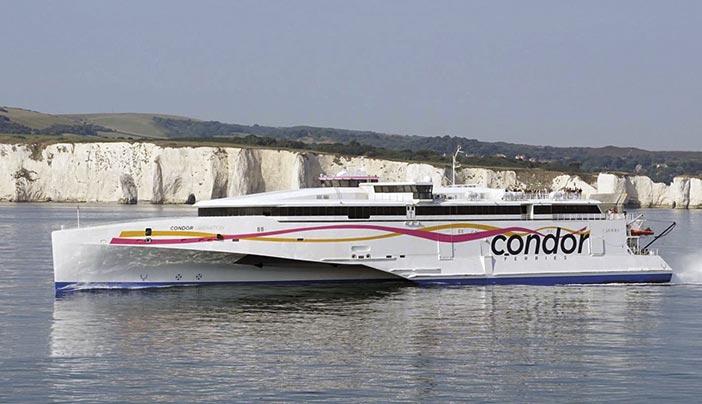
Condor Ferries’ Condor Liberation (above) was confirmed as being sales listed in early February as a result of Jersey splitting the Channel Island ferry service in two. The 6,307gt/2010-built craft was introduced by Condor Ferries in March 2015 and has served PooleGuernsey/Jersey/St. Malo ever since plus Portsmouth-Cherbourg on a seasonal service for Brittany Ferries in recent years, but not beyond 2023. From 29th March the Condor operation had only the one fast ferry, the 6,581gt/2000-built Condor Voyager, whilst DFDS introduced the 5,537gt/2015-built Levante Jet and 4,995gt/1997-built Tarifa Jet for its UKJersey-St. Malo operation.
Go Nordic Cruise Line is the new name for the Copenhagen-Oslo route acquired from DFDS. The name is reference to the route’s proud Nordic heritage and more than 150 years of history. The goal is to create even better-quality experiences onboard, with a focus on Nordic entertainment and gastronomy, as well as more time to explore the Nordic capitals. On 1st November 2024 the route was taken over from DFDS by the Swedish passenger shipping company Gotlandsbolaget, which has worked intensively to develop a new name, brand, logo and colours for the route.
Gotlandsbolaget of Sweden announced on 13th February that it had awarded Austal Australasia an A$270 million contract to design and construct a 130m long 'hydrogen ready' high speed vehicle passenger ferry. Part of Gotlandsbolaget’s ‘Horizon X’ programme, the high-speed Ro-Pax catamaran will be the largest vessel ever constructed by Austal, and feature a unique, highly efficient combined cycle propulsion system that includes both gas and steam turbines, a first for highspeed craft, worldwide.
With a capacity to accommodate up to 1,500 passengers, cargo and 400 vehicles, the ‘Horizon X’ multi-fuel catamaran will be designed by Austal with construction at the Austal Philippines shipyard commencing the first half of 2026 utilising “green aluminium”, produced using energy efficient processes and technologies that use less carbon, resulting in lower emissions. Construction is scheduled to be complete in mid-2028.
Andrew Cooke
Jose Luis Diaz Campa
Norled’s 1,598gt/2015-built Ampere, the world’s first fully electric ferry, has celebrated 10 years of successful operations in Norway’s Sognefjord. Designed and built by Fjellstrand Shipyard in 2015, the vessel has demonstrated the viability of electric maritime transport, covering a distance equivalent to 17 times around the equator using battery power alone. The success of the Ampere also catalysed widespread adoption of electric technology in the maritime sector.
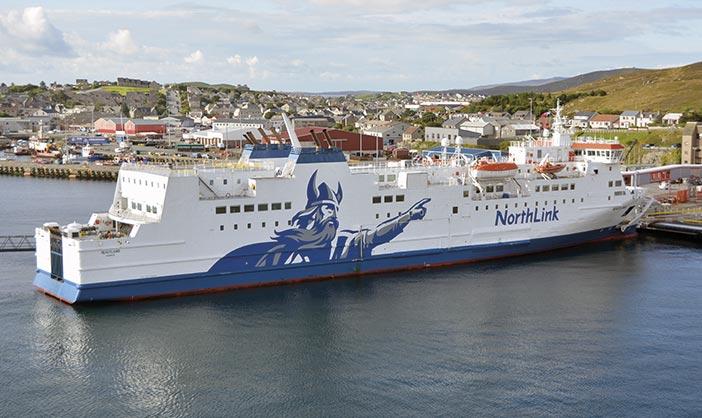
Serco NorthLink Ferries’ 11,720gt/2002built Hjaltland (above) was delayed returning to service following a flood which occurred in the pump room when the dry dock was being filled with water at Rosyth. In her absence, the 11,720gt/2002built Hrossey continued to operate the passenger service between Aberdeen, Kirkwall and Lerwick, with the 7,606gt/1997-built Helliar and 7,606gt/1999-built Hildasay providing freight services. The Hjaltland had been on refit since 10th February.
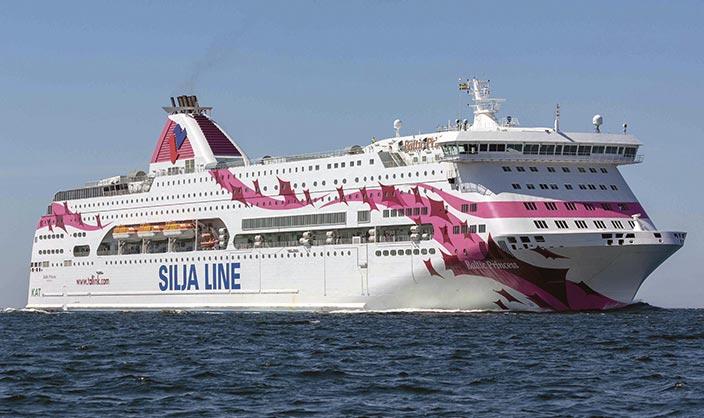
Tallink Silja Line’s 48,915gt/2008-built Baltic Princess (above)underwent an extensive one-month-long renewal and maintenance period 27th February-19th March in a break from her TurkuStockholm duties. The work took place at the BLRT Turku Repair Yard, in Naantali, Finland with several regular technical maintenance works and upgrades being done plus an extensive facelift of the main passenger areas.
Unity Line’s 47,626gt/2025-built newbuild for the Trelleborg-Swinoujscie service will be named Jantar Unity. The ship and her sister (NB101/ NB102) are being built in Gdansk at the Remontowa shipyard for Polish Shipping and Polish Baltic Shipping for the Ś winouj ś cie-Ystad/Trelleborg routes. The ferries will be 195m long with a 32m beam plus capacity for 4,100 lanemetres and 400 passengers.
CLdN’s 25,593gt/2010-built Peregrine arrived back at Zeebrugge from her Melbourne-Burnie (Tasmania) charter with StraitLink on 23rd January and four days later was back in action on the service to Teesport. From the end of February, CLdN increased the number of sailings and the amount of freight it can carry on its Zeebrugge-Teesport route. This was made possible by adding one more round-trip sailing per week and deploying larger Ro-Ro vessels on the route. These enhancements were made possible due to the imminent delivery of the brand-new, very large 50,440gt RoRo ships Chaumine and Leonine in 2025.
DFDS’ 11,530gt/2000-built Finlandia Seaways was announced in late February as having been sold for scrap, being destined for Esbjerg and Smedegaarden A/S as her final call. This facility also handled the scrapping of the former British Rail IoW Ferries Southsea, Caedmon, Cenwulf and Cenred. The Finlandia Seaways had encountered steering problems and ran aground on 5th December 2024 in Karmsundet, just southeast of Hydro, and around 400m from shore. The ship was outward bound from Kristiansund at the time and was assisted into Hydro by tugs for inspection, which clearly revealed damage.
The 7,606gt/1998-built Arrow is the Ro-Ro ship employed for the new DFDS Jersey service.
Grimaldi Line’s Con-Ro ship 56,660gt/2000-built Grande Brasile suffered a fire in the Dover Straits on the morning of 18th February whilst 15 miles from Ramsgate as she was heading for Le Havre from Antwerp. She issued a mayday resulting in lifeboats and the 7,535gt/2010-built tug Abeille Normandie attended. The fire, contained on one deck, was brought under control by the fire suppression system. The crew of 28 were evacuated. Two days later the ship was anchored in the Thames Estuary. The Multratug 35 attended the ship to assist her to anchor as the stricken ship had lost power during the blaze in the upper levels of her Ro-Ro decks. Smit Salvage was awarded the recovery contract and the ship was towed back to Antwerp.
Neoline Armateur celebrated the launch of Neoliner Origin in January at the shipyard RMK Marine, which will be the first commercial sailing Ro-Ro vessel. The ship Neoliner Origin will become a 136m-long sailing commercial ship capable of reducing greenhouse gas emissions by over 80% compared to conventional ships of equivalent size by
reducing energy needs and using wind as the main propulsion energy. The ship will be equipped with nearly 3,000m2 of sails and two 76m high foldable Solidsail carbon masts, manufactured by Chantiers de l'Atlantique, retractable antidrift plans made by Fouré Lagadec, and an ultra-efficient weather routing system developed by D-ICE Engineering.
P&O Ferries announced on 6th February a boost to capacity on its London/TilburyRotterdam/Europoort route, starting from 2nd March. Following a successful launch of the new route in 2024, a second vessel was added to the route, which will continue to offer 12 sailings per week with daily departures from both Tilbury and Europoort. The 20,296gt/1999-built sisterships Norsky and Norstream will cover the route, increasing capacity by up to 60%. Meanwhile, the 17,464gt/1994built Norbay and 17,464gt/1993-built Norbank, built for North Sea Ferries originally, were reportedly sales listed having mainly only served as relief ships since the Liverpool-Dublin service closed in December 2023. Having been towed to Aliaga from Perama, Greece, the former 31,785gt/ 1987-built Norsea/Pride of York/GNV Aries was beached as the Ari on 27th January 2025.
Stena Line revealed on 29th January 2025 that 2024 was a record year for Stena Line freight volumes on its three Belfast services with almost 600,000 freight units being shipped between Cairnryan, Liverpool (Birkenhead) and Heysham. Demand for freight services to and from Belfast has been increasing steadily in recent years with the BelfastLiverpool (Birkenhead) route in particular growing in popularity with hauliers with three ships serving the route.
On 25th February Stena Line reached a further milestone in its NewMax fleet investment programme with a ceremony to mark the launch of the Stena Connecta at the China Merchants Jinling Shipyard, Weihai, China. The new ship is one of two due to serve the Heysham-Belfast route. Sister ship, Stena Futura is being fitted out and is due to enter service August 2025. The Stena Connecta will follow in early 2026.
Wallenius SOL, a shipping company based in the Bay of Bothnia, has acquired Mann Lines, a UK-based Ro-Ro/Lo-Lo operator. Wallenius SOL has thus increased its fleet and a port network now stretching from the Baltic countries to Northwest Europe. Mann Lines serves Harwich and has a newbuild under construction by Visentini in Italy.
Nigel Lawrence
Marko Stampehl, Tallink Grupp
by Andrew Cooke
SAINT-MALO
Brittany Ferries and Stena RoRo are names synonymous with the ferry industry and both have been responsible for some of the most notable ships and designs that have helped to shape the ferry world into what it is today. Ferry Operators constantly strive for the optimum in versatility and efficiency and Stena RoRo embarked upon a new project to search for the next generation in Ro-Pax design in 2014 having been formulating such plans beforehand. After various design alternatives were considered, the E-Flexer Class was created in conjunction with Stena Line, Deltamarin (Marine Architect), Stena Teknik, Figura (Interior Designer) and Weihai Shipyard in China. The project had two main aims, to design and build a class of vessel that was as environmentally friendly and efficient as possible as well as being flexible to permit configuration for a variety of routes from short day crossings to longer overnight services.
The success of this has been reflected in the routes the vessels have been ordered for, ranging from the 90-minute Dover-Calais crossing to Brittany Ferries’ Portsmouth to Spain routes with crossing times of 23 hours and over. The Deltamarin proposal was selected after extensive tank tests at MARIN in The Netherlands. It was found to be the most efficient at the desired speed of 22 knots with the results indicating that the hull design was so effective that the ship would be capable of maintaining a speed of 18 knots with just one engine and propeller in use. This unique new hull form produced a bow shaped to reduce resistance including around the openings for the bow thrusters, and the stern is shaped to reduce wash. To further enhance the flexibility, the E-Flexer design allows the ship to be built to differing lengths and with/without cabin accommodation.
The versatility of this 21st century Ro-Pax could be likened to the series of short-distance ferries built in Germany between 1974 and 1975 for Stena RoRo using the Rickmers Seabridge design by Knud E. Hansen. These adaptable ships of their time were the 5,426gt/1974built Stena Normandica, 5,441gt/1974-built Stena Nautica, 5,443gt/1975-built Stena Nordica and 5,441gt/1975-built Stena Atlantica. At the time of writing, the former Stena Nordica remained in active service.
To get the E-Flexer project underway, the search for a suitable shipyard led to discussions with AVIC Weihai and other Chinese shipyards during 2015, with AVIC Weihai surpassing its competitors due to their approach and experience with international clients, plus the fact that AVIC owned 80% of Stena’s chosen naval architect, Deltamarin of Finland, so a working relationship was pre-existing. The Weihai shipyard was completed as recently as the end of 2008 when the company moved from an older site near the centre of Weihai. The new shipyard was built on land reclaimed for the purpose and boasts two large building docks as well as extensive shoreside
facilities and a workforce of around 1,000 people. Before the E-Flexer contract began in earnest, the AVIC Weihai yard became China Merchants Jinling Shipbuilding (Weihai) Co. Ltd. with no impact on the process.
EVOLUTION BY DESIGN
Brittany Ferries is the trading name of the French shipping company, BAI Bretagne Angleterre Irlande S.A. founded in 1973 by Alexis Gourvennec. Ferry operations began on 2nd January 1973 using the Ro-Ro vessel Kerisnel between Roscoff and Plymouth. The ship was replaced by the Ro-Pax Penn-Ar-Bed in 1974, BAI adopted the trading name Brittany Ferries and the rest as they say is history. Indeed, the company celebrated its 50th anniversary in 2023. The company first opened a St. Malo service in summer 1975 using the chartered 2,424gt/1975-built Prince de Bretagne from Plymouth. Demand grew from passengers further along the south coast, so, in 1976, the new ferry port at Portsmouth became the primary UK port for the St. Malo link. The 8,181gt/1972-built Armorique (1) was employed and served the route for almost 20 years. The 9,795gt/1979-built Duchesse Anne also operated here but the graceful 24,534gt/1989-built Bretagne took over in 1993, making the link her own for 31 years. Stena RoRo was founded in 1977 and has since led the development of new marine Ro-Ro, cargo and passenger concepts. The company leases vessels to operators worldwide, both other Stena companies and third parties. Stena RoRo specialises above all in using its technical expertise for the design and production of new vessels, and the conversion and technical operation of existing vessels to deliver tailor-made transport solutions to its customers. This is known as “Stenability.”
The original E-Flexer design footprint was 214.50m long, LNGready and 41,671gt with 175 passenger cabins and capacity for 1,000 passengers, 120 cars in their own dedicated garage on Deck 7 and 3,100 lanemetres of freight (with cars etc also carried on Decks 3/5 subject to the mix of traffic). The Stena Estrid was the first example delivered in 2019 for Stena Line’s Holyhead-Dublin service (Hull No. 263). She was followed by the Stena Edda in March 2020 (Hull No. 264) for the Birkenhead-Belfast link. The E-Flexer series attracted the interest of various ferry operators and Brittany Ferries was the first one of these to receive a newbuild. Hull No. 267 was delivered to the French operator on 3rd September 2020 on long-term charter. Named Galicia, the ship was the first newbuild in the fleet since the 40,914gt Pont Aven in 2004 and replaced the chartered 22,382gt/2003-built Baie de Seine (ex-Sirena Seaways). The Galicia took up service on the Spanish routes from Portsmouth, the rotations also including calls at Cherbourg. It is worth noting that on 27th November 2020 the Galicia was virtually inaugurated at Portsmouth. This was believed to have
NEWBUILD OF THE MONTH
been the first virtual inauguration in the marine sector and was necessary due to the continuing Covid-19 restrictions at the time. Hull No. 266 followed in November 2020 in the form of the Stena Embla, a running mate for the Stena Edda. The first indication of a heavily customised design emerged with the 40,331gt Côte D’Opale for DFDS (Hull No. 268 on long term charter), delivered May 2021, which had her passenger accommodation configured for the Dover-Calais service. The 6th ship in the series was the first LNG-powered example and the second ship for long term charter to Brittany Ferries. The 41,716gt Hull No.269, delivered in December 2021, was christened Salamanca and entered service on the Portsmouth-Bilbao route on 27th March 2022. The ship replaced the 32,728gt/2001-built Cap Finistere (withdrawn and sold to GNV in January 2022 as the GNV Spirit) with the 26,904gt/2008-built Etretat also having left the fleet the previous year, returning to Stena RoRo as the Stena Livia. Two extended 240m long and LNG-ready examples, the Stena Estelle (Hull No. 270) and Stena Ebba (Hull No. 271) were delivered to Stena Line’s Baltic fleet in 2022. Brittany Ferries’ third 214.50m long E-Flexer, the 41,716gt and LNG-powered Santoña (Hull No. 272), was delivered January 2023. Like the Galicia and Salamanca, she is on long-term charter and joined the Spanish/Cherbourg rotations. The fleet changes also saw the 27,414gt/2007-built Connemara withdrawn by Brittany Ferries in 2022 after 4 years and she repositioned to New Zealand.
A FUSION OF TECHNOLOGIES
The customised series of E-Flexers took a leap forward in 2021 when the LNG dual fuel propulsion and battery hybrid era arrived. Marine Atlantic Inc. of Canada ordered a 37,807gt and 202.9m long ship with this technology, which was delivered in February 2024 for service between Newfoundland and Nova Scotia. Beginning life as Hull No. 279, the ship was named Ala´Suinu, was again on long-term charter from Stena RoRo and brought this series of Ro-Pax newbuilds to 10 examples. Back on 22nd July 2021 Stena RoRo announced that it had placed orders for the construction of the 11th and 12th E-Flexer ships from CMI Jinling (Weihai), for delivery in 2024-25. At the same time, long-term charter contracts were signed with Brittany Ferries for these. This indicated major changes within the Brittany Ferries fleet as state-of-the-art tonnage was now on the horizon to oust the beloved 24,534gt/1989-built Bretagne (the first cruise ferry delivered new to the company) and the immensely popular 27,541gt/1992 Normandie. The loss of two huge favourites received a very mixed reception but we must cherish what we had whilst embracing the future. Nothing in life stands still, and the cross-channel ferry scene is no exception. The announcement indicated that Hull No. 275 would be for the Portsmouth-Ouistreham (Caen) service with Hull No. 278 being for the Portsmouth-St. Malo link, two primary routes in the company’s network. With the previous delivery being Hull No. 279, the running order of 275/278 was also reversed. The adaptable design came into play again with these newbuilds being 19.80m shorter than the original 214.50m E-Flexer, at 194.70m in length, the maximum for the ports of Ouistreham and St. Malo. Whilst continuing the LNG fuelled trend set by the Salamanca and Santoña, Nos. 275/278 would also have a battery hybrid capability, bringing this technology to an international ferry route from the UK for the first time.
The two new ferries have a respective capacity of 2,377 and 2,517 lanemetres, and 1,290/1,400 passengers whilst their onboard layouts differ to reflect the demands of both routes. As the newbuilds are equipped for LNG operation, they can also run on biogas or other new fuels such as ammonia, plus Marine Gas Oil (MGO) should any supply/equipment issues arise. MGO is carried as a matter of routine as this fuel assists with the start-up of LNG engines. In addition, newbuilds 11 and 12 are equipped with a large 11.5MWh battery hybrid package for propulsion and manoeuvring purposes in port, making them the largest battery hybrid ferries in the world thus far. They are also equipped with an 8-megawatt electric shore connection for charging the batteries, which entails an environmentally friendly stay in port. The shore power facilities at Portsmouth International Port were
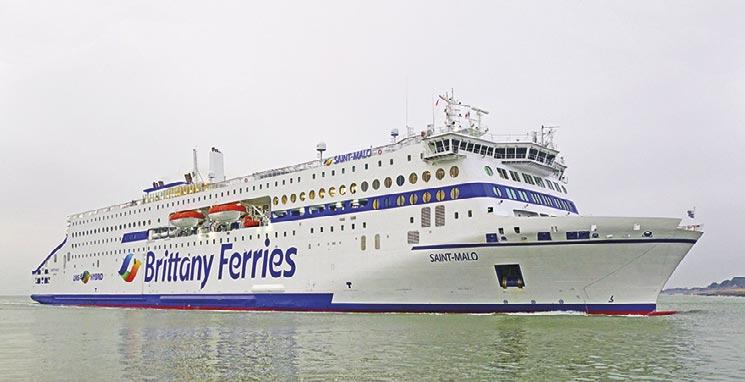
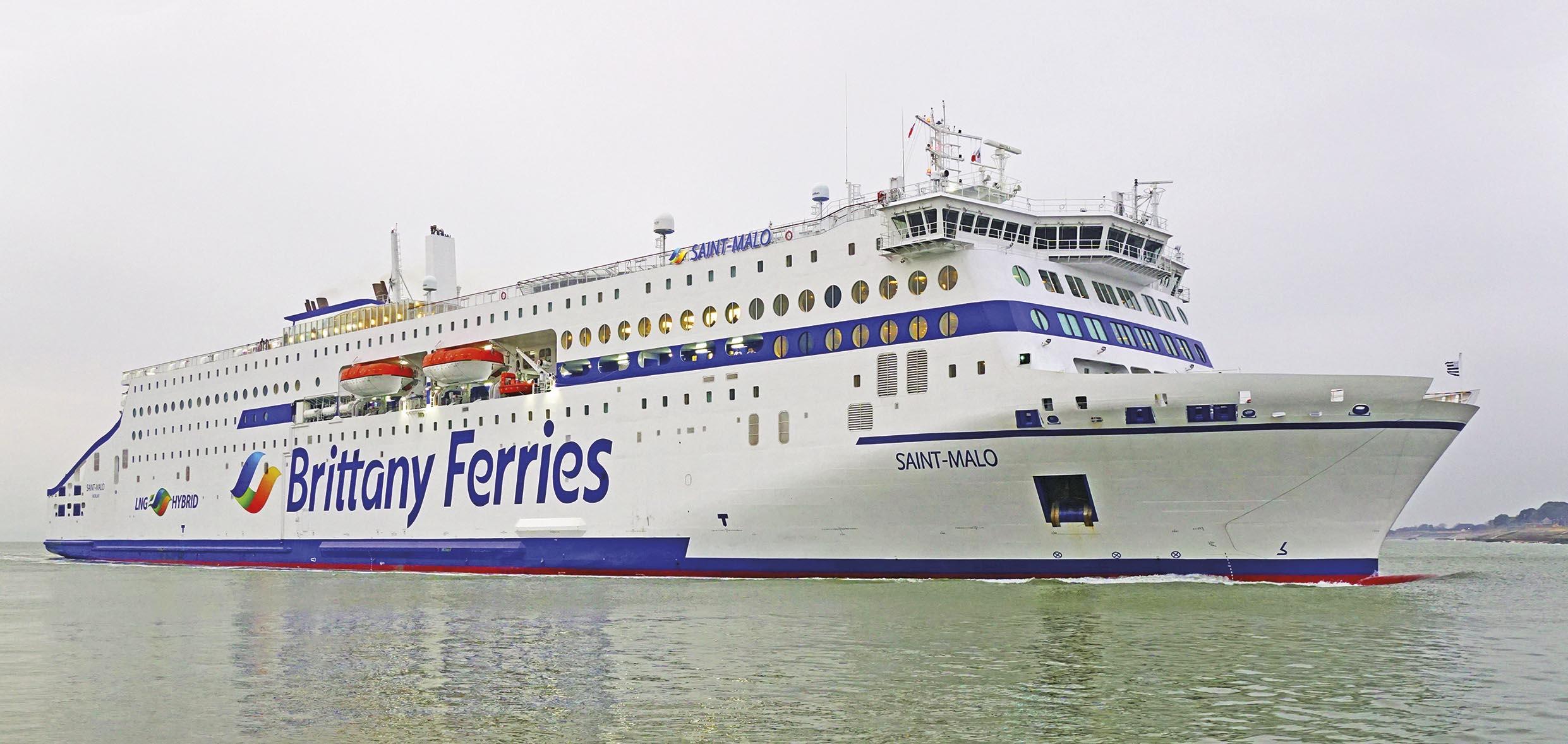
due to be completed in April 2025 whilst the infrastructure at St. Malo is expected as part of a ferry terminal re-development in 2027. The focus of this Newbuild of the Month is the Saint-Malo, Yard No. W0278, with the steel cutting having taken place on 2nd September 2022. The keel laying took place on 29th June 2023 and, with all building blocks in place, the ship was launched (floated out) at the shipyard on 7th October 2023. Sea trials commenced 6th June 2024, and the completed ferry was delivered on 15th October 2024. She sailed from her birthplace on 21st October 2024 and, like the previous 3 such ships for Brittany Ferries, the destination was Santander, Spain. The ship made bunkering calls at Singapore (29th October), Hambantota, Sri Lanka (2nd November), Port Louis, Mauritius (8th November), Walvis Bay (15th November), Porto Grande, Cape Verde (24th November) and Las Palmas in late November prior to arriving in Santander on 2nd December 2024.
The Saint-Malo was officially welcomed into the Brittany Ferries fleet on 5th December when she was re-flagged to the French Tricolour and re-registered to Morlaix. Dry docking at the Astander Shipyard followed 4 days later. Following a homecoming to her new home port on 12th January, the 36,965gt ship arrived at Portsmouth on the morning of 13th January with a double tug escort. The ship conducted berthing trials during her visit before sailing that night for Ouistreham to undertake berthing trials there too, in preparation for the delivery of the Guillaume de Normandie. The arrival and departure at Portsmouth had been made on electric power. From Ouistreham the ship sailed for Cherbourg to prepare for service, where she arrived on 15th January. A return to Portsmouth followed, for a test voyage on 25th January to St. Malo. Whilst in Portsmouth that day she took LNG bunkers from the 6,357gt/2021-built LNG bunker tanker Optimus, the first such operation at the port.
In the presence of the Minister of the Sea, Agnès PannierRunacher, Minister of Transport, Philippe Tabarot and Minister of Rural Affairs, Françoise Gatel, representatives of Brittany and guests took their places at the quayside beside the Saint-Malo on 31st January at the Brittany port for the blessing and christening ceremony. Her godmother was Nathalie Mercier-Perrin, president of the French Maritime Cluster. The ship officially entered full passenger service on 12th February at 20.15 from Portsmouth.
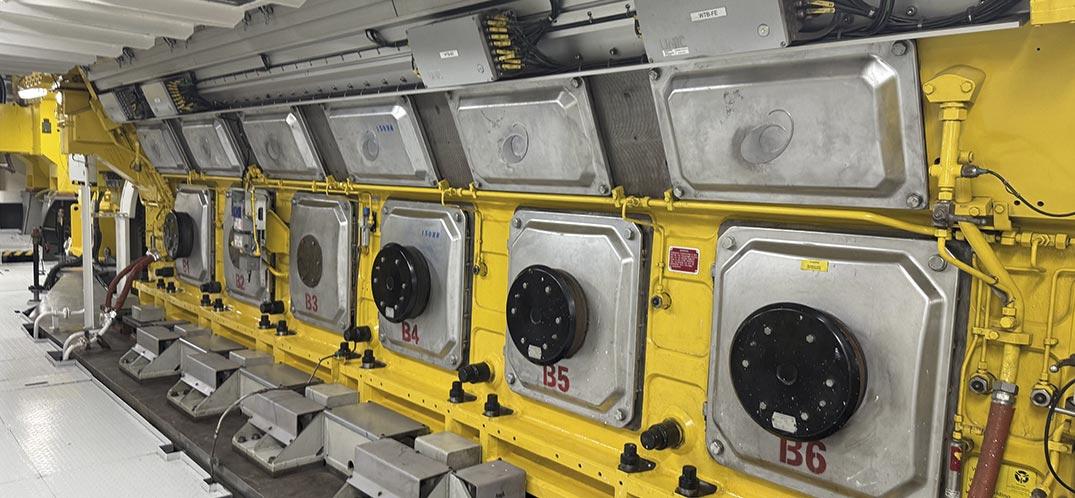
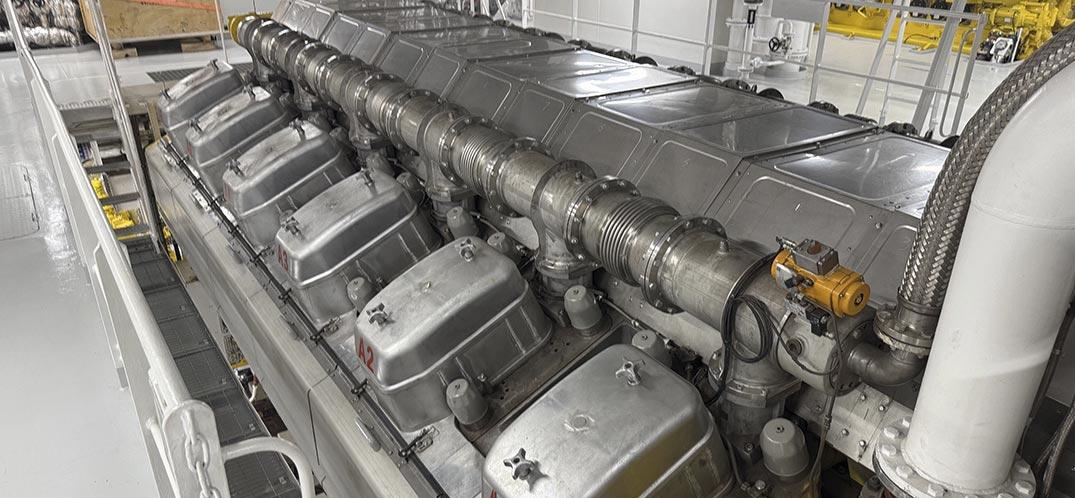
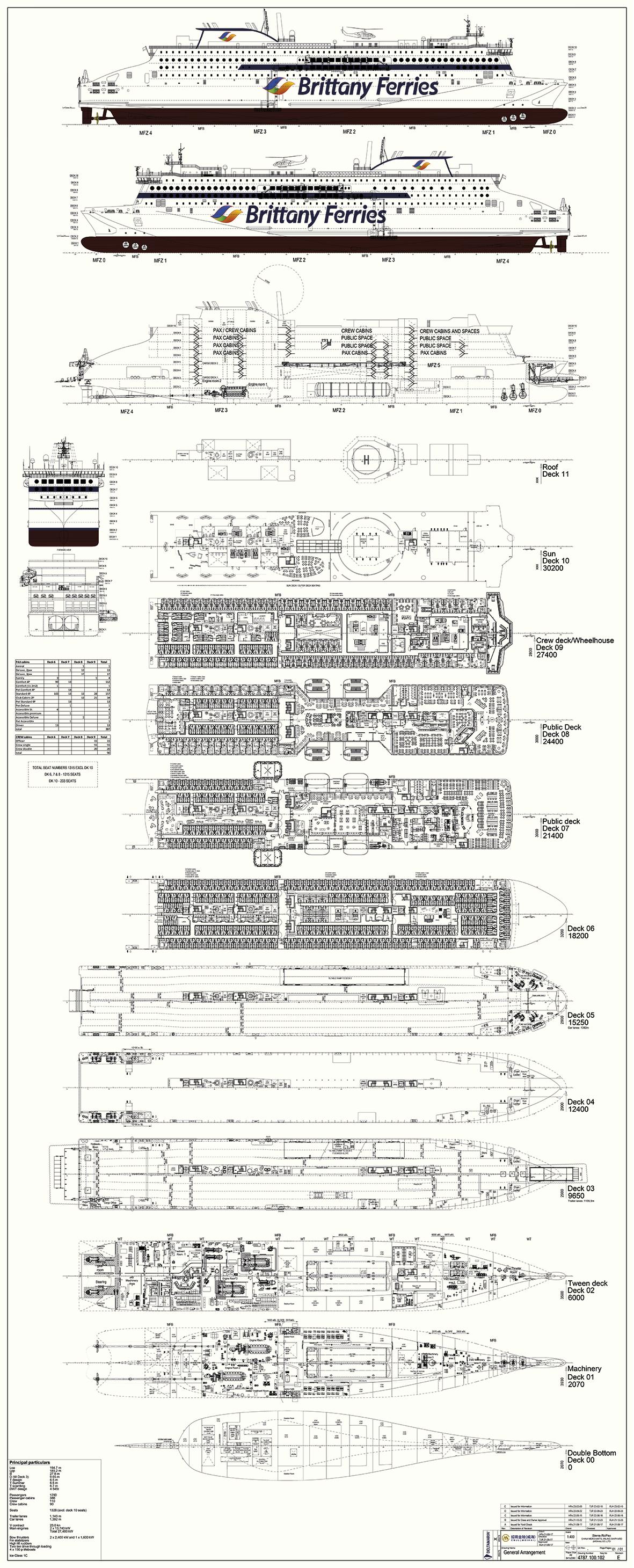
The Saint-Malo’s machinery spaces are on Deck 1 (Machinery Deck) and Deck 2 (Tween Deck) as seen above plus the hull has a double bottom. The control room for the machinery spaces is located aft of the engine rooms on Deck 2. The two engine rooms are offset and located aft, with Engine Room 1 to port, which contains a Wärtsilä 12V46DF/ 13,740kW output at 600rpm main engine (seated on Deck
NEWBUILD OF THE MONTH
1 with upper access on the Tweendeck) and two 1,680kW Wärtsilä 9L20DF LNG auxiliary generators (seated on the Tweendeck). Engine Room 2 has an identical main engine and single generator. The main engines are each linked to a Flender gearbox with extra-large 4,650kW PTO/PTIs, necessary for hybrid operation. PTO means Power Take Off, and PTI is Power Take In. These terms describe how energy is transferred between the engine and other systems onboard ship. PTO uses engine power to drive other systems, such as the electrical system, air conditioning, or hydraulics and can also be used to generate electricity. PTI uses electrical energy to drive the main engine in terms of a temporarily boost to the power or an emergency backup if the main engine fails. PTO/PTI systems allow the electric drive to operate as either a motor or a generator.
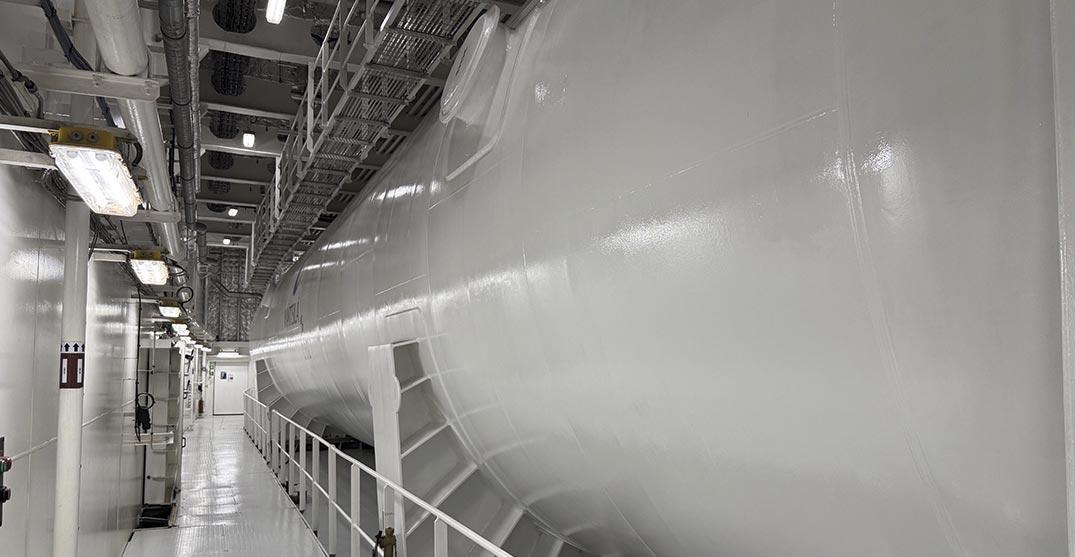
Whilst the ship is at sea the hybrid battery system can be charged. The batteries are situated in two rooms on each side of the ship, forward of the engine rooms and outboard of the two huge Wartsila 550m³ double walled LNG tanks (above), which were manufactured by Zhangjiagang Furui Cryogenic Technology Co. There are around 130 tonnes of batteries from the Leclanché Navius MRS-3 system in conjunction with Wartsila, providing 11.5 MWh of power. The battery system is scalable, which means that in the future the Saint-Malo can operate entirely on batteries or on a combination of these and different fuels. The Navius MRS-3 system has been specifically designed for the supply of on-board energy storage in marine applications. It comprises the latest Leclanché M3 Energy battery modules fitted with proprietary high energy and high lifecycle G/NMC cells, a Functionally Safe Battery Management system and is assembled into a scalable and modular rack system. Each module has dedicated liquid cooled plates for more efficient thermal management and a longer system lifetime. This liquid-cooled technology also permits significant system weight savings, and a more compact footprint compared to an equivalent capacity air-cooled system. The batteries are generally kept within their optimum performance levels of 25%-85% with electric propulsion engaged at the push of a button when sailing to/from port. To watch the changeover on the display screens between electric and main engine propulsion is fascinating with PTI switching to PTO once the main engines are running and climbing above 400rpm.
Commandant Olivier Raimbeaux explained the procedures and it is also possible to run one propeller on LNG power and one on electric if necessary. The range on electric power depends on thruster usage and general conditions but the power endurance is around 1 hour. At present the ship is generally on electric power from Outer Spit Buoy in the Eastern Solent to Portsmouth International Ferry Port and vice versa. It would be possible to extend this towards Nab Tower when suitable. Maximum speed whilst on batteries is 17.5 knots or 23 knots on LNG. The LNG equipment features a Wärtsilä gas supply system, energy management system and a selective catalytic reduction system (NOx) is also fitted. For optimum manoeuvrability the ship is fitted with three transverse tunnel bow thrusters, namely two 2,400kW Wärtsila WTT24 CP and one 600kW unit. The ship is fitted with a Safe Return to Port (SRtP) system, which is designed to ensure that new passenger vessels of greater than 120m in length involved in an emergency can return to port under their own power with passengers and crew still safely onboard. This requires a second navigation posi-
Special thanks must go to the Brittany Ferries Press Office for the invaluable assistance with information, diagrams and images, not to mention the ship’s Master, Officers and Crew for the behind-the-scenes access whilst aboard the ship.
tion onboard for emergency use that contains the essential equipment necessary to continue navigation in the event of an emergency. Redundancy among primary equipment aboard is also a requirement.
A HYBRID WITH HERITAGE
As Brittany Ferries rightly said, if the 1989-built Bretagne was a love letter to a vibrant Brittany region’s heritage, the new Saint-Malo is a vision of the future. With a length of 194.70m, a 27.80m beam and a 6.60m draught, the ship was the 4th of 5 new vessels to join the fleet 2019-2025 as part of the biggest fleet renewal programme in the company’s history. The Saint-Malo is chartered to Brittany Ferries for 10 years with a purchase option after 4 years. With the Bretagne’s final sailing on 4th November 2024 and the new girl on the block taking up the baton on 12th February 2025, the St. Malo service advanced 30 years in 3 months. The transition from cruise ferry to E-Flexer meant that the Saint-Malo had big shoes to fill and it is clear that Brittany Ferries was all too conscious of this. The Saint-Malo is not just another E-Flexer, she is a Brittany Ferries E-Flexer, with a very different vibe onboard. The layout has been redesigned to suit both the shorter length of ship and the route served where cabins are a higher priority to freight capacity. This has been demonstrated by the additional deck of cabins on Deck 6, made possible by a reduced clear height of 2.20m for the upper vehicle deck (Deck 5). There are 99 Comfort Cabins, an 11.3m2 Comfort Cabin (port side aft), 103 Standard Cabins, 13 Driver’s Cabins (5.4m2 each), 4 Accessible Standard Cabins, a 14.3m2 6-berth Family Cabin (starboard side aft) and a further 2 6-berth Family Cabins forward, one either side. The Standard and Comfort cabins are 6.9sqm7.1sqm whilst the Accessible Cabins are 13.3m2
The aft section of Deck 7, which is a cars-only garage deck on several of the E-Flexers, offers cabins on the Saint-Malo. There is a 14.2m2 2-berth Pet Deluxe Cabin portside aft plus 13 Pet Comfort Cabins (outside), 13 Pet Standard Cabins (inside) plus a Pet Accessible Premium Cabin located at the forward end of the accommodation. On the starboard side, forward to aft, are 1 Accessible Premium Cabin, 13 Comfort Cabins (outside), 13 Standard Cabins (inside) and a 14.3m2 Deluxe 5 Cabin for 2 passengers. Above on Deck 8 aft can be found the Commodore Class Cabins consisting of a 14.3m2 Deluxe 5 2-berth cabin portside aft, 11 Deluxe Cabins (11.6m2), 13 Club Cabins (7.1m2) and a 13.2m2 Accessible Deluxe Cabin at the forward end of this area. Starboard side aft is a 26.6m2 Admiral Cabin followed by 13 Standard Cabins (inside), 9 3-berth Deluxe Cabins (outside 12.9m2) and 8 2-berth Deluxe Cabins (outside - 12.8m2) plus a 13.2m2 Accessible Deluxe Cabin.
The Commodore Class accommodation is partnered with the 64seat Les 8 Trésors deluxe lounge/restaurant. This lounge, located aft, has panoramic windows overlooking the stern plus a private veranda. A complimentary breakfast is served here for Commodore Class passengers with refreshments available all day. The aft area of Deck 9 above offers 28 Standard Cabins (inside) plus 21 Club Cabins (outside along the stern and starboard side), some of which are Allergen Free, and a 14.3m2 Family Cabin in the starboard aft corner. Along the portside are 21 single outside crew cabins (7m2). Forward from this block of cabins in the midships section is crew accommodation consisting of 30 single and 20 twin 7.5m2 cabins, located inside and outside.
The Officer and Crew Dayroom is also sited here. The forward section of Deck 9 consists of the Crew Mess, Officer’s Mess, Pantry, Office, Conference Room, Medical Centre plus the 23.6m2 Captain’s cabin, the Chief Engineer’s cabin plus 3 Senior Officer, 10 Junior Officer and 4 Crew single cabins, all outward facing. The Safety Centre and Bridge are situated forward of the Officer’s accommodation. The cabin accommodations are impressive, but the ship does not offer a reclining seat lounge. However, an en-suite cabin offers a far better environment.
With over 380 passenger cabins in various categories, the SaintMalo is the E-Flexer with the highest passenger cabin capacity. The internal spaces were designed by Figura Arkitekter AB with interior outfitting by R&M. The Scandinavian décor synonymous with the E-
Flexers is apparent but the feel of the ship is very different, in a positive way. Something unique to the Saint-Malo thus far is an Exhibition Area midships on Deck 6. Leading from the main stairs lobby is a small event/exhibition area that includes an homage to the ship’s predecessor, the Bretagne. Here can be found a model of the ship, information about her, photos and a painting. On the adjacent side is an exhibition relating to Brittany. The corridors leading forward from this area feature a splendid array of heritage representing both the Brittany region and Brittany Ferries. The presentations include wallmounted paintings, photos, images, information plaques and images on floor mounted displays charting the history of the ferry company. The largest of these are two profile illustrations of the Saint-Malo. The Bretagne boasted a plethora of artwork by Alexander Goudie with 150 of his works transferred to the Saint-Malo, therefore the Bretagne’s soul lives on within her successor. The murals that once graced the reception area walls aboard the Bretagne are now also aboard the Saint-Malo, in the corridor behind the bridge. The ship’s public internal spaces are on Decks 7 and 8. The midships area on Deck 7 is situated between the lifeboats, two of 150-person capacity each side, with an area of outside deck beneath them.
The reception desk is located port side (with an office and Purser’s Office behind) as you walk in from the main stairway. This area also has seating for 93 passengers, an entrance to the Duty-Free Shop (starboard side) and stairs to the bar on Deck 8. The embarkation area for foot passengers is also here. Walking forward from here, the shop is to the right and, beyond the seating area, is a Wellness Room on the port side offering a variety of treatments more akin to a cruise ship. In fact, with her cabin windows on Deck 6, the ship has a cruise ship-like appearance compared to her larger sisters. Moving forward again, the walkway leads to Le Litoral Restaurant. This is an A La Carte restaurant with a small self service counter area for use at breakfast etc. The 346-seater eatery occupies the entire forward section of the ship on this deck and is certainly a step forward from Les Abers aboard the Bretagne in terms of size. Guests are usually greeted and seated when they arrive, and the staff have handheld tablets for taking orders. Leading aft from the main stairway adjacent to Reception is a walkway towards an external stern deck. This walkway features a Destination Library with 6 information points for planning ahead after arriving in port and this desk area has a backdrop of a large panorama of St. Malo. The seating along this corridor (128 in total) features high tables, at-table seating and seating in twin booths recessed into the walls. Two workstation areas are also screened from passers-by. The wall on the right walking aft is set aside for exhibitions. The walkway leads to the colourful La Plage Lounge that has a mixture of bench seating and funky at-table seating plus a coffee bar. Vibrant colours from the seaside are the theme with reds/oranges/blues and yellows and parquet flooring. Thus far, this area is unique among the E-Flexer ships as Deck 7 aft is usually set aside for the upper car garage. The theme of the ship’s interior spaces makes her an unquestionable ambassador to the Brittany Region with the desire to make passengers feel they are in Brittany the moment they step onboard.
Moving up to Deck 8, the passenger spaces, except Les 8 Trésors (the lounge for Commodore Class guests), are forward of the main stairway.
Firstly, the Breton-themed Breizh ma Bro bar (above) occupies the narrower section of deck between the lifeboat gantries. As with other E-Flexers where the bar is here, a large centrally positioned skylight
NEWBUILD OF THE MONTH
runs the length of the bar lounge. To the starboard side near the bar is a stage area (elevated above floor level) used for live entertainment, with a Children’s Area beyond. Forward of the bar on the starboard side is the 189-seater Le Jardin Restaurant with bright ceiling lighting and a counter for the serving of hot/cold food and drinks. Both restaurants aboard offer Breton themed cuisine with an emphasis on fresh produce rather than “fast food” style. Le Jardin occupies the area of the Driver’s Restaurant on other E-Flexers with the forward section being the Hygge/Reclining Lounge on ships such as the Stena Estrid and Galicia. The colour pallet used on board was intended to represent the Breton Region (from costumes to landscapes) and this is evident in various areas including the 163-seater CClub, the relaxing Club Class style lounge that occupies the forward area of Deck 8. This is available at a supplement, is accessed with a keycard, and includes complimentary food and drink throughout the day (i.e breakfast/lunch/afternoon tea on a day crossing) on a self-service basis, with crewmembers on hand throughout. Some fine sea views are available, and the window seating provides an ideal spot to watch for dolphins.
Just aft of the CClub is a 97-seater general lounge area on the portside. Overall, the internal passenger areas offer 1,315 seats with the sun deck on Deck 10 providing 203 seats in two main areas. The seating forward of the funnel is beneath a canvas cover plus there is also a kiosk for summer use and exercise machines.
Moving from top deck to bottom deck, Deck 1 provides a 345 lanemetre capacity Freight Hold on the original ships but the SaintMalo has a 15m long and 3.5m wide trailer lift, located forward on the starboard side of Deck 3, for use by loaded trailers bound for the provision stores/cool rooms on Deck 2 and no lower hold. Deck 3 is the main freight/vehicle deck with a capacity of 1,127 lanemetres for freight, a clear height of 5.20m and an offset centre casing, meaning 3 lanes up to 3.10m wide on the port side and four on the starboard side.
The Deck 3 stern ramp/door has a clear width of 17m (shore end of ramp is 12.50m to fit the berth at Portsmouth), a length of 7.30m plus 2.60m flaps. The bow ramp/door has a clear width of 5m, a length of 16.20m and 1.50m flaps. The bow shell doors are of the clam shell type. The ramp flaps fitted throughout the ship are MacGregor “soft flaps” that greatly reduce the noise of vehicles travelling over them and the entire cargo access system is from MacGregor. Deck 5 is the upper car garage with a 1,394 CEU lanemetre capacity for 250 cars and a clear height of 2.20m. The offset casing continues here with standard 2.40m wide car lanes starboard side and wider 3.00m lanes on the port side for larger/wider SUVs to provide ample room between vehicles. The port side also has a double lane tiltable ramp to provide access from/to Deck 3 on a 7 degree slope when double-tier loading is not available. Access at the stern is via a hinged platform on the weather deck upon which a shore ramp rests, and the bow access is via a hydraulic weather door with a clear width of 5m and a 2.20m clear height.
My wife and I found the ship to be most welcoming and friendly during our time aboard and we had booked an outside Commodore Class Cabin on Deck 8 for the overnight, which included the use of Les 8 Trésors for teas/coffees, relaxing and breakfast. The day voyage was in the CClub and both options are highly recommended. As lovers of the Bretagne, we were keen to sample the new era and were both very impressed. The new ship takes the route into the 21st century and, thanks to the ship’s flexibility and carefully designed schedules, Brittany Ferries hopes to boost passenger numbers by 41,000 each year. Her E-Flexer pedigree is a concept that has been continuously developed in line with future environmental requirements and, through technical design and a degree of innovation, can fulfil and exceed both existing and future international requirements.
At the time of writing there will be 15 ships in the E-Flexer family with Corsica Linea ordering an LNG/battery hybrid ship for their Marseille-Corsica route in January 2024 (delivery early 2026) followed by the Attica Group ordering a pair of methanolready/battery-hybrid ships for delivery in April/August 2027.
TECHNICAL SPECIFICATIONS
Contract Signing: 22nd July 2021 (Date when announced)
Steel Cutting: 2nd September 2022
Keel Laying: 29th June 2023
Launch Date: 7th October 2023 (Floated Out)
Sea Trials: 6th June 2024
Delivered: 15th October 2024
Route Operated: Portsmouth-St. Malo
Maiden Service Voyage: 12th February 2025
Designer: Deltamarin/Stena RoRo
Interior Designer: Figura Arkitekter AB
Contract Shipyard: AVIC Weihai, Shandong Province, China
Yard No: W0278
Building Project No: 4787
Class Hull Number: 48866 (DNV)
Initial Registered Owner: Xiang I5 International Ship Lease c/o: Stena RoRo AB Masthuggskajen, SE-405 19, Gothenburg, Sweden.
Ship Manager: Stena Ro-Ro AB Masthuggskajen, SE-405 19, Gothenburg, Sweden.
Operator: Brittany Ferries
IMO: 9946336
Vessel Type: Ro-Ro Passenger Ship
Vessel Class: E-Flexer
Building Class: DNV Ice Class 1C
Final Class: Bureau Veritas
Class Notation: BV +1A, Ferry A, Ice(1C), BIS, TMON, BWM(T), Clean, E0, NAUT(AW), VIBR, Recyclable, COMF(V-2), ER(SCR), Gas Fuelled, Shore Power, Battery (Power)
Service Notations: Ro-Ro Passenger Ship/LNG fuel/SRTP/Dual Fu
Flag: French (Building Flag – Cyprus)
Port of Registry: Morlaix (Building Registry - Limassol)
Length Overall: 194.70m
Length bp: 184.90m
Beam Overall: 27.80m
Draught: .60m
Hull Depth: 9.50m (Deck 3)
Gross Tonnage: 36,965gt
Deadweight: 5,269t
Dwt at summer load line: 5,080t at 6.60m draught
Lightship Tonnage: 16,725t
Main Propulsion: 2 x Wärtsilä 12V46DF main engines
Power Output: 27,480kW (2x 13,740kW) @ 600 rpm
Gearboxes: 2 x Flender units
Propellers: 2 x * Caterpillar Feathering Controllable-Pitch Units MPP 1410f (PB58547)
Auxiliary Generators: 3 x 1,680kW Wärtsilä 9L20DF LNG powered units 1665kW/1200rpm. Fuel type: Gas/MDO
Emergency Generator: 1 x *S12A2-M(P)TA (Mitsubishi Turbocharger and Engine Europe B.V)
Propulsion Motors/Shaft Generators: 2 x 4,500kW electric (PTO/PTI)
Energy Storage System: Leclanché – Navius MRS 3
Battery Capacity: 11.5 MWh
Bow Transverse Tunnel Thruster: 2 x 2,400kW Wärtsila WTT24 CP and 1x 600kW.
Stabilisers: 2 x Fin Mitsubishi Stabilisers
Rudders: 2 x MM-Offshore twisted leading edge high lift
LNG Storage: 2 x Zhangjiagang Furui Cryogenic Technology LNG tanks
LNG Capacity: x 550m3 tanks (1100m3 total)
Marine Diesel Oil Capacity: 600m3
Speed: 23 knots, 17.5 knots under battery power
Passenger Capacity: 1,290 passengers
Crew: 110
Total Lanemetre Capacity: 2,377 (Deck 3: 1,127lm/Deck 5: 1,394lm)
Number of Decks: 10
Number of Passenger Decks: 5 incl. Sun Deck
Passenger Cabins: 387
Pet Friendly Cabins: 28
Passenger Beds: 1,445
Crew Cabins: 90
Crew Beds: 110
St. HELIER and St. JULIEN
My father’s family hails from Guernsey in the Channel Islands and as a child I was fortunate enough to spend long summer holidays on the island, normally sailing there from Weymouth on the then venerable Sarnia, Caesarea and Caledonian Princess, or later on the Earls Godwin and William. Those crossings are forever etched in my mind and undoubtedly fostered my lifelong interest in ships and the sea.
However, my father had grown up on the island in the postwar era and recounted tales of an earlier time, of stormy winter crossings when he was thrown out of his bunk and his belongings swilled haphazardly around the floor of a shared cabin. The names of those ferries still resonate and amongst them were the St. Julien and the St. Helier.
To give some indication of these sisters’ longevity it is worth setting their careers in context. Their predecessors were built in the Victorian era and their replacements were commissioned as a direct challenge to the increasing popularity of air travel. For around thirty of their thirty six year careers they primarily plied back and forth between Dorset and the Channel Islands, providing a fondly remembered, reliable and largely uneventful service. Sandwiched midway through those careers were six intense war years in which the ships’ and their crews served the Allied
cause. From Dunkirk to D-Day, Operations Avalanche to Nest Egg, at least one of these plucky little ships and their crews was present at each crucial juncture of the European campaign, sometimes far from their home waters. Whether in peace or war the ships served their owners and their country with distinction.
In July 1923 the directors of the Great Western Railway company (GWR) first discussed ordering new ferries for the Channel Island service and commissioned Leonard Peskett, a naval architect associated with contemporary Cunard liners to draw up the relevant specifications and plans. Keeping the Cunard link the formal contract for the two ships was signed with the famous John Brown & Company at Clydebank and represented a significant total investment of £248,000. At 1,885 gross tons they were not that much larger than predecessors Ibex and Reindeer, their size was inevitably dictated by the confines of Weymouth, St. Peter Port and St. Helier harbours. In addition to the passenger ships GWR’s fleet renewal program also included a £90,000 order for two new freighters for the Channel Island service. Specifically designed with three cargo decks to prevent the island’s fruit crops from being crushed, these ships each had a 600 ton capacity ordered from Swan Hunter & Wigham Richardson.
Dispensing with the company’s previous Cervine naming policy, the ships were launched into the Clyde as St. Julien (yard number 509) and St. Helier (yard number 510) on 23rd February and 26th March 1925. The former’s name is associated with Guernsey, although perhaps St. Sampson, the second largest settlement, a key parish and the patron saint of Guernsey would have been a more appropriate name, whilst the latter more obviously honours the capital, parish and patron saint of Jersey.
Although their dimensions may have been similar the new ships were a marked improvement on their predecessors in terms of specification and facilities. The steel hull had a length of 282ft 2 inches, a beam of 40ft and a draught of 16ft 3in, with a straight stem and modern cruiser stern. It was built to Lloyds highest specification and subdivided into eleven watertight compartments, with watertight doors that could be operated directly from the bridge. Cargo was carried in two holds, one forward and one aft with a total capacity of 23,500 cubic feet. That hull also concealed the power plant, which consisted of two sets of Parsons compound turbines driven by 230psi of steam generated within four single-ended Scotch type boilers. These oilfired boilers, utilising the Howden forced draft system were centrally located in two
adjacent compartments forward of the engine room, with the bunkers squeezed in fore and aft of the respective rooms. Harnessed by single reduction gearing to the two propellor shafts the turbines delivered a combined 4,350 horsepower to twin screws for an 18 knot service speed. On trials over the measured mile, presumably off Arran, both ships achieved 19.5 knots.
Electrical power was created by dynamos coupled to a pair of Bellis and Morcom high speed enclosed steam engines, delivering 110 volts DC through a switchboard in the dynamo room, located centrally on Main Deck.
The ships were certified to carry 1,004 passengers in two classes. As convention dictated first class accommodation was generally amidships, with second class lower and distributed nearer to the bow and stern. First class passengers entered the ship by crossing the open deck space of Promenade Deck into a lobby with a large staircase and adjacent ticket office. A central corridor led forward to the bar and first class smoking room which was panelled in French Walnut and looked out forward over the well deck to the forecastle. Leading directly off the corridor was a stairwell to the ladies room below, some gentleman’s lavatories and a pocket of four berth cabins.
Left: The St. Julien as originally built with two funnels. (IThe late Jack Quinain collection) Above: The St. Helier as she was when built in 1925. Below: The St. Helier after her 1928 change of appearance with just one funnel. The aft funnel was a dummy.
Bottom: The St. Helier at Weymouth after her funnel was shortened in1937. (Imperial War Museum)
Below:
Bottom: The St. Julien after her aft dummy funnel was removed in 1928.
Proceeding aft from the entrance lobby was the mahogany clad dining salon, illuminated by a central skylight and served from the galley and pantries immediately aft. The galley was fitted with the most up to date equipment including fish-fryers, large oil-fired ranges and electric toasters. An access opening for the cargo hatch on main deck below backed onto the galley with a detached deckhouse containing the second class salon and smoking room further aft, accessed internally via their staircase.
Encircling the aforementioned accommodation was the covered promenade, which was glazed in the forward 40ft section and lined with benches. Heading up the main staircase passengers alighted on boat deck flanked by the six lifeboats (three on each side) and their Quadrant style davits. The deckhouses on boat deck provided officer accommodation, with the captain’s cabin directly below the wooden clad wheelhouse from which open bridge wings extended to small, enclosed cabins at each extreme. Atop the second class salon/smoking room was an open poop deck space, with buoyant seats that would double as life rafts in times of emergency. Initially an open aft docking bridge with associated controls was also fitted.
Most cabin accommodation was situated on main deck after descending a flight of stairs from the first class entrance lobby. Stewards were housed farthest forward in the bows, cut off from the passenger spaces by cargo space. Heading aft were a mix of open berth compartments accommodating up to 48 gentlemen or 46 ladies in second class down to centrally placed intimate 2 berth first class cabins. Sandwiching the upper levels of the boiler and engine rooms, and cargo space aft, on lower deck, were four more large open compartments of sleeping berths for ladies or gentlemen. Whether those located aft ever got any sleep is doubtful. The very definition of ‘steerage’, they abutted the rudder mechanism, controlled via hydraulic telemotor from the bridge, and were located directly above the screws.
As built the ships had a bold, lofty but balanced profile which the press readily likened to that of a small liner. They had two rather exaggerated funnels, the aft of which was essentially a dummy emitting only fumes from the galley stoves and a pair of tall masts fore and aft.
St. Julien left the Clyde with several GWR directors and other distinguished guests and arrived off Weymouth as scheduled during the evening of 4th May 1925. Accompanying the company bigwigs were some 80 workmen from John Browns, putting the finishing touches to their latest vessel. The Dorset coast was shrouded in fog that night and so the ship anchored in the bay before entering port and mooring up at 7 am the following morning. The precautions were wise, she was the largest vessel to have ever
Above: HMS St. Helier in her heroic role during World War II. (Imperial War Museum)
After the war St. Helier reurned to the Channel Islands service, her appearance improved by a broad white line at the top of her hull.
manoeuvred and berthed in the confined harbour.
Over the ensuing three weeks the ship was prepared for service, although on Friday 22nd May she undertook an excursion to the Isle of Wight with GWR bigwigs and Weymouth Town Council dignitaries. St. Julien’s maiden commercial voyage departed for the islands two days later, on the overnight service to Guernsey with Captain Langdon in command and more VIPs including the Lieutenant Governor of Jersey onboard. Crowds lined the piers and vantage points to witness her arrival in St. Peter Port on Monday 25th May, amongst them a regular passenger who presented the captain with a large floral tribute. After discharging her Guernsey passengers and taking on the interisland and mainland bound contingent St. Julien bisected the White Rock and Castle walk pierheads bound for St. Helier. More large crowds welcomed the new steamer to Jersey but one of GWR’s proudest moments was about to turn sour.
The additional height and those two large funnels substantially increased the new ships’ windage compared to their predecessors, and as St. Julien approached the pier a squall caught her broadside and pushed her against the coaster Continental Trader, which was moored at the Albert Pier. After disentangling herself from the cargo ship, St. Julien promptly collided with the Southern Railway steamer Vera, damaging a companionway on her rival’s anchor fluke. Doubtless embarrassed and a little ruffled Captain Langdon released the port anchor to arrest the new ship’s forward motion. Once order had been re-established St. Julien was belatedly berthed.
In many ways St. Julien’s Jersey troubles reflected GWR and Southern Railway’s growing concerns that port facilities were not keeping pace with ship development. Both companies put increasing pressure on the Island authorities to improve passenger and cargo handling facilities as the decade evolved. For GWR the situation at Weymouth was even more pertinent. On 29th April, less than a week before St. Julien’s arrival, GWR had introduced Roebuck, the first of the Tyne built cargo ships. The day of St. Julien’s maiden voyage travails in Jersey the second freighter Sambur departed from Weymouth on her first crossing to the islands. Other than some additional dredging of the main channel in the Spring of 1925 there had been no meaningful preparation to accommodate the new tonnage and its related increases in freight and passenger volume.
On 7th June 1925 St. Helier arrived at Weymouth from the Clyde and initially took over the overnight sailings from St. Julien, as a prelude to an accelerated summer daytime service inaugurated by St. Helier on the 29th June. Utilising new articulated rolling stock, passengers leaving Paddington on the Channel
MEMORABLE SHIPS - St. Helier and St. Julien
Islands Boat Express train would now disembark in St. Peter Port just 7 hours and 55 minutes later and in St. Helier just shy of 2 hours after that.
The sisters settled into a steady rhythm in that maiden year. In November St. Helier was rather oddly and self-indulgently chartered by the shipping magnate Sir Robert Houston for a single crossing from Southampton to Jersey. Accompanied by eight servants for a total passenger load of just ten and paying £450 for the privilege, it was probably the most expensive channel crossing ever, working out at an eye-watering £2,600 per person in today’s equivalent money.
Despite their popularity their size remained a concern and on the 10th March 1926 St. Helier collided with the pier head in her namesake port. The damage was significant and necessitated a return to her builder for repairs which kept her out of service for two months. With St. Julien still being refitted in Portsmouth, Reindeer was drafted in as a substitute but bizarrely the very next day suffered an identical accident and was out of service for a month. Doubtless exasperated GWR management were forced to charter Southern’s Vera until St. Julien returned to service.
When St. Helier did return to service in May 1926, she was certainly busy. Although the Trade Union Congress called off the nationwide General Strike after only a few days, the miners continued their industrial action severely limiting coal stocks and supplies. GWR inadvertently benefitted as a result, as Southern’s Southampton based service was suspended for more than a month and traffic diverted to Weymouth. As the only oil-fired passenger ships on the Channel Island run, St. Helier and St. Julien were unaffected and happily accommodated those previously booked on their older, coal-fired rivals.
Implementing the latest technology, the Guernsey States Telephone Department installed a ‘wireless listening in station’ at the end of the pier on the White Rock, St. Peter Port in 1926 allowing radio communication with the ships and providing a service whereby subscribers would be rung with accurate ship arrival times. Both ships were fitted with wireless direction apparatus at a cost of £250, evidenced externally by a wooden structure located above the bridge. At the time of their introduction GWR produced a jigsaw of the St. Julien and it is said that her first master, Captain Langdon, frequently completed the puzzle omitting the ship’s aft funnel. Tragically Captain Langdon never witnessed the subsequent changes his puzzle prophesied. Against his doctor’s advice he insisted on commanding St. Julien for a final crossing to Weymouth in late September 1927 before his successor, and fellow Jerseyman, Leyghton Richardson took charge but died of heart failure in his cabin en route.
During the winter refit programme of 1927-28 Langdon’s manifestation took place, and both St. Julien and St. Helier returned to service in early 1928 minus both the aft dummy funnel and their aft docking bridge. Aesthetically the change received mixed reviews, to many it disrupted the previous symmetry and the remaining active funnel seemed disproportionately tall and too far forward. The counter argument was that the single funnel created a less cluttered profile. Crucially GWR’s Marine Committee considered the changes ‘a decided improvement’ and most importantly the reduced windage thereafter improved the ships’ handling in the confines of the respective harbours.
Shortly before ‘going under the knife’ St. Julien was immortalised in celluloid when chartered by New Era films to star alongside J.P. Kennedy, Roy Travers and Douglas Herald in the First World War drama ‘Q’ Mystery Ships. Her scenes were shot off Portland Bill on 3rd December 1927 when supposedly being apprehended by a U-Boat.
After serving as master of the GWR cargo vessels in 1927 another Jerseyman, Reginald Richard Pitman was appointed as a permanent master of the passenger ships upon completion of the refits and first sailed as such on St. Helier in March 1928. He would subsequently become synonymous with the ship in both peace and war.
The funnels' removal might have helped to prevent damage incurred whilst manoeuvring in port, but the ships could also be vulnerable in open seas. Unlike modern Fastcats the GWR ships sailed in all sea states, but sometimes suffered the consequences. On 29th December 1929 St. Helier was caught in a particularly violent storm whilst in passage from Weymouth to St. Peter Port and waves buckled the bulwarks at the forward end of boat deck, resulting in £400 (over £20,000 in today’s value).
1930 was a significant year for several reasons. GWR and Weymouth Corporation finally reached agreement on port development. Contractors Bolton & Lakin commenced work on the structural elements the following February. As a precursor to the agreement and a sign of their local commitment GWR re-registered the vessels from London to Weymouth in September 1929. Upgrading the facilities was also important to keep pace with their rivals along the coast at Southampton. In March and April 1930 Southern Railways took delivery of the 2,143 grt Isle of Jersey and Isle of Guernsey. Built at Wm. Denny & Bros Dumbarton yard the new ships were larger, longer and faster than St. Julien and St. Helier. Crucially, with a capacity for 1,400 passengers they also carried almost 50% more than the GWR ferries. GWR’s riposte was to build a dual purpose vessel that would operate to the Islands in high season but also serve the Irish Sea trade over the winter. A direct replacement for a
MEMORABLE SHIPS - St. Helier and
ship of the same name that had been lost to fire the previous year, St. Patrick’s delayed maiden voyage commenced on 18th April 1930. Southern responded by ordering a third vessel of their own which would emerge as Isle of Sark. Although rivals, by 1932 and with the ramifications of the economic depression continuing to bite, the companies agreed to collaborate on freight manpower.
On the 5th August 1932 the new St. Patrick struck a rock whilst approaching Jersey in thick fog. Her passengers were mainly transferred to Southern’s Isle of Sark, but St. Julien stood by overnight and as the fog lifted towed her injured fleet mate to St. Aubins Bay where the stricken vessel anchored awaiting inspection.
For the next seven years St. Julien and St. Helier plied their trade linking the Islands to the mainland. Of course, each passenger’s experience was unique and what might be a life changing crossing for some would be mundane for others. In 1933 the harbour works at Weymouth were completed, comprising a quarter mile long reinforced concrete pier, six new electric cranes and two railway platforms capable of accommodating full length passenger trains. On 13th July the whole structure was officially opened by the Prince of Wales, later Edward VIII, and St. Helier had the distinction of being the first passenger ship to moor alongside, when running a special excursion from the Islands to witness the event.
The ships were well maintained and in addition to annual winter refits received periodic upgrades to their facilities. The most significant of these overhauls occurred over the autumn/winter of 1936/37. Externally St. Julien emerged in February 1937 looking a little diminished, almost five feet had been lopped from the top of her funnel and a cowl added. The glazing at the forward end of the sheltered promenade deck had been prone to damage in winter seas. The chosen solution was to remove this fenestration and extend the first class smoking room so that it filled the full width of the ship, daylight coming through three attractive picture windows on each side. More robust port-lights illuminated the remaining sheltered promenade area. Internally many of the cabins were refurbished, seating improved, and additional bar facilities provided. Almost £28,000 was spent on her over that winter and when she returned it was St. Helier’s turn to receive similar work. The following year St. Helier and St. Julien were fitted with Marconi Echo Sounding equipment.
By the late 1930s the deteriorating political climate in Europe ominously presaged future conflict. St. Helier experienced a portent of what was to come on 30th June 1938 when she narrowly missed ramming a surfacing submarine whilst outbound off Portland Bill. On her return voyage she had to deviate from her normal course because of another
Above: The St. Julien following the shortening of her funnel in 1937.
Below: The St. Julien as a hospital ship in World War II.
Bottom: The St. Julien lookng very smart in her post-war livery.
submarine exercise. The Munich Agreement and Chamberlain’s ‘Peace in our time’ in September proved to be false dawns and despite a bumper year for GWR, especially on the freight side, it would be the last with any semblance of normality for almost a decade.
1939 started well enough but by August passenger loads had dipped as holidaymakers cancelled or curtailed visits to the islands. After war was declared on 3rd September precautions were made against submarine attack, with the ferries zigzagging across the Channel. A week later both ships returned from the islands in a matter of hours, terminating their commercial service for the duration. St. Helier disembarked just 125 passengers and St. Julien was empty.
I’ve alluded to their war service earlier in this article. To the romantic it reads like a Boy’s Own tale of derring-do, to the realist a terrifying series of incomprehensible ordeals in which the ships and their crews were pushed well beyond their normal physical and emotional limits. Broadly speaking St. Helier served as a troop carrier, taking the men off to war and St. Julien, as hospital ship No 29, brought the injured back.
From the beginning the ships and their crews were exposed to danger, and it wasn’t only the enemy that imperilled them. On 30th November 1939 St. Helier was anchored off Spithead, unlit, and loaded with troops in preparation for a second convoy crossing to Cherbourg when the destroyer HMS Kelvin struck her stern and careered down the starboard flank. It was only by good fortune that the destroyer’s depth charges didn’t ignite with potentially catastrophic consequences. Promptly repaired in early December, St. Helier subsequently made a total of twentytwo trooping voyages in the ensuing five months to Cherbourg and later Le Havre, most in convoy but sometimes solitary and without escort. Her sister was also on the south coast at this time. Sporting an all-white livery embellished with broad green sheer band and prominent red crosses, St. Julien repatriated the first British casualties from Dieppe and Boulogne in early 1940. The ‘Phoney War’ lulled many into a false sense of security and whilst the GWR steamers were employed on Government service their Southern rivals even maintained a limited service to and from the Channel Islands. Fortunes were about to rapidly change.
Dunkirk is an emotive name. The evacuation was in truth the final chapter of a military humiliation and the effective abandonment of Briton’s most important ally. German forces had out manoeuvred and out fought their British and French counterparts with such rapidity that within a matter of days the steady build-up of the British Expeditionary Force in which St. Helier had so dutifully participated turned into a chaotic and desperate rout. Nevertheless, that so many men were rescued from the towns beaches was directly
MEMORABLE SHIPS - St. Helier and St. Julien
attributable to the heroic exploits of ‘The little ships’ and their crews. St. Helier and St. Julien were amongst the largest and most prominent of this legendary fleet whose exploits invoked the Dunkirk spirit.
Evading bombs and gunfire and despite ramming a minesweeper, whose Captain asked Captain Pitman to keep steaming into the wooden warship for forty minutes after the impact to prevent water ingress through the resulting gash, and colliding with a Red Funnel paddle steamer St. Helier survived. She made seven successful return crossings to Dunkirk and one to Calais between 21st May and 3rd June 1940. Captain Pitman and his fellow senior officers received the Distinguished Service Order in recognition of their contribution to this remarkable achievement, their ship had rescued a total of 1,500 civilians and 10,200 soldiers. St. Julien made four return crossings to Dunkirk, on the last of these she took on 247 casualties and despite her Red Cross markings came under enemy attack before returning to Newhaven on the evening of 31st May. After her Dunkirk exploits St. Julien made one return visit to Cherbourg, picking up 180 casualties and medical personnel, and then a final aborted crossing to Brest from Plymouth on 18th June.
St. Helier also experienced an aborted crossing to France, in her case St. Valery-enCaux before making two successful crossings to St. Malo on 15th and 17th June, initially repatriating some 600 French troops and returning with civilian evacuees and later British and French troops.
By July France had fallen and the Channel Islands were occupied. The sisters headed north to the river of their birth, the Clyde, where St. Julien was moored pending further employment and St. Helier, after two trips with internees to the Isle of Man, tendered troops from the liners which now anchored off Gourock. At the end of 1940 the ships’ wartime experiences diverged, St. Julien moved north to operate a hospital ferry service between the naval base at Scapa Flow and Aberdeen, whilst the now formally commissioned HMS St. Helier joined Combined Operations, first at Milford Haven and then from February 1941 spent a year moored at Dartmouth as a base and accommodation ship for motor torpedo boats.
In September 1942 St. Helier was back on the Clyde for conversion into an infantry landing ship. She was unrecognisable from the neat pre-war cross-channel ferry, with her clipped bridge wings, proliferation of stanchions, radar equipment and landing craft all cast in drab, uniform grey. Over the next 15 months she remained in Scottish waters before heading south in February 1944, in preparation for her next date with destiny.
St. Julien was meanwhile operating far from home. Having remained in Scotland throughout 1941 and 1942 she was refitted
that November with an operating theatre, water ambulances and life rafts in place of some of her lifeboats. After a brief spell back in Orkney she transferred to the Mediterranean, where she was thrust into the front line of the Allied push through Sicily and Italy. On 25th June 1943 she sailed in company with the St. Andrew for Malta and thereafter Sicily. In September 1943 she removed 219 casualties from Salemo Bay as Allied forces confronted their German counterparts in mainland Italy. She was there again during Operation Shingle in January 1944, anchored 5 miles off the Anzio beachhead as her ambulances transported medical supplies ashore and removed the injured subsequently, returning from Naples with US medical personnel. Estimates suggest St. Julien covered almost 30,000 miles and transported a remarkable 90,000 patients during her Mediterranean operations. Having supported the Allies southern front she then returned home arriving back at Penarth on 20th April 1944 for a much needed overhaul and repairs.
By June 1944 both ships were back on the South Coast of England, preparing for the Normandy landings. St. Helier formed part of Convoy J10 which finally departed from the Solent on the evening of 5th June with a contingent of Canadian troops who landed at Juno beach the following morning, D-Day. The next day as St. Helier sailed for Plymouth to embark reinforcements her sister departed from the Solent bound for Normandy but struck a mine and had to be towed back to Southampton where a 10ft square hole and damage to the keel and deck plating needed repair. By the end of the month, she was sufficiently seaworthy to pick up 175 casualties from the same Juno beachhead that St. Helier had so recently vacated.
Keeping pace with the Allied armies progress east the ships’ French ports of call edged along France’s northern coast from Arromanches to Le Havre, Dieppe and Boulogne. From 29th January 1945 St. Helier commenced a forces' leave shuttle between Tilbury and Ostend, encountering more mishaps the following month including a grounding and a collision with the tug Tind 90 in the Thames estuary. In March 1945 St. Julien started to ferry American casualties from Boulogne to Dover. As war in the European theatre drew to its exhausted conclusion, St. Helier was selected for a poignant cameo role in the final chapter and one very dear to her crew. On 11th May 1945, two days after the Channel Islands were finally liberated, she sailed from Plymouth as part of Operation Nest Egg, anchoring in the Little Russel off St. Peter Port to discharge her troops, returning to her namesake port on Jersey four days later.
It is easy to assume that the German surrender prompted a rapid return to normality, but of course the war in Asia would continue
MEMORABLE SHIPS - St. Helier and St. Julien
Above: The two cargo ships that ran alongside St. Helier and St. Julien were the 769grt Roebuck and Sambur. The Roebuck was built in 1925 by Swan, Hunter and Wigham Richardson at Low Walker. She is seen here at Weymouth in the late 1950s. She was broken up by Scrappinco at Willebroek during December 1965. The Sambur was also built by Swan, Hunter in 1925. She was broken up by F. Rijsdijk at Hendrik Ido Ambacht during June 1964.
Below: The newer St. Julien of 1,562gt was built in 1977 by Tekkosho at Usuki as the Emsland for AG "Ems" & Co Schiffahrts KG. In 1986 she became Bohus then from 1989 to 1990 she served the Channel Islands as St. Julien She later sailed as Osterjoen, Jon, Elba Nova, Nura Nova and Lady Carmela. She stills sails as such today for Gestour SRL of Italy. (Paul Morgan)
for three more arduous months and in the interim thousands of forces personnel needed to be repatriated. After her brief detour to Guernsey and Jersey, St. Helier returned to her Tilbury to Ostend service until another collision and prolonged repairs curtailed the service and she was decommissioned.
Subsequently she sailed under the Red Duster on repatriation duties between Harwich and Hook of Holland concluding on 15th March 1946. St. Julien was also sailing to and from Ostend during the last months of 1945, repatriating Axis POW’s and returning with British and Canadian troops. One can imagine the emotive atmosphere on board those respective voyages, relief at being spared tempered with thoughts for those who hadn’t made it and concerns about what they were returning to.
St. Julian arrived back at Southampton on New Year's Eve 1946, bringing to a close her own extraordinary war service.
Both ships’ post-war refits were undertaken in Wales, St. Helier in Newport and St. Julien at Penarth. Thursday 13th June 1946 was a seminal day in the history of Weymouth. Flag bedecked and restored to her pre-war prime with Captain Pitman DSC in command, St. Helier steamed into port serenaded by sirens from the Home Fleet anchored in Portland Harbour and Robuck and Sambur which were dressed overall at the cargo piers. She berthed at a passenger terminal festooned with celebratory bunting. In the early hours of Sunday 16th June, St. Helier departed on her first postwar commercial voyage with 350 passengers bound for
Guernsey and Jersey. Also dressed overall St. Julien returned to Weymouth on 29th November 1946 sailing to the islands on her maiden postwar crossing in the early hours of 1st December 1946. Externally the most noticeable change from their pre-war look was the extended white band at promenade deck level which now went to the bow.
Forgoing the jeopardy of their wartime exploits the ships’ postwar careers were remarkably incident free. From 1st January 1948 all the independent railway operators were nationalised under the auspices of the British Transport Commission (BTC) and the Weymouth based fleet was transferred from Western to Southern Region The ships adopted a new funnel livery, swapping their GWR red for buff, although retaining the upper black band. That same month, almost three years after the end of hostilities, there was a moment of concern when a member of St. Julien’s crew spotted a mine floating off Corbière on Jersey’s southwestern coast. In the summer of 1948 St. Helier undertook a series of day excursion trips to Guernsey from both Weymouth and Torquay, repeating the programme for a couple more years as St. Patrick provided seasonal cover on the scheduled ferry route.
By the mid-1950s the ships were entering their fourth decade of service and talk of replacements gathered momentum. Coincidentally their longstanding masters were also nearing the end of their seagoing careers. In September 1955 Captain Richardson of the St. Julien retired after 49 years at sea, and on the last day of April 1959 Captain Pitman, now Commodore of the British Railways fleet and a Member of the British Empire, took his beloved St. Helier to the islands for the last time.
By then her replacement, Caesarea, was well on the way to completion and after a final regular crossing on Monday 12th September 1960 and an excursion from Torquay to Guernsey a couple of days later St. Helier was laid up at a mooring in Portland harbour pending disposal. She was sold to the Ghent based breakers Van Heyghen Freres SA and departed from Weymouth under tow on 27th December 1960, arriving in Belgium to be dismantled two days later. St. Julien was dressed overall when making her final departure from St. Peter Port on 27th September 1960, prior to departure Captain Goodchild presented her name pennant to Castle Cornet Museum. She was laid up in Weymouth before being acquired by the same Belgian scrap merchant in March 1961. However, for St. Julien there was to be a final twist, on arrival in Ghent on 12th April 1961 she was diverted to a different purpose and would spend the rest of the 1960s as an accommodation ship for the De Schelde Royal Dockyard at Flushing, under the pseudonym Massnymph. By the turn of the following decade, she too had been scrapped.
Subscribe to Shipping Today & Yesterday by direct debit and save £9.40* on the normal shop price – that’s the same as 2 issues FREE! Every month you will receive your personal copy usually before it’s on sale in the shops, offering you maritime news, historical articles & regular features from the world of merchant shipping.
3 easy ways to order
SCAN ME
BURNTISLAND SHIPBUILDING Co.
Burntisland stands on the northern shore of the Firth of Forth, and was a small community of around 2,000 people. Over the centuries the main industries were fishing and coal mining, becoming a local port, only second to Leith on the river.
With the decimation of Britain’s merchant fleet by the German Uboat campaign in World War I, replacement ships were urgently needed. All the country’s shipyards were working flat out, and the government decided that new shipyards were needed to be created to help to stem the tide.
In April 1918, Sir William Robertson, the Lord Lieutenant of Fife, became the chairman of the new shipyard which was to be laid out, near Rossend Castle, on a site adjoining the harbour under the title of Burntisland Shipbuilding Co.
The fortunes of the new shipbuilding company were to be guided by two brothers Amos & Wilfred Ayre, both of whom were naval architects from South Shields. They served their apprenticeships at the shipyard of Wood, Skinner Co. Ltd. of Bill Quay, Gateshead. During their time there they teamed up with and worked in collaboration with another local naval architect Maxwell Ballard, with a novel design for an arch deck design of tramp steamer. The structure of the design was unique in that the upper deck had reverse sheer, with the upper two strakes of shell plating being radiused. The design provided a stronger ship, and saving over 10% in steel for construction, and better sea keeping qualities. In profile the ship appeared to have broken its back.
Moving on, they gained further experience by working in other shipyards, throughout the United Kingdom. Wilfred became the first yard manager, of John Lewis & Sons, Aberdeen, when the yard started in 1915.
The Ayre bothers came to view the site, at Burntisland which was a wilderness. A 20 year lease was secured from the L.N.E.R. Railway Company, and 180,000 tons of pit redd was laid down to create a working surface. With work well underway in May, by August 1918, four berths had been completed.The first keel was laid in late June 1918, for one of three modified standard “C” class cargo ships, with a 5,050 dwt capacity. The first ship was delayed by three months, as the electric power did not arrive to the new site until early 1919, with other essential building plant and machinery not coming on stream until even later!
This delayed ship the 3,099grt Sunbank (above), and her two sisters, for Sun Shipping Co. London (Mitchell, Cotts Ltd., managers.), for use for collier operations along the South African coastline. The ship was sold In 1928, to Daifuku Kisen K.K., Fuchu, taking the name Daishu Maru, and on 22nd November1943, when 100 miles north west of Nagasaki, was torpedoed and sunk by the submarine USS Seahorse (SS-340).
In 1919-20 there was a surge of shipbuilding contracts worldwide, to replace those lost, 7.1 million tons were launched. Under the terms of the German surrender, not only did they have to cede their overseas colonies and protectorates, but under Article 232 of the Treaty of
Versailles, all German merchant ships over 1,600 grt, had to give up in reparations, these amounted to 625 sea-going vessels, totalling 2,595,752 tons, as well as 192 coasting and river craft.
This surge of these ships, registering under the red duster, would have a dramatic effect, on the ordering of new ships from British shipyards, leading to a slump from 1920-23. A small revival took place in 1924, before another deeper slump in 1926. Even up to the start of World War 2, the shipyards never recovered back to the 1920s level of tonnage produced. These problems were exacerbated by national strikes, lock outs, long term unemployment, and poverty. The General strike had a profound effect on the industrial backbone of the United Kingdom. A slow revival was hit once again after the Wall Street crash.
Against this gloomy backdrop the shipyard managed to survive, one reason being that they had modern facilities. The majority of the ships they built in the 1920s ranged from 900 to 2,300grt.
Tramps and colliers became the staple diet of the shipyard. Of the 308 ships built, 92 were colliers, which ploughed up and down on the glamour-less East coast shuttle, to feed the power stations on the Thames and southern England. Most of the ships belonged to the power station companies, backed up with units of Hudson, Cory, Stephenson Clarke fleets etc. Orders for these often became a saviour for the shipyard, during the bleak inter-war years when orders were scarce.
Coal reserves had been depleted during the war, and coal form the USA arrived to bolster the stocks. It was cheaper than it could be produced in the UK. Beset by low demand and foreign competition, between 1921 and 1925, the government subsidized the mines. The miners went on strike in 1920, stemming from redundancies and the economic slump, all of which had a catastrophic effect on the nation’s industry trying to readjust to peacetime conditions. From December 1920, the Shipbuilding Employers Federation enforced wage cuts, and withdrawal of war time production bonuses. Ship order prospects were bleak, leading to more employees being paid off. By the end of 1922, generally only 20% of shipyard workers were in employment in the United Kingdom.This started a series of strikes across the trades which would affect the labour force for many years, as the post war depression spread. These causes of the early 1920s strikes were linked to those of the General Strike in 1926.
Despite these woes the shipyard continued to survive on a trickle of orders. As no engine works existed in the town the ships, after launching were towed to Dundee or the Tyne for machinery installation.
In September 1922, an arch deck type was launched, the only ship on order. The Eleveen for Monkseaton S.S. Co. with a 2,600 ton capacity, was built for the collier trade, and was the 14th ship of her type built (The design the Ayres’ had helped to conceive some years earlier). Subsequently after four name changes, she ended up with George Gibson of Leith. On 7th November 1940 she was attacked and damaged by German aircraft in the Thames estuary. She was on passage to London with wheat, a week later the wreck was abandoned in gales.
The Wandle (889grt) was launched on 20th December 1922 for the Wandsworth, Wimbledon and Epsom District Gas Co. and was the first flat iron the company built. The ship was fitted with a hinged funnel, to negotiate 17 bridges on the Thames.
At Christmas 1922, it was announced that the yard had secured orders for five colliers. By May 1923, the yard employed 650 personnel, but the year was still beset by industrial unrest.
Sheaf Brook (2,179grt /built 1924) owned by W.A. Souter Co. Ltd., was another Arch type. On 20th November 1935, she foundered in the North Sea, with the loss of all hands, when bound for Hamburg from the Tyne with a cargo of coal.
The Halbeath (2,085grt) was also built in 1924, was subsequently sold by Grahamston Shipping Co. Ltd. Glasgow, and by 1942 was owned by Hudson Steamship Co. Ltd. with the name Phillip M. When sailing in Convoy FS 1371, with 3,100 tons of coal from the Tyne bound for London on 24th February 1944 she was torpedoed and sunk by a German E-boat, near Hearty Knoll Buoy. A sister ship Carlbeath, survived until August 1958 when, under the Panamanian flag, she stranded and was abandoned north east of Crete, when en-route from Split to Aden with cement. She was re-floated, and towed to Piraeus to be broken up in 1961.
The 1,944grt Pandion (above), was one of six vessels, built for the British & Continental Steamship Co. routes. On 28th January 1941 she was damaged by German aircraft off the coast of Donegal, when bound from the Tyne to Leixoes. She was beached but broke her back in Lough Swilly.
Although Burntisland was kept reasonably busy in 1924, elsewhere yards were closing down through the lack of orders.
As the shipping slump wore on in the 1920s, tramp ship owners realised that they would have to cut costs to survive. The design team at the shipyard evolved a design which they marketed as the ‘Economy’ type. This was a 4,097grt, 372 foot long vessel, with five holds which had a permanent steel centre line bulkheads fitted between the hatches. When carrying grain or coal, portable shifting boards were supplied. The specified machinery was T 3cyl. (23-39-65) x 45”, with a service speed of 11 knots at best, supplied by D. Rowan & Co. Ltd., Glasgow, for example. The builder’s fuel consumption data and stated that the design would only consume 19 tons of coal per day, compared with the current norm of 24 tons. A “Pro-propeller” stern frame and streamlined rudder were also developed for enhanced performance by the designers. At a later date, the engine development which included balanced side valves, exhaust turbine and superheated steam reduced the consumption to about 11.25 tons of coal per day.
On 14th September 1927 the first ‘Economy’ type was launched, the Pentor, for Pentwyn S.S. Co.Ltd. Cardiff, which was the largest ship built at the yard. She is seen above in later life as the Abisola. The engines being supplied by David Rowan & Co., Glasgow. Better times were producing orders, with all berths full, and 1,500 employed, using 100,000 rivets a week. Between 1927 and 1939 six ships were built for the Alexander S.S. Co. Ltd. for their South American routes, all six were lost during World War 2. Accidents do happen, and on 9th January 1928, while the Pentyne was being launched, for the same
owners, the bottle of Champagne failed to break. Worse was to follow, during the launching process the bolts holding the drag chains to the hull sheared, and the ship crashed into a dock wall opposite it’s berth. The sternpost was smashed and the rudder and propeller were badly damaged. Not a good day at the office!
Two 4,095grt ships for Abor S.S. Co., (Howard Tenens manager) were completed in 1928, Cerasus and Cedrus (above), for the Chinese trades. In 1934 G. Costa, fu Andrea, bought them, and renamed them Enrico Costa and Eugenio C respectively. Both were to be lost in the war. Enrico Costa was torpedoed and sunk by the submarine, H.M.S. Utmost, in June 1941 when off Sicily. The Eugenio C. came under German military control in 1941, and was bombed and sunk by British aircraft in April 1944 when in Bodo Fjord, Norway.
The 1,947grt Tadorna (above) was built in 1928 for British & Continental Steamship Co. and was captured on 9th November 1942, by Vichy French warships north of Bizerta during a passage from Glasgow to Malta with Government stores. She was handed over to the German forces and in April 1943 sunk by U.S. aircraft in the Gulf of Tunis.
The decade continued to be peppered with local and national strikes and lock outs, affecting many of the shipyard trades. On 28th December 1928 Turner & Brightman Co. ordered two ships, the 4,250grt Eskdalegate (above) and Skeldergate (4,251grt). The Skeldergate was lost in November 1950. She was on passage from Wallaroo to Calcutta with a cargo of wheat, when she was caught in a cyclone, and driven ashore at False Bay, in India.
John B. Hill collection
John B. Hill collection
John B. Hill collection
FEATURE - Burntisland Shipbuilding Co.
In the spring of 1929 Glen & Co., Glasgow, ordered their first of twelve ships from the yard. The ships were all around 2,800 dwt. Their normal trade was to take coal to Sweden, and return with timber. The owners suffered large losses during World War 2, with six of the shipyards output were sunk, either by U-boats or aircraft. Narva which was built in 1937 was en-route from Naples to Alexandria with military store in January 1945, when she was sunk by an explosion 100 miles off the Libyan coast with the loss of sixteen of her crew.
Two ships were built for Zinal S.S. Co. the Zitella (4,251/built 1929) ran ashore on 6th February 1940 when on passage from Narvik to the Tees and was lost. While her sister Zouave (above) was en-route from Pepel to the Tees with 7,100 tons of iron ore and 900 miles west of Fastnet, on 17th March 1943, a U-boat found her. Thirteen of the crew were lost.
During May 1930, a 65 ton (s.w.l.) Arrol crane with a 135 foot radius was erected on the jetty for ship engine installations. But in October 1930, more lay-offs were enforced as the recession bit. In the new year short time was being worked leading to more unemployment. By July 1931 the shipyard was empty, and it was not until the end of the year before an order for another collier was secured.
The town and shipyard received a visit on 1st April 1933, from H.R.H. Prince of Wales.
A joint National shipbuilding conference was convened in January 1934. The discussion between employers and unions was to thrash out the way forward and encompass welding in the industry, which was not a success. Although some yards elsewhere in the country were experimenting with it.
By the mid-1930s, more well-known shipbuilding names were disappearing forever, as the recession continued. In December1934, the Leith shipyard of Ramage & Ferguson Ltd. was forced into receivership.
In May 1936, Wilfrid Ayre took over as chairman of Burntisland as his brother Amos had left the company to take up a position as Chairman, of the Shipbuilding Conference for the U.K. He was knighted in 1937. Amongst many war time committees he served on he became Director of Shipbuilding and Repairs for the Ministry of Shipping. When this department became the responsibility of the Admiralty, Sir Amos continued to serve as Director, with Sir James Lithgow as Controller, and was concerned with the conception of the national program of standard shipbuilding, which was to play such an important role in the war strategy by setting up shipyards in America and utilizing the vast production potential of the United States to build ships for this country. In 1941, Sir Amos became Deputy Controller and Director of Shipbuilding. He continued in this post until the end of 1944, when he returned to the chairmanship of the Shipbuilding Conference to utilize, once again his powers of organization and of planning to help the shipbuilding industry through the post-war period, a task which demanded wise and skillful direction during the transition from warship building to merchant ship construction. He died in 1952, aged 67.
Ship construction started to gather pace and by July 1937 the Company had thirteen ships on the order book.
During May 1938, a further lease of the land for another 30 years, from the L.N.E.R. Was agreed. At the same time, to improve output, in 1938, a 10 ton (s.w.l.) crane with a 135 foot working radius was installed to cover the building berths.
On 30th May 1938, the Derrynane, of 4,896grt built for McCowan & Gross Ltd. London, was launched, and ran trials on 8th August. On 30th January 1941, she sailed with Convoy SL/64S, from Freetown bound for Immingham. She had arrived from Lourenco Marques with 8,219 tons of iron ore. 400 miles South East of the Azores the convoy scattered, as the German heavy battle cruiser Admiral Hipper was in the area. The ships of the convoy were found, on 12th February. Not only was Derrynane attacked and blown up with the loss of all her crew, but also in the convoy of nineteen ships, was the 4,712grt Westbury (above) another product of Burntisland, too fell under the German guns and was lost.
The output of the shipyard in 1938 accounted for 8 ships of 26,956 grt, and 14,320 i.h.p. machinery installed.
When the 1,870grt Foreland (above) was launched in July 1939 for Shipping & Coal, London, it was the 50th raised quarter deck selftrimming collier built at the yard in 10 years. As the war loomed, in August 1939 the need for empty building berths became urgent.
To free one up, the 2,848grt, Cory collier Cormarsh, was launched 72 days after her keel had been laid. She too was to be a victim of German E-boats, when ambushed near Cromer in November 1941.
The 5,164grt, Cefn-y-Bryn (above) ran trails on 16th August 1939, and was built for Ambrose, Davies Mathews Ltd. In March 1943, when part of convoy XK2, (Lagos to Hull), she was torpedoed and lost, west of Cape Finisterre. A sister Dan-y-Bryn (5,117grt) was completed four months later, and was built at a cost of £123,000, under the scrap and build scheme, £110,000 was a loan from the governments scheme. In May 1941, when berthed in Hull, she was damaged in a bombing raid.
In 1941 Wilfrid Ayre was elected President of the Shipbuilders Employers Federation.
John B. Hill collection
John B. Hill collection
John B. Hill collection
John B. Hill collection
The 1,385grt, 1936 built Dotterel (above), built for British & Continental Steamship Co. When in convoy off Southwold on 7th March 1941 she was torpedoed by an E-boat. Disabled, she was taken in tow, but drifted ashore and was wrecked.
Built for Capper, Alexander & Co. in 1931, the 3,911grt Queensbury (above), was lying off Montrose on 6th June 1941, when she was bombed and sunk by German aircraft.
While the Roxburgh (4,241grt/built 1935) of B.J. Sutherland, was sold in 1937 and renamed Tower Field. In October 1941 she stranded at entrance to Workington Harbour with a cargo of iron ore. The vessel broke in two, but luckily they were able to discharge her, and re-float and repair her. The Ministry of War Transport took her over and renamed her Empire Tower. She too would succumb to a U boat, in the western approaches in March 1943, when carrying iron ore from Huelva to Middlesbrough.
R. Chapman & Son Ltd. of Newcastle, were regular customers of the shipyard. In May 1941 the 7,195grt Merton (above) was launched, At the end of her second trans-Atlantic convoy SC 58 in December 1941, she was stranded at the entrance to Herculaneum Dock, Liverpool, and broke her back. The two halves were re-joined by Cammell Laird Co. Ltd. The rest of her career was uneventful, and she was sold to Far Eastern owners in 1960, with the name Union Pacific. While on a voyage from Mormugao to Osaka with a cargo of iron ore in December 1964, she grounded on a reef off Okinawa, being holed and flooded she was abandoned. A sister ship Earlston was launched in August 1941. But her career was to be short, for in July 1942 she was in Convoy PQ 17 in the Barents Sea off the North Cape. Consisting of 41 merchant ships and 43 escorts, when the attack came, the convoy scattered. Earlston was carrying 2,005 tons on military stores, 195 vehicles, 33 aircraft and a steam launch as deck cargo. During the attack she was damaged by bombs from a Ju88 aircraft. In the late afternoon of 4th July U-334 sank her with two torpedoes.
FEATURE - Burntisland Shipbuilding
On 2nd April 1942 Burntisland Shipbuilding Co. took over the yard of Hall Russell & Co. of Aberdeen which was run by James and William Hall sons of the famous Alexander Hall, who started the shipyard in 1864, Mr. Russell joined them from the Clyde in 1867.The iconic tea clipper Thermopylae, of the Thomson Line was built at the yard. Most of the Rennie Line ships, for their South African trade came from the yard. The shipyard produced coasters, trawlers and tugs etc. After the takeover, Burntisland transferred five collier orders to Aberdeen. By the end of World War 2, the yard consisted of four building berths of 400 feet long. After which they built specialised fishing and cargo vessels, freezer stern trawlers, steam whaler catchers, and in 1951, a bulk sugar carrier.
The 7,038grt Lambrook (above) built in 1942 survived the war, and subsequently sold to the South American Saint Line, sailing with them as the St. Merriel, until 1963. By June 1966, she was under the Panamanian flag as the Elpis. She was abandoned after an engine room fire off Colombo. The burnt out vessel was towed into Trincomalee by the Smit tugs Maas and Orinoco. The hulk was broken up in Split in 1968.
Empire MacAlpine (above) was the first merchant aircraft carrier (MAC) ship built, laid down on 11th August 1942, launched on 23rd December 1942, and completed on 14th April 1943. She was of 7,950 grt, 412.5 x 56.75 feet, Doxford diesel engines with a speed of 12.5 knots. She was designed for carrying grain, but her superstructure was replaced with a flight deck, and designated as a MAC ship. The ship was equipped with four Fairy Swordfish aircraft. The aircraft were primarily meant to attack U- boats and for long-range and reconnaissance to prevent tracking of convoys. The ship was also armed with one 4”, two 40mm and four 20mm guns, and had a complement of 107 officers and men. In her escort role, and loaded with grain, for Convoy HX 245, with 87 merchant ships, and 22 escorts, she sailed from Halifax in June 1943, bound for the UK. On the 2nd July Empire MacAlpine collided with and sank the Empire Ibex (7,028grt/built 1918). In the collision, Empire Ibex, which was also carrying 9,600 tons of grain, sustained a 90 foot gash to her shell plating, which flooded the engine room. Empire MacAlpine sustained heavy bow damage which was repaired at Cammell Laird & Co. Ltd. In total Empire MacAlpine escorted a total of 29 North Atlantic convoys from June 1943. During 1947 she was converted back into a conventional looking ship, and sold to McCowan & Gross Ltd. and renamed Derrynane. After other name changes, she was was chartered by the Peoples Republic of China to take goods to Cuba. Following subsequent sales to Far Eastern buyers, she arrived in Hong Kong in February 1970 as the Pacific Endeavour for breaking up.
John B. Hill collection
John B. Hill collection
FEATURE - Burntisland Shipbuilding Co.
She was followed off the shipyard’s slipway by Empire MacKendrick launched on 29th September 1943. She too was MAC escort, and served on twenty two convoys on the same route. In 1946 she was sold to a Goulandris subsidiary but in June 1949 was laid up at Barrow, where she lay until 1951 She was then transferred to another offshoot of the combine, and towed to Hamburg for conversion into a conventional cargo ship. In 1955 she was renamed Saltersgate when operating for Turnbull, Scott Co. Ltd. for two years before moving to the Bulgarian state shipping company. As the Vassil Levsky, she was transitting the Great Bitter Lake on 5th June 1967, when she became trapped by the onset of the Arab-Israel War. Released, she arrived at Port Said on 16th May 1975. In July 1975, she was towed to Split for breaking up.
Four 401grt Chant tankers were built, to provide fuel in support of the allies, after the D day. Chant 66-69 were completed by May 1944. However on 16th June 1944, Chant 69, capsized off Normandy, and was sunk by gunfire from one of the supporting warships.
Three “Loch” class anti-submarine frigates were also built in the yard.
H.M.S. Loch Killin (above), on 31st July 1944 along with another sloop, sank U-333 in the western approaches. It was the first kill with the new Squid anti-submarine mortar. On 15th April 1945 she repeated the success against U-1063 in the same area. After the war she was retired from active service and put in the reserve fleet until broken up in 1960.
H.M.S. Loch Fyne spent her wartime on patrols between Gibraltar and the UK. After the war she acted as a guard ship escorting surrendered U-boat form Norway to Loch Fyne. In the 1950s she was based East of Suez. In April 1961 she went to the assistance of the sabotaged British India S.N. liner Dara, in the Gulf. She was put into the reserve fleet and broken up in 1970.
H.M.S. Loch Glendhu was commissioned in April 1945 and then used on anti-submarine patrols for three convoys. She sailed East in July 1945 and was then deployed for escort of military convoys for landings in the Port Swettenham area. In July she sailed east to Singapore and was part of the Operation Zipper Force to support of military operations in Java and Sumatra, and for escort of craft evacuating PoWs and Internees to Singapore. The remainder of her service was spent East of Suez, and she did not return to the U.K. until December 1953 when she was put into reserve and broken up on the Tyne in 1956.
During the war, the procession of East coast convoys with slow and cumbersome colliers, plying their vital trade, became easy prey for German Aircraft and E boats. Amongst these was the Adams Beck (2,816grt) completed in June 1941. She was bombed and sunk on the 30th July. While Stephenson Clarke’s Ambrose Fleming (1,555grt/built 1941) was torpedoed and sunk on the 28th of the same month, by an Eboat near the Dudgeon Light Vessel. Completed in February 1944 the Derrycunihy (7,093grt) built for McCowen & Gross Co. Ltd., London, was struck by a mine in Seine Bay on 24th June 1944 when approaching the allied beachhead, with 22 crew and 583 troops lost.
Another casualty was Glen & Co.'s, Narva (1,575grt/built 1937). She was bound from Naples to Alexandria with military stores in January 1945 when an explosion off the coast of Libya destroyed her with the loss of 16 crew members.
The collier Fulham VII (1,552grt/built 1942) sank on 14th February 1946 after colliding with the American steamer Alfred Victory (7,607grt/built 1945), when 9 miles off Beachy Head.
Another unlucky ship was the 2,024grt, 1946 built Merganser (above) of British & Continental Steamship Co. On 28th April 1947 she sank in the River Scheldt when on passage from Liverpool to Antwerp, after a collision with Norwalk Victory (7,078grt/built 1945). She was refloated and declared a constructive total loss. In 1948 she was repaired by Cockerill, Hoboken and was subsequently sold five times, before being abandoned on 5th August 1971 after catching fire with a cargo of cotton, running aground near Split. She was repaired again and sold once again before ending her days under the breakers torch at Split in November 1974.
Burntisland were not a yard that the large national lines normally used. But in 1949 British India S.N. Co. Ltd. gave them a contract for two small cargo ships, Warora (above)and Warla (3,668grt) for their Calcutta to Japan route.
The shipyard built a reputation for high quality and very good looking tramps and cargo liners, from customers such as Prince, Johnstone Warren, Alexander S.S. Co. Ltd. Amongst these was the 8,459grt Tenbury built in 1965 (above), which by 1980 was owned by the Saudi Research & Development Corporation of Jeddah, and renamed Sea Eagle. On 27th April 1984 when bound from Tunisia to Bandar Khomeini with fertiliser, she was struck by an Exocet fired from an Iraqi aircraft, when in the Khor Musa channel. The ship made port and was discharged, but found to be not worth saving so she was towed to Alang in December 1984.
John B. Hill collection
Charlie Hill
Imperial War Museum
Burntisland Shipbuilding
The Prince Line awarded the yard with nine orders between 19421960, for their services to the Levant.
During the 1950s the Ayre bothers continued in their roles, while The Scottish and Mercantile Investment Co. became the majority shareholder in the Company.
In 1953 the shipbuilder took over the Aberdeen builder Alex. Hall & Co. The yard was established in 1790, to build clippers and wooden sailing vessels. Hall also constructed steamers, boilers and their first marine engine in 1887. The construction of many trawlers, coasters, tugs and dredgers followed. During the Second World War, the company built 26 steam tugs, salvage tugs etc. many of them for the Admiralty. The yard with ten building berths, was adjacent to the Hall Russell yard.
In 1954, Pan Ore Steamship Co. Inc., had two 8,035dwt bulk bauxite carriers built. The Discoverer and Dispatcher were built to run on a shuttle trade between Moengo, Surinam and Trinidad to the Company’s smelter in Mobile in Alabama. Typically the two ships carried a combined total of 325,000 tons each year.
The South Eastern Gas Board took delivery of the 1,873grt flat iron collier Kingston (above) in December 1956. The ship was the last of twenty eight similar ships that the Fife yard had built for various customers over the preceding thirty four years.
Also in 1957 the Fife yard completed the Huntsville (6,849grt) the last ship of nine they had built for Power S.S. Co. Ltd. and their founders McCowen & Gross Ltd.. London. Beaverpine (4,514grt) was completed in 1962 for Canadian Pacific, for the Great Lakes trades. During 1971, she was converted at Boeles in Rotterdam, into a container ship, with the name CP Explorer. Being too small and slow, was sold to Panamanians, in 1973 and broken up three years later.
Shipbuilding orders from the mid-1950s started another of the industry’s periodical slumps, leading to cancellations. In Burntisland’s case, one it was unable to recover from, averaging four ships a year of varying sizes. In 1959, rumours circulated about the yard’s closure. There were questions, in the House of Commons, as to its viability and future. With the 1,000 employed in the yard, lay-offs started once again. The gloom gathered into the 1960s with receding order books. In 1963 Wilfred Ayre, who was knighted after the war, resigned as Chairman after 45 years in charge, aged 73. He died in 1971 aged 81.
The omens were not good, with only two ships a year being produced.
Two more good looking ships were built, the 6,623grt Montreal City (above) for the Bristol City Line, was sold in December 1972, to Thai Maritime Nav. Co. Ltd. Three months later she caught fire when loading rubber and was destroyed. The wreck was sunk by gunfire from the Royal Thai Navy. Her sister ship, Halifax City also was sold to the same Thai owners and served them until broken up in 1983.
FEATURE - Burntisland Shipbuilding Co.
The 6,60grt Booker Valiant was launched in 1965 but transferred to Johnston Warren Lines prior to hand over and renamed Nova Scotia. From 1973 she moved around Furness Withy fleets, including Shaw Savill & Albion. Sold in 1980 to Saudi owners and sailed them until broken up in 1998.
In an vain attempt to save the yard, in 1966, the Company received a Government inspired order, all too late, for a 11,046grt passenger cargo ship from Pakistan. The Ohrmazd (above) with accommodation for 275 passengers, was built for the East and West Shipping Co. (1961). She was to be the largest ship to be built on the Fife coast. The ship’s route was to ply between East & West (Bangladesh). The construction was financed by the British Government, as part of its overseas aid package to Pakistan. The building was bedevilled by disputes over the specifications and contract terms, between the shipyard and owners in Karachi. This was only to be expected, and led to serious delays and her completion, and resulted in the yard suffering heavy financial penalties, which it could ill afford. The ship was launched in April 1967, and completed in November 1968, but the damage was done and Burntisland could not withstand the financial burden and went into liquidation. The ship plied her trade which was seriously disrupted by the civil war in East Pakistan, which culminated in the independence of Bangladesh at the end of the year. In 1974 the shipping line was nationalised by the Pakistan Shipping Corporation. Ohrmazd arrived at Gadani Beach on 6th July 1994.
The Company went into liquidation in November 1968. In the talking shop at Westminster Local MPs harangued the Government for not doing more to save the situation under the Shipbuilding Act 1967. In January 1969, Gerald Fowler MP the Joint Parliamentary Secretary to the Ministry of Technology stated that, “The Shipbuilding Act 1967, was meant to be used not to save uneconomic yards, but to assist reorganisation”.
The Burntisland Group was disbanded, and the assets were acquired by the newly constituted Robb Caledon Shipbuilders Ltd., Dundee in 1969.
Tragically and ironically, it was either, a case of turning a blind eye, or the lack of understanding of the needs of the shipbuilding and shipping industries, by successive Governments that the same lame platitudes and procrastination would echo around the same halls of power over the next four decades!
Whilst in liquidation, the yard still had several orders to complete. Two 5,000grt cargo ships for Richard Schroder of Hamburg, followed by a similar ship for another German owner.
The last ship was the 5,143grt Helen Miller (above) for St. Vincent Shipping Co. Ltd. (Monroe Bros.), Liverpool. She was launched on 3rd April 1968, and completed three months later by the liquidator.
Nigel Lawrence
Chris Howell
Malcolm Cranfield
Charlie Hill
PHOTO OF THE MONTH
Tilbury in October 1967 showing two ships. On the left is Elder Dempster’s Patani and on the right is the Bodrum of Turkish company Sitki Kocman & Selahattin Goktug.
The 6,183grt Patani was built in 1954 by Scotts Shipbuilding at Greenock. In 1972 she was sold to Globe Navigation of Somalia and was renamed Patwari. On 24th January 1978 she arrived at Gadani Beach to be broken up. She is seen here in John Holt’s Guinea Gulf Line’s colours after Elder Dempster took over that company in 1965.
The 4,378grt Bodrum was built in 1961 by Weser Seebeck at Bremerhaven. In 1999 she was sold to Selahattin Kalkavan ve Ogullari Denizcilik Sanayi ve TLS of Istanbul and renamed Gulcin Kalkavan. On 9th September 2001 she arrived at Aliaga to be broken up by Kalkavan GS.
Photo: Nigel Lawrence
THE CUBAN MISSILE CRISIS
With the current situation of conflict in Ukraine it has been said that this could result in World War Three, however, this is not the first time the world has been in the brink of Armageddon, 63 years ago both the Soviet Union and US Presidents had their fingers poised over the “red button” in the Cuban Missile Crisis.
Cuba is 89 nautical miles south of Key West, Florida and is an archipelago of islands between the Caribbean Sea and the Atlantic Ocean, the main island being Cuba itself.
Spain ruled the island from about 1511 to 1899, and ended following the SpanishAmerican War, when US troops landed in Cuba, followed by a Peace Treaty, when Spain agreed to leave the Island and Cuba became an independent republic under the protection of the United States. Occupation by the US ended in May 1902, but a right to intervene in the Republic’s affairs lasted until
FEATURE by Ian Richardson
1934. However, Cuba agreed to lease the United States the naval base at Guantanamo Bay, which remains to this day, as it did during the Cuban Missile Crisis. US military aid to Cuba ended in 1958 and the following year Fidel Castro became Prime Minister and later President.
Castro was opposed to US intervention in the running of the Country, confiscating US assets and in March 1960 signed an economic and trade agreement with the Soviet Union.
The end of the 1950s and beginning of the 1960s were turbulent times, with the US and Cuba drawing further apart, politically and economically, Cuba formalising an alliance with the Soviet Union and was seen
more and more by the US as a threat. However, the US base at Guantanamo Bay was retained. Thousands had fled Cuba and the US finally severed diplomatic relations on the 3rd January 1961 and by February of that year the US had banned Cuban imports and exports, as well as the re-export of US products to Cuba from other countries. It also withdrew aid to those countries that gave assistance to Cuba.
Tensions began to rise across the globe, when spy networks were discovered on both sides, the US agreed to supply Polaris missiles to the UK, there was military intervention by the UK to prevent Iraq’s invasion of Kuwait and the UK backed the Malaysian campaign in defence of Borneo against Indonesian aggression, all these factors were taking place at this time.
In the USA, President Eisenhower supported an invasion of Cuba by anti-commu-
nist government elements, Cuban Democratic Revolutionary Front (DRF) and financed their operation. When John F. Kennedy became president on the 20th January 1961 he continued this support resulting in the Bay of Pigs fiasco.
About 1,400 paramilitaries divided into five infantry battalions and one paratroop battalion, plus about 60 member of the Alabama Air National Guard, trained that unit in Guatemala being funded by the US CIA.
On the 15th April 1961 the CIA supplied bombers, which attacked Cuban airfields before returning to the USA. The main invasion force was landed by boat from Guatemala and Nicaragua on the 17th April 1961, where it landed at Playa Giron in the Bay of Pigs, however local forces quickly overwhelmed it.
As the invasion lost the strategic initiative, the world community discovered the incursion had taken place and President Kennedy withdrew financial support, the invading forces being defeated within three days.
Left: The 13,319grt Upshur T-AP 198. She was built in 1952 by New York Shipbuilding at Camden, New Jersey. In 1973 she was renamed State of Maine before being broken up at Brownsville in 2011.
Above: The 81,937 ton fl. Independence CVA 62. She was commissioned in 1959, decommissioned in 1998 and scrapped at Brownsville in 2017.
Below: The 20,321 ton fl. HMCS Bonaventure CVL 22 was built by Harland & Wolff at Belfast in 1957. She was stricken on 1st April 1970 and subsequently broken up at Kaohsiung where she arrived on 25th November 1970.
Bottom: The 2,429 ton submerged Grilse SS 71 was built in 1943 by Portsmouth Navy Yard at Kittery as the Burrfish, becoming Grilse in 1961. On 19th November 1969 she was sunk as a target ship off San Clemente Island.
Above: The 94,781 ton fl. USS Enterprise CVN 65 was built in 1961 by Newport News Shipbuilding. As the carrier had 8 nuclear reactors she could not be sunk as a target ship after she was stricken in 2012, Her scrapping is starting later this year.
Below: The 36,960 ton fl. USS Essex CVS 9 was built in 1942 by Newport News Shipbuilding. She was on stand by to assist with air support during the invasion of the Bay Of Pigs, but quickly stood down when it became apparent that the enterprise was doomed to failure, She was decommissioned on 30th June 1969 and struck from the Naval Register in June 1973. On 1st June 1975 she arrived at Kearny, New Jersey to be broken up.
Bottom: The 3,460 ton fl. USS Gearing DD 710 was built in 1945 by Federal Shipbuilding and Dry Dock Co. at Port Newark. She was decommissioned and stricken in 1973 and sold for scrapping in November 1974.
Following the Bay of Pigs incident Cuba requested more arms from the Soviet Union as protection against any future invasion by the US or anti government forces, and in June 1961 a tense meeting took place in Vienna between Nikita Khrushchev and John F. Kennedy. Following the meeting Kennedy made a statement to the world’s press stating, “….that Khrushchev’s demands had made the prospect of war very real”. A climax to the tension came in August 1961 when Soviet troops assisted by the East Germans built a wall across Berlin separating the East from the West.
By August 1961 the CIA knew that significant arms shipments were being made to Cuba from the Soviet Union, and many of these were displayed on the New Year’s Day parade in 1962.
By April 1962 the United States as part of NATO had built up nuclear missiles in Turkey and Italy. In addition the Royal Air Force in the UK operated Thor Intermediate Range Ballistic Missiles (IRBM’s). The estimated number of warheads totalled about 83. The two countries were prepared for a stand off of arms.
Operation Anadyr was the code name given by the Soviet Union to the supply of arms to Cuba. By the middle of 1962 up to 60 Warsaw Pact ships or those chartered from other counties were on their way to Cuba.
The following is a list of the weaponry authorised by the Soviets to be sent to Cuba,
• 24 Medium range ballistic missiles
• 16 Intermediate range ballistic missiles
• Up to 144 launchers for SA-2 surface to air missiles
• 42 Mig 19 and Mig 21 interceptor aircraft
• 32 II28 Medium range bombers
• 15 Komar Class missile carrying boats. These were small, fast patrol boats of 100 tons displacement, at full load. They had a speed of about 40 knots and were armed with 2 launchers for surface to surface missiles with a range of 15 miles, plus a single twin 25mm AA gun forward
Additionally an undisclosed number of SS-N2 coastal defence missiles with two regiments and up to 50,000 combat and support troops.
The ships transporting the armaments were sailing from restricted ports such as Murmansk in the north and Sevastopol and Poti in the Black Sea. False declarations were made on the ships papers, and deck cargoes were concealed behind packing cases and sometimes blended in to appear as part of the ship’s superstructure. It is also possible that metal sheeting was used to prevent Infra red photography. The ships that passed through the Black Sea and Bosporus preventing local pilots coming onboard by offering bribes of vodka, caviar, brandy and food which sent the pilots away.
Aerial reconnaissance had shown a build up offensive weapons in Cuba, and the US intelligence ship USS Oxford (AG159), a converted Liberty Ship (ex Samuel R. Aitken), had been keeping close to Cuba and gathering intelligence. The ship had been launched on the 31st July 1945 and when completed she was operated by MooreMcCormack SS Lines, and then Arnold Bernstein Lines until put into reserve at Wilmington, North Carolina on the 10th April 1948. The ship was converted to an electrical signals intelligence gathering ship by New York Naval Shipyard commencing in September 1960 and commissioned into the US Navy on the 8th July 1961. USS Oxford was decommissioned on the 19th December 1969, struck from the naval register the following month and scrapped in June 1970.
The US base at Guantanamo Bay also provided additional information from “eavesdropping,” and with flights by U2 Spy Planes and information from US Navy and Air Force patrols monitoring shipping until on 29th August 1962 a U2 ‘plane photographed two SA-2 surface to air missiles sites, plus there was a steady stream of Soviet equipment and personnel into Cuba, which showed no signs of abating.
Early in September 1962 troops began to arrive in Cuba, this was in complete violation of the agreement going back to 1934, which stated that only the US had the right to have foreign troops in Cuba, the base at Guantanamo Bay.
Although the Soviet Union assured the US Government that only defensive weapons were being provided to Cuba a maritime patrol aircraft had photographed the Soviet freighter Omask and the cargo ship Poltava with deck cargo which turned out to be R-12 Medium Range Ballistic Missiles. USS Oxford also intercepted radio and radar emissions from combat radars associated with the SA-2 surface to air missiles.
The US began to prepare for a confrontation including plans to invade Cuba. On the 11th October 1962 the carrier USS Independence (CVA62) with a full air complement, and the Allen M. Sumner Class destroyers, English (DD696) and Hank (DD702) and the Gearing Class destroyer O’Hare (DD889) left the naval base at Norfolk, Virginia.
Although there was no evidence of nuclear warheads in Cuba, on the 20th October, President Kennedy decided that the risk was still too high and decided to impose a naval blockade, to be known as Quarantine, and this was the start of the Cuban Missile Crisis.
Contrary to the Soviet Union denying any nuclear warheads were being shipped to Cuba records do show that the Soviet cargo ships Indigirk and Aleksandrov arrived in Cuba on the 4th October 1962 and 23rd
FEATURE - The Cuban Missile Crisis
October 1962 respectively. The former carrying nuclear war heads and bombs for IL28 bombers, and the latter nuclear warhead for cruise missiles.
By early October the Soviets had deployed four Foxtrot Class (Project 641) diesel/electric submarines from the 69th Torpedo Submarine Brigade at Murmansk, B4, B36, B59 and B130. The submarines were armed with 22 torpedoes, one of which had a nuclear tip, and were to sail to Cuba and establish a base at Mariel Bay, 25 miles from Havana.
Although details of the Foxtrot Class boats were sketchy their particulars are generally believed to be as follows:-
Submerged displacement: 2,475 tons
Dimensions: 91.5m x 7.5m x 6m
Diesel electric propulsion, three diesels driving three shafts. 6,000 bhp for 16 knots surfaced and three electric motors 5,300 bhp for 15 knots submerged 6 bow and 4 stern 21 inch torpedo tubes with a maximum of 22 torpedoes or 44 mines Complement of 78.
There were a total of about 60 boats built for the Soviet Navy between 1958 and 1983 at the Sudomekh Division of the Admiralty Shipyard at Saint Petersburg and the last boats were retired between 1995 and 2000. These long range submarines had a range of 11,000 miles (Snorkel/surface), an endurance of 70 days and were generally considered to be very successful in service.
Escalation continued, and by 13th October 1962 Soviet submarine activity had increased and on the 17th October 1962 aerial photography showed more missiles had arrived, and a nuclear warhead storage bunker had been constructed, there was no sign that nuclear warheads were present. However, it is now known that 42 nuclear missile warheads and bombs were accessible.
On the 21st October 1962 final approval was given for the naval quarantine to be put in place, the Order being signed on the 23rd October 1962. This created a barrier 800 nm from Cuba which was later reduced to 500 nm on the suggestion of the British Government to allow more time for the Soviet ships to be turned around.
The 22nd October 1962 saw the transport USNS Upshur (T-AP-198) sail from Guantanamo Bay with 1703 evacuees onboard consisting of women and children and 25 civilian employees. The ship displaced 17,630 tons and had been designed as a passenger/cargo liner for the American President Lines, and was laid down on the 1st September 1949 as President Hayes, built by the New York Ship Building Corporation, New Jersey. The ship was taken over by the US Navy on the 15th September 1950, as a troop transport, on the outbreak of the Korean War.
In 1973 the ship was withdrawn from service and transferred to the United States Maritime Administration as a training ship and re named TV State of Maine. Transferred to the US Coastguard in 1995 as a training ship for the testing of fire fighting techniques at Mobile, Alabama.
Caught by Hurricane Katrina in 2005 and again by Hurricane Ike in 2008 the ship was damaged on both occasions before being scrapped in 2011 at Brownsville, Texas.
Task Force 135 was established to defend the base at Guantanamo Bay and 8,000 Marines were sent to re-enforce it. Naval vessels proceeded at full despatch to the Caribbean to form the blockade, and Polaris armed nuclear subs, some from the Holy Loch in Scotland, were sent to prearranged areas.
Task Force 136 was put into operation on the morning of Wednesday 24th October 1962 with 56 warships including 8 aircraft carriers. The US went to DEFCON 2 for the first time in history, with 134 intercontinental ballistic missiles, and submarine based missiles, plus almost 1,500 nuclear bombers on alert with about an eighth in the air at any one time.
British and Canadian navies were asked to help locating Soviet ships and submarines in the Atlantic, plus Argentina, Dominican Republic, Guatemala and Venezuela offered ships, airfield and ports to assist the US.
The Royal Canadian Air Force went to a high level and the anti submarine barriers were increased between the GreenlandIceland-UK gap and patrolled south between Newfoundland and the Azores. The Royal Canadian Navy deployed 22 destroyers and the submarines HMS/M Alderney (S66) and HMS/M Astute (S47) which, at the time were attached to the RCN. The aircraft carrier HMCS Bonaventure (CVL22) was recalled from the UK whilst participating in Exercise “Sharp Squall VI” with Royal Navy, Danish and Norwegian Units. During November the carrier operated with US ships towards the end and post Cuban Missile Crisis.
HMCS Bonaventure was a Majestic Class aircraft carrier built by Harland and Wolff at Belfast, laid down in 1943 as HMS Powerful but completed after transfer to Canada as HMCS Bonaventure in 1957. The ship displaced 19,500 tons full load and carried eight fixed wing aircraft and sixteen helicopters. The ‘carrier was broken up in Taiwan in 1971.
It does not appear that Royal Navy surface ships were directly involved, although frigates of the 8th Frigates Squadron on a Home/West Indies commission were in the Caribbean as Guardships. At the time the Type 15 Frigates HMS Ulster (F83), HMS Whirlwind (F187) and HMS Wizard (F72) were on such a cycle.
FEATURE - The Cuban Missile Crisis
The
Below: The 5,556 ton fl. USS Norfolk DL 1 was built in 1953 by New York Shipbuilding at Camden, New Jersey. She was stricken from the Naval Register in 1974 and sold for scrap.
Bottom: The 4,050 ton fl. USS Mullinnix DD 944 was built in 1958 by Bethlehem Steel, Quincy. She was decommissioned on 11h August 1983 and stricken from the Naval Register on 26th July 1990. She was sunk as a target ship in 1992.
The US Navy established a barrier of 10 diesel electric submarines covering 600 miles between Newfoundland and 300 miles north west of the Azores to try to detect soviet submarines deploying to the Caribbean.
At the time the Royal Canadian Navy only had one submarine of its own, HMCS Grilse (SS71), which was transferred from the US Navy on 11th May 1961, ex USS Burrfish, ex Amilla (SS312). The Balao Class boat was used as a training vessel for anti submarine warfare on the Pacific Coast, displacing 2,429 tons (submerged), she was built by Electric Boat and launched on the 18th June 1943. HMCS Grilse was used for training purposes until the arrival of three Oberon Class submarines being built in the UK, and delivered 1965-1967. She was returned to the US Navy in September 1969 and sunk as a target off California on the 19th November 1969.
Part of the Royal Navy 6th Submarine Squadron was based in Halifax Nova Scotia, consisting of the two modernised “A” Class submarines, HMS Astute (S96) and HMS Alderney (S66). A RN officer commanded the submarines with a mixed Canadian and British crew for training purposes.
On the 23rd October 1962 HMS Astute took up a forward surveillance patrol to the north west of the Grand Banks covering the area separating Newfoundland from Labrador. HMS Alderney was recalled to port to prepare for war under a cloud of secrecy, and both boats remained in position until the end of the crisis.
Vickers-Armstrong’s at Barrow built both submarines. HMS Alderney being completed on the 10th December 1946 and HMS Astute on the 30th June 1945. Both were streamlined/modernised in the 1950s and displaced 1,620 tons submerged and carried six 21 inch torpedo tubes, four forward and two aft.
HMS/M Alderney was broken up in 1972 and HMS/M Astute in 1970.
The Royal Canadian Navy deployed 22 destroyers from their 3rd, 5th, 7th and 9th Escort Groups.
This was a substantial number of available vessels, also taking into account that Canada based vessels on the Pacific as well as the Atlantic coastlines.
In 1962 Canada possessed seven St. Laurent Class (1st group) destroyer escorts, launched from 1952 and 1954. Seven Restigouche Class destroyer escorts (first group) launched from 1955 to 1957. Six of the second group were still to be completed. Seven war built Tribal Class destroyers, two Type 15 conversions from war built Cr and V Class destroyers and 21 War built River Class frigates.
Task Force 136 under the command of Vice Admiral Alfred Ward with his flagship the cruiser USS Newport News (CA148) together with 12 destroyers established a
Above:
3,479 ton fl. USS Jospeh P. Kennedy, Jr. DD 850 was built in 1945 by Bethlehem Shipbuilding Corporation at Quincy. She was stricken from the Naval Register on 1st July 1973, but is now preserved as a museum at Fall River, Massachusetts.
quarantine line 500 miles between 27.30˚N, 75˚wW and 20˚ N 65˚W. The aircraft carrier USS Independence (CVA62) and the nuclear powered carrier USS Enterprise (CVN65) together with their escorts supported this.
The US published a “Notice to Mariners” explaining the standard NATO procedure of using explosive sounds to signal the international code IDKCA for submarines to surface. The explosives were harmless, and this information was passed to the Soviet authorities.
The Soviet freighter Poltava (11,081grt) and Kimovsk (9,250 grt) were seen to be nearing the exclusion zone. Poltava was on her second voyage and had departed from the Black Sea on the 14th October 1962, falsely stating her destination was Accra in Ghana, but on the 23rd October reversed her course. Additionally 16 out of 19 Soviet freighters had stopped dead in the water or changed course.
On the 25th October the carrier USS Essex (CVS 9) with the destroyer USS Gearing (DD710) stopped the Soviet tanker Bucharest (21,255 grt) however the tanker was found to be carrying petroleum oil and was allowed on her way. The same afternoon, the Gearing Class destroyer Joseph P. Kennedy, JR. (DD850) and the Sumner Class destroyer USS John R. Pierce (DD753) boarded the Lebanese flagged Liberty Ship Marcula (7,219 grt). The ship was Greek owned and on charter to the Soviet Union and was found to be carrying paper products and truck parts and was allowed to proceed.
On the 25th October 1962 the UK Government was informed that fourteen Soviet ships had reversed course, and that these were probably carrying 'sensitive' cargoes and records show that President Kennedy was in regular contact with the British premier, Harold McMillan.
President Khrushchev made a proposal to President Kennedy on the 26th October 1962 that if the US gave assurances that an invasion of Cuba would not take place, nor would any support be given to others who intended an invasion PLUS that the US would remove Jupiter missiles form Turkey, the Soviet Union would remove offensive weapons from Cuba.
On the 27th October 1962 the Soviet submarine B59, working in almost intolerable conditions, was signalled to surface by the Gearing Class destroyer USS Corry (DD817). However the submarine remained submerged and was quickly running out of oxygen. It was believed on the submarine that live depth charges were being dropped and the routine for launching torpedoes was put into operation. However to launch a nuclear torpedo agreement had to be reached by the three most senior officers onboard. The second in command, Vasili Arkhipov refused to agree, correctly identifying that the charges were signals and not meant to harm the boat.
FEATURE - The Cuban Missile Crisis
B59 surfaced with her batteries almost exhausted surrounded by US ships, and the captain realised that they were not at war as one of the destroyers had a jazz band practicing on the upper deck. B59 declined assistance, but the Fletcher Class destroyer USS Beale (DDE471) moved to within 500 yards and aided by an aircraft illuminated the area to photograph the submarine.
A U2 reconnaissance aircraft was shot down on the 27th October 1962 by a Guideline surface to air missile, killing the pilot, Major Rudolf Anderson Jnr. and anti aircraft fire continued to be put up against low flying aircraft. However, President Kennedy scuppered plans to destroy anti aircraft sites that were firing against US planes.
Later that day US Attorney General Robert Kennedy agreed with Soviet Ambassador Dobrynin that by the following day Soviet missiles must be removed from Cuba, after that the US Jupiter missiles would be removed from Turkey. However this must be kept secret, and if not the deal was off. The following day (28th) Soviet radio announced that the weapons situated on Cuba would be dismantled.
On the 29th October the USS Essex Task Group sighted the submarine B130 on the surface, the boat was low on oxygen and needed to re-charge her batteries, but declined assistance. The Lloyd Thomas Class destroyer USS Keppler (DD765) shadowed the submarine, until the Soviet tug Pamir arrived and took the vessel in tow.
The Gearing Class destroyer Charles P. Cecil (DD835) tracked B36 for 35 hours forcing her to the surface to re-charge batteries. Again the Soviet vessel declined assistance. The submarine was tracked until 2nd November 1962 when contact was lost when she dived deep.
The outbound ships leaving Cuba for the Soviet Union commenced following the agreement and US ships were permitted to come alongside for inspection but not to board.
Castro, however, was obstructive and was angry that he had not been consulted about the agreement, and relations between the two allies began to deteriorate.
The quarantine was lifted on the 20th November 1962 and formally ended by President Kennedy the following day.
The Quarantine imposed by the United Stated involved a massive undertaking of its armed forces, and the following is an indication of the number and variety of vessels deployed by the US Navy.
US SHIPS DEPLOYED - OCTOBER TO DECEMBER 1962.
AIRCRAFT CARRIERS
Enterprise CVAN 65, 94,781 tons fl.
Completed December 1961, nuclear powered.
The ship was the first nuclear powered aircraft carrier and the largest warship in the world. Able to carry up to 90 aircraft she was a major unit of the United States Navy for over 50 years. She was deactivated on the 1st December 2012 and decommissioned on the 3rd February 2017 being stricken on the same day. The ship is due to commence being broken up in 2025, which will possibly take 5 years.
FORRESTAL CLASS,
81,101 TONS FL.
Saratoga CVA 60
Completed April 1956. She was decommissioned in 1994 and arrived in Brownsville, Texas in September 2014 to be scrapped, this being completed by 2019.
Independence CVA 62
Completed April 1959. She ship was stricken in March 2004 and was towed to the breakers yard in March 2017.
ESSEX CLASS 36,960 TONS FL. (ALL CONFIGURED AS ANTI SUBMARINE CARRIERS)
Randolph CVS 15
Completed October 1944. She was stricken on the 1st June 1973 and scrapped in 1975
Wasp CVS 18
Completed November 1943. She was stricken July 1972 and scrapped 1973.
Essex CVS 9
Completed December 1942. She was stricken June 1973 and scrapped the same year.
Lake Champlain CVS39
Completed June 1945.She was decommissioned in 1966 and scrapped in 1972.
CRUISERS
Newport News CA 148
21,320 tons fl., completed January 1949. She was converted to Fleet Flagship (Atlantic) 1961-62. The cruiser was stricken in 1978 and scrapped in 1993
Canberra CAG2
17,500 tons fl., completed October 1943 and converted to carry guided missiles June 1956. Stricken in 1978 and scrapped in 1980.
DESTROYER LEADERS
Norfolk DL1 7
5,556 tons fl., completed March 1953.
Willis A. Lee DL4
4,730 tons fl., completed April 1954.
GUIDED MISSILE DESTROYER LEADERS
3 Coontz Class 5,648 tons fl., completed 1959/62
GUIDED MISSILE DESTROYERS
5 Charles F. Adams Class, 4,526 tons fl., completed 1960/62. 66 Destroyers
FOLLOWING CLASSES (MOST WARTIME CONSTRUCTION)
Fletcher Class
2,924 tons fl., completed 1942-44
Allen M. Sumner Class
3,315 tons fl., completed 1943-44.
Forrest Sherman Class
4,050 tons fl., completed 1955-59
Basilone Class
2,464 tons fl., completed 1946-49
Gearing Class
3,460 tons fl., completed 1945 – 46.
Lloyd Thomas Class 2,464 tons fl., completed 1945-46.
14 RADAR PICKET DESTROYERS
Converted Gearing/Allen M. Sumner Class
3,460 tons fl., completed 1944-45
4 DESTROYER ESCORTS.
Buckley Class 1,673 tons fl., completed 1943-44.
Claude Jones Class 1,970 tons fl., completed 1956-60.
Edsall Class 1,590 tons fl., completed 1943-44.
7 RADAR PICKET ESCORT DESTROYERS
Edsall Class 1,590 tons fl., completed 1942-43.
In addition the following were the numbers of other ships deployed:-
• 5 Ocean Minesweepers
• 4 Amphibious assault helicopter carriers
• 15 Dock Landing Ships
• 15 Tank Landing Ships
• 3 Amphibious command ships
• 12 Attack cargo ships
• 12 Attack personnel transport ships
• 3 Troop transports
• 2 Destroyer tenders
• 4 Ammunition ships
• 4 Refrigerated stores ships
• 2 General Auxiliaries
• 1 General stores issue ship
• 12 Fleet oilers
• 1 Gasoline tanker
• 2 Repair ships
• 3 Rescue and salvage ships
• 1 Lifting vessel and 9 Fleet tugs.
The three attack aircraft carriers carried up to a total of 270 aircraft/helicopters, whilst the four anti submarine aircraft carriers carried up to a total of 160 fixed wing aircraft and helicopters. It is not known the full extent of the US submarine involvement however it is believed to have been substantial with both nuclear powered and diesel/electric.
TASK FORCE 137
This was an Inter-American Unit consisting of the following ships.
Flagship - USS Mullinnix (DD944)
A Forrest Sherman Class destroyer 4,050 tons fl, completed in 1958.
ARGENTINA
Esporo D21
2,924 tons fl., completed in 1943
Rosales D22
2,924 tons fl., completed in 1943, both ex US Fletcher Class destroyers
DOMINICAN REPUBLIC
Gregorio Luperon, F103
2,454 tons fl., completed in 1944
Cap. General Pedro Santana F104 2,060 tons fl., completed in 1944. Both ex US Tacoma Class Frigates.
GUATEMALA
Jose Francisco Barrundia 310 tons fl., completed in 1933.
VENEZUELA
Nueva Esparta D11
Zulia D21
Both 3,670 tons fl., and both built by Vickers at Barrow and completed 1953/54. Similar in appearance to British Battle Class, but with six 4.5 inch guns and three 21” torpedo tubes, sixteen 40 mm AA and Squid A/S mortar.
When the crisis came to an end the world breathed a sigh of relief, and the following year there was a 24-hour 'hot line' set up between Washington and Moscow, and the first nuclear test ban treaty was signed.
Academics and historians have discussed and debated the Cuban Missile Crisis including the question, “How would history have changed if President Khrushchev had been assassinated instead of President Kennedy?” It was decided that one thing was certain Aristotle Onassis wouldn’t have married his widow!
Above: The 21,320 ton fl. USS Newport News CA 148 was built in 1949 by Newport News Shipbuilding. She was the first fully air-conditioned surface ship and the last active all-gun heavy cruiser in the US Navy. She was stricken from the Naval Register on 31st July 1978. On 25th February 1993 she arrived at New Orleans to be broken up,
0 YEARS AGO Significant British Ships lost in May 1945
Special Souvenir Publication to commemorate the 80th Anniversary of the
In honour of the 80th Anniversary of Victory in Europe, the publishers of WARSHIPS IFR have created a special 100-page Souvenir Edition that explores the crucial role the Allied Navies played in securing victory during WWII. This commemorative issue delves into everything from the Allied strategies and the Battle of the Atlantic to the liberation of Europe and the surrender of German U-Boats. Offering a comprehensive overview of the key battles and achievements, this publication highlights the pivotal naval contributions that helped lead to the final triumph.
THROUGH THE EYES OF THE ARTIST THE BALTIC
In this feature we have been looking at images, both artist and photographic, of what was, for many years, Britain’s largest coastal shipping company, F.T. Everard and Sons, in a variety of locations, ports big and small, around the British coast. We have been fortunate to have been able to use the illustrations by renowned marine artist Frank H. Mason for much of this journey, as Mason was, in effect, the in-house artist for the company during the Second World War and for a period afterwards. However, Mason also provided some marvellous illustrations of Everard vessels in various locations abroad. We will showcase them, but this time with a difference. Other artworks and photographic images that provide a flavour of shipping in this area in times gone by will also be featured. Unfortunately for this feature, Mason did not paint any pictures of Everarders in Sweden or the East Baltic countries, although Everard vessels were regular visitors there. However, thanks to Facebook contributors, we can learn a little about this trade.
THE TIMBER TRADE
For much of the mid-20th century, the pulp and timber trade from Sweden and Russia was a mainstay of Everard’s trading pattern. However it was one that demanded high standards of seamanship from all the crew. Although pulp, which was particularly vulnerable to water, was usually stowed beneath the hatches, much of the timber was carried on deck as can be seen in the photograph above right, posted on Facebook by Tony Watson, of Security at sea with crew members struggling to secure the deck load and (right below), Summity in the calm at Seaforth by Neil Burns. The rigours of the voyages in winter is shown by the picture (above left), and below left showing the Mairi Everard in the ice, courtesy of Bert Roberts on Facebook with thanks.
More thanks are due to Neil Combes, who contributed (left) his loading plan (as Mate) for the 1977 Speciality in 1992. This reveals how complex some of the voyages could be, no simple loading in one port for another! It also shows another cargo from Swedish ports, lead and copper.
Many older readers will remember the characterful old Scandinavian timber steamers that used to be responsible for most of the timber imported into this country. The Swedish Consul Bratt (above right, own collection) typifies the type. This 1,116 grt steamer was completed at Trondhiem in 1913 for the Adolph Bratt company of Gothenburg, and her scrapping in 1954 roughly coincided with the incursion of Everard ships into this trade. The nice painting above left (unknown artist) of a common timber ship passing the Bass Rock would have been a typical sight in the late 1930s, which is when the photos (below left and right, own collection) were taken in Torquay harbour.
The 720 grt Enigheden (above left) was built at Christensen’s Marstal yard in Denmark for their own account and disappeared from registers in 1940 when sold to Russians. Timber from the 352 grt Borga (above right) has a sign noting the consignees as Thos J. Crossmans of the Saw Mills at Torquay. This vessel has an interesting history, as may be divined perhaps from her lines, she was built at Lodose in Sweden in 1904, launched as a schooner, and converted to a steamer in 1907. After a chequered career, she was finally broken up in 1970 at La Spezia.
Finnish steamers were also active in this trade, as the scene (above left) of a Finland S.S. Co. vessel in harbour, by Danish artist Victor Qvistorff, shows. These timber steamers had already come under attack from little Dutch coasters such as the 177 grt Geert (above centre by FotoFlite), launched at Waterhuizen as the Germaan 1935, and the Egbert Wagenborg (above right by Monsma). They were able to find their way up every navigable creek to ports like Sandwich, in Kent, as seen (left). They helped displace the sailing barges that had brought the timber to places like that from the steamers in the Surrey Docks (as shown, right, by Tony Westmore).
POLISH STEAMERS
Steamers of the Zegluga Polska (later Polish Steamship Lines) such as the 1,386 grt Danish built (1932 at Nakskov) Slask (seen left, in typical icy conditions, by renowned Polish artist Adam Werka) were also much in evidence, mostly in the Baltic coal trades. The Frenchbuilt (1926 at Blainville) Torun (right) is another example.
FEATURE - Through the Eyes of the Artist
BORE LINE
Although Everard motorships were among those who helped displace both the Scandinavian steamers and the Dutch schuyts from the timber trade, they in turn have been supplanted (for pulp at least) by modern roro ferries, although the British Scotline, happily, still provides a good quality service with modern coasters. The Bore Line is one of the ro-ro companies that have come to dominate the trade, but as the wonderful chromo-lithographic postcard (right) shows, their origins are much earlier. It shows the their very first steamer Bore, placed on the TurkuStockholm service in 1898 a year after this Finnish company had been formed in Turku. The Bore (1) was built by the Helsingor shipyard in Denmark. From 1916 she sailed for other owners under various names but was bought back by the Bore company in 1926 and broken up in Germany in 1961. Since then a variety of attractive ferries perpetuating
the Bore name (II, III etc.) have graced Baltic waters. In 1952 the beautiful 3,007 grt Bore III (below left, by Titus Wikstrom) came from the Oskarshamns Varv yard in Sweden which was much favoured by the Bore Line. She served on the Helsinki-Stockholm service in summer and the Turku-Stockholm service in winter. In 1976 she was sold to Panamanian-flag owners and was broken up after a fire at Montreal in 1982. In 1958 the Bore Line joined with the Finland Steamship Co. and Svea of Sweden to form the Silja Line, and three new ferries were ordered from the DubigeonNormandie yard near Nantes. The Bore Star (above right, also by Wikstrom) was the third of these and entered service in 1975. In 1980 she was sold to Effoa, which then owned the Silja Line, and renamed Silja Star. After multiple changes of ownership she became the Wasa Queen in 1992. Inevitably she ended up in the Far East but briefly returned to the Mediterranean as the Arberia in 2009 before succumbing to the scrapyard in 2013.
The company entered the dry cargo trade in 1924 and since then has been at the forefront of developing ro-ro services primarily for forest products as these images show. Bore Line has undergone many transformations and is now owned by the Dutch Spliethoff group, but has managed to retain their attractive and distinctive funnel design throughout.
Above left, the Bore Star of 1990 was built by Sietas at Hamburg and is still operating in the Philippines as the Super Shuttle RoRo
This great shot of the impressive 25,586 grt. Bore Song (above right) of 2011 (built at Flensburg) was taken by Ted Ingham in the Thames estuary. It illustrates the growth in the size of these ro-ros.
The painting (below left) the 4,745 grt shows the Bore Sky of 1977. She was built at Frederikstad in Norway and had a long career in the Bore group, latterly as the Borden as shown below right by Ted Ingham.
BORE POSTSCRIPT
Happily, visitors to the port of Turku in Finland can still enjoy the sight of a classic Bore Line ferry. The 3,492 grt Bore of 1960 (right) rests there and is used in a dual role of hotel and museum ship, like the Rotterdam at Rotterdam. She was built by the Oskarhamn Varv at Oskarhamn on the east coast of Sweden between Stockholm and Malmo. At this time the Bore Line had begun the collaboration with the Finland Steamship Co. and the Rederi Ab Svea which was to culminate in the formation of the Silja line in 1970. The new Bore was a bit of a transitional vessel thanks to the influence of Bore owner Hans von Rettig. She had a traditional appearance with two funnels, and was the last steam powered ship to be built in Scandinavia. However, she was also the first ferry where cars could be driven onboard, thanks to a large hatch on her starboard side, making her the first Scandinavian ro-ro vessel. She was put on the Turku-Mariehamn-Stockholm route, but ended service with the Silja Line in 1976 when she was sold to the Jakob Line and renamed Borea, running between Jakobstad and Skelleftea in the northern Gulf of Bothnia. She was sold again in 1984 and was eventually bought by the Partanen family from Kotka and extensively renovated for service as a cruise ship for Kristina Cruises as the Kristina Regina. In 1988-9 her car deck was converted into a conference centre and function hall, and a sauna and 120 brand new cabins were added. In 2010 the new SOLAS fire safety regulations rendered her inoperable but the Partanen family and another Finnish entrepreneur built the case for her preservation and the Viking Line provided a berth close to their terminal.
FINLAND STEAMSHIP CO.
The Finland Steamship Co. were another Finnish company whose steamers, usually white-painted, graced the Baltic coasts in the inter-war years, as shown (above left) in this attractive poster by Rodmell. It features the ill-fated Oberon of 1925 which collided in fog in the Kattegat with fleetmate Arcturus in December 1930 with the loss of 41 passengers and crew. The 2,558 grt Ariadne of 1914 is shown (above centre) painted by German artist Claus Berger (1885-1964) who was born in Stuttgart and studied at Munich. He painted many naval scenes, but before the First World War he frequented the picturesque Cornish fishing harbour at Polperro which he often portrayed. The Ariadne was built at the Lindenholmen yard at Gothenburg and operated on the Helsinki-Tallin-Stettin route. At the end of the second World War the Russians demanded her for reparations as the Finns had helped the Germans during the war, but on the delivery voyage to Leningrad the pilot allegedly deliberately ran her aground and the damaged vessel was no longer of interest to the USSR. However the old ship was repaired and continued in service until being scrapped in 1969. Her fleet-mate, the 2,365 grt Ilmatur, completed by Burmeister & Wain at Copenhagen in 1929, was not so lucky as she was retained by the USSR after the war and scrapped by them in 1963. This fine painting (above right) is by another accomplished German artist, Eduard Edler (1887-1969) who was born and died in Hamburg and painted ship portraits for a number of shipping companies.
However, in contrast to work for the Woermann Line and the DOAL he also painted this rather nice picture (above right) of the German coaster Rotersand of 1959 (built by Schlichting of Travemünde). The vessel is passing the famous lighthouse of the same name in the German Bight off Emden. We continue the lighthouse theme with a fine painting (above left) by yet another eminent German artist, Adoph Bock (1890-1968), who had served in the German navy but lived much of his life in Finland and later Sweden, where he died. He produced a fascinating series of postcards illustrating the maritime scene in the Baltic, of which this is one.
NEXT MONTH - IRELAND
PORT OF CALL by Patrick Boniface
If any port can lay claim to being the coal port of the Northeast of England, Goole has a good shout at being that port. With at least seven listed buildings from the era of coal exports dotted around the port including the impressive Brick Water Tower built in 1885 to hold 30,000 imperial gallons of water, to the Coal Wagon Hoist and the Hydraulic Accumulator Tower near the South Basin, Goole is an historic port with an important and impressive history. In its earliest days the port was known locally as ‘the port in the Green Fields’ due to its inland rural location. The rivers Don and Ouse form a confluence in East Yorkshire, and it is here that the Port of Goole is located.
The two rivers have been in use for maritime trade for millennia, but it was in 1826 that the port was truly first established as part of a wider scheme to access the heartlands of the Midlands through the construction of canals and waterways. In 1826, the Aire and Calder Navigation Company, under the leadership of chief engineer William Hamond Bartholomew, who following in the footsteps of his father Thomas, built the 30 odd mile long canal linking the town of Goole to the River Aire for the transportation of coal from the coal fields of West Riding to
GOOLE
Yorkshire where it would be put to use to fuel the furnaces of the Industrial Revolution.
As part of the scheme to build the canal the Port of Goole, until then a small town with a handful of berths and piers was transformed into a commercial seaport and officially opened for business on 6th July 1827. Over the previous few months, the facilities at Goole had been increased with the addition of a lock, warehouses and improved quaysides that in addition to coal could be used to handle a wide variety of cargoes from across the United Kingdom, Europe and the wider Empire. The first vessel to use the port was, appropriately enough, the Mischief which was owned and operated by the Aire and Calder Navigation Company. In short order railway lines reached Goole greatly enhancing the port’s ability to tranship commodities quickly and efficiently.
At Goole the coal was transported from the canal to the waiting ships in a system that used powered tugs pulling several small coal barges behind. These barges were known as Tom Puddings. These tub like barges were first introduced in 1863 and the name refers to their shape being similar to a string of black puddings. The barges have a long history dating back to the 1760s when the last
Duke of Bridgewater developed the Navigable Levels at Worsley and built a two class series of boats for service on the Bridgewater Canal, M boats were 53 feet by 6ft and carried 10 tons of coal, whereas the T boats were 50 feet by 4.5 feet and had a capacity of 7 tons. These boats in turn were developed across Britain’s canal network with many unique designs emerging. The first docks at Goole, West and East Docks, meanwhile, were completed in 1827.
On the Aire and Calder Canal, which ran from Knottingley to Goole experiments in steam powered boats had been taking place since 1813 with steam paddle tugs entering service in 1831. These in turn were replaced by steam powered screw tugs that could pull ten keels with over 700 tons of coal onboard. The size of the tugs and the length of the ten barges being pulled, however, proved to be troublesome when entering the locks. The solution was to lengthen first Pollington lock to 206 feet in October 1860. The same modifications were in time completed on Bulholme, Ferrybridge and Castleford locks. The size of the Tom Puddings varied over time as did the number of barges towed but it was not uncommon in the 1970s to see each barge carrying upwards of 39 tons of coal
with 19 barges in the single ‘train’. Exports of coal through Stanhope Dock reached their peak in 1953 when 2,698,000 tons passed through Goole. By 1976 this number had decreased to 250,000 tons. In the late 1970s and early 1980s there was a move to transport coal via the railways and the last Tom Pudding ran in 1986.
In 1848 new warehouses were added to increase the available storage at the Port of Goole, these were further added to throughout the 1850s when the original warehousing was found to be insufficient for the vast increases in tonnage of cargoes passing through the port. At the same time Victoria Dock and Ouse Dock were completed to allow the port to handle increasingly larger vessels.
The following year on 20th December 1861 at the company Board meeting it was agreed to spend £13,382 on the construction off three ‘train boats’ costing £1,100 each, a hydraulic hoist and associated machinery at the Port of Goole costing £2,500. By September 1863, the Aire and Calder had taken delivery of six compartments and a stern tug, but the bow section was missing, and construction of the hoist had not begun. The hoist was first tested on 4th February
PORT OF CALL - Goole
Left: The classic 1,473grt Stephenson Clarke collier Ardingly loading coal in September 1969. She was built in 1951 by S.P. Austin & Son at Wear Dock. In 1971 she moved to J. Kelly of Belfast as Ballyrobert, then in 1977 she became Lucky Trader of Oreosa Navigation, Cyprus. She was broken up at Piraeus in 1982. (Nigel Lawrence)
Above: An aerial map of the port.
Below: A view of the docks in the late 1940s, clearly showing the coal in the ‘Tom Puddings’. The 360grt 1939 built Gladonia belonging to the Goole company of J. Wharton Shipping is on the left. The 1934 built 399grt Birmingham of N.V.Internationale Kistvaart Maats (Shipping & Coal) can be seen on the right.
Bottom: Another classic Stevie Clarke’s collier the 1,277grt Beeding seen loading at Goole in 1968. She was built in 1950 by Goole Shipbuilding. In 1970 she too moved to John Kelly and was renamed Ballymore. In 1975 she was sold to Champion Shipping of Cyprus and was renamed Baltica. On 17th January 1977 she hit a submerged object off Monaco. The wreck was towed to Toulon to be broken up, arriving there on 22nd September 1978. (Nigel Lawrence)
PORT OF CALL - Goole
1864. In operation the system was underpowered, and a replacement more powerful unit became necessary raising the pressure available from 750 pounds per square inch (52 bar) to 825 pounds per square inch (62 bar). During the initial trials the system handled 1,198 tons of coal. Once the adjustments had been completed the steam hydraulic hoist was fully operational in 1865. In 1905 Railway Dock was opened for operation making the direct connection between ships and trains possible. Seven years later saw the creation of the Timber Pond that specialised in storage of imported timber and where the wood could be seasoned before onward transhipment.
Above: The 699gt Vibrence of London & Rochester Trading Co. at Goole in April 1994. She was built in 1981 just down the road by Cochranes of Selby. In 2002 she became Laura C. of Arpa-Shipping and in 2008 she joined Traverse Shipping as Traverse. In 2010 she moved to Eka Shipping LLC of Sierra Leone and was renamed Eka, then in 2011 she became Sena T. of Lumiere Shipping. On 30th December 2013 she arrived at Aliaga to be broken up by Yazici GS.
(Don Smith/photo-transport.com)
Below: The 1,655gt Sea Magula of Gerhard Ahrens KG Reederei at Goole in July 1994. She was built in 1980 by Bayerische at Erlenbach. In 1998 she was renamed Magula and in 2005 she became Bahman 4 of Bahman Shipping & Marine Services, Kuwait. In 2013 she was renamed Mariam then in 2016, Shaheen II under the same ownership. On 2nd November 2018 she arrived at Alang to be broken up by Anapama Steel.
(Don Smith/photo-transport.com)
Bottom: The 1,987gt Vasiliy Malov of North Western River Shipping at Goole in June 2004. She was built in 1978 by Valmet at Turku as the Baltiyskiy-104, being renamed Vasiliy Malov in 1981. She is still in service today.
(Dave Smith/photo-transport.com)
During the First World War the port played a crucial role in the war effort shipping military supplies to the Continent as well as importing food and other supplies to keep the home fires burning across the Midlands. The import and storage of oil based liquid products became a mainstay of the port in the 1920s with the construction of large oil storage tanks and associated handling facilities. The 1920s also saw the port suffer a decrease in trade due to competition from other ports and from the Depression that affected the whole world. By 1939 with war clouds gathering across Europe Goole, once again, became a frontline port that played a significant role in the logistics of European warfare. World War Two, however, was different in many ways from the First World War, with the notable difference being of regular, repeated and deadly air raids by Luftwaffe aircraft on the port and the town of Goole. Goole had by this time become not just an important port but a centre of shipbuilding and repair. The first air raids of note were in August 1940 during the Battle of Britain these inflicted moderate damage and disrupted port operations temporarily. The most significant raid was, however, on 9th10th March 1941 which was intended to destroy the docks, railway connections and warehouses at Goole. The raid killed dozens, although the precise number of dead remains unknown. The attack left the port in disarray, but a concerted effort to repair and restore critical infrastructure followed and within days the Port of Goole was operational once again. Goole was again targeted in the summer of 1942 and in March 1943 with the latter attack against the oil storage facilities which were set ablaze, the fires taking many hours to extinguish.
In the immediate aftermath of World War Two the Port of Goole for a while continued as before with the pre-war infrastructure in place, but quickly this was found to be lacking when set against more modern and forward looking competitor ports. In 1948 the Port of Goole was nationalised under the new Labour Government and was brought under the control of the British Transport Commission. In the 1950s and 1960s sub-
stantial investments were made to upgrade the facilities found at Goole including the 1955 construction of the West Dock Extension, the 1965 opening of the container terminal and the development of Ro-Ro facilities in 1970.
Ownership changes were, however, forced on the port by Government. On 1st January 1963 Goole became one of nineteen ports that came under the control of British Transport Docks Board following a reorganisation of British ports. This organisation ran the port until 1983 when the British Transport Docks Board was wound up and the assets privatised. The Port of Goole came under the ownership of Associated British Ports (ABP) where it remains today.
The late 20th century saw several key modernisation plans come to fruition including the modernisation of most of the ports warehouses, but a historic part of the ports past came to an end in 1985 with the closure of the Coal Hoists and the end of the Tom Pudding barges. In their place came the opening of the new grain terminal in 1990 and the establishment of the Goole Industrial Park on land close to the port in 1995. The new millennium saw the creation of the Logistics Terminal in 2002 and further expansion at the Container Handling Terminals. In 2021 ABP applied for and received the coveted status of Freeport for Goole. In 2022 an increase in capacity for petroleum products was completed at the Oil Terminal while in 2023 the port’s rich history was celebrated with the opening of the Goole Port Heritage Centre.
SHIPBUILDING
Goole established itself as a shipbuilding centre of excellence with several important shipyards on the stretch of river including Goole Shipbuilding and Repairing Company, Goole Engineering and Shipbuilding Company the most famous.
Goole Shipbuilding and Repairing Company Ltd. was founded in 1901 on a site already used for shipbuilding. The Craggs family had taken over the Mr T Scott and Co. yard that had specialised in the construction of tugs, trawlers and dumb barges since the 1880s. The first sizeable vessel built by the new owners was the Bia, a 200ft long steel screw steamer for Swedish owners in 1902. The same year Goole Shipbuilding and Repairing Company launched a further three vessels, the steamer Dot, the trawler Thrush and another steamer Sune for T. Schele (Ang) AB. Over the next few years, the shipyard specialised in trawlers, one of which would go down in history as a tragic occurrence. Crane was yard number 55 built for Kelsal Bros and Beeching Ltd. She would be sunk by gunfire on 21st October 1904 by the Russians cruisers Souvorov and Aurora who mistook her for a Japanese vessel the Russians were attacking on Dogger Bank.
The confines of their yard on the Dutch river were restrictive and became increasingly difficult to operate from as ships grew larger. The management in 1914 then leased a site on the River Ouse from the Aire and Calder Navigation Company for the next seventy years. The new yard was spread over ten acres with seven building berths and could accommodate ships up to 350ft in length.
The shipyard produced dozens of trawlers for the Royal Navy in the First World War and into the immediate postwar period. All the trawlers were equipped with Richard Westgarth three cylinder steam engines. In 1927 the yard changed its name to Goole Shipbuilding and Repairing and continued to build a variety of vessels for clients all over the world. The yard managed to survive through the Great Depression and just before World War Two the building berths were full of orders.
In World War Two the shipyard completed 15 minesweeping trawlers, nine boom defence vessels, eleven steam tugs, three large twin screw salvage vessels, six twinscrew refuelling launches for the Royal Air Force, four steam puffers as well as oil tankers and small watercraft. Postwar the shipyard concentrated on building commercial ships such as the Ino and Cato for the Bristol Steam Navigation Company and two 909grt vessels Warmia and Mazury for the Polish Government.
In 1954 the largest oil tanker ever built at the shipyard, the 2,003grt Anteriority was launched for F.T. Everard & Sons Ltd. This was surpassed a few months later when the cargo vessel Kelso at 2,488grt was launched. Smaller wooden walled Coniston class minesweepers were the order of the day in the 1950s with the yard building several including HMS Appleton, HMS Beachampton, HMS Dunkerton and HMS Dufton.
An unusual order was that of the Royal Mail ship Darwin. The passenger/cargo vessel was launched on 18th February 1957 and would serve between Montevideo and the Falklands and occasionally would sail to South Africa. By the 1970s the shipyard’s order book mostly contained trawlers. The last of which was the Maureen June for Burrwood Fishing Ltd. of Peterhead which was launched on 8th October 1979. The previous year under the Labour Government the yard had been nationalised.
The very last ship built by Goole Shipbuilders was No 604, The Fort Good Hope for John Townsend Co. (Holdings) Ltd. of London. In January 1984 with no fresh orders British Shipbuilders announced the closure of the shipyard. Dramatically in September 1984 the yard was purchased by Cochrane Shipbuilders of Selby who set about establishing a repair yard and built an offshore platform supply vessel. This yard subsequently closed in 1988.
STEAMSHIPS
In 1864 steamship services arrived at Goole with the Goole Steam Shipping Company that was backed by the Lancashire and Yorkshire Railway and the Aire and Calder Navigation.
This railway company was the successor of the company that originally built the line into the Port of Goole, the Wakefield, Pontefract and Goole Railway. The Lancashire and Yorkshire Railway would later, in 1905, create their own North Sea service to Rotterdam and London from Goole. A series of takeovers in the railway industry led to the company becoming part of the London, Midland and Scottish Railways and after 1948 British Railways who continued to run a ferry service that was operated on their behalf by AHL (Associated Humber Lines) until 1968.
Ferry services have a long history in the region from the earliest ferrymen carrying people, goods and livestock across the rivers from towns such as Selby and Howden. One of the first operators on the river was the Goole Steam Packet Company founded in the mid-19th century with routes from Goole to Hull and Grimsby using ships such as the SS Goole and SS Humber.
In 1948, the nationalisation of the railway and ferry services led to the creation of British Railways. This new entity took over the operations of Lancashire and Yorkshire Railway's ferry services, including those from the Port of Goole to Zeebrugge and Copenhagen utilising the ships MV York and MV Viking.
Air travel in the second half of the 20th century became ever more accessible and affordable to the average person and the frequency of the ferry services firstly declined to reflect the fall in passenger numbers, and then ceased altogether.
THE PORT TODAY
Being an inland port, the Port of Goole is located close to the epicentre of Britain’s road and rail networks including the M62 and M18 motorways making it ideal for efficient nationwide distribution of goods and services. Today the port efficiently handles a diverse range of cargoes including Dry Bulk (coal, grain, cement, aggregates), Liquid Bulk (petrol, chemicals and edible oils), Breakbulk (Timber, steel, project cargoes), Containers and vehicles and machinery through the RoRo connections with Europe.
To facilitate these activities the port has several key facilities including Victoria Dock primarily used for dry bulk and breakbulk cargoes. Ouse Dock for bulk and breakbulk, West Dock for containerised cargoes and RoRo operations, Timber Pond offering a specialised storage area for imported timber, the oil terminal and Grain terminals.
PORT OF CALL - Goole
Below: The 1,862gt Eems Star of Star Shipping Ltd. in the Ocean Lock. She was built in 2008 by Hong Ha at Haiphong. In April 2024 she was renamed H&S Patience.
Bottom: The 2,292gt Paper Star of RCS Shipping unloading paper at Goole. She was built in 1989 by Hegemann Roland at Berne as the Antina for Kapitan Manfred Draxl Bereederungs GmbH, becoming Paper Star in 2005. In 2022 she joined NS Star Shipholding as NS Star. (ABP)
Additionally, there are two dry docks (a third was infilled and repurposed as warehousing).
Ships entering the port from the northeast do so via Victoria Lock and Ouse Lock whilst shipping coming from the southeast enter via Ocean Lock.
The port has a complement of 20 berths with a maximum draft of 5.5 metres (18 ft). The length of vessels entering the dock cannot exceed 100 metres (330 ft).
The draft is constant and not affected by the tides as water is supplied from the Aire and Calder Canal. The acreage of each dock are:
Additionally, storage space on the dock, both in warehouses and open storage, covers in excess of 480,000 square feet (45,000 m2).
The Port of Goole is a busy port with regular shipping services connecting Goole primarily with European contemporaries. Regular services are operated by P&O Ferries, DFDS, Stena Line, BG Freight Line, Maersk Line, Unifeeder, CLdN Ro Ro, Cobelfret Ferries, Irish Ferries and Eucon Shipping and Transport connecting ports as diverse as Dublin, Rotterdam, Antwerp, Hamburg and Zeebrugge.
In 2022 the Port of Goole recorded a total operating profit of £15 million having seen 2.9 million tonnes of cargo pass through the port comprising 170,000 TEUs and 60,000 vehicles on Roll-on Roll-off vehicle transports.
For the managers of the Port of Goole, the key financial drivers for the future is to increase container traffic through the port and to diversify the cargo base to include bulk, breakbulk and increase the number of vehicles both imported and exported. To achieve these aims the Port of Goole expanded the West Dock container terminal in a £10 million project that was completed in 2022, which itself was built on the success of the 2021 £8 million modernisation of bulk handling operations at Victoria Dock.
Advances in renewable energy projects across the North Sea have meant that the Port of Goole has diversified into servicing this emerging industry as well as implementing a series of port wide initiatives to reduce, reuse and recycle energy in their Green Port Initiative.
Much of the focus of this project will see the increased use of digitalisation and automation through the port estate that will increase handling speeds, reduce labour costs and improve safety.
Above: The 1,366gt Ilka of H. Thorden at Goole in April 1994. She was built in 1985 by Husumer at Husum. She is still in service. (Don Smith/photo-transport.com)
Our primary photo collection is from the ‘DON SMITH COLLECTION’ – a superb compilation containing many classic photographs from around the world, taken over the last 40 years! We also have other photographers collections included on our website. We hope you like the site and have made it even easier to order from us by opening a FREE account!
Don’t have access to the internet - then you can still send for a list at the address below.*
We are always looking for collections of good quality images either to purchase or use on a commission basis. Contact us if you are thinking of disposing of a collection.
•We have separate lists for Shipping, Railway and Aviation Photos
•Each list is £3.95. Please specify which list you require and make cheques payable to Mr D Smith.
Orders, lists and a sample print* is available from:
Mr D Smith, 2 Briain Way, St Johns Road, Clacton-on-Sea, CO16 8LR.
Email: mail@phototransport.com
PICTURE OF THE MONTH
PS 11476 BP Rapid - ex SheppeyTanker - Thames London
PREMIER CRUISES
The story of Bruce Nierenberg
As befits such a well-honed entertainment operation, Disney is reputedly, berth for berth, the most profitable cruise line in the world. Its vessels are instantly recognisable wherever they sail, with their retro-ocean liner styled exteriors and fantastical interiors offering all the facilities one can imagine for the finest, high quality, escapist family experience afloat. Nevertheless, each time ‘when you wish upon a star’ emanates from those trademark whistles, passengers and management alike might spare a thought for the enterprising entrepreneur whose novel idea and pioneering cruise line preceded and, in many ways, facilitated the Magic Kingdom’s nautical adventure. After starting out at Eastern Airlines Bruce Nierenberg’s standing had risen rapidly in the then fledgling cruise industry of the 1970s. He joined Norwegian Caribbean Lines (NCL) in 1973 as a mid-20s regional sales Director for the Midwest and by the end of 1974 was firmly ensconced in the company’s senior management, as Vice President Marketing & Sales. That rapid progression followed several high profile successes, having conceived and implemented cruise line
firsts that would subsequently become industry staples. From comprehensive nationwide Fly/Cruise packages to trailblazing Western Caribbean itineraries and the very first, now ubiquitous, Private Island experience, Nierenberg’s new cruise concepts invariably prospered and reaped success in the fertile, progressive and enterprising atmosphere engendered by NCL’s chairman Knut Kloster.
In 1979 the then Executive VicePresident Bruce Nierenberg travelled to Le Havre on an initial fact-finding mission for NCL’s next big idea, converting the laid-up liner France into the world’s largest cruise ship. The reborn SS Norway transformed the industry, her size and amenities introduced the concept of the ship as a destination and launched a flurry of building programs from other major lines. Although he was instrumental in evaluating and negotiating the acquisition and refitting of Norway, even as the ship’s metamorphosis gathered pace at Bremerhaven, Nierenberg left NCL when a new management structure was introduced in December 1979.
For the next three and a half years he worked for DFDS’s combined cruise and
ferry operation linking New York, Florida and the Bahamas as Scandinavian World Cruises whilst the Danish shipping firm also offered overnight gambling cruises to Grand Bahama Island under the Seascape banner. Although Scandinavian World Cruises never achieved its goals Seascape Cruises was more successful, sailing from Miami and the then little know mid-State Port Canaveral, until Florida permitted land-based casinos and the sea-going market evaporated.
By 1983 Nierenberg was a mid-30s family man, with a decade of cruise line management experience and a desire to start his own company. Indeed, his young children would provide much of the inspiration for his next idea or ‘separation’, the guiding principle of his business philosophy.
The goal of ‘separation’ was to conceive and execute a unique product or initiative that allows the business to stand out from the competition. The most successful of these, like the Fly/Cruise packages, Western Caribbean itineraries, Private Island destinations, and SS Norway project had accelerated NCL’s growth to new levels and profitability in the late 1970s and early 1980s, whilst
FORGOTTEN FLEETS - Premier Cruises
In 1966 she joined sister company
SA
In
she
by Carnival and renamed Festivale. She joined Premier Cruises in 1996, initially as Islandbreeze before being renamed Big Red Boat III in 2000. On 9th July 2003 she arrived at Alang to be broken up having been renamed The Big Boat for her final journey. (C. Reynolds)
Above: The Federico C of Costa was sold to Premier Cruises in 1983. She was built in 1958 by Ansaldo at Sestri Ponante. (Don Smith/photo-transport.com)
Below: The Federico C became Premier Cruises first ship, the Royale. (Don Smith/photo-transport.com)
Bottom: After a very brief spell as Starship Royale in 1989 she became Seabreeze I. On 17th December 2000 she sank in suspicious circumstances off the coast of Virginia.
competitors scrabbled around, taking years to catch up.
Ruminating on their next family vacation it dawned on Nierenberg that no cruise line specifically catered for the largest holiday sector of all, the family market. Carnival’s Bob Dickenson had once acidly referred to cruising as the pursuit of old people and their parents and to his company’s advertising campaigns as trying to appeal to those under the age of death, but even as cruising’s age demographic lowered it was still very much an adult-only pursuit.
From the Carnival Fun Ships to Princess Cruises Love Boats, children were at best an afterthought and invariably an irritating distraction. Except perhaps for Easter and Christmas cruises, people rarely thought of taking their kids on a Caribbean cruise and even on a ship the size of Norway children’s facilities were limited. Responsibility for keeping the kids entertained broadly fell on parental shoulders and the net result was invariably discontent, with neither the children nor the adults feeling they had had much of a holiday.
The ‘separator’ in this case would be a then unique commitment to make families
Left: The 32,697gt Big Red Boat III was built in 1961 by John Brown at Clydebank as the Transvaal Castle for Union-Castle Line.
Safmarine as
Vaal.
1977
was acquired
FORGOTTEN FLEETS - Premier Cruises
Above: The 27,645gt Oceanic was built in 1965 by Riuniti Adriatico at Monfalcone for Home Lines. In 1985 she joined Premier Cruises initially as Starship Oceanic then from 1998 as Oceanic. From 2002 she operated for Pullmantur then, in 2006, she joined Peaceboat. On 17th June 2012 she arrived at Zhejiang to be broken up by Jintai Ship Breaking.
Below: The 19,337gt Atlantic was built in 1982 by Mediterranee at La Seyne for Home Lines. In 1988 she joined Premier Cruises as Starship Atlantic. In 1997 she joined MSC as Melody. In 1982 she was sold to Sahara India Tourism and renamed Qing but their project never got off the ground and on 29th June 2016 she capsized at Mormugao and was taken to Alang to be broken up. The ship berthed behind her at Port Canaveral is the Starship Oceanic. (Nigel Lawrence)
Bottom: The 35,143gt Starship Majestic was built in 1972 by Tirreno e Riuniti at Riva Trigoso as the Spirit of London for P&O. From 1974 to 1989 she sailed as Sun Princess for Princess Cruises before joining Premier Cruises in 1989. In 1995 they renamed her as Southern Cross and she subsequently sailed as Flamenco, Elysian Flamenco, Flamenco I and Ocean Dream. On 27th February 2016 she capsized and sank off Laem Chabang. (FotoFlite)
with school age children the main target market and the focus of all aspects of the ship rebuilding plans and subsequent operation. Quite simply the intention was to make cruising as much fun for the kids as it was for parents. This required setting children’s entertainment and the concept of family cruising at the very heart of the line’s philosophy and product from the start.
Nierenberg wanted to differentiate the new business from the established big players like Norwegian Caribbean Lines (NCL), Carnival and Royal Caribbean (RCCL), not only in terms of the family orientation but also where the ship sailed from. Drawing on his time at NCL he recalled that although the three and four night Bahamas cruises offered by Sunward II were popular with South Florida locals, statistics showed that 50% of her passengers came from outside the State and half of the remainder lived in Central and Northern Florida. In simple terms 75% of cruisegoers were not from South Florida and in the intended family market this proportion was likely to be even higher.
In 1983 Central Florida had three main attractions as a destination for families from across the USA. Top of the pile was Walt Disney World (WDW) at Orlando, which had opened its doors a dozen years earlier, second was the region’s climate and associated beach life and thirdly the plethora of grandparents who retired in their droves to the Sunshine State. Nierenberg considered that three or four night family orientated cruises could be incorporated into packages that included the cruise, a full week rental car, and three or four nights in Florida to visit WDW, the Kennedy Space Centre and/or friends and relatives living in the area. All packages would include a three-day family ticket at WDW and a one-day ticket to the Kennedy Space Centre.
Nierenberg’s experience with Seascape had highlighted the benefits of Port Canaveral as a terminal port. The most important element was the proximity to Central Florida’s visitor attractions and the concentration of retired relatives living in the region. The port’s naval facility and links to NASA’s space shuttle programme offered readymade deep water access. To Nierenberg it was something of a sleeping giant and he found a kindred spirit in Port Director Charles ‘Chuck’ Rowland. Rowland and the then Port commission Chairman, Malcolm ‘Mac’ McLouth had even advocated that the port make a pitch to the then forthcoming Walt Disney World as its “outlet to the sea” back in 1967. Despite the scepticism of some fellow commissioners Rowland secured an $80,000 budget to transform 20,000 square feet of warehousing into the port’s first cruise terminal back in 1982 facilitating Seascape’s Scandinavian Sea, the former Fred. Olsen Line’s Blenheim. When Nierenberg returned the following year with the intention of bas-
ing his new cruise line at the port, Rowland readily secured further funding for an even larger facility.
Although confident that the numbers showed the concept should be successful, Bruce Nierenberg was keenly aware that he couldn’t do it alone. He turned to another former NCL executive, Bjørnar Kristian Hermansen, then working back in his native Norway. Physically (he was 6ft 6in tall) and metaphorically the 40 year old Hermansen was a larger than life character and crucially the two ambitious young men offered different but complementary skill sets. It helped that they were also close friends.
Nierenberg met Hermansen at the Plaza Hotel in New York and successfully sold the idea behind the new cruise line. It wasn’t hard. Even while working together at NCL, they had often discussed starting their own company in the future. In broad terms the division of labour involved Nierenberg being responsible for creating, introducing, and marketing the product with Hermansen concentrating on the finance, administration and operations side. As part of a very accomplished CV, Hermansen had successfully project managed the very complex SS Norway conversion.
The next step was to secure finance. The pair turned to the Dial Corporation, a sprawling amalgam of businesses which had diversified from a core of food services and soap into multiple brands across a broad spectrum of sectors. Perhaps most famously the portfolio included the Greyhound Bus company and Dial Soap but also financial services. They approached Dial’s CEO John Teets, another interesting character and self-made businessman who duly convened a meeting of executives and investors.
Bruce Nierenberg recalls that he and Hermansen pitched their business idea to a boardroom of twenty and it later transpired that barely any of them supported the investment. Crucially however John Teets saw something in both the concept and the two young entrepreneurs. Ignoring the sceptics he agreed to fund the new shipping line.
Premier Cruise Lines was born.
According to Nierenberg, “I wanted a name that sent a message of quality and fed my constant intent to separate from competition based on what I had, and they didn’t. We were designed to be special and different from all the other standard cruise brands in the short cruise market”.
The next requirement was a ship. Serendipitously Costa Line’s recently laid up 25 year old Federico C was available in Italy and was duly purchased for $5 million before being sent to the Marriotti Shipyard in Genoa for conversion work costing a further $5 million. The ship was renamed Royale, the rationale being, “At that time there was still a leaning in naming ships with somewhat of an aristocratic feeling. I looked to use the word
FORGOTTEN FLEETS - Premier Cruises
Royal in the name and couldn’t think of one, so I just invented a version of the word 'Royal' by adding an 'E' at the end”. The traditional SS (steam ship) prefix was subsequently adapted to Star Ship, neatly tying in with the NASA Shuttle space program that was in full bloom and reflecting that the whole area in Brevard county was renowned as being “Space Oriented”.
Premier was offering something unique, and Nierenberg wanted the ship to stand out from its competitors. Before her refit began the original Premier shoreside team attended a meeting at which an outline profile of Federico C was presented with acetate overlays, each displaying a very different colour on the image’s hull. From lime green to pink, turquoise to lemon yellow, each vivid and frequently garish display was dismissed by the assembled team until a bright orange/red caused everyone to pause. Premier Cruise Line had found its colour. Bruce Nierenberg later confided that the red had been his choice from the start but sagely he had sought the opinion of others. Validation of the decision came one day in Nassau when he overheard a conversation between a couple returning to one of the conventional white cruise ships lining the piers. “Wow”, the wife commented, “if it’s that crazy on the outside just imagine how exciting it is on the inside!”
The eight months leading up to the inaugural voyage on 30th March 1984 was an incubator for the creation of what became the family cruise experience. The basic concept persists to this day. Nierenberg recalls, “Keeping the kids entertained and happy was the management team’s top priority, safe in the knowledge that this would allow the parents to also enjoy a relaxing vacation”. There was no reference point of how to do this. Separation and management of the children by age groups was important, clearly teenagers and toddlers have very different wants, needs, and security issues. Therefore, three separate groups were established: 2-7 year olds, 8-12 year olds and 13-17 year olds. Getting the right staff was essential and after an extensive interviewing process 30 British childcare personnel were hired to supervise and look after the youngest children (2-7) in ‘Pluto’s Playhouse’, a totally secured, “sign in and sign out” zone to provide comfort to the parents that their children were safe and well cared for. For hard to please, hormonally active, teenage cruisers, the ‘Space Station Teen Center’ offered a place to hang out and play arcade games. There were special screenings in the ship’s cinema including late night offerings for the teenagers.”
Royale had an entire deck dedicated to children’s public rooms and services. Not only would this allow the kids to quickly orientate themselves on board but by association would also give parents and childless cruisers peaceful areas to relax away from the little ones.
Setting the tone for life onboard, passengers were welcomed to their cabins with milk and cookies. There was also a note from the Hotel manager specifically welcoming the kids onboard and reminding them that this was their vacation and the ship’s crew and staff pledged to make it the best experience for them. Just like their parents each child received a daily programme under the cabin door named ‘Kids Call’, ‘Starcruiser’ and ‘Teencruiser’ respectively for each age group. This set out the activities on offer, from art and crafts to sport and films. For the first time on cruise ships (although it had been prevalent in the liner trade) special kids’ menus were provided in the dining rooms, offering the food they liked, from nuggets, pizza and fries to Jell-O desserts. “Kids don’t eat escargot”, Nierenberg recalls but that didn’t mean any compromises were taken with the culinary offering for adults. Poseidon Ship Caterers’ Lewis and Frank Jr. Fraser, whose father had been a pioneer of the Florida cruise business out of Miami, were hailed by no less an authority than Chaine des Rotisseurs as providing the finest food and beverage service afloat.
As Bruce Nierenberg recalls, onboard entertainment was initially an area of concern. “When we got started, I hired some older styled entertainment from my old NCL days, but the reception was not good, so we decided to spend some money and bring on ‘Named Entertainment’. We couldn’t afford Frank Sinatra, so I settled for a quality level, people like the Smothers Brothers and popular recording artists and comedians who were near the end of their careers but had lots of professional experience.”
Managing a boatload of up to 800 school age children and their 1,000 adult parents, on a summers evening provided arguably the greatest challenge. Bruce Nierenberg recalls, “Individual babysitting was impossible, so we backed into a perfect solution. The kids had much more fun hanging and playing with their newfound friends in the tightly controlled age group recreation centers, so “group childcare” was introduced for the two younger age groups. Parents would check in their kids after dinner, and they had a great time until 1am when parents would pick up their brood and take them back to their cabin for the night. If the children got tired there were sleeping bags in the recreation center for them to use. A huge hit. Kids were with their friends, parents had some very hard to find ‘personal time’ and the family cruise was in place. The Big Red Boat became a wellknown brand and synonymous with a quality family vacation.” Interestingly, despite the potential of large groups of teenagers marauding around a ship almost unsupervised there were no significant behavioural problems.
The cruise itinerary was simple and straightforward, a three or four day outing
FORGOTTEN FLEETS - Premier Cruises
Above: In 1995 the Starship Majestic was renamed Southern Cross. (C. Reynolds)
Below: The 38,645gt Rembrandt was built in 1959 by Rotterdam Dry Dock Co. as the Rotterdam for Holland America Line. She joined Premier Cruises as Rembrandt in 1997. After Premier Cruises failed she spent three years laid up at Freeport. Then in May 2003, the Rembrandt was purchased by the Rotterdam Dry Dock Co. with the plan to return the ex-Rotterdam to her homeport of Rotterdam where she would serve as a hotel ship which is where she is today.
(Don Smith/photo-transport.com)
Bottom: The 20,204gt Oceanbreeze was built in 1955 by Harland & Wolff at Belfast as the Southern Cross for Shaw, Savill & Albion. In 1973 she was sold to Ulysses Line and renamed Calypso. In 1980 she was renamed Calypso I and later that year she was sold to Eastern Cruise Lines and renamed Azure Seas. In 1991 after a brief spell with RCI she joined Dolphin Cruise Line as Oceanbreeze. Dolphin Cruises became part of Premier Cruises in 1997. On 4th October 2003 she arrived at Chittagong to be broken up by Silver Ship Breaking Industry.
from Florida to the Bahamas, calling at Nassau and Premier’s dedicated private ‘Out island’, Salt Cay. The extended four day itinerary included an additional full day at sea. Royale was an instant success. Nevertheless, despite being an integral part of the product on offer, the Disney corporation was initially hesitant to directly co-operate with the fledgling cruise line. Nierenberg had contacts from his Eastern Airlines days, but it would be a year before the naturally conservative executives became intrigued by the Premier product. Their interest was piqued not least because the cruise line’s package deals were sending hundreds of satisfied customers to the Magic Kingdom. Tom Elrod, Walt Disney World’s Vice President of marketing, was invited to take his family on a cruise to see for himself. Bruce Nierenberg recalls, “I told Tom that he should just go as a regular pax, jump in and see how it works and if he felt it was a good fit for Disney interests, we would welcome working together. He came back and within a week we were in negotiations to become ‘The Official Cruise Line of WDW’. We were off to the races after that”.
(Don Smith/photo-transport.com)
By mid-1985 an initial two year deal had been signed. Disney had quite literally come onboard with the idea. For the first time iconic characters like Goofy, Pluto and Donald Duck were deployed on a regular commercial basis beyond the Magic Kingdom. They joined the world’s most famous couple of mice striding up the gang plank into those famous red hulls to entertain children and adults alike.
On the back of the Disney affiliation and exceptional advanced bookings Premier looked to expand and combed the market for a suitable running mate for Royale. The timing was again impeccable. Home Lines were anticipating the arrival of their new Homeric and had placed the much vaunted 20-year old Oceanic on the sales list. Premier acquired her for $20 million in 1985, initially renaming her Royale Oceanic before reverting to her original name. A comprehensive $10 million refit was undertaken over the subsequent winter.
Sticking to script and garnering welcome publicity, Minnie Mouse was Godmother to the refurbished Star/Ship Oceanic prior to her 25th April 1986 maiden voyage. Bruce Nierenberg’s affection for this fine ship transcends simple commerciality. As he points out, she was incredibly adaptable and provided over 40 years of excellent, profitable service for diverse owners in very different markets. Premier retained designer Nicolo Costanzi’s timeless exterior profile but transformed the interiors to incorporate specialist children’s rooms for each age group and contemporary Michael Katzourakis’ inspired public room décor. Oceanic cemented Premier’s fine reputation and for most people became the definitive Big Red Boat, helping to
achieve Nierenberg’s requisite degree of ‘separation’. The two ships were booked up months in advance, and reaped substantial returns, in one year reputedly achieving a $20 million profit on gross takings of $100 million.
In 1988, after Holland America Line’s takeover, another Home Lines ship became surplus to requirements and so the five year old 35,143gt Atlantic joined the Premier fleet. In many respects the French built Atlantic was an updated version of Oceanic, providing a broadly similar layout to the earlier vessel, even if she never quite garnered the same affection due to her rather ungainly appearance. For 1989 Starship Atlantic slotted in alongside Starship Oceanic on the Nassau/Salt Cay run, replacing Starship Royale which went to Dolphin Cruises on a lease-purchase arrangement. Premier also introduced the smaller 17,042gt Sun Princess which was renamed Starship Majestic specifically to operate a new “All-Bahamian Out Island itinerary” to the Abacos archipelago of Bahamian islands. Green Turtle Cay, Great Guana Cay, Man-o-war Cay and the company’s privately leased Treasure Cay became staples on what was affectionately known as the “Abacodabra Cruise”.
Premier was now the number one cruise line on the Bahamas trade and received the coveted Grand Prix Mondial du Voyage and ‘Cruise Line of the Year 1988’ award from the World Travel Awards Committee. By the turn of the decade the company was riding the crest of a vivid red wave, but the directors had no intention of resting on their laurels. To maintain their pre-eminent position Nierenberg and Hermansen sought funding for newbuild, bespoke designed ships for the Premier brand. After first agreeing to expand, the Dial Corporation Board changed their minds, despite Premier’s success they simply did not consider the cruise business a core industry for Dial Corp. Greyhound-Dial as it was then known, even though the bus company element had been sold off in 1987, was in the midst of another major restructuring exercise and preparing to divest its financial services division. Bruce and Bjørnar offered a compromise proposal to approach Disney directly, but this was similarly rejected by the Dial board who clearly had no intention of playing second fiddle to such a powerful corporation.
Unsurprisingly around this time Premier’s success had attracted the attention of the cruise industry’s voracious big players. Carnival, which had only recently been rebuffed from an aggressive bid to take over arch-rivals Royal Caribbean, perhaps inevitably came calling. Rather than spend time and energy emulating Premier’s then unique model, Carnival opted to purchase the operation and a deal was duly thrashed out. It came within a hair’s breadth of realisation with the contract documents prepared and ready for
FORGOTTEN FLEETS - Premier Cruises
signature when a last-minute revaluation by Carnival scuppered the plans.
Without the hoped for financial backing to expand their business Nierenberg and Hermansen left Premier in 1991, selling their stake back to Dial and reaping the financial rewards commensurate with their dynamic effort and tangible success. In hindsight this was the zenith of the Premier Cruise Line story, a watershed moment. Something broke that would never be repaired even if thousands of passengers would enjoy Premier Cruise Line and then Premier Cruises vacations over the ensuing decade.
Dial installed a fresh management team to run Premier, but Disney were unimpressed and withdrew from the affiliation agreement in 1993. In fact, after rejecting advances from Carnival and Royal Caribbean the Disney corporation opted to create its own cruise product in 1995, with two distinctive new ships entering service by the turn of the millennium and a structure that borrowed heavily from Nierenberg’s Premier prototype. Soon after Mickey, Minnie and co. clambered ashore from the Premier ships they were replaced by Looney Toons’ Bugs Bunny, Daffy Duck et al, but the agreement with Warner Brothers studios was in many respects a weaker imitation of the original Disney affiliation.
Although Oceanic sailed to Genoa for an extensive two month refit in October 1994, her first transatlantic crossing in almost thirty years, Dial’s interest in Premier Cruise Line continued to wane as the decade progressed. That same year Majestic was chartered out and subsequently sold to CTC Lines, then in 1997 Atlantic was acquired by the Mediterranean Shipping Company to become their Melody. Premier Cruise Line regressed back to a single ship operation.
It didn’t remain that way for long. Dial sold Oceanic, the company, its client database and trading name to Cruise Holdings, a Miami operation headed by another former NCL executive, Kristian Stensby. Stensby had recently acquired a controlling stake in two other cruise companies Dolphin Cruise Line and Seawind Cruise Line. Cruise Holdings’ first move was to amalgamate the three operations into a single Port of Miami office, leaving only the company’s reservations group back at the Premier offices in Port Canaveral. Logistically this made eminent sense and gained related economies. Premier Cruises was chosen as the name of the new combined venture, which seemed at odds with the very different focus of the business. Superficially the name provided a link to Nierenberg and Hermansen’s original 1984 concept, however that is where the comparisons ended.
Hindsight is of course a wonderful thing, but even at the time industry analysts and insiders were questioning the new cruise operation’s rationale. Quoted in Cruise
Industry News company president and CEO Lany Magnan announced in September 1997, “Our market research has identified consumer and travel agent preferences for a cruise line with smaller ships, personalized service and unique itineraries”, adding, “We will satisfy these needs with an elegant and intimate yet affordable cruise experience”, before defiantly concluding, “and, our ships look like ships, not condos with propellers attached”. Such fighting talk was based on the belief that there was a gap in the short-sea, budget sector for passengers who were looking for a value for money ‘classic’ ship experience. In fact, that market had diminished significantly from its 800,000-passenger peak in 1993 to 300,000 by new Premier’s inception in 1997. What the floating condos of the competition may have lacked in aesthetics and character they more than made up for in efficiency and facilities. It was no surprise that swathes of liner-turned-cruise ships were on the market or heading for scrap on the beaches of the Indian sub-continent. Nevertheless, to supplement the five ships in the amalgamated fleet Magnan boasted of ten to twelve others that were on the company’s shopping list. The first acquisition was Rotterdam, Holland America’s famous former transatlantic liner which was promptly renamed Rembrandt. The new six ship fleet offered approximately 5,500 berths with an annual passenger capacity of almost 275,000 passengers making it the sixth largest cruise company in the world. Crucially though the average age of their vessels exceeded 30 years.
For 1998 the ‘new’ thirty nine year old 38,645gt company flagship, Rembrandt embarked on a series of winter cruises out of Sao Paulo, Brazil before migrating north for a summer season based out of Majorca. Carnival Corporation, which owned HollandAmerica had claimed that the cost of making Rotterdam compliant with the updated Safety Of Life At Sea (SOLAS) regulations was prohibitive but Premier achieved that goal for $20 million, half the predictions. More pertinently the work was also carried out without destroying the ship’s universally admired 1950s interiors. Premier marketed Rembrandt as a higher-end product attracting former Rotterdam devotees along with less affluent nostalgists looking to experience an iconic ship that was previously beyond their budget.
The new Premier Cruises fleet consisted primarily of former Dolphin Cruise Line veterans, the forty two year old 20,204gt OceanBreeze which had started life as Shaw Savill’s revolutionary Southern Cross, the 20,400gt thirty eight year old SeaBreeze, originally Costa’s Federico C which had started the original Premier story as Royale thirteen years previous and IslandBreeze, a sprightly thirty-five year old which had originally linked Britain and South Africa as Union Castle’s last mail ship, the Transvaal
FORGOTTEN FLEETS - Premier Cruises
Above: The 32,697gt Islandbreeze was built in 1961 as the Transvaal Castle. See page 56. She is seen here at Funchal in 1999. (Nigel Lawrence)
Below: The 23,306gt Seawind Crown was built in 1961 by Cockerill-Ougree at Hoboken as the Infante Dom Henrique for Cia Colonial de Nav. In 1988 she joined Trans World Cruises as Vasco da Gama before becoming Seawind Crown in 1995. She is seen here laid up at Barcelona in May 2003. She was broken up in Guangzhou in February 2004. (Nigel Lawrence)
Bottom: The company’s first ship Royale, now sailing as Seabreeze was one of those laid up at Halifax after the failure of Premier Cruises. (Don Smith/photo-transport.com)
Castle. For 1998 OceanBreeze was to be based out of Montego Bay Jamaica for Panama Canal cruises and SeaBreeze would undertake seven day cruises out of Miami before repositioning to New York for twonight cruises to nowhere and five-night trips to New England and Canada. She would then head down to Curacao for southern Caribbean and South America voyages the following winter. IslandBreeze was purchased outright (she had previously been on charter from Carnival) but continued with her previous employment, summers spent in the Mediterranean with a British clientele under charter to Thompson Holidays and winters in the Caribbean.
SeaWind Crown, originally the 23,306gt Portuguese colonial liner Infante Dom Henrique would continue southern Caribbean itineraries based out of the Dutch colony of Aruba whilst Oceanic continued to sail out of Port Canaveral on three and four night cruises in 1998 but now in direct competition with Disney’s new Magic and Wonder. When asked about taking on the original Premier’s former partners Magnan confidently stated it held no fears. “Our prices will be substantially less”, he said, “and we have a casino”.
Except for Oceanic, whose reputation and status as The Big Red Boat was too good a marketing ploy to drop, the new Premier Cruises adopted a dark blue hull livery topped with a gold stripe. For Rembrandt this replicated her former HAL hull, and she also had a more discreet gold band than other fleet mates. Rembrandt’s slender pipe funnels were white, whilst the other blue ships sported a dark blue funnel with a stylised white ship/wake motif. Oceanic emerged from her refit with a deeper red hull and matching funnel. All the ships had Premier Cruises painted in white on their stern quarters, according to Magnan, “The color scheme is more in keeping with the maritime spirit”.
Liner enthusiasts might have welcomed the new Premier Cruises reputation for saving elderly passenger ships from the knackers’ yard, but the resulting maintenance costs were prohibitive. Costs spiralled rapidly as first one and then another of the aged fleet required urgent repairs and dry-docking. Even the youngest ship in the fleet, the 33 year old Oceanic was briefly detained by the US Coast Guard in June 1998 after failing elements of the 1997 S.O.L.A.S. regulations.
A combination of ill-fortune, lack of proper maintenance, and overall mismanagement led to a $18.3 million loss in the fourth quarter of 1997 and $21.3 million in the first quarter of 1998. As early as January 1998 Stensby was replaced as company chairman by international investor Ike Kier amidst rumours that the new Premier Cruises finances were not as robust as first thought. The move came as the line sought to raise $160 million in high-yield, private-placement bonds amidst optimistic talk of a public stock
offering. Around the same time Premier backed out of a deal to acquire Regent Sun. The company’s marketing strapline ‘You’ve got our attention’ took on a rather disturbing tone.
In July 1998 Cruise Industry News reported Premier Cruises had mortgaged its two most valuable vessels, Rembrandt and Oceanic to Donaldson, Lufkin and Jenrette (DL&J) in return for a $35 million line of credit. Three months later in October the whole operation was restructured to create a ‘Firewall’ between the holding company and the operating company, with bond holders taking a majority stake and DL&J expanding their interest. The moves were designed to improve that most intangible, crucial but sometimes elusive element of any successful enterprise, confidence.
The principal bond holders were now Harch Capital Management, and they sought to regain the trust of Premier’s stakeholders, including fellow investors and perhaps most crucially, travel agents and the travelling public, by inviting Bruce Nierenberg to return as President and CEO to the company he had founded fifteen years earlier. Quoted in Travel Weekly magazine, Nierenberg explained, "The new owners approached me. They are looking to my type of management style to help them accomplish their goals”. He knew he was taking up a poisoned chalice, but it was one to which he had a special affinity. A year on in a November 1999 Cruise Industry News report Nierenberg reflected, “When I first came back, I didn’t know what was there (at Premier). I went to the institutional investors and said, let’s see what we have to work with. Because last November (1998), this was basically a bankrupt company”. before adding, “it was apparent by April (1999) that we had a viable business, but significant changes would be necessary”. His initial priorities were stabilising the business, upgrading the management team, and getting the ships back in solid technical shape.
With the schedules already announced for 1999 and IslandBreeze committed to the Thompson charter, few meaningful changes materialised in Nierenberg’s first year. However, for the year 2000 Premier’s ethos as well as its marketing strategy and ship deployment would shift away from the ‘classic’ cruise product and firmly return to its roots in the family orientated market. The move was very much a case of ‘back to the future’ but with a twist, the newly expanded fleet of Big Red Boats would sail from regional ports, a “Four Corners of America” program intended to take the ships to the market by reducing or even eliminating the cost and time of flying to Florida.
Big Red Boat (BRB) was now more than a marketing strapline as the hulls were painted a deep crimson and the white funnel livery with the original three colour “P”
FORGOTTEN FLEETS - Premier Cruises
returned. Oceanic would continue to sail out of Port Canaveral on three and four night trips but would be formally renamed Big Red Boat I. Her near sister, originally Costa’s Eugenio C, was being refitted and then chartered from its owner Ocean Marine Ltd., a subsidiary of British shipyard Cammell Laird as Big Red Boat II, to sail out of New York to the Northeast USA and Canada in the summer and Tampa to the Caribbean in the winter. Meanwhile IslandBreeze would be repainted and refitted to offer the first cruise operations from the Port of Houston on a Western Caribbean itinerary as Big Red Boat III. Prompting incredulity amongst ocean liner aficionados, Rembrandt was destined to receive the BRB treatment and livery in November 2000 as Big Red Boat IV, sailing on three and four night trips out of Los Angeles before redeploying to the Alaskan trade out of Seattle or Vancouver in 2001.
Seawind Crown had always provided a niche product out of Aruba and her smaller size and capacity was ill-suited to the Big Red Boat outfit, so she was selected to start a new operation, MexiCruise. Sailing out of Puerto Vallarta she would provide seven day long cruises along the Mexican Pacific coast whilst an Eastern Mexico itinerary would be taken up by the intended charter of Royal Olympic Cruises Triton, the former NCL Sunward II. The remaining vessels of the existing Premier fleet would constitute a transitional blue-ship brand which would then be replaced by a series of at least five newbuilds entering service from 2002.
Central to the whole operation was a ‘Seven Star Service’ strategy which Nierenberg expanded on, “We are not going to compete on price alone but will have the best product with attractive price points and the best value for money. We are also going to do a lot of land packaging so our program out of Houston may add a stay at a dude ranch, while the ships out of L.A. will target the honeymoon market with excursions to wine country, for example”. As part of the investment programme Oceanic was sent for an extended refit to the Grand Bahama Shipyard in Freeport in early 2000. Amongst several modifications and improvements, the reception, casino and show lounge were all refurbished, an internet café installed, and children’s facilities upgraded. Asked about the shift from his predecessors ‘classic-ship’ branding Nierenberg commented in the same November 1999 interview that although Cruise Holdings consolidation concept was sound in theory it was poorly executed, before prophetically adding, “When you start cutting back on the product and the service, that’s it, you’re in a death spiral”.
Things started badly for the new operation. SeaWind Crown’s late 1999 MexiCruise itinerary garnered little interest and the promised Mexican financial support never materialised. As a result, the ship was pulled after
just a few cruises. The silver lining came when Spanish tour operator Pullmantur took her on charter.
Unfortunately, the new millennium cruise programme brought no respite. On 27th May 2000 Big Red Boat II’s first cruise out of New York had to be cancelled due to mechanical problems, including the failure of the air-conditioning system. A fortnight later as she returned to Houston on 10th June fleet mate Big Red Boat III’s propellor sliced through the hull of the local tug Jupiter which sank although mercifully there were no injuries. Big Red Boat III’s costly propellor repairs resulted in the cancellation of the next two cruises. A day later, as she was departing a New England port the Big Red Boat II’s anchor snagged on an electricity cable in the James River, cutting the power supply to the island of Jamestown.
Events unfolded rapidly. On Friday 16th June, less than a week after Big Red Boat II and III’s incidents Michael Lewitt, an attorney acting for owners Harch Capital Management but also a shareholder and board member, announced yet another restructuring of the business and significant cost-cutting measures to be implemented immediately on both the ship and shoreside operations.
Ominously the owners brought in an outside consultant to supervise the ‘administration and the cost side of things’ whilst Nierenberg was marginalised, and his responsibilities limited to marketing. Quoted in Cruise Industry News, Lewitt set out the details, “The business plan now is for us to go from a fleet of six vessels down to just the three Big Red Boats. So, we must bring the overhead down to match that. The cost structure on our ships and shoreside is being addressed aggressively, without affecting the product, the cuts are frankly going to be somewhat disruptive to the shoreside people, but the bottom line is it must be done”. The goal he let slip was to streamline costs and find a buyer for the residual Big Red Boat operation.
Raising capital by selling the four ‘surplus’ blue ships was an immediate priority. OceanBreeze had recently been disposed of to the new Imperial Majesty Cruises realising $7 million and negotiations were underway for the sale of SeaBreeze. There were tentative plans to dispose of SeaWind Crown and an intention to find a buyer of Rembrandt. Directly contradicting Bruce Nierenberg’s ‘death spiral’ warning from the previous November Lewitt concluded by stating, “We have very low-cost tonnage. Although it’s a little more expensive lately because of the oil prices, we can compete very, very well on price and that’s what we’ll do. And if our low prices affect the market, and cause problems for competitors like Carnival Cruise Lines, then so be it”.
Alarm bells were already ringing amongst industry insiders and travel agents. Several
FORGOTTEN FLEETS - Premier Cruises
Above: The 30,567gt Big Red Boat II was built in 1966 by Riuniti
In
Below: Having crossed the Atlantic, the Big Red Boat II recieved her new livery. Eventually, on 1st June 2005 she arrived at Alang to be broken up.
Bottom: For a short while Premier Cruises chartered the 14,155gt Triton from Epirotiki. She was built in 1971 by Rotterdam Dry Dock as the Cunard Adventurer. She became Sunward II for Knut Kloster’s NCL in 1977 and in 1992 she joined Epirotiki Cruises as Triton. In 2005 she moved to Louis Cruise Line as Coral. She was renamed Cora for her final voyage to Alang where she arrived on 21st January 2014 to be broken up by Nagarseth Ship Breakers. (Don Smith/photo-transport.com)
agents would later confirm they had stopped selling Premier products weeks before Premier ceased operations on 14th September because commission payments had dried up. The immediate cause of the company’s demise was principal creditor Donaldson, Lufkin and Jenrette’s (DLJ) decision to seize the four ships whose mortgages they held (Big Red Boat I and III, Rembrandt and SeaBreeze) due to non-payment of debts. According to DLJ this was to pre-empt the intentions of other creditors and mitigate disruption to passengers. The latter explanation seems at odds with the facts, since 2,800 stranded passengers were forced to leave their ships mid-cruise, having been informed of the enforced change to their travel plans the previous evening. Big Red Boat I was at Nassau, Big Red Boat III at Cozumel, whilst Rembrandt and SeaBreeze were both berthed at Halifax.
Most passengers were flown to the US, but Big Red Boat II took some of the Halifax contingent back to New York before being repossessed by Ocean Marine. The 270 staff at Premier’s Port Canaveral HQ turned up for work on that Thursday morning to find that their employer was defunct, and their jobs no longer existed.
Alas the sorry tale of Premier’s collapse wasn’t over. The three Big Red Boats and Rembrandt were laid-up at Freeport pending disposal, but SeaBreeze remained at Halifax until sold on 1st December 2000 to Cruise Ventures III, a DLJ subsidiary. Two weeks later with a skeleton crew of thirty four onboard she left the Nova Scotian port bound for Charleston but sank in suspicious circumstances three days into the voyage after encountering a storm 200 miles east of Cape Charles. With an estimated $6 million scrap value her new owners had inexplicably insured the forty two year old ship for $20 million.
Eventually the laid-up ships were sold and dispersed. Big Red Boats II and III were bound for the scrapyards of Alang but there were to be happier endings for Oceanic and Rembrandt. Oceanic, the definitive Big Red Boat went on to revolutionise the Spanish cruise market sailing for Pullmantur, before befittingly ending her days on a global mission to spread peace, harmony and international understanding for the Peaceboat organisation. Meanwhile after a painfully slow gestation and spiralling cost overruns Rembrandt was transformed back into Rotterdam destined to take up a museum/hotel/convention centre role in her namesake port.
Bruce Nierenberg witnessed first-hand the euphoria of Premier’s formation and early success but also the disintegration of the business he and Bjørnar Kristian Hermansen so diligently built up. Watching the collapse of Premier Cruises was a disheartening experience, but Nierenberg remains as active and optimistic as ever in the cruise industry he has so significantly and successfully influenced through five decades.
Adriatico as the Eugenio C for Costa.
1997 she moved to Direct Cruises as Edinburgh Castle before joining Premier Cruises as Big Red Boat II in 2000. She is seen here on her delivery voyage to Premier Cruises. ((FotoFlite)
OCEAN LINER MEMORABILIA
White Star, Cunard, Royal Navy and others for sale.
78 Northam Road, Southampton www.cobwebs.uk.com Providing High Quality Tours for the Shipping Enthusiast Join the Thames Ship Society
To become a member of our society, contact: Dave Smith, 2 Briain Way, St Johns Road, Clacton-on-Sea, CO16 8LR, UK
Please do read my book, ‘From Beat to Open Deck: Looking For a Life of Adventure’ published by Amazon on Kindle. Code: BO1EAZMT18
Tel: 01473 421742
Email: dick.brooks@hotmail.co.uk
BOO K REVIEWS
ISLE OF MAN STEAM PACKET IN THE SECOND WORLD WAR
by Matthew Richardson
Names like Ben-My-Chree, Tynwald and Lady of Mann are synonymous with the Isle of Man Steam Packet Company, the world’s oldest shipping line that is still in existence. In its long history, there can have been no greater test of the company’s ships or its men than the Second World War.
As well as maintaining a crucial link to the Isle of Man (in spite of U-boats and mines), the vessels and their complements saw vital service as troop carriers at Dunkirk, on D-Day and elsewhere.
For the first time, this book explores what it was really like to crew these ships, often under fire, and frequently in danger.
Using previously unreleased archive material, and sometimes forgotten personal accounts, this book weaves a gripping narrative of what was arguably the Isle of Man’s greatest contribution to victory in the Second World War – its fleet.
This is a very good book backed up by some interesting historical photographs and I would very highly recommend it to our readers.
Published by: Pen & Sword
Books, 47 Church Street, Barnsley, South Yorkshire, S70 2AS
pen-and-sword.co.uk
ISBN: 978-1-3990-5157-6
Hardback: 235mm x 153mm, 216pp illustrated
Price: £15.40
FAIRFIELD A Shipyard Success Story 1834-2024
by Ian Johnston
One of the great names in British industrial history, the Fairfield Shipbuilding & Engineering Co Ltd, Govan, Glasgow, was always associated with innovation –particularly the development of the compound steam engine which brought great fuel efficiency to deep sea transportation and led to the ubiquitous triple expansion steam engine. Through the design and construction of record-breaking Atlantic liners and their machinery for the Guion and Cunard companies, by the late nineteenth century Fairfield had become the most important shipyard and marine engine works in the world. Admiralty contracts for all classes of warship followed, notably during the world wars and as a lifeline during the depression of the 1920s and early 1930s.
From the late 1950s onwards as shipbuilding in Britain began a steady decline, Fairfield, declared insolvency in 1965
This is a brilliantly researched book with some excellent historical photographs and I would very highly recommend it to our readers.
Published by: Seaforth Publications, George House, Beever Street, Barnsley, South Yorkshire, S71 1HNS seaforthpublishing.com
ISBN: 978-1-3990-8966-1
Hardback: 260mm x 218 mm, 256pp illustrated
Price: £28
FISHER’S FLEETS
The Barrow Shipping Company and its Constituents
by Derek Blackhurst, John Clarkson and Roy Fenton in association with Bill Harvey and Peter Stewert
The story of Fishers’ shipping interests is a remarkably long and fascinating one. The company is the oldest British shipping company still active. In over 160 years it has progressed from wooden sailing ships to sophisticated tankers.
I have reviewed hundreds of books in my role as editor of this magazine but this book is right up there as one of the best books that I have had the pleasure to read.
The comprehensive history of Fisher’s and its constituent companies Coe Metcalf, Metcalf’s Motor Coasters, Onesimus Dorey, John S. Sellers Ribble Shipping Co., Booker Line, Thorn Line, Bann Shipping Co. and H. Harrison Co. are remarkable and must have involved a considerable amount of research.
The details and history of every ship is covered thoroughly in detail. The book also contains photographs of virtually every ship mentioned.
I have no hesitation in very highly recommending this excellent book to our readers.
Published by: Ships in Focus Publications, 18 Durrington Avenue, London SW20 8NT mainlineandmaritime.co.uk ISBN: 978-0-9928264-4-4 Hardback: A4, 296pp illustrated Price: £40
by Chris Frame and Rachel Cross
In May 2024 Cunard welcomed Queen Anne to the fleet. The 249th ship to sail for Cunard since 1840, Queen Anne represents a new generation of Cunard cruising. Built at Fincantieri, Italy, the ship’s interior design challenges the status quo, blending traditional Cunard spaces with a modern style that makes this ship stand out. Queen Anne is the second largest Cunard ship ever to go to sea, allowing it to feature many favourite Cunard venues, while also introducing exciting new ones. Spaces aboard that wow travellers include the multistorey Pavilion complete with its massive glass roof, as well as a wellness studio, Bright Lights Society entertainment venue, and new dining choices.
This full-colour book, the latest in the beautiful Photographic Journey series, showcases Queen Anne in all her glory and allows the reader to enjoy this new Cunarder.
It would make good read ing to anyone interested in the interior of this modern ship.
Published by: The History Press, 97 St. George’s Place, Cheltenham, Glos. GL50 3QB thehistorypress.co.uk
ISBN: 978-1803996-41-7
Hardback: 224mm x 243mm, 166pp illustrated Price: £125
QUEEN ANNE A Photographic Journey
29TH APRIL
Open for consignments until 28th February
2-12TH JUNE
BRITOMART 3—Timed Collector’s Sale Open for consignments until 16th May
11TH NOVEMBER
Open for consignments until 12th September with free UK collections until 15th August *
1-11th DECEMBER
BRITOMART 4—Timed Collector’s Sale Open for consignments until 14th November
Proud to have served
The Merchant Navy Association is a community of serving and former Merchant Navy seafarers and fishermen with over 40 branches throughout the United Kingdom. Through regular meetings and communications, we provide companionship and support for our members as well as raising the profile of the Merchant Navy for those that have served and those that continue to serve our island nation.
Full Membership is open to ALL, serving in any and all capacities ~ officers, crew and passenger ship staff from across the broad spectrum of those having “signed on”.
Indeed, ANY person who has served on a merchant ship, fishing vessel, yacht (as paid crew member), RNLI lifeboat, RFA and Coastguard.
Associate Membership is available to any other person who supports the MNA’s objectives. We are proud to take our place alongside the maritime community – there is a place for you too in the MNA – interested? For more information please contact the Membership Secretary, Roy Glencross on;