Brown’s Nautical Almanac - Available Now Full-colour edition with updated layout and tables
Thomas’ Stowage 10th Edition - Available Now Regarded as the definitive reference in the loading, carriage and discharge of cargo
Meteorology 6th Edition - Available Now Now incorporating recent examples of marine forecasts and charts
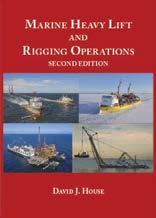
Marine Heavy Lift and Rigging Operation - Available Now A vital tool in handling shipping today
Hansen’s Ex-Meridian Tables - Available Now Used by mariners when a near miss occurs to still calculate their latitude
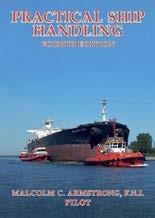
Practical Ship Handling - Available Now For trainee pilots and ships’ officers who aspire to be pilots
Sundial House, 17 Wickham Road, Beckenham, Kent BR3 5JS
EDITORIAL
Editor: Nigel Lawrence
E: editor@shippingtandy.com
The Editor welcomes the submission of editorial material which should be accompanied by return postage and submitted to the address above. Sundial Magazines Ltd. accepts no responsibility for loss or damage to materials supplied.
If you have a question or query you wish to raise with the Editor they should be writing to the Sundial Magazines address. The Editor is not based at the Tandy Media offices and asks for all enquirers to appreciate this fact and be patient. Please understand that the staff at Sundial Magazines do not have access to the information you require and therefore cannot answer your questions on the phone. Sundial Magazines cannot undertake research into specific or general queries.
Picture Guidelines: Please do not send originals and ensure your name and address is on all material submitted. All digital images should be at least 300dpi and with a print size width of 21cm. They can be sent by email but only individually.
SUBSCRIPTIONS
Subscriptions, back issues and binders are available from Shipping T&Y.
Annual subscription rates:
UK £56 Europe £73, Rest of the World £78.50 We accept cheques and postal orders in Sterling made payable to Shipping T&Y and can also accept most credit/debit cards. Shipping T&Y subs, Trinity House, Sculpins Lane, Essex CM7 4AY, UK
T; 01371 853638
E: shippingmag@ecosubs.co.uk
ADVERTISING
Advertising Manager: Simon Briant
T: 01273 594455
E: simon@sdbmarketing.co.uk
Shipping T&Y reserves the right to suspend or refuse any advertisement without giving reasons. Whilst every care is taken to avoid mistakes Shipping T&Y cannot be liable in any way for any errors or omissions. Nor can the publishers accept responsibility for the bona fides of advertisers.
COPYRIGHT
All articles, images and illustrations published in Shipping Today & Yesterday are strictly copyright of the authors and the publisher and may not be reproduced in any form without prior written permission. All photos are the property of the Editor unless otherwise stated.
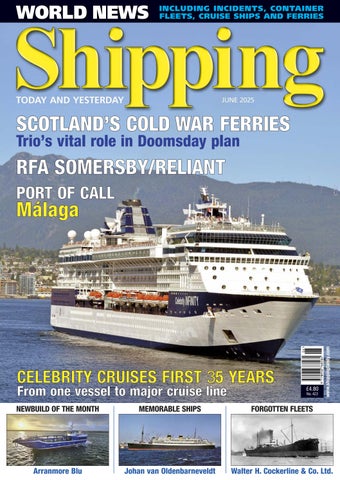
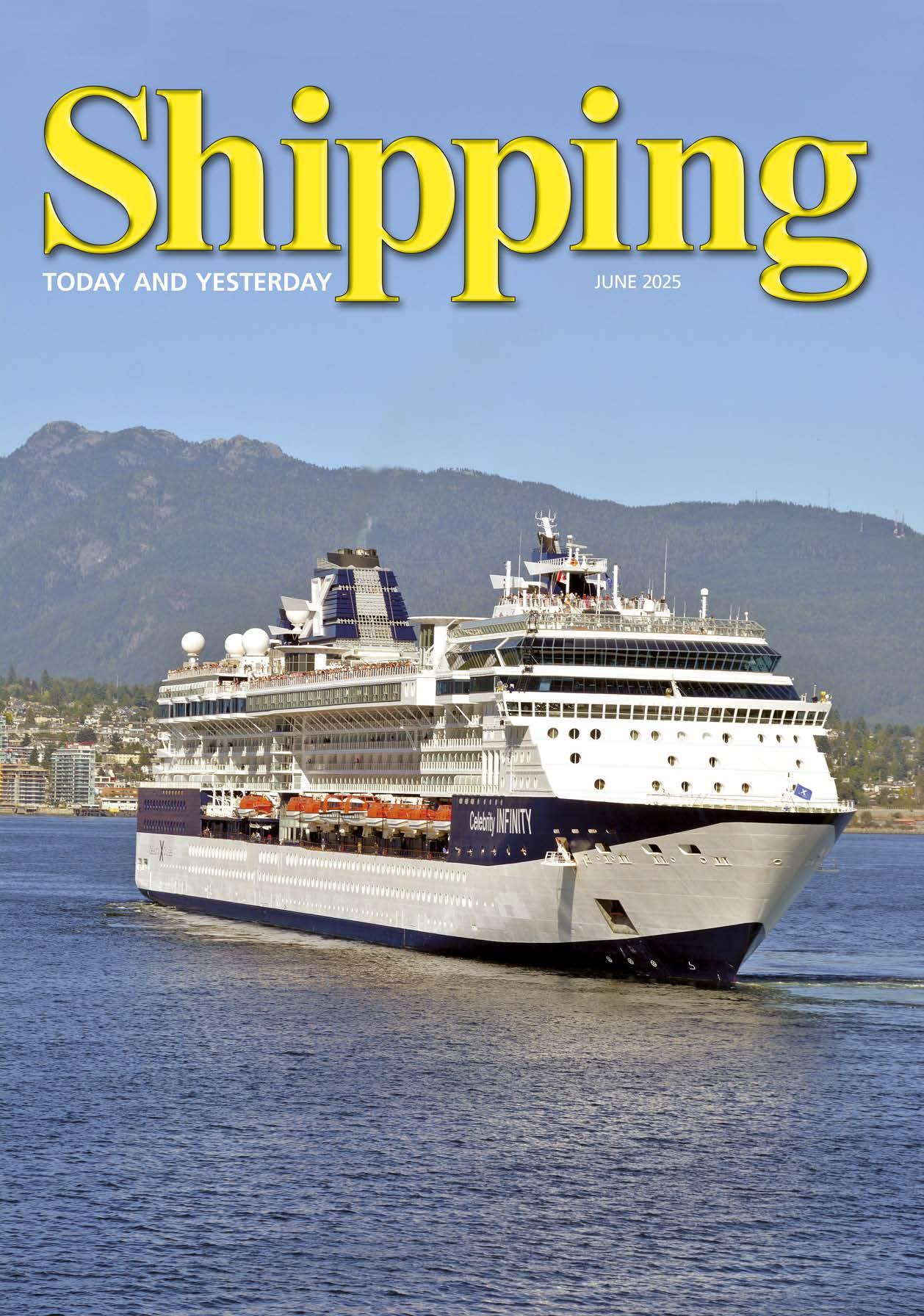
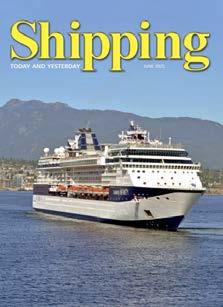
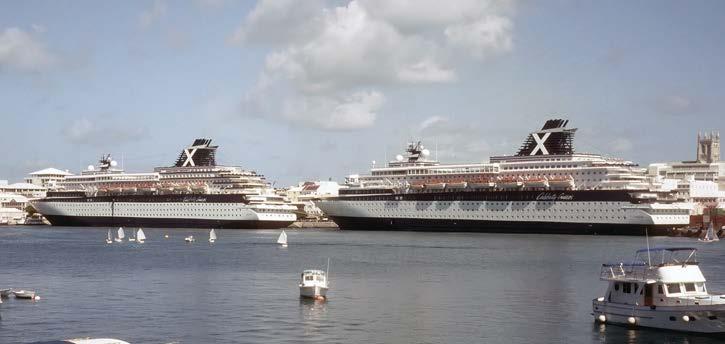
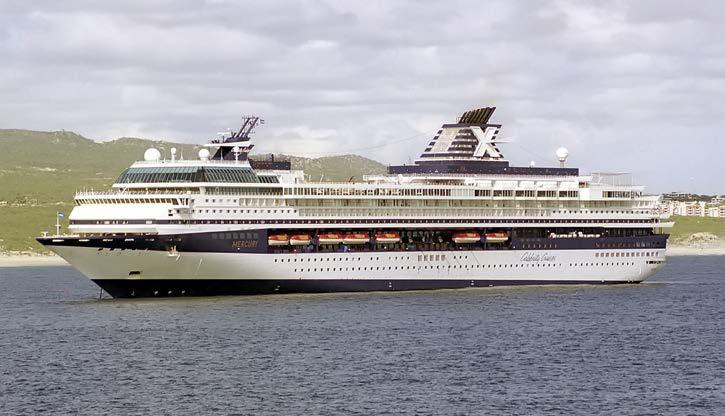
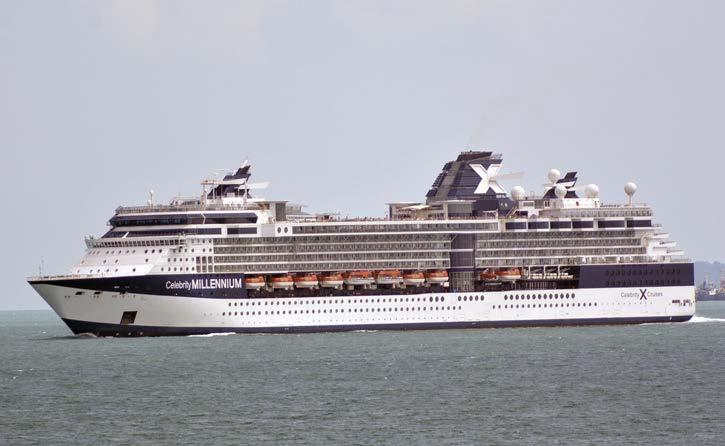
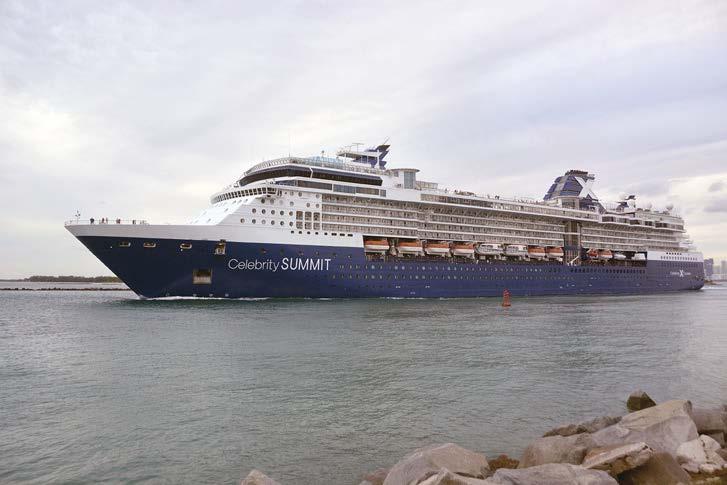
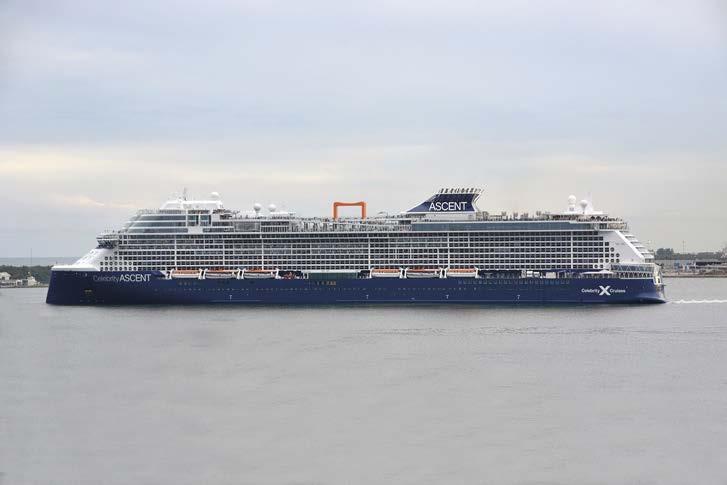
90,940gt Celebrity Infinity of Celebrity Cruises leaving Vancouver on 27th August 2017. She was built in 2001 by Chantiers de l’Atlantique at Saint Nazaire..
NOTABLE INCIDENTS
We start this month with an update on the 2,478 TEU MSC Baltic III which stranded on the inaccessible rocky coastline of Cedar Cove, Newfoundland at the end of February. MSC contracted T&T Salvage to develop a strategy for dealing with the wreck after it emerged refloating the stricken vessel was no longer a viable option due to hull damage. By the end of March, the plan was for T&T Salvage to fix up an all-terrain vehicle trail that leads from Lark Harbour to Cedar Cove extending the track to the bow of the ship so that trucks could be used to offload the fuels, oils and lubricants safely from the ship. Another priority was the removal of any hazardous cargo although it transpired 283 of the 473 containers onboard were empty.
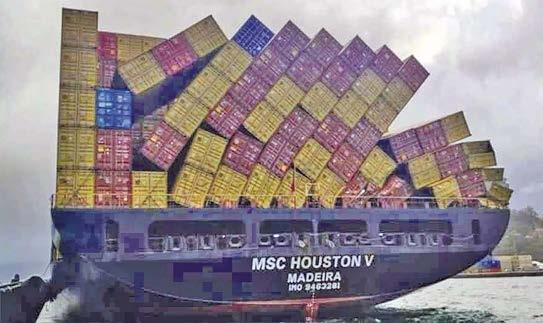
The Portuguese-flagged 4,432 TEU MSC Houston V (above) lost at least 15 containers after encountering Storm Martinho with big seas and winds of up to 48 knots off Cape St Vincent. With collapsed stacks of containers at her stern leaning precariously to starboard the ship deviated for an unscheduled call at Vigo’s Termavi Terminal where the authorities pondered how to deal with the problem in a safe and systematic fashion.
Losing rather more boxes was SM Line’s 4,228 TEU capacity SM Portland after encountering a Pacific storm near the Bering Sea. The South Korean operator issued a customer after on 5th March stating, “Due to heavy rolling by the inclement weather, unfortunately, it caused cargo damage, including container loss, collapse, and damage of 115 containers”. In its 2024 annual report the World Shipping Council pointed out that just 221 containers were lost at sea in 2023 out of 250 million transported. The IMO also moved in 2024 to tighten the rules requiring reporting of container losses.
EDITOR’S LOG
A runaway tanker caused havoc in the Brazilian port of Santos in mid-March as the seven year old 114,000 dwt Aframax Olavo Bilac suffered rudder failure and ploughed into the dock before hitting a naval patrol boat which then collected two others and coming to rest as naval and port personnel ran from the scene.
Highlighting ongoing concerns about pilotage in the area Korea Line’s 174,000m3 LNG carrier SM Kestrel collided with the anchored 57,273 dwt bulk carrier Diamond Star II in the Bay of Gibraltar in the early hours of 18th March. Although damage to both vessels was slight it was a pertinent reminder that safety concerns arising from the more serious collision of the bulkier OS 35 and LNG carrier Adam LNG in 2022 remain unresolved.
Replicating similar events to those reported in the Baltic Sea in recent months the Togo flag, Chinese owned and crewed Hong Tai 58 was apprehended by Taiwan’s Coast Guard Administration (CGA) after reports that the Taiwan-Penghu No 3 undersea cable linking the outlying Penghu Island had been severed. The ship, whose bows show a different name, Hongtai168 had been tracked by patrol boats and remained anchored over the cable despite several warnings to leave the area and was escorted to Anping whilst investigations continued. The most recent incident follows the severing of another telecom cable back in January but on that occasion identifying the responsible ship was even more difficult as the vessel had three distinct but clearly very similar digital signatures, being the Tanzania or Cameroonflagged Xing Shun 39, or the Cameroon-flagged Shun Xing 39.
Finally, in these troubled times it is always heartwarming to hear evidence of kindness and bravery emerging from tragic circumstances where humanity, supersedes narrow self-interest. On 26th February the 224gt Indonesian fishing boat Hasil Abadi 28 caught fire in the Indian Ocean. Responding to the vessel’s distress signal, Captain Todor Todorov directed the 55,500 dwt Eleen Armonia to the scene, where despite the inherent risks the ship approached the burning wreck, plucked the fishing vessel’s 34 crewmembers from the bow and ultimately put out the fire with their hoses. Commending the actions of their ship’s Bulgarian, Ukrainian and Indonesian crew Eleen Armonia’s owner Eleen Marine commented, “This incident serves as a powerful reminder of the unbreakable bond among seafarers worldwide, where the duty to assist those in peril transcends national and commercial interests”.
Hapag-Lloyd begins the year with 300 vessels in its fleet and an 18.7% capacity boost in 2024, as it prepares for the launch of its Gemini partnership.
Hapag-Lloyd has also announced that it is has ‘fully secured’ the $4 billion financing for the 24 new LNG dual-fuel, ammoniaready container ships it ordered from two Chinese shipyards in October.
French container carrier CMA CGM has invited quotes from South Korean and Chinese yards to build another round of newbuildings. CMA CGM is looking for a dozen 18,000 teu vessels, and is also contemplating ten new 11,000 teu ships in addition to doubling its current order for twelve 15,500 teu ships from Hyundai Heavy Industries, all to be LNG dual-fuelled. Currently, with a 3.84 million teu capacity fleet, CMA CGM is now the second largest liner operator, behind MSC, having recently overtaken Maersk, and its 1.14 million teu orderbook far exceeds Maersk’s 757,980 teu.
Also on the hunt for new tonnage is Evergreen, apparently seeking eleven 24,000 teu newbuilds, Kawa Shipping has, ordered three 4,800 teu ships and German shipowner Elbdeich Reederei has returned to CSSC Huangpu Wenchong Shipbuilding for two 1,900 teu conventionally fuelled ships, with options for another two. Elbdeich’s previous order for four 1,250 teu methanol dual-fuelled box ships from Wenchong are on long-term chartered to Unifeeder after delivery. Yangzijiang Shipbuilding Group and New Times Shipbuilding Company Ltd. will each build 12 ships between 2027 and 2029. The demand for new container ships seems to be increasing at a high rate. Let's hope that world trade will sustain the demand for these ships. editor@shippingtandy.com
CONTAINER FLEETS
TPM25, the premier conference for the trans-Pacific and global container shipping and logistics community was taking place in Long Beach, California. The related Lloyds List report painted a vivid picture of how the world has been turned on its head in the space of a few short weeks. Two themes stand out, the future of global trade and global security in the context of the United States’ isolationist policies and apparent abandonment of its role as the world’s security blanket. As the report and indeed the conference speakers made clear, in the short-term it’s impossible to react to every twist and turn of Trump’s actions and besides which for many countries the US remains the largest and most valuable trading partner. However, even without this administration’s blunt approach, the perceived trend is towards an isolationist and unreliable America and that is likely to mean a redirection of trade in the medium to long term with shippers having to react accordingly.
So much for the long game. In the short-term the greatest impact on shipping was the proposed imposition of punitive new docking fees for Chinese owned and even more importantly Chinese built ships calling at US ports. By the time this column is published we’ll know. The proposed charges come out of recommendations from a report by the US Trade Representative (USTR), commissioned by the Biden administration to investigate China’s dominance of the shipbuilding industry. They identified various practices including artificially suppressed labour costs, forced technology transfer and intellectual property theft that it considers has given China an unfair advantage in the shipbuilding sector. Container shipping is likely to be the most impacted sector simply because of the multiple calls made by each vessel at US ports. Responding to the accusations and the USTR’s recommendations a spokesperson for China’s Ministry of Commerce commented, “The US measures will not only fail to revitalise its shipbuilding industry but will also raise shipping costs on related routes, exacerbate its domestic inflation, reduce the global competitiveness of US goods, and hurt the interests of its port operators and dockworkers”.
A consultation on the proposed charges drew a huge, generally negative response in the US, with little optimism that the charges would achieve their desired goal of promoting the USA’s own shipbuilding capacity whilst potentially disrupting long established supply chains and hitting the pockets of the American public, importers/exporters and shipowners. A Lloyds List article quoted domestic operators such as Seabourne Marine, Atlantic Container Line, Bermuda Container Line and Somers Isles Shipping amongst those saying their businesses would likely fold or at least have to relocate. For global operators any fees would mean limiting or even eventually avoiding US port calls which could increase congestion at key hubs. Reflecting widespread concerns Gisholt Shipping’s president Hans Laue, issued a stark warning suggesting in the worst case, scenario “Applying them as proposed could be Armageddon for American industries and American citizens across the board”.
The USTR plan would also mandate that a portion of US exports be carried on US-flagged and, eventually, US-built vessels, which almost certainly explained the visit of CMA CGM’s chief executive Rodolphe Saadé to the White House in early March. Saade, who recently courted Indian premier Narendra Modi at Marseilles regarding investments in that country’s shipbuilding infrastructure pledged a $20 billion investment over four years supposedly creating 10,000 jobs whilst stating ‘you can count on us to do as much as we can’. Pledging to order from US yards seems a savvy move as Trump announced tax incentives and it may allow CMA CGM to avoid the worst of the USTR fees.
CMA CGM is heavily committed to the US, operating terminals at New York and Los Angeles and is the main cargo carrier for retail giant Walmart. Interestingly though, the $20 billion investment relates to the expansion of container ports and the creation of an air cargo hub in Chicago with five new Boeing 777 freighters to be flown by American pilots.
Leaving the United States behind for a moment but sticking with the French carrier, CMA CGM’s seemingly inexhaustible investment in new and second-hand tonnage this year persisted into early March as it nominally superseded Danish rivals Maersk to the title of world’s second largest container line based on current and ordered capacity. Ignoring the USTR’s port fee threat the Marseille-based operator contracted the Chinese state run CSSC’s Jiangnan Shipyard for twelve 18,000 TEU container ships in a deal reputedly worth about $2.6 billion. This adds to the dozen which it ordered from HD Hyundai Heavy Industries in Korea earlier in the year. The LNG dual-fuel ships are scheduled for delivery in 2028 and 2029.
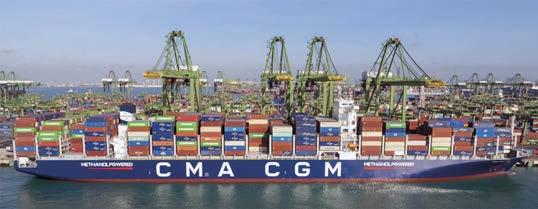
Meanwhile the company’s first 13,000 TEU dual-fuel methanol vessel, the Hyundai Samho Heavy Industries built CMA CGM Iron, debuted at Singapore in early March (above). The ship will be joined by her elemental sisters CMA CGM Cobalt, CMA CGM Argon, CMA CGM Platinum, CMA CGM Mercury, CMA CGM Helium, CMA CGM Krypton, CMA CGM Thorium, CMA CGM Silver, CMA CGM Copper and CMA CGM Gold progressively through 2025 and 2026.
On a very different scale CMA CGM also announced an order for a single 182 TEU fully electric river containership from another Chinese yard, Shandong Xinneng Shipbuilding. The vessel is part of an undisclosed investment in Vietnamese infrastructure projects which includes a solar farm for recharging at the company’s part-owned deep sea Gemalink Terminal in Cai Mep. When she starts operations in 2026 the vessel will be employed on a 180 km route from factories in Binh Duong province, shipping in the region of 50,000 TEUs per annum including those for Nike the sportswear retailer which is directly backing the project.
The French operator was also busy introducing a new service with the 6,552 TEU CMA CGM Nansha’s 8th April departure from Shanghai inaugurating the SEAS 3 weekly service linking the Chinese port with Santos outbound via Shekou, Vung Tua and Singapore, returning direct. Santos is a key hub with feeder services linking to the La Plata ports of Montevideo and Buenos Aires Brazilian coastal ports and up the Amazon and even via the BRAZEX service Cartegena in Columbia.
Hamburg based Peter Döhle Schiffahrts promptly exercised the options for a pair of 8,400 TEU to supplement the three ships ordered just a couple of months earlier from CSSC Guangzhou Shipyard International (GSI). The LNG dual-fuel vessels costing just over $120 million will be delivered between 2027 and 2028. Meanwhile another German operator, Hapag-Lloyd, decided to
CMA CGM
take a different approach to increasing capacity with analysts Alphaliner reporting that seven ships are heading to COSCO’s Zhoushan Shipyard to have their capacities increased from 9,324 TEU to around 10,200 TEU. The relevant changes include raising the deck house by 5 metres to provide bridge visibility over the taller forward stacks facilitated by heightened lashing bridges and a taller funnel to take gases above the aft container stacks.
The unrivalled number one tonnage operator in the container ship sector remains the Mediterranean Shipping Co. (MSC). According to industry analysts Alphaliner MSC made the surprise announcement in March that it would be redeploying the 19,200 to 24,300 TEU megamax ships currently linking the Far East and Northern Europe and replacing them with somewhat smaller 14,700 TEU units. The larger vessels will be moved to the AsiaMediterranean and Asia-West Africa services. Another analyst, Sea-Intelligence suggests the answer lies in the relative spot rates with those in Northern Europe trade falling more steeply than their southern equivalents. The move comes shortly after MSC closed down its service linking the Far East with the US northwest stating, “In response to current market conditions for Transpacific trade, we have decided to deploy tonnage intended for our Mustang service to trades in other parts of the world”.
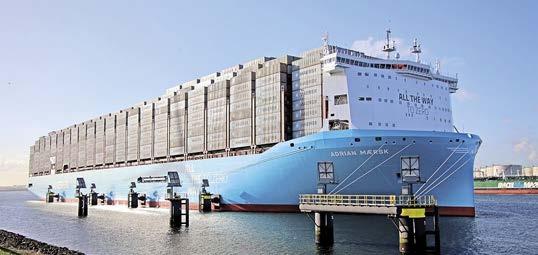
On 27th March Maersk christened the modern dual-fuel Adrian Mærsk (above) at the APM Terminals Maasvlakte II in Rotterdam. The vessel, with a capacity exceeding 16,000 TEU, is a crucial part of Maersk’s decarbonization strategy for maritime transport.
Despite all the multiple uncertainties surrounding container shipping a buoyant second hand market was evident back in March. Whilst Seaspan’s sale of the fourteen year old, 8,500 TEU sister ships Charleston and Shenzhen to charterers Zim Lines was something of an exception activity in the feeder sector was particularly noteworthy as brokers Braemar commented, “Owners of feeders continue to enjoy the luxury of choice between an active sale and purchase market or a still buoyant charter market, where two-year charters have become increasingly commonplace”. Evidence of this included Tsakos selling the 18 year old 2,824 TEU Irenes Rythm as part of a broader fleet renewal programme which has seen eight new feeder vessels introduced in the last couple of years and fellow Greek’s Eastern Mediterranean Maritime which disposed of the 2,192 TEU 2015built Haris (above) to Neptune Pacific Direct Line (NPDL) which operates services in the South Pacific for a reputed $31 million.
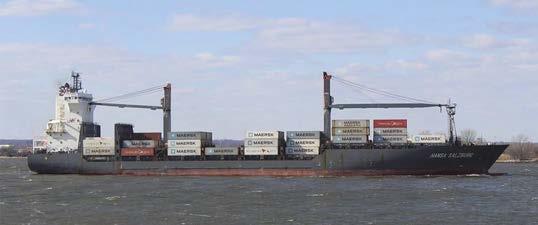
Meanwhile German owners Bernhard Schulte and Leonhardt & Blumberg were reported to have sold the 3,500 TEU Gottfried Schulte and the 1,738 TEU Hansa Salzburg (above) to undisclosed and Chinese interests respectively whilst Oslo based MPC Container Ships (MPCC) sold five vessels, with their respective charters to Contships Logistics en bloc at the end of March. The ships involved were the 2,000 TEU fifteen year old AS Alexandria and AS Anita, and the slightly older 1,300 TEU AS Filippa, AS Fabrizia, and AS Floriana. Delivery to the Greek operation was scheduled between April and June 2025.
Bengal Tiger Line (BTL), the Singapore based feeder operator announced that it was expanding operations into the Mediterranean in conjunction with Turkish operators Arkas and Turkon Line. The new service links Turkey with western India via the Red Sea with calls at Istanbul, Ambarli, Yarimca, Nemrut Bay, Mersin, Aqaba, Jeddah, Nhava Sheva and Mundra returning via Jeddah, Aqaba, El Dekheila and Izmit.
In other news, returning to geopolitics, the big story was the highly controversial sale of Hong Kong based CK Hutchison Holding’s ports division to BlackRock and Mediterranean Shipping Co (MSC) for $22.8 billion. The geopolitical ramifications of such a move, which relate to two facilities in Panama led the Chinese administration to strongly criticise the proposed transaction causing CK Hutchison’s share price to fall. Whilst the company considers the move a legitimate business transaction resulting from an openly competitive bidding process, China views it as another example of the US administration exerting unnecessary pressure and influence labelling the move “a betrayal of all Chinese people” in a strongly worded editorial in the mouthpiece publication Ta Kung Pao that was then reproduced in full on government websites.
Staying with ports, DP World, the Emirate based port operator began the £1bn expansion of its London Gateway facility in May, a four year project which will add two 400 metre all-electric berths and a second rail terminal. When completed the work will make London Gateway the largest container port in the UK. A company press release summed up the end goal stating, “The expanded container port, part of the Thames Freeport, will be able to accommodate six of the world’s largest container ships, which will be served by Europe’s tallest quay cranes” whilst Sultan Ahmed bin Sulayem, CEO and group chairman of DP World, said, “This investment enhances London Gateway’s position at the heart of British trade, creating new capacity and new connections between the UK and the global economy. DP World has invested more than £5 billion in its UK operations, providing more than 5,500 jobs, and is proud to be supporting national economic growth by enabling businesses to thrive and increasing resilience in the supply chain”. Meanwhile representing the first tangible evidence of the deal reached with the Gemini Co-operation (Maersk and Hapag-Lloyd) last year the alliance’s Maersk Stadelhorn, docked at London Gateway on 19th March as part of its ME2/IEX India-Europe service, before continuing on to Hamburg, Tanger Med, Colombo, Kamarajar, Algeciras, and Rotterdam.
Dave Smith collection/photo-transport.com/M. Faeth
Delaware River Ship Spotting
GWRDave
BULK AND TANKER NEWS
Ningbo Marine have taken up the option for another pair of 64,000 dwt 200m long ultramax bulker newbuilds from their compatriot Jiangsu Haitong Offshore Engineering Equipment shipyard with delivery scheduled for the latter half of 2027. The $74 million combined order comes on the back of the original two ships which were ordered last November. The orders mark a considerable expansion for the company which currently operates three slightly smaller 50,000 dwt units.
Chinese Maritime Transport (CMT) placed an order for a further pair of 210,000 dwt scrubber fitted vessels to supplement the two that were ordered from the same domestic CSBC Corporation yard in August 2024. Priced at $77.5 million each, the ships are pencilled in for delivery in 2027 and 2028. Meanwhile another Taiwanese based dry bulk operation, the wonderfully named Wisdom Marine Line’s placed an order for a pair of 39,000 dwt handysize ships from Japan’s Naikai Zosen, representing an investment of just over $70 million.
Having disposed of twenty vessels in 2024 Germany’s largest Dry Bulk owner/operator Oldendorff Carriers continued in the same vein this year selling the 93,000 dwt post-panamax Cora Oldendorff to undisclosed Chinese interests back in February. The sale of the Taizhou Catic-built vessel realised about $14 million, representing a healthy profit over the $9.5 million paid by the Lübeck based company in 2017.
Jinhui Shipping & Transportation sold the veteran 53,350 dwt Jin Shun to fellow Chinese interests Yuhe Shipping of Hong Kong back in March, realising $8.26 million for the 18 year old supramax with delivery scheduled for the end of May. Meanwhile Precious Shipping acquired the much newer 2020 built 63,688 dwt ultramax Western Singapore from Western Bulk Chartering which had previously exercised a purchase option after having the ship on long-term charter from Japan’s Nisshin Shipping.
Hyundai Merchant Marine (HMM) the South Korean owner/operator perhaps predominantly associated with the container sector invested $49.2 million to acquire the eleven year old 207,800 dwt newcastlemax bulk carrier Oriental Dragon back in February. For the Chinese sellers, Hosco Hong Kong, the ‘flip’ sale netted a small profit having purchased the ship just a year earlier from OMC Shipping for $48.5 million.
Konstantinos Konstantakopoulos-led Costamare have created a new entity Costamare Bulkers Holdings as it splits shipping divisions to create two distinct public traded companies in the containership and dry bulk sectors. To be listed on the New York Stock Exchange the newly formed dry bulk division will consist of about 40 owned and 50 chartered vessels in the Newcastlemax, capesize and Kamsarmax categories.
Having sought to cash in on the scrapping of two Iranian ‘shadow fleet’ tankers it appears that recyclers in Bangladesh may not be in a position to deal with the vessels after all. Having arrived off Chattogram (also known as Chittagong) in early March the fate of the 300,000 dwt Itaugua and Artemis III already hung in the balance even before the former was included in a new raft of US sanctions aimed squarely at Iran. Meanwhile it was reported that the German authorities have confiscated the 152,000 dwt Eventin which broke down in the Baltic whilst laden with sanctioned Russian crude oil and was towed to the Sassnitz anchorage off Rugen back in January 2025.
Singapore based Adhart Shipping has placed two firm orders with options for a further pair of 50,000 dwt MR tankers. What makes the order particularly noteworthy is that it represents the company’s first newbuilds in 18 years of trading and the choice of builder, China’s New Dayang shipyard.
Greece’s Capital Group ordered two firm 320,000 dwt VLCCs from South Korea’s Hanwha Ocean with the option for a third. The initial pair of scrubber-fitted tankers will cost $375m with delivery dates in 2027.
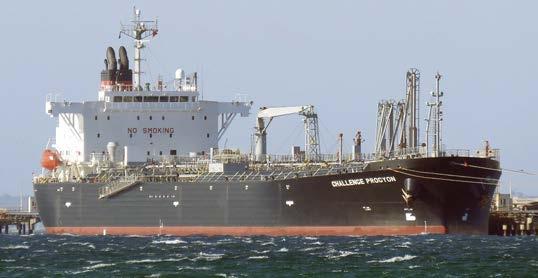
Making up for a three year barren patch in the market, no sooner had Velos tankers introduced the fifteen year old 36,700 dwt MR1 tanker Velos Rubini (formerly the Easterly Sirius) than they invested a further $19 million in the 14 year old 146,000 dwt Challenge Procyon (above) purchased from Kyoei Tanker.
Supertanker specialists DHT sold the fourteen year old Bohai Shipbuilding Heavy Industry built 320,000 dwt VLCC DHT Lotus, for around $55 million back in March. The disposal comes not long after the disposal of the vintage DHT Scandinavia as part of a conscious upgrading of the company’s fleet with four newbuilds on order and due for delivery next year.
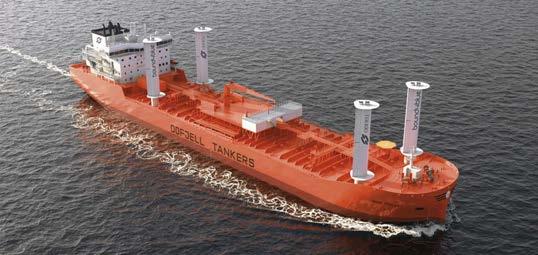
Odfjell’s 49,000dwt chemical tanker Bow Olympus (above)r eturned to service in March sporting four 22 metre-high eSAIL® suction sails supplied by Spain’s bound4blue and installed over a couple of days at the EDR Antwerp Shipyard. Preparatory work had been completed late last year at China’s Chengxi Shipyard.
As part of its own Environmental Vision Japan’s Mitsui OSK Lines (MOL) and Belgium’s CMB.TECH have formed a partnership to jointly own and charter, to associate MOL Chemical Tankers for between 7 and 10 years, two ammonia dual fuel and four ammonia ready chemical tankers. All six vessels will be built by China Merchants Jinling Shipyard (Yangzhou) Dingheng Co. Ltd. with delivery dates pencilled-in between 2028-29. The collaboration also includes an order for three ammonia dual fuel newcastlemax bulkers to be built at CSSC Qingdao Beihai Shipbuilding and delivered between 2026 and 2027.
Odfjell
CRUISE NEWS by Andrew & Donna Cooke
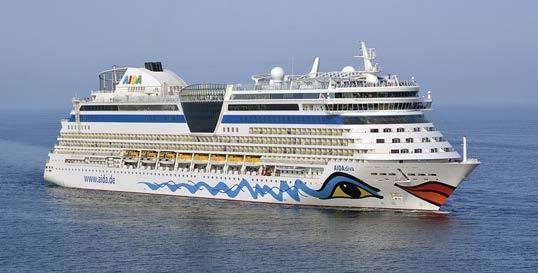
AIDA Cruises 69,203gt/2007-built AIDAdiva (above) has become the first of 7 ship modernisation projects to be completed under AIDA’s Evolution programme. The ship underwent a 7week dry dock overhaul at the Chantier Naval Shipyard in Marseille, France, from 3rd February to 21st March 2025. The company stated that the overhaul included new technology, upgraded staterooms, new restaurants and expanded entertainment. Work includes 6 family-friendly suites and associated sun decks being built at the stern. In some suites, 5-bed occupancy plus a baby cot is now available. Suite guests also have access to the Sky Deck and the Rossini Lounge. In the autumn the ship will embark on her first world cruise from 10th November 2025 to 23rd March 2026, from Hamburg to five continents and through 27 countries in 133 days. For the first time on an AIDA world cruise, the east and west coasts of the USA and Japan are featured, with Hawaii featured for New Year’s Eve.
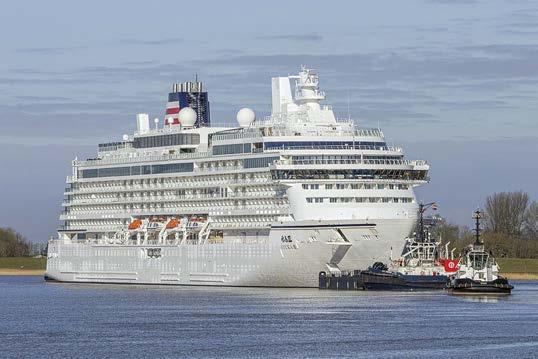
Asuka Cruises’ 51,950gt/2025-built Asuka III commenced sea trials on 9th March from Eemshaven. The company is part of the NYK Group, and she was built by Meyer Werft at Papenburg. The newbuild transitted the Ems River on 2nd/3rd March (above). Following the sea trials, the Japan-flagged ship was expected to be handed over to the NYK Group in early April 2025. Ordered in March 2021, the Asuka III is the first cruise ship built for the Asuka Cruise brand in over three decades. The ship will operate alongside the 50,444gt/1990-built Asuka II and showcases Japanese artists, including Hiroshi Senju’s fresco in the Gallery Café (Deck 6) and Reiji Hiramatsu’s paintings in the Noblesse Restaurant (Deck 6).
Carnival Cruise Line’s 85,920gt/2001-built Carnival Spirit welcomed guests back aboard in Barcelona over the weekend of 15th/16th March following her 4-week dry docking that incorporated various upgrades and enhancements onboard. She then sailed for Miami via Malaga, Cadiz, Ponta Delgada and Hamilton before sailing through the Panama Canal to Seattle to reposition for the summer season. She arrived in Miami on 30th March before her 15-day voyage onward to Seattle. In September, the ship will sail to Hawaii from Seattle followed by a one-way voyage from Seattle to New Orleans in October before returning to her seasonal homeport of Mobile.
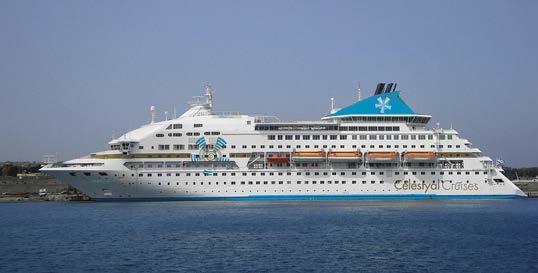
Celestyal Cruises’ 25,611gt/1980-built Celestyal Crystal (above), now renamed New Dawn, was sold to buyers in the United Arab Emirates for use as an accommodation ship. The ship was originally built as the Baltic cruise-ferry Viking Saga, but she has been substantially rebuilt twice in her 45-year career.
Crescent Seas, a new residential cruise operation, is planning to launch a new luxury residential cruising product onboard the 28,803gt/1999-built Navigator in 2026, the former Seven Seas Navigator. The new company is associated with Crescent Heights, a real estate development company based in Miami, Florida. The management details include Norwegian Cruise Line and the Apollo Group, overseeing the technical and hotel management of Crescent Seas’ first vessel respectively. The Navigator is due to embark upon her maiden voyage in December 2026 and the company says that she will offer exclusive private residences, bespoke hospitality, ultramodern amenities and immersive global exploration. The ship will depart from PortMiami and will offer 1, 2 and 3-bedroom residences with costs ranging from $500,000 to $8,000,000. The Navigator will feature 7 dining options, including a steakhouse and an Italian restaurant, bars and lounges, a co-working space, a podcast room, and a series of flex studios, which can be used for workshops, cooking classes, art classes and music lessons. A garden lounge with hydroponic plants will also be incorporated plus a wine room and a new spa and fitness centre.
Cunard Line’s 90,901gt/2010-built Queen Elizabeth had her new look unveiled on 18th March 2025 ahead of her debut season sailing from Miami and her inaugural Alaska voyages from Seattle. The 2,000-guest ship completed a transformative 3-week makeover at Seatrium’s Admiralty Yard in Singapore on 14th March. The Queen Elizabeth’s debut Alaska season from Seattle begins on 12th June, while her inaugural Caribbean voyage from Miami departs on 16th October, a 12-night roundtrip sailing offering guests the chance to visit Bridgetown’s UNESCO-listed Garrison and bustling markets of Castries, St Lucia. The Queen Elizabeth’s signature spaces such as the Commodore Club, Queens Room, Garden Lounge and The Pavilion have each been thoughtfully revitalised, connecting guests to the ocean while providing the perfect space to relax or enjoy al fresco dining. Outdoor decks have also been revamped to give guests better opportunities to admire Alaskan glaciers or Caribbean vistas, with more sunshades to the aft deck to accommodate warmer weather. The story behind the Queens Room redesign, which exudes the elegance and luxury reminiscent of the golden age of ocean travel, takes inspiration from the Royal Palace’s heritage of planting Mulberry trees since King James I, with its new carpet pattern replicating a lush garden shrubbery. The Grills, a hallmark of Cunard’s luxury offering, has also been elevated. Guests staying in the exclusive Grills suites now enjoy enhanced interiors and exteriors .
For the first time in Cunard’s history, one of their fleet members will spend the full season in Miami and the Queen Elizabeth will offer a dedicated programme of roundtrip
Nigel Lawrence Celestyal Cruises
Hans Joachim Hellman
Caribbean voyages with itineraries ranging from 9 to 28 nights. So, the ship won’t be seen back in UK waters for a while yet.
The same can be said for P&O Cruises’ 115,055gt/2010-built Azura, which underwent refit in No. 6 Dock at the Palumbo Malta Shipyard in Malta before continuing fly-cruise itineraries.
On 25th March Cunard announced an exciting partnership with Sail4th 250, the non-profit organisation overseeing celebrations in the Port of New York and New Jersey for America’s 250th anniversary next year. The 149,215gt/2003-built Queen Mary 2 will take pride of place at the heart of the landmark event, offering guests a once-in-a-lifetime vantage point in what promises to be an unforgettable moment in history. The 6-day centrepiece of America’s milestone anniversary will feature the largest international flotilla of tall ships and naval vessels ever assembled. Some 17 nations have already committed their tall ships to participate, and the U.S. Navy has invited scores of others. More than 30 tall ships are expected. The celebration will also include festivals, public access to the tall ships, a massive fireworks display, and an exhibition of 18th-century historic documents. Planners expect eight to 10 million spectators to line the 15-mile New York/New Jersey shoreline to view the 4th July parade of tall ships and naval vessels, with events planned from 3rd-8th July, 2026. From her prime position in New York Harbour, guests on board will have unrivalled views of the largest gathering of tall ships and naval vessels ever seen in the city. The spectacle will continue with a dramatic military flyover, culminating in a breathtaking fireworks finale over the Manhattan skyline. Cunard’s Independence Day Spectacular Voyage will then continue to Newport, Rhode Island, and Halifax, Nova Scotia, where guests can explore two of North America’s most charming and historic ports.
Disney Cruise Line’s new 135,000gt/2025-built Disney Destiny touched the water for the first time at the Meyer Werft shipyard in Papenburg, Germany in late March. As the third in a series of ships that started with the Disney Wish in 2022, the Disney Destiny is set to offer cruises departing from Port Everglades as from November 2025.
Explora Journeys’ 63.621gt/2004-built Explora II, the latest addition to the Explora fleet, offering exclusive 2-night (24th-26th May 2025), 3-night (23rd-26th May 2025), and 4-night (22nd-26th May 2025) stays during the Formula 1 TAG Heuer Grand Prix De Monaco 2025. As the only luxury ship docked in Monaco’s iconic Port Hercule, the Explora II provided an unmatched experience in the heart of the action throughout race weekend.
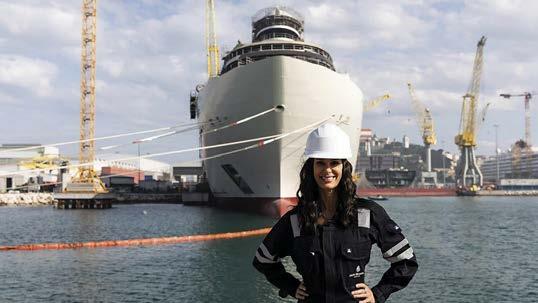
Four Seasons’ gain is Celebrity Cruises’ loss as Captain Kate McCue (above) was announced on 18th March as having been appointed by Four Seasons Yachts, which enters service in early 2026. A graduate of the California Maritime Academy, Captain Kate brings nearly three decades of maritime expertise to the role. The company said she was a pioneer in the industry as she made history in 2015 as the first American female captain of a mega cruise ship.
CRUISE NEWS
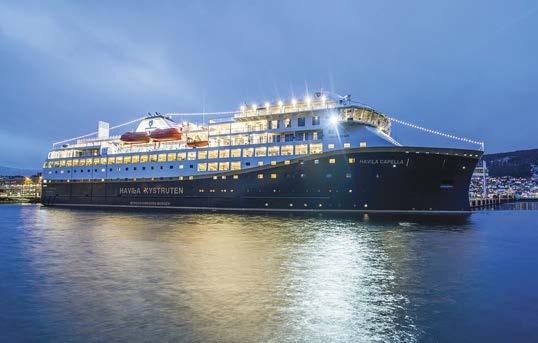
Havila Voyages is part of the Norwegian LNGameChanger consortium that has teamed up to develop a new solution for decarbonising maritime transport by capturing and storing CO2 from LNG-fuelled Solid Oxide Fuel Cell (SOFC) power trains. The project is lead by maritime technology supplier HAV Group, plus Havila Voyages, natural gas company Molgas Norway (formerly Gasnor), and research institution SINTEF. The potentially gamechanging research project was unveiled on 26th March at a press conference in Ålesund, Norway, held onboard Havila Voyages’ 15,519gt/2021-built coastal cruise ship Havila Capella (above). The LNGameChanger project’s primary objective is to design an innovative, decarbonised maritime LNG-fuelled power train combining solid oxide fuel cells (SOFC) and high-efficiency onboard CO2 liquefaction and storage, resulting in a CO2 equivalent intensity between the 2045 and 2050 emission limits.
Hurtigruten revealed in late March an updated ship design after successful Model Testing in Norway. Hurtigruten’s vision for the world’s most energy-efficient cruise ship is advancing, with its groundbreaking Sea Zero project recently completing a new phase of rigorous testing at SINTEF Ocean’s facilities in Trondheim, Norway. Large battery packs, retractable sails, air lubrication systems, contra-rotating propellers and an energyoptimised hull are among the innovations being evaluated.
Hurtigruten wants to design a ship that can sail without emissions in normal operation on the Norwegian coast from around 2030. Following months of testing, the ship design has been further refined to be longer, lower, and more stable, now featuring two large retractable sails, that can be raised or lowered as needed. The digital simulations and physical trials in Trondheim confirmed that the sails alone could reduce energy consumption by 10-15%. The Sea Zero concept aims to cut energy between 40-50% compared to today’s ships. With that reduction, batteries charged with shore power connectivity in key ports could make emission-free operations possible. The Sea Zero vessel will be 143.50m long, Hurtigruten’s longest to date and will now have 2 retractable sails with solar panels (10-15% energy savings).
Marella Cruises announced that Fincantieri and TUI have signed a Memorandum of Agreement (MoA) for the design and construction of two new cruise ships. The ships will be designed specifically for the English market and have a focus on environmental sustainability. The two vessels will be delivered in calendar year 2030 and 2032.
Marella Cruises has always operated with second-hand tonnage, with its current five-ship fleet consisting of the 69,742gt/1995-built Marella Discovery 2 and 72,458gt Marella Explorer 2, the 76,998gt/1996-built Marella Explorer and 69,742gt/1996-built Marella Discovery and the 77,302gt/1997built Marella Voyager.
Four Seasons
Havila
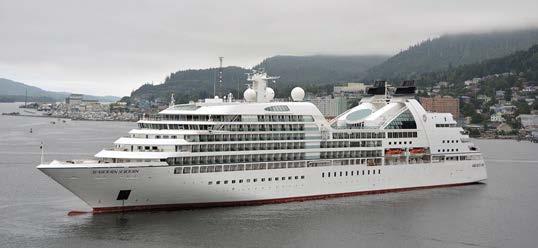
Mitsui Ocean Cruises have purchased the 32,477gt/2010-built Seabourn Sojourn (above) from Seabourn and Carnival Corporation. The sale to the Japanese cruise brand, a subsidiary of Mitsui O.S.K. Lines, Ltd. (MOL), was confirmed on 4th March. Following the sale, Seabourn has chartered the 458-guest ship back from Mitsui Ocean Cruises and continued to operate all published voyages through to completion of her world cruise ending on 15th May 2026. The Seabourn Sojourn will be delivered to Mitsui Ocean Cruises after the charter period and upon handover, the ship will be deployed by her new owners in a market that is “not competitive with Seabourn”, according to a statement. She will join the 32,477gt/2009-built Mitsui Ocean Fuji (ex-Seabourn Odyssey) and the 22,472gt/1990-built Nippon Maru in the Mitsui fleet. The Mitsui Ocean Fuji joined the fleet in December 2024.
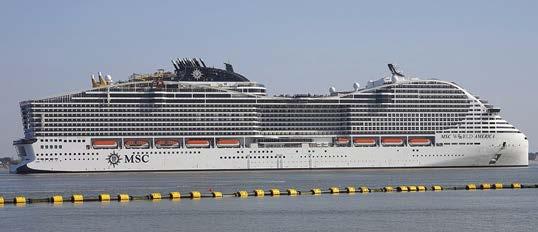
MSC Cruises officially named the 205,700gt/2025-built MSC World America (above) in Miami at the MSC Cruises Terminal on 9th April. After the ceremony, the MSC World America departed on a celebratory 3-night sailing to Ocean Cay MSC Marine Reserve in The Bahamas. While docked at Ocean Cay, the MSC Foundation hosted a ribbon cutting ceremony for its new Marine Conservation Centre. On 27th March the MSC World America was delivered with two further significant milestones marked with a coin ceremony for the MSC World Asia and the steel cutting for the newly named MSC World Atlantic at Chantiers de l’Atlantique in St. Nazaire. The MSC World America is the 23rd ship in the cruise line’s fleet. The traditional coin ceremony for the MSC World Asia involved commemorative coins placed inside the ship as a sign of blessing during construction and to bring good fortune to the ship. Two godmothers, Marialuisa Iaccarino, VP Shore Excursions for MSC Cruises and Flavie Biondo, Chargé d'affaires for Chantiers de l’Atlantique did the honours as part of this maritime tradition. The MSC World Asia will enter service in winter 2026-27 with sailings in the Mediterranean to destinations in France, Italy, Spain and Malta. MSC Cruises’ third celebration was a steel cutting ceremony to officially start the construction of the line’s fourth World Class ship, due to enter service in 2027. The ship’s name was revealed for the first time as MSC World Atlantic and she will be deployed in the Caribbean from Port Canaveral, U.S, from winter 2027-28. The World Class prototype set new standards in cruising with the introduction of the 215,863gt MSC World Europa in 2022, and the platform continues to evolve with each new ship incorporating innovations in design, technology and guest experience. The MSC World America’s inaugural season from Miami started on 12th April.
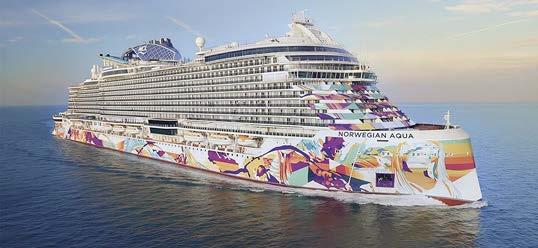
Norwegian Cruise Line’s 154,140gt/2025-built Norwegian Aqua (above) concluded her first passenger voyage on 26th March at Southampton having sailed from Lisbon on a weather disrupted itinerary. Marking a new chapter in NCL’s fleet evolution, the Norwegian Aqua is the first vessel in the cutting-edge Prima Plus Class. The Norwegian Aqua brings to life an array of industry-first and brand-exclusive features. Following her inaugural voyage, the Norwegian Aqua visited Zeebrugge on 27th March before embarking upon a Transatlantic voyage to the USA on 28th March where she was officially christened in Miami on 13th April, with Emmy Award-winning actor Eric Stonestreet serving as her godfather. She then homeported in Miami, and Port Canaveral (Orlando), as well as New York City until March 2027. The ship was delivered at Fincantieri’s Maghera Shipyard on 13th March and, that same day, the sistership Norwegian Luna was floated out of her building dock. The Norwegian Aqua became NCL’s 20th ship in the fleet. The vibrant hull art on the ‘Aqua is the work of Allison Hueman, NCL’s first-ever female hull artist. She is worldrenowned for her street art & global brand collaborations. Her hull art for the Norwegian Aqua, entitled "Where the Sky Meets the Sea”, is curated by Goldman Global Arts and evokes modern mythology through colourful mashups of abstract and figurative representations of sea and sky, ruled by ancient goddesses.
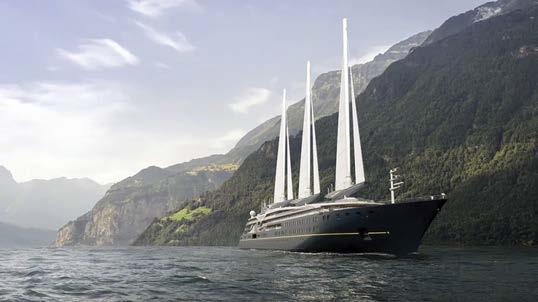
Orient Express announced on 4th March that the Orient Express Corinthian (artists’s impression above) will set a new standard of excellence in June 2026 when she’ll become the world’s largest sailing yacht. She will take to the open sea, tracing a course through the French and Italian Rivieras, jewels of the Mediterranean and Adriatic seas. The Orient Express Corinthian is the product of a visionary collaboration between Orient Express and Chantiers de l’Atlantique. Designed with both grandeur and purpose, the vessel will be 220m in length, with three towering masts supporting 1,500m2 of rigid sails. The Orient Express Corinthian is the first sailing yacht equipped with the revolutionary ‘SolidSail’ propulsion system. Three tilting, rotating masts optimise performance under sail, harnessing the wind with exceptional efficiency and reducing reliance on conventional fuels. This advanced system is further supported by a hybrid propulsion solution powered by LNG. The commitment to sustainability runs deep. An AI-driven detection system minimises the risk of marine mammal collisions, while dynamic positioning technology eliminates the need for anchoring.
Nigel Lawrence Fincantieri
Orient Express
Wikipedia
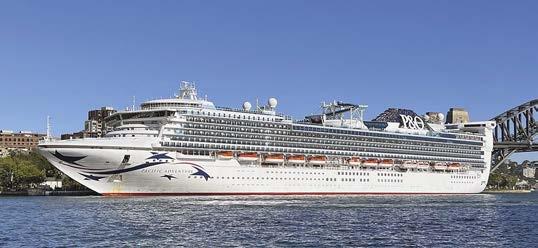
P&O Cruises Australia 108,865gt/2001-built Pacific Adventure sailed from Sydney on 10th March 2025 on her final voyage under the P&O Cruises Australia banner. The itinerary had to be changed due to Tropical Cyclone Alfred. Upon completing the cruise on 14th March, the Pacific Adventure underwent a technical upgrade and rebranding process before joining Carnival Cruise Line’s fleet as the Carnival Adventure. The 108,977gt/2002-built Pacific Encounter ended her P&O career for the company early as her 8th March departure was cancelled, also due to Tropical Cyclone Alfred. The ship finally returned to Brisbane on 11th March. The same process as for her fleet mate in Melbourne then followed, and she became Carnival Encounter. Carnival took advantage of the makeover to train the crew onboard, 96% of which were staying onboard for the brand transition from P&O Australia to Carnival Australia. The Carnival Adventure was scheduled to make her debut on 29th March, departing from Sydney for a 4-night cruise to Moreton Island. That same day, the Carnival Encounter sailed from Brisbane for a 7-night cruise to the South Pacific islands.
Ponant announced on 17th March that it is embarking on a new chapter in its history, becoming Ponant Explorations Group. This evolution followed the recent acquisition of a majority stake in Aqua Expeditions, supporting the Group’s international growth strategy. By embracing this new identity, the company reinforces its ambition to accelerate its development while strengthening its position in a dynamic and evolving market. The Group now includes three commercial brands, namely Ponant Explorations, Paul Gauguin Cruises and Aqua Expeditions.
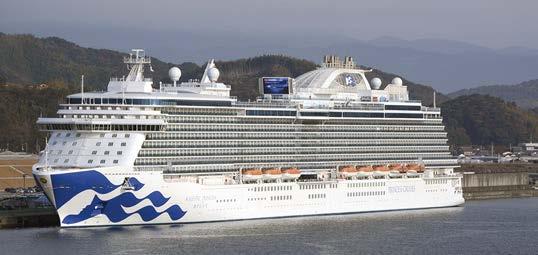
Princess Cruises’ 144,216gt/2017-built Majestic Princess (above) returned to Europe in early March after 8 years. The ship embarked on a trans-Atlantic crossing to Spain on 18th February 2025 from Fort Lauderdale to Barcelona. After an initial 7-night cruise in the Western Mediterranean, the vessel entered drydock for routine maintenance on 11th March at Fincantieri’s Palermo shipyard. After refit the ship offered both Mediterranean and Northern Europe cruises from 1st April before returning to North America for an autumn season in Canada and New England. The ship is then set to return to the Caribbean during the 2025-26 winter for cruises departing from Fort Lauderdale’s Port Everglades. Originally built for the Chinese market, the Majestic Princess entered service for Princess Cruises in 2017. The 145,281gt/2019-built Sky Princess arrived back at Southampton on 24th March to begin her 2025 season.
CRUISE NEWS
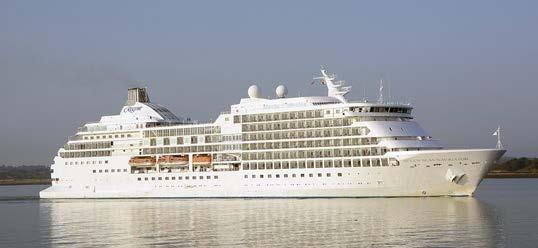
Regent Seven Seas Cruises announced on 21st March that the 28,803gt/1999-built Seven Seas Navigator (above) would be leaving its fleet in late 2026. The ship will be handed over to Crescent Seas, which is described as a new brand offering luxury residences at sea. (see above). The ship was reportedly part of a $230 million deal between Crescent Seas and Norwegian Cruise Line Holdings. The Seven Seas Navigator will offer a farewell cruise on 2nd October 2026, sailing from Istanbul, Turkey, to Alexandria, Egypt. The Seven Seas Navigator was built at the T. Mariotti shipyard, using the hull that was originally designed for a Russian research vessel. The 490-guest luxury vessel set sail on her maiden cruise for Regent Seven Seas Cruises on 7th September 1999.
On 27th March Regent Seven Seas Cruises marked the keel laying for the Seven Seas Prestige at the Fincantieri shipyard in Marghera, Italy. Honouring the occasion and a longstanding maritime tradition, three specially selected coins were welded onto the keel of the ship. Dating from the ancient Greeks and Romans, the tradition will see the coins forever embedded into the ship’s structure, bringing luck for all who sail onboard. Set to be delivered in 2026, Seven Seas Prestige, follows the tremendous success of Regent’s Explorer-Class vessels, built by Fincantieri, and will be Regent’s first new ship class in 10 years. At 77,000gt and hosting up to 850 guests, the Seven Seas Prestige boasts one of the highest passenger-to-space ratios in the cruise industry, offering more “Unrivalled Space at Sea®” on a Regent ship than ever before.
StarCruises and Dream Cruises officially relaunched with a ceremony aboard the Star Voyager, which departed from Singapore on 26th March. The event marked a new chapter for both brands, which share a 30-year history and now operate under a renewed vision for cruising. The occasion also coincided with the 77,441gt/1997-built Star Voyager’s maiden voyage under the StarCruises brand. The ship will be based in Singapore and offer itineraries with stops in destinations such as Jakarta, Melaka, Bangkok and Ho Chi Minh City. Resorts World Cruises’ 75,338gt/1999-built Resorts World One has been renamed Star Navigator and will operate under the StarCruises banner from now on, focusing on East Asian itineraries. The 150,695gt/2016built Genting Dream will continue sailing as part of Dream Cruises.
TUI Cruises’ 157,651gt/2025-built Mein Schiff Relax undertook her inaugural cruise on 16th March from Barcelona on a 7-night itinerary prior to her maiden season in the Western Mediterranean. The ship will also offer additional week-long itineraries in the Mediterranean that visit destinations in France, Morocco and Portugal. On 9th April the ship was christened during a special ceremony in Málaga that included an open-air performance by Robbie Williams. In late October, the Mein Schiff Relax is set to reposition to the Canary Islands for her first winter deployment sailing from Santa Cruz de Tenerife and Las Palmas de Gran Canaria. Following a short spring season in the Mediterranean, the Mein Schiff Relax debuts in Northern Europe ahead of the summer of 2026.
Nigel Lawrence
Nigel Lawrence
Tony Martin
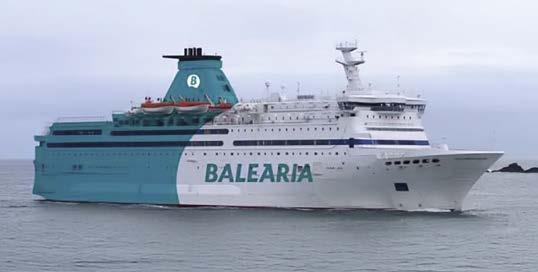
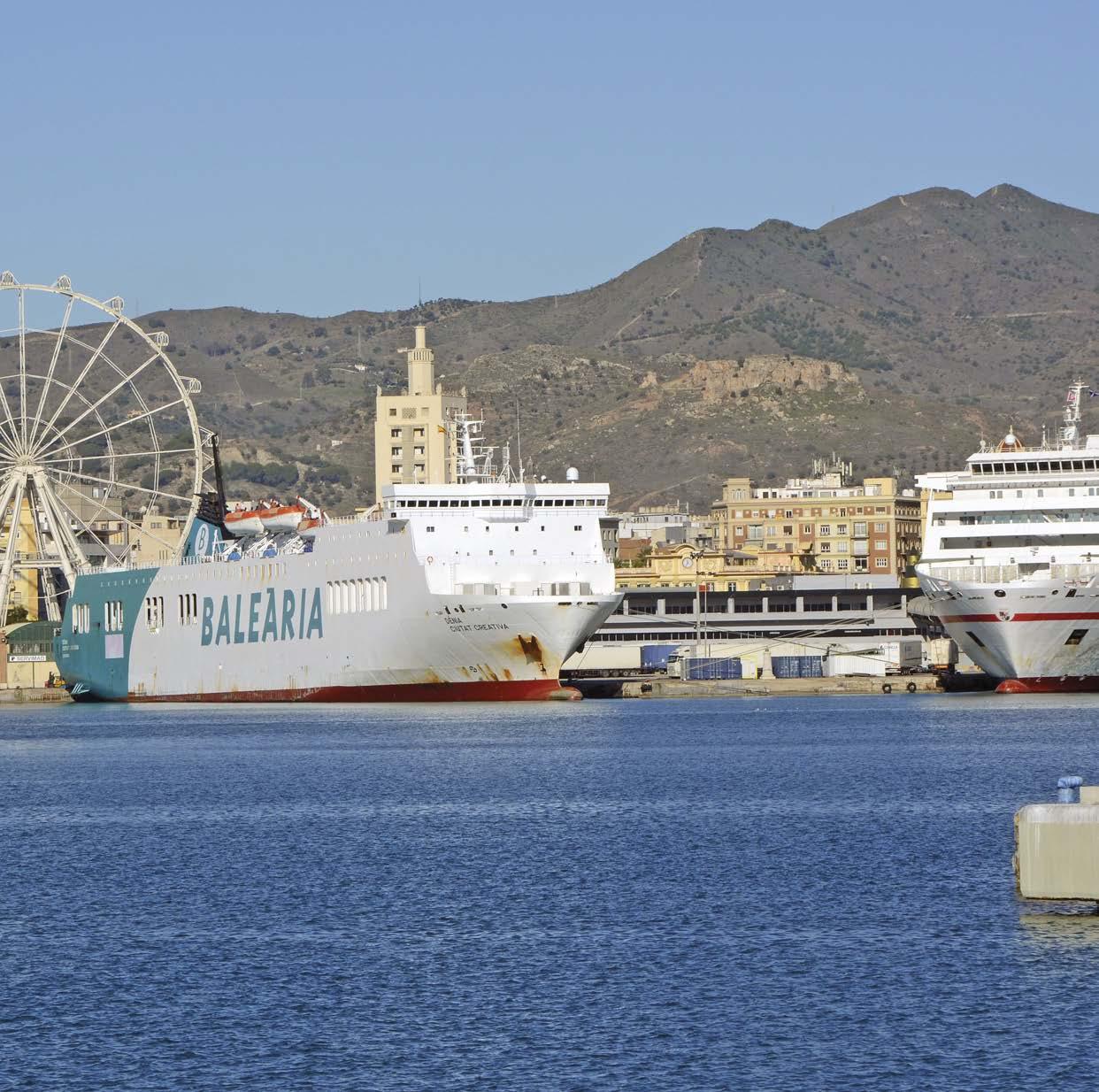
Balearia has acquired the Bretagne (above) from Brittany Ferries and renamed her Rosalind Franklin (above), continuing their inspirational women naming policy. Rosalind Elsie Franklin was a British chemist and X-ray crystallographer. Born 25th July 1920 in London, she was best known for her contributions to the discovery of the molecular structure of deoxyribonucleic acid (DNA), a constituent of chromosomes that serves to encode genetic information. She also contributed new insight on the structure of viruses, helping to lay the foundation for the field of structural virology. The 24,534gt/1989-built ship departed lay-up at Le Havre in the early hours of 18th March bound for Cadiz, where she arrived on 22nd March for attention at the Navantia Shipyard. Her intended use is understood to be on services from Almeria.
Brittany Ferries reported strong operational results for 2024, confirming its stabilised return to growth. The company’s consolidated revenue (excluding Condor Ferries) reached €516 million, marking a 6.5% increase from 2023. The passenger sector continues its steady recovery, with nearly 2 million passengers transported, a 6.5% rise compared to the previous year. Growth was particularly strong on the Channel routes, where Brittany Ferries outperformed its competitors. Freight volumes also increased by 4%, with the Spanish and Irish routes leading the way at +8.3%. Despite the introduction of the EU Emissions Trading Scheme (ETS), which added an €8 million cost in 2024, Brittany Ferries maintains solid operational profitability. The company has also significantly reduced its Covid-related debt, fulfilling commitments to repay regional loans and progressing towards a 50% reduction in its state-guaranteed loan by the end of 2025. Strategic decisions taken over the past decade, particularly the development of long-haul routes to Spain and Ireland, now contribute nearly half of Brittany Ferries' total revenue. These results reinforce the company’s leadership in sustainable maritime transport, as it continues investing in fleet decarbonisation and innovation. Brittany Ferries’ resilience is further reflected in the confidence of new private investors and the unwavering support of its historical shareholders. With the introduction of Europe’s two largest hybrid ferries in 2024, the company remains at the forefront of innovation in the maritime sector.
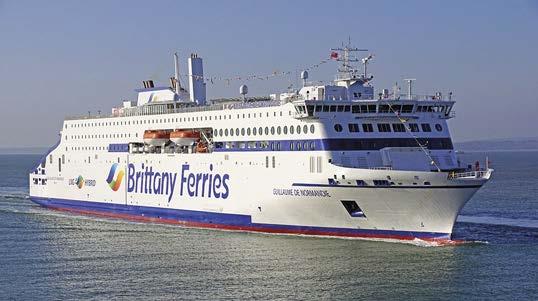
Whilst the ship was in port the 27,451gt/1992-built Normandie and 35,891gt/2002-built Mont St. Michel were both diverted to Le Havre, a rare if not first whilst in passenger service for the latter. The Guillaume de Normandie departed Ouistreham lunchtime on 29th March for Cherbourg and made her Portsmouth debut on 1st April 2025 before entering service on 18th April in place of the Normandie.
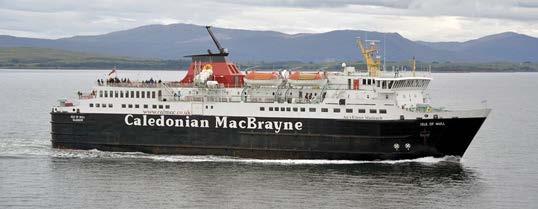
CalMac shuffled the fleet due to an exceptional set of circumstances impacting services. The 5,221gt/1993-built Caledonian Isles, which had been scheduled to return to service on 28th March, required extra time in dry dock for machining of stern tubes and was then expected back on Ardrossan-Brodick by midApril. The 6,753gt/1995-built Isle of Lewis finally departed Aberdeen for Castlebay on 29th March after an extended period out of service with engine issues during refit. She had been due back on 28th February. The 5,499gt/1998-built Clansman was slightly delayed in overhaul and resumed service on 9th March, relieving the 5,506gt/2001-built Hebrides on the Little Minch. The 4,719gt/1988-built Isle of Mull (above) continued to operate with a passenger limit of 45 plus crew due to her Marine Evacuation System being condemned which is due to be addressed in June. The Campbeltown-Ardrossan service will not operate this summer and the 2,991gt/2019-built Alfred’s charter from Pentland Ferries was extended from the end of March until the end of May 2025 and the 5,626gt/2011-built Finlaggan’s overhaul on 22nd April to 13th May meant vessels were redeployed to support Islay. The summer Craignure-Oban service featured the 1,599gt/2003-built Coruisk and the 1,160gt/2015-built Loch Frisa on the route from 3rd April until the Isle of Mull is back to full carrying capacity. The 7,272gt/2024-built Glen Sannox resumed operations on 16th March after a short period out of service to repair a hairline crack in her hull close to the waterline.
CMAL (Caledonian Maritime Assets Limited) and Remontowa Shipbuilding in Poland signed the contract to build the small vessel newbuilds on 28th March, which will support island communities and improve the resilience of the Clyde and Hebrides ferry fleet. It is expected that the first ferry will be delivered in 2027. The Small Vessel Replacement Programme (SVRP) will see seven fully electric vessels built in this first phase. Three more will be delivered in phase two of the project, which will be procured through a separate competitive tender process later this year. Phase one of the programme is backed by a £160 million investment from Scottish Government. The value of the shipbuilding contract is £147.5 million, while the remaining £12.5 million includes a 3% budget contingency and ancillary costs associated with the project. The initial SVRP Phase 1 vessel deployment plan will see the new vessels serving the following routesColintraive-Rhubodach, Lochaline-Fishnish, Tarbert-Portavadie, Iona-Fionnphort, Sconser-Raasay, Tobermory-Kilchoan and Tayinloan-Gigha. Through the cascade of existing vessels and port works, the following two routes will also benefit- LargsCumbrae and Oban-Lismore. Six yards were invited to tender for the contract, and five returned responses. Scottish procurement rules were stringently followed, with each yard scored against technical and commercial criteria, with a 65/35% weighting respectively.
The 38,500gt/2024-built Guillaume de Normandie (above) arrived at her Normandy port of Ouistreham (Caen) for the first time on 28th March for an official welcome.
Nigel Lawrence
Andrew Cooke
ALL CHANGE IN THE CHANNEL ISLANDS
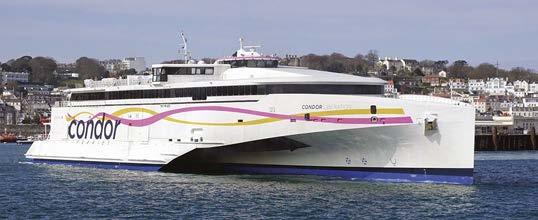
Condor Ferries’ 6,307gt/2010-built Condor Liberation undertook her final Poole-Guernsey-Jersey-Guernsey-Poole rotation on Sunday 23rd March (above). Having been aboard the maiden voyage on 27th March 2015, the Writer joined the vessel for her somewhat premature retirement.
The crews and shore teams have been fragmented by the changes imposed upon the Channel Island operations with tough times had by many. The human aspect of such upheavals should never be forgotten whilst too many focused on channelling hatred towards the ferries and company that worked so hard on the lifeline services. Seeing the emotions as the affected vessels concluded their faithful service only served to underline the bond that the crews form.
The previous day, the 11,116gt/1996-built Commodore Goodwill had played out her final Portsmouth-Jersey-GuernseyPortsmouth sailing and departed Portsmouth around midday on 28th March for Le Havre, joining the Condor Liberation in lay-up. Again, her future was unknown at the time of writing.
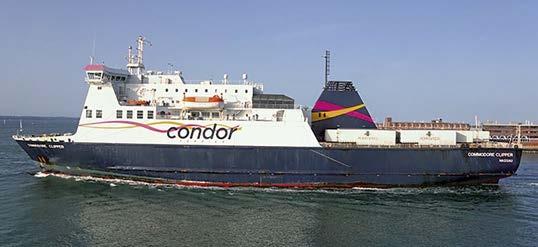
The 14,000gt/1999-built Commodore Clipper (above) made her last Channel Islands voyage for Condor on 24th March, deputising one extra day for the Condor Islander. She then reverted to her Portsmouth-Le Havre/Cherbourg and Cherbourg-Rosslare schedule whilst remaining as back-up for the Guernsey services as from 28th March. The Commodore Clipper and 6,581gt/2000built Condor Voyager had also bid farewell to Jersey that week in terms of regular schedules, both on 24th March. From the new tender start on 28th March, the Condor Voyager, now renamed Voyager, would call at St. Helier every Wednesday whilst DFDS had not published any inter-island calls at the time of writing.
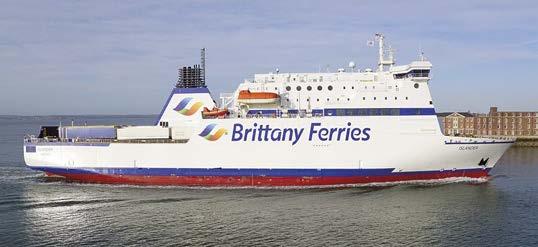
The 13,906gt/2005-built Condor Islander was refitted at the Remontowa Shipyard in Poland and was the first Condor Ferries vessel to be transformed into a member of the Brittany Ferries fleet. Renamed Islander, in full Brittany Ferries livery (above).
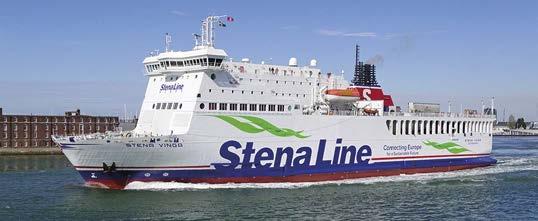
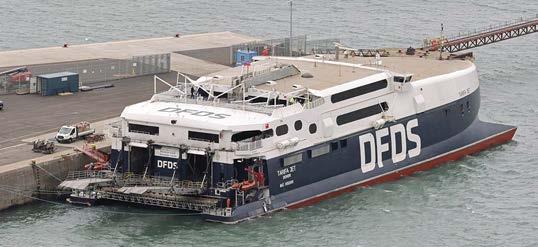
DFDS’ conventional Ro-Pax for the Portsmouth-Jersey service, the 14,551gt/2005-built Stena Vinga (modified sister of the Islander) departed Ventspils in Latvia for Portsmouth on 11th March. DFDS has chartered the ship, but she still wears full Stena Line livery. That same day the 86m and 4,995gt/1997built Tarifa Jet departed Algeciras in Spain bound for Portland via bunkers in Vigo. Once at the Dorset port on 15th March, various work was undertaken including modifying her stern ramps for use at St. Malo and Jersey.
The 85m and 5,537gt/2015-built Levante Jet will operate the Poole-Jersey service but needs a refit first so missed much of the Easter holiday period before entering service. The DFDS contract at Poole Port is for 1 year initially plus the company has chartered the 7,606gt/1998-built Arrow from the IoMSPCo. for one year to operate the pure freight service to St. Helier from Portsmouth.
The highspeed sailings for DFDS St. Malo-St. Helier did not get underway as planned as further work was required to the stern ramps.
The Stena Vinga departed for Jersey from Portsmouth again on 29th March but then operated three return trips to St. Malo in place of the Tarifa Jet before sailing overnight back to Portsmouth from Jersey on 30th March. Changes to the published St. Malo-Jersey schedules created some issues plus the operator announced the withdrawal of the Sunday sailings from Portsmouth to Jersey after talks with tourism leaders and freight companies.
The head of DFDS Jersey apologised and said, “We're not ready but we'll get there”. The Tarifa Jet was further delayed at Portland (above) due to additional work being required, reportedly after an MCA inspection of some kind.
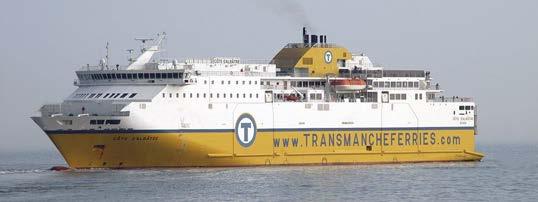
The Stena Vinga was redeployed again to St. Malo-Jersey from 3rd April for around 5 days. The Côte d’Albâtre (above) covered the Portsmouth sailings.
In all, not a perfect start for DFDS Jersey.
Nigel Lawrence
Andrew Cooke
Andrew Cooke
Andrew Cooke
Andrew Cooke
Andrew Cooke
Corran Ferry, Europe's busiest single-ferry route, is the subject of a £30 million upgrade plan and a project involving a new electric ferry. Plans have been submitted for £30 million of infrastructure improvements as the service carries around 270,000 cars and 11,000 commercial vehicles a year. The five minute crossing of Loch Linnhe's Corran Narrows links the wider Lochaber area with communities in the Ardgour peninsula in the west. The alternative journey by road around the loch takes about two hours. Highland Council has submitted a planning application to build a new slipway and overnight berthing at Ardgour. Also, on the Nether Lochaber side, constructing a new marshalling area for vehicles, cycle path, parking and a new protective breakwater. Highland Council would provide £10 million towards the cost, while £20 million would come from the UK government through the Inverness and Highland City Region. The Scottish government has also said £28 million could be used from the city region deal towards a new electric ferry.
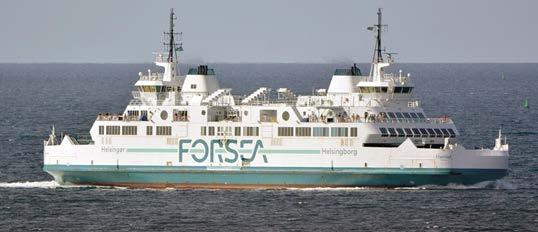
ForSea’s 10,067gt/1997-built Hamlet of the Öresundlinjen (above) is to be converted to battery power by Kongsberg Maritime. The ship operates on the Helsingør (Denmark) to Helsingborg (Sweden) route. The project involves installing large battery packs and new permanent magnet motors for the ferry’s four azimuth thrusters, each rated at 1530kW, aiming for zeroemission, fully electric operation with mechanical propulsion redundancy. The Hamlet will use high-voltage charging in port, taking 8-12 minutes, with low voltage genset charging as a backup. Kongsberg Maritime’s scope includes converting existing thrusters to electric operation, supplying energy, automation, and control systems, retrofitting the K-Chief 600 to the new KChief system with an Energy Management System, and installing Mcon thruster control with control chairs on both bridges. Echandia will provide energy storage systems, Oresund Drydocks will handle mechanical conversion starting November 2025. The ferry will feature twin-input thrusters powered primarily by electric motors, with diesel engines as backup, and will charge via a 10.6 MW/10.4 kV shoreside power source.
Incat’s next-generation sustainable ferry was announced on 27th March as being ready for operation in 2026. Construction of Incat’s newest 78m hybrid electric ferry is well progressed, with the vessel on track for operation in the first half of 2026, perfectly timed for operators looking to enter service ahead of the Northern Hemisphere summer season. With flexible propulsion options (fully electric, hybrid, or generator-assisted) the vessel offers unmatched versatility for operators navigating the transition to cleaner energy. The design has near-zero emissions capability with ESS sizing up to 12MWh and a charging capacity up to 10MW. The top speed is 27 knots with capacity for 600 passengers, a 4.60m vehicle deck clearance (ideal for freight and truck transport), flexible vehicle deck configurations with optional mezzanine decks, two 230kW bow thrusters for enhanced manoeuvrability and bridgewing control stations, port and starboard for berthing operations. Sized to replace the first generation of high-speed craft now approaching 35 years in service, this vessel is a future-focused solution for operators needing sustainable, fast, and efficient transport.
Incat delivered a 35m long diesel-electric ferry to Hong Kong-based ferry operator Sun Ferry in mid-March. The Xin Ming Zhu 30 was constructed by Guangzhou-based shipbuilder AFAI Southern Shipyard and is the third vessel to join a fleet of seven new vessels designed by Incat Crowther for the mass transit operator. Designed to provide passengers with an elevated commuter experience, the ferry’s main deck includes spacious seating for 171 travellers, dedicated areas for pets, and designated wheelchair spaces. The cutting-edge vessel will serve interisland commuter and tourism operations across Hong Kong, connecting Peng Chau, Mui Wo, Chi Ma Wan and Cheung Chau. The 300-seat passenger ferry boasts Veth azimuth thrusters that provide exceptional manoeuvrability at operating speeds of 14 knots. The upper deck provides seating for 129 passengers and access to panoramic views. The vessel is also fitted with 72 solar panels providing 7.5 kilowatts of on-board power.
Moby Lines’ Moby Dada (above) was sold for demolition in March following her unsuccessful charter to Algerie Ferries. The 34,093gt/1981-built ship began life as the Finlandia but is perhaps best known as DFDS Seaways’ Queen of Scandinavia, joining the Newcastle-Ijmuiden route in 2001 before passing to St. Peter Line in 2010 and Moby Lines in 2016. The 22,161gt/1982-built Moby Zaza (built as Olau Britannia for Olau Line) was also sold in March. She had been in Livorno since 10th March and has been sold to a Marshall Islands-based company, Atlantis Maritime SA. This may or may not seal her fate as being scrapped.
Spirit of Tasmania’s 47,994gt/2024-built Spirit of Tasmania IV, which arrived at the Scottish port of Leith for lay-up on 3rd December 2024, is to be moved to her new home of Tasmania after leasing negotiations broke down in March. Operator TT-Line said it had been engaging with a broker to lease the ferry, however, an agreement could not be reached. The Tasmanian government then ordered the ferry operator to relocate the 212mlong vessel to her new home. Built in Rauma, the ship went to Leith before winter over concerns it could be damaged by pack ice. A new berth to accommodate the ship, and sister vessel Spirit of Tasmania V, may not be ready until late 2026 or 2027 and the saga has sparked a huge political row in Australia. The cost of upgrading current infrastructure in Devonport, which handles about 450,000 passengers a year, has more than quadrupled from an original estimate of £45.5 million. TT-Line was paying £24,031 per week to berth the ship at Forth Ports Leith, according to figures published by the Tasmanian government. There was a possibility of the ferry being used to house Ukrainian refugees in Scotland, but the Scottish government quickly dismissed this saying it was not true. There are still hopes that the Spirit of Tasmania V will find work to fill the time until she can operate the Bass Strait service as intended but was still at the RMC Shipyard in Rauma at the time of writing.
Nigel Lawrence
Walter Maefarth
A-Ships Management acquired the 22,874gt/1986-built Wolin from Unity Line of Poland. The ship departed for Greece as the Golden Carrier in March. The ship was built in 1986 as the Öresund for the Swedish State Railways. The ship underwent a brief refit in Greece before entering service in the Mediterranean as from June.
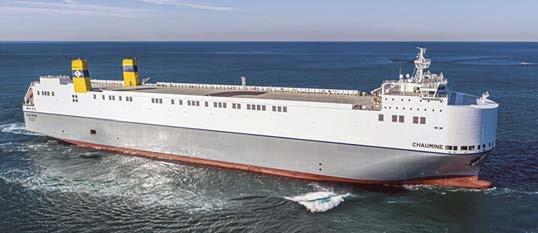
CLdN took delivery of the 77,678gt/2025-built/235m long and 8,000-lanemetre capacity Chaumine (above) from HD Hyundai Mipo in March, the first hybrid propulsion Ro-Ro ship built in South Korea. The ship is a 25,000-dwt twin-screw ship with a hybrid propulsion system that uses a diesel engine and an electric battery as power sources. The Chaumine has eight cargo decks, including three levels of hoistable car decks and can transport 510 trailers and 920 passenger cars simultaneously. The ship features a twin-shaft propulsion system that distributes thrust through two propellers to increase fuel efficiency, and a shaft generator that enables self-propulsion (PTH, Power Take Home) in conjunction with a 2.72 MWh battery pack.
Grimaldi Group has continued its global expansion by adding India to its maritime network. Starting in March, the company now offers a regular service with two departures per month from Europe to the Indian subcontinent, further strengthening its presence in the Asian market. The new route includes calls at key ports in Northern Europe and the Iberian Peninsula, the itinerary of Southampton-Antwerp-Bremerhaven-Setubal/Vigo-Mumbai. After reaching India, the ships will continue their journey to the Far East, calling at ports in Taiwan, Japan, South Korea and China. Additionally, the service will provide a monthly connection between India and major ports in the Persian Gulf, including Oman, the United Arab Emirates, Qatar, Bahrain, Saudi Arabia and Kuwait.
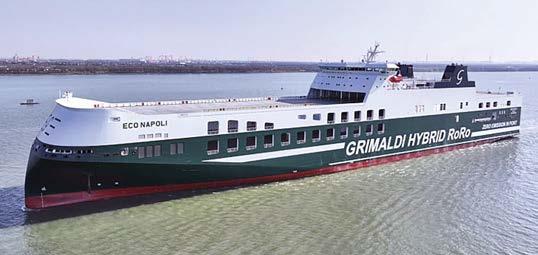
The company took delivery of the 67,311gt/2025-built Eco Napoli (above) in mid-March, the last of 14 hybrid Grimaldi Green 5th Generation (GG5G) Ro-Ro vessels from Jinling Shipyard in Nanjing, China. The ship is 238m long, with a beam of 34m and accommodation for 7,800 lanemetres of rolling freight (equivalent to around 500 trailers and 180 cars), twice the capacity of the previous generation of ships without increasing fuel consumption. In port, she operates with zero emissions using mega lithium batteries (5 MWh), recharged during navigation via shaft generators and 350m² of solar panels. The Eco Napoli was expected to arrive in the Mediterranean in early May on her delivery voyage and will reinforce the Gemlik-Ambarli-Patras-Trieste route.
Kawasaki Kisen Kaisha (K Line) took delivery of a new LNGpowered pure car and truck carrier (PCTC) built by Shin Kurushima Toyohashi Shipbuilding in March. The 75,259gt/2025built Oceanus Highway is from a series of LNG powered PCTCs that were built in compliance with Class NK requirements. Like her sisters, the newbuild has a length overall of 199.99m, a beam of 38m, a draught of 9m, a gross tonnage of over 75,000, and space for 7,000 vehicles. Power is provided by a dual-fuel main engine with a service speed of 19 knots. The LNG fuel tank capacity is 2,439m3. Sisterships are the 2021-built Century Highway Green and the 2024-built Nereus Highway and Poseidon Highway.
Stena Line and Norsepower announced on 18th March that the companies had teamed-up on a future-proof methanol hybrid RoRo equipped with Norsepower Rotor Sails. Norsepower, the global leader in wind propulsion systems, and Stena Line, have signed an agreement for the delivery of two Norsepower Rotor Sails on an all-new methanol hybrid newbuild Ro-Ro vessel. The 21,500gt/2026-built Stena Connecta is being built by Jinling Weihai Shipyard in China. The 147m vessel will feature two 28x4m rotor sails projected to deliver up to 9% fuel savings on the planned trade route, Heysham-Belfast.
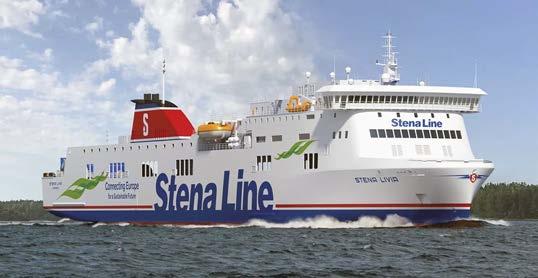
On 21st March Bluebridge announced the acquisition of a RoPax vessel to replace the 21,856gt/1997-built Strait Feronia, marking a significant upgrade for its Cook Strait operations. The Visentini ship will be replaced by another of the same shipyard, the 26,904gt/2008-built Stena Livia (above). Like the 27,414gt/2007-built Connemara, her new fleet mate, the Stena Livia has Brittany Ferries and LD Lines heritage. She was delivered as the Norman Voyager for Portsmouth-Le Havre before passing to Brittany Ferries as the Etretat. The Connemara operated as the Norman Asturias for a time from Poole. The Stena Livia has been operating between Travemünde, Germany and Liepaja, Latvia, and will join the Bluebridge fleet in July. The new ship will boost vehicle capacity by 10% and significantly increase passenger space, especially following modifications during a dry dock period in Europe.
As a result of this, the 27,522gt/2006-built Stena Horizon will replace the Stena Livia and the 39,191gt/1987-built Stena Vision returned to the Rosslare-Cherbourg route following lay-up at Holyhead and Belfast from 15th April. A timescale for the Stena Vision’s operation had not been confirmed. The ousted Strait Feronia previously served on the Irish Sea as the Dublin Seaways and Dublin Viking.
The 18,332gt/1991-built Patria Seaways of DFDS Seaways, built as Stena Traveller, was to have served Fishguard-Rosslare during the refit season, releasing the 24,263gt/2000-built Stena Nordica.
In the event, the Stena Horizon provided refit cover for the 41,671gt/2019-built Stena Estrid at Holyhead, and the Patria Seaways was used on the Rosslare-Cherbourg service 13th March-14th April. This was not entirely successful plus facilities were considerably less than on the Stena Horizon.
Hyundai Mipo
Stena Line
Grimaldi Group
by Andrew Cooke
ARRANMORE L
Bfeatured three very different types of Ro-Ro passenger ferry. The Glen Sannox was the subject in April, the UK’s first dual fuel LNG ferry; the Saint-Malo was the May edition subject, the largest/most powerful battery hybrid ferry when delivered, whilst this edition is a modernised version of a traditional ferry for small communities.
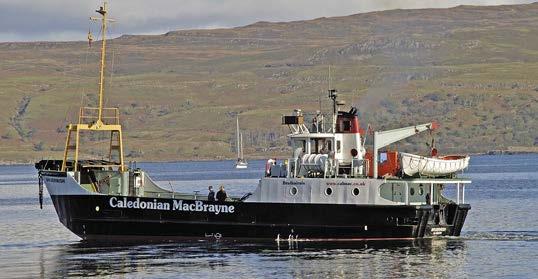
The Arranmore Ferry company has operated to the Island of Arranmore since 2006 and until 2025 was employing the former CalMac Island Class ferries Morvern and Canna for Ro-Ro services.
The 65gt/1972-built Morvern ended her CalMac career in 1995 as her size only permitted 4 cars per sailing. She was put to work at Arranmore but when slightly larger sisters Rhum and Coll arrived after sale by CalMac she was sold on for further service as the Bere Island ferry.
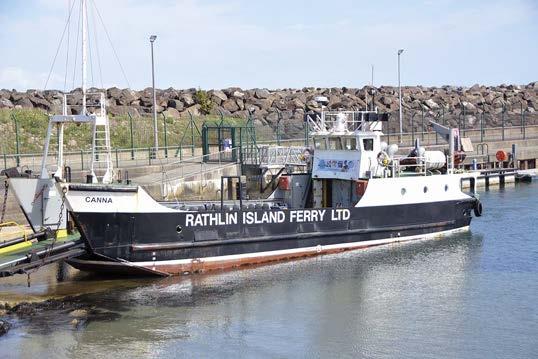
In 2009 she returned to Arranmore in the blue Arranmore Ferry fleet and replaced the 69gt/1973-built Island Class vessel Bruernish (above) on the Burtonport service. The Rhum and Coll still operated for her previous Arranmore owner, and the vessel was extended by 4m in 2013. The 69gt/1975-built Canna, the 7th of the 8 Island Class ferries, could carry 6 cars and 140 passengers and spent 21 years in various locations on the west of Scotland and a further 20 years at Rathlin Island, Northern Island, before moving to the Arranmore service.
The Canna (above) was rarely to be seen in Scotland after taking the Ballycastle-Rathlin ferry duty except when requiring overhaul. She was withdrawn by CalMac in July 2008 when the Rathlin service contract was taken over by Rathlin Ferries Ltd. The ferry remained at Rathlin for the new operator. In 2016 she was superseded by the newbuild Spirit of Rathlin and relocated to Burtonport where she remains, joining fellow Island Class representative Morvern. The Canna received a major overhaul that was completed in early 2020. The island served, Arranmore, is officially known by its Irish name, Árainn Mhór. It has been inhabited since prehistoric times and the fort at Uilinn dates from about 800BC.
Arranmore is the largest inhabited island off the coast of Donegal, Ireland and has an approximate area of 22 square kms or 8 square miles. The Island is part of the Donegal Gaeltacht and Ulster Irish (Gaeilge Uladh) is the main Irish dialect in use. In Irish, the island was traditionally called Árainn with the adjective mór (large) being added more recently. The island is twinned with Beaver Island in Lake Michigan. The crossing time to/from Arranmore Island is around 20 minutes and ferries operate all year subject to weather. The operation is proudly part of the Wild Atlantic Way whilst The Realt Na Maidne FEATURE Newbuild of
Nigel Lawrence
Nigel Lawrence
Teoranta Ferry Company is a family business. The company also runs a passenger service to Tory Island from Magheroarty all year round using the 113gt/1976-built Queen of Aran. The crossing time is around 45 minutes between Magheroarty Pier and Tory Island. This ferry previously served the Aran Isles 1985-2018 before moving to the Tory Island link in April 2018. A cargo service is also operated to the island as required using the vehicle ferries.
BUILDING ON SUCCESS
The Island Class generation of ferries have been highly successful but time marches on. In November 2020 a preliminary design was presented for a new generation of ferry taking the Island Class concept into the 21st century. The design ethos was to meet the requirements of the service without adding complexity or increasing the vessel size. The existing examples of tonnage are ideal for the service so excess windage or displacement was something to be avoided. The main points to improve upon were the ease of crew operation and better cargo handling, specifically for sizeable items such as static caravans.
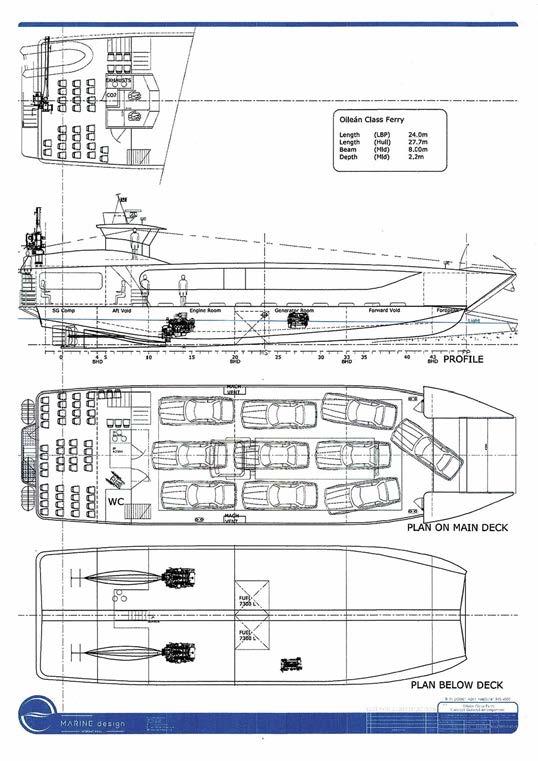
At this time the Morvern was 48 years old, and the Canna was 45 years old. Reflecting the new design’s geographical location, the new Oileán Class Ferry (Irish equivalent of Island Class) was drawn up by Marine Design International of Glasgow (MDI) with The Arranmore Ferry and MDI revealing the order for a newbuild in July 2022. The build contract was awarded to Bute Boatbuilders Ltd. of Undraynian Point on the Isle of Bute near Rothesay. This company was established in October 2018 and the Director is Ewen Ferguson, who has 41 years of experience in boat yards, including 26 years of constructing newbuilds.
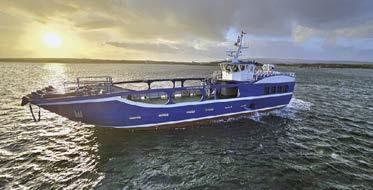
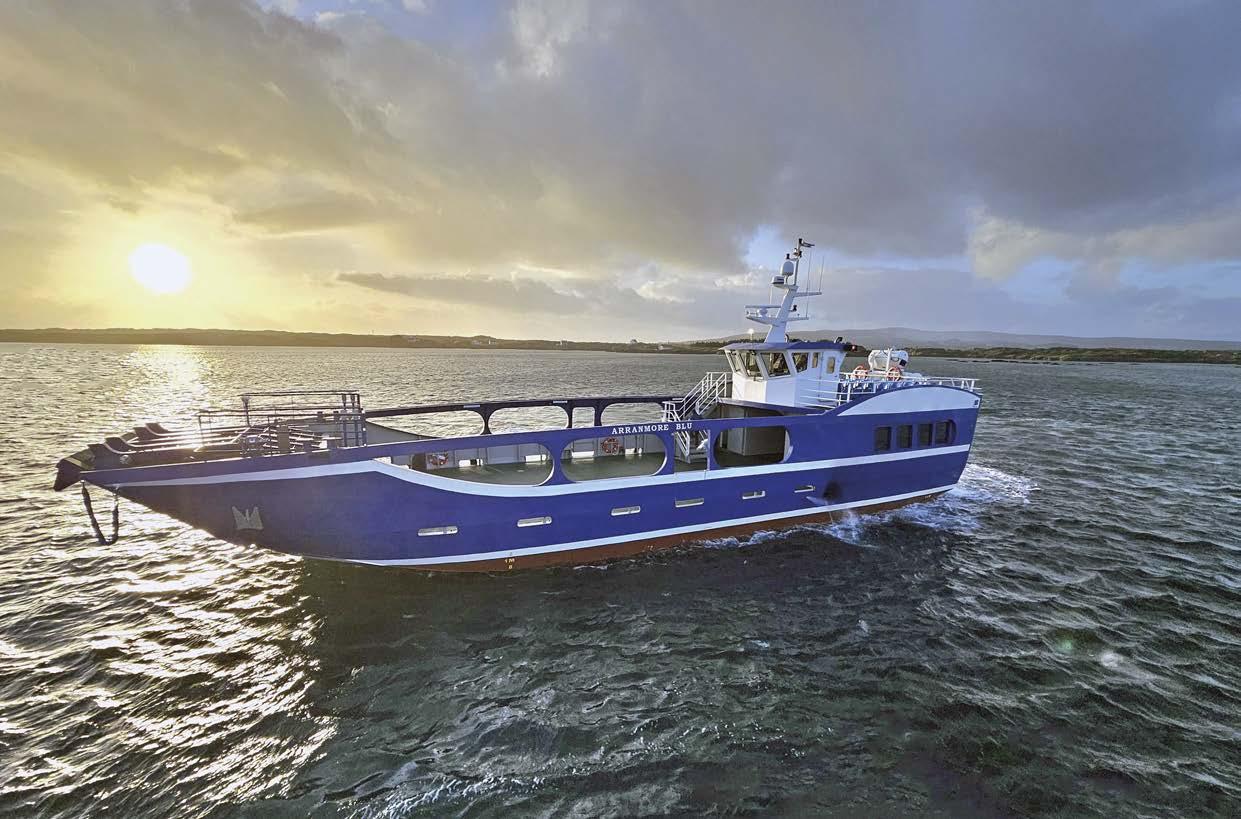
The business is a local employer and provides training for the next generation of skilled workers in the form of engineers, welders, painters etc. Bute Boatbuilders’ first newbuild was launched in May 2021 in the form of the 23m long work boat Lexi for Leco Marine Ltd. Newbuild No.2 was launched in November 2022 as a 17m long Fish farm workboat for Loch Duart Ltd. The third vessel built at the yard was launched in March 2023 in the form of the 19.7m long Landing Craft Hollie Rose for Scottish Sea Farms. The vessel is deployed between Mull and Oban, was designed by Argyll base architects A G Salmon and Co. and entered service in April 2024. The fourth project completed was in December 2024 and the subject of this article, the 28m long RoR ferry Arranmore Blu. Newbuild No. 5 took to the water in March 2024 and is a 19m long Landing Craft for Loch Duart Ltd. named Handa Isle. At the time of writing a 22m long Landing Craft, to be named Miss Marley, was in build for Milligan Transport Ltd. Build No.6 was due for completion during 2025.
At present the yard has the 28.70m long/8.10m beam Ro-Ro vessel long /8.00m beam) listed as passenger vessel products. Vessels in the range offered by the Shipbuilder include a 6.00m long/2.30m beam aluminium Ro-Ro Dory, 4x Fish Farm Workboats (14.00m long/5.70m beam, 16.00m long/6.50m beam, 17.30m long/7.00m beam and 23.00m long/8.00m beam), a 25.60m long/8.00m beam Dredger; 6x steel Landing Craft designs (14.00m long/5.80m beam, 17.00m long/6.50m beam, 18.50m long/7.30m beam, 19.00m long/7.50m beam, 22.10m long/7.50m beam and 25.00m long/9.00m beam) plus 2x Multicats (18.00m long/7.20m beam and 20.00m long/7.50m beam).
The Morvern was rebuilt in 2010, lengthened in 2013 and certified to the latest EU Class B certification at the time. The new vessel was developed from this knowledge to provide a ferry with greater safety, efficiency and capability in line with the SI640 of 2020 Irish Domestic Passenger Ship Standards. Marine Design International Ltd. had worked on the previous vessel refits and conversions for Arranmore and had grasped the driving factors required by what is one of the most scenic ferry routes in Ireland.
Such capital investment is significant for a small business and build options were considered for many months to make the project viable. Nothing was ruled out from self-build to shipyards in Turkey and Hong Kong, but the successful yard was much closer to home. The vessel is arranged to receive, and has the concept design for, hybrid
electric propulsion, thus future proofing the newbuild. This option is deemed to be feasible in reducing emissions further when funds allow. MDI has previously designed and built fully electric vessels and while the technology is proven it does not yet offer a financial break even so can only be implemented when suitable capital is available. The underwater hull is stretched as far as is feasible under the applicable regulations to create the lowest resistance whilst the structural design is optimised for weight efficiency while appreciating some of the rough conditions in which the vessel must operate. Investing in new vessels is a big step for any owner but as well as offering a modern and comfortable experience for users, it reduces maintenance and running costs so helps grow the business and industry in the long term.
BLU IS THE NAME
The name bestowed upon the new member of The Arranmore Ferry fleet was Arranmore Blu. There are two reasons for the name: 1) The company colours are blue, and the company is known locally as the blue ferry and 2) The name Blu has ancient origins (possibly Egyptian or Greek) and is associated with the Sea, Elegance, Calmness and Tranquillity. All traits being appropriate to the Island of Arranmore. The keel was laid by Bute Boatbuilders Ltd. in 2023, and the vessel was launched on 18th December 2024. Sea trials were completed the next day, the newbuild was handed over to her new owners and the delivery voyage to Burtonport was completed on 20th December.
Upon arrival in Burtonport the fitting out process aboard the Arranmore Blu continued. The Oileán Class ferry is 27.70m long with an 8m beam, a 2.20m hull depth (midships) and a 1.90m draught. The gross tonnage is a modest 134.70gt, the lightship weight is 120 tonnes, the maximum displacement is 180 tonnes whilst the weight of the steel used is approximately 70 tonnes. The machinery spaces are located below the main deck. The engine room (situated aft) contains the main engines, a pair of 4 cycle, V type, direct- injection, water cooled with wet turbo charger and inter-cooler Doosan V158TIH. Each are
NEWBUILD OF THE MONTH
480hp/353kW output at 1,800rpm. The displacement of each engine is 14,618cm3, the bore diameter is 128mm and the stroke is 142mm. The firing order of the 8 cylinders is 1-5-7-2-6-3-4-8. Each engine is 1,337mm long, 1,222mm wide and 1,074mm high with a dry weight of 1,350kg. There is also a Doosan 220/240V genset (located starboard side, midships in the generator room) and the gearboxes are hydraulic DMT240H examples by Dong-I. These are 400kg each, are designed for marine propulsion systems, with a marine transmission featuring a hydraulic clutch to maintain a constant reduction ratio in both forward and reverse gears.
Complying with ISO9001 standards, this model is built with saltwater-resistant materials and guarantees silent operation with precise gears. With an oil capacity of 8 litres, each unit features optimised tapered roller bearings to withstand maximum loads, a compact design, and an easily accessible metal oil filter. In the words of the manufacturer, the "Go Home" emergency function makes these gearboxes indispensable in critical situations, thus ideal for any type of vessel. The propeller shafts are conventional duplex examples with 940mm diameter fixed pitch propellers supplied by Michigan Marine Ltd. and fitted with high performance nozzles. Steering is via a pair of 70mm twin plate rudders with bottom skeg support and supplied by Michigan Marine Ltd. The service speed is 10 knots, and the maximum speed is 12 knots. The vessel’s fuel capacity is 14,600 litres of MDO stored below deck in the centre of the vessel, just aft of the generator room, in two 7,300 litre tanks.
The Arranmore Blu has a single chine hull with shaped bow and counter, hollow skegs as sumps and supporting stern tubes. All steel used was of the certified European S235/S275 standard. The prow ramp is of a hinged 4.30m wide and 3-section type including flaps at the shoreward end for a smooth transition ship to shore and vice versa. The base (stool) of the prow, the lower section and the hydraulics are of a robust construction to allow the ferry to be held in place on the slipway in moderate winds and sea conditions. When stowed, the prow creates a weather seal and smooth lines, thus avoiding water traps and subsequent pockets for corrosion.
The profile of the vessel is somewhat different to the first generation of Island Class ferries, creating a modern look for the 21st century. With an overall length of 8.00m, the prow ramp dimensions are 3.80m lower section/2.60m upper section and 1.60m flaps. The vehicle deck capacity is for a total of 10 cars loaded in 3 rows of 3 plus one parked at an angle in the bow. The Ro-Ro deck can also cater for a single 35t truck or 3.65m wide static caravan. Dangerous goods (fuel trucks) can also be carried.
The passenger saloon is located aft in the deckhouse. Seating is arranged in four rows of 4 seats across the beam of the vessel plus two rows of three on the portside in the forward area of the saloon. There are also toilet facilities. A total of 50 passengers can be seated inside with an additional 47 seats on the open deck above the passenger accommodation.
The total capacity is therefore 97 passengers plus 3 crew. The vehicle deck area is 15m long and 7.50m wide whilst the lower and upper passenger areas are 5.80m long/2.20m wide and 7.80m long/2.40m wide respectively. There is also a small stern ramp located centrally at the stern on the passenger lounge level. This was added to the design as the Owner wanted to “future proof" the Arranmore Blu. It is understood that this access would only be suitable for passenger use or light goods.
At the time of writing, the Arranmore Blu was expected to make her service debut end of April-mid May or thereabouts. An official launch party is planned and, the day before entering service there will be a special charter run. This event was auctioned off in conjunction with local radio station Highland Radio for local charities. This provided the lucky winners with the opportunity of being the first official passengers and vehicles on the vessel. The new ferry will operate Burtonport Pier (Donegal) to Arranmore Island, which has a crossing time of around 20 minutes.
TECHNICAL SPECIFICATIONS
Marine Architect: Marine Design International, Design Hub, R12, 100 Borron St, Port Dundas Business Park, Glasgow, G4 9XG
Shipyard: Bute Boatbuilders Ltd, Undraynian Point, Isle of Bute, PA20 0QY.
Class: Oileán Class Ferry
Yard No.: Build No.4
IMO: No. IMO number
Official Number: 405127
Call Sign: EIA 2958
Preliminary Design Submitted: November 2020
Order Announced: July 2022
Keel Laying: 2023
Launched: 18th December 2024
Sea Trials Completed: 19th December 2024
Delivered: 19th December
Delivery Voyage: 19th-20th December Bute-Burtonport
Service Debut: April/May 2025 (TBC)
Operator: The Arranmore Ferry
Route: Burtonport Pier (Donegal) - Arranmore Island
Crossing Time: 20 minutes
Length Overall: 27.70m
Length BP: 23.87m
Beam: 8.00m
Hull Depth: 2.20m (Mid)
Draught: 1.90m
Gross Tonnage: 134.70
Lightship Weight: 120 tonnes
Maximum Displacement: 180 tonnes
Steel Weight (Approx.): 70 tonnes
Main Engines: 2x Doosan V158TI @ 480hp each
Generators: South Shore Marine: Main Generator: Northern Lights PX-312K2 (10kW) Back-Up: Perkins 403A-11
Vehicle Deck Capacity: 10 cars, 1 Truck up to 35 tonnes
Dangerous Goods certified for fuel trucks. Can carry a static caravan of 12ft width (3.65m)
Passenger Capacity: 50 in the saloon, 47 on the open deck
Sincere thanks to Lynette at Bute Boatbuilders and Padraic Grady at The Arranmore Ferry for the invaluable help with information and imagery.
Johan van Oldenbarnevelt
It was over 60 years since the Greek cruise ship Lakonia was lost in the Atlantic Ocean off Madeira following a devastating fire. The fire, which had started due to faulty wiring in the ladies hairdressing salon, quickly engulfed the ship resulting in her loss and the death of 128 passengers and crew.
Lakonia was originally called Johan van Oldenbarnevelt, and was named after a Dutch soldier and statesman who was the architect of Dutch Independence from Spanish rule, founder of the Dutch East India Company and Pensionary of Holland.
The vessel was one of two liners built in the Netherlands and completed in 1930. Her sister, Marnix van St. Aldegonde, was lost in the Mediterranean during World War II on the 7th November 1942 after being hit by torpedoes from German aircraft. Although all onboard were taken off the ship safely and the vessel was taken in tow, she foundered the following day after colliding with another disabled vessel.
Johan van Oldenbarnevelt was built at the Amsterdam Shipyard of the Nederlandsche Scheepsbouw Maatschappij, yard No 194. She was laid down on the 29th June 1928 and launched on the 3rd August 1929 by Mrs Tegelberg-Hooft, the wife of one
of the directors of the owners, Nederland Line (Stoomvaart Maatschappij “Nederland”). The ship underwent her trials commencing on the 13th March 1930 and was handed over to her owners on the 26th April 1930.
As built, Johan van Oldenbarnevelt had a gross tonnage of 19,040, a displacement of 24,993 tons, a length of 586.2 feet and a beam of 74.8 feet. She was a twin-screw vessel powered by two Sulzer Diesel engines, built in Switzerland. Each engine was fitted with 10 cylinders producing 7,000 bhp, giving a service speed of 17 knots. On trials at 115 rpm the vessel achieved 19 knots.
In appearance, with two small squat funnels, she resembled a contemporary Harland and Wolff built vessel of the Union Castle or White Star Line. However the funnels were thinner than those of the H & W vessels and she was fitted with two raked masts and cargo cranes visible forward and along the superstructure.
Passenger accommodation had limited interchangeability between first and secondclass passengers and accommodation was provided for 245-300 first class, 246-367 second class, and 64-99 third class passengers. 48 fourth-class passengers were berthed forward on F deck. A crew of 360 was
originally carried and the ship, together with her sister, was intended for the Netherlands passenger and cargo service to the Dutch East Indies. Both ships had a large cargo carrying capacity of 9,000 tons.
Johan van Oldenbarnevelt had six main decks with the top “A” deck housing the master’s and officers (deck and engine) accommodation plus a fully equipped hospital, swimming pool and gymnasium. “B” deck contained first class cabins, a nursery and a small second-class promenade. The upper part of the Social Hall extended into this deck from “C” deck. Also on “C” deck were the promenades, first class forward and second-class aft.
Facilities for second-class passengers on the main deck included a Music Room, Smoking Room and Nursery. Further passenger accommodation was located on “D” and “E” decks with another second class Smoking Room on “D” deck.
First and second-class Dining Rooms were situated on “F” deck, each with a capacity of 262-270 and 316 diners respectively. A Dining Saloon for 84 third class passengers was sited on “D” deck. Quarters at the stern were provided for 140 Japanese servants.
The artistic decorations of the ship reflected the colonial wealth of the Dutch and provided a high degree of luxury and the saloons were fitted with large opening windows providing a cool and airy atmosphere in the tropics.
The ship had five holds on “H” deck, along with room for provisions and baggage. 12 x 3 ton Stork Hijsch deck cranes sited on the upper decks and in front of the forward superstructure served these.
Engine rooms were situated on “K” deck with the lower parts of the cargo holds for and aft. Drinking water was contained in the fore and aft peaks and forward of the engine room were the deep oil tanks.
After being accepted by her owners the Johan van Oldenbarnevelt made a short trip from Amsterdam to Ijmuiden on the 29th April 1930. This coincided with the opening of the new North Lock, the largest sea lock in the world on the North Sea Canal. The late Majesty Queen Wilhelmina was onboard and performed the opening ceremony.
Returning to Amsterdam to complete storing for her maiden voyage, the shp was ready to sail for the Far East on the 6th May 1930. However, when about half way down the canal a deep loaded freighter, ss Reggestroom
Left: The Johan van Oldenbarnevelt after her funnels were lengthened see here leaving Southampton.
Above: The Johan van Oldenbarnevelt being built alongside her sister Marnix van Sint Aldegonde at the Nederlandsche Scheepsbouw Maatschappij Shipyard at Amsterdam (Don Smith/photo-transport.com)
Below: The Johan van Oldenbarnevelt in her original guise as built in 1930.
Bottom: The Johan van Oldenbarnevelt after she changed her livery from a black hull to a grey one.
(FotoFlite)
(3,854grt/built 1923) of the Holland S.S. Co., Amsterdam, collided with the liner which sustained damage to her starboard bow.
Johan van Oldenbarnevelt returned to Amsterdam and was repaired in three days with all of her passengers still onboard. Her 2 knot margin of speed allowed the ship to makeup for lost time, only stopping at Southampton for 2 hours, being one day late at Genoa, but almost on time by the time she had reached Port Said.
Up until the start of World War II the liner and her sister sailed the route from Amsterdam to the Dutch East India taking 29 days outward and 27 days home. One incident that did occur, during the Spanish Civil War, on the 31st July 1937, when sailing off the Iberian Peninsular, she was fired on by anti aircraft shells, which caused minor damage but no casualties.
The Netherlands remained neutral until invaded by Nazi Germany on the 10th May 1940. Up until that time the ship had been used to repatriate US citizens from Europe to America, and then a European service from the Dutch East Indies to Genoa. Four such voyages were completed on this route via Suez.
Johan van Oldenbarnevelt was homeward bound in the Red Sea when news reached the vessel that the Netherlands had surrendered to the Germans. She was later used between Java and New York carrying cargo in every available space, including the passenger accommodation.
Converted at New York into a troopship with a capacity of 4,000 personnel, the vessel was placed under the management of the British Orient Line, serving with distinction throughout the war.
The ship returned to Southampton on the 29th October 1945 with 3,668 personnel onboard, half of which were the first former Japanese POWs to be repatriated. The liner, accordingly, received a tumultuous welcome.
Johan van Oldenbarnevelt was handed back to the Dutch Government on the 11th March 1946. However because of unrest in the Dutch East Indies, the ship was used to ferry troops out, and finding their position precarious, Dutch nationals began returning to Europe. By 1950 the service for which the ship was intended was no longer viable and she was used as an immigrant carrier to South Africa and Australia until mid 1951.
Due to the continued high level of bookings in emigrant traffic, and the success of Johan van Oldenbarnevelt in the role, she was taken in hand by the Amsterdam Dry Dock Company and her original builders, for a major refit. Trials following the refit were carried out 8/9th January 1952, and following the conversion her speed was reduced to 15.5 knots.
Extra doubled banked lifeboats were added on the fore part of the boat deck and her accommodation varied to enable the
Above: The Johan van Oldenbarnevelt as the Lakonia shortly after her sale to Greek Line in 1963.
Below: Another view of the Lakonia in her short life as a Greek cruise ship.
Bottom: The end of a great ship. The Lakonia ablaze following the fire on 22nd December 1963.
vessel to carry 1,414 passengers. The passengers were accommodated in one class in 200 four berth, 50 five and six berth cabins, 13 dormitories and a few double and triple berth cabins. All cabins were provided with a washstand and cold running water.
The conversion also enabled first and second-class passengers to be accommodated for a voyage to Indonesia, usually at the disposal of the Government. Following the refit, a cinema, ladies and gents hairdressing salons, two laundries together with ironing rooms and special nursery bathrooms were added.
On the 23rd January 1952 the ship sailed from Amsterdam on the first post refit voyage to Australia, remaining on this route with a few variations until 1959.
It was necessary to change her itinerary in 1953 following a collision between the liners, Orange (20,551/built 1938) and Willem Ruys (21,119/built 1947) on the 6th of January of that year. Johan van Oldenbarnevelt was placed on the passenger route for two voyages to Batavia (Djakarta) and Australia.
In 1954-55 some voyages were made to Canada with educational voyages to the USA in June 1954. In 1957 and 1958 the ship sailed to Australia and Canada plus doing two trips a year to the USA with Holland America acting as agents.
By 1959 the Australian emigrant trade was becoming saturated by too many ships chasing a dwindling number of passengers. The ship’s owners decided to put the ship in for a major reconstruction with the intention of running an around the world service along with the company’s vessel Orange, sailing westwards and Johan van Oldenbarnevelt eastwards.
Amsterdam Dry Dock Company carried out the conversion costing £400,000 and taking three months to complete. When the ship emerged from the refit she had a completely different profile. The two squat funnels had been replaced by two higher units with domed tops. The two raked masts were replaced by a foremast cut down to the crosstree and a signal mast on top of the bridge. The cranes sited on the forecastle were removed and decks extended aft.
Johan van Oldenbarnevelt was now a one-class ship with accommodation for 1,210 passengers. Most of the accommodation was provided in 247 two berth, 90 three berth, 81 four berth and a number of six berth cabins. Three special double cabins (numbers 21, 25 and 30) on the upper deck were provided with bedsteads, decorated to a higher standard and had adjoining en suite facilities, whereas the remaining cabins had shared facilities. Air conditioning was added together with an additional swimming pool aft of where the original mast and hat had been. The various alterations raised the gross tonnage of the ship to 20,238.
The first voyage of the ship after her reconstruction was to Wellington in New Zealand, via Southampton, Port Said, Suez, Aden, Fremantle, Melbourne and Sydney. The ship has sailed from Amsterdam on the 2nd April 1959, however due to thick fog her arrival in Southampton was delayed causing a reception with guests arriving by special train from London to be cancelled. Her return trip to Amsterdam was via Papeete, Panama Canal, Port Everglades, Bermuda and Southampton.
The ship continued to carry out around the world voyages incorporating ‘mini cruises” between Australia and New Zealand. However, due to a fall in demand, by 1962 it was apparent that the 32-year-old ship would be surplus to requirements, and on the 29th September 1962 the vessel made her final departure from Amsterdam, arriving at Wellington on the 9th November 1962.
From Wellington Johan van Oldenbarnevelt sailed to Fremantle where she acted as an accommodation ship for the Empire & Commonwealth Games, following which she undertook a short “Trans Tasman” cruise, her final passengers disembarking at Sydney on the 3rd February 1963.
The ship had been sold for little more than scrap value (but insured for £1.03 million) to Goulandris Greek Line subsidiary Ormos Shipping Co. Ltd. and arrived at the yard of Officine Mariotte, Genoa on the 8th March 1963 where she underwent a short refit and some modifications. The refit included replacing all the bunks with beds, adding twelve extra cabins on the sun deck, and the aft swimming pool was enlarged.
The ship was renamed Lakonia, and painted all white, sailing for Southampton, arriving on the 24th April 1963. Her cruise schedule would be more or less the same, sailing From Southampton calling at Madeira on the outward run and Le Havre on the return journey calling at Lisbon with calls at Tenerife, Las Palmas and/or Vigo. Occasional calls would be made at Tangiers, Casablanca, Malaga and Cadiz. Seventeen cruises were planned between April and November 1963, followed by a short overhaul then a further 27 cruises from 19th December to 17th November 1964.
However, by the end of August 1963, this programme was proving to be somewhat optimistic and the old engines of the ship were not proving to be up to the task and she fell behind schedule.
On the 9th December 1963 Lakonia entered No. 6 Dry Dock at Southampton for an extensive refit. When built her engines had incorporated a novel blast air and spark arrester feature which negated the need for silencers. This was changed to a pneumatic system, which Thornycrofts, who were carrying out the work, indicated that would solve the problem and improve fuel economy. New kitchen, pantry and bathrooms were fitted and the accommodation re-decorated.
Lakonia left dry dock on the 13th December and on the 18th December Ministry of Transport Inspectors issued her with the required Safety Certificate following a full inspection. This included lowering seven of the ship’s 24 lifeboats to the promenade deck level, where they would be boarded in and emergency. A further four were lowered into the water, before being hauled back up to the davits.
The ship, which had been berthed between the Cunard Liners, Queen Mary and Queen Elizabeth, sailed on a damp, grey day, on her next cruise at 5pm on Thursday 19th December 1963. Because of the rushed refit of less than 10 days, more work needed to be carried out as there were still minor defects in the cabins.
When Lakonia sailed she had 646 passengers (all but 21 being British) and 376 crew onboard, and the ship was due to arrive at Madeira at 08.00 hours on the 23rd December, followed by a Christmas Eve arrival at Tenerife, sailing on Christmas Day for Las Palmas. Following a stay of 12 hours the ship would sail for Le Havre arriving back at Southampton on the 30th December 1963. The vessel was under the command of 53 year old Captain Mathios Zarbis.
On the first day at sea a boat drill was carried out, however this consisted of mustering passengers at their boat stations, no boats were lowered and no instruction was given as to the correct way to fasten and wear a life jacket.
On the fateful evening of Sunday 22nd December, about 180 miles north and 12 hours from Madeira the passengers were enjoying the cruise to the full. The five bars were busy, there was a Hobo and Tramps Ball in the Main Lounge and the cinema had been showing the Bob Hope Film, “Call me Bwana.” A member of the hairdressing staff had locked the hair salon at 8pm and some time after 20.30 hours a fire was reported amidships on the upper deck. The hairdressing salon was ablaze and had been for some time with smoke quickly filling the ship. In the Main Lounge during the Hobos and Tramps Ball it was noticed that there was a smell of smoke and the bulkhead of the hairdressing salon on the Upper Deck was hot to the touch.
Two of the crew, young stewards, had been seen battering down the door to the salon, but before raising the alarm to the effect the ship was on fire. They only had two small fire extinguishers, which were not capable of having any effect on the blaze. This also caused the fire to spread rather than be contained. The fire alarm was eventually sounded, however the volume was weak and not everyone heard it, or believed it was a drill.
The crew consisted of personnel from Greece, Italy, Germany, Cyprus and Britain, with associated language communication problems. The cruise director, George Herbert
was British, and was instrumental in ensuring that the disaster was not worse than it was, by mustering passengers at their boat stations and trying to keep everyone calm.
The first SOS signals were sent out at 23.30 hours by the chief radio officer Antonios Kalogridis. The first ship to acknowledge the call was the British (4,999grt/built 1960) freighter Montcalm owned by Montship Lines Ltd., and managed by Buries Markes Ltd. The ship was on passage from Quebec to Casablanca. The final message, before the fire made it impossible, was transmitted by Lakonia at 0.22 hours the following morning. Other ships heading to the scene were the Argentine passenger ship Salta (12,053grt/built 1943), under the command of Captain Jose Barrere, and en-route from Genoa to Buenos Aires. Salta was the first ship to arrive at the scene with Montcalm next, followed by the Belgian liner Charlesville (10,946grt/built 1951), the P & O liner Stratheden (23,732grt/built 1937) the Royal Navy aircraft carrier HMS Centaur (26,118 displacement/built 1953), the US freighter Rio Grande (8,159grt/built 1945) and Pakistani freighter Mehdi (5,600grt/built 1947), Salta rescued the majority of the survivors, with Charlesville also picking up passengers from the lifeboats and from the water. Salta had originally been completed in September 1943 as an Escort Aircraft Carrier having been launched as the USS Jamaica in April of that year. However upon completion she was transferred to the Royal Navy becoming HMS Shah. Sold for merchant use in 1948 after being returned to the US Navy, she became the Argentine liner Salta, and was scrapped in June 1966 at Buenos Aires.
As soon as the distress signal was received the Norwegian salvage tug Herkules left Gibraltar for the area. An RAF Shackleton Search and Rescue aircraft based at Gibraltar was also prepared to arrive at the scene at first light.
About 00.15 hours on 23rd December the Royal Navy aircraft carrier HMS Centaur which was some 50 miles south west of Cape Finisterre was ordered to attend, reaching her maximum speed of 27 knots to the scene. The vessel was en-route from the UK to the Far East to relieve the carrier HMS Ark Royal.
Onboard Lakonia smoke was beginning to fill the ship and passengers were instructed to gather in the restaurant for the purpose of checking and issuing life jackets. The restaurant was three decks below the promenade deck, and with only one staircase there was a danger of crush and panic. However many passengers refused to go down and there does not appear of have been any real panic.
Also about 23.30 hours the first boats began to be lowered. However many were in poor condition, and not fully stocked with equipment, davit gear was jammed with paint and poor lubrication. In addition some of the crew were poorly trained, the public address
system had broken down and the there was an absence of deck officers to supervise the disembarkation. Many of the trained crew were trying to fight the fire and untrained stewards, who were not up to the job of supervising lifeboats, were trying to assist in getting passengers off the ship. One boat upended tipping everyone into the sea.
The lifeboat capacity of the ship was far in excess of the number of personnel onboard, as well as carrying 400 more life jackets that would have been required. In the case where there were sufficient lifeboats for everyone, it was a mistake to follow the tradition of women and children first, as this splits up families. When fire reached the last available boats many passengers and crew were left onboard and had to jump into the sea, trusting their lifejackets or floating debris to keep them from drowning.
The order to abandon ship was given by the ship’s purser just before 01.00 hours and just after 01.30 hours on the 23rd December the Montcalm arrived on the scene, to witness two explosions, and the whole of the midships section of the ship was ablaze. The remaining passengers now congregated on the stern, some lowering themselves into the sea by using ropes and ladders. American aircraft flew over the area dropping flares and life rafts.
By 02.00 hours all the lifeboats that could be launched from Lakonia had left the ship and lifeboats from the rescue vessels picked up the survivors in the water but many bodies were also recovered. Captain Zarbis was the last person to leave Lakonia and he was rescued by a lifeboat from the Belgian ship Charlesville
Some of the crew acted with extreme bravery in saving the lives of passengers. One of them had climbed down the outside of Lakonia hanging onto a rope and rescued a 10 year old boy, Nicholas Fishendon, through a porthole hauling him back up to the boat deck. Tragically the boy was drowned, as he was one of the occupants of the lifeboat the upended on its way down into the sea.
At first light two helicopters were flown off HMS Centaur, whilst arrangements were made onboard to receive survivors and also to deal with any bodies that would inevitably be in the water. The helicopters were to make an initial search of the area. The carrier came into visual sight of Lakonia about 08.30 hours, and the Captain, Captain O.H.M. St. John Steiner (later Rear Admiral) began coordinating the search of the area by the ships that had attended the scene.
Further helicopter flights and ships boats were sent to Lakonia to ascertain the state of the ship and to make sure there were not survivors still onboard. At 17.15 hours the tug Herkules closed in on Lakonia and preparations, along with the Dutch tug Poolzee, began to take Lakonia in tow. After consulting with the masters of the merchant vessels at
the scene, Captain Steiner decided that any further searches during the hours of darkness were pointless and further searches were called off.
During the day Centaur’s boats recovered 30 bodies and another 25 had been taken onboard from other merchant ships. Surgeons onboard the ‘carrier noted that more than 30 of the deceased had severe bruising around the chin, neck and face, and drew the conclusion that these injuries had been caused by the impact of jumping into the water from the high deck. These were sufficient to cause concussion on hitting the water, and as the lifejacket would not have kept the head upright, they drowned. Only three bodies recovered showed that they had been mutilated by sharks. A total of 128 people lost their lives, 95 passengers out of 646 and 33 crewmembers out of 376. Fifty-three people had actually been killed by the fire, the remainder succumbing to drowning, exposure or jumping overboard.
When Lakonia was being towed to Gibraltar by the tugs Herkules, Praia da Adraga and Polzee, about noon on the 29th December, the weather conditions worsened causing the liner to suddenly increase her 10 degree list to starboard and she sank stern first about 250 miles south west of Gibraltar at position 35º56'N 10º00' W.
The Master, First Officer and Security Officer were charged with Gross Negligence and a further five officers with Negligence. The Greek enquiry blamed Captain Zarbis and the other officers of Lakonia for poor organisation in their fire fighting efforts and evacuation of the ship. The owners of the ship were exonerated as it was felt that sufficient fire fighting equipment had been put onboard Lakonia. Although it was quite right to blame the Captain and the officers for poor organisation in the evacuation of the passengers it was perhaps unfair to blame them for failure to attack and extinguish the fire. Fires onboard ships are notoriously difficult to put out. Lakonia was not fitted with a sprinkler system, and the fire had taken a strong hold before it was discovered. Ships built prior to the 1949 International “Safety of Life at Sea” Convention came into force, were made of such flammable materials that it was virtually impossible to save the ship whether they were at sea or in port.
The enquiry found that the order to abandon ship was given too late and responsible officers did not supervise operations on deck. The crew, except for a few brave acts, failed to rescue sleeping passengers from their cabins below decks. The cause of the fire was determined to be a short circuit of faulty electric wiring in the hair-dressing salon.
Such was the story of Johan van Oldenbarnevelt/Lakonia, which plied the seas safely for over 30 years only to hit the headlines at Christmas 1963 for all the wrong reasons.
Save on the shop price & enjoy home delivery!
Subscribe to Shipping Today & Yesterday by direct debit and save £10.60* on the normal shop price. Every month you will receive your personal copy usually before it’s on sale in the shops, offering you maritime news, historical articles & regular features from the world of merchant shipping.
CELEBRITY CRUISES FIRST 35 YEARS
The first cruise to be operated by Celebrity Cruise Line departed on 1st April 1990, possibly not the most auspicious date on which to commence a new venture. However, while the name was new, the organization behind Celebrity was the Chandris Line, which had been started in 1911 by John D. Chandris, and after his death in 1945 came under the control of his sons, Dimitri and Anthony.
By the late 1950s, the brothers were looking at developing new trades which involved passenger shipping. Dimitri Chandris was interested in the cruise trade in the Mediterranean, and formed his own company, Chandris Cruises in 1960, and the same year Anthony Chandris established a passenger service from Greece to Australia and also formed a new company, Chandris Lines, to operate the route. Each company began buying second hand ships to establish their operations, and while they had identical funnel colours, they were totally separate entities run by each of the brothers.
In 1967, Anthony Chandris purchased Kenya Castle from the Union Castle Line, which was initially intended to establish a Chandris service from Mediterranean ports to New York, hence the liner being renamed Amerikanis. By the time the conversion of the ship was completed in August 1968, the Atlantic passenger trade was collapsing, so Amerikanis was placed in the American cruise market. On 23rd August 1968, Amerikanis left New York on its maiden cruise, going to Bermuda, the first time a Chandris ship had visited the island that would play a major role in the future of the company.
By the early 1970s, both companies were struggling financially, and in an attempt to reduce overheads and operating expenses, on 1st November 1974, Anthony and Dimitri Chandris amalgamated their two separate operations into a single new company, Chandris Lines - Chandris Cruises, having a combined active fleet of nine passenger vessels, with several other ships laid up. Anthony Chandris took control of the passen-
ger ship operation, while Dimitri Chandris turned his attention to building a chain of resort hotels in Greece.
At the end of 1977, Anthony Chandris withdrew completely from the Australian trade, and concentrated on the Mediterranean and North American cruise markets. In the summer of 1981 Chandris chartered the Italian liner, Galileo Galilei, for three months of cruises in the Mediterranean. It was also in 1981 that Chandris introduced Britanis to the North American trade, though it was then nearly fifty years old, having been built in 1932 as Monterey for the Matson Line. Britanis began cruising out of New York, and on 14 October 1981 arrived for the first time in Bermuda, where it would become a regular visitor in future years. At that time the liner was operating on charter to a small operation called Texas Cruises, which changed its name the next year to Fantasy Cruises, and later that year that company was bought by Anthony Chandris, and his ships would operate under the Fantasy banner in future.
Anthony Chandris wanted to upgrade the Fantasy Cruises fleet by purchasing more modern second-hand tonnage. Several ships were considered, in particular Oceanic of Home Line, which was about to be replaced by the new Homeric. They also looked at obtaining Scandinavia, built in 1982 to operate a passenger and car ferry service between New York and the Freeport, in the Bahamas, which was terminated in 1983. In August 1983, Galileo Galilei was purchased, and, after considerable conversion, entered service with Fantasy Cruises as Galileo in October 1984.
Anthony Chandris died suddenly on 28th November 1984, and control of Fantasy Cruises passed to his oldest son, John A. Chandris. He was keen to enlarge and improve the operation, and with no suitable ships being offered for sale, it was decided to investigate building a brand new liner. By 1986 these plans had firmed into a decision to build the first brand new passenger liner ever for Chandris. The exterior of the new
FEATURE - Celebrity Cruises
Left: The 27,907grt Galileo was built in 1963 by Riuniti Adriatico at Monfalcone as the Galileo Galilei for Lloyd Triestino. In 1983 she joined Chandris as Galileo and the following year they renamed her Meridian. In 1997 she was sold to Sun Cruises of Singapore and was renamed Sun Vista. On 20th May 1999 she sank off Penang following an engine room fire. (FotoFlite)
Above: The first cruise ship operating for the company was the 17,041grt Amerikanis which was built in 1952 by Harland & Wolff at Belfast as the Kenya Castle for Union-Castle Line. She became Amerikanis in 1967 and on 12th June 2001 she arrived at Alang to be broken up by Shree Ram Vessel Scrap. (Don Smith/photo-transport.com)
Below: The 18,017grt Britanis was built in 1932 by Bethlehem Shipbuilding Co. at Quincy as the Monterey for Matson Line. They renamed her Matsonia in 1956 and in 1963 she was sold to Chandris and renamed Lurline. She was renamed Britanis for cruising in 1970. In 1998 she was sold to Belofin Ltd. and renamed Belofin I and they planned to convert her into a floating hotel in San Francisco. This failed and on 21st October 2000 she sank off Cape Town while in tow to Alang where she was due to be scrapped. (Don Smith/photo-transport.com)
Bottom: The former Galileo Galilei as Meridian. (FotoFlite)
FEATURE - Celebrity Cruises
Above: The 47,255gt Zenith (left) and the 46,811gt Horizon (right) berthed in Hamilton, Bermuda. The Zenith was built in 1992 by Jos. L. Meyer at Papenburg. In 2007 she was transferred to sister company Pullmantur and from 2014 to 2017 she operated for Croisières de France. In 2000 she moved to Peaceboat as The Zenith but never sailed for them. She arrived at Alang in September 2022 under the named of Singa to be broken up. The Horizon was transferred to RCI subsidiary as Island Star in 2005 In 2012 she moved to Pullmatur, initially as Pacific Dream then reverting to Horizon. In 2012 she moved to Croisières de France as L’Horizon before returning to Pullmantur in 2017. On 19th August 2022 she arrived at Aliaga to be broken up. (Peter Plowman)
Below: One of the three ships of the Century was the 70,606gt Mercury which was built in 1995 by Jos. L. Meyer at Papenburg. In line with the company’s policy she was renamed Celebrity Century in 2008 and in 2015 she became Skysea Golden Era of Skysea Cruises and in 2019 she joined Marella Cruises as Marella Explorer 2. (Nigel Lawrence)
Bottom: The signature ship of the four ship Millennium class was the 91,011gt Millennium which was built in 2000 by Chantiers de l’Atlantique at St. Nazaire. She was renamed Celebrity Millennium in 2009 and is still in service. (Nigel Lawrence)
ship was designed by Jan Bannenberg, better known for his yachts, while the interior was created by Chandris' own staff.
In April 1988, a contract was signed with Meyer Werft, whose yard was at Papenburg in Germany. At the same time, an option was signed for a second ship of identical design, though this would depend on the success of the first ship. It was planned that the new ship would enter service in May 1990 in the North American market.
In April 1988, a contract for the construction of one ship, to cost US$185 million, was signed with the Meyer Werft shipyard at Papenburg, in Germany for the first passenger liner actually to be built for Chandris. The ship would be built from prefabricated sections in a huge covered building hall, and was scheduled to enter service in May 1990 in the North American market, being operated by Fantasy Cruises. At the same time, an option was signed for construction of a sister ship, though this would depend on the success of the first ship. However, happenings in the Bermuda cruise trade would have a major influence on the destiny of the new ship, and also the entire Chandris cruise operation.
For many years the Bermuda Government had offered a limited number of five-year contracts to companies to provide regular weekly cruises to the island from New York and other east coast ports between May and October. These contracts were highly prized, as the ships were given priority berthing, and at peak holiday times were the only cruise ships allowed to visit the island. Although Chandris and Fantasy Cruises ships had been going to Bermuda for many years, they had not operated under a contract.
In 1988 there were five contract ships operating to Bermuda, two of which, Atlantic and Homeric, were owned by Home Line and had several years to run. However, in April 1988 Home Line was bought by Holland America Line, with Atlantic and Homeric to be delivered to them at the end of that Bermuda season. The Bermuda Government was advised Homeric and Atlantic would not be returning in 1989, which contravened the two contracts Home Line had held that stipulated they must give two years notice of their withdrawal from the trade, and eventually Holland America paid the Bermuda Government US$1.8 million in compensation.
During 1988, the Bermuda Government had announced a new cruise ship policy to be implemented in 1989, which allowed just the four contract liners to visit the island in the peak summer months for the next ten years. The withdrawal of Atlantic and Homeric had left two contracts to be filled each week for the 1989 season, and although Chandris Fantasy Cruises had been operating to Bermuda for many years, with Galileo and Amerikanis both making numerous visits during 1988, they had never been able to secure
a contract. Chandris Fantasy Cruises was keen to obtain a contract, but these two ships were both over twenty years old and catered to the lower end of the cruise market, which the Bermuda Government did not favour, and the Chandris Fantasy Cruises tender for one or both of the available contracts was rejected. After some months of negotiations, Bermuda Star Line and Cunard were each granted a one year contract as a stop-gap measure.
However, one of the existing contracts was due to end in October 1989, and John D. Chandris realized that the new liner being built for Chandris Fantasy Cruises would be ideal for the Bermuda market. To guarantee it would be seen as modern and upmarket by the Bermuda Government, John D. Chandris decided to create a totally new company to operate it, and in April 1988 Celebrity Cruises was established.
Celebrity Cruises immediately started negotiations with the Bermuda Government, which resulted in their being awarded fiveyear contracts to bring two ships to the island on a weekly basis between May and October, starting in 1990. While the new ship was scheduled to enter service in May 1990 and could take up one of the contracts, Chandris would need another suitable ship to take up the second contract. It was decided Galileo would have a major upgrading and be transferred to Celebrity Cruises. Although it had been built in 1963, as Galileo Galilei for Lloyd Triestino, the rebuilding would result in a modern cruise liner.
Galileo completed its 1989 summer season of cruises from United States east coast ports in early October 1989, and was sent to the Lloydwerft shipyard at Bremerhaven for a US$55 million rebuilding into a luxurious modern cruise liner. The interior of the ship was totally transformed, including seventy small cabins being replaced by fifty-two deluxe staterooms, and eight Starlight Suites constructed on the Captain's Deck. Additions included the 585 seat Celebrity Show-lounge, the 450 seat indoor/outdoor Marina Cafe, a health and fitness centre, and a children’s playroom. Only one room remained intact from the days the ship was operating to Australia, the chapel. The names of the decks were changed to reflect the areas in which the ship would be operating, becoming from the top Atlantic, Horizon, Bermuda, Caribbean, Europa and Florida.
External alterations were equally drastic, the superstructure being extended aft almost to the stern, to allow for an additional outdoor swimming pool surrounded by three whirlpools. The funnel was modernised and repainted in the colours devised for Celebrity Cruises, which was a darker blue than the regular Chandris colour, but retaining the Chandris white 'X' on the funnel, though in a more stylised form, with a series of narrow
FEATURE - Celebrity Cruises
white bands. As the work was nearing completion, the ship was renamed Meridian. Last minute design changes delayed completion of the conversion by six weeks, causing the planned maiden cruise to be cancelled. On 22nd February 1990, Meridian was handed over by the shipyard to the owners, who were officially listed as Fantasy Cruises (Chandris) Ltd., but it would operate under the banner of Celebrity Cruises, and was registered in Nassau. As rebuilt Meridian measured 30,440 gross tons, and could accommodate 1,106 passengers in lower berths, or a maximum of 1,428 passengers.
Meridian departed Bremerhaven on 1st March 1990 on a positioning voyage to Port Everglades, but went through several storms that caused damage to one of the propellers. This required the ship to be drydocked for five days at Newport News for repairs, and the maiden cruise, which had been rescheduled to depart on 25th March, was also cancelled.
Meridian finally commenced the Celebrity Cruises operation with two cruises from Port Everglades to Antigua, St. Thomas and Nassau, the first departing on 1st April 1990. Meridian then began cruising to Bermuda, departing Port Everglades on 15th April on the first of two cruises, arriving in Bermuda on 17th April, berthing at King's Wharf, followed by departures from Charleston on 30th April, Wilmington on 6th May, then Baltimore and Philadelphia. Meanwhile, the new ship being built in Germany had been named Horizon, and was floated out of the building dock on 19th November 1989, in an almost complete state. As Horizon emerged stern first, berthed next to the building dock was Westerdam, which was formerly the Homeric of Home Line, and the ship Horizon would be replacing. Also built by Meyer Werft, Westerdam was waiting to be floated into the same dock to be cut in two and lengthened. This was the only time the two ships would be together in their original states.
Christened by Mrs John D. Chandris on 11th April in a ceremony at the Meyer Werft shipyard, Horizon was handed over to Celebrity Cruises on 30th April. At the time Horizon was the tenth largest passenger liner in service in the world, measuring 46,811 gross tons, with accommodation for a maximum of 1,798 passengers. After a delivery voyage without passengers from Hamburg across the Atlantic, which included a promotional call at Southampton, Horizon arrived in New York on 12th May and spent the next two weeks berthed there, being promoted to the travel press and public.
The external design was not appreciated by everyone, especially the oblong twin windows instead of round portholes for all cabins, some of which were located in the squared-off stern. Internally the ship was decorated in a rather restrained manner,
without any of the glitz of most other modern cruise liners. Lounges featured large windows with expansive views and very comfortable seating, and a particular feature was the 910seat, two-level Palladium Show Lounge. Dining could be in the Starlight Restaurant on Galaxy deck, or the more informal Coral Seas Café and Grill located on Marina Deck.
Horizon departed New York on Saturday, 26th May, on its maiden cruise to Bermuda, arriving there two days later and passing Meridian alongside King’s Wharf as it followed the channel across the Great Sound and into Hamilton Harbour to go alongside the No. 1 berth for a two night stay. Horizon moved to St. George’s on the Wednesday morning for an overnight stay, departing on the Thursday afternoon and arriving back in New York on the Saturday morning. Horizon was the biggest vessel yet to berth in Hamilton and St. George’s, dominating the skyline when alongside. Horizon maintained weekly sailings to Bermuda until 27th October, then went to San Juan for a season of winter cruises in the Caribbean. Meridian also cruised in the Caribbean during the winter months, operating out of Port Everglades.
Celebrity Cruises was a success from the start, and late in 1990 they exercised the option held with Meyer Werft for the construction of a sister to Horizon, to be named Zenith. Instead of placing this ship on the second Bermuda contract in place of Meridian, it was decided to operate the new ship on the Caribbean cruise circuit out of Port Everglades all year.
Horizon and Meridian resumed their summer service to Bermuda in April 1991, offering weekly departures from New York and other east coast ports until late October. Both liners then returned south for the winter, Horizon again being based at San Juan, and Meridian at Port Everglades.
Construction of the second new ship for Celebrity Cruises proceeded quickly through 1991, but while undergoing final outfitting a fire broke out on board on 4th November. The blaze destroyed five completed cabins and damaged about fifteen others before being brought under control. Fortunately the damage was quickly repaired, and did not delay the delivery of the liner.
Zenith left the Meyer Werft yard on 15th February 1992 for the tricky trip down the Ems River to the North Sea, commenced sea trials on 22nd February, and was handed over to Celebrity Cruises in Germany on 3rd March. Although at first glance Zenith and Horizon appeared to be identical, there were some subtle differences, particularly to the forward section of the superstructure. Zenith was given an extra ten cabins, but the interior décor and layout was generally similar to that of Horizon. Because of these alterations, Zenith was measured at 47,255 gross tons, slightly larger than Horizon.
FEATURE - Celebrity Cruises
Above: Another of the Millennium class was the 91,003gt Celebrity Summit which was built in 2001 by Chantiers de l’Atlantique at St. Nazaire as the Summit. She is seen here leaving Miami in December 2023 in Celebrity’s new colour scheme.
Below: The third ship in the Solstice class was the 121,878gt Celebrity Eclipse seen leaving Southampton in May 2013. She was built in 2009 by Jos. L. Meyer at Papenburg. She is in the present fleet.
Bottom: An extra member of the Solstice was delivered in 2012 as the 125,366gt Celebrity Reflection which was built at Jos. L. Meyer’s yard at Papenburg. She iseen here leaving Miami in March 2017.
(All photos by Nigel Lawrence)
Zenith made a promotional visit to Southampton before crossing the Atlantic without passengers to New York, arriving on 18th March and receiving the usual fireboat welcome accorded any new liner. Following a round of promotional events, Zenith headed south to Port Everglades, which would be its home port throughout the year.
Zenith was programmed to operate alternating seven-day cruises to the western and eastern Caribbean, leaving Port Everglades every Saturday.
The first cruise operated by Zenith, which departed on 4th April 1992, was to the eastern Caribbean, calling at San Juan in Puerto Rico, St. Thomas, St. Maarten and Nassau. The western itinerary took the ship first to Playa del Carmen and Cozumel in Mexico, then to the Cayman Islands, Montego Bay in Jamaica and Nassau.
Meridian, Horizon and Zenith quickly gained an excellent reputation, and by the middle of 1992 Celebrity Cruises were already contemplating building several larger ships, provided finance could be obtained. On 21st October 1992, a New York based company, Overseas Shipholding Group, signed a joint venture agreement under which a new company was formed, Celebrity Cruise Lines Inc., in which the Chandris Group held a 51% interest, while OSG held the other 49%.
The new company took over the three Celebrity Cruises ships and the three liners being operated by Chandris Fantasy Cruises, Britanis, Amerikanis and The Victoria. OSG invested US$220 million in the new company, which enabled serious planning on more ships to be put into effect.
On 30th March 1993, Chandris Group chairman, John Chandris, announced Celebrity Cruises had placed orders with Meyer Werft for the construction of three cruise liners, the first to be delivered in 1995, the others to join over the next two years. Designated the "Century" class, the three ships would cost about US$960 million, and each would provide accommodation for about 1,750 passengers in 870 cabins, of which 561 would be outside, and 54 would include a private verandah.
Meanwhile, Zenith continued its yearround cruises to the Caribbean from Port Everglades, while Horizon spent the winter cruising out of San Juan, then moved to New York in late April for its usual summer season of weekly trips to Bermuda. Meridian cruised out of Port Everglades to the West Indies in the winter months, and in early April again began operating cruises to Bermuda from a variety of east coast ports, including Port Everglades, Charleston, Wilmington, Newport News, Baltimore, Philadelphia and New York.
Built in the same covered dock as the earlier pair, the first of the new ships was floated out on 2nd October 1995, and christened Century in a ceremony on 26th
October. On 30th November, Century was handed over to Celebrity Cruises, and made a promotional visit to Southampton before going to New York, and then Fort Lauderdale to commence Caribbean cruises. Century was 70,606 gross tons and had accommodation for 1,778 passengers.
The second of the new ships was floated out of the building hall on 14th September 1996, being named Galaxy and handed over on 20th November. Galaxy, was slightly larger than Century at 76,522 gross tons and had accommodation for 1,896 passengers, and commenced its maiden cruise from Fort Lauderdale on 21st December 1996.
Celebrity Cruises had been started by Chandris Cruises as an upmarket sector of their business, and while their ships were popular with passengers, they were not making as good a return on their investment as Overseas Shipholding Group had expected when they obtained a 49% interest in the company.
As a result, it became known during 1997 that Celebrity Cruises was for sale, one of their prime assets being the two ten-year contracts they held with the Bermuda Government, one being operated by Meridian, while in 1997 Zenith had replaced Horizon on the other.
Royal Caribbean Cruise Line made a US$500 million offer for Celebrity Cruises, and on 17th June RCCL actually announced that they would be acquiring Celebrity. However, on 23rd June the RCCL offer was topped by a counter bid from Carnival Cruise Line, who offered US$510 million. RCCL then raised their offer to US$515 million, which Carnival countered with a bid of US$525 million, but on 2nd July an agreement was reached between Celebrity and Royal Caribbean, and Carnival bowed out.
Under the sale agreement, Celebrity Cruises would continue to operate as a separate entity within the RCCL organisation, and their ships would not be renamed, but there would also be some changes.
When the third of the “Century” class liners, Mercury, which was identical to Galaxy, would be delivered to the new owners and enter service in November 1997, the oldest ship in the fleet, Meridian, would be withdrawn and offered for sale. The three ‘Century’ class ships would operate to the Caribbean from Fort Lauderdale throughout the year.
Meridian was withdrawn at the end of September, its final departure being from Bermuda on 26th September. Meridian was sold to a Singapore based company, Sun Cruises, and began cruising in the Far East as Sun Vista, but, on 21st May 1999, she sank in the Strait of Malacca after an engine room fire.
The sale of Meridian meant Celebrity needed a ship to operate the second Bermuda contract. As a result, Horizon returned to the
FEATURE - Celebrity Cruises
Bermuda trade for the 1998 summer season after a one year absence, operating the same itinerary Meridian had followed. This meant that each Wednesday morning when Zenith moved from Hamilton to St. George’s it would pass Horizon docked at West End. However, Horizon was able to berth in Hamilton, so instead of staying four days at the West End, on Thursday afternoon, after the departure of another contract ship, Norwegian Crown, from Hamilton, Horizon would berth at No. 6 dock overnight, departing on Friday afternoon.
This pattern was repeated in 1999, and Horizon finished its season of Bermuda cruises with two departures from Philadelphia, followed by one each from Baltimore, Newport News, and Charleston, departing Hamilton on 29th October for what was thought to be the final time, as in the summer of 2000 Horizon was scheduled to cruise in the Mediterranean.
However, Norwegian Cruise Line did not renew their Bermuda contract for 2000, which created an unexpected vacancy that needed to be filled quickly, so an approach was made to Celebrity Cruise Line, offering them the vacant slot for Horizon. This was accepted, and Horizon returned for another season on the Bermuda trade, arriving in Hamilton every Tuesday and berthing astern of Zenith, providing an interesting sight of the sisters.
Meanwhile, Royal Caribbean Cruise Line had provided funds for the construction of four larger liners for Celebrity Cruises by the French shipyard, Chantiers de l'Atlantique at St. Nazaire. They would be the first cruise ships to be powered by gas turbines, built by General Electric and based on the engines then being used to power the latest widebodied jet aircraft. The two LM2500 engines to be installed were of a type being used in United States naval ships, and would produce electricity to power the pair of Mermaid propulsion pods that would drive the ships at a speed of 24 knots.
The first of the new ships, Millennium, was floated out of the building dock on 7th November 1999, and delivered to Celebrity on 22nd June 2000. At 90,228 gross tons, she was the largest ship yet built by the French yard. Following a naming ceremony at Southampton, Millennium departed Amsterdam on 1st July on its maiden cruise, which went to the Baltic. A maximum of 2,460 passengers could be accommodated in 975 cabins, of which 78% were outside and 586 had a balcony. A special feature was the 134-seat Olympic Restaurant, which featured the Louis XVI style walnut and gilded panelling that had been in the a la carte restaurant on the White Star liner Olympic.
The second new ship, Infinity, delivered to Celebrity on 23rd February 2001, had accommodation for 2,449 passengers in 1,019 cabins. Infinity departed Fort Lauderdale on
3rd March on its maiden cruise, which went through the Panama Canal on the way to San Diego, being followed by a cruise to Hawaii, and a season of cruises from Vancouver to Alaska. Following the trend set by Millennium, a feature on the ship was the United States restaurant, decorated with glass panels from the famous liner built in 1952. Enjoying capacity loadings on most of their cruises, the future had looked very bright for Celebrity Cruises. However, things changed drastically following the terrorist attacks on New York and Washington on 11th September 2001, which left Americans wary of flying, and cruise lines suddenly had passengers cancelling their trip if it required a flight to connect with the ship. This particularly affected cruises in Europe and Celebrity was one of many companies to have to reorganise their entire operation for several months.
On 1st October 2001, the third new ship, Summit, was handed over to Celebrity Cruises. Summit also had a special restaurant, which was appropriately named The Normandie, after the great French liner built at the same yard in 1935. The 134 seat Art Deco style room featured two sets of four large gold-lacquer panels, originally created by Jean Dunand for the Normandie first class smoking room. In addition, at the top of the staircase leading to the Cosmopolitan Restaurant there was an 8-foot high bronze statue, created by Leon Baudry and called La Normandie, which had been at the Fontainebleau Hotel in Miami since 1954.
The fourth ship in the class, Constellation, was delivered on 30th April 2002, but its maiden cruise had to be cancelled due to problems with the Mermaid pods, and the ship finally entered service with a cruise from Barcelona on 12th May. Her Ocean Liners restaurant contained memorabilia and paintings of the great French liner Île de France. All four ships were registered at Valetta in Malta, and initially were given dark blue hulls, but after a few years they were repainted white to match the earlier ships in the fleet.
Celebrity Cruises entered the developing expedition cruise market when the Celebrity Xpeditions sub-brand was launched in 2004 with a charter of the 2,842 gross ton Sun Bay that was operating in the Galápagos Islands, which was renamed Xpedition. In October 2005, Horizon completed its final cruise for Celebrity and was transferred to another Royal Caribbean subsidiary Island Cruises, being renamed Island Star.
In 2006, Royal Caribbean Group announced Zenith was to be transferred in 2007 from the Celebrity fleet to their Spanish subsidiary, Pullmantur, and at the same time the 30,277 gross ton sisters Blue Dream and Blue Moon, which had been built in 2000 for Renaissance Cruises as R Six and R Seven, would be transferred from Pullmantur to
FEATURE - Celebrity Cruises
Above: The 130,818gt Celebrity Apex was built in 2020 by Chantiers de l’Atlantique at St. Nazaire. She is seen here in October 2024 in the Solent. (Andrew Cooke)
Below: The 141,420gt Celebrity Beyond was built in 2022 by Chantiers de l’Atlantique at St. Nazaire. She is seen here leaving Southampton in April 2022. (Andrew Cooke)
Bottom: The newest of the Edge class is the 141,420gt Celebrity Ascent which was completed in December 2023 by Chantiers de l’Atlantique at St. Nazaire. She is seen here leaving Port Everglades on 7th January 2024 when just a month old. (Nigel Lawrence)
Celebrity Xpeditions and renamed Celebrity Quest and Celebrity Journey. However, on 4th May 2007 Royal Caribbean formed an entirely new subsidiary, Azamara Cruises, to operate these ships as Azamara Quest and Azamara Journey, but Zenith completed its final cruise for Celebrity at Tampa in April 2007 and was transferred to Pullmantur as planned, though not being renamed.
Celebrity Cruises expanded their operation to the South Pacific in the southern summer of 2007/08, when Mercury operated a series of six one-way cruises between Auckland and Sydney, arriving there for the first time on 22nd December 2007. In February 2008, Celebrity Cruises adopted a new naming system by adding ‘Celebrity’ to the existing names of all the ships in its fleet, and the port of registry of the three Century class ships was changed from Nassau to Valetta. For the 2008/09 summer season the larger Celebrity Millennium was programmed to operate a longer series of cruises from Sydney, commencing on 14th November 2008.
In 2005 the Royal Caribbean Group had placed an order with Meyer Werft for a new class of four sisters for Celebrity Cruises, built in the covered dock at Papenburg. The first ship was floated out on 10 August 2008 and delivered on 24th October as the 121,878 gross ton Celebrity Solstice, having accommodation for a maximum of 3,420 passengers in 1,425 cabins.
The public spaces featured a new style of ‘sleek minimalist décor’, while an interesting feature was the first real grass lawn at sea. Four diesel engines provided the electric power for two Azipod propulsion units. Celebrity Solstice began operating weekly cruises from Port Everglades on 23rd November, and in April 2009 repositioned to the Mediterranean for the summer.
The second ship of the class, the Celebrity Equinox, was floated out of the building hall on 6th June 2009, being handed over on 16th July, departing Southampton on 31st July on its maiden cruise, to Norway. With the new ships arriving, in March 2009, Celebrity Galaxy had completed its final cruise for Celebrity, and was transferred to TUI Cruises, a new German joint venture between Royal Caribbean and TUI AG, being renamed Mein Schiff.
The third ‘Solstice’ Class ship was delivered as Celebrity Eclipse on 16th April 2010, but before entering service left Southampton on 20th April for a special voyage to Bilbao to collect about 2,000 British tourists who had become stranded in Spain after all European air traffic was suspended following the eruption of the Eyjafjallajokull volcano in Iceland, landing them in Southampton on 22nd April. Celebrity Eclipse left Southampton on 29th April on its first cruise.
Celebrity Silhouette, the fourth of the class, was delivered on 18th July 2011, being
slightly larger than the first three at 122,210 gross tons, and having accommodation for up to 3,463 passengers in 1,443 cabins, though the crew remained the same at 1,271.
Celebrity Silhouette made its maiden cruise from Hamburg on 27th July, going to the Mediterranean. Meanwhile, in April 2011 Celebrity Mercury was withdrawn from the Celebrity fleet and also transferred to TUI Cruises, being renamed Mein Schiff 2.
By then a fifth ‘Solstice’ class ship had been ordered, but it would be slightly larger than the first four ships, being delivered on 9th October 2012 as the 125,366 gross ton Celebrity Reflection, with accommodation for 3,655 passengers in 1,523 cabins, but the same number of crew as the others. Its maiden cruise was from Amsterdam on 12th October to Barcelona.
In April 2015, Celebrity Century left Dubai on 5th April 2015 on its last cruise for Celebrity, terminating at Singapore where it was transferred to a newly established Chinese operation, being renamed Skysea Golden Era. This left Celebrity with a fleet of nine large liners and one small expedition vessel, but in June 2015 an order for two larger vessels of a totally new design was placed with the STX shipyard at St. Nazaire.
On 13th September 2015, Celebrity Cruises appointed the first female captain of a large cruise liner, when Captain Kate McCue took charge of Celebrity Summit, which was operating on the first Celebrity route between New York and Bermuda.
On 14th March 2016, Celebrity Xpeditions announced the acquisition of a Galápagos Islands tour operator, Ocean Adventures, and its two small boutique cruise ships, the 1,610 gross ton, 48-guest Eclipse and the 320 gross ton, 16-guest catamaran Athala II. They were renamed Celebrity Xperience and Celebrity Xploration respectively, and expanded Celebrity's capacity in the Galápagos by 65%.
The first of the vessels being built by the STX shipyard at St. Nazaire, the 130,818 gross ton Celebrity Edge, was delivered on 31st October 2018 and entered service on 9th December from Fort Lauderdale, operating alternating seven-night eastern and western Caribbean cruises in winter, moving to the Mediterranean for the summer. With accommodation for 2,918 guests in 1,450 staterooms, the most notable feature of Celebrity Edge was the revolutionary Magic Carpet, a 90-ton movable floating platform cantilevered over the starboard side and reaching a height of 13 decks above sea level. This can be used both as an entertainment centre on the top deck when the ship is at sea, and when the ship has to anchor off a port is lowered to sea level to become a more convenient way of getting passengers into and out of tenders. Celebrity Edge also introduced a new colour scheme with a dark blue hull, and over following years the rest of the fleet was repainted.
FEATURE - Celebrity Cruises
On 13th May 2019, Celebrity Xpeditions took delivery the 5,739 gross ton Celebrity Flora, the first cruise vessel designed specifically for cruising in the environmentally sensitive Galápagos Islands. Built by the De Hoop Shipyard in the Netherlands, the 101.5m long vessel is the largest cruise ship in the Galápagos, with accommodation for 100 passengers. Amenities include multiple lounges and dining venues, a stargazing platform, a marina that can load three Zodiacs at once, two water features and four private cabanas that passengers can rent for sleeping ashore under the stars.
Celebrity Flora made its maiden sevennight cruise from Baltra on 30th June, on the itineraries formerly followed by Celebrity Xpedition, which took over routes being operated by the smaller Celebrity Xperience and Celebrity Xploration, and these two vessels were sold.
The departure of Celebrity Edge from Fort Lauderdale on 8th March 2020, which was International Women’s Day, was notable, with Captain Kate McCue in command being joined by 26 other women from 17 countries to create the first all-female bridge and officer leadership team on a cruise ship.
Celebrity Cruises had been planning to celebrate the thirtieth anniversary of their first cruise on 1st April 2020, but just before that date the Covid epidemic brought world wide cruising to a halt, and the entire fleet had to be laid up. On 27th March 2020, Celebrity Cruises took delivery of their second ‘Edge” class vessel, Celebrity Apex, but instead of the usual gala ceremony it was done via a video conference at the Chantiers de l’Atlantique shipyard at St. Nazaire. With a number of crew members being diagnosed with coronavirus, the naming ceremony scheduled to be held at Southampton on 29th March was cancelled, and the ship remained at St. Nazaire.
In May 2016, two enlarged ‘Edge’ class ships had been ordered, and construction had commenced on the first of them at St. Nazaire, which would continue through the epidemic shutdown. In 2019 an order was placed for a slightly larger fifth ‘Edge’ class ship, to be delivered in 2025.
As cruising gradually resumed in 2021, on 5th June Celebrity Millennium began operating weekly departures from St. Maarten, Celebrity Apex finally entered service on 21st June with a departure from Piraeus. On 26th June Celebrity Edge became the first cruise ship to leave a United States port with its departure from Fort Lauderdale, and Celebrity Summit commenced a series of Alaskan cruises from Vancouver on 23rd July. The Galápagos expedition ships were also reactivated, Celebrity Flora on 4th July, Celebrity Xpedition on 24th July and Celebrity Xploration on 18th September, and over
subsequent months more ships were able to resume operating. In April 2022, Celebrity Cruises cancelled the scheduled 2022/23 Asia season of Celebrity Solstice due to uncertainty about when international operations in the region would fully restart, and the ship began operating from Los Angeles to the Mexican Riviera. With the departure of Celebrity Infinity from Port Everglades on 25th June 2022, the entire Celebrity fleet was back in service.
Meanwhile, in April 2022, Chantiers de l'Atlantique had delivered Celebrity Beyond, the third Edge-class ship, which at 141,420 gross tons was 20m longer and one deck higher than the first pair, with new 179 additional staterooms, and redesigned public spaces. Its maiden voyage departed Southampton on 27thApril, with Captain Kate McCue in command of an all-female bridge team.
The fourth Edge class ship, Celebrity Ascent, was handed over on 23rd November 2023, arriving in Fort Lauderdale a week later for an official naming ceremony on 1st December, becoming the first cruise ship in the world to feature two godmothers, who are also sisters, and two Captains, who are also brothers. Celebrity Ascent, which is identical to Celebrity Beyond, departed on its maiden cruise on 3rd December, offering alternating 7-night eastern and western Caribbean itineraries, moving to the Mediterranean in April 2024.
In June 2024 it was announced that two of the Celebrity Xpeditions fleet, Celebrity Xpedition and Celebrity Xploration, had been sold to Lindblad Expeditions, with the ships departing the Celebrity fleet in January 2025, leaving just Celebrity Flora operating in the Galápagos Islands.
On 13th June 2024, the keel was laid at the Chantiers d'Atlantique shipyard in St Nazaire for the fifth ‘Edge’ class ship, which will be slightly larger than the previous two ships with accommodation for 3,260 passengers. To be named Celebrity Xcel, it will enter service on 18th November 2025, being based in Fort Lauderdale and offering alternate seven-night Caribbean itineraries.
As Celebrity Cruises celebrated 35 years of operations in April 2025 they had a fleet of thirteen large, modern liners in three distinct classes, ‘Millennium’, ‘Solstice’ and ‘Edge’, with five departing Fort Lauderdale and one from Port Canaveral to the Caribbean, one based at Tampa, one in Japan and one in Australia, one on its way from Singapore to Alaska, one based in Amsterdam for Northern Eurpean cruises and two in the Mediterranean, along with one modern Celebrity Xpedition vessel based in the Galápagos Islands.
From a small start with one upgraded second hand ship, Celebrity Cruises has developed into one of the major cruise lines in the world today.
PHOTO OF THE MONTH
A sunny day in Liverpool in April 1969. On the left we see the Argyllshire of Clan Line subsidiary Scottish Shire Line and on the right is the Haparangi of New Zealand Shipping Co., by this time in Federal Steam Navigation’s colours.
The 9,359grt Argyllshire was built in 1956 by Greenock Dockyard at Cartsdyke East. In 1975 she was sold to Gulf East Marine Incorporated and renamed Schivago. On 3rd August 1977 she arrived at Gadani Beach to be broken up.
The 11,281grt Haparangi was built in 1947 by John Brown & Co. at Clydebank. On 8th September 1973 she arrived at Kaohsiung to be broken up by Tong Cheng Steel Manufacturing Co. Ltd.
Photo: Nigel Lawrence
RFA SOMERSBY/RELIANT
Before the Second World War Sir. R. Ropner & Co. Ltd., were the owners of one of the largest fleet of cargo carrying tramp ships flying the Red Ensign, with 45 ships owned at the beginning of September 1939 and a further 3 delivered in 1940.
During the war 33 ships wholly owned by the company and a further 11 vessels managed on behalf of the British Government were lost to enemy action. Three additional ships were lost by accidental causes.
Following the end of the war it was necessary for the company to replace the ships lost and to build up the fleet again. Advantage was taken of the opportunity to purchase Standard World War built ships, some of which had been managed by the company on behalf of the Ministry of War Transport.
The company had always been involved in the “Tramp Shipping” trade, where the vessels went where and when cargoes needed transporting. However a large part of the business following the end of the war involved ships sailing between the US Gulf and UK and Irish ports. It was therefore decided to commence a 'Liner' service whereby the ships were placed on a regular timetable and regular route. This was usually between New Orleans and London and Liverpool, although ships also called at Bremen, Hull and Dublin.
The 4,992grt motor ship Moorby (1936) which, had survived the war, inaugurated the Ropner Liner service, sailing from Hull on the
28th September 1946 loading at New Orleans and Houston for London and Bremen.
Following the early success of the Ropner Gulf Line, and indications were that there was potential to develop the service further the decision was made to build two purpose built cargo/passenger liners. These almost identical sisters were the 5,148grt Daleby and the 4,915grt Deerpool being built by Sir James Laing and Sons, Sunderland. Both ships were delivered in 1950 and could carry 12 passengers.
Following the profitability of the sisters in the liner trade it was decided to build two larger cargo/liners, also capable of carrying 12 passengers. These were to become Somersby and Swiftpool. Somersby was also built at the yard of Sir J. Laing and Sons, Sunderland whilst Swiftpool the slightly larger of the two was built at the yard of the Caledon Shipbuilding and Engineering Co., Dundee.
Somersby was ordered early in 1952 from Sir J. Laing and Sons, at Deptford, Sunderland. She was yard Number 801 and was launched on the 9th September 1953 by Miss Merle Ropner, elder daughter of Colonel Sir Leonard Ropner Bart M.P. one of the company directors. The ship’s name followed the pattern of the other ships of the Ropner Shipping Company being named after villages in Yorkshire or Lincolnshire ending in “by”. Somersby being a small village north east of Horncastle in Lincolnshire. Ships of the Pool
Shipping Company carried names ending in “pool”.
The ship had a gross tonnage of 6,893 and deadweight of 9,200 tons. A length overall of 469 feet (440 feet between perpendiculars) a beam of 61.4 feet and a summer deadweight draft of 26 feet 2.5 inches. Built to Lloyds Classification +100A1+LMC+RMC class 1 ship open shelter flush deck.
Her accommodation was designed to carry 12 passengers, housed in four double and four single cabins. The accommodation was of a particularly high standard for the time, as was the accommodation for the officers and crew.
She was fitted with a Doxford 6 Cylinder 2 stroke Diesel engine developing 7,500 BHP for a service speed of 16 knots. The engine was built by Hawthorn Leslie at their engine works at St. Peters near Newcastle on Tyne. The engine works had no facilities for installing the engines into ships, nor did Laings Deptford Yard have the facilities for engine installation alongside their premises.
Somersby was therefore towed from the Wear to the Tyne to have the engines installed by North East Marine at their Wallsend yard, using a floating crane.
Originally due for completion in December 1953 delays in the fitting of the engines was further compounded by delays due to bad weather which meant Somersby was not completed until 4th March 1954.
Whilst sailing from the builder’s yard at Sunderland to London she made an average of 19.2 knots down the east coast. She sailed on her maiden fare-paying voyage under the command of Captain J. Kenny from London to Miami and averaged 16.4 knots on the journey.
Early in 1957 the decision was made by the Directors of Sir Ropner & Co. Ltd., to pull out of the 'liner' trade. This had been made unprofitable by competition from United States and continental companies, and strikes in the UK that often delayed sailings or meant that ships were diverted to continental ports making it difficult for passengers to make their way home in the UK.
All four ships of the Line were retained but put on the 'tramp trade' going where and when a cargo was available. Daleby became the company’s cadet training ship, with the passenger accommodation given over to the budding officers, much to the chagrin of the regular seafarers!
In the early 1950s the shipping market went into decline and as a result many ships were either sold or scrapped. One of the company’s hit by this decline was the China Navigation Co. Ltd. Like Ropners the company had placed orders for two passenger/cargo liners of about 9,500 grt. These ships were for the trade between Australia and Asia, but due to the economic situation these vessels became redundant
Above: The 4,915grt Deerpool was built in 1950 by Sir James Laing and sons at
for Sir
Ropner & Co. Ltd. In 1961 she was sold to Jugoslavenska Oceanska Plovidba and renamed Kordun. On 3rd March 1972 she arrived at Split to be broken up by Brodspas. (FotoFlite)
Below: The 5,893grt Somersby was built in 1954 by Sir James Laing and sons at Deptford Yard for Sir
Ropner & Co. Ltd. She was purchased by the Admiralty in 1957. After her conversion into an Air Stores Issuing Ship her gross tonnage was raised to 8,438. She was renamed Reliant the following year.
Bottom: The 9,511grt Chungking was built in 1950 by Scotts Shipbuilders at Greenock for China Navigation. In 1952 she joined the Admiralty as RFA Retainer. On 19th November 1979 she arrived in Barcelona to be broken up by Desguaces Cataluna.
Left: RFA Reliant in Venice in 1972.
(Wolfgang Fricke)
Deptford Yard
R.
R.
(FotoFlite)
before completion. They were named Chungking and Changchow being built by Scotts on the Clyde.
The 9,511 grt Chungking entered service in 1950 and sailed for under two years for China Navigation, but was bought in 1952 by the Admiralty for use as a Fleet Replenishment vessel. She was chartered out and managed by Buries Marks until undergoing her conversion to a stores carrier by Palmers at Hebburn from 1954 to 1955.
The 9,357 grt Changchow was taken over upon completion in 1952 and manned by RFA personnel from 1957.
Chungking was renamed Retainer being scrapped in 1979 and Changchow was renamed Resurgent being scrapped in 1981.
Following the successful acquisition and conversion of these two ships The Admiralty was quick to spot that Somersby might be available for their use for conversion to an air stores issuing ship and quickly made Ropners an offer they could not refuse. It is reputed that the offer was in excess of the sum she cost to build, and Somersby was transferred to the Admiralty ownership in August 1957.
In August 1956 Somersby was taken up on charter for 3 months at the time of the Suez Crises. Bellerby, Daleby and Cedarpool, also owned by the company, were chartered and used as part of “Operation Musketeer” and returned either at the end of 1956 or beginning of 1957. Somersby however, does not appear to have directly been used in this Operation and was returned to the liner trade on the 1st October 1956.
On 3rd August 1957 the Admiralty purchased her and the ship became RFA Somersby on the 11th August 1957. She sailed as a stores freighter for a few months, used for the de-storing of the naval base at Trincomalee in Ceylon following the withdrawal of the Royal Navy from that island.
In February 1958 Somersby was taken in hand for conversion at Smiths Dock, at North Shields for conversion to an Air Stores Issuing Ship. The conversion consisted of extending the superstructure aft to provide extra accommodation for personnel, reshaping her internal spaces and adding another steel deck. Holds were refitted with shelving and storage for the carriage and easy access to spare parts. Extra generating capacity and naval radio installations were also added during the refit. Two extra boats in the form of 42 feet Naval Stores Tenders were carried on the extended superstructure. The tenders were used for transferring stores in harbour or at an anchorage, and also when appropriate for beach parties! She had 700 tons of permanent ballast added on her tank tops and her gross tonnage was increased to 8,460 tons with deadweight of 9,290 tons on a maximum displacement of 13,737 tons. Her Light displacement as built was 4,447 tons. Her maximum speed was now 18 knots, and a service speed of 16 knots and she carried
Above: The Chungking in her later role as RFA Retainer.
Below: The 9,357grt Changchow was built in 1951 by Scotts Shipbuilders at Greenock for China Navigation. She joined the RFA as Resurgent in 1953.
Bottom: The Resurgent at Falmouth in July 1967. On 27th May 1981 she arrived at San Estebande Pravia to be broken up by Desguaces Vige. (Nigel Lawrence)
1,298.5 tons of bunkers that gave her an endurance of 50 days.
She carried between 30,000 and 40,000 types of aircraft spares and general Naval stores, from ¼ inch washers to 2 ton flight deck tractors. Her six holds were fitted out to make her, at the time, one of the most up to date travelling store rooms afloat, and any one of the thousands of different items of stores could be located by the civilian stores officers onboard and taken up on deck within a few minutes. The very latest automatic tensioning winch, which was fitted on deck, permitted the converted ship to transfer stores even in rough conditions She was extensively equipped for replenishment at sea with 6 RAS points, forward heavy rigs to port and starboard and with light jackstays to port and starboard, after heavy rig to port and starboard.
The conversion was completed on the 23rd September 1958 and she was renamed RFA Reliant. at Rosyth. She retained her Ropner West Hartlepool port of registry, and was allocated pennant number A84 with International Call Sign GRLK. The ship carried a crew of 102-110 Royal Fleet Auxiliary personnel (British officers and Chinese Ratings) and the ship also carried the regular RFA black top to her funnel.
She sailed from Chatham for the Far East on the 4th November 1958 where she was to be based in support of the Royal Navy Aircraft Carriers East of Suez.
Upon arrival in the Far East, one of the first tasks undertaken by Reliant was to be part of a convoy along with RFAs Resurgent and Tidesurge taking the role of merchant ships. This was part of an exercise taking place between the 1st and 21st December 1958 involving the cruiser HMS Ceylon, destroyers HMS Cheviot and HMS Cavalier the frigate HMS Cardigan Bay and the U.S. Submarine USS Sablo.
Early in 1959 RFA Reliant was in support of HMS Albion (in aircraft carrier role) when the carrier was flagship of FO2 FEF during visits to Australia and New Zealand.
In July 1959 HMS Centaur arrived in the Far East, and on the 18th August 1959 HMS Albion left the area for the UK. RFA Reliant then supported HMS Centaur in the Middle and Far East until that carrier left for the UK. On the 18th April 1960 HMS Centaur commenced the northbound transit of the Suez Canal ceasing to be the operational carrier east of Suez, being replaced by HMS Albion which took up her place in the Far East once again.
In May 1960 RFA Reliant was the first RFA to fly the flag of a Commander in ChiefVice Admiral Dave Luce on passage from Singapore to Hong Kong.
HMS Albion remained in the Far/Middle East until December 1960 when she returned to the UK to be taken in hand for conversion to a Commando Carrier.
RFA Reliant returned to the UK in August 1960 and was refitted by Henry Robb,
FEATURE - RFA Somersby/Reliant
Leith when 49 feet by 52.5 feet helicopter cargo platform was fitted on her stern. Although the ship did not carry a helicopter this allowed helicopters carried by the aircraft carriers she was supporting to either land, or to pick supplies from the deck. Empty containers could also be dropped for replenishing prior to collection, the cost of this refit was estimated at £403,000.
The vessel was also equipped with a refrigeration installation and some 30,300 cubic feet in insulated storage for victualling and NAAFI stores, and she was fully air conditoned. RFA Reliant also lost the black top to her funnel to improve appearance.
Following this refit RFA Reliant returned to the Far East in support of the carriers operating in that area.
In June 1961 RFA Reliant was operating with the carrier HMS Victorious in the Far East, when because of a threatened invasion of Kuwait by Iraq, the carrier was sent with all haste to the Persian Gulf, after the British Government received a plea for help on the 27th June 1961 from the Government of Kuwait.
The Commander in Chief Middle East, Air Marshall Sir Charles Elworthy prepared to send troops and equipment (Operation Vantage) and 42 Commando were earmarked for embarkation on HMS Bulwark. This ship had recently been converted to a Commando Carrier. RFA Reliant sailed from Karachi on the 29th June 1961 for the Persian Gulf.
The Royal Navy Task Force consisted of HMS Victorious (later relieved by HMS Centaur) HM Ships Camperdown, Finnisterre, Saintes, Cassandra (destroyers), Loch Fynne, Loch Ruthven, Loch Insh, Llandaff, Yarmouth and Lincoln (frigates) the landing craft HMS Messina and the 108 Minesweeper Squadron from Malta. Royal Fleet Auxiliaries in support included RFAs Reliant, Wave Master, Wave Ruler, Orangeleaf, Pearleaf, Fort Constantine, Fort Dunvegan, Fort Sandusky and Retainer.
The Arab League had managed to gather together to provide protection for Kuwait and the crises was averted and the Task Force disbanded.
RFA Reliant, returned to her usual duties in the Far East and the ship underwent a refit at Hong Kong in 1962.
In mid 1963 RFA Reliant was supporting HMS Ark Royal and HMS Hermes. HMS Hermes left the Far East for the UK in August 1963 and because of mechanical problems HMS Victorious was sent to the Far East to replace HMS Ark Royal.
During her commission in the Far East from 1963 to 1964 HMS Victorious was served most of the time by RFA Reliant. Victorious left Aden on the 13th September 1963 en route to Singapore. She rendezvoused with HMS Ark Royal in the Straits of Malacca near Singapore, and then “The Ark” headed off to the Middle East in company with the frigate HMS Plymouth.
The work up of HMS Victorious was delayed due to mechanical problems. However she sailed on the 16th October 1963 from Singapore to resume operational duties and her aircraft squadrons rejoined the ship. Accompanying the carrier were the warships HM Ships Loch Alvie, Alert submarine Amphion and the Royal Australian Frigate HMAS Quiberon.
Shortly after sailing from Singapore RFA Retainer topped up the carrier with ammunition but on the 19th October 1963 failure of an auxiliary fuel pump on the centre propeller shaft caused the carrier to withdraw for repairs to Hong Kong.
En-route RFA Tidereach provided more fuel and RFA Reliant passed over some 80 tons of stores. HMS Victorious then proceeded to Hong Kong for the repairs to be carried out.
HMS Victorious was in Hong Kong for 14 days, following which she left in company with HMAS Quiberon and Vendetta, HMS Salisbury RFAs Reliant, Retainer, and Tideflow. Exercises were carried out with the submarine HMS/M Anchorite.
During this period 18 RASs were carried out between Reliant and Victorious which used up about 7 tons of food and stores each day.
The crew of Reliant quickly got to know the ways of those onboard Victorious and always understood even when items came back over the forward rig which had just been passed over the aft rig during the same RAS!
On the 2nd January 1964 HMS Victorious left Singapore for Exercise “Cocktail” once again RFA Reliant was in support. The exercise was carried out with the New Zealand Frigate HMNZS Taranaki and HM ships destroyer Diana, frigate Lincoln and submarine Andrew
Following these exercises HMS Victorious accompanied by HMS Diana and RFA Reliant headed off to Mombasa before sailing to the island of Gan.
At this time there had been an army revolt in Tanganyika, and fearing this might spread, HMS Victorious was ordered back to Mombasa on the 23rd January 1964 and on the 28th January 1964 to Dar es Salaam to take over from HMS Centaur.
During this deployment the diving team from HMS Victorious returned RFA Reliant to operational status on four separate occasions. Twice in six weeks her screw was badly fouled when leaving Mombasa by a six inch manila rope and at sea by some 35 turns of heavy jack stay wire. To carry out the second job a team was flown to her by helicopter, and the screw was cleared at anchor after four hours of diving.
In 1965 the ship transferred to the Mediterranean and joined HMS Eagle group and sailed east of Suez including service off Aden.
Above: RFA Reliant at Valletta, Malta in the 1960s. (Chris Howell)
Below: A major refuelling excercise by RFA Olynthus and RFA Reliant in 1966. From left to right are HMS Cleopatra, RFA Olynthus, HMS Victorious, RFA Reliant and HMS Leander.
Bottom: RFA Reliant refuelling HMS Eagle in rough weather.
During 1966 RFA Reliant operated in the Indian Ocean supporting ships carrying out the Beira Patrol carrying out a 3 ship RAS with the carrier HMS Eagle and tanker RFA Tidepool. Later that year she was back to the Far East year with supporting the carriers HMS Victorious and HMS Hermes.
Along with HMS Victorious, RFA Reliant paid a visit to Sydney, Australia, on the 27th October 1966. Other ships in the Group with the guided missile destroyer HMS Hampshire, the frigates HM Ships Arethusa, Cleopatra and Leander, and the submarine HMS Oberon.
From 18th to 22nd November 1966 RFA Reliant was in port in Bunbury, South West, Australia.
“Exercise Candywrap” took place later in November 1966 off the coast of New Zealand, and RFA Reliant was one of the ships involved in the first 5 ship RAS. This operation took place whilst the ships were steaming at 16 knots in the Java Sea. The other ships being the Leander Class frigates HMS Leander and HMS Cleopatra the carrier HMS Victorious and RFA Olynthus (later renamed Olwen) as well as Reliant. Astern of this group at the same time was the Destroyer HMS Hampshire which was carrying out vertical replenishment trials with RFA Resurgent and a Wessex Helicopter of 814 Squadron
The following year (1967) in the Indian Ocean RFA Reliant participated in a 6 ship RAS along with HMS Hermes, RFA Retainer, HMS Galatea, RFA Tideflow and HMS Minerva.
On the 28th November 1967 Reliant was part of the Naval Task Force present at the withdrawal from Aden. Other ships involved in the final steam past were RFA Retainer, RFA Tidespring, HMS Eagle, HMS Albion, HMS Intrepid, HMS London, HMS Ajax and HMS/M Anchorite.
Toward the end of September 1968 one of the largest operations of the time, “Operation Coral Sands” took place off the cost of northern Australia. It was the invasion of Northern Australia using the plans prepared by the Japanese during the Second World War.
United States forces including the Australian Aircraft Carrier HMAS Sydney were the opposing forces, and RFA Reliant was one of the vessels supporting the Royal Navy and Royal Australian Navy.
Initially the carrier HMS Hermes destroyers, HMS Glamorgan, Defender, Diamond, Diana, HMAS Vendetta and the frigates HMS Euryalus, Grenville, HMAS Parramatta supported by RFAs Reliant and Olna were involved but they were later joined by amphibious force comprising of HMAS Sydney in her role of a troop carrier, Commando Carrier HMS Albion, repair ship HMS Triumph, Assault Ship HMS Intrepid the destroyer HMS Caprice and the RFAs Tidespring and Tabartness.
FEATURE - RFA
Below:
Royal Naval units taking part were HM Ships, Hermes, Albion, Intrepid, Triumph, Forth, Glamorgan, Fife, Diana, Defender, Caprice, Euryalus, Puma, HMS/Ms Onslaught, Cachalot, Andrew, plus the minesweepers Bossington, Kirkliston and Maxton as well as R.F.A.’s Fort Rosalie, Reliant, Tarbatness, Tidespring, Gold Ranger and Pearleaf. The Australian vessels, HMAS Sydney and the tanker HMAS Supply also participated.
During the exercise RFA Reliant undertook a 4 ship RAS with HMS Diana, Hermes and HMAS Supply.
The landing took place at Shoalwater Bay to start a four-day battle for Queensland, the exercise being completed on the 13th October 1968.
RFA Reliant was back in the UK in 1969 for a refit, spending Christmas at Portsmouth before heading off back to the Far East. Following refit her name was cut in black and given ½ inch white edging.
Back in the UK early in 1971, RFA Reliant joined the carrier HMS Eagle and the replenishment group consisting of Resource and Tidepool. Leaving the UK at the end of May and arriving at Cape Town on the 1st June en-route to the Far East.
HMS Eagle along with Reliant and escorts HM Ships Glamorgan, Danae, Achilles, Jaguar, HMAS Ovens and HMNZS Waikato carried out exercises between Australia and New Zealand visiting Sydney 4th-9th August 1971 followed by Wellington in New Zealand later in the month.
During September and October 1971
British Naval Forces finally left Singapore and RAF Reliant was supporting HMS Eagle during that time. RFA Reliant along with the Frigate HMS Jaguar visited Bunbury in Australia from 8th to 14th September 1971.
In 1971 she was granted a Ship’s Badge. This was a Joining shackle in a studded chain cable, over wavy sea, on a blue background, representing the reliable link in the Fleet Train.
HMS Eagle left Singapore to sail back to the U.K. arriving back in Portsmouth on the 26th January 1972. There were no longer any Royal Navy Aircraft Carriers east of Suez and only one, HMS Ark Royal operational.
After her return to the U.K. in March 1973 she was de-stored at Portsmouth and then laid up at Rosyth in May 1973.
Following the completion of her major refit HMS Ark Royal was put at the disposal of NATO and spent her final years either in the Atlantic or the Mediterranean. RFA Reliant on occasions supported the “Ark”
Whilst laid up the vessel took on the role of actor, playing the part of a hijacked merchant vessel in the BBC Television Series Warship.
RFA Reliant was reactivated in May 1974 and between 6th to 10th October 1974 the vessel was off the Chagos Archipelago in the Indian Ocean where a rare bird was sighted from her decks.
From mid February to early March 1975 RFA Reliant took part in Spring Ex. which involved NATO and Royal Naval vessels in the North Atlantic and participated in a 5 ship RAS with HM Ships Ark Royal, Ashanti and RFA’s Olna and Resource. Most of the ships then moved into the Mediterranean, including in addition to RFA Reliant the destroyers, HMS Fife, Norfolk and Glamorgan, frigates HMS Llandaff, Leopard, Ajax, Ashanti, Charybdis, Dido, Hermione, Jupiter, Nubian and Rothesay, the submarines Onyx and Olympus and the tankers Black Rover and Tidereach.
In May 1976 she was taken out of service once again until on the 2nd September 1976 the Department of Trade advertised “SHIP FOR SALE” in Lloyds List.
“Offers are invited for the purchase of the under mentioned RFA ‘as lying’ at HMS Naval Base, Rosyth…………………”
Offers had to be received by the 28th September 1976. She was bought by T.W. Ward ship breakers at Inverkeithing and was towed the short distance to the breakers yard arriving there on the 23rd August 1977 for the demolition to commence. The spare propeller kept on the ship is now an exhibit at Chatham’s Historic Dockyard.
Throughout her service in the Royal Fleet Auxiliary she was known affectionately as The Yacht. This was because of her sleek looks, plush wood panelled officer’s accommodation with curved sweeping staircase and 'cruising' around the warm climes of the Pacific, Indian Ocean, and South China Seas. There was also the opportunity to party on remote beaches using one of the naval stores tenders that the vessel carried. This nickname was restricted to use within the RFA as The Yacht, could only mean Her Late Majesty’s Royal Yacht Britannia when used in Royal Naval circles.
Built as a cargo liner, used as a tramp and converted into a Naval Air Stores Ship, mv and RFA Somersby/RFA Reliant was a happy and popular ship whether flying the red or the blue ensign, and she served her original owners and the RFA well. She fulfilled a vital function keeping the carriers operating in the Middle and Far East until they were no more.
With their demise she was used for general replenishment duties and in major exercises before succumbing to the breakers torch at Inverkeithing.
Above: One of Reliant’s refuelling companions was the 18,292dwt tanker RFA Tidereach which was built in 1954 by Swan, Hunter & Wigham Richardson at Wallsend. On 20th March 1979 she arrived at Bilbao to be broken up. (Dr. George Wilson/Malcolm Cranfield collection)
HMS Ark Royal R09 spent a lot of time in reliant’s company. She was built in 1950 by Cammell Laird at Birkenhead. She was stricken from the register on 13th February 1979 and broken the following year.
Scotland’s Armageddon Ships
The ‘Cold War’, the Columba, Clansman and Hebrides
It seems strange, but peculiarly apt, that as the world watches with mounting unease a resurgent Russia flexing its nuclear muscles again, that there might be anything to be gained in examining the history of the ‘Python’ project of the 1960s, and the significant role that was to be played by a Scottish Ferry Company and its ships. The possibility of a nuclear Armageddon was at that time of great concern to the Western World.
But decades of relative calm have been swept away recently, and the fear of another nuclear ‘stand-off’ or worse is growing. Is our government dusting off and re-reading the script of project Python just in case? If the Covid pandemic taught us anything it has to be that a country has to be prepared for the unforeseen, and so a look back to how the country prepared itself for the aftermath of a nuclear attack on our shores is, at this moment in time, particularly valid.
Sixty years ago, the last of three new David MacBrayne Ltd. ferries was delivered to the company, initially for service operating out of the mainland port of Oban. She was in fact the Royal Mail Ship Columba, and in another guise, she is the sole survivor of those three important ships which were the
Clansman, the Hebrides and the aforementioned Columba.
They were broadly identical in design, and all were built at the Hall Russell shipyard at Aberdeen, with some unusual characteristics, which were of little interest to the travelling public, but of tremendous importance to her majesty’s government.
As if the business model and funding of the Company of David Macbrayne was not already quite byzantine and politicised enough, the inception and delivery of these three vessels took the company and its employees deeper into the labyrinth of both defensive and state planning. However, in a peculiar way the outcome benefitted both the travelling public and the civil defence of the realm.
The end of the second world war and a re-ordering of world affairs saw the emergence and subsequent collision of two dominant ideologies. Western Democracy and the communism states of the USSR soon became embroiled in ever heightening border tensions without ever actually engaging in a ‘hot war’. And so, the two ideologies settled into a decades long period of mutual tension which soon became known as ‘the cold war’. These terms were disingenuous in the
extreme, for the threat emanating from both sides was the possibility of an all-out nuclear war, which would have probably laid waste to whole continents, and have been the final epitaph to mankind’s folly.
Britain’s roll in all of this is well documented elsewhere, however, until the release of more government documents recently, not much has either been known or written about in regard to the civil defence planning in the event of nuclear war, or the part that Scottish Ferries might have to play. As the understanding grew of the scale of devastation the country might face, government planners began to realize that the methodology of continuing government during wartime from within underground or reinforced shelters and bunkers might be totally inadequate.
Plans that had existed to deal with the outbreak of conventional warfare were hugely revised therefore, and project ‘Python’ was brought into being. ‘Python’ called for a group of assets which could operate in a totally flexible way, which would shelter key government personnel from within a platform that would allow them to liaise and coordinate all efforts to stabilise a country lying in the ruins of a nuclear attack.
Ships and ferries, being highly mobile and independent from all land-based infrastructure, without the need for electricity, and able (by their nature and construction) to deal with the results of nuclear fallout were and remain the best protection in general. They enjoy the above attributes, and can simply relocate themselves to a safer environment in the event of an attack in their area. A very few land-based sites in remote locations such as in rural Wales, Cornwall and Perthshire were also identified as suitable, however, The Royal Yacht Britannia, Fleet auxiliary vessel Engadine and the three Caledonian MacBrayne vessels were earmarked for a crucial role.
In the event of a real threat of hostilities, the key members of the Royal Family would have been shepherded quickly to either of the West Coast Ports of Oban or Mallaig where they would board the Britannia, and set sail for an undisclosed remote loch on Scotland’s west coast. Britannia would have been accompanied by one of the three MacBrayne’s ferries, which in addition to its crew would have carried upwards of 60 key government personnel. This group of ministers and officials were to be key in establishing control during the early stages of
FEATURE - Scotland’s
Left: The Columba at Oban in 1989
Above: The first of the trio to be delivered was the Hebrides in April 1964. She is seen above in Tarbert, Harris in June 1977. (Nigel Lawrence)
Below: The Hebrides became the Devoniun in 1985 and was used on the Torquay to Alderney service.
Bottom: In 1993 the former Hebrides became Illyria of Falcon Marine Incorporated. On 31st July 2003 she arrived at Aliaga to be broken up by Huzur GS.
(Nigel Lawrence)
FEATURE - Scotland’s Armageddon Ships
Below:
Bottom:
what remained of a devastated country following a nuclear strike. All three ferries, which were rarely required to undertake overnight or prolonged passages were nevertheless fitted with passenger cabins for over 50 persons, thus making them more than suitable for what needed to be done and for however long.
The development of the ‘Python’ plan coincided with a rapidly altering ferry environment worldwide, as companies came to realise that the transportation of people to and from their Islands had also to accommodate the need to deal with the demand for vehicular transportation.
In around 1954 therefore, David MacBrayne Ltd., whilst not actually owning a dedicated ‘car’ ferry of their own, recognised that there was a pressing need to prepare for the future, and began a process that would soon consign their remaining fleet of ‘steamers’ to the history books.
In a curious twist, the submission of their plans to the Secretary of State for Scotland for the funds to build a new class of ferry coincided exactly with the development of the then very secret plan that was codenamed ‘Python’.
The three ferries were therefore ordered with no little fanfare, as they represented a huge investment in the future of the Scottish ferry networks and were at that time the largest ships ever built for either David MacBrayne Ltd., or any of its predecessors.
Now, sadly, we can only guess at what machinations and compromises were required in reaching agreement on a funding allocation between the office of the secretary of state for Scotland, the board of David MacBrayne Ltd., and the central government department responsible for the civil defence of the country. But it would appear that financially MacBrayne’s must have been a winner, in that they secured additional funding simply by allowing their new vessels to be fitted with equipment which did little to interfere with the commercial operations of the ships.
In addition to their normal scheduled duties of transporting passengers, vehicles, livestock and general cargo to and from the Inner and Outer Hebrides, the three MacBrayne ships were required to perform the following functions:-
1. Carry a large number of officers and officials of government and civil defence for an indefinite period of time.
2. If required to pass through a sea or loch area subjected to nuclear fall-out, have the ability to ‘self-decontaminate’ whilst maintaining a safe uncontaminated atmosphere inside the vessel.
3. Provide alternative accommodation for the Royal Family in the event of the Royal Yacht Britannia being unavailable.
Above: The second ship of the trio was the Clansman which was delivered in May 1964.
In 1972 the Clansman was lengthened by 9.5 metres which increased her gross tonnage to 2,743. (Tony Garner.)
In 1985 the Clansman was sold to Mira Shipping Line of Malta and initially renamed Tamira. (Emmanuel L.)
4. Provide a reliable means of communication to the outside world in an era which predated the ubiquitous mobile phone.
The naval architects tasked with planning the new vessels therefore allowed for the provision of 25 double berthed passenger cabins directly below the ships' vehicle deck. They were also fortunate to be able to learn from the experience of the Royal Navy which had already developed a nuclear bomb decontamination system. The system which had been tested successfully aboard HMS Cumberland (of the Battle of the River Plate fame) during 1955 to 1956 consisted of a water sprinkler system which could inundate the whole outside decks area for as long as might be required, and strategically placed decontamination stations through which persons would have to pass, leaving off their outer garments before entering the interior of the ship.
Airtight integrity of the interior spaces in the event of the ships being in a danger zone was also vital, and so with airtight and watertight doors and huge hydraulically operated bulkheads just aft of the vehicle hoist, the positive pressure air conditioning system guaranteed that the atmosphere inside the main superstructure would remain safely breathable. This area within the ships was code named ‘The Citadel’, for obvious reasons
Held securely in the Master’s safe were operational guidelines for the captain in the event of a deployment, including code books and sailing instructions. Deck officers and masters were routinely sent on shore-based courses being run from regional Royal Navy bases (usually a Royal Naval Reserve station) to learn more about the horror that would be ‘ABC’ warfare (atomic, biological or chemical warfare), an onward development from what was known as the ‘Merchant Navy Defence Course’.
Finally, the three ships, were equipped with an advanced radio communications system, which included an ability to send and receive messages by way of very high frequency, medium frequency and short-wave radio, and each ship carried a highly qualified radio officer, proficient in morse code messaging should it have been necessary.
The entry into commercial service of the three ferries represented a time of transition for David MacBrayne Ltd., a time when as yet there were virtually no ‘roll on roll off’ facilities at any of the island or mainland ports. The new car ferries therefore were designed to operate from the existing piers by way of ‘side loading’. Each ship at its forward end therefore had installed a full ship’s breadth hydraulic steel deck known as ‘the hoist’, able to carry five or six cars or one large commercial vehicle. This platform or deck could be raised or lowered according to the demands of the tidal range. Vehicles
FEATURE - Scotland’s Armageddon Ships
Below: In 1986 the former Clansman became the Al Rasheed of Baaboud
&
of Saidi Arabia. She was deleted from the register on 17th September 2010.
Bottom: The final ship of the trio was the Columba which was delivered in July 1964. She is seen here leaving Oban in September 1969. (Nigel Lawrence)
Above: After a short time as Tamira the Clansman was renamed Al Hussein. (Emmanuel L.)
Trading
Shipping Agencies
FEATURE - Scotland’s Armageddon Ships
In 1989 the
Below: One of the two other ships involved in the Python project was the 6,384grt helicopter carrier the RFA Engadine. She was built in 1978 by Robb Caledon at Leith. On 7th May 1996 she arrived at Alang to be broken up. (Chris Howell)
Bottom: The final ship involved in the Python project was the beautiful 5,769grt Royal Yacht Britannia. She was built in 1954 by John Brown at Clydebank. She was decommissioned on 11th December 1997 and is now a static museum ship berthed in Leith. (FotoFlite)
boarded by way of a swivelling ramp which was lowered from the ship, and a turntable allowed vehicles to be rotated when on board and then driven off the platform to enter the actual main car deck.
Up to 2024 Calmac Ferries operated two ferries which maintain this facility, albeit from the after end of the ships. They are the Hebridean Isles, recently withdrawn, and The Lord of the Isles.
Despite the relative slowness of the vehicle loading and unloading process, the ships were an immediate success, with demand for vehicle spaces especially during the summer months regularly exceeding supply. In the end, this success proved to be something of an embarrassment and galvanised the company into speeding up plans to move to a full roll on roll off operation, by ordering a new generation of car ferries and installing proper vehicle ramps at the principal ports.
There were elements of the ships’ design which did puzzle some passengers. Some were curious about the strange lowlevel pipework which seemed to run around all the outdoor decks, others puzzled over the strange hydraulic doors which when opened obscured the view forward from the bar and lounge areas. Why were the bridge windows smaller than on other ferries, and the outside doors so very heavy and cumbersome? But in time people soon forgot those anomalies, and by and large the ships were popular, especially so the ‘Hebrides’, which spent her whole career dedicated to the route known as ‘the triangle’, linking Uig on Skye to the ports of Lochmaddy and Tarbert on North Uist and Harris.
And so the cold war came, and went. The three car ferries gave excellent service for over 25 years, and were sold on for further service and now, in 2025, only one remains afloat and in service. Owned by ‘Hebridean Cruises’, the former Columba, now beautifully re-purposed into a small, yacht like cruise liner named the Hebridean Princess.
Of project ‘Python’, only two ships remain, the other being the Royal Yacht Britannia, now preserved at the port of Leith.
The links of project ‘Python’, between the Columba (Hebridean Princess) and the Britannia are made poignant when one notes that after the decommissioning of Britannia, her late majesty Queen Elizabeth was wont to exclusively charter the Hebridean Princess for a week’s cruise or longer around the Western Isles of Scotland.
The passage of time and the repurposing of the Columba and the Britannia suggest ‘The Python project’ has been consigned to history, but should we all hope that somewhere within government there exists an inkling of what might have replaced it?
Above:
Columba was sold to Hebridean Cruises and renamed Hebridean Princess. She is seen here berthed in Alderney in July 2015. (Nigel Lawrence)
Our primary photo collection is from the ‘DON SMITH COLLECTION’ – a superb compilation containing many classic photographs from around the world, taken over the last 40 years! We also have other photographers collections included on our website. We hope you like the site and have made it even easier to order from us by opening a FREE account!
Don’t have access to the internet - then you can still send for a list at the address below.*
We are always looking for collections of good quality images either to purchase or use on a commission basis. Contact us if you are thinking of disposing of a collection.
•We have separate lists for Shipping, Railway and Aviation Photos
•Each list is £3.95. Please specify which list you require and make cheques payable to Mr D Smith.
Orders, lists and a sample print* is available from:
Mr D Smith, 2 Briain Way, St Johns Road, Clacton-on-Sea, CO16 8LR.
Email: mail@phototransport.com
PICTURE OF THE MONTH
PS 11476 BP Rapid - ex SheppeyTanker - Thames London
•Spend
•Order
THROUGH THE EYES OF THE ARTIST Coastal Ships in Ireland
In this series we have been travelling around Britain and then Europe using images of the coaster fleet of F.T. Everard as our starting point, but also looking at artwork by local artists to paint a picture of the shipping scene there in the mid-20th Century. This month we travel to Ireland, and we can use a painting by the artist whose work was most synonymous with the Everard company, Frank Mason (1875-1965), to introduce us to the island. Appropriately for our journey, Mason shows (right) the 1952 Fellows-built Sonority entering Belfast Lough past the Blackhead Lighthouse of 1902.
Everards were frequent visitors to both Northern Ireland and the Republic, and Mason also captured the scene at Belfast when Harland and Wolff were still in their prime and building big ships such as the Royal Mail “3 Graces” Aragon, Amazon and Arlanza completed in 1959/1960 that are shown (left) fitting out behind the Everard flagship of the day, the 2,535 grt four hold Frederick T. Everard completed in 1954 at Goole.
As we saw last month, Everards were able to develop a burgeoning trade in forest products from Swedish ports mainly to Belfast, Dublin, Dundalk and Wicklow, and this is probably what brought the 1966 Cleland-built Actuality into Dundalk as recorded by Charlie McCarthy on Facebook (above left). Her sturdy masts are the remnants of cargo handling gear that included a midships winch platform and mast with derricks designed to handle timber freights. After leaving the Everard fleet in 1982 she went on to become a common sight around the UK coast as the Hughina, Greta C and Devonia, before being sold to Honduran flag owners in 1991 and deleted from Lloyds Register in 1999. By 1972 the Goole-built profile of the Summity (above right at Ocean Quay in Dublin, again Charlie McCarthy) shows not much has changed but cargo gear was no longer required, although the Summity certainly carried her fair share of timber. Her sad end off Dover Harbour in 1987 was chronicled in a previous issue.
A SUPERB FEAT OF SEAMANSHIP
Thanks again to Charlie McCarthy on Facebook for posting an article from the Evening Herald in 12th February1960 describing a superb feat of seamanship involving three Everard vessels off the coast of Eire near Drogheda, just North of Dublin. The story was told by the Irish skipper of the little 203 grt British coaster Indorita, owned by Coppack Bros. of Connah’s Quay near Chester on the Dee estuary (illustrated right by C.V. Waine). Joseph Keane related how the vessel had left Liverpool with general cargo for Drogheda but when 3 miles from her destination her engines seized and the 40-year old vessel drifted helplessly in high winds and mountainous seas.
FEATURE - Through the Eyes of the Artist
An S.O.S. was sent out and the nearby 501 grt Everard coaster Angularity raced to help. However the seas were too rough and it was not possible to get a line aboard. Eventually Skipper Keane ordered his crew to throw a lifebuoy into the sea with a rope attached and this drifted towards the Angularity and was picked up. At 11.30 am over 60 fathoms of anchor cable held the Indorita and the Angularity (seen above right) soon after she was completed in 1934 representing the company at the Spithead Review of 1935) began towing the stricken vessel to safety. During this time two other ships had arrived, the Everard vessels Amenity and Adaptity, and they stood by. However at 1.30 pm the cable broke and the Indorita drifted once again. This time it was the captain of the Angularity, Bob Goldings, and his crew of 12, who were required to show consummate seamanship skills as the Angularity was manoeuvred alongside the stricken coaster in mountainous seas and a blinding snowstorm whipped by a strong north-easterly wind. By 4pm a second line had been set up and the two vessels made for Dublin at a speed of about ½ a knot, increasing as conditions improved, to five knots. Finally a tug met the group and towed the coaster into port, and no doubt to much needed refreshment. The Clogher Head lifeboat had also been standing by and provided much reassurance to the crew, who included a Dublin man, Michael Cooke. The newspaper also printed a picture of three of the Indorita’s crew (above left), a rare opportunity to be able to put faces to names. The Indorita was sold for scrap in 1974 after an abortive attempt to preserve her.
JOHN BAIRD, IRELAND’S BEST COASTER PAINTER
Thanks to his generosity in allowing me to use his work to illustrate typical ships to be seen around the Irish coast, I am delighted to be able to showcase the paintings and drawings of what I believe to be one of the finest coastal ship artists from the British Isles. I hope this will help bring him the recognition he deserves. It is tragic that he has not had a publication devoted to his oeuvre. He has however produced a book, “The Port” - A Short Illustrated History of Port Ballyraine, Letterkenny, which throws much needed light on the typical small ports that thrived up many river estuaries in the days before bigger ships, better roads and giant lorries throttled the life out of them in the late 1960s. The picturesque scene (right) near his birthplace was what fascinated the young John Baird and encouraged his love of ships, especially coasters, and from the age of 10 also fostered his artistic skills which came to fruition in marvellous portraits such as this rendering of the 378 grt Dietert, a classic Dutch Groninger built there by Vos in 1955. Baird records that she visited the port a number of times with cargoes of timber and coal. As the direction signs indicate the port lay next to the main road between Letterkenny and Derry, which was about 20 miles away. Sadly there is no longer any physical evidence of the wharf and busy quayside that made such an impression on the young John Baird.
The 399 grt Cateli (below left), completed in 1951 by E.J. Smit on the Winschoterdiep at Westerboek, makes a fine sight at Ballyraine in the late 1950s or early 1960s, as does the regular visitor Narwal (below right).
To complete the picture, here are two more Baird paintings of Ballyraine visitors. The 295 grt Skagerrak (above left) was a product of the Coops shipyard at Hoogezand in 1950. She lasted until 1973. The 297 grt Solent (above right) was a near sistership from the same yard in 1953. Baird recorded her visiting Letterkenny on 24th July 1964 with coal from Rotterdam. Only 3 months later, in October 1964, she came to an unfortunate end just outside the entrance to Rotterdam when she took a list and then capsized. She had a deck cargo of 30 tons of cellulose, with 300 tons in the hold, loaded for London, which apparently caused stability problems. The crew managed to escape on the raft and were picked up by the nearby Ipswich Progress.
IRISH SHIPPING LIMITED
The Irish Free State was only formed in 1922 so the new country did not have much time to develop a fleet of deep-sea Irish vessels. In fact when Eire came into existence in 1937 there were none. This became a matter of some concern to the Eire government in 1939 when war broke out and the new country immediately declared itself neutral and ordered the small fleet of mostly coastal ships to hoist the Irish Tricolor instead of the Red Ensign. With the allied countries now controlling ship movements and giving priority to supplying their own countries it was becoming difficult to find vessels willing to be chartered for cargoes to Eire. Steel, oil and coal supplies began to dwindle and after considerable pressure the Eire Taoiseach Eamon de Valera authorised the setting up of the Irish Shipping Company to acquire, operate and maintain, a deep sea merchant fleet in order that the country’s economy and people could survive the war. However this was easier said than done when every available ship was already earmarked for the war effort. Eventually a rag-tag fleet of ships that had mostly been rejected for service by other countries was built up and probably did help out as intended. However after the war the Eire government gave its support to the acquisition of a fleet of new ships which began to be delivered from British shipyards in 1948. They sported a new funnel and houseflag in attractive colours that were soon to become familiar around the coasts of Britain and Ireland. John Baird has, happily, been given commissions to paint many of these vessels.
The 1,113 grt Irish Fern (above), delivered in December 1954, marked a milestone for the I.S.L. as she was the first of their newbuildings to come from an Irish yard, the Liffey Dockyard in Dublin. She was designed as a collier and was initially employed in the Bristol Channel/Cork/Dublin coal trade for the account of the Coras Iompiar Eireann (Irish Railways). In 1964 she was sold to John Stewart & Co. and became their Yewtree. Ten years later she was sold to Panamanian owners and was deleted from the register in 1999.
The 1,752 grt Irish Willow of 1956 (right), the third ship of this name to sail for the company, was built by the Ailsa Shipbuilding Co. of Troon and designed for service to the Great Lakes. In 1969 she was also sold on to the Panamanian registry and renamed Sparta. She was broken up at Manchester under the name of Mandi in 1980.
The 5,077 grt Irish Oak (above) was one of the first group of seven ships ordered post-war in 1945. This low pressure turbine steamer was delivered by J. Readhead of South Shields in 1949. She had her steam engines replaced by a Doxford diesel in 1959. She was sold to Greek owners and renamed Alkyon in 1967. Under other Greek owners she ran aground near Jeddah in 1979 and was broken up at Gadani Beach in 1980. All ship details thanks to Harry Spong’s Irish Shipping Ltd. for the World Ship Society in 1982.
The Irish Shipping Company ordered most of their early ocean-going ships from William Gray, of West Hartlepool, but in a deviation from this, two larger turbine powered vessels were ordered from Cammell Laird at Birkenhead. The 8,023 grt Irish Poplar (right) and her sister Irish Spruce (above left) were delivered in 1956 and 1957 respectively and sported the characteristic cowl funnel favoured by her builders at that time. The Irish Poplar was sold to Cypriot owners in 1972 and ended up in the Far East where she was broken up in 1979. Her sister, the Irish Spruce (above left), fared less well and was stranded on a sandbank near New Orleans in 1972 and subsequently broke her back. For their last conventional freighter the company reverted to William Gray and finally accepted diesel engines in the form of Doxford’s. The 8,269 grt Irish Ash (above right) was completed at West Hartlepool in 1958 but times were changing and she was sold to Greek owners in 1970 and broken up in the Far East in 1979. The Irish Shipping Company, having made losses up until 1967, did make profits in the 1970s after a change in policy resulted in bulk carriers being ordered and two large tankers. However in 1984 the Irish government surprised observers by putting the company into liquidation and selling off its four remaining vessels.
JOHN KELLY LTD., BELFAST
If the Irish Shipping Company was emblematic of the Republic of Ireland, “Kelly’s Navy” was equally symbolic of the Northern Irish shipping scene. As W.J. Harvey chronicles in his fleet history produced for the World Ship Society in 2009, in the late 19th and for most of the 20th century Kelly’s distinctive black, white and red funnels could be found in every Northern Irish port that had an electricity power station or coal yard. Because there was almost no coal to be found anywhere in Ireland it had to be brought across the Irish Sea, and the descendants of Samuel Kelly, who was born in Ballinderry in Antrim in 1818 and entered shipowning in 1861 with sailing vessels, formed a Limited Company in 1911 that came to dominate this trade. However at its peak in the 1930s the company was trading to the South and East coasts of the UK and to the Continent, and had diversified into carrying stone and cement as well as coal. Sir Samuel Kelly, grandson of the founder, even developed a dormant coal field that had been discovered in County Tyrone at Annagher near Coalisland, in the 1920s. In these years some of the ships were named after towns and settlements in Northern Ireland and had eclectic rather romantic sounding names like Rosapenna and Clandeboye. The 706 grt Chasmoor seen (above right) in Torquay harbour in the 1930s was a little different in that she had been built in Holland by J. & K. Smits Scheepswerven at Krimpen a/d Lek for Dutch owners in 1917 and sailed as the Zeeraaf and the Poortvliet. In 1922 she was sold to the Moore Steamship Co. of Goole and renamed Chasmoor. A victim of the depression she was sold by mortgagees of that company to John Kelly in 1931 without a change of name. We can date this photograph fairly closely as she only lasted until 1936 when she struck the Bishop Rock and sank whilst on a ballast voyage from Dublin to Newport. By 1947 the company was struggling financially as coal diminished in importance and as there were no remaining Kelly family members to drive the business forward control passed to two well-known mainland collier companies- Wm. Cory and Powell Duffryn, the latter operating the well-known company of Stephenson Clarke. They decided to give the fleet a more identifiable naming system, such as their own fleets had. This was to still use Irish place names, but only those beginning with BALLY. John Baird was able to feature several of them. This traditional-looking 1,340 grt steamer (below right) was ordered from James Lamont, Port Glasgow, as the Limavady in 1950 but delivered in 1953 as the Ballymoney. She was demolished at Faslane in 1971. Left is another classic Kelly steamer, the 662grt Ballygarvey began life as the Donaghadee from A.J. Inglis’ yard at Glasgow in 1937 and was renamed in 1952. She was broken up in Holland in 1964.
NEXT MONTH: More on the Irish scene
MÁLAGA
One of the most rewarding aspects of researching and writing articles is the number of times that my ignorance and stereotypes are challenged. Preparing this piece about Málaga is a typical example. After years spent dismissing the city as simply a gateway to the package holiday resorts of the Costa del Sol, I’ve learnt not only about the city’s historical and cultural richness and its sometimes tragic past, but also its deeply embedded maritime heritage. Málaga is reputedly the oldest continuously operational port in Spain and one of the oldest in the Mediterranean.
Malaka as it was then known was founded by the Phoenicians around 770 BC. These maritime itinerants who originated in the Levant region of the eastern Mediterranean were renowned for their seamanship and trading prowess. From their city state bases in modern day Lebanon the Phoenicians power and influence spread west across North Africa, Malta, Sicily and Sardinia before settling on the Iberian coast-
line. The earliest settlement near to Málaga was fittingly founded by Phoenician traders from the island kingdom of Tyre, upon another island in the nearby Guadalhorce River at Cello del Villar. As the community became more established it moved to the mainland. The name of the new settlement (Malaka) was derived from the Phoenician word for salt, a key component in fish preservation which was one of the principal trading activities undertaken along the 500m long waterfront. Perhaps the most noteworthy commodity produced by the Phoenecians was the highly valuable Tyrian purple dye, derived from sea snails and involving a labour intensive processing method of extraction.
The Tyrian influence waned when its home city was besieged by every schoolchild’s favourite biblical monarch, King Nebuchadnezzar, and although Tyre negotiated a peace settlement with Babylon it was Carthage, another Phoenician trading outpost in North Africa which became increasingly
important to Málaga’s fate during the 3rd Century BC. The port was a cultural and commercial melting pot and one of the most important settlements in the western Mediterranean, visited by Punic, Greek and Roman ships which loaded products forged in the city’s metallurgical workshops, ceramic factories and salting industries. Exports also included cereals and other agricultural products such as wine, oil, almonds, garum (fermented fish sauce) and citrus fruits.
When the Roman empire fell its Byzantine successor briefly governed the region, now known as Provincia Spaniae from 552 to 624 before being expelled by the encircling Visigoths but it wasn’t long before they in turn were evicted by the all-conquering Muslim armies of the Umayyad Caliphate in the 8th century AD. Mālaqah, as the city was subsequently referred to took on a pivotal north/south role, linking Africa to Moorish possessions in Iberia but its influence was even more widespread. Mālaqah became a conduit for ships and trade from throughout
the Mediterranean and beyond as well as the principal port of Granada and the surrounding region. Genoese merchants set up a large, prosperous community and they were joined by traders and ships from Flanders, Britain and the Nordic countries as well as the Barbary coast of North Africa.
An extensive range of products passed through the port ranging from exports of local citrus fruits, raisins, figs, almonds, sugar cane, saffron and ceramics/lustreware to barley, wool, crimson, leather, wax, dates, linen and exotica such as ostrich feathers, Nordic timber and Flanders cloth. By the fifteenth century the cosmopolitan city numbered over 10,000.
There was warehousing and merchant offices, shipbuilding and repair facilities but the port as such still consisted of the broad beach accessed through Puerta del Mar, the largest and most significant gate in the city walls. Standing sentinel over the port was and remains the castle on the top of Mount Gibralfaro and the nearby Alcazaba palace.
Left: The ferries Denia Ciutat Creativa and Fortuny in port in January 2019. The 19,308gt Denia Ciutat Creativa of Balearia was built in 1992 by Van der Giessen-de Noord at Krimpen a/d Ijssel as the Via Ligure for Viamare. In 1994 she moved to Tirrenia’s Ionian Star and in 1999 she became Scandola of Cie Meridionale de Nav. She joined Balearia in 2016. The 26,916gt Fortuny of Trasmediterránea was built in 2001 by Empresa Nacional Bazan at Purto Real. In 2019 she was renamed Ciudad Autonoma Melilla before reverting to Fortuny in 2024. (Nigel Lawrence) Above: A map of the port as it is today. (Port of Málaga) Below: The Cortina del Muelle in 1870 (Port of Málaga) Bottom: The 1,664grt Trasmediterránea ferry J.J. Sister at Málaga in April 1961. She was built in 1896 by Odero at Sestri Ponente as the Galileo Galilei for Nav Generale Italiana, becoming J.J. Sister in 1910. She was broken up by Aguilar y Peris at Valencia in June 1965. (Nigel Lawrence)
PORT OF CALL - Málaga
Above: The 2,516grt Trasmediterránea cargo ship Ciudad de Alcira at Málaga in 1961. She was built in 1946 by Union Naval de Levante at Valencia. On 14th November 1974 she arrived at San Esteban de Praviato be broken up by Steelnorte SA.
Below: The 5,717grt Monte Nuria of Naviera Aznar SA in Málaga in 1961. She was built in 1917 by Euskalduna at Olaveaga as the Artagan-Mendi for Cia Naviera Sota y Aznar, becoming Monte Nuria in 1939. On 12th June 1963 she arrived at Bilbao to be broken up by REMASA.
Bottom: The 2,049grt Verdaguer of MacAndrews & Co. Ltd. at Málaga no doubt to load a cargo of fruit. She was built in 1958 by Krogerwerft at Schacht-Audorf. In 1971 she was sold to Ursa Comercio Maritimo Cia SA and renamed Ursa. In 1974 she joined Losinjska Plovidba and on 26th December 1991 she arrived at Alang to be broken up by Madhav Industrial Group.
(All photos by Nigel Lawrence)
After seven centuries of Moorish hegemony this fortification would be the last bastion of the Arab defenders when the city and port was besieged and taken by the Castilian monarchs Ferdinand and Isabella as part of the Catholic Reconquista in 1487.
Despite the brutal treatment of the Moorish civilian population and ensuing turmoil including the hugely symbolic beginnings of the transformation of the dominant Great Mosque into the Cathedral of the Incarnation, the port remained a significant trading centre.
In 1491 the city council were pushing for funds to build a new harbour, but their petitioning initially fell on deaf ears. Málaga as it was now known was still a significant slave trading port but diminished in significance relative to other Andalucian cities as Seville and Cádiz prospered due to their proximity to the newfound riches of the Americas.
In 1500 Málaga was selected as the embarkation port for an 8,000 strong Spanish army boarding 60 galleys under the leadership of Fernández de Córdoba, colloquially known as The Great Captain.
Córdoba’s army would first fight and defeat the Ottoman’s and capture Cephalonia but then subsequently took the Kingdom of Naples.
As Málaga’s commercial and military importance grew so did the pressing need to improve the rudimentary port, which still effectively consisted of the Puerta del Mar beach. In 1526, the inspector Ramiro Núñez de Guzmán suggested that the government invest in dock improvements, but it was the constant harassment of Barbary pirates and fear of the legendary Barbarossa that finally forced King Charles I’s hand. He ordered the construction of a naval base for Álvaro de Bazán’s galley fleet and repairs and enhancements to the existing city walls and defences.
By May 1545, a new tax was imposed to fund the port’s development including construction of a dock directed by the illiterate Basque engineer, Juan de Guilisasti. Shortly after its commencement construction work was however brought to an abrupt halt by debris from storms and the flooding of the Guadalmedina river which bisects the city. This project might have been aborted but there remained both a requirement and momentum for change. The persistence of the civic authorities finally paid dividends in 1587, when King Philip II (he of Armada fame) authorised the construction of what would become the modern port of Málaga under the direction of the engineer Fabio Bursoto.
The first stone was blessed by the local Bishop and then ceremonially laid on 3rd January 1588. Bursoto had recently completed work on the port of Palermo and his new design consisted of a stone dock front with a long eastern breakwater to offer pro-
tection from the prevailing storms and a further western breakwater mirroring the aborted 1545 project. It would take fifteen arduous years to complete.
Málaga was a large, cosmopolitan community and a vitally important element of the national economy, filled with all the people and paraphernalia associated with a mercantile port city of the time. Merchants and fishermen intermingled with seafarers of every creed and colour whilst chandlers and boatbuilders, coopers and victuallers supplied the vessels. Trade was brisk, especially in the “vendeja” or harvest period of September and October when the port was full of vessels loading raisins, wine and other fruits and grain from the city’s hinterland. The city also attracted various notables including King Philip IV who visited Malaga for two days in 1624, and the great Spanish artist Diego Velázquez who passed through the port in 1649 on his way to Italy, returning with the King’s fiancée Archduchess Mariana of Austria.
Despite its prominence and position as a conduit for east/west and north/south trade there were no further major embellishments to the fabric or infrastructure in the port during the 17th Century.
The city entered a period of decline, prompted by crop failures, social unrest and the ever present threat from the Guadalmedina river which manifested in the great floods of 1580,1621 and 1661. Other disasters befell the city, including an outbreak of bubonic plague, blamed on a foreign sailor in 1637 and two significant explosions in 1595 and 1618 at the gunpowder factory located on Plaza de Arriola in the east of the city.
By the turn of the next century the seas around Málaga were particularly dangerous. The Barbary pirates still terrorised and pillaged this section of the Iberian shoreline but there was now an added threat from both the French Bourbon and rival Anglo-Dutch belligerents who periodically bombarded the city during the War of the Spanish Succession.
Following the siege and seizure of Gibraltar by an Anglo-Dutch squadron on 4th August 1704 a large French fleet of around 60 ships sailed to recapture The Rock and was spotted and intercepted by Admiral Rooke’s almost identical Anglo-Dutch force off Málaga on 24th August, the city giving its name to the ensuing battle.
Fighting was fierce and lasted all day before both sides withdrew. It was in fact the defining naval engagement of the war and although ostensibly a stalemate, the French fleet returned to port for the duration and Gibraltar remained in English, then British hands.
After fourteen years of suffering and an estimated 400,000 casualties, the War of the Spanish Succession ended how it had started, with the Bourbon king Philip V retaining the
Above: The 2,978grt Hesperus of Finska Angfartygs Ab at Málaga. She was built in 1921 by Öresundsvarvet at Landskrona as the Sukina for Rederi A/B Sverige-Levanten. In 1927 she joined A/B Svenska Amerika Mexiko Linien as Sparreholm and in 1936 she moved to Stamers Rederi A/S and was renamed Heimgar. She joined Finska in 1947. In 1963 she was sold to Stavros A. Daifas and renamed Irene and on 9th September 1969 she was wrecked off Lebanon while discharging phosphate.
Below: The floating dock at Wharf 5 in 2017 with the 2,266gt Geysir of Marco Marine LLC docked. She was built in 1980 by Equitable Equipment at Madisonville as the Amazonia for American Atlantic Shipping Inc. of New York. In 1984 she became Rainbow Hope of Rainbow Navigation and in 1999 she sailed as Juno for Noro A/S before becoming Geysir in 2000.
Bottom: The 94,730gt Dali of Synergy Marine at Málaga in January 2019. She was built in 2015 by Hyundai at Ulsan and hit the headlines on 6th March 2024 when she demolished a bridge at the port of Baltimore. (All photos by Nigel Lawrence)
PORT OF CALL - Málaga
Below: The 33,735gt Valencia Express of Hapag-Lloyd arriving at Málaga on 2nd January 2019. She was built in 1996 by Daewoo at Okpo.
Bottom: One of the harbour tugs was the 440gt Vehintisiete of Remolques Unidos SA. She was built in 2013 by Armon at Navia. In 2022 she was sold to Hadnuvo Marine of Nigeria and renamed Jovani.
(All photos by Nigel Lawrence)
throne of Spain. Philip was an energetic, reforming monarch and amongst other major projects ordered fresh harbour development at Málaga, under the direction of the engineer Bartolomé Thurus.
On 26th April 1718 in the presence of the local governor and other dignitaries ‘the first stone was laid on the dock called San Felipe’. Thurus’ new development also aimed to address the perennial problem of Guadalmedina flood waters silting up the docks with a protective chain across the seabed. His design was modified by a series of successors and protective forts and a new lighthouse were built to offer physical protection and navigational safety.
By the end of the 18th Century other major projects were underway, perhaps the most significant of these was a broad promenade to be built along the beachfront in front of the famous Puerta del Mar which had served as the port’s hub from Phoenician times, as the city spread south and east.
The early 19th Century brought a yellow fever epidemic in 1803 and more war, first with Britain hence the combined Spanish and French fleets defeated by Nelson at Trafalgar in 1805 and then with Napoleonic forces during War of Independence, commonly referred to in Britain as the Peninsula War. The French were jettisoned by a combination of the conventional British Army troops and irregular Spanish fighting methods which coined a new term, guerrilla (translated as ‘little war’) warfare. Social and economic hardship followed as Spain fought for its independence, nevertheless one of Málaga’s most iconic and symbolic monuments, the Farola lighthouse designed by Joaquín María Pery y Guzmán, was finally completed in 1817.
Málaga now entered a relatively brief period of economic prosperity founded mainly in the city’s newly constructed foundries and those located at nearby Marbella. Industrial production in the province was second only to Barcelona. The ships that called at Málaga now exported large quantities of iron, steel and textiles, as well as their derivatives.
Timber mills, brickworks, potteries and tanneries proliferated together with paint and soap factories. Local entrepreneurs including Manuel Agustín Heredia, Martín Larios and Jorge Loring harnessed the new technologies and the city took a central role in Spain’s development during the Industrial Revolution aided and abetted by new railway connections to Córdoba and ultimately the national network.
Ships brought in raw materials and a panoply of merchandise including the rare and exotic plant life that flourished in private gardens and the Parque de Málaga, the public gardens.
Port facilities were however still rudimentary and so in 1876 work started on a
Above: The 6,413gt Festivo of Peregar Maritima SA was a regular visitor to the port for many years. She was built in 1979 by Karlskronavarvet as the Baltic Press for P/R Gustav Edvardsson, becoming Festivo in 2008. In 2023 she was sold to Filo Denizcilik STI of Turkey and renamed RoRo Lefke.
new development planned by the engineer Rafael Yagüe.
These works included a longer protective western breakwater designed to deflect the floodwaters of the Guadalmedina, and more clearly defined quays and piers. When completed in 1897 the outline structure of the modern port was established with a defined inner port and extended outer breakwaters. By then however, mid-century’s heady prosperity had evaporated as a series of social, political and economic problems beset the city causing recession and hardship. The revolution of 1868 precipitated widescale social unrest and the high cost of importing coal resulted in the closure of the now uncompetitive La Constancia ironworks. Blight ravaged the vineyards, crops failed and as farmland was abandoned it only increased the impact of seasonal flooding.
The disbanding of the Spanish empire leading up to the emphatic victory of the United States in the Spanish-America war of 1898 eroded the markets in South and Central America. Meanwhile, widespread unemployment amongst farm labourers and factory workers inevitably fed a disenchantment with the state and the oligarchs who managed the local economy.
Tens of thousands of Málagueños, mainly amongst the impoverished, joined the exodus from Europe and emigrated overseas in search of better opportunities. Others looked for alternative employment in the nascent tourist industry.
On 16th December 1900, the German frigate Gneisenau was docked on the outer arm of the eastern breakwater. Despite warnings, the captain ignored local advice to take shelter in the inner port and subsequently Gneisenau was dashed against the rocks with the loss of 41 crew. Twelve Málagueños were also killed in the rescue attempt, earning the city the motto ‘Very Hospitable’ from the monarch.
When floods once more devastated Málaga in September 1907 and washed away amongst others the Santo Domingo bridge, German sympathies led by the Kaiser raised funds to build a replacement. The Puente de los Alemanes (Bridge of the Germans) was the result, completed in 1909 and bearing the inscription:
“Germany donated this bridge to Malaga in gratitude for the heroic aid that the city provided to the shipwrecked victims of the war frigate Gneisenau”.
Despite that Teutonic bond forged in adversity, four months before the great flood of 1907 Spain had signed The Pact of Cartegena with Britain and France. Spain might have lost its global empire but was intent on establishing a north African foothold with the help of the British and French. The result was the Spanish Protectorate of Morocco and Málaga port took on a strategic role both militarily and commercially in
Above: The 2,999gt Celtic Freedom of C.M. Willie & Co. at Málaga in January 2021. She was built in 2002 by Bijlsma at Lemmer as the Arklow Rally of Arklow Shipping. She became Celtic Freedom in 2017. In December 2023 she was sold to Rix Shipping and renamed Rix Baltic.
Below: The 47,842gt cruise ship Viking Venus at the Cruise Terminal on 7th January 2022. She was built in 2021 by Fincantieri Italiani at Ancona.
Bottom: The Spanish Navy’s 319 gt Anaga Class Patrol Boat Tagomago of 1981 at her home port of Málaga (All photos by Nigel Lawrence)
PORT OF CALL - Málaga
Below: An evening arrival on New Year’s Day 2023 was the 24,409gt Sicilia of Balearia. She was built in 2002 by Visentini at Porto Viro as the Trinacria, becoming Sicilia in 2015.
Bottom: The 26,916gt Fortuny was built in 2001 by Bazan at Puerto Real. In 2019 she was renamed Ciudad Autonoma Melilla. In April 2024 she reverted to her original name.
(All photos by Nigel Lawrence)
supplying the African territory. In the first decade of the 20th century there was further port expansion with redevelopment of existing quays and the construction of a dedicated passenger ship terminal.
The country remained neutral during the ensuing Great War of 1914-1918 but there were unsurprisingly general sympathies with the Allied position. Neutral Málaga thrived, industrial output and exports grew, concentrated to the west of the port, supplying all the belligerents without the leeching financial and manpower costs of participating in the war itself. Like the rest of the world the global pandemic of 1918 had a profound impact on the city, even if the term ‘Spanish flu’ was a misnomer, the country was neither the instigator nor the worst affected by the disease.
In 1920 another significant milestone in the port’s development was reached with completion of an oil pipeline to the refinery in the industrial heartland city of Puertollano.
Spain might have avoided the global conflict but in the summer of 1921, it became embroiled in a localised war within the Moroccan protectorate. From Ajdir in the Rif Mountains guerrilla leader Abd el-Krim led a rebellion which destroyed a large Spanish force sent against him and set up the independent Republic of the Rif. Málaga’s port was a key conduit for the supply of troops and materials for the Spanish Army of Africa, and also the location of a publicly funded field hospital in the city used to treat the many wounded.
More social, political and religious turbulence followed. From 1923 to 1931 Spain was governed by the autocratic prime minister General Miguel Primo de Rivera who came to power after a coup d'état with the tacit agreement of King Alfonso XIII. In 1931 Primo de Rivera’s repressive regime was ousted by various Republican elements. In Málaga more than any other city this unleashed riotous mobs on the evening of 14th April when the Second Spanish Republic was declared, lasting into the following day who were involved in la quema de conventos (the burning of the convents), in which many of the city’s religious buildings, icons, paintings and libraries were desecrated and destroyed.
That volatile, febrile atmosphere persisted leading to arguably the most painful episode in Málaga’s history, as the whole country was physically and metaphorically torn apart during the Spanish Civil War. The war had begun in 1936 and by the following January Franco’s Nationalists had lost much of their early momentum. Seeking a decisive victory and in collusion with Italian ‘volunteer’ forces which had landed in Cadiz, the Nationalists decided to concentrate their next attack on Málaga and its environs which was then held by the incumbent Republican government. Málaga port was a base for the Republican Navy.
Above: The 20,706gt USS. Laramie arriving at the port. She was built in 1996 by Avondale Shipyard at Bridge City.
The defenders were inexperienced, poorly organised, ill-equipped and riven with political factions. With their superior numbers and weaponry, air and naval support provided by the German Condor Legion and Kriegsmarine’s Admiral Scheer, the combined Nationalist force made rapid progress and by 6th February 1937 stood on the city’s threshold. Seeing the futility of his position Colonel Villalba the Republican commander ordered the civilian evacuation of the city which due to the enemy held mountain backdrop and naval blockade was therefore concentrated along the coastal road towards Almería. Málaga fell on 8th February and its heavily shelled port overtaken after a sustained bombardment.
Nationalist troops routed the remaining Republican elements, inflicting terrible retribution on those who remained, atrocities included rape, torture and the summary execution of around 4,000 citizens. Between 15,000 and 50,000 civilians (some reports quote 100,000) fled along the MálagaAlmería road to the east but were systematically targeted from the land, sea and air. Reports vary but between 3,000 and 5,000 are said to have been killed in the massacre that followed known as La Desbandá. Only recently have the events of February 1937 been openly acknowledged and a memorial erected on the road from Málaga, as the populace try to heal the war’s deep emotional wounds.
Spain once more remained neutral in the Second World War. Although its government under Franco was ideologically aligned with the axis powers there were also prominent anglophiles and a dependency on American oil and finance.
Due to the ideological ties with Fascism Franco’s Spain was largely shunned by western governments and the international community in the immediate post-war era. As a port Málaga became isolated and this was increasingly noticeable as the regime’s autarky economy (effectively a policy of selfsufficiency) took root.
Although not a terminal port for Trasmediterránea services to North Africa or the Balearic Islands Málaga was a call on the main Barcelona to the Canary Islands service. During this period port operations shifted south as the northern and eastern sections of the port were redeveloped for residential use.
With Spain on the brink of bankruptcy by the late 1950s, the International Monetary Fund (IMF) and the United States stepped in. They agreed to provide financial aid but in 1959 also enforce liberalisation of the economy which was put in the hands of a new breed of technocrats. This opening up led to unprecedented economic growth called ‘The Spanish Miracle’, second only to Japan. Tourism was a key driver.
As previously mentioned Málaga’s role as a tourist destination can originally be
traced to the late 19th and early 20th century. Once the popular choice of Hollywood glitterati including Frank Sinatra, Marlon Brando, Grace Kelly and Ava Gardner, the western suburb of Torremolinos became a magnet for unprecedented and largely unregulated development in the 1960s as mass tourism grew along the self-proclaimed Costa del Sol. Alongside shoreside developments the harbour increasingly attracted cruise ships ranging from the diminutive veteran educational cruise ship Dunera to the French Line’s mighty France which called a couple of times in 1969 in the course of mini-cruise positioning voyages between Le Havre and Cannes. When in 1966 Knut Kloster’s fledgling ferry operation with the Sunward between Southampton and Gibraltar was thwarted by Franco’s closure of the Spanish border at Gibraltar, the Norwegian briefly considered moving the Iberian terminal port to Málaga, but the additional sailing time made scheduling impossible.
A combination of geography and poor strategic planning meant Málaga was largely bypassed by the container revolution which transformed the nature of freight transport in the 1970s. Valencia to the northeast and Algeciras to the west became key hubs for the new technologies and Málaga’s prominence diminished, aided and abetted by the oil-crises which impacted on all western economies.
Oil was the key commodity passing through the port around this period, but by the turn of the millennium that too had largely ceased as the Málaga-Puertollano pipeline was switched off. The local authorities realised that the port was no longer fit for purpose and that fundamental changes were required to increase the basin’s depth and the length and width of the adjacent quays to accept larger passenger and cargo vessels and the requisite handling infrastructure.
There was also a pressing call for improved cultural, sporting, recreational and leisure facilities amongst the local populace as well as berthing for the increasing numbers of recreational yachts and superyachts proliferating around the Mediterranean.
Two major projects were instigated concurrently, the Special Plan which sought to redevelop the largely redundant inner port areas of Piers 1 and 2 for leisure facilities and the Expansion Plan intended to extend the existing port to accommodate larger ships and provide logistical and storage facilities ready for the 21st century.
MÁLAGA TODAY
The modern port reflects the manifestation of those two plans and consists of a land area of 1,190,723 m² encompassing a floating area of 6,884 hectares. The expansion of the dock facilities required the construction of a pro-
tective 1,800m long breakwater on the eastern flank of the existing port which was started in 1998 and officially inaugurated on 24th July 2001.
This new eastern arm also incorporates the Levante cruise berths, with cruise ship calls (around 220 per year) now a significant contributor to the city’s economy. The main facility consists of a pair of obliquely angled cruise berths that can accommodate and process passengers from the largest ships afloat. A single curved 13,700 m2 building is evenly split into Terminals A and B and serves the so-called north and south berths which started receiving ships in May 2011 and February 2008 respectively.
Adjacent to the cruise terminal on the seaward side is a large car park and the club house of Marina del Real Club Mediterráneo, a marina and yacht club established in 1873 which relocated to the site and now incorporates state of the art marina berths and services but also facilities for a broad range of sports activities.
Continuing north, towards the city there is a further dedicated cruise berth although without a terminal building referred to as ADL, before reaching that icon of the city, La Forola Lighthouse and the inner port. This is the location of Muelle Uno (Pier One), a large shopping and leisure complex redevelopment as part of the Special Plan which overlooks the inner harbour and the city beyond.
It is a focal point for locals and tourists alike, offers yacht moorings and as it meets the city proper includes the cubist Centre Pompidou, a venue dedicated to contemporary art and design.
On the inner port’s northern edge, heading west and running parallel to the Parque de Málaga and the original Phoenecian beach dock, is the El Palmeral cruise terminal at Palmeral de las Sorpresas.
This is dedicated to smaller, boutique style cruise ships whose passengers can step ashore directly to the heart of the city rather than enduring the long walk or shuttle bus ride from the more distant Levante terminals. All the cruise berths are managed by Cruceros Málaga.
Just a few yards west of the El Palmeral cruise terminal is the start of the revised western cargo section of the port. The first elements one comes to are the ro-ro berths. Málaga offers two scheduled passenger and freight ro-ro ferry services across to Melilla, the autonomous Spanish city on the North African coast. These are operated by Grupo Armas Trasmediterránea and Balearia with crossing times of about 7 hours.
Continuing west one enters a stalwart of Málaga port since the 1980s, the Mario López Shipyard now operated by the Cernaval Group. It provides a 1,000m waterfront on 4 quays capable of accommodating ships with a 10m draught. The shipyard pro-
PORT
vides 15,000 m² of facilities including a 2,000 m² workshop and a 140m x 24m floating dock.
Heading south away from the ro-ro berths, the shipyard and the city the next dock of note is the dry and liquid bulk cargo facility that branches off at right-angles effectively enclosing the inner harbour and with storage tanks along the outer flank. A range of products passes through this area including cement, agri-food, aggregates and biomass, together with olive and sunflower oil, hydrocarbons and molasses.
Continuing south one now reaches the main result of the Expansion Plan, consisting of a large 365,914 m² rectangle, orientated north to south and bordered by the Guadalmedina river to the west and offering deep water berths for container ships on the eastern length. Operated by Noatum Maritime, part of AD Ports, this new facility provides a total of 723m of quay for container and ro-ro car carrier traffic.
Neptune Lines operates the ro-ro car carrying service with Málaga part of its Line 1 linking Costanta in Romania with Turkish, Greek and North African ports with the Spanish and French Mediterranean coasts and out as far as Vigo, Setubal (Portugal) and Casablanca in the west.
There is an extensive 110,000 m² car storage parking area. The area also offers 42,000 m² of warehousing.
Málaga remains a backwater of the international container network but provides two dedicated berths serviced by three super postpanamax and a pair of post-panamax cranes, five rubber-tyred gantry cranes (RTGs), four reach stackers and three forklift trucks. There are 516 reefer plug-in points.
The most prominent customer is HapagLloyd whose MSW (Mediterranean-west coast of South America) service links Spanish and Italian ports with those in Colombia, Peru, Ecuador, Costa Rica, Panama and the Dominican Republic.
Another regular caller is WEC Lines whose 868 TEU capacity vessel provides a weekly feeder service from the major hub at Valencia calling at Cartegena and Almeria outbound before returning via Alicante.
The Málaga Port Authority celebrated its 150th anniversary in 2024 but in truth it can trace its linear history back much farther. I would like to finish by quoting the Port Authority’s website:
“In this new millennium, with the Port and the City united in an exciting and ardently desired enterprise, Málaga is fully open to the sea, the sea through which, with the agile ships that had set sail from the distant coasts of Phoenicia, Tyre and Sidon, more than three thousand years ago, the first germs of culture and civilisation began to arrive to a City that owes its cosmopolitanism and universality to the Port”.
Above: The car carriers of Neptune Lines are regular callers to the port. Here we see the 36,902gt Neptune Ithaki waiting for a vacant berth. She was built in 2010 by Hyundai at Ulsan.
Below: The 5,630gt bulk carrier Breb Cuxhaven of Briese Schiffahrts arriving at the port on 4th January 2023. She was built in 2010 by Huatai at Nanjing as the UBC Mobile for Feederlines. She became Breb Cuxhaven in 2017.
Bottom: The 23,677dwt bulk carrier AK Halima of AK Group at Malaga in January 2023. She was built in 2000 by Shin Kochi Jyuko at Kovhi as the Pacific Ace for Shunzan Kaiun KK. In 2010 she joined Freedom Navigation as Alethini and was acquired by AK Group in 2022.
(All photos by Nigel Lawrence)
VICTORY IN EUROPE
Special Souvenir Publication to commemorate the 80 th Anniversary
In honour of the 80th Anniversary, Victory in Europe, explores the crucial role the Allied Navies played in securing victory during WWII.
This 100-page commemorative issue delves into everything from the Allied strategies and the Battle of the Atlantic to the liberation of Europe and the surrender of German U-Boats. Offering a comprehensive overview of the key battles and achievements, this publication highlights the pivotal naval contributions that helped lead to the final triumph.
Don’t miss your chance to relive these historic moments – grab your copy today! Price: £9.99.
Available at selected WHSmiths and newsagents in the UK as well as internationally including the USA, Canada and Australia. Overseas dates and price may vary.
Or Order Here:
WALTER H. COCKERLINE & Co. Ltd.
This Hull tramp owner had a fleet of 42 tramps, but caused endless confusion during its seventy years of existence by using identical names to the big express passenger liners of the White Star Line on the North Atlantic run. Walter H. Cockerline (1856-1941) learnt the shipping trades as a clerk in the offices of Hull shipowner J.W. Smith, and then in 1885 purchased two of his ships, Baidar and Spark.
He owned two-thirds of the 64ths in this pair, with the Gillies family of Londonderry holding the remainder, and to whom he sold Baidar in 1888. Fortunately this pair and his next three tramps did not the use the 'ic' nomenclature of the White Star Line. Industry of 1887 was a new tramp from the Strand Slipway in Sunderland, and International of 1883 came from the Whitby fleet of Christopher Marwood in 1888. Albany of 1883 was purchased when ten years old but was sold on during the following year to David Mclver of Liverpool without change of name, and then in 1896 to John T. Lunn of Newcastle to become Willowdene.
The first White Star Line names to be used were those of five tramps built by William Gray & Co. Ltd. at Hartlepool during 1894/97 as Pacific, Graphic, Majestic, Atlantic, and Britannic. Four of this quintet had been sold by 1901 to leave only Pacific in the fleet at that time.
The Stockton-built tramp Coralie of 1892 was purchased when ten years old and after five years of trading for the company became its only peace-time marine loss when she foundered off Heligoland on 22nd February 1907.
A large building programme was then initiated by the company between 1902 and 1907:-
Robert Irvine & Co. (5) Oceanic, Olympic, Majestic, Adriatic, Germanic
William Gray & Co. (3) Atlantic, Britannic, Teutonic
R. Craggs & Co. (1) Corinthic
Raylton, Dixon & Co. (1) Graphic
One of these, Oceanic of 1903, from the Irvine yard was to have a career of seventy years, mostly under the Spanish flag as Santiago Lopez, and Olympic of 1903 was to have a career of over fifty years under
Scandinavian flags. Gothic (2) was purchased in 1910 as Bessborough , and the fleet on the outbreak of the Great War was fourteen tramps strong including two new ones built by Irvine and by Sunderland SB Co. Ltd., Corinthic (2) and Pacific (2), during that year.
There were to be two losses due to enemy action:-
30.7.1916 Britannic
Captured and sunk by gunfire 20m ESE of Cape Bon on a voyage from the Tyne to Alexandria with coal
31.10.1917 Cambric
Torpedoed and sunk 14m W of Cape Shershel, Algeria on a voyage from Tunis to the U.K. with iron ore, 24 lost
In addition, Adriatic of 1904 went missing at sea during October 1916 and may have been sunk by enemy action. All 29 crew were lost. Teutonic was trapped at the head of the Gulf of Finland at Leningrad in August 1914 and was transferred to the Russian Government, who for obvious reasons preferred the name of Slavonic.
Five tramps were sold on to other British owners for the high prices obtainable during the war including Corinthic (2) and Pacific (2) to James Chambers of Liverpool and his Lancashire Shipping Co. Ltd. for worldwide services as Thurland Castle and Hornby Castle.
FORGOTTEN FLEETS - Walter
This left only four survivors, Atlantic (2) of 1904, Majestic (2) of 1904, Germanic of 1905 and Gothic (2) of 1906, and the latter pair were sold on during 1920 to leave a fleet of only two tramps.
However two smaller tramps were purchased from the fleet of Bristol Channel Steamers Ltd. in 1921 and renamed Gothic (3) and Britannic (3). Two small tramps were completed during 1923/1924 as Pacific and Albionic from Clydeside yards. This quartet of smaller tramps were used for the import of timber in large quantities into Hull, as their derricks were placed well up their masts to be clear of this deck cargo of timber.
Two larger tramps were completed in 1923/24 as Asiatic (3) from the Burntisland yard and Corinthic (3) from the Irvine yard at Hartlepool for worldwide trading. Eight tramps were owned during the Depression of the 1930s and all were laid-up for varying periods but the company struggled on and none were sold for scrap or for further service.
Pacific (3) was laid-up at Dunston-onTyne in 1932 and reactivated four years later when she was towed down to Brigham & Cowan's repair yard at South Shields. She was in a sorry state with her steam winches rusted away and hull devoid of paint, with the pinky red colour of her funnel having turned to yellow, and her engines needing complete renovation.
Left: The 4,823grt Corinthic (3) was built in 1924 by Irvine's Shipbuilding & Dry Docks Co. at Middleton, West Hartlepool. On 13th April 1941 she was torpedoed and sunk by U-124 off Sierra Leone while on voyage from Rosario to the UK with a cargo of grain. Two crew were lost. (John B. Hill collection)
Above: The 2,218grt Oceanic was built in 1903 by Irvine's Shipbuilding & Dry Docks Co. In 1907 she was sold to Cia de Nav. Vasco-Asturiana of Spain and renamed Santiago Lopez as seen above. She survived until 1971 when, on 9th July, she arrived at Aviles to be broken up after a career of 68 years. (FotoFlite)
Below: The 3,487grt Britannic (2) was built in 1904 by Wm. Gray at West Hartlepool. On 30th July 1916 she was sunk by gunfire from U-35 20nm ESE of Cape Bon while on a voyage from the Tyne to Alexandria with a cargo of coal.
Bottom: The 3,028grt Adriatic was built in 1904 by Irvine's Shipbuilding & Dry Docks Co. On 31st October 1916 she set sail from Newport to Marseilles with a cargo of coal and was never seen again. The entire crew of 29 were lost.
FORGOTTEN FLEETS - Walter H. Cockerline & Co. Ltd.
Above: The 4,078grt Athenic (1) was built in 1906 by Sunderland Shipbuilding Co. In 1932 she was sold to A. Luisi of Greece and was renamed Attikos. On 11th July 1936 she arrived at Stockton to be broken up by South Stockton Shipbreaking Co.
Below: The 4,281grt Republic was built in 1906 by Sunderland Shipbuilding Co. In 1915 she was sold to E.E. Ambatielos of Greece and was renamed Nikolaos and the following year she moved to T. Bistis & Hadzikyriakos as Kilkis. On 24th July 1918 she was torpedoed and sunk by UC-70 off Hartlepool while on a voyage from Almeria to the Tyne
Bottom: The 2,546grt Gothic (3) was built in 1920 by Monmouthshire Shipbuilding Co. at Chepstow as the Nash Light fo Bristol Channel Steamers Ltd. She joined Cockerline in 1922. In 1939 she was sold to Orazio Rossini as Velites. Later that year she moved to G. Scorza of Genoa and was renamed Balilla. On 2nd November 1941 she was sunk by gunfire from the Polish submarine Sokol and HMS Utmost 20nm NW of Cape San Vito, Sicily. (John B. Hill collection)
The bleakest period for the company was when the new tanker Germanic of 9,000 dwt was completed at the Wallsend yard of Swan, Hunter & Wigham Richardson Ltd. in October 1931. She was immediately laid-up for a year due to the seriously low market freight rates before being sold at a loss to the Russians as Stanislav Kassior for Black Sea trading from Baku. On 4th July 1942, as Tuapse, she was torpedoed and sunk by U129 off Mexico.
When freight rates had returned to reasonable levels, three steam tramps of 8,500 dwt were completed by William Gray & Co. Ltd. at Hartlepool during 1936/1939 as Germanic (3), Athenic (2) and Atlantic (3) with the latter ship completed only a few days before the outbreak of World War II.
The elderly Atlantic (2) and Majestic (2) of 1904 had been sold for further service in 1938/1939 after 35 years trading.
There were seven losses suffered by the company due to enemy action or marine loss:-
11.9.1940 Albionic
Torpedoed and sunk by U-99 in the North Atlantic with the loss of her entire crew of 25
9.2.1941 Britannic
Bombed and sunk 300m W of Straits of Gibraltar on a voyage from Almeria to Barrow with iron ore
29.3.1941 Germanic
Torpedoed and sunk to S of Iceland on a voyage from Halifax (NS) to Liverpool with wheat
4.4.1941 Athenic
Torpedoed and sunk in mid-Atlantic on a voyage from Portland (Me) to London with grain
13.4.1941 Corinthic
Torpedoed and sunk off Freetown on a voyage from Rosario to U.K. with grain
21.1.1942 Asiatic
Ran ashore in County Down on a voyage from Liverpool to New York in ballast. She was later refloated and towed to Belfast during September 1942 for rebuilding, then sold to M.O.W.T. As Empire Torridge
26.2.1945 Auretta
Mined and sunk on a voyage from London to Antwerp with military stores, 2 lost
Pacific (3) was sold to Comben, Longstaff & Co. Ltd. in March 1942 and sailed from Sunderland on 7th February 1943 with coal for London. A heavy gale sprang up and the convoy scattered during the night, and by the morning she and two other ships had become marine losses, the former Pacific losing her entire crew of 38.
At the end of the war, the only pre-war survivor was Atlantic (3) of 1939.
Several standard types of tramp were managed for the Ministry of War Transport including Ocean Volunteer, Empire Prospero and the 'Scandinavian' type Empire Gareth of 4,700 dwt. The latter pair were purchased in 1947 and renamed Athenic (3) and Corinthic (4) to give a three ship tramp fleet. This was reduced to a single tramp in 1951 with the sale of Atlantic (3) of 1939 and Corinthic (4) of 1943 for further trading. Athenic (3) sailed on alone for a further three years until her sale on 20th December 1954.
TAX PROBLEMS
In 1925 the Inland Revenue started an investigation into his company’s tax returns. Three years later after what was described as an “exhaustive enquiry”, agreement was reached by both sides that Sir Walter was liable and should pay just over £107,000 in owed taxes, the equivalent of £8.6 million in today's money, relating to a 12-year period. He paid the sum with a single cheque.
In July 1928 further criminal proceedings were started against him by the Inland Revenue and he was charged with fraud in relation to his tax returns.
The case was heard before a stipendiary magistrate in Hull with the prosecution putting its full case over several weeks before the hearing was adjourned until September.
During this break, the defence informed the Inland Revenue that Sir Walter’s health had declined to such an extent that his life was likely to be endangered if proceedings were to continue. Two medical advisors, one from the Revenue and the other being Sir Walter’s own doctor, carried out examinations and reached the same conclusion. As a result and after consultation with the Attorney-General, the criminal case was withdrawn based on an agreement by Sir Walter to pay a £300,000 fine for false and fraudulent returns instead.
Sir Walter had avoided the possibility of ending up in the jail and went on to live for another 13 years, spending his later years in Scarborough before his death in 1941 at the age of 85.
After his death the running of his company was taken over by his son, who was also called Walter. In 1954 the firm sold its last ship and went into voluntary liquidation three years later.
The founder had lived at Hartford House in South Scarborough at the end of his life, and had been a member of the Council of the North of England Shipowners Association as well as a Sheriff of the City of Hull. His wife, formerly Mary Ann Vivian, had died in 1928 and they had one son and one daughter, who had married Sir Robert Aske, Barrister of Newcastle. Sir Walter had remarried in 1930 to Mary Emily Carrington, widow of Rev. E.J. Carrington.
FORGOTTEN FLEETS - Walter H. Cockerline
Above: The 3,741grt Asiatic (2) was built in 1923 by Burntisland Shipbuilding. In 1943 she was taken over by the Ministry of War Transport and renamed Empire Torridge and in 1946 she joined Hunter Shipping of London as Huntress. In 1950 she was sold to Paulins Rederi Ab Modesta of Finland and was renamed Modesta. She was broken up by Brodospas at Split in March 1962.
Below: The 5,351grt Athenic (2) was built in 1937 by Wm. Gray at West Hartlepool. On 4th April 1941 she was torpeoed and sunk by U-73 SSW off Reykjavik while on a voyage from Portland, Maine to London in Convoy SC-26 with a cargo of grain. (John B. Hill collection)
Bottom: The 5,351grt Germanic (3) was built in 1936 by Wm. Gray at West Hartlepool. On 29th March 1941 she was torpedoed and sunk by U-48 S of Iceland while in convoy from Halifax to Liverpool with a cargo of wheat.
BOO K REVIEWS
C/O CUNARD HOUSE
88
Leadenhall Street, London EC3
by Bill Ferguson
This is an unusual maritime story in that the author looks at life from the lower echelons of a merchant ship’s company and the relationship between officers and crew, deck department and the catering staff, recounting his life and experiences with people and places in Australia, New Zealand and Europe.
The title relates to Cunard House, the headquarters of Port Line Ltd at 88 Leadenhall Street, London EC3, where all mail for the sea staff was addressed before being sent to the appropriate vessel, hence the adoption of ‘Care of’. The building was a regular haunt for some staff going to, or returning from, a port ‘Boat’.
Port Line vessels carried a small number of passengers, often older folk making the trip to or from the Antipodes. Several events are recorded that display the varied aspects of human life and attitudes, between passengers and crew. This era of shipping has long gone, but in this book the memories remain as fresh as ever.
This is a very good book and I would highly recommend it to our readers.
Published by: Whittles Publishing, Dunbeath, Caithness, Scotland, KW6 6EG whittlespublishing.com
ISBN: 978-184995-582-9
Paperback: 240mm x 170mm, 224 pp illustrated
Price: £18.99
WORLD NAVAL REVIEW 2025
Edited by Conrad Waters
For over a decade this annual has provided an authoritative summary of all that has happened in the naval world in the previous twelve months, combining regional surveys with one-off major articles on noteworthy new ships and other important developments. Besides the latest warship projects, it also looks at wider issues of significance to navies, such as aviation and weaponry, and calls on expertise from around the globe to give a balanced picture of what is going on and to interpret its significance. describe in depth the US John Lewis class AORs, French Suffren class SSNs and Italian Paolo Thaon di Revel class offshore patrol vessels.
Another feature of this edition is an analysis of the naval lessons of the RussoUkrainian war
The regular Regional Reviews summarise developments in the world’s naval forces but also spotlight the lesser-known fleets of Portugal and the Philippines. This is a well produced annual publications and I would highly recommend it to our readers who have an interest in world naval affairs.
Published by: Seaforth Publications, George House, Beever Street, Barnsley, South Yorkshire, S71 1HNS seaforthpublishing.com
ISBN: 978-1-3990-8966-1
Hardback: 260mm x 218 mm, 256pp illustrated
Price: £28
TITANIC LEGACY
The Captain, the Daughter and the Spy
by Dan E. Parkes
On 3rd July 1930, a maid discovered the dead body of her employer on the floor of the sitting room in an upmarket apartment in Temple, London. The victim was 37-year-old Sidney Russell Cooke, mysteriously shot through the stomach by a hunting rifle. He was the husband of Titanic Captain Edward Smith’s only daughter, Helen, known to friends as ‘Mel’. Unknown to many, he was also an MI5 spy.
Never before published private letters and family photographs tell the true, untold story of a legendary captain, the mysterious death of a British spy and an inspirational daughter who stepped out of the shadow of misfortune to carve her own path. By the time Mel was 49 she had lost her father, mother, husband, son, and daughter, all in unusual circumstances. Yet she would become a pilot, a driver of fast cars, an artist’s muse and collector of fine art, living within a coterie of suffragettes, politicians, Russian spies, yachtsmen, gay lovers and the fabulously wealthy.
This is a fascinating story and I would recommend this book to our readers.
Published by: Amberley Publishing, The Hill, Merrywalks, Stroud, Glos., GL5 4EP amberley-books.com
ISBN: 978-1-3981-2435-6
Hardback: 234mm x 165mm, 416 pp illustrated
Price: £22.50
A HISTORY OF BRITISH TRAMP SHIPPING, 1870-1914
Volume
1
by Gordon Boyce
While the histories of some individual tramp firms have been written, this book uses personal correspondence and surviving company records to chart the development of the entire industry - the largest in the world- during a period of transformational technical change. Who were the bold, risk-takers who founded tramp firms? How did they mobilise the resources needed to enter this dynamic sector, build immense companies, and accumulate vast fortunes? Why did others fail? This study reveals how executives learned ‘the art’ of managing tramps and developed strategic networking skills. This innovative study places information, knowledge, learning, culture, and communication at the centre of the analysis in order to transport readers into the minds of those fascinating entrepreneurs who helped build the modern world.
This is very comprehensive background to some of the tramp shipping companies.
However, it is written in serious academic style which may appeal to all of our readers.
Published by: Liverpool University Press liverpooluniversitypress.co. uk
ISBN: 978-80207-466-6
Hardback: 234mm x 165mm, 303 pp
Price: £92
Please do read my book, ‘From Beat to Open Deck: Looking For a Life of Adventure’ published by Amazon on Kindle.
Code: BO1EAZMT18
Tel: 01473 421742
Email: dick.brooks@hotmail.co.uk
Nostalgic voyages on board the heritage mail ship
Are you ready to embark on a journey through time? Book your getaway at sea and create unforgettable memories aboard this historic ship. MS Nordstjernen was built in 1956 for the Hurtigruten Coastal Express and is now a protected vessel through the Norwegian Directorate for Cultural Heritage.
2025 Voyages around Norway - Denmark - BalticOrkney & Shetland