Sundial House, 17 Wickham Road, Beckenham, Kent BR3 5JS
EDITORIAL
Editor: Nigel Lawrence
E: editor@shippingtandy.com
The Editor welcomes the submission of editorial material which should be accompanied by return postage and submitted to the address above. Sundial Magazines Ltd. accepts no responsibility for loss or damage to materials supplied.
If you have a question or query you wish to raise with the Editor they should be writing to the Sundial Magazines address. The Editor is not based at the Tandy Media offices and asks for all enquirers to appreciate this fact and be patient. Please understand that the staff at Sundial Magazines do not have access to the information you require and therefore cannot answer your questions on the phone. Sundial Magazines cannot undertake research into specific or general queries.
Picture Guidelines: Please do not send originals and ensure your name and address is on all material submitted. All digital images should be at least 300dpi and with a print size width of 21cm. They can be sent by email but only individually.
SUBSCRIPTIONS
Subscriptions, back issues and binders are available from Shipping T&Y.
Annual subscription rates:
UK £56 Europe £73, Rest of the World £78.50 We accept cheques and postal orders in Sterling made payable to Shipping T&Y and can also accept most credit/debit cards. Shipping T&Y subs, Trinity House, Sculpins Lane, Essex CM7 4AY, UK T; 01371 853638
E: shippingmag@ecosubs.co.uk
ADVERTISING
Advertising Manager: Simon Briant
T: 01273 594455
E: simon@sdbmarketing.co.uk
Shipping T&Y reserves the right to suspend or refuse any advertisement without giving reasons. Whilst every care is taken to avoid mistakes Shipping T&Y cannot be liable in any way for any errors or omissions. Nor can the publishers accept responsibility for the bona fides of advertisers.
COPYRIGHT
All articles, images and illustrations published in Shipping Today & Yesterday are strictly copyright of the authors and the publisher and may not be reproduced in any form without prior written permission. All photos are the property of the Editor unless otherwise stated.
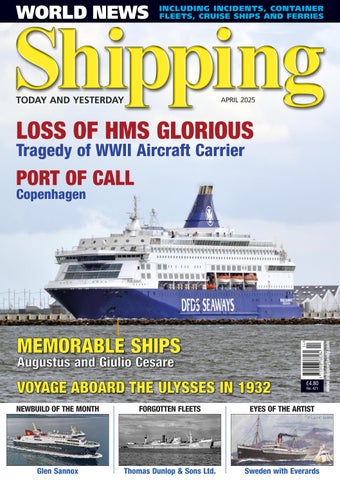
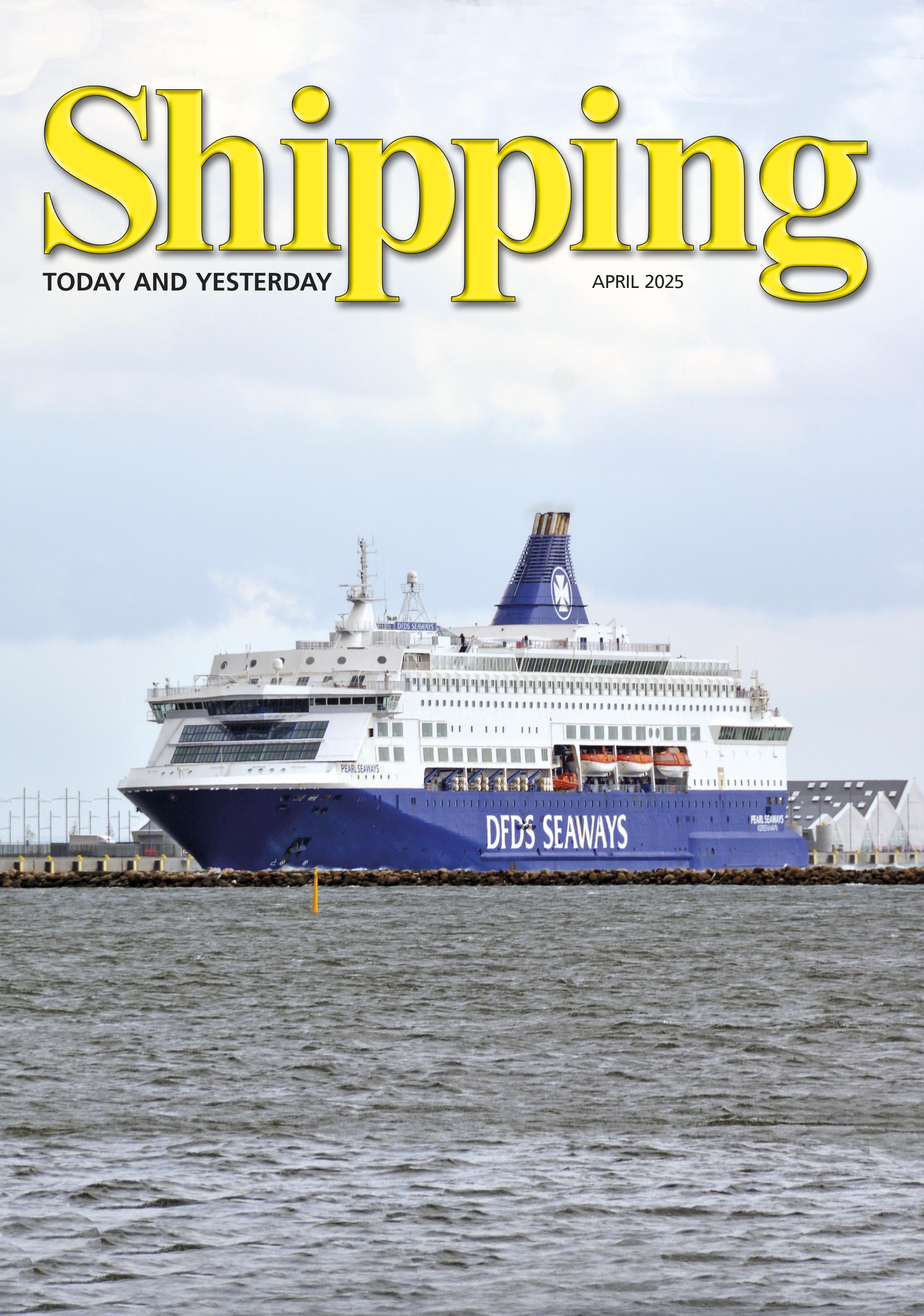
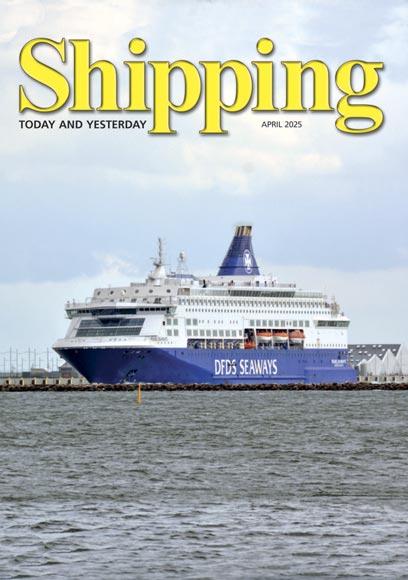
The 40,231gt Pearl Seaways of DFDS leaving Copenhagen in 2014. She was built in 1989 by Wartsila at Turku. She recently joined Gotlandsbolaget and has been renamed Nordic Pearl.
NOTABLE INCIDENTS
A joint statement from the heads of state or government of Denmark, Estonia, Finland, Germany, Latvia, Lithuania, Poland and Sweden put increased tensions in the Baltic region into a broader context when it declared, “Combatting breakage of undersea cables and pipelines represents a global problem. Russia’s use of the so-called shadow fleet poses a particular threat to the maritime and environmental security in the Baltic Sea region and globally. This reprehensible practice also threatens the integrity of undersea infrastructure, increases risks connected to sea-dumped chemical munitions, and significantly supports funding of Russia’s war against Ukraine”.
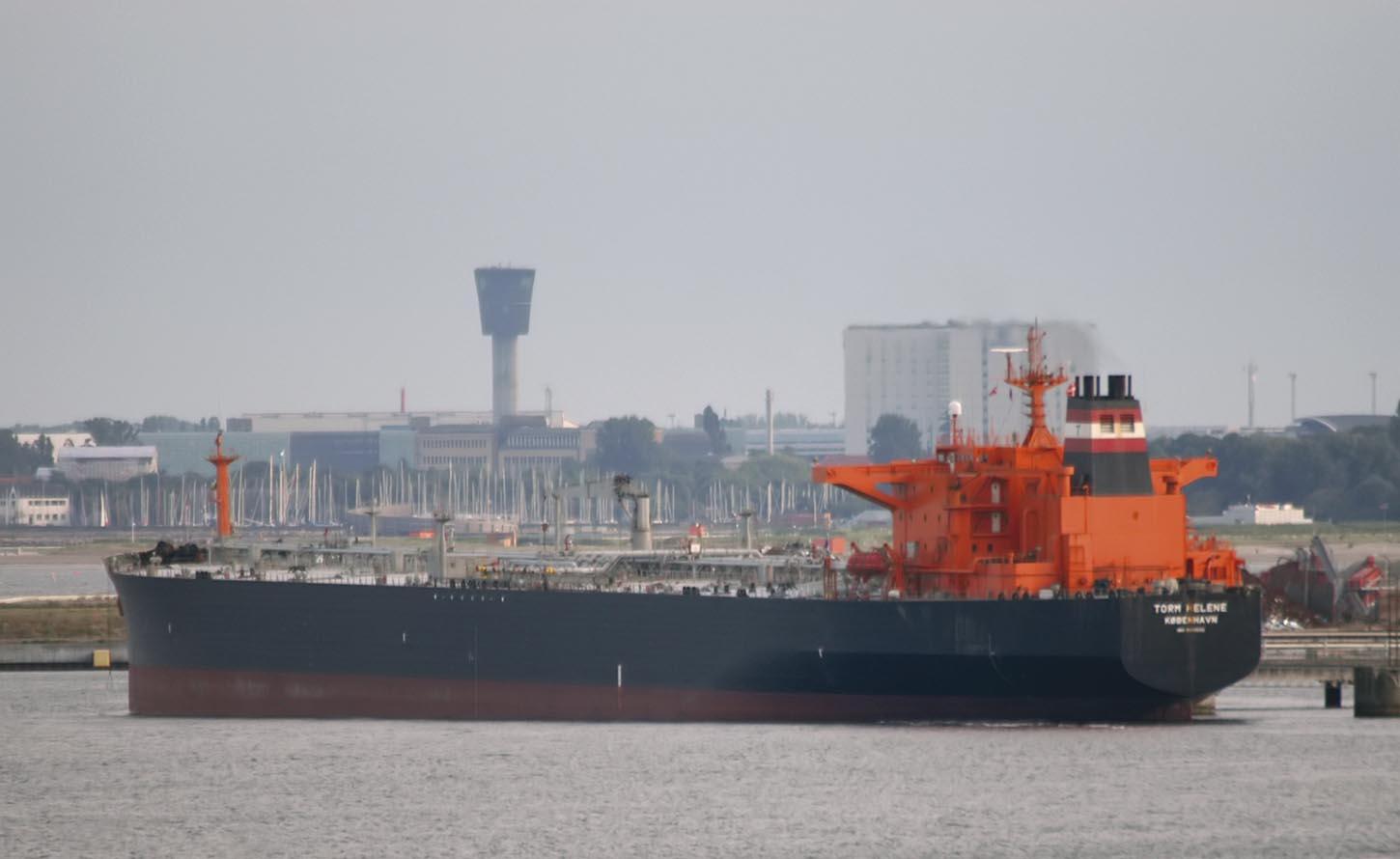
Those threats were increasingly real at the start of the year with three ageing tankers linked to exports of sanctioned Russian oil and a bulk carrier at the centre of infrastructure disruption, environmental concerns and political intrigue.
As reported last month the 74,035dwt Eagle S hit the headlines on Christmas Day 2024 as the prime suspect regarding the severing of electricity and data cables linking Finland with Estonia. Photographs later revealed the 18 year old Cook Islands-flagged product tanker had lost its port anchor which was subsequently retrieved by a loaned Swedish naval underwater survey vessel HMS Belos. Subsequent investigations indicated that the anchor had been dragged for over 60nm.
On 11th January 2025 news emerged that the similar vintage, 2006 built Panamanian flagged 152,000-dwt Eventin loaded with 99,000 tonnes of Russian oil was immobile and adrift in the southern Baltic. She had lost all power the previous day cutting off propulsion but also heating, lighting and water supply for the 24 crew members onboard. In an operation co-ordinated by the Central Command for Maritime Emergencies (CCME) helicopters flew in emergency generators together with lamps and heaters to the stricken vessel and secured a tow that took her to the closest point of safety, the anchorage off the German port of Sassnitz.
The third tanker of the infamous trio, the 2008 built 50,548 dwt Panama-flagged Jazz limped through the Baltic in late December and early January after departing from Vysotsk in Russia plagued by breakdowns and various mechanical issues off Finland and later Denmark. However, by mid-January she was sailing down the North Sea bound for Radès in Tunisia.
EDITOR’S LOG
Echoing the littoral states warning at the start of this column that the threat posed by shadow fleet ships goes beyond the Baltic came news that the sixteen year old Russian-flagged tanker Unity had broken down in storm conditions in the Bay of Biscay off France. The 62,863gt vessel had departed from Primorsk laden with oil when it lost power. As of the 27th January the ship was shown in the English channel, progressing very slowly possibly under tow and heading towards the Le Havre region.
The plight of these ships highlights both the intentional and accidental risks posed by the so-called shadow fleet, whose obscure ownership and dubious insurance credentials frequently go unquestioned by flag states.
Addressing the immediate risk of pipeline and cable sabotage NATO pledged to provide vessels to monitor shipping and the integrity of subsea connections with the first two German and Dutch vessels arriving on 15th January shortly after an agreement was reached at a meeting in Helsinki.
In contrast to the growing geo-political tensions in Northern Europe we end this month’s incidents column with news of the ceasefire between Israel and Hamas that came as a relief to so many. Shortly after the agreement came into effect Houthi rebels in Yemen announced they would stop their attacks on ships linked to Israel, the US and the UK. In another significant gesture the 25 strong crew of the 17,127 dwt captured car carrier Galaxy Leader were released as part of the agreement brokered by Oman. The ship was seized by Houthi rebels back in November 2023, whilst it was sailing without cargo to India under charter to Japan’s NYK on the pretext of Israeli-linked ownership interests and anchored near Hodeidah Yemen on very public display. Negotiations to release the Bulgarian, Romanian, Ukrainian, and Mexican nationals has been drawn out and complex, but IMO Secretary-General Arsenio Dominguez echoed the relief of many, saying, “This is a moment of profound relief for all of us, not only for the crew and their families, but also to the wider maritime community. Today’s breakthrough is a testament to the power of collective diplomacy and dialogue, recognising that innocent seafarers must not become collateral victims in wider geopolitical tensions”. Whilst welcoming the broader developments from the ceasefire shipping companies remained cautious and played down suggestions of an immediate resumption of services through the Red Sea and via Suez.
Following my comments about not preserving the great American liner United States in the February edition, I feel that I should make some positive comments about the preservation of well-loved ships in other parts of the world. Luckily, due to various preservation societies often aided by the governments of countries and cities, some great old ships are still preserved.
The obvious number one is the former Cunard liner Queen Mary of 1936 which has been preserved in Long Beach, California since 1968. I still feel emotional when I see her and visit her in her berth and am forever grateful to the various trusts that have made her preservation possible.
It is also a joy to see the former Holland America liner Rotterdam of 1959 in excellent condition back in her home port.
The former Japanese liner Hikawa Maru of 1930 is preserved as a museum in Yokohama. After financial problems the ship was taken over by Japanese shipping company NYK in 2007.
The former French liner Ancerville of 1962, now the Minghua, ia part of the Sea World Complex in Shenzhen, China.
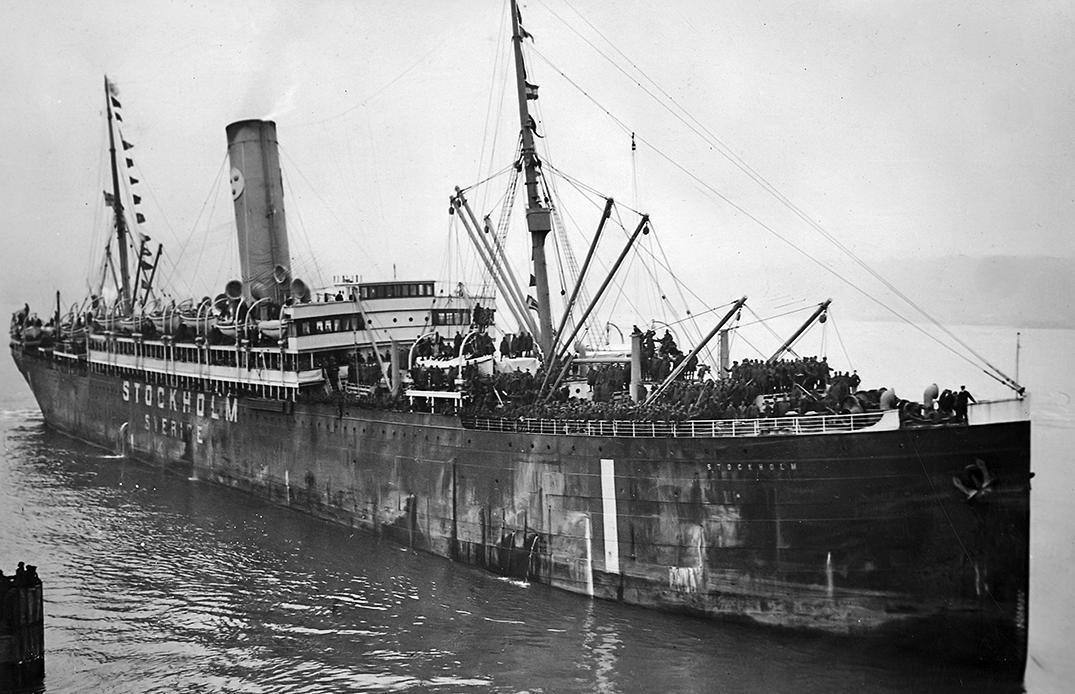
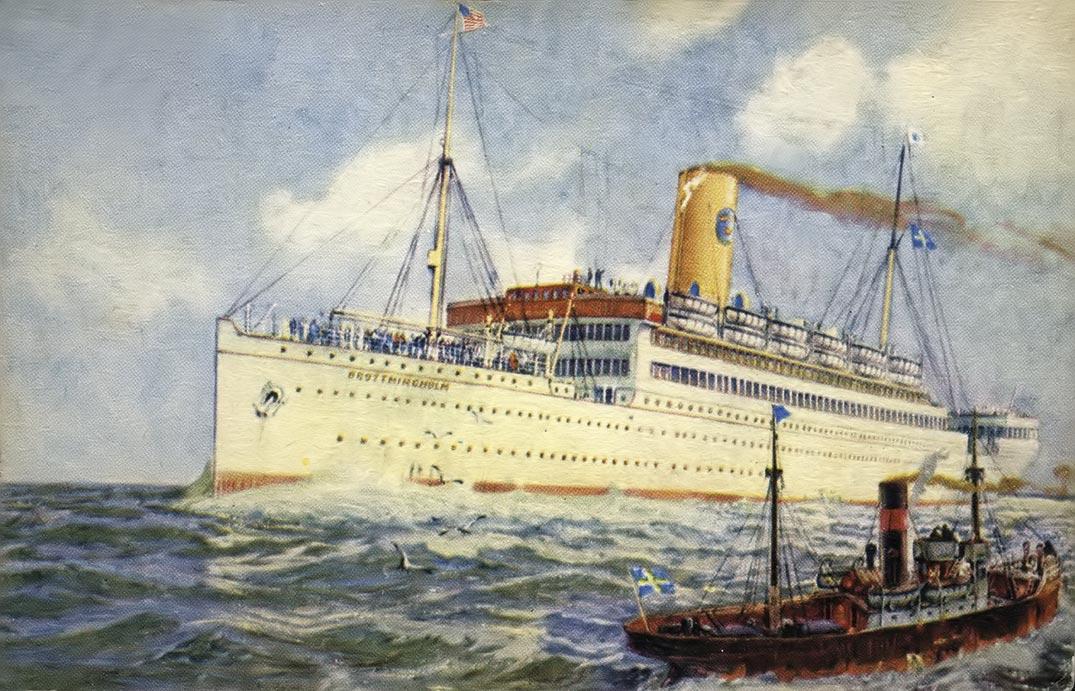
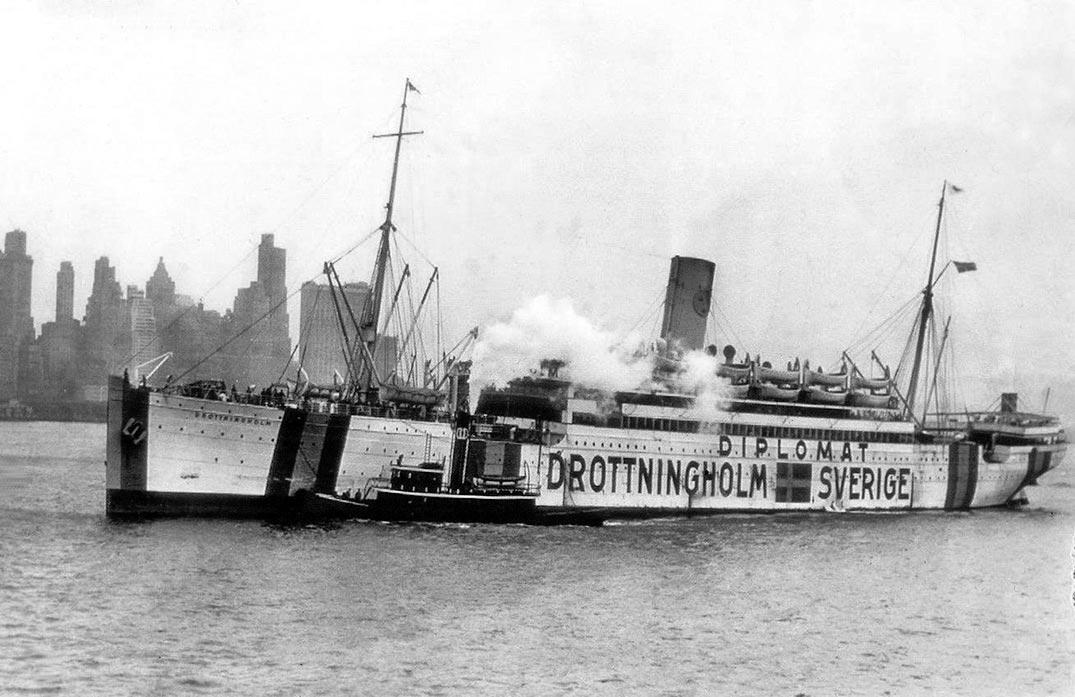
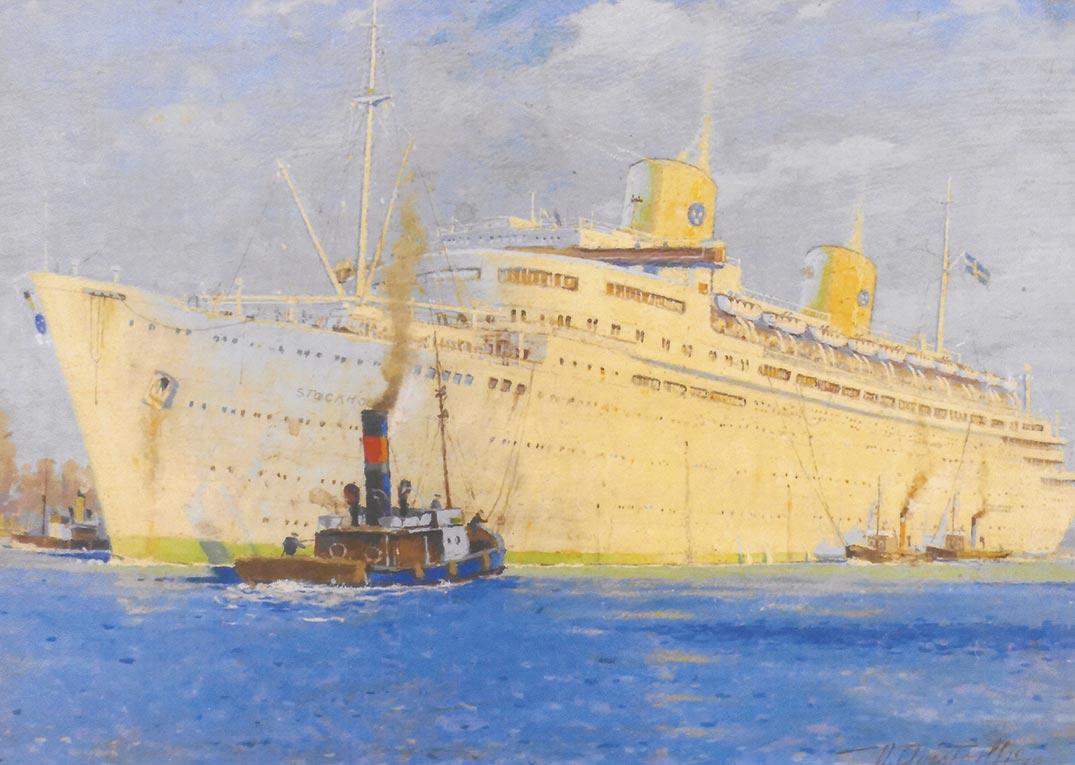
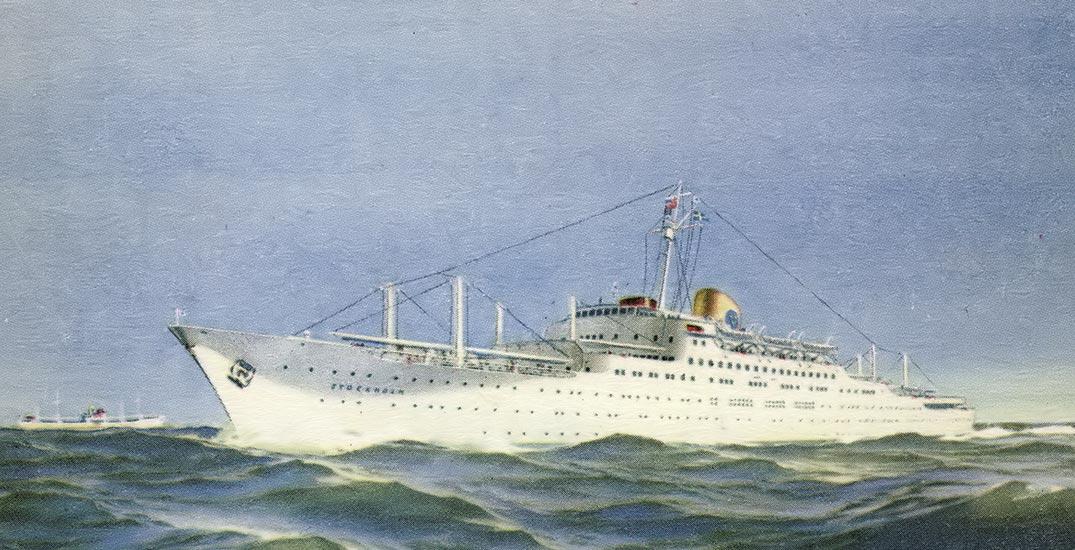
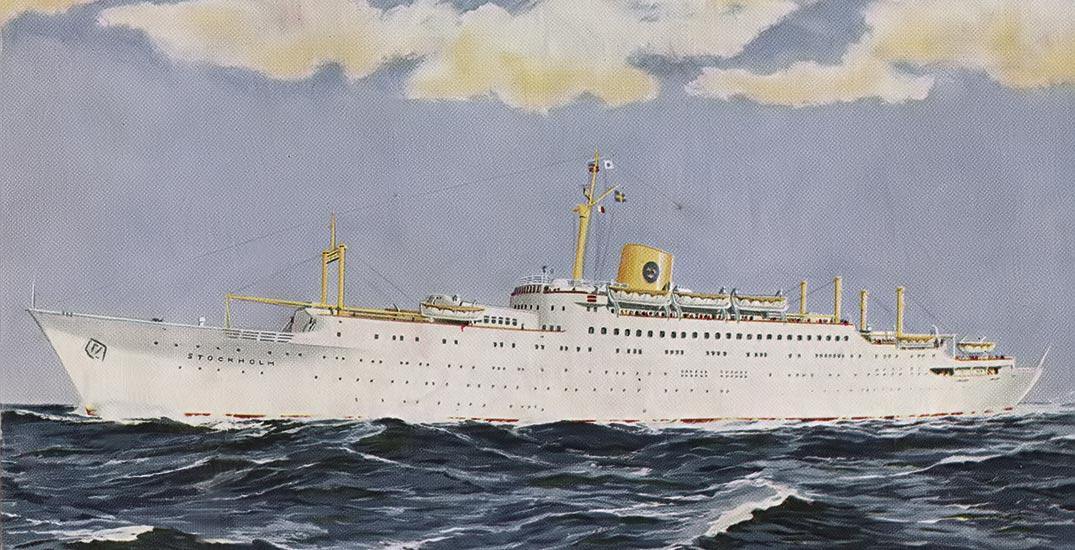
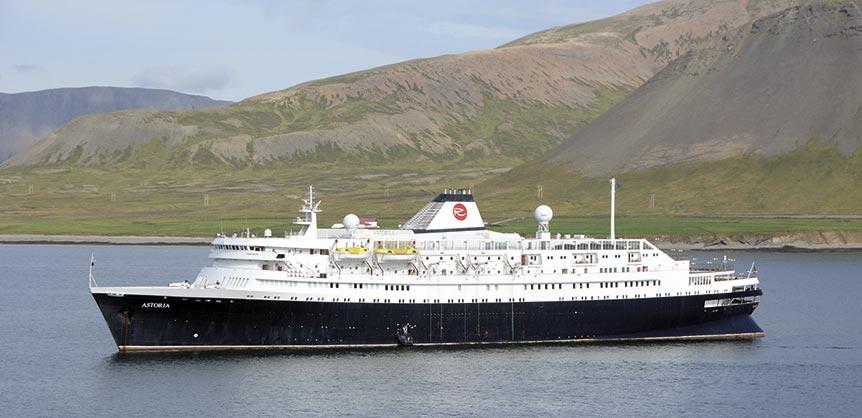
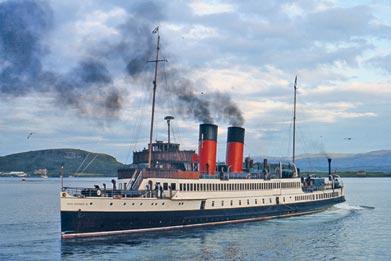
There are other great examples of preserving important ships from our past notably Brunel's Great Britain which is preserved in Bristol. Many smaller British ships such as Waverley, Balmoral, Kingswear Castle, Medway Queen and Glenlee are excellent examples of such. However, there are some notable vessels whose future is still in the balance. The 1948-built Astoria, which rose to fame when, as the Stockholm when she collided with and sank the Italian liner Andrea Doria off Nantucket in 1956, is still laid up in Rotterdam, her future causing much concern. Let's make certain that these important parts of maritime history are preserved for future generations to enjoy.
editor@shippingtandy.com
CONTAINER FLEETS
New shipping alliances dominated the news in February with the launch of the Premier Alliance, Maersk/Hapag Lloyd’s Gemini Co-operation and MSC/ZIM Transpacific combined services, whilst members of the long-established Ocean Alliance extended their commitment through to 2032.
When its largest contributor Hapag-Lloyd announced that it was leaving THE Alliance to join forces with the world’s second largest liner operator Maersk, there were concerns that the residual members, Ocean Network Express (ONE), HMM, and Yang Ming might disband. If anything, it seems to have drawn them even closer. The new Premier Alliance strategic partnership offers coordinated schedules on all the major East-West trade lanes linking China and the Far East with North America’s West and East coasts, the Middle East and north and southern Europe. Nevertheless there were teething troubles and as of January 2025 Premier Alliance was still trying to satisfy regulatory barriers imposed by the United States’ Federal Maritime Commission (FMC).
In contrast to Premier Alliance’s all-Asian membership the Gemini Co-operation agreement brings together two of Northern Europe’s heavyweights Germany’s Hapag-Lloyd and Denmark’s Maersk. Their combined fleet of about 340 containerships provide a total capacity in excess of 3.7 million TEU over a comprehensive network of 57 services, with industry leading reliability targets.
Meanwhile the Mediterranean Shipping Company (MSC), the world’s number one container line by volume and Maersk’s former partner in the now defunct 2M Alliance is primarily going it alone. Nevertheless it has teamed up with Israel’s ZIM Lines in a three year deal, which again started in February 2025 that includes slot swaps and vessel sharing on six transpacific routes from Asia to US East Coast and Gulf ports together with the Caribbean and Mexico’s West Coast.
The one stable partnership amongst these changes is the Ocean Alliance an eclectic mix of CMA CGM, COSCO shipping, Evergreen, and Orient Overseas Container Line (OOCL) which was formed in 2017 and provides a wide range of port coverage on seven East/West routes with a modern fleet committed to environmental initiatives. Having recently extended the agreement through to 2032 it provides the world’s largest shipping network with an OOCL press release commenting “In an everchanging market environment, this initiative undoubtedly reflected Ocean Alliance’s confidence in providing customers with stable and reliable services over the long term”.
These alliances are representative of the industry’s major players, but of course individual companies also provide their own services, and smaller independent operators ply various trades in competition. The general consensus appears to be that the new alliances will improve coverage by increasing competition, offering more diverse routes but also improving reliability.
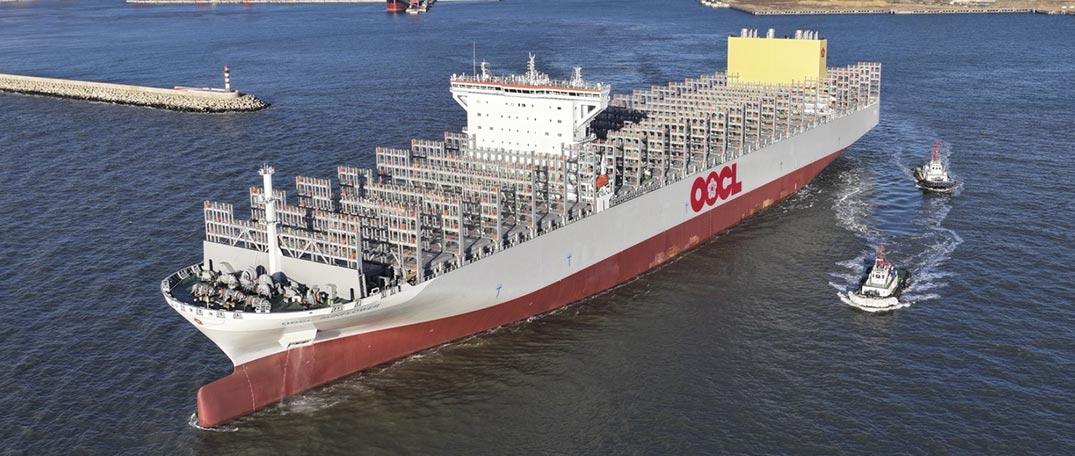
Two members of the Ocean Alliance introduced new vessels around the turn of the year with OOCL accepting the third of their new series of 16,828 TEU container vessels. She was named OOCL Sunflower by Mrs. Jenny King, Director and General Manager of INTCO Recycling Resources Co., Ltd. in a ceremony at Dalian COSCO KHI Ship Engineering Co., Ltd’s (“DACKS”) yard on Thursday 11th January 2025. OOCL Sunflower (top of next column) will operate on the company’s ECX1 service linking
Hong Kong, Yantian, Xiamen and Shanghai with New York, Savannah and Charleston on the US East Coast before returning via Laem Chabang and Cai Mep to Hong Kong on a 91-day round trip. Attending the ceremony Director and Member of OOCL’s Executive Committee Mr. Michael Xu commented, “We are confident that this ship will significantly enhance our ability to connect the world and serve our customers in future voyages. As we look ahead to 2025, the shipping industry is set to face both opportunities and challenges. OOCL's fleet structure will be further optimized, with more efficient and environmentally friendly new vessels set to deliver and sail, positioning us for future growth. We believe our vessels will continue to serve as a vital link connecting global markets, facilitating trade development, and delivering enhanced, environmentally friendly end-to-end integrated logistics services to our customers”.
On the cusp of the New Year the 366m long 15,372 TEU Ever Most, the twelfth of twenty conventionally fuelled scrubber-fitted M class vessels for Evergreen was named at her builder’s yard, South Korea’s Samsung Heavy Industry. Just a week later on 6th January she departed from Yantian China on her maiden voyage to the United States.
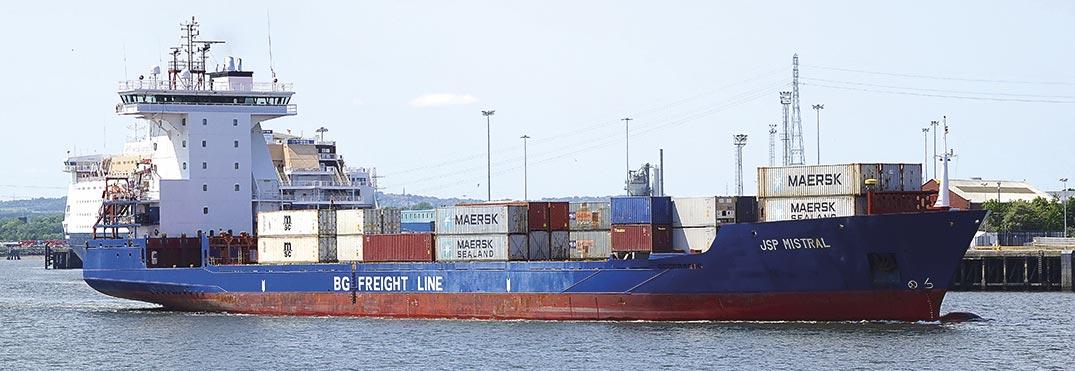
The largest member of the Ocean Alliance, France’s CMA CGM was also introducing new routes and changes to a variety of existing services. Starting on 10th February 2025 the company introduced a new configuration for its AMERIGO service, introducing Salerno in southern Italy to complement existing calls at La Spezia, Genoa and Vado Ligure. The other European ports of call are in Spain, Valencia and Algeciras with a fast twelve day transit time from Valencia to New York, before the ships head down the US East Coast to Norfolk, Savannah, and Miami. A week later CMA CGM launched a new weekly feeder service (named IAX1) using a 700 TEU capacity vessel, linking the Bulgarian ports of Burgas and Varna with the key Turkish hubs of Izmit and Ambarli. Lines between Turkey and the Eastern Mediterranean were also improved with the introduction of CMA CGM Short Sea Lines’ Bora Med service (BMS) utilising 2,500 TEU ships to link Antalya, Izmir, Aliaga, Ambarli, Gebze and Gemlik with Malta and then Ancona, Ravenna, Venice and Trieste with Koper, Rijeka, Bari and Taranto before returning via Malta, Limassol, Alexandria and Beirut to Antalya. Then on 20th January 2025 the JSP Mistral (above) started a new Baltic Express Service (BLX) a weekly feeder service originating from Gdansk and calling at Kotka in Finland and Riga.
Ian Richardson
OOCL
Amongst a host of other Chinese firms another member of the Ocean Alliance, COSCO Shipping was named by the US Defence Department in January as having links to the People’s Liberation Army. In response the shipping firm responded that it was seeking to clarify the position with the US authorities and that the subsidiaries singled out by the Pentagon were not Chinese military companies. Another prominent member of the blacklist is the state owned shipbuilder China State Shipbuilding Corp. (CSSC). Although there is no financial or legal sanction imposed, US firms are encouraged to disassociate themselves from the targeted companies.
Two members of the new Premier Alliance, Singapore-headquartered Ocean Network Express (ONE) and South Korea’s HMM announced a new service back in January, linking the Far East with East Coast of South American ports. Named East Coast South America Express 2 (SX2) by ONE and the Far East AsiaEast Latin America (FL2) by HMM the new service is expected to start this month, augmented by a dedicated River Plate feeder service offering “reliable and competitive transit times” to Argentina and Uruguay. The service runs out of Pusan calling at ports in South China and Singapore to Rio Grande, Santos and Santa Catarina returning via Singapore and Hong Kong to Pusan. The feeder service is based on a loop out of Rio Grande calling at Buenos Aires and Montevideo.
From new routes to new ships. Unconfirmed rumours as this column was being completed suggest that CMA CGM is the European owner mentioned by HD Hyundai Heavy Industries behind a total $2.58 billion order for twelve 18,000 TEU LNG dual-fuel containerships. Industry insiders suggest the new ships which are due for delivery by the end of 2028 will propel the French owner/operator into second place above Danish rivals Maersk.
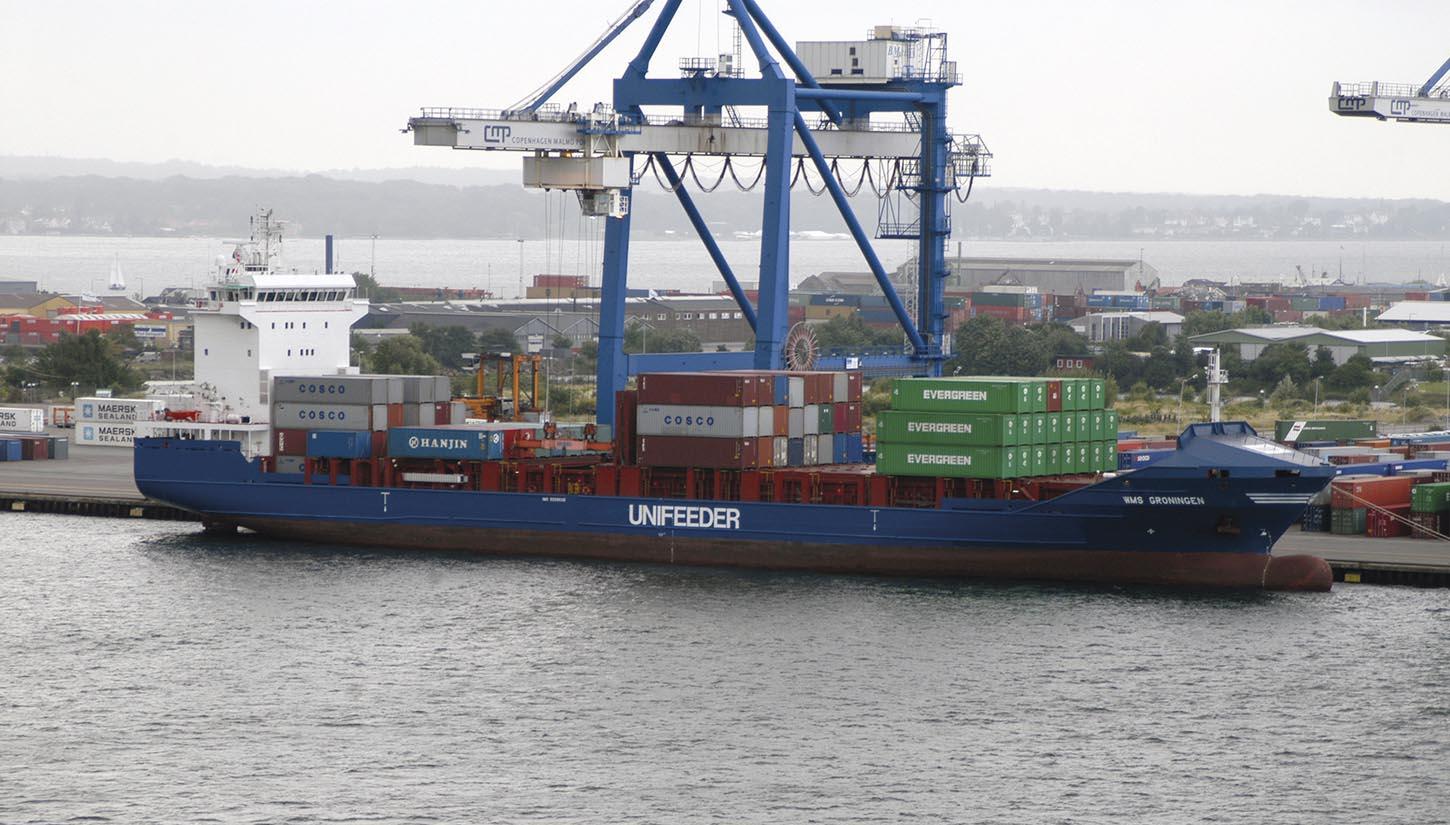
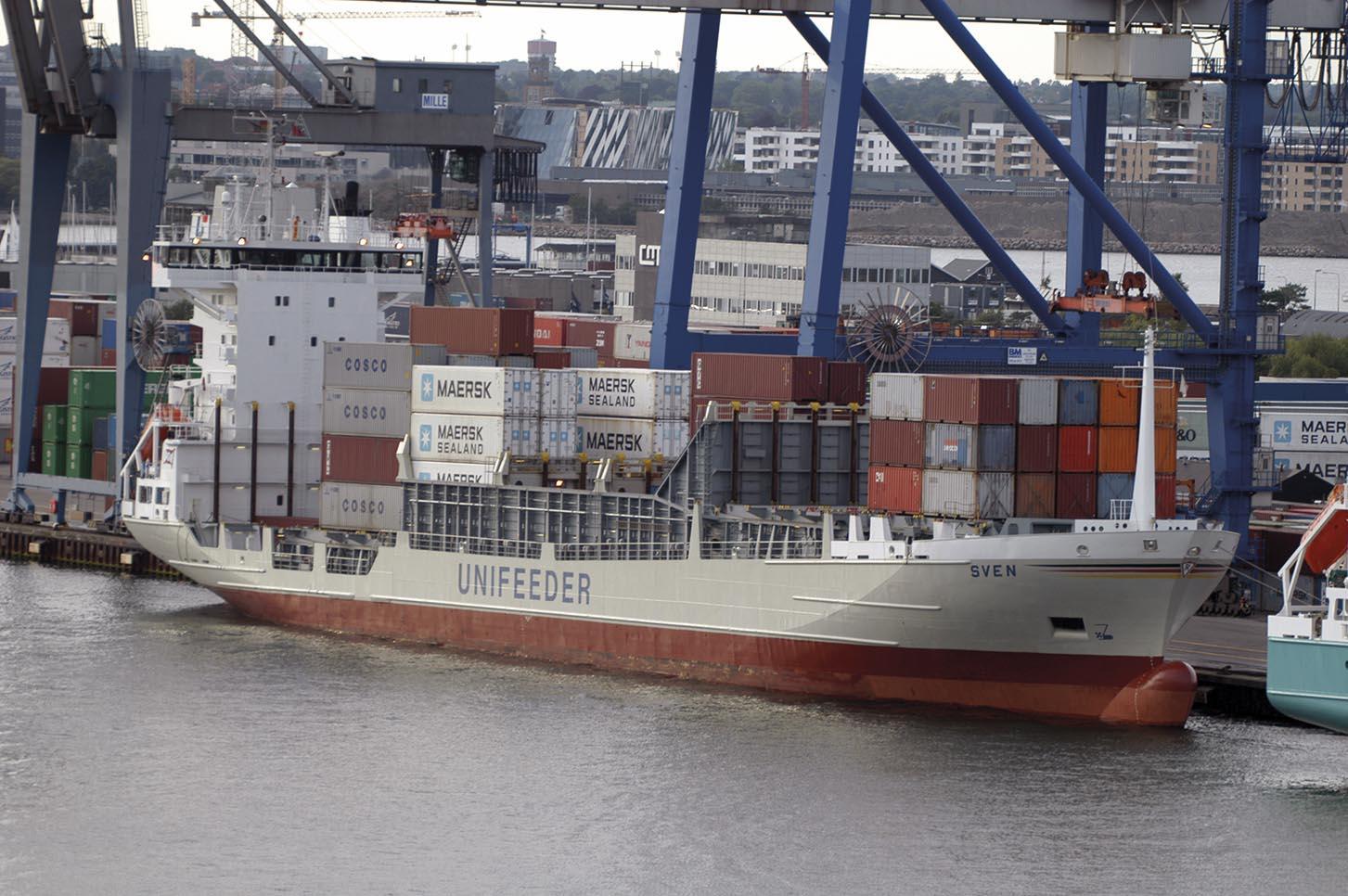
Meanwhile Elbdeich Reederei has returned to China’s Wenchong yard, the same shipbuilder which is currently fulfilling an order from the German owner for a quartet of 1,300 TEU methanol dual-fuel ships for one firm pair of 1,900 TEU vessels and options for two more. In a sign of changing times and philosophies the new ships will be conventionally fuelled. The four ships contracted in 2023 are time-chartered to feeder operator Unifeeder and are due for delivery in 2026 with the latest batch pencilled in for 2027.
Despite its 177-year history Hapag-Lloyd reached a new milestone in January 2025 by reaching 300 owned and chartered vessels in its fleet for the first time. The ship that reached that accolade is the 1,930 TEU capacity methanol ready Nordatlantic, one of three sisters the company is chartering from fellow Germans Reederei Nord. The Nordatlantic is a Wenchong Type, Gearless Container Vessel built by CSSC, HuangPu Wenchong Shipbuilding and can take 313 reefer units as part of her complement of containers. Staying with the same company the intricately named X-Press Odyssey V. 507E launched the new India Asia Express (IAX) service in February offering direct sailings from Mundra in India to Busan South Korea via Singapore and Qingdoa, Tianjin and Xingang. The new feeder service is designed to co-ordinate with the new Gemini Shuttle Network operated with MSC so that North American cargo can be transshipped via Qingdao and Busan.
In sharp contrast to Hapag-Lloyd’s longevity a relative newcomer China’s Kawa Shipping has delved into the newbuild market for the first time ordering three 4,800 TEU ships from compatriot Wuhu Shipyard. The ships will be LNG dual-fuel powered and cost about $60 million each with delivery scheduled for 2027. Another
Chinese owner/operator was also investing in new ships with intraAsia operator SITC International Holdings exercising options for two additional 1,800 TEU vessels from Huanghai Shipbuilding with delivery pencilled in for October and December of 2027.
Somewhat confusingly the Greek-based containership owner Euroseas’ recently created subsidiary Euroholdings, acquired three ships from the parent company in early January with Chairman and CEO Aristides Pittas commenting, “We firmly believe that under the right circumstances, there is considerable value in the current environment in continuing to trade older, wellmaintained vessels, rather than selling them”. The confusion came when one of the three, the 1998-built 2,008 TEU Diamantis P was promptly sold to undisclosed buyers for $13.15 million on a charter-free basis. The other two ships transferred to Euroholdings were the one year older 1,439 TEU Aegean Express and the 1999-built 1,732 TEU Joanna.
In other second-hand news Turkish owner/operator Medkon Lines purchased Contships Management’s 1,100 TEU Contship Med for $7 million in late January. Representing the ninth container vessel it has acquired in less than a year, the 2004 built Contship Med is also the sixth the company has bought from Contships Management in the same period. She will be transferred at the end of her current charter to Maersk and take the Medkon fleet to 23 ships.
Although recycling was down across all sectors, according to industry analysts Alphaliner the number of demolitions in 2024 was almost exactly half the 2023 figure. It transpires that only 56 ships totalling 80,950 TEUs were scrapped last year compared to 162,000 TEUs in 2023.
the Francis Scott Key Bridge in Baltimore on 26th March, is back in service. After a long process extricating her from the rammed bridge support the damaged ship was taken to the Fujian Huadong Shipyard in China for repairs. The yard completed the work ahead of schedule allowing the 9,971 TEU capacity ship to undertake sea trials on 12th January before resuming her role on Maersk’s transpacific route from Shanghai five days later.
OBITUARY
I was saddened to learn of the passing of Richard Woodman who has been a contributor to this magazine as well as the author of over 70 books on maritime history as well as novels. Richard had served with Blue Funnel Line and in 1967 he joined Trinity House where he became an Elder Brother in 2006. He was awarded the Merchant Navy medal and in 2014 he was appointed a Lieutenant in the Royal Victorian Order. He will be sadly missed.
Nigel Lawrence
Nigel Lawrence
BULK AND TANKER NEWS
We start this month with news of orders and deliveries for European based owners and operators.
The uniquely named Swedish operator AtoB@C Shipping, a subsidiary of ESL Shipping, which is itself part of the Finnish conglomerate Aspo, added Baymar and Soundmar the first two in a series of six 5,900 dwt ice class 1A bulkers to its chartered fleet around the turn of the year with the remaining four ships set for delivery in 2026. The ships were designed by Dutch Groot Design with the intention of reducing CO2 emissions by 50% compared to the existing fleet of similar sized ships. All are being built at China’s Jiangsu Dajin Heavy Industry for German owner BAAS Shipping.
AtoB@C Shipping was also anticipating the sixth in its own newbuilding programme of a dozen 5,350 dwt plug-in hybrid vessels to be delivered from India’s Chowgule & Company shipyard. The ship, named Terramar, was launched in December 2024 and is expected in the first quarter of 2025 with her sisters scheduled for delivery on a quarterly basis through to the end of 2026.
The largest ship ever to have wind-assisted propulsion returned to service after the installation of five 35-metre tall and 5-metre diameter rotary sails onboard the Asyad owned and Vale chartered 400,000 dwt Very Large Ore Carrier (VLOC) Sohar Max. The work was undertaken at COSCO’s Zhoushan shipyard. The units are supplied by UK based Anemoi Marine Technologies and include a folding deployment system which allows the rotors to be flattened in port and therefore moved out of the way during cargo operations. Initial testing was carried out during the ship’s postrefit maiden voyage and will be ongoing with emissions reduction of up to 6% anticipated, resulting in 3,000 tonnes less of carbon emissions per year. Vale’s investment doesn’t stop there however, as they plan to install more Rotor Sails on another 400,000 dwt VLOC, the NS United Kaiun Kaisha owned NSU Tubarao by September 2025.
Vale wasn’t the only company investing in wind power around the turn of the year. Coming on the back of the earlier retrofit of equipment on the company’s 50,000 dwt medium range products tanker, Pacific Sentinel, Eastern Pacific has signed a contract with Spain’s bound4blue for three 22 metre eSAILS to be installed late this year on a tanker under construction at New Times Shipbuilding, China. Eastern Pacific are investing heavily in its decarbonisation strategy with the wind assisted technology running alongside alternative fuels and optimisation systems.
Greek dry bulk owner Diligent Holdings which sold the wonderfully named 35,000 dwt Bliss to Lebanon’s Medsea for a reported $10 million at the start of the year. Renamed New Bliss she was the last handysize vessel in the Diligent fleet with the company now focussing on its supramax fleet. Meanwhile compatriots OceanPal have sold the 171,800 dwt 2005-built Salt Lake City to undisclosed Chinese interests. The $16.1 million payment comes on the back of the $18.25 million which it realised last year from the similar vintage 177,243 dwt Baltimore which was also sold to China, in that case YKJ Shipping.
Remaining in Greece to finish this review of the bulker sector, Empros Lines will have been happy to receive $21 million from undisclosed buyers in mid-January for the 2013-built 61,400 dwt Giorgos Dracopoulos, especially when an identical vessel Omishima Island also built by Iwagi Zosen realised just $19.8 million for Japan’s Shikishima Kisen only a fortnight earlier.
Adding to its investment in new ships RFOcean has ordered an eighth vessel in its series of 6,600 dwt methanol dual-fuel stainless steel chemical tankers being constructed by Wuhu Shipyard in China. The original deal was for four ships costing about $80 million back in the summer of 2023 ships which were later supplemented by three more. The latest addition will be upgraded versions of DC electric push duplex stainless steel intelligent chemical tankers which the yard constructed for Dingheng Shipping.
South Korea’s biggest owner/operator HMM which had purchased 20 vessels in the previous 12 months sold two 16 year old MR product tankers, the 50,800 dwt Oriental Diamond and the 50,500 dwt Oriental Gold to undisclosed buyers for a total of about $41 million. The sales come as HMM awaits the arrival of two new units from the HD Hyundai Mipo yard in the forthcoming year, just a small part of the massive investment that will eventually treble the size of its tanker fleet.
Moving to the gas transportation sector, Korean shipbuilder Samsung Heavy Industries (SHI) secured a 724 billion Won ($508 million) deal to build three very large ethane carriers (VLECs) for Japan’s Mitsui OSK Lines (MOL).
Also pressing ahead with new ships was Singapore’s principal marine fuel supplier Equatorial Marine Fuel Management Services. The company has contracted Chinese gas shipbuilding specialist Nantong CIMC Sinopacific Offshore & Engineering (CIMC SOE) to add to its 20 strong fleet with the construction of a 20,000 m3 bunkering vessel which features the latest WINGD dual-fuel main engine and iCER technology to meet IMO Tier III emission standards in both conventional fuel and LNG modes. The ship also incorporates an optimised cargo containment system that reduces the boil-off rate compared to similar-sized ships in the sector. For CIMC SOE the order comes hot on the heels of a contract for two 12,000 m3 LNG bunker vessels from compatriot’s Fuzhou Wuyang Refined Oil Trading.
Navigator Holdings, the world’s largest owner of handysize LPG carriers bought three 17,000 m3 liquefied ethylene carriers in December for a reputed $83.9 million. Although unnamed at the time of the transaction they are believed to be the 15 year old Gaschem Pacific and one year younger Gaschem Adriatic and Gaschem Antarctic. The vessels will be added in the first or second quarter of 2025 and takes the fleet to 59 vessels of which almost half are ethylene and ethane-capable. The additions complement the expansion of the Morgan’s Point ethylene export terminal, a joint venture with Enterprise Products Partners which is now expected to export 1.55 million tonnes in the next year.
Italy’s Marnavi placed an order for a pair of 13,000 dwt stainless steel duplex chemical tankers with China’s Zhoushan shipyard in a deal worth a total of about $60 million back in January. Delivery dates are pencilled in for the end of 2026 and early 2027. This represents the Naples-based group’s first newbuild foray in about seven years, adding to its established 37 strong fleet.
Also ordering new ships was China’s Yangzijiang Financial Holding a subsidiary of the country’s largest private shipbuilder Yangzijiang Shipbuilding. Various sources stated that the fund placed an order for four 50,000 dwt MR product tankers with Jingjiang Nanyang Shipbuilding, each ship costing about $45 million. Delivery is again scheduled in 2026 and 2027.
CRUISE NEWS by Andrew & Donna Cooke
ABP Southampton confirmed that 2024 was a record-breaking year for the cruise sector at the Port of Southampton, welcoming over 3 million passengers and surpassing the 2023 results. The year was also an unparalleled one environmentally, with a 50% increase in cruise vessels using Southampton's sector-leading shore power facilities, enabling zero emissions at berth, and working towards the Net Zero commitments. These achievements reinforce Southampton's position as Northern Europe's number one cruise turnaround port and the UK's leading cruise port. Southampton is an established cruise hub, supporting 85% of the UK cruise market. The Port offers leading expertise in cruise operations, fuel bunkering, cruise waste services, ground handling, and stevedoring, all of which contribute to an efficient cruise turnaround and continued growth. Rebekah Keeler, Cruise Strategy Manager, ABP commented, "We are proud to have the capability, infrastructure, and partnerships to facilitate sustainable cruise growth and over £1 billion in associated economic value. We continue to see global cruise sector growth, and Southampton leads the way for the UK and Northern Europe". The port’s environmental initiatives included the £55 million Horizon Cruise Terminal, home to the UK's first shore power facility for cruise ships and 2,234 roof-mounted solar panels. The second shore power connection at the Mayflower Cruise Terminal was commissioned in 2024.
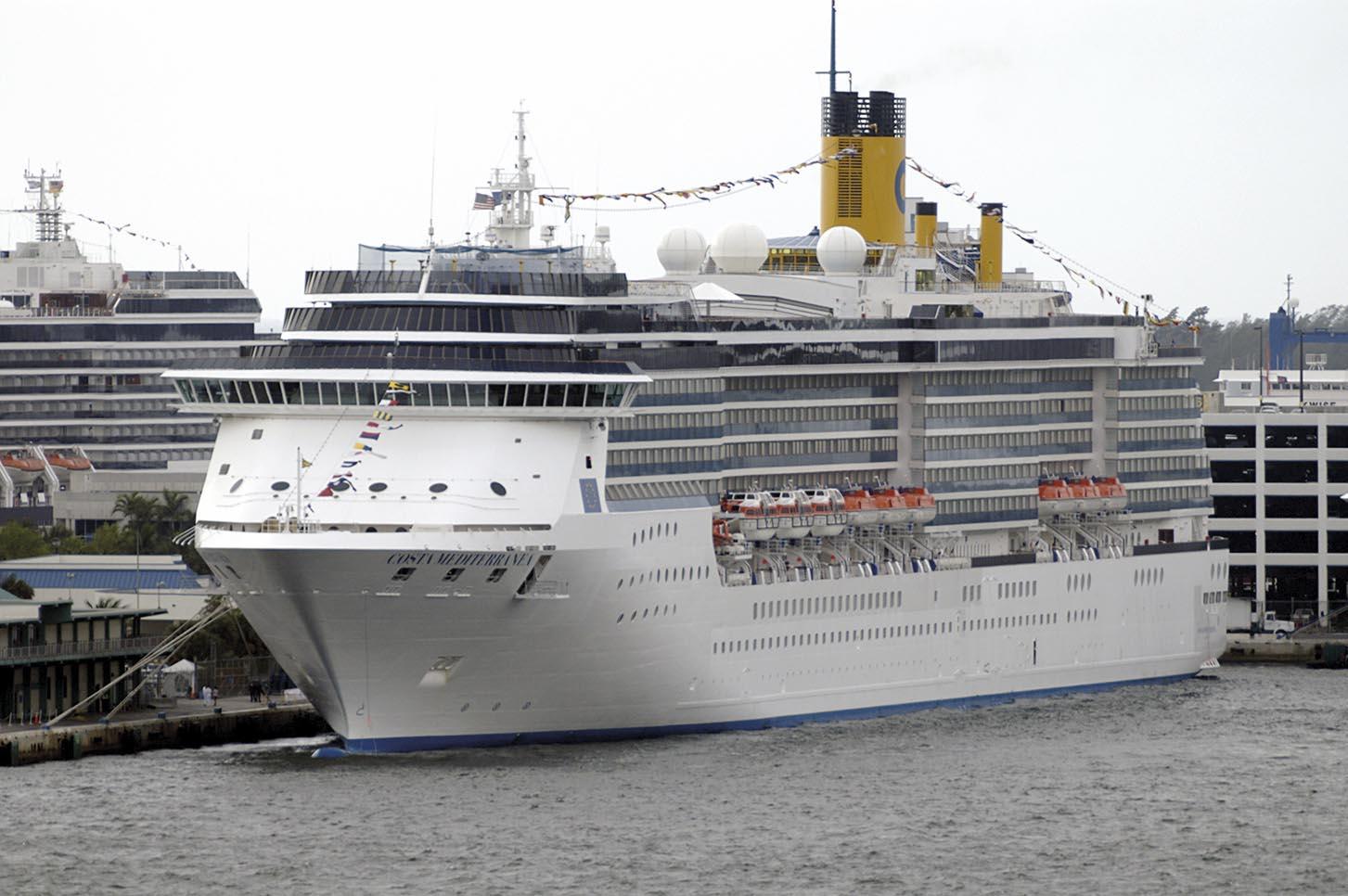
Adora Cruises, part of the CSSC Carnival partnership, announced on 16th January the completion of the hull assembly of the second homegrown large cruise ship, the 135,500/2026-built Adora Flora City, in Shanghai. The ship can accommodate 5,232 passengers at full occupancy and features 16 public decks. The Adora Flora City will offer international voyages from Guangzhou and draws inspiration from that location’s reputation as the Flower City. Historically, Guangzhou served as a vital hub of the ancient maritime Silk Road, and in a symbolic nod to its rich local heritage and traditional Chinese culture, the Adora Flora City will carry a message of discovery as it connects travellers with the wonders of the world. Adora Cruises’ first ship was the 85,619gt/2003-built Adora Mediterranea, the former Costa Mediterranea, and from 18th December 2024 she was offering cruises from Guangzhou, 3-6 days per itinerary, including popular destinations such as Hong Kong, Japan, and Vietnam.
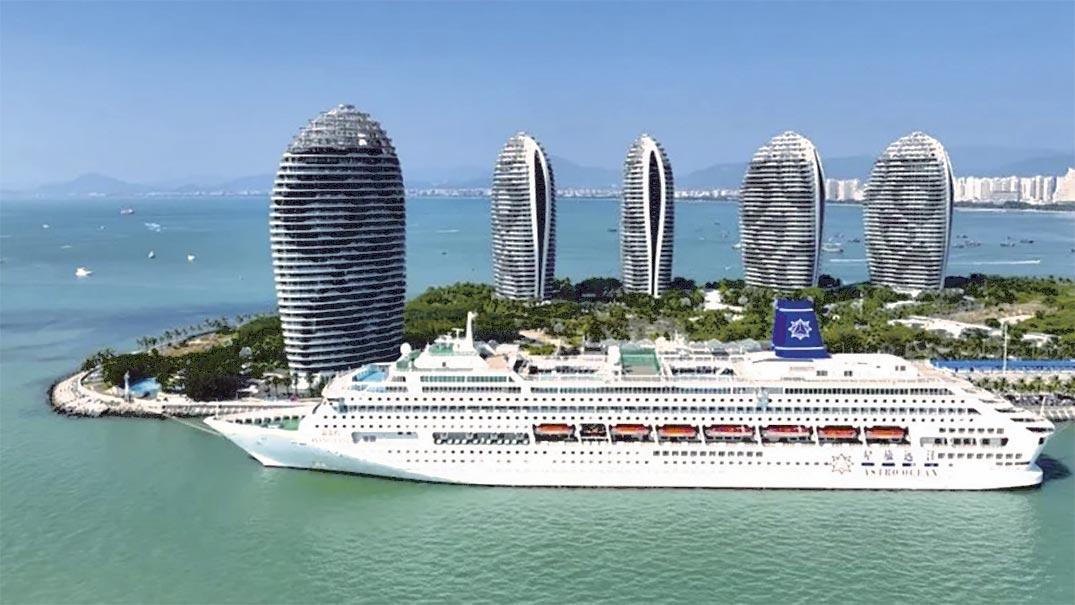
Astro Ocean’s 69,840gt/1995-built Piano Land (above), formerly P&O Cruises’ Oriana, was welcomed to the Chinese port of Sanya on 3rd January to commence the ship’s 2025 cruise season there. The 1,822guest capacity ship was the first to dock at the Phoenix Island International Cruise Port for 2025 on her debut visit. After a 4-year hiatus, the much-loved and sorely missed P&O-built vessel resumed guest service for Astro Ocean Cruises in June 2024, kicking off a series of short cruises from Shanghai. The Piano Land is now offering a series of itineraries that also sail to Hong Kong and Vietnam.
Carnival Corporation has expanded its partnership with Silverstream Technologies to install the Silverstream® System on another two cruise ships. These will be the third and fourth new build Excel-class vessels to be fitted with its air lubrication system. The 180,000gt ships, with a capacity of over 5,000 passengers, will be built at Meyer Werft in
AMBASSADOR & CFC TO MERGE
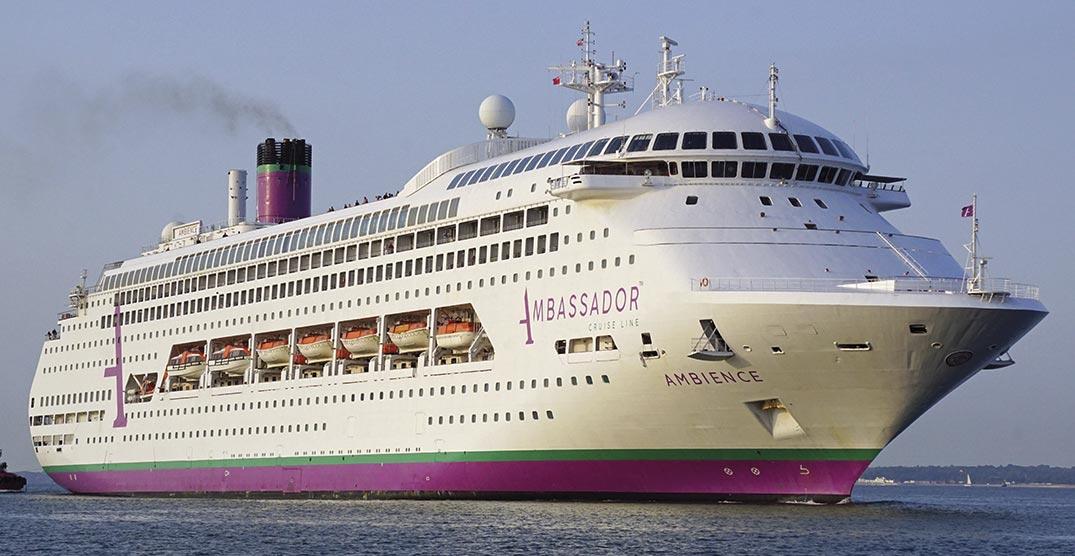
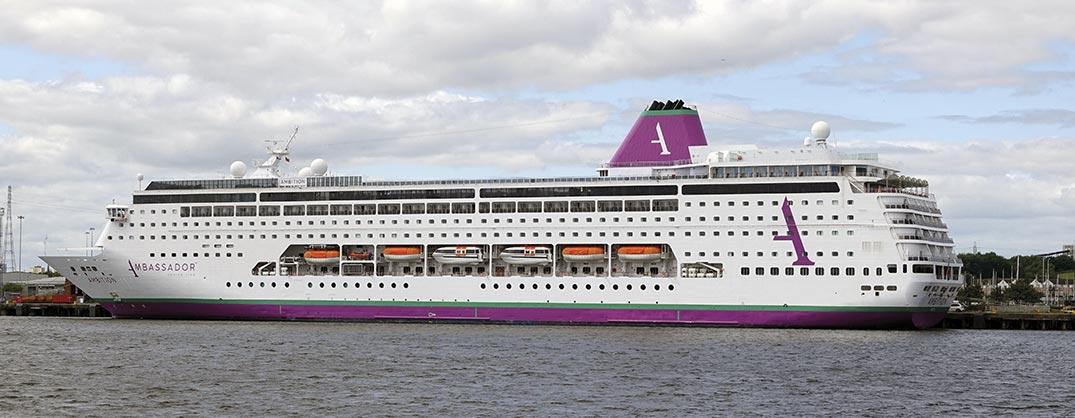
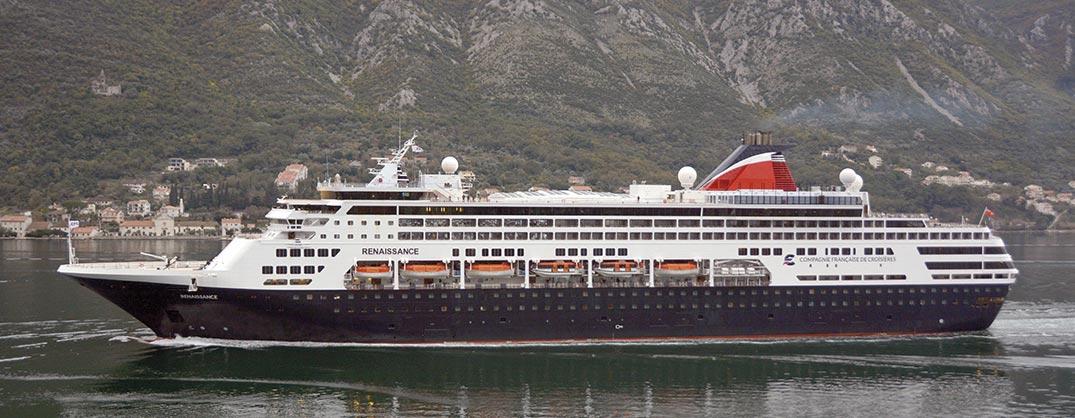
Ambassador Cruise Line and Compagnie Française de Croisières (CFC) announced on 9th January that the two cruise operators had reached agreement to merge.
Ambassador Cruise Line is a Njord Partners portfolio company and, together with CFC, will form the Ambassador Group. This strategic combination marks the creation of a leading European premium affordable value cruise line, targeting the no-fly silver market. The transaction was expected to close by the end of January 2025. With Ambassador’s success in the UK market and CFC’s strong presence in the French no-fly cruise sector, the combined operators provide a formidable platform from which to expand the newly formed Ambassador Group’s footprint in the European market, taking advantage of the significant growth in the European cruise sector over the next decade. With the market expected to grow by 12% p.a. over the next five years, the Group will leverage its premium and highly regarded offering to establish new destinations while delivering authentic cruise experiences to a wide audience.
The Group will operate a fleet of three small-to-mid-sized vessels, namely Ambassador Cruise Line’s 70,285gt/1991-built Ambience and 48,123gt/1999-built Ambition and CFC’s 55,575gt/1993-built and 1,200 guest-capacity Renaissance, which is fully refurbished following recent multimillion-euro investments. Both the Ambassador and CFC vessels will continue to offer a traditionally British or French product to their respective markets, with each brand retaining its unique national identity.
The Ambassador Group is introducing a joint fly-cruise Caribbean programme in Winter 2025/26 in partnership with Corendon, a leading European travel operator. With itineraries from October 2025 and homeporting in Barbados, Martinique and Curaçao, sailings will combine source markets from the UK, France and The Netherlands, marking the Group’s entry into the fly-cruise market and enhancing its year-round offerings.
Nigel Lawrence
Astro Ocean
Ian Richardson
Andrew Cooke
AMBIENCE AMBITION
RENAISSANCE
Germany and feature key sustainability technologies to support Carnival Corporation in meeting its decarbonisation goals. The LNGpowered newbuild vessels, among the most environmentally advanced ships in their class, will integrate Silverstream’s technology onboard, unlocking net fuel savings potential and paving the way for the next generation of low-emission passenger vessels. Previously, the system delivered approximately 5% net fuel and emissions savings onboard Princess Cruises’ Diamond Princess. This aligns with Carnival Corporation’s focus on minimising its carbon intensity by 40%, a target the company aims to achieve by 2026, four years ahead of initial projections. The two newbuilds, scheduled for delivery in 2027 and 2028, will result in a total of 16 vessels in Carnival Corporation’s fleet with the Silverstream® System This proven air lubrication technology generates a layer of air bubbles along the surface of the hull to minimise friction between the ship and the sea, thus driving up energy efficiency, reducing fuel consumption and cutting emissions. In February 2027 the 108,865gt/2001-built Carnival Adventure, currently the Pacific Adventure, will offer a roundtrip cruise from Singapore as part of a series of newly announced itineraries in the Asia-Pacific region. And, as part of Carnival’s 2026-27 season in the region, the 92,720gt/2009-built Carnival Luminosa is scheduled to offer cruises from Singapore and Japan.
Celebrity Cruises via the Royal Caribbean Group announced on 22nd January that a sixth Edge Class ship had been ordered from Chantiers de l’Atlantique in St. Nazaire. In 2028, the ship will join her sisterships Celebrity Edge (J34) delivered in 2018, Celebrity Apex (K34) delivered 2020, Celebrity Beyond (L34) delivered 2022, Celebrity Ascent (M34) delivered 2023, and Celebrity Xcel (N34) which will leave SaintNazaire at the end of October 2025. Edge 6 is currently known as Xcel 2. The ship will feature methanol propulsion as introduced by the 129,500gt Celebrity Xcel this year. The order was to be finalised once financing was obtained.
Costa Cruises confirmed in early January that the 185,010gt/2019built Costa Smeralda had received LNG bunkers on 4th January in Dubai during her winter season of cruises in the United Arab Emirates. This is the first LNG cruise ship refuelling at Dubai port, which was made possible thanks to Monjasa, the logistics provider and the cooperation of the Dubai Port Authority. The 7,403gt/2017-built LNG bunker tanker Green Zeebrugge filled the Costa Smeralda's three tanks with a total of around 3,000 cubic metres of LNG. One full LNG tank can power the ship for 2.5 weeks.
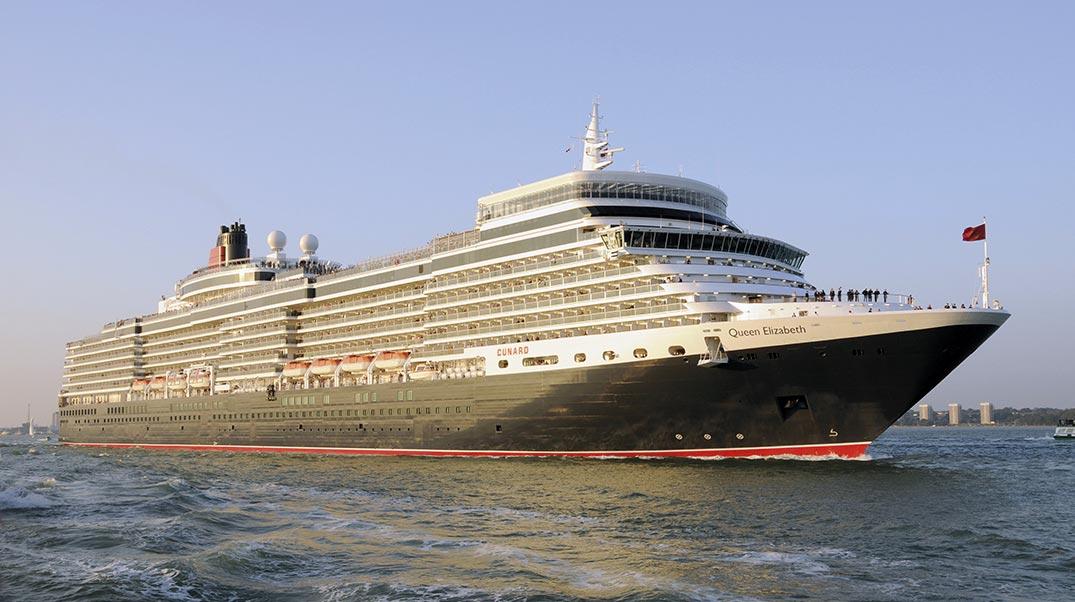
Cunard Line announced on 8th January the highly anticipated Alaska 2026 programme, offering travellers the chance to embark the 90,901gt/2010-built Queen Elizabeth (above) between April and September 2026 whilst she offers 23 roundtrip voyages from Seattle, USA, ranging from 7 to 12 nights. Cunard’s 2026 programme features visits to 31 destinations across 16 countries, including highlights such as Colón, Panama, and Bridgetown, Barbados. The Alaska season will be followed by a repositioning to the Caribbean. The Queen Elizabeth departed from Sydney on 11th February, concluding her season there. She is not set to return for 2025-2026.
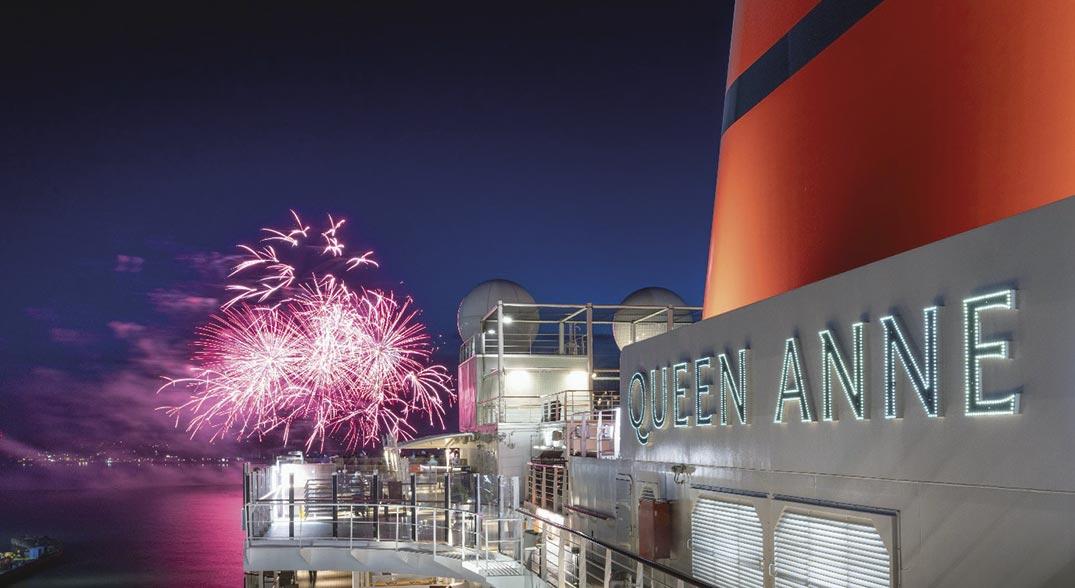
The 114,188gt/2024-built Queen Anne departed Southampton on 9th January for an historic maiden world voyage of 107-nights (above), becoming the 14th Cunarder to join the world voyage “club,” a tradition first pioneered by Cunard in 1922. The departure was celebrated with a dazzling fireworks display. The 3,000-guest ship made her first American landfall in New York on 17th January. Notably, the Queen Anne will also be the largest Cunarder in terms of guest capacity to achieve a full circumnavigation of the globe. The Queen Anne will call at 30 different ports across 18 countries. Highlights of the voyage include iconic calls to Miami, San Francisco, the Panama Canal, Honolulu, Auckland, Sydney, Hong Kong and more. Guests also crossed the International Date Line on 12th February. The full world voyage also includes overnight calls in New York, Honolulu, Sydney, and Singapore, with the ship returning to Southampton on 27th April, almost 12-months after her debut from the shipyard.
Disney Cruise Line will introduce a new class of ship class around 30% smaller than the Wish ships once the fourth Wish Class member is in service in 2027. The new series of vessels will be delivered between 2027 and 2031 according to reports. Each of the trio of 100,000gt newbuilds will accommodate 3,000 guests. Reducing the ship size will enable DCL to access more ports and destinations globally, including locations that prefer smaller ships. The new class will have next-generation power and propulsion systems and other features to optimise energy efficiency, including the ability to plug into shore power. They will also have the capability to operate on a variety of fuels, including hydrotreated vegetable oil and renewable methanol fuels, with the flexibility to pivot to additional fuel options that become available. They are not currently intended to be fuelled by LNG. The contract for the new generation of DCL ships was signed with the Meyer Werft shipyard in Papenberg in August 2024 and these are being designed by Walt Disney Imagineering.
The 129,750gt/2012-built Disney Fantasy had her scheduled dry dock changed, meaning that the cruises on 20th October/12th November 2025 are cancelled. Affected departures include a transAtlantic crossing that was scheduled to depart from Southampton on 20th October 2025 plus Bahamas cruises from Port Canaveral on 2nd, 7th and12th November 2025. The Disney Fantasy is now set to offer a revised trans-Atlantic crossing on a different date, with details expected from February.
Emerald Cruises announced on 16th January a significant milestone in the construction of its newest and most innovative luxury superyacht, the Emerald Kaia, with a keel-laying ceremony held during the week of 27th December 2024, with the team at MKM Yachts in Hạ Long Bay, Vietnam. In celebration of this event, Emerald Cruises unveiled updated renders of the Emerald Kaia, offering a glimpse into the vessel’s pioneering design and luxury features. Set to debut in April 2026, the Emerald Kaia promises to redefine yacht cruising with her contemporary elegance, thoughtful amenities, and world-class service. Building on the tremendous success of the 5,315gt/2022-built Emerald Azzurra and 5,315gt/2023-built Emerald Sakara, the Emerald Kaia reflects Emerald Cruises’ commitment to innovation, luxury, and sustainability. The newbuild is designed to accommodate 128 guests in spacious lux-
Nigel Lawrence
Cunard
ury, with 88% of cabins featuring verandas. Key highlights include an expansive Observation Sun Deck, state-of-the-art wellness areas with a 50% larger spa and swim-up platform allowing for direct access to the ocean from the fitness centre, enhanced marina facilities, including an indoor lounge and new water toys like an inflatable slide. With a focus on connecting guests to the sea and their surroundings, the ship will offer bespoke itineraries to the Mediterranean, Adriatic, Aegean, and Seychelles. Emerald Cruises celebrated their 10th anniversary in 2024.
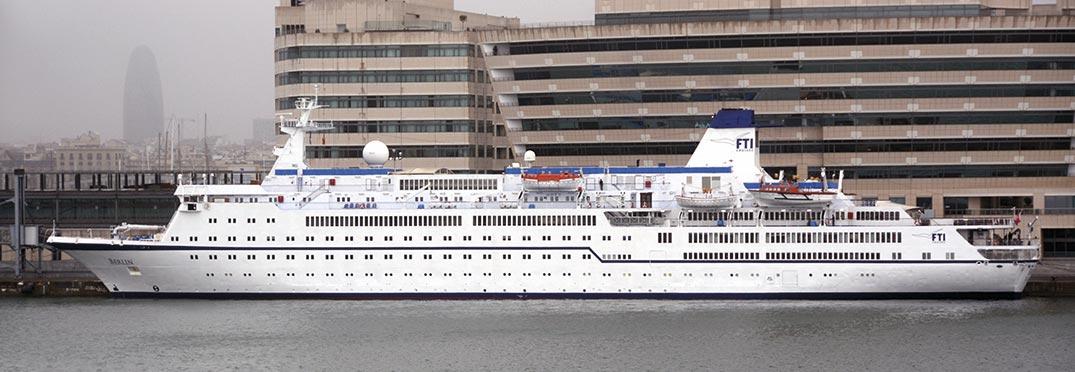
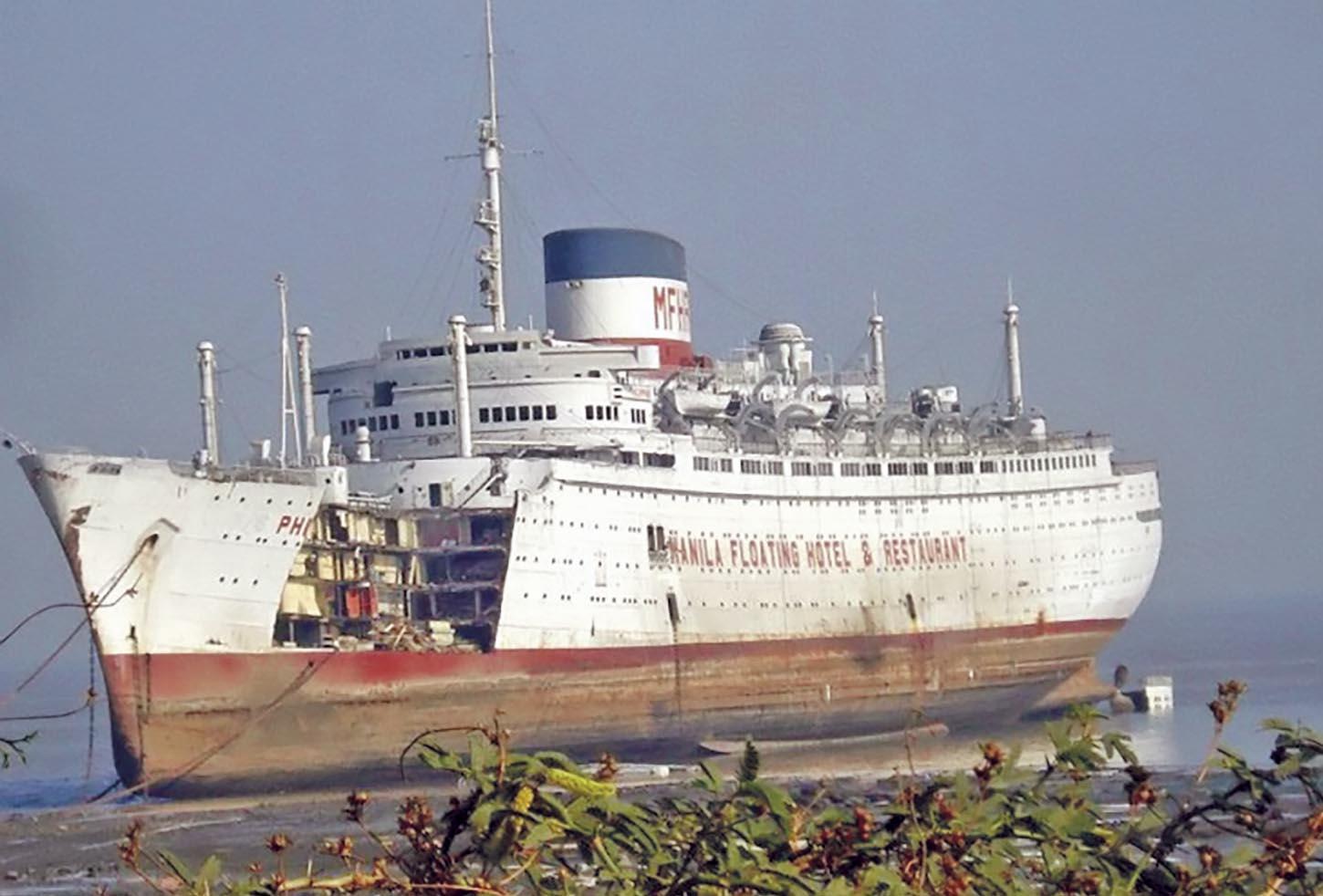
FTI’s former ship, the 9,570gt/1980-built Dream Goddess (exBerlin/Spirit of Adventure) arrived in Ningde, China, under the Mongolian flag after Christmas 2024 after spending more than 4 years laid up in Greece. The 420-guest ship had sailed from Perama in October, taking the Suez Canal passage. Her destination is a shipbreaking region but plans for the ship were unknown at the time of writing. Originally built for Peter Deilmann Reederei of Germany as the Berlin, in 2005 she was sold to Saga Cruises and renamed Spirit of Adventure, a career that lasted 6 years before she passed to FTI Cruises (above). The latter ceased trading due to the pandemic and the ship was sold/renamed in September 2020 with plans to convert her into a luxury yacht. Like so many such projects, this one didn’t proceed, and the ship languished in Perama until October last year.
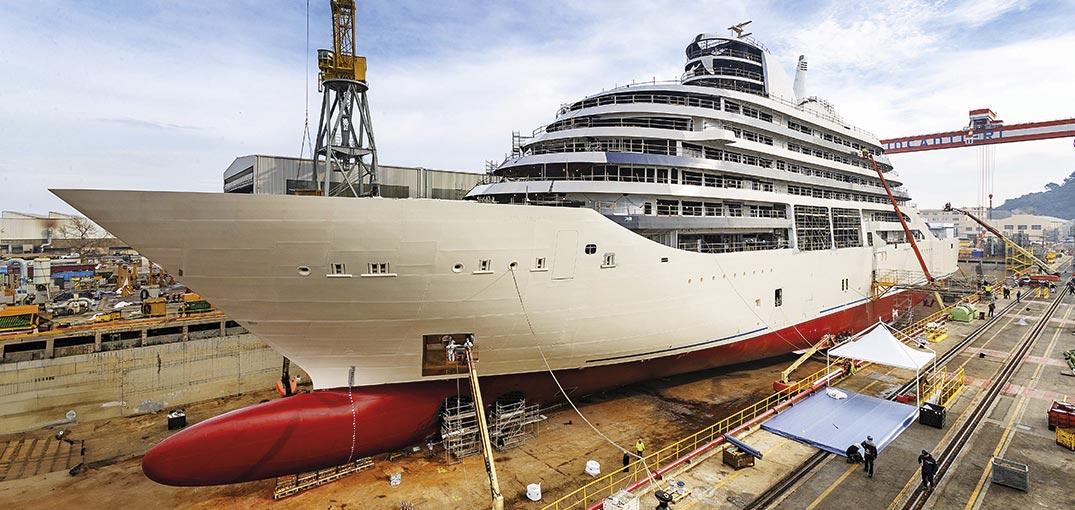
Four Seasons Yachts (Marc Henry Cruise Holdings Ltd) and Fincantieri celebrated the launch on 23rd January of the 34,000gt Four Seasons I (above), the first ultra-luxury ship for the new company, due to enter service in 2026. The all-suite, residential style ship is 207m long, will offer 95 exclusive suites up to 457sqm in size, which will be the prestigious funnel suite.
Fred. Olsen Cruises’ 62,735gt/2000-built Bolette embarked on her first-ever world voyage for Fred. Olsen Cruise Lines on 4th January 2025. Sailing from Liverpool, the vessel is on a 110-night cruise that circumnavigates the globe. After embarking additional guests in Southampton, the Bolette headed to South America for the first segment of the itinerary. Starting in late January, the ship visited ports of call in Brazil, Uruguay, Argentina and Chile, such as Ilhabela, Buenos Aires and Valparaiso. The vessel then set sail around the Cape Horn and the Chilean fjords before arriving in the South Pacific for destinations in Polynesia, Australia and New Zealand. This segment of the cruise was highlighted by an overnight visit to Sydney, in addition to a stop in Nukualofa, Tonga. Continuing her global adventure, the Bolette sailed to ports of call in the Indian Ocean and Africa, including Mauritius, Reunion and South Africa with a three-day visit to Cape Town. Back in the Atlantic, the cruise featured stops in Namibia, St. Helena, Senegal, the Canary Islands and Madeira. The ship was then scheduled to return to Liverpool and Southampton in late April before commencing a series of spring cruises in Northern Europe.
MSC Cruises announced on 2nd January that, as part of its ongoing global partnership, the company will be the title sponsor of three 2025 Formula 1 World Championship Grand Prix races, namely the Formula 1 MSC Cruises Austrian Grand Prix 2025 (June), Formula One 1 MSC Cruises United States Grand Prix 2025 (October) and Formula 1 MSC Cruises Grande Premio De Sao Paulo 2025 (November). MSC Group’s luxury ocean travel brand, Explora Journeys, will also bring the 63,621gt/2024-built Explora II to Formula 1 Grand Prix De Monaco 2025 in May. It is the first time that the cruise line’s brand will be included in the name of these three Formula 1 Grand Prix races and is in addition to the distinct track branding as part of MSC Cruises’ Global Partner status, which has been in place since 2022. The collaboration between the two world-class brands reflects Formula 1’s continuing global growth and the continued popularity of cruising as a holiday choice. The 181,541gt/2021-built MSC Virtuosa was again the star of the show for the second series of The Good Ship Murder, which aired from 17th January on Channel 5.
Norwegian Cruise Line has cancelled all calls to Corfu by the 155,873gt/2010-built Norwegian Epic during May-October 2025, around 18 in total. Itinerary changes are believed to be due to port congestion/maintenance work. Instead of Corfu, the ship will now visit alternative destinations in Greece, including Argostoli and Katakolon. The affected itineraries depart from the ship’s summer 2025 base of Civitavecchia. Upon completing her deployment in the Mediterranean, the Norwegian Epic will reposition to San Juan in November 2025 for a winter season in the Southern Caribbean.
Norwegian Cruise Line Holdings Ltd. announced on 6th January a new leadership structure to execute on its multibillion-dollar fleet expansion for its ultra-premium and luxury cruise brands. Jason Montague had been appointed Chief Luxury Officer for NCLH, effective 17th February 2025, overseeing both Regent Seven Seas Cruises and Oceania Cruises, capitalising on his industry expertise and strong track record previously leading these brands. This appointment underscores NCLH’s focus on its Charting the Course strategy, which includes adding five new builds to its upscale brands’ fleets and plans to refurbish nearly all their existing vessels. To advance NCLH’s bold vision for the future, the company plans to substantially increase its presence and positioning in the ultra-premium and luxury markets. Over the next five years, NCLH will progress its previously announced investment in its premium brands as it pursues continued leadership in this market.
For Oceania Cruises, the brand is expecting three new builds through 2029, starting with the 67,700gt Allura later this year. Additionally, the brands’ ships, the 66,084gt/2011-built Marina and 66,172gt/2012-built Riviera, will be refurbished in 2026 and 2027, respectively.
For Regent Seven Seas Cruises, two new vessels will be added through 2029, in addition to planned enhancements to the 48,075gt/2001-built Seven Seas Mariner and 42,363gt/2003-built Seven Seas Voyager in 2025 and 2026, respectively.
NYK Cruises’s 52,200gt/2025-built and 744-guest capacity Asuka III was floated out from Meyer Werft's covered building dock I (Hall 5) at Papenburg, Germany, on the morning of a rather misty 18th January 2025. The ship received her funnel during the float out, emerging from the hall and pausing for this to be completed by a crane on either side. The funnel and main mast had been fabricated at a shipyard in Gdansk and transported aboard the barge Ems Ponton 7 and towed by the tug Ems Sum. The ensemble paused at Swinoujscie en-route, departing there on 8th November. The new ship features numerous solutions customised for the Japanese market including a spa area equipped with a Japanese-style open-air Bath. A collection of arts and crafts inspired by the local culture was especially commissioned for the ship, with pieces signed by Hiroshi Senju, Noriko Tamura and Kazumi Murose. The collection includes a three-deck lacquer mural that will serve as the central
Nigel Lawrence
Four Seasons
piece in the vessel’s main atrium. Other features of the Asuka III include a selection of dining venues, as well as a large-scale theatre and a series of bars and lounges. The 230m long, 29.80m beam Asuka III is also the first passenger ship to be built under the supervision of the Japanese flag state in around 30 years. Once fitting out was completed, the ship undertook her River Ems conveyance to Eemshaven from where sea trials took place prior to delivery.
P&O Cruises Australia transitioned into part of Carnival Cruises (Australia) in March 2025 with the Pacific Adventure and the Pacific Encounter becoming Carnival Adventure and Carnival Encounter. P&O Cruises Australia stated that the two ships will continue to offer the same standard of service and quality currently available onboard, in addition to a series of new features. Once the ships joined Carnival Cruise Line, the names of stateroom categories changed to bring them in line with the rest of the company’s fleet. The onboard currency also remains unchanged, with services and shops accepting Australian dollars like other Australian-based Carnival ships.
Ponant of France announced during January the acquisition of a majority stake in Aqua Expeditions, an expedition company known for its river and ocean cruises in South America, Southeast Asia and beyond. This strategic acquisition by Ponant, backed by Artémis Group, the Pinault family’s investment company, will allow Aqua Expeditions to continue expanding globally. The company currently operates small ships in biodiversity hotspots such as the Galápagos, Raja Ampat, Komodo, Spice Islands, the Mekong River, and the Peruvian Amazon River. This transaction came at a crucial time as Aqua Expeditions began the launch of its East Africa itineraries, exploring the Seychelles and Tanzania.
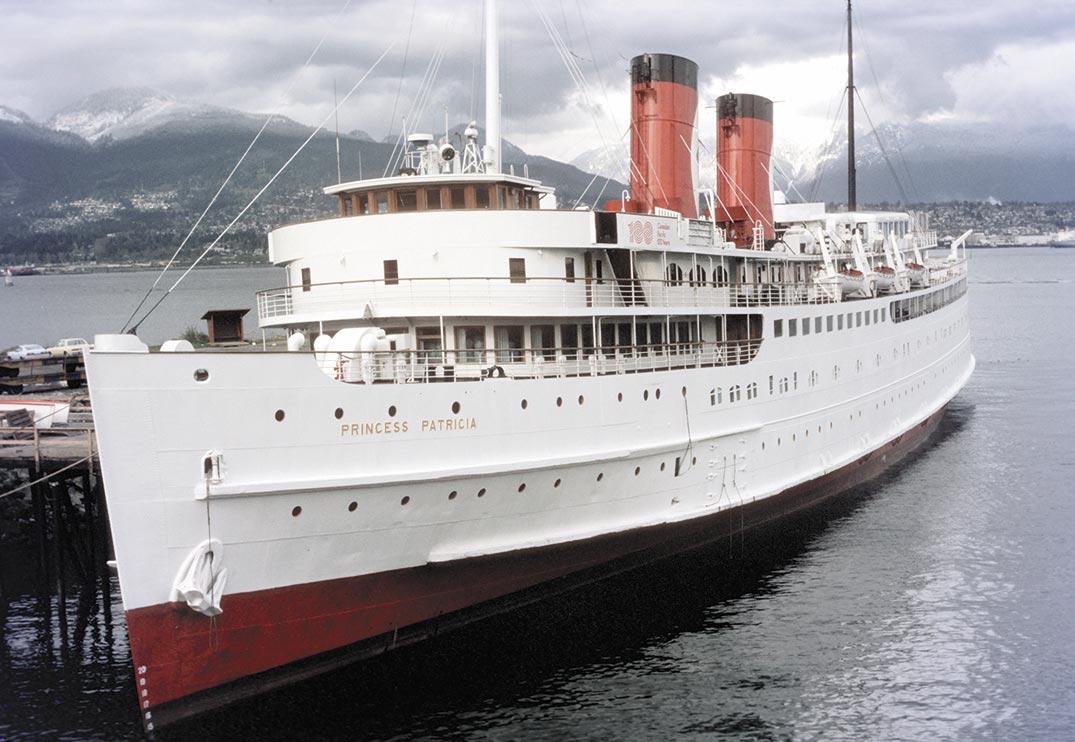
Princess Cruises announced on 4th January a nostalgic Diamond Anniversary voyage celebrating 60 years of cruising on 6th December 2025, departing Los Angeles for the Mexican Riviera to recreate the company’s first-ever sailing on 3rd December 1965 aboard the Princess Patricia (above). As part of the announcement, Princess revealed that The Temptations, the legendary Motown group behind the classic hit "My Girl," will sail on this anniversary voyage for a memorable performance. The 14-day 60th Anniversary Mexican Riviera Voyage aboard the 142,714gt/2013-built Royal Princess includes two overnight stays in Cabo San Lucas and Puerto Vallarta, plus visits to Loreto, Manzanilla and Mazatlán.
Also, in January came the news that the 142,714gt/2014-built Regal Princess will enter drydock in Rotterdam during late April for essential maintenance. All scheduled sailings, including the 4th April trans-Atlantic voyage to Southampton, proceeded as planned until the 18th April departure from Southampton that is shortened from 10 to 6 days with calls at Falmouth, Cobh, Dun Laoghaire and Belfast. The sailing on 28th April 2025 has been cancelled but, following the repairs in drydock in The Netherlands, the Regal Princess will resume service on 9th May, sailing her European season with British Isles itineraries from Southampton.
Resorts World Cruises has purchased P&O Australia’s 77,441gt/1997built Pacific Explorer, ex-Dawn Princess when she left the P&OA fleet in February 2025, she will relocate to Southeast Asia and operate as the Star Scorpio. The ship was the last of the Sun Class Cruise Ships operating for the Carnival Corporation, her sisters being Sun Princess, Sea Princess and Ocean Princess. The Dawn Princess moved to P&O Cruises Australia in 2017. With a new base of Singapore, the Star Scorpio’s maiden cruise from the Singapore Cruise Centre was scheduled for 26th March 2025. The ship will sail to many popular destinations, including Jakarta and Medan in Indonesia, Melaka and Pulau Redang in Malaysia, Bangkok and Ko Samui in Thailand and Ho Chi Minh City in Vietnam.
Seabourn unveiled on 17th January its 2026 itineraries to the Northwest Passage and Canadian Arctic, giving guests the chance to explore some of the world's most historic destinations and storied waterways. Between August and October 2026, the 23,615gt/2022-built Seabourn Venture will offer 6 voyages ranging from 8 to 24 days, traversing the historic routes of The Northwest Passage and Canadian Arctic.
TUI revealed in January plans for a unique naming ceremony for the 158,640gt/2025-built Mein Schiff Relax on 9th April 2025, featuring Robbie Williams. Perhaps an equally suitable occasion for UK Singer Holly Johnson and his 1984 hit “Relax.” However, the Mein Schiff Relax, the first newbuild in the all-new InTUItion Class, will be named in a unique ceremony in Málaga on 9th April. For the first time, two other ships from the Mein Schiff fleet will be present and will accompany the Mein Schiff Relax as godmothers at the event. This means that guests on the 98,785gt/2016-built Mein Schiff 5 and 112,982gt/2024built Mein Schiff 7 will also be able to experience this very special moment together with guests aboard the Mein Schiff Relax. Robbie Williams will give an exclusive open-air concert for the 15,000 christening guests. Everyone on the trio of ships will have the unique opportunity to experience this special moment together. Robbie Williams is also the feel-good ambassador of Mein Schiff Relax, which has been built at the Fincantieri shipyard in Monfalcone, Italy.
The two christening voyages of the Mein Schiff Relax begin and end in Palma de Mallorca and travel via Málaga to Tangier and Gibraltar. Following the naming event, the new ship will set course for Barcelona and Valencia before the cruise ends in Palma de Mallorca. The Mein Schiff 5 starts her cruise in Tenerife, calling at Madeira and Lisbon first whilst the Mein Schiff 7 begins her cruise in Gran Canaria, visits Fuerteventura and then calls at Málaga on 9th April.
Viking’s brand-new 53,769gt/2024-built Viking Vela, delivered 3rd December, was welcomed to Portsmouth International Port as their first maiden call of the year on 9th January. The Viking Vela’s next call was LICT at Tilbury and on her next itinerary, the ship encountered steering issues off the Norwegian coast whilst en-route Ijmuiden-Narvik. It was not an emergency, but it did result in the ship having to face a storm with 100mph winds head on whilst sailing for shelter and checks/repairs in Ålesund. The weather conditions in the area turned out to be worse than forecast. As seems to be the norm nowadays, armchair experts aboard were questioning the captain’s decision all over social media. The itinerary from Ijmuiden included calls at Narvik on 14th January, an overnight call in Tromsø on 15th January and likewise in Alta on 17th January.
However, the ship arrived in Ålesund on 14th January and remained there until the evening of 16th January. The revised itinerary was then Flam, Eidfjord, and Stavanger. Guests received refunds/credits accordingly and the ship maintained her previously scheduled arrival in Bergen on 21st January, an overnight stay before guests disembarked the next day. The ship then offered a 12-night return trip to London. It is not unreasonable to expect bad weather in regions such as Norway on a winter cruise and all credit to the ship’s crew for doing their very best under the circumstances.
Michael Tootill
FERRY NEWS by Andrew Cooke
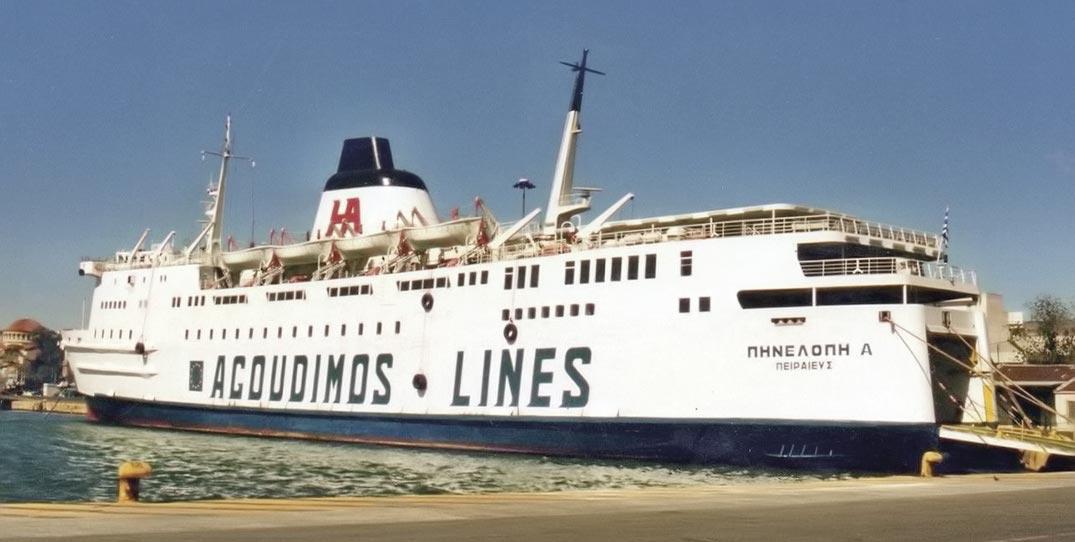
Agoudimos Lines’ 5,109gt/1972-built Penelope A (above), built as Sealink’s Horsa, was announced in January as being sold for scrap after 12 years of lay-up and languishing in Eleusis Bay. The ship left the UK shores in 1992 when sold for further service in Greece. The much-loved Horsa was one of three sisters, the others being Hengist (scrapped at Aliaga in 2017) and Senlac (sold to Greece as Apollo Express in 1987, became Express Apollon and scrapped as the Apollon at Aliaga in 2010).
BC Ferries announced the steel cutting ceremony on 16th January for the third vessel in an order for a quartet of Island Class vehicle ferries at Damen Shipyards Galati. At the same time, another vessel in the series reached the grand block assembly stage of construction at the yard. The vessels, based on Damen’s double-ended 8117 E3 Ferry, will be the first fully electric ferries to sail in the company’s fleet. They will bring the total number of Damen vessels operated by BC Ferries to 10.
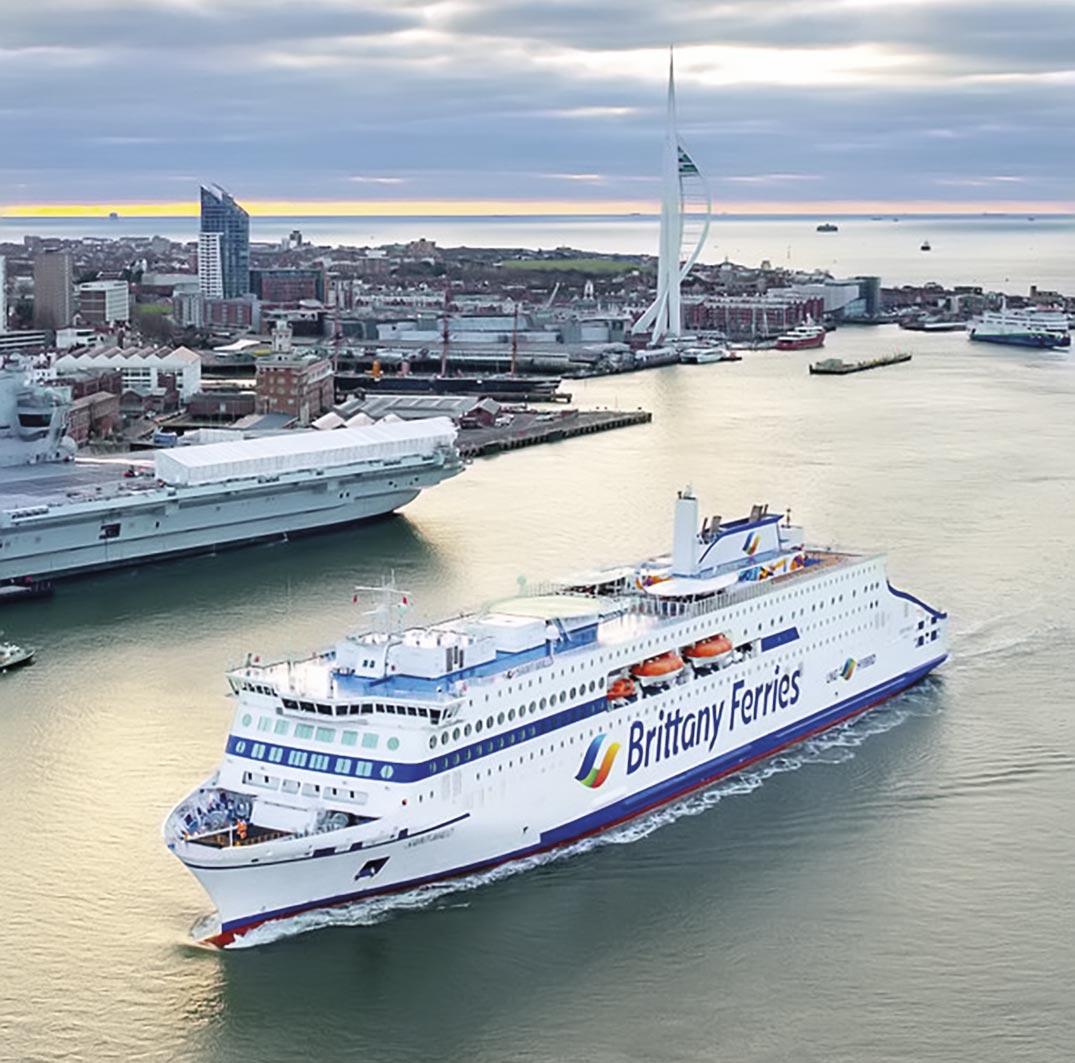
Brittany Ferries’ 20,133gt/1992-built Barfleur arrived in Gdansk for refit on 6th January having sailed from lay-up on the Caen Canal on 2nd January. The 36,965gt/2024-built Saint-Malo visited Roscoff on 11th January for a welcome ceremony and made her debut at her namesake port the next day. She arrived at Portsmouth on the morning of 13th January (above). The ship is the fourth E-Flexer in Brittany Ferries' fleet, is powered by LNG dual fuel propulsion and is equipped with a 11.5 MWh battery hybrid system. Her near-sister, Guillaume de Normandie (differing layout aboard) will join the operational fleet in April. The SaintMalo is the first Brittany Ferries vessel to refuel with LNG at Portsmouth and is one of two ships set to connect to Portsmouth’s shore power system when it becomes operational later this year.
DFDS’s 35,923gt/2005-built Dunkerque Seaways and 40,331gt/ 2021-built Cote D’Opale spent the New Year at Damen Dunkerque for maintenance/annual dry docking whilst the 33,940gt/2005-built Cotes des Flandres arrived at Odense for annual refit on 17th January, having sailed from Calais.
The much-travelled Patria Seaways has spent a long period in the Mediterranean but, following refit in Gibraltar, was noted bound for Klaipeda on 19th January.
The former DFDS Seaways North Sea stalwart Dana Anglia/Duke of Scandinavia has been in a spot of bother in Genoa whilst she waited to begin her new career with an Algerian ferry company. The 19,593gt/1978-built ship, now named Santa Cruz (renamed from Moby Corse), was seized in Genoa until a financial issue was resolved, being released again mid-January.
Fred Olsen Express' 6,554gt/2003-built newest fleet member, the Incat-built Barlovento Express, entered service with the company on 29th December between Las Palmas de Gran Canaria and Morro Jable in Fuerteventura. This high-speed ferry, which has a capacity of 866 passengers, 271 vehicles, and dedicated spaces for pets, brings the Fred. Olsen Express fleet total to 13 vessels. She was built as Incat 058 as the Ciudad de Ceuta for Trasmediterranea.
Gotlandsbolaget
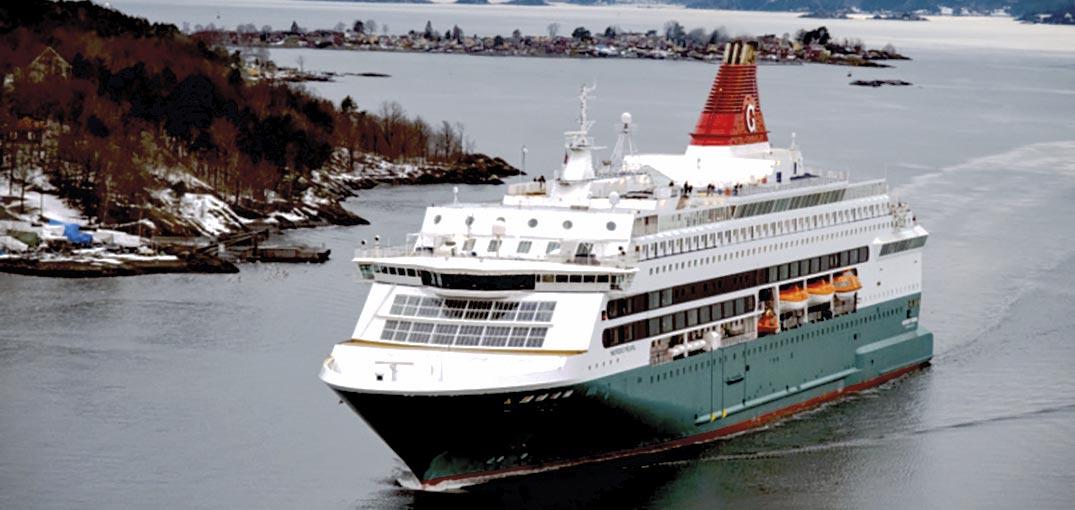
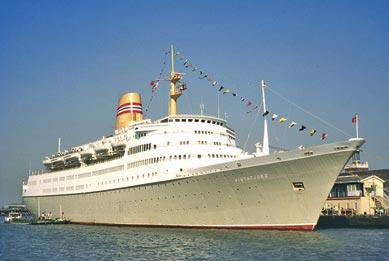
Gotlandsbolaget, which has acquired the DFDS route of Copenhagen-Oslo, revealed in January that the ferries Peal Seaways and Crown Seaways have been renamed Nordic Peal and Nordic Crown respectively. The Pearl Seaways received her new Gotlandsbolaget livery of a turquoise-coloured hull and red funnel whilst in dry dock at the Oresund Drydocks in Landskrona in January. The ship also received refurbishment works to public areas and upgrades to all cabins. The ship left Landskrona at the end of January with the Nordic Crown receiving the same treatment in March 2025.
Irish Ferries’ 50,938gt/2001-built Ulysses headed to Odense, Denmark, on 8th January for refit. The 51,388gt/2018-built W.B. Yeats provided cover on Holyhead-Dublin when the service reopened on 16th January with the Irish Ferries service relying on the 28,833gt/1992-built Isle of Innisfree (DublinFishguard/Pembroke) and 36,249gt/2007-built James Joyce (Rosslare-Pembroke) beforehand.
The 47,592gt/2011-built Oscar Wilde was en-route to Cammell Laird’s in Birkenhead on 7th January for dry docking and the 34,128gt/1997-built Isle of Inishmore went to Damen Dunkerque for her refit in January. Sadly, the James Joyce (built as Tallink’s Star) standed down from the Irish Ferries fleet on 15th January after her final sailing on the Rosslare service, where she had started when first taken on charter in 2023. It was a great shame to see this fine ship leave the fleet. She then headed to Dunkerque for handover to Tallink and arrived back at Tallinn on 27th January. On 7th January the Isle of Inisheer sailed from layup at Larne for berthing trials at Fishguard and then commenced work in the Irish Sea fleet week commencing 13th January on the Cherbourg-Dublin service, which also involved Dublin-Holyhead sailings in place of the James Joyce.
Strong Island
La Méridionale found a buyer for the 21,858gt/1997-built Pelagos and she repositioned to Egypt in spring 2025. The company, who has a major shareholder in the form of CMA CGM (as with Brittany Ferries) will take delivery of the 27,541gt/1992-built Normandie in May/June when she is replaced by the 36,965gt/2024-built Guillaume de Normandie.
Mersey Ferries’ first newbuild in over 60 years had her identity revealed on 10th January when Liverpool City Region Mayor Steve Rotheram confirmed that the Cammel-Laird built ferry will become The Royal Daffodil. The announcement was made at the keel laying ceremony. The new vessel will feature event spaces, bars, bike storage and improved accessibility, part of a £26 million investment in modernising the ferry fleet. The Royal Daffodil will become the sixth Mersey Ferry to bear the name first used in the early 1900s when she enters service in the summer of 2026.
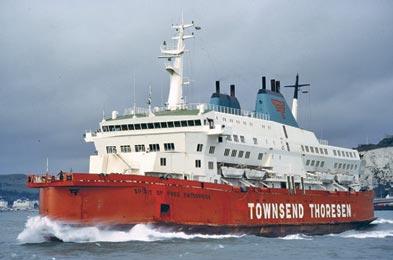
P&O Ferries’ plan to use shore power on the Dover-Calais service took a step closer to realisation on 9th January when Port Boulogne Calais made a groundbreaking move towards achieving carbon neutrality for the Calais-Dover link by 2035. In partnership with Réseau de Transport d' Électricité (RTE), the port will be connected to the high-voltage power grid, enabling the future operation of 100% electric vessels. This makes Calais the first port in the world to offer a charging capacity of 100 MW, capable of recharging up to three vessels simultaneously (20-35 MW per ship) in just 45 minutes. At present, only the 47,653gt/2023-built P&O Pioneer and P&O Liberte are future-ready for shore power and charging at present. The Spirit of France departed from A&P Falmouth after dry docking on 16th January (having gone for refit on 4th January) and the P&O Pioneer arrived in Cornwall for her first UK dry docking on the evening of 18th January.
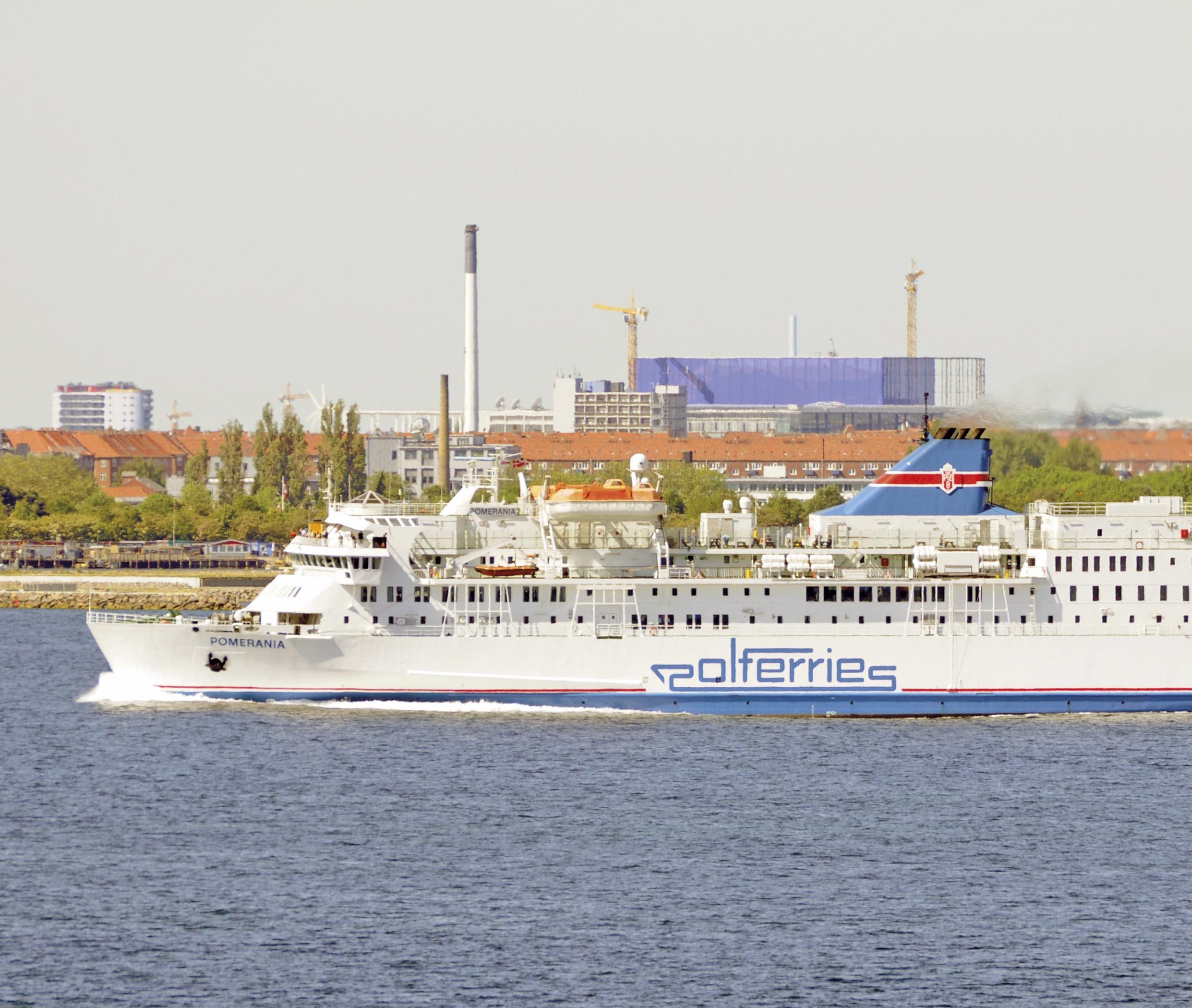
Polferries’ 17,990gt/1981-built Baltivia (formerly Transmanche Ferries’ Dieppe and TT Line’s Saga Star) was sold to new owners in Georgia, and she was renamed Dioscuria. The Ro-Pax ship departed Gdynia for her new home, via Skagen, on 1st January.
Stena Line’s ferry services on the Holyhead-Dublin route resumed on the morning of 16th January following the closure of the ferry berths at Holyhead Port in early December. The extended closure of the ferry berths at Holyhead Port at one of the busiest times of the year was unprecedented and Stena Line thanked their customers and staff for their patience and resilience.
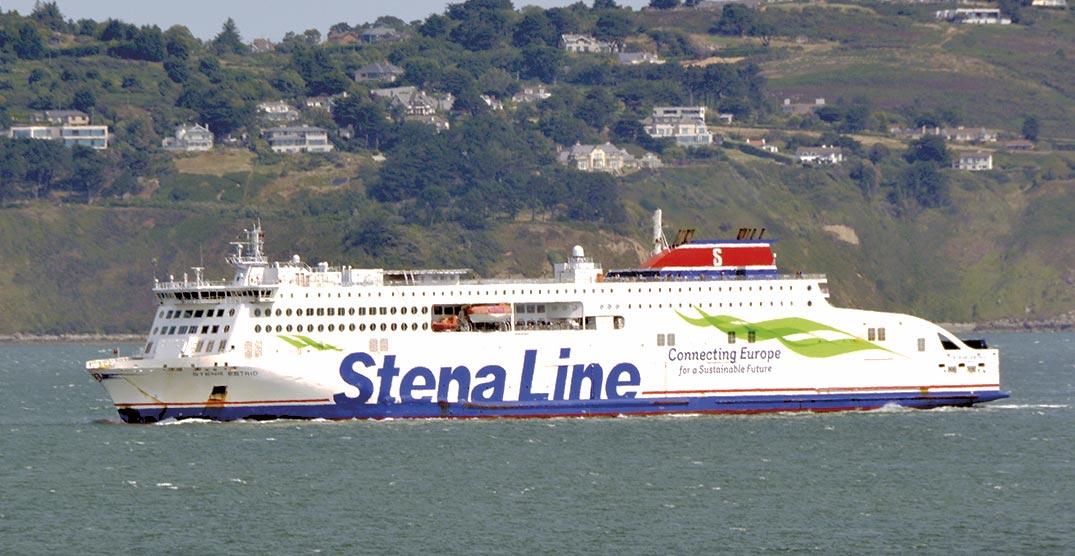
During the closure, Stena Line ensured continuity of connectivity between the UK and Ireland with new services from Dublin to both Birkenhead with the 41,671gt/2019-built Stena Estrid (above), and Fishguard with the Stena Adventurer redeploying both ships from the Dublin-Holyhead route. The company also chartered the 12,747gt/1998-built Ben-My-Chree to operate a freight only service on Dublin-Heysham. Both the ‘Estrid and ‘Adventurer returned to service on the Dublin-Holyhead link, with the 43,532gt/2003-built Stena Adventurer departing Fishguard on the final diverted sailing on 15th January.
TALLINK UPDATE
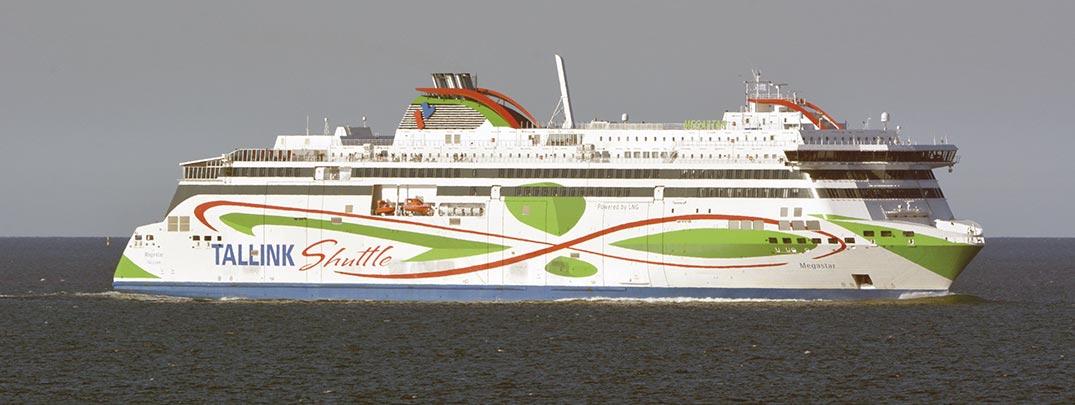
Tallink Grupp’s 9,134gt/built 2017 Tallink Shuttle ferry Megastar (above) was out of service for planned technical maintenance 7th-10th January. The work included maintenance of the vessel’s propulsion electric motors and the main engines, including, among other, replacing the vessel’s LNG system’s safety valves, maintenance of the life-saving equipment and sprinkler systems, and other regular service works. In addition, the vessel’s classification society performed their regular surveys of the vessel during the maintenance period.
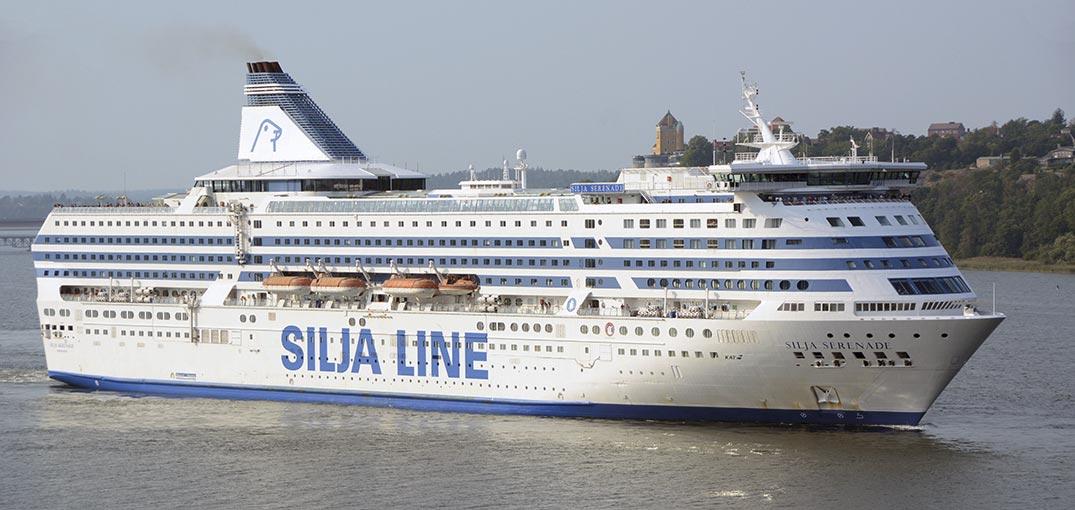
The 58,376gt/1990-built Silja Serenade (above) was also out of service due to planned maintenance 7th-29th January 2025. She usually serves the Helsinki-Stockholm route and went to the Remontowa shipyard, Gdansk 7th-29th January 2025. During this refit, sistership Silja Symphony (58,377gt/built 1991) operated the Helsinki-Stockholm route alone with departures from Helsinki and Stockholm every other day.
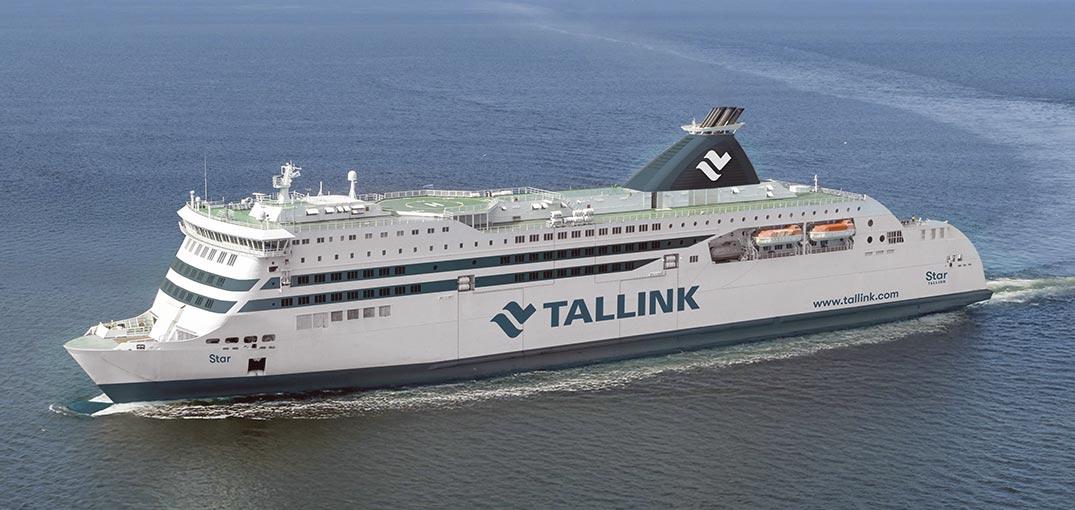
On 24th January Tallink Grupp announced that the Star (above) would return to Estonia and enter service on the PaldiskiKapellskär route from 9th February. The ship had been on charter to Irish Ferries as the Oscar Wilde/James Joyce from early 2023 to January 2025. Due to port service restrictions, alongside cargo and cargo transporters, the Star will primarily cater for car passengers on an intensified schedule, running opposite the Baltic Queen, which sails between Tallinn and Stockholm. Before returning to regular service on the PaldiskiKapellskär route, the Star underwent the necessary renewal and preparatory work in dry dock at Naantali, Finland. Compared to the Ro-Ro ferries 15,412gt/built 1999 Regal Star and the 20,921gt/1987-built Sailor, which have operated on the route until now, the Star offers an enhanced array of public spaces and passenger comfort. The ship replaced the Sailor and Regal Star, which were placed on standby for future deployment.
Nigel Lawrence
Nigel Lawrence
Nigel Lawrence
Tallink
CLdN saw the launch of their second 50,440gt G9 Ro-Ro ship, the Leonine, at Hyundai Mipo Dockyard on 3rd January. The 234m long Leonine will be equipped with two conventional main engines as well as two large shaft generators of 6 MW each, which can be used for generating power or for electric propulsion. The G9 vessels have a high degree of flexibility, allowing for a seamless integration of new fuels, fuel cells and/or battery technology in the future. Compared with CLdN’s largest vessels currently in operation, the Celine and Delphine, the new ships will further reduce CO2 emissions by 40% while having the same cargo capacity. The delivery of both the Leonine and elder sistership Chaumine was scheduled for the first half of 2025. CLdN’s 25,593gt/2010-built Peregrine had been on charter in Australia to Toll Shipping and was noted leaving Cape Town for Portugal on her homeward voyage on 6th January. CLdN is slowly removing the original P Class ships introduced by Seatruck with the Seatruck Pace sold to Al Arab Maritime and renamed Al Hussain in January. She was noted as re-registered to the Jordan flag at Liverpool on 19th January prior to sailing off for her new life.
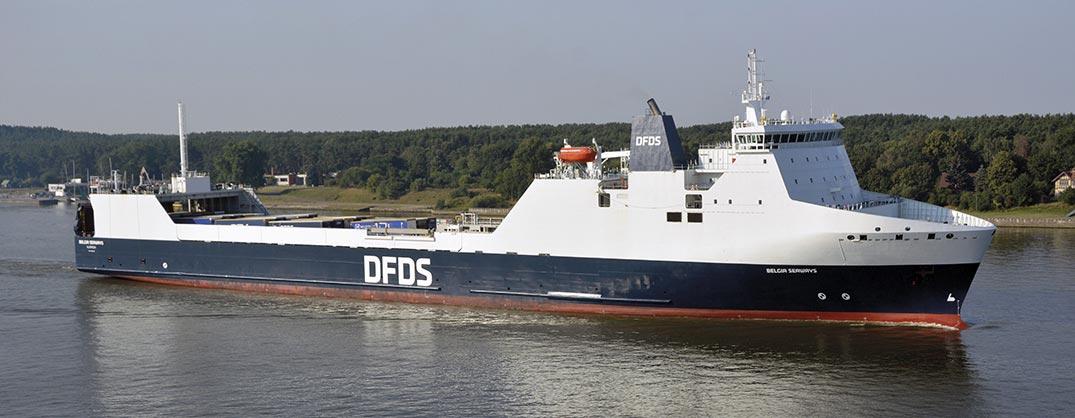
DFDS announced on 14th January that it was launching a weekly freight service connecting Spain and The Netherlands, aimed at serving the needs of industrial customers, freight forwarders and project cargo owners. In connection with the new route, DFDS and Hydro, a global aluminium and energy company, signed an agreement for weekly shipment of aluminium. Starting from late May, the new route will connect the ports of Vilagarcía and Rotterdam, offering a seamless and direct ferry link from southern to central Europe. With the new service, DFDS offers a competitive alternative to road transport to meet demand for freight transportation within Europe. The 21,005gt/2000-built Belgia Seaways (above) is being deployed on the route with a capacity of 2,660 lanemetres.
Godby Shipping Ab’s latest purchase, the 8,610gt/1991-built Aurora from Navimag, arrived at Algeciras, Spain, from Chile, on 16th January prior to commencing a charter to Marítima Peregar.
The Grimaldi Group has added the port of Gemlik (Gemport) to the Trieste-Patras-Ambarli Ro-Ro route, with regular calls starting in mid-December 2024. This expansion marks an important step not only for the new route but also for the group's Motorways of the Sea scheme. Two of Grimaldi's GG5G vessels, the 67,311gt/2022-built Eco Malta and Eco Mediterranea make the additional calls at Gemlik.
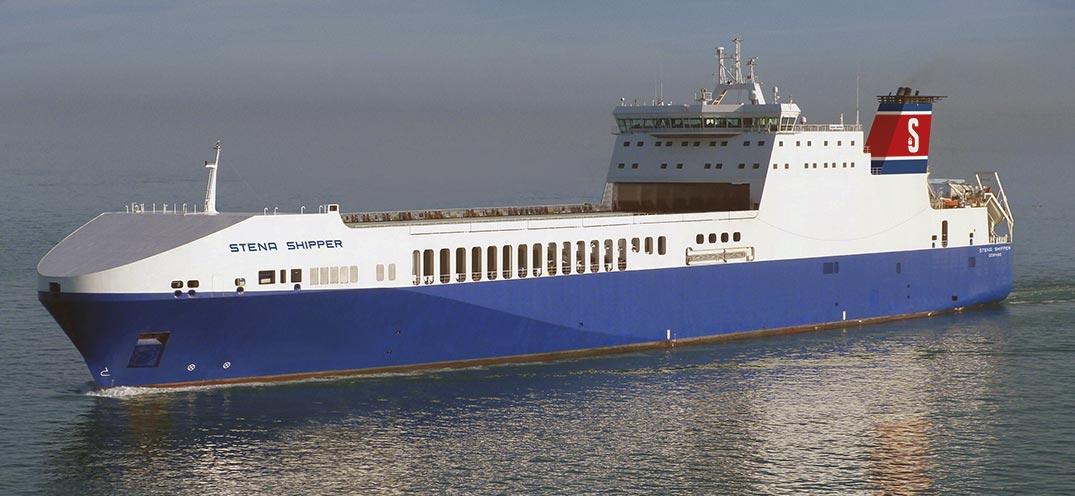
Stena Line gained a new Stena Shipper on 15th January, the Ro-Ro ship previously being the 29,429gt/2012-built Giuseppe Lucchesi, operated by CLdN. This move is in connection with Stena Ro-Ro taking over a contract with the Tunisian shipping company Cotunav for service on the Rades-Marseille route. The ship (above) was sold by CIN (Compagnia Italiana di Navigazione S.p.A), a company in the Moby Lines S.p.A group of companies. The Stena Shipper was built in 2012 at the Danish shipyard Odense Yard. The Stena Shipper is 193m long, has a draught of 7m, a beam of 26m, a service speed of 21 knots and a freight capacity of 3,663 lanemetres.
United European Car Carriers (UECC) took delivery of a new pure car and truck carrier (PCTC) on 1st January from Chinese shipyard CIMC Raffles, in the form of the 69,250gt/2025-built Blue Heritage, sistership of the 69,250gt/2024-built Blue Aspire that was handed over in early December 2024. The newbuilds each have a length of 200m, a capacity of 7,000 CEUs spread across 12 vehicle decks, and dual-fuel engines that can also run on LNG. Four of the vehicle decks are hoistable to permit the carriage of high and heavy cargo. UECC now operates both ships, together with another 4 vessels, on a route between the Mediterranean and Northern Europe, traversing the Turkish ports of Yenikoy and Autoport, the German port of Cuxhaven, and Zeebrugge, Belgium, every 4½ days. The Blue Heritage's propulsion can also be modified in the future to permit operation on liquefied biomethane, which UECC claims can generate even fewer emissions compared to LNG.
China in January (above).
UECC has also performed the first-ever ship refuelling operation in Spain with a truck-borne shipment of liquefied biomethane (LBM) supplied by green energy developer Naturgy from a biomethane production plant in the surrounding Galicia province. The fuel was pumped directly from a road tanker into the tanks of UECC’s multi-fuel LNG battery hybrid Pure Car and Truck Carrier, the 35,677gt/2021-built Auto Advance. The delivery allows the leading sustainable carrier in the European shortsea Ro-Ro trade to diversify its regional sources of supply for LBM beyond its main hub of Zeebrugge where it has a long-term supply agreement in place with Titan Clean Fuels. Another aspect of this diversification is that it also represents the first physical molecule delivery of the fuel - instead of mass balanced - as UECC explores multiple alternative delivery options to broaden its LBM portfolio. UECC is boosting uptake of the fuel, also known as bioLNG, in line with expansion of its Sail for Change sustainability initiative launched in summer 2024, in which LBM is being bunkered on the company’s five dual and multi-fuel LNG PCTCs for several major vehicle manufacturers to cut their Scope 3 emissions. UECC is providing fuel demand to support renewable energy development by Naturgy, which is involved in numerous innovative projects to convert agricultural and livestock waste into biomethane, strengthening the regional circular economy. Naturgy, in a joint venture with Reganosa and Repsol, is looking to produce 1 terawatt hours per year of biomethane from treatment of animal slurry and other waste sources, which would cover 7% of Galicia’s annual gas import requirements and result in a reduction of 500,000 tonnes of CO2 per year.
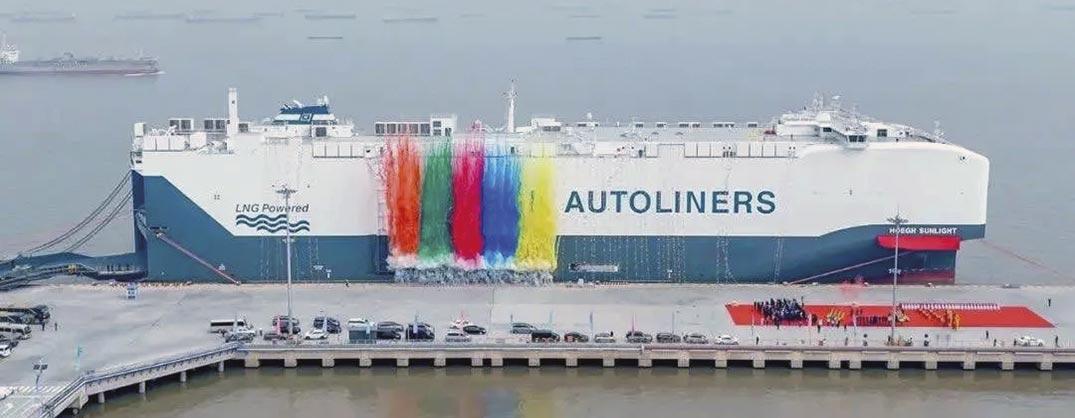
Höegh Autoliners' 84,135gt/2024-built Höegh Sunlight, the fourth 9,100 CEU capacity Aurora Class vessel, was named at the Taicang Haitong Auto Terminal in
Nigel Lawrence
Stena Ro-Ro
Hoegh
by Andrew Cooke
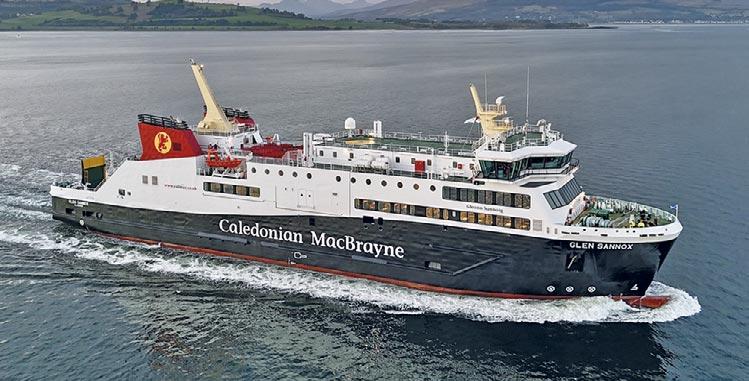
GLEN SANNOX
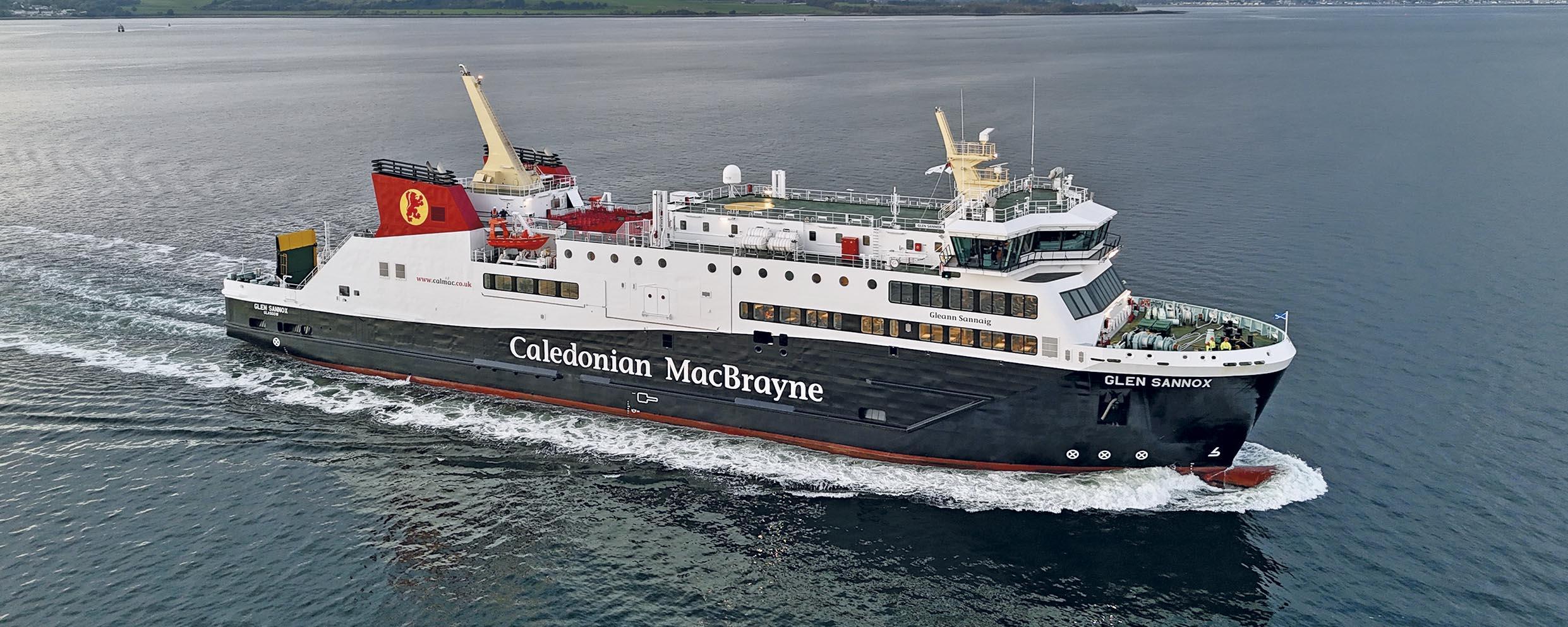
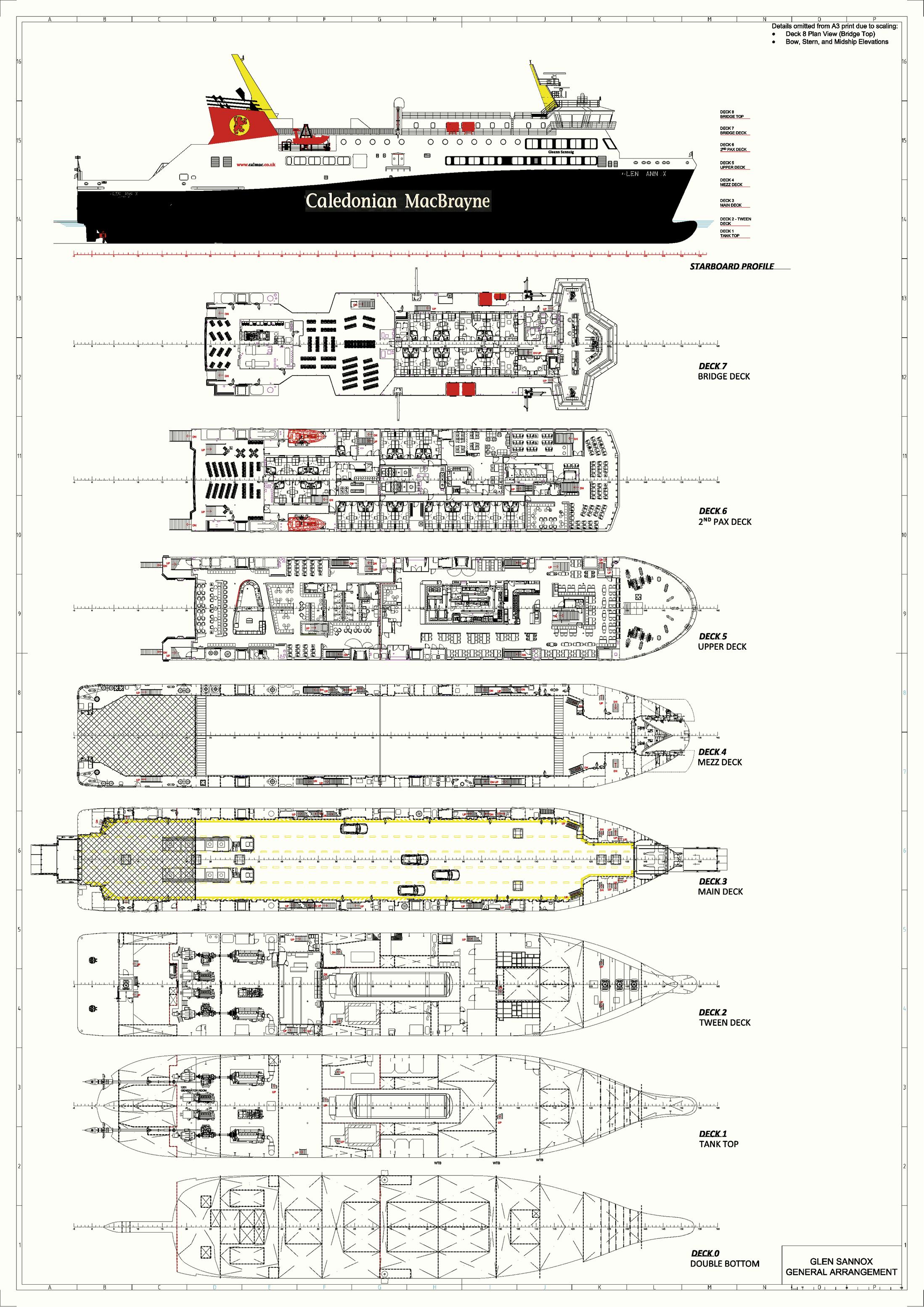
Bpair of major ferry newbuilds for CalMac services and, in July 2014, the procurement process was authorised for these now infamous sisterships. The plan was for one to be deployed on the UigTarbert/Lochmaddy route and the other on the ArdrossanBrodick/Campbeltown routes. These vessels would ideally be of similar capacity to the 8,680gt/2014-built Loch Seaforth, with the option of LNG dual-fuel capability firmly on the table. Little did anyone know that the process would trigger the start of what has surely been the most controversial, politically charged and problematical ferry project in the UK in living memory. The troubled saga has been well documented since the outset, but this feature is intended to both celebrate the ship and the perseverance in making her and her sistership a reality rather than dredge up all the negative aspects along the way. Nothing will change the history of this story, and the considerable human aspect should never be forgotten either.
PIONEERING SPIRIT
The procurement bandwagon began to roll from 15th October 2014 and six shipbuilders were then shortlisted for the invitation to tender for the new ferries, with bids due by 31st March 2015. On 31st August 2015, the then First Minister of Scotland, Nicola Sturgeon, visited the Ferguson Marine Engineering (Holdings) Limited (FMEL) shipyard in Port Glasgow on the River Clyde, and named the shipbuilder as Caledonian Maritime Assets Ltd.’s (CMAL) preferred tenderer for the £97 million build contract. The process was not without issue but on 16th October 2015 contracts were signed between CMAL and FMEL, heralding the continued construction of commercial ships of a noteworthy size on this famous waterfront.
The previous ferry contract awarded to FMEL was for CalMac’s trio of 499gt-built hybrid ferries Hallaig (launched 17th December 2012/delivered 2013), Lochinvar (launched 23rd May 2013/delivered 2014) and Catriona (launched 11th December 2015/delivered 2016). Others included the 1,024gt/2007-built Loch Shira, the 2,881gt/1994built Red Falcon/Osprey and 1996-built Red Eagle, the 6,753gt/1995built Isle of Lewis, the 3,504gt/1989-built Lord of the Isles and the 3,296gt/1984-built Isle of Arran. The performance of the latter, affectionately referred to as the Auld Trooper, is a credit to her builders in terms of the years of hard service, and she remains in frontline service into 2025. The shipyard has quite a pedigree with members of the CalMac fleet and even won the tender for Northlink’s 8,780gt/2002-built Hamnavoe for Scrabster-Stromness but was unable to proceed with the build.
The present site became Ferguson Shipbuilders in 1903 when Brothers, Peter, Daniel, Louis and Robert Ferguson left the family shipyard, Fleming & Ferguson, in Paisley to form a new operation at the Newark yard in Port Glasgow. The yard was nationalised in 1977 as part of British Shipbuilders, was privatised in 1986, became Fergusons again in 1989 under Clark Kincaid and momentarily went to Kvaerner when
Ferguson Shipbuilders Ltd. was then sold by Kvaerner to Ferguson Marine plc. in 1991. In 2000 HM Queen Elizabeth II visited the yard once again to launch the 5,506gt/2001-built Hebrides for Caledonian MacBrayne and in 2013, as mentioned above, the very first hybrid ferry was launched in the form of the Hallaig. Despite leading the world with the Hybrid Ferry concept, a lack of long-term investment in the yard and the general decline of commercial shipbuilding on the Clyde finally caught up with Ferguson’s and the company went into administration in 2014.
That same year, Clyde Blowers Capital, led by entrepreneur, Jim McColl OBE, stepped in to buy the company, renaming it Ferguson Marine Engineering Ltd., saving almost 100 jobs and bringing to an immediate halt the loss of the last commercial shipbuilders on the Clyde. The third hybrid ferry contract followed that year. In 2015 Clyde Blowers Capital invested an initial £12 million in the shipyard and its new management team, aiming to grow the workforce to over 400. The landmark contract for the dual-fuel CalMac ferries followed a year later and in 2018 FMEL successfully led a European consortium in a bid for EU funding support to pave the way for the building and launch of the world’s first sea-going car and passenger ferry fuelled by Hydrogen. The shipyard slipped into administration again in 2019 and was taken into public ownership by the Scottish Government that December. It now trades as Ferguson Marine (Port Glasgow) Limited. Ferguson’s have also delivered many examples of tug, support vessel, fish farm vessel and much more besides through their long history. The new ferries ordered in 2015, Yard Nos. 801 and 802, would become the first ships to be built and operated in the United Kingdom that were intended for dualfuel (LNG/Marine Gas Oil) operation. This presented a challenge for those involved in the design and construction process and provided a steep and tempestuous learning curve. Still, Designers and Shipbuilders must tackle such changes in design and technology as this is the only way to gain the knowledge and expertise. The only way forward is to start from scratch, with trial and error along the way. When this LNGreliant project got underway, the first LNG-powered vehicle ferry, Norway’s 2,268gt/2000-built Glutra of Fjord1, had “only” been delivered 14 years prior. The dual-fuel concept and technology used was evolving, and the shipbuilders that had undertaken such projects were still not in the majority. Furthermore, only one of the shortlisted bidders in 2015 had any experience with LNG ships. However, the increasing types of vessels to be ordered with LNG systems allowed more yards to get to grips with the technology. When the main engines were delivered, the engine manufacturer, Wartsila, had so far delivered over 2,000 dual fuel engines since 2003. That sounded a lot, but of course with various ship types requiring 2-4 per vessel (or more), the technology was still breaking new ground around the globe.
The ferry operator, Caledonian MacBrayne, has a history that stretches back more than 170 years, starting life in 1851 as a steamer company under the name of David Hutcheson & Co. The main sphere of
N E W B U I L D O F T H E M O N T H
Morag Blair
operation was from Glasgow through the Crinan Canal to Oban and Fort William and then on through the Caledonian Canal to Inverness. In the late 1870s, the Hutcheson brothers retired leaving the firm in the hands of David MacBrayne to which the firm was renamed. In 1953 the stateowned Scottish Transport Group (STG) was formed to operate not only David MacBrayne's services, but also those of the Caledonian Steam Packet Company (CSP) on the Clyde together with the dominant Scottish Bus Company. Soon after, the shipping companies were amalgamated and renamed Caledonian MacBrayne Ltd.
The Caledonian MacBrayne vessels soon sported the red CSP lion in a yellow disc in the centre of the red funnel, which remains to this day. In 1990, Caledonian MacBrayne became wholly owned by the Secretary of State for Scotland (now the Scottish Government). In 2006, the Scottish Executive decided that under EU rules ferry services were required to be put out to tender. This presented an issue, as the vessels required to operate the services and many of the ports to which services ran were owned by Caledonian MacBrayne Ltd., giving it an unfair advantage over potential competitors. The solution was to rename Caledonian MacBrayne Ltd. as Caledonian Maritime Assets Ltd. (CMAL) so that vessels and ports would be retained in state ownership, while a separate ferry operations company, CalMac Ferries Ltd. (CFL), was created. CFL is a wholly owned subsidiary of David MacBrayne Ltd., which is wholly owned by Scottish Ministers. CMAL also retained ownership of the Caledonian MacBrayne brand, which CFL uses as a trading name under licence from CMAL. The lion rampant device is also used by CFL with the permission of CMAL. In December 2017, Transport Scotland published an interim report into its Ferry Services Procurement Policy Review and Mr Yousaf MSP made a statement to Parliament advising that it was the Government's desire not to put the next CHFS contract out to tender in 2024. It believed that, with some minor changes to the constitution of David MacBrayne Ltd., the contract could be awarded directly to an in-house provider, such as CFL, if it was compliant with the Teckal Exemption and EU state aid rules. All a far cry from the formative years of the ferry operations.
CONSTRUCTION BEGINS
The steel was cut on 17th February 2016 for the two new ferries being built by FMEL, marking the start of construction on the then £97 million vessels. The ceremony took place at the FMEL shipyard in Port Glasgow and Derek Mackay, the then Scottish Government Minister for Transport and the Islands, joined Tom Docherty, former CEO and Liam Campbell from FMEL, to push the button to start the steel cutting machine. The keel for Hull No. 801 was laid on 16th June 2016 and in May 2017 CMAL opened an online competition to name the new ship after selecting a shortlist of possible names with the Scottish Government and the Clyde River Steamer Club. The nominated names were all inspired by the Isle of Arran's history and geography, Glen Sannox, Goatfell, Hutton and Glen Iorsa. In June 2017 the name Glen Sannox was a landslide winner, receiving nearly 50% of the approximately 2,300 votes cast. The ship’s name is Gleann Sannaig in Gaelic. The first Glen Sannox was a paddle steamer commissioned by the Glasgow and South Western Railway Company in 1892. She was replaced by a turbine steamer of the same name in 1925 which served Arran until 1954. In 1957, the first car ferry for Brodick also took the name Glen Sannox. This 1,269gt ship had a service speed of 16 knots and a capacity for 1,100 passengers and 55 cars. Built by the Ailsa Shipbuilding Company in Troon, the ship served Arran until 1970 and remained in the CalMac fleet until she was sold in 1989. Further service beckoned in Greece and on the Red Sea before meeting her end in 2000. The actual Glen Sannox is a dramatic glen that cuts into the sandstone mountains of the Isle of Arran with “glen” being the Scottish Gaelic word for “valley.” Scotland's topography is characterised by numerous beautiful valleys and glens, typically locations of natural water sources. It wasn’t until 31st August 2023 that Hull No. 802 was announced as to be named Glen Rosa, another landslide win in a public vote which saw 4,844 entries. The Glen Rosa, to be known as Gleann Ruasaidh in Gaelic, garnered 52% of the votes. On 14th July 2017 a major logistical engin-
eering operation took place on the Clyde when the 88 tonnes LNG tank was delivered to FMEL for the Glen Sannox.
The 147m3 capacity tank (one for each of the two ships) was supplied by Wartsila and was shipped from Shanghai, China, 8 weeks prior to delivery. The pressurised tank, made from double-skinned stainless steel and perlite insulation, was the single largest component required for the construction of each ship. The LNG is cryogenically cooled and stored in liquid form at -162 °C. This is then heated back to gas form before fuelling the engines. The tank is positioned midships on decks 1 and 2 within each ship. On 21st November 2017 the innovative Glen Sannox took to the waters of the River Clyde, the launch and christening ceremony being undertaken by the then First Minister Nicola Sturgeon. This was a major step forward in what was dubbed an ambitious and exciting project that presented highly challenging engineering issues. Indeed, when launched the ship was 431 days behind schedule with painted on windows and a bulbous bow that was fabricated in such a way that it was rejected by an inspector from Lloyd's Register. A replacement was fitted during a later visit to dry dock in Greenock. After launch, the ship spent a lengthy period at Ferguson’s fitting out quay whilst various hurdles were overcome. In January 2020 the strain on the fleet and all involved from the delays to the “fresh blood” was considerable, with the Covid-19 pandemic only adding to the issues from March 2020. The original delivery dates agreed by the shipyard were May and July 2018.
By January 2020 a total of 81 changes had been agreed with the build, 46 requested by FMEL and 35 by CMAL. Such revisions do of course present costs in terms of time and money. The first emergency diesel generator was successfully tested aboard the Glen Sannox on 5th July 2022 and on 31st July 2022 the Glen Sannox left Port Glasgow bound for a 3-week stay in dry dock in Greenock, where finishing touches were made to internal systems, including propulsion systems plus seals and bow doors with a fresh coat of hull paint also being applied. She returned to the shipyard on 31st August 2022. The Glen Rosa was launched on 9th April 2024, but in a far more advanced state than her elder sister was almost 7 years earlier. The ship glided into the water to the Skye Boat Song, piped by Stuart McMillan MSP. The delays with the project were really brought home when that amount of time separated the two launches, with the Glen Sannox yet to carry a passenger. Issues with the design and build process led to the 1,000-passenger specification being reduced to 852 as the requirement for a trio of bow thrusters and the LNG system added around 200 tonnes to the ship. In February 2022 it transpired that between 400 and 942 wires, some of them more than 100m in length, had to be stripped out and replaced as they were not long enough. Additional companionways also had to be installed after the internal fit out was at an advanced stage due to a safety audit in September 2023.
PERSEVERANCE PAYS
On 13th February 2024 came the news that sea trials had begun for the 7,272gt Glen Sannox and these continued during the spring with the ship running on marine gas oil (MGO). Following further completion works at Inchgreen and trials from late summer into autumn, from 20th September the Glen Sannox was out on her final set of trials and burning LNG too. This allowed full testing of all systems onboard. Two LNG bunkering operations had also been undertaken with the acceptance trials beginning on 8th October. Ferguson Marine completed the handover of the Glen Sannox on 19th November 2024, making her the first dual-fuel LNG ferry built and operated in the UK. This took place some 10 years after the process to build the ships began, 6 years after delivery was initially planned for and 7 years after her launch ceremony. This was a day that many onlookers thought would never come but perseverance paid off.
By comparison, the slightly larger Loch Seaforth was leased to CMAL by the Lloyds Banking Group for 5 years upon delivery in 2014 with Caledonian Maritime Assets Limited then paying £36 million to buy the ship outright. The new ships are also subject to a project to convert existing infrastructure in the ports to handle the new ferries. The £40
million upgrade of Ardrossan's port, owned by the Peel Ports Group, from which the Glen Sannox was due to operate, hasn’t commenced yet and could be another 3 years or so. The works are expected to take 2 years if/when they do get underway. The Ardrossan-Brodick service is 55 minutes in duration, so the Glen Sannox and Caledonian Isles were expected to operate up to 10 return trips daily. However, Troon, owned by ABP, has to be used by the Glen Sannox, with a crossing time to Brodick of 75 minutes reducing the daily sailing tally to 6 return trips.
In May 2023 it was also announced that the Glen Rosa would operate alongside her sister on the Arran service once delivered. This makes perfect sense logistically in terms of the LNG deliveries by road and required infrastructure. Once handed over, further berthing trials and crew familiarisation got underway and, in early January, the Glen Sannox travelled elsewhere on the network to test the suitability of berths. The aim of this tour was to future-proof service resilience at times of maintenance or breakdown if one of the ships had to deputise on suitable parts of the network. From 3rd-5th January 2025 the ship visited Stornoway, Lochmaddy, Tarbert and Ullapool.
Deck 3 is the main Ro-Ro deck, which is five lanes wide. The lane width is 2.90m approx. with 600mm spacing between the five car lanes. Approximately 70m of the main vehicle deck is enclosed with a minimum clear height of 3.00m. Around 17m of the vehicle deck at the stern is open air for the carriage of dangerous goods. The point of division between the open and closed deck is flanked by the ship’s twin funnel casings. The maximum deck load is a total of 16x 44t HGVs and the main deck axle load is 14t. Stowed above the main garage deck are two MacGregor mezzanine decks covering the full vehicle deck width, designed for cars only and create Deck 4 when in use. These can be individually recessed for increasing the garage clear height to 5.5m on the main vehicle deck for trucks at the expense of car capacity, if the external dangerous goods area of the deck isn’t sufficient for the number of high sided vehicles to be shipped. The clear height of the mezzanine deck is 2.30m above and below. These two hoistable decks can accommodate 230 lanemetres, the equivalent of 48 standard car equivalent units (CEU), so 24 CEU per platform. Main Deck 3 can accommodate 400 lanemetres or 85 CEU so the total CEU capacity is 133. Deck 3 can also hold 16 HGVs or a mixture of freight/CEUs. The stern access to Deck 3 is via a 5m long hydraulic ramp and the width of the access is 6m approx. The bow access is slightly narrower and via a 3.5m hydraulic ramp that is stowed behind a set of hydraulically operated clamshell doors and a watertight door. Deck 5 is the main passenger deck with the ship having capacity for 852 passengers and 33 crewmembers.
Forward on this deck is the self-service cafeteria, complete with a mix of picture windows, portholes and seating areas. There are further seating areas throughout the deck, a bar counter aft and windows overlooking the stern. The décor is wood panelling with various natural shades, parquet flooring throughout and the seating upholstery is shades of greens, greys and other natural pastel shades. Deck 6 offers a forward lounge with reclining seating and a partly covered stern deck with red seating. The aft section of Deck 7 also offers a large amount of external seating, also in red. TVs and USB charging points are plentiful throughout the internal seating areas. In total, the public area seating consists of 582 internal seats and 270 external seats plus the passenger deck area equates to 1,186m2 inside and 441m2 outside approx. The mid-ships section of Deck 6 and the forward section of Deck 7 features 38 single crew cabins. These are furnished with personal toilet/shower cubicle, wardrobe space, TV, and desk with file space.
The crew accommodation will allow the ship to operate on longer routes as and when necessary, thus increasing flexibility within the fleet. CalMac’s newest ship quietly entered service at 12.45 from Troon on 12th January in place of the chartered 2,991gt/2019-built Alfred to settle into passenger service. The ship carried 38 passengers, 15 cars to Brodick and 154 passengers, 53 cars, 2 commercial vehicles back to Troon. The slightly delayed official maiden voyage departure, scheduled as 06.30 from Troon, departed on 13th January with 104 passengers, and a new era within the CalMac fleet began.
We wish her Captain and crew all the very best.
TECHNICAL SPECIFICATIONS
Operator: CalMac Ferries Ltd, The Ferry Terminal, Gourock, PA19 1QP
Owner: Caledonian Maritime Assets Ltd.,
Shipyard: FMPG (Ex. FMEL), Port Glasgow
Yard No.: 801
Call Sign MOAW4
MMSI 232049068
IMO No.: 9794513
Class Notations: 100A1 Passenger/Vehicle Ferry, *IWS, LI, ECO, EU(B), United Kingdom Domestic Waters Service
Class: Lloyds Register of Shipping +100A1 - Pass./Vehicle Ferry
Displacement: @ 3.45m draught 4,438.40t/@ 3.70m draught 4,818.63 t
Lightship Information: Weight = 3670.981 t, LCG= 46.521 m (fwd. A.P.) TCG=-0.049 m (to port), VCG=7.632 m (Above BL)
Deadweight: 1,273
Gross Tonnage: 7,272
Net Tonnage: 2,181
Main Engines: 2x Wärtsilä 34DF
Total Power Output: 3,000kW
Nominal Revolutions: 750rpm (Main Engines)
Gearboxes: 2x Wärtsilä
Propellers: Twin Screw
Type 2x 4-bladed Wärtsilä Controllable Pitch Propellers
Diameter 2.60m
Nominal Revolutions 225rpm (Propellers)
Rudders: 2 x Wärtsilä Twisted-Leading - Edge High-Efficiency Flap Rudders
Bow Thrusters: 3x 620kW Wärtsilä
Stern Thruster: 1x 480kW Wärtsilä
Stabilisers: 2 x Kongsberg Fin Stabilisers
Service Speed: 14.50 knots
Maximum Speed: 16.50 knots
Generators: 2 x Wärtsilä 1,200 kVA - 6L20 DF - 920kW output
Emergency Generator: 1 x 875 kVA Cummins (Auxiliary) + 1 x Wärtsilä 625 kVA
Fuel: LNG/MGO
Stern Access: 5m ramp
Bow Access: 3.5m ramp
Lane width: 2.90 m approx.
Spacing Between Car Lanes: 600mm
Deck Clear Height: 3.00m (Min)/5.50m (Max)
Mezzanine Deck Clear Height: 2.30m
Maximum Deckload: Capable of carrying 16x 44t HGVs
Axle Load: 14t load per axle on main car deck
Capacities
Passengers: 852
Main Deck:
400 lanemetres (85 standard car units)
Mezzanine Decks: 230 lanemetres (48 standard car units)
Vehicle Capacity: 133 cars, 16 HGV
Crew: 33
Special thanks must go to Heather Schreuder of Clark Communications (CMAL), Fiona Borland (CalMac), Hannah Blackford and Jess Murphy of Muckle Media (FMPG) and other team members who so kindly assisted with information, images and diagrams.
AUGUSTUS and GIULIO CESARE
White Sisters on the Genoa to New York and South America Run
Giulio Cesare and Augustus were the first large Transatlantic liners built in Italy after World War II, and they were notable for their stylish accommodation in three classes, and for the wide range of public rooms for each class. There were four superb First Class Deluxe suites with private showers and facilities, and all single and double berth First Class cabins had their own bathrooms and telephones. Copies of a delightful Italia Line booklet were given to each passenger, detailing all of the deck games to play e.g. tennis, quoits, dodgeball etc, and all of the many parties to attend e.g. Captain’s First Night and Final Night parties, masked balls with all manner of masks and hats to wear, mystery parties, and other poolside parties that could be enjoyed while on a Transatlantic voyage. There was a swimming pool for each of the three classes and ample promenading space, and in 1964/65 they were each given auditoriums and cinemas of two decks in height for the benefit of both First Class and Second Class passengers when they became two class sisters. Wealthy passengers then travelled First Class, while tourists and emigrants travelled in Tourist Class.
Giulio Cesare was launched as Yard number 1756 on 18th May 1949 by Donna Ida Einaudi, wife of the Italian President, at
the Monfalcone yard of Cantieri Reuniti dell’Adriatico (CRDA), and sailed on her maiden voyage from Genoa to South America on 27th October 1951. Augustus followed from the CRDA yard at Trieste as Yard number 1757, her launch was on 19th November 1951 by Francesca de Gasperi, wife of the Italian Prime Minister, and she sailed on her maiden voyage to Buenos Aires on 4th March 1952. Their construction was highly symbolic not only in marking the rebirth of the national fleet through new liners, but also reasserting the economic ties of Italy with Trieste, which was still under United Nations administration at the time following World War II.
The sisters transferred to the Genoa to Halifax (NS), Boston and New York route in 1956/57 for four years following the loss of Andrea Doria in 1956, and then reverted to the South American route from October 1961. Giulio Cesare suffered steering trouble in January 1973 and was laid up, and because of declining passenger numbers due to air travel and increasing operating fuel costs, Italia Line decided against repairing her and she was sold for breaking up at La Spezia in April 1973. Augustus carried on for three further years on the Genoa to South America route until laid up in January 1976. She was sold to Far
Eastern owners for possible conversion into a cruise ship, but she languished in long time lay-up until sold for breaking up in September 2011 to Indian shipbreakers after a very long career of sixty years, all of the later career in lay-up under five different names after the end of her Italia Line career.
The sisters were twin screw liners and were fitted with two of the largest Fiat twelve cylinder direct acting diesel engines ever constructed at Turin, 650 mm by 970 mm, which had been built some years earlier giving an output of 37,000 bhp and a service speed of 22 knots with a flat-out trials speed of 23.31 knots. The diesel engines had been built in 1939 for a project to re-engine the steam powered liner Roma, built in 1926, and the first twin funnelled Augustus built in 1928 by the Ansaldo yard as a motor vessel, but the project was never realised due to the outbreak of war. They were also fitted with two auxiliary steam boilers working at 100 pounds per square inch. The hulls were part welded with the topsides made of special high quality steel.
HISTORY OF ITALIA LINE
Italia Line was founded on 2nd January 1932 by the merger of Navigazione Generale Italiana (NGI), Lloyd Sabaudo and Cosulich
Line. NGI dated from 1881, Lloyd Sabaudo from 1906, and Cosulich Line from 1903, with the new Italia Line having a capital of 740 million lire and comprising 1.4 million shares. The funnel colours were white with three thin bands of the Italian national colours of red, green and white at the top and with a black top. The houseflag was divided into red and white halves with the left half depicting a red cross on white, and the right half depicting a white halberd on red. Italia Line was converted on 2nd January 1937 into a limited liability company as the Italia Societa Anonima di Navigazione with a big fleet of 39 ships, comprising eleven passenger liners and 28 cargo ships.
Italia Line had peaked with numbers of Transatlantic passengers in 1960 when the long drawn-out switch to aircraft began, and interestingly it became the leading Transatlantic passenger carrier with double the numbers of Cunard Line in 1968. Cruising had been introduced in 1967 in the winter off season to make a modest increase in profits. However, berth occupancy on the North Atlantic was only 50%, and plans were made by the Italian Government and Finmare to reduce the subsidy for passenger shipping and switch it to container shipping instead. Thus, in 1971 this decision by the Italian
MEMORABLE SHIPS - Augustus and Giulio Cesare
Left: The Augustus off Santos, Brazil on 8th July 1974. (Don Smith/photo-transport.com)
Above: The 21,657grt first Giulio Cesare was built in 1921 by Swan, Hunter and Wigham Richardson at Wallsend. On 11th September 1944 she was bombed by Allied planes in Trieste. She capsized but was raised in 1949 and broken up. (John B. Hill collection)
Below: The Guilio Cesare as a hospital ship for the the International Red Cross in WW2.
Bottom: The Giulio Cesare leaving Genoa in 1972. (Don Smith/photo-transport.com)
MEMORABLE SHIPS - Augustus and Giulio Cesare
The
In July 1942 she was converted into an aircraft carrier and was renamed Sparviero. On 9th September 1943 she was seized by the Germans and on 24th Septmeber 1944 she was scuttled by them as a blockship. In December 1946 she was refloated and broken up starting 12th August 1947 but not completed until 1951
Below: In 1976 the Augustus operated for the Great Sea Shipping Corporation as Great Sea.
Bottom: In 1980 she was sold to Ocean King Navigation and was renamed Ocean King. (Chris Howell)
Government to reduce the annual subsidy for Transatlantic passenger shipping took place, and by 1975 the Italian Government announced that all long-distance Italian passenger shipping was to end in 1977.
The first Giulio Cesare was built on Tyneside by Swan, Hunter & Wigham Richardson Ltd. of 21,657 grt as a twin funnelled steam turbine powered liner with a service speed of 19 knots and accommodation for 243 First Class passengers, 306 in Second Class, and 1,824 in Third Class with a crew of 452. She operated for Italia Line between 1932 and 1937 when she was transferred to Lloyd Triestino.
In March 1942 she was chartered to the International Red Cross. She was painted in hospital livery and was used to repatriate Italian wounded from Italian East Africa.
On 11th November 1944 she was bombed by Allied Aircraft at Trieste. She capsized but was raised in 1949 and broken up where she lay.
The first Augustus of 32,650 grt was built in 1927 by Soc. Anon Ansalso Cantieri at Sestri Ponente. In July 1942 she was converted into an aircraft carrier and was renamed Sparviero. On 9th September 1943 she was seized by the Germans and on 24th Septmeber 1944 she was scuttled by them as a blockship. In December 1946 she was refloated and broken up starting 12th August 1947 but not completed until 1951.
GIULIO CESARE (2) and AUGUSTUS (2)
The second Giulio Cesare and the second Augustus had bulbous bows with a considerable degree of rake, and a large amount of graceful sheer from the bow, the point of their maximum beam being three feet below the waterline. They had dimensions of overall length of 680.0 feet, moulded beam of 87.5 feet, and a moulded depth of 33.0 feet, a loaded draft of 28.0 feet, with three complete steel decks in their hulls together with two partial steel decks. The combined fo’c’stle and bridge deck was of length 580.0 feet, and they had accommodation for 178 First Class, 288 Second Class, and 714 Third Class passengers, giving a total of 1,180 passengers, with a crew of 493. Their Third Class (Tourist Class) accommodation was rated as good as Second Class accommodation on most other Transatlantic liners. They were measured at 27,090 gross tons, with 251,018 cubic feet of dry cargo space, and 37,600 cubic feet of refrigerated space in their five holds, and a deadweight of 8,720 tons. After conversion to two class ships in 1964/65, they had accommodation for 325 First Class and 858 Tourist Class passengers.
Giulio Cesare and Augustus had curved fronts to their superstructures, cruiser sterns, with no masts and only six kingposts arranged in three pairs, and a slender, tall navigation mast on top of the Bridge. They had dramatic,
Above:
first Augustus of 32,650 grt was built in 1927 by Soc. Anon Ansalso Cantieri at Sestri Ponente.
stately funnels placed centrally and wider at the bottom than at the top, and an unusual rounded large domed ventilator aft of the funnel on Boat Deck. Full air conditioning was fitted to all cabins and public rooms, together with a good number of air extractors to give a complete change of air ten to twelve times per hour. The Promenade Deck had a rounded front with tall, vertical windows and contained most of the First Class public rooms, and ended in the First Class Swimming Pool, with swimming pools for the other two classes on lower decks.
The sisters berthed at the Stazione Marittima in the Port of Genoa for two days for passengers to board for the 18 day voyage to Naples, Cannes, Barcelona, Lisbon, Rio de Janeiro, Santos, Montevideo and Buenos Aires, returning via the same ports, and on the eight day passage to New York. Passengers from all over Northern Italy arrived by rail at the Stazione Principe in Genoa, and then transferred to the Stazione Marittima for boarding. The circular Porto Vecchio (Old Port) is at the heart of Genoa and the origin of its power as a seafaring city in the 11th and 12th centuries. It is a workaday ferry, cruise and cargo port, and among the vestiges of its glory is the Lanterna Lighthouse near the Stazione Marittima. Fires were lit at the top of the Lanterna to guide ships into port through the Avamporto (Outer Harbour) to the Ponte Caracciolo at the Stazione Marittima, which today has five terminals, three for ferries and two for cruise ships.
The circular harbour also has many other berths on the Ponte Biagio Assereto, Ponte Cristoforo Colombo, Ponte Andrea Doria, Ponte Andrea Parodi, Ponte Morasini, Ponte Spinola with a conference centre and large aquarium designed by Renzo Piano, and the Ponte Embriaco and the Molo Vecchio (Old Mole) with good rail and road connections. The Molo Nuovo (New Mole), Ponte Raffaele Rubattino, Ponte San Giorgio, Ponte Etiopia and Ponte Eritrea lie outside the circular harbour on the Lanterna Basin. The very modern Stazione Marittima today covers 29 hectares of indoor facilities and outside parking with alongside depths of 10.5 metres at the five terminal berths.
The Port of Genoa is today a lively area with restaurants, bars, shops, swimming pools and an ice skating rink erected at Christmas time. If time allowed before boarding, passengers would visit the Via Garibaldi (or the Street of Palaces) in the old city near the harbour with fine Renaissance buildings built during the golden age of Genoa. Palazzo Doria Tusi (City Hall) has displays on famous explorers, with the Palazzo Bianco (White Palace) and the Palazzo Rosso (Red Palace) having the best art museums, while the Palazzo Cataldi has a golden hall and many Renaissance murals. The Palazzo Reale (Royal Palace) on the Via Balbi was the home of the House of Savoy royal family from the
MEMORABLE SHIPS - Augustus and Giulio Cesare
17th century onwards, and has a highly ornate Rococo style interior most notably in the Ballroom and the Hall of Mirrors. The Cathedral of San Lorenzo (Duomo) has a black and white striped exterior, and dates from the 12th century Romanesque style through to the Baroque style, and is also worth a visit. One of several chapels in the Duomo is dedicated to St. John the Baptist, the patron saint of Genoa. The impressive fountain on the Plaza de Farrari is also in the heart of the old city near the port. Genoa is a hilly city and fortunately all of the port and these other attractions can be easily visited without an uphill struggle to reach them.
Images of Cristoforo Colombo abound in Genoa, the first statue greets the visitor as one exits the Stazione Principe railway station into Piazza Acquaverde, and his name appears on many other public buildings. In the 17th century Palazzo Belimbau atop the old city walls, is a series of frescoes by the local artist Tavarone celebrating the explorer’s life, and in the Sala del Sindaco in the Town Hall on Via Garibaldi are three of his letters. He was born at Savona, nine miles west of Genoa between 25th August and 31st October 1451, and probably grew up in the small ivy-clad house close to Porta Soprana, owned by his father, a weaver. He prevailed upon Ferdinand and Isabella of Spain to bear the expense of an expedition, the first of four between 1492 and 1498. The first discovered the Bahamas and Cuba, and the last discovered Trinidad and Tobago and the north coast of South America. He married Filipa Moniz Perestelo in 1479, and he died at Valladolid in Spain in 1506.
PUBLIC ROOMS of GIULIO CESARE and AUGUSTUS
While Giulio Cesare and Augustus were sister ships, they had been built at different yards to the design of naval architect Nicolo Costanzi. Giulio Cesare was built by the CRDA yard at Monfalcone (Falcon mountain in Italian), and Augustus had been built by the CRDA yard at Trieste, eighteen miles away to the south east as the crow flies. First Class and Second Class cabins had two, three or four berth cabins with showers, and the passenger accommodation in all three classes had a maximum limit of four berths for every cabin, even in Third Class. However, each yard used different interior designers, the Trieste yard used Romano Boico, Aldo Cervi, Vittorio Frandoli, Alessandro Psacaropulo, and Giovanni Nordio, while the Monfalcone yard used Gio Ponti and Giovanni ‘Nino’ Zoncada for the First Class areas, and Gustavo Pulitzer designed the First Class Dining Room on both Giulio Cesare and Augustus. Thus, the interior works of wall panel fabrics, art, décor, style and decorations were completely different in the two sister liners, and bore no resemblance to each other. The interiors of the two sisters were decidedly modern in style with clean
painted surfaces, indirect lighting, and classic original paintings and sculptures by contemporary Italian artists with a strong sense of Italian national identity.
There were nine decks for passengers, with First Class passengers mostly on the upper decks, and Second Class and Tourist Class (Third Class) passengers mostly on the lower decks. The decks were named as follows starting from the very top decks:-
Sun Deck had the wheelhouse, chartroom, radio room then a passageway encircling the funnel casing to the kennels and large ventilator with much deck space for games and parties.
Lido Deck had a narrow wrap around promenade with officers’ quarters culminating aft with First Class Swimming Pool and Bar, with much deck space for changing rooms, games and parties.
Boat Deck had the First Class Belvedere Observation Lounge forward and very well-lit from windows on three sides, a view forward over the bow of the liner. The First Class Reading Room was next moving aft on the starboard side, the First Class Writing Room was ‘midships. The forward staircase at its highest level was next with coloured wall panels and magnificent modern glass rails and the lift. This deck then had the four First Class Deluxe Suites and a gymnasium, playroom and solarium. Boat Deck had fourteen lifeboats, with four more boats aft on lower decks. The Tourist Class swimming pool, lido and bar was aft.
Promenade Deck had most of the First Class Public Rooms, including the full width Grand Social Hall forward with a superbly curved panorama of windows and an aft wall of many sculptures and reliefs in bronze by Italian sculptor Marcello Mascherini. The ceiling had an oval recess with the lighting designed to give light in a zodiacal constellation style of the heavens. The forward stairwell and lobby were also decorated with sculptures by Marcello Mascherini. The Grand Social Room was converted in 1964/65 to enable a two deck high auditorium and cinema to replace it, with only the beautiful oval ceiling remaining. Aft of the Lobby and Entrance Hall were passageways leading to the First Class Main Lounge and Ballroom aft with seating for four people in cosy armchairs arranged around square, rectangular or spherical tables, with much modern art on the walls and pretty, light coloured curtains. The dance floor was made of parquetry wood and in a variety of shapes and sizes, while the adjacent bar had both bar stools and small occasional tables.
The First Class Card and Games Room aft had large, square tables for playing chess etc and comfortable seating. The Third Class
MEMORABLE SHIPS - Augustus and Giulio Cesare
Below: The final role for the Augustus was as an hotel and restaurant ship berthed in front of the Manila Hotel in the Philippines capitol. (Chris Reynolds)
Bottom: The sad end to a great ship. The Augustus arrived at Alang on 11th January 2011 to be broken up by Atam Manohar Ship Breakers.
swimming pool and lido was aft on this deck next to the stern rail. Marcello Mascherini was born on 14th September 1906 in Udine (Italy) and died at the age of 76 years on 19th February 1983 in Padua (Italy). His work was famous and of highly distinctive body figures and was exhibited widely in many places including the Venice Biennale.
Upper Deck had the full width Grand Dining Room (Sala da Pranzo) for First Class passengers with tables for two, four or six diners, with the long top table decorated in an elaborate show of many dishes attended by chefs in white uniform topped by tall white chef’s hats. The Children’s Dining Room (Saletta Bambini) just forward of the Sala da Pranzo on the starboard side had tables with place settings for six or more children, with walls beautifully decorated with coloured images of boats, horses, musical instruments and Christmas trees. The Telephone Room (Saletta Messaggio) on port side opposite the Saletta Bambini was well equipped for sending business and family messages. The Barber’s Shop for gentlemen and the Ladies Hairdressing Salons for both classes were also on this deck.
Foyer Deck was a deck full of Second Class and Third Class (Tourist Class) cabins.
‘A’ Deck was a deck full of Second Class and Third Class (Tourist Class) cabins.
‘B’ Deck was a deck full of Second Class and Third Class (Tourist Class) cabins.
‘C’ Deck was a partial deck of cabins forward and aft of the engine room spaces.
1966 SAILINGS OF AUGUSTUS
Augustus made eighteen outward and homeward voyages, nine round voyages, to the River Plate in 1966, with two days always berthed at the Stazione Marittima in the Port of Genoa on each visit. These voyages were as follows:-
7.1.1966
Naples, Genoa, Cannes, Lisbon, Rio de Janeiro, Santos, Montevideo, Buenos Airesarrived 25th January.
26.1.1966
Buenos Aires, Montevideo, Santos, Rio de Janeiro, Lisbon, Barcelona, Cannes, Genoa, Naples-arrived 13th February.
17.2.1966
Naples, Genoa, Cannes, Lisbon, Rio de Janeiro, Santos, Montevideo, Buenos Airesarrived 6th March.
7.3.1966
Buenos Aires, Montevideo, Santos, Rio de Janeiro, Lisbon, Barcelona, Cannes, Genoa, Naples-arrived 24th March.
Above: In 1985 the Augustus was renamed President for use by the deposed President Marcos. (Robbie Shaw)
28.3.1966
Naples, Genoa, Cannes, Lisbon, Rio de Janeiro, Santos, Montevideo, Buenos Aires-arrived 15th April.
16.4.1966
Buenos Aires, Montevideo, Santos, Rio de Janeiro, Lisbon, Barcelona, Cannes, Genoa, Naples-arrived 4th May.
9.5.1966
Naples, Genoa, Cannes, Lisbon, Rio de Janeiro, Santos, Montevideo, Buenos Aires-arrived 27th May.
28.5.1966
Buenos Aires, Montevideo, Santos, Rio de Janeiro, Lisbon, Barcelona, Cannes, Genoa, Naples-arrived 15th June.
24.6.1966
Naples, Genoa, Cannes, Lisbon, Rio de Janeiro, Santos, Montevideo, Buenos Aires-arrived 11th July.
12.7.1966
Buenos Aires, Montevideo, Santos, Rio de Janeiro, Lisbon, Barcelona, Cannes, Genoa, Naples-arrived 30th July.
2.8.1966
Naples, Genoa, Cannes, Lisbon, Rio de Janeiro, Santos, Montevideo, Buenos Aires-arrived 20th August.
21.8.1966
Buenos Aires, Montevideo, Santos, Rio de Janeiro, Lisbon, Barcelona, Cannes, Genoa, Naples-arrived 8th September.
12.9.1966
Naples, Genoa, Cannes, Lisbon, Rio de Janeiro, Santos, Montevideo, Buenos Aires-arrived 30th September.
1.10.1966
Buenos Aires, Montevideo, Santos, Rio de Janeiro, Lisbon, Barcelona, Cannes, Genoa, Naples-arrived 19th October.
24.10.1966
Naples, Genoa, Cannes, Lisbon, Rio de Janeiro, Santos, Montevideo, Buenos Aires-arrived 12th November.
13.11.1966
Buenos Aires, Montevideo, Santos, Rio de Janeiro, Lisbon, Barcelona, Cannes, Genoa, Naples-arrived 30th November.
5.12.1966
Naples, Genoa, Cannes, Lisbon, Rio de Janeiro, Santos, Montevideo, Buenos Aires-arrived 23rd December. Christmas Day spent at Buenos Aires.
MEMORABLE SHIPS - Augustus and Giulio Cesare
27.12.1966
Buenos Aires, Montevideo, Santos, Rio de Janeiro, Lisbon, Barcelona, Cannes, Genoa, Naples-arrived 14th January 1967.
This exacting pattern of outward and homeward voyages to the River Plate with all of the intermediate calling ports was repeated by Augustus in the years from 1967 to 1973. However, after Giulio Cesare was withdrawn from service in early 1973, Augustus sailed direct from Genoa without calling at any other Italian or Mediterranean ports of call to Rio de Janeiro, Santos, Montevideo and Buenos Aires. She repeated the same sequence of ports on her homeward runs until she too was withdrawn from Italia Line service in January 1976. Augustus thus had made a fabulous total of around 380 outward and homeward voyages (190 Round voyages) between Genoa and the Brazilian and River Plate ports during her long Italia Line career. This was in addition to sixty round voyages on the Genoa to New York run between 1957 and 1961.
SUBSEQUENT CAREER OF AUGUSTUS
A very long career of over 35 years in lay-up in the Far East with only one voyage made in 1977 from Hong Kong to Keelung on Taiwan for a refit, and another voyage in July 1978 from Hong Kong to Keelung and Kaohsiung and back to Hong Kong for another refit to continue in lay-up there from 21st August 1978. While laid up at Hong Kong on 3rd September 1979 she was damaged in a collision by the Chinese COSCO owned fully loaded tanker Da Qing 252 of 41,000 grt. Repairs were made and she was given a red funnel at this time, and had the following six names from 1976 to 2011, moving from Hong Kong to Kaohsiung and Manila and back again to continue in lay-up :-
Great Sea
1976-1980
Hong Kong in lay-up
Ocean King
1980-1983
Hong Kong and Manila in lay-up
Philippines 1983-1985
Manila in lay-up
President 1985-1988
Hong Kong and Keelung in lay-up
Asian Princess 1988-1998
Kaohsiung in lay-up until arrived Manila June
1998
Philippines 1999-2011
Manila in lay-up as a hotel ship
She had a change of funnel colours while laid-up as Philippines from 1999 to red, white and blue bands under the ownership of a
Manila based hotel company, and she was moored alongside a tall hotel building. She was sold for breaking up in September 2011 in India, arriving in December of that year, with many of her interior objects and memorabilia removed by her last owner for subsequent sale on the internet and elsewhere before the final tow to Alang in India.
SUMMARY
The two sister Italia Line passenger ships had been built as the first members of an extensive post-war building programme, and were named after two of the greatest emperors of the Roman Empire. Giulio Cesare, or Julius Caesar, invaded both Gaul and England during his meteoric military career, fighting tribes such as the Iceni led by the indomitable Boudicaa (Boadicea). He is commemorated by an opera in three acts by George Frederic Handel, composed for the Royal Academy of Music in 1724.
Roman Emperor Augustus was born in 63 BC and was known by many names during his lifetime, particularly Emperor Octavian and Caesar Augustus, the first Roman Emperor who reigned over the huge, extensive European and Middle Eastern Roman Empire from 27 BC until his death in AD 14. He was the founder of the Roman Principate and consolidated a legacy as one of the greatest leaders in human history.
While the liner Giulio Cesare had a relatively short career of 22 years, Augustus had a much longer career of sixty years, being laid up for a very long time in the Far East ports of Hong Kong, Kaohsiung and Manila.
This gave an opportunity for many people on cruises to see one of this pair of early post-war Italia Line passenger liners, whose design was closely followed by the next pair of Andrea Doria and Cristoforo Colombo. It could be said that their typically Italian exterior design influenced Italian liners of Italia Line and Lloyd Triestino for the next thirty years.
Their heavily raked bows, cruiser sterns, and wide centrally placed funnels gave them an unmistakeable profile and identity when seen at a distance at sea. Sadly, all of these great Italian liners of the post-war period have passed into the realms of maritime history.
Italia Line existed as a subsidiary of the privately owned Fratelli d’Amico Armatori Societa per Azioni in Genoa from 1998, having reduced its fleet in size under Finmare ownership from eight passenger liners and a dozen cargo ships in 1973, to six container ships in 1996 for its traditional trade routes to the Eastern Seaboard of the U.S.A. and to South America.
However, it was sold to CP Ships three years later, and the famous Italia Line name ceased to exist following the one-brand strategy of CP Ships in 2005. The latter was merged into Hapag-Lloyd in a mid-2006 container ship consolidation move.
A VOYAGE ON THE ULYSSES in 1932
"The Blue Funnel Line - fast passenger vessels combining the friendly comfort of a home, the services and cuisine of the best of hotels, the acme of safety afloat and the utmost regularity"
The uplifting hyperbole and beguiling scenery of steamship advertising in the 1930s was indeed tempting to the privileged few. To travel first class in a cargo ship to Australia was a very unusual experience. Normal life meant the slump, lower living standards, poverty and social unrest. Taking a long voyage at a reduced cost whilst experiencing a unique itinerary was indeed an idyllic alternative. This account draws from the diary of a male passenger who experienced this first hand. First of all, let us place the voyage in its 1932 context.
CONDITIONS IN THE EARLY 1930s
The economies of the industrialised world were still struggling to shake off the shackles of the Great Depression. In Britain in 1932, unemployment represented 25% of the adult workforce and was 30% in northern areas reliant on heavy industry. Public sector wages were cut by 10% and 200,000 unemployed
men were sent to work camps. Millions were forced to use soup kitchens against the strains of Bing Crosby's international hit "Brother, can you spare a dime?" In September, the National Hunger March left Glasgow to prick the conscience of the establishment. In London, the coalition government of Ramsey MacDonald had re-established trade barriers on 1st March, at the very time when international trade and industrial growth needed to be accelerated. It was indeed going to be a long slog.
Escapist transportation of a more exotic character was in similar difficulty. The Depression devastated passenger as well as cargo travel. Passenger trades did badly in the slump, and throughout the inter-war years generally never fulfilling their pre-war promise.
Fares on Blue Funnel passenger services showed no tendency to rise, and in fact the trend was downwards. A first class single fare from the UK to Sydney cost £81 in 1913. In 1938, the same ticket cost only £78. Shipping lines searched desperately to supplement their income in any way they could, amidst becalmed trading conditions. Those with first class passenger accommodation like Blue Funnel seized their opportunity.
In an attempt to make full use of otherwise empty space, Blue Funnel, like other shipping lines, began to develop well advertised cruises. Especially successful were the Ulysses cruises started in 1932, which for a cost of £135 took passengers on a few months venture to Australia which included visits to the coral islands of the Great Barrier Reef in motor launches.
Economic conditions were difficult but there was still sufficient demand to make these round trip voyages popular. Ulysses sailed on a total of five Australian cruises between August 1932 and January 1935, until international trade had sufficiently recovered for the company to revert to more conventional cargo voyages, supplemented by emigrant passenger demand.
Ulysses focussed on the original cargo trade route, with port diversions made to take account of the 'cruise' character of the voyage. All passengers enjoyed an excellent single class service during the four months away. She sailed from Liverpool, calling at Marseilles en route to Port Said and the Suez Canal. Crossing the Indian Ocean to Colombo, Ulysses sailed on through the Straits of Malacca to Sumatra, Java and Northern Australia. An exploration of the Great Barrier Reef was then followed by calls at the major Australian ports, before turning west for the long voyage home. South African stops at Durban and Cape Town were the final expeditions before the three week voyage to London. This first cruise left Liverpool on 27th August 1932 and returned to London on 2nd January 1933, a marathon odyssey through exotic and rarely visited locations.
A journey of a lifetime indeed for those lucky enough to afford it, but what of the ship itself?
THE FACILITIES ONBOARD
Ulysses was the fourth ship of the line to carry the name. She was built in Belfast by Workman, Clark and launched in October
FEATURE - A Voyage on the Ulysses in 1932
Left: The 14,646grt Ulysses was built in 1913 by Workman Clark at Belfast. On 11th April 1942 she was torpedoed and sunk by U-160 5 miles south of Cape Hatteras, North Carolina and in the engine room by a torpedo at 22.53 hours. While the crew abandoned ship, the U-boat changed the side and fired another torpedo that hit amidships and caused the ship to sink in 30 minutes. The master, 189 crew members, 5 gunners and 95 passengers were picked up by USS Manley and landed at Charleston.
(The late Allan Green)
Above: An official Blue Funnel postcard of the Ulysses.
Below: A route map of the voyage.
Bottom: A First Class stateroom onboard the Ulysses.
FEATURE - A Voyage on the Ulysses in 1932
1913. Her sister ship Nestor had been launched in May. Ulysses had a gross registered tonnage of 14,646 and was 580 ft. long, with a beam of 68 ft. Both ships were introduced to the Liverpool-Brisbane service because of its growing popularity. Each ship cost £250,000 to build (equivalent to £14,250,000 in today's values) and was designed to accommodate up to 350 single class passengers. This was reduced after successive upgrades in passenger comfort, to 250 in 1926 and to 175 in 1935. By the time of its 1932 cruise, Ulysses' capacity was around 240 passengers, all designated as first class. Its owners, Ocean Steam Ship Company introduced a monthly service and ordered two ships that exceeded the capacity of their three predecessors by almost 4,500 grt. Indeed it was said that Ulysses carried the tallest funnel in the Merchant Navy! At the time of the voyage she was commanded by Captain D.T. Williams, who was authorised to carry 320 adults for 120 days. The passenger list records 132 passengers who embarked at Liverpool, so accommodation facilities would have been ample.
The passenger accommodation onboard Ulysses was situated on three decks. From the top, the Boat Deck provided 11 cabins, the Smoking Room, Bar, and Lounge. The Promenade Deck had 40 cabins, bathrooms and Drawing Room. The Upper Deck housed 92 cabins, doctor, bathrooms and hairdresser; and the lower decks accommodated the Dining Room, Nursery and other passenger facilities. An interesting convention was that a considerable number of the 143 cabins, 62 were single berths or 'cots' to use the contemporary term. This indicates the privacy conventions and the appeal of independent travel of the time. It is plausible that the company deliberately left some cabins unoccupied. This enabled additional storage to be made available for passenger possessions in predefined areas. The brochure advertising the Ulysses cruise lists voyage fees based on the type of cabin chosen. These ranged from £135 to an equivalent of £200 per person for the most exclusive berths. There were only four of the latter and they were the only ensuite cabins available.
These prices seem incredible value for a first class cruise to the Antipodes lasting four months. In many ways they were, especially when one considers how well passengers were treated in the various exotic locations they encountered. Sea travel by the European middle class was still sufficiently rare to imbue each of them with a sense of celebrity they encountered abroad. This was especially so in countries like Australia that only occasionally received visits from compatriots of the 'mother country'. This of course was when air travel was difficult, especially east of India. A voyage on this scale really did promise adventure and exploration.
Above: A two bedded outside stateroom on the Ulysses. Below: The.Ulysses Lounge . Bottom: The outside deck of the Ulysses.
WHAT WAS THE REAL COST?
On the other hand, one has to evaluate these cruise prices against modern values to appreciate their true cost. The cheapest single cabin ticket was £135, or £7,690 in today's values. The remaining 50 single cabins were priced up to £150. The majority of the double cabins were fixed at the same equivalent cost per passenger of around £140 (£16,000 for two). The most expensive berths on the Promenade Deck were four 'Cabin De Luxe', which at £350 each equated to nearly £20,000 in today's values. That only left the most exclusive accommodation at £400 per 'Suite', four Boat Deck cabins sleeping two each and as the most forward, enjoying panoramic views. For an equivalent cost today of £11,400 per person, two Suites shared a bathroom in the corridor, which was the most private it got! But one might also consider that a unique experience such as this would be reasonable value at £700 a week.
It is important to bear in mind that all cabins had sinks only, bathrooms were shared amongst several cabins. Ulysses remained essentially a cargo ship with comfortable passenger accommodation. It never aspired to match the passenger liners of Cunard or P. & O. To many travellers this only enhanced its romantic appeal. In contrast, the elite liner SS Normandie embarked on a 21 day cruise between New York and Rio De Janeiro in 1938. Individual prices ranged from $395 to $8,600, confining this experience to only the very rich, for a much shorter cruise.
With voyage prices costing between £135 to £200 each, how did they compare to alternative goods in 1932? The Morris Minor, Britain's 'first £100 car' had been launched in 1931. Its slightly more comfortable relation, the Austin Saloon cost the price of a Ulysses single cabin at £135. The average house price was £540, or £31,000 in today's values. On the other hand, the average wage at £3 per week was considerably below modern earnings in real terms. This priced even a Blue Funnel cruise beyond the reach of all but the most affluent middle class.
THE DIARY OF A ULYSSES PASSENGER
In recapturing the experiences of this Ulysses voyage, we have this account from a passenger about whom we know very little. We can only assume his identity from a few clues drawn from 'The Diary of a Ulysses Passenger', privately printed by the Blue Funnel Line some time afterwards. We know from this account that the author is 60 years old, has brought his wife Mildred and another companion Joan and leaves behind a son James, married to Winifred. We know that they are comfortably middle class, regularly enjoying long voyages over the years. A study of the passenger list from the National Archives lists 132 passengers. The identity of our observer is most plausibly Robert Allen,
FEATURE - A Voyage on the Ulysses in 1932
aged 60 and retired, his wife Charlotte, aged 55, and their unmarried daughter, Barbara, aged 28. The party lived in Northwich, Cheshire.
This remarkable account reveals remote places as they appeared over eighty years ago. Of equal value to today's reader is what it reveals about the social values of the time. The diarist hardly comments about Europe's reduced condition or social unrest at home. His attitude to the lesser developed countries visited is condescending to the point of racism. To Robert, the Great Depression has failed to undermine Britain's Imperial prestige. He makes use of his company contacts to give his companions an entrée to privileged tours and locations. This implies he occupied a senior position with a shipping agency or import/export company before retirement. Robert enthusiastically engages in all the social and sporting activities onboard, commendable for a sixty year old. The more strenuous pursuits ashore, such as swimming, surfing, or mountain-trekking seem confined to the company of male friends or more resilient females like his regular travelling companion, daughter Barbara. To protect the innocent, Robert changed the names of fellow passengers who featured in his account, wisely so, since some descriptions are rather uncomplimentary!
1. Birkenhead to Colombo: Friday 26th August-Tuesday 20th September 1932
'The masseur gave me hell, but did me good.'
Friday, August 26th 1932 - Arrived Liverpool 11.15. Had Turkish bath to alleviate lumbago. Arrived onboard at 6.15. Lay out in the most divine deck chairs on top deck, watching the shipping and discussed the affairs of the world. Was not at all impressed by our fellow passengers, to me they appeared most unenterprising.
As Ulysses eased out of Birkenhead Docks the following morning, Robert becomes more positive, "At last!!! said I, we are well away, and Joan (Barbara) did not miss her train or
lose her luggage", and by the evening the cuisine also impresses. "The food is excellent, and far in excess of our modest requirements. All going 'slow and cautious-like' for the moment at any rate". Robert becomes rather intrigued later.
Met an old bachelor who has had many cruises with this line during the last four years, to Japan, New Zealand, Fiji, Honolulu, etc., all very cheap and good. Must get particulars from him for future use. To bed at 12.00 pm and slept like a top.
In terms of deck sports Robert could be overconfident, particularly as he had never played quoits before. Witness the following echoes of Bertie Wooster.
Sunday, August 28th - My opponent was Miss Rosabel Cobbett. The score quickly reached 14-0 in my favour so I pointed out to Rosabel quite kindly that her methods were wrong and showed her what I considered the best way of discharging the rope thing. She was quite sensible about it and tried my way with disastrous results. She then went back to her own method and beat me 21-19.
A rather embarrassing incident I thought, difficult to get away with dignity. There is more in these games than meets the eye at the first encounter.
The writer seems preoccupied with personal appearance and good health.
Tuesday, August 30th - Bathed and donned one of my tropical suits for the first time. Quite a success, admiring glances shot across the deck as I walked up and down and down and up as one usually does on these cruises if one desires to preserve one's figure and keep one's liver functioning efficiently.
A week after leaving Liverpool the ship calls at Marseilles before leaving the French coast for Port Said. By now increasing temperatures prompt reduced clothing. Robert also comments on unfair practices.
Tuesday, September 6th - Amusing incident at breakfast this morning. A young man came down to breakfast in silk tennis shirt and white flannels. Captain sent round word asking him to put on his jacket and observe the conventions. At the next table sat a young lady with two thin straps across her bare back and the minimum of covering over her bosom. Why these distinctions? The equality of the sexes is a myth.
The arrival of Ulysses at the Suez Canal reminds him of the decline of an Egyptian civilisation, “once greater than we enjoy today.
FEATURE - A Voyage on the Ulysses in 1932
How much longer will ours last? Will the fact that we are gradually getting more and more democratic make our eventual fall more gradual?" An interesting relationship between democracy and power that China would now disagree with.
By the following Saturday, the ship is sailing through the Red Sea in extreme weather conditions, prompting many passengers to sleep on deck.
Saturday, September 10th - Terribly hot, 117 degrees F. registered in one of the men's forward cabins.When I awoke this morning, the hollows in my shoulder blades were full of water.
On the following day, Robert's bulldog spirit is a reproach to any passenger complaining of the heat. "Here we are all groaning after three days in the Red Sea with everything money and science can supply to reduce our discomfort. We must be degenerating."
By Tuesday 13th September the headwinds in the Indian Ocean bring blessed relief and the resumption of normal entertainments. On 18th September after five quiet days in the Indian Ocean, our writer reports:
Last night we had a 'head-dress' dance. Nothing very exciting in the way of decoration. I went as a small boy in James' old cricket cap, and later painted on some eyebrows and turned it into George Robey as 'Bindle'. Looking forward to seeing land again.
Ulysses arrives at Colombo, Ceylon (Sri Lanka) at 5.30am on 20th September.
2. Colombo to Surabaya (Java):Tuesday 20th September-Wednesday 5th October
'The Malay is always happy - they say the happiest race on earth.'
The day's stopover in Colombo provides Robert's circle with company courtesies involving a tour of the area.
Mr. Leonard, the head of U.P.U. Ceylon Ltd., arriving on board at 8.00am sent in his card. I received him in my dressing-gown in the saloon, and he very kindly placed a very comfortable car with his assistant in attendance at our disposal for the day.
The party enjoyed the beautiful sights of Colombo, including bathing and refreshments, except for Robert's wife, Charlotte (Mildred).
After lunch we drove back through groves of coconut palms, rice fields, etc. to the wharf, and shipped Mildred back to the Ulysses rather tired out. Picked up Dean at
Above: Deck games on the Ulysses.
Below: The “Crossing the Line” ceremony when the Ulysses crossed the Equator. Bottom: Passenger lounges were important social centres during the voyage.
the Galle Face Hotel and drove out to the golf links.
The passage between Colombo and Penang is marked onboard by the performance of a thrilling play promoted in advance by the diarist himself.
Then we had the prize-giving concert commencing with the play 'In Port', performed by Professor Warren as the escaped convict, myself as the judge, and Dean as the butler. Profiting by my son's persistent lectures on the value of publicity, I drew up the following advertisement in large, red and black type and had it posted well in advance of the show.
On arrival at Penang - "a beautiful little island, a Mr. Farmer, manager of U.P.U., Penang, had come onboard to receive us with all sorts of suggestions for seeing the various attractions of the island in the most comfortable way." This included a visit to a private bathing club.
A little sandy cove backed by lovely palms with comfortable dressing-rooms fitted with every luxury, including fresh-water shower baths. Here we disrobed and plunged into the deep, blue water. Oh! the joy of that first plunge!
This is followed by a visit to a Chinese Temple and the ascent of Western Hill, 2,400 feet high by means of a "funicular railway, and at the summit we found an attractive tea pagoda and a most ravishing view of the island and the mainland" Robert has formed his view of the Malayan culture quite firmly by this point:
The Malay is always happy. He takes no interest in politics. His wants are few, he owns a bit of land and a buffalo, which he turns into his paddy (rice) field to churn up the soil into a quagmire. He sows his rice, then he gets a long string and suspends a few kerosene tins from it, ties one end to a pole and the other to his or his wife's big toe as birds appear in the offing, thus rattling the kerosene tins, while lying on his back in the shade. That is his day's work. His clothes cost him 10/- a year. What a life!
Ulysses arrives at Singapore on Tuesday 27th September at 6.30am and the group, after admiring the hygiene, colour and symmetrical layout of the town, take advantage of the obligatory company vehicle and chauffeur. A session at the Bathing Club is followed by a round of golf, before returning to the ship to change, ready for the Raffles Hotel for 8.15pm According to Robert:
A perfect dancing floor and excellent band. Ideal conditions and very good partners, a very pleasant evening. The next morning,
FEATURE - A Voyage on the Ulysses in 1932
Mildred, Joan and I drove out to Johore in Archer's new car, which he had brought out in the ship with him. A lovely drive on the Great North Road, which extends right up to Siam and resembles one of our arterial roads at home.
That evening, a dinner and dance has again been arranged on behalf of the ship at the Raffles Hotel. The local men complain of a shortage of eligible women and appeal for as many Ulysses females as possible to fill the gap. A local guide discounts this, stating there are equal numbers of Singaporean females, leading our diarist to complain.
It is quite evident that the men are out for anything fresh that may come along, and do not appreciate the home product. Although a male myself, I do hope that the next generation will result in a real shortage of girls, and that they will get a bit of their own back
After Singapore, Ulysses travels along the coast of Java, calling at Batavia for two days, which included a visit onboard the Australian Navy ship Canberra.
Then to Cheribon for only six hours, which still allowed for a visit to a famous bathing pool in the hills, fed by spring water, well shaded by trees and fitted with dressing rooms and diving boards, etc. The pool was full of fish some of them two to three feet long, but they were quite tame and did not disturb themselves at all.
Then on to Semarang in the early hours of Tuesday 4th October for only a few hours, before moving further along the Java coast to Surabaya the following day.
3. Surabaya to Great Barrier Reef:Wednesday 5th October-Sunday 16th October
'People are journeying all over the world to stay in Bali, especially artists'.
The most significant experience for the travellers in Surabaya was an ascent of over 9,000 feet to Mount Bromo, a live volcano. The party leave the ship in three cars at 3 pm and drive to Tosari, a hill station 7,000 feet up. After a short sleep, they are called at 2.30am and make the remaining ascent on ponies. After climbing for two hours, dawn breaks.
At 5.15am we arrived at the edge of the old crater just in time to see the finest sunrise I've ever witnessed. First we had the whole sky changing from starlight, through silvergrey to a glorious pink, and then the sun made its appearance behind the hills twenty miles away, a great disc of boiling yellow gold, changing at intervals to a ball of mer-
cury, but the most beautiful part of it was the glorious colouring of the surrounding hills as the sun gradually rose above the horizon.
After visiting the edge of volcanic craters, one of which resembles "an inferno", the group make their way back down to the Tosari hotel at 10.30am. They return just in time before the ship departs at 5.15pm.
Friday, October 6th - Ever since Singapore, the rumour has being going round that we might visit the famous island of Bali. This would be the first English ship to anchor outside the island. Visitors usually take small steamers from Surabaya, but we hear the captain of the 'Ulysses' could use his discretion. Everyone was agog for days to hear his final decision.
Bali was an even more exotic paradise in 1932. At the eastern tip of Java and 150 miles long, the island coastline rises steeply out of the sea to over 10,000 feet. It was therefore an unsafe anchorage, which increased its isolation. The population of over one million were ruled as a Dutch colony. Our diarist provides a detailed account of the cultural, ethnic and religious character of the Balinese, including matchmaking.
The marriage customs are interesting. Polygamy is the rule, and a man must make love to the girl of his choice sometimes for ages, then he runs away with her for five days and she consents to marry him and is returned to her parents, who then arrange a marriage ceremony. If the woman at the last moment refuses to marry he kills her and gets ten years' penal servitude. Is it worth it? This is the only crime known in Bali.
The ship arrives at Buleleng at early morning on 7th October, but because of water depth close to the shore manages to drop anchor only at 9.30am in 100 fathoms. The party then travelled ashore by launch, "and found twenty-five very luxurious cars waiting for us”, before being transported a height of over 4,000 feet to the site of the island's three main volcanoes. "The luxuriance of everything was remarkable. At the foot of the volcanoes was an extensive bright green lake. It really was a magnificent spectacle." During the descent on their return Robert was moved by the 'native' beauty, "these ladies, naked to the waist with their superb figures, handsome faces and proud and graceful carriage. They were utterly unconscious of their lack of raiment and took very little notice of the European visitors."
The travellers spent just one day on Bali but were captivated by its beauty and idyllic seclusion. After Bali, Ulysses was a week at sea before reaching Thursday Island on Thursday 13th October. Robert comments
FEATURE - A Voyage on the Ulysses in 1932
that since arriving in the Pacific, "we have been looking out for the picture you see on Smiths' bookstall advertising Mr. Stacpoole's novel, the Blue Lagoon." and have so far been disappointed. Thursday Island changed all that.
The various shades of green and blue in the sea were superb and made one gasp from the sheer joy of it. It seems impossible to imagine that anything more beautiful can exist on this mortal earth of ours, and yet they say that the Barrier Reef is still finer.
The island was an important pearl fishing centre. Its population of 1,500 were a mix of European and Japanese, the latter the more proficient pearl fishers. Visits to the Barrier Reef were arranged for early the following morning. Robert was rather underwhelmed by the experience.
After reporting at the gangway at 5am to ensure he had a launch seat, "I stood there sentinel by myself for a considerable time, and was finally joined by the Warrens and Elizabeth (Elizabeth does not miss much), and there we waited for two blessed hours before the launch arrived." The party were then taken to a small outcrop of grey coral, landed and explored the island, "packing up pieces of coral and shells for a time" before returning to the launches.
An unsuccessful attempt to then attract sharks with raw meat as bait produced seasickness.
As a matter of fact, owing to my disturbed night, no breakfast, and a most unpleasant swell, I was by this time feeling extremely uncomfortable and would have given anything to throw the damned line overboard. I wasn't feeling like wrestling with a sardine, let alone a shark.
While many of the passengers and ship's company, Captain Williams included, took to the warm shallow water around the coral fully clothed up to their waists, our observer recuperates alone, "I reclined onboard trying to get my internal organs in order before lunch".
Leaving Thursday Island Ulysses travelled south along the Barrier Reef, exploring tiny isolated coral islands and mooring from time to time to allow exploration. The experience was clearly magical.
It is a curious sensation wandering about on one of these minute islands with no other land in sight, nothing but the blue Pacific Ocean on all sides. You can understand the feelings of a castaway and it gives one a feeling of security to see the good ship Ulysses standing out boldly in the offing.
On Monday 17th October Ulysses reached Cairns on the coast of Queensland, Australia.
Above: The Ulysses passing under the Sydney Harbour Bridge.
Below: The Ulysses arriving at Cape Town.
Bottom: Passing the Rock of Gibraltar on the way back to the United Kingdom.
4. Cairns to Perth, Western Australia: Monday 17th October-Tuesday 25th November
In common with every Australian port visited, Cairns affords the travellers a civic reception by the Lord Mayor and Council.
They one and all lauded up the attractions and commercial possibilities of this pioneer township and urged us to send out more settlers with capital if possible, to help to develop this unusually productive soil.
A visit to Barron Falls by train, arranged by Messrs. Cooks, also reveals the natural hazards of farming.
Within a yard of the path we saw specimens of a stinging plant like a large heart-shaped nettle.
Our guide had seen a horse die in a quarter of an hour after falling into a bush of this plant.
The ship's band booked the Trocadero Dance Hall for a dance that evening.
The etiquette was very like that at the Tower at Blackpool. The young men asked our girls to dance, and after each dance returned them to us and bowed themselves awkwardly away.
Ulysses moved on to Palm Island, used as an Aboriginal reservation.
These natives are under the special protection of the Government. The government had little time for the natives,. saying that they are very lazy and not much use as labourers. The Government “wished to prevent intermarriage with whites as far as possible, as the results are disastrous”.
Hitler's accession as German Chancellor was only months away. This seems a grim foretaste of where such racial values could lead to.
At Brisbane, the visitors were again feted on their arrival.
Wednesday, October 26th - Crowds of ladies appeared on the wharf at 9.30am and literally buried the ship in the most lovely flowers.
The Lord Mayor spoke very sensibly. He fully realized the difficulties they were fighting at the moment and refused to be unduly optimistic while the country was up to its ears in debt.
Sydney Harbour Bridge had been opened only on 19th March of that year. Ulysses arrives on Wednesday 2nd November and Robert has mixed feelings.
FEATURE - A Voyage on the Ulysses in 1932
Sydney Harbour is all that it was painted by the greatest enthusiasts. it is an enormous natural harbour with its many little bays and innumerable beaches. Its beautifully wooded banks covered with well-built houses and there in the middle of it stretched the famous bridge. Personally I think it spoils one of the most beautiful stretches of water I've ever seen.
After sailing on to Melbourne, the diarist is struck by the cultural contrast.
Thursday November 10th - Arrived Melbourne at 7.00am. Had a short reception at the Town Hall. In the evening we were invited to a dance given in our honour by the English Speaking Union, a very pleasant evening, the people very much more English in speech and manner than their countrymen at Sydney, Brisbane, etc.
The England cricket team had just arrived for what later became known as the infamous 'Bodyline' series, in which England triumphed 4-1 with the use of bowling specifically designed to neutralise the batting prowess of Don Bradman. Our observer had seen him make an effortless 238 runs in a local match at Sydney only days before. There was little indication at Melbourne of the international furore which would later engulf the England team.
After lunch we adjourned to the cricket ground and saw the match between Victoria and England from the members' stand. The English team was very bad. They are being too well entertained. They will have to smarten up if they want to get back the "Ashes". Voce bowled well, also Allen.
At Adelaide, on Monday 17th November the officers and crew of the Ulysses beat an Orontes team to win the silver cup at cricket. Robert was very proud, "it was a great triumph as the Orontes team had 350 against our 150 men to pick their team from".
Ulysses then sailed on to Freemantle on November 25th.
I took the tram to Perth, seventeen miles off and joined a very merry luncheon party given by the captain of the ship to about fifteen of us at the Esplanade Hotel.
Ulysses left Freemantle and Australia on 27th November, accompanied by the now obligatory adieu. "Crowds of people came to see us off, and there was the usual display of flowers and streamers."
5. Perth to London: 27th November2nd January 1933
Ulysses began the 11 day passage to Durban whilst the passengers kept themselves busy.
Good-bye cocktails every night for the last ten days, in connection with people leaving the ship at South Africa. Arrived Durban Wednesday December 7th, in the early morning. Went on shore and bathed in the swimming-bath for a time, then into the sea and did some surfing.
The arrival at Cape Town by sea was particularly stunning.
What a glorious view one gets on approaching Cape Town with the Table Mountain and the Lion's Head standing up proudly behind the town.
Not even Sydney Harbour, of which they are so proud, can compare with it for one moment.
A new cable elevator had recently been installed to carry sightseers on the exciting journey to the top of Table Mountain.
4,340 feet in six minutes, a thrilling journey. All the sensations of flying without the risk. The view from the top in that marvellously clear air is just heavenly. You could see the waves breaking over the Cape of Good Hope thirty miles away.
Apart from a brief stop at Las Palmas, there only remained the three week sea passage to London, taken up with parting festivities. Jealous passengers pressured the captain to observe strict protocol.
The great question of the 'dance' days was, "will the young officers be asked down?"
The captain much worried.
Unattractive middle-aged passengers annoyed at lack of enthusiasm among the young girls to dance with them when young officers were present evidently been complaining to the captain.
There was a brief diversion of onboard gossip.
Who were the couple seen descending from the hospital deck at 1.30am.? The first serious scandal of the cruise. Still it helped to keep things alive during those twenty-one days at sea.
This only added to the memorable achievement of this unique Ulysses cruise, treasured by those fortunate to experience it.
We finally reached London safe and sound after the most interesting four months we had any of us spent in our lives. We had seen some of the most glorious scenery in the world and met any number of interesting people and made many friends whom we trust we shall see a good deal more of.
PHOTO OF THE MONTH
A usual interesting day in Gibraltar in December 2022 depicts two tankers, the 160,024dwt tanker Red Moon on the left and the 156,598dwt Advantage Spring on the right. In the background is the 236,583gt container ship CMA CGM Louvre docked in Algeciras.
The Red Moon was built in 2012 by HHIC-Phil at Subic, Philippines. She is owned by Ima Lines of Japan and operated by Zodiac Maritime.
The Advantage Spring of Genel Denizcilik Nakliyati AS was built in 2010 by Jiangsu Rongsheng at Rugao. The CMA CGM Louvre was built in 2020 by Jiangnan Changxing Shipbuilding at Shanghai.
Nigel Lawrence
Photo:
THE TRAGIC LOSS AND MYSTERY OF HMS GLORIOUS
HMS Glorious courted controversy from her design stage to her sad and tragic demise when she was sunk on the 8th June 1940, off Norway, by the German battlecruisers Scharnhorst and Gneisenau. The former hit Glorious at a range of 26,000 yards (almost 15 miles) with her third salvo within six minutes of open firing.
This was the first and only time that a battleship has sunk an aircraft carrier, and at the greatest range when one ship’s guns have hit another vessel. This has only been equalled by the 15-inch guns of HMS Warspite when she struck the Italian battleship Guilio Cesare at the Battle of Calabria on the 9th July 1940.
HMS Glorious lost 1,207 personnel, including RAF staff, and British and Maltese sailors. In addition 160 men were lost from the destroyer HMS Acasta and 152 from her sister ship HMS Ardent bringing the total to 1,519 persons. This was the largest loss of life experienced by the Royal Navy in the Second World War.
These tragic losses following the sinking of HMS Glorious have remained shrouded in mystery ever since, and the cursory official enquiry report into the losses must remain secret for a hundred years and not opened until 2041. There have been a number of theories put forward, including a television documentary, however the following appears to be the relevant facts.
THE BEGINNING
HMS Glorious was one of three ships built for an operation devised by Admiral “Jackie” Fisher to invade Germany during the First World War by a landing on the Pomeranian Coast, 82 miles from Berlin, known as the Baltic Project.
The warships were to carry heavy guns, have a light draught and be very fast. The ships, were only authorised to be built as they were described as “large light cruisers”, and were immediately viewed with some disdain.
Admiral Fisher resigned as First Sea Lord in 1915 after falling out with Winston Churchill over the Dardanelles Campaign, and the Baltic Project was abandoned, however the construction of the “Large Light Cruisers” still went ahead.
HMS Glorious and HMS Courageous formed the Courageous Class (less kindly Outrageous Class) and the third unit, HMS Furious (less kindly Spurious) was a half sister.
The first two were armed with two twin 15-inch guns turrets, one fore and one aft, whereas HMS Furious was completed with a single 18-inch gun aft, and an aircraft flying off platform over the bows. Originally the ship was designed to carry two 18-inch guns, one forward and one aft. All three of the “large light cruisers” were subsequently converted to full aircraft carriers. The gun turrets
from HMS Glorious and HMS Courageous were put into store, and eventually incorporated into the new battleship HMS Vanguard which was completed in 1946.
The fore turrets being from HMS Courageous and the aft two from HMS Glorious, although the actual 15-inch gun barrels were from a number of different ships. The two 18-inch guns originally to be fitted to HMS Furious were fitted to two monitors of the Lord Clive Class, General Wolfe, and Lord Clive in 1918 and used to shell the German positions along the Belgian coast. A third ship, HMS Prince Eugene was also earmarked for the fitting of the spare 18-inch gun from HMS Furious, but this had not been fitted by the end of the war.
HMS Courageous was lost to a U-Boat torpedo on the 17th September 1939 and HMS Glorious to gunfire in June 1940. HMS Furious the first and least successful of the conversions served with distinction throughout World War II. Completely worn out by September 1944 she was placed in reserve, her demolition starting in 1948 and not completed until 1954.
DETAILS OF HMS GLORIOUS (as built) She was built by Harland and Wolff at Belfast and laid down on 1st May 1915. She was launched on the 20th April 1916 and completed in October 1916 and commissioned on 14th October 1916 as large light cruiser.
Protection: Main belt 2 to 3 inches, barbettes 3 inches to 7 inches.
Turrets: 13 inches, 11 inches, 7 inches and 4.5 inches.
Decks: Forecastle 1 inch, main 1.75 to 0.75 inches, 1.75 to 0.75 inches between barbettes. Complement: 829-842.
On the 23rd October 1916 the ship left Belfast for trials but struck a buoy and had to be docked for repairs. On the 19th November 1916 she was struck by the steamer Corib whilst still in the Harland & Wolff yard and further repairs were required.
HMS Glorious sailed for trials in the Clyde on the 30th December 1916 before joining the Grand Fleet at Rosyth forming part of the 1st Cruiser Squadron with sister HMS Courageous.
On the 16th October 1916 two German light cruisers of the Brummer Class managed to slip through the British blockade and
FEATURE - The Tragic Loss of HMS Glorious
Left: HMS Glorious after her conversion into an aircraft carrier in 1930.
Above: HMS Glorious as built by Harland & Wolff in 1916.
Below: HMS Courageous as built in 1917 by Armstrong, Whitworth & Co. at High Walker.
Bottom: HMS Courageous after her conversion into an aircraft carrier in 1928.
FEATURE - The Tragic Loss of HMS Glorious
Below:
Bottom:
attacked a convoy heading for Norway. The 1st Cruiser Squadron was ordered to intercept but the German vessels were able to out run the British ships and make their escape.
On the 17th November 1917 the 1st Cruiser Squadron was ordered to search for four light cruisers of II Scouting Force, eight destroyers, three divisions of minesweepers plus supporting trawlers, which were spotted about 07.30 hours. HMS Courageous and the light cruiser HMS Cardiff opened fire, and the Germans responded by laying a smoke screen, and one 15-inch shell hit the German cruiser SMS Pillau but it did not affect her speed. At 08.33 the left hand gun in the forward turret of HMS Glorious detonated inside the barrel, and the British forces broke off the pursuit to avoid a minefield marked on their maps.
HMS Glorious needed five days to repair the damage caused by the premature detonation of her own muzzle blast. She fired 57 15-inch and 213 4-inch shells during the engagement.
In February 1918 the ship underwent a refit at Devonport, which included the fitting of flying off platforms on the main turrets and some structural stiffening. A Sopwith Pup was carried on the rear turret and a Sopwith 1½ Strutter on the forward turret.
On the 5th November 1918, whilst in the Firth of Forth, the Seaplane carrier HMS Campania, a former Cunard Liner, dragged her anchors during a Force 10 gale. HMS Campania collided with the battleship HMS Royal Oak and both ships dragged onto HMS Glorious causing damage to all three vessels. Whilst not serious for HMS Royal Oak and HMS Glorious, HMS Campania was holed and foundered five hours later, fortunately, with no loss of life.
HMS Glorious was present with the Grand Fleet force that escorted the German High Seas Fleet into Scapa Flow and internment.
On the 1st February 1919 HMS Glorious was placed in reserve at Rosyth and in January 1921 recommissioned as turret drill ship for Plymouth Gunnery School, becoming Flagship of the Reserve Fleet at Devonport in April 1921.
Under the terms of the Washington Naval Treaty of 1922 the number of battleships and battlecruisers that the major navies were allowed to retain was severely limited. However up to 66,000 tons they could be converted to aircraft carriers.
The two ships of the Courageous Class and HMS Furious were selected, and it meant that some use could be made of the ships, which were, in any case, of dubious worth.
On the 1st February 1924 HMS Glorious arrived at Rosyth where she was stripped down prior to conversion to an aircraft carrier. When this part of the refit was complete, the vessel was towed to Devonport where she was reconstructed to a new design, although the work was not completed until almost six years later.
Above: HMS Glorious in her heyday.
The third member of the Courageous class was HMS Furious which was built in 1917 by Armstrong, Whitworth & Co. at High Walker and converted into an aircraft carrier the following year.
The damage to the bow of HMS Glorious following her collision with the French liner Florida off Gibraltar in 1931.
Gun armament: 12 single 4.7 inch QF Mk VIII HA, 3 quadruple 0.5 inch mg. Machinery: As battle cruiser, 91,162 shp enabling 30 knots.
Endurance: 2,490 miles @ 24 knots.
Protection: 3 inches side belt, 3 inches forward ends, 2 inches aft ends, 0.75 inches funnel casing and uptakes, 1.75 inches over machinery spaces, 1.5 inches over steering gear, external bulges designed to defeat torpedo warhead up to 440 lb.
The ship was fitted with a steel flight deck 576 feet in length and 91.5 feet in breadth. The flight deck stopped short of the bows, however this allowed aircraft from the upper hanger to be launched across the bows and into the wind. Both the upper and lower hangers were served by two aircraft lifts and each measured 550 feet x 50 feet x 15 feet.
In May 1934 4 arrester wires capable of stopping aircraft of 11,000 lbs @ 53 knots were installed, and two hydraulic catapults capable of launching 10,000 lbs @ 52 knots. From the mid 1930s with heavier aircraft being carried it was found that they could no longer be launched from the deck from the upper hanger, and the door was welded shut.
In 1940 Glorious could carry up to 48 aircraft, and the conversions of Glorious and Courageous were deemed to be a success. The two ships could be identified from each other as Glorious had a longer flight deck reaching right up to the end of her stern.
On the 7th January 1930 HMS Glorious re-commissioned as an aircraft carrier at Devonport, arriving at Malta on the 2nd July 1930 to join the Mediterranean Fleet. However it was found that three of her turbines had been damaged on the voyage out and it took until December 1930 for them to be repaired.
Various exercises took place during January and March 1931, and on the 1st April 1931 HMS Glorious collided with the French liner Florida north east of Gibraltar in fog. HMS Glorious collided with the port side of the liner immediately in front of the bridge. The impact crumpled 60 feet of the carrier’s bow and flying off deck and killed 1 seaman aboard Glorious and 24 passengers and crew onboard Florida.
HMS Glorious put into Gibraltar for temporary repairs, and then to Malta for permanent repairs, which were completed in September 1931.
The ship served mainly in the Mediterranean until deployed to the Indian Ocean after the start of WWII, in October 1939. During that time she suffered damage on the 11th March 1934 when storm force
FEATURE - The Tragic Loss of HMS Glorious
winds smashed through the hangar door into the upper hangar, destroying six aircraft.
On the 1st May 1934 the vessel commenced a refit at Devonport including the fitting of Mk III arrester gear, extension of flight deck aft supported by distinctive “W” bracket on quarter deck and two catapults forward. Following the refit she re-commissioned at Devonport on the 23rd August 1935.
On the 5th May 1937 HMS Glorious was present at Portsmouth for the Coronation Review of HM King George VI with 140 other ships. The ship’s naval air squadron took part in a fly past on the 21st May.
The ship took part in a major trade defence exercise at Falmouth on the 26th June 1937 before returning to Malta on the 16th July 1937.
On the 16th September 1939 HMS Glorious returned to Alexandria, and a planned refit in Malta was cancelled. Because of the activities of the German Pocket Battleship Graf Spee, HMS Glorious arrived in Aden on the 13th October 1939 for a short refit before deploying to the Indian Ocean. The vessel also covered a French convoy from Indo China with the Royal Navy cruiser HMS Kent, and the French cruiser Suffren.
Returning to the Mediterranean the ship arrived in Malta on the 17th January 1940 HMS Glorious underwent a delayed docking and refit, before sailing for Alexandria on the 31st March 1940 with HMS Ark Royal.
Following a period of intensive training in the Mediterranean both ships were ordered to Malta on the 9th April 1940 before sailing on the 14th April 1940 to join the Home Fleet for operations off Norway arriving in the Clyde on the 18th April 1940.
Thus was the start of operations that would ultimately lead to the catastrophic loss of the aircraft carrier.
The Captain of HMS Glorious was the 48 year old Guy D’Oyly-Hughes, DSO & Bar, DSC who was a highly decorated submariner serving with distinction in the First World War. He served in the Dardanelles Campaign and in June 1915 after a patrol in which his captain Lieutenant Commander Martin Nasmith was awarded the Victoria Cross. D’Oyly Hughes was awarded the DSC after swimming ashore from the submarine E11 and blowing up the ConstantinopleBaghdad Railway on the 21st August 1915.
Not a “carrier man” he had served as second in command on HMS Courageous for 10 months before being given command of HMS Glorious in June 1939. He did not get on with the vessel’s officer in charge of flying, Commander (Air) John Benjamin Heath, and his deputy Lieutenant Commander Paul Slessor. This led to frequent confrontations and disagreements, which, would ultimately possibly lead to the loss of HMS Glorious. D’Oyly-Hughes did not have a good working relationship with the other officers on his ship.
An article in the Sunday Times in 1980 described Captain D’Oyly-Hughes, “--whose First World War legend disguised incompetence, tyranny and questionable mental stability who ran a desperately unhappy ship.” His wife even wrote to an officer onboard warning that her husband “---says and does things that are quite mad.” It was reported that he kept a loaded revolver on the bridge for any man who failed to do his duty.
HMS Glorious worked in conjunction with HMS Ark Royal off Norway, and eventually Operation Alphabet was put into place on the 31st May 1940.
This was the evacuation of 24,500 Allied troops from Narvik in Norway. Merchant ships and warships ferried the troops across the Norwegian Sea shielded by a variety of vessels including the light cruiser HMS Southampton, the anti-aircraft cruiser, HMS Cairo and the repair ships HMS Vindictive, plus destroyers. During two troop transport convoys and one convoy carrying equipment, no escorted vessels were lost.
HMS Glorious had only embarked 802 and part of 823 Naval Air Squadrons to leave space for RAF aircraft that could be recovered from the shore. On the 7th June 1940 the carrier recovered 10 RAF Gladiators and 7 RAF Hurricanes. These were the first high performance monoplane fighters that had landed on an RN carrier.
BACKGROUND TO THE LOSS OF HMS GLORIOUS
In 1939 82% of Germany’s iron ore imports came from Sweden, sailing from the port of Lulea , through the Gulf of Bothnia, into the Baltic Sea and to Germany. In order to stop the iron ore trade a plan was devised, Operation Catherine (after Catherine the Great) to send an old and modified Royal Navy battleship into the Baltic to sink the ore carriers. However this plan deemed to be unrealistic and was soon abandoned in January 1940.
A further plan, Operation Paul (son of Catherine the Great) was proposed whereby carrier launched ‘planes sailing off the coast of Norway would fly across Scandinavia to lay mines in the Gulf of Bothnia off the Swedish port of Lulea. This would effectively block the exports from neutral Sweden, but could only take place from early June as the export port of Lulea was ice bound until late May.
On the 7th May 1940, a Fleet Air Arm Conference was called by Churchill, which was one of his last acts as First Lord of the Admiralty. One of the participants at the conference was Captain D’Oyly-Hughes, and one of the planning officers was Admiral Reggie Drax, his best friend.
Whilst in London D’Oyly-Hughes unsuccessfully tried to have Commander Heath replaced as his Flying Commander as their acrimonious relationship had reached a head.
FEATURE - The Tragic Loss of HMS Glorious
Above: HMS Ark Royal was built in 1938 by Cammel, Laird & Co. at Birkenhead. On 13th November 1941 she was torpedoed by U-81 30nm off Gibraltar. One crew member was lost.
Below: On 8th June 1940 the Orient Liner Orama was sunk by gunfire and a torpedo from the Admiral Hipper off Norway. 19 men were killed and 280, including Capt. Sherburne, became prisoners.
Bottom: The German battlecruiser Scharnhorst was built in 1939 by Wilhelmshaven Dockyard. On 26th December 1943 she was sunk by gunfire and over 30 torpedoes off the North Cape with the loss of 1,932 lives.
Vice Admiral Lionel Wells, the boss of D’Oyly-Hughes ordered the fitting of long range fuel tanks to 12 Swordfish carried by HMS Glorious. This would enable them to carry out Operation Paul.
A further six fuel tanks were to be fitted to part of Glorious’ 823 Squadron which were ashore in the Orkney’s to make space for RAF Hurricanes and Gladiators to be evacuated from Norway.
On the 14th May 1940, now Prime Minister, Winston Churchill gave orders for Operation Paul to be put into action by early June.
Operation Bottle was put into operation and was a test run for Operation Paul. Six Swordfish of 823 Squadron, now fitted with long-range fuel tanks took off from Hatson in the Orkney Islands on the night of the 17th May 1940 and headed for Stavanger. The extra fuel was in the form of a large drum fitted in the navigator’s seat, who was re located to the rear gunners seat.
This was the first time the aircrews had dropped mines in anger, and two aircraft and two crew were lost on the way home when the aircraft ran out of engine oil. However, it was enough to convince Churchill and Admiral Dudley Pound that the Operation was viable.
With the German advances into the Low Countries, France and Norway, and the evacuation of Narvik, it was of utmost importance that the largest number of mines possible should dropped off Lulea.
On the 26th/27th May HMS Glorious was off the coast of Norway and Captain D’Oyly-Hughes instructed his flying officer Commander (Air) J.B. Heath to carry out an attack with aircraft fitted with the long-range fuel tanks, and taking the ship within 30 miles of the Norwegian Coast. This would place the Swordfish within easy range of German fighters, and the target was not specific enough for the risks the operation entailed.
Operation Paul would mirror these requirements. Heath and his deputy Lt. Commander Paul Slessor were reluctant to carry out these orders and argued strongly against the operation. Heath, who had not been privy to the details of Operation Paul was put ashore at Scapa Flow under house arrest to face a Court Martial for “Cowardice in the face of the enemy”. Lt. Commander Slessor remained with the ship, but, later possibly also could have been subject of the charges.
The final run to Norway saw HMS Glorious help to evacuate the 24,500 strong allied force, along with HMS Ark Royal a number of cruisers, destroyers and merchant ships.
At the end of May and the beginning of June the operators at Bletchley Park, then in its infancy, reported increased radio traffic from German Naval HQ at Kiel to the battlecruisers, Scharnhorst and Gneisenau. Daily
warnings were sent to the Admiralty that it was likely that the two ships were at sea off the coast of Norway. However, the warning was ignored, but Bletchley Park was right, the two powerful ships had put to sea, with fog helping to hide them from RAF reconnaissance flights.
Operation Juno was the German mission to seize Harstad in northern Norway. The force departed Kiel on the 4th June 1940 and consisted of the battlecruisers Scharnhorst and Gneisenau, the heavy cruiser Admiral Hipper, and the four destroyers, Z7 Herman Schoemann, Z10 Hand Lody, Z15 Erich Steinbrinck and Z20 Karl Galster, all under the command of Admiral Wilhelm Marschall flying his flag in Scharnhorst.
On the 7th June the heavy cruiser and four destroyers took on fuel from the supply ship Dithmarschen at Trondheim. The following day, which was bright and sunny with excellent visibility, in the early hours, Admiral Hipper sank the armed trawler HMT Juniper and Gneisenau sank the tanker Oil Pioneer.
At 10.52 hours the group came across the unescorted former Orient Line passenger liner Orama (19.777grt, built 1924) being used as a troopship, but without any troops onboard. The liner was sent to the bottom by a combination of a single torpedo hit and gunfire from Admiral Hipper. Nineteen members of the crew were killed and 280 taken prisoner.
A hospital ship, Royal Mail Line’s Atlantis, was also present, but refrained from reporting the attack and was allowed to proceed unmolested.
As no ships were reported in Harstad by reconnaissance flights Admiral Marschall decided to search for convoys sailing from Norway to the UK. No convoys were found and Admiral Hipper and the four destroyers returned to Trondheim to support German forces there, leaving the two battlecruisers about 13.00 hours on the 8th June.
On the 31st May HMS Ark Royal together with HMS Glorious participated in Operation Alphabet, the evacuation of the British Expeditionary Force from Narvik. HMS Glorious embarked Naval Air Service Squadrons leaving enough space for such RAF planes that could be recovered from ashore.
On the 5th June 1940 a signal was sent from the First Sea Lord, Sir Dudley Pound, to implement Operation Paul immediately following the completion of Operation Alphabet, using HMS Glorious and HMS Furious. However HMS Furious was then earmarked to transport £18 million of gold bullion to Canada and did not take part in that Operation.
It was then decided that only one carrier would be used, and to utilise HMS Glorious the older carrier which would not be such a loss as would be HMS Ark Royal. In addition HMS Glorious had the necessary aircraft with
FEATURE - The Tragic Loss of HMS Glorious
long-range fuel tanks, plus another 6 from 823 Squadron at Orkney.
HMS Glorious and HMS Ark Royal were to sail back with a troop convoy to Scapa Flow, however Captain D’Oyly-Hughes requested permission to leave the convoy early and sail independently as he was short of fuel, and to prepare for the Court Marshalls. This was in the plural, suggesting that Lt. Commander Slessor was also to be dealt with along with Commander Heath. However it may have been that this was a ruse to cover the sailing of the ship to Scapa Flow to collect her modified aircraft, which were ashore, in order to carry out Operation Paul.
There is no doubt that HMS Glorious was getting low on fuel, however she had sufficient onboard to accompany the convoy from Norway to Orkney, whereby she would have been afforded protection by the other escorting vessels.
On the 7th June the progress of Glorious was delayed when she recovered 10 Gladiators of 263 Squadron and 7 Hurricanes of 46 Squadron.
This was the first time high performance monoplane fighters had been landed on a British carrier.
In the early hours of 8th June HMS Glorious was granted permission to leave the convoy and to make for Scapa Flow, escorted by the destroyers HMS Acasta (H09) and Ardent (H41).
About 16.00 hours on 8th June 1940 Midshipman Siegfried Goss , lookout in the crows nest of Scharnhorst, spotted HMS Glorious south west of Narvik. The carrier was not flying any aircraft on combat air patrol, and there was no look out posted in the crows nest. In addition the ship did not have all her boilers lit, meaning that she could not reach maximum speed for some time.
Although 5 Swordfish were ordered to the flight deck, none took off and HMS Ardent under the command of Lt.
Commander J.F. “Ben” Barker was ordered to investigate being met by gunfire from Scharnhorst. However the destroyer scored one hit with her 4.7-inch gun, and laid a smoke screen, firing torpedoes, none of which hit.
The gallant destroyer was hit several times by the secondary armament of the battlecruiser and sank at 17.28 hours. A German seaplane subsequently picked up two survivors but 10 officers and 142 ratings were lost.
Scharnhorst switched fire to HMS Glorious at 16.32 hours and scored the first hit six minutes later with her third salvo at a range of 26,000 yards with an 11 inch shell which hit the forward flight deck and burst in the upper hanger starting a large fire. At 16.58 hours a second shell hit above the bridge killing the captain and the other personnel stationed there.
The smoke screen laid by HMS Ardent obscured the visibility of the Germans for about 20 minutes from 17.00 hours and they ceased firing.
Glorious was hit in the centre engine room about 17.20 hours and developed a list to starboard. The German gunners from both battlecruisers continued to fire on her to within 16,000 yards, until 17.40 hours, and at 18.10 hours HMS Glorious sank with only 43 survivors.
As the Germans continued to fire at HMS Acasta, however, she managed to get into position and at 18.16 hours, fired torpedoes from both banks of quadruple torpedo tubes at Scharnhorst, one of which struck the battlecruiser on the starboard side near her aft turret.
The damage was substantial, two engine rooms, rudder, starboard propeller and rear turret were put out of action.
The ship took on 2,500 tons of water and 53 German sailors drowned when compartments were deliberately flooded to counter the severe list.
The two German battlecruisers continued to fire upon HMS Acasta and she succumbed to the withering fire from their secondary armament, and she sank almost immediately after firing her torpedoes.
There was only one survivor from HMS Acasta, Leading Seaman Cyril Carter. The sailor recounted, “At last the captain gave orders to abandon ship. I will always remember the surgeon-lieutenant (Temporary SurgeonLieutenant H.J.Stammers, RNVR) his first ship, his first action. Before I jumped over the side I saw him still attending to the wounded, a hopeless task, and when I was in the water I saw the captain leaning over the bridge, take a cigarette from a case and light it. We shouted to him to come on our raft, he waved ‘Goodbye and good luck – the end of a gallant man.”
The commanding officer, Commander C.E. Glasfurd, and 153 other officers and ratings were lost.
The damage to the German ship brought an end to Operation Juno, and stopped further attacks on the troop convoy escorted by HMS Ark Royal and saved thousands of lives. HMS Ark Royal left the Norwegian theatre on the 18th June 1940, sailing from Scapa Flow to join Force H in Gibraltar.
It was necessary for Scharnhorst to put into Trondheim for temporary repairs, reaching the port on the afternoon of the following day.
The repair ship Huaskaran was waiting to assist and patched up the battlecruiser sufficiently for her to sail back to Germany leaving on the 20th June. Running the gauntlet of RAF bombers Scharnhorst eventually made it to Kiel where she was under repair for the next 6 months.
Only 32 miles away was the heavy cruiser HMS Devonshire carrying members of the Norwegian Royal Family and Government
FEATURE - The Tragic Loss of HMS Glorious
Above: The German battleship Gneisenau was built at the Deutsche Werke shipyard at Kiel in 1938. On 26th February 1942 she was severely damaged by a British air attack. The ship was in such a bad state she was eventually sunk as a blockship at Gotenhaven on 27th March 1945.
Below: HMS Acasta was built in 1927 by John Brown at Clydebank. After her heroism she was sunk off Narvik with HMS Ardent and HMS Acasta by the Gneisenau and Scharnhorst.
Bottom: HMS Ardent was built in 1928 by Scott Shipbuilding at Greenock. On 8th June 1940 she was sunk together with the Acasta and Glorious with the loss of 152 lives.
back to the UK having been picked up from Tromso, 200 miles north of the Arctic Circle. The party arrived back in Glasgow on the morning of 9th June 1940. Onboard was Vice Admiral John H.D. Cunningham who was under strict orders to maintain radio silence to ensure his Norwegian passengers arrived safely in the UK.
The Norwegian Royal Family and government had been “on the run” from the invading Germans for two months following the invasion.
Their escape had been assisted by the loss of the brand new German heavy cruiser Blucher, sister ship to Admiral Hipper. The ship had been leading the invasion force into Oslofjord when she was struck by Norwegian gun fire from the shore and later two torpedoes from a concealed battery at the Oscarsborg fortress.
The following German ships believed that the Fjord was heavily mined and withdrew, giving vital hours for the escape of the Royals and the Government officials.
The ammunition and torpedoes were of First World War vintage, and the heavy cruiser was carrying troops, Nazi officials and members of the Gestapo.
Losses on the ship have been estimated at up to 1,000 seamen and soldiers.
It is a matter of doubt whether Admiral Cunningham received the reports from HMS Glorious about the sighting of Scharnhorst and Gneisenau, it is also possible that the radio transmissions were jammed by Gneisenau, however the cruiser maintained its course and did not go the aid of the carrier and her two destroyers.
Following the loss of HMS Glorious Operation Paul was cancelled.
A board of Enquiry, was quickly held and concluded, however its findings were to be kept secret for 100 years and not to be opened until 2041.
Command J. B Heath was acquitted of all charges and was later promoted to Captain, commanding the shore base HMS Heron at Yeovilton in 1947, later retiring to live in Yeovil.
His deputy, Lt. Commander Paul Slessor went down with the ship.
The brave and possibly suicidal actions of the commanding officers of HMS Ardent and HMS Acasta certainly warranted the award of a Victoria Cross. However this was not granted on the grounds that there was insufficient evidence from witnesses at the scene.
However the German report confirmed the bravery of both British captains. Another example of the Admiralty wanting to keep the whole incident “quiet.” Both commanding officers were mentioned in despatches.
So the end of HMS Glorious and her destroyers Ardent and Acasta remain somewhat of a secret and shrouded in mystery, a sad end to three fine ships.
The Hardingham sank after exploding in Colombo The Athelduke was torpedoed off the Tyne The Riverton was torpedoed off North Cornwall
Studying for “Tickets”
The first professional exam a navigator and seaman had to sit for was his Second Mates Certificate of Competency (informally referred to as a “Ticket”.) The qualifying sea time before being allowed to sit was four years as a cadet or sailor. (Actual time on ships-leave not included.) After that it was a further three years sea time for Master. In between on a sliding scale of one to one and a half years you sat for First Mate.
After I finished my cadetship I enrolled at Nellist’s Nautical College in Newcastle. It was the last privately run navigation school in the UK, and probably the smallest. Two brothers ran it and they had taught my father, 30 years previously for his Second Mate’s. They did not have much in the way of facilities, but they could teach. They had also developed, over many years, an uncanny ability to forecast exam papers. With the need of the shipping industry to have a steady flow of officers they could not have exams three times a year, but instead had them every two weeks during term. It made it hard for people to come in half way through a course, but ship-owners were like that. With a couple of dozen exams a year they could not make a new exam paper for each exam, but instead had a pool of dozens of papers which were randomly selected, and more occasionally replaced. When you had sat an exam you had to go back to school and let them know what was in it. Obviously the ability to sit a practice paper the week before the exam and do a similar one for the exam was a big help, and the brothers were very good at it.
At school before going to pre-sea training I had usually been towards, and occasionally, top of the class in English Language/Literature, Latin, French, History, etc. However I was always in the bottom 25% in Maths and Science Subjects. I had to do extra maths to pass the entrance exam for the Worcester. The six written papers for our tickets were all maths oriented with an individual pass mark of either 50% or 70% and an overall average of 70%. I was obviously going to struggle.
With only two brothers, and a comparatively small number of pupils much of the teaching was one on one, and sometimes one pupil helping another. It was tuition rather than lectures. However the barmaid at the “King Billy” (William IV) told of a time earlier when Jacky gave a lecture. One Friday lunchtime everyone had gone over and a Poets (Pxxx Off Early Tomorrow,s Saturday) Day had developed. When no one turned up after lunch Jacky knew where they would be and took a blackboard and easel and followed. He set up the easel in the bar and started “The ecliptic cuts the equinoctial at the First Point of Aries, and the First Point of
Libra…….” They got the message and followed him back to school.
I was making slow but steady progress when unfortunately Jacky, the more go-ahead of the two brothers had a heart attack and died. Billy then closed the school. We all transferred to South Shields Marine School which was a large well run school, but on more conventional lines than Nellist’s. It was coming towards the end of the summer term and with the dislocation I put off trying to have a go before the end of term. Instead I went off to sea and earned some more money before starting at the beginning of the next term. The extra money in my pocket was not necessarily a good thing. I met up with a fun loving crowd and a good time was had by all. With less money I might have had more time for studying, and where they could get by with the minimum of study, I could not. I took a few goes to get my ticket.
One of the “Rites of Passage” while going up for your Second Mate’s was to get your driving license. In those days there was a three month wait before you could sit your test, and as you never got that much leave you had to wait until you started studying to take it. I rolled up an hour and a half late for a double navigation lecture and the lecturer asked where I had been. “Driving Test Sir”. “Win or lose?” Like a mug I said “Draw”, so I had to tell the story. At 09.00 we had been driving along the Main North Road towards Newcastle and the examiner said “Take the next right turn”. He should have known better. There were cars parked on either side of the street and only room for a single car between. At that time of the morning, there was a long line of cars coming down it to turn onto the main road. It was a wide sweeping
corner, and I pulled off the main road and was at 45 degrees to each road while I waited for a gap in the traffic. Eventually one came and as I eased round I clipped the last parked car. Nothing serious, but unfortunately I was opposite Gosforth Police Station. PC Plod just happened to be coming down the steps. I got the full “Üllo-Üllo-Ullo, What have we got here” bit as he pulled his notebook out. The examiner slunk off and left me to the law. When the law had finished he came back. By then it was too late to do the test, but he said he would fit me in next week, rather than my having to wait three months. I rolled into the same lecture one week later.” How did you go this time?”said Robbie (and what an all round good bloke he was, as well as a superb lecturer.). “The examiner is off sick”. This caused stamping of feet, and sounds reminiscent of a noisy debate in the House of Commons. “Chicken!”. “Frightened to go out with the car smasher”. Etc. One week later I finally got it. By now you will have realized that I am a disaster area where any exam is concerned. How many people do you know who have had their name and address taken by the law while on Driving Test?
After getting the driving test the next step was to get a car. My 1932 open four seater Lagonda, complete with right hand gear change, and the accelerator as the middle pedal was a great drive. As a teenager I had gone to the Vintage Sports Car Club events at Silverstone and I was hooked. I cannot say that it did much for my studying though.
After I went away with Jardines it was obvious that I needed some more preparation before I went up for my Mate’s Ticket. Studying in a non air conditioned ship in the tropics had its own problems. I found that
The 8,644 grt Eastern Queen was built in 1950 by Wm. Denny at Dumbarton for the Indo China Shipping Co. In 1970 she became the Wicklow of Mullion & Co. before being broken up at Whampoa where she arrived on 22nd February 1974. (Don Smith/photo-transport.com)
with keeping the 8-12 watch at sea, if I got up at 06.00 I could put in a good one and a half hours before having a quick shower and breakfast and being on the bridge at 08.00.
Hong Kong was the ship’s home port, and while it is a great place to visit, it had a lot of drawbacks for studying. A mate of mine who worked ashore at Taikoo Dock had married quarters accommodation, although he was a bachelor, so I could stay with him. Braemar Terrace had been built in Victorian times, of massive construction, with thick stone walls. The windows were large but there were colonnades outside which stopped the sun’s direct rays while still allowing plenty of light. Very high ceilings with a large slow fan did their bit, and if not comfortable without air conditioning, it was bearable. Later on when he moved to a modern flat, if the air conditioning was not on 24/7 you cooked.
The major problem in the Colony at the time was water. Before the war Shanghai had been far bigger and more important than Hong Kong, but in 1947 when the Communists took over China a lot of the movers and shakers, both Chinese and European, and most of the money, moved to Hong Kong. It continued to grow rapidly and infrastructure struggled to keep up.
When I got there it was during a drought, and in spite of the government doing a deal with the Chinese and chartering a tanker to go up the Pearl River for fresh(?) water you only got water through the taps for four hours every fourth day. The routine was the same. As soon as the water came on we would both take a bath each, and afterwards the amah would give the tub a good scrub and then fill it up. That was your domestic water, for all purposes, for the next four days. For once people could not wait for the Typhoon Season (preferably a near miss, but with plenty of rain.)
The studying went in fits and starts. I would work like hell for two or three days, and then at about 8 at night when my addled brain had had enough I would think I will just go up the road for a couple of drinks. The following day would be not very productive, and with a feeling of remorse the cycle would start again.
One experience I can remember was deciding to go for a drink on a Saturday morning. As I came round the corner off Nathan Road I saw a fire engine stopped in the distance. Near the Ship Inn I thought and as I got closer, I saw it was. The Ship Inn was the meeting place for a lot of the mates and engineers who worked out of Hong Kong. As it was a non girlie bar they had cheap beer, and you could catch up on the gossip and possibly hear of jobs. As I got to the door I could see one or two of the regulars outside. The place was totally burnt out and a lot of water had been used. While we were standing there, the Chinese manager came out and said, “It has all been written off on insurance, so the beer is free”. Some of the beer kegs
FEATURE - Studying for “Tickets”
were set into the wall behind the bar, and being well insulated had withstood the short, sharp fire well. While the bar was completely burnt out the steel frame still stood. A couple of salvaged planks were laid across the top and we were in business. It was all very British stiff upper lip and Spirit of the Blitz stuff, standing ankle deep in ash and water and pretending not to notice.
My studying at sea had helped and this time I passed my written exams, but Orals was the problem this time. After you have finished the six written papers an examiner takes you for an oral exam which normally lasts about 2 hours. The majority of this is rules and regulations and practical seamanship. Normally I did not have too much trouble with this, but this time was different.
I was the first candidate on Monday Morning. The long awaited, and drought breaking, typhoon had arrived. The wind was howling and the rain lashing down. For the first time I could not get a cab. I had left very early but only just got there on time. I sat there opposite the examiner in a growing pool of water. Chan Tucks lightweight, superior, gentleman’s suiting had taken a hammering and was sticking to me like wet pajamas. The examiner started off with the Collision Regulations-standard stuff. Then the clerk bought in a pile of Monday Morning mail. Obviously wanting to have a look at this he changed tack and put a pad in front of me and said “Sketch the mooring arrangements aft on your last ship, and say how you would take in tow a ship of similar size and tonnage”. Danton’s Seamanship had just been published, and as the first all new seamanship book in a hundred years had a well deserved good reputation.
One of the examples quoted in towage was one Shell Tanker towing another. There were hemp and wire ropes of different sizes, messenger lines and heaving lines, blocks, tackles and shackles of varying sizes, all to be laid out and used in the right sequence by a large crew. It would have taken 10-15 minutes to sketch and list the steps. The examiner then started opening his mail. One minute later I was finished. With a grunt he pushed his unopened mail to one side.
My last ship, the Eastern Queen had been built to run to Calcutta. With the very strong bore tide that ran down the Hooghly a ship would normally tie up to the buoy ahead with the anchor cable and then use multiple wires to the stern buoy. She was fitted with stern anchor cables to tie up to the buoys. They also, of course, made towing another ship very easy. The examiner pushed the pile of unopened mail in front of him awaiting his perusal to one side, and I then got a good going over. I failed.
I had already been posted to my next ship which was on the Calcutta Run. Under an Empire Agreement you could sit for Orals in any Commonwealth Port that had an examiner. Before WW2, when the examiners
were expat British, Tickets granted in India were looked down on as being not quite up to the standard of British ones. “Curry and Rice Tickets” was the derogatory term. After independence when India had its own examiners, they were determined to expunge this idea and India was probably the toughest place to take your Orals. I knew a number of Indian candidates who went into financial hardship to study in the UK, rather than at home. Very fortunately for me Tony, a friend, who was due to go on a ship on the Australian Run offered to swap ships. The Australian Run was generally more popular because the wharfies often only worked two eight hour shifts a day, instead of the three in Asia. This gave you much more time for a social life.
I duly arrived in Melbourne and went up for my Orals. The Australian Examiner obviously had his own ideas about Hong Kong Tickets and gave me a good working over. However after two and a half hours of hard work I was eventually passed. Two down and one to go!
When I got back from the John Biscoe I went back to South Shields with the idea of working very hard, getting the ticket out of the way and then having a good holiday. After two or three weeks I found that I could not concentrate. I was sleeping badly, and generally not feeling too well. My father suggested seeing the doctor which I did. At that age I had had no cause to go to the doctor, but he lived a couple of streets away and we knew him socially. After listening to me he said, “You went out to Hong Kong for three years and came home when your mother died. After a couple of months at home you went to the Antarctic for two years. In my book you have had two months leave in five years, and now you are trying to study hard. If I were you I would take it easy or you will do yourself a mischief”.
What I should have done was left college, taken a good holiday and then started again. What I did do was the worst option-I stayed at school and took it easy. A number of people who were in the class were people I had been up for Second Mates with. (The time I had spent ashore in the Antarctic equated to their leave, and our sea time was the same.). While mortgages and wet nappies were slowing a lot of them up, there was still a hard core of players. My Lagonda was off the road for a rebuild, but I had bought a Lotus Super 7 for every day transport. (I kept it for 46 years). Since getting my driving test I only had about six months actual driving experience spread over six years. My enthusiasm levels were far higher than my skill levels. With its high power, and hard skinny tyres, it is amazing that I did not come to grief.
With two years of lightly taxed back pay in my bank account I was flush for the first time in my life. The recent invention of miniskirts also called for some hands on research. The omens were not looking good for studying.
FEATURE - Studying for “Tickets”
Talking about driving, one of my mates still had his Driving Test to do. He had not got it while up for Second Mate’s and had then gone off to the Far East/Pacific for three years. His ship was in the Cook Islands, and as they took the shopping and “goodies” for the ex-pat community a party usually developed on arrival. During the party he bought the subject up with the police chief. The next day he drove the police Land Rover once round the square and duly got a Cook Islands License. The Cook Islands were an N.Z. protectorate then, and when the ship got to N.Z. Mac parlayed his Cook Island Licence into an N.Z. one.
In those days you could drive for three months in the UK on a Commonwealth Licence and then you had to sit for the UK one. There was no way he was going to pass. He could get from his flat to the various night clubs at about 20 mph in second gear, and somewhat less frequently, to college in a similar way. The examiner got into the car and said he would do the paperwork first. Mac pulled out the N.Z. Licence. The examiner said, “My son has just migrated to N.Z. and I don’t know if he has done the right thing”. Mac might not have been able to drive a car, but he had a splendid line of patter. A long line of recycled virgins in South Shields could attest to that. He started on what a land of milk and honey N.Z. was, and what a superb career move his son had made. After a while the examiner said, “Good God, look at the time! - it is nearly up. Still you must have plenty of experience”. With that he gave him his license.
A major part of the Masters “Ticket” is magnetism and compass work. The very small magnetic influence of the earth’s magnetic field on a ships compass is completely overwhelmed by the surrounding structure on a steel ship. To compensate for this soft iron correctors are placed around the compass to cancel out the ships effect. As the ship swings through 360 degrees in one place the compass error changes. When the ship moves to a new location the earth’s magnetic field changes. The combination of these ever changing factors is the compass error. What appears a reasonable straight forward problem becomes remarkably complex.
The position of the soft iron correctors, Flinders Bar and Kelvin’s Balls, becomes all important. (When the ship heels it also introduces another contributing error, but let’s keep it simple for this explanation, and ignore that.). A ship might be corrected in the Northern Hemisphere and be reasonably correct. However when it crosses the Magnetic Equator and the polarity reverses small acceptable discrepancies become multiplied. The syllabus had been set over the previous 150 years so that a Master could do the corrections on his own magnetic compass anywhere in the world. Since then of course Gyro (mechanical) compasses had been invented. They are very reliable and accurate (except in high latitudes where they become
lazy), and we were also taught their theory and practice as a separate subject. The emphasis on Magnetic Compasses might just have been another example of a syllabus not keeping up with the times. I am sure we are not the only profession to have this problem. On the other hand the examiners might have just looked on it as an exercise in problem solving. “If he can work this one out he will be able to solve problems not yet invented.”
Without fully understanding what I was doing I found that if I applied this formula to “Coefficient B” and added its result to the calculation of another formula on “Coefficient C” I got an acceptable result, without really knowing why. One day I had my “Eureka” moment. It was not on par with the “Double Helix” breakthrough (The discovery that led to the understanding of DNA), but it was the closest that I would ever come to it. Suddenly the whole three dimensional problem fitted into context. Sure, I was still making arithmetical errors, but they were obvious, and easily fixed. This came to the fore when I did Deviascope.
All good things come to an end though and the exams were upon us. I went up for “Writtens” and very nearly jagged it. I passed each exam individually, but could not quite get the 70% overall that was needed. It was the closest I came for a long time. Later on after I had done a lot of studying I could not come so close. My good time mates had all passed and gone, and I had become the bloke in class that people came to with a problem. I could help them, but could not get through myself.
After sitting the “Writtens” (and before the results came out) I sat Orals. For Master’s in addition to the Seamanship, Collision Regulations, and Statutory Regulations there was the added complication of Deviascope. It was an ingenious instrument that replicated the effects of a ships magnetism on a compass. The examiner would lay an iron bar on the machine and you had to adjust the Kelvin’s Balls and Flinders Bar to remove its effects.
The system was that while the examiner was working on one candidate in his office a second candidate would be correcting the Deviascope. When the examiner had done his first candidate, he would, if successful, do the Deviascope. Likewise if the examiner was happy with the second candidate’s Deviascope he would take him for Orals. If you failed in either part you headed for the door.
I was doing the Deviascope first. There were two new examiners and they were working together. After they had examined the first candidate they came in to see how I had done on the Deviascope. I was at my wits end. I had corrected it on all headings and got a small error on one heading. When I corrected it on that heading it appeared on another heading 90 degrees different. It did not make sense. What I should have done was shut up. There are 32 headings and the examiner usually only checks 3 or 4. Obviously other people had had the same
problem and shut up, and taken their chances. Because I now knew my subject I brought it up. They checked my calculations and headings, and looked indecisive. Eventually they said, “You have got 3 degrees error on NE and only 2 is allowed. We are afraid you have failed”. I trudged back to South Shields. When I got my debriefing Robbie (the brilliant lecturer from my Second Mates, was now teaching Masters) went through my account of it thoroughly. From that he worked it out. One of the soft iron correctors to compensate for magnetism, had in fact become slightly magnetized itself. It was now part of the problem, not the solution. I am sure a phone call was made. When I went up for next exam I did Orals first. I got the Senior Examiner, who only came on at overload times, such as before Xmas. After giving me a thorough going over he gave me the slip of paper and said, “Give this to the clerk”. It looked to me that I had failed and I was not to proceed to the second part, the Deviascope. When I got to the clerk’s desk and handed him the slip he said, “Congratulations”. I said, “But I have not done the Deviascope”. He said if the Senior Examiner says you have passed that is good enough for me.
By now you will have realized that I can find new, and innovative, ways of failing any examination. This does not only apply to the sea. My wife can enumerate a similar set of examples, only they involve my being sent to Aldi.
The successive failures did represent a low point in my life. My ability to solve other people’s problems, but then fail myself was no help. Eventually, after failing in the UK I sailed to Australia. I eventually got my “Ticket” there, but by that time I had got married and we were living in a one bedroom unit with a small child while the family home was being built. Not conducive to studying. When I eventually passed the feeling was not of wild exhilaration, but more a feeling of “Thank Christ that is over”.
As usual my timing was a bit out. If I had been a few years later, by then hand held calculators would have come in and my problems with maths and particularly arithmetic would not have been so profound. (Still I would have missed out on all the good times before bloody containers came along, so perhaps the timing was right!)
Sometime later still computers came along and they also became a game changer. Years later when I was on the right ship/run/time I became interested in Solar Bending. This is the amount the ship bends due to the suns effect in hot weather. On my ship it could change the midships draft by 8 cms. which equated to a fair bit cargo. The co-ordinates involved in doing the calculations reached seven figures. Without a computer to do the number crunching there is no way I could have researched it. As it was I could have the ideas and then let the computer do all the heavy lifting.
Subscribe to Shipping Today & Yesterday by direct debit and save £9.40* on the normal shop price – that’s the same as 2 issues FREE! Every month you will receive your personal copy usually before it’s on sale in the shops, offering you maritime news, historical articles & regular features from the world of merchant shipping.
3 easy ways to order
SCAN ME
The Devil’s Sea or Dragon’s Triangle Pacific Ocean’s Bermuda Triangle
Most seafarers will, no doubt, be familiar with the legends of the “Bermuda Triangle” and the many mysteries associated with it, but there are other areas which, whilst perhaps not as well known, hold equal mysteries, paranormal, occult, and mythical claims. One of these areas is known as the “Devil’s Sea”, or sometimes known as the “Dragon’s Triangle”. As the name implies, the “Dragon’s Triangle” extends as a triangle between Japan and the Islands of Bonin, including a section of the Philippine Sea.
I was first made aware of the “Devil’s Sea” when a young first trip apprentice in 1961, whilst on a voyage from Newcastle (NSW) to Nagoya with a cargo of coal, when serving on the old Bank Line vessel Weybank. The mates used to take delight in telling me yarns about the mysteries said to be associated with the “Dragon’s Triangle”; which, being young and impressionable, I took as being gospel, despite their assurances that even though we would skirt the area, all would be fine!
The “Devil’s Sea” is said to be located in the Pacific Ocean, centered around the Izu Islands. The precise location is disputed by some, but it is generally agreed to be located to the east of Japan, around 62 miles from the main island. Other theorists claim it lies farther from Japan, around 745 miles from the eastern coast. Geographically, the triangle is located around Miyake-Jima, which is a Japanese island that lies around 65 nautical miles south of the mainland of Honshu. However, the exact location of the Devil’s Sea is disputed since several reports claim different distances to the area. The differing opinions as to the precise location of the “Devil’s Sea” is the main reason that science has expressed doubts regarding the accuracy and truthfulness of some of the more mysterious claims.
Whether it be called the “Dragon’s Triangle”, or the “Formosa Triangle”, the Japanese translation, ”Ma-No Umi”, means the same, dangerous, or troublesome sea and holds similar unknown occult fears for sailors.
The legend of strange happenings and disappearances in this specific area of the Pacific Ocean cover centuries and relate back as far as the reign of Kublai Khan and his Mongolian Empire. Legend has it that Kublai Khan, whilst endeavoring to invade Japan in the late 1200s, failed in his attempt, allegedly due to his loss of about 40,000 warriors, in the area now defined as the “Devil’s Sea”. This in turn convinced Kublai Khan to abandon his plan of invasion. He considered the area to be cursed or jinxed, specifically due to monstrous seas, probably relating to incredibly dangerous typhoons that frequent the area, which nowadays has become a generally known fact during certain seasons of the year. Another well documented disappearance occurred in August 1945. A Mitsubishi A6M Zero, a long-range fighter aircraft, went missing in the area of the “Devil’s Sea” towards the end of World War II. The pilot, Shiro Kawamoto, relayed one final message: “Something is happening in the sky, the sky is opening up” neither he or his aircraft were ever seen or heard of again.
One other well-known disappearance in the “Devil’s Sea” relates to the Japanese research ship Kaiyo Maru No. 5, which became the focal point of a search after she went missing in 1952. This ship was dispatched on an assignment to locate or find a number of small and large fishing vessels, as well as military vessels, that disappeared in the area between the 1940s and 1950s, in particular, between MiyakeJima and Iwo Jima. The ship and its 31 crew members vanished. However, the wreck was later discovered but the fate of the entire crew is a complete mystery. Following the unusual disappearance of the vessel, the Japanese government labeled this area of the ocean as especially dangerous and warned seafarers intending to transit the area to expect the unexpected, so to speak! According to records, folklore, mythology, as well as real-life accounts, the area in the
A possible form of the Dragon's Triangle.
Yomiuri Shimbun described that this blue quadrangle was the ma-no umi where the coastguard classified as special danger area. The actual danger area was the red circle according to Kusche.
Pacific Ocean known as the “Devil’s Sea” is notorious and prone to dangerous events and should be approached with caution. Without question, an unusually high number of ships have gone missing in the area, the precise parameters of which are open to debate between various researchers.
This has led some scientists to speculate about typhoons, tidal patterns, underwater volcanoes, and other theories, debunking those who claim far more quirky reasons. Whilst the “Devil’s Sea” has many stories of mysterious losses of ships and aircraft, and whilst a number of disappearances that have occurred in the area remain unexplained, the scientific community has submitted numerous explanations that are far more plausible than portals to other worlds, alien abductions, vanishing sea creatures, hexes, or other avenues of the paranormal. Another explanation for this unaccountable activity could be the presence of undersea volcanoes, which are very common in the area, and it is quite characteristic for small islands in the “Dragon's Triangle” to frequently disappear and new islands emerge, due to both volcano and seismic activity, although the veracity of these claims remain questionable.
The “Devil’s Sea” falls within one of the 12 known Vile Vortices (above), which encompass the earth. These regions are spaced at 12 symmetrically fixed locations on earth. They are areas on the earth’s surface which have naturally occurring anomalies due to the planet’s natural electromagnetic fields being stronger in these parts than anywhere else in the world. Vile Vortices are supposed to be spread evenly in 12 parts across the Tropic of Cancer, the Tropic of Capricorn, and include the North and the South Pole. The “Devil’s Sea” falls within the Tropic of Cancer compilation, south of Japan.
The term “Dragon’s Triangle” originates from the Chinese fable about the existence of sub-sea dragons. According to these myths, the dragons lurking below the sea attack vessels passing by to satisfy their
hunger. These stories originated well before the AD period -1000 BC. With their emphasis on the presence of mythical creatures such as sub-sea dragons, these fables have had a significant impact on the legends and mysterious stories which have grown over the centuries.
Likewise, the Japanese name “Ma No Umi”, which means the Sea of the Devil, or troubled waters, was originally coined by a Japanese years ago when the stories of paranormal phenomena in the sea was popularized. The superstitions associated with the “Devil’s Sea” have always haunted the Japanese from venturing into these waters for centuries
As the myths of the “Devil’s Sea” became more popularized through legends, there were also hypotheses, including the scientific explanations, attempting to solve the mystery. Several efforts were also made to understand the truth behind the so-called paranormal phenomenon.
Some academics have suggested that it is the hot and cold currents crossing this Vile Vortice leading to the disappearance of vessels in the “Devil’s Sea”, the conflicting currents result in electromagnetic disturbances that engulf the ships passing through.
Yet another hypothesis suggests that it is the sub-sea volcanoes in the area that may have caused the disappearance of vessels. The eruptions from these volcanoes could have initiated such accidents, substantiating the stories of dragons sucking in ships and its crew to the ocean’s depths. This could be in line with the theories of some marine scholars, claiming the islands in the area often disappear suddenly, while new ones appear equally as quickly.
Another scientific research claimed that the anomalies believed to occur in the triangle were the result of an environmental phenomenon. The researchers argued that the area has the presence of methane hydrates on the seabed. When methane hydrates gas or methane clathrates explodes, bubbles will be formed on the water surface as the icelike deposits separate from the bottom of the ocean at the time of the explosion. These activities can cause adverse effects on the buoyancy of a surface vessel, causing it to capsize and founder, quickly and without even leaving a trace.
So, with various differing opinions, is it just another nautical legend, or is there an element of truth buried somewhere amongst all the theorizing and speculation?
I personally have transitted through the area numerous times, without incident, not even a wandering magnetic compass needle, but then I am not a superstitious person by nature. It is up to you to form your own conclusions!
The 203grt Kaiyo Maru No. 5 was built in 1942 by Mitsubishi Heavy Industries at Shimonoseki. She went missing in the Dragon’s Triangle in 1952.
THROUGH THE EYES OF THE ARTIST Sweden with Everards
In this feature we have been looking at images, both artist and photographic, of what was, for many years, Britain’s largest coastal shipping company, F.T. Everard and Sons, in a variety of location, ports big and small, around the British coast. We have been fortunate to have been able to use the illustrations by renowned marine artist Frank H. Mason for much of this journey, as Mason was, in effect, the in-house artist for the company during the Second World War and for a period afterwards. However, Mason also provided some marvellous illustrations of Everard vessels in various locations abroad. We will showcase them, but this time with a difference. Other artworks and photographic images that provide a flavour of shipping in this area in times gone by will also be featured. Unfortunately for this feature, Mason did not paint any pictures in Sweden or the Baltic countries, although Everard vessels were regular visitors there. However, thanks to Facebook contributor Åke Hansson, we have some marvellous photographic images of the days when Everard vessels were regular visitors to Gothenburg.
Above Left: A rare crane-driver’s (or bridge) view of the Sanguity of 1956 in Gothenburg with a Wilhelmsen cargo liner in the background. The column on the quay is the “Sailor’s Tower” built in 1933. It is 48 metres high and there is a spiral staircase inside up to the statue of the grieving sailor’s wife. Behind and to the right is a building which is now the Maritime Museum, and up on the hill is Gothenburg Cathedral.
Top Right: The steam crane brings the Seriality a heavy container.
Top Below: A typical Everard crew of young lads is seen on a yellow Everard passing one of Gothenburg’s big shipyards, Erikberg’s, now just a memory.
Left: This shot shows the importance of the railways in bringing the timber and pulp to the quayside, where the Sanguity and Alfred Everard await their cargoes.
FEATURE - Through the Eyes of the Artist
PRESERVED SHIPS IN GOTHENBURG
There are many preserved ships in Gothenburg but two very different ones stand out. Quite what good luck has led to the preservation of the small Baltic trader Fryken (right) I am not sure. She was built at Aalborg in Denmark, in 1938, and was owned by Angbats A/B Ferm who were based in Kristinehamn, on Lake Vanern, which is connected to Gothenburg by the Trollhätte canal. She is a fine example of a postwar Baltic trader, and the group which look after her have the laudable aim of restoring her to her 1940s condition. By co-incidence the other rather different ship was also built in Denmark, at the Burmeister & Wain yard in Copenhagen. The 2,959grt four masted steel barque Viking (below) was competed in 1906 as a sail training ship for the Danish merchant navy.
EMIGRANT SHIPS
Left: A fine painting of the Viking in 1912 by Rolling, about whom I have not been able find anything. One day in July 1909, while carrying a full cargo of wheat from Australia, Captain Niels Clausen recorded a speed record in the ship's log: 15.5 knots (17.8 mph). In 1929 she came under the Finnish flag and was part of the famous Erikson fleet based on the island of Äland. She was saved from scrapping in 1940 by the Swedish government and has been preserved in Gothenburg ever since. She now acts as a hotel and conference centre.
From the 1850s the attractions of the wide-open spaces of Minnesota and Iowa in the United States attracted the interest of impoverished peasant farmers from Scandinavia, especially Sweden, and the absence of direct ocean liner services from Sweden to America provided an opening that the pro-active Hull firm of Thos. Wilson were quick to fill. Their ingenious solution was to take the emigrants from ports such as Gothenburg to Hull on their own small steamers, fitted out with berths in the ‘tween decks as well as in cabins. From Hull trains would whisk them across the country to Liverpool, with a few lost on the way no doubt fearing another sea voyage! There the great ocean liners of the White Star Line, Allan Line and Cunard would take them to the promised land. The extraordinary photograph (Swedish Maritime Museum) (below right) of the 2,376 grt Ariosto, built in 1890 by Earle’s of Hull, gives some idea of the crowded conditions these poor souls were prepared to endure to achieve their dreams. The Ariosto served from 1890 to 1910, and the painting of the Oslo below left shows the next generation of ship. She was built in 1906 also by Earle’s and could carry 95 1st class, 32 2nd and 90 in steerage with a further 400 in temporary berths.
FEATURE - Through the Eyes of the Artist
SWEDISH AMERICAN LINE
It was probably the absence of a Swedish transatlantic liner company that ensured the Wilson Line of its custom, and with both Norway and Denmark having their own transatlantic liners several Swedish shipowners were persuaded to enter the fray. In 1914, with the support of shipowner Dan Broström, the Rederiaktiebolaget Sverige-Nordamerika was formed which in 1925 became the Svenska Amerika Linien/Swedish American Line. Their ships were homeported and registered at Gothenburg. The first ship was acquired in 1915, the Holland-America liner Potsdam, which was renamed Stockholm. This 12,835 grt vessel had been built by Blohm and Voss at Hamburg in 1900, and as can be seen in the unsigned portrait (above left) she made a fine sight in Swedish-American colours, although the advantage of using an artist for publicity cards like this is that a certain amount of artist’s licence can work wonders for the appearance of the ship. At the end of the First World War the Stockholm was used to bring home what are described as the 1,000 heroes of the 369th New York (African American) Regiment, seen (above right) entering New York.
In 1920 the line felt able to expand further, but once again dipped into the second-hand market and found the 11,285 grt Allan liner Virginian which had been built by Alexander Stephen in Glasgow in 1905. Renamed Drottningholm, she made a splendid sight, especially with her white hull, as we can see captured (above) by Trieste-born German artist Alex Kircher (1867-1939). She shot to fame in the Second World War as the “Ship of Mercy”. The Drottningholm was chartered to the United States, British and French governments for the exchange of diplomats and prisoners of war (above right). She made 14 such voyages and carried a total of 18,160 passengers.
Next we can call upon the Danish artist we revealed in the last issue, Victor Qvistorff. Here (right) we have a rare and fascinating painting of a ship that was doomed never to sail commercially in the colours she was launched in and in fact was already in her second life before taking to the water. This impressive looking transatlantic liner was ordered by the Swedish American Line in 1936 from the Italian yard of Cantieri Riuniti dell’Adriatico at Monfalcone near Venice, using Italian currency the company had from a previous ship sale. She was launched as the Stockholm in May 1938 but in December that year she caught fire at her fitting out berth and eventually sank as a result of the fire-fighters pumping water onboard. Very little of the ship could be salvaged, but the Swedish owners did not give up and ordered a new ship on similar lines to be built using what could be salvaged from her ill-fated predecessor. The new Stockholm was launched in March 1940 and ran trials in the colours illustrated by Qvistorff, but the outbreak of war meant her owners could no longer deploy her as planned or even safely take delivery. As a result the brand-new ship was sold to the Italian government in 1941 and ran as a troopship under the name Sabaudia. In 1943 she came under German control but in July 1944 she was hit by an Allied air raid on Trieste when she caught fire, capsized and sank.
After the debacle of the first two Italian-built Stockholms the SAL finally turned to a home shipyard and ordered a new liner from their local Götaverken yard. The new Stockholm was delivered in 1948. As can be seen from the painting (above left), believed to be by Swedish artist and sea captain Titus Wikström (1887-1979), the new ship was very different to her doomed predecessors. To begin with she was much smaller 12,125 grt compared with 30,390 grt and apart from her first-class accommodation she had austere furnishings designed to provide cheap transportation for the masses. Her streamlined appearance also disappointed many, although she had her supporters, and the postcard (above right) by an unknown artist, perhaps does her looks more justice. Nevertheless, despite an inauspicious start to her career when she rammed and sank the liner Andrea Doria just outside New York in 1956 (the inquiry largely absolved her of any blame), with 46 deaths, this “ugly duckling” has outlasted all of her contemporaries and is still afloat at Rotterdam to this day as the Astoria. After multiple re-builds she looks very different (above right), but despite the unsightly fan tail one can still detect the fine lines of a classic hull, and there are even some calling for her to be preserved as the oldest operational cruise ship. However, if we are talking about elegant Swedish passenger ships, mention must be made of possibly the most beautiful small steamers to be seen in British waters in postwar years, the Suecia and Britannia of Swedish Lloyd (right), which graced Tilbury landing stage and the Millwall Docks until they were withdrawn in 1966.
The attractive painting (right), courtesy of the Bukowski art gallery, is by Titus Wikström and illustrates well a more workaday member of the post-war Swedish merchant fleet, and readers may easily spot that the vessel in question has a British pedigree. She is the 6,686 grt Jacqueline of the Lion S.S. Co. of Billingfors, which appears to be a landlocked small town near Lake Vanern. She was completed in 1942 at the Bartram yard in Sunderland, as the Jersey City for the Reardon Smith Line of Bideford. She came under the Swedish flag in 1955 but ended her days as the Polish Kopalnia Szombierki, being broken up in 1978.
In my researches I came across this interesting photograph (right) of an even more humble member of the Swedish merchant fleet, a type of ship that will be very familiar to regular readers of this series. Launched as the Chant 57 in 1944 by the Furness Haverton Hill shipyard on the River Tees, like most of this class of tanker she was sold abroad in 1946 and spent 20 years working for the Svea company of Stockholm as the Gran. She then made the long trip to Iran in 1966 where she soldiered on until finally foundering on a voyage from Dubai to Iran in 1989.
UDDEVALLA
To finish we return to the Everard theme. The small port of Uddevalla, lying up a long picturesque fjord to the North of Gothenburg, was a regular loading point for Everard ships in the 1960s and 1970s, and from Facebook postings it seems the young ladies of the town had a soft spot for the equally young seamen from what must have been seen by them as the hotspot of the 1960s teen culture, London, and they are remembered to this day. Here we see a post from Ian Kerridge of the Londonbrook (far right) en route to Uddevalla and the box-hulled Mairi Everard (right, courtesy of Geoff Hudson) of 1974 berthed there. One wonders if the mostly Filipino crews of today enjoy their voyaging as much they did back in the day.
NEXT MONTH: THE BALTIC COUNTRIES
PORT OF CALL by Patrick Boniface
The capital city of Denmark has a maritime history dating back into antiquity and one that persists into the modern era as one of Europe’s maritime hub cities. With its strategic location in Øresund Strait that separates Denmark from its Scandinavian neighbour Sweden the city has benefitted for millennia on seaborne trade.
The modern era for the Port of Copenhagen starts in the 12th century when the city was founded in 1167 by Bishop Absalon who built an impressive fortress on Slotsholmen an island in the centre of the large natural harbour.
Also known as Castle Island in English the island has become synonymous with Royal power and governance particularly during the Renaissance and Baroque periods of European history.
The island became home to many generations of Danish monarchs until the 18th century when the original fortress was demolished and replaced with the magnificent Christiansborg Palace which houses the Danish Parliament, Supreme Court and national museums and archives.
The port facilities grew steadily throughout the 12th and 13th centuries as trade between the nations that surrounded the Baltic Sea continued to prosper particularly following the creation of the Hanseatic League, a powerful alliance of Northern
European sea ports that extended as far as Russia, Scotland and England. The earliest records of the port’s existence indicate that Copenhagen’s port was a relatively simple structure consisting of a series of wooden piers and associated warehouses.
Europe in the 15th century was a hotbed of political instability, war and conquests over neighbouring states and Denmark was not immune from the effects of these conflagrations. Under the reign of King Christian I, the city of Copenhagen was, once again, fortified against the threat posed by the nation’s neighbours who viewed Denmark’s natural resources with envy. As part of this program of re-fortification the port was modernised, expanded and given proper protection with an array of weapons. When there was peace the Port of Copenhagen successfully traded in grain, fish, livestock and wooden products as it’s reputation continued to grow.
During the classic age of exploration in the 16th and 17th centuries Denmark decided it couldn’t stand back and watch as Europe’s great powers carved up the new worlds for themselves. These voyages of exploration had a significant impact on the history and development of both the city of Copenhagen and the port facilities. New trade routes were quickly established, and warehousing and new piers were constructed quickly doubling the size of the port.
The strategic location of Copenhagen in Øresund Strait became very lucrative when in 1429 King Eric of Pomerania imposed Sound Dues on ships passing through the Strait. These funds were used to further develop the port during the renaissance period. Further expansion occurred during the reign of King Christian IV (1588-1648). He played a crucial role in modernising the city and its infrastructure by establishing the district of Christianshavn, which included a new, welldesigned harbour area with canals modelled after Dutch cities. This development not only improved the port's functionality but also attracted merchants and craftsmen from across Europe.
One of the most devastating events in Copenhagen's history was the Great Fire of 1795, which destroyed a significant portion of the city, including parts of the harbour area. The fire started on 5th October, and raged for several days, fuelled by strong winds. It destroyed around 900 houses, churches, and other buildings.
The fire's impact on the port was severe, as warehouses and docks were reduced to ashes. However, the disaster also prompted a wave of reconstruction and modernization. New buildings were constructed with fireresistant materials, and the port's infrastructure was rebuilt to accommodate the growing demands of maritime trade.
In the 18th century Europe was plunged into an extended period of wars, but there was also progress too. Copenhagen endured several wars, including the Great Northern War (1700-1721) and the Battle of Copenhagen between 2 and 5 April 1801, during which the British fleet attacked the Danish navy anchored in the harbour. Up until this point Norway and Denmark had maintained a policy of strict neutrality as Britain and France waged war upon each other. However, even the staunchest neutralist could not escape the fear that they would eventually be drawn into the European conflict. That occurred when Napoleon Bonaparte pressured both Norway and Denmark to join the Armed Neutrality League in 1800. The aims of the league were to protect neutral shipping and to challenge the dominance of the British Royal Navy.
Understandably Britain’s Prime Minister William Pitt the Younger viewed these developments as a threat and launched a pre-emptive strike against the Danish fleet. The attack was commanded by Admiral Sir Hyde Parker with a dozen ships of the line and another thirteen smaller vessels. Parker’s second in command was Admiral Horatio Nelson.
The Danish-Norwegian fleet, under the command of Admiral Olfert Fischer, was anchored in Copenhagen harbour and consisted of formidable defences, including shore
PORT OF CALL - Copenhagen
Left: The 12,087gt Pomerania of Polish Baltic Shipping leaving Copenhagen in 2008. She was built in 1978 by A. Warskiego Szczecinska at Szczecin. In 2011 she became Dalmatia of Blue Line International and on 24th October 2014 she arrived at Alang to be broken up by United Ship Breaking Co. (Nigel Lawrence)
Above: The 2,436grt Thingvalla of DFDS was built in 1875 by Burmeister & Wain at Copenhagen. In 1900 she was sold to A/S D/S Aslaug and renamed Aslaug then on 26th November 1903 she arrived at Rotterdam to be broken up.
Below: The 1,580grt ferry Karnan of De Danske Statsbaner at Copenhagen in 1978. She was built in 1970 by Svendborg Skibs. In 1993 she was sold to Gozo Channel Co. of Malta and was renamed Calypso. On 20th January 2022 she arrived at Aliaga to be broken up by Isyksan. (Don Smith/photo-transport.com)
Bottom: The 2,558grt train ferry Malmohus of Svenska Statens Jarnvagar at Copenhagen. She was built in 1945 by Kockums MV at Malmo. In 1988 she was sold to Vikateatret A/S and renamed Vika Oslo for her final voyage. On 25th February 1988 she arrived at Santander to be broken up by Cantabra Metalurgica (Don Smith/photo-transport.com)
PORT OF CALL - Copenhagen
Above: The 7,494grt Baltika of the Baltic Shipping Co. of the USSR seen here at Copenhagen in September 1971. She was built in 1940 by Nederlandsche SB at Amsterdam as the Vyacheslav Molotov. The owners changed her name to Baltika in 1957. On 28th March 1987 she arrived at Gadani Beach to be broken up by Muzaffar Ahmed & Co. (Dave Smith collection - M. Bamforth/photo-transport.com)
Below: The 9,563gt Funchal was built in 1961 by Helsingor Vaerft at Elsinore for Empresa Insulana de Nav. She is seen here at Copenhagen in May 2005 and is currently laid up at Lisbon. (M. Faeth/photo-transport.com)
Bottom: The 85,619gt Costa Meditterania at Copenhagen in June 2008. She was built in 2003 by Kvaerner Masa at Helsinki. In 2003 she was transfered to the Carnival Chinese subsidiary Adora Cruises, initially as Mediterranea, then from July 2024 she was renamed Adora Mediterranea.
((Nigel Lawrence)
batteries and a chain of sunken ships, known as blockships, across the harbour entrance to prevent enemy ships from entering. The battle started on 2nd April 1801 when the British fleet approached Copenhagen harbour. Hyde Parker famously signalled Nelson onboard HMS Elephant ordering him, "Nelson, confound it! Obey orders even if you break them". Nelson interpreted this as an order to proceed with the attack against the port’s defences and smashing through blockships and forcing the Royal Navy’s entry into port. A second British force, led by Admiral Graves, attacked from the north. The Danish fleet under intense pressure from Nelson called for a ceasefire. The aftermath of the encounter was that Norway and Denmark agreed to cease supporting Bonaparte and returned to their status of neutrality.
In the aftermath of these conflicts, significant reconstruction efforts took place. The introduction of new technologies and the expansion of the dockyards improved the port's capacity and efficiency. By the late 18th century, Copenhagen had become one of Northern Europe's most important naval and commercial ports.
THE 19TH CENTURY INDUSTRIAL REVOLUTION
The Industrial Revolution brought profound changes to Copenhagen and its port. The introduction of steam-powered vessels in the early 19th century revolutionized maritime transport, making it faster and more reliable. This technological advancement required significant upgrades to the port's infrastructure to accommodate larger ships and increased cargo volumes.
DFDS
In 1847, the first Danish steamship company, Det Forenede Dampskibs-Selskab (DFDS), was founded. This marked the beginning of a new era for Copenhagen's port, as steamships facilitated regular passenger and cargo services across the Baltic Sea and beyond. The company was founded by Danish merchants Carl Frederik Tietgen and Lauritz Klaveness and was originally named as "Det Forenede Dampskibs-Selskab af 1866" (The United Steamship Company of 1866). They operated a fleet of small steamships including the 1868 built SS Cimbria on local routes in the Baltic Sea and the more modern 1875 SS Thingvalla for passenger and cargo services across the Atlantic to North America. DFDS continued to expand its operations in the early 20th century and survived the First World War and the following depression of the 1920s and 1930s. During World War Two Denmark was occupied by Nazi forces and DFDS vessels were requisitioned by the Germans. Post war DFDS was re-established
in August 2007and through acquisitions and mergers with Norfolk Line 1996, Tor Line 1997 and Scandinavian Seaways 2000, became one of Europe’s premier ferry operators.
The Port of Copenhagen in the late 19th century saw the addition of several new docks and quays to cope with the rapidly expanding volume of trade passing through the port. Due to overcrowding and the threat to their business posed by construction of the Kiel Canal in 1894 the Freeport of Copenhagen was established allowing the port to offer extremely competitive rates for shipping companies and a streamlining of services. The site chosen for the Free Port was Svanemølle Bay to the north of Kastellet and the original plans were drawn up by Holger Christian Valdemar Møller in 1862 to dig out the area and then use the material to in-fill and create new land along the coastline creating Søndre Frihavn (South Free Port).
It consisted of a West Quay (now America Quay), a South Quay (now India Quay), and an East Pier (now Langelinie), together forming an enclosed dock accessible from the north. Midtermolen (Middle Pier), a shorter pier, extended north from South Quay, dividing the harbour into an east and west basin. Only the west side of East Pier was part of the free port, while the east side was used for recreational activities, replacing the former coastline promenade. The two sides were separated by the Langelinie Promenade, a raised walkway constructed atop a series of low warehouses. The dock is enclosed to the north by the Marble Pier, leaving only a narrow entrance in the northeast. Construction began in 1891. After three years of work the new free port was opened on 9th November 1894 with the concession given to Københavns Frihavns-Aktieselskab (KFA).
Over the decades the area has been regularly expanded and modernised. In 1915 Jronløn Basin located to the north was constructed. Its location, however, blocked the access to the Kalkbrænderihavnen dock, making it necessary to dig out a new access canal to it. The next phase in the expansion plans took place between 1919 and 1931 which created the harbour basin now known as Orient Basin. Today the freeport is located in Nordhavnen and is part of CMP.
WORLD WARS
The First World War saw Denmark retain its neutrality, but trade was affected by the decline in seaborne trade caused by the conflict. Post war, however, trade volumes soon bounced back to pre-war levels. Investment in port facilities continued including in 1932 when the Port of Copenhagen inaugurated a new passenger terminal, enhancing its status as a key gateway for travellers. The port also played a crucial role in supporting Denmark's
PORT OF CALL - Copenhagen
Above: The 7,545gt feeder ship WMS Groningen at Copenhagen in August 2007. She was built in 2006 by Fujian Mawei SB Co. at Fuzhou for Unifeeder. In 2017 she was sold to Quanzhou Ansheng Shipping and renamed Hai Su 3 and in 2020 she joined Hede Hong Kong International as Tang Shan Gang Ji 2.
Below: Another feeder ship the 6,362gt Sven of Sven Wilfried Rambow Gmbh, chartered to Unifeere, seen at Copenhagen in 2007. She was built in 1996 by Sietas at Neuenfelde. Other charters saw her renamed Solid in 1996 and Lucy Borchard in 1997 before she reverted to Sven in 2000. In 2019 she was sold to Green Emirates Shipping as Dubai Alliance.
Bottom: The 99,990dwt tanker Torm Helene of Danish company Torm A/S at Copenhagen in 2007. She was built in 1997 by Hyundai at Ulsan. In 2020 she was briefly named OT Helene, then on 6th October 2021 she arrived at Chattogram to be broken up by KSB Steels under the name of Heng Long.
(All photos by Nigel Lawrence)
PORT OF CALL - Copenhagen
Above: The 3,475gt cement carrier KCL Banshee of Klaveness Selfunloaders A/S at Copenhagen in August 2006. She was built in 1983 by Higaki at Imabari as the Kurohime Maru for Seiho Kaiun KK. In 2003 she beacame Cem Jin of Cem Jin Co. before becoming KCL Banshee in 2004. In 2010 she was sold to Eureka Shipping Ltd. and renamed Danavik. She is still operating for them today.
Below: The 7,473gt tug/offshore supply ship Siem Garnet at Copenhagen in August 2014. She was built in 2010 by Kleven at Ulsteinvik for Zenith Energy Pte. In 2021 she joined Les Abeilles of Le Havre and was renamed Garnet, then the following year they renamed her Abeilles Normandie.
Bottom: The 1,018gt Danish Royal Yacht Dannebrog at Copenhagen in 2005. She was built in 1932 by the Royal Naval Dockyard at Copenhagen. She is seen here in the Danish Capitol in June 2006.
(All photos by Nigel Lawrence)
burgeoning export industries. The global Great Depression of the 1930s affected Denmark and saw a sharp decline in trade passing through the port. It was perhaps a prelude to the most dramatic and damaging period in the port’s history, the Nazi occupation of Denmark. Germany invaded Denmark on 9th April 1940, as part of Operation Weserübung, the simultaneous invasion of Denmark and Norway. The invasion was swift, and despite Danish resistance, the country surrendered within hours and the seizure of several Danish Navy vessels including the largest in the fleet the coastal defence ship HDMS Niels Juel. The facilities at the port of Copenhagen were ideal for the German Kreigsmarine. Dozens of destroyers, submarines and smaller craft were stationed at Copenhagen throughout the war. Danish resistance fighters often attacked the warships within the port as well as supply lines, communications networks and other key networks. Throughout the war the port and city came under sustained and devastating air raids. Copenhagen in May 1945 saw one of Germany’s most successful warships surrender to the Allies. The Hipper class heavy cruiser Prinz Eugen, which many experts suspect may have fired the shot that destroyed the British battlecruiser HMS Hood, rather than the battleship Bismarck, had been trying to reach a German held port of refuge. Copenhagen was one such port and she together with several other German warships arrived on 7th May 1945. Within days, however, the city and port were in Allied hands. The captain of Prinz Eugen officially surrendered to the Royal Navy. The cruiser ended her career as a target in the Bikini Atomic bomb tests in the Pacific.
POST-WAR RECONSTRUCTION AND GROWTH
The post-war era marked a period of significant growth and development for the Port of Copenhagen. The reconstruction of damaged infrastructure and the introduction of new technologies enabled the port to regain its pre-war prominence.
In the 1950s and 1960s, the port expanded its container handling capabilities, reflecting the global shift towards containerization in maritime trade. New container terminals were constructed, and modern cargo handling equipment was introduced, increasing the port's efficiency and capacity.
FERRY SERVICES
Ferry services continue to contribute to the success of the port of Copenhagen offering convenient, regular international connections with Baltic ports. DFDS remains one of the dominant services with frequent crossings between Copenhagen and Swedish ports including Malmö and Helsingborg. They also
have longer routes such as to Oslo in Norway, while Scandlines operates ferries to Rostock and Gedser in Germany. Danish island communities rely on the regular ferry services that connect the capital with Bornholm, known for its picturesque landscapes, and Zealand's smaller islands such as Samsø and Ærø. Stena Line is another of the major players in the area with routes across the Baltic including a regular service to Gothenburg in Sweden.
CRUISE LINES
Several cruise lines call at Copenhagen, making it a popular port of call for Baltic Sea cruises and northern European itineraries. In the ten years since it was opened on 2nd May 2014 the flexible and modern cruise terminals at Oceankaj by Her Majesty Queen Margrethe II, the terminals have welcomed over 1,300 ship calls and welcomed over 5 million passengers.
THE ØRESUND BRIDGE AND INTEGRATION
Denmark and Sweden are separated by only a thin channel of water and in 2000 the completion of the remarkable Øresund Bridge linking the two nations opened up a wealth of maritime opportunities for both nations as it linked Copenhagen to the Swedish port of Malmö significantly boosting the port's role in regional trade and integration. In 2001 the Ports of Copenhagen and Malmö merged to form Copenhagen Malmö Port (CMP).
Interestingly this merger created the world’s only port that is situated in two different countries and offering a full-service port capable of receiving all types of vessels and cargoes. One of the principal cargoes for Malmö is Toyota cars and vehicles and operates Scandinavia’s largest car terminal that opened in 2003. The terminal has a footprint equivalent to 200 football pitches and in addition to Toyota provides a logistic hub for another thirteen car company’s vehicles.
After two years work in 2011 1.5 million m2 of new land was created to establish new facilities for ro-ro, container and rail terminals within CMP at Norra Hamnen. Such is the importance of CMP that in 2012 the European Union designated it as a strategic ‘Core Port’ which also saw the EU pour extra investment into the twin ports. 2013 saw two key developments the creation of the Malmö Industrial Park and a new cruise terminal at Oceankaj in Copenhagen boasting a 1,100 metres long quay allowing a trio of large cruise ships to berth simultaneously. Five years later CMP opened a new cruise terminal on the island of Gotland in Visby.
SHIPBUILDING IN COPENHAGEN
Shipbuilding was part of Copenhagen life for generations but ended in 1996 with the clo-
PORT OF CALL - Copenhagen
sure of the last yard. Some of the most notable names included Holmen Shipyard that built warships for the Royal Danish Navy between the 1690s and the early 20th century. Københavns Flydedok (Copenhagen Floating Dock) operated between 1872 and the 1990s. Cargo ships and tankers were built by Øresundværftet between 1918 and 1983. 1983 was also the year that construction ceased at Helsingør Skibsværft (Elsinore Shipyard) that had started in 1882 building commercial and naval craft. Another significant naval shipyard, Orlogsværftet was responsible for constructing and maintaining the Danish fleet. It operated as part of the larger Holmen complex. They operated between 1680 and the mid-1950s. Several smaller shipyards also operated in Copenhagen including Toldbodværftet, Nørrebro Værft and Christianshavn Shipyard.
The last shipyard in Copenhagen was Burmeister and Wain (B&W) which was founded in 1843 by Hans Heinrich Baumgarten and Carl Christian Burmeister. The shipyard quickly established a reputation for innovation and at the height of their success employed in excess of 8,000 people. In 1996 they filed for bankruptcy and the site of their shipyard has now been redeveloped.
PORT OF COPENHAGEN TODAY
The port is divided into several different areas, many of which are individual harbours:.The first is Nordhavnen or Nordhavn which was founded in the 19th century and is the centre of the port with ferry berths, a container terminal, marina and several industrial concerns.
It is here that in 2013 a major expansion program was initiated that used 28,000 tonnes of steel piling and steel sheeting, 7 million tonnes of clean earth and 11 million tonnes of polluted earth from the City Circle Line Metro. The cruise terminal is located at Nordhavn. The second area of the harbour is Refshaleøen. It is a former industrial site in the harbour and located on a former individual island but today is joined with the larger island of Amager and was home to the Burmeister and Wain shipyard until it closed in 1996. The area’s industrial past is slowly being transformed into a leisure and retail destination together with housing although some light industry remains. In 2011 boatbuilding returned to the site with the creation of Copenhagen Yacht Services building yachts.
The third area of Copenhagen harbour is Holmen (The Islet) that was the former grounds of the Royal Naval Base and Dockyards.
‘The Islet’ is deceptive because Holmen is actually a collection of small islands forming a line between Christianshavn and Zealand and the northern tip of Amager.
Most of the land was created during land reclamation projects and was for a time used to house the Holmen Naval Base of the Royal Danish Navy. The Navy has since moved to a new location on the northernmost islet of Nyholm allowing the entire area to be redeveloped including the creation of the Copenhagen Opera House in 2005.
Frederiksholm has seen a great deal of redevelopment in recent years since the closure of the Holmen Naval Base on May 1993. The Royal Danish Navy established a naval base at Holmen in the late 17th century by Eric Menved, the first Danish King to build a naval port at Copenhagen, while King Hans built a shipyard there. His successor King Christian IV built a ‘war port’ on Slotsholmen island with several buildings around the harbour purchased to provide storage for the fleet’s supplies. King Christian VI built a dock in 1739 that survived until 1871 when it was taken over by Copenhagen’s Harbour Control.
In the late 1600s the Royal Danish Navy stationed its vessels west of a sandbank called Revshalen where old ships were scuttled after being filled with stones. Upon these wrecks were constructed artificial islands that became Nyholm where a shipyard was erected. The last ship launched there was in 1918 after which all shipbuilding transferred to Frederiksholm. Another artificial island Arsenaløen, or Arsenal Island was created in the late 1700s and became, unsurprisingly, an arsenal. Copenhagen’s petroleum harbour is located at Prøvestenen, also known as Benzinøen. It was created as an artificial island to house a fortress in 1713 and played a role in the Battle of Copenhagen in 1801. Decommissioned in 1922 the site was sold to the Royal Danish Navy and later still, reconfigured into the Petroleum Harbour from 1933 until today.
THE FUTURE
Expansion of services out of Copenhagen continue in the 21st century with the creation of a new container terminal in Ydre Nordhavn. The new facility is under construction by developer By & Havn who have in turn contracted the construction process to Rasmus Friis A/S. The tendering process for the work focussed heavily on the sustainability of the project with the impact on the environment to the fore. With this in mind recyclable building materials and energy efficient solutions were used where practicable. As part of the new container terminal a new Harbour House for port personnel is also being constructed that draws inspiration in design from the stacked containers that will be close by. The new container terminal is expected to open in the summer of 2025 and the Harbour House will be ready the following year, 2026.
THOMAS DUNLOP & SONS LTD. The ‘QUEEN LINE’
Thomas Dunlop was the son of a grocer, and started in business as a provision merchant in 1851, later becoming a grain merchant. He caught the adventure of ships and the sea when he travelled to London in 1868 with biscuit manufacturer friend John Neil and bought the barque Wye for £2,800. He was to learn much subsequently about the shipping business and Masters in particular. He started using the prefix ‘Clan' for his sailing ships but confusion with Charles Cayzer's Clan Line Steamers Ltd. of Glasgow after 1878 forced a change to a ‘Queen’ suffix.
The first steam tramp was Clan Davidson of November 1883 from the yard of Alexander Stephen. Her 13th voyage was her unlucky one for on 23rd September l885 she became a total loss in the Gulf of Bothnia.
Thomas Dunlop had owned 14 sailing ships prior to this steamer, ten with the ‘Clan’ prefix. Alexander Stephen then built the next three steam tramps, Queen Victoria of 1887, Queen Elizabeth of 1888 and Queen Margaret in 1890 at a total cost of £80,000. Queen Margaret at 2,678 gross tons was the largest
and she was registered under the Dunlop Steamship Co. Ltd formed in 1889 with a capital of £200,000. Queen Elizabeth was lost in I891 and Queen Victoria in 1896 but the third Alexander Stephen built tramp Queen Margaret gave 22 years service before being sold to German owners.
The second Thomas Dunlop and his brother Robert had been made partners in 1879, and the second Thomas Dunlop was always prepared to talk things over with his Masters with a sympathetic interest. He became a friend of each Master and this in turn brought loyalty from them with many remaining with the company for the whole of their sea-going careers. In this respect the class of officers gathered together was similar to liner companies. The Marine Supt. Alexander Jack almost always took command for the maiden voyage of a ship. When repairs were necessary he was not against crawling through the double bottom to see that the work had been done satisfactorily.
Bartram, Haswell of Sunderland secured the contracts to build the next seven tramps starting in 1891. They were the Queen Adelaide, Queen Anne, Queen Louise, Queen
Olga, Queen Cristina, Queen Eleanor and Queen Mary. Permission to use the various names of the Royal families of Europe was obviously obtained and a representative of each queen was present at the launching ceremony e.g. Queen of Denmark for Queen Louise, Queen Regent of Spain for Queen Cristina, Queen of Greece for Queen Olga etc. The tramps were of the spar-deck type with fo'c'stle, long bridge and poop, and the foremast carried topgallant yards.
Queen Louise had a dwt of 5,000 and cost £31,800 to build including some accommodation in her well-fitted poop to make her more attractive for liner charters. She was launched by Miss Louise Dunlop, daughter of Robert Dunlop, in 1893.
Queen Louise towed the stricken Hain tramp Trefusis to safety in the Mediterranean in January 1910. She had left Algiers westbound but ran into a westerly gale about 40 miles to NW of Cape Ivi Light and found Trefusis disabled with a broken thrust shaft. She was requested to give tow but waited until weather conditions moderated but still snapped several hawsers before towing commenced. At around noon on 25th it was
noticed that the starboard tow rope, a 5 inch steel wire, was almost cut through, and it was decided to shackle a chain onto the wire some considerable distance from the chock. Second mate Hurst volunteered to attempt this hazardous task. He pulled himself along the wire in a boatswain's chair and managed to hitch a chain cargo runner onto the wire some distance beyond the point of stranding. This was done in total darkness with frequent immersion in the sea for more than two hours. Course was resumed for Gibraltar but the next day it was decided to turn about and run for Almeria which was reached that evening. At the subsequent court action against Hain £2,120 was awarded to Dunlop, £250 to the Master and £580 to the crew with a special £50 to 2nd mate Hurst!
Two of the Bartram-built tramps were lost. Queen Anne was lost in a typhoon in 1895, and Queen Cristina was blown ashore and wrecked on Lihou reef outside the Great Barrier Reef on 23rd December,1899 on a voyage in ballast from Japan to Australia to load mules for the Cape during the Boer War.
The Master of Queen Anne for some unknown reason ignored typhoon warnings
FORGOTTEN FLEETS - Thomas Dunlop & Sons Ltd.
Left: The 7,076grt Queen Maud (4) was built in 1942 by Harland & Wolff at Govan as the Empire Torrent for the Ministry of War Transport. In 1948 she joined Ernels Shipping of Glasgow and was renamed Argos Hill before becoming Queen Maud. In 1954 she was sold to Nueva Valencia Cia Naviera SA as Scotia. They renamed her Skotia in 1959 then on 29th July 1962 she arrived at Kaohsiung to be broken up. (Chris Howell)
Above: The 3,549grt Queen Eleanor (1) was built in 1896 by Bartram & Sons at South Dock. In 1913 she was sold to Figli di Luigi Dufour of Genoa and renamed Luigi then on 7th March 1918 she was torpedoed and sunk by U-152 off Spanish Sahara.
Below: The 3,564grt Queen Mary (1) was built in 1897 by Bartram & Sons at South Dock. In 1913 she too joined Figli di Luigi Dufour and was renamed Angiolina. She later sailed as Bagnoli, Dori and Larch before being broken up at Charlestown where she arrived on 2nd February 1934.
Bottom: The 4,264grt Queen Alexandra (1) was built in 1901 by Northumberland Shipbuilding at Howdonon-Tyne. In 1913 she joined Gunwell Shipping of London as Turnwell. She later sailed as Craonne, Pura Rasilla, Vicen, Ciano and Vircov before being broken up at Gijon where she arrived on 28th July 1971.
FORGOTTEN FLEETS - Thomas Dunlop & Sons Ltd.
Above: The 4,225grt Queen Elizabeth (2) was built in 1907 by Northumberland Shipbuilding at Howdonon-Tyne. In 1920 she moved to Western Counties Shipping as Valemead, then in 1922 she joined Moor Line as Newtonmoor. In 1927 she briefly became Ornus of Arbor Shipping before moving to S.N. Vlassopulos as Maria. On 5th June 1937 she suffered a fire 20nm SW of Fernando Noronha Island, Brazil while on a voyage from Gdynia to Rio de Janeiro with a cargo of coal.
Below: The 4,344grt Queen Maud (1) was built in 1909 by Northumberland Shipbuilding at Howdon-onTyne. In 1920 she was sold to Guernsey Shipping Co. and renamed Springburn. In 1924 she moved to C.J. Hadjipateras & Sons of Chios as K. Hadjipateras, then on 2nd May 1932 she was wrecked at Punta Vignola, Sardinia while on a voyage from Marseilles to Chios in ballast.
Bottom: The 4,972grt Queen Margaret (2) was built in 1912 by R. Duncan & Co. at Port Glasgow. In 1925 she was sold to The Barr Shipping Co. of Glasgow and renamed Barrhill. On 28th June 1941 she was bombed and sunk off Norfolk with the loss of five lives.
and put to sea from Rangoon when even the British India Masters refused to sail and she was overwhelmed.
The Northumberland SB Co. Ltd. at Howdon on Tyne were the recipients of the next seven Dunlop tramp orders starting in l901 with Queen Cristina (2), Queen Alexandra, Queen Helena, Queen Amelie, Queen Elizabeth (2), Queen Eugenie and Queen Maud.
Queen Maud of 1909 was built under special Lloyds class with extra strengthening for low freeboard, and her North Eastern Marine triple expansion engines gave 11.75 knots on trials. Her maiden voyage to Valparaiso from the Tyne was under the command of Capt. Ritson.
Another large tramp was ordered from the Northumberland yard for delivery in 1912 as Queen Louise (2), and the similar Northumberland-built Elfland was purchased in 1912 and renamed Queen Alexandra (2).
Two further R. Duncan of Glasgow-built tramps Queen Adelaide(2) of 1911 and Queen Margaret (2) of 1912 made up a good fleet of 10 tramps in 1914. Queen Louise hit shoals off Squam Beach in New Jersey in dense fog on 7th February 1914 after drifting since 5am that morning and grounded at the top of the tide.
She became embedded in the sand with seas striking her broadside and sending spume flying over her. At first the crew refused to leave the tramp but later when the breakers became so rough that there were fears she might turn over and no lifeboat was available a breeches buoy was shot to her. After several attempts a line was made fast and the crew taken off, watched by thousands of curious New Yorkers! The tramp was eventually refloated after a tug was chartered ‘by the day‘ to save insurers a huge salvage bill.
Four tramps were lost due to enemy action during the First World War:-
25.3.1917 Queen Eugenie
Torpedoed and sunk by UC-67 23m NNE of Cani Rocks, 35 lost
16.4.1917 Queen Mary
Torpedoed and sunk by U-60 180m WNW of Fastnet, 9 lost
18.6.1917 Queen Adelaide
Torpedoed and sunk by U-70 13m NNE of St Kilda, 3 lost
17.9.1917 Queen Amelie
Torpedoed and sunk by UB-62 19m NNE of Muckle Flugga
Queen Mary was a new tramp built in 1915 by Lithgow. Queen Louise under Capt. Macdonald served throughout the Gallipoli campaign in 1915. On 19th December during
the Anzac evacuation the tramp took over the whole of the Scottish Horse. Capt. Macdonald became so popular with the troops that one Scottish battalion made him an honorary member of their mess. The Anzacs presented him with a fox cub as ship's pet although it eventually escaped. He received the D.S.C. at Gallipoli and later a bar for bringing the tramp into Le Havre after she was torpedoed on 31st March 1917.
The surviving tramps were joined by the purchased Common Brothers tramp Waziristan in 1920, which was fitted with cylindrical tanks by the company as their first experiment into tanker operation. Under Capt. Williamson and renamed Coylet she had a very short career, being lost off the Florida coast in February 1922 while on a voyage from New Orleans for Dunkirk loaded with 7,000 tons of petrol. She caught fire three days out on the 8th and the crew immediately took to the boats in fair weather and were picked up by an American steamer. The tanker was sunk a week later by a Coastguard ship.
The company then wisely stayed out of the market until tramp prices had moderated and purchased three in 1924, two from foreign owners. The Greek Evangelos became Queen Maud (2) the Sierra Blanca became Queen Eleanor (2) and the British Bembridge became Queen Olga (2). They had long periods of lay-up during the 1930s depression with Queen Maud laid-up at Glasgow during 1933.
The fleet was sold off and replaced by four motor-tramps built under ‘Scrap & Build’ and fitted with Doxford oil engines. They were the Queen Maud, Queen Adelaide, Queen Victoria and Queen Anne.
Although all four were fitted with Doxford oil engines, only Queen Maud was built by Doxford, being completed in November 1936 to their ‘Economy’ design with composite superstructure. The others were built by Barclay, Curle & Co. Ltd. and were completed in September, November and December 1936 respectively at a cost of around £90,000 each.
These three had a split profile with no. 3 hold between bridge and engineers accommodation. Queen Anne was registered under the Cadogan Steamship Co. Ltd. with the others under Queen Line Ltd. and one of the tramps purchased for sale to the breakers under ‘Scrap 81 Build‘ was none other than the old Sutherland 'Turret' Elgin, then under the Finnish flag as Virgo.
The brother of Sir Thomas Dunlop and partner in Thomas Dunlop & Sons Ltd., Robert J. Dunlop, ordered a further identical Barclay, Curle built tramp with a Doxford oil engine for his own account. Dunkeld was completed in May 1937 for his Lomond Shipping Co. Ltd. and survived the war. Three of the motor tramps were lost due to enemy action:-
FORGOTTEN FLEETS - Thomas Dunlop & Sons Ltd.
Above: The 5,271grt Queen Eleanor (2) was built in 1918 by Bartram & Sons at South Dock as the War Cygnet for the Ministry of War Transport. In 1919 she joined Soc. Transoceanique de Transportes of Belgium and was reanmed Sierra Blanca before becoming Queen Eleanor in 1924. In 1938 she was sold to Transmediterranea SA and renamed Pelorum and from 1941 to 1946 she became Rio Chico of Flota Mercante del Estado of Buenos Aires, before reverting to Pelorum. On 27th December 1952 she arrived at Palermo to be broken up.
Below: The Queen Maud (2) was built in 1923 by Taikoo at Hong Kong as the Evangelos for E.E. Ambatielos of Greece. She became Queen Maud in 1923 then in 1936 she was sold to Markettos SS Co. of Greece and was renamed Christos Markettos. On 8th June 1942 she was torpedoed and sunk by Japanese submarine I-20 off Pemba Island, Indian Ocean while on a voyage from Durban to Aden with coal. Two crew lost their lives. (John B. Hill collection)
Bottom: The 4,933grt Queen Adelaide (3) was built in 1936 by Barclay, Curle & Co. at Whiteinch. In 1951 she was sold to Westralian Farmers and renamed Swanhill and in 1957 she joined China Shipping Co. as London Breeze. In 1962 she became Dairen of Cambay Prince Shipping and in 1965 she moved to Lanana Shipping of Hong Kong as Agate. On 21st March 1969 she arrived at Kaohsiung to be broken up by Eo Lung Shi Steel & Iron Works. (Jack Quinain collection)
FORGOTTEN FLEETS - Thomas Dunlop & Sons Ltd.
Above: The 7,053grt Queen Anne (3) was built in 1943 by J. Readhead at South Shields as the Kelmscott for Pachesham SS Co. She joined Dunlop in 1949 and in 1954 she was sold to Polish Ocean Lines and was renamed Marian Buczek. On 30th March 1968 she arrived at Whampoa to be broken up.
Below: The 7,219grt Queen Victoria (2) was built in 1943 by Bethlehem-Fairfield at Baltimore as the Liberty Ship Samaye. She joined Dunlop in 1947 and in 1948 she was sold to T. & J. Harrison and renamed Historian, then in 1962 she joined Jayanti Shipping of Bombay as Parvati Jayanti. On 22nd February 1968 she was wrecked at Azemmour, Morocco and was later broken up by Desguaces y Salvamentos SA at Aviles Bottom: The 7,275grt Queen Eleanor (3) was built in 1943 by W. Doxford & Sons at Pallion as the Jersey Hart of Nolisement SS Co. In 1945 she joined Stanhope SS Co. as Stanpark before becoming Queen Eleanor in 1951. In 1956 she was sold to Douglas SS Co. of Hong Kong as Inchdouglas. On 4th November 1970 she arrived at Whampoa to be broken up by Hua Eng Coper & Iron Industrials.
(All photos from the John B. Hill collection)
5.5.1941 Queen Maud
Torpedoed and sunk By U-38 200 miles off Freetown on a voyage from Cardiff for Freetown and Alexandria with coal and stores. One crewmember was lost.
28.6.1942 Queen Victoria
Torpedoed and sunk by Japanese submarine I10 in the Mozambique Channel while on a voyage from Liverpool to Aden. Her entire crew of 48 was lost.
10.2.1943 Queen Anne
Torpedoed and sunk by U-509 8 miles SSW of Cape Agulhas while on a voyage from Manchester to Table Bay for Aden, Alexandria and Beirut carrying a cargo of 6,126 tons of government stores, 698 tons of commercial including explosives. Five of her crew were lost.
Capt. Radford had command of Queen Anne when she was torpedoed with the loss of his life and four others, with her regular Master Capt. Williamson having a voyage ashore. Unfortunately Capt. Williamson went down with his ship some months later when the war standard Fort Missanbie under management for the M.O.W.T. was sunk off Italy.
After the war a ‘Liberty’ which had been under company management was purchased at a reasonable figure and renamed Queen Victoria (3).
However she was found to be expensive to run with defects costing much expenditure. She was sold and replaced by a Readheadbuilt oil-burner from the Newsprint Supply Company in 1949 which was renamed Queen Anne (3).
The sole survivor of the four pre-war ‘Queen’ motor-tramps Queen Adelaide was sold to Westralian Farmers Ltd. of Fremantle and renamed Swanhill in 1951.
She was replaced by an ‘Empire’ type purchased from Counties Ship Management Ltd. as Argos Hill and renamed Queen Maud. At the same time the similar Stanpark was purchased and renamed Queen Eleanor on delivery at Calcutta, having been built as Jersey Hart for Morel Ltd.
The 'Empire' type Queen Maud was jointly owned by Queen Line Ltd., Cadogan S.S. Co. Ltd. and the Lomond Shipping Co. Ltd., the last being owned by Robert J. Dunlop.
His pre-war Dunkeld had been sold in 1943 to Jack Billmeir and renamed Stankeld but was also sold to Westralian Farmers Ltd. of Fremantle in 1951 and renamed Swanbrook. Robert J. Dunlop was for a number of years the manager of the London office of Newcastle tramp owner R.S. Dalgleish Ltd.
Queen Maud and Queen Anne were sold in 1954, leaving only the similar Queen Eleanor in the fleet until she was sold in 1956 and the company wound up.
Our primary photo collection is from the ‘DON SMITH COLLECTION’ – a superb compilation containing many classic photographs from around the world, taken over the last 40 years! We also have other photographers collections included on our website. We hope you like the site and have made it even easier to order from us by opening a FREE account!
Don’t have access to the internet - then you can still send for a list at the address below.*
We are always looking for collections of good quality images either to purchase or use on a commission basis. Contact us if you are thinking of disposing of a collection.
•We have separate lists for Shipping, Railway and Aviation Photos
•Each list is £3.95. Please specify which list you require and make cheques payable to Mr D Smith.
Orders, lists and a sample print* is available from:
Mr D Smith, 2 Briain Way, St Johns Road, Clacton-on-Sea, CO16 8LR.
Email: mail@phototransport.com
Copyright: Don Smith Collection/www.Photo-Transport.com
PICTURE OF THE MONTH
PS1373 Wicklow ex Eastern Queen off Singapore
•Spend £50 and get 10% discount when using our new website – enter the code SAVE10 on checkout
•Order either list and get a FREE Aviation list
OCEAN LINER MEMORABILIA
White Star, Cunard, Royal Navy and others for sale.
78 Northam Road, Southampton www.cobwebs.uk.com Providing High Quality Tours for the Shipping Enthusiast Join the Thames Ship Society
To become a member of our society, contact: Dave Smith, 2 Briain Way, St Johns Road, Clacton-on-Sea, CO16 8LR, UK