William Gibbons & Sons Ltd., 26 Planetary Road, Willenhall, West Midlands, WV13 3XB.
Copyright
Sundial Magazines Ltd 2026. All rights reserved. Reproduction in whole or in part is forbidden except with the written permission of the publishers.
ISSN 1743-0372 Sundial Magazines Ltd. Registered in England No 4134490.
Conditions for advertising
All advertisements are accepted subject to the publisher’s standard conditions of insertion. For a copy of Advertising Terms & Conditions, please write to Paul Cosgrove at Sundial Magazines Ltd, Sundial House, 17 Wickham Road, Beckenham, Kent BR3 5JS.
Australian subs sales agent
Greg McNiece, Rally Badges, PO Box 9, Tatura, Victoria 3616, Australia. +61 (0) 3 5824 1734
www.twitter.com/ EarthmoversMag July
The next issue of EARTHMOVERS magazine is available on3 July
Time for a change
fter 22 years of editing EARTHMOVERS Magazine and soon to reach the ripe old age of 67, I have decided to semi-retire and hand over the reigns of this fine publication to Harry Hunter. Harry not only has experience of reporting and editing in the construction and quarrying machinery sector, but also brings with him a high level of enthusiasm for the subject. We have been working together on this issue, Harry will be in charge of the next issue. My last official duty in this role will be to attend the Hillhead show. It has been a genuine privilege to report on the latest developments on diggers, dump trucks, dozers and the like, but what will stick in my mind are the great people that I have met over the years. This is a fantastic industry; I would like to thank you all – particularly our readers – for the courtesy and help that you have provided over the first couple of decades of EARTHMOVERS Magazine.
Yours till next month Graham Black, Editor
Above: Lord Bamford presenting Graham Black with a memento of his time as editor of EARTHMOVERS Magazine.
CONTENTS
FEATURES UPFRONT
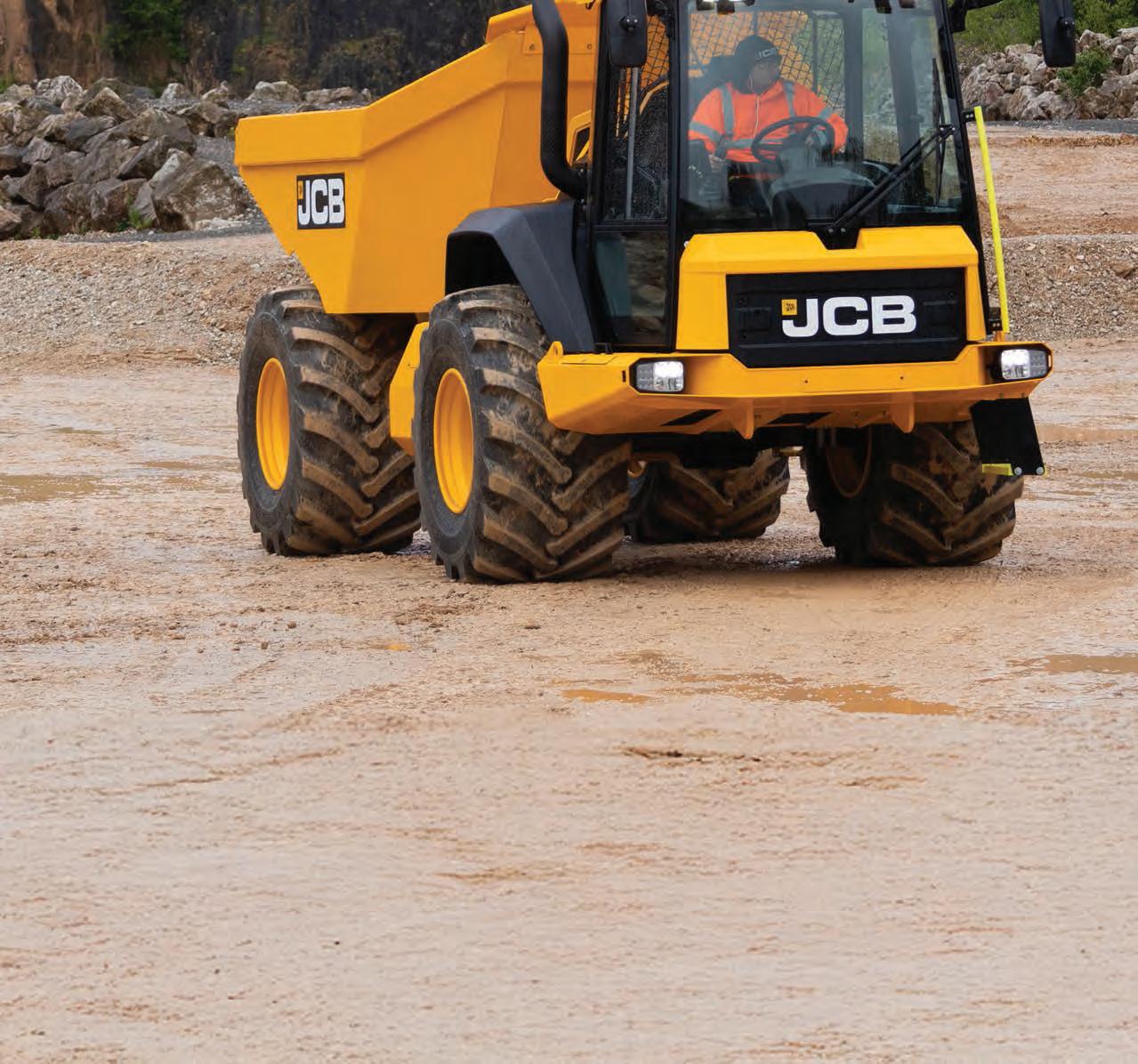
JCB’s latest machines revealed for the first time at an event in Uttoxeter.
Biennial show hosts the UK’s quarry, construction and recycling machinery.
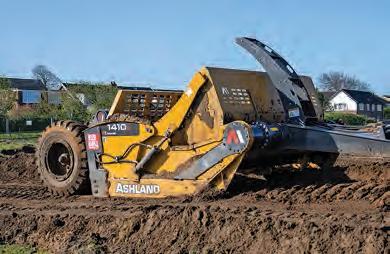
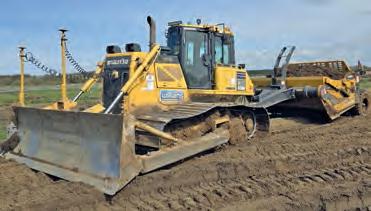
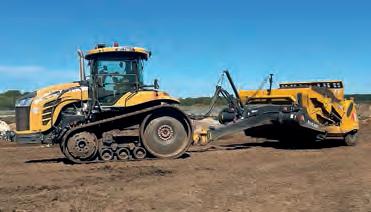
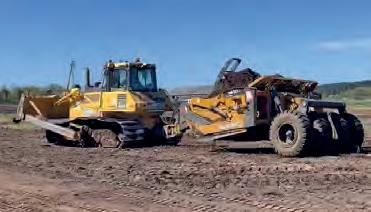
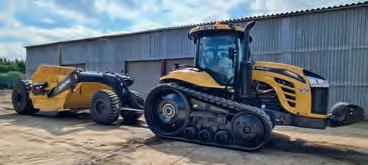
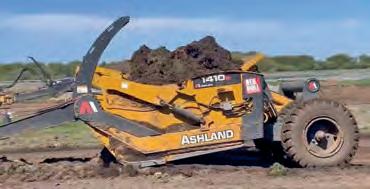
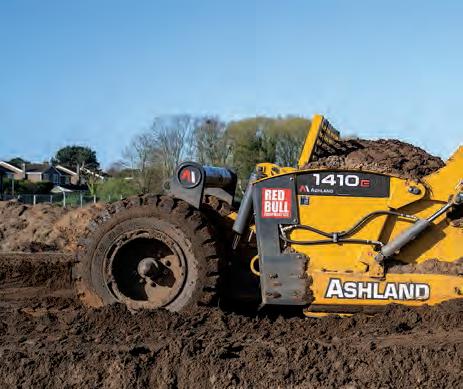
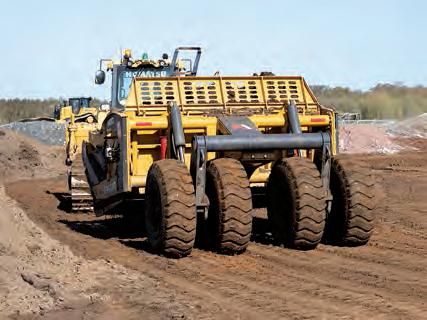
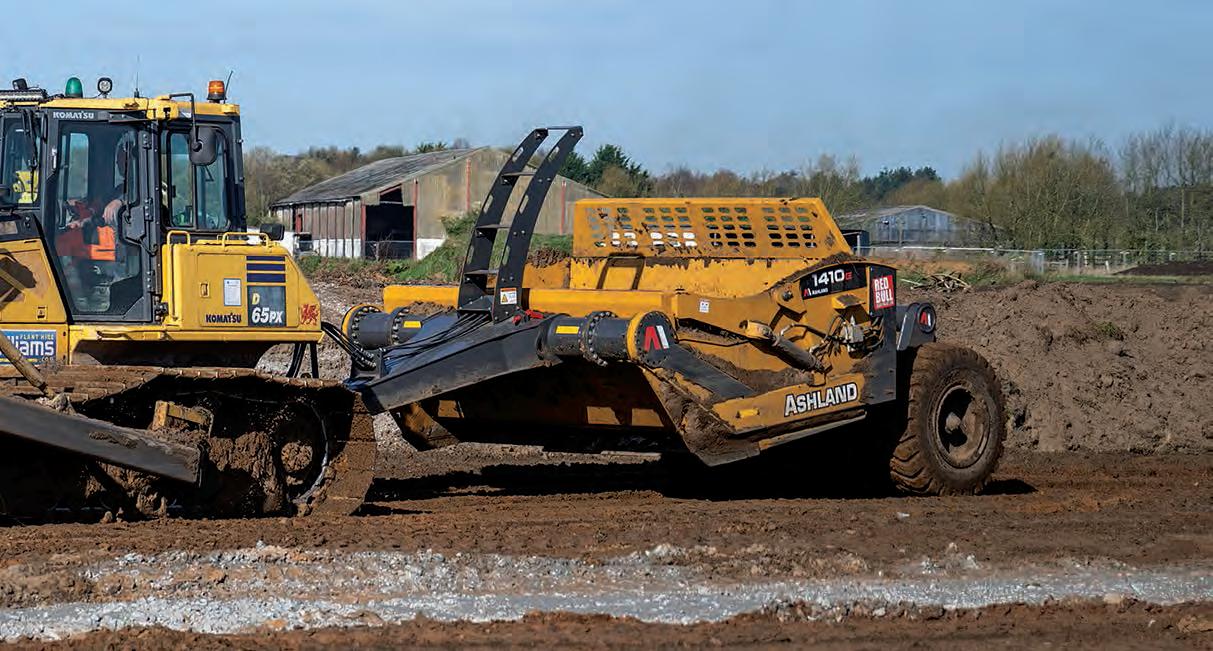
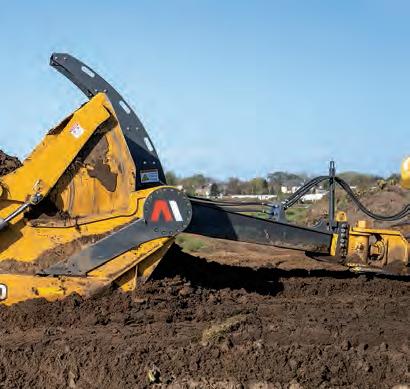
North Wales-based firm utilises a fleet of American Ashland scraper boxes.
Latest developments in
introduction of
A round-up of the latest news from the earthmoving and associated machinery industry.
Now being imported into the UK, Wille machines are a common sight in Finland.
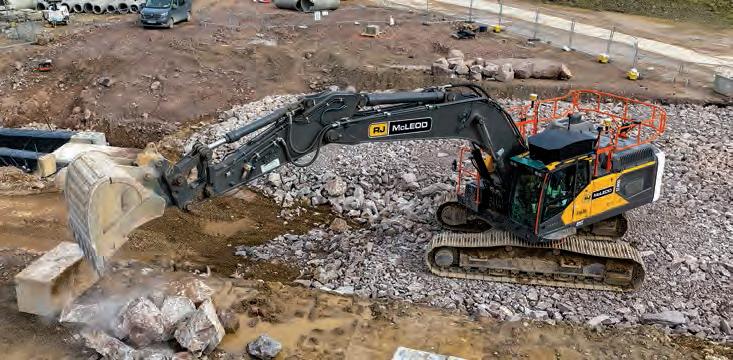
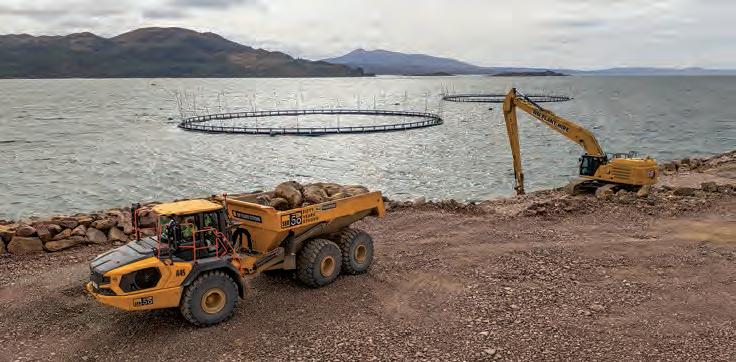
RJ McLeod is currently constructing an extensive dry dock in Scotland.
Our selection of highlights from Scotland’s largest biennial plant show.
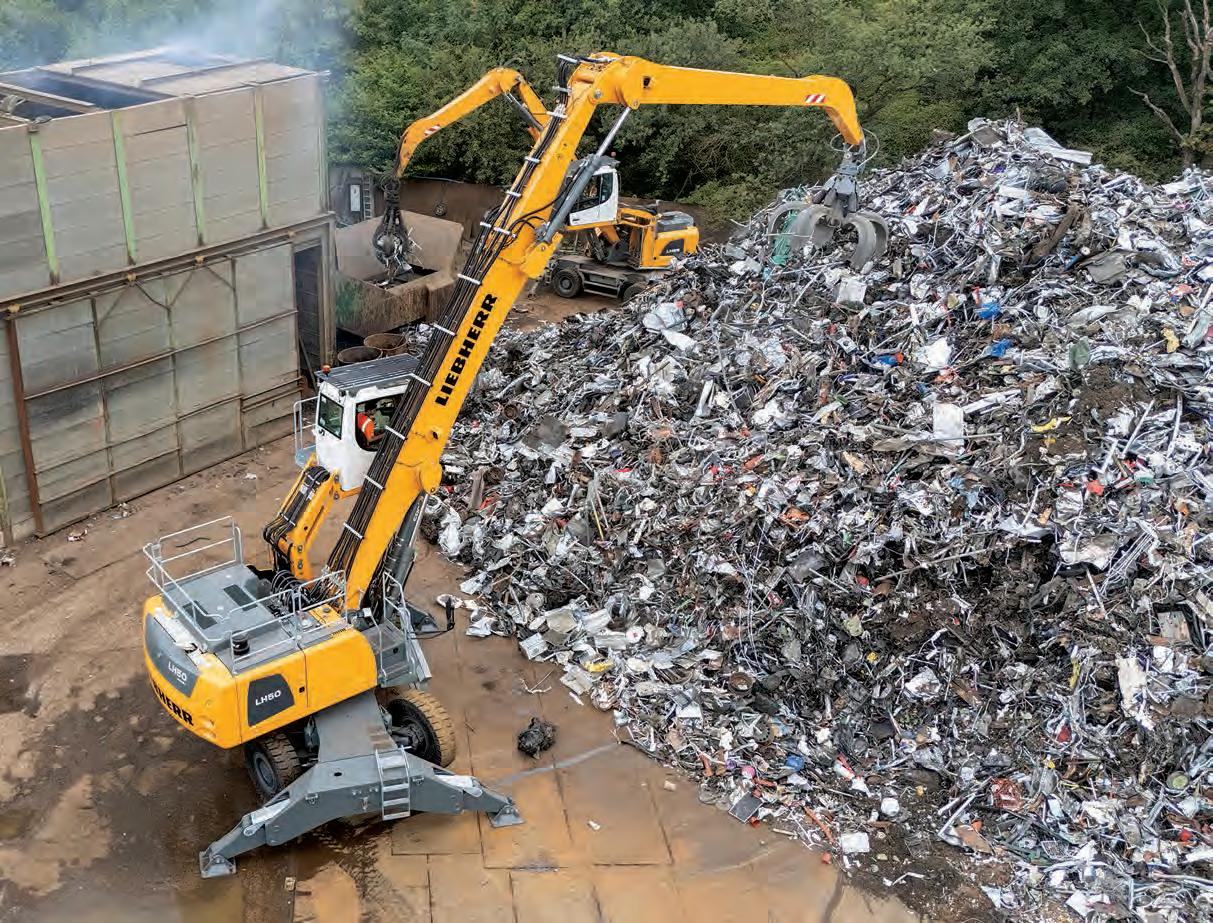
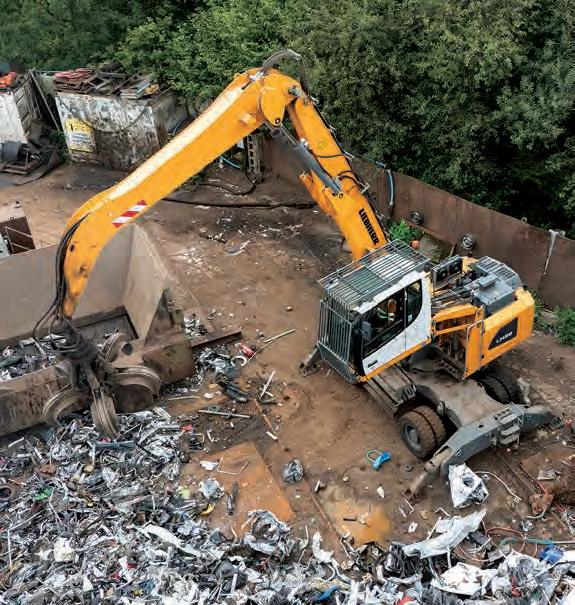
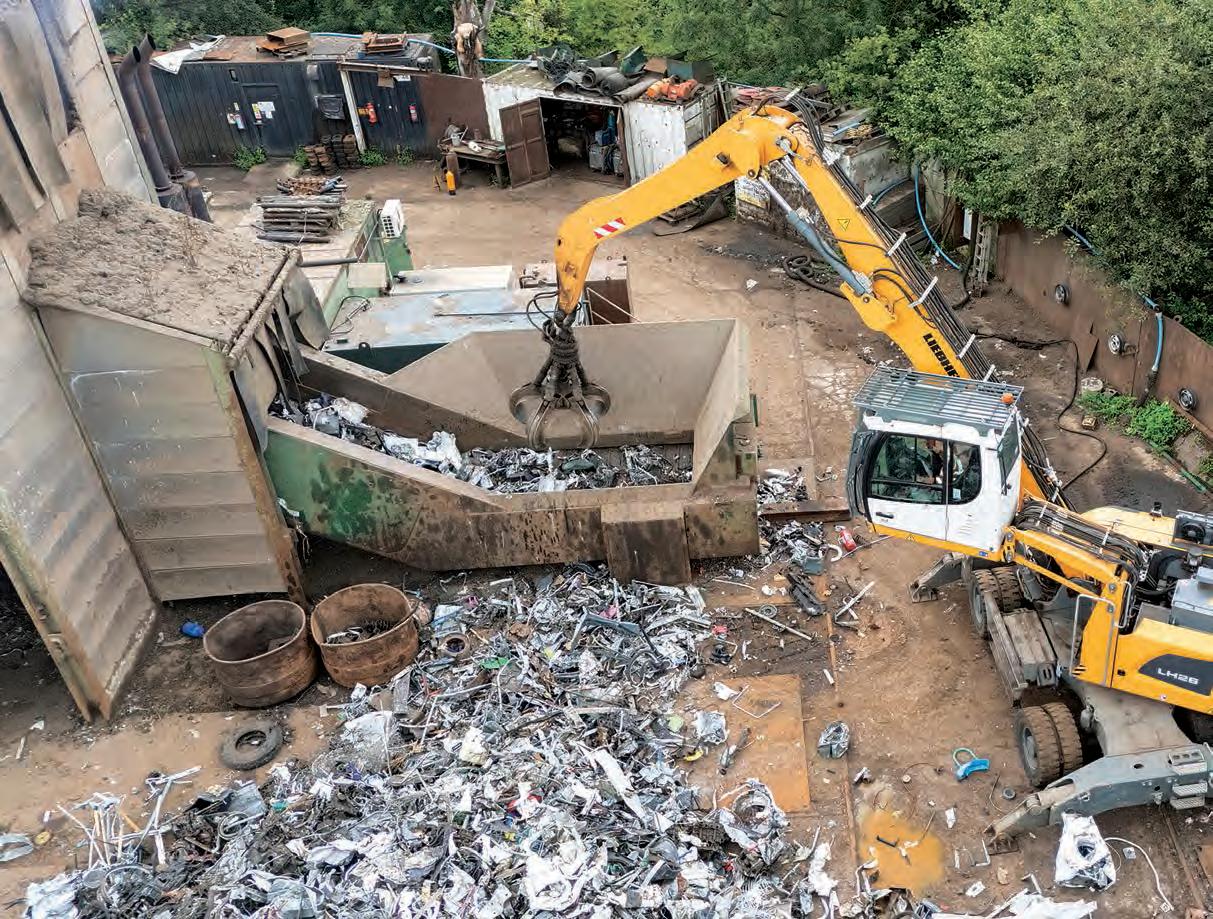
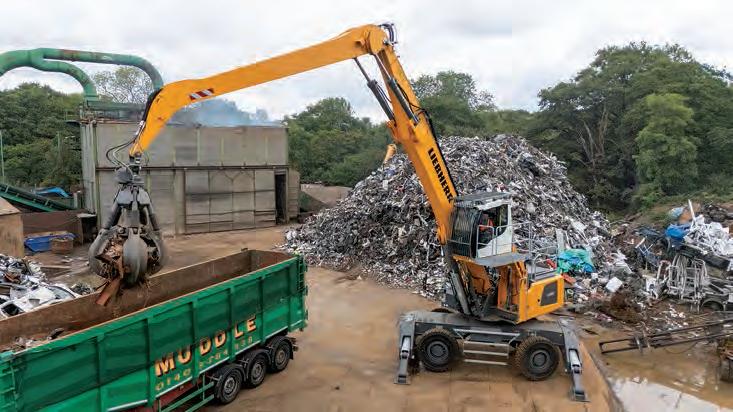
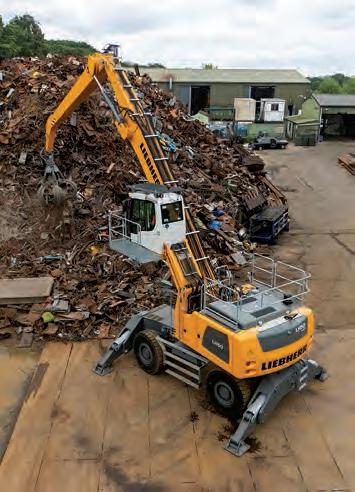
This metals rehandling site works with a pair of Liebherr material handlers.
New machinery added to the European market by South Koreabased Hyundai.
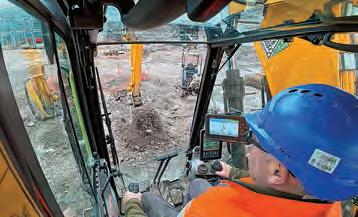
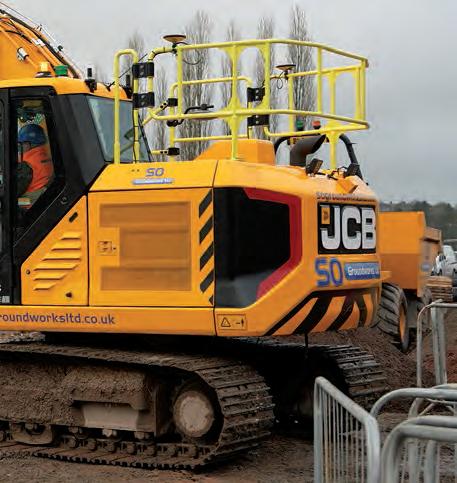
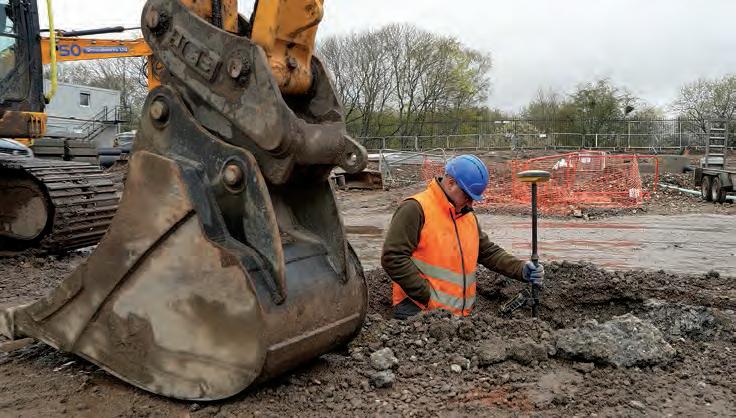
SO Groundworks’ Shaun Oldham’s experience with surveying and machine control.
There was much to shout about at recent Develon Demo Days in the Czech Republic.
The Hawkes Group is helping to process a site’s foundation concrete.
TAIL END
77 SITE VISIT
LIMERICK TO FOYNES RAIL
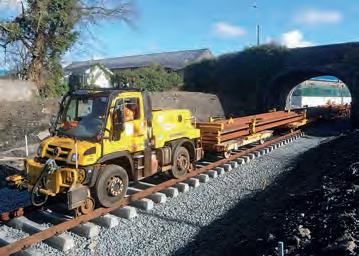
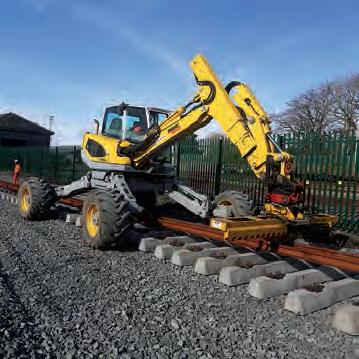
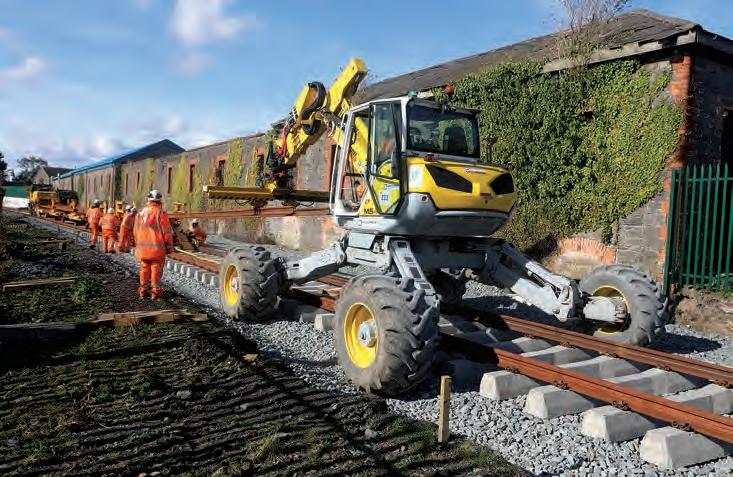
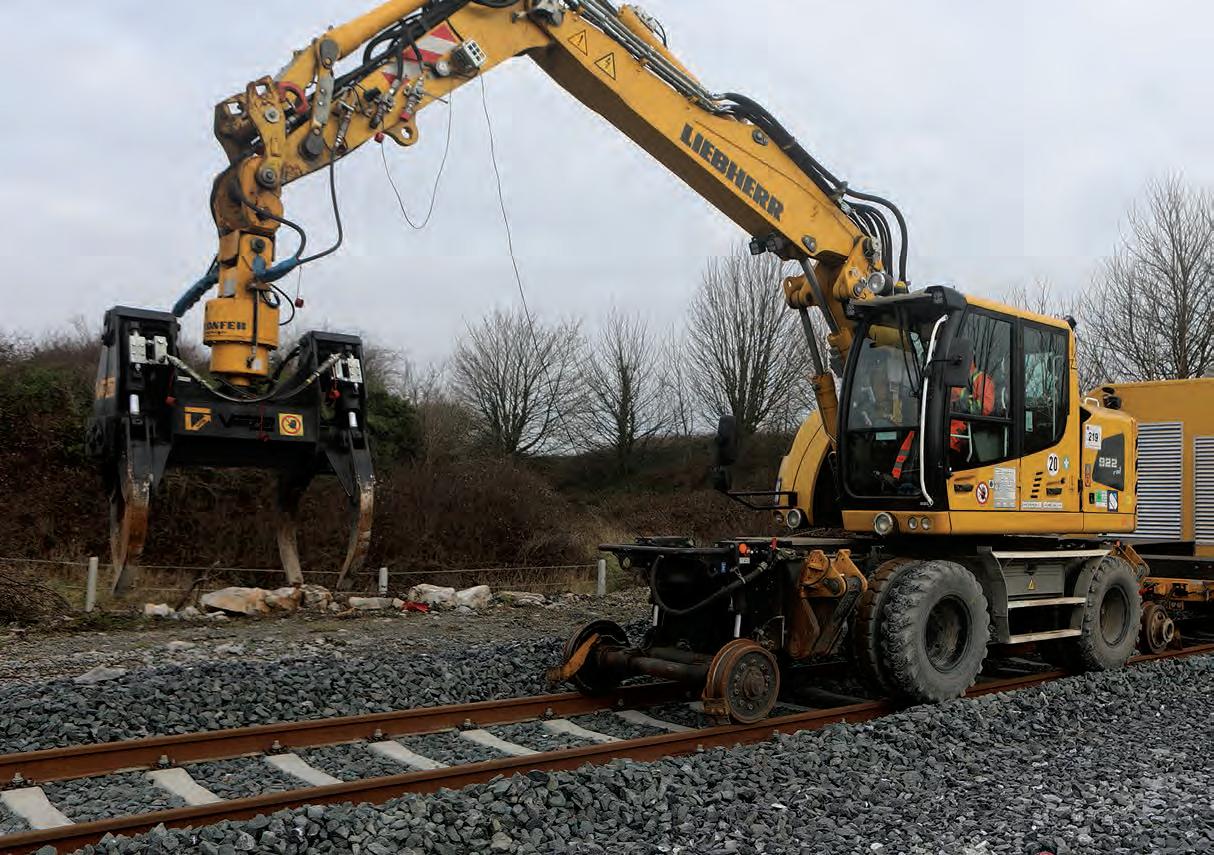
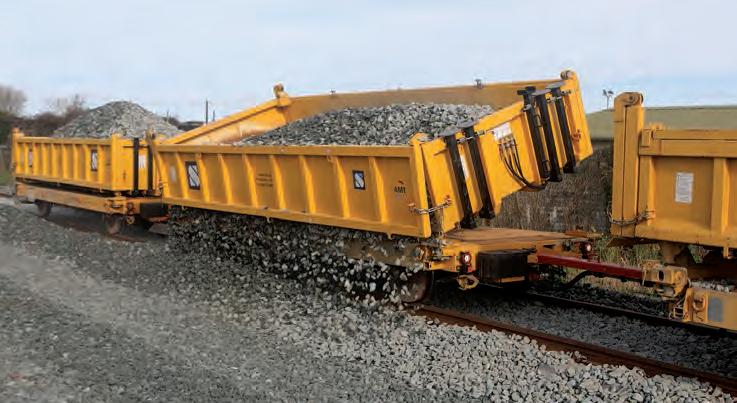
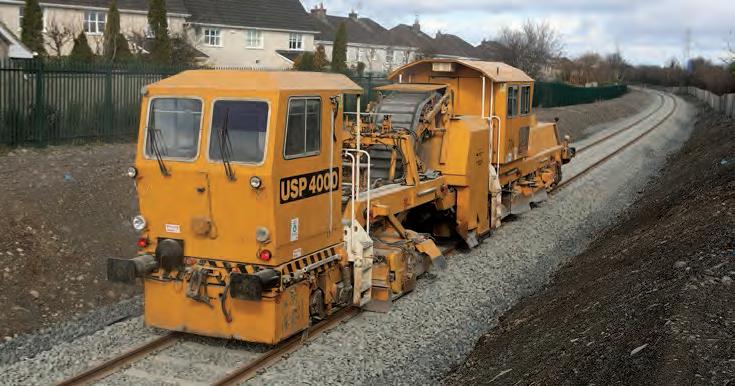
We report on the specialised plant used for the rail-laying aspect of the works.
83 ATTACHMENTS MB CRUSHER
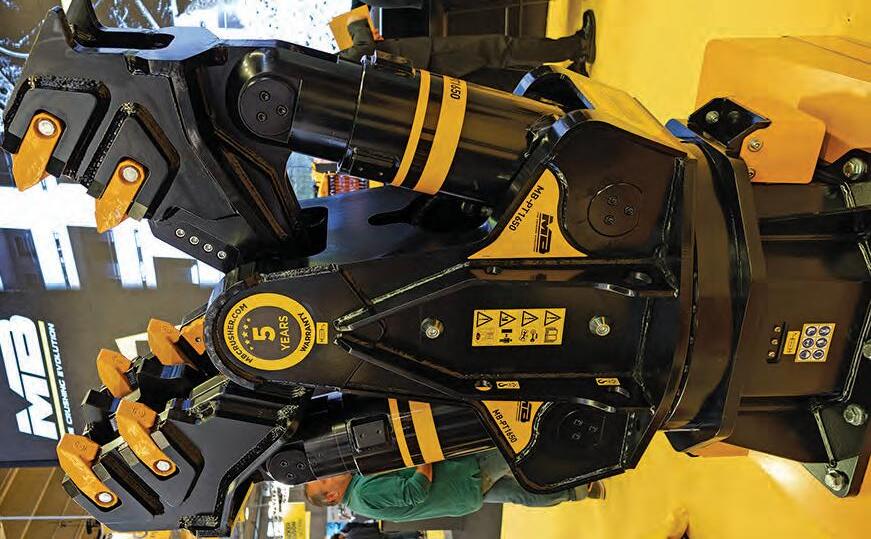
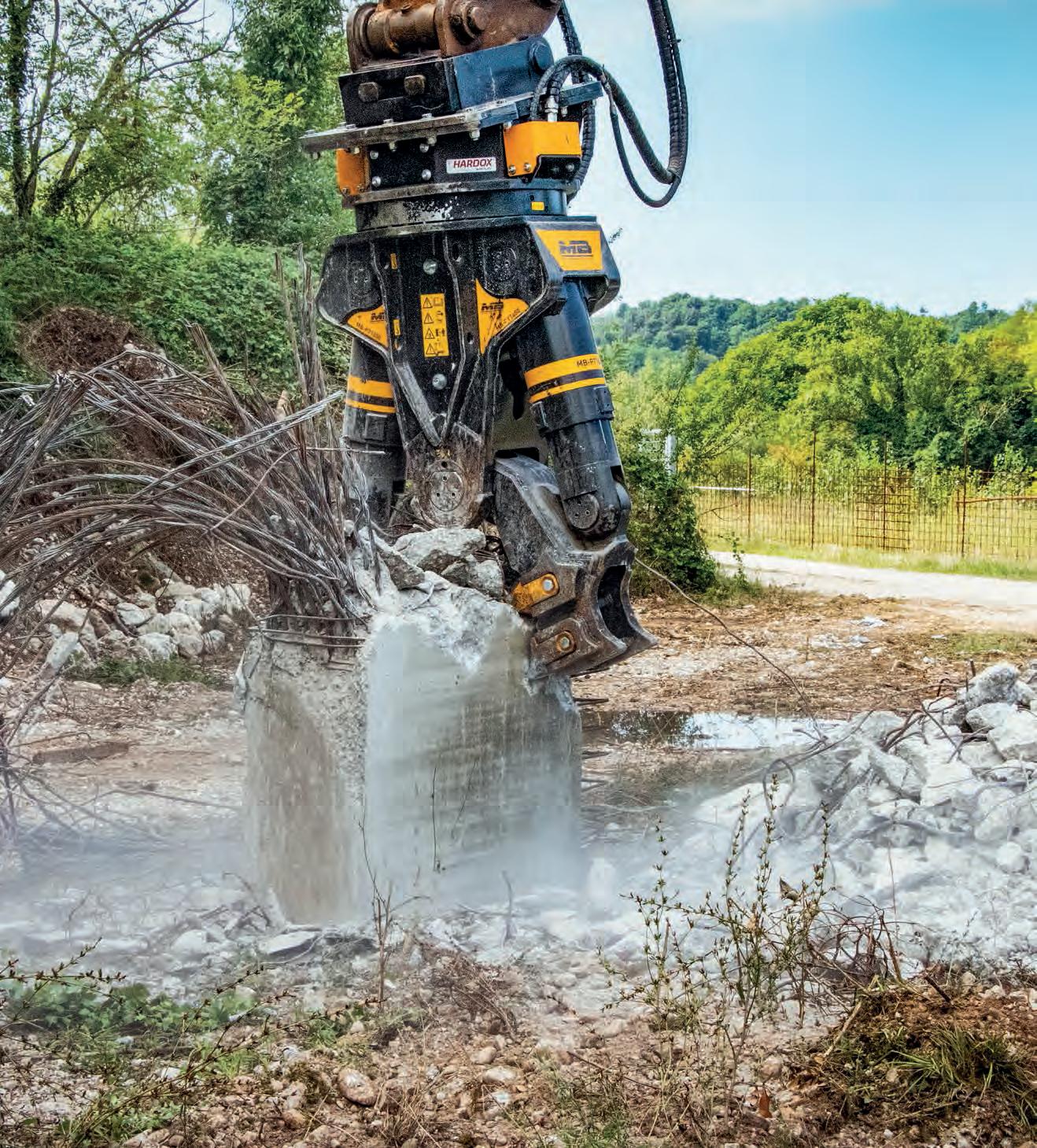
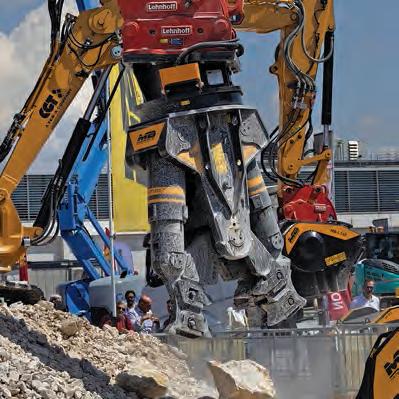
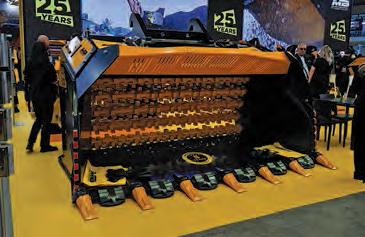
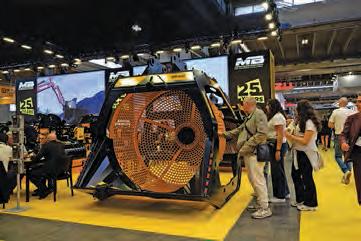
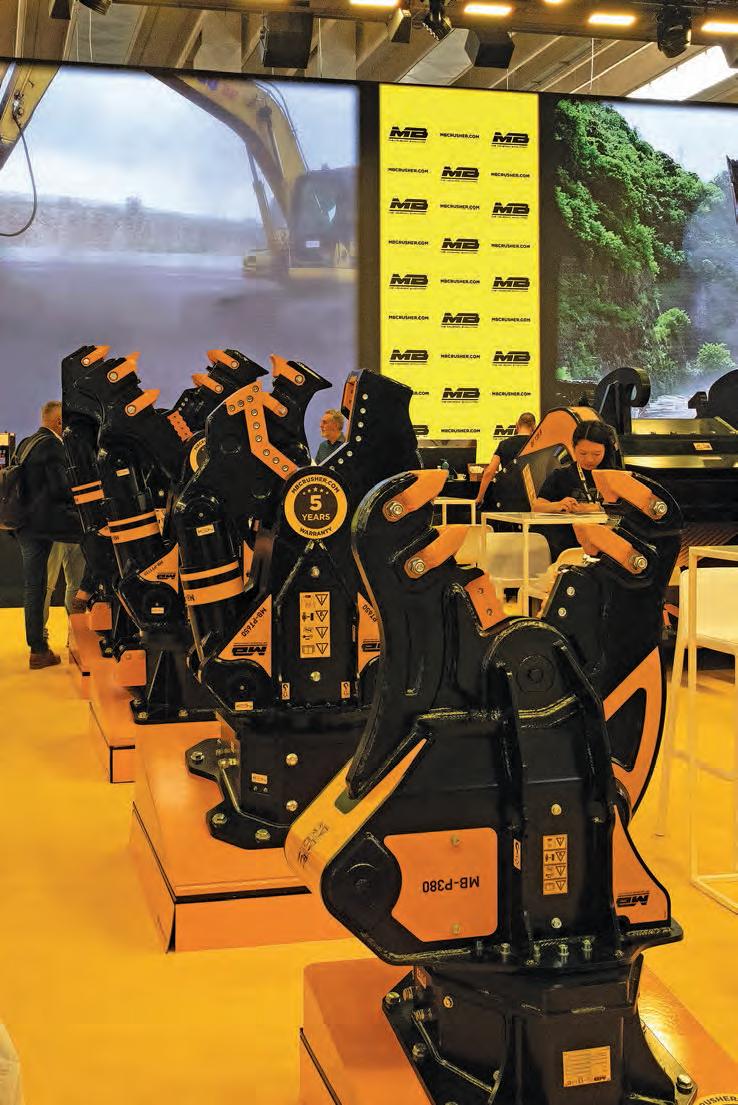
Italian manufacturer celebrated 25 years in business at the recent Samoter show.
87 EURO FOCUS MANSEN MÖRINÄT
Annual Finnish show sees a cluster of machinery dealers open their premises.
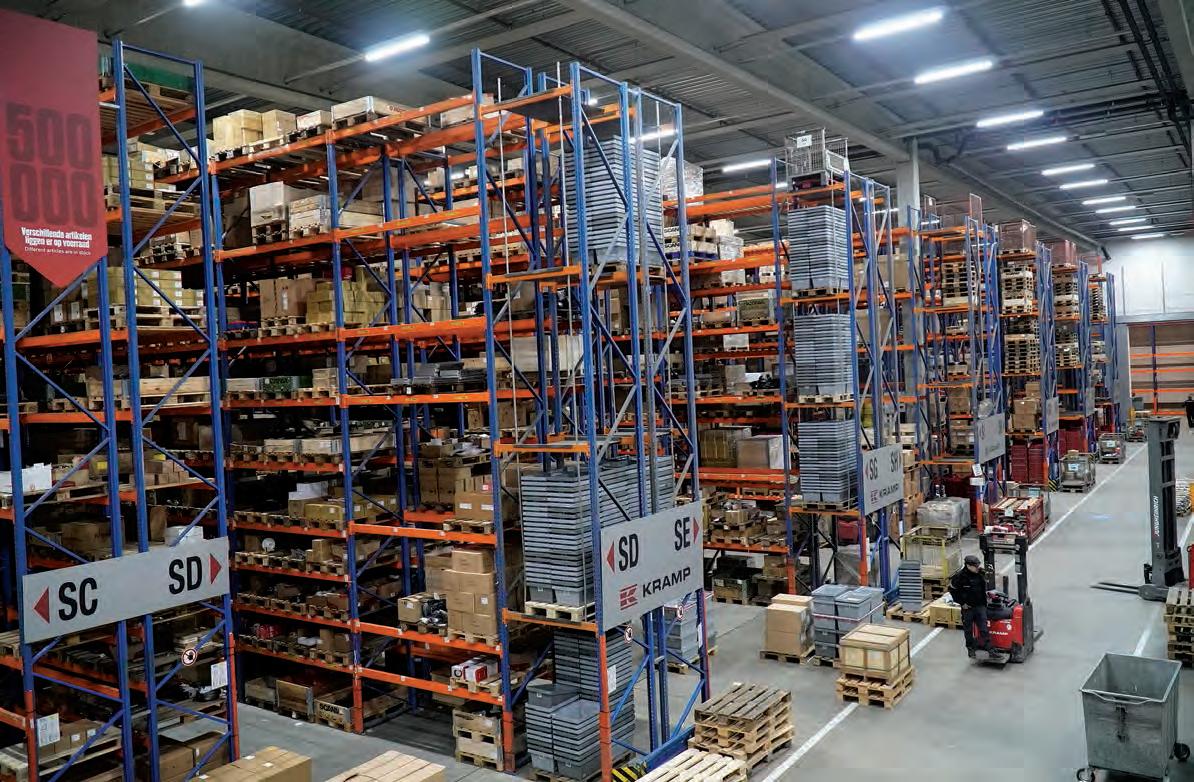
92 WORKSHOP LOGISTICS KRAMP
A major Dutch-based parts supplier to the European off-road machinery sector.
95 SHOW REPORT CONEXPO 2026
Last in a series of reports looks at some of the stand-out specialist equipment.
100 NEXT MONTH
Here’s a taster of just some of the exciting features planned for the next issue.
104 PLANTMOBILIA CLASSIC TRAILERS
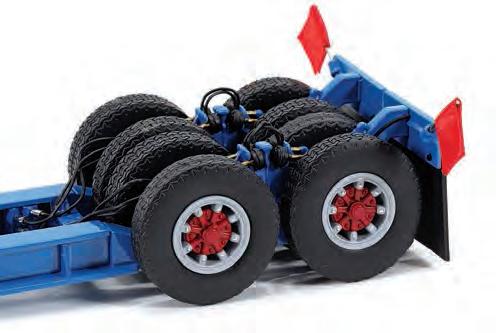
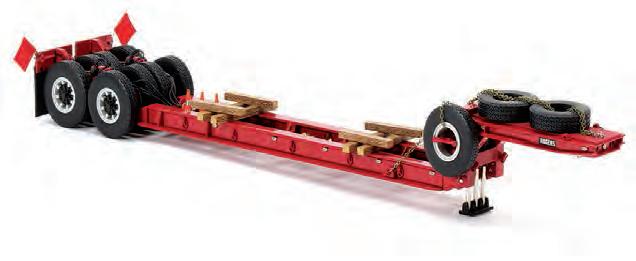
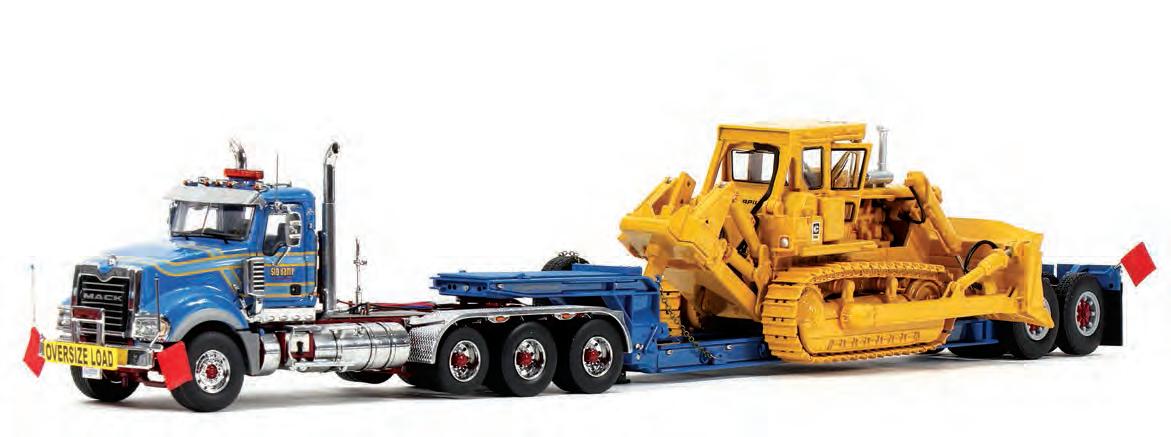
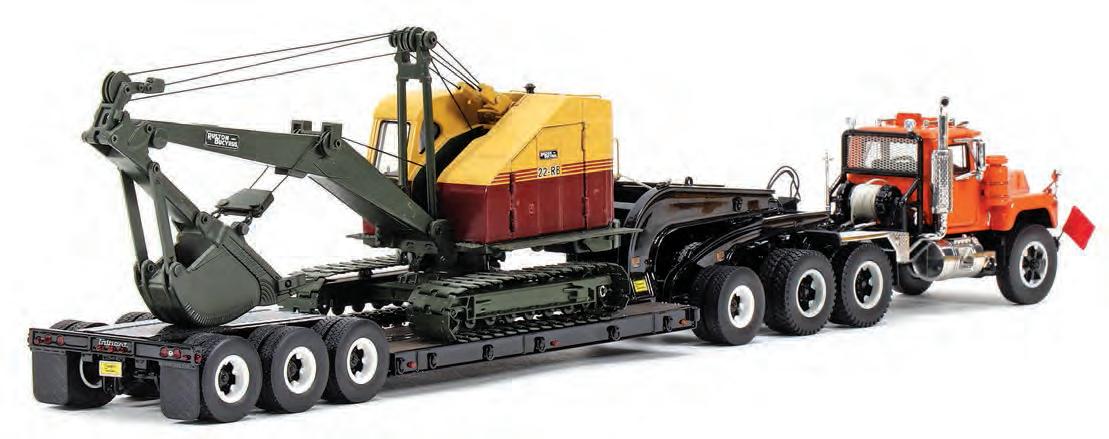
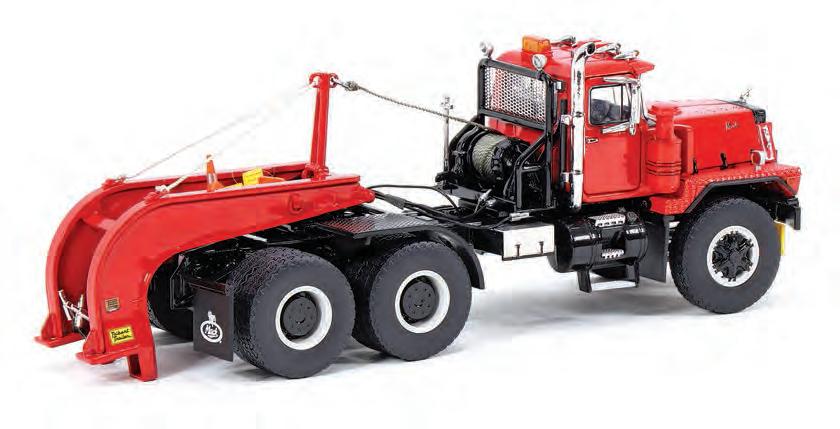
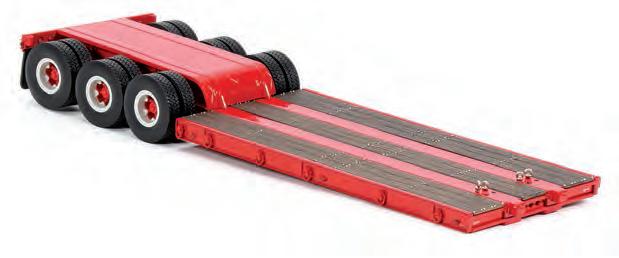
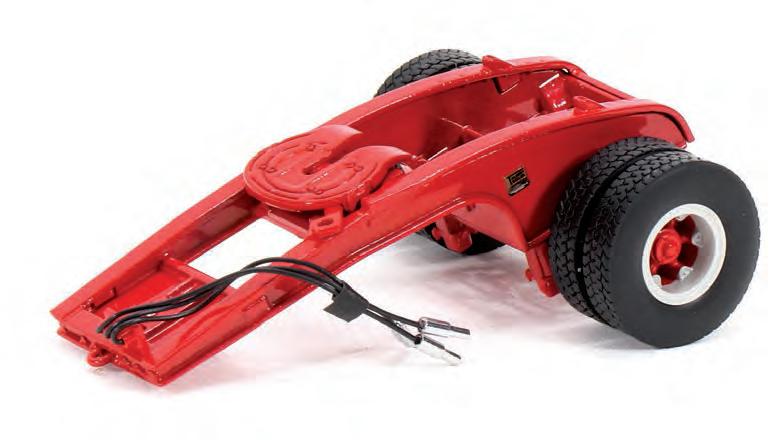
Review of scale models of a pair of classic plant trailers produced by Heavy Haul Replicas.
106 APPRENTICE INTERVIEW
KATE MACLEOD
The winner of the judges’ special award at last year’s CPA Stars of the Future event.
Fuel-smart performance
GEARING UP FOR HILLHEAD
Harry
Hunter reports on the latest machines from JCB, which are due to make their first public appearance at the forthcoming Hillhead show
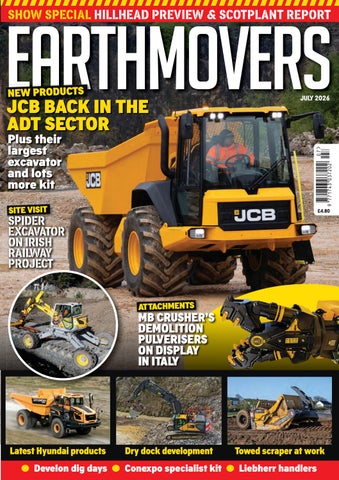
or many in the industry, the big news from the recent JCB new product launch event is that the UK-based manufacturer is returning to the two-axle articulated dump
Ftruck (ADT) sector of the market. The first model is the third generation 12.75-tonne capacity 715.
In retrospect, JCB was well ahead of the game when they introduced the 12-tonne capacity 712 and the 14-tonne 716 models way back in 1989. Sadly, due to low sales volumes, these 4x4 ADTs were discontinued in 1992. Then, at the Intermat show in 2000, JCB launched second generation models in the form of the 13-tonne capacity 714 and the 16-tonne 718. Four years later they introduced a 6x6 ADT, the 20-tonne capacity 722, again offering low ground pressure, particularly when configured with the appropriate tyres.
At a time when owners of ADT fleets
were looking at much larger 6x6 articulated haulers – then with carrying capacities of up to 40 tonnes – the 722 model was not a roaring sales success. JCB did consider introducing higher capacity 6x6 models, but they would have been mismatched with their largest JS series excavators. Although the smaller 4x4 models were extremely well regarded by users, the market was then
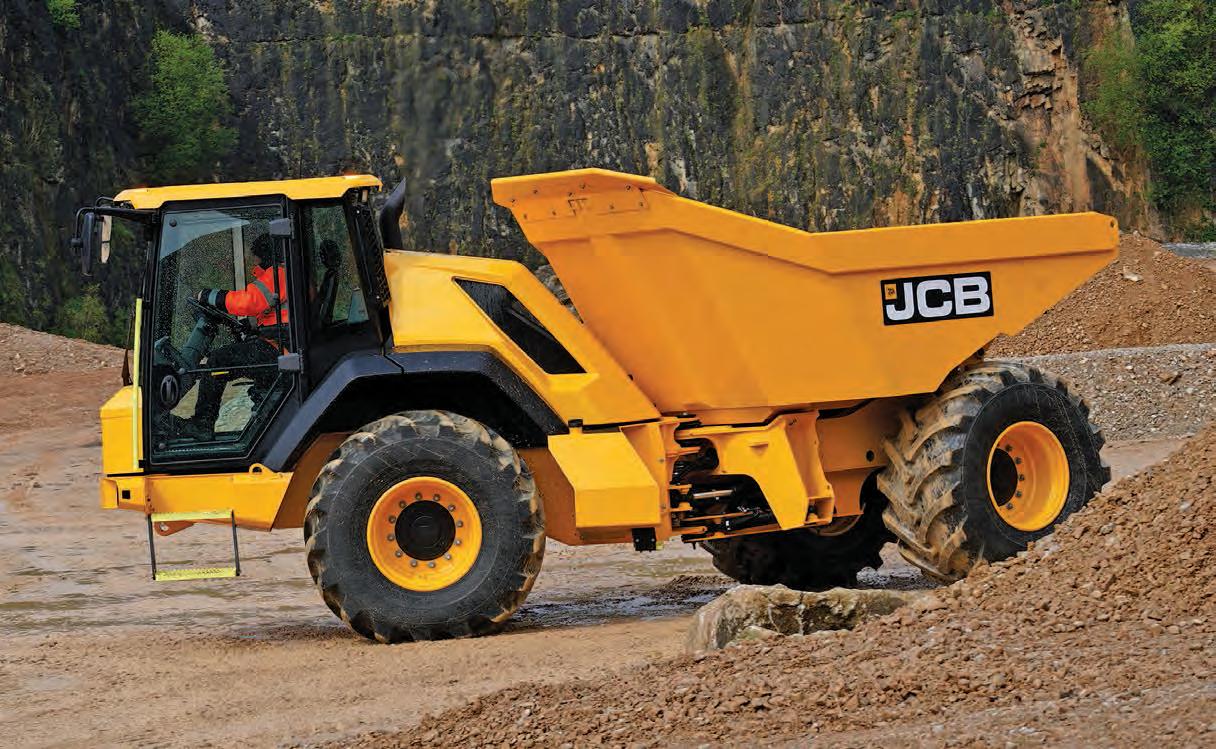
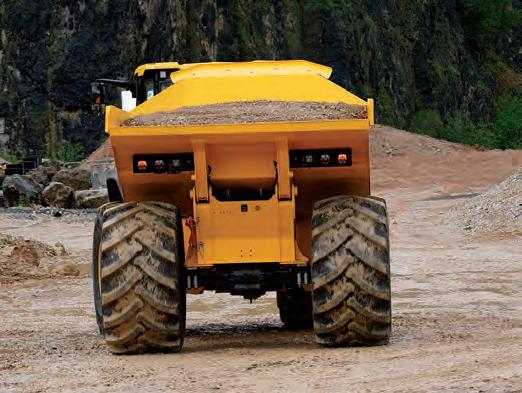
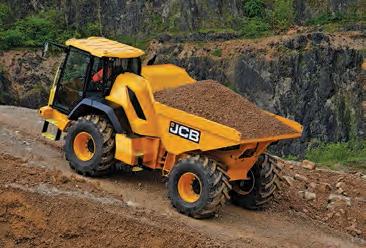
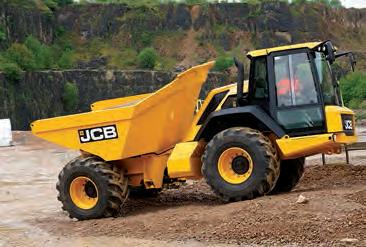
Below and inset: The 715 ADT is the first compact articulated dump truck that JCB has produced since production of the secondgeneration models was discontinued in 2013.
looking at more cost-effective, but arguably less productive and certainly less safe to use, nine- and 10-tonne capacity forward tipping site dumpers. Coupled with the significant costs of re-engineering such ADTs to meet increasingly stringent emissions regulations, it is little wonder that JCB opted to withdraw from this sector of the market in 2013.
Fast forward to 2026 and the compact hauler market has significantly changed. For those running large site dumpers, cabbed machines that provide much higher levels of operator comfort are now the industry standard. But even these are being superseded by machines with a rotating
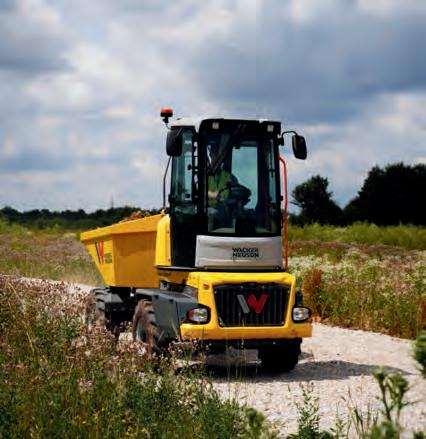
operator station, to provide much higher levels of site safety. However, a more dramatic change in buying patterns has occurred with increasingly popular 4x4 ADTs, which provide the ability to work over much softer ground conditions than their 6x6 counterparts. They undertake specialist applications and keep more mundane sites working during increasingly wetter months. JCB has responded to what the market is now demanding with two new machines, the nine-tonne capacity Dual Drive site dumper (see panel overleaf) and the 715 4x4 ADT, which can carry almost 13 tonnes in its 7.1cu.m skip.
The new 715 is powered by JCB’s own
488 four-cylinder, ultra-low emissions engine producing 129kW (173hp) and 690Nm of torque at 1500rpm. Power is transferred to the wheels by JCB’s eightspeed powershift automatic transmission with active torque lock, allowing the machine to reach a maximum speed of 40kph. The 715 weighs 9.3 tonnes and has a wheelbase of 3350mm. Two of these compact ADTs can be transported on one low-loader.
The design of the 715 harks back to its predecessor; light fixtures are placed low on the front of the body and are now built into the chassis rather than bolted on. However, the new 715 features a far shorter nose than the old 714 model. Coupled with more glass, this means a far better view out of the cab.
The cab is the latest JCB Command Plus featuring air-conditioning and a fully adjustable seat in a central driving position. A 7in touch-screen mounted to the right of the steering wheel displays the same user interface as in the X-Series excavators; a rear-view camera is also fitted as standard.
JCB’s global product innovation director Richard Brooks said, “This machine is a very clear statement of intent from JCB.
Above left and right: The 715 has a maximum carrying capacity of 12.75 tonnes in its 7.1cu.m skip. It is powered by a 173hp JCB engine driving an eight-speed powershift automatic transmission.
It’s a market that JCB and our customers strongly believe we need to be in, especially given the growth of our excavator range.”
LARGE EXCAVATORS
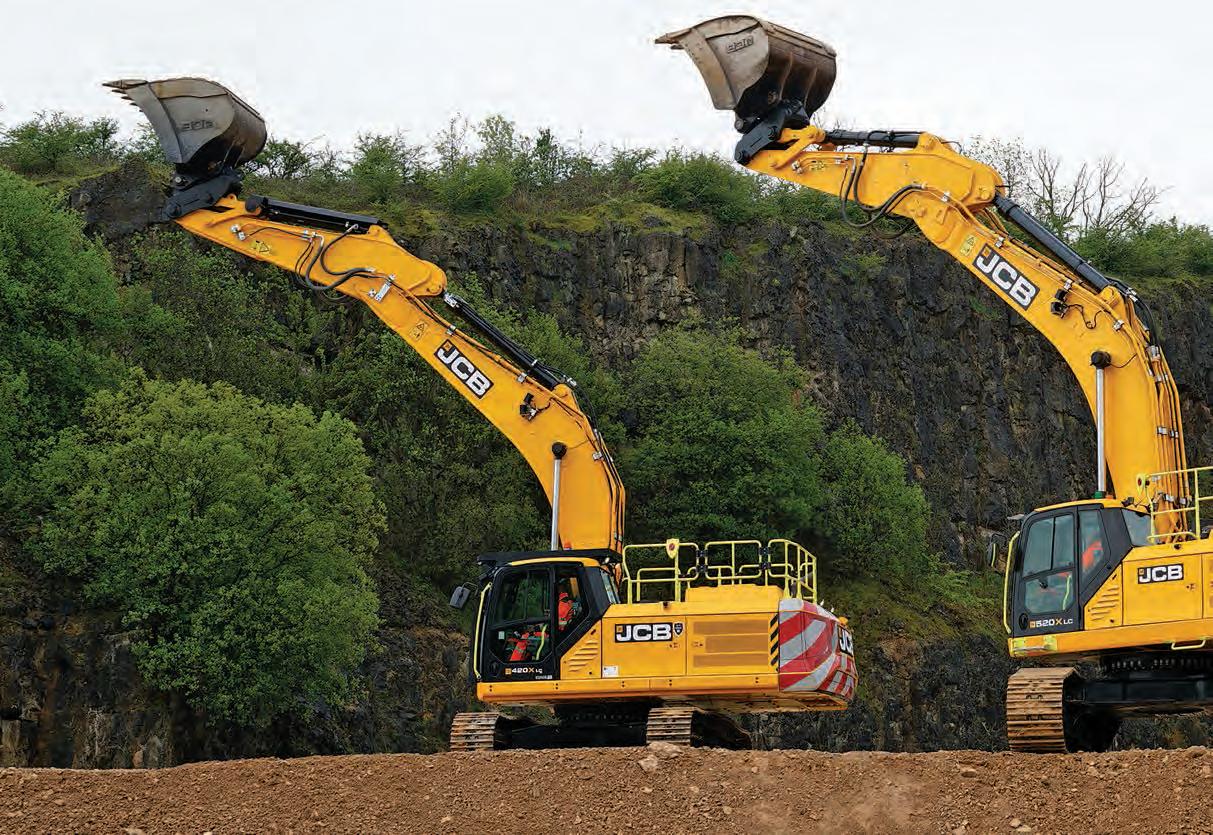
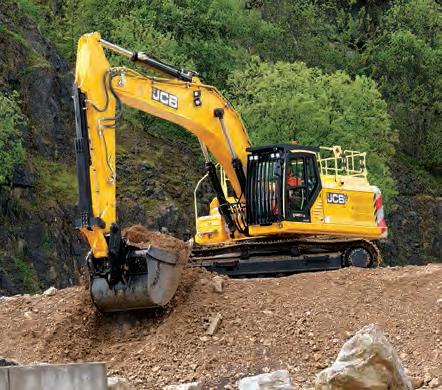
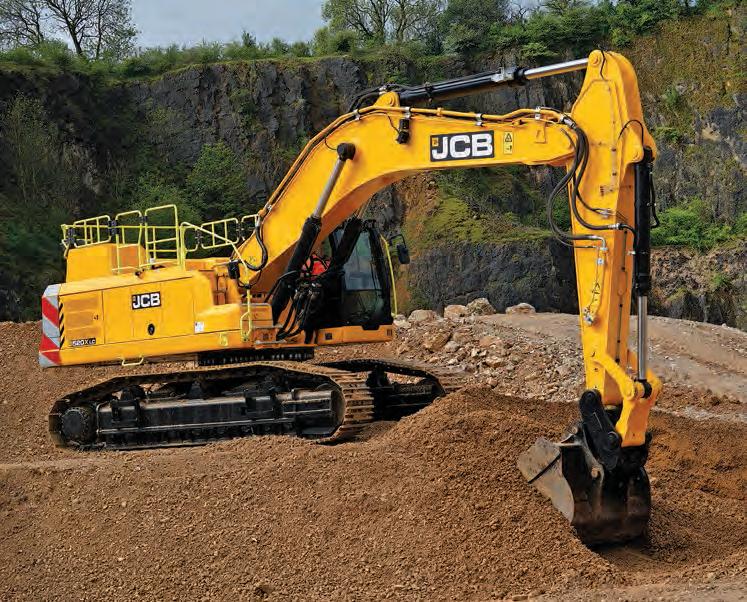
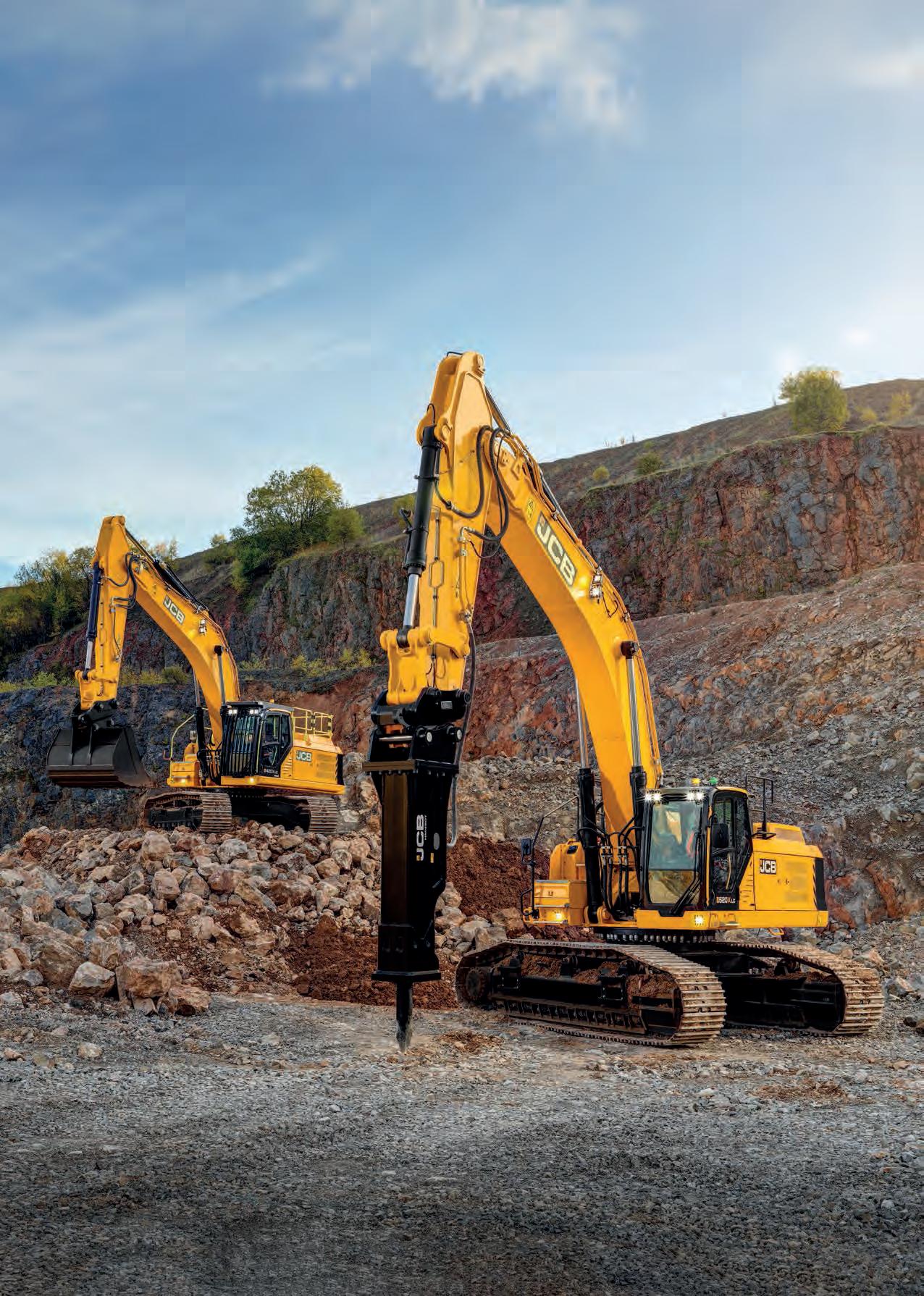
Until now, the largest excavator in JCB’s X Series range was the 37-tonne 370X, which has now been joined by the 420X and the mighty 520X models.
The 42-tonne 420X is powered by a six-cylinder Cummins engine putting out
PRODUCT LAUNCH // JCB
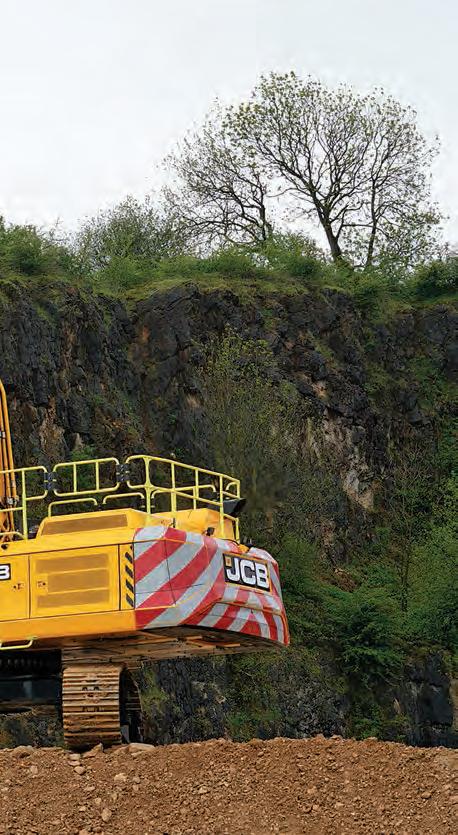
Above, left and below left: JCB has introduced two large excavators, the 42-tonne 420X and the mighty 520X, which tips the scales between 52 and 57 tonnes depending upon specification.
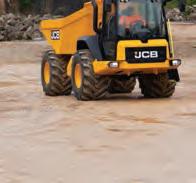
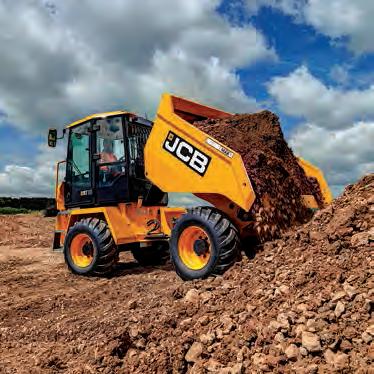
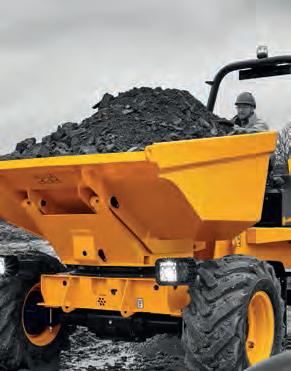
Below right inset: The new Dual Drive nine-tonne site dumper features a revolving operator station in its cab; it is available with either a front tipping or a swivelling skip.
240kW (321hp) and configured with JCB’s Earthmoving Pro Pack as standard. This includes a 2.6cu.m heavy-duty bucket, compared with the 2.34cu.m standard bucket on the 370X. To handle the volumetric increase JCB has reinforced the boom arm and equipped the new undercarriage with 50-tonne class track motors to significantly improve tractive effort over the 37-tonner.
Tom Whitacker, general manager for excavators at JCB Heavy Products, said, “A larger, heavy-duty slew ring, paired with up-rated slew gear improves the slew torque of the machine. Increased diameter lift rams paired with heavy-duty dig end structures improve tear-out force, meaning the 420X now boasts 11% greater lift performance than the 370X.
DUAL DRIVE DUMPERS
A surprise announcement during the product launch event was the introduction of a Dual Drive nine-tonne site dumper, available with either front tip or swivel skip configurations. The reasoning behind this decision is visibility; a common issue with site dumpers is operators not being able to see over a laden skip when driving forwards and having to twist their necks or backs when reversing. The new nine-tonne Dual Drive dumper ensures operators can always face the direction of travel by simply rotating the seat and controls to face whichever direction is needed.
“The all-new undercarriage has a 5.4% wider track gauge and is longer too. That increased footprint gives the machine stability and lift performance that customers expect and need in demanding loading and excavation applications.
“The 420X therefore becomes the new,
The nine-tonne JCB site dumper is powered by a 55kW JCB engine coupled to a two-speed hydrostatic drive train. The controls are designed to be simple and efficient; the Dual Drive system is already proven on JCB’s backhoe loaders and should prove useful on site dumpers.
high-productivity X-Series machine for customers who want more tonnes per hour in a strong, stable and operator friendly package.”
Weighing 52 to 57 tonnes depending on specification, the new 520X is powered by a Cummins X12 engine producing 298kW (400hp) at 1800rpm. The 520X is available with either a 6.5m mass excavation boom or a 6.9m-reach boom, for which 2.55m and 3.0m or 3.0m and 3.3m heavy-duty arms are available.
Tom Whitacker added, “The 520X is the largest machine that JCB have ever built, and I’m incredibly proud of what the whole team have achieved. The 520X is designed to meet the extreme demands of the global
50-tonne market, and it also becomes the first X-Series machine to be offered globally across all markets
“The 520X has undergone an intensive four-year testing programme to ensure we develop the most robust undercarriage and dig end structures that we’ve ever made. To the undercarriage we’re bringing outstanding tractive effort, 378kN in fact. Plus, new twin supported top rollers for extreme strength. The 520X is JCB’s new X-Series flagship. Put simply it’s built to dig hard, load hard and keep material moving at the top end of the sector.”
On both new excavators JCB Livelink telematics comes fitted as standard. As will the fitment of a Command Plus cab featuring storable operator profiles, joystick controls and attachment set-ups. The example unveiled in the factory carried a new largest breaker in the JCB attachments range, the 4.5-tonne HM450T.
COST-EFFECTIVE BACKHOE
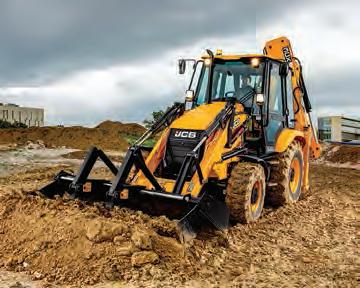
JCB’s iconic backhoe loader has been available in two configurations,
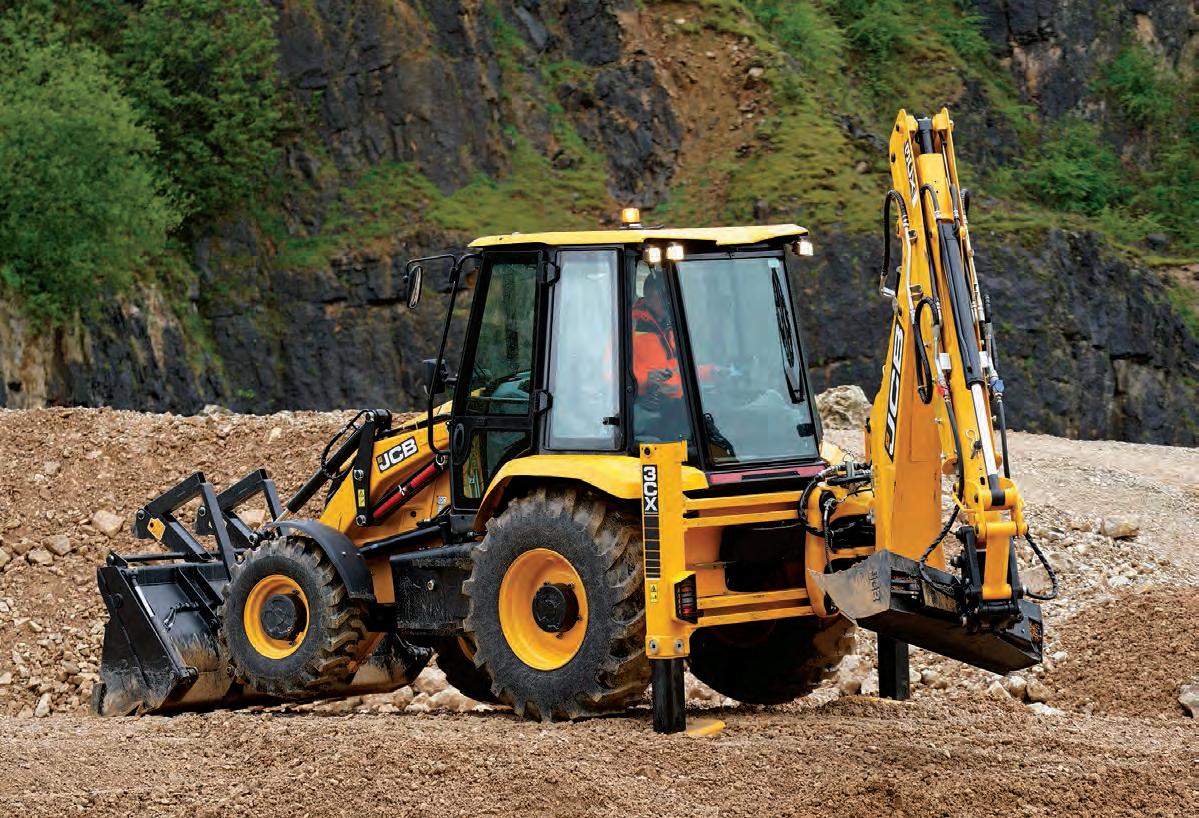
the standard 3CX Plus and the Dual Drive 3CX Pro, which has now been joined by the 3CX Sitemaster. The big news is that JCB’s UK dealer network will sell the 3CX Sitemaster for just £55,000, or £271 per week through JCB finance. The Dual Drive 3CX Pro retails at over £75,000, so the new Sitemaster represents a cost-effective, entry level model, designed to encourage owner-operators and small businesses to consider running such a versatile machine. This harks back to JCB’s first backhoe introduced in 1953. It resulted in a significant increase in the number of small contractors, which evolved into many of today’s £multi-million plant hire and muck-shifting businesses.
JCB’s construction ambassador Georgina Williams said, “This brand-new backhoe loader is designed to boost markets and give the next generation of business owners an affordable way to get started.”
There are of course trade-offs to be expected with such a relatively low-priced machine. It is powered by a non-AdBlue 3.0-litre JCB engine producing 55kW (74hp), rather than the more powerful 4.8-litre engine in the Plus and Pro models. The Sitemaster also comes with a four-speed manual 40kph gearbox, rather than the
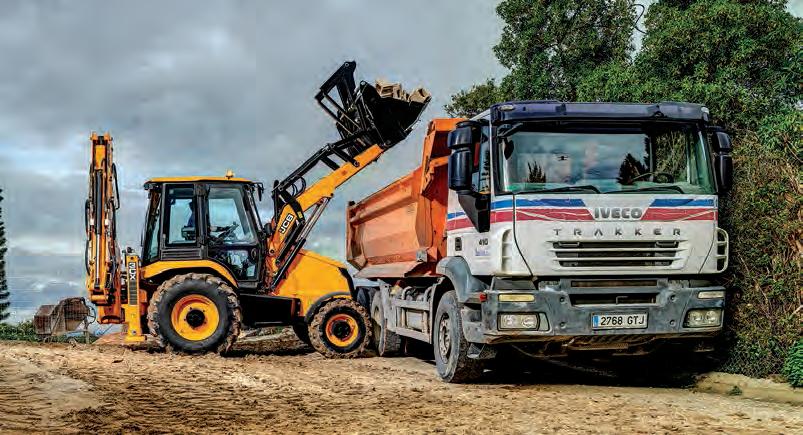
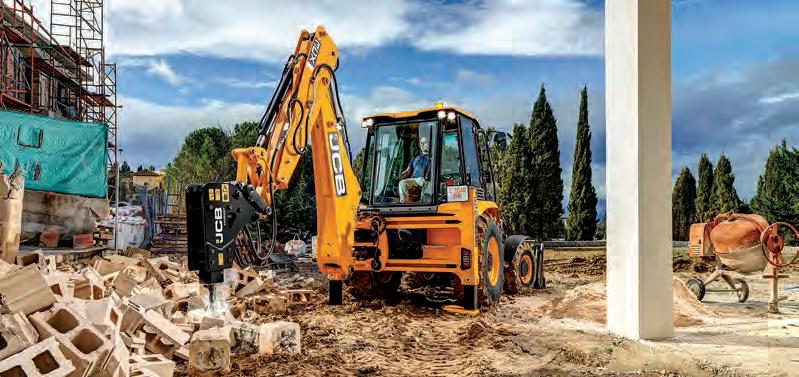
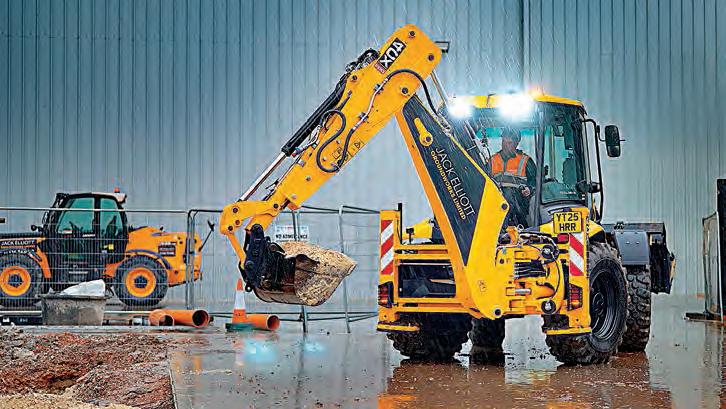
Above, left and above right: The 3CX Sitemaster is available in the UK for just £55,000, or £271 per week through JCB finance, and is powered by a 55kW JCB engine driving through a four-speed manual gearbox.
PRODUCT LAUNCH // JCB
six-speed auto-shifter on the other models and does not feature torque lock.
The cab is in what JCB describe as ‘standard’ trim, which for most will be more than luxurious enough, with a comfortable seat, air conditioning and joystick controls. The specification of the Sitemaster is fixed, it comes with a 1cu.m six-in-one front bucket with integrated forks and an extending dipper arm at the rear that has twin auxiliary pipework.
According to JCB the 3CX Sitemaster can load a 20-tonne truck in less than five minutes and can excavate 150 tonnes an hour. For those looking for a way in to owning and operating machinery for a living, the 3CX Sitemaster backhoe loader seems to be a perfectly capable option.
HILLHEAD SHOW
At the forthcoming Hillhead show at Buxton, JCB will have two large stands: A35 and D6. They will feature the new products, while the large excavators will also be working on the demonstration area. Visitors can also look forward to seeing JCB’s remarkable ‘Backhoe in a Box’.
VM138D.
COMPACTION EQUIPMENT
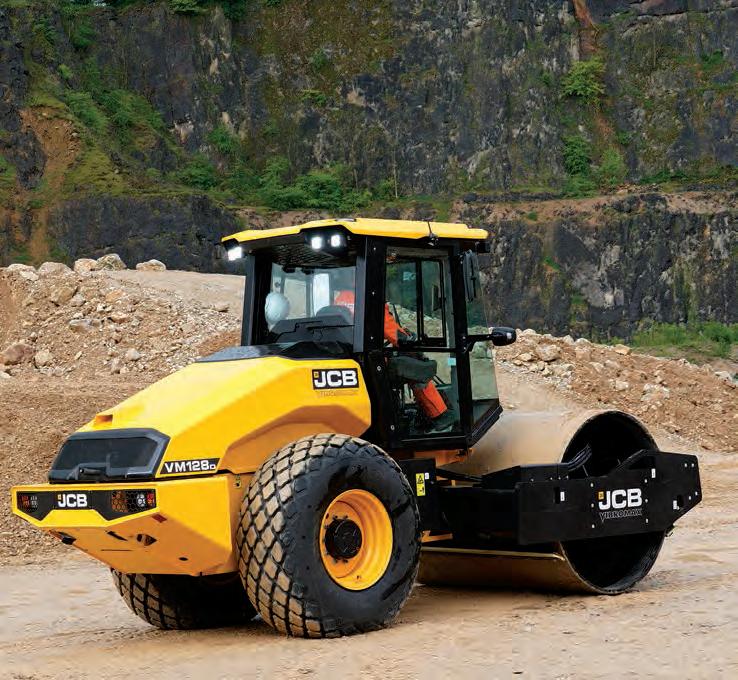
Last year JCB released the Vibromax VM118D single-drum soil compactor. Back in 2005, JCB acquired the German compaction equipment manufacturer Vibromax and production was subsequently relocated to the UK. The Vibromax name was discontinued in 2012, however it began to make a reappearance on models for the North American market a couple of years ago.
The range of JCB Vibromax compactors for Europe has now been expanded to include the 5.5-tonne VM58D, the seven-tonne VM78D, the 12-tonne VM128D and the 13-tonne VM138D. The two larger models are powered by a JCB engine rated at 97kW (130hp), while the two smaller machines have a 55kW Rehlko engine. These new models exert a centrifugal force from 81kN on the VM58D up to 292kN on the VM138D.
All feature 10mm-thick lateral stiffener rings on the drum, ensuring no bending or warping. The two smaller JCB models are said to be able to climb up to 60-degree gradients, while the larger units can climb slopes up to 55 degrees.
All five JCB Vibromax machines can be specified with the firm’s ‘IntelliCompaction’ management system, which monitors surface conditions in real time to ensure the correct number of passes, minimising the risk of either over- or under-compaction.
Right: The range of JCB Vibromax compactors for Europe has now been expanded to include four new single-drum models, including the 13-tonne
WORLD’S FIRST ZERO-EMISSIONS BACKHOE
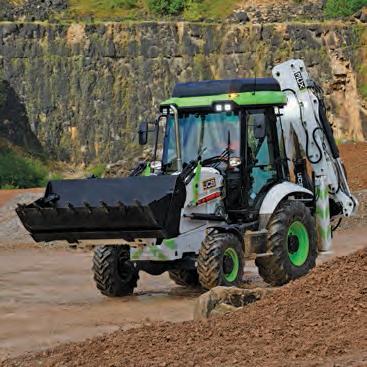
After many years of R&D and field testing, the wait is finally over as JCB has officially introduced its hydrogen-powered 3CX backhoe loader. The machine is powered by a 55kW version of JCB’s hydrogen combustion engine, which has similar regular maintenance intervals as its diesel counterpart. This innovative engine is supplied by three composite-wrapped roof-mounted hydrogen tanks, providing sufficient fuel for a full day’s work. It is understood that JCB Finance will be offering this machine in the UK on a three-year operating lease with a full-service contract.
JCB chairman Lord Bamford said, “The unique combustion properties of hydrogen enable the engine to deliver the same power, the same torque and the same efficiency that powers JCB machines today, but in a zero-carbon way.
“Hydrogen combustion engines also offer other significant benefits. By leveraging diesel engine technology and components, they do not require rare earth elements and, critically, combustion technology is already well proven on construction and agricultural equipment. It is a technology that is cost effective, robust, reliable and well known throughout not just the construction and agricultural industry, but the whole world.”
REFUELLING
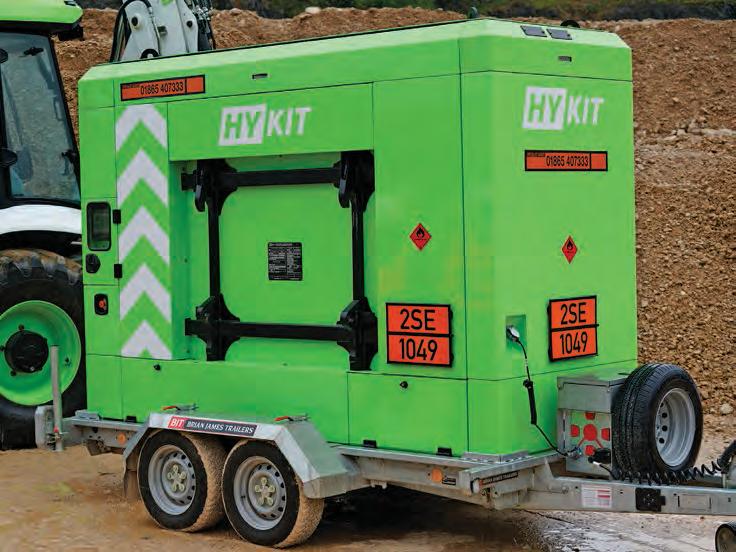
The supply of hydrogen in the UK is increasing, including through JCB’s partner Ryze Power. In addition, Hykit, a hydrogen infrastructure manufacturer partly owned by JCB, has introduced a trailer-mounted hydrogen storage and refuelling station, weighing less than 3.5 tonnes.
The MHR-X75 model has a hydrogen storage capacity of 75kg and is able to refill
JCB’s zero-emissions backhoe loader or site generator in 10 to 15 minutes. It features intuitive touch-screen controls, real-time remote monitoring and diagnostics and integrated safety systems, including leak detection and emergency shutdown.
LAND SPEED RECORD
JCB has a long history of setting unusual land speed records, including the world’s fastest backhoe loader (72.58mph) and the world’s fastest tractor (135.19mph). As part of the global launch of its new diesel engines, in 2006 the JCB Dieselmax streamlined vehicle set a world land speed record for diesel-powered machines at Bonneville Salt Flats, where driver Andy Green reached an incredible 350mph.
Graham Black reports on the latest developments in JCB’s introduction of hydrogen as a fuel of the future
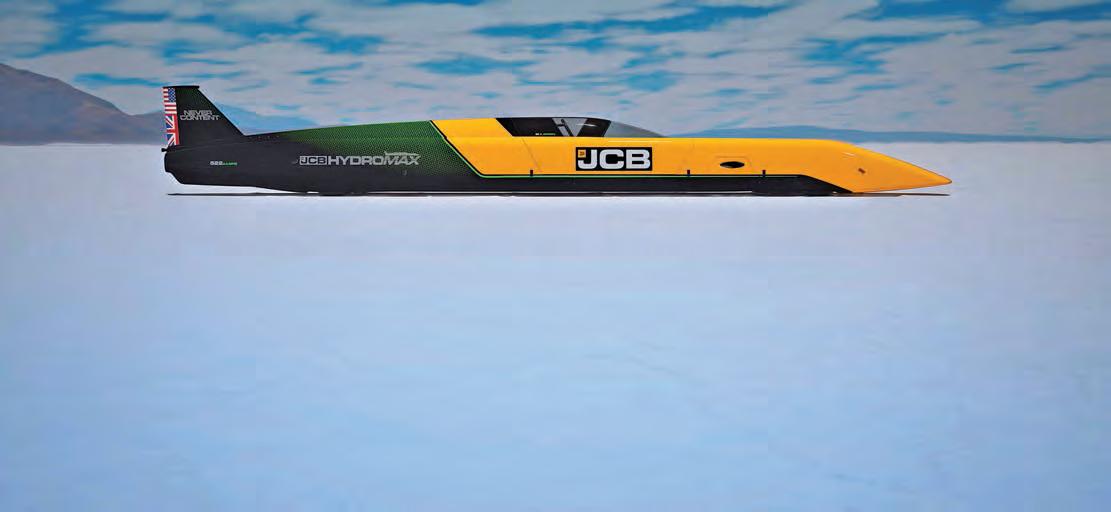
To celebrate the introduction of hydrogen combustion engines, they will return to Bonneville later this year with the JCB Hydromax, again driven by Andy Green. This 32ft streamlined car is powered by a pair of JCB hydrogen engines, which have been modified to generate a total of 1600hp, providing an estimated top speed of over 350mph!
Andy Green said, “The JCB Hydromax car is lighter, more powerful and faster than its predecessor of 20 years ago. Once again, we’re going to show the world just how good British engineering and technology really are. This August we’re going to smash the hydrogen-powered vehicle record in the world’s fastest and most exciting zero-emissions vehicle.”
Above: JCB is returning to Bonneville in an attempt to set another land speed record, this time with the JCB Hydromax, which is powered by a pair of hydrogen engines rated at 1600hp.
Below and inset: JCB has officially launched its hydrogen-powered backhoe loader, for which partner company Hykit is introducing a trailer-mounted hydrogen storage and refuelling station.
NEWS
FINNING ‘WIN BIG’ COMPETITION WINNERS
F
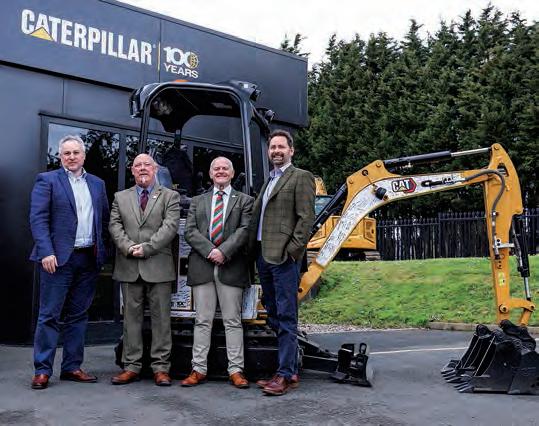
inning has named not one but two winners of its ‘Win Big’ competition, awarding each a new Cat miniexcavator to support their projects. Launched to mark Caterpillar’s 100th anniversary, the competition drew such high-quality entries that both the Colin Burt Reserve for Wildlife Conservation in Scotland and Valley Veterans in South Wales were selected.
The Colin Burt Reserve, a 50-acre nature site, won a Cat 301.6 excavator to aid conservation and biodiversity work. Valley Veterans, a charity supporting people with PTSD, received a Cat 301.5 excavator for its Equi-Grow project, promoting wellbeing through equine and horticultural activities.
Both winners attended Finning’s Cannock headquarters for training. Finning said the organisations’ inspiring entries made it impossible to choose just one winner.
A round-up of news stories in the plant and machinery construction industry ant
JCB COMPACT MACHINERY ACCESSIBILITY
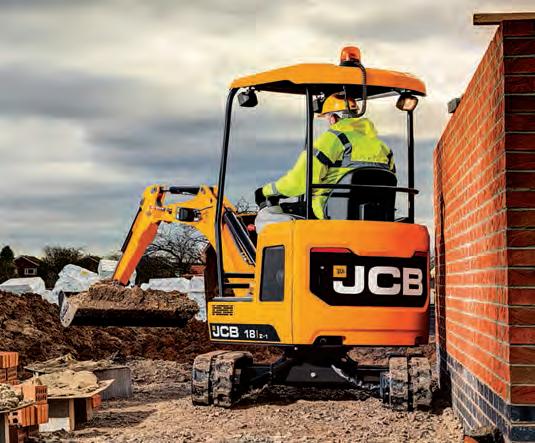
JCB Finance has introduced FlexiBuy, a new funding solution aimed at making mini-excavator ownership more accessible for businesses. Offered as a Business Contract Purchase (BCP), it features low upfront costs, fixed monthly payments and flexible end-of-term options to help manage cashflow.
Available across JCB’s 1.5 to five-tonne mini-excavator range, including the 19C-1E electric model, payments start from around £82 per week for selected machines. Customers pay a deposit followed by instalments over two or three years.
At the end of the agreement, businesses can return the machine, trade it in, or make a final payment to own it.
JCB says FlexiBuy supports growth by simplifying access to new equipment.
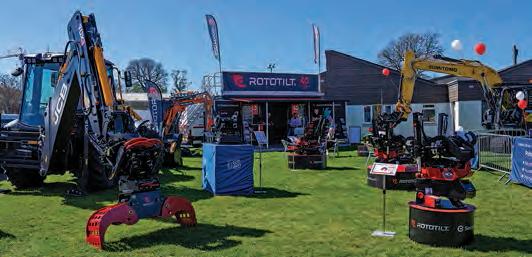
t ScotPlant Rototilt UK unveiled a custom black JCB 4CX for Owen Gillard Groundworks, fitted with a limited edition Rototilt RC3 tilt-rotator.
The RC3 tilt-rotator, designed for six- to 12-tonne machines, features Rototilt’s QuickChange feature, meaning hydraulic tools can be switched without the need to leave the cab.
The launch also coincided with Solway Machinery Sales being appointed Rototilt’s new dealer for Scotland, strengthening local support for customers.
HD CONSTRUCTION EQUIPMENT BRINGS BUSINESS TO UK
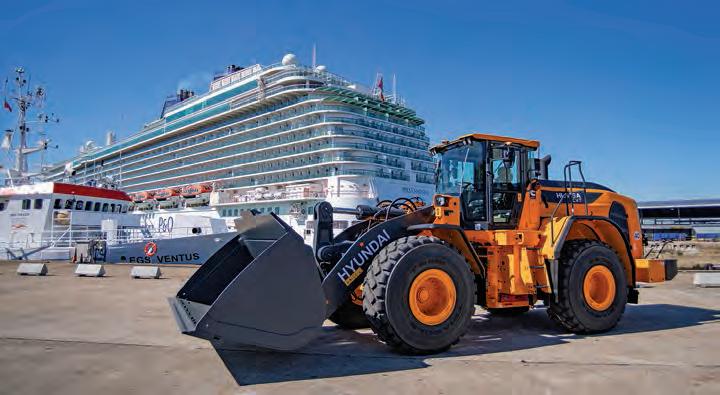
HD Construction Equipment, Hyundai’s parent company, has opened a UK pre-delivery inspection (PDI) centre at Southampton Docks to speed up delivery to UK customers and improve quality control. All fully-assembled Hyundai Construction Equipment machines destined for UK customers will now be delivered directly to the new PDI centre in Southampton. The site’s position within the docks ensures immediate quality checks on all incoming machinery. The new PDI is operated by long-time Hyundai partner Wallenius Wilhelmsen. The site cleans, inspects and documents each machine using detailed digital records, including up to 100 photos per unit. Repairs, repainting and decal replacements are completed on-site, and a six-bay workshop handles all equipment types.
100,000TH
LLIEBHERR WHEEL LOADER
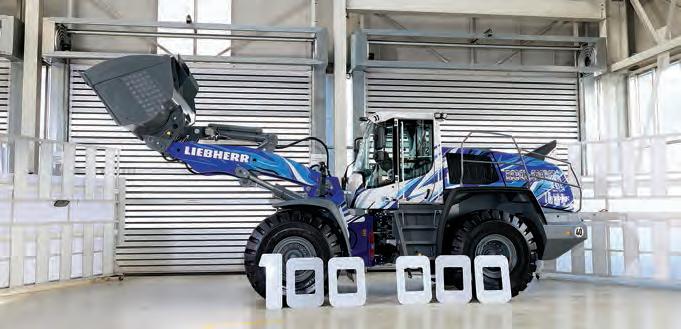
iebherr has celebrated the production of its 100,000th wheel loader, marking a major milestone at its Bischofshofen plant in Austria. The anniversary machine, an L 550 XPower in a special dark blue finish, has been delivered to long-time partner STORK Umweltdienste GmbH.
The handover highlights more than 30 years of collaboration between Liebherr, STORK and dealer Kurt König. STORK has used Liebherr equipment since 1994 and now operates a large fleet across its operations.
The commemorative loader features unique decals tracing the brand’s history and will be displayed at IFAT in Munich before entering service. Liebherr says the milestone reflects decades of innovation and partnership, while pointing ahead to future developments, including autonomous and hydrogen-powered wheel loader technologies.
CASE CONSTRUCTION EQUIPMENT CHAMPIONS GREAT CAUSE
ASE Construction Equipment, EMH Plant and Newstreet Groundwork Services have joined forces to support regional charity Children North East, helping raise funds and awareness for vulnerable children and families across the region.
Founded in 1891, Children North East provides support services covering mental health, domestic abuse intervention, family support and wider community initiatives aimed at helping young people reach their potential.
The collaboration between the three businesses highlights the growing role the construction and plant sector continues to play in supporting local communities alongside day-to-day industry operations.
MAJOR MOVES AT SCOTPLANT
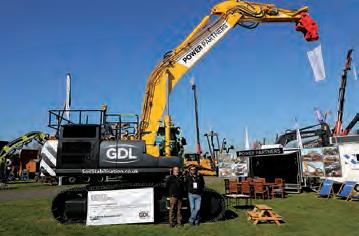
wo new announcements were made at Scotplant 2026, the first being that Ground Developments Ltd. in Whitburn have entered a joint venture with David Smith Contractors Ltd. to create a company named Power Partners. A partnership forged to tackle energy infrastructure projects that require both major civils and infrastructure capability and specialist groundworks.
Also announced at the Scotplant show was Hodge Plant being appointed as the Hyundai Construction Equipment dealer for Scotland. The Hamilton based firm will cover the whole country, aside from Dumfries and Galloway. Their sales and support teams will also continue to be based at the head office site in Hamilton.
SIZE BIG POCKET PERFORMANCE
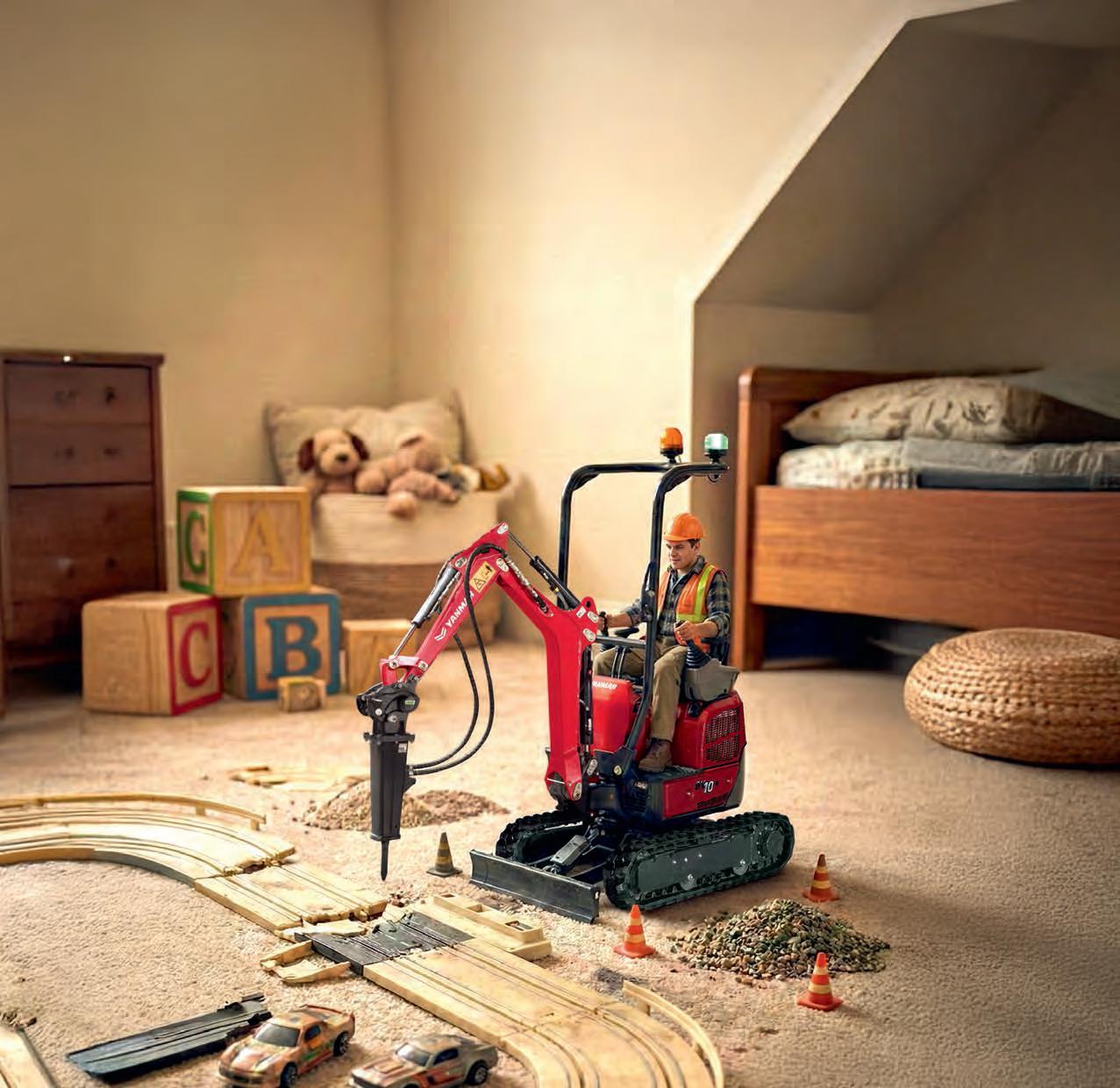
The ultimate versatility, ready to take on all your challenges. Thanks to its variable undercarriage and wide range of attachments, the SV10 guarantees perfect stability and unmatched agility. Easy to transport and quick to master, it is designed to reduce downtime and optimize your operating costs.
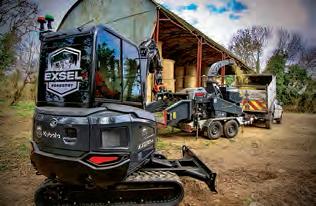
Exsel Plant and Tool Hire has introduced a black and grey livery across its growing forestry fleet of Kubota KX0304 machines, helping the Hampshire-based business stand out in an increasingly competitive sector.
Based in Winchester and with a second depot in Southampton, the company currently operates four forestry specification KX030-4 excavators, with another two on order through Lister Wilder. The high specification machines are fitted with full forestry guarding, additional protection, quick-hitches and specialist attachments including grabs, shears and arboricultural equipment.
“We just wanted something that stood out as a brand,” said managing director Max Pearce. “We’ve always been with Kubota, from day one. We’ve got 67 Kubota machines on the fleet in total, from 0.8 to three tonnes.” The forestry fleet operates on long-term hire contracts across much of the UK.
SCREENCORE LAUNCHES ORBITER 206R
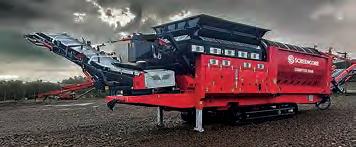
creencore has expanded its trommel range with the launch of the new Screencore Orbiter 206R, aimed at larger-scale material processing operations across recycling, quarrying and organic waste sectors.
SDesigned for handling materials including virgin rock, construction and demolition waste, landfill material and compost, the Orbiter 206R builds on the success of the company’s existing Orbiter trommel line-up. Power comes from a Caterpillar engine, while 4000mm tracks with two-speed drive and remote control improve site mobility. Operators also benefit from independent belt speed controls, a large PLC interface with fully automatic functionality and a 180-degree radial fines conveyor for improved stockpiling.
JCB’S DUALDRIVE PERFORMS ON SITE
One of JCB’s DualDrive backhoe loaders has proved capable of improving productivity and cut task time on site in Barnsley.
A new JCB 4CX Pro DualDrive is now working on a range of projects for Jack Elliott Groundworks Ltd, handling duties including ditching and machine repositioning on larger groundworks jobs. Supplied by TC Harrison JCB, the machine was selected for its versatility, flexibility and ability to improve efficiency on site.
Company director Jack Elliott said the biggest difference comes from the way the DualDrive system streamlines machine movements and reduces wasted time during operation.
“Repositioning can now be done in a matter of seconds,” he explained. “Before, you’d be lifting the bucket, turning the seat, lifting the stabilisers and driving forward separately. Now several actions can happen at the same time.” He added that the set-up also reduces operator fatigue over the course of the day while improving overall workflow on site.
T CECE CONGRESS 2026
he Construction Equipment Association will host the CECE (Committee for European Construction Equipment) Congress 2026 in London from 27 to 29 October, bringing together senior figures from across the European construction equipment industry.
Held at IET Savoy Place on the River Thames, the event will focus on key issues affecting the sector, including market pressures, innovation, workforce development and the future of construction equipment manufacture.
The Congress takes place every two years and is hosted by the country of the current CECE President. In 2026, that role is held by Phil Layton of JCB, with the CEA leading the event.
This year’s programme will follow the theme ‘create, innovate, educate’ and feature speakers including economist Joe Nellis, former Warner Bros Pictures executive Jason Bevan and former British Army officer Stewart Hill.
More than 150 delegates from across the UK and Europe are expected to attend, including OEMs, suppliers and industry organisations. Alongside the conference sessions, the programme will include networking events and a gala dinner cruise on the Thames.
EXSEL PLANT HIRE’S NEW LOOK
SEE IT FIRST AT STAND M9
TRUST TAKEUCHI for quality high-spec machines delivering power performance and proven reliability.
IN EVERY POSITION
MAKING ITS DEBUT AT HILLHEAD THE NEW TB3150R
KOMATSU 4D MINE ON SITE IN FINLAND
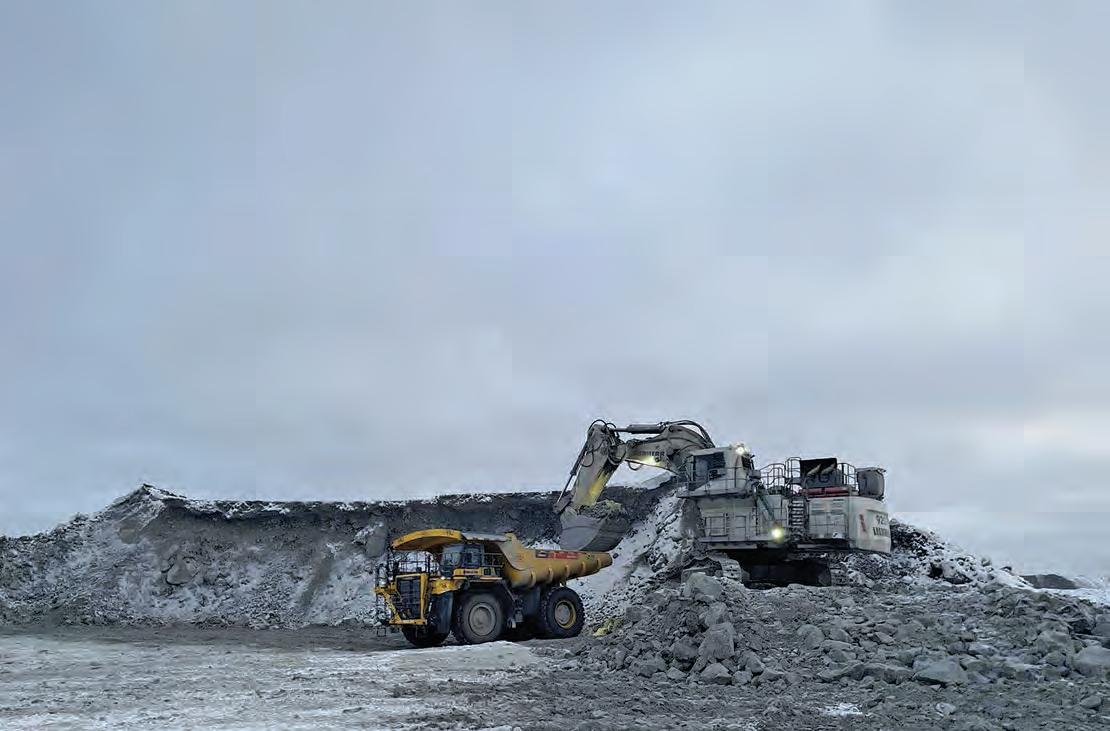
Komatsu technology is proving its worth in one of Europe’s harshest mining environments, as the company’s Mine 4D digital fleet management system aids 24-hour operations at the Kevitsa nickel and copper mine in northern Finland.
Operating in temperatures as low as minus 40 degrees, sub=contractor Vilppulan Kivijaloste Oy uses Mine 4D to monitor fleet activity, track payloads and improve operational visibility across critical support work at the mine, including reinforcement of
one of Finland’s largest tailings ponds.
The system replaces manual reporting with real time automated data collection, allowing site managers to monitor haulage distances, machine utilisation, cycle times and production activity from a central dashboard.
At a site where operations run continuously through long winter nights and extreme cold, the technology also supports equipment inspections, maintenance reporting and safety monitoring, helping identify issues such as excessive idling, speeding and harsh braking before they become larger operational problems.
Kari Mäkipää, CEO & founder at Vilppulan Kivijaloste Oy, explains: “At Kevitsa, maintaining a high level of oversight is essential for safe operations in an environment where conditions can change rapidly. Since implementing Mine 4D, we have improved how we monitor and manage production, gained a clearer view of operations and made load tracking easier and more efficient. The system has also proved highly reliable, with responsive support that has helped ensure it continues to meet our operational needs.”
FINNING’S ENGINE INVESTMENT
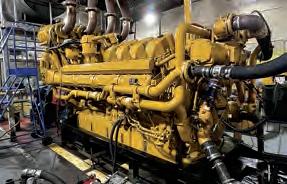
Finning UK & Ireland is investing more than £200,000 into advanced Cat® engine testing technology as demand grows for machine rebuilds and major component overhauls across the construction and heavy equipment industries.
A new £160,000 high-power dynamometer has been installed at the company’s Cannock headquarters, allowing rebuilt engines to be tested under full operating loads before returning to site. The system measures power, torque, fuel efficiency and overall reliability to ensure engines meet original manufacturer specifications.
The investment forms part of a wider upgrade programme across the Finning network and supports the company’s expanding rebuild and aftermarket services for Caterpillar equipment customers throughout the UK and Ireland.
Dave Carter, head of Rebuild, Repair and Response at Finning UK & Ireland, said: “Dyno testing allows for the optimisation of engine performance, ensuring the most efficient settings are in force for better fuel economy, while collecting essential data on power, torque and force.
The new testing equipment is also being integrated into Finning’s new Rebuild Centre of Excellence currently under construction in Cannock, supporting increasing demand for rebuilt machines that deliver near new performance while helping contractors reduce ownership costs.
CAMSO CONSTRUCTION ENTERS UK & IRELAND
AMSO Construction has announced its expansion into the UK and Ireland construction markets, marking the next phase of the company’s wider European growth strategy following its launch into southern Europe earlier this year.
CThe move follows RPG Group’s acquisition of the compact construction tyres and tracks business from Michelin in 2025. CAMSO Construction has now established warehousing and distribution operations within the UK.
The company has confirmed that its first deliveries of construction tyres and rubber tracks have already arrived at UK-based facilities, allowing it to begin supplying customers across the region.
Focused heavily on compact construction equipment applications, CAMSO Construction is aiming to strengthen its position in sectors where uptime, durability and operating efficiency remain critical for contractors and plant fleets.
Alongside its product range, the business says it is placing significant emphasis on after-sales support, technical expertise and dealer relationships as it builds its presence within the market. The company believes the UK remains one of Europe’s most important compact construction equipment markets, particularly for contractors focused on reducing downtime and overall operating costs.
FINNISH VERSATILITY
As Nick Drew reports, no matter what the season, you can’t travel very far in Finland without coming across a Wille machine, which are now being imported into the UK
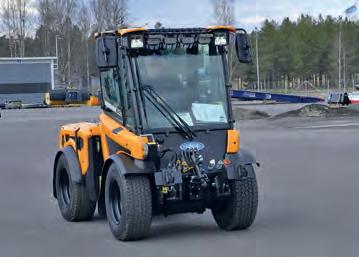
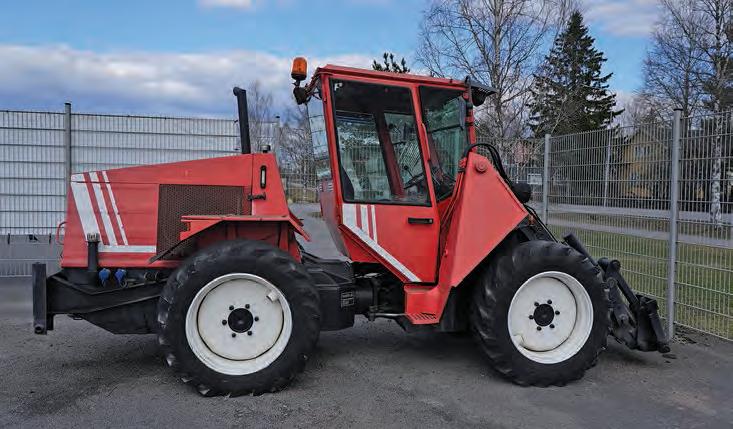
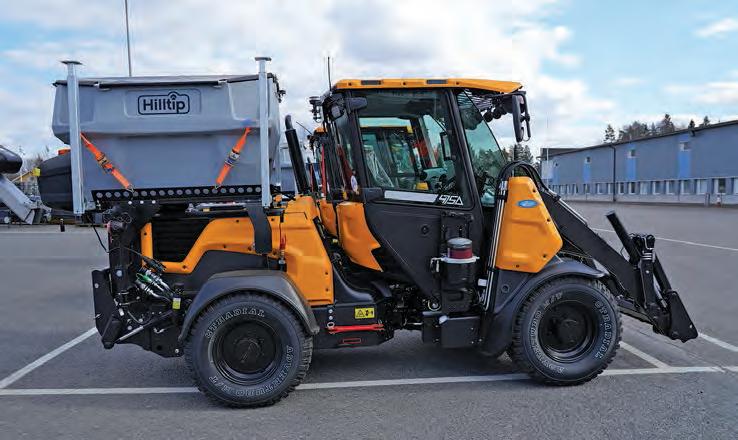
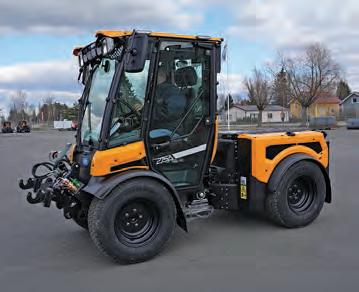
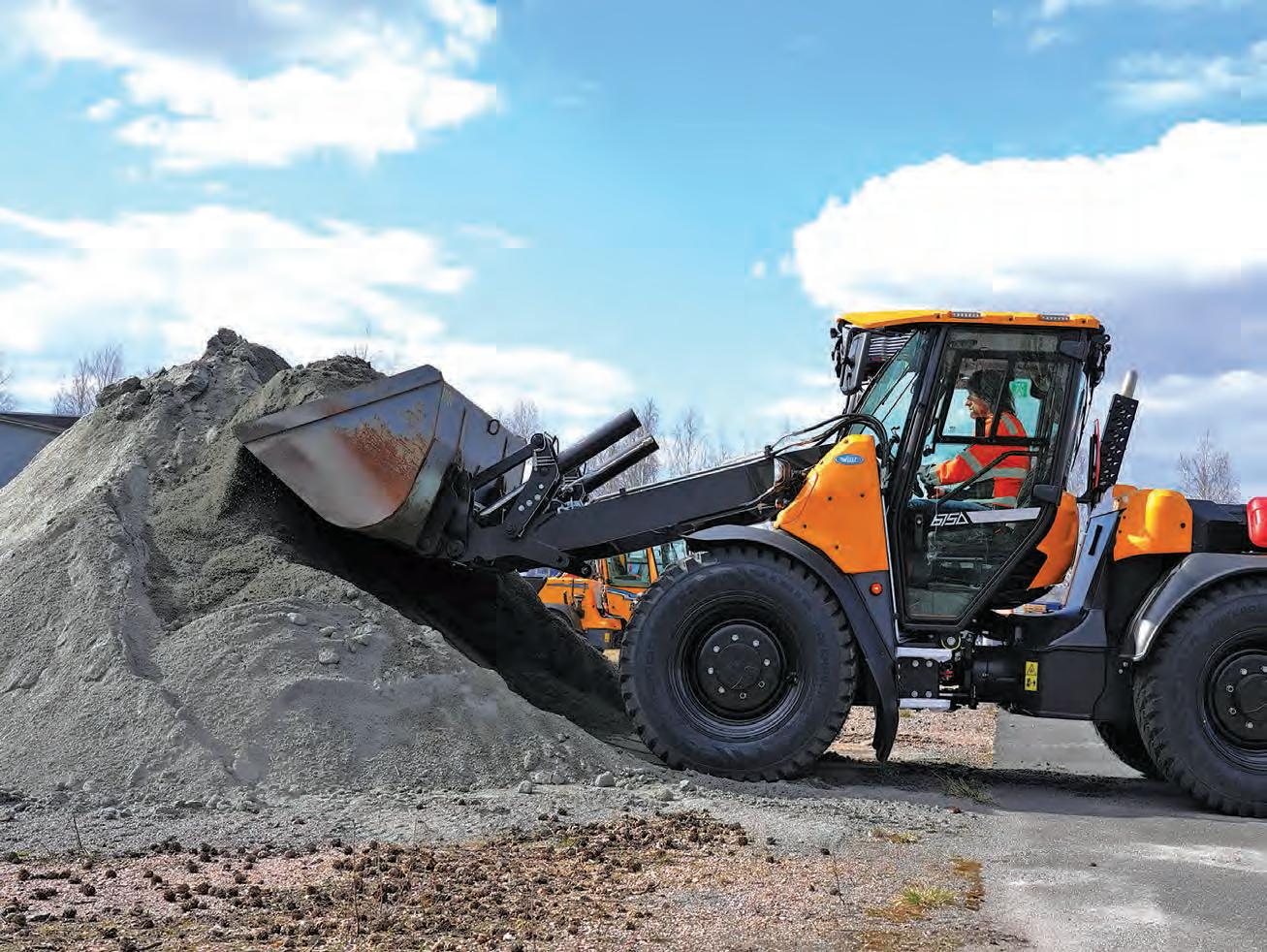
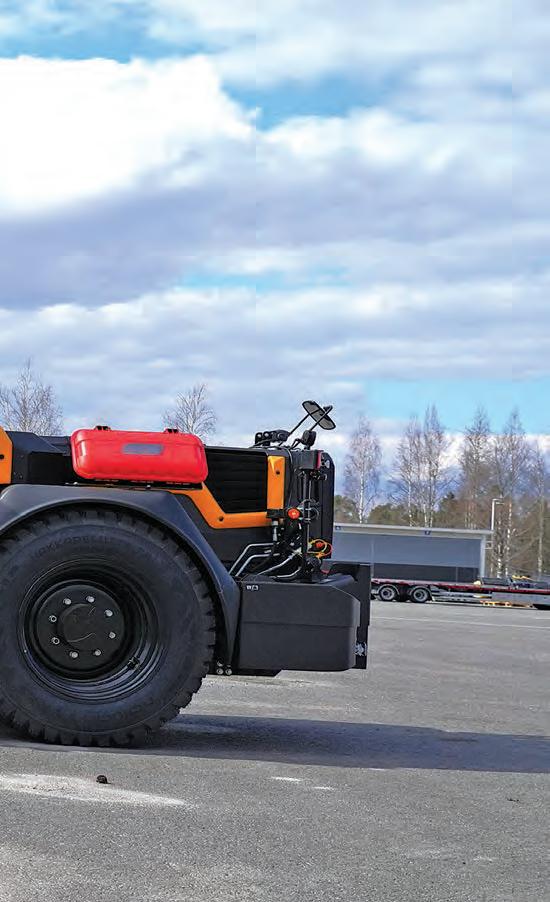
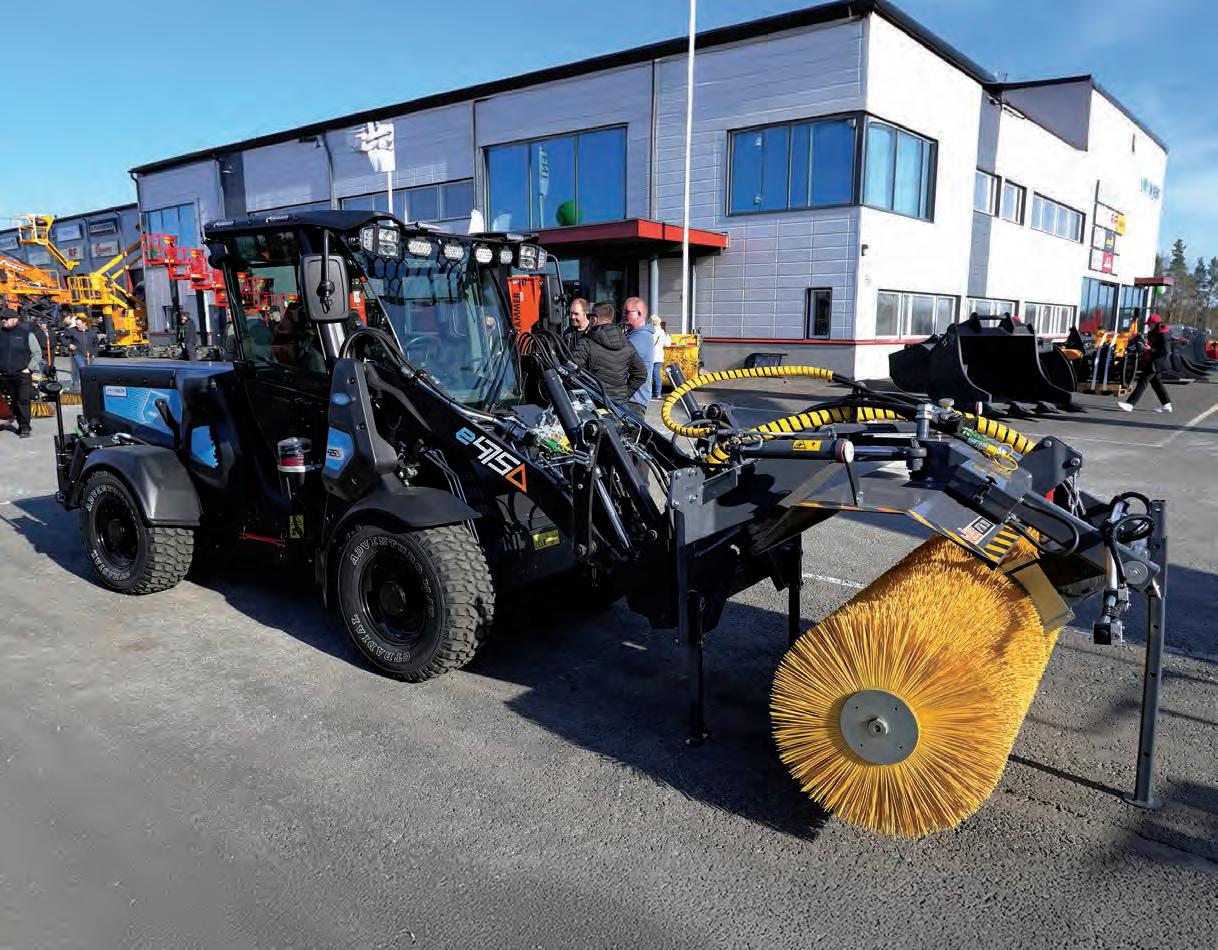
Acommon sight in the harsh winter months in Finland is a Wille articulated tool carrier equipped with a snow-clearing attachment up front and a sand spreader at the rear. In spring, they sweep those same streets and paved areas to remove the previously laid sand and any build-up of debris. In the summer months, the attachments are changed once again, as mowers and fl ails are used to manage vegetation growth along the roads.
Rarely does a machine perform such a variety of tasks based on the season of the year. Although we may not experience such harsh winters, there is no doubting the sheer versatility of a Wille tool carrier.
COMPANY BACKGROUND
Wille Machines is based at Loimaa in the south-west of Finland, about a two-hour drive from Helsinki and close to the international port of Turku. Like many earthmoving machinery firms, the company grew from humble origins, in this case when a young entrepreneur called Vilho Lankinen started to repair cars in 1950. In the mid-1950s, Vilho began
manufacturing front-end loaders and other attachments for tractors. Sold under the Vila brand, they became so popular that, by the 1960s, his workshop had stopped working on cars and focused on manufacturing.
In addition to designing and producing tractor attachments, the firm converted tractors for specialist applications, originally based on Vilske machines, then on the better known Valtra VL prime movers. They also began to develop complete machines from the ground up, including the VL45 street sweeper.
Vilho’s company changed its name to Vilakone Oy in 1968. Some 10 years later Vilho began to design an entirely new articulated multi-purpose machine. It became affectionately known as a Wille – pronounced ‘Ville’ in Finnish – which was Vilho’s nickname. The first prototype of a Wille was produced in 1980; some three years later the first production machine, a Wille 645, was delivered to a customer. Although greatly enhanced over the following decades, the basic configuration of a Wille has remained the same. The current range consists of two- to seventonne machines, which have become
Above: The Delta Series of Wille Machines has five models ranging from the compact 2180kg 275, right up to the 875 that tips the scales at just over seven tonnes.
NEW PRODUCTS // WILLE MACHINES
extremely popular in Scandinavia over the past 40 years.
In 2003 Vilakone Oy became part of the Wihuri Group, a large Finnish conglomerate that was the Wille dealer for Finland. In 2022, the firm was renamed Wille Machines Oy and last year it had a turnover of €40m and exported 53% of its machines. While most went to customers in the Nordic countries, Wille has dealers in North America and sells its products to customers in Estonia, Serbia and France. More recently, they appointed Lancashirebased dealer Multevo as their UK dealer.
FACTORY VISIT
The Wille Machines factory at Loimaa covers around 15,000 square metres and employs 100 people, plus another 40 working in the headquarters office.
Cabs for the smaller machines are fabricated in the factory, while larger models are equipped with cabs from a Finnish manufacturer. Metal cutting, bending and machining do not take place in the factory, instead pre-formed steel components are delivered by a nearby specialist sub-contractor.
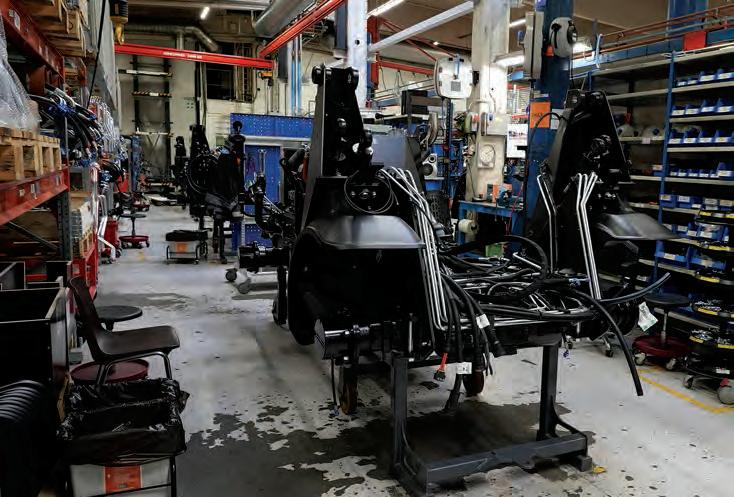
They are tacked together in the factory, before finished welding is undertaken by robots. In addition to structural components such as loader arms, rear and front frames, Wille also weld up all the hydraulic cylinders in-house, something that many manufacturers no longer undertake. Interestingly, Wille also weld together the fuel tanks; they don’t use plastic tanks like so many of their competitors. All these finished assemblies are then shot-blasted, powder coat treated and then painted prior to delivery to the assembly lines.
The factory can produce around 300 machines a year, the current production rate is one machine leaving the assembly area every working day. No machines are built for stock, all are built for a specific customer order.
When a machine reaches the end of the assembly line, it goes out into the yard for a period of hot testing. It is then driven for four to five hours on a pre-determined course round the town of Loimaa, after which a thorough check is undertaken on return to the factory.
Left inset and left: Vilho Lankinen began designing a multi-purpose articulated machine in the late 1970s. The third production machine, built in 1983, is displayed at the factory.
Left and above: All Wille machines can accommodate a range of powered rear attachments; the smallest 275 model has a three-point linkage in place of loader arms. Below: Wille Machines are hand crafted to meet a specific customer order; one machine a day leaves the assembly area.
WILLE MACHINES BASIC SPECS
Model 275 Delta675 Delta
Weight 2180kg6100kg, Engine KohlerKohler
Power 50kW (68hp) 105kW (140hp)
Top speed 40kph50kph
Wheelbase 1.9m2.53m Lift
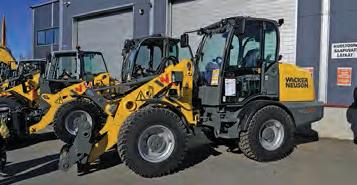
looking Delta Series of Wille machines, five models ranging from the 2180kg 275 Delta, right up to the 875 Delta that tips the scales at just over seven tonnes. These conventional machines have recently been joined by the battery electric e475 Delta, which was on show at the recent Mansen Morinat event.
The 275 Delta, nicknamed the Little Giant, differs from the other machines in the range as it does not have front loader arms, but an agricultural spec three-point linkage. It is powered by an ultra-low emissions, threecylinder Kohler engine rated at 50kW (68hp) at 2600rpm. It provides a maximum hydraulic oil flow of 110 litres per minutes, which is
more than enough to power a wide variety of front-end attachments.
Taking the 275 for a spin around the yard, the speed and power of this unit were impressive, as was the responsiveness of the hydrostatic transmission and the simplicity of the controls. There was also the opportunity to spend more time on the 675 Delta, which had been fitted with a 1000-litre bucket on its front loader arms.
NEW PRODUCTS // WILLE MACHINES
IN THE CAB
Climbing into the cab of the 6.1-tonne 675 Delta, it immediately felt like a very different beast to the smaller machine. The 675 shares the same cab as the 875 model; it’s deceivingly spacious inside and well-appointed. The sloping front windscreen offers an exceptional view of the front loader arms and attachment, and even with the loader arms raised there is still great visibility to the bucket.
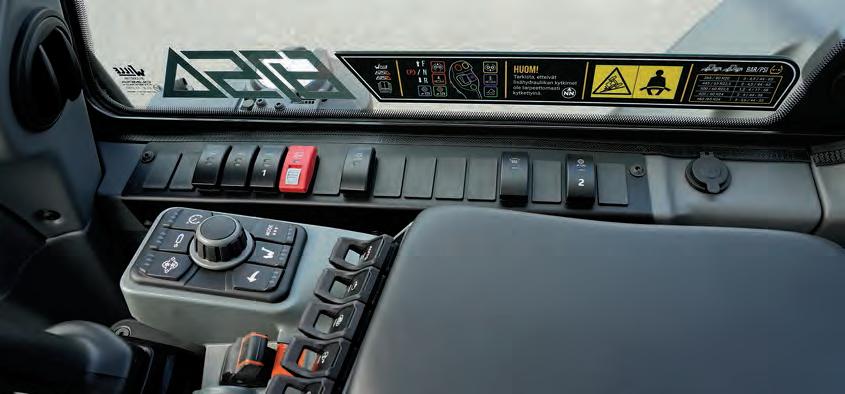
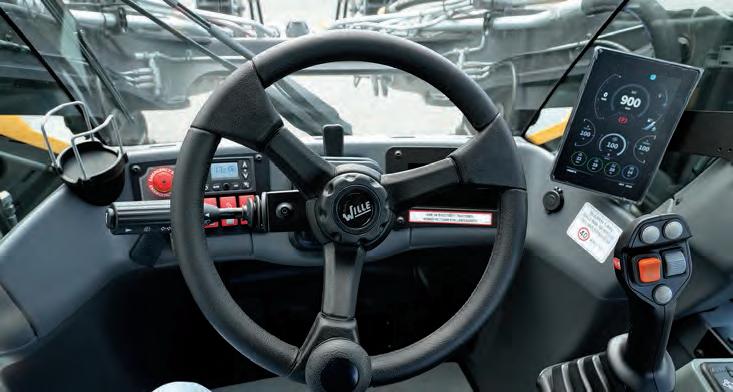
In fact, visibility from inside the machine is superb, with lots of glass all round. A new low-profile dashboard, which features an all-important addition of a cup holder, further enhances visibility to the front. Also, the cab being on the front section of the articulated machine improves the view.
Controls and switches are nicely located around the cab, all within easy reach. As has become very common in equipment these days, the 675 Delta
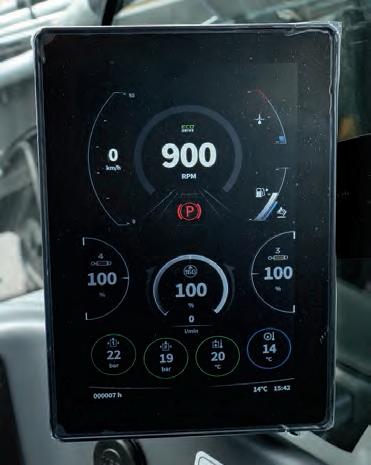
features a large tablet-style control screen, where an operator can monitor the machine’s status, hours worked and servicing reminders. Up to 30 individual operator profiles can be stored, as well as the ability to adjust hydraulic flows to suit a particular attachment. You can even adjust the joystick pattern to suit an individual operator’s preferences.
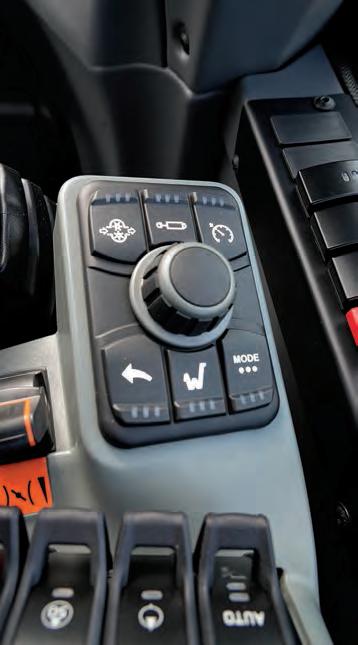
A jog-style dial situated to the operator’s right-hand side, in front of the armrest, is used to make the adjustments on the monitor, from the comfort of the seat. It is very similar to the type of thing seen on modern hydraulic excavators; it’s very intuitive and simple to navigate around the system. The steering wheel and fully adjustable suspension seat can be adjusted for depth and height, enabling operators of all shapes and sizes to find that perfect driving position. The machine features four driving modes: Eco, which is the default setting, Eco off, Heavy, and Smart.
FIRST IMPRESSIONS
On firing up the fourcylinder 105kW (143hp) Kohler engine in the 675 Delta model, there was a sense of serenity, as the internal noise level is a mere 70dBA.
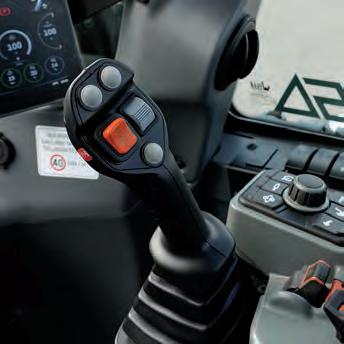
Once again simplicity of operation was evident: brake and throttle pedals together with a multi-function joystick to control the loader arm and attachment. A forward, neutral and reverse thumb rocker switch on the joystick controls the direction of travel.
A tug on the joystick to raise the bucket,
Far left, left and inset above: The comfortable cab is designed for long shifts in urban environments; it offers excellent all-round visibility and the controls are easy to use
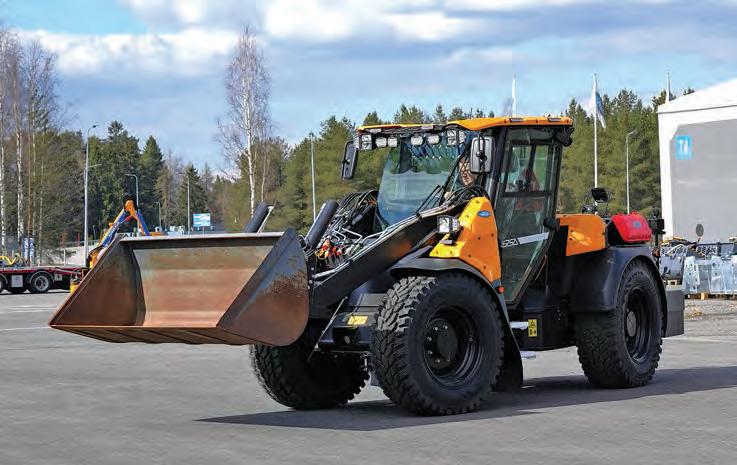
Right and below: Although rarely used as a wheel loader, this 6.1-tonne 675 Delta model proved to be an extremely proficient and fast machine in this application.
selecting forward on the rocker switch followed by a dab on the throttle pedal and the machine moves away. Immediately noticeable is that these machines are very swift; the hydrostatic transmission is capable of a top speed of 50kph, not that the Willes Machinery yard supports such antics, but it showed a rapid turn of speed!
A large pile of sand, probably left over from being spread across the yard during the winter, was available for shoving about with the bucket. Diving into the pile the machine, sitting on Nokian 420/65R24 tyres, showed some serious grunt and quickly gained a full bucket of material. Next, we took the loaded machine for another spin round the yard to see how it performed under load, before driving up on the heap and discharging the load.
Loader height at full lift is 3380mm and the bucket discharge height is 2420mm, which for a low-profile machine is not bad at all. Bearing in mind that Wille machines are not really used in a wheeled loader
application, as they are more commonly used as a tool carrier such as snow ploughs or rotary sweeping brushes.
With an inner turning radius of 2740mm and an outer turning radius of 4660mm, this machine proved to be very manoeuvrable despite its overall length of 5225mm.
SUMMARY
While it was good fun driving these Wille models round the yard, it quickly became apparent that these machines are serious bits of kit, well suited to multi-purpose tool carrier applications. Although unknown in the UK, after this experience it explained why they are so popular among demanding Scandinavian users.
Later this year the 9000th Wille machine will be produced, the 3000th model will be exported to Sweden and the first fully electric Wille will be delivered to a customer. All significant milestones for this long-established business.
MULTEVO DEALER PROFILE
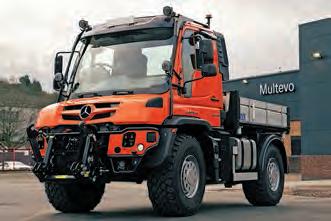
The new UK dealer for Wille Machines, Lancashire-based Multevo, offers a wide range of services including roads, civils, traffic management, arboriculture and vegetation management applications. They are undertaken on behalf of local authorities, major airports and blue-chip highway maintenance contractors.
In addition to providing truck and van maintenance services nationwide, they sell, hire and maintain specialist equipment. For the past two years they have been an official repair centre for Unimog vehicles. This relationship with Mercedes-Benz Trucks has recently been expanded as Multevo became an official sales dealer for the Unimog range.
Below: The latest model from Wille Machines is the battery electric e475 Delta, as seen at the recent Mansen Morinat machinery event in Finland.
The Hill name has long been synonymous with the very best in attachment technology. Our reputation has been built on over 50 years of innovation, with an unwavering commitment to product quality, backed by exceptional customer service.
Our new sales model, Hill Direct is no exception. Hill Direct now allows customers to order our Titan buckets, forks and rippers, with delivery in just two working days, with the option of including our TEFRA Couplers in a Go to Work package. We’re delivering on our reputation, so you can build yours.
EXPANDED RANGE DRIVES INCREASED SALES
Graham Black reports on the latest machinery introduced into the European market by South Korea-based Hyundai
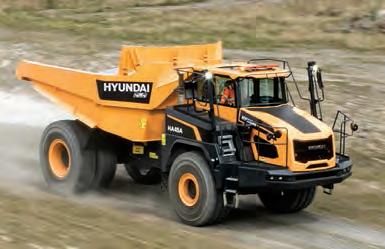
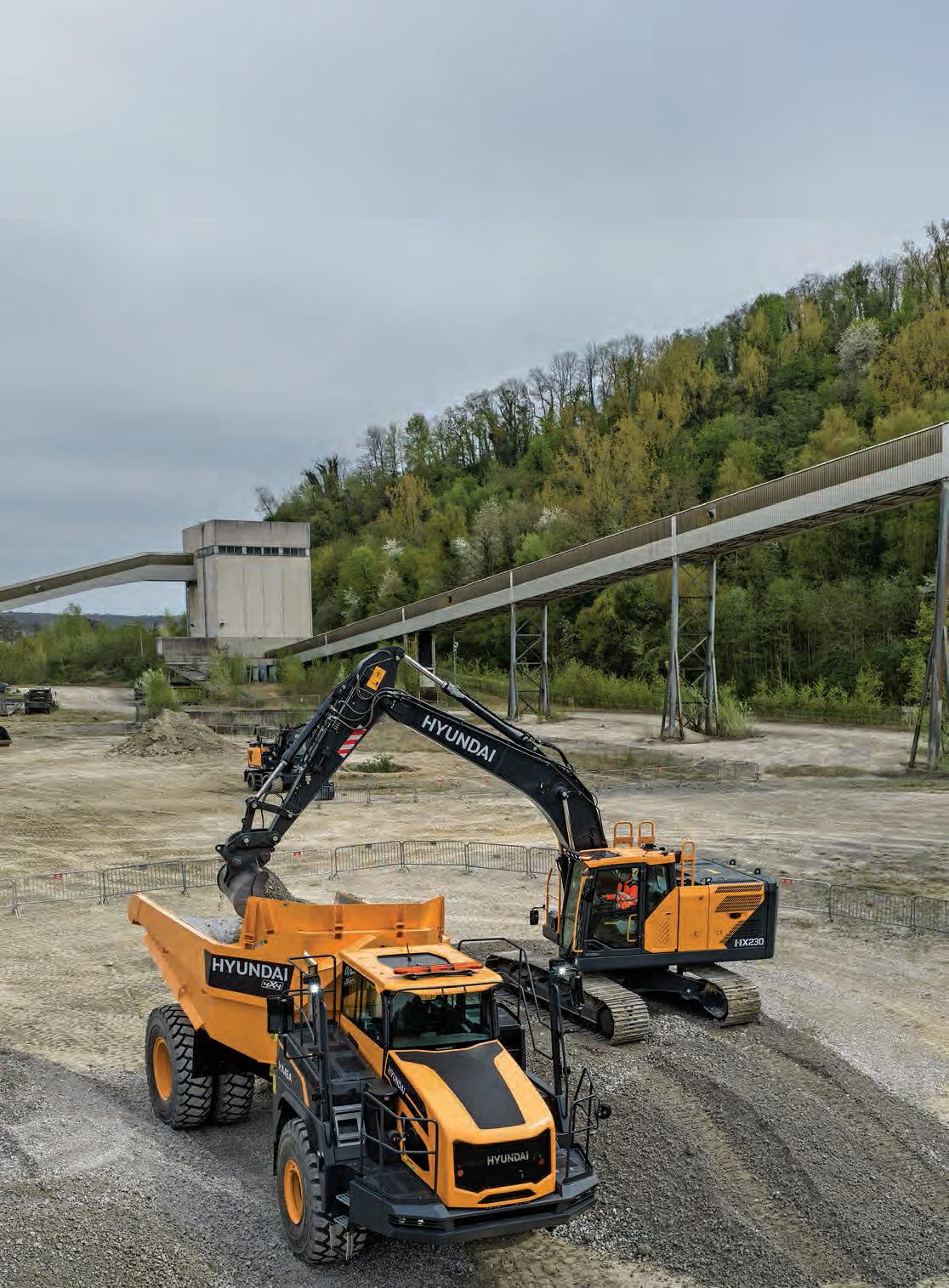
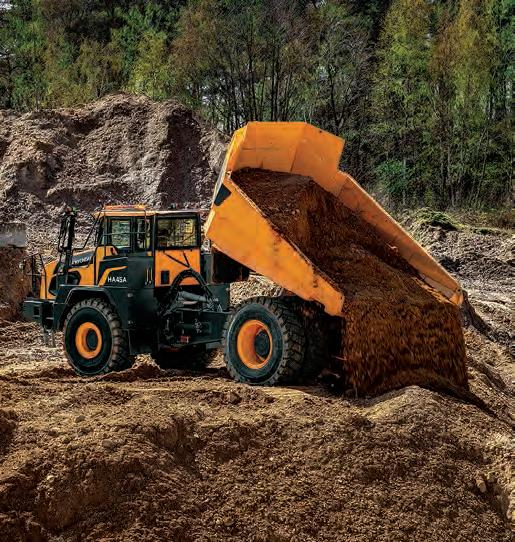
In a surprise move, Hyundai has introduced the HA45A. a two-axle articulated dump truck (ADT) with a carrying capacity of 41 tonnes. This 4x4 model retains the all-wheel drive functionality of its conventional 6x6 stablemates, but with twin rear wheels. It offers fast hauling for sites with well-developed haul roads, such as quarries, combining the benefits of a rigid truck with an ADT.
The truck is powered by a Scania engine delivering 368kW (500hp) and driving both axles through an electronically-controlled, eight-speed ZF automatic transmission. The HA45A has limited-slip differentials on both axles and a longitudinal diff that can be manually locked for maximum tractive effort. The ADT also benefits from self-levelling front and hydro-gas rear suspension, delivering a comfortable ride at higher travel speeds.
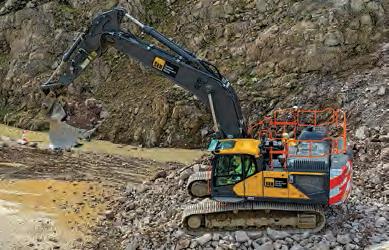
Above and below: Hyundai has introduced several new machines, including a 4x4 ADT and a further three examples of its next generation excavators.
NEW MICROEXCAVATOR
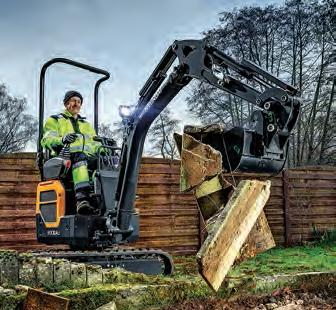
Though not as physically impressive as the new larger excavators, the launch of a micro HX10AZ will be equally important for Hyundai, as the company is keen to build its compact equipment sales. Weighing 1165kg, the HX10AZ is a compact radius mini with a retractable undercarriage, to allow access through a 730mm doorway. It opens out to 1110mm for added stability when digging. The compact machine is powered by a 7.6kW (10.35hp) engine, driving through twin hydraulic pumps, for a claimed class-leading bucket digging force of 10.8kN.
Equipped with a folding ROPS canopy, the operator station has adjustable consoles. The machine has a top-mounted boom cylinder, improving visibility to the working area and protecting the cylinder from damage. Front guards and LED working lights complete the specification.
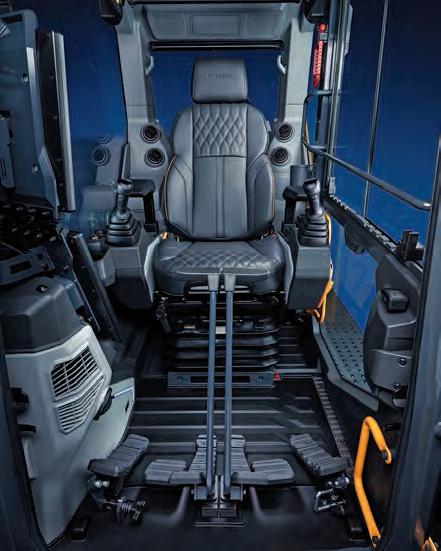
All of Hyundai’s ADTs have been given an updated cab interior, improving the working environment for the operator. Externally the cab is slightly lower, with a redesigned top and handrail for better service access. Despite that, the interior of the cab is more spacious, and all operating functions are now positioned close to the driver’s right armrest. A 12in monitor, similar to those found in their next generation excavators, provides all machine data and a screen for the rear-view camera. The heating and ventilation system has also been improved, with better airflow and rapid window clearing, while the wipers have been upgraded to deliver a larger swept area.
DEMO RIG
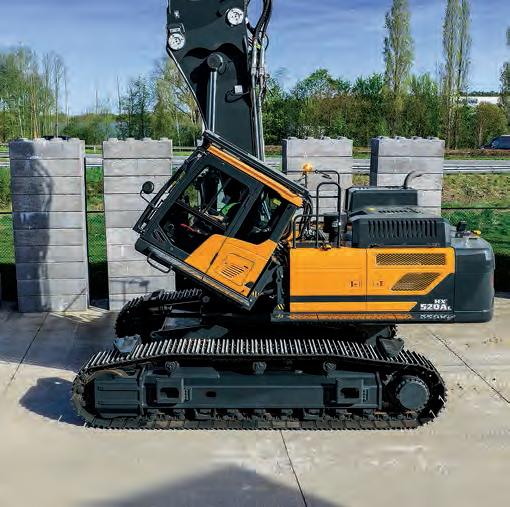
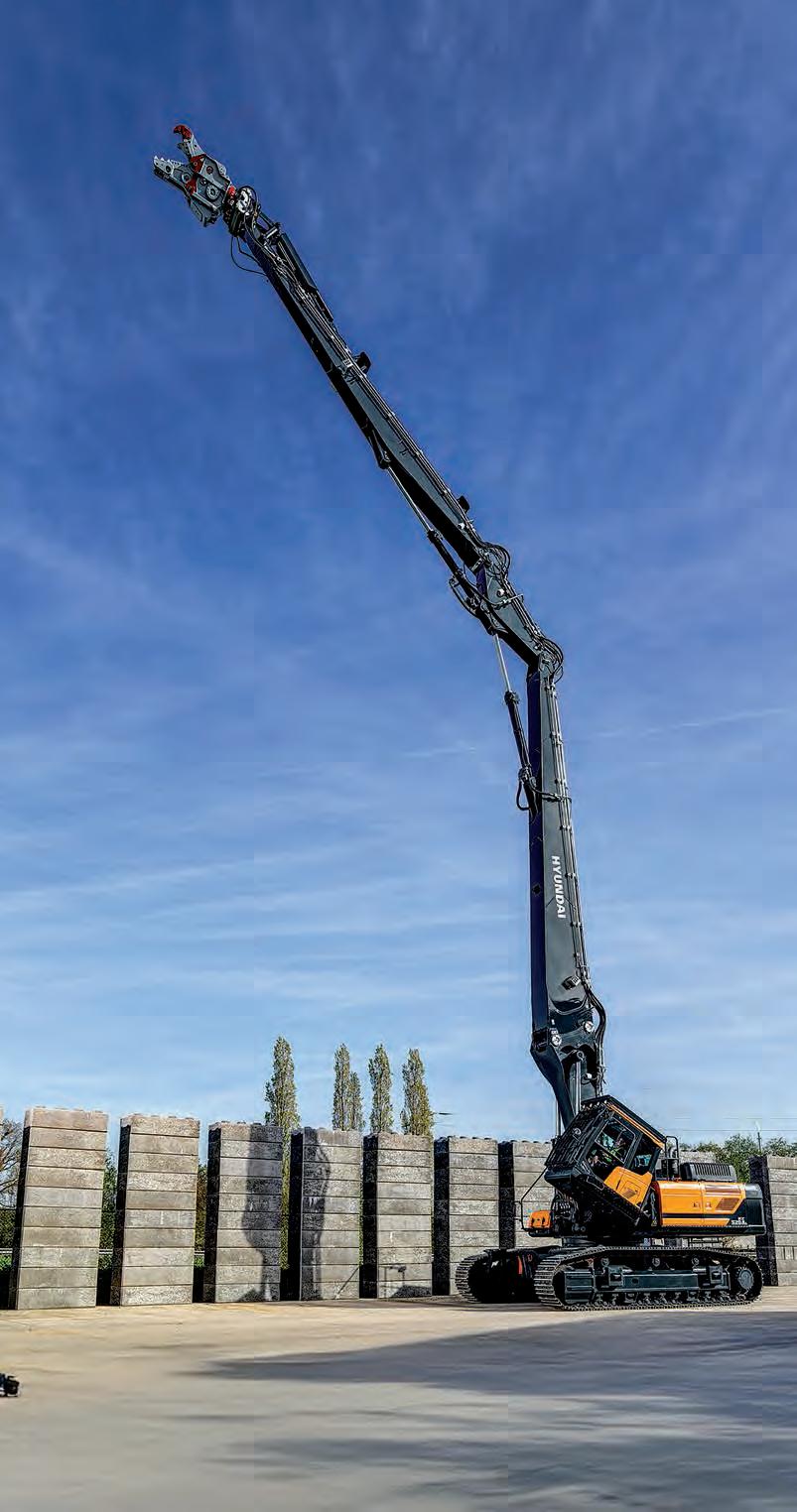
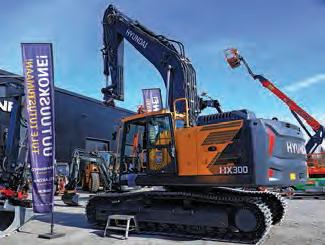
As Hyundai continues to enter new sectors of the equipment market, the company has been working with demolition specialist STC to create its first high-reach machine. The HX520A HRD is based on the current 50-tonne class crawler excavator, with a choice of three interchangeable booms. They include an excavating set-up, a straight demolition boom and the 27m working height high-reach rig.
The machine has a hydraulicallyadjustable undercarriage to cope with the additional working height, transforming from a transport width of 3m to a working width of 4m. The cab can be tilted through 30 degrees to provide an improved view of the working area and the machine gets a FOG/FOPS Level 2 protective guard. At full height of 27m, the HX520A HRD can handle a combined weight of three tonnes on the end of its dipper, including a working attachment, quick coupler and adapter plate.
TRACKED EXCAVATORS
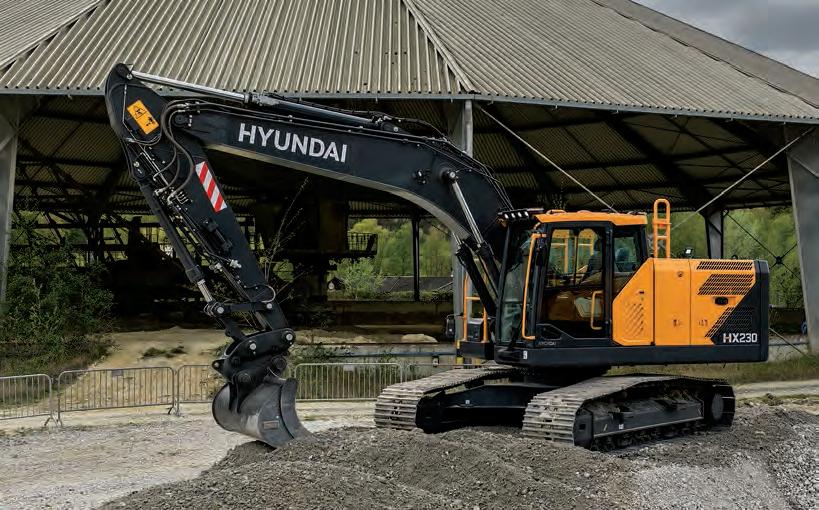
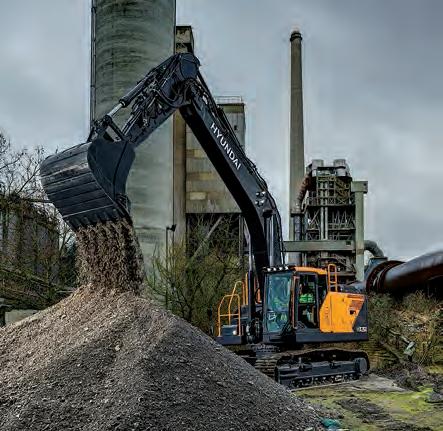
The company introduced the first two examples of its next generation excavators at Bauma last year. They have now been joined by a 23-tonne HX230, a 26-tonne HX260 and a 30-tonne HX300. As with the
Above and below: The new HX520A HRD demo rig can work with a total attachment weight of three tonnes at its maximum working height of 27m.
PRODUCT LAUNCH // HYUNDAI
existing larger models, all are powered by Hyundai’s new engines. The HX300 uses the six-cylinder DX08, delivering 207kW (277hp), an increase of 9% versus the previous A-Series model.
The smaller machines all make use of a four-cylinder, twin-turbo, DX05 engine. In the HX260 this 5.0-litre engine develops 164kW (221hp), while the HX230 has 141kW (189hp) available. This delivers fuel efficiency savings of up to 7% and cuts AdBlue consumption by as much as 30%. In all cases, service intervals have been doubled to 1000 hours, cutting operating costs and downtime for operators.
All these next generation excavators use Hyundai’s full electro-hydraulic (FEH) system that cuts hydraulic losses and increases feedback for the operator through the servo levers. The operator can set the sensitivity and response of the FEH servos to their individual requirements, saving all settings on the machine key.
The machines come with 2D machine guidance that can be upgraded to 3D, along with an automatic weighing function. They also get the latest version of Hyundai’s all-round camera system Smart Around View Monitor (SAVM). Where previous models had four cameras keeping an eye all round the machine, SAVM has six linked cameras, with AI human detection, along with radar object detection. These excavators also boast an auto-stop function that will shut down machine movement if the operator fails to notice a person or an object within the danger zone.
The camera system uses new 12.8in high-
SKID-STEER LOADERS
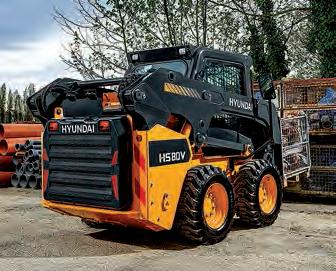
Initially seen at the Bauma exhibition last year, Hyundai’s first skid-steer loaders and compact tracked loader are now available in Europe. The HS80V and HS120V wheeled models, along with the HT100V tracked machine, are powered by non-AdBlue Hyundai engines, delivering 49.5kW (66.4hp) in the smaller HS80V model and 54.9kW (73.6hp) in the larger HS120V and HT100V machines.
Weighing 3.2 tonnes, the HS80V has a rated operating capacity at 50% tipping load of 885kg, while the larger 3.7-tonne HS120V delivers a maximum at 50% tipping load of 1220kg. The tracked machine, which tips the scales at 4.4 tonnes, has a rated operating capacity at 50% tipping load of 1490kg. All three are equipped with vertical lift path arm geometry, which allows the boom to raise the attachment to full height without spilling material. A vertical lift path also delivers improved stability, increased lift height and a higher operating capacity. An auto selflevelling system ensures that the bucket or forks remain level throughout the lift arc, so there is no spillage of material, without the need for operator input.
definition screens in the latest Hyundai cab, which also boasts premium heated and cooled seating, multi-channel audio and a real luxury feel.
THE FUTURE
Hyundai has some ambitious plans for the coming years. New CEO Sanho Shin, while cautiously optimistic about the 2026 market, claims that the company increased revenues by 40% in the first quarter versus the same period last year. He wants to see the company grow 12% year on year to 2030, much of this planned increase in market share coming from the next generation excavators and from compact equipment. He also said to expect additional new model launches later this year, including several battery-electric machines.
Above, left and below left: New generation HX230, HX260 and HX300 excavators join the two existing larger models; all feature a new cab and a multitude of safety and performance enhancing systems.
Develon had much to shout about at its most recent Demo Days in the Czech Republic, as Eoghan Daly reports
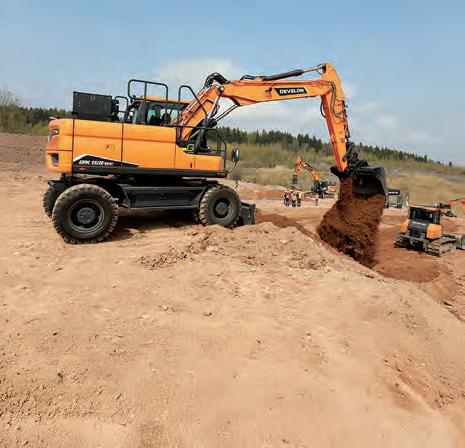
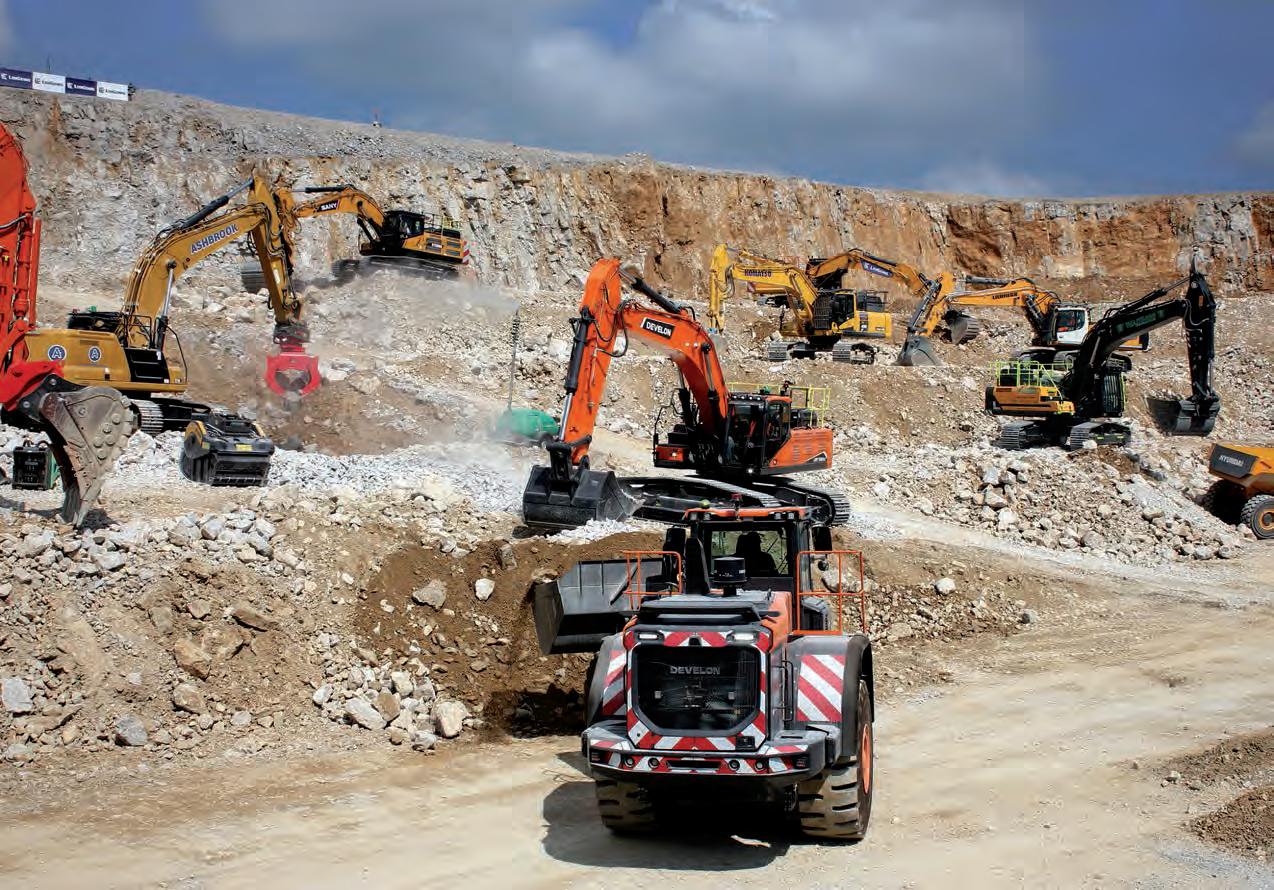
Located in the central Bohemian region of the Czech Republic, the Háje area just outside Pribram City has several claims to fame, including its mining heritage. It is the location of the Country’s deepest mine that reached an impressive depth of 1838 metres in 1975. However, for four days in mid-April, the area was the focus of attention for other reasons, as it hosted this year’s Develon Demo Days event. It was attended by almost 900 people from across Europe, providing the opportunity to experience the latest machines and technology in an authentic working environment.
EXPANDING RANGE
As part of Develon’s ambitions to move closer to being a full-line equipment provider, several new machines were at the event.
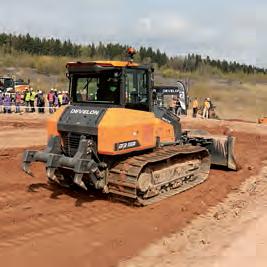
Following the success of the DD130-7 model, Develon has expanded its dozer offering to European customers. The new model is the 11-tonne class DD100-7, principally aimed at precision trimming and shaping applications. It is fitted with a six-way PAT blade and has an integrated 2D machine guidance system, with an easy upgrade path to a full 3D GPS machine control from Trimble or Leica.
Like the majority of recent Develon machines, the new DD100-7 dozer uses an
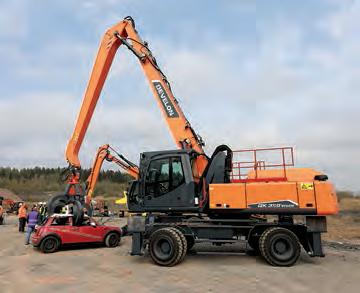
in-house produced engine in the form of a DM03 four-cylinder powerpack rated at 91kW at 2200rpm. The engine is paired with a hydrostatic transmission that exerts a tractive force of 16 tonnes, ensuring the machine has the capability to conduct more intensive pushing operations when required. The new dozer uses the same cab and control system as its larger sibling, a package that offers great visibility to both its front blade and rear ripper attachment. Although not yet available to UK or Irish customers, Develon’s range of wheeled material handlers has been expanded. Two models, the DX160WMH-7 and the DX350WMH-7, are produced on their
Below: For the majority of attendees, it was the first time they had seen a fully-autonomous excavator working in a real-world trenching application.
WORKING DEMO // DEVELON
behalf by the well-respected German manufacturer Atlas and complement the in-house built DX270WMH-7.
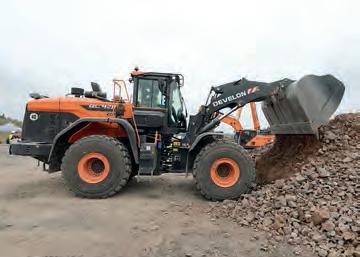
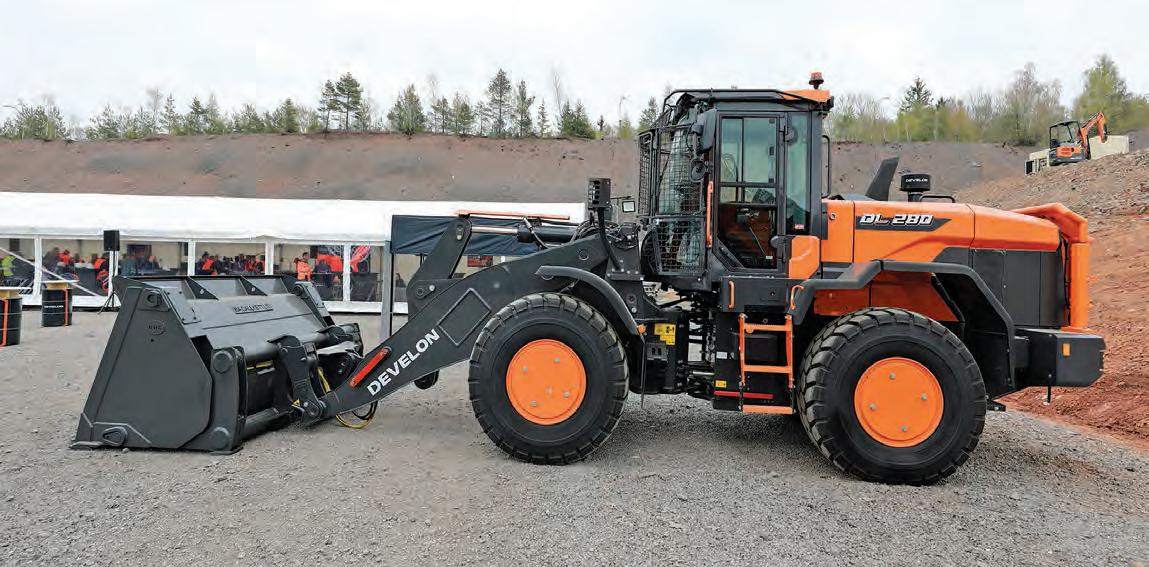
Regarding wheel loaders, the new waste specification DL280-7 features a comprehensive guarding and protection package together with high-lift working equipment. The loader arms provide a reach of five metres, fitted with a 2.8-cubic-metre capacity high-tip bucket from the long-established, UK-based BA Caulkett specialist attachment manufacturer.
Highlighting wheel loader safety, the latest generation Develon Transparent Bucket 2.0 system was demonstrated on a DL550-7. Also at the event was a DL280-7 model and the DL420-7 CVT, the only wheel loader in Develon’s range to feature
Left: Manufactured by Atlas and not yet available to customers in UK and Ireland, Develon has added two material handlers to its range.
Below left: The DX140RDM reduced-swing demolition rig provides a maximum pin height of 16m, while its variable undercarriage offers a transport width of 2.54m.
the increasingly popular continuously variable transmission.
Other specialist machines on show included the DX140RDM reduced-swing demolition rig, which provides a maximum pin height of 16m. The variable undercarriage offers a transport width of 2.54m that opens out to 3.74m in working mode, with a front blade for added stability. The cab has a maximum tilt angle of 30 degrees. Thanks to the ability to quickly change between high-reach and shorter digging boom configurations, the excavator can be used for various applications on tight urban demolition projects.
NEW TECHNOLOGIES
At the event were two battery-electric conversions of standard Develon excavators: a DX160WE-7 wheeled model and a tracked DX250E-7. The latter was configured with long-reach working equipment hosting a Pladet tilting hitch. These conversions have been developed in a joint venture with specialist firm the ELM Groep, which is also Develon’s dealer for the south-west of the Netherlands.
While these battery-electric conversions were based on Dash 7 excavators, it is understood the first conversion of a Dash 9 model is currently underway, based on a new generation DX230. It will combine machine control and battery management elements into a single control system, which is currently divided between two modules on the Dash 7 units.
Above: Battery electric conversions of Dash 7 excavators at the event included the wheeled DX160WE-7 and tracked long-reach DX250E-7.
Below: A waste spec DL280-7 wheel loader has been introduced; its long loader arms provide a reach of five metres, fitted with a 2.8cu.m high-tip bucket.
Far left inset: The 11-tonne class DD100-7 dozer is now available to European customers, configured with a six-way PAT blade and an integrated 2D machine guidance system.
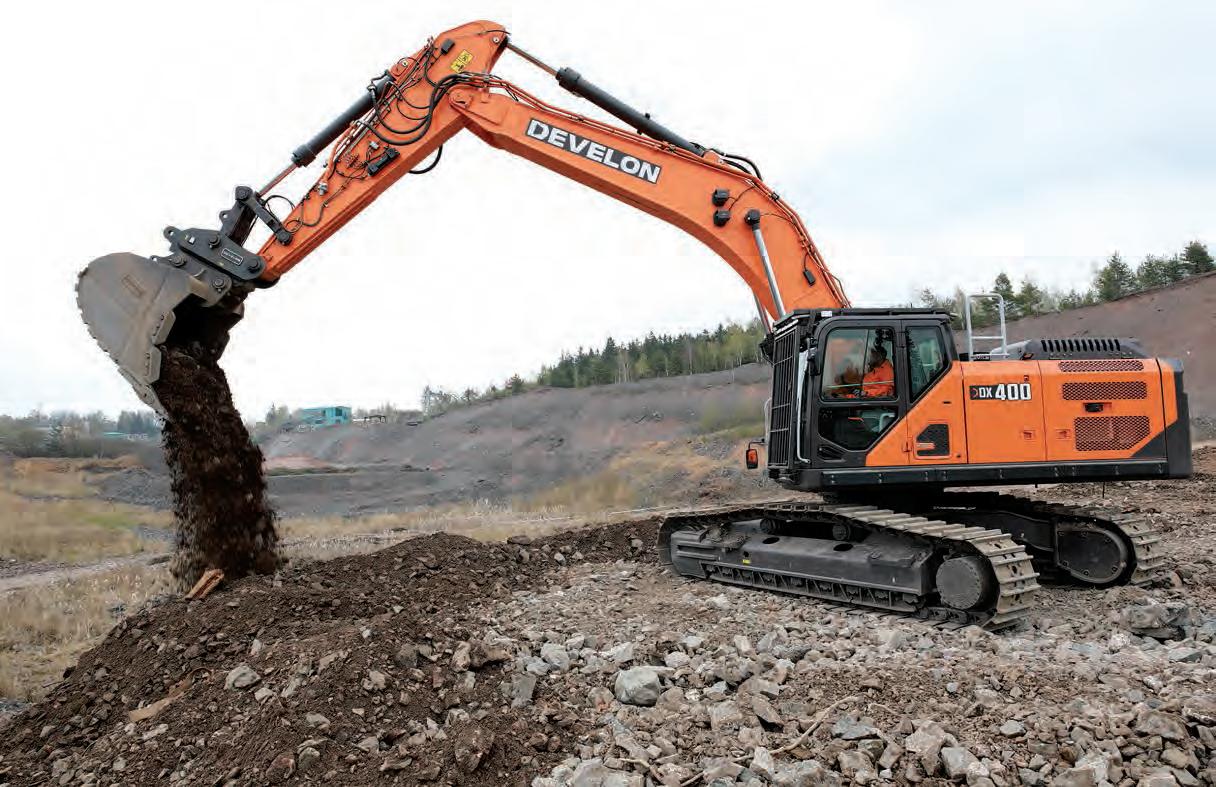
Below: The new 42-tonne DX400HD-9 excavator is powered by an in-house, six-cylinder engine rated at 254kW, producing its maximum torque of 1460Nm at just 1300rpm.
In addition, it is understood that Develon is developing an expanded range of smaller battery-electric machines, including tracked and wheeled excavators in the eight- to 10-tonne size class.
With a firm focus on the future, one of the most interesting presentations during the event was the working autonomous excavator. It’s not the first time this machine has been seen in public, but it still drew much attention as it provided a snapshot of the future and presented a valuable insight into moves to address the labour shortages being experienced in the construction industry.
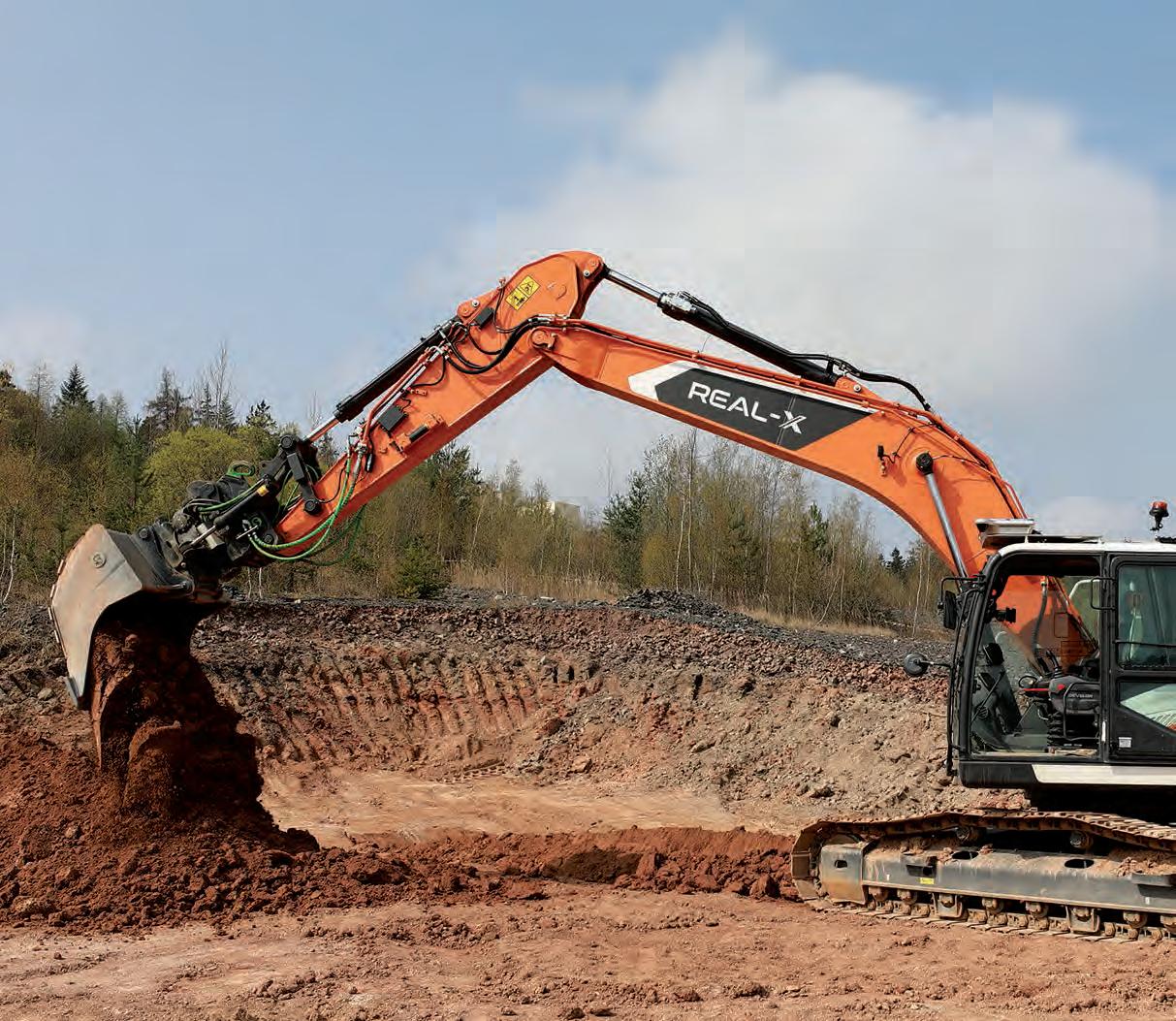
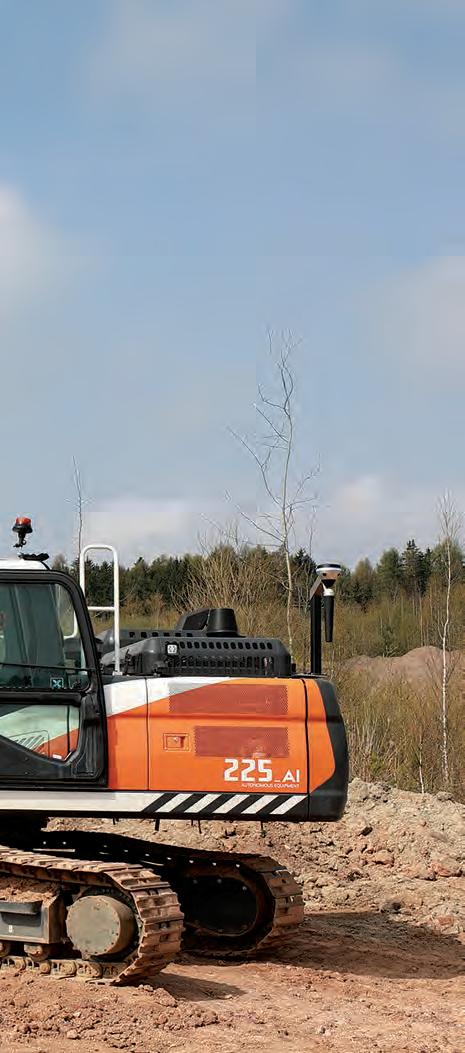
The 23-tonne class 225-AI model, equipped with a Steelwrist tilt-rotator, was used to excavate a trench. It uses the
Real X autonomous system from UK-based Gravis Robotics, with smart cameras and LIDAR radar sensors in a roof-mounted unit that communicates with the host machine’s CANbus system for precise control and can be used to convert any standard machine to autonomous operation.
NEW 40-TONNE EXCAVATOR
Develon continues to roll out more models in its next generation of specification-rich excavators, as the DX360-9 and DX400HD-9 made their first appearance in Europe. They join the DX230-9 and DX2609, which are already in the market, and presumably a DX300-9 model is on the near horizon.
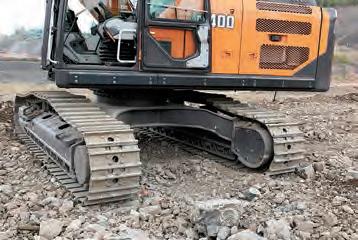
The opportunity was taken to spend some time in the cab of the 42-tonne DX400HD-9 model on the demonstration ground. Carrying the HD designation, this excavator is designed for intensive earthworks and quarrying roles and comes with a heavy-duty undercarriage. This example was configured with the optional 600mm double grouser track shoes, plus full-length track guides, nine bottom and two top guide rollers per side.
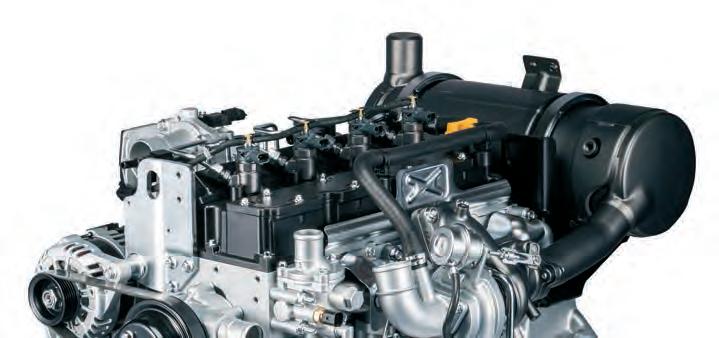
It is powered by the new 7.5-litre, six-cylinder Develon DX08 engine, in this
application rated at 254kW at 1800rpm. This powerpack produces its maximum torque of 1460Nm at just 1300rpm, which promises good fuel consumption. It features a high-pressure common rail fuel injection system and twin turbos.
The engine drives two main hydraulic pumps, each of which produces 360 litres of oil flow per minute. There is full electronic control for the hydraulic system, which also includes the pumps and main control valves, again contributing to its fuel economy.
There is a comprehensive choice of digging modes allowing the excavator to be matched precisely to the application. It can also prioritise specific movements, ensuring the excavator’s performance can be tailored perfectly to meet the demands of the application and different operator styles.
IN THE DIG
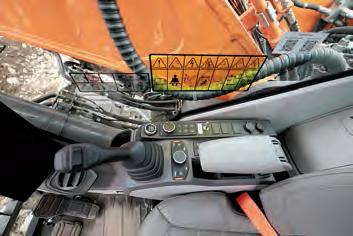
Bringing the engine to life is achieved via its keyless start system, which merely requires pressing start button at the centre of the right-side console.
Working the machine in P+ (power plus) mode and the engine set at 1800rpm, a positive sense of digging power and speed is evident as the heavily armoured bucket penetrates the material. Digging below ground level along the face of a bench,
Above: This example was fitted with 600mm double grouser track pads on its heavy-duty undercarriage, which also includes full-length track guides.
WORKING DEMO // DEVELON
was an effortless process. Even though some may believe electro-hydraulic controls deliver little feel, they were well suited to the attributes of this excavator, which delivers impressive levels of power, response
Transferring material across to the left side and grading off to a uniform finish with the machine’s standing point, the process was effortless as the sheer power of the machine was very much in evidence, while also having smooth, precise control when needed for nishing operations. Working at full reach over the side of the tracks, no signs of instability were evident, despite the heaped buckets of material being
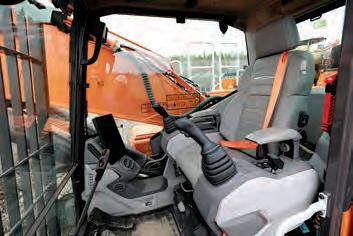
The layout of the cab demonstrated the level of intuitive thinking applied by Develon in its design, while the comprehensive main control system
Left and far left: Extremely comfortable, the new cab is has intuitive electro-hydraulic controls and a multifunction monitor/control screen.
display and safety systems played a pivotal role during operation.
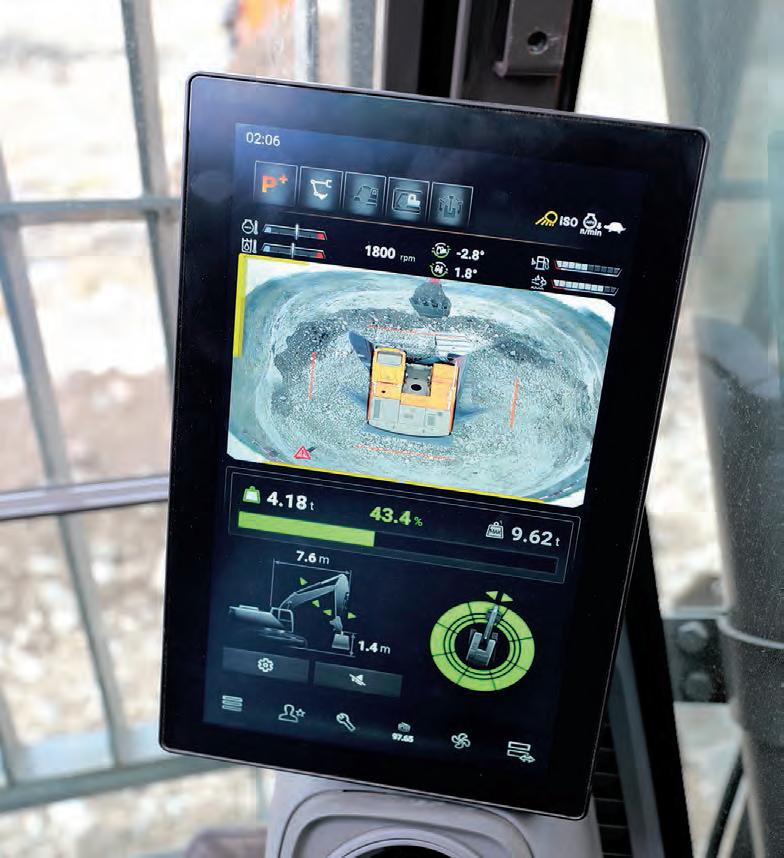
The Smart AVM system is fed by six cameras and three radar sensors with an AI-powered human detection sub-system. The Develon product specialist moved closer to demonstrate the effectiveness of the machine’s detection and E-stop system, showing his presence on the 360-degree view panel of the screen and highlighted in the display by a red triangle. As he moved closer and within the working zone of the machine, the E-Stop function demonstrated its effectiveness when personnel enter the machine’s immediate environs from the rear or either side.
CONCLUSION
The roll-out of world-class excavators, together with an enhanced dozer, wheel loader and materials handler ranges, Develon has done much to enhance its equipment offering. However, much more is still to come, including introducing radar detection, human recognition and E-Stop functionality to its wheel loaders in the future when they ultimately advance to dash 9 status.
For good reason, Develon is clearly bullish when it comes to furthering its market position across Europe.
Above: The Smart AVM system is fed by six cameras and three radar sensors with an AI-powered human detection sub-system.
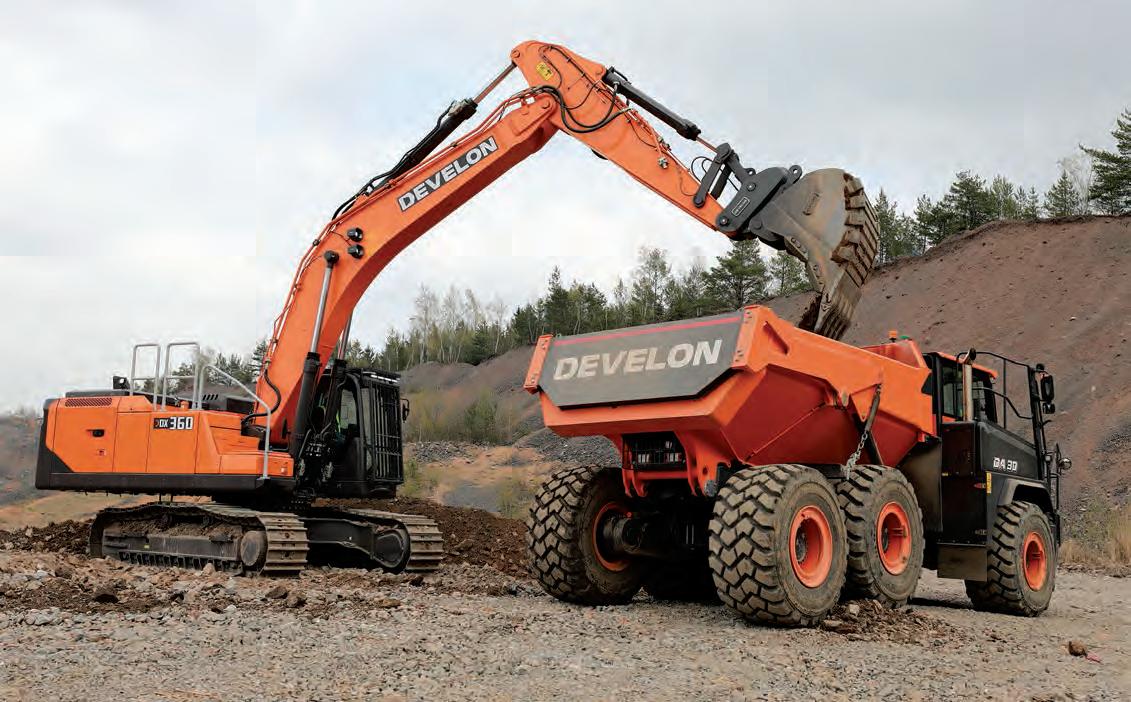
Below: In addition to the 42-tonne DX400HD-9, the 36-tonne class DX360-9 has been added to the firm’s excavator range.
INDUSTRIAL ENGINES
LOOKING FORWARD TO HILLHEAD 2026
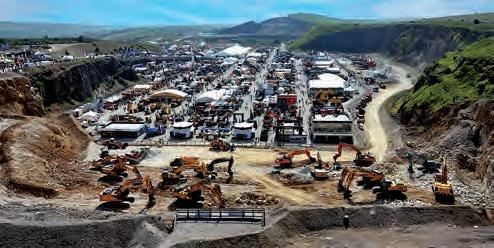
The biennial event Hillhead has been running for 44 years, always putting a heavy focus on moving machinery rather than static displays. Hillhead 2024 saw over 19,500 attendees (verified by an independent auditing company) take in the sights provided by 598 exhibitors. The three-day event brought new products, cutting edge technologies and live demonstrations.
The 2026 edition of Hillhead is set to
build on the momentum of 2024. Organisers of the show have already confirmed over 600 exhibitors and a need to extend the registration pavilion thanks to a near sell-out uptake. New for 2026, the Quarry Face demonstration area will feature a curated programme hosted by broadcaster and presenter Nikki Dean.
Showground improvements have also been made for the 2026 event, including a £105k wi-fi upgrade, an extra car park and further hospitality areas.
From 23 to 26 June, Hillhead Quarry in Buxton will once again play host to the UK’s largest quarry, construction and recycling exhibition. Harry Hunter has been speaking with key exhibitors set to showcase new machinery and equipment
MARSHALLS INDUSTRIAL - STAND B7
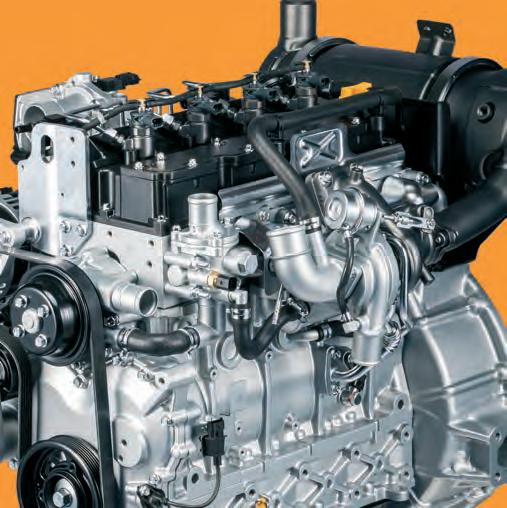
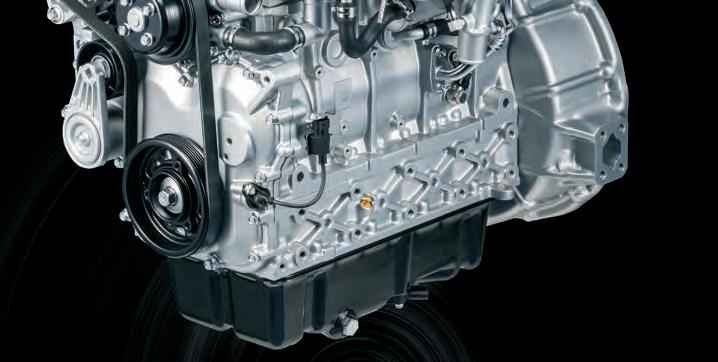
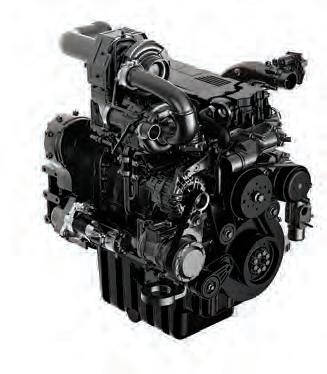
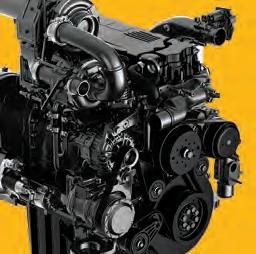
As the official UK distributor for Hyundai industrial engines, Marshalls Industrial will show the fuel-efficient G2 Series alongside the award-winning “Diesel of the Year” DX models. Both ranges meet stringent EU Stage V and US Tier 4 Final standards, delivering clean, reliable performance across diverse applications. Visit stand B7 to meet the team, explore the latest engine technology and discover how Hyundai power solutions can drive your next project forward.
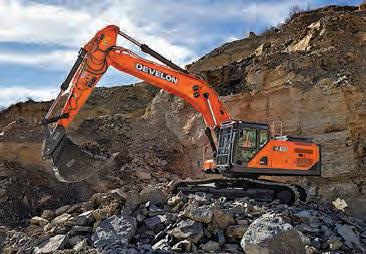
Hillhead 2026 will see the UK debut of the Develon Series 9 excavators. The DX400HD-9 will form part of the static display on the Develon stand, where it will be joined by the new 23-tonne DX230LC-9 model.
Visitors to the Develon stand will also be able to see the DA30-7 articulated dump truck together with the DA45-7 model on demonstration.
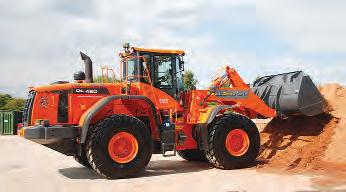
Develon’s quarrying and construction line-up will be further represented by the DL420CVT-7 wheel loader in the static display area, plus the larger DL480-7 wheel loader in the demonstration area. The static display will also feature the DD130-7 dozer, recently joined by the newly launched smaller DD100 model, expanding Develon’s dozer range on show.
Completing the display, Hillhead will mark the first appearance of the DX25Z-7 miniexcavator at the event, displayed alongside the larger DX55R-7 and DX85R-7 mini-excavators.
McHALE-KOMATSU – STAND Y3
Komatsu will be present through their new UK dealer, McHale-Komatsu. Since the acquisition by McHale Plant Sales of Marubeni-Komatsu in November of last year, McHale-Komatsu has been the focus of Komatsu’s efforts in pushing its latest products on to UK construction sites.
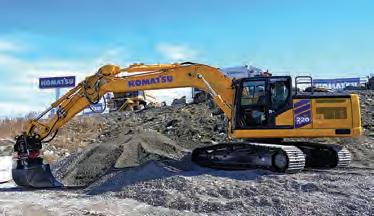
At Hillhead 2026 visitors can expect to see emphasis on Komatsu’s third generation of intelligent machine control, freshly fitted to their latest high-tech excavator release, the PC220LCi-12 intelligent excavator. Rob Macintyre, product manager at Komatsu Europe said of the technology: “We pioneered fully factory integrated machine control on excavators back in 2014. Those more than 10 years of constant development, deep experience of learning from customers and fully supporting them on the jobsite to get the best out of this type of technology, have led to these truly unique assist features we see on iMC 3.0”
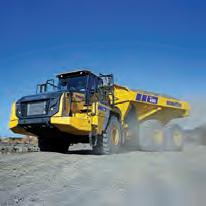
Visitors to the McHale-Komatsu stand will also see the 28-tonne D85PX-18 crawler dozer and 363HP WA485-11 wheel loader. There will also be Komatsu’s next generation HM460-6 articulated dump truck, the WA485-11 wheel loader, a PC130-11 13-tonne Excavator and more.
DEVELON – STAND Z4 CASE CONSTRUCTION
EQUIPMENT – STAND X10
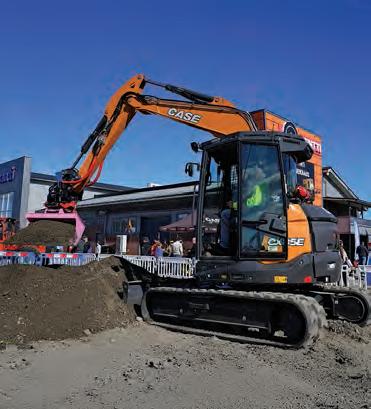
CASE Construction equipment will be focusing both on showcasing new models and highlighting a commitment to high standards in its existing machines. Recently off the back of a wheel loader launch (the new G+ Series) CASE will have on display the 1021G+ as well as the 1121G+, both equipped with new “X-Drive” functionality, said to improve smoothness, response times and all-terrain control through a continuously variable transmission.
CASE has also promised to feature special application excavators designed for specific customer requirements and operational conditions. Also on the CASE stand will be an operator challenge for attendees to try their hand.
FINNING – STAND V1
Long-time UK Caterpillar dealer Finning aims to showcase the brand’s latest technology in the form of zones within their stand, where visitors can pinpoint the issues they face on site and discuss how to solve them alongside the dealer’s expert team. Finning, with Caterpillar, have been pushing hard on the deployment of digital and technology features, data-analysis and on-site training.
Mick Knight, head of corporate and strategic accounts at Finning UK & Ireland, said: “Connecting our customers to the tools that enable their businesses to thrive is very important to us, whether that is using technology to unlock the data they need to improve safety, sustainability and productivity, or opening up new, cost-effective ways to invest in machinery through rebuilt solutions.”
“The Finning Caterpillar experience will be a fun, interactive way to consider how to develop and improve performance across the whole business, not just across the machine fleet.”
SHOW PREVIEW // HILLHEAD
MERLO – STAND A20
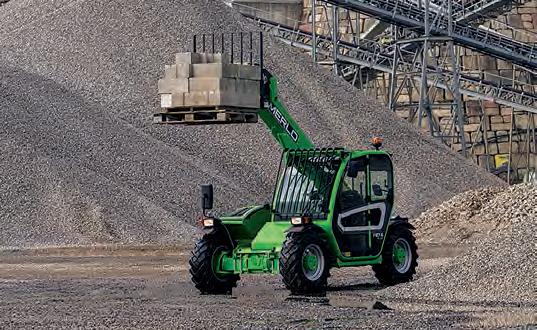
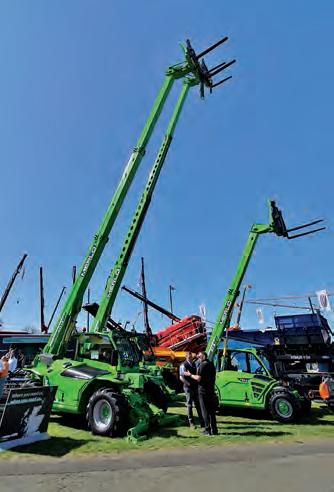
materials handler manufacturer Merlo will showcase a large section of its construction-focused offering. Six machines will be on display: the P27.6 PLUS compact telehandler, the stabilised P40.13 & P40.17 PLUS, the ROTO 50.26 SPLUS, the Tracked Carrier M700TD High Tip and the Heavy Lift P120.10. The last of these machines offers a 12-tonne lift capacity and 10-metre reach. This heavy-duty handler is fitted with CVT transmission, flow-sharing hydraulics delivering 160 l/min, and Merlo’s advanced stability control system (ASCS) with attachment recognition; the Heavy Lift P120.10 is the largest machine in the Merlo range.
ASTRAK – C10
This year at Hillhead, Astrak will be exhibiting from the top of the quarry, showcasing their premium GeoXD bucket range for 0.8–25t machines, including digging, ditching, bladed and riddle buckets. Alongside this, Astrak will also display a range of GET bucket teeth and cutting edges.
Visitors will also be able to see Astrak’s track shoes, Duraline Plus pads, TerraTrack Plus rubber tracks and a full range of undercarriage parts.
There will also be several area managers on the stand, presenting a great opportunity for visitors to discuss their requirements and connect with the team.
I Miller UK has been manufacturing excavator attachments for the quarrying sector since 1978, and has a reputation for quality and expertise. The business from the north-east of England will bring a range of buckets designed and manufactured in house, including an extreme rock bucket.
Miller’s industry-leading GT quick coupler range will also be featured, including the GTS, GTX, and GTT tilt coupler. Miller will also display its micro-manual coupler, the most compact and lightweight on the market.
Miller is set to continue its support of the Lighthouse Charity for a third consecutive year. A new special-edition charity bucket will be unveiled on the stand to raise awareness of the organisation’s vital work, as it marks 70 years of supporting construction workers and their families. Visitors can place bids throughout the show, and all proceeds go directly to the charity.
ULRICH ATTACHMENTS – STAND W18
Hillhead 2026 will see UK plant attachment manufacturer Ulrich Attachments unveil an exciting brand-new product launch in partnership with a leading European supplier.
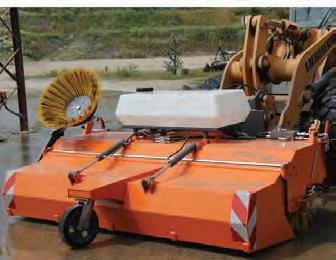
The innovative concept will introduce a new attachment solution for the forestry, construction, waste and agricultural industries. Included are the MD3.0 and MD6.0 modular models, as well as a hydraulic sweeper attachment for loaders fitted with an additional tank.
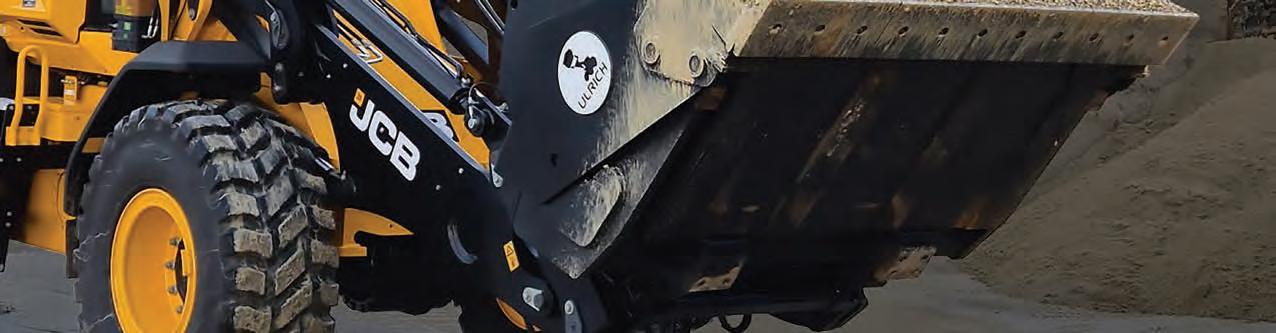
Ulrich’s line-up of products at the show will also include its high-tip buckets, the 7m3 high-tip and 4.5m3 high-tip clamp buckets. Their standard specification is manufactured from high tensile steel with 450/560 Brinell Hardness steel wearing parts, but Ulrich also produces full heavy-duty versions of the high-tip bucket range for specific applications and materials. The heavy-duty buckets are manufactured from 1250N/mm2 tensile, 1000N/mm2 yield steel.
At the Ulrich stand, the high-tips will be complemented by a 4.2cu. m heavy-duty rehandling bucket with a plastic lining, seven-tonne pallet forks and a hydraulic quick coupler.
talian
STEELWRIST – STAND A40
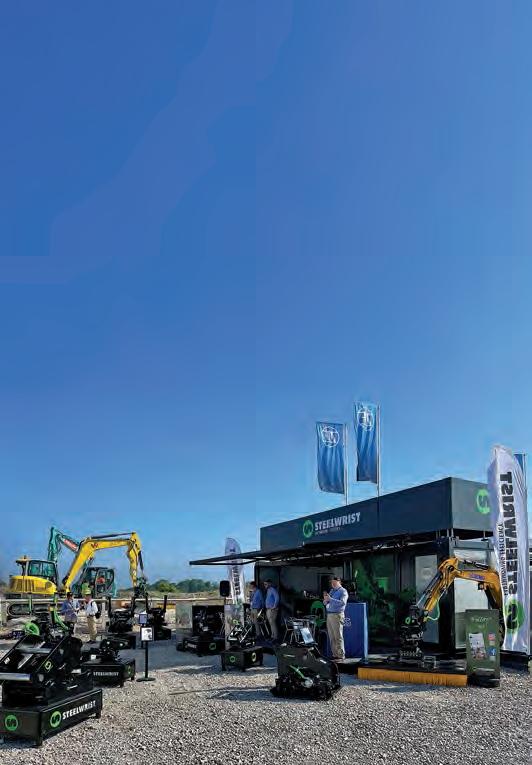
Steelwrist returns to Hillhead with a strong focus on excavator efficiency, live demonstrations and the continued roll-out of its third-generation XTR tilt rotator range.
Visitors to the Steelwrist stand will be able to see a wide range of products both on static display and in action. Steelwrist will also continue to demonstrate the SQ40 fully automatic quick coupler solution for compact excavators, enabling fast and safe hydraulic work tool changes directly from the cab.
Live demonstrations will feature two excavators equipped with Steelwrist products. One machine will be fitted with an X07 tilt-rotator and SQ40 automatic quick coupler interface while the second will demonstrate an X12 tilt-rotator with SQ50 interface.
XCMG – STAND T1
hile 2024 saw the first appearance of Chinese manufacturer XCMG at a UK show, the company is now a recognisable name on UK construction sites.
EDGE INNOVATE – STAND C20
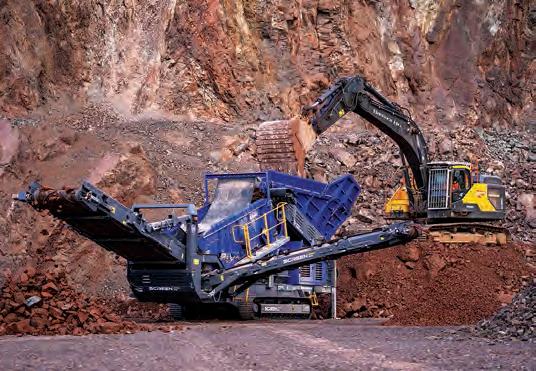
he new Edge Screenpro S16 heavy-duty track scalper will make its Hillhead debut at the 2026 show. Edge Innovate will showcase a strong range of material handling and screening solutions, supported by a team of experts offering tailored advice to operators across multiple sectors.
The S16 features a highly efficient 16ft x 5ft (4.8m x 1.5m) screening box with multiple media options, allowing it to operate as a stand-alone unit or integrate seamlessly into existing processing trains.
Also on display will be the TS80 track conveyor, a 14-tonne 25.4m-long train wagon offloader.
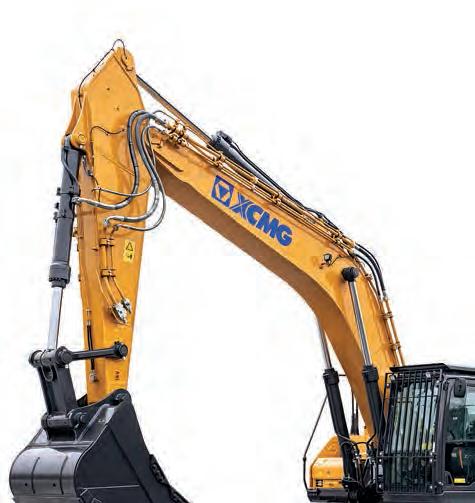
On the XCMG stand in 2026, they will showcase a range of machinery from excavators to loaders and rollers, including some of their most popular and well-received models, such as the 40-tonne XE380E tracked mining excavator and the XC998 wheel loader. XCMG are also likely to bring examples from their newly launched compact-excavator line-up. Expected to make an appearance are the notoriously well-built one-tonne XE10E (touting zero tailswing and a large angle boom deflection) and slightly larger XE27E.
The 2026 show will be an interesting opportunity to see how far Chinese construction machinery has come in the intervening two years.
KLEEMANN – STAND Q1
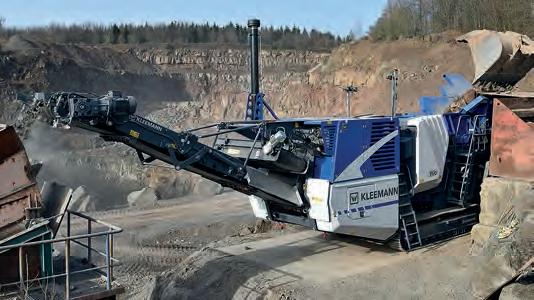
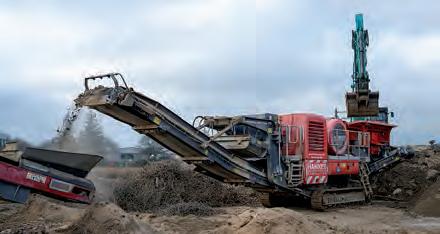
Part of the Wirtgen Group, Kleemann will have on their stand the new MOBISCREEN MSS 1102 PRO – a mobile coarse screening plant with an optional fully electric operation. Kleemann will also display the MOBIREX MR 100 NEOe mobile impact crusher, which focuses on low emissions and a low site footprint. Together with the MOBICAT MC 110 EVO2 mobile jaw crusher, which is the flagship of the Kleemann portfolio in the UK market, thanks to its intelligent operating concept and high efficiency.
TAKEUCHI – STAND M9
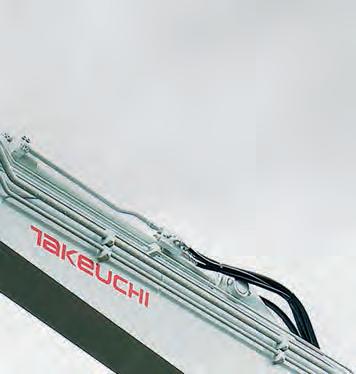
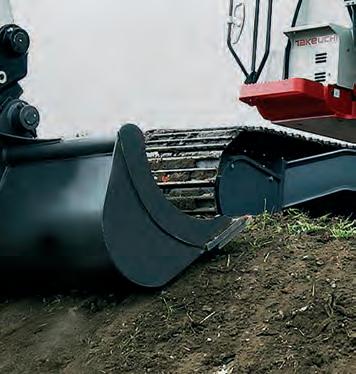
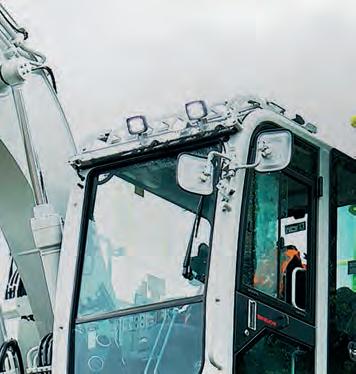
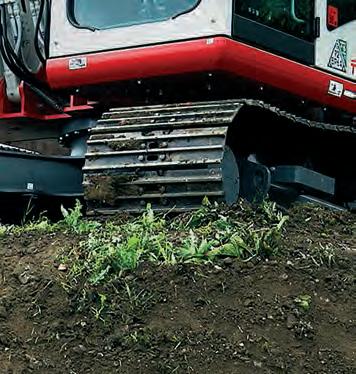
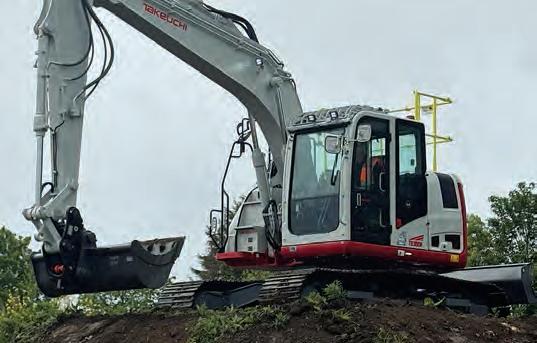
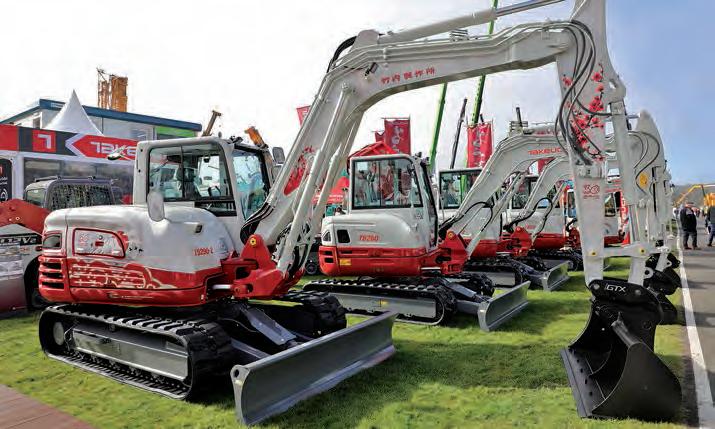
Takeuchi will display machines from one to 15 tonnes, encompassing the latest 3-Series machines to include the 15-tonne TB3150 offset and TB3150R fixed boom excavators. These new powerful machines deliver 3-Series styling with the latest electro-hydraulic controls.
The new 15-tonne models reflect a focus on larger models by Takeuchi and offer two distinct operating types – fixed or offset boom, giving owner operators greater choice and versatility on site. The new TB3150R with optional two-piece boom, is designed with the more common fixed boom and reduced tail, minimising rear overhang when working in confined areas or near structures. The TB3150’s unique offset provides a boom swing system that digs at offset without having to reposition the tracks. It’s also ideal in tight spaces or for utility and applications that need precise positioning.
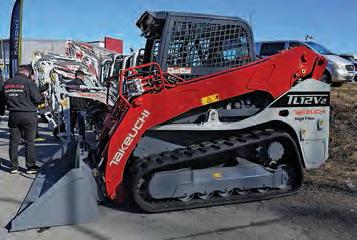
Also new for Hillhead will be the latest Takeuchi compact tracked loader range now available in the UK. The largest new model, the TL12V-2, will be on the stand. Since its launch at Plantworx 2025, the new range has proved popular.
LIEBHERR GREAT BRITAIN – STAND Z6
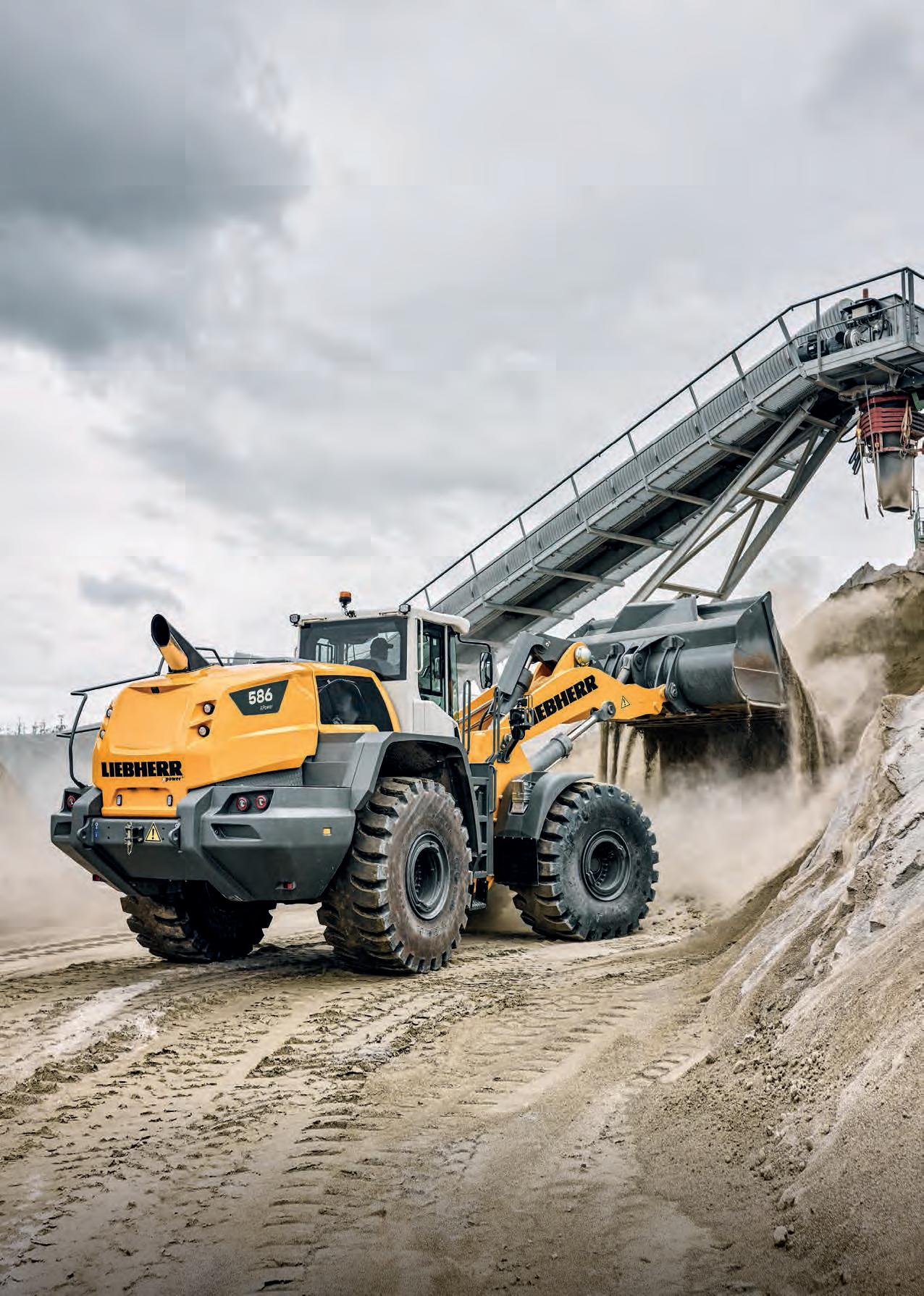
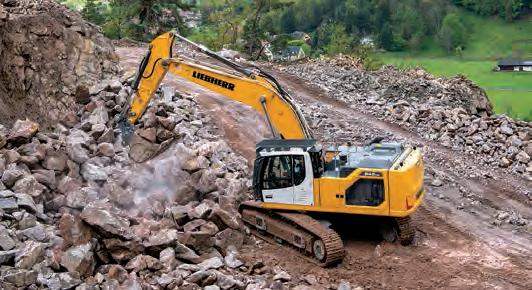
At Hillhead this year, Liebherr Great Britain is demonstrating how long-term partnerships deliver results on site. The stand will feature customer-owned machines, offering a view of performance in real quarry environments. Highlights include Sirius Group’s fuelefficient PR 736 Generation 8 dozer and Thor Atkinson’s new R 945 excavator. Beyond earthmoving, Grange Quarry’s HTM 905 mixer reflects Liebherr’s integrated approach, while a refurbished PR 756 from Used Equipment underlines lifecycle value. Across the range, from the L 586 XPower to the TA 230 ADT, Liebherr aims to focus on quality across all three of its machine outputs: new, used or rental.
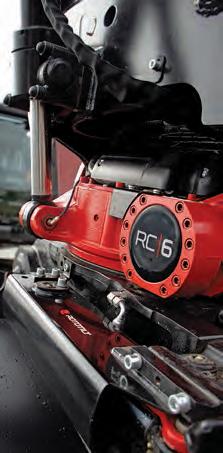
ROTOTILT – STAND A30
nother company marking an anniversary at Hillhead 2026 will be Rototilt, which will celebrate 40 years in business. On display will be an array of Rototilt tilt-rotators from RC-1 for 2t-3.5t machines through to the RC6 20t-25t, including plenty of associated attachments. At the rear of the stand will be a demo area where long-standing Rototilt customer Jason Metson of Broxted Plant Hire Ltd’s new Volvo EX140 geared with a QuickChange set-up will show the capabilities of Rototilt units.
As part of the 40th anniversary celebration, Rototilt will invite all attendees to join them for refreshments each afternoon of the show days.
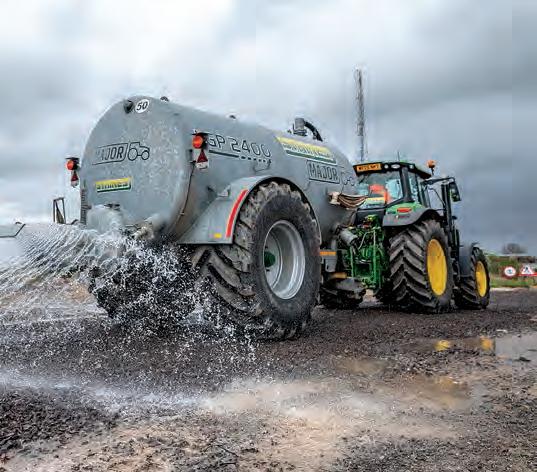
MAJOR EQUIPMENT – STAND CE4
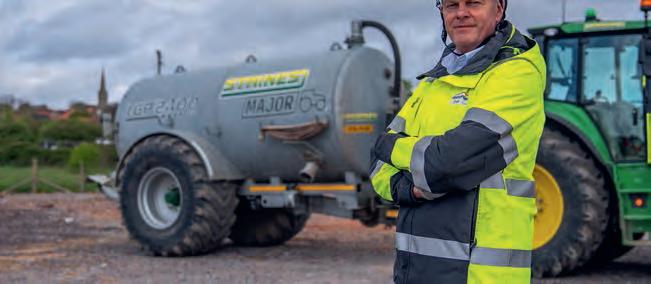
ndependent tanker manufacturer Major Equipment will use Hillhead to showcase its individual industrial tank design. Since 1976, Major Equipment has built a strong reputation for designing and manufacturing bespoke industrial tanker solutions. Unlike conventional tankers, where the tank and chassis form a single unit, Major tankers feature an independent drawbar and separate chassis. This design reduces stress, prevents cracking and extends tank life.
Major Equipment has developed and will demonstrate at Hillhead a diverse range of tankers for applications including hydro-seeding, dust suppression, liquid waste management and road and site cleaning. Each unit is engineered to meet specific operational requirements.
Major Equipment’s design engineers and company representatives bring hands-on experience and use high-quality components to deliver tailor-made solutions. The company works closely with customers and serves clients such as Flannery Plant Hire, Staines Hire Ltd and Jones Bros.
SHOW PREVIEW // HILLHEAD
QMS – STAND N14
QMS is set to return to Hillhead with a strong showcase of crushing and screening equipment, spare parts and processing solutions aimed at the quarrying, mining, demolition and recycling sectors. On the stand will be a selection of the company’s crushing technology, including models from its JB Series jaw crusher range and the B Series cone crushers. QMS B Series cone crushers have become increasingly popular across aggregate and quarry operations thanks to their high output, efficient hydraulic protection systems and consistent product shaping capabilities.
Alongside the machinery, visitors can expect to see a range of manganese crusher liners, crushing and screening spare parts and wear components. QMS specialists will also be on hand throughout the event to offer advice.
BOBCAT – STAND CE16
The first showing of the new T650 compact tracked loader in the UK and the first appearance at the show of the new generation R2-Series one to two-tonne mini-excavators are two of the highlights of the Bobcat Stand at Hillhead 2026. The T650 will be part of the static display on the Bobcat stand and the new mini-excavators will be put through their paces in the demonstration area.
The new T650 Stage V compact track loader utilises Bobcat’s 600-frame M-Series platform. The machine delivers 74hp without requiring AdBlue and offers an 1192kg rated operating capacity for demanding applications such as roadworks, infrastructure and earthmoving. The T650 features broad attachment compatibility, optional high-flow hydraulics, machine IQ telematics and enhanced operator visibility, making it well suited to construction, maintenance and utility work.
Also on the Bobcat stand, the new R2-Series one to two-tonne mini-excavators include the E16, E17z, E19 and E20z models, which feature an advanced SmartFlow hydraulic system that delivers improved precision, efficiency and power on demand typically seen in larger machines. The new range also cuts fuel consumption by up to 18% and reduces noise levels by 4dBA compared with previous-generation models.
HITACHI CE – STAND Z3 & Y3
At this year’s exhibition, Hitachi Construction Machinery UK will present a comprehensive line-up that reflects both the strength of its current offering and the strategic shift toward its future identity under the Landcros brand, set to launch in April 2027. The company’s presence will combine a broad equipment line-up with advanced technologies and a clear narrative of evolution and innovation.
On display will be a diverse range of machinery, from the compact ZX17U-6 mini-excavator and the versatile ZX95USB-7, through to the powerful ZX375USLC-7. The latter will be fitted with a suite of cutting-edge solutions, including Leica Geosystems machine control, a Safety Shield AI human detection system and XWatch height and slew restrictors with rated capacity indication (RCI). Together, this line-up offers visitors a tangible insight into the engineering quality, safety focus and technological innovation that define the company’s portfolio.
Beyond the machines themselves, the stand will serve as an important platform for introducing key new offerings of the forthcoming Landcros brand. Highlights include Landcros Connect, an enhanced telematics platform designed to deliver greater insight and control, and Landcros Play, a simulation-based video game experience aimed at engaging users in a new and interactive way. These developments signal a forward-looking approach, aligning Hitachi Construction Machinery UK’s established expertise with a more connected, digitally driven future.
HILLHEAD 2026
23 TO 25 JUNE
Registration for Hillhead 2026 is free and will once again bring the industry together for three days of live demonstration, innovation and collaboration.
Real
performance.
At Hillhead this year, Liebherr Great Britain isn’t just showing equipment — it’s showcasing how long-term partnerships drive results on site.
The stand showcases customer-owned equipment, giving a true picture of how these machines perform in working quarry environments.
From Sirius Group’s PR 736 Generation 8 dozer — delivering measurable gains in fuel efficiency and productivity — to Thor Atkinson’s latest R 945 excavator, the focus is clear: dependable performance backed by consistent support.
It’s not just about earthmoving. Grange Quarry’s HTM 905 truck mixer highlights how Liebherr’s cross-portfolio offering supports fully integrated operations — from batching plant to site.
There’s also a refurbished PR 756 dozer from Liebherr Used Equipment, showing how lifecycle value can be extended without compromising productivity.
Across the stand, machines like the L 586 XPower and TA 230 ADT demonstrate efficiency, operator comfort and evolving technology in demanding conditions.
Because how you source your equipment now matters just as much as how it performs. See us at Hillhead, stand Z6
The message is simple: One partner - Three routes to the right machine
SCRAPING SOFT SITE SURFACES
Paul Argent reports from a site near Liverpool where a mass muck-shifting project is being conducted by a new Ashland towed scraper
Fashions and trends are constantly evolving within the construction industry, sometimes not for the best!
The industry has moved away from what was seen as traditional muck-shifting machinery towards excavators and dump trucks. However, depending on the length of haul and type of material, scrapers are still seen as the cheapest form of earthmoving available.
While still several companies in the UK are successfully running traditional motor scrapers and tractors and boxes, the new wave of North American-manufactured towed scrapers is quickly becoming a more common sight on earthmoving projects up and down the country.
One of the pioneers of this type of earthmoving is North Wales-based Williams Plant Hire. The family firm is headed by David Williams, a veteran muck-shifter and staunch supporter of the more traditional side of the industry.
“We have been running towed scrapers since they first came over the water,” David commented. “In that time, we’ve seen plenty of other contractors take on products from the market leaders Ashland and K-Tec, and with that, a gradually increasing acceptance of the older methods of muck-shifting. One of the biggest issues we have faced is the disappearing number of older, more experienced operators who have grown up with this type of kit.”
Williams Plant Hire operates several large tractors capable of pulling the firm’s fleet of Ashland scraper boxes.“In the right conditions, there’s nothing quicker than a scraper,” David commented. “When ground conditions start to get challenging, we are able to swap a box from the rubber-tyred Challenger over to our Komatsu D65PX dozer, which allows us to carry on where others can’t.”
SITE BACKGROUND
One of the latest projects for the Williams team is on the outskirts of Formby, just north of Liverpool, where David has won a contract from one of the UK’s leading land remediation specialists, Vertase FLI, to move 20,000cu.m of soft, sandy soil to form surge piles ready for a future housing development.
Inset and below: The Komatsu D65PX pulling an Ashland 1410E makes a formidable combination on soft ground, as the scraper practically floats across the earth.
ASHLAND BACKGROUND
Wisconsin-based Ashland Industries was formed in the 1950s in the city that gives the company its name. Some of the first products manufactured by the fledgling company were for the region’s farming community, namely land scrapers, land planes and agricultural scrapers. The rapid success of its designs boosted the company’s fortunes and hydraulic ejection models were added in the 1970’s.
Further successes saw the company merge with K-Tec in 2020 to become the global leader in the pull pan earthmoving scraper market. Today, the company has produced over 25,000 different units and delivered them across the globe from its 45,000sq.m manufacturing facility where it currently employs over 200 people.
The company now supplies eight separate product ranges and over 35 different models from agricultural and construction scrapers to disc harrows and land levellers.
The site is adjacent to RAF Woodvale and sits almost at sea level. Criss-crossed with drainage ditches, the water table sits just over 1m from the existing surface level, which will lead to Vertase FLI building the entire level of the site up by a couple of metres. Piled foundations will then be installed to keep the new properties out of possible danger.
The contractor undertaking the road construction works had been using what is seen as one of the lightest and most competent ADTs for soft ground on the project. With a few rain showers peppering the area the day before our visit, the ADT was parked up as it was deemed to be
Left, below, far right and inset below: Recently converted to remote control, the undercarriages from Cat 325 excavators are used to shift the mobile elements of the site’s conveyor belt system.
making too much mess on the soft ground. This damp weather hadn’t put paid to the muck-shift for Williams Plant Hire, as David was happily moving load after load to the tip area. Hitched to a Komatsu D65PX dozer was the latest Ashland scraper box -a new 1410E model - purchased by the company through its dealer Red Bull Equipment.
NEW SCRAPER
The 1410E is a rear-lift ejector scraper from the company’s agriculture range. This design allows the floor of the scraper to remain nearly flat while loading, making field drainage and ditch clearing a simple task. The side router blades extend beyond the cutting blades to funnel material into the bowl while the scraper is being loaded.
The forward-placed router blades and flat floor angle are beneficial when loading loose material or if you are levelling the ground for drainage.
With a capacity of 11cu.m, the 1410E isn’t the largest model in the extensive range; this accolade goes to the huge 26cu.m capacity 3413E. But where the 1410E lacks in physical capacity, its low weight and compact size make it ideal for ground where heavier machines are likely to make more damage.
Ashland offers a range of its scrapers with dolly wheels to reduce the drawbar load on the towing tractor, but the 1410E is one of its direct-mount models using a sturdy drawbar, which transfers up to 25% of the total loaded scraper weight on to the back of the dozer. The 1410E is the only direct-
mount scraper in the range that comes standard with a Category 4/5 agricultural hitch for short-term scraper operations.
IN THE CUT
The 11-cube scraper has a cutting width of just over 3m and a maximum cut depth of 152mm, allowing it to be filled rapidly in just a short distance. During our time with David, he was averaging 40 seconds from getting the cutting edge on to the ground to it being lifted clear again. While the Komatsu dozer isn’t the fastest across the ground, it keeps going even through the spots where the water table was bubbling through!
“To be fair, this particular haul is just a little bit further than we would like,” David explained.
Below: The latest towed scraper to join the fleet of Williams Plant hire, which includes dozers, dump trucks and rollers, is an Ashland 1410E supplied by Red Bull Equipment.
// WILLIAMS PLANT HIRE
“That’s the construction industry for you; if it was perfect all the time, everyone would be doing it!”
Where many scraper designs use hydraulics to either lower the neck or the bowl itself to enter the cut, the 1410E uses a pair of rams to lift and lower the rear four-wheel bogie and therefore drop or raise the scraper bowl. Fitted with four 17.5 x 25 tyres provides little, but uniform compaction to the rear of the combination and allows it to almost float across the softer ground on site. Whilst the rear bogie looks complex in its design, it has been manufactured to
reduce maintenance costs: pivot pins and cylinders utilise 1200-hour greaseless composite bushings throughout, reducing grease locations by nearly 80% over traditional designs.
Quick and effortless ejection of the material is helped using large steel floor rollers and mid-mounted high-density polyurethane slide blocks, which accurately guide the ejector plate and reduce maintenance to a minimum.
As the scraper uses a drawbar design, to obtain effective ejection of the material, the front section pipe is placed high on the scraper sidewall, which provides an unobstructed gate opening to easily eject the material.
To increase his productivity, David uses Trimble machine control on the dozer to accurately remove material and place it on the stockpiles. He explained, “On the larger boxes pulled by the Challengers, we have GPS mounted to the box itself to increase their efficiency and accuracy of cut and fill works.”
CONCLUSION
At just 6.5 tonnes for the 1410E scraper box and a further 22 tonnes for the D65PX dozer, the combination puts very little pressure into the ground, making it an ideal combination for working on this type of ground. “The Challengers and larger boxes deliver us more capacity and more speed across the ground,” David commented, “but when it comes to cost-effective earthmoving on this soft ground, nothing compares to what we have here!”
Below and inset: David Williams has always appreciated traditional earthmoving methods; in the right conditions a scraper will outperform an excavator matched to ADTs.
KRAMP, YOUR PARTNER IN SPARE PARTS AND ACCESSORIES
5000+ CONSTRUCTION PARTS AVAILABLE.
The all Dust Suppression Unit DS8 NEW
Below: After the removal of almost one million tonnes of hard rock, the extended dry dock at Kishorn Port is set to be the largest in the UK.
Below inset: Supplementing main contractor RJ McLeod’s machines on this project is a substantial fleet from Stevens Equipment Rental.
As Paul Argent reports, main contractor RJ McLeod is currently constructing a huge dry dock in Scotland, with the help of additional machines from Stevens Equipment Rental ocated in Wester Ross on the western edge of the Scottish Highlands, a significant development is currently taking place at Kishorn Port (see panel overleaf), both to increase the size of dry dock and
deliver a further nine hectares of laydown land.
LThe remote location of the deep-water port makes it ideal to handle the ongoing wave of decommissioning projects, which has seen oil and gas platforms removed from the North Sea. It is also well-suited to support offshore wind farm projects, while facilitating the shipment of aggregates from the adjacent quarry.
SCOPE OF WORKS
The project to increase the port’s capacity has fallen to RJ McLeod, a well-known and well-respected contractor who undertakes a wide range of construction and civil engineering projects
across Scotland and the north of England.
The scope of work involves the rerouting of existing internal road networks, the extension of the existing dry dock and using the aggregate from that to reclaim an area of tidal shoreside. There is also extensive drainage, concreting and rock stabilisation works to be undertaken. The project sees RJ McLeod, which is celebrating its 75th anniversary, return to a project it worked on some 50 years ago.
The McLeod operation at Kishorn is headed up by the experienced team of Tommy Murray and Robert Maclean, who are on course to deliver what will become the largest dry dock in the UK. To achieve this, the RJ McLeod team will drill and blast over 450,000 cubic metres of
SITE BACKGROUND
Kishorn Port is a deep-water facility originally developed in the 1970s for fabricating North Sea oil platforms. The site was perhaps best known for constructing the massive reinforced concrete Ninian Central platform, which had a finished weight of more than 630,000 tonnes.
The site closed in 1987, but the circular dry dock was reopened in 1992 to enable two 17m-diameter, 13m-high concrete caissons to be manufactured. These two caissons, each weighing 2300 tonnes, support the 250m main span of the Skye Bridge.
The port was then mothballed until 1999, when Ferguson Transport & Shipping came in to initially support work for the aquaculture sector; then Leiths Scotland began operating a quarry on the west end of the site in 2006.
Both companies recognised the opportunities that the dry dock and the site’s wider infrastructure offered and in 2008 created a joint venture called Kishorn Port Ltd (KPL), principally to support renewable energy, decommissioning and oil and gas projects.
Under its new ownership, the port has undertaken a plethora of notable projects, including hosting one of the world’s largest semi-submersible drilling rigs – the Ocean Great White – on three separate occasions for pre-mobilisation and repair work, together with the decommissioning of the MV Kaami and Northern Producer and the dry docking of the Noble Intrepid jack-up rig.
Torridonian sandstone, a dense, highly abrasive material and one of the oldest rock formations in the world. All the almost one million tonnes of rock will be crushed and used to build up the new nine-hectare quayside or stored on the western edge of the site for future use.
“We are totally self-sufficient in providing our own materials for the project,” Tommy commented. “We will not move anything out or into the site that will reduce the impact on the local infrastructure, which gets very busy during the summer months. In doing this we will massively reduce the carbon footprint of the project too.”
FLEET FOCUS
While operating an extensive fleet of their own machines, this mammoth task has seen RJ McLeod call on the services of Stevens
Equipment Rental (SER) to significantly supplement their own kit. A pair of WM Plant Hire long-reach excavators is also working on rock armour placement along the new quayside, to prevent erosion of the extended laydown land behind it.
At the time of our visit, RJ McLeod had deployed a pair of new Volvo EC400 excavators and a pair of Develon DA30 articulated dump trucks on to the site, to work in conjunction with the remaining SER machines. While some of SER’s new Volvo ADTs have moved on to other jobs, along with a range of 35-tonne Volvo and 50-tonne Cat and Volvo excavators, SER still has around 20 items of kit operating on site.
The existing dry dock has a heavily reinforced concrete floor sitting 13.8m below the high tide level, which can currently handle a 160m-long vessel.
The work being undertaken by the McLeod team will see an additional 100m of usable length added to the facility.
An existing internal road has been relocated, enabling Robert and his team to set about preparing the area for blasting. To reach the solid rock, over 20m of overburden had to be removed and relocated. Once the rock head was exposed, it was drilled and blasted in a wide-spaced pattern to generate sufficiently sized material to be used as rock armour.
“We would have liked to have blasted in a closer pattern to create an easier-tohandle and more straightforward product,” Robert commented. “This has meant additional material segregation, which SER has handled for us.”
While SER has been handling much of the load, haul and material placement,
Lochgilphead-based Mellex has been busy undertaking crushing of all the sandstone. Crushed material has been loaded on to 30t ADTs for the short haul to the new quayside, where Cat D6 and D7 dozers have spread the material, before Cat CS16 and CS19 rollers have compacted to the required level.
SER’s contracts manager Mark Need said, “While we have several D6 dozers in the fleet, we favour the slightly larger D7 model for its increased capacity. The higher purchase price and minimal fuel consumption increase are offset by a large jump in its productivity.”
SER’s choice of larger-capacity machines isn’t confined to dozers, as larger-thannormal compactors make up the bulk of the fleet. It’s the same with their truck fleet, which is dominated by 45t capacity machines.
Left, above, inset and below: Some nine hectares of additional laydown land will be provided at the port, for which the crushed rock from the dry dock extension is being used as the infill material.
The blasting pattern at the face was designed to produce sufficiently large lumps of rock armour, which was placed by a pair of long-reach excavators from WM Plant Hire.
AT THE FACE
At the rock face, a mixture of Cat and Volvo excavators handle the blasted rock. Working alongside one of McLeod’s new Volvo EC400s is SER’s Volvo EC550E, both of which are loading both SER’s Volvo A45
and A30 trucks and McLeod’s Develon DA30 trucks. “The Volvo EC500 and EC550 are both extremely competent machines, delivering on productivity and reliability,” Mark commented. “The new generation of Volvo excavators has raised the bar on all fronts.”
Sitting on a platform of blasted material, the EC550E carefully loads each truck with material before they take the journey out of the dry dock to the crushing operation. “When it comes to specifying buckets for our machines, we are happy to pay a little more to get the best build quality, ensuring longevity and reliability for our customers, taking most examples from HSM Buckets in Sunderland,” Mark
comments. “We have also set up a sales company for a range of high-quality ground-engaging tools (GET), allowing us to keep our buckets, and those of a growing list of external customers, in first-class condition at all times.”
The material that is suitable for use
Above, left and below left: Steven’s Equipment Rental (SER) undertook much of the load, haul and material placement work, using large capacity Volvo excavators and articulated dump trucks.
as rock armour is transferred to the quayside by either a Volvo wheel loader or articulated dump truck, for placement by long-reach excavators. Any material that is too small for this use, but too large to be put through the crusher, is downsized by a 50-tonne Cat 352 excavator equipped with a Rammer 3011E hammer. A Volvo EC360 is used to clear away the broken material. The new EC360 is one of several new generation Volvo excavators that have arrived in the SER fleet in recent months. With an operating weight of just under 36 tonnes, it is powered by a 299hp, sixcylinder engine.
CONCLUSION
While the SER fleet is made up of some of the leading manufacturers’ products, the company has also upped the specification on each new arrival to ensure they are able to be deployed into any location. “We understand the complexities of the construction and quarrying industries
and have listened to our customers’ requirements,” Mark explains. “We have all our dozers, compactors and excavators either fitted with, or ready for, machine control to further their productivity. When it comes to safety, we have 360-degree cameras and human-form detection systems on almost all our machines, ensuring they meet all our customers’ requirements.”
Celebrating its 50th anniversary milestone in what is a very competitive industry, SER can only be applauded for its willingness to diversify and ultimately prosper beyond its traditional markets to give its customer base what it requires. With a keen eye on the future and the reduction of the carbon footprint of its construction machinery, the company has been investing heavily in a wide cross-section of equipment converted by Ultimate Fuel Cells to run on hydrogen.
“We currently don’t see battery-powered machines being suitable for heavy earthmoving and quarrying operations,” Mark commented. “The conversion of a selection of our fleet to run on hydrogen is a big step forward for both us and our customer base and will offer a more cost-effective and usable solution for future projects.”
Above and right: Material too large for the crusher, but too small to be used as rock armour, is downsized at the face by a 50-tonne class Cat 352 excavator.
Below left and below: RJ McLeod’s smaller Volvo excavators and Develon ADTs are used to tackle uneven terrain on the quarry wall and create benches for the larger machine to work from.
SPARES FOR OVER 110 MACHINE BRANDS
HIGHLAND MACHINERY SHOWCASE
he biennial ScotPlant show returned to its long-standing venue at the Highland Showground on the outskirts of Edinburgh. Good weather helped produce a high turnout of visitors on both days, expected to reach or surpass the 2024 show record of almost 6660. There was a total of 215 exhibitors, slightly more than the previous show, including first time exhibitors Ainscough Crane Hire, Flannery Plant Hire, Hirox Attachments, JLG Industries, LGMG Machinery, Parnaby Cyclones, Safety Shield Global, Stevens Equipment Rental and Stoddart Crane Hire.
TDavid Wylie reports on just some of the highlights from Scotland’s largest plant show
THE MANY MACHINES
OF MOLSONS
olson Scotland was back in the firm’s usual spot at ScotPlant 2026 with a multi-brand line-up that included two product ranges that the company showcased for the first time at a Scottish exhibition: Eggersmann waste processing machines and Merlo construction telehandlers. Eggersmann are Germandesigned machines with a portfolio that includes shredders, trommel screens, wind sifters and windrow turners.
Molson joined the Merlo construction dealer network in September last year. The portfolio includes telehandlers with lifting capacities from 2.5 to 12 tonnes and lift height capabilities from five to 35 metres. Options include the electric eWorker and hybrid Roto model.
McHALE-KOMATSU TECHNOLOGY
It was announced late last year that McHale had agreed a deal to acquire Marubeni-Komatsu, the distributor of Komatsu construction and utility equipment across the UK, and intended to trade as McHale Komatsu in the UK. McHale Komatsu had many new machines on its ScotPlant stand, including a large PX85 dozer for GDL. Also on the stand was the popular PW160 wheeled excavator, with Euro-Fab bucket, for Ayrshire-based BlackWood Plant hire and the latest AGG-Spec WA485 wheel loader. Also on thestand was the very latest PC220-12 with IMC 3.0 intelligent machine control that also works with other OEM tilt-rotators for plug ‘n’ play compatibility.
BATMAN BUCKETS
ttachment manufacturer
AEuro-Fab (Scotland) Ltd displayed its unique monster “Batman” V-Bucket, which was a bespoke unit built for Jones Bros.
SANY HIGH-REACH
The SY500HRD took centre stage on the Sany stand, being the first and currently only model of its kind operating in the UK.
Designed specifically for high-reach demolition applications, it combines exceptional stability, reach and precision, making it ideal for large-scale urban deconstruction projects. The SY500HRD was displayed in the livery of its new owner GCM Services and was set to go from the stand to its new site.
Making its UK show debut at ScotPlant 2026, the SW956E electric wheel loader also attracted strong attention as part of Sany’s largest-ever machine line-up at the event.
CASE LOADER DEBUT
Dealer HRN had a strong line-up of both Case and Kubota excavator models. Making their ScotPlant debuts were the Kubota U145 14-tonne excavator, Kubota SVL75-3 compact track loader, Kubota KX042-5 excavator and the Kubota KX019-4 Requip electric conversion. The Requip system enables the diesel engine to be removed
and replaced with an electric motor, offering a flexible low-emissions solution. The HRN stand also featured a strong presence from Case, including the CX300, CX210 CX130 and CX85 excavators. Headlining the HRN display was the UK launch of the Case 1121G+ wheel loader, which was displayed alongside the existing 821 model.
LIUGONG FROM LLOYD
LiuGong teamed up with its dealer Lloyd to showcase a broad range of machines. Visitors to the stand were able to experience a diverse range of equipment, including excavators, short-radius machines, electric solutions and wheel loaders. Compact and heavy-duty excavators on display included the 9018FE, 9027FE, 9051F, 909ECR, 915FCR, 922F and 925FCR. The line-up also featured loading solutions such as the 838T skid-steer and the 870HE electric wheel loader, alongside the LS0610E electric scissor lift.
S MASTER OF ALL TERRAIN
pecialist contractor Land and Water had several of its impressive low ground pressure and amphibious machines on stand and is showing an interest in the new Fat Truck by inviting the Fat Truck dealer Off-Piste Agri on to its stand. This Fat Truck, which was recently previewed in EARTHMOVERS, was sold to Inverness-based Aurora Energy Services during the show.
SMALL BUT MIGHTY BROKK
rokk is celebrating 50 years in business in 2026. On its stand was a compact, remote-controlled demolition robot called the 130+ and featuring a 20.2kW electric motor. The machine weights 990kg and is only 30.7in wide, making it ideal for tight spaces. It boasts a 4.3m (14.1ft) vertical reach, 3.7m (12.1ft) horizontal reach and uses the SmartPower+ system for improved efficiency and power management.
FIRST ALL-TERRAIN CRANE
Liebherr celebrated the handover of the UK’s first LTM 1055-3.3 all-terrain crane to Stoddart Crane Hire at the show.
BSMT
DISPLAY
VOLVO AND MORE
olvo dealer SMT GB made a return to ScotPlant 2026, to showcase a broad range of equipment across construction, compaction, compact plant and crushing & screening. The stand included the latest Volvo innovations such as the EC260FL hydraulic excavator; EWR150 wheeled excavator; EC18E compact excavator and ECR25D FL mini-digger. They were joined by a Dynapac CA3500D soil compactor and McCloskey J50 jaw crusher.
SHOW REVIEW // SCOTPLANT
TRACKING & DIGGING
irkcaldy-headquartered Astrak showed a selection of undercarriage wear parts and excavator buckets. On display was a Cat D9T from Hodge Plant with new undercarriage wear parts. Astrak explained they are built to deliver performance and long service life in demanding working conditions, helping contractors reduce downtime and keep projects moving.
KAstrak’s excavator bucket range covers machines from 0.8 to 25 tonnes. The line-up includes general-purpose and heavy-duty digging and ditching buckets designed for strength and durability across a variety of applications such as construction, utilities and groundworks. Built with wear-resistance and practical site use in mind, Astrak added that these buckets are designed to handle tough digging conditions while maintaining productivity.
A HITACHI WELCOME
itachi made a welcome return to ScotPlant two years ago with a prime spot in the event’s new entrance avenue. The firm was back there again this year with a first-class line-up of machines. Taking pride of place was the latest addition to the Hitachi ZX-7 range of compact excavators: the ZX95US-7, which replaced the ZX85-6 model. Also in attendance was the ZX19U-6, ZX130LC-7, ZX135W-7, ZX350LC-7 and ZW180-7 wheel loaders. Some models had dual branding added to the new Landcros name for Hitachi construction equipment.
STRICKLAND COUPLERS
Strickland MFG launched the firm’s new line of 1T hydraulic couplers. The products feature the company’s double locking design, utilising the body of the cylinder and a powerful coil spring to lock the front pin of buckets. The couplers also boast a built-in check valve in the event of a hydraulic failure. It removes the need for an additional latching component. The body is manufactured from Hardox to ensure a long lifespan in all environments.
Strickland also displayed models from its range of mini-excavator buckets and heavy-duty 40T buckets, along with more specialist options such as the S-Type Scandi-style graders, concrete pouring buckets and hydraulic tilting couplers.
HTAKEUCHI CELEBRATES
Takeuchi has a very well-established dealer network across Scotland. A busy stand saw Takeuchi UK celebrate 30 years in style with a celebratory competition and a unique Japanese custom-wrapped TB290-2 excavator. Always popular at ScotPlant is the Takeuchi Time Operator Challenge - a speed test for the most skilled operators in Scotland and hosted by operator and Instagram influencer DiggingWithDave, AKA Dave Vickers.
A further highlight from Takeuchi was the new range of compact track loaders – the largest, the TL12V-2, was on show and received a lot of interest. The TL12V-2 is a powerful 5895kg versatile tool carrier designed to power a range of attachments for multiple applications including forestry, landscaping and highways work.
6
intersecting star-shaped elements
Effective even on wet or waterlogged ground
Ideal for land reclamation and green area restoration
Patented system for rapid shaft replacement directly on site
Polyurethane or steel tools depending on the application
FEEDING THE SHREDDER
Paul Argent reports from a metals rehandling site that runs a pair of Liebherr material handlers
Operating from a purpose-built seven-acre site in Billingshurst, West Sussex, Charles Muddle has over 50 years of experience trading within the metals industry. The firm has built up a processing site capable of handling a huge variety of material and processing it ready for onward export and recycling. The family owned and run company is currently under the secondgeneration stewardship of Stuart Muddle with son James running the day-to-day business in the yard.
“We have always been of the mindset that
processing material into the best quality for recycling will achieve us a better resale price.” James comments. “To help us do this in the most economic and effective way, we are constantly investing in equipment designed to achieve these goals. We have expanded our material processing operations steadily to offer the recycling companies we work with a product that they can process more effectively.”
The large site at Billingshurst has allowed a steady expansion of the business. James continued, “Historically we have processed material with whatever equipment has been available at the time. We were one of the first merchants in the region to introduce shearing and shredding equipment, including a 1300t Copex shear that can cut up to seven times a minute. It has now been followed
by a two-stage shredding process where we can handle anything up to the size of a car. Larger objects are pre-shredded before it all passes through the main shredder, leaving a small material size that is easier to transport in bulk.”
To handle the variety of materials the company deals with daily they operate several material handlers up to 45 tonnes.
“We were always a Liebherr user,” James explains. “But for a variety of reasons, we started looking at alternative makes to see what they could offer. While some
Below and inset: Charles Muddle runs two front line Liebherr material handlers, an LH50M on stockpiling duties and an electric-powered LM26M to feed the shredder.
LIEBHERR LH50M CONFIGURATION
Like all Liebherr material handlers, the LH50M is available with a wide variety of working equipment to suit loading conditions and materials. The GA18 option chosen by the Muddle team comprises a 10.6m straight material handling boom matched to an 8m angled stick, which carries a 0.9cu.m GMM50 five-tine scrap grab. While the GA18 equipment signifies a maximum usable grab height of 18m, the ability to handle a stockpile of material close to 15m in height safely is a bonus for the Muddle team. With almost 19m of ground level reach available, the LH50M is able to reduce some of the necessary movement around the yard to pick up freshly tipped material.
“I know I have plenty of capacity to work safely placing material at the top of the stockpiles,” operator Lee Wills explains.
provided us with a close match, we always felt that the Liebherr product was just a step higher in terms of build quality.”
FLEET FOCUS
Two 17m material handlers look after feeding the shear and container stuffing operations while three Liebherr machines take care of the remainder of the site’s daily operations. The site also employs an older model Liebherr A 924, which is fitted with a shear to process larger items
of material prior to further processing.
Ensuring a steady flow of material is placed into the huge shredder is down to a Liebherr LH26M with 13m reach. Unlike the remainder of the fleet, the 2022-built LH26M is an electric machine using a 90kW motor to power the standard hydraulic system.
“We opted for the electric machine as it is used solely for feeding the shredder,” James explains. “We have a fixed cable attached that allows us to move it away to a safe location for servicing when needed.”
The large yard requires the services of a larger material handler to ensure a regular flow of material is put in place to keep both the shear and shredder occupied. “We possibly could do the job with a smaller machine,” James comments.
Above: The LM26M hardly moves from its position adjacent to the shredder, so it made sense to order an electric version, powered by a fixed cable.
Left, far left and inset: Providing a grab height of 18m and a ground level reach of 19m, the LH50M is frequently moved around the large site.
“But it would entail far more movement and a machine working at its limits compared to the work ahead of it. For this reason, we use an 18m-reach machine that can easily and safely manage the large pile of material adjacent to the shredder, ensure the material adjacent to the shear is safely managed, load trucks with material for onward export and feed oversized material into the pre-shredder.”
Having replaced a competitor’s machine of similar capacity, the Liebherr LH50M Industry has been handed to experienced operator Lee Wills. “We need a machine with this reach and capability to handle the variety of work we have,” he comments.
“What I have noticed instantly about the Liebherr is its speed and precision. Lifting the boom up under full load is far quicker and smoother. Having the precision to place the grab exactly where it needs to be speeds up loading our trucks too.”
The LH50M’s 18m reach is ideally suited to handling the large pile of pre-shredded material before it is passed to the electric-
powered LH26M for feeding into the shredder. “I can safely pile the material to a height to keep the yard clean and tidy,” Lee comments. “The machine is so stable at full stretch thanks to the large footprint of the stabilisers.” The material handler’s long undercarriage sits on a pair of heavy-duty axles providing both excellent stability and longevity.
The standard Liebherr cab sits on a hydraulically elevating arm, raising the operator’ s eye-line from 3.14m up to an impressive 5.69m, making it easier to see into the back of trailers when loading to ensure the load is distributed correctly. Easy access in and out of the cab is guaranteed by a sliding door and wide galvanised platform. Like most material handlers sold by Liebherr, the LH50M also does away with the traditional steering wheel and column sitting at the front of the cab and instead utilises Liebherr’s ultra-responsive and smooth stick-steer option. As Lee puts it, “It’s far more relaxing moving the machine around the yard with stick-steer.”
YARD LAYOUT
The layout of the Muddle yard requires operations to be conducted around a corner, meaning the LH50M is regularly moving from place to place. The speed with which Lee can raise the stabilisers off the ground and move the machine to its next location ensures maximum productivity is achieved.
“We can travel across the yard with the cab fully raised, which saves time,” he points out. “”Even at full height, there’s very little movement in the cab as you drive along.”
Lee demonstrates this by quickly positioning the machine at a 45-degree angle to one of the company’s own bulk artic tippers waiting to receive a load of scrap for delivery to the Port of Southampton for export. Quickly deploying the four stabilisers and lifting the wheels clear of the ground, Lee sets about picking up the previously sheared heavy iron and easily stretching the equipment out to gently place the material into the body of the tipper.
In just a few short minutes the weigh loader on the truck indicates it is full. With the truck out of the way, Lee picks up the ubiquitous bundle of light mesh in the grab to sweep the steel plated floor clean.
CONCLUSION
With a large fleet of trucks to maintain, Muddle have opted to service the new LH50M themselves using genuine Liebherr parts. “It makes it far easier for us to do this when it suits us,” James explains. “We do however have a comprehensive warranty on the machine stretching up to 10,000 hours, which will ensure peace of mind for our entire operating life of the machine.”
Left and above: In addition to managing the stockpiles and ensuring there is always sufficient material for the shedder and shear, the LH50M also loads trucks.
TAKING
CONTROL
Peter Haddock talks to Shaun Oldham, the owner of SO Groundworks, about bringing surveying functions in-house, together with the adoption of 3D machine control
Staffordshire-based Shaun Oldham spent decades working in the industry, learning from the ground up how to operate machines and manage projects. In 2015, he felt that the time was right to start his own business and formed SO Groundworks. Initially he undertook projects in the traditional way, manually setting out sites and checking grades, but he realised the full time and cost implications of this working method.
“As the business grew, we started moving into bigger jobs like industrial units and larger groundworks packages. The way we were working just wasn’t keeping up. We’d get an engineer out to set foundations and put in pegs; after that, it was down to me on site with a tape measure,” commented Shaun.
Below and inset: Having initially relied on an external engineer to mark out the site, Shaun Oldham decided to learn how to do such surveying tasks himself.
“I’d be pulling a 50-metre tape across the job, checking from one side to the other, double checking everything, and it just wasn’t working. Something that should have taken ten minutes was taking all day. And even then, you’re not fully confident because you’re relying on manual checks. I was second guessing myself all the time and that just slowed everything down.
“The biggest issue was when something didn’t line up, or you hit a problem. You’d have to stop and wait for an engineer to come back out. That could be hours, sometimes longer. Meanwhile, the job stood still, and that’s where it really started to cost.”
IN-HOUSE SURVEYING
Shaun continued, “I thought, instead of waiting on someone else, I’ll try to learn it myself. I went and did some training on a two-man station just to understand the
basics of setting out properly. That alone made a difference, but it also made me realise there had to be a better way of doing things.
“That’s when I was introduced to Chris Woodhouse of M&P Survey Equipment, who showed me the Leica Geosystems iCON solution with an ICR70-CC200 robotic total station and a GPS rover set-up. At that point, it started to open my eyes a bit. You could see straight away that this wasn’t just about speeding things up, it was about doing things properly.
“At the beginning, I thought I’d just be using it for basic setting out, kerbs, edges, that sort of thing. But once you start getting into it, you realise how much it can actually do. Now I’m doing full engineering packages myself. I’m working with 2D and 3D models, setting everything out, checking it and managing that side of the job in-house.
“I’ve started using cloud-based BricsCAD to do some of the modelling myself. It’s something I never thought I’d get into, but once you start, you see how everything links together from the design to the machine, to proving the work at the end of the project.
“We can supply as-built models and change things very quickly. I’m still learning, but even being able to produce drawings and reports adds another level to what we can offer. It’s all about how the data can flow to and from our machines.
“Using Leica ConX, I can update drawings, send new models to the machines and support the lads even if I’m not on site, all through the cloud. This means the job keeps going regardless of where I am.
“I didn’t realise how far it would go when I first started. You think you’re just solving one problem, but it opens up a completely different way of working. I remember thinking I wanted to know everything straight away. But looking back now, there’s no chance. There’s too much to learn. You have to build it up step by step.
Above, left and below: Several excavators on the fleet have been fitted with Leica base kits, which can quickly be fitted with a cab kit consisting of a tablet, an antenna and two GPS receivers.
TECHNOLOGY // DIGITAL DIGGING MANAGEMENT
“The biggest benefit today is that the job doesn’t stop anymore. Before, you’d be waiting to check something, waiting for someone to come out, waiting to move on. Now, if something needs setting out, we just do it there and then. There’s no downtime.
“People think the value is in doing the engineering, but it’s not really that. It’s the fact that you keep working. The job flows. Over the course of a project, that’s where the real gains are.
“The support from M&P has been massive. Every time you hit a problem or something you don’t understand, there’s someone there to help you through it. And every time you learn something new, you can apply it straight away on site. That’s what makes the difference.
“On one job, the site was very tight for space, so we were moving thousands of tonnes of material around, but nothing was being brought in or taken away. I told Chris Woodhouse of M&P about my problem, understanding how much material we were moving to show the client. He set up and trained us on the volume report that
provided all the data, which we married together with surveys to show exactly what had been moved, and that’s what got us paid. That’s where it really hit home for me.
“Once I’d got comfortable with the surveying side, machine control was the next thing. I saw it working and realised how good it could be. It was just a case of taking that next step.”
MACHINE CONTROL
After visiting the Leica training facility in Shropshire, he made the decision to introduce 3D machine control systems into his fleet. Initially with base kits fitted on site to his existing JCB 90Z-2 and 245XR excavators by M&P and, more recently, a factory-fitted system on his latest machine, a JCB 140X.
Shaun said, “The retrofit worked well. It got us into machine control without having to replace everything straight away. Then, when we moved on to new machines, having it factory-fitted just made it even easier. Everything’s integrated and it all comes as one package with all the warranty and support.
“From a business point of view, that’s important as I am able to bundle it together in one finance package. So, you have the machine, machine control and all the attachments in one deal, which is much easier to manage. That way, you know exactly what your costs are and there are no bits here, there and everywhere.
“We’ve decided to have base kits on multiple machines, but not to fit them all with cab kits. The MC1 cab kit is made up of the tablet, antenna and two receivers, all of which can be moved between machines. When you plug in the tablet is reads all of the key sensor and calibration data from
the machine automatically.
“Because everything is calibrated, you can basically use the machine as a real-time surveying tool. It’s not just digging, it’s collecting data. We’re using it to pick up levels, check progress and generate information that we can actually use.”
CONCLUSION
Shaun’s continuous learning approach has seen him starting to use Xwatch 3D avoidance zones in his Lieca-equipped excavators, particularly for working around drainage. He said, “Once the drains are in, we map them into the model. Then, when we’re digging around them, the system highlights it. It’s a simple thing, but it stops damage before it happens. On a busy site, that’s a big deal, particularly around gas and electric utilities.
“I never thought I’d be doing this, handling the engineering, running machines with control systems, working with models and data. It’s completely changed how we operate.
“If you’re thinking about doing what I have, my advice is just get started. You don’t need to know everything. Learn the basics, use it on site and build from there. The benefits come quickly and the more you use it, the more you get out of it.
“Looking back, I’ve got no regrets at all. It’s taken the business to a different level.”
Left and above: In addition to generating as-dug data from the machines, the SO Groundworks team use a variety of digital surveying methods.
CONCRETE CRUSHING
As Paul Argent reports, the Hawkes Group has deployed its new crusher to assist Thomas Bros to process the slab and foundations of a former manufacturing site
Headquartered in Kettering, Northamptonshire, the Hawkes Group has established itself as a one-stop-shop delivering a range of services to the construction industry. From plant hire and earthworks operations through to undertaking demolition and site clearance contracts, the company delivers a self-sufficient
service throughout the country.
Group director Reece Hawkes takes a hands-on role within the operation, casting a keen eye over ongoing projects on a regular basis and ensuring customer satisfaction levels are high and that machinery is delivering productivity levels as required.
PROJECT BACKGROUND
One of the group’s ongoing projects is in Aylesbury, where they are working alongside Thomas Bros Excavation to deliver a former industrial site ready for a mixture of new residential and light industrial buildings.
The site was the former home to CBS and Sony, where it was once a major manufacturing hub for both CDs and PlayStation games. As manufacturing has moved elsewhere, the site was closed down and eventually demolished in 2024. The original contractor was requested to leave the concrete slab in place.
the site’s redevelopment, Thomas Bros won the contract to remove the substantial concrete slab and foundations, fill in any existing voids and process the material, leaving around 9000 cubic metres on site for the later construction works and the remainder removed to other projects.
Deploying a fleet of their own Kobelco excavators to the site allowed the Thomas Bros team, headed by experienced site manager Andy Hogg, to start lifting and processing the material. Initially using their own Finlay J-960 jaw crusher to process the concrete, it became evident that with the increasing volumes of material being produced, a large crusher was needed.
“Our J-960 was doing a good job at
Below and inset: Reece Hawkes deployed their new Finlay J-1160 crusher to help Thomas Bros to process the slab of a former industrial site in Aylesbury.
first,” Andy commented, “but we needed more production in order to meet our tight time constraints.”
ADDITIONAL CRUSHER
Adding a suitable crusher to the Thomas Bros fleet at short notice wasn’t an option so MD Sean Hoare got in touch with Reece Hawkes, with whom he already had an established working relationship. “Reece was able to supply us with a crusher and an operator at relatively short notice to assist in the crushing and screening side of the operations,” Sean commented.
Hawkes had recently added a new Finlay J-1160 crusher to their fleet, replacing a similarly sized machine from another competitor. “We are pretty loyal to the brands we buy from,” Reece commented. “We had been using one supplier, but issues with parts supply had soured the relationship, making it hard for us to deliver the first-class service we demand for our customers. We looked at a variety of brands available, but it was the overall
Above and inset: Once the crusher is set up and started from ground level, the crushing process is controlled remotely by the operator of the feeding excavator.
when set up, the 2.6m width of the machine quick and easy set-up and adjusting of any settings to the way it simply powers through the material, I can’t fault it.”
Molson Finlay’s crushing and screening specialist Tom Pope added, “The hydrostatic drive delivers immense power to the jaw, but also reduces fuel consumption. We are finding this drive technology offers a great combination of reliability and low ownership costs, making the Finlay range very popular in this cost-conscious market.”
ON -SITE PERFORMANCE
Sitting on a sturdy crawler chassis, the crusher is fitted with a heavy-duty 5cu.m hopper with a vibrating grizzly feeder. It allows John to steadily load material into the machine, enabling it to have a constant flow of product pushing through the jaw.
“We have pre-processed a lot of the concrete to remove as much rebar as possible before we load the crusher,” John commented. “One thing I have noticed about the Finlay is that there are no gaps in the frame that on other machines allow rebar to catch and cause blockages. It’s a very simple detail, but for us in the demolition industry it provides us with increased uptime and stops us having to spend time trying to clear blockages.”
The standard conveyor on the crusher allows for a 60cu.m cone of material to be produced, ample when running with an attending loader to remove the material. For this application the crusher is paired with a tracked conveyor, allowing John to process almost 10 times as much material before the pile needs to be moved. The 900mm-wide belt passes under a hydraulically driven magnet, ensuring almost all of the rebar passing through the jaw is removed efficiently.
While rebar can cause productivity issues, so can poor quality of material being fed into the jaw. “We have found a lot of ballast and sticky material on the job,” Andy commented. “We are now using a riddle bucket to get just the concrete through the
jaw, again increasing productivity and reducing downtime. Having the ability to reverse the jaw too allows us to handle any potential blockages with ease.”
While the crushing process has changed very little since the days of John Finlay’s first foray into the sector, the machinery has advanced massively. Once the J-1160 is fired up at ground level, John is able to monitor the health and performance of the machine from the control screen located in the weather-proof and secure module mounted to the side of the frame.
Once the machine is set up and running, he then controls the position and the crushing process from his remote control within the cab of Thomas Bros’ Kobelco SK300 excavator. “I remember the days when you stood on the platform overlooking the jaw making sure there wasn’t a breach or a blockage,” He laughs. “Nowadays, especially in this nice Kobelco, I put the heater and heated seat on and stay dry and warm almost all day. How things have changed!”
SUMMARY
The arrival of the new jaw crusher on site has allowed the Hawkes team to up productivity for Andy and the Thomas Bros team. “We’ve been able to concentrate on getting the material out of the ground and processed ready for John to crush,” Andy commented. “It’s surprising just how much difference the new machine has made to the job, you can quickly see the stockpiles of material growing on a daily basis.”
The last word goes to Reece who was more than happy to show us around his new purchase. “We are very happy with the Finlay. The deal we have struck with Tom was good for us and we know that Molson deliver a very good back-up service should we need it,” he added. “We are in discussions for a second machine, seeing as the first one is doing so well and that dealing with Tom and the Molson team has been so easy.”
Right and below: The crusher was fed by a Kobelco SK300 excavator, and the processed material fed into a tracked conveyor to form large stockpile of material.
UK & Ireland Auction
24th-25th June
We’re exhibiting at Hillhead 23rd-25th June, come and visit us on stand RE4
Takeuchi Mini Excavator
LAYING DOWN THE LINE
As the Limerick to Foynes rail project approaches completion, Eoghan Daly reports on the specialised plant used for the rail-laying aspect of the works
As freight services are set to begin before the end of 2026, the Limerick to Foynes rail project signals a renewed focus on rail freight in Ireland. Extending to 42km, the narrow route runs between the port town of Foynes to Limerick’s Colbert Rail Station, where it will link up to the existing rail network.
Having formed the track bed, it was time for the track-laying works to commence.
Main contractor John Sisk & Son appointed specialist sub-contractor Steconfer to complete this element of the project (see panel overleaf).
Involving over 80km of individual rail sections, 66,000 concrete sleepers and 220,000 tonnes of ballast, the logistical
challenge for Steconfer was increased by it being a singleline rail project. Normally they would work from the adjacent line on a typical twin-track rail project.
RAIL LINE TRANSPORT
The enabling works started by establishing a rail line feeding depot within a sizeable compound prepared by main contractor Sisk. On this site Steconfer erected a four-unit, electric-powered gantry crane system. It was to be used both to unload sections of line from road going trucks, which transported them from the bulk storage area at nearby Foynes Port, then load them on to rail trailers to supply the
laying crew. Once the initial section of track had been laid adjacent to this rail feeding depot, the specialist machinery could begin work, supplying rails to the laying crews as they advanced eastwards towards Limerick.
Central to the success of the on-site rail transport operation was equipment run by the Dutch company AMT, which Steconfer employed to perform this task.
Below and inse abovet: The start of laying new track on the 42km route from Limerick to Foynes was the establishment of a rail-handling depot.
Central was a road-rail Mercedes Benz Unimog U423 and four rail trailers. Each trailer carried three removable rail-holding cradles made up of load stanchions on each side with swinging tier dividers. The individual rails were held in place by a head plate as well as a tensioned chain and ratchet assembly. Each of the three tiers of cradles on the four trailers offered the capacity to hold 12 36m-long rail sections.
Once the complete haul had been loaded and checked, it then travelled to the works area. Since this is a single-track line, on which rail launching took place over the rear of the combination, it was undertaken by reversing down the newly laid line to the laying crew.
RAIL PLACEMENT
The rearmost trailer was equipped with a rail launching trolley. When it reached the working area, the rails were unloaded and placed by Steconfer’s Menzi Muck M5 45 spider excavator, equipped with ZPSF twin rail handling attachment on a Rototilt tilt-rotator.
The Menzi Muck’s wheels were extended out on their mounting arms to run outside the concrete sleepers on the outer edges of the track bed. The raised position of the upper-structure ensured that the operator had a commanding view for the retrieval of rails from the rail trailer as well as during the complete launch and laying processes.
The ZPSF attachment on the Menzi Muck firmly gripped two rails at a time, then slid them out of the cradle until they were resting on the launching unit. As the rails approach the end of the launch unit, two steel slides provided a route for them to descend to sleepers where a steel reception frame cushioned their descent.
With the two rails out of the cradle and resting on the sleepers, the Menzi Muck travelled back up the route to the trailer and the operator aligned the new rails with the ends of the previously laid pair. He then advanced along the new pair of lines,
expertly positioning them for subsequent fixture into the holding clamps on the sleepers. At this point, the ground crew installed temporary clamps between the ends of the previously laid section and the new rails. Should there be a curve in the line, the end of inner line was cut to provide a uniform joint location.
When the ground crew were clear, the Menzi Muck retrieved the rail reception plate and moved it to the end of the newly laid lines. The Unimog and trailer combination then moved to this position and the process is repeated.
WELDING PROCESS
With the track successfully laid and joints held in place by temporary rail clamps, the next stage in the process was welding to form a continuous track. The technique employed is flash butt welding, which forms a highly durable bond of track sections; the finished welds make it almost impossible to identify where joints have been made. This is undertaken by a welding rig that is moved by a Liebherr 922 road-rail excavator fitted with a Vaia Car rail grab.
The temporary clamps supporting the rail joints need to be removed and preparatory works for flash butt welding
Above, top and above right: A road-rail version of a Unimog was initially used with trailers to feed the track-laying crew with 36m sections of new line.
conducted. This involves cleaning the rail ends using hand-held grinders. Once the cleaning has been completed, the welding unit is moved into position. Suspended from a mounting frame, the Geismar welding head is easily positioned and adapts to rails at each side of the line. For successful completion of the flash butt welding action, a slight gap remains between the rail ends while the fast and efficient autonomous process applies high electrical current to heat rails to a molten state. This is immediately followed by high pressure to force the rail ends together; the process takes three to four minutes to complete.
RAIL BALLAST
Working in a production line-like
fashion, following the passage of the welding team, the next stage in the process is the placement of rail ballast. For this task the Unimog combination transforms from its rail transport and launching role to that of a dedicated rail ballast haulage and placement unit. Three of the four rail trailers are coupled together by shorter drawbars to reduce the overall length of the combination. With the rail holding bodies removed, they are replaced by ballast box bodies, which are quickly and easily mounted and secured ready for operation. With multiple tipping direction possibilities,
STECONFER BACKGROUND
As a respected company with a global presence, Steconfer was founded in 1997 and initially concentrated on track works, before adding electrification and signalling to its portfolio. It now offers complete rail systems support to clients throughout the world. The company’s headquarters are in Povoa de Santarem in central Portugal, where administrative facilities are based on a campus that also accommodates plant and equipment maintenance and logistics. From this base, Steconfer co-ordinates projects across the world; their international focus is affirmed through the successful delivery of projects throughout Europe, Asia, Africa and America. Concentrating on design, construction and maintenance of rail infrastructure, Steconfer focuses on light rail, MRT and Metro urban transport, as well as heavy rail projects.
the first unit in the train is set to discharge to the left while the centre unit of the combination discharges to the right. The third and final trailer discharges to the rear with a specialist ballast-deflecting unit suspended from the rear, lowering on to the lines to ensure ballast does not sit on the rails.
The ballast is levelled by an Atlas 160WSR Blue road-rail excavator with an Engcon tilt-rotator and specialist ballast bucket, from the fleet of Breffni Plant Hire’s Rail Division, which ran immediately behind the Unimog combination. The combined capacity of the three ballast trailers coupled by the short haul distance from
A Menzi Muck M5 45 spider excavator, equipped with a ZPSF twin-rail handling attachment on its tilt-rotator was used to unload and position the rails.
compound where rail ballast had been stockpiled meant a seamless process without operational delays. Loading the ballast wagons was conducted by a Komatsu WA470 wheeled loader from the fleet of County Clare-based Mushroom Civil.
BALLAST TAMPING
Next, the rail ballast must be tamped using a dedicated tamper brought on to the project together with a ballast regulator from the fleet of IarnrÓd Éireann.
Operated and maintained under contract by Rhomberg Sersa Rail Group, the tamper utilised was an Austrian built Plasser & Theurer compact unit that uses 16 tamping tines in a 4x4 pattern. Since the new rail line was not connected to the network at the time, this imposing rail machine had to be transported to site by road.
Serving to compact the rail ballast beneath the sleepers and to correct the vertical level and alignment of the tracks, the contribution of this machine is vital to the project. It worked a total of 64 shifts over a four-month period. Pursuing the tamper was ballast regulator, which worked 40 shifts on the project. Also built by Plasser & Theurer,
Below and right: A Liebherr 922 road-rail excavator was the prime mover for the welding rig, which flash butt welded the sections of rail line together.
Below: Atlas 160WSR Blue road-rail excavator with an Engcon tilt rotator and specialist ballast bucket levelled the ballast alongside the tracks to ensure they maintain position.
SITE VISIT // LIMERICK TO FOYNES RAIL //
it is a USP 4000 model and utilises a series of ploughs and rear heavy-duty brooms to remove excess ballast and redistribute it to areas with deficiencies, while enhancing the service and integrity of the rail line through uniformity of the ballast profile. With these vital operations complete, the final phase of
Steconfer’s contribution to the project centred on cleaning the newly laid rail line to remove any unwanted ballast. Utilising a compressor hosted by a road-rail excavator, two hand-held air lines were used to manually clean any trapped ballast particles.
CONCLUSION
The project has now advanced on to the second phase, which involves the installation of signalling and telecoms
infrastructure to allow trains to operate on the line. Installating CCTV at 13 public level crossings represents a major enhancement to safety from the previously gated crossings. Other enhancements include the closure of self-operated level crossings along the route, which have been replaced by structures for landowners to cross the line.
Works to enhance the Foynes Station building is also part of the project. Commissioning the line is expected to begin in October 2026 and freight services are to begin soon after. In addition, Irish Rail has repurchased the Adare Station building and surrounding land and is set to commence construction of a temporary platform and facilities under a separate contract to accommodate passenger services.
They will run from Limerick Junction to Adare for visitors to the acclaimed Ryder Cup Golf Tournament, which is to be staged at Adare Manor during September 2027. Public representatives are currently engaged in lobbying for future construction of a permanent platform and regular passenger services to Adare in an effort to realise the full potential of this important piece of rail infrastructure for the area.
Above: Two machines from the Rhomberg Sersa Rail Group fleet were deployed for the project, a compact tamper and ballast regulator, both from Plasser & Theurer.
The rail trailers were reconfigured with three-way tipping ballast boxes, which were filled at the depot by a Komatsu WA470 wheel loader.
Installed on excavators, backhoe loaders and skid steer loaders, they are designed for primary and secondary crushing.
HOME TOWN HERO
As Harry Hunter reports, Italian-based attachment manufacturer MB Crusher celebrated 25 years in business at the recent Samoter show
In 1954, Carlo Azzolin started a construction business in north-eastern Italy. His first project was building an upland pathway linking Breganze to Fara Vicentino. Over the following decades his five children joined the firm, which specialised in the construction of mountain roads.
Such projects presented the Azzolin brothers with two problems: how to transport waste rock and other inert materials down the mountain for processing by third parties. Both these
factors proved to be a costly undertaking. Their solution was to invent a rudimentary crusher bucket, which could be powered by their excavator. It produced materials that could be used on site and was easier to transport.
Realising they had discovered a solution to a long-time industry headache, in 2001 two of the Azzolin brothers formed Meccanica Breganzese (MB) to commercialise their invention. By 2002 MB crusher buckets had entered serial production and the following year their range was expanded to cater for different sizes of excavator.
MB exhibited its products at the 2005 Samoter show, which provided the opportunity to reach the wider industry.
Right and inset: The highlight of MB Crusher’s demonstration area was a Komatsu PC210 swapping between a PT1650 demolition pulveriser and an HD5325 shaft screener.
For a market that was only used to large crushing and screening trains to process such waste materials, the introduction of crusher buckets came as a revelation.
In 2007, MB Crusher won first prize at the Grand Prix of the International Exhibition of Inventions in Geneva, which resulted in opportunities around the world. They included its products being used in South Africa in preparation for the 2010 FIFA World Cup, a tradition that continued for the 2014 and 2022 World Cup venues.
MB CRUSHER AT SAMOTER
MB Crusher spread its offering across three stands at this year’s Samoter show. One main stand showcased their entire range of attachments, another highlighted their Italian market rental service, together with a large outside demonstration area.
At the demo area MB Crusher had a Komatsu PC210 excavator atop a 10ft-high bench of rock, switching between an MB-PT1650 demolition pulveriser and an MB-HD5325 shaft screener. The screener bucket has a load capacity of 1.65 cubic metres and an oil flow rate of 120 to 160 l/min. The Komatsu was operated by Manuel Mattarolo, MB’s long-time demonstrator who used the pulveriser to break apart
larger rocks and then switch to the screener to produce a fine aggregate.
Alongside the PC210 atop the mount was a Cat 309 midi-excavator with an MBL140 crusher bucket, which was taking full loads of unprocessed material and crushing them to produce a useable aggregate. Below these two excavators sat a Volvo ECR25 mini fitted with an MBL140 sorting grapple, which showcased the precision of its attachment by using it to open bottles of prosecco.
Back at the main indoor stand, every hour saxophonist Veronika Semylit would come out and perform a five-minute set. The entire hall was filled with music, Bruno Mars’ Uptown Funk proving to be a firm favourite. Alessia Valerio, head of PR for MB Crusher said, “We are flamboyant, there’s no denying that.”
Furthermore, just below the large stage was a fully functioning bar serving prosecco or Aperol spritz. Dotted between the attachments were tables for potential customers and the sales team to strike up conversations.
Besides the entertainment, all 50 attachments that make up the MB Crusher product line were on display on the stand: 12 crushing buckets, five demolition pulverisers, six screening buckets, 13 shaft screeners, four drum cutters and ten
sorting grapples. Highlights on the stand included MB Crusher’s largest screening bucket, the MB-525 – sizeable enough for attendees to stand in – together with their biggest shaft screener the MB-HDS533, which is designed to fit excavators between 50 to 80 tonnes and capable of processing up to 5.2 cubic metres of material in a single pass.
DEMOLITION PULVERISER
Already established across the world, no more so than in Italy where last year’s sales rivalled the entirety of the rest of Europe, MB is looking at specific markets and which application its attachments can target best.
For the UK this seemed to be the newly released demolition pulveriser. Unveiled at Bauma 2025, it comes in five variants from the smallest MB-P160, designed for excavators between 1.5 and three tonnes, to the MB-PT1650 for excavators between 19 and 25 tonnes.
The MB demolition pulveriser range also comes with optional operational kits, the end goal being that one excavator can carry out a full structure demolition, regardless
Above: MB Crusher celebrated its 25th anniversary at the show, where saxophonist Veronika Semylit entertained the crowds as they enjoyed a complimentary bar service.
ATTACHMENTS // MB CRUSHER //
of the materials involved. These kits include add-ons of shears, crushers and pulverisers. Switching between the add-ons takes seconds thanks to the demolition pulveriser’s quick coupler.
Showcased at the demo area, fitted to the PC210 was the MB- PT1650. The MB-PT1650 is not only the largest but also the most powerful model in the MB demolition pulveriser range, built for heavy-duty demolition and handling tough structural materials including steelreinforced brickwork and reinforced concrete. The MB-PT1650 can be equipped with any of the three operational kits.
Other features include reversible blades, replaceable teeth and protected cylinders, all allowing for safer operation and improved reliability. The oil pressure on rotation of the
MB-PT1650 is 200 to 250bar and the oil flow rate, also upon rotation, is 30 to 40l/min.
For opening and closing, the oil pressure increases to 300 to 350bar and the flow rate to 100 to 150l/min. The MB-PT1650, along with all demolition pulverisers, is capable of 360-degree rotation and quick change when coupled with MB Crusher’s quick coupler.
THE FUTURE
Alessia Valerio said, “MB Crusher attachments are designed with operators in mind. Operators are a key part of our process and are often involved in the manufacture and design of new products, alongside the R&D Team.”
She then went on to describe how MB Crusher’s aim is to create a line of products all designed to complement a single machine, ultimately leading to a site where fewer machines are required to complete individual tasks. If one excavator can demolish, crush, screen and process material, the time and money spent by the end user would decrease dramatically. The introduction of the demolition pulveriser and its operational kits brings MB Crusher a step closer to this aim.
MB Crusher will display 12 attachments and demo a further three behind its stand at the forthcoming Hillhead show, where the focus will be on the new range of demolition pulverisers.
Above left, left and above: The full MB Crusher range was displayed on its indoor stand, including pulverisers, screening buckets, shaft screeners and selector grabs.
FINNISH MACHINERY FEST
Nick Drew reports from the annual Mansen Mörinät event in Finland, which sees a cluster of machinery dealers open their premises to visitors from throughout the country
The industrial district of Pirkanmaa, just outside of Tampere in Finland, is home to numerous construction
LATEST TAKEUCHI
Honka Trading is the dealer for Takeuchi and Hidromek machinery in Finland.
Assembled on their stand was a large array of Takeuchi machines, among them the new product for the European market, the TL12V-2 compact tracked loader, which is the largest in the four-model range that was officially launched into the European market at Bauma last year.
The TL12V-2 is a vertical lift model and has an operating weight of 5.9 tonnes. Power comes from a four-cylinder Kubota V3800 engine, which offers a power output rating of 81.8kW, delivering peak torque of 379.3Nm at 1500rpm.
equipment dealers. Every year Pirkanmaa plays host to an array of machinery, as part of a unique event named Mansen Mörinät. This year’s event saw over 50 dealers participating,
with kit from over 200 manufacturers. This attracted a record turnout, as construction business owners, operators and their families attended the two-day event.
ELECTRIC LIUGONGS FOR HIRE
CE Rental is actively engaged in promoting the electric powered LiuGong machines in Finland, which after a period of scepticism are now starting to gain traction in the market. The LiuGong 820TE for instance has been recognised as a viable option for street cleaning duties with a broom and box attachment. CE Rental now has four of them on its rental fleet. With an operating weight of 6,500-7,000kg and maximum road speed of 19kph, the machine features a 70.5kWh LFP battery, which can provide eight to 10 hours of runtime, depending on workload.
LOTS OF LIEBHERRS ON SHOW
Liebherr Finland presented a total of seven machines, including a pair of compact wheeled loaders, the 514 Stereo and the 509 Tele telescopic loading shovel.
NEW DEVELONS
eal Machinery Oy is the Develon dealer for Finland. Its star attraction was the newly released DX400HD-9 excavator, full details of which are provided elsewhere in this issue.
ROn its demonstration plot, a Develon DX260-9 equipped with Engcon tilt-rotator was available for visitors to test. This machine is now part of the dealer’s rental fleet.
NEW HYUNDAI
Telakone, part of the Finnsiirto Group, is the Hyundai dealer for Finland. The star attraction on its stand was the latest addition to the Next Generation range of Hyundai excavators, the 30-tonne class HX300, further details of which are elsewhere in this issue.
WACKER NEUSON COMPACTS
MBIG HITACHI
Hitachi’s main dealer for Finland, Rotator, also sells Bomag, Bell, Merlo and JLG products. The firm presented an expansion of its portfolio this year in the form of German-built Schäffer wheeled loaders. Compact wheeled loaders sell well in other parts of Europe and by way of introduction to Schäffer products, Rotator presented a quartet of the 2.5-tonne class 2445 S models, which are powered by a Kubota three-cylinder engine offering a power output rating of 37kW (50hp). The range includes five models, all with a Z-bar linkage and operating weights ranging from 1250 to 5300kg.
At the other end of the scale, Rotator also showcased the 90-tonne class Hitachi Zaxis 890LCR-7 excavator, which was impressively displayed simulating loading a Lokotrack LT350C mobile cone crusher, a product that is also featured in Rotator’s portfolio.
VOLVO FINLAND
Vulti-franchise business KHKoneet are dealers for Yanmar, Kobelco and Wacker Neuson.
A large selection of Wacker Neuson machines was on display. Highlights include a compact six-tonne class WL60 wheel loader, which has a top speed of 40kph. Examples can often be spotted around the towns with a sweeper box attachment on the front.
olvo Construction Equipment Finland presented the new 35-tonne class, next generation ECR355 compact radius excavator. Revealed at the end of 2025, the machine features an all-new design, especially noticeable on the offside front , where sloping bodywork is sure to improve visibility to that side of the machine.
Powered by a 189kW (253hp) in-house engine, the machine offers a 7% increase in fuel efficiency compared to previous generation machines, thanks to the new electro-hydraulic control system and redesigned main control valve on these latest next-gen excavators.
The Volvo CE Finland stand also hosted Finnish tilt-rotator brand Rotyx, who demonstrated their ramless design. The range has now increased to three different sizes, suitable for excavators from nine to 28 tonnes operating weight. According to a company spokesman, sales are going very well and there are plans to increase the range going forward. The narrow design is proving to be popular with contractors who have tried them in trenching applications for instance.
LATEST KOMATSU
Having now offi cially launched the PC220-12, which competes in the 25-tonne sector of the market, Komatsu displayed one of these long-awaited machines through dealer Suomen Rakennuskone. Launched at Bauma last year, the excavator is powered by Komatsu’s four-cylinder engine, which offers a power output rating of 129kW (173hp). The new cab is a welcome addition and a vast improvement, offering 16% more space inside compared to the old Dash 11 series.
CASE MIDI-EXCAVATOR
On the demonstration plot of Case dealer Rentti was an 8.5 tonne class CX85E midi-excavator, available for visitors to test.
It was configured with a Rototilt RC3 tiltrotator and a beautiful looking pink bucket from Finnishmanufacturer Honkajoki Works.
The Italian-built, Eurocomach inspired Case compact excavator is powered by the ever popular Yanmar four-cylinder engine, which offers a power output rating of 53.7kW (72.0hp).
KUBOTAS FROM KONESILTA
onesilta is a multi-faceted business selling new Kubota machines, dealing in used machines and modifying machines for low ground pressure applications.
A wide range of Kubota mini-excavators were on static display for visitors to see, and on a small demonstration area were a trio of machines, including the KX085-5, which was fitted with a Rototilt tilt-rotator.
On their stand was the Finnish company Jordas, which started life manufacturing affordable tilt-rotators for their own machines. However, they are now entering the market selling the equipment to customers. Three models are now available for machines ranging from 1.5 to 12 tonnes.
Konesilta are also dealers for the Swedish-built multi-functional backhoe loaders from Huddig. Two machines were on display, one on the demo plot and another, 1370 Rail specification model, was on static display.
NEW & REBUILT CATS
innish Caterpillar dealer Avesco Cat had some impressive machines on display, including the 40-tonne class Cat 340 excavator, which was fitted with a Turkish-built MTB 285 IQ breaker. This unit has been sold to long established business Oldemar, which has been in the quarrying and stone sector in Finland for over 30 years.
Avesco also runs a rebuild facility where machines like a 10-year-old Cat 982M wheel loader, with just over 25,000 operational hours on the meter, was undergoing a basic overhaul of the driveline and transmission. It was estimated that around 3000 parts are replaced during the rebuild, and the complete overhaul takes around eight weeks.
SUBSCRIBE NOW
BREAKING FOR PARTS
AGRICULTURAL, CONSTRUCTION & FORESTRY
Good used and new parts inc. axles, transmissions, engines, hydraulic and electrical components, hubs, gears, shafts, rams, etc
Large stock of telehandler attachments, loading shovel and excavator buckets, 4-in-1 and standard buckets, winches, grabs and rippers.
Probably the largest stock of used telehandler parts with up to 100 machines breaking.
For a reliable and efficient service
Tel: 01544 230167 Mobile: 07710 909 100
Email: les@gwgood1.go-plus.net
The Foundry, Kington, Herefordshire HR5 3DE
PLANT AND MACHINERY INSURANCE
Hire
• 12-20-30T dumptrucks
• 13-21t excavators
• D5 & D6 dozers
• Tractors & bowsers
• Low loader hire
SMART PARTS
Graham Black reports from the Netherlands on a major parts supplier to the European off-road machinery sector
ith a turnover of €1.3 billion, the Netherlands-based machinery parts and workshop consumables supplier Kramp plays a major role in supplying agricultural dealer networks throughout Europe. Established in 1951, the family-owned firm has recently turned its attention to the construction, forestry and landscaping sectors of the market.
Although primarily aimed at fulfilling the needs of dealers, its huge logistics network is being increasingly made available to end-user customers, including all forms of plant hire companies.
Their long-established UK operation is based at Biggleswade, where one of their 10 massive state-of-the-art European warehouses is located. Of particular interest to the UK market is the acquisition in September 2025 of the Vapormatic product
range. Kramp’s operation in Ireland was significantly strengthened by the acquisition in 2023 of Genfitt, based at a distribution hub at Kiltimagh in County Mayo.
WAREHOUSE VISIT
Kramp is based in the town of Varsseveld in the east of the Netherlands, close to the German border. In addition to the firm’s HQ, the site hosts a giant warehouse that holds over 500,000 different line items and, on an adjacent plot, a component manufacturing facility.
The daily routine in the warehouse centres around most of the morning being spent on receiving and storing bulk supplies of parts, while the team spends the rest of the day fulfilling customer orders, which are shipped overnight.
The rows of floor-to-ceiling racks in the
goods inwards section hosts thousands of pallets. However, apart from bulky goods, this is only a temporary storage area. Most of the items are unpacked from cardboard boxes or stillages and transferred into grey boxes, which are then sent to the fully automated main store. Occupying a space reminiscent of an aircraft hangar, this automated storage facility is a truly impressive sight.
At around midday, thousands of returnable red boxes, which are destined to be shipped out with orders from regular customers, begin to appear on the extensive network of conveyor belts. Orders from occasional customers are packed into cardboard boxes.
The relevant grey boxes from the automated store arrive at the appropriate picking and packing station. Each station includes a screen that shows a picture of the
Right and below: Morning activities centre around receiving bulk supplies of parts, most of which are stored in grey boxes in a huge, automated racking system.
WORKSHOP LOGISTICS // KRAMP //
item and provides the operative with instructions of how many to take from which grey box, and into which red or cardboard box they should be placed. There appears to be a weighing system, like a self-checkout at a supermarket, which warns the operative if too many, or too few, items have been placed in the outgoing box. It seems to be a foolproof system,
The red boxes are then transferred to the shipping area, loaded on to trucks for the start of their overnight journey across Europe.
MANUFACTURING
Across the road from Kramp’s HQ and giant warehouse is design, assembly and manufacturing facility. This part of the site produces a wide range of custom parts and finished components to meet a specific end-user requirement. This could be a sprocket for a chain-driven assembly with an unusual internal key way, or a PTO shaft with non-standard external splines. More relevant to the construction industry, Kramp can also fabricate bucket pins and bushes to match a customer’s specific need.
A large area of the machine shop is devoted to producing hydraulic cylinders. They tend to be fairly modest in size, for example replacement cylinders for the
tailgate of a tipping trailer. However, the array of specialist machine tools is capable of producing much larger hydraulic cylinders. Together with making up custom hydraulic hoses, Kramp is clearly eager to broaden its range to better serve the needs of the construction machinery sector.
The factory also designs and produces custom hydraulic and electrical assemblies. At the time of our visit, a batch of electric control units were being made up for a manufacturer of forestry machinery. Elsewhere, hydraulic power units were being fabricated, and all the relevant functions were verified on a comprehensive test bed.
“KRAMPISCLEARLY EAGERTOBROADENITS RANGE,TOBETTERSERVE THENEEDSOFTHE CONSTRUCTION MACHINERYSECTOR”
In addition to designing these assemblies in-house, all are assembled from components from Kramp’s vast range of parts, from hydraulic valve blocks to control screens.
SUMMARY
Late in the afternoon of the visit, I was invited to order a few items from Kramp’s on-line store, which includes workwear and workshop supplies. They were delivered to my house the following morning, which was an impressive logistics performance.
From a business perspective, having overnight access to a bewildering array of engine, axle and hydraulic components, from a wide variety of well-respected manufacturers, is a big plus point. As is the ability to order commonly used items from the same source, from LED lights to replacement rubber tracks for miniexcavators.
One of the main reasons that so many dealers use Kramp is to avoid tying up capital in a huge stock of parts and workshop consumables, as there is no need to do so if a reliable overnight delivery service is available. For those running mixed fleets of equipment in their hire fleet, sourcing parts from a single company is far more efficient than placing multiple orders with a variety of firms.
Kramp will be exhibiting at the forthcoming Hillhead show, on stand C4 within the entrance pavilion.
electrical and hydraulic assemblies.
Below left and right: Kramp designs and produces a surprisingly large volume of custom parts and assemblies,from hydraulic cylinders to
Above: From midday onwards, customer orders are picked and packed, mostly into returnable red boxes.
Selected-used
All
Big
Engine
Maintenance
Exportenquiries
SPECIALIST EQUIPMENT SHOWCASE
Eoghan Daly reports from Las Vegas on some of the more unusual new machines at the Conexpo show
The objective of attending international trade shows is to get a snapshot of new developments in the construction industry. However, when travelling to another continent to visit a show such as Conexpo, held in Las Vegas, there is always a wider range of new machines to assess from local machine brands and equipment concepts. Many new releases were aimed at specialist operations such as piling and foundations, as well as directional drilling and site clearance works together with material processing solutions.
NEW FLAIL MOWER
The Alamo Group is formed of numerous brands, so among their large offering in the Conexpo West Hall they showed machinery from Mantis and Morbark. Stand-out exhibits included the Mantis 201P self-propelled flail mower. While the base machine can be specified in a range of formats, making it a capable tool carrier, in
this guise it becomes a dedicated verge maintenance solution. Its design provides some very worthwhile features, such as: three specific steering modes including two, four and crab steering; a turning radius of 6.24 metres in two-wheel mode, which reduces to a mere 3.5 metres in four-wheel steer format; and a Stage V-compliant Deutz 5.2-litre engine that
produces 150kW. Its spacious operator’s cabin provides a positive view of the complete working area and machine environs. Top speed is 40kph and its low-set boom mounting creates a particularly low centre of gravity. The 201P weighs 7650kg without attachments and its weight distribution is very favourable for extending its working capabilities.
GEAX GEAR
onexpo 2026 included a highly comprehensive range of piling and foundation equipment, which included machines from Italian manufacturer Geax who have been in business since 2006. Exhibits from the company included its EK180 model mounted on a Develon excavator base unit. Employing a patented mast folding system, the machine can cater for piling to a maximum depth of 60 metres. It has a 7.6 metre headroom requirement. Delivering 180kNm of drilling torque, the EK180 can be equipped to work in Kelly drilling, CFA and a range of other piling and foundations roles.
FRD ROCK DRILLS
RD showed a number of drills and hydraulic breakers as part of its Conexpo exhibit, including the DCR L130 blast-hole drilling rig. The machine features an advanced drill rod changer and Dowmax ME350 drill motor, together with a high output compressor. The machine’s engine of choice comes from CAT with a power output of 340kW. Effective coverage from a single working location is ensured by the boom swing facility. which allows for a 30-degree offset to the right side and eight degrees towards the cabin.
BRON ON HOME TURF
he Bron machines on show included a 250 utility tractor with a V250 cable plough. Also taking pride of place on the Bron stand was their 310 selfpropelled tracked mulcher. The first Bron unit in the UK recently went into service in Scotland, so the machine definitely deserves a closer look. Fitted with an FAE mulching head, the 310 is the smallest of a two-model range. Its power is derived from a Cummins QSB 6.7 engine delivering a power output of 224kW. The 310, which weighs 12 tonnes without its mulching head, delivers an oil flow of 435 litres per minute to the mulcher to ensure its operation provides maximum return.
FASTEC SHUTTLE BUGGY
T The latest version of the Astec Roadtec SB2500E Shuttle Buggy mobile feeder unit builds on the proven reputation of a concept that has been in production for 37 years. While a range of manufacturers offer mobile feeder units, the Roadtec machine remains the only unit to offer an enclosed material holding surge bin that assists greatly in maintaining the desired material temperature. While maintaining material temperature is a benefit of employing the system, it also assists greatly with truck flow and means delays encountered when discharging directly to a paver are eliminated. Other benefits include a seamless operation of the paver, which not only benefits output and work flow but also consistency of the finished paved surface, as it is laid in a continuous fashion. Also, it removes the small but irritating deviations that can occur with a stop/start approach.
NEXT GENERATION DITCH WITCH
The Ditch Witch exhibits included a strong focus on horizontal directional drills, including the latest generation AT120 model. Classed as the world’s largest all-terrain horizontal directional drill, the AT120 has a Cummins diesel engine at its core with a power output of 209kW. The machine offers an impressive thrust pull back force of 533.8kN while the 21015Nm of outer rotational torque also contributes to its high performance. The latest generation operator’s cabin features many design refinements while the drill works with 6m rods in the interests of greater performance and user friendliness. Based on its working capabilities, the AT120 is said to be an impressive performer in challenging large-diameter bores.
FYREBX FIREFIGHTER
The Fyrebx stand featured a Cat compact tracked loader converted into a firefighting unit. The patented solution employs a water tank with a capacity of 1135 litres for the largest model, which can is fitted to a very mobile host machine. The water can be used to fight fires via fire hoses or the machine’s own cannon unit. In addition, the on-board water reserves can be transformed to 11,356 litres of foam through a dedicated on-board solution. When using the water cannon, full control from inside the cabin is afforded while the unit can be specified with a bolt-on dozer blade along the base of the tank. However, the machine is not just aimed at the firefighting market as other variants are available, such as dust suppression applications in construction roles.
MAGNA CRUSHER
he selection of crushing and screening equipment exhibited at the Las Vegas event was considerable. One of the larger jaw crushers was Magna’s largest, the MT130J. As a high output machine with a jaw opening of 13000 x 1000mm, the MT130J can accommodate larger material with ease, thereby dispensing with the need for advance processing. As a 126-tonne machine, it can be derigged for relocation without the need for a heavy crane while its various design innovations make the process particularly user friendly thanks to the machine breaking down to a series of modules.
KOBELCO REACHES HIGH
Dominating the Las Vegas Convention Centre skyline, the Kobeclo SK1300D-11 high-reach demolition excavator stood head and shoulders above the rest thanks to its maximum pin height of 39.9 metres, at which point a four-tonne tool can be accommodated. In addition to this maximum reach configuration, a number of other variants with lesser reach can be specified, including 31 and 35 metre reach, which allow pairing with larger tool sizes. In maximum reach format, the machine weighs 137,500kg. Power is derived from an Isuzu engine that develops an output of 382kW. The unit at Conexpo 2026 represented the first of its kind in the USA.
MORE FROM PRINOTH
Prinoth may be automatically associated with their proven range of tracked dumpers but there is much more to the manufacturer’s product range, as they also produce a varied range of site clearance and tree cutting equipment. These specialist units were well represented at the Las Vegas event where the Raptor quad tracked mulcher unit was shown alongside the T-Rex 300 tracked self-propelled mulcher, while the tracked variant of the Jarraff high-reach circular saw unit completed this diverse product offering.
McELROY WELDERS
As a leading manufacturer of specialist fusion welding equipment, McElroy showed a varied selection of machines in different size classes from across their range. Included in the machine line-up was a unit from the five-model TrackStar i Series range, which is aimed at large diameter HDPE pipe welding operations. Employing the Fusion Guide control system, the machine can be operated in full manual format or enhanced form giving a greater degree of control to the machine. Equipped with the Data Logger system, information on all welds is recorded in the system to provide evidence of operation to the correct working procedures for each weld while GPS positioning gives location information.
A PISTENBULLY FOR ALL OCCASIONS
isten Bully was one of the few manufacturers who had machines for all seasons and climates on its stand. A Pisten Bully 100 with front blade and personnel carrier body took pride of place on the stand. This machine is intended to ferry personnel over snow and frozen ground. In contrast, the stand also accommodated the company’s beach cleaner -designated Beach Tech 5500 - a high-output machine for cleaning litter and other washed-up debris from sand. The company’s comprehensive exhibit also included the Power Bully 12C tracked dumper, which had a Streaumaster SW T13ME binder spreader unit mounted in the rear load space instead of the standard dumper body. Based on the low ground pressure and tractive abilities of the Power Bully 12C, it obviously makes an ideal host machine for a binder spreader.
TIMBER PRO MACHINES
porting an American themed wrap, the TN7450 is a heavy-duty tracked base machine with a fixed upper-structure. Its high tractive force and the positive grip characteristics of the single grouser D7 type track shoes used on its CAT 330 specification undercarriage, the TN7450 features remarkable grip. Positive mobility is ensured by the 83cm clearance beneath the undercarriage cross frame, while this Cummins-powered machine has generous power and torque reserves of 232kW and 1526Nm, respectively. Machine control is by the proven Parker IQAN system, while the boom offers a maximum reach of 7.2 metres. Total machine weight without attachment isg 27,560kg.
SNEW ELECTRIC SENNEBOGEN
Arange of specialist machines were presented by Sennebogen, including their 830E demolition excavator with both excavation and high-reach demolition booms, which were rapidly exchangeable thanks to a quick change system. Rated as a 52-tonne machine, the 830E Demolition is the most recent addition to Sennebogen’s range of demolition machines and occupies the mid-range position of three models. Depending on the boom variant, its reach can be from 12 to 23 metres while the Maxcab delivers positive visibility and a unique perspective on demolition operations thanks to its tilting and elevating action.
As a Cummins-powered machine with an output of 186kW, it offers generous hydraulic oil flow while the variable width undercarriage allows machine width to be altered from 3m for transport right up to the maximum 4.5-metre width for stability.
WEILER FILLS A GRADING GAP
Weiler introduced the interesting G65 compact motor grader. As one of the few manufacturers to offer graders in this size class, the G65 fills an important niche as it competes in the seven- to eight-tonne size class at an operating weight of 7700kg. A compact grader with large grader features, the G65 has a circle diameter of 1.346 metres with the added advantage of a proven A-frame design. Its 2.4 metre turning radius makes the machine manoeuvrable and delivers a comprehensive blade range that broadens its working capabilities. The machine is powered by a CAT C3.6 Stage V-compliant engine providing 89kW of power.
VERMEER HORIZONTAL DRILLING
The exhibits from Vermeer featured a range of machines including their D100X 140 S3 Navigator horizontal directional drill. Notable features of this machine include rotational torque and speed increases over the previous model; rotary torque reaches 18,981Nm at 203rpm.
A range of different rod options allows the machine to be customised to best suit the typical working roles adopted by each user. The option to fit an on-board crane for handling rod carousels makes the machine self-contained. Power provision is by a CAT engine with an output of 205kW.
NEXT MONTH
EARTHMOVERS IN
SITE VISIT
HA CIVILS SPOTLIGHT
Peter Haddock reports from Bognor Regis on site with specialist groundworks business HA Civils as they expand their fleet of Kobelco excavators while rapidly adopting Leica Geosystems 3D Machine Control in a digital push to grow the business under the leadership of a 25-year-old managing director.
DEEP-DIVE
30 YEARS OF LIEBHERR
David Wylie delves into the history of over thirty years of Liebherr’s rigid mining trucks – from the first units to today’s hybrid and electric trolley-powered trucks, which are designed and made in Newport, VA, USA.
MARKET GUIDE HYDRAULIC HAMMERS
The full run-down on everything hydraulic hammers, from JCB’s 35Z to Rammer’s 4.75-tonne 5011E, we look at what’s on the market and the applications of each.
FIRST DRIVE JCB X-SERIES
Nick Drew offers a first-hand perspective from behind the sticks of both the 420XLC and 520XLC heavy excavators from JCB.
NEW PRODUCTS BOBCAT
Bobcat are hosting their annual Demo Days event in Prague. EARTHMOVERS will be there to see the latest innovations ahead of Hillhead 2026, including the new T650 compact track loader and the E-Series mini-excavators.
EXCLUSIVE LOOK CAT TECHNOLOGY
Harry Hunter visits Caterpillar’s Malaga Demonstration and Learning Centre to see the latest technology in action across the full CAT range.
AUGUST out3July
SITE SERVICES
AUTOLUBE
BREAKING FOR SPARES
BREAKING FOR PARTS
AGRICULTURAL, CONSTRUCTION & FORESTRY
Good used and new parts inc. axles, transmissions, engines, hydraulic and electrical components, hubs, gears, shafts, rams, etc
Large stock of telehandler attachments, loading shovel and excavator buckets, 4-in-1 and standard buckets, winches, grabs and rippers.
Probably the largest stock of used telehandler parts with up to 100 machines breaking.
Station Farm, Station Road, Kirton Lindsey, Gainsborough, Lincs, DN21 4BD, UK
Tel UK 01652 648931 : Fax 01652 640769 : Mobile 07966 484425
Email sales@unitedparts.co.uk : Web www.unitedparts.co.uk
Suppliers of Quality Used and Reconditioned Spare Parts
Jim at Weylode can help!!!!!
Over 5000 cases taken on and sorted to DVLA’s satisfaction so far.
50 years of collecting means we may well have what you are looking for. Advice and, if necessary help with problems with DVLA. Any make of agricultural vehicle, missing number plates many years out of use, or imports.
jim@weylode.com
OLD-SCHOOL HEAVY HAULERS
Steven Downes reviews scale models of a pair of classic plant trailers produced by
Heavy Haul Replicas
The trailer bed also features additional full-length flexible lines with fine perforated mesh floor, tie-down rings along both inner and outer edges.
Both trailer models come with a comprehensive accessory set containing three lengths of tie-down chains, two lengths of cribbing, traffic cones, wheel chocks, spare tyres and a fire extinguisher.
Using metal pins to detach the gooseneck, with built-in storage holders just like the real machine, the gooseneck also includes connection points so the model can be paired with any compatible tractor.
TMhe wobble-wheel rear axle system is fully replicated: each axle pair can be removed from the bed using a single pin. Flexible lines are included throughout and connect via strategically placed holes.
anufactured in the 1950s, the Rogers 90-ton ‘wobble wheel’ beam trailer is a highly detailed replica offered in 16 colour options. Every functional element of the real trailer has been reproduced, starting with a detachable gooseneck that includes a working adjustment lever and metal shims to set the neck angle. The front support leg is hydraulically extendable and strong enough to hold the trailer raised, while a spare wheel with chain strap is mounted on the neck.
PLANTMOBILIA
Produced in the 1960s, the Talbert 60-ton cable-neck low-bed trailer scale model is a highly detailed collector’s piece produced in over 15 colour variations, each accompanied by a single-axle dolly for added display and configuration options.
TAhe trailer bed features simulated wooden deck boards with a convincing textured wood-grain finish, complete with tiny silver bolt-head details that replicate the fastening hardware of the real trailer. Along the sides of the trailer are pivoting tie-down rings and amber marker lights, while additional tie-downs are positioned on the gooseneck.
fully detachable gooseneck is secured by two miniature screws and six scale pins, all of which must be removed to separate it from the deck. Beneath the neck, service lines plug into matching holes on the load floor and must also be disconnected during the detaching process.
The gooseneck’s design includes a cable-operated frame with rope stays, accurately reflecting the real trailer’s requirement for a tractor equipped with a winch to lift the neck once released. This mechanism can be realistically simulated on the model, adding an impressive functional element. The gooseneck also incorporates a photo-etched perforated storage platform and the front panel includes connection points for a tractor’s service lines.
Completing the set is the single-axle dolly, which features a working fifth-wheel plate, detailed service lines and freely rotating wheels with well-finished centres, allowing for multiple realistic hauling configurations.
TAIL END // OPERATOR INTERVIEW // KATE MACLEOD
Lucas Haddock talks to the winner of the judges’ special award at last year’s CPA Stars of
the Future event
A SIMULATOR SUCCESS STORY
t the end of 2023 Kate Macleod attended a careers fair where she tried her hand on a construction machinery simulator. She was quickly told that she had natural ability, but asked “There’s no way this is actually a job, right?”
Kate’s home is on the Isle of Lewis in the Outer Hebrides of Scotland, which is also where the building and civil engineering company Calmax Construction is based, who Kate approached in search of real-life experience.
She said, “I absolutely loved it, the entire week was amazing, everyone helped me. I enjoyed it so much I decided to go back for more work experience during my Easter holiday just to make sure. The second time I loved it even more, I got on with everyone so well and they were all happy to see me back. I was certain that I wanted to join the industry, so I decided to pursue an apprenticeship in plant operating.” With the help of the foreman she had been working with on site, an apprenticeship with Calmax Construction was organised, which started after six months of handson experience working on site.
She continued, “I really enjoyed the time before my apprenticeship started to get in and among it on site. It helped me easily move into the apprenticeship with confidence, knowing I had some experience going into it.”
Throughout Kate’s apprenticeship she was required to attend three month-long blocks per year at CITB Bertram Deuton College in Norwich. The journey to and from her home on the Isle of Lewis took a full day, sometimes two depending on the weather. This commitment was one aspect of her approach to the opportunity that appealed to the judging panel of the Stars of the Future. Kate gained her operators ticket while in college and had to get a minimum of 300 hours before she could begin her NVQ.
She continued, “Throughout my apprenticeship the thing I have liked the most is earning while learning. While my
“IT’SALLABOUTTHE
friends are still in school and have no way to pay for things, I was paying my own way while doing a job I really enjoy.
Apprenticeships are definitely the way forward; they do them in many different jobs now, but it’s certainly a step in the right direction if you want to get into the trades.
“Making mistakes together with the other apprentices is a huge help. I know it sounds like nonsense but it really is. If we go through a water service on the job they will usually stick us together to fix it and let us figure it out with our managers making sure we do it right. They’re also available
to answer any questions we may have.”
Kate is currently working with a Hitachi 8.5-tonne midi-excavator equipped with a Steelwrist tilt-rotator. She concluded, “I have learnt that pulling levers is only a small part of the job, as anyone can just jump into a digger and get the gist of it quickly. It’s all about the knowledge you gain on the job that makes you a good operator. You need to know where to dig, which is something you can’t know all the time. Ground is such a marvellous thing, as it holds a lot of secrets, like hidden cables that aren’t on the plans as they’re that old, so you always have to dig carefully!”