













Picasso Headline,
A proud division of Arena Holdings (Pty) Ltd, Hill on Empire, 16 Empire Road (cnr Hillside Road), Parktown, Johannesburg, 2193 PO Box 12500, Mill Street, Cape Town, 8010 www.businessmediamags.co.za
EDITORIAL
Editor: Ryland Fisher
Content Manager: Raina Julies rainaj@picasso.co.za
Contributors: Glynis Horning, Fiona Kaplan, Aditi Lachman, Levi Letsoko, Marc Lubner, Cathy Machingaidze, Vukani Magubane, Dumi Manganye, Itumeleng Mogaki, Busani Moyo, Anthony Sharpe
Copy Editor: Brenda Bryden
Content Co-ordinator: Natasha Maneveldt
DIGITAL
Online Editor: Stacey Visser vissers@businessmediamags.co.za
DESIGN
Head of Design: Jayne Macé-Ferguson
Senior Designer: Mfundo Archie Ndzo
Cover Images: photobeps/istock.com
SALES
Project Manager: Jerome van der Merwe
Sales: Frank Simons Franks@picasso.co.za | +27 82 366 3125
PRODUCTION
Production Editor: Shamiela Brenner
Advertising Co-ordinator: Shamiela Brenner
Subscriptions and Distribution: Fatima Dramat fatimad@picasso.co.za
Printer: CTP Printers, Cape Town
MANAGEMENT
Management Accountant: Deidre Musha
Business Manager: Lodewyk van der Walt
General Manager, Magazines: Jocelyne Bayer
The police killing of protesters in Soweto on 16 and 17 June 1976 had an impact much greater than the sprawling township that has always housed the majority of people who call Johannesburg, the city of gold, their home.
In the Hanover Park township on the other end of the country, where I was in high school, we decided to protest in support of the Soweto students, and against the police and the apartheid state. It was my introduction to the struggle against apartheid, which consumed the rest of my life as I morphed into adulthood.
Sadly, 50 years later, the struggle is continuing, albeit in slightly different forms to those we fought for and against. In many ways, despite the dangers of death and/or detention, it was easier to ght against apartheid. We knew the enemy, and we knew what we wanted to replace it with.
The young people of today are not only ghting for a more equitable society and against racism, but they are also ghting against things that we conveniently ignored, such as gender-based violence, in our quest to show a united front against apartheid. They have shown, as some of us older folk realised much later in life, that you cannot have selective morality when it comes to struggle. You have to oppose all that is wrong and unjust, and support all that is right and which aims to turn people into better human beings.
This publication re ects brie y on the 50th commemoration of the events that happened in Soweto in June 1976, and also looks at some of the issues young people deal with nowadays, such as nding jobs in an ever-changing work environment, nancial literacy, entrepreneurship and mental health, something we chose to ignore when I was growing up.
We hope you enjoy reading this publication and nd value in some of the information we are sharing with you. Aluta continua
Ryland Fisher Editor
Seth Mazibuko re ects on Youth Day’s 50-year legacy and calls on today’s generation to protect and grow the promise of liberation.
Young people need adaptability to succeed in the workplace of the future.
Green skills training is essential to address unemployment and transform our economy.
Technical and vocational training is reshaping pathways to employment by linking education, industry needs and hands-on apprenticeship opportunities.
South Africa must prioritise digital literacy to turn technology access into real economic opportunity and capability.
For young people facing an uncertain future, earning money is not enough – knowing how to manage it is just as critical.
Young South Africans have the ideas, but what they need are stronger systems to turn those ideas into thriving businesses.
Foundations are linking funding, training and job access to create integrated pathways for sustainable employment opportunities.
Exploring the changing expectations of the sector and what legal students need to know.
In South Africa’s changing job market, skills, networking and strategy matter most.
Young people in South Africa are facing major mental health issues. Organisations working with them unpack these and suggest solutions.
A new agritech pilot is empowering unemployed youth through microfarming entrepreneurship, tackling food insecurity and joblessness.
Solving the experience paradox and getting future ready.
By CLIFFE DEKKER HOFMEYR
Statistics South Africa’s latest Labour Force Survey indicates that 4.7 million youth are without jobs. For graduates, a central issue is the growing misalignment between new entrants to the workforce and the limited availability of entry-level roles. This is particularly evident in professional elds such as law, where the number of graduates each year is roughly more than double the number of available candidate attorney (CA) positions.
Compounding this is what many describe as the experience paradox. Employers increasingly seek candidates who are work-ready, yet graduates struggle to access the opportunities that would allow them to build that experience. As a result, a signi cant proportion of young people remain excluded from meaningful economic participation despite holding formal quali cations.
The legal profession itself has also undergone profound change, reshaping what it means to succeed as a young lawyer today. As Phetheni Nkuna, chief operating of cer at Cliffe Dekker Hofmeyr (CDH), explains, the past decade has seen a fundamental shift in how legal services are delivered.
“Technology has reshaped how we deliver legal services – from arti cial-intelligence-assisted research, due diligence and contract analysis to the digitisation of litigation processes and virtual client engagement. COVID-19 accelerated this shift dramatically, compressing what might have been a decade of digital adoption into a matter of months,” she notes.
“LAWYERS ARE TRAINED TO ANALYSE LEGAL RISK, BUT TOO FEW ARE EQUIPPED TO UNDERSTAND THEIR CLIENTS’ COMMERCIAL REALITIES, INDUSTRY DYNAMICS, GROWING SOPHISTICATED NEEDS, OR STRATEGIC OBJECTIVES.”
– PHETHENI NKUNA

This evolution has not been without its challenges, particularly in a profession historically rooted in tradition. However, it has also rede ned the skills required of new entrants. “There is a need for greater technology and innovation literacy – lawyers who cannot engage meaningfully with legal technology will nd themselves at a signi cant disadvantage,” Nkuna says.
“We need to move from seeing this as peripheral to deliberately making it foundational. It has become a critical skill.”
Beyond technology, she notes there is increasing demand for lawyers who are not merely technically pro cient, but also commercially astute, culturally intelligent and adaptable. “Lawyers are trained to analyse legal risk, but too few are equipped to understand
their clients’ commercial realities, industry dynamics, growing sophisticated needs, or strategic objectives.”
For graduates entering the profession, this means that academic excellence alone is no longer enough. “The candidates who succeed are those who combine strong legal acumen with digital literacy and a commitment to continuous learning, while being comfortable operating in multidisciplinary teams and navigating ambiguity – qualities that were perhaps less emphasised a generation ago, but are now indispensable,” says Nkuna.
Within this context, structured graduate programmes have taken on heightened importance, helping to address both the experience gap and the broader employability challenge.
“There is a well-documented gap between what law students learn in the lecture hall and what is required of them in practice,” Nkuna explains. “Graduate programmes provide a structured environment in which young professionals can apply their academic knowledge to practical scenarios, develop client-facing skills and begin to build the professional networks that will sustain their careers.”
At CDH, this bridge is intentionally designed. The rm’s graduate programme is a carefully curated experience that combines hands-on legal work with formal training, mentorship and continuous feedback. Graduates are immersed in real legal matters, gaining exposure to drafting contracts, conducting research, attending court proceedings and engaging with clients – all under the guidance of experienced legal professionals.
Malebo Maholo, graduate recruitment lead at CDH, describes the programme as a holistic pathway into the profession. “CDH combines practical experience with academic support to prepare graduates for the real demands of the legal profession.”





















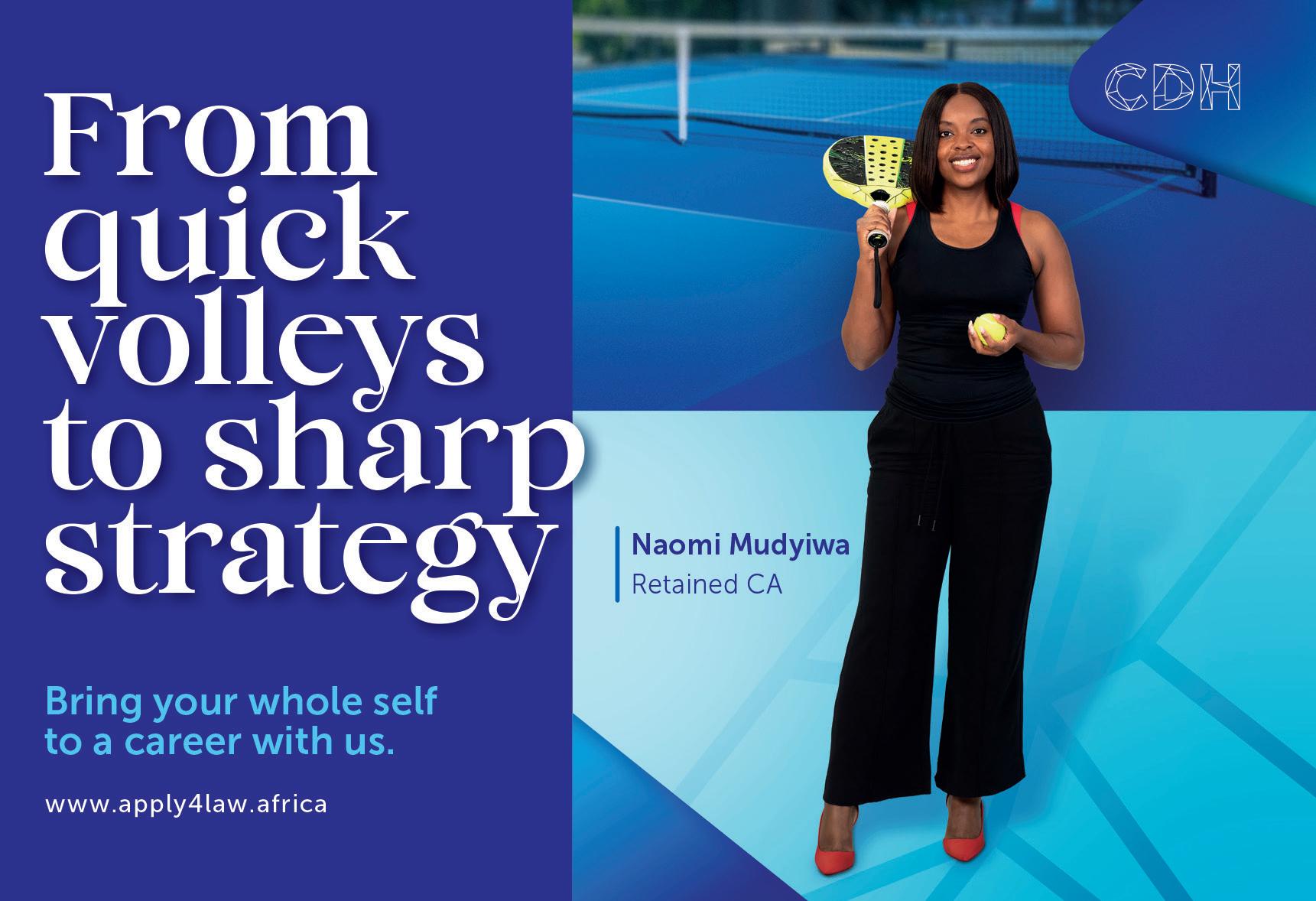
This includes a 24-month practical vocational training programme and equivalent pathways in the rm’s Kenyan and Namibian of ces.”
The rm has also developed multiple entry points to support aspiring legal professionals at different stages of their journey. Vacation programmes provide early exposure to the legal environment, while bursaries support promising students in their academic pursuits. For high school learners, job-shadow initiatives offer a rst glimpse into the profession.
Over time, the programmes have evolved with both the rm’s growth and broader industry changes. This includes the integration of technology-driven learning, mentorship and more sophisticated approaches to assessing potential.
“Each graduate works with a principal who acts as a mentor during their training, monitoring progress and providing professional advice,” says Maholo.
“After each rotation, formal feedback is provided – this approach creates a supportive environment where graduates feel equipped,
connected and con dent as they navigate their careers.”
Olivia Timothy, head of HR at CDH, emphasises that graduate employability is about more than securing a rst job.
“A successful graduate programme addresses the experience de cit,” she explains. “Through rotational exposure, supervised learning and clearly de ned development pathways, graduates acquire both technical competencies and workplace acumen within a supportive environment.”
These programmes also play an important role in promoting equitable access to opportunity. Transparent selection processes and standardised training frameworks create more inclusive entry points into the profession,
particularly for candidates from historically disadvantaged backgrounds.
Importantly, the bene ts extend beyond individual participants. For organisations, investing in graduate development is a strategic imperative. At CDH, the impact of this investment is both measurable and far-reaching.












“Over the past three years, more than 80 per cent of our CAs have been retained as associates,” says Timothy, who highlights that a signi cant proportion of CDH senior associates, directors and practice leaders began their careers through its graduate pipeline. CDH has a strong track record of developing leading legal talent across the UK, Europe, and beyond. In the South African market, its legacy is particularly evident with many of its alumni now serving as heads of legal across



major corporates. In these roles, they play a pivotal part in strengthening organisational governance, enabling strategic growth and contributing to the economy.”
In 2026 alone, the recent promotions of equity partners, salaried directors, counsel and senior associates, demonstrates the firm’s commitment to transformation in the legal sector. Beyond talent retention and progression, the programme has also contributed to meaningful transformation within the firm. CDH places a strong emphasis on developing female leadership. Women within the firm are not only visible across senior ranks at the firm, but also actively empowered as key decision-makers at board level, shaping strategy, guiding business priorities and influencing the direction of our firm. This is a marked shift from the legal landscape two decades ago.
At a broader level, CDH’s approach reflects an understanding that developing young talent is not simply about filling immediate vacancies. It is about building a pipeline of professionals equipped to navigate complexity, contribute
to the economy and shape the future of the profession.
“Leading firms like CDH occupy a privileged position in the legal ecosystem, and with that privilege comes a significant responsibility,” Nkuna says. “This is not merely a matter of corporate social responsibility; it is a strategic imperative and a higher call to impact society responsibly, not just make a profit.”
Ultimately, “greatness” in this context is defined not by scale, but by impact. It is reflected in the quality of the professionals CDH develops, the opportunities it creates, and the extent to which its graduates go on to make meaningful contributions – within the firm, across the legal sector and to society.
As Timothy advises, resilience is more than “toughing it out”. “It’s about treating feedback as a tool for growth, adjusting course where necessary and continuing to move forward even when progress feels slow. These are the characteristics we seek to instil in our graduates.”
Prospective applicants are invited to apply through CDH’s online portal at www.apply4law.
africa, where they are required to submit a comprehensive CV, motivational letter, matric certificate and full academic records.

Seth Mazibuko, one of the 1976 protest leaders, reflects on Youth Day’s legacy and calls on today’s generation to protect and grow the promise of liberation. He spoke to BUSANI MOYO
Fifty years ago, on 16 June 1976, apartheid-era police opened fire on young people in Soweto protesting the government’s decision that they had to be taught in Afrikaans. The tragic image of a dying Hector Pieterson opened the world’s eyes to the regime’s brutality. This day became the genesis of Youth Day in democratic South Africa. Half a century later, as the nation reflects on the sacrifices of the 1976 generation, a critical question arises: What is the defining struggle of the youth today, and how does it compare to the battles fought exactly 50 years ago?
To understand the evolution of South Africa’s youth movements, we spoke to former Soweto youth leader Seth Mazibuko. Born in Orlando, Soweto, Mazibuko was just 16 when he helped plan and lead the 1976 uprising.
Arrested in July 1976, he endured eighteen months of solitary confinement before being sent to Robben Island for seven years. Looking back, Mazibuko views the South African youth struggle as a continuum of phases, beginning with psychological liberation and evolving into today’s fight against social decay.
For Mazibuko, the overlap between the youth of 1976 and today is rooted in one fundamental issue: education. “The struggle of 1976 was born of the 1960s Black Consciousness Movement,” he explains. It was a fight for psychological liberation against an education system that introduced self-hate and undermined black identity. When the apartheid state attempted to impose Afrikaans as the medium of instruction, the youth drew a strict line. “When students tried to fight the introduction of Afrikaans, they were met with bullets,” he recalls. “The struggle of 1976

“FEES MUST FALL WAS A REMINDER TO THOSE IN PARLIAMENT THAT WHAT WE WERE FIGHTING FOR HAS NOT YET BEEN ACHIEVED.”
– SETH MAZIBUKO
became the battle of the book versus the bullet.” Driven by a unified, fearless spirit, this young generation ultimately brought apartheid education to its knees.
However, the circumstances and mindsets of today’s youth differ drastically. Mazibuko points out that the 1976 era was community-driven and untethered
from political parties. As the struggle transitioned into the 1980s and '90s, political infiltration fractured this unity, breeding painful divisions. When democracy arrived in 1994, the struggle shifted from the bullet to the ballot. This is where the generational disconnect began. “Those who were in the struggle of the bullet and blood now had to be busy with the ballot,” Mazibuko notes. Activists transitioned into parliament and corporate business. “While the struggle for education was continuing, those in parliament forgot about the trenches.”
This political amnesia gave birth to the modern youth’s response: the Fees Must Fall movement. “Fees Must Fall was a reminder to those in parliament that what we were fighting for has not yet been achieved,” Mazibuko states. Modern youth are still demanding a decolonised, high-quality education that empowers rather than undermines. Yet, without the unified ideological purpose of the 1970s, many of today’s young people face what Mazibuko critically calls “social pathologies”. Burdened by staggering unemployment, a deep sense of hopelessness has crept in. “Many fell into the unemployment sector, which saw them turn to drugs, alcohol and other forms of social pathology,” he laments.
What can today’s youth learn from the giants of 1976? Mazibuko urges a bold return to self-reliance and community unity. “We can only achieve social cohesion when black people reconcile with themselves and empower themselves,” he advises. Over 50 years, Youth Day’s profound meaning has drastically changed; it is no longer just a memorial, but a call to action. Mazibuko captures this shift in a beautiful metaphor bridging the generations: “The youth of 1976 watered the tree of liberation with their blood. The challenge for the current generation is to protect and grow the tree with their sweat, ensuring everyone enjoys the fruits it produces.”
Follow: The Seth Mazibuko Foundation www.linkedin.com/in/seth-mazibuko-713a361a
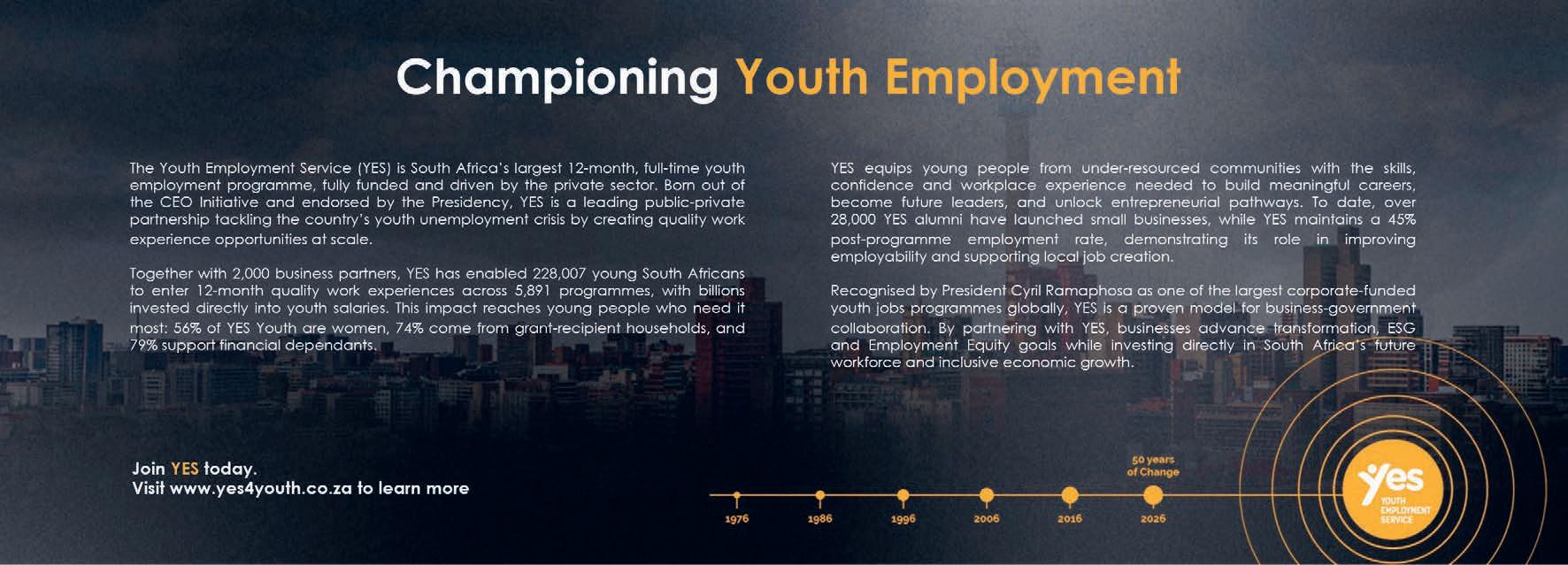
Young people need adaptability as a skill if they are to succeed in the workplace of the future, writes ADITI LACHMAN, head of youth programmes for Youth Employment Service

The world of work is changing faster than our education systems can track, which means preparing for a single career or a fixed set of skills is, paradoxically, one of the least effective strategies a young person can adopt today. The most important shift is to think about careers as journeys rather than destinations.
The World Economic Forum’s (WEF’s) Future of Jobs Report 2025 confirms what we see at Youth Employment Service (YES) every day: by 2030, 170 million new jobs will be created globally, while 92 million will be displaced. The net gain is a positive 78 million roles, but these will look very different from the ones that disappear. Young people who can adapt will ride the crest of this wave.
Adaptability comprises several components.
Analytical thinking is the number one core skill employers seek, with 7 out of 10 rating it as essential, according to the WEF. This means showing, in an interview or in the workplace, how you’ve applied knowledge, solved a
problem or made an impact. Simply put, the shift is from credentials to capabilities. Closely related is digital and artificial intelligence (AI) fluency. Technology is no longer just a tool; it’s a co-worker, a thinking partner, a source of competitive advantage. The WEF reports that AI and big data literacy is the fastest-growing skills category, with 87 per cent of employers identifying it as increasingly important.
– especially those from disadvantaged backgrounds, who often carry significant additional pressures and responsibilities – need to understand themselves, their strengths and their communication style. Confidence needs to be cultivated deliberately, and often with structured support.

What can government and the private sector do? For governments, there is an urgent need to reform education systems to keep pace with a world that is changing quarterly. That means integrating digital tools into classrooms, rethinking “computer literacy”, and creating space for the type of applied, critical thinking employers value.
This doesn’t mean every young person needs to learn to code. Instead, they need to understand how to work with AI, ask it the right questions and leverage it to think and act faster. The person who knows how to use AI well will have a significant edge over the one who doesn’t.
THE SKILLS GAP IS A MOVING TARGET, AND THE MOST FUTURE-PROOF THING ANY YOUNG SOUTH AFRICAN CAN DO NOW IS BECOME SOMEONE WHO KNOWS HOW TO KEEP LEARNING.
There is, however, a counterintuitive flipside to this: human skills are becoming more valuable. As AI takes on more of the routine, rule-based work, great employees will be distinguished by their ability to communicate clearly, collaborate meaningfully, lead with empathy and navigate complex interpersonal environments. Here, self-awareness becomes foundational. Young people entering the workforce
It also means acknowledging that microlearning – yes, even the TikTok-style, bite-sized format – is a legitimate learning modality, provided it is paired with the ability to evaluate and apply what is learned.
For corporates, as job roles evolve and new titles emerge, companies must invest in upskilling and reskilling their workforces, including young people. Hiring a young person and placing them in a static role without investing in their development is a missed opportunity. Linking training investment to actual employment outcomes, rather than funding enrolments and qualifications in isolation, will produce far better returns.
This is exactly where YES is trying to make a difference. Our partnership with Microsoft is among the most tangible examples: through the YES x Microsoft AI Skills Initiative, YES provides access to globally recognised, exam-based AI certifications – free of charge – across pathways in cybersecurity, data engineering, AI operations and more. These are not aspirational credentials. They are the certifications our corporate partners are actively hiring for.
The skills gap is a moving target, and the most future-proof thing any young South African can do now is become someone who knows how to keep learning.
Follow: Adita Lachman www.linkedin.com/in/aditilachman
Green skills training is essential to address the dual challenges of the youth unemployment crisis and the transformation of our economy into a sustainable one, writes ANTHONY SHARPE
Across South Africa, training initiatives are equipping young people with green economy skills while confronting the challenge of retaining scarce talent locally.
Nature Connect has been instrumental in offering accredited pathways to green employment, such as the NQF4 Youth in Nature programme. “As so often happens, particularly in industries such as services and nature conservation, there are greater opportunities for advancement when one has a formal accreditation,” says CEO Dr Anthony Roberts He cites the example of a young woman who was released from prison and given an opportunity to join one of the organisation’s green skills development programmes. “On completion, she joined a project with us during which time she also completed her Nature Conservation qualifications at the NQF4 level. After several project opportunities, she landed a permanent position as a field ranger. Moreover, because of her leadership and devotion to conservation, she became a training supervisor for other young women conservationists.”
Nature Connect also works with youth in rural areas, which presents challenges, including substantially increased transport costs.
“We are looking to leverage digital platforms to deliver some of our training in a hybrid fashion, but remain conscious of the potential technology gaps,” says Dr Roberts.

“Our experience of working with youth from rural areas shows them to be more eager for the opportunities presented, which is evident in their overall presenteeism, reliability and pride in presenting themselves and the organisation.”
feed their needs into the system. Then we get our tertiary institutions to develop programmes around those needs.”
Dr Sean Kruger, who heads up the Green Talent cluster at the University of Pretoria’s Centre for the Future of Work, says the programme has the potential to move the needle, but only if it practically considers employment prospects. “The PowerUp and Just Energy Transition employment programmes need to look at what you can do with the training after the programme. We shouldn’t just train people for the sake of it; they need to be ready for careers after that.”

“THE TRICK IS TO MAKE SURE THESE HIGH-LEVEL SKILLS DON’T LEAVE THE COUNTRY. WHEN LOOKING AT THESE KINDS OF SKILLS, THE CHALLENGE ISN’T UPSKILLING; IT’S RETAINING THE GREEN TALENT.”
– DR SEAN KRUGER
A collaboration between the Energy and Water Sector Education and Training Authority (EWSETA), the Department of Higher Education and Training, the Department of Mineral Resources and Energy, and a host of other stakeholders, PowerUp aims to close critical renewable-energy skills gaps and provide practical work experience to marginalised youth. Successes include its electric-vehicle pilot at West Coast TVET College and new certifications in solar and hybrid technology.
“We want PowerUp to become a hub for skills,” says Deputy Minister of Electricity and Energy Samantha Graham-Maré. “It’s a demand-led programme, so companies and municipalities
The University of Pretoria’s Centre for the Future of Work collaborates with industry and government to align curricula with evolving digital needs, focusing on upskilling, reskilling and policy development. Dr Kruger says a big challenge is addressing the stigmas attached to vocational work by both students and employers. This is creating a disconnect, he says, because the green economy needs people with skills in construction, electrics, plumbing, fabrication, carpentry and the like. “At the end of the day, not everyone can get a degree. The bigger picture of the Just Energy Transition is looking at programmes to develop practical skills.”

As far as the higher-level green skills go, Dr Kruger says the pipeline looks healthy, with collaborations between Norway, Germany, the Netherlands and South Africa sharing green hydrogen skills, for example.
“The trick is to make sure these high-level skills don’t leave the country. When looking at these kinds of skills, the challenge isn’t upskilling; it’s retaining the green talent.”
Technical and vocational training is reshaping pathways to employment by linking education, industry needs and hands-on apprenticeship opportunities, writes LEVI LETSOKO
Technical training that is focused on STEM (science, technology, engineering and mathematics) is the foundation of every technical and skilled trade. Rooted in developing critical thinking, nurturing problem-solving skills and upholding technical understanding, STEM training builds creative capacity.
Africa Skills’ Joshua Visser says electricians must understand electrical theory and measurements, and plumbers need to understand water pressure systems and material properties.

He adds that STEM subjects build the analytical skills artisans need to diagnose problems and design plans around implementing the solutions.
“We focus on equipping learners with practical, job-ready skills through accredited vocational programmes focused on in-person training and work-integrated learning models,” says Visser.
“Specialities include electrical, millwright, plumbing, welding, boiler making, carpentry and mechanical trades, alongside trade test preparation and testing, not only for employment, but also for entrepreneurship,” he adds.
He notes that technical skills are in short supply. Whether it is to help repair a post-harvest storage facility for a farming operation in an electricity-stressed remote village, or to help restore water supply by fixing underground water pipes, addressing skills shortages automatically aligns challenges faced by communities with homegrown solutions.
Visser says public-private partnerships aim to promote artisan development. He believes more artisan development programmes are needed to produce tangible results for
participants and enable them to plough these skills back into their immediate environments by attending to service delivery issues, such as water provision, electricity maintenance, waste management and environmental care.
Through UXI Artisan Development, CEO Elsie Harmse has made available industry-designed and QCTO-accredited learning programmes that lead to tangible employment.
She encourages learners with a strong STEM foundation to join these programmes, as they will find it easier to blend into the physical world of technical work.
“A solid STEM foundation accelerates both learning and employability in technical fields. We are building skilled professionals who are ready to contribute from day one,” she says.
Harmse acknowledges that there has been progress, but maintains it is not sufficient to meet the current skills demand in the technical skills deployment space.
She insists that skilled trade is in high demand and continues to offer higher pay to unemployed young people.
BluLever Academy co-founder Jess Roussos is making sense of the high unemployment numbers among the youth in an economy lacking skilled participation by that age group. She believes the system is not aligned with the realities on the ground.
Roussos doesn’t believe that more training programmes can solve the equation. She insists that better alignment of available training resources can yield more positive outcomes.

“The demand is there, across infrastructure, housing, energy and maintenance. But the system has often been too theoretical, too fragmented, and too far from industry,” she says.
“So, you end up with people who’ve ‘done the training’ but aren’t actually work-ready. And, employers who still can’t find the skills they need,” she adds.
“We directly bridge the gap between education and employment by aligning our training with industry needs. By incorporating workplace experience, we produce graduates who are ready to enter the job market,” she adds.
She insists that the country urgently needs more skilled artisanal professionals, suggesting that there has not been sufficient uptake of STEM students into the programmes on offer.
BluLever Academy has placed more than 600 apprentices over a four-year period, and the academy has built relationships with 200 employers who are eager to absorb candidates graduating from the academy.
Roussos boasts that 89 per cent of her graduates are active participants in their local economies, highlighting that this sector requires replication of working methods with systematic intent to empower locals to sustain livelihoods while ensuring their communities benefit from their skills.
“THE DEMAND IS THERE, ACROSS INFRASTRUCTURE, HOUSING, ENERGY AND MAINTENANCE. BUT THE SYSTEM HAS OFTEN BEEN TOO THEORETICAL, TOO FRAGMENTED, AND TOO FAR FROM INDUSTRY.”
– JESS ROUSSOS

South Africa must prioritise digital literacy, turning technology access into real economic opportunity and capability. By DUMI MANGANYE , Advtech Schools specialist: college and academic data
With economies becoming increasingly digital, the question facing education systems is not whether young people need technological skills, but which skills will matter most in a fast-changing, globally competitive world.
The answer is not coding, robotics or any single platform. It is digital literacy, the ability to think critically, solve problems and use technology effectively in unfamiliar and evolving contexts.
In a world where tools change rapidly, the real competitive advantage lies in adaptability. Young people must be able to evaluate information, identify misinformation, learn new technologies independently and apply digital tools to real-world challenges. Without these capabilities, access to devices risks becoming superficial, providing connectivity without competence.
For South Africa, this distinction is critical.
The country has made progress in expanding access to technology in education, but access alone does not translate into improved outcomes. Too often, the focus remains on inputs, devices, connectivity and platforms, rather than on whether learners are developing the skills required to succeed beyond the classroom.
This is where digital literacy must be reframed as a core educational outcome, on par with reading and numeracy.
At its core, digital literacy enables learners to:
• Navigate and critically assess information in a complex digital environment.
• Use technology to solve problems and create solutions.
• Collaborate effectively in digital spaces.
• Engage responsibly and ethically online. These are not optional skills. They are foundational to participation in a modern economy.
From a policy perspective, developing these capabilities requires a shift from fragmented initiatives to a more systemic approach.

First, digital literacy must be embedded across the curriculum rather than treated as a stand-alone subject. When integrated into everyday teaching and learning, it becomes practical, contextual and measurable.
Second, teacher capability must be prioritised. Technology does not transform education; teachers do. Without sustained investment in professional development, even the most advanced tools will have limited impact. Educators must be
equipped not only to use technology, but also integrate it meaningfully to enhance learning outcomes.
Third, infrastructure and access remain essential enablers. Persistent challenges, such as high data costs, inconsistent connectivity and unequal access to devices, continue to limit progress, particularly in underserved communities. Addressing these barriers is necessary to ensure digital literacy development is inclusive rather than reinforcing existing inequalities.
Finally, accountability through data is key. Schools and systems must move beyond measuring access to measuring impact, tracking how digital literacy develops over time and how it translates into improved academic performance and long-term outcomes.
Encouragingly, there are examples within the private sector where digital literacy is being embedded as part of a broader, data-informed education strategy. These models demonstrate that when digital capability is developed intentionally, supported by teacher training, structured frameworks and ongoing assessment, it can significantly enhance both learner engagement and performance.
At Advtech, this approach is embedded through a structured focus on digital literacy across all phases of schooling, supported by ongoing teacher development and the use of data to track learner growth over time. By integrating digital skills into everyday teaching and learning, rather than treating them as an add-on, schools can build deeper, more transferable competencies that prepare learners for both academic and real-world success.
However, scaling this impact requires collaboration between government, the private sector and civil society. No single stakeholder can address this challenge alone.
Ultimately, South Africa’s ability to compete in a global economy will depend on the skills of its people. Digital literacy is the bridge between access and opportunity.
If the country is serious about improving education outcomes and unlocking economic potential, it must move beyond simply providing technology and focus on building the capabilities that allow young people to use it effectively.
The future will not be defined by those who have access to technology, but by those who know how to use it to think, create and problem-solve.
Follow: Dumu Manganye www.linkedin.com/in/dumi-manganye-9b95195a
For
young people facing an uncertain future, earning money is not enough – knowing how to manage it is just as critical, writes
VUKANI MAGUBANE
South Africa, where many young people enter adulthood without the tools to manage money, financial literacy is increasingly seen as a foundational life skill rather than a nice-to-have.
Budgeting, saving and understanding debt can shape whether a young person builds stability or falls into financial vulnerability – making early financial education critical. Foundations such as Junior Achievement South Africa (JA) and Prescient Foundation are working to close this gap.
According to JA South Africa executive director Nelo Phihdile Spies, the organisation’s programmes are designed to equip young people with the skills to make informed financial decisions –whether managing their first salary, starting a business or navigating everyday expenses.
beyond. Programmes such as My Money Biz and the flagship JA Company Programme allow learners to apply financial skills while running their own businesses.

“It’s about equipping young people to make informed financial decisions,” she says. Practical skills, such as budgeting, saving, critical thinking and entrepreneurial thinking, are prioritised, alongside resilience and decision-making.”
JA believes financial education is most effective when taught through hands-on, real-world experiences that begin in primary school and continue through high school and
Out-of-school initiatives, including the Youth Enterprise Development Programme, integrate financial education into entrepreneurship training, preparing young people to participate more effectively in the economy.
“We embed financial education into all our entrepreneurship initiatives because money management is inseparable from the skills needed to create and sustain value,” says Spies. “The most impactful programmes combine theory with practice. Learners don’t just learn about money; they actively manage it.”
Nicole Pinto, CEO of the Prescient Foundation, says the organisation’s partnership with School of Savings South Africa is now in its second year, reaching 6 schools in Durban and more than 1 000 Grade 10 learners. The 18-month programme has been adopted by the Department of Education as part of the Life Orientation Curriculum.
“Schools teach young people how to make money, but not necessarily how to manage it. We want to shift that mindset early.”
She adds that perception remains one of the biggest challenges.
“Many students believe financial literacy is only for people who already have money. They ask, ‘How do we save when we don’t have?’
Overcoming that mindset – and the culture of instant gratification – is a critical part of the process.” Feedback from the learners has been encouraging, with them saying they understand that you need to save before you spend.
The Prescient Foundation highlights several behavioural shifts among participants, including:
• Improved decision-making and the development of a savings mindset.
• Greater understanding of delayed gratification.
• Increased awareness of debt and its long-term implications.
These lessons are already translating into tangible changes. Learners are opening bank accounts, applying for identity documents and engaging their families in conversations about money. Teachers and parents are also adopting the concepts, extending the impact beyond the classroom.

“THE MOST IMPACTFUL PROGRAMMES COMBINE THEORY WITH PRACTICE. LEARNERS DON’T JUST LEARN ABOUT MONEY; THEY ACTIVELY MANAGE IT.”
– NELO PHINDILE SPIES
“The School of Savings develops the curriculum content, while Prescient invests in the programme and adds motivational talks, debates, quizzes and speech contests to keep learners engaged,” Pinto explains. “This ensures that financial education isn’t just theoretical; it’s interactive and practical.”
Pinto emphasises the importance of reaching learners before they earn their first income.
The work of JA South Africa and the Prescient Foundation reflects a broader shift in how financial literacy is being approached – not as abstract theory, but as a practical, everyday skill. From classrooms to community programmes, financial literacy is starting to move out of textbooks and into real life.
For many young people, it’s the first time money feels less like a source of stress and more like something they can understand and control. “Ask for help and don’t fall into the trap of thinking you’re behind because you don’t know. Understand your circumstances, and don’t be afraid to budget,” Pinto says.
In a tough economic climate, that shift in mindset may be one of their most powerful tools.
Young South Africans have the ideas, but what they need are stronger systems to turn them into thriving businesses, writes ITUMELENG MOGAKI
South Africa’s youth are widely recognised for their entrepreneurial spirit, yet turning ideas into sustainable businesses remains a challenge. Across the ecosystem, organisations working closely with young entrepreneurs are increasingly aligned on one point: talent is abundant, but the systems required to support growth are still falling short.

For Dr Reabetswe Kgoroeadira, CEO of Regenesys School of Entrepreneurship, the real issue lies in the gap between innovation and scale. “South Africa does not have a youth talent problem; it has a systems gap. Our work is to connect youth innovation to funding, markets and global scale,” she says.
Young entrepreneurs, Dr Kgoroeadira explains, are actively developing solutions, particularly in technology, but often struggle to move beyond early-stage prototypes.
“Without access to funding, mentorship and commercialisation pathways, many promising ideas fail to reach the market.”
Regenesys, she adds, focuses on building a structured journey that takes entrepreneurs from ideation to global competitiveness.
At the SAB Foundation, executive director Sarah Mthintso echoes the need for more holistic support.
“Young entrepreneurs face a mix of structural and practical barriers that make it difficult to build sustainable businesses. Limited access to markets and networks often intersects with challenges around compliance and financial management, slowing growth even for promising ventures. In underserved communities, infrastructure constraints further complicate matters, making it harder for businesses to operate efficiently and scale beyond their immediate environment.”
Mthintso says the foundation’s model focuses on supporting entrepreneurs who are already operating, combining financial backing with hands-on mentorship and business development.

“Funding alone is not enough. Entrepreneurs need the tools, guidance and access required to translate potential into sustained business growth,” Mthintso says.
One such example, Mthintso says, is Omphemetse Ranoto, founder of Pheme Everlast, whose journey began with a small poultry operation in her grandmother’s backyard. With structured support, she has grown the business into a large-scale operation supplying thousands of broilers weekly, while also expanding her workforce and mentoring other women to start their own ventures. Her story reflects how targeted support can create both business growth and community impact.
From a financial sector perspective, Mbali Phewa, executive head of transformation at Nedbank, places youth entrepreneurship within the broader context of economic
Follow: Sarah Mthintso www.linkedin.com/in/sarah-leneisang-mthintso-3475b83
Larisha Naidoo www.linkedin.com/in/larisha-naidoo
Keotshepile Jonathan www.linkedin.com/in/keotshepile-mamsy-jonathan-a03011204
Mbali Phewa www.linkedin.com/in/mbali-phewa-4386b835
Regenesys School of Entrepreneurship www.linkedin.com/company/regenesys-school-of-entrepreneurship Phemeverlast www.phemeverlast.co.za
inclusion. “Structured, end-to-end support enables youth-owned enterprises to move from survivalist businesses into sustainable, growth-oriented ventures,” Phewa says.
“Without exposure to practical business experience and financial systems, it becomes difficult for young people to build competitive enterprises. Nedbank’s programmes aim to address this by combining skills development, mentorship and financial support, enabling entrepreneurs to formalise their businesses and access new opportunities.”
At Anglo American Zimele, vice president Larisha Naidoo says small businesses need big business to support and nurture them, and that without intentional integration into supply chains, growth remains limited.
“While many young entrepreneurs bring innovation and technical ability, gaps in financial management, business planning and compliance often hinder long-term success. Besides funding, breaking into established markets and supply chains continues to be a significant challenge.”

Through enterprise development and supplier programmes, Anglo American Zimele works to address these barriers by providing mentorship, facilitating access to finance and creating opportunities for businesses to enter corporate value chains. This integrated approach, Naidoo says, helps entrepreneurs move beyond informal trading into more sustainable, growth-oriented enterprises.

Naidoo highlights the journey of Keotshepile ‘Mamsy’ Jonathan
After starting with a single vehicle, she built a growing transport business and established herself in a competitive industry. “With our support, she has navigated compliance challenges and expanded her market reach, positioning her business for further growth.”
Why South Africa must invest earlier to prepare the youth for a changing world. By THE LEARNING TRUST
In January 2026, South Africa celebrated a record-breaking 88 per cent matric pass rate, the highest in the country’s history. It was a moment of national pride. Yet within months, many of those same young people would join the nearly 45 per cent of youth who are not in employment, education or training. The celebration fades quickly when the pathway ahead does not exist. Many young people leave school with a matric qualification but without the skills or experience to navigate what comes next. This is the pathway gap – a structural disconnect between education and opportunity that becomes visible in the labour market, but begins much earlier in a child’s learning journey.
In South Africa, nearly one in three learners who start school do not make it to matric.
Those who do often leave without the practical experience, foundational skills or networks needed to transition into further study or work. Employers, meanwhile, report a mismatch. Too few candidates demonstrate the capabilities required for entry-level roles, regardless of qualifications.
According to the Progress in International Reading Literacy Study (PIRLS), 8 in 10 children in South Africa cannot read for meaning. For learners in under-resourced quintile 1–3 schools, this early disadvantage compounds over time. By the time it appears in unemployment statistics, the gap has already been a decade in the making.
Take Siphesihle, who grew up in Orange Farm, one of Gauteng’s most under-resourced communities. With limited access to formal employment, she entered an after-school programme as a facilitator. Through structured training and mentorship, she built the skills and confidence to establish her own early childhood development centre. Today, she is creating learning opportunities for children while generating employment in her community. Her story is not an exception. It is a pattern.
At The Learning Trust, we work at the

intersection of education, youth employment and organisational development. With a national footprint across South Africa’s under-resourced communities, we partner with government, civil society and the private sector to build after-school infrastructure that improves outcomes for learners and creates pathways for young people entering the workforce.
After-school programmes (ASPs) are among the most effective and most overlooked levers in South Africa’s education and employment landscape. These structured, community-based spaces reinforce literacy and numeracy, build social and emotional skills and keep learners engaged beyond the classroom. When learners receive consistent, quality support early, they are more likely to stay in school, progress through grades and arrive at the matric threshold with the foundations needed to make meaningful choices about their next steps.
Critically, ASPs also create economic participation. Through public employment programmes such as the Social Employment Fund, nearly 20 000 young people have been
employed as tutors, facilitators and coaches within ASPs. They receive training across more than 150 skills areas, building technical and professional capabilities while contributing directly to improved learning outcomes.
ASPs are not just an education intervention. They are a socioeconomic strategy that addresses both the skills deficit in classrooms and the experience deficit in the labour market.
South Africa cannot afford to treat the pathway gap as inevitable. It is a structural challenge with a scalable solution, but only if we invest with intention. We are calling on government, business and the private sector to act together:
Government must formally recognise ASPs as a core component of education and youth development, supported by sustained, dedicated funding and a national policy framework.
For business, the case is immediate. Partnering with organisations that have the community’s trust and the track record to deliver impact is not a philanthropic gesture. It is a strategic investment in the future workforce upon which South Africa’s economy depends.
Closing the pathway gap is not optional. It is a business imperative.

For more information: www.thelearningtrust.org charlene@thelearningtrust.org Contact: 078 401 9540
From enterprise funding to job placement platforms, organisations are tackling youth unemployment through a connected system of support, skills and access, writes
VUKANI MAGUBANE
Youth unemployment continues to cast a long shadow over South Africa, but foundations are stepping in to build pathways to employment opportunities for young people who need them most.
Rather than relying on a single solution, organisations are tackling the challenge from different angles. Some are funding businesses that can create jobs, others are building employment opportunities directly, and some are working to connect young people to existing jobs. Together, these approaches reflect a broader shift: job creation is a system, not a single intervention.
ENABLING JOBS THROUGH ENTERPRISE
For Old Mutual’s Group Social Investment (GSI), job creation begins with supporting businesses that employ people.

“At the core of Old Mutual’s job creation are three flagship initiatives – the Masisizane Fund, the Old Mutual Foundation’s education programme, and the Enterprise and Supplier Development Fund. Together, these have invested billions of rand to support small and medium enterprises, empower women and youth, strengthen teaching and generate thousands of sustainable jobs across South Africa,” says Ndumiso Zulu, GSI’s CEO. The multipronged approach is based on a multiplier effect, tackling job creation from different angles. When businesses and education systems are strengthened, they create both employment and skills that ripple across communities, he adds.
BUILDING JOBS THROUGH PROGRAMMES
Some organisations are taking a more direct approach, creating employment opportunities through programme-led interventions. The Lulalab Foundation focuses on combining
AS SA YOUTH, JOB SEEKERS CAN REGISTER, BUILD PROFILES AND BE MATCHED TO OPPORTUNITIES WHILE EMPLOYERS GAIN ACCESS TO A BROADER, MORE INCLUSIVE TALENT POOL.
skills development with real work opportunities.
“South Africa’s youth unemployment rate sits at 45.5 per cent for those aged 15 to 34. For 15- to 24-year-olds, it is over 60 per cent. Behind those numbers are millions of young people ready to work, but who cannot find the pathway in,” says Palesa Mopeli, the foundation’s relationship manager.
For Harambee Youth Employment Accelerator, the challenge is not only the number of jobs available, but who can access them.
Harambee works with government, business and civil society to connect young people to opportunities at scale.

“Our partners, who are committed to results that can work at scale, include government, the private sector, civil society and over five million youth,” says Zengeziwe Msimang, Harambee’s chief communications officer.
Through platforms such as SA Youth, job seekers can register, build profiles and be matched to opportunities while employers gain access to a broader, more inclusive talent pool.

Programmes such as LulaRides, which trains and deploys youth as delivery drivers, and LulaBPO, which develops contact-centre and digital services talent, are designed to link training directly to employment.
The impact is not only economic, but also personal. Nokuthula, 22, from Soweto, says: “I didn’t just get a job. I got my confidence back.”
Scaling these initiatives depends on partnerships with employers, training bodies and corporates, aligning skills development with real demand.
“To date, Harambee has supported more than three thousand businesses to fill entry-level roles, often helping young people access work for the first time,” she says.
Taken together, these approaches show that job creation is not driven by one solution alone. Funding businesses, building employment programmes and connecting young people to opportunities each address different parts of the problem.
Without capital, businesses cannot grow. Without targeted programmes, skills may not translate into work. And, without access, opportunities remain out of reach.
From enterprise funding to job placement, these efforts are beginning to reshape how employment is created and accessed. For many young people, the impact is not just about securing a job, but also gaining a foothold in the economy – often for the first time. In a tough labour market, that foothold can make all the difference.
Follow: Nudmiso Zulu www.linkedin.com/in/ndumiso-zulu-308a7832 Palesa Mopeli www.linkedin.com/in/palesa-mopeli-1451a116b Zengeziwe Msimang www.linkedin.com/in/zengeziwe-msimang-44b36a34

FIONA KAPLAN, dean of the Faculty of Law at Emeris, explores preparing graduates for modern, strategic and evolving legal careers
For many people, a career in law still conjures up images of courtrooms, working on lengthy case files, litigation between opposing parties and steely glances at opposing counsel across the boardroom table. Advocacy and dispute resolution remain central to the profession, but the work of today’s legal practitioners increasingly extends far beyond traditional legal practice.
Across South Africa’s economy, organisations are navigating a growing web of regulation, governance requirements and emerging legal questions tied to technology, finance and public policy. As a result, legal practitioners are increasingly called upon to advise businesses and help leaders make informed strategic decisions.
This shift has also prompted debate about how legal education prepares graduates for the realities of modern practice. A national review of the LLB qualification by the Council on Higher Education highlighted concerns that some programmes were too heavily focused on theoretical knowledge, and recommended stronger emphasis on practical capability, ethical training and broader professional competencies.
Against this backdrop, private higher education providers have increasingly positioned themselves as alternative pathways into the legal profession. Emeris, for example, reports graduating a significant number of law students each year, with a large proportion entering employment within their first year after completing their studies.
LEGAL PRACTITIONERS ARE INCREASINGLY CALLED UPON TO ADVISE BUSINESSES AND HELP LEADERS MAKE INFORMED STRATEGIC DECISIONS.
FUTURE PRACTITIONERS NEED TO
IN COMMUNITIES AND POLICY SPACES AS THEY ARE IN FORMAL LEGAL SETTINGS, AND THAT IS A KEY FOCUS IN THEIR LEGAL STUDIES.
This evolution reflects the changing expectations placed on legal professionals. Where legal practitioners were once primarily focused on interpreting legislation or litigation, they are now increasingly expected to assist organisations in decision-making at the intersection of law, business and society. As a result, many are becoming strategic advisers who help organisations navigate complex and multifaceted challenges.
While dispute resolution and courtroom advocacy remain an important part of the profession, much of today’s legal work takes place in advisory roles. Legal practitioners may assist companies with regulatory compliance and corporate governance, labour frameworks or, for instance, guidance on new legal questions arising from digital platforms, artificial intelligence, data protection and evolving financial regulation.
In fact, many legal practitioners work closely with executives or corporations, engineers, financial professionals and policy specialists responsible for developing and interpreting regulatory frameworks to interpret how legal frameworks apply to real-world operations. This reality means that legal practitioners are increasingly expected to understand the industries they advise and not just the legal rules that apply to them.
As the profession continues to evolve in this way, legal education is also expected to follow suit, preparing students for a wider range of career pathways while grounding them in the constitutional principles that underpin South Africa’s legal system.
The role of legal experts is shifting, and so too are the careers they can pursue with qualifications such as a Bachelor of Arts in Law or a Bachelor of Commerce in Law and the Bachelor of Laws (LLB) degrees. These programmes, particularly in the manner they are designed at Emeris, combine legal studies with broader disciplines, such as business, psychology and communication, to help students understand the contexts in which law
According to 2025 Legal Practice Council statistics, South Africa has 34 967 practising attorneys, of whom 18 587 (53.16 per cent) are black practitioners and 15 996 are women. However, only 5 172 black women attorneys are currently practising in the country, highlighting ongoing transformation and representation challenges within the legal profession. Sources: Legal Practice Council (2025); Law Society of South Africa profession statistics
operates and better prepare them for a broader range of specialisations.
Practical exposure to the profession is also becoming a key part of legal training. At Emeris, students have access to simulated courtroom environments designed to mirror real legal proceedings, where they can practise courtroom etiquette, legal argumentation and trial preparation through both moot and mock court sessions. These simulations form part of a broader effort to equip students with the practical thinking and problem-solving skills expected in professional legal environments.
Students also have the opportunity to participate in one of five community law clinics that provide free legal assistance to members of the public who may otherwise struggle to access legal services. In South Africa, where more than half of the population lives below the poverty line and eligibility for state-supported legal aid is limited by strict income thresholds, initiatives like these can help broaden access to justice and support for vulnerable communities.
Students also engage in community-focused learning that exposes them to the social role of law, and they come to learn the importance of access to justice and the protection of rights in South Africa’s constitutional democracy.
The legal profession is still fundamentally about protecting rights and advancing justice, but the way that work is done is evolving. Future practitioners need to be as comfortable in communities and policy spaces as they are in formal legal settings, and that is a key focus in their legal studies.
Ultimately, a legal qualification opens more than a single career path and involves adopting a way of thinking that can be applied across a range of sectors and settings. While the core purpose of the profession remains the protection of rights and the pursuit of justice, the environments in which legal practitioners operate are expanding into business, policy, technology and public interest contexts. This requires graduates who can move beyond technical interpretation of the law and apply it in practical, problem-solving ways that respond to real-world complexity, whether in formal legal practice or in broader roles that support fairness, accountability and informed decision-making.
Follow: Fiona Kaplan www.linkedin.com/in/fiona-kaplan-3074b514/
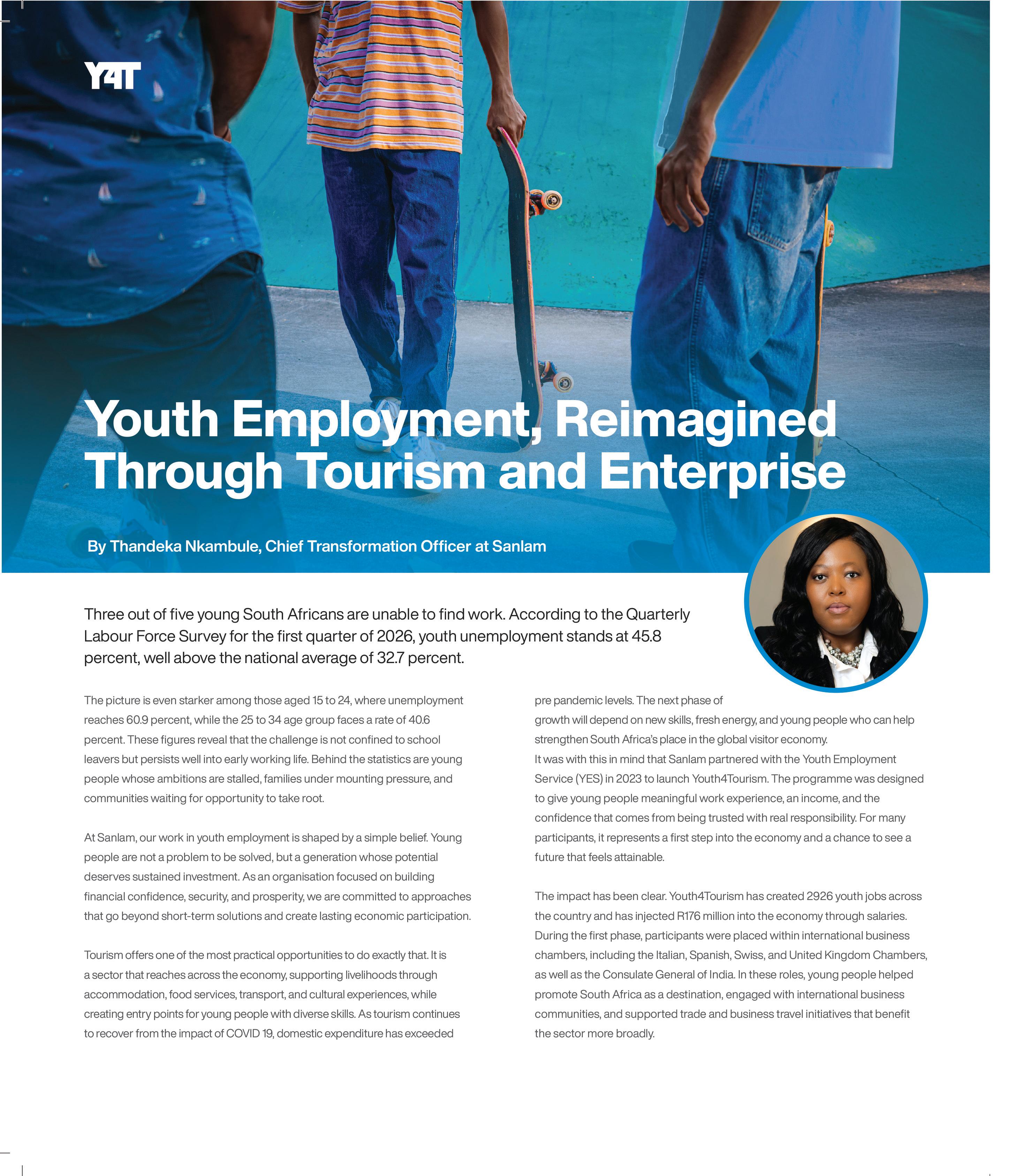
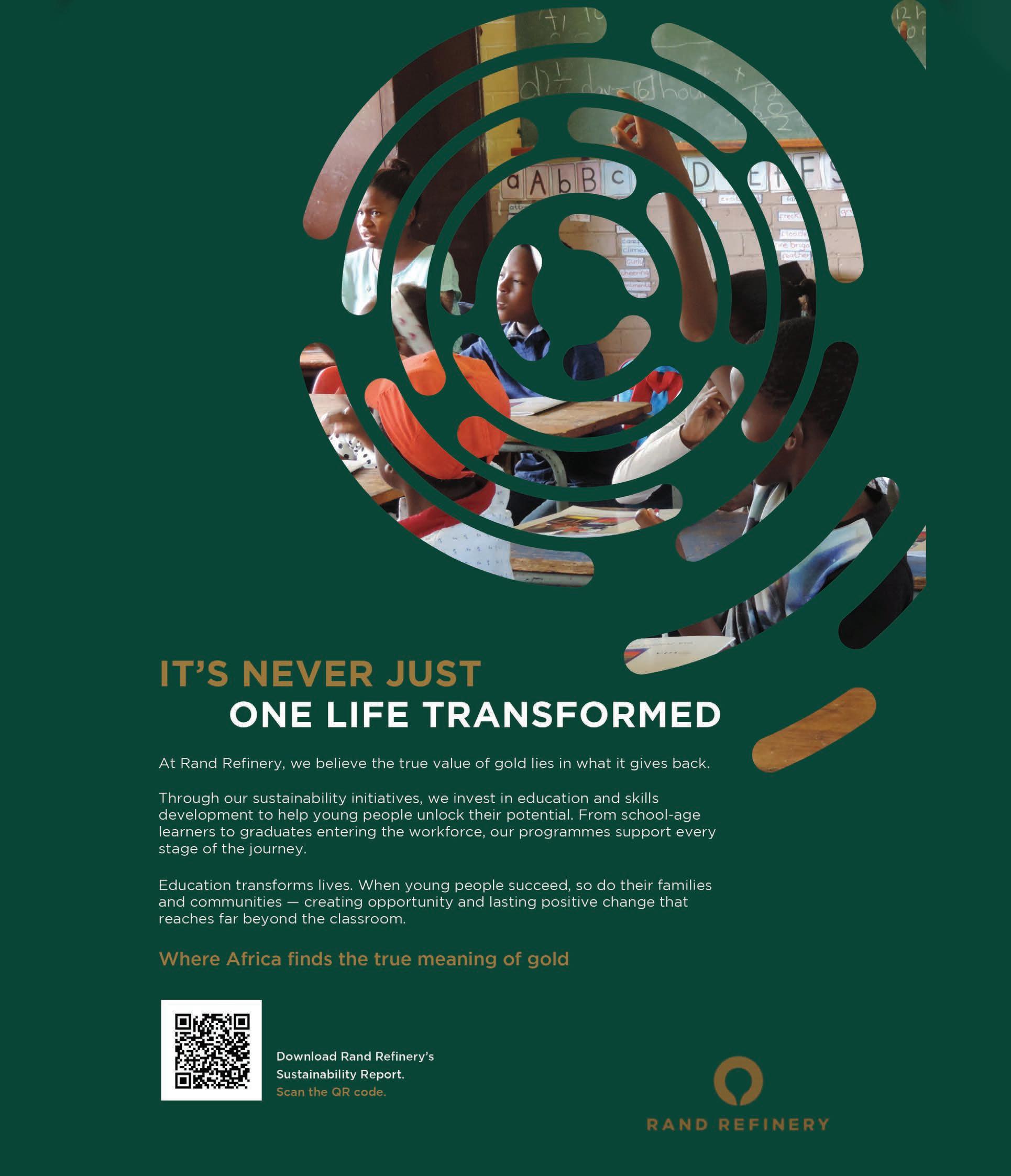
Youth Day reminds us that the nation’s future depends on building a more inclusive tomorrow. Within the mining and metals value chain, Rand Refinery leads by example through its unwavering commitment to supporting youth, investing in education, advancing skills development and nurturing community growth. Rand Refinery’s investment in people goes beyond corporate responsibility; it is part of our role in supporting national renewal. By equipping young South Africans with the skills, support structures and industry insight essential to excel, the refinery is laying the foundation for innovation, productivity and broad-based growth across the economy.
The World Bank reports that basic education in South Africa faces a growing financial challenge, as sectoral budget allocations have declined over the past few years, and the education system needs to accommodate an additional 1.2 million learners by 2030. It says the basic education system’s ability to deliver good outcomes efficiently is undermined by low-quality teaching and insufficient accountability. Equally worrisome is that the government’s pro-poor funding mechanism for education is failing to achieve its objective.
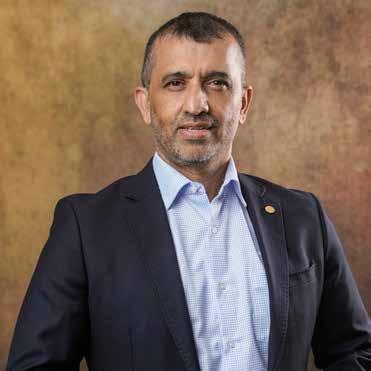
In addition, the company donated resource libraries, STEM (science, technology, engineering and mathematics) textbooks and study guides, valued at nearly half a million rand, to eight secondary schools across four provinces. The refinery’s sought-after STEM tutoring programme in Ekurhuleni, now in its second year, provides tutoring opportunities for unemployed graduates. These targeted interventions are designed not only to meet immediate needs, but also to spark a lifelong passion for learning, technology and innovation –critical drivers of economic advancement and social progress.
“Our commitment to community development is about creating lasting opportunities that strengthen communities, expand access to education and empower individuals to build more secure and sustainable futures,” says Rand Refinery CEO Dean Subramanian
Rand Refinery’s vision for youth empowerment is therefore holistic. By fostering workplace exposure and artisan development in a highly specialised sector, the refinery creates pathways to employment and leadership across the mining and metals value chain.
Rand Refinery’s impact in this space is intended to extend well beyond the classroom, driving broad, practical and enduring change. The company recognises that education is the cornerstone of sustainable, positive change. In 2025 and 2026, the refinery intensified its support for 14 underprivileged primary and secondary schools across Ekurhuleni, Gauteng, Mpumalanga, the Free State, Limpopo, KwaZulu-Natal and the Eastern Cape. By distributing 1 200 educational resource packs, complete with essential learning materials, backpacks and school shoes, Rand Refinery ensures that thousands of learners have a fair and deserved chance of success.
Engineers in training, commercial graduates, apprenticeships and learnerships provide hands-on experience in state-of-the-art environments, while internships and bursaries open doors to advanced study and career development. Including commercial students in the bursary scheme ensures that future leaders are as adept at business strategy as at technical excellence.
“Education remains one of the most powerful drivers of dignity, inclusion and long-term economic participation,” notes Subramanian.
Rand Refinery recognises that the future of South Africa’s industrial economy depends on a workforce equipped with world-class technical expertise and agile, innovative mindsets. Through a suite of initiatives, including technical training, artisan development, apprenticeships, learnerships, internships and bursaries, the refinery is cultivating a talent pipeline to meet the demands of a globally significant sector.
Since launching its bursary scheme in 2023, Rand Refinery has awarded 189 bursaries, investing R17-million to help young South Africans pursue technical and commercial qualifications aligned with the refinery’s core business. The growth is striking, from 10 bursaries in 2023 to 94 in 2026, and the settlement of historical debt for 50 tertiary students in 2025 (18) and 2026 (32). These bursaries are reserved for high-performing candidates – recipients must maintain a 70 per cent aggregate.
At a recent recognition ceremony, Rand Refinery celebrated 62 outstanding students across 5 categories, including full and partial bursaries, NATED bursaries, apprenticeship bursaries and top matriculants. “We look forward to witnessing their academic growth, their future contributions to the South African economy, and their emergence as leaders in their chosen fields,” said Subramanian.
As we celebrate Youth Day, Rand Refinery is a beacon of what is possible when business, education and community collaborate to build a brighter, more equitable future. The company’s leadership, expertise and firm vision are inspiring a generation to take on the future with confidence and lead South Africa forward.

South Africa’s youth face a changing job market where skills, networking and strategy matter most. Learn how graduates can stand out and succeed. By
CATHY MACHINGAIDZE ,
a
partner at Redi Holbourne Group
Placing candidates into employment is no longer a straightforward exercise. The rules have shifted due to evolving work models and intensifying global competition for scarce skills.
The post-pandemic workplace reshaped expectations around exibility. Remote and hybrid work became standard almost overnight, but many employers are now reverting to full-time in-of ce arrangements. This reversal is creating friction, as candidate expectations no longer always align with organisational policy.
At the same time, South Africa is increasingly competing with global markets for high-demand talent, particularly in nance, legal, risk and technology. Employers are no longer choosing from a local talent pool alone; they are benchmarking skills globally.
The result is a simple but uncomfortable reality: demand for jobs is far higher than supply.
The traditional “apply everywhere” approach is no longer effective. Volume has been replaced by precision. Graduates and job seekers must shift to a skills- rst strategy. Employers prioritise candidates who demonstrate practical capability, not just quali cations.
Key actions that make a measurable difference include:
• Targeted applications only: apply only when you meet most of the requirements,
and tailor every CV and cover letter to the role. Generic applications are easily dismissed.
• Skills over qualifications alone: short, certi ed online learning (Coursera, Udemy, and similar platforms) helps demonstrate job-readiness beyond a degree.
• Digital and tech fluency: foundational skills in AI prompting, data analysis and basic coding are fast becoming baseline expectations, not advantages.
• Work experience in any form: temporary, freelance and contract roles should not be avoided. They build networks, income stability and often convert into permanent employment.
• Soft skills matter more than ever: adaptability, emotional intelligence and critical thinking are critical in workplaces increasingly shaped by automation.
• Strategic networking is non-negotiable: LinkedIn is not optional. Pro les must be optimised with keywords and used actively to connect with decision-makers, not just apply for jobs.
• Informational interviews create access: short “coffee chats” with industry professionals often unlock insights and referrals that job boards cannot.
• Visibility on job platforms: pro les must be active and updated on trusted platforms such as CareerJunction, PNet and SAYouth.mobi.
• Graduate programmes and structured pathways: initiatives such as YES and NYS provide critical entry points into the labour market.
• Experience-building through contribution: nongovernmental organisation work, volunteering or industry association involvement strengthens credibility and signals reliability.
• Entrepreneurial thinking: side hustles, such as tutoring, freelancing or e-commerce, build transferable skills while job searching continues.
Across sectors, including nance, legal, risk, compliance, digital technology, IT, HR, company secretarial, marketing and actuarial science, recruiters are prioritising experienced, job-ready candidates that require minimal onboarding.
Recruitment today is no longer just about placement; it is about preparation.
A signi cant part of the process involves coaching candidates on interview-readiness, from understanding a company’s structure and culture to aligning personal experience with role requirements.
Yet one of the most persistent gaps remains preparation. Candidates often under-research organisations, weakening their interview performance before they even enter the room. Presentation also still matters, particularly in face-to-face interviews where grooming and professionalism in uence perception.
Another recurring issue is poor CV quality. Hiring managers are not expected to “decode” applications. If experience is unclear or poorly structured, the CV is often disregarded within seconds.
The modern job market does not reward effort alone; it rewards strategy. Success now depends on targeted applications, relevant skills, active networking and consistent personal branding.
For graduates, job searching is no longer a sprint for quick wins. It is a deliberate, long-term strategy that requires discipline, adaptability and positioning in a highly competitive global talent economy.















POLYCO, a large South African Producer Responsibility Organisation, is on a mission to strengthen the country’s plastic recycling industry through investment in recycling collection, infrastructure, research and education
Funded through its members’ Extended Producer Responsibility (EPR) fees, the organisation works to divert plastic waste from landfill, create jobs, support innovation and strengthen the country’s circular economy.
Polyco’s investment in recycling education, from primary school through to tertiary level, is helping build the skills, behaviours and opportunities needed for a more inclusive circular economy. That matters not only for environmental outcomes, but also for long-term economic growth, as young people become active participants in cleaner communities, stronger recycling systems and future green jobs.
One example is Polyco’s partnership with the Western Cape Department of Environmental Affairs and Development Planning (DEA&DP), through which, with the support of its members, the organisation has expanded the iThemba Phakama 4Ps partnership to 31 schools across the province, including 14 additional low-income and no-fee schools in the 2026 rollout. The programme combines recycling education, practical infrastructure and community participation, while promoting recycling at source and helping young people recognise waste as a valuable resource.
Learners collect recyclable materials from their schools and households and bring them to school-linked recycling hubs where that material becomes both a teaching tool and a source of value. Schools are paid for the recyclables they collect, creating an additional income stream that can be reinvested into school priorities and infrastructure improvements.
The 2026 rollout is expected to reach more than 13 700 learners and over 380 educators, while supporting 28 jobs across participating communities. Since its launch, the programme has collected more than 40 tonnes of recyclables and reached over

30 000 learners and more than 900 educators across participating Western Cape schools.
Patricia Pillay, CEO of Polyco PRO NPC, says: “This programme is about shaping mindsets early. When children learn about recycling from a young age, those lessons extend beyond the classroom into their homes, their communities, and ultimately into the future of our country’s circular economy.”
Polyco is extending this model beyond the Western Cape. In collaboration with one of its members, Venk-Pak, the organisation recently activated a recycling education programme across five primary schools in Tongaat, KwaZulu-Natal, showing how member-supported partnerships can create practical, community-based impact in more parts of the country. The participating schools have been linked to the recycling value chain through the Packa-Ching collection network, helping ensure that the infrastructure introduced is supported by an ongoing sustainable recycling system.
Packa-Ching, Polyco’s mobile collection network, creates additional meaningful opportunities for young people by incentivising participation in the collection phase. Operating primarily in low-income informal areas, where waste collection is often limited, Packa-Ching provides community members of all ages with the opportunity to sell their collected recyclables and contribute to their household as well as the upliftment of their neighbourhood.
Polyco’s broader education footprint also continues to grow nationally through collaborations with local municipalities and through the Million+ Schools Programme, in partnership with the Pick n Pay School Club. Together, the programme has reached approximately 2 million learners and more than 90 000 educators across over 2 600 schools nationwide.
By educating learners from a young age, Polyco is helping build a culture of environmental responsibility while giving future consumers, workers, entrepreneurs and leaders a practical understanding of recycling and waste separation. Children take these lessons home, influencing household behaviour and strengthening separation at source, which is essential for more efficient collection and recycling systems. Over time, this kind of early intervention helps grow the skills base, public participation and demand needed for a stronger green economy.
Polyco’s investment in youth development also extends to tertiary education and skills development. In 2026, the organisation invested R600 000 through the AEL Bursary Programme at the Academy for Environmental Leadership SA, supporting five students enrolled in the AEL Conservation Ecology Higher Certificate Programme, and helping prepare future professionals for the environmental and waste management sectors.
Polyco’s work demonstrates how EPR regulations can be effectively implemented in practice. By collecting and reinvesting EPR fees from participating members, the organisation is delivering tangible environmental benefits while simultaneously unlocking social and economic value.

For more information: www.polyco.co.za
Young people in South Africa are facing serious mental health issues. Organisations working with affected youth unpack these – and suggest solutions. By
GLYNIS HORNING
The prevalence of mental health disorders in South Africa is a serious problem for young people, says Leon de Beer, deputy director of the SA Federation for Mental Health (SAFMH). “However, it is surmounatable should government come to the table, take ownership of their roles and responsibilities, and act in the interest of building mental health.”

Mpadi Makgalo, CEO of HEAL-SA, adds: “From our perspective, it’s a systemic crisis that is currently out of control, but fundamentally fixable. We are dealing with a massive ‘treatment gap’, where roughly seventy-five per cent of South Africans living with a mental disorder do not receive any form of care.”
“It’s a growing challenge, yet mental health still gets a very small slice of the national health budget,” says Lyn Labuschagne, project manager at the South African Depression and Anxiety Group (SADAG). “A lot of that goes into inpatient care rather than prevention and early support, so we are not catching young people early enough. Many communities don’t have access to the help they need, and nongovernmental organisations and helplines end up carrying much of the load.”
All three organisations report a significant rise in anxiety and depression. “Many young people are grappling with issues of identity, self-worth and belonging, with social media often intensifying feelings of comparison, inadequacy and isolation,” says Labuschagne. “These are constant, overwhelming feelings that can be difficult to put into words.
Heartbreakingly, suicide remains one of the leading causes of death among young people.”
“The most prevalent issue we see is the ‘hopelessness cycle’,” says Makgalo – chronic anxiety creates overwhelming fear and exhaustion, which fuels profound feelings of worthlessness and depression. “It’s rooted in the NEET (Not in Education, Employment or Training) reality. When a young person looks at the youth unemployment rate, future-focused anxiety is a rational response. We see a heavy reliance on ‘avoidance coping’ – social withdrawal or ‘doomscrolling’ on social media to escape reality.
“We also see intergenerational trauma. Many young people carry the weight of their parents’ communities’ past traumas –violence, poverty and systemic exclusion. This manifests often as ‘high-functioning anxiety’, where a student works themselves to exhaustion to be the first in their family to succeed while internally battling a sense of impending collapse.”

failing, rather than a health condition, says Makgalo.
“Normalise the conversation,” she urges. “Shift from asking ‘How was school?’ to ‘How did you feel today?’, creating safe spaces for disclosure before a crisis occurs. Listen actively without judgement – often young people stop sharing because they fear being ‘fixed’ or lectured. Parents need to be the first line of emotional safety, not just providers of material need.”

Stigma makes everything harder, adds de Beer. “NEET youth often face quiet (or not so quiet) judgement from family and communities, making asking for help feel shameful rather than brave.”
The greatest barrier in South Africa is often the generational gap, where many parents view mental struggle as a lack of resilience or a spiritual
Parents should also learn to recognise the signs of common mental health issues like depression and anxiety and seek help early, says de Beer. Signs include persistent sadness or irritability, social withdrawal, loss of interest in activities, significant changes in sleep/appetite and complaints like frequent headaches or stomach aches. Anxiety often manifests as excessive worry, clinging or avoidance of school/social situations. Schools also need to step up. “Emotional intelligence and coping mechanisms should be integrated into Life Orientation as core, examinable skills,” says Makgalo. “Schools can establish peer-support programmes, and train ‘Mental Health Ambassadors’ among learners for early detection and peer-led destigmatisation. We must move from a curative mindset to a preventive one, building resilience while young people are whole.”
FOR MORE INFORMATION AND SUPPORT, CONTACT:
SAFMH: www.safmh.org, 011 781 1852, info@safmh.org
SADAG: www.sadag.org, 0800 567 567, SMS 32312
HEAL-SA: www.heal-sa.org.za, 010 880 3334, WhatsApp 066 323 6869, heal@heal-sa.org.za
Follow: Leon de Beer www.linkedin.com/in/leon-de-beer-84019122b Mpadi Makgalo www.linkedin.com/in/busisiwe Lyn Labuschagne www.linkedin.com/in/lyn-labuschagne-b945a5147
Our youth need a route to quality higher education to build a sustainable future, writes DR SIEGIE BROWNLEE , CEO of Eduvos
Youth Month is a time to remember the courage of young South Africans who helped shape our country’s future. However, remembrance must also come with responsibility. What are we doing today to ensure young people have real pathways into education, employment and economic participation?
For many young South Africans, the desire to study after school remains strong. The challenge is often access, affordability and confidence that higher education will lead somewhere. This is where higher education has a critical role to play. A qualification should directly open doors to opportunity, confidence, social mobility and work readiness.

At Eduvos, we believe youth empowerment begins with access to quality higher education, but it cannot end there. Students need relevant curricula, strong support systems, exposure to industry, practical experience and the confidence to navigate a changing world of work.
In 2025, more than 21 000 students were enrolled in Eduvos qualifications registered on the Higher Education Qualifications Sub-Framework, with more than 23 000 participating across formal programmes, access and bridging programmes and short courses. Nearly 90 per cent of our students were aged 18 to 24, placing the institution at the centre of South Africa’s youth development agenda.
Our national access model includes 12 campuses, online, hybrid and contact learning, multiple intake opportunities and flexible academic pathways. Higher Certificates, bridging programmes, Recognition of Prior Learning and credit transfer mechanisms all
help create more than one route into higher education. This matters because young people don’t all arrive with the same academic, financial or personal circumstances. Access, however, is only meaningful if students are supported to succeed. Between 2024 and 2025, Eduvos’ institutional pass rate improved from 80.5 to 85.9 per cent, even as participation increased. This reflects the work being done across academic delivery, student support and progression monitoring to help students move through their studies with confidence.
Employability is where the promise of higher education becomes visible. South Africa needs graduates who can think critically, work with technology, communicate effectively, adapt to change and apply knowledge in real workplace contexts. In 2025, 74 per cent of Eduvos graduates transitioned into employment or further study, increasing to 78 per cent among accessible graduates. In a constrained labour market, this is a significant indicator of the value of relevant, future-fit higher education. Workplace exposure plays a big part here. More than 1 150 Eduvos students completed structured work-integrated learning placements across over 750 host companies. In information technology (IT), project-based learning, capstone assessments and applied development tasks expose students to real industry challenges in areas such as software development, cybersecurity, cloud computing and data analytics. This focus is particularly important in the digital economy. In 2025, 40.4 per cent of Eduvos students were
enrolled in IT programmes, making us a meaningful contributor to South Africa’s digital skills pipeline. These capabilities will shape competitiveness, innovation and youth employment in the years ahead.
Partnerships strengthen this work. Eduvos collaborates with professional and industry bodies to support relevance, credibility and alignment with professional expectations. Career fairs, employer engagements, industry-linked projects and professional affiliations help connect students to the world beyond the classroom.
However, youth empowerment isn’t only academic or professional. Today’s students are navigating financial stress, social pressure, family responsibilities and mental health challenges in a hyperconnected world. Higher education institutions must recognise this reality, which is why Eduvos’ wellness ecosystem includes counselling, wellness events, webinars, workshops, student-led campaigns, peer support networks, Wellness Ambassadors and the Peer Enrichment Programme. Through our partnership with the South African Depression and Anxiety Group, students have access to free, confidential mental health support.
As for financial access, in 2025, Eduvos supported 891 funded students and secured R63.2-million in student funding. Importantly, 84 per cent of funded students were African, showing the role financial support plays in widening access and supporting transformation.
Young people have always been central to South Africa’s future. Our responsibility as educators is to ensure today’s youth are not left with aspiration alone, but with credible pathways to build that future.

Follow: Eduvos https://www.linkedin.com/school/eduvos/ www.eduvos.com
A practical guide to choosing between private practice and in-house law, unpacking the realities, pressures and rewards of each path. By JENNA PIETERSE, senior legal advisor, MANDISA MNGADI, legal advisor, both at The Spar Group Ltd, and TIM FLETCHER, litigation attorney and presently chairman at Cliffe Dekker Hofmeyr
Each year, newly admitted legal practitioners nd themselves at a crossroads where ”two roads (diverge) in a yellow wood” (with apologies to Robert Frost), and they are not ready to choose. To the left, a law rm – long hours, natty suits and the intoxicating promise of partnership. To the right, a corporate legal department – business casual, xed salary and a parking bay that does not need 200 billed hours monthly to justify its existence. Both roads lead to a life in the law. However, pick the one that ts you poorly and a few years in, you will experience a particular kind of existential dread. This article is an attempt to help you avoid that moment or, if this guide comes too late, to con rm that you are not alone.
The most obvious difference is the relationship with time. In a law rm, time is the product. Every six minutes is one unit, tracked obsessively. Time spent not working isn’t rest; it is lost income. A quiet Tuesday afternoon isn’t a blessing; it’s a crisis.
In-house counsel are salaried, which immediately distinguishes them from their private practice counterparts –and occasionally makes those counterparts uneasy. There are no six-minute units and no billable targets, but that doesn’t mean time is meaningless. It’s just measured differently. Value shows up in problems that never materialise, deals that survive scrutiny and situations that quietly improve after legal gets
OPINION, EACH BILLING ITS OWN TIME.
involved. Nobody applauds a crisis that never happened, but the business often runs more smoothly because someone in-house spotted the issue early.
Not having to glance nervously at the clock during coffee may sound liberating, and it might be, but if your time is not generating revenue, you are an overhead.
And, every chief nancial of cer will tell you enthusiastically that overheads exist only to be reduced. You cannot invoice the board for “preventing the company from doing something catastrophically stupid”. There’s no time recording code for that.


Mandisa Mngadi




The Greek poet Archilochus wrote that “the fox knows many things, but the hedgehog knows one big thing”. Private practice lawyers are hedgehogs. They burrow deep into a single

area – competition, tax, mergers and acquisitions, environmental – and they know it in detail, bordering on the obsessive. Ask a competition lawyer about vertical restraints and your afternoon is toast. Ask that same lawyer to look at a suretyship, and you may see genuine panic.
In-house counsel are foxes. They settle employment contracts before lunch, negotiate supplier agreements after it, and sit in board meetings commenting on everything from regulatory risk to IP strategy. The breadth is astonishing. The depth, by necessity, a bit more modest. They are generalists with
enough knowledge about each subject to know when they are struggling and to know when to call the hedgehog.
A lawyer in private practice, presented with a legally dodgy proposal, is allowed, in fact expected, to say “no”. The advice is delivered, the risks are explained. The invoice is sent, the le closed. Duty discharged. They may sleep soundly. The in-house lawyer has no such luxury. The commercial team is not interested in “no”. Nor is the CEO or the board. They are only interested in “how”. The in-house lawyer cannot only be an adviser, but also a problem-solver, a risk architect, a lter of the language of law into the language of commerce – nding a path through the legal jungle without leading the company into regulatory quicksand. This needs creativity and a tolerance for imperfection that would make many law rm partners really uncomfortable.
THE IN-HOUSE LAWYER IS EMBEDDED IN THE BUSINESS, AND WHEN THE BUSINESS MAKES A MISTAKE, THE IN-HOUSE LAWYER IS IN THE BLAST RADIUS.
If you derive satisfaction from knowing your speciality so thoroughly that you can anticipate every objection, private practice is your gig. You will need intellectual rigour, attention to detail and resilience under pressure. The technical work is only half the job. The other half is persuading your clients to follow advice they may not like. You will need the temperament of a marathon runner: disciplined, focused and willing to defer grati cation for years.
However, if you are energised by variety –solving fteen problems in a day rather than spending fteen days on one – you should be in-house. You should have the temperament of a decathlete: versatile, adaptable, willing to be pretty good at many things rather than brilliant at one. You will need commercial acumen, emotional intelligence in spades, and above all, judgement. You will often be the only legally trained person in the room, making calls without partner support down the passage. You must be comfortable being wrong occasionally because the deal timetable will rarely wait for certainty. Neither is better. Just different. Choosing without regard to t is like buying a Ferrari to do the school run, or a Vito to race at Kyalami. In private practice, integrity means giving honest advice even if it costs you the client. In-house, it means giving honest advice even if it costs you a promotion, or people quietly doubting your judgement.


In a law rm, transaction risk is parcelled out to specialist teams, each producing its own opinion, each billing its own time. Whether those answers come together as a workable strategy is the client’s concern. In-house, the lawyer personally owns the risk. When the regulator calls, there is no external rm to blame and no opinion letter to hide behind. The in-house lawyer is embedded in the business, and when the business makes a mistake, the in-house lawyer is in the blast radius.







In-house offers the satisfaction of the architect: broad, collaborative and connected to the nal product. Your advice translates into business decisions. The lifestyle is usually more predictable, the salary independent of fee performance. However, your advice will sometimes be ignored. And you will, from time to time, nd yourself in a four-hour “strategy workshop” that could have been an email.
Ultimately, the legal profession is large enough for hedgehogs and foxes, marathon runners and decathletes. The tragedy is that too many lawyers end up in roles that do not suit them because nobody told them, early enough, of the choices available. Don’t choose on vibes alone. Stop romanticising whichever one you haven’t tried yet, but if you have the opportunity, get a taste of both. Think about what oats your boat and what drains you. Whether you want to be the person who writes the opinion or the person who decides what to do with it. And then choose deliberately – a career in a role that doesn’t t you is just billable hours or meetings.

Private practice offers the deep and genuine satisfaction of the craftsman. You are called when the problem is genuinely dif cult. The nancial rewards are substantial, the prestige real. However, the hours are long, the pressure relentless, and the billable hour will haunt you.





Tim Fletcher



A new agritech pilot is empowering unemployed youth through microfarming entrepreneurship, tackling food insecurity and joblessness, writes MARC LUBNER , group CEO of Afrika Tikkun
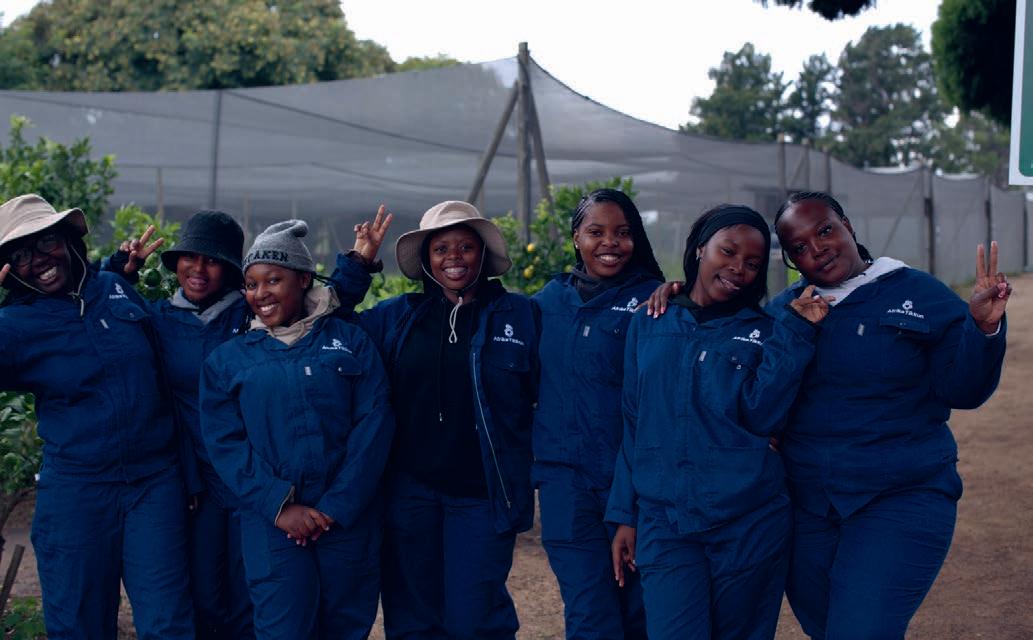
South Africa stands at a difficult intersection where youth unemployment and food insecurity are no longer separate challenges, but deeply intertwined structural realities. Addressing one without the other limits the impact. That is why new thinking is needed –approaches that combine skills development,
enterprise creation and local food production into a single, scalable pathway for young people to build sustainable livelihoods. In Diepsloot, Johannesburg, a new pilot initiative is testing exactly this proposition by developing unemployed youth into microfarming entrepreneurs.
microfarming enterprises using Hydro-Coop units designed for urban, rural and remote environments with limited infrastructure.
The Hydro-Coop unit is a smart farming system that integrates poultry production with hydroponic vegetable cultivation. These solar-powered units are compact, movable and use significantly less water than conventional farming systems. Crops are cultivated through sustainable, biodiversity-friendly methods, ensuring participants gain access to forward-looking agricultural skills aligned with future food systems.
The pilot began in February, with participants entering a structured practical development phase that blends training with live commercial activity. Since then, the cohort has completed programmes covering hydroponics, farm management and entrepreneurship, while simultaneously launching their own micro-enterprises. WHEN SKILLS DEVELOPMENT
A farming initiative, led by nonprofit organisation Afrika Tikkun and funded and supported by impact investor E Squared Investments, is positioning small-scale agritech as a viable start-up pathway for young people to earn an income, build sustainable livelihoods and contribute directly to local food security and broader economic growth.
Launched in May, the Green Acres Hydro-Coop programme at Afrika Tikkun’s Green Acres Farm in Diepsloot equipped a cohort of 20 trailblazers – 19 resilient young women and a determined young man with a disability – to operate revenue-generating
Arika Tikkun Agriculture is a purpose-driven agricultural development initiative that integrates skills training, enterprise development and commercial farming into a single, sustainable agrihub model.
Rooted in Afrika Tikkun’s Cradle-to-Career methodology, the initiative empowers young people and communities through accredited agricultural education, entrepreneurship development and access to sustainable livelihoods. By combining empowerment with commercial sustainability, Afrika Tikkun Agriculture is building a resilient agricultural ecosystem that drives food security, youth employment, inclusive economic growth and long-term community transformation across South Africa.
While agriculture remains one of South Africa’s key employment sectors, youth participation is still limited despite growing interest in agritech and entrepreneurship. Recent labour data shows the sector employs around 920 000 people nationally, with steady job gains in late 2025 driven by horticulture and field crops.
However, youth (aged 15–34) continue to face structural barriers, with overall youth unemployment still above 40 per cent, pushing policymakers and development programmes to actively target agriculture as an entry point for jobs and self-employment.
Source: Statistics South Africa’s Quarterly Labour Force Survey, reported in the Department of Agriculture labour updates, November 2025
Over the past four months of a twelve-month programme, participants have transitioned from training into early-stage entrepreneurship, actively building and operating their own agricultural businesses.
Afrika Tikkun has also established partnerships with Garden Fresh at Nine Yards, Joburg’s new green town square, alongside other retail outlets, to support the sale of produce. Participants will operate in a customer-designed retail space, gaining practical exposure to sales and customer service in parallel with their agricultural training. If programme targets are achieved, the 20 enterprises are projected to produce annually:
• 22 400 chickens.
• 60 000 vegetables.
• Approximately 228 000 meals.
• Up to 1.5 million litres of water savings. At the heart of this model is a simple yet often overlooked principle: when skills development is combined with sustained mentorship and real market access, agriculture shifts from subsistence activity to structured enterprise.

The intention is not only to equip young people to farm, but also to enable them to build viable businesses that can outlast the programme itself.
The first intake was intentionally structured as an almost all-female cohort, targeting women with limited access to formal employment or business opportunities. This design reflects broader economic realities, where women – particularly younger women – continue to experience higher unemployment rates, lower levels of business ownership and reduced access to start-up capital compared to their male counterparts.
Rather than placing participants into temporary work placements, the programme is structured around ownership, allowing participants to build and operate their own enterprises from the outset.
Within this framework, agriculture is positioned as a potential engine for job creation, entrepreneurship and community development. By providing access to infrastructure, practical training and market linkages, the programme aims to enable young people to establish viable businesses while simultaneously contributing to improved local food security. The longer-term ambition is to scale the model to reach significantly more young people across South Africa.
The Green Acres Hydro-Coop model forms part of Afrika Tikkun’s broader agricultural programming, which integrates training, enterprise development and
commercial operations to convert skills into income-generating activity. Agripreneurship is positioned as a critical pathway within the organisation’s Cradle to Career model, enabling unemployed youth to transition into entrepreneurship through structured support. One example of this pathway in action is the experience of participant Debra Dagada, who joined Afrika Tikkun’s agricultural learnership in Gauteng and completed an NQF Level 2 qualification in plant production. Following completion, she transitioned into entrepreneurship through Green Acres, launching her own farming operation with starter inputs, mentorship and technical support. She later secured independent land at Northern Farm in Diepsloot, moving from trainee status to operating as an independent farmer.
Service provider UrbanFarm Africa, a South African-based agritech and smart food systems business, reports that it has implemented 271 smart farming projects, trained more than 7 500 people and supported participating farmers in generating R250-million over five years.
From an investment perspective, E Squared Investments reinforces the importance of solutions that are both practical and enduring. As noted by Zakiya Khan, head of investments: social entrepreneurship at E Squared, the strength of the model lies in its focus on enabling young people to participate meaningfully in the economy –not only through skills development, but also through ownership and sustained income generation over time.
Afrika Tikkun is preparing to introduce a new cohort of 20 participants in 2027, with a long-term vision to scale the model across additional communities throughout South Africa.
SOS CHILDREN’S VILLAGES equips young people for the world of work, through its YouthCan and YouthLinks programmes
As we commemorate Youth Month, SOS Children’s Villages in South Africa reinforces the importance of investing in youth education, training and skills development.
SOS Children’s Villages is a nongovernmental organisation that offers family-like residential care for children and young people who have lost or are at risk of losing parental care. Established in 1984, SOS has seven Children’s Villages and three Social Centres across eight provinces, looking after more than 800 children and youth in its villages, and supporting thousands more through its community outreach programme, Community Family Empowerment (CFE).
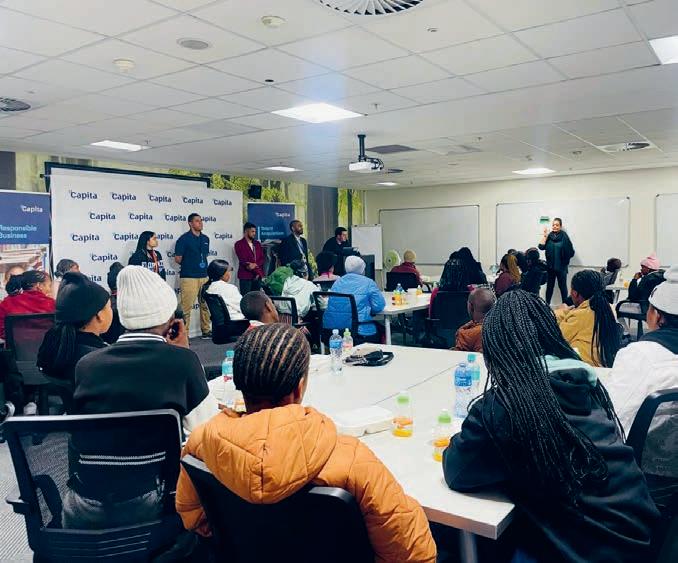
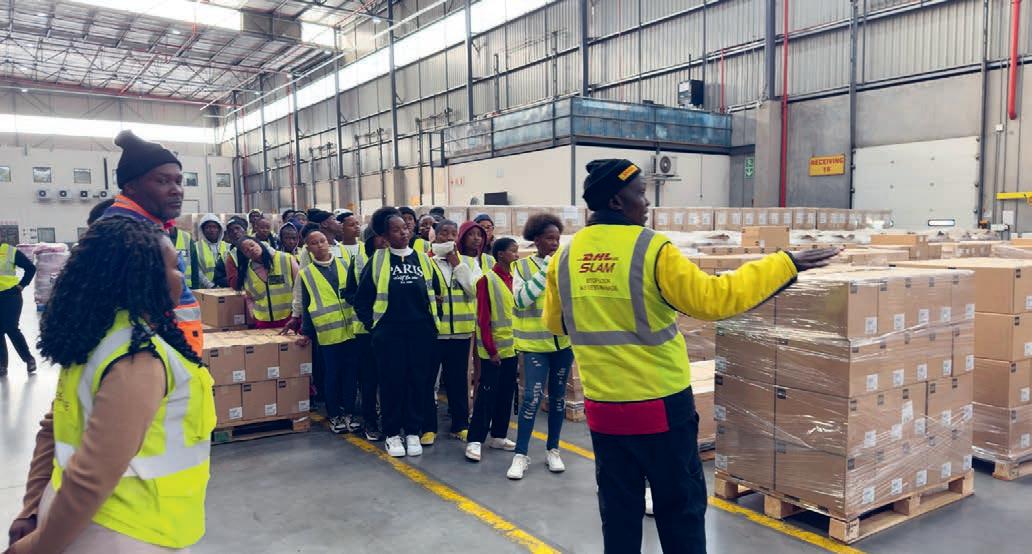
The CFE Programme aims to drive sustainable solutions that empower and enhance the capacity of communities and families to care for, support and protect children in community settings, and enable families to gain self-reliance. The mission is also to ensure children grow and thrive in environments that foster holistic development, and to empower youth to reach their full potential and eventually become self-reliant. We work in co-operation with local authorities and other service providers to empower families and communities to protect and care for their children effectively.
TRAINING AND MENTORSHIP
Through the YouthCan and YouthLinks programmes, SOS Children’s Villages partners with corporate companies to
VILLAGES
provide young people with exposure to vocational training opportunities and link them to mentors who can support them on their journey. They are provided with job-shadowing opportunities at different companies, and given learnership and internship opportunities. These programmes use the power of technology to provide training and mentorship opportunities, overcoming geographical and professional limitations.
Corporate partnerships are leveraged to support young people to manage the transition from school to independent adulthood successfully.
Corporate support and donors are needed to continue this important work. Please support SOS Children’s Villages by going to www.sossouthafrica.org.za, calling +27 11 234 8708, or send an email to info@sos.org.za