










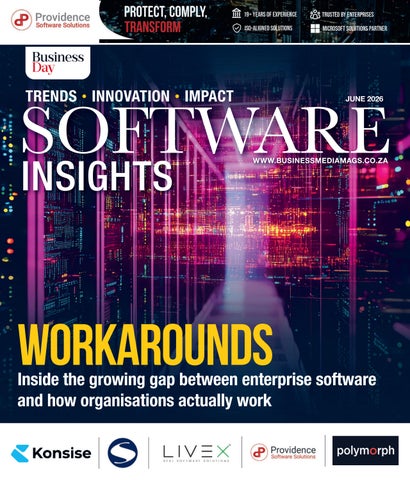

Inside the growing gap between enterprise software and how organisations actually work















PUBLISHED BY
Picasso Headline,
A proud division of Arena Holdings (Pty) Ltd, Hill on Empire, 16 Empire Road (cnr Hillside Road), Parktown, Johannesburg, 2193
PO Box 12500, Mill Street, Cape Town, 8010 www.businessmediamags.co.za
EDITORIAL
Editor: Brendon Petersen
Content Manager: Raina Julies rainaj@picasso.co.za
Contributors: Tiana Cline, Ituneleng Mogaki, Jaco Oosthuizen, Rodney Weidemann
Copy Editor: Brenda Bryden
Content Co-ordinator: Vanessa Payne
DIGITAL
Online Editor: Stacey Visser vissers@businessmediamags.co.za
DESIGN
Head of Design: Jayne Macé-Ferguson
Senior Designer: Mfundo Archie Ndzo
Cover Images: 123rf.com/ pikepicture
SALES
Project Manager: Tarin-Lee Watts
wattst@arena.africa
+27 87 379 7119
+27 79 504 7729
PRODUCTION
Production Editor: Shamiela Brenner
Advertising Co-ordinator: Johan Labuschagne
Subscriptions and Distribution: Fatima Dramat fatimad@picasso.co.za
Printer: CTP Printers, Cape Town
MANAGEMENT
Management Accountant: Deidre Musha Business Manager: Lodewyk van der Walt General Manager, Magazines: Jocelyne Bayer
COPYRIGHT: Picasso Headline.
Organisations have spent decades replacing spreadsheets with enterprise software, so why are so many people still using spreadsheets? Billions of rand are spent every year on enterprise resource systems, customer relationship management platforms, HR software and compliance tools. Implementations take months, sometimes years. Yet, in organisations across South Africa, the spreadsheet endures. People build workarounds. They maintain parallel records and nd ways around the systems that were supposed to make their working lives simpler. That's not a technology failure. It's a signal that something more fundamental is going wrong in how software is chosen, deployed and governed.
This is the rst edition of Software Insights, and we wanted to launch it by taking that question seriously. Not by reviewing products or ranking vendors, but by looking honestly at how software actually functions in South African organisations, across retail, manufacturing, logistics, healthcare, agriculture, government and private enterprise. What we found, consistently, is that the hardest problems aren't technical. They're human. Integration fails because nobody owns the decision. Adoption stalls because employees weren't part of the process. Data sits in silos because the incentives to share it don't exist.
Software shapes how work gets done, how decisions get made, and increasingly, how organisations survive. It deserves more rigorous scrutiny than it usually gets.
That's what we're here to provide.
Brendon Peterson Editor
6 POS, e-commerce and loyalty systems depend on middleware that is trusted by few and relied on by all.
7 ERP and manufacturing systems remain dif cult to implement and integrate; Fleet, routing, and warehouse platforms still operate unevenly across fragmented infrastructure.
8 RegTech and document automation tools are spreading across enterprise systems, but automation still has limits.
17 Enterprise platforms are built to centralise and automate, yet spreadsheets persist. The problem is rarely the software.
19 Farm management platforms and internet of things monitoring tools generate volumes of agricultural data that mostly can't talk to each other.
SOFTWARE STACKS
23 South Africa may be ready for AI, but its network infrastructure is inadequate for AI complexity and data volume
24 Healthcare data remains siloed by legacy systems, weak integration and vendor lock-in.
25 Integrated EdTech platforms improve insight and learning outcomes; Disconnected government systems continue to weaken service delivery.
26
create data gaps, weaken decisions and increase risk across recruitment, payroll and workforce management.
INTEGRATED PLATFORMS
insuretech, wellbeing and employee engagement will drive productivity, greater ef ciency and sustainability.



Retail is evolving into a fully integrated, application programming interfaces-driven ecosystem where payments, platforms and artificial intelligence agents now define market participation, writes
RODNEY WEIDEMANN

Retail operations today rely on a complex software stack that includes point-of-sale (POS) systems, e-commerce platforms, inventory management tools and loyalty engines, all of which rely on integration and middleware, along with customised application programming interfaces (APIs) to bridge any gaps.
Vincent Maher, innovation lead at Digital Solutions Group, says retailers still need POS, e-commerce, payments, order management, inventory, and a customer data platform tying them all together. What’s changed, he says, is that those layers now have to behave as one connected commerce layer that can talk uently to arti cial intelligence (AI) agents acting on customers’ behalf, not just to humans browsing a website.
“Shopify and Google launched the Universal Commerce Protocol earlier this year, OpenAI and Stripe put out the Agentic Commerce Protocol, and Visa and Mastercard have both released agent-aware payment frameworks. Integration isn’t an internal IT problem anymore. It decides whether you exist inside the new shopping economy at all,” he says.
Thivian Moodley, head transact: digital, product and pricing for the business and commercial banking division of Investec Bank, notes that the critical issue for retailers is payment acceptance. The aim, he says, is twofold: to choose payment methods that are fast and operationally ef cient for the retailer, while giving customers a trusted and frictionless experience that helps keep queues as short as possible.
“While South Africa remains a cash-heavy market, especially among lower- and middle-income consumers, cash carries security, reconciliation and operational risks for both customers and retailers. Interoperable QR-code acceptance and other instant digital payment options are key to drawing cash- rst customers into the digital payments ecosystem because they can offer a simple, familiar experience while reducing the need to carry and handle cash,” he says.

“Middleware and APIs are key to achieving the desired outcomes. They allow a bank’s payment systems to connect securely with the retailer’s host, point-of-sale and e-commerce environments in near real-time. That reduces integration friction, supports more reliable reconciliation and helps transactions move faster,” he states.
Maher adds that what makes APIs vital is their ability to give back clean, real-time data that the agent can act on without having to ask twice.
“Every rand spent maintaining fragmented systems is a rand you are not spending on the customer. Consolidating onto a uni ed platform
is what frees you to invest in customer value management, which is where margin and loyalty are actually won.
“A good example of doing retail software right is Walmart’s Sparky, which works inside its app and through its Gemini partnership. It’s effective because their stacks are joined up end-to-end. That’s not by accident either – real-time integration, resilient APIs and a single transaction view aren’t a competitive edge anymore, they are the price of entry,” Maher informs.
“CONSOLIDATING ONTO A UNIFIED PLATFORM IS WHAT FREES YOU TO INVEST IN CUSTOMER VALUE MANAGEMENT, WHICH IS WHERE MARGIN AND LOYALTY ARE ACTUALLY WON.”
– VINCENT MAHER
Enterprise resource planning and manufacturing execution systems platforms are becoming central to manufacturing intelligence, but only when integration and visibility are properly designed. By RODNEY
WEIDEMANN
Enterprise resource planning (ERP) and manufacturing execution systems (MES) sit at the core of modern factory operations, but their complexity often slows implementation and limits exibility.
Gerhard Hartman, vice president, medium business at Sage Africa & Middle East, explains that ERP and MES are inherently complex because they sit at the centre of the business and production environment, connecting many moving parts in real-time. On the factory oor, that includes production scheduling, inventory, quality control, labour, traceability, compliance, maintenance, procurement and nance, often all at once.
“The complexity is not only technical, but operational as well. Every manufacturing business has its own processes, product mix, regulatory requirements and supply chain realities. So, the system needs to be exible because if it is not designed carefully, technology can add complexity rather than reduce it,” he says.
Visibility into real-time data is key to ensuring processes run smoothly and production is at capacity. Technology plays a critical role in providing real-time data to manage the business accordingly.
“The best implementations happen when the organisation, its implementation partner and the software provider work together to map how the business actually operates, identify bottlenecks and decide what needs to be standardised versus what should remain exible. If you get this part right early on, the technology has a much better chance of delivering value and supporting your business optimally.”
Tjaart Malan, head of SAP Services: Africa, adds that the ability of ERP and MES platforms to integrate with newer technology tools is essential for sustained manufacturing performance and innovation. As factories increasingly adopt advanced analytics, sensors, automation, AI and energy management solutions, core platforms must be able to connect seamlessly or risk becoming barriers to progress, rather than enablers.
“In Africa, integration is particularly important because value is created across systems, not within silos. Production execution, asset performance, quality, energy use and supply constraints all in uence outcomes on the factory oor. Integrated platforms are designed to work within open, mixed technology landscapes, helping manufacturers combine these data sources to gain real-time visibility and respond quickly to disruption,” he says.
“Effective integration depends on open architectures, standard interfaces and strong data governance, while platforms that support APIs and modular extensions allow manufacturers to introduce new capabilities incrementally, without destabilising core operations.”
Layering energy management and predictive maintenance solutions on top of ERP and MES platforms also offers clear bene ts, Malan says, particularly in African manufacturing environments where energy cost, availability and equipment reliability are constant challenges.
“Energy management tools can then be layered on top of these systems to provide visibility into consumption and support more informed production decisions. Meanwhile, predictive maintenance helps reduce unplanned downtime by identifying potential failures before they occur. When integrated with core systems, these insights can be acted on quickly, adjusting production plans, triggering maintenance activities or improving cost control.”
Follow:Gerhard Hartman www.linkedin.com/in/gerhardhartman Tjaart Malan www.linkedin.com/in/tjaart-malan-560b99
Fleet and logistics systems are converging into integrated platforms that improve visibility, efficiency and cross-system co-ordination.
By RODNEY WEIDEMANN





Fleet management platforms, route optimisation engines, warehouse management systems and tracking tools are central to modern logistics operations. Supported by a range of technologies, they help organisations improve ef ciency, optimise routes and gain real-time visibility across the supply chain.
According to Netstar, eet management software is, in effect, a large database of information, where companies can store records – everything from vehicle speci cations to maintenance schedules, parts and service histories, insurance, licences and tax documents, to fuel transaction records and operating expenses.

The key components include maintenance tracking and scheduling of regular vehicle inspections and repairs, fuel management, where consumption is optimised through analytics on usage patterns, and asset tracking to ensure every vehicle is accounted for and in good working condition.
Hicron Software, a digital transformation and systems integration specialist, notes that software integration solutions for eet management combine multiple
eet-related systems into one uni ed platform. These solutions connect GPS tracking, maintenance schedules, fuel management, and driver communication tools to create a single dashboard for better eet oversight.
Among the advantages this offers are more uni ed operations as well as enhanced collaboration through shared dashboards, automated noti cations and real-time data access across all departments.
Other bene ts include business process integration, where the eet management software connects with enterprise resource planning, customer relationship management
RODNEY WEIDEMANN explains how regulatory technology is embedding compliance into enterprise systems, shifting it from manual oversight to automated, system-level governance
and accounting systems to automate work ows and reduce manual data entry, and the ability to customise solutions to suit even businesses with unique requirements.

These fast-moving, fuzzy rules test the limits of automation and spotlight the need for human judgement.
spotlight, as a piece of core enterprise software. Tasks once handled by hand,

“Complexity grows as regulations shift, leaving room for interpretation, but locking these rules into rigid systems can create new hurdles. Automation excels when rules are black-and-white, but is less effective in the grey areas, such as edge cases, exceptions, and shifting interpretations – these can easily slip through the cracks,” he says.
“Product teams must quickly reshape compliance logic and work ows, often decoding vague terms and obligations.
AUTOMATION SYSTEMS NOT ONLY SHAPE DATA FOR COMPLIANCE, BUT ALSO KEEP WATCH TO ENSURE EVERY ACTION STAYS WITHIN SET BOUNDARIES.
“Bringing RegTech into the heart of business platforms adds another layer of challenge. These systems must integrate with enterprise resource planning, customer relationship management, and nance tools without disrupting daily operations. Success depends on thoughtful design at every touchpoint. Compliance should never become a roadblock.”
He advises product leaders to pinpoint where smart boundaries can be drawn today, and to inspire teams to blend automation with human insight, experiment with hybrid models and ensure compliance systems fuel bigger organisational ambitions.
“Immediate next steps can transform insight into action. Start by auditing your compliance work ows to identify automation boundaries and areas for improvement. Next, test a hybrid model in a focused area, tracking edge cases and where human input is needed. Finally, set up regular cross-team reviews to see how compliance automation keeps pace with changing regulations and business needs. These moves help leaders push compliance automation forward with clarity and con dence.”
Follow: Sarthak Rohal www.linkedin.com/in/sarthak-rohal-4266512
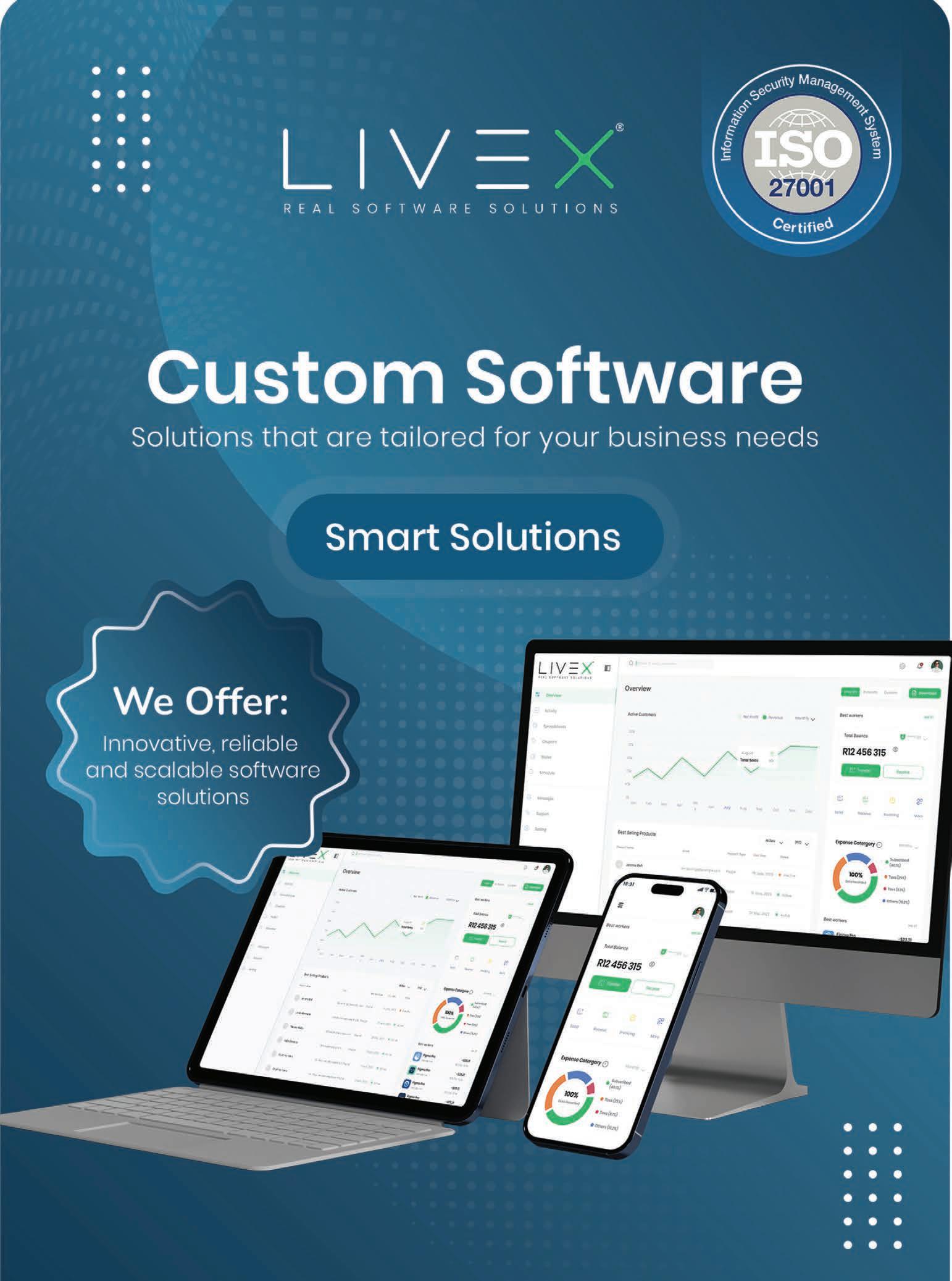
Having the right customised software optimises business operations and fosters growth, writes REINARD MORTLOCK , Livex CEO
Custom software is changing faster now than at any point in the last 20 years. Arti cial intelligence (AI) has stopped being a feature on a roadmap and has become part of how good systems are designed. The companies that pull ahead in the next ve years will not be the ones that bought the most software, but those that built the right software, with the right partner, at the right time.
Livex is a South African software company specialising in building innovative, scalable custom software solutions. We design and develop large, custom enterprise systems for organisations that have outgrown what off-the-shelf products can do. Our clients are not buying a product. They are choosing a partner to build, run and evolve a custom software system that their business depends on and will help it grow and remain relevant in the ever-changing software landscape.





Innovation in our work is not a slogan. It is ingrained in the way we build our solutions; every platform is custom-engineered for the business it serves because the systems that genuinely move a business forward are the ones built for it, not those it has to bend itself around. Our solutions are designed for automation from the start, work ows that move themselves through the business instead of waiting for someone to action them, processes that run in the background instead of consuming a team’s day. Where AI earns its place in that work ow, we implement it, surfacing the right information, drafting routine work, agging what a person needs to look at, optimising business processes without creating total dependency on AI.



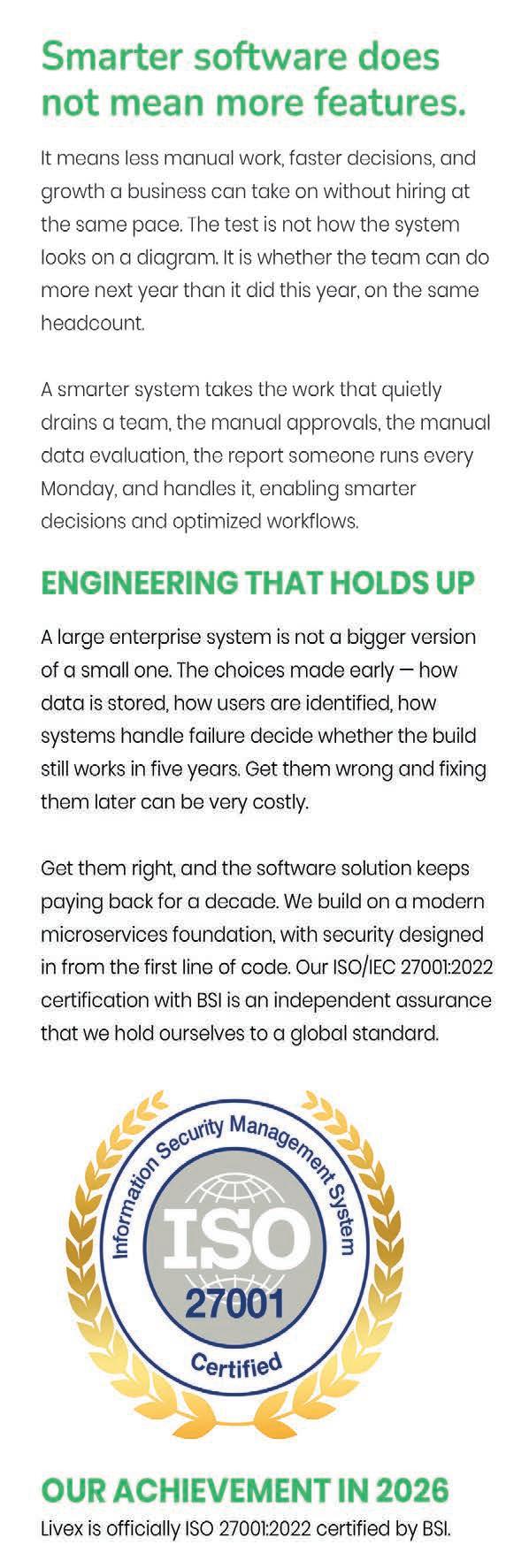
Smarter software does not mean more features. It means less manual work, faster decisions and growth a business can take on without hiring at the same pace. The test is not how the system looks on a diagram; it is whether the team can do more next year than it did this year, with the same headcount. A smarter system takes the work that quietly drains a team – the manual approvals, manual data evaluation, the report someone runs every Monday – and handles it, enabling smarter decisions and optimised work ows.


SMARTER SOFTWARE DOES NOT MEAN MORE FEATURES. IT MEANS LESS MANUAL WORK, FASTER DECISIONS AND GROWTH A BUSINESS CAN TAKE ON WITHOUT HIRING AT THE SAME PACE.
identi ed, and how systems handle failure – determine whether the build still works in ve years. Get them wrong and xing them later can be very costly. Get them right, and the software solution keeps paying back for a decade. We build on a modern microservices foundation, with security designed in from the rst line of code. Our ISO/IEC 27001:2022 certi cation with BSI is an independent assurance that we hold ourselves to a global standard.







Most software projects struggle not because the code is bad, but because the relationship ends the day the system goes live. The business keeps changing. The software does not. We work differently. Livex partners with clients for the life of the platform. The same team that designed the system runs it, improves it, and is still on call two years later when the business wants to add something new. That is what scalable growth requires, not a project that nishes, but a platform that keeps moving.


A large enterprise system is not a bigger version of a small one. The choices made early – how data is stored, how users are




South Africa is not short of software talent. Few teams are willing to take on the hardest builds and see them through. That is the work we do. That is the change we are here to drive.
WE DESIGN AND DEVELOP LARGE, CUSTOM ENTERPRISE SYSTEMS FOR ORGANISATIONS THAT HAVE OUTGROWN WHAT OFF-THE-SHELF PRODUCTS CAN DO.
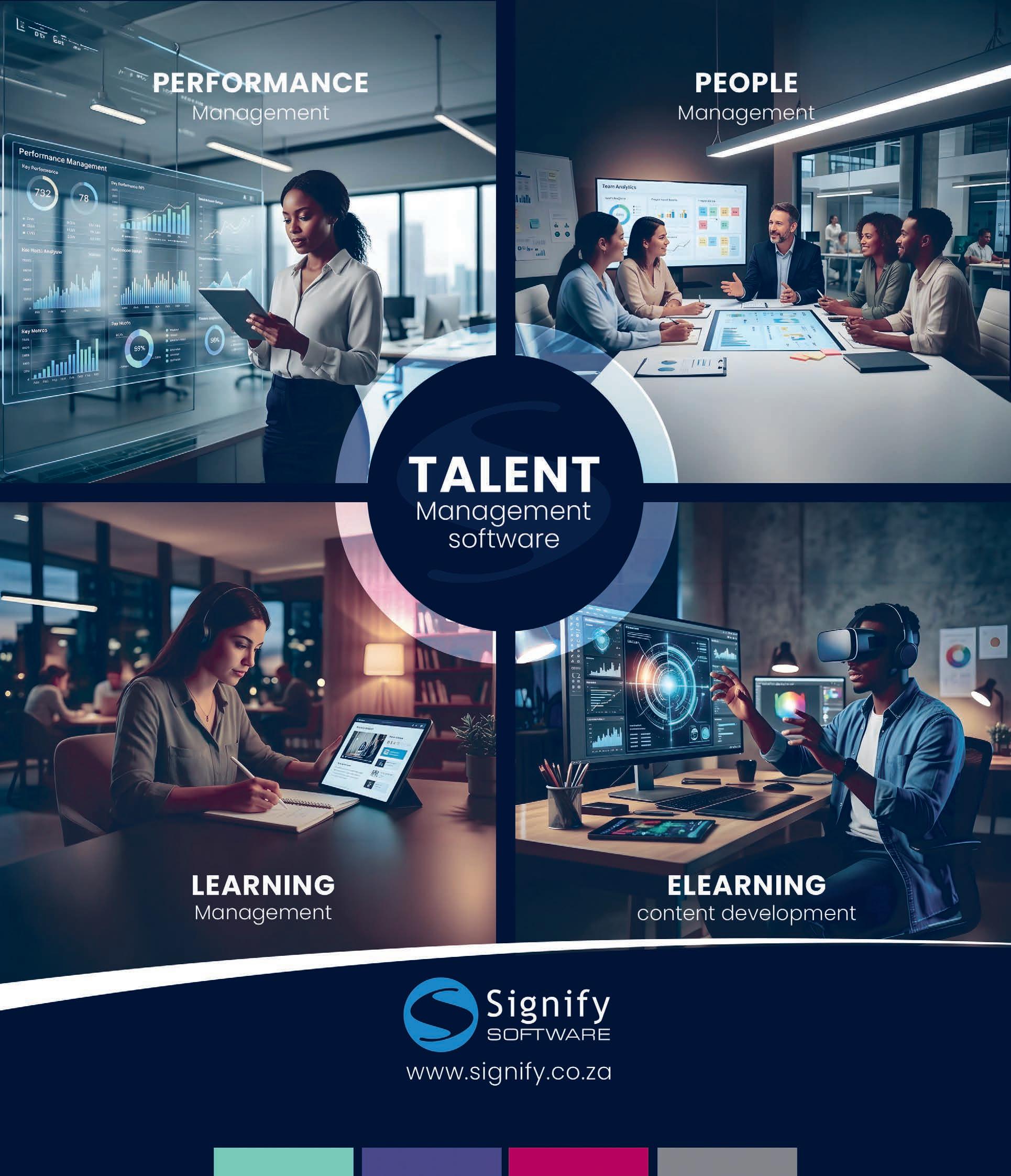
For decades, organisations have built their talent strategies around capability – knowledge and skills – that model is now being reimagined, writes SIGNIFY
In a world where everyone has access to the same knowledge and the same arti cial intelligence (AI) tools, the real differentiator is no longer what people know, but how they decide.
Organisations today are operating in an environment de ned by speed, complexity and constant change. Decisions are being made more frequently, with more data, and often with the support of intelligent systems. Yet, the gap between organisations that consistently perform and those that struggle to execute is widening.
The difference is not capability in the traditional sense; it is the quality of judgement applied at every level of the business.
For decades, organisations built their talent strategies around knowledge and skills. The assumption was simple: equip people with the right information and capabilities, and performance will follow. Perhaps, this assumption should be questioned.
Knowledge is now abundant. AI can retrieve, summarise and generate insights in seconds. Skills remain important, but they are increasingly transferable and replicable. What cannot be easily replicated is the ability to interpret information, weigh competing priorities and make sound decisions in context.
This is the emerging reality: judgement is becoming the de ning currency of capability.
AI has dramatically increased the speed and volume of decisions across organisations. But has it improved the quality of those decisions by default? Not necessarily.
When decision-making is accelerated without a corresponding improvement in judgement, organisations can become more ef cient at executing awed thinking. This could mean that we scale based on questionable assumptions or that biases are

ampli ed. Short-term optimisation can quietly undermine long-term value.
AI does not eliminate risk; it ampli es the value of robust human judgement.
As we increasingly integrate AI into work ows, it raises some uncomfortable but necessary questions:
• Do our recruitment processes prioritise experience and credentials over how people think and reason, especially in ambiguous contexts?
• Do we reward performance based on outcomes, without understanding the quality of decisions behind them?
• Does learning and development focus solely on content and skills, rather than on improving how people navigate trade-offs in real situations?
• Does succession planning rely heavily on subjective indicators of potential, not proven judgement under complexity?
This may result in a systemic blind spot for many organisations.
Reimagining talent management means consistently assessing judgement in meaningful contexts and measuring how this shows up in your business over time. More importantly, this approach can help us link decisions to business outcomes across risk, ef ciency and long-term value.
Judgement is not an abstract concept. It is directly linked to tangible business outcomes.
• Risk exposure is shaped by everyday decisions, not just policies.
• Cost ef ciency depends on trade-offs made under pressure.
• Customer experience is in uenced by how employees interpret and act in real-time. Strategic execution is ultimately the sum of thousands of decisions made across the organisation. Organisations that understand and improve how decisions are made will outperform those that continue to focus primarily on knowledge and skills.
The future of talent management will not be de ned by better content or more sophisticated skills frameworks. It will be de ned by the ability to build, measure and scale better judgement. The organisations that win in future will be those that deliberately build their ability to make quality decisions.
Talk to Signify about shifting the focus of your talent, HR and learning strategies to enhanced decision-making.

You have nothing to fear. Artificial intelligence is going to make you look good to management, staff and prospective candidates alike – making things simple and easy for everyone, writes
co-founder of GrowMyTeam.ai
Human Resources managers have it tough, caught in the cross re between the objectives of management and staff. If you’re in HR, you’ll know what I’m talking about. Your soft skills are somehow meant to nurture the team while also meting out discipline and telling people what they don’t want to hear. In between the myriad tasks and paperwork that go with that, you also need to work miracles on the hiring front, growing the team by nding unicorns and purple squirrels in a sea of applicants, as if you are a full-time professional recruiter. However, this is only one of 12 things on your to-do list, before your nonexistent lunch break.

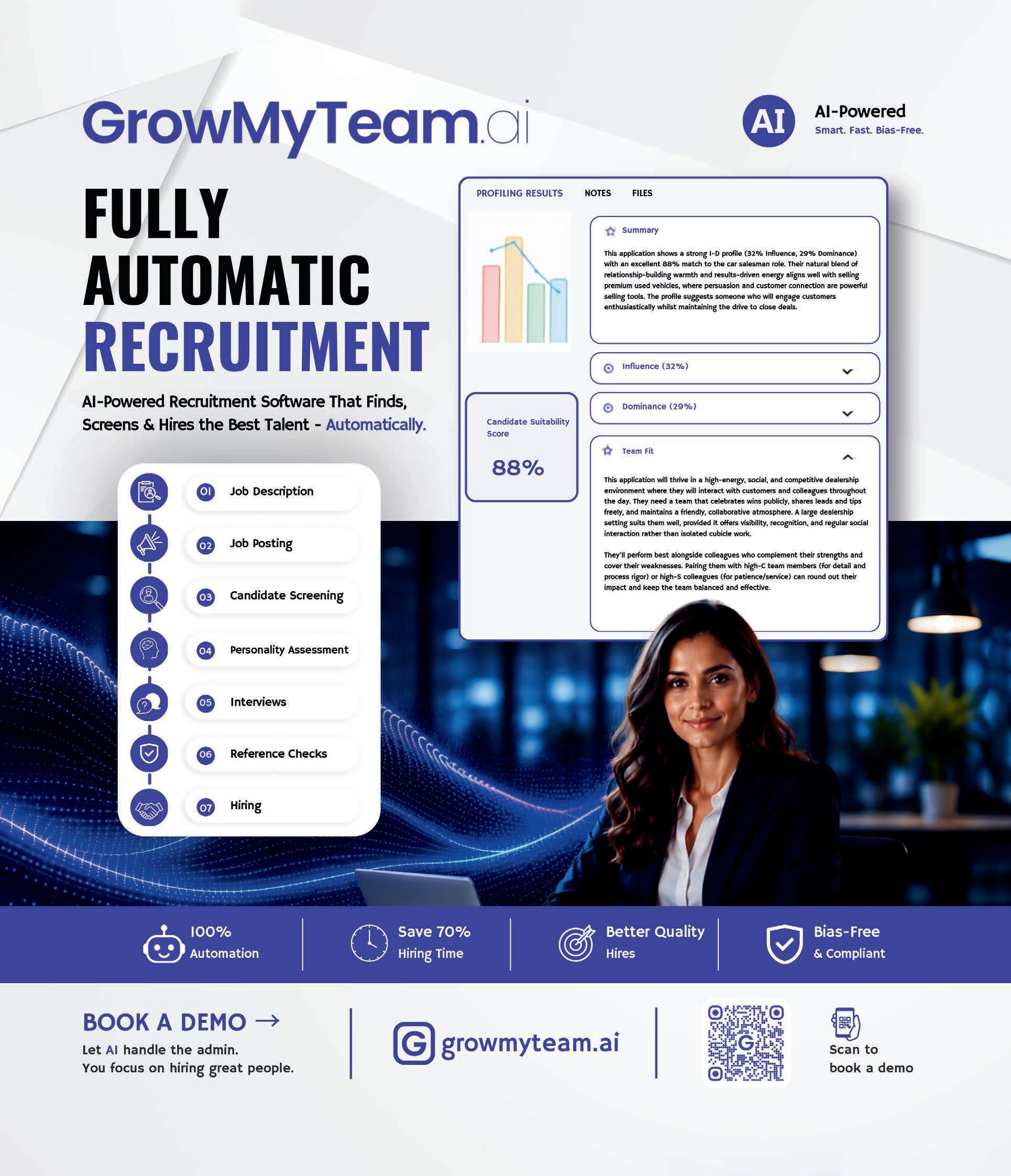
requirements and personality traits for the role. In short, AI is going to make you look good to management, staff and prospective candidates alike by cutting out the grind and making things simple and easy for everyone. This is not a crystal ball or hopeful prediction; these systems are available right now. We offer one that we like to think is at the forefront of what can be done in the recruitment space, but there are many, each with their own niche within the HR niche.
To make matters worse, both staff and management sometimes see the HR layer as a necessary evil and, so, from a business point of view, a grudge purchase that they would love to automate.
I’ve been in the business of automating major aspects of HR for many years. I am involved in a leading recruitment software business, and I have been obsessed with arti cial intelligence (AI) for the past three years. If we could automate HR, we’d make plenty of money off your board of directors by saving them salaries.
The better news is, AI will make your job easier by automating the mundane and leaving the real human-only “fun part” to you, such as choosing a winner from a shortlist of great candidates and welcoming them to the team, con dent that the person’s resumé, psychometrics, quali cations and references have already been thoroughly analysed and come up golden against the
THE ONLY HR EXECUTIVES WHO WILL BE REPLACED DUE TO AI, ARE THOSE NOT USING AI TO THEIR ADVANTAGE.
Think along these lines: open a website, tell it about the role you are recruiting for (literally speak to it), then watch the magic happen. A few hold points and choices along the way to keep you well and truly in the loop, and voila! A shortlist of candidates, with screening questions answered, DISC pro le completed, CV analysed and compared to an ideal candidate, references checked, and to cap it all, an individualised interview guide for each selected candidate with insights and meaningful questions applicable to their particular strengths, weaknesses and risk factors. All in a very simple and intuitive work ow.
While the best old-school recruiters can screen applicants quickly with a trained eye, nobody can screen every single applicant fairly and thoroughly, going into every detail of their application, in mere seconds. Nobody
ANTON MENKVELD,
can maintain simultaneous communication with dozens of candidates in real-time as they move through the recruitment process. And, psychometric testing, such as DISC, is usually an expensive and time-consuming process reserved for the few nal candidates. Imagine doing all of this with almost no effort. And, at a very low cost, compared to the cost of hiring badly.
In short, the only HR executives who will be replaced due to AI, are those not using AI to their advantage, because they will be left so far behind that they can’t compete.
Those who embrace the change can look forward to that feeling of “how did I ever do without this?”
Fun times for the brave!
GrowMyTeam.ai is a hiring platform designed to enable faster, easier, more accurate hiring using next-generation recruitment technology.

Anton Menkveld www.linkedin.com/in/antonmenkveld
Better platforms haven’t solved the human problem at the heart of enterprise software. By BRENDON PETERSEN
Enterprise software was never supposed to create more work. Enterprise resource planning (ERP), customer relationship management (CRM) and human capital management (HCM) platforms were built to consolidate data, automate repetitive processes and free people to focus on decisions that actually require them. Yet inside organisations that have spent millions on these systems, spreadsheets and email chains remain stubbornly in place. The software is running. It just isn’t being used.
“THE GAP BETWEEN A POWERFUL PLATFORM AND ACTUAL BUSINESS OUTCOMES IS ALMOST ALWAYS A DATA PROBLEM.”
– LINDA SAUNDERS
The reasons are rarely technical. “Failures rarely stem from the core technology itself,” says Gerhard Alberts, SAP director: customer evolution for Africa. “The breakdown typically happens in the implementation process and organisational alignment.” That’s a consistent nding across the enterprise software landscape: the platform works, but the conditions around it don’t.
Linda Saunders, country manager and senior director of solution engineering for Africa at Salesforce, frames the same problem from a CRM angle. “Historically, enterprise software was built for managers and reporting, not for the people using it every day,” she says. When a platform delivers no visible bene t to the person
Linda Saunders
entering data into it, they nd a workaround. The spreadsheet survives not because it’s better software, but because it’s more immediately useful to the individual using it.
Data quality sits at the heart of both problems. Alberts points to insuf cient data cleansing, inconsistent master data and weak data governance as frequent culprits behind ERP underperformance.
Saunders is equally direct: “The gap between a powerful platform and actual business outcomes is almost always a data problem.”

I compounds this. When generative arti cial intelligence (AI) is built on top of fragmented, ungoverned data, outputs can’t be trusted and users disengage quickly.
The South African context adds its own variables. Load shedding, variable connectivity and leaner IT teams shape what organisations can realistically deploy. Alberts notes that hesitation around legacy migration is understandable. Still, the cost of staying put accumulates quietly: rising operational risk as support deadlines approach, integration limitations with modern cloud and AI tools, and higher manual overhead from fragmented processes.

Saunders makes a similar point about the patchwork approach to CRM. “With leaner IT teams in South Africa, it traps people in keeping the lights on,” she says, describing how point solutions create constant integration maintenance that leaves no capacity for genuine innovation.
Cloud and SaaS models have shifted part of this equation. SAP’s move toward precon gured offerings like S/4HANA Cloud has addressed two persistent barriers locally: time to deploy and cost predictability. Public cloud implementations can now run as short as three months. Salesforce’s mobile- rst architecture keeps pipelines moving during outages, syncing automatically when connectivity is restored. AI is increasingly embedded in both platforms, though neither company is positioning it as a shortcut. SAP’s Joule assistant surfaces intelligence within existing work ows rather than through a separate tool. Salesforce’s Agentforce handles repetitive tasks like data entry, meeting summaries and routine follow-ups, reducing friction rather than adding complexity.
The human side remains the harder problem. Saunders puts technology at 20 to 30 per cent of the adoption equation, with people and process accounting for the rest. “Companies win when they elevate human judgement as their competitive edge, not just train staff to click buttons,” she says. Alberts draws the same distinction, separating a traditional mindset that treats ERP as a technical migration from a future-built approach that treats it as a fundamental shift in how the organisation operates.
What both perspectives share is the recognition that reverting to spreadsheets isn’t a failure of the software alone. It’s a signal that the implementation didn’t address the human and process elements with the same rigour applied to the technology. The platforms have matured. The gap that remains is almost entirely organisational.
In today’s digital economy, organisations are under pressure to secure data, maintain compliance and adapt quickly to change.
PROVIDENCE SOFTWARE SOLUTIONS helps businesses meet those demands
A single data breach can damage customer trust, disrupt operations and expose organisations to serious penalties. Providence Software Solutions supports PCI DSS compliance through services integrated with internationally recognised standards, including ISO 9001, ISO 27001, ISO 22301, ISO 12207, ISO 20000 and ISO 45001.
The company helps organisations secure payment environments, improve access controls, document policies and prepare for ongoing compliance and recerti cation. Rather than treating compliance as a once-off exercise, Providence positions it as part of a broader operational resilience strategy. This approach helps businesses protect cardholder data, strengthen governance and demonstrate mature security practices to customers, partners and regulators.
PROVIDENCE POSITIONS
CYBERSECURITY AS AN ENABLER OF SECURE DIGITAL TRANSFORMATION THROUGH IDENTITY AND ACCESS.
Arti cial intelligence (AI) is reshaping governance, risk, and compliance (GRC) by helping organisations process information faster and identify risks more proactively. Providence Software Solutions uses AI to support compliance teams through intelligent document analysis, policy reviews, evidence summarisation, risk detection and audit preparation.
In highly regulated environments, this reduces repetitive administrative work and gives compliance professionals more time for oversight, decision-making and strategic risk
management. Providence maintains a human-in-the-loop approach to ensure accountability, secure data governance and validation of AI-generated outputs. Used responsibly, AI becomes a practical tool for improving operational ef ciency without compromising governance standards.
Cybersecurity is now a critical business requirement as organisations adopt cloud platforms, hybrid work models, automation and digital collaboration tools. Providence positions cybersecurity as an enabler of secure digital transformation through identity and access management, multifactor authentication, endpoint protection, SIEM monitoring, DLP controls and secure cloud governance. These solutions reduce exposure to ransomware, phishing, data breaches and unauthorised access while maintaining operational continuity and protecting sensitive information. Providence supports industries such as healthcare, nance, government, education and retail, where security, compliance and business continuity are essential. Continuous monitoring, employee awareness training, governance policies and ongoing improvement reinforce its layered security approach.
The automotive industry is rapidly moving toward software-de ned vehicles, making AI-driven development increasingly important. Providence leverages Microsoft Azure, GitHub Copilot, Power Platform, SharePoint and Azure AI services to accelerate software engineering while supporting functional safety and compliance requirements.
AI assists with code generation, legacy system modernisation, virtual ECU simulation, predictive defect analysis, automated testing
and compliance documentation. These capabilities help engineering teams reduce development bottlenecks, improve traceability and shorten development cycles. In high-consequence environments, however, AI-generated outputs still require strict governance, human validation and secure audit controls throughout the software development lifecycle.
Providence’s Employee Management Case Management System centralises sensitive employee relations processes into a structured, auditable platform. Disciplinary matters, grievances, misconduct investigations, leave disputes, onboarding, performance management and exit processes can all be managed within a single digital environment. The system includes work ow automation, deadline tracking, document management, role-based access controls, dashboards and compliance monitoring. By replacing fragmented spreadsheets, emails and paper-based processes, organisations gain greater consistency, visibility and control. For HR teams, the platform reduces administrative overhead and improves standardisation. For organisations operating in complex labour environments, it strengthens compliance with labour legislation, reduces procedural risk and supports fair employee management practices.

Precision agriculture is generating more farm data than ever, but disconnected tools and patchy connectivity mean most of it never becomes a decision, writes TIANA CLINE
African farms are producing more data than ever before. Satellite imaging maps soil variability from above, internet of things sensors monitor moisture and crop health in real-time, and farm management platforms log inputs and outputs across entire seasons. The technology stack for precision agriculture exists, and, in pockets, it works well. The challenge is that most of it does not work together.
One platform captures sensor data, another handles satellite imagery, and agronomic advice lives somewhere else entirely. For the farmer trying to make a planting or irrigation decision, the data exists in theory, but is scattered across systems that were never designed to integrate. This is not just a software architecture problem; it re ects something more fundamental about how agricultural data behaves.
“You grow one crop, one year, in one environment, and that being a repeatable performance is very rare,” says Jeremy Groeteke, Syngenta Group’s global head of IT and digital strategy. “But no weather event is the same year to year.” A single data point is rarely actionable on its own and only becomes useful when layered with context, history and local knowledge – layers that are typically siloed across different tools, vendors and platforms that were never designed to communicate.
According to Growing Africa research, nearly half of all African countries currently lack the baseline data needed to implement precision agriculture, which means the integration problem is, in many places, a secondary concern. Rural internet access remains thin across the continent, and many precision agriculture systems depend on reliable data transfer to function. When a soil sensor cannot sync, a satellite image cannot be retrieved or an
advisory platform cannot reach the farmer, the feedback loop that makes the technology worth deploying breaks down entirely.

Biome Makers, a soil-intelligence platform backed by Naspers, uses biological data to guide farm management decisions. “It is not just about ef ciency. It is about ensuring that more families have access to jobs in agriculture,” says Naspers South Africa CEO PhuthiMahanyele-Dabengwa, “and that we’re able to produce our farming and agricultural goods in the most sustainable manner.” That framing shifts the question away from whether precision agriculture works on a large commercial farm, where it already does, and towards whether it can work for the smallholder farmer with limited connectivity and no dedicated agronomist. This is something that comes down as much to platform design as it does to technology. “Very often the technology is the easiest part of the process,” explains Aaron Frank, a faculty member at Singularity. “The dif cult part is, does the business operations team or the IT team own this project?” In agriculture, that question is further complicated by the fact that the end user is often a farmer, not a technologist.

The software layer is also evolving in ways that reduce how much real-world data these systems need in the rst place. “Companies like
John Deere are using simulation to train their tractors to know what a barn looks like, what a farmer looks like and what do birds that will y away look like,” says Frank. “Learning how to navigate these different environments is far cheaper and more available in simulation.” Where simulation handles training, natural language is beginning to handle the interface. Syngenta’s CropWise AI is just one example of what that looks like in practice – a platform built on multiple large language models that turns complex decisions around weather, soils and inputs into a conversational exchange accessible to any grower. The tools are becoming more capable, but ultimately, capability alone does not determine who gets to use them. “You can’t have a smart tractor and dumb equipment, or smart equipment and a dumb tractor,” says Groeteke. “The whole system has to work together.”
“VERY OFTEN THE TECHNOLOGY IS THE EASIEST PART OF THE PROCESS. THE DIFFICULT PART IS, DOES THE BUSINESS OPERATIONS TEAM OR THE IT TEAM
THIS PROJECT?”
– AARON FRANK

What you build has never mattered more.
By PATRICK SCHREIBER , chief executive officer, Polymorph
Building software has never been more accessible. A founder with a clear brief can prototype something meaningful over a long weekend if they have a rm grasp of how to use arti cial intelligence (AI) for development. A small team can stand up an MVP (minimum viable product) before the business case has cleared the board. The barrier to entry has never been lower.
That speed raises a more interesting question. Not “how fast can we build this?” That problem is largely solved. The question that still determines whether a product succeeds is: “What should you build?”
There are two ways to react to that, and both miss the point. Some people believe AI will handle everything: the brief, the design, the iteration, the delivery. Others are convinced that shortcuts produce shortcuts and anything built at pace will inevitably miss what matters. The teams building great products today use AI to move fast and people to decide what is worth building. That is where quality is produced.
As building gets faster and cheaper, product thinking matters more now, not less. When it took 18 months to nd out you had built the wrong thing, teams had a powerful incentive to ask hard questions upfront. When you can prototype over a weekend, those questions get skipped. The speed advantage disappears if what you launch misses the market.
AI has shifted the cost curve, but it hasn’t removed the risk curve. If anything, it’s made it easier to build the wrong thing faster.
Discovery and research have never mattered more: understanding who the product is for, what job it must do and what evidence should change the plan.
Before committing capital and effort, three things tend to separate products that earn their place from those that get shelved:
1. Know who you are actually building for. Start with real conversations with real people who will use your product: understand their daily friction, their workarounds (even if they don’t have one yet, they are doing something) and who else has to say yes before they can adopt something new. Five structured conversations with the right people will inform more decisions than a week of desktop research. Teams that skip this step often discover, too late, that the market they assumed was there had a different shape entirely.
2. Test your value assumption before you scale the build.
You’ll be tempted to ask, “Do people value this?” But the real question you should ask is: “Under what conditions will they switch, and what would it take for them to pay for it?” A concierge MVP (delivering the outcome manually before writing production code) often reveals what no prototype can: whether the problem is painful enough to change behaviour. Finding out before you build costs far less time and money than nding out after you ship.
3. Scope to what you can learn from, not what you can imagine.
Great products are rarely built in one pass. They are built in deliberate cycles: ship the minimum that tests the most important assumption, learn and decide what comes next. Teams that try to build everything at

Patrick Schreiber
Patrick Schreiber leads Polymorph, a Stellenbosch-based software and product partner with more than 15 years of experience working with founders, enterprises and product teams across discovery, validation and delivery.
once usually learn less, not more, and spend a lot more time and money nding out.
Over more than 15 years of building software products, we have seen this pattern hold. The teams that ship things worth keeping don’t move faster by skipping the hard questions. They move faster by answering them early. We do that in workshops and design sprints that bring product leads, domain experts and real users into the room alongside AI tools. AI accelerates iteration. People set the direction, challenge the assumptions and keep the work honest.
AI has given product teams the fastest runway this industry has ever seen. Product thinking is what lets you use it well.
Build faster. Build what matters.









































































South Africa ranks above the global artificial intelligence-readiness average. Its network infrastructure does not, writes BRENDON PETERSEN
South Africa’s arti cial intelligence (AI) readiness sits at 19 per cent, above the global average of 13 per cent, according to Cisco research. That gap re ects genuine enterprise intent, but the infrastructure data beneath it tells a more complicated story.
Less than a third of South African organisations believe their current IT infrastructure can support modern AI workloads. Sixty-four per cent struggle to centralise data, only twenty-three per cent report adequate graphic processing units (GPU) capacity, and thirty-one per cent say their networks cannot scale for AI complexity or data volume.
Speaking at the World Economic Forum in Davos in January, Cisco executive vice president and chief people, policy and purpose of cer Fran Katsoudas described the South African picture as one of contrasts. “Companies are truly leaning in, which is amazing,” she said. “But then you look at that other stat, which is that sixty per cent of people are still not connected. There’s something there that we absolutely have to go after.”

Modern software deployments, from observability platforms to real-time analytics pipelines and agentic AI systems, depend on bandwidth, latency, and connectivity consistency that most South African enterprise networks were not built to deliver. When those assumptions break, the failure surfaces in the software layer. Teams spend cycles debugging integration failures and data synchronisation issues that trace back to network architecture decisions made well below the application level.
Cisco president and chief product of cer Jeetu Patel, also speaking at Davos, pointed to trust and security as among the critical constraints on AI progress.
“If people don’t trust these systems, they’re not going to use them,” he said. “Safety and security of these systems are paramount.”
That concern translates directly to the enterprise software stack. Two-thirds of the most AI-ready organisations globally have integrated AI into their security and identity systems, and 75 per cent can secure and manage AI agents at scale. South Africa lags across both measures, according to the Cisco research.
The connectivity gap is one dimension of the problem. The more immediate constraint for enterprises already operating in the digital economy is what happens above the connectivity layer: where software stacks make assumptions about network performance, reliability and visibility that most South African enterprise infrastructure cannot currently meet. Legacy on-premise environments running alongside cloud workloads compound this, creating hybrid architectures where network fragmentation is built in by design.

There is a useful framing for the structural gap this creates: AI infrastructure debt. Like technical debt in software development, it accumulates when teams focus on building above it, and it compounds. Organisations successfully moving AI from pilot to production are four times more likely to do so than their peers, and 50 per cent more likely to see measurable value, because they treated network architecture as a software decision rather than a procurement exercise.
THE MORE IMMEDIATE CONSTRAINT FOR ENTERPRISES ALREADY OPERATING IN THE DIGITAL ECONOMY IS WHAT HAPPENS ABOVE THE CONNECTIVITY LAYER.
Smangele Nkosi, Cisco general manager for South Africa, framed the local challenge in terms of choice. “We are helping South African organisations navigate the path to AI and modernisation by ensuring they never have to choose between innovation and control,” she said.

That framing points to the practical decision facing South African technology leaders: network modernisation and software stack design need to be co-designed, not sequenced. Choices about network management, security integration and visibility tooling directly shape what software can do and how reliably it can do it.
Cisco’s AI Readiness Index data suggests South African enterprises understand the stakes. The 19 per cent readiness gure, above the global average, re ects real intent. Closing the gap between that intent and production-grade outcomes requires treating the network layer as a rst-order software architecture decision, one that belongs in the same conversation as platform selection, data strategy and application design, not as an afterthought.
Despite rapid digitisation, healthcare data remains siloed. Legacy systems, poor integration and vendor constraints continue to block interoperability and a unified patient view, writes ITUMELENG MOGAKI

In modern healthcare environments, fragmentation is not always visible at the point of care, but it is felt. A patient may move between a community clinic, a hospital and a pharmacy, yet their records do not move with them. Each system captures part of the story, but no single system holds the
down, with no reliable feedback loop con rming whether patients actually reached the next level of care,” he adds.
as closed architectures and commercial incentives discourage open connectivity,” Dr Rech explains.
He adds that connectivity constraints also shape system performance in real-world settings. “Health platforms must be designed for of ine- rst environments, particularly in rural and under-resourced regions where connectivity is unreliable. Systems that assume constant internet access often fail at the point of care, making data capture inconsistent and incomplete. Distribution platforms like WhatsApp introduce further complexity due to data costs and access limitations.”
, CEO of Audere Africa, says the
“Health systems were historically designed in record,” says Dr Rech.

On the risks of fragmentation, Dr Rech warns that the absence of a uni ed patient view leads to duplicated treatment, unnecessary testing and delayed care. “At a system level, it distorts national health insights, with ministries relying on incomplete or delayed data that can misrepresent real-world outcomes.”
He explains that Audere Africa’s approach focuses on fast healthcare interoperability resources- (FHIR) compatible longitudinal records, designed to consolidate patient histories and enable real-time, connected care across systems.
Dr Rech also says, while FHIR provides a global framework for health data exchange, inconsistent usage, varying versions and limited support for multilayered diagnostic inputs create interoperability gaps.
“When systems are ‘FHIR-compliant’ they may still require custom mapping and lose critical clinical context during data exchange. Legacy systems and vendor-controlled ecosystems further complicate integration,


From a systems design perspective, Botha van der Vyver, founder of JustSolve Group, says fragmentation is driven by disconnected procurement decisions. “Healthcare organisations often implement electronic health records (EHRs), billing systems and lab platforms independently, without an overarching integration strategy. This results in ecosystems where data exists but is not usable across functions.”
Van der Vyver says interoperability standards such as Health Level 7 and FHIR help, but only when supported by strong architecture and governance. “Without this, systems remain tightly coupled, costly to maintain and dif cult to scale.”

Ultimately, perspectives shared by both experts point to the same conclusion: healthcare interoperability is not a tooling problem, but an ecosystem design challenge shaped by architecture, procurement and the limits of legacy thinking.
Integrated EdTech systems connect data across platforms, enabling real-time insights, improving teaching decisions, and creating more responsive, student-centred learning environments, writes ITUMELENG MOGAKI
EdTech ecosystems increasingly rely on learning management systems (LMS), assessment platforms and student information systems that often operate in isolation. While each tool captures valuable data, fragmentation limits insight and slows decision-making.
Industry leaders argue that integration through application programming interfaces (APIs) and intentional platform design is essential to unlock a connected, responsive education environment across diverse learning contexts.
According to Khomotjo Mashele, head of product at SPARK Schools, many EdTech failures stem from systems designed around scholars without considering how teachers interact with data.
She says teachers must remain central, with technology acting as a co-pilot that enables more effective learning interventions.
Siloed student data, she explains, reduces learners to isolated metrics rather than holistic individuals, limiting personalised support.
“Integrated datasets combining academic performance, behaviour and contextual factors, allow educators to respond more effectively and accelerate mastery,” Mashele says.
“APIs are critical for enabling real-time connectivity across platforms, reducing manual reporting and improving intervention speed. Ultimately, better connectivity allows institutions to shorten the time to mastery and frees educators to focus on developing future-ready skills,” she adds.

Nic Riemer, CEO of The Invigilator App, says integration challenges are widespread because institutions often purchase assessment, proctoring and LMS tools separately without considering interoperability. This then forces educators to navigate
multiple systems, making it dif cult to build a uni ed view of student behaviour and academic integrity, he explains. Giving a practical example, Riemer says at The Invigilator, integration is treated as a core design principle, with all tools built into a single ecosystem to surface patterns across attendance, submissions and assessment authenticity.
Riemer says that designing for low-connectivity environments like South Africa also improves global resilience, as of ine- rst systems reduce dependence on stable infrastructure. “Institutions should prioritise integrated solutions over fragmented point tools to reduce complexity and improve educational outcomes.”
In his view, Dr Mario Landman, an executive at The Independent Institute of Education, says EdTech integration issues are often rooted in inconsistent data models and misapplied technical standards.
Dr Landman explains that mismatched identi ers and poorly structured data prevent systems from communicating effectively, even when integration tools exist. “Siloed data undermines institutional decision-making, limits early intervention for at-risk students, and creates fragmented reporting across departments.”
Dr Landman advises that institutions should adopt API- rst system designs, enforce strong data governance and invest in staff training to fully realise connected learning ecosystems. He adds that weaker integration ultimately limits innovation, particularly in large institutions aiming to scale data-driven educational transformation in today’s systems.

Disconnected government systems undermine service delivery, highlighting the need for integrated architecture, data standards and design discipline.
By ITUMELENG MOGAKI
As South African citizens interact with government, they expect a single, seamless digital experience. Instead, they are often passed between disconnected systems, each holding a partial version of the truth. It’s all too common in South African government services, where applications disappear between departments, records don’t match, and data must be re-entered multiple times.
The problem is rarely visibility. According to the knowledgeable, it is architecture. Beneath the surface lies a patchwork of systems that

Follow: Spark Schools www.linkedin.com/posts/a-message-of-pride-and-possibility-from-our-share-7387427863358173185-SDSR Nic Reimer www.linkedin.com/in/nicholas-riemer-ca-sa-434428193
Dr Mario Landman www.linkedin.com/in/mario-landman-dr-05738222

Many platforms are built as stand-alone solutions for speci c mandates, without a shared enterprise architecture. As a result, interoperability is an afterthought rather than a design principle, reinforced by unstructured formats like PDFs that resist automation.”
TJ Hanekom, chief operating of cer at Africonology, adds that the issue is structural rather than technological.
“Most legacy systems were procured to solve isolated departmental problems, without consideration for cross-government integration. This leads to environments where systems function well independently, but fail when asked to communicate across departments. That integration is often “bolted on” later under pressure, instead of being designed in from the start, creating long-term inef ciencies.”
When legacy systems are combined with modern platforms, both experts highlight growing risks.
Thipha points to vendor lock-in, performance mismatches and cybersecurity gaps, particularly where outdated systems lack modern protections.
Meanwhile, Hanekom cautions that layering new digital front ends over outdated infrastructure often increases complexity rather than reducing it, locking institutions into old constraints while appearing modern on the surface.
Application programming interfaces (APIs) are frequently positioned as the solution, but both experts challenge that assumption. “APIs enable data exchange, but cannot x inconsistent data structures. Without standardisation and governance, they simply expose deeper fragmentation,” says Thipha.
Hanekom adds: “APIs are only effective when supported by strong architecture and ownership; otherwise, they risk becoming unmanaged layers of complexity.”
Ultimately, both agree that the core issue is not technology, but design discipline. Government systems will only become truly interoperable when procurement, architecture and data standards are aligned from the outset, before a single system is built.
Follow: Russell Thipha www.linkedin.com/in/russell-thipha-68a07923
TJ Hanekom www.linkedin.com/in/tj-hanekom-7137981
MOGAKI on how disconnected HR systems create data gaps, weaken decision-making and increase risk across recruitment, payroll and workforce management
In most organisations, HR systems are not a single ecosystem; they are a collection of disconnected tools that only appear uni ed on dashboards.
Recruitment platforms capture candidates, human capital management (HCM) systems manage employee records, and payroll engines handle compensation. However, between each stage, data is re-entered, rechecked, and often reinterpreted, creating gaps that compound as employees move through the organisation.
Sandra Crous, managing director of Deel Local Payroll, says the biggest disconnect sits at the handover between recruitment and onboarding.

“Candidate data is often manually transferred across multiple systems that were never designed to communicate, leading to duplicated records and reduced data accuracy.” She explains that payroll and HCM systems frequently fail to synchronise real-time changes, such as promotions or banking updates, creating compliance and operational risks.
According to Crous, fragmented HR data also leads to poor decision-making, as leadership teams rely on incomplete workforce insights while payroll remains one of the highest organisational costs.
On the question of legacy versus modern systems, Crous says legacy platforms remain deeply embedded in enterprise environments, particularly in South Africa. “These systems were built for slower, localised workforce models and struggle to support modern, multijurisdictional employment structures. The result is a patchwork ecosystem that requires constant maintenance to remain functional.”
Janine Palm, social executive at Attacq, says fragmented HR data also undermines decision-making by distorting key workforce metrics such as headcount, turnover and labour costs.
On system architecture, Palm explains that legacy tools provide stability, while newer platforms introduce improved user experience and integration capabilities. “However, when poorly implemented, combining the two can increase fragmentation rather than reduce it. That system t must be aligned with organisational complexity, with careful attention to integration between legacy and modern tools.”
Sasha Knott, CEO of Job Crystal, argues that fragmentation begins in recruitment itself, where multiple specialised tools are used for sourcing, assessments and background checks before data is passed into HR and payroll systems.
“This creates incomplete employee records, especially when candidates drop out mid-process. The biggest risk is loss of data continuity, where no single system holds the ‘truth’ about an employee life cycle, increasing compliance exposure and reducing organisational visibility into talent pipelines,” says Knott.
Knott suggests these practical steps to simplify and future-proof HR tech stacks:
•Map all systems that store or process candidate and employee data, including spreadsheets, to identify duplication.
•De ne a single “golden record” system as the source of truth and integrate all other tools with it.
•Consolidate overlapping recruitment tools into one platform that covers sourcing, assessments and background checks, and connects to payroll.
•Use AI selectively in high-value areas like sourcing and screening, ensuring it is fully integrated to prevent new data silos.
Follow: Sandra Crous www.linkedin.com/in/sandra-crous
Janine Palm www.linkedin.com/in/janine-palm-97633326
Sasha Knott www.linkedin.com/in/sashaknott
South African businesses are spending more on employee bene ts than ever before and getting less return on that investment than they should. Healthcare costs are rising. Burnout rates are climbing. Absenteeism remains stubbornly high.
Despite signi cant spending on insurance, wellness programmes and engagement initiatives, many organisations are still managing these as three separate functions, owned by different teams, running on different platforms, with no meaningful connection between them. This is costing them much more than they realise.
Employees’ lives do not work in silos. Physical, emotional and nancial health, motivation and productivity are essentially linked. As these factors continue to challenge businesses, the need for integration has become a business imperative rather than simply ornamental.
For decades, the structure of employee bene ts has followed a predictable pattern. Insurance sits with the risk and compliance division and is activated when something goes wrong. Wellness programmes, where they exist at all, are owned by HR and operate independently of the broader bene ts strategy. Rewards and incentive schemes are layered on as engagement add-ons, but rarely integrated with either of the other two systems.

Jaco Oosthuizen
When systems don’t communicate, businesses lose visibility into the behaviours and trends that shape workforce wellbeing over time. Employees navigate multiple platforms with no coherent experience between them. And, because traditional insurance is inherently reactive, a claim is led after the dif cult moment has already arrived, the opportunity to intervene earlier is consistently missed.
By integrating insuretech, wellbeing and rewards into a single ecosystem, businesses can take proactive measures to prevent employees from experiencing issues rather than simply responding after an incident occurs. Instead of waiting to react until something goes wrong with employees’ health, organisations can help employees make healthy choices daily, creating more engagement and giving them greater insight into their work-related risks.
YuLife was built on a different premise: that insurance, wellbeing and rewards are not separate products to be managed independently, but interconnected levers that, when uni ed in a single platform, can shift employee engagement from reactive to preventive on a continuous basis.
In practice, this means employees interact with their bene ts daily, not just at claims events. The YuLife platform combines life insurance with an active wellbeing programme, tracking physical activity, mindfulness and other
When benefit systems operate in isolation, businesses and employees pay the price, but creating one ecosystem will drive employee wellbeing, greater efficiency and sustainability.
By JACO OOSTHUIZEN
, MD and CEO of YuLife South Africa
health behaviours, and rewards employees with incentives redeemable through a built-in rewards ecosystem.
The future of insurance lies in connected ecosystems that actively improve people’s wellbeing, rather than simply responding when something goes wrong. By adopting this change, employers have been able to change their perception of insurance from simply an emergency nancial support option to immediate intervention, giving them an ongoing opportunity for engagement with their employees as it relates to being healthy and more productive at work.
Advances in technology and behavioural science are enabling this at scale. Real-time data on employee behaviour allows organisations to identify what their workforce needs earlier and personalise support before problems escalate.
For HR and risk professionals, this represents a meaningful shift: from managing incidents to managing conditions. For businesses, this presents both a challenge and an opportunity. Organisations that continue to operate with disconnected bene ts systems face a compounding challenge: rising people-related costs on one side, and a workforce that expects a more coherent, responsive experience on the other. Those embracing integrated ecosystems are more likely to build healthier, more engaged and resilient workforces.
As insuretech, wellbeing and employee engagement continue to converge, the businesses best positioned for long-term sustainability will be those that stop treating these areas as separate line items and start managing them as the interconnected drivers of performance that they are.
Follow: Jaco Oosthuizen https://www.linkedin.com/in/jaco-oosthuizen-/
very company operating in South Africa answers to two demanding regulators.
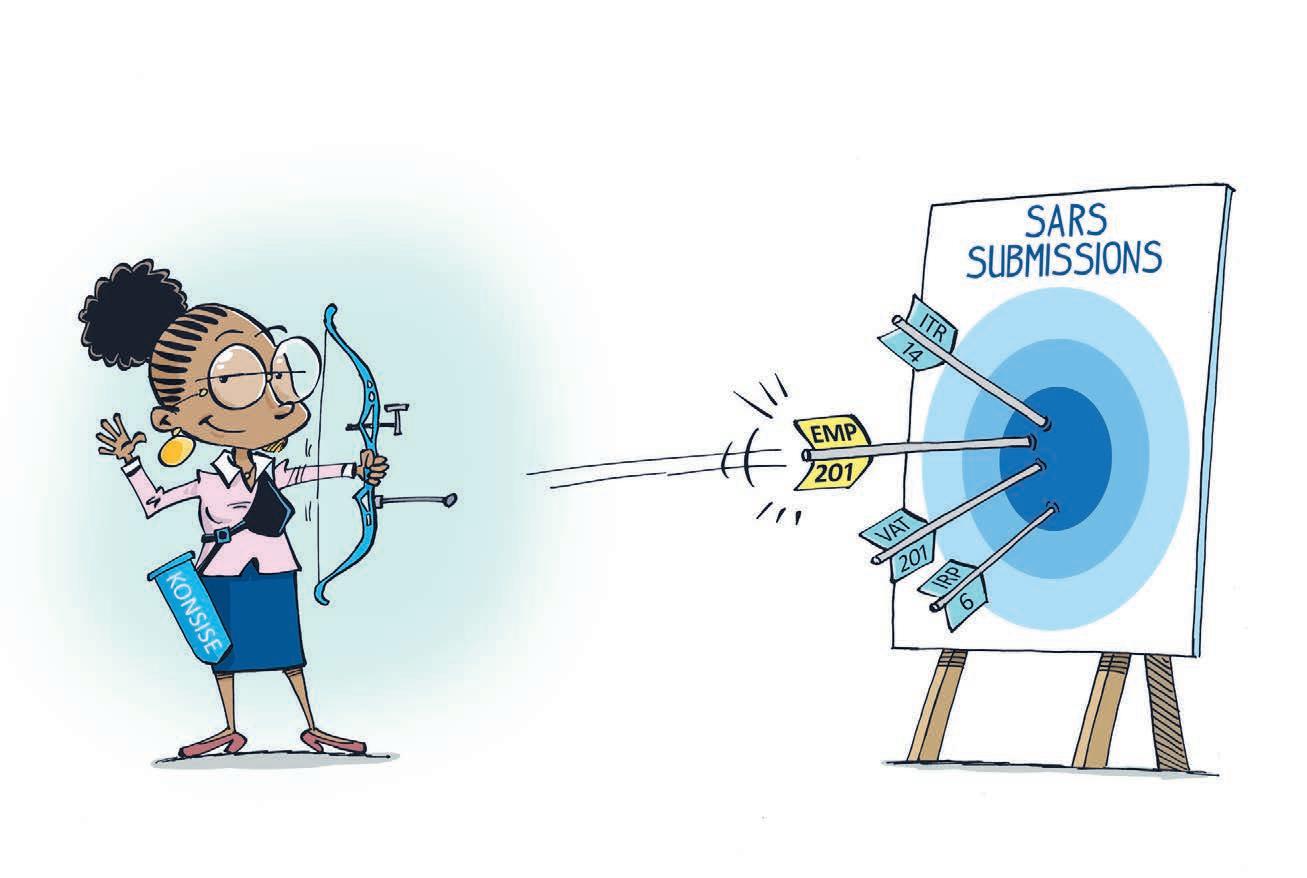
The South African Revenue Service (SARS) wants accurate, on-time tax submissions. The Companies and Intellectual Property Commission (CIPC) wants current, correct records of who owns and controls the business. For years, most of that work has been done manually. Returns prepared and led, statutory registers kept in spreadsheets, deadlines tracked on someone’s calendar, and the two sets of records were rarely reconciled, if at all, by people working across disconnected processes. Konsise was built on a simple but unusual premise: tax management and entity management belong on a single platform, designed from the ground up for South Africa.
That premise matters more than ever because both tax compliance and CIPC obligations are becoming increasingly demanding as regulatory expectations evolve. It is no longer individual lings that create the most risk. It is the inconsistencies between them. What a company submits to SARS must align with its records at the CIPC and the Master of the High Court. Bene cial ownership, securities registers, shareholder data and of cer records all have to match. When they do not, the consequences
are no longer merely administrative. They include penalties, audits, reputational risk and ongoing veri cation requirements.
This is exactly the gap Konsise was built to close, and it is designed for how compliance actually works here. Much of the software South African nance and governance teams rely on was designed for other markets and later adapted to local rules. Konsise was designed
SOMETHING A MANAGER CAN SEE AT A GLANCE.
the other way round. Tailored speci cally to SARS, the CIPC, the Companies Act and the country’s bene cial ownership regime, and structured to mirror how local entities and their tax affairs are actually organised.
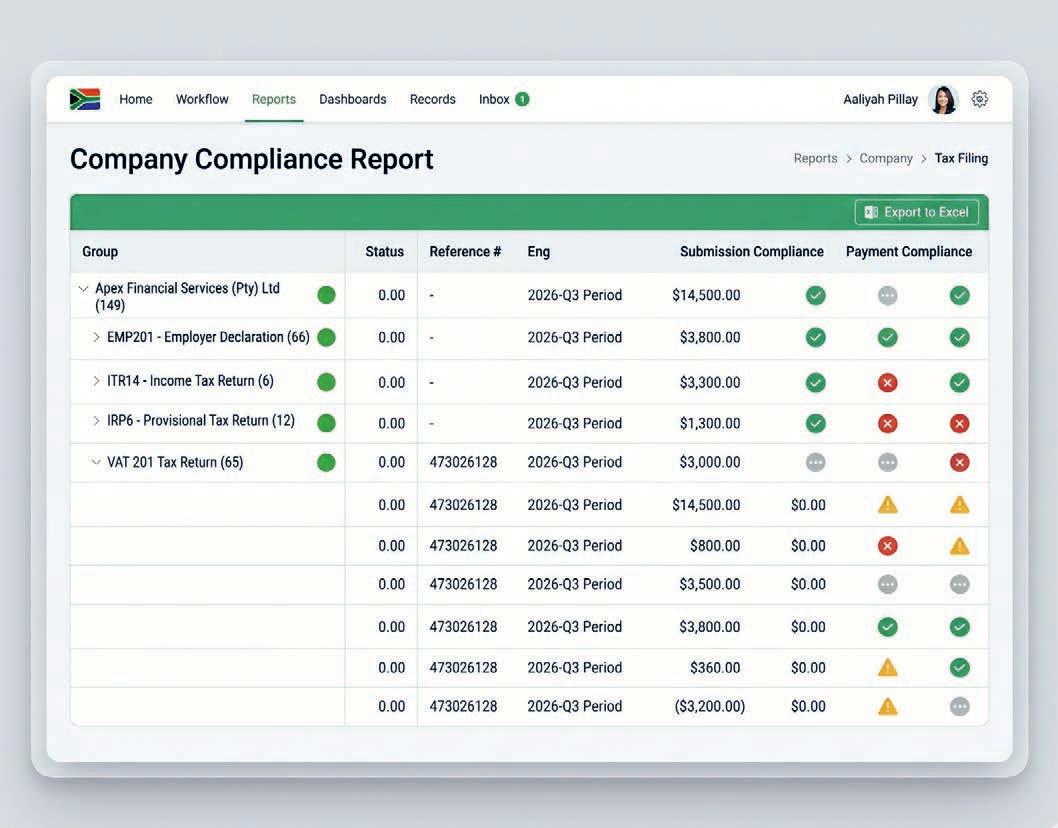
On the tax side, Konsise automates the SARS work ow. Through a direct, bidirectional integration with SARS, teams submit VAT, PAYE, corporate income tax and provisional tax returns directly from the platform – no manual uploads and no logging in and out of separate eFiling pro les. The platform continuously retrieves SARS correspondence, veri cation notices and Statement of Account values for each tax type, so submission amounts, payments and outstanding balances are visible in real-time on a single dashboard. Users can also initiate SARS payments directly from Konsise, with near real-time status tracking. At the same time, a built-in review and sign-off work ow allows multiperson tax teams to authorise returns properly before anything reaches SARS. Automated due-date tracking keeps deadlines met, whether for one entity or several hundred.
Behind the ling sits a proper system of record. Every tax document, assessment and note lives in Konsise’s records function, lterable by company or tax type. So, the
supporting paper for any submission or SARS query is a search away rather than a hunt through inboxes and shared drives. From that data, Konsise builds consolidated compliance reports for each tax type and each company, turning a portfolio’s SARS status into something a manager can see at a glance.
On the entity side, Konsise replaces scattered les with a single, secure record of every company, director, of cer, shareholder and trust in a portfolio. Bene cial ownership data is structured according to CIPC de nitions and thresholds, with ultimate bene cial ownership percentages calculated automatically rather than worked out by hand. No small thing now that the CIPC has tied bene cial ownership directly to the annual return. Share registers are updated in real-time, digital share certi cates are generated on demand, and automated reminders track annual returns, AGMs, and director or shareholder changes. Approval work ows and a complete, timestamped audit trail keep every change authorised and traceable, and the share-register Time Machine can reconstruct an entity’s entire ownership structure as it stood at any point in its history, answering, in seconds, questions that once took days of forensic spreadsheet work.
For governance teams, that means real-time statutory and ownership reports for board packs, internal audit and regulatory submissions, with far less dependence on slow, outsourced secretarial support to produce them.
The real strength, however, lies in bringing these elements together. Because tax and entity data sit on the same underlying record, what goes to SARS and what sits at the CIPC are drawn from one source of truth, with a single login and a single audit trail spanning both. The inconsistencies that now drive real risk – a securities register that no longer matches a ling or bene cial ownership that has quietly drifted out of step – are designed out rather than chased down. Few platforms in the South African market bring tax and entity management together this way. It is precisely that combination that lets a team see a company’s complete compliance position, scal and statutory, in a single view. All protected throughout by enterprise-grade security and granular, role-based permissions.
That reliability is why Konsise is trusted by some of South Africa’s biggest taxpayers, as well as leading accounting rms, tax practitioners and corporate service providers. It is built and supported in South Africa by a team whose leadership comes from the tax-technology and corporate-governance world, with experience from rms, including Thomson Reuters, EY and Deloitte.
These capabilities don’t mean Konsise is only suitable for large multinational companies. Every company registered in South Africa is subject to the same obligations. The smallest private company answers to the same SARS and CIPC rules as the largest listed group, and for anyone responsible for ve or more legal entities, bringing them onto one platform is close to a no-brainer. The platform is just as valuable to a CFO who simply wants oversight: a clear, current view of what has been led, what is still outstanding and where the exposure lies, so that unbudgeted nes and penalties never arrive as a surprise.
The name says it plainly. Konsise –pronounced “concise” – is about cutting the complexity out of compliance. As SARS and the CIPC sharpen their expectations and the cost of mismatched records climbs, handling tax
and governance as two disconnected, manual processes increasingly looks like the harder, riskier path. One platform, built for South Africa, that keeps both aligned looks more and more like common sense.
See it with your own data and book a no-obligation demonstration at www.konsise.com