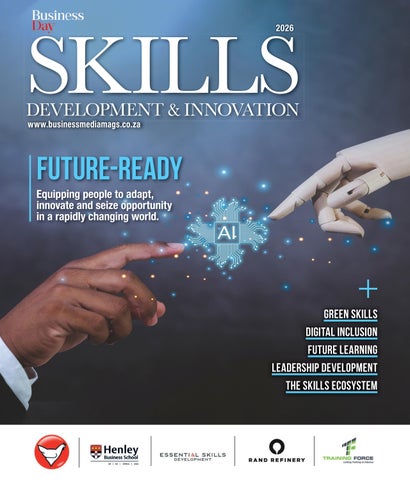
SKILLS 2026
DEVELOPMENT & INNOVATION www.businessmediamags.co.za
FUTURE-READY Equipping people to adapt, innovate and seize opportunity in a rapidly changing world.
+ GREEN SKILLS DIGITAL INCLUSION FUTURE LEARNING LEADERSHIP DEVELOPMENT THE SKILLS ECOSYSTEM
Cover5.indd 1
2026/09/17 09:39
ToCheck_DPS.indd 2
2026/08/20 10:59
ToCheck_DPS.indd 3
2026/08/20 10:59
Untitled-4 1
2026/09/16 16:26
SKILLS DEVELOPMENT & INNOVATION PUBLISHED BY
A proud division of Arena Holdings (Pty) Ltd Hill on Empire, 16 Empire Road (cnr Hillside Road), Parktown, Johannesburg, 2193 PO Box 12500, Mill Street, Cape Town, 8010 www.businessmediamags.co.za EDITORIAL Editor: Ryland Fisher Content Manager: Raina Julies rainaj@picasso.co.za Contributors: Cynthia Banda, Philip Hanley, Jackie Kennedy, Vukani Magubane, Itumeleng Mogaki, Busani Moyo, Leigh-Ann Revill, Rodney Weidemann Copy Editor: Brenda Bryden Content Co-ordinator: Natasha Maneveldt DESIGN Head of Design: Jayne Macé-Ferguson Senior Design: Mfundo Archie Ndzo Cover image: Eakarat Buanoi/istock.com SALES Project Manager: Frank Simons Franks@picasso.co.za +27 82 366 3125
FROM THE EDITOR
PREPARING FOR THE JOBS OF TOMORROW
I
n a country where the official unemployment rate has been hovering above 30 per cent for decades, it becomes important to focus on creating job and economic opportunities. As the world of work changes, so too do the skills people need to participate in it. The challenge is not simply to create more opportunities, but to ensure that people are equipped to take advantage of them. There will always be a need for traditional and artisanal skills. We will always need plumbers, electricians, mechanics and other skilled tradespeople. Yet even these professions are changing. Today’s mechanic, for example, needs to understand far more than wrenches and spanners as vehicles become increasingly computerised and technologically sophisticated. At the same time, entirely new opportunities are emerging in fields shaped by digital transformation, automation, renewable energy and the transition to a greener economy.
IMAGES: XXXXXXXX
MANAGEMENT Management Accountant: Deidre Musha Business Manager: Lodewyk van der Walt General Manager, Magazines: Jocelyne Bayer
Copyright: No portion of this magazine may be reproduced in any form without written consent of the publisher. The publisher is not responsible for unsolicited material. Skills Development and Innovation is published by Picasso Headline. The opinions expressed are not necessarily those of Picasso Headline. All advertisements/advertorials have been paid for and therefore do not carry any endorsement by the publisher.
Ryland Fisher Editor
CONTENTS 17
07
DIGITAL Online Editor: Stacey Visser, vissers@businessmediamags.co.za PRODUCTION Production Editor: Shamiela Brenner Advertising Co-ordinator: Johan Labuschagne Subscriptions and Distribution: Fatima Dramat, fatimad@picasso.co.za Printer: CTP Printers, Cape Town
Preparing young people for this future means thinking beyond the skills needed today and considering those that will be required tomorrow. This requires a careful balance between creating employment opportunities and investing in meaningful skills development. It also requires stronger partnerships between government, business, educational institutions, civil society and other stakeholders. No single sector can solve South Africa’s skills and employment challenge alone. In this edition of Skills Development and Innovation, we explore some of the ways these partnerships can help unlock potential and create pathways to opportunity. The future of work may be uncertain, but one thing is clear: preparing people for it cannot wait. We hope you enjoy reading these and many other articles in this publication.
8 10
CREATING PATHWAYS Turning youth potential into opportunity – connecting skills, experience and entrepreneurship to create sustainable careers for young South Africans.
SKILLS ECOSYSTEM
19
ENTREPRENEURSHIP EDUCATION
20
LEADERSHIP DEVELOPMENT
DIGITAL INCLUSION Taking technology skills to underserved communities – closing the digital divide through training, foundational skills and opportunity.
14
THE SKILLS SHIFT
16
FUTURE LEARNING
AI is reshaping work – making skills development an investment in competitiveness, adaptability and career mobility.
Learnerships can help deal with South Africa’s unemployment problem, especially among young women.
18
GREEN SKILLS Under the weather – South Africa’s climate challenges demand green skills for a changing economy.
CLOSING THE GENDER GAP
How collaboration between academia, industry, employers, SETAs and government is strengthening South Africa’s skills ecosystem.
South Africa needs education that empowers people to create businesses, generate income and become job creators.
How to develop leaders who can turn skills into better decisions, stronger organisations, innovation and sustainable economic growth.
We explore how institutions are rethinking curricula and human skills for an AI-shaped workplace.
16 Contents.indd 3
18 WO R L D F O O D DAY SK I L LS
3 3
2026/09/17 08:26
ToCheck_DPS.indd 2
2026/08/28 16:02
ToCheck_DPS.indd 3
2026/08/28 16:02
ToCheck_fcp.indd 2
2026/09/04 10:46
CREATING PATHWAYS
TURNING YOUTH POTENTIAL INTO OPPORTUNITY
O
ur country’s young people have great potential, yet millions remain locked out of meaningful work. While government is responsible for creating the policy environment, business has an equally key role in opening doors through workplace experience, skills development, entrepreneurship and investment. For Joanna Johnston, country president of Novartis South Africa, a global pharmaceutical company developing innovative healthcare treatments, creating employment begins with investing in people long before they enter the workforce. “Corporates have a critical role to play in creating sustainable employment opportunities by investing in learnerships, internships, mentorship, workplace experience and future-focused skills development,” says Johnston.
“CORPORATES NEED TO MOVE PAST SINGLE GRANTS AND BECOME COMMITTED PARTNERS IN BUILDING EMPLOYMENT PATHWAYS.”
IMAGES: SUPPLIED
– FLORIAN ZECH
She believes South Africa needs to stop treating education, skills development and employment as separate issues. “Instead,” she says, “all three should function as one connected system where schools, universities, business and government work towards the same outcome, that is, employable graduates with skills that match industry demand. “Success should be measured not by the number of people trained, but by how many young people transition into sustainable employment and long-term careers. “At Novartis, that philosophy is reflected in structured learnerships, mentorship, job shadowing and
How business can turn youth potential into sustainable careers. By ITUMELENG MOGAKI leadership development programmes that help young professionals gain practical workplace experience. These initiatives strengthen both employability and the country’s future talent pipeline,” she says.
FROM JOB SEEKERS TO JOB CREATORS Johnston also believes corporates can create opportunities beyond hiring. “Supporting youth entrepreneurship Joanna Johnston can help young people transition from job seekers to job creators,” she says. “By using supplier development, corporate social investment and broad-based black economic empowerment programmes, large companies can help youth-owned businesses gain access to funding, mentorship and, most importantly, customers,” adds Johnston. Strong partnerships, she argues, can create entrepreneurial ecosystems where small businesses have a genuine chance to grow. For Florian Zech, founder of Safe-Hub, a youth development organisation creating pathways into employment and enterprise, employment starts even earlier, “by building clear pathways that connect excluded young people with real economic opportunities”. Zech adds: “Corporates need to move past single grants and become committed partners in building employment pathways.” Rather than simply funding projects, he believes businesses should help define the skills they need, shape training programmes and create workplace opportunities through their own value chains. “Government provides scale and policy direction, while community organisations
ensure young people who are often outside formal systems are not left behind,” says Zech.
BUILDING OPPORTUNITIES WHERE YOUNG PEOPLE LIVE Zech argues that training only becomes valuable when it leads somewhere tangible. “Alignment has to start with what employers actually need, rather than generic course menus,” he says. He believes technical training should be combined with digital skills, communication, resilience and personalised career guidance, ensuring young people are prepared for today’s labour market rather than yesterday’s. Zech also sees procurement as one of the country’s biggest untapped employment tools. “Businesses can open their value chains, procurement systems and infrastructure to young entrepreneurs and township enterprises,” he says, creating opportunities for local businesses to become suppliers rather than remaining on the margins of the economy. Despite approaching the challenge from different angles, both leaders agree on one principle: collaboration must produce measurable results. Johnston believes successful partnerships require clear targets, shared accountability and measurable outcomes linked to real jobs, enterprise growth and long-term economic participation. Ultimately, South Africa’s greatest advantage is not its policies or programmes, but its people. As Johnston puts it: “We are not short of talent, ambition or potential. The challenge now is ensuring that business and government work together to create the pathways that allow that potential to become prosperity.”
Follow: Joanna Johnston www.linkedin.com/in/jo-johnston-70ab9a55 Florian Zech www.linkedin.com/in/florian-zech-368bb212
Florian Zech
SK I L LS
7
GREEN SKILLS
UNDER THE WEATHER South Africa’s climate challenge needs more than funding. It needs green skills, argues PHILIP HANLY, customer success director at New Leaf Technologies
GREEN SKILLS DEVELOPMENT A PRIORITY At the same time, international investment in South Africa’s energy transition continues to grow, including the recent extension of a US$1-billion United Kingdom/African Development Bank debt guarantee, aimed at supporting infrastructure development and communities in coal-dependent regions. The African Union has also placed increasing emphasis on green skills development through initiatives such as Africa Skills Week and its Youth Employment Strategy. Funding and policy are essential, but they are only part of the solution. You can approve large-scale investment, but if there are not enough people trained in renewable energy installation, grid management, sustainable agriculture or climate adaptation, implementation becomes far more difficult. Without a workforce equipped with the right capabilities, the pace of South Africa’s transition risks being limited by a shortage of practical skills rather than financial resources.
8
WITHOUT A WORKFORCE EQUIPPED WITH THE RIGHT CAPABILITIES, THE PACE OF SOUTH AFRICA’S TRANSITION RISKS BEING LIMITED BY A SHORTAGE OF PRACTICAL SKILLS RATHER THAN FINANCIAL RESOURCES.
Green skills are no longer a niche requirement for environmental specialists. They are becoming increasingly important across multiple sectors of the economy. Agriculture requires more climate-resilient farming practices and improved water management. Energy demands technicians capable of installing and maintaining renewable infrastructure. Businesses need professionals who understand sustainability, environmental compliance and changing operational requirements. Other countries are already responding to this challenge. LinkedIn’s Global Green Skills Report found that professionals with green skills experience a 55 per cent higher hiring rate than the broader workforce, while demand for green talent is growing more than twice as fast as supply. The OECD also reports that countries worldwide are investing in national green upskilling strategies to prepare their workforces for the transition ahead. South Africa has an opportunity to do the same. Digital learning offers one of the most practical ways to build these capabilities at scale. Different industries require different solutions – a renewable energy technician
in Mpumalanga has very different training needs from a smallholder farmer adapting to prolonged drought in the Eastern Cape. Flexible digital learning makes it possible to deliver relevant, accessible training to diverse audiences while overcoming many of the geographic and logistical barriers associated with traditional classroom-based education. The alignment of climate urgency, international funding and policy attention presents a unique opportunity for South Africa’s learning and development sector. However, this window will not remain open indefinitely. If organisations, government and learning providers work together to develop the green skills needed for the future, South Africa will be better positioned not only to respond to climate change, but also to unlock the full potential of its energy transition, strengthen economic resilience and create sustainable opportunities for generations to come.
Follow: Philip Hanly www.linkedin.com/in/philip-hanly
IMAGES: ISTOCK.COM/ DUSANPETKOVIC, SUPPLIED
S
outh Africa is facing two significant pressures at once. On one side is the growing likelihood of a super El Niño developing during the 2026/27 season, bringing an increased risk of drought, agricultural disruption and food insecurity. On the other is the country’s accelerating Just Energy Transition Partnership (JETP), backed by billions of dollars in international funding to support the shift towards a greener economy. Both demand action. Yet one critical element often receives less attention than it deserves: developing the workforce with the skills needed to turn climate ambition into real-world outcomes. The climate risks are well-documented. The African Union has highlighted the potential impact of a severe El Niño on agriculture-dependent economies across the continent. Historical data shows that 16 of the past 21 El Niño events since 1961 coincided with below-expected South African maize yields. During the 2023/24 El Niño-linked drought, the Crop Estimates Committee projected a 21 per cent decline in South Africa’s summer grain and oilseed harvest.
SKILLS
green skills_subbed.indd 8
2026/09/15 14:16
IN PARTNERSHIP WITH UNIVERSITY OF JOHANNESBURG
REIMAGINING EMPLOYABILITY Collaboration, not policy alone, will realign South Africa’s skills system, writes Professor RENE BENECKE, head of the School of Communication, Faculty of Humanities at the University of Johannesburg
T
he University of Johannesburg’s (UJ) Strategic Plan 2035 commits the institution to an unambiguous mandate: societal impact and sustainability. That commitment remains current. In the 2026 Times Higher Education Sustainability Impact Ratings, released on 24 June 2026, UJ was confirmed as the number one university in South Africa and Africa, placing 39th globally among 1 646 institutions assessed against the United Nations Sustainable Development Goals, and seventh in the world for SDG 8: Decent Work and Economic Growth (UJ News). Decent work is precisely what motivated the Faculty of Humanities to partner with Social TV and the Public Relations Institute of Southern Africa (PRISA) to host the third annual Best Results and Achievements Gathering (BRAG) Employability Summit at UJ’s Sanlam Auditorium from 12 to 14 August 2026. The summit did not emerge in a policy vacuum. Deputy Minister of Forestry, Fisheries and the Environment Narend Singh opened proceedings with a direct message to young people: “Thousands of work opportunities exist for young people who want to be involved in the initiatives offered by the Department of Forestry, Fisheries and the Environment.” His presence signalled that employability is a whole-of-government concern, rather than a problem for universities to solve alone.
IMAGES: SUPPLIED
WORK-INTEGRATED EDUCATION Together with external partners, the faculty put UJ’s Work-Integrated Education (WIE) Policy to the test. The policy defines WIE as encompassing work-integrated learning, problem-based learning, community-based learning, service learning and internships, each a “contextualised and well-structured authentic modality of learning in action” (UJ WIE Policy, 2022). Around 1 500 Faculty of Humanities students, almost 50 speakers and more than 30 exhibitors engaged under the theme
Student volunteers working at BRAG 2026 with Sylvester Chauke, UJ Professor of Practice, and Professor Rene Benecke.
Carolyn Steyn of the 67 Blankets for Mandela team with Social TV’s Samm Marshall and Professor Rene Benecke.
“Reimagining Employability: Skills, Systems, and Social Impact” (Social TV). The disciplinary range made the case more effectively than policy language could. Strategic communication students, whose diploma requires a three-month industry placement, moved from service-learning briefs into partnership-led corporate social investment projects with FNB eBucks and Engen. Film and television studies and African languages students found counterparts in Social TV’s storytelling mandate and literacy partner Nal’ibali, illustrating that multilingual, screen-literate communication is economic infrastructure, not a “soft” skill. Sociology, psychology and social work shaped sessions on sustainable partnership models, youth wellbeing and gender-responsive design, reinforced by EPF Tech Fund’s Joanna Govender, the sole African recipient of a recent Paris Women in Tech award. As Sun International Foundation’s Heidi Edson
put it: “Well done to you and your team for showcasing your commitment to community engagement and social impact. Much appreciation and (I am) humbled to play a part.” A funder crediting the university rather than claiming the credit, says something about what genuine collaboration owes its partners. Students felt it, too. PRISA’s Tshedza Rambau observed that “employability is not something we start thinking about after graduation; it is something we should actively build while we are still students”. Kaamini Reddy described being “moved by the hope, the real stories and the generosity of people sharing what they have learnt along the way”. Such accounts suggest WIE is experienced as substantive, not procedural. Scaling this model, however, exceeds any single faculty’s resources. Sector education and training authorities should extend their funding to include WIE placements; institutional incentives should reward departments for sustaining partnerships, not just publications; and universities must continue partnering with business and government to create decent work opportunities for young professionals. The summit’s success belongs to every partner who chose to participate. When more than 40 organisations collaborate with humanities academics practising work-integrated education, employability stops being a line in policy or a ranking table and becomes a jointly held undertaking. That is the premise on which collaboration rests – and what a genuinely reimagined national skills system requires.
VISIT WEBSITE SCAN THIS QR CODE TO GO TO THE UNIVERSITY OF JOHANNESBURG WEBSITE
For more information: www.uj.ac.za www.linkedin.com/school/university-of-johannesburg
SKILLS
9
DIGITAL INCLUSION
The digital divide widens, making digital literacy vital in rural communities, writes RODNEY WEIDEMANN
W
e have a vital need to break the cycle of poverty in this country, reduce high youth unemployment and bridge the vast digital divide between urban centres and remote or rural areas. The answer lies in providing marginalised populations with digital literacy skills as a means to foster economic inclusion and social equity. We tend to describe the digital divide as a shortage of devices and data, explains Bradley Maseko, founder and director at training organisation Seseko. In fact, the real gap is a gap in capability. It separates young people learning to build with technology from those who are only learning to use it, and it decides whether someone enters the digital economy as a participant or as a customer, he says. “Usually, by the time a young person sits down for an interview at twenty-two and discovers the market wants skills nobody offered them at fifteen, the fix is remedial and expensive,” continues Maseko. “This is why early exposure to artificial intelligence (AI), robotics and coding at school – taught in the language of the CAPS (Curriculum and Assessment Policy Statement) curriculum by a teacher who has been trained and equipped rather than bypassed – is the
10
SKILLS
cheapest and most durable form of economic inclusion this country has available to it.” According to Kate Groch, founder and CEO at the Good Work Foundation, there are multiple challenges; however, access is the most important, as we need to ensure young people are not left behind. “There is also a need to look further down the education funnel and make sure the children have access to skills like problem-solving and design thinking,” she says. “Working with school learners means we have to prepare them for the world of ten to fifteen years’ time – a world that is hard to imagine. For our young adult learners, meanwhile, we need to look at cybersecurity, cloud computing and the use of AI.”
GOVERNMENT AND CORPORATE ROLES Maseko notes that both government funding and corporate sponsors play key roles in ensuring the success of programmes such as Seseko. “Government needs to come to the party and ensure they fund the mandate,” he explains. “After all, requiring coding and robotics without providing resources – like hardware, teacher training and technical support – pushes the shortfall onto the schools least able to carry it,” he says. It is also imperative that government treats teacher development as infrastructure, and ring-fences it. This is key, because although it’s easy to budget for equipment, it is not easy
Follow: Bradley Maseko www.linkedin.com/in/bradley-maseko-4b4670244 Kate Groch www.linkedin.com/in/kate-groch-3b625013/
THE CHALLENGES Some of the major challenges in taking technology to underserved communities include: • Limited funding for digital infrastructure and capacity building. • Difficulty attracting and retaining digitally skilled people. • Resistance to change and technology adoption. • Data privacy, cybersecurity and compliance requirements. • Lack of long-term sustainability planning. • Poor alignment between technology solutions and actual community needs. Source: PwC – Marthle du Plessis, partner and workforce leader at PwC
to budget for teacher capacity. Yet capacity decides whether training efforts will work. Corporates, meanwhile, need to deliver lasting impact, which means funders and policymakers must move from short-term projects to sustained investment, continues Groch. “This should come in the form of multiyear funding, infrastructure commitments for rural areas, incentives for private sector to hire and mentor local talent and formally recognising community-based training providers in education and skills strategies.” Groch indicates that the digital divide isn’t just about devices or connectivity; it’s about opportunity, dignity and the right to participate in the future economy. Closing that gap requires a long-term, systems-level approach: affordable connectivity and devices, continuous teacher and community training, locally relevant curricula, holistic learner support and partnerships that align resources and expertise. “Technology skills are a powerful route out of unemployment, but they must be taught with context. Foundational skills – critical thinking, problem-solving, collaboration and digital literacy – are as important as technical skills like cloud computing, cybersecurity and AI. Ultimately, combining technical training with industry exposure, work-integrated learning and entrepreneurship support will provide young people with real pathways to jobs or self-employment,” she concludes.
IMAGES: ACOBLUND/ISTOCK.COM, SUPPLIED
EXPANDING ACCESS TO TECH SKILLS
IN PARTNERSHIP WITH RAINBOW CHICKEN
CONTINUOUS LEARNING IS A BUSINESS IMPERATIVE For South Africa to compete in an increasingly digital, knowledge-driven economy, organisations must develop people with the necessary skills and leadership capabilities. By ANSA DU TOIT, talent, learning and development executive at Rainbow Chicken
A
cross industries, businesses are responding to skills shortages, technological disruption and evolving workforce expectations. In this environment, attracting and retaining talented people is only part of the equation. The greater challenge and opportunity lies in creating workplaces where employees continue to learn, adapt and grow throughout their careers. For organisations focused on long-term success, talent development is no longer simply a human resources function. It has become a strategic business imperative. This philosophy shapes Rainbow’s approach to developing its people. Rather than viewing learning as something that happens at specific points in an employee’s career, the company sees leadership as a capability built progressively through continuous development, practical experience and increased responsibility.
IMAGES: SUPPLIED
IMAGES: SUPPLIED
EARLY INVESTMENT IS ESSENTIAL Developing people shouldn’t be viewed as a human resources strategy; it’s a business strategy. Organisations that consistently invest in learning build the capability to adapt, innovate and lead over the long term. That investment begins early. Rainbow’s Internship Programme provides young professionals with practical workplace experience while creating opportunities to transition into permanent roles within the business. Its Management Trainee Programme similarly reflects a long-term commitment to building future capability, supporting graduates as they develop the
technical expertise, commercial understanding and leadership skills to contribute to the organisation over time. Inside the organisation, there are many examples of employees who started as management trainees and now occupy senior roles within the business.
ONGOING DEVELOPMENT Importantly, learning does not end once employees establish their careers. Rainbow has developed a structured Leadership Development model in partnership with leading educational institutions. It creates development opportunities across every stage of leadership, recognising that the capabilities required to lead teams, functions and businesses evolve throughout a career. As responsibilities grow, so too does the opportunity to continue learning. At Rainbow, this extends to the company’s executive directors who are afforded development opportunities, allowing them to remain up to date in areas critical to navigating an evolving business landscape. This approach reflects an important shift in how organisations think about leadership. Rather than preparing people only for the roles they occupy today, businesses increasingly need to equip employees for the challenges they are likely to face tomorrow. Continuous learning strengthens succession planning, supports internal career mobility and helps retain institutional knowledge while ensuring organisations have the leadership capability to respond to changing market conditions.
Follow: Ansa du Toit
www.linkedin.com/in/ansa-du-toit
Rainbow Chicken www.rainbowchickens.co.za Contactus@rainbowchicken.com
Ansa du Toit
Rainbow Chicken_TL Advertorial.indd 11
Leadership isn’t something people suddenly acquire when they receive a promotion. It’s developed over time through experience, learning and taking on greater responsibility. Every stage of a career presents an opportunity to grow. For employees, this creates greater visibility of potential career pathways and reinforces that professional development is an ongoing journey, not a destination. For organisations, it builds resilience by developing leaders who understand the business, are equipped to make sound decisions in increasingly complex environments, and can lead their people through inevitable change. This is particularly relevant in South Africa, where strengthening the country’s skills base remains essential to improving economic competitiveness. While government, educational institutions and industry all have important roles to play, employers are uniquely positioned to create meaningful opportunities for people to develop practical skills and leadership capability within the workplace. Businesses have an important role in developing South Africa’s future workforce. When organisations invest in people over the long term, they’re strengthening their leadership capability and contributing to a more skilled, capable and competitive economy. Ultimately, organisations that succeed in the years ahead are likely to be those that recognise learning as a continuous process rather than a once-off intervention. Developing talent is not about preparing people for their next role alone. It is about building the curiosity, adaptability and leadership capability that enable individuals and organisations to thrive over the course of an entire career. For Rainbow, continuous learning is more than an investment in its people; it is an investment in the business’s future resilience and the long-term competitiveness of South Africa’s workforce.
SKILLS
11
2026/09/17 08:52
Untitled-1 2
2026/09/15 10:22
Untitled-1 3
2026/09/15 10:22
THE SKILLS SHIFT for an AI-enabled workplace and deepening technical capability through structured frameworks, cross-skilling and upskilling. KPMG positions itself as a learning firm, investing in trainees and graduates as they develop skills and pursue long-term careers. “As a learning firm, we invest in building the skills and capabilities of our people, including trainees and graduates, supporting them on their journey towards professional qualification and long-term career success,” Chambers says. Learning is also a professional requirement. KPMG must demonstrate to regulators how it helps employees maintain technical knowledge and upholds global risk and training standards. Its priorities include AI, audit and risk capabilities, enabling employees to improve efficiency while protecting audit quality and professional standards.
AI RESHAPES WORKPLACE LEARNING
BEYOND THE SCORECARD
As artificial intelligence transforms work, organisations are shifting skills development from compliance towards competitiveness, adaptability and career mobility, writes BUSANI MOYO
S
kills development may contribute towards a company’s broad-based black economic empowerment (BBBEE) score, but technological disruption is making learning increasingly difficult to treat as a compliance exercise. Artificial intelligence (AI), automation and changing client expectations are compelling organisations to consider whether their people have the capabilities required for the future. For Lesley-Anne Gatter, global head of people and organisation at Investec; Carolyn Chambers, interim head of people for KPMG Southern Africa; and Marilize Putter, chief academic officer at Milpark Education, the case for investment extends beyond regulatory incentives. They regard learning as essential to performance, professional standards and employability. “The question South African businesses should be asking is no longer whether they
can afford to invest in skills development. It is whether they can afford not to,” Putter says.
FROM TRAINING TO CAPABILITY “Investec acts as a training ground for a young workforce, with learning designed not only around immediate role requirements, but also around transferable capability that enables people to remain agile, adaptable and effective as the business and industry evolves,” Gatter says. The organiation’s priorities include strengthening managers’ ability to set objectives and manage performance, developing leaders through its global One Investec programme, preparing employees
The prominence of AI at Investec and KPMG demonstrates how rapidly skills requirements are changing. Investec was the first organisation in South Africa to publicly announce a full-workforce deployment of Microsoft Copilot, covering more than 8 000 employees across South Africa, the United Kingdom and other international markets. “At a group level, the focus is on building AI literacy so that people understand the tools and can participate confidently in new ways of working,” Gatter explains. Bespoke interventions help particular functions apply AI to specific tasks. Leaders and executives are also receiving development supported by external expertise and international business-school partnerships. Investec is further exploring how AI can help employees access knowledge more readily and learn within the flow of work. At KPMG, AI upskilling and access to AI tools receive significant attention. The firm combines formal instruction with independent study and peer-to-peer knowledge sharing to accommodate different learning preferences and rates of adoption. “At the same time, the use of AI tools is governed through clear policies and oversight mechanisms to ensure responsible, ethical and secure adoption,” Chambers says. Putter believes technological change is also altering what employers value. Qualifications remain important, but organisations increasingly need people who can Lesley-Anne Gatter
14
SKILLS
THE SKILLS SHIFT apply knowledge, solve complex problems, collaborate and use emerging technologies effectively. Human-centred capabilities are becoming more important, rather than less, as AI adoption accelerates. “While AI can automate certain tasks, it cannot replace human judgement, creativity, leadership and empathy. The most successful professionals of the future are unlikely to be those competing against AI, but rather those who understand how to work alongside it,” she says.
IMAGES: ISTOCK.COM/PRESSMASTER, SUPPLIED
FROM PARTICIPATION TO RESULTS The distinction between meaningful skills development and box-ticking becomes clearer when companies assess what employees can do differently, rather than only recording expenditure or attendance. Investec’s Copilot enablement programme reached one in three employees within its first four weeks, with uptake across South Africa, the United Kingdom, the United States and Switzerland. The highest adoption rates were recorded in South Africa, India and Mauritius. “Feedback from the team highlighted tangible productivity benefits across a range of business activities, including reporting, presentation creation, research and document summarisation,” Gatter says. Ninety-seven per cent of participants reported increased confidence in using AI tools, while fifty-four per cent said they were significantly more confident about applying AI in their daily work. Sixty-eight per cent returned for at least two learning sessions, suggesting sustained interest Carolyn Chambers in developing their capabilities. At KPMG, the Development and Assessment Centres’ process and personal-case approach are intended to improve career advancement decisions. Development centres identify areas for performance improvement while assessment centres establish whether employees considered for senior roles have the competencies required for leadership. “Our Development Centres focus on identifying and driving performance improvement, and the Assessment Centres ensure that, at a senior level, we have fully
assessed the required competencies before advancing someone to a leadership position within the firm,” Chambers says. Learning does not, however, automatically produce advancement. Chambers identifies role availability as KPMG’s greatest challenge in translating development into progression. Employees may be ready to advance, but opportunities remain dependent on business needs and organisational structures.
“THE OBJECTIVE IS NOT SIMPLY TO HELP STUDENTS ACQUIRE KNOWLEDGE, BUT ALSO TO ENSURE THEY CAN APPLY THAT KNOWLEDGE EFFECTIVELY IN PROFESSIONAL ENVIRONMENTS.” – MARLIZE PUTTER
RETHINKING CAREER PROGRESSION Investec faces a related challenge: helping employees move beyond the expectation that a successful career must follow a predictable upward path. It encourages movement across teams and divisions so employees can broaden their expertise and develop cross-functional capabilities. “We see ourselves as a learning organisation rather than a training organisation. Learning is not confined to formal programmes or a traditional career ladder; it is a continuous cycle, combining structured development, real-world experience and the everyday moments where people build new skills and capabilities,” Gatter says. This flexible model may become increasingly important as technology changes roles faster than conventional promotion structures can accommodate. Lateral mobility and cross-skilling can strengthen individual employability while creating a more resilient internal talent pool. Education providers also have a role in narrowing the distance between acquiring knowledge and applying it. Milpark’s Immersive
Online learning model uses simulations, case studies, collaborative problem-solving and contextual learning experiences that reflect workplace realities. “The objective is not simply to help students acquire knowledge, but also to ensure they can apply that knowledge effectively in professional environments,” Putter says. This is especially important in South Africa, where high unemployment exists alongside shortages of specialised and job-ready skills. Employers struggle to find some capabilities, while many graduates struggle to secure meaningful employment. Closing this gap requires closer alignment with education, workplace development and employment opportunities.
INVESTMENT BEYOND INCENTIVES Asked what would happen if skills development no longer attracted BBBEE points, Investec and KPMG say their learning investments would continue. “Our approach has always been deliberate – a strategic investment in our people and the long-term success of our business. If external incentives no longer existed, our commitment to learning and development would remain unchanged,” Gatter says. KPMG would also retain its core initiatives because skills development is integral to its strategy, culture and employee value proposition. “As a learning firm, we recognise that investing in our people enables us to maintain high professional standards, adapt to changing client needs, embrace new technologies and build future leaders. These priorities would remain unchanged regardless of external incentives,” Chambers says. BBBEE has encouraged corporate investment in learning and widened access to development. The greater test, however, is whether that investment builds adaptable employees, strengthens performance and creates genuine opportunities. “The future of skills development in South Africa should not be measured by compliance reports. It should be measured by careers built, productivity improved, innovation accelerated and opportunities created,” Putter concludes.
Follow: Lesley-Anne Gatter www.linkedin.com/in/lesley-anne-gatter-6b620915 Carolyn Chambers www.linkedin.com/in/carolyn-chambers-188a331a Marilize Putter www.linkedin.com/in/marilize-putter-cfp®-a39812b1
SK I L LS
15
FUTURE LEARNING
South African universities are rethinking not only what students learn, but also how they learn as technology reshapes the workplace. By VUKANI MAGUBANE
I
n Durban University of Technology’s (DUT) dean of the Faculty of Accounting and Informatics Professor Oludayo Olugbara’s boardroom, honours and postgraduate students are working alongside professors on a live government software project. There are no rows of desks or lecturers delivering notes from the front. Students are debating ideas, solving problems and developing technology for a real client while gaining practical experience and earning through the project. A student shares: “What I’ve learned here, from research to actual experience, you couldn’t just learn in the classroom.” The collaboration around Professor Olugbara’s boardroom is a powerful snapshot of how universities are responding to one of higher education’s biggest challenges: preparing graduates for jobs being reshaped by artificial intelligence (AI), digital technologies and rapid innovation, as reported in the World Economic Forum’s Artificial Intelligence and the Future of Entry Level Work report.
REDEFINING HOW LEARNING IS DELIVERED
“AI IS CHANGING EVERYTHING RADICALLY. WE NEED TO RETHINK EVERY STEP OF WHAT IT MEANS TO BE A UNIVERSITY.” – PROFESSOR ANNÉ VERHOEF
learning by solving real-world challenges rather than simply studying them. Lecturers become mentors and collaborators, introducing theory as students develop practical solutions. “We don’t want to train students who will be looking for jobs,” says Professor Olugbara. “We want to train employers of labour, not employees of labour.”
RETHINKING CURRICULA CONTENT How students learn is only part of the challenge. The rapid rise of generative AI is forcing universities to examine something more fundamental: what should students still be learning when technology can already perform many of the tasks that once took years to master? That is at the centre of North-West University’s (NWU) response to AI. Ironically, the university’s AI hub is led not by a computer scientist, but by a professor of philosophy. Professor Anné Verhoef was drawn into the AI debate by concerns around ethics and academic integrity. He was asked to chair NWU’s AI steering committee before establishing and now directing the university’s AI Hub, where he oversees the ethical and responsible integration of AI across teaching, learning and research.
For universities, the challenge is no longer simply to introduce new technology modules. It is to rethink what graduates need to know, how they learn and develop the skills that will remain valuable in a rapidly changing world. At DUT, the transformation is most visible in how students learn. “Technology is challenging our pedagogy of learning,” says Professor Olugbara. “Professors don’t have to go to lecture rooms. They need students to show what they are doing.” Through its ENVISION2030 strategy, DUT is developing curricula that stimulate creativity and innovation, while academic departments embed graduate attributes into their curricula and shift from knowledge-based to skills-based learning. Students work alongside academics on live industry and government projects, Professor Oludayo Olugbara
16
SKILLS
Generative AI is unlike any technological disruption universities have faced before, says Verhoef. “AI is changing everything radically,” he says. “We need to rethink every step of what it means to be a university.” That rethink begins with the curriculum. Rather than abandoning disciplinary foundations, Professor Verhoef argues that universities must preserve the fundamentals of every profession while preparing graduates to work intelligently alongside AI. Engineers must still master engineering principles, but also learn to work critically, responsibly and confidently with technologies that are becoming integral to every profession, he adds. At NWU, the response extends beyond introducing compulsory AI literacy courses. Faculties are reviewing programmes, redesigning assessments and asking whether traditional learning outcomes still serve graduates entering an AI-enabled workplace. In one exercise, AI analysed engineering programme outcomes to identify which competencies artificial intelligence can already perform, which require collaboration between humans and AI, and which remain uniquely human. “We are identifying where the human contribution is that universities should develop,” Professor Verhoef explains. Teaching methods are evolving just as quickly. AI-powered tutor bots provide personalised support by identifying where individual students are struggling and tailoring learning activities to their specific needs, while lecturers are increasingly using AI to develop teaching material, classroom activities and assessments. “The greatest challenge is not technological but human,” says Professor Verhoef. “If we don’t incorporate AI, we will not prepare students for the world of work,” he says. “However, we must teach students to use AI ethically, responsibly and critically.” He fears that universities failing to make that shift face an uncomfortable future. “Universities that don’t rethink every programme, every module and ultimately why they exist risk becoming irrelevant and illegitimate,” he warns.
Follow: Professor Oludayo Olugbara www.linkedin.com/in/oludayo-olugbara-4707271b7 Professor Anné Verhoef www.linkedin.com/in/ann%C3%A9-verhoef-24b759245
IMAGE: SUPPLIED
TEACHING BEYOND AI
CLOSING THE GENDER GAP
LEARNERSHIPS
Opening doors for young women Learnerships can help deal with South Africa’s unemployment problem, especially among young women, writes CYNTHIA BANDA, head of learning at SA Business School
S
outh Africa’s youth unemployment crisis in our country is well-documented, and harrowing. What gets less attention is how unevenly that crisis falls on young women, particularly young black women from disadvantaged communities who have no pathway into further study and qualifications after school to improve their employment prospects. Learnerships, both employed and unemployed, offer one of the few proven routes past that barrier.
A LEARNERSHIP IS ONE OF THE FEW MECHANISMS THAT ADDRESS THE COST BARRIER, EXPERIENCE BARRIER AND QUALIFICATION BARRIER SIMULTANEOUSLY.
When money is tight, it is often young women, not young men, who are pulled out of the education pipeline first. The result is a large pool of capable young women who leave school with a matric, but no realistic path to a qualification that employers need or recognise. This is the critical gap that learnerships are designed to close.
WHAT IS A LEARNERSHIP? A learnership is a structured, work-based learning programme, typically over 12–24 months. The learner undergoes theoretical and on-the-job training, learning practical skills directly related to a specific occupation – from IT, engineering and insurance to business process outsourcing, sales and retail, among many others. It leads to a registered qualification on the National Qualifications Framework (NQF), and is central to skills upliftment and in bringing young people onto the employment and career ladder.
LEARNERSHIPS MAKE EXCELLENT BUSINESS SENSE
IMAGE: SUPPLIED
THE AFFORDABILITY WALL Most young South Africans cannot afford tertiary education. University and technical and vocational education and training fees, accommodation, transport and living costs while studying place a formal qualification out of reach for millions of households, and household budgets in disadvantaged communities are disproportionately carried by women.
Cynthia Banda
Learnerships are developed by the industry, so the skill sets and outcomes are aligned with the requirements of the specific occupation and industry sector. Every learnership can be customised to the business strategy, as long as it meets the requirements of notional hours and formative and summative assessments. Qualifications are registered on the NQF, which means that employees are learning new skills and knowledge within a recognised qualification. Learnerships earn points on the BEE Scorecard under both Employment Equity and Skills Development, and there is a SARS
Follow: Cynthia Banda SA Business School
tax rebate if the learnership is registered with the Department of Labour and the agreement is registered with the sector education and training authority (SETA). SETA discretionary and mandatory grants reward employers that submit a Workplace Skills Plan and Annual Training Report, unlocking funding that can offset the cost of hosting learners. Job prospects are imminently better for the learner, with sound theoretical and practical occupation-specific training backed by a nationally recognised qualification. Learnerships often result in permanent employment for the learner upon completion if they have performed well. For the employer, learnership graduates who have already been trained inside a business and understand its systems and culture are typically faster to onboard into permanent roles than external hires.
WHY THIS MATTERS SPECIFICALLY FOR YOUNG WOMEN Learnerships address several of the barriers keeping young women out of the labour market. They remove the cost barrier that pushes young women out of education first. They provide workplace experience and, because learnerships are structured and monitored by SETAs, they create a defensible pathway into industries, such as finance, engineering, technical trades and insurance, where women remain under-represented in more senior and higher-paid roles. South Africa’s youth unemployment will not be solved by government programmes alone, and certainly not resolved by ignoring the fact that young women face a steeper climb than young men at every level of education. A learnership is one of the few mechanisms that address the cost barrier, experience barrier and qualification barrier simultaneously. The tools, tax incentives and funding structures already exist. What is needed now is more corporates willing to open their doors and ensure women can participate and contribute on an equal playing field.
www.linkedin.com/in/cynthia-banda-3294b438 www.sabusinessschool.com
SK I L LS
020_gender gap_subbed.indd 17
17
2026/09/15 14:17
THE POWER OF PARTNERSHIPS
employability – whether they pursue careers in mining, technology, government, academia or other sectors. Securing long-term funding remains the institute’s biggest challenge. “Funding is what keeps me up at night. If we had more funding, it would enable us to bring in more students,” Twala says.
Collaboration is strengthening South Africa’s skills ecosystem. By VUKANI MAGUBANE
STRENGTHENING EMPLOYABILITY
S
outh Africa’s skills challenge is too complex for any one institution to solve. As employers’ needs evolve, collaboration between academia, industry, employers, sector education and training authorities (SETAs) and government is strengthening the country’s skills ecosystem. The Wits Mining Institute is one example, developing postgraduate talent while supporting the ongoing development of professionals already working in the mining sector. Pontsho Twala, director of the Wits Mining Institute, says: “Industry is saying graduates are not ready, but academic institutions are saying we’ve looked at our curriculum and introduced courses on technology and Pontsho Twala sustainability. Yet we’re still sitting with this issue of graduates not finding employment.”
APPLIED RESEARCH AND CAPACITY BUILDING Rather than operating like a traditional academic department, the institute focuses on applied research shaped by industry challenges while delivering training and capacity-building programmes for professionals already working in the sector. “Our role is to conduct evidence-based research informed by the key issues facing the mining sector. In addition to research, we offer training and capacity-building programmes designed for employees working in the industry. It’s really about addressing the skills gaps among industry stakeholders,” says Twala. The institute’s longstanding partnership with Sibanye-Stillwater funds much of its work, while more recent support through the Mandela Mining Precinct – funded by the Department of Science, Technology
18
SKILLS
“WE RECOGNISED THAT IF WE WANTED TO HELP SOLVE SOUTH AFRICA’S SKILLS SHORTAGE, WE COULDN’T SIMPLY FOCUS ON PLACING TALENT; WE ALSO HAD TO HELP BUILD THE FUTURE TALENT PIPELINE. ” – LYNDY VAN DEN BARSELAAR
and Innovation and the Minerals Council South Africa – helps fund postgraduate research and bursaries. As the Mining Qualifications Authority’s (MQA) research partner, the institute also produces research that helps shape future skills priorities. “Through these partnerships we’re able to bridge the gap between industry and academia. We get first-hand insights into some of the challenges they’re facing,” says Twala. Students from disciplines, including mining engineering, computer science, geography, education and mechanical engineering, work side by side on real industry challenges. “The students come from different backgrounds, Lyndy van and there’s cross-transference den Barselaar of skills. They train each other,” Twala says. Students gain hands-on experience solving real industry challenges while building professional networks that strengthen their
Follow: Pontsho Twala Lyndy van den Barselaar
While the Wits Mining Institute demonstrates how collaboration can strengthen research, innovation and advanced skills, the partnership between Manpower SA and the Maharishi Invincibility Institute (MII) shows how collaboration can strengthen workforce readiness and graduate employability. “We recognised that if we wanted to help solve South Africa’s skills shortage, we couldn’t simply focus on placing talent; we also had to help build the future talent pipeline,” says Lyndy van den Barselaar, managing director of Manpower SA. Through the Imvula Education Empowerment Fund, Manpower SA contributes 25 per cent of its annual profits to bursaries, while employees provide CV-writing workshops, interview preparation and career guidance. The company has also employed 16 MII graduates. “We’ve made the partnership part of our organisational DNA. Our involvement extends well beyond funding,” van den Barselaar adds. Working within the Services SETA framework, MII continually adapts its programmes to employer needs, while Manpower SA shares labour market insights. Graduate placement rates average around 95 per cent. Reflecting on more than a decade of partnership, van den Barselaar says one lesson stands out. “Business has an important role to play in shaping South Africa’s future workforce – not only by creating jobs, but also by investing in education, skills development and graduate employability,” she explains. “If there is one lesson we have learned over the past decade, it is that no single organisation can solve South Africa’s skills challenge alone. Lasting impact comes from genuine collaboration between educational institutions, industry, SETAs, government and employers.”
www.linkedin.com/in/pontsho-twala-32412a3b www.linkedin.com/in/lyndy-van-den-barselaar
IMAGE: SUPPLIED
SKILLS ECOSYSTEMS
ENTREPRENEURIAL EDUCATION
FROM JOB SEEKERS TO JOB CREATORS South Africa does not need more people trained simply to find jobs. It needs education that equips people to create businesses, generate income and become job creators, writes LEIGH-ANN REVILL, CEO at Chartall Business College
O
ur unemployment crisis has reached a point where incremental solutions are no longer enough. With the official unemployment rate climbing to 33.6 per cent in Q2 2026 and millions of discouraged work seekers no longer actively looking for work, South Africa cannot continue to view education solely as a pathway to employment. Education must also become a pathway to entrepreneurship, self-employment and small-business growth. For decades, success was measured by how effectively qualifications prepared students to enter the corporate workforce, but, in an economy where formal job opportunities are shrinking, that model is no longer sustainable on its own. South Africa does not simply need more people searching for jobs. It needs more people capable of creating them. This requires a significant mindset shift across education, business and society.
BUILDING EFFECTIVE ENTREPRENEURS REQUIRES BALANCING HARD TECHNICAL SKILLS WITH ESSENTIAL HUMAN CAPABILITIES.
IMAGE: SUPPLIED
BREAKING THE ACADEMIC FACTORY LINE Shifting the national mindset requires educational institutions to move away from producing compliant employees and focus instead on developing capable employers. Education must be treated as a
Follow: Leigh-Ann Revill
tool for economic empowerment and ownership, rather than a conveyor belt designed to feed corporate machinery. Learners must enter training with the explicit goal of gathering actionable skills to build their own enterprises. To drive this shift, training providers must embed entrepreneurial thinking across every single educational module. Curricula must deliver rigorous, practical expertise across core business functions, including finance, marketing, human resources, operations and management. This technical knowledge gives individuals the essential tools to launch, run and sustain business ventures. Education must equip learners to read market demand, manage risk effectively and take calculated, strategic risks to turn ambition into income and ideas into enterprises.
BALANCING HUMAN AGENCY WITH TECHNICAL SKILL A major flaw in the current educational mix is that accredited qualifications move too slowly to match the rapid developments of the marketplace. While comprehensive formal degrees remain important, agile microlearning and focused short courses offer a powerful way for individuals to plug specific skills gaps and implement those capabilities immediately. Building effective entrepreneurs requires balancing hard technical skills with essential human capabilities. Despite the rise of technology and artificial intelligence, the business world still runs on human interaction. Developing leadership, sales ability, critical thinking and emotional strength alongside financial literacy gives business owners the tools to survive tough economic
www.linkedin.com/in/leigh-ann-revill-5623732a
times. This practical resilience is learned best through exposure to real-world business challenges, actual case studies and simulated workplace scenarios.
UNLOCKING THE TRUE SCALE OF THE MICROECONOMY South Africa possesses no shortage of raw entrepreneurial energy. The informal sector is home to a booming microeconomy of street vendors, second-hand clothing markets, community childcare facilities and local transport networks. The systemic failure is not a lack of drive, but a lack of scalability. Practical business education provides the exact bridge to transform a survivalist sole trader into an employer capable of hiring three or four additional people. Integrating real-world project work with academic theory in higher education can help small enterprises transition from informal operations into sustainable, growth-oriented businesses. This grassroots scaling provides a realistic alternative to nonexistent corporate or industrial roles and reduces societal reliance on shrinking institutional opportunities.
A TRISECTOR ECONOMIC IMPERATIVE We cannot build a generation of job creators through isolated efforts. Solving South Africa’s unemployment crisis requires meaningful collaboration between education providers, business and government. Training providers must deliver practical, market-relevant learning quickly, without allowing regulatory delays to slow the development of critical skills. Corporates need to move beyond tick-box corporate social investment initiatives and provide genuine mentorship, workplace exposure and high-value internships that prepare people for the realities of business. Government, meanwhile, must create an environment where entrepreneurs can grow through reliable infrastructure, supportive policy and accessible funding for microbusinesses often excluded from the formal banking system. Practical business education combined with real-world experience does more than produce qualifications. It gives people the confidence and capability to create income, build businesses and employ others. South Africa cannot solve unemployment by producing more job seekers for nonexistent jobs. Our country needs more people equipped to create opportunity for themselves and for others. Leigh-Anne Revill
SK I L LS
19
LEADERSHIP DEVELOPMENT
THE LEADERSHIP SKILLS GAP
D
eep inequality and fragile trust require ethical leadership and a profound understanding of people. To navigate this fragile landscape, South Africa needs leaders at every level who can master a three-part framework: leading themselves, leading others, and leading the work. Leading yourself requires self-awareness, adaptability, personal accountability and remaining grounded under pressure. Leading others requires clear communication, empathy, trust, courageous conversations and bringing diverse people together around a shared purpose. Leading the work requires critical thinking, sound judgement, innovation and the discipline to turn strategy into action.
system, funded through the skills levy and supported by structures that include the sector education and training authority and the Quality Council for Trades and Occupations. However, we must critically distinguish activity from impact. Much of our formal system is designed around occupational qualifications, accreditation and rigid compliance. While these mechanisms develop practical competence, they are not designed to develop the adaptable human skills leaders need in a rapidly changing environment. When learning is shaped primarily around predetermined qualifications or recovering levy spend, it limits innovation and distracts from the actual needs of organisations and their people.
TECH AMPLIFIES, HUMANS LEAD In our current digital era, artificial intelligence (AI) makes these human skills more important; not less. AI can accelerate analysis, automate repetitive tasks and create entirely new possibilities. However, it cannot replace human judgement, empathy, ethical responsibility, trust or the innate ability to mobilise people through turbulent change. While AI fluency enables leaders to use technology, human skills determine whether it is applied thoughtfully, responsibly and effectively. We must combine human capability with technological opportunity to create meaningful value, strengthen organisations and contribute to sustainable economic growth.
DITCHING THE COMPLIANCE CHECKLIST FOR REAL RESULTS Currently, there is meaningful training activity happening across employers, business schools and leadership development providers. Organisations are investing heavily in leadership programmes, workplace learning, coaching, upskilling and AI education. South Africa also boasts an extensive formal skills-development
20
LEADERSHIP DEVELOPMENT MUST BE RELEVANT, CONTEXTUAL AND CONNECTED TO REAL WORK.
Leadership development must be relevant, contextual and connected to real work. Behaviour changes when people learn, apply, reflect and repeat – supported by feedback, coaching, peer learning and accountability. As organisations adopt AI, development must combine technical fluency with critical thinking, judgement, adaptability, communication and ethical responsibility. We must measure what changes after the learning. The real indicators of success are better decisions, stronger team behaviours, greater trust, successful adoption of new ways of working and improved business performance – not simply attendance, certificates or training expenditure. The shift
Jackie Kennedy
we need is from compliance-led development to outcomes-led development.
BUILDING A DELIBERATE CULTURE This responsibility is shared; leadership development cannot be outsourced to government, an accreditation body or the HR department. Boards and executive teams must define the leadership capabilities required by their strategy and invest in developing them. HR and learning teams should create the architecture, but managers need to shape the real learning environment daily through what they model, reward, challenge and tolerate. Crucially, individuals must take ownership of their development because no programme creates lasting change without personal responsibility and consistent practice. Government has a role in the broader regulatory environment, but a centralised system should not sit at the heart of leadership development. A more valuable contribution would be to reduce unnecessary friction and give employers greater flexibility to invest their skills spend in credible, outcomes-based development programmes to ensure they respond to real, rapidly changing needs. Ultimately, every organisation is already developing leaders, whether intentionally or not. Its culture teaches people how decisions are made, whose voices matter, how technology is used and what success looks like. The urgent question is whether that development is deliberate, consistent and aligned with the future we are trying to build.
Follow: Jackie Kennedy www.linkedin.com/in/jackie-kennedy-leadme
IMAGE: SUPPLIED
South Africa needs leaders who can turn skills development into better decisions, stronger organisations, innovation and sustainable economic growth, writes JACKIE KENNEDY, founder and CEO of LeadMe Academy
SKILLS
leadership development_subbed.indd 20
2026/09/15 14:14
ToCheck_fcp.indd 2
2025/06/10 09:13
ToCheck_fcp.indd 2
2026/09/04 10:47