Project Manager: Jerome van der Merwe Jeromem@picasso.co.za
Tel: +27 21 469 2484 | 082 668 1496
Sales: Frank Simons
PRODUCTION
Production Editor: Shamiela Brenner
Advertising Co-ordinator: Johan Labuschagne
Subscriptions and Distribution: Fatima Dramat fatimad@picasso.co.za
Printer: CTP Printers, Cape Town
MANAGEMENT
Management Accountant: Deidre Musha
Business Manager: Lodewyk van der Walt General Manager, Magazines: Jocelyne Bayer
MOVING BEYOND THE CHECKLIST
Welcome to the inaugural edition of SHEQ Management. In today’s rapidly evolving industrial landscape, managing Safety, Health, Environment and Quality (SHEQ) is no longer merely an exercise in ticking regulatory boxes or avoiding punitive nes; it is the very foundation of a resilient, thriving organisation.
We are launching this magazine because there has never been a more crucial time to elevate the SHEQ conversation. Modern industries are navigating unprecedented complexities, from rapid technological disruptions to shifting workforce expectations. In this dynamic environment, SHEQ must transition from a siloed operational duty into a core strategic imperative that drives overall business value.
In this issue, we explore what it takes to embed these vital principles deeply into an enterprise's DNA. True safety is not organically generated on the factory oor; it begins at the boardroom table. That is why we open our issue by examining how executives must actively champion a “Zero-Harm Culture: Building Safety from the Top Down.” We discuss why accountability must ow seamlessly from leadership to frontline workers, ensuring safety is a shared cultural value rather than an enforced rule.
However, modern safety extends far beyond hard hats, warning signs and physical hazards. Recognising the human element at the centre of our industries, we connect zero-harm to the wellness imperative, focusing on holistic health in modern workplaces. Today’s leaders understand that psychological safety, stress management and emotional wellbeing are intrinsically linked to operational success and accident reduction.
To support this human-centric approach, SHEQ professionals must leverage modern technology. We investigate how forward-thinking organisations are navigating “Smart Compliance: Digital Tools Transforming SHEQ Operations,” moving away from archaic paper trails toward streamlined, real-time monitoring platforms. Yet, gathering information is only the rst step. We explore the critical shift from reactive damage control to predictive foresight in “Closing the Loop: Incident Prevention Through Data-Driven Analysis,” highlighting how advanced analytics can pinpoint systemic vulnerabilities and near-miss events before a critical failure occurs.
Finally, as global ecological pressures mount and corporate environmental criteria
become non-negotiable, the 'E' in SHEQ demands our urgent attention. We explore this evolution in “Beyond Compliance: Sustainability as a SHEQ Responsibility,” challenging businesses to adopt practices that protect not just their immediate workforce, but also the broader ecosystems in which they operate.
Our vision is to create a premier platform for innovation, shared learning and uncompromising standards. We hope this rst edition equips you with the actionable insights necessary to lead your organisation with con dence, foresight and care. Welcome to the future of SHEQ management.
Busani Moyo
EDITOR
3 A ZERO-HARM CULTURE
South African organisations are transforming zero-harm safety from a compliance checkbox into a lived, top-down culture of genuine leadership and everyday accountability.
7 TECHNOLOGY
Digital tools transforming SHEQ operations.
8 INCIDENT PREVENTION
Closing the loop through data-driven analysis.
12 INTEGRATING
SUSTAINABILITY
We unpack how South African organisations can position environmental sustainability as an integrated SHEQ discipline, rather than treating it as a stand-alone function.
ZERO-HARM CULTURE
Building safety from the top down
South African organisations are transforming zero-harm safety from a compliance checkbox into a lived, top-down culture of genuine leadership and everyday accountability, writes BUSANI MOYO
Across South Africa, “zero-harm” has become a powerful rallying cry in boardrooms and on factory oors alike. The ambition is deeply human: every worker must return home safe. Yet, achieving zero-harm over a sustained period requires more than checking regulatory boxes. It demands a top-down cultural transformation where C-suite commitment dictates frontline safety behaviours.
To understand what separates organisations that successfully transform safety into a lived culture from those that merely pay lip service to it, we must look to the leaders driving this change.
Eli Msimanga, regional lead: health & safety at WSP in Africa and SAIOSH chartered member, views zero-harm through the lens of human engagement and building trust.
Bronwyn Williams, founder and MD at Agile Group SA, argues for treating safety as a non-negotiable enterprise value, protected as such. Teddy Habib, CEO of the Draco Group, brings the frontline perspective of high-risk demolition, where leadership visibility is a matter of life and death.
Together, their insights reveal a shared truth: zero-harm is not a policy; it is a lived leadership behaviour.
BEYOND THE COMPLIANCE CHECKBOX
For many struggling organisations, safety remains relegated to the “too-dif cult” box; a bureaucratic burden outsourced to specialists.
“Too often, zero-harm is treated as a compliance exercise, a set of rules, policies and forms designed to satisfy regulators,” Msimanga explains. “While compliance is important, it does not on its own create safe workplaces. Real progress happens when
safety becomes part of how people think, lead and act daily.”
Williams agrees that true safety cannot be legislated by paperwork alone. “If we’re serious about zero-harm, executive teams must stop treating safety as a metric and start treating it as a leadership behaviour,” Williams says. “Too often, safety shows up in board decks as lagging indicators, audit scores and regulatory updates. That’s necessary, but it’s not culture. Culture is built in what leaders consistently prioritise, reward, question and tolerate.”
To shift from a compliance mindset to a zero-harm culture, leaders must align their incentives with safety outcomes. “If performance bonuses reward speed, cost savings and output without equal weight on safe execution, the message is clear. People will do what gets recognised,” Williams adds.
THE FRONTLINE REALITY: STANDING SHOULDER-TO-SHOULDER
For zero-harm to transcend corporate slogans, leaders must physically model the accountability they demand. Habib lives this reality in the demolition industry, where structures are intentionally brought down, and complex hazards are a daily occurrence.
“Zero-harm begins with leadership integrity,” Habib states emphatically. “Safety culture cannot exist where executives treat it as a reporting requirement rather than a personal responsibility. Leadership behaviour sets the standard for the entire organisation.”
For Habib, this means stepping out of the boardroom and into the dust. “I make a point of being present during our high-risk demolition drops. I stand alongside those on the frontline during both mechanical and blast demolitions,”
Eli Msimanga
“IF WE’RE SERIOUS ABOUT ZERO-HARM, EXECUTIVE TEAMS MUST STOP TREATING SAFETY AS A METRIC AND START TREATING IT AS A LEADERSHIP BEHAVIOUR.”
– BRONWYN WILLIAMS
he shares. “Leadership cannot ask people to take on risk while standing at a distance. By standing shoulder-to-shoulder with our teams, I demonstrate that I believe in the methodology, the planning and the safety systems we have put in place.”
Organisations that succeed, Msimanga notes, avoid “safety department syndrome” by ensuring shared ownership. “Managers actively participate in designing and improving safety systems, rather than simply enforcing rules developed elsewhere,” he says, pointing out that safety must be everyone’s responsibility, from the CEO down.
THE ‘JUST CULTURE’: REPLACING FEAR WITH TRUST
A core framework of a zero-harm culture is psychological safety. A workplace cannot achieve zero-harm if employees are terri ed to report near misses or operational mistakes.
Msimanga champions the Outward Mindset, where leaders genuinely see workers as people with their own risks and challenges, rather than mere tools for production.
“High-performing organisations deliberately build trust,” Msimanga notes. “Instead of asking ‘who is to blame?’, they ask ‘what can we learn?’ This approach, often referred to as a ‘just culture’, recognises that
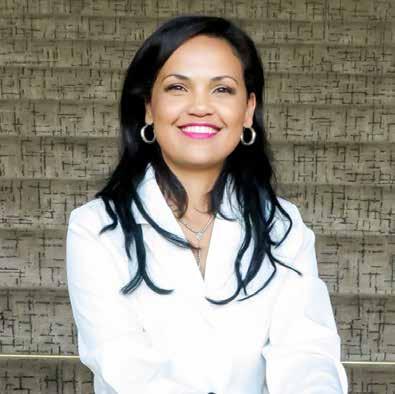
Browyn Williams
“THE STRONGEST BUSINESS CASE FOR ZERO-HARM IS SIMPLE: PROTECTING PEOPLE PROTECTS THE BUSINESS.”
– TEDDY HABIB
most incidents are the result of system weaknesses rather than individual failure.”
Williams highlights a fascinating metric anomaly that often frightens reactive leaders: in psychologically safe cultures, reporting spikes initially.
“In weaker cultures, incidents are under-reported. Near misses disappear. People stay quiet because they fear blame or career damage,” she explains. “In strong cultures, reporting increases before injury rates drop. That’s not failure; that’s trust building. The moment a mistake leads to punishment without curiosity, reporting goes underground. Executives set the tone by asking, ‘What in our system allowed this?’”
THE BUSINESS CASE: VALUE PRESERVATION
While the moral imperative of zero-harm is undeniable, the business case is equally robust. Estimates from the International Labour Organisation indicate that work-related injuries cost an estimated four per cent of global gross domestic product annually.
“The strongest business case for zero-harm is simple: protecting people protects the business,” says Habib. “Incidents carry enormous human, operational and nancial consequences. They disrupt projects, damage reputations, increase insurance exposure and erode trust with clients and regulators.”
From a compliance and risk perspective, Williams argues that executives must view safety as enterprise protection.
“The business case for zero-harm is not built on emotion. It’s built on risk, capital protection and long-term value creation,” Williams explains. She highlights that for every recordable injury, indirect costs, such as lost productivity, investigation time and rework, are often two to four times higher than direct costs.
“When injury frequency declines sustainably, the total cost of risk declines. Insurance experience modi ers improve. Capital becomes cheaper. Zero-harm is not a cost centre; it’s cost control through risk elimination,” she notes. “Unsafe systems are unstable systems. Where you see injuries, you often see quality failures, equipment breakdowns and process variability.”
FROM SLOGAN TO LIVED REALITY
Ultimately, the dividing line between success and failure is straightforward: struggling organisations treat safety as a compliance issue to be managed; zero-harm organisations treat safety as leadership to be demonstrated.
Building safety from the top down requires every strategic decision to pass a simple test, posed by Williams: “Does this make it easier or harder for our people to work safely?”
She concludes: “The question for executives is not ‘Can we afford to invest in zero-harm?’
The question is ‘Can we afford the volatility, capital loss and reputational damage that comes from not building it?’”
When leadership aligns behind that truth, zero-harm ceases to be an elusive target and becomes the way an organisation does business.
Follow: Bronwyn Williams www.linkedin.com/in/bronwynbwilliams
Eli Msimanga www.linkedin.com/in/eli-msimanga-mba-04896024
While strong leadership and proactive risk management are the bedrock of a zero-harm culture, physical safety cannot exist in a vacuum. If an employee is fatigued, highly stressed or burned out, their risk of physical injury skyrockets.
Dhanusha Dhoorgalu, a holistic wellness coach, speaker and founder of the wellness company Miss Dhanusha, says a major stumbling block for modern organisations is treating safety and wellbeing as isolated entities.
“One common issue I see across many organisations is that wellness sits in separate boxes: mental health in one programme, safety in another, and physical health somewhere else entirely,” explains Dhoorgalu. “But people don’t live their lives in compartments. When an employee is overwhelmed, fatigued or physically unwell, it affects every part of how they show up at work.”
Just as a zero-harm culture requires psychological safety to enable reporting of physical hazards, Dhoorgalu stresses its importance in managing psychosocial risks. Stress and disengagement build quietly in environments with unsustainable workloads. To combat this, she argues that “prevention should be the focus, rather than reacting once people are already burned out”.
“Today, SHEQ leaders have the opportunity to influence culture. They are uniquely positioned to connect the dots between physical safety, mental wellbeing and their workforce’s overall health,” Dhoorgalu notes. This requires upskilling in mental health awareness and interpreting wellbeing data, such as absenteeism and engagement scores, alongside traditional safety metrics.
Achieving true zero-harm means looking at the whole human. “The role is evolving from protecting people from harm to helping create environments where people can genuinely thrive,” Dhoorgalu concludes. “When organisations embrace that mindset, safety and wellness stop being separate priorities; they become part of the same conversation.”
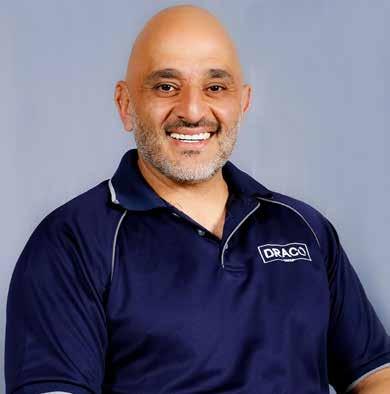
Teddy Habib
Dhanusha Dhoorgalu
SMART COMPLIANCE
DIGITAL
TOOLS TRANSFORMING SHEQ OPERATIONS
From smarter reporting to more accurate oversight, the availability of new digital tools promises a host of advantages that stand to transform safety, health, environment and quality operations. LISA WITEPSKI finds out how
From a compliance obligation, safety, health, environment and quality (SHEQ) is fast becoming a strategic business objective, thanks to the emergence of digital tools that help enhance transparency, reduce manual effort and enable organisations to anticipate harm before it occurs.
The result, says Louise Woodburn of KBC Health and Safety, is that organisations can create safer, stronger, more resilient workplaces.
INSIDE THE ARSENAL
Organisations can access a range of tools to enhance their health and safety practices. For instance, digital compliance platforms consolidate legal registers, policies, risk assessments, audits, incident reporting and corrective actions into a single system. “This improves visibility and strengthens audit-readiness, particularly in a regulatory environment where enforcement is tightening,” says Eli Msimanga, regional lead: health & safety at WSP.
Internet of things sensors are also making a signi cant difference. Real-time monitoring of noise, dust, vibration, temperature and exposure to hazardous gases enables earlier intervention to prevent incidents from escalating. This moves organisations from reactive to proactive safety management. Mobile- rst auditing tools, meanwhile, enable organisations to capture inspections and observations on-site. Uploading these
“DIGITAL SHEQ PLATFORMS SHOULD BE ABLE TO INTEGRATE WITH EXISTING BUSINESS SYSTEMS TO AVOID DUPLICATION AND INCONSISTENT REPORTING.”
– ELI MSIMANGA
immediately improves accountability and accelerates the close-out of nonconformances. Msimanga further recommends using AI-powered analytics to connect all data points, enabling organisations to analyse trends across incidents, near misses and behavioural observations. “By identifying emerging risk patterns, recurrence can be prevented.”
Cloud-based systems also play a role in this space. Msimanga explains that they provide a single, centralised source of truth, capturing incidents, hazards, observations and checklists in real-time and ensuring they are accessible across multiple sites. “The result is not simply digitised paperwork. It is stronger oversight and more consistent evidence of compliance,” says Msimanga.
PUTTING IT INTO PRACTICE
Ariel Flax of ATG Digital says the organisation’s clients have experienced signi cant bene ts since implementing digital tools across access control systems. Positive outcomes include safer sites, fewer nes and decisions driven by data rather than guesswork. “Since the rules of the Mine Health and Safety Act are make-or-break, this isn’t just tech. It’s lives and livelihoods saved,” he says.
General savings add up too: Flax reports that digital tools help organisations spend 20–30 per cent less on incidents. They also bene t from lower insurance costs, higher output and faster audits.
THE CHALLENGES
Inevitably, companies may experience some obstacles when implementing digital systems. Ensuring interoperability is one such potential stumbling block. “Digital SHEQ platforms should be able to integrate with existing business systems to avoid duplication and
inconsistent reporting. Fragmented digital tools recreate the silos they are meant to eliminate,” Msimanga says.
He adds that companies also face increasing responsibilities around data protection as digital adoption increases. “Organisations must ensure compliance with data privacy legislation, such as The Protection of Personal Information Act, and establish clear governance over data access, storage and use. Security cannot be an afterthought.”
Meanwhile, smaller companies may face speci c challenges, including limited digital infrastructure, skills gaps or uncertainty about where to begin.
Larger organisations are no more immune to teething problems. In this instance, says Msimanga, issues are likely to include the legacy of existing systems that may be complex or fragmented. “Integration challenges typically involve aligning legacy processes with new digital platforms, ensuring data consistency and managing organisational change across multiple sites.”
In all cases, Woodburn warns that the Department of Labour still wants businesses to submit manual folders. “Until legislation is passed making electronic les permissible, we’re stuck in two worlds,” she says.
She adds that it remains necessary to appoint an employee to oversee the interpretation of all data and take ownership of the process. “Safety is all about people, and computers don’t always understand people – sometimes, it’s gut instinct and not data that tells you what needs to be done,” Woodburn concludes.
Follow: Louise Woodburn www.linkedin.com/in/louise-woodburn-a53bb734
Eli Msimanga www.linkedin.com/in/eli-msimanga-mba-04896024 Ariel Flax www.linkedin.com/in/ariel-flax-157462120
CLOSING THE LOOP
Incident prevention through data-driven analysis
A
more proactive stance on incident prevention is being made possible through data-driven analysis, writes ANTHONY SHARPE
For nearly four decades in health and safety, Ken Annandale of INTRA has watched the eld inch from clipboards to code. Now, he says, the in exion point has arrived. “We’re moving away from the old enforcement mentality to a predictive one,” he argues, where data forecasts when and where incidents are going to happen, along with the severity and potential consequences.
In South Africa, mobile- rst auditing and photo-based reporting have gone mainstream over the past decade. Inspectors log observations that automatically trigger digital tickets and job cards, replacing in-of ce computers with tablets and phones, and enabling real-time analysis of incident frequency and patterns.
Internationally, Annandale notes, larger enterprises use robotics and visual camera networks with motion and facial-recognition capabilities to predict near misses and ag noncompliance with personal protective equipment. These practices will hopefully feed into local organisations soon.
“WEARABLES
Legislation lags tools, however. The Occupational Health and Safety Act of 1993 still underpins compliance, and the Department of Employment and Labour has only recently begun accepting digital les. Here, arti cial intelligence (AI) is bridging the gap between intent and execution.
“Platforms can immediately generate precautionary measures or safe work procedures,” says Annandale, “and integrate that into induction and training” – closing the loop from observation to behaviour.
RECONSIDERING RISK
Data is already reshaping risk pro les. In one wet- oor operation that Annandale studied, the vast majority of slips and falls involved younger staff, prompting targeted interventions and virtual-reality-enabled training that was once prohibitively expensive.
Annandale also encourages people to look beyond blood-and-bandage incidents. “Of about two-and-half million people per annum that are killed worldwide, about two million are victims of some sort of occupational disease.” He says that wearables and rapid diagnostics can help pinpoint risks by time and location, enabling prevention rst, treatment second.
BREACHING THE CULTURAL BARRIER
With AI, internet of things devices and wearables ooding the market, the biggest
barrier to predictive safety is increasingly not the technology – it’s culture, says SafetyArk managing director Monique Botha. “If you don’t get buy-in from the shop oor, you’re going to struggle. People don’t like change, so your technology needs to be easy to use. It must integrate seamlessly into their daily routines.”
Botha works primarily in the food industry, where computer vision systems can now scan video feeds for unsafe behaviours, while wearable sensors ag workers entering restricted zones, even pushing alerts to managers via WhatsApp. Yet she stresses that sophisticated tools are meaningless without clear metrics and a long-term view.
She advocates using traditional safety indicators as a baseline –reportable injury rates, lost-time injury frequency rates, near-miss reporting, equipment downtime and environmental nonconformance – then measuring improvements after implementation.
“Your baseline is normally a twenty-month pre-implementation average,” says Botha. “With your AI target implemented, you need to look at a twenty to forty per cent reduction in incidents over around eighteen months.”
ACTION AND ENGAGEMENT
Crucially, data must lead to visible action. Workers quickly lose faith when repeated reports go unanswered. “You also need to make sure your data structures are built in such a way that people can get feedback,” says Botha. “If a hazard can’t be attended to within twenty-four to forty-eight hours, there needs to be clear reasons so that further inspection can be done.”
To sustain engagement, Botha designs programmes that are fun, creative and tailored to workforce culture, from themed “hero” campaigns to custom songs and visible recognition.
The results are already tangible. In one client, near-miss reporting rose sharply within six weeks, surfacing at least three incidents that could have been serious – quietly proving that, when data and culture align, prevention becomes a team sport rather than a compliance chore.
INTEGRATING SUSTAINABILITY INTO SHEQ SYSTEMS
How
can South African organisations position environmental sustainability as an integrated safety, health, environment and quality discipline, rather than treating it as a stand-alone function?
Across many South African organisations, environmental sustainability is undergoing a shift.
Rather than existing as a separate corporate responsibility initiative, it is increasingly being embedded into safety, health, environment and quality (SHEQ) management systems.
This re ects a growing recognition that sustainability supports resource ef ciency, operational continuity and long-term business competitiveness.
Integrated management systems allow organisations to address environmental risks alongside safety and quality controls, ensuring environmental performance is monitored through the same structured processes used to manage operational risk.
CIRCULAR ECONOMY THINKING THROUGH A SHEQ LENS
Mandy Hattingh, director of mining, energy and environmental law at NSDV Law, says organisations are shifting away from viewing sustainability as a stand-alone initiative, instead treating it as a core governance discipline. “Circular economy principles are increasingly being embedded into SHEQ systems,” she says.
By ITUMELENG MOGAKI
systems, these obligations fall under existing audit and reporting structures.
“Water management is another area where circular thinking is applied. Many industrial and mining operations now implement closed-loop systems, reuse infrastructure and monitoring programmes to improve ef ciency and ensure compliance.”
organisations to manage compliance while strengthening operational ef ciency and resilience,” Hattingh adds.
BUILT ENVIRONMENT AND SHEQ INTEGRATION
From a built environment perspective, environmental sustainability is also increasingly being integrated into governance and operational systems.
Georgina Smit, CEO designate of the Green Building Council South Africa (GBCSA), says SHEQ should be viewed as a decision-making framework rather than simply a compliance exercise.
“While many SHEQ principles are connected to legal requirements or ISO standards, the real value lies in enabling good decisions that centre safety, wellbeing and sustainable practices clearly and measurably,” she says.
Hattingh adds: “Energy is also being treated as a strategic resource. Ef ciency measures, renewable energy procurement and emissions monitoring are increasingly managed through SHEQ governance processes.”
REGULATORY DRIVERS
Hattingh also points out that South Africa’s environmental regulatory framework is encouraging closer integration of sustainability into operational governance.
“The National Environmental Management Act sets the foundation by requiring environmental impacts to be anticipated, avoided or minimised, while integrating environmental considerations into decision-making and operational planning,” she says.
“In practice, resource ef ciency, waste minimisation and emissions management are integrated into operational risk management, compliance monitoring and continuous improvement processes that already exist within SHEQ frameworks.”
Hattingh says waste management provides a practical example. “Environmental authorisations often require waste streams to be tracked, reduced and recycled where possible. When incorporated into SHEQ
“In addition, the Carbon Tax Act further incentivises emissions reduction by placing a price on carbon-intensive activities, encouraging energy ef ciency and better emissions monitoring. Integrating these requirements into SHEQ systems
Smit also points out that green building certi cations, such as Green Star, EDGE and Net-Zero, complement SHEQ frameworks by providing recognised standards that support resource ef ciency and reduced environmental impact.
“These certi cations build on regulatory compliance and help drive sustainability practices further in the built environment. They also align closely with SHEQ objectives by improving environmental performance while supporting occupant wellbeing,” she says.
Importantly, these systems also demonstrate clear business bene ts. “Adding measurable metrics to goals such as air quality, energy ef ciency or environmental impact is really the heart of green building certi cation,” Smit explains.
She continues: “Research conducted over a decade with the University of Pretoria and industry partners found that certi ed green of ce buildings can deliver faster returns on investment and stronger nancial performance compared to noncerti ed buildings.”