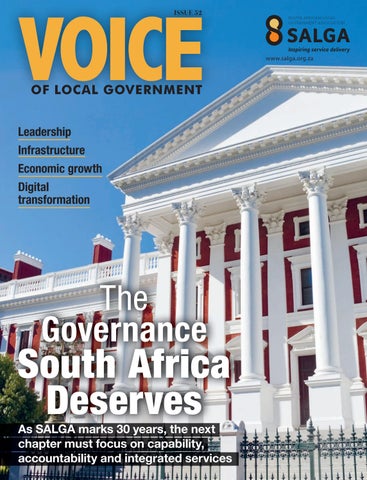
Leadership Infrastructure Economic growth Digital transformation
The Governance
South Africa Deserves
As SALGA marks 30 years, the next chapter must focus on capability, accountability and integrated services
SALGA_52_Cover final.indd 1
2026/10/26 09:05
ToCheck_fcp.indd 2
2026/10/21 10:20
EDITORIAL NOTE AND CONTENTS
L
ocal government is where the promise of government becomes tangible. It is where policy meets potholes, infrastructure becomes a functioning water system, economic development determines whether a small business can grow, and leadership is experienced in the everyday lives of communities. As the South African Local Government Association marks 30 years, this issue of Voice of Local Government looks both to the past and the future. Three decades is an opportunity to reflect on how local government has evolved, the leadership that has shaped it and the lessons that should inform its next chapter. More importantly, it asks: What kind of local government do we need for the next 30 years? ON PAGE 6, “Salga @30 – a review” looks at how democratic local government has evolved over the past 30 years – from the restructuring of municipalities and the expansion of basic services to the growing pressures on institutions, finances and public trust. More importantly, it asks what the next three decades will require from the sector. ON PAGE 10, “Leadership matters” examines what remains at the heart of municipal performance – leadership, skills, accountability and political maturity. Dr Harlan Cloete and Professor André Duvenhage consider why legislation and policy can only go so far without the people and systems to implement them. That starts with those entering political office. “From induction to impact”, ON PAGE 12, considers why councillor induction must be more than a once-off exercise, with ongoing development, support and learning to help councillors navigate increasingly complex responsibilities. ON PAGE 13, “Building better together” examines public procurement as a tool for stronger infrastructure delivery, fair competition, decent work and sustainable growth, with government, industry and labour working together towards better outcomes. Taken together, these stories point to a sector at an important crossroads. The foundations for delivery are explored ON PAGE 14 in “Fixing the foundations”, which looks at infrastructure, municipal finances and the capacity needed to manage investment. Alternative
ISSUE 52
01_Contents_Credits.indd 1
funding models and partnerships may create opportunities, but competent municipal capacity remains fundamental to turning investment into functioning infrastructure. Economic opportunity is the focus ON PAGE 15 in “Turning local enterprise into economic growth”, which examines more practical approaches to local economic development, from supporting township businesses in Ekurhuleni to emerging contractors and entrepreneurs in Overstrand. The emphasis is on whether interventions help businesses grow, access markets and create jobs. Finally, ON PAGE 16, “Making the municipality work as one” looks at digital transformation and the potential of connected systems, integrated data and digital platforms to improve how municipalities operate. However, technology cannot compensate for weak data, skills, infrastructure or governance. ON PAGE 3, “From the ballot to delivery”, we chart six democratic local government elections – from the first polls of 1995/96 to the 2026 contest – revealing how voter participation, political competition and the municipal landscape have changed. With turnout falling to 46 per cent in 2021 and hung councils becoming more common, the numbers point to a bigger challenge: rebuilding the connection between citizens, local democracy and the delivery of services that shape everyday life. The next chapter will not be defined by one reform, technology or funding model, but by the ability to bring together capable leadership, professional administration, financial sustainability, productive partnerships and meaningful community participation. Thirty years provides an opportunity to celebrate how far local government has come – and to be honest about what still needs to change. The challenge now is to move from experience to evolution, building on the lessons of the past to create more capable, connected, responsive and resilient municipalities.
VOICE OF LOCAL GOVERNMENT
1
2026/10/26 09:18
SALGA FOREWORD
The next 30 years SALGA marks 30 years of local government, reflecting on progress, challenges and the road ahead. By the SALGA Editorial team
A
s the South African Local Government Association (SALGA) marks 30 years of organised local government, this edition of Voice of Local Government provides an opportunity to reflect on an important democratic journey and to consider what lies ahead for municipalities across South Africa. Local government is the sphere of government closest to the people. It is where residents experience the reality of governance in their daily lives. Whether it is access to water, electricity, roads, sanitation, housing or economic opportunities, municipalities play a central role in shaping the quality of life in communities. When local government functions effectively, it helps create an environment where people can live with dignity, businesses can grow and local economies can thrive. Over the past three decades, democratic local government has achieved significant progress. The municipal landscape has been transformed through the creation of a single, inclusive system of local government serving communities across the country. Access to basic services has expanded to millions of households, and municipalities have become key partners in advancing development and improving living conditions. These achievements reflect the commitment and hard work of councillors, municipal officials, communities and many other stakeholders who have contributed to building and strengthening local democracy. Yet this milestone is about more than looking back. It is also an opportunity to confront the challenges that continue to face municipalities. Many local governments are under pressure from ageing infrastructure, financial constraints, growing service demands
2
VOICE OF LOCAL GOVERNMENT
02_SALGA FOREWORD.indd 2
and capacity challenges. Public trust in institutions has also come under strain in many communities. These realities require honest reflection and a shared commitment to finding practical solutions that strengthen governance and improve service delivery.
The future success of local government will depend on collaboration between municipalities, communities, business, labour and other stakeholders. Complex challenges cannot be solved by one institution alone.
The articles featured in this publication explore these issues from different perspectives. They examine the evolution of local government over the past 30 years and the lessons that can guide its future. They highlight the importance of ethical leadership, accountability and professional administration in building capable municipalities. They also look at the role of councillor development, infrastructure investment and sound financial management in supporting sustainable service delivery. The publication further explores how municipalities can stimulate local economic development by creating an environment where businesses can grow, jobs can be created and communities can prosper. It considers the opportunities presented by digital transformation and the growing use of technology to improve municipal operations, strengthen planning and
enhance citizen engagement. At the same time, it recognises that technology is only as effective as the systems, skills and leadership supporting it. Another important theme throughout this edition is partnership. The future success of local government will depend on collaboration between municipalities, communities, business, labour and other stakeholders. Complex challenges cannot be solved by one institution alone. Sustainable progress requires shared responsibility, open dialogue and a commitment to working together in the public interest. As we look to the future, the question is not simply how municipalities can overcome today’s challenges, but how they can become more responsive, innovative and resilient in the years ahead. Building capable local government will require strong leadership, sound governance, financial sustainability and meaningful community participation. It will also require a willingness to learn from experience and adapt to changing realities. This edition of Voice of Local Government is therefore both a reflection on the journey thus far and a contribution to the conversation about the future. It celebrates progress, acknowledges challenges and explores ideas that can help shape the next chapter of local government in South Africa. We trust that the insights shared in these pages will encourage reflection, inspire dialogue and contribute to the ongoing effort to build municipalities that are capable, accountable and responsive to the needs of the people they serve.
ISSUE 52
2026/10/22 07:56
LOCAL GOVERNMENT ELECTIONS DATA
A BIGGER ELECTORAL MAP Six local government elections have reshaped South Africa’s municipalities since democracy – changing representation, political competition and voter participation along the way
The municipal landscape has also changed. In 2016, South Africa had 257 municipalities and 4 392 wards. By 2021, the number of wards had risen to 4 468. For the 2026/27 local government elections, the Municipal Demarcation Board has delimited 4 488 wards. The number of registered voters has also grown:
2016: 25 383 361
THE DATA STORY
2021: 26 749 806 2026: 27 723 675 That represents an increase of more than 2.3 million registered voters since 2016.
2021: A TURNING POINT The 1995/96 elections marked the beginning of the transition towards integrated democratic local government, while the 5 December 2000 elections established the municipal system broadly recognisable today. SALGA describes these as the second and third phases of the transformation of local government.
The 2021 election produced another important shift: 66 of the 213 municipalities contested had no outright majority, creating hung councils. The ANC retained majorities in 161 municipalities, while the DA had majorities in 13 and the IFP in 10. That fragmentation has changed the nature of municipal politics, making coalition-building, political maturity and the ability to govern across party lines increasingly important.
THE TURNOUT STORY Did you know? Voter participation has not followed a straight line. Turnout among registered voters rose from about 48 per cent in 2000 and 2006 to 58 per cent in 2011 and 2016, before falling sharply to 46 per cent in 2021 – the lowest level recorded across the 2000–2021 local election period. The IEC notes that only about 30 per cent of South Africa’s voting-age population voted in 2021.
TEXT SUPPLIED BY: RAINA JULIES SOURCES: IEC, MUNICIPAL DEMARCATION BOARD (MDB) AND SALGA.
Local election turnout has fallen sharply
ISSUE 52
03_INFOGRAPHIC.indd 3
2026: THE NEXT TEST For 2026, the electoral map is slightly larger, with 4 488 wards compared with 4 468 in 2021. The IEC’s current figures show 27.72 million registered voters, with women accounting for 55.25 per cent of the registered roll and men 44.75 per cent. However, the most significant number may be the one from the previous election: 46 per cent. After three decades of democratic local government, the question for 2026 is therefore bigger than who wins which ward. It is whether local elections can reconnect citizens with the institutions closest to their daily lives – and whether municipalities can turn electoral mandates into visible, credible and effective local government.
VOICE OF LOCAL GOVERNMENT
3
2026/10/26 09:17
Unlocking the value of waste in Bushbuckridge PLASTICS SA leads a community recycling initiative with the launch of a new waste beneficiation centre in Thulamahashe, connecting household recycling, skills development and industry investment to support cleaner communities and local livelihoods
“For municipalities, the challenge extends beyond collecting waste. It includes finding workable ways to recover materials, support livelihoods and sustain community participation. Industry can contribute resources and expertise, while municipalities and traditional leaders provide essential local knowledge and support. Each partner has a role in making the system function,” Hanekom explains.
CO-ORDINATING INDUSTRY SUPPORT The memorandum is endorsed by participating Producer Responsibility Organisations (PROs), including Petco, Polyco, Metpac-SA Fibre Circle, eWASA and The Glass Recycling Co. (TGRC). Industry commitments and assets (valued at approximately R2-million) will support operations.
P
lastics SA, the umbrella body representing the local plastics industry, is helping turn waste into economic opportunity through its Innovative Solutions for Waste (ISOW) project, which has launched a new waste beneficiation centre in Thulamahashe, Mpumalanga. Located at a new regional landfill site and a waste separation at source in Thulamahashe, Section B, within Bushbuckridge Local Municipality, the centre brings together local government, industry, traditional leadership and residents to strengthen recycling, reduce waste sent to landfill and create opportunities for local enterprise development. Supported by the Promoting Women’s Employment for Africa’s Green Transformation (WE4D) programme, ISOW combines infrastructure, accredited training, household education and business mentorship. Its initial programme targets 1 049 households, with schools and local waste reclaimers forming important links in the recovery system.
4 VOICE OF LOCAL GOVERNMENT
Plastics SA_DPS Advertorial.indd 4
“Recycling works when the different parts of the value chain join together. Households need a practical way to separate their waste, reclaimers need skills and access to materials, and local operators need equipment, business support and markets. Through ISOW, we are helping bring these elements together,” says Anton Hanekom, executive director of Plastics SA.
BUILDING A PRACTICAL PARTNERSHIP The centre’s establishment follows extensive preparation, including baseline and feasibility studies by Moss Group, site visits and stakeholder consultations. Engagements with the municipality and the Amashangane Traditional Council, on whose land the centre stands, have been central to the process. Kruger to Canyons Biosphere Region (K2C) also helped connect relevant stakeholders. A memorandum of understanding between Plastics SA and Bushbuckridge Local Municipality formalises the collaboration and provides a foundation for co-ordinated implementation and further funding.
Support spans infrastructure, education and value-chain development. MetPac-SA has reaffirmed its commitment to developing recycling value chains and supporting reclaimers, and Petco has worked with Plastics SA to engage educators at four community schools and emphasised the importance of assistance beyond equipment. Polyco has sponsored school recycling bins and pledged continued investment and support, Fibre Circle has announced sponsorship of a forklift and operator training to strengthen the centre’s capacity, and eWASA has expressed interest in exploring electronic waste opportunities as these arise.
ISSUE 52
2026/10/22 18:35
IMAGE: SUPPLIED
The original landfill space before the centre was built.
“Waste reclaimers and small businesses are essential partners in recovering valuable materials. Providing infrastructure is one part of the solution. Training, mentorship and reliable collection arrangements are equally necessary if that infrastructure is to create lasting value.” – Anton Hanekom
IN PARTNERSHIP WITH | PLASTICS SA
SUSTAINING PROGRESS BEYOND THE LAUNCH
Waste reclaimers receiving SAQA accredited training.
CONNECTING HOUSEHOLDS, RECLAIMERS AND LOCAL BUSINESS
IMAGE: SUPPLIED
Plastics SA’s involvement extends from project co-ordination to developing the required skills to support recycling on the ground. Fifteen waste reclaimers and key project stakeholders received accredited training through Plastics SA. Local waste ambassadors are visiting households to explain the initiative and encourage separation at source. Recyclables will be collected on a different day from the municipality’s regular waste collection service. A local waste operator will manage the centre, collect separated materials, distribute ISOW-branded bags and co-ordinate the buying and selling of recyclables. Mentorship in managing a buy-back centre will support business development, creating an opportunity for a local small, medium and micro enterprise to participate directly in the recycling value chain. Local staff appointments have also brought community knowledge into the project. “Waste reclaimers and small businesses are essential partners in recovering valuable materials. Providing infrastructure is one part of the solution. Training, mentorship and reliable collection arrangements are equally necessary if that infrastructure is to create lasting value,” Hanekom says.
Bushbuckridge Local Municipality has welcomed the initiative’s potential to complement municipal services, ease waste collection challenges and support livelihoods. Recovering recyclables before disposal also supports its broader waste management objectives.
TAKING RECYCLING EDUCATION INTO SCHOOLS Alongside household engagement, the schools programme combines educator involvement, recycling bins and awareness activities led by waste ambassadors. This gives learners practical opportunities to apply what they learn about responsible waste management. Early feedback has been encouraging. The principal of Eric Nxumalo High School reported a cleaner school environment and welcomed the involvement of learners, the school governing body and the wider school community. For Plastics SA, education is essential to sustaining participation and extending the programme’s reach into homes. “When learners understand that discarded packaging and other recyclables have value, they can help influence habits at home. The aim is to make responsible waste management part of everyday life, supported by a collection system that people can use,” Hanekom explains.
Bushbuckridge Local Municipality has welcomed the initiative’s potential to complement municipal services, ease waste collection challenges and support livelihoods. Recovering recyclables before disposal also supports its broader waste management objectives.
ISSUE 52
Plastics SA_DPS Advertorial.indd 5
Hanekom acknowledges the municipality, traditional leadership and industry partners, together with Deutsche Gesellschaft für Internationale Zusammenarbeit (GIZ), which implements ISOW through the WE4D programme on behalf of the European Union and Germany’s Federal Ministry for Economic Co-operation and Development (BMZ). “This project reflects what becomes possible when partners commit to a shared local objective. We appreciate the support that has brought ISOW to this point. The next task is to build consistent participation and an operation that can serve the community over time,” he says. The recycling component has launched, with further landfill-site activities to follow. Long-term success will depend on effective management, continued household participation and viable markets for recovered materials. ISOW demonstrates how co-ordinated local action can connect environmental improvements with economic participation: cleaner surroundings, more materials recovered for productive use and stronger opportunities for the people who collect, sort and trade them.
Launch attendees were shown how the sorting process works.
VISIT WEBSITE
SCAN THIS QR CODE TO GO TO THE PLASTICS SA WEBSITE
For more information, visit www.plasticssa.co.za
VOICE OF LOCAL GOVERNMENT
5
2026/10/23 10:42
SALGA @30
The democracy dividend Thirty years of democratic local government have transformed access to basic services, but weak institutions, financial strain and declining public trust show that the job is far from finished, writes BUSANI MOYO
Since 1994, government has delivered more than 5 million housing opportunities, benefitting an estimated 13 million people, according to the Department of Human Settlements in 2026.
T
hirty years after the South African Local Government Association (SALGA) was established, the local government story resists both celebration and despair. South Africa dismantled a racially fragmented municipal order, created wall-to-wall municipalities and extended essential services to millions of households. It also built an ambitious legal architecture intended to make municipalities democratic, developmental and accountable. Yet the institution closest to citizens is frequently the one they trust least. Municipal finances are strained, infrastructure is deteriorating, leadership is unstable, and public participation too often feels ceremonial. The defining question for SALGA’s anniversary is therefore not whether the Sithole Mbanga
6
VOICE OF LOCAL GOVERNMENT
06_09_LOCAL GOVERNANCE.indd 6
democratic municipal project succeeded or failed. It is why its gains have not produced equally strong institutions, citizen influence or confidence – and what must change over the next 30 years.
THE DEMOCRATIC BREAKTHROUGH SALGA chief executive Sithole Mbanga locates the organisation’s birth within a larger project: democratising the local state itself. As apartheid ended, local government had to move beyond institutions serving racially divided communities and become a driver of a developmental state at local level. Civic groups across the country negotiated questions ranging from water and electricity to municipal revenue. The slogan “one city, one tax base” captured that ambition. For Mbanga, it was fundamentally about citizenship: “We have a right to the city. We have a right to a
municipality.” Residents were contributors with a stake in the municipality, while integrated development planning was intended to root democracy locally. SALGA emerged in 1996 amid this transition. It was formally recognised in 1997, while the 1998 White Paper on Local Government helped define the developmental municipality. Municipal restructuring subsequently placed every part of the country within a municipality and reduced a fragmented landscape of more than 800 authorities to today’s 257 municipalities. Speaking at the National Summit for Organised Local Government in November 1996, President Nelson Mandela captured both the optimism and responsibility of the moment. Local government, he said, had to provide an “effective Dr Michael Sutcliffe instrument” through which communities could improve their lives. He also posed a question that still hangs over the system: “Have we deserved the trust that communities put in us?” Dr Michael Sutcliffe, co-director of City Insight and a former eThekwini municipal manager, regards the constitutional design as a major achievement. “There is no doubt we now have democratic local government,” he says. He also points to expanded basic services, while
“We have become the poorer cousin in the governance frame, precisely because we chose to report upwards, when we should be reporting downwards as local government.” – Sithole Mbanga ISSUE 52
2026/10/22 07:57
LOCAL GOVERNANCE
warning that access must be affordable, sustainable and supported by stronger civil-society partnership. The progress is measurable. Statistics South Africa’s Census 2022 shows that the proportion of households in formal dwellings rose from 77.6 per cent in 2011 to 88.5 per cent in 2022, while access to piped water, flush toilets and electricity also increased. Mbanga therefore resists writing off the original model. “The foundation of the design of local government, including SALGA, was correct,” he says. The larger failure, in his assessment, has been implementation: “the how and the who”.
THE PARTICIPATION PARADOX In 2025, 87.4 per cent of households had access to piped or tap water in their According to a Government dwelling, on-site or at a communal tap. However, access does not always mean Communication and Information System reliability: 56.8 per cent of households experienced water interruptions during the (GCIS) Tracker cited in the Department year, while 37.6 per cent reported interruptions lasting at least two days or longer than 15 days. of Planning, Monitoring and Evaluation’s (DPME) 30-Year Review, public trust and confidence in local government’s ability to accountability predate deliver basic services fell from Mbanga is equally critical of the sector it. Coalitions are 70 per cent in 2004 to 35 per cent in 2022. and of SALGA. “You can’t have local likely to remain Professor Steven Friedman, director of democracy without the participation of part of South the Centre for the Study of Democracy, the communities,” he says. He describes African politics, argues that even the language used to local government as a “three-legged pot”, he argues, and describe municipalities comprising communities, the the democratic reveals the deeper municipality and councillors, response should problem. “I don’t like and acknowledges criticism be greater talking about service that SALGA has sometimes Professor accountability delivery. I prefer to talk appeared more representative Kedibone Phago and consultation: about public service, of councillors than of councils “The solution to local because public service or communities. government’s problems is makes the point that if He also identifies an more democracy, not you’re in government, inversion of accountability. less democracy.” you are there to serve “We have become the people.” In his account, poorer cousin in the CAPABILITY BEYOND COMPLIANCE “delivery” can reduce governance frame, precisely South Africa does not lack municipal residents to passive because we chose to report legislation, plans or reporting recipients rather upwards, when we should Professor Steven Friedman requirements. It lacks consistent than citizens shaping be reporting downwards as capability to turn them into results. priorities and trade-offs. local government,” Mbanga Dr Harlan Cloete, a research fellow at Professor Kedibone Phago, dean of says. Municipalities, he argues, should the University of the Free State and the Faculty of Economics, Development be reporting first to “the streets, to the author of 101 Local Governance Lessons: and Business Sciences at the University wards, to the regions in the local space”. From the Great Governance, puts it of Mpumalanga, reaches a similar The admission connects SALGA’s conclusion. Ward committees and anniversary directly to Mandela’s question bluntly: “Our problem is not policies. Our problem is people. People implement integrated development plans were about whether local government has and interpret legislation.” supposed to make participation earned citizens’ trust. A municipality may recruit qualified continuous. In practice, he says, party Professor Friedman cautions against managers and still fail if departments politics, weak capacity and outdated treating coalition government as the operate in silos, political and consultation methods have often turned automatic cause of municipal failure administrative roles blur, or poor participation into compliance. when patronage, exclusion and weak
ISSUE 52
06_09_LOCAL GOVERNANCE.indd 7
VOICE OF LOCAL GOVERNMENT
7
2026/10/22 07:58
performance carries no consequences. Clean audits matter, but Dr Cloete’s warning – “You can have clean audit and dirty streets” – captures the danger of what he calls “wicked compliance”: meeting formal requirements without improving people’s lives. Jugal Mahabir, a research associate at the Public Affairs Research Institute and lecturer at the University of Johannesburg’s School of Economics, identifies the same distortion. Municipalities can spend scarce capacity satisfying multiple reporting demands while the institutions receiving those reports fail to provide timely support. “Over the past twenty years, we have implemented a compliance culture,” he says. Mbanga reaches much the same conclusion from inside organised local government. “You can’t have democracy being reduced to reports, compliance or a clean audit,” he says. If democracy does not change ordinary citizens’ lives, then it is not fulfilling its purpose.
ONE MODEL, UNEQUAL PLACES Capability cannot be separated from place. A metropolitan municipality with a Jugal Mahabir deep rates base and complex infrastructure cannot sensibly be governed or supported like a sparsely populated rural municipality dependent on grants and serving many indigent households. Professor Phago calls the one-size-fits-all assumption a continuing structural weakness. Differentiation should affect functions, funding, reporting and the support offered to municipalities. It should also protect local government’s developmental purpose by helping municipalities attract investment, develop
Electricity: 90.6 per cent of households were connected to the mains electricity supply in 2025, compared with 76.7 per cent in 2002.
productive industries and connect local businesses to larger value chains. Mbanga says SALGA has reached a similar conclusion. While defending the foundations of the system, he says the organisation is questioning aspects of the single-tier model, arguing for differentiation and calling for the local government funding formula to be overhauled. Mahabir agrees that the fiscal model is under pressure as household poverty has grown, service costs have risen, and some municipal tax bases remain extremely narrow.
SALGA’S BALANCE SHEET Over three decades, SALGA has represented local government in intergovernmental structures, lobbied on legislation and finance, acted on behalf of municipalities as an employer, supported capacity development and built platforms through which municipalities share knowledge. Mbanga describes its purpose more vividly: “SALGA was not meant to be a structure. It was meant to be an engine.” Its job, he says, is to help 257 municipalities deliver democracy, services and changed lives.
“Our problem is not policies. Our problem is people. People implement and interpret legislation.” – Dr Harlan Cloete
8
VOICE OF LOCAL GOVERNMENT
06_09_LOCAL GOVERNANCE.indd 8
However, an anniversary balance sheet also requires institutional candour. “Hence it is important that when we look at what SALGA has done, we must also acknowledge our own shortcomings,” Mbanga says. “One of those failings is that we did not pay attention to the role of communities in local government.” That acknowledgement may be as important to SALGA’s next chapter as any account of its achievements. An association created to be the voice of local government must represent the sector while helping municipalities rebuild their relationship with communities.
THE NEXT THIRTY YEARS SALGA is now finalising what Mbanga calls a five-pillar “SALGA Manifesto” for the next phase of local government. Financing comes first. He argues that the current model expects municipalities to raise most of the resources needed to fulfil their responsibilities even where poverty and weak economic bases make that increasingly difficult. “The formula is not working,” he says. However, the agenda is “much more than just” finance. Municipalities must become stronger drivers of economic development. National investment strategies ultimately land in municipalities expected to provide water, electricity, roads, approvals and spatial planning. Mbanga questions the continuing distance between national economic policymaking and local government when implementation ultimately happens locally.
ISSUE 52
2026/10/22 08:18
LOCAL GOVERNANCE
Spatial transformation is another priority. Apartheid’s separation of where people live from centres of employment continues to impose financial and social costs. Climate resilience must also move closer to the centre of municipal planning because extreme weather increasingly threatens infrastructure through which services are delivered. The final element captured in Mbanga’s views concerns leadership and short-termism. SALGA, he says, must help build stronger leadership, including cultivating the political intelligence needed to manage the political-administrative interface in local government. That intersects with Dr Cloete’s focus on capable institutions, Professor Phago’s
call for differentiation, Mahabir’s warning against compliance for its own sake, Professor Friedman’s demand for deeper democracy and Dr Sutcliffe’s insistence that the democratic foundations should be made to work rather than discarded. Thirty years ago, the achievement was creating democratic local government for the majority of South Africans. The task now is harder: making that democracy consistently capable, financially viable, economically developmental and trusted. SALGA enters its fourth decade with both an institutional record to defend and shortcomings to confront. The question is whether the “engine” Mbanga describes can help 257 very different municipalities turn democratic promise into capable
DISCOVER 101 Local Governance Lessons: From the Great Governance
READ The Department of Planning, Monitoring and Evaluation’s Toward a 30-year review of South Africa’s democracy (1994 to 2024): Executive summary government – and earn the trust Mandela challenged local government to deserve at its birth.
IMAGES: GEOFFSP/ISTOCKPHOTO.COM, VLADAN RADULOVIC (RSA)/ISTOCKPHOTO.COM, M_D_A/ISTOCKPHOTO.COM, , SUPPLIED
SERVICES: THE 30-YEAR SCORECARD • Formal housing: 84.2 per cent of South African households lived in formal dwellings in 2025, while 12.1 per cent lived in informal dwellings. • Housing delivery: since 1994, government has delivered more than 5 million housing opportunities, benefitting an estimated 13 million people, according to the Department of Human Settlements in 2026. • Water access: in 2025, 87.4 per cent of households had access to piped or tap water in their dwelling, on-site or at a communal tap. However, access does not always mean reliability: 56.8 per cent of households experienced water interruptions during the year, while 37.6 per cent reported interruptions lasting at least two days or longer than 15 days. • Water reliability: only 43.2 per cent of households reported no water interruptions during the 12 months preceding the 2025 survey. • Electricity: 90.6 per cent of households were connected to the mains
electricity supply in 2025, compared with 76.7 per cent in 2002. • Electricity interruptions: the share of households experiencing load shedding and/or unscheduled electricity interruptions fell sharply from 92.1 per cent in 2023 to 31.0 per cent in 2025. • Sanitation: 84.0 per cent of households had access to improved sanitation in 2025, up from 61.7 per cent in 2002 – a gain of 22.3 percentage points over the period. But the national picture masks significant provincial disparities: access reached 95.9 per cent in the Western Cape and 91.3 per cent in Gauteng, compared with 64.8 per cent in both Limpopo and Mpumalanga. Importantly, “improved sanitation” does not necessarily mean safely managed sanitation, highlighting the growing importance of maintenance, waste treatment and reliable municipal infrastructure. • Refuse removal: 62.9 per cent of households had their refuse removed
at least once a week or less often in 2025. The figure was 84.9 per cent in urban areas, compared with just 13.0 per cent in rural areas. • Municipal consumer debt: by 31 December 2025, consumers owed municipalities R467.2-billion, up from R405.1-billion a year earlier. Households accounted for R335.3-billion of the debt. • Municipal liquidity: 50 municipalities reported negative cash balances in the second quarter of 2025/26, while actual collection against billed revenue was only 69 per cent, compared with a budgeted collection rate of 78.6 per cent. Sources: Statistics South Africa’s General Household Survey 2025; Department of Human Settlements, 2026; National Treasury’s Local Government Section 71 Report – Q2 2025; National Treasury’s Local Government Revenue and Expenditure Report, Q3 2024/25; Statistics South Africa’s Free Basic Services/ Non-financial Census of Municipalities 2023.
Follow: Sithole Mbanga www.linkedin.com/in/sithole-mbanga-081b91142 Dr Michael Sutcliffe www.linkedin.com/in/michael-sutcliffe-4465395b Professor Steven Friedman www.linkedin.com/in/steven-friedman-9a2ab822 Professor Kedibone Phago www.linkedin.com/in/kedibone-phago-47345427 Dr Harlan Cloete www.linkedin.com/in/dr-harlan-cloete-84908324 Jugal Mahabir www.linkedin.com/in/jugal-mahabir-a930211b
ISSUE 52
06_09_LOCAL GOVERNANCE.indd 9
VOICE OF LOCAL GOVERNMENT
9
2026/10/22 07:58
Leadership matters Effective local government depends on ethical leadership, capable officials, strong accountability and political maturity, but reform must turn policy into practice. By MATTHEW HIRSCH
M
REFORM STARTS WITH LEADERSHIP Speaking to the National Council of Provinces (NCOP) earlier this year, President Cyril Ramaphosa outlined plans to reform local government to improve municipal performance. “Local government is critical in ensuring that people have water and sanitation, electricity, roads, clinics and community services. Local government has a vital role in determining where companies choose to establish their offices, factories, shops and outlets. When companies choose to close and move
10 VOICE OF LOCAL GOVERNMENT
10_11_Municipality Reform.indd 10
Dr Harlan Cloete
“Local government is that space for popular participation where people experience the love or the indifference of the state. We need to manage the development of people better.” – Dr Harlan Cloete
SKILLS ARE NOT ENOUGH elsewhere because of poor services, jobs and livelihoods are lost, and the local economy suffers,” the president said. “When local government works, when municipalities are well-managed and deliver on their mandates, cities, towns and villages thrive.” As part of the planned reforms, government released the reviewed draft White Paper on Local Government, which proposes an overhaul of municipal billing and revenue collection and reforms to tighten the municipal finance system. Dr Cloete says challenges facing municipalities include failing infrastructure as a result of not managing projects properly, procurement and corruption. “I would say the number one problem is leadership,” he stresses.
The question of who should lead municipalities has also sparked debate. ANC general secretary Fikile Mbalula sparked a debate when he said the party would not accept mayoral candidates for the upcoming elections who don’t have a postgraduate degree. “You must also have a little bit of experience in running a municipality and sophisticated economics,” he says. “We have seen that when we take someone without putting an emphasis on their qualifications to run these municipalities, it has become a bigger challenge.” However, Dr Cloete says qualifications are not necessarily a panacea for municipal reform. “In many respects, you have educated thieves running our institutions.
ISSUE 52
2026/10/22 08:03
IMAGES: SUPPLIED
unicipal reform ultimately starts with leadership, but capable local government also requires accountability, skills and political maturity. In municipalities, leadership and management are the main challenges, according to Dr Harlan Cloete, a research fellow at the University of the Free State. “With municipalities, it’s never one thing. It’s several things. A municipality has three components like a potjie pot. You’ve got the administrators, the politicians and you have community,” says Dr Cloete. The relationship between these three components is critical to the effective functioning of a municipality. Dr Cloete says it is a problem when politicians don’t perform their oversight duties, while coalition politics, in particular, can create instability. “If those politicians appoint the wrong people who must implement (policies), then you have a problem there as well. If you have administrators who are managing the institution badly, looting instead of creating that conducive environment, you have a problem.” He adds that it is vital that communities understand their role and that there is sufficient civic education.
One reform mechanism already underway is municipal staff regulations, passed in 2021. The regulations stress “clear accountability for performance and financial outcomes; provide targeted regulatory dispensation to allow flexibility in the span of control of the municipal manager where required to implement the reform; support the implementation of the Single Point of Management Accountability (SPoMA) model; strengthen administrative and professional accountability in the management of trading services; and promote the broader objective of professionalising local government administration in line with constitutional principles of public administration”. For Dr Cloete, the emphasis on skills and performance management is particularly important. “It talks about the appointments. It sets a very progressive chapter on performance management. For me, that is at the heart of our reform.” Dr Cloete’s research shows that we’re not managing managers in an evidence-led way. He adds that other research also shows that most corruption in municipalities comes from the office of the municipal manager.
MUNICIPAL REFORM
“That will be my point of departure, starting with law and order, applying the principles of ethical governance, allowing responsibility. Give them the responsibility to do the job, but keep them accountable for what they are doing and check on these people.” – Professor Andre Duvenhage
“A matric or a degree does not guarantee, for example, that you are ethical. We need people who have a good heart … a heart for the people. Then you need a good head; you have to have knowledge. Local government is complex. You need ethical and accountable leadership,” he stresses. For Dr Cloete, capable leadership therefore requires more than qualifications. It requires people with the knowledge to manage complex institutions and the ethical commitment to serve communities.
MAKING RESOURCES WORK
IMAGES: SUPPLIED
Dr Cloete says the current one-size-fits-all approach to how municipalities are funded is outdated. The new White Paper on Local Government proposes a relook at the model. “It’s very difficult to compare the resource base of Beaufort West, for example, with the resource base of Cape Town. But ultimately it comes down to how you use what you have. Many municipalities are not getting it right. Not having a big resource base is not an excuse. “Even from a low revenue base, if you have a mayor who is focused on the job of serving her people, then you have an opportunity for success. “If you have a mayor who is fighting with the municipal manager all the time, then you have a problem,” adds Dr Cloete. The challenge, therefore, is not simply about how much a municipality has, but how effectively its resources are managed and whether political and administrative leadership can work together.
Dr Cloete says the immediate challenge is to develop coalition maturity because the country’s electoral system encourages it. “The voters are saying, we’re not going to give you the majority. We want you to work together. Leave your egos at the door and put your purpose together,” he says. He stresses that it is vital for municipalities to manage economic development because the country has some of the highest levels of inequality in the world. “Local government is that space for popular participation where people experience the love or the indifference of the state. We need to manage the development of people better. “We’ve got a legislative framework, so having policies and laws means nothing if you do not implement them. If we must have a World Cup on policies, we’ll win without having to practise,” adds Dr Cloete. The ability to translate policy into implementation remains at the heart of the reform challenge.
ACCOUNTABILITY MUST FOLLOW Professor Andre Duvenhage, from North West University, says municipalities must appoint capable people and not those connected to political parties. “You need to keep them responsible for what they are doing, and the oversight structures should kick in at the provincial and national level,” he says. He stresses that implementing consequence management is important.“If there is a problem, then fire the person.”
Professor Andre Duvenhage
He adds that another major problem is corruption, particularly when it comes to tenders. “It’s all about financial control, financial management, and responsibility for your financial situation.” Professor Duvenhage disagrees with Dr Cloete about the required qualification issue, saying those appointed must have qualifications. “You must get rid of these mafia-oriented structures that manipulate and sidestep. “What we want is effective, transparent, ethical governance and government and appointments accordingly.” Professor Duvenhage adds that it is vital to ensure the environment is stable and infrastructure development benefits all citizens. “That will be my point of departure, starting with law and order, applying the principles of ethical governance, allowing responsibility. Give them the responsibility to do the job, but keep them accountable for what they are doing and check on these people,” he says. For local government reform to succeed, leadership cannot be separated from accountability, competence or political maturity. The frameworks may be in place, but the real test is whether municipalities can turn them into better management, stronger institutions and improved outcomes for the communities they serve.
COALITION MATURITY Coalition politics presents another test for municipal leadership.
ISSUE 52
10_11_Municipality Reform.indd 11
Follow: Dr Harlan Cloete www.linkedin.com/in/dr-harlan-cloete-84908324 Professor Andre Duvenage www.linkedin.com/in/andre-duvenhage-09624b34
VOICE OF LOCAL GOVERNMENT
11
2026/10/22 08:03
COUNCILLOR INDUCTION
MATTHEW HIRSCH examines how effective councillor induction can build stronger oversight, accountability, governance and service delivery
T
here will be a significant cohort of new councillors in councils after the local government elections on 4 November. At least, this is what some analysts are predicting. Dr Zweli Mkhize, National Assembly chairperson of the Portfolio Committee on Cooperative Governance and Traditional Affairs (CoGTA), says new councillors may even outnumber those who have experience. “It’s important that the councillors, when they come in, have a proper orientation in terms of the working of the municipality, the decision-making processes, and the laws that are applicable, particularly for financial management,” Dr Mkhize explains. He says it is vital for new councillors to understand their oversight role and the interface between the political and administrative layers of the administration. If this is not understood, he says, it makes running councils a challenge.
particularly in orientating councillors about the financial systems, the financial controls and the responsibility of councillors in terms of the Municipal Financial Management Act.” Dr Mkhize adds that councillors have a particularly important role to ensure there is no irregular, fruitless, or wasteful expenditure.
Dr Zweli Mkhize
“Councillors need to have a fair understanding of the work; then they can make the municipality operate with efficiency and competence.” – Dr Zweli Mkhize
SALGA’S 2026 INDUCTION PROGRAMME The South African Local Government Association (SALGA) recently invited applications for the 2026 Integrated Councillor Induction Programme (ICIP). The programme is set to cover issues relating to ethics and leadership, governance, local government legislation and policy, municipal finance, and development strategy and planning, including infrastructure. It will also look at the important topics of performance and accountability, and the 2026 White Paper on Local Government. “When things go wrong, there shouldn’t be an explanation that people didn’t understand how the council works. The role of SALGA in the induction of councillors is critical,” says Dr Mkhize. “However, beyond that, we think that SALGA needs to play an ongoing role,
12
VOICE OF LOCAL GOVERNMENT
12_Induction to impact.indd 12
“The orientation becomes very important for the work of the councillors,” he says, adding that the role SALGA plays in this is vital. “Many councils have not demonstrated accountability and are not demonstrating consequence management,” Dr Mkhize says. “We think those issues need strong attention, and we believe SALGA has been good in giving the council those kinds of capacity-building programmes. “Political parties need to be encouraged to invest in the capability of the new councillors as well as the ethical leadership among them because that’s the foundation of everything. “Councillors need to have a fair understanding of the work; then they can make the municipality operate with efficiency and competence,” he says.
ACCOUNTABILITY AND CONSEQUENCE MANAGEMENT Dr Mkhize says the joint committees of CoGta and the Standing Committee on Public Accounts (SCOPA) in Parliament will ensure there is accountability and consequence management at municipal level. “We believe that even the CoGta department will be focusing on strengthening control mechanisms and support mechanisms through section 154 so municipalities can deal with issues long before we reach dysfunctionality.” Professor Andre Duvenhage of North-West University says it requires a lot of hard work to be a councillor and understand the complexities of local government. “If you want to be a councillor, you have to follow oversight processes.” He adds that it is vital for councillors to understand their particular municipality and the challenges it is facing, the demographic situation and the levels of unemployment. “Councillors need to establish partnerships with institutions like universities. It doesn’t need to be universities alone, but institutions that can assist them and people who can support them in bridging these gaps,” he explains. Meanwhile, in a recent interview with eNCA, SALGA spokesperson Motalatale Modiba said it is essential that ward councillors understand their roles. “Municipalities are required to provide democratic and accountable government. “They must also ensure sustainable service delivery, promote social and economic development and encourage community participation.
IMAGES: SUPPLIED
From induction to impact
ISSUE 52
2026/10/22 08:05
PUBLIC PROCUREMENT
Building better together DANIE HATTINGH, spokesperson for business at the Building Industry Bargaining Council, examines how public procurement can support fair competition, decent work and sustainable construction
P
ublic procurement accounts for an estimated 12 per cent of South Africa’s gross domestic product, according to the National Research Foundation, highlighting its influence on economic growth, employment and industry standards. With the Department of Public Works and Infrastructure’s R7.8-billion allocation in 2026/27 and R24.6-billion over the medium term, it will continue to play a major role in shaping infrastructure delivery, skills development and competitiveness in the building industry. However, public procurement is about more than delivering infrastructure. It can drive economic growth, support jobs and strengthen industries. For the Building Industry Bargaining Council (BIBC), it is a key lever for building a sustainable and competitive construction sector. It is more than a purchasing process. When structured effectively, it can support quality infrastructure, fair competition, decent work and sustainable industry growth.
BEYOND THE LOWEST BID Procurement frameworks can deliver the greatest value when they balance cost, quality and compliance. While affordability remains important, an overemphasis on the lowest bid can compromise workmanship, delay projects and increase long-term costs. Greater emphasis should therefore be placed on performance, compliance and accountability. Responsible contractors that invest in their workforce, comply with labour laws and consistently deliver quality projects should be rewarded. Competition should be based on quality, skills and compliance, rather than cutting costs at the expense of industry standards. The BIBC believes procurement frameworks should promote quality, compliance and long-term value through recognised safety and construction standards. It also stresses the importance of prompt payment and greater use of local suppliers, subcontractors and materials to support jobs and economic growth.
ISSUE 52
13_PUBLIC PROCUREMENT.indd 13
The discussion is particularly relevant to initiatives such as the Expanded Public Works Programme (EPWP). While it plays an important role in creating jobs and supporting service delivery, the BIBC believes these programmes offer valuable lessons for future procurement frameworks, with opportunities to strengthen alignment with industry standards, skills development and fair competition. Government infrastructure goals and negotiated industry agreements are not competing priorities. When aligned, they can support both infrastructure delivery and decent work. A key lesson is the importance of collaboration across all spheres of government. The best outcomes are achieved when government, industry and labour work together. Their roles are complementary and can contribute to better outcomes for workers, employers and communities. Continued collaboration and knowledge-sharing across government and industry are essential to achieving consistent outcomes. There is also an opportunity to strengthen awareness of bargaining councils’ roles in promoting labour stability, compliance and fair competition, particularly within procurement and policy implementation processes.
A LEVEL PLAYING FIELD Public procurement should support negotiated wages, employee benefits and industry standards that promote decent work and fair competition. Negotiated agreements protect both workers and responsible employers. They create a level playing field where businesses compete on quality, service and efficiency, rather than labour exploitation. Consistent standards also encourage investment in skills, safety and workforce stability, strengthening productivity and project delivery.
Follow: Danie Hattingh
“Procurement frameworks can deliver the greatest value when they balance cost, quality and compliance.”
The benefits extend far beyond individual construction sites. Fair wages and negotiated benefits improve workers’ financial security and economic participation, while formal employment supports tax compliance and broader economic stability. For employers, consistent standards promote fair competition and reward innovation, performance and quality. For government and society, well-managed procurement delivers better infrastructure, stronger economic participation and greater value from public investment. The BIBC believes procurement frameworks can be strengthened through closer public-private collaboration and by requiring contractors to demonstrate compliance with key legal, labour, safety and industry requirements when tendering for work. It has already seen encouraging progress through its engagement with government and industry. The City of Cape Town, for example, now requires a BIBC Compliance Certificate or Tender Certificate for construction tenders, helping promote compliance and fair competition. The BIBC continues to work with government, the Construction Industry Development Board, the Department of Employment and Labour and other industry stakeholders to strengthen compliance, procurement and industry sustainability. It participates in initiatives and regularly engages employers and subcontractors to promote compliance and industry best practice. The BIBC’s goal is to help build an industry where quality infrastructure, fair competition, decent work and sustainable growth go hand in hand. When procurement frameworks support those outcomes, everyone benefits – from government and contractors to workers and communities.
www.linkedin.com/in/danie-hattingh-9a154728/
VOICE OF LOCAL GOVERNMENT
13
2026/10/22 08:14
MUNICIPAL INVESTMENT
Fixing the foundations
I
n the face of capacity constraints, infrastructure bottlenecks, long-overdue maintenance and the need to accelerate development and new projects, there’s a role for public-private partnerships, private sector management and business involvement. However, there’s no substitute for urgently bringing experienced engineers in and empowering them to create change. That’s the view of Andrew Donaldson, former deputy director-general at the National Treasury and now senior research associate in the Southern African Labour and Development Research Unit at the University of Cape Town. “If you’re contracting, partnering or outsourcing to private businesses, you need the engineering capacity to manage those partnerships Andrew Donaldson as well,” he says.
UNDERSTANDING REVENUE AND DEBT France Kgobe, PhD in Development Studies candidate at the University of Johannesburg’s Department of Anthropology and Development Studies, says it’s important to distinguish between municipalities that genuinely have adequate revenue that is simply not being converted into cash and services efficiently. “SALGA has a legitimate structural funding argument, and Treasury itself is reviewing the local government fiscal framework, but the latest numbers also show R484-billion in municipal consumer debt, only 63.3 per cent collection against billed revenue by the end of March, R148-billion owed to municipal creditors, and significant capital and grant underspending. So, the solution cannot simply be another pot of money,” he says.
14
VOICE OF LOCAL GOVERNMENT
14_MUNICIPAL INVESTMENT.indd 14
“I would absolutely pursue long-outstanding debt, but not pretend that the full R484-billion is collectable. Almost 88 per cent is already more than 90 days old. The debtor book needs to be segmented: people who genuinely cannot pay are fundamentally different from solvent businesses, public bodies and households that will not pay.”
“Municipalities have to think like property developers. They need to think about attracting businesses and households that pay for rates and services, and generate revenue over time that pays for the improved infrastructure that is needed.” – Andrew Donaldson Donaldson says that 10 per cent of the national budget goes to municipalities – and he believes that’s the peak. “The lobby that comes from some quarters for more of the national France cake to go to Kgobe municipalities is misplaced – municipalities have to think about how to generate their own revenue. That’s linked to an accountability problem – if a municipality knows they are going to get funding grants from the national government, accountability to cities, citizens and businesses is weak,” he says.
“Municipalities have to think like property developers. They need to think about attracting businesses and households that pay for rates and services, and generate revenue over time that pays for the improved infrastructure that is needed.”
LONG GAME Donaldson says any kind of fix is a long game. “It is a strength of our municipal environment that it doesn’t have high levels of debt in the conventional sense of debt. Where a municipality takes the necessary steps and puts in place engineers to manage projects, plan those projects well and take advantage of technical and financial assistance from entities like the Development Bank of Southern Africa, it’s not too hard to get to a place where we can put finance in place. We need basic concessional finance that Treasury is willing to subsidise to get to the kind of long-term investment that pays for itself over a long time, when it’s accompanied by economic growth.” Kgobe concurs that there is no quick fix – but says there are quick ways to stop the deterioration from accelerating. “Get budgets funded and realistic; collect from people and institutions that can pay; repair billing and meters; protect spending on the small number of assets whose failure would do the most damage; settle bulk suppliers and put competent people in charge of procurement and maintenance. Those measures can stabilise a system before the large renewal programme starts,” he says. “The long game is asset management, professionalisation, revenue reform, a credible renewal pipeline and better financing. Treasury itself now says transfer withholding is only a short-term fix and is pursuing a fiscal-framework review, smart meters, utility-style metro reforms, implementing agents and greater private participation. That tells you the problem is institutional as much as financial.” IMAGES: SUPPLIED
TREVOR CRIGHTON examines whether new investment models, stronger partnerships and better municipal capacity can help turn South Africa’s infrastructure and service-delivery challenges around
Follow: Andrew Donaldson https://saldru.uct.ac.za/contacts/andrew-donaldson France Kgobe www.linkedin.com/in/france-kgobe-m-a-a19252184
ISSUE 52
2026/10/22 08:06
LOCAL ECONOMIC DEVELOPMENT
Turning local enterprise into economic growth Local economic development is evolving as municipalities look for ways to turn strategies into tangible results that help businesses grow, compete and create jobs – whether in large metros like Ekurhuleni or smaller coastal towns like Overstrand. By VUKANI MAGUBANE
F
or too long, local economic development (LED) has been measured by the number of programmes launched rather than the businesses and jobs they create. Across municipalities, that approach is beginning to shift. From Ekurhuleni’s efforts to remove barriers facing township enterprises to Overstrand’s targeted support for emerging contractors, the focus is increasingly on practical interventions that connect small businesses to markets, skills, productive assets and real economic opportunity.
REMOVING BARRIERS IN TOWNSHIP ECONOMIES In Ekurhuleni, the work begins with the basics: clearing the practical obstacles that keep township businesses small or informal – from compliance and infrastructure to access to markets and skills. “The overall approach is to move township economic development from grant-based support to an opportunity-based model,” says Zweli Dlamini, City of Ekurhuleni spokesperson. He adds: “The city’s approach is guided by three practical questions: Where will the entrepreneur operate? What support will help the business grow? Where will the customer or market come from?” This thinking is clear in its support for spaza shops. More than 1 000 shop owners have received training in food handling, business registration, tax and compliance. Through a partnership with the National Empowerment Fund, 174 compliant spaza shops received packages, including training, stock and infrastructure upgrades – a shift from ad hoc assistance to structured support linked to market readiness. Ekurhuleni is also targeting unemployed youth through a 12 month Forge Academy programme focused on artificial intelligence,
ISSUE 52
15_LED_subbed.indd 15
digital skills and emerging technologies, with pathways into employment, freelancing and entrepreneurship.
OUTCOMES MATTER MORE THAN ACTIVITIES Associate Professor Kagiso Pooe, from the Wits School of Governance – whose specialist areas include local economic development, public policy and development – says municipalities need to look beyond the number of programmes they run. “It’s one thing to have a programme; it’s one thing to say, listen, there are activities,” he says.
“The overall approach is to move township economic development from grant-based support to an opportunity-based model.” – Zweli Dlamini He adds: “They often mix up activities with actual economic activity. Business retention and expansion take longer, and they’re rarely measured.” He notes that many LED offices lack the expertise to translate plans into economic outcomes. “LED is treated like a naughty corner in some municipalities,” he says. “We don’t hire people who understand the language of business.” He explains that support only becomes effective when it connects to the strengths of the local economy. In Ekurhuleni, for example, it means linking township suppliers to opportunities in manufacturing, logistics and aviation, he adds.
Follow: Zweli Dlamini Professor Kagiso Pooe
TARGETED PARTNERSHIPS TO HELP SMMES WIN WORK While Ekurhuleni works at metro scale, Overstrand shows how smaller municipalities are adapting LED principles to their own economic realities. Here, the work happens on a smaller scale, shaped by the rhythm of a coastal economy and the needs of local contractors trying to secure steady work. For more than five years, the municipality has partnered with Veolia Services SA to support about 10 emerging contractors a year with practical business training, mentorship, safety compliance assistance and trade-specific equipment. The programme covers construction, cleaning, grounds maintenance, electrical services and carpentry. “The programme has helped businesses strengthen their operations, improve their competitiveness and build sustainable enterprises,” says executive mayor Alderman Archie Klaas. Overstrand has also assisted about 180 small, medium and micro enterprises with company registration, tax numbers and supplier database onboarding, he says. In June, 10 local women entrepreneurs received sewing machines after business-readiness assessments and book-keeping training. This is a small but tangible example of placing productive assets directly into the hands of emerging businesses. Professor Pooe says places that succeed often build around a clear anchor industry. “Every successful place has an anchor,” he says. “Cape Town has tourism. Magaliesberg has tourism. Potchefstroom has the university. Once you have an anchor, you can build around it,” he says. He adds that LED must reflect local realities. “What happens in Overstrand is not what happens in Cape Town. What happens in Ekurhuleni is not what happens in the Eastern Cape. LED has to be different because economies are different,” he says, adding, “your strategy needs to be aligned with your problem, and our problem is mass unemployment.”
www.linkedin.com/in/zweli-dlamini-0577855b www.linkedin.com/in/tk-pooe-phd-60895a75
VOICE OF LOCAL GOVERNMENT
15
2026/10/22 08:08
Making the municipality work as one The next phase of municipal digitisation will depend on how well the systems already running our cities can work together, writes BRENDON PETERSEN
A
pothole is rarely just a pothole. There may be a leaking pipe underneath it, rubble left behind after the repair and a road surface that eventually needs to be repaved. To the person who reported it, there’s one problem outside their home. Inside a municipality, it can become several jobs moving through different departments, systems and budgets. That difference explains a lot about why dealing with a municipality can be so frustrating. Local government is organised around departments responsible for roads, electricity, water, waste and everything else a city does. From a resident’s perspective, however, these distinct services coalesce into a single, unified experience of the city. Some of that work is already happening. The South African Local Government Association’s 2026 Digital Forum was built around what SALGA called a “Hyper-Connected, AI-Fuelled, Data-Anchored” local government. SALGA has also started looking at common digital platforms that could be
16
VOICE OF LOCAL GOVERNMENT
16_18_CONNECTED SMARTER CITIES.indd 16
used across local government rather than every municipality solving the same problems independently. The Auditor-General’s latest assessment of local government found that municipal IT systems are often ineffective or aren’t being used properly to automate and protect important processes such as billing, asset management, payments and accounting. Skills and capacity shortages remain widespread. The municipality of tomorrow might therefore have less to do with buying more technology than finally getting its technology and information to work together.
Municipal IT systems are often ineffective or aren’t being used properly to automate and protect important processes such as billing, asset management, payments and accounting.
THE CITY MUST KNOW WHAT THE CITY KNOWS
WATCH Digital Water Tower: City of Tshwane Dashboard overview The City of Tshwane has been experimenting with what that could look like. In 2025, it began working with the Council for Scientific and Industrial Research (CSIR) on an integrated intelligence dashboard designed to bring information from different parts of the municipality into a shared view. The CSIR says the system can show live information from specialised departments and trading services, including service requests, response times and weekly operational plans. Tristan Davis, the CSIR geospatial modelling engineer who led development of the dashboard, describes it as “a bit more than a unified data source”. He says Tshwane has also decided its reporting measures should be shaped and informed by the dashboard. A burst water pipe that damages a road shouldn’t have to become the roads department’s problem only after the water team has finished. If one incident requires several municipal services, a connected system should be able to create and co-ordinate those jobs. Conrad Steyn, country digital acceleration leader at Cisco Sub-Saharan Africa, says municipalities need systems that can exchange information, supported
ISSUE 52
2026/10/22 08:12
SMART GOVERNANCE
by common data standards so something as basic as an address or municipal asset is described consistently across departments. Rather than replacing every existing system, Steyn argues for an integration layer across the municipality. Information can move between existing platforms while a central workflow Conrad passes a job from one Steyn department to another or triggers several tasks from the same event. South African metros aren’t starting from the same place, however. The Auditor-General’s assessment of metropolitan institutional capability found that six of the eight metros were maintaining legacy systems, while five had weaknesses in their IT strategies and five had high vacancy rates affecting IT operations. In some places, connecting systems begins with fixing the systems being connected. A MAP CAN BECOME MUCH MORE THAN A MAP
READ
eThekwini Corporate GIS
A pipe has a location. So does a transformer, road, stormwater drain, housing development or electricity substation. Municipalities have used geographic information systems (GIS)
ISSUE 52
16_18_CONNECTED SMARTER CITIES.indd 17
for years, but combining those maps with asset information, service requests, maintenance records and live sensor data changes what they can tell officials. eThekwini is pushing this idea towards a digital twin of Durban. The project is intended to move beyond a static 3D representation of the city and eventually support planning, operational information and simulations. Steyn gives the example of the “pave-then-dig” problem. If planned municipal works are visible on the same map, a system can flag that the roads department intends to resurface a street shortly before another department plans to excavate it. The same model could help planners assess whether electricity, water and sewage infrastructure can cope with a new housing development or identify assets in areas vulnerable to flooding. A detailed 3D model built on incomplete infrastructure records is still working with incomplete records. eThekwini is also experimenting with artificial intelligence (AI) through the eThekwini Data Intelligent Assistant, or EDINA, an internally developed system built with assistance from Microsoft. The municipality says EDINA connects previously siloed systems and allows decision-makers to interrogate integrated, real-time information through a conversational interface. Large language models can make complicated databases easier to interrogate, but they can’t make
bad municipal data accurate. If two departments disagree about an asset, or the municipality doesn’t know that asset’s condition, putting a chatbot in front of the information doesn’t resolve the problem.
WHAT IF THE MUNICIPALITY KNEW BEFORE YOU DID?
WATCH City of Cape Town – Advanced Metering Infrastructure explained Much municipal maintenance still begins when somebody notices a failure and reports it. Sensors allow that sequence to start earlier. Cape Town, for example, is replacing conventional mechanical water meters with Advanced Metering Infrastructure. The city plans to replace a large proportion of its more than 680 000 mechanical meters with ultrasonic meters over the coming decade. These can send consumption information digitally and help identify unusual usage that could indicate a leak. At network level, pressure, flow and other measurements can identify abnormal behaviour before a failure becomes obvious. Steyn points to acoustic sensors that can detect vibrations associated with water leaks, while electricity infrastructure can be monitored for overheating or abnormal loads. Instead of maintenance beginning only when something breaks, municipalities can start using information about an asset’s condition to decide when intervention is needed. Cooperative Governance and Traditional Affairs Minister Velenkosini Hlabisa put the ambition plainly in August: municipalities should move from reacting to infrastructure failure towards systems that “predict, prevent and manage infrastructure risk”. That still depends on having the budget, parts and technicians to act on what those systems find.
VOICE OF LOCAL GOVERNMENT
17
2026/10/22 08:12
AI HAS A LESS GLAMOROUS MUNICIPAL JOB Cities receive thousands of service requests that need to be classified, prioritised, assigned and eventually closed, which is where Steyn sees a practical role for AI. Natural language processing could classify incoming complaints and identify higher-risk incidents, while historical records and sensor information could help determine which repairs should be prioritised. Automation could then help match work to available crews. A first-come, first-served queue isn’t necessarily the best way to allocate scarce maintenance capacity. A pothole on a heavily used bus route may affect far more people than a similar pothole in a quiet street. A failing water pipe supplying a hospital carries different consequences from one supplying a handful of properties. Software can help identify those differences, but people still have to decide how priorities are set. This is a crucial consideration in the local context. Relying solely on the volume of digital reports to determine urgency risks prioritising areas with better connectivity over those with less digital access. To be truly effective, automated municipal systems must ensure they remain inclusive, rather than favouring only those who engage through digital channels. THE REFERENCE NUMBER SHOULDN’T BE THE END Cape Town’s C3 service request platform allows residents to report and track faults online, search for existing incidents, subscribe to them and dispute requests marked as completed when the work hasn’t been done. In May 2026, Cape Town recorded 134 274 service requests, with 51 851 logged digitally. Mayoral committee member for corporate services Theresa Uys said the city was seeing “a positive trend with residents utilising our digital tools”. Cape Town’s service information still directs residents to different channels depending on whether a problem involves water, electricity, stormwater, potholes or another municipal function. Steyn describes a more connected model in which the resident reports what they can see and the municipality works out who needs to deal with it. The same
18
VOICE OF LOCAL GOVERNMENT
16_18_CONNECTED SMARTER CITIES.indd 18
WATCH
READ
City of Cape Town’s C3 services explained
Ekurhuleni’s Siyakhokha WhatsApp Business channel
request follows the work through the organisation. A field technician updates the job from a mobile device; the resident sees the status change, and completed work can include geotagged, time-stamped evidence. If another department is required, the workflow continues rather than the resident being told to open another ticket. Managers can then see where jobs stall, residents can see whether work has been dispatched, and recurring failures of the same asset become easier to identify. Ekurhuleni’s Siyakhokha WhatsApp Business channel takes another approach, allowing residents to access bills, submit meter readings, deal with account queries and make payments through WhatsApp. SALGA’s 2026 Digital Forum resolutions include investigating whether Ekurhuleni’s WhatsApp integration could be replicated elsewhere in local government. SOUTH AFRICA DOESN’T NEED 257 SEPARATE VERSIONS OF THIS A digital transformation strategy that assumes every municipality can employ data engineers, cybersecurity specialists, AI developers and GIS experts isn’t going to work across South Africa. SALGA appears to recognise this. Its 2026 Digital Forum work on common platforms points towards shared digital services rather than every municipality building everything itself. Municipalities differ enormously, but many of their basic functions don’t. They manage assets, bill residents, receive complaints, dispatch work and communicate with communities. National government is moving in a similar direction. Through Operation Vulindlela, the Presidency is developing a Digital Public Infrastructure programme around interoperable systems, including digital identity and data exchange. Google is one of the private-sector companies supporting the broader agenda, with the
Follow: Conrad Steyn
Presidency explicitly linking the company’s 2026 South African investments to advancing the country’s digital public infrastructure. That doesn’t mean Google is digitising South African municipalities, or that national infrastructure is about to connect every municipal department. It does mean the country is increasingly thinking about government technology as infrastructure that needs to exchange information rather than a collection of isolated systems. Steyn argues that municipalities should concentrate on an integration layer that allows existing systems to communicate, a digital asset map showing what infrastructure they have and its condition, and a citizen portal through which residents can follow their requests. Technology also can’t compensate for weak controls, missing skills or a municipality that doesn’t have the capacity to maintain its infrastructure. After the 2026 local government elections, progress may be easier to recognise in something much more ordinary. A resident should be able to report a problem once and have the municipality take it from there. The city should know which assets are involved and which departments need to respond, while those departments should work from the same information, and the resident should be able to see what’s happening without repeatedly phoning a call centre. When the work is finished, the information generated along the way should help the municipality make a better decision the next time something goes wrong. For many South African municipalities, getting that much right would already be a substantial change.
READ eThekwini Municipality’s executive committee decisions (28/04/26)
www.linkedin.com/in/conrad-steyn-96129740
IMAGES: BLACKJACK3D/ISTOCKPHOTO.COM, DAVID MICHAEL BELLIS/ISTOCKPHOTO.COM, TOA55/ISTOCKPHOTO.COM, JUSTSTOCK/ISTOCKPHOTO.COM, , SUPPLIED
SMART GOVERNANCE
ISSUE 52
2026/10/22 08:12
IN PARTNERSHIP WITH | CLIFFE DEKKER HOFMEYR
Not necessarily a fiduciary breach Senior officials who make irregular decisions aren’t automatically guilty of breaching their fiduciary duty, write YVONNE MKEFA, director – Employment Law, and NOMPUMELELO NDWANDWE, candidate attorney – Employment Law, at Cliffe Dekker Hofmeyr
T
he public sector has long been confronted with concerns surrounding corruption and maladministration. At the centre of this discourse is the extent to which senior employees, who are entrusted with significant responsibilities, are required to exercise those responsibilities in the interests of their employer and in accordance
ISSUE 52
CDH 3 pages - FIDUCIARY DUTY_1.indd 19
with applicable legislation, policies and directives. Where an irregular decision is subsequently identified, it may be tempting to attribute responsibility to the senior employee overseeing the relevant function. However, the mere fact that an employee occupies a senior position, or that an employee participated in a process that ultimately proved to be irregular, does not necessarily establish a breach of fiduciary duty.
Poor outcomes, irregular decisions and fiduciary breaches are not interchangeable concepts. This distinction was recently considered by the Labour Appeal Court (LAC) in Department of Sports, Arts, Culture and Recreation, Gauteng v General Public
VOICE OF LOCAL GOVERNMENT
19
2026/10/21 14:29
Yvonne Mkefa
Service Sector Bargaining Council and Others (case no JA14/25), delivered on 1 September 2026. The judgment illustrates that where an employer relies on an alleged breach of fiduciary duty as the basis for disciplinary action, the focus must ultimately be on the employee’s own conduct, knowledge and culpability.
The facts and proceedings Mr Kolanisi was employed as chief director: human capacity management in the Gauteng Department of Sports, Arts, Culture and Recreation. The department charged him with, among other things, breaching his fiduciary duties by allegedly recommending the appointment of a candidate who did not meet the minimum requirements prescribed by a Department of Public Service and Administration (DPSA) directive. The department contended that, given his senior position and responsibility for ensuring legislative compliance, he ought to have prevented the appointment from proceeding. Following a disciplinary hearing, Mr Kolanisi was found guilty and dismissed. He subsequently challenged the fairness of his dismissal at arbitration. The commissioner found that the recruitment process was flawed from the outset and concluded that the department had failed to establish that Mr Kolanisi had acted in bad faith or otherwise breached his fiduciary duties.
20
VOICE OF LOCAL GOVERNMENT
CDH 3 pages - FIDUCIARY DUTY_1.indd 20
The commissioner accordingly found the dismissal substantively unfair and ordered his reinstatement. The department launched review proceedings in the Labour Court, arguing that the commissioner had failed properly to assess Mr Kolanisi’s obligations as a senior employee and had incorrectly concluded that no fiduciary breach had occurred. The Labour Court dismissed the review application, finding the commissioner’s conclusions reasonable. The department then appealed to the LAC.
The LAC’s approach to fiduciary duties The central issue before the LAC was whether the commissioner’s conclusion that Mr Kolanisi had not breached his fiduciary duties was one that a reasonable decision-maker could reach on the evidence. In answering that question, the court focused not on the existence of an irregular appointment, but on whether the department had proven Mr Kolanisi’s personal culpability in relation to that appointment. The court accepted that senior employees can owe fiduciary duties to their employers. However, it cautioned against conflating an irregular outcome with a breach of fiduciary duty. In rejecting the Department’s reliance on RSF Administrators (Pty) Ltd v Samons and Others, the court stated: “The case seems to confirm that senior employees owe fiduciary duties, however, it does not establish a principle that if a poor decision is made, a breach is proved.” This statement lies at the heart of the judgment. The court made it clear that a fiduciary-duty charge is not established merely because an employee was involved in a process that ultimately proved flawed. Nor can an employer rely solely on the employee’s seniority or general responsibility for compliance.
Rather, the employer bears the onus of proving that the employee personally acted in bad faith or in a manner incompatible with the duties of loyalty, honesty and good faith arising from the employment relationship. The LAC accordingly emphasised that an employer must establish a sufficient connection between irregularity and the employee’s own conduct. This requires evidence demonstrating the employee’s involvement in the impugned decision, the authority exercised by the employee, the employee’s knowledge of the relevant circumstances, and conduct that is culpable or inconsistent with the employee’s obligations to the employer. Without such evidence, a fiduciary breach cannot simply be inferred from an irregular result. On the facts, the court found that the evidence did not establish the necessary connection between the irregular appointment and Mr Kolanisi’s conduct. The advertisement containing the allegedly defective requirements had been approved on 2 August 2016, approximately one month before Mr Kolanisi assumed his position on 1 September 2016. He therefore had no involvement in drafting or approving the advertisement that formed the foundation of the recruitment process. As the court observed, the person responsible for approving the advertisement, rather than Mr Kolanisi, was the individual responsible for that particular irregularity. The court further accepted that Mr Kolanisi was not a member of the selection panel and had no authority to recommend an appointment. His role was limited to supporting the recommendation generated through the recruitment process. Importantly, the department’s own recruitment policy provided that
ISSUE 52
2026/10/21 14:29
IMAGES: JACOB WACKERHAUSEN/ISTOCK.COM, SUPPLIED
The court made it clear that a fiduciary-duty charge is not established merely because an employee was involved in a process that ultimately proved flawed.
IN PARTNERSHIP WITH | CLIFFE DEKKER HOFMEYR
While senior employees may owe fiduciary duties to their employers, the existence of such duties does not render them strictly liable for every irregularity occurring within their sphere of responsibility.
IMAGES: JACOB WACKERHAUSEN/ISTOCK.COM, SUPPLIED
Nompumelelo Ndwandwe
selection criteria could not be changed after interviews had commenced. This meant that Mr Kolanisi could not simply alter the criteria or restart the process without potentially acting contrary to the applicable policy framework. These circumstances undermined the department’s argument that he should be held responsible for the appointment. The court also attached significance to the absence of evidence establishing that Mr Kolanisi knew about the NEHAWU observation report, which raised concerns regarding the recommended candidate. The report had been addressed to the acting head of department, who was its custodian. Mr Kolanisi testified that he never received the report and had made enquiries regarding its whereabouts. Significantly, the acting head of department did not testify to contradict this evidence. In those circumstances, the commissioner was entitled to accept Mr Kolanisi’s version and conclude that the department had failed to establish the necessary knowledge on his part.
ISSUE 52
CDH 3 pages - FIDUCIARY DUTY_1.indd 21
The court also considered evidence originating from the department itself. The department’s head of department had previously assisted the MEC in responding to the Public Service Commission and stated that the acting head of department was satisfied that the recruitment and selection process had been followed correctly and that the recommended candidate met the requirements set out in the advertisement. The LAC regarded this as significant because it demonstrated that Mr Kolanisi was not alone in his understanding of the process and supported the conclusion that he had not acted dishonestly or in bad faith. Having considered the totality of the evidence, the court concluded that the department had failed to discharge the onus resting upon it. As the court explained: “The appellant bore the onus of proving that Mr Kolanisi acted in bad faith or in a manner incompatible with his duties. The commissioner found that the appellant failed to discharge that onus, and that finding, based on the evidence on record, is reasonable.” The court further held: “The commissioner correctly identified the issue as whether the appellant had proved that Mr Kolanisi had recommended the appointment and acted in bad faith. She considered the totality of the evidence and concluded that the appellant had failed to discharge its onus.”
culpability, not merely accountability The judgment provides an important reminder that a fiduciary-duty charge is ultimately concerned with culpability and not merely accountability. While senior employees may owe fiduciary duties to their employers, the existence of such duties does not render them strictly liable for every irregularity occurring within their sphere of responsibility.
Importantly, case no JA14/25 clarifies that an employer seeking to prove a breach of fiduciary duty must establish more than an irregular outcome. The employer must demonstrate the employee’s personal involvement in the impugned conduct, the authority exercised by the employee, the employee’s knowledge of the relevant facts, and conduct demonstrating bad faith, disloyalty or behaviour otherwise inconsistent with the obligations arising from the fiduciary relationship. Seniority and responsibility may be relevant factors in that enquiry, but they cannot substitute for proof of culpable conduct. For employers, the practical lesson is clear. Investigations should focus not only on identifying whether a process was irregular, but also on determining who was responsible for the irregularity, what authority the employee exercised, what the employee knew, and whether the employee’s conduct was inconsistent with the duties of loyalty, honesty and good faith owed to the employer. In the absence of such evidence, disciplinary action based on an alleged fiduciary breach may be difficult to sustain. This case therefore reinforces a fundamental principle of workplace discipline: poor outcomes, irregular decisions and fiduciary breaches are not interchangeable concepts. A finding of breach requires proof of the employee’s own culpable conduct, and cannot be inferred merely from an employee’s position or from the fact that an irregular decision was ultimately taken.
Follow: Yvonne Mkefa www.linkedin.com/in/yvonne-mkefa-aa95a58a Nompumelelo Ndwandwe www.linkedin.com/in/nompumelelo-ndwandwe-79205629b www.cliffedekkerhofmeyr.com
VOICE OF LOCAL GOVERNMENT
21
2026/10/21 14:33
ToCheck_fcp.indd 2
2026/06/10 13:58
Kandao Meeting Pro 360º All-in-one Intelligent Video conference system Audio and Video Recording
https://ww0.kandacvr.com/resourceMeetingProEN.mp4
Meet the Kandao Meeting Pro Kandao Meeting Pro, all in one conferencing 360° Camera/ speaker/ microphone system. The plug-and-play system can work with your existing computer or laptop, or it can connect to your online meeting as a stand-alone unit, for Video conference meetings and Audio and video recordings meetings. The Meeting Pro Audio, and video recording of meetings allows you to record sessions into a built-in 64 gigabyte internal drive, you can also add your own SD card using the SD card slot for additional recording space.
Digital Voice Processing (Pty) Ltd Contact: Peter@dvpsa.co.za
DVPSA_updated_fcp.indd 10
2026/10/26 09:01
ToCheck_fcp.indd 2
2026/10/20 16:29