







































































































































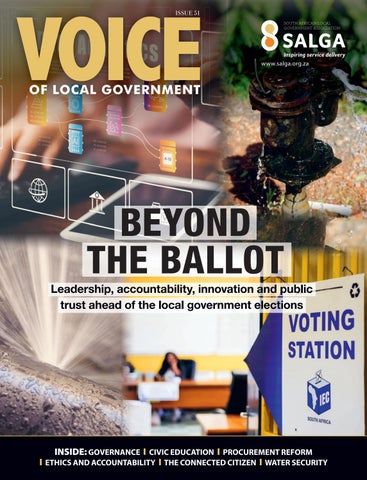
With elections approaching, this issue examines municipal governance, accountability, service delivery challenges and citizen participation shaping South Africa’s local democracy. By the SALGA Editorial team
As South Africa edges closer to the November local government elections, the role of municipalities in shaping democratic participation, service delivery and public trust has never been more critical. This edition of Voice of Local Government arrives at a crucial moment, when governance structures are under scrutiny, communities are demanding accountability, and the future of local democracy is being tested against rising expectations and persistent challenges.
The content of this issue re ects the urgency of the times. We begin with councillor induction programmes, a cornerstone of SALGA’s work to ensure that newly elected representatives are prepared to govern effectively from day one. With thousands of councillors set to enter of ce, the induction process is not merely administrative; it is about equipping leaders with the knowledge, skills, and ethical grounding to navigate one of the most complex governance environments in the country. The strength of local government depends on the competence and readiness of those entrusted with its leadership.
Governance itself takes centre stage in this edition, with the importance of ethical leadership, accountability and oversight as non-negotiable standards for municipalities. Readers will see
how blurred lines between political leadership and administration weaken decision-making, while strong governance frameworks restore credibility and enable municipalities to deliver on their constitutional mandate. Communities, as the primary stakeholders, are at the centre of this conversation, reminding us that transparency and responsiveness are not optional, but essential.
Equally important is the voice of citizens. Civic education emerges as a powerful tool to close the gap between communities and their representatives, and this edition outlines how accessible, youth-focused civic education can empower voters to make informed choices. These perspectives remind us that democracy is lived most directly at the local level, where water supply, electricity, housing, and public facilities shape daily life.
This issue also highlights urgent service delivery challenges, particularly how nonrevenue water (NRW) losses from leaking infrastructure and inef ciencies drain municipal nances and threaten water security. The call for sustained NRW reduction underscores the need for municipalities to adopt disciplined operations and data driven solutions to secure reliable water systems.
Similarly, procurement reform debates remind us that legislative frameworks
Civic education emerges as a powerful tool to close the gap between communities and their representatives, and this edition outlines how accessible, youth-focused civic education can empower voters to make informed choices.
must balance ef ciency with public participation, ensuring that municipalities can deliver services without compromising transparency or accountability.
As we move closer to the November elections, this issue serves as both a mirror and a guide. It re ects the realities of local government, the frustrations, the risks, and the hopes of communities, while also pointing towards solutions rooted in governance, accountability, and citizen engagement.
A strong local government is not built overnight, nor is it sustained by compliance alone. It requires leaders who are competent and ethical, institutions that are transparent and resilient, and communities that are informed and empowered.
In this spirit, we invite readers to engage deeply with the challenges and opportunities ahead. Whether you are a councillor preparing for of ce, a citizen demanding accountability, or a stakeholder invested in the future of municipalities, this edition offers insights, re ections, and practical pathways to strengthen local democracy.
We close this issue with a heartfelt tribute to Jerome Leon Van Der Merwe, a cherished and longstanding contributor to Voice of Local Government who sadly passed away in May. Jerome’s work has left an indelible mark on this publication, and his legacy will continue to inspire us in the years ahead. We honour his memory with deep gratitude.
With elections approaching, SALGA is intensifying councillor induction programmes to strengthen municipal governance, writes MATTHEW HIRSCH
With local government elections approaching, the South African Local Government Association (SALGA) expects another in ux of rst-time councillors –making induction and governance training more critical than ever, says SALGA governance and municipal resilience cluster chief of cer Lance Joel.
Many newly elected councillors arrive with little understanding of their roles, responsibilities or the legislative framework governing local government, he explains. As a result, SALGA takes responsibility for preparing them for of ce.
“We assume from the start that new councillors know very little about local government,” says Joel. “We take them through the legislative framework, their responsibilities and the practical workings of council.” SALGA aims to begin the induction process immediately after councils hold their inaugural meetings to avoid delays in governance and decision-making. With around 500 political parties registered for the local government elections on 4 November, Joel expects a high turnover of councillors. “We are likely to see a similar trend to previous elections, where many new councillors enter the system,” he says. “That requires a strong response from SALGA to ensure they are properly inducted.”
Joel describes local government as a complex and highly regulated environment that demands capable leadership at both the political and administrative level.
“There is not enough focus on ensuring we have the right people in local government,” he says. “Our aim is to identify appropriately skilled, quali ed and experienced people.”
This concern informed SALGA’s submissions to the White Paper on Local Government, which included recommendations around competency requirements for councillors.
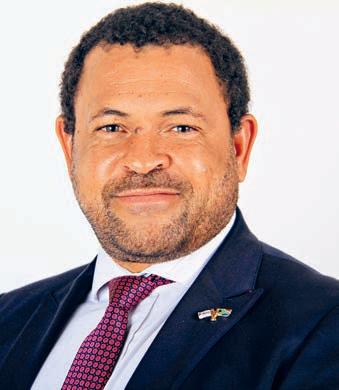
“We cannot allow just anyone to become a councillor,” Joel says. “We need a competency framework that makes it easier for people to ful l their responsibilities effectively.”
He stresses that this does not mean councillors must hold university degrees. Instead, SALGA wants representatives who either understand government processes or are prepared to undergo training.
“People entering this environment for the rst time often struggle to understand how complex it is,” he says. “That affects their ability to carry out their responsibilities.”
Joel explains that after the election, the Independent Electoral Commission (IEC) usually takes about three days to announce the results. Once the results are declared, outgoing councillors immediately leave of ce.
“At that point, there is no mayor or speaker in place. There are only councillors,” he says.
Legislation then requires councils to hold inaugural meetings within 14 days. During those meetings, councillors elect the speaker, mayor and chief whip.
The mayor then appoints the mayoral committee, followed by the establishment of ward committees.

The South African Local Government Association (SALGA), through Dr Thobile Mhlongo, SALGA’s director for municipal learning and development, has confirmed that preparations for the 2026 Integrated Councillor Induction Programme are complete, with rollout scheduled ahead of the post-election transition. The programme will induct approximately 10 000 councillors following the 2026 municipal elections and is designed to strengthen governance readiness across local government structures. A blended learning model will be introduced, combining online modules with in-person training to ensure accessibility, flexibility, and consistency in delivery. The curriculum has been updated to reflect evolving governance priorities, legislative frameworks, and the service delivery challenges facing municipalities.
Training will be delivered through provincial centres, enabling decentralised access and ensuring councillors are equipped with the practical tools required to fulfil their roles effectively from day one in office.
“That is when we begin the induction programme,” Joel says. “We familiarise councillors with council processes and help them understand how local government operates.”
As local elections approach, IoDSA CEO Professor PARMI NATESAN says strong ethical leadership, accountability and oversight remain essential for restoring trust in municipalities
As South Africa approaches its local government elections, I believe it is important to re ect on the state of governance within municipalities and why it remains central to public trust, service delivery and accountability.
Recent public discourse has once again drawn attention to allegations of corruption involving municipal of cials, tensions between political leadership and administration, and ongoing dissatisfaction with service delivery and tariff increases. While each case differs in its circumstances, together they point to a deeper and more systemic governance challenge in local government.
Municipal governance may differ structurally from corporate governance, but the principles that underpin it are the same: accountability, ethical leadership and effective oversight. These principles are not optional. They are essential to how public institutions function and how communities experience the state.
Municipal councils remain the focal point of governance and carry constitutional responsibility for the overall performance and integrity of municipalities. This places a signi cant burden on elected councillors, who are expected to act in the best interests of the municipality and the communities they serve.
This responsibility becomes even more critical in an election year, when political dynamics are heightened. Regardless of
political af liation, the duty of councillors remains unchanged: to prioritise service delivery, accountability and the long-term interests of communities.
Ethical leadership must therefore be embedded as a non-negotiable standard within local government. Without it, governance frameworks lose effectiveness.
One of the recurring governance risks in municipalities is the lack of clarity between political leadership and administrative management.
While municipal managers act as accounting of cers, councils are responsible for oversight and strategic direction. When these roles are blurred or inconsistently applied, instability emerges, decision-making is weakened and service delivery outcomes are negatively affected.
Clear separation of responsibilities is therefore not a technical detail; it is a foundational requirement for stable and effective governance.
The effectiveness of municipal governance is directly linked to the quality of individuals appointed to leadership positions.
Although councillors are elected through political processes, political parties carry a responsibility to ensure candidates possess the necessary integrity, competence and commitment to act in the public interest.
Ethical leadership must therefore be embedded as a non-negotiable standard within local government. Without it, governance frameworks lose e ectiveness.

weak governance, nancial mismanagement, service delivery breakdowns and declining public trust.

Unlike corporate entities, municipalities do not have shareholders. Their primary stakeholders are the communities and ratepayers who fund and depend on public services.
This makes transparency, accountability and responsiveness even more critical in local government than in many other sectors.
Governance structures must therefore prioritise meaningful engagement with communities and ensure that decision-making re ects the real needs and expectations of the people they serve.
As the country moves toward local government elections, governance should remain at the centre of public debate.
Strong governance is not simply about compliance with frameworks such as King V. It is about ensuring municipalities are capable of delivering services effectively, managing public resources responsibly and maintaining the trust of the communities they serve.
Ultimately, the strength of local government is determined by the strength of its governance. That is where the focus must remain.
KHURSHED MOAKES, COO of Futurelect, reflects on strengthening civic understanding ahead of South Africa’s 2026 local elections
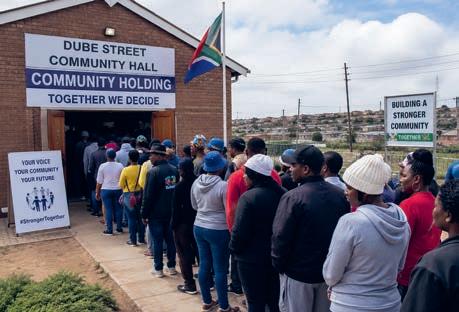
The date is set. The race has begun. President Cyril Ramaphosa con rmed that Wednesday, 4 November 2026, is the date for South Africa’s local government elections. With that announcement, the countdown to one of the most consequential ballots in recent democratic memory has of cially begun. For us at Futurelect, the announcement is a call to action.
Local government is where democracy is felt most directly. It is the municipality that xes the water. It is the councillor who is accountable. If citizens do not understand what they are voting for, they cannot hold anyone to account. That is the gap we exist to close.
In the weeks and months ahead, we will intensify our Civic Education Programme, delivered directly to South African youth through our mobile learning app, available on iOS, Huawei and Google Play, as well as across our social media platforms. The programme is designed for accessibility: short, clear and digestible content that explains what local government does, how councillors are elected, what the ward system means and, critically, what voters have the right to demand from those elected to serve them.

No jargon. No assumptions. Just the information every eligible South African deserves to have before stepping into a voting booth. Topics include:
•How the local government electoral system works.
•What municipalities are responsible for – and what they are not.
•How to check and update voter registration.
•What questions to ask candidates before voting.
The 2026 local government elections arrive at a moment of heightened public scrutiny. A recent Ipsos survey suggests many South Africans feel politically disengaged, not because they do not care, but because they feel unheard and uninformed.
This points to a growing civic education challenge. With 508 political parties registered to contest the 2026 local government elections – the highest number in South Africa’s democratic history – the information environment has never been more complex, or more important to navigate clearly.
That is why civic education matters now more than ever.
municipalities are responsible for Local government directly affects residents’ daily lives through services such as:
• Water and sanitation.
• Electricity distribution.
• Refuse removal.
• Local roads and streetlights.
• Town planning and zoning.
• Public libraries.
• Parks and recreational facilities.
• Municipal clinics and community services.
• Local economic development.
• Building regulations and bylaw enforcement.
Municipal councillors are responsible for oversight, policy direction and representing community interests within local government structures.

South Africans can access Futurelect’s civic education content through the Futurelect mobile app and by following Futurelect across its social media platforms.
The rst IEC voter registration weekend is scheduled for 20 and 21 June 2026, and our programme will support and amplify civic education efforts in the lead-up to that date. The objective is simple: to ensure more South Africans enter the voting booth informed, con dent and ready to participate meaningfully in local democracy.
A Finetown voter highlights service delivery failures, youth disengagement and accountability gaps as key issues ahead of upcoming local elections elections.
By MATTHEW HIRSCH

“We’re looking for fairness, we’re looking for integrity. We’re looking to be served with a sense of accountability.” For Finetown resident and community activist Samuel Johnson, these are not abstract ideals; they are the daily demands of life in a township still battling basic service delivery failures.
Finetown, a developing township in the southwest of Johannesburg, continues to face deep infrastructure and municipal challenges, from unreliable electricity to water shortages and limited public facilities.
Johnson, 32, has lived most of his life in the area, and says these conditions will strongly in uence how he votes in the upcoming local elections on 4 November.
SERVICE DELIVERY BACKLOGS SHAPE VOTER PRIORITIES
Johnson says residents continue to struggle with basic services, including water supply, housing, electricity and access to community infrastructure.
“We’ve got transformers that blow out. We’ve got people who have lived for more than ve years without electricity. We’ve got the water crisis as well,” he says.
He adds that the expansion of informal settlements is compounding existing pressure on already strained municipal systems.
“If services aren’t able to get to people that have been living in the area for more than twelve years, how are services going to get to people that are coming out in sprouting areas?” he asks.
For Johnson, these issues re ect a deeper governance challenge – one that will remain unresolved unless accountability improves at local level.
Johnson believes voter education and civic awareness are critical, particularly among young people who often feel disconnected from the political process.
“The number one problem with our people is the lack of knowledge. People don’t understand the power of the act (to vote),” he says.
He adds that young people are inheriting long-standing structural challenges, from inequality to limited economic opportunity, but are not always fully engaged in shaping solutions.
“The youth are now ghting for equal education. We are ghting for nancial emancipation,” he says, adding that youth representation in leadership remains limited.
Johnson also calls for stronger civic education initiatives to reinforce the importance of voting and democratic participation.
He says parts of Finetown remain severely underdeveloped, with limited access to basic infrastructure and public amenities.
“We don’t have title deeds. We don’t have tar roads. We don’t have a library,” he says.
“Residents
Johnson says he carefully considers his vote, but remains concerned about accountability in local government.
“I fear that eighty per cent of the councillors in the City of Johannesburg did not get into council because of the need to serve,” he says.
He adds that residents continue to face long travel distances to access essential services such as libraries and sports facilities, which he says should be available within communities.
“We’re looking for fairness. We’re looking for integrity. Our leaders are not held to account,” he says.
Johnson also stresses the need for equitable economic opportunity, arguing that access should be based on merit and not background.
Meanwhile, the Independent Electoral Commission (IEC) has assured Parliament that it is prepared to deliver the local government elections scheduled for 4 November 2026 within its allocated budget.
The IEC has received R3.2-billion for the current nancial year to support electoral operations. Key priorities include strengthening voter registration systems, particularly to address under-representation of certain demographic groups on the voters’ roll, as well as preparing for candidate nominations and ballot printing.
The IEC also plans to intensify voter outreach programmes, with a speci c focus on encouraging youth participation. It has further con rmed that election day will be declared a public holiday to minimise disruption, including within the education sector.
continue to struggle with basic services, including water supply, housing, electricity and access to community infrastructure.” – Samuel Johnson



SEAN JACOBS, GIBB specialist engineer in nonrevenue water reduction, examines how nonrevenue water losses are draining municipalities and threatening South Africa’s water security
Africa’s “hidden dams” are not found in rivers or reservoirs, but beneath city streets – in leaking pipes, ageing infrastructure and inef ciencies that drain treated water before it ever reaches consumers.
Known as nonrevenue water (NRW), this is the share of treated water lost between production and consumption. It represents one of the most immediate and practical opportunities to improve water security across the continent, particularly as drought cycles intensify, cities expand rapidly and public nances come under increasing pressure.
Water security is fundamentally about reliable, continuous access to safe drinking water. Yet for many communities, this remains far from reality. Even in relatively well-served countries such as South Africa, systems are under strain as urban growth outpaces infrastructure development. The result is intermittent supply, reduced pressure and, in some cases, system failure. NRW sits at the centre of this challenge. When left unaddressed, it reduces the volume of water available to consumers while eroding the nancial viability of municipalities responsible for service delivery. NRW comprises all water lost between treatment and nal use. It is typically divided into two categories: real
losses and apparent losses. Real losses refer to physical leakages – bursts, pipe failures and background leakage from ageing infrastructure. Apparent losses, while less visible, are equally signi cant and include water that is consumed, but not accurately measured or billed due to faulty meters, data inconsistencies or unauthorised usage.
In many African cities, NRW levels exceed 30 per cent of total supply and can reach as high as 60 per cent. This means more than half of treated, energy-intensive water generates no revenue and fails to reach its intended users.
This is why NRW is often described as the most expensive water in the system. The cost of abstraction, treatment and pumping has already been incurred – often in the context of constrained electricity supply and rising operational costs – only for large volumes of water to be lost underground or on paper.
The result is a self-reinforcing cycle. Reduced revenue limits municipalities’ abilities to maintain and upgrade infrastructure, leading to higher leakage rates and further nancial deterioration. Left unchecked, this cycle can push water systems towards progressive failure. Against this backdrop, large-scale infrastructure investments such as new dams, transfer schemes and treatment plants remain important, but insuf cient on their own. These projects are capital-intensive, slow to deliver and often subject to environmental and regulatory constraints.
NRW reduction offers a faster, scalable and cost-effective intervention. Every litre saved through loss reduction effectively becomes “new water” available to the system, without requiring additional abstraction from natural resources. From an engineering perspective, the solutions are well established. Pressure management is one of the most effective tools for reducing real losses – it lowers stress on pipe networks, reduces burst frequency and limits background leakage. Modern systems also allow for dynamic
Nonrevenue water reduction o ers a faster, scalable and cost-e ective intervention. Every litre saved through loss reduction e ectively becomes “new water” available to the system, without requiring additional abstraction from natural resources.
pressure control, enabling utilities to reduce pressure during off-peak periods and further minimise losses.
Equally critical is measurement. Many utilities still lack accurate, real-time data on system in ows, distribution and consumption. Strengthening network and customer metering, alongside reliable billing systems, is essential to understanding where losses occur. Without measurement, effective intervention is not possible – NRW reduction is as much a data and systems challenge as it is an engineering one.
The economic implications are signi cant. A 10 per cent reduction in NRW at a national level can translate into billions of rand in recovered value and avoided losses. For water service providers, this improves cash ow, reduces reliance on bulk water purchases and creates capacity for reinvestment in maintenance and
infrastructure renewal. For communities, it means improved reliability and fewer service interruptions. For economies, it strengthens industrial resilience and investor con dence.
However, NRW programmes frequently fail not because the technical solutions are unclear, but because implementation is not sustained. Institutional instability, shifting budget priorities and the failure to ring-fence savings often undermine early progress. Effective NRW management is an ongoing operational discipline that requires consistent monitoring, governance and reinvestment.
The most immediate opportunity lies in optimising existing systems. In a resource-constrained environment, the fastest route to improved water security is not always new infrastructure, but better performance from existing networks. Africa’s “hidden dams” – the vast volumes of treated water currently lost – represent a scalable, engineering-led opportunity to deliver immediate and measurable gains. The tools already exist. The challenge now is sustained execution.

The 2025 No Drop PAT findings refer to the latest audit results from South Africa’s national water services performance monitoring programme run by the South African Department of Water and Sanitation. The No Drop assessment evaluates how municipalities manage water demand, losses and efficiency, particularly focusing on nonrevenue water (water lost through leaks, theft or poor billing) and overall water conservation performance.
Some of the key findings in the 2025 assessment:
• The national average percentage NRW has remained roughly constant since the 2023 Full No Drop Report at 47,3 per cent.
• This is an indication that the increasing percentage NRW that was evident between 2013 and 2023 has stabilised, albeit at a high level. (These results will need to be verified by the full No Drop report that will be released next year.)
• While the percentage physical water losses is smaller in Gauteng than that in the Northern Cape, the volume of water lost in Gauteng
is 431 billion litres per annum compared to 48 billion litres per annum in the Northern Cape.
• KwaZulu Natal and Mpumalanga has the highest percentage NRW at 60 per cent followed by the Free State at 56 per cent and North West at 53 percent.
• Northern Cape has the highest percentage physical losses at 44 per cent followed by Limpopo at 43 per cent.
• Western Cape has both the lowest percentage NRW and percentage physical losses.
• Gauteng receives by far the highest volume of water and has the highest average consumption of water per capita per day (243 l/c/d).
• The volume of water lost in Gauteng is almost equal to the entire volume received in the Western Cape, similarly KwaZulu Natal loses a volume almost equal to the entire volume received in Limpopo.
• The national average consumption in terms of litres per capita per day has remained approximately the same when compared to the Full No Drop in 2023.

• Eastern Cape and Western Cape have the lowest litres per capita per day consumption but the relatively low consumption in the Eastern Cape is influenced by high water supply interruptions.
•The small difference between percentage NRW and percentage physical losses in Northern Cape and Limpopo may be due to many WSAs not submitting data in these provinces.
Source: Water Services Drop Programmes, 2026 Full Green Drop and Blue Drop and No Drop Progress Reports (The national report and detailed provincial reports will be available for download from www.dws.gov.za)
Unpacking the framework and a legal analysis of piggyback procurement under South African law. By
Cliffe Dekker Hofmeyr’s SENTEBALE MAKARA, director – Dispute Resolution, CORNÉ LEWIS director – Dispute Resolution, and LIËTTE VAN SCHALKWYK, senior associate – Dispute Resolution
Imagine a government department needing to procure goods or services urgently, but instead of launching a lengthy new tender process, it leverages an existing contract that another organ of state has already awarded. This is the essence of “piggyback” or co-operative procurement: a mechanism that allows a procuring entity to acquire goods or services by relying on another entity’s validly awarded contract.
While this approach offers substantial administrative and economic ef ciencies, it raises important legal considerations relating to compliance, fairness, transparency and value for money. Its application is limited to government departments, constitutional institutions and public entities listed in Schedules 3A and 3C of the Public Finance Management Act.
This article unpacks the regulatory foundations, key legal principles, practical risks and essential governance requirements that underpin piggyback procurement under South African law.
Co-operative procurement or contract riding, also referred to in the market as “piggyback” procurement, is a mechanism by which a procuring entity acquires goods or services through reliance on an existing contract awarded by another entity. While this approach offers administrative and economic ef ciencies, it raises important legal considerations relating to compliance, fairness, transparency, and value for money.

As a solution to inter alia procurement delays and, at times, budgetary challenges, piggyback procurement occupies a complex position within South African public procurement law. While it offers administrative ef ciency, its legality is strictly circumscribed by constitutional principles, statutory frameworks, such as the Public Procurement Act 28 of 2024 and the Public Finance Management Act 1 of 1999 (PFMA), Municipal Finance Management Act (MFMA), and applicable regulations.

Piggyback procurement occurs when a secondary procuring entity relies on a contract that has been competitively tendered and awarded by a primary entity.
Piggyback procurement is explicitly recognised under supply chain management regulations.
The procurement by the secondary entity is undertaken without the secondary entity initiating its own independent procurement process.
The essence of the “piggyback” is that the secondary entity enters into a legal arrangement – either directly with the supplier or via the primary contract framework – to receive goods or services under the same or similar terms as the primary entity.
Legally, piggyback procurement is a derivative use of an existing contract. Its validity hinges on three critical factors:
1. The lawfulness of the original procurement process.
2. Contractual provisions expressly allowing extension to third parties.
3. Strict compliance with applicable procurement legislation.
The secondary entity must also pay close attention to material terms in the primary contract, including its validity period, as using an expired or soon-to-be-expired contract is a common pitfall.
THE LEGAL FOUNDATION: WHEN IS PIGGYBACKING LAWFUL?
For piggyback procurement to be lawful, the applicable regulatory framework must expressly or implicitly permit it.










Corné Lewis








Generally, piggybacking is permissible where:
1. The original tender disclosed that other entities may utilise the contract.
2. The scope of goods or services remains unchanged.
3. The constitutional principles of fairness, equity, transparency, competitiveness and cost-effectiveness are not compromised. Without such provisions, piggybacking may constitute an unlawful circumvention of competitive bidding requirements, opening the door to legal challenges and irregular expenditure ndings.
From a contract law perspective, piggyback procurement typically relies on third-party bene ciary principles, cession or assignment of rights, or framework agreement structures where multiple entities are contemplated from the outset. The critical point: the original contract must explicitly permit such arrangements. If it does not, the secondary contract may be legally unenforceable, leaving the secondary entity exposed.
Section 217(1) of the Constitution demands that organs of state contract for goods or services through a system that is fair, equitable, transparent, competitive and cost-effective. Any piggyback arrangement must be rigorously assessed against these ve constitutional pillars. Section 217 is a constitutional safeguard designed to protect public funds, prevent corruption and ensure accountability. No amount of governance approval or commercial convenience can override these imperatives.
The Public Procurement Act 2024 consolidates the procurement framework and aims to enhance uniformity, transparency and ef ciency across the public sector. Although not yet fully
Organisations must ensure alignment with statutory mandates, preserve competition and uphold transparency.
commenced, it reinforces that procurement must occur within a regulated, transparent framework with robust accountability and expenditure control aligned with constitutional principles. While the Act does not expressly codify piggyback procurement, it implicitly permits co-operative mechanisms provided they do not undermine competitiveness or transparency.
Piggyback procurement is explicitly recognised under supply chain management regulations. The PFMA Supply Chain Management Framework mandates that procurement systems be fair, equitable, transparent, competitive and cost-effective. Treasury Regulation 16A6.6 and MFMA SCM Regulation 32 permit institutions to participate in contracts secured by other organs of state, but only subject to strict conditions: the original contract must have been validly procured, the contract must allow such participation and value for money must be demonstrable.
At its heart, piggyback procurement raises a fundamental legal question: can reliance on another organ of state’s contract satisfy the constitutional requirement that procurement be fair, equitable, transparent, competitive and cost-effective? When the answer is yes, piggybacking delivers ef ciency without sacri cing legality. When the answer is not due to improper reliance on Regulation 32, for example, the consequence may be irregular expenditure ndings or outright contract invalidity.
Piggyback procurement must adhere to ve foundational principles:
Piggyback procurement occupies a complex position within South African public procurement law.



• Legality: all activities must be authorised by law or valid policy frameworks.
• Transparency: the original tender must disclose the possibility of piggybacking.
• Fairness and competitiveness: the process must not unfairly exclude potential bidders.
• Value for money: secondary users must independently verify that pricing remains commercially advantageous.
• Accountability: all decisions must be documented and capable of withstanding audit scrutiny.
To ensure compliance, procuring entities must satisfy the following conditions:
• An explicit piggyback clause in the original tender and contract.
• Scope alignment, ensuring goods or services fall strictly within the original contract scope,
• Supplier consent to extend the contract to additional entities.
• Thorough due diligence verifying the validity, duration and procurement compliance of the original contract, as well as pricing competitiveness.
• Formalisation through a separate participation agreement or addendum.
Key legal risks include:
• Ultra vires actions: if piggybacking is not authorised by law or policy, it may be declared invalid, exposing of cials to personal legal consequences.
• Irregular expenditure: improper piggybacking may result in ndings of irregular, fruitless or wasteful expenditure under the PFMA or MFMA.
• Contractual invalidity: where third-party use is not permitted, the secondary contract may lack legal enforceability.
• Scope creep: using the contract beyond its intended scope can trigger legal challenges and set-aside applications.
• Constitutional challenges: piggybacking may be reviewed and set aside if it undermines competitive procurement principles.
To mitigate legal risk, procuring entities should:
• Conduct a legal review of both the original contract and applicable procurement laws.
• Maintain audit-ready documentation of the decision to piggyback.
• Obtain internal approvals from legal, procurement, and nance functions.
• Con rm supplier capacity and pricing validity.
• Limit use strictly to the original contract scope and terms.
Piggyback procurement is a lawful and ef cient mechanism – when applied within the bounds of the applicable legal framework. Its legitimacy depends on
Properly governed, piggyback procurement delivers valuable administrative e ciency.
strict compliance with procurement law principles and contract law requirements. Organisations must ensure alignment with statutory mandates, preserve competition and uphold transparency. Properly governed, piggyback procurement delivers valuable administrative ef ciency. Misapplied, it exposes institutions and of cials to signi cant legal and nancial risk. The choice is clear: proceed with rigour, or proceed at your peril.

For more information: www.cliffedekkerhofmeyr.com

Cliffe Dekker Hofmeyr’s YANIV KLEITMAN, director – Corporate & Commercial, NADEEM MAHOMED, director – Employment Law, and ROXANNE BAIN, director – Corporate & Commercial, explain the Companies Act amendments and remuneration disclosure
South Africa’s recent Companies Act 71 of 2008 (Companies Act) amendments mark a deliberate shift towards greater openness on executive pay, anchored in the conviction that excessive remuneration, particularly at the highest levels of a company, is a matter of great concern internationally. The international literature on this topic, as well as on the inequity of signi cant pay gaps between the top and bottom levels of a company, is signi cant. By introducing a structured remuneration report regime, the amendments seek to bring South African company law in line with these international developments.

The reform rests on a clear policy rationale, as contained in the explanatory memorandum on the Bill. The provisions relating to transparency on the pay gap and the reasonableness of remuneration provide an objective benchmark to assist the public dialogue on this topic. That dialogue carries weight because the factors giving rise to these concerns are, to an extent, responsible for the signi cant levels of inequity in society. Conventional wisdom is that these levels of inequity are unsustainable, and it seems that the government holds the view that this concern has even greater resonance in South Africa. To address this, the amendments make provision for augmentation in the levels of disclosure of executive remuneration.
According to the explanatory memorandum on the Bill, disclosure is a powerful regulatory mechanism for several
reasons. First, it provides shareholders with an effective means of responding to dissatisfaction over excessive remuneration. Second, it has a shrinking effect, inducing boards and senior executives to refrain from awarding and receiving excessive remuneration for fear of the adverse reputational consequences. To give these mechanisms teeth, the amendments oblige public and state-owned companies to prepare a directors’ remuneration report and to disclose the pay gap between directors and workers, including details of the highest and lowest paid employees, average and median remuneration, and the gap between the top ve per cent and bottom ve per cent of earners. The remuneration implementation report must be approved by ordinary resolution at the annual general meeting, with consequences where approval is not obtained.
Importantly, the amendments stop short of prescribing outcomes. They do not seek to propose what the ratios between executive and worker pay should be; instead, they propose transparency and empower shareholder voting to be more effective than currently is the case. This is signi cant, according to the explanatory memorandum on the Bill, given that this kind of inequality underpins much of the well-known workplace con ict in South Africa.

These measures emerged from negotiated compromise. The explanatory memorandum highlights that during discussions at the National Economic Development and Labour Council, the matter of wage ratios and the status of remuneration reports was raised and a number of proposals were made. The discussions focused on what an appropriate package of measures would entail, providing for disclosure of information coupled with greater rights for shareholders at annual general meetings, without placing an undue burden on small businesses. Based on the outcome of discussions with representatives of business and labour, the amendments were drafted.
For collective bargaining, the implications are practical rather than prescriptive. By placing veri able data on wage differentials in the public domain, the disclosures hand trade unions an objective benchmark to inform their negotiating positions, allowing them to ground demands in published median and ratio gures rather than estimates. This signals how unions are likely to deploy these gures at the bargaining table. While the amendments confer no new bargaining rights, the transparency they create is likely to sharpen negotiation over the reasonableness of pay at both ends of the scale.





Courts hear challenges to new procurement legislation, with concerns over public participation, centralisation and impact on municipal service delivery.
By MATTHEW HIRSCH
In May, the Constitutional Court heard arguments challenging the Public Procurement Act (PPA) of 2024, a piece of legislation that has already generated signi cant controversy across government and civil society.
The act, which is not yet in force, seeks to centralise all state procurement under a single of ce housed within National Treasury, while also setting preferential procurement guidelines aligned with government’s Broad-Based Black Economic Empowerment (BBBEE) policy. It was passed by Parliament on 16 May 2023 and received presidential assent on 18 July 2024.
The legal challenge has been brought by the City of Cape Town, the Western
Cape Provincial Government and the AmaBhungane Centre for Investigative Journalism.
The matter has also been widely debated across governance spheres and featured at the National Municipal Legal Practitioners Forum in Cape Town earlier this year. The forum provides a platform for municipalities to engage on emerging legal and governance challenges.
Umika Gopichund, senior manager for corporate legal services at the South African Local Government Association (SALGA), says South Africa’s procurement environment has historically
In its court papers, the City of Cape Town argues that the legislative process failed to meet constitutional requirements for meaningful public participation.
been governed by fragmented and overlapping rules.
The new act, she says, attempts to consolidate these into a single framework applicable across the public sector. “It’s about how public money is spent, how transparent that process is, and how we build trust in public institutions,” she explains.
She adds that procurement remains a critical governance pressure point. “Procurement, after all, is where policy meets practice, and sometimes where governance meets temptation.”
Gopichund describes the legislation as one of the most signi cant efforts in recent years to streamline procurement rules and strengthen anti-corruption safeguards.
In its court papers, the City of Cape Town argues that the legislative process failed to meet constitutional requirements for meaningful public participation.
It contends that members of the public, particularly in the Western Cape, were not given a reasonable opportunity to engage with the draft law, and that neither Parliament nor provincial legislatures ensured adequate consultation.
“The PPA is unconstitutional because it was enacted without a reasonable opportunity for public participation,” the city stated in its papers, warning that the procedural shortcomings have “grave and far-reaching consequences”.
Beyond procedural concerns, the city argues that the act could negatively affect local service delivery by slowing procurement processes and limiting municipal exibility.
It further highlights that municipalities would no longer be able to maintain their own supplier databases, with payments and supplier management integrated into a national system under a central public procurement of ce.
Legal practitioner Lelani van den Berg, senior legal advisor at uMngeni Local Municipality, says municipalities already operate under at least six overlapping procurement laws.
She stresses that behavioural change, alongside legal reform, is essential to improving outcomes.
Van den Berg pointed to the act’s proposed debarment system, which would create a centralised database, excluding suppliers found guilty of fraud and corruption.
“There’s going to be a central database, which will exclude suppliers found guilty of fraud and corruption,” she explains, noting that implementation challenges could arise, particularly in relation to internal accountability systems.
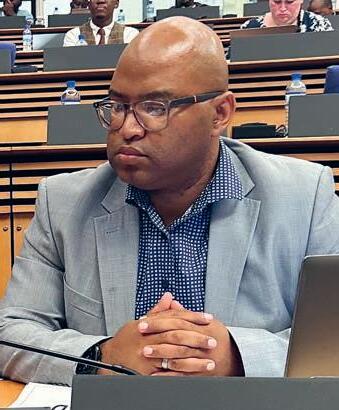
“It’s a complete U-turn from municipalities having the right to determine their own preference system … it almost goes back to this archaic place where it’s being controlled from a national perspective.” – Alfonso Page
She also highlights persistent enforcement gaps. “We’re dealing with suppliers that are totally overcharging, that are doing inferior work … Why aren’t these guys blacklisted?”
She adds that courts have consistently reinforced the principle that compliance is not optional.
City of Cape Town procurement law specialist Alfonso Page cautions against overstating the bene ts of the proposed framework, arguing that South Africa’s challenge is not the absence of legislation, but enforcement.
“We know the problem in our country is not the laws. We’ve got great laws. We have dif culty with enforcement,” he says.
Page says the case before the Constitutional Court effectively asks whether the act is invalid from inception due to procedural aws. If upheld, the status quo would remain; if not, the legislation could be implemented in full.
He adds that the act represents a signi cant shift away from municipal autonomy in procurement. “It’s a complete U-turn from municipalities having the right to determine their own preference system … it almost goes back to this archaic place where it’s being controlled from a national perspective.”
Journalist Caroline James, writing for the AmaBhungane Centre for Investigative Journalism, said the challenge is grounded in concerns over inadequate public participation during the legislative process.
She argued that consultation timelines were extremely limited and that substantive changes were introduced late in the process, after public submissions had already been made.
“The timelines were ludicrously short, the majority of public submissions were not considered,” she wrote, adding that this undermines the constitutional requirement for participatory democracy.
South Africa’s Constitution, she noted, is based on a representative and participatory model, requiring that public views are meaningfully considered in law-making processes.
She further pointed out that the National Assembly’s call for comments allowed less than a month for public engagement with a complex and far-reaching piece of legislation.
The Constitutional Court is now expected to determine whether these procedural and constitutional concerns are suf cient to invalidate the act, or whether it may proceed with implementation.
Beyond procedural concerns, the city [Cape Town] argues that the act could negatively a ect local service delivery by slowing procurement processes and limiting municipal flexibility.
DIGITAL DISCUSSION SYSTEM
CCS 1000 D










Designed for plug-and-play, ease-of-use and highly productive meetings.
Excellent speech intelligibility with built-in digital acoustic feedback suppression. Built-in audio recording on internal memory and/or USB memory stick.
Onboard support for automatic HD camera control.
Advanced configuration and control via built-in web browser.
Energy-saving mode for switch-off after two hours of inactivity. Up to 245 discussion devices.
Digital Voice Processing (Pty) Ltd
+27 31 267 0923
info@dvpsa.co.za
www.dvpsa.co.za


Municipal leaders, auditors and ethics experts call for stronger controls, cultural change and enforcement to tackle corruption and maladministration risks, writes MATTHEW HIRSCH
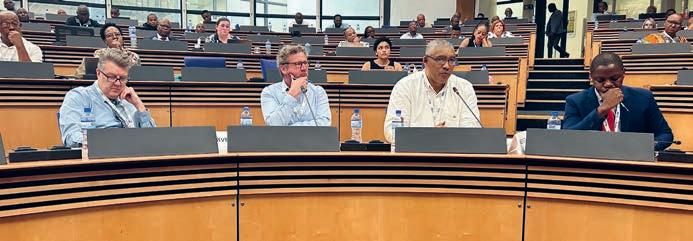
Wisdom and courage are essential if local government is to turn the tide against corruption, according to City of Tshwane city manager Johann Mettler. Speaking at the South African Local Government Association 6th National Municipal Legal Practitioners Forum, Mettler said leaders must adopt a realistic approach to risk and governance to protect public resources.
The session, chaired by Michael Chauke, focused on combatting corruption and maladministration in municipalities. Mettler said his approach is shaped by a “rule of thumb” when entering new environments. “I assume that seventy- ve to eighty per cent of the people around me are corrupt,” he said, adding that this mindset helps leaders prioritise systems over assumptions of trust.
He warned that poor oversight and weak controls expose municipalities to material irregularities. “We have to start exercising control in our environment. If you don’t, you will end up with a material irregularity,” he said.
Mettler further stressed that accountability requires decisive action. “If you don’t go after the bad guys, you’re also wasting your time, and maybe you should get out of the job.”
He added that municipalities must “make peace” with operating in high-risk environments, focusing
instead on strengthening checks, balances and delivery systems.
From an accountability perspective, the Auditor-General of South Africa outlined key enforcement mechanisms aimed at improving compliance and protecting public resources.
Thabelo Kangale, deputy business unit leader for material irregularity, explained that one of the most signi cant tools introduced is the certi cate of debt, implemented through legislation in 2019.
The mechanism is designed to improve accountability, strengthen oversight and ensure consequences for nancial mismanagement in the public sector.
Once a material irregularity is identi ed, it is communicated to the accounting of cer – typically the municipal manager –who is required to take corrective action.
“There will be an expectation of a recovery of those nancial losses, and the of cials who are responsible should be disciplined,” Kangale said.
If accounting of cers fail to implement recommendations, the Auditor-General may issue binding remedial action. This can ultimately result in of cials becoming personally liable for nancial losses incurred by the state.
“A certi cate of debt is something serious coming your way if you do not implement the recommendations of the Auditor-General,” he warned. However,
Kangale stressed, the aim is prevention rather than punishment, noting that full compliance with recommendations can prevent escalation.
He also highlighted culture as a central challenge. “The most dif cult thing is the culture change. If leadership is not clean, there is no way that the culture is going to change,” he said.
The Ethics Institute of South Africa reinforced the need for ethical transformation in local government. Senior manager Kris Dobie said governance challenges often stem from weak systems that consistently fail to promote ethical behaviour. He pointed to issues such as poor disciplinary processes and improper appointments, stressing the need to move from compliance-driven governance to values-based leadership.
“Now we need to transform that into values and get people to actually act ethically at all times,” Dobie said.
He added that national efforts are underway to strengthen ethics management in the public sector, referencing work led by the Minister of Public Service and Administration, Inkosi Buthelezi, to develop a formal ethics strategy. Despite persistent challenges, Dobie noted positive signs. A 2024 survey of more than 7 000 public servants found that 89 per cent would willingly undergo lifestyle audits.
However, gaps remain, including limited awareness of ethics hotlines, with only 47 per cent of respondents indicating they knew their organisation’s reporting channels.
Dobie also noted that compliance with lifestyle audit processes has improved signi cantly since 2023, rising from 61 per cent to over 90 per cent.
The ndings suggest growing institutional readiness for reform, even as municipalities continue to grapple with entrenched governance risks.
C: +27 82 366 3125 E: FRANKS@PICASSO.CO.ZA
PUBLISHER
PICASSO HEADLINE, a proud division of ARENA HOLDINGS (Pty) Ltd Hill on Empire 16 Empire Road (cnr Hillside Road), Parktown, Johannesburg
Publication date: October 2026



PLASTICS SA highlights that the key to addressing South Africa’s waste management problem lies in strengthening collaboration between industry, municipalities and government stakeholders
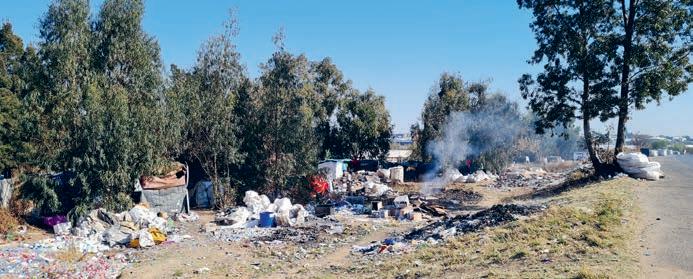
South Africa’s waste management system is under severe strain, and without urgent reform, the country risks losing the environmental and economic bene ts effective recycling can deliver.
“The country already has the technology and expertise to design fully recyclable packaging products. However, without an effective waste collection and separation system, much of this potential is lost,” says Anton Hanekom, executive director of Plastics SA.
Hanekom says we can (and do) have packaging products that are 100 per cent designed for recycling, but this is of little use if these materials are not collected by waste pickers or municipal waste management systems.
“Fixing South Africa’s broken waste management infrastructure must be a national priority. Municipalities currently carry the primary and constitutional responsibility for waste collection and land ll management. Yet, the system is under pressure from growing waste volumes, limited resources and inadequate separation at source. Recyclable materials often end up mixed with organic waste at land ll sites, making recovery far more dif cult and expensive,” Hanekom says.
In many cases, waste pickers recover recyclable materials directly from land ll sites under extremely challenging conditions. As wet and dry waste are not separated at source, the materials are often dirty and contaminated, requiring additional washing, sorting and processing steps before recyclers can use the material.
“These additional steps add costs and reduce the value of recyclable materials, limiting the growth potential of the recycling sector. Yet, recycling remains a critical component of South Africa’s circular economy. It creates jobs, reduces environmental pollution and keeps valuable materials in circulation,” he says.
One of the most effective solutions is separation of waste at source, supported by improved municipal infrastructure and public awareness programmes.
“If households are given the tools and facilities to separate dry recyclables from wet waste, the value of recyclable materials increases signi cantly,” says Hanekom. “Cleaner materials are easier to sort and bale, which improves prices and makes recycling far more viable.”
Despite the challenges, there are encouraging signs. Growing public awareness and industry-led initiatives are helping to shift attitudes away from
”Recycling remains a critical component of South Africa’s circular economy. It creates jobs, reduces environmental pollution and keeps valuable materials in circulation.” – Anton Hanekom
the traditional “use-and-dispose” mindset towards a more circular approach to materials management.
To further stimulate dialogue around these issues, Plastics SA has launched a pilot podcast series titled “Plastics Matter.”
The series provides a platform for open, fact-based discussions about the challenges and opportunities facing the industry and the broader waste management system.
One of the rst two inaugural episodes focuses on South Africa’s waste management crisis and features Bala Nengovhela, specialist: waste management at SALGA, in conversation with Hanekom.
“Plastics SA aims to be the voice of the plastics industry,” Hanekom explains. “With Plastics Matter, we want to create a platform where critical issues can be discussed openly and constructively with government, industry and the public.” Inviting SALGA to participate in the series highlights the importance of co-operation between industry bodies and local government. “Municipalities play a pivotal role in the waste management value chain,” says Hanekom. “Our collaboration with SALGA is essential if we want to build a more effective and sustainable waste management system for South Africa.”
Partnerships like this, combined with improved infrastructure, policy alignment and public participation, are essential to xing the country’s waste management system and unlocking the full value of recyclable materials.
“Ultimately, solving South Africa’s waste challenges requires all stakeholders to work together. Through collaboration, we can move from simply managing waste to building a truly circular economy,” Hanekom concludes.


South Africa’s fragmented public data systems hinder service delivery, highlighting the need for integrated, citizen-centric digital government transformation. By NTSAKO BALOYI, data and AI lead, and VARAIDZO MURERIWA, managing director within the health and public service business at Accenture, South Africa
For many South Africans, interacting with government still involves repeating the same process. Whether applying for an ID, accessing healthcare, navigating the justice system or engaging with social services, people are often required to resubmit the same information and move between disconnected processes. Records do not always align, and each interaction can feel separate.
FRAGMENTED SYSTEMS, REPEATED CITIZEN JOURNEYS
This is not because government lacks data. In many cases, the opposite is true. Large volumes of citizen information already exist, but they are spread across
departments, stored in different formats and not always easy to reconcile. As a result, there is no consistent, shared view of the individual across the public sector. Over time, much of the focus in digital government has been placed on introducing new systems and platforms, improving interfaces and digitising access points. These efforts have delivered value in speci c areas, but they have not fully addressed how information is managed, shared and maintained behind the scenes. In practice, the challenge often lies in how data is structured, governed and connected, as well as in enabling a truly uni ed “One Government” approach that operates seamlessly across spheres and departments. At the centre of this
• Resubmitting the same documents across departments.
• Systems that don’t talk to each other.
• Multiple databases holding duplicate or outdated records.
model is the citizen, anchored by the principle of One Citizen, One Identity – delivering a consistent, integrated experience that transcends departmental boundaries and places citizen needs at the core of service delivery.
DIGITAL PROGRESS, STRUCTURAL GAPS
Departments continue to operate independently, even where their work overlaps. Systems are developed at different times, using different standards, and are
not always designed to work together. In some instances, legacy infrastructure makes it dif cult to adapt or integrate new approaches at the required pace.
For citizens, this shows up in practical ways. Time is spent waiting in queues or reapplying for services. Mistakes occur when records do not match. Processes take longer than they should, and the experience can feel inconsistent. Over time, this places a burden on individuals and shapes how people perceive public institutions.
In South Africa, where access to public services plays a central role in economic participation and social inclusion, these challenges carry wider consequences. They directly affect livelihoods, and result in a lack of trust in institutions, limiting how effectively services can be delivered.
Addressing this challenge requires a more consistent approach to digital transformation with emphasis on the underlying data and systems that support these services. This includes ensuring information is accurate, standardised and can move securely between departments where appropriate. It also involves aligning governance practices and establishing common ways of working with data across the public sector, supported by a streamlined data-sharing framework across government institutions that enables ef cient, secure collaboration while minimising unnecessary administrative complexity.
Technologies such as AI can support this shift, particularly in helping anticipate service needs or improve how citizens engage with government. However, the quality of these outcomes depends heavily on the data that underpins them. Where information is incomplete or inconsistent, the results are likely to re ect those gaps, often resulting in fragmented data across government institutions, which, in turn, leads to a disjointed and inconsistent citizen experience.

Departments continue to operate independently, even where their work overlaps. Systems are developed at di erent times, using di erent standards, and are not always designed to work together.
There are already opportunities to strengthen this foundation. Greater alignment across departments can help create a more reliable and coherent view of citizens over time. This can reduce duplication, improve accuracy and make it easier to deliver services in a way that re ects how people actually live and interact with the state.
It can also support more ef cient operations within government. When processes are better connected and information is easier to access, administrative effort can be reduced, and resources can be directed to areas of greater need.
At the same time, this does not require departments to give up their individual mandates. Rather, it calls for a level of co-ordination that allows information to be shared responsibly where it adds value, while maintaining appropriate safeguards.
Greater alignment across departments can help create a more reliable and coherent view of citizens over time. This can reduce duplication, improve accuracy and make it easier to deliver services.
• One citizen ID across all services.
• Shared databases across departments.
• Real-time data updates instead of re-application.
• Single digital front door for services.


organisations that have improved how they use data across different parts of their operations. When information is connected, interactions tend to feel more coherent and responsive. This principle is just as relevant in the public sector.
A more connected approach to service delivery starts with recognising citizens in a consistent way across different touchpoints. It allows services to re ect real-life needs and circumstances, rather than the structure of departments. Over time, it also creates the conditions for more responsive and proactive support.
South Africa already has many of the building blocks in place. The next step lies in how these are brought together in a way that is practical, secure and sustainable. At its simplest, it begins with a clear objective: ensuring that, across the system, each person is seen and understood as a single individual.
Employment-linked digital skills are helping government modernise services, automate processes and build long-term capacity for citizen-focused public sector transformation, writes
LEBOGANG LUVUNO, B-BBEE executive at Microsoft South Africa

South Africa’s drive to modernise public services has placed digital transformation rmly on the government agenda. Yet implementing new technologies depends not only on digital platforms, but also on the people with the skills to deploy, manage and improve them within public institutions.
This is the principle underpinning Microsoft’s Equity Equivalent Investment Programme (EEIP), which combines skills development with long-term employment to help strengthen digital capacity across government.

Through the programme, 64 unemployed graduates, each holding a minimum NQF Level 7 quali cation, have been trained and placed in long-term roles across 11 national and provincial government departments. Rather than participating in internships or short-term learnerships, they are employed for three years, with Microsoft funding their salaries and continued professional development until June 2028. Before being placed, every graduate completes Microsoft’s Expert Technical Certi cation in Power Platform, equipping them with low-code and no-code development skills that enable
departments to automate work ows, digitise manual processes and improve access to operational data.
Since joining departments in March 2026, participants have been working on live digital transformation projects, including redesigning approval processes, digitising document management systems and replacing manual reporting with automated dashboards.
According to Lerato Mathabatha, Public Sector director at Microsoft South Africa, government departments are under increasing pressure to improve service delivery through digital innovation. “Government is under increasing pressure to deliver services that are more accessible, predictive and responsive to citizens’ needs. Cloud and AI technologies are already helping departments reimagine service delivery, but sustainable transformation is enabled and scaled through public-private partnerships, where these platforms are paired with skilled people inside government who can build, adapt and scale solutions.”
The programme addresses one of the practical challenges facing public sector modernisation: ensuring departments have access to people who can implement and sustain digital systems after technology has been introduced.
By embedding graduates within departments for several years, the
initiative provides continuity while allowing participants to contribute directly to operational improvements instead of observing them from the sidelines.
The model also aligns employment creation with digital transformation. Sustainable digital transformation depends on more than skills development in isolation. It requires meaningful employment pathways that connect training to real operational environments. Through the EEIP, we are creating jobs, enabling immediate contribution to government modernisation, and building a pipeline of digital professionals who can grow long-term careers in public service.”
The programme’s impact is already supporting broader government digitisation initiatives. In the North West province, for example, the SmartGov programme is modernising administrative work ows and reducing reliance on paper-based systems, creating an environment where digitally skilled professionals can contribute to more ef cient service delivery.
While Microsoft’s EEIP forms part of the company’s broader investment in South Africa’s digital economy, including youth employment, education and SMME development, its Public Sector Workplace Placement Programme distinguishes itself through its long-term approach.
Rather than training graduates before moving them into the job market, the programme embeds them within government departments where they can apply their skills, gain institutional knowledge and contribute to ongoing digital transformation. As departments continue automating processes and adopting data-driven systems, sustained digital capability within the public sector will remain an important component of improving operational ef ciency and service delivery.

By THE SOUTH AFRICAN BUREAU OF STANDARDS
As the sphere of government closest to citizens, local government plays a critical role in improving lives, supporting economic growth and building thriving communities.
Municipalities are at the heart of everyday life, providing essential services, maintaining infrastructure and supporting local economic development.
As expectations around service delivery, governance and accountability continue to grow, municipalities need systems that enable them to translate plans, resources and priorities into consistent, measurable outcomes.
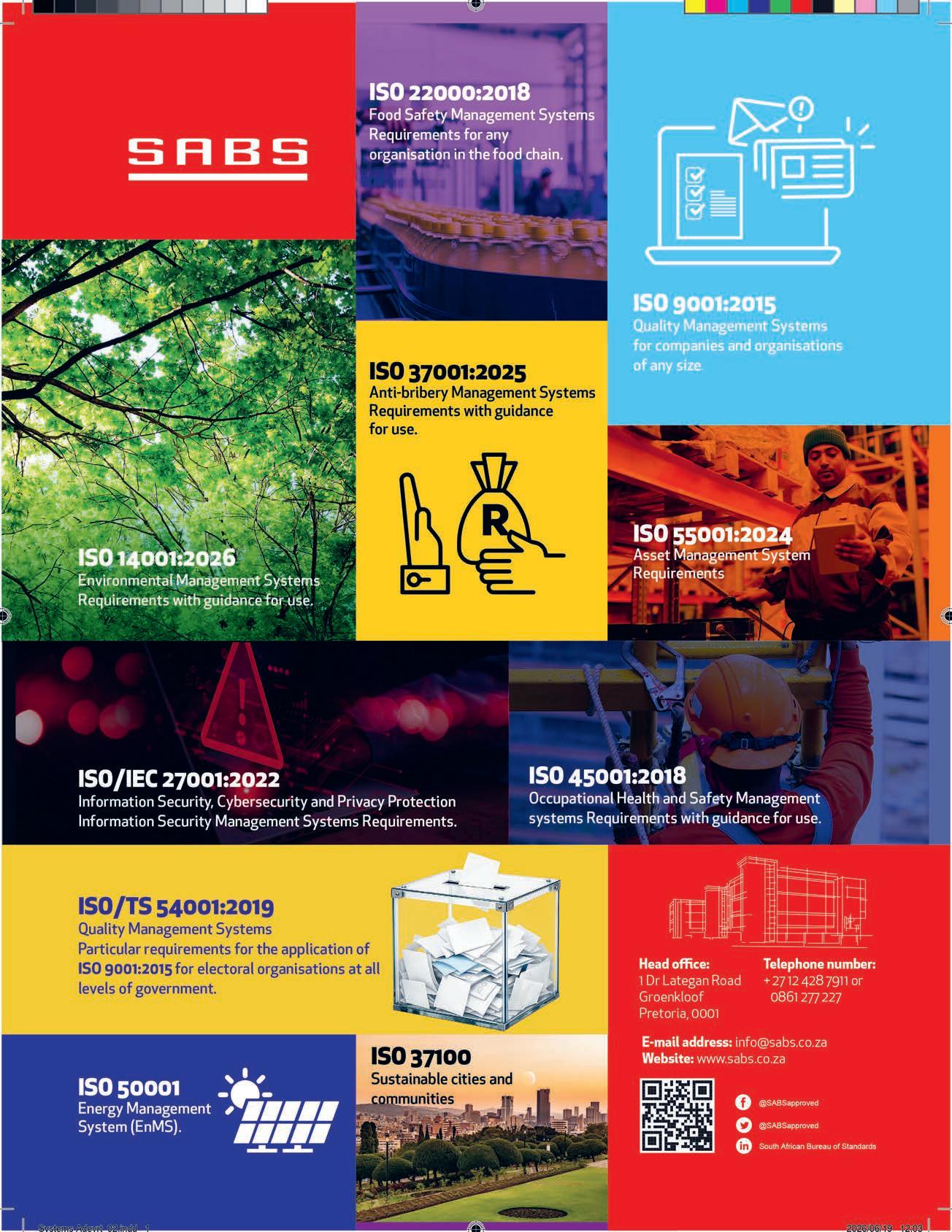
SANS/ISO 9001 Quality Management Systems provide a practical framework for achieving these goals by supporting the consistent delivery of essential services, including bulk water, infrastructure maintenance and customer service.
As municipalities grow in complexity, delivering consistent results requires systems that provide clear processes, de ned responsibilities, performance visibility and a structured approach to continuous improvement.
Behind effective service delivery are systems that enable organisations to plan, measure performance, manage risks and continuously improve.
This is the value of a South African Bureau of Standards (SABS)-aligned Quality Management System. It provides the structure that helps municipalities
move from reacting to challenges to proactively managing performance across the organisation, including administrative backlogs, poor infrastructure maintenance and citizens’ complaints.
One of the most signi cant bene ts of a SANS/ISO 9001 Quality Management System is improved service delivery. When communities receive reliable services, timely responses and consistent performance, con dence in local government is strengthened.
Clear procedures, performance monitoring and de ned responsibilities help municipalities identify service delivery gaps, improve response times and prevent recurring problems from escalating. Quality management systems also strengthen governance and accountability by improving oversight, supporting compliance and aligning organisational objectives with community priorities. This gives municipal leaders better visibility, stronger accountability and greater public con dence.
Several South African municipalities have adopted quality management principles as part of broader efforts to improve organisational performance, governance and service delivery. The City of Cape Town and the Ekurhuleni Metropolitan Municipality have both implemented ISO-aligned approaches, which have improved process control, responsiveness and service delivery outcomes.
One of the most significant benefits of a SANS/ISO 9001 Quality Management System is improved service delivery. When communities receive reliable services, timely responses and consistent performance, confidence in local government is strengthened.
These examples demonstrate that embedding quality principles in municipal operations can improve governance, performance and citizen service. Consistently delivering services that meet de ned quality, reliability and performance requirements also helps strengthen trust between municipalities and the communities they serve.
Implementing a quality management system is not merely about achieving certi cation. It is about building organisational capability and supporting long-term improvement. SABS supports municipalities through internationally recognised quality management systems, training, advisory services and certi cation programmes that embed quality into everyday operations and strengthen performance.
While SANS/ISO 9001 provides the foundation for improved service delivery, governance and operational excellence, municipalities can further strengthen their capabilities through SANS/ISO 14001 Environmental Management Systems, ISO 45001 Occupational Health and Safety Management Systems and SANS/ISO 50001 Energy Management Systems. Sustainable municipal performance is built on systems that enable organisations to consistently deliver, measure, improve and adapt. For municipalities committed to better services, stronger governance and greater public trust, SANS/ISO 9001 Quality Management Systems help turn service-delivery ambitions into measurable outcomes.