24 million tonnes: new rail freight capacity
300ppb: gold at Namibia’s Nguni Mine
SA MIN NG SEPTEMBER / OCTOBER 2026
www.samining.co.za
READ WHAT REALLY GOES DOWN IN SADC R39.90 (incl VAT) International R44.50 (excl tax)
INSIDE:
Arbitration and the confidentiality challenge
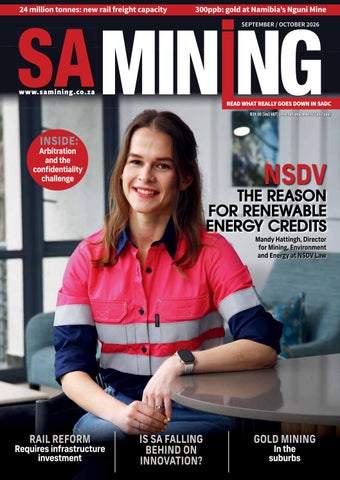
NSDV
THE REASON FOR RENEWABLE ENERGY CREDITS
Mandy Hattingh, Director for Mining, Environment and Energy at NSDV Law
RAIL REFORM
Requires infrastructure investment
IS SA FALLING BEHIND ON INNOVATION?
GOLD MINING In the suburbs
ENGINEERING CORPORATE PROFILE
TEGA INDUSTRIES CLOSES THE MINERAL PROCESSING LOOP The acquisition of Molycop by Tega Industries ensures that mines will gain access to a more coordinated approach to improving milling performance and plant efficiency.
Vishal Gautam.
T
he recent acquisition by Tega Industries of global grinding media specialist Molycop is a gamechanging development for the mineral processing sector in Sub-Saharan Africa, where plant optimisation and production efficiencies remain key priorities. With the integration of grinding media consumables and smart process control technologies, as well as measurement and analytics solutions into the Tega Industries portfolio, mines will gain access to a more coordinated approach to improving milling performance and plant efficiency. This combination of technologies and technical expertise can now be applied across the entire comminution circuit. Vishal Gautam, Tega Industries Africa CEO, says the acquisition strengthens the company’s ability to support customers, by combining its mill lining technology and expertise with grinding media solutions, holistic process monitoring technology and other services, into a single offering. “Grinding circuits are usually supported by multiple suppliers and the management of the interaction between these components can be fragmented. By combining all these services under one roof, Tega is now able to assess the complete grinding environment, rather than individual wear components – taking into account the liner design, grinding media selection and mill operating conditions together, to improve equipment availability and throughput from existing infrastructure,” he says. “Process engineers know that even relatively modest gains in mill availability can deliver worthwhile production improvements over time, without additional capital
“PROCESS ENGINEERS KNOW THAT EVEN RELATIVELY MODEST GAINS IN MILL AVAILABILITY CAN DELIVER WORTHWHILE PRODUCTION IMPROVEMENTS OVER TIME WITHOUT ADDITIONAL CAPITAL INVESTMENT.” – VISHAL GAUTAM
investment. Molycop’s process technology platform also introduces continuous monitoring and operational analytics into the grinding circuit.”
MORE EFFECTIVE MONITORING
He says sensors and instrumentation installed on-site will be able to give operators live information on variables such as charge volume, slurry conditions, throughput and milling performance. Rather than relying on historical trends or inspections, they will be able to monitor operating conditions continuously and convert the data gathered into practical recommendations that improve plant performance. Although Molycop has supplied products into Africa for many years, it has not previously maintained an operational entity within the region. This will enable Tega to maintain a local presence that will allow customers to access Molycop technologies through existing sales and service teams. The expanded workforce will increase technical capacity for closer customer interaction and more frequent plant support. The acquisition adds a further 12 production facilities to Tega’s 10 plants worldwide, and will significantly increase manufacturing capacity for even shorter lead times. “We are also looking at opportunities to introduce equipment from our other operational divisions – such as McNally – to expand the portfolio available to local mining operations. This will provide far greater access to a broader range of integrated
technologies supported through an established regional organisation.” These integrated solutions will combine equipment, consumables and operational intelligence, to assist customers to maintain world-class levels of productivity anywhere in Sub-Saharan Africa’s mining industry, he says.
KEY POINTS ABOUT THE ACQUISITION
The acquisition combines Tega’s mill lining expertise with Molycop’s grinding media and process technologies. Southern African mines gain access to broader local technical support. Live monitoring and process analytics provide greater visibility into grinding circuit performance. Integrated optimisation may improve mill availability, throughput and plant efficiency, without major capital investment. The expanded portfolio now includes equipment, consumables, speciality chemicals and digital process technologies.
SCAN TO VIEW WEBSITE
Performance for Productivity Engineered to Unlock Measurable Gains
DynaPrime Engineered for Higher Throughput. Built for Longer Life. INCREASED WEAR LIFE Longer service life REDUCED DOWNTIME Lower maintenance and change-out frequency HIGHER PRODUCTIVITY Consistent performance for better throughput SAFER MAINTENANCE Lighter components for safer handling
93
SPECIALISED PRODUCTS
CUSTOMERS WORLDWIDE
COUNTRIES SERVED
MANUFACTURING PLANTS
GLOBAL TECHNOLOGY. LOCAL EXPERTISE. REAL RESULTS. With a global footprint and deep application knowledge, Tega delivers innovative solutions and local support that help mineral processing plants perform at their best.
www.tegaindustries.com
in.linkedin.com/company /tega-industries-limited
CONTENTS SEPTEMBER / OCTOBER 2026
20
36
12
IN BRIEF 6
20
Safety, Health & Environment In high-risk industries, workplace injuries represent not only human tragedies but also considerable business risks. Mines need to shift from a reactive to a preventive approach.
36
30
Transport & Earthmoving Equipment While rail reform is an important milestone, its success will depend on whether the surrounding infrastructure is structured in a way that is investable, scalable, and commercially sustainable.
30
Drones, trains and appointments
FEATURES 8
12
16
Cover Story NSDV Law talks to the importance of renewable energy credits, which allow mines to match some or all of the electricity consumed with renewable electricity that has been generated elsewhere. Finance & Legal To manage confidentiality risks in mining disputes, parties should plan for this from the start rather than assuming arbitration will provide it automatically. Gold Privately owned mining house Upward Spiral 1471 is set to commence full-scale mining at its recently acquired Snake Road mining right in Benoni on the East Rand.
35
40
VIEW OUR 2026 CALENDAR
Shaft-sinking, Drilling & Tunnelling The importance of responsible environmental stewardship during drilling operations, and what efforts can and should be made to minimise environmental impact across all levels of a drilling operation. Projects in SADC A significant gold prospect in Namibia’s Okondeka Fault Zone is to be developed further as Ongwe Minerals conducts a major exploratory drilling campaign.
https://issuu.com/sundaytimesza/docs/2024_calendar_a2
SUBSCRIBE TO OUR NEWSLETTER businessmediamags.co.za/bmm-subscribe/
FOLLOW US www.samining.co.za www.linkedin.com/company/samining/ www.facebook.com/businessmediaMAGS/company/samining/
SCAN TO SUBSCRIBE TO THE SA MINING NEWSLETTER
Mining Innovations South Africa is falling behind on innovation, especially when it comes to domestic research and development. However, it is hoped that new mines can add momentum to its growth.
NEWS IN NUMBERS 40
24 million tonnes: new rail freight capacity 300ppb: gold at Namibia’s Nguni Mine
REGULARS 4
Out of Africa
NEXT ISSUE HIGHLIGHTS
■ Energy (including coal, oil & gas and uranium)
■ Diamonds & gems ■ Projects in Africa ■ Materials handling, logistics & beneficiation
■ Mine closures ■ Training and skills development ■ Underground mining
SA MIN NG
FROM THE EDITOR
www.samining.co.za
READ WHAT REALLY GOES DOWN IN SADC
REBUILDING, INNOVATING AND REHABILITATING
PUBLISHED BY
South Africa’s rail infrastructure is slowly rebuilding, mines are focusing on technological innovation and one small startup is driving environmental rehabilitation in the heart of Benoni.
Picasso Headline A proud division of Arena Holdings (Pty) Ltd, Hill on Empire, 16 Empire Road (cnr Hillside Road), Parktown, Johannesburg, 2193 PO Box 12500, Mill Street, Cape Town, 8010 www.businessmediamags.co.za
RODNEY WEIDEMANN
Rodney Weidemann Tel: 062 447 7803/065 057 4080 Email: rodneyw@samining.co.za
S
outh Africa’s rail network has long required a significant upgrade. Following Transnet’s signing of the Rail Access Agreements, the goal is to create an opportunity to improve network efficiency, ease pressure on the roads, and restore greater reliability to the movement of cargo across South Africa. However, this will require public-private partnerships to revitalise the fixed-asset backbone, thereby improving rail access and ensuring reliable freight movement. With the current state of its finances, Transnet cannot rebuild, modernise and future-proof the transport system alone, but at the same time, private participation cannot mean surrendering public accountability or accepting poorly designed deals. We look at how South Africa needs disciplined public-private partnerships, and how these should be built around clearly allocated risk, measurable service standards, transparent procurement and consequences for non-performance. Meanwhile, as digitisation, automation and artificial intelligence (AI) take the global mining sector by storm, South Africa appears to be falling behind, especially when it comes to domestic research and development. Therefore, we take a closer look at what is happening with local mining innovation, how the sector can improve its technological investment, and how new mines can give this momentum. When it comes to legal issues, arbitration
PROTECTION WITH THE CAPACITY TO MATCH
www.alpha.co.za
disputes that occur in the mining sector are usually because projects involve high financial stakes, long operational timelines, and complex interactions between private companies, host governments, and local communities. But in such cases, confidentiality is never absolute, which can create challenges for those undertaking such a process, as it can potentially expose years of sensitive technical, operational and commercial information through documents, witnesses and experts, if not provided for and protected adequately. Meanwhile, privately owned mining house Upward Spiral 1471’s new proposed mining operation will target an established gold-bearing reef in the heart of Benoni. The operation forms part of a broader mandate to rehabilitate historical mine dumps and tailings filtration facilities. The company places great emphasis on its surrounding communities, and the project also opens an opportunity for the company to create sustainable employment and economic opportunities for local businesses. In high-risk industries like mining, workplace injuries represent not only human tragedies but also considerable business risks. They can have a wide range of impacts including lost productivity, delayed projects, reputational damage, regulatory fines, and increased workers’ compensation costs. We consider how important it is for mining organisations to shift from merely responding to safety incidents, to making concerted efforts to proactively prevent these from occurring in the first place. We also delve into Namibia’s burgeoning gold exploration industry, focusing on Ongwe Minerals’ newly discovered Nguni prospect – a continuous 6km gold-in-soil anomaly, located 17km from its existing Manga Gold discovery. Drilling companies need to always practise responsible environmental stewardship, and in this issue we focus on the efforts that can and should be made to minimise environmental impact across all levels of a drilling operation. Finally, in our cover story, NSDV Law outlines how in order to more effectively meet environmental compliance standards, mining operations should invest in renewable energy credits. These enable mines to match some or all of the electricity consumed with renewable electricity that has been generated elsewhere, allowing them to reduce reported electricityrelated emissions.
EDITOR
ART DIRECTOR
Shailendra Bhagwandin Tel: 072 559 3808 Email: bhagwandinsh@arena.africa
ADVERTISING CONSULTANTS
Ilonka Moolman Tel: 082 346 3412 Email: moolmani@samining.co.za Tshepo Monyamane Tel: 062 239 3538 Email: tshepom@samining.co.za Willem Moolman Tel: 082 346 3413 Email: willemm@samining.co.za
PRODUCTION COORDINATOR
Neesha Klaaste Tel: 076 401 5889 Email: neeshak@sahomeowner.co.za
DIGITAL EDITOR
Stacey Visser Email: vissers@businessmediamags.co.za
SUB-EDITOR Andrea Bryce
BUSINESS MANAGER
Lodewyk van der Walt Email: lodewykv@picasso.co.za
CONTENT MANAGER
Raina Julies Email: rainaj@picasso.co.za
GENERAL MANAGER MAGAZINES Jocelyne Bayer
SWITCHBOARD Tel: 011 280 3000
SUBSCRIPTIONS
Neesha Klaaste Tel: 076 401 5889 Email: neeshak@sahomeowner.co.za
PRINTING
CTP Printers, Cape Town Copyright Arena Holdings (Pty) Ltd. No part of this publication may be reproduced, stored in a retrieval system or transmitted in any form or by any means, electronic or mechanical, without prior written permission. Arena Holdings (Pty) Ltd is not responsible for the views of its contributors.
PROTECTION WITH THE CAPACITY TO MATCH BUILT FOR LARGE-SCALE MINING OPERATIONS
E
ffective protection requires an understanding of the intricacies of mining operations and the assets that support it. As operations grow, these environments become increasingly complex. When disruption occurs, the consequences often extend beyond the damaged asset and influence broader operational performance, recovery objectives, and financial outcomes.
Mining Assets All Risks insurance cover can be aligned to the specific characteristics of the environment, supporting a broad range of mining risks while maintaining a consistent focus on production continuity and recovery. With more than 22 years supporting largescale and complex operations, Alpha offers protection up to R3.5 billion per location for open-cast mining operations and up to R575 million per location for underground mining operations.
Alpha. Protecting Futures | Mitigating Risk.
Scan to Read More
Alpha (Pty) Ltd +27 861 949 444 | info@alpha.co.za | www.alpha.co.za Alpha (Pty) Ltd (FSP No: 21820) is an authorised financial services provider.
© 123rf.com
OUT OF AFRICA
AFRICA’S FIRST FULL-STACK HYDROGEN HUB Namibia has announced the continent’s first fully integrated green hydrogen operation – the CMB.TECH facility in Walvis Bay. This brings together solar power generation, green hydrogen production, and energy storage in a single operational ecosystem. Africa’s first fully integrated green hydrogen facility demonstrates that large-scale clean energy production is not a future ambition, but a present-day reality. Operating successfully in one of the world’s most demanding environments, it showcases the viability of green hydrogen as a cornerstone of the continent’s energy transition. The hydrogen produced will initially power local industrial applications, like dualfuel trucks, generators and Namibia’s first hydrogen-powered freight locomotive. In the future, the plant will expand and integrate more with port infrastructure, transforming maritime decarbonisation by refuelling ships with ammonia from green hydrogen. This will boost Namibia’s renewable energy use and reduce dependence on fossil fuels, especially in the hard-to-decarbonise shipping sector. Beyond its role as an energy production facility, the project illustrates how green hydrogen can accelerate the decarbonisation of transport and logistics value chains. From supporting local mobility solutions to enabling future maritime refuelling infrastructure, it provides a tangible pathway towards lower-carbon industrial and shipping ecosystems. “The current 5MWp solar park occupies only a fraction of the available land. The next step is to increase capacity to 250 megawatts, then to 500, turning Namibia into a global energy hub that exports energy to Europe and the rest of the world,” says Roy Campe, chief technology officer at CMB.TECH. “Today we have 7 000 solar panels; in the future, there could be millions.”
AECI CELEBRATES 20 YEARS OF GROWTH IN THE DRC AECI Mining Explosives marked an important milestone at DRC Mining Week 2026 in Lubumbashi, celebrating 20 years of continuous presence in the Democratic Republic of the Congo (DRC). Since entering the market two decades ago, AECI Mining Explosives has expanded its presence across the country. Today the company provides blast design, initiation systems, explosives supply, blasting equipment, delivery system technologies and on-site support to a number of major mining operations. One of the defining features of AECI’s presence in the DRC has been the continuous adaptation of technology to local conditions. The company currently operates what is believed to be the largest fleet of mobile charging units in the region, while its vertical drop emulsion system has become an established technology at customer sites. It has also evolved its up-hole charging capability, delivering a level of performance that remains unmatched in the region. As a pioneer of the civil explosives sector in the DRC, AECI introduced several industry firsts, including cold bulk emulsion, blended emulsion, Heavy ANFO and electronic detonators in the early 2000s. Looking ahead, AECI Mining Explosives plans to continue expanding its footprint in the DRC while investing in local talent and technologies suited to the country’s evolving mining sector.
4 SA MINING
SEPTEMBER-OCTOBER 2026
© 123rf.com
NIGERIAN EXPORT DEAL HIGHLIGHTS DEMAND FOR WERNER PUMPS Werner Pumps has completed its first pressure testing unit sale into Nigeria, marking an important milestone in the company’s growing export activity. The unit, supplied to a customer operating in Nigeria’s oil and gas sector, West Mark, is designed to hydro-test pipes and tube systems by pumping water through them to detect leaks or pressure losses. In industries where pipeline integrity is critical, pressure testing plays an important role in both operational safety and quality assurance. The process itself is relatively straightforward. Water is pumped into a sealed pipe system until the required pressure level is reached. Once sealed, the system is monitored via a pressure gauge. If the pressure drops, it indicates a leak, crack or weakness somewhere in the pipeline. “We’ve definitely started to see more interest from the rest of the continent in our equipment,” says Werner Pumps MD Sebastian Werner. “We’ve sent units to several other countries and we look forward to continuing to grow our exports and to making the market aware of our full range of offerings.”
SCAN TO VIEW THE SA MINING WEBSITE www.samining.co.za
OPTIMAL
PERFORMANCE UNDER PRESSURE.
GUARANTEED. Global businesses rely heavily on Invincible Valves for exceptional products, proven expertise, and as Africa’s largest stockist of Saunders & Insamcor valves, our reputation for reliability and excellence has earned us recognition on the world stage, making Invincible Valves the trusted partner across industries. Driven by technology and innovation, we continue to expand into emerging markets, delivering smarter solutions and building lasting partnerships. There is only one trusted name in valves – INVINCIBLE VALVES.
GENERAL INDUSTRY | MINING | PETRO-CHEMICAL | POWER GENERATION | WATER | SEWERAGE
+27 11 822 1777 | enquiries@invalve.co.za | invalve.co.za
If it’s not INVAL®, it’s not Invincible
© 123rf.com
IN BRIEF
DRONES OFFER SUPERIOR GEOSPATIAL INTELLIGENCE FOR JUNIOR MINERS
It is believed that around 70% of the mining majors use unmanned aerial vehicles (UAVs) for security, exploration, surveying and mapping purposes, though UAV uptake by juniors remains relatively low. This despite the early-stage mining activities that are the main focus of juniors being where drones really shine with their cost savings and safety enhancements. According to Phil Smerkovitz, MD of enterprise-class UAV consultants, GoUAV, drone-based geospatial mining solutions help mining teams use better site data to improve productivity, manage operating costs and strengthen safety. “Their real value, however, lies in precision site intelligence that integrates space, air and ground to provide a clearer, layered understanding of an area. Satellite remote sensing, UAV thermal imaging, LiDAR point clouds, digital elevation models, aeromagnetic information and ground validation are all combined to improve site visibility,” he says. Drone-based workflows that include aerial surveying and mapping, thermal imaging and LiDAR can safely capture detailed site information at lower altitudes and at a higher spatial resolution. What’s more, the entire lifecycle of a site can be supported, from early exploration and construction planning to drill and blast, load and transport, operational management, safety monitoring and eventual reclamation. “Drones have spent the past five years proving their worth in perimeter monitoring, incident response, illegal mining detection and safety oversight. In 2026 and beyond, drones will increasingly support the full mining lifecycle with measurable geospatial data that enable mining teams to improve visibility, reduce risk and verify progress based on data rather than assumptions,” he says.
TRAXTION WELCOMES FIRST SHIPMENT OF LOCOMOTIVES FOR SA SERVICE The first eight Wabtec C28 locomotives have arrived at the Port of Durban from New Zealand, marking the first shipment under Traxtion’s R1.8-billion rolling stock investment programme and an important milestone in expanding freight rail capacity across Southern Africa. The arrival marks the first of four planned shipments that will see 46 locomotives introduced over the next two years. The programme includes the planned acquisition of 920 wagons for a further R1.6bn, marking a total planned investment of R3.4bn. “The future of freight depends on collaboration between government and the private sector, backed by the kind of long-term investment needed to build capacity and unlock economic opportunity,” says Traxtion CEO James Holley. “Every investment of this nature creates a multiplier effect that extends beyond rail, supporting jobs, strengthening supply chains and enabling economic growth.” Government has identified greater private sector participation as a critical component of revitalising the country’s rail network, so the arrival of the first shipment comes at a pivotal time. “While policy reform provides the framework for greater private sector participation, infrastructure investment is what enables that vision to become an operational reality,” notes Holley.
6 SA MINING
SEPTEMBER-OCTOBER 2026
© 123rf.c om
SCAN TO SUBSCRIBE TO THE SA MINING NEWSLETTER
AECI APPOINTS ALAN DICKSON AS GROUP CEO AECI Limited has announced the appointment of Alan Dickson as group CEO and an executive director, following the conclusion of a formal selection process led by the board and its Nominations, Governance and Directors Affairs Committee, supported by a leading executive search firm. Dickson is a highly accomplished leader with more than 20 years of executive experience across diversified industrial, technology, manufacturing and infrastructure-driven sectors. He spent 29 years with the Reunert Limited group, including service as group CEO, where he led a large and complex organisation with diverse operations. His track record includes disciplined capital allocation, strategic growth, operational excellence and long-term value creation in listed industrial environments. The company notes that his experience aligns well with AECI’s strategic priorities of strengthening performance, maintaining an uncompromising focus on safety, leadership and delivering sustainable growth.
www.samining.co.za
More control. Less clean-up. Meet the MC51 Continuous Miner. rock mining. With full remote control and DynaCut technology, it delivers 100% clean-up and uses up to 50% less equipment. komatsu.com/mc51
12 Commercial Road, Wadeville, Germiston | Tel. +27 11 872 4000 © 2025 Komatsu Ltd. or one of its subsidiaries. All rights reserved.
MEETING ENVIRONMENTAL COMPLIANCE STANDARDS THROUGH RECs Renewable energy credits allow mines to match some or all of the electricity consumed with renewable electricity that has been generated elsewhere, enabling them to reduce reported electricity-related emissions. BY RODNEY WEIDEMANN
E
nvironmental compliance standards are critical in mining operations as these are in place to prevent irreversible ecological damage and help maintain community trust. A key way to remain compliant to these standards is for mines to invest in renewable energy and green credits. Renewable energy credits (RECs) offer multiple benefits to mines, helping them to lower greenhouse gas emissions, cut energy costs, and avoid upcoming carbon taxes. They also assist in reducing operating costs and securing reliable power for these operations, while helping them meet national environmental compliance standards. According to Mandy Hattingh, mining, environment and energy director at NSDV Law, it is worth highlighting that RECs are not the same thing as carbon credits, and the distinction is particularly important for mines. A carbon credit generally represents one tonne of greenhouse gas (GHG) emissions that has been avoided, reduced or removed. An REC, by contrast, represents the renewable energy attributes associated with a specific amount of electricity generated from a renewable source, usually one megawatt-hour.
“RECs matter for mines because electricity is a major input into mining operations. In South Africa specifically, the grid remains heavily reliant on fossil fuels, consequently, electricity can also represent a significant part of a mine’s GHG footprint. Electricity-related emissions are also not always easy for a mine to reduce,” she says. “It is useful to distinguish between the different categories of emissions. Scope 1 emissions are those generated directly by the mine – for example from diesel used in mining vehicles and equipment. “Scope 2 emissions are associated with the electricity the mine purchases and consumes. Scope 3 emissions arise elsewhere in its value chain, including certain emissions associated with suppliers, transport and customers.”
GHG EMISSION REPORTING
RECs are principally relevant to Scope 2 emissions, says Hattingh. Where a mine purchases and retires qualifying RECs, it can use them in calculating and reporting its market-based Scope 2 emissions. “Put simply, RECs allow a mine to match some or all of the electricity it consumes with renewable electricity that has been generated elsewhere. This can be particularly valuable for a mine that remains dependent on grid
“PUT SIMPLY, RECs ALLOW A MINE TO MATCH SOME OR ALL OF THE ELECTRICITY IT CONSUMES WITH RENEWABLE ELECTRICITY THAT HAS BEEN GENERATED ELSEWHERE.” – MANDY HATTINGH
8 SA MINING
SEPTEMBER-OCTOBER 2026
www.samining.co.za
electricity but wants to reduce its reported electricity-related emissions.” She points out that the importance of RECs lies in the fact that the regulatory environment around carbon emissions is changing rapidly. Governments are increasingly requiring companies to measure and disclose their GHG emissions, while carbon pricing and carbon-related trade measures are making the emissions associated with producing goods increasingly relevant. “For mines, RECs can form part of the response to that changing regulatory environment because they provide a recognised and traceable way of demonstrating the renewable attributes of electricity used for Scope 2 reporting.” The important point for mines is therefore that carbon regulation is moving beyond regulating emissions at the mine itself, she says. “RECs can help mines prepare for that environment by providing credible evidence of renewable electricity procurement and supporting the reduction of their reported market-based Scope 2 emissions.” Investors increasingly care about emissions, says Hattingh, because emissions translate into financial risk. Investors want to understand what a mine is actually doing to reduce its emissions, how that progress is being measured and, importantly, what exposure the mine may have to future carbon costs and regulation.
PRACTICAL AND MEASURABLE
“RECs give mines a practical, measurable way to show progress on one of the most significant parts of their footprint, rather than simply making a broad environmental, social, and governance commitment.
© 123rf.com
FINANCE & LEGAL COVER STORY
A lawyer, a quantity surveyor, and a project manager walk into a bar… One’s opening an RFQ. One’s commissioning a processing plant. One’s toasting a closure.
Meet your dedicated end to end Construction Contract Management team.
Whichever phase you’re in, we’re already at the bar…awaiting your order. www.nsdvlaw.com
© 123rf.com
FINANCE & LEGAL COVER STORY
“RECs SHOULD BE VIEWED AS ONE TOOL WITHIN A WIDER ENERGY STRATEGY RATHER THAN AS A SUBSTITUTE FOR REDUCING EMISSIONS WHEREVER THAT IS PRACTICALLY POSSIBLE.” – MANDY HATTINGH
“There is also a broader financial consideration. A mine with a high carbon footprint may face increasing exposure to carbon-related regulation, changing customer requirements and potentially higher costs of accessing certain markets or sources of finance.” Investors therefore increasingly view a credible decarbonisation strategy not simply as an environmental issue, but as part of assessing the long-term sustainability of the mine, she says. There is also an important supply-chain dimension. One company’s emissions can form part of another company’s Scope 3 emissions. The emissions associated with producing a mineral can therefore become relevant to the steelmaker, battery manufacturer, automotive company or other downstream customer purchasing that mineral. Those businesses are themselves under increasing pressure from investors and regulators to reduce the carbon footprint of their supply chains. “A mine that can demonstrate a credible lower-carbon production profile may therefore be better positioned not only with its own investors, but also with the customers and investors further down the value chain.” One of the biggest advantages of RECs for mines is flexibility, she adds. Unlike a mine with a long remaining life that may be able to justify investing in its own renewable generation or entering into power purchase agreements – which typically include long terms, short-life mines do not have the same ability.
“RECs provide a way for those operations to access the benefits associated with renewable electricity, without making the same long-term capital commitment. RECs also enable long-life mines to benefit from Scope 2 emission reductions, while developing their own renewable generation or negotiating power purchase agreements.”
CARBON AS PART OF THE COMMODITY
“RECs are also flexible in scale. A mine can purchase RECs to match all or only a portion of its electricity consumption and can adjust that amount as production and electricity demand change. “This can be useful in mining, where energy requirements can change significantly over the life of an operation.” Finally, from a market perspective, mining companies do not operate in isolation. The minerals they produce are used in products manufactured further down the supply chain, and customers are increasingly interested in the carbon footprint associated with those minerals. This means that mines that use RECs may be more attractive to carbon-conscious customers, both from a financial and a reputational perspective. “Traditionally, the competitiveness of a mineral was determined by factors such as grade, price, location and security of supply. Increasingly, the emissions associated with producing that mineral are also becoming relevant – essentially, carbon is becoming a characteristic of the commodity itself,” she says. “This is particularly important as the world moves towards technologies that are
10 SA MINING SEPTEMBER-OCTOBER 2026
www.samining.co.za
FAST FACT
The key drivers behind the uptake in RECs include: carbon regulation; investor and lender expectations; customer requirements; and the changing economics of doing business in a carbon-constrained world.
SCAN TO VIEW WEBSITE themselves intended to support the energy transition. There is an obvious tension if the copper, lithium, manganese and other minerals needed for renewable energy, battery storage and electrification are themselves produced using highly carbonintensive energy.” Over time, we are likely to see greater differentiation between the carbon intensity of the same commodity produced by different mines. A tonne of copper produced using predominantly renewable electricity does not have the same emissions profile as a tonne produced using carbon-intensive electricity. As customers become more focused on the emissions embedded in their own supply chains, that difference could become increasingly commercially significant. “For South African mines, this makes the transition to cleaner electricity particularly important. RECs should be viewed as one tool within a wider energy strategy rather than as a substitute for reducing emissions wherever that is practically possible,” she says. Ultimately, the opportunity for the mining sector is not simply to produce the minerals required for the global energy transition, but to find increasingly lower-carbon ways of doing so, says Hattingh. “Mines that start thinking about this now may be better positioned as customers, investors and international markets place increasing value on the carbon footprint of the commodities they buy,” says Hattingh.
FINANCE CORPORATE PROFILE
PROTECTING BUSINESS CONTINUITY IN MINING A mining operation is a complex and interconnected ecosystem, and a failure in one area can rapidly affect another, turning an isolated incident into significant operational and financial disruption.
A
lpha is Africa’s largest independently owned cell captive underwriting management agency and a specialist insurance and risk management partner to the mining industry. With more than 22 years supporting complex risk environments, over 500 employees across the Alpha Group, an A- financial strength rating and mining capacity of up to R3.5-billion per risk location, Alpha has the scale, financial resilience and technical capability required to support complex mining operations. Today, Alpha has more than R8.27-trillion in assets under protection and has paid over R6.75bn in claims, demonstrating both the scale of the responsibility entrusted to the business, and its experience supporting clients when significant losses occur. A mining operation is a complex and interconnected ecosystem in which people, critical plant and machinery, infrastructure, power, processing, materials handling and production depend on one another. A failure in one area can rapidly affect another, turning an isolated incident into significant operational and financial disruption. Alpha’s approach therefore begins with understanding the operation behind the insurance programme. Dedicated underwriting, claims, technical and risk management teams focus on critical assets, operational dependencies, business interruption exposures, vulnerabilities and potential failure points across the operation. The value of insurance begins long before a claim occurs. Alpha has more than 50 dedicated risk management professionals across the surveying, fire engineering, quantity surveying, loss adjusting, claims and technical disciplines.
Alpha Insure headquarters, Bedfordview, South Africa.
Specialist surveyors and Alpha’s proactive risk management approach help clients understand their exposures, make more informed risk decisions and reduce the likelihood and potential impact of disruption.
PROACTIVE APPROACH
As part of this proactive approach, Alpha develops disaster recovery plans for clients at no additional cost, helping mining operations prepare for major disruption and establish a clear recovery framework in advance. Risk transfer and active risk mitigation therefore work together to protect production and strengthen business continuity. When a loss does occur, Alpha’s involvement extends beyond assessing the financial claim to supporting the decisions required to restore operations, minimise interruption and accelerate recovery. In mining, where downtime can affect revenue, operational performance, employees, contractors, supply chains and surrounding communities, the speed and quality of recovery can be as important as the financial settlement itself. Equipment can be repaired and infrastructure rebuilt, but production lost during downtime cannot be recovered. The true measure of recovery is therefore not simply the reinstatement of damaged assets, but the restoration of the operational capability required to return production to expected levels. Alpha’s philosophy is clear: “Insurance is our profession. People are our purpose.” Behind every mining operation are employees, families, suppliers, customers and communities that depend on its ability to continue.
www.samining.co.za
Protection therefore extends beyond physical assets to the organisation’s ability to maintain production, fulfil its responsibilities and sustain the livelihoods and economic activity it supports. For Alpha, that is what protecting business continuity means. FAST FACT
The true measure of recovery is not simply the reinstatement of damaged assets, but the restoration of the operational capability required to return production to expected levels.
Antonio Iozzo, Founder and CEO.
SEPTEMBER-OCTOBER 2026
SA MINING 11
FINANCE & LEGAL
PLANNING FOR CONFIDENTIALITY DURING ARBITRATION Arbitration can offer privacy, but parties should plan for confidentiality from the outset to prevent it from entering the public domain. BY RODNEY WEIDEMANN
A
rbitration disputes occur in the mining sector because projects involve high financial stakes, long operational timelines, and complex interactions between private companies, host governments and local communities. But privacy is not automatic, and public disclosure of sensitive operational data can severely harm commercial interests and market valuation. Mines must therefore actively plan for confidentiality during arbitration disputes. Samantha Reyneke, director and attorney in the construction and dispute resolution team at NSDV Law, explains that arbitration is attractive because disputes are generally resolved away from an open courtroom. But that does not mean everything disclosed in an arbitration is automatically protected in every circumstance. “This is important in the context of the mining sector, because arbitrations can potentially expose years of sensitive technical, operational and commercial information through documents, witnesses and experts if not provided for and protected adequately,” she says. When it comes to the kind of confidential and commercially sensitive information that might be impacted in such an arbitration process, Reyneke notes that this could potentially be almost every layer of the mining operation. “This could include technical information such as geological and resource data,
mine plans, production figures, recovery rates, processing methods and proprietary technology. It could also encompass commercial information such as pricing, margins, contractor rates, financing arrangements, offtake agreements and future strategy,” she says. “Then, of course, there are emails, WhatsApp messages, board meeting minutes and internal reports, which is often where the real story of the dispute lives. Anyone who has done a sizeable mining arbitration knows that the email dashed off at 11pm, at night three years ago, has an uncanny ability to see the light of day at the most inopportune moments, and generally the moment a dispute arises.”
ARBITRATION INVOLVING PUBLIC BODIES
Mark Thomas, legal director at Pinsent Masons, suggests that confidentiality is not absolute. For companies, investors, and funders alike, this raises concerns from commercial, regulatory and reputational risk perspectives. “South Africa’s International Arbitration Act of 2017 states that where a public body is a party to the arbitration, the proceedings are open to the public, unless the arbitral tribunal orders otherwise. “This creates a fundamental challenge in mining disputes involving public bodies, since mining arbitrations typically involve the disclosure of confidential and commercially
“IN CROSSBORDER MINING DISPUTES, ONCE ARBITRAL DOCUMENTS ARE REFERRED TO IN COURT PROCEEDINGS, THE RISK OF DISCLOSURE ESCALATES SIGNIFICANTLY.” – MARK THOMAS 12 SA MINING SEPTEMBER-OCTOBER 2026
www.samining.co.za
sensitive information, including geological data, pricing assumptions, forecasts, funding, and investment in projects,” he says. “Owners, contractors and investors view this sort of information as proprietary and confidential. If disclosed, such information may affect trading conditions, prices, offtake, investor appetite, funding rates, and even share prices.” He says both South African and English law recognises that arbitration is private, but that veil of confidentiality yields where disclosure is ordered by a court or where it is deemed necessary for the protection of legitimate rights and interests or by law. “In crossborder mining disputes, once arbitral documents are referred to in court proceedings, the risk of disclosure escalates significantly. This is because when documents are referred to and relied upon in pleadings or submitted to court, they may enter the public domain despite any existing confidentiality agreement between the parties.” Reyneke notes that under the International Arbitration Act, an international commercial arbitration involving a public body is held in public unless the arbitral tribunal directs otherwise for compelling reasons. “There is good reason for transparency where public money and public decisionmaking are involved. However, this does not mean that the private mining company’s technical and commercial information suddenly becomes less sensitive.”
CONFIDENTIALITY PROTECTION LIMITS “Therefore early identification of sensitive information is vital. If protection of information or documents is needed, an explanation needs to be provided as to what is sensitive, why it is sensitive and what harm disclosure of the information or
“ARBITRATIONS CAN POTENTIALLY EXPOSE YEARS OF SENSITIVE TECHNICAL, OPERATIONAL AND COMMERCIAL INFORMATION THROUGH DOCUMENTS, WITNESSES AND EXPERTS IF NOT PROVIDED FOR AND PROTECTED ADEQUATELY.” – SAMANTHA REYNEKE
documents could cause. That is far more persuasive than simply stamping everything as ‘Confidential’.” According to Christopher Majuru, senior associate at Pinsent Masons, a court, by its very nature, is a public forum and the public can access documents filed at the court, unless it imposes a confidentiality regime that restricts access. “There is also the risk of a subpoena of arbitration documents in subsequent or parallel court proceedings, as the courts retain discretion to compel disclosure of documents where necessary,” he says. “A recent judgement delivered by the Gauteng High Court in Johannesburg provides a useful illustration of these risks. In that matter, the court was asked to determine the scope and enforceability of a confidentiality agreement concluded in connection with a proposed crossborder mining investment, while related proceedings were ongoing in Tanzania.” Declaratory relief was sought by a related group company in South Africa, he continues, stating that although it was not a party to the original confidentiality agreement, it was cited as a defendant in the main proceedings in Tanzania. “The court confirmed that confidentiality obligations are strictly contractual and bind only those entities that are party to the agreement. It said the related group company was not bound by the confidentiality terms, because it had not signed the original confidentiality agreement.” This judgment is important for two reasons, says Majuru. “First, it confirms that confidentiality protections do not automatically extend across corporate groups, affiliates or
investment structures unless expressly provided for in an agreement. Secondly, it shows that confidentiality disputes themselves may be litigated in open court, potentially exposing confidential arrangements.”
CONFIDENTIALITY STRATEGY
Asked how to ensure that confidentiality during arbitration is respected, regardless of the surrounding circumstances, Reyneke says you should start before the dispute. “Mining companies spend enormous time negotiating price, performance, liability, and risk allocation, and then often reach the dispute resolution clause thinking, ‘Hopefully we never need this.’ Unfortunately, sometimes you do.” It is therefore important to understand from the outset which arbitration regime and rules apply, particularly on cross-border projects, he says. “Then identify sensitive information early, agree [on] appropriate confidentiality protocols, control who has access to it and consider redactions of sensitive information where necessary and appropriate.” Furthermore, one must be cognisant that confidentiality is not just the legal team’s problem. Executives, mine personnel, engineers, geologists, experts and consultants may all handle sensitive information during an arbitration. “Ultimately, ‘We are going to arbitration, so it is confidential’ is not a confidentiality strategy. Knowing what needs protecting, and protecting it before it starts travelling, goes a long way down the road,” she says. Thomas agrees that in order to manage confidentiality risks in mining disputes, parties should plan for confidentiality from the start, rather than assuming arbitration will provide it automatically.
www.samining.co.za
NSDV’s Samantha Reyneke points out that when it comes to confidentiality, it does not need to be a case of all or nothing. “An agreed confidentiality regime can restrict particularly sensitive information to the arbitral tribunal, the legal team, selected company representatives and experts. Redaction can protect the sensitive part of a document without withholding the whole thing,” she says. “Secure data rooms, restricted access to documents or pleadings and specific protocols for sensitive information or documents can all assist too. The key is to be targeted, rather than trigger-happy. “Forty thousand documents stamped ‘Highly Confidential’ is not an effective protection strategy. Rather work out what actually matters and put the necessary measures in place to protect it properly.” Pinsent Masons’s Mark Thomas says South African courts recognise a range of protective confidentiality regimes short of outright nondisclosure. One of the most widely used mechanisms is a restricted-access “confidentiality ring” regime. This allows for access to sensitive material to be limited to only identified independent experts and external legal representatives on a need-to-know basis, with the parties themselves excluded. “Secondly, there is a partial disclosure and redaction regime, which allows only those contractual provisions strictly necessary for the fair adjudication of the dispute to be produced. Another option involves personal confidentiality undertakings, where all recipients give binding undertakings not to disseminate or misuse the information.” The last regime, he says, relates to dual pleadings and “in camera” adjudication, whereby confidential versions of pleadings or evidence are circulated within a closed confidential group, disputes over redactions are resolved in chambers, and a nonconfidential record is maintained for broader public and procedural use.
SCAN TO VIEW THE SA MINING WEBSITE “Extra care is needed when exchanging sensitive technical or commercial information. Parties should also be aware that going to court, even to protect their rights, can result in confidential arrangements becoming public.” The lesson is straightforward, he says: “Confidentiality must be deliberately built into agreements and actively managed throughout a dispute life cycle.”
SEPTEMBER-OCTOBER 2026
SA MINING 13
© 123rf.com
IT’S NOT ALL OR NOTHING
WHY MINING CONTROL ROOMS MUST EVOLVE Forward-looking mining companies are increasingly recognising the fact that control room design is no longer simply a facilities decision – it is now an operational strategy.
The views expressed are the author’s own and do not necessarily reflect SA Mining’s editorial policy.
M
BY MATERNIQUE DUBE, SALES SPECIALIST, AUPI DIVISION, ABB IN SOUTH AFRICA
ining companies across Southern Africa are investing heavily in automation, digitalisation, advanced analytics, and remote operations centres. Behind this technological progress lies a growing contradiction: many modern mines are still operating critical control rooms with environments designed for conventional office work, rather than high-pressure, 24-hour industrial operations. This is no longer simply an infrastructure oversight. It is becoming a measurable operational, safety, and workforce risk. Prolonged static sitting is linked to cardiovascular disease, musculoskeletal disorders, reduced circulation, fatigue, and declining cognitive performance. Extended sitting can significantly impair concentration and alertness in screen-intensive environments. In mining control rooms, where operators are required to remain focused for 10- to 12-hour shifts while monitoring safety-critical systems, these effects carry consequences far beyond ordinary workplace discomfort. Despite the sophistication of the technology being monitored in these rooms, many operators continue working from static desks, poorly aligned screens, and ergonomically compromised workstations. These all quietly contribute to fatigue, slower reaction times and reduced mental sharpness over long shifts. Fatigue rarely presents itself dramatically in mining operations. In fact, it develops gradually through sustained physical discomfort, poor posture, eye strain and cognitive overload. Over time, this erodes situational awareness and decision-making performance, precisely the capabilities mining operations depend on during abnormal conditions. An often-overlooked contributor to operator fatigue is lighting. In many control rooms, static overhead lighting fails to account for longduration screen exposure, contributing to eye strain, reduced focus and cognitive fatigue. Modern control room environments increasingly incorporate adaptive lighting systems that adjust brightness, colour temperature and contrast, based on operational conditions and time of day. Proper lighting not only improves visibility, but plays a critical role in sustaining attention, reducing eye fatigue and supporting circadian rhythms during long shifts.
NEW OPERATIONAL STRATEGY
The mining industry has historically attributed many incidents to “human error”. However, global research increasingly suggests that environmental design plays a significant role in operator performance. Properly designed work environments can measurably improve concentration, reduce fatigue-related errors, and enhance operational responsiveness in industrial settings. The challenge extends beyond operations and safety. It is also becoming a workforce issue. Mining companies across the region are
14 SA MINING SEPTEMBER-OCTOBER 2026
competing for increasingly scarce technical skills, particularly among younger engineers, automation specialists and digitally skilled operators. Workplace quality increasingly influences talent attraction and retention. Younger technical professionals are placing greater importance on wellbeing, workplace experience, and modern working environments when evaluating employers. In mining, the design of operational spaces now plays a strategic role in workforce competitiveness. Forward-looking mining companies are beginning to recognise that control room design is no longer a facilities decision. It is an operational strategy. Another critical dimension of control room performance is communication. As mining operations become increasingly centralised, operators are required to interact not only with systems, but with distributed teams, field personnel and remote experts. Modern operator environments therefore integrate advanced audio-visual technologies, including high-quality cameras, strategically positioned displays and intelligent audio systems. These enable clear, real-time collaboration while maintaining situational awareness within the control room. The inclusion of visual communication restores the “human layer” to digital operations, improving engagement, decision-making clarity and response coordination during critical events. Well-designed audio systems further support alerting mechanisms, sound prompts, and communication clarity.
HUMAN-CENTRED DESIGN
What is needed is a comprehensive approach to human-centred control room design, combining ergonomics, environmental optimisation, and integrated communication technologies. For example, ABB’s Extended Operator Workplace solution is designed specifically for 24/7 industrial environments. Beyond enabling seamless movement between seated and standing positions through motorised adjustment, it is about supporting correct posture, optimal screen positioning, and reduced physical strain over extended shifts. This improves circulation, reduces musculoskeletal fatigue, and helps sustain cognitive alertness. Air quality is another essential but frequently underestimated factor in operator performance. Control room environments with poor ventilation or inadequate air filtration can contribute to drowsiness, headaches, reduced concentration and long-term health impacts. Integrated air quality solutions, including advanced air purification systems, help maintain optimal oxygen levels, reduce airborne contaminants, and create a healthier, more alert working environment. Ultimately, control room ergonomics can no longer be seen as a luxury consideration. They are emerging as a critical component of operational resilience, workforce sustainability, and modern mining safety strategy.
www.samining.co.za
© 123rf.com
THOUGHT LEADERSHIP SAFETY, HEALTH & ENVIRONMENT EQUIPMENT CORPORATE PROFILE
Relentless Dewatering for Your Toughest Jobs. Primed for Performance, Built for Resilience When your operations face critical dewatering challenges, you need equipment that won’t quit. Godwin provides reliable dewatering solutions for construction, mining, and municipal projects. Whether you are tackling open-pit drainage or sewage bypasses, our pumps deliver uncompromising performance. Engineered for total reliability, Godwin pumps feature our exclusive Dri-Prime® technology with Venturi air evacuation for fully automatic self-priming up to an 8.5-meter lift. A specialized oil-bath mechanical seal isolates the system from pumpage, ensuring indefinite dry-running capabilities without manual intervention.
Advanced Technology for Every Application From the high-volume CD Series to the high-head HL Series, Godwin has the exact configuration for your site. Equipped with cast chromium steel impellers that resist wear and shattering, our durable systems confidently handle everything from clean water to abrasive sludge.
Don’t let water challenges slow you down. Contact our experts today to secure your solution.
xylem.com
GOLD
MINE REHABILITATION OFFERS A GOLDEN OPPORTUNITY Upward Spiral 1471’s efforts to rehabilitate historical mine dumps and TSFs are creating an opportunity to boost both employment in the surrounding communities and their bottom line. BY RODNEY WEIDEMANN
P
rivately owned mining house Upward Spiral 1471’s new proposed mining operation will target an established gold-bearing reef that laterally extends from the Snake Road area to Upward Spiral’s Van Ryn surface mining operation in Benoni. According to MD Jackie Pahad, this mining operation represents a controlled, compliant and sustainable mining development that balances production with safety, environmental responsibility and meaningful community participation. “The operation forms part of a broader mandate to rehabilitate historical mine dumps and tailings storage facilities (TSFs). Equally vital is the opportunity it offers to create sustainable employment and economic opportunities for local businesses,” she says. “Such rehabilitation is crucial, as we are surrounded by residential areas. As these dumps have been in existence for decades, rehabilitation is essential in order to restore the site to a cleaner environment and
improve the surroundings and quality of life for the local communities.” Historically, the site had been used primarily for aggregate mining, with only limited gold extraction through surfacelevel reef picking. However, the current gold price environment has enabled Upward Spiral 1471 to pursue a selective, lowerimpact mining approach. Pahad explains that the Snake Road project is a near-surface, conventional gold mining operation with a welldefined development plan and an inferred mineral resource estimated at approximately 128 603 ounces of gold. It is designed to scale production in response to economic and financial conditions, with peak output expected to increase from 579 troy ounces to up to 1 158 ounces of gold per month, under favourable market conditions. Thabang Masuku, the company’s metallurgical manager, notes that the flexibility of this operation is one of its key strengths.
16 SA MINING SEPTEMBER-OCTOBER 2026
www.samining.co.za
MAXIMISING VALUE
“At the planned production rate, the mine is economically sound, and should conditions justify it, we can increase throughput by making provision for future expansion, allowing for increased processing capacity while maximising value during favourable gold-price cycles,” he adds. “The defined resource base supports an initial 10-year life-of-mine, with potential for increased scale and accelerated production. Moreover, the Snake Road plant will operate on continuous shift cycles, creating stable long-term employment, with the majority of employees being recruited from surrounding communities, including through graduate development and skillstraining programmes.” Pahad describes how Upward Spiral 1471 took over the project in 2024, while the necessary reconstruction and additional building required occurred in late 2025. “We will be ready to commence operations later this year, which will entail reprocessing the material preconcentrated and subjected to gold extraction and further reprocessed at larger facility with the bulk of the lower grade material,” she says. Masuku says once the soil has been processed, Upward Spiral uses a unique process called belt filter. “This process means that instead of having slurry at the end – which would require the creation of a new TSF – the waste material comes out as a solid cake. “In turn, this makes it safe and environmentally friendly enough that it can be disposed of at a landfill, although it can also be beneficiated for use in the cement or tiling industries. Essentially, this gives us access to a second revenue stream, beyond the gold we process.”
Upward Spiral 1471 is strongly focused on job creation, with the business currently employing around 200 permanent employees in sustainable and permanent jobs, according to MD Jackie Pahad. “We are also very focused on the youth and developing graduates, specifically from our surrounding communities. We run both graduate and training programmes, as well as learnerships with various institutions. We also offer bursaries for the youth, and are proud to state we have issued around 20 of these during this past year. “Our directors are very handson and are active participants in the business, and we remain very passionate about our people. For example, we also offer an adult basic education programme for artisans and other employees, which has witnessed significant success – we have one employee at our processing facility who originally worked as kitchen staff, and through this type of upskilling, has now become an assistant in our metallurgy lab.”
IMPROVING SURROUNDING COMMUNITIES
Pahad indicates that in terms of the environmental aspects, while regulations have become stricter, the company is proud to be able to claim active compliance in ensuring it meets all relevant regulations governing this. “We have in-house employees, as well as specialist outsourced consultants, to ensure continuous improved regulated compliance,” she says. “We also believe in giving back to our communities. With one of our nearby sites that was completely rehabilitated, we chose to acquire the land and have since developed this former mining site into the Mzansi Speedway.” She points out that by removing the gold source from this area, it had already improved things by eradicating the illegal mining operations. “However, we saw
an additional opportunity to improve the surrounds and the city as a whole. So we developed the racetrack to provide a sporting facility for our local youth to enjoy, and to create a new landmark for the region.” Now that the raceway is operational, she says, “we have also opened it up to the local communities to enable them to participate economically in the operation – by selling food, replica racing wear, and various other products during race days”. Asked about the company’s future, Pahad suggests that Upward Spiral 1471 remains ambitious and strives to be recognised as an industry leader in its specific mining niche. “Moreover, as a fully black-owned, managed and privately funded operation, we remain committed to our goal of creating more opportunities for the communities in and around the East Rand. “We ourselves also aim to drive continuous growth and become a greater
www.samining.co.za
SCAN TO VIEW THE SA MINING WEBSITE
contributor to the South African economy. We will achieve this by contributing to significant environmental improvements in our region, cleaning up challenging dumps and TSFs, and by continuing to invest in technologies and innovative research and development to help us achieve these aims,” she says.
SEPTEMBER-OCTOBER 2026
SA MINING 17
IMAGES © UPWARD SPIRAL
FOCUS ON JOB CREATION
MINING EQUIPMENT CORPORATE PROFILE
THE MACHINES WE TRUST What makes a machine trustworthy is not horsepower alone, but what happens once it gets to work. Senwes’s experts describe the machines they trust, and why.
I
f you asked four Senwes Equipment specialists which John Deere machine they would put their name behind, you would probably get four different answers. This is hardly surprising, as a machine that proves its worth in one part of an operation may be doing a very different job somewhere else. What makes a machine trustworthy is not horsepower alone. It is what happens once it gets to work: how it handles the load, how it responds to the operator and how well it performs when the terrain or workload becomes demanding. For some jobs, versatility matters. For others, there is real value in a machine designed to do one thing particularly well. That makes the choices of the Senwes Equipment construction team worth a closer look. They work with the machines, understand where they fit and see what customers expect from them. We asked four of our marketers in the construction & forestry sector a simple question: which machine do you trust, and why? For Dawie Conradie, it is the John Deere 460P Articulated Dump Truck. A 41-tonnerated payload gives the 460P the capacity to move serious volumes of material. But Conradie is just as interested in what happens when conditions get difficult. Hill assist prevents rollback during uphill starts, while the integrated retarder provides controlled braking on descents and reduces wear on the service brakes. Automatic differential lock manages traction as
conditions underfoot change. The machine can also detect an unsafe ground angle and restrict dumping to help reduce the risk of a tip-over. For Gavin Uhlmann, the John Deere Wheel Loader range gets the nod. His reasoning comes down to the fundamentals of loading well: strong breakout force, quick cycle times and precise hydraulic response. On a mine, shaving time off repeated loading cycles adds up. So does keeping the machine available. Fuel-efficient performance, robust construction and easier maintenance all contribute to the reason Uhlmann rates the range so highly. Pieter Labuschagne puts his trust in John Deere Excavators. He singles out their combination of digging power and control, with efficient engines and advanced hydraulics delivering smooth, precise operation. He also points to something that can easily be overlooked when discussing heavy machinery: the person in the cab. Ergonomic controls and a comfortable working environment matter when an operator spends an entire shift there. Hanco Fourie, meanwhile, chooses the John Deere 315P Backhoe Loader – largely because it refuses to be limited to one job. With its digging depth, breakout force and lifting capability, the 315P can move between trenching, loading and material handling. That versatility gives an operation the option of using one machine across several supporting tasks, rather than keeping
www.samining.co.za
specialised equipment for every job. Clearly, there is no single “best” machine among their choices, nor should there be. A mine does not need the most impressive specification sheet – it needs equipment suited to its material, terrain, workload and production targets. That is where the Senwes Equipment team’s product knowledge becomes invaluable. Not only do our people know the machines, but more crucially, they recognise that the right recommendation starts with understanding the job. FAST FACT
A mine does not need the most impressive specification sheet – it needs equipment suited to its material, terrain, workload and production targets.
SCAN TO VIEW COMPANY PROFILE
SEPTEMBER-OCTOBER 2026
SA MINING 19
SAFETY, HEALTH & ENVIRONMENT
MOVING THE SAFETY CONVERSATION FROM REACTIVE TO PROACTIVE Improving the future of occupational health and safety means shifting from responding to safety incidents to making efforts to proactively prevent these from occurring. BY RODNEY WEIDEMANN
I
n high-risk industries like mining, workplace injuries represent not only human tragedies, but also considerable business risks. Such incidents inevitably have wide-ranging effects on mining companies, not only from a health and welfare perspective, but also on productivity, finance and the organisation’s reputation. Far too many companies continue to take a reactive approach to workplace safety, responding to incidents that have already occurred, rather than preventing them, notes Nazeer Hoosen, Federated Employers Mutual Assurance Company (FEM) CEO. “To improve the future of occupational health and safety, a major shift towards proactive injury prevention is imperative. After all, when one considers the range of negative impacts it can have on a business, safety is no longer just about compliance; it is about ensuring safety is made a strategic priority,” he says. Patrick Morutlwa, COO at Implats, agrees, pointing out that modern safety thinking recognises that incidents are rarely isolated events. “They are often preceded by warning signs, unsafe conditions, behavioural indicators and control failures. By identifying and addressing these early signals, companies can prevent harm before it happens. “It is about placing the focus on understanding risk in real time and
intervening early, rather than waiting for an incident to tell you where the weaknesses are,” he says. “Compliance establishes the minimum standard. Prevention challenges organisations to continuously improve beyond those requirements.” A proactive company actively seeks out risks, strengthens controls, listens to employee concerns and learns from near misses and operational observations, he says – the goal is to create an environment where people can work safely every day.
MULTIPLE IMPACTS
Ruanne Sandrock, Deloitte senior associate director and mining advisory leader, says just because a mine has had a long streak without any safety incidents does not mean they are not still exposed to risk. “Truly effective organisations not only understand the risks, but also the systems and processes used to manage these risks. They also pay attention to the on-the-ground safety culture, and how leadership behaves, models and drives a good organisational risk culture,” she says. It is very easy for mining businesses to underestimate the massive effect safety incidents can have on their operations, she continues. Apart from the obvious medical treatment, legal expenses and hospitalisation costs, there are many other impacts – some of which are distinctly long-term.
“TRULY EFFECTIVE ORGANISATIONS NOT ONLY UNDERSTAND THE RISKS, BUT ALSO THE SYSTEMS AND PROCESSES USED TO MANAGE THESE RISKS.” – RUANNE SANDROCK
20 SA MINING SEPTEMBER-OCTOBER 2026
www.samining.co.za
“Among these are additional downtime, business disruption, a loss of management focus – as safety incidents draw attention away from other parts of the business – as well as long-term damage to their reputation with investors, customers, communities and regulators. It can also have a long-term impact on workers’ morale and overall trust in leadership.” Wessel Oosthuizen, partner and AWS artificial intelligence and data leader at Deloitte, adds that if an organisation is perceived as being lax regarding safety, this can impact hiring in the longer term. A business that is perceived to have a poor safety record will struggle more to hire good employees, while it will also be harder to articulate a strong value proposition to potential investors. “The key to proactive safety lies in identifying the small breaks with policy and rules that ultimately lead to a more general lowering of safety standards. Cutting out the minor unsafe acts that become commonplace is the best place to begin,” he says. “Mines need to realise that in today’s digital world, there’s a lot of data available. By leveraging cameras, clock-in and clockout fatigue management data, health and wellbeing information and more – and then overlaying this with data around specific workers, such as their particular job description – one can create a much more comprehensive picture of each worker, and more clearly understand what issues are impacting them.” Using big data and analytics in this fashion enables the organisation to understand why things are risky and to identify how particular conditions impact specific situations. “Finally, once you have this data at your
© 123rf.com
PROMOTING PROACTIVE SAFETY
According to FEM, employers who promote proactive safety in their organisations will: ■ Protect the safety of their workforce ■ Improve their compliance with regulatory requirements ■ Improve employee productivity ■ Reduce the risks to their financial stability ■ Earn the trust of their stakeholders © 123rf.com
“CONTINUOUS LEARNING HELPS EMPLOYEES RECOGNISE RISKS, MAKE INFORMED DECISIONS, INTERVENE WHEN NECESSARY AND ADAPT TO CHANGING OPERATING ENVIRONMENTS.” – PATRICK MORUTLWA
fingertips, you need to have the processes in place to ensure that it is used effectively to mitigate dangers – such as through additional training, focused learnings, or perhaps reducing the hours of a struggling employee – and close the loop.”
PROACTIVE STRATEGIES
Hoosen says there are several key strategies that can be applied to proactively prevent workplace injuries. “Firstly, there is early risk identification. You should be regularly conducting comprehensive and continuous risk assessments. Regular site visits, identifying potential hazards through hazard identification plans, conducting job safety analyses, and having pre-task safety briefings all assist in identifying and addressing potential hazards before work begins. Ongoing oversight allows for dynamic management of changing risks throughout the life of a project,” he says. “Data-driven safety management involves tracking near misses, minor incidents, and behaviour identified from the safety management system to identify repeat problems, so these can be resolved before they escalate.” When leadership demonstrates commitment to the safety culture by practising safety walkabouts, performance measurement, and open reporting of incidents, employees are also more likely to practise safe behaviours. “Continuous training and skills development are also key. Providing ongoing training programmes and regular refresher courses, along with toolbox talks and simulation-based training, help employers to ensure their workers’ competence and alertness.”
Finally, mental health needs to be a core consideration, he says. Fatigue from lack of sleep, stress, or other challenges related to mental health can lead to workplace accidents. “Therefore, a holistic approach to accident prevention includes elements that address wellness for employees, reasonable management of workloads, and available employee assistance programmes.”
BUILDING A ‘BIG PICTURE’
Morutlwa agrees that leadership commitment is fundamental. Safety culture is shaped by what leaders prioritise and demonstrate through their actions. When employees see leaders actively involved in safety, it strengthens trust and reinforces that safety is a shared responsibility. “At the same time, competence development is essential. Continuous learning helps employees recognise risks, make informed decisions, intervene when necessary and adapt to changing operating environments,” he says. Rhyno Jacobs, Deloitte’s senior associate director and mining advisory leader, says it is about developing a culture of operational discipline. Everyone needs to know the rules and follow them explicitly, until it becomes second nature to do this all the time. This should then be reinforced by leadership, who must also be seen to follow all the rules. “Operational safety is also an organisational responsibility, rather than that of a single individual within the company. It should be cross-functional, as there are many people involved in the various moving parts that go into ensuring that safety is kept paramount,” he says. “This is why it is crucial to effectively integrate all the data across the business, by eliminating data silos, allowing leadership
www.samining.co.za
SCAN TO VIEW THE SA MINING WEBSITE
to view a comprehensive ‘big picture’. It is also about looking at people holistically – mental, financial and physical health are all key and interlocking – so a truly proactive safety approach will consider all these components together.” Implats concurs that data is now a powerful enabler of prevention, allowing organisations to identify trends, detect emerging risks and focus attention where intervention is needed most. The value of data lies in turning information into timely decisions that improve safety outcomes. “Modern mining environments are complex, which means safety cannot be treated as a standalone compliance function. Organisations that place safety at the centre of their strategy are better positioned to protect their people and build long-term sustainability. “Safety has never been just about meeting legal requirements. It is about creating a culture where every person goes home safely every day, and where preventing harm is embedded in every decision the organisation makes,” says Morutlwa.
SEPTEMBER-OCTOBER 2026
SA MINING 21
© 123rf.com
INNOVATIONS CORPORATE PROFILE
DIGITISING DATA WITHOUT LOSING WHAT WORKS Mines often rely on paper-based data. PDS will take you from paper-based records in the field to globally accessible information that is secure, auditable, and compliant with ISO standards.
I
n any mining environment, everything begins with the verifiable reliability of paper. Many mines’ systems require capturing their data onto paper log sheets first – on bulk sampling sites, at weigh bridges and stockpiles, through contractor field data feeding into a central mine report, or at remote sites where 24/7 connectivity isn’t a given. This is because the low-tech convenience of paper works. This hard-won data may start on paper, but organisations still need to digitise it; capture, analyse and report on it; and turn that data into actionable information. From paper-based records in the field to globally accessible information that is secure, auditable, and compliant with ISO standards, Process Data System (PDS) offers a solution when the limitations and looseness of spreadsheets no longer meet your business requirements. Or to put it another way: the Monday morning scramble to generate a report for your weekly management meeting could be a thing of the past.
THE MIDDLE GROUND
PDS is a product of PMC Process Consultants that spans the middle ground between spreadsheets and large, corporate systems. Born from 25+ years of experience in the mining industry and over 50 resource evaluation projects, PMC has witnessed the need for simple, cost-effective data solutions that continue to work in remote environments lacking high-end support.
PDS works with your existing paper forms and inputs them to a matching browserbased user interface that mimics the forms – your experience, your way of work, your data, captured securely into a cloud SQL database. No need to host any hardware beyond the computer you already use, and clerk-level skills are all that are required to operate the system. All changes are auditable and tracked, rules can be applied, and nothing can be added or changed without approval, while user rights ensure only people with approved roles can perform the tasks they need to. Data is hosted securely in the cloud and managed in line with the Protection of Personal Information Act requirements, so sensitive project data stays protected, without adding IT burden on your side – meaning your compliance requirements are covered. PMC is ISO 9001:2015-certified for mineral resource evaluation services. It operates one of only three commercial micro-diamond analytical laboratories worldwide, and is the sole South African provider. The rigour, traceability and quality compliance required to maintain these systems are inherent in how we operate, and PDS has been built with quality systems in mind. PMC has brought these standards to projects covering commodities from andalusite to zinc. Our PDS team is ready to discuss your requirements – whether it’s of fixed project
22 SA MINING SEPTEMBER-OCTOBER 2026
www.samining.co.za
duration or a longer-term partnership – as well as build your solution and offer a trial period. On-boarding follows a staged path that begins with installation, followed by a pilot period to prove value in your environment, and only then a monthly subscription – so you’ll see the system working before you commit. FAST FACT
PDS offers a solution that takes you from paper-based records in the field, to globally accessible information that is secure, auditable, and compliant with ISO standards.
SCAN TO VIEW COMPANY PROFILE
THE BRIDGE BETWEEN YOUR PAPER FORMS & YOUR DIGITAL DECISIONS
A PMC Process Consultants Product
BUILT FOR ANY DATA DRIVEN PROCESS
Built Around Your Operation, Not The Other Way Around. Unlike traditional software, PDS mirrors your existing log sheets & process forms exactly. The Result: Rapid adoption, trusted data & confident decisions.
Mirror forms & log sheets Automated reporting Full traceability Single source of truth Trend visibility Operational control
BOOK A FREE DEMO TODAY www.pmc-pds.co.za
+27 (0)74 619 6326
MINING MATTERS
MAPEI SOUTH AFRICA COMMISSIONS NEW LIQUID PLANT IN GERMISTON
M
apei South Africa has reached an exciting milestone with the successful commissioning of its new liquid plant at its head office in Germiston, Gauteng, a major investment that underscores its commitment to growth, innovation and manufacturing excellence. This achievement represents far more than an expansion of capacity – it is a clear statement of Mapei’s confidence in the South African market and its ambition to strengthen its presence across the Southern African Development Community region. At the heart of the new facility is a state-of-the-art twin shaft mixer, equipped with 45kWh and 7kWh motors, capable of producing 10 000 kilolitres of admixtures or grinding aids per batch. The new system enables four operators to produce up to 100 000 litres of product in a single shift, more than doubling the current output of 48 000 litres – achieved by six operators – while still consuming only half the electricity. The benefit of the new plant extends beyond increased production capacity. Significant maintenance savings will be felt
by replacing ageing equipment that required substantial repair expenditure. Additional advantages include reduced electricity consumption and enhanced health and safety from the use of a two-ton crane to charge powder raw materials, dust controls
and exposure. This investment reflects Mapei’s confidence in the growing African market and reaffirms its commitment and determination to continued growth and meeting market demands, while it looks forward to a brighter, sustainable future.
© 123rf.com
THOUGHT LEADERSHIP TRAINING AND SKILLS DEVELOPMENT
THE THREE GAPS COSTING MINES PERFORMANCE Some 86% of the obstacles preventing teams from performing at their best are within management’s control. So why do the same problems keep popping up?
A
BY ARJEN DE BRUIN, GROUP CEO AT OIM CONSULTING
meeting scheduled for 15 minutes runs for 25. A crew waits longer than planned for a site to be signed off. The next shift is expected to catch up, but they’re still solving the problems left by the previous team. None of these delays looks particularly serious in isolation, but add them up and they amount to hours of lost production. Using on-site data to understand why teams don’t always perform at their best indicates that some 86% of obstacles holding teams back come down to people, processes or systems – which means most sit within management’s control. Looking more closely at how these controllable obstacles play out on the ground, three recurring gaps emerge: employees are not fully invested in the work, frontline leaders do not always have the skills to lead effectively, and mines struggle to follow their own processes consistently. These are the gaps in willingness, capability, and discipline.
The views expressed are the author’s own and do not necessarily reflect SA Mining’s editorial policy.
THE WILLINGNESS GAP
We sometimes describe “willingness” as the difference between the head, the heart and the hands. Most employees know what their organisation stands for. They can often recite its values, its safety expectations and its priorities. That puts the message in the head. The challenge is getting it into the heart, so that people believe in it, and ultimately into the hands, where it changes how they work. One way mines can build that investment is by connecting company values to the jobs people do every day. Integrity, for example, can mean recording the correct production figures, while excellence needs to be defined by what good work looks like on site. When people understand what those values mean in their own roles, and why the organisation’s success matters to them, their families and their communities, values stop being words on a wall and start shaping behaviour on the shift.
THE CAPABILITY GAP
An engaged workforce is a strong foundation, but the frontline leader is where culture, strategy and operational plans ultimately have to translate into a successful shift. Around 80% of the workforce is managed through supervisors, which makes this layer one of the most important levers available to a mine. Yet many supervisors move into these roles because they are technically strong, rather than because they have been equipped to lead. Research consistently identifies planning and organising, analysis and problem-solving, and leading and developing teams among the weakest frontline leadership competencies. Data shows that 91% of supervisors operate largely in
firefighting mode, reacting to problems and changing plans on the fly rather than consistently addressing their root causes.
THE DISCIPLINE GAP
Invested teams and capable supervisors also need a disciplined way of working. Most large mining companies already have sophisticated management operating systems that set out how work should be planned, executed and measured. The problem is often not the framework itself, but what happens within it on the day. Discipline means creating a reliable operating rhythm: plan the work, execute it, understand the variance, solve the underlying problem and feed that learning into the next plan. When that rhythm slips, five minutes lost here and 10 minutes there begin to compound. Meetings run over, teams start late, problems are passed to the next shift and plans are continually changed to compensate. Eventually, deviation becomes the normal way of operating.
WHY ALL THREE MUST BE ADDRESSED TOGETHER
The consequences of this fragmentation become very real on the ground. An example is how at one site, the operations programme told supervisors to follow the plan without questioning it, while the culture programme encouraged them to stop and think before acting. Both interventions had a useful purpose. The problem was that they had been designed and implemented separately, leaving the supervisor on the ground to reconcile two different ways of working. A better approach is to bring these efforts together so that culture, leadership development and the operating system reinforce one another. This means developing frontline leaders in the environment in which they actually work – coaching them to plan, lead and solve problems effectively; helping them translate organisational values into everyday team behaviours; and building the discipline to work consistently within the mine’s management operating system. The impact can be significant. At one conventional platinum operation, an intervention addressing frontline capability, operating discipline and culture helped the mine reach and then surpass its targets within eight weeks, while productivity improved by approximately 18%. The improvement did not come from finding another technical solution. It came from getting the people, leadership and operating discipline working together. Ultimately, willingness, capability and discipline all have to meet in one place: the shift. That is where culture becomes behaviour, leadership becomes execution and an operating system becomes performance. Get those three working together, and mines can begin closing the controllable gaps that cost them production every day.
www.samining.co.za
SEPTEMBER-OCTOBER 2026
SA MINING 25
DIAMONDS CORPORATE PROFILE
MAJOR ASSET SALE LOOMS AT FINSCH DIAMOND MINE
The assets of one of South Africa’s most substantial diamond mining operations – Finsch Diamond Mine – are set to go under the hammer.
P
ark Village Auctions (PVA) has been solely mandated to realise the assets of one of South Africa’s most substantial diamond mining operations – Finsch Diamond Mine (Pty) Ltd – in business rescue. Following the adoption of the business rescue plan, the joint business rescue practitioners appointed PVA as the only disposal agent for this mandate. The assets on offer span underground, processing, engineering, and support infrastructure, built up over decades of operation at the Lime Acres site. “This is an exceptional opportunity for local and international buyers to acquire high-calibre mining infrastructure, specialised processing plants, and an extensive mobile fleet,” says PVA’s John Taylor. He notes that the significant scope includes earthmoving and mining machines, a complete fixed process plant with crushing and reduction equipment, an extensive conveyor network, fully equipped workshops, a large spares and stores inventory, electrical infrastructure, and specialist equipment. The underground assets include concrete batching and crushing installations, dewatering pumps, and a full trackless mobile fleet that encompasses drill rigs, load-hauldumps and utility vehicles.
Early registration is essential as phased Finsch Mine asset releases begin across multiple auction formats.
“This is one of the largest and most complex mine asset disposals we have undertaken. Given the scale and the phased nature of the release, registering early is the only way for buyers to stay ahead of each announcement as it happens,” says Taylor. PVA has confirmed a phased programme that will release the assets to market as cataloguing, recovery and clearance progress. Sales will run through various auction formats over the coming months, including on-site, webcast, and timed auctions, as well as invitations to submit offers. He says sales already scheduled cover the mobile fleet, workshops, stores, yards, the fixed process plant, and the fixed underground plant. Further releases will follow, including electrical infrastructure, additional stores and yard stock, and underground assets as they are recovered to surface. “Viewing is by appointment only, with identification and personal protective equipment required. Underground access, where offered, requires mine safety induction arranged by the mine.” Early registration is imperative, and prospective buyers can visit www. pvamatters.co.za to avoid missing early releases in this fast-moving programme.
26 SA MINING SEPTEMBER-OCTOBER 2026
www.samining.co.za
“Additionally, interested parties can sign up to receive asset schedules, photograph packs, and viewing information immediately as announcements are issued,” says Taylor. FAST FACT Park Village Auctions has announced a major opportunity to acquire high-value assets from one of South Africa’s key diamond mining operations.
SCAN TO VIEW COMPANY PROFILE
RELIABLE FUEL SUPPLY FOR MINING
© 123rf.com
ENERGY CORPORATE PROFILE
THE VALUE OF A DEPENDABLE PARTNER IN A VOLATILE MARKET With the current volatility in fuel prices, mining entities require a partner that considers factors like volumes, delivery frequency, distance, routing and scheduling, while delivering consistently, safely and at scale. To this end, he says, “we work with established industry partners and continuously monitor market conditions and customer requirements, so that we can plan product and logistics requirements as far ahead as possible”.
PRACTICAL SUPPORT FOR SECURE AND EFFICIENT FUEL SUPPLY
He notes that Makwande’s logistics capability is a particularly important part of this. Having an in-house tanker fleet and a national operating footprint gives the business greater visibility and control over the delivery process. “When we talk to customers about managing fuel costs, we look beyond the price per litre. The total cost of getting fuel to a mining operation is influenced by many factors: volumes, delivery frequency, distance, routing, scheduling and how effectively the supply chain is managed.” This is where the company’s trading and logistics capabilities work together. “We look at the customer’s consumption patterns and delivery requirements and then consider how those deliveries can be planned as efficiently as possible. Good routing and scheduling can help avoid unnecessary movements, while better visibility of expected demand allows us to plan product and transport requirements more effectively.” Furthermore, the logistics operations are supported by established procedures and controls, covering the safe handling and transportation of petroleum products. This includes appropriate vehicle and equipment standards, driver and operational requirements, safe loading and offloading practices, and compliance with the relevant regulatory and site requirements. “The current environment has
28 SA MINING SEPTEMBER-OCTOBER 2026
www.samining.co.za
reinforced just how important resilience is in the fuel supply chain,” he says. “Mining companies are dealing with pressure from several directions, and fuel costs and supply uncertainty add another layer of complexity. In this environment, having a dependable fuel partner can make a real difference to the dayto-day running of an operation.” Ultimately, the company’s role is to make fuel supply easier and more reliable for its customers, allowing them to focus on running their mining operations. “In a volatile market, we believe the value of a fuel supplier goes beyond the price of a litre. Reliability, responsiveness, quality, logistics capability and the ability to adapt when conditions change are what build longterm partnerships – this is the role Makwande plays, and which we aim to continue playing – within the mining sector,” says Mgole. FAST FACT Makwande works with customers on supply arrangements that are appropriate to their volumes and operating requirements. The objective is to create a solution that is commercially practical without compromising security of supply. © 123rf.com
H
igh and volatile diesel prices are placing real pressure on mining operations – diesel is a major operating cost, as these operations depend heavily on haul trucks, loaders, generators, drilling equipment and other diesel-powered machinery. The challenge, explains Yanga Mgole, sales and marketing manager at Makwande Energy Trading, is not only the price itself, but the uncertainty, which is why mining customers need more than a product supplier. “They need a partner that understands their consumption, has the logistics capability to support their requirements and can respond timeously. Customers want to work with empowered suppliers, but they also need those suppliers to deliver consistently, safely and at scale,” says Mgole. “This is where Makwande Energy comes into the picture. A Level 1 B-BBEE, 100% black woman-owned company, Makwande has capability across the fuel value chain, including fuel trading, wholesale supply and in-house logistics. “We operate our own fleet of fuel tankers and have a national footprint, which gives us a strong platform from which to plan and coordinate deliveries for customers.” In practical terms, the company works with customers to understand their expected consumption, delivery requirements and site conditions. From there, it is able to plan volumes and delivery schedules around the operation, rather than simply offering a standard delivery model. “This flexibility is particularly important when demand changes. Production schedules can move, equipment can be added or taken out of service, and maintenance requirements can affect consumption. Our teams need to be able to respond to those changes and coordinate with the customer and our logistics network.”
SCAN TO VIEW COMPANY PROFILE
TRANSPORT
CAN RAIL REGAIN ITS STATUS? SA’s rail network requires a significant upgrade. Can public-private partnerships revitalise this fixed-asset backbone to improve rail access and ensure reliable freight movement? BY RODNEY WEIDEMANN
N
ewly signed by the Transnet Rail Infrastructure Manager, the Rail Access Agreements create an opportunity to improve network efficiency, ease pressure on the roads, and restore greater reliability to the movement of cargo across South Africa, provided the supporting infrastructure is in place. Southern African Transport Conference public relations consultant Salome Mabe says that at the most recent conference, Transport Minister Barbara Creecy’s opening address outlined how years of underinvestment and weakened rail and port performance had exposed South Africa to more agile regional competitors. “There is, however, movement rather than promises now,” Creecy said, “with 11 private train operating companies approved to access the national network, private sector participation projects due to enter the market and the recovery of 35 priority passenger rail lines.” The public sector could not rebuild, modernise and future-proof the transport system alone, she said. “Equally, private participation cannot mean surrendering public accountability or accepting poorly designed deals.
South Africa needs disciplined publicprivate partnerships, built around clearly allocated risk, measurable service standards, transparent procurement and consequences for non-performance.” According to Roelof van den Berg, Gap Infrastructure Corporation (GIC) CEO, rail depends on the fixed-asset backbone that carries goods from production points into corridors, through terminals, and on to market.
PHYSICAL INFRASTRUCTURE
“The first private operators are expected to add 24 million tonnes of freight capacity to the network, but that volume will place immediate pressure on the infrastructure around the line itself, from the facilities that load and secure freight, to the connections that move it cleanly into ports, industrial zones, agricultural belts, and regional markets.” He says to ensure this transition happens with the least friction possible, the country needs the structures that allow rail access to become reliable freight movement. Infrastructure developers have a direct role to play, he says. Public-sector reform has opened the door for private operation,
30 SA MINING SEPTEMBER-OCTOBER 2026
www.samining.co.za
but the surrounding assets will need commercial discipline if they are to attract long-term funding. “The opportunity now is to use privatesector development capacity to support the state’s logistics agenda through projects that are practical, measurable, and financially sustainable. This can be accomplished by taking rail-linked infrastructure to market as disciplined long-term assets rather than as broad development concepts. “An intermodal terminal or logistics hub becomes easier to fund when freight volumes are already visible, the operating model is clear, and repayment is protected through use over time. This approach gives private capital a stronger basis for participation and gives South Africa a more credible route to building the rail backbone at the scale the economy now requires.” Traxtion CEO James Holley says there are two parts to this effort: solving for the shortage that the country has in the number of trains it has operating, as well as finding the funding for the upliftment of the physical track infrastructure itself. “What we are talking about here is the sleepers, the rails, the ballast, the bridges,
© 123rf.com
24
MILLION TONNES:
NEW RAIL FREIGHT CAPACITY
ADDITIONAL BENEFITS
© 123rf.com
Traxtion CEO James Holley points out that there are many additional benefits to getting rail freight moving again. Firstly, he says, it will protect the condition of the roads. Secondly, the carbon benefit of moving from road to rail will likely be somewhere between 30% and 60%. Lastly, from a safety perspective, it will help to reduce deaths significantly, as there will be fewer large trucks on the road.
“THIS EXPERIENCE HAS SHOWN THAT INVESTORS RESPOND TO PROJECTS BUILT AROUND REAL DEMAND, CLEAR OPERATING MODELS, AND REPAYMENT STRUCTURES THAT CAN HOLD OVER TIME.” – ROELOF VAN DEN BERG
the tunnels, the overhead lines, and the regional grid that feeds those overhead lines,” he says.
CIVIL BACKBONE
Holley says the country has two things going for it that will have a huge impact on the planned rail improvement. “For one, we have a significant existing track network. Transnet has 23 000 route kilometres, and the national freight railway infrastructure backbone touches all of our major economic nodes. Crucially, the cost of refurbishing rail track is about one third of the cost of constructing new rail track. “In other words, we already have the civil infrastructure backbone, which means none of the massive costs associated with things like building tunnels, bridges, or mountain cutaways.
“The second [thing] is that we are a country that has big freight volumes. An example that demonstrates this is the fact that the Democratic Republic of the Congo and Zambian copper belt together is about an 8.5 million-tonne market, whereas in South Africa, Anglo-American alone is a more-than 40 million-tonne customer.” The GIC says to attract the investment needed to help the public sector meet its target of lifting annual freight rail volumes to 250 million tonnes by 2029, a stable, repeatable and bankable infrastructure finance model must be introduced. “We have already demonstrated, through work across large-scale development programmes, that public initiatives and resources, supported by private capital and expertise, can drive infrastructure development when the commercial logic
www.samining.co.za
SCAN TO VIEW THE SA MINING WEBSITE
is disciplined and the long-term return is credible,” he says. “This experience has shown that investors respond to projects built around real demand, clear operating models, and repayment structures that can hold over time. The same approach can now be applied to the rail backbone as SA looks to fund the infrastructure that will carry open access beyond its first phase.”
SEPTEMBER-OCTOBER 2026
SA MINING 31
© 123rf.com
TRANSPORT
FAST FACT
THE IMPLEMENTATION OF THIS PROJECT WILL BE A BIG JOB CREATOR, AS IT WILL REQUIRE HUGE INVESTMENTS IN TERMS OF LABOUR TO UPLIFT THE CONDITION OF THE INFRASTRUCTURE, WHILE SKILLS INVESTMENT WILL BE REQUIRED IN TERMS OF THINGS LIKE NEW SIGNALLING TECHNOLOGIES. FINALLY, IT SHOULD SIGNIFICANTLY BOOST JOB CREATION BY BEING A CRITICAL ENABLER OF UPSTREAM ECONOMIC GROWTH.
LIKELY PARTICIPANTS
With the advent of modern communication and computing, the ability for current technologies to bring efficiencies into how trains operate is significant. “If we can get the tracks back to good condition and we implement modern signalling, communication and train scheduling tools, we will create huge efficiencies, making the business case behind the investment into the train sets themselves becomes much, much stronger,” he says. “The ability for Transnet, which owns huge fleets of locomotives, to operate these
much more efficiently and to declare higher volumes, better revenues and better margins also become stronger – and I have no doubt that this will become a rising tide that lifts all boats,” he says. Asked who he thinks are the most likely participants in such a project, Holley points to South African infrastructure funders that have a record of investing in successful projects, alongside the commercial funders in the form of large banks. “Another group of interested parties will be those players in the upstream economy – the mining companies on mining corridors,
“IN OTHER WORDS, WE ALREADY HAVE THE CIVIL INFRASTRUCTURE BACKBONE, WHICH MEANS NONE OF THE MASSIVE COSTS ASSOCIATED WITH THINGS LIKE BUILDING TUNNELS, BRIDGES, OR MOUNTAIN CUTAWAYS.” – JAMES HOLLEY
32 SA MINING SEPTEMBER-OCTOBER 2026
www.samining.co.za
the large shipping lines, and the container lines on the general freight corridors. “These are all entities that would benefit enormously from the additional rail capacity to unlock productive capacity in their businesses. Don’t forget you have mines in South Africa that have had to curtail their volumes because of constrained rail freight capacity. By unlocking the rail capacity and the physical track infrastructure, you can unlock a huge bottleneck to growth in the South African economy.” Of course, says Van den Berg, South Africa will only begin experiencing the impact of this agreement when freight starts moving with enough consistency to ease the strain that logistics constraints have placed on the economy. “A rail system capable of carrying more of that load reliably would give the country greater efficiency, fewer delays, and improved confidence in the systems that support trade,” he says.
Downtime is more than
Delay
Proactive protection safeguards output, assets and people
Mining is a zero-failure environment. Every breakdown carries cost, risk and consequence. Castrol protects the operation with an end-to-end lubrication and services portfolio designed for extreme conditions. From engine and hydraulic oils to advanced fluid monitoring and specialist technical support, Castrol helps safeguard productivity, asset life and safety across the entire site. Delivering certainty where performance must hold under pressure. Visit castrol.co.za for more information.
Protect the Operation
Complete lubrication solutions for engines, hydraulics and critical systems Oils engineered to perform under extreme load, heat and pressure Fluid condition monitoring to reduce risk and extend asset life Global mining expertise applied to local operational challenges
© 123rf.com
SHAFT-SINKING, DRILLING & TUNNELLING
HOW TO MAKE DRILLING ENVIRONMENTALLY RESPONSIBLE
As sustainability comes to the fore in the mining sector, greater efforts must be made to minimise environmental impact across all levels of a drilling operation. BY RODNEY WEIDEMANN
I
n an era where the mining sector faces increasing scrutiny over its environmental impact, it is vital for mines that advanced drilling operations and responsible environmental stewardship go hand in hand. Environmental responsibility in drilling starts with the method selected, notes Izak Bredenkamp, group business development manager at Master Drilling Group (MDG). “Our focus is to use technology to reduce exposure, improve precision and remove unnecessary disturbance. Where the application allows it, mechanised solutions such as raise boring, the Mobile Tunnel Borer and the Shaft Boring System can reduce reliance on conventional drilland-blast. Meanwhile, remote operation, automation and digital monitoring improve consistency and control,” he says. “We also see water and energy as critical resources. Our environmental, social and governance approach includes responsible water use, reduced pollution and wastage, energy-efficient operations, lower fossil fuel consumption, renewable energy and the use of technology to understand and reduce our carbon footprint.” Going forward, he adds, these commitments should increasingly be translated into project-level measurements such as water, energy and carbon intensity per metre drilled.
CLEAN ENERGY BENEFITS
Rosond, meanwhile, is driving innovation and sustainability in South Africa’s drilling
industry through its latest investments in clean energy technologies. As part of its ongoing commitment to environmentally responsible operations, Rosond has rolled out 13 (of 25) solar-powered command units in its Northern Cape operations. “The Rosond exploration drilling fleet of diamond core and rotary percussion rigs are tele-remotely operated from the command unit where the operators and assistants sit in a clean, temperature-controlled, and well-lit environment, now entirely powered by solar energy,” says company CEO Glen McGavigan. “The new solar-powered command units replace noisy, diesel-driven generators with a cleaner, quieter alternative. By using solar panels and inverters, supported by a battery backup system, we are ensuring uninterrupted operations while reducing noise pollution and dependence on fossil fuels. “When fully rolled out, we will reduce our diesel consumption by 64 000 litres per year – which equates to a CO2 emissions reduction of 172t/annum.” Bredenkamp agrees that green technology has a role, indicating that renewable electricity, site microgrids, battery storage and, increasingly, electrified drilling equipment can lower emissions, noise and heat. “Technology is already advancing rapidly across the mining equipment sector. For MDG, the opportunity is to match the right power solution to each drilling application and to offer clients a measurable lower-carbon option,” he says.
“THE WINNING PROPOSITION WILL COMBINE SAFETY, MECHANISATION, CLEAN POWER, RESOURCE EFFICIENCY AND REAL-TIME DATA.” – IZAK BREDENKAMP
www.samining.co.za
At Rosond, in addition to greener energy, the company has introduced enhanced safety features such as built-in cameras to monitor drilling activities. This not only ensures safer working conditions, but also optimises performance and provides vital tools for incident analysis and continuous improvement.
SAFETY AND SUSTAINABILITY
MDG also believes safety technology can support environmental performance. He suggests that its exploration rigs can incorporate 360-degree camera surveillance, recording and live streaming. “Cameras are primarily a safety and supervision tool, but when combined with telemetry and sensors, they can help identify leaks, poor water control, dust or other abnormal conditions earlier – thereby strengthening incident investigation and accountability.” McGavigan says at Rosond, sustainability and innovation go hand in hand. “With our clients, we are constantly advancing safer, clean and more productive exploration. We believe in safe and sustainable discovery.” By combining clean energy solutions with cutting-edge drilling technology and safety enhancements, he says, Rosond “continues to play its part in building a more sustainable and resilient exploration future, one drill hole at a time”. In the view of Bredenkamp, drilling companies will ultimately become integrated technology partners. “The winning proposition will combine safety, mechanisation, clean power, resource efficiency and real-time data. The objective is not only to drill faster; it is to deliver each metre with less human exposure, less waste, lower environmental intensity and better information for the client,” he says.
SEPTEMBER-OCTOBER 2026
SA MINING 35
INNOVATIONS
IS SA FALLING BEHIND ON INNOVATION? South Africa’s mining innovation may be lagging, but it is not stagnant – and new mines can give it momentum. BY JAMES FRANCIS
M
ining is incredibly important to South Africa, contributing over 6% of GDP, employing nearly half a million people, and representing 45% of the country’s exports, according to a Research Institute for Innovation and Sustainability (RIIS) mining modernisation report. Yet the same report highlights that local mining innovation trails behind most other regions. Ranking 10 countries, South Africa only fares better than India, and trails far behind Australia, Sweden, Canada, China and Chile. Notably, only it and India rank “low” in the advanced technology category. What is happening with local mining innovation, and how can the sector improve its technological investment?
EXPLORING RESEARCH AND DEVELOPMENT
While adoption might drag, South Africa’s mining innovation pipelines are noteworthy, largely through a healthy private sector of companies providing services and systems to local and international mines. “South Africa’s mining industry has been forced to solve some of the world’s toughest mining challenges, including ultra-deep mining, complex underground conditions,
safety risks, energy constraints and declining grades,” says Minerals Council South Africa (MCSA) CEO Mzila Mthenjane. “This has created a strong local ecosystem of mining technology developers, equipment manufacturers, and research institutions with capabilities that are relevant far beyond South Africa.” In the public sector and public-private arenas, mining innovation is also gaining momentum again after a notable period of stagnation. Several decades ago, South Africa had the largest private research and development facility in the world, the Chamber of Mines Research Organisation (COMRO), established in 1964. According to a paper by Prof May Hermanus, from the Natural Resources and Environment Unit of the CSIR, published in the Journal of the Southern African Institute of Mining and Metallurgy and titled “Mining redesigned – innovation and technology needs for the future – a South African perspective”, investment in COMRO had flagged considerably by the 1980s and 1990s, leading to its eventual closure. Around the mid-2010s, concerns grew about SA mining’s sustainability, leading to the South African Minerals Extraction Research, Development and Innovation (SAMERDI) strategy and the 2018 founding
FAST FACT
SA’S MINING POTENTIAL IN CURRENT CONDITIONS IS STRONG, WITH WORLD-LEADING PLATINUM, MANGANESE, AND CHROME RESERVES. BUT ITS INNOVATION ADOPTION IS LAGGING. ACCORDING TO RIIS, FEWER THAN 10% OF DEEP MINES USE AUTONOMOUS VEHICLES, FEWER THAN 25% USE AI OR DIGITAL TWINS, ONLY 18% OF ENGINEERS ARE TRAINED IN AI, AND 62% OF FIRMS CITE DIGITAL SKILLS SHORTAGES.
36 SA MINING SEPTEMBER-OCTOBER 2026
www.samining.co.za
of the Mandela Mining Precinct, which coordinates research efforts between different parties. It has produced some notable wins, such as the much-celebrated Isidingo Drill project that produced two lighter rock drills. As the precinct met more of the SAMERDI objectives, it has expanded into longerterm innovation. But it’s the private sector that produces most of South Africa’s mining innovation momentum. Attendees to the biennial Electra Mining Africa convention met with dozens of South African companies that have cut their teeth in the demanding local market and are increasingly courting international mines. “The local market may not be enormous in global terms, but its expertise is deep,” says Tiaan Coetsee, CEO of mining internet of things provider IOTDC. “South African providers have grown up solving difficult mining problems, which gives companies like ours knowledge that can travel well into other mining jurisdictions. “South Africa’s mining-technology sector punches above its weight because it has been shaped by some of the world’s most demanding mining environments.”
GETTING MORE FROM LESS
The claim that SA lags in mining innovation is justified, but also very broad. On closer inspection, innovation does happen. However, much of it focuses on improvements rather than more radical new concepts. According to the MCSA report, 44% of interviewed local mining firms introduced new or significantly improved products or services between 2021 and 2023, while
– MZILA MTHENJANE
SCAN TO VIEW THE SA MINING WEBSITE
46% implemented process innovations. It notes that innovation in SA mines is often underreported, because adaptation activities are not counted. PwC’s 10 Insights into 4IR in South African Mining report reveals a similarly reluctant appetite for new technologies such as artificial intelligence (AI), noting that innovation readiness often aligns with the rollercoaster of commodity prices, swinging the industry between value and volume-at-all-cost modes. These more conservative outlooks also reflect a riskier environment, where old ore bodies complicate extraction. Thus a substantial portion of local innovation investment goes towards getting more from less. “People are using technology to get the most out of their mines,” says Ian Mackay, associate director of smart mining at PwC South Africa. “When somebody has an old ore body, they’re going to be blending and mixing. That’s much of where we are in South Africa. “Digital technologies can identify different types of clustering, and then you would adapt plant settings accordingly. What we found in our study is that across the whole value chain, people are getting around 10% to 15% improvements using these advanced process controls.” An example of such processing innovation is at the Sishen mine in the Northern Cape, where Kumba Iron Ore is investing R11.2-billion into ultra-high-dense media separation. Another example of more-fromless strategies includes African Rainbow Minerals’ SmeltDirect, a new smelting technology that could reduce electricity consumption by up to 70%, and Gold Fields testing remote drilling operations at its Deep
South gold mine. Coetsee defends local mines, saying they are innovation-focused, but operational ownership, integration support and longterm funding often stop pilots from growing into projects. “South African mines are more innovation-focused than they are sometimes given credit for. However, mining is a safety-critical, capital-intensive industry, so adoption is necessarily cautious. The challenge is rarely a lack of interest; it is moving successfully from a promising pilot to a solution that is trusted and deployed across the operation,” he notes.
INNOVATION GREENFIELDS
South African mines are adopting new innovations, but not in the progressive sense seen in markets such as Australia and Chile. The reasons are complex, ranging from risk-cautious “followers, not leaders” sensibilities, to carefully navigating sensitivities around employment and labour tensions. Yet, there is also a major inhibitor: South Africa needs more exploration and new mines. Australia has over 100 prospective mining and processing projects, according to the Minerals Council of Australia. China has over 200 types of minerals being mined or explored, according to Professor Jing Vivian Zhan in her 2020 book China’s Contained Resource Curse. South Africa’s new mine development is considerably more anaemic, and mining exploration in 2025 fell 5.3% to R738-million, according to government statistics – the seventh consecutive year of such a slump. That’s down from R6.2m in 2006.
www.samining.co.za
New (greenfields) mines provide more scope for innovation investment. A mine is often a multi-decade operation, and the shorter lifespans of older mines limit the investment mileage required by cuttingedge technologies. But such technology, particularly AI, also offers an opportunity. For example, KoBold Metals fed over a century of survey data from Zambia’s copper belt into AI, which discovered Mingomba, a massive copper deposit with an estimated 247m tonnes of ore. South Africa can follow the same example. “My suggestion is to do exactly the same thing in South Africa,” says Mackay. “We feed all the existing exploration data, including paper-based records, into AI. We teach the AI what we’re expecting of it, and we start exploring on that basis.” Reinvigorated exploration – supported by state policies that encourage private sector exploration and backed by a new mining cadastre system – could expand innovation adoption among mines and support local beneficiation, processing more resources inside the country. At present, only around 25% of minerals are processed domestically. “South Africa has been mining for more than 150 years and it is essential that exploration discoveries of mineral deposits, which are economically viable to extract, are brought into the pipeline of mine development to replace reserves,” says Mthenjane. “With the rapid development of mining technologies and mining methods, new mines will certainly be modernised to make them safer, healthier, more productive, and inclusive.”
SEPTEMBER-OCTOBER 2026
SA MINING 37
© 123rf.com
“SOUTH AFRICA’S MINING INDUSTRY HAS BEEN FORCED TO SOLVE SOME OF THE WORLD’S TOUGHEST MINING CHALLENGES, INCLUDING ULTRA-DEEP MINING, COMPLEX UNDERGROUND CONDITIONS, SAFETY RISKS, ENERGY CONSTRAINTS AND DECLINING GRADES.”
ELECTRA MINING AFRICA 2026
DEMONSTRATES WHAT IS POSSIBLE The event demonstrated the demand for technologies, products, expertise and business connections that can help improve productivity, safety, efficiency and operational performance.
NEW PRODUCTS AND INNOVATION AWARDS WINNERS 2026
BY RODNEY WEIDEMANN
F
rom new product launches and live technology demonstrations to award-winning innovations, Electra Mining Africa 2026 provided a showcase for the products, equipment and solutions shaping the future of mining, industrial, electrical, power, automation, manufacturing and transport. The event recently concluded its biggest edition in its 54-year history, bringing together 1 100 local and international exhibitors, an expanded footprint of more than 44 300m2 net exhibition space, and 41 390 visitors and representatives. These came from across mining, manufacturing, automation, electrical, power, transport and related engineering industries. For many exhibitors, the increased scale of the show also translated into new faces, project discussions and opportunities to reconnect with existing customers. Meanwhile, for those companies using Electra Mining Africa to launch products, demonstrate technologies and engage directly with the market, the exhibition provided a broad platform for interaction. The focus on practical customer needs was another strong theme, with exhibitors reporting more substantive discussions and enquiries. An additional value add was the programme of seminars, conferences, workshops and specialist activities. This attracted strong participation throughout the five-day exhibition, extending the value of Electra Mining Africa beyond the exhibition stands. The Southern African Institute of Mining and Metallurgy seminars addressed issues relevant to the mining and related
industries. The Women in Mining South Africa workshop provided women in mining with an opportunity to share knowledge, learn from industry experience and build valuable professional connections. In addition, the SA Institution of Mechanical Engineering Skills and Career Hub proved successful in strengthening connections between industry and the education and training sector. Finally, the Geological Society of South Africa Explorers’ Pitch provided another highlight, with the winning student team delivering an exceptional presentation to the judging panel before being named the competition winner.
BREADTH OF INNOVATION
Another highlight was the New Products and Innovation Awards, which are exclusive to Electra Mining Africa exhibitors. These highlight new products and technologies that demonstrate how research, development and engineering expertise can be translated into practical solutions for industry. From improving safety and productivity to reducing operating costs and supporting more sustainable operations, innovation continues to play a critical role in the evolution of the mining, manufacturing and industrial sectors. Ultimately, with six complementary sectors represented across the exhibition, visitors were able to explore technologies and solutions spanning mining, manufacturing, automation, electrical and power, transport and related engineering industries. At the same time, they could engage directly with suppliers, manufacturers, technical specialists and business leaders, says Charlene Hefer, portfolio director at
38 SA MINING SEPTEMBER-OCTOBER 2026
www.samining.co.za
The overall category winners were: ■ Afromix, in the category: Innovation – Local Manufacturing – Industrial ■ Bell Equipment, in the category: Innovation – Local Manufacturing – Mining & Construction ■ Kaltire, in the category: Innovation – International Manufacturing – Mining & Transport ■ MineARC Africa, in the category: Innovation – Local Manufacturing – Mining & Safety ■ Mineral Technologies, in the category: Innovation – International Manufacturing – Mining ■ RNE Pumps, in the category: Innovation – Local Manufacturing – Mining
SCAN TO SUBSCRIBE TO THE SA MINING NEWSLETTER
Montgomery Group Africa, organisers of Electra Mining Africa. “From operational efficiency, extraction and equipment technology in the mining sector, to product design, fluid handling, engineering and workforce safety, the products showcased at the event demonstrated the breadth of innovation taking place across the industries represented. “Artificial intelligence, IT, electrical systems and smart logistics also featured strongly – reflecting the growing role of technology in industrial operations,” she says. “There is no doubt that this year’s Electra Mining Africa demonstrated what is possible when the industry comes together at scale. The record exhibition footprint, increased exhibitor participation and strong visitor response have created a dynamic environment for business, knowledge sharing and connection.”
© 123rf.com
EVENTS
© 123rf.com
ENGINEERING CORPORATE PROFILE
IMT LAUNCHES A NEW CHAPTER IN AFRICAN MINING New branding and additional strategic investment is positioning IMT to help shape the future of mining across Africa, by promising to turn complexity into certainty.
M
ining has never been more complex. Across Africa, mining companies are under increasing pressure to improve productivity, strengthen safety, adopt rapidly evolving technologies and meet increasing regulatory and sustainability requirements. While technology continues to advance, the real challenge lies in successfully integrating people, engineering, systems and data into practical solutions that deliver measurable operational outcomes. It is against this backdrop that Probe IMT now officially becomes IMT – Integrated Mining Technologies – unveiling a new corporate identity together with a strengthened ownership structure that marks the next chapter in the company’s evolution. More than a rebrand, IMT represents the evolution of a business that has spent years helping its customers solve complex operational challenges through the successful integration of world-class technologies, engineering expertise, implementation capability and long-term operational support. Reflecting this journey, IMT has adopted a new brand promise: turning complexity into certainty. Today, IMT positions itself as Africa’s leading integrated productivity and safety solutions partner, working alongside mining companies to improve safety, increase productivity and simplify operational complexity through fully integrated solutions. Rather than supplying individual products, IMT combines leading global mining technologies with its own engineering capability, project delivery expertise and field support to create integrated solutions tailored to each customer’s operational environment. Its capabilities span collision prevention systems, fleet safety, intelligent monitoring,
mining communications, auto-electrical solutions, engineering services, lighting and technical field support. These are all delivered through strategic partnerships with some of the world’s leading mining technology providers. “Technology on its own doesn’t solve mining’s challenges,” says IMT CEO Gert Roselt. “Success comes from integrating the right technologies with the right engineering, the right people and disciplined execution. That is where IMT creates value. “We exist to simplify complexity so our customers can focus on what they do best – mining. Turning complexity into certainty is far more than a brand promise; it defines how we partner with our customers every day.”
A STRATEGIC PARTNERSHIP FOR THE FUTURE
The launch of the IMT brand coincides with a significant milestone in the company’s growth journey through the introduction of a new shareholding structure. AIH Capital, Kleoss Capital and Ditiro Capital – three highly respected South African private equity firms that are black-owned, and in the case of AIH Capital and Ditiro Capital, women-led – have invested in IMT. They join InspireX Collective, the investment vehicle through which the senior management team holds its stake, and the Gert Roselt Family Trust, which continues to hold a significant shareholding in the business. The new ownership structure creates a diversified and empowered shareholder base while strengthening IMT’s governance framework and providing broader access to strategic expertise and long-term growth capital. The new IMT identity reflects the company’s evolution into an integrated
www.samining.co.za
solutions business. Its interconnected brand elements symbolise collaboration, engineering excellence, innovation and the increasingly connected nature of modern mining operations. Together, they reinforce IMT’s commitment to helping customers operate safer, smarter and more productively, through integrated solutions that deliver certainty in increasingly complex operating environments. Looking towards Vision 2030 and beyond, IMT is focused on sustainable regional growth, continued innovation and creating long-term value for its customers, employees, shareholders and strategic partners. As mining continues to evolve, IMT believes technology alone will not define the future of the industry. “Success will belong to organisations capable of integrating technology, engineering, people and execution into practical solutions that create measurable business outcomes. That is the future IMT is helping to build. Our name has changed. Our commitment hasn’t,” says Roselt.
FAST FACT
Technology on its own doesn’t solve mining’s challenges. Success comes from integrating the right technologies with the right engineering, the right people and disciplined execution.
SCAN TO VIEW COMPANY PROFILE
SEPTEMBER-OCTOBER 2026
SA MINING 39
© 123rf.com
PROJECTS IN SADC
ONGWE MINERALS TO DEVELOP NGUNI GOLD PROSPECT
300
A significant gold prospect in Namibia’s Okondeka Fault Zone is to be developed further as Ongwe Minerals conducts a major exploratory drilling campaign.
PPB:
GOLD AT NAMIBIA’S NGUNI MINE PLENTY OF POTENTIAL
BY RODNEY WEIDEMANN
C
anadian-listed miner Ongwe Minerals is preparing its first major drilling campaign to explore its newly discovered Nguni prospect – a continuous 6km gold-in-soil anomaly, located 17km from its existing Manga Gold discovery, and around 55km from WIA Gold’s Kokoseb project. Recent results from an intensive soil sampling programme returned some 50 samples containing more than 300 parts per billion (ppb) of gold, with the strongest assay reaching 1 310ppb, similar in size and grade to the Kokoseb soil anomaly. According to CEO Dave Underwood, Nguni – which was discovered in May – forms part of Ongwe’s Omatjete Gold Project. The discovery came during a regional exploration programme targeting the Okondeka Fault Zone, a structure that is becoming increasingly important in Namibia’s emerging gold exploration industry. “The Nguni prospect is now the fourth surface discovery we have made in the northwestern Damara, which is shaping up to become a substantial new gold district. In fact, I would describe this as the best soil anomaly I have seen in my 10 years of exploring for gold in Namibia,” says Underwood. “The gold-in-soil anomaly is currently 6km in strike length (where we have assays over 50ppb) but what is more exciting is that it remains open to the west, north and east.
I have no doubt the scale is set to increase as exploration continues.” He notes that the discovery was made using detailed structural interpretation from aeromagnetics and radiometrics, soil sampling and old-school boots on the ground.
INVESTORS ARE EXCITED
“Of course, at the heart of it is our trademarked detectORE™ technique, which is a way of analysing for gold using a portable X-ray fluorescence (XRF) device. This has never previously been possible because other elements interfere with the gold absorption signature and mask it,” he explains. “In short, a large soil sample is collected, leached and a concentrate made. This concentrate is mixed with proprietary chemicals and analysed. It is a process that can be completed in 24 hours, allowing for real-time exploration where you can chase the anomaly day by day.” According to Underwood, the Nguni prospect is a high-quality addition to Ongwe’s discovery portfolio, and appears to be a very robust target. He adds that the fact that it is on strike from the Kokoseb deposit adds to the discovery potential, making Nguni something that has got its investors quite excited. Discussing the company’s plans from here, he notes that at this very early stage, the organisation is providing
“THE GOLD-IN-SOIL ANOMALY IS CURRENTLY 6KM IN STRIKE LENGTH, BUT WHAT IS MORE EXCITING IS THAT IT REMAINS OPEN TO THE WEST, NORTH AND EAST.” – DAVE UNDERWOOD
40 SA MINING SEPTEMBER-OCTOBER 2026
www.samining.co.za
Ongwe Minerals has tied up more than 60km of strike length of the Okondeka fault system, including its splays and transfer faults, making two surface discoveries to date (Manga and Nguni) after exploring about 30% of the system. This indicates a large-scale, productive hydrothermal system – especially when Kokoseb, which lies along strike to the west, is included.
SCAN TO VIEW THE SA MINING WEBSITE employment opportunities on the ground for local communities, as all labour is sourced locally. “We have also just established our operational base at the local town of Omaruru, where we have built a laboratory to run the portable ppb. We are also in the process of setting up a logistics and geology office, core yard, logging and sample storage facility in the town which will process all our samples in the years to come. “These facilities all provide employment, training and service provider opportunities for the community. Although we are a small startup currently, these opportunities will grow with exploration success.” Looking at the longer-term potential, if a significant discovery is made, “you only have to look at our team’s previous discovery at Osino to see what’s possible”, says Underwood. “The Twin Hills Gold Mine will employ at least 800 people full-time for 13 years once construction is complete in 2027, with about 60% to 70% of employees coming from the local communities. We hope for something similar at Nguni,” says Underwood.
EVENTS
JOBURG INDABA 2026
LAYING A PLATFORM FOR MINING SUCCESS The 2026 event aims to create an environment to help foster mining success, while not losing sight of the many bottlenecks that still impede progress.
T
he Joburg Indaba, now in its 14th year, offers a critical platform for discussions that help to shape the future of the country’s mining sector. South Africa is blessed with critical mineral endowments, well-located ports, and a wealth of skills and expertise in mining. And even though the nation faces significant headwinds, the overall sentiment last year was one of cautious optimism, underpinned by a shared African tenacity to overcome challenges. South Africa’s people are resilient, and the leaders of most large mining industry entities remain committed to making things work. The clear willingness to rise after challenges, refine the approach, and keep driving towards success is key – it simply requires the right environment to flourish. At the Joburg Indaba 2026, the goal is to create just such an environment, while not losing sight of the geopolitical, infrastructural and regulatory bottlenecks that still impede the effective unlocking of South Africa’s mineral potential. In the opening session, CEOs of major
mining organisations will consider how increasing geopolitical volatility and uncertainty are affecting commodity prices, mineral supply chains, and market conditions, and the role government and industry can play in strengthening supply chain resilience. After this, delegates will have a chance to explore how the country’s upcoming local government elections may impact South Africa’s trajectory, and what the political, economic and social implications may ultimately be. In one keynote address, the Minerals Council South Africa will provide an update on its investment and growth strategy, while in a second, delegates will hear from the United Nations Secretary-General’s Panel on Critical Energy Transition Minerals and a Global Mining Legacy Fund. In session three, politicians and industry bodies will consider where the industry stands with regard to policy, regulation and investor confidence, while later in the day, experts will discuss which critical minerals
are likely to become increasingly strategic over the next decade and how South Africa can take advantage of this opportunity. Day two will include sessions that investigate the changing nature of South Africa’s energy transition; ask what has happened to mining companies and mining in SA, now that the majors have left; look at how companies are adapting to the “green economy” through the use of technology, decarbonisation, energy security and operational performance; consider the opportunities and risks related to AI in mining; and ask the question: Is African mining ready for a gender and generational power transfer? The upcoming Joburg Indaba 2026 is expected to provide an industry opportunity for reflection, honesty, and strategic planning, while also recognising that SA possesses all the inherent ingredients for success. It aims to lay the platform for the mining sector to determine how best to unlock SA’s mineral wealth and to collaborate in eliminating infrastructure and regulatory barriers. The Joburg Indaba takes place on 7 and 8 October at the Inanda Club, Sandton.
LEAD SPONSORS
7 - 8 OCTOBER 2026 | www.joburgindaba.com THE INANDA CLUB, FORREST ROAD, INANDA, JOHANNESBURG For sponsorship opportunities please contact us on: sponsorship@resources4africa.com
REGISTER TODAY! +27 (0) 11 463 7799 // +27 (0) 78 292 7595// registrations@resources4africa.com // www.joburgindaba.com
MINING MATTERS
A
PIRTEK CONTINUES TO GROW ITS AFRICAN FOOTPRINT
ccording to Pirtek Africa managing director Matt Pennefather, “Pirtek exists on a simple promise: to keep its customers operating.” Behind that promise sits a network of Pirtek Centres and mobile service units geared specifically to minimise downtime and maximise uptime for the industries that cannot afford to stand still. Pirtek’s Centre network reaches into every province across South Africa, providing industries from mining and agriculture to construction, transport and manufacturing with a local point of contact, one that is placed geographically close to where their equipment is working. That same principle has carried the brand across the border into Namibia, and it continues to carry the brand further into other African markets, through Pirtekauthorised distributors operating under the same principle. “What distinguishes the Pirtek network most clearly is the calibre of the people who have chosen to build their futures within it. Every Pirtek Centre is owned and run by an independent business owner who took
P
on the accountability of learning Pirtek’s model, establishing local relationships, and executing the operational requirements to ensure success and longevity in their respective territories.” The depth of the Pirtek network across
South Africa and Namibia, and its continued reach across the wider African continent, reflects a business that has been built steadily and deliberately by the people who chose to own a piece of it, he says. “That same opportunity remains open today.”
PIRTEK NORTHERN CAPE OPENS NEW SATELLITE LOCATIONS
irtek Africa’s Northern Cape (NC) Centre, based in Kathu, has extended its footprint, having added two satellite locations – in Hotazel and Postmasburg – to its already established operation since May. For businesses operating in Kathu’s greater mining and industrial corridor, downtime is not just an inconvenience, it’s a loss of working hours and lost revenue with every extra kilometre between a breakdown and service point.
By placing satellite service centres closer to where customers operate, the Pirtek NC team has removed one of the biggest barriers between a breakdown and a solution. Response times have shortened, and customers who once had to plan around lengthy round trips now get their hydraulic issues assessed, repaired, or replaced with minimal operational disruption. Pennefather says the results speak for themselves. “The immediate impact on the revenue of Pirtek NC is remarkable. It’s
42 SA MINING SEPTEMBER-OCTOBER 2026
www.samining.co.za
testament to having the right centre owner and operational team, in the right place, with the right mindset, to create practical, impactful solutions for our customers.” That combination of local ownership paired with genuine problem-solving sits at the heart of what makes the Pirtek franchise model work. Each Pirtek Centre is independently owned and operated, giving owners the flexibility to respond to the specific pressures of their region, rather than applying a one-size-fits-all approach. Pirtek NC illustrates that flexibility perfectly, in how it translates into a decision: take the service to the customer, instead of asking the customer to come to the service. Customers across the surrounding region now have access to the high-quality hydraulic hose and fitting standards and support that Pirtek Africa has long been recognised for – now without the extended travel requirements. For an industry where equipment cannot afford to sit idle, this kind of localised expansion is more than a convenience – it is a practical demonstration of what the Pirtek service promise means: fast, reliable, on-site support wherever customers need it.
3 x 2017-2024 JCB 540-170 Telehandlers 2 x 2021 JCB 540-140 Telehandlers 1 x 2017 JCB 535-125 Telehandler 1 x 2017 Manitou MT1840 Telehandler
3 x New 2026 JCB 3DX Plus 4x4 TLB’s 2 x New 2026 CAT 424 4x4 TLB’s 2 x New 2026 CASE 770NX Series 4x4 TLB 1 x 2018 JCB 3DX Plus 4x4 TLB
1 x 2015 Bomag BW211D-40 SD Roller 1 x 2003 CAT CS683 SD Roller 1 x 2010 Bomag BW212D-40 SD Roller 1 x 2014 HAMM 3412 SD Roller
1 x 2019 CAT 390FL Exacavator Refurbished (14400 Hrs) 1 x 2018 Volvo EC750DL Excavator-Fully Refurbished (75 Ton) 1 x 2018 CAT 374FL Excavator-Refurb
1 x 2021 CAT 140K Grader-Refurbished
1 x 2024 CAT 320D3 Excavator (1000 hrs)
2 x New 2025 CAT 323D3 Excavators
1 x 2013 Bomag BW213H-4 SD Roller
2 x 2013 CAT 140K Grader-Refurbished
1 x 2023 CAT 320D3 Excavator (2300 hrs)
2 x New 2025 CAT 320D3 GC Excavators
1 x 2009 Bomag BW213H-4 SD Roller
1 x 1995 CAT 140G Grader-Rebuilt
1 x 2024 CAT 323D3 Excavator (500 hrs)
1 x 2024 CAT 323D3 Excavator (500 hrs)
1 x 2010 Bomag BW212-40 SD Roller
1 x 1985 CAT 140G Grader-Refurbished
1 x 2024 CAT 323D3 Excavator (960 Hrs)
1 x 2024 CAT 323D3 Excavator (900 hrs)
1 x 2010 CAT 120K Grader-Refurbished
1 x 2011 CAT D8R Dozer-Full Rebuilt
1 x 2018 BELL B45E 6x6 ADT-Refurbished
1 x 2009 HAMM GRW18 PTR
1 x 2004 CAT 120H Grader-Refurbished
1 x 2020 CAT D8T Dozer-Rebuilt
1 x 2016 BELL B45E 6x6 ADT-Refurbished
1 x 2009 HAMM GRW18 PTR
1 x 1995 CAT 120G Grader-Refurbished
1 x 2000 CAT D10R Dozer-Full Rebuilt
1 x 2003 BELL B25C 23 000Lt Bowser
1 x 2002 Ingersoll Rand 27T PTR-Refurb
3 x 2018 Volvo A60H 6x6 ADT’s
1 x 2006 CAT 826H Landfill Compactor-
1 x 2010 Broce CR350 Road Sweeper
1 x 2015 CAT 246D Skidsteer
2 x 2018/16 Bell B45E 6x6 ADT’s
Full Rebuilt
1 x 2018 Broce CR350 Road Sweeper
1 x 2018 GEHL R150X Skidsteer (20Hrs)
2 x 2015/14 CAT 730C 6x6 ADT’s
1 x 2006 CAT 826H Landill-Refurbished
1 x 1997 Vogele 1803-2 Asphalt Paver
1 x 2015 CAT 301.7 Mini Excavator
1 x 2017 CAT 980L Front End Loader-
1 x 2002 Merlo DB3500 Concrete Mixer
1 x 2014 CAT D7R Dozer-Refurbished
1 x 2014 CAT 329DL Excavator
Refurbished
1 x 2006 CAT 826H Landfill Full Rebuilt
1 x 2012 CAT D5K Dozer-Refurbished
1 x 2015 CAT 320D2L Excavator-
1 x 2012 CAT D10T Dozer
Refurbished
1 x 2018 CAT 966L Front End Loader
TO ADVERTISE IN
SA MIN NG
VIEW OUR 2026 SUPPLIERS GUIDE https://issuu.com/sundaytimesza/docs/online_suppliers_guide_sa_mining_2026
www.samining.co.za
READ WHAT REALLY GOES DOWN IN SADC
ADVERTISING Ilonka Moolman
INDEX TO ADVERTISERS
082 346 3412
ALPHA INSURE ...............................................................................................2, 3,11 BIRTHMARK GROUP ............................................................................................. 24 BLC PLANT COMPANY.........................................................................................IBC BRELKO CONVEYOR PRODUCTS ........................................................................... 44 CASTROL .............................................................................................................. 34 ENAEX AFRICA .................................................................................................. OBC IMT – INTEGRATED MINING TECHNOLOGIES ........................................................ 39 INVINCIBLE VALVES ............................................................................................... 5 KOMATSU MINING .................................................................................................. 7 MANITOU ............................................................................................................. 33 NSDV .................................................................................................................8-10 SENWES EQUIPMENT ......................................................................................18-19 PARK VILLAGE AUCTIONS ...............................................................................26-27 PROCESS DATA SYSTEM (PMC – PDS) ............................................................22-23 MAKWANDE ENERGY TRADING .......................................................................28-29 TEGA INDUSTRIES .............................................................................IFC, GATEFOLD VENDEL EQUIPMENT SALES ................................................................................. 43 XYLEM ................................................................................................................. 15
moolmani@samining.co.za Tshepo Monyamane 062 239 3538
tshepom@samining.co.za
WATCH:
Business Spotlight – Enaex Africa’s plans to embrace artificial intelligence
Gary Alfonso speaks to the CEO of Enaex Africa, Francisco Baudrand, about the company’s plans to embrace artificial intelligence, while also looking into incorporating sustainability within the organisation’s strategic objective. https://youtu.be/2U0RMa_6bko
© 123rf.com
IN CASE YOU MISSED OUR INTERVIEW!
BRELKO FEATURES
BRELKO NIP GUARD SAFETY DEVICE PATENTED - USA: 11,724,889
•
Easy installation.
•
Low maintenance.
•
Simple design.
•
Operates in all conditions.
•
Manufactured according to SABS, CEMA, Australian and PROK mounting standards.
•
Unique adjustable guard maintains a constant gap between the conveyor belt and guard, even when the conveyor belt is tensioned.
•
Robust construction for longer life.
•
Can be installed on bi-directional conveyor belts.
APPLICATIONS •
Nip Guards improve worker safety around head, tail, and drive pulleys and prevents worker exposure to conveyor pulley nip points and pinch point hazards.
®
CONVEYOR PRODUCTS
RVICE E SE OVER
EL XC
38
E-Mail : sales@brelko.com
E
Tel : +27 11 013 4000
L E NC
YEARS
Website : www.brelko.com
AFRICA’S LEADING EARTHMOVING EQUIPMENT & PARTS DEALER www.blcplant.com
PLANT
+27 11 555 2000
PARTS
MOTOR CAT 140H; 140K; 16M; 16H GRADER
WHEEL CAT 950H; 966H/L; 962H; 980H; LOADER 992G/K
BULL CAT D6R; D7R; D8R; D9T; D10T; DOZER D11T
HEX
info@blcplant.com
RENTAL
CAT 320D; 323D; 329D; 336D; 345D; 349D; 374D/F; 390D/F, Mahindra & Hyundai
SDLG HYDRAULIC EXCAVATOR & WHEEL LOADER AVAILABLE
MAHINDRA M AHIN DR AM MAYHEM A YHEM NDRA RA AY BRAND B R AND N NEW EEW WV VX90 XX9 90 & G G90 90 RA VX Fuel ient Effic
4x4
with on airc
Service exchange units available 6 MONTHS WARRANTEE on refurbished components.
View all our available stock on our website www.blcplant.co.za