APRIL 2026
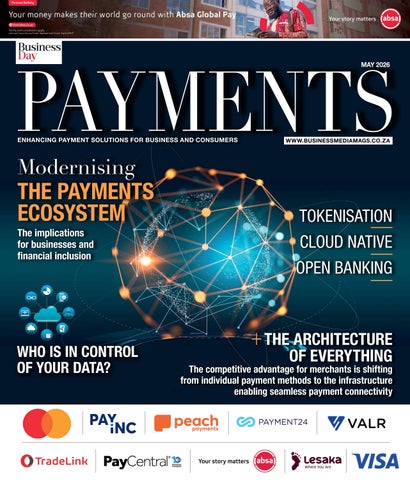
PAYMENTS MAY 2026
ENHANCING PAYMENT SOLUTIONS FOR BUSINESS AND CONSUMERS
WWW.BUSINESSMEDIAMAGS.CO.ZA
Modernising
THE PAYMENTS ECOSYSTEM The implications for businesses and financial inclusion
WHO IS IN CONTROL OF YOUR DATA?
TOKENISATION CLOUD NATIVE OPEN BANKING
+ THE ARCHITECTURE OF EVERYTHING
The competitive advantage for merchants is shifting from individual payment methods to the infrastructure enabling seamless payment connectivity
ToCheck_dps.indd 2
2026/04/15 11:51
ToCheck_dps.indd 3
2026/04/15 11:51
A holistic, multiproduct platform for consumers, merchants and enterprises Lesaka operates a South African fintech company driven by a purpose to provide financial services, software and other business services to Southern Africa’s underserviced consumers and merchants. We offer an integrated, holistic multiproduct platform that provides transactional accounts, lending, insurance, merchant acquiring, cash management, software and alternative digital products. We provide targeted solutions and integrations to facilitate payments between consumers, merchants and enterprises. By providing a full-service fintech platform in our connected ecosystem, we facilitate the digitisation of commerce in our markets. Lesaka has a primary listing on NASDAQ (NASDAQ: LSAK) and a secondary listing on the Johannesburg Stock Exchange (JSE: LSK).
For more information: www.lesaka.tech
Empowering clients Mastercard powers economies and empowers people in more than 200 countries and territories worldwide. Together with our customers, we’re building a resilient economy where everyone can prosper. We support a wide range of digital payments choices, making transactions secure, simple, smart and accessible. Our technology and innovation, partnerships and networks combine to deliver a unique set of products and services that help people, businesses and governments realise their greatest potential.
For more information: www.mastercard.com
Built for business, designed with intent Payment24 is an enterprise payments technology platform built for businesses that need real flexibility, modularity and merchant control of their payments and loyalty infrastructure. Headquartered in Cape Town with a regional office in the United Arab Emirates, the company has team members across more than 8 countries and customers in over 20, spanning Africa, the Middle East, Latin America and the Asia Pacific region. The Payment24 platform is structured across four integrated verticals: fleet payment modules, payment processing, loyalty and rewards, and retail modules. More than 20 product modules sit across these verticals, all bank-agnostic, hardware-agnostic and channel-gnostic by design, allowing clients to compose precisely the stack their business needs without lock-in to any single acquirer, terminal vendor or integration partner. The platform was forged in the highly complex world of fuel retail, where a single transaction can blend fleet cards, loyalty redemptions, mobile wallets, fuel rebates and convenience store baskets in seconds. That same architectural rigour now powers payments, loyalty and retail operations for clients across multiple industries and geographies, hosted on the cloud using MS Azure.
For more information, visit www.payments24.com
Payments solutions to support companies’ growth Peach Payments is a fast-growing African payment service provider that makes offline and online payments easier and more accessible across Kenya, Mauritius and South Africa through its payment gateway. More than just transactions, Peach Payments is a single platform that helps enterprise merchants solve complexity by offering payment orchestration, enterprise-grade security, 365-day support and top conversion rates to optimise business growth. The company works with growing enterprises to provide a complete toolkit to accept, manage and disburse payments through point-of-sale, web and mobile. Peach Payments’ merchant partners include your favourite food delivery services, whether you’re ordering in or using a meal kit, travel services that can help you book your next getaway adventure and even your home cleaning service. For these partners and their customers, Peach Payments aims to provide delightful experiences that make it as easy as possible to facilitate payments. Peach Payments recently agreed to acquire West African payment platform PayDunya, which operates in six Francophone countries: Senegal, Côte d’Ivoire, Benin, Burkina Faso, Togo and Mali.
For more information: sales@peachpaymnets.com www.peachpayments.com
Ensuring seamless payment flow Trade Link – the link between retailers and their customers – ensures payments flow seamlessly, every day, all day. Trade Link is a leading services and payment support partner to retailers, retail banks and payment service providers across Southern Africa and key African markets. It delivers retail payment solutions, tailored to meet the unique demands of customers across all retail verticals. The company’s success is built on strong partnerships with leading global software and hardware vendors, enabling it to bring payment solutions to every customer environment. At the heart of Trade Link is a team of highly skilled experts with deep experience in retail payment technologies. Trade Link understands the complexity of today’s payment landscape and is equipped to meet its evolving demands with confidence and precision. Committed to delivering timely support, accurate insights and effective resolutions, Trade Link ensures its customers can accept payments without disruption. In retail, consistency and quality of the payment experience are critical to customer satisfaction and loyalty. Trade Link understands that every transaction matters and business continuity depends on speed, accuracy and reliability. Retailers trust Trade Link because its experience, agility and deep retail knowledge ensure their systems perform when it matters most. For more information: 011 553 8000 or 021 910 5000 marketing@trade-link.co.za www.trade-link.co.za
Shaping a resilient, inclusive payments system PayInc is South Africa’s designated National Payments Utility, providing the trusted infrastructure that enables the secure, efficient movement of money across the economy. As a regulated and systemically important payments financial market infrastructure, PayInc plays a central role in supporting the stability, resilience and modernisation of the National Payments System. Building on a legacy as the country’s automated clearing house, PayInc processes billions of transactions annually, delivering interoperable, real-time and cost-effective payment capabilities across banks and regulated non-bank participants. PayInc’s shareholding includes the South African Reserve Bank alongside commercial banks, and the organisation is focused on expanding access to modern digital payments, enabling broader participation and supporting inclusive economic growth. Through continued investment in infrastructure, innovation and collaboration, PayInc is helping to shape a more connected, resilient and inclusive payments ecosystem for South Africa.
For more information: www.payinc.co.za
A diversified financial services group Absa Group Limited (Absa Group) is listed on the Johannesburg Stock Exchange and is one of Africa’s largest diversified financial services groups. Absa Group offers an integrated set of products and services across personal and business banking, corporate and investment banking, wealth and investment management and insurance. Absa Group owns majority stakes in banks in Botswana, Ghana, Kenya, Mauritius, Mozambique, Seychelles, South Africa, Tanzania (Absa Bank Tanzania and National Bank of Commerce), Uganda and Zambia, and has insurance operations in Kenya and South Africa. Absa also has offices in the People’s Republic of China, Namibia, Nigeria and the United States, as well as securities entities in the United Kingdom and the United States, along with technology support colleagues in the Czech Republic.
For more information: www.absa.africa
Crypto for everyone VALR is a global crypto exchange, founded in 2018 and headquartered in Johannesburg. Backed by prominent investors, including Pantera Capital, Coinbase Ventures and Fidelity’s F-Prime Capital, VALR has established itself as a large African crypto platform by trade volume, serving over 1.8 million registered users and 2 000 corporate and institutional clients across the globe. Licensed by South Africa’s Financial Sector Conduct Authority and with regulatory approval in Europe, VALR provides a secure, comprehensive suite of products for diverse needs. These encompass simple swap, spot and margin trading, perpetual futures, staking, lending, over-the-counter services, a world-class application programming interface for advanced strategies, including autonomous AI agents, VALR Pay and crypto bundles, with access to over 100 crypto assets, as well as tokenised US stocks, gold and private credit. With the world’s deepest ZAR-denominated markets and support for USD, EUR, GBP, and more than 150 local currencies, including Mobile Money, VALR facilitates borderless, inclusive finance. Rooted in the principle of “Crypto for Everyone,” VALR is committed to fostering a just financial ecosystem that upholds human dignity and the oneness of humanity, bridging traditional and digital assets to drive economic empowerment.
Simplifying payment management PayCentral has been helping businesses simplify how they manage payments. Founded by Veenash Parbhoo in 2016 and later joined by Preniel Pentia in 2020 the company’s goal is straightforward: to make it easy for businesses to pay people quickly, securely and efficiently. What started as a prepaid card solution has since grown into a business payments platform used by growing and established businesses across multiple industries. PayCentral supports a wide range of payment programmes, including employee wages, incentives, expense management, commissions, rebates and rewards. Through its platform, businesses can issue payment cards, load funds and monitor transactions in real-time. Platform features enable batch payments authorisations, card issuance, funding allocations and programme rules directly, without relying on third parties for routine tasks. Security is built into the platform from the ground up. Two-factor authentication and controlled user access enable strong governance and management of fund distribution and user access control for payment authorisation. In its 10th year, PayCentral serves more than 1 700 corporate clients across 44 sectors, has loaded over R8.2-billion onto cards, issued over 700 000 cards and facilitated more than 19 million transactions. The company is based in Bryanston, Johannesburg, and is taking its first steps into Africa.
For more information: For more information, visit www.valr.com
+27 10 012 6676 info@paycentral.co.za www.paycentral.co.za
CONTENTS 28
18 TRENDS How fintech is powering a faster, smarter and more dynamic economy.
20 MODERNISATION South Africa’s payments ecosystem is undergoing a technical and regulatory overhaul, with big implications for businesses and financial inclusion.
22 DATA SOVEREIGNTY South Africa’s strict data sovereignty regulations mean that infrastructure control and algorithmic transparency are crucial.
28 ARTIFICIAL INTELLIGENCE AI is increasingly researching, comparing, negotiating and completing purchases on behalf of consumers or businesses.
32 VISIBILITY Unifying physical and digital payment data creates a command centre for retailers to stop fraud, boost revenue and streamline reconciliation processes.
48
43 FRAUD
37 OPTIMISATION As South Africa’s digital economy grows, payments are driving revenue, customer experience and competitive edge.
With fraud techniques increasing, businesses and financial services providers must walk a fine line between prevention and friction.
48 CONVERGENCE How omnitokens are transforming the way businesses handle the payments back end.
55 SUPERMARKETS South Africa’s largest retailers are partnering with payment platforms in ways that enable cautious, careful and customer-centred evolution.
PAY M E N T S
5
80 80 PAYROLL A more agile, card-based ecosystem is eliminating cash handling risks while empowering unbanked workers.
89 DIGITAL ASSETS Unpacking the implications of National Treasury and the Financial Sector Conduct Authority’s plan to integrate crypto into our financial infrastructure.
90 PARTNERSHIPS South Africa’s payments revolution is being built less by lone disruptors than by strategic allies.
94 INFRASTRUCTURE Understanding the evolving infrastructure that enables seamless flow between digital infrastructure and cash.
98 TECHNOLOGY By exposing core services to third-party developers, financial institutions can generate new revenue streams through banking-as-a-service. of handling sensitive card data.
60 MERCHANT EXPERIENCE
77 INFORMAL ECONOMY
Speed and seamlessness are becoming the essence of the merchant experience.
Advances in digital payments translate to meaningful gains for informal traders.
63 INNOVATION Cloud-native, modular architectures enable payment systems to be broken down into core building blocks that can operate independently.
99
67 CURRENCY What does the continuing uptake of digital payment methods mean for cash?
74 TECHNOLOGY How tokenisation facilitates seamless, secure and repeat payments, without the cost and complexity
6
PAYMENTS
99 AUTOMOTIVE Fuel payments are shifting from cards to intelligent platforms to cut fraud, speed up forecourt turnaround and integrate driver apps.
ToCheck_fcp.indd 1
2026/04/15 11:52
PAYMENTS
FROM THE EDITOR
PUBLISHED BY
LET'S GET MODERN
W
elcome to the third – and largest – issue of Payments. We like to think that the size of this year’s magazine reflects just how much is happening in the local and international payments ecosystem, not just our appetite for writing about said ecosystem. If you’ve been keeping up with the changes the way we have, you’ll know there’s been a lot Anthony Sharpe of buzz about the South African Reserve Bank’s (SARB) Payments Ecosystem Modernisation (PEM) programme, and rightly so. The evolution of SARB’s Vision 2025, PEM aims to leverage the considerable resources and skills of the country’s financial sector, under the Reserve Bank’s guidance, to modernise our payments infrastructure. This is complemented by SARB’s proposed Authorisation Framework, which introduces a shift to activity-based regulation in the financial ecosystem, meaning nonbank entities can participate more directly in payment activities. Read our story on page 20 to unpack the implications of these developments. A big part of payment modernisation is migrating legacy systems to cloud-based ones, enabling organisations to implement new solutions in a modular fashion without reinventing the wheel (page 63), which is great news for large retailers that can’t afford downtime and don’t want to expose their infrastructure (page 55). This is building depth in the payments ecosystem and creating a sort of “co-opetition” where banks, fintechs and infrastructure providers collaborate to advance their layer of the stack
8
while competing where their roles overlap (turn to page 90). Utilising overseas cloud services, however, has major regulatory implications for financial institutions that must comply with the data sovereignty regulations set out in the Protection of Personal Information Act (page 22). Also essential is optimisation, which can mean the difference between a denied message and a completed sale (read more on page 37). In this context, efficient digital payment systems are shifting from cost centre to engine for revenue growth for merchants that are also increasingly expecting quick and seamless onboarding, developer-first portals and robust support (find out more on page 60). What does this mean for good old cash? Well, it’s not disappearing any time soon, but the costs of working with it for players across the spectrum mean that making digital payments more affordable is a major priority (page 67). You may also start seeing more of your rands tokenised into stablecoins, which are an evolution of cryptocurrency that facilitates easier cross-border payments (see page 89). The same tokenisation technology is freeing up liquidity and broadening investment options for businesses (see page 74). Beyond that, we look at the importance of consolidating physical and digital payment data (see page 32) and infrastructure (page 48), the rise of agentic e-commerce (page 28), the evolution of fuel cards (page 99) and prepaid payroll cards (page 80), and so much more. Hopefully, our efforts have paid off, and you enjoy this publication (at least more than that dreadful pun). Anthony Sharpe Editor
PAYMENTS
Picasso Headline, A proud division of Arena Holdings (Pty) Ltd, Hill on Empire, 16 Empire Road (cnr Hillside Road), Parktown, Johannesburg, 2193 PO Box 12500, Mill Street, Cape Town, 8010 www.businessmediamags.co.za EDITORIAL Editor: Anthony Sharpe Content Manager: Raina Julies rainaj@picasso.co.za Contributors: Keith Bain, Trevor Crighton, Megan Ellis, Biénne Huisman, Busani Moyo, Thando Pato, Brendon Petersen, Vanessa Rogers, Rodney Weidemann, Lisa Witepski Copy Editor: Brenda Bryden Content Co-ordinator: Natasha Maneveldt DESIGN Head of Design: Jayne Macé-Ferguson Senior Designer: Mfundo Archie Ndzo Project Designer: Annie Fraser Cover Images: videoflow/123RF.com DIGITAL Online Editor: Stacey Visser vissers@businessmediamags.co.za SALES Project Manager: Tarin-Lee Watts wattst@arena.africa | +27 87 379 7119 +27 79 504 7729
PRODUCTION Production Editor: Shamiela Brenner Advertising Co-ordinator: Johan Labuschagne Subscriptions and Distribution: Fatima Dramat fatimad@picasso.co.za Printer: CTP Printers, Cape Town MANAGEMENT Management Accountant: Deidre Musha Business Manager: Lodewyk van der Walt General Manager, Magazines: Jocelyne Bayer
COPYRIGHT: Picasso Headline. No portion of this magazine may be reproduced in any form without written consent of the publisher. The publisher is not responsible for unsolicited material. Payments is published by Picasso Headline. The opinions expressed are not necessarily those of Picasso Headline. All advertisements/advertorials have been paid for and therefore do not carry any endorsement by the publisher.
ToCheck_fcp.indd 1
2026/04/22 12:29
SOUTHERN AFRICA: THE NEXT GLOBAL FINTECH FRONTIER The digitalisation of commerce is one of the defining investment themes of our generation. Globally, it has reshaped how individuals and businesses transact, reducing friction, broadening access and driving productivity. By LESAKA TECHNOLOGIES
D
igitalising commerce is a universal transformation that affects every human – young or old, poor or wealthy – fundamentally changing how we engage in trade. It has unfolded at scale in markets such as India, Brazil and Egypt. Today, Southern Africa is positioned to follow a similar trajectory as reliance on cash declines, and digital payments and financial services expand. Fintechs are ideally positioned to lead the way.
Africa is Booming: Demographic and Growth Dynamics Africa is currently the youngest continent in the world, with an average age of 21 and a population of 1.5 billion people. By 2050, Africa is projected to account for 25 per cent of the global population. From a fintech perspective, the continent is projected to be the fastest-growing region globally, with a projected revenue growth of 13x between 2021 and 2030, significantly higher than North America (4x), Europe (5.5x) or the Asia-Pacific region (8.5x).
* Source: BCG Global Fintech Analysis 2023
10
PAYMENTS
Sources & Notes: (1) PRB World Population Data. (2) Using market share: by total asset value as proxy for South Africa; JP Morgan Research (12 July 2024). “Latin American Banks: Market Share & Credit Bibie” UBS Research (28 May 2024) “Brazilian Banks Side-by-Side”; the Prudential Authority (South African Reserve Bank); Company Estimates. (3) South African Reserve bank Payment Study Report 2023; Morgan Stanley “The End of growth” – forecast digital payments penetration of personal consumption to be at 94% for 2024E.
Within this context, the five markets of South Africa, Botswana, Namibia, Zambia and Kenya provide a fertile base to benefit from these long-term tailwinds. These regions represent a combined population of approximately 250 million people, a scale comparable to that of Brazil.
THE “NEXT BRAZIL”: A MARKET COMPARISON Southern Africa bears striking similarities to Brazil’s market dynamics in 2017, before its fintech boom. Brazil’s financial services economy has transformed between 2017 and 2023. Currently, the market share of loans by major fintechs in South Africa is less than one per cent, compared to Brazil’s five per cent in 2017. However, over the course of six years, Brazil’s fintechs captured over 20 per cent market share of loans. Companies like StoneCo disrupted banks by focusing on the underserved small and medium enterprises segment. StoneCo has grown into a unicorn with a market cap exceeding $3-billion. Agi is a fintech that combines digital and physical distribution
DESPITE HIGH BANK ACCOUNT PENETRATION IN SOUTH AFRICA, THE ECONOMY REMAINS OVERWHELMINGLY CASH-DOMINANT.
IN PARTNERSHIP WITH LESAKA TECHNOLOGIES
to provide banking, insurance and credit to the most underserved populations. It currently has over six million clients and was recently listed on the NYSE with a market cap of over $1-billion. StoneCo and Agi are not isolated success stories; Brazilian fintechs now make up approximately 30 per cent of the market capitalisation of major banks. By contrast, the market cap of the top four fintechs in South Africa is less than five per cent of the top four banks. These parallels suggest substantial upside for fintech expansion in Southern Africa as it disrupts bank concentration and digitises the cash economy.
THE PARADOX OF CASH: A MASSIVE OPPORTUNITY FOR DISRUPTION
IMAGES: SUPPLIED
Despite high bank account penetration in South Africa, the economy remains overwhelmingly cash dominant. Approximately 56 per cent of all transactions in South Africa are still conducted in cash. Even more startling, data from the South African Reserve Bank indicates that 50 per cent of adults withdraw the entire digital deposit from ATMs immediately upon receiving it. This disconnect is most visible at the point of sale, in our transport system and in small and medium businesses. This reliance on cash acts as a regressive “tax” on society, including high handling costs and security risks, and facilitates crime. For many small traders in rural areas, traditional digital payments are unattractive due to settlement delays and material merchant fees.
Source: BCG Global Fintech Analysis 2023
A merchant may often wait days for settlement, while cash provides immediate liquidity – an essential consideration for small enterprises, where cash flow is king. This structural inefficiency in the traditional banking system has created the runway for fintechs to lead the digitisation of the economy.
FINTECHS ARE IDEALLY POSITIONED TO LEAD Fintechs are built on three core pillars that give them an advantage compared with incumbents: 1. Regulatory changes: as seen in Brazil, Southern Africa is in the process of removing traditional barriers that protected incumbent banks. For example, proposals in South Africa would allow nonbanks to participate directly in the payments infrastructure without requiring a bank sponsor. Fintechs are also playing a growing role in regulatory modernisation through ASAPP, an association of 13 nonbank fintechs. 2. Agile technology: the absence of legacy systems, combined with dynamic teams and agile operating models, allows fintechs to adopt new technologies, such as artificial intelligence and blockchain, more rapidly than incumbents, using them to drive efficiency and more authentic customer engagement. 3. A “positive sum” mindset: fintechs are not encumbered by current profit pools and heavy cost structures, which, while significant to banks now, are at a high risk of declining over time.
POWERED BY THE SOLANA BLOCKCHAIN, ZARU ENABLES 24/7/365 SETTLEMENT, BYPASSING TRADITIONAL BANKING HOURS.
LESAKA: LEADING THE DIGITISATION OF SOUTHERN AFRICA Lesaka empowers underserved Southern African consumers and merchants to fulfil their potential by delivering innovative financial services and other business services focused on meeting their needs where they are. Over the past four years, Lesaka has established itself as among the largest independent fintechs in Southern Africa. The company has three divisions – consumer, merchant and enterprise – serving over 2 million active retail consumers, 130 000 merchants and 750-plus enterprise clients. • Consumer division: provides banking services to grant recipients, including transactional accounts, credit and insurance. Lesaka’s consumer division provides human connectivity with over 250 hyper-local hubs and over 800 local sales agents, combined with the convenience and efficiency of a digital bank. Clients are onboarded and can transact with a card in under five minutes. This division has seen a growth in active consumers from 1.4 million in Q2 FY24 to 2 million in Q2 FY26. Close to 50 per cent of Lesaka’s 2 million active clients have more than one product with Lesaka. • Merchant division: offers acquiring, software, cash management, alternative digital products and lending to small and medium enterprises, including informal community merchants – a segment traditional banks have underserved. The average revenue per merchant is approximately R1760 per month, indicating the level of incumbency. Almost half of Lesaka’s merchants now utilise more than one product. • Enterprise division: acts as a technology infrastructure provider, managing solutions for billers, utilities and municipalities. Enterprise provides bill payment services to Lesaka’s consumer and merchant clients, as well as major banks and retailers in Southern Africa. If you are paying your municipal bill through your bank app or at a retail store, there is a good chance you already use Lesaka’s services. >
PAY M E N T S
11
IN PARTNERSHIP WITH LESAKA TECHNOLOGIES
BOLD STRATEGIC MOVES In 2025, Lesaka announced the acquisition of Bank Zero, a fully digital neobank, representing a significant strategic milestone. The transaction will enable Lesaka to deliver and expand its suite of financial services without reliance on a third-party bank sponsor and strengthen control over its banking infrastructure. Notably, the founders of Bank Zero demonstrated strong alignment with Lesaka’s long-term strategy by electing to receive Lesaka shares for the majority of the purchase consideration, resulting in their collective position as one of the company’s largest shareholders. This alignment underscores the partnership-oriented nature of the transaction. Over the past decade, several digital banks have been launched in South Africa, typically requiring multibillion-rand capital investments and extended timelines – often five years or more – to achieve scale and profitability. Bank Zero offers an ultra-modern technology stack and a highly secure, low-cost banking platform, positioning it favourably relative to Lesaka’s alternatives. In turn, Lesaka brings scale, distribution and a diversified customer base, which is expected to accelerate Bank Zero’s path to sustainability within the broader group. The bank is expected to reach profitability within the first 12 months post-acquisition. Strategically, the integration is expected to reduce Lesaka’s dependence on legacy banking infrastructure and technology, broaden its reach into underserved communities and support the expansion of product offerings across deposits, lending and transactional services, particularly for small and medium enterprises. Collectively, the transaction enhances Lesaka’s capability to innovate across its ecosystem while improving operational flexibility and long-term economics. From a balance sheet perspective, the transaction is expected to reduce group debt by around R1-billion and reduce funding costs for Lesaka’s existing merchant and consumer businesses.
Notes: All operational data as at Q2FY26. All Financial data for FY25A (Fiscal year ending June) unless stated otherwise. Forecasted Group Adjusted EBITDA growth based on the midpoint of FY26 guidance.
Lesaka is also proud to be part of a consortium that recently launched the ZARU stablecoin (ZAR-pegged stablecoin). Powered by the Solana blockchain, ZARU enables 24/7/365 settlement, bypassing traditional banking hours. For a merchant, this could mean T+0 (trade plus zero days) settlement velocity – instant liquidity that removes the 24- to 48-hour wait for capital – the primary barrier to digital adoption in the informal economy. For consumers, it can offer cheaper and faster cross-border payments to family and dependents.
A TRACK RECORD OF PROFITABLE GROWTH AND ACCRETIVE ACQUISITIONS Lesaka is a profitable growth story with its organic and inorganic strategies clearly demonstrated in its financial performance. For fiscal 2026, Lesaka has guided to an adjusted EBITDA (earnings before interest, taxes, depreciation and amortisation) of between R1.25-billion and R1.45 billion – representing a three-year compound annual growth rate of 49 per cent at the midpoint. On a per share basis, adjusted earnings per share have grown at over 100 per cent in the past two fiscal years, from a loss of 266 cents in FY23 to a profit of 229 cents per share in FY25.
BY COMBINING DISRUPTIVE DISTRIBUTION MODELS, BLOCKCHAIN-NATIVE TRANSPARENCY AND A DEEP COMMITMENT TO THE COMMUNITY, FINTECHS ARE IDEALLY POSITIONED TO LEAD SOUTHERN AFRICA AWAY FROM CASH AND TOWARD A FULLY DIGITISED, INCLUSIVE AND THRIVING ECONOMY.
12
PAYMENTS
THE NORTH STAR AMBITION The goal for fintech in Southern Africa is to “work back from the future”. South African giant Naspers became the largest business on the continent by investing in the digitisation of commerce in China via Tencent – the next multibillion-dollar African champions wil be those that invest in the digitisation of Africa itself. Fintechs are the modern infrastructure – the ports and railways of the digital age. By combining disruptive distribution models, blockchain-native transparency and a deep commitment to the community, fintechs are ideally positioned to lead Southern Africa away from cash and towards a fully digitised, inclusive and thriving economy. The journey has only just begun, and Lesaka is leading the way.
VISIT WEBSITE SCAN THIS QR CODE TO GO TO THE LESAKA WEBSITE
For more information: www.lesaka.tech
IN PARTNERSHIP WITH LESAKA TECHNOLOGIES
RAND-BACKED STABLECOINS Stablecoins have evolved rapidly from a niche crypto instrument into a scaled, globally relevant payments rail, offering a scalable digital payments opportunity, writes BASIE KOK, CEO, enterprise division at Lesaka Technologies
B
y 2025, the total stablecoin market capitalisation exceeded $300-billion, up from less than $5-billion in 2019, underscoring both accelerating adoption and growing institutional relevance. In the South African context, stablecoins present compelling real-world utility. They combine the trust and familiarity of traditional fiat currency with speed, transparency, programmability and the efficiency of a blockchain-based settlement system. Importantly, stablecoins also have the potential to advance financial inclusion – an enduring and critical policy objective for South Africa – by lowering barriers to participation in the digital economy, given the ease of integration of blockchain technologies compared to legacy banking systems.
IMAGES: SUPPLIED
THE BENEFITS At a foundational level, Rand-backed (ZAR) stablecoins offer three structural benefits. First, they enable the digitisation of the Rand, creating a native digital representation of ZAR that upgrades existing payment rails. Second, they reduce domestic and cross-border payment costs by lowering reliance on card networks, interchange fees and legacy correspondent banking infrastructure. Third, they materially improve liquidity and cash-flow management, particularly for small and medium enterprises, by enabling real-time settlement on a 24/7/365 basis, removing the heavy cost of capital requirements to run transactional businesses. These attributes directly address long-standing pain points faced by South African merchants and consumers.
Imagine a tavern owner in Soweto enjoying the bustling long weekend trade. When customers pay with a rand-backed stablecoin, the payments go directly into a digital wallet right at the moment of sale, instead of taking days to clear. This quick access helps him restock supplies swiftly and pay his food and drink suppliers immediately. The benefits are clear: better cash-flow control, lower transaction costs and less dependence on physical cash, making his tavern more secure and more efficient. South Africa already hosts three rand-denominated stablecoins – ZARP, ZAR Supercoin (ZARSC) and ZARU. ZARP initially concentrated on decentralised finance applications before expanding into broader use cases. ZAR Supercoin is popular within gaming ecosystems, and ZARU has been strategically positioned for institutional utilisation, with a specific focus on digitisation of the cash economy and optimisation of existing card rails in retail. This demonstrates market-readiness and an expanding base of local expertise. Taken together, South Africa’s advanced payments infrastructure, the growth of fintech innovation, well-defined use cases and a population receptive to digital solutions indicate strong underlying readiness for stablecoins to become mainstream. Yet despite these favourable conditions, adoption has lagged behind potential. Regulatory clarity remains a critical enabler. The Intergovernmental Fintech Working Group (IFWG) has made meaningful progress through its March 2026 discussion paper, which addresses key regulatory considerations for stablecoins. However, the consultation
process needs to be translated into a binding, enforceable framework that provides certainty for market participants and protects systemic integrity. Key elements of such a framework include full one-to-one backing with segregated reserves, regular and transparent reserve reporting, clear separation of roles across wallet provision, custody, exchange and treasury functions, minimum entry standards, and guaranteed redemption rights. International experience reinforces this point. The United States’ GENIUS Act and the European Union’s Markets in Crypto Assets regime both entered into full effect in 2025, creating regulatory certainty that enabled stablecoin markets to thrive. Stablecoin transaction volumes are estimated to have grown by more than 70 per cent in 2025 alone, with retail usage increasing tenfold. Rand-backed stablecoins represent more than a technological innovation; they offer South Africa a faster, cheaper and always-on payments rail with tangible economic benefits. Supported by a well-designed framework, ZAR stablecoins can advance financial inclusion, enhance SME competitiveness, modernise the payments ecosystem, and ensure South Africa captures the value of digital money innovation in Rand on its own terms. Lesaka is a partner in ZARU, a South African institutional-grade, Rand-backed stablecoin launched in February 2026 to enable 24/7, instant and low-cost digital payments.
VISIT WEBSITE SCAN THIS QR CODE TO GO TO THE LESAKA WEBSITE
For more information: www.lesaka.tech
PAY M E N T S
13
IN PARTNERSHIP WITH
PASA
S
outh Africa’s payments industry is navigating a period of profound and overlapping change. Globally, rapid technological innovation and geopolitical shifts are reshaping payment systems at speed. Locally, the industry is experiencing its most significant regulatory transition in more than three decades, alongside important changes to governing structures. At the same time, rising levels of scams and financial crime, coupled with pressure on interchange and declining margins, are adding to the complexity. Amid this noise, it is easy to lose sight of a fundamental truth: the National Payment System (NPS) and its resilience are critical to the functioning of the economy. South Africans are all too familiar with the consequences of failing core infrastructure, whether electricity, water or transport. The NPS should be viewed in the same light – a foundational infrastructure that underpins the modern economy. Every trade executed on an exchange, every online Ghita Erling purchase, every card transaction at a point of sale, every salary and wage payment, and every debit order depends on the uninterrupted functioning of the NPS. Even a brief outage on a core payment system can have immediate and widespread economic consequences.
WHY PAYMENTS POWER THE ECONOMY GHITA ERLING, CEO of Payments Association of South Africa, unpacks why South Africa’s National Payment System is critical infrastructure – and how modern, trusted digital payments can drive inclusion, growth and resilience While South Africa’s bank account penetration is estimated to exceed 80 per cent of eligible adults, digital payment usage paints a much grimmer, more divided picture. According to GlobalData forecasts, the average number of payments per card per year is just over 100. By contrast, Statista reports that only 70 per cent of adults have made a digital payment in the past year. Notably, in 2024, 38 per cent of account holders still used their accounts primarily as “mailboxes”, withdrawing their funds in cash each month.
EVERY TRADE EXECUTED ON AN EXCHANGE, EVERY ONLINE PURCHASE, EVERY CARD TRANSACTION AT A POINT OF SALE, EVERY SALARY AND WAGE PAYMENT, AND EVERY DEBIT ORDER DEPENDS ON THE UNINTERRUPTED FUNCTIONING OF THE NPS.
Corporation of India (NPCI). South Africa is seeking to learn from this experience through the Payments Ecosystem Modernisation initiative led by the South African Reserve Bank. However, faster and more convenient payments also introduce new risks. The convergence of artificial intelligence, data stolen through cybercrime and irrevocable instant payments is contributing to the growing social and economic cost of scams and financial crime. This is not a challenge any single institution, sector or regulator can solve alone. A key lesson from India’s experience is the importance of collaboration: the role of private sector participation in building national infrastructure, the power of market-led innovation to drive adoption, and the sustained, incremental effort required to deliver payment systems that are both inclusive and safe. Realising the full potential of an NPS that works for every South African will require co-ordinated action across the public and private sectors, including financial services, telecommunications and technology, to ensure digital payments are accessible, trusted and resilient.
VISIT WEBSITE
THE SOCIOECONOMIC BENEFITS South Africa today benefits from a payment system that is safe, efficient and effective. However, experience from other emerging markets suggests the NPS can deliver far more than economic enablement. By meaningfully shifting from cash to electronic payments, countries have driven financial inclusion, supported economic growth and helped alleviate extreme poverty.
14
PAYMENTS
The social and economic case for replacing cash with digital payments is well articulated in Dr Balakrishnan Mahadevan’s book, Designing Change: My Journey Through Digital Payments Transformation. The book traces India’s two-decade-long transformation of its national payment system from the perspective of Dr Balu, former chief operating officer of the National Payments
For more information: https://pasa.org.za/
IMAGES: SUPPLIED
SCAN THIS QR CODE TO GO TO THE PASA WEBSITE
IN PARTNERSHIP WITH PASA ACADEMY
BUILDING CAPABILITY ACROSS EXPANDING THE PAYMENTS ECOSYSTEM SA’S PAYMENTS ECOSYSTEM PASA ACADEMY equips professionals with the knowledge and skills to succeed in an evolving payments system landscape
T
he payments industry is entering a new phase of structural complexity. Globally, payment systems are no longer defined by efficiency alone, but by how effectively they balance interoperability, innovation, sovereignty and resilience in an increasingly fragmented and politicised environment. In this context, the defining constraint is no longer technology; it is capability. As payments evolve into interconnected, ecosystem-based models, the ability to develop, retain and renew institutional knowledge is essential for the stability and evolution of the National Payment System (NPS) and the commercial ambitions of its participants and the broader economy. The PASA Academy sits at the centre of this shift, with a clear mandate: to build capability across South Africa’s payments ecosystem.
IMAGES: SUPPLIED
FROM OPERATORS TO SYSTEM THINKERS Established in 2012, the PASA Academy was created to address a growing industry-wide skills gap. It offers a structured learning pathway, from foundational programmes to advanced certificates in electronic and high-value payments, equipping professionals with technical depth and a systems-level understanding of how the NPS functions. To date, over 4 500 professionals have graduated from the PASA Academy programmes. Introduction to Payments, a short, self-paced online programme, is managed separately from PASA Academy’s certificate
programmes. It offers newcomers and nonspecialists a basic understanding of how payments work. Unlike the certificate programmes, it has no assessments, live sessions or formal certification and focuses on concepts rather than operational detail. “The academy is more than a training institution; it is a platform for building shared understanding across the industry,” says Thami Moatshe, founder and CEO of Percer Consulting and a PASA independent councillor. “It brings together banks, fintechs, regulators, operators and innovators around a common language and framework.” That shared understanding is critical in the interconnected network of the NPS. The academy is designed to cultivate this systems view, working with subject matter experts to unpack the complexity and opportunity embedded in the payments landscape. “Understanding the ecosystem view distinguishes payment professionals from payment operators,” Moatshe adds. “It is also where subject matter expertise becomes critical.”
PAYMENT PRACTITIONERS AS LEARNING FACILITATORS The PASA Academy’s programmes are co-designed and delivered by practitioners actively operating within payment systems. This ensures learning remains grounded in lived experience and real-world application, rather than abstract theory. “You have the opportunity to learn from someone who does this work daily,” says Clyde O’Reilly, head of treasury operations at Investec and a PASA Academy subject matter expert. “It’s not something you can replicate easily elsewhere.” This access to lived expertise is often where understanding deepens and confidence grows. Kwabena Anim, an Investec deal manager and top-performing graduate, describes the impact as transformative. “There’s definitely a before and after,” he says. “It’s not just knowledge you gain; it’s a shift in how you think about payments and how you engage with the system.”
Payments is not the domain of technical specialists alone. It is influenced by behavioural insight, commercial strategy, customer experience and design. As the digital economy expands, there is growing demand for professionals who can manage payments in a commercial context. Like many PASA Academy participants, Tracey-Lee Zürcher-Campbell, chief marketing officer at Payflex, did not begin her career in payments. With a background in marketing and commercial strategy, she points to the academy’s ability to translate complexity into practical insight. “Breaking payments down into structured, accessible concepts made it far easier to understand challenges and think through solutions,” she says.
BUILDING WHAT COMES NEXT This ability to demystify complexity and develop shared frameworks will be increasingly important as the industry continues to evolve. Innovation and the regulatory, technological and societal forces reshaping payments will not slow. The PASA Academy’s long-term value lies in its ability to build a pipeline of professionals capable of not only operating within the system, but also shaping its future. As Moatshe reminded a cohort of 2025 graduates: “South Africa’s payment system will only be as strong, inclusive and resilient as the people who build and operate it. From today onwards, that includes you.” Ready to take your career to the next level? For enquiries and registrations on all programmes, email academy@pasa.org.za or scan the QR code below:
VISIT WEBSITE SCAN THIS QR CODE TO GO TO THE PASA ACADEMY PROGRAMMES INFORMATION WEBSITE
For more information: https://pasa.org.za/
PAY M E N T S
15
IN PARTNERSHIP WITH PASA
Ghita Erling, Jada Eagar, Tim Masela, Jill Murtagh and Ingrid Goodspeed
RECOGNISING EXCELLENCE ACROSS SOUTH AFRICA’S PAYMENTS ECOSYSTEM PASA Industry Awards honour the individuals, teams and organisations that demonstrate innovation and excellence in the South African payments ecosystem, thereby supporting economic growth and financial inclusion, writes PASA.
16
PAYMENTS
to team-based recognition of large-scale collaborative initiatives. This ensures excellence is acknowledged at every level – from emerging professionals building specialist capability to experienced leaders shaping system-wide change.
RECOGNITION AS AN INDUSTRY MILESTONE Recognition matters because it signals what the industry values. By celebrating innovation, leadership, technical expertise and collaboration, the PASA Industry Awards help elevate standards across the payments environment. They also encourage wider participation by demonstrating that meaningful contribution – whether operational, strategic or technical – is both visible and valued. The Lifetime Achievement Award is a clear example. In 2025, it was awarded to Tim Masela, recently retired head of the National Payment System Department (NPSD) at the South African Reserve Bank (SARB). His work across regional and international institutions reflects the lasting impact of
VISIT WEBSITE SCAN THIS QR CODE TO GO TO THE PASA WEBSITE
For more information: https://pasa.org.za/
IMAGES: SUPPLIED
I
n a sector defined by complexity, collaboration and constant innovation, recognising excellence is more than ceremonial. It plays an important role in shaping industry standards, reinforcing good practice and encouraging sustained performance across the payments ecosystem. The PASA Industry Awards provide a formal platform to recognise, honour and celebrate the individuals, teams and organisations contributing to the advancement of South Africa’s payments ecosystem. Through recognising impactful projects and initiatives, the awards highlight the work that supports a secure, efficient and resilient National Payment System (NPS). More than a recognition platform, the awards serve as a driver of excellence. By shining a light on contributions that often occur behind the scenes, they reinforce the behaviours and outcomes that are essential to the integrity and ongoing evolution of the payments system. The awards span a broad range of categories, from individual achievement
sustained leadership and partnership in shaping South Africa’s payments ecosystem. In her tribute, PASA CEO Ghita Erling noted: “Masela has a rare ability to distil complex, competing issues into clear, principle-based outcomes that serve both the system and the broader public interest. His steady, transparent and collaborative leadership enables him to navigate domestic and international dynamics with credibility, integrity and conviction.” The Retirement Service Award also recognises the intersection of long service and leadership. In 2025, it was presented to Elsabe Jacobs, Gavin Wasserfall, Jill Murtagh and Jada Eagar, acknowledging their enduring contributions to the industry. In their acceptance speeches, many of the awardees acknowledged the role that mentorship played in their professional journeys, reinforcing its importance in building capacity, resilience and continuity across the payments ecosystem. As Ingrid Goodspeed, chairperson of PASA, observes: “PASA’s Industry Awards honour excellence in an industry that quietly powers every corner of South Africa’s economy and keeps the wheels of commerce turning for millions of people and businesses every day. The professionals and leaders we recognise are advancing innovation and strengthening the NPS so that it continues to support economic growth and financial inclusion, efficiently and resiliently.”
IN PARTNERSHIP WITH PASA
TURNING INDUSTRY DIALOGUE INTO CO-ORDINATED ACTION The sixth PASA International Payments Conference brought together financial institutions, fintechs, regulators, technology providers and global experts to discuss topics about the evolving payments ecosystem
A
t a time of rapid and far-reaching change in payment systems, the need for common industry understanding has never been more critical. As innovation accelerates and new regulations reshape the ecosystem, no single institution can navigate the complexity alone. Guided by the theme, Forging Ahead, Together, the sixth PASA International Payments Conference (PIPC 2025) convened the payments ecosystem to engage with the forces reshaping payments, both in South Africa and globally. Since its launch in 2013, PIPC has provided a trusted platform for industry dialogue, enabling stakeholders to engage on shared challenges, explore emerging trends and debate the future direction of the National Payment System (NPS). In 2025, more than 780 delegates and close to 70 speakers gathered at the Sandton Convention Centre for the two-day conference, reinforcing PIPC’s position as a leading forum for meaningful industry-wide engagement.
A PLATFORM FOR INDUSTRY DEBATE
IMAGES: SUPPLIED
PIPC has evolved into more than an industry gathering. It brings together financial institutions, fintechs, regulators, technology providers and global experts to engage on common priorities across the payments value chain. PIPC 2025 reinforced this role, creating space for constructive debate on the future of the NPS and the broader payments ecosystem. Its value lies in enabling co-ordinated industry thinking in a system that depends on interoperability, trust and shared standards. In an interconnected environment, alignment is not optional; it is foundational.
KEY THEMES SHAPING THE FUTURE OF PAYMENTS Discussions at PIPC 2025 reflected the growing complexity of the payments landscape, supported by a programme designed to deepen
engagement through fireside chats, interactive interviews and focused breakaway panels. Artificial intelligence (AI) emerged as a major driver of transformation, with discussions highlighting its role in improving system performance, enhancing customer experienceand strengthening fraud detection. Cyber-resilience was positioned as a non-negotiable priority, as rising digital adoption expands the threat landscape. Another recurring theme was the shift towards ecosystem-based models of value creation, underpinned by the growing use of application programming interfaces (APIs). These enable greater interoperability between systems, allowing banks, fintechs and platforms to connect more efficiently. Financial inclusion remained central, with a focus on ensuring advances in payments technology translate into broader access and participation. These themes were explored by a diverse group of cross-sector experts, including Justice Malala, Ismail Momoniat, Dr Kimmo Soramäki, Andy White, Dr Leo Lipis and Wiza Jalakasi, among others. “Financial inclusion is about building wealth and building a balance sheet – not just participating in transactions,” Professor Adrian Saville, founder of Boundless World and speaker at PIPC 2025, explained.
PIPC 2025 – with Adrian Saville and Justice Malala.
Beyond the formal programme, PIPC enabled meaningful networking and collaboration across institutions and sectors, reinforcing a shared sense of responsibility for shaping a resilient, inclusive and future-ready payments ecosystem.
LOOKING AHEAD TO PIPC 2027 As the industry continues to evolve, PIPC remains a vital platform for building shared understanding and strong working relationships. The next conference will take place on 8–9 September 2027 at the Sandton Convention Centre, building on the momentum of PIPC 2025 and continuing the dialogue on key forces shaping payments, including AI, geopolitics, and the drive for faster payments. Delegate registration, sponsor and exhibitor opportunities will open in 2026, alongside new opportunities for speaking engagements.
VISIT WEBSITE SCAN THIS QR CODE TO GO TO THE PIPC WEBSITE
FROM TECHNOLOGY TO COLLABORATION A consistent message emerged throughout the conference: collaboration is essential and shared infrastructure remains core to how value is created. This was reflected in discussions on public-private partnerships, the growing role of fintech participants and the need for collective responses to systemic risk. Ghita Erling, CEO of PASA, said: “The National Payment System is changing rapidly, and collaboration will determine how effectively we shape that change.”
For more information: info@pipc.co.za https://www.pipc.co.za/
PAY M E N T S
17
LOCAL FINTECH FINESSE Two homegrown fintechs are solving for distinctly on-the-ground challenges, writes ANTHONY SHARPE
F
intechs spring up to find solutions to challenges facing businesses, financial services providers and consumers, in the process growing the payments ecosystem as a whole. South Africa’s financial market, one of the most developed in the developing world, coupled with the plethora of socioeconomic challenges we face, has presented fertile soil for the growth of the fintech sector. According to Crunchbase, more than 300 fintechs now operate in South Africa, offering a range of services that span the spectrum. A paper by the Reserve Bank found that fintechs “can improve competition and financial inclusion, exert welcome pressure on incumbent financial institutions to innovate and boost the overall efficiency of financial services”. Two fintechs doing just that are Lesaka Technologies and Karri, each of which identified a distinct gap in the market and created innovative solutions to fill it.
LESAKA TECHNOLOGIES Financial inclusion is a massive challenge across South Africa, with millions lacking sufficient access to banking services, let alone digital payment technologies. This is the core driver behind Lesaka Technologies, which provides consumer, merchant and enterprise financial solutions to underserved markets. CEO Lincoln Mali says the company’s EasyPay Everywhere was developed to provide banking, loans and insurance mainly to permanent South African Social Security Agency (SASSA) grant recipients, along with helping prospective grant recipients register for SASSA, open or switch bank accounts so they can receive grants into an EasyPay Everywhere account. Mali is hopeful that the platform will help reduce the overwhelming proportion of grant recipients
18
cash into a Lesaka cash vault or a customer pays on a Lesaka POS terminal, that value hits their digital wallet instantly – no waiting, no paperwork,” says Kagiso Khaole, CEO of the company’s merchant division. “Cash still enters the shop, but no longer stays there. The cash handling, transporting and storing that weigh merchants down is eliminated. This takes the physical burden out of cash, right at the point of sale or at a nearby vault in their community.”
Lincoln Mali
who withdraw their funds in a single ATM cash transaction. “While it is true that customers continue to withdraw most of their funds from ATMs, this is largely influenced by their individual circumstances and needs. These include living far from areas that provide electronic payment services, which then necessitates the customer travelling to town to withdraw funds to subsist for the month at home. As electronic payment acceptance by merchants becomes more widespread in rural areas, the need to withdraw all one’s cash at once will decrease. Lesaka has over 90 000 community merchants in informal markets using its digital devices, and this continues to grow.”
MERCHANT MAGIC The digital services those merchants are using include point-of-sale (POS) terminals and smart cash vaults to reduce the amount of cash kept in-store. “When a spaza merchant deposits
PAYMENTS
Kagiso Khaole
This has an obvious impact on security, continues Khaole. “Less cash on site means less risk, fewer dangerous trips to the bank and fewer reasons for criminals to target the shop. Merchants pay suppliers digitally, settle stock faster and reconcile takings without counting notes. Cash management that used to drain hours now runs in the background. That
TRENDS
is what changes when the informal economy goes digital.” Going digital is about more than just reducing cash, however. Small merchants are gradually unlocking the insights and efficiencies that have become the mainstay of enterprise business. “Every transaction processed through a Lesaka POS terminal generates data that flows straight back to the merchant, surfacing real-time margin visibility by product, sales trends and historical performance benchmarks,” explains Khaole. “That insight turns pricing and reordering from guesswork into informed decisions.” On the supply-chain side, Khaole says the POS tracks stock levels in real time, while an integrated wallet lets merchants order and pay suppliers digitally, unlocking volume-based discounts and loyalty rewards previously out of reach. “To keep these tools useful, each merchant has a dedicated Lesaka direct sales representative who visits regularly, walks them through their data, identifies opportunities they may be missing and helps them act on the insights the platform surfaces. That hands-on relationship is as important as the technology itself.”
IMAGES: SUPPLIED
KARRI PAYMENTS Karri Payments is a case of solving for a challenge that seemed innate and immutable – until you apply a little fintech magic to it. Any parent, schoolchild or teacher knows the complexity of handling ad hoc school payments. “The frustration was simple but universal: parents were sending cash in envelopes to schools for excursions, outings, tours and stationery,” says Karri founder and CEO Douglas Hoernle. “Teachers and administrators were drowning in manual processes – chasing payments, matching deposits and handling cash float. We built Karri to digitise that entire loop. “The core design principle from day one was that the payment had to be as easy as a WhatsApp message for the parent,
and the reconciliation had to be automatic for the school. No more manual lists, no more money packets. We embedded that philosophy into every product decision since.” Every payment made through Karri is tagged to a specific student and a specific collection item in real-time. “The school’s finance team doesn’t need to match bank statements or cash receipts to student records manually,” explains Hoernle. “The Karri dashboard surfaces exactly who has paid, who hasn’t and what the outstanding balance is, down to the cent. For schools managing hundreds of simultaneous collections across different grades and categories, Karri has been transformative. It eliminates the reconciliation marathon and gives bursars the confidence to close their books cleanly.”
THE KARRI CARD Karri’s original payment product solved one problem: eliminating cash being sent to school. Hoernle saw the Karri Card as a natural extension of that idea: eliminating cash being spent at school. “Once you frame it that way, the strategic logic is obvious,” he says. “We had already built deep trust with parents around managing school payments, and the Karri Card lets us extend that trusted relationship into everyday student spending.” The Karri Card is a Mastercard prepaid debit card with guardrails that parents control. In a country where youth financial inclusion remains a challenge, Hoernle believes that’s a meaningful position to occupy. “We see the guardrails as training wheels rather than restrictions. Parents can set daily limits that teach students to budget across a week. Merchant category code blocking means spending stays within appropriate categories, but
Fast fact
South Africa’s fintech market is projected to reach nearly R71-billion by 2034, fueled by a 16 per cent annual growth rate starting in 2026. With mobile penetration exceeding 100 per cent, digital wallets like Google Pay and Apple Pay now dominate, while AI-driven security has blocked more than R673-million in fraudulent transactions this year alone. Source: The Report Cube: South Africa Fintech Market Size, Growth and Trends 2034 (2026 edition), Capitec 2026 financial results
the student still has autonomy within those bounds. Multiparent control means mom, dad and a grandparent can all contribute and have visibility without stepping on each other.” Hoernle says Karri is building a safe environment for young people to make real financial decisions and experience real consequences with a trusted safety net underneath. “That’s financial education through lived experience, not just a classroom exercise. Critically, those guardrails sit on top of genuine bank-grade infrastructure. Every transaction runs through the Mastercard network with the same security, fraud protection and acceptance as any other debit card.”
Follow: Lincoln Mali www.linkedin.com/in/lincoln-mali-34666233 Kagiso Khaole www.linkedin.com/in/kagiso-khaole Douglas Hoernle
READ THE SARB’S WORKING PAPER ON FINTECH AND FINANCIAL SYSTEM STABILITY IN SOUTH AFRICA
www.linkedin.com/in/douglas-hoernle-7695a621
PAY M E N T S
19
MODERN TIMES
South Africa’s payments ecosystem is undergoing a technical and regulatory overhaul, with big implications for businesses and financial inclusion. By ANTHONY SHARPE
L
ast year, the South African Reserve Bank (SARB) launched the Payments Ecosystem Modernisation (PEM) Programme, a strategic initiative aimed at enabling fast, inclusive, affordable and secure digital payments across the country. Now don’t go ditching your wallet – we’re not ditching the randelas yet, but SARB is working to make digital payment channels more accessible and affordable, aiming to keep our economy apace with emerging market peers. It’s a promising signal from the central bank that should hopefully support and galvanise our robust fintech sector, which accounts for more than a fifth of fintech start-ups on the continent.
Fast fact
South Africa ranks 40th in the world on the FOREX Cash Index, with 62 per cent of our transactions conducted in cash. Source: FOREX Cash
The country’s continued dependence on cash has more than just a convenience cost, says Natalie Scott, director at Werksmans Attorneys. “Despite a sophisticated payments system, South Africa remains heavily reliant on cash for everyday transactions, particularly among lower-income households. Around 76 per cent of social grant recipients withdraw their entire grant in cash Natalie Scott each month, despite having
20
PAYMENTS
access to bank accounts and debit cards. This carries economic costs, increasing the expense of doing business and limiting participation in the formal economy. “By reducing the frictions associated with cash and enabling broader adoption of digital payments, SARB estimates that this transition could lift our gross domestic product by around 0.5 per cent, a much-needed shot in the arm for a sluggish economy.” It comes down to onboarding and operational costs, explains Janade Sewnarain, head of infrastructure at PayInc (formerly BankservAfrica), Africa’s largest automated clearing house. “Modernising payments infrastructure through cloud-native technologies reduces these costs by eliminating large, periodic hardware refresh cycles and leveraging scalable, on-demand cloud infrastructure. “By optimising platforms for efficiency and scale, the cost per transaction decreases as volumes grow. This has a direct impact on financial inclusion; having lower run costs translates into more affordable services for clients, thus making it easier for fintechs and smaller players to participate.” This has huge implications for small and medium enterprises (SMEs), the lifeblood of our economy. Better payment systems improve cash flow, reduce friction and allow these businesses to operate faster and at a lower cost, says Sewnarain. “Faster payments capabilities enable SMEs to access funds sooner, rather than waiting extended periods for funds to reflect. This has a direct impact on working capital. “Modern payment platforms also enable better integration into business operations.
WHERE DOES YOUR DATA LIVE? South Africa has strict data sovereignty laws and regulations, as enshrined in the Protection of Personal Information Act (POPIA). These mandate that personal data be processed lawfully and securely, and kept within South Africa – with a caveat. Janade Sewnarain of PayInc says that under this legislation, it might be understandable if organisations insist on local data centres or on-premise infrastructure. “Regulators want to know they can audit, investigate and exercise jurisdiction over data that falls under their remit. Those are legitimate concerns, and we take them seriously. “However, the assumption that ‘local’ automatically means ‘more secure’ or ‘more compliant’ is a fallacy. POPIA recognises this and expressly permits cross-border transfers of personal information where the receiving jurisdiction has equivalent protections in place. The global leaders in cloud computing operate under regulatory frameworks, contractual obligations and security standards that meet and, in many cases, exceed what a local data centre can offer. Compliance requires proper due diligence on the data governance frameworks, audit rights and contractual protections, rather than defaulting to geography as a proxy for safety.”
Payments can be embedded into invoicing (for example, the PayShap Request to Pay functionality) and e-commerce, reducing manual effort, errors and the need to chase payments. This leads to faster fulfilment and more predictable cash-flow cycles.” Sewnarain adds that digital payment acceptance through online channels, mobile payments or card-based transactions allows SMEs to collect funds more efficiently and reduces reliance on cash, which improves both speed and security. “Finally, lower barriers to entry and reduced
Janade Sewnarain
MODERNISATION
infrastructure requirements mean SMEs can adopt these capabilities without significant upfront investment, allowing them to operate more competitively in the market.” Key to the PEM strategy, says Scott, is the proposed National Payment Utility: a shared, interoperable platform designed to enable fast, low-cost digital payments at scale. Built on existing infrastructure and enhanced systems such as PayShap, it aims to make real-time payments accessible to a far broader segment of the population.
I PROVIDE FINANCIAL SERVICES, THEREFORE I AM
IMAGES: SUPPLIED, PROT56/WWW.123RF.COM
Perhaps the most consequential change, however, lies in regulation. “Historically, South Africa’s payments ecosystem has operated on a bank-centric model,” says Scott. “Nonbank players, including fintechs and payment service providers, have largely been confined to the periphery, often requiring sponsorship from banks to access core infrastructure.” That model is now being dismantled. “SARB’s proposed Authorisation Framework introduces a shift to activity-based regulation, where entities are regulated according to the services they provide rather than their institutional status,” continues Scott. “This seemingly technical change has profound implications. It opens the door for nonbank players, from fintech start-ups to mobile network operators, to participate more directly in key payment activities such as issuing e-money, acquiring transactions and initiating payments. At the same time, it imposes clear licensing, capital and governance requirements across seven defined categories of payment activity.” It’s a change that makes sense for a market that has evolved well beyond the traditional bank-centric model,
“HAVING THE PAYMENT LAYER ABSTRACTED BEHIND A CLEAN API MEANS THAT ADDING PAYSHAP OR A NEW BUY-NOW-PAY-LATER PROVIDER IS A CONFIGURATION CHANGE, NOT A DEVELOPMENT PROJECT.” – JULIETTE THIRSK
nonbank payment service providers. We says Juliette Thirsk, general counsel at also adopted open standards, reducing Peach Payments. “Regulating what an entity complexity and avoiding proprietary does rather than what it is makes sense integration approaches. when the same economic activity is being “This combination significantly performed by banks, fintechs and lowers technical barriers, everything in between.” shortens onboarding Thirsk emphasises that timelines and reduces free or low-cost digital the need for specialised payments don’t happen infrastructure. Our organically in a market simulator environments dominated by established and developer portal players with existing further simplify revenue models. “You adoption and reduce need a regulator-run development effort.” model, with the mandate Thirsk agrees, saying to back it up, move the that having the payment layer needle on affordability at Juliette Thirsk abstracted behind a clean API scale. India and Brazil are means that adding PayShap or a new examples of markets that have buy-now-pay-later provider is a configuration made real progress on financial inclusion change, not a development project. and payment modernisation through public “The reality of payments across infrastructure mandates, not by waiting for Africa is that the method landscape the market to self-correct.” is genuinely fragmented,” continues Thirsk. “Mobile money here, real-time EASY PEASY API bank transfers there, card schemes Enabling regulation is a good start, but the everywhere, and new payment underlying technology also needs to be rails emerging constantly. The accessible. Thankfully, PayShap, the instant merchants that will win are online payments system co-developed by the ones that can move BankservAfrica, was deliberately designed fast when a new payment with this objective in mind, explains Sewnarain. method hits critical mass “From the outset, we chose application with their customers. programming interfaces (API)-based An API-first architecture integration as the primary connectivity gives them model, recognising that APIs are widely that optionality.” understood and adopted by fintechs and
Follow: Janade Sewnarain www.linkedin.com/in/janade-sewnarain-74809029 Natalie Scott www.linkedin.com/in/natalie-scott-817a8887 Juliette Thirsk www.linkedin.com/in/juliette-thirsk-aa38419
PAY M E N T S
21
WHO’S IN CONTROL OF YOUR DATA? As South Africa’s payments modernisation accelerates, the debate has moved beyond where data is stored to who controls the infrastructure, the algorithms and ultimately the ecosystem. By BRENDON PETERSEN
Busi Radebe
T
he question of where South African payments data lives has a fairly straightforward answer: most of it remains here. The more challenging question is who controls what happens to it. “Barring a few outliers, the majority of payments data resides within the borders of the country,” says Werner Pyke, head of product at Electrum. “While it is true that in many cases it traverses the global network in encrypted form, this is not the core issue.” What really matters, Pyke argues, is the control plane: the infrastructure, people and processes that operate the base compute resources underpinning South Africa’s payments systems.
22
PAYMENTS
“If United States-based companies were barred from providing services to South Africa, the physical infrastructure would remain in place, but we would not have the ability to operate and maintain that infrastructure for long without enormous disruptions.” That framing cuts to the heart of what data sovereignty means in payments. It’s not just about where data is stored; it’s about who holds the keys.
A TWO-SPEED CONVERSATION Capitec’s executive head of payments, Busi Radebe, describes his bank’s approach in terms that reflect the industry’s balancing act. “Capitec processes and stores client and payments data in line with South African regulatory requirements, with a Werner Pyke
strong focus on data protection. Where cloud or third-party infrastructure is used, Capitec ensures major infrastructure providers operate multiple data centres in South Africa.” That’s a practical framework satisfying the requirements of the Protection of Personal Information Act (POPIA) while retaining access to global cloud scale. It’s a managed arrangement, not an independent one. Pyke makes a useful distinction between fundamental and convenience payment services. The former covers what South Africans need to move money electronically between accounts and access cash. The latter includes smartphone payments and real-time cross-border transfers. “For the fundamental services, true sovereignty is possible, even in a cloud-native age, but sovereignty does not imply no disruption in the case of a geopolitical event. It means that South Africa should have a workable disaster recovery plan that allows us to maintain fundamental services.”
THE COST OF COMPLIANCE Reconciling data residency requirements with the demands of real-time payments isn’t new. What is new is the cost dimension.
DATA
“The ability for banks and other participants to access low-cost infrastructure at a global level makes the trade-offs even more complex,” says Pyke, “especially in an environment where the regulator has made lowering the cost of payments a critical priority.” Radebe echoes this. “Regulatory compliance, including POPIA, is embedded into how we design, select and implement technology. Every adoption of third-party solutions goes through rigorous governance processes, including legal, risk, security and compliance assessments.” The pull isn’t between compliance and innovation. It’s between local infrastructure costs and global scale efficiency, set against a regulatory environment trying to drive affordability and protection at once.
FRAUD DETECTION AND THE LIMITS OF LOCALISATION
IMAGES: SUPPLIED/WIRESTOCK/WWW.123RF.COM
Nowhere is this pull more acute than in fraud detection. The payment type matters: global datasets give card payments a disproportionate boost, while local threats like mule account fraud or debit order abuse need local answers. Pyke points to collaborative models where banks share a common pool as far more powerful than what any participant can manage alone. Vinesh Ramnarain, Visa’s vice president of product and solutions for sub-Saharan Africa, adds an important nuance. Fraud patterns are detected across markets, not within a single country. However, Visa separates intelligence from personal data: insights used for detection are anonymised and aggregated, not drawn from raw identifiable data. “South Africa benefits from this global intelligence
HOW VISA’S LOCAL DATA CENTRE CHANGES THE EQUATION When a South African uses their Visa card at a local retailer, that transaction stays in South Africa to be processed at Visa’s local data centre, part of the company’s R1-billion commitment to the country, not routed to a server elsewhere. That matters for data residency, but Visa’s Vinesh Ramnarain is clear that localisation and global connectivity aren’t in conflict. “The trend we see is not a choice between local and global, but a layered model: strong national infrastructure, anchored by global networks that provide interoperability, scale and resilience.” The line between domestic and cross-border transactions is more precise than most assume. A South African buying groceries locally produces a domestic transaction within South Africa’s borders. The same cardholder buying from an international merchant online triggers a cross-border transaction handled by Visa’s global network. On fraud, Visa separates intelligence from personal data. Detection insights are anonymised and pattern-based, drawing on signals from multiple markets rather than raw identifiable data. South Africa benefits from threat intelligence identified elsewhere before those patterns emerge locally. Ramnarain challenges a common assumption: “Localisation alone doesn’t guarantee security. Security is strengthened through scale, shared intelligence and sustained infrastructure investment, alongside local controls and oversight.”
because threats identified elsewhere can be mitigated locally before they emerge at scale.” Radebe describes a tightly governed structure at Capitec. “Capitec’s fraud detection capabilities operate within a secure risk-managed environment, supported by strict access controls, clear segregation of duties
Vinesh Ramnarain
and full auditability. Advanced analytics and decisioning capabilities are governed through dedicated access controls, with alerts routed to specialised, trained analysts.”
BEYOND DATA: THE ALGORITHMIC QUESTION POPIA governs what happens to personal information. It says very little about the algorithms processing it. That’s a gap Pyke believes the industry needs to close. “Algorithmic sovereignty in the provision of credit and investment decisions is even more critical than in payments. In practice, the most viable approach may be to insist on transparency. We may not be able to control the algorithms and AI models that run at global scale, but we should insist on having the ability to see and analyse their behaviour and decisions.” Demanding that institutions build and own every model they use is unrealistic. Demanding they understand and account for those models’ outputs is not.
WHO CONTROLS THE ECOSYSTEM? Looking five years ahead, Pyke points to India and Brazil as models for a sovereign payments ecosystem. “Payments infrastructure is like electricity. It is a utility that the economy and the people of the country rely on.” The regulator sets the standards and cost model, commercial players build on top. It’s not nationalisation; it’s architecture. Radebe is similarly forward-looking. “We have observed several international infrastructure and payments providers adopting localised infrastructure. This trend enables local businesses to combine global innovation with local control, regulatory compliance and strong client protections.” The picture that emerges isn’t clean independence. It’s structured interdependence, where regulation, global infrastructure and transparent algorithms must work together with more intention than they do now. South Africa’s payments data may mostly stay at home. Keeping meaningful control over what happens to it is the next, harder problem.
Follow: Werner Pyke www.linkedin.com/in/wernerpyke Vinesh Ramnarain www.linkedin.com/in/vinesh-ramnarain Busi Radebe www.linkedin.com/in/busi-radebe-69aa4b3a
PAY M E N T S
23
SHAPESHIFTERS OF GROWTH How MASTERCARD is positioning SMEs to power South Africa’s economic future
S
outh Africa’s nearly 3 million small and medium enterprises (SMEs) are responsible for more than 60 per cent of the country’s employment and roughly 34 per cent of gross domestic product, according to industry estimates. These are not abstract economic indicators. Behind them are spaza shop owners in Soweto, hairdressers in Durban, fresh produce sellers in Limpopo – people whose daily trade keeps families fed and communities running. Yet, the gap between what these businesses contribute and what they receive in return remains stark. The IFC 2024 data estimates a $5.7-trillion global credit gap for micro, small and medium enterprises (MSMEs), a figure that swells to $8-trillion when informal businesses are included. In emerging markets, 70 per cent of MSMEs lack adequate financing. For South Africa with its high unemployment rates, this is more than a funding shortfall. It is a structural break on the very businesses best positioned to absorb workers and create livelihoods. At Mastercard, we believe that one of the most transformative levers for SME growth is acceptance and enabling access to
24
PAYMENTS
tailored products. The ability for merchants to receive digital payments simply and securely. When a business can accept a card, a phone tap or a QR code, it does more than complete a transaction. It can help a business enter the formal economy over time. It builds a verifiable financial history. It becomes visible to lenders, suppliers and new customers. Bundled acceptance and tailored issuing solutions can serve as a bridge between informality and opportunity.
WHY BUNDLED SOLUTIONS CHANGE EVERYTHING Consider the numbers. Mastercard has tripled its global acceptance locations to more than 150 million – in-store and online. Across Africa specifically, Mastercard grew its acceptance network by 45 per cent in 2025, a milestone that brings millions more consumers and small businesses into the continent’s fast-expanding digital economy. South Africa has a highly banked population, yet everyday transactions, particularly in the informal sector, remain largely cash-based. That is beginning to change, and the shift is
already visible in South Africa. Findings from Mastercard’s SME Confidence Index show that, according to respondents surveyed, 90 per cent of South African SMEs report adopting digital payments. Businesses recognise seamless supplier payments (89 per cent), more efficient multichannel transactions (87 per cent), and quicker access to revenue (72 per cent) as the most significant advantages of digital payments. The direction is clear. Businesses are ready to embrace a digital Africa. Digital acceptance does more than replace cash at the till. It enables SMEs to track and manage their expenses, build verifiable transaction histories and encourage card spend, all of which reduce cash dependence and accelerate the formalisation of the informal economy. However, acceptance cannot remain the preserve of large retailers with dedicated point-of-sale terminals alone. This is where solutions that meet businesses halfway are critical. Mastercard’s Tap on Phone technology – now live in over 115 markets – is enabling small merchants to turn any smartphone into a payment terminal. Paired with real-time
IN PARTNERSHIP WITH MASTERCARD
SME account and card issuance, physical or virtual, it allows merchants to accept payments and manage their business finances in one step. A merchant that can accept a card, pay suppliers digitally and separate personal from business expenses is building a financial track record, and with it, a path to accessing capital in the medium to long term. For a street vendor in Johannesburg or a tour operator in Cape Town, this is the difference between being part of the digital economy and being left outside it.
FROM TRANSACTIONS TO TRUST
IMAGES: SUPPLIED
Growth built on digital payments only works if people trust the system. This is where Mastercard’s investment in security infrastructure becomes critical. Mastercard’s tokenisation service, MDES, now powers 30 per cent of all Mastercard transactions globally, processing one billion tokenised transactions weekly. However, tokenisation extends well beyond securing acceptance at the point of sale. It underpins the virtual cards and tokenised credentials that allow SMEs to make supplier payments securely online, and powers digital wallets like Apple Pay and Samsung Pay that consumers increasingly expect merchants to accept. Combined with artificial intelligence-driven fraud detection, this layered security means digital payments are not just convenient; they are widely regarded as a secure way to transact. For SMEs, where a single fraud incident can be devastating, this level of protection directly influences whether a business owner chooses to go digital or stays with cash. Click to Pay, Mastercard’s streamlined online checkout experience, is live in numerous markets and supported by a wide range of payment enablers. By bringing tokenisation and payment passkeys together, it makes the online
buying experience as seamless as tapping in-store, opening up e-commerce to small businesses that previously found it too complex or too risky.
BEYOND PAYMENTS, BUILDING ECOSYSTEMS THAT WORK Acceptance is only the starting point. Sustainable growth requires more. SMEs need access to working capital, financial management tools and connections to broader markets. This is where the real work of economic inclusion happens. And, it demands collaboration across sectors. This is also where bundled acceptance and issuing solutions unlock real value. When a merchant who accepts digital payments is also issued an SME card with integrated spend management and access to working capital, the entire financial life cycle of that business comes into view. Acceptance generates revenue. Issuing enables that revenue to be managed and reinvested. Together, they create the financial visibility that opens the door to credit. Mastercard offers a broad suite of bundled payment solutions designed to help SMEs manage expenses, control card spend and streamline operations, tailored to the diverse needs of businesses, from start-ups to scaling enterprises. Mastercard’s collaboration with African fintech SAVA, through its SME enablement programme Mastercard Strive, empowers Africa’s small businesses through financial management technology designed for the realities of operating in emerging markets, where a robust bookkeeping tool can be as valuable as a line of credit. Our collaboration with BoxCommerce to launch a Mastercard-powered prepaid card provides SMEs with fast, secure and direct access to their earnings. Available in virtual and physical form and fully integrated into the BoxCommerce merchant dashboard, the cards allow payouts to be received in near real-time, helping SMEs manage cash flow more effectively and reinvest earnings directly into inventory and operations, without relying on traditional banking systems. Mastercard Move enables financial institutions to provide fast, secure cross-border payments through mobile platforms at lower costs and with greater transparency. For a South African SME importing goods from Kenya or exporting crafts to Europe, this ability to send and receive international payments without prohibitive fees is the key difference between a local operation and a global one.
REDEFINING WHAT SUCCESS LOOKS LIKE For too long, the narrative around African SMEs has centred on survival. Resilience is celebrated, but it should not be the ceiling. The question is no longer whether small businesses can endure. It is whether the systems around them are built to support and help them thrive in the digital era. Africa’s projected $1.5-trillion digital payments market by 2030 is estimated to represent an enormous opportunity, but that figure only becomes real when spaza shops, small vendors and township cafes can all participate in this economy equally. Over time, when acceptance becomes more universal, it can widen tax bases, support employment formalisation and help reduce economic exclusion. Mastercard’s role in this evolution is intentional. Empowering SMEs is a strategic priority, not only to sustain businesses, but also to enable them to grow with purpose. That commitment is reflected in Mastercard’s goal to connect and protect 500 million people and small businesses on their pathways to financial health by 2030. By enabling access to the right tools, technology and financial solutions, SMEs are better positioned to move beyond resilience and towards meaningful impact. The future will be shaped by those who build it. For South Africa, that means three million small businesses – and the ecosystems that choose to back them.
VISIT WEBSITE SCAN THIS QR CODE TO GO TO THE MASTERCARD WEBSITE
For more information: www.mastercard.com www.priceless.com
PAY M E N T S
25
SECURING THE DIGITAL FRONTIER MASTERCARD is helping fortify trust in Africa’s growing digital economy
A
frica’s digital economy is growing rapidly, bringing new opportunities and new risks. By strengthening security across payments, identity and digital infrastructure, Mastercard is helping build a trusted foundation for inclusive, long-term growth. Africa’s digital economy is accelerating at a pace few predicted. From Lagos to Nairobi, Johannesburg to Casablanca, more people are transacting online, more small businesses are embracing digital platforms, and more governments are investing in the infrastructure to support a connected future as the digital payments economy on the continent continues to grow. However, there is a paradox at the heart of this progress. The same digital platforms powering Africa’s growth are also creating new entry points for cybercriminals. As Mastercard and its stakeholders work to bring more people and businesses into the digital fold, the question of how to protect them has become as critical as how to connect them. The opportunity for Africa is immense, but it is built on a foundation of trust. Every time someone taps their phone to pay, or a small business owner accepts a digital payment for the first time, they are placing their confidence in the system behind that transaction. If we don’t protect that confidence, we risk undermining the very growth we’re working so hard to achieve.
ACROSS AFRICA, MASTERCARD WORKS WITH FINANCIAL INSTITUTIONS AND FINTECH COMPANIES TO EMBED SECURE INFRASTRUCTURE INTO DIGITAL PLATFORMS, ENABLING SAFE AND SCALABLE INNOVATION.
A GROWING THREAT IN A CONNECTED CONTINENT The scale of the challenge is significant. INTERPOL’s 2025 Africa Cyberthreat Assessment found that cyberincidents across the continent resulted in estimated financial losses exceeding $3-billion between 2019 and 2025, with online scams, ransomware and business email compromise among the most financially damaging threats. Cyberattacks targeting African organisations rose by 37 per cent year-on-year in the second quarter of 2024, with South Africa and Egypt suffering the highest ransomware detection rates in the region. Globally, the picture is equally sobering. Cybercrime costs are projected to reach $15.63-trillion annually by 2029 – according to Statista – nearly doubling from $9.2-trillion in 2024. In the financial services industry specifically, distributed denial-of-service (DDoS) attacks rose by
23 per cent between 2023 and 2024, driven by increasingly sophisticated botnets and rising geopolitical tensions, according to a joint report by FS-ISAC and Akamai. These numbers matter because behind each one are real consequences: businesses losing revenue, consumers losing confidence, and institutions facing erosion of the systems they worked hard to build. In a continent where millions are still accessing formal financial services for the first time – many through mobile money and digital wallets – the impact of a breach extends far beyond a balance sheet.
FROM DEFENCE TO FORESIGHT In 2025 alone, Mastercard processed 175 billion transactions, leveraging our insights and advanced data science to detect vulnerabilities faster and with greater precision, enhancing protection across the ecosystem. The response to this growing threat landscape is rooted in anticipation rather than reaction. The company’s cybersecurity approach combines real-time decisioning, identity verification, fraud prevention and advanced artificial
26
PAYMENTS
IN PARTNERSHIP WITH MASTERCARD
payments to underserved communities, supporting financial inclusion that is central to the continent’s broader economic ambitions. Mastercard also works with regulators, including the South African Reserve Bank, to support secure national payment systems and digital identity frameworks. Together, these collaborations are helping build a more secure, interoperable and trusted digital ecosystem across Africa. When the ecosystem works collectively – governments, banks, fintech companies, telecommunication providers and technology companies – we don’t just protect transactions; we create the conditions for inclusive, sustainable growth for people and businesses across Africa.
IMAGES: SUPPLIED
BUILDING FOR THE LONG TERM
intelligence (AI) to detect threats before they occur. This capability is increasingly strengthened by AI and tokenisation. AI helps detect and respond to threats in real-time, using behaviour patterns to stop fraud before it happens. At the same time, tokenisation protects sensitive data by replacing real details with secure digital tokens so they are never exposed. Together, these make data less valuable to criminals, reducing the impact of breaches and helping digital interactions grow securely. Central to this approach is Recorded Future, acquired by Mastercard in 2024 to help governments and businesses anticipate risk, strengthen resilience and safeguard trust across the digital economy. Combined with Mastercard’s existing infrastructure to assess cyber risk and identify vulnerabilities early, these capabilities are enabling organisations to move from reactive defence to genuine foresight and proactive protection. The results speak for themselves. Over the past three years, Mastercard’s Safety Net technology has helped prevent nearly $50-billion in potential fraud losses across
its network. Its Payments Resiliency systems protect financial institutions during outages, including those caused by cyberattacks, ensuring critical payment infrastructure continues to function when it matters most. Since 2019, Mastercard has invested more than $12.6-billion in cybersecurity innovation and supported the development of more than 20 cybersecurity-focused start-ups through programmes like Start Path. This is now core to how the company envisions the future of digital commerce.
SECURING THE ECOSYSTEM TOGETHER Technology, however powerful, cannot secure a digital economy in isolation. The ecosystem is deeply interconnected, spanning payments, identity, data and infrastructure. Protecting it requires strong collaboration across industries and between the public and private sectors. Across Africa, Mastercard works with financial institutions and fintech companies to embed secure infrastructure into digital platforms, enabling safe and scalable innovation. Collaborations with telecommunications providers such as MTN Group and Airtel Africa extend secure digital
As Africa’s digital economy matures, the relationship between growth and security will only deepen. The continent’s young, increasingly connected population represents an enormous opportunity, but capitalising on it depends on building digital infrastructure that people and businesses can trust. Mastercard’s commitment to this effort, reflected in its investments, technology and stakeholders across the continent, is helping to lay that foundation. By strengthening the architecture of trust that underpins every transaction, the company is playing a critical role in ensuring Africa’s digital promise translates into lasting, inclusive prosperity for all.
VISIT WEBSITE SCAN THIS QR CODE TO GO TO THE MASTERCARD WEBSITE
For more information: www.mastercard.com www.priceless.com
PAY M E N T S
27
A
gentic commerce is an advanced form of online shopping, where artificial intelligence (AI) agents autonomously research, compare, negotiate and complete purchases on behalf of consumers or businesses. It effectively dispenses with manual browsing, using AI to make decisions based on defined goals, transforming shopping into a delegated, automated process.
GROWTH OPPORTUNITY “South Africa is early in the agentic commerce journey, but not as early as you might expect,” says Simone le Roux, marketing manager at Stitch. “BCG research shows that 31–34 per cent of South Africans are already active ChatGPT adopters, using it for everything from research to informing purchase decisions, which is a significant base. What Simone le Roux hasn’t happened yet, at scale, is the step from ‘AI advising on purchases’ to ‘AI executing purchases’, but the direction is clear.” Le Roux says Stitch has already built and demonstrated agentic commerce capabilities in a live context, processing payments on merchants like Takealot through agent-initiated flows. “The protocols that make this possible, like MCP from Anthropic, ACP from OpenAI and Stripe, UCP from Google and Shopify, are also available in South Africa now. So, we’re not late, but most merchants haven’t yet built the stack that would make their platforms accessible to agents, and that gap will matter as adoption accelerates.” Ashleigh Naidoo, director of sales for Africa at ACI Worldwide, shares the view that fully end-to-end agentic commerce, where AI agents autonomously complete checkout and payment on a customer’s behalf, is not yet in full swing in South Africa. “What does exist, however, is sophisticated AI adoption and early agent adjacent patterns that closely resemble agentic commerce use cases.”
28
AN AGENT WILL BE WITH YOU SHORTLY Would you let AI handle online purchasing for you and your business? By TREVOR CRIGHTON The applications for this technology are wide-ranging, with the most common use cases currently emerging in business-to-consumer commerce. “In these scenarios, consumers use chat agents such as ChatGPT, Gemini or a retailer’s own proprietary assistant to discover, evaluate and ultimately purchase products from an online retailer without ever leaving the chat environment,” explains Naidoo. “Conversational AI is a natural entry point for agentic commerce, particularly where consumers interact with retailers through familiar social platforms like WhatsApp. Behind the familiar interface, chat agents guide consumers through a seamless, human-led payment journey that reduces friction and simplifies decision-making.”
REMOVING FRICTION Naidoo believes agentic commerce is a transformative tool to help businesses
PAYMENTS
make life easier and less stressful for consumers. “In my opinion, agentic commerce should first and foremost make communication between the two entities easier and frictionless. Just as we view AI as a supportive assistant, we should view agentic commerce as a supportive personal assistant. With this as a central foundation or mindset, agentic consumer journeys should be guaranteed by regulators and implementers to be safe, secure, personalised and consumerpayment controlled. The practical benefits then extend into almost every known industry.” Le Roux says that, for e-commerce platforms, the implications are more structural. “Much of the investment in digital commerce over the past decade has focused on improving conversion on their website or app, including things like faster checkout, better recommendations and fewer steps to purchase. Ashleigh Naidoo
ARTIFICIAL INTELLIGENCE
AGENTIC COMMERCE IN ACTION
“Agentic commerce reframes that entirely. If an agent already has permission to act, conversion becomes implicit rather than something to be optimised within the interface, and in these cases, customers aren’t even visiting the websites at all. The competitive Myrna Heunis battleground shifts from attracting and retaining human users to building the kind of machine-readable, well-structured, policy-aware infrastructure that agents can interact with effectively.”
IMAGES: SUPPLIED, PITINAN/WWW.123RF.COM
COMPLEX REGULATION Stitch head of legal Myrna Heunis explains that agentic commerce isn’t yet a distinct regulatory category in South Africa, but it falls squarely within existing frameworks that are already well-developed. She cites how the South African Reserve Bank oversees the National Payment System under the eponymous act, with a mandate covering authorisation, mandate governance, operational resilience and payment clearing. “The Protection of Personal Information Act governs how personal data can be used in automated decision-making,” explains Heunis. “The Financial Intelligence Centre Act maintains anti-money-laundering and
Kiaan Pillay, Stitch co-founder and CEO, has his Takealot orders managed by his own personal AI agent that selects products, executes purchases and processes payments through Stitch. That integration was stress-tested using a purchase of R29.99 BIC colouring pencils, transacting back and forth until the flow was reliable. It’s now regularly used to purchase all sorts of items from e-commerce platforms on his behalf. It’s a small detail, but it illustrates that this isn’t a concept demo: it’s production infrastructure running real transactions today. “More broadly, Stitch processes payments for Takealot and a number of other large South African enterprises, which puts us in a position to see how payment behaviour evolves as agent-driven transactions begin to appear alongside human-initiated ones,” says Stitch’s Simone le Roux. “The infrastructure we’ve built, supporting programmable authorisation, variable transaction amounts, high uptime and real-time routing, is the same infrastructure upon which agentic commerce depends.” Internationally, Shopify has invested in agent-ready commerce infrastructure through its partnership on Google’s Universal Commerce Protocol, designed to let agents discover, evaluate and transact across its merchant network. Amazon has expanded its application programming interface surface to accommodate programmatic purchasing flows. Stitch’s involvement in the Agent Commerce Protocol reflects its bet that payment infrastructure will need to be natively agent-accessible. These developments signal that agentic commerce is moving from proof-of-concept to production infrastructure across global markets.
counter-terrorist financing obligations that don’t disappear simply because a transaction is agent-initiated. Beyond these, the Consumer Protection Act (CPA) is directly relevant where agents transact on behalf of consumers. The CPA governs product liability, unfair contract terms and – critically – cooling-off rights in direct marketing contexts, all of which apply regardless of whether a human or an agent initiates the transaction.” In terms of the legality of a contract initiated by an agent, Naidoo believes an AI agent is no more capable of signing a contract than an app or a website. “In the context discussed here, the agent should be viewed purely as an interface through which an underlying service provider or merchant delivers its offering, rather than as an independent legal actor with the authority to enter into contractual agreements.”
Naidoo adds that the Financial Sector Conduct Authority – Prudential Authority Joint Report frames AI as a technology deployed by institutions and subject to governance, oversight and accountability by licensed entities. “It also implies that AI as a technology is incapable of bearing responsibility independently. The report is explicit that accountability remains with the regulated institution, not the AI system. I am not a legal expert, but this appears to suggest that AI remains outside the scope of legal personhood – and therefore does not itself have the capacity to enter legally binding contracts – while continuing to operate under the oversight and control of a regulated institution.”
Follow: Myrna Heunis www.linkedin.com/in/myrna-nell Simone le Roux www.linkedin.com/in/simone-le-roux-874942b9 Ashleigh Naido www.linkedin.com/in/ashleigh-naidoo-b596751a1 www.linkedin.com/in/kiaan Kiaan Pillay
PAY M E N T S
29
BUILDING AFRICA’S BORDERLESS DIGITAL PAYMENTS ECONOMY Africa’s cross-border payments landscape is at a pivotal moment. Demand for remittances and regional trade is growing, requiring closer co-ordination and strategic collaboration across the ecosystem to connect markets, strength trust and expand access to secure, efficient digital payment networks, writes MASTERCARD
A
frica’s digital economy is undergoing a major shift, built on mobile innovations that have already changed how millions of people work, save and transact. These transformations are driven by expanding connectivity, with Africa’s digital economy projected to make a potential contribution of $712-billion by 2050, bringing previously underserved communities into the digital fold. With more than 70 per cent of sub-Saharan Africa’s population under the age of 30, young Africans are becoming key drivers of this transformation. Their appetite for digital tools, global connectivity and economic opportunity is reshaping trade patterns and redefining financial inclusion, laying the foundation for a continent that is open, connected and built for growth. One tangible expression of this generation’s global reach is the remittance economy. As more young Africans seek employment opportunities abroad, they maintain economic ties to their home communities – channelling funds that sustain households, support small enterprises and stabilise local economies. In 2024, remittance flows into Africa reached $104-billion, with projections indicating this is set to reach record highs.
HIGH COSTS CHALLENGE GROWTH Yet the infrastructure supporting these flows remains costly, with Africa listed among the most expensive regions for cross-border transfers. A World Bank report states that the average cost of sending remittances to Africa stood at 6.7 per cent in mid-2024, more than double the UN Sustainable Development Goal target of 3 per cent. High transfer fees discourage use of formal channels and push users toward informal alternatives, such as hand-carry methods, unregistered money transfer and informal traders who facilitate cross-border currency
30
PAYMENTS
exchange outside formal financial systems. While often cheaper and more accessible, these informal pathways erode the financial resilience remittances are meant to build and keep users outside the system, increasing risk, limiting economic opportunities and reinforcing long-term financial exclusion.
endpoints and supporting transactions in 150 currencies. A key initiative is the collaboration with FNB Globba, which enables seamless international payments for South Africans, integrating the country more efficiently into the global economy and expanding access to formal financial services. This initiative forms part of a deliberate architecture designed to bring greater speed, security and cost-efficiency to every transaction.
EMPOWERING SMES AND BUSINESSES Small and medium enterprises (SMEs) represent both the continent’s most dynamic economic force and its most underleveraged one. According to the Mastercard 2025 SME Confidence Index, 90 per cent of SMEs in South Africa have adopted digital payments, with seamless supplier transactions (89 per cent) and faster access to revenue (72 per cent) emerging as the most valued benefits. Yet adoption alone is not enough. The next frontier is cross-border capability: the ability to transact internationally with the same speed, security and cost efficiency domestic that digital payments now offer. This is where friction remains most acute. Solutions like Mastercard Move address this gap directly, enabling financial institutions to provide fast, secure international payments through mobile platforms at lower costs and with greater transparency, removing the barriers that constrain SMEs from engaging confidently in regional and global trade.
A BORDERLESS ECONOMY, BUILT FOR SCALE CONNECTING THE CONTINENT Addressing Africa’s fragmented payment landscape demands collaboration across financial institutions, mobile operators, regulators and fintech innovators. Mastercard built its Africa strategy around this principle, forging alliances across the financial ecosystem to connect previously siloed systems and create faster, more reliable payment corridors better suited to the continent’s diverse market realities. Mastercard Move enables money movement across more than 200 countries and territories, connecting more than 17 billion
With remittance volumes surpassing $100-billion annually, the commercial and social stakes of getting payments right have never been higher. The path forward lies in building infrastructure that turns friction into flow, and cost into opportunity. For Africa’s youth, entrepreneurs and communities, that future is already being built – in the seamless payment corridors that connect the continent’s global diaspora to their families, in the transparent, reliable innovations made possible through trusted collaborations, and in the promise that Africa’s next generation holds to power a thriving $1.5-trillion digital economy by 2030.
IN PARTNERSHIP WITH MASTERCARD
TRUSTED RAILS FOR AI COMMERCE Africa’s fast-growing AI economy is reshaping digital trade, creating an urgent demand for secure, trusted payment infrastructure that can support agent-assisted commerce at scale across the continent, writes MASTERCARD
V
enture capital investment in artificial intelligence-focused start-ups is accelerating to meet this demand. South Africa led the continent with $610-million in investment during 2023, followed closely by Nigeria with $218-million and Kenya with $15-million. This capital creates a fertile ground for innovation in multiple sectors. Realising this vast potential requires building secure, trusted digital rails for everyday commerce and data exchange. The research highlights a significant opportunity to expand financial inclusion. There are over 400 million unbanked or underbanked adults in sub-Saharan Africa. Artificial intelligence (AI) can help bridge this divide by enabling new ways to assess risk and extend services. Digital agents can assist consumers in securely sharing their permissioned data, such as mobile money usage history, with local financial institutions. Users retain complete oversight of their personal information at all times. These permissioned data exchanges sit alongside Mastercard’s core role as a trusted transaction network – linking identity, intent, authentication and settlement into a single, secure flow. This consumer-led approach ensures data rights are respected while safely expanding access to vital financial services. Businesses and consumers are looking for ways to reduce friction in their daily transactions. Imagine a scenario where a small business owner in Johannesburg directs a digital agent to execute a pre-approved procurement within clearly defined parameters, such as preferred suppliers, price thresholds and delivery requirements. The critical question is how the business owner can trust that agent to execute the payment securely and accurately.
AGENTIC COMMERCE FRAMEWORK Mastercard is addressing this exact challenge through specific frameworks designed for trusted, agent-initiated transactions.
This framework is supported by massive investments in network security. Mastercard has invested approximately $11-billion in cybersecurity innovation since 2018. The company already utilises generative AI to protect the broader financial ecosystem. Its Decision Intelligence Pro tool analyses over one trillion data points to deliver a 200 per cent higher fraud detection rate. In the United Kingdom, a similar solution detects 20 per cent more authorised push payment fraud, saving a potential £100-million annually. Mastercard is now applying this deep expertise to establish the guardrails for a new era of agentic commerce. The agentic commerce framework rests on strict pillars of consumer control and interface standards. Any digital agent operating on the network must be fully verified and registered. The system relies on precise intent capture. The human user always sets the initial parameters and financial boundaries. If a transaction falls outside a predefined limit, the system pauses. If the user’s intent changes, the network requires immediate re-authentication. Agents cannot authorise payments without explicit human consent and clearly defined validity windows. This eliminates the risk of unapproved spending and keeps the consumer firmly in control. To protect financial data during these interactions, the network deploys agentic tokenisation. These controls ensure the user’s actual account details remain entirely hidden when the digital agent interacts with merchants or third-party services. The framework guarantees total transparency alongside this privacy. Users maintain a clear, accessible record of exactly which agent acted on their behalf at any given time. These mechanisms are built entirely on foundational principles for responsible AI development. Mastercard prioritises trust, transparency, accountability and security in every product. The company fosters this culture internally through its AI and Data Science Guild, which boasts approximately 2 000 members.
A broader AI Enthusiast Collective engages nearly 7 000 members across the organisation. This deep internal expertise ensures that every new payment solution is rigorously tested and secured before reaching the market. Stakeholders need a co-ordinated approach to navigate the future of digital finance. Fragmented regulatory landscapes and data silos remain significant challenges across the continent. By building secure ecosystems for user-directed agents, the financial sector can work constructively within diverse regulatory environments to build interoperable, compliant ecosystems. This careful, structured approach will safely unlock the true value of artificial intelligence for African commerce.
VISIT WEBSITE SCAN THIS QR CODE TO GO TO THE MASTERCARD WEBSITE
For more information: www.mastercard.com www.priceless.com
PAY M E N T S
31
and expect a uniform payment experience. Historically, retailers managed physical and digital payments through separate systems, creating severe operational blind spots. “Finance teams then waste significant time stitching together data from disparate sources to track consumer preferences, spot fraud and even process refunds.” Laher says the lines between in-store and online commerce have effectively disappeared, but customer expectations have not. With contactless transactions now accounting for more than half of face-to-face payments, transaction data is multiplying rapidly across multiple touchpoints and card terminals. “The businesses that will thrive are those that can see it all in one place,” says Cohen.
THE OMNICHANNEL COMMAND CENTRE Unifying physical and digital payment data creates an essential command centre for retailers to stop fraud, boost revenue and streamline complex reconciliation processes. By BUSANI MOYO
S
outh Africa’s retail sector is undergoing a profound transformation. The traditional dividing lines between physical storefronts and e-commerce platforms have dissolved, giving way to a fluid, multichannel consumer journey. In this complex environment, the single omnichannel view has transitioned from a technological luxury into an essential merchant command centre. By unifying point-of-sale (POS) and e-commerce data, modern dashboards are giving retailers the real-time visibility needed to make rapid, data-driven decisions. This shift is being felt across the entire spectrum of South African commerce, from enterprise retail chains to informal micro merchants. Simone le Roux,
32
marketing manager at enterprise payments platform Stitch, Steven Cohen, chief technical officer of QR-based fintech LegendTags, and Ahmed Laher, CEO of retail technology provider Trade Link, all agree that seamlessly unifying payment data into one view is now foundational. “This visibility is increasingly a competitive necessity rather than a nice-to-have,” for any retailer operating within a market like South Africa today, says le Roux.
THE BLIND SPOT OF FRAGMENTED SYSTEMS While South African consumers increasingly split their payments across online, in-app and in-person channels, the vast majority of transactions still occur face-to-face. However, shopper behaviour is highly hybrid. Le Roux points out that consumers move fluidly between channels
PAYMENTS
DETECTING FRAUD AND MINIMISING CHARGEBACKS Fraudsters rarely confine themselves to a single channel. Stolen credentials are often tested through low-value online transactions before being exploited for high-value, in-store purchases. Without an integrated command centre, these events remain disconnected. “When POS and e-commerce data are visible on a single platform, patterns that would otherwise be missed become detectable in real time,” le Roux explains. She notes that anomalous behaviour – such as unusual transaction velocity or mismatches between device data and in-store locations – can be identified and acted upon before escalating. By integrating high-volume data and bank dispute records, platforms like Stitch can proactively block suspicious transactions across all channels. Laher notes that a unified interface allows merchants to “trend the data that highlights spending patterns as well as fraud patterns”, ensuring rapid identification alongside banking partners. Cohen adds that employing automated reconciliation that independently verifies every payment against provider application programming interfaces confidently turns a “days-long trawl into a five-minute lookup”. Furthermore, applying clear, dynamic bank references consistently across all transactions Steven Cohen
VISIBILITY
The other half is what you can see on the back end. If payments are failing at a particular step or a specific payment method is underperforming, you need to see that in one place to act on it. Visibility drives improvement.”
them to secure their ecosystems, enhance customer experiences and reclaim lost revenue in an increasingly complex multichannel world.
THE REALITY OF RECONCILIATION
When selecting or building a unified payment dashboard, retailers must look past surface-level features to ensure foundational stability. Industry experts highlight several non-negotiables: • True transaction-level integration: Le Roux warns against platforms that merely pull reports from siloed systems. “There is a meaningful difference between a dashboard that pulls reports and one that is genuinely integrated at the transaction level. The latter eliminates reconciliation work.” • Action over aesthetics: “When choosing an omnichannel dashboard, the biggest mistake is focusing only on visuals,” warns Laher. “The real value lies in whether the dashboard drives decisions.” • Automated reconciliation: do not underestimate this step. “It is the unsexy part of payments infrastructure that determines whether your unified dashboard reflects reality or just reflects what your systems managed to capture,” says Cohen. That gap is where revenue leaks. • Method breadth and no lock-in: ensure native support for everything from card payments to Apple Pay and Capitec Pay without requiring separate channel integrations. Furthermore, retailers should retain the freedom to bring their own acquiring banks to the platform, owning their tokenised data without being subjected to restrictive vendor lock-ins.
Perhaps the most transformative aspect of the omnichannel command centre is its impact on reconciliation, which is traditionally a highly manual, error-prone task. “Reconciliation is where the real cost of fragmented payment data shows up – not in the transaction itself, but in the hours spent afterwards trying to match records across systems,” Cohen says. LegendTags addresses this by running an automated, multilayer integrity check every 10 minutes, completely eliminating end-of-day manual matching. “Finance teams spend their time on analysis and strategy rather than on error correction. That is a material operational saving that compounds every single day.”
Fast fact
Car guard Belrand Mpila with his LegendTag.
equally helps respond quickly, drastically reducing the overall volume and frustrating frequency of completely avoidable merchant chargeback disputes.
IMAGES: SUPPLIED, PITINAN/WWW.123RF.COM
FRICTION, FAILURE AND ACCEPTANCE RATES Payment failures represent the single biggest operational challenge for South African online retailers, significantly hurting revenue. Le Roux says declined card transactions account for roughly 52.2 per cent of lost online sales, but unified dashboards enable retailers to instantly identify if a specific acquirer is causing widespread failures across channels, allowing for rapid resolution at the core infrastructure hardware level. Cohen boils the revenue loss problem down to a fundamental rule: “Friction kills conversion”. By removing the need for apps or logins, the LegendTags platform ensures payments are completed in under 30 seconds. “However, removing friction on the front end only tells half the story.
According to the Stitch 2025 Consumer Payments Report, 64 per cent of South African online shoppers verify in-store product availability before buying in person, and 40 per cent utilise click-and-collect services. Furthermore, 71 per cent will completely abandon a purchase if a payment fails, underscoring the urgent need for seamless omnichannel experiences. Le Roux agrees, noting manual consolidation is eliminated entirely: “Every transaction, regardless of channel, payment method or provider, appears in one place, with consistent referencing. This makes tracing complex actions, like processing refunds, perfectly seamless and highly operationally transparent.” Ultimately, unifying POS and e-commerce data does more than just track money. It equips South African retailers with a centralised intelligence hub, enabling
BUILDING THE ULTIMATE OMNICHANNEL DASHBOARD
Follow: Simone le Roux www.linkedin.com/in/simone-le-roux-874942b9 Steven Cohen www.linkedin.com/in/steven-cohen-b139ab2, Ahmed Laher
READ THE STITCH 2025 CONSUMER PAYMENTS REPORT.
www.linkedin.com/in/alaher
PAY M E N T S
33
BREAKING PAYMENT SYSTEM LOCK-IN South African retailers, restaurateurs and franchise operators are paying a hidden daily cost: bank lock-ins, outdated hardware, slow system upgrades and fragmented data. But a locally built platform is changing the rules of engagement. By NOLAN DANIEL and SHADAB RAHIL, joint CEOs of Payment24 Group
W
alk into any busy quick-service restaurant on a Friday night and watch the till. Card machine on the counter, loyalty scanner beside it. A second terminal for the delivery aggregator. A tablet for the mobile wallet promotion that marketing rolled out last quarter. Each device is tied to a different provider, a different contract and a different reconciliation file that the back office has to stitch together on Monday morning. Now do the same exercise in a forecourt convenience store, a fashion franchise, a coffee chain or a hotel front desk. The faces change; the mess does not. This is the unglamorous reality of payments in South African retail and hospitality in 2026. Not the glossy fintech keynote version. The version where margin gets eaten by terminal
34
PAYMENTS
rental, where a simple promotional change takes six weeks because a bank’s product team has to schedule it, where the merchant carries the compliance burden, and the bank captures the data.
THE FOUR TAXES NOBODY TALKS ABOUT Most operators have come to accept payments as a fixed cost of doing business. They shouldn’t. Look closely, and you’ll find at least four hidden taxes that compound year after year: • The bank lock-in tax. Sign with one acquirer and your terminals, settlement, data and roadmap are tied to that bank’s priorities. Want better rates? Rip and replace. Want a second acquirer for redundancy? Run a parallel estate. • The hardware tax. Every new payment method seems to demand a new device. The footprint at the till expands.
So does the capital expenditure line, the cabling and the queue. • The change velocity tax. Marketing wants a new promotion, a fuel rebate, a loyalty multiplier or a split-payment flow for delivery riders. The bank says “next quarter”. The competitor across the road launches first. • The data tax. Transactions flow through multiple silos. Head office sees fragments. Reconciliation is manual. Insight is retrospective. Fraud signals get lost between providers. Individually, each of these is tolerable. Together, they are the reason payments quietly drag on growth in businesses that should be sprinting.
HOW WE FLIPPED THE SCRIPT IN FUEL There is a reason the breakthrough came from the forecourt. Fuel retailing is arguably the most demanding payments environment on the planet. A single transaction can blend a fleet
IN PARTNERSHIP WITH PAYMENT24 GROUP
WHY EMV IS THE NEW BASELINE FOR FLEET CARDS Magnetic-stripe fleet cards belong to a different era. They are easy to clone, simple to skim and almost impossible to control once they leave your office. EMV, the global chip-card standard, replaces that with a cryptographic handshake at every transaction. Each authorisation is signed by the chip itself, making counterfeit and skimming attacks effectively redundant. For fleets, that security is only the beginning. EMV cards issued by Payment24 carry an additional layer of fleet-specific intelligence. We can lock a card to a single vehicle, a fuel grade, a daily or weekly litre limit, a list of approved sites or a defined operating window. If a driver tries to fuel outside their shift, refuel a nonapproved tank or exceed their allowance, the transaction is declined at the host before a single litre flows. Exception reports land with the fleet manager in real-time, not in next month’s reconciliation.
FLEET PAYMENTS GO DIGITAL NOLAN DANIEL and SHADAB RAHIL, joint CEOs of Payment24 Group, explain how EMV fleet cards and radio frequency identification tags are becoming the new baseline for modern fleet management and payment systems FROM FLEET ROOTS TO BANK-GRADE RAILS
One platform, two complementary tools
Payment24’s story started with fleets. From there, we expanded into loyalty, transaction switching, EMV fleet card issuing and EMV implementations for banks, alongside the RFID closed-loop solutions we still deploy today. That progression matters. It means our platform was forged in the realities of fuel and fleet operations first, then hardened to the standards demanded by the financial sector. Today, banks rely on us as a trusted EMV implementation partner, and fleets get the same scheme-certified rails and operational reporting and controls that only a specialist fleet issuer can provide.
EMV and RFID are not competing technologies. They are designed to work together. A long-haul vehicle fuels on the open network with an EMV fleet card. The same vehicle returns to base and tops up against an RFID tag at your private pump. Both transactions flow into the same Payment24 management portal, with unified reporting, alerting and reconciliation. The result: fewer leaks, lower admin overhead and granular cost data that turns fuel from a line item into a lever you can pull.
CLOSING THE LOOP WITH RFID
READY TO TAKE CONTROL?
For operators with their own depots, mines or ports, even EMV is not always the right tool. When fuel never leaves your site, you should not be paying interchange on it. That is where Payment24’s RFID tags come in. A small, tamper-evident tag is fitted to each authorised vehicle. When the RFID tag is read, the system validates it against your business rules and dispenses the right grade fuel, up to the right volume, to that vehicle only. Every drop is accounted for because the loop is closed. There are no cards to lose, no PINs to share and no scope for fuel fraud or expense fiddling. Odometer prompts, driver IDs and shift codes can be layered on top, giving you a complete picture of fuel cost per kilometre, per asset, per route. The reach doesn’t stop at your gate. Payment24 operates one of South Africa’s largest on-road networks accepting RFID closed-loop tags, meaning the same tag that fuels a vehicle at your depot can fuel it at participating sites across the country.
Whether you’re a bank looking for a proven EMV implementation partner, or a fleet operator tired of fighting fuel fraud with spreadsheets, Payment24 has the rails, cards and tags. Talk to us about putting cryptography and RFID to work on your fuel bill.
VISIT WEBSITE SCAN THIS QR CODE TO GO TO THE PAYMENT24 WEBSITE
For more information: www.payments24.com
IMAGES: SUPPLIED
F
or any business running a fleet, fuel is one of the largest controllable costs on the books, and one of the easiest to leak. A misplaced card, a quiet cash-back scheme at the pump or a driver topping up a personal vehicle can quietly siphon thousands every month. The fix is not more paperwork; it is smarter payment technology. At Payment24, we have built our business around exactly that: secure EMV card issuing for banks and fleets, and radio frequency identification (RFID) tags that turn closed-loop refuelling sites into fully automated, fraud-resistant ecosystems.
IN PARTNERSHIP WITH PAYMENT24 GROUP
WHY EMV IS THE NEW BASELINE FOR FLEET CARDS Magnetic-stripe fleet cards belong to a different era. They are easy to clone, simple to skim and almost impossible to control once they leave your office. EMV, the global chip-card standard, replaces that with a cryptographic handshake at every transaction. Each authorisation is signed by the chip itself, making counterfeit and skimming attacks effectively redundant. For fleets, that security is only the beginning. EMV cards issued by Payment24 carry an additional layer of fleet-specific intelligence. We can lock a card to a single vehicle, a fuel grade, a daily or weekly litre limit, a list of approved sites or a defined operating window. If a driver tries to fuel outside their shift, refuel a nonapproved tank or exceed their allowance, the transaction is declined at the host before a single litre flows. Exception reports land with the fleet manager in real-time, not in next month’s reconciliation.
FLEET PAYMENTS GO DIGITAL NOLAN DANIEL and SHADAB RAHIL, joint CEOs of Payment24 Group, explain how EMV fleet cards and radio frequency identification tags are becoming the new baseline for modern fleet management and payment systems FROM FLEET ROOTS TO BANK-GRADE RAILS
One platform, two complementary tools
Payment24’s story started with fleets. From there, we expanded into loyalty, transaction switching, EMV fleet card issuing and EMV implementations for banks, alongside the RFID closed-loop solutions we still deploy today. That progression matters. It means our platform was forged in the realities of fuel and fleet operations first, then hardened to the standards demanded by the financial sector. Today, banks rely on us as a trusted EMV implementation partner, and fleets get the same scheme-certified rails and operational reporting and controls that only a specialist fleet issuer can provide.
EMV and RFID are not competing technologies. They are designed to work together. A long-haul vehicle fuels on the open network with an EMV fleet card. The same vehicle returns to base and tops up against an RFID tag at your private pump. Both transactions flow into the same Payment24 management portal, with unified reporting, alerting and reconciliation. The result: fewer leaks, lower admin overhead and granular cost data that turns fuel from a line item into a lever you can pull.
CLOSING THE LOOP WITH RFID
READY TO TAKE CONTROL?
For operators with their own depots, mines or ports, even EMV is not always the right tool. When fuel never leaves your site, you should not be paying interchange on it. That is where Payment24’s RFID tags come in. A small, tamper-evident tag is fitted to each authorised vehicle. When the RFID tag is read, the system validates it against your business rules and dispenses the right grade fuel, up to the right volume, to that vehicle only. Every drop is accounted for because the loop is closed. There are no cards to lose, no PINs to share and no scope for fuel fraud or expense fiddling. Odometer prompts, driver IDs and shift codes can be layered on top, giving you a complete picture of fuel cost per kilometre, per asset, per route. The reach doesn’t stop at your gate. Payment24 operates one of South Africa’s largest on-road networks accepting RFID closed-loop tags, meaning the same tag that fuels a vehicle at your depot can fuel it at participating sites across the country.
Whether you’re a bank looking for a proven EMV implementation partner, or a fleet operator tired of fighting fuel fraud with spreadsheets, Payment24 has the rails, cards and tags. Talk to us about putting cryptography and RFID to work on your fuel bill.
VISIT WEBSITE SCAN THIS QR CODE TO GO TO THE PAYMENT24 WEBSITE
For more information: www.payment24.com
IMAGES: SUPPLIED
F
or any business running a fleet, fuel is one of the largest controllable costs on the books, and one of the easiest to leak. A misplaced card, a quiet cash-back scheme at the pump or a driver topping up a personal vehicle can quietly siphon thousands every month. The fix is not more paperwork; it is smarter payment technology. At Payment24, we have built our business around exactly that: secure EMV card issuing for banks and fleets, and radio frequency identification (RFID) tags that turn closed-loop refuelling sites into fully automated, fraud-resistant ecosystems.
OPTIMISATION
FROM COST CENTRE TO GROWTH ENGINE
As South Africa’s digital economy grows, payments are becoming more than a back-end function. They now also drive revenue, enhance customer experience and provide a competitive edge, writes VANESSA ROGERS flexibility to adopt new payment methods – such as wallets or buy-now-pay-later initiatives – and poor data visibility. Many are layering new checkout solutions onto outdated stacks, thereby accelerating the inefficiency instead of fixing it. In South Africa, where payment preferences are diverse and friction quickly leads to abandonment, payment performance has become a key revenue driver. Payment optimisation addresses these challenges through intelligent routing, multiacquirer strategies, real-time data and flexible infrastructure that adapts to evolving methods.
Eshmael Mpabanga
S
outh African banks have never looked more digital, says Eshmael Mpabanga, regional head for Southern Africa and senior vice president at Intellect Design Arena South Africa. Yet behind seamless mobile apps and intuitive interfaces lies a stubborn truth: many still run on decades-old foundations. “This is the digital banking paradox: an ecosystem that appears modern on the surface, but remains structurally constrained within legacy frameworks,” Mpabanga explains. “While customer experience has evolved, the core has not. The consequence is an illusion of transformation: sleek front ends powered by inflexible back ends.” This paradox extends beyond banks. It directly affects merchants, particularly when it comes to payment systems. While consumers enjoy fast and incredibly seamless checkouts, many businesses still rely on fragmented, somewhat outdated infrastructure behind the scenes. The result? A similar illusion of modernity in the payments space. For merchants, this shows up as high transaction costs, low success rates, limited
Merchants that modernise their payment foundations can unlock higher conversion rates, lower their costs and enjoy greater resilience, proving that true transformation lies beneath the surface.
BUSINESS IMPACT OF DATA-FIRST PAYMENTS Lyle Eckstein, co-founder of Ozow, agrees that payment performance is directly tied to revenue. This is particularly true in digital commerce, where the payment step is the final moment in the customer journey. “A data-first strategy enables merchants and payment service providers (PSPs) to identify failure patterns and root causes, improve success and completion rates, reduce unnecessary costs linked to failed transactions and enhance the customer experience through faster, more reliable payments.” Even small improvements, such as a one to two per cent increase in approval rates, can have a disproportionate impact, potentially translating into millions in recovered revenue for high-volume merchants, says Eckstein. “There’s also a cost dimension. Failed transactions often carry fees for PSPs, so optimising payment flows not only improves revenue, but also protects margins across the ecosystem.” Ultimately, the biggest impact comes from proactive optimisation: using data not just to report on failures, but also to prevent them from happening in the first place.
MAKING SENSE OF THE DATA Lyle Eckstein
The shift required is clear: from surface-level checkout improvements to full payment architecture optimisation. It all requires moving away from static, single-provider setups and into dynamic orchestration powered by data and AI.
PAY M E N T S
At the core of the payment optimisation mechanism is merchant advice codes (MACs), which serve to explain why a transaction has failed via a diagnostic
37
OPTIMISATION
acquirer or switch to abackup payment method if one has been pre-configured.” For example, in recurring billing, a failed primary method can automatically fall back onto another option without disrupting the customer experience. These strategies significantly reduce unnecessary declines and improve completion rates.
ROLE OF AI: MOVING BEYOND THE RULES Today, most routing decisions are still
MERCHANTS THAT MODERNISE THEIR PAYMENT FOUNDATIONS CAN UNLOCK HIGHER CONVERSION RATES, LOWER THEIR COSTS AND ENJOY GREATER RESILIENCE, PROVING THAT TRUE TRANSFORMATION LIES BENEATH THE SURFACE.
Practically, MAC data enables two key actions: • Intelligent retries: automatically reprocessing transactions when failures are temporary (for example, timeouts or network issues), without requiring customer intervention. • Friction visibility: identifying where drop-offs occur in the payment journey, so as to enable merchants to see where optimisation is required. While MACs are valuable for reporting and insight, the real opportunity lies in using them proactively to recover transactions and improve conversion rates.
COMMON CAUSES OF DECLINES Eckstein says transaction declines typically fall into a few key categories: • Authentication failures, especially surrounding 3D Secure, where customers either abandon the process, experience connectivity issues or don’t complete a final step. • Insufficient funds, a consistent driver across both card and account-to-account methods. • Risk and fraud prevention, where transactions are declined due to suspicious activity • Technical failures, such as timeouts, switch issues or acquirer downtime. “This is where intelligent retry and routing strategies become powerful. If a failure is recoverable, a PSP can retry the transaction in the background, route it through an alternative
largely rules-based, optimising for cost, availability and basic performance metrics. The data signals that inform these decisions include success and failure rates, latency and processing speed, acquirer or bank availability, transaction type and value, and historical performance. “AI’s impact lies in moving beyond static rules to dynamic, real-time decision-making based on a broader set of variables,” says Eckstein.
DRIVEN BY INTELLIGENCE Eshmael Mpabanga of Intellect Design Arena South Africa believes true payment optimisation can begin when institutions shift from digital-first to AI-first banking, where intelligence drives the system. “This approach creates a flexible, learning architecture that can sense, decide and act in real-time. At Intellect, this is realised through eMACH.ai, a composable open finance platform that breaks legacy systems into modular microservices, facilitating faster adaptation to evolving business models.”
Follow: Eshmael Mpabanga
This, he believes, is because AI can detect subtle performance degradation, not just outright failure, and can proactively reroute transactions to maintain optimal performance. While the capability is still emerging in South Africa, AI-driven optimisation is steadily gaining traction – with implementations gradually evolving from rule-based systems to more adaptive and data-driven models. “That said, the opportunity is significant, particularly in performance optimisation – where even small improvements in speed and reliability can have a meaningful impact on conversion,” says Eckstein.
PAYMENT AS A GROWTH LEVER For merchants that still view payments as a back-end cost centre, the mind shift starts with recognising that payments are not just a utility; they’re a critical conversion layer. Businesses tend to invest heavily in marketing and customer acquisition. But if the payment experience fails at the final step, that investment is lost. Payments should therefore be treated as a strategic growth lever, not just an operational function. From a mindset perspective, says Eckstein, this means: • Prioritising conversion and customer experience at checkout. • Viewing payments as part of the full customer journey. • Holding providers accountable for performance and optimisation. From an infrastructure perspective, he believes this requires: • Access to rich, real-time data and insights. • Support for multiple payment methods and routing options. • Partnerships with PSPs offering orchestration, retry logic and optimisation capabilities. “As the payments ecosystem matures, we’re seeing a natural shift in this direction,” enthuses Eckstein. “Payments are becoming the foundation, and the real value lies in what you build on top of that functionality – better conversion, improved reconciliation or a more seamless customer experience.
www.linkedin.com/in/eshmael Lyle Eckstein
www.linkedin.com/in/lyle-eckstein-6808a232
IMAGES: SUPPLIED
signal. MACs indicate whether a failure is recoverable, such as because of a temporary technical issue, or nonrecoverable, such as due to insufficient funds or suspected fraud. The challenge, says Eckstein, is that most merchants aren’t equipped to interpret and act on this data in real-time. “That’s where PSPs play a crucial role. At Ozow, we aggregate and interpret these signals across payment methods, and use them to optimise outcomes on behalf of merchants.”
IN PARTNERSHIP WITH PEACH PAYMENTS
WHO’S ACTUALLY RUNNING YOUR AI GOVERNANCE? Peach Payments CISO JUDY WINN explains why AI governance matters more than you think
Judy Winn
M
ost organisations with an artificial intelligence (AI) governance function have put it in the data science team, the legal function or a stand-alone “responsible AI” team reporting to the chief data officer or chief technology officer. I don’t think any of these are the right place. AI governance belongs to the chief information security officer’s (CISO’s) office. Here’s why:
WHO IS FRAMING THE PROBLEM? When AI governance is framed as a data science problem, it focuses on model accuracy, bias and interpretability. Important questions, but not security questions. When it’s framed as a compliance problem, it focuses on documenting what AI is being used for and which regulations apply. Necessary, but reactive, not protective. Neither framing naturally asks: what happens when this AI system is attacked? What’s the blast radius if it’s compromised? How do I know the model running in production is the model I approved? What are the authentication controls on the application programming interface endpoints that feed this system? Those are security questions. And, they don’t get asked if the CISO isn’t in the room.
WHO ARE YOU TRAINING? Employees across industries are using AI tools like ChatGPT, Copilot, Claude and dozens of others. They are feeding them company data without anyone having reviewed the provider’s training clauses. The default for most consumer-facing AI tools is that your inputs can be used to improve the model. For customer data, transaction data or anything under a
regulatory obligation, that’s a material compliance exposure that nobody consciously accepted. Your developers use AI code generation in their integrated development environments daily. Some of that code introduces risks like hallucinated package dependencies or packages that exist but have been poisoned. AI-generated code needs the same security review as human-written code, and in most organisations, it isn’t getting it because the CISO isn’t involved. Your AI agent ecosystem also introduces supply chain risks at an entirely new scale. Prompt injection is a structural challenge across the entire AI ecosystem, from unvetted open-source agent marketplaces to the most carefully built commercial platforms. The attack surface scales with capability because the more connected and capable you make an AI agent, the more devastating a successful injection becomes.
SOMEONE HAS TO OWN THE SECURITY RISK ASSESSMENT, THE THREAT MODELLING, THE ACCESS CONTROLS AND THE INCIDENT RESPONSE FOR AI SYSTEMS. THAT’S THE CISO’S ROLE.
Model Context Protocol (MCP) servers amplify this further. MCP is the emerging standard for connecting AI agents to external tools and data sources. Community-contributed, broadly permissioned and largely unvetted, they represent yet another layer of the same trust problem. The agent ecosystem is growing faster than the security tooling and instincts around it. Underneath all of this is hype-driven pressure. Business teams feel compelled to adopt the latest AI tools to stay current, often before they’ve fully understood or secured. The result is an ungoverned AI footprint that grows faster than any compliance function can document.
WHO OWNS THE ATTACK SURFACES? None of this is malicious. Most of it is people trying to do their jobs better or keep pace with a fast-moving market. Yet it represents data-handling risks, supply-chain exposure and expanding attack surfaces that someone needs to own. The CISO is the person with the mandate and the toolkit to do it. The CISO doesn’t have to do this alone, but the CISO must lead it. AI governance requires collaboration across data science, legal, product and engineering. The CISO isn’t replacing those voices. However, someone has to own the security risk assessment, the threat modelling, the access controls and the incident response for AI systems. That’s the CISO’s role. If you’re a CISO and AI governance isn’t on your agenda yet, it should be. Not because regulation is coming (though it is), but because the attack surfaces your organisation is creating with AI are security attack surfaces that are growing whether you’re watching or not. Don’t wait for someone to invite you to the table. It’s your table.
VISIT WEBSITE SCAN THIS QR CODE TO GO TO THE PEACH PAYMENTS WEBSITE
For more information: sales@peachpaymnets.com www.peachpayments.com
PAY M E N T S
39
IN PARTNERSHIP WITH ABSA GROUP
ABSA GLOBAL PAY AND THE MOVE TOWARD SMARTER REMITTANCES IN AFRICA
R
emittance flows into Africa have grown significantly in recent years. However, a meaningful share of this value is still absorbed by the systems through which it moves. The global average cost of sending $200 is about $12.50, or 6.25 per cent, according to the World Bank’s Remittance Prices Worldwide database. In sub-Saharan Africa, that cost can exceed 20 per cent between some corridors, reducing what ultimately reaches households that are dependent on it for essentials like food, healthcare, housing and education. Against this backdrop, solutions such as Absa Global Pay are being introduced to transform the way customers send money across borders. The service enables customers to initiate international payments directly from Absa’s digital channels, with instant settlement across 18 countries, faster processing and clear cost transparency. This experience is underpinned by the ability to deliver funds through multiple endpoints tailored to the receiving market – whether into bank accounts, mobile wallets or at cash pickup points – supported by real-time notifications and full end-to-end transaction visibility for greater confidence and control. With lower fees, competitive foreign exchange rates and enhanced value, Absa Global Pay ensures that more of each transaction reaches the families and businesses who depend on remittances as a vital financial lifeline. For customers, this means simply opening their banking app, sending money across borders and having it received almost immediately in the way that works best for the recipient, without the complexity
40
PAYMENTS
Nick Nkosi
that has traditionally characterised international payments. This is made possible through Absa’s integration into Thunes’ global payments infrastructure, which connects financial systems across more than 130 countries and 80 currencies, linking mobile wallets, bank accounts and card networks into a single interoperable layer. That network already supports large-scale platforms such as Uber, Airbnb, Visa, Mastercard, WeChat Pay and WorldRemit, placing Absa within an ecosystem where reach is defined less by proprietary build-out and more by how effectively systems connect. For Absa as a Pan-African bank, operating across 16 markets and serving close to 13 million customers, remittances sit within a broader shift in how cross-border payments are evolving.
The bank’s research points to a significant share of value still moving inefficiently across borders, particularly in corridors where families depend on timely and affordable transfers, reinforcing the role of solutions like Absa Global Pay that can operate at scale while reducing friction at the point of transaction. Around 200 million people live and work outside their home countries, sending money to an estimated 800 million family members who remain behind, with remittances now accounting for roughly 5.1 per cent of the continent’s gross domestic product. The scale is such that even small changes in how these transfers are priced and processed have outsized effects, with estimates suggesting that bringing global remittance costs down to three per cent would retain an additional $20-billion each year within receiving households. At that level, remittances are an essential part of the continent’s economic fabric, and demand systems that reflect their importance.
VISIT WEBSITE SCAN THIS QR CODE TO GO TO THE ABSA GLOBAL PAY WEBSITE
For more information: www.absa.co.za
IMAGES: SUPPLIED
Absa Global Pay enables businesses and individuals to receive payments made outside South Africa with ease and minimal expense, writes NICK NKOSI, managing executive transactional and deposits, Absa Personal and Private Banking
IN PARTNERSHIP WITH
ABSA GROUP
PAYMENTS STILL THINK IN BORDERS. CUSTOMERS DON’T Making cross-border payments faster and less costly by linking national instant payment systems and expanding the use of digital channels. By KEENAN MAYET, head retail payments and international banking, Absa Personal and Private Banking Keenan Mayet
IMAGES: SUPPLIED
E
arlier this year, the South African Reserve Bank (SARB) published a consultation paper on Vision 2030+, the next iteration of its medium- to long-term payment strategy, aimed at safely accelerating the digitisation of the payments ecosystem to support inclusive economic growth in South Africa and deeper co-operation across the African continent. The SARB’s more interventionist posture comes at a point where the payments system is changing faster than the structures around it were built to handle, as new participants enter and technologies mature, and the way money moves becomes less contained by the boundaries that once defined it. For most of the modern financial system, payments have been organised around jurisdiction. Domestic systems optimise for speed and efficiency within a defined perimeter, and anything that crosses that perimeter is routed through a separate set of rails, with different rules, timelines and cost structures. That separation made sense when economic activity was largely contained within national borders and when the institutions facilitating payments operated within the same constraints. However, today, the distinction between domestic and international payments is converging, which means that paying across a border is beginning, or at least increasingly expected, to resemble a domestic transfer. Payments are moving more quickly and are more frequently settled in local currency through locally integrated payment rails positioned closer
to the end user, rather than being routed through traditional correspondent banking networks. The convergence is really about the customer experience and how difficult it is becoming to tell the difference between payment types. This is starting to place real pressure on the financial services sector to adapt quickly, especially with the proliferation of fintechs across the continent. Recent studies show that more than half of African fintech firms operate in payments and lending, with over 60 per cent of equity funding flowing into these segments. The continent now accounts for roughly 74 per cent of global mobile money transaction volume, raising expectations on regulators to provide oversight and on banks to move beyond traditional models to keep up. The prevailing assumption is that this will create more competition in the sector, but it is more likely to give rise to what is increasingly described as “co-opetition”, where institutions compete while also forming strategic partnerships. These types of partnerships are already forming across the sector as institutions move beyond their own infrastructure to deliver capabilities they cannot build or scale alone. One can see this in recent collaborations like that between Absa Group and Thunes, where the focus is less on extending proprietary networks and more on connecting into existing ones to move value across markets more quickly and at lower cost. Through Absa Global Pay, leveraging Thunes’ Direct Global Network and Absa’s presence across key African markets, customers can send funds directly to multiple markets with near-instant settlement across a growing set of corridors.
Payments can be received into bank accounts, mobile wallets or approved cash pickup points, with improved visibility and more transparent pricing and foreign exchange. Efforts to make cross-border payments faster and less costly are now being co-ordinated at a global level, including through the G20 Roadmap for Enhancing Cross-border Payments, which is working to link national instant payment systems and expand the use of digital channels to reduce reliance on slower correspondent banking networks. What is being reworked at the level of infrastructure and policy is already being felt at the transaction level. In the end, the system is adjusting to something simple: customers no longer experience payments in borders, even if the system still does.
VISIT WEBSITE SCAN THIS QR CODE TO GO TO THE ABSA WEBSITE
For more information: www.absa.co.za
PAY M E N T S
41
IN PARTNERSHIP WITH SAMSUNG
SAMSUNG WALLET: simplifying everyday life, smartly, securely and seamlessly Samsung Wallet continues to quietly transform the humble smartphone into something closer to a digital command centre, writes ZAHIR CAJEE, MX Lead for Product and Commercial, at Samsung South Africa
42
PAYMENTS
in the ease and security of mobile-first solutions. Whether tapping through a retail terminal, paying for parking or even accessing transport systems like the Gautrain, the experience is designed to be frictionless. No cash, no cards, no delays. The evolution of digital payment solutions has been driven by a need for greater simplicity, speed and security in everyday transactions. Samsung Wallet brings all of this together, enabling users to pay or transact effortlessly using their Galaxy smartphone, whether in-store or online. Over and above conventional payments, Samsung Wallet has seen increased usage at Gautrain and airports, making it naturally beneficial for Galaxy users.
A MULTIFUNCTIONAL LIFESTYLE TOOL However, the real magic lies in everything beyond payments. Samsung Wallet has expanded into a multifunctional lifestyle tool. With Samsung Pass, users can securely store passwords and personal information, enabling quick autofill when logging into apps or websites. Boarding passes can be saved and accessed easily, turning airport check-ins into a smoother experience. Loyalty cards, coupons and event tickets can be neatly organised in one digital space, eliminating the need to juggle plastic cards or printed slips. Then there is the growing world of digital keys. With selected compatible vehicles, Samsung Wallet allows users to lock, unlock and even start their cars using their smartphones. It is a glimpse into a future where your phone is not just something you carry, but something that unlocks the world around you. This evolution is particularly meaningful in the South African context. Convenience here is not just about saving time; it is about accessibility. For users in remote or underserved areas, the ability to manage finances, store important information and perform everyday transactions from a mobile device reduces the need to travel and expands access to essential services. Samsung Wallet brings a sense of control and flexibility that fits the realities of our diverse and dynamic population.
With great convenience comes the need for serious security. Samsung Wallet is built on Samsung Knox, the company’s defence-grade security platform. Through encryption, biometric authentication and a secure, isolated environment, Knox ensures sensitive data remains protected from malware and unauthorised access. In a time when digital fraud is an ever-present concern, this layer of protection is not just reassuring but essential. The platform also integrates seamlessly into the broader Galaxy ecosystem. From smartphones to wearables, users can access their Wallet across devices, including compatible Galaxy Watch models. That means paying, accessing tickets or tapping through entry points can be as simple as raising your wrist. Eight years after its debut, Samsung Wallet has grown into more than a feature. It has become a daily companion that continues to offer its users a smarter, safer and more connected way to navigate everyday life. As digital lifestyles become the norm, the idea of a physical wallet feels increasingly outdated. Samsung Wallet does not just replace it; it reinvents it, turning a simple device into a gateway for convenience, security and possibility.
VISIT WEBSITE SCAN THIS QR CODE TO GO TO THE SAMSUNG WEBSITE
For more information: www.samsung.com/za
IMAGES: SUPPLIED
W
hat began in South Africa in 2018 as Samsung Pay, a simple tap-to-pay solution, has evolved into a sophisticated, all-in-one platform that blends payments, identity, access and convenience into a single, secure experience. Rebranded in October 2022, Samsung Wallet reflects a broader vision. It is no longer just about paying for groceries with a tap. It is about reimagining how people carry and interact with the essentials of everyday life. Cards, tickets, passwords, keys, and even travel documents can now live in one place, ready to be accessed with a swipe or a tap. At its core, Samsung Wallet still delivers on its original promise: fast, seamless payments. Supporting over 13 major South African banks, the platform allows users to make both in-store contactless payments and secure online transactions. As online payments continue experiencing strong growth, more consumers are embracing the convenience of transacting digitally, confident
FRAUD
SMARTER, SAFER, SMOOTHER
As fraud techniques proliferate, businesses and financial services providers must walk a fine line between prevention and friction, writes ANTHONY SHARPE
F
raud in South Africa has evolved. From stolen credit card details and rudimentary phishing attacks, we’ve seen fraudsters diversify their tactics to include complex behavioural and identity-based schemes, now increasingly supplemented by artificial intelligence (AI). Friendly fraud has surged in 2026, with customers exploiting digital vouchers or making “wardrobing” returns (purchasing items, using them for an event or maximum return period, then returning them as unused), while fraudsters are creating Frankenstein identities that blend real and fake data to bypass know your customer (KYC) processes. To combat this, financial services providers (FSPs) and platform designers are implementing more sophisticated countermeasures, analysing a broadening range of individual user data to identify fraud at a more granular level without introducing unnecessary friction.
of not introducing friction for good users through fraud prevention measures. “While we tend to focus on fraud prevention in these discussions, much thought has also gone into determining whether a customer is familiar and in good standing. Good behaviour can be rewarded with lower friction, which leads to better experiences and success rates. “However, when the evidence points to a familiar but ill-intentioned user, account providers will have the option of flagging interactions for review, introducing more stringent authentication policies or declining the interaction outright. Serial offenders will be associated with failed or flagged interactions, which ensures stricter responses to future interactions. For this scenario, behavioural analytics and machine learning (ML) can be used in conjunction with other techniques to highlight any concerns. This could include a customer who is behaving differently from how they usually do, or one who is acting
differently to the general behaviour of a good user.”
ACTIVE/PASSIVE This raises the question of whether active or passive authentication is more appropriate for a given transaction. Active authentication, where a customer participates in the flow, by its nature adds possible points of failure into a user journey, explains Maritz. “It also introduces a systemic risk of transaction failure in cases where a customer’s authentication device is unreachable – for example, when a mobile network operator is having issues or an issuing bank’s app is experiencing high load.” Maritz says active authentication is thus less appropriate in cases where a customer is known, and transaction risk is low. “In other words, there are scenarios where the value of active authentication for a customer decreases, but adds a risk of failure. By adaptively considering risk profiles, a merchant can decide whether active authentication adds value to the customer’s user journey, where previously they may not have had a choice at all.” The alternative to this participatory process is passively securing a session using silent signals and advanced modelling facilitated by ML and AI. “There are two facets to quality passive authentication,” says Maritz. “First, we need to collect trusted signals, then we need to return an opinion on what those signals tell us about fraud. The Entersekt
Andries Maritz
ON GOOD BEHAVIOUR Andries Maritz, principal product manager at Entersekt, emphasises the importance
PAY M E N T S
43
FRAUD
GOING OFFLINE Having robust systems in place to determine the best approach is key to maintaining the fine balance between security and seamless user experience, says Rupesh Vashist, associate director in the technology, risk and cyber team at KPMG. “While preventing
GETTING CUSTOMER BUY-IN While fraud prevention involves an increasingly sophisticated array of technologies, KPMG’s Rupesh Vashist points out it is not just a technical challenge; it is also a matter of customer trust. “Customers need to understand that security measures, even when they occasionally add friction, are ultimately in their best interest. The customer-facing teams play a crucial role here, ensuring communication with customers remains transparent.” Rather than letting fraud prevention efforts be perceived as an inconvenience, says Vashist, FSPs must position them as proactive security measures designed to protect customer funds and personal data. “Regular communication, such as notifying customers about security enhancements, explaining why additional verification may sometimes be required and offering seamless alternatives like biometric authentication, can build trust and acceptance over time.”
44
PAYMENTS
“BY ADAPTIVELY CONSIDERING RISK PROFILES, A MERCHANT CAN DECIDE WHETHER ACTIVE AUTHENTICATION ADDS VALUE TO THE CUSTOMER’S USER JOURNEY, WHERE PREVIOUSLY THEY MAY NOT HAVE HAD A CHOICE AT ALL.” – ANDRIES MARITZ
fraudulent transactions before they are committed is critical, an overzealous approach can result in legitimate transactions being flagged, frustrating customers and reducing trust in the payment operators.” Vashist advocates constituting a neutral team to maintain and govern the efforts on both sides and make decisions to maintain the balance, along with a surprising strategic approach: going offline. “This involves shifting some fraud detection processes offline to identify fraud trends and implement targeted blocking rules accordingly,” he explains. “Real-time AI analysis can be computationally expensive and time-consuming, making it impractical to apply deep fraud screening to every single transaction. Instead, FSPs and payment operators can analyse the data in transaction messages offline to identify emerging fraud patterns and fine-tune fraud rules without disrupting transaction flows.”
PREDICTIVE PREVENTION By identifying patterns in both criminal and legitimate behaviour, businesses and FSPs can better anticipate and mitigate fraudulent activity. “The holy grail of fraud prevention is not just identifying fraudulent activity, but also predicting how fraudsters will adapt,” says Vashist. “By continuously refining models with new data sources – including dark web monitoring, synthetic identity trends and geopolitical risks – financial institutions can build a dynamic, self-learning defence system.” Vashist says that while traditional fraud detection systems focus on identifying suspicious activity in real-time, the future lies in forecasting emerging fraud patterns before they materialise. “While the execution of predictive analytics for fraud prevention is slow in Southern Africa, it is expected to play a vital role in
fraud prevention, moving beyond reactive measures to a proactive, intelligence-driven strategy. Currently, banks primarily analyse transactional data for anomaly detection to flag potential fraud as it happens. However, predictive analytics enables institutions to take this a step further, leveraging ML models, historical fraud data and external threat intelligence to anticipate evolving attack vectors, methodologies and modus operandi.”
THE BOTTOM LINE It’s clear that the perspective on fraud prevention is shifting from pure loss prevention to competitive differentiator. With e-commerce on the rise and payment channels proliferating, businesses that offer a secure, seamless experience will prosper. “In a very direct sense, the more legitimate traffic that a merchant can facilitate, the higher their revenue will be, and at a lower cost point,” says Maritz. “Fraud prevention doesn’t just help increase revenue, but also overall margin. For good customers, the user experience can also be improved by reducing friction when the fraud risk is low. This leads to brand loyalty and reductions in cart abandonment.” He adds that less friction has a knock-on effect on customer support channels, as well as a reduction in other operational costs. “The merchant that can provide a low-risk, low-friction experience to their customers can afford to spend less on call centres or infrastructure like SMS one-time passwords. Customers of these merchants will more often be able to complete their transactions, leading to more recurring transactions as trust builds. Put differently, high-quality fraud prevention builds positive feedback loops that give merchants the best chance of success.”
Follow: Andries Maritz www.linkedin.com/in/andriesmaritz Rupert Vashist www.linkedin.com/in/rupeshvashist
IMAGES: SUPPLIED, PITINAN/WWW.123RF.COM
signal collection flow works in native apps as well as browsers, collects trusted signals first-hand and secures the flow of signals to prevent tampering. This ensures that we get the best possible raw input signals into fraud models.” From there, he continues, “risk factors” are generated. “A risk factor could be a statement about the session (for example, ‘there are signs of tampering on this device’), which can be used in rule logic to mitigate attacks. It could also be a model score, which returns a numerical probability indicating how likely an interaction is to be fraudulent. The Authentication Advisor leverages a combination of these, providing a holistic view of fraud and session health.”
IN PARTNERSHIP WITH PAYINC
PAYMENTS IN SOUTH AFRICA: WHERE PURPOSE MEETS INNOVATION Global and local forces are reshaping payments, signalling a fundamental shift the industry must be ready to navigate, writes ISRAEL SKOSANA, Chief Product and Scheme Officer at PayInc
T
he local payments landscape stands at a pivotal moment of transformation, prompting a reset on how money moves, uninterrupted. Payments have moved beyond an operational function; they are increasingly central to economic performance. Rapid technological advancements, new entrants and shifting consumer expectations are redefining the payments landscape, changing how payments are designed, delivered and experienced. This shift is already evident in South Africa. The establishment of PayInc as South Africa’s National Payments Utility (NPU) reflects a deliberate move to strengthen the country’s financial infrastructure. It signals the emergence of a payments utility designed not just for change, but for a digital economy that is faster, more connected and more inclusive. By investing Israel Skosana in modern payments infrastructure, South Africa is laying the foundation for value to move more efficiently, more locally and with greater accessibility across the economy. Even in South Africa, where the digital divide persists, electronic payments – from EFT to PayShap – are reshaping everyday transactions, supported by the rise of digital wallets, contactless payments, QR-based solutions and alternative stores of value such as stablecoin.
IMAGES: SUPPLIED
DRIVING INNOVATION THAT ENABLES PARTICIPATION The tranche of payment innovations is not simply about digitisation; it is about enabling participation. Payments sit at the centre of everyday economic life, from a taxi fare to a corporate transaction, influencing how individuals and businesses engage in
the economy. The value lies not in their level of sophistication alone, but how effectively they enable these interactions. Immediate access to funds is reshaping economic behaviour. For small businesses, faster settlement improves cash flow and enables quicker reinvestment. For consumers, it deepens economic inclusion and reduces reliance on cash. Over time, this drives a more responsive and efficient economy, where money moves in step with real-world needs. As payment activity evolves and payment rails converge, interoperability becomes foundational. Innovations must be developed to support multiple forms of payment seamlessly. Moving between cash, cards, real-time payments and emerging digital value is essential to improving user experience, expanding inclusion and reinforcing trust in the system. This is where infrastructure becomes a critical enabler. PayInc’s role as the NPU extends beyond operating the system; it is about enabling it to evolve. This means ensuring stability in an increasingly complex environment while creating the conditions for innovation to scale without fragmenting the ecosystem. It also requires alignment with broader regulatory reform, including the South African Reserve Bank’s Payments Ecosystem Modernisation and Vision 2030+, which are opening the system to greater participation while maintaining a strong focus on safety and systemic resilience. As South Africa’s NPU, PayInc plays a central role in enabling this transition, providing the infrastructure and governance required to support a more open, interoperable and resilient payments ecosystem.
ENABLING PURPOSEFUL CHANGE, TOGETHER Building on the real-time rails that enabled PayShap, the focus shifts to an infrastructure that expands acceptance, unlocking use cases beyond person-to-person payments.
INNOVATIONS MUST BE DEVELOPED TO SUPPORT MULTIPLE FORMS OF PAYMENT SEAMLESSLY. MOVING BETWEEN CASH, CARDS, REAL-TIME PAYMENTS AND EMERGING DIGITAL VALUE IS ESSENTIAL TO IMPROVING USER EXPERIENCE, EXPANDING INCLUSION AND REINFORCING TRUST IN THE SYSTEM.
It must be designed to deliver value not only for consumers, but equally for businesses and government – with the scalability and predictability needed to build consistent and transparent flows across the economy. As payments become increasingly part of everyday life, its role will extend beyond facilitating transactions to enabling broader economic participation. The ability to move money instantly, securely and seamlessly will shape how individuals engage with the economy and how businesses grow in a digital environment. However, progress cannot be measured by innovation alone. What will matter most is enabling broader participation to drive efficiency and a purpose-driven system that works for all. Leading from the centre, PayInc is building the infrastructure that will drive a more connected, resilient and inclusive payments future for South Africa.
VISIT WEBSITE SCAN THIS QR CODE TO GO TO THE PAYINC WEBSITE
For more information: 011 497 4000 info@payinc.co.za www.payinc.co.za
PAY M E N T S
45
ToCheck_DPS.indd 2
2026/04/17 11:18
ToCheck_DPS.indd 3
2026/04/17 11:18
THE ARCHITECTURE OF EVERYTHING As consumers come to expect a seamless experience across every touchpoint, South African merchants are discovering that the real competitive edge lies not in any single payment method, but in the infrastructure that connects them all. By BRENDON PETERSEN
S
outh African retail is in the middle of a quiet but consequential restructuring. The question isn’t whether merchants should offer both online and offline payments. It’s whether those channels share a brain. The term “omniexperience” has been floating around boardrooms long enough to attract its share of scepticism. However, the underlying challenge it describes is real: consumers expect to be recognised, served and rewarded consistently, whether they’re tapping a card at a physical till, completing a mobile checkout or returning a product bought online to a brick-and-mortar store. Stitching that experience together requires unified
48
purchase months later, or tap in-store without re-entering details. Loyalty rewards become part of the same interaction, with no separate QR code and no parallel app required. The experience, from the customer’s perspective, is simply seamless.
data, shared infrastructure STRUCTURAL CHANGE and the tools to act on both For merchants, the value is in real-time. structural. Chagger points to At the heart of this one Peach Payments client is the concept of the that consolidated 10 separate omnitoken: a single, payment providers into a single payment-network-agnostic integration. The result was a identifier that represents a unified view of transactions, customer’s payment credentials inventory and settlements across every channel. Sandeep across online and physical Chagger, chief operating officer channels, allowing the of Peach Payments, describes business to handle five times the mechanic plainly. Peach its usual year-on-year volume Sandeep Chagger Payments provides merchants during Black Friday without with a single, PCI-compliant disruption. “When you solve token representing a customer’s payment the complexity of the back end,” Chagger says, credentials. It can be stored and reused across “the front end takes care of itself.” channels (web, mobile, recurring billing), That back-end complexity is no small thing in removing the need for merchants to handle the African context. Peach Payments has built sensitive card data directly and significantly what it calls a Payment Orchestration Layer, reducing PCI scope. described by Chagger as the central nervous The practical effect is that a customer system for an enterprise’s financial operations. who saved their card during a desktop Rather than routing transactions in a straight checkout can complete a frictionless mobile line from merchant to bank, the system uses
PAYMENTS
CONVERGENCE
rule-based logic to determine, in milliseconds, which bank or processor is most likely to approve a transaction at the lowest possible cost. When a provider goes down, traffic is rerouted automatically to a secondary or tertiary option. The merchant stays live, revenue doesn’t get lost, and the customer never knows it happened. This centralised control extends to how merchants manage their full payment product mix. Through a single dashboard, they can toggle payment methods on or off, adjust promotional configurations and pull performance reports across their entire estate, online and offline, without touching a single
IMAGES: SUPPLIED, PITINAN/WWW123RF.OCM
WHY CONVERSION RATES MATTER MORE THAN TRANSACTION FEES Merchants evaluating payment providers often start in the wrong place. The instinct is to focus on transaction fees, shaving basis points wherever possible. According to Peach Payments’ Sandeep Chagger, that’s a costly error in judgement. “If your primary concern is saving half a basis point on a transaction fee, but your checkout conversion rate is ten per cent lower than the industry average due to technical friction, you aren’t saving money. You’re losing revenue.” The numbers back him up. Peach Payments’ data shows that merchants who implement Apple Pay see, on average, a 20 per cent higher conversion rate. The mechanism is straightforward: biometric authentication via face or touch ID removes the moment of hesitation at checkout. Eliminating the manual entry of card details turns browsers into buyers in seconds. South Africa’s online retail sector is projected to surpass R130-billion this year, according to the 2025 Online Retail in South Africa Report, published by Peach Payments. Yet 39 per cent of consumers now cite digital wallets as their preferred payment option, while merchant adoption continues to lag behind consumer demand. For merchants still weighing the cost of implementation, that gap is the real fee worth calculating.
integration. Brand consistency and operational agility become a matter of configuration rather than co-ordination.
Where others have focused on integration and infrastructure, Happy Pay is building what it describes as a closed-loop commerce network in which advertising, payments and zero-cost financing operate as a BUY NOW, PAY LATER, KEEP MOVING single system. Buy-now-pay-later (BNPL) has “We are not just a payment become one of the most option bolted onto a checkout consequential layers page,” says co-founder in this omnichannel and CEO Wesley Billett. architecture. Tracey-Lee “We are a closed-loop Zürcher-Campbell, chief commerce network. Our marketing officer at platform actively drives Payflex, notes that BNPL high-intent shoppers to our has evolved well beyond merchant partners across its original function as a both digital and physical checkout add-on. “BNPL touchpoints.” An AI-driven is no longer confined to a engine analyses behavioural single channel. It moves with Tracey-Lee Zürcher-Campbell signals, transaction data and the customer.” contextual cues to surface Payflex has integrated targeted offers before consumers reach deeply into the existing payments ecosystem, checkout. As the instalment payment is already embedding itself into e-commerce platforms, embedded in the offer, decision and payment payment gateways, point-of-sale systems, collapse into one. switches and PIN entry devices. For merchants Unlike digital advertising, where merchants already using an integrated partner, enabling pay for clicks or impressions regardless BNPL is, as Zürcher-Campbell describes of outcome, Happy Pay’s merchants pay it, a simple switch-on rather than a lengthy only when a transaction is completed. technical project. Merchants can activate “Promotional triggers translate directly or deactivate the option across their into guaranteed sales rather estate without restructuring their than speculative marketing payment infrastructure. costs,” says Billett. For What has changed more merchants navigating an fundamentally is the role increasingly fragmented BNPL now plays earlier consumer journey, that in the customer journey. accountability matters. Payflex has repositioned The architecture itself as a discovery underpinning South and demand-generation Africa’s omnichannel channel, not merely a payments shift is becoming payment option at the clearer. Unified tokens point of sale. Customers eliminate friction across increasingly begin their Wesley Billett channels. Orchestration layers shopping journey on the Payflex ensure uptime and optimise approval platform, browsing merchants rates. BNPL has graduated from a checkout where flexible payment is already available. feature into a discovery and conversion “Payflex is increasingly becoming a demand channel. Commerce networks are beginning driver and originator for merchants,” says to merge marketing and payments into a Zürcher-Campbell, “rather than just a payment single, accountable system. For merchants of option at the end of the funnel.” every size, the question is no longer whether to unify their payments experience. It’s how CLOSING THE LOOP much revenue they’re leaving on the table while The most ambitious repositioning they wait. in this space belongs to Happy Pay.
Follow: Sandeep Chagger www.linkedin.com/in/sandeepchagger Tracey-Lee Zürcher-Campbell www.linkedin.com/in/tracey-lee-zürcher-campbell-86531712 Wesley Billett www.linkedin.com/in/wesley-billett-a6a3a1127
PAY M E N T S
49
THE ARCHITECTURE OF AFRICA’S GROWTH
Unpacking the building of a payments solution that orchestrates scale to manage the complexity merchants face. By RAHUL JAIN, CEO of Peach Payments
B
uilding a robust Pan-African payments business is not for the fainthearted. For over a decade, Peach Payments has identified, absorbed and solved the complexity for merchants as they scale. Terminology such as “easy”, “simple” and “one-click” merely scratches the surface of a payments infrastructure decades in the making. Let’s pull back the curtain of how we got here.
solution. In a market this fragmented, simplicity is often a mask for fragility. True scale requires a robust architecture, a system designed not only to process transactions, but also to withstand the structural chaos of a continent in flux.
THE GAP BETWEEN NARRATIVE AND INFRASTRUCTURE: THE IRONY OF PROGRESS For more than a decade, the global financial community has been captivated by the “Africa Rising” narrative. It is a story told in broad, optimistic strokes: a continent of 1.4 billion people, the youngest median age on the planet, and a digital-first population that famously leapfrogged the desktop era straight into the mobile age. From a high-level perspective, the trajectory looks like a straight line toward prosperity. However, as any enterprise leader operating within the African landscape will tell you, the view from the boardroom is often much more granular and complex. There is a profound gap between the optimistic narrative of a unified digital market and the technical, fragmented reality of moving money across borders. In Africa, payments are not just another feature of commerce; they are the primary friction point. Moving value from point A to point B within a country, and more so across the continent, is fundamentally difficult. It is not merely a challenge of writing efficient code or building sleek user interfaces. It is a gruelling exercise in navigating varied capital controls, managing the volatility of dozens of currencies and co-ordinating a patchwork of disparate banking partners, each with their own legacy systems and regulatory hurdles. At Peach Payments, our thesis is simple: success for the modern enterprise does not come from a “simple plug-and-play”
50
PAYMENTS
Rahul Jain
THE FRAGMENTATION OF VALUE: PROCESSING $6-BILLION IN A REGIONAL MOSAIC To understand the scale of the challenge is to understand the sheer volume of value currently being orchestrated behind the scenes. Annually, Peach Payments processes over $6-billion. This isn’t just a vanity metric; it represents the lifeblood of thousands of enterprises, from global airlines and insurance giants to domestic retail powerhouses. Our infrastructure is currently live with over 50 stores of value, such as card acquirers, mobile money wallets, buy-now-pay-later services and more, across the continent. This technical feat has allowed us to transition from a South African stalwart to a truly Pan-African leader. Our footprint now covers the strategic hubs of South Africa, Kenya and Mauritius,
and has recently expanded into the high-growth markets of West Africa. The acquisition of the West African payment platform PayDunya was a pivotal moment in this journey. It wasn’t just about adding dots to a map; it was about gaining entry into the UEMOA Francophone zone, specifically Senegal, Côte d’Ivoire, Benin, Burkina Faso, Togo and Mali. This region represents a massive, underserved economic block, operating under a different regulatory and cultural logic than the Anglophone markets of the south and east. When you look at this regional mosaic, the fragmentation becomes visible. In South Africa, the payment landscape is relatively mature, with card transactions (credit and debit) still dominating approximately 70 per cent of the online market. However, as you move north, the picture shifts dramatically. In Kenya and across West Africa, “the card” is often the alternative, not the norm. Here, value is stored and moved through an array of alternative payment methods – digital wallets, vouchers and mobile money systems like M-Pesa or Orange Money. Enterprises attempting to scale across these borders cannot simply export their South African payment strategy. They need a partner who understands that in Nairobi, “cash is king” has been replaced by “mobile money is king maker”.
THE STRATEGIC PIVOT: FROM MOVING MONEY TO ORCHESTRATING SCALE The broader payments industry is currently trapped in what I call the “race to zero.” Competitors are slashing transaction fees
WE DON’T USE AI JUST TO GENERATE MARKETING COPY; WE USE IT FOR PROACTIVE THREAT MODELLING.
IN PARTNERSHIP WITH PEACH PAYMENTS
IMAGES: SUPPLIED
in a bid to win market share, treating payment processing as a basic utility, much like electricity or water. At Peach Payments, we believe that while payments is a utility at the pure processing level, there is an inherent complexity and opportunity to differentiate at the layers above. For an enterprise client, this can mean accessing new customers, new countries, and, more importantly, improving conversion rates that will more than compensate for any short-term gain from a cheaper basic processing solution. This realisation has driven our strategic pivot from a company that “moves money” to one that “orchestrates scale”. We have introduced an updated payment orchestration layer, which serves as the central nervous system of an enterprise’s financial operations. Rather than a linear path from merchant to bank, orchestration allows for: 1. Rule-based routing. The system can automatically decide, in milliseconds, which bank or processor is most likely to approve a specific transaction at the lowest possible cost, in other words, balancing the trade-off between conversion and cost. 2. Failover redundancy. In the African context, “uptime” is a relative term. Banks go down and telecommunications links fail. Our orchestration engine provides instant redundancy. If one provider fails, the traffic is immediately rerouted to a secondary or tertiary provider. The merchant stays live, the customer remains happy, and the revenue is secured. This leads to our “open kitchen” philosophy. Most payment providers treat their internal processes as a black box. You put a transaction in and, hopefully, money comes out the other side. We take the opposite approach. We want our enterprise partners to see the “messy innards” of tax laws, fraud vectors and local regulatory requirements. By providing this level of transparency and visibility, we prove our value as an architect. We handle the complexity so the merchant can focus on their core ambition: growth.
BUILDING RESILIENT CODE: SECURITY, AI AND NETWORK TOKENISATION Looking ahead, the definition of “resilience” in fintech is evolving. It is no longer enough to be secure; you must be proactive.
identify and neutralise sophisticated fraud vectors before they impact our merchants’ bottom lines. A system is only as strong as its weakest link. That’s why real-time payouts with bank verification are a game-changer. The goal is to ensure that every payout is verified before a single cent moves. By confirming account ownership and details in real-time, we eliminate the administrative nightmare of failed disbursements and the risk of man-in-the-middle fraud.
COMPLEXITY. SOLVED
A significant technical lever is network tokenisation. At the core of this is a unified token strategy where Peach Payments provides merchants with a single, PCI-compliant token that represents a customer’s payment credentials. This token can be safely stored and reused across channels (web, mobile or recurring billing), removing the need for merchants to handle sensitive card data directly and significantly reducing PCI scope. More importantly, it solves the problem of “involuntary churn”. For subscription-based businesses, like the home cleaning or meal kit services we partner with, an expired credit card usually means a lost customer. With network tokenisation and built-in life-cycle management, the token remains valid even if the physical card is replaced, ensuring the billing cycle remains uninterrupted. Regarding the opportunities of artificial intelligence (AI), my perspective is built on two pillars: consumer behaviour and risk management. Consumer behaviour is evolving, and AI will fundamentally affect digital commerce. On the risk front, we believe AI governance belongs in the chief information security officer’s office. We don’t use AI just to generate marketing copy; we use it for proactive threat modelling. In a continent where fraud patterns can shift overnight, AI allows us to
Our brand promise is captured in two words: Complexity. Solved. To be clear, “Solved” does not mean the complexity of the African market has been eliminated. The capital controls remain, the currencies are still volatile, and the regulations are still fragmented. “Solved” means that this complexity has been engineered, contained and stress-tested by an architect. We provide our partners with what we call “earned calm” – the peace of mind that comes from knowing your payment infrastructure is as ambitious as your business plan. For the enterprise leader, the message is simple: stop looking for a tool that promises to make Africa look easy. Start looking for an architect who knows exactly why it is difficult – and has built a system to thrive in it anyway.
VISIT WEBSITE SCAN THIS QR CODE TO GO TO THE PEACH PAYMENTS WEBSITE
For more information: sales@peachpaymnets.com www.peachpayments.com
PAY M E N T S
51
IN PARTNERSHIP WITH PEACH PAYMENTS ACCORDING TO THE LATEST FINDINGS OF THE 2025 ONLINE RETAIL IN SOUTH AFRICA REPORT, THE SECTOR IS SET TO SURPASS R130-BILLION THIS YEAR. THIS REPRESENTS NEARLY 10 PER CENT OF TOTAL RETAIL, A STRUCTURAL REALIGNMENT OF THE NATIONAL ECONOMY.
RETAIL AND E-COMMERCE _ THE CONVERSION ENGINE South Africa’s retail sector is set to reach the R130-billion milestone, and PEACH PAYMENTS is helping retailers consolidate their payment ecosytems
S
outh Africa’s online retail landscape is no longer an “emerging” market; it is a mature powerhouse. According to the latest findings of the 2025 Online Retail in South Africa report, the sector is set to surpass R130-billion this year. This represents nearly 10 per cent of total retail, a structural realignment of the national economy.
Fast fact
Over the 2025 Black Friday/Cyber Monday weekend, Peach Payments processed more than 2.69 million transactions to a total value of more than R1.86-billion.
in a single dashboard, irrespective of whether consumers have bought online or offline. Even loyalty rewards are as simple as tapping your card without the need for separate QR codes, apps or hardware.
CASE STUDY: THE DIGICAPE STANDARD Look at Digicape, a leading South African independent Apple reseller. By partnering with Peach Payments, it consolidated its entire payment ecosystem, which previously involved 10 different providers, into a single integration. The result? The company was able to scale its operations to handle five times year-on-year growth during the high-pressure Black Friday period. With Peach Payments, Digicape achieved a “single source of truth” for its financial data, proving that when you solve the complexity of the back end, the front end takes care of itself.
BIOMETRICS AND THE 20 PER CENT BOOST Despite this growth, many retailers are still leaving money on the table. Our research
shows that 39 per cent of consumers now cite digital wallets as their preferred and fastest payment option. However, adoption among retailers has lagged behind consumer demand. At Peach Payments, we’ve seen that merchants who implement Apple Pay experience a 20 per cent higher conversion rate. The reason is simple: biometric security (Face ID/Touch ID) removes the moment of hesitation at checkout. By eliminating the need to enter card details manually, we turn browsers into buyers in seconds.
VISIT WEBSITE SCAN THIS QR CODE TO GO TO THE PEACH PAYMENTS WEBSITE
The future of retail is not just “online”; it is omnichannel. We have launched enterprise-grade point-of-sale devices that finally bridge the gap between the web store and the physical storefront. A retailer can now see a single, unified view of their transactions, inventory and settlements
52
PAYMENTS
For more information: sales@peachpaymnets.com www.peachpayments.com
IMAGES: SUPPLIED
THE RISE OF ENTERPRISE OMNICHANNEL
IN PARTNERSHIP WITH PEACH PAYMENTS
TRAVEL AND HOSPITALITY _ FLY ME TO THE BOOM The travel boom and the demographic shift and how PEACH PAYMENTS is solving its payments complexity Concurrently, a new demographic of younger, domestic travellers is emerging, driven by social media inspiration and a desire for experiential travel.
THE COMPLEXITY OF TRAVEL PAYMENTS
T IMAGES: SUPPLIED
he travel and hospitality sector is arguably the most complex payment environment on the continent. The opportunity is undeniable: South Africa enjoyed a 19 per cent increase in inbound tourism arrivals in 2025.
WE NAVIGATE THE HIGH-FRICTION RISK MODELS OF BNPL, STREAMLINE 3D-SECURE ROUTING AND ENABLE TARGETED INNOVATIONS LIKE NATIONAL PAYMENT SYSTEMS TO CAPTURE THE INFLUX OF INTERNATIONAL TOURISTS SEAMLESSLY.
Capturing this booming market requires more than a simple checkout page; it requires speaking the traveller’s financial language. A recent study by Phocuswright, sponsored by Peach Payments and PayJustNow, points out key trends the modern traveller expects from businesses. • Winning the battle at checkout: for 40 per cent of the South African population, inspiration happens on social media, but the actual purchase is secured on the web. Adding diverse payment options directly improves conversion rates. • Digital wallets: digital wallets are rapidly becoming the preferred choice for South Africans, with nearly 4 in 10 (39 per cent) citing them as the fastest payment option. • The buy-now-pay-later (BNPL) dilemma: the global BNPL market was forecast to reach $560-billion in 2025, reflecting 13.7 per cent year-over-year growth. In South Africa, the BNPL sector is projected to be worth $913.6-million by 2033. • Cart abandonment: cumbersome 3D-secure verification processes and technical failures remain a leading cause of drop-offs in the South African market.
ORCHESTRATION AS THE ULTIMATE SOLUTION Adding payment methods is easy, but reconciling them is the true enterprise challenge. When a travel brand uses multiple payment service providers (PSPs), managing refunds and matching net settlement values against specific passenger records becomes an administrative nightmare. As industry leaders have noted, resolving this requires a single orchestration platform – a unified system that talks to multiple back-end PSPs through one user interface.
ADDING PAYMENT METHODS IS EASY, BUT RECONCILING THEM IS THE TRUE ENTERPRISE CHALLENGE.
This is where Peach Payments acts as the architect. By integrating directly into enterprise hospitality booking and airline systems, we consolidate the chaos. We navigate the high-friction risk models of BNPL, streamline 3D-secure routing and enable targeted innovations like national payment systems to capture the influx of international tourists seamlessly. By abstracting the complexity of multicurrency settlements and automated reconciliation, we ensure travel brands can focus entirely on the guest experience.
VISIT WEBSITE SCAN THIS QR CODE TO GO TO THE PEACH PAYMENTS WEBSITE
For more information: sales@peachpaymnets.com www.peachpayments.com
PAY M E N T S
53
ToCheck_fcp.indd 1
2026/04/15 11:54
SUPERMARKETS
THE CAREFUL, CAUTIOUS MARCH TOWARDS PAYMENT SOVEREIGNTY KEITH BAIN unpacks how large retail chains are partnering with fintechs and payment service providers to offer new payment technologies to customers
N
ever underestimate CATCHING THE WAVE the agility of South Today, van Wyk is the CEO Africa’s retail giants. of MoneyBadger, a local In the rapidly innovator enabling shoppers advancing payment to spend crypto in the real landscape, it is often the world. He calls himself an large chains that have the “early wave catcher” rather scale and the experience to than a tech evangelist – become early adopters of new he simply wants to solve payment technologies. real-world problems. Much of this is achieved His company has already through effective partnering partnered with Pick n (with both traditional Pay, a move that van Wyk Deven Moodley and emerging payment describes as painless. platforms), a system of “Their payment systems are relationship-building and technology top-of-the-line and highly flexible, so when integration that enables cautious, careful we did the integration, it was easy. They were and customer-centred evolution – because ready on a technical front.” they understand that innovation should meet Deven Moodley, Pick n Pay’s executive the needs of real people who are in their head of value-added services, financial stores, shopping today. services and mobile, says Africa has, Those shoppers have diverse needs – and for some time, been the most poised for those needs are changing all the time. innovation in the payment sector, precisely Carel van Wyk, one of the first engineers because “we don’t sit with as much legacy at SnapScan, a fintech that altered the as Europe, the United States or even payments landscape at a time when there China”. In the African context, van Wyk was no mobile payment option, says that now believes South Africa is light-years ahead. an increasing number of people don’t want “We have a robust, diverse ecosystem, to walk around with a physical wallet or pay and the payments industry, in particular, using a piece of plastic. has a lot of highly skilled people who are constantly innovating.” It’s why we’ve seen relatively quick uptake of new technologies like card tokenisation, Apple Pay and Samsung Pay and the like. “We also have these emergent alternative payment options like buy-now-pay-later products and what we do, crypto payments,” he says, adding that these technologies get deployed quite rapidly across the local landscape, an indication “that we have a mature and flexible ecosystem of payment providers”.
TEST AND LEARN Moodley says Pick n Pay’s strength lies in not having legacy systems, but rather having many cloud-based solutions. It enables agility, speed and customer protection. “We think of
PAY M E N T S
Fast fact
As digital payments gain in popularity, those owning the technology highlight that artificial intelligence (AI) is increasingly being adopted to detect and prevent fraud. In a whitepaper on AI in Africa released by Mastercard last year, secure payments are being ensured through a combination of tokenisation and AI deployment, helping to ensure that as payments go digital, less money lands up in the wrong hands. it as a platform, whereby we build payment ecosystems that enable us to plug in new solutions without disrupting existing ones,” he explains. “There’s nothing worse than dropping a new system in, and all of a sudden, our customers’ debit cards won’t tap, for example. So, this ‘platform-thinking’ approach allows us to implement changes without disruption because we need to maintain trust and reliability at scale.” Ashleigh Naidoo, director of sales for Africa at ACI Worldwide, says platform thinking in large retail means treating payments as a strategic, modular capability, not a fixed utility embedded in point solutions. “Instead of tightly coupling gateways, fraud tools and networks to core point-of-sale or enterprise resource planning systems, retailers use a decoupled orchestration layer with stable application programming interfaces. This allows components such as acquirers, gateways or anti-fraud services to be swapped or upgraded without
55
SUPERMARKETS
ARE RETAIL STORES BECOMING BANKS? Aside from banks piloting customer service kiosks and ATMs at supermarkets, tills are increasingly places for cash withdrawals, deposits and even cross-border remittances. It’s a growing trend that, with the right technology partners, everyday banking is moving into the retail environment. “We are working together so that, with fewer ATMs and less cash in banks, customers are never left wanting,” says Pick n Pay’s Deven Moodley. Exciting, too, is that by offering multiple digital on-ramps (like vouchers, prepaid services, mobile apps), retail customers can increasingly participate in the digital economy without needing a traditional bank account. Shoprite’s Money Market, for example, enables digital account-to-account and app-to-app money transfers that are instant, safe and cost-effective. Its cross-border money-sending application means cash can be sent to 70 countries across the continent – with some 45 000 collection points in Africa.
Also key is a process of “tiered innovation”. Rather than simply replacing existing payment methods, new ones are layered on top of existing ones. Moodley says this gives customers choice, rather than forcing adoption. “It is deliberate and by design because we are trying to serve customers today while helping them confidently embrace technologies that will likely become standards in the future.”
TRUST AND PARTNERSHIP Moodley says that because payments are trust-based interactions, any new solutions that prove unreliable or confusing will tend to erode customer confidence rapidly. It means that the stakes in forging partnerships with fintech firms are high, and it’s critical to avoid unintended friction at the till. “Any fintechs and technology partners must bring proven scalable solutions into our environment rather than building from scratch,” Moodley says. For van Wyk, partnerships between retailers (or their payment service providers) and specialist fintech firms are an “obvious” solution to a crucial need. “If you’re a retailer, your business is selling your product to the market, so why waste time trying to build something that’s already been built and is, to some degree, protected by one of several great payment institutions in the country?” Van Wyk also adds that fintechs like MoneyBadger, which are focused on specific problems, are excellent at
removing any hint of that till point friction that makes retailers nervous: “We mitigate the volatility to provide stability,” he says. Getting there – for retailers with payment systems that aren’t quite as adaptable as those of Pick n Pay – might include a lot of initial groundwork, however. “That’s why we pick the path of partnering with their existing payment providers instead, because we can tell them that there’s no effort required on their part. Our system integrates into their existing provider, which means that it can be activated with the flip of a switch.”
Follow: Deven Moodley www.linkedin.com/in/devenmoodley, Carel van Wyk Ashleigh Naidoo www.linkedin.com/in/ashleigh-naidoo-b596751a1
56
PAYMENTS
www.linkedin.com/in/carelvwyk
IMAGES: SUPPLIED
re-engineering the core architecture. It reduces dependency risk, accelerates innovation and preserves stability, enabling retailers to continuously evolve their payments stack while protecting mission-critical operations.” There are operational risks too, says Moodley, such as “system instabilities and integration challenges when you go to scale”, along with caution around fraud exposure, “a growing concern, although it has always existed”. Moodley explains that one successful way of introducing new payment options is to run what he calls “a very big ‘test-and-learn’ approach”. “Many of our innovations are piloted in selected stores before we scale any of it. It allows us to really refine the experience before exposure to the entirety of our business.”
IN PARTNERSHIP WITH TRADE LINK
SCALING RETAIL PAYMENTS IN A RAPIDLY EVOLVING LANDSCAPE Retail is changing at a fast pace. New payment methods are emerging, customer expectations are rising and technology cycles are shortening. For retailers, banks and fintech players alike, the challenge is no longer just about enabling payments; it’s doing it at scale, with speed, resilience and future-readiness. By AHMED LAHER, chief executive officer, Trade Link
IMAGES: SUPPLIED
A
t its core, scaling in the retail payment space is about more than adding devices or processing more transactions. It requires an ecosystem approach, one that connects hardware, software, networks, compliance and support into a single, seamless environment. Without this integration, growth introduces complexity, and complexity introduces risk. By integrating payment devices, point-of-sale (POS) solutions, back-office infrastructure and on-site support services, retailers can scale confidently without the burden of managing multiple vendors. This unified approach simplifies operations, improves reliability and ensures every component of the payment journey works seamlessly. It also creates a foundation for faster deployment, easier upgrades and more consistent customer experiences across locations. As a leading provider of enterprise retail solutions, Trade Link understands that scale is only one side of the equation; the other is evolution. The payment landscape is shifting rapidly, from traditional card payments to contactless, mobile wallets, QR codes and software-driven Android terminals. Retailers must continuously adapt to these changes while maintaining business continuity. This requires access to the latest technologies and the ability to implement them without disrupting operations.
Trade link’s OMNICHANNEL SOLUTION
Ahmed Laher
Trade Link’s omnichannel retail solutions enable retailers to deliver consistent payment experiences across
physical stores, online platforms and mobile POS solutions. Whether customers are paying in-store, via app or at a pop-up location, the technology must work seamlessly across all touchpoints. Trade Link supports this evolution by investing ahead of demand. By building capabilities, strengthening vendor partnerships and developing internal expertise in advance, Trade Link ensures it is ready to support customers as they adopt new technologies. This includes continuous development of proprietary platforms like OmniPOS retail software, which provides retailers with a flexible, integrated solution for modern commerce. This forward-thinking approach allows retailers to move quickly when the market shifts, without the delays typically associated with large-scale system changes. Trade Link’s comprehensive retail IT managed service removes the complexity of managing payment ecosystems in-house. From payment device support to software updates and network monitoring, retailers can focus on their core business while Trade Link handles the technical infrastructure. This includes PCI-compliance services, ensuring all payment systems meet the stringent security standards required in today’s regulatory environment.
AGILITY AND FAST RESPONSE Payment infrastructure must perform consistently across diverse conditions. Trade Link’s national footprint, combined with its field services capability and multitier support model, ensures systems remain operational wherever they are deployed. This includes comprehensive retail hardware support across all major device types and manufacturers. Supporting numerous stores and devices requires not only technology, but also logistics, planning and rapid response capabilities.
Trade Link combines local expertise with enterprise-grade capabilities to serve retailers of all sizes. At the heart of this capability is agility. In a market defined by change, the ability to respond quickly is a key differentiator. Trade Link’s structure and culture enable fast decision-making, allowing resources to be deployed efficiently and solutions to be adapted in real-time. Whether navigating supply chain challenges, responding to infrastructure constraints or rolling out large-scale upgrades, agility ensures progress is maintained without compromising service delivery. Ultimately, scaling and evolving in the retail payment space comes down to one outcome: ensuring every transaction is completed successfully. A failed payment is not just a technical issue; it is a lost sale, a frustrated customer and a potential erosion of trust. Trade Link’s role extends beyond technology implementation to being a strategic enabler of payment success. By combining ecosystem integration, innovation, operational scale and human expertise, it empowers customers to grow, adapt and compete in an increasingly complex retail environment. Scale means nothing without reliability, and innovation means nothing without execution.
VISIT WEBSITE SCAN THIS QR CODE TO GO TO THE TRADE LINK WEBSITE
For more information: 011 5538000 or 021 9105000 marketing@trade-link.co.za www.trade-link.co.za
PAY M E N T S
57
TRANSACTION SATISFACTION
Speed and seamlessness are becoming the essence of the merchant experience, which is undergoing a significant evolution, writes LISA WITEPSKI
F
ar from being just a pure transaction layer, payments are becoming a critical part of the overall customer experience. The landscape is changing, with merchants now receiving (and increasingly demanding) greater ease of purchase, while factors like time-to-live, post-sales support and integration Jonatan Allback are gaining prominence as key differentiators. This is underscored by NijaPay CEO Jonatan Allback’s observation that “the payments landscape in 2026 has shifted from a ‘commodity’ service to a strategic ‘orchestration’ layer where the ultimate differentiator is velocity-to-value”.
BEATING BOTTLENECKS
Greg van der Riet
TIME-TO-LIVE Greg van der Riet of PayJustNow also notes changes. “Historically, onboarding a new payment provider was often slow and resource-intensive. Merchants faced lengthy contracting processes, complex integrations and ongoing reliance on vendor support for even minor changes. This created friction not only at the point of sale, but also across the entire sales cycle, from implementation through to post-sales support and optimisation.” This points to one of the major developments in the landscape: speed-to-first-transaction. Jonathan De Matteis of Pay@ says this has become a competitive metric, with the gap between
The technical infrastructure is no longer the bottleneck; process design is. The merchants who onboard fastest are those who arrive with their integration requirements understood upfront. Payment providers that offer self-service sandbox environments and clear documentation dramatically shorten that runway.” De Matteis says Pay@ has built its onboarding model around removing friction at every stage, from a single application programming interface (API) integration that unlocks the full network of payment rails (retail, cash, bank, mobile, digital) to a no-code portal option for merchants that don’t have dedicated development resources. “The real differentiator is not just how fast you can plug in, but how quickly a merchant starts recognising value: first settlement, first reconciliation report, first successful customer payment. Those downstream moments matter as much as the initial go-live.”
Jonathan De Matteis
best-in-class and average measured in days or weeks rather than months. “In a well-designed ecosystem, a merchant should be able to go from signed agreement to live transaction within days, not months.
Allback notes that there are constraints, however: processes are still dependent on how quickly acquiring banks can act. “Modern and automated know your business/customer processes can help bypass legacy onboarding, but a merchant ID with your acquiring bank can still take weeks.” This isn’t the only potential obstacle. Allback explains that integration hurdles often stem from either outdated technical documentation or legacy systems that lack standardised messaging or modern APIs. Regulation is also playing a role. “The regulatory landscape is changing in South Africa, as part of the South African Reserve Bank’s (SARB) initiative to open up the National Payment System (NPS). One specific change, tied to payments, is the ability for fintech and payment service providers to apply for a designated acquiring licence, instead of being required to use one of the big four banks,” Allback says. Andy Higgins of Bob Group points out that one of the biggest drivers of change in the regulatory sphere is South Africa’s exit from the Financial Action Andy Higgins
60
PAYMENTS
MERCHANT EXPERIENCE WHAT FEATURES DO YOU REALLY NEED? Task Force greylist in late 2025, which he describes as “a watershed moment”. The “greylist era” forced a massive increase in compliance rigour, but it also accelerated the development of world-class automated screening systems, he explains. “The primary hurdle now is the transition under SARB’s Payment Ecosystem Modernisation project. While the new Draft Directive for the authorisation framework introduces more rules, it is a ‘pro-competition’ shift. By opening the NPS to nonbank fintechs, SARB is effectively removing the ‘bank-dependency’ bottleneck. This allows agile players like Bob Pay to innovate directly on the payment rails, offering merchants faster integrations without the legacy lag of traditional clearing banks.”
DEVELOPER-FIRST ON THE RISE The rise of developer-first portals is another significant development in the space, marking a fundamental shift in how payment infrastructure is consumed, according to De Matteis. Merchants (particularly in e-commerce, utilities and subscription billing) now have technical teams that expect to be able to self-serve: explore the API, test edge cases and simulate payment scenarios, all before a single line of production code is written, he says. This decouples integration progress from the provider’s support queue. There are other advantages, too: “Sandbox environments also reduce go-live risk,” says De Matteis. “Merchants that have thoroughly tested integration scenarios arrive at production with far fewer surprises, which means fewer support calls, fewer failed transactions and faster path to volume.” The upshot? Merchants are now selecting payment partners partly on the quality of developer experience.
In South Africa, sales are uniquely defined and determined by which demographic you are targeting, says Jonatan Allback of NijaPay. Based on who you are targeting, you will need different features and payment methods: • The “informal” bridge: features that allow for cash-to-digital (like 1Voucher or OTT) or QR codes are essential for capturing the informal economy. • Buy-now-pay-later (BNPL), Capitec Pay and digital wallets: if you are selling to the up-and-coming middle class, you have to offer products and services like BNPL (working women between 30 and 50) or digital wallets for tech-savvy Gen Z and millennials. • Smart routing: given the volatility of local bank uptime, the ability to automatically failover from one local switch to another is a non-negotiable feature for South African enterprise merchants that collect 90 per cent via cards. • Fraud: if you are selling physical goods or products of value, you need a robust and sophisticated fraud detection tool. • Reconciliation: if a company is working with multiple providers, reconciliation can become a nightmare for the finance team, which is why you need to ensure it is addressed.
rather than incurring ongoing maintenance costs for incremental improvements. FNB’s take has been to offer merchants flexibility: they are able to either buy or rent Speedpoint devices. The bank’s Netsai Ngidi explains that both options have advantages: outright purchase is ideal for start-ups and growing businesses because they avoid ongoing rental costs, but renting provides additional benefits like unlimited maintenance and support.
IMAGES: SUPPLIED, KHAN05/WWW.123RF.COM
PRIORITISING POST-SALES At the same time, post-sales support is becoming a critical consideration. Van der Riet says it is no longer sufficient to simply “switch on” a payment method. PayJustNow’s approach has been to provide a test environment and a dedicated development team that works closely with merchants, so that they can not only resolve issues, but also continuously optimise and enhance integrations. This means that merchants extract maximum value over time,
Netsai Ngidi
For De Matteis, the key to reducing cost and ongoing maintenance lies in stable, well-documented integration. This is especially important given the fragmented nature of South Africa’s payments landscape, which encompasses retail points, bank rails, mobile money, digital wallets, QR codes and cash. Merchants that try to maintain separate integrations for each channel face compounding maintenance costs. A single, well-thought-out integration that covers the full payment network is far more cost-efficient over a three-to-five year horizon, he points out. Higgins says local and global trends show a shift towards low-cost fixed-fee transactions, which allow for cost predictability (thanks to the avoidance of “success tax”, where costs scale linearly with revenue). Post-sales maintenance can be reduced by prioritising providers that offer managed updates. “The merchant experience is no longer about just accepting a payment; it’s about providing a platform that is invisible, inexpensive and intelligent. As South Africa’s regulatory environment matures, the winners will be those who turn compliance into a competitive advantage and technology into a self-serving utility.”
Follow: Jonatan Allback www.linkedin.com/in/jonatan-allback Greg van der Riet www.linkedin.com/in/greg-van-der-riet-5bab708 Jonathan De Matteis www.linkedin.com/in/jonathan-de-matteis-93521b34 Andy Higgins www.linkedin.com/in/andyhigginsza Netsai Ngidi www.linkedin.com/in/netsai-ngidi-405368a3
PAY M E N T S
61
RMB
THE TRUST DIVIDEND MPHO MOFOKENG, CEO Corporate Core Banking at RMB, explains why South Africa’s revolution is a pivotal economic milestone
F
or years, South Africa’s payments landscape has been framed as a zero-sum game between banks and fintechs. Established institutions were viewed as heavily regulated and systemic, while newer entrants positioned themselves as agile disruptors operating at the fringes of the National Payment System (NPS). As South Africa approaches a critical regulatory milestone later this year, it is time to move beyond that binary framing. The finalisation of the new payments authorisation framework is not a routine compliance exercise. It represents a shift to an activity-based Mpho Mofokeng licensing model that aligns regulation with how payments now function in a digital economy. Rather than defining participation based on institutional form, the framework focuses on the activity being performed. In doing so, it lays the foundation for a more collaborative, resilient ecosystem that supports innovation while safeguarding systemic stability.
THE “SO WHAT” OF REGULATORY EVOLUTION Changes to payments regulation may appear technical, but the implications are far-reaching. Historically, direct access to the NPS was largely limited to registered banks, with nonbank providers entering through sponsorship arrangements. While these models enabled innovation within a controlled framework, reliance on legacy integration often constrained scale, speed and accessibility. The new framework enables qualifying nonbank payment providers to access the system more directly, subject to authorisation and compliance with equivalent governance,
62
PAYMENTS
security, safeguarding and risk management requirements appropriate to the activities performed. By regulating payment activities consistently across participants, the South African Reserve Bank is levelling the playing field and encouraging broader participation without compromising integrity. This shift has significant implications for financial inclusion. Lowering barriers to entry reduces the cost of digital participation for informal and low-margin merchants, supports interoperability across fragmented payment solutions and accelerates the displacement of cash through instant, low-cost digital payments. In a market where cash remains dominant because of its immediacy, initiatives such as PayShap are essential to expanding participation in the formal digital economy. Global examples such as Brazil’s Pix and India’s UPI demonstrate how interoperable, low-cost infrastructure can drive widespread adoption when designed around local realities. While South Africa’s context is distinct, the lesson remains clear: payment systems that move at the speed of everyday life change behaviour.
BRIDGING THE TRUST GAP Modernisation inevitably raises concerns around security and data privacy, particularly when extending access to the unbanked. Trust is central to addressing these concerns. Unregulated environments have shown how bad actors can exploit vulnerable communities, eroding confidence in digital systems. Regulation exists not to create friction, but to protect participants and ensure systemic integrity. A critical enabler of trust in an open payments environment is proportionate verification that does not reintroduce exclusion. Under the Reserve Bank’s guidance, the ecosystem is shifting away from paper-based processes towards a digital financial identity, known as PEMKey. This identity registry will support interoperable KYC (know your customer) processes, helping consumers verify who they are paying and reducing the risk of fraud.
FirstRand’s Role: STRATEGIC PARTNER TO THE ECOSYSTEM At FirstRand, we recognise our responsibility to support this transition.
Rather than defending legacy structures, our role is to bridge institutional resilience and fintech innovation through partnership. This approach is reflected in our investment in Optasia, a global fintech that provides AI-led financial infrastructure to enable responsible credit in data-scarce environments. By leveraging real-time behavioural insights, Optasia supports credit access for consumers outside traditional financial models. By enabling the responsible use of payments-adjacent data and infrastructure within a strong compliance framework, we help close participation gaps while allowing innovation to scale responsibly. Competition drives adoption, and adoption drives inclusion, and a diverse ecosystem ensures South Africa’s unique challenges shape the financial products of the future.
THE ROAD TO YEAR END Payments modernisation is a process of continuous calibration. Each step reflects a deliberate balance between innovation, security and resilience. A measured approach is essential when consumer funds and trust are at stake. As the framework nears finalisation, the message to South African businesses is clear: this is the moment for strategic alignment. Payments modernisation is a long-term journey towards a more accessible and globally competitive economy. Trust, ultimately, remains the most valuable currency of all.
VISIT WEBSITE SCAN THIS QR CODE TO GO TO THE RMB WEBSITE
For more information: https://www.rmb.co.za
IMAGES: SUPPLIED
IN PARTNERSHIP WITH
INNOVATION
CLOUD-NATIVE IS THE FUTURE
Cloud-native, modular architectures point the way to banking’s future, allowing payment systems to be broken down into core building blocks that can operate independently, writes RODNEY WEIDEMANN
IMAGES: SUPPLIED
M
odular, cloud-native architectures are more than just the latest technology hype; they are about building the agility necessary for South African merchants to safeguard their payments infrastructure against shifting regulations, emerging digital currencies and the need for real-time interoperability across borders. Avinash Gupta, head of In2IT Technologies’ Centre of Excellence, says that a modular, cloud-native payments architecture decouples core payment logic from external providers through application programming interfaces (APIs), microservices and orchestration layers. This means that merchants do not need to rebuild the full payments environment each time they change an acquiring bank, gateway, anti-fraud platform, tokenisation service or other partner. “In practice, merchants can integrate once into an abstraction layer and connect multiple providers behind it using standardised interfaces,” says Gupta. “If one provider underperforms, becomes too costly, suffers downtime or no longer meets fraud or regulatory requirements, traffic can be rerouted to an alternative with minimal disruption. This reduces vendor lock-in and gives the business greater operational flexibility.” He says the key benefit of such a setup is resilience because, rather than relying on
a tightly coupled payments stack, where one change affects the entire environment, merchants can replace or scale individual components independently. “For retailers and merchants operating in a fast-changing payments landscape, that agility is critical to maintaining uptime, compliance and customer trust.” Brighton Chidoma, senior customer growth executive at Infobip, concurs, noting that with on-premise solutions, changing a gateway or a set of fraud tools means a massive project that could take months to conclude. “With cloud-native, we have what is essentially ‘plug-and-play’ solutions, connected via clean APIs. This means merchants can swap out or bring in partners within days, rather than months, without touching Avinash Gupta anything else in the stack. An extra bonus is that this also reduces downtime and helps ensure business continuity.”
Brighton Chidoma
ISO 20022 AND DECENTRALISED FINANCE Chidoma explains that the new ISO 20022 standard for electronic data interchange plays into this, enabling banks to screen for fraud more effectively. “Because these are global standards, everyone must adhere to them. Thus, if you move money from A to B, it has already been screened as the money moves. These standards make transactions quicker >
“WITH CLOUD-NATIVE, WE HAVE WHAT IS ESSENTIALLY ‘PLUG-AND-PLAY’ SOLUTIONS, CONNECTED VIA CLEAN APIs. THIS MEANS MERCHANTS CAN SWAP OUT OR BRING IN PARTNERS WITHIN DAYS, RATHER THAN MONTHS, WITHOUT TOUCHING ANYTHING ELSE IN THE STACK.” – BRIGHTON CHIDOMA
INNOVATION
and safer, and future-proofs it too, as it is designed not only for cross-border payments, but also next-generation payments and whatever comes else down the line.” Norman Nyawo, head of merchant solutions for business and commercial banking at Standard Bank South Africa, explains that ISO 20022 is a global messaging standard introduced across the payments life cycle that enables richer, more structured data to be embedded with each transaction. “This increased level of detail improves transparency and data quality. For merchants, this translates into smoother straight-through processing, fewer errors, easier compliance checks and faster investigations when issues arise. It also results in fewer rejected transactions and clearer payment traceability. Importantly, ISO 20022 provides a future-ready framework that aligns with evolving industry requirements, including real-time and cross-border settlement models. “Meanwhile, decentralised finance (DeFi) and other emerging payment technologies challenge the traditional model where financial services flow through a single central institution. They introduce concepts such as programmable money, tokenised assets and peer-to-peer settlement.” While these technologies are still evolving, continues Nyawo, they signal a fundamental shift in how value may move in the future. “Organisations don’t need to adopt them immediately, but they do need to ensure their systems are capable of connecting to these ecosystems when the time is right. The best way to prepare is by investing in modern, open, API-driven cloud-native architectures that are flexible enough to integrate with new technologies as they mature.”
REGULATORY CHALLENGES Furthermore, cloud-native architectures help to strengthen payment security by embedding controls into the platform itself, rather than adding them afterwards. Gupta says capabilities, such as identity enforcement, encryption, secrets management, workload isolation, policy automation and continuous monitoring, can be built directly into the infrastructure and application stack. “This is critical in payments, where fraud, credential theft, bot attacks, API abuse and ransomware are rising. A cloud-native model supports real-time telemetry, faster threat detection, automated response and tighter segmentation, helping merchants contain risk more effectively.
64
PAYMENTS
“It also improves regulatory agility because when compliance controls, reporting logic, data retention and fraud rules are designed as modular services, organisations can adapt to changing requirements without overhauling the full payments environment. For retailers and merchants, that means stronger resilience, better compliance and greater operational continuity.”
Norman Nyawo
Nyawo adds that digital currencies and real-time payments require speed, resilience and constant availability, which cloud-native architectures are built for. “Unlike traditional batch-based systems, cloud-native platforms are event-driven and operate using low-latency messaging. This allows transactions, currency conversions and settlement instructions to be processed within milliseconds. “As these architectures are modular, they can support multiple settlement methods in parallel, including traditional currencies, digital currencies, and both domestic and cross-border payment rails. This enables
organisations to introduce new rails or currencies as demand grows, without disrupting existing operations.”
LOOKING TO THE FUTURE Gupta thinks cloud-native architectures are well-suited to emerging digital currencies and real-time cross-border payments, because they are designed for continuous processing, rapid integration and scalable interoperability. As new payment rails, wallet models, digital assets and settlement mechanisms emerge, he says, merchants need platforms that can connect quickly without redesigning the full payments stack. “Cloud-native environments are API-led and modular so they can integrate payment rails, FX engines, compliance services, tokenisation platforms and settlement partners far more easily than legacy systems. They also support elastic scaling, which is critical for 24/7 transaction flows and real-time processing demands,” he notes. “For any merchant or retailer still hesitating, this is no longer only a technology issue. It is a competitiveness issue. The payments architecture increasingly determines how quickly a business can innovate, manage risk and protect customer trust,” adds Gupta. Nyawo explains future-proofing means building systems that can adapt as customer expectations, regulations and technologies evolve, without needing to re-engineer the core payments stack. “Cloud-native architectures give merchants this flexibility. They allow businesses to add or change payment methods, comply with new regulations or onboard new partners quickly, with minimal redevelopment and downtime. In this context, future-proofing is about staying adaptable, resilient and ready for change, whatever form it takes.” Chidoma adds that future-proofing isn’t about predicting the future, but about being prepared for any future. “To this end, my advice to merchants is to adopt a cloud-native architecture as soon as possible, as it allows you to implement new technologies within weeks, rather than months. Moreover, it ensures that technology serves the business, and not the other way around. In the end, it’s the architecture that will deliver true agility and the ability to adapt to whatever the market may throw at you in the future,” he concludes.
Follow: Avinash Gupta www.linkedin.com/in/avinash-gupta-58014a39 Norman Nyawo www.linkedin.com/in/norman-nyawo-45817a24 Brighton Chidoma www.linkedin.com/in/brighton-chidoma-00845635
IN PARTNERSHIP WITH VALR
AI AGENTS AND CRYPTO: THE NEW FINANCIAL SYSTEM
The current financial system, stipulating how value is created, secured, grown and transferred, is changing dramatically, writes BEN CASELIN, chief marketing officer of VALR
Ben Caselin
G
lobally, this shift appears in response to events such as today’s energy crisis and in everyday transactions and payments. We can see alternative currencies, including bitcoin and stablecoins, come under active consideration and note increasing use. Bitcoin allows anyone to participate without needing approval from a central authority. It operates independently of any single controlling entity and gives users greater control over their own finances. It is digital and designed to enable direct value movement over the internet. Stablecoins offer similar benefits while remaining linked to existing fiat currencies.
IMAGES: SUPPLIED
A FLUID, BORDERLESS ECONOMY This change invites a more imaginative view of the future economy. I think of a world where more of the world’s population is highly mobile, living fluidly across urban centres and rural areas. More work likely occurs remotely in distributed team settings. Transactions would happen often, seamlessly, in borderless fashion, and probably on the basis of a widely shared unit of account. Aside from humans, artificial intelligence (AI) agents would also actively participate in the economy as autonomous systems with minimal human input. And, if that’s not enough, the internet of things could add yet another layer. Think about cars, household appliances and public infrastructure engaging in economic activity on a semi-autonomous basis.
Such an economy would be highly fluid, digital, vibrant and inclusive, and would likely require digital currencies secured by cryptography. Bitcoin, potentially operating on the Lightning Network for fast and low-cost settlements, could serve as one foundation. Stablecoins linked to fiat currencies or digital versions of real-world assets, such as gold, could provide others. Further forms may emerge. This infrastructure could support the seamless exchange of value among humans, AI agents and connected devices.
VALR AND THE EMERGING INSTITUTIONS As this new financial architecture takes shape, established institutions will upgrade, and a new generation of institutions will emerge. VALR is one such institution. At the highest level, our aim is to advance the economic life of human civilisation and work towards a financial system that is truly inclusive of all of humanity and empowers all. On the VALR platform, markets support price discovery, where participants can express their views on the future of money. Users access ways into crypto and out of fiat through bank transfers, credit and debit cards, mobile money or over-the-counter services. Once funded, the platform offers staking, lending and borrowing for new forms of yield generation. VALR Pay enables users to integrate crypto into daily economic activity. While that ultimate vision of a comprehensive, ultra-fluid, internet-native economy may take more than a decade to unfold, we are certainly operating on the frontiers of that new era, laying the groundwork.
service that provides intuitive assistance through intelligent market analysis, insights into account activity and performance, trading suggestions and immediate tailored support. In parallel, we have opened up VALR’s exchange infrastructure to autonomous AI agents as independent economic actors. Following the open Agent Skills Standard, our application programming interface now supports agents such as OpenClaw, Anthropic’s Claude Code, OpenAI’s Codex, OpenCode and others, to conduct financial activities on VALR. Change is happening fast, and progress is evident across all vectors, from public perception and regulation to institutional uptake, technology and partnerships between traditional and new institutions. Founded in 2018, VALR is now a leading digital asset infrastructure provider on the African continent, serving 1.8 million registered users and 2 000 corporate and institutional clients worldwide. We invite everyone to join us in shaping this new era of finance.
VISIT WEBSITE SCAN THIS QR CODE TO GO TO THE VALR WEBSITE
VALR’S EMBRACE OF AI AND AGENTIC FINANCE Just last month, VALR announced the launch of its AI Service, which consists of two parts. For human users, we’ve developed a chat
For more information: www.valr.com
PAY M E N T S
65
ToCheck_fcp.indd 1
2026/04/15 11:55
CURRENCY
Fast fact
It is estimated that up to 60 per cent of transactions are still cash-based, even with high levels of bank account ownership. This is borne out by the fact that ATM usage continues to grow, with transactions still rising in 2025, demonstrating continued demand for cash. Source: Nedbank
Chipo Mushwana
security, reconciliation, shrinkage and frequent cash collections. These costs are rarely visible at the till, but they feed into higher prices and operational inefficiency across the economy. In aggregate, cash imposes a material cost burden that digital payments simply do not.”
IMPACT OF PAYDAY WITHDRAWALS Christelle Pretorius, CEO at FNB Personal Core Banking, suggests that payday cash withdrawal surges – while highly predictable – are operationally intensive, requiring banks to pre-position large volumes of physical cash across ATM and branch networks, ahead of this peak demand. “While this does not generally create systemic liquidity risk, it does reduce balance-sheet efficiency by tying up funding in nonearning physical assets and increasing working capital requirements. In contrast, digital payments allow liquidity to be managed centrally and dynamically, with real-time visibility and settlement across the banking system.” Mushwana adds that the payday surge does not create a liquidity risk in the regulatory sense, but it does create operational strain. When large volumes of salaries are withdrawn in cash over a short period, banks must ensure physical cash is available at the right locations, which increases replenishment cycles and cash-in-transit movements. The issue is therefore not liquidity risk, but structural inefficiency and elevated
68
PAYMENTS
operating cost. “The Reserve Bank’s proposal to establish a National Cash Utility is a critical structural intervention. It aims to consolidate fragmented cash infrastructure, including ATM networks and cash processing, into a shared, interoperable utility. “By reducing duplication and improving demand forecasting, the model lowers system-wide costs, enhances safety and improves access, particularly in underserved areas. Importantly, this approach allows banks to compete on customer experience and innovation, rather than on expensive, duplicated infrastructure. Ultimately, it’s not about removing cash, but about making the remaining cash system more efficient and sustainable.”
FROM CASH TO DIGITAL Cundall notes that the move towards a more utility-based model for cash infrastructure, such as a white-labelled ATM network, is a positive development. “White-labelling an ATM network should hopefully reduce transaction fees for consumers and improve access, particularly in rural and low-income areas. Importantly, it can also create a more level playing field by enabling digital-first banks to offer cash access, without needing to build and maintain their own ATM networks,” she adds. “Over time, these shared networks can also support modern payment capabilities, such as acting as on- and off-ramps for real-time
payment systems like PayShap, which would help reduce reliance on cards and further digitise everyday transactions.” Nonetheless, cash is likely to remain part of South Africa’s payments mix for the foreseeable future, particularly as a resilience mechanism, a budgeting tool and a means of participation in the informal economy, says Pretorius. “However, the long-term trajectory is clearly towards reduced cash usage as instant, affordable digital payments become more widely trusted, interoperable and accepted by merchants. Rather than being eliminated entirely, cash is more likely to decline steadily and become a smaller, more targeted part of the ecosystem.”
A CASHLESS SOCIETY? Cundall notes that moving towards a cashless society means expanding access to digital payments by including nonbank participants under evolving regulatory frameworks, so that more consumers have practical, affordable alternatives to cash. This is what will ultimately drive meaningful and inclusive cash displacement. “The key issue is not simply reducing cash usage, but ensuring digital alternatives are meaningfully accessible, affordable and trusted by both consumers and merchants. Cash persists because it is universally accepted, immediately settled and easy to understand. Any digital replacement must meet or exceed these qualities to drive real behaviour change.” Mushwana adds that South Africa is unlikely to become fully cashless in the foreseeable future, but is clearly moving toward a more cash-light economy. “Cash remains important for low-income households, informal workers and areas with limited connectivity. The future, ultimately, is hybrid. The objective should not be to force cash out of the system, but to make digital payments so affordable, simple and trusted that cash becomes a choice, rather than a necessity,” she concludes.
Christelle Pretorius Follow: Marin Cundall www.linkedin.com/in/marin-cundall-622ab039 Albertus Nel www.linkedin.com/in/albertus-nel-70079634 Christelle Pretorius www.linkedin.com/in/christelle-pretorius-03735a28 Chipo Mushwana www.linkedin.com/in/chipomushwana
ToCheck_fcp.indd 1
2026/05/04 10:57
HOW PAYINC IS DRIVING THE FUTURE OF SA’S PAYMENTS
Payments have become key drivers of modernisation, economic growth and inclusion. At the centre of South Africa’s payments ecosystem, PAYINC, as the country’s designated National Payments Utility, is playing a central role in shaping this evolution
I
n today’s interconnected economy, payments are about more than simply moving money. A digital payment to a small business can have far-reaching impact, bringing funds into the formal financial system where they can be saved, reinvested and used to grow their business. Similarly, sending money home does more than complete a transaction; it creates a safe way to share value, build savings and participate in the economy. As a gateway to financial inclusion, payments are connecting economies, people and businesses. Research from the Bank for International Settlements shows that increased adoption of digital payments is linked to measurable improvements in gross domestic product (GDP) growth. The South African Reserve Bank (SARB) estimates that the broader adoption could lift GDP up to 0.5 per cent. By improving speed, security and affordability of transactions, digital payments increase the velocity of money – driving economic growth, improving efficiency and creating value at scale.
A NEW PHASE Locally, this shift is gaining momentum. Years of industry collaboration and regulatory reform have culminated in a new phase for payments, marked by the establishment of PayInc as the National Payments Utility (NPU) in late 2025. This signals a more deliberate
The PayInc Executives celebrated the grand opening of its Rosebank offices in January 2026.
and co-ordinated approach to building an ecosystem that serves both the economy and society. As more individuals and businesses are brought into the formal financial system, the impact extends far beyond transactions. Expanding participation, strengthening resilience and unlocking growth, payments are reinforced not as invisible infrastructure, but as a powerful force for national progress. As South Africa’s NPU, PayInc sits at the heart of this transformation, enabling the infrastructure, access and collaboration required to support a future-ready, inclusive payments ecosystem.
COLLABORATION AND NETWORK EFFECTS BECOME A KEY ENABLER OF PROGRESS. NO SINGLE INSTITUTION CAN DELIVER AN INCLUSIVE PAYMENTS SYSTEM IN ISOLATION. IT REQUIRES A CONNECTED ECOSYSTEM, SUPPORTED BY A UNIFYING PLATFORM.
70
PAYMENTS
Payments are increasingly being recognised as critical national infrastructure, much like energy, telecommunications and transport networks. They underpin the day-to-day functioning of economies, enabling commerce, supporting livelihoods and facilitating the flow of value at scale. As economies digitise and operate in real-time, always-on, reliable and open payment systems become even more important. Globally, central banks and regulators are prioritising digital payments infrastructure for public good. This reflects a growing understanding that well-functioning payment systems do more than support financial services; they enable broader economic participation, reduce friction in trade and create the conditions for sustainable growth. The role of shared, trusted infrastructure becomes essential, providing the foundation on which innovation, competition and inclusion can flourish.
IN PARTNERSHIP WITH PAYINC
PAYMENTS AS A PLATFORM FOR INCLUSIVE GROWTH IN SOUTH AFRICA Ask most consumers what they expect from payments, and the answer is: instant, affordable and trusted. These expectations now define the payments experience across all instruments, from cash and cards to digital wallets and QR-based solutions.
IMAGES: SUPPLIED
PAYINC IS EXCITED TO INTRODUCE NEW INNOVATIONS, EXPAND PARTNERSHIPS AND ENABLE MORE MERCHANTS, HELPING MORE SOUTH AFRICANS TO BENEFIT FROM DIGITAL PAYMENTS.
The local payments landscape reflects a more complex reality of two worlds: one increasingly digital and connected, and the other heavily cash-dependent, particularly in the thriving informal economy. Cash remains deeply entrenched, valued for its accessibility and immediacy, even as digital payments adoption continues to accelerate. The result is a widening gap shaped by persistent exclusion and uneven access. PayInc’s data reflects this duality. The PayInc Cash Index, which tracks cash supply and demand in South Africa’s cash industry, highlights cash’s continued resilience, while the PayInc Economic Index points to growing demand for electronic payments. Transaction volumes across EFT, PayShap and Real-time Clearing spiked in March 2026 to 195.5 million, up 13.4 per cent year-on-year. Together, these trends reveal how payments are transitioning to a state of coexistence, with a gradual shift to digital. This reinforces that financial inclusion cannot simply be achieved by displacing cash overnight. It requires building a payments ecosystem that enables choice, accommodates both traditional and digital payment methods and lowers barriers to entry for regulated payment service providers. At the same time, the structure of the ecosystem is evolving, and PayInc is playing a key role in enabling this shift. Historically, participation was largely limited to banks operating within closed networks.
Today, regulatory reform and technological advancement are enabling a broader range of participants, including fintechs, retailers and payment service providers, to play a more active role. This shift is reshaping how payment services are delivered. It is enabling greater competition, driving new enablement and bringing underserved segments of the market into the fold. However, it also introduces new complexity, increasing the need for co-ordination, standardisation and interoperability across participants. In this environment, collaboration and network effects become a key enabler of progress. No single institution can deliver an inclusive payments system in isolation. It requires a connected ecosystem, supported by a unifying platform and aligned with a common purpose of enabling safe, efficient and accessible payments for all. True inclusion goes beyond access; it enables individuals and businesses, from digitally savvy consumers to informal traders, to move money with confidence, affordability and ease. When more people can pay and get paid instantly, cash flows improve, small businesses thrive, and economic exchanges become more visible. The result is a more resilient South Africa. This places a responsibility on the payments industry, and particularly infrastructure providers like PayInc, to design with the user at the centre, delivering solutions that are simple, trusted and aligned with everyday economic realities. The opportunity is significant. South Africa’s township economy, estimated at around R1-trillion, represents a powerful opportunity for growth and formalisation. Realising this potential depends on the ability to deliver payment solutions that are both
accessible and relevant to small merchants and their customers. Encouragingly, the rise of real-time payment solutions such as PayShap, alongside ongoing regulatory reform, signals a decisive shift. These developments are laying the foundation for simple, affordable and secure digital payments that broaden participation and support economic progress. However, sustained progress will depend on collaboration among banks, fintechs and regulators that set new benchmarks for the industry.
PAYINC AS SOUTH AFRICA’S NATIONAL PAYMENTS UTILITY Founded in 1972 as the Automated Clearing Bureau and later rebranded to BankservAfrica in 2010 to support the local banking industry, PayInc is designated by the SARB as a systemically important payments financial market infrastructure and operates as a licensed Payment Clearing House System Operator under the Payments Association of South Africa (PASA). Following the SARB’s subscription to a 50 per cent shareholding in November 2025, the organisation now operates under a public – private ownership model and is transitioning into South Africa’s NPU. Building on its legacy as a trusted automated clearing house and payments service provider, PayInc continues to serve as the backbone of the National Payments System, delivering secure, seamless and efficient payment services to process billions of transactions worth trillions of Rands each year. At the same time, PayInc’s role is expanding with a deliberate focus on advancing financial inclusion through affordable, modern and interoperable payment capabilities that support economic growth. >
PAY M E N T S
71
PayInc’s collaborative office space is a physical reflection of the company’s new mandate.
PayInc’s mandate has evolved to drive low-cost, accessible digital payments for all South Africans – a shift reflected in its rebrand, operational transformation and move to a modern, collaborative office space in Rosebank. At the heart of this is a renewed purpose as a trusted enabler within an increasingly diverse payments ecosystem. Operating as a siloed utility is no longer feasible. Sustainable growth depends on broader participation, requiring deeper collaboration and engagement across a wider range of stakeholders.
POWERING AN INTERCONNECTED, INCLUSIVE PAYMENTS FUTURE PayInc is actively modernising South Africa’s National Payments System through world-class infrastructure built on ISO 20022 standards. Cloud-based, real-time and interoperable, its payment rails are designed to deliver speed, resilience and scale for everyday payment transactions. As regulation evolves, PayInc is opening access to its infrastructure, enabling banks, fintechs, retailers and other participants to collaborate more effectively. This marks a shift from infrastructure operator to a future state as stewards of national payment schemes, underpinned by strong governance, trusted rails and continued investment in interoperability. PayInc’s payment schemes are already demonstrating this impact. PayShap, an interbank instant payment service, continues to evolve to meet the country’s needs. Since its launch, it has enabled more South Africans to send, receive and pay digitally, supporting greater inclusion and convenience. As adoption grows, with banks, fintechs and payment service providers participating through sponsored access, PayShap is expanding access, strengthening
72
PAYMENTS
interoperability and unlocking new opportunities for merchants and consumers alike. Beyond the numbers, the real impact of real-time payments is felt in everyday economic activity. For small businesses and informal traders, the ability to receive funds instantly can improve cash flow and reduce reliance on cash handling. For consumers, it offers a safer, more convenient way to transact and manage money. For many, it represents a first meaningful step into the formal financial system. By enabling immediate access to funds and reducing transaction friction, real-time payments are helping to build a more responsive and inclusive economy, where individuals and businesses can participate with greater confidence. With over 839 million transactions valued at R744-billion from launch to end March 2026, and having 5.6 million registered ShapIDs, for proxy-enabled payments, the service continues to scale, with 14 banks already on board and non-banks leveraging PayShap Request
TOMORROW’S PAYMENTS WILL NOT BE DEFINED BY TECHNOLOGY ALONE, BUT BY CONNECTION ACROSS INSTITUTIONS, INDUSTRIES AND BORDERS.
through sponsored banks. PayInc is excited to introduce new innovations, expand partnerships and enable more merchants, helping more South Africans to benefit from digital payments. Beyond South Africa, PayInc supports regional economic inclusion and payments system modernisation through the Transactions Cleared on an Immediate Basis (TCIB) Payment Scheme. Its platform enables low-cost, real-time cross-border payments across the Southern African Development Community, facilitating seamless money flows between banks and non-banks and strengthening integration. Endorsed by regional regulators, the scheme is already connecting South Africa, Botswana, Eswatini, Lesotho, Namibia and Zimbabwe. Adoption continues to grow, with FNB using TCIB as its preferred Common Monetary Area payments solution and Namclear, Namibia’s Automated Clearing House, partnering with PayInc to leverage the platform in March 2026. Efficient cross-border payments are a critical enabler of regional trade and economic integration. Across Africa, the high cost and complexity of moving money between countries remain a barrier to growth, particularly for small and medium enterprises. Simplifying these flows is essential to unlocking the full potential
IN PARTNERSHIP WITH PAYINC
IMAGES: SUPPLIED
of broader, continental-wide initiatives such as the African Continental Free Trade Area. By providing a real-time, low-cost platform for cross-border transactions, TCIB is contributing to a more connected regional economy. It enables businesses to trade more easily across borders, supports financial inclusion beyond national boundaries and strengthens the foundation for intra-African trade. As adoption grows, its role in enabling seamless regional payments will become increasingly significant. As payments become faster, more digital and more deeply embedded in everyday transactions, the importance of resilient and trusted infrastructure increases. Real-time processing reduces the margin for error, requiring systems that can operate continuously with high levels of reliability and security. At the same time, a growing number of participants and payment methods introduces additional complexity into the ecosystem. Interoperability does not happen organically. It requires deliberate design, common standards and co-ordinated governance to ensure different systems and participants can connect seamlessly. In this context, shared infrastructure plays a critical role in maintaining stability while enabling innovation at the edges. This shift reinforces the importance of institutions that can provide neutral, trusted platforms to support the ecosystem. As the payments landscape evolves, the role of infrastructure providers becomes not less relevant, but more central to enabling scale, access and long-term sustainability.
ALIGNING WITH INDUSTRY CHANGES AND NATIONAL PRIORITIES PayInc began modernising its payments infrastructure as early as 2018, alongside the launch of the SARB’s Vision 2025, which
set out to build a well-functioning National Payment System. PASA’s Project Future defined the architecture for a future-fit payments environment, including real-time retail capabilities, laying the foundation for the Rapid Payments Programme and innovations such as PayShap. Today, regulatory and policy reforms are accelerating this trajectory. The SARB’s Payments Ecosystem Modernisation programme is focused on deepening inclusion through interoperable, low-cost digital solutions, while the National Payment System Vision 2030+ outlines a future anchored in digital public infrastructure. At a national level, initiatives such as Operation Vulindlela Phase II are linking payments modernisation to broader economic reform and digital transformation. PayInc’s transformation is closely aligned with these national priorities and supports both regulatory direction and broader economic objectives. These developments mark a turning point, positioning payments as a driver of participation, efficiency and inclusive growth. The focus now is to sustain this momentum and turn it into real impact.
PAYINC’S COMMITMENT TO SA PAYMENTS South Africa’s financial system remains among the most advanced globally. However, transitioning to the next level will require payment innovation and governance structures that support an inclusive economy and a generation that lives, works and transacts in real-time. Tomorrow’s payments will not be defined by technology alone, but by connection across institutions, industries and borders. PayInc is committed to driving real progress by uniting the ecosystem behind a
common purpose of growth that will serve generations of South Africans. A connected network of shared rails has the potential to unlock growth at every level of the economy. When payments move efficiently, commerce follows. And with it, broader economic activity and opportunity. This year marks a defining year for PayInc as it transitions fully into its role as South Africa’s NPU. This next phase is not only about modernising infrastructure, but also about enabling a payments ecosystem that reflects how people live, work and transact in a digital, always-on economy. Looking ahead, payments will become increasingly embedded in everyday experiences, from retail and transport to informal and cross-border trade. Moving money seamlessly will shape how individuals participate in the economy and how businesses grow and scale. South Africa is well-positioned to lead this evolution among emerging markets, supported by strong regulatory direction, industry collaboration and a shared commitment to inclusion. The opportunity now is to build on this momentum and translate it into meaningful, sustained impact. PayInc’s ambition is clear: to help enable a payments system where innovation can scale, participation can broaden and value can be created more inclusively. In doing so, it moves beyond enabling transactions, towards enabling economic opportunity for all, and shaping the future of payments in South Africa.
VISIT WEBSITE SCAN THIS QR CODE TO GO TO THE PAYINC WEBSITE
For more information: 011 497 4000 info@payinc.co.za www.payinc.co.za
PAY M E N T S
73
TOKENISATION Retail’s invisible advantage Tokenisation allows small, medium and micro enterprises to operate as if they were large-scale retail organisations. It facilitates seamless, secure and repeat payments, without the cost and complexity of handling sensitive card data. What exactly is this clever new concept, and how does it stand to make shifts for our entrepreneurial sector? By VANESSA ROGERS
T
okenisation can turn slow-moving value into usable cash and, at payment level, can reduce fraud and failed transactions, leading to a larger number of completed sales and less leakage. This is the opinion of Arthur Goldstuck, CEO of Worldwide Worx and an expert on how payments fit into overall digital behaviour. “Tokenising invoices or receivables can help businesses unlock funding against money they are still waiting to collect,” explains Goldstuck. “This mechanism improves cash flow, makes it easier to pay suppliers and staff on time, and creates room for enterprise growth.” Another expert in the space is Peter Ludi, business development executive at redPanda Software, a company that builds and delivers custom software and digital solutions, predominantly within the retail sector. “Tokenisation opens up alternative funding mechanisms beyond traditional banks, which is particularly relevant locally where many small, medium and micro enterprises (SMMEs) remain underserved by conventional financial institutions.” Ludi’s take is that tokenisation has the potential to better suit the SMME environment during its initial phase in South Africa, where it can help to convert assets such as invoices, inventory or even future sales into liquid value. “Instead of waiting extended
74
adoption in areas such as tokenised invoice financing, receivables pilots and tokenised warehouse receipts – where physical assets are being used as real-time collateral,” says Ludi. In agricultural and supply chain contexts, tokenisation is assisting small producers to access funding more efficiently. In retail, models such as prepaid value and loyalty programmes are signalling how customers themselves can become a valuable source of working capital. Goldstuck believes the most immediate example is card tokenisation, which is already helping merchants
THE CONCEPT IN ACTION
Arthur Goldstuck
periods for payments to clear, small businesses will be able to unlock cash flow almost immediately.”
HOW IT WORKS IN PRACTICE While local examples are still limited, there is growing traction globally as the infrastructure develops. “We’re seeing early
“TOKENISING INVOICES OR RECEIVABLES CAN HELP BUSINESSES UNLOCK FUNDING AGAINST MONEY THEY ARE STILL WAITING TO COLLECT.” – ARTHUR GOLDSTUCK
PAYMENTS
Imagine a small coffee shop in Cape Town that has revolutionised the payment landscape. By working with a point-of-sale provider such as Gaap, Zapper, iKhokha, Yoco or Adumo, customers can tap their cards or use a smartphone app to pay, and their credit card details will be replaced with a unique and secure token. This payment concept is being rolled out slowly but steadily across order-ahead restaurants, social commerce operations, beauty and personal care businesses, fitness studios and quick-service health food stores. Fast, secure and repeated payments are a game-changer for SMMEs, where tokenisation can reduce compliance costs and risk, while simultaneously enabling secure subscriptions that create predictable monthly income. Businesses applying the system can also expand across channels (such as WhatsApp and store-specific apps) without complex tech expenses – all while keeping fraud and chargebacks low thanks to seriously secure financial exchanges.
TECHNOLOGY
LIQUIDITY UNDER THE SPOTLIGHT Unlocking liquidity is the catalyst for SMME growth, directly translating into job creation and poverty alleviation. By delivering fit-for-purpose funding to South Africa’s three million micro-entrepreneurs, the country can reverse its historically low rate of enterprise survival and fuel sustainable economic development. Source: “Maintaining liquidity to improve the performance of small businesses”, by S Gumede and O Takawira (2025) and published in the International Journal of Entrepreneurship and Business Development
Peter Ludi
to reduce fraud and improve payment approval rates (see case study below). The next phase, he suggests, is more significant for small businesses: tokenised receivables and tokenised deposits. “These allow invoices and bank-based value to move
IMAGES: SUPPLIED
AN SMME NUMBERS GAME According to the World Economic Forum, at least 90 per cent of businesses in emerging markets account for 40 per cent of gross domestic product and create more than half of global employment. These stats mirror those in South Africa, where SMMEs make up 91 per cent of formal businesses, account for at least 34 per cent of GDP, and make up at least 60 per cent of the country’s employment, according to the Absa/ SACCI Small Business Growth Index. However, more than 40 per cent of SMME owners globally say financial stress affects their productivity. In South Africa, the figure is likely to be considerably higher – as only 33 per cent of businesses in the country have access to credit, say experts at the United Nations Development Programme. Note: The global figure for SMME funding is much higher at 68 per cent, according to CoinLaw researchers.
faster through the system, giving SMMEs quicker access to working capital. The real test will be whether this helps smaller firms to survive long payment cycles, without them having to take on expensive debt.”
TRENDS TO INVESTIGATE AND APPLY Isn’t tokenisation just the foundation of cryptocurrency, then? Ludi advises that tokenisation is evolving way beyond its association with cryptocurrency – and is increasingly being applied to real business assets such as invoices, inventory and contractual value. It is transforming how we represent and trade all kinds of assets digitally. “A key trend to watch is the extent to which it will become embedded within business systems, rather than existing as a stand-alone concept,” he says. While tokenised balance sheets remain a powerful concept, they are still in the early stages of practical implementation. Current progress is more visible in specific use cases such as receivables, payments and collateral, which are likely to drive broader adoption over time. “In the retail sector, this is playing an important role in building trust by turning assets and transactions into verifiable, shared records – reducing fraud risk and enabling the secure, real-time exchange of value between parties,” says Ludi. “We are also seeing early innovation in areas such as property, where tokenisation enables fractional ownership and improves access to traditionally liquid assets; although this remains an emerging space.” Goldstuck stresses that retailers should watch three things: safer
SOLVING SMMES’ MOST PRESSING ISSUE Tokenisation is transformative because it converts traditionally illiquid assets, such as unpaid invoices, into tradable digital assets. This increases liquidity and enables broader investor participation, allowing businesses to access immediate working capital instead of waiting for payments. By reducing reliance on traditional bank financing and intermediaries, it creates more efficient and accessible funding pathways – helping address one of the primary challenges facing SMMEs: cash-flow constraints. Source: World Economic Forum
and smoother payments through tokenised credentials, faster B2B settlements through tokenised deposits and new forms of finance based on tokenised invoices or other business assets. “The real value will not lie in the terminology, but in whether tokenisation succeeds in cutting fraud, speeding up settlement and improving access to liquidity.” Payment systems such as these will win, depending on how fast, trusted and frictionless they can become in the near future
Follow: Arthur Goldstuck www.linkedin.com/in/arthurgoldstuck Peter Ludi www.linkedin.com/in/peter-ludi-3b3292180
PAY M E N T S
75
ToCheck_fcp.indd 1
2026/05/04 11:00
INFORMAL ECONOMY
THE NEXT FRONTIER FOR DIGITAL TRANSFORMATION Advances in digital payments translate to meaningful gains for informal traders, with significant implications for the economy as a whole, writes LISA WITEPSKI
T
here is no denying that informal traders, such as those dominating the township economy, are at a disadvantage in a cash-based economy. Heightened security risks, including theft and loss, limited access to formal financial services, lack of transactional records and inefficiencies in managing and scaling a business are just some of the setbacks they experience in such a context. “Moving beyond cash begins to address these challenges by introducing safer, more efficient and traceable payment methods,” says Lincoln Mail, president of the Association of South African Payment Providers. “Digital payments create an auditable transaction history, reduce the risks associated with handling physical cash and enable greater financial inclusion by linking informal traders to the broader financial system.”
IMAGES: SUPPLIED
EXCITING INNOVATIONS It’s good news, then, that several innovations in this sphere are facilitating greater inclusion. Noteworthy developments include the introduction of interoperable QR code payments, including bank-integrated QR solutions and low-cost QR rail services, Mali explains. “Initiatives such as PayShap QR enable instant, low-value payments between bank accounts using a simple QR code or mobile number, while bank-led QR offerings allow merchants to accept payments from multiple banks without needing a point-of-sale device.” Mali adds that fintech providers have also introduced QR-based acceptance solutions that allow informal traders to receive
payments directly into a bank account or mobile wallet using only a printed QR code. In addition, mobile payment apps have gained traction by enabling quick, low-cost transactions for everyday purchases. “These solutions are particularly well-suited to small-ticket, high-volume transactions, typical of the informal sector. They reduce barriers to entry by lowering costs, simplifying onboarding and enabling acceptance of payments from multiple banks and payment providers through a single interface.” Meanwhile, new platforms are creating exciting advantages for individuals. Tappy is one such example: featuring a tap-to-pay wearable device linked to a digital wallet, this platform makes it possible for customers to pay tips or make micropayments without cash, simply by tapping their phone. It’s a big step forward for petrol attendants, car guards and other tipped workers who rely on small, cash-based payments, and for whom the demise of cash represents a threat to livelihoods. “There are also cost and accessibility benefits. By removing the need for traditional point-of-sale infrastructure, the platform significantly reduces transaction costs, making it a viable option for individuals and small traders who would otherwise be excluded from digital payments,” says Tappy co-founder West Pitt. Then there’s Waxd Taxi, an app that turns drivers’ phones into a payment point. This, too, is a significant development. “It has traditionally been difficult for taxi drivers to accept payments other than cash, because it takes several days for funds to clear. This compromises them when, for example, paying tolls or buying fuel,” says Waxd
Solutions’ Anthony Stewart. In contrast, Waxd holds funds in an electronic wallet, so that they are instantly available. The app further provides evidence of income for drivers and owners alike, making them more bankable, and generates a pool of data that may qualify the taxi industry for government subsidies. Even established platforms like FNB’s eWallet are evolving, with the latest iteration seeing it change from a sender-dependent payment solution to a self-onboarding digital wallet, accessible to any South African directly via WhatsApp. This removes traditional banking barriers, enabling greater activity in the informal economy, says FNB executive head eWallet Hema Morar.
SIGNIFICANT IMPLICATIONs The implications for informal traders are significant. “Transaction data generated through digital payments can be used to build a financial profile for informal traders, enabling lenders to assess creditworthiness more accurately,” explains Mali. “This enables access to working capital, microloans and other financial products that were previously out of reach.” From a supply chain perspective, digitisation improves transparency and traceability, Mali adds. “Suppliers and distributors can better track payments, reconcile transactions and manage inventory flows. This reduces friction in the value chain and can support more formalised relationships between informal traders and larger suppliers or retailers.” Overall, greater participation in the formal financial system, improved access to finance, supported business growth and greater resilience lead to formalisation of economic activity and, ultimately, broader economic development.
Follow: Anthony Stewart www.linkedin.com/in/anthonystewart-innovative-ant Lincoln Mali www.linkedin.com/in/lincoln-mali-34666233 West Pitt www.linkedin.com/in/west-pitt-706863242 Hema Morar www.linkedin.com/in/hema-morar-6139812
Hema Morar
PAY M E N T S
77
ToCheck_dps.indd 3
2026/04/22 16:00
PAYROLL
RETHINKING EMPLOYEE REMUNERATION Manual payroll tools – and cash wage or salary payments – are giving way to a more agile, card-based ecosystem, eliminating cash handling risks while empowering unbanked workers and helping organisations manage their payroll, rewards and benefits more efficiently. By TREVOR CRIGHTON
O
ffering organisations the option to manage payroll through card-based systems is a practical business solution that enables employers to disburse money onto cards without employees needing bank accounts, says Veenash Parbhoo, founder and director at fintech PayCentral. PayCentral’s CashCentral cards operate like normal debit cards, allowing people to perform PIN-protected transactions and draw cash from ATMs and point-of-sale terminals, keeping their money safe. PayCentral director Preniel Pentia says enabling people to tap and swipe to pay without requiring bank accounts is helping drive local economies. “People in rural or informal areas sometimes have to take a taxi to go and draw cash, which inevitably leads them to a major centre, where they then spend their money. By facilitating cashless payments, money stays where people live, enabling local businesses such as spaza shops and family-run neighbourhood stores to benefit when residents buy their day-to-day products locally.
80
PAYMENTS
Lesaka Technologies’ prepaid card systems also allow businesses to disburse funds instantly and securely to employees, suppliers and partners, ensuring transparency, reliability and operational efficiency without being reliant on the recipient’s bank account or banking details being available. Lesaka Technologies CEO Lincoln Mali says its Lesaka Payouts technology aims to simplify how companies manage their payout and incentive systems, allowing them to focus on what truly matters for their business, such as driving growth, improving safety and supporting the communities that depend on them. “By combining technology with human-centred design, we are working to transform South Africa’s most vital industries into a more connected, transparent and inclusive ecosystem.”
Mali says that prepaid cards have a meaningful role to play as a gateway into the formal financial system, while accelerating the broader shift from cash to digital payments. “Prepaid solutions offer users greater convenience, safety and accessibility, particularly in environments where cash has traditionally dominated. By giving cardholders instant access to funds that can be used directly at any point of sale, this technology enables users to transact without needing to withdraw cash, which can reduce transport costs, minimise fees associated with cash handling and improve overall transaction safety.” Mali says for many users, a prepaid card is often their first interaction with digital financial services. Through this experience, they become familiar with receiving funds electronically, using a card and PIN securely, checking balances via mobile channels and transacting in formal retail environments. “As users grow more comfortable with card-based payments and experience the benefits of safety and convenience, there is a natural progression towards greater adoption of digital financial behaviour in the wider economy.” Parbhoo says there have been instances where unbanked casual workers have transitioned to opening a bank account to save value that would otherwise have been stored on the card. However, the real change has come from solving for business problems, which have trickled down to cardholders. “Previously, we thought we were solving for both businesses and cardholders, but the reality is that we need to focus on businesses and solve their problems first. We don’t want people to spend money they don’t have, which is one of the reasons our prepaid cards can’t be used in casinos or for online gambling. We want people to enter the system with prepaid cards and use them to transact. Signing up for a bank account is a natural progression for some, but not all.”
Follow: Veenash Parbhoo www.linkedin.com/in/veenash-parbhoo-010465167 Preniel Pentia www.linkedin.com/in/preniel-pentia-a4649572 Lincoln Mali www.linkedin.com/in/lincoln-mali-34666233
IMAGES: CAMERACRAFT/WWW.123RF.COM
GATEWAY TO BANKING
IN PARTNERSHIP WITH PAYCENTRAL
WHAT 1 700 CLIENTS TAUGHT US ABOUT HOW SOUTH AFRICAN BUSINESSES PAY After 10 years and over 1 700 corporate clients, the patterns are clear. Most businesses are solving the wrong problem, writes PRENIEL PENTIA, director, PayCentral
IMAGES: SUPPLIED
I
get asked a version of the same question constantly. It comes from finance directors, human resources managers and operations heads. They want their payment process to be Preniel Pentia faster or cheaper. My honest answer: “That is probably not your real problem.” After 10 years and 1 700 corporate clients across 44 sectors, I have come to understand that what most businesses struggle with is not transaction speed. It is visibility. The moment they can see their payment activity laid out in real-time, they realise how many disconnected manual processes they have been running in parallel, and how much of their finance team’s week has been disappearing into administration that the platform can eliminate. We haven’t reinvented the wheel. The technology behind payments is well understood. What we’ve spent 10 years building is the discipline to execute it better than anyone else, for every type of business that needs it.
ONE CARD, MANY PROBLEMS Here is a story from a large mine in the Northern Cape. I use it often because it illustrates
something no product spec sheet can capture. The mine wanted to run 24-hour operations, but workers were not taking overtime shifts. The payment process was too slow and too opaque. So, we put a prepaid card in place, linked to a timesheet approval workflow. The foreman signs off the hours, and the card is loaded within 24 hours. Within weeks, the mine had more employees applying for overtime than available slots and had to manage it with a roster. So far, so good. However, here is where it gets interesting. The mine realised that everyone now had a card. So, it started loading incentives for attending financial wellness and AIDS awareness training.
PayCentral serves 1 700-plus corporate clients across 44 sectors in South Africa. It has loaded over R8.2-billion onto cards, processed over 19 million transactions and issued more than 700 000 plastic cards in 10 years.
Attendance went up. Then the mine extended it to safety: if every person on site was incident-free for 25 consecutive days, everyone got R1 000 on their card. What happened next, nobody planned. Workers started holding each other accountable. A forklift driver would come in on a Monday smelling of alcohol, and his colleagues would tell him, quietly, to stand down. Not because management asked them to, but because if he caused an accident, everyone would lose their bonus. The mine had accidentally built a peer accountability system out of a prepaid card.
PROCESSING IS NOT ENOUGH I prefer to use the word “orchestrator” rather than “payment processor” because what businesses need is not just a mechanism to move money from A to B. They need a single environment where they can see every programme, approve every batch, manage every cost centre and make decisions based on what the data tells them. PayCentral has spent 10 years building the layer on top of that technology – the one that turns a payment into a decision, a disbursement into a data point, a card programme into a management tool. That is what 10 years and 1 700 clients buys you. Not a new wheel, but a much better understanding of where it needs to go.
VISIT WEBSITE SCAN THIS QR CODE TO GO TO THE PAYCENTRAL WEBSITE
For more information: www.paycentral.co.za
PAY M E N T S
81
IN PARTNERSHIP WITH ABSA GROUP
AFRICA’S REAL-TIME PAYMENTS FUTURE Across Africa, the business of payments is undergoing a quiet but profound transformation as instant, real-time transactions change how companies grow, manage cash flow and serve their customers. By NOMFUNDO NDIMA, head of product: domestic payments (Pan Africa), and NISHAL GAJOO, head of product: domestic collections (Pan Africa), at Absa Group
INSTANT RECEIVABLES AND THE ALWAYS ON CUSTOMER
Nishal Gajoo
82
PAYMENTS
The rise of cross-domain instant payment systems amplifies this opportunity. Businesses can collect funds instantly from multiple payment instruments, including bank accounts and mobile wallets, through a single interoperable rail. By meeting customers where
they are, corporates can accelerate receivables, reduce days sales outstanding and realise revenue faster. Businesses can unlock significant efficiency gains by adopting Request to Pay (RTP) frameworks like Ghana’s GhIPSS RTP and South Africa’s PayShap Request, which transform payments from manual, customer-initiated actions to digitally prompted, bill-driven approvals. In effect, RTP turns instant rails into instant receivables. The opportunity lies in eliminating payment errors, reducing manual reconciliation, lowering collections and reminder costs, and accelerating cash flow through instant or near-real-time settlement. By embedding payment requests into trusted financial channels and linking them to real-time payment rails, businesses improve straight-through processing, reduce fraud and disputes and get immediate visibility into payment outcomes.
THE BRIDGE TO SCALABLE REAL-TIME PAYMENTS As instant payment volumes grow across Africa, application programming interfaces (APIs) are emerging as the key channel for integrating payments. While real-time rails provide the underlying settlement capability, APIs enable businesses to access, embed and scale those capabilities seamlessly within their operations. We have seen these benefits ourselves by offering real-time payments through our own API channel. For any business operating across multiple geographies, one growth challenge is the complexity of managing payments and receivables at scale. Each market has its own local rails, clearing schemes, regulatory requirements and interoperability levels. This complexity often leads to fragmented integrations, inconsistent customer experiences and increased operational overhead. Corporates increasingly demand simplicity. Businesses want a standardised way to initiate, receive and reconcile instant payments – a single integration that works consistently across instruments and markets. At Absa, we have been building payments capability shaped by the
principle of simplification. We have created a single integration layer that connects seamlessly to multiple settlement rails across different markets. By abstracting local market complexity behind a unified API experience, we enable corporates to scale their real-time payment operations without rebuilding or reconfiguring their systems for each geography. This approach is not just technical; it is strategic. Simplifying access to instant payments lets businesses focus on growth, customer experience and innovation while we manage the underlying complexity of infrastructure, interoperability and resilience. As Africa’s instant payment ecosystems mature, the role of APIs will grow in importance. API-first payment systems, offering secure, well-documented and scalable integration, are more likely to see strong corporate adoption. In a real-time economy, success is driven by how easily speed can be embedded into the digital experiences businesses provide to their customers. APIs are the bridge between payments infrastructure and realworld value creation.
VISIT WEBSITE SCAN THIS QR CODE TO GO TO THE ABSA WEBSITE
For more information: www.absa.co.za
IMAGES: SUPPLIED
F
or businesses, the primary benefit of instant payments is liquidity. Instant payments compress the cash conversion cycle by making funds available in seconds. Another key benefit is payment finality. Real-time payment systems give immediate confirmation, reducing uncertainty and allowing businesses to release goods or services faster and forecast more accurately. For large multinationals working in several African countries, instant payments help solve the problem of fragmented systems. Interoperable real-time payment systems improve Nomfundo Ndima predictability, allowing better cross-border liquidity planning and optimisation. Instant payments are also transforming one of the most challenging areas of cash management: receivables. For many businesses, the ability to collect funds in real-time is directly linked to customer satisfaction. The impact is twofold. First, real-time receipting improves collections by reducing payment friction and failed activations, especially outside traditional banking hours. Second, it enables a seamless customer experience, strengthening retention and brand loyalty. This moves payments from a back-office process to an integral part of the customer journey.
IN PARTNERSHIP WITH
ABSA GROUP
MOULDING COMMERCIAL PAYMENT SOLUTIONS TO FIT EVERY BUSINESS STORY Innovative, modern payment solutions that meet every client’s requirements from ABSA BUSINESS BANKING
T
he payments environment has changed fundamentally over the past few years. Today, small and medium enterprises as well as commercial businesses operate in a world where clients expect speed, simplicity and transparency. At the same time, regulators demand stronger governance, resilience and oversight. Commercial payments are no longer a back-office function. They sit at the centre of how a business manages cash flow, serves customers, pays suppliers and makes informed decisions. In this environment, meeting customer demands requires a shift in how payments ecosystems are designed, delivered and experienced. Against this backdrop, Absa Business Banking has taken a deliberate approach to ensure payments innovation truly meets customers’ unique needs. The result is a payments ecosystem that is modern, resilient and fit for the realities of today’s business environment while being flexible enough to support future innovation.
IMAGES: SUPPLIED
FLEXIBILITY, VISIBILITY AND RELIABILITY It is important to acknowledge that no two businesses are the same and their payment needs vary based on size, sector, growth stage and operating model. So, instead of offering fixed product bundles, Absa Business Banking is working on a suite of solutions that clients can select and combine in a way that suits their own business story. The golden thread that enables this experience is digital onboarding. Through a simplified and intuitive journey, clients can open a business banking account digitally in 10 minutes. In time, this flexible approach will allow clients to start with what they need today while adding new capabilities as their requirements evolve – whether it is a point-of-sale device or the ability to create their own online store through ShopRed quickly.
Equally important is how payment solutions complement each other. Cash, issuing and payment acceptance are designed as part of one integrated portfolio, rather than disconnected tools. This integration gives businesses better visibility across their payment flows, seamless reconciliation and access to meaningful data that supports decision-making. Underpinning this experience is proven scale and stability. As the largest merchant acquirer on the continent, Absa Business Banking has a track record of processing high volumes of transactions reliably, even during peak trading periods such as Black Friday. This reliability builds trust with clients and provides a strong foundation for continued innovation. In addition, its integrated strategy is brought to life across the payments portfolio. In commercial issuing, the bank has been at the forefront of offering true virtual card capability with tokenisation. The solution has been widely used in the travel and entertainment sector and has recently been enhanced to enable business-to-business supplier payments. Driven by digital technology, it creates transparency in supplier payments, unlocks enhanced working capital and reconciliation capabilities, while seamlessly integrating with the business’s existing enterprise resource planning system. At the same time, it offers supplier insights, analytics and automated reconciliation tools. In cash, Absa offers an on-demand, digital-first cash management solution for high-volume retail environments. It allows retailers to request a cash-in-transit pickup via a digital platform within two hours, thereby enabling a safe and transparent solution that gives them control to manage, track and reconcile their cash deposits. It also enables same-day settlement, facilitates cost reduction, improved cash forecasting and reduced working capital requirements, lowers cash handling losses and unlocks time savings for supervisors. In acceptance, simple and scalable solutions enable businesses to accept payments
in ways that suit their customers, whether in person or digitally, supported by strong processing capability. Whatever your business story, Absa Business Banking offers solutions that adapt to your needs, integrate into your operations and help your business grow with confidence.
VISIT WEBSITE SCAN THIS QR CODE TO GO TO THE ABSA BUSINESS WEBSITE
For more information: www.absa.co.za/business
PAY M E N T S
83
ToCheck_dps.indd 2
2026/04/15 11:56
ToCheck_dps.indd 3
2026/04/15 11:56
UNLOCKING SOUTH AFRICA’S TOURISM BOOM THROUGH SMARTER DIGITAL PAYMENTS As South Africa accelerates its tourism recovery, smarter digital payments will be a critical enabler of sustainable, long-term growth, writes LINESHREE MOODLEY, country head for Visa South Africa
A
s global travel continues its strong recovery, South Africa stands at a pivotal moment. Tourism has re-emerged as a key engine of economic growth, with the potential to create employment, attract foreign exchange and stimulate activity across the economy. Yet the next phase of growth will depend not only on destination appeal or price competitiveness, but on the systems that shape the visitor experience – particularly payments. In an increasingly digital and regionally mobile travel environment, payments are no longer a back-office function. They are core economic infrastructure, influencing traveller confidence, shaping spending behaviour and converting tourist demand into realised economic value. This is particularly true of cross-border payments. In South Africa’s high-frequency, repeat-driven regional tourism market, seamless cross-border payments are foundational to growth. Without consistent and trusted payment experiences, tourism demand cannot fully translate into sustained economic impact. Tourism spending passes through multiple touchpoints – accommodation, transport, retail, hospitality, entertainment and services – each dependent on payments working reliably. With a network embedded in the pockets, phones and purses of billions of people
worldwide, Visa supports this next phase of growth by enabling seamless and secure digital payments for international travellers and local businesses alike.
Infrastructure as a foundation for growth Sustaining tourism growth requires continued investment in both physical and digital infrastructure. Government’s R1-billion tourism infrastructure pipeline is aimed at unlocking investment, enhancing visitor experiences and supporting job creation across key destinations. Equally critical is payments infrastructure. Visa is investing R1-billion in South Africa over the next three years to strengthen the country’s payments ecosystem. A cornerstone of this investment is the launch of Visa’s first African data centre in Johannesburg, which supports local processing across card, contactless and online transactions. This investment is about expanding access, enabling small businesses and supporting inclusive growth by creating real opportunities within the digital payments landscape. For tourism, this goes beyond efficiency. Strong, localised payments infrastructure creates payment certainty, enabling more seamless and reliable payment experiences that directly influence traveller satisfaction and overall spend.
THE RISE OF BUSINESS AND MICE TOURISM South Africa is gaining traction as a destination for business and MICE tourism – meetings, incentives, conferences and exhibitions. This segment plays a vital role in attracting high-value visitors who typically spend more and stay longer. South Africa ranked 37th in the International Congress and Convention Association’s 2024 rankings, hosting 98 meetings – the highest on the African continent. In terms of cities, Cape Town leads in global rankings, supported by world-class venues and infrastructure.
86
PAYMENTS
In the 2024/25 financial year, the Cape Town and Western Cape Convention Bureau secured 36 new conference bids, with an anticipated economic impact of R745-million and more than 27 000 delegates expected through to 2028, according to Tourism Update. Large-scale global events are particularly significant. Visa insights from the B20/G20 Summit held in 2025 highlight the level of spending events of this magnitude can drive. Total spend increased steadily throughout the week, peaking on the final day with a 49 percent increase compared to the same period in 2024. This uplift extended beyond business-related expenses to various other sectors. Food and restaurant spend rose by 29 percent, retail by 28 percent, and travel and accommodation by 14 percent, while local transport saw a 10 percent increase. Notably, the impact was not limited to the host city, with spillover spending observed in other metros. These patterns point to a growing trend of “bleisure” travel, where business visitors extend their trips for leisure purposes. For South Africa to capture the full potential, it needs a payments ecosystem that supports diverse spending behaviours across multiple touchpoints.
CROSS-BORDER PAYMENTS AS A CRITICAL ENABLER South Africa’s tourism economy is deeply regional and repeat-driven. Visitors from Southern African Development Community (SADC) countries accounted for three-quarters (75.2 percent) of all tourists last year, with a further 1.9 percent of tourists coming from other African countries, as reported by Statistics SA. Furthermore, travellers from the African region made the highest contribution – 37 percent – to overall spend during the B20/ G20 Summit week. More broadly, cross-border visitors contribute significantly to retail, hospitality and informal-sector activity. Visa data shows
IN PARTNERSHIP WITH VISA
that travellers from 199 international corridors visited South Africa over the past year, with inbound cross-border payment volumes reaching over $8.2-billion. Regional shopping trips alone account for more than 10 million crossings annually, highlighting the scale of this opportunity. Affordability, driven in part by moderate inflation and exchange rate dynamics, continues to attract both regional and international shoppers. However, the effectiveness of this flow depends heavily on the ease of cross-border payments. Challenges, such as currency conversion, transaction costs and inconsistent payment experiences, can create friction that ultimately limits spend. By contrast, secure, interoperable payment systems, supported by Visa’s global processing network, can unlock higher transaction volumes and deeper economic integration. At the same time, traveller behaviour is evolving. Visitors are increasingly seeking longer, more immersive experiences rather than short trips. This trend amplifies the importance of reliable payment systems that function seamlessly over extended stays.
DIGITAL PAYMENTS AND THE INFORMAL ECONOMY
IMAGES: SUPPLIED
A defining feature of South Africa’s tourism sector is its vibrant informal business ecosystem. Micro enterprises, from market traders to township tour guides, are often the most direct beneficiaries of tourism spend – yet these are also the areas where cross-border payment acceptance has historically been weakest. Visa is addressing this gap through low-cost digital acceptance solutions, including debit and prepaid products that don’t require traditional bank accounts, and innovations such as Tap to Phone, which allows merchants to accept contactless payments using only a smartphone. By lowering barriers to acceptance, these solutions connect tourist demand with local supply and enable foreign spend to reach deeper into the economy.
Through partnerships with digital-first banks and fintechs, Visa supports low-cost debit and prepaid cards that don’t require traditional bank accounts, while Tap to Phone allows merchants, shops and sellers without payment terminals to accept payments via their smartphones. By lowering barriers to acceptance, these solutions connect tourist demand with local supply, enabling foreign spend to reach deeper into the economy while helping small businesses improve security and build transaction histories that can support future growth.
EVOLVING CONSUMER BEHAVIOUR AND RETAIL TRENDS Recent retail and payment data (as reported by RSM and the B20 travel insights briefing document) further illustrates how consumer behaviour is shifting. • Total holiday retail spend in South Africa grew by 7.9 percent year on year. • 88 percent of transactions still occur in physical stores. • E-commerce is expanding rapidly, with online retail spending rising by 49.9 percent. For the tourism sector, these trends highlight the importance of integrating digital and physical payment experiences. Travellers expect consistency across channels, whether booking online or purchasing in-store.
A PATHWAY TO INCLUSIVE GROWTH Tourism remains one of South Africa’s most powerful opportunities for inclusive growth. It creates employment at scale, supports small and informal businesses and channels foreign exchange directly into local communities. Unlocking its full potential requires that the systems supporting tourism evolve alongside it. Tourism’s full economic potential is unlocked when payment friction is removed. When payments are seamless, secure and inclusive, they do more than enable transactions; they unlock confidence, increase spend and ensure the economic benefits of tourism are felt across the entire value chain.
TRUST AND SECURITY BEHIND EVERY TRAVEL TRANSACTION As digital payments become central to the travel experience, Visa plays a critical role in building trust for both travellers and tourism businesses. Through real-time, AI-driven fraud monitoring, tokenisation and biometric authentication, Visa helps protect transactions while keeping payments fast and seamless. Over the past five years, Visa has invested more than US$10 billion in AI and advanced security technologies, helping prevent an estimated US$40 billion in fraudulent transactions annually. Strong, locally based payments infrastructure further enhances reliability and resilience, enabling international visitors to spend with confidence and supporting South African tourism businesses to securely capture more value as the sector continues to grow.
VISIT WEBSITE SCAN THIS QR CODE TO GO TO THE VISA WEBSITE
For more information: www.visa.co.za
PAY M E N T S
87
IN PARTNERSHIP WITH VISA
DIGITAL, AI AND CRYPTO-LED PAYMENTS POISED TO TRANSFORM SA SPENDING LINESHREE MOODLEY, country head for Visa South Africa, unpacks the key data from Visa’s Spending Shift Survey wallets are the fastest payment option, and more than a third would recommend them to others, signalling growing confidence in digital-first experiences. • Open to the future of money: among South Africans who have sent money abroad, 57 percent say they would consider using stablecoins as a form of payment, highlighting a strong appetite for more efficient cross-border transactions.
TRUST AND SECURITY AT THE CORE
AI A MAINSTREAM SHOPPING COMPANION
INNOVATION MEETS EASE AND SECURITY This confidence is reinforced by the widespread adoption of advanced payment security tools. • Biometrics well entrenched: two-thirds (66 percent) of South African consumers already authorise payments using biometric authentication, such as fingerprint or facial recognition, suggesting a high level of comfort with secure, technology-enabled transactions. • Digital wallets gain traction: nearly 4 in 10 (39 percent) South Africans say digital
88
PAYMENTS
However, 63 percent prefer to speak with a human customer service representative rather than an AI chatbot.
South African shoppers are increasingly turning to artificial intelligence (AI) to make shopping easier and more efficient, and safer as these tools become part of everyday life. • AI adoption accelerates: 63 percent of South African consumers have used AI to assist with shopping-related tasks, including brainstorming gift ideas, researching products or communicating with customer service. • Consumer expectations are clear: as shoppers integrate AI into their routines, they’re setting clear expectations. Almost 45 percent believe that AI-powered tools are more likely to find the best possible price.
Security remains a key concern for South Africans, but consumers are accepting the role they play in ensuring a safe payment experience. • Security is top priority: security is the biggest consideration in choosing a payment method, with 88 percent of respondents calling it “extremely important.” • Shoppers are taking responsibility but still rely on the industry: while South African consumers view banks (76 percent) and then payment networks (71 percent) as the primary guards against emerging security threats, 67 percent feel consumers themselves are “extremely responsible” for the detection of payment fraud and security threats. • Proactive steps to stay secure: Consumers are taking their security seriously, with almost 50 percent enabling two-factor authentication and 40 percent regularly changing passwords. • AI security still a concern: 60 percent of consumers are concerned about how their personal data is being used by AI-powered shopping and payment tools. Yet, 42 percent say they are confident they could detect AI-driven payment scams. * The results are based on a survey sample of 1 000 adult respondents in South Africa. The interviews were conducted online, and the data weighted, based on gender, education attainment, age and race. Results from the full survey have a margin of error of plus or minus three percentage points.
IMAGES: SUPPLIED
V
isa has released its Spending Shift Survey*, which reveals that South African consumers are increasingly embracing innovative payment technologies such as digital wallets, artificial intelligence (AI) and cryptocurrency. While traditional payment methods continue to play an important role – with physical cards still the most preferred and convenient way to pay – South Africans are showing that trust and technology can go hand in hand. Consumers are increasingly willing to adopt new payment solutions when they deliver both convenience and peace of mind.
DIGITAL ASSETS
FROM FRINGE TO FRAMEWORK
How South Africa is rewriting the rules on crypto South Africa’s crypto industry has been thrust into the limelight thanks to a recent announcement by the National Treasury and the Financial Sector Conduct Authority, which will integrate crypto into the infrastructure of South Africa’s financial sector. By THANDO PATO
IMAGES: SUPPLIED
M
inister Enoch Godongwana’s 2026 Budget Speech confirmed that draft regulations would be published under the Currency and Exchanges Act to bring crypto assets formally into the country’s capital flow management regime, news that has been welcomed by crypto industry players. “South Africa has provided one of the world’s leading regulatory environments for crypto assets,” says Farzam Ehsani, co-founder and CEO of local crypto exchange VALR. “I trust we will continue to lead Farzam Ehsani the way with sensible and appropriate regulation that allows South Africa to continue to grow and prosper.” The sentiment is echoed by Gillian Darko, vice president of strategy at Yellow Card Financial. “Innovation always comes before regulation, but real success comes when both evolve together to create a competitive and well-protected market. In that context, South Africa’s move signals maturity.” Darko says the news does come with compliance pressure because organisations and individuals using crypto must navigate Gillian Darko overlapping regulatory layers, market conduct under the Financial Sector Conduct Authority, anti-money laundering obligations and capital flow oversight under exchange control.
“For firms operating across multiple African jurisdictions, that increases the compliance burden significantly.”
OLD LAWS, NEW MONEY One of the technical challenges raised by Treasury’s move is around the definition of onshore and offshore crypto assets, explains Ehsani. “Since crypto assets exist on a globally distributed public ledger as native assets on the internet, this will be our major challenge in ensuring that the regulatory framework is appropriate and enables the future of finance to flourish in South Africa.” Despite this, both Ehsani and Darko view the legislative announcement positively. “The conversation has moved from ‘this is risky’ to ‘how do we regulate this effectively?’” says Darko. However, she says compliance frameworks will determine future success. “The real risk is over-complexity. If compliance becomes too expensive or fragmented, smaller players may struggle, which could reduce innovation and competition.”
TOKENISATION AND THE DEMOCRATISATION OF ASSETS Beyond exchange controls, the conversation around crypto is broadening to encompass tokenisation and stablecoins. VALR already offers tokenised stocks and tokenised private credit to its customers, a signal of where the whole industry is headed, Ehsani says. “South Africa is certainly ready for the tokenisation of assets. Tokenisation provides much
THE COST OF SENDING MONEY ACROSS AFRICA Remittances into and within Africa remain the most expensive in the world. Sub-Saharan Africa has consistently averaged around 8–9 per cent in remittance costs, with South Africa often ranking among the most expensive countries globally from which to send money, in some corridors exceeding 12 per cent. Source: Yellow Card Financial
wider access to many more people and can reduce costs associated with issuing and trading assets. I believe most digital assets will be tokenised in the future because a range of customers use stablecoins.” Darko says the biggest misconception in South Africa is treating crypto primarily as an investment. At Yellow Card, which has pivoted to a business-to-business model, stablecoins function as financial infrastructure. “A South African business doesn’t ‘invest in crypto’ to use this system. It converts funds into a stablecoin, transfers value across borders almost instantly, and then settles locally in another currency. The stablecoin is simply the bridge between two fiat environments.”
THE NEXT PHASE Regarding what lies ahead, the frameworks being developed now will determine whether South Africa captures the economic benefits of digital finance. For progress to be noticeable, Darko says: “Regulators need to differentiate clearly between crypto as an investment, crypto as infrastructure, and tokenisation as financial evolution. Each requires a different approach.” Getting that distinction right will determine whether or not South Africa’s regulatory ambition translates into genuine economic transformation.
Follow: Gillian Darko www.linkedin.com/in/gillian-darko-6654b719 Farzam Ehsani www.linkedin.com/in/farzam-ehsani
PAY M E N T S
89
SIZING UP THE “CO-OPETITION” South Africa’s payments revolution is being built less by lone disruptors than by strategic allies, writes BIÉNNE HUISMAN
as the payments landscape continues to evolve.” Naidoo adds that South Africa’s 2026 payments landscape feels less like a collection of fragmented players and more like a coherent commercial ecosystem. She explains that within the collaborative payments ecosystem, specialist players, for example, Electrum, eCentric and Transaction Junction, focus on merchant access,
A
cross boardrooms, data centres and software platforms, banks, fintechs and infrastructure providers are embracing a new era of “co-opetition” – competing where their roles overlap while collaborating behind the scenes to make payments faster and simpler. Insiders agree that the commercial logic is compelling. Shared infrastructure lowers costs, shortens time-to-market and reduces operational risk, while still supporting competition where it matters, for example, customer experience and services differentiation. Rachel Cowan, interim CEO of instant digital payment platform Ozow, says: “South Africa’s payments market is becoming more interconnected: banks, fintechs and infrastructure providers are increasingly working together so merchants can access a broader range of payment methods through one interface, rather than having to stitch everything together themselves.” The trajectory is towards simplification, interoperability and speed to market. “Merchants want fewer integrations, less complexity and the ability to switch on new payment methods quickly,” says Cowan. “The providers that will win are those that can combine innovation with ease of implementation, strong compliance and a seamless user experience.”
IN ALIGNMENT Ultimately, co-opetition works because incentives are aligned. “Merchants gain simplicity and reliability,” says Ashleigh Naidoo, director of sales Africa at ACI Worldwide. “Banks and fintechs are free to innovate faster and closer to
90
Rachel Cowan
customer needs. Infrastructure providers ensure the system remains secure, resilient and fit for purpose
COMMITTING TO CRYPTO Since January, South African digital payment platform Ozow’s integration with MoneyBadger has allowed customers to pay directly from crypto wallets. This includes Bitcoin Lightning and major exchange wallets such as Luno, VALR and Binance while merchants receive instant settlement in South African Rand. Effectively, merchants can now participate in the digital asset economy without having to manage wallet infrastructure, crypto volatility or separate technical integrations. Rachel Cowan, interim Ozow CEO, says: “From an interoperability perspective, this is significant because it helps bridge two previously separate worlds: traditional merchant payments and digital assets. This is what enhanced interoperability looks like in practice: consumers can use more of the value they already hold, while merchants
PAYMENTS
Anton van Zyl
can access that demand through the same unified payments environment they already use. This positions crypto alongside pay by bank, card, vouchers, payouts, refunds and PayShap, reinforcing that the company is building a single ecosystem that brings multiple payment methods together in a simple, merchant-friendly way.” To this end, Cowan adds that the company welcomed National Treasury’s commitment, announced in the Budget Speech in February, to formally incorporate crypto assets into South Africa’s capital flow management framework, under the Currency and Exchanges Act. “For Ozow, the key message is that regulation should be enabling as well as protective. Our position is that balanced, pragmatic regulation strengthens oversight and transparency while also allowing innovation to develop responsibly,” she says.
PARTNERSHIPS
orchestration and customer experience. Beneath that layer, payment infrastructure providers such as ACI Worldwide handle the heavy lifting: processing, switching, security and risk management, delivered reliably and at scale.
“CO-OPETITION IN SOUTH AFRICA’S PAYMENTS MARKET IS UNDERPINNED BY A STRONG, WELL-ESTABLISHED REGULATORY FRAMEWORK, AND THAT STRUCTURE IS A CENTRAL REASON THE ECOSYSTEM FUNCTIONS AS EFFECTIVELY AS IT DOES.”
IMAGES: SUPPLIED, YUROLAITSALBERT/WWW.123RF.COM
– ASHLEIGH NAIDOO
“Each operates in a distinct layer of the stack,” says Naidoo. “That separation allows innovation to accelerate without putting the stability of the core at risk,” says Naidoo. “Co-opetition is no longer aspirational. It works because banks, fintechs and infrastructure providers have become much clearer about what they should own themselves, and what is better delivered at scale through shared platforms.” Commenting on Electrum’s role in the ecosystem, CEO Anton van Zyl says: “Our work is explicitly to create specialised utility software that enables consumers to pay seamlessly at the merchant of their choice. This is remarkably complex to achieve at scale, since tier one merchants run highly complex enterprise systems, where the complexity is there for good reason. Each company within the broader ecosystem brings a level of expertise and focus to a specific area to ensure merchants can meet their end customers’ needs and expectations.”
IT’S ALL CONNECTED
Lineshree Moodley
Lineshree Moodley, country manager of Visa South Africa, agrees that partnerships are key
LOCAL INFRASTRUCTURE IS LEKKER Global payments network Visa opened its first data centre in Johannesburg in July 2025. Lineshree Moodley, country manager of Visa South Africa, elaborates: “Visa has been committed to South Africa and the continent for decades, and our investment in a local data centre in Johannesburg is a clear, tangible signal of that long-term commitment. It forms part of a broader R1-billion investment in South Africa, focused on strengthening the resilience and credibility of the region’s payments infrastructure. “The data centre allows us to process domestic, intra-South Africa transactions locally, while maintaining the same global standards of resilience, security and performance that underpin Visa’s network worldwide. For our partners and the broader ecosystem, this investment strengthens reliability, supports regulatory requirements and ensures South Africa remains well-positioned as digital payments continue to scale.”
to boosting interoperability: “Partnerships are fundamental to interoperability because they allow the payments ecosystem to connect once and scale consistently, rather than fragment into multiple bespoke solutions. When banks, fintechs, acquirers, gateways and networks align around shared infrastructure and standards, innovation can move faster without increasing complexity for merchants or consumers.” Moodley describes Visa’s role as simplifying what happens behind the scenes “through common acceptance frameworks, secure global and domestic rails, tokenisation, and advanced risk and fraud management. This creates a stable foundation on which partners can innovate, differentiate and bring new solutions to market, while preserving a seamless and trusted customer experience.” Effective partnerships, she says, shift the ecosystem from disconnected point solutions to interoperable platforms, enabling broader reach, faster adoption and sustainable growth across the payments value chain.
RULES OF THE GAME The sector is regulated by the South African Reserve Bank and, more specifically, the Payments Association of South Africa, which administers the operational rules that allow banks, fintechs and payment providers to interoperate, enabling co-opetition. Naidoo says: “Co-opetition in South Africa’s payments market is underpinned by a strong, well-established regulatory framework, and that structure is a central
reason the ecosystem functions as effectively as it does. At the centre is the South African Reserve Bank, which oversees the National Payment System and sets strategic direction through initiatives such as the Payments Ecosystem Modernisation programme. This provides clear guardrails around safety, stability, access and systemic risk, while still creating room for innovation to progress. Industry bodies like the Payments Association of South Africa play a critical role in translating that oversight into practical rules, standards and operating agreements.” She points out that regulation is not designed to dictate business models or to slow innovation. Instead, it establishes a shared foundation for governance, compliance, risk management and consumer protection. “That common foundation allows diverse participants to interoperate safely at scale without fragmenting the market or duplicating effort. In practical terms, regulation acts as the confidence layer. It gives banks, merchants and consumers assurance that, as the ecosystem evolves and new players emerge, the underlying payments system remains secure, resilient and fit for purpose,” she says. Essentially, trust sits at the heart of payments, and a strong regulatory framework sets out to enable the exciting, rapid-fire developments within the sector.
Follow: Ashleigh Naidoo www.linkedin.com/in/ashleigh-naidoo-b596751a1 Rachel Cowan www.linkedin.com/in/rachelbcowan Anton van Zyl www.linkedin.com/in/antonvanzylza Lineshree Moodley www.linkedin.com/in/lineshree-moodley-788677187
PAY M E N T S
91
IN PARTNERSHIP WITH MASTERCARD
BANKING GOES DIGITAL-FIRST
South Africa’s digital-first banking shift is being powered by strong local infrastructure, deep talent pools and sustained innovation. By GABRIËL SWANEPOEL, Mastercard division president, Africa
A
frica is among the fastest financial transformations the world has seen. A young, digitally native population is shifting an entire continent toward a digital or mobile-first economy. In Southern Africa, 95 to 98 per cent of existing account owners already utilise digital financial products. However, adoption alone does not create a digital economy. Sustainable digital growth depends on payment systems that can move money securely and at scale, connecting consumers, businesses and institutions without friction.
WHAT DIGITAL-FIRST REALLY MEANS FOR PAYMENTS Digital-first finance is not simply a digital wrapper on a traditional process. It reflects a fundamental shift in how people expect access to and use money. Customers sign up digitally, manage their finances, limits, security toggles and subscriptions all in one place from a mobile device. For users, the experience feels simple and intuitive. This is the experience Gen Z and younger millennials already expect and increasingly demand from financial services. At Mastercard, our role is deliberately specific. We are not the bank. We power the payment network behind digital experience. By connecting issuers, acquirers, fintechs, merchants and consumers through trusted infrastructure, we enable, in collaboration with banks and other ecosystem participants, secure transactions, real-time authorisation, broad acceptance and efficient settlement, allowing faster, more seamless and more personal payment experiences to reach people and businesses every day. Across South Africa, digitally enabled banks demonstrate what becomes possible when modern customer experiences are built on resilient payment infrastructure.
Customers can open accounts remotely, in many cases receive approval quickly, and when supported by the issuing bank, begin transacting immediately. To the end user, the experience feels simple because the complexity, from authorisation to security and acceptance, is handled behind the scenes. Building the foundational rails to support this is essential. Mastercard grew its acceptance network across Africa by 45 per cent in 2025, bringing millions more consumers and small businesses into the digital economy. In South Africa, card payments were projected to reach R2.9-trillion last year, driven by demand for faster, more secure and more convenient transactions. However, seamless payment experiences require both sides of the transaction to be supported. While consumers may be ready to transact instantly via mobile, businesses also need reliable and efficient ways to receive and manage those payments.
THE REAL ENGINE OF GROWTH: ON-SOIL INVESTMENT Sustainable digital banking growth takes more than technology. It takes investment on the ground – infrastructure, talent and local innovation ecosystems that turn ideas into real and relevant products. Secure data centres, interoperable payment platforms and collaboration with banks, governments and fintech companies ensure digital solutions become tools people actually use. Mastercard continues to play a crucial role in powering the South African digital economy, from tap-and-go payments to one-click e-commerce and artificial intelligence-powered cybersecurity tools that can calculate risk and find fraud in real-time, protecting billions of transactions across our network each year. Small businesses and consumers rely on timely access to funds. Faster settlement allows Gabriël Swanepoel
92
PAYMENTS
merchants to restock, pay employees and keep the digital economy moving as money flows seamlessly across the ecosystem, Mastercard enables acquiring banks, in supported markets, to process card payments for merchants in real-time through the introduction of real-time clearing and more frequent settlement cycles.
INCLUSIVE GROWTH FOR ALL Despite this progress, the cash-to-digital transition remains incomplete. According to World Bank data, only 20 per cent of adults in sub-Saharan Africa paid merchants digitally in 2024, and a $5.7-trillion small, medium and micro enterprises finance gap in developing countries continues to constrain small business growth. Digital-first banking, underpinned by strong payment networks and local investment, helps address both challenges by enabling faster access to funds and broader participation in the digital economy. Africa’s digital banking opportunity is enormous, but realising it requires continued investment in local infrastructure, trust, talent and technology. The next wave will be seamless: instant mobile sign-up, frictionless card issuance and full account management in one app, powered by resilient technological infrastructure and connected by interoperable, real-time platforms. At Mastercard, our vision is simple: everyone, everywhere should have the access they need to thrive in the digital economy.
VISIT WEBSITE SCAN THIS QR CODE TO GO TO THE MASTERCARD WEBSITE
For more information: www.mastercard.com www.priceless.com
ToCheck_fcp.indd 1
2026/05/04 11:01
INFRASTRUCTURE
THE SEAMLESS FLOW BETWEEN DIGITAL INFRASTRUCTURE AND CASH Cash is still king in South Africa, but how people send and receive it is evolving. THANDO PATO speaks to the key players changing the landscape of how South Africans bank
94
PAYMENTS
IMAGES: SUPPLIED
T
he ATM has evolved effectively becoming everyday financial hubs, far beyond being a Ozow’s response to this complementing banks and, in some cases, simple cash machine reality is a voucher system that beginning to compete with them,” he says. to become a critical functions as a practical bridge. The integration of in-store ATMs amplifies this bridge between the A customer uses cash at a retail effect, reducing pressure on tills and improving physical and digital economies, point to purchase a voucher, both security and customer experience. On says Wayne Abramson, CEO which they then redeem to the infrastructure side, PayShap is the system of ATM Solutions, a subsidiary complete an online transaction. attracting the most attention. Korsten says of Paycorp. “Vouchers provide a practical that early adoption has been strongest among While cash withdrawals link between cash and digital already-banked, digitally active users, typical remain dominant, the way payments,” explains Korsten. for the early stages of any new payment rail, but consumers access cash “Many customers want to that the longer-term opportunity is considerably is shifting fundamentally, participate in the digital broader. “PayShap has the potential to reach from inserting a card to economy, but their trust in Wayne Abramson lower-income consumers by offering a faster scanning a QR code, entering cash remains strong. Vouchers and more affordable alternative to cash for a one-time pin or, in some create a bridge by allowing everyday transactions.” cases, simply placing a finger them to convert cash into a on a biometric reader. digital payment in a way that The consumer at the centre still feels familiar and controlled. of this story is not, typically, a That combination of familiarity “SOUTH AFRICA IS BUILDING A digitally native millennial. They and accessibility makes HYBRID MODEL THAT REFLECTS are, according to Abramson, vouchers an effective way to living in a cash-first environment, help more consumers transition ITS REALITIES, A MATURE but needing digital capability from a cash-based economy BANKING SECTOR, STRONG for paying online, topping up into digital commerce.” wallets, sending money or Trust is the central variable CARD INFRASTRUCTURE AND A transacting where cash isn’t in this equation, which is why CASH-HEAVY ECONOMY.” accepted. Consumers include Korsten says a consumer’s – WAYNE ABRAMSON informal workers, social grant first experience using their new Catherine Korsten recipients and microtraders, platforms is make-or-break. groups that have historically “If it’s unclear or something been excluded from the formal digital economy goes wrong, it’s very difficult to win that BUILDING A CASH-SMART SOCIETY by circumstances. “It’s not about replacing customer back. People want to feel confident South Africa’s cash-to-digital system is cash. It’s about enabling choice and a that their money is safe and that the payment following in the steps of Kenya’s M-Pesa, India’s seamless flow between digital and cash.” has gone through successfully. Once that first UPI and Brazil’s Pix. However, Abramson is transaction is completed without issues, trust clear that local conditions demand a locally builds quickly.” calibrated model. “South Africa is building a BUILDING TRUST hybrid model that reflects its realities, a mature Ozow chief growth officer Catherine banking sector, strong card infrastructure Korsten says the company RETAIL: THE NEW FINANCIAL HUB and a cash-heavy economy.” The South serves a large portion of South South Africa’s retail sector is emerging as an African Reserve Bank’s Payments Ecosystem Africans who are not fully unexpected engine of financial inclusion in this Modernisation programme is steering toward banked in the traditional story. Abramson sees retailers increasingly what he calls a “cash-smart” society: not sense. “They may have delivering everyday financial services like cashless, but one in which cash and digital are multiple bank accounts, cash-in, cash-out, bill payments and wallet genuinely interoperable, and consumers have but they don’t top-ups. Some large retail groups are even real, meaningful choice. exploring banking licences. “Retailers are necessarily consistently use cards or digital Follow: Wayne Abramson www.linkedin.com/in/wayne-abramson-81880483 banking.” Catherine Korsten www.linkedin.com/in/catherine-korsten-b4471328
IN PARTNERSHIP WITH STANDARD BANK
PAYMENTS BEYOND BORDERS Africa needs interoperable payment systems that reduce friction, accelerate trade and unlock financial inclusion by connecting domestic instant payments seemlessly across regional markets, writes BRAD GILLIS, Standard Bank head: Payments Africa Regions
A
frica is at a critical point in its economic development. Fragmentation across financial and payment systems continues to impose unnecessary cost on trade, inclusion and growth. For millions of individuals and businesses, the lack of efficient, affordable payment rails remains a structural barrier to participation in the formal economy. During South Africa’s recent G20 and B20 cycle, payment interoperability featured prominently as a key enabler of inclusive growth and regional integration. While those forums have now concluded, the message remains clear: faster, simpler and more transparent payments are essential for emerging markets, particularly in Africa. The focus now must shift from discussion to execution. Across the continent, domestic instant payments are expanding rapidly. Real-time account-to-account and wallet-based payments are becoming the preferred way for consumers, small businesses and platforms to move money. Expectations around speed, certainty and simplicity are being reshaped by these domestic experiences. Yet many of these systems still stop at national borders, limiting their broader economic impact.
regional fulfilment, delivered However, technology alone directly into a bank account will not deliver interoperability. or wallet in local currency. Regulatory alignment remains For customers, this creates critical. Greater consistency a simple and predictable around data standards, experience. For businesses compliance expectations and platforms, it supports and reporting requirements faster trade flows, payouts would significantly improve and treasury management. straight-through processing There is no single and lower costs. Many route to achieving payment regulators across Africa interoperability across Africa. share similar objectives around Brad Gillis In practice, several credible resilience, integrity and consumer pathways are emerging, including protection, providing a strong linking regional payment networks to extend foundation for co-operation. real-time domestic payments beyond national Payment interoperability is no longer an borders without redesigning existing systems; abstract ambition. It is a practical requirement creating a shared pan-African interoperability to support trade, remittances and digital layer to simplify cross-border flows while commerce across a growing and increasingly preserving local control; scaling established connected continent. With continued regional utilities incrementally to build broader collaboration between policymakers, reach on proven infrastructure; and aligning financial institutions and technology systems through common global standards so partners, Africa has a real opportunity to different payment platforms can interoperate move beyond fragmented systems and without centralisation. In reality, meaningful build a payments ecosystem that works on progress is likely to come from a combination a continental scale. of these approaches rather than a single structural choice.
BEYOND OUR BORDERS
Innnovation and technology
One of the most important next steps is therefore enabling interoperability between domestic instant payment systems and regional payment networks. If domestic real-time payments can connect seamlessly into regional environments, immediacy can extend beyond borders without re-introducing complexity or delay. In practice, this means allowing a real-time domestic payment to trigger near-real-time
Innovation also has a role to play. New forms of regulated digital settlement, including tokenised or stable-value instruments, may, over time, help to further reduce friction in cross-border payments. Used within appropriate frameworks, these tools can complement existing infrastructure, improve liquidity efficiency and support faster settlement without compromising financial stability or monetary sovereignty.
PAYMENT INTEROPERABILITY IS NO LONGER AN ABSTRACT AMBITION. IT IS A PRACTICAL REQUIREMENT TO SUPPORT TRADE, REMITTANCES AND DIGITAL COMMERCE ACROSS A GROWING AND INCREASINGLY CONNECTED CONTINENT.
VISIT WEBSITE SCAN THIS QR CODE TO GO TO THE STANDARD BANK WEBSITE
For more information: Follow: Brad Gillis www.linkedin.com/in/brad-gillis-jb www.standardbank.com
PAY M E N T S
95
ToCheck_dps.indd 2
2026/04/15 11:58
ToCheck_dps.indd 3
2026/04/15 11:58
TECHNOLOGY
Unlocking value with savvy APIs While open banking in South Africa is still evolving, there are signs that it will benefit financial institutions, businesses and consumers. By MEGAN ELLIS
I
n many regions, open banking – which involves banks sharing financial data with third-party services using application programming interfaces (APIs) – has been adopted due to regulations. In South Africa, however, open banking is still evolving and has been a market-led process. Does this mean that banks and their clients are missing out on the benefits of a widespread open banking ecosystem? Research has shown that both financial institutions and consumers could benefit from this different approach to banking.
OPEN BANKING AS A DRIVER FOR GROWTH In a South African Reserve Bank (SARB) working paper, “Open banking and financial inclusion in South Africa”, the authors note that while South Africa’s open banking market is still developing, the high level of mobile and internet technology penetration makes it a promising vehicle for financial inclusion.
Fast fact According to Allied Market Research’s API Banking Market Research report, the global API banking market was valued at R404.5-billion in 2022. The market is projected to reach R3.5-trillion by 2032. This reflects a compound annual growth rate of 24.7 per cent from 2023 to 2032. However, one interesting conclusion is how the move towards open banking can also benefit stakeholders. “Open banking has significant potential to expand access to and usage of formal financial services. Using nationally representative survey data, the analysis shows that open banking reduces the
98
PAYMENTS
likelihood of being unbanked and increases the uptake of credit, savings and insurance products, as well as the frequency of banking transactions,” the paper states. According to Deloitte’s The Future of Money Movement, Enabled Through API Banking report, some of the ways banks are already leveraging their APIs include payment initiation, payment status, account validation, balance overviews and up-to-date transactions.
VALUE ALL AROUND
From a consumer standpoint, the benefit of being able to access payments in shopping apps or easily checking your balance in a budgeting app is apparent. However, open banking also creates opportunities for embedded finance and banking-as-a-service that benefit banks. “This model also creates opportunities for third-party developers and financial institutions to generate new revenue streams through banking-as-a-service. By exposing core banking capabilities as modular services, Investec enables HOW BANKS ARE CURRENTLY IMPLEMENTING partners to build and distribute OPEN BANKING IN SOUTH AFRICA financial products beyond South Africa’s open banking traditional channels,” market is still considered Summers adds. to be in its infancy, but this “At the same time, doesn’t mean banks aren’t this shift accelerates already finding ways to the rise of embedded leverage their APIs to unlock finance, allowing banks more value. Nedbank’s to capture value deeper API Marketplace includes within customers’ APIs for Greenbacks rewards nonfinancial digital journeys redemptions, payments, and retail ecosystems. open data, short-term Rather than sitting at the insurance, mechanisms for edge of the experience, customers to draw cash, banking becomes an business transactions and Wayne Summers integrated layer – unlocking account verifications. new touchpoints, increasing Absa allows developers relevance and enabling more contextual, to access APIs for foreign exchange, retail real-time financial interactions.” payments and account information. This means that not only can Notably, Investec doesn’t only allow customers access financial services businesses and fintechs to access its APIs, more easily, but they can also use them but also clients. This approach is known as on platforms where they might not programmable banking. have before. Wayne Summers, head of open APIs at Open banking is just the start, creating Investec, notes that this opens up access opportunities for growth in customer to its API for different needs. “Investec bases and value for clients and embedded is redefining modern banking through its finance services. Developer Platform, positioning itself as a programmable financial partner rather than a traditional bank,” Summers says. “By opening its APIs not only to Follow: Wayne Summers www.linkedin.com/in/waynebusinesses and fintechs, but also to summers-45b7b73a
IMAGES: SUPPLIED
OPEN BANKING
individual clients, Investec enables users to build, customise and automate their banking experiences to suit both personal and business needs.” According to Summers, clients can integrate financial services into their everyday tools and workflows, including spreadsheets and custom-built applications. The platform is also supported by a growing developer community, as well as low-code and no-code tools.
AUTOMOTIVE
FROM FUEL CARDS TO REAL-TIME CONTROL South African fleet fuel payments are shifting from cards to intelligent platforms using RFID and camera recognition to cut fraud, speed up forecourt turnaround and integrate driver apps. By BUSANI MOYO
T
IMAGES: SUPPLIED, ARTITCOM/WWW.123RF.COM
raditional fuel cards are being overtaken by intelligent payment platforms that can confirm, in real-time, that a fuel transaction matches operational reality. In South Africa’s high-volume commercial fleet environment, newer systems are shifting fuel payments from a simple event to a verified, policy-controlled activity.
Shadab Rahil, joint CEO at Payment24, and Lee Bester, business development manager at DigitFMS, describe the same turning point from different angles: moving away from static card credentials towards vehicle-linked identity, automated verification and live operational control. Bester argues that traditional fuel cards “operate as transaction tools, not control systems”. They record that a payment occurred, but do not verify whether it aligns with the job at hand. Real-time expense orchestration, on the other hand, links fuel spend to “vehicle identity, location, route context and driver behaviour”, shifting fleets from after-the-fact auditing to live operational control. The operational question becomes: “Was this spend valid, expected and operationally justified – in real-time?”
RFID AND CAMERA RECOGNITION: STOPPING CLONING AT THE PUMP Security is a major driver of change. Rahil points to the industry’s move to EMV chip-and-PIN as a baseline improvement, as it reduces the risk of magnetic-stripe card cloning. However, he stresses that, a card, even a more secure one, can still be used to fuel “any vehicle out there” if it is misused. Radio frequency identification (RFID) and camera recognition change the trust model by authenticating the asset, rather than merely a payment instrument. As Bester explains, these technologies remove reliance on static credentials, such as a card number or PIN, and instead authenticate via a physical vehicle presence (RFID tag) and visual confirmation (licence plate recognition). In other words, the transaction is tied to something that must be physically present. Rahil highlights the operational value of a windscreen RFID tag that breaks when removed, making it difficult to transfer between vehicles. For fleet operators, this provides peace of mind that the tagged vehicle was physically on the forecourt when fuel was dispensed, closing off a common fraud route, where fuel is purchased for an unauthorised vehicle.
REDUCING FRICTION FOR LARGE FLEETS Automated vehicle identification also improves throughput. Bester notes that manual steps – driver authentication, card handling, PIN entry and human validation – add friction. Automated recognition can trigger authorisation instantly and pre-validate the transaction, reducing dwell time. At scale, small time savings per vehicle compound into faster throughput, reduced congestion and improved route efficiency.
Fast fact
With fuel representing 60 per cent of fleet operating costs, new reporting solutions are becoming essential as fleet needs evolve. Real-time spending data gives managers immediate visibility into what is being spent, where and whether it aligns with routes and policies, enabling faster intervention, tighter control and more strategic fuel purchasing decisions. Source: Visa
Rahil cautions that not all automated identification approaches scale neatly. Some nozzle- or tank-ring solutions can be expensive to install and prone to breakage, driving up operational costs. Camera-based number plate recognition can deliver a convenient “drive in, fuel and drive out” experience, but it typically requires significant forecourt infrastructure and can be costly to deploy and maintain. For many fleets, the practical choice is the method that balances reliability, roll-out speed and total cost.
THE PAYOFF: OPERATIONAL CERTAINTY The biggest advantage of all this is moving from visibility to control. Rahil points to two standout gains: “Highly improved security through vehicle-and-driver verification and real-time monitoring that lets operators dynamically manage limits and exceptions.” Bester summarises it as a shift from “transaction visibility to operational certainty”: not only that money was spent, but why, where and whether it should have been spent. In a high-cost fuel environment, that certainty is fast becoming the new benchmark.
Lee Bester
Follow: Shadab Rahil www.linkedin.com/in/shadabrahil Lee Bester www.linkedin.com/in/lee-bester-b67038144
PAY M E N T S
99
ToCheck_dps.indd 2
2026/05/19 10:57
ToCheck_dps.indd 3
2026/05/19 10:58
ToCheck_fcp.indd 1
2026/04/15 11:52