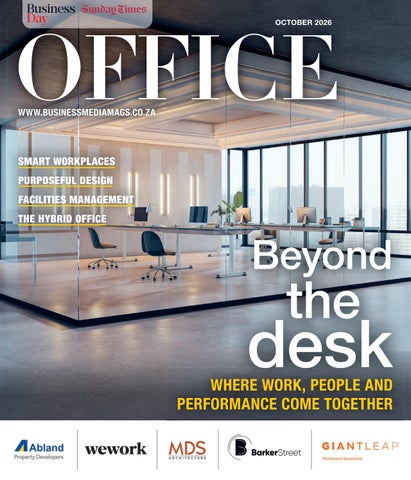
OCTOBER 2026
WWW.BUSINESSMEDIAMAGS.CO.ZA
SMART WORKPLACES PURPOSEFUL DESIGN FACILITIES MANAGEMENT THE HYBRID OFFICE
Beyond
the
desk
WHERE WORK, PEOPLE AND PERFORMANCE COME TOGETHER
OFFICE_Cover final.indd 1
2026/10/01 10:46
ToCheck_DPS.indd 2
2026/09/10 16:41
ToCheck_DPS.indd 3
2026/09/10 16:43
FROM THE EDITOR
THE MODERN WORKPLACE
W
elcome back to Office, a relaunch of an annual publication examining how the workplace is changing and what those changes mean for the people and organisations using it. The modern office can no longer be defined by desks, meeting rooms and technology. It has become a strategic environment where design, culture, wellbeing, technology, sustainability and business performance intersect. As organisations rethink where and how work gets done, the challenge is not simply deciding whether people should be in the office, at home or somewhere in between. It is creating workplaces that give people reason to be there, and provide businesses a return on their investment. In this edition, we unpack how organisations are approaching hybrid working, designing healthier and more engaging environments, using technology to work smarter, managing risk and facilities more effectively, and making sustainability part of workplace planning. Through expert perspectives and real examples, we discover what these choices mean for employee experience, culture and organisational performance. The future of work is not about choosing between the office and remote working. It is about creating places where people can do their best work, and businesses can perform at their best. Itumeleng Mogaki, Editor
CONTENTS 19
FUTURE READY Understanding the principles helping to create workplaces that are more resilient, resource-efficient and ready for a changing business environment.
20 SECURITY
11 22 4 THE NEW OFFICE Organisations are rethinking how workplaces support both people and business performance.
7 PURPOSEFUL DESIGN Thoughtful workplace design can shape how people feel, work and interact.
11 WORKPLACE INNOVATION Meet three organisations taking different approaches to the workplace.
18 SMART WORKPLACES We explore what technologies are genuinely improving the workplace experience.
2
A robust security strategy starts with understanding where the vulnerabilities lie – and building the right protections around them.
FACILITIES MANAGEMENT A successful workplace depends on much more than its design.
24 HYBRID WORKSPACES How can organisations create a hybrid workplace that works for both employees and the business?
PUBLISHED BY
Picasso Headline, A proud division of Arena Holdings (Pty) Ltd, Hill on Empire, 16 Empire Road (cnr Hillside Road), Parktown, Johannesburg, 2193 PO Box 12500, Mill Street, Cape Town, 8010 www.businessmediamags.co.za EDITORIAL Editor: Itumeleng Mogaki Content Manager: Raina Julies rainaj@picasso.co.za Contributors: Trevor Crighton, James Francis, Lynn Grala, Stefano Migliore, Anthony Sharpe Copy Editor: Brenda Bryden Content Co-ordinator: Natasha Maneveldt DESIGN Head of Design: Jayne Macé-Ferguson Senior Designer: Mfundo Archie Ndzo Cover Image: Peshkov/istockphoto.com SALES Project Manager: Merryl Klein merrylk@picasso.co.za Tel: 021 469 2446 I Cell: 082 895 7260 Sales: Anton Klein DIGITAL Online Editor: Stacey Visser vissers@businessmediamags.co.za PRODUCTION Production Editor: Shamiela Brenner Advertising Co-ordinator: Shamiela Brenner Subscriptions and Distribution: Fatima Dramat fatimad@picasso.co.za Printer: CTP Printers, Cape Town MANAGEMENT Management Accountant: Deidre Musha Business Manager: Lodewyk van der Walt General Manager, Magazines: Jocelyne Bayer
27 THE NEW WORKPLACE How hospitality, flexibility and human-centred design are rewriting the role of commercial real estate.
18
COPYRIGHT: Picasso Headline. No portion of this magazine may be reproduced in any form without written consent of the publisher. The publisher is not responsible for unsolicited material. OFFICE is published by Picasso Headline. The opinions expressed are not necessarily those of Picasso Headline. All advertisements/advertorials have been paid for and therefore do not carry any endorsement by the publisher.
OFFICE
02_Ed's note Contents.indd 2
2026/09/30 14:45
ToCheck_fcp.indd 2
2026/09/18 07:40
THE NEW OFFICE
The office is being redefined as organisations balance flexibility, collaboration, employee expectations and business performance, writes ANTHONY SHARPE
W
hen it comes to working trends, we are in what could be termed a post-post-pandemic environment. Most professional jobs can now be performed remotely, so employee expectations have thus shifted, both in terms of where and how they want to be able to work, and what they expect from office spaces. Andre Vermeulen, director of organisation transformation at Deloitte, says that while companies across the board are adopting modern technologies, from internet of things sensors to digital workplace and collaboration platforms, to boost productivity and efficiency, only a small proportion are getting it right. The common Andre Vermeulen denominator among them, he says, is that they are orchestrating their assets deliberately and effectively, one of which is the office. “We need to relook the way the office gets designed,” says Vermeulen. “Open plan is perfect for co-creation, knowledge sharing and experimentation, but it’s not good for jobs that need quiet and concentration.” Vermeulen believes that beyond redesigning physical office spaces, the businesses that are succeeding in this new regime are those redesigning jobs themselves.
4
REDUCING COSTS Overheads are a major consideration for any organisation, and with so many staff working hybrid or remotely, it doesn’t necessarily make sense to maintain large, expensive workplaces. Deloitte’s Andre Vermeulen says the company has sublet two of the six floors in its Waterfall office, which reduces overheads considerably. Vermeulen advocates for a rough ratio of 60 seats to 100 staff under hybrid conditions. “You can make up teams that alternate being in the office on different days, which means you occupy the whole office environment, but never as a whole contingent together.”
“They are acknowledging there are certain roles and tasks that are perfectly suited to work from home, but also certain experience and capabilities that they want employees to bring to a physical location because that knowledge and experience then gets shared and amplified through community.”
HOME BASE While an office may be home base for businesses, one thing that’s changed dramatically in many workplaces is the idea
of a home desk. “The traditional office with family photos on the desk is now quite old-fashioned,” says Vermeulen. He says it’s increasingly common for staff to book hot desks. “It’s first come, first served.” Despite this, however, Scott Thorburn, national asset manager for offices at Redefine, believes many staff still want their own space when they come to work, an area where they can feel familiar and more at home. Thorburn also sees a reduction in the use of flexible workspaces among larger corporates. “Smaller companies subject to significant Scott Thorburn growth or contraction tend to be the main tenants in flexible workspace offices. Larger companies prefer to have their own environments and their own culture.”
THE TALENT IMPACT It’s not just culture that is at stake, however. With competition for talent remaining fierce, workplace design and policies can play a significant role in acquiring and retaining expertise. Thorburn says a hybrid working policy is of great import when hiring staff. “Upfront, this policy details whether or not there is any flexibility, without which you will see fewer respondents to a new post. “However, it will be horses for courses, as companies have decided to reduce their talent pools to ensure they have a staff complement interacting and collaborating face-to-face at work. Those staff members for whom this does not work will move to other companies offering this flexibility,” Thornburn concludes.
Follow: Andre Vermeulen www.deloitte.com/za/en/about/people/profiles.andre-vermeulen+df8e0ab6.html Scott Thorburn www.linkedin.com/in/scott-thorburn-0890aa32
IMAGES: MARC_OSBORNE/ISTOCKPHOTO.COM, SUPPLIED
WHERE WORK WORKS NOW
OF F ICE
04_New Office_1.indd 4
2026/09/29 18:07
ToCheck_fcp.indd 2
2026/09/16 13:53
ToCheck_fcp.indd 9
2026/09/22 11:56
PURPOSEFUL DESIGN
WORTH THE COMMUTE Thoughtful workplace design, wellness-focused environments and user-centred amenities are creating healthier, more engaging spaces that encourage employees to spend time in the office, writes ANTHONY SHARPE
W
here coming into the office was once considered the norm, expectations have shifted considerably post-pandemic, with employees expecting more from the office than just a less convenient alternative to the home workstation, complete with the hassle of commuting. The most successful workplaces are moving beyond amenity-led design and focusing on purpose-led design, says Nkosinathi Manzana, head of real estate services at Standard Bank Group. “Employees are far more likely to come into the office when the space supports activities that are difficult to replicate remotely, such as collaboration, innovation, learning, mentorship and relationship building.” Manzana says the office is evolving from being a place people have to be to a place where they gain value from being present. “Our research consistently shows that connection, culture, collaboration and development opportunities remain among the strongest drivers of voluntary attendance.”
“EMPLOYEES ARE FAR MORE LIKELY TO COME INTO THE OFFICE WHEN THE SPACE SUPPORTS ACTIVITIES THAT ARE DIFFICULT TO REPLICATE REMOTELY, SUCH AS COLLABORATION, INNOVATION, LEARNING, MENTORSHIP AND RELATIONSHIP BUILDING.” – NKOSINATHI MANZANA
CULTIVATING CULTURE While the majority of professional jobs can now be performed from home, it is difficult to foster a sense of company culture among remote employees. This is a critical role for offices, says Manzana. “Physical environments play a critical role in reinforcing both culture and team cohesion. The workplace can provide shared experiences that strengthen trust, relationships and organisational identity. Effective design creates opportunities for spontaneous interaction, mentorship, collaboration and celebration. It can also reflect organisational values through architecture, sustainability initiatives, local identity and community-focused spaces.” Manzana says Standard Bank makes room for spaces to display and celebrate team achievements and reinforce identity. “When people feel connected to both their colleagues and the organisation’s purpose, the workplace becomes a cultural asset rather than simply a functional one.”
UNDERSTANDING OFFICE USE For offices to evolve, companies need more than badge-swipe data. Standard Bank’s Nkosinathi Manzana says combining it with sensor data, room bookings and employee feedback provides a fuller picture, helping organisations understand not just occupancy, but also whether the workplace is delivering better outcomes and experiences.
BEYOND AMENITIES One of the biggest mistakes companies make is trying to entice people back to the office by simply upgrading finishes or adding amenities, without rethinking how the space actually supports the way people work. Faye Simpson This is the view of Faye Simpson, sales and business development director at Giant Leap,
115 West Street, Sandton, Johannesburg.
OF F ICE
07-08_Worth the commute_1.indd 7
7
2026/09/29 18:08
PURPOSEFUL DESIGN
“WHEN PEOPLE CAN MOVE BETWEEN SPACES DESIGNED FOR DIFFERENT TASKS, THE WORKPLACE BECOMES MORE PRODUCTIVE, COMFORTABLE AND EFFECTIVE FOR EVERYONE.” – FAYE SIMPSON
SUSTAINABLE STIMULUS The Green Building Council South Africa (GBCSA) is the authority on sustainable building practices in South Africa. GBCSA CEO Georgina Smit says the council’s Green Star framework has always included elements
Standard Bank, Rosebank, Johannesburg.
DESIGNING FOR DIFFERENCES Neurodiversity and inclusivity are becoming increasingly important in workplace design, says Giant Leap’s Faye Simpson. “As more organisations recognise that a one-size-fits-all approach no longer works, quiet zones, focus rooms, adjustable lighting and varied work settings can create more inclusive, comfortable and productive environments for everyone.”
of indoor environmental quality, which speaks to the health and wellbeing of the building’s users. Smit says: “So theoretically, through the Green Star framework, South Africa has had a definition and a framework of a green building that includes a focus on designing for people. In practice, however, the typical focus from a green building perspective is always on resource efficiency in relation to carbon, energy and water. “Nevertheless, designing comfortable workspaces and office spaces has been shown to improve productivity, impact
Follow: Nkosinathi Manzana www.linkedin.com/in/nkosinathi-manzana-266b0936 Faye Simpson www.linkedin.com/in/faye-simpson-8459237a Georgina Smit www.linkedin.com/in/georgina-smit-0b097916
8
retention rates and decrease sick days,” she explains. “These are typically the indicators that are used to establish a causal link with design features such as better air quality, daylight, access to external views, good acoustic design and good temperature control. When people have control over their environment, that also gives them a feeling of agency and contributes to better productivity.” Then, adds Smit, there are elements that appeal to your senses. “For example, are you designing a staircase from locally sourced timber and as an architectural feature, while also being a meeting spot in the middle of the building so you can meet colleagues on the staircase and have a chat instead of using the lift? Are you including biophilic design elements, which is where you include nature-inspired design elements?”
Georgina Smit
IMAGES: SUPPLIED
who says many offices are still designed around rows of desks, despite employees coming in primarily to collaborate, connect, learn and build relationships. The trick is that different staff expect different experiences, which means thoughtful design is paramount. “One of the biggest challenges in open-plan environments is trying to make a single space support every type of work,” says Simpson. “Acoustics, lighting and zoning need to work together to create choice.” Simpson also says a successful workplace provides clearly defined zones for different activities. “Collaborative areas can be more energetic and social, while quiet zones, focus rooms and enclosed meeting spaces offer environments for concentrated work.” Adds Simpson: “Acoustic treatments such as ceiling baffles, wall panels, soft furnishings, carpets and acoustic screens help reduce noise and improve comfort throughout the space.” She says lighting also plays an important role. “Brighter, more dynamic lighting can support collaboration areas, while softer, task-focused lighting creates a calmer environment for focused work. When people can move between spaces designed for different tasks, the workplace becomes more productive, comfortable and effective for everyone.”
OF F ICE
07-08_Worth the commute_1.indd 8
2026/09/29 18:09
ToCheck_fcp.indd 2
2026/09/29 10:47
WORKPLACE EVOLUTION
DESIGNED FOR PEOPLE, BUILT FOR PERFORMANCE
LYNN GRALA showcases three organisations redefining the workplace through innovative design, technology, sustainability and employee-focused strategies
M
any employees are realising that there is more to work than just receiving a paycheck at the end of the month and working towards a possible promotion in the near future. They are becoming more intentional about the environment in which they choose to work and whether it promotes their mental health and wellbeing. Companies have caught on and recognise that the workplace can no longer be viewed as a place where “work just gets done”, but that investments in the heart of office design can foster greater trust, engagement, collaboration and productivity among employees. When the right design strategies are put in place, not only for aesthetic appeal, but also for employee wellbeing, work not only gets “happily” done, but office morale lifts and productivity increases because employees feel their needs have been considered. Three companies are reaping the rewards of investing in intentional and innovative office spaces.
SANTAM’S PEOPLE-FIRST WORKPLACe Santam, one of South Africa’s largest short-term insurance companies, has won serial awards over the years as one of the country’s top employers. Based on its employee-centred and purpose-driven environments created for its 6 000 employees across 46 locations countrywide, it again ranked second at the Top Employer Institute awards this year. “A central principle of the company has been the understanding that people perform well in different settings,” says Dr Philile Mkhize, Santam’s group chief operating officer. When hybrid working became the new norm in 2020, the company intentionally began phased revamps to modernise its office design from traditional layouts that depicted
“Time in the office is increasingly purposeful, with greater emphasis on teamwork, relationship-building, culture and learning,” explains Dr Mkhize. Santam also invested heavily into audio-visual infrastructure, digital meeting capability and technology-enabled collaboration spaces to ensure virtual meetings, real-time communication and remote teamwork run optimally to facilitate stronger connectivity and collaboration for teams and clients. “The changes have not only enhanced our employee experience, but have also delivered tangible business value, which includes approximately R50.7-million in property and workplace optimisation savings,” says Dr Mkhize. Other notable workplace upgrades include wellness rooms, ergonomic considerations and green building principles such as energy efficiency, water efficiency, waste reduction and occupancy-informed resource planning.
Dr Philile Mkhize
IRIDIUM’S FUN-FIRST WORKPLACE
fixed desks and dedicated workstations and evolved them into more varied and intentional workplace settings to incorporate collaboration zones, breakout spaces, multifunctional canteens, focus rooms, wellness rooms and informal engagement areas.
A crew of 80 millennial tech-loving financial professionals makes up the cloud-based accounting and tax team at Iridium. Their “tech company”-inspired dress code sets the office tone along with the barista-style coffee machine, lunchtime ping-pong and their much-loved popcorn machine.
Santam office space.
OF F ICE
11-12_WORKPLACE EVOLUTION_1.indd 11
11
2026/09/29 18:12
WORKPLACE EVOLUTION “TIME IN THE OFFICE IS INCREASINGLY PURPOSEFUL, WITH GREATER EMPHASIS ON TEAMWORK, RELATIONSHIP-BUILDING, CULTURE AND LEARNING.” – DR PHILILE MKHIZE
“At Iridium, we’ve focused on creating a workplace that people want to enjoy being part of. We want the office to be more than just a place to work; it should be somewhere our team can connect, collaborate and have fun,” explains Peter Magner, sales and marketing director at Iridium Business Solutions. He adds: “The small touches help create a relaxed and social environment.” With a branch in Cape Town and Pretoria, the offices boast a predominantly open-plan layout: “We intentionally limited the number of desks and people per office and chose large desks per person so the offices feel spacious and generous, and encourage a calm environment,” explains Magner. Various offices have been assigned for managers, meeting rooms, and smaller pods for calls or focused conversations. At the heart of the office is the large “Coffee House” space, which is intentionally multifunctional and used for everything from full-team meetings and training sessions to Friday braai lunches and social events to support productivity, connection and culture. As a cloud-based business, Iridium has invested in tech and digital systems such as Xero, Slack, Dext and Karbon that allow its teams to work and collaborate effectively from anywhere, without compromising the service provided to clients.
offices – this includes our CEO. This is a deliberate choice. Our leaders are visible and approachable, and our people are encouraged to work with and learn from one another, regardless of their position,” says Marno Boshoff, head of culture at King Price Insurance. Every meeting room has the technology needed to engage seamlessly with remote colleagues and business partners. Various environments have been designed for different ways of working, such as formal meeting rooms, stand-up spaces for quick discussions,
“pods” for Teams calls or focused work, and communal areas where people can connect more informally. Employees can choose an environment that suits the task rather than forcing every task into the same environment. King Price also places tremendous emphasis on the people who speak and deal directly with its clients and has focused on these teams’ office design and environment. Other notable workplace features include an on-site clinic staffed by a qualified nursing sister and the Moonshot Café, which offers free breakfast for early-bird employees. Each of these companies has put its employees at the core of its office space designs, keeping in mind what needs to be accomplished, how it needs to get done efficiently and that people perform best in a variety of office settings.
KING PRICE’S OPEN-DOOR WORKPLACE King Price office space.
Follow: Dr Philile Mkhize www.linkedin.com/in/philile-mkhize Santam www.linkedin.com/company/santam Marno Boshoff www.linkedin.com/in/marno-boshoff King Price Insurance www.linkedin.com/company/king-price-insurance Peter Magner www.linkedin.com/in/petermagner Iridium Business Solutions www.linkedin.com/company/iridiumbusiness
IMAGES: SUPPLIED
King Price Insurance’s standout culture for its 1 500-plus employees has earned it certification from the Top Employer Institute this year. Its approach to workplace innovation starts with a fairly simple question: “What do our people need to be able to do their best work?” The answer may range from technology and productivity to creativity. “Accessibility is also fundamental to the way we work therefore there are no private
12 OF F ICE
11-12_WORKPLACE EVOLUTION_1.indd 12
2026/09/30 14:39
ToCheck_fcp.indd 2
2026/09/25 09:41
BUILDING HUMAN CENTRED WORKSPACES
T
he definition of the modern office is undergoing a profound, overdue shift. Globally, discussions around workplace design centre on hybrid balance, employee experience and flexible real estate footprints. Yet within South Africa, these conversations carry unique stakes. South African organisations operate in a landscape of stark contrasts, where world-class multinational enterprise thrives in corporate hubs like Sandton, Century City and Umhlanga, while surrounding urban infrastructure faces systemic strain. More critically, the urban workforce travels daily from townships, informal settlements and subeconomic suburbs to enter these modern centres. In this specific context, workplace design cannot merely be a superficial exercise in aesthetic trends. The built environment is a tool for equity, productivity and human dignity. By rethinking how physical space and furniture support people, progressive organisations can transition from passive containers of labour into spaces of empowerment, respect and performance.
THE 100-YEAR CONTINUUM: FROM TAYLORISM TO THE IDEAS AGE To understand the modern workplace, one must trace its psychological evolution over the past century: • 1920s–1940s (Scientific Management and Taylorism): early office layouts mirrored factory assembly lines. Workspaces prioritised strict surveillance, repetitive tasks and spatial hierarchy, treating workers as interchangeable cogs in an industrial machine. • 1960s–1980s (The Information Age): the introduction of computers, cubicles and paper pushing shifted focus towards individual processing. Efficiency was measured by desk presence and task completion, though spatial layouts remained rigid and isolated. • Present day (The Ideas Age): value is driven by creative problem-solving, collaboration and rapid adaptability. Machine execution has been largely automated; human ingenuity, empathy and collective insight are now the true economic drivers.
Throughout this century-long shift, a constant truth has emerged: an organisation’s performance relies on a workforce that is properly equipped, genuinely listened to and visibly valued. In South Africa, where many employees endure long, difficult commutes and challenging living conditions, the physical office must offer relief, functional utility and psychological safety.
THE SOUTH AFRICAN CONTEXT: FROM SERFDOM TO HOSPITALITY Corporate environments can generally be categorised into three operational mindsets: • Obstructive organisations: rigid, outdated setups that actively hinder daily tasks through uncomfortable seating, poor lighting and friction-filled layouts. • Enabling organisations: basic, neutral spaces that provide basic tools, but lack inspiration or intentional support for human wellbeing. • Catalyst organisations: environments designed to elevate human potential, where spatial design and furniture act as active drivers of engagement, health and pride. For catalyst organisations operating in South Africa, the workplace must move away from lingering corporate paternalism towards a
14 OF F ICE
14_15_BARKER TL.indd 14
2026/09/29 18:15
IMAGES: PEOPLEIMAGES/ISTOCKPHOTO.COM, EXTENDED LICENSE/ISTOCKPHOTO.COM
South Africa’s workplace is evolving from a place of productivity into a space designed for dignity, wellbeing and performance, writes BARKER STREET OFFICE FURNITURE
IN PARTNERSHIP WITH BARKER STREET OFFICE FURNITURE
culture of hospitality. When employees enter an office, they should feel like respected guests rather than supervised labour. A hospitality-led workplace acknowledges daily realities. Providing ergonomic seating, quiet focus areas, reliable power infrastructure, clean, comfortable breakout spaces and nutritious hospitality facilities transforms the office into a place of sanctuary. It communicates a simple message: your presence is valued and your comfort matters.
IMAGES: PEOPLEIMAGES/ISTOCKPHOTO.COM, EXTENDED LICENSE/ISTOCKPHOTO.COM
DATA-BACKED MODERN DESIGN: LEESMAN, GALLUP AND MILLERKNOLL INSIGHTS Designing effective flexible and hybrid spaces requires moving past subjective opinions and grounding decisions in global workplace data: • Leesman Index insights: Leesman’s extensive workplace data consistently reveals that while remote work supports individual focus, physical offices excel at connection, social cohesion and brand immersion. However, an office only attracts employees back if its functionality exceeds what they have at home. • Gallup engagement findings: Gallup reports that organisational performance hinges on employee engagement, which is directly tied to feeling supported and having the right tools to work without unnecessary friction. • MillerKnoll research: workplaces designed around flexible, “living office” settings – offering a mix of high-focus havens, casual gathering spots and collaborative hubs – see measurable increases in wellbeing and team problem-solving. For hybrid models in South Africa, static floor plans with fixed desks no longer serve daily operational needs. Spaces must adapt dynamically based on who is present and what work needs to be accomplished.
FOR HYBRID MODELS IN SOUTH AFRICA, STATIC FLOOR PLANS WITH FIXED DESKS NO LONGER SERVE DAILY OPERATIONAL NEEDS. SPACES MUST ADAPT DYNAMICALLY BASED ON WHO IS PRESENT AND WHAT WORK NEEDS TO BE ACCOMPLISHED. ERGONOMICS, CULTURE AND RESPONSIBLE INVESTMENT Ergonomics as an operational priority: physical health is non-negotiable. For a worker navigating a two-hour daily commute on public transit, sitting in a poorly designed task chair for eight hours leads directly to physical strain, fatigue and burnout. Providing high-performance ergonomic task seating, sit-to-stand desks and adjustable monitor arms is a direct investment in cognitive sharpness and long-term health. Ergonomics is not a compliance luxury; it directly reduces fatigue and maintains daily focus. Reflecting culture and attracting talent: the physical environment reflects the company culture. When top talent evaluates an employer, the workspace reveals how the company views its employees. Bright, open, well-designed environments signal egalitarian values and dynamic energy, whereas drab, hyper-segmented spaces signal bureaucracy. Sustainable furniture and responsible investment: responsible workplace planning balances long-term value with environmental stewardship. Sustainability in furniture selection means prioritising: • Circular design principles and high-durability materials that resist early landfill disposal. • Ethically sourced and locally manufactured components that reduce carbon footprint while supporting the local economy.
• Modular configurations that can be reconfigured over time rather than replaced entirely.
DISTINGUISHING ESSENTIAL CHANGE FROM EVOLUTIONARY FINE-TUNING Creating an efficient, people-centric environment does not require an expensive, complete overhaul. Most effective workplace transformations rely on targeted enhancements to existing assets rather than costly structural rebuilds.
THE PATH FORWARD: WORKSPACES AS ENGINES OF EQUITY The future of office design in South Africa lies in intentional, human-centred planning. Backed by four decades of relational expertise partnering with architects, designers, facilities managers and corporate leaders, Barker Street Office Furniture understands that creating an impactful environment requires more than supplying products. When business leaders and spatial strategists collaborate with an experienced local manufacturer to build environments rooted in dignity, efficiency and hospitality, the office becomes far more than real estate overhead. It becomes a catalyst for human capability – a space where every employee, regardless of background, is equipped, respected and empowered to do their best work.
OF F ICE
14_15_BARKER TL.indd 15
15
2026/09/29 18:15
ToCheck_fcp.indd ToCheck_fcp.indd2 2
2026/09/11 2026/09/1117:30 2026/09/30 17:30 14:12
ToCheck_fcp.indd 2
2026/09/11 17:30
SMART WORKPLACES
WHEN TECHNOLOGY WORKS BEHIND THE SCENES Technology is transforming how workplaces operate, creating more efficient, responsive and adaptable environments, writes TREVOR CRIGHTON
“For example, a room-booking platform is far more valuable when it is connected to occupancy data, visitor access, audio-visual systems and building controls because the workplace can respond to how people are actually using it. That might mean automatically releasing unused rooms, adjusting lighting or ventilation based on occupancy, or helping employees find suitable spaces for focused work, collaboration or hybrid meetings.”
INTEGRATED SYSTEMS
“THE BEST SMART WORKPLACES ARE THOSE WHERE TECHNOLOGY BECOMES ALMOST INVISIBLE, IMPROVING PRODUCTIVITY, EMPLOYEE EXPERIENCE, OPERATIONAL EFFICIENCY AND SUSTAINABILITY WITHOUT ADDING COMPLEXITY TO THE USER EXPERIENCE.” – CARLO CECCHI
becomes almost invisible, improving productivity, employee experience, operational efficiency and sustainability without adding complexity to the user experience,” says Cecchi.
WORKSPACE MANAGEMENT Operational solutions manage the workplace itself, such as access control, room booking and building systems, while workflow solutions support employee productivity and collaboration. Cecchi says that these systems increasingly work together to create a seamless user experience.
Follow: Carlo Cecchi
MEETING HYBRID WORKPLACE NEEDS According to Cecchi, connected workplaces must protect workplace and building data through strong cybersecurity, clear governance policies and regulatory compliance, ensuring technology can be trusted while enabling innovation. “As offices become more connected, organisations need to understand what data is being collected, why it is needed, who can access it and how long it is retained. Occupancy and building performance data can be extremely useful, but should be managed carefully, ideally in aggregated or anonymised form where the purpose is to understand space use rather than monitor individuals,” says Cecchi. The real value of a smart workplace lies not in the technology itself, but in how effectively it supports people and the business. When connected systems work seamlessly behind the scenes, workplaces become more responsive, efficient and adaptable to changing needs.
www.linkedin.com/in/carlo-cecchi-0815254
IMAGES: ZHUDIFENG/ISTOCKPHOTO.COM, SUPPLIED
D
igital innovation isn’t limited to the tools we use at work; it’s changing how physical workplaces operate, creating more connected, efficient and responsive office environments. Workplace technology expert Uain Boswell says a truly smart workplace is less about having lots of disconnected technologies and more about creating a joined-up operational ecosystem where systems can communicate with each other intelligently. “In a larger organisation, that usually starts with the environment itself becoming connected. You would typically see internet of things sensor networks throughout the building monitoring things like lighting, air conditioning, temperature, noise levels, air quality, occupancy and desk utilisation,” says Boswell. “All of that data then feeds back into an integrated building management system (BMS), which helps automate and optimise how the space operates.” Carlo Cecchi, WSP Africa’s discipline lead for connected building technology, says a smart office connects workplace, building and digital systems to improve employee and occupant experiences, operational efficiency and sustainability. “Large organisations focus on enterprise-wide integration, while smaller offices prioritise cost-effective solutions that deliver practical business benefits. Ultimately, the best smart workplaces are those where technology
The distinction between workflow solutions and the tools people use daily at their desks to supplement their performance and help their teams is becoming less and less rigid as platforms and solutions increasingly integrate. “Organisations are looking to create context-aware environments. For example, an AI assistant that generates meeting transcripts and summaries could recognise that a meeting takes place every Wednesday and automatically schedule and book a room based on this pattern. Workflow systems and automation triggered by visitor arrivals are another example,” says Boswell.
18 OF F ICE
18_Smarter workplace_1.indd 18
2026/09/29 18:16
FUTURE READY
SUSTAINABLE WORKPLACES BUILT FOR TOMORROW Sustainable workplaces improve wellbeing, efficiency and resilience, writes TREVOR CRIGHTON
S
ustainable office design in South Africa has historically largely been driven by environmental, social and governance (ESG) commitments and compliance requirements. While these remain important drivers, the conversation is increasingly expanding to include occupant wellbeing, resilience and long-term workplace performance. “In South Africa, factors such as energy security, water scarcity and changing employee expectations are encouraging organisations to look beyond compliance and focus on creating workplaces that are healthier, more productive and better equipped to respond to future challenges,” explains Hlologelo Manthose, sustainability discipline lead at WSP Africa. “This shift can be seen in the growing interest in frameworks such as WELL Certification, which place occupant health and wellbeing at the centre of workplace design. Increasingly, organisations are recognising that sustainability is not only about reducing environmental impacts, but also about creating workplaces that support people, improve operational resilience and deliver long-term business value,” says Manthose.
IMAGES: AMA ARCHITECTS, SUPPLIED
FITTER, HEALTHIER, MORE PRODUCTIVE Manthose says sustainable workplace design delivers benefits beyond reducing Hlologelo Manthose environmental impact through responsible material selection, efficient resource use and circular design principles, creating healthier, more comfortable and productive environments for the people who use the space every day. “Importantly, sustainable workplace design is no longer just about environmental responsibility. It is increasingly being recognised to future-proof assets, respond to
changing employee expectations and build resilience to challenges such as rising utility costs, resource constraints and climate-related risks,” she says.
SUSTAINABILITY TRENDS
SUSTAINABILITY THAT SUPPORTS COMPLIANCE Workplace sustainability supports ESG objectives, regulatory compliance and long-term organisational resilience by creating workplaces that perform better for people, the environment and the business. Manthose says that through measures such as energy-efficient design, renewable energy, water conservation and waste reduction, organisations can reduce resource consumption while contributing to key ESG objectives.
Key trends in South African workplaces include smart building management systems that optimise energy use in real-time, solar photovoltaic and battery storage solutions that improve energy security and advanced monitoring platforms that provide greater visibility of energy and water performance. “We’re also seeing growing investment in water resilience measures such as rainwater harvesting, greywater recycling and intelligent leak detection systems. Digital tools are also being used to track Towers Main (formerly known as Absa Towers Main) – Johannesburg, waste streams, monitor designed by AMA Architects in collaboration with WSP Africa. material performance and support life-cycle assessments, helping organisations “These same strategies also help make more informed decisions organisations respond to evolving regulations, about the products and materials reporting requirements and investor they specify,” says Manthose. expectations. Beyond compliance, however, She finds it interesting they strengthen resilience by reducing exposure that many organisations’ to challenges such as rising utility costs, energy goal is no longer just insecurity, water scarcity and climate-related to create greener risks,” she says. buildings, but also to She concludes: “In the South African context, deliver workplaces that workplace sustainability is increasingly being perform better for both recognised not just as a compliance exercise, people and business. but as a way of creating healthier, more “A good example is Johannesburg’s efficient and future-ready workplaces that can Towers Main, a 1970s high-rise refurbished adapt to changing environmental, economic into a mixed-use development, with WSP and occupant needs while delivering long-term providing engineering and sustainable building business value.” consultancy services,” says Manthose.
Follow: Hlologelo Manthose
www.linkedin.com/in/hlologelo-manthose-52582674
OF F ICE
19_Sustainable workplace_2.indd 19
19
2026/09/29 18:18
WORKPLACE SECURITY
ONE RISK, TWO FRONTS Physical and digital threats are increasingly connected. Building a more resilient workplace starts with understanding where those risks overlap. By JAMES FRANCIS
HOW TO STRENGTHEN OVERALL SECURITY Companies can tackle digital and physical security by approaching them as business risk and resilience concerns. Start by creating an inventory of what you have, says Brandon Muller, technical expert and consultant at security vendor Kaspersky. “The first thing is inventory, knowing what devices, applications, databases, whatever you may have. Now we can classify. What are these assets? What matters most? Then you start planning and define the right approaches, such as detecting and responding, and look at policies and awareness, such as training.” This step has several useful staging points.
Digital security teams can scan the network for devices, and physical security teams can update their inventory records. These should be regular exercises, not one-off events. Using the inventory, assess risk levels. Define a baseline level of protection: what is the minimum requirement? For example, POPIA requires taking “appropriate, reasonable technical and organisational measures” to protect personal information.
COMPANIES CAN TACKLE DIGITAL AND PHYSICAL SECURITY BY APPROACHING THEM AS BUSINESS RISK AND RESILIENCE CONCERNS. Would the protection around your visitor register qualify? Is it password-protected or encrypted? Who can access it? Can you track and audit access? Additionally, ensure employees are trained in data security policies, writes law firm CMS. Next, consider necessary and achievable protection. Perhaps a cloud-based visitor register is better than a spreadsheet. Then, implement changes, including ways to measure its performance.
Measurement can include access log reviews and spot checks of reception points. Additionally, CBRE recommends a company use badge swipes, Wi-Fi usage, footfall counters and security camera analytics to check how many people enter and exit, comparing that information with the register.
Brandon Muller
COLLABORATION IS CRUCIAL Digital and physical security teams should work together, creating overlaps that layer to galvanise their efforts. However, these areas won’t naturally coalesce, which is why workplace security must come from business leadership. It’s absolutely crucial that business leaders set these expectations as policy and cultural priorities, says Muller. “As a business owner, consider business continuity that goes into all avenues. It is whether you can keep operating after something happens.” Treat digital and security threats as core disruption scenarios for business continuity. Critically, formulate disaster recovery plans (including communication channels, responsible parties and mitigation measures) that are periodically tested and adjusted. “There needs to be a plan for what happens when something goes wrong,” says Mc Loughlin. Bring different security teams together, take inventory, assess relative risks (including regulatory), weigh the impact and cost of baseline mitigations (such as enhanced systems, policies and staff training), then measure, test and adapt. This is the path to creating resilient workplace security.
Follow: John Mc Loughlin www.linkedin.com/in/j2johnmcloughlin Brandon Muller www.linkedin.com/in/bmullercs
IMAGES: GORODENKOFF/ISTOCKPHOTO.COM, SUPPLIED
T
he nine-to-five has changed. Businesses face both digital and physical security risks, from data theft to premises breaches. Yet, most organisations still treat these as separate domains, a habit that weakens their overall security measures. “The important thing is that businesses stop treating physical and cyber risk as completely separate risks,” says John Mc Loughlin, group CEO and sales director of UK-based cybersecurity provider J2. In fact, digital security concerns start the minute someone walks through the front entrance. The Protection of Personal Information Act (POPIA) treats most security data, from access card logs to visitor registers, as personal information, imposing strict control and maintenance conditions. In addition, the Cybercrimes Act has a clear physical component. For example, a physical breach that enables a cyberoffence can fall under that act’s jurisdiction.
John Mc Loughlin
20 OF F ICE
20_SECURITY_1.indd 20
2026/09/29 18:22
IN PARTNERSHIP WITH GALLAGHER SECURITY
SECURITY NOW ANCHORS THE INTELLIGENT COMMERCIAL BUILDING For landlords and developers, this is increasingly a commercial differentiator. Buildings that provide seamless experiences are better positioned to attract and retain tenants. At the same time, property owners are seeking new ways to improve operational performance. looking to security technologies to improve Integrated security platforms are enabling tenant experience, increase operational greater visibility by connecting access efficiency and support long-term control, visitor management, asset value. parking systems, elevators, video surveillance, time and A PEOPLE-CENTRIC APPROACH attendance systems, and A decade ago, a smart other building technologies building was typically through a single platform. defined by automation The result is stronger technologies such as security, paired with intelligent lighting or improved efficiency and energy management streamlined operations, as systems. Today, intelligence well as valuable insight into is measured by how Tarryn Fortune how people use buildings. effectively a building responds The growth of connected to the people who use it. environments also highlights another emerging priority: cyber-physical security. Organisations must ensure that both BUILDINGS THAT ARE SECURE, digital systems and physical infrastructure ADAPTABLE AND CENTRED are protected. The convergence of cyber and physical security is becoming a key ON HUMAN EXPERIENCE consideration for commercial property owners WILL DEFINE THE FUTURE OF looking to future-proof their investments. Buildings that are secure, adaptable and COMMERCIAL PROPERTY. centred on human experience will define the future of commercial property, and that’s exactly what we advocate for at Gallagher Security. Occupants expect seamless and intuitive Security is the platform that makes this experiences. Whether arriving at a car park, possible. When integrated effectively, it enables entering a building, calling an elevator or frictionless access, connected experiences, accessing a workspace, technology should and smarter operations while helping property work quietly in the background while delivering owners create secure, efficient environments a frictionless journey – from street to seat. that people genuinely want to work in and visit. This creates an opportunity for modern security platforms to contribute far more than protection. Technologies such as mobile credentials, digital identity management and integrated access control are helping to remove friction from daily interactions while maintaining high levels of security. The growing adoption of mobile wallets has accelerated these expectations, with many users now expecting building access to be as simple and intuitive as accessing a boarding pass or making a digital payment.
Commercial properties across Africa are undergoing a significant transformation, writes TARRYN FORTUNE, sales manager – South Africa, Gallagher Security
T
raditionally, the desirability of a commercial building was measured by factors such as location, design and tenant mix. Today, tenants and investors judge building owners on something much broader, weighing the quality of the experience they create, the efficiency of their operations, their ability to adapt to change and the value they deliver to occupants. As hybrid working reshapes office utilisation, tenant expectations continue to rise, sustainability targets become increasingly ambitious, and property owners are under growing pressure to create secure, future-ready environments.
Images: Supplied
Images: Supplied
SECURITY IS THE FOUNDATION As buildings become more connected and digitally enabled, every interaction relies on trusted infrastructure. As a result, the role of security is becoming a strategic foundation for an intelligent building. Access control, identity management and visitor systems now sit at the centre of how people move through and interact with a building. Protection and risk management are even more critical. Without secure foundations, the promise of intelligent buildings quickly becomes fragile. Around the world, leading commercial developments are adopting a new mindset. Rather than viewing security as a compliance requirement, property owners are increasingly
Follow: Tarryn Fortune www.linkedin.com/in/tarryn-fortune-0b04a06a Gallagher Security www.security.gallagher.com
OF F ICE
Gallagher Security_FCP Advertorial.indd 21
21
2026/09/29 14:25
FACILITIES MANAGEMENT
THE ENGINE BEHIND A BETTER WORKPLACE From maintenance and hygiene to energy, data and employee wellbeing, facilities management is becoming a strategic function that keeps workplaces safe, efficient, sustainable and ready for business, writes ITUMELENG MOGAKI
M
odern workplaces rely on a range of services, from cleaning and hygiene to ventilation, maintenance, waste, catering and energy management, to keep them safe, comfortable and productive. As expectations around wellbeing, sustainability and workplace experience grow, facilities management is becoming more strategic, with technology and data helping businesses anticipate problems rather than simply react to them.
– AUBREY McELNEA
“Smart building systems, sensors, occupancy data and digital platforms can help organisations clean according to demand, manage energy more intelligently, identify maintenance issues earlier and deploy resources more efficiently. “The value comes from what you do with the information,” Otto says. “The focus”, he adds, “should be on measurable outcomes, such as cleaner environments, fewer incidents, lower consumption and reduced equipment downtime.”
MORE THAN MAINTENANCE For Aubrey McElnea, CEO of Tsebo Facilities Solutions, facilities management should be viewed as a strategic business function rather than simply a service focused on cleaning. Preventive maintenance, health and safety, hygiene, indoor air quality, reliable infrastructure and comfortable working conditions remain essential. However, businesses should also understand how
Nomonde Radebe
employees experience and use their workplaces, identifying problems before they affect productivity. “The physical workplace sends a powerful message about how much an organisation values its staff and stakeholders,” he says. “Technology is helping facilities teams become more proactive, with data supporting better management of energy, occupancy, maintenance and resources. The result is a workplace where employees can focus on their work rather than dealing with avoidable problems,” says McElnea.
MANAGING FOR OUTCOMES Adriaan Otto, managing director of Excellerate Services, says the biggest opportunity lies in bringing different facilities services together and managing them around workplace outcomes. “Consistent standards, preventative maintenance and strong oversight remain important, while data provides greater visibility into what is happening across a building.
DATA CHANGES THE GAME At Growthpoint Properties, Christiaan Meyer, national facilities manager (commercial), says facilities management is shifting from a reactive maintenance function to a strategic enabler. “Regular inspections, risk assessments, preventative maintenance and integrated systems help identify problems before they become incidents. Data from building management systems, internet of things sensors and other platforms can also reveal opportunities to improve efficiency, reduce consumption and support environmental goals,” says Meyer. Looking ahead, Meyer expects artificial intelligence and digital twins to enable predictive maintenance, better space management and faster decision-making. “The shift also has implications for the choice between in-house and outsourced teams. The model matters less than having the right expertise, systems and accountability in place,” says Meyer. At its core, effective facilities management is about creating workplaces that perform for both people and business. Workplaces that are safe, healthy, efficient and sustainable, and remain adaptable as needs change.
IMAGES: SUPPLIED
GETTING THE BASICS RIGHT Nomonde Radebe, CEO of Smondz Sustainability Solutions, says effective facilities management starts with the following fundamentals: safety, preventive maintenance, housekeeping and clear emergency procedures. “In addition, indoor air quality, lighting, noise and thermal comfort affect employee wellbeing and productivity.” Waste management, she adds, should be viewed as more than disposal. “Separating, recovering and responsibly managing waste can improve hygiene, reduce environmental risks and support sustainability goals. “Facilities management is the operational backbone that keeps workplaces safe, efficient and environmentally responsible,” Radebe says. “This means facilities teams need to look at the workplace as a whole, from the quality of the air employees breathe to the way water, energy and waste are managed.”
“THE PHYSICAL WORKPLACE SENDS A POWERFUL MESSAGE ABOUT HOW MUCH AN ORGANISATION VALUES ITS STAFF AND STAKEHOLDERS.”
Follow: Nomonde Radebe www.linkedin.com/in/nomonde-radebe-70409667 Aubrey McElnea www.linkedin.com/in/aubrey-mcelnea-ceo Adriaan Otto www.linkedin.com/in/adriaan-otto-1a53aa91 Christiaan Meyer www.linkedin.com/in/christiaan-meyer-b7717922
22 OF F ICE
22_FACILITIES Management_1.indd 22
2026/09/29 18:22
Untitled-1 1
2026/04/28 16:02
BEYOND THE OFFICE
W
hen are hybrid and remote work appropriate, and what do they need to succeed? For centuries, work belonged to the workplace. However, as digital technology and connectivity expanded, a counterview emerged. Work could be hybrid or remote. Then the 2020 pandemic’s lockdowns gave these ideas their time to shine.
EVERY COMPANY IS HYBRID According to Pnet’s July 2026 Job Market Trends Report, job posts featuring remote work increased 28 per cent in 2026, and such roles are 41 per cent more common than two years ago. The shift is even more obvious if one considers every company hybrid. “In the past few months, every meeting I attended had a hybrid component to it or the potential to have one,” says Nevo Hadas, partner at digital transformation practice DYDX.
“Meetings now frequently mix physical and virtual attendees, often being entirely virtual even if they are in the same building. Hopping onto a Teams call or exchanging thoughts on Slack has become second nature.” Howeverk hybrid and remote work are still distinct concepts. While some focus on whether these are good or bad, the answer is subjective and nuanced. “There is enough research to support both the upside and downside of every work-type model,” says Phillipa Geard, CEO of RecruitMyMom. “Success is all about how the team is designed, clear and defined outcomes and the ability of the middle managers appointed to lead the team.” Wendy Spalding, managing director of Tuesday Consulting, which recruits executives for businesses, says it depends heavily on a company’s leadership style and priorities.
“MEETINGS NOW FREQUENTLY MIX PHYSICAL AND VIRTUAL ATTENDEES, OFTEN BEING ENTIRELY VIRTUAL EVEN IF THEY ARE IN THE SAME BUILDING.” – NEVO HADAS
“It is very much determined by the leader and what they’re trying to get out of the business. If a business is mature, stable and performing, there’s less of a risk around hybrid work. If a business is in large-scale change or underperforming, it requires leaders to be visible. That’s when we tend to see organisations calling people back to the office,” says Spalding. Some sectors, like manufacturing and retail, don’t fit as well with hybrid and remote work, while knowledge work such as legal, IT or business services is much better suited. Most of the remote vacancies in Pnet’s data are for technology jobs.
DRIVEN BY PEOPLE AND WORKFLOWS “One can define hybrid working around physical components, such as software or locations. Would desk swapping be best? Do employees need new routers or access to satellite offices? The answers depend on what a business needs and how it adapts. First, take a step back and look at how work happens,” says Hadas.
IMAGES: EXPLORA_2005.COM, KATARZYNABIALASIEWICZ.COM, ALBERTO VAN HERCKENRODE.COM SUPPLIED
Hybrid work is no longer about choosing between home and the office. It is about designing a workplace that supports productivity, collaboration, culture and business performance, wherever work happens, writes JAMES FRANCIS
Nevo Hadas
24 OF F ICE
24-25_Hybrid workplace.indd 24
2026/09/29 18:41
HYBRID WORK
IMAGES: EXPLORA_2005.COM, KATARZYNABIALASIEWICZ.COM, ALBERTO VAN HERCKENRODE.COM SUPPLIED
Wendy Spalding
“You want to be human-centred. It’s a mistake to always take an engineering mindset and break it down to simple steps like an engineer would. We take a human-centred approach. You understand what people are thinking and feeling as they’re doing steps. That often changes the way to do things. You’re designing processes for people, not for systems. “Focusing on creating Phillipa Geard workflows that will help people will reveal requirements for other areas. For example, someone who frequently accesses or uploads large files will need good internet. Someone with distractions, such as small children, might need a desk at a satellite office or co-working space. Workflows also reveal bottlenecks (employees overloaded by email could use an alternative) and point to policy considerations (appropriate limits and reasons for interactions outside of business hours),” says Hadas. “Hybrid often performs better where collaboration, innovation and early-career development are central to success. The trade-off is that these benefits only appear if hybrid is carefully designed. Poorly designed hybrid teams produce both remote and office downsides,” says Geard.
She adds: “Looking at how people get things done is also a good way to tackle one of hybrid/remote working’s thorniest issues: company culture. While hybrid often makes workplaces more productive, it’s a tougher task to maintain the company’s culture and camaraderie. However, returning everyone to the office isn’t an automatic fix. Even culture issues should be open to adjustment and met with suitable strategies.” “When we onboard new people, we request that they be in the office full time, for at least the first two months,” says Spalding, where employees work in-office three days of the week. “Onboarding, transferring knowledge and culture are incredibly important to us.”
“IF A BUSINESS IS MATURE, STABLE AND PERFORMING, THERE’S LESS OF A RISK AROUND HYBRID WORK. IF A BUSINESS IS IN LARGE-SCALE CHANGE OR UNDERPERFORMING, IT REQUIRES LEADERS TO BE VISIBLE.” – WENDY SPALDING
For Spalding, companies should also consider appropriate infrastructure. “Routers, laptops, internet access, and so on, and a reliable IT partner is invaluable for these choices. “We work with a very good IT provider who helped set us up. We have all the necessary security measures in place. We also provide a data allowance to our staff monthly so they can cover some of the costs of working remotely. And, our policy states that if you don’t have the correct infrastructure, quiet professional space, connectivity, and so on, then you should come into the office,” says Spalding. As the experts suggest, making hybrid work requires more than choosing where people work. It means aligning leadership, culture, workflows and technology around the needs of the business and its people.
POWERED BY TECHNOLOGY “Guided by culture and workflows, companies can look at physical changes. Whether a company is remote, hybrid or in-office, it will need suitable software, such as asynchronous messaging, online meetings and shared documents and storage,” says Hadas, adding, “whiteboard software is very useful for them.”
Follow: Nevo Hadas www.linkedin.com/in/nevohadas Phillipa Geard www.linkedin.com/in/phillipa-geard Wendy Spalding www.linkedin.com/in/wendyspalding
OF F ICE
24-25_Hybrid workplace.indd 25
25
2026/09/29 18:42
ToCheck_fcp.indd 2
2026/04/21 11:29
THE NEW WORKPLACE
WHY OFFICES MUST BECOME
MORE HOSPITABLE STEFANO MIGLIORE, CEO of WeWork South Africa, explores how hospitality, flexibility and human-centred design are rewriting the role of commercial real estate
B
IMAGES: SUPPLIED
efore 2020, real estate futurist Antony Slumbers predicted that commercial real estate would shift from selling a product to delivering a service. People would no longer necessarily need an office to work, while landlords and companies would be expected to provide spaces that were hospitable, not simply functional. At the time, I couldn’t imagine it; today, I’m helping rewrite it. On paper, I’m the CEO of WeWork South Africa. In reality, however, my work is coffee, Wi-Fi, wellness and people. Why? Because commercial real estate has changed. A tenant is no longer simply a tenant; they are a guest. A landlord is no longer simply a landlord; they are a concierge of an office worker’s needs. South African businesses have outgrown the idea that work is simply a place we must go to. The building hasn’t disappeared, but what we expect it to do has fundamentally changed. Increasingly, workplaces are being shaped by the principles of hospitality – creating environments that respond to the needs and experiences of the people who use them. Even Wi-Fi has become part of that experience. If the Wi-Fi in a flexible workspace doesn’t work, the office member
They experience the workplace at a functional, human level and judge it by whether their day was productive. Slumbers predicted that the office company of the future would need to combine real estate, technology, workplace, HR and hospitality. He was right. Real estate and hospitality aren’t competing disciplines, and separating them misses the point. With the future of work increasingly shaped by flexible workspaces, health-oriented design and greater tenant control, employers are not only competing with the flexibility of home. They are competing for talent by creating offices people have a reason to choose, stay in and enjoy. The modern workplace needs to be hospitable, but we must understand what hospitality means in a work context. It isn’t a happy hour or a 9am aquarobics class. It is about supercharging the purpose of the office – enabling people to perform at their best. It is about function, design and human fulfilment coexisting within the same ecosystem.
BEYOND COFFEE
Stefano Migliore
doesn’t experience it simply as an IT problem, but as a failure of the service they have come to expect.
THE WHOLE WORKPLACE EXPERIENCE Think of the workplace like a hotel. Behind the scenes is the real estate operation, while out front the guest experiences hospitality. The same applies to flexible real estate. Flexible real estate needs the front of house and the back of house to create the new office heritage. The guest doesn’t experience all the functions taking place behind the scenes.
COMMERCIAL REAL ESTATE HAS CHANGED. A TENANT IS NO LONGER SIMPLY A TENANT; THEY ARE A GUEST. A LANDLORD IS NO LONGER SIMPLY A LANDLORD; THEY ARE A CONCIERGE OF AN OFFICE WORKER’S NEEDS.
The coffee we serve at WeWork is a good example. We aren’t simply serving coffee; we are creating a coffee experience that complements the workday. This includes exclusively sourced specialty organic beans, premium automatic coffee machines on every floor and full-service coffee stations with purpose-trained baristas who know members’ orders personally. So why not open a coffee bistro instead? Great question. I have. It’s called WeWork. WeWork is the coffee bistro. It is the Wi-Fi store, concierge service, interior designer and flexible workspace. This is what employers and commercial real estate need to understand about the shift. Real estate is not the bricks or the contract; it is the bounty that results from every moving part. It is where talent gets to express its full potential.
A NEW OFFICE HERITAGE I don’t believe we’ve seen the last of the traditional office. The new office heritage sees flexible workspace sitting alongside traditional commercial property, not as a disruptor, but as an enabler of customers and suppliers – and a healthy competitor too. For me, the hope in this rewrite is that the office will not be judged solely by its flexible space, square metreage or the length of the lease. It should be judged by its capacity for human-centred design to enable connection and productivity.
OF F ICE
27_WeWork TL.indd 27
27
2026/09/29 18:43
IN PARTNERSHIP WITH WEWORK SOUTH AFRICA
CHANGING HOW THE WORLD WORKS Observed as a breakthrough business that broke the mould, then the bank, then records, WeWork South Africa is changing the face of coworking real estate, writes STEFANO MIGLIORE, CEO of WeWork South Africa often about answering a call for go-to affordable desk space. Today, businesses are no longer asking, how much space do we need, and what will it cost? Now, it’s more about what does this space say about our culture, and will it enable our talent to do their best work?
BEYOND CO-WORKING: THE FUTURE OF WORK IS HUMAN
28
ABOUT WEWORK WeWork is a leading global flexible space provider, offering businesses of all sizes the solutions they need to thrive in a new world of work. In addition to its flagship South African locations in Sandton, Rosebank and Cape Town, WeWork provides a global footprint of 2 000 locations across 37 countries, offering beautiful, functional spaces designed to foster productivity and community wherever work happens. Since entering the South African market, WeWork South Africa has played a defining role in reshaping the country’s flexible workspace landscape. The business has helped shift coworking from a niche offering typically found in smaller spaces and lower-grade buildings to a premium workplace solution located in some of the country’s most prestigious commercial developments.
SOUTH AFRICA, AS A GLOBAL PLAYER While South Africa’s flexible workspaces currently represent only around one per cent of the country’s commercial office stock, according to Research and Markets’ Middle East and Africa Coworking Space Market Outlook 2030, by bringing an internationally recognised flexible workspace model to South Africa, WeWork South Africa is helping elevate expectations around quality, location and the role of shared workspaces in the broader commercial property market.
VISIT WEBSITE
SCAN TO GO TO THE WEWORK SOUTH AFRICA WEBSITE
For more info on WeWork South Africa, visit : www.wework.co.za
Images: Supplied
S
ince arriving in South Africa during 2020 – that COVID year – WeWork South Africa has rapidly and steadily moved through changing landscapes. Not only from a worldwide pandemic, but from the unforeseen adversity stemming from WeWork’s (Global) Chapter 11 process. Despite the tremors radiating from its mother ship in the United States in 2023, WeWork South Africa remained independent and steadfast. The company emerged with a renewed conviction that it was never in the game of growing office space, but of growing something far more valuable to the global economy – human potential. This realisation became the defining philosophy of WeWork’s purpose-driven culture, which would resculpt the future of work itself. Now hailed as TIME Magazine’s Top 100 Influential Companies (2026) for masterfully achieving a global turnaround, WeWork is reshaping the world of work as we know it. As one of Africa’s pioneering flexible spaces, WeWork South Africa is rapidly expanding and recognising that coworking was only ever just one part of the bigger picture. This is no longer a coworking story; it’s about human potential and the evolution of work itself. The early coworking narrative was
With flexible and serviced workspaces that emphasise human potential and connection, WeWork South Africa is proudly flagging this paradigm shift in an otherwise antiquated system of office real estate. Our members share spaces with start-ups, corporates, creatives and entrepreneurs from entirely different sectors. That kind of cross-pollination – like the unexpected conversation, the referral, the collaboration that nobody planned – is something a monoculture office simply cannot offer. Currently, 4 600 people, across 400-plus enterprises of all sizes, call WeWork South Africa home – a testament that our team must be doing something right. We’re rewriting the rules of the co-working playbook. We’re making space for South Africa’s working cohort to feel like they belong to a space, not to a desk or a lease.
However, South Africa has its own unique cultural fabric that sets it apart from any global association. There is something distinctly South African that evidently remains in the next chapter of work: the idea that South Africans have inherently learnt to build, adapt and compete in circumstances that aren’t always easy. This makes our working culture inherently hard-won, humble and inclusive. To sum it up, borrowing the now-famous line from UFC champion Dricus du Plessis: “Hulle weet nie wat ons weet nie.” And, every South African business out there may just agree.
OFFICE
WeWork_FCP Advertorial.indd 28
2026/09/29 14:29
ToCheck_fcp.indd 2
2026/09/18 12:48
Untitled-1 1
2026/06/18 17:41