SLOWER JOURNEYS,
inter has a way of changing how we travel. The world feels quieter, the landscapes more cinematic, and even familiar places take on a softer, more re ective rhythm. It’s a season that invites us to slow down – whether that means lingering a little longer over a reside meal, taking the scenic route through misty mountain passes, or discovering the kind of destinations that feel best when wrapped in a blanket of cold air and warm moments.
In this issue of High-Flyers, we explore that spirit of seasonal travel across Mzansi and beyond. From the crisp beauty of the Free State and the creative charm of Clarens, to the vast, dramatic landscapes of the Northern Cape, we lean into places where space, silence and scenery do most of the storytelling.
Along the way we meet the individuals and stories that shape our world – from the calm authority of Ronwen Williams between the posts, to the avours and cultural moments that remind us travel isn’t only about distance, but also discovery.
This is winter travel, reimagined: not fast, not eeting – but deeply felt.
,
A proud division of Arena Holdings (Pty) Ltd, Hill on Empire, 16 Empire Road (cnr Hillside Road), Parktown, Johannesburg, 2193 PO Box 12500, Mill Street, Cape Town, 8010 www.businessmediamags.co.za
EDITORIAL
Content Manager: Raina Julies rainaj@picasso.co.za
Contributors: Keith Bain, Herman Gibbs
Copy Editor: Brenda Bryden
Content Co-ordinator: Natasha Maneveldt
DIGITAL
Online Editor: Stacey Visser vissers@businessmediamags.co.za
DESIGN
Head of Design: Jayne Macé-Ferguson
Senior Designer: Mfundo Archie Ndzo
Cover images: City Sightseeing, Mamelodi Sundowns FC
SALES
Sales Manager: Richard White
Tel: +27 83 229 4040
Email: RichardW@picasso.co.za
Sales: Stephen Crawford, Gavin Payne
PRODUCTION
Production Editor: Shamiela Brenner
Advertising Co-ordinator: Johan Labuschagne
Subscriptions and Distribution:
Fatima Dramat fatimad@picasso.co.za
Printer: CTP Printers, Cape Town
MANAGEMENT
Management Accountant: Deidre Musha
Business Manager: Lodewyk van der Walt General Manager, Magazines: Jocelyne Bayer
COPYRIGHT: Picasso Headline. No portion of this magazine may be reproduced in any form without written consent of the publisher. The publisher is not responsible for unsolicited material. HIGH-FLYERS is published by Picasso Headline. The opinions expressed are not necessarily those of Picasso Headline. All advertisements/advertorials have been paid for and therefore do not carry any endorsement by the publisher
Picasso Headline
THE ULTIMATE
In the world of football, goalkeepers are often the flamboyant, brash personalities commanding attention both on and off the pitch. However, Mamelodi Sundowns and the Bafana Bafana World Cup-bound captain, Ronwen Williams, who chats to HERMAN GIBBS, defies this stereotype
Mindset and psychology
How do you maintain focus during long periods of inactivity when your team is dominating possession?
I’ve learned to stay involved in the game. Obviously, we’re a team that has a lot of possession, so it is key for me to stay active during the boulder play. When we are defending, when we are attacking, always making sure my rest defence is okay, that I’m communicating with my defence. You’ll always see me speaking to the attackers, too. We must place them where they can move, because I’ve got the best picture of the eld.
What is your process for resetting mentally after making a costly mistake?
Obviously, as a goalkeeper, once you make a mistake, you know it’s a costly one, and the ball is in the back of your net. But over the years, I’ve learned to focus on the next action. Be it a good one, a bad one, or a mistake, I always try to focus on the next action.
Do you have specific pre-game rituals or superstitions that help you enter the “zone”?
I don’t have any rituals or superstitions. I try to stay in the zone. Obviously, I speak to my family before the game.
After nishing the call, I get into the zone and focus completely on the game. When I walk onto the eld, once I cross the white line, I look to the sky and obviously dedicate the game to all the family members and friends that I’ve lost. So I’ll mention all their names, looking up to the sky.
How do you deal with the intense mental pressure when facing a penalty kick?
I feel no pressure when facing a penalty kicker. I think the pressure lies more on the kicker. Goalkeepers don’t tend to get nervous. But I think the most important thing is to do your homework, to study. In this way, you ensure you are prepared, putting all the pressure on the kicker to get into his head.
Technical and tactical
What key technical differences in training do you focus on to prepare for high-pressing opponents?
On a day-to-day basis, we work with a goalkeeper coach to perfect our craft. Leading up to the game, we’ll do a lot of reaction saves. We’ll do plenty of passing drills as well. We try to incorporate everything that will happen in the match.
Advice to future generations
What is the biggest mistake you see young goalkeepers making? The biggest mistake I see goalkeepers make is trying to chase the game – always wanting to be involved, going out when they’re not supposed to.
How crucial is “hard work” compared to “talent” for a goalkeeper?
Hard work will always outlast talent. Talent can only carry you so much. It will get you in the door, but hard work will improve your consistency. Hard work will take your talent to even greater heights. So, I think hard work is the most important ingredient that a professional footballer can have.
How has the role of the modern goalkeeper changed in terms of playing out from the back with your feet?
Goalkeeping has changed a lot over the last few years. Goalkeepers have become so important in the game. They’re the rst attack for a team with the build-ups now. You need to be a sweeper because many teams try to press very high. You need to cover your defence, cover their backs.
Career and experiences
Who was your favourite goalkeeper growing up, and which of their traits did you try to adopt?
My favourite goalkeeper growing up was Uncle Mokes (Maurice Camelio). He was one of my rst coaches and someone I looked up to. He’s the reason why I fell in love with goalkeeping. As most people know, I was a striker, so I didn’t really have role models until my uncle introduced me to goalkeeping. Over time, I fell in love with many goalkeepers. I tried to steal abilities and
skills from local goalkeepers like Brian Baloyi (Kaizer Chiefs) – for his saves; Moeneeb Josephs (Orlando Pirates) – for playing off his line; Itumeleng Khune and Rowen Fernández (both Kaizer Chiefs) –for their distribution.
What has been the most difficult shot or hardest save you’ve had to make in your career?
The most dif cult save I made was the last-minute one at the 2020 AFCON against Cape Verde. In the 91st minute, when the guy (Gelson Tavares) was through on goal. He hit the top corner, and I managed to make probably my best save ever.
Which player have you faced that is the most unpredictable or dangerous?
The most dangerous player I faced was the world-class Kylian Mbappé, the French captain. Even though we analysed him, he was so dangerous in and around the box. He can disguise his shot. You think he’s looking to go to the far corner, and then he goes near post. He scored a world-class goal against me in a
situation that we (Bafana Bafana) studied so much.
What is the best piece of advice you received from a goalkeeper coach?
Most goalkeeper coaches tell you just to be yourself, work hard, and, in good and bad moments, believe in your abilities.
Quick-fire
and fun
Clean sheet or winning 4–3?
Clean sheet – goalkeepers pride themselves on clean sheets. What is your favourite hobby to take your mind off football?
I prefer to spend time with my family, with my kids, because we’re always on the road; we’re always travelling.
If you couldn’t be a goalkeeper, what other position would you play?
I would have been a striker. I could have made a profession as a striker as well.
CATCH THE FREE STATE’S
Near the Maluti mountain foothills, a stone’s throw from Golden Gate Highlands National Park, the gallery- and restaurant-filled town of Clarens is just about as hip as it gets in the Free State countryside. While it’s not exactly placid, it ably pulls off its image as an idyllic weekend getaway, perfect for both a tranquil getaway or one steeped in adventure, writes KEITH BAIN
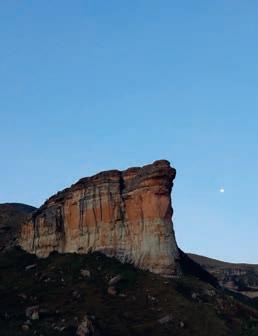
t was pre-dawn when a black-backed jackal skipped across the lawn below my balcony at SANParks’ alpine-style Golden Gate Hotel, the moon still a solid disc above Brandwag Buttress, the hulking sandstone edi ce jutting out from the grass-covered mountainside across the road.
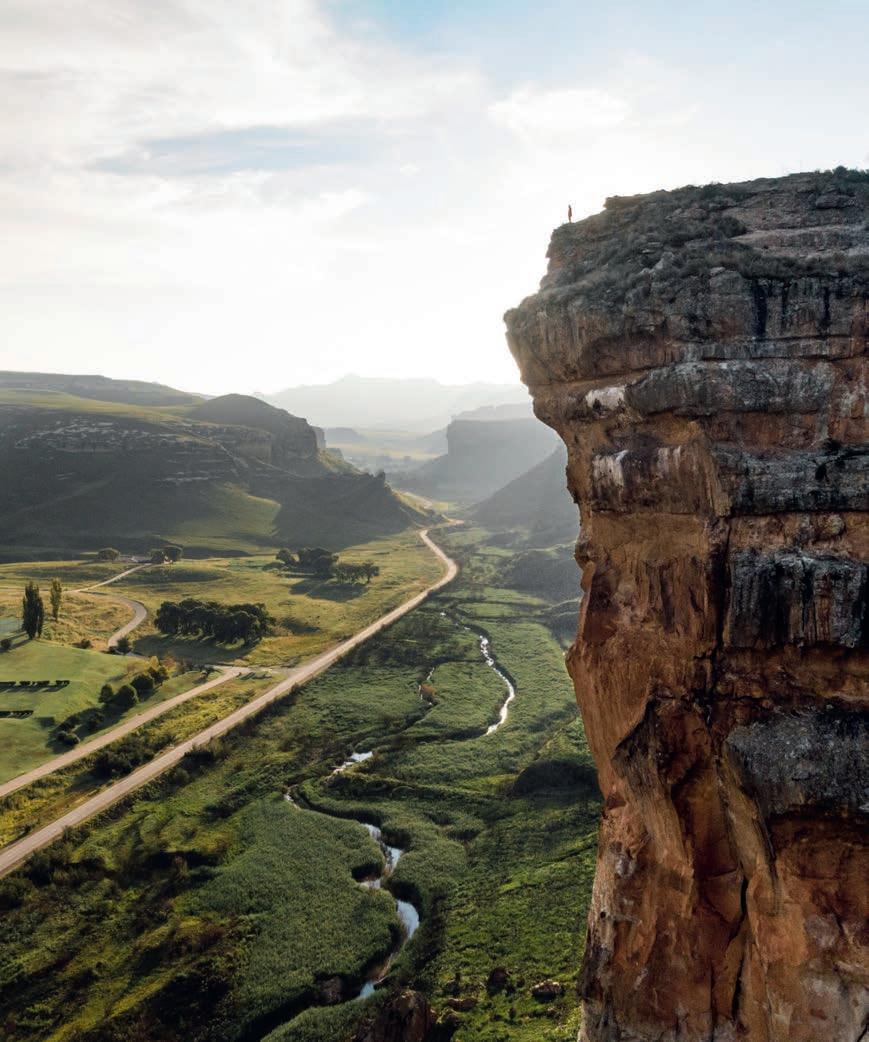
We’d hiked up Brandwag the previous afternoon. Not an especially arduous climb, it’s the quickest way to gain an appreciation for Golden Gate Highlands National Park’s distinctive features: the silhouettes of crenellated mountains receding towards distant horizons, the deep ssures and dappled light through cracks in humongous rock plateaus that look like sculptures. You could spend a lifetime exploring and never be done with it.
Within the park are gorgeous, far- ung mountain cabins with views stretching far across the Drakensberg range. Nearby, there’s a vulture restaurant with a bird hide, and you can visit a cultural village for an immersive insight into traditional Basotho life. Roamed by zebras and antelope, the park is one of the best places in the country for hiking, its precious grassland biome inundated with rare plants.
A paleontologist’s dream destination
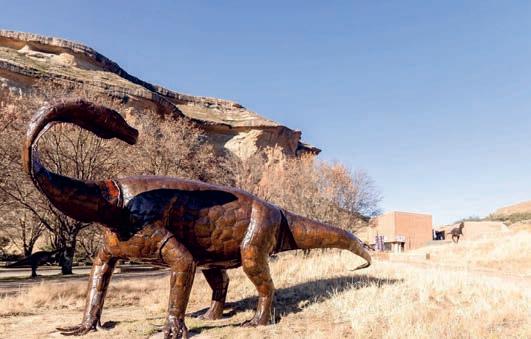
The entire area is also a paleontological hotspot, famed for the fossilised dinosaur eggs and embryos discovered in what was, 200 million years ago, a nesting area for the early-Jurassic-era Massospondylus carinatus, a 5-metre-long herbivore. Discovered in 1854 and believed to have been unique to Southern Africa, Massospondylus was among the earliest dinosaurs to be named.
Under construction for the better part of a decade and open since last June, the Kgodumodumo Dinosaur Interpretation
Centre is just down the road from the hotel and close to Glen Reenen Rest Camp. It’s a state-of-the-art visitor and research facility where Massospondylus fossils can be appreciated close to where they were dug up. Kgodumodumo is the Sesotho word for “Great Giant”, a reference to a mythical monster the BaSotho constructed out of their early discoveries of fossilised bones and footprints.
On display are not only life-size dinosaur models, but also fossils of some of the oldest dinosaur embryos ever found. There are interactive exhibits and opportunities to meet scientists who study these extinct creatures – palaeontologists like Dr Kimi Chapelle, a Massospondylus specialist
who was the lead scientist on the museum’s development.
Cool, too, is that the museum building itself resembles a “Great Giant” – though you might need to squint to see its resemblance to a dinosaur.
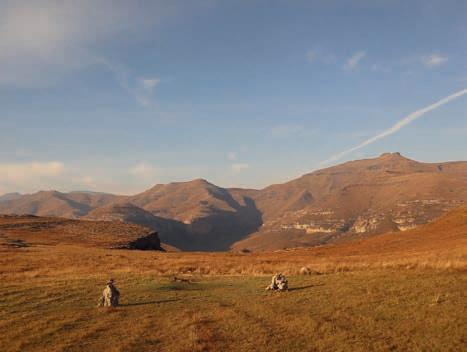
From the museum, it’s about 20 minutes to Clarens, a leafy little town at the foot of Mount Horeb. Here, what instantly imprints itself on your imagination are the amber mountains, the ochres and rusted reds, the pale-yellow grasses and the way the sandstone bluffs and gigantic rocks glimmer like gold at sunset.
Art, food and adventure
Despite its lump-in-the-throat beauty, Clarens was – a couple of decades back –barely a blip on tourist maps.
Ollie Esplin, founder of Clarens Xtreme, which pioneered adventure activities in the area, says tourism in Clarens took off very unexpectedly. “At one stage we had more art galleries per square kilometre than anywhere else in the country –around twenty-six galleries,” he says.
While plenty of “hip” spots have slipped in, there’s still a quirky variety of shops, some of them conceptually wild – one out tter sells everything from
DID YOU KNOW?
Clarens is named after a town in Switzerland where Paul Kruger, former president of South Africa, spent his final days as a voluntary exile after having fled South Africa when the British troops advanced during the Anglo-Boer War. The village was named in his honour due to his role in the 1865 Battle of Naauwpoort Nek in the Free State-Basotho War.
*Source: www.visitclarens.com/ about-clarens
hunting knives to recreational axes. Aside from the deli-style Purple Onion (with its biltong bar and artisanal sweets), there are spots like Die Spens (“the pantry”) and Helli’s Deli (for cheeses and fudge) where you can stock up.
Within strolling distance of the town square is an array of dining spots: The Posthouse serves “traditional” dishes with a contemporary twist; The Square specialises in dry-aged meat; Gosto is Portuguese; Roter Hahn prepares genuine German fare; and Italian-owned Bocca Di Lupo does authentic homemade pasta and pizza.
Ask around town for ideas about what to do, and you’ll get recommendations ranging from hot-air ballooning to abseiling on Titanic Rock, yet another hunk of sandstone resembling the hull
of a ship – it’s one of several landmarks worth exploring on a hike. Mountain bikers, too, have a swath of options to dig their cleats into.
You can do just about anything in Clarens, from ziplining to trout shing, quad-biking trekking to nd ancient rock paintings or visiting the sacred Motouleng Caves, which local people claim to be the place from where the rst cattle and our rst human ancestors stepped into the world.
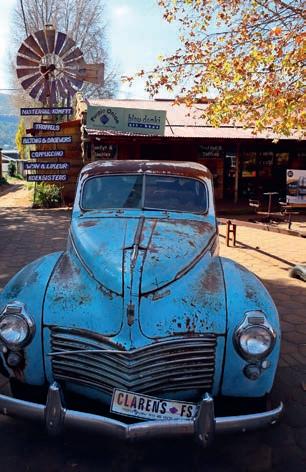
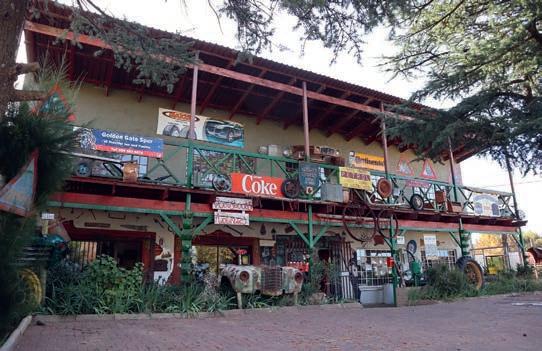
Art galleries abound, plus there’s a cool bookstore (with a cat named Dostoyevsky who “talks” to visitors) and the time-warp Voetstoots Antique Shop (and Music Saloon) where you can get lost for hours browsing the vast vintage trove. Some nights, it hosts intimate concerts or stand-up comedy.
Don’t neglect to spend time in the Clarens Village Conservancy, a protected wild land with a permit system for its hiking trails. It’s also the setting for the annual Titanic Challenge, a trail running race with distances up to 50km. The race takes place each September and is not for the fainthearted, since the mountains are 2 000m above sea level. If you’re not used to high altitudes, your lungs will burn.
You can, of course, seek out even higher altitudes in nearby Lesotho. The Caledonspoort border post is only 42km from Clarens, making it an ideal gateway for forays into the Mountain Kingdom. But that’s a whole other adventure.
NORTHERN
Our largest, least populated province is a place of red dunes, desert dust and vast flat stretches that give on to exquisite vistas and quirky stops full of surprises. By KEITH
BAIN
he Northern Cape brims with places bearing strange, vaguely unfamiliar names. There’s Keimoes, Kakamas, Kuruman, Kathu … all tiny, tuckedaway places steeped in some kind of preternatural mysteriousness. There’s the Karoo, too, of course, derived from the Khoekhoen word meaning “hard” or “dry”. And – just as mysterious and enchanting – the Kalahari, a desert whose name derives from the Tswana word “kgala”, meaning “the great thirst”. The Kalahari – or Kgalagadi, rather – is around 900 000 km2, stretches into Botswana and parts of Namibia, recognisable not only by its red sand, but also by its lack of surface water.
Rivers, hiking trails, the falls, rocks
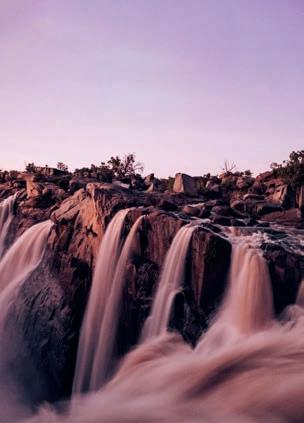
Parched, arid landscapes are just one part of the story. While dryness and heat are de ning aspects of the Northern Cape’s personality, the province is traversed by the life-bringing Orange River, which, 120km west of Upington, is responsible for one of South Africa’s most breathtaking natural sights: Augrabies Falls. Set within its own national park, with pleasant SANparks accommodations, wonderful hiking trails and plenty of viewpoints of the falls, it’s a magical place to begin or end a road trip across the province – or even set off on a multiday white-water rafting trip, starting either from the park itself or from
Southern Cross Game Reserve, which is 45km downstream.
The drive between Augrabies and Upington is among the loveliest in the country: apart from expansive vistas of ochre-orange rock formations, there are humongous nests of social weaver colonies that bulge from trees and telephone poles, and road stalls serving gigantic plates of food in quirkily decorated spaces. Plus, all those middle-of-nowhere towns where you feel like you’ve travelled back in time.
Wine, spirits and nibbles
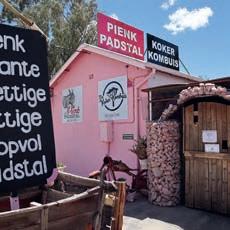
In Kakamas, 40km from Augrabies, there are wine farms to visit for lunch and tastings. And, at the edge of town is the famously pink farm stall, Die Pienk Padstal – its pastel signage is impossible to miss. There’s a sit-down diner, too, with quirkily decorated outdoor seating; it sells, among other things, locally grown grapes, fresh-baked goods, and some of the juiciest dates you’ll ever taste.
At Dyasonsklip, off the N14 between
Keimoes and Upington, pull into Bezalel, where, along with wine, Tinus Bezuidenhout makes brandies and liqueurs and offers cellar and distillery tours.
Where the wild things roam
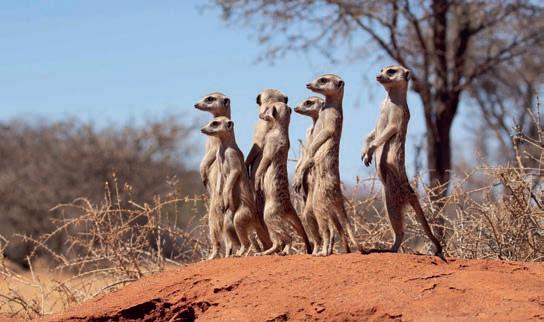
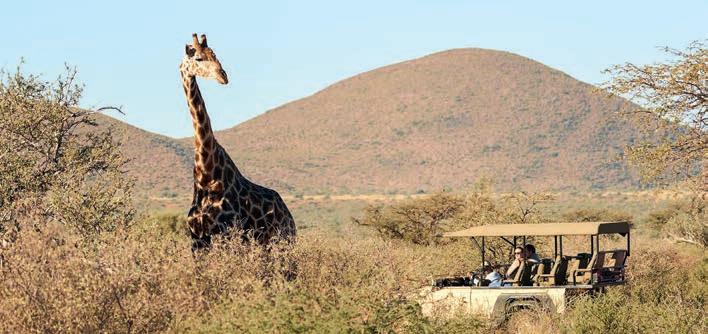
Several hours north of Upington, the border-straddling Kgalagadi Transfrontier Park contains multitudinous red sand dunes, black-maned lions and enormous herds of springbok that mingle with jackals and kori bustards, oryxes and meerkats.
Driving through the reserve, you’re constantly wending back and forth between South Africa and Botswana because the border fences have been removed so animals can roam freely.
Here, in SANPark’s off-grid wilderness camps, you are assured of solitude and space and a chance to see and hear animals from your verandah, scratching in the dirt right outside your cabin.
These days, you don’t even need to rough it to enjoy it. Rather than stay inside the reserve, you can bed down blissfully at Kgalagadi Lifestyle Lodge, situated 5km from the park’s Twee Rivieren entrance. It has cottages on a high ridge overlooking a scene that, come sunset, transforms into a sky that looks like it should be served in a cocktail glass. Antelope roam freely, and there’s camping, too, each site with its own ablutions, so no feeling like you’re on top of one another. Apart from good-value lodgings, it’s also where you’ll nd the Northern Cape’s best steakhouse, Black Mane Butcher & Grill.
Down the road from the lodge, there’s Kalahari Trails, a meerkat sanctuary offering bush walks to see little critters in the wild; also nearby, you can get a bit of an adrenaline spike sand-sur ng on 800m-high dunes with Kalahari Extreme Adventure. A couple of hours west of the reserve, you can visit the country’s only camel dairy, Koppieskraal Camel Farm, where the farmer might let you watch the milking process before introducing you to the bene ts of drinking camel milk.
Small towns, big adventure
To and from the transfrontier park, you will no doubt need to stop for fuel in the small town of Askham. While you’re there, pop into the Diamond T, a coffee shop, deli and gift store where you can tuck into what is almost certainly the dreamiest milk tart on the planet.
A couple of hours east along a harrowingly corrugated dirt road, you’ll hit the crazily remote town of Van Zylsrus. It’s worth spending time at its colourful art hotel, packed with fascinating memorabilia, its walls covered in idiosyncratic Kalahari-inspired paintings, mosaics and other artworks. It also has a bar full of cold beers and a kitchen serving hearty meals.
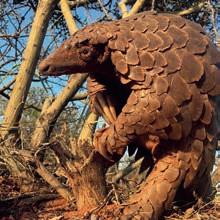
Due south of Van Zylsrus, midway to Kimberley, there’s the country’s largest private game reserve, Tswalu, where the especially wellheeled can set off on horseback, walk with meerkats, and stay up all night looking for pangolins, aardvark and other shy nocturnals.
Or, if you’re skipping the Transfrontier Park, somewhere between Upington and Kimberley, more or less in the middle of nowhere, you’ll nd Witsand Nature Reserve, a 2 500-hectare island of white sands within a sea of copper-red Kalahari sand. Also known as brulsand – or roaring sands –because of the eerie murmur produced when the sand is disturbed (usually by wind during the hot, dry period from September to April), Witsand’s 10km belt of tall white dunes is considered prime sandboarding territory. Boards can be rented at the reserve’s entrance.
Pretending to surf in the middle of a desert may sound like the ultimate adventure, but it also has great birding and lots of rare nocturnal animals (pangolin, aardvark, aardwolf and bat-eared foxes), so it might be worth losing yourself here for a couple of nights. Unless, of course, you’re missing the crowds, traf c and daily grind of home.
SEVEN SENSES, ONE ARCHIPELAGO
There are trips you take … and then there are journeys that stay with you long after you’ve unpacked. Zanzibar is firmly the latter – a place where time softens, colours feel more alive, and even the air seems to hold its own quiet rhythm. RAINA JULIES steps into the island’s sensory world, moving through its sights, sounds, flavours and subtler, harder-to-name moments that make it unforgettable
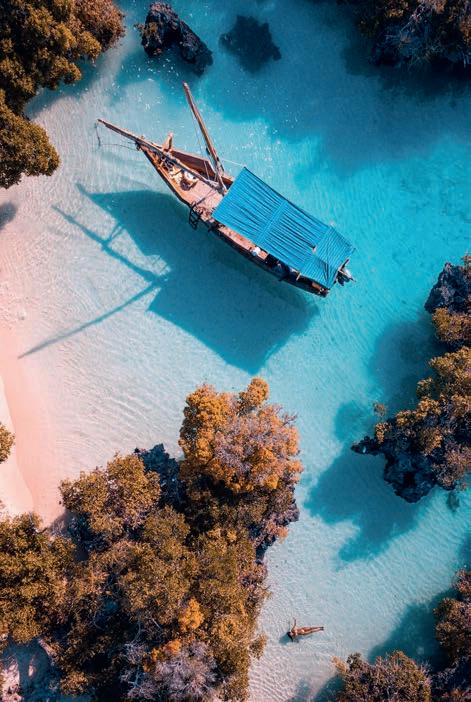
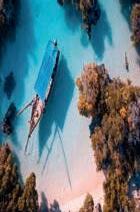
anzibar is not your typical island escape. It asks to be experienced slowly, through all seven senses, with no rush to “see it all”, but rather a willingness to let the island lead. At rst, it feels familiar – ocean horizons, beach days, a laid-back coastal rhythm that could almost be mistaken for other seaside destinations. But it doesn’t take long to realise this place operates differently. Here, every detail is heightened: the scent of spice on warm air, the echo of footsteps through ancient Stone Town, the way light shifts across coral stone and turquoise sea. Zanzibar doesn’t just host you; it absorbs you.
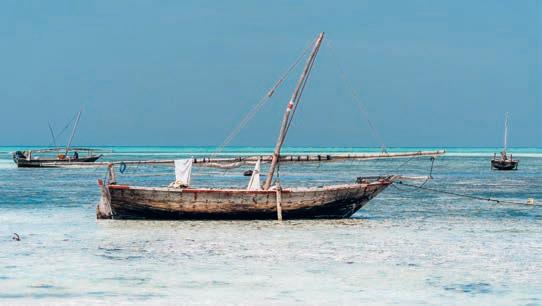
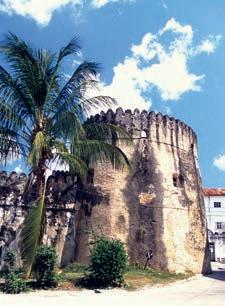
Sight: Stone Town sets the tone immediately. It’s a maze of narrow alleys and weathered buildings where nothing feels staged. Sunlight slips between carved wooden doors, casting patterns across stone walls that have held centuries of stories. Out on the coast, places like Nungwi and Kendwa open everything up again – white sand, wide skies and dhows drifting across the horizon like moving silhouettes at sunset. From there, sound takes over in layers. The call to prayer drifts across rooftops in the early morning and again as the day closes. In Forodhani Gardens,
DID YOU KNOW?
Due to the local chickens’ diet of sorghum rather than yellow maize, many egg yolks across Zanzibar are white or pale, rather than bright yellow.
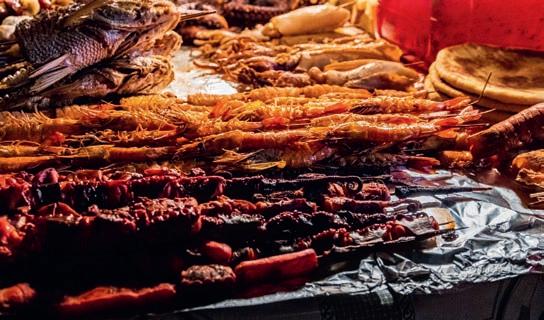
evenings come alive with the sizzle of grills and easy laughter. Elsewhere, taarab music spills from tucked-away corners of Stone Town – a blend of African, Arabic and Indian in uences that feels uniquely rooted to the island. Even the quieter moments aren’t silent; they’re textured.
Zanzibar makes its presence known instantly through the smell of spice hanging in the air. This is the Spice Island in the truest sense. In places like Tangawizi Spice Farm, cloves, cinnamon and vanilla are not just names on a jar; they’re growing, drying and drifting through the humid air around you. A crushed leaf or rubbed spice pod shifts everything in an instant, sharpening your senses and your awareness of just how alive the island feels.
Taste is where the island turns social. At Forodhani Gardens Night Market, food is cooked in front of you – seafood grilled over open ames, sugarcane juice pressed fresh, and the famous Zanzibari pizza folded and fried on the spot. It’s messy, loud, generous and best experienced without overthinking it. For something slower, coastal restaurants like The Rock Restaurant turn dinner into an event, perched above the tide and reached by foot or boat depending on the ocean’s mood.
Touch brings everything closer still. Barefoot becomes the default setting here. Sand warms underfoot in Kendwa, ocean water feels almost weightless, and coral stone walls in Stone Town carry centuries of texture in their surface. Even a simple dhow sail at sunset becomes physical – wind, rope, salt spray, movement.
Somewhere along the way, intuition kicks in. You stop planning the day so tightly. You linger longer in conversations, take the unmarked turn, sit a little further into stillness. Places like Jambiani or Paje on the quieter east coast are where this shift really settles in – where doing less becomes the point.
And then there is wonder – not as a single moment, but as a thread that runs through everything. It’s in the sunrise over the Indian Ocean, in carved doors worn smooth by time, in the simple act of
DID
YOU KNOW?
The capital of Zanzibar is not Stone Town, as some believe, it’s Zanzibar City. Stone Town is the historic town within Zanzibar City.
sitting still and watching the world move differently around you.
Zanzibar doesn’t try to impress you. It doesn’t need to. It unfolds, gently and completely, until you realise you’re experiencing it rather than simply visiting it – and that feeling tends to stay with you long after you’ve left.
DID YOU KNOW?
Zanzibar is not actually one island; it’s a group of islands just off the coast of East Africa. There are two large main islands, Pemba and Unguja – the latter is sometimes informally (and incorrectly) referred to as “Zanzibar”.