Contributors: Niel Bekker, Trevor Crighton, Darren Epstein, James Francis, Gareth Griffiths, Scott Irving, Justine Krige, Levi Letsoko, Anél Lewis, Moses Lutalo, Puseletso Mompei, Anthony Sharpe, Mark Swemmer
Copy Editor: Brenda Bryden
Content Co-ordinator: Vanessa Payne
Digital Editor: Stacey Visser vissers@businessmediamags.co.za
DESIGN
Head of Design: Jayne Macé-Ferguson
Senior Design: Mfundo Archie Ndzo
Advert Designer: Bulelwa Sotashe
Cover Image: Gareth Griffiths Imaging
SALES
Project Manager: Merryl Klein merrylk@picasso.co.za | +27 21 469 2446
PRODUCTION
Production Editor: Shamiela Brenner
Advertising Co-ordinator: Johan Labuschagne
Subscriptions and Distribution: Fatima Dramat fatimad@picasso.co.za
Printer: CTP Printers, Cape Town
MANAGEMENT
Management Accountant: Deidre Musha
Business Manager: Lodewyk van der Walt
General Manager, Magazines: Jocelyne Bayer
COPYRIGHT: Picasso Headline. No portion of this magazine may be reproduced in any form without written consent of the publisher. The publisher is not responsible for unsolicited material. Commercial Property is published by Picasso Headline. The opinions expressed are not necessarily those of Picasso Headline. All advertisements/advertorials and promotions have been paid for and therefore do not carry any endorsement by the publisher.
REIMAGINING THE WAY BUSINESS OPERATES
Almost from the very beginning oflockdown last year, the commercial real estate sector has undergone massivedisruptions. However, we’ve also seenincredible innovations and spurts of growth within the e-commerce sector, which meant growth for warehousing businesses, and the strengthening of co-working opportunities asthe work from home concept became a
Contents
Opportunities for investment in sub-Saharan Africa; and why offshore property is a sound investment growth within the African market
10 PROPERTY MANAGEMENT
How proptech is merging the digital world and commercial real estate; managing complex telecommunications infrastructure; co-working trends; and advice on how to be a successful property manager
13 GREEN BUILDINGS
The Ridge building at the V&A Waterfront is Cape Town’s newest 6-Star Green Star Design certified commercial building
16 MIX-USED DEVELOPMENTS
The concept of mix-used precincts is evolving rapidly
reality for many. And, technology use within this space has never been more exciting as business owners reimagine how to bring their portfolios to potential tenants and investors.
Top of mind going forward, our experts share,is innovation, future-proofing and a new way todo business.
Raina Julies
18 RETAIL
Online versus brick and mortar; and reimagining retail development
21 MEDICAL REITS
Healthcare real estate investment funds open the doors for better medical facilities
22 PROFILES
Three women in the construction industry share their stories about working in a traditionally male-dominated sector
26
OCCUPIER SPACE
Why co-working, shared office spaces, and the hybrid model of the office may be here to stay
27 STORAGE
The growth potential of self-storage
PROPERTY DEVELOPMENT IN AFRICA WORTH A SECOND LOOK
When considering offshore portfolio diversification, South African investors often overlook Africa as an investment destination. For investors willing to do their homework, the continent could offer significant investment yields at acceptable relative risk levels
Outside of South Africa, property development on the continent is in its infancy, but growing rapidly with close to US$1 billion in transactions recorded in 2021, according to Africa Property Investment Summit.
From a property perspective, we have seen some interesting structural and cyclical shifts away from so-called traditional real estate asset classes, driven primarily by ongoing investments into telecommunications as well as the impact of COVID-19 on healthcare and supply chain logistics. For example, Africa Data Centres Association and Xalam Analytics report that only a third of Africa’s 80 metropolitan areas with a population of more than a million have at least one built-for-purpose data centre. This is where developers such as Gateway Real Estate Africa (GREA) see the real opportunity.
MITIGATING RISK
In addition to ensuring tenure of land, the ability to repatriate funding and other key risk mitigants, GREA reduces risk by positioning itself as a strategic property development partner to international blue-chip companies and diplomatic missions wanting to expand their existing footprints.
This means that the company avoids speculative developments, with each project underpinned by a long-term lease contract with an international counterparty.
COUNTERPARTY STRENGTH
GREA counts the likes of London-listed Grit Real Estate Income Group, French retailer Carrefour, and the United States Bureau of Overseas Buildings Operations (OBO) as some of its key tenants. OBO is a US government agency that directs the worldwide overseas building programme for the United States of America.
Because of its blue-chip tenant base, most of GREA’s leases are denominated in US dollars with parent company guarantees providing further surety. Some of the assets are rented on a triple-net basis, with the tenant covering maintenance costs, insurance, rates and taxes.
EVERGREEN INVESTMENT STRUCTURE
Unlike private equity, which usually requires a liquidity event every five or seven years, GREA has an evergreen investment structure, allowing it to hold assets throughout a cycle and optimise shareholder returns on disposal.
TRACK RECORD
Since its formation in 2018, GREA has successfully deployed US$400-million across eight African countries and has a $500-million pipeline for developments in Nigeria, Kenya, Ghana and Mauritius.
On 1 September 2021 it will hand over the completed development of the only security, seismic and international standard compliant housing development for consular staff in Ethiopia, designed and developed in accordance with the specifications of OBO. GREA is constructing another consular and diplomatic residential complex on behalf of OBO in Kenya and is nearing completion
of the first phase of a Tier III, 10-megawatt data centre facility in Eko Atlantic City, Lagos, Nigeria. The development is on behalf of Africa Data Centres, a subsidiary of Liquid Telecoms.
OUTLOOK
In Mauritius, GREA has broken ground on an 81-bed healthcare facility in Curepipe, as well as a state-of-the-art corporate office development in Grand Baie, anchored by Grit Real Estate Income Group and Dentons, the world’s largest law firm, as a significant tenant.
The company also commenced construction of an office development in Appolonia City, outside of Accra, Ghana, anchored by Appolonia Development Company Limited.
Going forward, we are likely to see increased collaboration between funders, corporate tenants, developers, regulators, and professional services firms with a long-term, sustainable view of the continent.
Savvy investors will do well to consider African property development as a portfolio diversifier when looking at offshore investments.
A boom in affordable housing in Uganda and government incentives for the residential sector in Kenya present significant opportunities for both small and large investors looking to tap into offshore opportunities in the African property market, writes MOSES LUTALO, managing director of Broll Uganda
Real estate investment trusts (REITs) offer smaller investors, who are typically more risk-averse, an ideal opportunity to build a more balanced and diversified portfolio. Listed investment vehicles provide a softer entry for smaller players so they can manage their risk and any potential liquidity issues by ensuring sufficient returns.
The residential sector is an ideal proposition for large players – typically institutional investors with access to long-term funding. There is a huge demand for affordable housing in Uganda and Kenya. In Kenya, the government has introduced incentives for investors to encourage them to enter the space, and the returns are good. Institutional investors with major strong balance sheets and long-term capital will have the most success here, as demand continues to outstrip supply.
Niche asset classes like data centres, healthcare facilities, cold rooms and logistics centres are also ripe for diversifying a portfolio. It depends on how the investor wants to structure the investment, the risk appetite and the desired return. This will determine if they play within the affordable housing space, opt
for listed property investments or go for niche sectors like large industrial warehousing. There is no “one-size-fits-all” model for offshore investment. A medium-size private equity fund may have anything from $10- to $40-million to invest. These flexible investors can invest in listed funds, while taking on a $20-million affordable housing project at the same time, for example.
Long-term capital requires a long-term outlook, with a typical return on investment window of three to ten years. These sorts of investors are willing to wait for the economic
cycle to turn in favour of real estate and then, crucially, exit at the best time.
The Ugandan economy has seen an upsurge since the general election in January, with projects such as signing of the oil pipe line deal. Despite the impact of COVID-19 on the economy, growth is expected to be north of five to six per cent. When that happens, the real estate sector will pick up due to the increased gross domestic product per capita. As a result, investors will be able to take well informed positions on real estate as an asset class whether residential, commercial or retail.
Also prompting offshore investment is the current shift from rental to home ownership.
Any investors geared towards real estate that can offer a good gated community or a planned neighbourhood with a large masterplan of about 20 to 50 acres will definitely attract buyers in the medium- to long-term.
NICHE ASSET CLASSES LIKE DATA CENTRES, HEALTHCARE FACILITIES, COLD ROOMS AND LOGISTICS CENTRES ARE ALSO RIPE FOR DIVERSIFYING A PORTFOLIO.
OFFSHORE INVESTMENT GROWTH IN THE AFRICAN MARKET
Investing in the African property sector makes business sense even during transitional uncertainty, writes LEVI LETSOKO
Africa’s growth potential is obvious for investors to see, believes GREA CEO Greg Pearson. Africa, a continent constantly recovering from the effects of global challenges such as recession and COVID-19, attracts investors and multinational companies to comb through its markets to capitalise on the upswing.
“The African property sector is still in its infancy, with demand for A-grade commercial properties, especially bespoke developments such as logistics parks, data centres
and warehouses, outstripping supply,” he says.
“There is a greater focus on sustainability and community involvement from international investors. Property developers, owners and investors are realising that their responsibilities extend beyond the fence line of the development,” says Pearson.
“Technology will increasingly play a role in how property managers, investors, owners and consumers interact. There is a strong demand to develop buildings that are future-proof from a technology and lifestyle point of view.”
“THE AFRICAN PROPERTY SECTOR IS STILL IN ITS INFANCY, WITH DEMAND FOR A-GRADE COMMERCIAL PROPERTIES, ESPECIALLY BESPOKE DEVELOPMENTS SUCH AS LOGISTICS PARKS, DATA CENTRES AND WAREHOUSES, OUTSTRIPPING SUPPLY.” – GREG PEARSON, GREA
Moses Lutalo
INVESTMENT OPPORTUNITIES IN SUB-SAHARAN AFRICA RISING
While the property sector recovers and adjusts to a world changed by COVID-19, optimistic investors are seeking reasons to invest in the sector, despite the gloomy picture painted by doubtful observers.
By LEVI LETSOKO
Having witnessed listed property’s boom as the best performing asset class over the last 25 years, Andrew Dewey, MD of Swindon Property Group believes that looking at the past is the best way to forecast the sector’s possible peak.
“From a direct investment perspective, the volatility created by COVID-19 has caused an approximate 20 per cent write-down on the valuation book for the majority of the sector, with the office and retail sector hardest hit,” says Dewey.
“Therefore, there has been no better time to invest wisely in the direct market coming off this low base, provided you have done your research and accurately weighed up the valuation.” Dewey has observed that property investment has been largely ignored over the last few years, stating that only US$2-billion was raised from investors compared to US$11.9-billion raised by private capital in the same period.
WHY OFFSHORE PROPERTY IS A SOUND INVESTMENT
SCOTT IRVING, general manager of Carrick Property, shares why investing in offshore property is a sound way to externalise your wealth
One of the key tools to minimise investment risk is a diversified portfolio. Spreading your investments across asset classes, geographies, currencies and industries is one of the few time-tested strategies for investors. Offshore property, in particular, is becoming increasingly attractive as a strong diversifying investment option due to its growth and inflation-beating returns and potential for regular income. The protection of capital and the gradual appreciation of that capital have to be at the forefront of the investment process. Investing in offshore property as an asset class is a sound way to externalise your wealth and balance your portfolio. It’s outperforming other products on the market and currently producing good returns. Depending on how you gear the property, you can borrow at three or four per cent and get
a five to eight per cent yield on a new development in the UK, for example.
We are seeing more and more high-net wealth families investing in offshore developments, whether it’s a buy-to-let investment, an occasional residence for visiting children who are studying overseas, or for retirement.
Much of your success in global property investments will, naturally, depend on which market you invest in. Markets such as the UK, France and Mauritius are popular with South Africans seeking a hard currency income.
Because property is an always-in-demand asset class, Dewey is confident about the prospects for small and larger developers, as well as investors with an interest in the sub-Saharan region.
“Property owners and investors who are fully engaged with the market, monitor the demand and supply chain, continue to invest in cost-saving technology and maintain a working relationship with their tenants will stay ahead of their competitors,” he concludes.
“FROM A DIRECT INVESTMENT PERSPECTIVE, THE VOLATILITY CREATED BY COVID-19 HAS CAUSED AN APPROXIMATE 20 PER CENT WRITE-DOWN ON THE VALUATION BOOK FOR THE MAJORITY OF THE SECTOR, WITH THE OFFICE AND RETAIL SECTOR HARDEST HIT.” – ANDREW DEWEY, SWINDON PROPERTY GROUP
BENEFITS
Investing in an offshore development has many benefits.
• Long-term wealth generation. In a good property investment, returns over 10 to 20 years can outperform many other investments.
• Accessible financing: being able to leverage the property at very low financing costs in terms of small, fixed-rate mortgages.
• Property is a tangible, stable asset class.
• Economic and political stability and therefore greater levels of protection.
• Offshore wealth accumulation. Funds can be used for your children’s education or as part of your retirement planning.
Purchasing, financing and managing an international property portfolio can, however, be full of pitfalls, red tape and stress. Investors should always seek the services of a professional advisory firm.
Scott Irving
CARRICK PROPERT Y
THERE ARE MANY BUSINESS FINANCIERS OUT THERE. BUT NONE LIKE US.
So, who are we?
We’re the company that’s been supporting and financing business owners for over 40 years. That’s longer than some of Africa’s largest banks have existed. We’ve provided over R20,5 billion in tailor-made finance to small and medium businesses. Helped facilitate over 658,000 jobs and counting. With finance from R500,000 to R50 million, imagine the potential we can unlock in your business.
Apply for our specialised business finance at businesspartners.co.za
The ABCs of DDs
JUSTINE KRIGE , director in corporate and commercial practice at Cliffe Dekker Hofmeyr (CDH), shares some legal advice for entrepreneurs
Most investors will want to conduct a due diligence (DD) investigation on a business before investing any funds or taking up an equity share. What does this mean for your business if you are looking for funding?
WHAT EVERY ENTREPRENEUR SHOULD KNOW
1. Due diligence investigations typically comprise a legal, financial and tax review. This is done by performing a comprehensive analysis of the target company, often including commercial, banking and finance, litigation, employment, environmental, insurance, tax, intellectual property, and real estate law aspects. The assets and liabilities of the target company and how the business functions are scrutinised. Often various legal, financial and tax teams will work in tandem.
2. How is a DD investigation undertaken? The company under investigation will typically be required to make important documentation available to the reviewers through a virtual or a physical data room. The nature of the documents and information required will have been set out in an information request. These documents depend on the specific purpose of the review, but are usually a mixture of company secretarial documents, constitutional documents, client and supplier agreements, employment agreements and human resource policies, payroll schedules, business licences, trading terms and conditions, business plans, financial statements and tax filings, among others.
3. What are reviewers looking for in a DD investigation? Generally, they are looking for any potential risks faced by the target company such as existing debt obligations in the form of unpaid tax or potential administrative fines as a result of statutory noncompliance, as well as any restrictive or unusual clauses in agreements, particularly those which trigger adverse consequences in the event of a change of control of the target company (for example, if an investor takes up a majority stake). Depending on the particular sector in which the business operates, there may be a specific focus on certain aspects of the target company’s operations (for example, an emphasis on evidence of environmental legal compliance in respect of a waste management company).
4. How is a DD investigation ultimately relevant? Ultimately, the reviewers will compile a due diligence report, which will give a full picture
of the target company. This report will enable the investor to gauge the commercial viability and performance of the target company and make an informed decision about the investment. The report will also inform the nature and extent of the warranties and indemnities that the investor may want to include in the investment agreement so that any identified risks are adequately mitigated. The due diligence report is typically pivotal in an investor’s ultimate decision (and on what terms) to invest.
5. How can the target company assist? Statutory compliance (or noncompliance) is a key consideration. Review your basic company secretarial and other statutory records, founding documents, employment contracts and human resource policies, supplier and customer arrangements, trading
Justine Krige
DID YOU KNOW?
A due diligence investigation examines the structure and operations of the target company, its assets and liabilities, as well as any potential risks that it faces in the market. In short, are there any skeletons in the closet or risks around the corner?
The scope of a due diligence investigation will vary from case to case. Generally, the more significant the investment, the more detailed and probing the due diligence investigation.
terms and conditions, business licences and tax filings. Where these do not comply with legal requirements, correct as soon as possible. Ensure that the company keeps a comprehensive paper trail, and as the business concludes key contracts, carefully consider whether they would be attractive to a potential investor. Businesses that are structured correctly from the outset and keep up-to-date records are more likely to lend themselves to investment.
RETHINKING TECHNOLOGY
The current global crisis is compelling business owners to rethink the way they do business. Now more than ever, future-proofing needs to embrace new technology like proptech. By RAINA JULIES
Proptech is evolving at a rapid pace and is real estate’s biggest disruptor. Essentially, proptech allows the real estate market to explore digital innovations that make doing business more efficient, simpler and seamless. Think drone technology for virtual tours, the rise of artificial intelligence (AI) where AI platforms allow developers and investors to test feasibility and risks, cloud-based technology that provides access to data on any property from anywhere, and robotic automation that uses software or bots to streamline business operations and reduce costs.
“Proptech is a powerful level of tech that’s increasingly merging the digital world with the commercial property environment,” says Wayne van der
Vent, co-founder of Quoin Online, innovation partners in the commercial property sector. “Landlords and owners need to rethink not only the method of transacting and marketing, but also what makes their property different and attractive to tenants, buyers and investors. Tech moves fast; if there was ever a time for proptech to take centre stage, it was during the lockdown.”
Van der Vent explains that the office sector may, for example, “need to look at more flexible leasing arrangements, not only offering space, but also services. It may be necessary for landlords to adopt the same methodologies as shared office operators.”
It’s this type of disruption and solutions-based focus that makes proptech an essential part of growing the commercial property market in crisis times.
Many commercial buildings such as shopping centres and office blocks house a variety of different wireless telecommunications infrastructure. These can include towers, antennas, digital antenna systems, cabinets, satellite dishes and transceivers. These are typically located on rooftops and within buildings. However, managing this complex environment effectively can be challenging. Landlords often struggle
SIMPLIFYING tELECOMMUNICATIONS MANAGEMENT
Mark sweMMer, managing director of the Reach Group, explains how managing complex telecommunications infrastructure can be simplified
to ensure optimal space utilisation for communications infrastructure, lack adequate knowledge of technical site installation requests and battle to ensure that energy consumption costs are recouped. They may also be unaware of the revenue generation opportunities that could exist.
Finding a partner to help simplify the complexity and provide a complete managed solution via a single point of contact will make life easier and more profitable for landlords and property
WHAT’S TRENDING IN CO-WORKING?
DarreN ePsTeiN, founder of Roamwork in Harrington Street, and NieL Bekker, CEO of CHIPS co-working space, share the top trends in the co-working space
1. New clientele. More people are considering co-working as an option. Enquiries are being received from larger businesses wanting more flexible leases and employees of big corporates who receive stipends to work from anywhere.
managers. The reach Group enables telecoms operators and wireless services providers to access buildings’ rooftops, towers and outdoor areas to extend their coverage, providing consumers with multiple broadband, telecommunications, fibre, LTe a nd 5G services. This then empowers landlords and property managers to actively manage and leverage their rooftop space and outdoor areas to enhance revenues from alternative leasing areas.
Roamwork has an in-house production studio with an infinity curve and green screen. There’s also catering available and showering facilities and it’s dog-friendly.
2. P roperty developers. Cape Town property developers have caught on to the co-working and co-living trend. For example, property development company Neighbourgood is converting the former Townhouse Hotel in the CBD into a co-living space with a shared communal workspace – Neighbourgood East City –for young professionals.
3. F inding the niche. Bekker points out that turning on the Wi-Fi in an empty office and calling it a co-working space doesn’t cut it anymore. You need to offer something specialised to a particular class of clients. There’ll be more spaces with unique benefits for differentiated communities.
4. C lubs not cubicles. Epstein says today’s spaces are not desk, chairs, cubicles and somewhere to plug in a laptop. Globally, they’re becoming more like members’ clubs. Roamwork, for example, boasts a full art collection sponsored by Art Gazette.
5. C ross-pollination. Shared spaces create networking opportunities in a time when people have Zoom fatigue and limited chances to connect in person.
6. a h ome for headquarters. Several businesses are now seeking a space to connect monthly, but don’t want an office of their own. There’s massive opportunity for communal spaces to accommodate this new use case.
* The top trends in co-working formed part of the research findings done by the Cape Town Central City Improvement District (CCID) into co-working within the Cape Town CBD.
A communal table in Roamwork’s shared office space.
The members’ kitchen area and canteen.
CELEBRATING a key milestone
WeconnectU, the rapidly growing property management software solutions company, is celebrating 500 000 property units being managed on its cloud-based platforms this month
In just four years since its inception, WeconnectU has grown into a provider of choice for body corporate, homeowners associations and rental portfolio managers who seek the most advanced end-to-end property management solution to make them more compliant, manageable, scalable, and profi table.
“WeconnectU was born out of our frustrations managing a large portfolio of properties. We were using multiple systems to handle all the elements of our business, none of which were integrated or designed with the workfl ows and challenges of property management in mind,” says Danie van der Merwe, one of the three Van der Merwe brothers who collaborated and started the company specifi cally to solve the very real challenges they and other property managers faced.
SOLVING REAL-WORLD PROBLEMS
Johann van der Merwe, CEO of WeconnectU, says the company is dedicated to solving the real-world problems property managers face.
“We solve problems through easy-to-use property management software designed with the finesse that experts in the industry will appreciate. Our fully integrated ecosystem ensures optimal efficiencies for property and rental asset managers through our community management software, rental asset management software and inspection and maintenance management software.”
He says the company started with community management, as this is the fastest-growing sector in property management and one of the more complicated and heavily regulated sectors. The result was one of the first end-to-end community management solutions bringing all tasks and stakeholders together on one, transparent, cloud-based platform.
It includes a custom-built fi nancial module, intelligent dashboards to monitor and manage client and business KPIs, built-in (and constantly updated) support for compliance and an unprecedented level of comprehensive reporting.
“After this, we needed to respond to the numerous requests for rental management and inspection and maintenance management solutions. The goal was an integrated ecosystem that could handle the full range of property management services, replacing outdated systems with a complete suite of reliable, user-friendly, effective and efficient cloud-based tools,” says Schalk van der Merwe, who recently joined the team to add value to the partnership through his varied and rich experience in the property industry.
“The team felt they had far more to offer the industry with a new solution for rental portfolio management that would support a more modern asset management experience, rather than just another administrative property management system. The resulting rental asset management software addresses the entire value chain of rental portfolio management, including tenant vetting processes, bank integrated account management, lease management, and integrated inspection and maintenance management,” says Schalk.
“It was important to us to ensure that we kept solving real industry problems with our technology, rather than just building tech for tech’s sake,” says Johann. “So we decided to secure the exclusive global marketing licence for RedRabbit, the industry leader for inspection and maintenance management. We chose to integrate it with our platform instead of reinventing that particular wheel.
“WeconnectU aims to enable property managers to deliver a rich and valuable client experience. We do this in two ways: by
“We solve problems through easy-to-use property management software designed with the finesse that experts in the industry will appreciate.” – Johan van der Merwe
dramatically improving efficiency to give them time to focus on adding value to their clients’ property assets and portfolios, and by creating exceptionally detailed reports that can be used to inform, educate and advise investors on the status of their properties as investments.
“Our goal is to continue supporting the industry with our cutting-edge technology and ecosystem of tools, solving complex industry problems with simple, elegant and user-friendly solutions,’’ says Johann.
CYBERSECURITY ADVICE WEBINAR
As part of celebrating this milestone, WeconnectU will host an expert advice webinar on 9 September at 10am, announcing major new system features and focusing on cybersecurity in the property industry. Guest speaker Eric Lundberg, from Redshift Cyber Security, will discuss why cybersecurity is important in the property management industry, the importance of a hosting platform that comes with built-in security best practices and the impact more people working from home has on security.
GREENING THE RIDGE
A first-of-a-kind green commercial office building has opened in the Portswood district of Cape Town’s V&A Waterfront. GARETH GRIFFITHS speaks to the developers about this living, breathing building
The completion of several significant infrastructure projects in its precinct has increased the V&A Waterfront’s commercial office portfolio. The latest offering, The Ridge, was commissioned as the Cape Town office for the V&A’s tenant, multinational professional services firm Deloitte.
“The growth of a blue-chip commercial portfolio allows the V&A to diversify its financial exposure to the excellent retail offering of the Victoria Wharf and complements the retail and residential offerings across the V&A. This blue-chip portfolio includes companies such as Allan Gray, Nedbank, PwC, Werksmans, E&Y, Red Bull, and now Deloitte, all choosing to locate their offices in the precinct,” says Vusumuzi Nondo, executive manager for development for the V&A Waterfront.
TREADING LIGHTLY
In 2020, The Ridge was awarded 6-Star Green Star Design certification from the Green Building Council of South Africa. The V&A’s green innovations aim to promote a healthy work environment and low carbon modes of transport while also helping combat sick building.
“It has been said that working from an office post-COVID-19 will never be the same again, worldwide. That’s true, but long before the pandemic, the V&A Waterfront development team identified the paramount importance for
any business of a healthy office space that looks after the wellness of employees,” Nondo adds.
Mark Noble, development director at the V&A, says that The Ridge includes several standout environmental features. The eye-catching engineered timber facade is the best example. “The facade on the top two floors of the building contains locally sourced cross-laminated mass timber unitised together with the more standard glass and aluminium panels.
“The use of timber as both the structural facade element and for internal and external finishes is, we believe, a genuine first for South Africa. This has contributed significantly to the architecture. It has also reduced the overall carbon footprint of the building by the equivalent of 60 mega-tonnes of CO2”.
THE V&A’s GREEN INNOVATIONS AIM TO PROMOTE A HEALTHY WORK ENVIRONMENT AND LOW CARBON MODES OF TRANSPORT WHILE ALSO HELPING COMBAT SICK BUILDING.
THE RIDGE’S STANDOUT SUSTAINABLE FEATURES
• Mixed-mode method of ventilation, using fresh outdoor air coming off the Atlantic, keeps occupants comfortable and healthy and saves electricity.
• A thermally activated building system (TABS) helps to cool the workspaces on warm days. The system circulates chilled water through the floor slabs.
• The timber facade with openable windows, TABS and natural ventilation system means that fresh air ventilation, not air conditioning, is used for 60 to 80 per cent of the year.
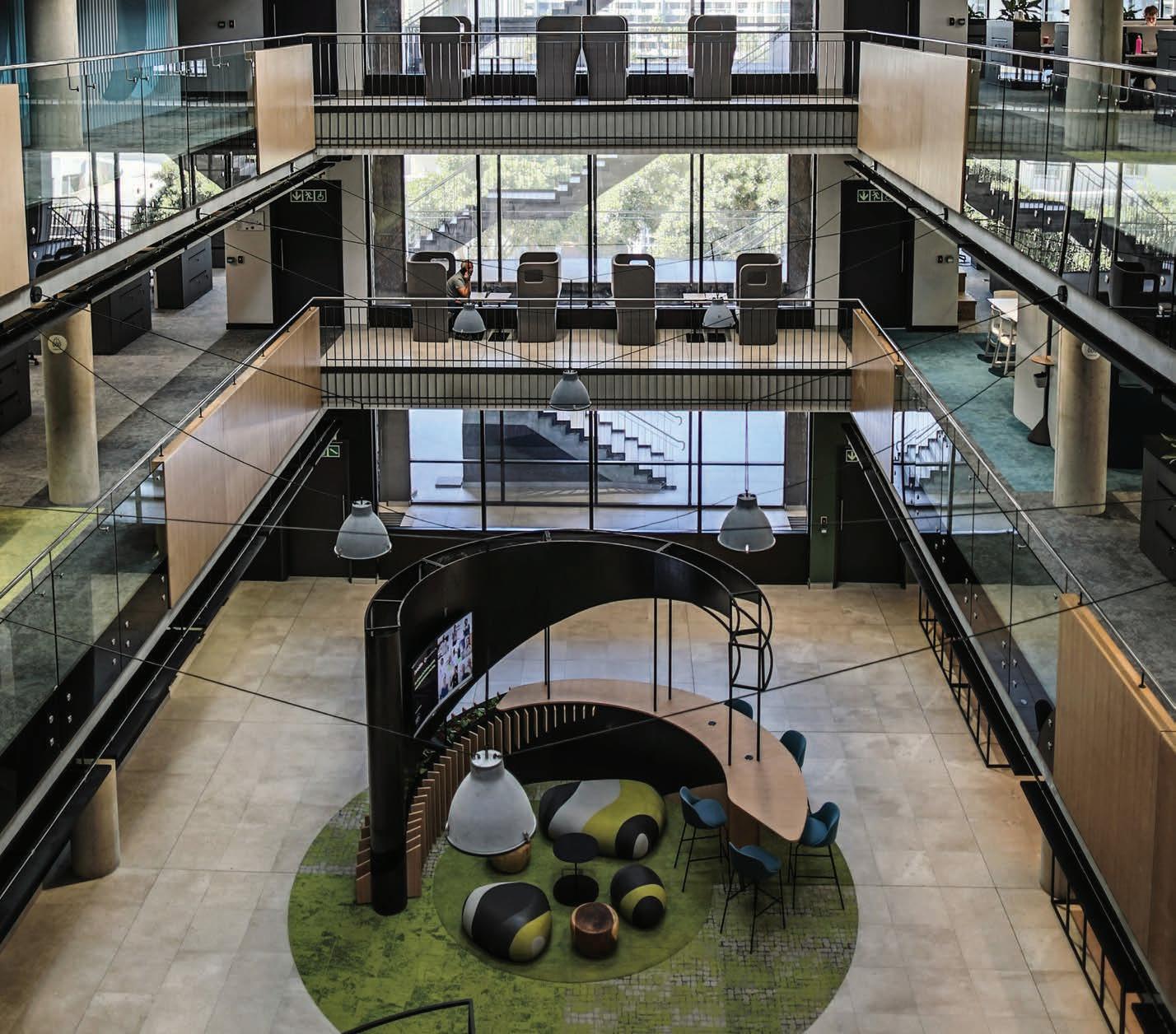
• A striking 16-metre high atrium, called the “Central Street”, enables the movement of fresh air throughout the building and allows natural lighting from the roof to permeate the building.
• Eco-bricks inside the floors have saved 38 000 megajoules of embodied (carbon-based) energy inside the building. Some 14 000 recycled plastic bottles filled and compacted with single-use plastic waste have been used, thus avoiding landfill.
GBCSA’S CREDIBLE AND OBJECTIVE MEASUREMENT FOR GREEN BUILDINGS IN SOUTH AFRICA & AFRICA
Vusumuzi Nondo and Franette Ventura, V&A Team
An interior view showing the giant Central Street atrium.
The Ridge’s facade, showing the glass side.
EFFECTIVE UTILITY COST MANAGEMENT
Simplify
utility management, cut costs, improve tenant relationships and reduce administrative burden with a prepaid submeter
The current market is easily defined as uncertain, tight and mercurial. Companies are under pressure to tighten belts and sharpen bottom line spend to ensure consistent and sustainable growth into the next quarter of the year. It’s a complex time, and companies in the property sector are facing an interesting battle for tenant retention among load shedding, economic challenges, fraud and cost-cutting measures.
“Companies are tightening their belts more than ever,” says Michael Franze, managing director at Citiq Prepaid. “They can’t afford to spend more than they planned on anything, whether it’s the latest technology innovation or their commercial property rental or their utility bills. Every cent must be accounted for to ensure that the business stays alive and afloat over the next six to twelve months. This makes it incredibly important for commercial property owners to focus on solutions that will drive tenant engagement and stickiness.”
This stickiness, the glue that holds the tenant in place, can be built into property design and solutions that simplify tenant life and minimise admin. One such solution is prepaid submeters. Simple, effective, trustworthy and manageable – prepaid submeters can smooth the path for tenants by reducing the risk of unexpected costs or bill shock.
“One of the challenges facing most commercial property owners and managers is that utility spend and billing is erratic and complicated,” explains Franze. “The billing cycle can vary from area to area, and the costs incurred by tenants can be disputed if one bill is shared across multiple companies or individuals. If one company barely uses any
energy, but another is devouring the power, the shared expense will only serve to get people’s backs up. With prepaid submeters, however, this challenge is completely bypassed.” Prepaid submeters can be installed into individual offi ce blocks or units, accessed only by the tenants or the property managers, and payments can be completely controlled by the tenants. Using accessible tokens that can be purchased from physical stores or online, tenants can pay for their utility usage upfront, ensuring comprehensive management of their spend and easy insight into their usage. They can more effectively control their budgets with no unexpected bills arriving at the end of the month – what they use is paid for. What they paid for is used.
“While prepaid submeters won’t remove the problems caused by load shedding, the pandemic or service interruptions, they will remove a signifi cant percentage of the hassle often associated with utility payments and management,” says Franze. “Tenants, property owners, commercial property managers and estate management have granular control over their utilities. And, if they work with a company like Citiq Prepaid they also have access to a bouquet of online services and reporting tools.”
PROVIDING VISIBILITY
Citiq Prepaid has an online prepaid submetering management platform that provides property owners with visibility into their meter usage, meter status and more. The online platform is designed to be as user-friendly as possible with an intuitive dashboard that shows Buildings,
Payments, Meters and Reports. Simple to manage, it provides immediate access to relevant information around prepaid submeters and payments, massively reducing the admin burden.
“The platform allows owners to see the new meters that have been added to the building, create reports that unpack the specifics of the different sites and gain an overall snapshot of status and payments,” explains Franze. “The reports include accounting, building statements, building summary and client issue, among others, and you can customise the dates so you can unpack any problems that may arise with ease.”
This intelligent platform, along with market-leading, high-quality prepaid submeters, sets Citiq Prepaid above the rest when it comes to service delivery, support, and capability. These tools do more than just simplify your utility management, they improve tenant relationships and transform admin.
ALIVE WITH POSSIBILITIES
The concept of a mixed-use precinct is a rapidly evolving one. From new lifestyle options, residential opportunities and green building designs, possibilities abound, writes GARETH GRIFFITHS
GOING RED IN the GREEN PRECINCT
Located immediately north of Rosebank, Oxford Parks is a sustainable green precinct providing over 300 000m2 of well-located, highly accessible offices, a range of bespoke residential buildings and high street retail – all within a vibrant and pedestrian-focused public environment.
Andre Gouws, CEO of Intaprop, the developer of Oxford Parks, says they have made substantial progress with the development of this new green precinct in Rosebank.
The 222-bed Radisson RED Rosebank Hotel is the fifth building to be completed in the 35 000m2 first phase of Oxford Parks. It
AN INTEGRATED CITY
What is the “good life” and how do you ensure it? Zoe van Onselen, marketing manager for Steyn City Properties, says: “No two people share the same idea of what constitutes the ‘good life’. However, we believe that our definition of the concept comes close to the ideal: a spacious 2 000-acre parkland where the setting of your luxurious home (apartment, freehold or cluster) is matched by the quality and calibre of a wide range of leisure amenities.”
The upshot of providing every possible service and facility for residents – from casual and bistro dining to golfing, horse riding, mountain biking, jogging, swimming, walking, fishing and many others – adds to the promise that Steyn City is a haven of convenience in a highly secure setting.
“Living and working here is further enhanced by the presence of an on-site school campus and AAA-grade offices at Capital Park. As a result, our clients spend less time driving around, and more time doing the things that they enjoy.”
was opened on 1 August. In addition to the hotel, Oxford Parks’ corporate tenants include BP Southern Africa, Thebe Investment Corporation, Credo Wealth, Life Healthcare, Sony Music, Arup, Metier and G&D Currency Technologies.
“The concept of the Radisson RED with its focus on art and trendy lifestyle perfectly fits with Intaprop’s vision for Oxford Parks. We wanted an asset that would add to
STILL GOING FOR GREEN
the future success of the precinct and were impressed by the Radisson RED concept,” says Gouws. Accordingly, RDC Properties acquired the hotel asset from Intaprop at the end of July for R385-million.
The ground floors of the buildings include high street restaurants and eateries, speciality services and convenience retail offerings, which combine extremely well with the Radisson concept.
Another recent development saw Intaprop concluding a lease and development agreement with Anglo American for a new 6-Star Green Star Design office building to house Anglo’s Global Support Services division. “The transaction with Anglo was a catalyst for the second phase of Oxford Parks. It was important for us to keep positive momentum in a difficult property market and the Anglo transaction came at the right time,” explains Gouws.
“THE CONCEPT OF THE RADISSON RED WITH ITS FOCUS ON ART AND TRENDY LIFESTYLE PERFECTLY FITS WITH INTAPROP’S VISION FOR OXFORD PARKS. WE WANTED AN ASSET THAT WOULD ADD TO THE FUTURE SUCCESS OF THE PRECINCT AND WERE IMPRESSED BY THE RADISSON RED CONCEPT.” – ANDRE GOUWS, INTAPROP
WHAT’S IN THE PIPELINE AT STEYN CITY?
Steyn City Properties has hot-off-the-press plans to make the residential development more attractive to home buyers and investors with the imminent launch of its “City Centre”.
The developers promise to set new standards in urban apartment living. The latest development offers 700 unique homes, all featuring special highlights including integrated Gaggenau kitchens, blu_line kitchens and Kohler fittings and sanitaryware. Eight of these apartments have been decorated by leading South African designers, who have created extraordinary
havens with their inimitable design signatures.
Spring will see the launch of the 300m Clearwater Lagoon, which will transform Steyn City into a year-round holiday environment complete with pedalos, kayaks, water slides, beach volleyball and a Laguna kiosk for the ultimate in family fun.
Completing the package is the forthcoming opening of the Ultimate Helistop, a seven-star facility offering flights, a magnificent arrival and departure lounge, viewing area, washroom facilities and business services.
“LIVING AND WORKING HERE IS FURTHER ENHANCED BY THE PRESENCE OF AN ON-SITE SCHOOL CAMPUS AND AAA-GRADE OFFICES AT CAPITAL PARK. AS A RESULT, OUR CLIENTS SPEND LESS TIME DRIVING AROUND, AND MORE TIME DOING THE THINGS THAT THEY ENJOY.” – ZOE VAN ONSELEN, STEYN CITY PROPERTIES
The new Ultimate Helistop at Steyn City.
We remain grounded in property fundamentals and committed to executing our business in a sustainable manner, remaining adaptive as we rebuild for growth.
SMART Spaces: We maximise insight obtained from smart data solutions, with opportunities to be delivered alongside traditional experiential strategies.
Good Spaces: We create robust assets that will benefit generations, allowing for agile and adaptable environments that align to net-zero goals.
Interactive Spaces: We have a vision to create vibrant and diverse spaces with experience at their heart.
Safe Spaces: We drive a clearly defined mall strategy that ensures the mall environments hold the highest standard of safety and security for tenants and shoppers.
LEARNING TO LIVE
TOGETHER IN HARMONY
The future of retail lies
in a blend of online and physical spaces to cater for South African consumers’ needs.
South Africa’s “mall culture’” in suburban areas is strong: people support their local malls and have an affinity with them. While millions of South Africans were introduced to online retail during lockdowns, we’re still a nation that likes to touch and feel before we buy – which is why online retail “only” accounts for a 2.8 per cent (R30.2-billion) slice of the R1.05-trillion retail pie for 2020.
“I truly believe that online and physical retail are going to have to learn to live together, integrating seamlessly for customers to get the best of both worlds,” says Liberty 2 Degrees CEO Amelia Beattie. “It’s the phenomenon of ‘no-line’ shopping, dominated by neither online nor traditional retail. Personalisation is also becoming more important - if we get that right, customers will be able to choose whether they want to look at something online and order it, or prefer walking into a store to touch, feel and carry out what they’ve bought, because that defines the experience. Choice is important”.
Atterbury CEO Armand Boshoff says that South African shoppers’ passion for instant gratification means that they want their groceries when they want them, rather than waiting even 60 minutes. “It’s impossible for a retailer to cover deliveries in large urban areas quickly from a central distribution warehouse,” he says. “What we’re seeing is that retailers are using their physical stores to fulfil orders more quickly – the retail space is becoming a
By TREVOR CRIGHTON
distribution centre, which anchors the physical space within a retail centre.”
OBSTACLES AND ALTERNATIVES
Boshoff says there are two major stumbling blocks to online shopping in South Africa –logistics and reaching people in rural areas or informal settlements with hard-to-find addresses. “Our logistics infrastructure is not on the same level as in the US, UK and Europe. There is some way to go before that matures. It’s hard to tell someone that they need to be at home for an entire day to take delivery, rather than assigning them a time so they can plan,” he says. “Then, 80 per cent of the South African population lives in rural areas and informal settlements that don’t have street addresses to facilitate online deliveries to their doors. Until our logistics infrastructure is on par with the first world and we solve the address problem, I think that mass adoption of online shopping will take a long time.”
Beattie concurs, saying that even though online retail has grown from one to two per cent of the total retail market in the last three years, that’s still 100 per cent growth; and the trajectory is upwards. “We have to think about how we accommodate that. The analogy I always use is that you can go to Sandton city, or we can bring Sandton City to your couch. We have to adapt so that we don’t just focus on looking for tenants to fill the space. We’re constantly thinking of the
“The most important message to the market is that if you have good quality retail opportunities with enough feet coming through the door and spending, vacancies will remain low.” – Amelia Beattie, Liberyy 2 Degrees
other things that could draw people to retail environments.” She cites the example of car dealerships that operate at regular hours during the week when people have to work, and then close early on Saturday and largely don’t open on Sunday.
“By bringing things like car showrooms into the retail environment, with the same trading hours as other stores, and using our huge car parks as spaces for people to test drive them, we can make it easier for them to buy vehicles,” she says. “We’re doing things like providing storage facilities for customers to drop their shopping off safely before stopping off for something to eat or doing more shopping - and then returning to collect before heading to the parking. We’re also adding more ‘click & collect’ services - all to make it easier for customers to shop the way they want to”.
Boshoff says that its vital for retail developers and landlords to continue to ensure that consumer needs and demands are met in the retail environment. “What makes shopping centres successful is that people come to an anchor tenant for their groceries, then stay and have a coffee or a meal and then browse other stores,” he says. “What may happen is that we’ll see people shopping for basics and ordering bulky items that are hard to move around the centre online, but they’ll still stay and enjoy the vibe and options provided by a mall.”
“There’s a strong sense of ‘belonging’ in the retail environment – look at how communities stood together in the face of looting in July to protect their malls,” says Beattie. “People support the centre because they were born close by, have always shopped there and have an affinity with and loyalty to brands – that kind of customer loyalty in that environment is difficult to replicate online.
“It’s about providing quality environmentsand it’s encouraging that we’re seeing people wanting to open new stores because they have confidence in those environments. The most important message to the market is that if you have good quality retail opportunities with enough feet coming through the door and spending, vacancies will remain low. If the fundamentals are not in place, vacancies will go up and retailers will have to consolidate in the places they believe will give them the best chance of success - a change from the days of opening stores everywhere to get a bigger footprint and focusing instead on where to open for the best impact.”
Richmond Corner
Sandton City Protea
HOW SAFE AND SECURE ARE YOU?
“Ensuring safety and security at a retail space is about creating value – helping property owners set the right requirements and secure their assets,” says SAFE Asset Group CEO Erik Engstrand. “By ensuring that the space feels safe – and is safe – owners and managers can build loyalty among tenants, staff and customers because their destination is an attractive one when measured against a new idea of security and cleanliness standards.”
He says that while the retail mix remains important, requirements around making experiences more safe and enjoyable now occupy a greater prominent role in customer choice.
As part of their recovery from the violent looting that took place in July, many retail hubs have had to reinvest in rebuilding and refitting their spaces. Engstrand says this is the ideal time for property owners to review their safety and security planning. “With the risk landscape that has emerged around the world in the last three to five years, it’s become ever more important to implement new safety and security requirements for any destination,” he says. “Adding twenty guards or a hundred new cameras for the sake of it is pointless if they’re not managed properly. If an owner is going to spend hundreds of millions of Rand on refurbishment or rebuilding, it’s essential to set down proper requirements and processes for a new future with new risks.”
SAFE Asset Group VP for Africa Kobus Weyers says that the change has come about because landlords are starting to see the importance of being responsible for the whole building, rather than shifting responsibility to the managing agent.
CHANGING SPACES
In a pandemic-affected retail world, is online set to do to brick and mortar what video did to the radio star? TREVOR CRIGHTON looks for answers
The World Wide Worx Online Retail in South Africa 2021 study, revealed that online retail grew by 66 per cent in 2020 to R30.2-billion – doubling in the space of two years.
Despite this mammoth growth, online still accounts for just 2.8 per cent of total retail in the country. It has, however, outpaced traditional retail in 2020, which saw a decline.
The study projects that online retail sales will gross R42-billion in 2021, accounting for around four per cent of total retail – signalling more signifi cant growth.
South African online retail success story Yuppiechef raised more than a few eyebrows in 2017 when it opened brick-and-mortar retail stores alongside its online presence at a time when many retailers were looking to move the other way. Yuppiechef head of marketing Lauren Seddon says that the closure of brick-and-mortar stores for extended periods in 2020, coupled with customers’ caution about being in busy
“Once the landlord understands that creating the right environment for shoppers is a responsibility that starts at construction and redevelopment, rather than simply daily management, we will see real change that benefits both tenants and customers, and then, ultimately, the landlords, themselves,” he says.
Changes in the application of retail spaces for the future also require new protocols to be put in place. “With malls looking to become spaces for leisure, adding libraries or healthcare centres, the requirements change,” says Weyers.
“Establishing a healthcare venue in the property requires new protocols for the safe storage and protection of drugs, as well as evacuating ill people as fast as possible.” He says that it’s essential to set a roadmap that’s accessible and understandable across the board to ensure that the requirements are understood and properly communicated so that they can be effectively implemented.
public spaces, did impact their physical store environment.
“However, they recovered well after the initial lockdown period. And, our online channel, by contrast, far outperformed our expectations,” she says.
Seddon says that the company sees plenty of value in the future of omnichannel.
It aims to prioritise both channels equally and invest in the growth of both.
“We want to keep increasing the ways in which a single customer journey
FAST FACT
can intersect the online and store offerings, adding more convenience to a Yuppiechef shopping experience. We aim to meet customers where it suits them best. Having a balance of stores and e-commerce gives us more opportunities to meet customers’ needs – even more so when those experiences work together seamlessly. We strongly believe that our store experience can be better because of our online offering and our online experience can be better because of our stores,” she explains.
A Mastercard survey (2020) of 1 000 South African online consumers found that 68 per cent of respondents were shopping more online since the onset of the pandemic, with clothing (56 per cent) and groceries (54 per cent) showing the most growth.
“WE AIM TO MEET CUSTOMERS WHERE IT SUITS THEM BEST. HAVING A BALANCE OF STORES AND E-COMMERCE GIVES US MORE OPPORTUNITIES TO MEET CUSTOMERS’ NEEDS – EVEN MORE SO WHEN THOSE EXPERIENCES WORK TOGETHER SEAMLESSLY.” – LAUREN Seddon, YUPPIECHEF
Lauren Seddon
INNOVATIONS WITHIN THE HEALTHCARE SECTOR
Healthcare real estate investment funds open the doors for better medical facilities, writes JAMES FRANCIS
The Cintocare Hospital in Menlyn Maine, east of Tshwane is a remarkable modern building, covered by glass and elegant curves. A spine-like design flows across the front of the building, reflecting the hospital’s exclusive focus on ear, nose, throat, head, neck, spinal, facial and vascular surgery.
Cintocare is the crown jewel of Growthpoint Healthcare Property Holdings (GHPH), an unlisted fund and subsidiary of Growthpoint Properties, the prominent South African REIT (real estate investment trust). Built by Growthpoint, Cintocare was sold to GHPH, which operates the site and leases space to medical specialists and staff.
“It is the first specialist head, neck and spine surgical hospital of its kind on the African continent, and one of only a handful globally,” says Dr Linda Sigaba, GPHP’s fund manager.
A NEW SPIN
Launched in 2018, GHPH is widely called a healthcare REIT – a reasonably new model in the REIT market. A REIT pools real estate assets under a single investment umbrella, making returns through various means such as rent and asset ownership. Healthcare REITs focus on medical facilities, including nursing homes, and bank their future on the long-term stability of the medical market and the patronage of ageing populations. GHPH
FAST FACT
South Africa only provides 2.3 hospital beds for every 1 000 people, presenting enormous growth opportunities, states a parliamentary commissioned report on inequality and access to quality healthcare.
is technically not a REIT as it’s not listed, but it serves a similar purpose for Growthpoint.
“In the half-year to 31 December 2020, the fund delivered distribution per share growth of 7.5 per cent and a dividend of 40.8 cents per share,” Sigaba says. Growth of 10 per cent for the full financial year (ending June 2021) is anticipated. “Healthcare properties enjoy far longer leases than, for instance, office and retail property, and most of our leases have seven-plus per cent annual escalations,” Sigaba explains. GHPH has a R2.64-billion portfolio of four hospitals and a medical chamber and a medium-term pipeline of R4.5 billion. It focuses on acquisitions, but this is just the start; the medical real estate market is still new. According to Million Acres, less than 15 per cent of US healthcare
“HEALTHCARE PROPERTIES ENJOY FAR LONGER LEASES THAN, FOR INSTANCE, OFFICE AND RETAIL PROPERTY, AND MOST OF OUR LEASES HAVE 7-PLUS PER CENT ANNUAL ESCALATIONS.” – DR LINDA SIGABA, GROWTHPOINT HEALTHCARE
PROPERTY HOLDINGS
A HEALTHY BUILDING
Cintocare is Africa’s first green hospital – rated 5-Green Star by the Green Building Council South Africa – and one of only a handful of global medical facilities sharing that distinction.
Among the green building features are an HVAC system that places infection control and indoor air quality at the fore, a recycling waste storage facility, a rainwater storage tank for routine fire protection, entryway walk-off mats, which capture particulates from occupants’ shoes, and the inclusion of as much daylight as possible.
The hospital is also remarkably high-tech, featuring a robotic pharmacist and an on-site oxygen production plant, among many other innovations.
facilities are REIT-owned, compared to 40 per cent of malls and hotels. Such funds offer real potential, not just for investment but also for market development.
INNOVATION FOR MEDICAL MARKETS
Medical REITs can innovate for market growth as Sigaba points out, referring to two specifi c examples.
“The fi rst is to provide a special touch,” says Sigaba. “We work closely with the tenant operators of the healthcare facilities to ensure that the buildings support their goals and objectives.”
At Cintocare, the theatre and ICU facilities are on the same floor so frail and vulnerable patients don’t have to ride in elevators with other people. The ICU rooms are also well lit with plenty of natural light – a feature that Sigaba lauds, lamenting that often ICU facilities “are in the basement”.
The second example relates to the expense involved in developing healthcare sites, so accessing a large REIT’s funding and development muscle is particularly helpful. This model is also useful when expanding healthcare facilities to rural and underserved areas.
“Townships and nontraditional centres are generally underserved when it comes to healthcare. Meeting this demand is an emerging opportunity,” explains Sigaba. “The government’s licencing programme encourages new, smaller and empowered players in the sector. However, the bricks-and-mortar component of new healthcare facilities requires a hefty capital outlay of up to three-quarters of setup costs. Backed by the balance sheet strength of big brother, Growthpoint Properties, our healthcare fund is well placed to partner operators.”
Dr Linda Sigaba
Cintocare Hospital
BRINGING A NEW DYNAMIC TO BUILDING
The Construction Industry Development Board (CIDB) indicates that 48 per cent of South Africa’s construction companies are owned by women. A promising sign in an industry that has traditionally been heavily male-dominated.
By PUSELETSO MOMPEI
Lettie Mashau is the CEO of Motheo Construction Group, a company that has developed into a leading, mainly black female-owned and managed construction company. Mashau, who holds a diploma in building and civil engineering, has been a part of the Motheo family for 14 years.
Mashau says she chose to pursue a career in construction because it was different and presented a challenge, being a mainly male-dominated industry. “I also wanted to do something meaningful for our communities. Having grown up in the township of Malamulele, Limpopo, it’s fulfilling to be building houses and community facilities that change our people’s dignity.”
SECRETS TO HER SUCCESS
Mashau says that for women to succeed in the field they must recognise their worth and abilities. This will show their peers that they are confident and someone who can be counted on to get the job done. “No one will appreciate your contributions until you appreciate them yourself. Know that you are a unique and valuable part of the team offering a previously missing perspective and skill set.”
She says understanding where your strengths lie is essential to propel you
forward in your career. “In a male-dominated industry, a woman can bring unique skills that are not only advantageous to her, but also the entire company.”
Mashau urges women to continue to search for ways to further their education and knowledge, adding that it is important not to dismiss constructive criticism along the way. “You don’t have to know it all right now – remain open to learning new things from seminars or classes. Change can be painful, but it is required to reach new levels. Change will force you to adapt, grow and further yourself within your career.
“A good attitude will generate goodwill and boost morale among your employees and peers. Focus on the victories, not the defeats.”
LEADING THROUGH CRISIS
“The COVID-19 pandemic has had a huge impact on the construction industry. It has added pressure on an already pressurised economy and forced companies to adapt and evolve. It has also challenged the industry to change to remain relevant and sustainable,” says Mashau.
She admits that Motheo has not come out of this situation unscathed. “However,” she explains, “the company continues to show resilience. Thanks to the quick thinking, planning and agility of management, decisions were taken to ensure that Motheo retains its staff and operations. The company has adapted to the current ‘new’ way of operating and navigating through this pandemic.
“The crisis presents us with opportunity –innovation is born amid chaos.” It also shows us the weight of humanity, Mashua claims. “It reminds us of who we are. As individuals, we are fragile; our strength lies in being part of a community.”
Her top priorities for the business are diversification, new markets and restructuring management.
“In the highly competitive construction industry, service delivery is of utmost importance. We provide our services nationally across South Africa and have offices in four provinces. A new management structure will allow Motheo to expand its presence and services within all nine provinces,” she explains.
Under her guidance, the company has embarked on a diversification strategy to achieve balanced growth across the board. “Growth has its risks, but the right strategy can deliver stability, security and long-term profits. We have assessed the business’ current strengths, weaknesses, opportunities and threats and are well equipped to handle them. We have the capacity to contribute to the infrastructure space and various construction sectors including building and civil construction, electrical reticulation, fibre reticulation and residential accommodation.
“We’re committed to making a meaningful contribution towards the company’s bottom line and will form strategic pillars for its next level of growth.”
“A good attitude will generate goodwill and boost morale among your employees and peers. Focus on the victories, not the defeats.”
– Lettie Mashau, Motheo Construction Group
PERSERVERANCE ALWAYS PAYS OFF
Gr any Letswalo is a service administration manager at Shumani Industrial Equipment, which distributes a broad range of quality industrial and construction equipment.
Armed with a diploma in fi nancial management, Letswalo started her career
as a credit controller and now oversees the company’s maintenance department.
She leads a team of service controllers who ensure that all machinery is serviced and load-tested timeously.
She says that to succeed in the fi eld a woman must have passion.
“You have to love what you are doing,
look forward to doing it and enjoy doing it. Striving to learn more, dedication and a little extra effort go a long way.”
Letswalo says that when she joined the company in 2010, she was intrigued by the machinery and was curious to learn more. She has been instrumental
Lettie Mashau
Nikita Budree is a senior structural engineer at AECOM, a global infrastructure consulting fi rm.
When she joined AECOM, she didn’t really feel out of place as many other female engineers and technicians were employed. “However, when visiting a site, which is invariably male-dominated, you do feel a little bit insecure and unsure of yourself. All we need to do is stay strong to gain the respect of everyone. Keep your head high and treat everybody equally, then they will learn that you have as much right to be there as anyone else,”
Budree points out.
She says that a woman needs to know her strengths and weaknesses and work towards improving them. Another requirement is perseverance; Budree emphasises that women shouldn’t stand down when they need to be heard. She points out that women are great at multitasking, but “we need to slow down sometimes and focus on one task at a time to maximise quality and build relationships.”
Budree encourages women to explore options linked to their fi eld of expertise.
“This will provide fl exibility in your work life and career path.” She further urges women not to shy away from their mistakes, but instead learn from them.
DISCOVERING AGILITY
“COVID-19 has taught me to adapt to change, although I still struggle with this,” says Budree. “While we accept that change is constant, I have learnt that communication must come with change –the two go hand in hand.”
She says that connecting remotely through online platforms when
ADAPTING TO CHANGE
working from home has assisted with communication, however, the team still struggles with this occasionally.
“Because AECOM is an international company, we have managed to work across offi ces globally. This has helped keep us busy when the infl ow of local work has been slow. We are working towards securing more local projects so that our business can become more sustainable.”
GOALS AND VALUES
Budree aims to constantly mentor and share knowledge to benefi t her team and colleagues. On the personal front, her goal is to constantly expand her knowledge base, which will then add further value to her projects and clients.
“I also strive to create new relationships inside and outside my organisation. Relationships within the organisation need to be maintained and maximised through collaboration. Relationships outside my organisation need to be developed further by understanding and fi nding innovative and effi cient ways to fulfi l their needs.
“Initially, I was interested in studying architecture, but after some thought and advice, I changed my university application to civil engineering, knowing that I would specifi cally be interested in structural engineering because of its ties to architecture.”
Operating out of AECOM’s Durban office, Budree explains that KwaZulu-Natal’s multicultural nature reflects the core values of diversity and inclusivity as embraced by AECOM. “It is important to base your understanding on different perspectives, as this impacts our thinking when responding to specific client requirements.
“Being a well-rounded engineer is a major achievement because sometimes you can get stuck in a rut of just doing engineering or calculation-type work. Fortunately, due to my experience and involvement in projects, I have an ingrained multidisciplinary approach to my work, which is aligned with AECOM’s culture and ethos.”
in implementing procedures to ensure a more effective workfl ow. As a result, the company has grown in leaps and bounds.
She adds that the COVID-19 pandemic has wreaked havoc, and having to run the business in an unusual way was quite challenging. “But, we took each day as it came and did our best to address any situation on hand. This has taught me to keep calm and be more encouraging towards my fellow team members.”
Letswalo is keen to upgrade her knowledge by completing a course in operations. Her aspirations for the team are to develop a growth mindset and improve work ethic. She says having a healthy work environment is very important. “My team needs to look forward to coming to work, the offi ce spirit has to be high. Following the right procedures also has been quite helpful for improving the work ethic. I keep the team motivated and so far, it has worked.”
Grany Letswalo
Nikita Budree
Grow fast with the global workspace leader
FRANCHISE OPPORTUNITIES
Demand for flexible workspace is growing at an exponential rate. Can you help us meet it?
We have the world’s number one network. We also have a proven business model and globally recognised brands such as Regus, Spaces, HQ and Signature
Now all we need are franchise partners to turn this once-in-a-generation investment opportunity into exceptional returns.
Contact Alan van der Westhuizen on franchise.SA@iwgplc.com franchise.iwgplc.com
THE REAL DEAL –FLEXIBLE WORKSPACES
The flexible working segment is an asset class that has shown tremendous potential over the last few years
In South Africa, “space as a service” is a rapidly emerging business sector that has grown 1 000 per cent in the last 10 years and is gaining traction in the country’s prime business hubs and now in the suburbs. The growing interest from large occupiers and small and mid-sized firms is thanks to the cost-advantages and flexibility offered by these varied working spaces.
Technology and innovation through mobile devices, cloud computing and social networking allow people the freedom to work from anywhere at any time. Companies see fl exible space as a great working solution, especially as it is becoming increasingly important to attract and retain top talent in a new generation workforce that wants fl exibility, rich amenities, connections, community and collaboration.
The shift to hybrid working is driving solid growth in sales from office workers who want to continue working closer to home, so now is a great time to explore flexible office space within a diversified franchise or investment portfolio.
Alan van der Westhuizen, head of Partnership Growth South Africa at IWG plc (Regus and Spaces in South Africa), says: “What we are seeing is increased demand from businesses that want to continue working flexibly because they know that it maximises staff productivity and reduces overheads. This demand to work in a new way is defi ned by a combination of working locations. For many businesses, this still means a central city offi ce, but also
a space to work from home, with fl exible workspaces that are somewhere in between the two.”
GREAT POTENTIAL
While the fl exible offi ce as a franchise in South Africa is still in the early stages, COVID-19 has awakened institutional investors to the franchise’s potential as a synergistic extension of their existing portfolio or a safe bet for their next venture.
“At the global and domestic level, shared office space has already generated plenty of interest among occupiers. The pandemic has forced flexible office space providers to evolve. Investors are watching the emerging trends in office space as a result of the work-fromanywhere concept and companies’ adoption of a capex-light model in the wake of the pandemic,” says van der Westhuizen.
Businesses are currently strategising their real estate portfolios to optimise operational expenditure. “Flexible workspace as a franchise is developing into an opportunity that has become a sustainable and investor-friendly proposition,” he adds.
South African investors are taking notice, and in March 2021, the country’s first franchise deal, between local KwaZulu-Natal entrepreneur Cassim Khan and IWG, was signed. The first HQ Business centre is expected to open in October at Northlands Corner, Northriding. Later this year, a Regus Centre will be opening in the prestigious Durban Country Club.
The IWG franchise model presents an opportunity to diversify away from traditional franchise industries and benefit from strong cash returns and significant returns on investment. Landlords, multifranchise operators, real estate investment trusts and high-net-worth individuals can enter this exciting industry in partnership with Regus or Spaces, the world’s largest provider of flexible workspace and part of IWG.
“We have a balanced portfolio of SMEs and start-up clients and have recently concluded deals with large enterprise clients. The enterprise-driven model has allowed us to add over half a million new members to our network, which in turn has generated interest from larger investors in the flexible workspace sector,” says van der Westhuizen.
Investing in a flexible working franchise is a great way to start your own business in a booming industry that offers tremendous potential. IWG plc. has been an industry leader in office space and plans to continue that trend.
Are you interested in joining one of the fastest-growing flexible workspace franchises? Contact us today to learn more about franchise opportunities.
THE BEST OF BOTH WORLDS
The hybrid office provides an ideal solution for the fast-changing world of work. ANÉL LEWIS discovers why co-working offerings are so successful
The novelty of being able to work from home and attending online meetings in pyjama bottoms may have worn off, but the pandemic has accelerated a trend that was already gaining momentum before COVID-19.
While there is still a place for the traditional office, says David Seinker, CEO of The Business Exchange, it is no longer viewed as essential for getting work done. “The question is increasingly not whether we should go back to the office, but rather why. As such, the office needs to offer much more than just a space to work.”
Also, says Nkuli Bogopa, chief operations officer of property management at Broll, the pandemic is still with us, impacting how people return to the office, so a hybrid approach is likely to prevail.”
HYBRID OFFICE MODEL
Allowing staff to work from an office on some days and remotely on others, offers the best of both worlds, says Joanne Bushell, managing director of IWG plc. “While there may be some benefits to working from home, most of us still haven’t found satisfactory ways to replicate the social interactions that present opportunities for collaboration with our colleagues during the workday,” says Bushell.
SHARED OFFICE SPACES
Co-working spaces that offer dedicated or shared “hot desks” are designed with collaboration in mind. Bushell explains that people from different companies and industries can work in the same space with access to communal spaces. A shared office, however, usually offers more privacy and customisation as it is designed to meet the specific needs of a client, says Seinker. Lianie Minny, managing director of Internal Developers, a wholly owned subsidiary of Broll Property Group, says the company focuses on creating the right type of space to enable the traditional office to become, once again, a flourishing space to work. “Our clients are not necessarily looking to partner with co-working or shared office solutions. They rather want their own real estate to be optimally planned and used.”
FLEXIBLE LEASES
Seinker says companies are concerned about being tied down by long, inflexible leases in the fast-changing world of work. “A fully serviced, hybrid office can save on rental costs, through the efficient use of space, and associated costs such as large fit-outs, furniture and even IT infrastructure.” Rael Levitt, CEO of business park provider Inospace, says: “Many businesses want shorter-term lease options as they rebuild and rethink their previous ways of working.”
Space as a service
The transition to working from home has been a wake-up call for landlords, says Seinker.
“MANY BUSINESSES WANT SHORTER-TERM LEASE OPTIONS AS THEY REBUILD AND RETHINK THEIR PREVIOUS WAYS OF WORKING.”– RAEL LEVITT, INOSPACE
FAST FACT
Almost nine out of ten leaders (88 per cent) at large enterprises in South Africa expect they will adopt a more hybrid way of working permanently.
Source: Microsoft’s newly launched Work Reworked research, November 2020
“We have to overdeliver on value and think out of the box when it comes to the services and amenities we offer.” Levitt refers to this paradigm shift, where landlords provide a suite of value-adding services ranging from digital connectivity and furniture to security and even staffing, as Space-as-a-Service (SPaaS).
Office space must be able to accommodate the expansion and contraction of businesses as their needs evolve, says Minny. Workplace flexibility should also include leasing options for furniture – a significant business cost. Whereas SPaaS used to focus primarily on technology, it now needs to include holistic solutions that consider employees’ wellbeing and provide access to physical outdoor spaces, healthy food options and recreational facilities, explains Minny.
CENTRALITY
The notion of a central headquarters with multiple offices is fast becoming obsolete, says Bushell. “Rather, the future is likely to be hub-and-spoke with a central office supplemented by smaller satellite offices.” Levitt says there’s a need for mixed-used serviced business parks close to transport routes, commercial nodes and residential hubs.
Office access is also no longer about a single location, but about being able to move freely within a network of spaces, adds Levitt. “Many large corporations are looking to decentralise their head office and create access to a global network of workspaces so that people can work close to home wherever they are in the world.”
ENDURING APPEAL
Seinker says the operational efficiency and cost-effectiveness of a hybrid office model make it an appealing option for many companies. “It could also result in a better work/life balance, increased productivity and lower costs for organisations – even beyond COVID-19,” concludes Bushell.
MICROSOFT’S FUTURE WORK TRENDS FOR SOUTH AFRICAN ORGANISATIONS
Nkuli Bogopa
SAFER THAN HOUSES?
It’s no secret that the commercial property sector has struggled to recover from the damage and uncertainty wrought by the pandemic, successive lockdowns and significant changes in living, working and shopping behaviour. The FNB Property Broker Survey – 2nd Quarter 2021 shows that despite slight performance improvements, the sector tails the economy overall in terms of recovery, with industrial performing the best, followed by retail and then office property.
One sector that does seem to have survived – even thrived, perhaps – is storage. Several factors are driving this, says G aletti Corporate Real Estate CEO John Jack. “There’s this great flux in the market. People are moving out of cities, or within cities, they’re downscaling their houses and moving into smaller apartments. A nd they need storage space. The rise in emigration has seen an increase in demand for people needing to store their South African possessions.”
A nthony McHenry, MD of Storage Professionals, ironically sees migration into cities as a push factor too. “Many people working lower-income jobs are moving into the city and need to be centralised in high-density residential developments. Some of them have homes in rural areas and they want to buy things to take home. These need to be stored too.”
CONVENIENCE IS KEY
These movements of people have created great demand for self-storage facilities in
Self-storage is becoming increasingly popular as a place to store goods – and capital, reports ANTHONY SHARPE
urban, easily accessible areas. Jack says the ability to live in a smaller space and store in a relatively convenient space is a driver. He gives the example of Stor-Age, which has gained plenty of traction not just through presenting a more aesthetically appealing storage product, but also by choosing its locations wisely. “The old-school model was to stick storage out in the middle of nowhere, requiring a huge mission to get there. Stor-Age has created a great product in prime locations – and they’re not afraid to charge for it,” says Jack.
This is where all those underutilised office spaces come in. “While it remains to be seen whether or not the office sector will recover, many large companies have adopted working from home long-term, and are downscaling their offices,” says Jack. “Combined with other factors, this has resulted in a huge oversupply of office space, which people are starting to turn into storage facilities.”
“TRANSPORT
FAST FACT
The Stor-Age Property REIT has performed well: its year-on-year rental growth of 18 per cent is better than other global self-storage REITs with a current yield of eight per cent.
Source: Moneyweb
McHenry says shopping malls are also prime targets for self-storage locations and make sense. “Transport is becoming excessively expensive, so people are thinking more about their money. If they can access their storage while doing their shopping, they will. Storage facilities in malls will see a huge boom.”
BARRIERS TO ENTRY
Jack believes the barrier to entry is high for those interested in getting into the storage game: investors looking to turn a property into a storage facility need a brand to back it up. “With regards to direct investment, you’d be eyeing a whole business. If an established brand decided to sell, you’d have a chance to make a broader acquisition, but you’re looking at a more than R100-million investment. But you need to know how to run a business; this isn’t just about taking on some property.”
McHenry believes the market is primed and ready, even for those looking to invest between R4- and R5-million. “If you want to invest in, say, a shopping mall storage facility, but lack the marketing or management skills to do so, that’s where professional storage brands come in. They offer a turnkey solution with on-site training if needed, storage management software and debt collection.”
While clients are welcome to create individual brands, McHenry agrees that branding costs can run into the millions. “We want to create profit for investors by harmonising the branding over multiple privately owned, almost franchised storage facilities.”
He’s surprised more REITs haven’t decided to occupy storage spaces and have them managed by professional storage brands. He believes that both new site acquisitions and repurposing of existing structures are valid business models in the current environment. “These are affordable property investments. There are franchised brands in South Africa with management systems and software in place. It’s there and ready to go.”
IS BECOMING EXCESSIVELY EXPENSIVE, SO PEOPLE ARE THINKING MORE ABOUT THEIR MONEY. IF THEY CAN ACCESS THEIR STORAGE WHILE DOING THEIR SHOPPING, THEY WILL. STORAGE FACILITIES IN MALLS WILL SEE A HUGE BOOM.”
– ANTHONY MCHENRY, STORAGE PROFESSIONALS
SELF STORAGE AS A BUSINESS
........ from $ZERO to HERO
turning unutilised space into income
The SELF STORAGE INDUSTRY was almost non-existent 25 to 30 years ago. It started when a few landowners began to build garages on their properties and rented them out. Additional properties were developed in phases as cash flow was generated. In these storage facilities, occupancy averaged 90 percent and rental income was decent. And so, developers copied each other and the self-storage industry grew.
Most of these self-storage businesses targeted the residential market and offered no additional services such as move-in transport or credit card payments to their customers. With little to no advertising, the industry was largely unknown to consumers.
Entrepreneurs woke up when South Africa was in the middle of a gigantic property boom. Building a stor-
age facility was not viable due to the land being expensive. Those who were able to build new facilities were those who already owned suitable land to develop on. Buying an existing facility was also extremely difficult as the original developers were getting excellent returns and all hung onto their businesses. These storage facilties were generally not even zoned correctly nor did they have the correct fire regulations applied to the buildings.
There were also no specialty self-storage property-management companies or associations to welcome potential investors into the industry.
As the self-storage industry grew in South Africa, it also evolved. New technology and concepts were introduced. Building also became more affordable, reusable and recyclable
materials were also options when building facilities.
Still, there was a significant gap in the market for a property/portfolio management company to bring solutions to this growing industry. It was then that Store-Pro Management was created by Self Storage Guru, Anthony Mc Henry. Store Pro Management has been the market leader in self-storage marketing for the last 12 years, bringing new sizes and concepts to market ever since.
Store-Pro Management have been assisting storage facilities in generating maximum returns per m², growth of 100% in 2 years on their profit margins and increased occupancies from 60% to 85% with collections as high as 99,6% of invoices for the year. They pride themselves on the best online marketing and management team in SA and incorporate well-es-
tablished architects and builders.
Store-Pro Management was the first to launch the 4,5m² unit in SA at scale and have subsequently brought units ranging from 1m³ to mini-warehouses at 200m² into the self-storage market.
In the last few years, storage facili-
Store-Pro Management is the umbrella company to:
Self Storage Software
www.storagesoftware.co.za
StorePod
STORAGE WHERE YOU NEED IT
Bringing storage to your home when you need it.
www.storagepod.co.za
The only independent self storage company in SA.
www.storageprofessionals.co.za
ties also changed from a space in an industrial area and moved into local shopping malls. Shopping malls have a lot of underutilised space. These spaces are valuable real estate which could be generating residual income. This is where Store-Pro Management helps property owners get the best returns by converting these spaces into storage units.
Store Pro Management
Assisting you in building the most efficient self-storage facility
• We supply software.
• We supply staff.
• We market your facility.
• We collect your money.
• We give you full financial control.
• Accounting is done for you.
• We can include full accounting services as well. VAT, PAYE, UIF, annual tax returns and management reporting for your portfolio.
“Some of our sites are being built 100% green, using solar energy to ensure 100% uptime for customers, being an essential element from a security point of view.
The software we use incorporates a real live booking link to each site to ensure end user-friendly experience that is easy and packed with intuitive AI. Increasing productivity of site staff and increased sales. Included in this package, we also have a site manager, an online-based clocking system that captures images and mouse movement of each computer on a daily basis. This will alert us to any unwanted activity on sites not allowed.
Keeping in mind that the system will independently run reports weekly, monthly and quarterly, which are sent from the software direct to the owner of the license. 100% transparency is guaranteed at all times. One of the most significant advantages to using Storage Professionals and related products, etc., is that we will never accept your money in our bank accounts. We charge a % of collected monies not invoiced as most property management companies would do. So, you do not end up with what we call the ghost tenant in your portfolio. “
An opportunity missed is an income lost in business
You could have a potential income waiting for you from the real estate you already own. Store-Pro Management can show you how.
For more information visit: www.storageprofessionals.co.za or Call: 082-594-6052