WWW.BUSINESSMEDIAMAGS.CO.ZA
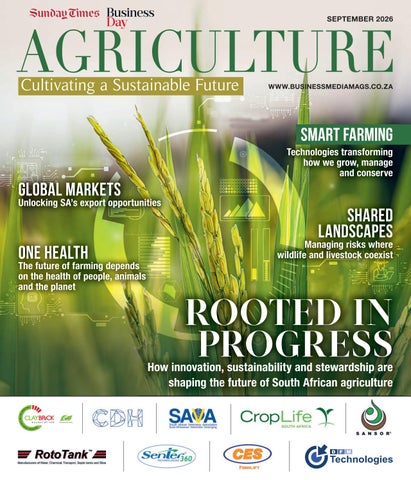
SMART FARMING Technologies transforming how we grow, manage and conserve
GLOBAL MARKETS
Unlocking SA’s export opportunities
ONE HEALTH
The future of farming depends on the health of people, animals and the planet
SHARED LANDSCAPES
Managing risks where wildlife and livestock coexist
How innovation, sustainability and stewardship are shaping the future of South African agriculture
Agriculture_FCP_final.indd 1
2026/09/22 09:06
ToCheck_fcp.indd 2
2026/08/27 09:11
IN PARTNERSHIP WITH SENTER 360
WHEN IRRIGATION PRECISION STARTS TO SLIP The best agronomic practices, water-management strategies and fertilisation programmes are only as effective as the irrigation system delivering them. SENTER 360 unpacks the key factors affecting centre pivot performance
T
here is little value in applying the best agronomic and water-management practices if the irrigation system cannot deliver water accurately and uniformly. For producers, the question is therefore simple: Is your centre pivot still delivering the precision irrigation performance it was designed to provide? The first step is to understand the key factors that determine pivot performance,
START WITH THE CORRECT INLET PRESSURE Every centre pivot has a specific required inlet pressure. No universal or generic pressure applies to all pivots. The correct pressure depends on the irrigated area, pivot flow rate and application package, pipe diameters, land topography and overall system design. A qualified irrigation specialist should calculate the correct inlet pressure for the specific pivot. This is the essential starting point when evaluating system performance.
WHY DOES PRESSURE DECLINE?
IMAGES: SUPPLIED
A reduction in pivot pressure can develop gradually or occur relatively quickly. One common cause is an ageing or deteriorating pump, which may lose its ability to deliver the required pressure and flow. Poor suction conditions can accelerate pump deterioration. Excessive suction lift, blocked or dirty foot valves, and restrictions on the suction side can all place additional strain on the pump. Leaks in the pivot or supply pipeline can also cause significant pressure losses. Even relatively small leaks may reduce system performance. Another frequently overlooked cause is worn pressure regulators.
Regulators have a finite service life. As they deteriorate, they may allow more water to pass through the same sprinkler nozzle, increasing flow rates and reducing application uniformity.
IDENTIFYING UNEVEN WATER APPLICATION Uneven application can often be detected through visual and agronomic indicators. When observing the sprinklers early in the morning or late in the afternoon against sunlight, differences in water application may be visible. Uneven crop growth can also indicate inconsistent irrigation, particularly where wetter and drier patterns correspond with irrigation zones. Individual sprinklers may also discharge noticeably more or less water than neighbouring units. Before replacing a sprinkler or regulator, however, check that the sprinkler is clean, the correct nozzle is installed, and the nozzle is not damaged or blocked. Reduced application towards the outer end of the pivot is another warning sign and may indicate insufficient system pressure.
Simply increasing pump pressure is therefore not the solution. The correct solution is to replace all pressure regulators on the sprinkler package, rather than replacing only those that appear faulty. If the regulators have operated under similar conditions for the same period, replacing only a few units will not restore uniformity.
PROTECTING IRRIGATION PERFORMANCE AND PROFITABILITY Apart from pump deterioration, worn pressure regulators are a major contributor to low system pressure and uneven water distribution. Application packages can deteriorate significantly with age – under harsh conditions, from around five years onward, and under more normal conditions, often between seven and fourteen years. Unlike a mechanical breakdown, regulator deterioration happens gradually and can easily go unnoticed. However, reduced irrigation uniformity can ultimately affect crop yield, water-use efficiency and profitability. Regular inspection, maintenance and timely replacement or upgrading of pressure regulators and sprinkler packages should therefore form part of every producer’s irrigation management programme.
THE HIDDEN IMPACT OF WORN REGULATORS Worn pressure regulators are among the most overlooked causes of poor pivot performance. As regulators wear, they allow more water through the same nozzle. This is particularly significant on modern low-pressure application packages. As individual regulators wear at different rates, some may pass considerably more water than others. This creates differences in application rates across the pivot and increases the total system flow. The additional demand can cause pump pressure to fall further.
REGULATORS HAVE A FINITE SERVICE LIFE. AS THEY DETERIORATE, THEY MAY ALLOW MORE WATER TO PASS THROUGH THE SAME SPRINKLER NOZZLE, INCREASING FLOW RATES AND REDUCING APPLICATION UNIFORMITY.
VISIT WEBSITE SCAN THIS QR CODE TO GO TO THE SENTER 360 WEBSITE
For assistance in evaluating your centre pivot’s performance, contact Senter360 on: +27 (0)18 469 1991 www.senter360.co.za
AGRICULTURE
SENTER 360_Advertorial.indd 1
1
2026/09/15 09:10
FROM THE EDITOR
SHAPING AGRICULTURE FOR A CHANGING WORLD
S
outh African agriculture has never stood still. From the way we produce food and manage livestock to how we conserve our natural resources and compete in international markets, our industry continues to evolve in response to a rapidly changing world. In this issue, we explore some of the forces shaping the future of agriculture, as well as the opportunities that arise when innovation and sustainability principles work together. At the same time, we consider the increasingly important relationship between wildlife and livestock, and the practical measures needed to manage shared landscapes, protect animal health and maintain productive ecosystems. International trade remains another key driver of South African agriculture. Despite geopolitical uncertainty, evolving sanitary and phytosanitary requirements and ongoing logistical challenges, our agricultural sector continues to demonstrate its ability to compete in global markets. We look at where the next export opportunities may lie and how producers can position themselves to take advantage of changing consumer demands. Sustainability also takes centre stage in our exploration of the One Health approach, which recognises that human, animal and environmental health are closely interconnected. This issue further examines responsible livestock welfare, innovative mechanisation and irrigation technologies. Finally, we turn our attention to some of the challenges facing people and wildlife, from human-wildlife conflict to wildlife crime, and the collaborative approaches being used to address them. For me, these stories highlight how interconnected we are with our environment and those who share it with us. This interconnectedness brings with it a profound stewardship responsibility. It is always an honour to see how those involved in agriculture are stepping up to play their part. Elriza Theron, Editor
CONTENTS
18 SHARED LANDSCAPES Managing shared risks between livestock and wildlife.
23 POISON TRACKING The high-tech battle to save SA’s wildlife.
7 7 GLOBAL MARKETS Competing in a changing global marketplace.
13 ONE HEALTH The science of shared responsibility.
16 ANIMAL WELFARE Healthy cows. Smarter systems. Stronger dairy.
2
24 COEXISTENCE Protecting livestock, preserving wildlife.
27 SMART FARMING Mechanisation and emerging technologies are helping farmers save time, water and resources.
PUBLISHED BY
Picasso Headline, A proud division of Arena Holdings (Pty) Ltd, Hill on Empire, 16 Empire Road (cnr Hillside Road), Parktown, Johannesburg, 2193 PO Box 12500, Mill Street, Cape Town, 8010 www.businessmediamags.co.za EDITORIAL Editor: Elriza Theron Content Manager: Raina Julies rainaj@picasso.co.za Contributors: Jennifer Booth, Hanlie du Plessis, Magda du Toit, Busani Moyo, Ivor Price Copy Editor: Brenda Bryden Content Co-ordinator: Natasha Maneveldt DESIGN Head of Design: Jayne Macé-Ferguson Senior Designer: Mfundo Archie Ndzo Cover Image: Worawith Ounpeng/istockphoto.com SALES Project Manager: Gavin Payne GavinP@picasso.co.za Cell: +27 74 031 9774 Sales: Stephen Crawford, Frank Simons DIGITAL Online Editor: Stacey Visser vissers@businessmediamags.co.za PRODUCTION Production Editor: Shamiela Brenner Advertising Co-ordinator: Shamiela Brenner Subscriptions and Distribution: Fatima Dramat fatimad@picasso.co.za Printer: CTP Printers, Cape Town MANAGEMENT Management Accountant: Deidre Musha Business Manager: Lodewyk van der Walt General Manager, Magazines: Jocelyne Bayer
30 CROPLIFE SA Genome editing expands potential to feed the world.
34 ON THE FRONTLINE OF ANIMAL HEALTH SAVA’s role in biosecurity and One Health.
COPYRIGHT: Picasso Headline. No portion of this magazine may be reproduced in any form without written consent of the publisher. The publisher is not responsible for unsolicited material. AGRICULTURE is published by Picasso Headline. The opinions expressed are not necessarily those of Picasso Headline. All advertisements/advertorials have been paid for and therefore do not carry any endorsement by the publisher.
AGRICULTURE
02_Contents.indd 2
2026/09/22 09:09
IN PARTNERSHIP WITH SANSOR
a starting point not only for a plant, but for entire value chains. Today, advances in plant breeding are helping breeders reach these goals with greater speed and precision than ever before. Alongside conventional crossing and field selection, breeders now use tools such as molecular markers, genomic selection, high-throughput phenotyping, speed breeding and, where appropriate, precise breeding technologies to identify valuable traits earlier and combine them more effectively. These advances allow breeders to work not only with what can be seen in the field, but also with the genetic information within the plant itself. The result is a stronger ability to develop varieties that Faith the size of a mustard seed is often spoken about in agricultural are productive, resilient, nutritious, attractive to circles. We rarely hear about an onion seed, but what is in a seed? consumers and better adapted to the realities How can it hold such faith and promise? By Dr LUKESHNI CHETTY farmers face every season. So, this article is also a tribute to the brilliant breeders whose work often begins long ho in agriculture has not heard this and attractiveness; varieties that carry before a seed reaches the farmer’s phrase at some point or another? more protein, oil, vitamins or other hand. Their vision, patience and Who has not leaned on faith alone nutritional value; and crops scientific skill shape the crops to get through a difficult season, that can stand more firmly that sustain us. Through praying for rain to quench dry soil against pests, diseases, countless trials, careful or praying for the rain to stop? I have often heat, drought and changing observations, failed attempts, reflected on the power of this saying, having production conditions. renewed efforts and quiet leaned on it many times myself. Yet, in truth, Breeding has also breakthroughs, they help turn there is so much more to a seed than faith or helped agriculture use its possibility into harvest. In its small size. It may be tiny enough to rest on a resources more wisely. every improved variety, there fingertip, but it holds the potential for abundant Improved root systems can is evidence of their dedication; growth, feeding villages and nations alike. It help crops access water Dr LUKESHNI CHETTY and in every seed planted with reminds us that great outcomes can begin in and nutrients more efficiently. confidence, there is a reflection of the humblest of places. Better plant architecture can their contribution to agriculture, food Every season begins with a decision about support higher plant populations security and the future. seed. Long before a crop emerges from the and easier harvesting. Disease-resistant Perhaps that is where faith and seed meet soil, its potential has already been shaped varieties can reduce losses and, in some again: in the belief that something small, carefully by generations of selection, research and cases, lower the pressure on crop protection nurtured, can carry the promise of abundance. breeding. Farmers may see a bag of seed; spray programmes. These may sound like From one seed, and from the faith placed in plant breeders see years of patient work: technical improvements, but to a farmer those who improve and protect it, the future of crossing parent lines, selecting the strongest they can mean the difference between a agriculture continues to grow. offspring, testing them across environments disappointing harvest and a viable one. and refining varieties until they carry the traits The value of seed therefore reaches far needed in the field, the market and the home. beyond the field. It supports food security by helping producers grow more reliable and nutritious crops. It supports livestock THE ART AND WONDER OF PLANT BREEDING VISIT WEBSITE SCAN TO GO TO THE SANSOR WEBSITE production through feed crops and forage. This is where the science and art of plant It contributes to fuel through crops grown for breeding become so important. Modern bioenergy and industrial oils. It supports fibre crops are not accidental. They are the result through cotton and other plant-based of deliberate improvement: higher-yielding materials that clothe and connect maize, wheat, oilseeds and vegetables; fruit communities. In this way, a seed becomes and grains with better taste, colour, shelf life
FAITH THE SIZE OF AN ONION SEED
IMAGES: SUPPLIED
W
EVERY SEASON BEGINS WITH A DECISION ABOUT SEED. LONG BEFORE A CROP EMERGES FROM THE SOIL, ITS POTENTIAL HAS ALREADY BEEN SHAPED BY GENERATIONS OF SELECTION, RESEARCH AND BREEDING.
For more information: www.sansor.org
AGRICULTURE
SANSOR_FCP Advertorial.indd 3
3
2026/09/15 09:28
ToCheck_DPS.indd 2
2026/09/03 11:14
ToCheck_DPS.indd 3
2026/09/03 11:15
ToCheck_fcp.indd 2
2026/09/07 12:26
GLOBAL MARKETS
Diversify, Adapt, Compete:
THE NEW IMPERATIVE FOR SOUTH AFRICAN AGRICULTURE South African agriculture must diversify markets, navigate tougher trade rules and strengthen resilience to remain competitive in a shifting global marketplace, writes ELRIZA THERON
S
outh Africa’s agricultural sector has long been defined by its ability to compete in some of the world’s most demanding markets. From citrus and wine to deciduous fruit, nuts, beef and processed agricultural products, South African producers have built an export-oriented sector capable of supplying consumers across Europe, Asia, Africa and the Middle East. That competitiveness, however, is increasingly being tested. Geopolitical tensions, changing tariff regimes, shipping disruptions, rising production costs and increasingly complex sanitary and phytosanitary (SPS) requirements are reshaping the global agricultural trading environment. Yet, rather than retreating from international markets, South Africa is responding through diversification, market development, improved production practices and stronger collaboration across the value chain. The results are encouraging. According to a media statement released by the Department of Agriculture in March 2026, South Africa’s agricultural exports reached approximately R268.7-billion in 2025, the strongest performance since the COVID-19 period. This was achieved despite a weaker rand, tighter regulatory requirements in some markets and the impact of higher United States tariffs.
SOUTH AFRICA’S AGRICULTURAL EXPORT PROFILE IS GEOGRAPHICALLY DIVERSE, ALTHOUGH AFRICA REMAINS ITS LARGEST MARKET. A WIDESPREAD EXPORT MARKET South Africa’s agricultural export profile is geographically diverse, although Africa remains its largest market. In the fourth quarter of 2025, approximately 53 per cent of agricultural exports went to African markets, 17 per cent to Asia and the Middle East, 16 per cent to the European Union (EU) and 14 per cent to the rest of the world, including North and South America. Export growth during the year was particularly strong in the United Kingdom, BRIC+ countries, the EU and the Southern African Development Community (SADC). The importance of regional African trade should not be underestimated. SADC has consistently accounted for a substantial share of South Africa’s agricultural exports, providing geographical proximity and established commercial relationships. At the same time, the African Continental Free Trade Area (AfCFTA) offers an opportunity to
expand intra-African trade further as tariff and nontariff barriers are progressively addressed. Beyond Africa, the EU remains a critical market, particularly for horticultural products. Europe remains the region’s largest export market for citrus, and during the 2025 season, South Africa alone exported more than one million tonnes of citrus to the EU. The United Kingdom is another important destination, while China, India, Japan and countries in the Middle East represent significant opportunities for further diversification. This diversification is becoming strategically important. South Africa’s agricultural exports to the United States declined sharply Wandile Sihlobo in the fourth quarter of 2025 following higher tariffs, but growth in other markets more than compensated for the decline. Wandile Sihlobo, chief economist at Agbiz and presidential envoy on agriculture and land, notes: “The expanded BRICS grouping accounts for roughly half of global agricultural imports, yet the original BRICS countries, particularly China and India, account for less than ten per cent of South Africa’s agricultural exports.”
AGRICULTURE
07_08_MARKET ACCESS.indd 7
7
2026/09/15 17:25
GLOBAL MARKETS
Sihlobo argues that a preferential trading arrangement could provide a practical first step towards deeper agricultural integration by reducing tariffs, addressing SPS barriers and potentially establishing tariff-rate quotas for selected products. China has already taken steps in this direction. In May 2026, China reduced tariffs on goods from African countries through its China–Africa Economic Partnership Agreement, creating potential opportunities for African exporters. For South African producers, the opportunity is therefore not simply to “find new markets”, but to identify markets where South African products have a genuine competitive advantage and where trade agreements, tariff preferences and SPS protocols can support commercially viable access. Market access is no longer determined by tariffs alone. Sanitary and phytosanitary requirements, maximum residue limits (MRLs), traceability, certification and production standards increasingly determine whether a product can enter a market. The EU’s proposed changes to their MRL framework under the Food & Feed Omnibus package, for example, is of particular concern. The proposal could make it harder for some South African products to enter the EU. Certain active substances not approved for use in Europe could be assigned MRLs at what is known as the analytical “technical zero”, even where internationally recognised Codex standards allow higher, scientifically assessed MRLs or where the European Food Safety Authority has proposed higher MRLs based on consumer health assessments. For South African producers, this could have a significant impact because production environments in Southern Africa differ substantially from those in Europe, including differences in pests, diseases, climate and agricultural conditions. Third-country growers may consequently require plant-protection tools that differ from those available to European growers and MRLs should be based on scientifically justified consumer risk assessments. The issue extends beyond citrus though because if importing countries increasingly align their import requirements with domestic production policies rather than internationally recognised, risk-based food-safety assessments, exporters could
8
face a growing number of market-specific production requirements. While market access is becoming more complex, global demand for sustainably produced food is creating new opportunities. Consumers, retailers and food companies are increasingly interested in the environmental and social footprint of agricultural products. This creates both an additional compliance burden and an opportunity for South Africa. South Africa’s agricultural industries have strong experience in traceability, responsible production and sustainability, giving producers an opportunity to differentiate themselves in global markets. However, the cost of meeting private retailer criteria and undergoing third-party audits is becoming untenable for growers. Future competitiveness will depend not only on productivity, but on market intelligence, regulatory readiness, sustainability and supply-chain resilience.
PRIORITIES FOR PRODUCERS Producers should therefore consider several priorities. First, diversification should be pursued at both industry and farm level, reducing excessive dependence on any single destination. Second, market requirements
should be understood well in advance, particularly where residue limits, phytosanitary protocols or certification requirements can influence production decisions. Third, producers and exporters should strengthen collaboration with government and industry bodies to identify emerging market opportunities and address SPS barriers. The South African government has already identified markets such as Japan, Vietnam, Thailand, India and the Middle East as areas of opportunity, supported by increased export-certification capacity and efforts to align biosecurity standards with destination-market requirements. Finally, sustainability should be embedded in production and marketing, not treated as a compliance exercise. Responsible production, environmental stewardship and transparent supply chains can help South African products stand out in global markets. While South Africa cannot control geopolitical tensions, tariffs, shipping disruptions or regulatory changes, it can control how prepared it is to respond. Diversified markets, stronger trade relationships, improved logistics, science-based SPS engagement and sustainable production provide a solid platform for long-term competitiveness.
RESPONSIBLE PRODUCTION, ENVIRONMENTAL STEWARDSHIP AND TRANSPARENT SUPPLY CHAINS CAN HELP SOUTH AFRICAN PRODUCTS STAND OUT IN GLOBAL MARKETS.
IMAGES: SMEDEREVAC/ISTOCKPHOTO.COM, FOKKEBOK/ISTOCKPHOTO.COM, SUPPLIED
BARRIERS AFFECTING TRADE
AGRICULTURE
07_08_MARKET ACCESS.indd 8
2026/09/15 17:26
HARDI SA resized_fcp.indd 2
2026/09/15 18:02
ToCheck_fcp.indd 2
2026/09/02 16:13
IN PARTNERSHIP WITH DFM TECHNOLOGIES
PREPARING FOR A SUPER EL NIÑO
Precision irrigation can make the difference between surviving a drought and protecting your profitability, writes JEROMEO MENTO, horticulturist, DFM Technologies
S
outh African agriculture has experienced the devastating effects of El Niño before. Reduced rainfall, prolonged heat waves, declining dam levels and increasing irrigation demand place enormous pressure on farmers, particularly those producing high-value perennial crops such as apples, pears, citrus, table grapes, almonds and stone fruit. Climate scientists continue to warn that future El Niño events could become more intense, increasing the likelihood of severe drought and record-breaking temperatures. While farmers cannot control the weather, they can control how efficiently they use every litre of water available. The question is no longer if drought conditions will occur but how prepared your farming operation is Jeromeo Mento when they arrive.
WHAT DOES A SUPER EL NIÑO MEAN FOR IRRIGATION? During severe El Niño conditions, growers can expect: • Reduced winter rainfall and lower dam levels. • Higher evaporation rates. • Increased crop water demand. • Greater irrigation requirements during peak summer. • Increased pumping costs. • Greater risk of reduced fruit size, quality and yield. The objective is not to apply more water; it is to apply the correct amount at the correct time.
EVERY DROP COUNTS Water has become one of agriculture’s most valuable production inputs. When allocations are reduced, every irrigation decision has financial consequences.
Many growers still irrigate according to fixed schedules, historical practice or visual observations. During drought conditions, this can result in over- or under-irrigation. Both are costly.
THE HIDDEN COSTS AND RISKS Applying extra water may seem like insurance against heat, but excessive irrigation can waste valuable water while reducing orchard performance. Over-irrigation can lead to deep drainage below the root zone, nutrient leaching, reduced oxygen around the roots, increased disease pressure, higher electricity costs and less water being available later in the season. Under-irrigation (applying too little water) can be equally damaging. When soils remain below the optimum moisture range, roots become stressed, photosynthesis declines, fruit sizing slows and trees struggle to recover during heat waves. Yield potential can decline long before visible symptoms appear.
THE GOAL IS NOT FULL; IT IS OPTIMAL The most successful growers do not keep their soils permanently saturated. Instead, they maintain moisture within an optimum management zone where roots receive sufficient oxygen, water remains readily available, irrigation efficiency is maximised and deep drainage is minimised. Achieving this balance requires irrigation decisions based on measured soil moisture rather than assumptions.
PRECISION IRRIGATION STARTS WITH MEASUREMENT DFM Technologies’ multidepth soil moisture probes continuously monitor moisture throughout the root zone. Rather than measuring only surface conditions, the probes
reveal where water enters the soil, how deeply irrigation penetrates, which areas are actively extracting water and how quickly the crop is using available moisture. This transforms irrigation from guesswork into science. Data alone does not save water. Its value lies in correctly interpreting the information and turning it into practical action. DFM Technologies combines soil moisture monitoring, weather data, crop coefficients, evapotranspiration, root development, soil characteristics and horticultural expertise to provide practical irrigation recommendations throughout the season. Instead of asking, “How much should I irrigate today?”, the question becomes, “How much water does my crop actually require today?” Precision monitoring can also help identify irrigation system problems such as blocked drippers, uneven application, incorrect irrigation run times, poor infiltration, water bypassing the root zone and leaks. Finding these problems early can save more water than simply increasing irrigation capacity.
PREPARING BEFORE RESTRICTIONS ARRIVE A super El Niño cannot be prevented. However, preparation can help to protect against the effects. Growers can prepare by installing soil moisture monitoring, evaluating irrigation system performance, regularly updating irrigation schedules, monitoring crop water use, prioritising critical growth stages and eliminating unnecessary water losses. The earlier these actions are implemented, the greater the opportunity to protect production. Climate variability is becoming an increasingly important consideration for agriculture. Future success will depend on producing efficiently with less water. DFM Technologies combines advanced soil moisture monitoring, irrigation scheduling, weather integration and horticultural expertise to help producers optimise every irrigation event. During a super El Niño, every irrigation decision matters. Every litre saved today may become the litre that protects tomorrow’s harvest.
Follow: Jeromeo Mento www.linkedin.com/in/jeromeo-mento-96164046 DFM Technologies www.linkedin.com/company/dfm-technologies-pty-ltd
AGRICULTURE
DFM_TL fcp.indd 11
11
2026/09/15 09:05
ToCheck_fcp hv.indd 2
2026/09/03 10:30
HEALTHY VALUE CHAINS
ONE HEALTH
The science of shared responsibility Protecting people, animals and the environment requires collaboration across agriculture, health, regulation, nutrition and supply chains, writes MAGDA DU TOIT
Healthier animals require fewer antibiotic treatments, supporting responsible antimicrobial stewardship.
S
outh Africa’s food supply, farmer welfare and environmental sustainability are locked in an alliance to weather macro challenges such as changes to trade agreements, export market regulation, geopolitical unrest and climate change. The spread of disease, antimicrobial resistance and biodiversity loss requires additional resilience. By acknowledging the interconnection between people, animals, plants and the environment, the agriculture sector is positioning itself to safeguard food security as well as human and animal health amid canvassing for the long-term sustainability of farming systems. In 2022, the Food and Agriculture Organisation of the United Nations (FAO), the United Nations Environment Programme (UNEP), the World Organisation for Animal Health (WOAH) and the World Health Organization (WHO) adopted the One Health (OH) Joint Plan of Action (JPA) to improve human and animal lives while contributing to
food chain are inseparable. Every link in the agricultural value chain depends on the next, making collaboration essential to protect animal health, public health and consumer confidence,” Breytenbach explains. She cites antimicrobial resistance (AMR) as one of the clearest examples of the One Health approach. “AMR occurs when bacteria no longer respond to antibiotics, making infections increasingly difficult to treat in both people and animals. Responsible antimicrobial use, together with strong disease prevention throughout the food chain, is therefore becoming a global priority.” The animal feed sector plays a critical but often overlooked role in this effort, explains Breytenbach. “Safe, high-quality and nutritionally balanced feed keeps livestock healthy, strengthens natural immunity and reduces disease risk. Healthier animals require fewer antibiotic treatments, supporting responsible antimicrobial stewardship.” Innovation in animal nutrition is also expanding the contribution of feed beyond meeting basic nutritional requirements. “Modern feed ingredients and additives can improve gut health, strengthen immune
sustainable development and a world better equipped to prevent, predict, detect and respond to health threats.
AN INTERCONNECTED SYSTEM DEPENDENT ON COLLABORATION In South Africa, the One Health concept is actively promoted through various initiatives and collaborations across the food and health value chains. For example, it forms the basis of many of the University of Pretoria’s Future Africa research focuses and themes. “Human and animal health, food production and environmental protection can no longer be managed in isolation. What happens in crop production influences animal feed, and animal nutrition influences animal health and productivity. These outcomes ultimately affect food safety, public health and food security,” emphasises Liesl Breytenbach, executive director of the Animal Feed Manufacturers Association (AFMA). “Animal feed is one of the first links in the food production chain. The feed and
“EVERY LINK IN THE AGRICULTURAL VALUE CHAIN DEPENDS ON THE NEXT, MAKING COLLABORATION ESSENTIAL TO PROTECT ANIMAL HEALTH, PUBLIC HEALTH AND CONSUMER CONFIDENCE.” – LIESL BREYTENBACH
AGRICULTURE
13_14_ONE HEALTH_1.indd 13
13
2026/09/15 17:29
function and increase animals’ resilience to disease and environmental stress. While nutrition is not a substitute for antibiotics, it forms an important part of an integrated strategy that includes vaccination, genetics, biosecurity, clean water and good animal husbandry,” Breytenbach remarks. Karen Nel, director and chief executive officer of Design Biologix, says although research and implementation of animal health practices are increasingly moving into the private sector due to limited government funding, private-sector vaccine producers are liaising closely with veterinarians and farmers to ensure that their products remain relevant. “This approach cements the message that we are moving beyond awareness-raising and focusing more on practical and scalable implementation through collaboration,” Nel states.
POLICY AND REGULATION Meanwhile, there is mounting international pressure to impose more stringent regulation of agricultural remedies. Annelize Crosby, head of legal intelligence at Agbiz, says South Africa has a comprehensive regulatory framework supporting sustainable and responsible food production. “Agricultural crop protection is highly regulated, with strict requirements for labelling, application standards, maximum residue limits and record-keeping.” The primary legislation governing agricultural remedies and the animal feed industry is the Fertilizers, Farm Feeds, Agricultural Remedies and Stock Remedies Act, 1947 (Act 36 of 1947), supported by detailed regulations. In addition, South Africa is a signatory to several international conventions, including the Rotterdam Convention on the safe trade of hazardous chemicals, the Stockholm Convention on persistent organic pollutants, and the Basel Convention regulating the transboundary movement and disposal of hazardous waste. Crosby stresses that the agriculture industry is not opposed to improving or renewing the regulatory environment where necessary. “As an industry we are fully participating in processes aimed at renewing policy and legislation.” The harmonisation of maximum residue limits (MRLs) and ensuring agricultural exports meet global safety requirements aims to integrate agriculture with food safety and
general health. “Encouraging the adoption of safer and more sustainable alternatives across product value chains and promoting responsible chemical management in the agriculture and healthcare industries with improved transparency and access to information on chemical risks are some of the positive steps towards a safer and healthier society,” Crosby notes. Nel says South Africa is actively examining legislation regarding the use of antibiotics and antimicrobials, especially those regulated by Act 36 of 1947. “There is a strong move to transfer the registration of these molecules to Act 101 of 1965, where they will be available on veterinarian script only.”
“THERE ARE KNOCK-ON EFFECTS IN THE FOOD CHAIN. CO-OPERATION ACROSS THE VALUE CHAIN IS THEREFORE INVALUABLE.” – KAREN NEL
MAINTAINING AN UNBROKEN COLD CHAIN Another key aspect in achieving food safety and general health is the maintenance of the cold chain. This happens in the background of the food and pharmaceutical industries. It is often taken for granted until the cold chain is broken, product quality is affected, and sales are lost. “The cold chain is not a luxury, but a vital part of the food and health value chain. It is essential for preserving the quality, safety and efficacy of temperature-sensitive products,” says Wolfe Braude, manager for the Agbiz Fruit Desk. Every product has an optimum temperature requirement to ensure the product’s longevity. “For perishable food, pharmaceuticals and other temperature-sensitive products, the cold chain is essential. Breaks in the chain can compromise safety, quality and efficacy,” Braude points out.
Braude adds that traceability is closely linked to the cold chain and plays a key role in maintaining the integrity of plant and animal health product management. “Consumers are increasingly interested in the origin or ‘backstory’ of the product and its producer.” Lastly, Braude stresses that the role of the cold chain and overall efficiency of logistical infrastructure and systems must not be forgotten with regard to keeping South Africa food secure and food prices affordable. The reputation of South Africa as a reliable and high-quality supplier is also interlinked with cold chain integrity and logistics efficiency. Nel agrees: “What happens in one part of the food value chain will impact the broader food industry. There is no doubt that there are knock-on effects in the food chain. Co-operation across the value chain is therefore invaluable.” Nel uses the foot-and-mouth disease (FMD) outbreak in South Africa as an example. “Lack of movement control of animals, lack of traceability, lack of willingness to act quickly to contain the very first reported outbreak, lack of understanding of the effective use of quarantine measures and lack of sufficient vaccines led to increasing speed of transmission until virtually no area in South Africa was free of the disease. All of this eventually culminated in a large increase in the price of meat at a retail level.” All agree that capacity building through training and mentorship and cross-sector collaboration between various role players using existing frameworks are crucial for the One Health concept to work.
IMAGES: SUPPLIED
HEALTHY VALUE CHAINS
Annelize Crosby
Follow: Annelize Crosby www.linkedin.com/in/annelize-crosby-69835a1a Liesl Breytenbach www.linkedin.com/in/liesl-breytenbach-333a7349 Karen Nel www.linkedin.com/in/karen-nel-89625966 Wolfe Braude www.linkedin.com/in/wolfe-logan-braude-506b3525
14 AGRICULTURE
13_14_ONE HEALTH_1.indd 14
2026/09/15 17:31
ToCheck_fcp.indd 2
2026/08/27 16:57
ANIMAL WELFARE
At Colbourne, better animal welfare, natural systems and smart technology are helping create healthier cows, stronger productivity and a more resilient dairy business. By HANLIE DU PLESSIS
F
or Andrew Morphew, returning to farming was less a career decision than a homecoming. “When I was in primary school, I was supposed to do homework in the afternoons, but I would escape from my room to feed radish to the cows,” he says. “I don’t think I ever really doubted that I would end up back on the farm. Farming isn’t just an occupation; it is a way of life.” Morphew spent time away from agriculture, studying at Rhodes University and working in London. When his parents offered him the opportunity to return to Colbourne, the decision was easy. They bought the Howick, KwaZulu-Natal farm in 1989, developing it mainly as a piggery, with maize grown for the pigs and beef cattle on the grazing. When Morphew returned, the family assessed where the best opportunity for growth lay. The numbers favoured dairy, and the enterprise gradually became the focus of the business. In 2020, the farm transitioned to organic production.
Morphew received the MPO Nedbank Stewardship Award in 2021, but says his understanding of sustainability has become more pragmatic. “There isn’t a perfect system. For me, sustainability is about farming as conscientiously as you can within the system you have, continually measuring what you are doing, learning from it and adapting as you go.” That philosophy extends to animal welfare, which Morphew sees as both a responsibility and a business imperative. “As livestock farmers, we are custodians of our animals. We have taken away their ability to feed and care for themselves, so we must take complete responsibility for their welfare.”
SUPPORTING THE COWS’ NEEDS AND HEALTH “Welfare means more than preventing illness. It is about creating an environment in which the animal can be healthy, comfortable and able to behave as naturally as possible within a farming system.” He aims to design the production system around the needs of the cow rather than continually asking the cow to adapt to it.
Follow: Andrew Morphew www.linkedin.com/in/andrew-morphew-4917294 Colbourne https://colbourne.co.za
Morphew’s advice: • Be pragmatic. • Learn from other people. • Take the things that make sense. • Discard the things that don’t make sense. • Build a system that works for you and run it your way.
IMAGES: SUPPLIED
HEALTHY COWS. SMARTER SYSTEMS. STRONGER DAIRY.
This is evident in Colbourne’s foster-cow system. Replacement heifers are raised by foster cows, with one cow able to rear up to four calves. Once settled, groups of foster cows and calves are moved onto pasture. “It creates as natural an environment as we practically can for those calves. They are outdoors, they interact socially, they start grazing early, and they learn from the older animals around them.” Morphew sees animal welfare as part of a wider biological system. “Diversity is valuable both above and below the ground,” he says. Diverse pastures provide cows with a range of grasses, legumes and herbs, while different plant species support soil health through their varied root structures and interactions with soil biology. Technology provides another tool for protecting animal health. Activity trackers establish each cow’s normal behaviour and alert staff to changes that could indicate illness or heat. This allows earlier intervention and supports fertility management. “Both health and fertility have a significant impact on the profitability of a dairy cow,” says Morphew. “Every calculated action we have taken to improve the welfare of our cows has had a positive impact on profitability. Put simply, happier cows do better business.” Colbourne covers about 840 hectares and has approximately 850 cows, of which 700 are in milk. The farm produces about 4.5 million litres of milk a year and employs just under 50 people. However, Colbourne’s experience is not a blueprint for every livestock farm. Different resources, production systems and constraints require different approaches. Morphew’s advice is to learn, test and adapt rather than copy.
16 AGRICULTURE
16_Animal Welfare_1.indd 16
2026/09/15 17:33
ToCheck_fcp.indd 2
2026/09/09 09:40
SHARED LANDSCAPES
HEALTHY HERDS Managing shared risks between livestock and wildlife Livestock and wildlife increasingly share disease risks, making biosecurity, traceability, responsible land management and collaboration essential to protecting healthy herds, writes HANLIE DU PLESSIS
S
outh Africa’s livestock industry increasingly operates in a landscape where cattle, sheep, goats and wildlife share boundaries, resources and disease risks. For Dr David Pretorius, the answer is not to separate livestock and wildlife into opposing camps, but to manage the entire landscape as one interconnected animal health system. Dr Pretorius qualified as a veterinarian at the University of Pretoria in 2009 and has worked extensively in wildlife capture, immobilisation, translocation and disease management through Motsumi Wild. His work subsequently expanded into the development of Motsumi Darts, while his involvement with buffalo, epidemiology and livestock health led to the establishment of Buffalo Analytics in 2020. The platform combines field veterinary work with biosecurity, geographic information systems, traceability and regulatory reporting. This experience has given Dr Pretorius a perspective that crosses the traditional boundaries between wildlife and livestock production. He says the distinction between a wildlife farmer and a livestock farmer is becoming increasingly irrelevant as enterprises diversify and farms increasingly border game operations and conservation areas. “A pathogen does not recognise title deeds
or industry categories,” he says. “We therefore need to manage the entire epidemiologically connected landscape.” The recent foot-and-mouth disease (FMD) epidemic has brought the importance of this approach into sharp focus. African buffalo are recognised reservoirs of the Southern African Territories serotypes of FMD virus, making buffalo-cattle interfaces a genuine disease risk. However, Dr Pretorius cautions against automatically blaming wildlife for every outbreak. “Molecular epidemiology shows that transmission does not necessarily occur only in one direction,” he says, pointing to evidence of transmission from cattle to buffalo as well as from buffalo to cattle. The source of a specific outbreak should therefore be established through field epidemiology and virus genotyping rather than assumptions. The lesson for livestock producers is that wildlife is only one part of a much larger risk network. Uncontrolled animal movements, inadequate surveillance, shared transport, auctions, personnel and feed logistics can all create pathways for disease transmission.
Follow: Dr David Pretorius www.linkedin.com/in/david-pretorius-a1b31668 Motsumi Darts www.facebook.com/motsumidarts
PREVENTING DISEASE SPREAD Practical disease prevention starts with limiting exposure. Dr Pretorius recommends controlling access to farms, keeping visitor and movement records, establishing clean and dirty zones, using dedicated farm vehicles and physically separating high-risk animals. New livestock should enter through a veterinarian-designed risk and quarantine programme. While 28 days may be a useful minimum in some FMD protocols, it is not a universal guarantee of freedom from infection. Origin, local disease status, clinical examination, testing and vaccination history must determine the appropriate protocol. The same principle applies to wildlife Dr David Pretorius operations. Where buffalo and cattle have a direct FMD interface, strong fences, monitoring and regulatory compliance remain essential. During an active outbreak, reducing particular contact opportunities may be the most responsible management decision. Disease management, however, cannot be separated from the condition of the land itself. “Healthy veld, sufficient water, appropriate carrying capacity and biodiversity support nutrition, resilience, reproduction and climate resilience,” Dr Pretorius says. A healthy ecosystem does not mean an absence of disease risk, but ecological integrity and targeted disease control can work together through sound fencing, controlled water points, carcass management and monitoring of wildlife-livestock-human contacts. This makes responsible land management a livestock productivity issue and a conservation priority. Dr Pretorius argues that biosecurity should ultimately be viewed not simply as insurance against disaster, but also as a quality system. “A herd with lower disease pressure, better vaccination compliance, fewer mortalities, better reproduction and a verifiable health history offers a buyer less risk and greater predictability.” The future of South African livestock production will therefore depend on managing shared landscapes rather than defending isolated sectors. “Knowledge, integrity and collaboration are our best protection,” Dr Pretorius says. “No farmer, veterinarian, auction, feedlot or government department can control FMD alone.”
IMAGES: SUPPLIED
HEALTHY LANDSCAPES,
18 AGRICULTURE
18_Healthy landscapes_1.indd 18
2026/09/15 17:39
ToCheck_fcp.indd 2
2026/09/16 08:37
BEWARE EL NIÑO LUCINDE RHOODIE, director – Dispute Resolution, and Agriculture, Aquaculture & Fishing, and LIËTTE VAN SCHALKWYK, senior associate – Dispute Resolution, and Agriculture, Aquaculture & Fishing at Cliffe Dekker Hofmeyr, unpack the El Niño extreme weather and force majeure clauses in South Africa and the risk for the agricultural sector
A
s South Africa faces the prospect of a strengthening El Niño cycle, agricultural producers, agribusinesses, input suppliers, processors and commodity traders should pay close attention not only to weather forecasts, but also to the allocation of risk in their commercial contracts. Forecasts indicate that El Niño conditions are likely to bring hotter and drier weather to much of Southern Africa, increasing the risk of supply chain disruptions, drought, wildfires, water shortages, reduced crop yields and livestock losses. While El Niño itself is a recurring climatic phenomenon, and not a legal event, its consequences, as mentioned above, may have significant contractual implications.
WHAT IS EL NIÑO AND WHY IS IT IMPORTANT? El Niño is a naturally occurring climate pattern characterised by unusually warm ocean temperatures in the central and eastern Pacific Ocean. Although it originates thousands of kilometres from Southern Africa, it is well known for altering global weather patterns. In Southern Africa, El Niño events are frequently associated with hotter and drier conditions, increased drought risk, water scarcity and agricultural disruption. The name El Niño (“the little boy” or “Christ Child” in Spanish) was coined by Peruvian fishermen in the 19th century to describe a warm current that appeared around Christmas. The most recent forecasts from the World Meteorological Organization indicate a strengthening El Niño event, with elevated risks of above-average temperatures and shifting rainfall patterns across parts of Africa. Southern Africa may experience drought
conditions, pressure on water resources and associated economic impacts. For businesses operating in sectors such as agriculture, mining, energy, manufacturing, logistics and construction, these impacts can affect the ability to perform contractual obligations, from delivering products and services to maintaining production levels and meeting project deadlines. One option available to parties operating, for example, in the agricultural sector is to include force majeure clauses in their contracts.
FORCE MAJEURE CLAUSES UNDER SOUTH AFRICAN LAW Unlike some jurisdictions, South African law does not contain a statutory definition of force majeure. Instead, parties generally rely on express force majeure clauses contained in contracts, or the common law doctrine of supervening impossibility of performance where no contractual provision exists. Force majeure is a contractual mechanism that typically excuses or suspends performance when an extraordinary event, beyond the reasonable control of the parties, prevents one or both from carrying out their obligations. Unlike ordinary commercial risk (price spikes and supplier delays you could have planned for), force majeure captures the
IN SOUTHERN AFRICA, EL NIÑO EVENTS ARE FREQUENTLY ASSOCIATED WITH HOTTER AND DRIER CONDITIONS, INCREASED DROUGHT RISK, WATER SCARCITY AND AGRICULTURAL DISRUPTION.
truly exceptional: events that are external, unforeseeable (or not reasonably foreseeable) and unavoidable, and that cause the impossibility of performance. Under South African common law, in the absence of a force majeure clause in a contract, a genuine objective supervening impossibility can discharge duties. However, a clear force majeure clause is invaluable because it defines events, notice steps, mitigation duties and consequences with far more certainty than common law alone. Subjective factors, such as mere inconvenience, increased cost, reduced profitability or operational Lucinde Rhoodie hardship, will ordinarily not suffice.
CAN EL NIÑO CONSTITUTE A FORCE MAJEURE EVENT? The answer is not a simple yes or no and will depend on the wording of the specific contract and the facts of each case. Importantly, El Niño itself is unlikely to constitute the triggering event. Rather, the relevant question is whether the consequences of El Niño fall within the scope of the force majeure clause. For example: • A severe drought resulting in regulatory water restrictions. • Flooding that damages critical transport infrastructure. • Wildfires that destroy production facilities. • Government-imposed emergency measures affecting operations. • Extreme weather preventing physical access to sites or projects. Where a clause expressly includes events such as “natural disasters”, “acts of God”, “drought”, “extreme weather events” or similar wording, there may be a stronger basis to invoke the force majeure protection afforded in a contract. Whether a party is entitled to relief will depend on establishing a nexus between the event and the inability to perform.
20 AGRICULTURE
CDH_DPS Advertorial.indd 20
2026/09/15 08:56
IN PARTNERSHIP WITH CLIFFE DEKKER HOFMEYR
FORESEEABILITY MAY BECOME INCREASINGLY RELEVANT As climate-related events become more frequent and forecasts more sophisticated, businesses may face greater scrutiny when relying on force majeure provisions. While South African force majeure clauses are primarily interpreted according to their wording, it may become more difficult to argue that climate-related disruption was entirely unforeseen where advance warnings and seasonal forecasts were available. Courts may scrutinise: • Whether reasonable contingency planning was undertaken. • Whether the affected party took adequate mitigation measures. • Whether alternative means of performance were available. • Whether the event genuinely rendered performance impossible rather than merely more expensive or inconvenient.
THE PURPOSE OF A FORCE MAJEURE CLAUSE It stipulates to each party who bears which risks if performance becomes impossible due to extraordinary events and allocates the risk to a specific party. It creates a roadmap (the roadmap usually consists of the notice obligation to mitigate risk suspension possible termination) so parties can act promptly and predictably to ensure sufficient continuity planning. By expressly defining qualifying events and procedures up front, it narrows room for disputes once the event arises. It prevents a party from being labelled in breach where performance was objectively impossible despite reasonable efforts.
PRACTICAL STEPS FOR BUSINESSES
IMAGES: SUPPLIED
In light of growing climate volatility, organisations should consider reviewing existing contracts to determine: • Whether the force majeure clause is fit for purpose: many older contracts do not expressly address droughts, water shortages, heatwaves, environmental emergencies or climate-related disruptions. • Notice requirements: force majeure provisions often contain strict notification obligations. Failure to provide timely notice may prejudice a party’s ability to rely on the clause.
becoming a contractual risk. Businesses should not assume that the force majeure clauses in their contracts will automatically provide protection against weather-related disruption. The availability of relief will depend on the precise wording of the contract, the nature of the event and whether performance was genuinely prevented.
REVIEW CONTRACTS AND ASSESS EXPOSURE
Liëtte van Schalkwyk
A CLEAR FORCE MAJEURE CLAUSE IS INVALUABLE BECAUSE IT DEFINES EVENTS, NOTICE STEPS, MITIGATION DUTIES AND CONSEQUENCES WITH FAR MORE CERTAINTY THAN COMMON LAW ALONE. • Mitigation obligations: most clauses require affected parties to take reasonable steps to minimise the effects of the event and resume performance as soon as possible. The farmer must then bear in mind the steps to be taken to mitigate losses. • Supply-chain exposure: businesses should evaluate whether key suppliers and subcontractors are vulnerable to drought, water restrictions, transport disruptions or energy constraints. • Climate-specific drafting: future contracts may benefit from expressly addressing climate-related risks, including droughts, floods, water restrictions, wildfires and other extreme weather events. The expected strengthening of El Niño serves as a reminder that climate risk is increasingly
Follow: Cliffe Dekker Hofmeyr www.cliffedekkerhofmeyr.com Lucinda Rhoodie www.linkedin.com/in/lucinde-rhoodie-31526166 Liëtte van Schalkwyk www.linkedin.com/in/li%C3%ABtte-van-schalkwyk-9b5641214
El Niño serves as an important reminder that climate risk and contractual risk are becoming increasingly intertwined in the agricultural sector. While severe droughts and other extreme weather events may provide a basis for invoking force majeure clauses, relief will not be automatic and will depend on the specific terms of the contract and the facts of each case. Agricultural producers and agribusinesses should use the current forecasting window to review contracts, assess climate-related exposures and obtain the necessary legal advice to ensure force majeure provisions adequately address the realities of modern farming. In an era of increasing climate volatility, careful contractual drafting may prove just as important as rainfall. A proactive review of force majeure provisions, together with broader climate resilience planning, can help reduce disputes and position organisations to respond effectively when extreme weather events occur. El Niño may not itself be a force majeure event, but its consequences may trigger contractual relief where they render performance objectively impossible and fall within the scope of the applicable force majeure clause. Businesses should review their contracts now, before disruption occurs.
VISIT WEBSITE
SCAN TO GO TO THE CLIFFE DEKKER HOFMEYR WEBSITE
For more information contact: www.cliffedekkerhofmeyr.com
AGRICULTURE
CDH_DPS Advertorial.indd 21
21
2026/09/15 08:56
ToCheck_fcp.indd 2
2026/09/15 15:48
WILDLIFE WATCH
TRACKING POISON
The high-tech battle to save South Africa’s wildlife Satellite tracking, drones, forensic science and community intelligence are giving conservationists powerful new tools to detect poisoning and protect wildlife. By IVOR PRICE
A
satellite-tagged vulture that has spent days soaring over the bushveld suddenly stops moving. On a computer screen hundreds of kilometres away, conservationists notice the stillness. Within minutes, phones start ringing. Rangers, reserve managers, veterinarians and antipoaching teams head for the bird’s last known location, hoping they are not already too late. Sometimes they arrive in time to save birds poisoned by a tainted carcass. Sometimes they don’t. However, every rapid response offers another chance to preserve evidence, identify the poison and stop those responsible. Modern wildlife crime is no longer fought only by rangers on patrol. Every poisoning incident has become a crime scene, where satellite technology, forensic science and community intelligence are proving as important as boots on the ground. A single poisoned carcass can kill scores of vultures while also claiming jackals, hyenas, lions and other scavengers. In many cases, poachers deliberately target vultures because circling birds can reveal freshly poached rhino or elephant carcasses.
IMAGES: SUPPLIED
FAST RESPONSES THANKS TO TECHNOLOGY For Kerri Wolter, chief executive of Vulpro, technology has transformed the race against time. “We are able to respond to possible poisoning scenes almost immediately,” she says. “Once we notice the bird or birds’ lack of movement, we can deploy a team to get to site as soon as possible.” The alert triggers a co-ordinated response involving landowners, reserve managers, wardens, rangers and antipoaching teams. “This way, we can potentially save vultures that would have suffered a horrible fate. This ability has allowed us to give more birds a greater fighting chance of survival.”
The system has already proved its worth. In May last year, abnormal GPS signals from tagged vultures led conservationists to one of South Africa’s worst recorded poisoning incidents. More than than 100 vultures were found dead around a poisoned carcass in Mpumalanga while others were rescued before it was too late. Technology extends beyond satellite tracking. Drones are increasingly used to monitor remote breeding colonies and inaccessible cliffs, giving conservationists a clearer picture of where birds are moving and where danger may emerge. However, sophisticated technology cannot stop poison from entering the country. Dr Gerhard Verdoorn, director of the Griffon Poison Information Centre, says South Africa already has the laws needed to deal with many of the chemicals used in wildlife poisoning. “The loopholes are not legal in nature, but rather enforcement in nature.”
PROTECTING AGAINST POISONING Highly toxic pesticides such as aldicarb have long been banned yet continue to enter the country through organised crime syndicates. “The mere possession of a banned substance such as aldicarb is a criminal offence,” he says.
Follow: Vulpro
When poisoning incidents occur, forensic scientists analyse tissue samples and contaminated bait to identify the chemicals involved, helping investigators build criminal cases. Community intelligence has also become a powerful tool. Wolter says years of working alongside rural communities have changed attitudes towards vultures, particularly among younger people. “There is more empathy towards vultures with the younger generation. There is also a sense of responsibility to protect them as well as to become informants of potential illegal trade”. Those relationships have led to sting operations and the rescue of birds destined for the illegal wildlife trade. Kerri Wolter Keeping that early-warning network operating is expensive. Each satellite tracking device costs around R25 000, excluding annual service fees. “Vultures are a species that is, without a doubt, underfunded. They are regarded as vermin, ugly and often overlooked.” Despite those challenges, conservationists believe the fight against wildlife poisoning is becoming smarter. From satellite tags and drones to forensic laboratories, community tip-offs and rapid-response teams, every poisoned carcass is yielding intelligence that helps investigators understand not only how wildlife is being poisoned, but who is behind it.
www.facebook.com/VulProAfrica, www.vulpro.com
AGRICULTURE
23_WILDLIFE TRACKING_1.indd 23
23
2026/09/15 17:41
COEXISTENCE
PROTECTING LIVESTOCK, PRESERVING WILDLIFE Practical, evidence-based approaches are helping farmers reduce livestock losses while protecting predators and building more sustainable human-wildlife coexistence. By BUSANI MOYO A COMBINATION OF INTERVENTIONS
“THERE IS NO SINGLE INTERVENTION THAT EFFECTIVELY PREVENTS HUMAN-WILDLIFE CONFLICT ACROSS ALL FARMING SYSTEMS.” – CYRIL STANNARD
Interventions must reflect the landscape, predator species, farming system, resources and the producer’s circumstances. Both van der Merwe and Stannard agree that technical interventions alone cannot deliver sustainable coexistence. Where farms, communal land and protected areas share boundaries, poor communication and mistrust can discourage participation in conservation initiatives. Farmers and communities should therefore help develop the measures they are expected to implement, receive ongoing technical support and participate in monitoring the results. “The most successful projects are those where landowners actively participate in developing and implementing solutions, receive ongoing technical support and monitor outcomes over time,” van der Merwe says. “Coexistence is ultimately about partnerships rather than individual interventions.” Protecting livestock and conserving predators need not be competing objectives. However, lasting progress requires proactive management, locally appropriate solutions and trusted relationships among farmers, communities, conservation organisations and government agencies.
Follow: Derek van der Merwe www.linkedin.com/in/derek-van-der-merwe-36328335 Cyril Stannard www.linkedin.com/in/cyril-stannard-09376683
IMAGES: STEPHEN BARNES/ISTOCKPHOTO.COM, SUPPLIED
A
s farms and wildlife habitats increasingly overlap, practical interventions are helping producers protect their livestock while allowing predators to remain part of functioning ecosystems. “Human-wildlife conflict is largely driven by habitat loss and fragmentation, increasing overlap between people, livestock and wildlife, declining natural prey and poor livestock husbandry,” says Derek van der Merwe, manager of the Carnivore Conservation Unit at the Endangered Wildlife Trust (EWT). Removing or killing the predator responsible seldom provides a lasting solution because it does not address the conditions that made livestock vulnerable. It can also disturb established territorial and social structures. “Removing a territorial predator creates a vacant territory that is quickly occupied by other vagrant individuals, often leading to increased competition among these new predators and, in some cases, greater livestock depredation,” explains Cyril Stannard, project manager and senior field officer at the Cheetah Outreach Trust. Relocation is also becoming increasingly difficult for protected predators such as cheetahs and leopards. Suitable release sites are scarce, and many already support resident animals. Delayed assistance from conservation authorities and organisations can further erode farmers’ tolerance, placing protected species at greater risk.
The more sustainable response is to reduce opportunities for attacks through a locally appropriate combination of interventions. These may include predator-resistant fencing, secure night kraals, improved husbandry, livestock guardian dogs, herders and a stronger human presence during vulnerable lambing and calving periods. GPS collars and geofencing can also warn farmers when livestock or predators enter high-risk areas. “There is no single intervention that effectively prevents human-wildlife conflict across all farming systems,” Stannard cautions. “The most successful conflict mitigation programmes therefore use an adaptive, integrated approach, combining several nonlethal interventions rather than relying on a single solution,” he adds. Evidence from the EWT’s Livestock Guardian Dog Project demonstrates what a well-supported intervention can achieve. Over the past two decades, the organisation has placed nearly 300 dogs with farming communities across South Africa. “Participating farmers have experienced an average ninety-three per cent reduction in livestock losses, while dramatically reducing the need for lethal predator control,” van der Merwe reports. “This has demonstrated that livestock production and predator conservation are not mutually exclusive when practical, evidence-based solutions are implemented.” Relatively inexpensive measures can also reduce losses. Stannard recommends regularly inspecting fences for damage caused by animals such as warthogs, reinforcing night kraals with thorn branches and installing motion-activated lighting to deter nocturnal predators. However, farmers must be able and willing to maintain the measures they adopt. Someone uncomfortable working with guardian dogs may achieve better results with GPS alerts, provided reliable cellular coverage is available.
24 AGRICULTURE
24_Living Together.indd 24
2026/09/15 17:43
ToCheck_fcp.indd 2
2026/08/31 10:06
ToCheck_fcp.indd 2
2026/09/14 15:21
SMART FARMING
THE NEW FACE OF MECHANISATION Mechanisation is evolving beyond tractors, with connected utility task vehicles, precision irrigation and emerging technologies helping farmers save time, water and resources, writes JENNIFER BOOTH
F
or generations, mechanisation on South African farms has been defined by tractors, harvesters and bakkies. Today, mechanisation is expanding beyond this traditional machinery. Specialised off-road utility task vehicles (UTVs), precision irrigation systems and connected technologies are giving farmers more efficient, cost-effective and sustainable ways of managing their operations. One of the clearest examples of this evolution is the growing use of specialised UTVs. These vehicles play an active role in everyday farming operations, from inspecting livestock and irrigation systems to crop scouting, maintenance and field logistics.
IMAGES: SUPPLIED
SAVING TIME AND COSTS André Olwagen, product portfolio manager at Case IH, says the demand for agricultural utility vehicles is strongest in livestock, game, horticulture, forestry, sugarcane and large mixed-farming businesses. Grain farmers also increasingly rely on them for crop scouting, field repairs and establishing GPS guidance lines before planting. “Using a UTV instead of larger machinery for routine inspections, minor repairs and field logistics can reduce fuel use, maintenance costs and machinery wear,” he says. Although South Africa’s agricultural UTV market is well established, Olwagen says it still lags behind leading agricultural countries such as the United States, Australia and parts of Europe. He expects future growth to be driven by smarter technologies, improved safety, connected telematics and practical, farm-specific customisation, transforming UTVs into mobile work platforms rather than simple transport vehicles. For Jan Grey, a fourth-generation farmer who also produces grain, apples and Boran cattle at Janvos Landgoed in Mpumalanga, the greatest advantage of UTVs is their significant time-saving factor.
“It helps me get around the farm much faster. You get on and go, instead of constantly opening doors and climbing in and out of a bakkie. We use UTVs daily to check water troughs, feed points, cows that are about to calve, and to move between the dairy, silage and feed storage. Utility task vehicles are invaluable when you need to respond quickly to farm emergencies. It’s far more effective than using a bakkie for those specific tasks,” Grey says.
“UTILITY TASK VEHICLES ARE INVALUABLE WHEN YOU NEED TO RESPOND QUICKLY TO FARM EMERGENCIES.” – JAN GREY
PRECISION IRRIGATION FOR GREATER EFFICIENCY While specialised UTVs are improving mobility on farms, precision irrigation is helping farmers use water more efficiently. Modern irrigation technologies are enabling more accurate water application, supporting higher productivity while conserving one of South Africa’s most limited resources. “Precision irrigation has transformed farming from broad, uniform management practices to site-specific, data-driven decision-making,” says Charl van Reenen, agronomy manager at Netafim Southern and East Africa. “By accounting for differences in soil, crop requirements and growing conditions, farmers can apply water and nutrients more accurately. Modern irrigation systems integrate low-flow drip irrigation, fertigation, irrigation
Irrigation technology by Netafim.
software, soil analysis and weather data to help farmers make better decisions while using water, fertiliser and energy more efficiently.
TECHNOLOGY FOR THE WIN Emerging technologies such as artificial intelligence, machine vision and robotics are expected to further expand the role of mechanisation, particularly in high-value horticulture and controlled growing environments where precision and consistency are increasingly important. As precision irrigation technologies evolve, so too will the skills needed to support them. The shift towards satellite remote sensing and data-driven irrigation is expected to increase demand for specialists who can interpret satellite data, develop digital irrigation solutions and help farmers make better management decisions. Mechanisation in South African agriculture is no longer evolving through bigger machines alone. It is increasingly providing farmers with more specialised, connected and efficient ways of managing their businesses. As these technologies become more affordable and accessible, they are likely to play an increasingly important role across South African agriculture, helping farmers improve productivity, make better use of scarce resources and build more resilient farming businesses.
Follow: Charl van Reenen www.linkedin.com/in/charl-van-reenen-919591202 André Olwagen www.linkedin.com/in/andreolwagen Netafim www.linkedin.com/company/netafim-south-africa www.linkedin.com/showcase/case-ih-agriculture Case IH
Charl van Reenen
AGRICULTURE
27_Smart Farming.indd 27
27
2026/09/15 17:45
Placed_fcp.indd 2
2026/09/14 13:17
Placed_fcp.indd 2
2026/09/14 13:17
EDITING THE FUTURE OF FARMING Genome editing could help agriculture produce more resilient crops and livestock while using less water, fertiliser and land, and reducing waste. By CROPLIFE SA
A
s the global focus on sustainability intensifies, agriculture is under increasing pressure to produce more food while using fewer resources and reducing its environmental footprint. At the same time, climate change is bringing more frequent droughts, temperature extremes, pests and diseases, making food production an increasingly complex challenge. Meeting these demands will require continued innovation. One technology attracting growing attention is genome editing, an advanced breeding tool with the potential to improve crop and animal production while supporting more sustainable and resilient agricultural systems. Genome editing uses molecular techniques to make targeted changes to an organism’s genome. Tools such as CRISPR allow scientists to alter specific genes precisely to achieve desirable traits. Unlike some genetic modification approaches, genome editing tools can often edit an organism’s existing genetic material without introducing foreign genes. In many cases, the changes achieved through genome editing are similar to those that could occur naturally or through conventional breeding. However, the greater precision and efficiency of the technology can allow breeders to develop desirable traits in years rather than the decades sometimes required through traditional breeding.
GENOME EDITING’S POTENTIAL The potential applications of genome editing are extensive. Researchers around the world are investigating how the technology can help produce greater quantities of healthier and more nutritious food without expanding agricultural land or increasing pressure on natural resources.
GENOME EDITING IS ALSO BEING USED TO INVESTIGATE DROUGHT-RELATED GENES THAT COULD HELP CROPS WITHSTAND PROLONGED PERIODS OF DROUGHT AND EXTREME TEMPERATURES. One important area is water efficiency and climate resilience. Scientists have demonstrated improvements in water-use efficiency through targeted genetic changes, with research now extending to crops such as maize and soybeans. Genome editing is also being used to investigate drought-related genes that could help crops withstand prolonged periods of drought and extreme temperatures. Research is underway in crops, including maize, rice, wheat, sorghum, yams, cowpea and bananas. The technology could also help crops better withstand pests and diseases. As changing
weather patterns create conditions that allow pests and pathogens to establish in new regions, improving the natural resistance of crops could reduce losses and the resources and inputs required to maintain production. Another promising application is improving nutrient-use efficiency. Nitrogen fertilisers are essential for crop production, but their manufacture and use contribute to greenhouse gas emissions. Research is therefore exploring ways to improve crops’ ability to access and use nitrogen, potentially reducing dependence on fertiliser inputs. Scientists are also investigating genome-editing applications that could improve carbon capture and storage in soils through larger root systems, and support low-carbon biofuels development. Genome editing is not limited to plant production. Applications in livestock are being investigated to improve productivity, breeding and genetics, animal welfare and resistance to diseases. These developments could contribute to more efficient and sustainable animal production systems. The technology may also help address food waste, an important yet often overlooked aspect of sustainability. Genome editing has already been used to develop products with improved quality and storage characteristics, including nonbrowning apples and mushrooms and nonbruising potatoes. By helping food remain marketable for longer, such traits could reduce waste and ensure that fewer of the resources used to produce food are ultimately lost. Genome editing’s precision, flexibility and relatively low cost make it an increasingly valuable addition to the breeding toolbox. Its potential to improve productivity, resource efficiency and resilience could make an important contribution to the future sustainability of agriculture. However, technological potential alone will not determine its success. Consumer acceptance and appropriate regulatory frameworks will be critical to determining whether producers and consumers can access and benefit from genome-edited technologies. For South Africa, the regulatory approach to genome editing and its derived products will therefore play an important role in determining how the technology develops locally. As agriculture faces increasing pressure to produce more with less, genome editing is fast becoming an important part of the innovation toolkit to build a more resilient and sustainable food system.
IMAGES: NATALI_MIS/ISTOCKPHOTO.COM, SUPPLIED
IN PARTNERSHIP WITH CROPLIFE CROPLIFE SA SA
30 AGRICULTURE
30_Croplife.indd 30
2026/09/15 17:46
Unisa_CAES_fcp.indd 1
2026/09/22 09:21
PUBLISHED IN MAY & OCTOBER 2027 ADVERTISING CONTACT Gavin Payne Sales Project Manager C: +27 74 031 9774 E: GavinP@picasso.co.za
AGRI Filler Ad.indd 2
PUBLISHER PICASSO HEADLINE, a proud division of ARENA HOLDINGS (PTY) Ltd Hill on Empire 16 Empire Road (cnr Hillside Road), Parktown, Johannesburg
2026/09/15 08:31
ToCheck_fcp.indd 2
2026/09/14 15:09
IN PARTNERSHIP WITH THE SOUTH AFRICAN VETERINARY ASSOCIATION
ON THE FRONTLINE OF ANIMAL HEALTH Stronger biosecurity, co-ordinated disease control and responsible antimicrobial use are essential to protecting animal health, food security, livelihoods and public health. By THE SOUTH AFRICAN VETERINARY ASSOCIATION
D
isease does not respect fences, farm boundaries or species. From highly pathogenic avian influenza (bird flu) sweeping through poultry flocks to foot and mouth disease (FMD) spreading at the wildlife-livestock interface, South Africa’s animal health system is regularly tested. When outbreaks of bird flu forced poultry producers to cull millions of birds and push up egg prices, the effects were felt by everyone, from farmers and retailers to families buying groceries. Yet behind the scenes, veterinarians were working tirelessly to contain the spread and protect the country’s food supply. Animal disease outbreaks can threaten food security, disrupt exports, damage livelihoods and place enormous pressure on agricultural sectors. Supporting these efforts is the South African Veterinary Association (SAVA), whose members provide expertise and leadership during disease outbreaks across the country.
TECHNICAL SUPPORT WHERE IT’S NEEDED MOST At the heart of SAVA’s response capability are specialist veterinary groups covering poultry, pigs, ruminants and wildlife. These networks provide practical expertise during disease outbreaks and help veterinarians, farmers and authorities respond effectively. SAVA’s Poultry Group contributes specialist knowledge during outbreaks of avian influenza, while the Pig Veterinary Society supports efforts to manage African swine fever. SAVA’s Wildlife Group and RuVASA (the Ruminant Veterinary Association of South Africa) play an important role in addressing FMD, a particularly challenging threat because the virus can persist in wildlife populations and spread to livestock. Together, these specialist groups help ensure disease-control measures are guided by both sound science and practical field experience. Responding to an outbreak is only one part of protecting animal health. Effective disease management depends on a veterinary system that is properly resourced, co-ordinated and can respond quickly when threats emerge.
SAVA continues to advocate for the investment and infrastructure needed to maintain a strong national animal health system. During disease emergencies, the association helps direct veterinary expertise to where it is needed most, supporting both private practitioners and government-led interventions. Public awareness is equally important. Farmers, animal owners and members of the public are often the first to notice signs of disease. Through education and communication campaigns, SAVA works to ensure reliable information reaches those who need it most, supporting early reporting and encouraging compliance with disease-control measures.
SAVA WORKS CLOSELY WITH GOVERNMENT DEPARTMENTS, REGULATORY AUTHORITIES AND INDUSTRY ORGANISATIONS AS PART OF A CO-ORDINATED NATIONAL RESPONSE TO ANIMAL HEALTH THREATS. A CO-ORDINATED NATIONAL EFFORT Animal disease control cannot be achieved by any single organisation acting alone. SAVA works closely with government departments, regulatory authorities and industry organisations as part of a co-ordinated national response to animal health threats. The association supports national biosecurity measures and regularly provides expert input into policy and legislation, helping ensure regulations are informed by sound veterinary science and practical realities. Through collaboration with government, the South African Veterinary Council and industry stakeholders, SAVA contributes to a stronger and more co-ordinated animal health system.
ONE HEALTH AND THE FIGHT AGAINST ANTIMICROBIAL RESISTANCE One of the most significant challenges facing both human and animal health is antimicrobial resistance (AMR). AMR occurs when bacteria become resistant to medicines that were once effective, making infections increasingly difficult to treat. Addressing this threat requires a One Health approach, recognising the close connection between the health of people, animals and the environment. SAVA’s specialist groups have developed antimicrobial stewardship programmes and guidelines that promote responsible antibiotic use by veterinarians. The association also supports surveillance projects that monitor antimicrobial resistance and antimicrobial use, while SAVA and RuVASA have been active in promoting standardised data collection to strengthen evidence-based decision-making. In addition, SAVA supports the development of a national antimicrobial-use reporting platform and participates in awareness initiatives such as World Antimicrobial Awareness Week, helping keep responsible antibiotic use front of mind across the veterinary and farming sectors.
ONE PROFESSION, SHARED RESPONSIBILITY Whether responding to a fast-moving disease outbreak or addressing the growing challenge of antimicrobial resistance, veterinarians play a critical role in safeguarding South Africa’s future. SAVA’s work demonstrates that biosecurity is not only about protecting animal health. It is also about protecting food supplies, supporting agricultural livelihoods, preserving export markets and contributing to public health. By combining specialist veterinary expertise with strong partnerships across government, industry and the scientific community, SAVA continues to help build a healthier and more resilient South Africa.
For more information: www.sava.co.za
34 AGRICULTURE
34_SAVA.indd 34
2026/09/16 13:36
ToCheck_fcp.indd 2
2026/09/11 14:52
ROOIBOS RECLAIMED Cliffe Dekker Hofmeyr’s BELINDA SCRIBA, director – Dispute Resolution, CLAUDIA GROBLER, associate – Dispute Resolution, and Agriculture, Aquaculture & Fishing, and JULIA ROELOFSE, candidate attorney – Dispute Resolution, share insights from a successful case that helped protect South Africa’s agricultural heritage
Claudia Grobler
A NAME HIJACKED: THE AMERICAN TRADEMARK SAGA
S
outh Africans have been growing and consuming rooibos for generations. It is believed that the Khoi and San peoples of the Cederberg mountains were the first to harvest the yellowflowered shrub, fermenting its leaves into the distinctive amber-red tea that is now one of the country’s most recognisable exports. However, the journey from bush tea to globally protected agricultural product has been anything but straightforward, and the legal battles fought for rooibos carry important lessons for the protection, development and commercialisation of South Africa’s agricultural products. Although grown in other parts of the world on a limited basis, the rooibos plant (Aspalathus linearis) only really thrives in the Western and Northern Cape’s fynbos biome, its character inextricably linked to the arid soils of the Cederberg region. It is precisely this uniqueness that has made it both commercially valuable and vulnerable to foreign appropriation. Its history also illustrates how agriculture, intellectual property (IP), trade and traditional knowledge can intersect, particularly where a product’s value is closely tied to its place of origin.
Belinda Scriba
The word mark “Rooibos” was registered in 1994 by Forever Young and acquired in 2001 by Virginia Burke-Watkins of Burke International. As rooibos gained popularity, Burke issued cease-and-desist letters to tea cafes and South African exporters, demanding licence fees for using a name South Africans had been using for centuries. Producers were forced to market under alternative names like “Red Tea” or “Red Bush”, undermining brand identity. In 2005, after a decade-long legal battle by a coalition of South African industry players and United States’ (US) importers, a US District Court ruled the registration invalid as it related to tea products, holding that “rooibos” was a generic term. Burke surrendered the name, but the battle was protracted and costly.
AS ROOIBOS ENTERS MORE INTERNATIONAL SUPPLY CHAINS (BLENDED INTO FUNCTIONAL BEVERAGES, COSMETICS AND FOOD PRODUCTS) BROADER IP STRATEGIES WILL BE ESSENTIAL TO ENSURE ITS VALUE FLOWS BACK TO SOUTH AFRICA.
36 AGRICULTURE
CDH_DPS Advertorial 2.indd 36
2026/09/15 09:15
IN PARTNERSHIP WITH CLIFFE DEKKER HOFMEYR
ROUND TWO: THE FRENCH INCURSION
America’s Best New Product award in the Specialty Beverage category. In 2024, it was reported to be operating over 100 product lines in more than 12 countries. Red Espresso demonstrates that while geographical indication protects the foundation, premium value requires deliberate innovation and strategic IP. This is an important part of the broader agricultural story: protecting a raw agricultural product is only one part of creating long-term value. Processing, product development, branding and innovation can all play a role in moving an agricultural commodity further up the value chain.
In 2012, French company Compagnie de Trucy applied to register trademarks incorporating “rooibos” in France, including “South African Rooibos” and “Eleven o’Clock Rooibos”. South Africa’s response was swift. In September 2013, the Department of Trade and Industry published a notice under the Merchandise Marks Act 17 of 1941 declaring “Rooibos”, “Red Bush”, “Rooibostee”, “Rooibos Tea”, “Rooitee” and “Rooibosch” prohibited marks, subject to certain qualifications.
FROM PROHIBITED MARK TO PROTECTED DESIGNATION While the Merchandise Marks Act was a necessary first step, the real prize was international recognition of rooibos as inseparable from its origin. In 2014, rooibos achieved Geographical Indication (GI) status through the EU-SADC Economic Partnership Agreement, which was signed in 2016. In May 2021, it was granted Protected Designation of Origin (PDO) status on the EU GI Register, becoming the first African food registered as an EU PDO. Today, the name “Rooibos” is legally reserved for products grown within the defined production area of the Western and Northern Cape – making it comparable to other protected products that originated in specific areas, such as Champagne, Parmigiano Reggiano and Darjeeling tea.
BIOPIRACY AND BENEFIT-SHARING: RESTORING DIGNITY
IMAGES: SUPPLIED
Threats also came in the form of “biopiracy”. In 2010, a patent application was filed in Switzerland relating to rooibos and honeybush for treating skin, inflammation and hair conditions, allegedly without obtaining permits under South Africa’s Biodiversity Act or negotiating benefit-sharing with indigenous traditional knowledge holders. This “Rooibos Robbery” controversy coincided with the world’s first industry-wide benefit-sharing agreement in November 2019 between the South African rooibos industry and representatives of the Khoi and San peoples. Under this agreement, the industry pays 1.5 per cent of the farm-gate price of unprocessed rooibos to indigenous traditional knowledge holders – a landmark in restorative justice.
THE ROAD AHEAD
Julia Roelofse
TODAY, THE NAME “ROOIBOS” IS LEGALLY RESERVED FOR PRODUCTS GROWN WITHIN THE DEFINED PRODUCTION AREA OF THE WESTERN AND NORTHERN CAPE. This benefit-sharing agreement demonstrates that the value of an agricultural product may extend beyond the farm gate, recognising the value that traditional knowledge has contributed to the development or use of a product.
INNOVATION ON HOME SOIL: RED ESPRESSO Rooibos’s success is as much about offence as defence. In 2005, Cape Town entrepreneur Carl Pretorius ground rooibos to the consistency of coffee and produced a caffeine-free espresso shot complete with a natural crema. Partnering with Pete and Monique Ethelston, he built Red Espresso into an internationally recognised brand separate from conventional tea. In 2008, the company became the first tea-based product and South African firm to win the Specialty Coffee Association of
Follow: Belinda Scriba www.linkedin.com/in/belinda-scriba-64220564 Claudia Grobler www.linkedin.com/in/claudia-anne-grobler www.linkedin.com/in/julia-roelofse-724748274 Julia Roelofse
CDH_DPS Advertorial 2.indd 37
In 2025, rooibos exports exceeded 10 000 tonnes – nearly doubling the level recorded a decade earlier. Japan remains the largest export market, while Germany, the Netherlands, the United Kingdom and France provide stability. On 1 May 2026, China implemented a zero-tariff policy on rooibos imports from African countries, opening a significant new growth market. However, expansion brings exposure as GI protection does not automatically extend to every export destination. As rooibos enters more international supply chains (blended into functional beverages, cosmetics and food products), broader IP strategies will be essential to ensure its value flows back to South Africa. The rooibos story is about more than protecting a name. It is also about protecting the value created by South African agriculture, supporting producers and exporters in international markets, recognising traditional knowledge and using innovation to develop new opportunities from an existing agricultural resource.
VISIT WEBSITE
SCAN TO GO TO THE CLIFFE DEKKER HOFMEYR WEBSITE
For more information contact: www.cliffedekkerhofmeyr.com
2026/09/15 09:03
ToCheck_fcp.indd 2
2026/08/26 14:50