Implemented by
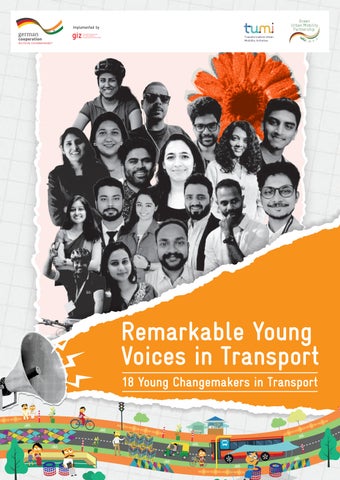
Remarkable Young Voices in Transport 18 Young Changemakers in Transport
Implemented by
As a federally owned enterprise, GIZ supports the German Government in achieving its objectives in the field of international cooperation for sustainable development. Published by: Deutsche Gesellschaft für Internationale Zusammenarbeit (GIZ) GmbH Registered office: Bonn and Eschborn, Germany Address: Remarkable Young Voices in Transport - India Edition B-5/2, Safdarjung Enclave New Delhi - 110029 India T 011-49495353 F 011-49495391 E giz-indien@giz.de Responsible: Manjunath Sekhar, Director - Sustainable Urban Mobility. GIZ India Editor: Rishi Kukreja, Communication Specialist, GIZ India Sristi Mehra, Consultant, GFA Reviewer: Rana Anwar Amani, Technical Advisor, GIZ India Photo Credits: Photos courtesy by participants Printing and Distribution: GIZ India Office, New Delhi As at: New Delhi, 2025
Content Foreword Editorial
1 2-3
Remarkable Young Voices in Transport - India Edition 1. Aishwarya Agarwal 2. Neha Sakka 3. Rithvika Rajiv 4. Samhita Shiledar 5. Nihar Thakkar 6. Pawani Khandelwal 7. Priyanka Krishnan 8. Vedant Raj Mhatre 9. Nikita Lalwani 10. Ashik Sohan Jain 11. A V Venugopal 12. Chetan Sodaye 13. Ajay Kumar 14. Kshitij Srivastava 15. Atulesh Dhiman 16. Pravar Choudhary 17. Amrita Singh 18. Gurugubelli Sai Ratna Chaitanya
4-5 6-7 8-9 10-11 12-13 14-15 16-17 18-19 20-21 22-23 24-25 26-27 28-29 30-31 32-33 34-35 36-37 38-39
s e c i o V g n u o Y e l b a k on r i t i d E Rema a i d In t r o p s n in Tra Foreward Dear readers, India stands at a defining moment in its mobility transformation. As the world’s most populous nation and one of its fastest-growing economies, the way we move will determine how equitably we access opportunities, how safely we navigate our cities, and how sustainably we shape our shared future. Amid this transformation, young people are emerging as powerful changemakers. Across India from metropolitan centres to smaller cities and rural regions young Indians are reimagining mobility through innovation, creativity, and courage. They are cycling advocates redesigning our streets, entrepreneurs advancing electric mobility, researchers mapping informal transit networks, and community leaders championing women’s safety and accessibility for all. By 2035, nearly half of India’s urban population will be under 35. This generation does not see transport merely as infrastructure it sees it as a question of justice, equity, and opportunity. Their ideas challenge traditional planning approaches, integrate digital innovation, and place inclusion and sustainability at the centre of the mobility discourse. Yet, while young people are among the most affected by mobility choices, they remain underrepresented in policy and planning. True progress depends on giving them a meaningful seat at the table where their lived experiences and fresh perspectives can directly influence decisions shaping our cities. This India edition of the Remarkable Young Voices in Transport series, launched by the Deutsche Gesellschaft für Internationale Zusammenarbeit (GIZ) GmbH commissioned by the German Federal Ministry for Economic Cooperation and Development (BMZ) with support from Transformative Urban Mobility Initiative (TUMI) brings these voices to the forefront. It showcases the creativity, resilience, and leadership of 18 young professionals who are already transforming India’s mobility landscape. Their work demonstrates that inclusive and sustainable transport is not a distant vision, it is a movement already underway, driven by the energy and determination of India’s youth. As we advance towards cleaner, safer, and more equitable mobility systems, let us ensure that young people are not just participants but partners in shaping the journey ahead. Their ideas and leadership will define the transport systems of tomorrow. Manjunath Sekhar Director, Sustainable Urban Mobility, GIZ India
1
Editorial Dear readers, India stands at a defining moment in its urban mobility journey. With over 65% of our population under the age of 35, young Indians are not just the future of transport they are reshaping its present. Our cities are transforming at an unprecedented pace. India’s urban population is expected to reach 600 million by 2031. Young people as students, workers, entrepreneurs, and caregivers rely heavily on walking, cycling, and public transport. Yet despite being most users, they remain largely absent from the decision-making tables that shape the systems they depend on every day. The challenges are familiar. Women face harassment on crowded buses and poorly lit streets. Young professionals spend hours in traffic. Persons with disabilities navigate infrastructure never designed with them in mind. And across our cities, the dream of affordable, safe, and dignified mobility remains frustratingly out of reach for millions. But this publication tells a different story - one of hope, innovation, and action. This India edition is launched by the Deutsche Gesellschaft für Internationale Zusammenarbeit (GIZ) GmbH on behalf of the Federal Ministry for Economic Cooperation and Development (BMZ) with support from Transformative Urban Mobility Initiative (TUMI). The young voices featured here are proving that change is possible. They are the cycling advocates making streets safer, the data scientists mapping informal transit networks, the social entrepreneurs electrifying last-mile connectivity, the community organisers demanding women’s right to safe mobility, and the engineers designing accessible infrastructure. From Delhi to Bengaluru, from Chennai to Pune, they are building solutions rooted in India’s reality. These young leaders are living proof that age is not a barrier to impact, that fresh perspectives can unlock solutions to entrenched problems, and that meaningful change happens when we listen to those who use transport systems every day. We hope their stories inspire you to open doors for more young people in transport planning, to fund
2
Methodology and Criteria The call for nominations for Young Voices in Urban Transport was announced through social media platforms, inviting applications from individuals below 35 years of age who have been actively contributing to the urban mobility sector. Based on the applications received, proposals were evaluated to identify individuals demonstrating notable contributions and innovation in the field. The shortlisting process considered several key aspects, including: 1. Ground-level implementation efforts that have resulted in improved urban mobility systems. 2. Innovative solutions promoting the inclusion of women and other genders in the urban mobility sector. 3. Impactful implementation of initiatives within the mobility domain. Considering these aspects, 18 young professionals were selected to represent the Young Voices in Urban Transport. A rigorous evaluation and background review process, conducted by domain experts, ensured that everyone featured in this publication represents exemplary contributions to the field of transport and mobility. Happy reading! GIZ India
3
Aishwarya Agarwal Gurugram, Haryana Driven by her belief that mobility defines opportunity and inclusion, Aishwarya has dedicated her career to creating greener and more equitable transport systems. Growing up in a Tier-II city, she saw how inadequate transport limited access to education, work, and safety - especially for women. Today, as Lead at the Centre for Inclusive Mobility at OMI Foundation, she works to embed inclusion in India’s sustainable transport landscape. Her leadership of the #InclusivEVTransition campaign has positioned her at the forefront of gender responsive mobility planning, bridging research, policy, and on-ground implementation.
Lead, Centre for Inclusive Mobility at OMI Foundation
What are her key contributions? Aishwarya leads the #InclusivEVTransition campaign and authored India’s first study on Feminising EV Value Chains, now guiding state policies and industry dialogues. Her work has advanced gender-inclusive EV manufacturing in Telangana, accessible charging frameworks in Kerala, and sustainable mobility planning in Jharkhand. She also contributed to the Mumbai Ahmedabad High-Speed Rail Project, leading gender analyses with over 100 women participants.
“Mobility dete rmines opportunity a nd inclusion - it’s not just abou t moving peo p le, but about ena bling freedom , safety, and d ignity.”
in design, “Even small shifts r can create policy, or behaviou g change.” meaningful, lastin
4
What is her perspective on inclusive urban mobility? For her, inclusion means ensuring safety, dignity, affordability, and accessibility for all particularly women, elderly citizens, persons with disabilities, and informal workers. She believes that true inclusion combines data with lived experiences and requires active community participation in planning.
How has she influenced the sector? Through the Ease of Moving Index (40 cities, 50,000+ respondents), she strengthened datadriven mobility planning. She also pioneered data comics like Moving Whilst Women, translating research into accessible storytelling. At the OECD International Transport Forum 2025, her analysis of 33 EV policies highlighted the importance of gender inclusiveness in achieving India’s decarbonisation goals.
What challenges does she see in India’s mobility landscape? India’s diversity, she observes, calls for solutions sensitive to local contexts, social norms, and informal mobility. Her work focuses on integrating inclusion as a core element in transport planning rather than treating it as an add-on.
What is her advice and vision for the future? She urges young professionals to stay empathetic, collaborative, and community driven, balancing data with human insight. Aishwarya envisions Indian cities with public transport at their core, complemented by safe walking and cycling networks and an equitable, zero-emission EV ecosystem that creates opportunities for all.
5
Neha Sakka Jaipur, Rajasthan Neha Sakka, the first female professional engineer from her conservative Rajasthani community, turned personal defiance into a public mission - to ensure India’s mobility transition includes those long excluded by design. Committed to bridging climate action with social equity, she founded the Trust EV Awareness Oath Programme (TEVAOP), which has trained over 5,500 youth free of cost through 130+ sessions on EV technology, solar charging, and the circular economy. Her work has made Rajasthan a national leader in EV skilling, empowering rural and underprivileged youth to join India’s green mobility workforce.
Founder, Trust EV Awareness Oath Program
What are her key contributions? Through TEVAOP, Neha introduced the I2TC model - Innovate to include, Train youth, Connect gaps - creating a neutral platform to build public confidence in electric mobility while providing technical training to students from ITIs, polytechnics, and rural areas. The initiative’s value exceeds ₹75 lakh in free education, with partnerships enabling hands-on labs in EV repair, maintenance, and retrofitting.
6
“True inclusio n means every one finds access and agency a cross the value cha in - driving, servicing, des ign, and decision-m innovation, aking.”
ility became “Decarbonising mob for making my starting point a daily reality.” sustainable living
What is her perspective on inclusive urban mobility? For her, inclusion means access and agency across the entire value chain - driving, design, servicing, innovation, and decision-making. She believes inclusion must be practical and localised, adapting training and technology to regional contexts and languages.
How has she influenced the sector? Neha pioneered non-commercial partnerships between startups and training institutions, where shared expertise benefits both learners and industry. Her outreach has extended to unexpected audiences, including Sanskrit school students, and inspired international peers in Kenya and South Africa. Her work has been recognised by the Union Minister of Heavy Industries and the former Chief Justice of India.
What is her advice and vision for the future? She encourages young professionals to master green and digital mobility skills, focus on regional solutions, and apply the I2TC model to ensure innovation remains inclusive. Neha envisions a “human-first” mobility system where walking and cycling are natural choices, and inclusivity becomes a measurable criterion for success - rewarding projects that employ women, rural youth, and persons with disabilities in technical roles.
What challenges does she see in India’s mobility landscape? Changing mindsets remains her biggest challenge. Many women and rural youth hesitate to enter the EV space because they rarely see role models like themselves. Her work aims to normalise their participation and build confidence through visibility and opportunity.
7
Rithvika Rajiv New Delhi Rithvika Rajiv is committed to building inclusive, climate-responsive, and gender equitable cities. Working at the intersection of transport, urban development, and social inclusion, she brings together research, policy, and practice to strengthen gender perspectives in mobility planning. As Assistant Programme Manager at Safetipin, she leads projects developing gender analysis frameworks for urban transport and freight decarbonisation and drafts inclusive transport indicators for Small Island Developing States in the Asia-Pacific region. Her work reflects a blend of analytical rigour and grassroots sensitivity, shaping safer, more equitable, and sustainable mobility systems.
Assistant Pr ogram Manager, Sa fetipin
What are her key contributions? Rithvika co-authored a chapter on gender and transport for SLOCAT’s Transport, Climate and Sustainability Global Status Report (GSR-4) and has authored several handbooks and reports on gender and mobility. She led the Handbook on Enhancing Young Women’s Mobility in Indian Cities with the FIA Foundation - bringing together women’s lived experiences and municipal insights to inform practical, gender-responsive transport solutions.
“Inclusion in mobility isn’t only about movem ent; it’s abou t recognising c are, dignity, a nd choice as cen tral to how c ities function.” 8
How has she influenced the sector? What is her perspective on inclusive urban mobility?
Through national working groups and capacity development programmes, Rithvika supports governments, practitioners, and civil society in embedding inclusive approaches into urban transport policies and projects. She also coordinates Women on the Move: Transforming Transport in Asia, a regional network that connects women professionals, promotes collaboration, and strengthens institutional foundations for gender inclusion in mobility.
Rithvika believes inclusion means creating affordable, safe, and accessible systems for all- especially women, children, the elderly, and persons with disabilities - while recognising mobility for care and leisure, not just for work. For her, inclusive transport is also climate-responsive and grounded in social equity.
What challenges does she see in India’s mobility landscape? India’s rapid urbanisation, informal transport systems, and entrenched gender gaps pose complex challenges. Rithvika’s work focuses on bridging the gap between progressive policy intent and everyday realities through incremental, context sensitive interventions.
ssible transport “Unsafe and inacce issue - it isn’t just a mobility cial and policy reflects deeper so portunity.” gaps that limit op
What is her advice and vision for the future? She urges young professionals to stay curious and deeply connected to the people they design for - understanding lived experiences as much as technical frameworks. Her vision is of an India where walking, cycling, and public transport are prioritised through inclusive design and data-driven governance, addressing care mobility and the diverse needs of women, youth, and informal workers. 9
Samhita Shiledar Nagpur, Maharashtra Samhita Shiledar is a Principal at RMI, where she leads clean mobility initiatives across India and emerging international markets to advance efficient, affordable, and low-carbon transport. Her work spans policy design, quantitative analysis, and project management for electrifying two- and three-wheelers, delivery vehicles, and trucks across India, Southeast Asia, Africa, and the United States. Passionate about sustainable urban systems, she views transport as a lever for both environmental and social transformation.
I
Principal, RM
What are her key contributions? Samhita co-developed the Shoonya – Zero Pollution Mobility campaign with NITI Aayog, a pioneering national effort promoting zero-emission vehicles in ride hailing and delivery. With over 250 corporate partners, the initiative has completed a billion electric rides, reaching 70+ million people. She also designed Shoonya Paathshala, an educational programme introducing school students to EVs and clean mobility concepts.
10
How has she influenced the sector? Leading RMI India’s Zero Emission Trucks (ZET) vertical, Samhita has deployed 7 e-trucks at Jawaharlal Nehru Port, contributed to Ministry of Heavy Industries operational guidelines, and launched ZET Accelerators in Telangana and Tamil Nadu - identifying India’s top 10 e-trucking corridors. Earlier, she initiated Deliver Electric Delhi (2018), which guided Delhi’s EV policy and created a roadmap for 100% electrification of urban delivery fleets. Internationally, she supports EV adoption frameworks in Nigeria and Indonesia, co-authoring vision reports that link e-mobility to cost savings and emission reductions.
What is her perspective on inclusive urban mobility? For Samhita, inclusion means building systems that serve everyone - regardless of gender, geography, or income - ensuring no community shoulders disproportionate burdens of pollution or unsafe transport. She emphasises that sustainability must also be affordable, reliable, and equitable, bridging global best practices with India’s scale and diversity.
What is her advice and vision for the future? She advises young professionals to look beyond disciplinary boundaries, since transport intersects energy, economy, environment, and equity. Samhita envisions Indian cities where shared, efficient, and electric mobility becomes the norm - creating cleaner air, safer streets, and healthier, more connected urban environments.
What challenges does she see in India’s mobility landscape? Samhita points to siloed approaches as a key barrier. Her work focuses on breaking institutional silos by convening governments, industries, and financiers around shared, system-wide strategies for clean and equitable mobility.
how we “Transport shapes the - it live, work, and brea create has the power to l and both environmenta social impact.”
“Real change ha ppens when we connect the dots between energy, econom y, and equity.” 11
Nihar Thakkar Bengaluru, Karnataka Nihar Thakkar is a technology innovator redefining urban mobility in India through artificial intelligence and data-driven solutions. Based in Bengaluru, he works at the intersection of sustainable transport, AI, and community engagement - showing how technology can make cities safer, more liveable, and inclusive. His journey began at age 13 when he developed the “Bengaluru Buses” app to fill a critical information gap in the city’s transport system. This early innovation evolved into a collaboration with the Bangalore Metropolitan Transport Corporation (BMTC) to launch the MyBMTC app, offering real-time bus tracking and trip planning for thousands of daily users.
What are his key contributions? Nihar led the Complete Streets initiative in BBMP Ward 85 (2021–2023) with the Directorate of Urban Land Transport (DULT) and local communities, creating pedestrian- and cyclist-friendly infrastructure including three cycle lanes, bicycle counters, cycle stands, and community spaces. He also developed India’s first AI-powered bicycle counter, now deployed across Bengaluru, IIT Delhi, and Gurugram, generating real-time data that challenges the perception of low cycle use.
12
“Technology m ust serve people first—A I and data are tools to m ake cities more human, not less.”
hen communities “Change begins w ther to redesign and code work toge e.” how our cities mov
What is his perspective on inclusive urban mobility? Nihar believes inclusive mobility must be community-driven and data-informed, reflecting the diverse needs of India’s urban populations. He emphasises women's safety, last-mile connectivity, and accessibility for marginalised groups as essential priorities in urban transport planning.
What challenges does he see in India’s mobility landscape?
How has he influenced the sector?
He notes that collaboration between innovators and government agencies remains a key challenge, requiring persistence, trust, and continuous dialogue. Aligning civic engagement with administrative processes is central to achieving sustainable, long-term outcomes.
His AI-based traffic enforcement camera monitors cycle lane violations in real-time, protecting dedicated infrastructure and encouraging behavioural change. Through his latest Traffic Analysis Platform, he applies AI to improve street design and road safety, supporting data backed decision-making for sustainable mobility planning.
What is his advice and vision for the future? Nihar advises young professionals to pursue innovation with patience and persistence, balancing ambition with empathy. He envisions Indian cities that are technologically advanced yet deeply human-centric - caring, sensitive, and liveable for people and nature alike.
13
Pawani Khandelwal Mathura, Uttar Pradesh Pawani Khandelwal is the founder of Aatm Nirbhar, a social enterprise transforming women’s mobility in India. Since 2017, her work has empowered over 25,000 women across 15 cities through two-wheeler training - turning a simple skill into a catalyst for employment, entrepreneurship, and independence. By linking mobility training with economic opportunity, Pawani has helped women access jobs, education, and markets, making mobility a gateway to dignity and self-reliance.
Nirbhar Founder, Aatm td Learning Pvt L
What are her key contributions? Through Aatm Nirbhar, Pawani built a scalable model that connects mobility skills with livelihood opportunities in India’s growing gig economy. Women trained under the programme now participate in delivery, logistics, and service sectors, improving first- and last-mile connectivity for their families and communities. Her work has also made women early participants in India’s electric vehicle transition by integrating them into sustainable, low-emission mobility systems.
the omen on w r e th o e the ecame my “Where ar b n o ti s e u at q ility a roads? Th make mob r women.” to e s o ce fo purp self-relian to y a w te ga 14
How has she influenced the sector? Pawani’s initiative has led to tangible social shifts - families encouraging daughters to travel independently, employers investing in women’s mobility, and women trainers establishing local riding academies. In several cities, this has resulted in a 30% rise in women riding scooters, visibly reshaping public spaces and gender norms.
“Mobility isn’t ju st about movem ent it’s about openin g doors to oppo rtunity, independence, an d equality.”
What challenges does she see in India’s mobility landscape? One of the main gaps, she notes, is that mobility is not yet recognised as a formal skill in national policy. Through partnerships with corporates, policymakers, and skill councils, Aatm Nirbhar advocates for integrating two wheeler mobility into India’s skilling ecosystem.
What is her perspective on inclusive urban mobility? For Pawani, inclusion means ensuring safety, affordability, and accessibility for all especially women, persons with disabilities, and marginalised groups. She emphasises recognising diverse travel patterns and lived experiences, viewing mobility not just as transport but as a key to economic participation and personal freedom.
What is her advice and vision for the future? She encourages young professionals to travel, observe, and design with empathy - questioning who is missing from transport systems and why. Pawani envisions cities where women move freely and shape mobility systems as leaders, not just users - creating streets that reflect equality, opportunity, and dignity for all.
15
Priyanka Krishnan Bengaluru, Karnataka Priyanka Krishnan leads the B.MOBILE programme at the Bangalore Political Action Committee (B.PAC), where she drives data-based advocacy for sustainable urban mobility. Her flagship project, “IRR Street: Standstill to Active,” revitalised a 7.5 km stretch of Bengaluru’s Inner Ring Road improving bus reliability, walkability, and road safety through collaborative, evidence-led action. Working closely with BBMP, BMTC, Bengaluru Traffic Police, and other departments, Priyanka’s persistence turned data into impact, transforming one of the city’s busiest corridors into a safer, more efficient public space.
Bangalore Political Action Committee (B.PAC), Research & Program Associa te, B.MOBILE Programme
ta together “Persistence and da begins save lives - change ts action.” when evidence mee
What are her key contributions? Under her leadership, the IRR Street project achieved remarkable outcomes: crash blackspot interventions reduced fatalities from nine deaths to zero since late 2024; ten new buses and 123 additional daily trips improved frequency to every five minutes; and 4,325 tonnes of debris were cleared. The project also delivered better drainage, lighting, and crossings - making commutes safer and more resilient to floods.
“An inclusive mobility syste m prioritises pe ople over veh ic les - ensuring sa fety, comfort, and dignity for ev eryone on the move.” 16
How has she influenced the sector?
What is her perspective on inclusive urban mobility? She believes mobility systems must prioritise people over vehicles - ensuring that all, regardless of age or ability, can walk, cycle, or use public transport safely and comfortably. For her, equitable access and dignity in daily travel define true inclusion.
Priyanka’s structured, evidence-based collaboration model has set a precedent for multi-agency mobility reform in Bengaluru. By integrating data analysis with community engagement, she has built trust among departments and citizens alike. Her approach now informs ongoing work across other corridors and crash blackspots in the city.
What challenges does she see in India’s mobility landscape?
What is her advice and vision for the future? She encourages young professionals to immerse themselves in on-ground learning - through workshops, community projects, and fieldwork because real transformation begins at the street level. Priyanka envisions an India where public transport becomes the fastest and most convenient choice, supported by safe walking and cycling infrastructure that ensures seamless, inclusive first- and last mile connectivity.
Priyanka points to fragmented accountability, overlapping departmental roles, and limited funding as key hurdles. She tackles these through transparent, data-driven advocacy using audits, geotagged evidence, and joint site inspections to build interdepartmental consensus and citizen ownership.
17
Vedant Raj Mhatre Mumbai, Maharashtra Vedant Raj Mhatre is the founder of The Walking Project, a non-profit launched in 2022 to make Indian cities - starting with Mumbai - more walkable. Over just two and a half years, the initiative has advanced citizen engagement, data-driven advocacy, and collaboration with local governments to embed a pedestrian-first approach in urban planning. Through its campaigns and community-based research, The Walking Project has helped secure a ₹100-crore municipal allocation for footpath improvements in Mumbai, making walkability a public and policy priority.
Convener, Walking
Project
What are his key contributions? Vedant’s Community Walks and Talks have engaged over 500 citizens on ground, reaching more than 3 million people online. His team has trained over 50 students from architecture, computer science, and economics through NEP aligned programmes, teaching them how to audit, map, and redesign neighbourhood streets. Together, they have completed 37 walks covering 60 kilometres of roads, street-view mapped 100 kilometres of footpaths, and integrated air quality monitoring across multiple neighbourhoods in partnership with Asar Social Impact Advisors.
18
“Inclusion lie s in everyday details — ben ches for work ers, safe crossing s for children , and footpaths tha t invite people to walk.”
istence, but “Change takes pers in the system building trust with rence.” makes a real diffe
How has he influenced the sector? The project has built one of Mumbai’s most comprehensive databases on walkability combining AQI data (over 2,600 points) with real-world street assessments. Its evidence-based storytelling and strong media outreach have turned pedestrian safety and street design into visible civic issues, prompting action from the Municipal Corporation of Greater Mumbai and sparking dialogue on urban mobility.
What is his advice and vision for the future?
What is his perspective on inclusive urban mobility?
Vedant encourages young professionals to engage the system with patience and empathy. He envisions Indian cities where streets invite walking - supported by safe crossings, reliable public transport, and active citizen participation in decision making. His goal: cities where mobility drives opportunity, equality, and a better quality of life.
Vedant believes mobility must serve people of all genders, ages, and abilities. He emphasises the importance of everyday design elements accessible toilets with sanitary dispensers for women, benches for daily-wage workers, and legible signage for children. For him, inclusion lies in the details that make streets usable, comfortable, and dignified for everyone.
What challenges does he see in India’s mobility landscape? He notes that a major gap persists between what citizens expect, what administrators believe works, and what truly functions on the ground. Limited funding also challenges sustained advocacy, but partnerships and persistence have helped build credibility and trust within the system.
19
Nikita Lalwani Ahmedabad, Gujarat Nikita Lalwani is the Founder of Crooze and India’s first Bicycle Mayor, appointed by BYCS Netherlands in 2014 - making her the world’s seventh Bicycle Mayor. Her cycling journey began when a flyover construction doubled her four-kilometre commute. After cycling to work and cutting her travel time to just 11 minutes, she sparked a movement that soon expanded beyond her workplace into a national effort to revive cycling culture in Indian cities.
CTech Crooze App (C Pvt Ltd) Health & Env What are her key contributions? Nikita initiated Cycling Cities, a pan-India campaign to promote urban cycling, and launched TRING (Try Cycling) at her workplace, providing employees with cycles, helmets, and guided rides. The initiative later expanded to public heritage rides and corporate programs. Through Gift a Cycle, over 100 bicycles were donated to girls walking long distances to school, improving attendance, safety, and independence.
“Changing min dsets is the h ardest part of buildin g sustainable cities - but every p edal forward counts.”
transport - it’s “Mobility isn’t just ity, and quality about access, dign of life.”
20
How has she influenced the sector?
What is her perspective on inclusive urban mobility?
As India’s first Bicycle Mayor, Nikita introduced the Global Bicycle Mayor Network to India, which now includes over 70 cities with local leaders driving grassroots cycling movements. She has represented India at international forums like the Velocity Conference (Brazil) and the Australian Walking & Cycling Conference, advocating people-first transport systems and inclusivity in urban design.
To scale impact, she founded Crooze, a gamified fitness and mobility app that turns every ride, walk, or run into challenges and rewards, while tracking carbon savings. With 37,000+ users across 400 cities, Crooze blends technology, behaviour change, and community engagement to make sustainable mobility aspirational and measurable.
What is her advice and vision for the future? She encourages citizens and professionals to start small, collaborate across sectors, and stay persistent. Her vision is for Indian cities where walking, cycling, and public transport form the backbone of urban mobility - supported by smart systems and incentive-based programmes that redefine sustainable transport for the Global South.
What challenges does she see in India’s mobility landscape? Changing mindsets remains her biggest hurdle. Nikita works to challenge the notion of cars as symbols of status and to position cycling as a healthy, dignified, and efficient urban choice.
21
Ashik Sohan Jain Pimpri Chinchwad, Maharashtra
Bicycle May
or
Ashik Sohan Jain is an architect, urban planner, and the Bicycle Mayor of Pimpri Chinchwad, whose advocacy for cycling began in his youth and grew into a professional mission to make Indian cities more walkable and cycle-friendly. His background in urban design and sustainable transport has guided his collaborations with cities including Pimpri Chinchwad, Pune, Ulhasnagar, and Mumbai, alongside organisations like PARISAR, ITDP, GDCI, and the Centre for Environmental Excellence. Through his work, he has helped bridge citizen activism, planning, and policy, creating momentum for people-centric mobility systems.
What are his key contributions? Ashik has been instrumental in the drafting and adoption of the Non-Motorised Transport (NMT) Policy for Pimpri Chinchwad and the Parking Policy that channels parking fees into sustainable transport. He also catalysed the formation of the NMT Cell within the city and initiated the Harit Setu Project - a ten-year Active Mobility Master Plan inspired by the 15 minute neighbourhood concept. His tactical urbanism pilots, walkability audits, and the publication PCMC on Foot and Cycle have guided both policy and street level change.
“We’re moving fr om ‘it can’t happ en in India’ to ‘it is happening in In dia’ - one successful example at a ti me.”
22
How has he influenced the sector? Under his leadership, Pimpri Chinchwad earned national recognition, winning Streets4People, Transport4All, Cycle2Work, and the Urban Mobility Awards 2023. The city also secured the Bloomberg Cycling Infrastructure Grant and was named one of 25 Global Lighthouse Cycling Cities. Ashik’s ability to translate community action into institutional practice has made Pimpri Chinchwad a model for active mobility in India.
What is his perspective on inclusive urban mobility? Ashik believes true inclusion lies in equitable road space - where walking, cycling, and public transport are prioritised alongside motorised modes. He views Indian streets as inherently multimodal and advocates for policies that restore balance and accessibility for all.
s in equitable road “True inclusion lie - where walking, space distribution transport restore cycling, and public streets.” democracy to our
What is his advice and vision for the future? What challenges does he see in India’s mobility landscape?
He encourages young professionals to remain patient, tactical, and collaborative - balancing visionary goals with on-ground realities. Ashik envisions Indian cities as global examples of well-executed sustainable mobility projects, moving from “it can’t happen in India” to “it is happening in India,” one pilot at a time.
Institutional continuity remains his biggest hurdle. Frequent administrative changes and shifting priorities require constant dialogue and collaboration to ensure that sustainable mobility is recognised as core infrastructure, not a temporary agenda.
23
A V Venugopal Chennai, Tamil Nadu
er, Healthy Programme Manag hips (ITDP India) Streets & Partners
A. V. Venugopal serves as the Programme Manager for Healthy Streets and Partnerships at ITDP India, where he leads transformative national and city-level initiatives to make Indian streets healthier, safer, and more inclusive. He co conceptualised the India Streets4People and India Cycles4Change Challenges with the Ministry of Housing and Urban Affairs, supporting over 100 cities to design people-centric streets and active mobility networks. His efforts have helped 15 cities adopt Healthy Street Policies, 41 cities conduct design competitions, and 20+ cities host open street events, many evolving into permanent transformations.
What are his key contributions? Venugopal’s leadership has guided major street design reforms nationwide. In Chennai, he leads ITDP India’s support for the Mega Streets Project, securing the city’s largest-ever pedestrian infrastructure budget of INR 200 crore for 200 km of walkable streets. As knowledge partner to CUMTA, his team supported Chennai’s Parking Policy and Comprehensive Mobility Plan, setting benchmarks for people-first transport planning.
“We don’t nee d Goliaths to fix cities - we ne ed Davids wh o believe in pil ots, persisten c e, and people-fir st design.”
24
What is his perspective on inclusive urban mobility? Venugopal believes cities must prioritise their most vulnerable users - pedestrians, cyclists, and public transport riders - by designing streets that guarantee safety, comfort, and accessibility for all, regardless of age, income, or ability.
How has he influenced the sector? His publication Streets for People: Pathways of Change - documenting 50 transformative projects - won the Gerd Albers Award 2024. Through national campaigns and capacity-building workshops, he has trained over 300 officials and reached 250+ city leaders across 40 cities, building a network of practitioners advancing sustainable mobility. What challenges does he see in India’s mobility landscape? sure of a city “The ultimate mea happiness of is the health and its citizens.”
He highlights institutional inertia as a major barrier. His strategy focuses on building strong evidence, showcasing successful pilots, and nurturing local champions within government to sustain reform momentum.
What is his advice and vision for the future? Venugopal advocates for patience, collaboration, and consistency - valuing small yet strategic wins. He envisions Indian cities where walking and public transport are the natural choices, built by committed teams transforming short-term pilots into long-term urban change.
25
Chetan Sodaye Bengaluru, Karnataka Chetan Sodaye is an architect and urban designer serving as Programme Manager for Integrated Transport and Road Safety at WRI India. With over a decade of experience, he works to make streets safer, more inclusive, and climate-ready. His projects across Pune, Mumbai, Bengaluru, Hyderabad, and Chattogram (Bangladesh) focus on redesigning intersections and corridors as democratic public spaces prioritising safety, dignity, and equity. Programme Manager, Inte Transport an grated d Road Safe ty, WRI India
What are his key contributions? Chetan has been instrumental in shaping city-level mobility plans and on-ground interventions. He contributed to Pune’s Cycle Plan covering 470 km of infrastructure and led Bengaluru’s Suraksha75 initiative - redesigning 75 high-risk junctions through data-driven, design-first approaches. These efforts have institutionalised safer street design practices across Indian cities.
“Streets are our largest continuo us public spaces they must be de si gned for safety, dignit y, and commun ity.”
26
“Real solutions to complex urba n issues only com e through collaboration an d co-creation.”
How has he influenced the sector? His co-authored works, including the World Bank’s Road Safety in Transit-Oriented Development guidelines and Bengaluru’s Namma Raste Kaipidi Manual (spanning 12,000+ km of roads), have guided city agencies toward safety-centric planning. Recognised with the WRI Global Top Outcome Award (2024) for mobilising over $128 million in safer street investments, Chetan has trained 1,200+ officers and students and engaged 6,500+ citizens through participatory platforms like Namma Raste 2023 & 2025.
What challenges does he see in India’s mobility landscape? Chetan identifies inter-departmental silos as a major barrier to implementation. His solution: a cluster-based, collaborative planning model that unites multiple agencies under shared goals, ensuring resilient, integrated mobility outcomes.
What is his perspective on inclusive urban mobility? He believes inclusive systems must allow everyone - regardless of gender, income, or ability - to move safely and affordably using diverse, accessible modes of transport. His approach integrates data analysis, tactical urbanism, and community co-design to craft locally adaptable and scalable interventions that drive long-term systemic change.
What is his advice and vision for the future? He advises young professionals to stay patient, curious, and committed to collaboration - real transformation, takes time, happens when design, data, and community voices converge. Chetan envisions India’s Tier-II and Tier-III cities leading the Global South in safe, inclusive, and climate-responsive street design, where walking, cycling, and public transport become natural, everyday choices.
27
Ajay Kumar Gurugram, Haryana
Founder &
CEO, Fery
Rides
Ajay Kumar, Founder and CEO of Fery, is transforming women’s mobility in India through a safe, sustainable, and inclusive two wheeler ride-hailing platform - run entirely by women, for women. Combining fleet rentals, EV technology, and driver training, Fery ensures both reliable mobility for passengers and dignified livelihoods for its women drivers, known as Sister Partners. With over 65,000 eco-friendly rides covering 650,000 electric kilometres and zero safety incidents, Fery has empowered more than 250 women from diverse backgrounds while offering 30–50% cost savings to customers. Its 100% EV fleet has saved 18,500 litres of petrol, reduced 50 tonnes of CO2 emissions, and positively impacted over 180,000 lives across India.
What are his key contributions? Ajay’s For Women, By Women model created a trusted transport service while enabling financial empowerment. Partnering with Delhi Metro, Fery maintains an 80% conversion rate and 70% repeat ridership, proving that safety-focused mobility can be commercially viable and socially transformative.
nability can go “Safety and sustai n innovation hand in hand whe y.” begins with empath
28
What is his perspective on inclusive urban mobility? Ajay believes inclusive mobility must ensure access, safety, and dignity for all - especially for women who face daily mobility barriers. He emphasises that mobility systems should be designed by those who experience them, not only for them.
What challenges does he see in India’s mobility landscape? The biggest challenge is shifting mindsets proving that women can lead in sectors like transport. Fery addresses this by showcasing real stories of transformation, where each Sister Partner becomes a visible example of courage and leadership.
“The future of mobility isn’t just about moving people - it’s a bout moving comm unities forwa rd.” What is his advice and vision for the future? Ajay encourages young professionals to start with empathy and focus on solving real problems. For him, the future of mobility lies in moving communities, not just people. He envisions an India where every woman can commute confidently, where safety, sustainability, and inclusion shape every ride, and where Fery stands as a national symbol of women’s empowerment on the move.
How has he influenced the sector? By integrating electric mobility with women’s employment, Fery has built public trust and confidence in women-led services. Its Sister Partners have become change-makers, supporting families and inspiring others to join the clean mobility movement.
29
Kshitij Srivastava Delhi Kshitij Srivastava is a PhD scholar at IIIT Delhi and Founding Engineer at Chartr, working at the intersection of data, technology, and public transport reform. With over five years of experience, he has been instrumental in transforming India’s transit ecosystem through open data and scalable digital infrastructure. He led the creation of Open Transit Data Delhi, India’s first open transit data platform, which standardises and publishes GTFS data for over 7,000 buses, enabling developers, researchers, and planners to build smarter mobility applications.
Founding Engin
eer, Chartr
What are his key contributions? Kshitij’s work on the Delhi Transport Stack has built a unified platform integrating multimodal data and open APIs to enhance interoperability across Delhi’s transport network. His backend systems power the Chartr and One Delhi apps, providing real-time transit information to millions of daily commuters.
“Public transp ort is where data and technolog y can make a clear, tangible difference for millions - oft en for people who may never ev en notice it.”
30
stems are key “Open, modular sy that move to building cities tably.” efficiently and equi
How has he influenced the sector? By leading India’s first city-scale open data initiative, Kshitij demonstrated how transparency and collaboration can drive better public transport planning. His work has inspired similar efforts in Chennai, Pune, Rajkot, Surat, and Trivandrum through collaborations with the World Bank, GIZ, and ITDP, helping cities adopt open and data-driven approaches to mobility management.
What is his advice and vision for the future?
What is his perspective on inclusive urban mobility?
He encourages young professionals to first understand how cities actually move before designing solutions - emphasising the importance of collaboration and empathy alongside technical expertise. Kshitij envisions a future where data-driven, integrated transport systems connect all modes seamlessly, reducing congestion and enabling sustainable, inclusive urban growth.
He defines inclusive mobility as systems that are safe, affordable, reliable, and transparent, where clear and open information ensures access for everyone - regardless of income, gender, or ability. His focus lies in designing solutions that are modular and locally adaptable, respecting India’s diverse transport contexts.
What challenges does he see in India’s mobility landscape? Kshitij highlights coordination among multiple agencies and legacy systems as a key barrier to digital transformation. He addresses this by fostering capacity building and demonstrating the practical value of open, interoperable systems to governments and operators alike.
31
Atulesh Dhiman Gurugram, Haryana Atulesh Dhiman is the co-founder of Street Surge Technologies, a startup revolutionising urban mobility planning through big data and artificial intelligence. His journey began in Delhi NCR, where long commutes through traffic congestion revealed how mobility shapes access to opportunity. Recognising that India’s cities were failing millions due to outdated planning methods, he left his corporate career to build data-driven tools that make public transport more efficient, inclusive, and sustainable.
treet Surge Co-Founder, S Technologies
ten favours the “Urban planning of vation lies in affluent - true inno sport affordable, making public tran nal for everyone.” safe, and aspiratio
“Technology is not just an en abler - it’s the brid ge between e quitable design and e ffective delive ry.”
What are his key contributions? Through Street Surge, Atulesh has scaled two breakthrough technologies - big data mobility analytics that aggregate millions of GPS traces to model real travel demand, and AI-powered route planning algorithms that optimise transit networks by balancing fleet capacity, charging needs, and multimodal integration.
32
How has he influenced the sector?
What is his perspective on inclusive urban mobility?
In Delhi, his team designed the DEVI bus network, connecting 1.2 crore residents, including 23 lakh who gained public transport access for the first time. Serving 8 lakh daily riders with 65% women ridership, DEVI improved citywide transit accessibility by 30%. Their projects now extend to Delhi Metro, Ahmedabad MRTS, and internationally with Yukon, Canada, setting a new benchmark for tech-led public transport planning.
For Atulesh, inclusion means universal access to safe, affordable, and reliable transport, irrespective of income or gender. He believes technology is central to bridging gaps in demand estimation and network design, ensuring that public investment translates into equitable outcomes.
What challenges does he see in India’s mobility landscape? He notes that many transport authorities still rely on manual, survey-based planning and are hesitant to adopt digital solutions. To build confidence, his team collaborates with institutions like IITs and IISc for validation and demonstrates measurable improvements through successful city scale deployments.
What is his advice and vision for the future? Atulesh encourages young professionals to focus on solving real commuter problems through innovations rooted in empathy and evidence. He envisions Indian cities where public transport forms the backbone of daily life - powered by clean technology, data-driven planning, and inclusive design that ensures mobility for all.
33
Pravar Choudhary Bengaluru, Karnataka Pravar Choudhary has redefined how Indian cities think about walkability by blending design, storytelling, and citizen engagement. As the founder of Bengawalk, he has turned complex ideas about urban mobility into accessible public conversations through films, writing, and interactive data platforms. By mobilising a community of young volunteers and creating compelling visual narratives, Pravar has made pedestrian-friendly streets both a design goal and a civic movement.
ban mobility “Real change in ur storytelling, and requires patience, when people collective action possible, they understand what’s for better cities.” become advocates
What are his key contributions? Through Bengawalk, Pravar has built a unique model of research-driven communication that translates urban design principles into relatable, actionable ideas. One of his most impactful projects - the wayfinding maps at Majestic Bus Station in Bengaluru - improved access to information for thousands of daily commuters, showcasing how thoughtful design can enhance public transport experiences.
“We’re trying to understand how to unlock opportunities to make travel in In dian cities more effi cient, easy, and delightful.” 34
Founder, Ben g
awalk
How has he influenced the sector?
What is his perspective on inclusive urban mobility?
His data-backed storytelling has helped shift Bengaluru’s public dialogue toward pedestrian priority and people-centric planning. Bengawalk’s videos and data platforms have engaged citizens, policymakers, and urban planners alike, inspiring a new wave of advocacy around walkable cities and public spaces.
Pravar defines inclusion as a system built on affordability and availability, ensuring everyone can access mobility options comfortably and safely. He believes in designing with patience and openness - recognising that sustainable change in cities comes through gradual, iterative processes.
What is his advice and vision for the future?
What challenges does he see in India’s mobility landscape?
Pravar encourages young professionals to engage actively in urban mobility discussions through platforms like Twitter, reading widely, and contributing original ideas. He envisions Indian cities that invest time and care in design, execution, and maintenance, moving beyond short-term projects toward policies that create lasting, human-centred impact.
He acknowledges that articulating core messages effectively is a recurring challenge, especially when communicating complex urban issues to diverse audiences. Collaboration and openness to new perspectives, he believes, are key to overcoming these barriers.
35
Amrita Singh Jaipur, Rajasthan
Project Lead, AC CESS Development Ser vices
Amrita Singh is Project Lead at ACCESS Development Services, where she has pioneered a transformative model of urban mobility that empowers marginalised women while redefining responsible tourism in India. Leading initiatives such as the Pink City Rickshaw Company (Jaipur), Holy City Rickshaws (Varanasi), and Lake City Rickshaws (Udaipur), she trains and employs women from low-income SC/ST and minority communities as drivers of eco-friendly e-rickshaws. Under her leadership, these projects have become national models for socially inclusive, environmentally sustainable, and heritage-sensitive transport.
“By placing w omen and info rmal workers at th e centre, we create cities that mo ve with dignit y and purpose.”
What are her key contributions? Amrita’s work ensures that women are not only drivers but also equity holders in the enterprises - turning mobility into a source of dignity, agency, and ownership. As cultural ambassadors, these women offer visitors authentic experiences of India’s heritage cities, enriching tourism while advancing gender equity and environmental goals.
What is her perspective on inclusive urban mobility? She believes inclusion must centre on dignity and opportunity - especially for informal workers, women, the elderly, and persons with disabilities. Her approach views mobility not only as physical movement but as a pathway to empowerment and community pride. 36
st about “Mobility is not ju out stories, movement, but ab uity.” aspirations, and eq
What challenges does she see in India’s mobility landscape? Amrita highlights the need to bridge policy and practice. In cities where modern and informal systems coexist, the challenge lies in creating hybrid models that value local culture while ensuring safety and sustainability. Her team addresses this by building trust with communities and translating lived experiences into design and advocacy.
How has she influenced the sector?
What is her advice and vision for the future?
Through partnerships with major travel agencies and heritage hotels such as Radisson, Taj, Ramada, Sita Travels, and Brij Rama, Amrita has integrated the initiative into leading travel itineraries. Backed by India Tourism, her model is now a benchmark for responsible tourism, demonstrating how transport innovation can drive both social and economic change.
She urges young professionals to begin by listening - to see mobility as a collection of stories, aspirations, and struggles. Amrita envisions Indian cities where inclusive, low-carbon transport systems empower informal workers as climate champions while preserving local identity and promoting sustainable livelihoods.
37
Gurugubelli Sai Ratna Chaitanya Bengaluru, Karnataka Gurugubelli Sai Ratna Chaitanya is a transport researcher who has spent nearly a decade shaping India’s public transport data ecosystem. Beginning his journey as a young architect in Hyderabad in 2016, he recognised that India’s mobility challenges were rooted not only in infrastructure gaps but in missing, fragmented data. Since then, he has worked across Hyderabad, Bengaluru, and Kochi, using open data to make public transport more transparent, accessible, and efficient for citizens and agencies alike.
-I childhood y m d e p a e the “Buses sh experienc to e n o y r ction want eve and conne m o d e e fr same gave me.” they once
What are his key contributions? Chaitanya pioneered one of India’s first GTFS (General Transit Feed Specification) feeds for Hyderabad’s bus system, exposing broken data flows and inefficiencies. Through RTIs filed in 2017, he revealed declining fleet sizes and over aged buses, enabling media and policymakers to advocate for improvements. When official datasets proved unreliable, he generated his own frequency and occupancy studies highlighting systemic overcrowding in public transport.
38
Transpor t Re Open Da searcher & ta Advoc ate
How has he influenced the sector? Since 2023, Chaitanya has led efforts to build GTFS and open data systems for Bengaluru’s buses and metro, engaging with officials for over 18 months to institutionalise these systems. His work now powers mobility platforms like Namma Yatri and Tummoc, endorsed by Karnataka’s IT Minister. Collaborating with the Disability Rights Alliance, he has also contributed to improving bus accessibility in Chennai, bridging data and inclusion.
“Even small im provements like reliable signages can cr eate lasting chan ge when sustained with data and in tent.”
What challenges does he see in India’s mobility landscape? Chaitanya notes that decades of neglect have led citizens to self-provide transport in unregulated ways. His challenge has been convincing stakeholders that small interventions - like improving signages or publishing open data - can cumulatively drive systemic change.
What is his perspective on inclusive urban mobility? He believes affordability is the foundation of inclusive transport, complemented by universal accessibility for people of all ages and abilities. His work seeks to ensure that digital transformation of transport never excludes the human experience of mobility.
What is his advice and vision for the future? He emphasises patience and persistence, recognising that every conversation about sustainable mobility contributes to progress. In the coming decade, he envisions an India where technology and open data empower both users and agencies, backed by strong intent and funding, ensuring dignified and reliable public transport for all.
39
Implemented by