COVERING BEST PRACTICES FOR THE INDUSTRY
Sulfuric Acid T
w w w. H 2 S 0 4 To d a y.co m
O
D
A
Y
F a l l / W i n te r 2 0 2 6
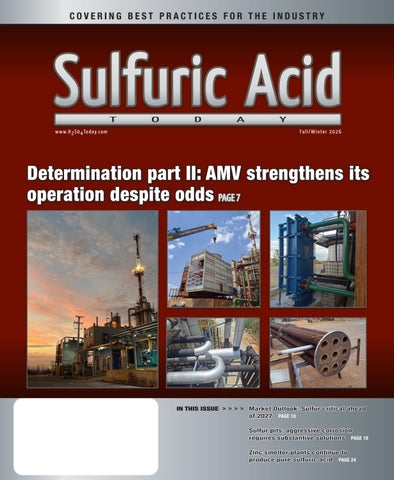
Determination part II: AMV strengthens its operation despite odds PAGE 7
IN THIS ISSUE > > > > Market Outlook: Sulfur critical ahead of 2027 PAGE 10 Sulfur pits: aggressive corrosion requires substantive solutions PAGE 18 Zinc smelter plants continue to produce pure sulfuric acid PAGE 24
Sulfuric Acid
COVERING BEST PRACTICES FOR THE INDUSTRY
Sulfuric Acid T
O
D
A
Y
w w w. H 2 S 0 4 To d a y.co m
F a l l / W i n te r 2 0 2 6
Determination part II: AMV strengthens its operation despite odds PAGE 7
T
Vol. 32 No. 2
IN THIS ISSUE > > > > Market Outlook: Sulfur critical ahead of 2027 PAGE 10
O
D
A
Y
Covering Best Practices for the Industry
Fall/Winter 2026
Sulfur pits: aggressive corrosion requires substantive solutions PAGE 18 Zinc smelter plants continue to produce pure sulfuric acid PAGE 24
On the Cover… 7 Ácidos y Minerales de Venezuela (AMV) shares its success in boosting sulfuric acid production
Departments 4
Industry Insights News items about the sulfuric acid and related industries
12 Lessons Learned Case histories from the sulfuric acid industry 14 Safety Sector Sharing common safety concerns 32 Conference Review Recap of industry meetings 36 Faces & Places Snapshots from industry events 38 Calendar of Events Upcoming industry meetings
PUBLISHED BY Keystone Publishing L.L.C. ––––––––––––––––––––––––––––––– PUBLISHER Kathy Hayward ––––––––––––––––––––––––––––––– EDITOR April Kabbash ––––––––––––––––––––––––––––––– EDITOR April Smith ––––––––––––––––––––––––––––––– DESIGN & LAYOUT 281-545-8053
–––––––––––––––––––––––––––––––
Mailing Address: P.O. Box 3502 Covington, LA 70434 Phone: (985) 807-3868 E-Mail: kathy@h2so4today.com www.h2so4today.com
SUBSCRIPTIONS U.S. Addresses Only Subscribe Online: www.h2so4today.com
FROM THE PUBLISHER Welcome to the Fall/Winter 2026 issue of Sulfuric Acid Today. We are committed to bringing you the latest products and technologies impacting our industry, and we hope you find this issue both helpful and informative. Inside, you’ll find several insightful articles covering cutting-edge technology and major projects. Our cover story highlights how Acidos y Minerales de Venezuela (AMV) overcame severe economic and political challenges through innovative equipment upgrades, workforce resilience, and industry collaboration to increase sulfuric acid production and ensure a reliable supply of chemicals for drinking water purification nationwide (page 7). Acuity Commodities expects global sulfur and sulfuric acid markets to remain tight heading into 2027, as geopolitical disruptions, export restrictions, and limited supply continue to drive elevated prices and market uncertainty (page 10). Elessent Clean Technologies highlights how its MECS® AcidPilot™ system combines plant operating data, advanced analytics, and expert guidance to improve sulfuric acid plant performance, reliability, troubleshooting, and technical knowledge transfer (page 12). Weir highlights best practices for reliable molten sulfur pumping in sulfuric acid plants, emphasizing temperature control, recirculation systems, and robust pump design to improve efficiency, minimize maintenance, and extend equipment life (page 16). Sauereisen discusses the importance of properly engineered corrosion-resistant lining systems for sulfur pits, emphasizing chemical compatibility, temperature resistance, and proper installation to protect equipment, reduce maintenance, and extend service life (page 18). INTEREP explores the importance of documenting expansion joint failures, evaluating damage patterns, and identifying root causes before replacement to prevent recurring
problems, improve reliability, and minimize plant downtime (page 20). Clark Solutions spotlights how modular sulfuric acid plants offer small and mid-size consumers a cost-effective, flexible, and reliable alternative to large-scale facilities through simplified construction, reduced emissions, and innovative energy recovery technology (page 22). Beltran Technologies explains how wet electrostatic precipitators (WESPs) remove contaminants from zinc smelter gas streams to produce high-purity sulfuric acid, protect downstream equipment, and reduce maintenance and operating costs (page 24). Topsoe and Southern Perú Copper highlight how catalyst upgrades, optimized acid circulation, and improved temperature control reduced SO2 emissions at the Ilo Copper Smelter’s sulfuric acid plant by 40% while increasing production by 25% (page 26). We are pleased to welcome our new and returning Sulfuric Acid Today advertisers and contributors, including: Acid Piping Technology Inc., Acuity Commodities, Alphatherm, Beltran Technologies, Central Maintenance & Welding, CG Thermal, Chemetics, Christy Catalytics, Clark Solutions, Elessent MECS Technologies, INTEREP, Mercad Equipment Inc., NORAM Engineering & Constructors, Sauereisen, Southwest Refractory of Texas, Topsoe, VIP International, and Weir. We are now assembling content for our Spring/Summer 2027 issue. If you have article suggestions or other contributions, please email me at kathy@h2so4today.com. I look forward to hearing from you. Sincerely, Kathy Hayward
FEATURES & GUEST COLUMNS 10
Sulfur critical ahead of 2027
16
Best practices for pumping molten sulfur: temperature control, recirculation, and pump design in acid plants
18
Sulfur pits: aggressive corrosion requires substantive solutions
20
Reading expansion joint failure patterns: what to record before you replace
22
Modular sulfuric acid plants: productive autonomy for small and mid-size consumers
24
Zinc smelter plants continue to produce pure sulfuric acid
26
Evaluation and reduction of SO2 emissions in Acid Plant No. 1 at Ilo Copper Smelter
16
10
20
Department
INDUSTRY INSIGHTS Uzbekistan builds $54.5M sulfuric acid plant in Navoi
BAKU, Azerbaijan—Uzbekistan is building a $54.5 million sulfuric acid production plant in Karmana district of Navoi region, with the facility expected to produce 500,000 tons annually once commissioned. In a statement from Uzbekistan Technological Metals Complex (TMK), the project is being implemented by TMK Chemicals, part of TMK, and is intended to expand domestic production of sulfuric acid, an important input for technological processes in the mining and metallurgical industries. Key production facilities are currently being constructed alongside engineering and utility infrastructure needed to integrate the plant into a unified production system. Construction and installation work is being carried out by CITIC Construction, an international engineering and construction company, using modern technological solutions and in line with international standards. The project is expected to strengthen the domestic supply of sulfuric acid for industrial consumers and support the production chain in Uzbekistan’s mining and metallurgical sectors. Once operational, the plant will add significant new sulfuric acid production capacity to Uzbekistan’s industrial base, with annual output planned at 500,000 tons. For more information, visit uztmk.uz/en/ project/tmk-chemicals.
PAGE 4
Egypt opens $10M fertilizer plant, boosting phosphate capacity
SUEZ GOVERNORATE, Egypt—Egyptian Prime Minister Mostafa Madbouly has inaugurated a new fertilizer manufacturing facility operated by NaTrans Fertilizers and Chemical Industries in the Sokhna Integrated Industrial Zone, part of the Suez Canal Economic Zone (SCZONE). The $10 million investment marks another step in Egypt’s efforts to expand domestic chemical manufacturing and develop highervalue industrial products for the agricultural sector. The new facility occupies an 18,000-square-meter site and has an annual production capacity of 100,000 tons. The project is expected to generate approximately 490 employment opportunities, including 140 direct jobs and 350 indirect positions, supporting industrial activity and employment in the SCZONE. The factory was developed within the industrial area established by the EgyptianChinese Joint Investment Company. Its production portfolio includes phosphate-based fertilizers and associated chemical products, with powdered and granular single superphosphate among its key offerings. These products are primarily used as agricultural inputs, providing phosphorus to crops and supporting fertilizer demand in farming markets. Madbouly emphasized the importance of expanding chemical manufacturing in Egypt,
particularly industries that produce value-added products and essential inputs for strategic sectors such as agriculture. According to the prime minister, strengthening domestic production could improve the competitiveness of Egyptian-made products, increase export opportunities, and reinforce Egypt’s position as a regional manufacturing and industrial hub. NaTrans is also preparing for a significant expansion of the facility. According to NaTrans Chairman Nader Metwally, the company plans to invest around $45 million in future development, using an additional 28,000 square meters of industrial space. Once completed, the expansion is expected to substantially increase the site’s phosphate fertilizer production capacity. Annual phosphate fertilizer output could rise from the current 100,000 tons to approximately 375,000 tons. The expansion will also introduce sulfuric acid manufacturing capacity of around 120,000 tons per year. The project represents a broader effort to integrate fertilizer and chemical production within Egypt’s industrial infrastructure. Higher domestic phosphate fertilizer availability could support agricultural supply chains, while the planned sulfuric acid unit may provide an important chemical input for phosphate processing. The additional production capacity could also strengthen Egypt’s export prospects as regional demand for fertilizers continues to develop. For more information about NaTrans, visit natrans.org/.
Tengyuan Cobalt announces $18 million sulfuric acid & power generation project in Kolwezi, DRC
GANZHOU, China—Tengyuan Cobalt plans to invest in and construct a 160,000-tonne sulfur-burning sulfuric acid plant with 5,000tonne sulfur dioxide production and 5.3 MW steam turbine power generation. The facility will be built within the plant site of Hechuang New Energy Mining Co., Ltd. in Kolwezi, Lualaba Province, the Democratic Republic of the Congo (DRC). The project involves an investment of $18 million and has a construction cycle of approximately 13 months, of which the sulfuric acid unit is scheduled to be commissioned in 11 months and the power generation unit in 13 months. Sulfuric acid production is expected to begin in August 2027, and power generation in October 2027. Upon completion, the project will enable the company to achieve partial or full self-supply of key auxiliary materials such as sulfuric acid and sulfur dioxide, thereby significantly reducing procurement costs and transportation expenses. At the same time, waste-heat recovery for power generation will improve the electricity self-sufficiency rate and reduce reliance on diesel-fired power generation. For more information on Tengyuan Cobalt, visit en.tycogz.com/. q
Sulfuric Acid Today • Fall/Winter 2026
Kazakhstan unveils $1.6B plan for major copper smelter
BALKHASH, Kazakhstan—Kazakhstan is set to build a major new copper smelter worth $1.6 billion in the city of Balkhash, Karaganda Region, as the country moves to expand its copper production capacity. The project will attract 750 billion tenge ($1.6 billion) in private investment. Construction is scheduled to begin in 2027, with the plant expected to start operations in 2030. The facility will have an annual production capacity of 300,000 tons of cathode copper, 10
Department
INDUSTRY INSIGHTS tons of gold, 300 tons of silver and more than 1.5 million tons of sulfuric acid. The project is also expected to create around 1,200 permanent jobs. The new production capacity will help increase the country’s copper output by 1.5 times to more than 800,000 tons per year. Exports of high-value-added products are also expected to rise, with annual copper exports projected to increase from 460,000 tons to 760,000 tons. The new plant will be equipped with modern technologies and digital solutions. For more information about the Ministry of Industry and Construction, visit www.gov.kz/ memleket/entities/mps?lang=en. q
Absent friends — In memoriam
George Wang 1952-2026
Leonard Friedman 1944-2026
George Wang George Wang, revered chemical engineer and technologist to the sulfuric acid industry, passed away on March 21, 2026, at the age of 73. Wang dedicated his professional career to the industry beginning with Stauffer Chemical’s Hammond, eventually Ecoservices, where he worked for several decades until moving into his own consultancy. Throughout his career he was known for his depth of knowledge and relentless push for plant safety. One of Wang’s most enduring contributions was his leadership in advancing industry understanding of hydrogen-related risks in sulfuric acid manufacturing. His participation in an international hydrogen safety committee helped elevate awareness of this historically underrecognized hazard and culminated in widely shared research that continues to inform best practices across the industry. Wang was often called on to help solve some of the most challenging problems, particularly in corrosion, hydrogen grooving, and equipment integrity. His regular participation at Sulfuric Acid Roundtable conferences helped make the event a place where lessons were exchanged honestly, and younger engineers felt welcomed into the conversation. For many, a conversation with Wang was as valuable as any formal presentation—an opportunity to gain insight, challenge thinking, and leave with a clearer path forward. From his decades of work in plant operations, technology development, and consulting, Wang will be remembered for his clarity of thought, intellectual honesty, and practical wisdom.
Leonard Friedman Leonard Friedman, a visionary chemical engineer with more than 60 years of experience in sulfuric acid, passed away on June 22, 2026, at the age of 81. He was internationally renowned for his technical acumen and commitment to industrial safety. Friedman developed safety guidelines used across global manufacturing sectors. His foundational research on mitigating and preventing devastating hydrogen explosions in sulfuric acid plants helped revolutionize safety practices in the industry Friedman also authored influential historical works tracing the technological evolution of the contact sulfuric acid process, helping preserve the legacy of chemical innovation for future generations of engineering students and professionals. Friedman founded and led Acid Engineering & Consulting, Inc., a trusted consultancy based in Boca Raton, Fla., which provides engineering technology, hazard auditing, and specialized troubleshooting for the industry’s complex operational challenges. He was respected by peers, clients, and colleagues alike for his integrity, intellect, and exceptional problemsolving ability. Beyond his considerable achievements, Friedman will be remembered for his thoughtful intellect and a deep commitment to his clients and the sulfuric acid community. q
Sulfuric Acid Today • Fall/Winter 2026
PAGE 5
MONDI
™
By Acid Piping Technology, Inc.
CUT THE COST.
INCREASE THE DEPENDABILITY. SINCE 1991, ACID PIPING TECHNOLOGY, INC. HAS BEEN THE WORLD LEADER IN RELIABLE AND COST‐EFFECTIVE PRODUCTS FOR THE SULFURIC ACID INDUSTRY. MONDI™ PIPING WAS SPECIFICALLY DESIGNED FOR 30+ YEARS OF CONTINUOUS SERVICE IN HIGH CONCENTRATION SULFURIC ACID AT A FRACTION OF THE COST OF OTHER PIPING SYSTEMS. LEARN MORE ABOUT HOW MONDI™ PIPING CAN BENEFIT YOUR OPERATION AT WWW.ACIDPIPING.COM.
PIPING
CERAMICS
FLOW CONTROL
Cover Story
Determination part II: AMV strengthens its operation despite odds By: April Smith, Editor
AMV’s homemade supplementary airto-gas heat dissipator, designed and fabricated in-house, operates like a standard radiator.
AMV’s sulfuric acid plant in southeastern Venezuela supplies the company’s aluminum sulfate operation providing for water purification nationwide.
I
n 2013, Sulfuric Acid Today featured Acidos y Minerales de Venezuela, C.A. (AMV), a small aluminum sulfate manufacturer located in Puerto Ordaz, Venezuela. At that time, AMV was just putting the finishing touches on its brand new sulfuric acid plant, which the company built to ensure sufficient supply of sulfuric acid—a key ingredient in its aluminum sulfate operation. AMV’s high-grade iron-free aluminum sulfate is used to treat water to potable standards. The company’s primary customer, Hidroven, administers the supply with the country’s water utilities to deliver safe drinking water nationwide. Since 2013, AMV has undertaken many improvement projects to survive
Sulfuric Acid Today • Fall/Winter 2026
challenging political and economic conditions, along with strict import restrictions. Some conditions were so severe, company personnel fabricated their own equipment using spare parts or by procuring items from eBay. Despite these obstacles, the plant has delivered on its mission to guarantee water treatment supplies for millions of people across Venezuela.
About AMV
AMV began operating in 1995 producing aluminum sulfate, while facing severe production difficulties due to its remote location in southern Venezuela and the lack of a reliable supply of sulfuric acid.
From 2007 to 2011, AMV fabricated and installed its own sulfuric acid plant onsite, having no prior experience with sulfuric acid production and building much of the facility’s components in-house. Adding the acid plant enabled the company to supply its aluminum sulfate operation instead of relying on an external supplier located over 700 miles away. The acid plant was later modified to have the flexibility to process liquid or solid sulfur producing 98.5% sulfuric acid concentration. The multi-contact process is catalyzed by vanadium pentoxide, V2O5 catalyst, and, like the sulfate, complies with both national and international standards. AMV has a long history of doing a lot with a little. This was especially the case beginning in 2015. “At that time national economic and political conditions became our toughest challenge,” said AMV’s president, Leandro Casas. “We experienced talent migration, raw material fluctuations, and severe restrictions on spare parts and equipment, which put our organization to the test,” he said.
Capacity growth
AMV leaned on its ingenuity, perseverance, industry colleagues, and its workforce to raise its production safely and reliably to meet the ever-present need for the sulfuric acid required for industries and for safe drinking water. Today the company’s aluminum sulfate production level is at capacity, about 25,000 tons per year. “This level represents a signif-
AMV’s 70-ton, 3+1 double absorption plant, designed by MB Consultores and constructed locally, has been in operation for almost 15 years.
icant increase over the past thirteen years, which we achieved through improvements carried out in all process units,” said Casas. The history of capacity at the acid plant is likewise varied. In its first years, from startup in 2011 and for the next two years, AMV maintained its 70 ton/day design capacity. But subsequent years were extremely difficult. “Due to the deteriorating conditions in the economic and political environment, the next five years of production was very low,” Casas said. “It was only our determination and the help of those who lined up with our cause that we were able to lift the plant production from this abyss.” With continuous process improvements, greater operational stability, and better sulfur supply, the plant increased its production to 15% above design capacity and today consistently maintains levels at about 80 tons per day. Today, AMV has established itself as a reliable supplier of a primary water treatment chemical nationwide. AMV’s process ensures high-purity product with 17% alumina content and complies with local and international standards. The sulfate’s grade-A, iron-free designation makes the product ideal for treating and purifying drinking water. It has also become a reliable supplier of sulfuric acid PAGE 7
Cover Story
operation lead us to build two new towers, using a steel skeleton and PVC sheets, with new water distribution troughs, fans, and layout.” These second versions were a big improvement. “With our ambient temperature consistently between 27-35 C all year round, these are working fantastically with 90% efficiency,” said Casas.
First replacement water towers, built in-house using containers.
for several top Venezuelan manufacturing industries including brewery operations, battery manufacturing, grease manufactures, food producers, and chemical product distributors.
Ingenuity and grit
The specific economic challenges AMV faced, including inflation, low wages, and import restrictions, have pervaded the private sector nationwide in Venezuela. “Very low wages and hyperinflation hit us very hard,” Casas explained, “and we lost almost all our professional workforce. We also had almost no access to imported spares from foreign suppliers because of US policies that blocked the financial channels that would have allowed their procurement.” Once its original technical staff was gone, the plant “got creative,” Casas explained, “working with who and what was available or feasible.” Some of these creative solutions included: • Using compression fixtures to join lengths of Mondi™ piping because replacement piping could not be procured. • Replacing furnace sulfur feeding pumps with off-the-shelf hydraulic pumps from trucks because the only sulfur available was contaminated with petroleum coke, which deteriorated catalyst, furnace, piping flow, and pumps. • Replacing deteriorating water towers
3. Cooling circuits AMV optimized its sulfuric acid cooling circuits by installing a second plate heat exchanger, allowing the plant to maintain the ideal acid temperature even at higher production rates. “Installing only two Alfa Laval heat exchangers in parallel has permitted sufficient cooling to raise our production rate above design parameters,” Casas said.
with homemade water towers built from containers. • Dispatching and transferring acid by air pressure or gravity because all sulfuric acid pumps, except for the Lewis™ acid circulation pump, were no longer functioning. • Procuring from Ebay or searching locally for spares to repair process control signaling.
Efficiency and safety improvements
Bypassing the many obstacles, the acid plant completed several major technological upgrades over the last thirteen years with the goal of increasing operational efficiency and safety. Because of procurement difficulties, most of the equipment replacements and technological upgrades were simple and reliable constructions that were completed in-house. The most significant upgrades were as follows: 1. Cooling towers AMV lost its original tower to corrosion, so plant personnel set to work fabricating two of their own, adapting them to their specific operating conditions. “We recycled the existing tower’s filling and fans, and, using four 20-foot containers stacked on top of each other, we built two towers,” Casas said. “These lasted four years; and what we learned from their
fourth bed inlet. This has allowed us to achieve the lowest emissions in our production history,” Casas said. The resulting higher production rates necessitated another modification to dissipate heat before the inlet to the first absorption tower. “We designed a heat dissipator, also from material in our yard, that works as a radiator to dissipate the excess heat to the atmosphere, achieving the required inlet temperature,” Casas added.
New water towers installed.
2. Gas-gas heat exchanger & gas–air heat dissipator A new gas-gas heat exchanger—completely designed, fabricated, and installed in-house—was added to the plant to ensure sufficient temperature in the converter. An additional exchanger was needed because during the low production years, the two existing gas-gas heat exchangers were not recovering enough heat to maintain the reaction in the converter’s fourth bed unless a bypass between the third and fourth bed was open, increasing emissions. “So, we designed a new heat exchanger, manufactured with existing materials from our yard, and installed it before the
4. Soft starters The plant installed a soft starter on the Weir acid recirculation pump, which eliminated the alarming water hammer effect on Mondi™ piping. “A soft starter on our production air blower eliminated the mechanical stresses on the motor, coupling, and turbine blades on the blower, increasing the life of the equipment,” Casas explained. “This is very important when procurement difficulties are permanently present in our operations.” 5. Advanced measurement systems Integrated radar-level measurement systems were incorporated in both acid and liquid sulfur storage tanks. “These simple, reliable, and precise measurements permit us to monitor liquid sulfur storage and, mainly, sulfuric acid storage,” said Casas. “Sulfuric acid storage, transport, and use is very restricted and controlled by authorities and the company maintains precise daily monitoring of sulfuric acid dispatch.”
Industry expertise
Installing second set of home-made replacement water towers, in use today.
PAGE 8
Casas credits the sulfuric acid industry’s culture of sharing expertise and providing advisement for contributing to the plant’s success. “Crucial to our survival was participating in numerous industry conferences and council from colleagues. We cannot emphasize enough the value of attending COBRAS Brazil (since 2003) and Mesa Redonda Chile (since 2008) which helped us personally meet equipment suppliers and fellow manufacturers, make many friends in the industry and gain international recognition as a company struggling to develop its sulfuric acid plant.” Casas said. “In a hostile environment to private enterprise, it is very difficult to express Sulfuric Acid Today • Fall/Winter 2026
Cover Story
Installing new gas-gas heat exchanger
Gas-gas heat exchanger, designed and built in-house, optimizes fourth bed activation.
the enormous value to our survival we achieved from the 2013 Sulfuric Acid Today cover article,” Casas added. Recently, the plant celebrated two decades since its initiation in sulfuric acid by presenting at both Latin America conferences. The presentation mainly emphasized the enormous value in meeting and networking with the community of industry professionals. Experienced and knowledgeable industry suppliers also provided important equipment and services. Despite the enormous restrictions on imports, there were times of partial easing, especially considering the necessity of water treatment for continued public health. The company was able to procure spare parts from Europe, North America, and Latin America,
Heat exchanger and radiator.
Sulfuric Acid Today • Fall/Winter 2026
including from Acid Piping Technology, Begg Cousland Envirotec, BASF, Clark Solutions, MB Consultores, STEULERKCH, and Weir. When this was not possible, alternatives were manufactured in-house or procured from suppliers in China.
Workforce resilience
After losing much of its technical professionals in the years 2016 to 2020, AMV has been rebuilding its workforce, drawing on the local population as it always has. “Our organization prioritized workforce resilience in creating a new generation of professionals. Through a dedicated training program, a positive workplace, a goal-oriented work culture, better working conditions, and competitive wages, we have trained and retained skilled local talent in sulfuric acid production.” Casas said. Continuous training is a fundamental pillar of the company’s Integrated Management System, Casas continued. The company’s program combines internal workshops, on-the-job training, along with specialized external courses in safety, boiler operations, emergency response, and contingency planning. Plant engineers and operators also participate in industry workshops.
Moving forward
Despite the continuous, systemic challenges to AMV’s operation, the plant remains undeterred, setting and working toward goals for improvement. “We’re currently focusing on the rigorous optimization of our resources and the expansion of our production capacities,
A second Alfa Laval plate heat exchanger provides enough acid cooling to raise production rate.
Soft starters for recirculation pump.
blowers
and
while fully complying with environmental regulations,” Casas said. He envisions future design improvements and removal of bottlenecks to propel the plant to the next level in meeting upward trends in demand. Just recently, the company replaced all the beds of its converter with new BASF Quattro® catalyst which has resulted in less pressure drop, higher gas flow, increased production rate, and much lower emissions. In the near term, the plant also plans to incorporate a higher capacity blower to maximize catalyst activity. Additionally, the plant is keeping sight of “fourth industry revolution” trends and looking for ways to incorporate digital “smart plant” technology into its operation. Personnel have always been the backbone of AMV’s operation and investment in workers remains a top priority. Especially with the loss of key talent and the devastation it caused in recent memory, the plant is “driven to pursue organizational excellence and continuous development of talent,” Casas said. The plant remains committed to translating the company vision into these concrete goals to firmly establish AMV as a green and sustainable enterprise. q PAGE 9
Ce F oa vte urr e Story
MARKET OUTLOOK
Sulfur critical ahead of 2027 Fiona Boyd, Acuity Commodities
By: Fiona Boyd and Freda Gordon, Directors of Acuity Commodities
Our article in the last issue of Sulfuric Acid Today was penned shortly before the US-led strikes on Iran at the end of February. At the time of this writing in early September, tension in the Middle East region was ongoing and having a significant impact on sulfur production, availability, and trade. Acuity Commodities estimates that sulfur produced in the Middle East region accounted for close to 60% of supply for the traded global seaborne market in 2025, amounting to around 1.3m t/month. With a significant disruption to vessel traffic through the Strait of Hormuz and attacks on sulfur-producing and handling assets, sulfur supply flowing from the region has been dramatically reduced. Supply is being further squeezed by less supply from Kazakhstan, which was the second largest source of sulfur supply for the global market behind the Middle East last year. In late June, sulfur exports from Kazakhstan, except to designated railway stations in Russia, were banned. This was in addition to the ban on sulfur exports from Russia noted in our last issue. And while the ban on Kazakhstan exports was lifted in early August, lower volumes are anticipated moving forward. With the reduction of sulfur supply from the Middle East and Kazakhstan seen in 2026, there has been less sulfur available, which has driven prices to record levels. This has led to some demand destruction, mainly from the phosphate fertilizer producing sector, historically the largest consumer of sulfur. But as we noted in our last article, there is now more demand for sulfur from the mining sector, who may have a different price tolerance than other consumers. As a result, we have continued to see ongoing sulfur buying in the metals-producing hubs of Southern Africa and Indonesia. PAGE 10
And despite mounting demand destruction, it appears not enough to outpace the ongoing supply losses, with most export prices still firm in the four-digit range at the time of writing. With supply unlikely to see a dramatic improvement going into 2027, sulfur pricing will continue to be a closely watched factor.
from China resulted in a quota system being put in place through April, which was replaced by the full ban starting May. This was notable as China exported over 4.6m t of sulfuric acid in 2025, up a startling 2m t from the 2024 level. As discussed in the last article, we were watching several
in the Aratu region in Brazil, its precarious financial position continues to stall progress. The plant, when operational, is expected to reduce sulfuric acid imports into Brazil. This year, however, we have seen firmer imports particularly as many sulfur burners that typically would supply sulfuric
On the sulfuric acid side, we noted in our last article that the tightness of copper concentrate availability was being overshadowed by sulfur price direction, and we expect that to remain the case for next year. Amid the ongoing tightness of concentrates since 2024, namely copper, constraining output amid the record high sulfur price environment, smelters remain focused on increasing revenue from sulfuric acid sales. This also remains a way to increase revenue from other streams due to sustained limited-to-no revenue from treatment charges (TC) and refining charges (RC). Sulfuric acid prices also saw further support in March when China announced a sulfuric acid export ban from May 2026. In the last issue, we noted mounting concerns over a ban of exports
key factors on the acid supply and demand sides. On the supply side, this included an expected uplift in smelter acid production from India and Indonesia, which is beginning to materialize. At that time we also said a supply improvement in China could have put downward pressure on export values. But with the ban initiated, the opposite happened. No supply improvement has been seen from west coast Mexico either with the Minera Boleo operation in Santa Rosalia remaining offline on an unplanned basis, as it has been since July 2025. There is a sulfurbased burner there with excess acid exported offshore, largely to Chile, as well as cabotage movements. We have also not seen any uplift in supply in Brazil or Peru on new production ramp ups. While Unigel continues to pursue startup of a sulfur-based plant
acid to the merchant market are not running due to sulfur pricing being unworkable against its downstream production, mainly fertilizers. In Peru, several cargoes of supply from PetroPeru’s Talara refinery moved in late 2025 after its start up in 4Q25. We previously noted this suggested more regular supply could be seen in 2026. This has not materialized either, with only one cargo seen during the first nine months of the year. As such, none of the factors that could have improved supply availability meaningfully have been seen, including the restart of Minera Boleo, a ramp up of Unigel, and more regular supply from Talara. We do note, however, an improvement in smelter acid supply is emerging on smelter ramp ups in India and Indonesia. Sulfuric acid demand expectations for this year have
Freda Gordon, Acuity Commodities
also not been as expected. Demand in Chile has not been as strong as anticipated, helping offset the lack of acid from China. Since the export ban there, however, one miner inked a deal to receive sulfuric acid it had contractually secured in a swap for copper concentrate supply, with the first of several vessels planned for 2026 departing in August. Looking to 2027, we expect miners in Chile to be more heavily involved in discussions for concentrate-for-acid contracts in several markets, including China, South Korea, India, and Europe. Meanwhile, Morocco’s OCP has largely stayed out of the import market. This has been offset by tight smelter acid supply availability out of the key European supply region. We will conclude this article with the opening words from the 2025 Fall/Winter issue of Sulfuric Acid Today: emphasis will remain on tight concentrate availability, sulfur price direction, and ongoing uncertainty in the geopolitical landscape. This reflects that as 2027 nears, market conditions have not seen a notable improvement so far in 2026. Acuity Commodities provides insight into the sulfur and sulfuric acid markets through price assessments, data, and supporting analysis. Offerings include weekly reports on the global sulfur and sulfuric acid markets. For North America, we offer a bi-weekly report on sulfur and sulfuric acid as well as a monthly report on industrial chemicals, including caustic soda and hydrochloric. We also have developed a database detailing battery and mining projects under development in North America that could consume products such as sulfuric acid. In addition, Acuity does bespoke consulting work. Please visit www.acuitycommodities.com for detailed information. q
Sulfuric Acid Today • Fall/Winter 2026
Can your towers stand the test of time? Obvious Tower Problems Are Easy To Spot... But when it comes to proper lasting repairs or evaluating potential problems that could cause unscheduled downtime, call the experts on sulfuric acid towers … VIP International has been inspecting and repairing towers for over 40 years – with specialized equipment and trained personnel, VIP’s focus is on safety and reduced downtime. From mist eliminators, to the outlet nozzle, and everything in between, VIP International can shave days off your next outage, and perhaps, pre-empt the one after that. Call for our complete line of acid plant services.
6638 PECUE LANE • BATON ROUGE, LA 70817-4400
+ 1 . 2 2 5 . 7 5 3 . 8 5 7 5
The Tower Maintenance Legends
www.vipinc.com
Worldwide Service
Department
LESSONS LEARNED: Case histories from the sulfuric acid industry
Why plant data alone does not improve acid plant performance: lessons on applying analytics and expertise By: Patrick Speltincx, EMEAI Field Service Leader, MECS® Sulfuric Acid & Environmental Technologies
Plant historian databases preserve years of operating signals, but they do not preserve the reason behind operating decisions. This article examines how a repeatable advisory workflow combining structured analytics with sulfuric acid process expertise can help plants identify gradual change, establish a shared operating context, maintain technical continuity as personnel change, and strengthen the diagnostic capabilities of engineers who are new to the plant.
Why conventional troubleshooting can miss developing issues
The problem behind the data
The cost of fragmented data analysis
Modern sulfuric acid plants generate large volumes of operating data. Temperatures, flows, pressures, concentrations, analyzer results, steam production, and equipment indicators may be stored in plant historians for years. The challenge is not whether data exists, but how to convert many individual signals into a consistent operating view that supports timely decisions. Doing so requires reliable data, comparable operating periods, appropriate baselines, and sulfuric acid process context. It also requires a disciplined path from observation to action: determining what changed, assessing whether the instruments are credible, considering possible explanations, agreeing on the next step, and reviewing the result. Traditional technical support often begins with a data request. An engineer exports tags to Excel, answers questions about names or units, and repeats the process when a different time window is required. Before analysis begins, the data may need to be cleansed, reformatted, and incorporated into calculations. This may be adequate for a one-time study, but it slows continuous performance review. On top of that, static files can also fragment troubleshooting. Different engineers may use different calculations, definitions, or baselines. Gradual process drift can disappear within normal variability, while review time is spent reconciling data instead of deciding what to do. The limitation becomes more apparent when experienced personnel retire, transfer, or leave the organization. A plant historian database may retain a temperature trace, but it does not retain why the team selected a particular baseline, questioned an instrument reading, or changed a maintenance priority. New engineers can therefore inherit years of data without inheriting the operating logic that made it useful. PAGE 12
Conventional troubleshooting often relies on one-off data exports and static analyses. Although this approach may suit an isolated study, it is less effective for continuous performance management because data preparation, technical interpretation, and follow-up remain separate activities.
• Data arrives late or incomplete. Missing tags, inconsistent formats, and unclear units delay analysis and reduce confidence in the result. • Each review starts over or becomes outdated. Plant personnel must locate and export the appropriate tags before the advisor can clean the data, rebuild calculations, and confirm that the selected period is representative. Fixed reports may also continue presenting indicators after the plant’s operating questions have changed. • Context is separated from the trend. A deviation may be visible without showing whether it is operationally significant, caused by an unreliable instrument or associated with a known plant event. • Gradual change is easily missed. A monthly snapshot may appear acceptable while the longer-term trend is deteriorating. Movement in temperature rise, heat duty or system efficiency may look ordinary when viewed in isolation or over an unsuitable comparison period. • Review time is spent reconciling information. Meetings focus on locating data, checking calculations, and debating definitions rather than prioritizing technical action. • Knowledge and actions lose continuity. Calculations may remain in personal
spreadsheets, while recommendations, owners and results are not linked to the operating view that generated them. This makes previous reasoning difficult to recover when personnel or responsibilities change.
Major plant systems evaluated
• Sulfur burner and gas system. Feed, combustion, and gas-strength behavior. • Converter performance. Temperature rise, conversion indicators, and long-term drift. • Heat recovery and steam generation. Thermal performance and production trends. • Acid system efficiency. Tower, cooler and associated operating indicators. • Compressor and heat exchangers. Performance patterns and developing constraints. • Startup and stabilization. Event-focused review after operating transitions.
A continuous, contextual advisory approach
To help plants use historical data, Elessent developed MECS® AcidPilot™, a technical advisory service that combines selected plant operating data with Elessent sulfuric acid process expertise. The service connects securely to a plant historian or other approved data source and transforms operating information into dashboards, analytics, trend interpretation, and structured technical commentary. The objective is not to create more charts. It is to establish a common, evidence-based view of plant behavior so the customer and MECS specialists can identify developing issues earlier, support reliability discussions, troubleshoot more efficiently, and pursue performance optimization with better context.
How the advisory model works
1. Secure data connection. Selected tags are transferred from the customer’s data historian or approved source. No direct process control functionality is required. 2. Analytics and visualization. Key indicators are organized into repeatable dashboards, calculations, trends, and system-level summaries. 3. Expert review. MECS subject matter experts interpret deviations and patterns using process knowledge, historical operating context, and established calculations. 4. Actionable reporting. Regular technical commentary and recommendations support reliability, optimization, troubleshooting, and maintenance-planning discussions. Although AcidPilot™ supports technical decision-making, it is not a control system, alarm-management platform, or remote-operations tool. It does not replace the DCS, plant interlocks, qualified plant personnel, operating procedures, inspection, maintenance execution, engineering approval, immediate response to alarms, or the customer’s responsibility for safe operation.
Experience from an early implementation
In one early implementation described during Technical Services training, historian data was refreshed daily, keeping the operating view no more than about 24 hours old for normal trend review. The initial service used monthly reports and review meetings. Customer feedback led to changes in the dashboards and report content. That is an important design principle: AcidPilot™ should evolve with the plant rather than become another static report. The example is not a universal service-level commitment; connection method, update frequency, and reporting cadence are customer-specific.
How data becomes technical insight
Fig. 1: The advantage of AcidPilot™ is continuity: repeatable data, a shared view, expert interpretation, and prioritized follow-up.
1. A shared trusted view. Customer and AcidPilot™ work from the same historian-based information, agreed calculations, and familiar report structure. Less time is spent debating which file or formula is correct. Sulfuric Acid Today • Fall/Winter 2026
2. Process context. A yellow or red indicator is not automatically a diagnosis. Expert review asks whether the behavior is expected, instrument-related, operationally significant, or evidence of a developing constraint. 3. Long-term pattern recognition. Repeatable analytics make it easier to compare current operations with a baseline and recognize slow movement in conversion, heat recovery, cooler performance, gas behavior, or other critical indicators. 4. Aligned action. Structured commentary connects the trend to the technical question, the confidence level, the recommended next step, and the discussion owner. A dashboard is not the product. Value comes from combining plant data, sulfuric acid process expertise, performance interpretation, operating context, and customerspecific recommendations.
What a shared operational view changes
Summary first, then drill down where needed: A heat map can show the status of major plant systems at a glance. Green indicates acceptable behavior; yellow identifies an item to investigate; and red highlights a more significant deviation. The reader can then move directly to the relevant detailed trends and commentary. Dynamic reports instead of static studies: The report structure can remain familiar while new data refreshes the trends. Calculations and screens can be adapted as plant objectives change, new equipment is added, or a different operating question becomes important. A common vocabulary: Agreed metrics, calculations, and templates help plant teams and MECS specialists discuss the same event in the same terms. This makes recommendations easier to understand, assign, and follow up on. Regular technical review: The service combines analytics with scheduled commentary and discussion. The review cadence can be monthly, quarterly, or temporarily more frequent depending on plant objectives and operating complexity.
What expert review contributes
Expert review separates signals from noise. It asks whether a deviation is persistent, whether the instrument is credible, whether a baseline is appropriate, and whether the pattern has an operational explanation. It also converts analysis into a decision sequence: verify the data, define the likely mechanism, rank the consequence, recommend the next check or action, and review the result. A dashboard can still fail. Without data governance, process judgment, and a closed action loop, automation only produces the wrong chart faster. Sulfuric Acid Today • Fall/Winter 2026
Fig. 2: Secure data access becomes useful only after analytics, expert interpretation, and disciplined reporting.
Preserving technical continuity through personnel transitions
Sulfuric acid plants depend heavily on accumulated operating experience, but that experience can be difficult to transfer when a senior engineer retires; an operator moves to another role, or a new engineer joins the facility. Trend data may remain available, while the reasoning behind earlier conclusions is distributed across emails, spreadsheets, meeting notes, and personal memory. A repeatable advisory process can reduce this loss of context by maintaining common calculations and a recurring record of technical interpretation. New team members can review not only what the plant did, but also why a deviation was investigated, how data quality was assessed, which mechanisms were considered, and whether the recommended action produced the expected result. The same recurring review process can also support the development of newer plant engineers. Rather than receiving only a final recommendation, an engineer can participate in the diagnostic process with experienced MECS sulfuric acid subject-matter experts. This may include selecting comparable operating periods, testing the credibil-
ity of instruments, relating changes across plant systems, and defining the evidence needed to confirm or reject a hypothesis. Because this mentoring is grounded in the plant’s own operating data, it can help engineers distinguish normal variability from process drift, identify which indicators deserve attention, and understand how a technically plausible explanation is translated into a safe and practical next step. The plant benefits from both immediate technical recommendation and greater internal capability to investigate future operating questions. This does not mean that an advisory service captures all institutional knowledge or replaces experienced plant personnel. The continuity of benefit depends on disciplined documentation, active plant participation, and a closed follow-up loop. AcidPilot™ should therefore be described as a structured advisory environment or shared technical workspace. It can support mentoring and knowledge transfer, but it does not replace site onboarding, operating qualification, or the plant’s formal training program.
Build the service around decisions
Practical strategies for a successful AcidPilot™ implementation include: 1. Define the decisions and values. Start with the operating questions. AcidPilot™ must support reliability risk, emissions margin, production constraint, heat recovery, energy use, maintenance planning, startup stabilization or long-term drift. Define what a useful recommendation looks like and how success will be checked. 2. Establish governance and the data boundary. Agree to the approved historian or data source, connection method, cybersecurity review, confidentiality terms, user access, and ownership of data and reports. Keep the advisory connection separate from process control and document the responsibilities of customer operations, IT/ OT, and Elessent. 3. Validate the tag register. Use current P&IDs, instrument lists, and operator knowledge to map tag names, units, ranges,
Fig. 3. The AcidPilot™ service creates value only when the data, technical review, action owner, and validation loop remain connected.
sample rates and equipment meaning. Flag missing, substituted, or unreliable tags. A clean dashboard built on the wrong instrument is still wrong. 4. Build baselines from representative operation. Separate steady-state windows from startup, shutdown, maintenance, and known upset periods. Compare current behavior with design intent, historical best operation, or an agreed practical baseline. Revisit the baseline after major plant changes. 5. Organize views around plant systems. Structure dashboards and reports so burner, converter, heat recovery, acid system, gas handling, compressors, exchangers, and startup behavior can be reviewed as connected systems. Avoid a screen that is only a long list of tags. 6. Pair the heat map with drill down and commentary. Use color status to direct attention, not to replace analysis. Every yellow or red item should link to supporting trends, the technical interpretation, dataconfidence notes, and the recommended next step. An understood deviation may remain visible without being treated as an emergency. 7. Set cadence, ownership, and escalation. Choose reporting and review frequency based on operating risk and customer objectives. Assign owners for each recommendation and define when an observation becomes a maintenance action, a troubleshooting study, an on-site assessment or an immediate plant response through existing procedures. 8. Keep the service dynamic and close the loop. Review whether screens, calculations, and commentary still answer the plant’s questions. Add or retire indicators as equipment, operating strategy, and priorities change. After action is taken, compare the result with the baseline and capture the lesson in the next review.
Conclusion
Acid plants do not improve because more data is collected. They improve when trusted data is converted into a shared operating view, interpreted by people who understand the process, and connected to decisions that are owned and followed through. The differentiating value of MECS® AcidPilot™ is therefore not simply dashboards or software. It is the combination of plant operating data, sulfuric acid process expertise, performance interpretation, operating context, and customer-specific recommendations. The practical discipline is straightforward: validate the data, establish the baseline, review the trend, explain the mechanism, prioritize the action, and check the result. For more information, please visit Elessent Clean Technologies at www.elessentct.com. q PAGE 13
Department
LESSONS LEARNED: Case histories from the sulfuric acid industry
Department
SAFETY SECTOR
Safety certifications that actually pay off By: Nicolas “Cooper” Richards, CSP, Safety Coordinator, VIP
Safety is not just a department in your company. Safety is the foundation of operational success, reputation, and long-term profitability. Employing certified safety professionals can deliver measurable advantages in culture, compliance, risk reduction, and business performance. The Board of Certified Safety Professionals (BCSP) is the leading certifying body for safety, health, and environmental professionals. While there are many other certifying organizations, BCSP is recognized as holding the most weight due to its reputation and guidelines required to achieve the certifications. BCSP awards certifications based on knowledge and on an individual’s experience. Combining these two factors is the primary reason safety professionals with BCSP certifications hold such an immense weight and value in high-risk operations. Key certifications awarded by BCSP include: Construction Health and Safety Technician (CHST), Associate Safety Professional (ASP), Safety Trained Supervisor (STS), and finally the gold standard of SH&E credentials–Certified Safety Pro-
fessional (CSP). Companies that invest in these credentials demonstrate serious dedication to safety. For example, VIP International currently maintains two CHSTs, two STSs, and five CSPs on our team—clear evidence of prioritizing both professional development and safer workplaces. Why do BCSP certified professionals matter? Through knowledge and experience, they can enhance hazard and risk identification, apply control measures, and establish a culture of proactive prevention. These will enable a company to strengthen regulatory compliance and reduce incident rates for employees and property. BCSP certified professionals also increase credibility amongst clients, insurers, and regulators. On a larger scale, they can improve safety culture within a company that doesn’t start and end with JUST the safety department, but one that cascades throughout the company from top to bottom. Especially in the construction industry, these certifications can also give a competitive advantage in bidding and project awards for those clients who focus on safety.
Forecast Future Sulphur & Sulphuric Acid Demand Before Projects Reach Production
Insight: US & Canada Battery and Mining Projects is a proprietary intelligence database tracking future demand across North America’s battery materials, critical minerals, mining, and battery recycling sectors 120+ North American projects tracked 72 projects with sulphuric acid demand 19 projects with sulphur demand Proprietary Probability & Timing Index Quarterly database and briefing updates
info@acuitycommodities.com
PAGE 14
S CA N TO RE QUE ST A S A MPL E DATA BA S E
W W W.AC UI T Y C O MMO D I T I E S .C O M
CHST: Construction Health and Safety Technician (entry-level / technician credential)
The CHST certification is ideal for construction-focused SH&E specialists and holds significant weight in the construction industry. Requirements include three years of experience in construction safety where at least 35% of job duties require technical SH&E skills and knowledge. There is no minimum education requirement, but the individual must study for and pass the CHST examination. Continued education points must be earned during each certification cycle to maintain the certification. Value: demonstrates practical competency in preventing construction illnesses and injuries.
ASP: Associate Safety Professional (steppingstone certification)
The ASP is an intermediate credential that validates foundational SH&E knowledge. Obtaining this certification serves as a primary pathway (qualifying credential) toward the CSP. Requirements include a minimum of a bachelor’s degree in any field or an associate degree in safety, health, or environment (with specific SH&E coursework). One year of professional-level SH&E experience (at least 50% preventive, with breadth and depth of safety duties). Must study for and pass the ASP examination and maintain certification by meeting continued education credit requirements. Value: Signals seriousness about the profession and readiness for advanced practice.
STS: Safety Trained Supervisor (safety knowledge beyond the safety department)
Safety is everyone’s responsibility, especially leaders and supervisors. The STS certification is designed for project managers, supervisors, and leaders whose primary role is not full-time safety. Requirements for certification include at least 30 hours of formal SH&E training and one of the following: two years of supervisory experience; or four years of work experience in any industry (minimum part-time); or an
associate degree or higher in occupational safety, risk management, or construction management; or completion of a two-year trade/union apprenticeship. Must study for and pass the STS examination and maintain certification by meeting continued education credit requirements. Value: Supervisors and project managers make daily decisions that directly affect worker safety. This type of leadership also greatly reduces gaps between safety policies and field execution.
CSP: Certified Safety Professional (highest / gold-standard credential)
The CSP is the most recognized and prestigious certification in the safety field. Requirements include a minimum of a bachelor’s degree in any field. Four years of professional-level SH&E experience (at least 50% preventive, with breadth and depth). A BCSP-approved qualifying credential (most commonly the ASP; other options include GSP, TSP, CIH, etc.). Must study for and pass the CSP examination and maintain certification. Value: Positions holders as leaders capable of designing, implementing, and managing comprehensive safety programs across industries. Certifying employees is a strategic investment, not a résumé line. Treating the safe completion of work as the company’s single highest goal—never a tradeoff against schedule or budget—means supporting credentials such as the CSP, CHST, ASP, and STS so both full-time safety professionals and front-line leaders have the knowledge and experience to prevent incidents, strengthen compliance, and embed a genuine safety culture from the boardroom to the jobsite. The returns compound quickly: fewer injuries mean fewer project delays, lower insurance premiums, and reduced legal exposure, while employees respond with higher engagement, stronger retention, and greater productivity. Clients notice the difference and increasingly award preferred-contractor status to firms that demonstrably protect their people. When safety is the non-negotiable foundation of operational excellence rather than a cost center, certified professionals become the catalysts that turn that commitment into lasting resilience, reputation, and profitability. For more information, please visit www.vipinc.com. q Sulfuric Acid Today • Fall/Winter 2026
Custom tower designs to match your plant needs.
State-of-the-art safety, reliability, and superior performance in a complete package. Worley Chemetics’ SARAMET® Acid Towers achieve performance requirements in all plant operating modes. Our customized SARAMET® metallurgy is selected for each application — including Dry, Inter, Final, ALPHA™ or Oleum Towers. • Proprietary gas inlet nozzle designs engineered to eliminate localized corrosion • Designed for retrofit or new tower installations • Allows use of existing or new tower foundations minimizing installation time • Scope of supply ranges from detailed engineering and manufacturing drawings with material supply, to complete EPC • Full tower life cycle support, including technical and inspection services
Contact us to learn more
chemetics.info@worley.com WORLEY.COM
Ce F oa vte urr e Story
Best practices for pumping molten sulfur: temperature control, recirculation, and pump design in acid plants By: Anouar El Amrani, Regional Account Manager, Weir
Molten sulfur pumping applications play a vital role in sulfuric acid plants and sulfur recovery units where reliable and efficient handling of molten sulfur is essential. Weir offers proven vertical pump solutions, including the widely used Lewis® 2VSHR and 1.25VS pump ranges, which are well suited for sulfur transfer and burner feed applications. In addition, larger pump sizes are available to accommodate higher capacity requirements and a wide range of operating conditions, ensuring an optimized solution for each specific application. Successful molten sulfur pumping requires careful consideration of hydraulic performance, temperature control, and mechanical reliability. Selecting the appropriate pump configuration helps maintain stable operation, maximizes equipment life, and minimizes maintenance requirements.
Challenges to pumping molten sulfur
Molten sulfur presents a unique set of challenges due to its temperaturedependent properties and the demanding nature of many sulfur handling processes. Maintaining stable operating conditions is critical to ensuring reliable pump performance and overall process efficiency. When handling molten sulfur, key considerations include: • Hydraulic efficiency • Temperature management • Mechanical reliability • Internal recirculation control • Long-term equipment durability For molten sulfur service, heat generation is particularly critical because sulfur properties are highly temperature dependent. Even relatively small temperature increases can have a significant impact on fluid behavior and process reliability.
The importance of temperature control
One of the key considerations in sulfur applications is the temperature rise generated by the pump itself. As pump efficiency decreases, a larger portion of the absorbed power is converted into heat rather than useful hydraulic energy. This heat is transferred directly to the sulfur passing through the pump. Under extreme conditions, the temperature increase can become substantial because less fluid is available to absorb and carry away the generated heat.
PAGE 16
Fig. 1: Effect of temperature on viscosity of sulfur.
Excessive temperature increases can lead to undesirable changes in sulfur viscosity (see Fig. 1), increasing the risk of operating problems, reduced pump performance, and process instability. Consequently, pump selection for these applications must consider not only head and flow requirements but also the thermal impact of operation near shut-off conditions.
must also be capable of withstanding the increased loads associated with high-head operation. Critical design features may include: • Robust shaft construction • Heavy-duty bearing arrangements • Effective thrust balancing • Wear rings or casing rings to minimize imbalance • Volute designs that reduce radial loading For larger pumps, dual-volume configurations are often employed to further balance hydraulic forces acting on the impeller. In addition, the relatively high specific gravity of molten sulfur must always be considered when sizing mechanical
A practical rule of thumb
When evaluating these molten sulfur applications, engineers should ensure that the pump handles sufficient flow to maintain acceptable thermal and mechanical operating conditions. Recirculation systems are often a simple and cost-effective solution, allowing a standard centrifugal pump design to operate reliably even in demanding services. The objective is not merely to achieve the required process flow, but to ensure that the pump operates in a region where efficiency, temperature rise, and mechanical stresses remain within acceptable limits.
Conclusion
Using recirculation to improve reliability
One of the most effective methods for addressing this operation is the use of a controlled recirculation system. A common approach is to incorporate a bypass orifice that allows a portion of the pumped sulfur to return to the storage vessel or sump. While the process requires only a small flow rate, the pump continuously handles a larger total flow. This additional circulation provides several important benefits: • Reduces temperature rise across the pump • Moves the operating point away from shut-off • Improves hydraulic stability • Lowers mechanical loading on the impeller and shaft at upset conditions • Extends equipment life In practical terms, the recirculation flow effectively shifts the system operating point to a more favorable region of the pump performance curve. The pump continues to satisfy process requirements while operating under conditions that are safer and more efficient.
Mechanical design considerations
Hydraulic improvements alone are not sufficient. A reliable molten sulfur pump
components. The resulting loads can be significantly greater than those encountered in comparable water-service applications.
Fig. 2: Lewis Clean Sulfur Pump.
Reliable molten sulfur pumping depends on the successful integration of hydraulic performance, temperature control, and robust mechanical design. By selecting the appropriate pump configuration and incorporating well-engineered recirculation systems where required, operators can improve equipment reliability, extend service life, and maintain stable process conditions. Weir’s portfolio of proven vertical sump pumps, including the 2VSHR, 1.25VS, and larger pump sizes, provides effective solutions for a wide range of molten sulfur applications. Successful pump selection is not only about meeting process requirements but also about ensuring long-term operational performance and durability. Founded in 1871, Weir PLC is one of the world’s leading engineering businesses with a purpose to make its mining and infrastructure customers’ operations more sustainable and efficient. Weir’s highly engineered technology enables critical resources to be produced using less energy, water and waste while reducing customers’ total cost of ownership. Weir is ideally positioned to benefit from structural trends that support long-term demand for its technology including the need for more essential metals to support economic development and carbon transition. Weir has 12,000 employees operating in over 50 countries with a presence in every major mining region of the world. For more information, visit www. global.weir. q Sulfuric Acid Today • Fall/Winter 2026
INNOVATIVE TECHNOLOGY + CREATIVE ENGINEERING
The building blocks for reliability, integrity and sustainability
NORAM is a world leader in extending the life of existing facilities, improving operating economics and cost-effectively meeting stringent emission standards.
+1.604.681.2030 | sulfuric@noram-eng.com | noram-eng.com
Ce F oa vte urr e Story
Sulfur pits: aggressive corrosion requires substantive solutions Sulfur pits may not be the most visible assets in a chemical related facility, but they are among the most demanding environments to protect. Found throughout oil refineries, sulfuric acid plants, petrochemical facilities, fertilizer operations, and other chemical processing facilities, sulfur pits play an essential role in receiving, melting, storing, and handling sulfur. Regardless of the operation, one requirement remains constant: sulfur pits must withstand a harsh, highly corrosive operating environment over the structure’s life. To protect concrete or steel sulfur pit surfaces a lining must be designed that will be capable of resisting a combination of temperature, acid exposure, moisture, chemical vapors, thermal cycling, and, in some operations, changing pit chemistry. Understanding these conditions is critical to protecting the underlying concrete or steel and providing long-term service.
A harsh and dynamic environment
Most sulfur pits are constructed from reinforced concrete, although steel construction is also used in certain applications. Regardless of the substrate, the environment inside the pit can be extremely aggressive. Molten sulfur is typically maintained at elevated temperatures to keep it in a liquid state. The heating process can result in the formation of sulfurous and sulfuric acids, which are particularly destructive to conventional concrete and many metals. Sulfur pit environments are not static, with variations in temperature, moisture and sulfur levels, and depending on the facility and its operating practices, the chemistry of the environment itself can change. The result is a combination of thermal, chemical, and physical stresses that must be considered when selecting a protective lining. A successful system needs to do more than simply survive contact with molten sulfur. It must protect the substrate from corrosive liquids and gases, accommodate the conditions created by temperature changes, and maintain its integrity over the expected service life.
Protection starts with the substrate
Concrete is widely used for sulfur pit construction because of its structural capabilities and availability. However, unprotected concrete is vulnerable to acidic attack. Acid exposure will deteriorate the cement binder components of concrete, weakening the concrete and allowing corrosive materials to penetrate deep into the substrate, resulting in damage that is complicated and costly to repair. Steel presents a different set of challenges. Exposure to moisture, acidic compounds, and corrosive vapors will accelerate corrosion, resulting in plate thickness losses, which compromises structural integrity. For both substrates, the objective of a lining system is straightforward: create a durable barrier between the containment structure and the aggressive operating environment. Achieving that objective requires matching the lining technology to the actual conditions.
Traditional sulfur pit lining systems
Historically, several lining approaches have been used to protect sulfur pits, including acid-resistant brick with potassium silicate mortars or potassium silicate refractories and polymer concretes, with high temperature, acid resistant membranes. Acid-resistant brick has a long history of successful use in demanding chemical environments. Brick systems provide excellent chemical resistance and physical durability when installed with an appropriate acid-resistant mortar. However, brick installations are labor-intensive and can be very costly in PAGE 18
terms of initial installation, as well as maintenance, as compared to monolithic systems. Monolithic systems offer a different approach. Potassium silicate-based refractories and polymer concrete systems have been used for decades because of their combination of hightemperature capability and acid resistance. These systems provide continuous, durable protective surfaces without the extensive joint network associated with brick. The choice between systems ultimately depends on the specific operating conditions, required service life, and maintenance strategy of the facility.
Temperature is only part of the equation
A common mistake in selecting a sulfur pit lining is focusing primarily on temperature. Certainly, temperature matters. A material that performs well at ambient temperatures may not be suitable for continuous exposure to elevated temperatures. However, a lining’s temperature capability is not always indicative of its chemical resistance. The system must be evaluated as a whole. What chemicals are present? What is the expected pH? Is the pit exposed to condensation? Are there temperature fluctuations? How frequently does the pit cycle? Is the substrate concrete or steel? How will the lining be installed, repaired, and maintained? These questions are just as important as the maximum operating temperature. The right lining is not necessarily the material with the highest temperature rating. It is a system that is engineered for the actual combination of conditions.
The pH challenge
Potassium silicate systems have a long and successful history in acidic environments, but there is an important limitation that must be recognized; potassium silicate is intended for acidic conditions and is not suitable for alkaline environments. This is relevant in certain sulfur pit operations where alkaline materials may be introduced to neutralize acidity. While such practices can reduce the aggressive effects of acid in the structure, they can also change the chemistry of the pit. If the operating environment shifts above pH 7, potassium silicates will be compromised. Facilities considering changes in sulfur handling practices should consult a corrosion specialist before selecting or replacing a lining system. A thorough understanding of the operating environment can prevent an otherwise well-intentioned modification from creating a new materials problem. When the chemistry changes, the lining strategy should change with it.
Why sodium silicate fell out of favor
The history of sulfur pit linings provides an important lesson in why chemical compatibility matters. Sodium silicate was once commonly used in acid-resistant construction. However, its reaction to sulfuric acid can create a significant long-term problem. When sodium silicate is exposed to sulfuric acid, salts form within the lining matrix. In traditional sodium silicate systems, this reaction product will continually grow. As the salt grows (expands), it generates internal stresses within the lining that lead to cracking, spalling, loss of adhesion, and eventual exposure of the underlying substrate. Potassium silicate systems also form a reaction salt when exposed to sulfuric acid. The critical difference is that the potassium salt remains comparatively stable rather than continuing to grow like sodium silicate salts. This stability is a major reason potassium silicate became the preferred silicate technology for many acidic environments and replaced sodium silicate in sulfur pit applications decades ago.
Monolithic systems: a practical alternative
For sulfur pit applications, monolithic lining systems provide an attractive alternative to traditional brick construction. Potassium silicate gunites, refractories, and polymer concrete systems can be installed as continuous surfaces, reducing the number of joints and simplifying installation compared with brick. They are also typically used in systems incorporating membranes, allowing engineers to tailor the system to the substrate and operating environment, addressing different exposure conditions within a single overall lining design. This is particularly valuable in rehabilitation projects. Existing sulfur pits may have decades of service behind them before a rehabilitation project begins. The concrete may already have experienced chemical attack, cracking, or other deterioration. Simply installing a new lining over a compromised substrate is rarely an adequate long-term strategy. Surface preparation, concrete repair, grade restoration, joints, penetrations, and transitions must all be considered. The lining itself is only one part of the solution.
Engineering for long-term performance
A sulfur pit lining should be viewed as a complete engineered system rather than an individual product. Successful projects begin with understanding the service environment and the conditions the lining will encounter. Temperature, chemical exposure, pH, substrate condition, moisture, thermal cycling, and anticipated mechanical stresses must all be evaluated. From there, the appropriate combination of membrane, refractory, polymer concrete, or brick and mortar can be selected. Installation is equally important. Even the most chemically resistant lining can fail prematurely if the substrate is inadequately prepared, application thickness is inconsistent, joints are improperly detailed, or curing requirements are not followed. For this reason, experienced applicators and technical support are valuable components of a sulfur pit lining project.
A century of sulfur pit experience
Sauereisen has been developing corrosion-resistant materials for more than a century, with its history extending back to the earliest generations of silicate-based cements and mortars. This history includes extensive experience with the demanding conditions found in sulfur pit environments. Today, sulfur pit lining systems can incorporate a range of technologies, including substrate repair materials, acid-resistant membranes and potassium silicate mortars, refractories, gunites, and polymer concretes. The objective is to provide a complete rehabilitation and protection system based on the specific conditions of the application. Sulfur pits are critical assets, and failure can mean far more than an inconvenient repair. Corrosion can threaten structural integrity, interrupt production, create costly maintenance requirements, and shorten the useful life of the structure. In sulfur pit protection, experience, chemistry, and installation all matter. The lining system must be engineered for all three. With more than 127 years of experience solving corrosion challenges, Sauereisen continues to provide engineered materials and technical expertise for some of the world’s most demanding corrosive environments, from sulfur pits and chemical processing facilities to wastewater infrastructure and other critical assets. In aggressive environments such as sulfur pits, Sauereisen can provide an engineered solution that will ensure long-term asset protection. For more information on corrosion-resistant solutions, contact Sauereisen at (412) 963-0303 or info@sauereisen.com. q Sulfuric Acid Today • Fall/Winter 2026
Ce F oa vte urr e Story
Reading expansion joint failure patterns: what to record before you replace
By: CJ Horecky, Executive Director, INTEREP, Inc.
Your expansion joint has failed, the plant wants it replaced, and somebody is already asking when you can be back online. This is probably not the moment you were hoping to develop an interest in expansion joint failure analysis. Fair enough. But before the old joint goes into the scrap bin, get somebody to photograph it and write down how it was installed. You paid for that failure already; you might as well get something useful out of it. We’ve covered expansion joint selection, pipe supports, and maintenance in previous issues. This time, let’s talk about what the failed joint can tell you, what it can’t, and which information disappears the moment somebody cuts it out. One thing before we start: if an expansion joint problem is likely to take your plant offline, call INTEREP while you’re still figuring out the outage plan. You’ll want us checking material, warming up the shop, and working through labor availability before the plant stops. Whether the answer is a replacement or a field repair takes some sorting out, and that conversation gets considerably less pleasant once everyone is watching the downtime clock.
Get the picture before you take it apart
A close-up of a hole confirms that you have a hole. Helpful, certainly, but I’d also like to know which joint it belongs to, which way was up, and what the piping around it was doing. When the equipment is safely accessible, photograph the complete assembly before loosening hardware or removing the joint. Record the equipment tag and flow direc-
Fig 1: Localized damage in the centerspool of a metal expansion joint, at the bellows attachment weld. Photograph where the damage stops as well as where the opening is; the adjoining material is part of the investigation. PAGE 20
tion. Photograph the damage (with a reference for scale), then step back far enough to include the adjacent ductwork, supports, and restraints. Note whether the joint was hot, cooling, or cold when you took the measurements. A cold measurement compared with a hot design position can send you looking for a problem that isn’t there. Measure the face-to-face distance at identified points around the joint, along with centerline offset and flange alignment. If the ends aren’t parallel, one face-to-face measurement won’t tell us much. Keep the installed measurements separate from anything you measure after removal; the joint and piping may move when they’re released. If you expect the damaged area to need examination, ask what should be saved before the crew cleans, cuts, or welds it. An enthusiastic cleanup can do a wonderful job of removing the evidence you were hoping somebody would explain. 1. It’s corroded at the bottom. Now what? Liquid seeks the lowest point. We’ve been over that one before, and unfortunately your horizontal bellows may provide several very convenient places for moisture to stay. If most of the damage is at the bottom, internal condensation belongs on your list of suspects. But which side did the damage start on? Water running down the outside, wet insulation, and acid collecting inside are different problems. A brown stain doesn’t answer that question for you. Look at both surfaces wherever they can be examined safely. Record where the metal has thinned, where deposits
Fig. 2: Angular deflection in a metal bellows on cementplant metal piping. Unequal spacing can be part of the intended movement. Compare the measured position with the joint’s design limits.
Fig. 3: A damaged expansion joint assembly with exposed rods and surrounding insulation. Keep the restraint arrangement in the picture; the bellows is only one part of the assembly.
have collected, and where the actual opening is. Does the damage stop at the bellows, or continue into the adjoining spool? Is there an external water path? Does the rest of the circumference look substantially better? If the evidence points toward internal condensation, bring the temperature and operating history into the conversation, especially startup and shutdown conditions. There isn’t one acid dew-point temperature that settles the question for every gas stream. Here’s where “put a blanket on it” or “buy a better alloy” can become an expensive shortcut. Changing the insulation changes the temperature the metal sees; changing the metal doesn’t explain how the liquid got there. Have an expansion joint specialist review the gas conditions, temperature history, and proposed material together before you settle on either remedy. 2. The convolutions are close together on one side Before you condemn the joint, find out whether it was supposed to do that. An expansion joint designed for angular movement will close on one side and open on the other. That’s how it works. The question is whether the angle and movement agree with the approved design, or whether your piping has found a new position that nobody included in the calculations. Compare the installed geometry with the drawing and any earlier hot and cold measurements. Check for a specified preset before deciding somebody installed it crooked. Then look for shifted supports, stuck slide plates, missing guides, and contact with a liner or cover. Convolutions touching, rubbing, or flattening deserve a closer look. If the drawing and the field measurements disagree, save both. Please don’t just change the face-to-face dimension on the replacement order so the new joint fits the opening. It may fit beautifully and still be wrong for the movements. Send INTEREP the measured positions and the piping layout at that point. We can help work through whether you’re looking at intended angular movement, an Sulfuric Acid Today • Fall/Winter 2026
3. “The last one cracked there too” Good, now we have something worth comparing. Go find the old photos. Where, exactly, is “there?” In the bellows material, the attachment weld, the metal beside the weld, or the adjoining spool? Record the direction of the crack and its position around the circumference. A crack beside a weld is not, by itself, proof that the welder had a bad day. Now compare what the two joints actually experienced. Similar numbers of starts and stops? Any vibration? Evidence that a liner or cover was rubbing in that spot? Had either joint been repaired there before? You don’t need to diagnose the fracture yourself. You do need to save enough information, and enough of the damaged material, for someone to distinguish a fatigue problem from corrosion-assisted cracking or a fabrication issue. An expansion joint specialist can help decide whether the next useful step is checking the movement calculations, nondestructive examination, or sending a sample for metallurgical analysis. Ordering all three without first looking at the evidence isn’t much of a plan either. 4. Don’t “fix” the hardware before you photograph it A loose-looking nut is a powerful temptation for anyone carrying a wrench. Take the picture first. Record rod settings, clearances, pins, brackets, and contact marks before anything is adjusted. Photograph the
connections too. A picture of a rusty rod tells us less than a picture showing what that rod was attached to and where its nuts were set. Tie rods, limit rods, hinges, and gimbals do different jobs. Some hardware restrains a movement; some allows a specified amount of it. Tightening everything until it looks tidy can change what the assembly is able to do. Check the drawing, and if the function or setting isn’t clear, have the joint supplier explain it before making an adjustment. When insulation or covers come off, document what’s underneath. Corrosion is something you can photograph. Whether a component was binding or carrying an unintended load is something you still need to establish. Keep the observation and the conclusion separate.
fore you approve the next one. “Meets the drawing” needs to mean more than having the right bolt holes. Then compare the installed dimensions, support changes, insulation, pressure, temperature, gas conditions, and operating cycles. Ten years in steady service and two years of frequent starts and stops are different assignments for a bellows. Calendar life alone doesn’t tell the whole story. If the original drawing or cold-position measurement is missing, write “unknown.” You won’t improve the investigation by upgrading “it should have been the same” into a fact.
Give us something to work with
Keep the photos, installed measurements, damage location, hardware settings, drawings, and operating history together under the equipment tag. Include what changed, what you suspect, and what nobody knows yet. You can arrange an urgent repair or replacement while collecting this information. Nobody is asking you to hold the plant offline until you’ve written a dissertation about the old expansion joint. Just preserve the things that will help us avoid repeating its last assignment with the next one. Send the drawing, the measurements, and the wider photos along with the close-up. Call while there is still time to work through the options. We’d much rather help you plan the work than start learning about your joint from a picture taken from the scrap bin. For more information, contact us at cj@interep.us or 480-500-9161. q
5. The old one lasted for years. This one didn’t. “Same size, same material, built to print.” Sounds like the same expansion joint, doesn’t it? Perhaps. Pull both drawings and the installation records before you decide. Compare the material, ply construction, bellows thickness, convolution geometry, movement requirements, and restraint arrangement. Include fabrication and inspection records where available. A replacement design or manufacturing issue belongs in the investigation just as much as a change in the plant. And as always, there are many things about manufacturing an expansion joint that you simply can’t capture on a drawing. True “apples-to-apples” is nearly impossible to attain on a one- or two-page drawing. That is a good reason to have the replacement manufacturer explain the design and construction differences be-
®
LY
AM
ER I C
A
N
E
PRO
AD
U
M
D
TWO NEW SUPERHEATER EJS IN UNDER 72 HOURS
IN
Sulfuric Acid Today • Fall/Winter 2026
TE R E P.U S
PAGE 21
C o v eFreS atu ore y
installation offset, or a system movement that needs to be included in the replacement design. Buying another joint is the easy part. Knowing what you’re asking it to do takes a little more work.
Ce F oa vte urr e Story
Modular sulfuric acid plants: productive autonomy for small and mid-size consumers
By: V.H. Machida, Clark Solutions, São Paulo, Brazil
Sulfuric acid plants have followed a path of increasing scale. Thirty years ago, a 2,000 MTPD unit was considered large. Today 4,500 to 5,000 MTPD units, although not common, are already in operation at large complexes in Morocco and Saudi Arabia. This trend serves large metallurgical and fertilizer complexes well, but leaves the small and mid-size consumer uncovered, still dependent on thirdparty logistics, availability, and pricing. This article presents the modular sulfuric acid plant concept—units from 50 to 300 MTPD assembled on container-sized skids developed by Clark Solutions—compares single versus double absorption in this capacity range, and addresses the role of safe energy recovery through the patented SAFEHX® technology.
1. Introduction: the scale mismatch
Sulfuric acid is a process input in several industrial chains. Large metallurgical and fertilizer complexes produce it in volume, and the industry has concentrated on a few very high capacity units. For the small consumer, this arrangement creates three recurring problems: dependence on external suppliers, logistical complexity, and low cost predictability. In regions far from production centers, transporting concentrated acid is expensive and carries inherent risk. The question guiding this article restates the one raised by Clark Solutions in 2017: is there room for small capacity plants in the 50 to 300 MTPD range in a world of mega plants? The answer developed over subsequent years, and consolidated in executed projects, is yes—provided the unit is conceived under a logic different from simply scaling down a conventional design.
2. The modular concept
The modular plant is built in components, each one corresponding to a functional step of the acid production process. 2.1 Skid-based design The modules are arranged on skids with the dimensions of a standard 40-foot container or smaller, which allows road transport and field assembly and disassembly with reduced effort. The practical consequence is a shift in where value is added: fabrication is carried out in the supplier’s shop, under controlled quality and safety conditions, and the site receives only the interconnection of the skids on civil foundations. This eliminates much of the risk inherent to electromechanical assembly in the field and shortens the overall schedule. If operation is permanently shut down, the unit can be moved to another location, an attribute no conventional plant offers. PAGE 22
2.2 Capacity range and flexibility The Clark Solutions concept covers the range from 50 to 300 metric tons of sulfuric acid per day, with operating flexibility from 30% to 110% of nameplate capacity. The high level of automation reduces manpower requirements and allows remote operation. A compact footprint is one of the design attributes. Possible configurations go beyond elemental sulfur burning: mercaptan feed and metallurgical gases (containing SO2 and SO3) are also accommodated, which extends the reach of the technology to plants that already generate sulfurous streams as effluent. The concept is not merely theoretical: units in this capacity range have been supplied and have been operating in Brazil since 2020.
3. How the plant is organized
A modular sulfur burning plant with single absorption and tail gas abatement is organized in functional blocks, each one corresponding to a step of the process: • Sulfur preparation: Solid sulfur is melted and filtered before burning, which preserves the catalyst and extends the plant campaign. • Air drying: The process air is dried with sulfuric acid itself, reducing acid condensation at cold spots of the plant, such as boilers and economizers. • Compression: The lower pressure drop of single absorption allows single-stage centrifugal blowers, with lower maintenance cost and higher availability. • Sulfur burning: Burning generates SO2 and, in the waste heat boiler, steam for export or power generation. • Conversion: In the catalyst beds, SO2 is oxidized to SO3. The released heat is recovered in economizers, boilers and superheaters, in arrangements defined according to the customer’s needs. • SO3 absorption: SO3 is absorbed into the circulating acid, forming the product. This is the step where energy recovery with SAFEHX® takes place. (See section 5.) • Tail gas scrubbing: The scrubber keeps emissions below the strictest environmental limits, regardless of the operating condition— start-up, full load, or shutdown. • Steam generation and cogeneration: Dedicated skids for boilers and, where applicable, for the complete cogeneration cycle feeding a steam turbine.
4. The central decision: single or double absorption
The industry consolidated the double absorption route because it raised SO2 to SO3 conversion from the 96–97% range to the 99.6–99.7% range, reducing emissions under regulatory pressure. This gain, however, was obtained almost exclusively at the expense of higher energy consumption, higher
catalyst cost, and greater complexity: double absorption requires a second absorption tower and two gas-gas heat exchangers, which raises investment, operation, maintenance, and the installation of adjacent equipment such as instrumentation, pumps, and acid coolers. In modular plants, single absorption has been the preferred option: lower cost, greater process reliability and safety, higher operating margin, and simpler start-up. Rising energy prices in the late 20th and early 21st centuries, combined with the evolution of catalytic converters and tower internals, made the single absorption route with SO2 regeneration or with tail gas scrubbing a competitive alternative to double absorption. By coupling a tail gas scrubber to a single absorption plant, emission performance equivalent to double absorption is obtained with approximately 70% of the investment, higher steam generation per ton of acid, and better turndown.
5. Safe energy recovery: SAFEHR®
From a thermal standpoint, an acid plant is an energy generation plant. Sulfur burning in the furnace, catalytic oxidation of SO2 to SO3 in the converter and SO3 absorption into the acid are all exothermic. The first two are recovered in the usual way, as mediumand high-pressure steam. The remaining heat, originating at the absorption towers, is conventionally rejected to the cooling water, because the acid circulates at a temperature too low for steam generation. Existing recovery technologies raise the temperature of the circulating acid to make medium pressure steam viable. The cost of that choice is known: acid at high temperature is extremely corrosive and, in the event of a failure or inadequate maintenance, direct contact between hot acid and pressurized water accelerates corrosion, raises the temperature at the leak point, and generates hydrogen, with risk of explosion and the need for an emergency shutdown of the entire plant.
4.1 Tail gas scrubbing and co-products Unconverted SO2 can be retained with or without co-product generation. The most common scrubbing solutions are: • Hydrogen peroxide, which reacts with SO2 and forms diluted sulfuric acid, consumed internally as dilution for concentration control in the acid circulation tanks. • Caustic soda, generating sodium sulfite or bisulfite. • Ammonia-based solutions, allowing the synthesis of ammonium sulfite and bisulfite. Alternatively, regenerative systems with a scrubber and a stripper recover SO2 by thermal desorption with low pressure steam, with virtually no co-product generation. In this arrangement, the recovered SO2 returns to the plant inlet, at the drying tower. In a modular plant, this flexibility is strategic: the scrubber is no longer only an environmental compliance item and becomes a portfolio choice, since sodium bisulfite and liquid SO2, among others, can be produced according to the commercial interest of the unit.
5.1 The principle: an inert intermediate circuit SAFEHX® establishes an intermediate circuit between acid cooling and steam generation, so that water and acid never come into direct contact. The heat transfer medium is a family of proprietary fluids (CS Fluids), inert to and immiscible with acid and water, non-corrosive, non-toxic and non-flammable, with good heat transfer properties and a density between that of water and that of acid. That intermediate density is what allows phase separation: in the event of a leak, the acid—or the water—separates from the intermediate fluid and is drained, with detection by instrumentation. Since there is neither dilution nor heating of the acid, the leak is not self-catalyzed and does not escalate progressively, as it does in conventional exchangers. The plant can keep operating with a detected leak, which allows a scheduled decision on when and how to shut down. The equipment that embodies the concept is SAFEHX®, a three-fluid heat
Parameter
Single absorption (1920)
Double absorption (1960)
Single absorption + scrubber (2020)
SO2 conversion
96–98%
99.7%
99.7%
Capital investment (index)
< 60
100
70
Steam Generation (tons / ton of acid)
1.60 t/t
1.30 t/t
1.80 t/t
Turndown
Down to 30% of nameplate capacity
Down to 50% of nameplate capacity
Down to 30% of nameplate capacity
Table 1: Comparison between process routes. Capital investment (index) normalized with double absorption = 100. Sulfuric Acid Today • Fall/Winter 2026
5.2 The gains The recovered heat can be used according to the customer’s demand: preheating boiler feed water, acting as an economizer; direct generation of low-pressure steam; or preheating upstream of the deaerator, reducing low pressure steam consumption. In a 150 MTPD single absorption design, total steam generation rises from 8.1 t/h to 11.3 t/h with SAFEHX®, almost 40% more, while cooling water demand drops from 280 m3/h to 80 m3/h. The reduction in water is a relevant effect in regions with water restrictions or high water treatment costs. The energy gain, however, only turns into value when there is demand for the additional steam. For this reason, energy recovery should be sized according to the actual steam consumption of the plant being served.
6. Materials: the role of high-silicon stainless steel
The feasibility of modularization depends on weight, the number of flanges, and assembly time—three variables directly linked to material selection. High-silicon stainless steels such as CSX™ form a passive layer of silicon oxide in the presence of
sulfuric acid, providing high corrosion resistance over a wide range of temperatures and concentrations. For a modular plant, the practical consequences are: • Fewer leaks: The possibility of welding drastically reduces the number of flanges, the main leak risk point. • Lower weight: Equipment in CSX™ has a smaller wall thickness and allows smaller diameters; and alloy tanks are lighter than brick-lined ones, a critical item when the goal is to minimize field work. In piping the difference is significant: cast iron spools, besides their heavy flanges, have about 25 mm of wall thickness, against 8 mm in CSX™. • Faster installation: There is no lining application on site, a complex task that depends on highly specialized labor. • Better product quality: Lower corrosion rates reduce the iron content in the acid produced. • Reduced maintenance: Less corrosion, fewer flanges and the possibility of weld repairs.
7. Additional benefits
Beyond plant performance, the modular concept delivers advantages that show up outside the battery limits: • Logistics: One truck of sulfur is equivalent to three trucks of sulfuric acid. Fewer trips reduce the carbon footprint of
transport and, above all, risk exposure, since acid spills are significantly more dangerous and damaging than solid sulfur spills. • Safety and construction quality: Skid fabrication at the supplier takes place under stricter safety conditions and tighter quality control than field installation, and the modules are tested before shipment. • Predictability. In-house production breaks supplier dependence, simplifies logistics, and improves cost predictability, an attribute that for many small and midsize consumers weighs as much as the unit cost of acid. • Co-products: Steam is a co-product of the process and can be a valuable asset when the consuming plant has demand for it. The scrubbing system, in turn, can be designed to produce sodium bisulfite, liquid SO2, and other products.
8. Conclusions
The growth in average capacity of sulfuric acid plants does not eliminate the demand for small units, it only makes that demand less visible. Consumers who need 50 to 300 MTPD of acid, especially those far from production centers and able to use the steam or the power generated, find in the modular plant a technically and economically attractive alternative. The combination behind this result has three elements: the single absorption route with tail gas scrubbing, which delivers SO2
conversion equivalent to double absorption at substantially lower investment; safe energy recovery through an inert intermediate circuit, which turns traditionally rejected heat into steam without introducing the risk of contact between acid and water; and modular construction in high-resistance alloys, which moves the electromechanical assembly effort to the supplier’s shop. q
References
1. CLARK, N. P.; BASTIDA, A. C.; FERRARO, B. B.; STURM, V. A. Do small, modular acid plants fit in a world of mega plants? Sulfuric Acid Today, Fall/Winter 2017, p. 20. 2. Kalium Mineração chooses SAFEHR® for its new 150 MTPD sulfuric acid plant. Sulfuric Acid Today, Spring/Summer 2018, p. 20. 3.
STURM,
V.
A.;
FERRARO,
B.
B.;
MONTANI, M. D.; CLARK, N. P. Scalable energy recovery systems for sulfuric acid plants. Sulfuric Acid Today, Spring/Summer 2017, p. 28. 4. AVILA GARCIA, V.; MACHIDA, V. H.; STURM, V. A.; ALMEIDA, E. H. R. A.; FERRARO, B. B.; CLARK, N. P. Modular Acid Plants. World Fertilizer, October 2019. 5.
CLARK
SOLUTIONS.
Sulfuric
Acid
Solutions, 4th edition, 2023. 6. CLARK SOLUTIONS. Internal technical and
commercial
material—Sulfuric
Acid
Plants (single versus double absorption comparison).
Protection P rotection Y You ou Ca Can nC Count ount O On. n.
For over a century, Sauereisen has provided engineered solutions that stand up to the harshest environments. Our protective materials deliver long-lasting corrosion protection for steel, concrete, and other substrates. Whatever your application, our experts will help you identify the right material and the right solution to keep your assets protected for the long term.
CHEMICAL RESISTANCE
MADE IN THE USA
LOW PERMEABILITY
LONG-TERM PERFORMANCE
Polymer Concretes - Refractories - Mortars - Coatings & Linings - Substrate Repair
Sulfuric Acid Today • Fall/Winter 2026
+1.412.963.0303 sauereisen.com
PAGE 23
C o v eFreS atu ore y
exchanger in which the inert fluid transfers heat from the acid to the water without the two ever meeting.
Ce F oa vte urr e Story
Zinc smelter plants continue to produce pure sulfuric acid By: Gary Siegel, Marketing Director, Beltran Technologies, Inc.
A downstream sulfuric acid manufacturing plant is the economic revenue generating answer for metallurgical mining operations including zinc smelters which generate sulfur oxides and sulfuric acid. For the purist form of market-ready sulfuric acid, an efficient sulfuric acid manufacturing process strictly requires the removal of contaminants from the input gas streams, especially fine and submicron particulates and acid mists such as those emitted from metal ore roasters and smelters, petroleum refineries, and coalfired industrial boilers. This is necessary for protecting downstream components such as catalyst beds from corrosion, fouling, and plugging; as well as for preventing the formation of a “black” or contaminated acid end-product. Proper gas cleaning also results in lower maintenance and operating costs for the manufacturing plants.
Case history
Nexa Resources, which operates a zinc smelter plant located in Juiz de Fora, Brazil, has contracted Beltran Technologies to engineer and construct two wet electrostatic precipitators (WESPs) for sulfuric acid gas cleaning to achieve pure H2SO4 sulfuric acid. The WESPs are configured in parallel before the sulfuric acid plant. The WESPs operate by charging and collecting the particulate, mists, and aerosols with a corona formed by the collector surfaces and the sharp pointed discharge electrodes. High voltage power supplies charge the WESPs at high voltage, usually between 30 and 75 kilovolts, depending on the WESP design and the process gas conditions. The WESP is usually formed with a collector of tubes or plates with discharge electrodes held in the center of the collector structure by a high voltage frame, supported by non-conducting insulators. Since the process gases are saturated and contain electrically conductive mists and aerosols, the insulators must be operated dry, being purged by dry, clean, and heated purge gases, usually ambient air. The WESP can be operated by the collection of liquid acid droplets, mists, and aerosols, flushing the collector plates, or with the operation of continuous fogging sprays into the collector section. WESPs usually have deluge PAGE 24
or wash nozzles mounted to periodically wash the WESPs of solids and collected particulate, which may not be removed by the draining acid/water collected by the WESP.
WESP collection efficiency
The collection efficiency of the WESP varies with the size of the particulate, mist, or aerosol. Since gas phase reaction and evaporation/condensation form particles around 0.1 to 1.0 microns, considerable acid mist and particles form in this size range. As particles increase in size from the submicron range, they are more easily collected, since field charging increases. Also, as particles decrease in size from the submicron range, they are more easily collected, since diffusion charging increases. Therefore, the collection efficiency curve versus particle size forms a U-shaped curve with its minimum in the submicron range. The collection efficiency is also related to the corona power of the WESP, with the minimum efficiency increasing with greater corona power. To minimize the size of the WESP and maximize the operating efficiency, the WESP should be designed to maximize w, the drift velocity, or the rate at which particulate, mists, and aerosols move to the collector plates. The most efficient design when considering collection efficiency, compactness, and economic design is the square tube collector configuration. The square tube collector completely utilizes the cross-section of a square or rectangular vessel, and can be effectively utilized in a round or hexagonal vessel. Due to the square tube’s high utilization of the vessel cross-section, it can be operated at a lower velocity so that the required tube length is lower, making it more efficient and easier to wash, since the wash sprays penetrate the collector. The high voltage frame is also more rigid, does not swing, and stays more accurately aligned, resulting in more efficient and reliable performance. Because of the shorter tube length, lower stabilizing insulators are not required, and the insulators can be mounted on the clean gas side of WESP, reducing the requirement for heated purge air and resulting in more reliable WESP operation.
Beltran WESPs for sulfuric acid gas cleaning.
Beltran WESP systems are built with sophisticated electronic controls linked to a close-coupled gas flow management system. These can optimize operating parameters such as gas velocity, saturation, temperature, and corona intensity, to achieve maximum efficiency. Also, to prevent premature deterioration, critical surfaces should be constructed with advanced protective materials such as fiber-reinforced plastics (FRP) or high nickel-chromium alloys. The high-voltage insulators should be continuously purge-air cleaned to further reduce maintenance costs.
WESP materials of construction
Today’s WESP systems are being built of metal alloys, thermoplastic materials, thermosetting materials, and conductive graphite composite materials. Metal alloys are expensive and have extended delivery time, but their biggest disadvantage is the unreliable performance with regard to corrosion. The sulfuric acid WESP operates in highly corrosive environments, including sulfuric, hydrochloric, and hydrofluoric acid and other impurities, as well as increased temperature. Because of the high cost of more robust chromenickel-molybdenum alloys, like C-276, C-22, and C-2000, designers are attempting to utilize less corrosion resistant alloys like AL6XN and SMO 254, with resulting corrosion problems in some applications and conditions. Beltran WESPs, manufactured with conductive graphite composite materials, have the following advantages: • Highly corrosion resistant • Have good mechanical properties • Electrically conductive • Homogenous • Do not require water/acid film to ground WESP • Fire retardant and thermally robust • Cost effective For more information, contact Beltran Technologies, Inc., at 718-338-3311 or info@ beltrantechnologies.com; or visit the company website at www.beltrantechnologies.com. q Sulfuric Acid Today • Fall/Winter 2026
THE ART OF ACID PROOFING
S O U T H WEST REFRA CTORY DELIV ERS THE HIGHEST Q U ALI T Y A CID PROOFING, REFRA CTORY, INDUSTRIAL MA SONRY A ND FIREPROOFING WORK.
With in-depth engineering support, meticulous craftsmanship and extensive planning down to the finest details, we’re turning industry into artistry.
V I E W O U R G A LLE R Y O F A C I D PR O O FI N G A N D O T H E R R E FRA C T O R Y PR O J E C T S AT S W R R E FRA C T O R Y. C O M. (281) 824 9342
INFO@SWR-US.COM
Ce F oa vte urr e Story
Evaluation and reduction of SO2 emissions in Acid Plant No. 1 at Ilo Copper Smelter By: Álvaro Jara, Southern Perú and Felipe Da Costa, Topsoe América Latina
In 2019, Acid Plant No. 1 at Southern Peru Copper Corporation’s Ilo Copper Smelter in southern Peru was modernized. The scope consisted of converting the process from single contact single absorption to double contact double absorption, which involved modifying the gas and acid ducting, installing a new intermediate absorption tower (IAT) and new heat exchangers, and redesigning the catalytic reactor under an uncommon 2+1 arrangement. Even though the new configuration made it possible to sustain operation and accommodate the increase in copper concentrate treatment capacity at the smelter, the emission level at the beginning of operation exceeded the value established in the design balance by 75%. This article details how the operating conditions and plant design were evaluated, the results of that examination, and the corrective measures that were implemented.
1. Introduction
Current metallurgical operations require sustainable processes, efficient in the use of energy and responsible towards the environment. In the case of the Ilo Copper Smelter, the production rate and the campaign performance have increased notably in recent years, rising from 1.4 to 4.5 million tonnes of processed concentrate between the first and the eighth campaign, with a campaign duration that increased from 1.4 to 3.7 years (Fig. 1), so it became necessary to expand the treatment capacity of the SO2 capture and conversion system.
Fig. 1: Copper concentrate processed (black line) and sulfuric acid produced (red and blue bars) per campaign since modernization of the Ilo Smelter. Duration of each campaign at top (in green).
Within this framework the modernization of Acid Plant No. 1 (AP1) was completed in 2019, consisting of the conversion of the process from single contact single absorption to double contact double absorption. The objectives of the modification were (1) increase the nominal sulfuric acid production from 1,050 to 1,451 t/d, (2) operate with inlet SO2 concentrations bePAGE 26
tween 8.25 and 12.8 % v/v, thereby improving the draft capacity of the furnace gas handling train, (3) raise the overall process conversion from 96.5 to 99.87% and (4) reduce the SO2 concentration in the stack emission from approximately 3,507 ppmv to values below 400 ppmv. Even though most of the modernization objectives were achieved, the SO2 concentration at the stack initially remained at an average of 700 ppmv with a production of 1,000 t/d of sulfuric acid, that is, emissions exceeded the value of the design balance by 75%, so a series of technical evaluations was initiated and different hypotheses were formulated that served as the basis for implementing operating adjustments and modifications to the new process design. It is worth noting that the configuration adopted for AP1 is uncommon, because the conversion to double contact was executed while keeping the same number of catalytic beds, that is, moving from three beds in single contact to a 2+1 arrangement in double contact, so the performance of the first two beds is decisive for the overall balance of the plant. The studies were initially oriented towards improving the chemical activity of the reactor, evaluating alternative catalyst technologies together with the review and optimization of the temperature control loops at the inlet of each of the three beds, on the basis of the literature on SO2 oxidation kinetics over vanadium catalyst (Livbjerg and Villadsen, 1972; Briggs et al., 1977; Doering, 1988; Bunimovich, 1995; Jakubikova, 2007). Likewise, M&E balance simulations were used to analyze the effect of the temperature and of the acid flow towards the final absorption tower (FAT). Finally, the absorption and desorption behavior of SO2 in sulfuric acid was investigated, because the gas composition analyses showed an increase of up to 100% in the SO2 concentration between the outlet of the last catalytic bed and the stack, a behavior that evidenced SO2 desorption in the FAT and that was identified as one of the mechanisms contributing to the higher emission level. The measurements, analyses, and modifica-
Fig. 2: SO2 content at AP1 stack from 2023– 2026. Sustained decrease of the average is observed from 2025 maintenance onward.
tions carried out made it possible to control the SO2 emission at values close to the original design target (Fig. 2).
2. Background and evolution of the Ilo Smelter
The Ilo Smelter has undergone major technological transformations aimed at aligning its operation with international standards of sustainability and process efficiency. A decisive milestone of this evolution was the 2007 modernization project, which replaced the reverberatory furnaces and the Teniente converter with an Isasmelt submerged lance smelting furnace (ISA). This improvement increased the annual smelting capacity to 1.2 million tonnes of copper concentrate and established an initial sulfur capture target of 92%. In order to treat the larger volume of gas generated, Acid Plant No. 2 (AP2) was commissioned, with a design capacity of 3,740 t/d of sulfuric acid, with which the overall sulfur capture efficiency exceeded 95%, in line with the industry trend towards the treatment of metallurgical gases with high SO2 concentration (Dijkstra et al., 2017). Under this scheme, AP1 continued to operate as a support unit with single contact single absorption technology (SCSA) for the treatment of the remaining metallurgical gas stream. The subsequent increase in the smelting rate and the improvement of the campaign performance made it necessary to expand the gas handling capacity of AP1 in order to prevent the plant from becoming a bottleneck of the operation and to have the flexibility required for future increases of the smelting rate, while maintaining environmental compliance. 2.1 AP1 modernization project In February 2019 the modernization of AP1 was completed, converting the plant from a single contact single absorption configuration (SCSA) to a double contact double absorption process (DCDA). With an approximate investment of 26 million dollars, the project was conceived not only to ensure operational continuity but also to achieve significant improvements in environmental and production performance, so its strategic objectives were (1) increase the nominal sulfuric acid production from 1,050 to 1,451 t/d, (2) raise the overall SO2 conversion efficiency from 96.5 to 99.87%, enabling the treatment of process gases with up to 12.8 % v/v of SO2, and (3) reduce the stack SO2 emission from historical levels of approximately 3,507 ppmv to values
below 400 ppmv, ensuring compliance with air quality standards.
3. Process configuration and identified operational challenges
The modernization of AP1 led to limitations and performance deviations. 3.1 DCDA design on a 2+1 reactor arrangement AP1’s modernization involved the transition from an SCSA process to a DCDA configuration. While conventional DCDA sulfuric acid plants use 3+1 or 3+2 catalytic bed arrangements (King et al., 2013), the Ilo design was based on a 2+1 reactor arrangement, under which the process gas passes through only two catalytic beds before entering the intermediate absorption tower, and then returns to the converter for a final catalytic conversion stage prior to entering the FAT. Consequently, the performance of the first two beds is critical for the overall sulfur conversion and for the mass balance of the plant. The review of the available literature did not identify published cases of DCDA plants operating with a single acid circulation circuit on a 2+1 reactor arrangement. The published works on the conversion of plants from single to double absorption address the performance of the conversion train and the overall efficiency (Lemessa et al., 2022), but they do not report the behavior of the acid circuit under this configuration, so the phenomenon described in the present work has no documented precedents allowing a direct comparison. The selection of the 2+1 configuration was determined mainly by the interest in maximizing the use of the existing equipment. Keeping the original three-bed converter was preferred over installing a fourth catalytic bed for three reasons: (1) the pressure drop limitation, given that the existing main blowers did not have sufficient capacity to take on the additional pressure drop associated with a fourth catalytic bed; (2) the investment constraint, since a conventional 3+1 configuration would have required the replacement of the converter and substantial modifications of the blowers, significantly increasing the cost of the project; and (3) the shutdown time constraint, because the work had to be executed within a 32-day shutdown, which favored the internal modification of the existing equipment over the installation of major new assets. Sulfuric Acid Today • Fall/Winter 2026
3. 3 Performance deviations after start-up After the start-up of the DCDA modernization, the first stack measurements indicated SO2 emissions above 600 ppmv, with an average of 700 ppmv, under a production of 1,000 t/d of sulfuric acid, that is, 75% above the value foreseen by the design mass balance, which raised a concern about environmental compliance and long-term operational sustainability. The hypotheses considered to explain the deviation between the measured emission and that of the design balance were: (1) insufficient chemical activity of the installed catalyst, associated with thermal degradation and aging of the load; (2) an intrinsic limitation of the 2+1 reactor arrangement to reach the overall design conversion; and (3) the enSulfuric Acid Today • Fall/Winter 2026
try of additional SO2 in the final absorption section, coming from desorption from the circulating acid. To identify the root cause, an extensive field monitoring campaign was executed with industrial gas analyzers, obtaining simultaneous measurements at two critical locations: (1) the reactor outlet gas entering the FAT and (2) the stack outlet, downstream of the FAT. The results showed a significant difference between measurement points, since while the gas leaving the converter contained approximately 300 ppmv of SO2, corresponding to an overall conversion efficiency greater than 99%, the stack concentration consistently exceeded 600 ppmv under that same operating condition. This increase of nearly 100% between the converter outlet and the stack indicated that the main limitation did not correspond to the catalytic performance but to a physical mass transfer phenomenon occurring within the absorption circuit, thus discarding the second hypothesis: the reactor was operating in accordance with the design expectations of the 2+1 configuration and was reaching the foreseen sulfur oxidation efficiency. Therefore, the desorption of SO2 within the FAT introduced an additional emission source that had not been incorporated into the original design basis, a phenomenon further intensified by inadequate thermal management of the acid circuit, whose temperatures frequently reached 85–90∞ C, substantially reducing the solubility of SO2 and promoting the additional release of the dissolved gas towards the stack.
4. Diagnostic methodology and process evaluation
A series of tests were performed including multiple types of SO2 measurements, analyzing the acid circuit, and simulating the concentrated acid circuit. 4.1 Plant measurement campaigns The initial stage of the investigation was oriented towards measuring the SO2 concentration in the gas phase at two critical locations of the DCDA process: the outlet of the third catalytic bed, immediately upstream of the FAT, and the stack, downstream of the FAT. On the basis of these observations, Topsoe was requested to execute the TOPGUN evaluation (Topsoe's Portable Gas Analyzing Unit), which mainly consists of determining the apparent activity of the catalyst and the optimum load volume for the plant, even though it also allows the condition of relevant equipment to be assessed, such as heat exchangers and absorption towers, and it can be used to identify leaks and inefficiencies in these units. This evaluation produced the results presented in Table 1, which showed an increase of the SO2 concentration across the FAT which was considered an indicator of the desorption occurring in
Run
SO2 at bed 3 outlet (ppm)
SO2 at FAT outlet (ppm)
Run 01
492
800
Run 02
460
720
Run 03
654
1,016
Table 1: Increased SO2 concentration measured at the bed 3 outlet and at the final absorption tower outlet during the TOPGUN evaluation.
measured dissolved SO2 concentrations in the order of 250 ppm in the common tank, and the comparison with the published solubility data of SO2 in sulfuric acid of high concentration (Zhang et al., 1998; Ashar, 2016) indicated that the circulating acid was operating close to saturation under the actual operating temperatures, thereby confirming the thermodynamic conditions required for SO2 desorption in the FAT.
this equipment. It must be specified that the TOPGUN evaluation was executed in a later operating scenario, with the plant producing 1,250 t/d of sulfuric acid against the 1,000 t/d of the initial diagnosis. The higher production rate demanded more from the conversion train and increased the SO2 content throughout the balance, so the absolute values of Table 1 are higher than those of the first scenario. Even though the figures changed, the notable increase of the SO2 concentration between the third bed outlet and the stack is maintained in both scenarios, which confirms that desorption is independent of the load level of the plant. Simultaneous measurements were subsequently carried out with industrial gas analyzers calibrated for the expected emission range, using a Testo 350 portable electrochemical cell analyzer. The objective of this desorption evaluation was to verify whether the reactor was reaching the expected overall SO2 conversion, greater than 99%, and to determine whether additional SO2 was being incorporated within the FAT, taking into account that if low SO2 concentrations were measured at the reactor outlet and high concentrations at the stack, the only physically possible explanation would be the desorption of SO2 from the circulating acid inside the FAT. The measurements confirmed this difference, since the reactor outlet gas contained approximately 300 ppmv of SO2, while the stack emission consistently exceeded 600 ppmv, both values corresponding to the 1,000 t/d scenario, with which the first direct quantitative evidence was obtained that SO2 desorption constitutes a significant contribution to the overall emission balance of the plant.
4.3 Process simulation The simulation was limited to the concentrated sulfuric acid circulation circuit of AP1. The model incorporated the geometric characteristics of the absorption towers, including the packing type and the packed volume, together with statistically representative operating conditions collected during the operation of the plant. The properties of the liquid phase were described with the electrolyte NRTL model coupled to the Redlich-Kwong equation of state (Electrolyte NRTL-RK) (Chen and Evans, 1986), appropriate for concentrated sulfuric acid solutions. The absorption was represented by the equilibrium reaction (SO3 + H2O H2SO4) in the packed towers. The calculations were executed in a commercial process simulator. The M&E balance was developed for both absorption stages, fed with the actual process gas streams coming from the converter, with which the saturation conditions within the common acid circuit were identified and a reliable platform was obtained to evaluate operating modifications without affecting the operation of the plant (Fig. 3).
4.2 Chemical characterization of the acid circuit Acid samples were taken from the common circulation tank and from both absorption towers, determining the dissolved SO2 concentration through analytical procedures, with recognition of the end point by the color obtained in the volumetric titration. According to Henry's law, the solubility of SO2 in sulfuric acid depends mainly on the partial pressure of the gas and on the temperature. In this unit, there is a shared acid circuit, where the acid leaving the IAT, (which handles a gas containing more than 1 % v/v of SO2), is mixed with the circulating acid returning from the FAT. The chemical analyses consistently
Parametric runs were subsequently executed, varying the acid inlet temperature within ±10 C and modifying the acid circulation flow in increments of 5%. The simulation results demonstrated that a reduction of 5 C in the temperature of the irrigation acid entering the FAT significantly decreases the SO2 emission foreseen at the stack. Likewise, the reduction of the average acid circulation flow from 425 to 325 m3/h maintains a stable hydraulic operation and simultaneously reduces SO2 desorption. To verify the representativeness of the model, the simulation results were contrasted with the plant measurements under four independent conditions, corresponding to
Fig. 3: M&E balance of the acid absorption circuit of AP1. For each stream the temperature (C) and the volumetric flow (m3/h) of the final (TFINAL) and intermediate (TINTERM) towers are indicated.
PAGE 27
C o v eFreS atu ore y
3.2 Limitations of the single acid circuit Even though the plant was converted to a DCDA configuration, a single acid circulation circuit was kept to feed both the IAT and the FAT. Under this arrangement, the acid returning from both towers is collected in a common tank, mixed, cooled and recirculated back to the absorption towers, so the chemical condition of the circulating acid, at 98.5 wt.% of H2SO4, depends directly on the operating conditions of both absorption stages. The shared circulation system consists of vertical pumps that drive the acid through the cooling system before its distribution to the towers. However, the original design did not fully consider the characteristics of a 2+1 configuration, in which the gas entering the IAT contains significantly higher SO2 concentrations than those found in conventional three-bed primary conversion systems. Consequently, the circulating acid of the IAT is exposed to gas streams with more than 1 % v/v of SO2, which promotes the absorption of SO2 into the liquid phase, and the plant investigations confirmed that the circulating acid contained approximately 250 ppm of dissolved SO2. Because this same acid is subsequently used in the FAT, an inversion of the concentration gradient takes place: within the FAT, the SO2 saturated acid comes into contact with the relatively clean gas leaving the third catalytic bed, where the SO2 partial pressure is substantially lower. According to Henry's law, this condition favors the desorption of SO2 from the liquid phase towards the gas phase (Ashar, 2016), so the acid circulation circuit acts not only as a sulfur capture medium but also as a secondary source of SO2 emission. The process simulation further demonstrated that, in the absence of an active desorption system (stripper) or of physically separated acid circuits, the process becomes highly sensitive to load fluctuations, so that any reduction of the primary conversion efficiency rapidly increases the stack emission through progressive saturation of the circulating acid.
Ce F oa vte urr e Story
Variable
Condition
Measured
Simulated
Deviation
SO2 at the stack (ppmv)
Period 1 (baseline)
700
800
+14%
SO2 at the stack (ppmv)
Period 3 (VK38+)
420
400
−5%
Period 1 (baseline)
300
350
+17%
Dissolved SO2 in the common tank (ppm)
Period 1 (baseline)
250
300
+20%
Period 3 (VK38+)
< 50
80
+60%
SO2 at the bed 3 outlet (ppm)
Dissolved SO2 in the common tank (ppm)
Table 2: Contrast between the values measured in the plant and those calculated by the simulation model.
the stack emission and to the dissolved SO2 concentration in the circulating acid, before and after the change of the catalytic load (Table 2). With this contrast the model is validated to reproduce the behavior of the common acid circuit within the evaluated load range, so it is considered adequate to evaluate the operating modifications described in section 5.
5. Implementation and process optimization
Several measures were implemented to improve the process. 5.1 Improvement of the catalyst load To reduce the desorption in the FAT, one of the options consisted of increasing the conversion up to the bed 2 outlet, given that under this condition the amount of SO2 available for absorption in the intermediate tower would be lower and, consequently, the driving force for SO2 mass transfer would also be reduced. On this basis, and respecting the design constraints of the heat exchangers and the catalyst volume available in each bed, the SO2 conversion of AP1 was simulated using VK38+, a catalyst of notably higher activity than VK38 (Alvarez et al., 2024), whose better performance is due to a modified carrier that allows a better use of the internal pore volume, as well as to a molten active phase optimized for maximum performance with the new carrier. Fig. 4 shows the effect of the change to VK38+ while keeping the same catalyst volume under the same operating conditions. This solution was implemented during the 2025 maintenance shutdown, whose load configuration is presented in Fig. 5. VK38+ replaced VK38 in the load of the first two beds: in bed 1 the VK59 was kept in the upper layer and VK38 was substituted by VK38+, while in bed 2 the replacement was partial, keeping the fraction of VK38 recovered from
Fig. 4: Lower emission with the same catalyst volume. Comparison of the simulated conversion profile for VK38 and VK38+ under identical operating conditions. PAGE 28
the screening, a usual practice in the maintenance of the catalytic load. With this configuration, the SO2 concentration downstream of the second catalytic bed was reduced from approximately 1.8 % v/v to less than 0.8 % v/v, and simultaneously the accumulation of dissolved SO2 in the shared acid circuit decreased by close to 80%, from approximately 250 ppm to less than 50 ppm. Fig. 6 presents the comparison of the simulated SO2 concentrations before and after the installation of VK38+. As the amount of dissolved SO2 entering the intermediate absorption circuit is reduced, the driving force for SO2 desorption in the FAT was substantially reduced. The change is also reflected in the thermal profile of the reactor: the higher chemical activity of VK38+ allows operation with a gas inlet temperature between 10 and 15 C lower in the first two beds, with which the temperature rise across each bed is greater and conversion is gained without modifying the catalyst volume. The previous load was designed on a strategy based on VK69 and VK38, appropriate for the low operating temperatures of the third bed. VK69 was fully capable of reaching the target while receiving 1.8 % v/v of SO2 at the inlet of the intermediate absorption tower. However, the SO2
released by desorption is incorporated into the gas downstream of the third bed, that is, after the last conversion stage, so no catalytic improvement in that bed can capture it: in practice, desorption was operating as a by-pass of the VK69 bed. The condition was mitigated by increasing the conversion up to the intermediate absorption tower, with which the SO2 available to dissolve in the acid is reduced and, with it, the driving force of desorption. 5.2 Hydraulic optimization through the redesign of the orifice plate To mechanically reduce SO2 desorption, the hydraulic characteristics of the feed system of the FAT were optimized through the modification of the liquid/gas ratio. The intervention consisted of reducing the orifice plate diameter from 5.8 to 5.0 in, with which the acid flow decreased from 425 to 325 m3/h (Fig. 7). The revised hydraulic design maintained an approximate Reynolds number of 8.2 × 10⁴, ensuring the stable operation of the pumps and minimizing the vibration in the 18-in acid line.
Fig. 7: Average irrigation acid flow to the absorption towers. In the lower curve, the reduction from 425 to 325 m3/h towards the final tower; in the upper curve, the increase of 100 m3/h redirected towards the intermediate tower.
Fig. 5: New catalyst load configuration with TOPSOE VK38+ for the AP1 reactor.
Fig. 6: SO2 concentration (% v/v) before and after the installation of VK38+, obtained by simulation under the same operating conditions.
The balance simulations using the Electrolyte NRTL-RK model described in section 4.3 demonstrated that the excessive circulation of SO2 saturated acid coming from the IAT increases the interfacial area and, consequently, intensifies SO2 desorption within the FAT, a behavior consistent with that reported for packed towers, where the increase of the liquid/ gas ratio reduces the absorption efficiency (Jafari et al., 2012). The results showed that the reduction of the acid flow to the final tower decreases the stack emission without affecting the SO3 absorption, with an appreciable effect already from reductions of 10%, which supports the 23.5% reduction effectively implemented; so the excess acid was redirected toward the IAT, increasing its circulation from an average of 950 m3/h
Fig. 8: SO3 content in the gas entering the third catalytic bed. On the left, the previous condition, with 850–900 m3/h of acid to the intermediate tower within an average operation of 950 m3/h; on the right, with 1,000 – 1,050 m3/h.
to 1,050 m3/h, with which the SO3 absorption and the overall performance of the reactor were improved (Fig. 8). 5.3 Thermal management of the cooling circuit To further suppress SO2 desorption, the secondary cooling system of AP1 was intervened, recovering its efficiency through the chemical cleaning of the plate heat exchangers, the replacement of the recirculation pumps, and the optimization of the temperature control loops. This strategy was based on Henry's law, recognizing that operating temperatures of 85–90 C substantially reduce the solubility of SO2 and promote its release from the circulating acid. It must be pointed out that the acid does not experience an appreciable temperature change between the inlet and the outlet of the absorption towers, so the temperature of the whole circuit is governed by the cooling system and this constitutes the only variable available to act on the solubility of SO2 in both stages. The M&E balance simulations demonstrated that a decrease of 5 C in the temperature of the acid entering the FAT significantly increases the SO2 retention capacity, which made it possible to sustain the target of 400 ppmv and to improve the sulfur capture even with the seasonal variation of the sea water temperature. The results showed a strong correlation between thermal management and environmental performance, so the acid temperature should be kept below 75 C, a condition that stabilizes the stack emission and, likewise, protects the stainless-steel equipment against accelerated thermal corrosion.
6. Results and discussion
The investigation was executed during the operation of the plant, so the measures were implemented sequentially, and their effect can be followed in three differentiated operating periods, whose summary is presented in Table 3. The values in Table 3 correspond to the averages of each period. The reduction of period 3 was obtained simultaneously with an increase of 25% in the acid producSulfuric Acid Today • Fall/Winter 2026
Intervention
Acid production (t/d)
SO2 at the stack (ppmv)
Reduction (ppmv)
1
Baseline, without intervention
1,000
700
—
2
Adjustment of the flow and of the temperature of the irrigation acid
1,000
450
250
3
Catalyst replacement by VK38+, keeping the acid flow and temperature
1,250
420
30
Techniques: Liquid Sulphur Dioxide as a Solvent of Sulphur Trioxide. https://doi. org/10.1007/978-3-319-22641-5 Briggs J P et al (1977) Composition Cycling of an SO2 Oxidation Reactor. Chemical
Table 3. Contribution of each intervention to the reduction of the SO2 emission at the stack.
tion, so the contribution of the catalyst is not limited to the 30 ppmv of difference: without the higher level of chemical activity, the increase of the SO2 flow would have raised the emission above the level reached in period 2. The largest individual reduction corresponded to the hydraulic and thermal adjustment of the acid circuit, which acts directly on the desorption mechanism, while the catalyst replacement made it possible to sustain the emission level reached while raising the treatment capacity of the plant by 25%. It must be pointed out that the order of presentation of section 5 responds to the logical sequence of the diagnosis and not to the chronological order of implementation, which was the one indicated in Table 3. After the start-up of the 2019 modernization project, AP1 recorded a stack SO2 emission of 700 ppmv on average with a production of 1,000 t/d of sulfuric acid, that is, 75% above the design target of 400 ppmv (Fig. 9). The simultaneous measurements executed at the converter outlet and at the stack discarded the reactor as the origin of the deviation, since the outlet gas contained approximately 300 ppmv of SO2, corresponding to an overall conversion greater than 99%. The difference between both points, close to 300 ppmv, corresponds to the SO2 incorporated within the FAT by desorption from the circulating acid, a phenomenon attributable to the shared circuit and not considered in the original design basis. The two families of intervention implemented act on different mechanisms. The adjustment of the flow and of the temperature of the irrigation acid operates directly on desorption, by reducing the available interfacial area and raising the solubility of SO2 in the liquid phase, and it explains most of the reduction achieved,
Fig. 9: SO2 content at the reactor inlet and at the AP1 stack. Three operating periods are shown: baseline (700 ppmv), after adjusting acid flow and temperature (450 ppmv), and after catalyst replacement (420 ppmv). Sulfuric Acid Today • Fall/Winter 2026
250 ppmv at constant production. The catalyst replacement operates upstream, by decreasing the amount of SO2 that reaches the acid: the concentration at the second bed outlet was reduced from 1.8 % v/v to less than 0.8 % v/v and the dissolved SO2 in the circulating acid decreased by close to 80%, from 250 ppm to less than 50 ppm. Its apparent contribution of 30 ppmv underestimates the real effect of the measure, given that it was obtained while production was being raised from 1,000 to 1,250 t/d. Overall, the plant achieved an overall SO2 conversion efficiency of 99.87% and the stack emission stabilized at an average of 420 ppmv, with sulfuric acid production sustained above 1,250 t/d (Fig. 10). The value is 5% above the design target of 400 ppmv, a difference that must be interpreted considering that the operating context is more demanding than that of the original balance, since the plant treats a larger metallurgical gas flow and operates with longer smelting campaigns; so the average emission is in its lowest range since the start-up of the upgrade, even with a production 25% higher.
Fig. 10: Daily sulfuric acid production of AP1. The production level is sustained above 1,250 t/d after modifications were implemented.
The contrast between the measured and the calculated values (Table 2) shows that the model reproduces the direction and the order of magnitude of the changes with a conservative bias, which supports the control criteria derived from it. At the same time, the analysis reveals the limit of the configuration adopted: with a single acid circuit, the stack emission is governed by the degree of saturation of the circulating acid, so that any reduction of the primary conversion or any additional increase of the SO2 load towards the intermediate absorption tower rapidly translates into a higher emission level. The margin available with the current configuration is, therefore, limited, and its extension requires intervening the acid circuit.
Engineering
Science.
https://doi.
org/10.1016/0009-2509(77)80147-4 Bunimovich G (1995) SO2 oxidation in a
7. Conclusions
reverse-flow reactor: Influence of a va-
• The modernization of AP1 at the Ilo Smelter demonstrates that unconventional 2+1 DCDA configurations, which incorporate a shared acid circulation circuit, require a detailed mass transfer analysis in addition to the conventional evaluation of the catalytic performance. • An increase of nearly 100% in the SO2 content between the converter outlet and the stack was identified, not previously recognized, thereby confirming that SO2 desorption governed by Henry's law constitutes a significant emission source that was not considered in the original process design. • The implementation of the high-activity catalyst VK38+, together with the hydraulic and thermal optimization, substantially reduced the dissolved SO2 within the circulating acid and stabilized the stack emission at values close to the target. • To sustain the result achieved, the following control criteria are established: (1) temperature of the irrigation acid to the final tower below 75 C; (2) acid flow to the final tower of 325 m3/h and to the intermediate tower of 1,050 m3/h; (3) SO2 concentration at the second catalytic bed outlet below 0.8 % v/v; and (4) dissolved SO2 in the common acid tank below 50 ppm, against the 250 ppm of the previous condition. • Even though work remains to be done, the diagnosis allows it to be stated that the desorption of SO2 from the circulating acid is the mechanism that governs the residual emission of AP1, with which the line of work of future projects is defined: to decrease this effect and its implication on the emissions. In that sense, the physical separation of the acid circuits or the incorporation of an active desorption system must be evaluated, taking into account the risk that the single circuit limits the environmental performance of the plant in scenarios of higher SO2 load to the intermediate tower. q References
catalyst
dynamic
properties.
Chemical Engineering Science. https:// doi.org/10.1016/0009-2509(94)00443U Chen C-C, Evans L B (1986) A local composition model for the excess Gibbs energy of aqueous electrolyte systems. AIChE Journal 32(3):444–454. https:// doi.org/10.1002/aic.690320311 Dijkstra R, Senyard B, Shah U, Lee H (2017) Economical abatement of highstrength SO2 off-gas from a smelter. Journal of the Southern African Institute of Mining and Metallurgy 117(11):1003– 1008.
https://doi.org/10.17159/2411-
9717/2017/v117n11a2 Doering F J (1988) Modelling of SO2 oxidation rates based on kinetic data of a Cs/V catalyst at high pressures and conversions. Chemical Engineering Science.
https://doi.org/10.1016/0009-
2509(88)85034-6 Jafari M J, Ghasemi R, Mehrabi Y et al (2012) Influence of liquid and gas flow rates on sulfuric acid mist removal from air by packed bed tower. Journal of Environmental Health Science and Engineering 9:20. https://doi.org/10.1186/17352746-9-20 Jakubikova E (2007) Reactions of Sulfur
Dioxide
with
Neutral
Vanadium
Oxide Clusters in the Gas Phase. I. Density Functional Theory Study. The Journal of Physical Chemistry. https:// doi.org/10.1021/jp076439w King M, Moats M, Davenport W G (2013) Sulfuric
Acid
Manufacture:
Analysis,
Control and Optimization, 2nd ed. Elsevier, Oxford. ISBN 978-0-08-098220-5 Lemessa A, Birlie M, Kassahun M, Mengistu Y (2022) Process revamping of H2SO4 plant to double contact double absorption (DCDA) using Aspen HYSYS to reduce SO2 emission: case of Awash
Melkassa
Sulfuric
Acid
Fac-
tory. Advances of Science and Technology, LNICST 411:59–72. https://doi. org/10.1007/978-3-030-93709-6_5 Livbjerg H, Villadsen J (1972) Kinetics and effectiveness factor for SO2 oxidation on an industrial vanadium catalyst. Chemi-
Alvarez M A et al (2024) Understanding the
nadium
sulfuric
acid
catalyst
properties
and reaction resistances in the SO2
cal
Engineering
Science.
https://doi.
org/10.1016/0009-2509(72)80138-6 Zhang Q, Wang H, Dalla Lana I G, Chuang
for
K T (1998) Solubility of sulfur dioxide
catalyst design and selection. Sulphur
in sulfuric acid of high concentration.
2024
Industrial & Engineering Chemistry Re-
oxidation–and +
their
Sulphuric
implications Acid
International
Conference & Exhibition. Ashar N (2016) Advances in Sulphonation
search
37(3):1167–1172.
https://doi.
org/10.1021/ie9706119
PAGE 29
C o v eFreS atu ore y
Period
Department
NEWS BITS CG Thermal introduces DiluteMax Pro™ pre-engineered sulfuric acid dilution packages
TWINSBURG, OH–CG Thermal LLC, a leading provider of corrosion-resistant heat transfer equipment and engineered process systems, announces the launch of DiluteMax Pro™, a new line of pre-engineered sulfuric acid dilution packages designed for facilities with recurring sulfuric acid requirements.
CG Thermal’s new DiluteMax Pro™ offers cost-effective onsite sulfuric acid dilution with Umax Advanced Ceramic technology.
DiluteMax Pro™ offers a streamlined alternative to fully custom-engineered dilution systems, providing a faster, more predictable path to installation and operation. The skid-mounted packages arrive with equipment, piping, instrumentation, wiring, and controls assembled and tested, helping reduce onsite installation requirements and simplify startup. A smarter approach to sulfuric acid supply Facilities that regularly purchase pre-diluted sulfuric acid may incur unnecessary transportation and purchasing costs associated with shipping water alongside acid. By purchasing higher-concentration sulfuric acid and diluting it onsite, facilities can potentially reduce costs while gaining greater control over acid concentration and availability. DiluteMax Pro™ packages are designed to produce 9,000–25,000 lb/hr of diluted sulfuric acid at concentrations ranging from 25–50% by weight, with final capacity determined by application-specific process conditions. Each package includes: • Umax Advanced Ceramic heat exchanger for efficient removal of heat generated during dilution. • Pre-programmed PLC and operator interface for automated process control. • Integrated safety sensors and interlocks for reliable operation. • Skid-mounted construction with accessible piping and electrical connections. • Comprehensive documentation, including P&IDs, equipment specifications, system drawings, and operating instructions. Engineered for corrosion resistance and long-term reliability At the heart of every DiluteMax Pro™ package is CG Thermal’s Umax Advanced Ceramic heat exchanger, featuring alpha-sintered silicon carbide tubes backed by a lifetime guarantee against corrosion and erosion. PAGE 30
Designed for demanding chemical processing applications, the Umax heat exchanger also offers simplified onsite maintenance. Individual tubes can be inspected, cleaned, or replaced using common tools without disturbing adjacent tubes or requiring specialized field welding. Flexible configurations for industrial applications DiluteMax Pro™ is designed for facilities across a range of industries, including water and wastewater treatment, pulp and paper, chemical processing, and industrial pH control. The standard dilution package can integrate with existing plant infrastructure or be expanded with optional concentrated acid storage, feed pumps, finished-product tanks, and transfer equipment. For applications requiring different capacities, concentrations, or operating conditions, CG Thermal also offers fully customized sulfuric acid dilution systems. Availability and additional information DiluteMax Pro™ pre-engineered sulfuric acid dilution packages are available for quotation. Facilities interested in evaluating onsite dilution can request package specifications, configuration options, and application-specific pricing through CG Thermal’s website. For more information, visit www.cgthermal.com.
Elessent Clean Technologies forms strategic alliance with Thermal Systems Pvt Ltd
ST. LOUIS—Elessent Clean Technologies signed a strategic alliance agreement with Thermal Systems Private Limited, a leading provider of steaming equipment based in Hyderabad, India. This agreement combines more than a century of MECS® sulfuric acid plant expertise from Elessent with 40 years of steaming equipment experience from Thermal Systems to deliver highly effective solutions for customers. Replacing steaming equipment in a sulfuric acid plant is often assumed to be a straightforward replacementin-kind exercise. In practice, however, these projects can be much more complex. Many plants have evolved over time, and the conditions under which a boiler, superheater, or economizer was originally designed may no longer reflect current operation. What is needed to optimize a replacement is complete knowledge of plant operations and the highest quality equipment possible. Together, MECS® and Thermal Systems deliver customers a fully integrated solution that combines deep sulfuric acid process expertise with proven steaming equipment design and manufacturing capabilities. By evaluating the entire heat recovery system and not just the individual piece of equipment, customers benefit from optimized performance, improved reliability, reduced operational risk, and equipment solutions tailored to current plant conditions and future operating needs. “We are excited to collaborate with Thermal Systems,” said Kevin Bockwinkel, Vice President, Cleaner Fertilizers, Metals and Chemicals, Elessent Clean Technologies. “The combination of MECS® design standards and Thermal Systems steaming equipment fabrication capabilities allows us to better meet our customers’ needs by providing the equipment directly to them. Thermal Systems is a respected and proven partner, making this a natural fit.”
The MECS® sulfuric acid technology has been in use for over a century in the phosphate fertilizer, non-ferrous metals (leaching & smelting), oil refining and general chemical industries. MECS® technologies are licensed and marketed by Elessent Clean Technologies. Elessent Clean Technologies provides solutions for decarbonizing the industrial manufacturing sector supplying the metal, fertilizer, chemical, petrochemical and oil refining industries with technologies including MECS® sulfuric acid production, STRATCO® alkylation, BELCO® wet scrubbing, and IsoTherming® hydroprocessing. For more information on Elessent, visit www. ElessentCT.com. For more information on Thermal Systems, visit hermalindia.com/.
JPMC subsidiary signs $193 million deal to build sulfuric a plant in Ma’an
AQABA, Jordan—The Indian-Jordanian Chemicals Company, a wholly owned subsidiary of the Jordan Phosphate Mines Company (JPMC), signed a $193 million strategic agreement with East China Engineering Science and Technology Company (ECEC) to establish a concentrated sulfuric acid plant in the Shidiya area in the Ma’an Governorate. The new facility will have a production capacity of about 900,000 tons annually and is scheduled for completion within 30 months. The project will be implemented in accordance with international technical, engineering, and environmental standards. Under the agreement, the sulfuric acid output will be utilized in the production of phosphoric acid as part of the company’s expansion project, which will increase phosphoric acid production capacity from 330,000 tons to 550,000 tons per year. The agreement was signed in the presence of the JPMC Chairperson, Mohammad Thneibat, the JPMC Chief Executive Officer, Abdul Wahab Rawad, and ECEC’s Deputy General Manager, Meng Chenzhou. Thneibat said the JPMC continues to advance its investment and operational expansion plans in line with Royal directives on modernization and the Economic Modernization Vision. He noted that the company’s strategy focuses on attracting investment, building international partnerships, and enhancing the added value of Jordanian industries, particularly in the mining sector. He said the project represents a strategic step with tangible economic and industrial impact by increasing phosphoric acid production capacity, enhancing valueadded output, and generating direct and indirect employment opportunities during construction and operation. Rawad said the project will constitute a major technical addition to operations at the Shidiya mines by ensuring a stable and specification-compliant supply of sulfuric acid to support phosphoric acid plants. Meng expressed pride in partnering with the JPMC on the project, affirming his company’s commitment to delivering the plant at full design capacity and in line with the highest standards of quality and professionalism. He said the project reflects the depth of JordanianChinese industrial cooperation and expressed hope for continued long-term collaboration on future high valueadded projects at the regional and international levels. For more information on JPMC, visit www.jpmc.com. jo/en. For information on ECEC, visit en.chinaecec.com/.q Sulfuric Acid Today • Fall/Winter 2026
Beltran Sulfuric Acid Today Full Page 2026.qxp 9/1/26 4:11 PM Page 1
ADVANCED WESP, HIGH-PERFORMANCE GAS-CLEANING FOR SULFURIC ACID PRODUCTION Beltran Wet Electrostatic Precipitators capture ne and submicron particulates, acid mists and condensed organics with maximum efficiency and lower operating cost. COPPER SMELTER WESP
Beltran gas-cleaning WESPs are the systems of choice specified by engineers and consulting engineering firms working at sulfuric acid plants worldwide, including emission control from lithium refining, mining and metallurgy and spent acid recovery. • High efficiency particulate reduction increases life time of Catalyst. • System can be customized to reduce heavy metal contaminants in sulfuric acid. • Unique electrode design and multistage systems capture flue-gas components like acid mist particulate and heavy metals with up to 99.9% efficiency. • Low pressure drop supports higher gas velocities and volumes with smaller equipment and lower costs.
ZINC SMELTER WESP
• Aqueous flushing system prevents residue build-up. • Cool, saturated WESP is more effective on condensable, oily, sticky contaminants. • Contaminant-free feedstock gas assures quality end-product for acid plants.
SCAN HERE with your Smart Phone for more info from Beltran
Beltran Wet Electrostatic Precipitators: The leading technology for sulfuric acid gas cleaning
BELTRAN TECHNOLOGIES, INC.
Beltran Technologies, Inc. 1133 East 35th Street, Brooklyn, NY 11210 718.338.3311 • Fax: 718.253.9028 info@beltrantechnologies.com www.beltrantechnologies.com
GOLD REFINERY WESP
ENGINEERING THE FUTURE IN EMISSION CONTROL TECHNOLOGY! 70 YEARS OF EXPERIENCE. MORE THAN 1000 INSTALLATIONS WORLDWIDE.
Department
CONFERENCE REVIEW
2026 Sulfuric Acid Roundtable brings industry professionals together for technical exchange The 2026 Sulfuric Acid Roundtable (SAR) attracted 180 attendees from nine countries to the Omni ChampionsGate in Orlando, Fla., April 7–10. The event brought together sulfuric acid industry professionals for three days of technical presentations, interactive panel discussions, networking, and industry activities. The program provided sulfuric acid producers with opportunities to share operating experiences, discuss challenges, and explore practical approaches to improving plant reliability, efficiency, maintenance, and safety.
Fiona Boyd of Acuity Commodities delivers the keynote presentation, “Sulfuric Acid Market–A Changing Landscape,” at the 2026 Sulfuric Acid Roundtable.
Patrick Ferguson of VIP International discusses sulfuric acid vessel decontamination and demolition as colleague Mark Thompson looks on.
Kevin Gottschall of Nexpera discusses waste heat boiler failures and repairs during a panel discussion with colleague Marco Garay alongside him. PAGE 32
The 2026 Sulfuric Acid Roundtable brought together 180 industry professionals from nine countries at the Omni ChampionsGate in Orlando, Fla.
The 2026 SAR opened with recreational and networking activities, including a golf tournament and kayak fishing tournament. The day ended with registration and a welcome cocktail reception, followed by a Cajun welcome dinner hosted by VIP International. The conference was kicked off by a keynote presentation examining the changing sulfuric acid market. Fiona Boyd of Acuity Commodities presented, “Sulfuric Acid Market–A Changing Landscape,” providing an overview of the market environment facing producers. The technical presentations moved quickly into practical operating and maintenance topics, including: –“Reducing Shutdowns and Pressure Drop: Technologies for Cleaner Sulfur Filtration,” by Mathijs Sijpkes, Elessent MECS Technologies –“Atomization and Nozzle Technology: Capacity Boost in Retrofitted Sulfuric Acid Plants,” by Jorge Ayazo, CS Combustion Solutions –“Considerations for a Reliable Tubesheet Protection System in Sulfuric Acid Plants,” by Domenica Misale-Lyttle, Industrial Ceramics –“Removing the Blinders: HighValue Expansion Joint Inspections During Sulfuric Acid Plant Outages,” by Daniel Corral and Gary Gerba, INTEREP –“Fertilizer Producer Increases Acid Production with Catalyst Improvement,” by Patrick Polk, Topsoe –“Catalyst Upgrade and Superheater Replacement at Simplot,” by Stuart Hinze, Simplot and Allison Belgard, BASF –“From the Top Down: Best Practices in Sulfuric Acid Vessel Decontamination and Demoli-
tion,” Patrick Ferguson and Mark Thompson, VIP International –“Smelter Acid Plant–Hot Gas Exchanger Replacement Case Study,” by Neal Londry, NORAM Engineering & Constructors –“Mist Elimination–Tales of the Unexpected,” by Graeme Cousland, Begg Cousland Envirotec –“Tale of Two Towers,” by Guy Cooper, EXP –“Performing Complex, AcidResistant Repairs on Brick-lined Units Externally,” by Roland Guenter, Steuler-KCH GmbH –“Anodic Protection Stainless Cooler vs. Alloy Cooler–Making an Informed Decision,” by Herbert Lee, Worley Chemetics –“Sulfuric Acid Concentration Measurement,” by Harald Schroth, SensoTech –“Process Measurement of H2SO4 from 0 to 114%,” by Felipe Cavalcanti, Anton Paar USA, Inc. –“AI-Driven Troubleshooting in Sulfuric Acid Production,” by Omar Talib, ControlRooms.ai Perhaps most importantly, the agenda emphasized practical experience and interaction. Panel discussions let sulfuric acid producers and industry special-
Hoss Maddry, left, of VIP International stirs the jambalaya as Jeff Shipley joins him during the Cajun welcome dinner at the 2026 Sulfuric Acid Roundtable.
First-place golf tournament winners at the 2026 Sulfuric Acid Roundtable are, from left, Rick Mason of Ecoservices, John Varnum of CMW, Billy Brock of CMW, and Ian Legg of CMW.
ists explore challenges that often extend beyond the scope of a traditional technical presentation. The panel discussions gave attendees opportunities to compare experiences and discuss solutions directly with their peers. Panel discussions included: –Sulfur/Furnace/Boilers—sulfur pit maintenance, sulfur filtering, refractory, atomization, boiler leaks, and inspections. –Converters—catalyst management, screening, design, maintenance, and MOC. –Acid Towers & Absorption Towers—distribution systems, filters, packing, mist carryover, and MOC. –Acid Coolers & Exchangers— shell-and-tube and plate-type coolers, anodic protection, gas-togas exchangers, and preheaters. –Pumps & Acid Piping—sulfur and acid pumps, troubleshooting and maintenance. –Safety—incidents, reviews and CEMS. –Storage Tanks—maintenance and inspections. In addition to the technical sessions, the Roundtable featured an exhibitor area representing a broad range of companies serving sulfuric acid producers. Exhibitors included suppliers specializing in pumps and valves, measurement technology, catalysts, refractory materials, mist elimination, piping, pumps, combustion systems, ceramics, thermal equipment, and other plant technologies. With its combination of technical presentations, producerfocused panel discussions, exhibits, and informal networking events, the 2026 Sulfuric Acid Roundtable provided a comprehensive forum for
Bill Goodell of Topsoe discusses the company’s latest technology with attendees at his exhibit during the Sulfuric Acid Roundtable.
Participants enjoy a friendly game of blackjack during the conference’s evening festivities.
professionals involved in sulfuric acid production to exchange ideas, learn from operating experiences, and strengthen industry connections. The result was a program that addressed both the immediate challenges facing sulfuric acid plants and emerging opportunities—from improved equipment reliability and maintenance practices to advances in measurement and AI-driven troubleshooting. The 2026 Sulfuric Acid Roundtable was not all work. Participants also enjoyed nightly networking opportunities designed to foster relationships and strengthen connections throughout the industry. Activities included a hospitality hour, group dinners, and a laser skeet shooting tournament featuring whiskey tasting and rolled cigars. The event concluded with an entertaining evening of casino-style games, with door prizes generously donated by the event’s cosponsors. These social gatherings provided attendees with valuable opportunities to connect with colleagues, exchange ideas in a relaxed setting, and build lasting relationships beyond the technical sessions. For more information, please visit www.h2so4today.com. q
Sulfuric Acid Today • Fall/Winter 2026
CAN YOU REALLY AFFORD ANY OTHER CATALYST?
Topsoe catalysts are designed and developed based on 80 years of science and experience. That’s why they can give you: →
Consistent emissions down to below 70 ppm
→
Superior capacity through proven performance at SO2 levels as high as 12.4% for sulfur burners and 15% for metallurgical plants
→
Demonstrated campaign lengths as long as 5 years
Contact us to discover the true value a Topsoe catalyst solution can bring to your operations.
Get the full details on www.topsoe.com
Department
CONFERENCE REVIEW
Annual AIChE conference highlights sulfuric acid innovation The 49th Annual American Institute of Chemical Engineers (AIChE) International Phosphate Fertilizer and Sulfuric Acid Technology Conference, organized by the AIChE Central Florida Section, brought together industry professionals, equipment manufacturers, and technical experts for two days of knowledge sharing, technical presentations, and discussions focused on advancing chemical processing operations. The conference was held at the TradeWinds Resort in St. Petersburg Beach, Florida, and featured a Sulfuric Acid Workshop on Friday, June 5, followed by technical presentations on Saturday, June 6. Together, these sessions provided valuable insights into sulfuric acid plant equipment, catalyst technology, operational reliability, maintenance strategies, and emerging industry developments. The Sulfuric Acid Workshop was moderated by Rick Davis of Davis & Associates Consulting. The workshop brought together representatives from leading equipment manufacturers and technology providers to share their specialized knowledge of the components and systems essential to sulfuric acid production. Allison Belgard of BASF provided an overview of how sulfuric acid catalysts are manufactured, offering attendees insight into the processes involved in catalyst production. She also shared an update on BASF’s innovative 3D-printed catalyst technology, highlight-
ing the company’s work in developing new approaches to catalyst design and manufacturing. Grant Harding of Worley Chemetics discussed his company’s expertise in acid cooler technology. Acid coolers play an important role in sulfuric acid production, and the presentation provided an opportunity to learn about the specialized equipment used in these demanding applications. Brad Varnum of CMW shared the company’s extensive fabrication knowledge and capabilities across a wide range of equipment used in sulfuric acid plants. His presentation covered the fabrication of converters, absorption towers, pump tanks, gas-gas exchangers, boilers, ductwork, and expansion joints. Wolfhard Kiefer of Howden discussed the company’s expertise in industrial compressors used in sulfuric acid applications. His presentation highlighted Howden’s experience with compression equipment and its importance in supporting sulfuric acid plant operations. Michael Baier of Technotherm provided insight into the company’s manufacturing capabilities for heat recovery and steamgeneration equipment. His presentation covered waste heat boilers, economizers, superheaters, and fire-tube boilers, highlighting the specialized equipment used to recover and utilize thermal energy in industrial processes. The workshop offered attendees an opportunity to gain a broader understanding of the equipment, manufacturing processes,
and engineering expertise that support sulfuric acid production. By bringing together specialists from several equipment and technology providers, the program emphasized the importance of collaboration and technical knowledge across the industry. The conference continued on Saturday, June 6, with a series of eight technical presentations addressing operational challenges, equipment performance, and technological advancements in sulfuric acid production. The sulfuric acid technical presentation included: • “Case Study: A Catalyst Upgrade with Temperature Optimization,” by Allison Belgard, BASF • “Removing the Blinders: High Value Expansion Joint Inspections During Sulfuric Acid Plant Outages,” by Gary Gerba, INTEREP • “Beyond Replacement in Kind: Optimizing Steaming Equipment Replacements in Sulfuric Acid Plants,” by Rachel Thapalia, Elessent/ MECS • “Leak Detection and Dewpoint Measurement in Sulfuric Acid Plants,” by Cal Lockert, Ohio Lumex • “I Love it When a Plan Comes Together – A Lithium Americas Update,” by Mickey Jones, Lithium Americas, and Steve Puricelli, EXP • “Platinum Promoted Honeycomb Catalysts – A Versatile Technology for Sulfuric Acid Production,” by Johannes Hofer, Alexander Sigg, Michael Felsberger, and Paul Piantino, P&P • “Enhancing Reliability in Sulfuric Acid
Grant Harding of Worley Chemetics discussed his company’s expertise in acid cooler technology during the sulfuric acid workshop.,
Plants,” by Sarah Richardson, Elessent/MECS • “Details Matter, Materials Analysis,” by John Homer, Chemetics The Saturday session concluded with closing remarks and the presentation of the Engineer of the Year Award to Dr. Sandy Pettit, associate dean for student success at the University of Alabama, recognizing her professional achievements and contributions to the engineering community. The 50th Annual AIChE International Phosphate Fertilizer and Sulfuric Acid Technology Conference will take place June 4-5, 2027, at the TradeWinds Resort in St. Petersburg Beach. For more information, please visit the event’s website at www.aiche-cf.org. q
HEAVY HAUL DELIVERED WITH PRECISION We specialize, in reliable, end-to-end heavy haul transportation for industrial, construction, and specialty equipment across the Gulf Coast and beyond.
LEARN MORE swrt-us.com
PAGE 34
CONTACT info@swrt-us.com
Sulfuric Acid Today • Fall/Winter 2026
ALPHA-CORR TYPE III ACID BRICK
AvAilAble in the USA todAy From our strategic location in Houston, TX, we are able to supply a variety of brick shapes (straights, arches, wedges, keys) and sizes from stock for immediate purchase. Please reach out to us for technical data and pricing. Samples available upon request. Meeting ASTM C279 standards for use in new construction and refurbishment of existing structures in sulphuric acid plants including towers, process vessels, floors, sumps, pits, etc.
A-103 MASTIC® A-103 Mastic® is Still Available and in Stock in warehouses in USA and Canada. Made from the original recipe. When your plant has a product that has proven successful for over forty years, why change? With this in mind, Alphatherm Inc. purchased the recipe of Pecora A-103 Mastic® to keep this integral piece of the Sulphuric Acid Tower lining system intact. Made from the same ingredients with A DECADES OLD RECIPE, A-103 continues to be the workhorse membrane in Acid Plants worldwide. Industrial Linings for Sulphuric Acid Plants.
Absorption Towers, Pump Tanks, Sulphur Pits, Secondary Containment, Acid Resistant Linings. Acid Brick, Acid Resistant Mortar, Membranes, Carbon Brick, Polymer Concrete, Refractories, Teflon, Ceramic Paper and Blanket, Ceramic Rope, Borosilicate Block
Accept No Imitations! This is THE ONLY A-103 Mastic® made with the original Pecora recipe. A-103 MASTIC is a registered trademark of Alphatherm Inc.
Alphatherm Inc. | www.alphatherm.com
| Tel: (905) 948-9949 | Email: info@alphatherm.com
Faces & Places
Sulfuric Acid Roundtable ChampionsGate, Florida
Catching up during the hospitality hour at the Sulfuric Acid Roundtable are, from left, Dillion Lawrence and Nicholas Zapf of Freeport-McMoRan; Carl Horecky and CJ Horecky of INTEREP; and Joseph Sedillos, Darari Tajayani, Fasihullisan, and Scott Summers of Freeport-McMoRan.
Southern States Chemical participants catch up during a break at the Sulfuric Acid Roundtable. From left are Jarrett Sippola, Thomas Reynolds, Jason Smith, James Freeman, and Wes Riddell.
Cristian Roempler (left) and Elio Barraza of Noracid visit with Roland Guenther of STEULER-KCH during a break at the Sulfuric Acid Roundtable.
Simplot participants unwind at the cigar and whiskey tasting event following the day’s meetings. From left are Stuart Hinze, Randy Hamilton, Michael Juel, and Lyndsie Holden.
Networking during a break at the Sulfuric Acid Roundtable are, from left, Kevin Bryan and Mickey Jones of Lithium Americas, Vulcan Mutler of EXP, and Dennis Torres of Albemarle.
Enjoying the cigar and whiskey tasting event are, from left, Chuck Munro of Spraying Systems, Shrey Sirbhaiya and Herbert Lee of Worley Chemetics, and George Brown of Nexpera.
Trying their luck at blackjack during the Sulfuric Acid Roundtable are, from left, Braden Magura, Ben Neufeld, and Greg Zahayko of Border Chemical.
Ecoservices participants enjoy the hospitality hour after a day of meetings. Pictured are, from left, Alex Goldacker, Adrian Blue, Evy Vining, Ty Guidroz, and Daniel Tate.
Conference participants take aim during the laser skeet tournament at the Sulfuric Acid Roundtable.
Peter Koeck of CS Combustion Solutions, left, visits Jamie Mansukhan, Kyle Hall and Dan Iver of Nutrien during a hospitality break.
Toasting to another successful Sulfuric Acid Roundtable, from left are Howard Tenney of Tenney & Co., Kathy Hayward of Sulfuric Acid Today, Becky Harris of VIP International, and Jack Harris of VIP International.
Placing their bets at the craps table are, from left, Jason Strunk of Ecoservices, Trace Smith of Ecoservices, Mathijs Sijpkes of Elessent MECS Technologies, Justin Hughes of Elessent MECS Technologies, and Jack Harris of VIP International. At the Sulfuric Acid Roundtable are Leandro Casas and Vanessa Casas of Acidos y Minerales de Venezuela, left, visiting with Oliver Schmidt of STEULER-KCH, Graeme Cousland of Begg Cousland Envirotec, Roland Guenther of STEULER-KCH, and Alex Knoll of Acid Piping Technology.
Faces & Places
AIChE Phosphate Fertilizer and Sulfuric Acid Technology Conference St. Pete Beach, Florida
Representing Weir at the AIChE Phosphate Fertilizer and Sulfuric Acid Technology Conference are, from left, Scott Stauffenberg, Marwan Karaki, and Ricky Jaswal.
Weir hosts a customer appreciation dinner at Coconut Charlie’s during the AIChE Phosphate Fertilizer and Sulfuric Acid Technology Conference in St. Pete Beach, Fla.
Representing Kimre at the AIChE Phosphate Fertilizer and Sulfuric Acid Technology Conference are, from left, Frank Power, Maria Acevedo, and Steve Fediw.
Catching up during a hospitality event at the AIChE Phosphate Fertilizer and Sulfuric Acid Technology Conference are, from left, Michael Niaraki of Worley Chemetics, Graeme Cousland of Begg Cousland Envirotec, Collin Bartlett of Metso, and John Homer of Worley Chemetics. Ethan Schrader and Joan Bova represent CG Thermal at the company’s booth during the AIChE Phosphate Fertilizer and Sulfuric Acid Technology Conference. Attendees enjoy karaoke during an Elessent MECS Technologies hospitality event during the AIChE conference in St. Pete Beach.
Rick and Charlotte Davis of Davis & Associates Consulting enjoy catching up with Alex Knoll of Acid Piping Technology at Coconut Charlie’s during Weir’s customer appreciation dinner at the AIChE conference in St. Pete Beach.
Elessent MECS Technologies hosts a hospitality event during the AIChE conference in St. Pete Beach, Fla. From left are John Horne of Elessent MECS Technologies, Juan Diaz of Nutrien, and Stan Miller of VIP International.
Representing NORAM at the AIChE Phosphate Fertilizer and Sulfuric Acid Technology Conference are Randal Sarrazin, left, and Nolan Kerr-Dini.
Department
CALENDAR OF EVENTS 2027 AFRIQOM Africa Fertiliser Conference planned for Cape Town
Through its partnership with Acuity
Commodities, the Africa Fertiliser Conference by AFRIQOM will take place Feb-
ruary 1-3, 2027 in Cape Town. The event will bring professionals together from the
fertilizer, sulfur, sulfuric acid, mining, and industrial markets.
The program will feature special-
ist market insight while attracting senior decision makers from across these interconnected industries, creating new opportunities for dialogue, collaboration, and business.
The last AFRIQOM event brought
together a diverse international audience
representing over 30 countries, uniting key players from across Africa, Europe, the Middle East, Asia, and the Americas.
The event welcomed industry leaders, African decision-makers, government rep-
stakeholders created a platform for mean-
is expected to increase in the region over
and colleagues from all over the world have
and strategic business connections—rein-
As metal recoveries, cost contain-
chemical process technology, specifically
ingful networking, knowledge exchange,
forcing a shared commitment to strength-
ment, productivity, and waste management
advancing food security.
neers are looking at improving their pro-
visit
efficiencies. Their technical papers will be
ening Africa’s agricultural value chain and
For more information and to register,
www.afriqom.com/capetown-africa-
fertilizer-conference-2027. AFRIQOM pro-
vides fertilizer market intelligence across
Africa, as well as consultancy, industry conferences, and strategic events.
10th Sulphur and Sulphuric Acid Conference slated for May 2027
become more relevant, chemists and engi-
cesses, extraction methods, acid usage, and presented.
Prospective authors are invited to sub-
mit titles of their paper, extended abstracts, or presentations.
For more information and to register,
visit saimm.co.za/saimm-events/upcomingevents/sulphur-and-sulphuric-acid-conference-2027.
gathered to share their ideas concerning the production of phosphoric acid, phosphate fertilizers, sulfuric acid and other
related topics. The convention provides ample opportunity to relax with friends and family, enjoy good food, and have fun.
Beyond the main program topics of
phosphate fertilizer and sulfuric acid, discussion of water technology processes will be added for 2027.
This year there will be several work-
shops held on Friday, June 4, including the Bi-Annual PE Laws, Rules, and Ethic
Workshop as well as programs relating to sulfuric acid. Participants can also earn up
day event, hosted at the Protea Hotel Polok-
Phosphate Fertilizer & Sulfuric Acid Technology Conference
(on May 10), the conference (May 11-12),
AIChE will host its annual Phosphate Fertil-
conference, please contact Section Chair
With high demand for Southern Af-
ence from June 4-5, 2027 at the TradeWinds
Treasurer Robert Andrew at treasurer@
The 10th Sulphur and Sulphuric Acid
Conference begins on May 10, 2027 in Polokwane, South Africa. The multiplewane Ranch Resort, includes a workshop and a technical visit (on May 13).
resentatives, NGOs, and logistics experts,
rica’s resources including uranium, copper,
distributors, and policymakers. The mix of
sulfuric acid production and consumption
alongside producers, traders, importers,
the next few years.
cobalt, rare earths, manganese, and lithium,
to 8 PDH for attending both Friday and Saturday sessions.
If you have any other questions or
The Central Florida Section of the
would like more information regarding the
izer and Sulfuric Acid Technology Confer-
Jordan Waters at chair@aiche-cf.org or
Resort in St. Petersburg Beach, Fla.
aiche-cf.org.
bers of the AIChE Central Florida Section
aiche-cf.org/annual-conference. q
Each year for the last 49 years, mem-
For more information, please visit
Plant Process Components Solutions For Your Sulfuric Acid Plant
LEARN MORE
PROX-SVERS® Ceramic Balls • Christy® Pak Ceramic Saddles • Christy® Pak Cross Partition Rings • Christy® Pak Low Pressure Drop Saddles • Thermoplastic Tower Packing EXPERIENCE SHIPPING TO OVER 75 COUNTRIES | 24/7 RESPONSIVENESS | FLEXIBLE | FULL STAFF OF TECHNICAL SUPPORT PERSONNEL
Christy Catalytics, LLC
info@christyco.com
www.christycatalytics.com
HOUSTON | SHANGHAI | DAMMAM | ROTTERDAM
PAGE 38
Certified ISO 9001:2015
Sulfuric Acid Today • Fall/Winter 2026
Scalable solutions for your sulfuric acid demand Designed to match your exact production needs, our modular sulfuric acid plants can be placed next to your main facility, reducing installation costs and ensuring reliable acid supply.
clarksolutions.com
Only
LEWIS Lasts
With over 130 years experience, Lewis® pumps and valves are engineered with genuine Lewmet alloys, meaning they provide better corrosive resistance than anyone else. Our team is focused on one thing, and one thing only, creating the most durable products in the world. It’s no surprise we’re market leaders, there’s just nothing as strong as Lewis® pumps and valves. Learn more at onlylewis.weir
global.weir Copyright © 2024 Weir Minerals Australia Ltd. All rights reserved.
®