2026
Stanford Historian
Table of Contents
Chair’s Letter Dear Faculty, Students, Alumni, and Friends,
Chair’s Letter
2
The History of 2025
3
America at 250
4
Featured Co-sponsored Events
5
Events
6
Visitors
7
Faculty Highlights
8
Graduate Showcase
12
Undergraduate Spotlight
16
Commencement 2026
20
Digital History
22
Alumni Updates
24
Staff & Support
25
Greetings from History Corner! I hope everyone is having a happy and relaxing summer. In this issue of the Stanford Historian, we share with you some of our faculty and student achievements, alumni updates, and our research and outreach efforts spanning from September 2025 through July 2026. This year, our department calendar was filled with over 350 academic events; our faculty published 12 books, and our students were recognized with numerous awards for their academic excellence. The 36th edition of our undergraduate-edited journal, Herodotus, was also published to include some exemplary research produced in our courses. In June 2026, we conferred 32 B.A., 26 Minor, 9 M.A., and 10 Ph.D. degrees, sending historically informed minds to their journey beyond the Farm. We also say farewell to two faculty members, Gabrielle Hecht and Nancy Kollmann, who retire this August. This past academic year, Professor Cornelius Torp (University of Bremen) joined us as Kratter Visiting Professor in Modern Europe, teaching about Cold War Germany and the welfare state in modern Europe. In Winter 2027, we expect to welcome historian Katja Hoyer (King’s College London) under the same endowed professorship to discuss authoritarianism, the Weimar Republic, and modern European politics. In partnership with Stanford’s Europe Center, we will host Professor Christina Lutter (Universität Wien) as 2027 Distinguished Visiting Austrian Chair to teach an advanced level course and lead academic workshops about medieval and early modern cultural and gender history in Europe. In AY 2026-27, we are excited to launch collaborative projects with the Gilder Lehrman Institute of American History, the American Historical Association, the Institute of Historical Research (London, UK), and the European University Institute (p. 10). We are also running two faculty searches about The U.S. in the World and History of Political Thought & Institutions to expand our faculty ranks. August 2026 marks the end of my six-year service as the department chair. As I pass over my leadership duties to my colleague Professor Fiona Griffiths, I am pleased to see our community thrive steadily through a global pandemic, financial instability, and administrative challenges. As our department works diligently to meet our research, teaching, and public outreach mission, we are grateful for your continued interest in our activities. If you’d like to support us, please review our giving opportunities, follow us on X/Twitter, visit our website, answer our Alumni Questionnaire, and/or feel free to reach out to us at history-info@stanford.edu. Thank you for supporting the Stanford Department of History.
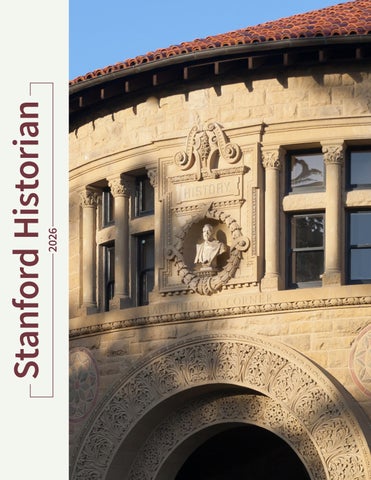
(Above) Professor Caroline Winterer explored an “American History petting zoo” of 32 curated objects with students for Democracy Day Photo: Evan Ludington (‘26) (Front Cover) View of Lane History Corner on the Stanford University Main Quad Photo: King of Hearts (Wikimedia Commons)
Sincerely, Caroline Winterer Chair, Department of History William Robertson Coe Professor of History and American Studies Stanford University
2025
THE HISTORY OF
Charles Petersen What is an Elon Musk?
Jennifer Burns How to Understand Trump’s Tariffs Steven Press Trump and Greenland
Kathryn Olivarius Anti-Vaxx America: MAHA and the Abuses of History Partha Shil Police Power in World History
Robert Crews The Death of Humanitarianism?
Thomas Mullaney AI Cold War? From ChatGPT to DeepSeek (and beyond)
Fiona Griffiths How to Choose a Pope
How can we understand the events, ideas, and conflicts that have featured in the news cycle during the past year? The History of 2025 offered the historically informed reflections on last year’s momentous events, providing an opportunity to understand our world in its historic context. Each week featured a different History faculty member speaking on a major news topic of the year, showing what we can learn by approaching it from a historical perspective. More than 130 students attended the course to reflect on the challenges and opportunities of 2025 through a historically-rounded analysis and methods. We look forward to the next iteration of the course in Autumn 2026.
Pedro A. Regalado Migrants, Money, and Panic
An archive of recordings from past lectures in this series can be found on the History website. Be sure to explore our “History of Now” page for more information.
3
America at 250 2026 marks the 250th anniversary of the U.S. Declaration of Independence. U.S. History faculty have participated in many on- and off-campus events discussing the impacts and legacy of the Declaration, the Constitution, and the role the United States plays on the world stage. You can find more information on the America at 250 page on our website. You can also explore our expert’s book recommendations to brush up on America’s founding here!
Featured Courses HIS 25 | The Declaration of Independence at 250: Big Ideas That Made a Nation (Spring 2026) In partnership with Stanford Continuing Studies, Professor Caroline Winterer offered a 4-week course for the general public and Stanford Students to investigate the Declaration both as a historical event and as a living document. History 25 | America at 250 (Spring 2026) Professor Jonathan Gienapp brought together Stanford faculty from across the university to unpack how the concerns and values expressed in the Declaration have played out across U.S. history, tying the nation’s origins to its present. Past Events January 5 Are We Rome? Are We Repeating Their Rise and Decline? January 22 The Meaning of the United States: Debating Union Before the Constitution February 4 The Declaration of Indepence: History, Meaning, and Modern Impact February 11 America at 250: Classical Heritage, Western Civilization, the Future April 27 The Eclipsed Republicanism of the Era on Conquest May 18 The Other Republicans: Anti-Monarchical Movements in the World in the Era of America’s Independence July 1 The 250th Anniversary of the Declaration of Independence
Professor Jonathan Gienapp speaks in Hauck Auditorium on February 11, 2026 Photo: Patrick Beaudouin
Upcoming Events June 18 - November 8, 2026 The Spirit of ‘76: Reflecting on America’s 250th Los Alto History Museum In honor of America’s 250th anniversary, this exhibition invites visitors to reflect on foundational texts and their relevance today, while exploring local histories of civic engagement and community building. September 10, 15 & 17, 2026 American Antiquities: Beyond the Classical World of the American Founders University of Pennsylvania Three lectures from Professor Caroline Winterer Model Republic: Why the American Founders Loved Ancient Carthage Colonies without Empire: The Archaic Greek Colonies in the American Revolution
4
Professors Caroline Winterer, Dan Edelstein, and Anne Twitty in Hauck Auditorium on February 11, 2026 Photo: Patrick Beaudouin
The First Empire: The Appeal of Ancient Persia in Revolutionary America
Featured Co-sponsored Events Islam & Science In Fall 2025, Professors Morrison, Şen, and Varlık visited Stanford to present their research
Clockwise (from top left): Professors Robert Morrison, A. Tunç Şen, and Nükhet Varlık; Stanford PhD Student Fyza Parviz Jazra presents during the June 6th Islam & Science workshop
•
October 14 | Robert Morrison (Bowdoin College) Merchants of Knowledge: Intellectual Exchange in the Ottoman Empire and Renaissance Europe
•
October 28 | A. Tunç Şen (Columbia University) Forgotten Experts: Astrologers, Science, & Authority in the Ottoman Empire
•
November 11 | Nükhet Varlık (Rutgers University - Newark) New Regimes of Death and Disease in Early Modern Istanbul
A June 6, 2026 workshop brought together graduate and undergraduate students from across Stanford representing a wide range of disciplines, including Art History, Department of Languages and Literature, History of Science, Ottoman History, Science and Technology Studies, and Religious Studies. Participants presented their ongoing research while engaging in constructive interdisciplinary discussion and offering feedback to their peers. Organized by Stanford History Professor Ali Yaycıoğlu and Stanford History PhD student Fyza Parviz Jazra Made possible by the Sohaib and Sara Abbasi Program in Islamic Studies
HISTORY 275, HISTORY 375 Haiti: Past, Present, Futures
Taught by Professor Rachel Jean-Baptiste, this course investigated and analyzed the history, present, and futures of Haiti. While every nation has a creation story, few are as unique and particular as Haiti, the only country established through a revolution of enslaved and free peoples to establish an independent republic and the second nation in the Western hemisphere. As a part of the course, we hosted four scholars discussing key moments in Haiti’s complex and dynamic history - from the 1804 Haitian Revolution to the present day. •
February 17 | Etant Dupain Film Screening and Q&A with Director of Madan Sara
•
February 24 | Darlene Dubuisson (UC Berkeley) Reclaiming Haiti’s Futures: Returned Intellectuals, Placemaking, and Radical Imagination
•
March 3 | Myriam Chancy (Scripps College) Haiti as Global Nexus: A reading from the novel Village Weavers
•
March 10 | Samuel Dameus Film Screening and Q&A with Director of The Heroes of the Massacre River
Made possible by a Stanford Global Studies Course Innovation Award
Author Myriam J. A. Chancy and her book, “Village Weavers”
Events
2025-2026 was another busy year for the Department of History! We hosted over 300 events between September and June, averaging more than one event per day, seven days a week, for over 270 days. These events welcomed visitors from across campus and around the globe, allowed for collaboration with our campus partners, and curated an incredible list of enticing presentations, lectures, workshops, reading groups and seminars for Stanford faculty, students, affiliates, and the community. Ten event series continued creating an incomparable forum for research and conversation: the Africa Research Workshop, British History Lecture Series, Digital History Series, East Asian History Working Group, Early Modern History Workshop, Gender History Workshop, Latin American and Caribbean History Workshop, Mexican and Mexican American Studies Reading Group, Stanford Environmental and Climate History Workshop, and U.S. History Workshop. We also saw the creation of three new reading groups: the Adam Smith Reading Group, the Social Theory Reading Group, and the Stuart Hall Reading Group. More information about our Events can be found here. One of my personal favorite events from this last year was hosting Career Ambassador Dan Smith, an American diplomat who formerly served as the director of the Foreign Service Institute and as the acting United States Secretary of State at the presidential transition of Joe Biden. Ambassador Smith (Stanford History PhD, 1984) gave a talk titled The Withdrawal from Afghanistan: An AfterAction Report, where he shared invaluable insight into international relations, global security and cooperation, and the role history plays in politics, policy, and conflict mediation. As we approach September, I am delighted to observe once again the emerging foundations for another year of enjoyable intellectual events that will get us out of the classroom and traveling through time. I look forward to seeing you around History Corner soon. Have an enjoyable rest of summer! Sincerely, Colin Hamill Events & Communications Coordinator
This mix of graduate students, undergraduates, researchers, and lecturers enriched our conversations and fostered lively discussions about Adam Smith’s works and their continuing relevance. - Fyza Parviz Jazra Adam Smith Reading Group
ARW has allowed graduate students to act as respondents to each presenter’s paper, giving students the chance to network with various scholars. ARW became more popular among faculty and students during the 2025-26 fall, winter, and spring quarters, with more registered participants for the events.
One event that especially stood out to us was the Multispacious History reading event we organized... the intellectual exchange was phenomenal, particularly as several participants work on projects related to animal history. The conversations were both thoughtful and genuinely enjoyable.
- Mathew Ayodele Africa Research Workshop
- Xincheng Hou & Longkai Zang East Asian History Working Group
Looking ahead, we hope to continue expanding the workshop’s reach, strengthening connections with scholars at other institutions and creating further opportunities for collaboration among graduate students and faculty in the department.
6 Graduate Student Coordinators Reflect on AY 2025-2026
- Alara Aygen & Yoav Levinson-Sela Early Modern History Workshop
Dr. Theresa Iker Choi-Lam H&S Lecturer in Undergraduate Teaching
AWARD: ACLS Fellowship Program, 2026 Making America Male Again: The Men’s Rights Movement, 1960–2005 “Men’s rights” is a hazy concept, associated today with the online manosphere, Trumpist politics, and an increasingly global far right. “Making America Male Again” traces the American men’s rights movement back to its surprising origins in the early 1960s. Its adherents have argued that men’s legal rights and social privileges have been lost or even stolen—seized by power-hungry feminists and a corrupt state. Yet for decades these same activists were overwhelmingly male, white, and straight. This project interrogates the paradox of a powerful group proclaiming its powerlessness, a claim to grievance and redress that has reshaped twenty-first century politics. “Making America Male Again” traces the men’s rights movement’s trajectory from the margins of politics and culture to the center of the Trumpist Right in the 2010s, a place it still holds today.
Dr. Samia Errazzouki Mellon Postdoctoral Fellow
ARTICLE: Morocco at Breaking Point? Drought, Misrule, and the Rise of Gen Z 212 From late September to mid-October 2025, Moroccans across the country descended into the streets to once again demand change from their government. Under the banner of a leaderless youth coalition dubbed the Gen Z 212 Movement (after Morocco’s international telephone code), protesters called for improved conditions in hospitals and schools, fair job opportunities, infrastructure that meets social needs, and an end to government corruption. PODCAST: Elizabeth I’s Doctor - & Poisoner? Why was a Portuguese-born Jewish doctor, who rose to become Elizabeth I’s chief physician, brutally executed for treason in a scandal that shocked England? Was Dr. Rodrigo Lopes truly guilty, or simply caught in the crossfire of antiSemitism, court rivalries, and empire? Dr. Samia Errazouki joins the Not Just the Tudors podcast to reexamine Lopes’s fall, tracing a web of diplomacy, espionage, and identity that stretched from London to Lisbon to Marrakesh.
Visitors & Post-Docs Professor Cornelius Torp Kratter Visiting Professor Cornelius Torp joined the Stanford History Department in Winter 2025 as the Kratter Visiting Professor in European History. A specialist in modern German and European history, he has published and taught widely on the history of trade policy in the age of globalization, the development and intellectual foundations of the welfare state, and the history of gambling.
2026-2027 Lecturers Madihah Akhter Christian Alvarado Margo Horn Charles Petersen Jenna Phillips Morgan Tufan 2026-2027 Kratter Visiting Professor Katja Hoyer (King’s College London) 2027 Distinguished Visiting Austrian Chair Christina Lutter (Universität Wien)
7
Faculty
Highlights
History of Economics Society Joseph J. Spengler Book Prize Jennifer Burns Milton Friedman: The Last Conservative Jessica Riskin was elected to the 2026 Class for the American Philosophical Society.
African Studies Association 2025 Aidoo-Snyder Book Prize Joel Cabrita Written Out: The Silencing of Regina Gelana Twala
Jennifer Burns Edgar E. Robinson Professor in United States History
Medieval Academy of America 2026 John Nicholas Brown Prize Rowan Dorin No Return: Jews, Christian Usurers and the Spread of Mass Expulsion in Medieval Europe
Joel Cabrita was named to 101st Class of The John Simon Guggenheim Memorial Foundation Fellows.
Western Association of Women Historians 2026 Judith Lee Ridge Article Prize Rachel Jean-Baptiste To Be Worthy of the Name of My Father: Métis, Paternity and Belonging in Twentieth and Twenty-first Century Colonial and Postcolonial French Africa and France ACLS Digital Justice Development Grant Professor Rachel Jean-Baptiste & Professor Emeritus Richard Roberts The Senegal Liberations Project
Ana Minian Clifford G. Morrison Professorship in Population and Resources Studies
The Journal of Korean Studies returns to Stanford University’s Korea Program at the Walter H. Shorenstein Asia-Pacific Research Center Yumi Moon | Editorial Team Organization of America Historians 2025 Lectureship Program Kathryn Olivarius American Historical Association John K. Fairbanks Prize in East Asian History Matthew Sommer The Fox Spirit, the Stone Maiden, and Other Transgender Histories from Late Imperial China Jennifer Burns was inducted as a member of the American Academy of Sciences & Letters.
American Society for Legal History Peter Gonville Stein Book Prize Matthew Sommer The Fox Spirit, the Stone Maiden, and Other Transgender Histories from Late Imperial China
Thomas Mullaney Faculty Director for Program in STS & UNESCO Chair in Digital Futures at Stanford
Phi Beta Kappa Teaching Excellence Award Gil-li Vardi
Londa Schiebinger received the Harvard Centennial Medal, which is awarded annually to distinguished alumni who have made fundamental and lasting contributions to knowledge, their disciplines, their colleagues, and society.
8
Zephyr Frank Spence and Cleone Eccles Family Director of the Bill Lane Center for the American West
Professor Caroline Winterer wins Richard W. Lyman Award, which recognizes outstanding faculty members who generously donate time to alumni beyond the expectations of university appointments.
Gordon Chang Eric Ly and Zhiyi Yu Director for Asian American Research Center
What is one thing from your research that you wish more people knew about?
If you could highlight a rarelyknown issue about your research, what would it be?
“I wish more people knew about the history of diamonds. The practice of giving diamond engagement rings may seem ancient, even eternal. In fact, this practice is a recent, invented tradition that took hold well after diamonds had ceased to be rare. It is also a practice that is wrapped up in complicated economic and humanitarian concerns.” - Professor Steven Press
Get to Know
“Charles Darwin was a Lamarckian! Jean-Baptiste Lamarck was the person who coined the word “biology” in 1802 and developed the first theory of evolution. According to Lamarck’s theory, animal behavior shaped the course of evolution” - Professor Jessica Riskin
Stanford Historians
What is one historical mystery or question that keeps you up at night? Why?
One of my research interests involves illicit economies. From drug capitalism to bootlegging, I’m fascinated by forms of economic activity that seek to evade official scrutiny and, by extension, make it harder for historians to piece together how they actually worked. - Professor Pedro A. Regalado
What skills do students develop in your courses that benefit them regardless of their declared major or career plans? “Students leave my courses with a practical understanding of how complex organizations operate under pressure. Students learn the immense complexity of organized military action, and the manifold ways in which it is an outcome of our society, culture, and technology.” - Dr. Gil-li Vardi
Faculty Lectures 11/19 Faculty Seminar with Paula Findlen Urbano Monte’s World: Milanese Encounters with Global Knowledge 12/3 Historical Conversation with Steve Zipperstein Philip Roth: Stung by Life 3/4 Historical Conversation with Fiona Griffiths ‘Wives of the Church’: Priests’ Wives in Medieval Europe 4/22 Faculty Seminar with Jana Hunter The Child of Freedom: Temporal Sovereignty and the Politics of Prague Time after 1867
Stanford Historians at the 2025 Dan David Prize Ceremony The Dan David Prize recognizes outstanding scholarship that illuminates the past and seeks to anchor public discourse in a deeper understanding of history. From Left: Dan David Prize winners and Stanford Alumni Mackenzie Cooley (2025 Winner, Stanford History PhD ‘18), Beth Lew Williams (2025 Winner, Stanford History PhD, ‘11), Benjamin Brose (2024 Winner, Stanford Religious Studies PhD, ‘09), Hannah Marcus (2025 Winner, Stanford History PhD, 2016), and Professor Kathryn Olivarius (2024 Winner)
9
Rome Archive Summer Seminar Consortium, 2026-2029 Organized in collaboration with University of Notre Dame and Princeton University, this month-long archival immersion program is co-led by Professor Paula Findlen. The program enables Ph.D. candidates at partnering universities to conduct complex, advanced research in Roman archives by hosting them for an intensive learning opportunity at the University of Notre Dame’s Rome Global Gateway Campus. Stanford School of Humanities & Sciences has generously supported the consortium activities since its inception in Summer 2023. More information can be found here
African Women Shaping the World Activism, Networks and Connections (1920s-1970s) Dakar, Senegal Professor Rachel Jean-Baptiste coconvened this workshop featuring pioneering Senegalese feminist scholars, including Fatou Sow, author of Feminism in Africa: Gender, Knowledge and Resistance. Learn more about this workshop
Medieval History Forum As part of a broader effort to strengthen the presence of premodern history at the American Historical Association, Professors Rowan Dorin and Fiona Griffiths are joining forces with colleagues from eight other universities across the United States to launch the Medieval History Forum. Thanks to seed funding from Stanford’s School of Humanities and Sciences and the support of the Stanford History Department (as well as other institutional partners), this initiative will bring a cohort of advanced graduate students and early career scholars to the AHA’s Annual Meeting each year to present work-in-progress in a seminar format. The first iteration will be held in Seattle in January 2028, with meetings in New York and Washington D.C. to follow in subsequent years.
Global Florence: The World of Francesco Carletti, 1573-1636 Firenze globale: il mondo di Francesco Carletti, 1573-1636
Stanford Open Minds @ Boston November 7, 2026
Supported by the Gladys Krieble Delmas Foundation & Samuel H. Kress Foundation
Join Stanford’s president Professor Jonathan Levin, leading faculty, including Professor Caroline Winterer, to share their insights in navigating the future with open minds.
The Global Florence: The World of Francesco Carletti, 1573-1636 exhibition will be on display at Biblioteca Laurenziana (Florence, Italy) from October 8, 2026 through January 8, 2027. Focusing on Francesco Carletti as the first private person to circumnavigate the world by various means, the exhibition aims to engage students and the public around the relationship between Renaissance Florence and an increasingly global world at the turn of the 16th century. The project is led by Professor Paula Findlen and Stanford’s Program in History & Philosophy of Science, in partnership with Syracuse University, European University Institute, and University of Warwick.
More information can be found here
Accounting for Debt & Order of Debt: Power, Wealth, and Death in the Ottoman Empire, 1700-1830) Vienna, Austria Professor Ali Yaycıoğlu gave a hands-on workshop and lecture investigating the relationship between property, capital, finance, and Ottoman statehood in the eighteenth and early nineteenth centuries. More information can be found here
What was revolutionary about the English Revolution? London’s Institute of Historical Research July 2027 Conference The causes and consequences of the civil wars of the 1640s – which led to the execution of King Charles I and the abolition of monarchy – are amongst the most intensively debated problems in the history of the British Isles. This conference is designed to showcase new research by early career scholars, with commentaries and discussion led by senior figures, to identify new agendas for future development, and to integrate current cutting-edge work with older models and insights. Featuring Professor David Como as one of the keynote speakers, the conference is supported by our department’s Anglo-California/Stansky Fund for British Studies and by the Elizabeth and Conrad Russell Fund.
Teachers’ Symposium with the Gilder Lehrman Institute of American History, 2027-2029 We are launching a 3-year pilot with the Gilder Lehrman Institute as part of their annual multi-day, multi-track teachers’ professionalization workshop for K-12 teachers. The collaboration builds upon our U.S. History faculty’s work with the Institute through online seminars, and aims to strengthen the pedagogical foundations of how American history is taught across the nation. More information can be found here
New Books
2025-2026 Travel the World with Stanford Historians September 1 - 9, 2026 Normandy Walk | Dr. Gil-li Vardi September 30 - October 9, 2026 Piemonte Walk | Professor Caroline Winterer October 9 - 14, 2026 Columbia and Snake Rivers | Professor Emeritus David Kennedy
History Lecture Series Inaugural Lecture The Tame and the Wild: People and Animals After 1492 Professor Marcy Norton University of Pennsylvania In April 2026, Professor Norton visited History Corner to discuss her award winning book, which tells a new history of the colonization of the Americas by placing wildlife and livestock at the center of her analysis.
March 14 - 22, 2027 American South | Professor Emeritus David Kennedy May 12 - 25, 2027 Camino de Santiago Walk | Professor Caroline Winterer June 6 - July 5, 2027 Croatia Family Adventure | Professor Caroline Winterer November 6 - 18, 2027 Japan | Professor Kären Wigen Click here for more information on Stanford Travel/Study trips
11
Graduate Showcase
2026 Departmental Awards Best Written Dissertation Prize Lane Baker From Encounter to Expulsion : Romani Immigrants in the Holy Roman Empire, 1417-1498 Excellence in First-Time Teaching at a TA Eric Lindheim-Marx Europe in the Middle Ages, 300-1500 (History 115D) Best Graduate Teaching of an Undergraduate Seminar Lucy Stark History 3S: Growing up in the World: A Global History of Childhood (History 3S)
Mathew Ayodele wins Lagos Studies Association Best Graduate Student Paper Prize for his paper Transactional Agency: Nigerians, Indigenous Authorities, and Colonial Officials Negotiating Museum Development, 1936-1945
Stanford Humanities Center Fellowships Emre Can Daglioglu Stanford Humanities Center Next Generation Scholars Fellowship Max Fennell-Chametzky Stanford Humanities Center Dissertation Prize Fellowship Yeseul Byeon Mellon Foundation Dissertation Fellowship
Program on History & Philosophy of Science Research Grants Mathew Ayodele ~ Fyza Jazra ~ Janice Ndegwa Sina Salessi ~ Adele Stock
The Europe Center Graduate Student Grant Recipients Mathew Ayodele Resisting Ignorance, Negotiating Authority: Indigenous Healers and the Medical Marketplace in Southwestern Nigeria, 1860–1960 Nathan Deschamps A Sharp Insight into Atrocious Conduct: Inflation and Economic Thought in Early Modern Europe Sina Salessi The Property of Science: Global Cartography, Law, and Institutions, 1650–1750 Gillian Smith The Edwardian Hospitals: Urban Statecraft and Social Control in Sixteenth-Century London James Terrasi Notaries on Trial: Legal Professionals and Fraud in Medieval Bologna
Hoover Institution Center for Revitalizing American Institutions: Research Seed Grants
Fyza Jazra Arabic Scientific Scholarship and the Emergence of New Physics in Early-Modern Europe
Jennifer Depew Spirits of ’76: Memories of the American Founding in American Politics, 1976-2016
British Studies Program at Stanford Department of History
School of Humanities and Sciences: Graduate Research Opportunity in Modern British History & Culture Mathew Ayodele ~ Mustafa Emre Günaydı Angelica Krystel von Kumberg ~ Janice Ndegwa
12
Centennial Award Katherine Booska Kayra Guven Fyza Parviz Jazra
Nathan Deschamps Mahishan Gnanaseharan Gillian Smith These fellowships are designed to assist graduate student research on the history of Britain and the British Empire (or alternatively, for essential research on other fields tied to UK repositories). Funds may be used to support archival research or to obtain materials, order digital copies, secure electronic editions, and pursue other research opportunities
Lucy Stark receives Fulbright Grant At the Archives Nationales D’Outre-Mer in Aix-en-Provence, France, Lucy will complete doctoral research on coerced child labor regimes in the 18th- and 19th-century French Empire, focusing on children of African descent in Saint-Domingue, Louisiana, and Senegal.
Julia Fine receives Mellon/ACLS Dissertation Innovation Fellowship Julia Fine’s project, Pyrites & Power: Imperial Mining Corporations in a Planetary Age, examines the entangled geography of mineral extraction from the 1870s through the onset of the “Great Acceleration” in the mid-20th century.
Aliyah Dunn-Salahuddin receives Partnerships for Climate Justice Fellowship Aliyah Dunn-Salahuddin is the current Thomas D. Dee II Graduate Fellow with Stanford’s Bill Lane Center for the American West. Her research examines the Black experience in Northern California through the intersection of environment, race, and urban infrastructures. Adele Stock receives Susan Ford Dorsey Innovation Africa Fellowship Adele Stock’s research examines the intersections of environment, infrastructure, and religious life in African cities from the nineteenth century to the present. Adele’s dissertation, “Kampala is a Swamp: Power, Placemaking, and Devotion, 19002026,” offers an environmental and religious history of Kampala, Uganda’s wetland ecosystems. Courtney MacPhee receives VPGE Dissertation Completion Fellowship Courtney MacPhee’s research examines the impact of religious radicalism on the formation of the British empire during the mid-seventeenth century and offers a new interpretation of the English Revolution and its place in the development of early Caribbean and American colonial politics.
Jordan Virtue won the Outstanding Graduate Student Paper Award from The Society of Civil War Historians for her paper, “‘The Lyre of War’: Black Civil War Memory in Paul Laurence Dunbar.”
2026-2027 Cohort M.A. & Ph.D. Students Africa Rachel Hendrix Britain Zachary Wallis Early Modern Europe Elena Lu East Asia John Jagoe Joshua Park Latin America Emely Quezada Medieval Yunji Li Adam Rainbolt Ottoman Empire & Middle East Merve Nur Kocyigit Ruqaiyah Damrah Russian and Eastern Europe Sophia Charles Science, Technology, Environment & Medicine Celeste Mariana Gomez Sarah Chow Transnational, International, and Global History Lianna Leung Mina Turunc United States Nkemjika Abad Emenike Maya Martinez-Krams Raina Nelson Kelly Lew Julia Jones Chaffers Sherman Criner
13
Graduate Student Interviews
Christian Robles-Baez “The Making of an Improbable Global Market: Coffee (1808–1850)”
Alina Bykova Clements Center for National Security Predoctoral Fellowship
Sonya Schoenberger “A Year in the Pacific: Insights from a Fulbright-Hays Scholar”
Farah Bazzi Stanford Humanities Center Next Generations Scholar
Olavo Passos de Souza Tinker Foundation Dissertation Completion Fellowship
Adele Stock Mellon Foundation Dissertation Fellowship
Kyle Harmse Stanford Program in History & Philosophy of Science Dissertation Fellowship
Ana Núñez “Dynasty, Identity, Authority: Female Rule and Political Culture in the Kingdom of Jerusalem, 1131–1228”
Aliyah Dunn-Salahuddin “Bringing Life to Their Words: Experience from a Mellon/ACLS Dissertation Innovation Fellow”
(Left) Professors Caroline Winterer and Jessica Riskin and Stanford History graduate students met up in Edinburgh while abroad for conferences and research. Photo: Caroline Winterer (Right) Canal in Venice, as seen by Ph.D. candidate Audrey Martel-Dion while visiting archives in Italy as part of their Social Sciences and Humanities Research Council of Canada Doctoral Fellowship Photo: Audrey Martel-Dion
Summer 2025 Intensive Language Grants James Terrasi Catalan (Catalunya, Spain) “My research focuses largely on sources that are not available in print or online. In some cases, even the inventories of these sources exist only in a handwritten format and must be accessed in person. Learning Catalan and visiting local archives allowed me to explore new sources that I have not thought of or known before.” Kayra Guven Modern Standard Arabic (Fes, Morocco) “In addition to working in the archives, I took every opportunity to visit the local historical sites... these excursions introduced me to a trove of new Arabic vocabulary that will be instrumental to my doctoral research about French colonialism during the Third Republic.” Bailey Martin Dutch (Leiden, Netherlands) “The opportunity to learn a new language and to learn it while being surrounded by institutions central to my research added indispensable value to my summer and reinforced my research interest in the Dutch Atlantic as a geographical site to explore in my doctoral program in History.” Eva Baudler Mandarin (Beijing, China) “The course at PKU allowed me to not only sharpen the skills I already have as a heritage speaker, but also pushed me to read texts in both simplified and traditional script.” Summer Intensive Language Grant reports can be found here
(Above) Flyer for U.S. History Mini-Conference, featuring work from History M.A. and Ph.D. students (Below, Left to Right) Palais Mnebhiin Fes, Morocco (Photo: Kayra Guven); Canal of the Forbidden City (Photo: Eva Baudler) The Castellet of Perpignan, photographed during the Focs de Sant Joan festival (Photo: James Terrasi)
15
UNDERGRADUATE Awards Evan Ludington David M. Kennedy Prize
2025 Summer Internship: Zaid Akhtar
Evan Ludington & Eli Toney Robert M. Golden Medal for Excellence in the Humanities and Creative Arts
Kitab Ghar Lahore & Karachi, Pakistan
Judy Liu & Theo Baker James Birdsall Weter Prize for Outstanding History Thesis
Read Zaid’s Internship Report
Kastella Nguyen Oral Communication Award for Excellence in Honors Thesis Presentation Bethany Lorden Award for Excellence in Creative Capstone Projects Eliana Contreras Award for Innovation in Creative Capstone Projects Jack Komaroff Award for Outstanding Presentation of Creative Capstone Projects Tianren Li Carl N. Degler Prize (Herodotus) Melody Ding Jerry Anderson Prize for Best History Undergraduate Research Paper
2025 Summer Internship: Bethany Lorden The Spectator World Washington, DC Read Bethany’s Internship Report
2025 Summer Internship: Mandy Maselli Louisa May Alcott’s Orchard House Concord, MA Read Mandy’s Internship Report
Henry Segal Stanford Historical Society Presidential Award of Merit Theo Baker Gabrielle Edelin Andrew Kelmanson Henry Segal Claudia Sung Eli Toney Stanford Award of Excellence Caspar Griffin Kastella Nguyen Sachin Singh Grace Wong Elyse Hwang George Porteous Elected to Phi Beta Kappa Andrew Kelmanson Yenching Scholarship
16
2025 Summer Internship: Leslie Bravo Los Angeles Superior Court Los Angeles, CA Read Leslie’s Internship Report
2025 Summer Internship: George Porteous The Whole Story with Anderson Cooper New York, NY Read George’s Internship Report
Herodotus Undergraduate Journal Caspar Griffin ‘Little Hope to the Parent of a Backward Boy’: The Genetic View of Genius in Terman’s Longitudinal Study Anna Wang An Open Secret: Sex, Vaudeville, and Gay Prison Culture at the San Quentin Little Olympics Anand Krishnan When Industry Regulates Itself: The Agnogenesis and Regulatory Capture of the FDA Viraj Jayam Defusing the Peaks: U.S. Embassy Fieldcraft and Nuclear De-Escalation in the 1999 Kargil Crisis Tianren Li Archiving Nanjing: American Photographs, Written Testimony, and Sino-American Relations Ines Salter Martin Negotiating the Legacy of Occupation: Cultural Memory and Historical Reckoning in Postwar France Julia Lasiota Creating Injustice: Hugo Princz, Michael Kolanik, and the Failures of Reparations Eli Ward Toney The People’s Bench: Representative Juries in the Early American Republic
Read Volume XXXVI of Herodotus here
2025-2026 History Department Undergraduate Research Assistantship Program The History of Anglo-European “Free City” projects in Honduras Faculty: Steven Press RA: Alia Saphier Global Florence: The World of Francesco Carletti, 1573-1636 Faculty: Paula Findlen RAs: Carlos Leiva & Mandy Maselli Wives of the Church: Marriage, Ordination, and Clerical Families, 900-1200 Faculty: Fiona Griffiths RAs: Emma Lorimer & Leila Yokoyama “Slavery” after Abolition: The History of a Concept Faculty: JP Daughton RAs: Hayden Thompson & Iman Deriche
2025-2026 Peer Advisors (from left) Evan Ludington, Leila Yokoyama, Judy Liu & Caspar Griffin
More information can be found here.
SPOTLIGHT
17
AY 2025-2026 Honors Theses Theo Baker Codename Crook: A Soviet Spy in Congress and the Forgotten Origins of the Red Scare Nina Burik Inventing the Third Branch: Justice Thomas Todd, Circuit Riding, and the Geography of Early Federal Law Christina Cheng “Troublesome Bedfellows”: Chinese, Mormons and Marital Anxiety in the Postbellum American West Yifei Cheng “Are you married or single?”: The Case of Twenty-two Lewd Chinese Women in 1875 Caspar Griffin How We Grow: Developmental Psychology and the Creation of a Longitudinal Public, 1921-1940 William Heafey A History of Runaway Youth and Youth Services in Berkeley, California: 1967-1973
The Park-Young Honors Mentorship Program matches undergraduate thesis writers with History Ph.D. students to provide additional mentorship and professionalization opportunities.
Jaylon Jones Black Bodies, White Spaces: A History of the Aftermath of “Take Back the Mic” and Black Student Resistance at Stanford, 1968–1978 Andrew Kelmanson “The Century of Biology”: The Making of China’s Biopharmaceutical Industry, 1976-2026 Dylan Little The Fiction of Freedom: Race, Law, and the First Civil Rights Movement in California, 18491870 Judy Liu “The Fury of Battle”: Manufacturing Militarism in the German Empire Evan Ludington A California Calamity: Constructing Collective Meaning in the Great Flood of 1862
Kastella Nguyen Do You Know the Way to Little Saigon?: Defining Place in the San Jose Vietnamese American Community, 1975-2013 Emelia RIchling At the Summit: Women’s Entrance to Wall Street in the Era of Financial Deregulation and Democratization, 1967-1989 Sachin Singh American Philosopher, American Poet: Richard Rorty’s Literary Turn Eli Toney Creating Slavery: Towards a Coherent Theory of Mississippi Slave Law, 1817-1860 Elisabeth Westermann ‘She Would Not Be Moved’: Diane Nash’s Direct-Action Leadership During the Civil Rights Movement, 1960-1965 Grace Wong Resistance, Recognition, and Remembrance: Communist–Allied Cooperation in World War II Hong Kong and Its Implications
(From left) Director of Undergraduate Research & Honors Professor Rowan Dorin with senior thesis presenters Eli Toney, Yifei Cheng, Kastella Nguyen, Dylan Little, and Honors Mentoship Program coordinator & History PhD student Jordan Virtue after a day of Honors Thesis presentations Photo: Colin Hamill
Zaid Akhtar Sacred Spaces Beyond Boundaries: “Wayside” Shrines and the Negotiation of Identity in South Asia Scout Butler 2Tone: The Sound of Britain Eliana Contreras La Reyna Bakery: How Pan Dulce Forged Community in the Mission Nghia Duc Do (via recording) Interview with Luat Su Lan
Creative Capstone and Honors Thesis SDR Collections The Department of History launched the Creative Capstone Collection in the Stanford Digital Repository this academic year. This will allow our students who opt to create a history project to submit their work much like our honors thesis writers. We’d love it if you would take a look at the Department of History’s undergraduate Creative Capstone Collection and Honors Thesis Collection.
AY 2025-2026 Senior Capstone Projects Gabrielle Edelin HAIRitage: A Personal and Broad History of Black Hair in America Rollo Ferguson Touchstone or Blarney Stone: J.E. Wallace Sterling and the Purpose of American Higher Education Jack Komaroff Reel 1 of Reaganism: The Hollywood Origins of Ronald Reagan’s Conservative Vision Kennedy Lalonde Lost in Translation Bethany Lorden California Dreaming
Michi Mairena Into The Resistive Ecologies of Campesino Youth’s Art in Bajo Aguán, Honduras: Welcome to Our Digital Museum Henry Segal SI MONUMENTUM REQUIRIS, CIRCUMSPICE: Wallace Sterling and the Stanford Medical School Claudia Sung Sites of Power, Seeds of Resistance: Asian American Student Activism at Stanford University Roisin Willis (via recording) Stanford University and Female Athletics: The Impact and Role of Title IX
The Devil On Our Shoulders “According to the librarian who first inducted me as a visiting student at Oxford, the Radcliffe Camera houses approximately 600,000 volumes. I considered that figure two months later while sitting in the library’s upper gallery. It was a Sunday night and the word processor on my laptop showed only a blank page, the cursor blinking dully back at me. I was expected to turn in an essay the next day on neoliberalism and technological change, but felt incapable of writing even a simple sentence.” - George Porteous (’27) Read George Porteous’ full essay in the Oxford Review of Books
19
COMMENCEMENT “Standing here today, I think we can see clearly the importance of the past in shaping our lives today. Amid the confusions of our present moment, when so many crises buffet us from day to day, the long view of the historian offers both perspective and wisdom. We do not know what lies ahead of us. Nobody can predict the future, no matter what they tell you. But if we listen carefully to the voices of the many people who walked the earth before us, we can begin to appreciate our collective humanity. Whether we are separated by place or time, we are all humans, with hopes, fears, and the capacity to change the world for the better. One gift of the historian is to remind the world of this. You, our graduates, now also bear this gift. Please go forward and share your historical wisdom and perspective with the world.” Professor Caroline Winterer
“I’d like to end with a proposal that contingency—the uncertainty in history and in our present—is not scary or condemning but liberating. If the past was not inevitable, the future is not either. It’s built by people like us, both traditional leaders and members of communities who make rippling waves. I’m optimistic that the future is in the hands of the people here, steeped in virtues of the historian’s craft: radical empathy and the will to understand.” Evan Ludington, Class of 2026
“Scholars in my field often talk about the ways that remembrance is tied to place. So if you’ll forgive me one “woo woo” California moment, I’d like us to pause and take this in. The warm breeze, the profound feeling of community, the shadow of a building where we learned and taught and read and laughed and probably cried. A shared sense of accomplishment and possibility, of completion and new beginnings. The air in our lungs, the joy in our hearts. I am deeply grateful to have shared this soon-to-be-memory with all of you. Congratulations to the class of 2026.” Dr. Emily Bradley Greenfield, Class of 2026
20
MAJORS
MA
Zaid Akhtar Theo Baker (Honors) Nina Burik (Honors) Scout Butler Luke Campbell Christina Cheng (Honors) Yifei Cheng (Honors) Eliana Contreras Nghia Duc Do Gabrielle Edelin Rollo James Ferguson Theodore Gillibrand Caspar Griffin (Honors) William Heafey (Honors) Jaylon R. Jones (Honors) Adrew Ross Kelmanson (Honors) Jack Tyler Komaroff Kennedy Lalonde Dylan Kayin Little (Honors) Judy Liu (Honors) Bethany Joy Lorden (Honors) Evan Ludington (Honors) Kastella Ngoc Ha Nguyen (Honors) Emelia Evangeline Richling (Honors) Henry Asher Segal Sachin Singh (Honors) Claudia Sung Eli Ward Toney (Honors) Elisabeth Westermann (Honors) Roisin Willis Grace Yun Wong (Honors) Leila Yokoyama
Lindsey Allebest Muhammad Haram Gulzar Teddy Hickenlooper Borys Jastrzebski Ellie Gianna Luchini Bella Shahani Tess Stapleton Micaela Wibberly Ruiji Zhang
MINORS Alexandre Acra Maya Agarwal Deborah Lim Bong Trey Crawford Michael Fung Ruosong Gao Manasi Garg Melannie German Cate Greenman Ramya Iyer Felipe Jafet Hannah Justicz Megan Grace Liu Tiara Martinez Marley Melbourne Ava Mendoza Samuel Minev Benzecry Bess Olshen John Puri Carl Purisima Alexandre Ravel Victoria Ren Juan Sandoval Igareda Alisha Service Elijah Williams Emily Ruby Winn
PhD Luther Cox Cenci A Sea of Law: State Power, Judicial Entrepreneurs, and Vernacular Legal Culture in the Chinese Diaspora, 1780-1890 Advisor: Professor Matthew Sommer Austin Clements Defending the Kingdom of God: Religious Origins of the American Right, 1917-1941 Advisor: Professor Jennifer Burns Amanda Coate Experiences and Meanings of Hunger in Early Modern Europe, c. 1550-1700 Advisor: Professor Laura Stokes Emily Bradley Greenfield Among the Curiosities of the Neighborhood: Slavery and Memory at Thomas Jefferson’s Monticello Advisor: Professor James Campbell Hannah Johnston Go-Betweens: Sex, Gender, and Labor in Early Modern Italy Advisor: Professor Paula Findlen Ana Núñez Hereditary Queenship in the Kingdom of Jerusalem, 1131–1228 Advisor: Professor Fiona Griffiths Preetam Prakash A Sufficient Representation of Justice: Judicial Violence, Knowledge, and Contingency in the Qing Autumn Assizes Advisor: Professor Matthew Sommer Aaron Meir Schimmel Russian Jews and Georgian Jews: Intercommunal Encounters in the Russian Empire, 1801-1917 Advisor: Professor Steven Zipperstein Narusa Yamato Archipelago of Cows: A History of the Japanese Dairy Industry, 1854-1945 Advisors: Professor Jun Uchida and Professor Kären Wigen Magdalene Zier Women at the Bar: Law, Liquor, and the Making of Modern Feminism Advisor: Professor James Campbell
CLASS OF
2026
Digital History endeavors in the Department of History are supported by Academic Technology Specialist Dr. Anne Ladyem McDiviit and SILICON Project Coordinator Audrey Gao. Anne Ladyem’s appointment is renewed for an additional three years in collaboration with Stanford Libraries and Stanford School of Humanities Sciences. She will continue to lead meaningful visits to campus resources, run the Digital History Series in the Department, and assist faculty, students, and staff with digital projects. SILICON will move to Stanford Libraries with Audrey and Professor Thomas Mullaney continuing their digital history efforts in collaboration with department and School affiliates. University Archives Visit | February 25, 2026 In the winter quarter of 2026, history undergraduates visited the University Archives with University Archivist Josh Schneider to get handson experience with some of the materials held in Green Library’s Special Collections. Students were able to see Jane Stanford’s life mask, the original charter for the university, materials from student life, seance items, and more. This was an exciting opportunity for our history students to engage with objects and documents with relevance to Stanford, while also getting to learn about how to access archival materials for their research projects. We also discussed how these could be implemented into digital history projects, which one student accomplished for their creative capstone project.
DIGITAL “We hear about Generative AI nearly every day, and this academic year, I felt that it would be helpful for our faculty and students to hold workshops to help navigate the ever changing landscape as historians. In Fall 2025, I gave a workshop called GenAI for Historians, and in Spring 2026, I co-lead the GenAI for Humanities workshop in Stanford Libraries. These workshops gave us the opportunity to discuss how historians can use GenAI responsibly, including for research and in the classroom. I plan to continue these workshops at least annually to address new developments”. - Dr. Anne Ladyem McDivitt, Academic Technology Specialist 22
2026 ATypI Conference at Stanford Led by Professor Thomas Mullaney, SILICON (Stanford Initiative of Language Inclusion and Conservation in Old and New Media) brought the ATypI Conference back to Stanford for the first time since its 1983 gathering on campus. The multi-day conference focused on typography’s global past and the pressing need to design more inclusive digital futures. Scholars and practitioners explored different aspects of type design and inclusion from May 27th through May 30th, 2026. Speakers included History alum John D. Berry with his paper, “70 Years of ATypI.”
“When I was an undergrad at Stanford... I ended up studying Chinese history at a time when it was virtually impossible for an American to visit China. It was a wonderful coming-full-circle experience to come back to Stanford this year for the annual conference of ATypI (Association Typographique Internationale)... It only added to that full-circle feeling that the conference organizer, Tom Mullaney, is himself a noted professor of Chinese history.” - John D. Berry (Stanford Class of 1971)
HISTORY “This past year marked another milestone for SILICON. We published collaborative papers with the Institute for Human-Centered Artificial Intelligence (HAI) and celebrated the appointment of our Director Tom Mullaney as UNESCO Chair in Digital Futures. This summer, SILICON welcomed our third cohort of summer interns, having grown from 4 students in 2023 to 17. We thank VPUE, Haas, Stanford Global Studies, UNESCO, Unicode, and the Endangered Languages Project for making this possible. This academic year, SILICON established new institutional partnerships with the Endangered Languages Project and the African Languages Conference. SILICON ran the second cohort of the Knuth Bigelow Type Design Incubator and the The Dr. Chan Yeh Practitioner Program. We launched the first cohorts of the Knuth Bigelow UX/UI Incubator and the Digital Futures Incubator. As SILICON transitions to its new home in the Stanford Libraries, we extend our sincere gratitude to the History Department staff for their support over the past 3 years.” - Audrey Gao, SILICON Project Coordinator MingKwai Professor Tom Mullaney, Audrey Gao, and Anne Ladyem McDivitt visited Swope Design Solutions in San Francisco in March 2026 to assemble prototype MingKwai typewriters. This was an excellent opportunity to see history brought to life in a more accessible way, and it was a fun challenge to figure out how to take the videos and images from the experience and turn them into written and drawn instructions for assembly. Learn more about the MingKwai, and Professor Mullaney’s journey to find it, here.
Updates
Alumni
ALUMNI: Connect with us by filling out our Alumni Questionnaire
Alumni Interview with Professor Jacob Daniels (Stanford History PhD, 2022) The Jews of Edirne: The End of Ottoman Europe and the Arrival of Borders Alumni Interview with Professor Joseph Seeley (Stanford History PhD, 2019) Border of Water and Ice: The Yalu River and Japan’s Empire in Korea and Manchuria
Alumni Interview with Professor Koji Hirata (Stanford History PhD, 2018) Making Mao’s Steelworks: Industrial Manchuria and the Transnational Origins of Chinese Socialism Alumni Interview with Professor Nana Osei-Opare (Stanford History AB/MA, 2011) Socialist De-Colony: Black and Soviet Entanglements in Ghana’s Cold War Alumni Interview with Professor Benjamin Hein (Stanford History PhD, 2018)
Prizes, Publications, and News Nicole Martin (Stanford History PhD, 2018) wins 2025 Ray Allen Billington Prize from Western History Association. Jonathan Connolly (Stanford History PhD/JD, 2017) wins 2025 Stansky Book Prize from North American Conference on British Studies for his new book, Worthy of Freedom: Indenture and Free Labor in the Era of Emancipation. Vladimir Hamed-Troyansky’s (Stanford History PhD, 2018) book, Empire of Refugees: North Causasian Muslims and the Late Ottoman State, wins eight book prizes. Padraic Rohan (Stanford History PhD, 2021) publishes Latin and Eastern Catholicism in Ottoman Anatolia: Social, Economic, and Religious Inquiries from 14th-20th Centuries in The Isis Press. Carolyn Zola (Stanford History PhD, 2024) publishes Bowl By Bowl: Black Women, Food Selling, and Survival in the Antebellum North in the Journal of Social History. Lane Baker (Stanford History PhD, 2025) wins 2026 Fritz Stern Dissertation Prize from Friends of the German Historical Institute. Tanner Allread (Stanford History PhD, 2025) joins faculty at Harvard Law School The Los Altos History Museum featured A Conversation between Historians on Partition and Memory with Madihah Akhter (Stanford History PhD, 2020) and Anna Toledano (Stanford History PhD, 2023) Alumni Interview with Annelise Heinz (Stanford History PhD, 2015)
The Migrant’s Spirit: How Industrial Revolution Came to the German Lands
Alumni Interview with Professor Samuel Huneke (Stanford History PhD, 2019) I Will Not Abandon You: Queer Women in Nazi Germany
Are you a recent History MA/PhD graduate navigating the academic job market? Connect with us to be featured on our NEW Job Market Candidates Page!
Department Staff Burcak Keskin Kozat | burcak@stanford.edu Director of Finance and Operations Van-Anh Nguyen | vnguyen@stanford.edu Assistant Director of Finance and Operations Arthur Palmon | apalmon@stanford.edu Assistant Director of Student Services Kai Dowding | kdowding@stanford.edu Student Services Officer Vivian Beebe Sana | vbeebe@stanford.edu Faculty Affairs & External Relations Officer Colin Hamill | chamill@stanford.edu Events & Communications Coordinator Maria Moreno-Lane | morenola@stanford.edu Assistant Building Manager & Administrative Associate Audrey Gao | agao@stanford.edu SILICON Project Coordinator Anne Ladyem McDivitt | ladyem@stanford.edu Academic Technology Specialist
This summer we bid farewell to Student Services Officer Kai Dowding. After more than seven years with the Department, Kai will be heading north to start an MLIS/ MAS program at the University of British Columbia. This summer, the Department held a 2026 FIFA World Cup in Canada/USA/Mexico prediction competition with over 35 participants among History staff, faculty, and students. This year’s winner was Professor Jonathan Gienapp, and we look forward to playing again next year for the 2027 FIFA World Cup in Brazil!
Home to a world-renowned faculty, the Department of History offers programs of study for undergraduate and graduate students. Through a diverse array of courses spanning the globe and ranging from the ancient world to the modern era, students can prepare for a variety of fascinating careers and for citizenship in a globalized world.
Support Stanford History Your support ensures our department’s continued leadership in the History discipline and enriches historical research and teaching at Stanford University. Your support will: • • • •
Equip Stanford students with historical and analytical skills Support innovative learning and scholarship Disseminate informed perspectives about the U.S. and global history in public media Creat a support network for current and future Stanford historians
Learn more about supporting Stanford History
25
Photo: Colin Hamill
Department of History Lane History Corner, Building 200 450 Jane Stanford Way Stanford, CA 94305 history.stanford.edu history-info@stanford.edu x.com/StanfordHistory