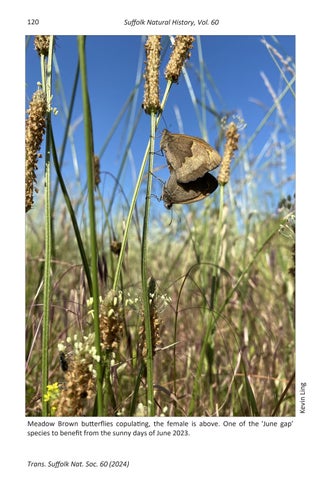
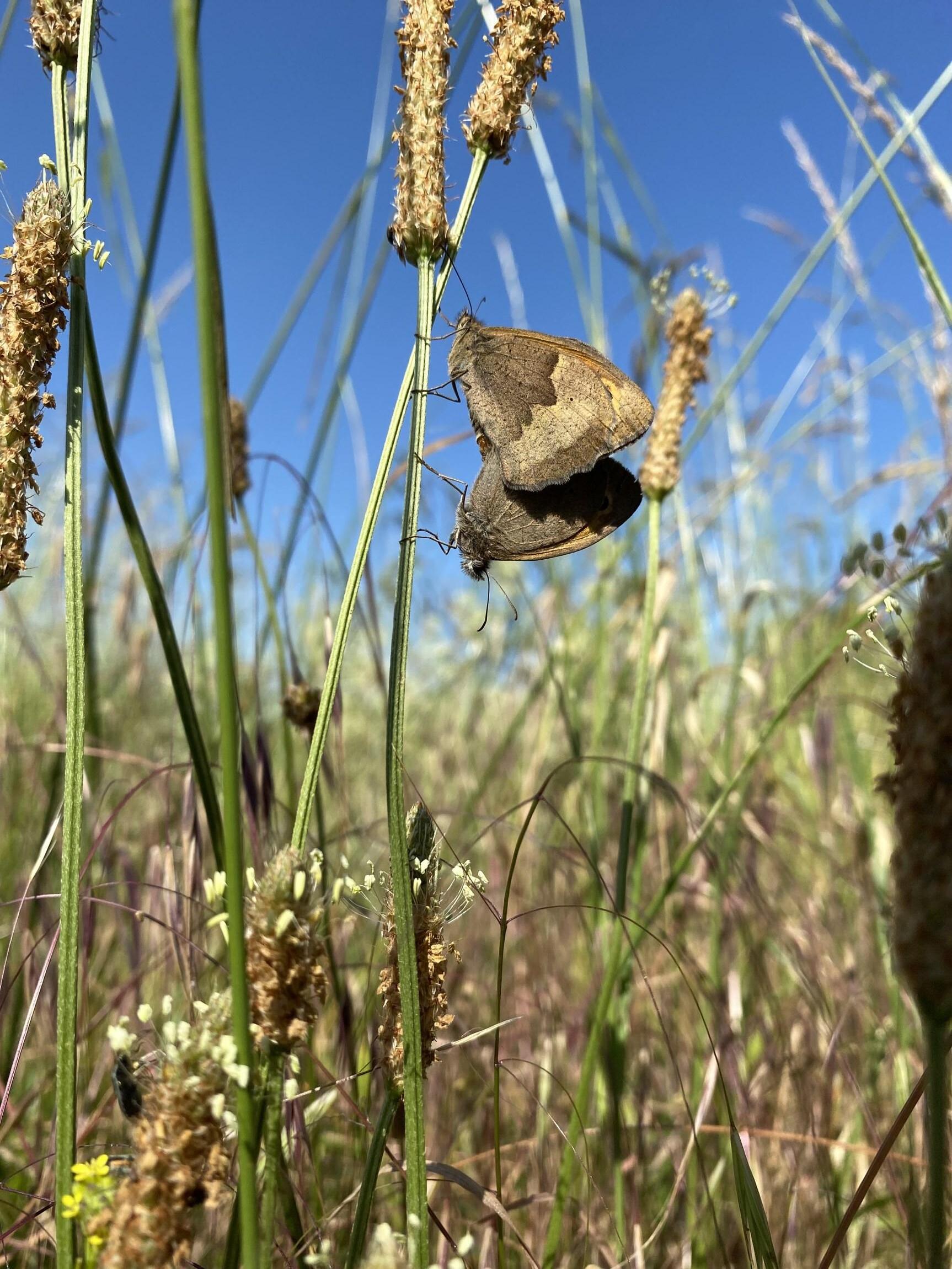
Meadow Brown butterflies copulating, the female is above. One of the ‘June gap’ species to benefit from the sunny days of June 2023.
Suffolk Nat. Soc. 60 (2024)
2023 SUFFOLK BUTTERFLY REPORT
JAMES CORTON
Introduction
Since the 2022 report there has been sad news in the passing of Trudi Willis, a member who held an open garden day annually, raising funds for Suffolk Branch and providing a chance for members to meet and socialise. My Norfolk counterpart, Alan Brazil, also passed away. He had encouraged me as I began this County Butterfly Recorder role. Both will be missed.
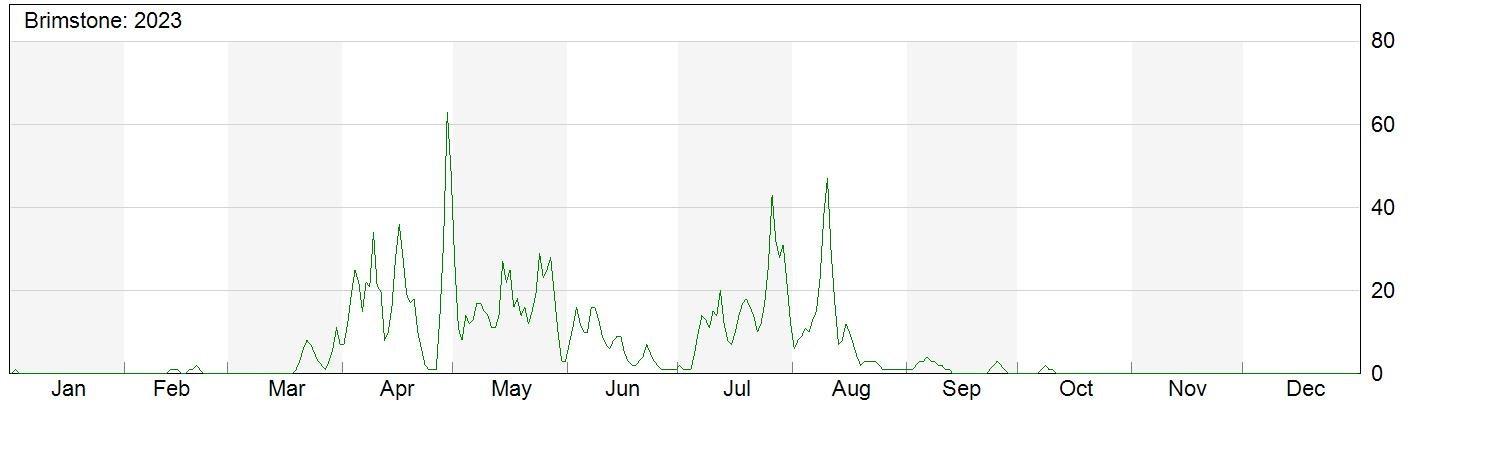
The first butterfly sighting of 2023 came on 2 January, a Brimstone in Long Melford and the last sighting was of a Peacock on 27 December in Woodbridge. Between these dates, well over 100,000 sightings were reported from over 30,000 recording trips. This is slightly more than in 2022.
The full report contains additional data from spreadsheet and paper-based records, as well as some late data and makes up about 10% of total records. The additional data is not expected to affect distribution maps or flight dates greatly except, perhaps, some of our less recorded species, such as hairstreaks.
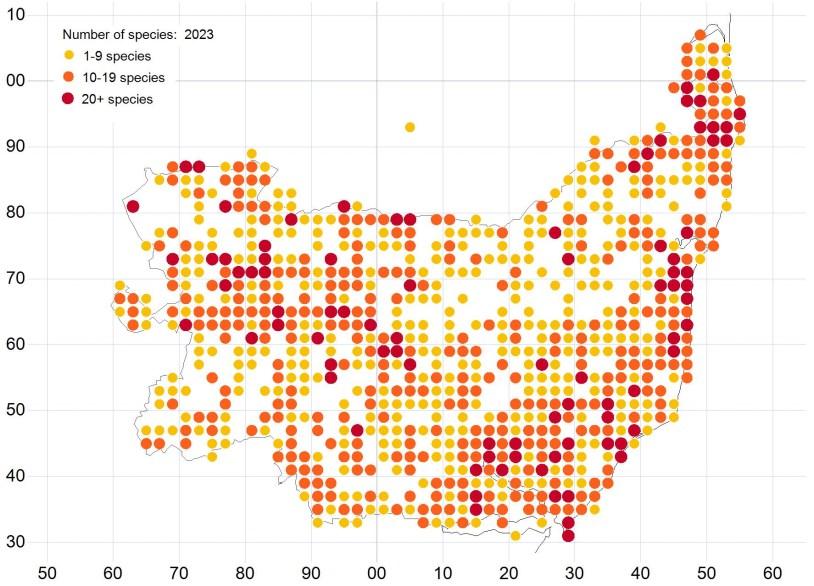
Number of species: 2023
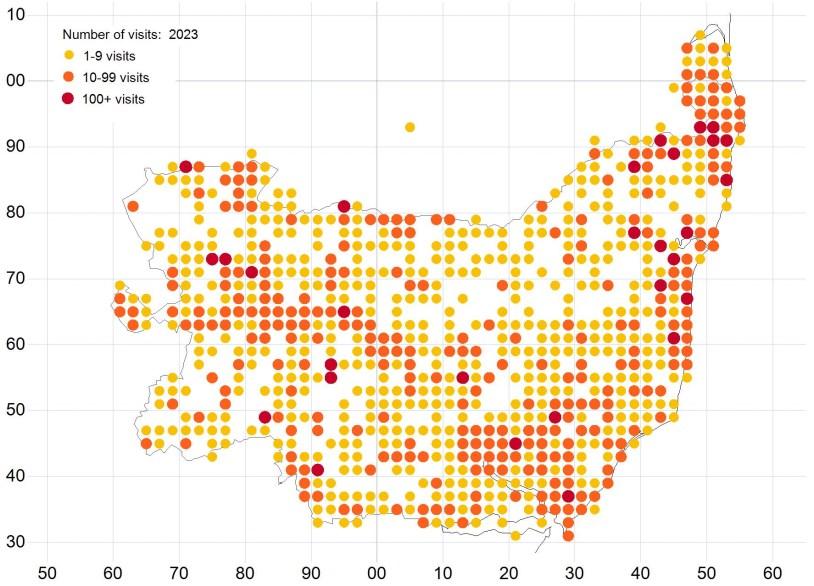
Number of visits: 2023
This report uses data from species level identification for accuracy i.e., doesn’t incorporate indeterminate species identification such as, Small/Essex Skipper or ‘Pieris’ for unknown white butterflies. Genus and Family level records can still be used elsewhere by Butterfly Conservation Head Office and other organisations, so please continue recording them.
Special thanks go to the photographers who supplied pictures for this report; Mark and Hazel Brewster, Liz Cutting, Jane Ferguson, Kevin Ling and Robert Quadling. Thanks also to Richard Perryman for his sterling work keeping the Suffolk Branch website up-to-date with information and sightings.
I also wish to thank Butterfly Conservation (Suffolk Branch) Committee, Trevor Goodfellow (BC Suffolk Argus Editor) and Suffolk Naturalists’ Society (especially Martin Sanford, Editor) for their support as well as all the many individuals who reported their Suffolk butterfly sightings. Finally, a mention for Robert Quadling and Andrew Hickingbotham of Suffolk Wildlife Trust who have been monitoring the Wall Brown population in the north-east of our county and devising conservation plans for this UK listed Endangered species. Thank you both.
Further information on recording is available at: https://www.suffolkbutterflies.org.uk/recording.html
Further reading is available. Butterfly Conservation has published, ‘The State of Britain’s Butterflies’ and ‘The Red List of Butterflies in Great Britain’. Both of these can be viewed via the BC website at https://www.butterfly-conservation.org/butterflies
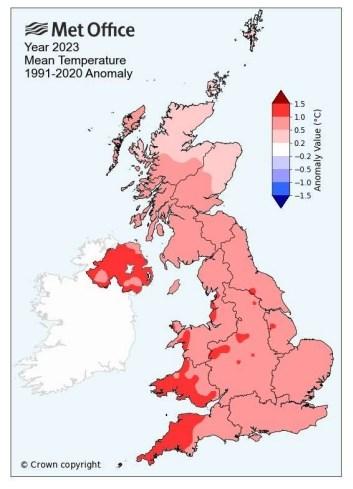
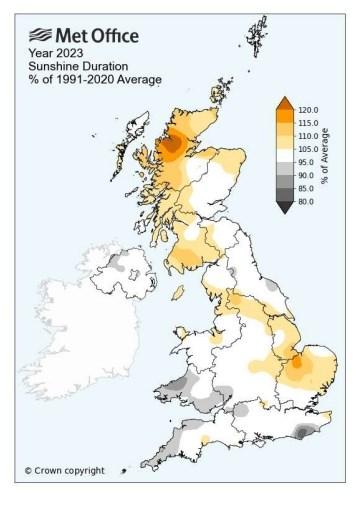
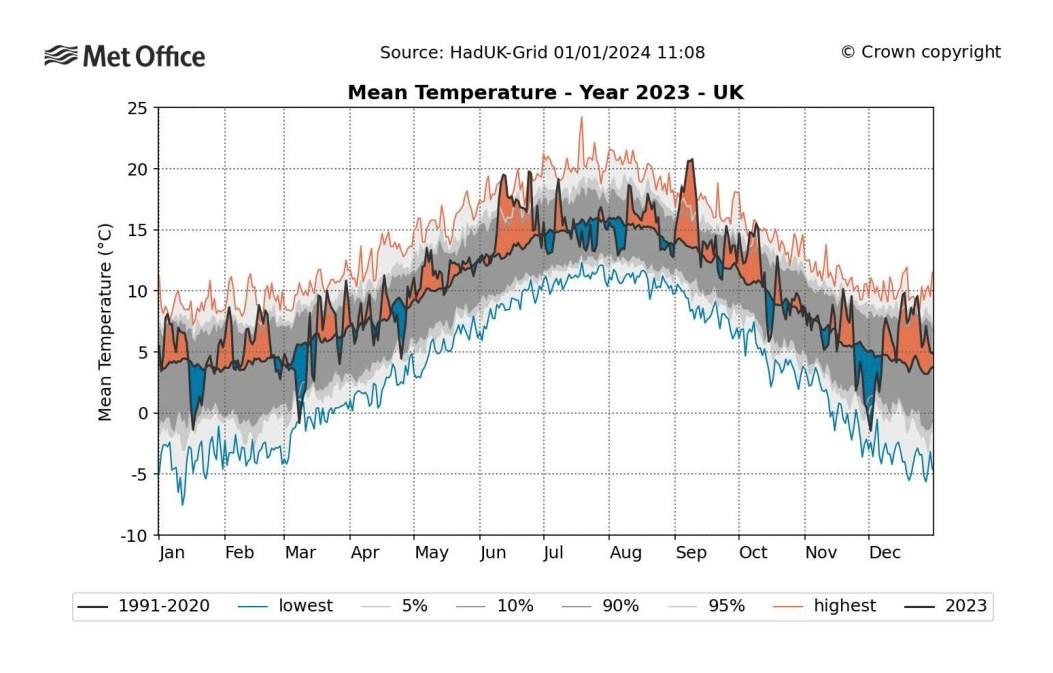
Weather Patterns and Extreme Events
Following the record-breaking year of 2022 where 40.3°C was recorded and drought affected much of the nation, 2023 was not as dramatic. The butterfly season was relatively unaffected by cold snaps in January, early March and again in November/December. June was very hot and sunny – over eight hours sunshine per day on average. However, the hottest day of the year was in early September during an Indian Summer when, undoubtedly, many late season butterflies benefitted from the warmth. It was a wet year, too, the sixth wettest on record for England. Storms began early in August and rolled in throughout the autumn and winter, fuelled in part by a strong El Niño event in the Southern Oscillation System in the equatorial Pacific Ocean.
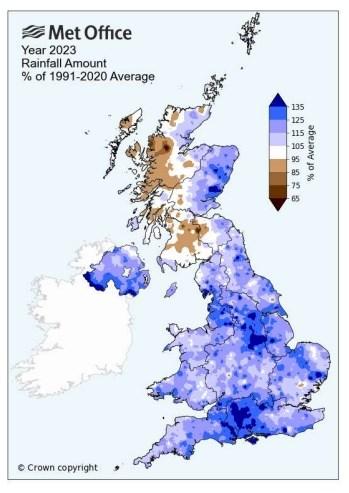
Unusual Sightings
Early April brought a Camberwell Beauty to Little Stonham, the only record of the year for this species. A Large Tortoiseshell was seen and photographed in Wenhaston a few days later, on 9 April and a further two sightings came in, one from Dunwich on 7 May and one from Covehithe on 9 May. On 15 August a Long-tailed Blue was reported from Somersham, Ipswich and a few days later, on 20 August, another was reported from the coastal village of Kessingland. These are all very migratory species; the sighting dates are consistent with genuine wild migrants. The Long-tailed Blue, like the Geranium Bronze, is sometimes brought in on horticultural imports and this is
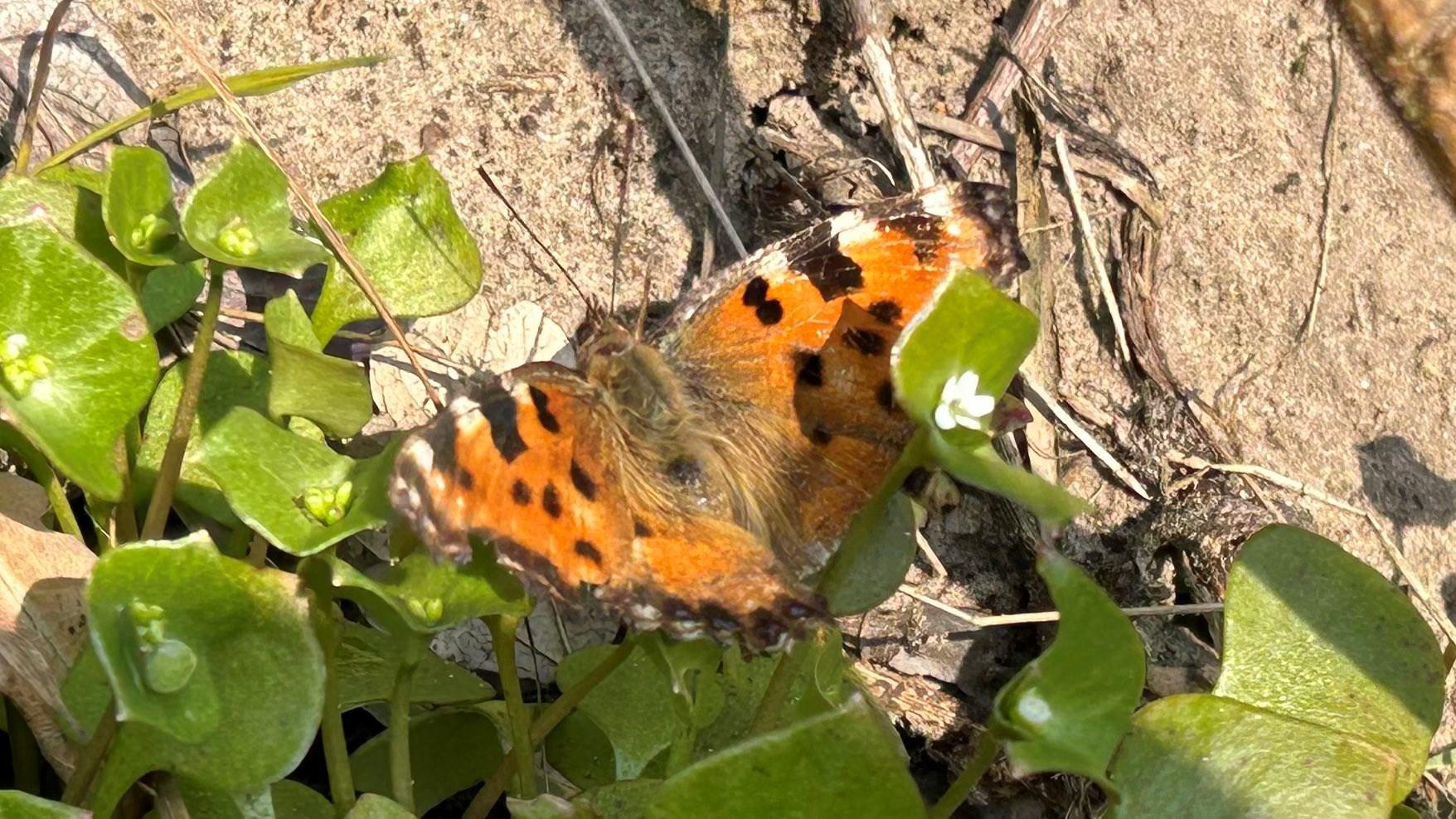
Large Tortoiseshell at Wenhaston, Spring 2023.
Following 2022’s exotic list of species, many due to releases, I would have preferred to draw attention to naturally occurring rarities in 2023 but, as is the trend these days, much of the unusual butterfly action was about releases.
2022’s single specimens of Glanville Fritillary and Small Pearl-bordered Fritillary proved to be just that, and no further specimens were seen in 2023. A large number of Queen of Spain Fritillary were reported in July from the East Bergholt area with an autumn brood individual being seen some distance away at Sutton Hoo in September. A High Brown Fritillary may also have been sighted but this would invariably be a release/escapee. Neither High Brown Fritillary nor Dark Green Fritillary are Suffolk species (the Dark Green Fritillary may rarely disperse from nearby Cambridgeshire sites, such as the Devil’s Dyke, Newmarket).
A small colony of Marsh Fritillary has been present on a fen in the north of the county since 2021. This is now seen as self-sustaining, with both mating and egglaying being witnessed and increasing numbers of adults being reported. The Marsh Fritillary is one of six UK species to have full protection, including capture and release. The colony is on a Suffolk Wildlife Trust and SSSI nature reserve which confers an element of protection, again. Introductions are seldom successful and the one near
Hopton is an exception to the rule, well thought through and successful but illegal for the above reasons. As Head Office have said, unofficial introductions make butterfly records less reliable e.g. for planning against climate change and habitat loss. We
Browns, Fritillaries and Aristocrats (Nymphalidae)
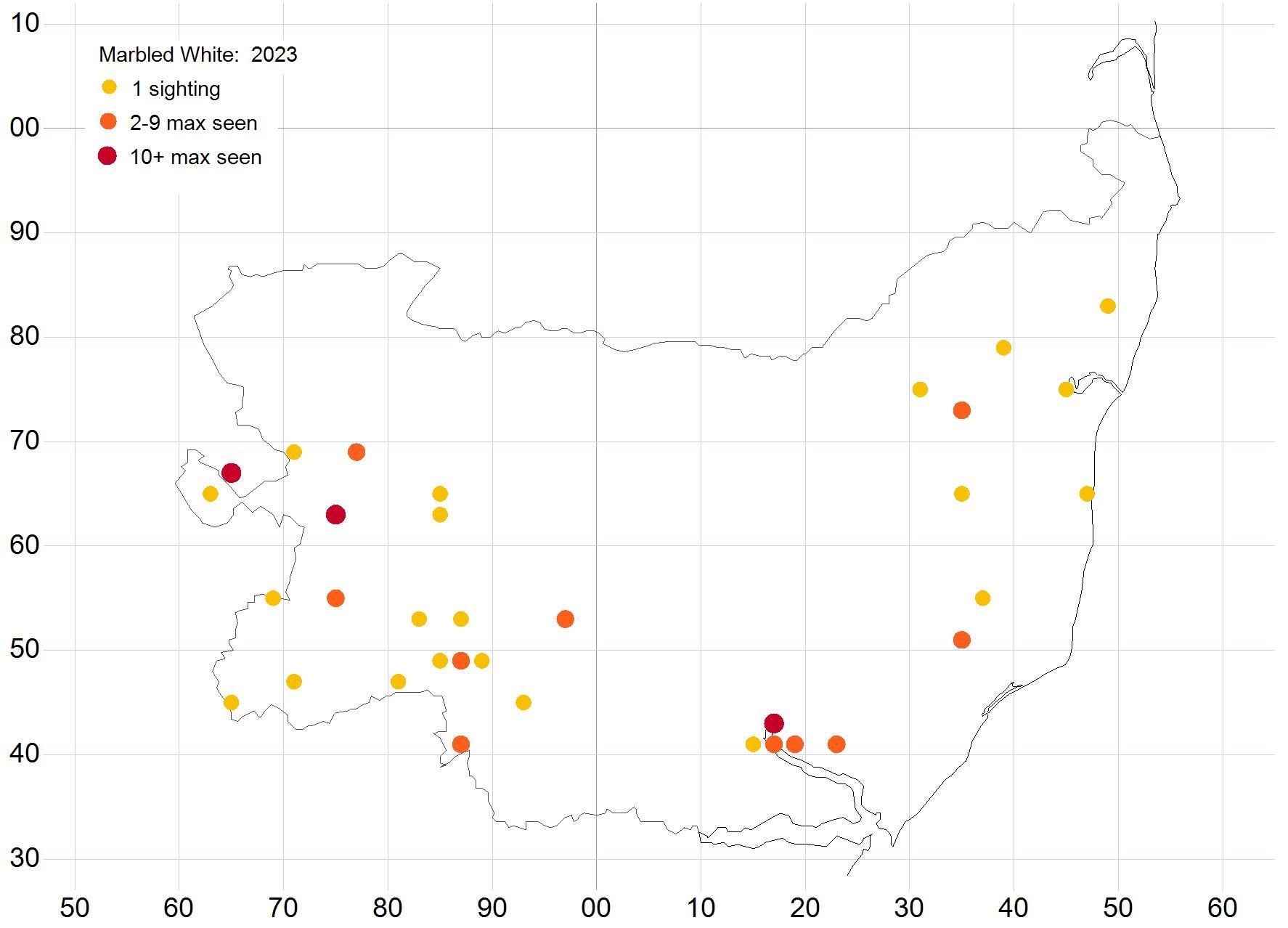
Marbled White continued to spread east and north into the county. Naturally occurring colonies are now found five miles within the county border, from Brandon through to Newmarket, Haverhill and Sudbury. The 2008 introduced colony at Ipswich is now only 15 miles from naturally occurring colonies and, although many of these are small, it is likely that the species will continue to expand into suitable habitat further east and north. It prefers long grassland with ample flowering plants for adults and Red Fescue for its larvae – a very common species of grass.
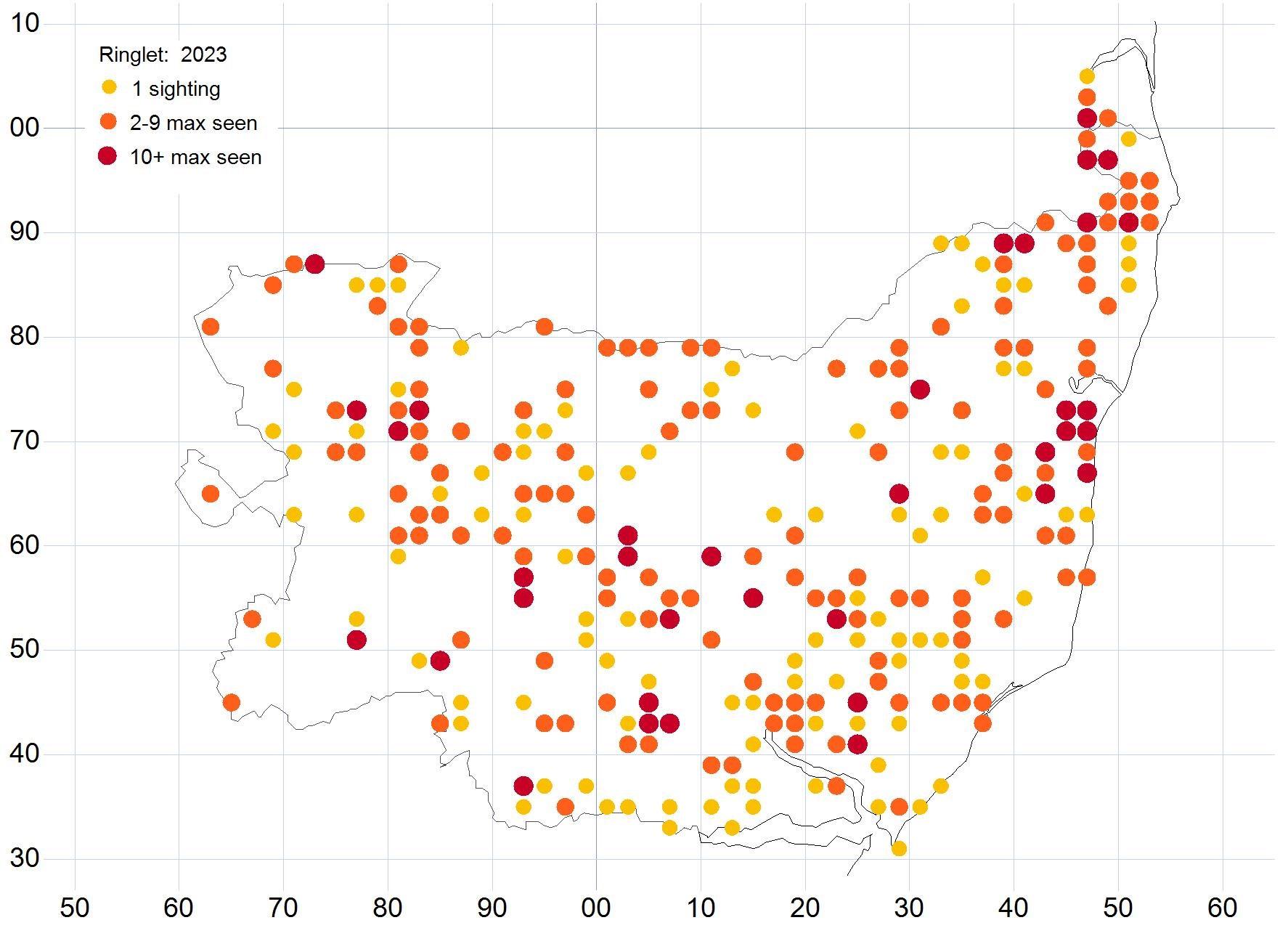
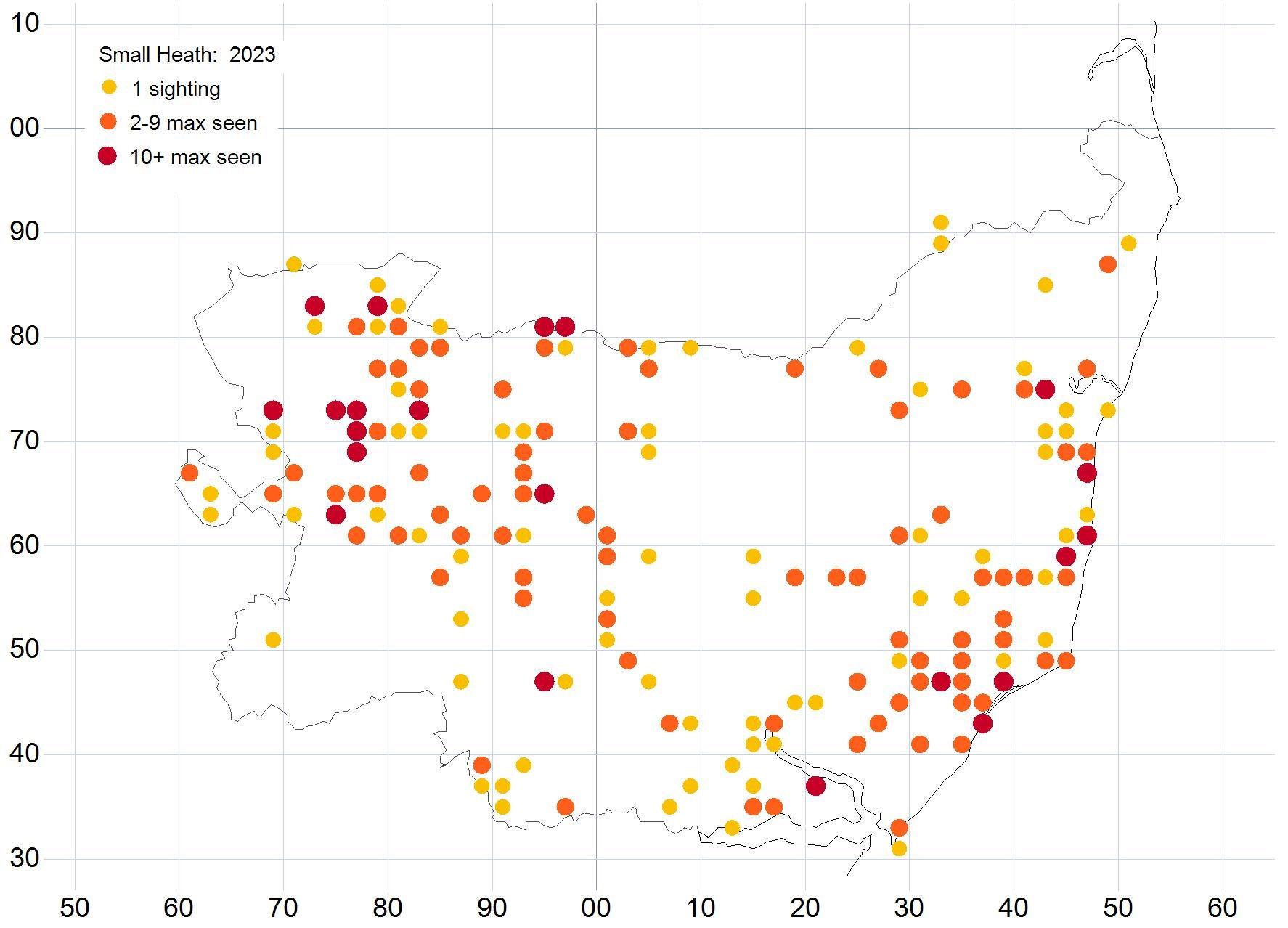
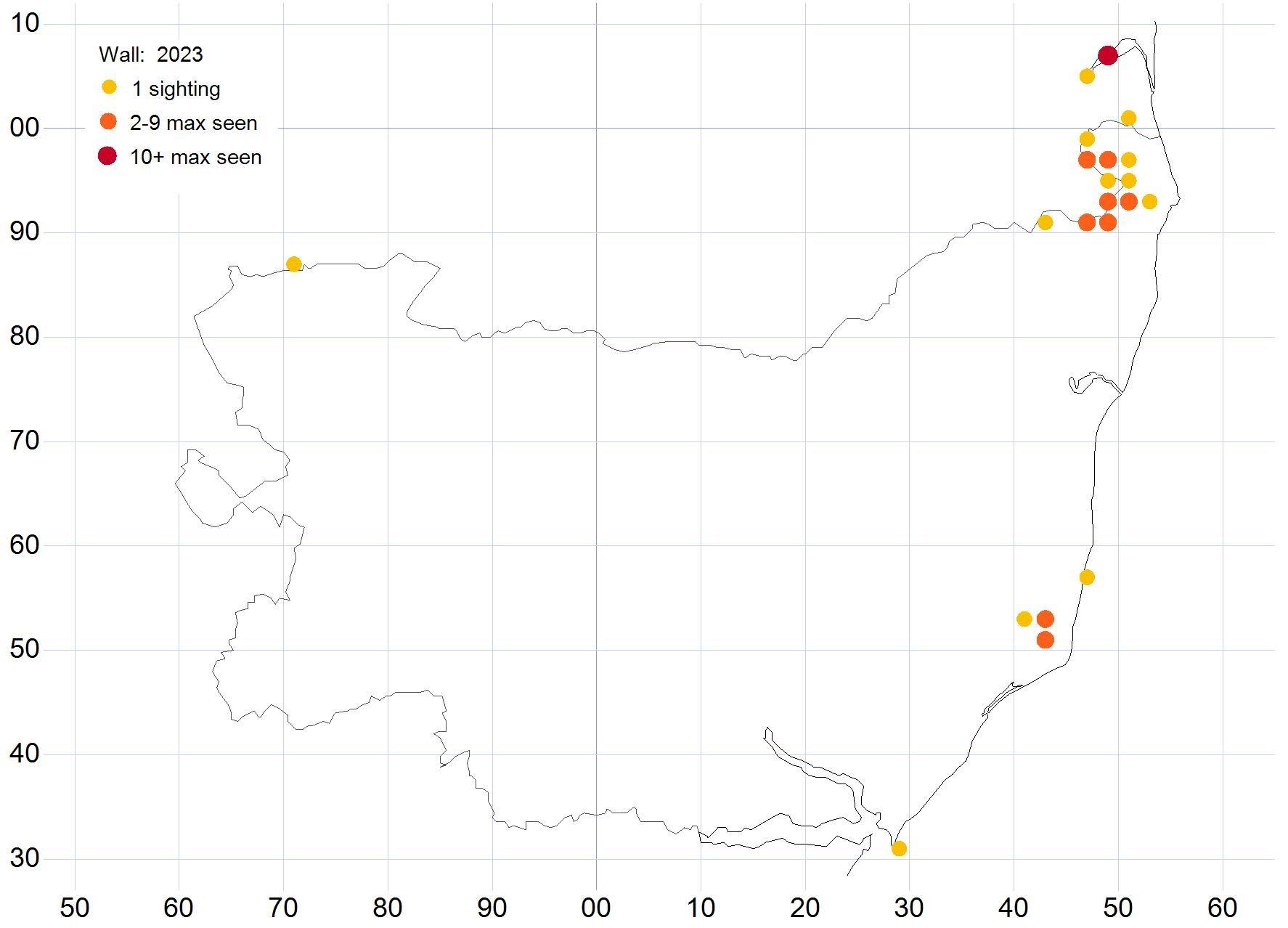
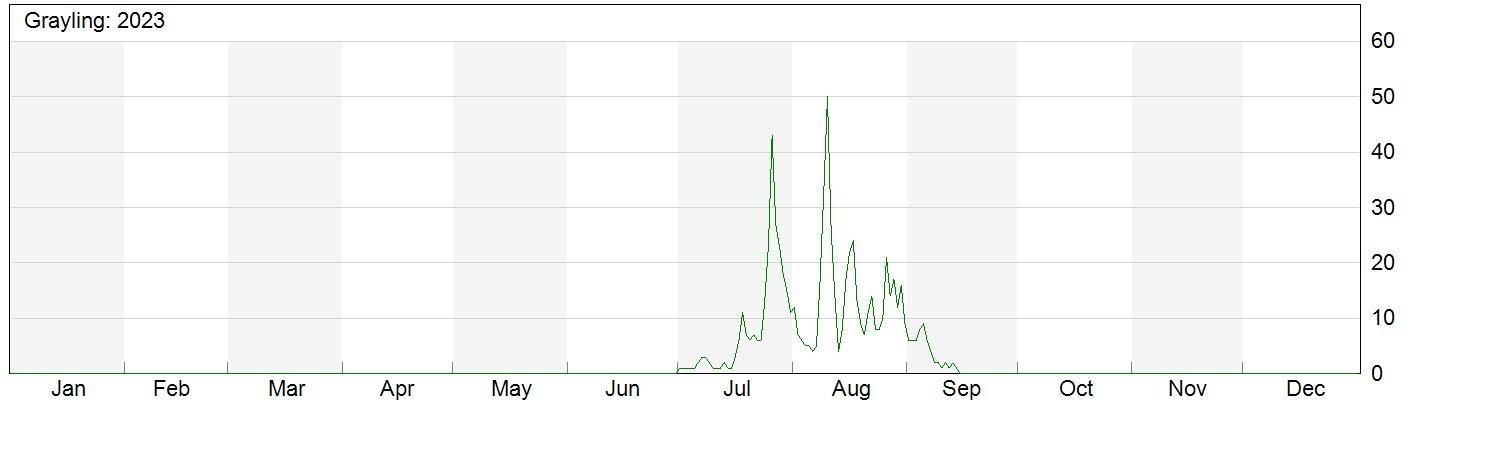
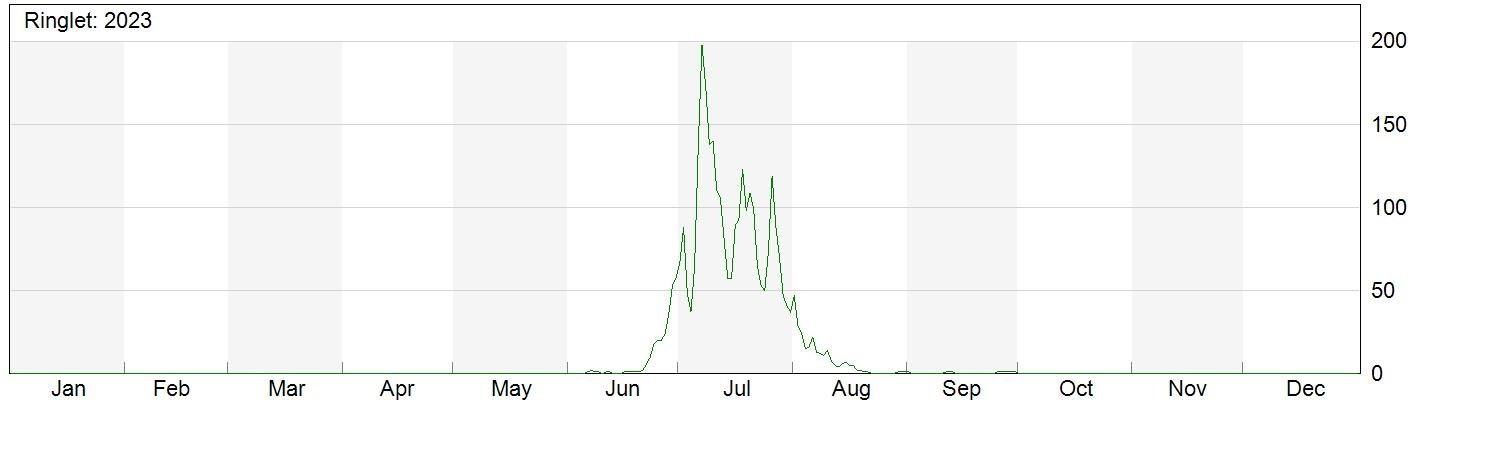
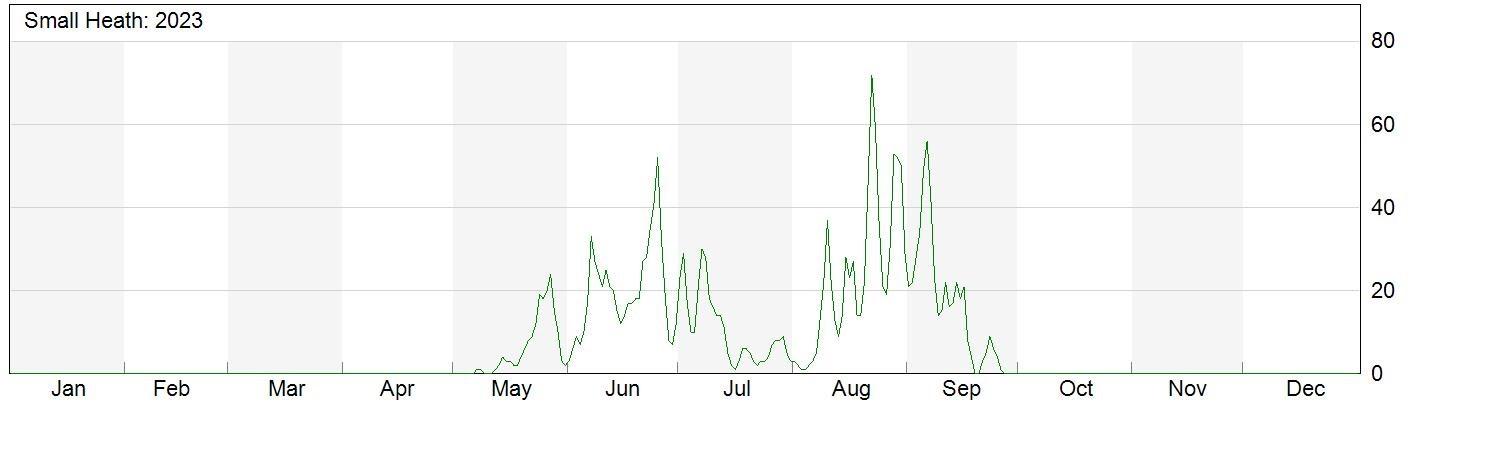
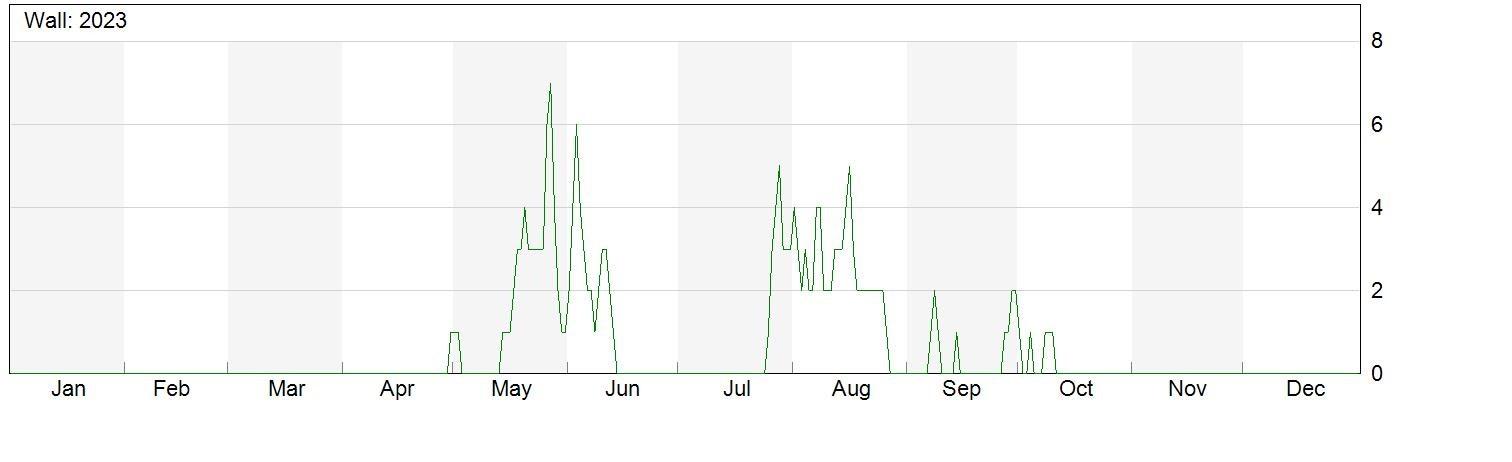
Thankfully, previous summer droughts had relatively little effect on many species. One that seems to have been adversely affected though is the Ringlet. A damp grassland preferring species, numbers were significantly down on previous years. The wet but warm weather in July and August appeared to suit this species very well and it is hoped that it will recover in 2024. Other Brown species were recorded in numbers to be expected for normal years, showing that the 2022 drought had not affected them so greatly as widely feared. This was particularly good news for our Brown BAP species, Small Heath, Grayling and Wall Brown. Grayling had been noted moving into woodland during 2022’s drought, a survival strategy that clearly worked. Small Heath have larvae that are dependent on finer and perhaps less droughtresistant grass species but they, too, proved resilient. Perhaps it is because they are continuously brooded and at least some of their offspring were able to develop in healthy grassland? Wall Brown continued to hold on along our coastal boundary around the River Waveney and Sudbourne Marshes areas. Numbers recorded were
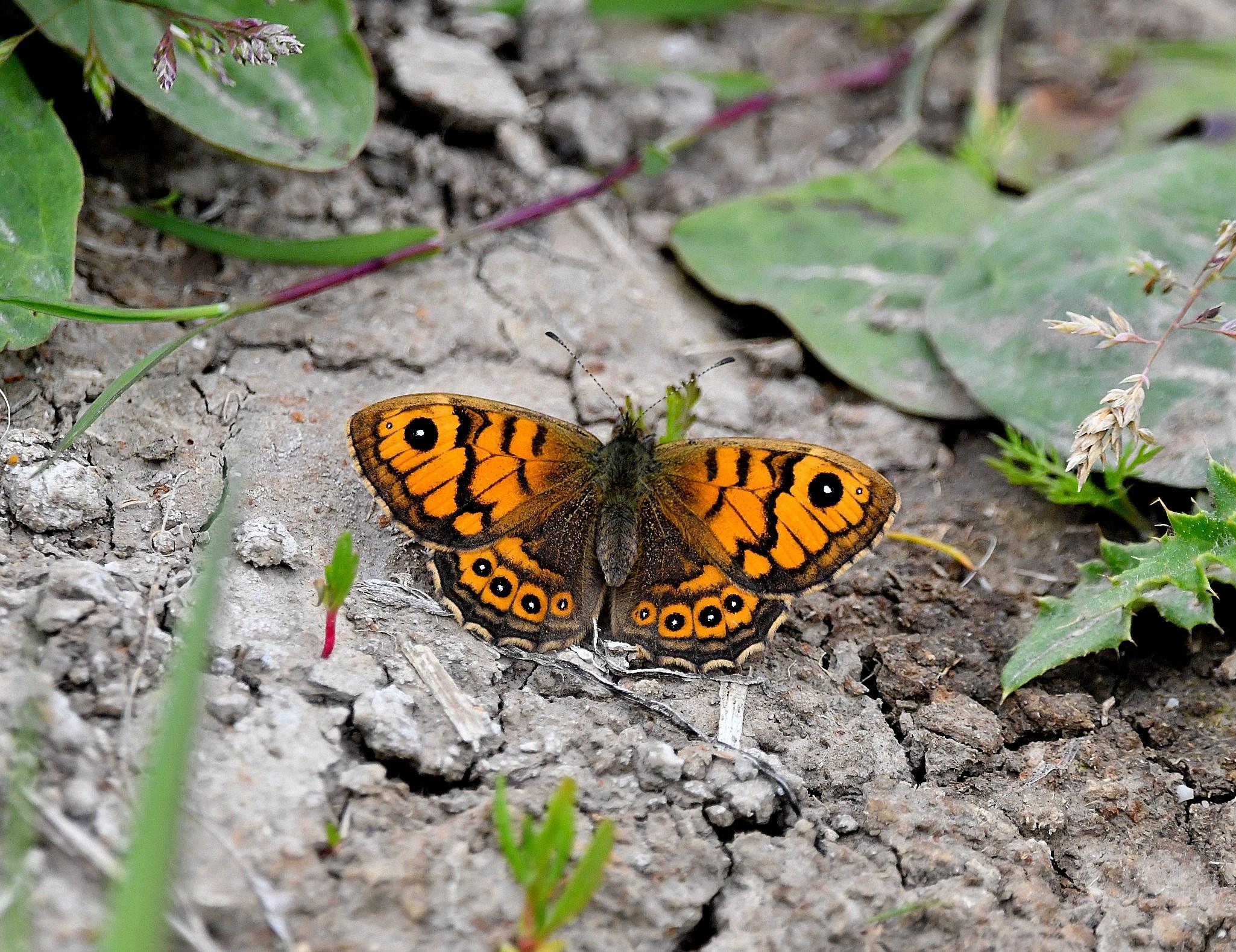
similar to 2022 and it is a relief that such an endangered butterfly survived the drought in this marshland habitat. A small third brood bodes well for 2024 with many caterpillars reaching a size that enables winter survival. This species has fluctuated in the past and its exact requirements are not fully understood.
Thankfully, previous summer droughts had relatively little effect on many species. One that seems to have been adversely affected though is the Ringlet. A damp grassland preferring species, numbers were significantly down on previous years. The wet but warm weather in July and August appeared to suit this species very well and it is hoped that it will recover in 2024. Other Brown species were recorded in numbers to be expected for normal years, showing that the 2022 drought had not affected them so greatly as widely feared. This was particularly good news for our Brown BAP species, Small Heath, Grayling and Wall Brown. Grayling had been noted moving into woodland during 2022’s drought, a survival strategy that clearly worked. Small Heath have larvae that are dependent on finer and perhaps less droughtresistant grass species but they, too, proved resilient. Perhaps it is because they are continuously brooded and at least some of their offspring were able to develop in healthy grassland? Wall Brown continued to hold on along our coastal boundary around the River Waveney and Sudbourne Marshes areas. Numbers recorded were similar to 2022 and it is a relief that such an endangered butterfly survived the drought in this marshland habitat. A small third brood bodes well for 2024 with many caterpillars reaching a size that enables winter survival. This species has fluctuated in the past and its exact requirements are not fully understood.
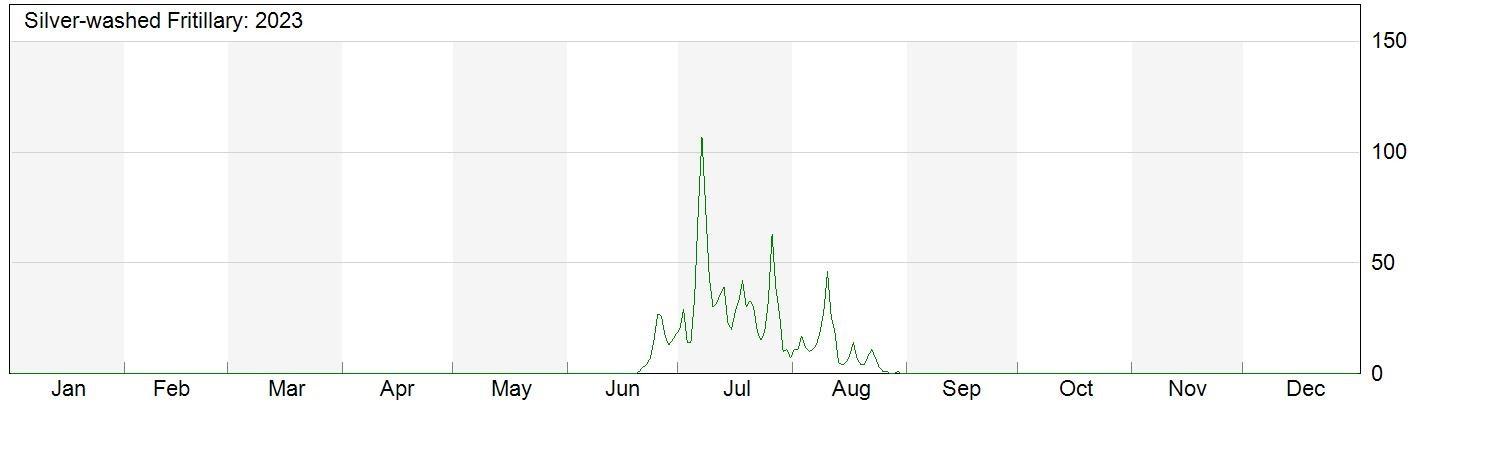
Silver-washed Fritillary had another good year. It has now colonised every part of the county and existing populations have grown in many cases. There is some evidence of a decline in the past five years which may be due to its preferred mature woodland habitat becoming overly mature and shaded. Apart from this it seems to be benefitting from climate change, at least for now.
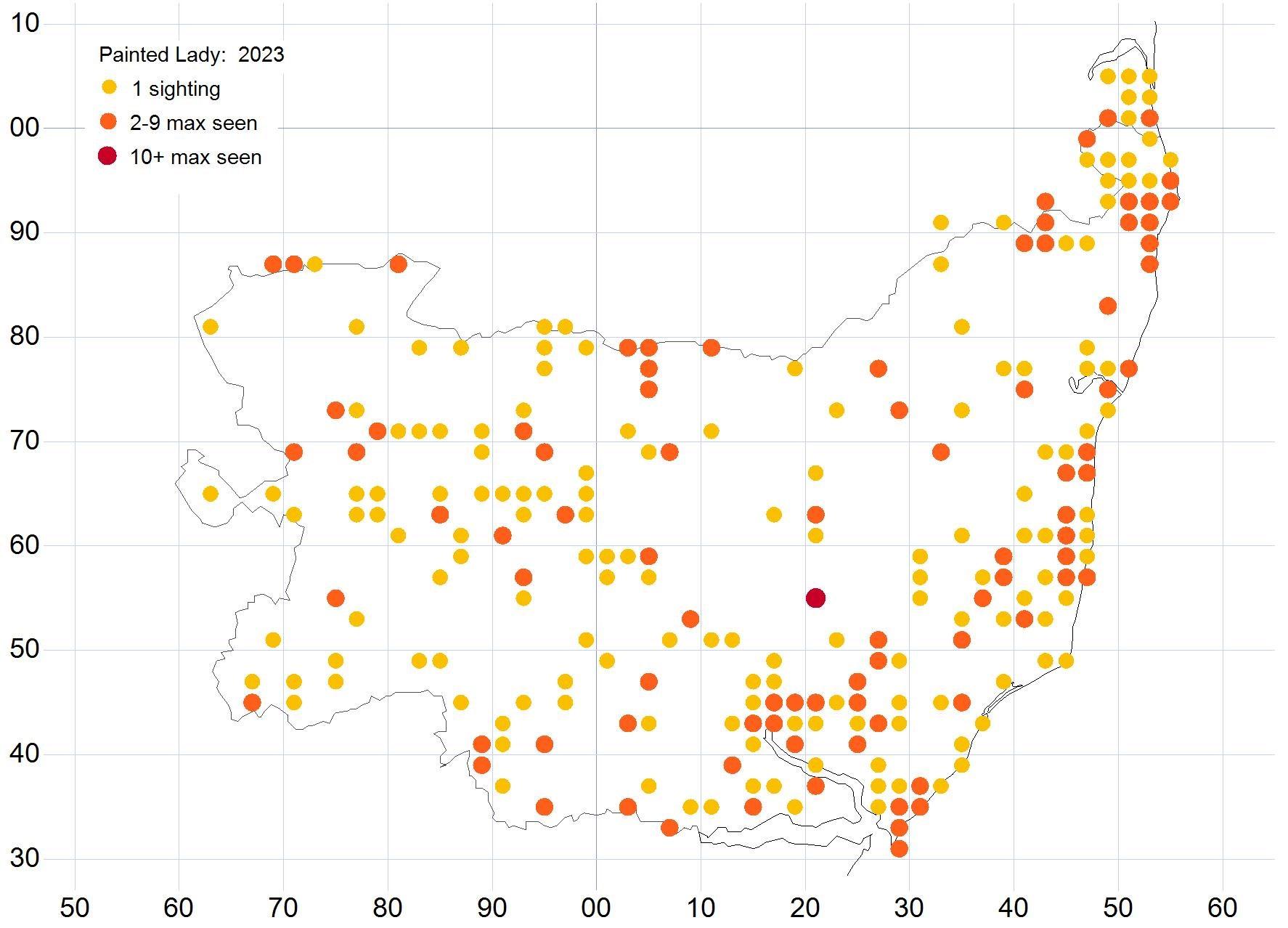
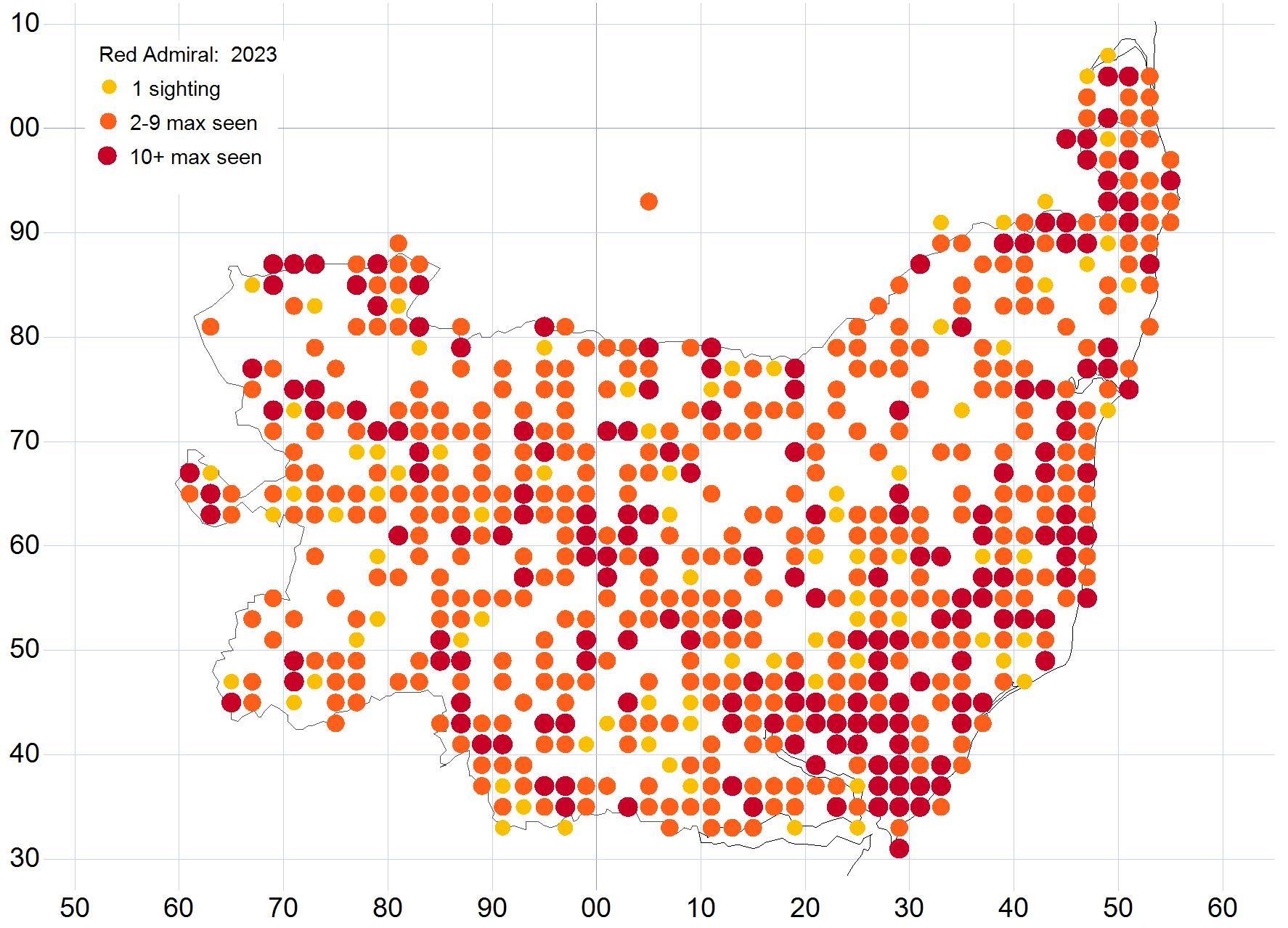
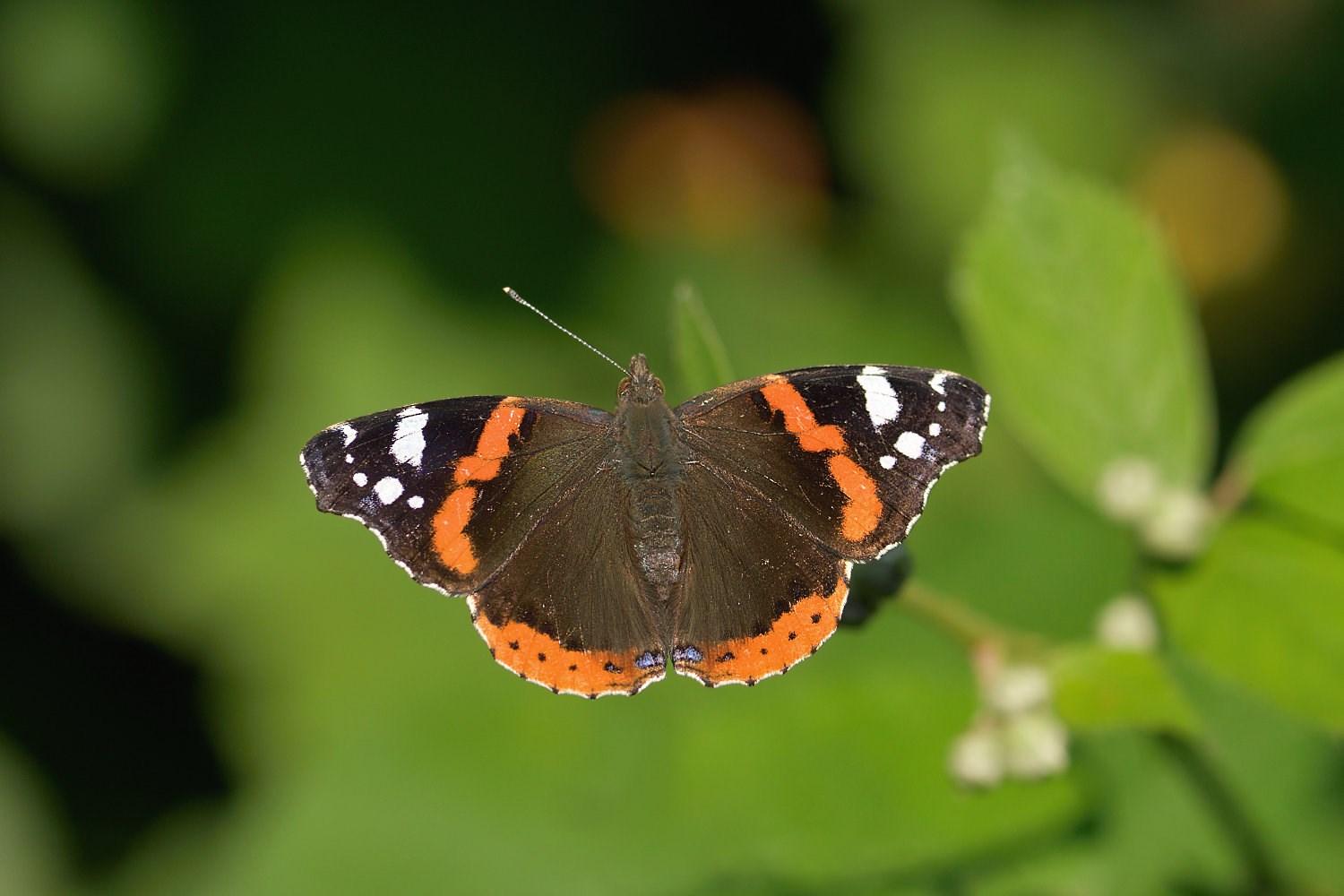
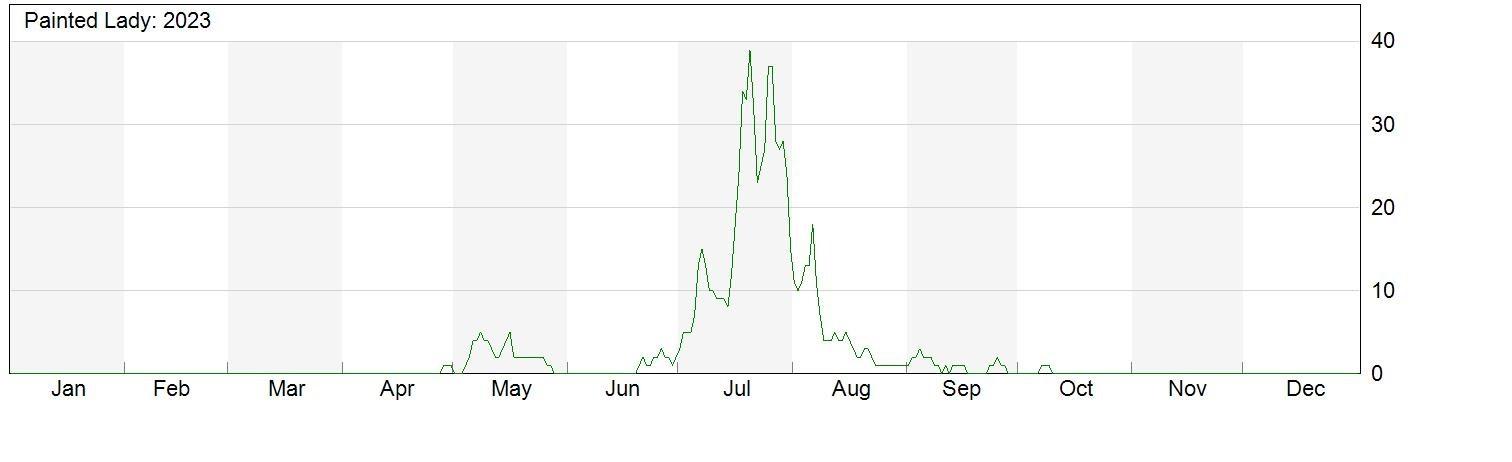
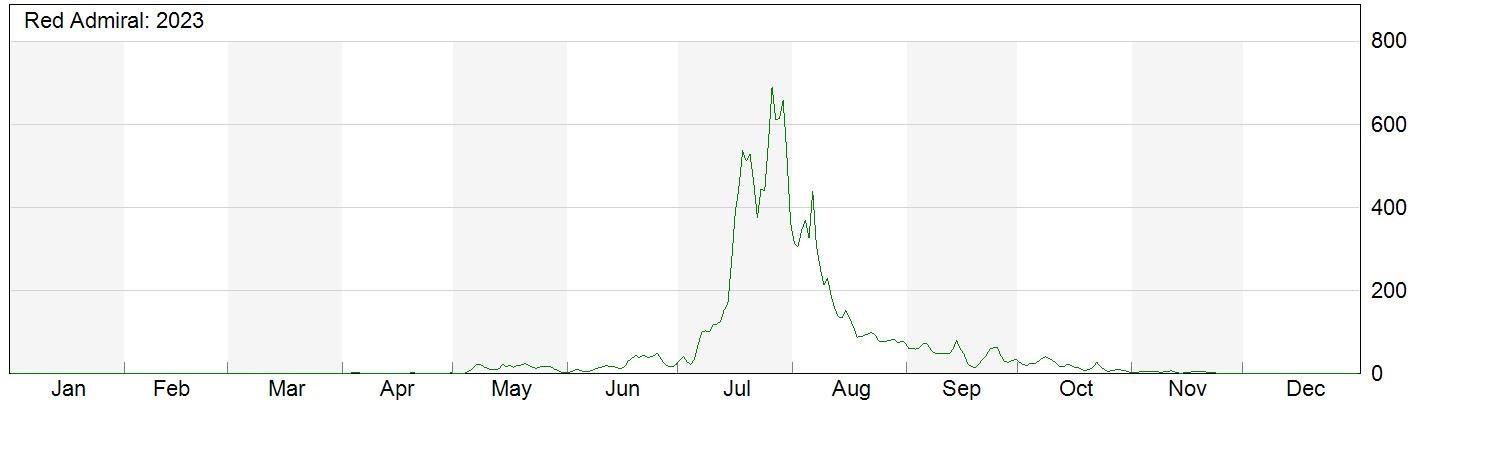
Our two most commonly encountered migrant nymphalids had contrasting fortunes. The Red Admiral was widely found in good numbers whereas the Painted Lady was sparsely observed. These species are very dependent on migration and factors such as winter weather conditions in North Africa and European summer conditions play a large role in determining how many turn up in Great Britain each year, probably greater than the presence of a few adults successfully overwintering. Migration had long been suspected to be a two-way movement, north and south. Recent research has proven this to be the case via radar and infra-red tracking. Human observers have often reported local movements that strongly suggest southerly autumn migration. The staff and volunteers at Landguard Bird Observatory were treated to this spectacle with over 3,000 Red Admiral streaming down the coastline in a southerly direction on 8 October.
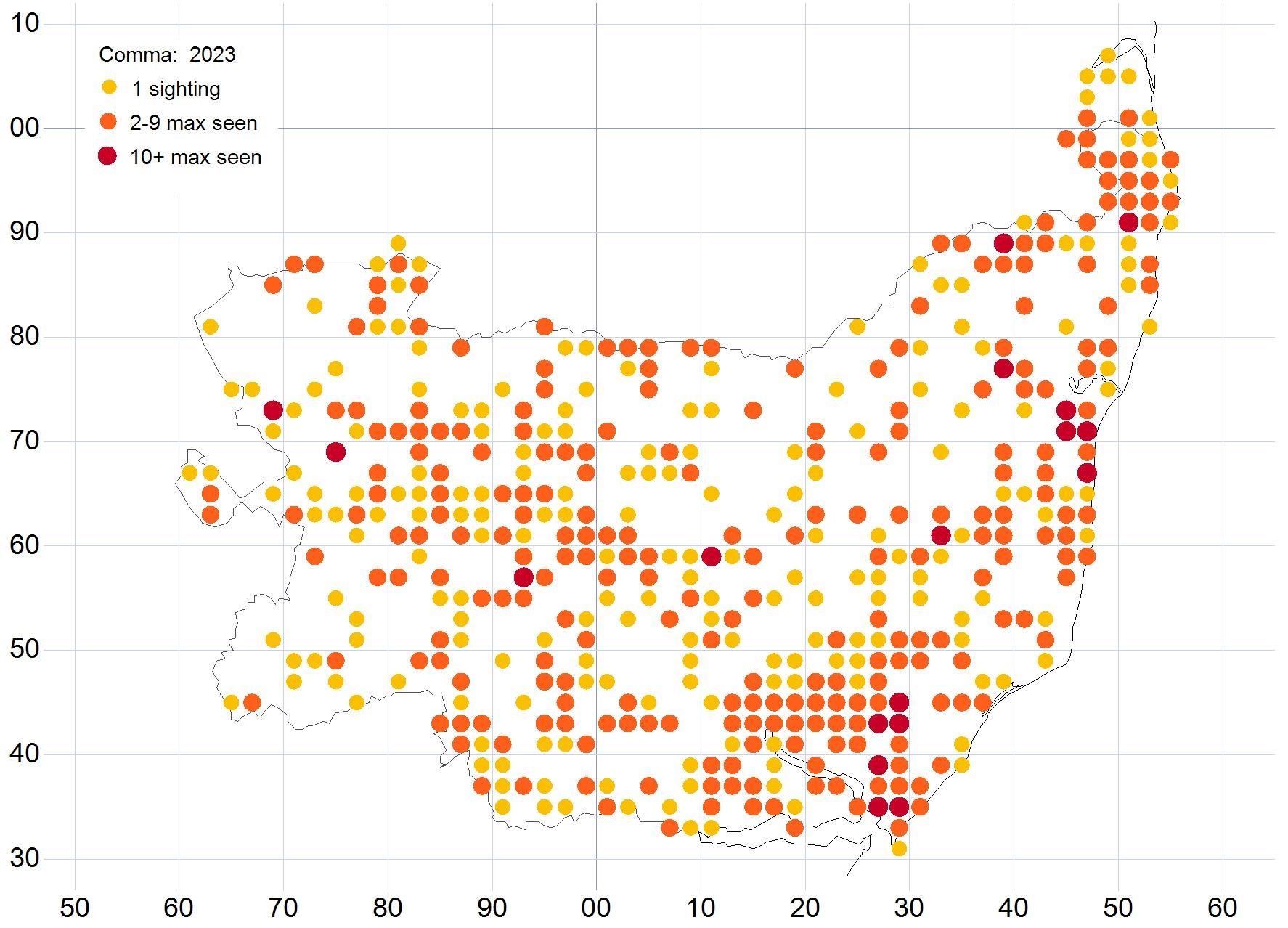
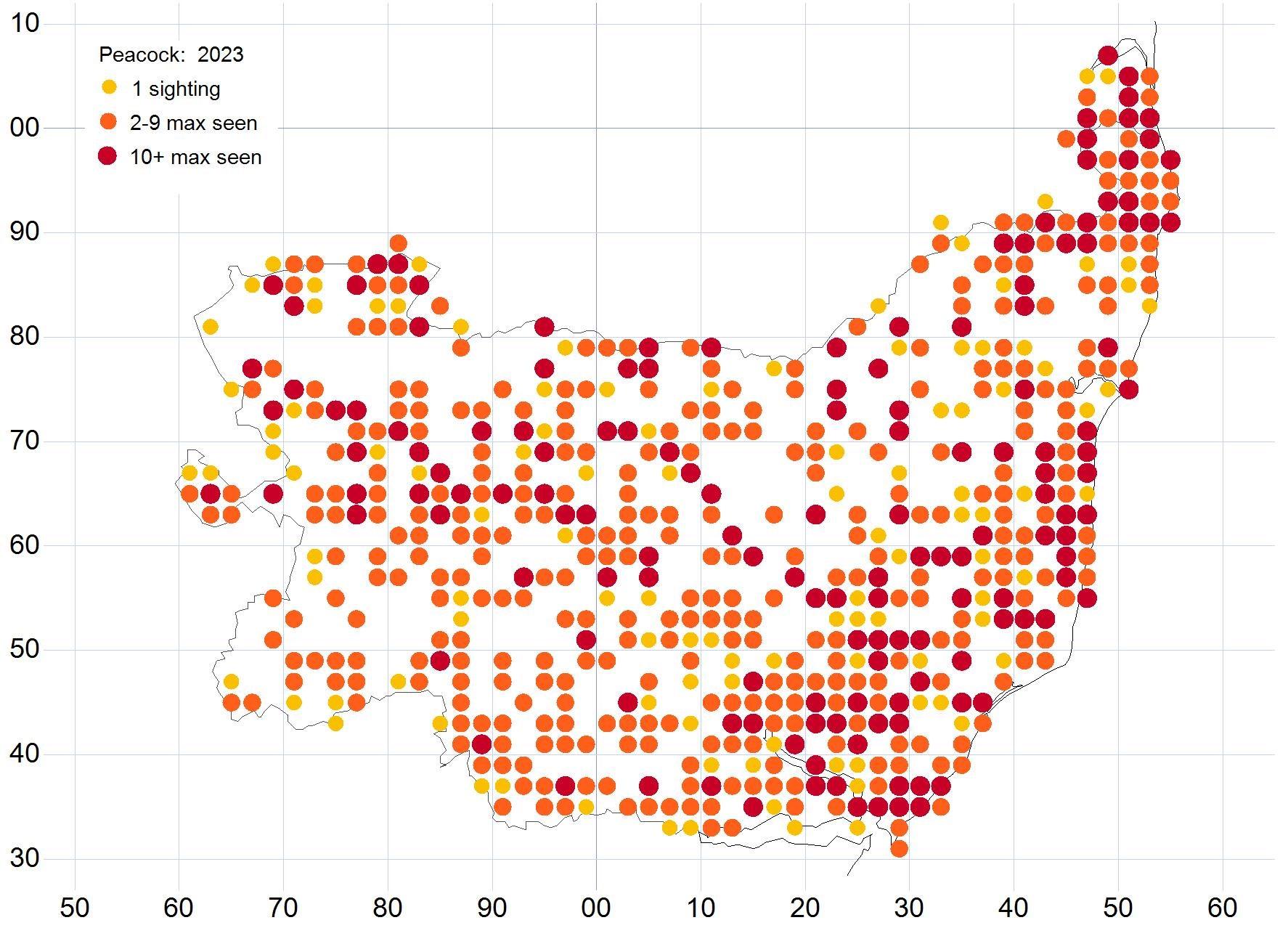
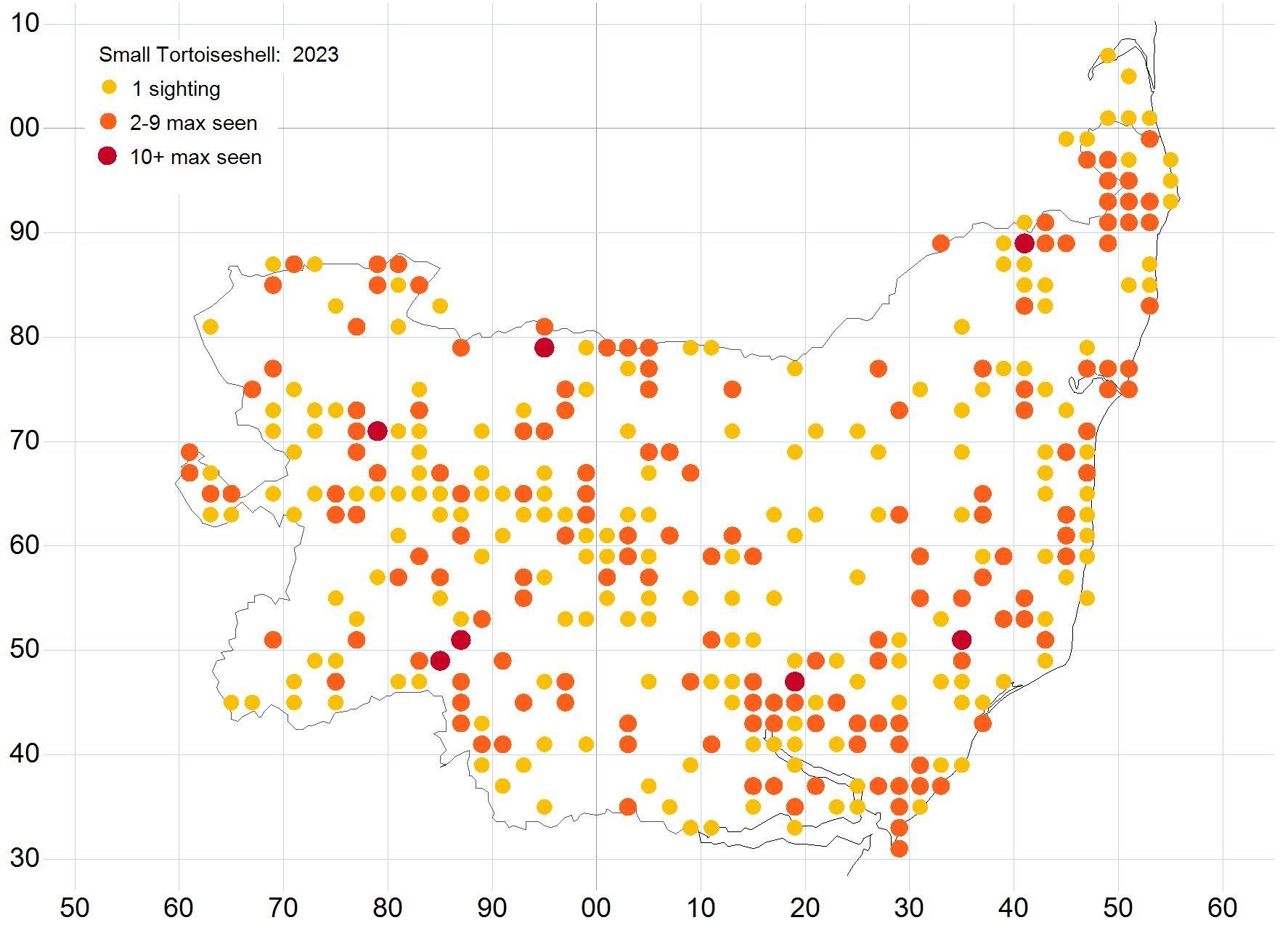
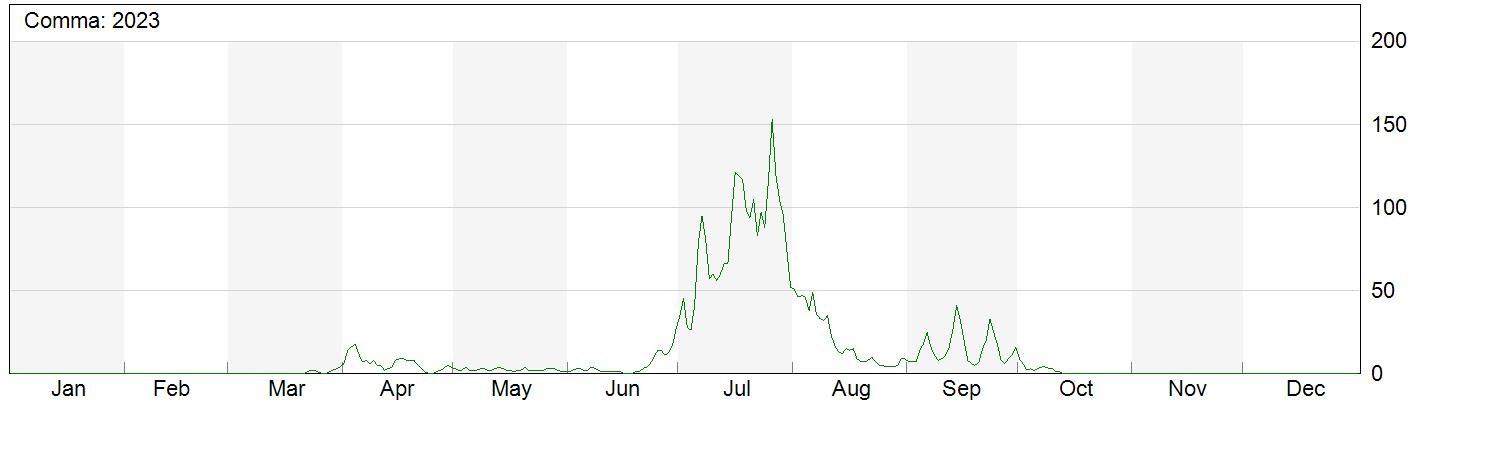
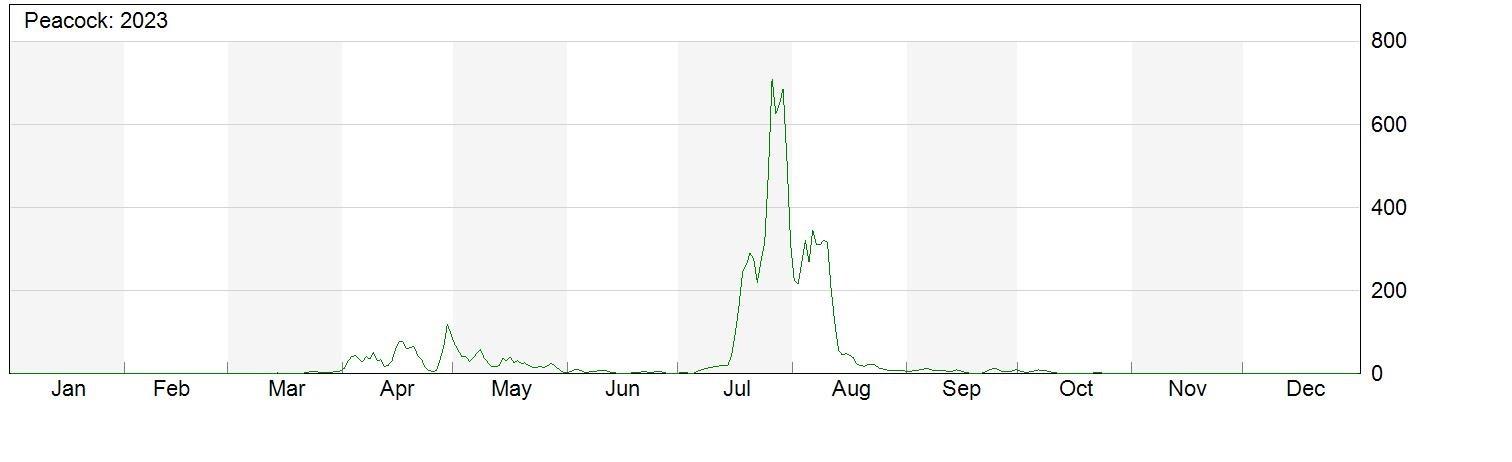
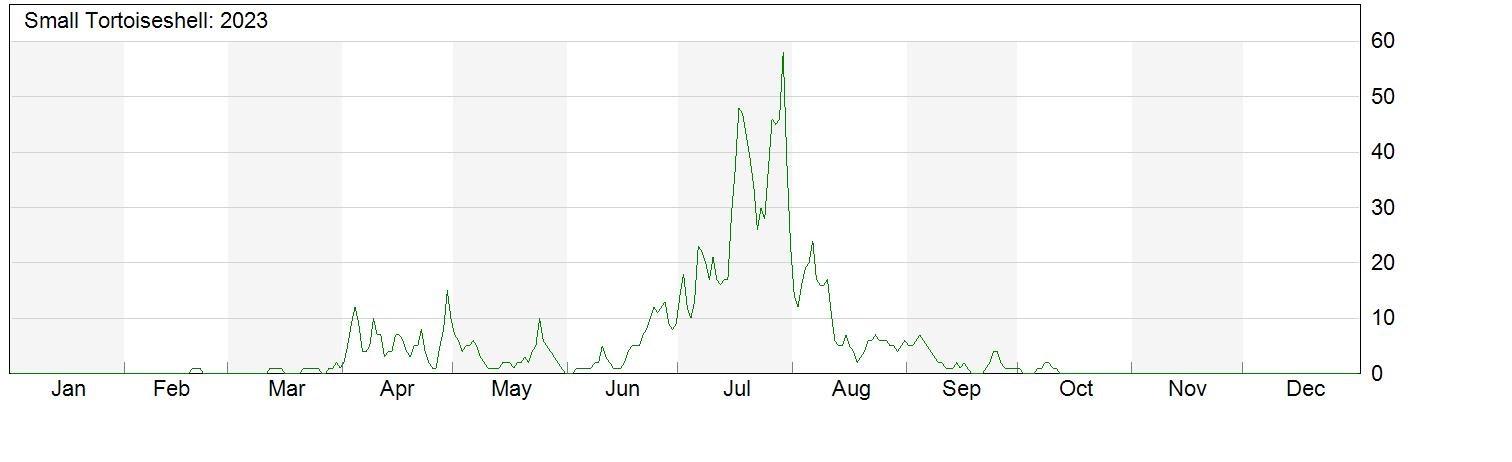
Peacock had a slightly below average year but nothing out of the usual. Comma did better and was more commonly seen than in normal years. After a little respite in 2022, the Small Tortoiseshell continued its alarming decline with another well below average year. In fact, nationally it recorded its lowest transect levels since records
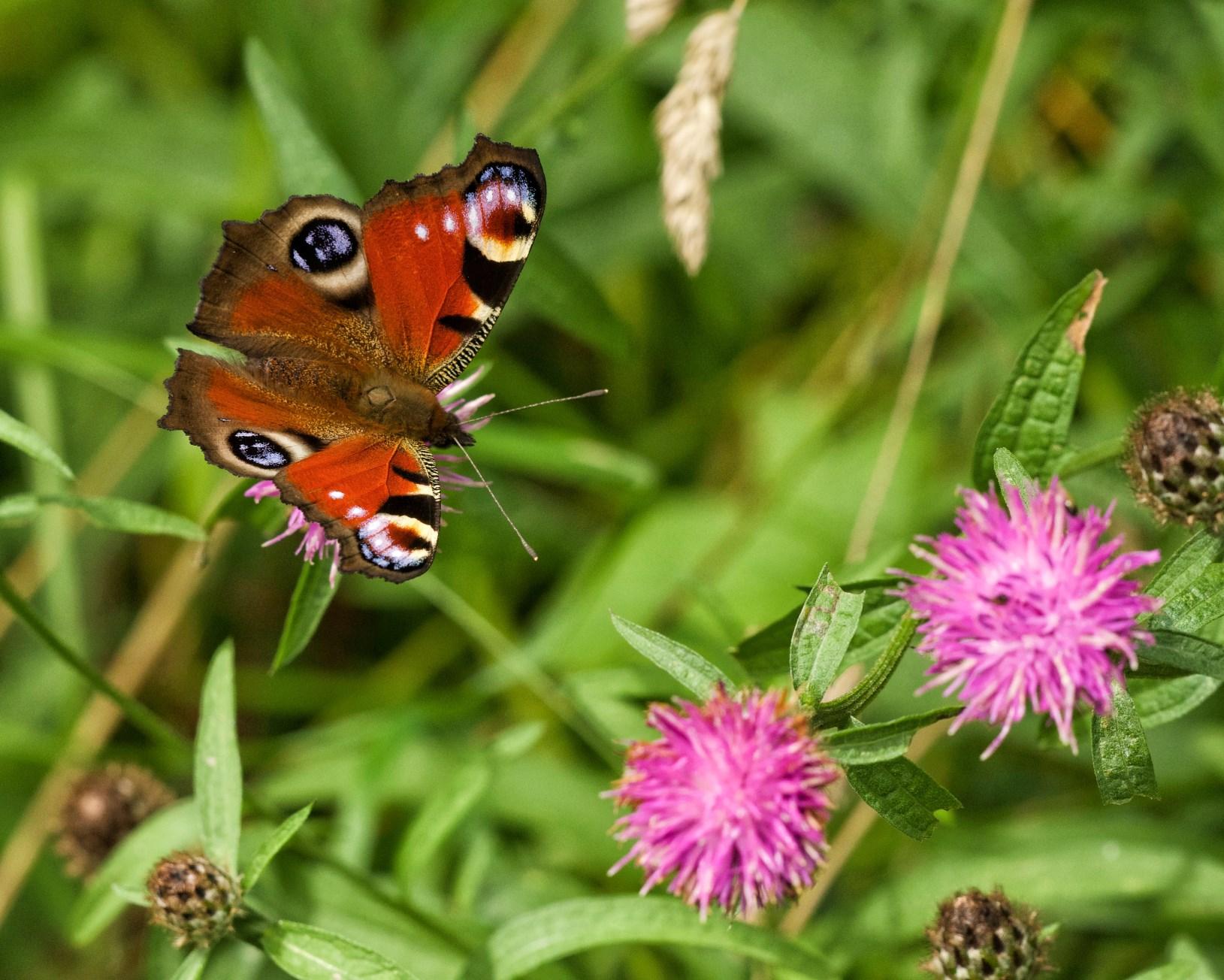
began in 1976. The reasons have been discussed in a previous report and, unless it can find a way to breed without the tachinid parasite Sturmia bella decimating its broods, the future looks bleak in southern counties. Perhaps a change to univoltine breeding or a hyperparasite of Sturmia bella will avert it becoming a rarity?
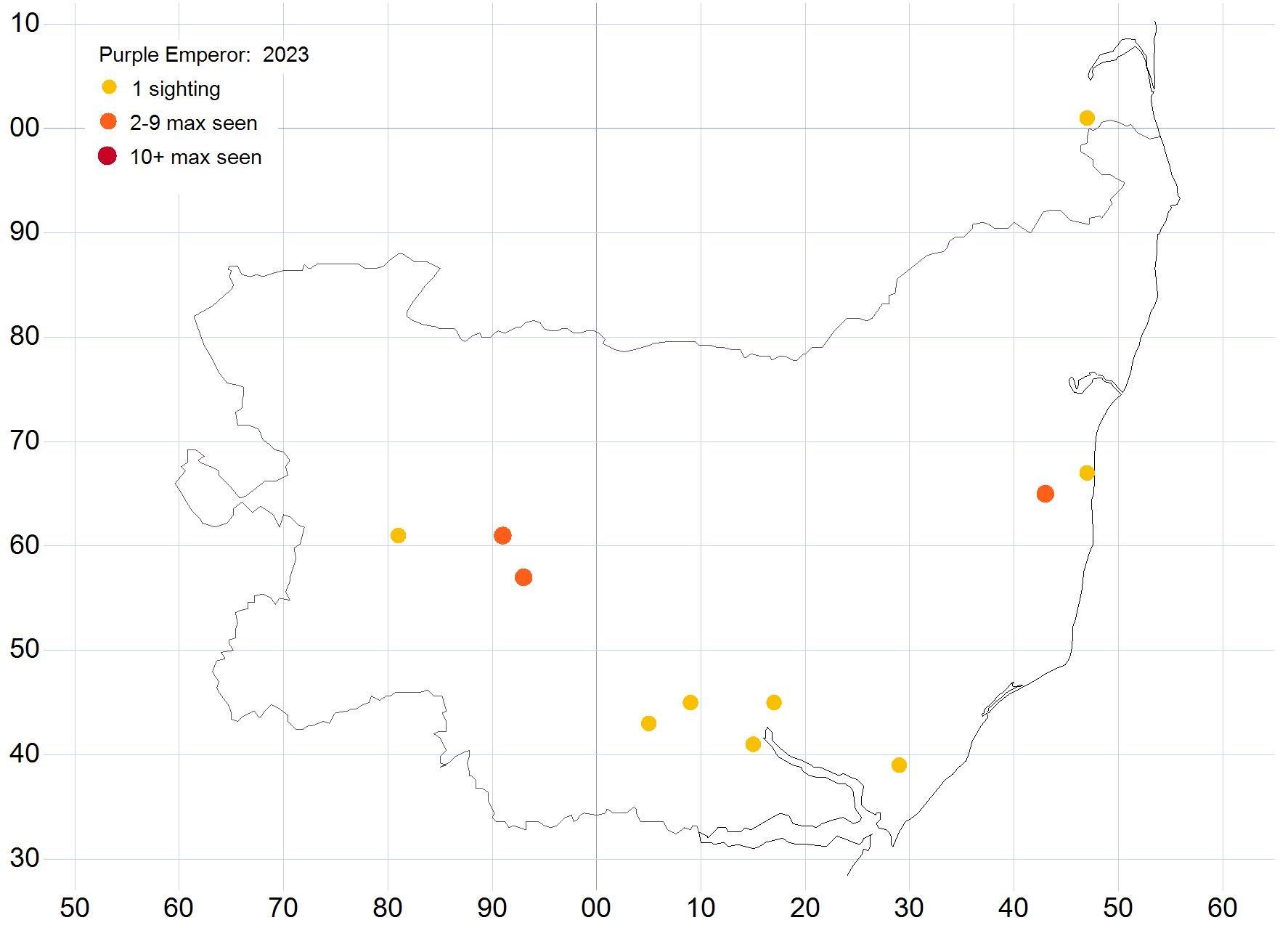
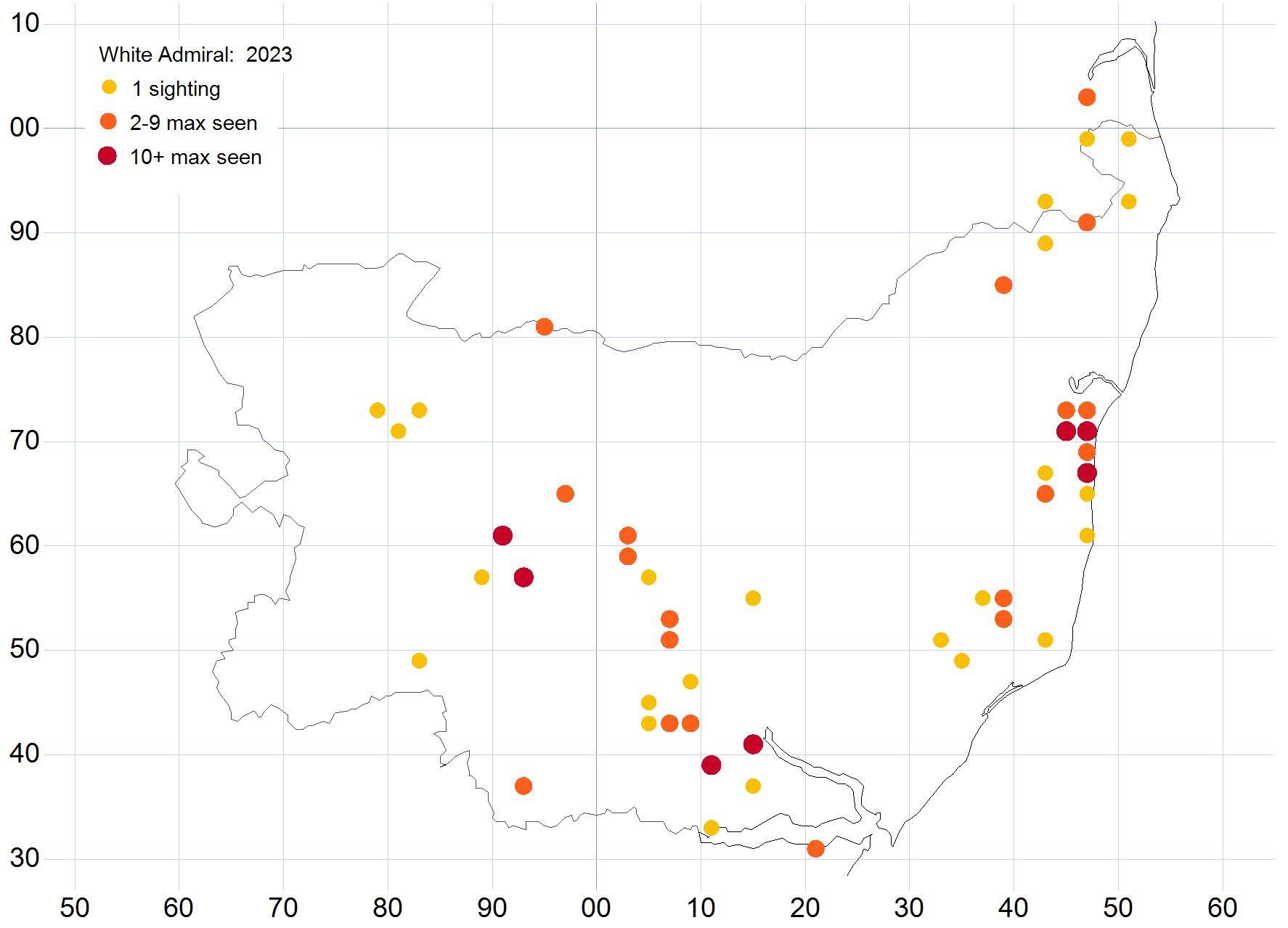
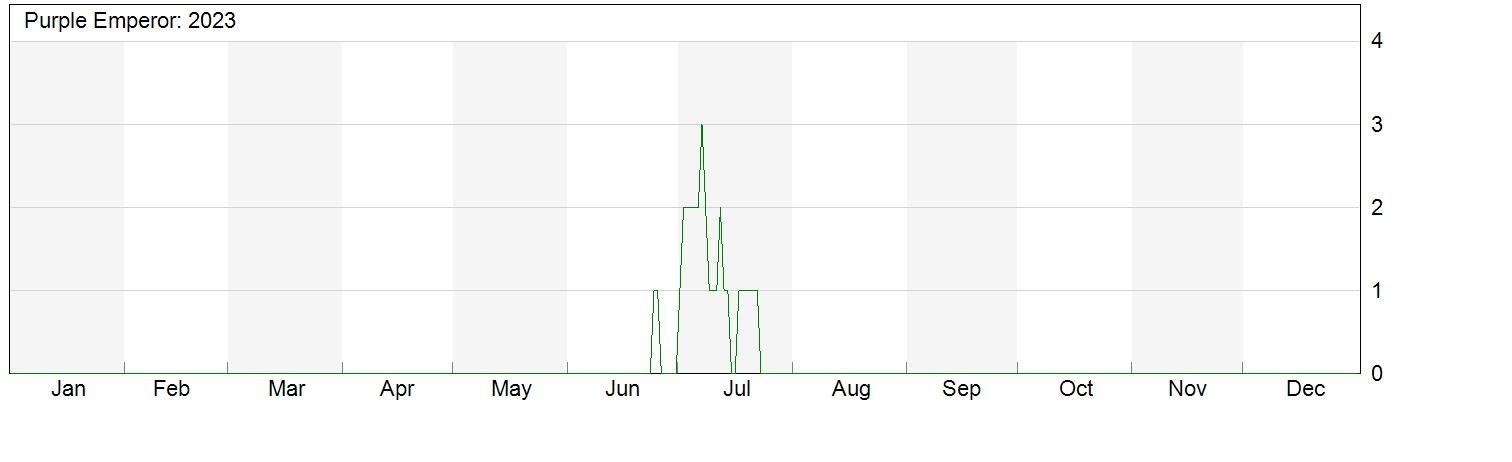
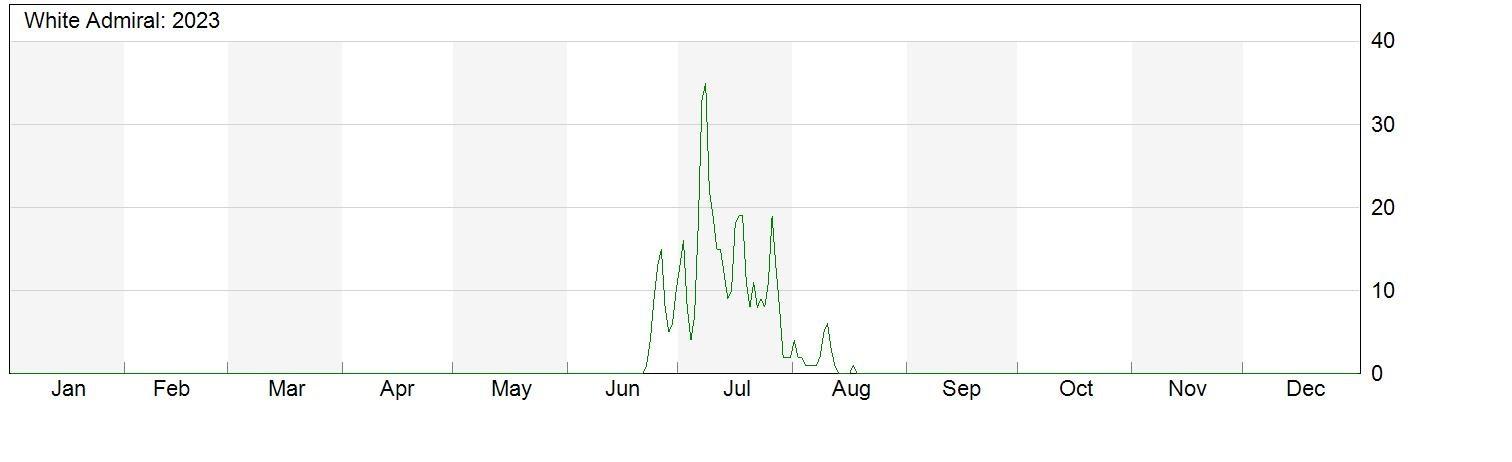
White Admiral had another good year and there was a very small partial second brood in some locations. Purple Emperor was recorded in its well-known sites but is undoubtedly present in more woods than the species map suggests. This is one of the species which draws people to congregate at certain ‘Emperor’ sites. It could be fruitful if people could check mature woodland habitat with Goat Willow for this elusive species that is expanding its range.
Gossamer Winged Butterflies - Coppers, Hairstreaks and Blues (Lycaenidae)
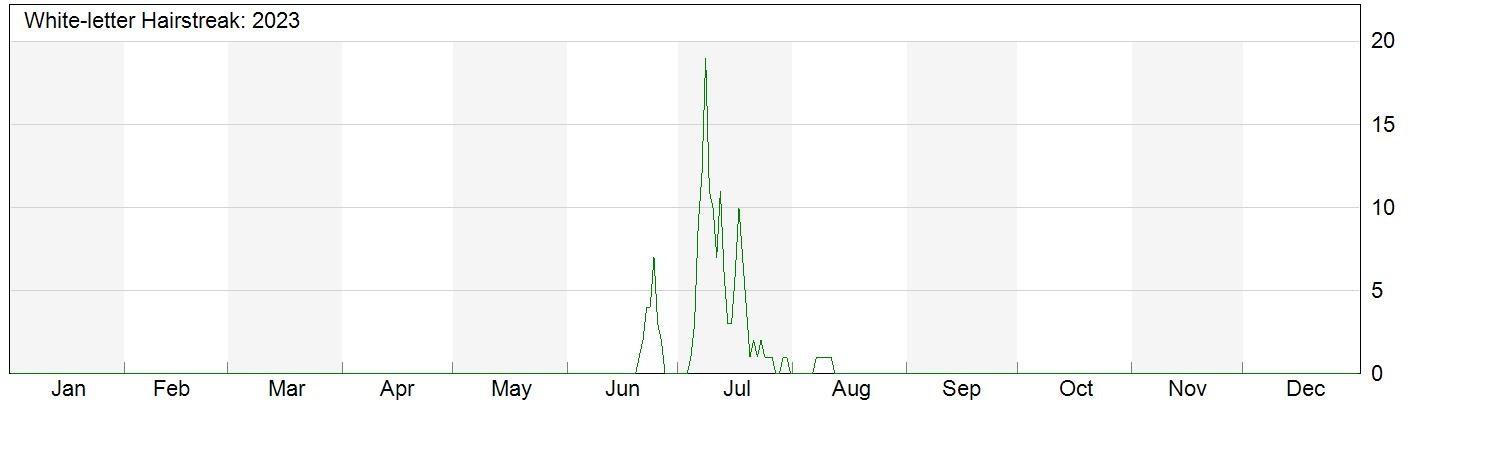
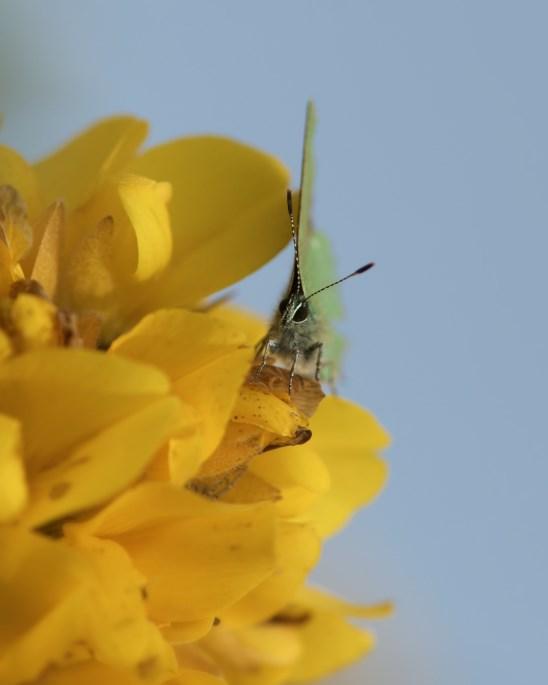
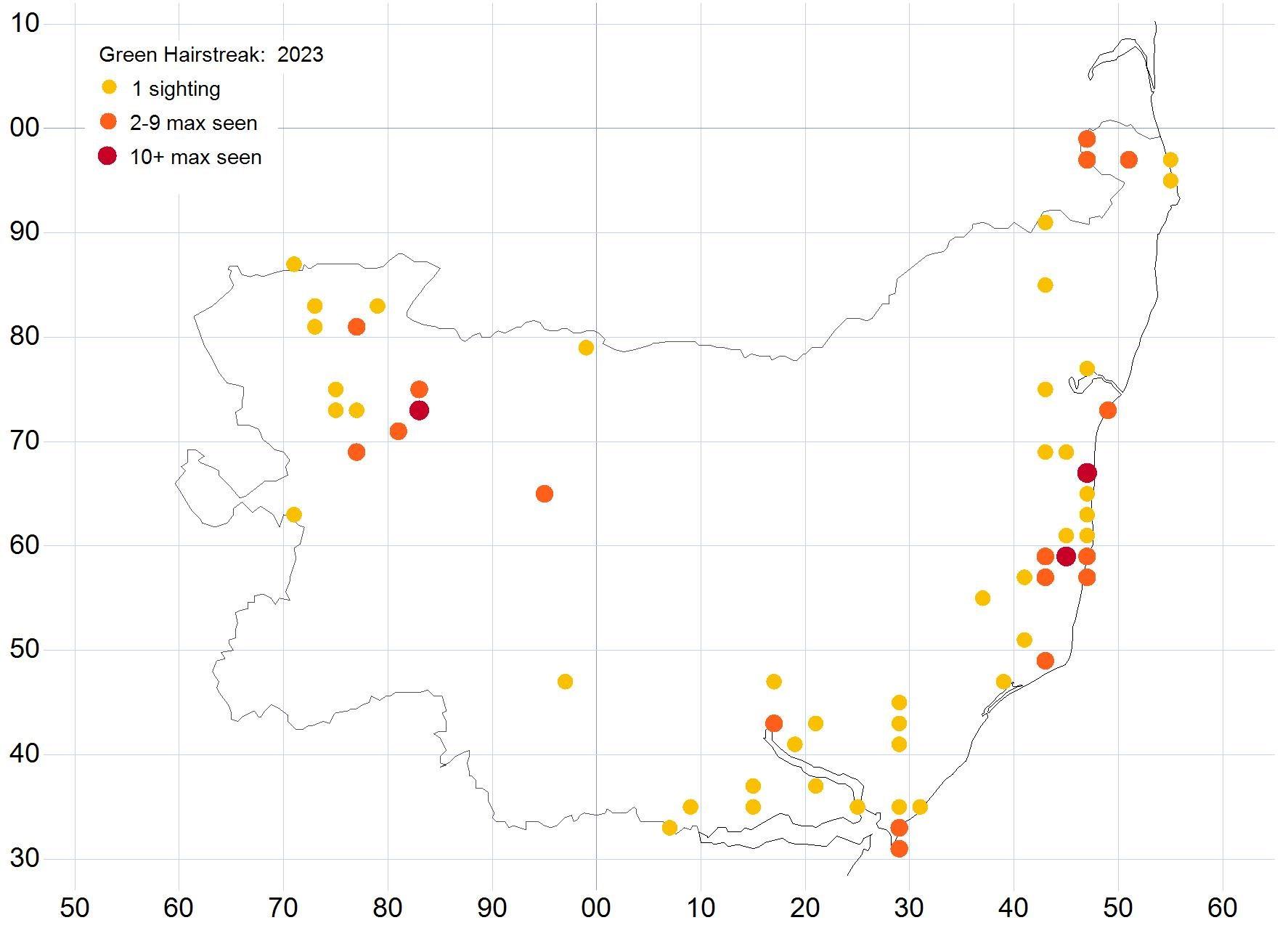
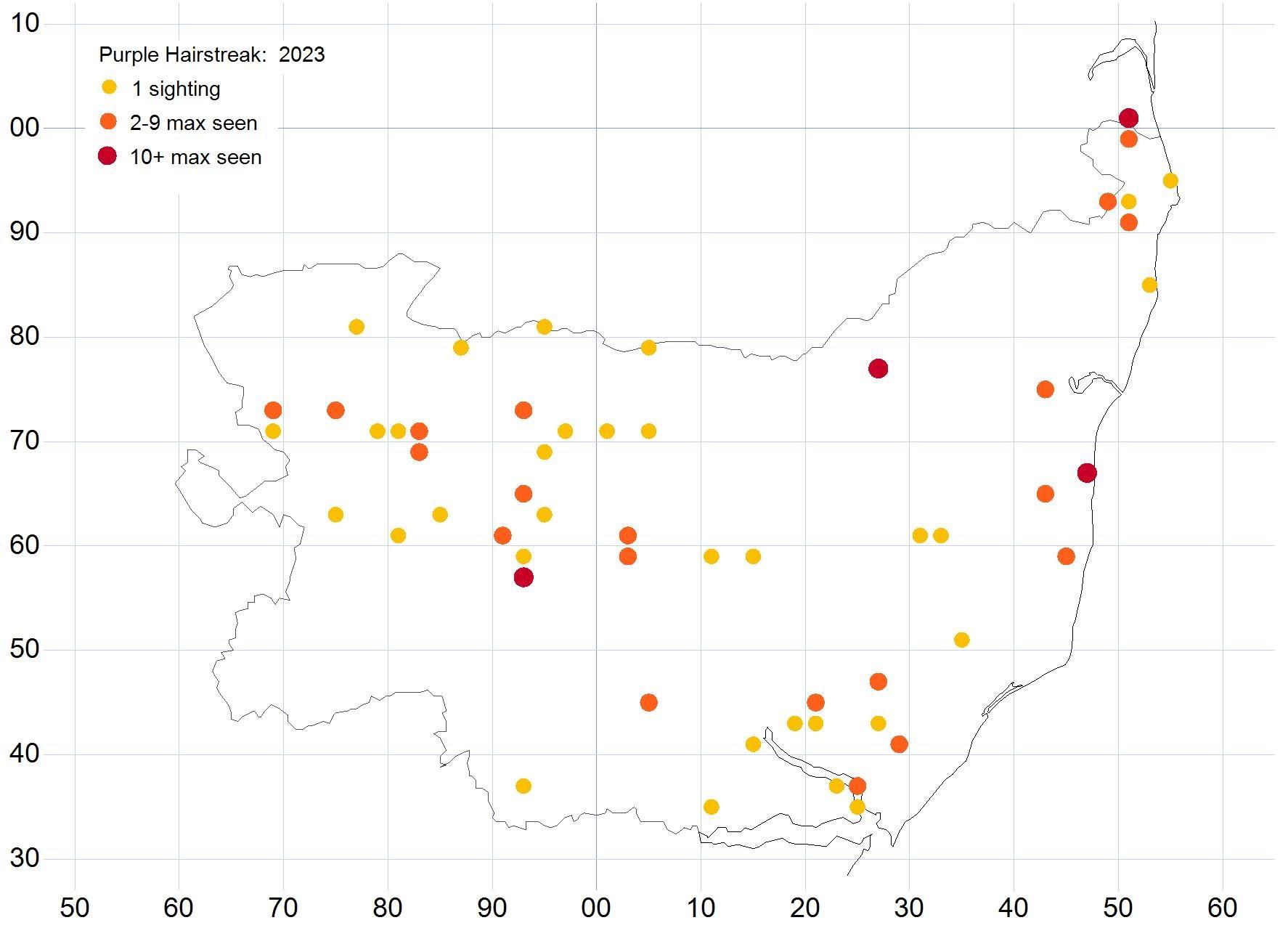
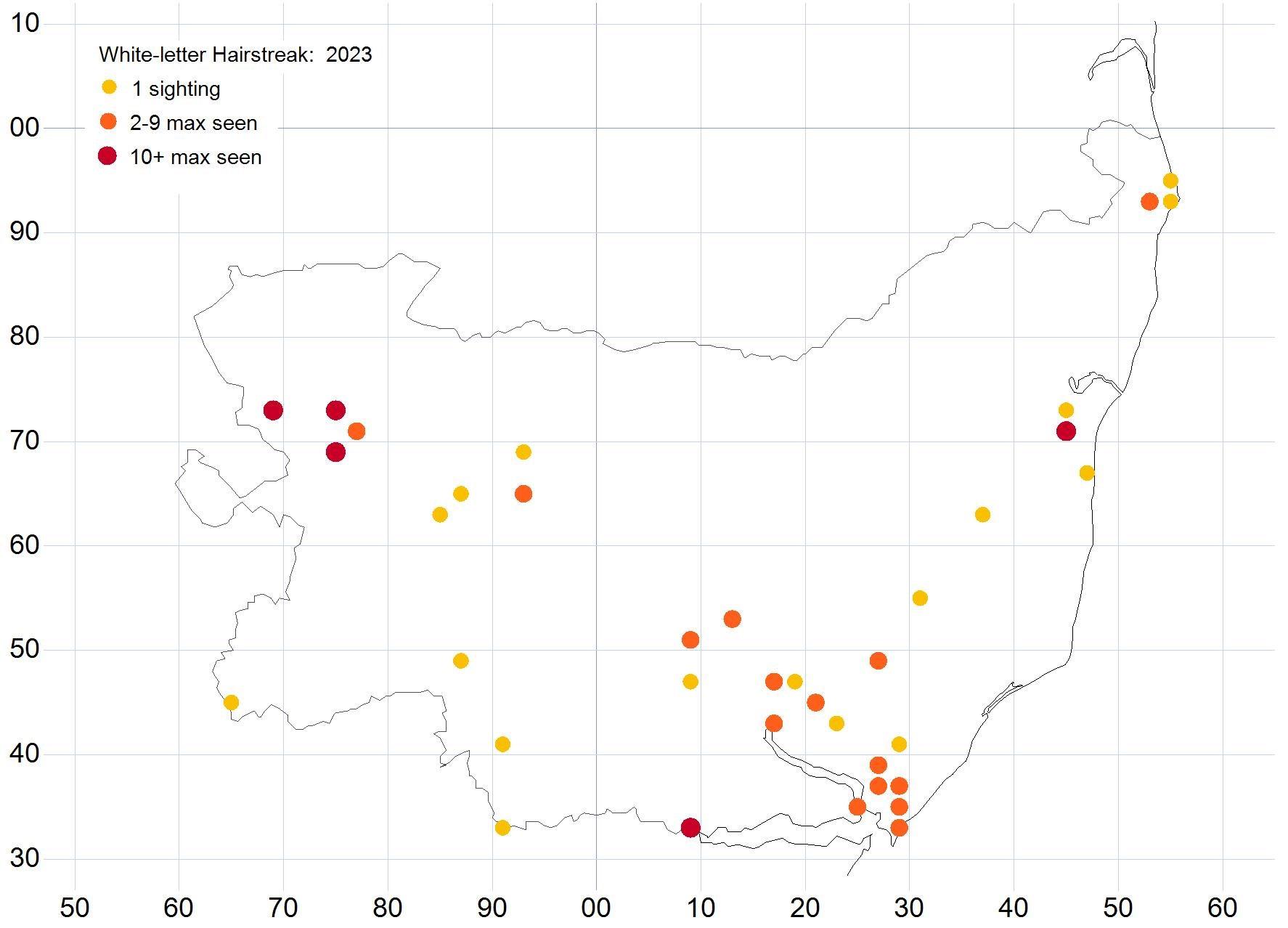
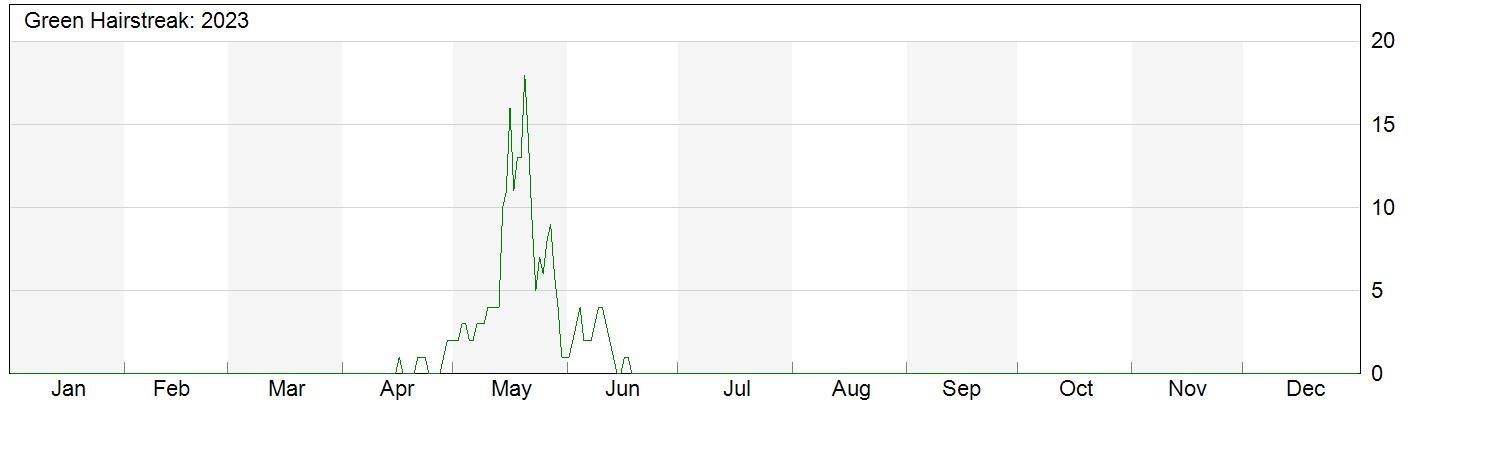
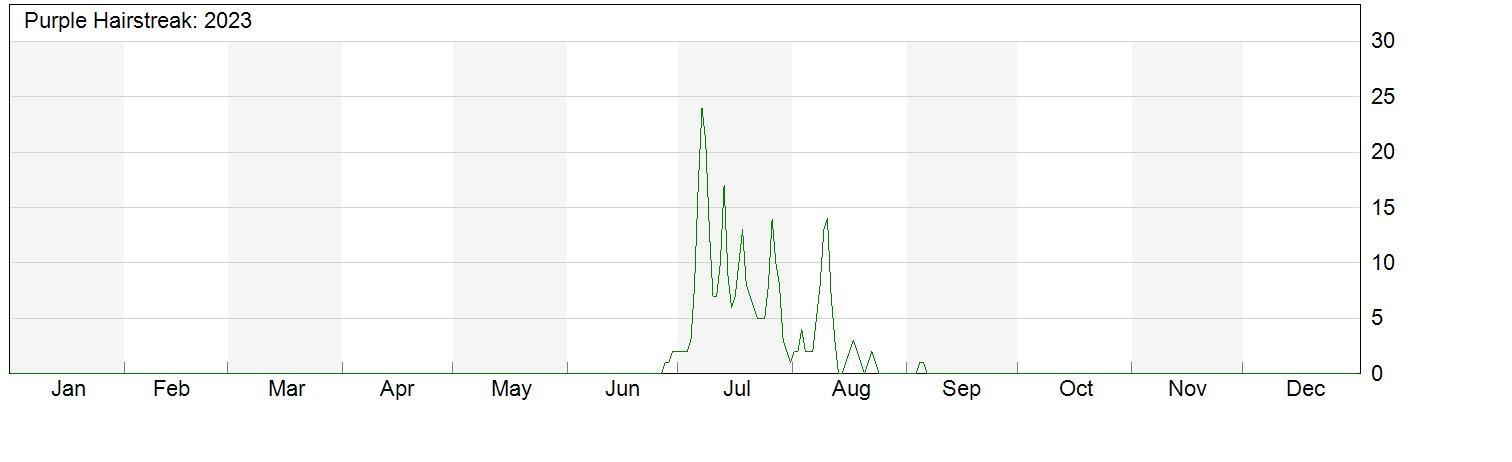
Hairstreaks are elusive and under-reported butterflies, so it is hard to make reliable comments about their abundance. Purple Hairstreak showed well in some areas but there was a drop in records for White-letter Hairstreak and Green Hairstreak species. Part of this is due to at least one recorder supplying records manually from the Lowestoft area where several White-letter Hairstreak and Purple Hairstreak colonies are known to exist. These records should be included in the full report. Only one Brown Hairstreak was reported, from Ipswich on 5 September. It is not known yet
whether this is due to a reduction in recording or a decline in the introduced population. It is arguably our most elusive species of butterfly.
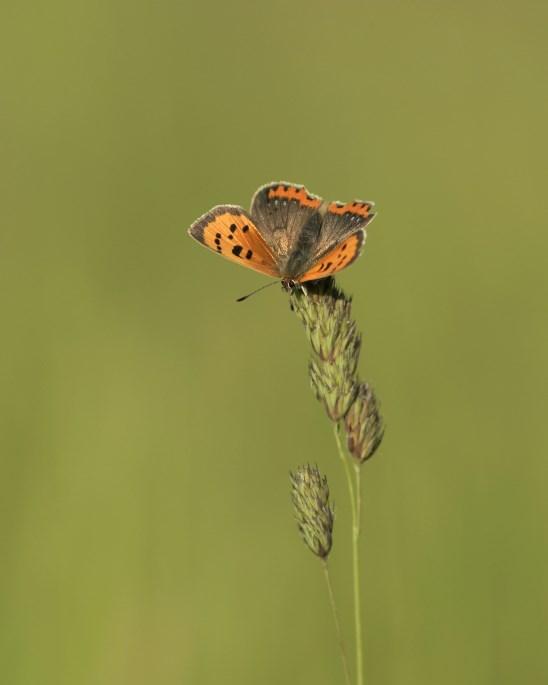
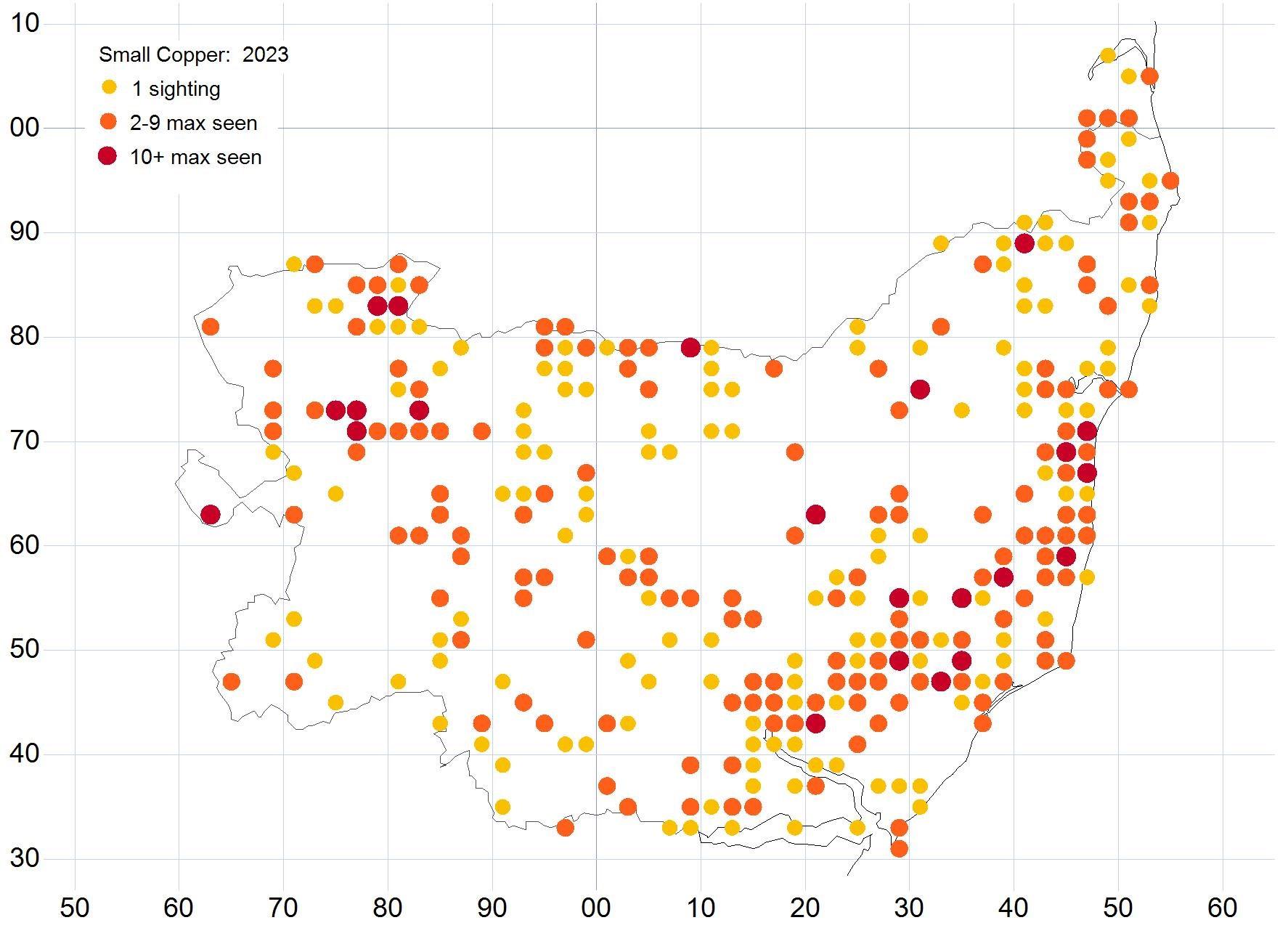
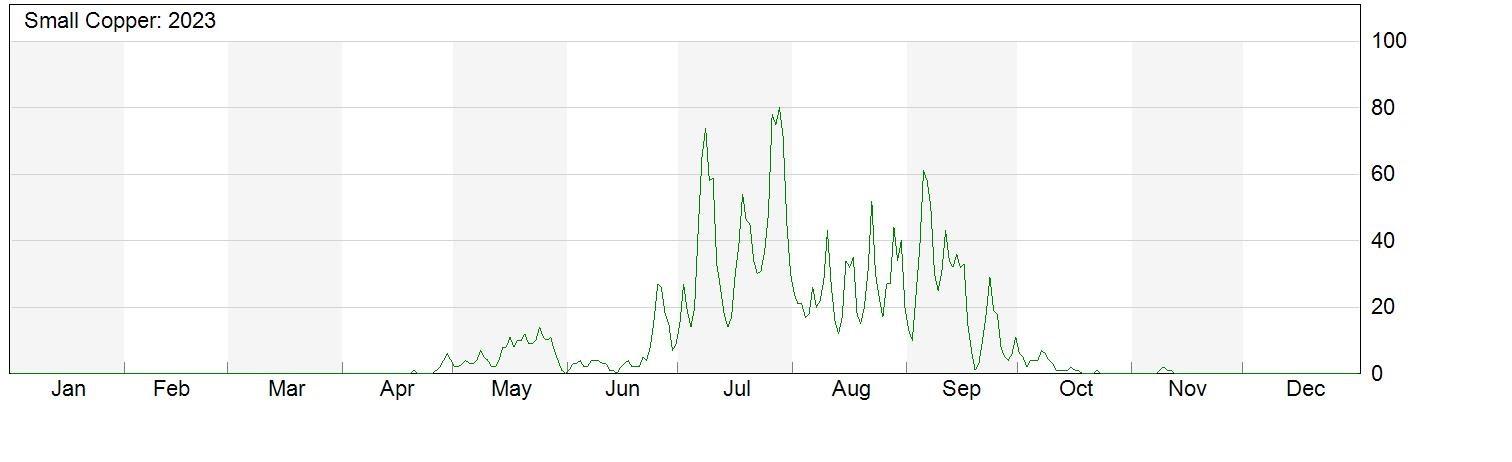
Small Copper were recorded from across the county in good numbers except for the far south-west. Numbers were significantly higher in second and third broods than in the spring generation, a quite normal phenomena for multi-brooded lycaenid species.
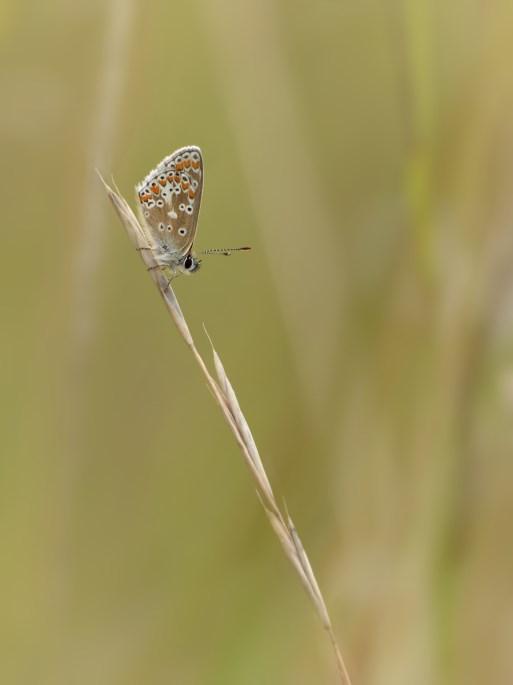
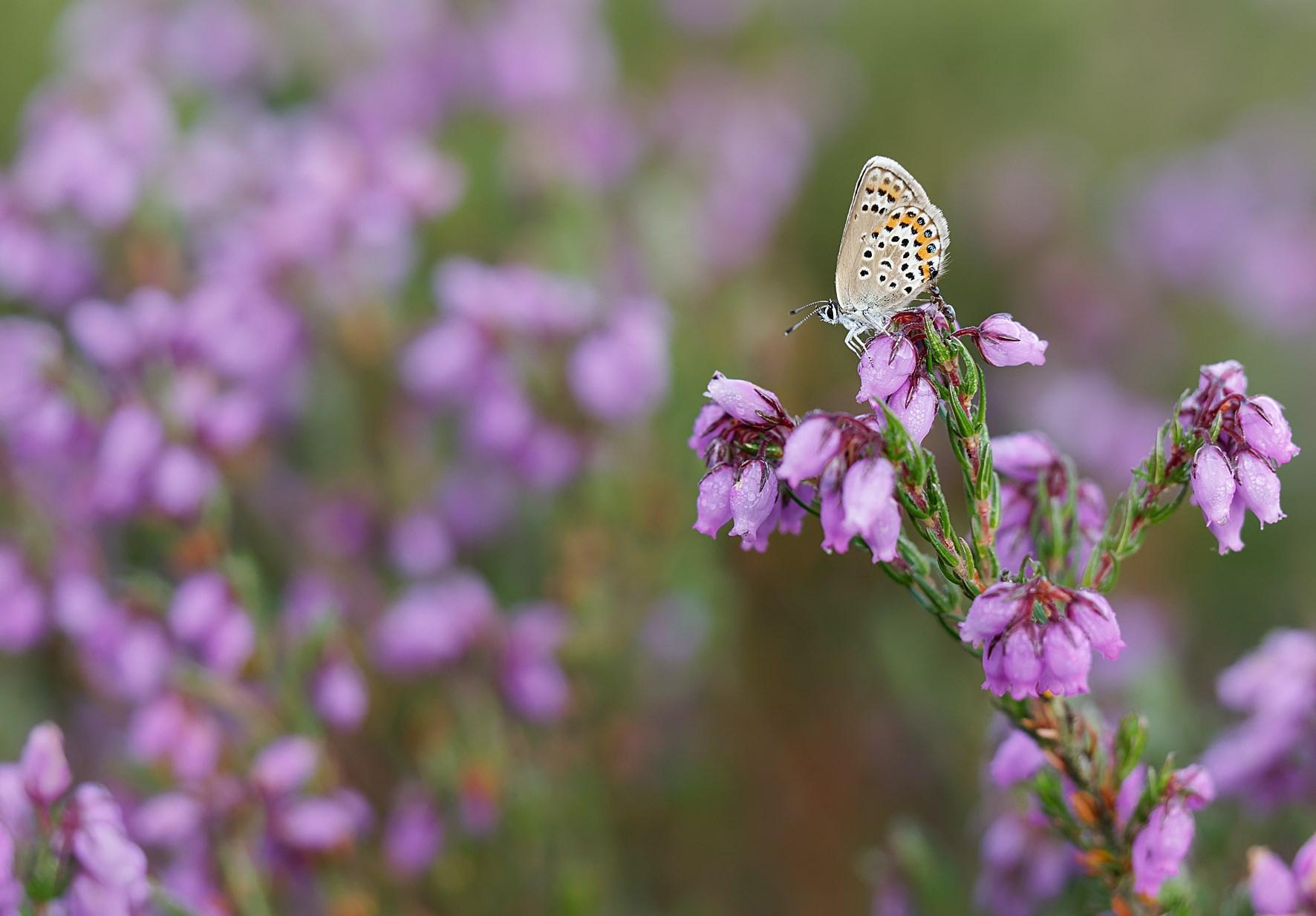
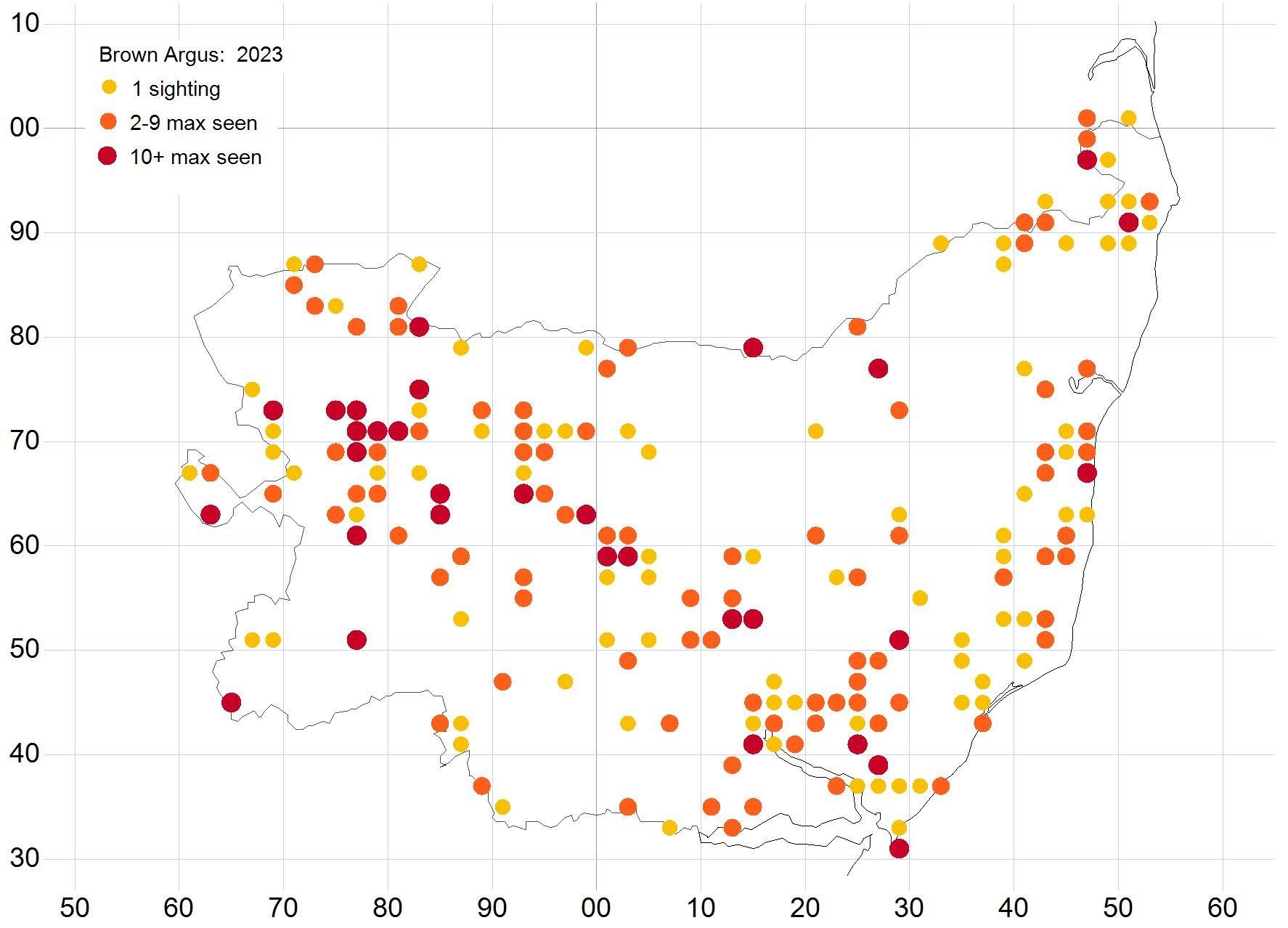
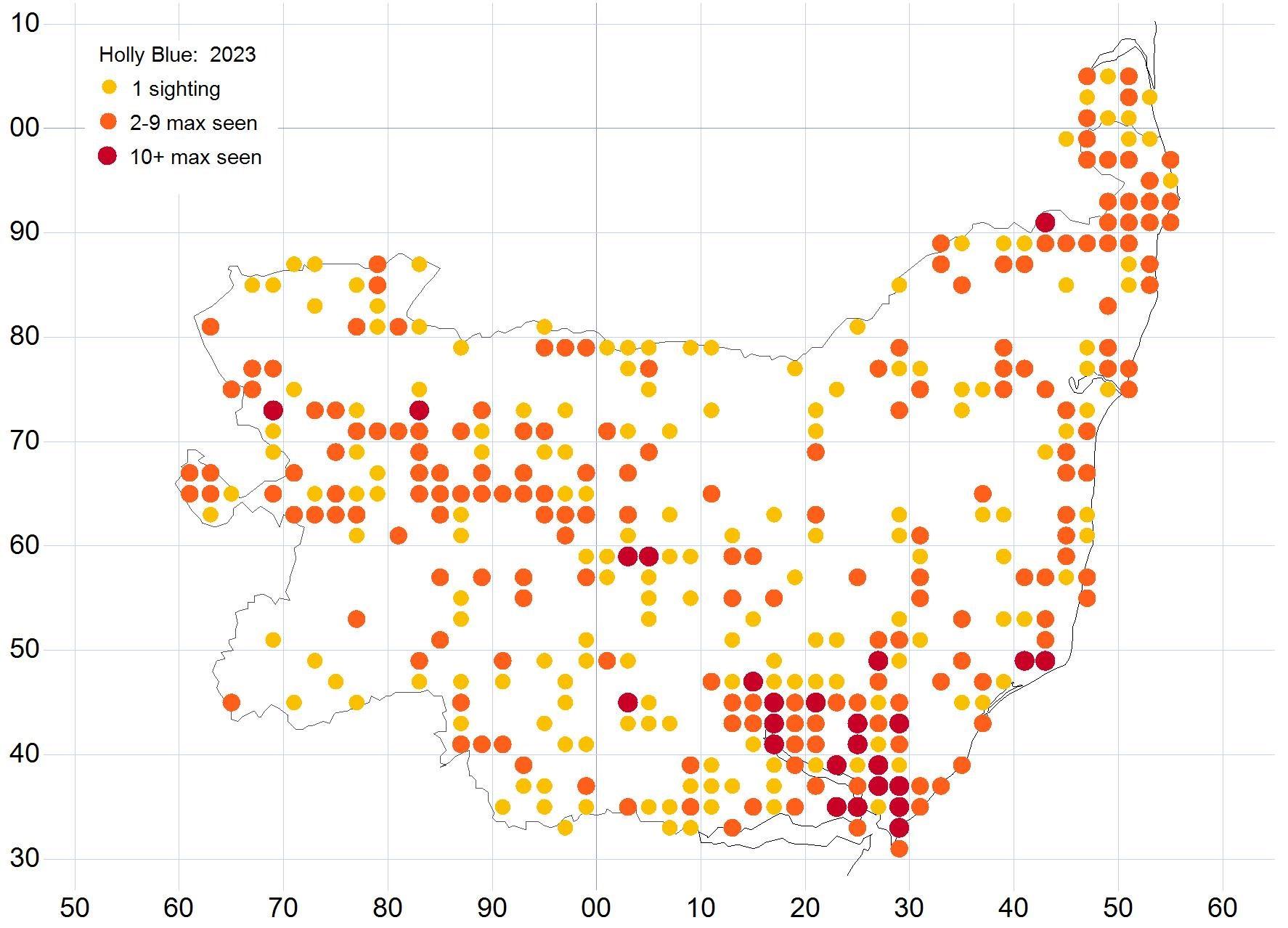
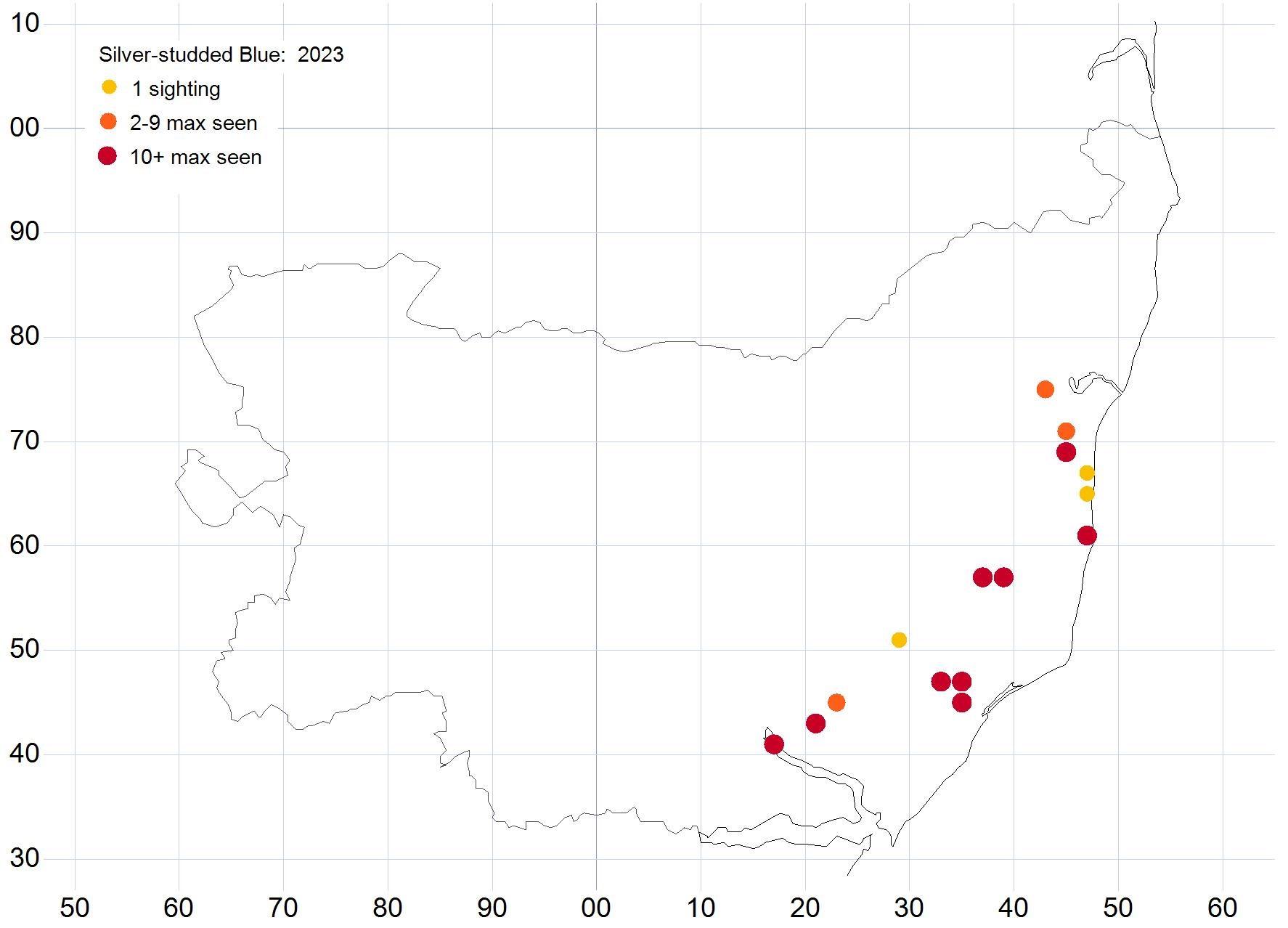
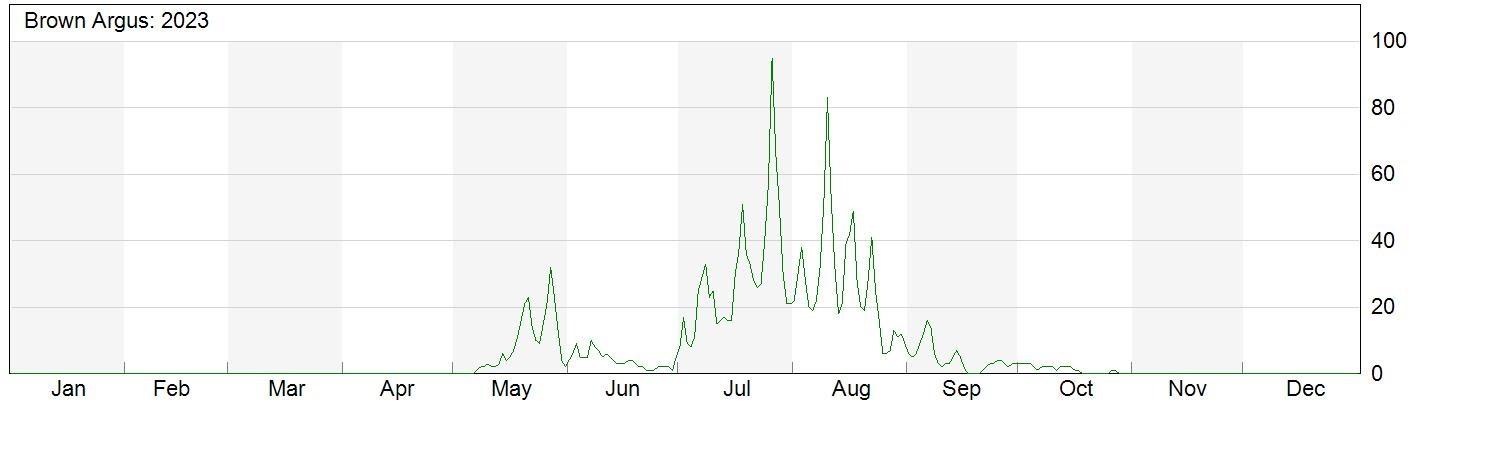
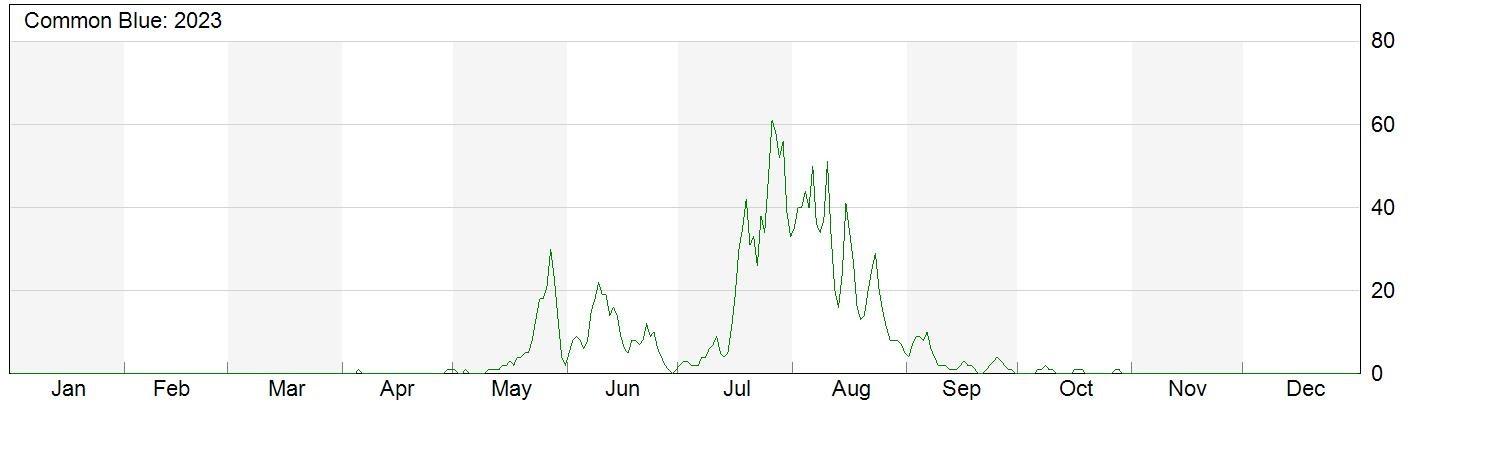
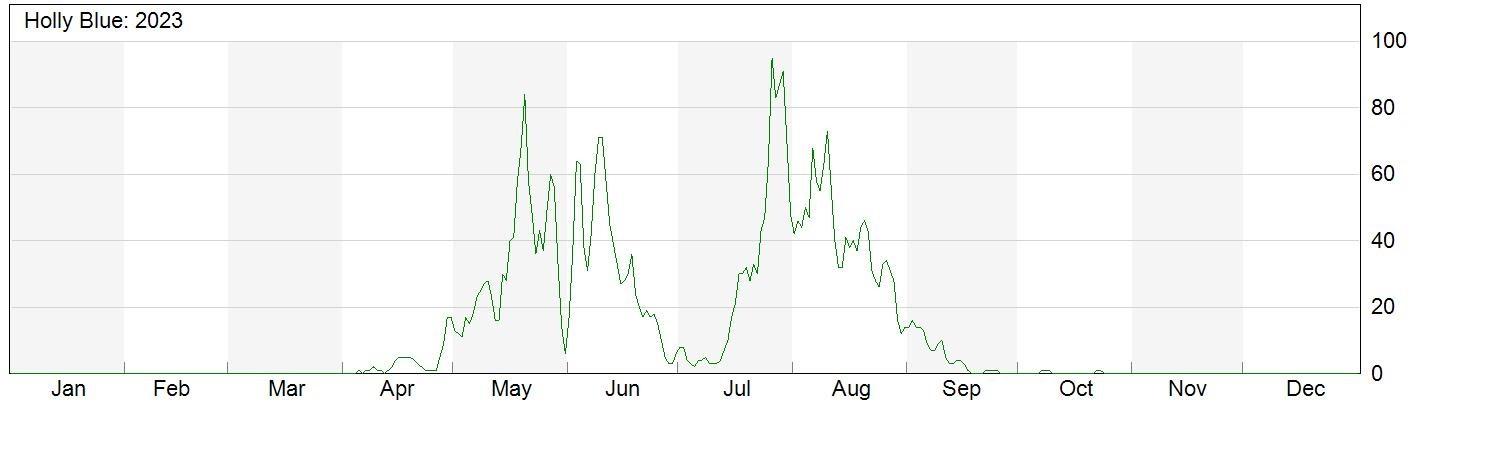
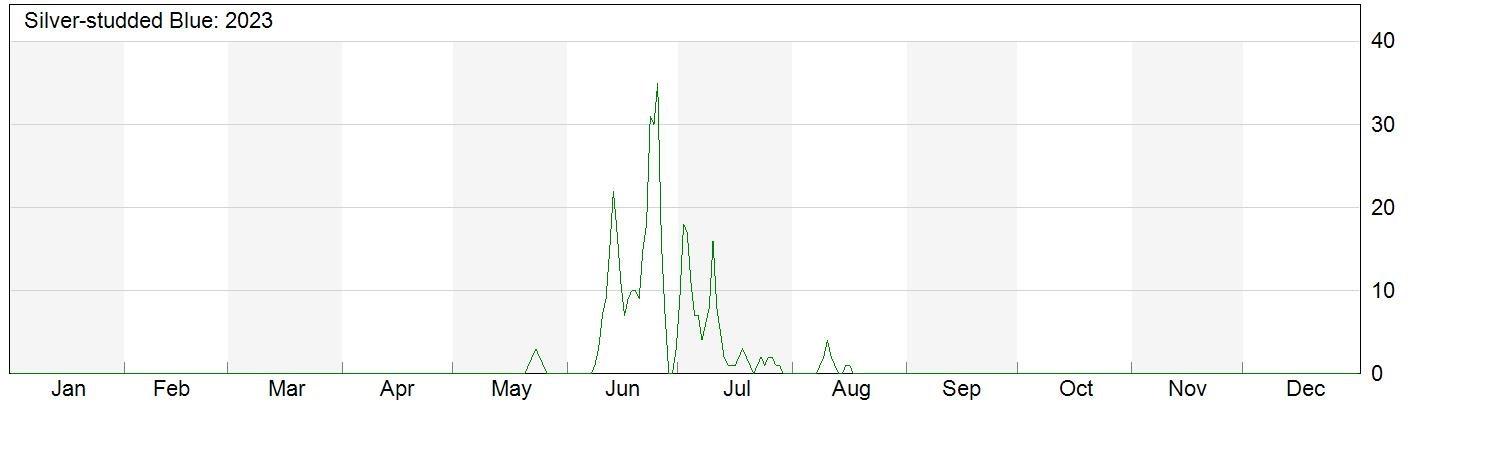
Brown Argus continued the upward trend and, while Common Blue started well, the summer brood did not build as much as hoped for. This is another pair of similar species, at least in the field, and identification issues mean that it is hard to be certain just how good a population exists in any one site. Holly Blue have enjoyed a run of good years and 2023 was another such year. The 10-year trend bears this out at a national level. Some early records for Silver-studded Blue may be Holly Blue or Common Blue – it is worth checking because a faded Common Blue may be a faded Silver-studded Blue. At times, it appears that Holly Blue are also recorded as Small Blue. Given the introductions that have occurred in Suffolk it is plausible but impossible to verify these accurately without photographs due to the similarity between the species and resultant confusion. Our very small population of Chalk Hill Blue in the west of the county held on with similar numbers being reported compared to 2022 (this is distinct from the Devil’s Dyke colony which is just over the border in Cambridgeshire but could stray into Suffolk on rare occasions).
Skippers (Hesperiidae)
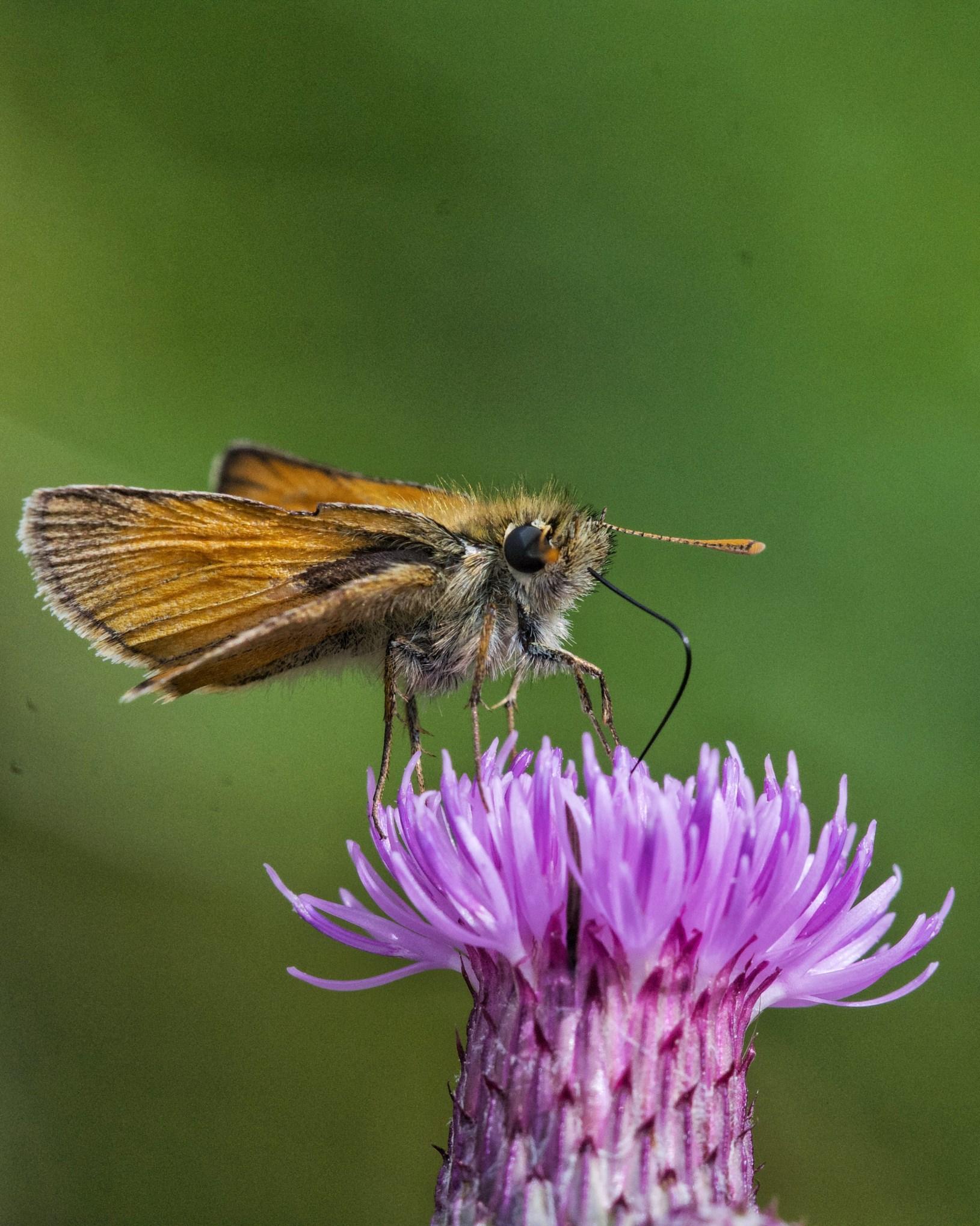
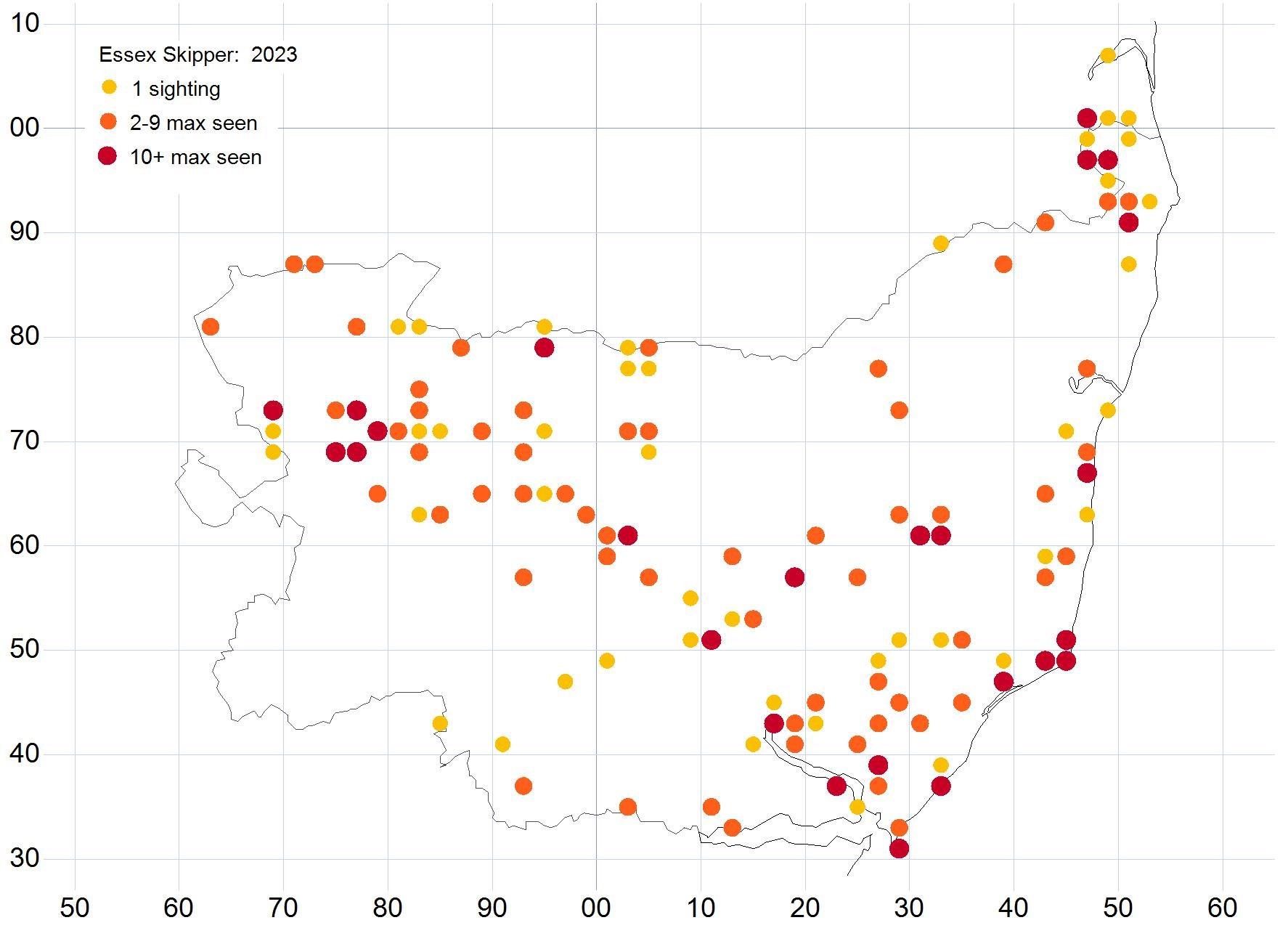
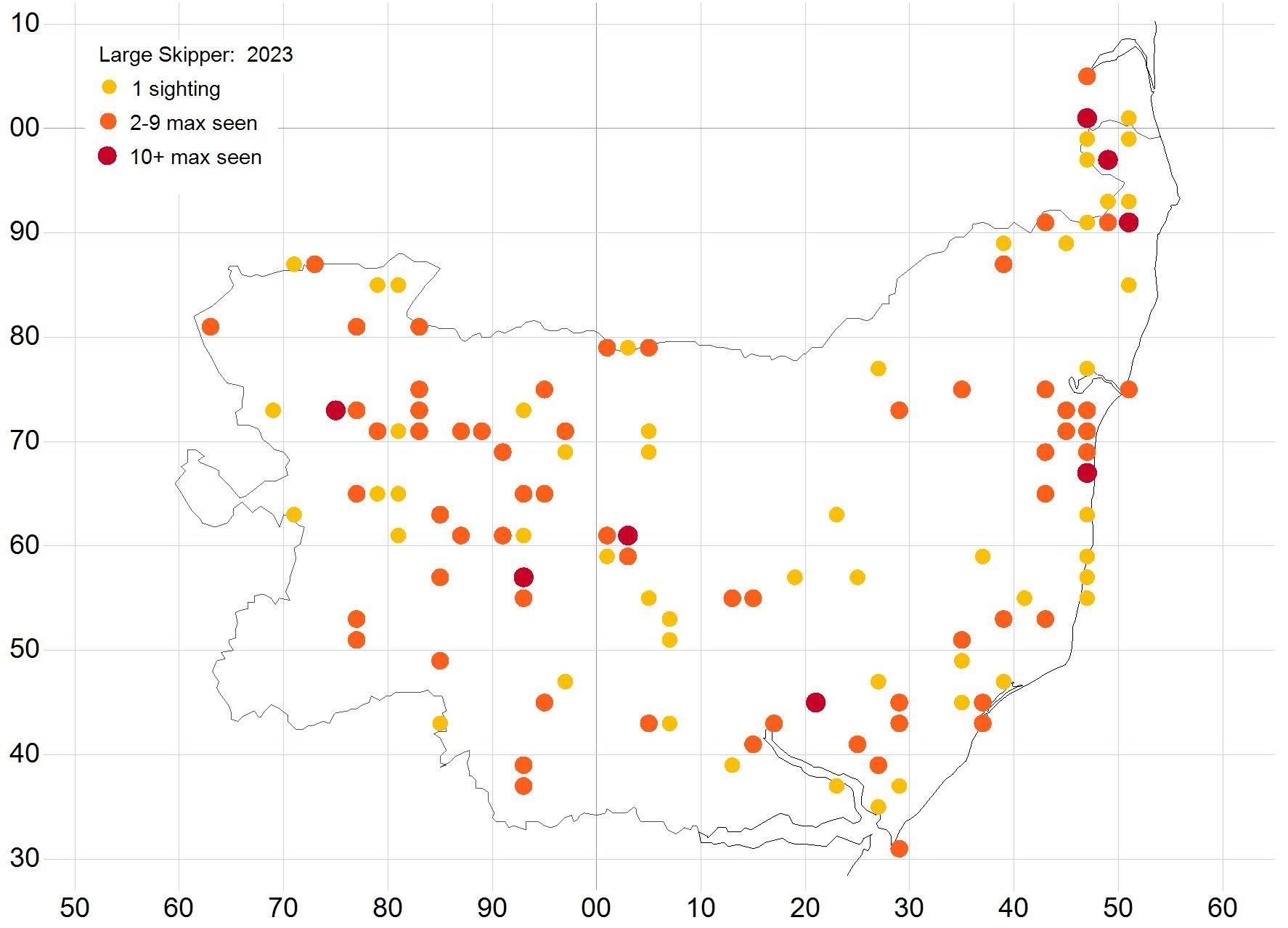
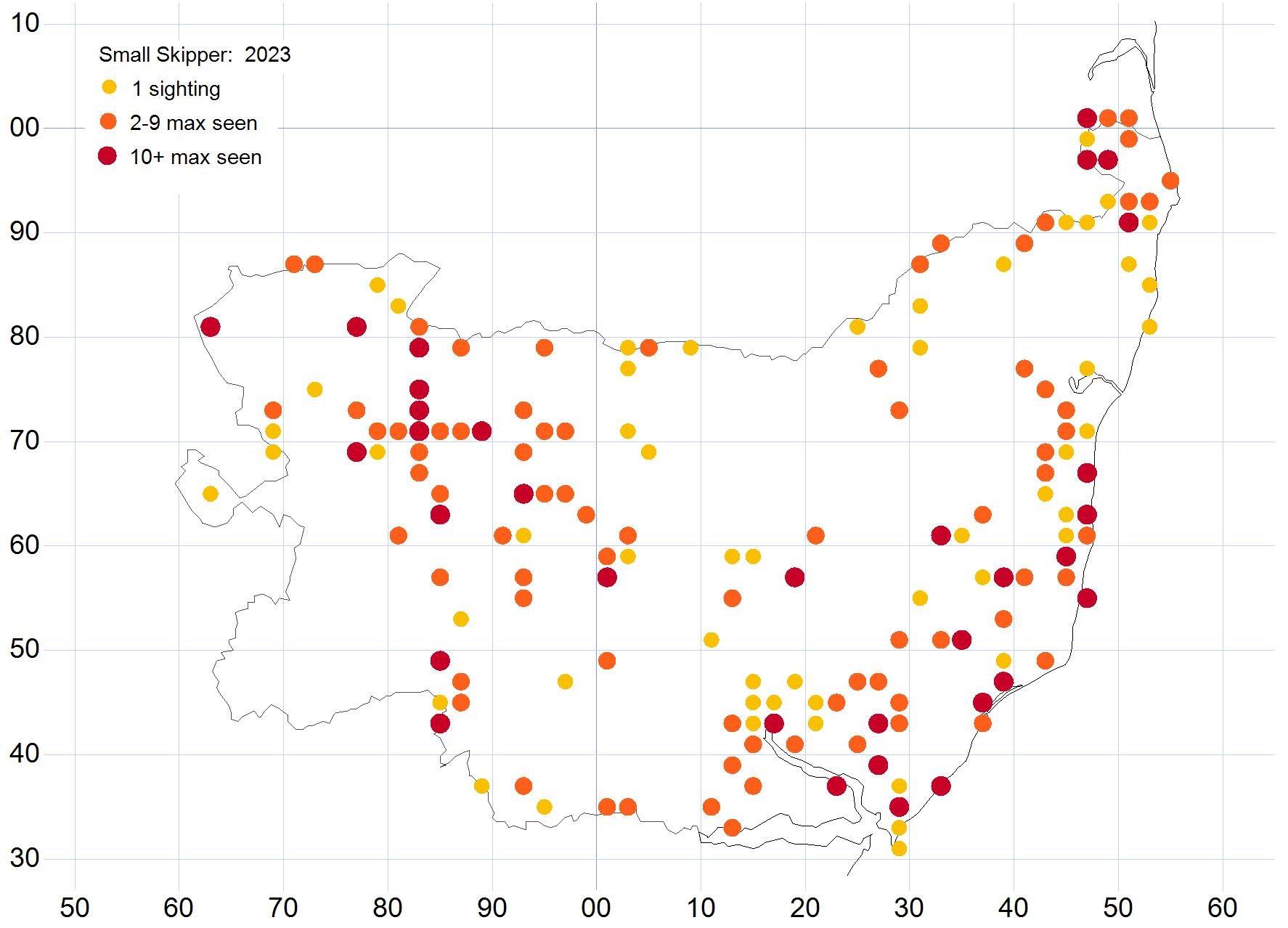
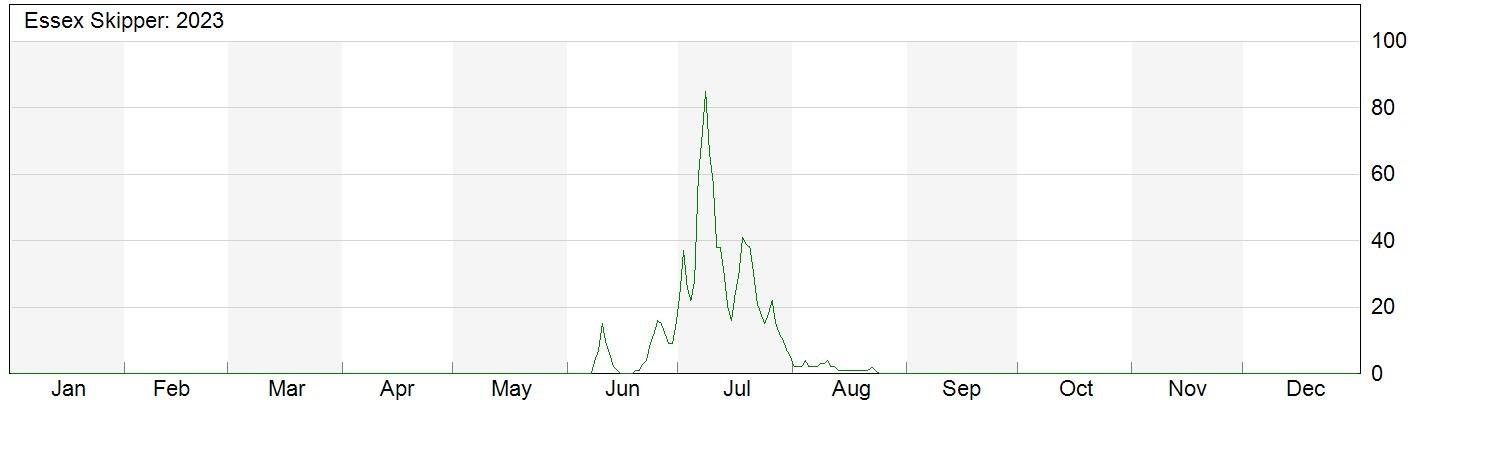
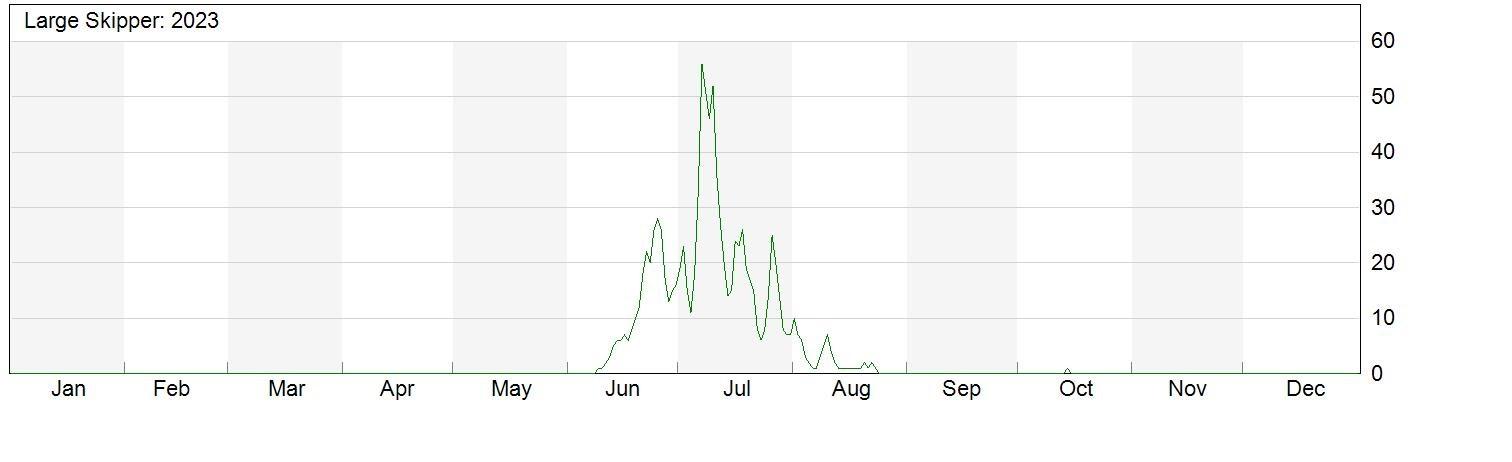
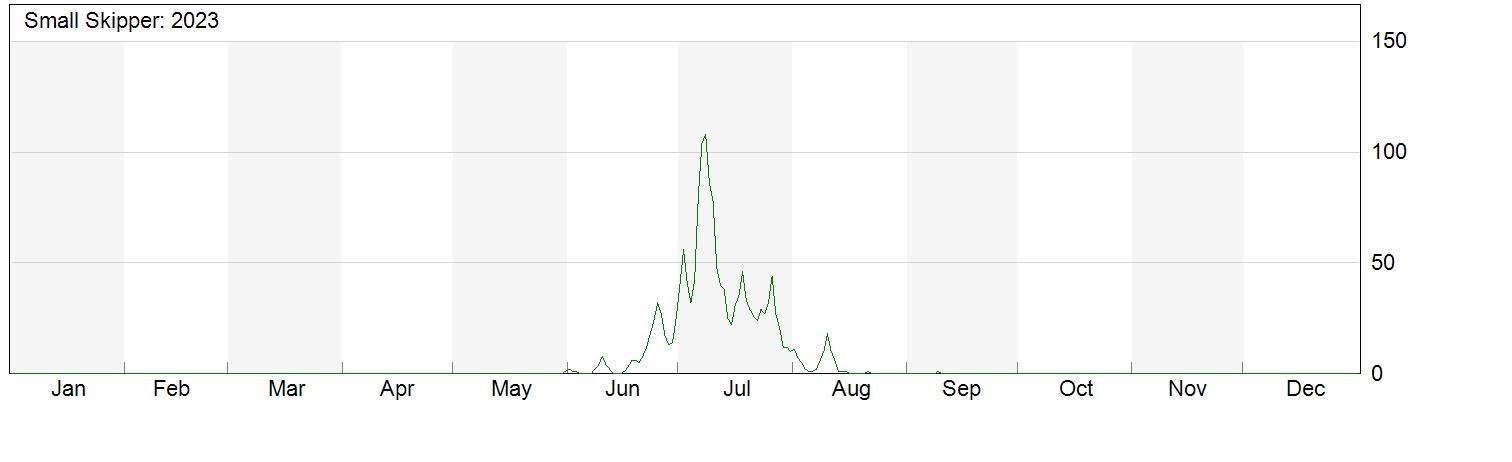
The golden skipper species had a good year with the slightly unusual feature of Small Skipper being observed before any Large Skipper had emerged (typically they are a week or two behind). The difficulty separating Essex and Small Skipper in the field makes it hard to produce accurate maps and data for each species. Both should be quite common in areas with long grass that is allowed to stand throughout winter. A survey in north-east Suffolk produced a ratio of two Small Skipper for every one Essex Skipper. This ratio tactic can be useful in recording large numbers from a site with a degree of confidence. The ratio is quite variable across the country so it’s worth
Forest work and adverse weather has led to a decline in their current sites. Our hope is that the species is quite mobile within the forest and capable of finding new breeding habitat. Its status in Suffolk remains critical and all records received are very
Appendix 1: Summary of UK Changes for Species at National Level
Our Suffolk species have their own trends, but it is appropriate to show the backdrop against the national trend for our butterflies. It is a complex picture with many factors including development, pesticides and climate change playing a part in the mixed fortunes. Skippers, however, stand out as a family of butterflies with losses all round (10-year trend).
Key: * P < 0.05 (significant), ** P < 0.01 (highly significant), ***P < 0.001 (very highly significant). Red text has been used to highlight those species that had their worst year of the series in 2023, and blue text for those species that had their best year of the series in 2023.
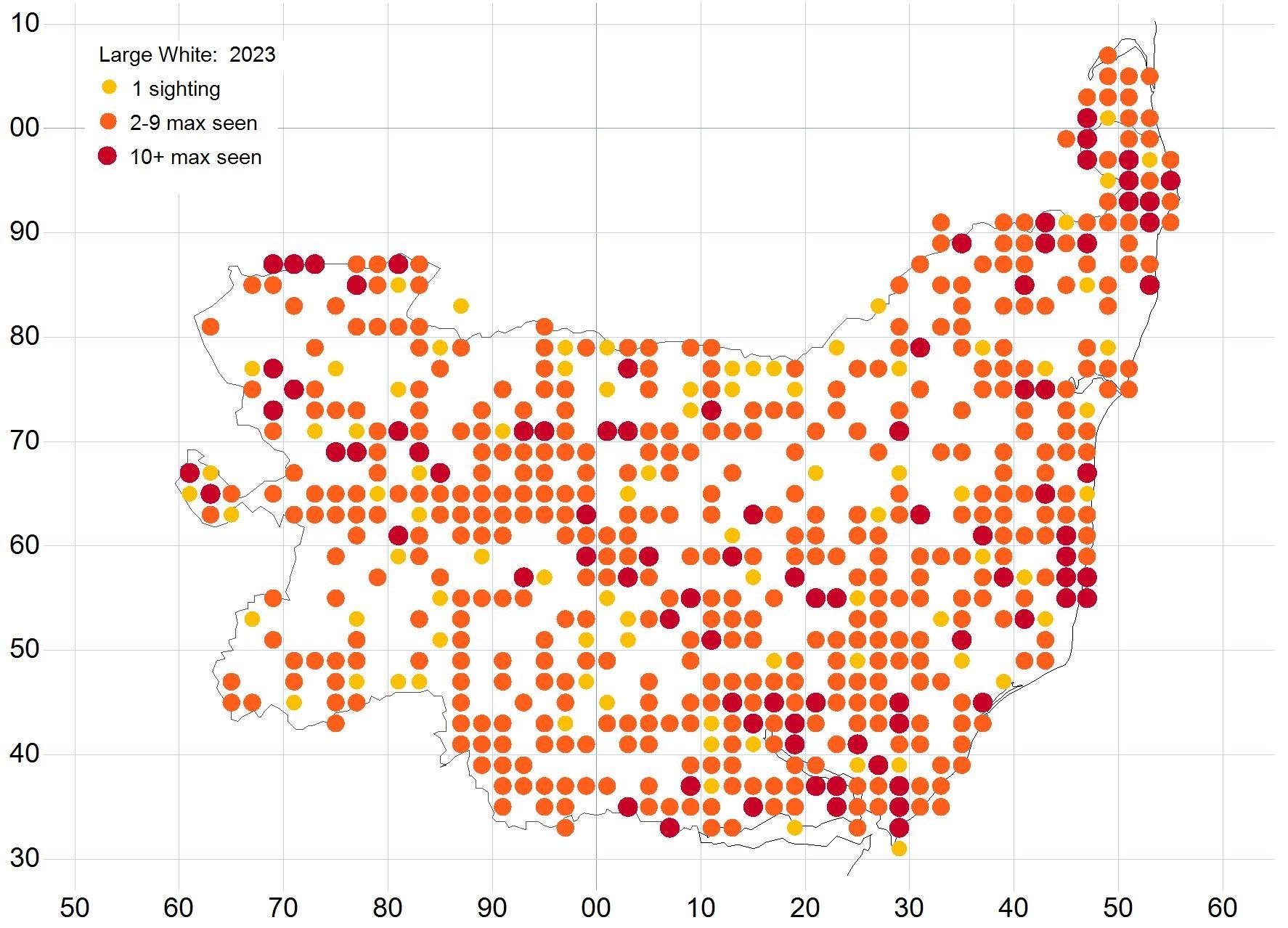
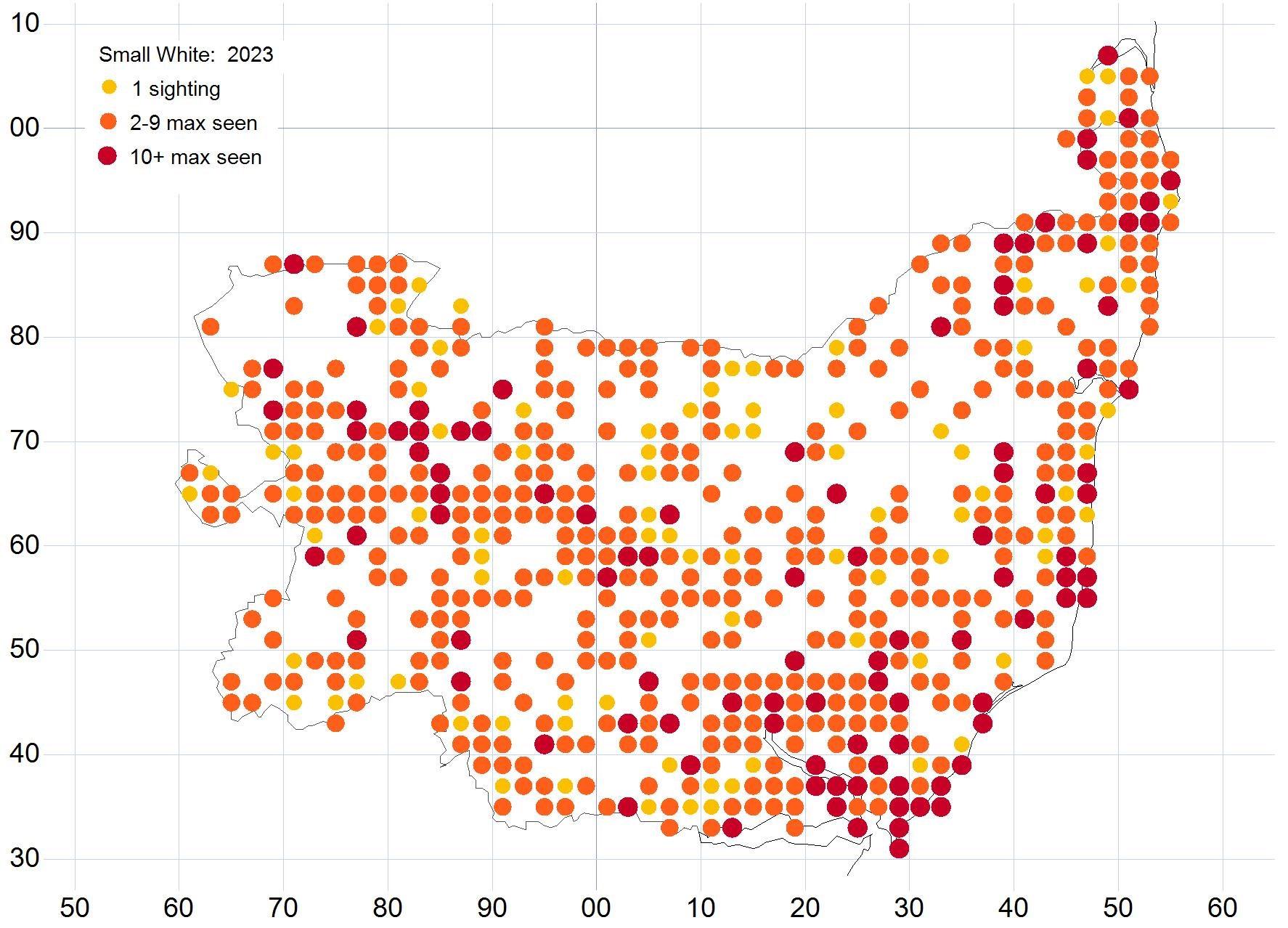
Appendix 2: Distribution Maps for Selected Species (2023)
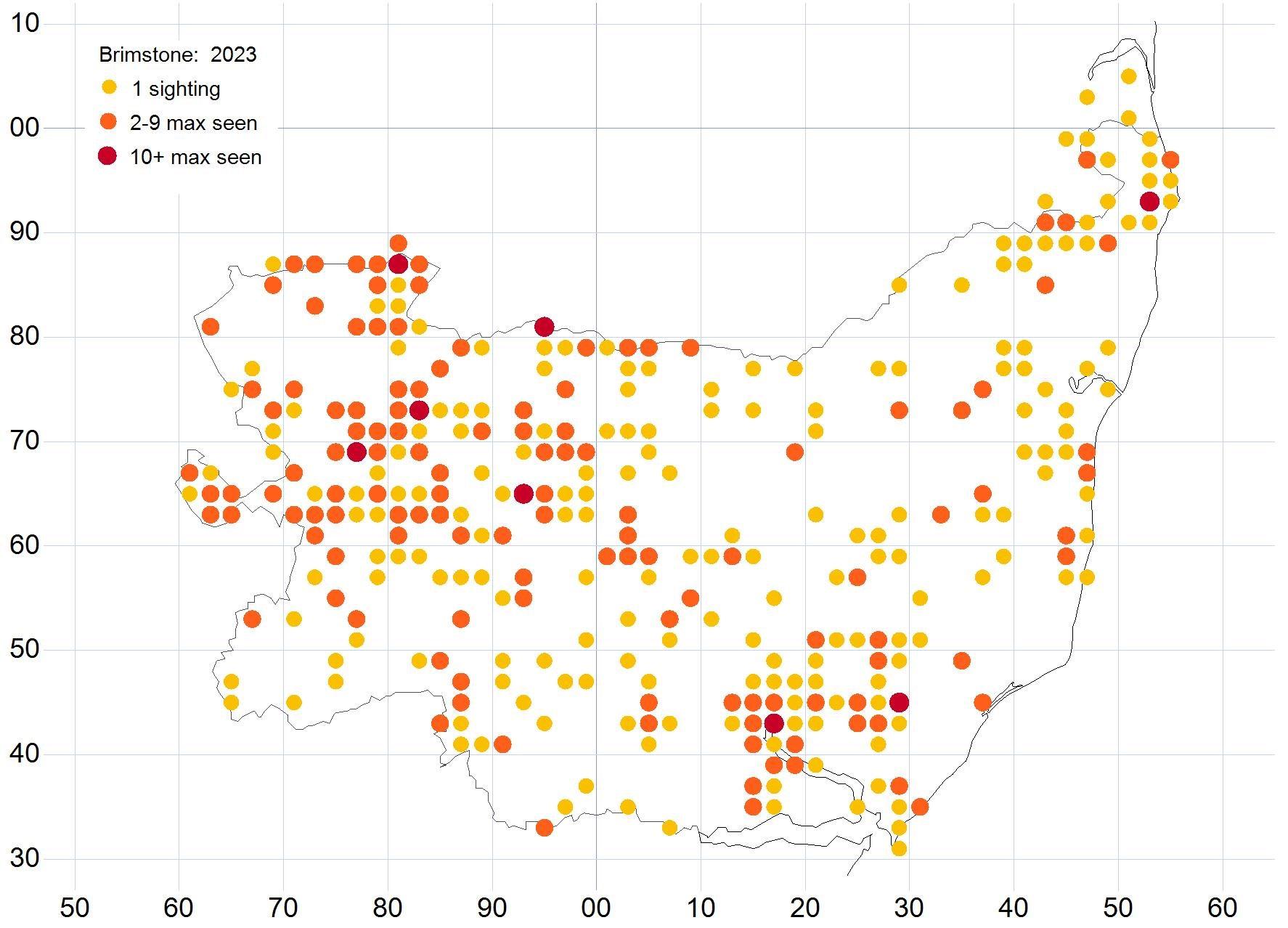
Brimstone: 2023
Brown Argus: 2023
(2024)
Comma: 2023
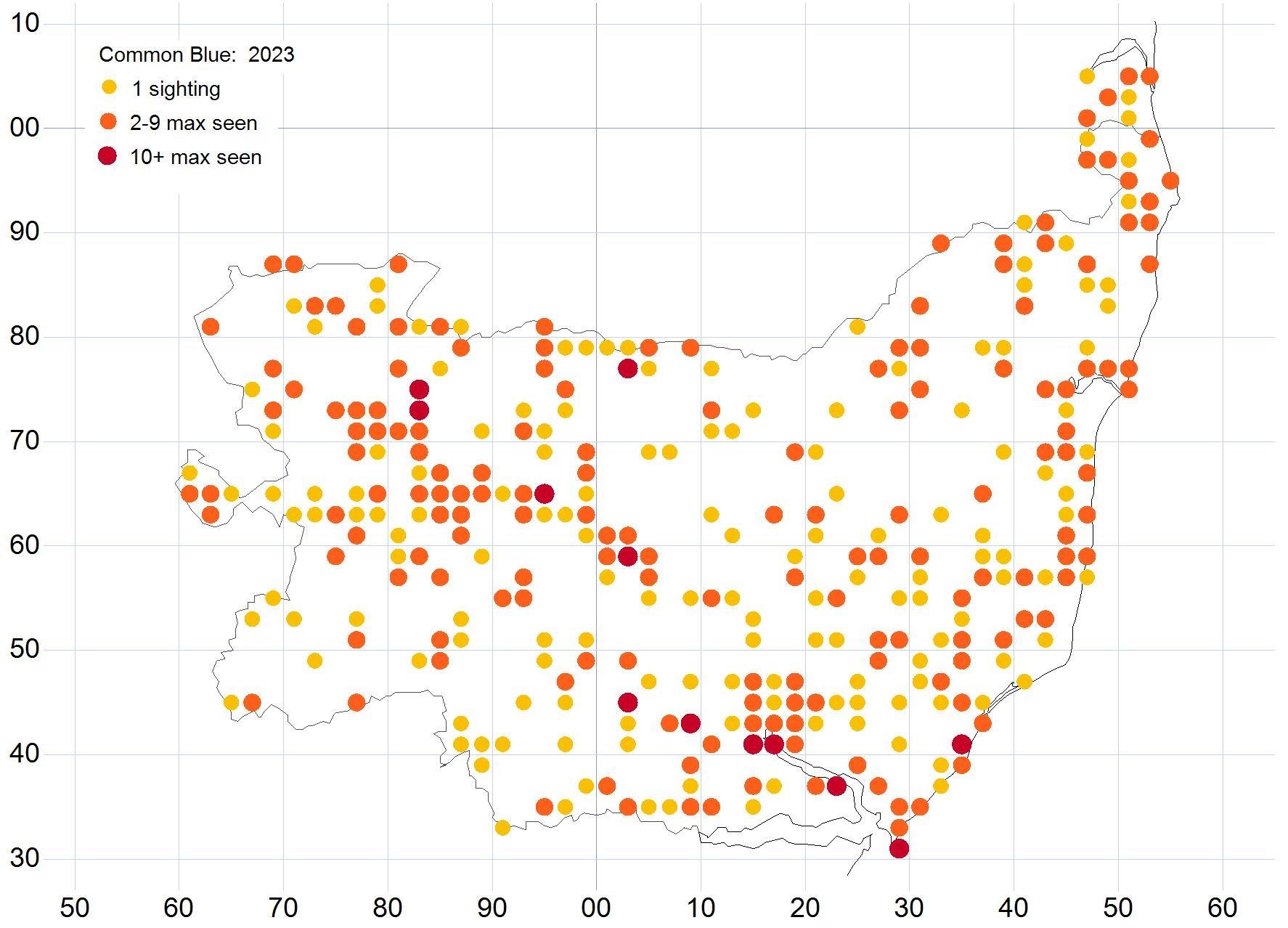
Common Blue: 2023
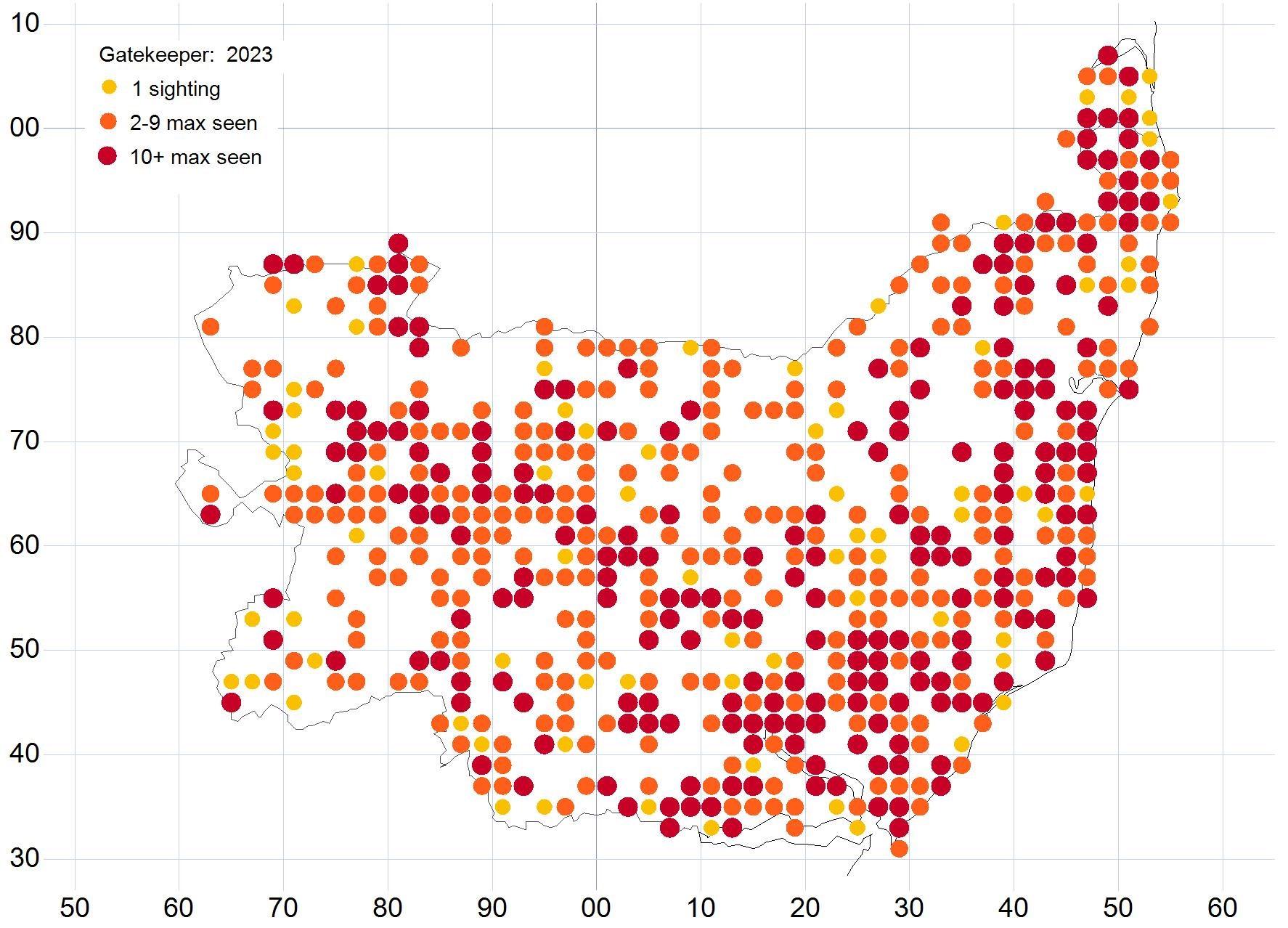
Gatekeeper: 2023
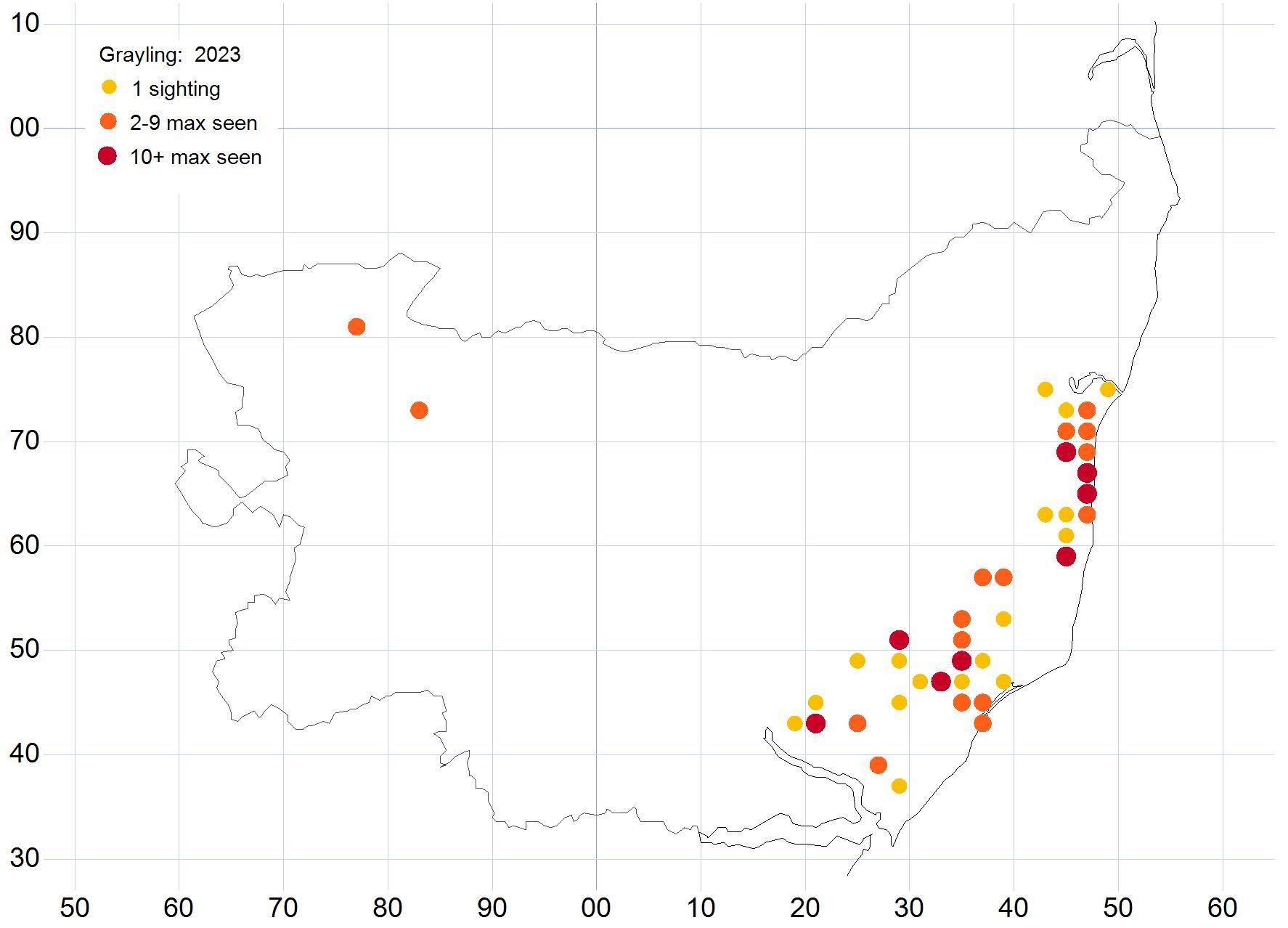
Grayling: 2023
Green Hairstreak: 2023
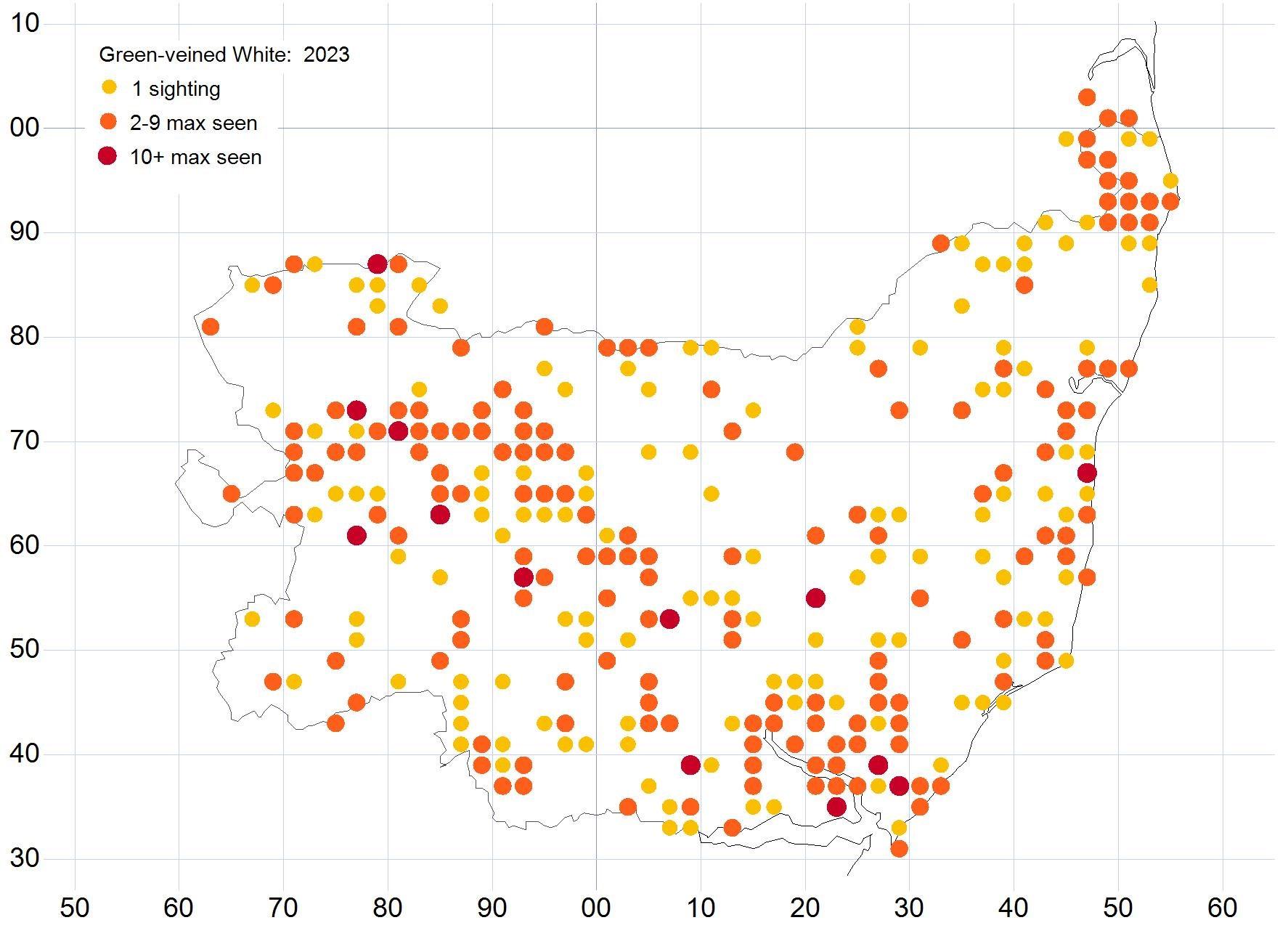
Green-veined White: 2023
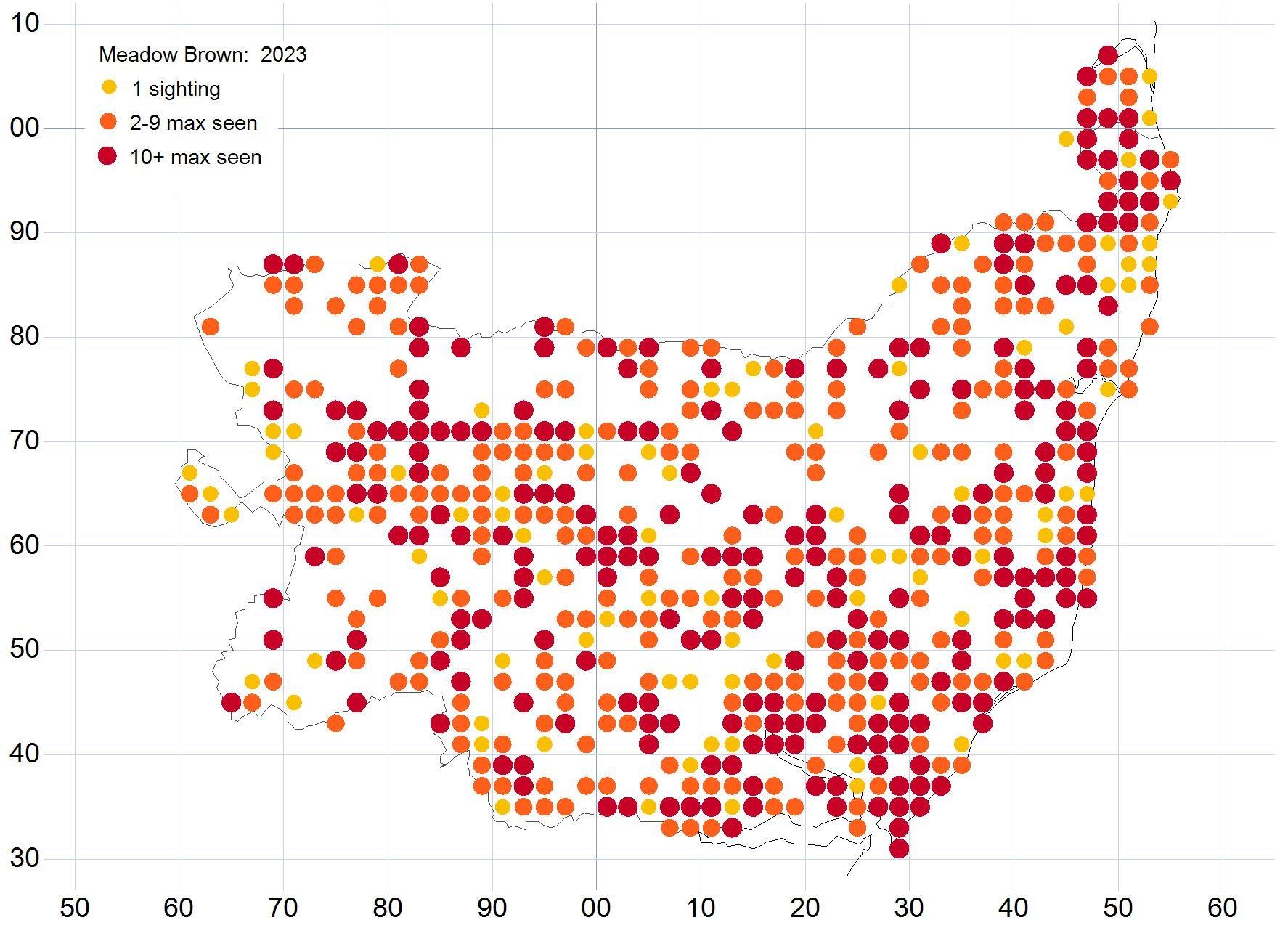
Meadow Brown: 2023
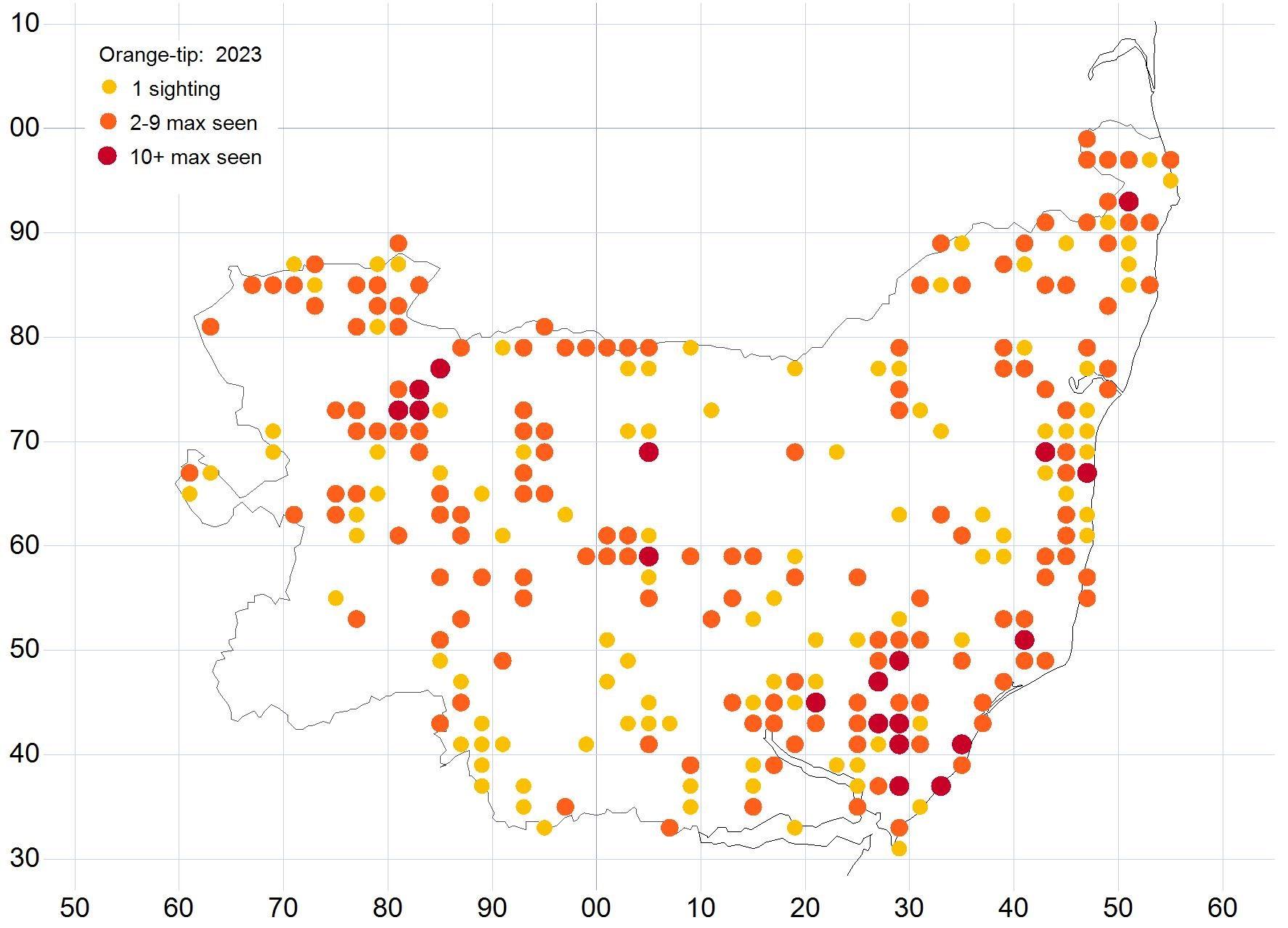
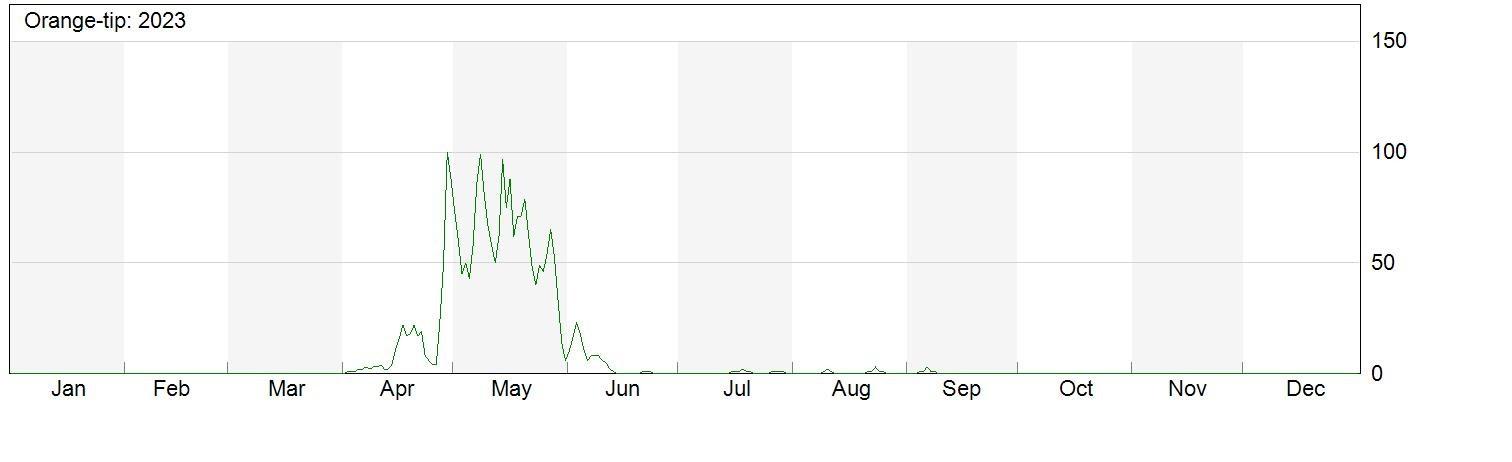
Orange-tip: 2023
Silver-studded Blue: 2023
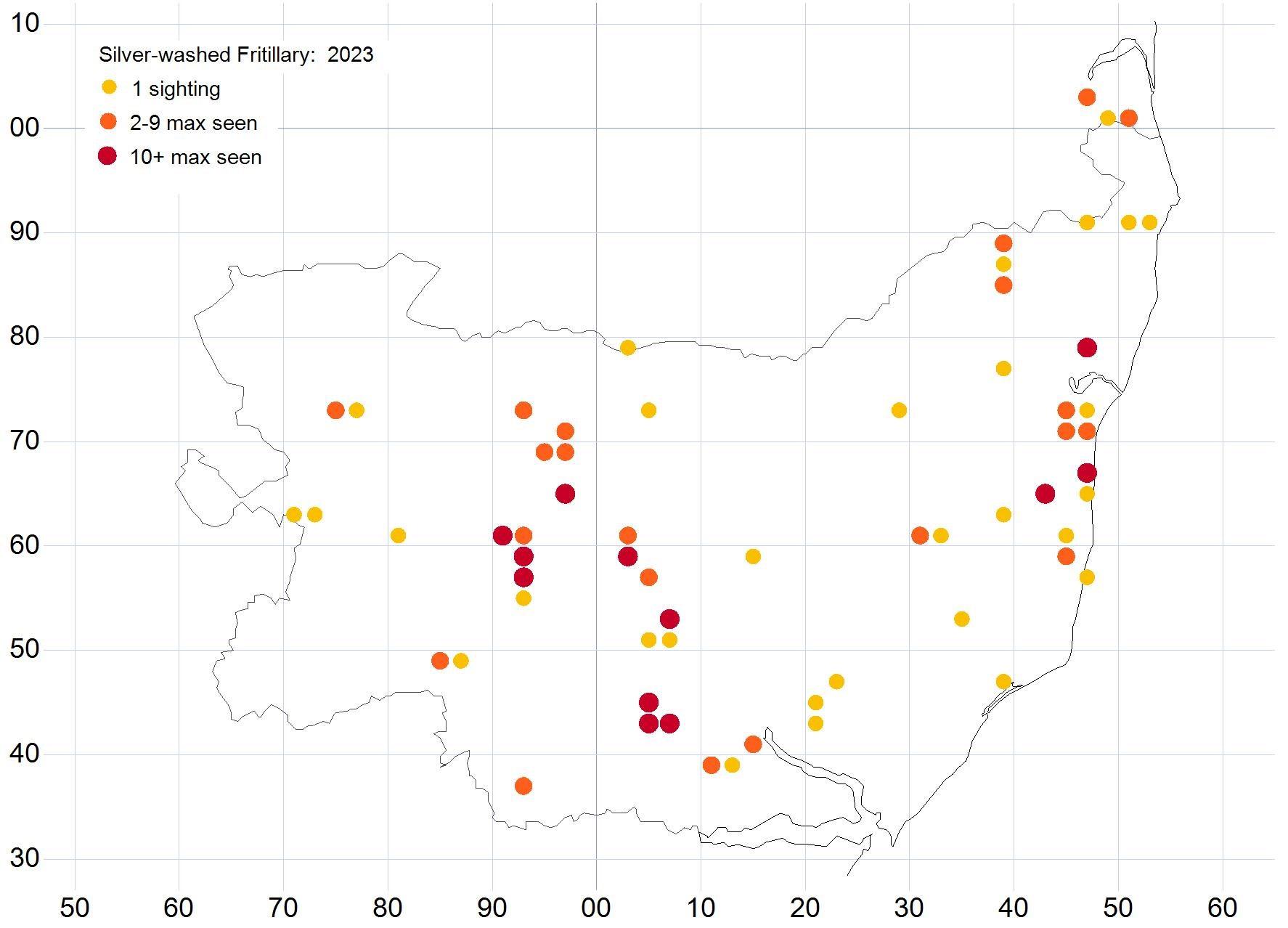
Silver-washed Fritillary: 2023
Small White: 2023
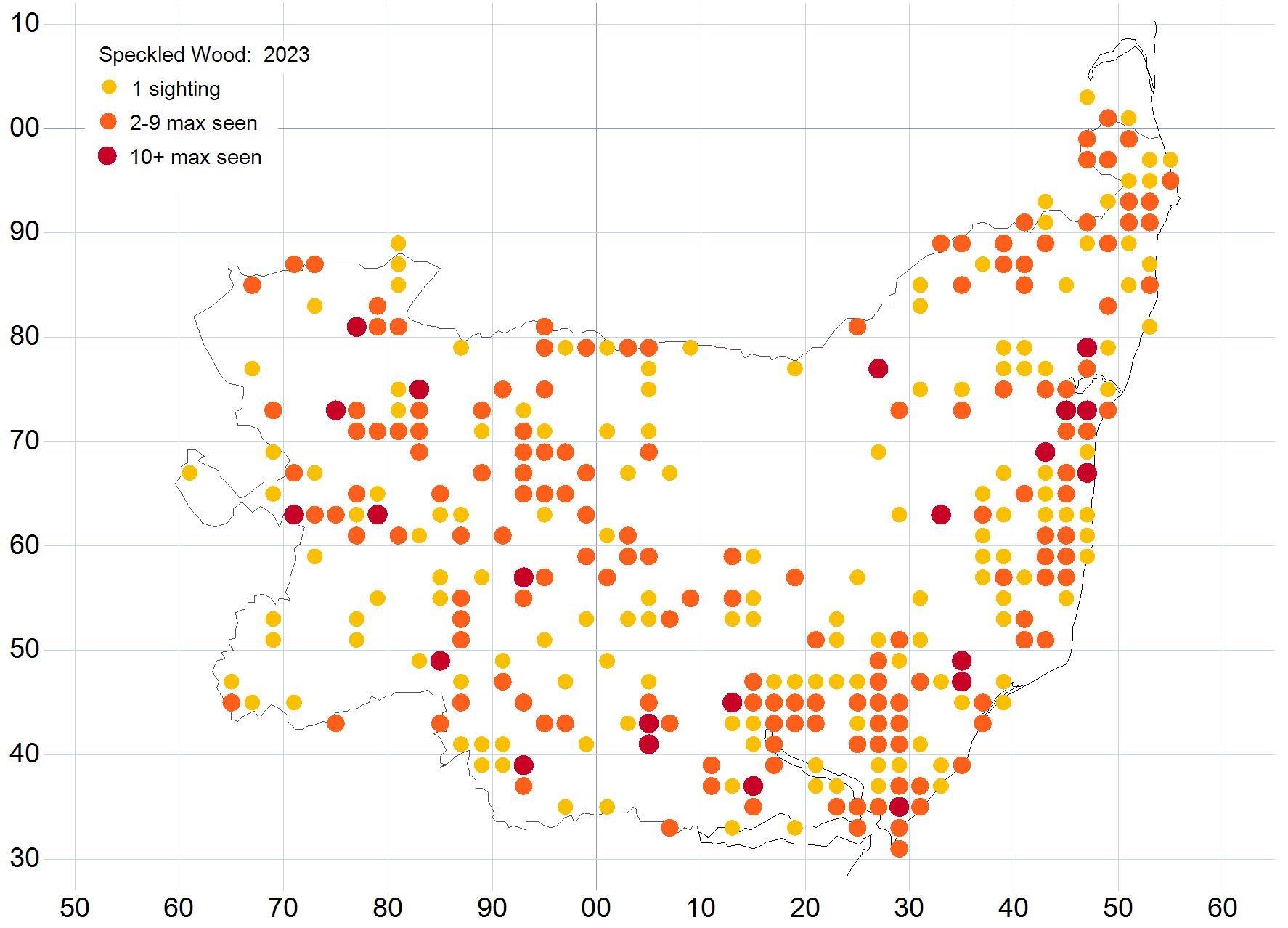
Speckled Wood: 2023
White-letter Hairstreak: 2023
Appendix 3: Flight Charts for Selected Species (2023)
Brimstone: 2023
Brown Argus: 2023
Comma: 2023
Common Blue: 2023
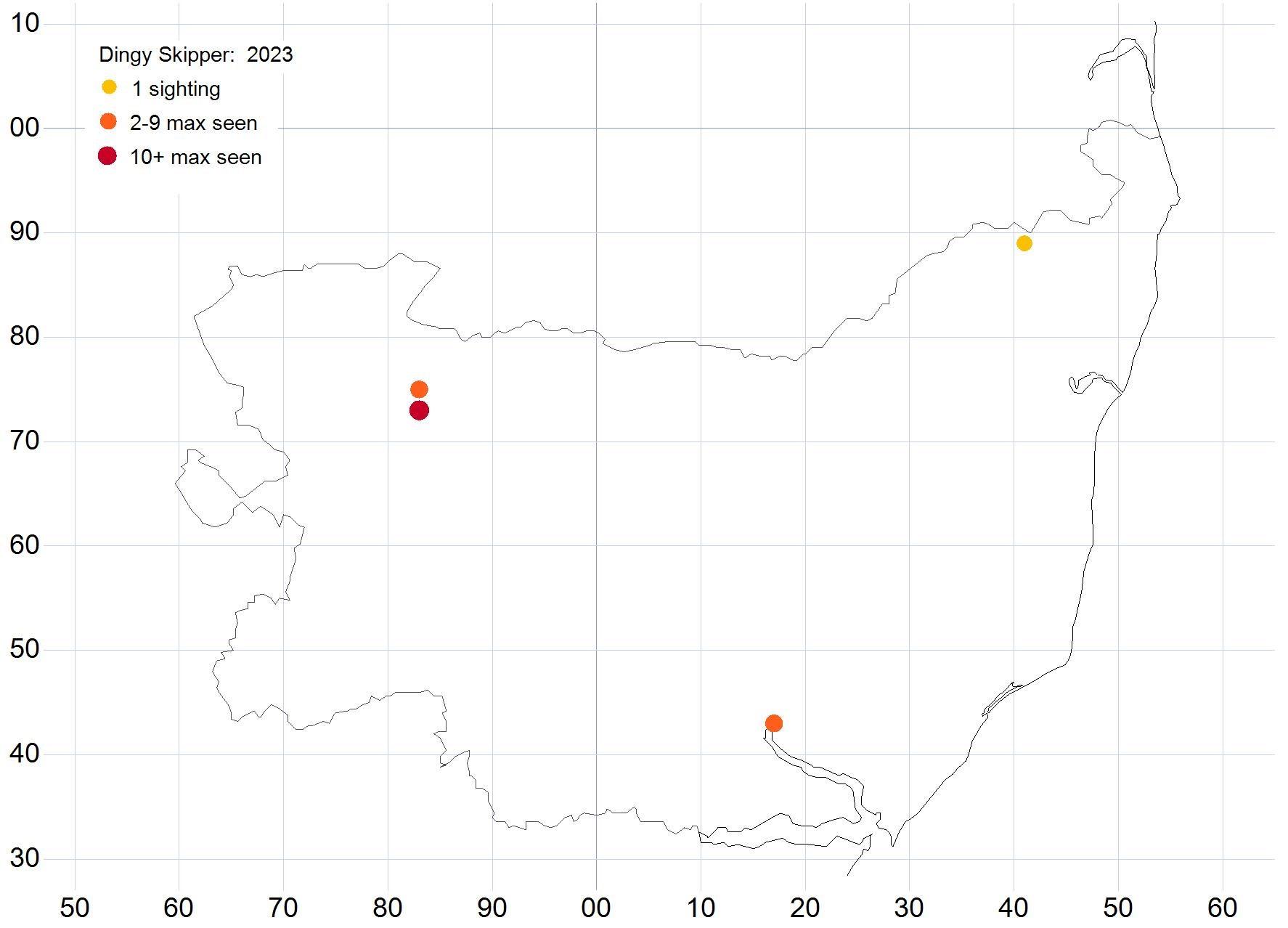
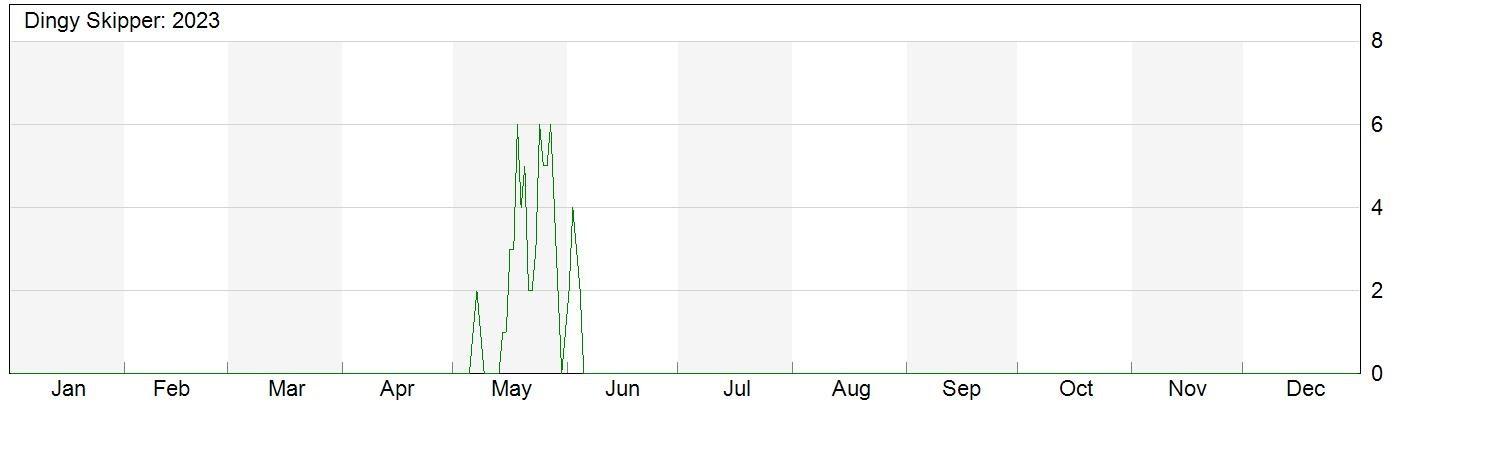
Dingy Skipper: 2023
Essex Skipper: 2023
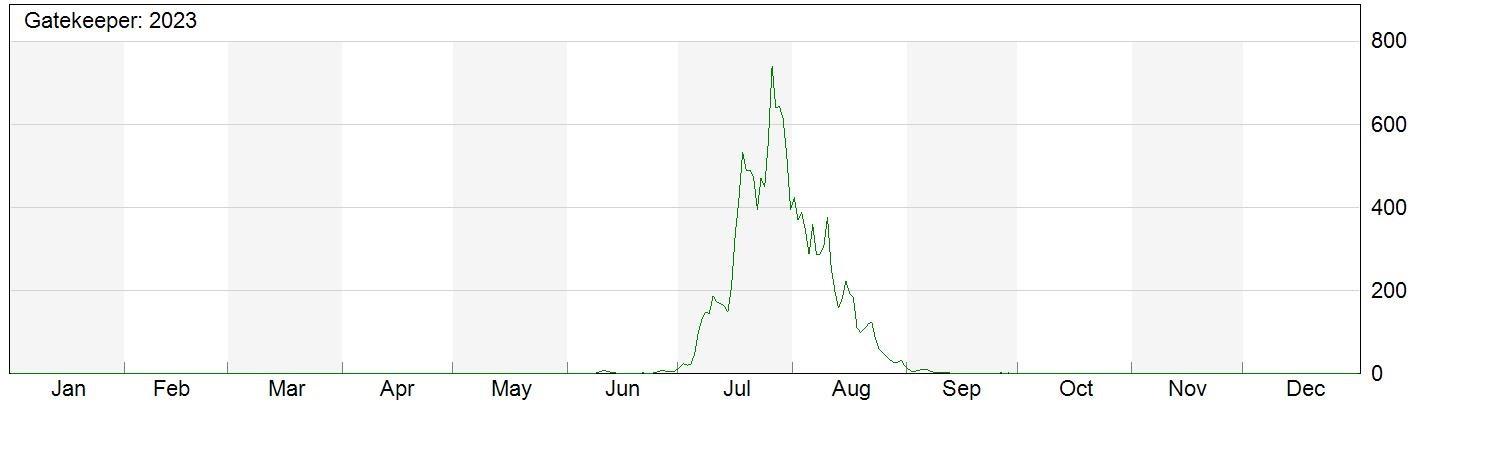
Gatekeeper: 2023
Grayling: 2023
Green Hairstreak: 2023
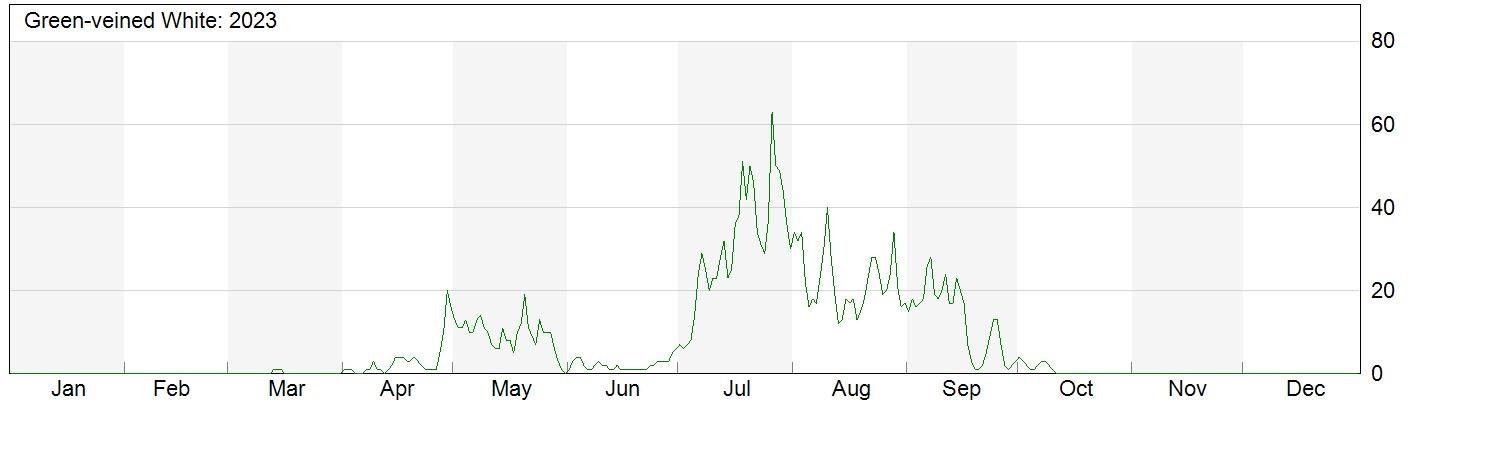
Green-veined White: 2023
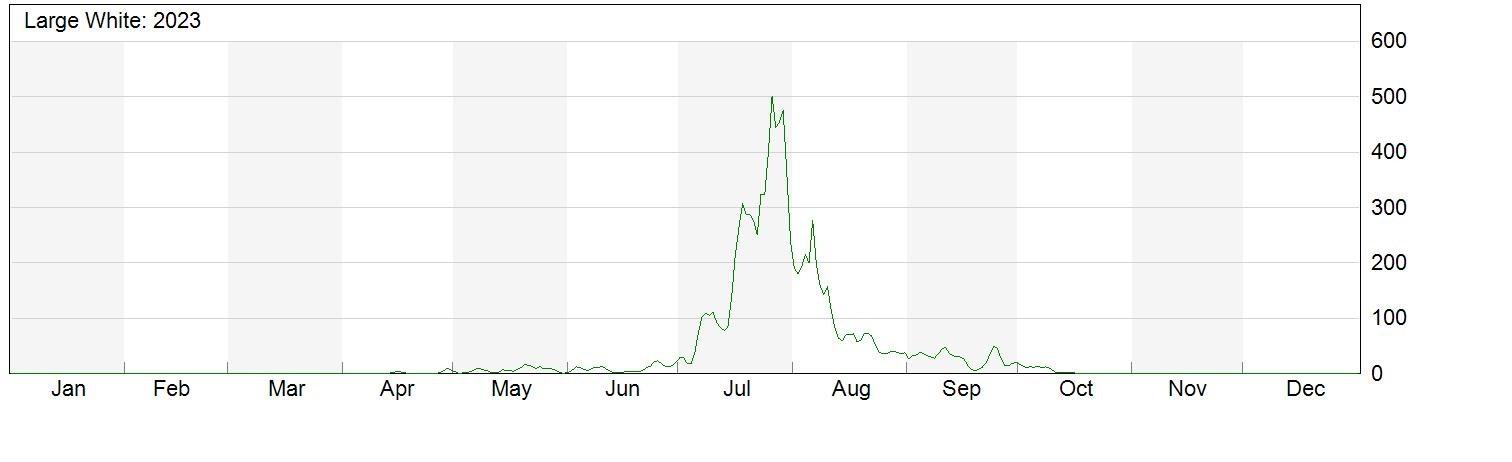
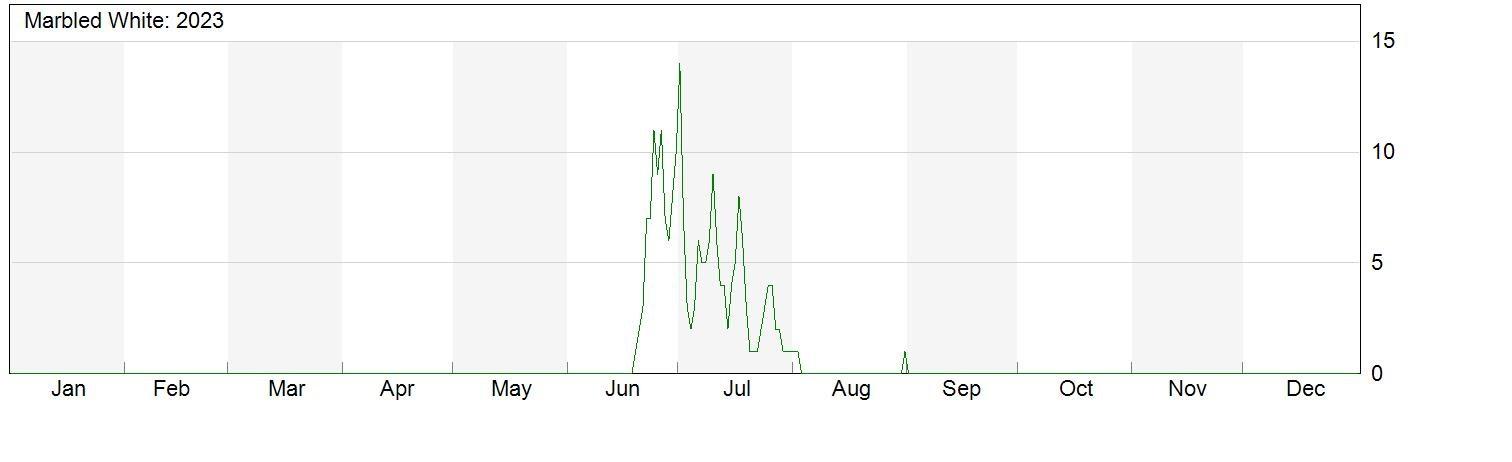
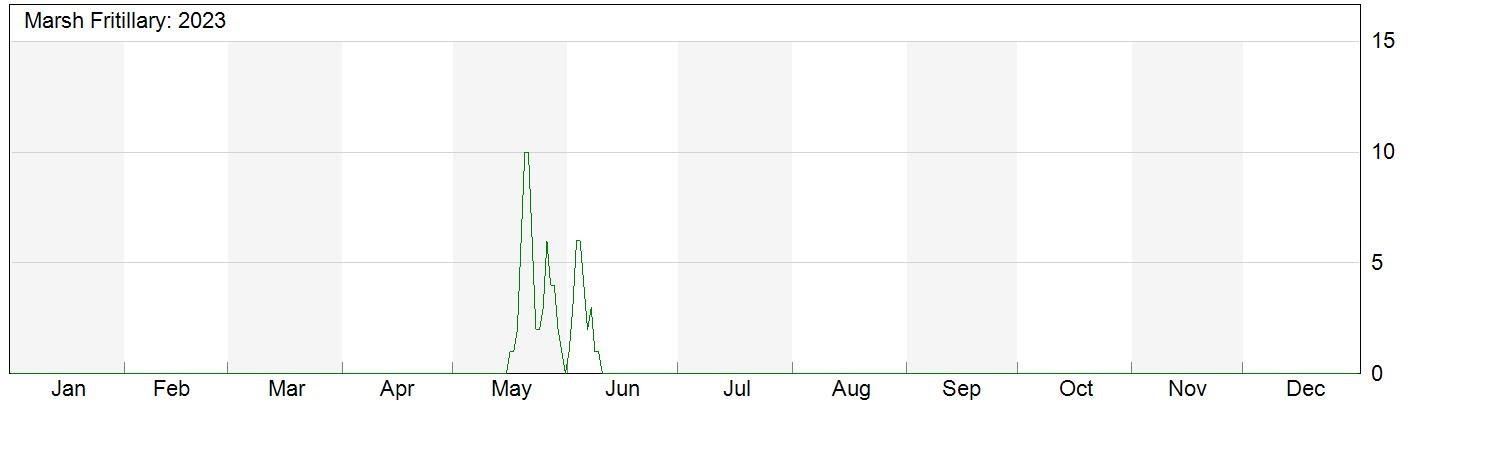
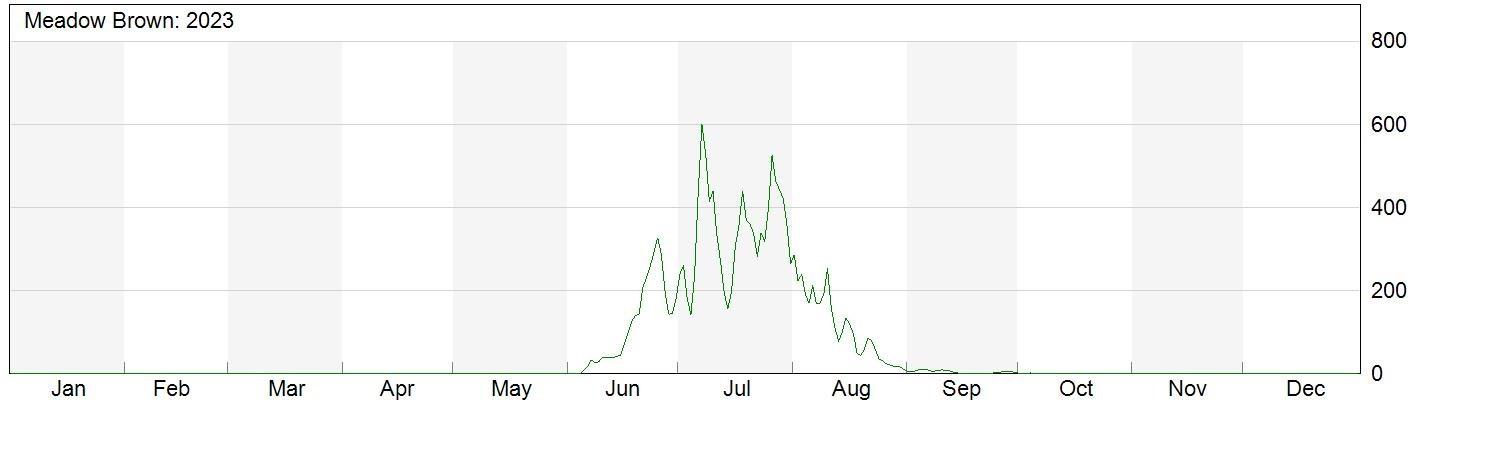
Purple Hairstreak: 2023
Red Admiral: 2023
Ringlet: 2023
Silver-studded Blue: 2023
Silver-washed Fritillary: 2023
Small Copper: 2023
Small Heath: 2023
Small Skipper: 2023
Small Tortoiseshell: 2023
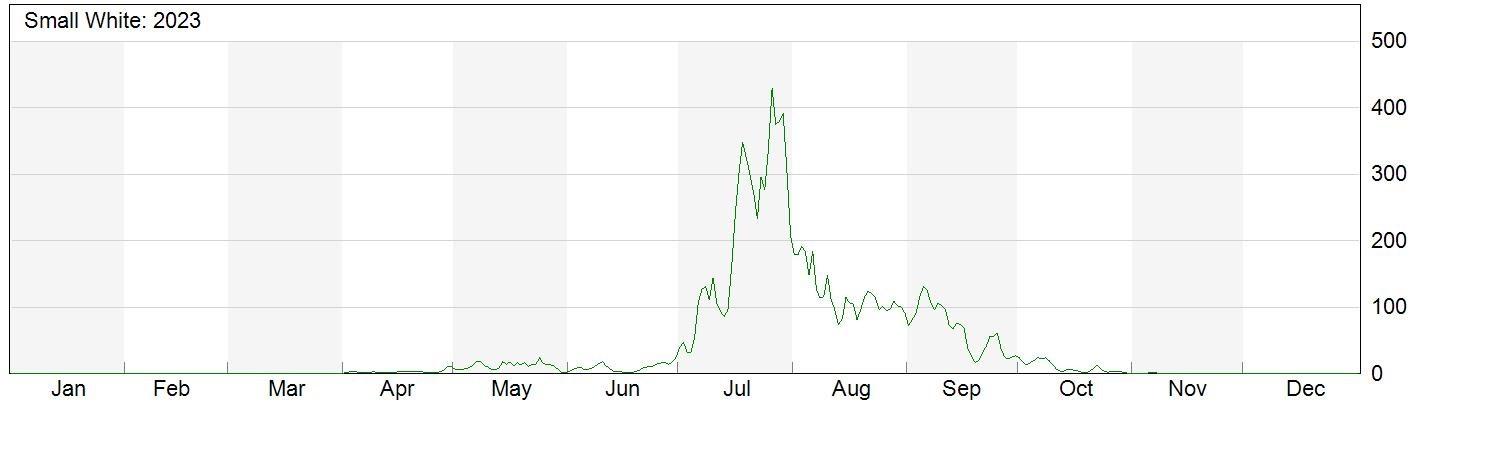
Small White: 2023
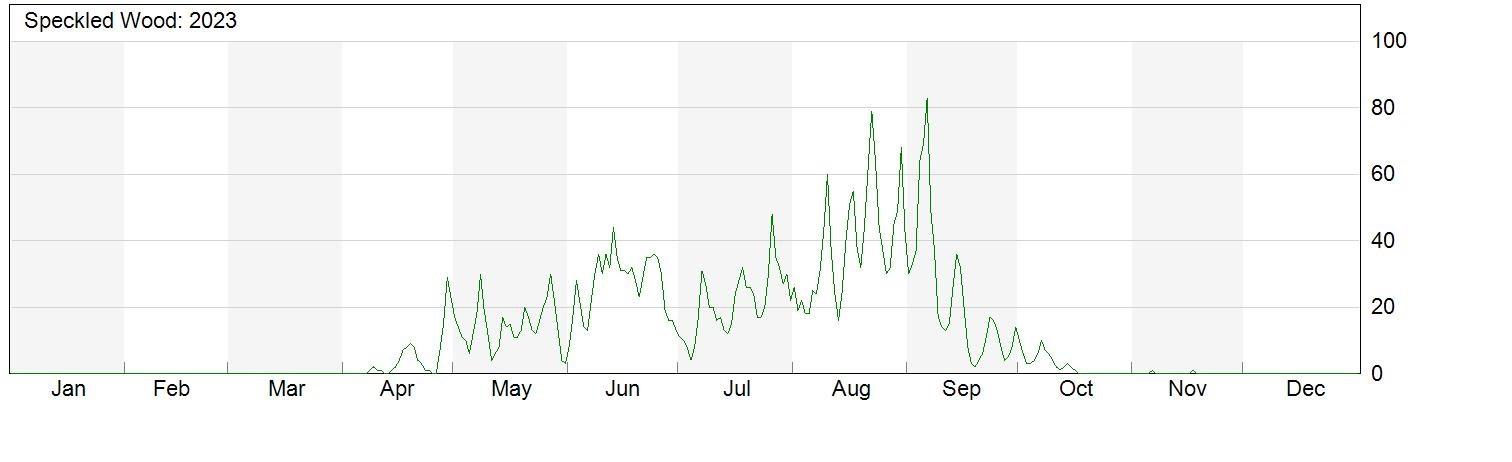
Speckled Wood: 2023
Wall: 2023
White Admiral: 2023
White-letter Hairstreak: 2023