CRYSTAL SEA SLUG ANTIOPELLA CRISTATA (ORDER NUDIBRANCHIA; FAMILY JANOLIDAE) AT WALBERSWICK, SUFFOLK
JIM R. ELLIS
The sea slug Antiopella cristata (Delle Chiaje, 1841), formerly Janolus cristatus and sometimes referred to as the ‘crystal sea slug’ or ‘crested aeolis’, is distributed widely in the shallow sublittoral of the eastern North Atlantic. It has been reported from the southwestern coast of Norway (e.g. at Tananger and Egersund; Evertsen & Bakken, 2005) to Morocco and the northwestern Mediterranean Sea (Thompson & Brown, 1984). It is generally found from the shallow sublittoral down to 40 m water depth (Thompson & Brown, 1984) but has been reported at 70 m water depth in the Mediterranean Sea (Toma et al., 2022).
Whilst it has been recorded widely around the British Isles, most of these records have been from along the southern and western coasts (e.g. Alder & Hancock, 1845–1910; as Antiopa cristata), and records from the eastern seaboard have generally been from the northern North Sea (Seaward, 1990; Thompson & Brown, 1984). Whilst not listed for Norfolk by Hamond (1972), data submitted to the National Biodiversity Network Atlas (https://nbn.org.uk/) indicate a moderate number of records from the north Norfolk coast, but seemingly only seven records from the coasts of Essex and Suffolk (Table 1). It has also been reported from other coasts of the southern North Sea, such as Den Helder in the Netherlands (Engel, 1936).
Table 1. Records of the sea slug Antiopella cristata along the coasts of Suffolk and Essex, ranked chronologically. Previous records from the National Biodiversity Network Atlas (https://nbn.org.uk/)
22/08/2010 -
20/06/2009Wreck of the “Fontenoy
22/08/2010 -
-
19/09/2014 -
20/06/2017 -
https:// nbn.org.uk/
07/08/2024 8 Present study Walberswick (harbour wall) 21/08/2024 1
Antiopella cristata has several characteristic features: it has a slightly translucent body, with larger individuals having a brown hue and white flecks. It has elongated cerata that surround the body (including around the anterior of the body), each having a narrow dark thread (digestive gland) and a blue-white tip. Additionally, there is a caruncle visible between the rhinophores (Picton & Morrow, 2023).
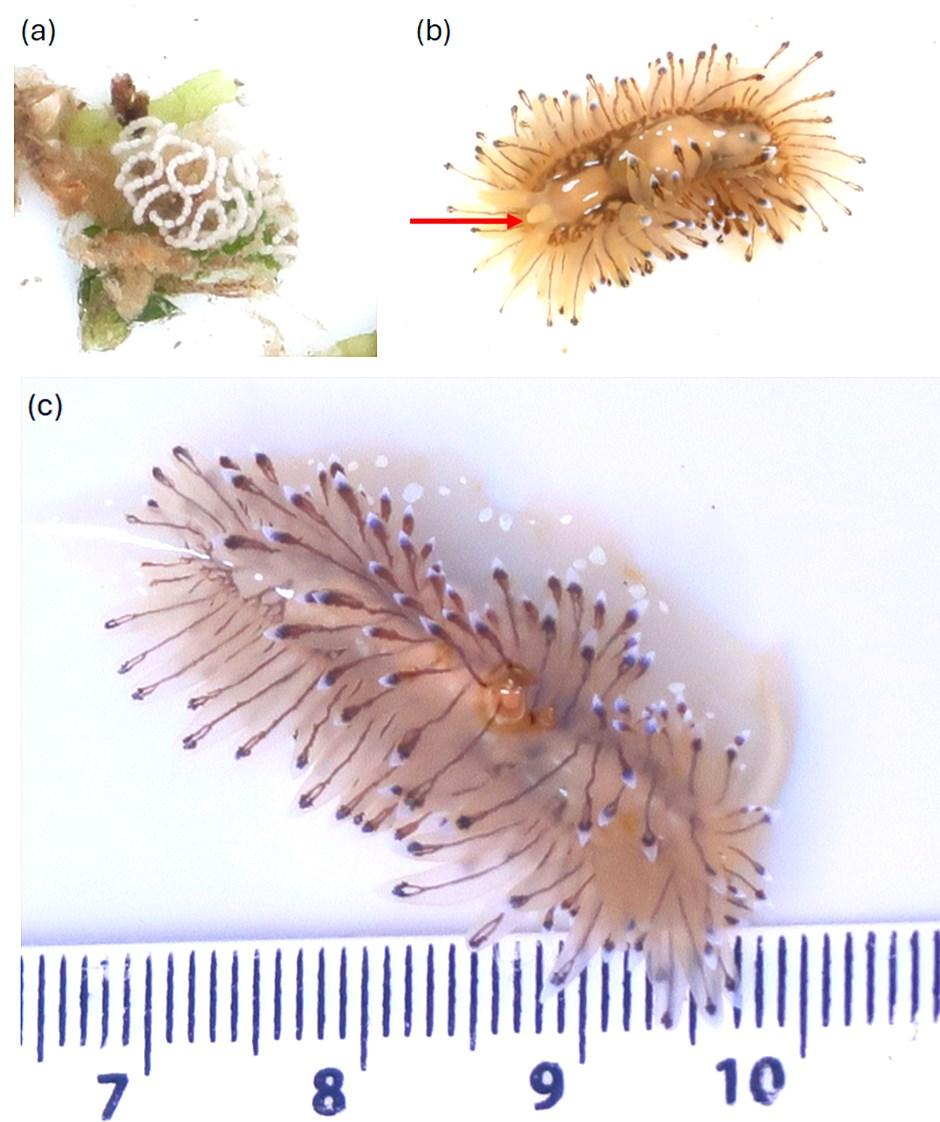
Figure 1: Sea slug Antiopella cristata from Walberswick showing (a) chain of spawn, (b) whole specimen showing the caruncle between the rhinophores, and (c) whole specimen with scale bar.
Given the limited number of records of this sea slug from Suffolk, it is noted here that multiple specimens of A. cristata were observed in 2024. Eight individuals were observed on the seaward side of the harbour wall at Walberswick (ca. 52.3139°N, 1.6728°E) at low water during spring low tides on 7 August 2024, with spawn also present. A further specimen that was actively laying eggs was recorded at the same
site on 21 August. No specimens were observed on comparative low-water sampling during either July or September. The largest specimens observed were approximately 25–35 mm long (Fig. 1). All were found close to the base of the harbour wall in shallow water, with this section of wall covered with hydroids, tube-forming polychaetes, and bryozoans. Among the bryozoans, Bugula is a known prey item of A. cristata (Picton & Morrow, 2023).
Another species of sea slug, Thecacera pennigera, which was reported from Walberswick last year (Ellis, 2023), was again seen in the same location in the summer of 2024 (7 August: two specimens; 21 August: three specimens; 22 August: two specimens; 6 September: four specimens; 18 September: one specimen).
Acknowledgements
Thanks to Peter Barry (CEFAS) for commenting on the manuscript.
References
Alder, J. & Hancock, A. (1845–1910). A monograph of the British nudibranchiate Mollusca. London: Ray Society.
Ellis, J. R. (2023). Occurrence of the sea slug Thecacera pennigera (Order Nudibranchia; Suborder Doridina; Family Polyceridae) at Walberswick, Suffolk. Trans. Suffolk Nat. Soc., 59: 80–82.
Engel, H. (1936). The Netherlands nudibranchiate Mollusca. Zoologische Mededelingen (Leiden), 19(8): 103–116.
Evertsen, J. & Bakken, T. (2005). Nudibranch diversity (Gastropoda, Heterobranchia) along the coast of Norway. Fauna norvegica, 25: 1–37.
Hamond, R. (1972). The marine mollusca of Norfolk. Transactions of the Norfolk and Norwich Naturalists’ Society, 22: 271–306.
Picton, B. & Morrow, C. (2023). Nudibranchs of Britain, Ireland and Northwest Europe. Second Edition. Wild Nature Press / Princeton University Press, 360 pp.
Seaward, D. R. (1990). Distribution of the marine molluscs of north west Europe. Nature Conservancy Council (Peterborough, UK), 114 pp.
Thompson, T. E. & Brown, G. H. (1984). Biology of opisthobranch molluscs. Volume 2. London: Ray Society, 229 pp.
Toma, M., Betti, F., Bavestrello, G., Cattaneo-Vietti, R., Canese, S., Cau, A., Andaloro, F., Greco S. & Bo, M. (2022). Diversity and abundance of heterobranchs (Mollusca, Gastropoda) from the mesophotic and bathyal zone of the Mediterranean Sea. The European Zoological Journal, 89: 167–189.
J.R. Ellis
CEFAS, Pakefield Road, Lowestoft, Suffolk, NR33 0HT