DIPTERA REPORT 2021
PETER VINCENT
Hoverflies are probably the family of flies that are most familiar to the general naturalist. Their appeal lies in the fact that apart from being in the most part rather attractive insects they are frequently encountered in gardens and urban areas as well as in the countryside. They may not garner as much attention as butterflies, moths or dragonflies, but the current interest in pollinators means they have been gaining a higher profile than once was the case. Some recorders are just happy to recognise the commoner and more obvious species without taking specimens, while there are plenty of taxonomic challenges for those who wish to take their interest a stage further. Indeed, for many an interest in hoverflies is a stepping stone to further study of the fascinating world of dipterology. Nowadays the study of hoverflies is much aided by the excellent, field guide by Ball & Morris (2015), and identification keys provided by Stubbs & Drake (1996). The Dipterists Forum Hoverfly Recording Scheme host a Facebook group, which as well as providing a simple way of adding records to the recording scheme database, means that photographic images of hoverflies can be posted online allowing identifications to be made or confirmed.
Although, hoverflies are the most studied and recorded family of flies in Suffolk, with about 180 of the 280 British species known from the county, new species continue to be added to the Suffolk checklist. These can be of species that have recently arrived in the country by natural migration from continental Europe or by accidental introductions, or they can be hoverflies that are considered long standing native British species - but because of their rarity have previously not been seen in the county. In the past year I have been made aware of two species of hoverfly that are new to Suffolk; one is a relatively recent arrival into Britain, probably brought in with imported plants, and the other a scarce native hoverfly hitherto not recorded from Suffolk.
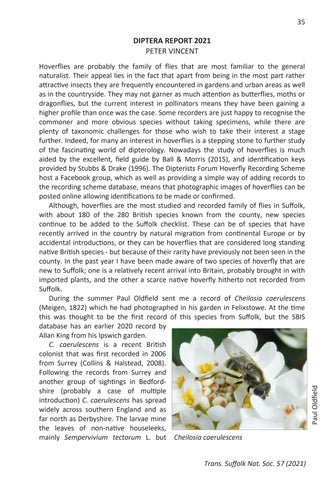
During the summer Paul Oldfield sent me a record of Cheilosia caerulescens (Meigen, 1822) which he had photographed in his garden in Felixstowe. At the time this was thought to be the first record of this species from Suffolk, but the SBIS database has an earlier 2020 record by Allan King from his Ipswich garden.
C. caerulescens is a recent British colonist that was first recorded in 2006 from Surrey (Collins & Halstead, 2008).
Following the records from Surrey and another group of sightings in Bedfordshire (probably a case of multiple introduction) C. caerulescens has spread widely across southern England and as far north as Derbyshire. The larvae mine the leaves of non-native houseleeks, mainly Sempervivium tectorum L. but Cheilosia caerulescens
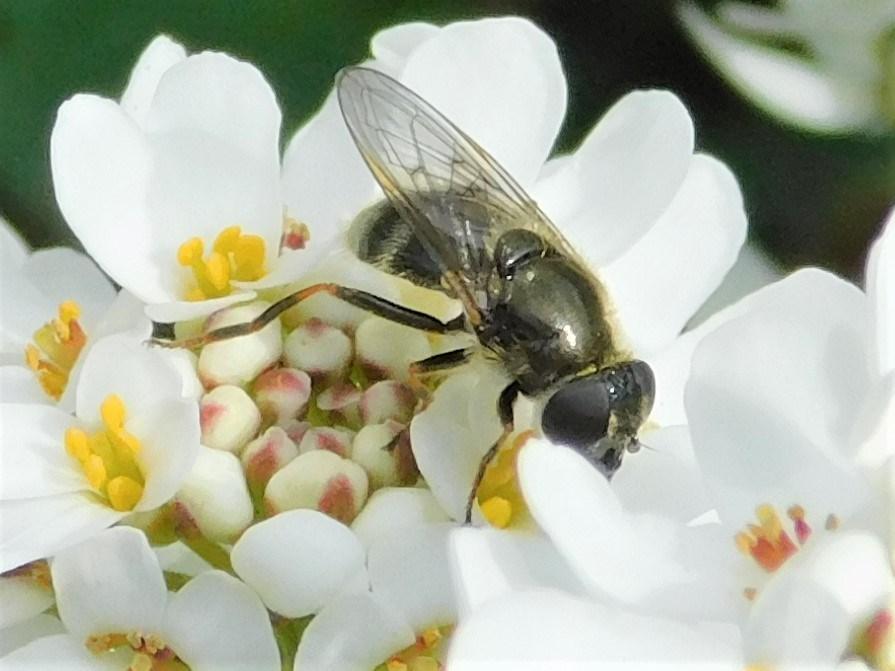
also S.montanum L. and S.arachnoideum L. It is presumed that the fly was introduced accidentally with imported plants, probably from the Netherlands where C. caerulescens is well established (Ball. et al., 2011). It is relatively easy to identify, being a medium-sized, bare-eyed, bluish-grey Cheilosia with pale knees and distinct markings over the two cross veins of the wings. The lower face is rather strongly protruding, the third antennal segment is brownish-red, and the antennal pits are fused. C. caerulescens appears to be bivoltine as adults can be found both in late spring and in late summer-early autumn. The other hoverfly new to Suffolk, a rare native, is Meligramma euchromum (Kowarz, 1885). It is early flying, and perhaps has been overlooked amongst similar looking hoverflies. It was found by Adrian Knowles in Raydon Great Wood in April (see elsewhere in these Transactions).
In addition to species mentioned above, some interesting and uncommon species that have recently been recorded from Suffolk include, the Agromyzids, Chromatomyia milii (Kaltenbach, 1864), Agromyza cinerascens Macquart, 1835, and Liriomyza flaveola (Fallén, 1823), the Anthomyiid, Pegomya transgressa (Zetterstedt, 1846), the Chironomid, Synendotendipes impar (Walker, 1856) [1st Suffolk record], the Chloropid, Calamoncosis glyceriae Nartshuk, 1958, the Dixid, Dixa submaculata Edwards, 1920 [2nd Suffolk record], the Empidids, Hilara flavipes Meigen, 1822, H. litorea (Fallén, 1816), Kowarzia bipunctata (Haliday, 1833), Rhamphomyia tibiella Zetterstedt, 1842, and R. variabilis (Fallén, 1816), the Hybotid, Drapetis exilis Meigen, 1822, the Limoniids, Lipsothrix remota (Walker, 1848), and Tasiocera murina (Meigen, 1818). the Muscids, Phaonia fuscata (Fallén, 1825) and Spilogona denigrata (Meigen, 1826), the Pediciid Dicranota pavida (Haliday, 1833) [2nd Suffolk record, the first since 1928], the Piophilid, Stearibia nigriceps (Meigen, 1826), the Platypezid, Agathomyia viduella (Zetterstedt, [1838]) the Psychodid, Boreoclytocerus ocellaris (Meigen, 1804), the Sarcophagid, Sarcophaga anaces Meigen, 1826, the Syrphid, Triglyphus primus Loew, 1840, the Tachinids, Huebneria affinis (Fallén, 1810), Loewia foeda (Meigen, 1824), and Panzeria rudis (Fallén, 1810), the Tephritid, Tephritis praecox (Loew, 1844), and the Ulidiidae, Dorycera graminum (Fabricius, 1794).
References
Ball, S.G., Morris, R.K.A, Rotheray, G.E. & Watt, K.R. (2011). Atlas of the Hoverflies of Great Britain (Diptera, Syrphidae). Wallingford, Biological Records Centre.
Ball, S.G. & Morris, R.K.A (2015). Britain’s Hoverflies: A Field Guide. 2nd Ed. Woodstock, Oxfordshire, Princeton University Press. Collins, G.A & Halstead, A.J. (2008). Cheilosia caerulescens (Meigen, 1822) (Diptera, Syrphidae) new to Britain. Dipterists Digest (second series) 15: 23-26.
Peter Vincent Pennyfields, Rectory Road, Middleton, Suffolk IP17 3NW