BEYOND THE WORLD OF GHIBLI: ‘A TRUE TAKE ON LIFE’
A Study of the Journalisitc Aspect of Anime, and the Animes Inspired by Real Incidents
Sudeshna Ghoshal
PGDIMJ23090
Mentor: Shalini Shah
Dissertation submitted to Asian College of Journalism in partial fulfillment of the requirements for the Postgraduate Diploma in Integrated Multimedia Journalism
March 2024
ACKNOWLEDGEMENTS
I want to sincerely thank my mentor, Shalini Shah, who helped me narrow down my topic and guided me throughout the process of writing along with restructuring, without which the dissertation would not have been possible.
I would also like to acknowledge my college, Asian College for Journalism, for providing me with the opportunity of covering a topic of my interest, at large. I would also like to thank our librarian, Mr. Magesh Kumar for providing me with journals, and books that were not easily accessible.
I would also like to thank my film elective professor, Dr. Uma Vangal, and filmmaker Aswath Nair for their insights, my former colleague, and anime enthusiast, Steve Fernandez for helping me shortlist the animes, and respondents for taking out time to fill the survey form for my findings. I would also like to thank the employees of Writer’s Cafe, Adyar, for their kindness, and patience in allowing me to spend a considerable amount of time at the cafe and write.
Introduction: Anime could be more journalistic than you think “ Literature is more journalistic than you think,” professor K. Nagaraj had mentioned during the Covering Deprivation lectures conducted by the Asian College of Journalism. Although contrary to popular belief, the same can be said about anime. While many consider anime to be a mere world of fantasy, or children’s cartoon, several shows based on incidents from around the world, render this notion a lie. As anime begins to be included in media and literature syllabi across the globe—this genre too, is replete with journalism.
Findings reported that Studio Ghibli productions are the most preferred animes for the sense of peace they evoke, while people were largely unaware about animes based on true stories, and Ghibli’s use of dark themes. However, an exploration of certain animes, reveal otherwise.
Interviews with film scholars, filmmakers, and anime enthusiasts further pointed out how anime is the best medium for depicting true stories.
Chapter 1
What is anime; An ‘invention’, or animation?
Despite the ever-growing popularity of anime, very few people have analyzed what the term ‘anime’ denotes—let alone, the ‘anime-heads’, who boast of being anime fans ever since its inception. As Brian Ruh (2014, p.164) notes in “Conceptualizing Anime and the Database Fantasyscape,” “ Most simply equate ‘anime’ with ‘Japanese animation’; this is a relatively easy ‘out’ in order to get past tricky questions of definition.” However, anime fans, find such definitions to be problematic as all animations from Japan cannot be considered anime. So then what exactly is anime? What we know as anime today, was called Japanimation much before, during the late 1980s and early 1990s. Brian Ruh (2014, p.165) highlights the first usage of the word, “ Anime historian Fred Patten traces the first use of the word ‘Japanimation’ to around 1968, shortly after anime fandom became formalized with the establishment of the first U.S anime fan club, called the Cartoon/Fantasy/Organization(CFO), in May 1977.”
As experts debate over the precise definition of anime, some defend their use of Japanimation to focus on the characteristic styles and geography this form entails, while others stick to how anime is viewed on screen, how “ it indicates a way of positioning images and information onscreen and how viewers interact with them.”(Ruh, 2014, p.166)
Stylistically recognized as Japanese, anime has evolved as a globalized form of creative expression. The author of Frames of Anime, Tze-Yue G.Hu (2010, p. 16), considers anime a “ success, that went without the push of major corporations.” Much more than a media product,
anime–on the whole, demonstrates the ability of actors from varied backgrounds, who have contributed to the transformation of anime from a cultural niche into something that has a global reach and worldwide audience. Expanding from a mere child’s play, or children’s genre, the world of anime has transformed into a sphere of relevance for teenagers and adults alike. It is this “ collective engagement” that Ian Condry (2013, p.12) refers to as the “soul of anime”. “ For me, the soul of anime does not point to some ultimate, internal essence of the media as an object. Rather, the soul of anime points to this social energy that arises from our collective engagements through media, and as such, it gives us an alternative way to think about what is of value in media. This, in turn, suggests dynamics for producing creative platforms on which to shape new futures.” (Condry, 2013, p.12)
Weaved within a blend of fantasy and magic, animes showcase the world through non-photoreal depictions. Such frames, thus build alternative worlds and thereby give rise to the need for anime theories, as has been discussed earlier. Alistair Swale (2020, p. 199), follows a similar trail of thought as she writes, “Theories particular to anime are often developed to account for these idiosyncrasies with a tendency to treat anime as a distinct genre rather than part of cinema more broadly.”
Fantasy, being a characteristic feature of anime, brings in profound cinematic experience. The animated images provide for a greater agency, and open possibilities for travelling beyond the realms of memory and consciousness–thus creating a surreal, yet realistic world, which might have otherwise been challenging in cinema. According to a journal article “Anime and the Conquest of Time”(Swale, 2020, p.205), “Cel -animated images in particular transpose a character on to a figure that is not necessarily ‘life-like’, allowing us to engage with such figures
with the full force of our imagination, particularly if they deal, even obliquely, with deeper, more implicit references to emotional experience.”
Chapter 2
Anime: The Evolution
Drawing inspiration from the American cartoons that formed a part of the Japanese cinema screens, G. Bendazzi, in his Cartoons: One Hundred Years of Cinema, traces the beginning of anime to “ in around 1910, some local artists wanted to try their own skills as animators.” (G. Hu, 2020, p. 75). On the other hand, Taiwanese filmmaker and scholar Fan Jian-you(1977, p.34), traces the roots of Japanimation from France. The first animation film Fantasmagorie (1908), was directed by Emile Cohl. Spanning over a minute, and forty-five seconds–the film largely consists of a ‘stick man’ moving around several objects, such as a wine bottle, that continuously keeps metamorphosing–from bottle to flower, then an elephant, and the series continues. Such animations of some simply hand-drawn lines, made the Japanese realise, what Jian-you (1977, p. 34) calls the “potential of animating pictures on the screen.” However, scholars such as Yamaguchi, and Watanabe (1977, p. 22) noted that such graphics in the form of ‘lines’, were already a part of Japanese native drawing techniques, or the traditional magic lantern show, called the utsushi-e. The works of European animators, such as Oskar Fischinger–who worked with abstract animation, and Lotte Reiniger further influenced the Japanese animators, whereby animes also came to be recognized as zenei eiga(avant-garde film), educational, and cultural films (Yakota, 2013, p.100).
As the adage goes, “ birds of a feather flock together,” the founding fathers of anime consisted of the trio of Shimokawa Outen, Kouchi Junichi, and Kitayama Seitaro. Although united by their common forte for animation and the success of each of them completing his first animated film in 1917, the three men specialized in different genres. While Shimokawa worked with satire, and
Kouchi was a political cartoonist, Kitayama was trained in the Western tradition. Besides their individual contributions, and experimentations with varied forms, the trio’s work with their disciples and apprentices further vehicle the development of Japanese animation. For instance, the animation film department at Nikkatsu Film Company was set up on Kitayama’s proposal, and Kouchi’s apprentice, Ofuji Noburo, invented the use of figurines cut from Japanese translucent paper for animations. Shimokawa, on the other hand, often collaborated with film companies to craft animations for them (G. Hu, 2020, p. 220)
During the late 1920s, as the Japanese audience began to get familiar with Disney animations that had sound effects—animators started scouting for sound specialists in animations while strategizing how to counter the increased production costs that came with music composition and performance. Over time, as Disney animations continued to amaze the audience, and made Japanese animation film producers ponder over possibilities, the immensely popular Silly Symphonies made animators think globally. “ The idea of export of Japanese made animation was thus germinated, and it was believed that domestically made animation would have market support in foreign lands,” (G.Hu, 2020, p. 78) as Japanese animators realized that exporting and distributing their works across borders would substantially minimize the costs of production. The craft of animation now came with an enterprising vigour, as to put it in Yamaguchi and Watanabe’s (1977 p. 27) words, “because they can be sold.”
The success of the anime industry can further be attributed to the exponential growth of the photographic film industry, which got immense support from the erstwhile government.
According to the Sogyo ninjunen no arumi, that G. Hu refers to, in 1933, the Fuji Film Company
received around 1.2 million yen, equivalent to Rs. 6,62,351.30 in 2024. The animes developed during this period moved beyond and intermingled the confines of children’s as well as adult genres:
“Japan’s Japan ( Nippon no Nippon)
World’s Japan ( Sekai no Nippon)
Janpan’s World ( Nippon no Sekai)” (Eigaenzetsu :Seji no ronrika, 1926)
Such was the identity crisis of Japan, that Kouchi highlights in his 32-minute film. The plot further digs at the rhetorics of politicians and intellectuals, accompanied by visuals of a sinking ship confused about its navigation in the Pacific Ocean—thus portraying Japan’s fear (G. Hu, 2020, p.79) As several categories of films, such as documentary, and animation, increasingly began to portray Japan’s social crisis in the face of the Sino-Japanese war, the Motion Picture Control Committee of 1934 put films under government control.
The banning of war films meant a subsequent increase in screening space, thereby paving the way for more domestic short films, most of which were animated. The government set up the Culture Film Division (bunka eigabu) and ordered more educational films, for which animation turned out to be the most suitable medium. Gradually, animation became a space for all: creatures from the animal kingdom, sports, and Olympic events built the scene for disseminating educational values of unity, and diversity–thereby softly covering the cracks of Japan’s previously portrayed identity crisis.
Eventually, after a series of trials and tribulations, Toei Animation was formed in 1951. The industry went through further roubles, and disagreements till in 1958, when Hakujaden was screened. It was an immense success, as the founder Okawa Hiroshi had promised: “We shall progressively produce, and give birth to American-Disney’s professional standard of animated films”(G.Hu, 2020, p. 106). A job at Toei, was soon every graduate's dream, among whom were the stalwarts Miyazaki Hayao, and Takhata Isao.
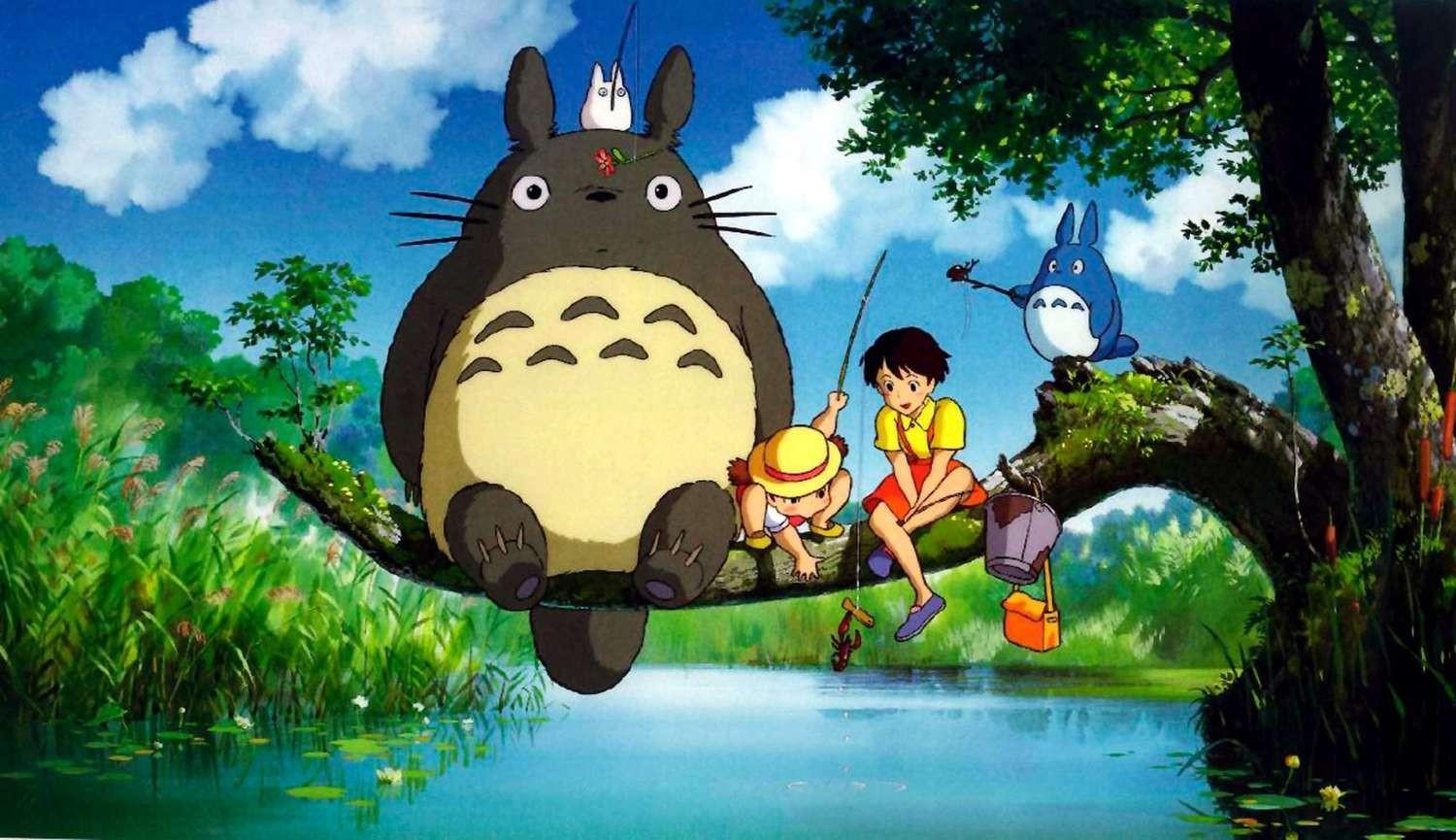
It was in 1950, when late manga artist Tezuka Osamu became the richest commercial artist, and Toei decided to collaborate with him. Gradually there was the blending of animation, and manga, giving birth to the gekiga–the new comic. Eventually, Miyazaki and Takahata co-founded Studio Ghibli, which gave rise to popular animes such as My Neighbour Totoro, and Princess Mononoke (G. Hu, 2020, p. 137) These films centered around co-existence, and saving the earth–themes intrinsic to Japanese culture, thereby creating a sense of ‘deja vu’ among the audience, and became immensely popular. Such an indigenous drive, consequently transformed anime to “Disney’s professional standards,” thus becoming what G. Hu (2020, p.72) calls the “ Disney of Asia.”
Escaping the Confines of Japan’s Media Market: The Growing Popularity of Anime
Movies get famous, they bag Oscars. Countries rank higher, or lower than one another when it comes to several parameters like economy, military capabilities, press freedom index, and a range of other factors. Amidst such a scenario, it wouldn’t come as a surprise if one were to think–-How did a toon product from a country get so popular? Japan, which is widely known for its cutting-edge innovations in technology, and high exports of Toyota, and Honda, has another feather to its cap–anime. Let alone the widespread demand for Nissin noodles–an instant ramen, which, according to a report (PR Newswire, 2023), has seen an increase in its sales by 41 percent in 2023.
As Tze-Yue G. Hu (2010, p.16), writes in Frames of Anime-Culture and Image Building, anime can broadly be defined as a “late-twentieth-century Japanese ‘invention’ that fascinates and dominates the world. It does not come in a hard form, quantifiable, as in metal or in liquid state with tactile and tangible qualities.” Speaking of how this “invention” became popular, Tze traces the success to two decades back when Japan–the world’s second-largest economy, was “ on a shopping spree,”(2010, p.16). Actively involved in investing in North American media corporations, which were known for successfully churning Hollywood films and pop stars–Japan further had its eyes on the famous paintings of water lilies and sunflowers by Vincent Van Gogh and Claude Monet.
Besides investing in Western products, Japan also contributed to the global economy by increasingly harnessing its technological prowess. High-display televisions, walkmans, video players, and several other electronic products became the demand of the hour. Japan was a “corporate world”, as “it was increasingly known in the 1970s onwards that the Japanese government worked closely with the nation’s business sector in order to compete internationally.
This corporate world has been nicknamed Japan Inc” (G.Hu, 2010, p. 243).
It is from Japan Inc., that Sony Corporation, one of the leading manufacturers of audio, video, and communication technology products, emerged. Towards the late 1980s, Sony collaborated with major American businesses such as Columbia Pictures, and Tristar Pictures–which gradually became its subdivisions. As G.Hu ( 2020, p.17) refers to Harris, who states that Sony wanted to transform into a “science-and information-based company,” as a branch to their already existing base in electronics. “ In other words, Sony wanted to tap into the creative enterprises of Hollywood; by owning part of Hollywood, it would help boost its worldwide business expansion.”
Until the early 1990s, anime was often known as “limited animation”, or to put it simply, “ a form of cheap animation ” that served as a toon entertainment ( G. Hu, 2020, p. 17). Comprising two, or three animated frames per second, the creation of anime was budgeted, leading to the formation of a cel-based type of animation. The frequency of two, or three frames was substantially low, as compared to the standard twenty-four animated frames per second, intended for mass viewership. This “limited animation”, which was previously called ‘kawaii’ — the Japanese term for ‘being lovable or cute’, got a new name: ‘Japanimation’. The name
Japanimation was instrumental in uplifting the lowly and “cheap animation” connotation to a status, where anime was to expand, and could no longer be ignored.
It was only around the 1997s to 2000s onwards, that the craze for Pokemon in the US markets revealed anime’s power to render Japan as something more than a tech giant. Luke Winkie (Vox, 2021), in his “Pokemon will outlive us all”, writes how, in 1998, any grade school student in the United States would probably remember Pikachus, Charmanders, and Squirtles as a top favourite in children’s entertainment. The storm played a pivotal role in reshaping playing cards and fastfood toys. Winkie, who is a features writer with the Vox, notes that “ A wildly popular Nintendo franchise, Saturday morning cartoon, and trading card game, Pokémon had all the hallmarks of a flash in the pan.” Such was the craze, that Winkie pens his personal experience of how his collection of cards was solely on Pokemon. “ Within a week, the principal had banned Pokémon at my school, and my mom enforced a strict moratorium on all collectible cardboard in our household”( Winkie 2021). The grand craze of Pokemon that spread at lightning speed further saw “ the grand courting of Studio Ghibli for worldwide distribution of rights of its animated works.” (G.Hu, 2020, p.17)
‘Netflix and Chill’: The Increase in the Viewership of Anime
While anime became successful in becoming the ‘Disney of Asia’, the product further owes its widespread acclaim to the streaming platforms, that carried forward the anime’s glory decades later–in the twenty-first century. Crunchyroll is one such anime streaming giant, which has been the biggest anime-centric streaming platform since 2010. Although there are several other renowned companies like Funimation which started way ahead, Crunchyroll’s success surpassed its predecessors in no time.
“We help everyone belong. That’s our mission,” reads Crunchyroll’s ‘About Us’ section on its website. An independent venture between Sony Pictures Entertainment, and Japan’s Aniplex–two subsidiaries of Japan Inc., Crunchyroll went live in 2006. As a user-generated pirated site, it allowed fans to upload anime videos and movies. The founders–four graduate school students kept the site running with donations, till a company called Venrock invested over $4 million into Crunchyroll, thus enabling them to become a legal streaming company.

As the number of anime fans continued to grow around the world, Crunchyroll gained eminence. According to a report published by Bloomberg (Kim, 2023), Crunchyroll was looking ahead to tap into the Indian markets, as the anime industry was estimated to be $20 billion. The deal was meant to be a promising one, as the president looked forward to India as one of the precursors of market growth. Since 2024, Crunchyroll has also been the biggest sponsor of Comicon events across India. The Mint (Laghate, 2023) further reported that India, with a 5.5% demand share, is viewed as the largest anime market after the US.
Besides exclusive streaming platforms, the rise of OTT platforms has also led to the increased viewership of anime. In the Voices blog of Times of India (June 29, 2022), Hansa Mondal, the chief operating officer of Ssoftoons–a Bengali regional animation company, mentioned how OTT platforms such as Netflix, and Amazon Prime, to name a few–have substantially boosted the animation industry. “ The advent of OTT platforms has provided a major boost to the animation industry as content is now perceived as a cross-platform Intellectual Property (IP).
Animated content delivered over OTT platforms fetches higher ROIs over longer shelf life,” wrote Mondal. She further said how producing animated content for TV incurs significant costs, as opposed to OTTs which deliver high return on investment (ROI). Aswath Nair, a 36-year-old filmmaker, and an anime enthusiast shared a similar view in his interview: “ Netflix has played a major role, actually a massive one in pushing anime, and anime culture.” “ I wish we had this much encouragement,” opined Nair, who has been watching animes since he was five.
Not only does OTT elevate the viewer’s experience, without any disruptions caused by TV commercials–but also categorizes shows according to age categories, thus making it easier for 16
the parents to filter what their children see. Although platforms such as Disney+, and Hotstar support ad streaming, Hansa Mondal said, the increased viewership had caused viewers to opt for subscription packs.
“The Indian animation market is expected to reach INR 180 billion by 2024 at a growth rate of 29%. Animated content has audiences across different age groups and the industry has been growing exponentially given the shift in consumption patterns. With cheaper data increasing access to OTT platforms, the demand for regional animated content has skyrocketed. OTT platforms are therefore investing in Indian animated IP to deliver fresh and diverse content that appeals to the taste and preferences of modern-day consumers,” further mentioned Hansa. Thus, as is evident, the development of OTT with the increasing popularity of anime, has evolved into a symbiotic relation over time–accounting for anime’s escape from its national confines.
Aswath Nair pointed out that an increase in the viewership of anime could also be attributed to the Comicon events across major Indian cities. “ The sheer scale of the event was much smaller compared to Delhi (the biggest con of the year) and even Mumbai. That said, we did see good numbers both in terms of attendees and cosplayers, so further events are expected to do even better,” said Syed Mohammed Yadullah Abidi–one of the volunteer supervisors for Comicon Chennai, while speaking about the first Comicon event of the city.
Moving Beyond Studio Ghibli: The Journalistic Aspect of Anime
According to a report published by the BBC (Rosney, 2023), the Reuters Institute has found a “sharp decline in appetite for news in recent years.” As compared to a figure of 63 percent in 2017, only 48 percent of people are interested in news in 2023, further mentioned in the research. However, a look at comics interestingly reveals that every superhero is either a journalist or a photographer by profession. This journalist is often found closely observing the superhero–to record and report the actions to the public or is himself a journalist–using his resources to get closer to the problem to either solve it, probe further into a potential threat, or investigate a villain.
Katherine Foss (2016, p.1) notes how popular comic characters such as Superman, alias Clark Kent, and Peter Parker, a.k.a Spiderman play the dual roles of superhero, as well as journalists.
Nonetheless, “celebration of journalism in comic books and their adaptations, public confidence in the profession has been steadily declining since the heyday of journalism in the 1970s,” opines
Foss (2016, p.2) in her “ No Longer Seeking "Truth, Justice and the American Way"
Anime follows a similar trail, showcasing scenarios inspired by true events, thereby offering a journalistic reportage through a different frame–contrary to its initial status of ‘cheap animation’.
While Studio Ghibli is the first name that might cross our minds when discussing anime, several underrated shows embody contemporary issues through their magical blend of colours and characters.
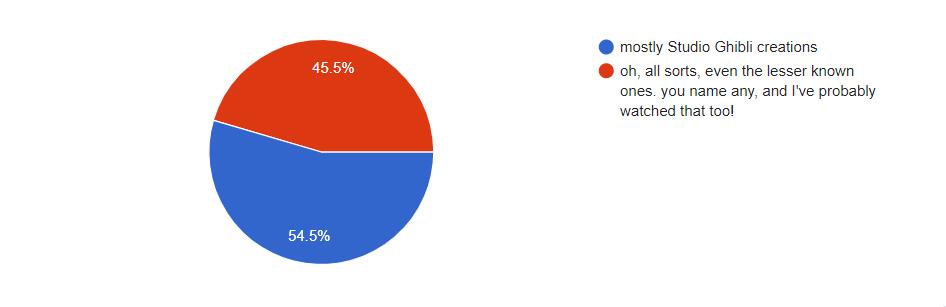
According to findings, in a group of 60 viewers, 54.5 percent of the group mostly watched Studio Ghibli creations. The survey also found out, that 50 percent of the group was unaware of animes based on true stories, or prevalent issues that vehicle the series–as they were more hooked on “the sense of peace,” “nature themes,” “depiction of food,” that Studio Ghibli animes majorly deal with–as mentioned by some of the respondents of the survey. Interestingly, these viewers are also the ones, who are not anime fanatics, or as the Japanese word goes, otaku. Nonetheless, animes are not all about Studio Ghibli creations, as is evident in its journey of evolution where TOEI stands as one of the major precursors.

Image: 50% of the survey-takers knew about the existence of animes based on true stories
Source: Google survey form
Image: The majority of anime-watchers prefer Studio Ghibli creations. Source: Google survey formChapter 6
The World of Journalism : Analyzing animes
Grave of the Fireflies, Death Note, and Welcome to the N.H.K are some animes that tell the story by weaving in contemporary issues. While Studio Ghibli is known for its creations that revolve around nature, Grave of the Fireflies by Ghibli is the only darkest anime by the production house, and is based on the brutalities centering the Second World War.
Grave of the Fireflies
Takahata’s most famous work, Grave of The Fireflies charts the painstaking journey of two siblings during World War II when their mother is killed in an air raid. The film opens with a jarring visual of a dead boy–till a series of flashbacks take us to the story. Seita is a young teenager and his sister Setsuko, is merely five—they don’t know where to find shelter after their house is burnt down. Their home, neighbours, and school are all gone. With their father away, serving in the Japanese navy, Seita tries his best to shoulder the responsibilities of a guardian and keeps the news of their mother’s death away from his little sister. “ This is what is black rain, then, ” says Seita, looking at the brief spell of rain that hits the ground–right after an airstrike. Seita’s apprehension, and confusion upon seeing the black drops for the first time, add to the ravages and destruction brought upon by the World War. What sets the film apart, are the moments of silence interspersed within the story–viewers are given the time to think as shots are held, and the mise-en-scene establishes itself through the nature scape.
Setsuko’s sobbing, “ I lost a koroko(shoe),” immediately after her brother runs away with her to find shelter, juxtaposes a five-year-old’s world of innocence against the nations at war. As Alex
Dudok de Wit (2017, p.3) writes, “ In Takhata’s films, the animation amplifies the reality in the story.” The scene where Setsuko eats a marble, not mistaking–but believing it to be a candy is one of the darkest. Setsuko and Seita cupping fireflies in their hands might point to a ray of hope, and happiness even in direst times–but not for long, as another gruesome portrayal, or dialogue follows soon. Setsuko lovingly prepares an imaginary dinner by moulding up mud to make riceballs. The animation is not a mere reproduction of reality, but a simultaneous heightening and simplification, that knocks at the minds of the audience to pause and observe–yet tears them apart with an emotional experience.
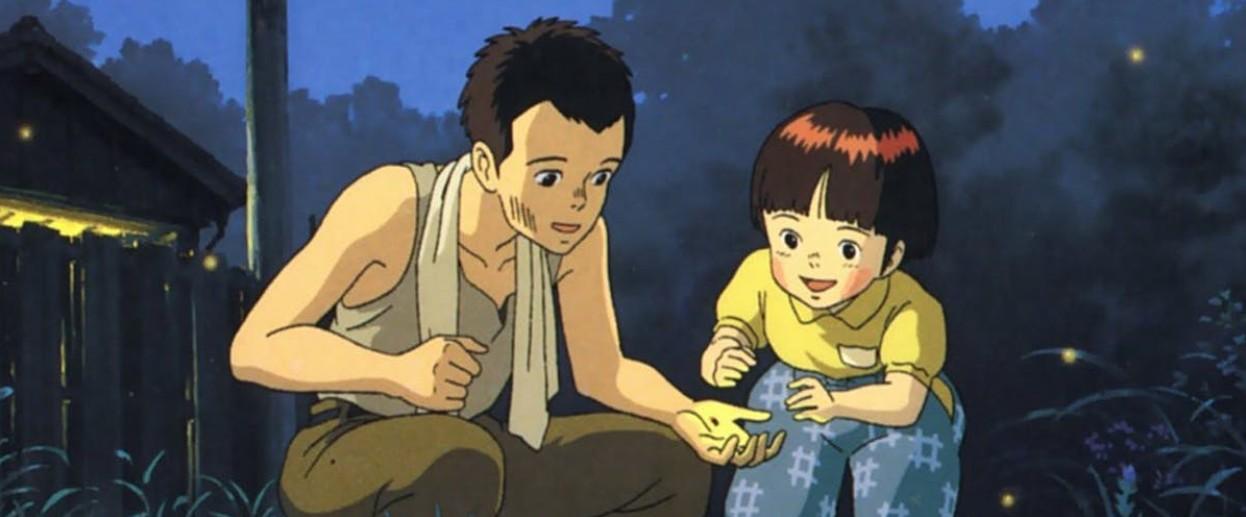
Late film critic Roger Ebert (2000) wrote how Hollywood has been trying to achieve the “realisitc animation” portrayed in Grave of Fireflies. The animation is enriched with drawings–Setsuko’s big and bubbly eyes, her tonsils when she cries–all evoke a sense of sadness, but not melodrama. The film uses “pillow shots–a detail from nature, say, to separate two scenes,” notes Ebert. According to him (Ebert,2000), Fireflies’s visuals compose poetry: “There are moments of quick action, as when the bombs rain down and terrified people fill the streets, but this film doesn’t exploit action; it meditates on its consequences.”
Image: A scene from The Grave of Fireflies, where Setsuko and Seita try to catch fireflies Source: NetflixWhile many still believe that animated films are made for children, and cannot go beyond the fantastical–flying superheroes to save the city, talking objects and animals, Takahata’s oeuvre cuts across by making war a subject of animation. Dudok de Wit (2017, p.4) was perhaps referring to the same, as he wrote, “ With costumes, and special effects, its story could have been told in live action. But animated characters are more abstract, more malleable, less mired in particulars than real people…The protagonists unmediated by distracting actors, become more universal; viewers relating to them more easily.” Thus, for Takahata, animation magnifies the story. Speaking of Takhata’s use of animation as a medium, Harsha Damerla, a 24-year-old student filmmaker, who is working on his first animated film, also pointed out how animation serves as the best medium in certain cases. “ The brief bonding, and emotions between a human and an animal could only be portrayed through animation,” said Damerla, while referring to a specific scene in his film, Fira.
Death Note
“ Everyone who I’ve spoken to about anime, has brought up either Naruto, or Death Note,” says Nair. Receiving 4.8 out of five stars on Crunchyroll, Death Note is one of the popular animes with 30,600 ratings. An eminent anime and manga series created by Tsugumi Ohba and Takeshi Obata, Death Note centers around the importance of media–especially broadcast, to investigate the cause, or perpetrator behind the consecutive deaths of prisoners, all of whom die due to a heart attack. Although the magical powers of a notebook called Death Note, and supernatural
forces such as Shinigami(Japanese God of Death) are at play, the use of media propels the series forward.
Death Note features a highly intelligent, academically brilliant, high school teenager Light Yagami who stumbles upon a notebook called the ‘Death Note’, as the God of Death throws it from the ‘World of the Dead,’ into the human realm. In the first episode, the instructions in the notebook read, “Any person’s name written in the notebook, would die within 40 seconds of writing it…” As the audience would expect, Light, too believes it to be a hoax, until he tries it out. Soon after the TV announces, “The children inside the daycare, have been held hostages..,” in episode two, Light Yagami is shown to instantly pen the name of the criminal. Within 40 seconds, the criminal is declared dead, of a heart attack. Bedazzled by the sudden power he possesses, Light immediately takes it upon himself to become a messiah for the world–he aims to wipe out all criminals and make the world a better place. Awestrucking visuals and animations bring in an immense throw of colour. Every time Light keeps on writing one name after the other, the swish and flick of streaks of white light becomes the call for another death. The frames of the anime, further give it the agency to focus more on the action and build the suspense as Light continues to gather the names of his next victim from the daily news broadcast.
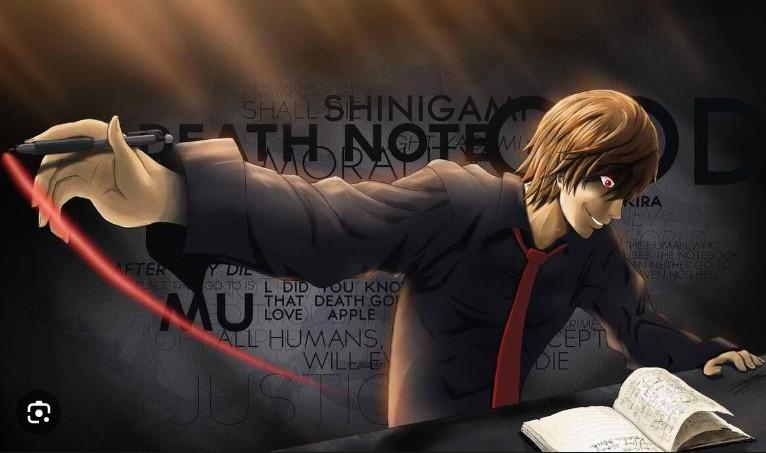
All the episodes begin with a news broadcast, the anchor reading the top headlines of the day— inevitably the top story is the sudden heart attack of another prisoner. The series reaches its climax when the broadcast is interrupted to showcase a piece of special news from the Japanese police department to communicate a message to Light, who now possesses the pseudonym, Kira. As the police try to investigate the cause of the murders, the broadcast medium becomes a bridge between Light Yagami, and the lead detective ‘L’.
It is only through the news telecast, that L gives out the message, “The world is watching.”As L had promised that he would “show very soon by directly confronting the culprit, and definitely catch the one behind the murder,”(Ep. 3, Death Note) he becomes successful in getting his initial clues through Light’s actions that follow after the broadcast. Neither L nor Light has the slightest idea of each other, except for the messages that are exchanged within them through news shows, as the world remains a witness. L gets clues about Light's whereabouts from a special broadcast intended only for the Kanto region of Japan. “ Told you this is a live broadcast worldwide, but this is only being broadcast in the Kanto region of Japan. Was planning on broadcasting this is in different areas, but don't need to,” says L, as Light had already written the name of his intended victim, who died soon after, in Kanto.
The ordeals of working in a media house, and the harsh realities, entirely form the tenth episode–Giwaku, when editor Demegawa of Sakura TV station pressurizes his reporters for a good story. “ We've been gaining ratings only because we do stories that other stations don't. Make up somethin'!” Demegawa blasts out when the reporters tell him they have no follow-up on the Kira case, as the police are unwilling to speak about the investigation. As luck would have it, Demegawa soon receives a package containing Kira’s tapes, with the threat that if not
broadcasted, all of the employees would be killed. Ethics and fact-checking take a backseat as a new broadcast takes place, without Demegawa caring to consider if the tapes were indeed from Kira. The editor is completely blinded, as he speaks to himself, “ the ratings could go up by 60–70%.”
Death Note, further effectively portrays how media plays an important role in shaping public opinion–evident through society’s divided views on Kira. The public at large, looks up to him as the saviour, to the point of creating a website on him. On the other hand, the Japanese intelligence units, and the state police condemn it as “ the most atrocious act of murder in history, and it will not go unpunished,” with the aim of “definitely catching the one behind the murder.” (Ep. 1, Death Note)
By crafting a plot that incorporates media dynamics into its narrative, Tetsuro Araki’s direction sets its standards, as it provides for an exploration of the themes of justice, morality, and the power that comes with those wielding it. Unlike the fantasy world of Studio Ghibli which provides for an emotional experience, Death Note serves as an intriguing commentary on the influence of media, and the dangers of misusing it to form public opinion. As the common saying goes, “With great power comes great responsibility,” Death Note serves as an epitome of the same.
Welcome to the N.H.K
With around 2,900 ratings, and an average of 4.8 stars on a scale of five—Welcome To The N.H.K is one of the lesser-known animes, that has been inspired by real-life experiences of socially awkward people. Tangled amidst his anxiety and a net of conspiracy theories, Sato is a 22-year-old NEET (Not In Education, Employment, or Training), a socially awkward man, who
believes in the existence of Nihon Hikikomori Kyokai (N.H.K). Conjured up by Sato’s overthinking, N.H.K is believed to be an organization that aims at turning all the NEETs in society into a group of hopeless recluses.
Tatushiro Sato is a university dropout and mostly spends his days in his matchbox-like apartment. A self-proclaimed hikikomori( a person who avoids social contact), Sato hasn’t stepped out of his home in four years, except for trips to convenience stores. The only interaction he has had in all these years is with his furniture. “Inbo, inbo, inbo (conspiracy, conspiracy, conspiracy),” the fridge, television, and computer suddenly start blaring, through animated lips and eyes, as Sato wakes up amidst a dream, in a state of utter frenzy. Instant noodle cups, empty soda cans, a sink full of unwashed utensils, an ashtray full of cigarette stubs, all bring about the harsh realities a disturbed young adult goes through, especially when living alone. Sato speaking to himself: “ Is it because I sleep 16 hours a day..my brain is whacked,” further underscores the intensity of Sato’s reality. Besides animated furniture that continues to dance around whenever Sato spirals into an unending loop of overthinking, colourful animated figurines of bubblegums and puddings float in Sato’s vision further confirming his overthinking.
The moment Sato thinks of complaining about his neighbour for playing loud music, he hears strange voices. Not of humans, but voices in his head. “Has he no shame..give me a break…such a creep,” thoughts continue to encircle him even though he has barely stepped out of his bed. Interestingly, the radio confirms his apprehension, as it blares through animated radio waves, “ it was in fact a conspiracy..to make you withdraw from the society.”
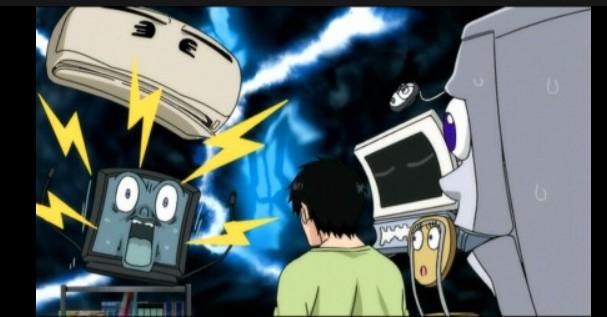
Eventually, Sato is roused from his musings as a girl called Miyazaki comes with the determination to turn Sato into a functional human being. Miyazaki creates a curriculum for Sato, along with regular assignments that require Sato to go out and spend time in public places–including a school, and supermarket–any hikikomori’s nightmare. Sato’s transformation might rip one apart from within, while he goes through tumultuous consequences, as the series explores a variety of coping mechanisms that socially awkward people possess. Nonetheless, Sato often falls into the vicious trap of going back to his old habits.
Imbued with comic hues, Welcome To The N.H.K is no less than a tragicomedy. A review by a prominent US-based pop-culture website Rolling Stone (Sudarshan, 2023) mentions, “ Welcome to the NHK, despite its comedic overtones, actually depicts a dark world. A world with sharp teeth, waiting to tear you apart, crush you with its molars and spit you out; a broken mess.”
Easier said than done, “ the feelings of isolation, despair in the face of hopeless situations, depression, suicide, existential dread,” prove to be a Herculean task for many (Rolling Stone, Sudarshan, 2023). According to Nair, “ N.H.K is a true take ,” that provides a more balanced portrayal of life through its web of complexities.
Image: Sato’s radio is animated, and confirms his apprehension about a conspiracy. Source: KaidoTVAnime Journalism–A Viable Profession?
“You can’t talk about anime without talking about otaku.” (Ep. 1, Welcome to the N.H.K)
Following the lines of how Welcome to the N.H.K sets the ground for otakus, right within the series, anime tends to be incomplete without anime journalism. One of the core elements is anime journalism, which keeps otakus thriving. Anime News Network (ANN), and Crunchyroll top the list when it comes to popular sites in anime journalism.
Similar to how media outlets report news–reporting about anime, the latest developments, and techniques in the studio is what majorly constitutes anime journalism. As Lauren Orsini(2010), founder of Otaku Journalist, a website focusing on anime writes, “ For many of us, it seems like a fantasy. Watching and reviewing anime as part of the daily grind. Getting paid to cover anime and gaming conventions. Making money off of things most otaku pay money to do.”
While one may argue that anime journalism is the anime equivalent of a film critic, Aswath Nair disagrees: “ You’re also reporting the news..you’re wearing multiple hats for the job. So yes you’re reviewing anime (new and old) but also talking about the latest developments from the studio side of things.” He further mentions how the barrier to entry is considerably high as compared to regular media-centric journalism. Lauren Orsini’s interviews with anime journalists such as Gia Manry of Anime News Network, and Patrick Macias–an independent anime journalist, also highlight their daily grind. “ The career is no joke,” comments Orsini. A typical day in the lives of an anime journalist reveals a journey of starting with anime journalism as a part-time occupation, till getting paid enough before converting into a full-time career option.
Patrick Macias started his career in anime journalism by contributing articles for “little or no pay” (Orsini, 2010). His subsequent submissions progressively paved his path to Viz Media’s editorial section. There has been no looking back thereafter. Macias has co-owned a media company, besides acting as the editor-in-chief for Otaku USA magazine. He has also authored two books. Gia Manry’s career path, on the other hand, was rickety–as she started with a manga blog of her own, wrote for a website named Anime Insider which shut down later, and eventually settled for Anime News Network. As is evident from Orsini’s interview, either way, the professional life of an anime journalist entails waking up early in the morning to fit two jobs and following up on anime statistics, and minute-to-minute updates from social media platforms–without fail. Would then anime journalism make for a viable profession? Nair disagrees. “ While anime does enjoy a larger seat at the dinner table that is media and film, it has to do a lot more to be recognized as something ‘legitimate’ outside its circle of patrons. For anime journalism to be a viable profession one will need an active/eager audience, a publication that can think in terms of the long game and assign a passionate writer/team, and enough material to talk about.” Aswath further mentions that while there is “ enough content emerging not just from Japan, but also from Korea, France, UK, and even the US to a certain extent,” popular anime networks such as the ANN, Crunchyroll are only open to working with freelance writers since their staff writer positions are already filled up. Nair also points out that in ANN, the writing team is approximately 20 members strong with only one editor each for the UK, South East Asia, and Indian regions respectively.
Anime journalist Colette Benett shared a similar view: “Anime journalism is a viable career venue, but a very small one”(Orsini, 2010). Conclusively, if we were to compare anime journalism with other niches like film, or food–the consensus lies with all these professions demanding one to be always on toes, and thinking out of the box to bring something new to the table, each time.
Chapter 8
Conclusion: ‘The world isn’t simple enough to explain in words’
According to a News 18 report, Dragonball creator Akira Toriyama, passed away at the age of 68 (Sharma, 2024). Not just News 18, the report was covered by almost all the media houses across borders, including the BBC, Mint, Press Trust of India, USA Today, and many others.
Anime News Network (ANN), also covered the news. The difference? It was the top story for ANN, while it was one of the stories for the newsrooms mentioned above. The extent of the coverage of the story, tell us that anime–the Japanese media product that was earlier connotated as a cheap form of animation, or children’s cartoon, is currently an integral part of the entertainment that the public consumes at large, a part that affects the people to a considerable extent.
What started as a late-twentieth-century Japanese invention, as author Tze-Yue G. Hu calls it, the anime industry is now worth $4 million. From Pokemon’s craze in the US in 1998 to Death Note receiving a rating of 4.8 stars in the 21st century, anime has gradually escaped the confines of a niche. Not only have OTT platforms, namely Netflix, played a massive role in the increased viewership of anime, but exclusive streaming networks such as Crunchyroll–which offer subscriptions at nominal rates, further owe a considerable share in the success story. As Aswath Nair said, “There is a massive anime market that can be tapped into, now is the time for it.”
While the preference for anime, or movies continues to be a personal choice, anime is not just about the world of fantasy. Besides taking its viewers for a phantasmagorical journey through a palette of vibrant colours, and magical forces, animes such as Grave of the Fireflies, Welcome to the N.H.K, and Death Note, tap into the realities of life, thus calling for a journalistic reportage.
Although journalism is reportedly on a decline, interestingly, superhero characters such as Superman, or Spiderman, have been portrayed as journalists. Animes follow a similar trend, as they underscore the complexities of life under their visually appealing frames. While Studio Ghibli’s Grave of the Fireflies provides for an emotional experience through the ravages of the World War, and Welcome to the N.H.K showcases the difficult journey of socially awkward people through comic overtones, Death Note achieves a thrilleresque note by inculcating the brutal realities of media into its fictional narrative. As Fulbright media scholar and film professor Dr. Uma Vangal shared her view, “ Film with its melodrama and spectacle focuses on the highlights while anime brings into play the issues, implications and ethical perspectives.” Is anime then, a cartoon for adults? As it turns out, its for both, children and adults. “ The aspect that I liked the most is it keeps the kid alive in you. Serious, with a narrative, emotions, but still some cartoonish flair. Now anime lovers might kill me for saying anime is cartoon, but think of it,” said 22-year-old Asma M–an occasional anime watcher, while otaku Sumana Ghoshal, 27 years, who named herself as Dragonball’s Goku in the survey form, wrote about “ the detailed storytelling style,” that keeps her hooked into anime. Nonetheless, be it the ecocritical themes of Studio Ghibli, or the portrayal of real-life incidents—the strand that unites otakus, and general viewers alike, is the depiction of characters and the beautiful weaving of the story with animations. As goes the famous saying by Hayao Miyazaki, “The world isn't simple enough to explain in words.”
Bibliography
Condry, I. (2013). The soul of Anime: collaborative creativity and Japan’s media success story. Durham: Duke University Press.
Death Note (2006). Series. Directed by Tetsuro Araki. Japan: Madhouse Studios
Ebert, R. (2000). Grave of the Fireflies movie review (1988) | Roger Ebert. [online] www.rogerebert.com. Available at: https://www.rogerebert.com/reviews/great-moviegrave-of-the-fireflies-1988 [Accessed 2 Jan. 2023]
Foss, K. (2016). No Longer Seeking ‘Truth, Justice and the American Way’: Journalists and the Press in Comic Books and Contemporary Film Adaptations. [online] The IJPC Journal. Available at: http://ijpc.uscannenberg.org/journal/index.php/ijpcjournal/article/ view/81 [Accessed 2 Jan. 2023]
Hu, T.-Y.G. (2015). Frames of anime: culture and image-building. Aberdeen, Hong Kong: Hong Kong U.P.
Hu, T.G. and Yokota, M. (2013). Japanese Animation: East Asian Perspectives. [online]
Project MUSE. Jackson: University Press of Mississippi. Available at: https://muse.jhu.edu/book/85995 [Accessed 1 Mar. 2024].
Laghate, L.J. (2023). India 2nd largest anime market for Crunchyroll. [online] Mint, 22 July.
Available at:
https://www.livemint.com/industry/media/india-2nd-largest-anime-marketfor-crunchyroll-11689961738171.html [Accessed 10 Mar. 2024]
Mondal, H. (2022) The growth of OTT and its impacts on the animation industry. The Times of India. [online] Available at: https://timesofindia.indiatimes.com/blogs/voices/thegrowth-of-ott-and-its-impacts-on-the-animation-industry/ [Accessed 10 Mar. 2024]
Orsini, L. (2020). How to start a career in anime journalism. [online] Otaku Journalist.
Available at: https://www.otakujournalist.com/how-to-start-a-career-in-animejournalism/ [Accessed 20 Dec. 2023]
Sillito, D (2023). Sharp decline in appetite for news in recent years, Reuters Institute says.
BBC News. [online] 14 Jun. Available at: https://www.bbc.com/news/entertainment-arts65880999
Sohee, K (2023). World’s Top Anime Site Crunchyroll Is Sony’s New Money Maker. Bloomberg [online] 13 Jul. Available at:
https://www.bloomberg.com/news/articles/2023-07-13/crunchyroll-eyes-india-forgrowth-as-japanese-anime-becomes-20-billion-industry
Sudarshan, R.A. (2023). ‘Welcome to the NHK’ Review: A Grim Yet Comical Look at the World of the Hikkikomori. [online] Rolling Stone India. Available at: 34
https://rollingstoneindia.com/welcome-to-the-nhk-hikkikomori-tatsuhiro-sato-novelanime-manga-analysis-review/#:~:text=The%20story%20is%20heavy%2C
%20it,characters%20like%20Sat%C5%8D%20or%20Yamazaki. [Accessed 10 Jan. 2024].
Swale, A. (2020). Anime and the Conquest of Time: Memory, Fantasy, and the ‘TimeImage’ from Ghost in the Shell to Your Name. Japan Review, [online] (35), pp.199–218.
Available at:
https://www.jstor.org/stable/27009006 [Accessed 18 Jan. 2023]
The Grave of the Fireflies(1988) Film. Directed by Isao Takahata. Japan: Studio Ghibli
Welcome to the N.H.K (2006). Series. Directed by Yamamoto. Japan : Studio Gonzo
Winkie, L. (2021). Pokémon will outlive us all. [online] Vox. Available at:
https://www.vox.com/the-highlight/22825263/pokemon-nintendo-cartoon-card-gamelongevity