Metro
CAGAYANLifestyle TIMES Weekly DE ORO
Volume 8 | No. 34 | Cagayan de Oro City | April 5-11, 2021
2021 Philippine Veterans Week
T
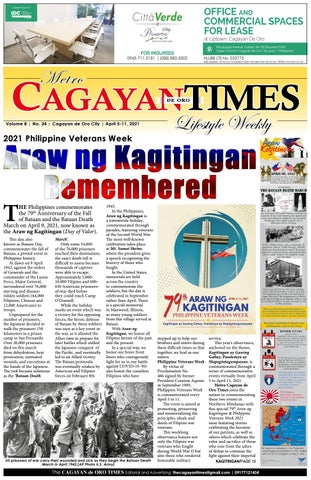
HE Philippines commemorates the 79th Anniversary of the Fall of Bataan and the Bataan Death March on April 9, 2021, now known as the Araw ng Kagitingan (Day of Valor). This day, also known as Bataan Day, commemorates the fall of Bataan, a pivotal event in Philippine history. At dawn on 9 April 1942, against the orders of Generals and the commander of the Luzon Force, Major General, surrendered over 76,000 starving and diseaseridden soldiers (64,000 Filipinos, Chinese and 12,000 Americans) to troops. Unprepared for the number of prisoners, the Japanese decided to walk the prisoners 150 kilometers to a prison camp in San Fernando. Over 20,000 prisoners died on this march from dehydration, heat prostration, untreated wounds, and executions at the hands of the Japanese. The trek became infamous as the ‘Bataan Death
1945. In the Philippines, Araw ng Kagitingan is a nationwide holiday, commemorated through parades, featuring veterans of the Second World War. The most well-known March’. celebration takes place Only some 54,000 at Mt. Samat Shrine, of the 76,000 prisoners reached their destination; where the president gives a speech recognizing the the exact death toll is bravery of those who difficult to assess because fought. thousands of captives In the United States, were able to escape. memorials are held Approximately 5,000across the country 10,000 Filipino and 600to commemorate the 650 American prisonerssoldiers, but the day is of-war died before celebrated in September they could reach Camp rather than April. There O’Donnell. is a special memorial While the holiday marks an event which was in Maywood, Illinois, a victory for the opposing as many young soldiers from this village served at forces, the heroic defense of Bataan by those soldiers Bataan. was seen as a key event in With Araw ng Kagitingan, we honor all the war, as it allowed the Filipino heroes of the past Allies time to prepare for and the present. later battles which stalled In a special way, we the Japanese conquest of the Pacific, and eventually honor our brave front liners who courageously led to an Allied victory. fight for us in our battle The Bataan peninsula was eventually retaken by against COVID-19. We also honor the countless American and Filipino Filipinos who have forces on February 8th
US prisoners of war carry their wounded and sick as they begin the Bataan Death March in April 1942.(AP Photo U.S. Army)
stepped up to help our brothers and sisters during these difficult times so that together, we heal as one nation. Philippine Veterans Week By virtue of Proclamation No. 466 signed by former President Corazon Aquino in September 1989, Philippine Veterans Week is commemorated every April 5 to 11. The event is aimed at promoting, preserving and memorializing the principles, ideals and deeds of Filipino war veterans. This weeklong observance honors not only the Filipino war veterans who fought during World War II but also those who rendered honorable military
service. This year’s observance, anchored on the theme, Kagitingan ay Gawing Gabay, Pandemya ay Mapagtatagumpayan, is commemorated through a series of commemorative events virtually from April 5 to April 11, 2021. Metro Cagayan de Oro Times joins the nation in commemorating these two events in Northern Mindanao with this special 79th Araw ng Kagitingan & Philippine Veterans Week 2021 issue featuring stories celebrating the heroism of our patriots, as well as others which celebrate the valor and sacrifice of those who rose from the ashes of defeat to continue the fight against their imperial KAGITINGAN/PAGE 15
The CAGAYAN de ORO TIMES Editorial and Advertising: thecagayantimes@gmail.com | 09177121424
2
Metro
CAGAYANTIMES Lifestyle Weekly DE ORO
April 5-11, 2021
MESSAGE
On the 21st Anniversary of Araw ng Kagitingan and 2021 Philippine Veterans Week
April 9, 2021 training, equipped N THE and defended with surplus occasion our country from of the foreign aggression armament from th World War I and in 79 Araw ng during one of the Kagitingan and limited quantities, darkest moments 2021 Philippine in our history, the they fought against a Veterans Week Second World War. battlefield-hardened from 5 to 11 April, Armed with enemy who fought allow me to pay courage, patriotism in Mainland Asia, tribute to the and determination, equipped with valiant Filipino modern implements with little or soldiers who fought practically no of war and resolute to triumph for the glory of their Emperor. In the course of our annual commemoration, we always remember the Battles of Bataan and Corregidor and the sacrifice at Capas as the symbols of our struggle that defied and maybe Brig. Gen. Restituto L. Aguilar (Ret.) Executive Director surpassed the National Historical Commission of the Philippines limits of human endurance. who may have or operational troops as well as Metro The Philippine survived these odds defeat and should civilian volunteers Campaign was in the battlefield not be celebrated at alike. In those Lifestyle Weekly required by the succumbed to all, it should instead defining moments Imperial Japanese the brutalities of be accentuated a of the war, Bataan CAGAYAN TIMES/Sudaria Group of Companies Publisher General Staff to the enemy during strategic triumph and Corregidor be completed the Death March as it has preserved were in reality a MIKE BAÑOS Editor-in-Chief within fifty-five from Mariveles the Anglomicrocosm of the (55) days based on and Bagac, Bataan SUSAN P. DENNIS American Alliance Philippines, wellGEAN T. CESAR the experiences to San Fernando, that eventually represented from RANDY FAMACION MAI MAI SISON generated in fighting Pampanga and then spearheaded in Batanes to TawiKLAUS DORING armies of other to the subsequent the resolution of Tawi up in arms ANNIE GORRA RAGO WENDY RAMOS-GARCIA Western colonies sub-human the conflict in against the invader. Contributing Editors in the Pacific in conditions of their Europe, North It was a battle of CLIFFORD SANTILLAN battles that preceded incarceration at Africa and the the Filipino people Layout Artist it but our veterans Capas, Tarlac. Pacific. The same for freedom, paid PINKY DOMINGO carried on the fight The Battles amount of honor, in blood, sweat and Marketing even without naval of Bataan and remembrance and tears. KHRISTHA RIVA FELICILDA or air support and Corregidor lasted dignity is bestowed Today, as a Advertising with problems for about one as in the famous grateful nation and ATTY. MARIO T. JUNI confronting them hundred twenty Battles of Masada people, we pay them Legal Counsel such as dwindling (120) days that has (Israel), Gallipoli our respects and food, medicine unduly tied up the (Australia and New remember their The Metro CAGAYAN de ORO TIMES newspaper is published weekly at Tanleh Bldg., Abellanosa Street, and ammunition. enemy forces even Zealand) and the great contribution to Consolacion, Cagayan de Oro City. Towards the necessitating fresh Alamo (US) that regain our freedom It is registered with the Department of Trade and Industry concluding days of reinforcements (DTI) Region 10 with Certificate No. 01801884, and with they considered as and independence. Business Registration Plane No. 17211 with Business their defense, most from various parts glorious battles in We are beneficiaries License Certificate 2014-00691. TIN No. 311-982-549-000 were already ill, of the occupied their history and of their selfless Tele/Fax #: (088) 856-3344 Find us on Facebook: were malnourished territories that never a defeat. sacrifices paid with http://www.facebook.com/CagayandeOroTIMES and / or experienced should have been The stubborn their lives and limbs. email us at thecagayandeorotimes@gmail.com battle fatigue sent to conquer defense of Bataan Let us honor them but these did other countries and Corregidor and their memory Member: Cagayan de Oro Chamber of Commerce and not deter them in the southern was made possible in perpetuity with Industry Foundation, Inc. (Oro Chamber) from performing hemisphere. by soldiers from all the maxim, “It is our their duty to the Although usually over the country, duty to honor our Motherland. considered by from walks of life, veterans.” facebook.com/CagayandeOroTIMES Many of those cynics as a tactical regular and reserve A meaningful
O
CAGAYANTIMES DE ORO
Metro
CAGAYANTIMES Lifestyle Weekly
3
The Mindanao Death March D DE ORO
April 5-11, 2021
By ROBERT JOHN I. DONESA
URING World War II, there were two (2) death marches in the Philippines that were presented at the Tokyo War Crimes Trials as evidence of the inhuman treatment of prisoners of war (POWs).
These were the “Bataan Death March” and the “Iligan Death March”, also referred to as the “Mindanao Death March” or the “Dansalan Death March” in some accounts. While the commemoration of the Bataan Death March is commemorated annually with the Araw ng Kagitingan (Day of Valor) national highway every April 9th, very few people know about the Iligan Death March. On the 4th of July 1942, surrendered Filipino and American soldiers in Mindanao were made to march on a rocky dirt road and under the blazing tropical sun, from Camp Keithley in Dansalan to Iligan in Lanao – a distance of about thirty-six (36) kilometer (25 miles) prior to their transfer with the rest of the Mindanao POWs to Camp Casisang, Malaybalay, Bukidnon. Transport trucks, although available, were denied the POWs. Without food and water, one by one the soldiers fell down due to exhaustion. Those who fell were shot in the forehead to prevent them from joining the guerrillas in the event they recover. But the story did not end there. The Tokyo War Trials
On January 19, 1946, the victorious Allied powers— France, the Soviet Union, the United Kingdom, and the United States of America— established the International Military Tribunal for the Far East (IMTFE) in Tokyo, Japan. The IMTFE had the jurisdiction to try individuals for Crimes Against Peace, War Crimes, and Crimes Against Humanity that were committed during the World War II. The subsequent trials held were collectively known as the Tokyo War Crimes Trials. The Tokyo War Crimes Trials were held between May 1946 to November 1948. The Philippine Prosecution Team presented and proved before the IMTFE at least sixteen (16) incidents of indignities, torture and barbarities committed against the Filipino and Foreign Prisoners of Wars (POWs) and civilians. Each of these incidents is a bundle of gruesome stories and tales of human suffering. The Bataan Death March, notorious as it was, overshadowed all the other incidents in history books. In fact, of the 16 incidents, only the Bataan Death March appeared in history textbooks. All the others remained unknown. Because the evidence
against the accused were overwhelmingly strong, the Iligan Death March, along with others, were only summarily presented and proven during Tokyo War Crimes Trials. Guests of the Emperor The Japanese landed in the Southern part of Mindanao, in Parang, Maguindanao. From there, they began advancing northwards to the Province of Lanao. The Philippine Troops and Moros formed MARCH/PAGE 11
Left : Brig Guy O. Fort, Commanding General, 81st Division (Philippines); Right: Lt. William A. Knortz escaped from Dansalan ang joined the Mindanao Guerrillas.
American prisoners of war in Camp Casisang, Malaybalay, Bukidnon celebrate the Fourth of July, 1942 at risk of discovery and death at the hands of their captors, unaware that their fellow soldiers from the 81st Division were struggling through the Mindanao Death March from Dansalan to Iligan.
The CAGAYAN de ORO TIMES Editorial and Advertising: thecagayantimes@gmail.com | 09177121424
Camp Keithley (now Camp Amai Pakpak) in Dansalan (now Marawi City), Lanao (now Lanao del Sur)
Metro
ARTS & CULTURE | HEALTH | EVENTS | TRAVEL & TOURISM | PEOPLE
CAGAYANTIMES History DE ORO
April 5-11, 2021
Page 4
The History and Legacy of the Fighting Moreno Brothers
Guerrillas of Balingasag, Misamis Oriental
V
ERY few of the current generation are aware the story of fifteen members of the Moreno clan of Balingasag, Misamis Oriental, who fought together under one guerrilla unit based in this town. Unlike the five Sullivan brothers who were all killed in action during the sinking of the light cruiser USS Juneau on 14 November 1942, all survived the war and went on to establish their own families and had children who are now prominent figures in their own right. Most prominent among the fifteen were four male offspring of the seven sons and three daughters of Jose Gonzales Moreno and Josefina Almendrala who served with the 110th Infantry Regiment, 110th Division (Guerrilla) of the 10th Military District, United States Forces in the Philippines (USFIP) during World War II, along with a son-in-law married to the eldest of their three daughters. The third son Rodolfo joined the United States Army Forces in the Far East (USAFFE) and fought in Bataan, captured by the Japanese and survived the death march after which he was held captive and tortured in Capas, Tarlac. He was later released after taking an oath of allegiance to Imperial Japan and found his way back to Balingasag where he joined his siblings Redentor, Emeterio Sr. and Manuel in the guerrillas. Their brother in law Papias Tiro, who married their eldest sister Humildad, also fought in the same unit. The three other brothers were Metelo, Taurino and Jose, Jr., and the two younger sisters Purisima and Nieves. Jose Gonzales Moreno was a farmer-landowner and raised the brood at the Moreno-Almendrala Ancestral House in Balingasag Poblacion where all of their
children were born. Built before the Second World War, the house has now passed through five generations. The Almendralas and Morenos inter-marriage strengthened the union between the two families that bequeathed Misamis Oriental and Cagayan de Oro with a legacy of prominent physicians, religious leaders and public servants, among them Dr. Ignacio B. Moreno, a former member of the Misamis Oriental Provincial Board; Dr. Ramon F. Moreno; Fr. Antonio F. Moreno, S.J.; Deacon Manuel A. Moreno; Former Misamis Oriental Governor and currently Cagayan de Oro City Mayor Oscar S. Moreno and the former Mayor of Balingasag Marietta R. Abogado, daughter of former municipal mayor Porferio Roa. “Papa told me during the war, the whole family evacuated to (Barangay) Camuayan, then went back to the ancestral house afterwards,” recalls Elvira Moreno-Magsalay, daughter of Jose’s eldest son Redentor, and now based in Seattle, USA. “Lolo (Jose) was a landowner/ farmer while Lola (Josefina) had always been a housewife.” Dr. Redentor A. Moreno The eldest son, 1st Lt. Redentor A. Moreno DC, served as the Regimental Dental Surgeon of the Medical Co. of the 110th Infantry Regiment, 110th Division (Guerrilla) based in Balingasag, Misamis Oriental. While the family has no records of his wartime exploits with the guerrillas, one can infer his leadership from how he assumed the
Moreno Family Portrait take 19 May 1952 at their ancestral house in Balingasag, Misamis Oriental: Standing from left to right: Emeterio Sr.(father of Mayor Oscar S. Moreno), Redentor Sr. (father of Dr. Sonny Moreno); Metelo, Taurino, Rodolfo (father of Fr. Tony Moreno, S.J.) and Manuel (father of Cecile Kionisala). Seated left to right: Papias Tiro (husband of Humildad); Milagros (shown carrying the 1-yr old Oscar Moreno) , Leonor, Josefina, Jose, Perla, Violeta and Jose Jr. (Seated in front of Josefina and Jose from left to right: Purisima, Humildad, and Nieves). Photo courtesy of Fr. Antonio Moreno, S.J.
paternal duties as patriarch of the clan as the eldest of the Moreno siblings when their father passed on, and his brand of public service as a public servant after the war. As a father and family man, he was a strict disciplinarian, inheriting the values of his father Jose G. Moreno. Being the eldest of a patriarchal family with a strong Catholic faith and qualities from both parents, he inculcated in his children the value of prayers, trust in God, and education. “He was the recognized head of the family when our father died,” his son Sonny said. “All the brothers and sisters, even their spouses and children, looked up to Ede, or Iyo Ede as their adviser, mediator, problem solver, and confidant when internal family conflicts or problems arose. He is the source of the Moreno unity now still being practiced after 3-4 generations. Strong family ties were always emphasized, that the family is still close even today after the succeeding generations.” As a public health dentist who served the entire province, he was so punctual he often arrived ahead of the
regional health units staff when he came calling! He rose from the ranks to became senior dentist (the equivalent of regional dental officer today) but decided to retire in 1979 when the boat they were riding on an inspection tour in Camiguin capsized and they were in the water for 2-3 hours under the scorching heat of the sun before being rescued. His health was affected and in 1980 he and his wife decided to migrate to the USA. He died on May 14, 1988 and was buried in California. Until his death, he was still active in the activities of the US Veterans in California. “He was a very diligent and patient dentist that his patients came from as far as Medina to Villanueva. He was always busy that our meals were always disrupted because he would treat patients first, especially those from far towns, before he would eat or rest,” Sonny recalls. “This kind of public service we inherited from our father, so his sons decided to stay and serve the country the best way we can.” All his children chose the medical profession: Elvira
and Asuncion are nurses now living in the USA, while Redentor Jr. and Ignacio (Sonny), are both medical doctors and practicing in the Philippines. Redentor Jr. served as the municipal health officer of Talisayan, and was a volunteer with the United Nations Volunteer Program) in Samoa and Zambia. Sonny took his residency in anesthesiology at the Northern Mindanao Medical Center (then known as the Northern Mindanao Regional Training Hospital) in 198487. After his residency he was elected as a member of the Misamis Oriental provincial board (1st District) in 1992-1995. He joined the Provincial Health Office in 1997 and became the Provincial Health Officer in 2004, retiring in 2013. During his tenure, Misamis Oriental under then Gov. Oscar S. Moreno rehabilitated its seven provincial district hospitals and constructed the OWWAMisOr Philippines Hospital in Alubijid, a pilot partnership between OWWA and MisOr LGU. As a result, the Misamis Oriental Provincial
Government was awarded its first Galing Pook Award in recognition of its outstanding health services program Strategic Innovations for Government Hospitals and Sonny was recognized by JCI Philippines Senate as one of the Ten Outstanding Filipino Physicians of 2012 for his work as Misamis Oriental’s Provincial Health Officer. Dr. Emeterio A. Moreno, Sr. The second oldest brother, 2nd Lt. Emeterio A. Moreno Sr., also served in the same unit as S-1 and HQ Company Commanding Officer, coincidentally under the leadership of 1st Lt. Othelo Emano, 1st Battalion Commanding Officer. 1st Lt. Emano was the uncle of the late Cagayan de Oro Mayor and Misamis Oriental Governor Vicente Y. Emano, and grand uncle of current Misamis Oriental Governor Yevgeny Vincente “Bambi” Emano. This is recorded in the Roster of Troops, Combat Co., HQ Bn 110th Inf of Balingasag, Misamis Oriental dated midnight 30 Aug 1945 and signed by Abundo Bibiano, 2nd Lt, Inf (USFIP) with Declassified Authority
GUERRILLAS/PAGE 5
(top photo) Dr. Redentor Ed. A. Moreno, Sr. and his wife Leonor Buhay. (photo courtesy of Sonny Moreno) (left photo) Manuel A. Moreno with his wife Violeta Casiño. (photo courtesy of Cecile Kionisala)
Rodolfo Moreno and his second wife Emilia at their wedding. (courtesy of Tony Moreno)
The CAGAYAN de ORO TIMES Editorial and Advertising: thecagayantimes@gmail.com | 09177121424
Feature
Metro
CAGAYANTIMES Lifestyle Weekly DE ORO
April 5-11, 2021
The History and Legacy of the Fighting Moreno Brothers
5
Guerrillas of Balingasag, Misamis Oriental
Guerrillas... from page 4
NND 883078. 2nd Lt. Moreno Sr. is the father of former Misamis Oriental 1st District Congressman and Misamis Oriental Governor Oscar S. Moreno, who is currently serving his third and last term as the Mayor of Cagayan de Oro City. The elder Moreno later became a physician and served in the town's barangays. The younger Moreno has recorded significant achievements in his various positions as a public servant. Besides serving as Congressman for the 1st District of Misamis Oriental,
Oscar Moreno also served with distinction as provincial governor of Misamis Oriental, twice winning the Galing Pook Award for the province for strategic innovations in its hospital system, and for integrating the former rebel stronghold of Sitio Lantad into the mainstream of society, the DILG Gawad Pamana ng Lahi, and the Seal of Good Housekeeping for good governance. During his incumbency as Cagayan de Oro’s chief executive, the city consistently ranked among the top 10 highly urbanized cities in regional competitiveness since the inception of the rankings, ranking 7th in the
Papias and Humildad Tiro in 1960 (courtesy of Toting Potenciano)
latest 2020 edition. Another son, Dr. Reynaldo S. Moreno M.D., served as a General and Pediatric Surgeon at the Maria Reyna -Xavier University Hospital, but passed on three years ago. Rodolfo A. Moreno The third oldest sibling 3rd Lt. Rodolfo A. Moreno, probably had the most colorful wartime career among the four sons of Jose Moreno who joined the guerrillas. Born on 05 June 1920 in Balingasag, Rodolfo was a college student and cadet officer at the Ateneo de Cagayan when World War II broke out and enlisted in the Philippine Army and subsequently absorbed into the United States Army Forces Far East (USAFFE) under Gen. Douglas MacArthur. “He was a cadet officer of Ateneo de Cagayan when he was enlisted,” said his son, Fr. Antonio F. Moreno, S.J. “It led him to the fall of Bataan and then to Capas, Tarlac. He hardly spoke about his ordeal and torture in Capas. My grandparents were told he had died. They had a requiem Mass for him owing to an account of his friend. My father was so furious, but
happy to be reunited with his siblings and parents.” Notes on the Philippine Army of the Philippine Veterans Affairs Office (PVAO) Digitized Collection) show that before the war Rodolfo served as a clerk at the General Headquarters. On January 1, 1941, in the opening salvo of the war, he was inducted under the Provisional Battalion, 31st Infantry, Philippine Army as Platoon Sergeant. The 31st Inf., PA under Brigadier General Clifford Bluemel was tasked with protecting the coast of Zambales but was pulled out to Bataan on 7 January 1942 to form the protective line along with the Abucay-Morong position under the I Philippine Corps defending the left flank of the USAFFE forces in Bataan and its coastal areas facing the sea. The 31st Infantry led a counterattack on January 20 to relieve the 51st Infantry, Philippine Army of the II Philippine Corps protecting the right flank of the BagacPilar line. During the lull, Vet. Moreno was transferred to the 3rd Battalion of the unit, composed of the I, K, L, and M companies. After the Fall of Bataan, Moreno
A guerrilla force moves down a road near Macajalar Bay on 11 May 1945, most probably from the 1st & 2nd Bn, 110th Division. (NARA)
became a prisoner-of-war and was released before Christmas of 1942. After surviving the Bataan Death March, and incarceration at Capas, Rodolfo was released after taking an oath of allegiance to Imperial Japan and managed to slip back to
Mindanao where he joined the guerrillas, serving with the Headquarters of the 110th Regiment. After the war, Rodolfo married Perla Abrogar and graduated with a Commerce degree from Ateneo de Cagayan in 1946, and started
GUERRILLAS/PAGE 13
MABUHAY 79th Anniversary Araw ng Kagitingan and 2021 Philippine Veterans Week.
The CAGAYAN de ORO TIMES Editorial and Advertising: thecagayantimes@gmail.com | 09177121424
6
Metro
CAGAYANTIMES Lifestyle Weekly DE ORO
April 5-11, 2021
Defending Dipolog April 1945:
A young guerrilla’s eyewitness account By MIKE BAÑOS & RAUL B. ILOGON
T
On the same day (08 March) naval bombardment units began a pre-assault pounding of the beaches at the other end of the peninsula, near the town of Zamboanga. Combat air patrol for the bombardment units was furnished by Marine planes temporarily stationed at Dipolog. Within the next two days, 16 planes from MAG-12 had been flown to the little airstrip, and as the task force approached its objective from Mindoro, these planes flew cover over the convoy, and later covered the landing of the 41st Sunset Division at Zamboanga on D-Day, March 10, 1945. It was used by USMC Marine Air Groups 12 and 32 during
the logistics lifeline from the Visayas. About 150 Japanese troops armed with two knee mortars, a light machine gun, two automatic rifles, and over a hundred rifles, had advanced within 16 kilometers of Dipolog on March 27. These were wellseasoned troops that had been moved into the area from Zamboanga about five weeks earlier. Over 500 Filipino guerrillas who opposed the Japanese forces “were evidently keenly interested in avoiding a fight with the Japs.” Major Donald H. Wills felt that an air strike might boost their morale and damage the enemy at Corporal Jesus JAKE B. Ilogon in his younger years the same time. (Ilogon Family Archives) There were no maps or photographs of any kind to cover landings and available, no method of subsequent assault marking targets, and no operations in the vicinity means of communication of Zamboanga town. with the troops – all these It seemed necessary to factors combined to make ensure friendly control of control of the strike by Dipolog, at least until the normal means impossible. bigger San Roque Airfield But ingenuity found a way. in Zamboanga could be Into the cockpit of a seized and readied for Marine Corsair climbed aircraft operations. Major Wills, who was Allied Air Forces thoroughly familiar with planes taking supplies the enemy positions; after to 10th Military District him climbed the smallest (Mindanao Guerrillas) of the Marine pilots in the under Col. Wendell W. division, First Lieutenant Fertig’s guerrillas had Cpl. Jake Ilogon witnessed a strafing run by 3 P-38 been using the field since Lightnings during the battle to defend Dipolog Airstrip. Winfield S. Sharpe. (USAF) Both men squeezed late 1944; the field had into the cockpit, with also been the site of many Sharpe sitting on Major emergency landings by at Zamboanga. March 1945 to support Wills’ lap. Soon afterward, American aircraft. The Thirteenth Air operations in southern with the major pointing Many times during Force therefore decided Mindanao and as an out targets to the pilot, the January and February, to send a squadron from emergency airfield. Corsair led the four plane Marine pilots from Leyte Marine Air Group 12 to MAG-12 Corsairs division in six strafing and Samar had landed Dipolog to supplement taking off from Dipolog at the airstrip on supply the air support that could made support strikes in the passes over the enemy’s positions. missions, or simply seeking be provided from other San Roque-Pasonaca area The planes used all haven for their planes available bases. in Zamboanga on March ammunition with which when weathered away To strengthen the 12-14. Dipolog based from their bases. guerrilla garrison at planes had also flown daily they had been loaded; the enemy area was thoroughly But because of Dipolog during the critical patrol missions over the strafed; compelling the increasing pressure from support period, two beach area during this Japanese to withdraw 3-5 Japanese forces in the area, reinforced companies of period. the guerrillas were finding the 21st Infantry Brigade By March 15, American kilometers. Cpl. Ilogon’s Final it increasingly difficult to , 24th Infantry Division, forces were able to Mission hold Dipolog. were brought in by air to operationalize the San We are fortunate to A week before the first Dipolog Field to provide Roque Airfield (renamed have a first-hand account Army landing, two US additional protection Moret Field) with Marine of the final phase of this Marine officers with six for 16 F4U Corsairs of units VMF-114, followed battle by a young guerrilla enlisted men were inserted Marine Air Group 12 on in the next three days by who was dispatched with behind Japanese lines and 08 March (two days before flight echelons of VMFthe 108th Expeditionary taken to the guerrilla held Zamboanga’s J-Day) and 211, VMF-218 and VMFCompany in early 1945 airstrip near the town of then to provide blocking 313 (all from MAG-12) to reinforce the guerrilla Dipolog. Captured at the forces in the north for the from Tanauan Field, forces defending Dipolog airfield were a Japanese invasion force that landed Leyte and commenced L2D Tabby and a G4M3 on Zamboanga on 10 operations. Nine days later, Airfield early April, 1945. Corporal Jesus B. Betty Bomber. March. MAG-32s SBD’s patrol Dipolog Airfield was This was but one dive bombers arrived from Ilogon, who just turned 20, was just recovering occupied by minimum example in the campaign Luzon. from a minor operation personnel necessary to of ground forces directly Counterattack at the 108th Division stage one fighter squadron supporting the air domain. But the Japanese were Regimental Hospital at from 08 March through 22. From there, the Marines not about to give up A temporary flight control could cover a larger Dipolog Airfield without a Talacogon, Alubijid in center was also set up there landing on Zamboanga on fight given its’ strategic role Misamis Oriental, when he was summoned by his Two C-47 (Douglas R4D Skytrain), on the tarmac of from 06 March until such 10 March with the 162nd in providing air cover to Dipolog field in 1945 as its squadron of fighter bombers time as the fighter control commanding officer, Capt. and 163rd Infantry of the the Zamboanga and Sulu were away for bombing and air support missions. center could be established 41st Infantry Division. operations, and protecting EYEWITNESS/PAGE 15 (US Dept of Defense) HE Battle of Dipolog is an interesting study of World War II in the Pacific Theatre, because not only was it a small scale showcase of the American armed forces joint operation tactics to retake its Philippine territories from the Imperial Japanese Army, featuring close coordination not only between the US Army, Navy and Marines, but even more important, how the intelligence on the ground and support from local FilipinoAmerican guerrillas contributed to the eventual victory. Although founded earlier by Spanish missionaries, Dipolog was only separated from the Segundo Distrito de Misamis in 1903 as part of the Dapitan District of the Provincia Mora (which later became Zamboanga), and became a barrio of Dapitan a year later. In 1912, John J. Pershing, Governor of the Department of Mindanao and Sulu, granted the petition to reorganize Dipolog into a municipality and it was formally inaugurated as a municipality on July 1, 1913. In 1942, the Seat of the Provincial Government was transferred from Zamboanga City to Dipolog by ActingGovernor Felipe B. Azcuna, making it the cabacera de facto. Dipolog Airfield Dipolog rose to prominence in the Victor IV Operations to retake
Mindanao due to the complementary, albeit significant role it played during the ensuing Battle for Zamboanga and the Sulu Archipelago, because of the strategic location of its airfield. Built in 1937 with a single 500 meter runway surfaced with macadam at the instance of Gov. Matias Castillon Ranillo, it was located near the Philippine Constabulary Camp, now Camp Hamac in Sicayab. In 1942, it was occupied by the Japanese until 1945. Gov. Ranillo was appointed by Col. Wendell W. Fertig as provincial military governor and Filipino guerrillas seized control by late 1944. Prelude to Zamboanga By 1945, bands of Filipino guerrillas had seized control of key areas in Mindanao. They controlled over half a dozen airstrips where Army transport aircraft, escorted by Marine F4U Corsairs, often landed with necessary supplies. One of these was the Dipolog airfield. Not far from the town, in a clearing right next to the water’s edge (Sulu Sea), lay a narrow grass-surfaced airstrip with importance out of proportion to the relatively small facility it afforded. Eight Army Commander Lt. Gen. Robert L. Eichelberger and his staff had noted the airfield at Dipolog in planning VICTOR IV Operations and were counting on it as a base from which to stage a MAG-12 fighter squadron
The CAGAYAN de ORO TIMES Editorial and Advertising: thecagayantimes@gmail.com | 09177121424
Metro
CAGAYANTIMES Lifestyle Weekly DE ORO
Cinchona from Bukidnon help Allies World War II victory in the Pacific
T
HE Mount Kitanglad Range Natural Park in Bukidnon is an ASEAN Heritage Park that holds a special place in the history and heritage of World War II. With a total land area of 47,270 hectares, it is located in the province of Bukidnon in Region 10, Mindanao. Mount Kitanglad is one of five peaks in the Kitanglad Mountain Range with an elevation of 2,899 meters above sea level. The Park was declared a Protected Area through Republic Act No. 8978 in 2000 and declared as ASEAN Heritage Park in 2009. Philippine Commonwealth President Manuel L. Quezon issued Presidential Proclamation No. 89 establishing as Kaatoan Forest Reserve for Experimental Work in Quinine Tree Cultivation, Forest Protection, and Timber Protection in the Municipality of Malaybalay, setting aside 1,330 hectares (has.). for a Cinchona- Quinine Forest Reservation at Barangay Kaatoan in 1927, and is the only of its kind
left in Asia and the Pacific where the medicinal plant Cinchona (Cinchona ledgeriana) and Four other Species is grown. The Kaatoan plantation was an Experimental Research Station with a Cinchona Nursery and Plantation by forerunner of the Ecosystems Research and Development Bureau (ERDB), the principal research and development (R & D) unit of the DENR. It's the only location in the Philippines where the Cinchona Tree was raised and thrived purposely for Quinine production to treat Malaria. “During the time the area was proclaimed, it was a mere barrio of Malaybalay,” said Carlos P. Bagonoc of the CENRO Office of Department of Environment and Natural Resources (DENR) in Manolo Fortich, Bukidnon which provides technical guidance for the effective protection, development, and conservation of forestlands and watersheds. “Since the Cinchona Project was no longer a priority after the
The Bamboo Fleet’s Bellanca Pacemaker
April 5-11, 2021
7
By CARLOS POLICARPIO BAGONOC
war, it has now become a part of the Regular Reforestation Project by the former Bureau of Forestry and later formed part of the Protected Area of Mt. Kitanglad Range Natural Park (MKRNP) under the National Integrated Protected Areas System (NIPAS Law or Republic Act No. 7586, An Act Providing for the establishment and management of National Integrated Protected Areas System, Defining its scope and coverage, and for other purposes), and a growing tourist destination owing to its Cinchona trees, old growth forest/ plantation of mixed and indigenous species, unique landscape, rich Cultural Communities and home of the Philippine Eagle under the supervision of the Protected Area Superintendent, PENRO Office of Bukidnon based in Malaybalay,” Bagonoc noted. Cinchona, is a medium-sized tropical tree that can grow up 24 meters (79 ft) with a 60 centimeters (24 in) diameter, is a source of quinine that is used for malaria treatment. The Cinchona Story Cinchona has been historically sought after for its medicinal value, as the bark of several species yields quinine and other alkaloids that were the only effective treatments against malaria which made them of great economic and political importance up to the
late 1940s although the curative properties of cinchona were known much earlier. Quinine & World War II The main problem facing soldiers in the fight against malaria in the early days of World War II was securing a safe and reliable supply of antimalarial drugs. The traditional treatment for the disease was quinine due to its proven efficacy as an effective antimalarial, relatively few and mild side effects which made it the preferred antimalarial medicine for various armed forces. As World War II approached, the world supply of quinine was largely under control of the Netherlands. The island of Java, a Dutch colony, was the world’s largest producer of cinchona, which thrived in its tropical climate. A consortium of growers banded together to form the Kinabureau, based in Amsterdam, which dictated the supply of quinine and held an effective monopoly on this valuable commodity. When the Nazis occupied the Netherlands in May 1940, they gained access to the warehouses and manufacturing capabilities of the Kinabureau, allowing them to dictate the distribution of processed quinine. With the Japanese occupation of Java and the Dutch East Indies in 1941, the raw supply of cinchona was cut, and the Allies found
Arthur F. Fischer photo from the Dec. 15, 1933 issue of The Tribune (Manila) )(trove.nla.gov.au)
themselves without access to any supply of the gravely needed medication or its raw components. However, with all sources of natural quinine in the hands of the Axis powers, the Allies were forced to turn to other antimalarials to aid their efforts against disease. Although several efficient quinine total syntheses had been achieved, each had issues, mainly related to a variety of unpleasant side effects, and none could compete in economic terms with isolation of the alkaloid from natural sources. Arthur F. Fischer Col. Alejandro Melchor C.E., Philippine Army Military and Technical Adviser to the President, in his November 7, 1945 memorandum to President Sergio Osmeña on the Award of the Distinguished Service Star to
CINCHONA/PAGE 8
MABUHAY 79th Anniversary Araw ng Kagitingan and 2021 Philippine Veterans Week.
The CAGAYAN de ORO TIMES Editorial and Advertising: thecagayantimes@gmail.com | 09177121424
8
The
CAGAYANTIMES Lifestyle Weekly DE ORO
April 5-11, 2021
Cinchona... from page 7
Col. Arthur F. Fischer, Military Intelligence Service, United States Army, cited how Colonel Fischer, then Director of the Bureau of Forestry of the Philippines from 1917 to 1936, was solely responsible for the successful development of the cinchona plantation in Mindanao. Through his initiative and tireless energy, a government pilot plant for the extraction of totaquina from the cinchona bark was established in Manila. “Thus, by providing the people with cheap and efficacious totaquina for the prevention and cure of malaria, Colonel Fischer has immeasurably aided the control of the tropical disease which was a great drawback in the development of the natural resources of the Philippines.” The Cinchona species originally came from South America's Andes Mountain between Peru and Chile. It was raised by the Dutch in Java, Indonesia and later introduced by Fischer in the Philippines with seeds he got in Java from Consul General Hoover. Success in Kaatoan After a series of failed trials in Baguio (1912, 1916) and Impalutao, Impasugong, Bukidnon (1927), it was finally successfully raised in Kaatoan, Malaybalay, with nearly double the quinine content of the original. At least two million cases of malaria occurred yearly in the Philippines, and 32, 400 kilograms of quinine were needed on the basis of 250 grains per case per year. The amount of quinine actually
imported was often less than 2, 000 kilograms a year, because most Filipinos could not afford to buy it. “Refined quinine is, in fact, an expensive luxury, a rich man's remedy. Therefore, there is a very large field for the production of a still lower-priced product, such as totaquina. . . there is a potential market in the Philippines alone for more than 30, 000 kilograms a year. It is required by malarious consumers who literally cannot afford to buy higherpriced drugs.” Successful clinical trials were made by the authors at the Iwahig Penal Colony Hospital with totaquina prepared locally from Ledgeriana bark grown in the islands. The Malaria Commission of the League of Nations named a preparation which was a mixture of cinchona bark alkaloids containing at least 75 per cent crystallizable alkaloids and 15 per cent quinine as Totaquina. The advantage of the preparation was a distinctly lower price, mainly due to the method of extraction, even when its efficacy was equal to or only slightly less than that of quinine. By the time World War II in the Pacific broke out in 1941, there were already 1,200,000 cinchona trees in Kaatoan, of which 750,000 survived the Japanese occupation. Quinine for Bataan The Distinguished Service Star citation for Col. Fisher details how he risked his life the only plane left as the Japanese closed in on Bataan to get quinine from the cinchona tree plantation he had developed in Bukidnon:
“In March 1942, fired with determination by the desperate plight of the malaria-stricken defenders of Bataan, he flew at great personal risk from Bataan to Mindanao where he organized a group composed mostly of his former old staff of foresters, for collecting the cinchona bark.” The average soldier serving in the Pacific Theater of Operations (PTO) fighting against the Japanese faced a great many challenges and dangers. Often overlooked by histories of the war, one of the most insidious of these was malaria. This disease, while not typically fatal to the infected soldier, would take him out of action for a prolonged period just as surely as if he had been wounded in battle. According to the U.S. Army Heritage and Education Center, the Allied defenders of the Philippines were devastated by an epidemic of malaria. About 24,000 of the 75,000 American and Filipino soldiers involved in the desperate campaign to stop the Japanese advance in 1942 were suffering from malaria. If these troops had been healthy, they could have greatly bolstered the defense against the 57,000 Japanese invaders early in the war. The lesson learned by the Army from the Philippines was that effective malaria control was essential for the successful conclusion of the campaign in the Pacific. By March 1942, close to 500 men with malaria were qualifying daily for admission to the hospital and by the end of the month nearly 1,000 men per day were reporting to morning sick-call throughout the command with malaria so
May 1941 photos of the Koatoen Research Laboratory and Experimental Cinchona Farm in Lantapan, Bukidnon.
acute as to render them unfit for duty. Efforts to supplement the nearly exhausted supply of quinine were made as often as possible by planes of the little Bamboo Fleet. On March 30 it was reported they had flown in close to 800,000 tablets- a mere fraction, however, of the estimated minimum of 3 million needed to quell the spread of the disease. One final attempt to help solve the quinine shortage began with a request for a volunteer from Bataan’s Bamboo Fleet to fly a special mission to Mindanao and back. Based at the air base in Del Monte on the southernmost Philippine island of Mindanao, the Bamboo Fleet was operated by Captains Harold Slingsby, Dick Fellows, Joe Moore, Harvey Whitfield, and Bill Bradford. Captain Bill Bradford, a pre-war commercial airlines pilot in the islands, took it. Of the group “Jitter Bill” Bradford was the most experienced pilot, having spent ten years as senior pilot and general manager for the Philippine Air Taxi Company (Patco) transporting people and cargo around the 7,000plus islands in the Philippines. For this particular mission, Bradford would fly his Bellanca Pacemaker nicknamed Old Number Nine, a high-wing, cabin fuselage airplane capable of carrying seven passengers and notable for its long range. It had a top speed of 180 miles per hour, and an average range of 900 miles. However, like all of the rickety planes of the little Bamboo Fleet, the Bellanca was nearing the end of its operational life and had been condemned for private flying. There were only about 200 flying hours left on its single engine, the battery was out, and it had no radio. Just before dark on the night of March 31, he flew his Bellanca over Kindley Field on Corregidor where he picked up Lt. Col. Arthur Fischer. After clearing Old Number Nine from Kindley, he asked his passenger the reason for the trip. Col. Fischer, it seems, had knowledge of an experimental cinchona plantation on the island of Mindanao. Cinchona, if extracted in time from the bark of the tree, could furnish enough quinine to save the command. After a brush with Japanese fighters on the way to Del Monte field, resulting in an abrupt ground-loop to finish the landing, the two men were met by Fischer’s old friend-Father Edward Haggerty- the legendary Guerrilla Padre of the underground in Mindanao against the Japanese. By noon, they had the Bellanca loaded with every available gallon of precious quinine that could be crammed into the plane’s empty cabin. Bradford, leaving Fischer behind to carry on with what he called “Operation Malaria,” made it back to Corregidor safely. Tragically, no more of the drug reached Bataan in time to be used.” Fischer shuttled back
and forth in the old Bellanca plane until Bataan fell. Then he supplied American and Filipino guerrillas until he was ordered to Australia, on the last undamaged B-17 Flying Fortress of the Royce Special Mission. After the USAFFE Mindanao Force under Major General William F. Sharp surrendered to the Japanese on 10 May 1942, an estimated 90% of the 6,000 Filipino and 1,200 American prisonersof-war (POWs) incarcerated at the former Philippine Constabulary Training facility at Barrio Casisang just south of Malaybalay were afflicted with malaria because they did not have mosquito nets. However, quinine from the cinchona reserve at Kaatoan was smuggled into the camp from US Army stocks and helped reduce the suffering, according to Sgt. Elmer Franklin Hannah. During the Japanese occupation of World War II from 1942-1945, the Bukidnon plantation was turned into a troops garrison and the bark/tissue of Cinchona tree were secretly harvested and smuggled by US operatives as Quinine source to treat Malaria to its affected troops deployed in Asia and the Pacific. Col. Fischer secretly went to the area to lead the Cinchona bark gathering under the very noses of the Japanese garrison troops and brought it to an unspecified location near Macalajar Bay off Cagayan, Misamis where enough cinchona bark to manufacture 1,000,000 fivegrain quinine tablets was transported by submarine to the Allied Headquarters in Australia under the leadership of General Douglas MacArthur. According to tabulations done after the war, Army medical personnel treated 47,663 cases of malaria in the SWPA in 1942. The rate of infection was calculated at almost 251 cases per 1,000 troops in the entire area. With a quarter of all troops infected, malaria was proving to be as large a menace to American operations as the Japanese. Additionally, it was discovered during the fighting at Buna that efforts to reduce the incidence of the disease quickly broke down once combat operations began. The Medical Department estimated that casualties due to this disease for this period outnumbered combat casualties on an order of seven to ten times. The fight against malaria was an ongoing struggle in the Pacific, and the disease affected both sides. By the war’s end, the increasingly cut-off Japanese were suffering extreme rates of infection. It was estimated that at times, up to ninety percent of Japanese troops in some locations were combat ineffective due to malaria and dysentery. At Buna, where American forces had learned hard lessons about the impact the disease could have, the Japanese fared just as poorly. After the battle, the 3d Portable Surgical Hospital records noted that every single Japanese prisoner they received was infected with
The CAGAYAN de ORO TIMES Editorial and Advertising: thecagayantimes@gmail.com | 09177121424
malaria. For his war time services, Fischer was awarded the US Legion of Merit by the War Department for his work in directing the harvesting of cinchona seeds under battle conditions in Mindanao from March 26, 1942 to April 13, 1942, transporting the seeds to the United States, and collaborating in the work of organizing an American Cinchona Plantation for the production of quinine. The delivery of medicine, particularly quinine, also made a critical difference between the life and death for many military personnel. Lt. Col. William Kennard of the Medical Corps, claimed that “through the initiative and sheer guts of the Air Corps pilots” the drugs they delivered enabled the treatment of several malaria cases and prevented morbidity. He also contended that treating malaria maintained the fighting force and delayed Bataan’s surrender by at least two weeks. Those two weeks helped keep resistance alive in the Philippines for a total of six months, four months longer than the Japanese had planned. Those extra months required the Japanese to invest additional manpower and resources in the Philippines as opposed to other areas of the Pacific theater, thus buying MacArthur more valuable time in preparing his forces to repel and eventually counterattack the enemy. In novelist and historian William Edmond’s assessment of the overall effort in the initial months, he stated “Their accomplishment, little as it may have seemed in that enormous area of islandstudded seas, was probably the deciding factor that kept the Japanese from trying to isolate Australia before we were able to prevent them.” Today the Cinchona Forest Reserve at Kaatoan, Lantapan, Bukidnon adds prestige to the Mt. Kitanglad Range Natural Park’s stature as an ASEAN Heritage Park ASEAN Heritage Park as the only of its kind left in Asia and the Pacific where the medicinal plant Cinchona is grown. Access to the area has recently been greatly improved with the completion of the 1,143-meter concrete access road in Lantapan, Bukidnon that leads to the Cinchona Forest Reserve in the Mt. Kitanglad Range Natural Park. The completion of this concrete road would hopefully promote greater awareness of the heritage and history of this area. Few today remember the key role it played in delaying the surrender of the Philippines and upsetting Imperial Japan’s timetable for its planned conquest of Asia and the Pacific that would eventually lead to ultimate victory for the Allies. In time, hopefully the coming generations could be made more aware of its story, and remember the valor and sacrifice of forgotten heroes like Fischer and Bradford, to pay them the proper respect and admiration they so richly deserve. (with additional research by Mike Baños)
The
CAGAYANTIMES Lifestyle Weekly DE ORO
April 5-11, 2021
The Live Or Die (LOD) Unit of the Mindanao Guerrillas
9
By RAUL B. ILOGON
IN TIME for the celebration of Araw ng Kagitingan, I would like to honor a group of patriots whose small but dangerous organization was credited to have contributed materially to the eventual defeat of the enemy during World War II. The herioc story of these young men and women must be told. “ That the organization was so effective in causing
(from
left to right )
damage to the enemy is evidenced by the fact that, about 20 percent of the total membership were executed by the Japanese, “ Col. Wendell Fertig, Commanding Officer, 10th Military District, United States Forces in the Philippines ( USFIP ). Col. Fertig was not talking about the 36,000 strong guerrilla combatants in Mindanao under his command but rather to a small
propaganda, intelligence and sabotage unit with a recognized strength of 74 members in Manila under his command. Members of this group regularly took clandestine trips to Mindanao to the headquarters of the 10th Military District highly valuable intelligence materials like information on the location of American POW concentration camps, strength of Japanese garrisons,
Jose Flores, Ricardo Flores, Guillermo Flores (JR Enerio Family Collection)
number of planes in Japanese airfields, troops movement as well as movements of Japanese ships, gun placement and the like.
Teodorico Flores (JR Enerio Family Collection) ; Pedro Enerio (JR Enerio Family Collection) ; Roberto Velasquez (photo courtesy of Efren Ozaraga)
On their return trip to Manila, contraband cargoes of their twomasted inter-island bancas included demolition materials like hand grenades, blasting caps, plastic and incendiary time bombs, radio transmitters for distribution to select guerrilla groups in Luzon, medicines, money and propaganda materials like chocolates candy and cigarettes with I Shall Return markings, and magazines such as Readers Digest, Life, Victory, Look and Library. Aside from propaganda and information gathering, their operation also includes sabotage,
liquidation of spies and collaborators. At one time an order was received to eliminate Japanese puppet Pres. Laurel, Gen. Francisco and General Kuruda of the Japanese Imperial Army. Due to the high risks inherent in the type of operations undertaken by the unit, 19 of their 93 members were executed by the Japanese. Several others were captured and tortured but miraculously released including 5 young women. Only 3 out 9 original members of the core group survived. LOD Founders pay the price Among those executed by the Japanese was the founding leader Capt. LOD/PAGE 10
MABUHAY 79th Anniversary Araw ng Kagitingan and 2021 Philippine Veterans Week.
The CAGAYAN de ORO TIMES Editorial and Advertising: thecagayantimes@gmail.com | 09177121424
10
The
CAGAYANTIMES Lifestyle Weekly DE ORO
April 5-11, 2021
Heroes... from page 16
officer at the Ateneo de Cagayan when World War II broke out and enlisted in the Philippine Army and subsequently absorbed into the USAFFE under Gen. Douglas MacArthur. “He was a cadet officer of Ateneo de Cagayan when he was enlisted,” said his son, Fr. Antonio F. Moreno, S.J. “It led him to the fall of Bataan and then to Capas, Tarlac. He hardly spoke about his ordeal and torture in Capas. My grandparents were told he had died. They had a requiem Mass for him owing to an account of his friend. My father was so furious, but happy to be reunited with his siblings and parents.” Notes on the Philippine Army of the Philippine Veterans Affairs Office (PVAO) Digitized Collection) show that before the war Rodolfo served as a clerk at the General Headquarters. On January 1, 1941, in the opening salvo of the war, he was inducted under the Provisional Battalion, 31st Infantry, Philippine Army as Platoon Sergeant. The 31st Inf., PA under Brigadier General Clifford Bluemel was tasked with protecting the coast of Zambales but was pulled out to Bataan on 7 January 1942 to form the protective line along with the Abucay-Morong position under the I Philippine Corps defending the left flank of the USAFFE forces in Bataan and its coastal areas facing the sea. The 31st Infantry led a counterattack on January 20 to relieve the 51st Infantry, Philippine Army of the II Philippine Corps protecting the right flank of the BagacPilar line. During the lull, Vet. Moreno was transferred to the 3rd Battalion of the unit,
LOD... from page 9
Jose O. Flores, who was only 25 years old at the time of his execution. His 21 year old brother and two cousins were also executed. Fortunately, his two other brothers who were also members of his organization survived the war. Capt. Jose O. Flores, a 24 year old former officer of the Philippine Scouts from the municipality of Oroquieta, Misamis Occidental, was the organizer of Live or Die, popularly known in the underground movement as LOD. Their group specialized in information gathering, propaganda, sabotage and assassination. “The members have unanimously approved of calling the organization LOD because it was something suicidal, something so sensitive that a destructive explosion was fearlessly being hinted anytime. In a more simple way, it was literally “Live or Die,” reads the Report on LOD History submitted to Fertig by Capt.Julian L. Alvarez . Capt. Flores was a Bataan Death March survivor. When he was released from Capas concentration
composed of the I, K, L, and M companies. After the Fall of Bataan, Moreno became a prisoner-of-war and was released before Christmas of 1942. After surviving the Bataan Death March, and incarceration at Capas, Rodolfo was released after taking an oath of allegiance to Imperial Japan and managed to slip back to Mindanao where he joined the guerrillas, serving with the Headquarters of the 110th Regiment. Before his passing on 28 January 1978, Rodolfo was active in the Cursillo Movement during the 1970s. “Refined. Reserved. Resolute. Reformed,” is how Antonio describes his father who would have turned 101 this year. “ Not a saint, but he tried to be good to others. Forever grateful in our hearts. On your birth centenary, pray for us and for the healing of our world.” Angeles L. Limena While our third patriot did not fight in Bataan and did not suffer the Death March, he and his men were similarly force marched from his command at Cagayan to Camp Casisang, in Malaybalay Bukidnon, previously a training ground for the Philippine Constabulary, where American and Filipino prisoners-of-war (POWs) were incarcerated. Soldier-Priest Angeles Labrador Limena was born October 2, 1899 in Sorsogon, Sorsogon. He was christened Angeles by his parents Angeles since his birth date fell on the Feast of the Catholic festival of the Guardian Angels. He went to study in Sorsogon to be a priest, but before he was ordained he left to join the armed forces in Manila where he was accepted into the Philippine Constabulary. Limena was assigned
to the School for Reserve Commission in Camp Keithley, Lanao (now the Philippine Army Officer Candidate School at Camp O’Donnel, Capas, Tarlac) where the American camp commander noticed his all around abilities and sent him for formal military training to the Philippine Constabulary Academy at Camp Henry T. Allen, which eventually became the Philippine Military Academy in 1936. However, before he was assigned to Baguio, Limena met and married Mary Figuro Kelley while he was at Camp Keithley. Mary was the daughter of Marion Lee Kelley from Grand Rapids, Michigan, a US Army veteran who fought in Cuba during Spanish-American War, and came to the Philippines to help educate the Filipinos. When World War II broke out, Limena was assigned as the Provincial Commander of Camp 1Lt Vicente Garcia Alagar, Cagayan de Misamis, Misamis Oriental. Major General William F. Sharp, commander of the USAFFE Mindanao Force, on orders of Major General Jonathan M. Wainwright from Corregidor, ordered all American and Filipino soldiers under his command to surrender to the Japanese on May 9, 1942. Limena surrendered Camp Alagar to the Kawamura Detachment on May 10, 1942, and he and all his men were forced to walk from Cagayan to Camp Casisang, in Malaybalay Bukidnon, previously a training ground for the Philippine Constabulary. Another Death March? Although Google maps says it usually takes a one hour and 54 minute ride to negotiate its 93 kilometers, the old Sayre Highway which the marchers took was a much longer route, and definitely as
long as, if not more brutal than the Bataan Death March. It has an all uphill stretch at Carmen Hill in Upper Puerto and a particularly difficult stretch through the Mangima Canyon where it dips down gorges and up cliffs as deep and high as 420 meters. Older folks from Malayabalay used to say it took them around 5-6 hours to travel to Cagayan by motor vehicle over the old route. “I became a Prisoner of War of the Japanese Imperial Army on May 10, 1942 on the island of Mindanao in the Philippine Archipelago. On that date all U.S. armed forces were ordered by our commanders to lay down their weapons and to surrender to the Japanese,” reads the personal account of Pvt. First Class Robert W. Phillips, an Aircraft and Engine Mechanic, Second Class, crew chief and flight engineer with the 28th Bombardment Squadron stationed at Del Monte Airfield. “Immediately after our surrender we were ordered to make our way to the Philippine Army cantonment called Camp Casisang, near Malaybalay, Bukidnon Province. I walked most of that distance before catching a ride in one of our trucks whose destination was the same as mine.”
camp he wasted no time in organizing a Sabotage and Espionage underground group. On Dec 1, 1942, inspired by the promise of Gen MacArthur to return and provoked by the cruelty of the Japanese regime, Capt. Flores started organizing the Live or Die ( LOD ) while still recuperating from an illness he got in concentration camp. The core group was composed of close friends and relatives of Capt. Jose Flores . He was the Commanding Officer and also the head of Intelligence Detachment. His brother, 1st Lt Teodorico was the executive officer. The Sabotage Detachment was commanded by his cousin, Capt. Pedro Enerio with 1Lt Antonio Rivera as executive officer. Capt. Maximo Blas, a reserve officer before the war whose wife was a town mate of Capt. Flores, was the Commanding Officer of Propaganda Detachment. The EO was 1Lt Pulturico Tabanao. All these leaders were later executed by the Japanese. In Sept. 10, 1943, 1Lts Ricardo and Guillermo Flores, brothers of Capt. Flores were released from Capas concentration camp.
1Lt Ricardo Flores took over command of Intelligence Detachment from his older brother Jose. 2lt Guillermo Flores and their cousin 2lt. Roberto Velasquez who were assigned to the Courier Detachment. All were similarly executed by the Japanese. The LOD was composed of unsurrendered soldiers who escaped from Bataan and those who were released from Japanese concentration camp at Capas, Tarlac. There were also women recruits, young but brave ànd courageous. The work of LOD Sabotage Detachment delivered the most devastating blows on the enemy in the history of the guerrilla. The targeted facilities for demolitions were oil, ammunition dump and other military facilities. For a starter, the tunnel in San Juan, Manila, that was used as an ammunition dump was completely destroyed but the ammunition failed to detonate. Not long after, their success rate was increasing from 75 to 100% in terms of damage to the enemy installations and war logistical resources, such as the oil depot at the Manila
Port Area that burned and took the whole day and night to put out with 75% of the facility destroyed. They also sabotaged a Japanese oil tanker whose blast so damaged a nearby destroyer that both sank as a result. The sabotage unit’s biggest sabotage was the complete destruction of the former Navy Yard in Cavite which so alarmed Caviteños who thought they were being bombed by the liberating US forces. It was considered by the U.S. and the Guerrilla Forces as the biggest Sabotage in Guerrilla History. Their intelligence reports were accurate, reliable and of great value and were forward to Gen. Douglas MacArthur in Australia by Col. Fertig. Through their Propaganda Detachment, they were successful in countering Japanese propaganda. Leaflets containing messages from President Manuel L. Quezon were also distributed along with the aforementioned “I Shall Return” marked collaterals and American magazines and other reading materials. Col. Bernard Anderson, CO of Anderson Guerrilla
The zigzag road portion of the Sayre Highway in Mangima Canyon, Tankulan, dips and rises in gorges and cliffs as high as 420 meters. (NARA)
However, even before the Japanese evacuated all POWs from it on August and October 1942, Limena managed to escape, walking towards Misamis Oriental, avoiding Japanese soldiers, crossing rivers, forests and mountains. He reached Alubijid where he meet few of his trusted soldiers guarding his family. Guerrillas Organized On September 22, 1942, Limena organized the Western Misamis Oriental Sector Guerrilla at Manticao, Misamis Oriental, around the core group of Ramon Legazpi, Sr. The covered the province from Lugait, Misamis Oriental to Ugyaban river, Cagayan. Unsurrendered soldiers from the USAFFE, Philippine Constabulary, Philippine Army and Philippine Scouts comprised the fighting core while fishermen, farmers, students from surrounding barrios also volunteered to serve as civilian volunteers. Among the ranking officers who reported to Major Limena upon the creation of his guerrilla were Major Juan Taduran, Capt. Laureto Talaroc, Capt. Carlos Subang, Capt. Porferio Pakingan, Capt. Ricardo Abellanosa, Capt. Magno, Capt. Vicente Austria, and Capt. Antonio Ognir. Major Juan Taduran, a Bicolano, inducted the new
officers-Lt. Ramon Legaspi Sr., Lt. Salvador Legaspi, Lt. Paterno Padua, Lt. Elson Lagrosas, Lt. Paterno Lagrosas, Lt. Elegio Pacana, Lt. Jose Carlos, Lt. Alfonso Dadole, Lt. Ben Johnson Ratunil, Lt. Gang Wilkomm, Lt. George Wilkomm, Lt. Jose Gabe, Lt. Eutiquio Madriaga, Lt. Amado Ravidas, Lt. Monico Chaves, Lt. Herculano Babatido, Lt. Edipalo Lagrosas, Lt. Jesus Juario, Lt. Romeo Villaraza, and Lt. Elpedio Lagrosas. On November 28, 1942, Limena was designated Regimental Commander of the 109th Infantry Regiment. 109th Division by Col. Wendell W. Fertig. His assigned officers and their designated area of responsibility included Lt. (later Maj.) Fidencio Laplap’s 1st Battalion, covered Lumbia District to el Salvador, Cagayan; Capt. Carlos Subang’s 2nd Battalion, covered Alubijid to Initao, Misamis Oriental; and Capt. Vicente Austria’s 3rd Battalion, covered Naawan, Initao to Lugait, Misamis Oriental. Perhaps it was only fitting that Limena returned to his Creator on April 9, 1976, appropriately enough the 34th Anniversary of the Araw ng Kagitingan.
Gravestone of Jose & Guillermo Flores at Oroquieta Cemetery (photo by Gain Paul de Barras)
in Northern Luzon who often coordinated with LOD had nothing high praises to this group of young men and women. “It was my opinion that the LOD unit that operated in Luzon was a unit of 15 to 20 very high caliber individuals.” Col Anderson
The CAGAYAN de ORO TIMES Editorial and Advertising: thecagayantimes@gmail.com | 09177121424
testified in an signed affidavit issued after the war.
To be continued
Source: World War 2 Declassified Documents, National Archives and Records Administration (NARA)
The
CAGAYANTIMES Lifestyle Weekly DE ORO
March... from page 3
the Bolo Battalion under 81st Division commander Brigadier General Guy O. Fort. The plan was to defend Ganassi, Bacolod Grande on the southern end of Lake Lanao and stop the advancing Japanese troops. Gen. Fort planned for guerrilla warfare. However, on May 6, 1942, Lt. Gen. Jonathan M. Wainwright IV, the Allied commander in the Philippines, surrendered the Filipino and American Forces on Bataan and Corregidor. Gen. Homma threatened to kill the American surrenderers from Bataan and Corregidor unless all American and Filipino forces surrendered. Subsequently, on May 10, 1942, Gen. Wainwright ordered Maj. Gen. William F. Sharp to surrender all his US and Filipino troops in Mindanao. He complied. At Bubong, Lanao del Sur, a large number of Filipino troops escaped to the hills. The Americans were ordered not to desert or face court martial. On May 26, 1942, soldiers walked 6 miles from Bubong to Dansalan, where they surrendered their arms. The Japanese Commanding Officer declared them to be “guests of the emperor” and not “prisoners of war.” There were 46 Americans and some 300 Filipinos under General Fort who surrendered. While awaiting instructions from Lt. Masaharu Homma, the POWs were billeted in an abandoned building once used as a mint for producing provincial money. Soon, the Japanese soldiers guarding the POWs were replaced with extremely young men who slapped them if they failed to count in Japanese. Beginning in June 10, 1942, the young Japanese guards invaded the POW sleeping quarters. During these nightly invasions, the Japanese looted the POWs of their belongings, beat and abused them physically. These incidents resulted in hushed talks about escaping. To avert possible escape, the Japanese guards adapted the Honor System, that is, for every soldier who escaped, their officers would be executed. On July 1, 1942, Cpl. William Knortz, Pvt. Robert Ball, Seamen Jas S. Smith and William Johnson escaped. Under the Honor System, Col. Robert Hale Vesey, Captain A.H. Price and Sgt. John L. Chandler paid the price. When asked about the whereabouts of the abovementioned officers, the Japanese interpreter only remarked: “They died like soldiers.” The Japanese were very angry with the escape. As punishment, all POWs were required to walk instead of riding to Iligan. The Iligan Death March At 8:00 A.M., July 4, 1942, the POWs lined up for the march at Dansalan (now Marawi), Lanao. The Americans were arranged four abreast and strung together in columns by a gauge wire through their belts. The Filipino POWs, though unwired, were to walk barefooted. As it was the fourth of July, the march was mockingly dubbed the “Independence Day March.” A truckload of Japanese soldiers with a mounted machine gun followed the prisoners, ready to shoot anybody who tried to escape. As the day progressed, the midday tropical sun became unbearable. Without food and water, one by one the soldiers
April 5-11, 2021
fell down due to exhaustion. Those who fell were left behind after they were first shot at the forehead to prevent them from joining the guerrillas in case they recover. Among the more prominent deaths recorded during the march were those of Mr. Childress ( or in other documents – Kildritch) was an American civilian who owned a coconut plantation in Mindanao, shot by a Japanese guard for failing to keep up with the other marchers; Major Jay J. Navin, Commanding Officer, 84th Regiment, also shot for the same reason; Lt. Robert Pratt, Finance Officer, 81st Division, who died of exhaustion in Iligan after the march; The Filipino soldiers, being resilient people, started the march at a lively pace. They weren’t tied together. But unlike their American counterparts who wore military shoes, they walked barefooted. A few hours into the walk, the hot rocky dirt road started to burn their feet, which was so unbearable that some of them started crawling. One was left behind. The Japanese guard, tired of prodding him to walk, bayoneted him to death. As the march continued, the Japanese killed four more Filipinos, including a Medical Officer with a Red Cross band on his arm. By the end of the day, Fullerton, Jr. estimated some ten or twelve Filipino soldiers were killed by bayoneting or shooting. At St. Michael’s Academy, Iligan By mid-afternoon, when the throng was about 3 kilometers from Iligan, the gauge tie was removed. They arrived in Iligan at around 7:00 P.M. in the evening. All were tired, thirsty, hungry and were at the point of complete exhaustion. The POWs, both Filipinos and Americans, were housed in a rickety two-story school building of St. Michael’s Academy, located across the St. Michael’s Church in Iligan. The Filipino POWs occupied the first floor while the Americans were locked at the second floor. Off to Camp Casisang, Malaybalay, Bukidnon The POWs stayed in Iligan for two (2) days before they were ferried away to Cagayan de Misamis. The Japanese, every now and then, confiscated the POWs’ money, valuables, gold rings, wristwatches, etc. on the pretext that the POWs had to purchase their own food or transportation. Afraid of another dreaded march, the POWs gave whatever they had of value to the Japanese. On July 6, 1942, the POWs boarded a canon boat and sailed a hundred miles east along the shore of Mindanao to Cagayan de Misamis, the capital town in Northern Mindanao. From there, trucks took them to Camp Casisang, Malaybalay, Bukidnon where they joined other POWs from Mindanao. Conclusion The story of the Mindanao Death March, through all these years, has remained relatively unknown. This speck of Philippine History was neither available nor accessible to the Filipino reading public until online primary sources became available. Triangulating and verifying these online primary sources with other available printed and non-print sources made possible the admissibility of these sources as historical records to be used as evidence for the writing of this historic fact - the Mindanao Death March. As shown, it was a tragic
story of how the American and Filipino POWs experienced undue brutalities and indignities during the WWII in Mindanao. They surrendered and thus, under the existing laws of war, they expected civil treatment from the Japanese victors. It is now time to rewrite the Philippine History textbooks and create more space for the participation of Mindanao in WWII. Aftermath On the Fourth of July, 1942, Lt. Col. Wendell W. Fertig sat on a high hill near Dansalan looking down on the National Road. Below him the Japanese paraded a long line of ragtag and malaria ridden POWs, in hopes of impressing the citizens of Mindanao. At the head of the column they placed Brigadier General
Guy Fort in an open truck. The POWs shambled forward tied together foot and hand with telephone wire. Whenever they lagged, Japanese guards beat them or jabbed them with bayonets fixed on their long rifles. When they fell they were stabbed. Watching from above, Fertig decided he would never surrender. He would fight. (from They Fought Alone, by John Keats, pp 82-83) By late 1944, Fertig commanded the 10th Military District of the US Forces in the Philippines (USFIP) a guerrilla force estimated at 36,000—the equivalent of an Army Corps—with 16,500 of them armed. Fertig also created and helped administer the civilian government of Mindanao while at the same
time conducting the guerrilla war against the Japanese. The USFIP killed at least 7,000 Japanese soldiers and, while a constant drain on Japanese resources, they also prevented the Japanese from fully utilizing Mindanao's resources in support of its war efforts. At one time, the Japanese committed approximately 60,000 troops in an attempt to crush guerrilla resistance on Mindanao, troops that were desperately needed elsewhere. Throughout the entire Philippines, the guerrillas managed to tie down a Japanese army of 288,000 troops, of which approximately 43,000–60,000 were on Mindanao, depending on the time period. (From PBS. 2009. MacArthur: The Guerrilla War. Retrieved March 30, 2021; and Schmidt, Larry. (1982). American Involvement
11
in the Filipino Resistance on Mindanao During the Japanese Occupation, 1942–1945 -30 While the Bataan Death March is a widely known indignity to WWII POWs, there seemed to be only scanty accounts of the Iligan Death March. It is fortunate that at least four (4) of the American POWs who participated in the said death march eventually survived the gruesome war and narrated their ordeals before they died. They were: Victor L. Mapes, Herbert L. Zincke, Richard P. Beck and Frederick M. Fullerton, Jr. These narratives, however, can only be found online. After validating these sources, it is now possible to retell the story of the Mindanao Death March for present and future generations.
MABUHAY 79th Anniversary Araw ng Kagitingan and 2021 Philippine Veterans Week.
The Grove: Where modern design meets green living PUEBLO DE ORO Development Corporation, the residential development arm of the ICCP Group, continues its mission to provide distinctive and premium homes as it launched its newest development in Cagayan de Oro City. The Grove at Pueblo Golf is an exclusive boutique community made up of residential townhouses with a Modern Asian design aesthetic. The Grove is surrounded by the greens and open spaces of the Pueblo de Oro Golf Course allowing homeowners to commune with nature. The condominium units are designed to provide lightfilled living spaces crafted with comfort and style. Each townhouse has three bedrooms, three toilets & baths, a
flexi-room, and a balcony offering a view of the golf course. The unit has a carport that can accommodate two cars. The Grove lot sizes range from 88 to 132 sqm, with floor areas from 90 to 101 sqm. It boasts a low density of only 92 two-storey units within the 1.66-hectare development. And because it is located on a plateau 134 meters above sea level, the area is virtually flood-free. Located
just a few meters away from Masterson Avenue, The Grove allows homeowners to experience leisurely living in a location that is within easy reach of modern conveniences like banks, malls, hospitals, and schools. The Grove is part of the 400-hectare Pueblo de Oro Township, a master- planned community in uptown Cagayan de Oro City that is composed of several upscale and exclusive residential subdivisions, reputable
The CAGAYAN de ORO TIMES Editorial and Advertising: thecagayantimes@gmail.com | 09177121424
educational institutions such as Xavier University (Ateneo de Cagayan) and Corpus Christi School, the par72 championship Pueblo de Oro Golf & Country Club, and the St. Francis Xavier Parish. For over 20 years, Pueblo de Oro Development Corporation has been developing residential projects that offer homeowners innovative style, quality, strength, and affordability – all while caring for the environment. It has developments in other key locations around the country, including Pampanga, Cebu, and Batangas. HLURB LTS NO: 033790 Website: https://www. pueblodeoro.com/ Telefax No.: (088) 858-8976 Mobile No.: 0917-102-8736
Metro
ARTS & CULTURE | HEALTH | EVENTS | TRAVEL & TOURISM | PEOPLE
CAGAYANTIMES Feature DE ORO
April 5-11, 2021
Page 12
IDC Chairman & CEO speaks at the Next-Generation Property Builders
I
TALPINAS Development Corporation Chairman and CEO Architect Romolo V. Nati spoke at the Next-Generation Property Builders organized by the Philippine Star, a national event and influential platform escalating business networking with the top executives like Mr. Marco R. Antonio, President & CEO of Century Properties Group, Inc. Mr. Jeffrey Ng, President of Cathay Land Inc. Arch. Nati , a devout advocate of sustainability, talked about “Green Buildings in Emerging Cities in the Philippines”, Arch. Nati , a devout advocate of sustainability, talked about green buildings in emerging cities in the Philippines, sharing the strategies and architectural technologies which are among the means of the successful accomplishments of Italpinas Development Corporation, a “design-driven developer of sustainable properties focused on emerging cities in the Philippines”. Expert in green architecture, he emphasized the advantages of promoting sustainable buildings in emerging cities explaining that aside from reducing the overall impact to the
environment and on human health. “Green buildings are the key for property developers to achieve sustainable urban development in an environmentally friendly manner. Such structures are defined as environmentally responsible and resource-efficient over their full life cycles and proven to be cost effective with reduced energy requirements,” expressed Arch. Nati. Italpinas Development Corporation was officially listed in the Philippine Stock Exchange (PSE) on December 7 2015, only six years after its establishment. As a multi-awarded green developer, IDC’s breakthrough project, the mixeduse two-tower building, Primavera Residences in uptown Cagayan de Oro, has gained international and national accolades. These include the Best-Development Mixed-use Development in the Philippines, awarded by the International Property AwardsAsia Pacific and the First Completed Building in East Asia to be certified by EDGE (Excellence in Design for Greater Efficiency). This honor was given by the prestigious IFC World Bank Group, the innovator of EDGE software
and certification program which was launched a few years back and currently used mostly by building designers and property developers who want their buildings to withstand various
climate stresses for a long period of time and command greater value in the market. Current IDC’s green projects, Primavera City complex, in uptown Cagayan de Oro,
recently gained the EDGE Preliminary Certification and the latest highrise eco-friendly Miramonti Green Residences in Sto. Tomas, Batangas, has been awarded as Best-Development
The CAGAYAN de ORO TIMES Editorial and Advertising: thecagayantimes@gmail.com | 09177121424
Mixed-use Development in the Philippines, by the International Property AwardsAsia Pacific, a highly acclaimed award in the worldwide property industry.
The
CAGAYANTIMES Lifestyle Weekly DE ORO
Guerrillas... from page 5
working at Philippine Packing Corporation (Del Monte). Two children, Nestor Edgardo (1947) and Virginia (1948) were born before Perla passed on in 1952. He married Emilia Flores in 1954, with whom he had three children: Ramon (1957), Jesus Benigno (1959) and Antonio (1961). Before his passing on 28 January 1978, Rodolfo was active in the Cursillo Movement during the 1970s. “Refined. Reserved. Resolute. Reformed,” is how Antonio describes his father who would have turned 101 this year. “ Not a saint, but he tried to be good to others. Forever grateful in our hearts. On your birth centenary, pray for us and for the healing of our world.” The youngest of five Rodolfo’s children, his son Antonio has risen to prominence in the Society of Jesus. After his ordination in 1993, he served as Dean of Arts and Sciences, and later Vice President for Social Development of Xavier University (Ateneo de Cagayan), and later as President of Ateneo de Zamboanga University. In 2013 he became Father Provincial of the Philippine Jesuit Province, and was appointed President of the Jesuit Conference of Asia Pacific by Jesuit Fr. General Arturo Sosa on 2017, concurrently serving as Major Superior of the Arrupe International Residence. Another prominent son of Rodolfo, Dr. Ramon F. Moreno, FPCP, is currently serving as the Chief of the Medical Professional Staff of the Clinical Department of the Northern Mindanao Medical Center (NMMC). Manuel A. Moreno Corporal Manuel A. Moreno was the youngest of the four Moreno brothers and served with the Headquarters and Headquarters Service Co., 110th Division. Born December 24, 1921, he enlisted as a Corporal with ASN136109, and at age 20 was commissioned as Regimental Supply Officer under Lt. Alfredo M. Hojas. “The memories of war were vividly remembered by my Father,” said Cecile Moreno-Kionisala, the 8th of his 12 children. “He told me that he was sickly but not completely invalid during his war because his older brothers who were commissioned officers, extended him special assistance, and attended to his sickness.”
April 5-11, 2021
Miming, as he was known to his siblings and relatives, attributed his hypertension and peptic ulcer to the time when he narrowly cheated death after witnessing his companion bayoneted to death when they were ambushed by retreating Japanese soldiers. On July 16, 1945, he was discharged as a Corporal at Alae, Tankulan (now Manolo Fortich) Bukidnon. He became a member of the Veterans Federation of the Philippines, Region 10 under the leadership of Retired Col. Romulo N. Kionisala. After the war, Manuel married Violeta Casiño, a Tagoloanon, on April 27, 1946, a marriage blessed with 12 children (7 girls and 4 boys). He had a colorful career, elected as municipal councilor of Balingasag in 1951-1955, after serving as a classroom teacher in Lagonglong. He finished his studies interrupted by the war at the Ateneo de Cagayan, graduating with a BSBA degree in 1967 after which he worked as a personnel officer with an oil company at Tablon, Cagayan de Oro City. After serving as Mission Movement Leader of Sta. Rita Parish in Balingasag, he was ordained as a permanent deacon by Bishop Patrick Cronin in 1971and served in this capacity at the Lourdes Parish Church in Binuangan, later being appointed Parish Administrator there by Cronin. He became one of the only four permanent deacons in the Philippines. He also served as a Board Member of the MindanaoSulu Pastoral Conference (MSPC) and worked as Archdiocesan Lay Coordinator in 1971-1973. “Manuel used to serve 2 or 3 Chapels in some Barrios of the town on Sundays to transmit the Homily of the priest and distribute Holy Communion to the faithful in time of the Katilingbanon Pag-ampo (in lieu of Eucharistic Celebration),” Cecile recalls. “He sometimes hiked 6 to 8 kilometers to the barrios to conduct Christian community seminars.” A priest can celebrate the Mass and all Sacraments except the Holy Order, while a deacon cannot perform any of the sacraments, but they can preside over services that do not involve the celebration of the Mass. Priests are assistants to the bishop and the Pope, while deacons are servants of the church and the bishops. The Philippine bishops have stopped the ordination of permanent deacons and have not re-instituted the permanent diaconate to date,
despite it being actively promoted in other Catholic countries. After graduating from the South East Asia Rural Social Leadership Institute (SEARSOLIN) with a scholarship secured through Bishop Cronin while he was working at the Archdiocesan Social Action Office, Manuel worked as Sangguniang Bayan Recorder, Municipal Secretary to the Mayor and designated Balingasag Municipal Security Officer. In 1982 the Municipal CSU (Civil Security Unit) of Balingasag was awarded the Model Municipal CSU Award for 1982 at GSD, CISA largely due to Manuel’s model Municipal Defense and Contingency Plan which won him a commendation. The plan enabled the municipality to monitor through the Regional Station of NISA (National Intelligence Security Agency) several anti-government groups and their activities aimed at disrupting the local government of Balingasag. After suffering from two strokes in 1985 and 1990, Manuel died at the age of 70 on June 9, 1992 at Northern Mindanao Regional Hospital (now the Northern Mindanao Medical Center). Papias A. Tiro Besides the four Moreno brothers, a brother-in-law 1st Lt. Papias Tiro also served in the same unit as regimental finance officer under Major Rosauro P. Dongallo, Sr. (who would later become governor of Misamis Oriental). Tiro married the eldest of Jose Moreno’s three daughters, Humildad. A biography of Papias Paping Almonia Tiro written by his granddaughter Thea Uyguangco, reveals he was born and raised in Medina, Misamis Oriental. Born on January 29, 1920, he was one of ten children of Maximina Aguilar Almonia and Pedro Rocha Tiro. Being the eldest, he instilled in himself the values of responsibility, honor, and discipline and continued to be a loving older brother to his siblings even when he already had a family of his own. He finished his primary education at the Medina Elementary School and secondary education at Medina National High School. He graduated with a degree in accountancy at the University of the East, became a Certified Public Accountant and moved back to Mindanao. During the Second World War, Paping joined the guerrillas and served as regimental finance officer of the 110th Infantry Regiment,
110th Division. During his posting at the regimental headquarters in Balingasag, he wooed, and later wed Humildad Diding Moreno, the eldest of the three Moreno daughters. After the war, the couple built a life in Cagayan de Oro and raised their ten children (Erlinda, Asther, Papias Jr., Roberto, Veronica, Maria Dulce, Rita, Pedro, Ana Marie, and Jose Ramon) on the foundations of trust, humility, faith, and love of the Catholic faith. He also served as a lay minister and treasurer, and leader (with Diding) with the Archdiocese of Cagayan de Oro City. His children recount how Paping ran his household with a firm hand and instilled in them the value of discipline, ensuring children had a consistent routine and a set of rules to follow. In his later years, he continued to work hard and was active in his religious duties, becoming an advocate and pillar of Cursillos in Christianity for various chapters in Northern Mindanao, until he suffered a fatal cardiac arrest on March 29, 2000 at the age of 80. The children passed on the lessons learned from their parents to 44 grandchildren and 54 great grandchildren. Fondly known to the second and third generations as Lolo Ping, he is remembered as the bespectacled white-haired grandad, with large ears who carried his grandchildren and great grandchildren on his shoulders. The Spouses Tiro also served as leaders in the family Life Apostolate in the Archdiocese while Paping served as a lay minister of St. Augustine Cathedral until his mid70s. His children Erlinda, Papias Jr., Veronica and Ana Marie are all active members and leaders of the Brotherhood of Christian Businessmen and Professionals (BCBP), while Rita is an active member of Couples for Christ (Tampa, Florida), and Maria Dulce is a member of the Bukas Loob sa Diyos Covenant Community. For his role in rejuvenating the moribund Cagayan de OroMisamis Oriental Chapter of the Philippine Institute of Certified Public Accountants (PICPA), Paping became known as the Godfather and senior adviser of the local PICPA chapter, and was conferred the PICPA Honorary Life Membership Award during the 1992 PICPA National Convention. His granddaughter Ana Mae Lugod Barrera, the eldest granddaughter of the clan, and daughter of his eldest daughter
Erlinda, followed in his footsteps as a Certified Public Accountant. His legacy in the accountancy profession lives on with the elevation of the local chapter to the PICPA Hall of Fame for winning the Outstanding Chapter Award for ten (10) times, the first conferred in 1981 when Paping was the Chapter Adviser. The chapter also hosted PICPA’s National Convention for the third time in November 2020. Besides the four siblings, three more Morenos also served in the 110th Regiment: 2nd Lt. Nilo V. Moreno (I Co CO), 1st Sgt. Canilo A. Moreno (Hq & Hq Service Co), and Sgt. Diomedes A. Moreno (Hq & Hq Service Co). Nine more similarly surnamed also served with the guerrilla, among them 3rd Lt. Lamberto M. Moreno (K Co, 120th Regiment), Pvt. Angel P. Moreno (Engr Co, 113th Regiment), Pvt. First Class Ciriaco G. Moreno (D Co, 113th Regiment), Pvt. Anastacio B. Moreno (Hq 10th Military District), Pvt. Esmeraldo N. Moreno (B Co, 112th Prov Battalion), Sgt. Eugenio M. Moreno (D Co.,112th Prov Battalion), Pvt. Gregorio S. Moreno (C Co, 114th Regiment), Pvt. Juan M. Moreno (F Co, 115th Regiment), and not the least, Pvt. Restituto N. Moreno (L Co, 115th Regiment). The 110th Infantry Regiment The 110th Infantry Regiment under which all the Moreno siblings, and most of their cousins and in-laws served during the Second World War was charged with the area from the Tagoloan River, Misamis Oriental to the Eastern border of the province. Activated early in November, 1942, it was composed mostly of various guerrilla units in Eastern Misamis Oriental during early September 1942: Balingasag and the surrounding towns led by Lt Pedro Collado; PFC (later 1st Lt), Clyde M. Abbot, Vicente Mercado and Sgt (later Lt.) Entique Carpio; Claveria under M/Sgt James McIntyre, U.S. Army Air Corps (USAAC); Malitbog under M/Sgt. Alfred Fernandez, USAAC; and Talisayan led by PFC Fausto Omandang. The first commanding officer of this regiment was Capt. Pedro D. Collado who was designated on Nov. 1942, relieved by Capt. Francisco N. Luz on Feb. 1943, and succeeded by Maj. Rosauro P. Dongallo, Sr. in June, 1943. It was during Dongallo’s tenure when the 110th was most active. Dongallo as lieutenant, was a Battalion Commander in the 81st Field Artillery, USAFFE;
The CAGAYAN de ORO TIMES Editorial and Advertising: thecagayantimes@gmail.com | 09177121424
13
fearless, calculating and cool. He is remembered for retrieving some P143,000 in emergency notes from the Provincial Building during the attack on Butuan, under constant Japanese enfilading fire from a distance of some 20 meters. His regiment figured in the advance of the Americans on Malaybalay in May 1945, and subsequent mopping up operations of the enemy in that sector. When the 110th Infantry Regiment did become fully organized, it had to justify its existence by taking part in the attack against the Japanese at Butuan together with the 113th Regiment which lasted for several days during which the Japanese had to call for reinforcements. The Filipino troops were only forced to withdraw when enemy reinforcements arrived and Japanese planes began to strafe them. The attack failed as the Japanese were too well-entrenched and armed, but it demonstrated the mettle of the guerrillas and convinced the civilian populace of the guerrillas’ ability to fight and of the need to support them. The regiment under Dongallo’s leadership also contributed to the collection and processing of intelligence information for the Tenth Military District. The 110th Infantry Regiment was actively involved in two key operations against Japanese garrison troops in 1945. On 22 April 1945, it destroyed the Japanese barge staging area at Talisayan, Misamis Oriental and ejected the garrison troops permanently with the assistance of the US Navy Task Group 70.4. This Talisayan operation is historically significant because it was the first amphibious guerrilla offensive against the Japanese- the first of several successful operations in conjunction with Task Group. 70.4. From 27 April to 09 May 1945, the 110th Infantry Regiment was the main offensive unit in the Tagoloan-Bugo operations which cleared Japanese garrison troops from the Eastern coast of Cagayan and protected the right flank of the US Army’s 108th Regimental Combat Team (RCT) of the 41st “Sunrise” Division which landed at Tin-ao, Agusan, Cagayan on 10 May 1945, ultimately leading to the capture of the Sayre Highway in Bukidnon which ended organized Japanese resistance on June, 1945, and leading to the Liberation of Cagayan on 12 May 1945 by Filipino Guerrillas of the 109th Infantry Division.
Metro
ARTS & CULTURE | HEALTH | EVENTS | TRAVEL & TOURISM | PEOPLE
CAGAYANTIMES Feature DE ORO
April 5-11, 2021
Page 14
First time home buying tips at a glance L
2-day real estate online conference gave inspiring tips and recommendations
ast weekend Arch. Romolo Nati, Chairman and CEO of Italpinas Development Corporation (IDC) had the opportunity to talk about the various aspects that make IDC’s developments different from others. In this 2-day real estate online conference hosted by TGFI he explained how the company is using very distinct passive green design features, integration begins during the conceptualization process and is then developed into the design, construction, and building maintenance. The process is created using performance-based design strategies that make use of parametric and generative architectural
software that analyze the existing data of natural weather conditions of the site location, optimizing the use of natural elements to shape the design of the building—the same “thinking model” used by nature. The use of passive green features such as increased natural ventilation and shaded facades, together with the production of renewable energy through the use of photovoltaic panels and water recycling, make it possible to deliver to the end-user greater comfort and a lighter energy and water consumption without a substantial cost increase. Architect Nati added that these passive green design features, contrary to common belief, are not making the construction more expensive because these are inspired
by nature and not by the use of technology which is the costly element in modern “green” building. His feature bore the title “Going beyond green: future proofing the real estate market” and underlined the importance of keeping sustainability in mind when planning and building any development. Projects like Primavera
Residences, Primavera City in Cagayan de Oro and Miramonti in Sto Tomas, Batangas are already a landmark on their own fully reflecting the ‘green’ philosophy of IDC. The event title was “building and investing in your first home” and featured about 20 very prominent speakers discussing what happens when buying a home. Many very interesting insights
were given on the steps and processes of buying a home: from the financial wisdom of the decision itself, the personal finance options available to potential buyers, the potential locations to consider, tips on how to maximize and organize interior spaces, the potential issues with titles and intricacies of sales contracts as well as the ever haunting taxation aspects.
The CAGAYAN de ORO TIMES Editorial and Advertising: thecagayantimes@gmail.com | 09177121424
Among others, Pag-Ibig were able to illustrate their forthcoming financing options, Filipino Homes’ founder Anthony Leuterio explained the fast and nationwide rise of their company, Lamudi’s country CEO Kenneth Stern gave an insight on the statistics and data of website visitor’s search behavior, other speakers of the event like real estate authority Alejandro Manalac was very exhaustive on what you need to know when building a home and how his company helps landowners and foreign developers to handle the development and construction process. Ultimately viewers were able to take away a great set of wisdom, recommendations and advice about real estate buying in the Philippines with the added value of receiving this information directly from the nobility of the industry.
The
CAGAYANTIMES Lifestyle Weekly DE ORO
Kagitingan... from page 1
oppressors. The Mindanao Death March The untold story of the Death March in Mindanao – one of the only two death marches recognized in the Tokyo war crime trials as evidence of the inhuman treatment of Filipino and American Prisoners of War (POWs) during World War II. On July 4, 1942, surrendered Filipino and American soldiers in Mindanao were forced to march on a rocky dirt road under the blazing tropical sun from Camp Keithley in Dansalan (Marawi) to Iligan in Lanao – a distance of about thirty-six (36) kilometers, for the purpose of joining them with the rest of the Mindanao POWs at Camp Casisang, Malaybalay, Bukidnon. Based on online research conducted by Robert John A. Donesa, Saint Louis University, Baguio City. Heroes de Bataan: Death March Survivors fight again in Mindanao USAFFE soldiers from Northern Mindanao who fought in Bataan and survived the Death March managed to find their way back to Cagayan de Misamis and joined the guerrillas to continue the fight against the Imperial Japanese Army garrison troops. Quinine from Bukidnon Farm help Allies win the War in the Pacific Still unknown to many, cinchona bark from a secret farm in Bukidnon helped prolong the defense of Bataan and Corregidor, delaying the Imperial Japanese Empire’s timetable to conquer Asia and the Pacific, buying precious time for the Allies to organize their defenses and eventually counter attack and defeat the enemy. By Carlos Policarpio Bagonoc (with additional research by Mike Baños). The Live or Die (LOD) Unit of the Mindanao Guerrillas Philippine Scouts from Oroquieta organized this small but deadly intelligence, sabotage, assassination, and propaganda unit from the 10th Military District of Mindanao which hit hard at prime targets of the Imperial Japanese Army and Navy in Manila itself and paid for it with the ultimate sacrifice of their lives in the service of their beloved country. By Raul B. Ilogon The History & Legacy of the Fighting Moreno Brothers: Guerrillas of Balingasag, Misamis Oriental The Moreno clan of Balingasag, Misamis Oriental sent no less than 15 of its finest young men to fight with the 110 th Division of the US Forces in the Philippines (USFIP), the organized resistance against the Imperial Japanese Army during World War II. Here are the stories and legacies of four of seven brothers of one of those families who later became prominent citizens as well as their children and grandchildren who continue their tradition of valor in battle and integrity in public service. Defending Dipolog April
April 5-11, 2021
1945: A Young Guerrilla’s Eyewitness Account A first-hand account of the final phase of this battle by a young guerrilla who was dispatched with the 108th Expeditionary Company in early 1945 to reinforce the guerrilla forces defending Dipolog Airfield early April, 1945. By Mike Baños & Raul B. Ilogon. We hope and pray these stories are remembered and treasured by those who read it, to remind themselves and the those still to come after us, that there was a steep price to pay for the freedom we enjoy today, and the least we can do is pay it forward by passing on these tales to our children and grandchildren. We must tell their stories.
Eyewitness... from page 6
Gil Sumpio to join the 108th Expeditionary Company to Dipolog. “My immediate reaction was to refuse him,” Ilogon wrote in his unpublished manuscript, “Memoirs of the Guerrillas: The Barefoot Army”. “I was enjoying my life in Iligan as a teen-ager. I had several new Iliganon friends, both guerrillas and civilians. Iligan was very lively compared to what we had undergone in the mountains. I wanted to continue my four months of glorious, carefree life. I found the courage to tell him ‘No’. So far, my tale was about being alive in 19421945, being young and have my share of war.” But Capt. Sumpio would not take no for an answer and told him, “an order is an order.” According to Ilogon, the 108th Expeditionary Company was a composite unit. The enlisted men came from various companies of the 120th Regiment and the officers from the 108th Regiment. Both were part of the 108th Division. “I met my old friends like Private Dominador Rosal from Laguindingan, and First Sergeant Raymundo Diaz from Initao, a classmate from Misamis Oriental Provincial High School. We were to reinforce the 105th Regiment guerrilla force under Major Marcelo Bonilla at Dipolog, Zamboanga. We were given more ammunition. I was lucky to be issued a pair of leather army shoes, my first shoes in two and a half years. The others were still barefoot and we wore the same ragged clothes.” This operation was undertaken to prevent the enemy from pushing
into Dipolog. The 108th Expeditionary Battalion with a strength of five officers and 78 men aided the 107th Infantry Regiment, 105th Division, and the Headquarters Company Service Troops of the 105th Division. The 108th Division Expeditionary Battalion left Iligan on an LCI No. 361, on 06 April 1945 arriving at Katipunan, Zamboanga the following day. “The people of Iligan were at the pier to send us off. The 108th Division marching band played martial music. The American sailors were shocked to see a different kind of army-no shoes, no uniform, no helmet,” Ilogon noted. “The guerrillas who were mostly farmers and barrio boys were excited because it was their first experience to ride a boat across the sea and there were many interesting things in the ship, like toilet paper, water flushing in a toilet bowl, water shower, and soap, among other things. Things my friends from the barrios never though existed.” “The sailors were dumbfounded to see guerrillas unrolling very long toilet paper for no purpose, washing their hands in the toilet bowls, and smelling the sweet fragrance of the soap.” When they arrived in Katipunan, the town next to Dipolog, the whole town turned out to greet the first American ship to arrive there since the war started but were startled to see a ragged group of guerrillas instead of American soldiers disembarks from the boat. “We were also shocked to see the front wall of the ship open and disembarked us on the beach instead of a wharf! Surprises all around. We were ordered to follow a dirt trail until we reached our assigned position.” On 08 April 1945, instructions were received from Major Donald Wills and Maj Marcelo Bonilla who were then in charge of the operation. Maj Wills showed them the map of the Japanese occupied area. On 09 April 1945, the Expeditionary Battalion left with Maj. Bonilla and Lt. Lubaton, S-3, passing his Advance Command Post for Dinoman Valley. The troops then bivouacked at the school building and established security. The enemy could be seen at the nearby hill. Attack Carefully Planned The morning of 10 April 1945, the troops succeeded in getting through the Jap’s first line of defense which our troops occupied in turn. This location was about 300 yards from between the hills. Security was again established and maintained.
At noon of 11 April 1945, Lt. Alviola of the 107th Infantry, with his .50-cal. Machine gun arrived. He then supported the advance to Barren Hill supposed to be the second line of defense of the Japs. “In skirmish formation we rushed nearer the Japanese positions,” Ilogon recalled. “The Japanese in their foxholes were still full of fight.” His unit was flanked by the 105th Regiment (guerrilla) on the other side of the hill in slit trenches. The first platoon under Lt. Bartolome Canoy of Maigo, Lanao to their left, and the 3rd Platoon under Lt. Antonio Picardal of Linamon, Lanao to their right. The 2nd Platoon, under a former Philippine Constabulary noncom was between the first and 3rd Platoon. The fight lasted for about one and a half hours. The area was taken and line maintained until 13 April, 1945. Ilogon was apprehensive since they were facing veteran Japanese jungle fighters who had conquered Asia and the Southwest Pacific. Air Marines On 14 April 1945, nine US planes bombed and strafed the enemy. Assaults were then made at the Bushy Hill nearby, where Japs established their line of defense. This assault should have been successful had the Combat Company of Maj. Bonilla which was supposed to be the reserve company appeared. The men did succeed in reaching the top of the hill, but were stopped there and withdraw shortly
thereafter. This troop had to withdraw due to the superiority of fire from the enemy. One Pvt Calisagan of the Expeditionary Battalion was killed in the morning of 15 April 1945 by a sniper who was able to follow the withdrawal. On 16 April 1945, the force moved back to Dinoman and waited for orders from Maj Wills and Maj Bonilla. A patrol was sent to contact them. On 17 April 1945, S-2 (Regiments Intelligence Section-107th Regmt) reported that the enemy moved to Dohinob Diet. Lt. Caballero with four enlisted men was sent out to verify the report. They came back with a report that the Japs were actually occupying the place. Six planes bombed and strafed the Japanese occupied area. After breakfast on 18 April 1945, the troops left for Japono to contact the enemy, but were late. The enemy was followed but the Jap move was too fast for them. On the evening of April 23, 1945, Ilogon was ordered to lay out three white 2x20 foot reflectorized sheets fifty meters in front of each platoon to direct US planes towards the enemy. “At 8AM in the morning of April 24, 1945 three P-38 Lightnings (called doublebody by the locals) made a shallow dive and strafed the Japanese in three passes. The plane barrage was a grim show from our grandstand ridge.” As he ran towards the three platoons to monitor their movements for the jump-off, Ilogon noted his fellow guerrillas had the
CT: March 22, 29 & April 5, 2021
The CAGAYAN de ORO TIMES Editorial and Advertising: thecagayantimes@gmail.com | 09177121424
15
“bright glint of fear in their eyes.” “Faces were tense, lips moving in silent prayer. They were now engaged in a war very different from the guerrilla where they were in an ambush position waiting for the enemy to appear. They care about staying alive and making sense of what was happening immediately around them. For many, especially the civilian volunteers, it was their first taste of what a real battle was and thus obviously an unforgettable experience.” Ilogon survived the skirmish unscathed and lived to write his memoirs 56 years later in the US while visiting his children. In the assessment of the 10th Military District written in its History of the Mindanao Guerrilla: “The operation in Dipolog was a success. The enemy was not able to proceed to the town proper, thus was unable to occupy the airstrip, two kilometers north of the town. The combined troops of the 107th Infantry Regiment, 10th Headquarters Company Service Troops, and the 108th Expeditionary Battalion, not only proved good fighters, but also proved to be disciplined soldiers.” Ilogon’s memories of his final mission were no less succinct: “On May 1, 1945, we were ordered back to Iligan via Oroquieta, Misamis Occidental, leaving one dead and four wounded confined at the Dipolog Army Hospital. This long after, I can still remember every day of those twenty days and nights as clearly as though they were days and nights last week.”
Metro
ARTS & CULTURE | HEALTH | EVENTS | TRAVEL & TOURISM | PEOPLE
CAGAYANTIMES Feature DE ORO
April 5-11, 2021
Page 16
Heroes de Bataan: Death March Survivors fight again in Mindanao By MIKE BAÑOS
U
NITED States Army Forces Far East (USAFFE) soldiers from Northern Mindanao who fought in Bataan and survived the Death March managed to find their way back to Cagayan de Misamis and joined the guerrillas to continue the fight against the Imperial Japanese Army garrison troops. We feature some of their stories to commemorate our Araw ng Kagitingan and celebrate the memory of their valor and sacrifice for their beloved Philippines so that we may have the freedom we enjoy today. The Tiano Brothers Perhaps the most remarkable Kagayanon patriots were the Tiano siblings, for whom the Tiano Brothers street in Cagayan de Oro is named after. No less than six of the siblings, five males and one female, were involved in the war versus the Japanese occupiers in World War II. The eldest Ronaldo, was a 1st Lt. with the 7th School Squadron of the nascent Philippine Army Air Force (PAAC) Class 41-B, based at Maniquis Airfield in Cabanatuan under Lt. Benito Ebuen. They were equipped with the Stearman 76D-1 and 3 other aircraft. They also had an instructional airframe of an obsolete Martin B-10 Bomber (not in flying condition) also in Maniquis Air Field. He survived the Bataan Death March, but was released by the Japanese from the POW Camp in Capas, Tarlac and
The Tiano Brothers (L-R) Sgt Nestor Tiano, 1Lt Ronaldo Tiano & 2Lt Apollo Tiano. (MOGCHS 1980)
instructed to report to the Japanese headquarters in Cagayan. He came home wearing his full PAAC uniform. Instead, he joined the 120th Infantry Regiment under Maj. Angeles Limena as one of his staff. After the war he joined the newly organized Philippine Air Force (PAF) but left after 18 months to join Philippine Airlines (PAL). He died in a plane crash on Jan. 24, 1950. The second eldest sibling Nestor was killed in action at the young age of 24 while repelling a Japanese attack at Aglaloma Point, Bataan on Jan. 23, 1942. Apollo became a 2nd Lt. and platoon leader of “C” Company, 1st Battalion, 120th Regiment, 108th Division based in Initao, Misamis Oriental. He died fighting with the 19th Battalion Combat Team (BCT) of the Philippine Expeditionary Force to Korea (PEFTOK) defending Hill 191 (also called Arsenal Hill) and Hill Eerie, comprising Combat Outpost No. 8 at the Chorwon-Siboni corridor in the west central sector
of Korea on June 20,1952 while repelling a superior force of the Chinese People’s Volunteer Army. The Philippine Navy’s BRP Apollo Tiano (now decommissioned) was named in his honor. Uriel became a sergeant of “A” Company, 1st Battalion, 120th Regiment, 108th Division based at Pangayawan, Alubijid, Misamis Oriental, and ended the war in the Signal Corps. The youngest brother Jaime was a private first class at only
15 years of age, and served as a medical aide of the 120th Regimental Hospital together with his sister 1st Lt. Fe B. Tiano (RN), who was the unit’s sole regimental nurse at the regimental hospital at Talacogon, Lugait, Misamis Oriental. As Cpl. Jesus B. Ilogon relates in his unpublished manuscript, Memoirs of a Guerrilla: The Barefoot Army, “Lt. Fe Tiano and PFC Jaime Tiano were engrossed in their hospital work, tending to the sick of the regimental hospital.
Col. Angeles and Mrs. Mary Limena (courtesy of Alice Limena-Lacson)
They were so busy that they forgot to apply for their vacation, and when they did, it would be disapproved.” “This is the story of the Tianos-brave and courageous, their battles are now part of history. While they went to war, their parents Emilia Bacarrisas and Leocadio Tiano and two sisters Ruth and Emily were left in Lapad (Alubijid, now part of Laguindingan), to stoke the home fires burning,” Ilogon noted. The Fighting Moreno Brothers
Lt. Fe B. Tiano and her brother PFC Jaime during the Libertion. (Ilogon Family archives)
Photos of Camp Casisang in Malaybalay,Bukidnon by {Pvt. Robert B. Heer, 30th Bomb. Sqdn, 19th Bomb. Gp. (H) when he was a POW.
Very few of the current generation are aware fifteen members of the Moreno clan of Balingasag, Misamis Oriental, fought together under one guerrilla unit based in this town. All survived the war and went on to establish their own families and had children who are now prominent figures in their own right. Most prominent
The CAGAYAN de ORO TIMES Editorial and Advertising: thecagayantimes@gmail.com | 09177121424
among the fifteen were four male offspring of the seven sons and three daughters of Jose Gonzales Moreno and Josefina Almendrala who served with the 110th Infantry Regiment, 110th Division (Guerrilla) of the 10th Military District, United States Forces in the Philippines (USFIP) during World War II, along with a son-in-law married to the eldest of their three daughters. The third son Rodolfo joined the USAFFE and fought in Bataan, captured by the Japanese and survived the death march after which he was held captive and tortured in Capas, Tarlac. He was later released after taking an oath of allegiance to Imperial Japan and found his way back to Balingasag where he joined his siblings Redentor, Emeterio Sr. and Manuel in the guerrillas. (see related story on page 4) Their brother in law Papias Tiro, who married their eldest sister Humildad, also fought in the same guerrilla unit. The three other brothers were Metelo, Taurino and Jose, Jr., and the two younger sisters Purisima and Nieves. Rodolfo A. Moreno The third oldest sibling 3rd Lt. Rodolfo A. Moreno, probably had the most colorful wartime career among the four sons of Jose Moreno who joined the guerrillas. Born on 05 June 1920 in Balingasag, Rodolfo was a college student and cadet HEROES/PAGE 10