BusinessWeek M I N DA N A O CREDIBLE
We strive for Excellence!
Philippine Press Institute Civic Journalism Community Press awardee for the following: 2013 Best in Business and Economic Reporting 2014 Best in Environmental Reporting 2017 Best in Business and Economic Reporting 2018 Best in Business and Economic Reporting
YOUR MINDANAO-WIDE BUSINESS PAPER
RELIABLE
IN-DEPTH
P15.00
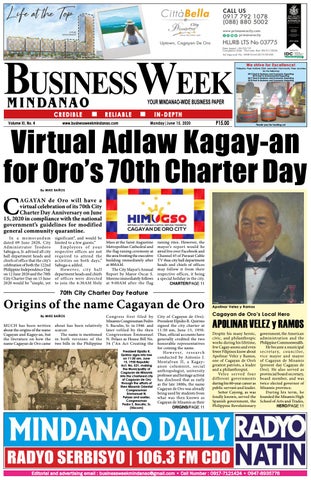
Virtual Adlaw Kagay-an for Oro’s 70th Charter Day Volume XI, No. 4
C
Monday|June 15, 2020
www.businessweekmindanao.com
Thank you for trusting us!
By MIKE BAÑOS
AGAYAN de Oro will have a virtual celebration of its 70th City Charter Day Anniversary on June 15, 2020 in compliance with the national government’s guidelines for modified general community quarantine.
In a memorandum dated 09 June 2020, City Administrator Teo doro Sabuga-a, Jr. advised all city hall department heads and chiefs of office that the city’s celebration of both the 122nd Philippine Independence Day on 12 June 2020 and the 70th City Charter Day on 15 June 2020 would be “simple, yet
significant”, and would be limited to a few guests.” Employees of your respective offices are not re quire d to attend t he activities on both days,” Sabuga-a added. H o w e v e r, c i t y h a l l department heads and chiefs of offices were directed to join the 6:30AM Holy
Mass at the Saint Augustine Metropolitan Cathedral and the flag raising ceremony at the area fronting the executive building immediately after at 800AM. The City Mayor’s Annual Report by Mayor Oscar S. Moreno immediately follows at 9:00AM after the flag
raising rites. However, the mayor’s report would be aired live over Facebook and Channel 45 of Parasat Cable TV thus city hall department heads and chiefs of offices may follow it from their respective offices, it being a special holiday in the city. CHARTER/PAGE 11
70th City Charter Day Feature
Origins of the name Cagayan de Oro By MIKE BAÑOS
MUCH has been written about the origins of the name Cagayan and Kagay-an, but the literature on how the name Cagayan de Oro came
about has been relatively scarcer. The name is mentioned in both versions of the two bills in the Philippine
C ongress f irst f iled by Misamis Congressman Pedro S. Baculio, Sr. in 1946 and later refiled by the then Congressman Emmanuel N. Pelaez as House Bill No. 54 ("An Act Creating the President Elpidio R. Quirino signs into law on 11:30 am, June 15, 1950 Republic Act. No. 521, making the Municipality of Cagayan de Misamis into the chartered city of Cagayan de Oro through the efforts of then Misamis Oriental Congressman Emmanuel N. Pelaez and earlier, Congressman Pedro S. Baculio, Sr. (Hiscom)
City of Cagayan de Oro). President Elpidio R. Quirino signed the city charter at 11:30 am, June 15, 1950. Thus, official accounts have generally credited the two honorable representatives for coining the name. H o w e v e r, r e s e a r c h conducted by Antonio J. Montalvan II, a Kagayanon columnist, s o cial anthropologist, university professor and heritage activist has disclosed that as early as the late 1800s, the name Cagayan de Oro was already being used by students from what was then known as Cagayan de Misamis as their ORIGINS/PAGE 11
Apolinar Velez y Ramos
Cagayan de Oro’s Local Hero
APOLINAR VELEZ y RAMOS Despite his many heroic, civic, and philanthropic works during his lifetime, few Cagay-anons and even fewer Filipinos know about Apolinar Velez y Ramos, one of Cagayan de Oro’s greatest patriots, a leader and a philanthropist. Ve l e z s e r ve d fou r different governments during his 60-year career as public servant and leader. Señor Cayong, as was fondly known, served the Spanish government, the Philippine Revolutionary
government, the American administration and the Philippine Commonwealth. He became a municipal s e c r e t a r y, c o u n c i l o r, vice mayor and mayor of Cagayan de Misamis (present day Cagayan de Oro). He also served as provincial board secretary, board member, and was twice elected governor of Misamis province. During his term, he founded the Misamis High School of Arts and Trades, HERO/PAGE 11
MINDANAO DAILY
RADYO SERBISYO | 106.3 FM CDO Editorial and advertising email : businessweekmindanao@gmail.com • Cell Number : 0917-7121424 • 0947-8935776
2
Advertising and Editorial E-mail : businessweekmindanao@gmail.com Contact nos. : 0917-7121424 • 0947-8935776
MONDAY|JUNE 15, 2020
A Century and two decades of History
The Legacy of PLAZA DIVISORIA I
By MIKE BAÑOS
F THE old trees of Plaza Divisoria could talk, they would be busy regaling the crowds with tales of its storied past, and how it often played a major role in the city’s local history. Plaza Divisoria was constructed in 1901 by Tirso Neri y Roa, a rich merchant who was then municipal mayor of Cagayan de Misamis, the old name of the city. Much of the site used for the plaza was donated by Neri to the town. “The purpose of this plaza was to serve as a divider for the town. Divisoria is a Spanish word which means divider,"
said Antonio J. Montalvan II, Ph.D., a Kagayanon columnist, social anthropologist, university professor and heritage activist. “At that time, Cagayan de Misamis, as the town was then called, was continuously razed by big fires. So, in order to contain such kinds of conflagrations, Tirso Neri built this fire break known as Plaza Divisoria." However, due to its central location, Plaza Divisoria soon became the socio-political and cultural center of Cagayan de Misamis. On September 10, 1916 it was the scene of a big parade celebrating the
passage of the Jones Law, which granted a bicameral congress to the Philippine Commonwealth. On June 19, 1917, the patriot Porfirio Chaves and his wife Fausta Vamenta turned over one of the earliest monuments in the country of national hero Dr. Jose Rizal which still graces the center of the plaza. To the east is the old monument to the Heroes de Cagayan, where the bones of local revolutionaries who died in the Battle of Agusan Hill on May 14, 1900 were once interred. At the center of the old plaza used to be a structure known to all Kagay-anons as the
Kiosko (and earlier, the Tribuna). In the 1950s, people gathered here for important social and cultural occasions, such as the annual celebration of National Heroes Day. By the 1960s, people were regularly gathering in the area which is now occupied by the Cagayan de Oro Tourist Assistance Center to discuss the burning issues of the day. This group of residents became what is now known to old-timers as The Plazans and included many of Cagayan de Oro's finest like Councilor Pio Roa, Yo Amon Fuentes, Dr. Jose Montalvan, Jesus Roa, Anastacio Gabor, Ramon Echem, former Governor Paciencio Ysalina, Aquilino Pimentel, Sr., Tawag ng Tanghalan National Champions Tata Neri and Rizal “Boy” Ortega, the late police chief Melo Esguerra, Carlos Yamut, and former
Plaza Divisoria during the 1960s showing the Bandstand at the site of the present Kiosko Kagawasan. photo courtesy of wadhu ' s quality store
PH Ambassador to the US Raul Ch. Rabe, to mention a few. For some time , the Kiosko was replaced by the Bandstand built by City Mayor Justiniano “Tiñing” Borja in the 60s, who also restored the central significance of Plaza Divisoria by building another structure, known
to Kagay-anons as the Ampi (for amphitheater). “All Philippine presidents who came to town, addressed the people of Cagayan de Oro in Plaza Divisoria,” Montalvan recalls. “So in a sense, this is the Plaza Miranda of Cagayan de Oro.” Borja’s Bandstand has in turn been replaced by the “Kiosko Kagawasan”, built by the past administration of Mayor Vicente Y. Emano. It recalls the architecture of the original Kiosko sans the skylight and the two lions which remain missing to this day. During the last term of the past administration, the Plaza underwent a major facelift. Besides the band stand’s replacement with the new Kiosko, the “ampi” has also undergone DIVISORIA/PAGE 9
CAGAYAN DE ORO MAIN BRANCH P & J Lim Bldg., Tiano Brothers Kalambagohan Sts., Tel. # (08822) 727-829 * Telefax # (088) 856-1947 CAMIGUIN BRANCH B. Aranas St., Poblacion, Mambajao, Camiguin Tel. # (088) 387-0491 CORRALES BRANCH Corrales Ave., Cagayan de Oro City DIVISORIA BRANCH Atty. Erasmo B. Damasing Bldg., #61 Don A. Velez St., Cagayan de Oro City Tel. # (088) 857-3631 LAPASAN BRANCH Lapasan Hi-way, Cagayan de Oro City Tel. # (088) 231-6739 CARMEN BRANCH Vamenta Blvd., Cagayan de Oro City Tel. # (088) 231-2011
Advertising and Editorial E-mail : businessweekmindanao@gmail.com Contact nos. : 0917-7121424 • 0947-8935776
MONDAY|JUNE 15, 2020
A Century and 17 years of History
Feature
ANG KATARUNGAN, F
Mindanao’s Oldest Newspaper
EW people would imagine from its humble four pages that the tabloidsized Weekly Katarungan is Mindanao’s, and possible the Philippine’s longest surviving Filipino-owned, edited and produced newspaper. First established as Ang Katarungan (The Reason) on July 1, 1903, it was founded by the distinguished Neri brothers Ramon, Felino and Vicente in Cagayan de Misamis (as Cagayan de Oro was then known). Ramon B. Neri was the Mayor of Cagayan de Misamis from 1912–1916 and represented Misamis during the 4th Philippine Legislature. He is the father of the former Undersecretary of Foreign Affairs Felino Neri. Felino was a lawyer and Vicente Neri San Jose was a former Misamis Oriental provincial governor (1934), journalist and publisher . When it first appeared, Ang Katarungan had the same size and number of pages as its present day descendant: the Weekly Katarungan now edited by Jerry Valenton and published by the founder’s great, great grandson Anton. It was type set by hand and printed in the venerable Minerva letterpress, many of which can be seen operating all
over the countryside and had a respectable (for those days) 300 copies circulation During the next 45 years, Jose A. Bautista of Camiguin, a staff writer of the Bisaya magazine, wrote that the paper changed its format no less than five times. Bautista said among its past editors included Felino Neri, Salvador Pacana, Jose V. Yasay, Fidel Valledor, Patria Neri, Fidencio Neri, and Eustaquio Batoto Gonzales. “From 1926 to the present (March 26, 1949), the paper had come out regularly as a Visayan-English newsmagazine in 16 pages, carrying on its masthead the pledge Devoted to the Development and Progress of Mindanao (which it does to present day).” During that year, Ang Katarungan had a weekly circulation of 4,000 copies, and reached many points of Misamis Oriental and Mindanao. It wasn’t all smooth sailing for the paper, starting with April 1937 when its office and printing plant was razed to the ground. Another fire struck on June 28, 1940 when a great fire which killed 12 persons wiped out the business and residential districts of the municipality. Barely two months later,
Vicente Neri San Jose, one of the 3 founders and publishers of Ang Katarungan
however, published Neri San Jose set up another printing plant and resumed publication on August 17, 1940. World War II began on December 8, 1941 and the paper was shut down in 1942. When Filipino guerrillas liberated Cagayan on May 10, 1945, the paper’s offices and plant were again destroyed. But the indefatigable Vicente Neri San Jose
KATARUNGAN/PAGE 9
Ang Katarungan Staff and Personnel
3
4
Opinion
The BusinessWeek Mindanao is published by BusinessWeek Mindanao Corporation every Monday to Friday with office address at Tanleh Building, Abellanosa, Cagayan de Oro City. It is registered with the Securities and Exchange Commission under Company Registration No. CS201531633 with BIR Certificate of Registration No. 2RC0000831068, TIN No. 463-826-272-000 – VAT. Reg., and with Business Permit No. 2020-04015. Tel. Nos.: (088)856-3344, (088) 810-100, 0923-432-0687, 0917-7121424 Website: www.businessweekmindanao.com E-mail : businessweekmindanao@gmail.com
BUSINESSWEEK MINDANAO CORPORATION Publisher DANTE M. SUDARIA President/CEO ALLAN MARIO MEDIANTE Vice President for Corporate Affairs RUFINO T. MAGBANUA Vice President for Business Development VICENTE C. DELA VICTORIA Vice President for Operations JOE FELICILDA Vice President for Administration JOHN AARON M. DEL BANDO Vice President for Events and Promotions JOE PALABAO Vice President for Marketing ROSE MARIE D. SUDARIA Vice President for Finance MIKE BAÑOS Vice President for Digital
NELSON CONSTANTINO Editor-in-Chief
GILBERT Y. CHAO
JUN AYENSA
Motoring Editor
Regional Editor - Caraga
MIKE BAÑOS Contributing Editors
ATTY. ANTONIO S. SORIANO
Feature Editor
2f, ICS Building Tel.No.: 881-0176 Tiano cor. Montalvan sts. Legal Counsel
CLIFFORD SANTILLAN
ATTY. MARIO T. JUNI
CHAINCERLIE SUMALPONG Advertising
Juni Law Office Cruz Taal St., CDO Legal Counsel
JOE PALABAO Layout Artist
DAVAO MARKETING OFFICE Door 223, Doña Segunda Bldg., CM Recto Ave., Davao City Telephone #: (082) 298-8815 Regional Mktg Manager-JOE PALABAO- 0926-8430152 Circulation-JOHN PAUL AQUINO, 0907-331-5640
Member: Philippine Press Institute Oro Chamber
Success starts today Think a minute… In 1951 a nuclear disaster almost took place at a nuclear power plant in Canada. The core reactor had melted down, so it had to be taken apart before more deadly radiation escaped into the community. The challenge was to quickly find the right person who was both highly trained and also willing to do such a dangerous job that could kill him. We l l , a 2 6 - y e ar- o l d lieutenant in the United States Navy who was highly trained in nuclear physics and reactor technology was willing to rise to the challenge. He had top security clearance at the headquarters of the Atomic Energy Commission in Washington D.C., so he was flown to the nuclear power plant in Canada where the accident had happened. There he led a team of trained technicians as they promptly practiced each precise step of taking apart the melted down reactor. Finally, wearing special radiation-resistant clothing and armed with only the tools in his hands, the lieutenant went where no human being had ever gone: a melted-down
THINK A MINUTE
MONDAY|JUNE 15, 2020
Blended learning, blinded solution
THE idea of having a blended le ar ning cou ld b e come a ‘ blinde d de cision’ as Education Secretary Leonor Briones raised the idea of implementing blended learning for the opening of school year 2020-21. It can be recalled that no less than President Duterte has been telling DepEd this: ‘No vaccine, No classes’ policy. That said, the push for the planned school opening this August is not feasible at this time when the Covid pandemic is still wreaking havoc worldwide. DepEd says that under the blended learning, students can benefit from doing part of their learning in a digital environment, and part of it face to face.
It further justifies that the benefits of blended learning include the fact that many students can learn best independently on their own time frame, and via interface with digital technology. But again the President has this last say on whether he allows schools to open in all levels. But then again the order stays firm: classes should not be held until a dedicated vaccine against Covid-19 is discovered. This was the also the growing sentiment of parents heavily concerned about their children going to school at this time when there is no available cure for the virus. Education is important, but dodging the virus is
important as well. Education can wait, but the virus cannot. In fact, a lawmaker had strongly opposed the plan for the resumption of classes on August 24, saying that classes should not be held until a vaccine against the coronavirus is discovered. People of all ages are vulnerable to the disease including school children. P hy s i c a l d i s t a n c i n g would be a struggle for a classroom with 40 to 50—or even more—especially in public schools. And therefore compliance to physical distancing in such a situation is near to impossible. Further, It would be hard for children to learn through virtual classrooms.
UNRUFFLED
RUFFY MAGBANUA In fact, even members of the House of Representatives are having difficulty conducting virtual sessions and communicating with each other due to weak Internet and communications signals. Again, education can wait, but the not the dreaded c o r o n av i r u s ( r u f f y 4 4 _ ph2000@yahoo.com)
Cooperatives: The new breed of 'freedom fighters' KIM'S DREAM
Cell No: 09352379999
MANILA OFFICE: 9th Floor, Unit 918, CityLand Herrera VA Rufino Cor. Valero St., Salcedo Village, Makati City Tel. # : 5555392,Cell No.: 0977-152-8860 LANI VALLIDO-Marketing Manager
Advertising and Editorial E-mail : businessweekmindanao@gmail.com Contact nos. : 0917-7121424 • 0947-8935776
ORLAN R. RAVANERA As we celebrate Independence Day, let us feel the essence of Fre e dom w hich our forefathers had fought for in a protracted armed struggle a century or so ago, when a few brave men and women had organized resistance against colonial rule, firmly believing that the people united can never be defeated. Nothing could be sweeter in the history of a nation than unfettering the people from external forces who would dare impose their will as masters subjugating their peons, stripping a nation of its dignity, making a mockery of the people’s ability to govern
themselves and craft their own destiny. No w ay c ou l d su ch subjugation continue. Such arrogance of having colonial masters dominating a people violated the very essence of man (or woman) for which God created him/her to be as one endowed with intelligence and free-will. It would only be a matter of time when such cruel societal order would be dismantled by freedom loving people. It is indeed great to be unfettered from the tentacles of direct oppression to savor the freedom of choosing our leaders, freedom of expression, of seeking redress to grievances, freedom of assembly, of privacy, of mobility and what have you. How e v e r, t h e r e a r e conditions which are also limiting, if not depriving, a nation of its liberty. Poverty, for example, doesn’t only strip a person of his humanity; it imprisons him to a life of hunger and ignorance. As former US Secretary of State Henry Kissenger would aptly
put it, “you deprive one of his right to food and you control his mind.” We may not be concerned so much with our freedom OF; it is our freedom FROM that we are struggling for during these most challenging times. To liberate the people from the vicious cycle of poverty, from hunger, from ignorance, is now the urgent call of the times so as to win back the very essence of the blessings of independence. For indeed, a nation-state may be independent in form but not in substance as it may be under the overwhelming influence of another, in more ways than one, as to make it in effect, not absolutely independent. A century or so ago, Dr. Jose Rizal, Andres Bonifacio, Apolinario Mabini, among ot he rs , b e c ame he ro e s b e c aus e t he y d are d to respond to the urgent call of the times by inspiring the people to hit the very core of the problem – colonialism. These nationalistic men had organized the people to wage
resistance, trusting in the inherent capability of the people to craft their own destiny. Today, all sectors of society are up in arms against the common enemy which is abject poverty, gross inequity and social injustices. They follow the same formula adopted by our heroes, which is, to harness the people’s collective potentials and power to have control over their lives and over the resources which are fast slipping through their fingers. Not only do they give high adherence to time-honored and universally-accepted principles; most importantly, they practice them. These set of principles is anchored on democratizing wealth and power which go by the name of cooperativism. By law, cooperatives loom as instrument of social justice, social equity and peoplecentered development. Be it in the arena of a g r ar i an re for m , fo o d security, ecological integrity, LAW/PAGE 9
The bull, the bear and the virus JHAN TIAFAU HURST nuclear reactor core. He had to take the reactor apart perfectly, with each step taking no longer than one minute and 30 seconds. In that amount of time this young lieutenant’s body was exposed to the maximum allowable radiation for a human being for an entire year! So his swift and skillful work was crucial to his own survival. He had no time for even one small mistake of fumbling for a bolt or valve connector. Both his life and the lives of many others were depending on him. But he not only survived, he succeeded! And not only at that challenging job, but many others throughout his life. For SUCCESS/PAGE 9
Amidst COVID 19, BPI Ass et Management and Trust Corporation (BPI AMTC) continues to engage its investors by keeping them well-informed of the market situation and possible opportunities in this crucial time. BPI AMTC launched last week a new Webinar series, “The Bull, The Bear and The Virus – The Anatomy of Resilient Investment Plans”. BPI AMTC gave an update on the global markets and the opportunities to diversify one’s portfolio, identified the most promising sectors to look out for as the world starts to recover from COVID 19, and how the world’s central banks are reacting to breathe new life in the financial markets. Despite a certain degree of recover y since the worst sell-off in March, we should not extrapolate too
much into the future as the world is still fraught with uncertainty and risk. The fundamentals continue to show poor economic data and unemployment is on the rise. B P I A M T C ’s He a d of Investments Solution, Martin Allen Dee, talked about the importance of diversification, and exploring global opportunities as a way of diversifying one’s portfolio. I contributed my few centavos worth by sharing my own experience as a long-time investor and relating how the Bangko Sentral reacted to the 2008 global financial crisis and the current COVID 19 crisis. The BSP has been putting money, by buying bonds, providing liquidity for banks, easing restrictions, allowing the banks to take a breather. Martin Allen Dee’s key takeaways:
-There is a common misconception that investing in global assets is riskier but this is not always the case. In fact over a ten-year period, the numbers show that global equities gave better returns (with less volatility) compared to PSE. -The Philippine market is highly concentrated by company, sector and revenue source. 5 conglomerates dominate the market. Ergo, i nve st i n g lob a l ass e t s to benefit from a fully diversified portfolio. -The COVID 19 pandemic will change the way consumers and businesses behave. Use this period to “future proof ” your portfolio by investing in emerging global themes through global stocks and b onds . T he re are ve r y interesting opportunities in 1) innovation and technology, 2) sustainability
SPEAKING OUT
IGNACIO BUNYE and ESG investing and 3) health care and medical sciences. -Remain cautious. Take on risks on your portfolio but be wary that the room for error is large given the dislocation between the real economy and the market. - “Timing the bottom” and “timing the peak” are extremely difficult to do. Having a regular investment plan is very important. This BUNYE/PAGE 9
5 Globe partners with ChildFund Philippines to empower Filipino children and families in time of COVID-19 Advertising and Editorial E-mail : businessweekmindanao@gmail.com Contact nos. : 0917-7121424 • 0947-8935776
MONDAY|JUNE 15, 2020
WITH most Filipinos still undergoing the effects of community quarantine policies across the country, Globe is helping keep them safe with its partnership with ChildFund Philippines, an international nongovernmental organization that ensures the healthy and safe beginnings of Filipino children. ChildFund is an international organization that has its beginnings that go way back to 1938 in the USA. It works with local partner organizations, governments, corporations, and individuals in 24 countries around the world to help create the safe environments children need to thrive. Through its programs, ChildFund gives parents and caregivers the skills and resources to be responsive to children’s needs, ensure access to health and education, and provide quality learning
and safe environments. To date, it has helped 7.94 million children across the world. Under the partnership, Globe will be providing SMS Blasting services via AMBER.ph to reach families and inform them on ways to keep their children safe from the COVID-19 pandemic. This includes mitigating potential harm to kids and maintaining normalcy through continuous learning. Enabled by Globe’s SMS blast solutions, ChildFund has also implemented a Home-based Family Activity Kits (HFAK) facility, reaching out to 8,729 families from Apayao to Tawi-Tawi, five days a week. This includes suggested activities in creating family routine, social and emotional learnings, farming, arts and crafts activities to foster unity and creativity among family members. In addition, the
organization has completed its six virtual training sessions on Mental Health and Psychosocial Support (MHPSS) and Psychological First Aid (PFA), attended and completed by 43 individuals representing the organization's 12 local partners nationwide. These virtual training sessions equip local partners with additional knowledge and skills to handle stress and
anxiety that is inherent during a pandemic, which they, in turn, can utilize in conducting the same training to parents, volunteers, caregivers and some local government units, all to ensure the protection and development of a child. “The quarantine poses challenges for us to physically reach families, but we believe that harnessing technology through our SMS services
can help fulfill ChildFund’s vision of helping young individuals achieve their potential,” shared Globe Chief Commercial Officer Albert de Larrazabal. Globe aims to reach more people as it continues to provide its mobile and other digital solutions to customers and partners, amid the new normal. It continues to enable more personalized customer experiences through innovative digital
platforms, partnerships with public and private organizations, and improved care channels such as customer service apps and chatbots. “We understand that life goes on even during a quarantine. Through our enhanced services and partnerships with reputable organizations like ChildFund Philippines, we hope to support more Filipinos GLOBE/PAGE 9
BusinessWeek MINDANAO CREDIBLE
RELIABLE
Editor: GILBERT Y. CHAO
MOTORING IN-DEPTH
Monday|June 15, 2020
Bang for the Buck
6
- the All-New Suzuki S-Presso
T
HE S-PRESSO’s exterior design is a sight to behold. Its bold and athletic profile, combines with its tall and powerful stance ensuring it commands all the attention wherever it goes. The car’s strong character lines and prominent exterior features such as the muscular front grille, striking front and rear bumpers, distinct headlamp and rear lamp design add to its robust appearance. Make a bold statement as you
zip around corners and on lanes. The S-Presso’s side body volume has been pushed upwards to give high visual center of gravity. The boxy wheel arches enhance its stance and sporty side while the strong character line adds the car’s bold persona. The moment you step inside the S-Presso, your eyes instantly fall on the unique center console housing a trendy digital speedometer. Artistically crafted with bold and vibrant
design elements, it’s from where all the energy originates, spreading into the interior of the car. The central position of the meter cluster also gives you a new, heightened driving experience. Get in and experience the invigorating ambience of the S-Presso. The exceptional experience of the S-Presso is a combination of its driving performance and convenience. With a peppy engine and other innovative features, you’re in for an exciting drive. So sit back, and gear up for an energetic drive that’s equally relaxing. S-Presso's compact 1-liter engine is the perfect foil for the go-getter in you. After all, it delivers a peppy performance to go along with your active lifestyle. Plus, it delivers enhanced fuel efficiency, allowing you to go that extra mile. With a 5-speed manual transmission, the S-Presso makes driving on any road a pleasant experience. Its transmission offers an optimal gear ratio,
and reduces friction for the engine and drivetrain, enabling it to obtain the best possible fuel consumption and performance. Muffler noise, road noise and floor vibration are minimized through optimizing body characteristics. Not only are the noises reduced by use of enhanced insulation materials on the car body through a series of intricate improvements to optimize airflow, the ideal balance of design and aerodynamic performance is realized. The S-Presso lets nothing hinder you from reaching what you set out for. And it does this by keeping you protected on every road you take. With a host of exceptional safety features, the S-Presso takes care of you while you enjoy the drive. The S-Presso comes with front SRS airbags as standard for the safety of the driver and front-seat passenger in case of
a frontal collision. The pre-tensioner is designed to tighten the seatbelts to restrain occupants quickly and to prevent them from being thrown forward in case of a moderate or severe frontal crash. Force limiter helps protect occupants from seatbelt inflicted injuries. Innovation lies in the heart of the S-Presso. It is built with Suzuki’s new generation platform – HEARTECT. Light and highly rigid, it lowers fuel consumption and vastly improves the fundamental vehicle performance in terms of running, turning and stopping. Its frame is characterized by smooth and continuous curves, which efficiently disperses impact energy in case of collision. The bodydesign of S-Presso centers on Suzuki’s TECT concept, which helps protect the cabin in the event of a collision by efficiently absorbing and dispersing energy.
It also widely employs high tensile steel to achieve both lightness and excellent safety performance. In emergency braking or on slippery surfaces, the anti-lock brake system (ABS) keeps tires from locking, and enhances the driver’s ability to avoid obstacles through steering. The S-Presso comes fitted with ultrasonic sensors in the rear bumper. This means you can get rid of your parking woes, because it helps detect obstacles while you park the car. Warning sounds keep you aware of the distance to the obstacle, making parking a simple task. A minimum turning radius of 4.5m provide excellent maneuverability even on narrow roads. The All New S-Presso is priced at a SRP of Php518,000.00 and is available in a new colorway, Sizzle Orange. You may also enjoy the S-Presso in Fire Red, Metallic Granite Gray, and Metallic Silky Silver.
Advertising and Editorial E-mail : businessweekmindanao@gmail.com Contact nos. : 0917-7121424 • 0947-8935776
MONDAY|JUNE 15, 2020
7
8
Advertising and Editorial E-mail : businessweekmindanao@gmail.com Contact nos. : 0917-7121424 • 0947-8935776
MONDAY|JUNE 15, 2020
3 Generations of Tradition:
Cagayan de Oro's oldest store looks forward to the next century and beyond C
By MIKE BAÑOS
agayan de Oro – In the center of Wadhu's Quality Store stands a 1931 NCR cash register, bought by the store's founder by mail order from Sears & Roebuck in the United States 71 years ago. During the world war two, the owner wrapped it in grease and buried it in his backyard. After the war, he dug it up and it still serves the same store now run by his grandson John-John.
That cash register is the living testimony of the traditions that has made Wadhu's Quality Store Cagayan de Oro's oldest surviving retail store, a tradition established by the store's patriarch and carried on by the third generation which now runs it. Eight four years ago, Wadhu Dharamdas Uttamchandani set up in Cagayan de Misamis (as Cagayan de Oro was then known) 'Wadhu's Home
The original 1931 NCR cash register still on duty today at Wadhu's Quality Store.
of Quality' near Plaza Divisoria, the town's social and commercial center. Mr. Wadhu arrived as a 12-year old boy from India n the Philippines in 1924. He was employed at the Indian Bazaar owned by his uncle Nebhraj Ramchand Buhdrani in Zamboanga City for 12 years where he gained his basic knowledge and business savvy in the retail trade. In 1936, he felt he had enough seed money, contacts and experience to establish his own store in Iligan, but decided on Cagayan instead. His thatched roof store featured items bought by mail order from Sears & Roebuck was set amidst stores run by Japanese nationals near the Heroes de Cagayan monument. Divisoria was the Escolta of Cagayan in those days, and the nearby public market ensured the fledgling store flourished until World War II exploded. "My father survived the war by bartering his goods for food and clothing," said
This was how the pioneering store Wadhu's House of Quality (now Wadhu's Quality Store) looked like in the late 1930's when it was still situated at its original site in Plaza Divisoria. photos courtesy of dodong wadhu
his son, Wadhu "Dodong" Jr. "He married my mom, Trinidad Babiera Valmores at Balingasag, Misamis Oriental in 1943 and had two children, myself and my sister Linda." In 1946, Mr. Wadhu (as he was fondly called by friends and customers) reopened at a new location in Plaza Divisoria just across the public market, but moved to the next block after two years, when its present name as Wadhu's Quality Store was first seen. The store moved to its present site in the corner of J.R. Borja and Pabayo streets when Mayor Justiniano Borja moved the city public market to the Cogon area in 1958. STORE/PAGE 9
Wadhu Dharamdas Uttamchandani
Hinterland Teacher: Embracing New Ways of Teaching By EMERALD BATION MANLIGUEZ Teacher I Katipunan National High School Katipunan, Sinacaban, Misamis Occidental
Being a teacher serving in the hinterlands is one of the noblest profession in the world. It entails a lot of sacrifices and efforts to become a teacher assigned in the mountain barangays. Waking up early, riding a motorcycle or what we called "habal-habal". Many people would generally say that even being a hinterland teacher is a fortunate circumstance because she would still get the chance to avail of salary loans from any bank in the country. Many adjustments to ensure we gave students the best learning they need. As a teacher we makes adjustments on how to deliver any means of teaching to the students. We embrace a new ways of teaching on how the students best adopt learnings. The best challenge for every teacher is capturing each students attention and conveying ideas effectively. As a hinterland teacher, we embrace new ways of learning specially we considered the materials given to us and on how to delivered it clearly to them. Teachers teaching quality is one of the most challenging and important goals of education improvement. Teacher finds
many way on how to teach their students specially on hinterland area. It is more challenging and exciting because you will discover a lot of things on how the students will adopt our new teachings ways or method. It gives a lot of encouragement to work harder, teach harder specially on those students who are eager to learn and reach their dreams. A hinterland teacher needs a lot of work on making things easier for your students to adopt easily and learn easily. As a hinterland teacher, we also need to consider the behavior of the students around other students, doing school work and other things like making school requirements. By this we also need to adopt our teaching to the best way we can that will make them love going to school everyday. Participate every lesson and listen when a teacher is talking is the main goal everyday of every teacher. By embracing new ways of teaching we are guaranting our students to help them reach their dreams and teach them everything we need them to teach in a ways they best learn.
Advertising and Editorial E-mail : businessweekmindanao@gmail.com Contact nos. : 0917-7121424 • 0947-8935776
MONDAY|JUNE 15, 2020
Success... from page 4
that young Navy lieutenant who saved countless lives by skillfully and bravely going where no human in history had gone before, went on to become president of the United States: Jimmy Carter. Rememb er, w hat we become in the future is determined by the choices we make today—and every day. We must choose to do the right thing and be our very best, no matter what the cost or risk. When that becomes our daily habit and character, then it continues to bring us greater success in life. So won’t you ask Jesus to forgive you for not living the way you know you should, and to help you start living His right, best way every day? Just think a minute…
Bunye... from page 4
allows the investor cost averaging. -St ay ca lm and st ay invested. If you have a longer investment horizon, if you are patient and you don't get bothered by short-term volatilities, if you are fully diversified, you will reap the reward. BPI AMTC, a stand-alone trust corporation and a wholly owned subsidiary of the Bank of the Philippine Islands (BPI), ended 2019 with P730 billion in assets under management (AUM), and registered a record growth of 24% year-onyear and approximately 7% growth for the past five years. BPI AMTC was named the Best Asset Manager for 2020 by International Finance magazine for the fourth year in a row. BPI AMTC recently garnered two wins at the Search for the Best Managed Funds of the Year Awards sponsored by the Charter Financial Analysts Society of the Philippines. BPI AMTC´s BPI Balanced Fund product, and BPI Global Equity Fundof-Funds were adjudged the best products in their respective categories. BPI AMTC President, Sheila Marie U. Tan, said these prestigious recognitions “are a testament to our competence in achieving our objective of helping Filipinos with their financial goals in the most efficient and strategic way.” Disclosure: The author sits in the board of BPI AMTC. Note: You may wish to share this article via Facebook, Twitter and/or Linked-In.
Law...
from page 4
job generation and global c omp e t it ive n e s s , t h e s e cooperatives are now serving notice to one and all that they will not allow anymore poverty to deprive them of their right to live a dignified life, free from hunger, from ignorance. Through their cooperatives, people are brought into the mainstream of development processes, to
participate in the God-given right of decision making and in effected, put power where it rightfully belongs, that is, with the people. The cooperatives which are increasingly becoming a formidable development force to fight hunger and poverty can aptly be called the new breed of freedom fighters, the new heroes of the contemporary times. By harnessing the collective power of the people, they have drawn the poor and the oppressed into the mainstream of development processes. The cooperatives are the great equalizer to democratize wealth and power in a highly skewed societal order. In a country so rich in ecological resources – the richest on earth per unit area and the Philippine Archipelago being the “center of the center of marine life on earth,” no way should poverty be allowed. But who controls, who profits, who decides? Only a few oligarchs as concluded by a Study. Today, liberation day has come as the 18,000 cooperatives with some 11 million members advancing the 17 Sustainable Development Goals – i.e., stop poverty, stop hunger, stop social injustices, stop gross inequities, protect the environment, promote the health of the people, etc. Indeed, they have become transformative for People, Planet, Prosperity and Peace for genuine FREEDOM!
Katarungan... from page 3
persevered and again managed to resume publication on its 45th anniversary on July 17, 1948. That week’s issue had the late President Elpidio Quirino on its cover and cost 15 centavos. Not bad for a 16-page newsmagazine in those days. D u r i n g t h e p ap e r ’s centennial, writer E. Lazaro Garcia said the paper featured the Sept. 1, 1948 eruption of Mt. Hibok-Hibok in Camiguin (then a part of Misamis Oriental). Garcia said among its ads for that issue were offers for the yet undeveloped Nazareth Sub div ision (C agayan’s first) and Ah Fat Store and Bakery with its ensaymadas, mammon, broas, cakes, etc. located at the corner of what was then known as South Divisoria-Real (now Capistrano) streets. “It was housed at Neri’s Printing Press at Mindanao (Tiano Bros.) street. Among its later distinguished editors and publishers were Augusto F. Neri, Sr., father of Atty. Augusto “Titot” Neri, Jr., former president of the Cagayan de Oro Press Club, COPC) and added the prefix “Bag-ong” to its name. AFN, as he was known to readers of his Political Diary, served as a city councilor of Cagayan de Oro for two terms during the 1960s, and was chairman of the board of the Cagayan de Oro City Water District until his death in 1982. He was also president
of the COPC in 1958. Regular contributors i n c l u d e d At t y. E . M . Tamparong, Atty. Juan B. Regalado, Dr. Blas Ch. Velez (composer of Diyandi, a songdance, believed to be the oldest song in Cagayan de Oro), Adrito Labial, J. M. Gandionco, Guido R. Ongpin and former Cagayan de Oro Mayor Reuben R. Canoy (In a Nutshell). Garcia said it also carried anonymous columns and articles by writers with “varied and amusing” nom de plume like Ginaraying Tistis ni Intoy Kinilaw (in balak form), Piko-Piko Laguring ni Pakang; Siesta of Mari Lu Valdez and Kulas Lipak. (RMB)
Divisoria... from page 2
a similar renovation, which thankfully left it in better shape than it was before. But even that “new ampi” was later demolished to give way to a new one is now being constructed which should be ready by 2022. “Perhaps a better way of regarding Divisoria and its future is in order now,” Montalvan said. “We now have a national law in place, RA 10066, the National Cultural Heritage Law. Government is now capable of declaring sites and landmarks so that these can be protected. There is one classification there called the Heritage Zone that I think is the most appropriate way of ensuring the future of Divisoria. Soon we shall pass from this world. But what assurance do we leave behind?” Residents and visitors remain hopeful that, in time, these transient problems are resolved and that Plaza Divisoria with its fruit stands, monuments, benches and trees would be there for the next hundred years or so for their afternoon paseos, paradas and procesiones to mark important and historic occasions in this city’s history.
Store... from page 8
"My dad didn't want to be too close to the Cogon market where competition would be stiff but he also didn't want to be too far from the former site in Divisoria and his regular customers either," Dodong explained. In 1973, the elder Wadhu felt the younger generation was ready to take the reins of the business and turned over the store's management to Dodong. "The idea was to help infuse faster and newer approaches towards marketing and merchandising without changing the original concepts on which we made our reputation," Dodong recalls. "We introduced new products catering to the tastes of the younger generation and terminated others which were slow moving." And not too soon. By 1975, retails giants Ororama and Gaisano came into the picture, forcing other stores to fold up due to the intense competition. "We took this as an
opportunity, a challenge to make our strategies competitive with the giants," Dodong said. "I have always we l c om e d c omp e t it i on because it is the only way to serve the public with better service and cheaper prices." For instance, when more people from Butuan, Surigao, Bukidnon and Iligan began coming to Cagayan, Wadhu's even multiplied its customers despite stiff competition from the bigger stores. "Our overhead is not as large as the big ones, so we were able to adjust our prices and compete," Dodong said. "Since we were also getting the same merchandise from the same suppliers, we were able to attract more customers with our lower prices without sacrificing service and quality." The 1990s brought even stiffer competition from malls like SM City and Limketkai Ma l l w hich fe ature d a wide variety of stores and merchandise and attractive amenities like national food chains and cinemas all under one roof. " We ke pt ou r l oy a l customers and even added more through our personalized service," Dodong said. "Most of the sales girls in the big malls are hired on a casual basis and are no match for better paid and motivated sales staff of smaller stores who have better experience and training, not to mention knowing the customers on a first name basis." "Ever yone is equally served and each person is attended to no matter how small their needs are," he adds. "We train our sales people never to look down on anyone and treat them as regular adult customers regardless of age, gender or appearance." Some years ago, a ruggedly dressed barefoot gentlemen wanted to buy an expensive watch. Sensing the sales clerk was at a loss on how to deal with him, Dodong stepped in to personally entertain him and he paid in cash. "It was only a week later that I found out he was the owner of a big building which housed many stores in Bukidnon," Dodong wryly recalls. "He told me ours was the third store he went to and the only one who gave him any attention." More recently, traders from Mainland China, Taiwan and Korea have swamped the city with low quality merchandise at very low prices. Together with the ukay-ukay vendors selling smuggled garments and shoes at rock bottom prices, they have crowded the city's sidewalks and even areas fronting regular stores. The third generation of Wadhu’s takes all the competition and changes in stride, having been born and raised in Cagayan de Oro under the tutelage of their father and grandfather. They remain confident the "Open Door" policy of the original Wadhu's Home of Quality will see them through the next century and beyond. "We grew up in this store and we don't see any
reason to change how it looks or operates," said the elder Haresh. "Since my grandfather first started this store, he insisted to my Dad to leave the store's doors wide open. So, even people from the rural areas would not be shy to come in and window shop. They don't feel pressured to buy something and can window shop as much as they like." In the center of the store, another sale is rung up in the NCR cash register. If the sale totals more than the P99.00 the machine is capable of calculating, a hand-held calculator steps in. It looks like the old machine could easily outlive a dozen or so of its modern counterparts, just like the store it serves in the corner of J.R. Borja and Pabayo streets in Cagayan de Oro has done to many of its competitors.
CORRALES BRANCH Corrales Ave., Cagayan de Oro City
DIVISORIA BRANCH Atty. Erasmo B. Damasing Bldg., #61 Don A. Velez St., Cagayan de Oro City Tel. # (088) 857-3631 LAPASAN BRANCH Lapasan Hi-way, Cagayan de Oro City Tel. # (088) 231-6739 CARMEN BRANCH Vamenta Blvd., Cagayan de Oro City Tel. # (088) 231-2011
from page 5
as they stay connected, productive, and informed, even at home,” added de Larrazabal. To st ay up d ate d on the latest COVID-19 developments, Globe mobile and broadband customers are also given free access to the official websites of the Department of Health (DOH) and National Disaster Risk Reduction and Management Council (NDRRMC). Learn more about this story and other ongoing efforts by Globe in response to the COVID 19 crisis via https://w w w.glob e.com. ph/. You may also tune in to ChildFund Philippines' Facebook page for more updates on issues that affect children's rights, safety and development. E X T R A J U D I C I A L SETTLEMENT OF ESTATE AMONG HEIRS WITH DEED OF ABSOLUTE SALE
CAGAYAN DE ORO MAIN BRANCH P & J Lim Bldg., Tiano Brothers Kalambagohan Sts., Tel. # (08822) 727-829 * Telefax # (088) 856-1947 CAMIGUIN BRANCH B. Aranas St., Poblacion, Mambajao, Camiguin Tel. # (088) 387-0491
Globe...
9
CDO MAIN BRANCH P & J Lim Bldg., Tiano Brothers Kalambagohan Sts., Tel. # (08822) 727-829 * Telefax # (088) 856-1947
DIVISORIA BRANCH Atty. Erasmo B. Damasing Bldg., #61 Don A. Velez St., Cagayan de Oro City Tel. # (088) 857-3631
CAMIGUIN BRANCH B. Aranas St., Poblacion, Mambajao, Camiguin Tel. # (088) 387-0491
LAPASAN BRANCH Lapasan Hi-way, Cagayan de Oro City Tel. # (088) 231-6739
CORRALES BRANCH Corrales Ave., Cagayan de Oro City
CARMEN BRANCH Vamenta Blvd.,Cagayan de Oro City Tel. # (088) 231-2011
KNOW ALL MEN BY THESE PRESENTS:
That the late CUSTODIO L. CURIADO JR. who died on June 7, 2014 at Medical Center- Cagayan de Oro City that the deceased at the time of his death left a parcel of land located at Cogon Cagayan de Oro City, covered by Transfer Certificate of Title No. 137-2014001340, declared under Tax Declaration No. g-274856 and which is more particularly described as follows; containing an area of One Hundred Sixty Eight (168) Square Meters More or Less, that said deceased died intestate, without will or testament and without any outstanding debts in favor of any person or entity; filed by the heirs of CUSTODIO L. CURIADO JR., per DOC #72; PAGE #15; BOOK #134; Series of 2020 under the Notarial Registry of ATTY. SATURNINO N. BAGONGA.
That the late AQUILINA D. PABILONA, died on January 4, 2014, ELSA D. PABILONA died on May 27, 2018, PURITA D. PABILONA died on July 29, 2018 and CLARITA D. PABILONA died on May 25, 2017, all single and without issue; while LILIA PABILONA RARAN died on February 4, 2011 and CIPRIANO D. PABILONA died on March 11, 1971, both in Cagayan de Oro City, respectively, without any last will or testament, all deceased left a parcel of land ORIGINAL CERTIFICATE OF TITLE NO. CARP2015000014 situated at Barrio of Carmen, City of Cagayan de Oro, Prov. Of Misamis Oriental, Island of Mindanao, containing an area of FIFTY TWO THOUSAND ONE HUNDRED EIGHTY SIX (52, 186) Square Meters, more or less, and has been the subject of an EXTRAJUDICIAL SETTLEMENT OF ESTATE AMONG HEIRS WITH DEED OF ABSOLUTE SALE, filed by the heirs of AQUILINA D. PABILONA, ELSA D. PABILONA, PURITA D. PABILONA, CLARITA D. PABILONA, LILIA PABILONA RARAN, CIPRIANO D. PABILONA, in favor of VEPCO GROUP DISTRIBUTION CORP, represented herein by its Chief Operating Officer, JOHN LESTER T. TAN, per DOC #329; PAGE #66; BOOK #47; series of 2019 under the Notarial Registry of ATTY. NOEL B. VEDAD.
BWM: June 15, 22 & 29, 2020
BWM: June 8, 15 & 22, 2020
E X T R A J U D I C I A L SETTLEMENT OF ESTATE AMONG HEIRS WITH DEED OF ABSOLUTE SALE KNOW ALL MEN BY THESE PRESENTS:
BusinessWeek MINDANAO CREDIBLE
RELIABLE
www.businessweekmindanao.com
FEATURE
IN-DEPTH
10
Monday|June 15, 2020 The Bulk Water Supply Project treats raw water from the Bubunawan River into potable drinking water for COWD since 2007.
Malasag Spring in Mapawa Nature Park was the first source of piped in water of Cagayan. photo courtesy of jojie alcantara
The origins of
Cagayan de Oro’s Water Supply By MIKE BAÑOS
DURING the ground breaking for the Indigenous People Cultural and Community Water System (Phase II) at Sitio Malasag, Barangay Cugman four years ago, Datu Masikal Jude Jabiniar reminded those present of the origins of Cagayan de Oro City’s water supply. “It is ironic that many people had forgotten that the Malasag Spring provided Cagayan de Oro its first ever running water but for many years Malasag was itself without a water system,” Datu Masikal said in the vernacular. “We are happy that finally our place in history is recognized and the city government made things happen to finally give our residents their own water system.” In the olden days of Cagayan de Misamis, the townsfolk of the capital town of the Segundo Distrito de Misamis relied on the Cagayan River as its main
source of water. According to former city mayor Reuben Canoy, “Then, dirty water for kitchen use was drawn beside the river bank and sold for P1 per kerosene can and clean water for drinking, taken by enterprising boatmen from the middle of the river, sold for P2 per kerosene can. After the cholera epidemic, US Army doctors ordered the public to drink only boiled water.” “ To p r e v e n t f u t u r e outbreaks of water-borne diseases, the local government built in 1922 what was to become the town’s first water system, source of which came from a spring in the Malasag Hills and was distributed from the concrete water tower which today houses the City Museum.” “After World War II, the Cagayan Waterworks was taken over by the National Waterworks and Sewerage Authority (NAWASA). It
was virtually a two-man operation. In 1954, then Mayor Justiniano Borja had a well dug at the end of Pabayo Street, a reservoir built on the Bontula Hill in Macasandig and a pump installed at the Mabulay Subdivision where the COWD Administration building now stands. Even with these efforts, it was still difficult to cope with the city’s rapid expansion.” Recalls former city mayor Constantino G. Jaraula: “Ang tayam-tayam nga tubig sa Calamian (Mabulay) gave way to deep wells in several areas; ang Malasag source na monopolize sa Sta. Cecilia ug Capistrano complex; ang water tank sa Gaston remained the main source of the fire trucks until several hydrants were erected in several areas.” “Ang Calamian District deep well sulod sa mga Mabulay or nalibutan sa ilang mga yuta. The area used to be known as Calamian District and later yielded to “Mabulay Subdivision.”
COWD Public Relations Information Division hosts a Facilities Tour and Water Conservation Campaign to brief high school students on the safe and responsible use of water resources at Production Well No. 1 in Macasandig.
Long-time resident Amadeo “Tatoy” V. Neri, Jr. shares his memories: “When our old house was built in 1948 along the corner of Apolinar Velez and Hayes Sts. it already had water piped in. The source was the old water tower and water was supplied by the city waterworks.” “In the 50s if you were living in Lapasan, many relied on rainwater for drinking, via water tanks that collected water during rains. Many areas had artesian wells that were opened to the public for their common use,” he added. Even during the 1960s, with water already piped directly to houses in the old poblacion, potable water remained scarce and residents still went to the Cagayan River for most of their water needs. “I can remember NAWASA pa to sa among time early mid 60s murag grade 4 ko.Naa na gripo sa among balay sa bata pa mi but hinay kaayo tubig,” said Lealyn Abellanosa-Ramos whose family lived along Tiano Brothers Street. “Sa gabii ra mo tubod sa among taas. Sa silong banyo, CR, labhanan sag-ob tubig daan kay dili continuous ang tubig. Sa ka kulang tubod ang paglaba didto sa Cagayan River, kanag ilalom sa tulay duol city hall.” ( I remember it was NAWASA during our time in the early to mid 60s, I guess I was in Grade 4. We had running water from a faucet in our residence but the flow of water was very slow. It was only at night when water pressure rose that water could be had in the second floor. We stocked water in the first floor where we had our bathroom, toilet, laundry area because the flow of water was intermittent. If the water was insufficient for our washing, we had our laundry done at
Old Water Tower under construction
the Cagayan River in that area below the Ysalina (then known as Carmen) Bridge.” During those halcyon days, piped-in water from NAWASA cost a flat rate of P40.00 a month, recalls Jocelyn Velez, whose family resides along present day J. Gaerlan Street. “One time I noticed the bill had reached P100! I investigated and found out our helpers often left the water hose open overnight so they didn’t have to water during the hot days! I warned them that if the next water bill goes over P 40.00 I would take the difference from their wages! Needless to say, it never happened again.” Along Marcelo H. Del Pilar Street about a kilometer
from the city poblacion, the kids of Severino and Ruth Ramos were fortunate to have an atabay (deep well) where they could draw clean water for their laundry, watering the plants and general use. Drinking water was drawn from a common public faucet along nearby Magsaysay Street. Wh e n Att y. R e u b e n Canoy became City Mayor in 1971, he created the Water Development Commission and soon after, President Ferdinand Marcos created the Local Water Utilities Administration (LWUA) which was charged with organizing water systems throughout the country. ORIGINS/PAGE 11
11
Advertising and Editorial E-mail : businessweekmindanao@gmail.com Contact nos. : 0917-7121424 • 0947-8935776
MONDAY|JUNE 15, 2020
Charter... from page 1
In its official Facebook page, Kagay-anons here and outside the city and the country were invited to join the virtual celebration to be aired live on Facebook, Parasat Channel 45 and radio stations in the city on 15 June 2020. Adlaw Kagay-an On August 2, 1999, the Cagayan de Oro City Council u n an i m ou s ly approve d Resolution No. 4365-99 “Permanently adopting the name Adlaw Kagay-an for the City Charter Day.” The resolution noted that since the signing of the City Charter in Malacañang Palace on June 15, 1950 had been commemorated ever since in the city as “City Charter Day”. However, the council further noted that City Charter Day was a “rather anglicized name” compared to other cities which had already adopted Filipino names for their respective charter days such as Araw ng Maynila and Araw ng Dabaw. “Since the Charter Day of Cagayan de Oro City is considered a significant historical milestone in the city’s history, and the national guiding principles of History from the Filipino point of view must also guide the city in the use of names for indigenous events and activities,” the resolution noted further.
Hero... from page 1
which survives to this day as the Misamis Oriental
Considering how h istor i an s chol ars ha d traced the etymology of the term Cagayan to the ProtoPhilippine language where the word kagay means “river”, and Kagay-an means “the place where there is a river”. Thus, the city council jointly and unanimously adopted to permanently adopt the name Adlaw Kagay-an for the City Charter Day. T h e re s o l ut i o n w a s sponsored by Councilors Maryanne C. Enteria, Noel S. Beja and President D. Elipe with then Vice Mayor John L. Elizaga as presiding officer, and attested by Teresita R. Bancoro, assistant city council secretary for the city secretary. Higala-ay Festival The Adlaw Kagay-an resolution marked the first instance where the first of the city’s two main holidays were renamed. The city fiesta traditionally celebrated on August 28 in celebration of the feast day of its patron saint, St. Augustine of Hippo, has undergone at least four name changes in the last two decades. Previously known as the Kagayhaan Festival, Promote CDO sponsored a competition in 2007 to find a more appropriate name that would reflect Cagayan de Oro’s ethnicity, heritage and history. After initially selecting Karambola Kagay-an, the NGO settled on Kagay-an after receiving negative feedback about the
term Karambola. However, the new moniker only lasted six years as the new administration of present Mayor Oscar S. Moreno chose to change the festival name to Higalaay Kagay-an in 2014, before finally dropping Kagay-an altogether in 2016 and changing it again to Higalaay Festival. Spring Festival Since 2016, the city has added two more festivals in its calendar, with one being celebrated every quarter of the year. For the first quarter, the city celebrates its Chinese heritage and history by joining the worldwide celebration of the Spring Festival, otherwise known as the Chinese New Year and locally branded as the Cagayan de Oro Chinese New Year Festival. Since the festival date changes every year according to the Lunar Calendar, the date of the city’s first quarter festival is movable and is spearheaded by the Cagayan de Oro Filipino-Chinese Community which counts no less than 23 FilipinoChinese organizations in its ranks. Himugso Festival T h i s i s fol l owe d i n the second quarter by the Himugso Festival which jointly celebrates the Philippines’ Independence Day on June 12 and the Cagayan de Oro City Charter Day Adlaw Kagay-an on June 15. With the tagline Birthing
a City. Birthing a Nation. B i r t h i n g To m o r r o w , Himugso is a celebration of the Cagayan de Oro City and the Philippines’ history and heritage and traditionally celebrated with exhibits, plays, walking and windshield tours of the city’s historical sites as the new generation is invited to look back at the people and events which made the freedom and prosperity they enjoy today possible.
General Comprehensive High School, and Mambajao Industrial High School in Camiguin. Señor Cayong the Patriot
records from 1889 to 1892. For example, for Ramon Abejuela's school records at the Ateneo de Manila, he placed Cagayan de Oro as his hometown.” “There was no Department of Education under colonial Spain. The DepEd was the UST. All schools all over the Philippines submitted all their records to the UST, including grades, enrolment forms, graduates, etc.” That said, the name Cagayan de Oro really gained even greater usage by the local populace when Filomeno M. Bautista, Sr. put up the Cagayan de Oro Hotel sometime in 19381939 next to Plaza Divisoria at the corner of what is now Tiano Brothers and Tirso Neri streets, in the first recorded public installation of the name. “This was our second hotel just before the war in 19381939,” said his son, Filomeno A. Bautista, Jr. in a recent
Velez Family
Origins... from page 1
place of residence in the enrollment records of the schools they were studying in Manila. “The trend actually began in the late 1800s. I found enrolment lists of students from Cagayan studying in Manila in1889-1892 which listed their home town as Cagayan de Oro,” said Montalvan, a Ford Foundation scholar on Anthropology who is also a former member of the Cagayan de Oro Historical and Cultural Commission, and now based in Europe for a teaching professorship. “I was quite shocked to see it. These were enrolment forms of the Ateneo de Manila and University of Santo Tomas (UST) in the Libros de Matrículas 18891892 at the AUST (Archivo de Universidad de Santo Tomás),” he added. “These were school
On August 1, 1973, Mayor Canoy converted the Water Development Commission into the Cagayan de Oro City Water District (COWD) the first ever water district in the country. On January 4, 1974 COWD was issued Conditional Certificate Conformance (CCC) No. 001 by the LWUA. COWD was born as a selfreliant, quasi-public entity with the implementation of the Provincial Water Utilities Act of 1973 (PD 198), which created the water districts nationwide. Under the strong leadership of its first and brilliant general manager, Engr. Ernesto B. San Juan, COWD, despite its independence, was able to transform itself from scratch to an organization clothed in efficiency, competence, credibility and success. COWD started with only 3,500 service connections when it took over the management of the defunct NAWASA or Water Development Commission in 1973. This was expected from an average
water production of only 12,200 cubic meters per day distributed to consumers through transmission lines only 39 kilometers long. In 46 years COWD has grown around 29 times more in number of active service connections, 16 times more in water production and as much 13 times more in pipeline length. The safe potable water COWD distributes to the its concessionaires is periodically tested by a laboratory in Bgy Macasandig and drawn from twenty-eight (28) wells distributed in six (6) well fields at Barangays Macasandig, Balulang, Calaanan, Bugo, Tablon and Agusan. Their spring source from Malasag which originally served the city’s first water system at the old water tower is still in operation. Production facilities include three (3) major Booster Pumping Stations and eight (8) reservoirs. As of April 2020, COWD has102,233 service connections in its service area covering the city and the adjacent municipalities of Opol, Misamis Oriental in the west side and Casinglot, Tagoloan in the east. COWD, which became a government-owned and controlled corporation (GOCC) in March 1992, was highly recognized for its remarkable success. In 1993, former mayor Pablo P. Magtajas acknowledged it as being instrumental in fueling the city's growth by leaps and bounds. He likewise commended COWD for its efficiency, competence, responsiveness to the needs of the people and sensitivity to public opinion, referring to the affordable
rates, which were multiplied only 11 times, from the minimum charge of P20 equivalent to 10 cubic meters in 1973 to P218.40 since 2014 up to the present. COWD also reaped laurels in the national scene as the Most Outstanding Water District in the Philippines in 1986, 1987 and 1999 before being elevated to the LWUA-WD Hall of Fame on January 28, 2000. Not the least, COWD’s Bulk Water Supply Project (BWSP) is the first of its kind in the entire Philippines. This is a supply agreement scheme between the COWD and the contractor for 25 years. The COWD began receiving bulk treated water initially from Rio Verde Water Consortium Inc. beginning January 2007 at initial volume of 40,000 cubic meters per day. This BWSP is coupled with a Lateral Improvement Project, which includes the laying out of mainline pipes ranging from 300-800mm diameter to enable the COWD to accommodate the 100,000 cubic meter production of the Bulk Water Supply, expand service area and further improve water service to the public. The bulk water ownership and operation has since been taken over by the Cagayan de Oro Bulk Water, Inc. (COBI), a joint venture between Metro Pacific Water and COWD. COBI currently supplies COWD with 60,000 cubic meters per day (cmpd) of potable water to augment its own supply for its west side concessionaires and 20 cmpd for those in the east side. This brings COWD’s total supply to 205,000 cubic meters per day.
served with distinction in four major battles during the Spanish-American periods. On October 14, 1887 he was commissioned a Second Lieutenant in the Spanish Army and subsequently decorated with the Cruz Roja de Merito Militar and Cruz de Merito Civil by the Spanish Crown for his ke y role in leading the Tercio de Voluntarios de Cagayan against the mutinous Disciplinarios of Calaganan, present day Baloi, Lanao del Norte.(see related story). On April 7, 1900, he
joined the Mindanao Battalion in the battle to recapture Cagayan from the American Forces. Unfortunately, superior American firepower repulsed the Filipinos with great loss of life. But Major Velez was to have his revenge. On June 4, 1900, Señor Cayong led the Western Division of the Mindanao Battalion to victory in the Battle of Makahambus, the only victor y by Filipino patriots over American troops in Mindanao during the Philippine-American
war. But the greatest contribution of Apolinar Velez to the future of Cagayan de Oro would probably be his donation of 32 hectares of his property in Patag as the cadre training site for the Citizens Army of the Philippine Commonwealth. This is the site of the present day Camp Edilberto Evangelista, headquarters of the Philippine Army’s 4th Infantr y “Diamond” D iv is i on . T he m i l it ar y pres ence in t he cit y is generally credited with keeping Cagayan de Oro
the most peaceful city in Mindanao, which has been a great factor in its growth and progress as one of, if not the fastest growing city n Mindanao. There have been numerous initiatives to properly recognize this great Kagay-anon patriot and philanthropist by promoting the numerous petitions to rename Camp Evangelista to Fort Apolinar Velez but these have all so far resulted only with the naming of one of Cagayan de Oro’s busiest thoroughfares as Apolinar Velez Street.
interview at this residence. “It was our second hotel after the first one my father established on a rented property fronting what is now the downtown office of CEPALCO.” “He named it the Cagayan de Oro Hotel because the town at that time was known for the gold which could easily be found in the hills of its hinterlands like Tumpagon,” recalls Manong Dodong, as he is better known. “My father was a former Division Academic Supervisor and he coined the name long before Mayor Max Suniel became the city’s first mayor, and long before Assemblyman Maning Pelaez named the city in his bill,” he added. Filomeno Marcos Abellanosa Bautista born on April 25, 1890 in Cagayan de Misamis. He personally witnessed the Fiesta Nacional of January 10, 1899 celebrating the Philippine independence from Spain.
A government scholar at the Philippine Normal School, he was appointed principal of Mambajao Elementary School in Camiguin and e ve ntu a l ly b e c ame t he Division Academic Supervisor of Misamis, Surigao and Bukidnon. Retired in 1933 to write Glimpses of MindanaoThe Land of Promise and The Bautista Manuscript of the Philippine Revolution in Misamis Province, 1900-1901, both published in 1939. Manong Dodong attributed his father’s coining the phrase Cagayan de Oro to his passion for history being from the academe who relentlessly pursued his research on the history of Cagayan de Misamis. “I was his clerk for both manuscripts,” he added. From this we can infer that the name Cagayan de Oro was in fact, already commonly used by people from Cagayan de Misamis
Origins... from page 10
The Cagayan de Oro Hotel stood at the corner of South Divisoria and Calle Mindanao and was so-named even though the name Cagayan de Oro was only officially recognized on 15 June 1950. This picture is a photo from the book “Glimpses of Mindanao” by Filomeno A. Bautista, Sr.
as early as the 1800s to refer to their hometown, and that it was further established in the public psyche with the establishment of the Cagayan de Oro Hotel in 1938-1939 by the noted historian Filomeno M. Bautista, Sr. However, this is not to
detract from the efforts of Congressmen Pedro S. Baculio, Sr. and Emmanuel N. Pelaez whose collective endeavors ensured the name Cagayan de Oro would be further enshrined in the country and the city’s heritage and history.
12
Advertising and Editorial E-mail : businessweekmindanao@gmail.com Contact nos. : 0917-7121424 • 0947-8935776
MONDAY|JUNE 15, 2020