Mindanao Daily NEWS BUSINESS . ECONOMY . CORPORATE . BANKING Bringing Good News of Mindanao
Editor : Cheng Ordoñez
Volume III, No. 115
Thursday
your one-stop
print engineer!
twinbee print ads
Printing
(088) 880 0140 09167442406 l 09069189896 09173057798
www.twinbeeprintadscorp.com
story on Page B1 12 October 9,See 2014
DBM: P7.7 billion to address classroom shortage The Department of Budget and Management (DBM) has approved the release of P7.7 billion to the Department of Education (DepEd) and Department of Public Works and Highways (DPWH) to address the shortage of classrooms nationwide. This is the third batch of funds released this year from the Basic Education Facilities Fund (BEFF), which had an allocation of P39 billion from the 2014 General Appropriations Act (GAA), DBM said. Prior to the latest release, the DBM had channeled to DepEd and DPWH a total of P8.6 billion: P1.25 billion in the wake of Super Typhoon Yolanda and P7.35 billion as the first batch of funds released in the middle of the year. “This third release of funds is in keeping with President Aquino’s commitment to the Social Contract, supporting as it does the needs of our education sector as well as advancing quality education in the country. We need to accommodate the increasing number of students every year with new schools as well as equip them properly to create a conducive learning environment,” Secretary of Budget Florencio “Butch” Abad said in a statement. The BEFF is used for the construction, rehabilitation, replacement, completion, and repair of school buildings in areas experiencing acute classroom shortage. It is also used for the construction of water and sanitation facilities as well as the acquisition of school desks, furniture, and fixtures for the targeted public schools. The government defines “areas experiencing acute classroom shortage” as areas where the classroom-tostudents ratio is 50:1 or worse (i.e. classrooms are temporary in nature, are makeshift, or non-existent). “The Administration plans to build more quality classrooms, as each school year brings with it a larger student population. This is one of several ways through which we’re reforming the education system, besides providing better facilities and learning materials to See classroom, page B3
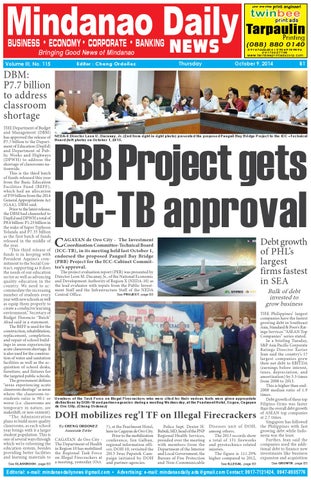
PBB Project gets ICC-TB approval
NEDA-X Director Leon M. Dacanay, Jr. (2nd from right in right photo) presented the proposed Panguil Bay Bridge Project to the ICC –Technical Board (left photo) on October 1, 2015.
C
Debt growth of PHL’s largest firms fastest in SEA
AGAYAN de Oro City - The Investment Coordination Committee-Technical Board (ICC-TB), in its meeting held last October 1, endorsed the proposed Panguil Bay Bridge (PBB) Project for the ICC-Cabinet Committee’s approval.
The project evaluation report (PER) was presented by Director Leon M. Dacanay, Jr., of the National Economic and Development Authority of Region X (NEDA-10) as the lead evaluator with inputs from the Public Investment Staff and the Infrastructure Staff of the NEDA See project, page B3 Central Office.
Bulk of debt invested to grow business
Diseases unit of DOH, among others. The 2013 records show a total of 131 fireworks and pyrotechnics related injuries. The figure is 111.29% higher compared to 2012,
The Philippines’ largest companies have the fastest growing debt in Southeast Asia, Standard & Poor’s Ratings Services’ “ASEAN Top Companies” series stated. In a briefing Tuesday, S&P Asia Pacific Corporate Ratings Director Xavier Jean said the country’s 17 largest companies grew their net debt to EBITDA (earnings before interest, taxes, depreciation, and amortization) by 3.5 times from 2008 to 2013. This is higher than end2008 median ratio of 1.9 times. Debt growth of these top Filipino firms was faster than the overall debt growth of ASEAN top companies at 2.7 times. Singapore has followed the Philippines with fast growing debt while Indonesia was the least. Further, Jean said the companies used the additional debt to finance new investments like business expansion and acquisition
See illegal, page B3
See growth, page B3
Members of the Task Force on Illegal Firecrackers who were cited for their various feats were given appropriate distinctions by DOH-10 and partner-agencies during a meeting Wednesday, at the Pearlmont Hotel, Cogon, Cagayan de Oro City. (Cheng Ordonez)
DOH mobilizes reg’l TF on Illegal Firecrackers By CHENG ORDONEZ Associate Editor
CAGAYAN de Oro City The Department of Health in Region 10 has mobilized the Regional Task Force on Illegal Firecrackers at a meeting, yesterday (Oct.
7), at the Pearlmont Hotel, here in Cagayan de Oro City. Prior to the mobilization conference, Jun Galban, regional information officer, DOH 10, revisited the 2013 Iwas Paputok Campaign initiated by DOH and partner-agencies.
Police Supt. Dexter H. Bubuli, MD, head of the PNP Regional Health Services, presided over the meeting with members from the Department of the Interior and Local Government, the Bureau of Fire Protection and Non-Communicable
Editorial: e-mail: mindanaodailynews@gmail.com • Advertising: e-mail: mindanaodaily.ads@gmail.com Contact: 0917-7121424, 0947-8935776
B2 Mindanao Daily NEWS business . economy . corporate . banking Your Mindanao-wide Community Newspaper
Economy
thursday, october 9, 2014 Advertising and Editorial E-mail : mindanaodailynews@gmail.com Contact nos. : 0917-7121424 • 0947-8935776
‘Near poor’ - next target of DSWD
T
he near poor or nonpoor families will be the next target of the Department of Social Welfare and Development (DSWD) in developing programs and policies to veer them away from becoming poor. In the October 7 learning forum dubbed “People at Edge: Defining the Near Poor of the Philippines,” at the Sulu Riviera Hotel in Quezon City, Dr. Vicente Paqueo, of the Philippine Institute for Development Studies (PIDS) presented the result of the study he headed entitled “Analysis of the Near Poor Challenge and Strategy Development Ideas.” One of the salient points
of his study is the proposed definition and threshold of near poor. Paqueo said, “ the study revealed that non-poor families can be defined as people that live at a knife-edge with little or no buffer against the economic shocks such that they can easily become poor when faced with crisis. Pacqueo elaborated that the government should take steps because near poor households are more prevalent, they are victims and possible victims of policy and program failure and it is easier to prevent them from becoming poor and therefore should be part of a comprehensive and sustainable anti-poverty
programs. The panel of reactors for this event included Dr. Mahar Mangahas of the Social Weather Station (SWS), Dr. Ana Maria Tabunda of Pulse Asia, and Romeo Recide, the Interim Deputy National Statistician of the Philippine Statistical Authority. Recide on his part pinpointed the five regions that have high percentage of poor households (HH) and households vulnerable to becoming poor. He committed to review methodology of determining poverty and gave assurance of support towards handling issues and data on poverty statistics. Meanwhile, Mangahas stressed that poverty line
should be clearly distinguished and suggested that the government should compute total poverty threshold every six months. Family income should not be the sole basis of determining poverty threshold but should include non-food and number of HH members Dr. Ana Maria Tabunda of Pulse Asia commended DSWD for its LISTAHANAN data program which can be used by other sectors/ agencies in determining possible beneficiaries for poor alleviation program. Listahanan is the DSWD’s information management system that aims to identify poor families who will be beneficiaries of social
protection programs and services. With the near poor threshold, the project will be able to identify the near poor and social protection programs will be crafted to keep the near poor from becoming poor. The learning forum is part of the month-long celebration of the 25th National Statistics Month (NSM) with the theme, “25 and Beyond: Solid and Responsive Philippine Statistical System in Support of Globalization and Regional Economic Integration.” As the lead agency in social protection, DSWD is mandated to develop, implement, and coordinate social protection and pov-
erty reduction programs and services for and with the poor, vulnerable, and disadvantaged. Consistent to this mandate, DSWD, with support from the Asian Development Bank (ADB), initiated the study that will put forward a national policy on the near poor. “This policy will allow us to define and identify members of this sector that cuts across the vulnerable and disadvantaged in the Listahanan 2nd round of assessment, and find ways how we can effectively address their concerns,” stated Secretary Corazon-Juliano Soliman. (DSWD/RJB/LFB/ PIA-NCR)
Legislators and Cabinet officials in the finance sector expressed firm support to the provisions of the proposed Bangsamoro Basic Law or House Bill 4994 on funding and revenues for the future Bangsamoro region so that it can exercise fiscal autonomy as envisioned in the Comprehensive Agreement on the Bangsamoro, catch-up in development, and boost the country’s economy.? “That is why we are pursuing this Bangsamoro Basic Law because we believe that we will save more if there’s peace and we will generate more if there’s peace,” underscored Bureau of Internal Revenue (BIR) Commissioner Kim Jacinto-Henares
during Tuesday’s hearing of the Ad Hoc Committee on the Bangsamoro at the House of Representatives. Said hearing was the third in ?a series of marathon meetings on the BBL. Department of Budget Management (DBM) Secretary Florencio Abad, on his part, conveyed that while resource persons from various government agencies are invited by Congress in reviewing the Bangsamoro bill, the proposed law which is “submitted by the executive (to Congress for passage) is the national government’s position”. Abad shared that the DBM was consulted, and it concurred on the “possibility and reasonable-
ness” of providing “annual block grants” for the future Bangsamoro region. Under the draft BBL, the annual block grant for the Bangsamoro will be automatically appropriated. For the budget year immediately following the year the BBL takes effect, the amount of the annual block grant shall be equivalent to four percent (4%) of the net national internal revenue collection of the BIR, less the internal revenue allotment of local government units. According to Abad, the 2015 budget proposed for the Autonomous Region in Muslim Mindanao (ARMM) is about P 24.3 billion, while the future annual block grant for the proposed Bangsamoro government according to the 4 percent calculation will amount to P 27 billion. On the part of the lawmakers, Maguindanao 1st
District and Cotabato City Representative Bai Sandra Sema said that there can be improved revenue collections in the autonomous region when there is peace in Mindanao. “How much is going (to be gained) let’s say for peace in Mindanao? I think we can relate it to that,” she said. Likewise, Cagayan de Oro Representative Rufus Rodriguez, who chairs the Ad Hoc Committee on the Bangsamoro said that “we are giving more fiscal autonomy to them because we are really putting up a Bangsamoro entity with more powers than ARMM had. There is a new dawn, new hopes being tried here.” Rodriguez and Partylist Rep. Silvestre Bello III of 1-BAP shared support to the devolution of powers for fiscal autonomy of the future Bangsamoro. According to Rodriguez, “justice
is relative for some sectors and the justice being defined now is giving affirmative action for those neglected for so long.” Revenues of the Bangsamoro Meanwhile, University of the Philippines Prof. Leonor M. Briones also expressed support to giving fiscal autonomy for the future Bangsamoro. However, she also urged clear understanding on the financial aspect of the Bangsamoro bill, specifically on the grants or budget calculations for the future autonomous region. According to the B a n g s a m oro bi l l , t h e sources of revenue of the Bangsamoro government shall include among others, taxes including additional taxes beyond those already devolved to the ARMM such as capital gains tax, donor’s tax, estate tax, and documentary stamp tax provided all elements are in
the Bangsamoro area; fees and charges; annual block grant; loans, whether foreign or domestic, which the Bangsamoro Government is authorized to contract. The Bangsamoro will also have a share in the government revenues derived from the exploration, development, and utilization of natural resources through the following shares: 100 percent of revenues for non-metallic minerals; 75 percent for metallic minerals; and 50 percent for fossil fuels and uranium. Other sources of revenues include: Bangsamoro Government bills, bonds, notes, debentures; Overseas Development Assistance; grants and donations; and share in the GOCCs operating in the Bangamoro. Moreover, a Special Development Fund (SDF) will also be established for the rehabilitation of the region which has been affected by conflict. Presidential Adviser on the Peace Process Teresita Quintos Deles, Government of the Philippines (GPH) Peace Panel Chair Prof. Miriam Coronel-Ferrer, and panel member Senen Bacani also joined the third ad hoc committee hearing as resource persons on the
Lawmakers, finance execs back budget plans, fiscal autonomy for Bangsamoro
LOT FOR SALE 996 SQ.M. BALOY, TABLON CAGAYAN DE ORO CITY BESIDE GAMA FARMS CALL CHARLIE 0917-889-9935
MDN: OCT. 2, 3, 6, 7, 8, 9 & 10, 2014
See bangsamoro, page B3
KIMBERLITE PAWNSHOP MALAYBALAY BRANCH
Kimberlite Pawnshop will be having an AUCTION SALE on all items that expired on August 2014: AUCTION DATE: October 21, 2014 Estrada Bldg., Fortich-Don Carlos Sts., Malaybalay City, Bukidnon
Mindanao Daily B3 NEWS
thursday | october 9, 2014 Advertising and Editorial E-mail : mindanaodailynews@gmail.com Contact nos. : 0917-7121424 • 0947-8935776
business . economy . corporate . banking Your Mindanao-wide Community Newspaper
BSP: No shortage in coins’ supply
By Apipa P. Bagumbaran
C
AGAYAN de Oro City - The Bangko Sentral ng Pilipinas (BSP) here said there is no shortage in the supply of coins. According to BSP, they have issued around 21.86 billion pieces of coins as of August 31, 2014. Dexter Erick Demafeliz, senior research specialist of BSP Cagayan de Oro branch, said the problem is not on supply but on
Project... from B1
C o s t i n g a t ot a l of P5,086.71 billion, the fouryear (2015-2018) project involves the construction of a two-lane 3.188 kilometer main bridge (0.32 km) and approaches (2.868 km) across the Municipality of Tubod, Lanao del Norte, and Tangub City in Misamis Occidental. Panguil Bay Bridge Project is consistent with the national, regional and local development agenda. It is expected to provide a more reliable and efficient transport infrastructure and a more accelerated and sustained economic growth especially in the northern and western part of Mindanao. It is also supportive to the region’s vision of becoming the major transhipment hub and establishing its role as the gateway and industrial core and trade center in the South. The Project will be presented to the ICC-Cabinet Committee in its next meeting tentatively set on October 17, 2014. Once approved, it will be presented to the NEDA Board for confirmation. (NEDA-10)
Illegal... from B1
which has 62 cases. Majority of the cases involved males with, at least, 78%. One death has been reported last year. Galban said most of the
circulation of coins. This is because some people keep coins in piggy banks, drawers and other containers. Demafeliz said the solution to the perceived shortage is re-circulation of coins by all users that is why BSP launched an inter-agency coin recirculation contest on October 1 during the opening ceremony of the 25th National Statistics Month (NSM) celebration in the region.
The contest aims to flush-out idle coins in storage, promote the importance of coins, and correct wrongful sales practices. The inter-agency coin recirculation contest is open to agency members of the Regional Statistical Coordination Committee (RSCC). The agency with the most number of collected fit coins donated by their employees wins the contest and their chosen beneficiary gets the pro-
ceeds. The coins must still be shiny, in its original size and form, and free from adhesive tapes and any form of damage, said Demafeliz. Coins which are bent or twisted out of shape, defaced or with signs of corrosion, has been considerably reduced in weight by natural abrasion or wear and tear, and has shown signs of flipping, clipping or perforation
are considered unfit and will not be accepted in the contest. We will only accept fit coins because our main purpose is recirculation, he added. Also, only low denomination legal tender, -25, -10, -5 and -1 centavo coins collected will be included in the counting. Demafeliz said the inter-agency coin recirculation contest will run from October 1 until October
27, 2014. Collected coins must be submitted for counting to BSP Cagayan de Oro branch only on October 27 from 8:00 to 11:00 a.m. Coins will not be accepted before and beyond the allotted schedule. Top three winners will be awarded trophies during the NSM culminating activity on October 30 while other participating agencies will be given certificates. (APB/PIA-10)
cases were from Misamis Oriental and Piccolo was the No. 1 involved type of firecracker in the incidents. Among the firework injuries, 90% of the victims were active users -- meaning they were the very persons who use the firecrackers that caused their injuries. The Task Force on Illegal Firecrackers tried to address the firecrackers’ incidents increasing cases during the meeting, designating various agency-members to varying tasks that will address the problem brought about by firecrackers. Past approaches include presentation by way of positive and negative messages in the tri-media.
are still growth of opportunities. It’s also going in dividends. And increasingly, we are seeing more acquisitions taking place,” Jean mentioned. “These companies are very sizeable in their domestic markets and the only way to grow further is by taking on bigger value transactions -- larger projects or more sizeable acquisitions,” he added. “Why do they do these is because they generally have the financial muscle to do that.” “In terms of liquidity being available, very low interest rates is applicable in the Philippines. Refinancing risk is not very high and in aggregate, companies are still holding a lot of cash, provide mitigation,” he further said. On the other note, S&P Asia Pacific Corporate Ratings Managing Director and Analytical Manager Michael Seewald noted that the increase in debt does not only mean negative business and financial risks for the companies but is also a sign of healthy domestic banking system.
“Philippine companies are growing (their debt) trough bank debt. They are exposed to the health of the general banking system. As of now, banking system in Philippines is stable,” Seewald said. The risk that S&P has seen is that debt will grow faster than companies earnings. S eewald said it was noted in the top firms in ASEAN that their investment have grown but debt also expanded while earnings have slowed down. Me a nw h i l e , t h e 1 7 Filipino firms that were included in S&P’s survey are Abitiz Power Corp., Alliance Global Group, Inc., Ayala Corp., Ayala Land, Inc., DMCI Holdings, Inc., Globe Telecom, Inc., International Container Terminal Services, Inc., JG Summit Holdings, Inc., Jollibee Foods Corp., Lopez Holdings C orp., Manila Electric Co., PAL Holdings, Inc., Petron Corp., Philippine Long Distance Telephone Co., San Miguel Corp., SM Prime Holdings, Inc., and Universal Robina Corp. (PNA)
Bangsamoro..
(IRA) from the national government. Meanwhile, the annual block grants to the Bangsamoro region “are similar to the IRA being granted to the local government units.” Auditing of Bangsamoro Auditing, conduct of elections, and welfare of civil servants in the current ARMM regional government were also tackled during the hearing on Tuesday afternoon with officials from constitutional commissions in attendance, namely from the Commission on Audit (COA), Commission on Elections (COMELEC), and the Commission on Civil Service (CSC). Rep. Rodriguez affirmed that “no provision of this Bangsamoro bill can oust powers” of constitutional commissions. “There will be no diminution of powers, not even a single inch,” he said. He posited that while the Bangsamoro will create its Bangsamoro auditing body, the powers of COA will “reign supreme” and “there is just a layer (of auditing) because we are devolving powers.” (OPAPP)
Classroom..... from B1
our students,” Abad said. The funds will be released directly to the DPWH-Central Office to administer the construction based on a list of school buildings and work program submitted by the DepEd. Among the regions set to benefit from the release are the National Capital Region (P2B), Region IV-A (P1.7B), and Region VII (P1.5B). (DBM)
Growth... from B1
as well as to pay dividends. “Capital spending almost tripled. Companies, they are spending a lot of money in the Philippines because the market is still pretty under penetrated in a lot of sectors. There
from B2
Bangsamoro bill. Coronel-Ferrer shared that the GPH Panel ensured consultations with the Cabinet during the negotiations with the Moro Islamic Liberation Front for the Comprehensive Agreement on the Bangsamoro (CAB) and during the drafting by the Bangsamoro Transition Commission of the BBL. She said they were “very much on the loop during the cabinet meetings that were held with reference to the progress of the different provisions of the agreement.” Bacani stressed that “No less than the framers of the 1987 Philippine Constitution under Article 10 sought to strengthen local autonomy by making available resources to the local government units’ funds to finance their programs and projects.” He added that “the privileges already enjoyed by the local government units within the Bangsamoro under existing laws shall not be diminished” including their internal revenue allotment
B4 Mindanao Daily NEWS
Corporate Electric rural coops prefer cheaper renewable over coal
Advertising and Editorial E-mail : mindanaodailynews@gmail.com Contact nos. : 0917-7121424 • 0947-8935776 thursday | october 9, 2014
business . economy . corporate . banking Your Mindanao-wide Community Newspaper
By Davao Today
D
AVAO City -The Association of Mindanao Rural Electric Cooperatives (Amreco) and the Mindanao Development Authority (MinDA) warned that the bulk of energy production in Mindanao starting next year will be sourced from coal-fired power plants by major energy industry players mostly based here in Davao Region. MinDA Investment Promotions and Public Affairs Officer Romeo Montenegro estimated that some 2,000 mega-watts of coal-sourced energy will be produced by 2016, enabling it to power households and industries in Mindanao. The companies that have ventured into coal are the 300-MW Therma South owned by the Aboitiz in Toril, another 300-MW plant operated by the Alcantaras in Davao del Sur. San Miguel Corporation is also building a 600-MW plant, FDC with 405-MW, and GN Power in Kauswagan with 540-MW. Amreco President Sergio Dagooc, however, said that despite the entry of coal energy, rural electric cooperatives want to pursue a “balanced supply” between renewable energy source
and coal. Dagooc said a balanced supply is necessary due to the high cost of coal and fossil fuel. “We don’t want to suffer like in Luzon where prices are affected by the prices of diesel and fuel,” Dagooc said. “There would be minimal increase if there is a mix.” Montenegro said currently Mindanao has a 6040 mix between renewable energy and fossil fuel energy, with 54% of the total supply coming from the Agus-Pulangi Hydro Power Plant. He said with the current mix, energy rates based on hydro-power plants are charged with P1.50 per kilowatt hour. Bunker fuel
costs four times more at P8 to P10 per kw/hr, and coal at P4 per kw/hr. Montenegro said MinDA wants to avoid a reverse of energy source by making an effort to come up with a “50-50 energy mix” as outlined in their Mindanao Development Plan. Montenegro said the entry of coal energy is inevitable with the “business as usual” scenario of investors, and the 90% reliability of this source as compared to hydro-power which relies on run-off rivers. He said this mix also foresees the scenario of drought that will affect water supply. The Agus-Pulangi 4 and 6 are also scheduled to be shut down next year
for repairs with the entry of the Therma South and Alcantara plants. Montenegro said MinDA and Amreco are pushing for the fast-tracking of some 157 applications into renewable energy by facilitating a one-stop application process to achieve a target of a 1,700-MW supply. Montenegro said redtape has discouraged investors into renewable. “They have to go through 13 lead agencies and 169 signatures. That will take about three or four years,” he pointed out. He said MinDA has made headways in cutting down the process by half of the usual length for application. Both groups said this will be among the issues they will tackle in depth in their upcoming third Mindanao Congress of Advocates for Renewable Energy and Rural Electrification & Development (MinCARED) slated on October 29 to 31. They are also pushing for amendments in the House of Representatives deliberation on the Electric Power Industry Reform Act (EPIRA) not to privatize the Agus-Pulangi Hydro-power plant. (Tyrone A. Velez, davaotoday.com)
Smart, Sun expand free Internet offer to postpaid and broadband subscriber Offer extended to January, plus ‘unli all-you-can Facebook’ In another unprecedented move, Smart Communications, Inc. (Smart) and Sun Cellular announced that effective October 3, they are expanding their free Internet offer to all of their prepaid subscribers to also cover all their postpaid and broadband subscribers. Furthermore, they are extending the duration of the free mobile Internet promo across all subscribers – postpaid, prepaid and broadband -from November 30 through the Christmas season until January 5, 2015. The announcement was made through MVP’s official Twitter account: “TY for the overwhelming response to #SmartFREEInternet. Our early Christmas gift to our loyal and new subs – offer now extended to Jan. 5.” In another tweet, MVP added “Even better – free Internet now open to ALL prepaid, postpaid & broadband subscribers of Smart, TNT 7 Sun #smartFREEinternet for All.” Full Facebook experience and more On top of their free
Internet, all subscribers can also enjoy “unli” “allyou-can” Facebook access - including sending messages via Facebook messenger and viewing of videos embedded in the social networking site. Through this special offer, all of the 72 million subscribers of Smart, Sun and Talk ‘N Text can enjoy browsing through all their favorite websites as well their social media accounts using their data-enabled handsets. They can also send and receive emails, use their favorite mobile apps, shop online, and more – without incurring additional data charges. This move comes a week after Smart and Sun Cellular surprised the industry with its groundbreaking offer for free mobile Internet for its Smart prepaid, Talk ‘N Text and Sun Cellular prepaid mobile subscribers. “ This is our way of thanking our subscribers as well as a response to the requests of our postpaid and broadband subscribers to be included in the special offer. It is part of our overall strategy in accelerating mo-
bile Internet adoption and usage in the country,” said Charles A. Lim, executive vice president and head for wireless consumer business at Smart. Text FREE to 9999 To avail of the free mobile Internet offer, subscribers just have to maintain an airtime balance of at least one peso, or be subscribed to any load bucket/ promo. They can register each day, by simply sending “FREE” to the number “9999.” Registration is free. They will receive an SMS confirmation upon successful registration. Once registered, subscribers can enjoy a free data volume package of up to 30MB per day. Data charges will however apply to peer-to-peer uploads and downloads, videos (unless embedded in Facebook), VOIP and messaging (except for Facebook messenger). Smart’s successive free mobile Internet offers follows the leader’s recent announcement that it has stepped up the deployment of its broadband network, to meet the growing de-
mand for data services. Resilient and nationwidest network “With millions of subscribers going online, our network has been performing very well, enabling them to sign-up for the service to take advantage of the free Internet offer .” said Roland G. Pena, Smart Technology Group Head. The PLDT Group has thus far rolled out about 90,000 kilometers of fiber optic cables all over the country which provides the transmission facilities needed to support Internet services. It has also the most extensive international cable systems needed to connect the Philippines to the rest of the world. Last Wednesday, PLDT also announced that it is boosting the capacity of its 90,000-kilometer domestic fiber optic network by 520 gigabits per second under a P544-million expansion project that will be completed by the first quarter of 2015. This will raise the total capacity of PLDT’s DFON by 13 percent to 4.6 terabits per second. (Smart)
PRINT MEDIA TRAINING MODULES Print Media 1. 2. 3. 4. 5. 6. 7.
Column Writing Editorial Writing Editorial Cartooning Feature Writing Fact-sheet Writing Feature Writing First Aid During Media Coverage and Other Emergency Situations 8. Headline Writing 9. Investigative Reporting 10. Keeping Media Practitioner’s Family Safe
11. Layouting 12. Low-cost Media 13. News/Press Conference Organizing and Facilitation 14. News Paper Editing 15. News Writing for Print 16. Photography 17. Print News Release Preparation 18. Securing the Newsroom 19. Specialized Writing : Sports, Business, etc.
BROADCAST MEDIA TRAINING MODULES
1. Audiocraft 2. Audio News Release Production 3. Broadcast Editorial Writing 4. Broadcast Media and the Church Broadcast News Scriptwriting \ Broadcast News Simulation 5. Communication Theory 6. Community Radio Program Production 7. Conducting Energizers/Ice Breakers 8. Coverage of Civil Disorders, Natural and Human-induced Catastrophic Situations, Wars and Conflicts, Abuse and Exploitation 9. Data Gathering 10. Dealing with Death Threats and Surveillance 11. Disc Jockeying (Disk Jokering) 12. Effective Listening and Questioning 13. Feature Writing and Production 14. First Aid During Media Coverage and Other Emergency Situations 15. Headline Writing 16. Interviewing Children 17. Investigative Reporting 18. Keeping Media Practitioner’s Family Safe 19. Lantern Lecture Techniques 20. Microphone Handling 21. Newscasting
22. Non-linear Audio-Video Editing 23. News/Press Conference Organizing and Facilitation 24. Overcoming Ambush Interview 25. Overcoming Stage Fright 26. Program Hosting/Anchoring 27. Public Journalism 28. Radio, As Community Development Tool 29. Radio Programming 30. Radio and TV Guesting and Interview 31. Securing the Newsroom 32. Specialized Writing : Sports, Business, etc. 33. Telephone Interview and Reporting 34. Television, As Community Development Tool 35. Video Camera Handling 36. Video News Release Production 37. Voice Development Others 1. Structured Learning Exercises 2. Trainers Training on Training Facilitation 3. What To Do When Abducted, Arrested, or Stopped at Checkpoints or Roadblocks 4. Zero Waste Management
GENDER AND HEALTH TRAINING MODULE
1. Adolescent and Youth Health 2. Gender and Reproductive Health 3. Gender Sensitivity for Couples, Women and Men 4. Gender Sensitivity in Media 5. Gender Sensitivity Training for Lupon 6. Gender in Waste Management 7. Violence Against Women and Children
INFORMATION, EDUCATION, COMMUNICATION (IEC) and ADVOCACY MODULES 1. 2. 3. 4. 5. 6. 7. 8. 9. 10. 11. 12. 13. 14. 15. 16. 17.
Brainstorming and Project Presentation Building a Constituency for Support Communicating with the Adolescents, Handicaps Community Organizing and Planning Community Public Address System (ComPAS) Conducting an Advocacy Campaign Designating Spokespersons Data Gathering Defending Against and Addressing the Opposition Development Communication Educating Colleagues Establishing Goals, Objectives and Activities Expanding Your Base of Support Enhancing Your Public Education Efforts Establishing Hotlines Framing Issues and Shaping Your Message Going Public/External Relations
18. Intrapersonal and Interpersonal Communication 19. Knowing Your Community 20. Letter to the Editor Writing 21. Making Contacts 22. Media Relations 23. Networking and Coalition Building 24. Objective Setting and Action Planning 25. Organizational Communication 26. Overcoming Burnout 27. Overcoming Stage Fright 28. Program/Project Audience Analysis 29. Project Proposal Writing and Presentation 30. Public Address System Operation 31. Public Speaking 32. Reaching the General Public 33. Reaching Policy Makers, Lobbying, Legislative Approaches 34. Strategic Planning 35. Verbal and Non-verbal Communication 36. Vision, Mission and Goals Setting 37. Writing Mission Statements
VALUES AND RELATED TRAINING MODULES 9
1. Aggressiveness and Assertiveness 2. Coping With (Post-traumatic) Stress and Depression 3. Dealing with Conflict 4. Developing Positive Personal Values 5. Discovering Interpersonal Life 6. Emotional Quotient 7. Etiquette and Grooming 8. Good Passenger Handling 9. Human Relations and Personhood 10. Intelligence Quotient 11. Leadership 12. Overcoming Difficult People 13. Prayer Writing and Delivery 14. Public Relations 15. Sermon Writing and Delivery 16. Supervisor, as Formater 17. SWOT Analysis 18. Team-building 19. Values Clarification
For training facilitation, please contact +639997990008, +639262553215, or +639355588706