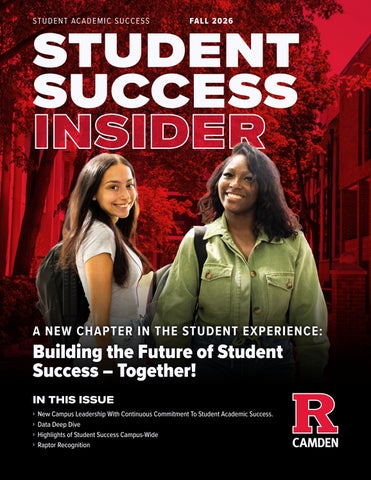
STUDENT SUCCESS INSIDER ST U D E N T ACA D E MIC SUC C E SS
FALL 20 26
A NEW CHAPTER IN THE STUDENT EXPERIENCE:
Building the Future of Student Success – Together! IN THIS ISSUE › New Campus Leadership With Continuous Commitment To Student Academic Success. › Data Deep Dive › Highlights of Student Success Campus-Wide › Raptor Recognition Rutgers University–Camden | Student Academic Success
1
WELCOME 5
COVER STORY: NEW CAMPUS LEADERSHIP WITH CONTINUOUS COMMITMENT TO STUDENT ACADEMIC SUCCESS
12
34
15
45
RAPTOR RECOGNITION
DATA DEEP DIVE
DIVISION HIGHLIGHTS
STAY TUNED
The Student Success Insider e-magazine is produced by the Division of Student Academic Success SPO N S O R Dr. Marsha L. Lowery
EDI TO R-I N -CH I E F Dr. Jason L. James Jr. AS S O CI ATE E DI TO R Jordan Staub
CO N TRI BU TO RS Alexys Anderson, Laura Collins, Heather Dalton, Angela DeRocini, LaToya Gibbons,
Madeline Levy, Erica Reeves-Mukherjee, Lindsay Peck, and Brandon Quiles
2
STUDENT SUCCESS INSIDER | Fall 2026
SAS DIVISION MISSION, VISION, PILLARS, AND VALUES
SAS employees are committed to student academic success, and the work of the members of the SAS Division aligns with our mission, vision, values, and pillars. Those are: SAS MISSION
SAS VISION
The Division of Student Academic Success leads persistence efforts that result in improved educational equity, retention, and timely graduation from Rutgers University–Camden. Our team empowers students to develop identity consciousness, sense of belonging, self-efficacy, and academic responsibility to become the best versions of themselves in and out of the classroom. Through personalized and holistic supports, we provide students with resources, tools, and opportunities to define success for themselves.
Student Academic Success will be a national leader in utilizing student-centered approaches to improve success outcomes. Our team fosters student academic success by using data to identify and nimbly address student needs to eliminate any gaps in graduation rates. Through our work, our students will build on their existing strengths and demonstrate their development in pursuit of their goals in college and beyond.
Rutgers University–Camden | Student Academic Success
3
SAS VALUES Identity Consciousness:
Sense of Belonging:
Contributing to a person’s understanding of their values, goals, attitudes, and beliefs
Fostering a level of respect, value, acceptance, care, inclusion, and mattering
Self-Efficacy: Developing a person’s belief in their capacity to execute behaviors necessary to produce specific performance attainments
Academic Responsibility: Instilling a person’s sense of duty to their academic progress; to become accountable for their own journey
SAS PILLARS P IL L AR 1
Data-Driven Decision Making: Data-informed practice is at the core of all SAS efforts. To effectively advance the achievement of our students and the campus overall, we must regularly seek out empirical evidence and use it responsibly to meet our students’ needs. We accomplish this by contextualizing our decisions using data and theory.
PI L L AR 2
Proactive Approaches to Cohort Engagement and Transition Programs: SAS is committed to developing a sense of belonging amongst those we serve, with holistic services to onboard first year and transfer students to the University. We foster affinity-based communities to help students realize their intersectional identities.
P I LLA R 3
Centering Students in Operational Procedures: SAS is dedicated to enhancing student experiences through process improvement, efficiency, and consistency. We aim to do so by identifying and addressing problematic procedures and holding ourselves accountable for eliminating known barriers.
P IL L AR 4
P I LLA R 5
Cross-campus collaboration and mastery of essential skills are key to fulfilling our mission. To nurture continued excellence and maximize campus community engagement, we must invest time into building trusting and reliable relationships with partners and resources into developing new talent. Efforts to do so include normalizing transparency and data sharing, collectively addressing student challenges, serving as subject matter experts and thought partners, and exposing staff and students to skill-building opportunities.
As our campus becomes increasingly diverse, it is our responsibility to ensure that we meet the unique needs of all our students and that we honor their intersecting identities. Thus, expanding support offerings, exploring additional funding opportunities, and celebrating student success remain priorities for our future.
Increasing Partnerships; Developing Deeper Collaborations:
Intentional and Differentiated Supports for Diverse Populations:
THESE, TOGETHER, SUPPORT THE EFFORTS TOWARDS FULFILLING OUR STRATEGIC PLAN. The Rutgers University–Camden strategic plan can be found by clicking here. 4
STUDENT SUCCESS INSIDER | Fall 2026
COVER STORY
NEW CAMPUS LEADERSHIP WITH CONTINUOUS COMMITMENT TO STUDENT ACADEMIC SUCCESS On July 1, 2026, at the top of the 2026-2027 academic year, Rutgers University–Camden welcomed Dennis J. Shields, JD as Interim Chancellor. Interim Chancellor Shields has a well-established portfolio of service excellence in higher education across several prestigious institutions.
Rutgers University–Camden | Student Academic Success
5
COVER STORY
MOST RECENTLY
Interim Chancellor Shields sat down with Dr. Marsha Lowery, Vice Chancellor for Student Academic Success at Rutgers University–Camden, and Diamani Waugh, an undergraduate student double majoring in Psychology and in Health Sciences in the Camden College of Arts and Sciences. Check out the video to learn more about Interim Chancellor Shields’ perspectives, insights, and hopes for student success.
To learn more about Interim Chancellor Shields, visit here.
6
STUDENT SUCCESS INSIDER | Fall 2026
D D D
A E I
RETENTION THE CSI: AN INCOMING STUDENT SURVEY IN THREE HAIKUS the college student inventory (csi) is a survey employed by rutgers–camden as a useful tool for multiple audiences. these three haikus give a summary of how each stakeholder can take advantage of the information provided by student voice data. THE STUDENT SIDE
› How do you need help? › Tell us your motivations › Twenty minutes done THE STAFF SIDE
› We get a report › Helps us understand you more › Guides us to support
T E V
A P E
ITEM SUCCESSFULLY ADDED TO YOUR CART! The Navigate360 platform (formerly RaptorConnect) has been in use by Rutgers–Camden since 2017 as a student success management system to better assist faculty and staff to understand their students, support them, and communicate with them. On the student side, the addition of a phone app allows students to schedule appointments, find study buddies, check their progress reports, and more! Compared to other campuses that use this system, Rutgers–Camden's usage is pervasive and comprehensive. Each semester, about 80% of faculty submit mid-term grades through the system, for students to know how they are doing in classes. Over 20,000 appointments get scheduled through the system each year, with academic advisors, success teams, tutors, and career management specialists.
THE MACRO SIDE
› What are all the trends › The patterns that inform us › How to shape our work Rutgers University–Camden | Student Academic Success
7
DATA DE E P DI V E : SYST E M S SYN E RGY
ELEVATING RETENTION: STORIES AND STRATEGIES FROM ENCOURA + RNL This July, the Office of Retention and Student Success Initiatives traveled to Chicago to attend and present at the Encoura + RNL National Conference. As a student success partner, the campus utilizes Ruffalo Noel Levitz's (RNL) College Student Inventory, a critical tool for capturing incoming student voice data. As we look to capitalize on and expand our usage of CSI data to support our incoming students, this conference provided the retention team the opportunity to connect with other campuses around best practices related to retention, marketing, and enrollment management. As a system becomes part of the campus norm, it’s easy to be complacent and take for granted the abilities we have to better know and serve our students. Instead, Rutgers–Camden is approaching the new academic year with a sense of Positive Restlessness – always seeking to "level up" in new ways, even when our status quo isn’t bad. To that end, over the summer, system admins started setting up reports for faculty leadership and staff members invested in retention to better monitor registration trends, know when to check course maps before students graduate, and figure out who's eligible for opportunities like honor societies and Dean's Lists. New (and just new-to-us) features such as dashboards, more customizable communications, and elevated case management help us become even more efficient at identifying and wrapping around students of concern to reduce barriers to graduation. We’ll never be done growing and adapting to serve students, and we are so excited to partner with all our stakeholders using the system to make the most out of it.
Student Academic Success’ structure is unique; the intentionality behind the 5-pillar strategic plan that guides our work puts us in a place where retention is a key component behind all that we do. The Office of Retention highlighted this divisional framework and office specific initiatives during our session In the Name of Retention: Using Data To Inform and Transform Culture.
If you’re feeling a sense of positive restlessness, or even just want more information on what system functionality may be helpful for you specifically – contact Lindsay Peck or Alexys Anderson, from the Office of Retention, or the generic Navigate360 email at navigate@camden.rutgers.edu. We’ll be happy to join you in taking the next step! 8
STUDENT SUCCESS INSIDER | Fall 2026
DATA DE E P DI V E : SYST E M S SYN E RGY a communications strategy. Simplifying institutional jargon, providing multiple access points for the same information, and sharing the same information in different ways can be helpful.
› The importance of data: Data and student voice
data collection is a way of giving students a seat at the table. How institutions use this data can impact student outcomes. As we enter the new academic year, the Office of Retention looks to capitalize on the threads of innovation and inspiration that arose at the conference to continue to positively impact students and move our work forward.
CONFERENCE TAKEAWAYS: STORIES AND STRATEGIES
The RNL + Encoura conference provided 3 days of connection and conversation. Many takeaways arose from the various keynotes and sessions, but snippets of importance include:
› An earned credential still has generational
impact. The value of higher education is still relevant; it is our job as higher education professionals to make sure students understand that value, and to help students get to the finish line.
› Universities are a brand, and part of this
work to build a brand includes identifying and communicating what makes you unique, highlighting value, and building brand loyalty. As conference keynote Americus Reed put it, “great institutions don’t just enroll students; they build belonging that lasts”.
› Language matters–how we share information is
Rutgers University–Camden | Student Academic Success
9
DI V I S I O N H I G H L I G H TS
DIVISION HIGHLIGHTS FIRST-GENERATION COLLEGE STUDENTS (FGCSS)
Decorating Stations in the Campus Center Lounge, which continued Thursday alongside the Raptor Reunion – a campus quad gathering with the Office of Student Involvement, BSU, and other student organizations. The week closed on May 1st with the Tri-Alpha Induction Ceremony for new inductees. This year's expansion from a single luncheon to a full week reflects growing investment in recognizing
CELEBRATING A WEEK OF FIRST-GEN FIRSTS From April 27th through May 1st, the Division of Student Academic Success expanded last year's single-day luncheon into a full First-Generation Graduation Celebration Week, honoring our graduating first-gen students with a week of programming built around connection, career readiness, and tradition. The week opened with the SAS Luncheon on April 27th, followed by "Show, Don't Tell," a personal statement workshop co-hosted with OSDFA, and a Graduation Mixer with RUCAA co-sponsored by The Graduate School of Arts & Sciences at the Hilton Camden Waterfront on Tuesday evening, bringing together undergraduate and graduate students with alumni. Wednesday offered professional headshots through the Career Advancement Center alongside the first of two Cap
10
STUDENT SUCCESS INSIDER | Fall 2026
DI V I S I O N H I G H L I G H TS : CO N T I N UED first-gen students at every stage of the send-off – not just the ceremony, but the mixer, the mementos, and the community that got them there. The week had over 100 attendees and brought together many collaborations – Rutgers University’s own Educational Equity and Excellence Collaborative (E3C), The Rutgers University–Camden Alumni Association (RUCAA), and many other supporters who helped make the week a success.
FIRST-YEAR EXPERIENCE (FYE) AND STUDENT SUCCESS COACH OFFICE (SSCO)
To learn more about Tri-Alpha membership or explore opportunities for collaboration, please contact Tri-Alpha Co-Advisor, Erica ReevesMukherjee at er957@camden.rutgers.edu
This year marked the exciting launch of the WISDOM (We Include and Support Diversity of Minds) Living Learning Community in the first-year residence hall at Rutgers University–Camden. Created and led by Success Coach Heather Dalton and Assistant Director for Student Support Services, Brandon Quiles, WISDOM was designed for firstyear students interested in the humanities and social sciences, with a focus on academic success, community building, and personal growth. The program was made possible through the generous support of the DICE IDEA Grant.
WISDOM LIVING LEARNING COMMUNITY
One of the best components of WISDOM was the diverse group of students who chose to be part of the community. WISDOM community members came from a variety of majors and backgrounds, bringing unique perspectives into conversations and programs throughout the year. Students quickly built a welcoming and supportive community rooted in curiosity, inclusion, and friendship.
Rutgers University–Camden | Student Academic Success
11
DI DIVVIISSIIOONN HHIIGGHHLLIIGGHHTS TS :CO CONNT TI NI NUUED ED iconic Philadelphia traditions and landmarks. The pilot year highlighted the impact of intentional residential programming and meaningful community-building – especially for first-year students. WISDOM demonstrated the importance of creating supportive spaces where first-year students can learn, grow, and thrive together.
Throughout the year, members participated in monthly community meetings centered on group coaching topics relevant to the first-year student residential experience. Conversations included the transition to college, time management, making friends, wellness, campus involvement, career readiness, studying abroad, and building healthy habits for success in the humanities and social sciences. These meetings gave students a comfortable space to reflect, connect, and navigate the transition to college together.
RAPTOR READY: GETTING STUDENTS AND SUPPORTERS PREPPED BEFORE THEY LAND
In mid-June, the Division of Student Academic Success launched the Raptor Ready Online Modules, a set of pre-orientation modules developed for two distinct audiences: incoming students and the supporters–parents, guardians, and family–who are venturing along the transition with them.
WISDOM students also shared memorable cultural experiences throughout Philadelphia. During the fall semester, students visited the African American Museum, enjoyed dinner in Chinatown, and explored the Winter Village at LOVE Park. In the spring, the community traveled to the Philadelphia Museum of Art and the Shofuso Japanese Cultural Center. These trips gave students the opportunity to engage with art, culture, and global perspectives outside the classroom. For many out-of-state students, the experiences also introduced them to
12
In partnership with the Division of Enrollment Management, the Raptor Ready Online Modules walk new Raptors through completing their enrollment pathway, paying for college, RU–C technologies, and an introduction to the First-Year Experience and their success team (with a parallel track for transfer students covering the transfer experience specifically), closing out with tips for how to be a successful student. The Supporter Module runs alongside it, covering how to support a strong summer start, FERPA and privacy, the financial aid process, how to support a student's health and safety from a distance, and what to expect during the first year.
STUDENT SUCCESS INSIDER | Fall 2026
DI V I S I O N H I G H L I G H TS : CO N T I N UED The overarching goal of these modules is to provide a centralized resource that new students and their supporters can use to access important information about their transition and revisit as needed. By providing this information before students participate in orientation, we also hoped to reduce the time spent covering logistical nextstep details during orientation sessions. This approach to pre-orientation activities allows the orientation experience to more fully focus on fostering connections with campus staff, peers, and support resources, helping students feel engaged and supported from the start.
The Raptor Ready Online Modules were co-built this spring using CSI and retention data to target the gaps that students and families told us mattered most and are designed to keep families engaged as partners without taking ownership away from the student. Through this initiative, SAS also worked with Marketing and Communications to create a website for incoming families/supporters that provides important information about resources, support services, and common questions and answers related to the student experience.
WELCOMING THE NEXT CLASS OF RAPTORS
This summer, the Divisions of Student Academic Success, Enrollment Management, and Student Affairs, in partnership with other campus colleagues, welcomed incoming students and their supporters through four in-person New Student Orientation programs and three virtual orientation sessions held throughout July and August.
class and providing an important early touchpoint before the start of the fall semester at Rutgers University–Camden.
The in-person orientation experience was designed to support student success by promoting academic readiness, increasing awareness of campus resources, and fostering engagement with the university community. Each orientation day began with students and supporters participating together in a shared welcome experience before splitting into audience-specific programming. Students attended interactive workshops and advising sessions, while supporters participated in presentations and panel discussions focused on the college transition. The day concluded with a resource fair featuring many of the university's hightouch support offices. For students, programming emphasized the knowledge, skills, and resources needed for a successful first year. Participants learned about opportunities for campus involvement through the Office of Student Involvement, explored connections between their interests, academic majors, and potential career paths, and gained insight into the expectations and rigor of collegelevel academics. Students also met with academic advising units, reviewed major requirements, and received their fall course schedules. Compiled survey feedback showed that more than 90% of students understood their next steps before the fall semester, knew how to access academic support and campus resources, and felt confident in their abilities to succeed at Rutgers–Camden.
A total of 661 new students participated in orientation, representing over 70% of the incoming
Rutgers University–Camden | Student Academic Success
13
DI DIVVIISSIIOONN HHIIGGHHLLIIGGHHTS TS :CO CONNT TI NI NUUED ED Throughout the day, students also participated in a Rutgers–Camden Trading Card challenge. Each card highlighted a campus resource, tradition, or student experience, and students were encouraged to connect with one another to collect a complete set of eight cards for a chance to win a new MacBook.
Building a sense of belonging and connection was another key goal of orientation. Students were assigned to groups led by peer orientation leaders who guided discussions and activities throughout the day. Before the official welcome, students participated in morning warm-up activities designed to foster engagement and connection, including a residence hall-style escape room, conversations with returning and more experienced students in the Bridge and Leader Lounge, and a collaborative, interactive mural. Across all orientations, more than 89% of participants reported connecting with a new student, learning about a relevant organization, and feeling excited to begin their Rutgers–Camden experience in the fall.
Programming for parents and supporters focused on helping families understand the transition to college, including the academic expectations students will encounter, common challenges during the adjustment process, and the campus resources available to support student success. Many sessions were intentionally presented in panel format, allowing supporters to hear directly from the faculty and staff members who will work closely with their students throughout their Rutgers– Camden experience. Across all orientations, more than 95% of supporters reported understanding how to support their student, the resources available to them, and the tasks their student needed to complete before the start of the semester. For students unable to attend an in-person session, virtual orientations provided access to essential information, campus resources, and support services critical to a successful transition. These sessions connected students with Enrollment Management, Financial Aid, and Student Academic Success staff, ensuring they received timely guidance and support as they prepared to begin their college experience.
14
STUDENT SUCCESS INSIDER | Fall 2026
DI V I S I O N H I G H L I G H TS : CO N T I N UED Together, these orientation programs created a welcoming environment where students and their supporters could build meaningful connections, strengthen their sense of belonging, and leave with a clear understanding of the opportunities, expectations, and support systems that will help them thrive at Rutgers–Camden.
TRIO SSS
CULTURAL IMMERSION WITH TRIO On Saturday, May 2nd, TRiO SSS took several scholars to our nation’s capital to enjoy Passport DC's Around the World Embassy Tour. This powerful educational experience is when international embassies across DC swing open their doors, diplomats become storytellers, and participants are transported across the world. Scholars explored dozens of embassies representing countries across Africa, Asia, Latin America, Europe, and the Middle East and encountered traditional dance performances, sampled regional cuisine, observed cultural traditions, engaged in conversations with diplomats, and discovered histories that rarely make their way into university classrooms. Admission to the embassies was free, making this global exploration accessible to our first-generation and lower-income scholars. For many FGLI students, international travel remains an aspiration postponed by cost. As such, the world beyond their immediate communities can often feel distant, both geographically and professionally. Opportunities like Passport DC disrupt that reality by ensuring accessibility to cultural immersion.
LUIS BELTRAN JR., A JUNIOR AND ECONOMICS MAJOR SHARED:
“These opportunities are especially important to me because experiences like this would likely be impossible otherwise due to financial restraints and logistical barriers. Trips like this condense years of learning into an experience so meaningful that it lasts a lifetime, sharpening one’s focus and intentions. Without this trip, I would still be holding loosely to concepts about this country and its history. Because of this experience, my relationship with those ideas is now tangible and will actively influence my academic progress as an economics major. I got to touch history and taste culture, not just imagine it.” Research consistently shows that experiential learning deepens retention and increases student engagement because it transforms abstract concepts into lived experiences. Exposure has always been one of higher education's most valuable currencies and TRiO at Rutgers University–Camden prioritizes exposing our scholars to different experiential learning opportunities. Students from affluent backgrounds often benefit from international vacations, study abroad opportunities, museum memberships, and cultural institutions that expand their understanding of the world long before they enter college. Students from first-generation lower-income backgrounds frequently possess equal talent and ambition but traditionally have fewer opportunities to enjoy those same types of experiences. That is why these experiences carry such emotional weight and impact. They affirm identity and belonging. They build confidence and spark interest in more co-curricular learning among our scholars. DAVIAN WILLIAMS, A SOPHOMORE AND THEATER MAJOR SHARED:
“My experience of having the opportunity to visit Washington, D.C with TRiO was one of the most memorable and interesting experiences that has ever happened in my life. I got to learn about different cultures and really had a chance to view life on the other side of the world in ways I wasn’t used to. The trip gave us [the TRiO group] the opportunity to build a deeper bond and connection with each other. Only two of us had the opportunity
Rutgers University–Camden | Student Academic Success
15
DI DIVVIISSIIOONN HHIIGGHHLLIIGGHHTS TS :CO CONNT TI NI NUUED ED to study abroad, and we all left wanting to make that a part of our experience next year. I believe that TRiO should take more trips to other places because I want future scholars to have the same connections and experiences to see life outside from their usual environments and possibly influence them to want to engage in new learning.”
EDUCATIONAL OPPORTUNITY FUND (EOF) RISING TOGETHER: HOW THE SUMMER INSTITUTE PREPARED OUR NEWEST SCHOLARS This summer, the Educational Opportunity Fund (EOF) program officially welcomed our incoming cohort with an intensive, high-energy Summer Institute. Designed as a vital bridge between high school and university life, the five-week program provided 38 incoming first-year scholars with an immersive head start on their college journey. Over the course of the five weeks, scholars engaged in rigorous coursework and interactive seminars focused on sharpening their academic and social skills. A major highlight of this summer’s curriculum was the introduction of the "Raptor-ish" seminar taught by Dr. Matthew West. By connecting scenes from the hit TV show Grown-ish to candid, real-life conversations, students explored what to expect during their transition to college this fall – tackling topics from independence and social dynamics to academic expectations. More than just an academic tune-up, the Summer Institute served as a powerful community-building experience. Students put their collaboration and problem-solving skills to the test through their Summer Narrative Projects. The project focused on removing the stigma that is commonly associated with Camden City. Our hope was to connect students with local organizations that impact the Camden community positively. We hoped that the relationships students cultivate in the summer would lead to service opportunities throughout their time at Rutgers–Camden. Working in teams, scholars learned how to navigate challenges, support one another through obstacles, and communicate effectively. Their hard work culminated at the Summer Institute Closing Ceremony, where each team proudly presented their finished products to peers, staff, and family.
16
STUDENT SUCCESS INSIDER | Fall 2026
DI V I S I O N H I G H L I G H TS : CO N T I N UED "Working on the narrative project taught me how to truly collaborate with my peers. We had to push through challenges together, but presenting our video at the closing ceremony showed us what we’re capable of achieving as a team." —Isaac Sanyaolu, '30 As the summer session concluded, our 38 new scholars departed with renewed confidence, earned credits, a strong sense of belonging at Rutgers–Camden, and a deeper appreciation and connection for the city of Camden. We are exceptionally proud of their dedication and growth over those five weeks, and we look forward to watching them thrive as they step into their first full semester in the fall!
PAYING IT FORWARD: AN ALUMNI HIGHLIGHT
The true legacy of the Educational Opportunity Fund (EOF) program lies not just in the degrees our scholars earn, but in how they use their success to uplift others. At this year’s Summer Institute Closing Ceremony, our 38 incoming first-year students had the honor of hearing from an alumna who truly embodies what it means to "lift as you climb": keynote speaker Sabriya Muhammad. Sabriya’s journey at Rutgers University–Camden serves as a powerful blueprint for our newest cohort. An EOF alumna, she earned her Bachelor of Social Work in 2023 before completing both her Master of Social Work and the Addiction Counselor Training Program at Rutgers University–New Brunswick in 2024.
Rutgers University–Camden | Student Academic Success
During her undergraduate career, Sabriya fully immersed herself in campus life. She served in Housing & Residence Life, participated in B1Gs, became a member of Alpha Kappa Alpha Sorority, Incorporated, and was inducted into both the TriAlpha First-Generation Honor Society and the Phi Alpha Social Work Honor Society. Her leadership and dedication were formally recognized with the prestigious EOF Director’s Award. For many in our EOF family, Sabriya’s impact is deeply personal. Having served as a respected student leader and Peer Coach for previous Summer Institutes, her relationship with the program has evolved from scholar to mentee, and now to inspiring alumna. Known for her emotional intelligence, compassion, and resilience, Sabriya has an extraordinary ability to make everyone around her feel seen, heard, and valued. Today, Sabriya continues her commitment to servant leadership as an Investigator with the New Jersey Department of Children and Families. In her professional career, she advocates for children and strengthens families, operating on the foundational belief that every individual deserves the opportunity and support to thrive. As our newest scholars prepared to embark on their own Rutgers journey, Sabriya’s keynote address served as a timely reminder that success is ultimately measured by the lives we touch along the way. We are immensely proud of Sabriya’s achievements and grateful for her continued dedication to paying it forward to the next generation of EOF scholars!
17
DI V I S I O N H I G H L I G H TS : CO N T I N UED
OFFICE OF SCHOLAR DEVELOPMENT AND FELLOWSHIP ADVISING (OSDFA) OSDFA HOSTS FULBRIGHT APPLICANT SUMMER BOOTCAMP While summer usually means sunny beach days and time away from schoolwork, for our advisors and a handful of students and alumni, summer means Fulbright season. Each year, the Fulbright US Student application opens in late spring and OSDFA spends much of the summer months coaching students and alumni through award options, country selection, and essay drafts. This year, OSDFA added a mid-summer workshop designed to help applicants put themselves in stronger positions ahead of our annual committee review in late August. The Fulbright Applicant Summer Bootcamp took place across two days in July (14 & 21), with Fulbright hopefuls gathering for full-day virtual workshops to dig into the mission of Fulbright, explore options for countries and awards, connect with past applicants and awardees, engage in reflective exercises, and receive mentorship from our campus committee. We had 10 applicant participants join us for our inaugural bootcamp. Sessions were led by OSDFA and members of our Fulbright Campus Committee and included topics ranging from writing to convey cultural curiosity, mitigating perfectionism in drafting, application time management, demonstrating flexibility, to opportunities beyond Fulbright.
community. Participants also reported benefiting most from “hearing from the applicants/recipients,” “time management tips,” and “strategies that make my writing sound like myself while still showcasing me.” OSDFA plans to offer our Fulbright Applicant Bootcamp again in Summer 2027 in hopes to adapt this content to support applicants with other national awards opportunities throughout the academic year. Be sure to follow OSDFA on social media and stay in touch with our team to learn about these and other upcoming events.
Participant feedback was overall positive for this event, with most attendees reporting agree or strongly agree on each of the following items: the event helped improve their understanding of the Fulbright US Student Program; helped them see the value of the process of applying; demonstrated the transferable skills of awards applications to other opportunities, including grad school and careers; helped them feel supported; and helped them feel more connected to the Rutgers University–Camden
18
STUDENT SUCCESS INSIDER | Fall 2026
DI V I S I O N H I G H L I G H TS : CO N T I N UED
FELLOWSHIP ADVISORS NAVIGATING CHANGE
During the National Association of Fellowships Advisors summer workshop, "Advising in Uncertain Times" [Princeton University, July 15-17], OSDFA Director, Laura Collins, was featured on a panel for a session titled, "Fellowships Advisors Navigating Change." Along with three other national fellowships advisors, Laura spoke about how our students are responding to some of our present-day challenges and opportunities and about how their pursuit of awards and resulting narratives are impacted.
Among the topics of discussion, panelists were specifically asked to consider observed changes in who is applying and what awards are of most interest to our students and alumni. Laura and her colleagues all confirmed minor shifts are common but that the applicants and opportunities remain steady. When asked how we advise students to align their authentic interests with national awards, Laura shared, “Helping students find their fit is one of the most rewarding parts of advising for these awards and empowering students to tell their story in a way they’ll be proud of, regardless of outcome, is something I think applicants carry with them beyond the application process.” Panelists were also asked how our definitions of ‘‘success” change around national awards, to which Laura responded, “For us, it has always been about the process – success is measured by their engagement with the process, their openness to try new things, their
Rutgers University–Camden | Student Academic Success
persistence when it's challenging, and how much they embrace the opportunity for growth.” Laura’s participation was especially rewarding as Rutgers– Camden represented the only MSI institution on the panel. Throughout the conversation, Laura spoke about the impact of national awards processes for a population of students largely identifying as first-generation, limited-income and showcased our applicants' successes on the national stage
Through increased awareness of and access to national awards, OSDFA empowers students and alumni to pursue transformative opportunities aligned with their personal and professional interests. Our goal is to contribute to a campus community in which students recognize their potential to pursue and achieve opportunities at every level, develop confidence in their abilities, and acquire the transferable skills necessary to be successful in their full pursuits. Those interested in learning more about the opportunities and support available through OSDFA are encouraged to connect with us via Navigate 360 and/or our website.
19
DI DIVVIISSIIOONN HHIIGGHHLLIIGGHHTS TS :CO CONNT TI NI NUUED ED
CENTER FOR LEARNING AND STUDENT SUCCESS (CLASS) CLASS: CREATING A CULTURE OF ACHIEVEMENT AND GROWTH Every student's college experience tells a story. Some chapters are filled with achievement and discovery; others bring unexpected challenges, difficult courses, competing responsibilities, or academic setbacks. At the Center for Learning and Student Success (CLASS), students are reminded that one difficult chapter does not determine how their story ends. Instead, it can be the beginning of something new. As Rutgers–Camden begins a new academic year, CLASS is also entering a new chapter in its support for student learning and academic recovery. Through a thriving peer tutoring program, individualized learning support, academic coaching, and the launch of a newly redesigned Habits for Academic Recovery Program (HARP) in Fall 2026, CLASS is creating an academic support experience centered on connection, effective learning, personal growth, and forward progress. Our goal is not simply to help students overcome academic challenges; it is to help them recognize what they can achieve next.
A GROWING CULTURE OF ACADEMIC SUPPORT Peer tutoring and Supplemental Instruction remain at the heart of the student experience at the Center for Learning and Student Success. During the 2025–2026 academic year, CLASS provided 2,829 tutoring and Supplemental Instruction appointments, compared with 2,308 the previous year, a 22.6% year-over-year increase. Spring 2026 alone accounted for 1,195 appointments, representing a 20.7% increase over Spring 2025.
20
Behind those numbers are thousands of moments when students choose to invest in their own success. Students come to CLASS to prepare for exams, work through challenging concepts, strengthen their writing, practice problems, and develop more effective approaches to learning. In each case, seeking support represents an important academic behavior: recognizing a challenge and acting. CLASS peer tutors and Supplemental Instruction leaders play a particularly valuable role in creating this culture. As students themselves, they understand the academic expectations their peers face. They help with course content while also modeling the behaviors of successful learners, asking questions, practicing difficult material, seeking feedback, using available resources, and persisting when learning becomes challenging. The use of tutoring demonstrates an important shift; academic support is not something students need only when they are struggling. In fact, it is a key tool that successful students use to achieve their goals.
HARP: BUILDING ON WHAT WE HAVE LEARNED. That philosophy is shaping one of the Center for Learning’s important initiatives for Fall 2026, the redesigned Habits for Academic Recovery Program (HARP). HARP supports students navigating academic probation and continued probation. While CLASS has long provided academic recovery support, the redesigned HARP model officially launches in Fall 2026, creating a more structured, intentional, and
STUDENT SUCCESS INSIDER | Fall 2026
DI V I S I O N H I G H L I G H TS : CO N T I N UED forward-looking experience for students. Spring 2026 provides an important baseline as CLASS enters this next phase. During Spring 2026, 58 of 93 eligible students participated in HARP, representing 62.3% of the eligible student population. Among those, 67.3% improved their cumulative GPA. Most significantly, 45.5% of participating students ended the semester with a cumulative GPA of 2.00 or higher, compared with 26.8% of nonparticipants. Participants also demonstrated greater persistence: the withdrawal rate among HARP participants was 5.2%, compared with 16.3% among nonparticipants.
So, we redesigned the Habits for Academic Recovery Program (HARP) to direct students to shift their attention toward a different question: What can I change, what can I do now that will move me closer to where I want to be? That question is at the center of the new Fall 2026 program. HARP's guiding message, “One Step at a Time,” recognizes that academic recovery usually does not happen because of one dramatic change. It happens through smaller actions repeated over time. It happens when students learn to build good habits to replace the old ones
› Attending class › Completing assignments › Following a weekly plan › Going to tutoring › Meeting with a professor › Preparing differently for an exam › Using campus resources › Asking for help Each good habit represents progress, and each can become a key performance indicator that helps a student see that progress is happening.
CELEBRATING THE WINS These outcomes helped inform an important question for CLASS as it redesigned HARP: How can we help even more students recognize that academic recovery is possible and see evidence of their progress before final grades arrive?
LOOKING FORWARD INSTEAD OF BACK Students entering academic probation often arrive at CLASS focused on the past. They know the classes they did not pass. They remember the assignments they missed, the exams that did not go as planned, and the GPA that placed them on academic probation. Those experiences matter, and reflection is an important part of learning. But recovery cannot happen by looking backward alone.
Rutgers University–Camden | Student Academic Success
One of the most intentional changes in the redesigned HARP program is a greater emphasis on helping students look for and celebrate their wins. Students work with a dedicated CLASS Learning Specialist to identify individualized key performance indicators that reflect the behaviors and outcomes most important to their academic recovery. For one student, success might begin with attending every class for two consecutive weeks. For another, it may mean completing all assignments on time, attending tutoring before an exam, following a weekly schedule, or raising an exam grade. For another student, the milestone may be watching a cumulative GPA move closer to the critical 2.00 threshold. These indicators help redirect students' attention from past failures toward the actions they can control and the evidence that they are moving
21
DI DIVVIISSIIOONN HHIIGGHHLLIIGGHHTS TS :CO CONNT TI NI NUUED ED forward. The goal is to create a cycle in which action leads to progress, progress becomes visible, and visible progress builds confidence and motivation to continue. A student does not have to wait until final grades are posted to know that something is changing. Showing up is a win. Asking for help is a win. Following the plan is a win. Improving an exam score is a win. Moving closer to good academic standing is a win. HARP is designed to help students recognize those victories while continuing to work toward the larger goal.
ONE STEP AT A TIME. TOGETHER. The redesigned program also recognizes that students do not have to navigate academic recovery alone. HARP brings together reflection, individualized coaching, tutoring, workshops, online learning, and accountability into a more cohesive academic recovery experience.
ANGELA DEROCINI
Assistant Director of Student Academic Support
With 14 years of experience at Rutgers–Camden, Angela provides strategic leadership for the Center’s academic support programs, aligning The result is intended to be more than a series of CLASS services, staffing, assessment, and campus program requirements. HARP is designed to create partnerships with broader student success a sustained coaching relationship in which students priorities. Her work focuses on ensuring that have someone helping them answer three important CLASS continues to evolve alongside students’ questions: changing needs and creating academic support that is proactive, responsive, and connected to the 1. Where do I want to go? classroom experience. 2. What actions will help me get there? Angela provides leadership for the Center’s 3. How will I know if I am making progress? peer tutoring, academic coaching, academic THE PEOPLE BEHIND THE PROGRESS recovery, workshops, and other student success initiatives. She also collaborates with faculty and The growth of CLASS and the launch of a new campus partners to identify courses and student chapter in academic support at Rutgers–Camden is populations that may benefit from targeted powered by a team committed to helping students academic support and uses data and assessments become more confident, strategic, and independent to guide program development and continuous learners. improvement. Together, CLASS staff members bring leadership, Bringing expertise in program development and academic coaching, program development, project leadership, Angela has contributed to instructional expertise, and peer education to the major Rutgers–Camden student success initiatives, Center. While their roles are different, their work including the campus-wide implementation of shares a common purpose: meeting students where Navigate360. She holds an Ed.M. in Adult and they are while helping them develop the skills, Continuing Education from Rutgers Graduate habits, and confidence to move forward. School of Education and a B.S. in Management
22
STUDENT SUCCESS INSIDER | Fall 2026
DI V I S I O N H I G H L I G H TS : CO N T I N UED from the Rutgers School of Business–Camden. At the heart of her work is a commitment to creating an academic support system that reaches students early, builds meaningful connections, and gives them the strategies and resources to take ownership of their success.
HARP and its newly created Canvas course. Her work helped transform the program into a more intentional academic recovery experience, one that encourages students to look beyond past setbacks, identify meaningful indicators of progress, and recognize the wins that demonstrate they are moving forward. Benita brings a strong foundation in student development and counseling to this work. She earned an M.S. in Higher Education Counseling & Student Affairs from West Chester University of Pennsylvania and a B.A. in Humanities, Early and Elementary Education from Widener University. Her combination of education, student affairs expertise, and individualized coaching helps create supportive relationships that encourage reflection,
BENITA REGUSTERS
Learning Specialist
As a Learning Specialist, Benita works directly with undergraduate students to strengthen learning strategies, develop effective academic habits, and become more independent and self-regulated learners. Her work with students includes individualized academic coaching and evidence-based strategies for time management, organization, study planning, note-taking, reading, test preparation, retrieval practice, metacognition, motivation, and goal setting. Through ongoing coaching relationships, she helps students establish measurable goals, reflect on their progress, build accountability, and develop greater ownership of their learning. Benita has also been instrumental in creating the next chapter of HARP. Throughout Summer 2026, she researched academic recovery and support programs at other universities and thoughtfully applied that research to the redesign of both
Rutgers University–Camden | Student Academic Success
accountability, academic ownership, and growth.
NICOLE SERVAIS
Learning Specialist Nicole Servais joined the Center for Learning and Student Success in Summer 2026, bringing extensive experience as a K–12 and university educator, instructional coach, and instructional design specialist. Nicole earned a Bachelor of Arts in Italian from the University of Wisconsin–Madison and a Master of Arts in Linguistics from George Mason University. Her background in teaching, coaching, and
23
DI DIVVIISSIIOONN HHIIGGHHLLIIGGHHTS TS :CO CONNT TI NI NUUED ED instructional design brings a valuable perspective to CLASS as the Center expands its emphasis on individualized learning support and academic coaching. Alongside Benita, as a Learning Specialist, Nicole works with students to identify their strengths and challenges, establish meaningful academic goals, learn evidence-based strategies, and monitor their progress throughout the semester. Her experience designing learning experiences and coaching students makes her a valuable addition as CLASS launches the redesigned HARP program and continues expanding support that helps students build good habits to achieve their academic goals.
and Supplemental Instruction reached 2,829 appointments during the 2025–2026 academic year, the recruitment, preparation, development, and coordination of CLASS's student educators have become increasingly important. Jozivana knows the Rutgers student experience firsthand. As a Rutgers University alumna with a degree in Criminal Justice, she is continuing her educational journey as a master’s student in Public Administration at Rutgers University–Camden.
A NEW CHAPTER For CLASS, “A New Chapter in the Student Experience” is more than a headline. It describes the direction of the Center's work. The growth in tutoring demonstrates that more students are choosing to engage with peer academic support. The Spring 2026 HARP outcomes provide an encouraging baseline for academic recovery. And the redesigned HARP program represents CLASS's next chapter, building a more proactive, structured, strengths-based approach that helps students reflect on where they have been and focus on where they are going. Success begins with something small, like a tutoring appointment, a conversation with a Learning Specialist, a completed assignment, a better exam grade, or a week in which a student followed the plan they created. But small wins build strong habits that matter. They give students evidence that their choices can change their trajectory.
JOZIVANA MOLINA
Peer Tutor Coordinator As Peer Tutor Coordinator, Jozivana provides operational leadership for CLASS's growing peer tutoring program and supports the Center's daily operations. She recruits, interviews, and onboards CLASS peer tutors; coordinates CRLA-aligned tutor training and certification documentation; observes tutors and provides developmental feedback; and monitors tutoring schedules and student demand through Navigate360.
And when students recognize those wins, academic recovery becomes more than repairing the past. It becomes an opportunity to build habits, confidence, and skills that will shape what comes next. That is the new chapter CLASS is helping students write. One Step at a Time. Together.
Her work helps support the infrastructure behind thousands of student-to-student learning interactions each year. As tutoring
24
STUDENT SUCCESS INSIDER | Fall 2026
DI V I S I O N H I G H L I G H TS : CO N T I N UED
CAREER ADVANCEMENT CENTER FROM INTERESTS TO POSSIBILITIES: EOF STUDENTS BEGIN THEIR CAREER EXPLORATION JOURNEY
For incoming EOF students, the transition to college is about more than selecting a major and succeeding in the classroom – it is also an opportunity to begin understanding who they are, what they enjoy, and how their interests can translate into meaningful careers. This summer, the Career Advancement Center partnered with the EOF program to introduce incoming students to career exploration through a four-session EOF Career Exploration Series. The program was designed to help students move from self-discovery to intentional career planning by connecting their interests, academic majors, career possibilities, and career readiness skills.
BUILDING SELF-AWARENESS THROUGH CAREER EXPLORATION The series began with an introduction to the Career Advancement Center and the O*NET Interest Profiler, a career assessment based on Holland's RIASEC model. Students explored their individual interest themes and began thinking about how their interests might influence their academic and career choices. In the second session, students reviewed their results and participated in an activity designed to
Rutgers University–Camden | Student Academic Success
explore the relationship between their Holland themes and their intended majors. This helped students recognize that a major is not necessarily a single career pathway, but rather one component of a broader career journey. The third session introduced students to the NACE Career Readiness Competencies and encouraged them to identify the skills they already possess as well as those they will need to continue developing throughout college. Students were able to connect their personal interests with competencies such as communication, critical thinking, leadership, professionalism, teamwork, technology, and career & self-development. The series concluded with an exploration of careers associated with students' Holland themes using O*NET. Students were encouraged to move beyond simply asking, "What career should I choose?" and instead consider, "What types of work might be a good fit for my interests, strengths, and skills?"
TURNING EXPLORATION INTO ACTION The impact of the series was evident in students' plans for the coming academic year. In the postprogram evaluation, 73% of respondents indicated that they planned to seek an internship because of their participation. Fifty-seven percent planned to attend a career fair, and 43% planned to update their resumes. Other students identified plans to join student organizations, pursue campus employment, participate in research, conduct informational interviews, build their LinkedIn profiles, and explore additional careers. These responses demonstrate an important shift from simply learning about careers to identifying concrete experiences that can help students develop and test their interests. Students also demonstrated an emerging understanding of their own career readiness. When asked to identify their strongest NACE competency, students most frequently selected Career & SelfDevelopment (23%), followed by Professionalism (20%), and Critical Thinking (17%). These competencies are particularly meaningful for first-year students because career readiness does
25
CO DI DIVVIISSIIOONN HHIIGGHHLLIIGGHHTS TS::CO CONNNTTTI ININNUUED UED ED not begin when students are seniors preparing for their first job. It begins with the experiences, habits, relationships, and skills students develop from their first year forward.
EXPLORING BEFORE DECIDING One of the most valuable outcomes of the series was giving students permission to explore. Students were introduced to a framework that encourages them to view their major, interests, skills, and career possibilities as connected – but not predetermined. Their Holland results provide a starting point for exploration, while their college experiences provide opportunities to test those interests and develop the competencies employers value.
LOOKING AHEAD The EOF Career Exploration Series represents an important first step in helping students develop a career mindset early in their college experience. By starting with self-awareness and progressing toward skills identification, career exploration, and action planning, students begin to see career development as an ongoing process rather than a decision they need to make all at once. The goal is simple: help students understand themselves, explore their possibilities, build their skills, and take their next step. The Career Advancement Center looks forward to continuing to partner with EOF to help students turn their interests into experiences—and ultimately, experiences into career possibilities.
26
STUDENT SUCCESS INSIDER | Fall 2026
RAPTOR RECOGNITION STUDENT / STUDENT WORKER RECOGNITION
Rutgers University–Camden | Student Academic Success
27
R A P TO R R E CO G N I T I O N
RAPTOR RECOGNITION STUDENT / STUDENT WORKER RECOGNITION
In the Spring 2026 semester, National Student Employment Week was April recognized April 13th – 17th. The SAS Student Worker Appreciation Week Recognition and Celebration was held Tuesday, April 14th.
NAME: Justin Scotton ACADEMIC YEAR & SCHOOL: Sophomore, Camden
College of Arts and Sciences ACADEMIC MAJOR: Computer Science
WHAT ARE YOUR HOBBIES AND INTERESTS?: I enjoy
working out, gaming, and baking.
WHAT’S BEST ABOUT YOUR STUDENT WORKER JOB?: The best part of my student worker job is
making connections with new scholars.
WHAT KIND OF STUDENT WORKER ARE YOU?: I am a
During this event, student workers shared many aspects of their developmental experiences including, but not limited to, gaining new skills and knowledge, making lasting peer and supervisor connections, and strengthening their work experience portfolios. See video from the event In the Summer 2026 term, the SAS student workers come to us from all kinds of backgrounds and experiences, and they have several varied developmental experiences with us during their time RU–C. Check out the profiles of some of the SAS student workers on the following pages:
Residential Peer Counselor. WHERE WERE YOU BORN?: I was born in Philadelphia, PA.
WHAT SKILLS HAVE YOU DEVELOPED BECAUSE OF YOUR STUDENT WORKER JOB?: One major skill I
developed as a result of my student worker job is conflict resolution. I have also been able to help see when a student is not in the best mental state. WHAT CHALLENGES HAVE YOU OVERCOME BECAUSE OF YOUR STUDENT WORKER JOB?:
A challenge I overcame was having the students listen to me, since they viewed me as more of a friend than a counselor. I overcame this by being stricter with the ones that didn't follow the rules. HOW HAVE YOU CHANGED BECAUSE OF BEING A STUDENT WORKER?: I felt that I have become a
better role model for the younger scholars.
WHAT IMPACT HAS BEING A STUDENT WORKER HAD ON YOUR COLLEGE EXPERIENCE?: My role as
a student worker showed me just how great it is to help others in their academics.
28
STUDENT SUCCESS INSIDER | Fall 2026
R A P TO R R E CO G N I T I O N : CO N T I N U ED
NAME: Marissa Mendez ACADEMIC YEAR & SCHOOL: Junior, The School
NAME: Mia Aguilar ACADEMIC YEAR & SCHOOL: Junior, The School of
of Nursing
Business
ACADEMIC MAJOR: Nursing
ACADEMIC MAJOR: Finance
WHAT ARE YOUR HOBBIES AND INTERESTS?: I enjoy
ACADEMIC MINOR: Marketing
working out.
WHAT’S BEST ABOUT YOUR STUDENT WORKER JOB?: I love connecting with students. WHAT KIND OF STUDENT WORKER ARE YOU?: I am a
WHAT ARE YOUR HOBBIES AND INTERESTS?: I enjoy reading, watching television shows, and dancing. WHAT’S BEST ABOUT YOUR STUDENT WORKER JOB?: The best part of my student worker job is
Residential Peer Counselor.
helping other students out.
WHAT SKILLS HAVE YOU DEVELOPED BECAUSE OF YOUR STUDENT WORKER JOB?: I have developed
IN WHAT CAMPUS ACTIVITIES/CLUBS ARE YOU INVOLVED?: I am involved in B1GS and Lambda
my communication, decision-making, and listening skills. WHAT CHALLENGES HAVE YOU OVERCOME BECAUSE OF YOUR STUDENT WORKER JOB?: I have
been able to overcome the struggles of being firstgeneration. HOW HAVE YOU CHANGED BECAUSE OF BEING A STUDENT WORKER?: I have learned how to
overcome the stereotypes of Camden. I have also become a better leader and an example to others. WHAT IMPACT HAS BEING A STUDENT WORKER HAD ON YOUR COLLEGE EXPERIENCE?: Doing this
program can show the students that I am proof that you can do it. I did the program, and so can they.
Theta Alpha Latin Sorority, Inc.
WHAT KIND OF STUDENT WORKER ARE YOU?: I am a
Residential Peer Counselor. WHERE WERE YOU BORN?: I was born in Kissimmee, Florida. WHAT SKILLS HAVE YOU DEVELOPED BECAUSE OF YOUR STUDENT WORKER JOB?: I have learned how
to communicate better with others and become more confident in speaking up.
WHAT CHALLENGES HAVE YOU OVERCOME BECAUSE OF YOUR STUDENT WORKER JOB?: I have
overcome my shyness and fear of asking questions. HOW HAVE YOU CHANGED BECAUSE OF BEING A STUDENT WORKER?: I have become more confident
in being a leader.
WHAT IMPACT HAS BEING A STUDENT WORKER HAD ON YOUR COLLEGE EXPERIENCE?: Being a student
worker helps me to be more social and to network with other students. Providing RU-C students with meaningful workplace and other professional development opportunities positively impacts the student experience and leads to increased retention, persistence, and completion!
Rutgers University–Camden | Student Academic Success
29
RAPTOR RECOGNITION FACULTY RECOGNITION
30
STUDENT SUCCESS INSIDER | Fall 2026
FACU LT Y R E CO G N I T I O N
RAPTOR RECOGNITION FACULTY RECOGNITION
better, though, is when individual connections pop up. I had a student who once asked me about the best way to solve a puzzle they’d encountered in a game they were playing with friends, which turned out to be a variation on the “Lights Out” game: an excellent application of linear algebra. 3. HOW CAN FACULTY FOSTER A GREAT SENSE OF BELONGING FOR STUDENTS WHO MAY FEEL ISOLATED, DETACHED, OR EXCLUDED FROM ACADEMIC SPACES?
NAME: Randy Mershon TITLE: Assistant Teaching Professor and
Undergraduate Coordinator ACADEMIC SCHOOL: Camden College of Arts and Sciences, Department of Mathematics 1. WHAT DOES A SUCCESSFUL STUDENT LOOK LIKE TO YOU? WHAT ARE THE QUALITIES AND BEHAVIORS STUDENTS CAN DEMONSTRATE THAT PROMOTE THEIR COLLEGE SUCCESS?
As simple as it may sound, a successful student is one who asks me questions about math! Most students know that communication with their professors is important; however, knowing what questions to ask is the hard part and often manifests as students only communicating with questions about course policies, grades, and so on. The real key to success is learning the material, and one of the best ways for me to facilitate that is working one-on-one with a student clarifying their individual questions. 2. IN WHAT WAYS HAVE YOU BEEN EFFECTIVE IN UTILIZING STUDENTS’ UNIQUE AND PERSONAL EXPERIENCES TO HELP SUPPORT THEIR SUCCESS?
Since math involves a lot of abstraction, the secret to making it click for people is often anchoring it to something tangible in their lives. While it is true that math is everywhere, it plays a different role in everyone’s lives. So, there are generic examples we can give – for example, my predecessor Josephine Johansen would describe the associative property as the difference between putting on your shirt and pants (where order doesn’t matter) vs. putting on your shoes and socks (where order certainly does matter). Or, I may present graph theory as the math behind finding the optimal route through the grocery store. Even
Rutgers University–Camden | Student Academic Success
I think we, as faculty, can let our humanity show sometimes. To a college student, professors can seem like a species that could not possibly have anything in common with them. Showing the students that, just like them, each of us are unique people with unique backgrounds, can lead to finding common ground. Personally, I am a firstgeneration graduate with a three-year gap between high school and college. I took the scenic route to get where I am today, and I share my story with students to show that if I can do it, they can too. 4. WHAT OPPORTUNITIES FOR COLLABORATION, EDUCATION, AND TRAINING MAY BE USEFUL FOR FACULTY WHO ARE LOOKING FOR BETTER WAYS TO SUPPORT MARGINALIZED AND UNDERREPRESENTED STUDENTS?
I would encourage other faculty to get involved in programs like EOF. Also, teaching courses targeted to students outside of their field, introduction & general education courses, can help expose us to struggles students of different backgrounds face. Coordinating outreach programs as well – in math, we have an existing summer program for 8th grade students that we are working on similar programs for students from the Camden school district. While these may not yet be college students, we can get a head start in guiding their path to success. 5. WHAT ELSE WOULD YOU LIKE US TO KNOW ABOUT HOW YOU PROMOTE STUDENT SUCCESS?
I began teaching in 2012, and from the very beginning I realized there was no “one size fits all” approach to teaching. In math, it is easy to forget what it was like to not understand a concept and default to a standard way of conveying the material, but often students need alternative explanations to make a topic make sense to them, and I believe that anyone can understand math if it’s spoken to them in a language they understand. I am happy to spend as much time as needed to find a way to make math click to a student who is willing to put in the time and ask the questions, and seeing the pieces come together for a student is the best part of the job.
31
RAPTOR RECOGNITION STAFF RECOGNITION
32
STUDENT SUCCESS INSIDER | Fall 2026
R A PFTO STA F R ERCO E CO G NGINT I O T INO N : CO N T I N U ED
RAPTOR RECOGNITION STAFF RECOGNITION
We are pleased to recognize our RU–C colleagues for a well-done and relevant recent research study publication illuminating patterns in the experiences of our students. Please join us in congratulating the authors – Joseph Abbas, Daniel Hart, Lindsay Peck, Stacy Haynes, and Oluwatobi Adeyi – for their contribution to the social science research field, and specifically to the growing body of literature pointed to student success in higher education. The publication, “Balancing the Plate and GPA: Exploring Food Pantry Use and Academic Performance in College Students,” specifically focused on undergraduate student visits to the campus food pantry in association with cumulative GPA. The results and conclusions are compelling, and the entire article is worth reading! Check out the Abstract: Objective: To examine the association of the number of campus food pantry visits during the 2023-2024 academic year with the cumulative grade point average (GPA) among undergraduate students. Participants: Administrative records from 573 identified pantry users were linked to registrar GPA data; 485 met the inclusion criteria alongside 3,619 nonusers. Methods: Participants using the food pantry were linked to their GPAs obtained from administrative records. Exploratory analyses suggested a curvilinear relationship between the number of food pantry visits and GPA. Results: GPA was lower among students who visited the food pantry 1-9 times than among non-users, though those using the pantry more than 9 times had GPAs similar to non-users. Conclusions: These results highlight the possibility that food pantry use may serve as both a signal of material hardship and a nutritional intervention. Frequent use was not associated with academic decline, raising the possibility that consistent access to resources helps maintain academic continuity. Keywords: Administrative data; GPA; college food insecurity; college students; food pantry. Read more about the publication by clicking here. Lindsay Peck serves as the Director of Retention and Student Success Initiatives in the Division of Student Academic Success at Rutgers University–Camden. Rutgers University–Camden | Student Academic Success
33
STUDENT SUCCESS INSIDER | Fall 2026
STAY TUNED
There is always something interesting happening on campus. Keep up to date with us! Frequently check out the Academic Calendar for important dates here. Career Advancement Center events are regularly updated and can be found here. Rutgers–Camden Center for the Arts features exhibitions, collection, and other engaging activities. Check them out here. Previous issues of the SSI can be accessed here. Other campus publications can be accessed here.
Rutgers University–Camden | Student Academic Success
35
CO N TACT U S Rutgers University–Camden Student Academic Success 311 N. 5th Street | 231 Armitage Hall Camden, NJ 08102 Phone: 856-225-6442 success.camden.rutgers.edu
36
STUDENT SUCCESS INSIDER | Fall 2026