BACK REFLECTION shores of Newfoundland, frequently reaching 40 degrees of north latitude, equally obstructing vessels bound to Halifax, Boston, and St. John’s. In fact, during April, it not infrequently happens that vessels making the southern passage meet with great obstruction, while the ocean northeast of Cape Race is free from ice; the floes having gone rapidly by to linger in lower latitudes, where the southern currents detain them, often for a considerable time. The Custom House returns show the arrival and departure of vessels to and from St. John’s during every month in the year, and in the memory of the oldest citizen, the harbor has been known to freeze entirely over only on two occasions; thus proving the comparative mildness of the climate, which is in fact less severe by several degrees than Halifax or Boston, consequent upon Newfoundland being entirely surrounded by salt water. The great circle sailing line for ocean steamers between the English Channel and New York, when drawn across the chart, almost intersects the harbor of St. John’s, and in the event of vessels ever being prevented from approaching this port due to floating ice, the harbor of Trepassey, eleven miles southwest of Cape Race, would be available, as it would be freed from obstruction by the same wind which would block the eastern shore. It is therefore proposed to have equal facilities for coaling steamers in this latter port, so that captains may rely with confidence upon being supplied at either place during any season of the year.
102 SUBMARINE TELECOMS FORUM MAGAZINE
The average detention of a steamer in the harbor of St. John’s would not exceed two hours, in consequence of the perfect arrangements for rapid coaling. The extra distance to be run in making port would not exceed twenty miles in and out, or two hours of additional time—making four hours in total—a trifling period compared to the gain in speed which would ensue from steamers departing with less coal and in lighter trim, and to the increased amount of income from extra freight room. Nothing, however, can add more to the importance of St. John’s as a port of call than the establishment of the line of electric telegraph between St. John’s and New York, which will be completed this summer—supplying news, both political and commercial, between the American continent and all Europe, from three to five days in advance of any other present means
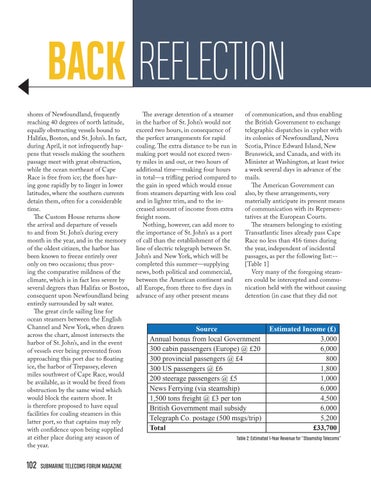
of communication, and thus enabling the British Government to exchange telegraphic dispatches in cypher with its colonies of Newfoundland, Nova Scotia, Prince Edward Island, New Brunswick, and Canada, and with its Minister at Washington, at least twice a week several days in advance of the mails. The American Government can also, by these arrangements, very materially anticipate its present means of communication with its Representatives at the European Courts. The steamers belonging to existing Transatlantic lines already pass Cape Race no less than 416 times during the year, independent of incidental passages, as per the following list:-[Table 1] Very many of the foregoing steamers could be intercepted and communication held with the without causing detention (in case that they did not
Source Annual bonus from local Government 300 cabin passengers (Europe) @ £20 300 provincial passengers @ £4 300 US passengers @ £6 200 steerage passengers @ £5 News Ferrying (via steamship) 1,500 tons freight @ £3 per ton British Government mail subsidy Telegraph Co. postage (500 msgs/trip) Total
Estimated Income (£) 3,000 6,000 800 1,800 1,000 6,000 4,500 6,000 5,200 £33,700
Table 2: Estimated 1-Year Revenue for “Steamship Telecoms”