EXORDIUM
FROM THE PUBLISHER
WELCOME TO ISSUE 144 OF SUBTEL FORUM, OUR OFFSHORE ENERGY EDITION
FEATURING A PREVIEW OF IWCS CABLE & CONNECTIVITY INDUSTRY FORUM ‘25
Alate summer vacation found me on the west coast of Ireland… Peg had been talking about visiting her grandparent’s home countryside for years and a simple email solicitation last autumn from some unknown travel company gave me a wonderful Christmas present for her – a nine day self drive tour of a good chunk of the island. This trip was really all for her and other than my share of the driving was along for the ride, except I wanted to do one thing: visit the village where John Ford’s 1951 classic,
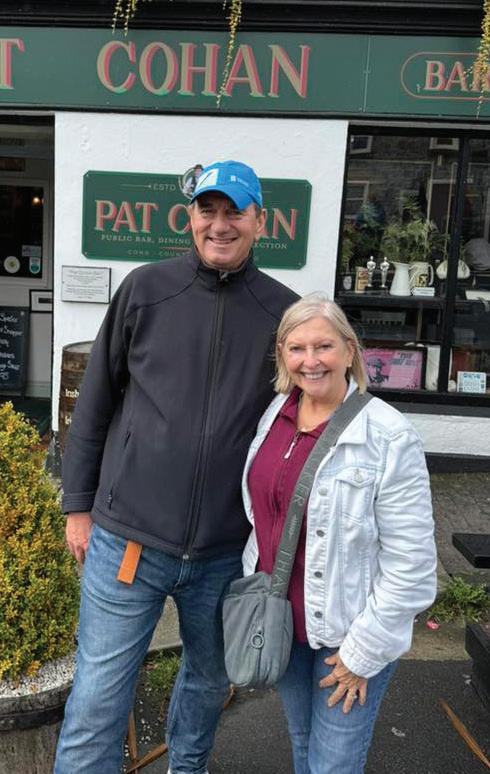
“The Quiet Man,” was filmed. The day I was leaving Stewart Ash asked in our weekly projects meeting if I was also going to Valentia Island, which I had not even considered. Four days into the trip I received an email from Derek Cassidy about his article, which I answered on my phone and mentioned offhandedly that I was excited to be visting Valentia some two hours away the next morning, to which he jumped into gear and arranged within minutes an incredibly wonderful, personal tour to one of the most important places in our industry’s history, Valentia Island cable station.
UC BERKELEY CERTIFICATE – WINNING STUDENT ARTICLES
SubTel Forum is proud to support UC Berkeley’s Global Digital Infrastructure Certificate, the first program focused on the backbone of the internet—submarine cables and data centers. Running May through August 2025, the program brought together students worldwide to explore how connectivity can be made more sustainable, resilient, and equitable. We contributed cable maps, industry reports and features
to enrich the curriculum, bridging academic inquiry with real-world insights. From more than two hundred submissions, three standout articles—by Henry el Bahnasawy, Jessica Halim, and Emma Stevens—were selected by a joint academic and industry panel which appear in this issue.
2025–26 SUBMARINE TELECOMS INDUSTRY REPORT
Our flagship Submarine Telecoms Industry Report returns this fall with its most comprehensive analysis yet. The last edition was downloaded over 500,000 times and cited widely across global business and trade media, making it the industry’s most visible annual publication.
Advertising and sponsorship opportunities for the 2025–26 Report are now open. Secure your placement today and put your brand in front of the subsea industry’s key decision-makers worldwide. Contact Nicola Tate (ntate@associationmediagroup.com) or +1 804-469-0324) to reserve your space.
2025 SUBMARINE CABLE MAPS – IWCS EDITIONS
We’re gearing up to print the 2025 Submarine Cable Map for Submarine Networks World 2025 (Singapore, September)
and IWCS Forum 2025 (Pittsburgh, October). These exclusive maps highlight global subsea system advancements and will be distributed directly to key decision-makers across the industry.
2026 SUBMARINE CABLE MAPS – PTC, EMEA, SNW & IWCS
Sales are now open for the PTC’26 edition of the Submarine Cable Map. Additional 2026 editions are planned for Submarine Networks EMEA (London, May), Submarine Networks World 2026 (Singapore, September), and IWCS Forum 2026 (location TBD, October). Each map offers premium visibility at the subsea industry’s most influential gatherings.
Want your logo featured? Now’s the time to secure your ad space and gain high-visibility placement across the full 2026 conference series. Click here to secure your spot!
THANK YOU
Thank you as always to our awesome authors who have contributed to this issue of SubTel Forum. Thanks also for their support to this issue’s advertisers: APTelecom , Fígoli Consulting, International Wire & Cable Symposium, Submarine Networks World 2025, and WFN Strategies. Of course, our ever popular “where in the world are all those pesky cableships” is included as well.
Yes, we also visited the village of Cong, where we had a pint in Pat Cohan’s pub and enjoyed a touch of Hollywood magic courtesy of John Wayne, Maureen O’Hara, Barry Fitzgerald, and Ward Bond, who, 74 years ago, brought electricity, jobs, and generational prosperity to some 200 local village extras!
A Publication of Submarine Telecoms Forum, Inc. www.subtelforum.com | ISSN No. 1948-3031
PRESIDENT & PUBLISHER: Wayne Nielsen | wnielsen@subtelforum.com | [+1] (703) 444-2527
VICE PRESIDENT: Kristian Nielsen | knielsen@subtelforum.com | [+1] (703) 444-0845
ANALYTICS: Kieran Clark | kclark@subtelforum.com | [+1] (540) 533-6965
SALES: Nicola Tate | ntate@associationmediagroup.com | [+1] (804) 469-0324 subtelforum.com/advertise-with-us
DESIGN & PRODUCTION: Weswen Design | wendy@weswendesign.com
DEPARTMENT WRITERS:
Andrés Fígoli, Camila Paulino, David Kiddoo, Iago Bojczuk, John Maguire, Kieran Clark, Nicola Tate, Nicole Starosielski, Phillip Pilgrim, and Wayne Nielsen
FEATURE WRITERS:
Anders Tysdal, Derek Cassidy, Emma Stevens, Geoff Bennett, Henry el Bahnasawy, Jessica Halim, John Manock, Kieran Clark, Kristian Nielsen, Martin Reilly, Michael Brand, Nicole Starosielski, Ron Larsen, Sarah Hudak, and Wayne Nielsen
NEXT ISSUE: November 2025 – Data Centers & New Technology featuring PTC ’26 Preview and SubTel Forum’s 24th Anniversary Edition
AUTHORS INDEX: https://subtelforum.com/authors-index
MAGAZINE ARCHIVE: subtelforum.com/magazine-archive
Submarine Telecoms Forum, Inc. www.subtelforum.com/corporate-information
BOARD OF DIRECTORS:
Margaret Nielsen, Wayne Nielsen, Kristian Nielsen and Kacy Nielsen
Contributions are welcomed and should be forwarded to: pressroom@subtelforum.com.

Good reading – Slava Ukraini STF

Wayne Nielsen, Publisher
Submarine Telecoms Forum magazine is published bimonthly by Submarine Telecoms Forum, Inc., and is an independent commercial publication, serving as a freely accessible forum for professionals in industries connected with submarine optical fiber technologies and techniques. Submarine Telecoms Forum may not be reproduced or transmitted in any form, in whole or in part, without the permission of the publishers.
Liability: While every care is taken in preparation of this publication, the publishers
cannot be held responsible for the accuracy of the information herein, or any errors which may occur in advertising or editorial content, or any consequence arising from any errors or omissions, and the editor reserves the right to edit any advertising or editorial material submitted for publication.
New Subscriptions, Enquiries and Changes of Address: 21495 Ridgetop Circle, Suite 201, Sterling, Virginia 20166, USA, or call [+1] (703) 444-0845, fax [+1] (703) 349-5562, or visit www. subtelforum.com. Copyright © 2025 Submarine Telecoms Forum, Inc.
Henry el Bahnasawy
SENSING THE SEABED
How Fiber-Optic Sensing Technologies Are Protecting Critical Submarine Infrastructure
By Anders Tysdal

HOW MOFN UNLOCK OPPORTUNITY FOR TELCOS AND HYPERSCALERS
By Martin Reilly

DECODING THE FLEET
Launching the Cableship Codex – A New Era of Cableship Intelligence
By Kieran Clark
CROSSED PATHS
Managing Telecom Cable, Offshore Wind Energy, and Fishing Interests on the U.S. Seabed
By Sarah Hudak and Ron Larsen

OPTICAL AND SUBMARINE CABLE SENSING: A BRIEF OVERVIEW
By Derek Cassidy
UNDERSEA CURRENTS
How Geopolitics and Policy Are Reshaping Submarine Cables (Sep 2024–Sep 2025)
By Kristian Nielsen
HANDS OFF OUR CABLES!
Detecting Human Activities Around Submarine Cables
By Geoff Bennett
EMERGING OFFSHORE WIND CABLE MARKETS SOUTH AMERICA AND AFRICA
By John Manock

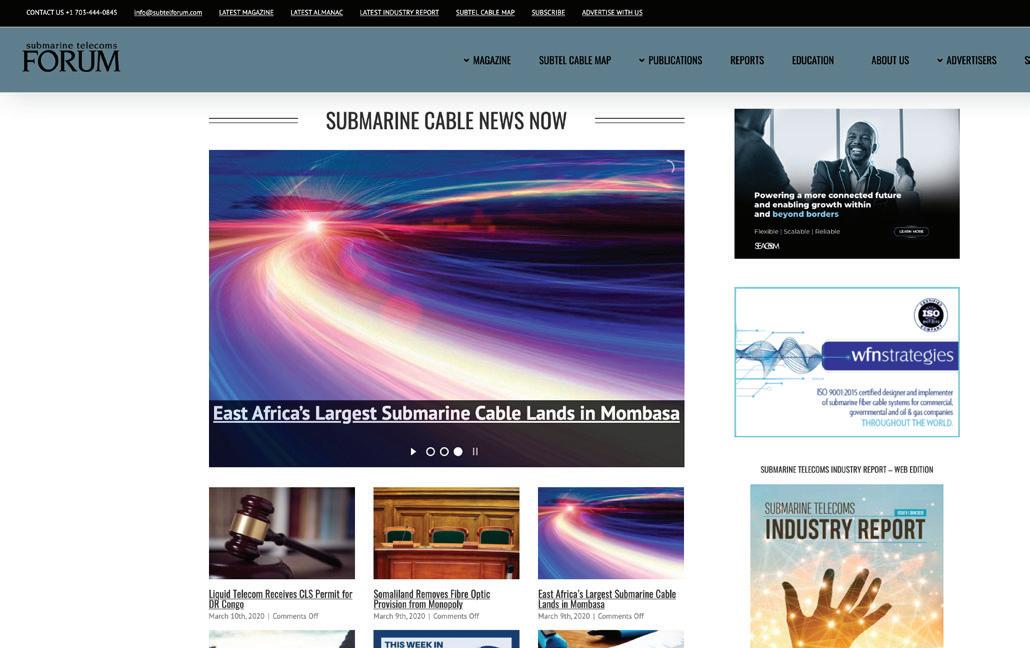
INSIDE THE WORLD OF SUBTEL FORUM: A COMPREHENSIVE GUIDE TO SUBMARINE CABLE RESOURCES
TOP STORIES OF 2019
The most popular articles, Q&As of 2019. Find out what you missed!
NEWS NOW RSS FEED
Welcome to an exclusive feature in our magazine, where we explore the captivating world of SubTelForum.com, a pivotal player in the submarine cable industry. This expedition takes us on a detailed journey through the myriad of resources and innovations that are key to understanding and connecting our world beneath the oceans.
mapping efforts by the analysts at SubTel Forum Analytics, a division of Submarine Telecoms Forum. This reference tool gives details on cable systems including a system map, landing points, system capacity, length, RFS year and other valuable data.
DISCOVER THE FUTURE: THE SUBTEL FORUM APP
CONNECTING THE DEPTHS: YOUR ESSENTIAL GUIDE TO THE SUBTEL FORUM DIRECTORY
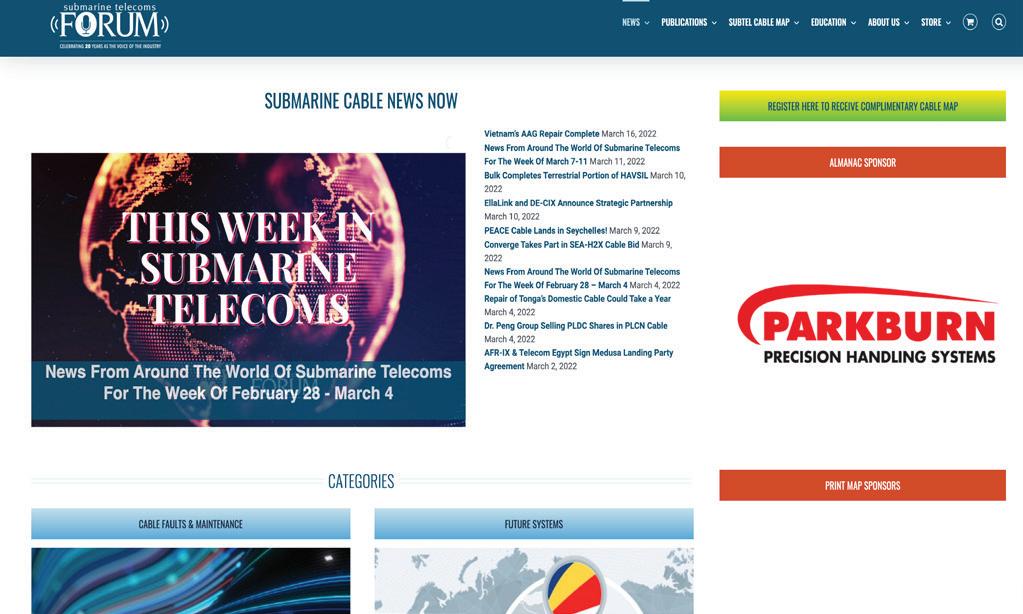
Keep on top of our world of coverage with our free News Now daily industry update. News Now is a daily RSS feed of news applicable to the submarine cable industry, highlighting Cable Faults & Maintenance, Conferences & Associations, Current Systems, Data Centers, Future Systems, Offshore Energy, State of the Industry and Technology & Upgrades.
PUBLICATIONS
Submarine Cable Almanac is a free quarterly publication made available through diligent data gathering and
Submarine Telecoms Industry Report is an annual free publication with analysis of data collected by the analysts of SubTel Forum Analytics, including system capacity analy sis, as well as the actual productivity and outlook of current and planned systems and the companies that service them.
CABLE MAP
In our guide to submarine cable resources, the SubTel Forum Directory shines as an essential tool, providing SubTel Forum.com readers with comprehensive access to an array of vetted industry contacts, services, and information. Designed for intuitive navigation, this expansive directory facilitates quick connections with leading vendors, offering detailed profiles and the latest in submarine cable innovations. As a dynamic hub for industry professionals, it fosters community engagement, ensuring our readers stay at the forefront of industry developments, free of charge.
2024 marks a groundbreaking era for SubTel Forum with the launch of its innovative app. This cutting-edge tool is revolutionizing access to submarine telecommunications insights, blending real-time updates, AI-driven analytics,
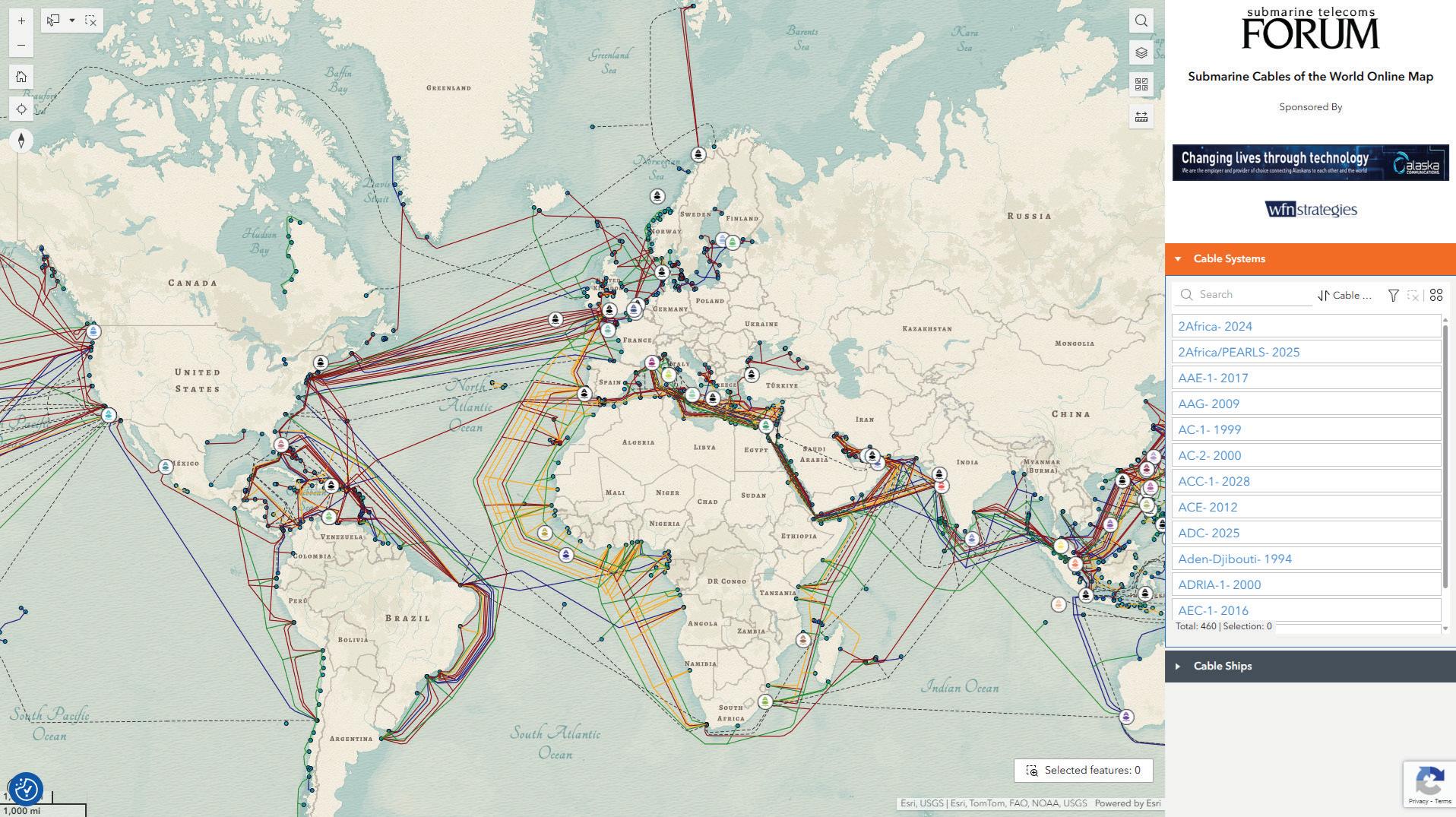
The online SubTel Cable Map is built with the industry standard Esri ArcGIS platform and linked to the SubTel Forum Submarine Cable Database. It tracks the progress of
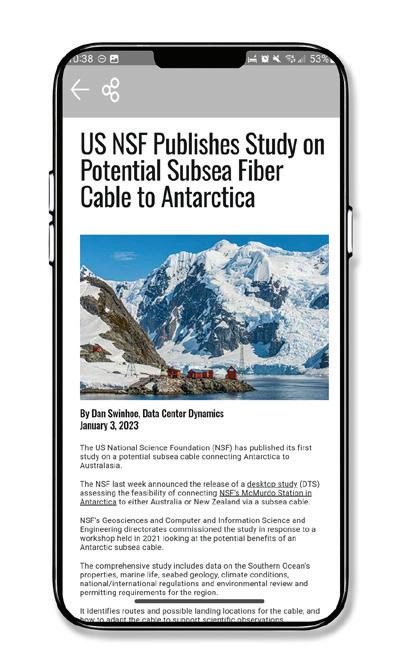
and a user-centric interface into an indispensable resource for industry professionals. More than just a technological advancement, this app is a platform fostering community, learning, and industry progression. We encourage you to download the SubTel Forum App and join a community at the forefront of undersea communications innovation.
YOUR DAILY UPDATE: NEWS NOW RSS FEED
Our journey begins with the News Now updates, providing daily insights into the submarine cable sector. Covering everything from the latest technical developments to significant industry milestones, this feed ensures you’re always informed about the latest trends and happenings. It’s an essential tool for professionals who need to stay on top of industry news.
THE KNOWLEDGE HUB: MUST-READS & Q&AS
Dive deeper into the world of submarine communications with our curated collection of articles and Q&As. These insightful pieces offer a comprehensive look at both the history and current state of the industry, enriching your understanding and providing a broader perspective on the challenges and triumphs faced by submarine cable professionals.
IN-DEPTH PUBLICATIONS
• Submarine Cable Almanac: This quarterly treasure trove provides detailed information on global cable systems. You can expect rich content including maps, data on system capacity, length, and other critical details that sketch a vivid picture of the global network.
• Submarine Telecoms Industry Report: Our annual report takes an analytical approach to the industry, covering everything from current trends to capacity analysis and future predictions. It’s an invaluable resource for anyone seeking to understand the market’s trajectory.
VISUALIZING CONNECTIONS: CABLE MAPS
• Online SubTel Cable Map: An interactive tool mapping over 550 cable systems, perfect for digital natives who prefer an online method to explore global connections.
• Printed Cable Map: Our annual printed map caters to those who appreciate a tangible representation of the world’s submarine fiber systems, detailed in a visually appealing and informative format.
EXPLORING OUR PAST: MAGAZINE ARCHIVE
Explore the Submarine Telecoms Forum Magazine Archive, a comprehensive collection of past issues spanning 23+ years of submarine telecommunications. This essential resource offers insights into project updates, market trends, technological advancements, and regulatory changes. Whether researching industry developments or seeking

expert analysis, the archive provides valuable perspectives on the technologies and trends shaping global connectivity.
FIND THE EXPERTS: AUTHORS INDEX
Our Authors Index is a valuable tool for locating specific articles and authors. It simplifies the process of finding the information you need or following the work of your favorite contributors in the field.
TAILORED INSIGHTS: SUBTEL FORUM BESPOKE REPORTS
• Data Center & OTT Providers Report: This report delves into the evolving relationship between cable landing stations and data centers, highlighting trends in efficiency and integration.
• Global Outlook Report: Offering a comprehensive analysis of the submarine telecoms market, this report includes regional overviews and market forecasts, providing a global perspective on the industry.
• Offshore Energy Report: Focusing on the submarine fiber industry’s oil & gas sector, this report examines market trends and technological advancements, offering insights into this specialized area.
• Regional Systems Report: This analysis of regional submarine cable markets discusses capacity demands, development strategies, and market dynamics, providing a detailed look at different global regions.
• Unrepeatered Systems Report: A thorough examination of unrepeatered cable systems, this report covers project timelines, costs, and operational aspects, essential for understanding this segment of the industry.
• Submarine Cable Dataset: An exhaustive resource detailing over 550 fiber optic cable systems, this dataset covers a wide range of operational data, making it a go-to reference for industry specifics.
SubTelForum.com stands as a comprehensive portal to the dynamic and intricate world of submarine cable communications. It brings together a diverse range of tools, insights, and resources, each designed to enhance understanding and engagement within this crucial industry. From the cutting-edge SubTel Forum App to in-depth reports and interactive maps, the platform caters to a wide audience, offering unique perspectives and valuable knowledge. Whether you’re a seasoned professional or new to the field, SubTelForum.com is an indispensable resource for anyone looking to deepen their understanding or stay updated in the field of submarine telecommunications.
SUBTEL CABLE MAP UPDATES
BY KIERAN CLARK
The SubTel Cable Map— powered by Esri’s ArcGIS platform—offers an interactive and detailed way to explore the global network of submarine cables. This indispensable resource provides information on over 440 existing and planned systems, more than 50 cable ships, and upwards of 1,000 landing points. Connected directly to the SubTel Forum Submarine Cable Database and integrated with our News Now Feed, the map enables real-time tracking of industry activity and cable-specific news coverage.
Submarine cables serve as the foundation of global digital infrastructure, carrying more than 99% of international data traffic. These systems enable the seamless connectivity the world depends on—from personal communication to enterprise operations. Without them, modern, high-speed global communication simply wouldn’t be feasible. Our analysts continually update the map using verified data from the Submarine Cable Almanac and valuable input from industry contributors. This ensures a timely and accurate picture of the subsea cable landscape, spotlighting the latest deployments and developments. As we approach the end of the year, map updates may slow during the holiday season, but our commitment to delivering reliable insights remains unchanged.
Submarine cables serve as the foundation of global digital infrastructure, carrying more than 99% of international data traffic. These systems enable the seamless connectivity the world depends on—from personal communication to enterprise operations.
We’re proud to feature Alaska Communications Systems and WFN Strategies as the current sponsors of the SubTel Cable Map. Additional sponsorship opportunities are available—offering high-visibility placement for your logo and
a direct link to your organization. It’s a great way to align your brand with global connectivity and the future of the submarine cable industry.
We invite you to explore the SubTel Cable Map and gain a deeper understanding of the vital role submarine cable systems play in our interconnected world. As always, if you are a point of contact for a system or company that requires updates, please email kclark@subtelforum.com.
We hope the SubTel Cable Map proves to be a valuable
Here’s the list of systems updated since our last issue:
SEPTEMBER 15, 2025
resource for you, offering insight into the continually evolving submarine cable industry. Dive into the intricate network that powers our global communications today. Happy exploring! STF
KIERAN CLARK is the Lead Analyst for SubTel Forum. He originally joined SubTel Forum in 2013 as a Broadcast Technician to provide support for live event video streaming. He has 6+ years of live production experience and has worked alongside some of the premier organizations in video web streaming. In 2014, Kieran was promoted to Analyst and is currently responsible for the research and maintenance that supports the Submarine Cable Database. In 2016, he was promoted to Lead Analyst and his analysis is featured in almost the entire array of Subtel Forum Publications.
Do you have further questions on this topic?
Newly Added Systems:
• Oman Emirates Gateway (OEG)
• Updated Systems:
• Celia
• E2A
• Humboldt
• MANTA
• SEA-ME-WE 6
• SHV-HK
• SJC2
ANALYTICS
OFFSHORE ENERGY
[Reprinted Excerpts from SubTel Forum’s 2024/25 Submarine Industry Report]
Subsea fiber optic cables are becoming an indispensable part of the offshore energy sector, particularly for the offshore oil & gas and wind industries. Both sectors have seen substantial growth in recent years, largely driven by increasing demands for reliable and high-capacity communications to support operations in remote and harsh environments. This report will explore the latest developments in subsea fiber communications supporting these industries, focusing on the expansion of fiber networks in offshore oil & gas, as well as the rapid growth of the offshore wind industry.
OFFSHORE OIL & GAS AND FIBER COMMUNICATIONS
improvements. The Campos Basin project is a significant contributor to Brazil’s offshore oil production, and fiber communications have enabled operators to link offshore platforms with onshore control centers. This reduces the need for human presence on platforms while enhancing safety and efficiency. Subsea fiber networks provide the capacity for real-time monitoring and predictive maintenance, which is increasingly vital as oil & gas companies strive to reduce costs and environmental risks. (Global Wind Energy Council, 2024)
Globally, the trend towards digitization in oil & gas is transforming the way companies operate.
Automation
and
digital technologies have become fundamental to reducing operational risks and improving decisionmaking in real-time. Fiber optics play a critical role in this transformation by providing the bandwidth needed to support dataintensive applications.
In the offshore oil & gas sector, robust communication networks are essential for supporting the complex operations of platforms, which include drilling, extraction, monitoring, and logistics. Companies like Tampnet have been pioneers in providing high-speed, low-latency communications across critical oil-producing regions. Tampnet’s Gulf of Mexico System, for example, is a major project that illustrates the role of fiber in offshore operations. Tampnet has been upgrading the communications infrastructure in the Gulf of Mexico to integrate fiber optics and 4G LTE networks, enabling enhanced data transfer and remote control of offshore platforms. These upgrades allow oil & gas companies to manage operations more efficiently, with applications such as real-time video surveillance, automation of key processes, and monitoring of equipment through IoT devices. (World Forum Offshore Wind, 2024) (Global Wind Energy Council, 2024)
Similarly, other key offshore oil regions, like Brazil’s Campos Basin, have leveraged subsea fiber for operational
Globally, the trend towards digitization in oil & gas is transforming the way companies operate. Automation and digital technologies have become fundamental to reducing operational risks and improving decision-making in real-time. Fiber optics play a critical role in this transformation by providing the bandwidth needed to support data-intensive applications. From monitoring well performance to enabling predictive analytics, fiber communications are essential for optimizing offshore production and ensuring the safety of personnel. (Global Wind Energy Council, 2024)
EXPANSION OF OFFSHORE WIND AND FIBER COMMUNICATIONS
While oil & gas continues to be a key driver of subsea fiber growth, the offshore wind industry is emerging as an equally significant market for fiber suppliers. The offshore wind sector has expanded rapidly over the past decade, with a notable increase in global capacity. In 2020, offshore wind capacity stood at around 29.1 GW, and by 2023, it had increased to approximately 75 GW. The industry is projected to grow even further, with estimates suggesting that global offshore wind capacity could reach 487 GW by 2033. (Det Norske Veritas, 2024)
Fiber optic communications are critical to the operation of offshore wind farms, providing the infrastructure needed to connect turbines to control centers and national power grids. As the size and complexity of offshore wind farms increase, the demand for reliable and scalable communication networks grows. Subsea fiber networks support real-time monitoring of turbine performance, grid stability, and environmental conditions. These networks also enable remote diagnostics and control, reducing the need for maintenance crews to be physically present on offshore platforms. (Det Norske Veritas, 2024)
Europe continues to lead the offshore wind market, with countries like the United Kingdom and Germany driving much of the capacity expansion. However, new markets in the Asia-Pacific region and the U.S. are expected to fuel further growth. In the U.S., for example, the federal government has set ambitious targets for offshore wind capacity, with a goal of reaching 30 GW by 2030. This growth is expected to spur demand for subsea fiber to connect wind farms along the Atlantic coast (Det Norske Veritas, 2024)
nearby wind farms. This not only reduces greenhouse gas emissions but also provides a more stable and sustainable energy source for offshore production. Fiber optic networks will be essential to managing the flow of information between these interconnected systems, ensuring that they operate efficiently and safely.
FUTURE OUTLOOK AND CHALLENGES
In addition to offshore wind, emerging markets like floating wind farms are opening up new possibilities for fiber suppliers. Floating wind farms, which can be installed in deeper waters than fixed-bottom turbines, require even more advanced communication infrastructure.
In addition to offshore wind, emerging markets like floating wind farms are opening up new possibilities for fiber suppliers. Floating wind farms, which can be installed in deeper waters than fixed-bottom turbines, require even more advanced communication infrastructure. Subsea fiber networks are key to managing the complexities of floating platforms and ensuring stable operations in challenging conditions.
INTEGRATION OF OFFSHORE OIL, GAS, AND WIND INFRASTRUCTURE
As the offshore energy sector evolves, there is increasing interest in the integration of offshore oil, gas, and wind infrastructure. Hybrid energy systems, which combine oil & gas platforms with offshore wind farms, could offer significant benefits by sharing infrastructure such as subsea cables, power supplies, and communication networks. Fiber optics could be the backbone of such integrated systems, enabling the simultaneous management of multiple energy sources from a single control center.
For instance, as oil & gas companies look to decarbonize their operations, some have begun exploring ways to power their offshore platforms using electricity generated by
The demand for subsea fiber communications is set to grow significantly over the next decade as both the offshore oil & gas and wind industries expand. However, there are challenges that could impact the pace of growth. For the oil & gas sector, geopolitical risks, regulatory changes, and fluctuating oil prices could affect investments in new fiber networks. Similarly, the offshore wind industry faces challenges such as supply chain constraints and rising capital costs, which may slow the development of new projects (Det Norske Veritas, 2024) Despite these challenges, the long-term outlook remains positive. Both sectors recognize the critical importance of reliable, high-capacity communications in supporting their operations, and fiber optics will continue to play a central role. As digital technologies evolve, the offshore energy industry will increasingly rely on real-time data, predictive analytics, and automation—all of which require robust fiber communications.
In conclusion, subsea fiber communications are vital to the continued growth and success of both the offshore oil & gas and wind industries. As these sectors expand and become more interconnected, the demand for high-speed, reliable communications will only increase. Fiber optic networks will remain the foundation for modern offshore energy infrastructure, enabling the efficient and sustainable production of energy in some of the world’s most challenging environments. STF
NOW OUT: SUBOPTIC FOUNDATION’S 2025 REPORT ON BEST PRACTICES IN CABLE LANDING STATION SUSTAINABILITY
BY IAGO BOJCZUK, CAMILA PAULINO, AND NICOLE STAROSIELSKI
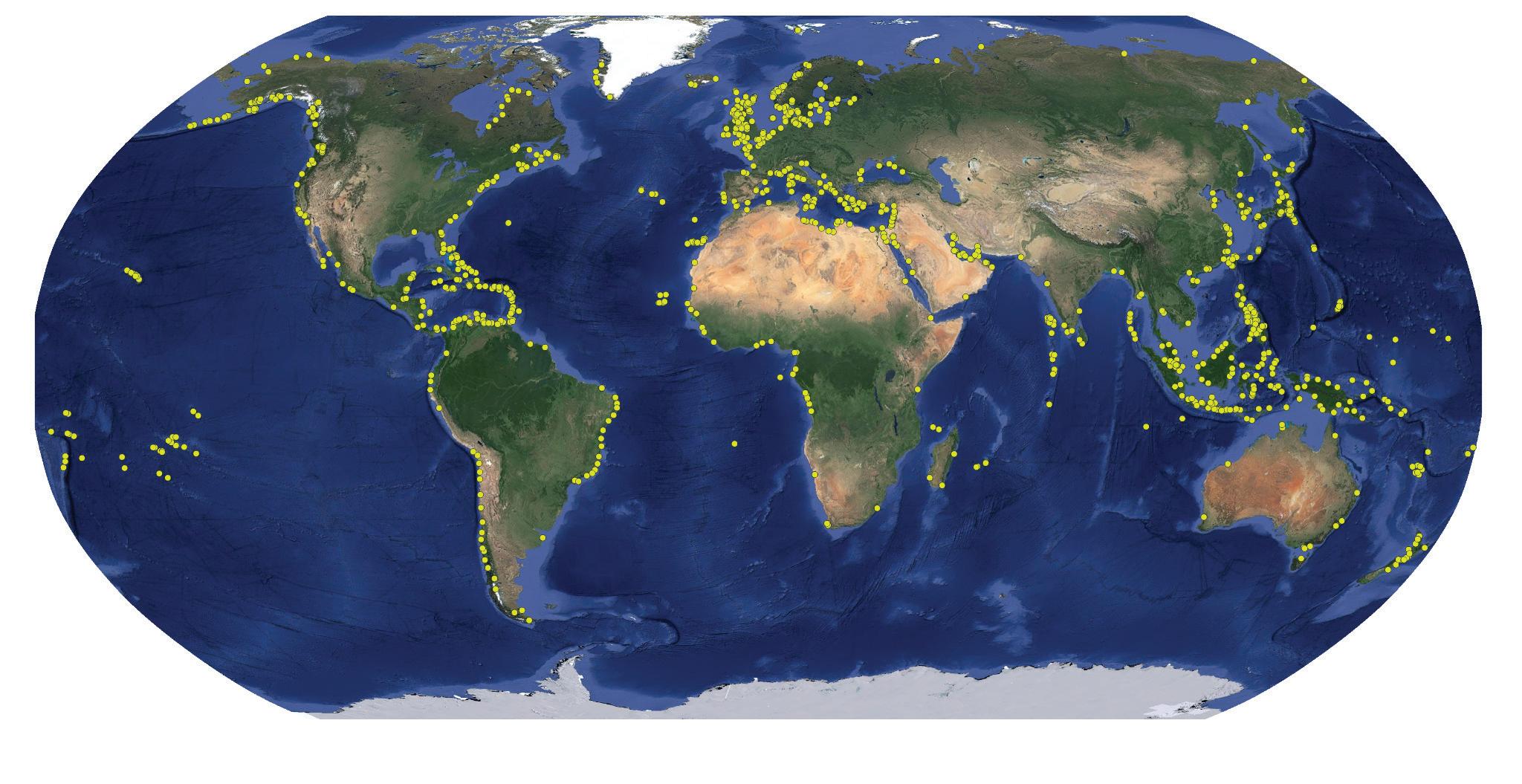
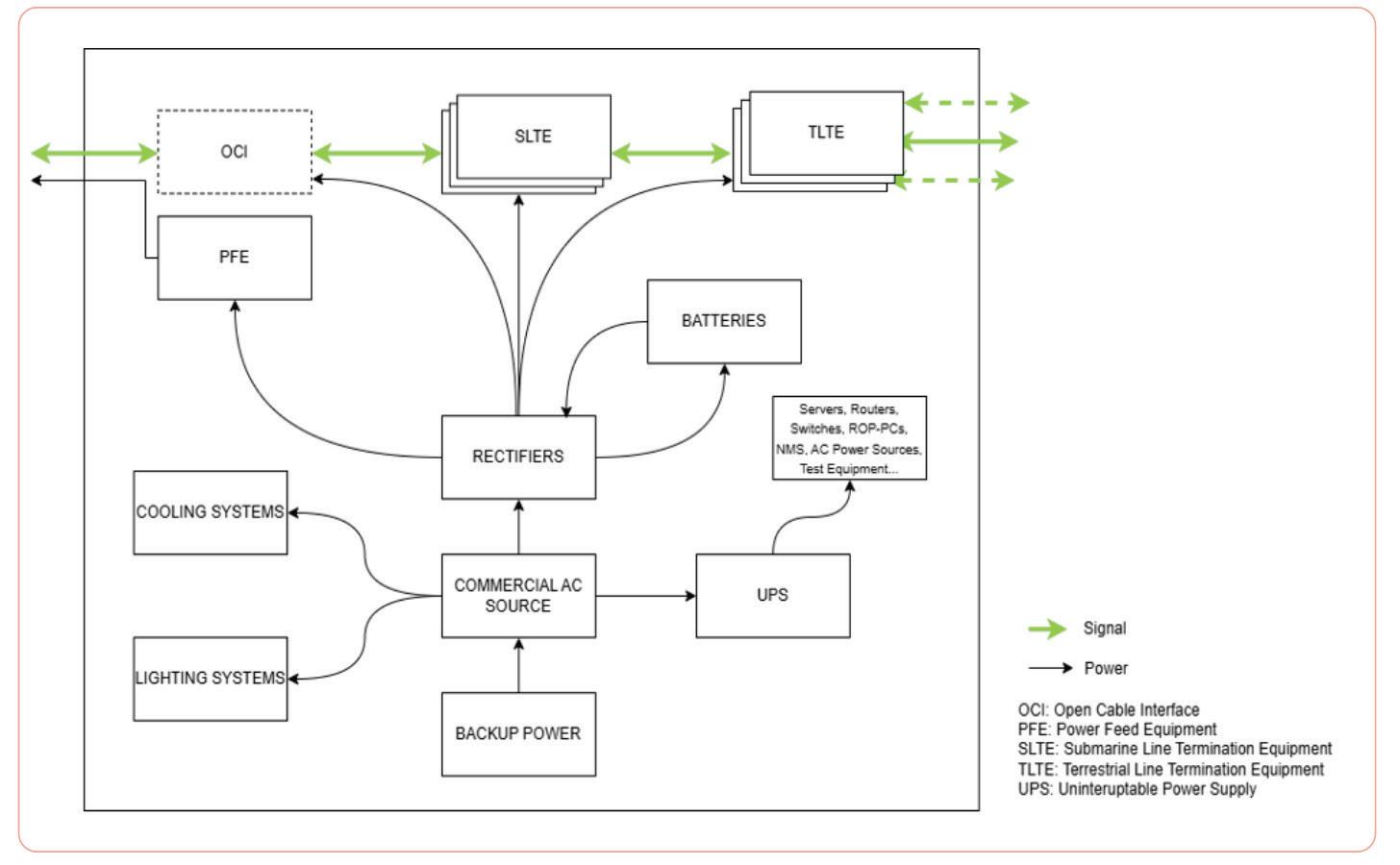
Acable landing station (CLS) is the essential dry-plant facility where a subsea cable ends and connects to terrestrial networks. According to TeleGeography, there are over 1,500 cable landings distributed worldwide (Fig. 1) (Burdette, 2025). Inside one of these facilities, you typically find power-feed equipment (PFE) that supplies constant-current power to the undersea cable’s repeaters (amplifiers), submarine line terminal equipment (SLTE) that terminates and processes high-capacity optical signals, terrestrial back-haul equipment, and the critical facility stack: redundant power and HVAC, battery backup, monitoring and control systems, and physical security—usually supported by 24/7 network operations, even though some sites are not manned, they are continuously and remotely monitored. Engineers and technicians work around the clock at these sites to ensure smooth operation.
In other words, the CLS is where the system’s energy and computing resources are concentrated, cooling systems must operate flawlessly, and all equipment supporting optical transmission is housed. Although sizes and capacities vary, most facilities tend to follow a similar layout (Fig. 2). As internet bandwidth demand increases, CLS energy use and environmental impact could also grow. However, with the advancement of high-data-rate networks and more efficient terrestrial and subsea LTE,
power consumption can be reduced. As a vital part of the dry plant, neglecting CLS sustainability means missing a major opportunity to improve the environmental performance of today’s subsea cable systems.
Over the years, with more cables being deployed globally, the strategic importance of where and how to build CLSs cannot be overstated. Increasingly, operators must weigh facility design and site selection. Energy availability—both grid capacity and carbon intensity—will remain key drivers, alongside new potential for deploying on-site renewable energy. New CLSs are being deployed in regions with abundant or low-carbon power. Energy profiles vary by location: Portugal has a high share of
renewables, whereas Singapore and Oman remain gas-heavy, so “low-carbon” does not uniformly apply across those examples. Redundancy and interconnection needs are also pushing the industry toward open, carrier-neutral CLS models that support multiple cables and terrestrial providers. In parallel, regulators commonly require environmental assessments, coastal and seabed permits, and national-security reviews for CLS projects (Ogren, 2025).
As with other layers of digital infrastructure, the cable landing station (CLS) brings long-overlooked sustainability issues into focus: although the cable itself lies offshore, the CLS—the dry-plant facility that powers the system—operates on land
and its sustainability parameters have historically been under-mapped. Yet now, disclosure rules are tightening.
Three questions organize the CLS sustainability agenda: Are we measuring the right things in the right places, with clear operational boundaries, so impacts can be seen and compared? Do governance and reporting routines turn those measurements into continuous improvement across varied ownership and co-located contexts? Are design, procurement, and refresh decisions aligned with grid realities and climate risk to minimize both operational and embodied impacts over time? Framed this way, improving CLS efficiency goes to the heart of a subsea cable system’s environmental footprint.
In this month’s Sustainable Subsea column, we summarize a new SubOptic Foundation report that brings sustainability squarely into CLS operations. Produced with the UK-based firm Carbon3IT, the 2025 Report on Best Practices in Cable Landing Station Sustainability identifies the CLS as one of the most sensitive—and
most actionable—levers for improving network environmental performance. The report treats the CLS as a practical focal point for sustainability because it concentrates powered optical transmission equipment and supporting infrastructure. The premise is simple: if each CLS operates more cleanly and efficiently, the global telecommunications network becomes more resilient and better prepared for climate risks. Yet the complexity of the environmental considerations at play makes this systematic study a timely contribution to a more sustainable subsea cable industry.
CLS AND ENVIRONMENTAL SUSTAINABILITY
As climate change regulation advances worldwide, the energy demands of digital infrastructure are under increasing scrutiny. The energy efficiency and carbon emissions of data centers have been thoroughly examined, and frameworks such as the European Code of Conduct for Energy Efficiency in Data Centres (EUCoC) have been crafted for that sector. By
contrast, CLS facilities lack a systematized, data-driven view of their global footprint and still do not benefit from standardized sustainability metrics. Because many CLS facilities are smaller than full data centers and were built before sustainability was a priority, they offer clear upgrade opportunities. A few operators—such as Equinix in Marseille, BT in Dublin— are beginning to fold the CLS into the data-center footprint, but such arrangements remain the exception.
Against this backdrop, the published SubOptic report constitutes the first industry-wide, systematic study of sustainability at the CLS layer of the subsea cable system (Fig. 2). While CLSs are only one component of the larger submarine ecosystem, which includes cable manufacture and deployment, marine operations, repair, and recovery, they offer a tractable locus for data collection and benchmarking. Focusing here enables mutually beneficial pathways: actionable improvements for operators and measurable progress in greening cable operations.
Figure 1. Global footprint of CLS facilities, based on TeleGeography data (2024).
The United States is by far the country with the most CLS facilities.
According to Nicole Starosielski, co-convenor of the SubOptic Global Citizen Working Group and the Sustainable Subsea Networks team, this report offers a useful view for the industry because it applies well-established frameworks in the data center industry and beyond to the specific case of the subsea industry.
According to Derek Cassidy, Senior Submarine Cable Technologist and Programme Manager at British Telecom (BT), CLS infrastructure is a vital link in international connectivity and is directly tied to BT’s climate ambitions. As he puts it, “with the increasing demands to meet the climate challenge, BT has already instigated a programme to become carbon neutral by 2030.” He explains: “By applying this ethos to our infrastructure, power systems, and line terminal equipment, we have already begun a programme to reduce power consumption and reduce the carbon footprint that we have, thereby helping us to achieve our 2030 goal of being carbon neutral.” Cassidy, who worked with the broader Sustainable Subsea Networks team, adds that consolidating sites and infrastructure is another lever to accelerate progress and concludes that being more power efficient is seen as a pillar that helps to promote BT’s climate goals.
THE SURVEY’S METHODOLOGY
Because systematic studies of the environmental dimensions of cable landing stations (CLSs) were scarce, SubOptic Foundation’s Sustainable Subsea Networks (SSN) Cable Landing Station working group set out to develop a creative, practical methodology that could be applied in the field. Over two years, the team mapped and measured key sus-
tainability factors across the subsea ecosystem, focusing on CLSs as the primary unit of analysis. Building on this groundwork, the team developed a sector-wide survey in partnership with Carbon 3IT. Convened by Vedrana Stojanac of Ciena, the subgroup’s membership includes Aqua Comms, BT, Bulk Infrastructure, Ciena, Colt, e&, Exa Infrastructure, Google, Orange, R&G Telecomm, the Solomon Islands Submarine Cable Company, Telecom Egypt, Telxius, and Vodafone.
Reflecting on her work with the SubOptic Foundation’s SSN Cable Landing Station subgroup, Vedrana Stojanac, Senior Consultant of the Global Submarine Systems Engineering Team at Ciena, said: “Given the critical role of subsea cables in ensuring the reliability of the internet and their status as key infrastructure, CLS facilities warrant focused study to optimize operations and safeguard sensitive data transmission. Adopting sustainability practices not only supports environmental goals but also enhances operational efficiency,
resilience, and security, creating a robust and future-ready facility. By integrating sustainable approaches, CLS operators can better address the fast-growing demands of global connectivity. The group’s efforts represent an important step toward achieving these objectives.”
An inevitable part of the process was considering CLSs in relation to data centers, since both rely on similar electrical and cooling equipment. As late British scientist Lord Kelvin—whose innovations enabled signal detection on the first transatlantic telegraph cables—famously observed, “If you cannot measure it, you cannot improve it.” Guided by this principle, our first task was to determine what to measure and how to do so repeatably. Drawing on established data-center standards, we assembled performance metrics and energy-efficiency/sustainability best practices and paired them with continuous-improvement methods from manufacturing. As Nick Morris of Carbon3IT explains, “Combining these tools with continuous improvement method-
Figure 2. Typical CLS layout and its ICT equipment. With an Open Cable Interface (OCI), the SLTE connects to the subsea fiber pair through the OCI, which may support optical spectrum sharing (multiple SLTEs on one pair) and includes wet-plant supervisory and photonic components. Source: 2025 Report on Best Practices in Cable Landing Station Sustainability.
ologies initially developed in manufacturing enables the measurement of absolute and relative performance across time and between different infrastructures.”
However, unlike the data center sector— which relies heavily on the metric of power usage effectiveness (PUE), despite its limitations—CLS operations lack a phased, granular understanding of how power and other resources are used. Accordingly, the survey targeted critical operational areas: (1) ICT equipment—optical transmission and IT (servers); (2) power—primary and backup; AC/UPS and 48 V DC; (3) cooling; (4) measuring, metering/monitoring, and reporting; (5) environmental conditions; (6) standards applied—sustainability, energy efficiency, and related; and (7) indicators monitored and logged—carbon emissions and water use.
rity model)—to assess how proven energy-efficiency practices apply to CLS operations, alongside ISO 14040–se-
ries life-cycle standards.
In the survey, metering, monitoring, data management, and reporting were treated as prerequisites for applying metrics and best practices—particular-
ly because ownership and colocation models complicate data access. Facilities spanned diverse configurations: cables with 2–12 fiber pairs, AC power typically N+1 with 2(N+1) UPS, DC at 2N or N(A+B), lead-acid batteries where disclosed, and cooling dominated by DX with over/under-floor delivery, with chillers added in colocated sites. The survey also addressed building operations and environmental conditions, including power sourcing, carbon emissions/water use, as well as backup generators, noting the widespread use of low-carbon electricity through PPAs or supplier mix, and the universal use of diesel backup.
While comprehensive sustainability management processes were not
The survey captured data from companies representing around 150 CLS facilities, covering primary and backup power (AC/UPS and 48V DC), cooling approaches, metering/ monitoring and reporting practices, environmental conditions, and ownership/management models (methodology shown in Figure 4). The results were then mapped against established data-center frameworks—notably the EU Code of Conduct for Energy Efficiency in Data Centres and EN 50600-5-1:2023 (a data-center matu-
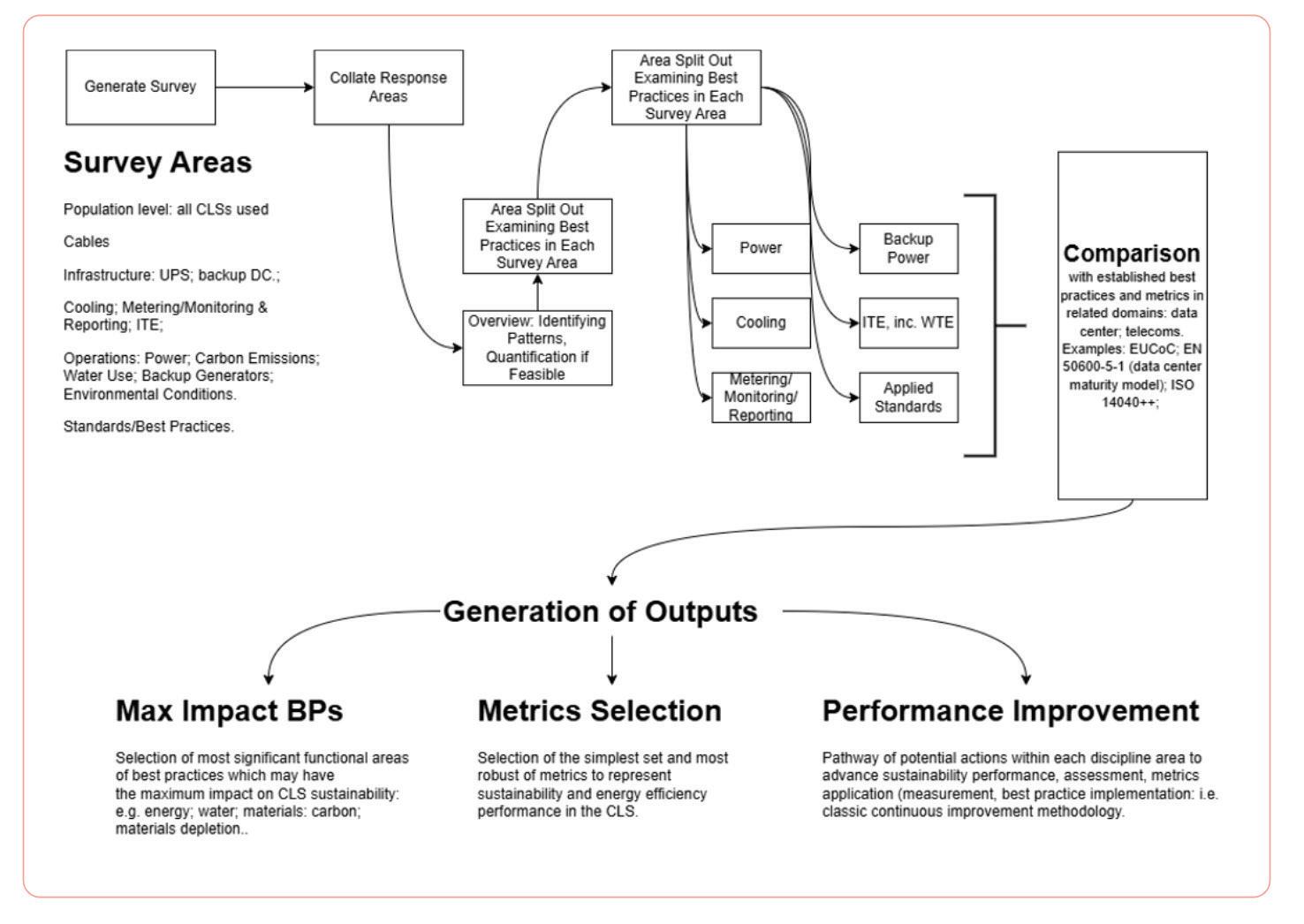
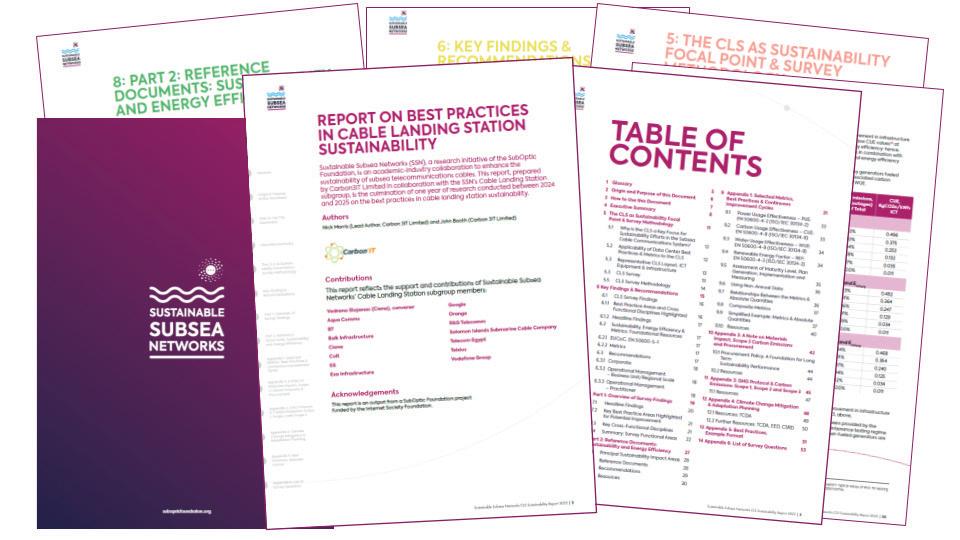
Figure 3. Click here to access the full version of the 2025 Report on Best Practices in Cable Landing Station Sustainability.
Figure 4. Survey methodology summary. Source: 2025 Report on Best Practices in Cable Landing Station Sustainability.
SUBSEA
widespread, several efficiency-oriented practices were observed, including strategic layout design and the use of metrics to track energy performance. Collected data was organized into a continuous-improvement loop—establish a performance baseline, apply the selected metrics, implement targeted upgrades, and measure again. As Nick Morris of Carbon3IT observes, “The resulting framework contains a practically applicable set of actions that will measurably reduce emissions and energy and materials use, thereby reducing bottom-line costs and enhancing business and operational resilience against climate change and economic shocks.” This cycle enables standardized comparisons across facilities, supports
climate-adaptation planning, and integrates sustainability criteria into procurement and operational decisions.
Building and readying this measurement-driven framework for adoption is—and will remain—a collective effort across the industry. Hesham Youseff, a senior transmission engineer at Telecom Egypt, emphasizes the collaborative nature of the research: “This achievement would not have been possible without the dedication, commitment, and cooperation of all CLS owners and operators and the entire team who contributed to the project. It was a great honor to represent the CLS Working Group and Telecom Egypt and to present the results of this
project at SubOptic 2025 in Lisbon.” Looking ahead, translating this framework into consistent practice will require sustained coordination among CLS owners, operators, and technical partners—and continued commitment from the people responsible for implementation.
KEY FINDINGS
The survey yielded several broad findings. First, carbon emissions are not comprehensively estimated by CLS owners and are rarely split by Scopes 1, 2, and 3. Second, ownership and colocation arrangements—including whether a CLS sits inside a data center—significantly affect the complexity of acquiring sustainability data. Third, electricity use is often
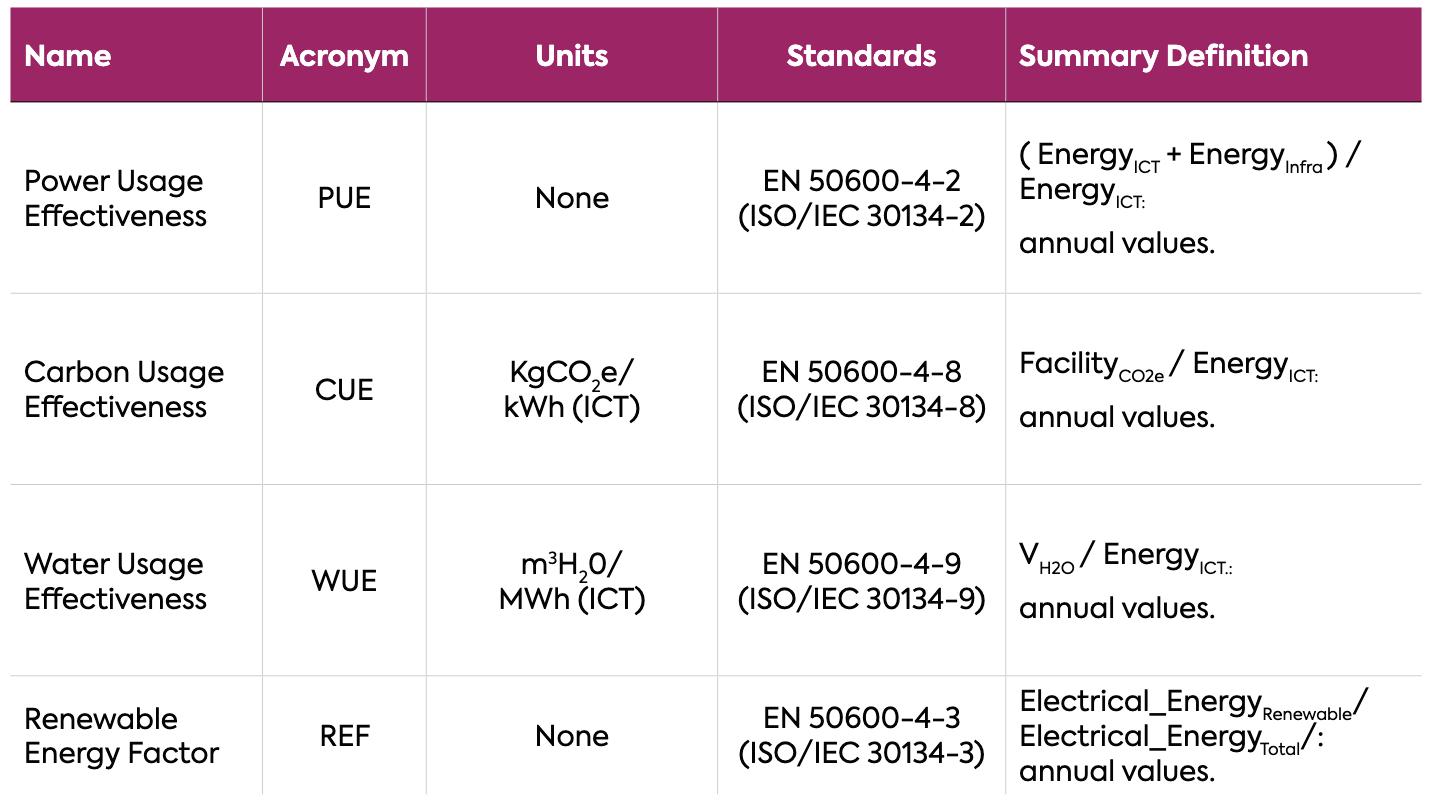
Figure 5. Summary of the main metrics with their respective standards, definitions, and units. These metrics cover sustainability’s core facets—energy, carbon, and water—with energy prioritized for its influence on the others. Source: 2025 Report on Best Practices in Cable Landing Station Sustainability.
not metered at the points needed to calculate core metrics and attribute energy accurately. Fourth, refresh cycles followed expectations: ICT equipment is refreshed more often than infrastructure (M&E, power, cooling), with upgrades improving performance per unit of power. Finally, only one reporting company had a holistic sustainability/energy-efficiency standard in place, and PUE was evaluated in full compliance with the standard in only one case.
Recommended next steps are to obtain EUCoC/EN 50600-5-1 and the metric standards, assign a lead, prioritize metering/monitoring/ reporting, run a continuous-improvement cycle, report metrics alongside absolute quantities, leverage procurement, and integrate outputs into corporate and operational reporting—optionally adding a procurement-oriented scoring mechanism and aggregating key KPIs into reporting flows.
In sum, the report treats the cable landing station (CLS) as a practical focal point for sustainability because the transmission equipment and supporting infrastructure are concentrated there. Drawing on the survey, it recommends carrying over proven data-center practices—tracking Power Usage Effectiveness (PUE), Carbon Usage Effectiveness (CUE), Water Usage Effectiveness (WUE), and Renewable Energy Factor (REF)— into coastal, high-resilience CLS operations, underpinned by clear system boundaries and robust metering and monitoring, with each ratio reported alongside absolute quantities: kilowatt-hours (kWh), tonnes of carbon-dioxide equivalent (tCO₂e), and cubic meters (m³). Co-location within data centers can facilitate this
transfer, provided boundaries are defined from the outset. The report also cautions against composite indices that obscure real performance drivers. Taken together, these steps position CLSs to embed sustainability in day-to-day operations and to scale a greener approach across the global subsea cable industry. STF
In sum, the report treats the cable landing station (CLS) as a practical focal point for sustainability because the transmission equipment and supporting infrastructure are concentrated there.
This article is an output from a SubOptic Foundation project, Sustainable Subsea Networks, funded by the Internet Society Foundation.
IAGO BOJCZUK is a Ph.D. candidate in the Department of Sociology at the University of Cambridge, UK, and the Student and Young Professional Coordinator for the SubOptic 2025 conference. His research focuses on the sustainability and governance of digital infrastructures, including subsea cables, data centers, and satellites.

CAMILA PAULINO is a Master’s student at NOVA University Lisbon. Her research focuses on health and development, particularly in the context of climate resilience and adaptation.
NICOLE STAROSIELSKI is Professor of Film and Media at the University of California, Berkeley. Dr. Starosielski’s research focuses on the history of the cable industry and the social aspects of submarine cable construction and maintenance. She is author of The Undersea Network (2015), which examines the cultural and environmental dimensions of transoceanic cable systems, beginning with the telegraph cables that formed the first global communications network and extending to the fiber-optic infrastructure.
Starosielski has published over forty essays and is author or editor of five books on media, communications technology, and the environment. She is co-convener of SubOptic’s Global Citizen Working Group and a principal investigator on the SubOptic Foundation’s Sustainable Subsea Networks research initiative.
Works Cited
Burdette, L. (2025) Shore things: a data-driven look at submarine cable landing stations. Washington, DC: TeleGeography.
Ogren, J. (2025) ‘The evolving role of cable landing stations in a hyperconnected world’, Data Center Dynamics (DCD), 14 July. [Online]. Available at: https:// www.datacenterdynamics.com/en/opinions/the-evolvingrole-of-cable-landing-stations-in-a-hyperconnectedworld/ (Accessed: 16 August 2025).
SubOptic Foundation (2025) Report on best practices in cable landing station sustainability. London: SubOptic. [Online]. Available at: https://www.suboptic.org/paperspresentations/report-on-best-practices-in-cable-landingstation-sustainability
European Commission (no date) ‘European Code of Conduct for Energy Efficiency in Data Centres’, The Joint Research Centre: EU Science Hub. [Online]. (Accessed: 25 August 2025).
TeleGeography (2024) ‘Data Center Research Service’. [Online]. Available at: https://www2.telegeography.com/ data-center-research-service (Accessed: 1 August 2025).
WHERE IN THE WORLD ARE THOSE PESKY CABLESHIPS?
BY KIERAN CLARK
A GLOBAL ANALYSIS OF CABLE SHIP PATTERNS, INFRASTRUCTURE PROXIMITY, AND PROJECTED ACTIVITY USING AIS
DATA
The subsea cable network—the hidden foundation of global connectivity—depends on a small, specialized fleet of vessels tasked with installing, repairing, and maintaining undersea systems. These cable ships are indispensable, but their operations remain opaque. Most available insights derive from AIS (Automatic Identification System) signals, which reveal where ships are and how they move, but not their precise mission. As a result, interpreting cable ship behavior requires inference, data modeling, and a contextual understanding of regional infrastructure.
This article presents the latest results of a geospatial analysis of cable ship movement based on 9,000+ AIS-derived idle data points collected between 1 July and 31 August 2025. Building on prior reporting, the September dataset highlights evolving patterns in maintenance and installation activities, shifts in regional clustering, and the persistent dominance of unclassified behaviors. By applying a proximity-based model, we can better infer whether vessels are engaged in cable repairs, system deployments, or other standby operations.
The AIS dataset was again compiled at six-hour intervals to ensure consistent temporal coverage. Idle points—where vessels moved slowly or remained stationary for extended periods—were classified against known depot and factory locations within a 50 km threshold. This classification scheme applied three categories:
• Installation if located near a cable factory
• Maintenance if located near a cable depot
• Unclassified if no infrastructure proximity or vessel routing patterns provided sufficient context
Where both facility types were present, installation was prioritized, consistent with observed practices around factory-adjacent staging zones.
This methodology mirrors approaches used in other sectors, such as logistics (vehicle dwell times near warehouses) and fisheries (vessel clustering near reefs). The aim is the same: transforming raw positional data into operational insight.
GLOBAL MAP OF OBSERVED BEHAVIORS
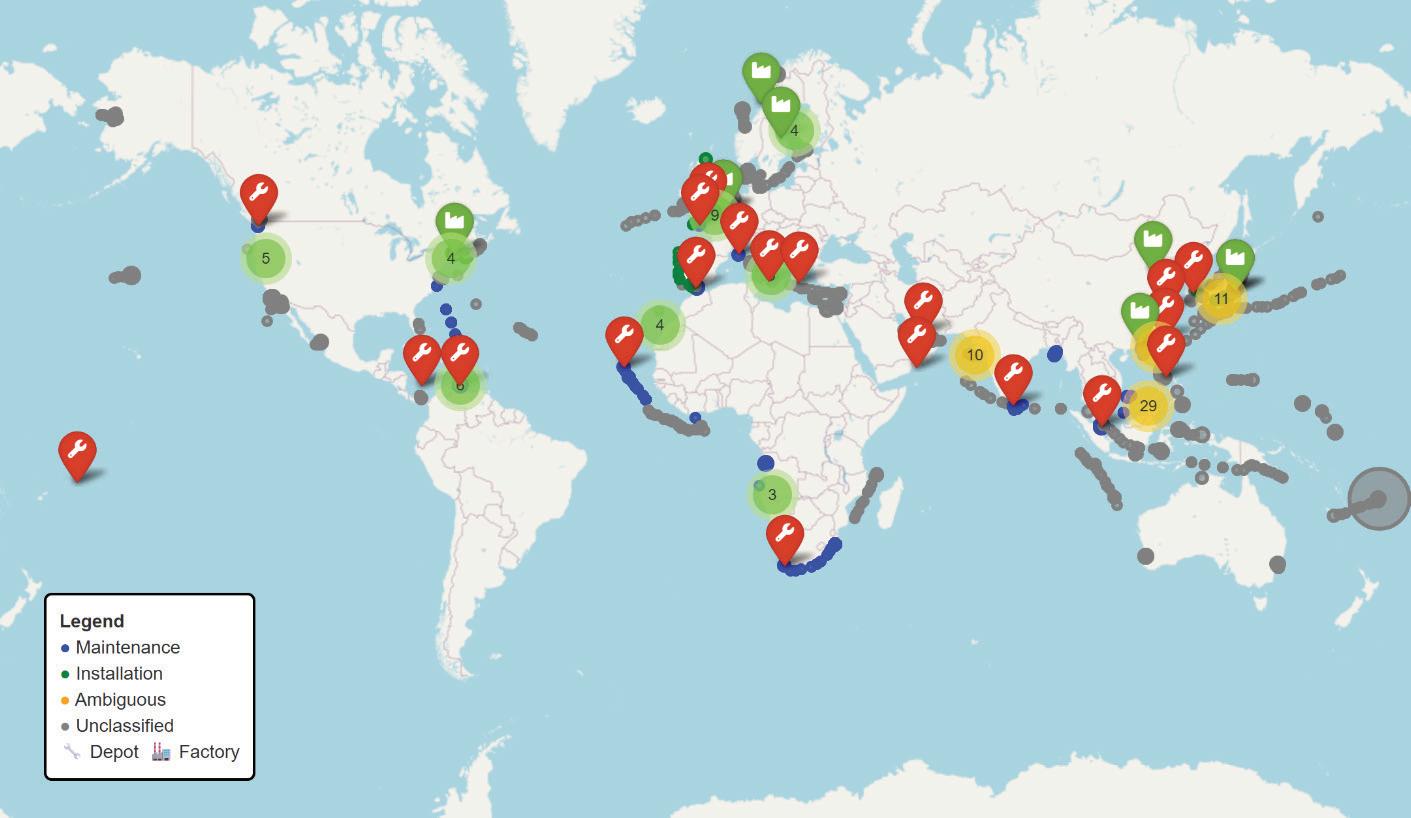
To establish a geographic baseline, Figure 1 provides a spatial overview of cable ship idling between July and August 2025. The map integrates thousands of AIS records, highlighting locations where ships remained slow-moving or stationary near infrastructure or in open waters. Each point is color-coded by projected classification:
• Blue: Maintenance Activity
• Green: Installation Activity
• Gray: Unclassified Activity
Icons indicate infrastructure locations:
• Wrench: Cable Depot
• Factory: Cable Factory
Clusters are again visible in historically significant corridors. East Asia and Southeast Asia dominate the dataset, showing strong concentrations around Shanghai, Busan, Kitakyushu, Singapore, and Manila. The North Atlantic continues to exhibit dense patterns around Calais, Brest, Lowestoft, and the Canary Islands, reinforcing its role as a global repair hub. Emerging concentrations are also visible in the Bay of Bengal, Arabian Sea, and West Africa, where both depot-linked maintenance and unclassified behaviors
appear. The Pacific basin shows smaller but persistent tracks near Papua New Guinea and eastern Australia. These clusters underscore the correlation between vessel idling and infrastructure proximity, while also highlighting regions where large shares of unclassified points obscure activity context. Together, these patterns set the stage for deeper analysis in the following sections on activity types, regional distribution, and facility influence.
PROJECTED ACTIVITY TYPE
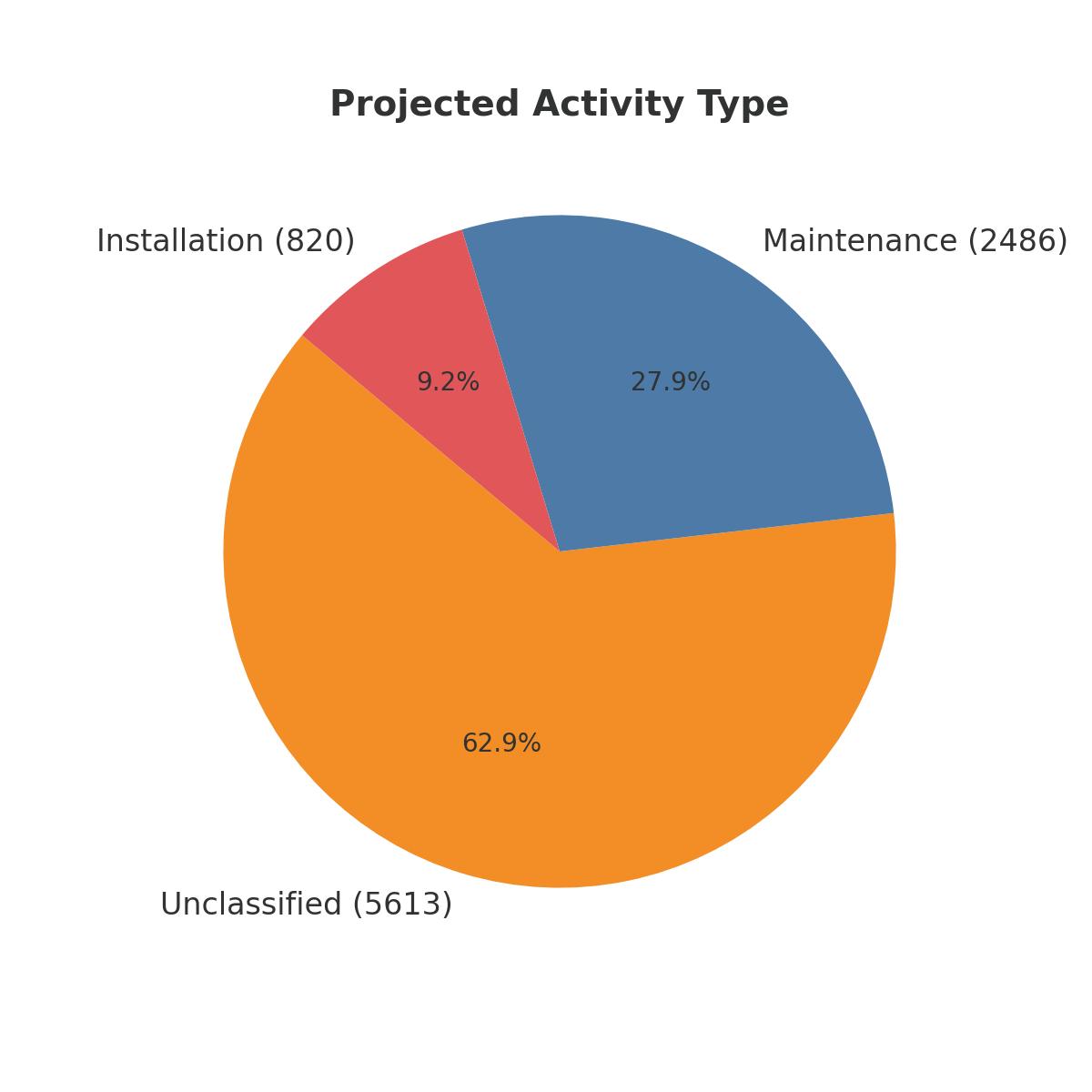
With the global footprint established, the next step is to interpret the underlying purpose of cable ship behavior. Each AIS-derived idle point was classified into one of three categories—Maintenance, Installation, or Unclassified—based on proximity to known facilities and post-idle routing patterns. Figure 2 illustrates the resulting distribution for July–August 2025.
CLASSIFICATION RESULTS:
• Maintenance: 2,486 data points (27.9%)
• Installation: 820 data points (9.2%)
• Unclassified: 5,613 data points (62.9%)
Ships associated with maintenance activity typically lin-
Figure 1: Vessel Activity Map
CABLESHIPS
gered near depots, reflecting patterns consistent with fault response readiness, repair staging, and short-range positioning around high-density cable corridors. By contrast, installation activity was tied to factory adjacency or observed along deepwater transit routes, often corresponding to long-haul system deployment.
The September dataset shows a rise in the unclassified share, now accounting for nearly two-thirds of idle points. This increase highlights the ongoing challenge of inferring purpose without vessel-reported metadata. Nonetheless, the identifiable behaviors reinforce long-standing dynamics: maintenance remains the most consistent operational demand, while installation continues to appear episodic and geographically dispersed.
In short, the picture that emerges is one of a fleet dominated by depot-linked maintenance, supplemented by a smaller but critical layer of installation-driven deployments. The high proportion of unclassified points underscores the limits of inference—but also signals an opportunity for richer operational transparency across the industry.
REGIONAL TRENDS IN ACTIVITY TYPE
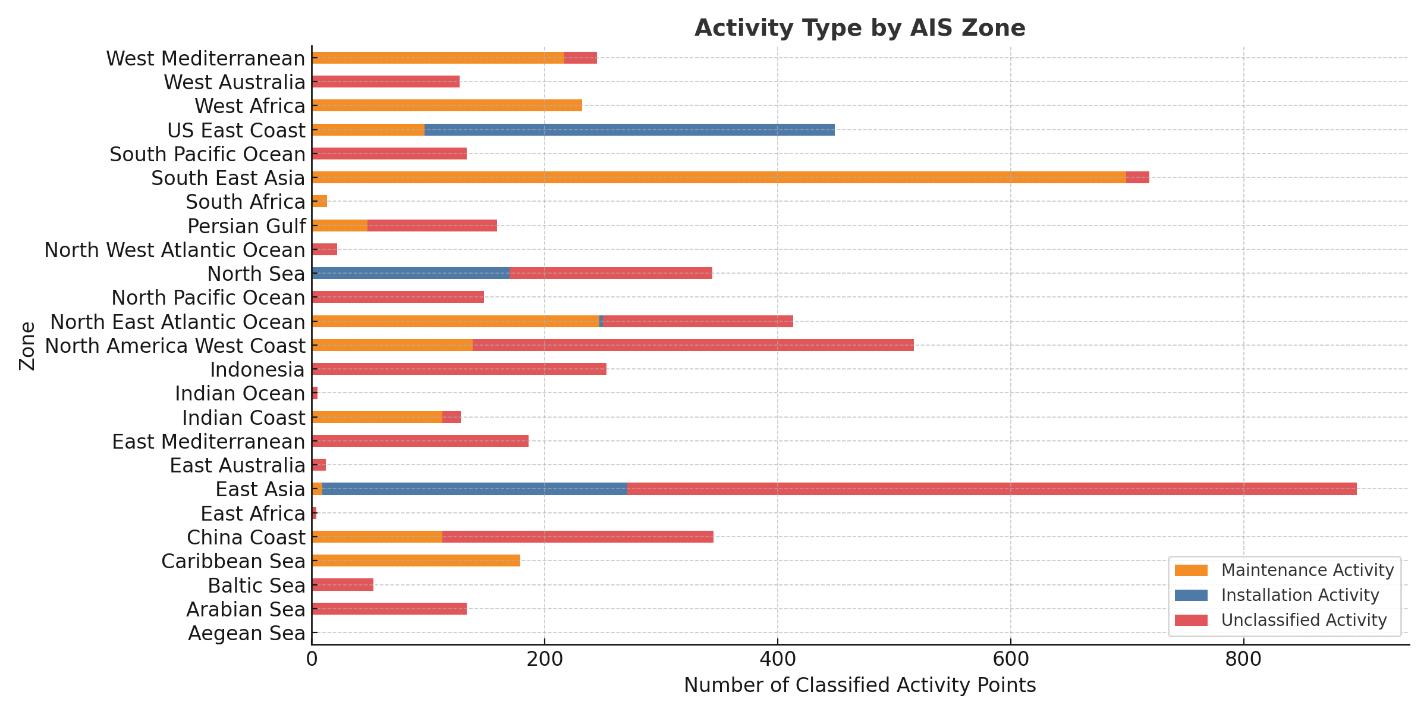
After establishing a global classification framework, the analysis turns to how activity varies across geographic regions. By grouping idle points according to AIS Zones, we can better understand how maintenance, installation, and unclassified behaviors distribute globally. Figure 3 presents this breakdown for July–August 2025.
The September dataset reveals strong regional contrasts. As in previous reporting, East Asia and Southeast Asia dominate total idle records, accounting for the largest concentration of vessel activity worldwide. Both regions continue to show a diverse profile of maintenance and installation, reflecting the combination of regional depots and multiple cable factories in Japan, Korea, and China. The scale of unclassified activity here, however, reinforces the sheer density of vessel presence and the limitations of AIS-only inference.
The North Atlantic and North Sea zones remain perennial hubs for depot-supported maintenance. Notably, activity clusters persist around Calais, Brest, and Lowestoft, underscoring the strategic importance of Europe’s depot network in supporting both transatlantic and regional systems. The US East Coast and Caribbean Sea also feature prominently, reflecting hybrid roles in maintaining legacy systems while staging for system buildouts across the Americas.
Elsewhere, regional dynamics are more fragmented. The Indian Coast and Arabian Sea reflect balanced patterns of installation and maintenance, consistent with both emerg-
ing buildouts and legacy fault response. The South Pacific and East Australia show modest but steady concentrations of unclassified events, indicating ongoing vessel presence in less-instrumented zones. Meanwhile, West Africa and the South America East Coast remain dominated by unclassified points, highlighting persistent data opacity in areas where infrastructure coverage is sparse.
Two takeaways emerge from the zonal analysis:
1. Maintenance activity continues to cluster in well-served regions with depot density, supporting rapid fault response.
2. Installation activity remains episodic and geographically selective, tied to factory staging and project deployments.
The zonal view reinforces the interplay between infrastructure distribution, cable age, and fleet availability in shaping global vessel behavior.
INFRASTRUCTURE INFLUENCE ON VESSEL BEHAVIOR
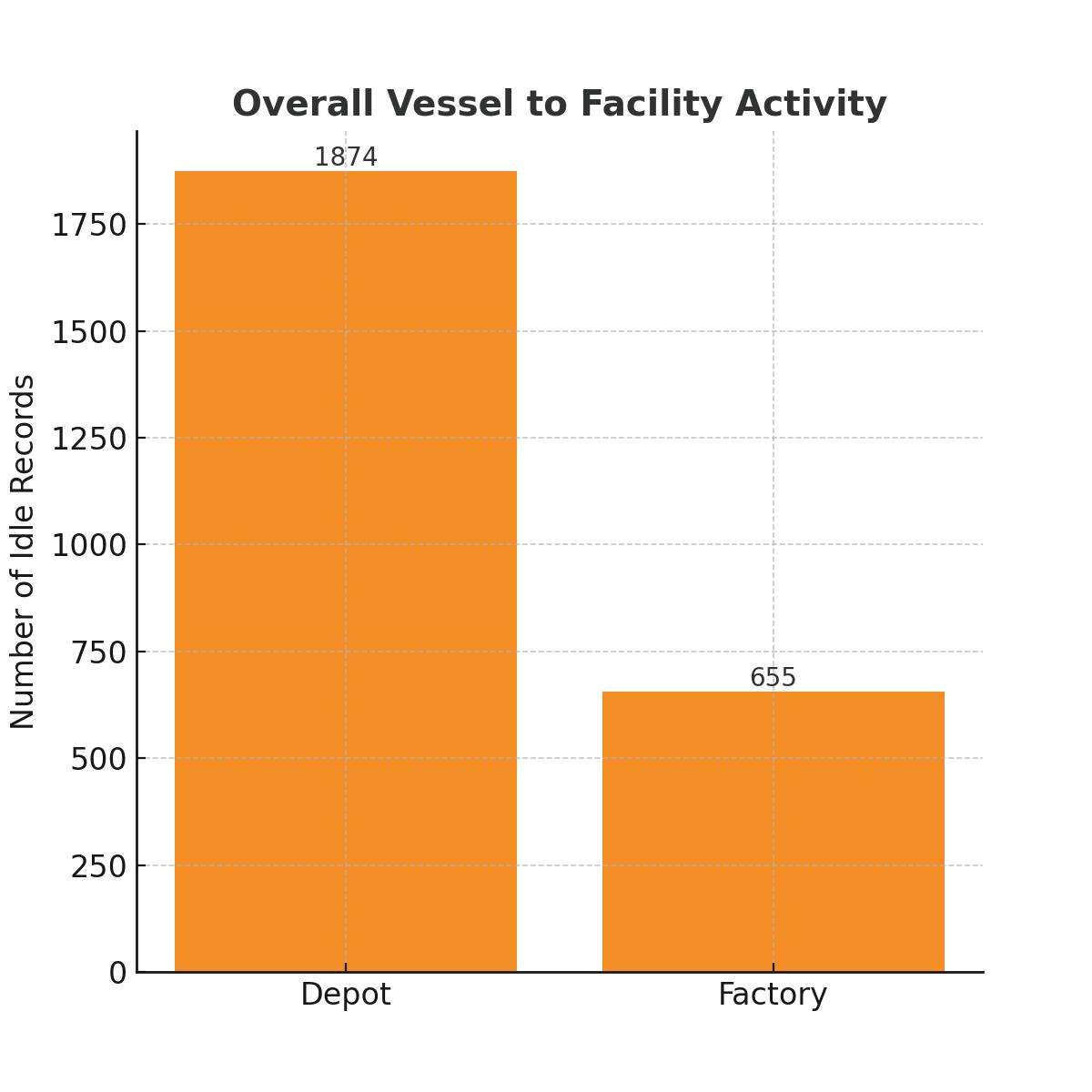
Beyond geography, cable ship behavior is also shaped by its relationship to nearby infrastructure—specifically, depots and factories. These facilities anchor vessel activity: depots serve as hubs for fault response and restaging, while factories support cable loading and the initiation of system deployments. Figure 4 illustrates the facility-linked breakdown for July–August 2025.
The September dataset records 1,874 depot-associated idle points compared to 655 factory-associated idle points, showing that vessels were nearly three times more likely to
Figure 2: Projected Activity Type
remain near depots than factories. This distribution echoes the broader classification findings: maintenance remains the dominant driver of vessel activity, while installation, though crucial, appears less frequent and more episodic.
The operational rhythms of these two facility types remain distinct. Depot-linked presence is cyclical and sustained, with vessels frequently returning for resupply, crew turnover, or immediate fault mobilization. By contrast, factory-linked presence tends to spike before deployment campaigns, after which ships quickly disperse along new-build routes.
This facility-based lens reinforces the importance of global depot coverage. Regions with strong depot networks—such as Europe and East Asia—benefit from faster repair cycles and reduced vessel transit times. By contrast, underserved regions often show higher concentrations of unclassified points, as vessels cluster in fallback zones without nearby infrastructure.
In short, the facility analysis underscores the central role of depot availability in maintaining system reliability, while highlighting how factory adjacency continues to signal episodic but high-impact installation campaigns.
CONCLUSION: PERSISTENT PATTERNS, EMERGING SHIFTS
This September analysis provides an updated snapshot of cable ship behavior using AIS data, covering over 9,000 idle points recorded between July and August 2025. By classifying vessel activity into maintenance, installation, and unclassified categories, and mapping them across regions and infrastructure, several key patterns emerge.
Maintenance remains the backbone of fleet activity. With 2,486 depot-linked idle points, maintenance accounted for nearly 28% of the dataset—slightly below July’s 30.6%. These operations continue to cluster around major depots in East Asia, Southeast Asia, and the North Atlantic, underscoring the enduring demand for repair readiness as systems age and traffic volumes grow.
Installation activity remains episodic but essential. September’s dataset captured 820 installation points (9.2%), down slightly from July’s 12.2%. While fewer in share, these events were geographically dispersed, highlighting the global scope of new system deployments. Factory-adjacent hubs in East Asia, particularly Japan and Korea, continued to anchor this behavior.
Unclassified activity has grown significantly. Nearly 63% of idle records this period could not be definitively linked to maintenance or installation, up from 57% in July Issue 143 Cable Ships.
This rise reflects both the scale of vessel presence in high-density corridors and the limitations of inference without vessel-reported context. The persistence of large unclassified shares emphasizes the opacity of fleet operations in regions lacking depots, factories, or transparent reporting.
Depot influence continues to outweigh factory staging. Ships were nearly three times more likely to idle near depots than factories, consistent with July’s ratio. This pattern underscores the critical role of depot infrastructure in supporting fault response and ongoing maintenance cycles, while reinforcing the episodic nature of installation campaigns.
TREND COMPARISON: JULY VS. SEPTEMBER
Comparing July’s analysis (May–June dataset) with September’s (July–August dataset) reveals several subtle but
Figure 3: Activity By AIS Zone
CABLESHIPS
important shifts:

• Maintenance share fell slightly (30.6% 27.9%), though absolute volume rose, suggesting more overall activity but a larger share of unclassified points.
• Installation share also declined (12.2% 9.2%), reinforcing the episodic nature of deployments.
• Unclassified share increased significantly (57.2% 62.9%), pointing to persistent gaps in classification confidence.
• Depot vs. factory ratios remained stable, with depots continuing to dominate vessel idling.
Taken together, these results highlight both continuity and change. Maintenance continues to anchor global fleet behavior, while installation remains critical but episodic. Yet the growing share of unclassified activity underscores the limits of AIS-based inference and the pressing need for better transparency.
LOOKING FORWARD
As this reporting series continues, the trendline is clear: maintenance demand is steady, installation activity is episodic, and unclassified activity remains stubbornly high. Without more structured data sharing from operators—such as AIS message extensions, anonymized mission logs, or port call declarations—these patterns will remain partially hidden.
Greater transparency would not only sharpen analytical insight but also support faster response coordination, improved forecasting, and more efficient fleet utilization. In a world increasingly dependent on subsea connectivity, understanding cable ship behavior is not just an analytical exercise—it is a strategic imperative. STF
KIERAN CLARK is the Lead Analyst for SubTel Forum. He originally joined SubTel Forum in 2013 as a Broadcast Technician to provide support for live event video streaming. He has 6+ years of live production experience and has worked alongside some of the premier organizations in video web streaming. In 2014, Kieran was promoted to Analyst and is currently responsible for the research and maintenance that supports the Submarine Cable Database. In 2016, he was promoted to Lead Analyst and his analysis is featured in almost the entire array of Subtel Forum Publications.
Figure 4: Vessel to Facility Activity

CAPACITY CONNECTION
REGIONAL CABLE SYSTEMS IN A HYPERSCALE WORLD
BY JOHN MAGUIRE
GLOBAL CONTEXT
There is a veritable frenzy of submarine cable builds currently planned and underway. And the cables we know most about are absolutely huge. Consider Meta’s wonderfully named Project Waterworth and Google’s flabbergasting Pacific Network.
Waterworth is a 50,000km project expected to be the world’s longest 24 fiber pair submarine cable, connecting North and South America, Africa, Asia and Australasia—engirding the globe.
Google’s Pacific network is a mesh, depending on how you count it, of five 16 fiber pair transpacific cables, spanning more than 70,000km connecting Australia (with three landings), with the Americas (two landings North and one South) via Fiji (four landings); Guam/Tinian (four landings), French Polynesia (with eight (sic!) landings) and Hawaii (three landings).
The mind boggles at the cable kilometres (120,000) but is doubly boggled at the fiber kilometres (2.3 million, give or take). And none of this is to mention anything of so much else that either of these players—or any other global platform provider—is otherwise doing.
The International Telecommunication Union (ITU) and United Nations Conference on Trade and Development (UNCTAD), however, have long advocated for developing regional infrastructure to reduce reliance on centralized, vulnerable transit
paths1, so what practical effects do we see of this advocacy?
POLITICAL AND GEOPOLITICAL RESPONSES
Not all hyperscalers are U.S. companies, but those building their own global networks are, a fact that has come into increasingly sharp relief this year, especially in the context of independence and sovereignty. It is an issue that is addressed in different ways by different political/geopolitical players. For our purpose here we will look at just three examples with mutually contrasting points of view: the European
1 https://www.subseacables.net/industry-news/brazilreignites-brics-submarine-cable-project-with-2025feasibility-study-proposal/
THE EUROPEAN UNION
The EU is relatively easy to analyse, of course, because it operates quite transparently. It has a benign regulatory environment. Hyperscalers can readily acquire rights to operate their own networks. To create some European independence from the U.S. in connectivity, however, the EU has articulated
2 BRICS: A group comprising Brazil, Russia, India, China, South Africa, Saudi Arabia, Egypt, UAE, Indonesia, and Iran. BRICS serves as a political and diplomatic coordination forum for countries from the ‘Global South’ and for coordination in the most diverse areas. It does not have a constitutive treaty, its own budget, or a permanent secretariat (https://brics.br/en/about-the-brics/frequently-askedquestions-about-the-brics?activeAccordion=14356ea5-08e24bae-b630-f74c238249de).
Union (EU), BRICS2 and Vietnam.
1
ATMED Nador–DG Atlantic–Mediterranean via Morocco
ATMED EAST–DG East Mediterranean route
Grant to integrate Malta into Medusa
Part of Medusa grant package
Alongside other Medusa grants
ATMED–DG Western Mediterranean gateway Unspecified One of six Medusa-related grants Far North Fiber Arctic route linking EuropeU.S.Japan Unspecified CEF support confirmed Atlantic CAM–CM Mainland Portugal Azores–Madeira
The largest single CEF Digital grant EllaLink (French Guiana)1
a digital strategy3 aimed at improving its resilience and reducing the extent to which it relies on outside entities (“third countries”, in EU parlance) and, in the process, consolidating intra-regional coherence. It seeks to improve intra-EU connectivity and better connect the EU to other geographies. Let’s have a quick look4 at what Europe is doing. Table 1 summarises readily available information about EU supported subsea projects: This is not a huge amount of money in industry or population terms—but it is public money, coming into private, mostly regional cable systems, aimed at strategically improving Europe’s interconnectivity with the world and, crucially, bolstering Europe’s independence and resilience.
3 https://digital-strategy.ec.europa.eu/en/library/ joint-communication-strengthen-security-and-resiliencesubmarine-cables
4 Focusing only on subsea telecom cables and ignoring power cables and cable sensing.
To create some European independence from the U.S. in connectivity, however, the EU has articulated a digital strategy aimed at improving its resilience and reducing the extent to which it relies on outside entities
BRICS
The interesting characteristic of this group from our point of view is its longstanding interest in increasing its independence, as a group, from western (or
northern) infrastructure, which it would define to include that of EU. As far back as in 20125 the idea was mooted by a far smaller BRICS6 than we have today, of creating a submarine cable system connecting them all. Geographically, this would be very much a global submarine cable (of some 34,000km), of course, but BRICS, as a champion of the underserved, identifies regardless of geography, as a ‘region’—an approach consistent in principle, if not scale, with the EU’s towards French Guiana and its other overseas territories.
While the initial BRICS cable proposal approach did not gather much momentum at the time of its launch—it
5 https://web.archive.org/web/20151119214406/http:// www.yourfibreopticnews.com/brics+cable+unveiled+ for +direct+and+cohesive+communications+services+ between+brazil,+russia,+india,+china+and+south+africa_ 31525.html
6 The original members—Brazil, Russia, India, China, South Africa—who generate the acronym.
Here, French Guiana being in South America, we see evidence of ‘regional’ being defined not in geographical terms, but by sovereignty.
Table 1: Summary of financial support from the EU for EU regional subsea cable systems
FEATURECABLESHIPS
CAPACITY CONNECTION
had become dormant by 20157--ten years later it has re-emerged into a very different environment. Following the recent 17th summit in Brazil, Brazil’s president, Luiz Inácio Lula da Silva (“Lula”), announced that a feasibility study into the cable would be undertaken, funded by the New Development Bank (www.ndb.int). Lula went on to state that “submarine cables directly connecting BRICS members will increase the speed, security and sovereignty in the exchange of data”. And interestingly was at pains to note, especially in the context of trade sanctions that might affect the viability of realising the system, that the development should not contribute to fragmentation of the internet.
AND VIETNAM
Vietnam’s situation is quite different from the EU’s, and indeed the BRICS’, and the details of its approach are not especially clear, viewed from without. A big country with a late-developing telecom market, it adeptly balances itself in the powerful geopolitical magnetic field generated by its massive neighbour and BRICS member to the north and the western aligned countries that represent a great portion of its global market. Vietnam is currently connected by five subsea cable systems but, recognising that improved connectivity is essential to the country’s continued growth and success, the government recently announced an objective to have 10 (yes, 10) new subsea cables connecting Vietnam to the world by 20308. The number and date may be to some extent arbitrary—certainly
7 https://jsis.washington.edu/news/reactions-u-scybersecurity-policy-bric-undersea-cable/ 8 https://vietnamnews.vn/society/1657723/viet-namto-have-10-new-undersea-fibre-optic-cable-lines.html
Vietnam is currently connected by five subsea cable systems but, recognising that improved connectivity is essential to the country’s continued growth and success, the government recently announced an objective to have 10 (yes, 10) new subsea cables connecting Vietnam to the world by 2030.
ambitious—but one underestimates Vietnam at one’s peril. According to state-owned Viettel, Vietnam’s undersea cables suffer about 10 incidents per year, each typically taking roughly a month to repair9—for context, the global average is 24 cable faults per week, or about 100 faults annually, worldwide10. The government has the vision and will to rectify the situation.
The new 10,000km Asia Direct Cable, linking Vietnam with China, Japan, Philippines, Singapore, Thailand has recently achieved RFS status and other players are jockeying for position, seeking to get more new systems into the water with a recent announcement, for example, from Singapore’s Keppel and Vietnam’s Sovico11 of their intention to connect Vietnam and Singapore with a new system.
GLOBAL MARKET EFFECTS
While we have considered regionalisation at the political level, cables are not built there. So, in the real world, what is the rest of the world doing while industry behemoths gobble up the available capacity of the major con-
9 https://e.vnexpress.net/news/news/vietnam-sinternet-infrastructure-hangs-by-a-thin-thread-4569266. html
10 https://blog.telegeography.com/what-to-know-aboutsubmarine-cable-breaks
11 https://www.reuters.com/technology/singaporevietnam-firms-talks-new-undersea-cables-sourcessay-2024-12-13/
tractors such as SubCom and ASN?
The first thing to remark upon is that the sheer scale of major new builds is severely testing the ability of the traditional major players, SubCom, ASN and NEC (the “Big Three”) to keep up even with this demand. The bigger buyers, naturally, seek to buy at the lowest possible price and are supported in their efforts to do so by being able to commit to significant ongoing new builds over many years. We see evidence of the effects of this in announcements of capacity expansions, for example, at SubCom12 and ASN13. The evidence is, however, from those who might build independent regional systems, that because such capacity expansions take years to come on stream, and because they may anyway be mopped up by the global platforms, it remains more difficult than it used to be to get a major manufacturer interested in a smaller new build. This is reflected in higher prices for smaller players—and delivery lead times being longer than they used to be.
We also see evidence of increasingly rigorous opportunity qualification
12 subcom.com/documents/2023/SubCom_ Ramps_Up_Production_and_Marine_Fulfillment_ Capabilities_21SEPT2023.pdf
13 https://www.lemonde.fr/en/economy/ article/2024/11/05/asn-strategic-manufacturerof-submarine-telecom-cables-nationalized-byfrance_6731573_19.html
among the Big Three. A request for a rough order of magnitude (ROM) price for a new system that might once have rapidly been turned around with few questions is today met with something that Jerry Maguire’s (no relation) client, Ron Tidwell, might once have said: “Show me the money!”14 Before committing resource even to a ROM, some financial rigor is required to be shown. And, assuming said money is indeed shown, it may still take many months for the ROM to materialise.
There is never any shortage of ambitious thinking among those who would develop submarine cables, but this situation has forced them to think a little more outside the box even than usual. Among the approaches being explored are:
Using disaggregated supply. This means, rather than seeking to engage a big supplier to provide a turnkey delivery, sourcing elements separately and accepting some of the delivery risk associated with that. (About which a little more to follow).
Designing systems for repeaterless technology. By festooning a proposed regional system, the need for repeaters can be designed out of the solution, opening the possibility of someone other than the transoceanic suppliers providing the solution. This eliminates the possibility of longer segments, yes, but permits of much higher fibre counts in the shorter ones, which can reduce unit cost. And drives some interesting thinking around landings.
In response to market shifts, we also see traditional suppliers of repeaterless system increasing their manufacturing capacity and even, working to some extent with Big Three incumbents,
14 https://www.imdb.com/title/tt0116695/quotes/
integrating third party repeaters into their own cables. A tipping point may occur when these players begin to stepup, to offer turnkey delivery, critically taking on the task of assembling the supply chain required for delivery and assuming responsibility for the warranties and liabilities that attach to that. It is beyond the scope of this article to
Enabled by open standards and shifting political and regulatory attitudes, these operators are constructing a complementary and resilient mesh of regional routes that will underpin the modern Internet for a generation.
consider, but one is forced to wonder what the industry might look like at the inevitable point where hyperscaler cable building winds back and the Big Three become hungry again.
CONCLUSION
The global submarine cable landscape is not being shaped solely by hyperscalers or by national or supranational government. Smaller, regional players are innovating with purpose-driven builds that prioritize latency, openness, and localized infrastructure. Enabled by open standards and shifting political and regulatory attitudes, these operators are constructing a complementary and resilient mesh of
regional routes that will underpin the modern Internet for a generation.
It is interesting to note the contrasting responses from the EU, BRICS and Vietnam. While Europe admittedly operates a somewhat more socialist economy than, say the U.S., it is still very much a liberal, market economy, or union of economies. The response here: to direct public funding at private enterprises in support of efforts to increase regional independence, sovereignty and resilience. Contrast this with the response of the Socialist Republic of Vietnam, governed by the country’s only political party, the Communist Party of Vietnam: tell your enterprises (state and privately owned) to get building. Makes one wonder who the free marketeers are, and who the socialists.
Given the first appearance of the first air-gapped cracks in the global platform model15, we are certainly living in interesting times—with plenty more ahead. STF
Currently Director, EMEA, with APTelecom, JOHN MAGUIRE has experience gained across a broad spectrum of telecommunications roles and businesses over the past 30 years. He has sold security and network control software to mobile networks worldwide; established a regional federation fibre network across a family of affiliated telcos and, several times, established interconnect networks and wholesale structures for leading telco brands in new entry and emerging markets. He’s done this in roles across the business: using satellite and cable technology, for OEM and service provider companies and in fixed and mobile domains—including for start-ups and mature companies. His roles have encompassed general management, sales management, direct and indirect sales, business development, market development and operations. A native of Dublin, Ireland, he’s also lived and worked in Australia, UK, Singapore, Hong Kong, Thailand, Qatar, UAE and Malaysia. John holds a B.Tech. degree from University of Limerick in Ireland and an M.A. from Macquarie University Graduate School of Management in Sydney, Australia.
15
https://aws.eu/
10 QUESTIONS WITH DAVID KIDDOO
Talking Submarine Cable Industry with IWCS
Cable & Connectivity Industry Forum’s CEO/Director

As the global submarine cable sector continues to evolve at an unprecedented pace, few events serve as a clearer signal of what’s ahead than the Cable & Connectivity Industry Forum. Organized by IWCS, the Cable & Connectivity Industry Forum brings together top deci sion-makers, innovators, and infrastruc ture builders shaping the future of global connectivity. With the IWCS 2025 Cable & Connectivity Industry Forum on the horizon, we sat down with David Kiddoo, CEO/Director at IWCS, to discuss this year’s focus, industry trends, and what lies ahead for the event—and the ecosystem it supports.
1.
CAN YOU INTRODUCE CABLE & CONNECTIVITY INDUSTRY FORUM 2025 AND EXPLAIN THE CORE MISSION BEHIND THE EVENT?
IWCS organizes the Cable & Connectivity Industry Forum as the premier technology event for the exchange of information about product, material and pro-
cess innovation for cabling and connectivity solutions. The IWCS Technical Symposium Committee generates an extremely high-caliber program for each year’s Forum and the peer-reviewed papers presented during the Technical Symposium remain archived for ongoing research and education. IWCS also provides networking and development opportunities for industry professionals by offering educational webinars and scholarships. If I could summarize our goals in one short phrase, I would say IWCS facilitates the exchange of critical information and professional networking in an effort to grow our industry and enhance the careers for those who are
2.
HOW DOES THE CABLE & CONNECTIVITY INDUSTRY FORUM 2025 DIRECTLY ENGAGE WITH AND IMPACT THE GLOBAL SUBMARINE CABLE MARKET?
The submarine cable market is an important application for long-haul network deployment across wide
regions, particularly for optical fiber cables. The IWCS Forum presents a wide variety of Technical Papers covering innovations in materials selection, cable designs, manufacturing, and deployment challenges for the wide range of thermal, mechanical, exposure stresses and other engineering considerations for submarine cables.
3.
WHAT KEY INNOVATIONS IN SUBMARINE CABLE SYSTEMS OR EMERGING APPLICATIONS WILL TAKE THE SPOTLIGHT THIS YEAR?
The robust program for this year includes 11 topic-specific Technical Sessions, offering content relevant to a wide-variety of technical-minded professionals working in the cable industry. This includes many presentations relevant to our submarine-specific cable audience that highlight advancements in cable materials and the evaluation of long-term aging under environmental stresses.
More granular examples of topics that can be experienced at this year’s event include: water-absorbent polymers, robust optical fiber coatings, multicore fiber assemblies, high-density loose tube cables, sustainable solutions, and resilient connectivity through the evolving smart and renewable power grid.
4.
WHAT ARE THE PRIMARY REASONS BEHIND THE CABLE & CONNECTIVITY INDUSTRY FORUM’S CONTINUED RELEVANCE AND GROWTH IN THE TELECOMMUNICATIONS SPACE?
For over 73 years, IWCS has produced the most unique and compelling technical forum to discuss and present the very latest innovations in our global industry. Not only does our international audience learn of the important trends and drivers leading us into the future, but the networking opportunities to meet with global industry suppliers, colleagues, and peers is unmatched! We are extremely thankful to our attendees, exhibitors, presenters, sponsors and — of course the IWCS Symposium Committee — for making our annual event a success. It’s wonderful to see long-time supporters return year after year, as well as many new individuals who experience the event for the first time.
5.
HOW IS THE CABLE & CONNECTIVITY INDUSTRY FORUM HELPING DRIVE DIVERSITY, EQUITY, AND INCLUSION ACROSS THE SUBSEA AND TELECOM INDUSTRIES?
In an effort to promote diversity, IWCS has implemented solutions to help develop an inclusive and well-rounded workforce within the cable industry. A few examples of recent IWCS initiatives are: nurturing relationships with colleges and universities to connect young
engineers with internship and professional opportunities within the industry; starting a job board to promote open positions and resumes for those seeking employment; and introducing panel discussions into the Forum program that are focused on supporting and celebrating diversity plus supporting young professionals so they can achieve successful and rewarding careers within this growing industry.
Dr. Corina Neumeister, an R&D leader at Nabaltec and a participant in our 2022 “Women in Cable & Connectivity” panel discussion, summarized the need for diversity very well when she declared, “Having a diverse team is the basis of being innovative.” That’s right! Facilitating industry innovation is a key driver of IWCS and Corina’s statement perfectly summarizes our intent to promote a diverse workforce.
For this year’s event, we are thrilled to include groups of students and researchers from local universities including the University of Pittsburgh, Carnegie Mellon University, and University of Delaware, as well as international institutions such as De Montfort University (UK), Lodz University of Technology (Poland), and Technical University Munich (Germany). At the event, IWCS helps connect professional mentors with students to set our younger workforce up for successful careers in the cable industry.
6.
WITH SUSTAINABILITY TOP OF MIND, HOW IS THE CABLE & CONNECTIVITY INDUSTRY FORUM CONTRIBUTING TO THE INDUSTRY’S TRANSITION TO MORE CIRCULAR, LOWIMPACT PRACTICES?
IWCS has received a growing number of Technical Paper submissions related to sustainable materials and processes that support recycling initiatives and global sustainability. In addition to the technical innovations shared, IWCS also fosters discussion on high-level concepts paving the way for a more sustainable future.
One of this year’s three special trend sessions is “Sustainable Solutions for Power and Data Cables.” This full-day special session will feature topical panel discussions and technical presentations related to innovative sustainable materials and processes. A highlight of this session will be an update from the Sustainable Optical Fiber Industry Alliance (SOFIA), whose collaborative initiative was introduced during last year’s IWCS Forum.
7. HOW DOES THE CABLE & CONNECTIVITY INDUSTRY FORUM FOSTER THE DISCOVERY AND GLOBAL PROMOTION OF ADVANCEMENTS IN OPTICAL FIBER TECHNOLOGY?
Innovations in optical fiber technologies are growing rapidly, with no signs of slowing down. The strong demand
PREVIEW
for high-speed connectivity requires advancements in fiber optic materials and assemblies, which is a major focus of the IWCS Technical Symposium. In addition to many fiber-related presentations, we are also looking forward to a presentation in our Executive Session, “Datacentres, BEAD, and FTTH – What is the Future of the US Fiber Optic Cable Market?” shared by Egest Balla, research analyst at CRU.
8.
AS THE CABLE & CONNECTIVITY INDUSTRY FORUM APPROACHES, HOW IS CABLE & CONNECTIVITY INDUSTRY FORUM SETTING ITSELF APART OR COMPLEMENTING THE BROADER CONFERENCE CALENDAR?
Expanding upon the traditional event elements, we are thrilled to introduce multiple special trend sessions featuring influential industry and technology leaders plus the exclusive opportunity for attendees to engage with the panelists and presenters. These auxiliary trend components are divided into three special sessions featuring discussions on the following topics: artificial intelligence + machine learning, sustainable solutions for power and data cables, and smart grid infrastructure.
Another new feature is the introduction of Cable Manufacturing Spotlight presentations, which offer updates from leading global manufacturers including Corning, Prysmian and YOFC.
Before making travel arrangements, attendees should make note of the schedule for this year’s event. Not only does the event start on Monday (which in recent years started on Sunday), but popular elements have been moved to day one of the program—from what historically have taken place on day two. This includes the Plenary Session Luncheon, Welcome Reception, and the first three technical sessions. The 100-level Professional Development Courses remain on day one (Monday), while the more advanced 200-level courses have been moved to day two (Tuesday).
9. HOW IS THE CABLE & CONNECTIVITY INDUSTRY FORUM EVOLVING TO MATCH THE ICT SECTOR’S ACCELERATING DIGITAL TRANSFORMATION AND GROWING SUBMARINE INFRASTRUCTURE DEMANDS?
To stay on top of the rapidly evolving ICT industry, IWCS is expanding its focus to address challenges, opportunity, and change affecting present and future business for cable suppliers, manufacturers, regulatory agencies, and end users such as utilities.
This year, the digital transformation conversation contin-
ues during a Technical Session devoted to innovations in Hyperscale and AI Innovations for Data Centers. Additionally, the “Powering the Grid of the Future—Smart Connectivity, Resilience, and Innovation” trend session brings together industry leaders, technologists, and policymakers to explore the evolving landscape of grid modernization. With a focus on the critical role of cabling, connectivity, and emerging technologies such as AI and digital twins, this session delves into the infrastructure, innovation, and strategic partnerships necessary to power an electrified economy. Designed for cable and fiber experts, smart grid engineers, and energy stakeholders, the session offers forward-looking insights and actionable dialogue to shape the next generation of resilient, intelligent grid systems.
In 2023, we had the pleasure of hosting Stephen Eaves, the inventor of Digital Electricity, to share novel developments in fault managed power (FMPS), which was adopted into the National Electric Code® just months earlier. In 2024, we heard from utility providers, policymakers, and innovators of power and communication cables including— but not limited to—Google Fiber, Alabama Power, National Telecommunications and Information Administration (NTIA), and Electric Power Research Institute (EPRI).
10.
LOOKING AHEAD, WHAT’S NEXT FOR IWCS IN SHAPING THE FUTURE OF DIGITAL INFRASTRUCTURE EVENTS?
Our 2026 event, taking place November 1-4 at the Gaylord Palms in Orlando, Florida will be our 75th annual event. We look forward to celebrating the accomplishments and technical innovations shared since IWCS was started in 1952 by key government and industry representatives devoted to the development of improved wires and cables for military applications. Our mission-critical industry shows no signs of slowing down and IWCS plans to keep up with the essential need for exchanging novel cable and connectivity technologies. STF
DAVID KIDDOO is the CEO / Director of IWCS, Inc. Prior to his current role, David spent over 20 years as the Global Business Manager for Wire and Cable insulation and sheathing products at AlphaGary Corporation. He also had 11 years of wire & cable experience with the Du Pont Company.
Experience the traditional IWCS event elements ...and more!
Highlighting the Technical Symposium, Supplier Exhibition™, and additional components that have established the IWCS Forum as the premier event for cable and connectivity technologies for the past 73 years, the 2025 IWCS Forum also features new components for trending developments in sustainability, artificial intelligence/machine learning, power delivery, and smart grid infrastructure. Join industry-leading wire and cable suppliers, manufacturers, and end-users to experience critical innovations and developments affecting the global cable and connectivity industry.
• Codes and Standards
• Fiber Manufacturing
• Materials Resilience & Durability
• Cable Sustainability & Recycling
• Micro-Cable Design & Installation
• Design and Testing for Copper Ethernet and PoE Cables
• Advances in Optical Fiber Coatings & Cable Materials
Solutions for Power and Data Cables
• Special Applications & Installations
• Fiber Cable Design, Qualification, Manufacturing and Reliability
• Hyperscale and AI Innovations for Data Centers
• Multicore Optical Fiber
PREVIEW
Join industry-leading wire and cable suppliers, manufacturers, and end users in Pittsburgh this October to experience critical innovations and developments affecting the global cable and connectivity industry. For the past 73 years, international representatives from the communications, data, electronics, power, industrial, automotive, aerospace, and similar industries gather at the annual IWCS Forum for valuable networking, learning, and career and business growth.
This premier event features the traditional elements of the IWCS Forum plus additional new components that highlight trending developments and innovations affecting the cable and connectivity industry. These auxiliary trend components are divided into three special sessions featuring discussions on the following topics: artificial intelligence + machine learning, sustainable solutions for power and data cables, and smart grid infrastructure.
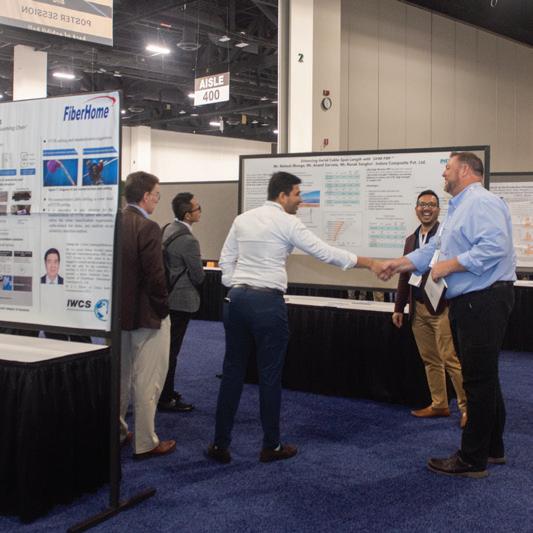
EXECUTIVE SESSION
TECHNICAL SYMPOSIUM
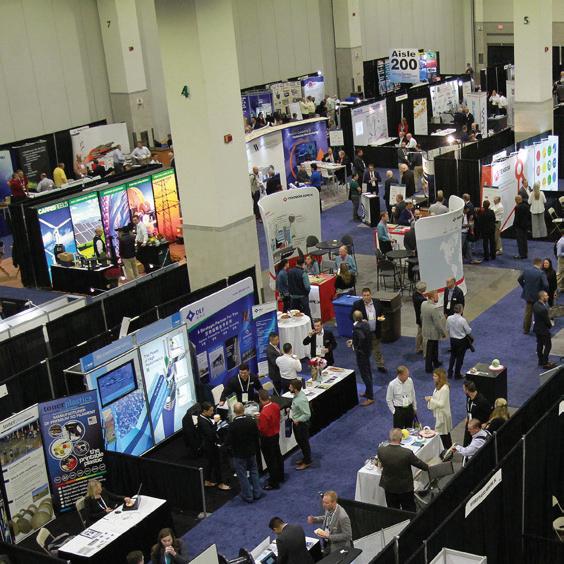
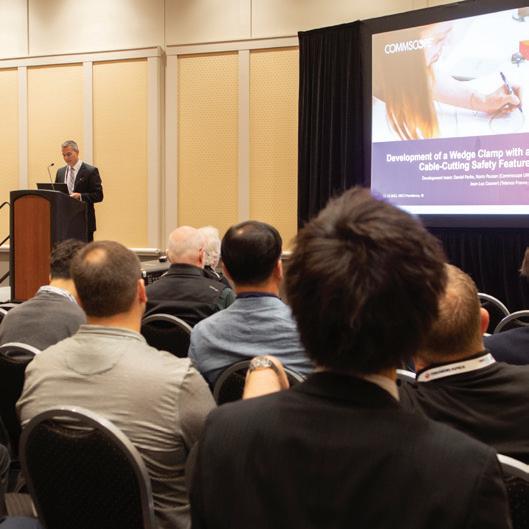
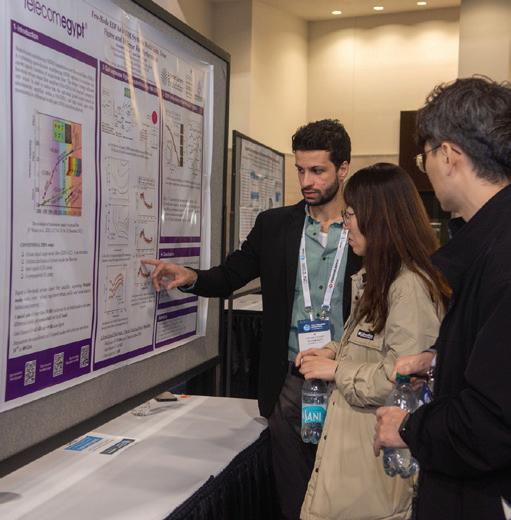
SUPPLIER EXHIBITION™
TREND SESSIONS
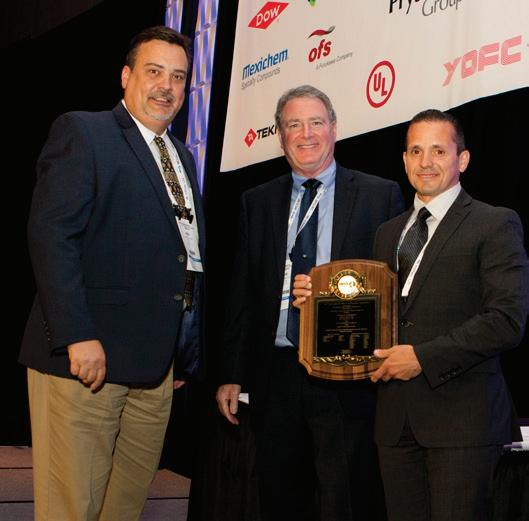
PROFESSIONAL DEVELOPMENT COURSES
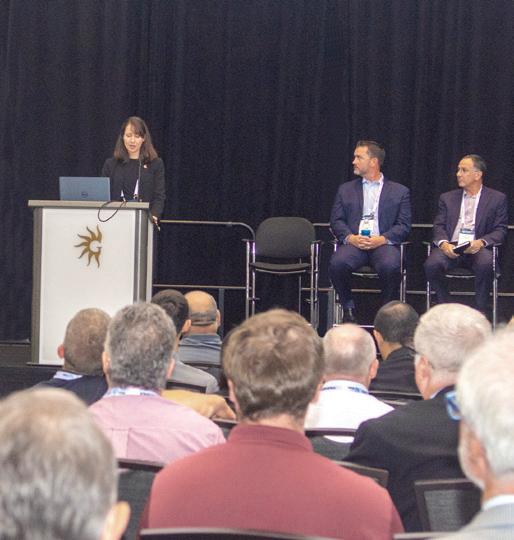
PLENARY LUNCHEON WITH KEYNOTE
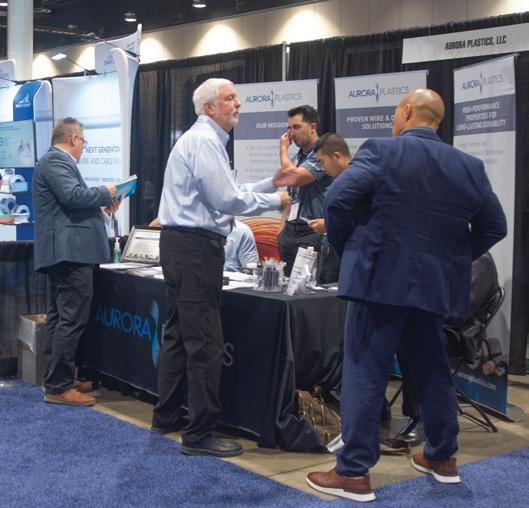
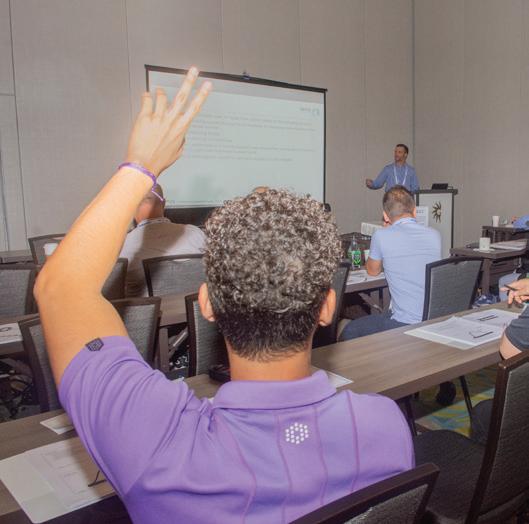

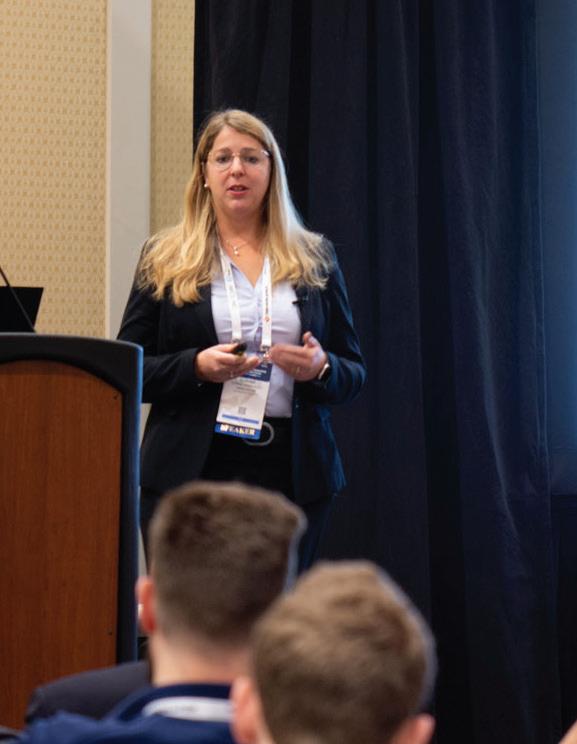

2025 IWCS Cable & Connectivity Industry Forum
MONDAY–THURSDAY, OCTOBER 27-30
Pittsburgh, Pennsylvania USA
Submarine Cable Highlights at the 74 th annual IWCS Forum
The cornerstone of the IWCS Cable & Connectivity Industry Forum is the Technical Symposium, which allows attendees to experience previously unpublished Technical Papers featuring research and development for cabling and connector / interconnect technologies, designs, components, materials, fabrication, performance, testing and applications. Listed below are select papers related to subsea cable networks and fiber optic cable design and performance. View the full program on the IWCS website at www.iwcs.org.
• Evaluating Water Seepage Distance in Submarine Cables with Water-Absorbent Polymers Based on Air and Water Permeability, NIPPON SHOKUBAI CO.,LTD.
• Kinetic Study on New Generation Optical Fiber Coatings with Improved Processing Robustness, Covestro LLC
• Improvement of Fiber Ribbon Planarity Based on Optimization of Merging Mold Size and Fiber Preparation Process, YOFC
• Clad Deposition Process Capacity Enhancement with Multiple Burners Through Mathematical Modelling, Sterlite Technologies Limited
• High-Speed, Multi-Color Optical Fiber Ring Marking, Rosendahl Nextrom Oy
• cableCORE MES: A Modular Approach to Future-Proofing Cable Manufacturing, InnoVites
• Development of a Composite Fiber Module Fiber Optic Cable for Enhanced Air-Blown Installation, Sterlite Technologies Limited
• Downsizing of High Fiber Count Optical Cable for Air-Blowing, Fujikura Limited.
• High Density 864F Micro Cable with 200 Micron Fibre Compatible with Legacy Network, HFCL Limited
• Compact Single Jacket Single Armored Optical Fiber Cable Tubeless Design Featured with Mass Fusion Splicing, HFCL Limited
• Blow Length Prediction of Optical Fiber Cables Using Monte-Carlo Simulations Through Cable Bending Stiffness Optimization, Sterlite Technologies Limited
• Detection of Calibration Dart and Blown Cable When Reaching End of Duct, Plumettaz S.A.
• Multicore Fiber Technology Study and Simulation, Legrand
• Advances in Few-Mode Fiber Manufacturing and Characterization, Prysmian
• Core Identification and Geometry Specifications in Multicore Optical Fibers, Lightera
• Preparing for Mass Production of Multicore Fiber Assemblies, Nest Technical Services, Inc.
• Multicore Fiber Microduct Cable with Multiple Strands of HighDensity Loose Tubes, Sumitomo Electric Industries,Ltd.
• Cross-Talk Optimized Seven Core Multi Core Fibre, Sterlite Technologies Limited
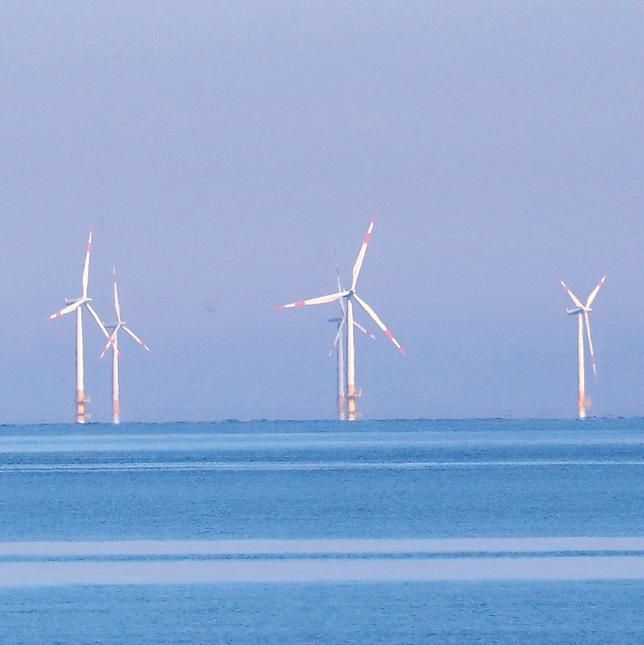

PREVIEW
Introducing new trend sessions focused on topics affecting the industry!
The 2025 IWCS Forum will be enhanced by multiple special trend sessions featuring influential industry and technology leaders. Attendees will have an exclusive opportunity to engage with the panelists and presenters.
In this session, experts will share real-world examples of Artificial Intelligence (AI) and Machine Learning (ML) in action, highlighting how these transformative technologies are already driving meaningful impact within the cable and connectivity industry. From accelerating research and innovation to enhancing efficiency, optimizing design and processes, improving forecasting, and enabling groundbreaking discoveries, AI and ML are reshaping processes and problem-solving approaches. While the potential benefits are vast, we will also address common challenges, including high energy demands, infrastructure requirements, evolving regulations, and shifting societal perceptions.
This full-day special session will feature topical panel discussions as well as the technical paper presentations included in the “Cable Sustainability & Recycling” Technical Symposium Session. A highlight of this session will be an update from the Sustainable Optical Fiber Industry Alliance (SOFIA), whose collaborative initiative was introduced during last year’s IWCS Forum.
Powering the Grid of the Future – Smart Connectivity, Resilience & Innovation
This session brings together industry leaders, technologists, and policymakers to explore the evolving landscape of grid modernization. With a focus on the critical role of cabling, connectivity, and emerging technologies such as AI and digital twins, this session delves into the infrastructure, innovation, and strategic partnerships necessary to power an electrified economy. Designed for cable and fiber experts, smart grid engineers, and energy stakeholders, the session offers forward-looking insights and actionable dialogue to shape the next generation of resilient, intelligent grid systems.



The detailed agenda for these trend sessions is in progress at the time of this article development. Please check the IWCS website for complete details and additional subject matter experts who will be participating in these sessions.

Register early for discounted rates! Visit IWCS.ORG to begin planning your IWCS Forum experience.
Traveling internationally? Promptly ensure your U.S.A. VISA and travel documents are valid through October.


IWCS 2025 SCHEDULE AT A GLANCE
SUBJECT
Important!
FEATURE
BACK-TO-SCHOOL
Certificate in Global Digital Infrastructure Article Competition Winners
BY NICOLE STAROSIELSKI AND MICHAEL BRAND
As the subsea network expands, so does the industry’s concern about the next generation of their workforce. Industry veterans are asking: Who will build the internet in the future? And how will we equip them with the knowledge, techniques, and skills to do so?
To help answer these questions, we launched the Certificate in Global Digital Infrastructure — the world’s first certificate program covering the backbone of the internet – in collaboration with the SubOptic Foundation and Infrastructure Masons (iMasons). From May-August of 2025, the program brought together college students and young professionals from across the globe to learn what goes into building, operating, and maintaining the infrastructures of the internet.
Throughout the program, students were tasked with investigating, building, and regulating these infrastructures. They came up with many ideas about how to make them more globally equitable, sustainable, secure, and resilient. They worked on projects, conducting original research, and proposing solutions to subsea challenges.
Out of more than two hundred projects submitted—which included business and regulatory proposals, as well as more standard essays—three articles stood out as especially innovative and inspiring visions for the future of internet infrastructure.
A joint subsea cable and data center industry panel reviewed the submissions, and Submarine Telecoms Forum generously sponsored their inclusion in this Back-to-School issue.
Marketing and communications specialist Emma Stevens’s public and industry-facing article argues that the digital divide isn’t an unsolvable riddle, but a challenge we need to rise to. Instead of seeing markets as too small, too remote, or too difficult, Stevens suggests that it is possible to build resilient, sustainable infrastructure that benefits both the bottom line and local economies.
While Stevens focuses on the case of Nome, Alaska, Henry el Bahnasawy, a graduate student in Computer Science at the Free University of Berlin, Germany, tackled a similar challenge looking at the subsea cables connecting West Africa. el Bahnasawy’s analysis likewise situates subsea systems within a broader digital ecosystem—with important connections to internet exchange points (IXPs) and data centers. “With the right investment, governance, and regional collaboration, West Africa can build a digital ecosystem that is secure, inclusive, and capable of meeting future demand,” el Bahnasawy concludes.
Jessica Halim, who is from Indonesia and currently works in multilateral development finance, looked at the

connections between subsea cables and cloud services. Halim’s article, “Batam at the Cloud Edge: From Transit Corridor to Digital Hub,” shows readers the difference between an interconnection-oriented versus an origination-oriented digital ecosystem—and this distinction matters both commercially and strategically. Without a pivot from interconnection to origination, Halim shows, Batam could risk being locked into a supporting role.
These three articles offer analyses of complex areas and multifaceted digital ecosystems. Together, they show the willingness of the next generation of students from around the world – in this case from Europe, Asia, and North America – to take on the challenges of emerging digital infrastructure. By giving them tools and platforms for their investigation, the Certificate in Global Digital Infrastruc-
NICOLE STAROSIELSKI is Professor of Film and Media at the University of California, Berkeley. Dr. Starosielski’s research focuses on the history of the cable industry and the social aspects of submarine cable construction and maintenance. She is author of The Undersea Network (2015), which examines the cultural and environmental dimensions of transoceanic cable systems, beginning with the telegraph cables that formed the first global communications network and extending to the fiber-optic infrastructure. Starosielski has published over forty essays and is author or editor of five books on media, communications technology, and the environment. She is co-convener of SubOptic’s Global Citizen Working Group and a principal investigator on the SubOptic Foundation’s Sustainable Subsea Networks research initiative.

MICHAEL BRAND is an undergraduate student at UC Berkeley studying Environment Economics and Policy. He is also a research assistant on the SubOptic Foundation’s Sustainable Subsea Networks research team. His research focuses on the intersection of behavioral economics, environmental policy, and public communication for the development and
THE DIGITAL DIVIDE WON’T CLOSE ITSELF (I CHECKED)
BY EMMA STEVENS
The digital divide isn’t some unsolvable riddle we’ve been doomed to puzzle over forever. It’s a set of structural gaps—where we build, who we prioritize, and how we listen—that we’ve chosen to live with. In some places, those gaps are measured in megabits per second; in others, they’re measured in years of lost opportunity. Closing them isn’t just a fairy tale—it’s a practical outcome of rethinking how and where we invest.
Closing the digital divide goes beyond simply increasing capacity. The Global Digital Inclusion Partnership is challenging this status quo of digital inclusion with an updated goal to provide communities with “Meaningful Connectivity”, a framework backed by organizations like the International Telecommunication Union (ITU) from 2022. This standard moves beyond the basic metric of “anyone who used the internet in the last 3 months” and raises the bar, establishing minimum thresholds across four key pillars: regular internet use, an appropriate device, enough data, and a fast connection (a minimum of 4G mobile connectivity).
These metrics aren’t unrealistic luxuries. They’re the baseline for participating in modern society. Yet many North American communities, especially Indigenous ones, are being left behind because they’re seen as too small, too remote, or too difficult. While many companies claim to support this cause through PR initiatives, true progress requires a
new approach; one that rethinks where and how the subsea cable and data center industries build.
PEERING INTO THE GAP
Estimates show Indigenous and rural Indigenous communities in North America face stark connectivity gaps: 2022 federal analyses put the share of people on U.S. tribal lands without fixed broadband anywhere from roughly 18% to 35% depending on methodology, with the FCC and Congressional reports typically citing about a quarter of residents as unserved vs 7% nationally. Even where service exists, many rely primarily on smartphones rather than home broadband. One analysis found about 33% of reservation residents depend on mobile-only access. The picture is similar in Canada, where only about one in four households in Indigenous communities currently has access to 50/10 Mbps service.
These aren’t places without need—they’re places without investment. The reasons are structural: high build costs, harsh environments, and infrastructure decisions that historically prioritize density and profit over equity. Closing the digital divide would require rethinking where and how we build. Prioritizing pairing renewable-first infrastructure with meaningful community partnerships could help to create a more balanced social impact and sustainable profitability.
THE EASY-BUILD BIAS
The digital infrastructure playbook of the last few decades has rewarded building in high-density, low-cost zones. Ashburn, Virginia became the poster child for the data center industry: reliable energy, abundant land, proximity to the “important” people. That model was more or less copy-pasted to Phoenix, Oregon, Silicon Valley, Toronto, and beyond.
Step outside those “easy build” regions and you run into challenges. However, places that don’t tick the conventional business-case boxes may hold the biggest opportunities for innovation.
The uncomfortable truth? Many corporate digital divide initiatives are crafted gestures that look good on paper but often fall short at demonstrable change because they’re designed without input from, or long term investment in, the communities they’re meant to serve.
WHERE THE USUAL CHECKLIST FAILS:
Let’s zoom in on a community with immense potential: Nome, Alaska. This remote village on the western edge of the state is famous as the finish line of the historic 1925 Serum Run, which inspired the Iditarod sled dog race. Today, Nome is poised for a different kind of race—to become a hub for emerging digital infrastructure.
As of July 1, 2024, the Nome Census Area counted an estimated 9,651 residents, with about 3,670 living in Nome city itself with roughly a third of them under the age of 18. American Indian and Alaska Native (Non-Hispanic) residents make up 74.6% of the population, many of whom are part of the federally recognized Nome Eskimo Community (NEC).
for total pollution among Alaska’s counties.
Alright, let’s run the classic site-selection checklist. Reliable power? Not exactly. Large population? Nope. Plenty of land? Sure—if you’re cool with the permafrost. By traditional market logic, Nome wouldn’t even make the shortlist. But to see only these challenges is to miss the strategic advantages.
Nome is positioned for connectivity with two subsea cables landing in the city, with a third trans-Arctic cable to Japan and Asia potentially on the horizon. This provides a first-mover advantage for bringing data to the area. The region is also ready for an energy transition, with local leaders actively seeking to diversify away from diesel and embrace renewable sources like hydrokinetic, nuclear, geothermal, wind, or solar power. The cold Arctic climate provides a natural advantage by enabling year-round free air cooling for data centers.
Estimates show Indigenous and rural Indigenous communities in North America face stark connectivity gaps: 2022 federal analyses put the share of people on U.S. tribal lands without fixed broadband anywhere from roughly 18% to 35% depending on methodology, with the FCC and Congressional reports typically citing about a quarter of residents as unserved vs 7% nationally.
Between 2019 and 2023, 16.5% of households in the area had no broadband subscription (U.S. Census Bureau). The region’s power comes from a diesel-fueled microgrid, supplied only during the ice-free shipping season. Fuel costs swing with market volatility, and deliveries freeze— literally—if the port ices over in winter. That dependence on diesel leaves a heavy mark: an estimated 42.7 million kilograms of CO₂ emissions annually, ranking Nome 7th
Most importantly, investing in Nome offers an opportunity to support Indigenous Digital Sovereignty. According to the American Indian Policy Institute (AIPI), this concept encompasses both network and data sovereignty, empowering communities to control the infrastructure and data that flow through it. As Dr. Traci Morris, Executive Director of the AIPI, explained in a webinar hosted by the National Digital Inclusion Alliance, “Putting in a network is an act of self-determination. It is nation-building.”
Indigenous Digital Sovereignty covers both the information and the physical networks, governed by the community’s own policies. Building here requires not just permission, but partnership.
Bringing meaningful connectivity to these markets is also an ethical responsibility. Increasingly, global policy circles recognize that access to reliable, affordable internet is a basic human right. For Nome’s predominantly young population, that means more than social media and entertainment. It’s about unlocking remote learning options when the local school can’t offer advanced courses, enabling telehealth appointments when the nearest specialist is hundreds of miles away, and creating pathways to careers that don’t require leaving the community. In a
FEATURE
place where the median age is measured in teenagers, denying meaningful connectivity is essentially denying the tools to shape their own future.
BUILDING A WIN-WIN MODEL
Yes, building in locations like Nome is harder. But hard doesn’t mean unprofitable. By pairing renewable-first infrastructure with meaningful community partnerships, companies can build resilient, sustainable infrastructure that benefits both their bottom line and local economies.
Don’t get too excited, just bringing your own power doesn’t absolve you from community concerns. You need to actively engage with community stakeholders, especially in indigenous spaces. This could look like establishing an advi sory board composed of community stakeholders like tribal elders, local business leaders, and community representatives. Another avenue is a Shared Ownership model. Part nership models, joint ventures, and shared revenue streams can transform potential pushback into active support by aligning the project’s success with the community’s definition of success.
You can also offset costs by utilizing the many federal programs dedicated to tackling these very challenges. For Nome, the Alaska Broadband Office, the Broadband Equity, Access, and Deployment (BEAD) Program, as well as the Tribal Broadband Connectivity Program (TBCP), offer funding opportunities to support bringing digital connectivity to these rural regions.
demand meet. If we only build digital infrastructure where it’s easy, we’ll keep leaving millions behind. But if we take on the hard builds—power them sustainably, and do it in partnership with the people who live there—we not only expand the internet’s reach, we future-proof our own infrastructure.
The digital divide isn’t inevitable. It’s a choice. And so is closing it. STF

References:
A storyteller with a tech obsession, EMMA STEVENS is a marketing and communications specialist for the digital infrastructure industry. She recently completed UC Berkeley’s Certificate in Global Digital Infrastructure.
Global Digital Inclusion Foundation. (n.d.). Meaningful connectivity. Retrieved from https://globaldigitalinclusion.org/our-work/meaningful-connectivity/ U.S. Census Bureau. (n.d.). QuickFacts: Nome Census Area, Alaska. Retrieved from https://www.census.gov/quickfacts/fact/table/ nomecensusareaalaska/BZA115222
Companies like Greensparc are already putting this model into practice in the Interior of Alaska. They’re building modular, scalable microdata centers optimized for sustainability and resilience in challenging environments.
Companies like Greensparc are already putting this model into practice in the Interior of Alaska. They’re building modular, scalable micro-data centers optimized for sustainability and resilience in challenging environments. By utilizing untapped renewable energy sources, these projects lower local connectivity costs while increasing global capacity.
“We believe connectivity is both a human right and an engine of growth, and we’re excited and eager to share our blueprint with the world. ”
Building in overlooked places is both a moral imperative and a strategic business move.
The future of digital infrastructure lies in unconventional locations where renewable energy, local needs, and global
Arizona State University. (n.d.). AIPI (American Indian Policy Institute). Retrieved from https://aipi.asu.edu/ Congressional Research Service. (2024). CRS Report R48563. Retrieved from https://www.everycrsreport.com/ reports/R48563.html
Asia-Pacific Economic Cooperation (APEC). (2022, April). Indigenous broadband report. Retrieved from https://cdn.ymaws.com/apec.site-ym.com/ resource/collection/6C0A16D6-94C3-443C-9DC251545211FDD8/Research_Report_-_Indigenous_ Broadband_Report__April_2022_.pdf
U.S. Department of Energy, Office of Fossil Energy and Carbon Management (FECM). (2024, August). Alaska Regional Report. Retrieved from https://www.energy. gov/sites/default/files/2024-09/FECM%20Alaska%20 Regional%20Report%20August%202024.pdf
Department of Energy. (2024). Alaska Regional Report: Building a Clean Energy Economy. Retrieved from https://www.energy.gov/sites/default/files/2024-09/ FECM%20Alaska%20Regional%20Report%20August%20 2024.pdf
Find Energy. (2023). Nome, Alaska energy profile. Retrieved from https://findenergy.com
U.S. Department of the Interior, Bureau of Indian Affairs (BIA). (n.d.). Expanding broadband access. Retrieved from https://www.bia.gov/service/ infrastructure/expanding-broadband-access
Digital Inclusion Alliance. (n.d.). Indigenous digital sovereignty [Blog]. Retrieved from https://www.digitalinclusion.org/blog/indigenous-digital-sovereignty/
National Telecommunications and Information Administration (NTIA). (n.d.). Broadband Equity, Access, and Deployment (BEAD) Program. Retrieved from https://www.ntia. gov/funding-programs/high-speed-internet-programs/broadband-equity-access-anddeployment-bead-program
National Telecommunications and Information Administration (NTIA). (n.d.). Tribal Broadband Connectivity Program. Retrieved from https://broadbandusa.ntia.gov/fundingprograms/tribal-broadband-connectivity
Greensparc. (n.d.). Edge-based data centers for the AI era. Retrieved from https://www. greensparc.com/
THE FRAGILE BACKBONE OF WEST AFRICA’S DIGITAL INFRASTRUCTURE
In an era where digital connectivity is the backbone of social development and economic growth, a number of West African countries lag behind in building the foundations for digital transformation. The coastal countries Mauritania, The Gambia, Guinea-Bissau, Guinea, Sierra Leone, and Liberia continue to depend largely on a single subsea cable—the Africa Coast to Europe (ACE) system— for access to the global internet. While internet penetration in this region has grown—reaching an average of 32,6% with a growth rate of 3.12% between 2024 and 2025—the foundations of connectivity remain fragile (Kepios, 2025).
With a combined population of approximately 39.1 million people growing at 2.43% per year, these countries are home to millions of individuals whose access to the digital economy depends on a single point of failure (United Nations, 2024). Any disruption to the ACE cable can have outsized consequences—cutting off entire nations and slowing progress toward digital inclusion, resilience, and long-term economic growth.
This structural fragility underscores the need for diversification beyond the ACE system. Key strategies encompass the deployment of additional submarine cables, expansion of cross-border terrestrial fibre backbones, establishment of carrier-neutral data centres, and development of regional Internet Exchange Points (IXPs). However, simply increasing capacity is not enough to address the region’s digital challenges. Equally important are transparent cost structures, infrastructure neutrality, and equitable market access—ensuring that all service providers have a fair and equal opportunity to participate in the market. This pro-
motes fair competition, innovation, and more affordable digital services. Moreover, GDP per capita, small population sizes, competing commercial priorities, and complex regulatory and political environments all influence the pace and viability of such developments. There is a need to create a more resilient, affordable, and inclusive digital ecosystem that can support sustainable socioeconomic change.
THE PRE-ACE ERA
Before the Africa Coast to Europe (ACE) subsea system went into service in 2012, internet connectivity in many West African countries was very limited—both in capacity and affordability (World Bank, 2012). At this time, countries such as Sierra Leone, Liberia, The Gambia, and Guinea-Bissau relied almost entirely on satellite-based connections—particularly Very Small Aperture Terminal (VSAT) systems—as well as on microwave and fiber links to neighboring countries for internet access (Pushak & Foster, 2011). For example, Sierra Leone’s National Telecommunications Commission (NATCOM) estimated that the entire country, with a population of approximately six million, possessed only about 155 Mbps of international bandwidth (World Bank, 2020). At the time, this was roughly equivalent to the bandwidth demand of a small town in the US or Western Europe. In The Gambia and Guinea-Bissau, the cost of bandwidth ranged from $4,000 to $5,000 USD per Mbps per month, compared to approximately $500 USD per Mbps per month in East African countries which were already connected to subsea cables at this time (World Bank, 2022). End users faced very limited and extremely
HENRY EL BAHNASAWY
FEATURE
expensive options: in Sierra Leone, low-speed packages cost around $200 USD per month, equivalent to 56.8% of per capita GDP, and in Liberia, users paid two to three times more than the regional average for connectivity (World Bank, 2012).
THE ACE SUBSEA CABLE SYSTEM
The launch of the Africa Coast to Europe (ACE) Subsea Cable System in 2012 is considered a milestone in the transformation and advancement of telecommunications in Africa. The Project, led by Orange S.A. (formerly France Telecom), was developed by a consortium of 20 companies, including its regional subsidiaries and local partners. Its three segments currently connect 24 landing points—three in Europe (France, Portugal, Canary Islands) and the rest in Africa, from Mauritania to South Africa. For seven African countries (The Gambia, Guinea, Equatorial Guinea, Liberia, Mauritania, São Tomé and Príncipe, Sierra Leone), it’s the first direct link to a fiber-optic submarine cable (ACE Consortium, 2021). By providing direct connectivity to Europe, the ACE system has significantly reduced costs and increased the capacity of available international bandwidth across the region.
The ACE cable system, built with an investment of approximately $700 million USD, was primarily funded by the Orange Group, which contributed around $250 million USD alongside its subsidiaries (Orange, 2015). Each connected country contributed approximately $25 million USD to secure a landing station in its territory (World Bank, 2012). Supplied by Alcatel Submarine Networks (ASN), the cable features two fiber pairs and initially delivered a capacity of 5.12 Tbps. In June 2021, an extension to South Africa was completed, upgrading the system’s total capacity to 24 Tbps (France Télécom-Orange, 2012). Several cable landings in West African countries were financed through loans from the World Bank’s development agency, the International Development Association (IDA), to support digital development and expand international connectivity (SubTel Forum, 2011). According to a former Google employee who was involved in the rollout of Google’s network in Africa, landing costs in some locations
have been significantly higher than average due to difficult marine conditions. Extremely shallow coastal waters and intense, often uncontrolled marine activity—such as fishing and anchoring—have made the installation process more complex and costly. These factors also raise the risk of cable damage during operation, which can lead to increased long-term repair and maintenance costs. In addition to these physical challenges, the effective cost of using capacity is further driven up by low utilization rates and the high cross-connect fees charged by Cable Landing Station operators. These issues are not unique to ACE, but they remain particularly relevant at some of its landing sites.
TECHNICAL AND GEOGRAPHICAL VULNERABILITIES
While ACE has played a crucial role in expanding West Africa’s connectivity, it also has persistent and costly vulnerabilities that limit its effectiveness and reliability. One of the most critical challenges is recurrent service outages—so much so that it has been referred to as a “problem child” in the subsea cable industry. A major contributing factor is that ACE, as well as other submarine cables along the Atlantic coast of Africa, traverse canyons that are highly susceptible to debris flows and turbidity currents.
While ACE has played a crucial role in expanding West Africa’s connectivity, it also has persistent and costly vulnerabilities that limit its effectiveness and reliability. One of the most critical challenges is recurrent service outages—so much so that it has been referred to as a “problem child” in the subsea cable industry.
Two particularly vulnerable areas are the Trou Sans Fond Canyon, located just off Abidjan in Ivory Coast, and the Congo Canyon (Clare, 2025). Impacts of turbidity currents in the Congo Canyon, such as landslides and rock movements, have damaged multiple subsea cables on six separate occasions between 2019 and 2024 (Ingale et al., 2025). Another major incident took place on 14 March 2024, when the ACE cable, along with three other cables serving West African countries, suffered breaks in the Trou Sans Fond Canyon. The repair took over a month and was completed on 17 April 2024 (Clare, 2025). A notable earlier outage occurred on 30 April 2018, when cable damage caused by a trawler led to significant disruptions. According to Dyn, a web-infrastructure company owned by Oracle, ten countries were affected, and Mauritania even experienced a complete internet blackout lasting 48 hours (Baynes, 2018).
Due to these numerous outages, the demand for more
resilient and redundant international connectivity is growing. The only currently viable way to mitigate the hazards of the Congo Canyon is to route the cable further offshore into deep waters exceeding 5,000 meters, as was done with Google’s Equiano cable. This approach allows the submarine canyon and any associated deep-sea fan to be avoided, but it also entails considerably longer cable spans, which may make the solution economically unviable for some systems (Clare, 2025).
GOVERNANCE AND MONOPOLY STRUCTURES AT CABLE LANDING STATIONS
Despite its potential to improve international connectivity, the ACE submarine cable system has not fostered a competitive or resilient digital ecosystem in West Africa. This is due to deep-rooted structural and governance-related constraints that persist across the region. Cable Landing Stations (CLS) along the ACE system are predominantly controlled either by incumbent national operators or non-representative ISP consortia. These monopolistic structures significantly hinder competition by acting as gatekeepers, enforcing restrictive conditions and charging excessive fees for capacity, cross-connects, and colocation services on buyers. According to telecom broker and editor of the Subsea Cable Blog, Roderick Beck, cross-connect fees at some of the ACE CLSs can range from $4,000 to $15,000 per month. Modern OTT-led subsea cable projects, such as 2Africa, by contrast, rely on an open-access model and require operators to guarantee effective wholesale access to international capacity—at fair and reasonable prices, and under transparent and non-discriminatory conditions (2Africa Consortium, 2022). Here, cross-connects are capped at $150 per month at the CLS, and most hand-offs occur at carrier-neutral facilities (Beck, 2025).
These monopolistic structures significantly hinder competition by acting as gatekeepers, enforcing restrictive conditions and charging excessive fees for capacity, cross-connects, and colocation services on buyers.
Nonetheless, without regulatory oversight or competitive pressure, these cost structures often become entrenched and disconnected from actual service value—especially when the same entities that operate the CLSs are also market participants with a commercial interest in limiting access by potential competitors, creating a clear conflict of interest. As Beck explains: “It is reform of the CLSs that is the key ingredient. ACE is of little value to carriers in general. Only the party that controls the CLS benefits.” This view is echoed in a 2017 study by Dr. Uchenna Jerome Orji, Research Fellow at the African Center for Cyber Law and Cybercrime Prevention, which examined the implementation of the ECOWAS Supplementary Act C/ REG.06/06/12. ECOWAS (the Economic Community of West African States) is a regional political and economic union of fifteen countries in West Africa, established in 1975 to foster economic cooperation and sociocultural exchanges among its member states (Ejike, 2023). Adopted in 2012, the act sought to establish a harmonized legal and technical framework for open, transparent, and cost-oriented access to submarine CLSs across West Africa.
However, ACE’s high prices cannot be explained solely by strategic displacement of other market participants. As one industry expert explains: “One could argue that the high costs associated with capacity, and cross-connects are partly a function of low volumes, which drive up unit costs. But this may well represent a vicious cycle—where high prices suppress demand, and limited demand, in turn, prevents price reductions.”
However, as Orji’s analysis highlights, the regulation has remained legally ineffective: none of the ECOWAS member states had incorporated it into national law at the time, rendering its provisions non-binding (Orji, 2017). Orji also criticized the persistent dominance of incumbent telecom operators, who continued to control CLS infrastructure and pricing in direct contradiction to the regulation’s objectives. The absence of legally enforceable access rules has allowed opaque, non-cost-oriented pricing structures to prevail. Compounding the problem, national regulatory authorities in many member states lacked both the independence and the institutional capacity to enforce the open-access principles envisioned by the act. As a result, instead of achieving regional harmonization, the region has remained fragmented, with each country taking its own approach to submarine cable access—ultimately deterring new market entrants and reinforcing existing monopolies (Orji, 2017).
Another structural factor contributing to inflated pricing is the typical market configuration in ACE countries: in most cases, there is only one licensed operator with exclusive landing rights—such as the GUILAB consortium in
FEATURE
Guinea. GUILAB is a limited company established in 2011 as a public–private partnership (PPP) between the Government of Guinea and eight internet service providers (ISPs) to manage the country’s ACE landing station (World Bank, 2021). As a result, international capacity is often only sold on a half-circuit basis. In this outdated model, customers purchase just one side of a connection and must then procure the other half separately from another provider.
This not only increases transaction complexity but also gives the landing operator disproportionate market power, particularly when no competitive alternatives exist. In contrast, a full circuit provides end-to-end connectivity between two points via a single operator, ensuring transparency, efficiency, and fairer pricing. However, such models are rarely available in the current ACE setup. For example, in Liberia, licensed operators are unable to activate full circuits independently at the Monrovia landing station. Instead, they are forced to purchase the Liberian half-circuit from the local monopoly at inflated prices—further reinforcing the lack of competition. This approach is detrimental not just to all licensees in the market but also to government objectives, since it typically deters investors from buying capacity into the country at all and artificially reduces international capacity. In Liberia specifically, high access costs have discouraged investment in additional capacity, creating an artificial scarcity of international bandwidth that hinders the growth of the telecommunications sector and slows progress toward digital inclusion (Google, 2011).
reducing costs, improving performance, and keeping local traffic local (Internet Society, 2014). Examples from other African countries, such as Nigeria and Kenya, demonstrate the potential impact that IXPs can have. According to the Internet Society, IXPs can save millions of dollars annually in transit costs by offloading traffic from expensive international links onto more affordable local links (Kende, 2020). While these countries did not transform their internet ecosystems overnight, the success of these projects was the result of a collective effort by governments, business leaders, and other stakeholders working together (FINN Partners, 2020).
“Because there are no domestic data centers, every piece of content— from video streaming to basic web services—is served from abroad. This structural gap ensures that no local internet traffic exists, reinforcing the region’s dependence on costly international bandwidth.” —Andreas Fink, CEO, Cajutel
ABSENCE OF DOMESTIC INTERCONNECTION AND IXPS
The lack of interconnection between ISPs in West African countries further increases dependence on international capacity. Even traffic between ISPs within the same country is routed internationally—typically via Europe—before returning to a neighboring network. This results in unnecessarily high transit costs, higher latency, and degraded user experience. In none of these countries does an established Internet Exchange Point (IXP) currently exist to facilitate domestic traffic exchange between providers.
Establishing IXPs is therefore a critical step toward
In order for IXPs to succeed in West Africa, addressing regulatory and market challenges is just as important as the technical deployment. Adequate numbers of ISPs and a supportive regulatory framework are critical to enable fair interconnection. Resistance may arise from incumbent providers, who might view IXPs as a threat to their revenue or market position, particularly where they hold monopoly control over key infrastructure such as international gateways. Small ISPs may also struggle with technical complexity or limited resources. Building awareness among stakeholders and fostering trust is therefore essential to ensure broad participation and long-term sustainability of local IXPs (Jensen, 2012).
Building local interconnection points like IXPs is essential to reduce dependence on international links, but they address only part of the region’s connectivity challenges. Another factor influencing reliance on international bandwidth is the declining share of peerto-peer (P2P) traffic on the Internet, which has become marginal in recent years.
Today, nearly all traffic follows client–server architectures, making the location of servers critical. As Andreas Fink, CEO of Cajutel, notes: “Because there are no domestic data centers, every piece of content—from video streaming to basic web services—is served from abroad. This structural gap ensures that no local internet traffic exists, reinforcing the region’s dependence on costly international bandwidth.” However, content providers deploy cache servers within local ISPs to reduce reliance on international links. These caches—such as Google Global Cache (GGC)
or Meta Network Appliances (MNA)—can lower transit costs and improve performance (Volmer, 2017). But they are only effective if the local ISP handles a sufficient volume of traffic to achieve a high cache hit ratio; otherwise, the cache provides little to no benefit. The performance of a cache improves with the number of users it serves, because a larger user base increases the likelihood of repeated content requests, resulting in a higher cache hit rate (Carlinet et al., 2010).
LACK OF LOCAL DATA CENTERS AND POWER INFRASTRUCTURE CONSTRAINTS
While the establishment of domestic data centers is a critical step toward reducing dependence on international bandwidth and strengthening digital sovereignty, data center deployment in these countries faces substantial challenges. One of the most pressing constraints is the instability and limited capacity of national electricity grids. Frequent power outages, unpredictable voltage fluctuations, and unreliable service levels make it extremely difficult to operate energy-sensitive infrastructure like data centers. In many areas, operators must therefore rely on expensive diesel generators to power their equipment, particularly at CLSs located in remote coastal sites. Transporting diesel to these locations is often slow and costly, especially where roads are underdeveloped. In addition, diesel is costly to procure and its use results in high CO2 emissions, adding both environmental and financial strain to operations.
infrastructure, particularly when it comes to long-term capital projects such as data centers or subsea cable systems. As highlighted by Siaplay and Werker (2023), the region has experienced a surge in political instability, including five successful coups between 2020 and 2023, along with increasing violence spilling from the Sahel into coastal states like Benin and Togo. These developments contribute to a broader environment of governance fragility, elevated political risk, and investor uncertainty (Siaplay & Werker, 2023).
For infrastructure investors, the perceived and real risks of instability translate into higher capital costs, insurance premiums, and security-related expenditures. The threat of civil unrest, weak institutions, and sudden regime changes discourages long-term commitments and complicates operational planning. As a result, even when demand and technical potential exist, digital infrastructure projects can be stalled or scaled back.
While the establishment of domestic data centers is a critical step toward reducing dependence on international bandwidth and strengthening digital sovereignty, data center deployment in these countries faces substantial challenges.
BUILDING BEYOND ACE: NEW REGIONAL INFRASTRUCTURE INITIATIVES
A second challenge lies in the lack of investment capital. Data centers require not only high upfront expenditure but also sustained operational funding to meet global standards for cooling, security, uptime, and connectivity. However, in markets where internet penetration remains low and local digital services are underdeveloped, the business case for such infrastructure is perceived as weak. This discourages both private sector investment and public infrastructure financing.
POLITICAL INSTABILITY AND SECURITY-DRIVEN INVESTMENT RISKS
Furthermore, West Africa’s fragile security situation represents a major obstacle to the development of digital
Recognizing the systemic weaknesses of the ACE system, a range of public and private actors are now exploring alternative infrastructure projects to strengthen regional connectivity. These initiatives aim to expand bandwidth and create redundancy to enhance resilience. They also address underlying issues such as cost structures, market access, and infrastructure neutrality—ultimately lowering access prices for end users. Notably, some segments of ACE have now been in operation for almost 13 years— surpassing half of the system’s 25-year design lifespan— which underscores the growing urgency of developing alternatives (Keck, 2019).
While many of these efforts face significant challenges—financial, political, and operational challenges—they address the urgent need to meet future demand. According to TeleGeography, between 2020 and 2024, internet traffic in Africa grew at a compound annual growth rate of 41% (Brodsky, 2024). It is expected to continue rising by 38% annually through 2030—well above the global average of 31% (Christian, 2024). Key growth drivers include accelerated fiber-to-the-home (FTTH) and fixed 5G adoption, and the need to cater for heavy data-consuming applications. Increasing adoption rates in emerging markets are contrib-
FEATURE
uting considerably to this growth (Africa Analysis, 2024).
However, in many of the target West African countries, basic connectivity and internet adoption remain largely constrained by economic factors and the viability of the business case. Many households and businesses cannot yet afford high-speed broadband services, and operators often face limited incentives to invest in infrastructure without a guaranteed return. In more developed markets, such as South Africa, where infrastructure and income levels are higher, FTTH and 5G adoption can directly drive demand for bandwidth-intensive services, contributing significantly to overall digital growth.
Even though current economic constraints limit internet adoption in many West African countries, demand is gradually increasing and could soon create a bottleneck, as existing systems like ACE—and even more recent deployments such as 2Africa and Equiano—may no longer be sufficient to meet regional demand in the near future. According to Salience Consulting, international capacity requirements in West Africa could exceed 500 Tbps by 2049 (Ramos, 2025). In this context, investments in diverse and resilient digital infrastructure—both subsea and terrestrial—are essential to support long-term growth, improve affordability, and close the digital divide.
rope remains the ultimate destination for both content and peering, providers connected via the Amilcar Cabral cable would still need to purchase costly capacity from Cabo Verde to Europe—thereby limiting the project’s ability to substantially reduce bandwidth costs or foster local ISP growth (Beck, 2025).
There is also no guarantee that the CLSs tied to the project will be carrier-neutral or operate under open-access principles. Without clear regulatory safeguards, there is a risk that control may again concentrate in the hands of incumbent operators—driving up costs for capacity and cross-connects, limiting fair access to international capacity, and discouraging broader participation in the market.
Many households and businesses cannot yet afford high-speed broadband services, and operators often face limited incentives to invest in infrastructure without a guaranteed return.
One such initiative is the Amilcar Cabral Submarine Cable Project, named after the Bissau-Guinean independence leader (PIDA, 2023). It is a regional ECOWAS-backed project aimed at connecting the under-served countries—Liberia, Sierra Leone, Guinea, Guinea-Bissau, and The Gambia—with Cabo Verde, where several systems already land: WACS and EllaLink, which provide connectivity to Europe, and SHARE, which connects to Senegal. The planned route spans approximately 3,130 km, with branching units (BUs) for all five coastal countries and an estimated cost of USD 91.3 million (Ramos, 2025). For potential regional expansions, the design also includes two additional BUs, intended for later connection to Dakar (Senegal) and Abidjan (Côte d’Ivoire)—two emerging West African key hubs that could significantly enhance the project’s strategic reach.
However, as Roderick Beck points out, the project’s overall impact on connectivity costs may be limited. As Eu-
In addition, the project has been already under discussion for years without securing the necessary funding, raising doubts about whether it will progress beyond the feasibility stage.
On July 16, 2025, Liberia’s Ministry of Posts and Telecommunications announced an initiative for a successor project to the Amilcar Cabral cable. The project, titled the “Second Submarine Cable Project”, aims to reduce dependence on the Africa Coast to Europe (ACE) cable and thereby enhance internet resilience in the region (Tanner, 2025). It is being developed in partnership with the ECOWAS Commission for Infrastructure, Energy, and Digitalisation, alongside the World Bank, with the objective of deploying a second subsea cable that will connect Liberia with four other West African countries: The Gambia, Guinea-Bissau, Guinea, and Sierra Leone. The consulting firm TACTIS was contracted to conduct a feasibility study covering the cable’s technical design, financing, and implementation roadmap (Anyango, 2025). In Liberia, the cable is expected to land in Buchanan, Grand Bassa County. So far, no further information has been made publicly available, including whether the CLSs will operate under an open-access model. It remains to be seen whether this new project will advance more rapidly than the Amilcar Cabral cable, whether the necessary funding can be secured, and whether it will ultimately be constructed.
Driven by the assumption that the capacity of 2Africa and Equiano will no longer be sufficient in Africa in a few years’ time, AFR-IX Telecom plans to extend the Medu-
sa cable system in the Mediterranean Sea to West Africa (Yadav, 2025). To support this initiative, the company has already secured a €14.3 million grant from the Connecting Europe Facility (CEF) fund of the European Union. Rather than being a simple southward extension of a Mediterranean system, the project is better understood as a Portugal–West Africa configuration, with the potential for sheath sharing with the existing North African branches of Medusa. Beyond adding long-haul capacity, this initiative could be strategically relevant for countries that remain connected only via the ACE cable. By integrating them into a newer, more carrier-friendly system, the project would significantly improve resilience and reduce their exposure to a single point of failure. By complementing 2Africa and Equiano, it could mitigate the risk of future capacity shortages and reduce systemic dependence on just two OTT-driven systems. However, it has not yet been announced in which West African countries Medusa will land. It therefore remains to be seen whether the system will actually provide redundancy to those markets currently dependent on ACE alone. As AFR-IX Telecom has not yet provided concrete information or a timeline regarding the planned West African extension, both the scope and the financing of the project remain uncertain.
Google’s Equiano cable and Meta’s 2Africa system have both introduced more open-access principles compared to older cables like ACE, offering competitive wholesale pricing and higher capacity (Google, 2011). Yet their reach within the ACE-dependent coastal states remains limited. While both systems include branching units (BUs) that could be potentially used to connect countries such as Liberia, Sierra Leone, or Guinea in the future, pre-installing BUs on a trunk provides only the technical capability to consider future branches. It remains a huge challenge to secure funding to actually deploy those branches. An industry expert notes that as the trunk capacity becomes allocated and utilized across the original landings, the business case to add further branches diminishes because of the relatively limited capacity demand at additional landing points. This dynamic can, of course, change in the event of a dramatic geopolitical shift in the region, but it is a truism that the longer the gap between Day 1 and Day 2, the smaller the
chance of a successful business case to support new landings.
Thus, the main obstacle is therefore not technical feasibility but the challenge of securing a viable business case— given high entry costs, complex regulatory environments, and limited short-term market volumes. As another former Google employee who worked on Equiano explains: “We contacted all ACE countries where Equiano had a potential branching unit to land. The incumbent operators—mostly monopolies—were not receptive to an open, competitive cable, and their parent Orange was also lukewarm to the idea.” In addition, several countries were unable to secure sufficient financing. Similar challenges arose during the development of 2Africa, highlighting the persistent financial and regulatory barriers to expanding open-access subsea infrastructure across the region. This highlights how entrenched market power and weak competitive incentives can prevent transformative infrastructure from reaching the countries that need it most, underlining the importance of effective regulatory and commercial frameworks to enable open and competitive networks.
An industry expert notes that as the trunk capacity becomes allocated and utilized across the original landings, the business case to add further branches diminishes because of the relatively limited capacity demand at additional landing points.
On July 29, 2025, EllaLink signed an agreement with Mauritania’s Ministry of Digital Transformation and Administrative Modernization (MTNMA) to build, operate, and maintain a new subsea cable branch (EllaLink, 2025).
Construction is already underway, led by ASN. The system will include two fiber pairs and connect Nouadhibou, Mauritania’s second-largest city, directly to Sines and Lisbon in Portugal, via a 500 km (310.6 miles) extension to the existing EllaLink transatlantic cable, which links South America to Europe. Once operational—expected in early 2027—the system will initially offer a 200 Gbps low-latency link from Sines and Lisbon, over terrestrial fiber to EllaLink’s Point of Presence (PoP) in Madrid, Spain, with capacity expected to grow over the next 25 years. The new system also complements recent domestic infrastructure efforts, such as the launch of Mauritania’s first national Tier III-certified data center in Nouakchott (Swinhoe, 2025).
Mauritania is currently especially reliant on the ACE cable, as the country lacks significant cross-border terrestrial fiber connections. This isolation became particularly
FEATURE
evident during a major outage on April 30, 2018, when a fishing trawler damaged the ACE cable near Nouakchott. The result was a complete national internet blackout that lasted 48 hours (Belson, 2018).
The total investment amounts to €29.5 million, including €9.6 million in funding from the European Commission’s CEF Digital program and additional support from the European Investment Bank (EIB) (Qiu, 2025). Once completed, the new connection is expected to support the country’s digital transformation by providing direct, affordable access to major European internet hubs.
In 2020, Orange launched Djoliba, a 10,000 km terrestrial fiber network combined with 10,000 km of subsea cables (ACE, MainOne, SAT-3), connecting eight West African countries, including Senegal, Mali, Guinea, and Ghana (Bannerman, 2020). Promoted as the first pan-West African backbone, the system offers high-capacity connectivity of up to Nx100 Gbps, spanning 16 PoPs and nearly 155 technical sites (Qiu, 2020). While it is marketed as a single, seamless network, in practice the system is operated and controlled by Orange’s national affiliates, which each manage their domestic segments independently. According to Fink, this operational structure creates significant barriers for third-party access. He recounts the case of an operator seeking capacity between Senegal and Burkina Faso, who was offered a price nearly 100 times above market level, effectively blocking entry. Even Orange’s own international wholesale division has reportedly faced difficulties negotiating fair offers with local affiliates. As a result, despite the infrastructure being in place, access is often restricted—especially for potential competitors.
ing, neutral access conditions, and consistent connectivity across all countries involved.
Moreover, CSquared, a pan-African technology company, is building a terrestrial fiber backbone between Nigeria and Senegal, providing a critical land-based alternative to West Africa’s fragile internet infrastructure (CSquared, 2025). In partnership with Phase3 and SBIN, the network connects key coastal countries using OPGW (Optical Ground Wire), a type of cable designed to serve dual functions: it acts as a ground wire for power transmission lines and as a medium for high-speed data transmission via optical fibers (Michael, 2024). The project aims to strengthen regional digital resilience, particularly for hyperscalers and cloud providers that require redundancy on land, not just undersea.
In 2020, Orange launched Djoliba, a 10,000 km terrestrial fiber network combined with 10,000 km of subsea cables (ACE, MainOne, SAT3), connecting eight West African countries, including Senegal, Mali, Guinea, and Ghana
Another ambitious initiative is the Teralink project, spearheaded by Cajutel and Fink Telecom Services. Rather than relying on subsea connectivity alone, Teralink proposes to construct a 6,000 km cross-border terrestrial fiber-optic backbone stretching from Dakar to Lagos, connecting over 110 PoPs across the region (Teralink Communications Ltd., 2025). The network is designed to be carrier-neutral and accessible to all operators, thereby breaking with the monopolistic control seen in the ACE system. The total cost of the project is estimated at USD 201 million, with plans to utilize a mix of existing fiber routes where feasible, while also laying new conduits. At this stage, the project has not yet secured funding and remains at the conceptual and fundraising phase.
Another limitation is that Djoliba does not provide full redundant coverage. While countries like Senegal, Mali, and Ghana are well integrated via redundant subsea and terrestrial routes, others—such as Liberia and Guinea— still lack domestic terrestrial fibers and remain entirely dependent on the ACE submarine cable. This means their exposure to outages remains unchanged, with no secondary routes to mitigate disruptions of the ACE system.
Djoliba shows that building infrastructure is not enough—the way it’s governed and accessed matters just as much. A truly open and regional system requires fair pric-
What makes Teralink particularly noteworthy is its full independence from the power grid: all sites are solar-powered, with battery backups to maintain uptime during multiday outages—an essential design feature given the fragility of the region’s energy infrastructure, as CEO Andreas Fink underlines. The project is structured into ten investment phases, with early deployments focusing on Senegal, Guinea, and Sierra Leone, and later phases extending to Liberia, Côte d’Ivoire, Ghana, Togo, Benin and Nigeria. In Senegal, Teralink plans to interconnect with open-access subsea cable systems like 2Africa, enabling access to affordable international capacity—key for lowering wholesale costs and driving competition across inland markets.
CONCLUSION
West Africa is facing a critical moment. The region’s rapidly growing population, accelerating internet adoption, and ambitious digital agendas highlight both its potential and the urgency of addressing infrastructure gaps. The need for improved connectivity is based not only on the current digital divide but, more importantly, on anticipated future gaps. Notwithstanding a wealth of publicly accessible data projecting strong growth for the region—particularly given that it hosts the world’s youngest demographic—current infrastructure remains fragile and often monopolized. The ACE cable marked a transformative step by providing first-time international connectivity to previously isolated nations. Yet it also exposed the risks of relying on a single system—technical vulnerabilities, prolonged outages, and persistently high costs.
To unlock the region’s full digital potential, stronger, more resilient, and genuinely open infrastructure is essential. Initiatives such as the Amilcar Cabral submarine cable, CSquared’s terrestrial backbone, and the Teralink project aim to diversify routes, boost capacity, foster competition, and lower prices.
laboration, West Africa can build a digital ecosystem that is secure, inclusive, and capable of meeting future demand. Without such change, millions will remain excluded from the digital economy, and the region will continue to face avoidable outages, high costs, and missed opportunities for sustainable development. STF
To unlock the region’s full digital potential, stronger, more resilient, and genuinely open infrastructure is essential. Initiatives such as the Amilcar Cabral submarine cable, CSquared’s terrestrial backbone, and the Teralink project aim to diversify routes, boost capacity, foster competition, and lower prices. However, many remain delayed, underfunded, or constrained by the same governance and market structures that have hindered progress in the past.
Subsea cable landings have demonstrable economic effects. For example, in South Africa, subsea cables were associated with a 6.1% increase in GDP per capita between 2009 and 2014. Over a longer period (2002–2017), a 10% increase in broadband penetration corresponded to a 0.27% increase in GDP per capita, with similar results observed for international connectivity overall (O’Connor et al., 2020).
However, closing the digital divide will require more than new cables. West African countries must coordinate on shared regulatory frameworks, enforce open-access principles, and ensure fair, non-discriminatory market participation. Reliable, affordable, and competitive connectivity would not only strengthen economic resilience but also catalyze transformative growth in key sectors—enabling fintech innovation, expanding access to remote medical services, enhancing online education, and supporting e-government initiatives.
With the right investment, governance, and regional col-
HENRY EL BAHNASAWY is a graduate student at the Free University of Berlin, Germany, pursuing a master’s degree in Computer Science, where he has specialized in networking and edge computing. He is part of the inaugural cohort of the Certificate in Global Digital Infrastructure, guided by Professor Nicole Starosielski at the University of California, Berkeley, where he focused on digital infrastructure in West Africa, particularly in countries currently dependent on a single submarine cable.
Contact: henry.bahnasawy@gmail.com https://linkedin.com/in/henry-el-bahnasawy-747583231/
References
ACE Consortium. (2021). ACE Submarine Cable. https://ace-submarinecable.com/en/ submarine-cable/
Africa Analysis. (2024). Africa Broadband Outlook 2024. https://atuuat.africa/wp-content/ uploads/2024/11/Africa-Broadband-Outlook-2024-v1-00-DRAFT-FINAL-08.11.2024. pdf
Anyango, A. (2025). Liberia, ECOWAS, World Bank, launch second submarine cable project. https://www.logisticsbusinessafrica.co.za/liberia-ecowas-world-bank-launchsecond-submarine-cable-project/
Bannerman, N. (2020). Orange launches Djoliba: the first pan-West African fibre network. https://www.capacitymedia.com/article/29ot42ikril15nn5zaosp/news/orange-launchesdjoliba-the-first-pan-west-african-fibre-network
Baynes, C. (2018). Entire country taken offline for two days after undersea internet cable cut. https://www.independent.co.uk/tech/mauritiana-internet-cut-underwater-cableoffline-days-west-africa-a8298551.html
Beck, R. (2025). The Amilcar Cabral West African Subsea Cable Project. https:// subseacables.blogspot.com/2025/06/the-amilcar-cabral-west-african-subsea.html
Beck, R. (2025). Subsea Cables & Internet Infrastructure. Update On The Medusa Cable. https://subseacables.blogspot.com/2025/08/update-on-medusa-cable.html
Beck, R. (2025). 2Africa Update - Cable Landings Stations, Capacity Availability & POPs - Part 1. https://subseacables.blogspot.com/2025/07/2africa-update-cable-landingsstations.html
Belson, D. (2018). ACE Submarine Cable Cut Impacts Ten Countries. https://web.archive.
FEATURE
org/web/20180807085008/https://dyn.com/blog/ace-submarine-cable-cut-impacts-tencountries/
Brodsky, P. (2024). International Internet Bandwidth to Africa Nearly Quadrupled 20202024. Telegeography. https://blog.telegeography.com/international-internet-bandwidthconnected-to-africa-has-almost-quadrupled-since-2020
Carlinet, Y., Debar, H., Gourhant, Y., & Mé, L. (2010). Caching P2P Traffic: What Are the Benefits for an ISP? https://doi.org/10.1109/ICN.2010.67
Christian, P. (2024). Africa Networks Geography Update. Telegeography. https://www.afpif. org/wp-content/uploads/2024/08/Network-Infrastructure-Trends-in-Africa.pdf
Clare, M. (2025). Submarine Cable Protection and the Environment. https://www.iscpc. org/publications/submarine-cable-protection-and-the-environment/ICPC_Public_EU_ June_2025.pdf
CSquared. (2025). CSquared, Phase3 and SBIN Commission Lagos-to-Accra Terrestrial Fibre Route, Strengthening West Africa’s Digital Resilience. https://csquared. com/2025/05/06/csquared-phase3-and-sbin-commission-lagos-to-accra-terrestrial-fibreroute-strengthening-west-africas-digital-resilience/
Ejike, S. (2023). Formation of the Economic Community of West African States. https:// www.ebsco.com/research-starters/politics-and-government/formation-economiccommunity-west-african-states
EllaLink. (2025). Mauritania trusts EllaLink for its new international submarine cable connection. https://ella.link/press-releases/mauritania-ellalink-international-submarinecable-connection/
FINN Partners. (2020). What Will It Take to Get the Internet Access We Need in The Gambia? https://www.finnpartners.com/news-insights/what-will-it-take-to-get-theinternet-access-we-need-in-the-gambia/
France Télécom-Orange. (2012). France Telecom-Orange announces the launch of service for the ACE submarine cable. https://www.oafrica.com/broadband/france-telecom-orangeannounces-the-launch-of-service-for-the-ace-submarine-cable/ Google. (2011). https://www.google.org/docs/liberia-internet-ecosystem.pdf
Google, Africa Practice, & Genesis Analytics. (2021). Equiano Subsea Cable: Regional Economic Impact Assessment. https://africapractice.com/wp-content/uploads/2021/10/ Equiano-Regional-Economic-Impact-Assessment-6-October-2021.pdf
Google, Africa Practice and Genesis Analytics. (2022). Equiano Subsea Cable: Regional Economic Impact Assessment. https://africapractice.com/wp-content/uploads/2021/10/ REIA-7-February-2022.pdf
Ingale, V. V., Parnell‐Turner, R., Fan, W., Talling, P., & Neasham, J. (2025). Hydroacoustic Signals Recorded by CTBTO Network Suggest a Possible Submarine Landslide in Trou Sans Fond Canyon, Offshore Ivory Coast, March 2024. https://doi. org/10.1785/0220240448
Internet Society. (2014). The Internet Exchange Point Toolkit & Best Practices Guide. https://www.internetsociety.org/wp-content/uploads/2021/04/Global-IXPToolkit_ Collaborative-Draft_Feb-24.pdf
Internet Society. (2024). 2024 West Africa Submarine Cable Outage Report. https://www. internetsociety.org/resources/doc/2024/2024-west-africa-submarine-cable-outage-report/
Jensen, M. (2012). Promoting the Use of Internet Exchange Points: A Guide to Policy, Management, and Technical Issues. https://www.internetsociety.org/wp-content/ uploads/2012/12/promote-ixp-guide.pdf
Keck, M. (2019). Options Study for State-Owned Communications Infrastructure in the Gambia: Final Report. https://www.ppiaf.org/sites/default/files/documents/2019-01/ Gambia_options_study_final_report_.pdf
Kende, M. (2020). Anchoring the African Internet Ecosystem: Lessons from Kenya and Nigeria’s Internet Exchange Point Growth. https://www.internetsociety.org/wp-content/ uploads/2020/06/Anchoring-the-African-Internet-Ecosystem-Lessons-from-Kenya-andNigeria.pdf
Kepios. (2025). Digital 2025. https://datareportal.com/reports/ Michael. (2024). What is OPGW? https://www.eescable.com/what-is-opgw/ O’Connor, A. C., Anderson, B., Lewis, C., Brower, A. O., & Lawrence, S. E. (2020). Economic impacts of submarine fiber optic cables and broadband connectivity in South Africa. https://www.rti.org/publication/economic-impacts-submarine-fiber-optic-cablesbroadband-connectivity-south-africa
Orange. (2015). Orange announces the connection of Benin and the Canary Islands to the ACE submarine cable (Africa Coast to Europe). https://web.archive.org/ web/20150705011518/https://www.orange.com/en/press/Press-releases/pressreleases-2015/Orange-announces-the-connection-of-Benin-and-the-Canary-Islands-to-
the-ACE-submarine-cable-Africa-Coast-to-Europe
Orji, U. J. (2017). Harmonising the Regulation of Access to Submarine Cable Landing Stations in the ECOWAS: A Review of Regulation C/REG/06/06/12. https://www. researchgate.net/publication/328559598_Harmonising_the_Regulation_of_Access_to_ Submarine_Cable_Landing_Stations_in_the_ECOWAS_A_Review_of_Regulation_ CREG060612
PIDA. (2023). Programme for Infrastructure Development in Africa. Construction of Amilcar Cabral Submarine Cable System. https://www.au-pida.org/project/constructionof-amilcar-cabral-submarine-cable-system/
Pushak, N., & Foster, V. (2011). Country Report. Sierra Leone’s Infrastructure: A Continental Perspective. https://documents.worldbank.org/en/publication/documentsreports/documentdetail/345051467990934557/sierra-leones-infrastructure-a-continentalperspective
Qiu, W. (2020). Orange Launches Djoliba, the First Pan-West African Network. https:// www.submarinenetworks.com/en/nv/news/orange-launches-djoliba-the-first-pan-westafrican-network
Qiu, W. (2025). EllaLink Cable to Connect Mauritania. https://www.submarinenetworks. com/en/systems/trans-atlantic/ellalink/ellalink-cable-to-connect-mauritania
Ramos, J. d. L. (2025). Feasibility Study for the Development of the Amilcar Cabral Submarine Cable. https://www.youtube.com/watch?v=kLDXMXNeySs Siaplay, M., & Werker, E. (2023). Will rising insecurity erase West Africa’s economic development gains? https://www.brookings.edu/articles/will-rising-insecurity-erase-westafricas-economic-development-gains/
SubTel Forum. (2011). ACE-Sierra Leone okays $31m loan for fibre optic cable. https:// subtelforum.com/76ace-sierra-leone-okays-31m-loan-for-fibre-optic-cable/ Swinhoe, D. (2025). Ellalink to expand subsea cable to Mauritania. https://www. datacenterdynamics.com/en/news/ellalink-to-expand-subsea-cable-to-mauritania/ Tanner, J. (2025). Liberia, ECOWAS plan second subsea cable for five West African countries. https://developingtelecoms.com/telecom-technology/optical-fixednetworks/18809-liberia-ecowas-plan-second-subsea-cable-for-five-west-african-countries. html
Teralink Communications Ltd. (2025). TeraLink. https://teralink.com/ 2Africa Consortium. (2022). FAQ | 2Africa Cable. https://www.2africacable.net/faq United Nations. (2024). World Population Prospects. https://data.worldbank.org/indicator/ SP.POP.TOTL
Volmer, T. (2017). Google Global Cache - enabling content. https://www.afpif.org/wpcontent/uploads/2017/10/06_Google-Global-Cache-Enabler-2017.pdf
World Bank. (2012). West Africa Regional Communications Infrastructure and Central African Backbone Programs. https://documents1.worldbank.org/curated/ en/248641468188045518/pdf/96373-BRI-2012Apr5-P116273-West-Africa-RegionalCommunications-Infrastructure-Box-391427B-PUBLIC.pdf
World Bank. (2020). Sierra Leone Digital Economy Diagnostic. https://hdl.handle. net/10986/35805
World Bank. (2021). Market Assesment Report. West Africa: Regional Broadband Market Development Assessment. https://www.ppiaf.org/sites/default/files/documents/2021-01/ West_Africa_-_Regional_Broadband_Market_Development_Assessment_-_final.pdf World Bank. (2022). Western Africa - Regional Communications Infrastructure Project. https://documents.worldbank.org/en/publication/documents-reports/ documentdetail/920521646421347997
Yadav, N. (2025). AFR-IX secures $15.6m of EU funding for Medusa subsea cable expansion to West Africa. https://www.datacenterdynamics.com/en/news/afr-ix-secures156m-of-eu-funding-for-medusa-subsea-cable-expansion-to-west-africa/
BATAM AT THE CLOUD EDGE From Transit Corridor to Digital Hub
BY JESSICA HALIM
Batam is at a critical inflection point in Southeast Asia’s digital infrastructure landscape. Strategically located less than 30 kilometers from Singapore, the island has begun to attract investments in new subsea cables and data center campuses as not only as a spillover destination but also as an emerging digital infrastructure site in its own right, supported by a growing domestic renewable energy sector and local Special Economic Zone (SEZ) advantages. However, despite recent investor commitments in Batam such as Oracle’s Indonesia North (Batam) region and NeutraDC’s planned multi-phase hyperscale campus, major hyperscaler operators such as Amazon, Microsoft, and Google remain absent. This gap might be explained by Batam’s growing interconnection capacity as a regional redundancy node, but still-limited role in cloud origination—the generation and hosting of enterprise and public-sector workloads locally, rather than simply relaying data across borders. At present, Batam’s facilities seem to largely serve telcos and content delivery networks, with only one internet exchange provider, while latency-sensitive enterprise workloads remain clustered in neighboring Singapore or Kuala Lumpur.
Experiences from Johor, Dublin, and Northern Virginia demonstrate that transit hubs can successfully transition into a more self-sustaining origination role, provided the appropriate measures.
For Batam, six enabling conditions might be worth establishing to sustain its growth and unlock its potential as a long-term, commercially viable digital cloud hub: (i) reliable east-west connectivity through a carrier-neutral dark fiber backbone; (ii) cloud-specific regulatory framework with respect for domestic digital sovereignty; (iii) anchor demand seeding from both private and public sectors; (iv) availability of sustainable and predictable power through renewables and long-term power purchase agreements (PPAs); (vi) development of neighboring Bintan as a complementary hinterland; and (v) capacity building for local talent and future workforce.
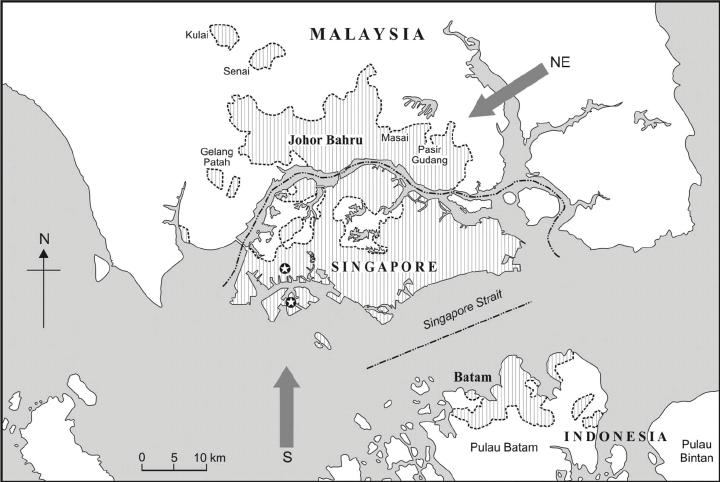
Map of Batam and Singapore1
FEATURE
BATAM’S INFRASTRUCTURE BOOM
Batam has long been recognized as a manufacturing and logistics base within Indonesia’s Riau Islands province, serving as a key industrial partner to Singapore. In recent years, however, its strategic geography, just 20 km across the Singapore Strait, has taken on new significance in the regional digital economy.
Over the past five years, global and regional operators including Telin, BW Digital, and GDS have accelerated deployments of digital infrastructure in Batam, often with a direct interface to Singapore’s digital ecosystem. Multiple high-capacity cable projects have landed and are being planned on Batam with direct connections to Singapore’s Tuas and Changi landing points, notably the Indonesia–Singapore Cable (INSICA) and the Nongsa–Changi system. On the terrestrial side, Batam has attracted investments from Singapore-based BW Digital, GDS, PDG, and other regional colocation operators for multi-phase data center developments clustered around its Nongsa Digital Park1 Accordingly, Batam is the nationally designated driver of Indonesia’s data center market growth2, which is projected to reach USD3.63 billion in 2029 by Telecom Review Asia3
The most immediate catalyst for this development was Singapore’s moratorium on new data centers in 20194 due to land/power constraints and environmental targets. During the process, Singapore restricted expansion in the city-state to a few projects meeting stringent energy efficiency and sustainability requirements. The moratorium was then lifted in 2023 with the launch of a pilot call-for-applications5 and a Green Data Centre Roadmap6 prioritizing capacity allocations to best-in-class “green” builds.
Today, efficient power, higher operating temperatures, and green finance have become new industry norms for Singaporean operators – for instance, Singtel7 secured a S$643 million (US$476m) green loan for its DC Tuas facility slated for 2026. However, the supply-demand gap for expansion by Singaporean operators remains, driving investors to look at proximate geographies – Batam as one of the foremost8.
INTERCONNECTION VS. ORIGINATION
Due to its operator-led growth history, Batam’s infrastructure footprint points to a pattern of an interconnection-driven, rather than origination-oriented, digital ecosystem.
Batam hosts more than a dozen subsea cables and multiple landing stations, alongside nearly ten colocation facilities concentrated around Nongsa. Six telco providers also maintain extensive cell tower networks on the island. Yet Batam has only one Internet Exchange Point (IXP) and, until very recently, no hyperscale cloud zones – major players such as Amazon Web
Services (AWS), Microsoft Azure, and Google Cloud remain concentrated in Singapore, Kuala Lumpur, or Jakarta.
This distribution suggests that Batam’s data center facilities are primarily oriented toward operators such as telcos, content delivery networks (CDNs), and carriers whose business is to move data across borders (interconnection), rather than hyperscalers that facilitate enterprise or public-sector workloads which involve generating, processing, and storing data at scale (origination).
The distinction between interconnection and origination matters both commercially and strategically. Interconnection services – such as cross-connects and wholesale bandwidth – generate revenues that fluctuate with external traffic volumes, leaving operators exposed to demand conditions in neighboring markets. By contrast, origination workloads – such as enterprise cloud, Artificial Intelligence (AI), and public-sector digital services – create more stable, recurring revenues, while also embedding a location more firmly within regional value chains. Once hyperscale tenants anchor workloads locally, ecosystem multipliers typically follow: banks, Software-as-a-Service (SaaS) providers, FinTechs, and developers tend to cluster around cloud regions, generating stickier demand and deeper talent pools9.
Without a pivot from interconnection to origination, Batam could risk being locked into a supporting role: valuable for providing redundancy but commercially limited, with margins tied to unpredictable cross-border demand from Singapore and little scope for stable, recurring revenues. This reliance might also carry strategic costs: continued dependence on external hubs would constrain Indonesia’s digital sovereignty and weakens regional resilience by concentrating critical workloads in a handful of nearby locations.
Recent hyperscaler commitments offer cautious optimism. In July10, Oracle launched its Indonesia North (Batam) cloud region by leasing space in DayOne’s data center at Nongsa Digital Park, marking Batam’s first live hyperscale cloud deployment and demonstrating its viability as a host for hyperscale cloud services. In parallel, Telkom Indonesia’s NeutraDC, in partnership with Medco Power, is developing a >60 MW solar-powered hyperscale campus in Kabil Industrial Estate, targeted for commissioning in late 202511
Together, these announcements indicate that Batam is beginning to attract cloud-native investments that are prerequisite to higher-value digital activity. The key challenge now might be whether such initial wins could be converted into a durable origination ecosystem.
STALLED AT THE CLOUD EDGE
Converting Batam’s passive interconnectivity into active
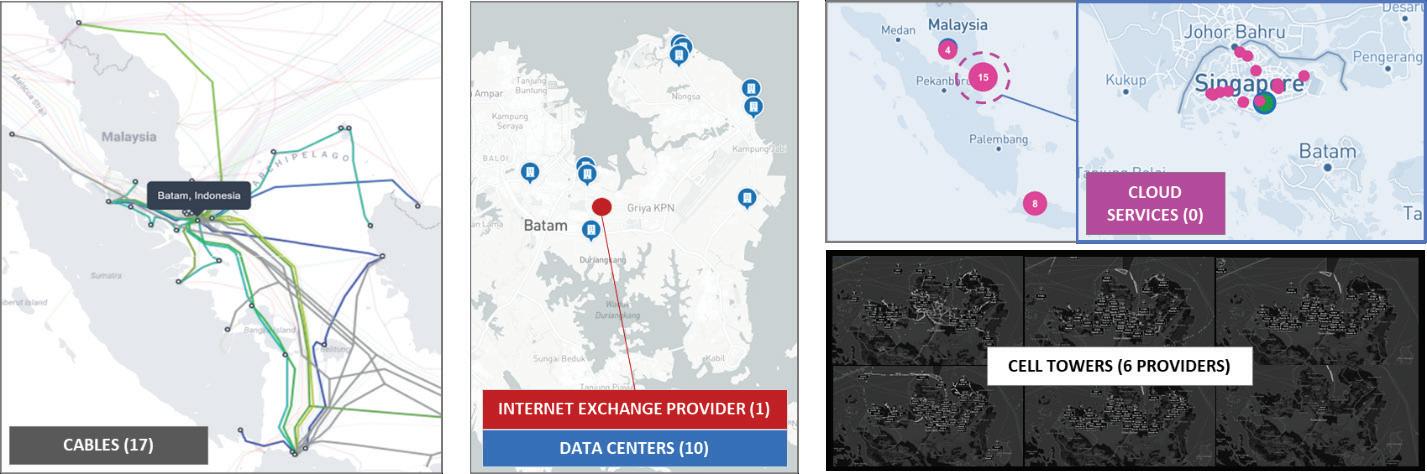
cloud origination is likely to require a multi-stakeholder effort that aligns commercial, technical, and policy conditions shaping hyperscaler investment. While Oracle’s Indonesia North (Batam) deployment demonstrates that cloud services hosting is technically feasible in Batam, its leased, single-availability-domain setup contrasts with the multi-availability zone (AZ) cloud regions that typically anchor enterprise workloads.
As noted, Batam’s growth to date has been driven by operators such as Telin and BW Digital, whose business models can tolerate operational uncertainties such as grid variability, staggered permitting processes, and custom interconnection arrangements. However, hyperscalers such as Amazon, Microsoft, and Google tend to only commit to building multi-AZ regions when three preconditions are in place: (i) a reliable, predictable, and increasingly renewable power supply; (ii) availability of a carrier-neutral dark fiber network for reliable east-west connectivity with enforceable service-level agreements (SLAs); and (iii) a critical mass of demand through enterprise or public-sector workloads.
Data Center Dynamics12 echoes these requirements, highlighting robust networking infrastructure, the cost and availability of land and power, proximity to customers, ease of doing business, financial incentives, political stability, and low exposure to natural hazards as central determinants of hyperscaler location.
On many of these counts, Batam demonstrates potential advantages from its key characteristics13, which likely might have contributed to its appeal as a spillover destination from Singapore:
• proximity to Singapore, which allows for ultra-low latency;
• comparatively lower labor and land costs;
• rapid development of renewable energy sources14 including floating solar and gas-to-power projects integrated into the domestic and potentially a cross-border grid,
which can offer more sustainable, reliable, predictable, and affordable electricity than Singapore’s own constrained grid;
• commercial incentives from its Special Economic Zone15 (Nongsa Digital Park) and Free Trade Area status, which include among others, tax deductions, import duty exemptions, streamlined licensing processes, as well as expedited piloting of regulations and infrastructure projects;
• direct access to Southeast Asia’s largest and fastest-growing digital economy, Indonesia – which is projected to reach US$260 billion by 203016, with demand for cloud and data-intensive services already outpacing the country’s current hyperscale readiness of roughly 200 MW17;
• relatively lower risk of natural disasters18 due to its location outside the Ring of Fire; and
• larger area of available land for further development of data centers and supporting facilities or infrastructure, with potential expansions into the neighboring Bintan island.
Despite these advantages, several critical structural gaps still constrain Batam’s ability to move from a transit node to a true origination hub:
1. Multi-Zone Availability19
Large hyperscalers would only designate a location as a cloud “region” if resiliency can be guaranteed within national borders. This requires at least three separate AZs connected by ultra-low latency, carrier-neutral SLA-backed fiber with guaranteed uptime and performance. However, Batam’s fiber networks currently are still fragmented and under construction.
2. Peering Fabric Density20
Peering refers to the direct interconnection of networks so that data traffic can be exchanged locally without detouring through distant hubs. Rich domestic peering
Batam’s Digital Infrastructure Inventory, as of June 202525
FEATURE
fabrics are critical for latency-sensitive workloads such as financial transactions, AI training, or SaaS platforms. Batam’s single Internet Exchange Point (IXP) limits interconnection diversity, which might force traffic flows to be routed through Singapore or Jakarta. This increases both delay and cost, weakening Batam’s attractiveness for enterprises and public-sector clients that require fast, reliable local processing.
3. Regulatory Certainty and Cloud-Specific SLAs21
While Indonesia’s GR 71/2019 and the 2022 Personal Data Protection (PDP) Law provide broad frameworks, their effectiveness hinges on implementation rules and the still-to-be-formed independent national PDP authority. For hyperscalers, the absence of enforceable standards on uptime, latency, and recovery creates operational uncertainty; for investors, this ambiguity translates into financing risk. Without predictable rules and SLAs, long-term commitments such as multi-decade power-purchase agreements (PPAs) or hyperscale campuses remain difficult to make bankable.
4. Local Demand Anchors22
As mentioned, Batam’s economy is still dominated by manufacturing and logistics rather than service-based sectors that generate “sticky” workloads. Government and municipal systems remain Jakarta-centered, while few multinationals base data-intensive operations in Batam. Unlike Singapore or Jakarta, the island lacks concentrations of banks, insurers, FinTechs, or AI clusters that normally catalyze hyperscaler investment.
CLOSING STRUCTURAL GAPS
Global precedents prove that the leap from transit to origination is achievable when land, power, regulation, demand, and finance are bundled into coherent strategies. For example, Johor23 marketed itself as “Singapore-adjacent,” pairing SEZ incentives with neutral interconnection fabric and framing itself as part of a binational ecosystem. Dublin24 overcame its peripheral geography by leveraging renewable power and EU-aligned regulation.
For Batam, shifting from transit to origination would likely depend on whether policy, private sector operators, and investors can align around enabling conditions to attract and sustain hyperscale investments – six areas appear particularly relevant for consideration:
1. Carrier-neutral Dark Fiber Backbone. A carrier-neutral, SLA-backed dark fiber network linking multiple AZs in Batam – and potentially extending to Singapore – would provide a foundation for resilience. Government support in the form of rights-of-way, regulatory guarantees,
or PPP structures could be leveraged to ensure open, non-discriminatory access for private operators.
2. Cloud-Specific Regulatory Framework. A dedicated Batam Cloud SEZ rulebook covering (i) enforceable SLAs for uptime, latency, and recovery; (ii) standardized cross-border protocols (including harmonization with Singapore); and (iii) clear data residency requirements could give hyperscalers greater regulatory certainty.
3. Anchor Demand Seeding. Migrating select government systems, incentivizing enterprise adoption, and supporting AI/data-intensive services within Batam, particularly within the Nongsa Digital Park, could create the early “sticky” workloads needed to shift the nature of data traffic demand in Batam from transit to origination.
4. Sustainable and Predictable Power. Expanding renewable capacity such as floating solar, gas-to-power, and grid integration, and bundling cloud projects with long-term green power PPAs aligned to hyperscaler sustainability targets, could secure both cost efficiency and carbon competitiveness.
5. Batam as a Hinterland. Leveraging neighboring Bintan island as a complementary extension to improve resilience and reduce deployment costs, by hosting renewable-linked power assets, secondary data centers, and industrial or residential facilities on Bintan.
6. Talent and Capability Development. Expanding local training pipelines through partnerships between universities, operators, and technical institutes would help build a workforce capable of sustaining hyperscale operations and supporting the broader Indonesian digital economy.
ENDING NOTES
Batam’s digital transformation is underway. Subsea cables, colocation campuses, and the first hyperscale deployments demonstrate that the island has already moved beyond the margins of Southeast Asia’s connectivity map. The question now is no longer whether Batam can function as a transit node – it already does – but whether it can also originate the digital services that underpin long-term value. The answer would likely depend on how effectively Batam’s existing and planned infrastructure is complemented by enabling conditions: reliable dark fiber, predictable regulation, renewable-linked power, anchor demand, integrated regional development, and a skilled workforce. If these elements progress in parallel, Batam could shift from its speculative “build-to-attract” growth pattern toward a more durable, demand-driven ecosystem.
The implications extend beyond Batam itself. For investors, clearer rules and bankable frameworks – including enforceable SLAs and long-term PPAs – could help reduce
financing and operating risks. For Indonesia, such a transition could strengthen digital sovereignty by anchoring critical workloads domestically. For Southeast Asia, it could enhance resilience through greater diversification of hubs, routes, and markets. For the industry, Batam would serve as proof of concept that a region can move from being a transit corridor to an origination hub, provided early hyperscaler commitments translate into durable ecosystem growth.
At the same time, Batam’s long-term value might lie less in replicating Singapore’s status as a full origination hub and more in cultivating a distinctive role of its own. Rather than chasing scale for its own sake, Batam could position itself as Singapore’s digital twin for resilience, a spillover site for carbon-constrained workloads, or a proving ground for cross-border protocols and AI/IoT applications – enabled by niche models such as redundancy-as-a-service, green power–bundled campuses, or regulatory “cloud sandbox” pilots. The real test would then be whether these possibilities mature into a differentiated ecosystem: one that defines Batam not as an afterthought to Singapore, but as a laboratory shaping Southeast Asia’s next generation of digital infrastructure. STF

JESSICA HALIM works in multilateral development finance, focusing on connectivity infrastructure that advances sustainable and inclusive economic growth. She is from Indonesia.
1. Velasco, E., & Roth, M. (2012). Review of Singapore's air quality and greenhouse gas emissions: Current situation and opportunities. Atmospheric Environment, 60, 583–601. https://doi.org/10.1016/j.atmosenv.2012.06.052
2. Telin and Singtel. (2024, May 31). Telin partners with Singtel to develop submarine cable system connecting Singapore and Batam [Press release]. PR Newswire; Swinhoe, D. (2024, June 3). Singtel and Telin partner for Singapore Batam subsea cable. DataCenter Dynamics
3. H. Vinnilya. (2025, July 28). Indonesia bets on Batam to challenge Singapore’s data center dominance. Jakarta Globe. Retrieved September 5, 2025. https:// jakartaglobe.id/tech/indonesia-bets-on-batam-to-challenge-singapores-data-centerdominance#goog_rewarded
4. Telecom Review Asia. (2025, January 20). Investment potential in Indonesia’s expanding data center market. Retrieved September 5, 2025. https://www. telecomreviewasia.com/news/featured-articles/4789-investment-potential-inindonesia-s-expanding-data-center-market/
5. DataCenter Dynamics. (2020, November 10). Singapore issues data centre construction moratorium. DataCenter Dynamics.
6. Infocomm Media Development Authority (IMDA). (2023, July 5). Singapore authorities invite applications for new data centers. IMDA. https://www.datacenterdynamics.com/ en/news/singapore-authorities-invite-applications-for-new-data-centers/; Infocomm Media Development Authority (IMDA). (2023, July 5). Four data centre proposals selected as part of pilot data centre call-for-application. IMDA. https://www.imda.gov. sg/resources/press-releases-factsheets-and-speeches/press-releases/2023/four-datacentre-proposals-selected-as-part-of-pilot-data-centre-call-for-application
7. Infocomm Media Development Authority (IMDA). (2024). Green Data Centre Roadmap. IMDA. https://www.imda.gov.sg/how-we-can-help/green-dc-roadmap
8. Singtel. (2023, August 25). Singtel secures green loan for DC Tuas. Singtel. https:// www.singtel.com/about-us/media-centre/news-releases/singtel-secures-green-loanfor-dc-tuas
9. Business Times. (2024, June 4). Batam emerges as data center hub, rivals Johor for investments. The Business Times.
10. PeeringDB. (n.d.). Batam Internet Exchange (B-IX). https://www.peeringdb.com/ ix/2670;
11. TeleGeography. (n.d.). Batam, Indonesia landing points. Submarine Cable Map. https://www.submarinecablemap.com/landing-point/batam-Indonesia; Cellmapper. (n.d.). Cell tower mapping – Batam, Indonesia. https://www.cellmapper.net/map
12. Access Partnership. (2022, December). The impact of hyperscale cloud on the UAE’s SMEs and start-ups. https://accesspartnership.com/wp-content/uploads/2022/12/ impact-of-hyperscale-cloud-on-the-uaes-smes-and-start-ups.pdf
13. DataCenter Dynamics; Oracle. (2025, May 15). New Region in Batam, Indonesia [Release notes]. Oracle Cloud Infrastructure.
14. Skidmore, Z. (2025, July 9). NeutraDC and Medco to deploy solar power at hyperscale facility in Batam, Indonesia.
15. DataCenter Dynamics. (2025). Global hyperscale rankings: Northern Virginia, Beijing, Dublin top 3. DataCenter Dynamics. https://www.datacenterdynamics.com/en/ news/northern-virginia-beijing-and-dublin-named-top-3-hyperscale-locationssynergy/
16. Straits Times. (2024, June 4). A moratorium on data centres in Singapore fuels expansion abroad. The Straits Times.
17. ASEAN Briefing. (2023, June 12). Unlocking solar energy investment opportunities in Indonesia’s Batam. ASEAN Briefing. https://www.aseanbriefing.com/news/ unlocking-solar-energy-investment-opportunities-in-indonesias-batam/; Channel News Asia. (2024, October 21). Singapore-Indonesia floating solar farm in Batam could power 100,000 homes. CNA. https://www.channelnewsasia.com/commentary/ singapore-indonesia-floating-solar-farm-batam-clean-energy-electricity-4737861
18. ASEAN Briefing. (n.d.). Indonesia’s Batam receives two new special economic zones. ASEAN Briefing. https://www.aseanbriefing.com/doing-business-guide/indonesia/ where-to-invest/indonesia-s-batam-receives-two-new-special-economic-zones; W.Media. (2025, July 31). Batam zone ‘full’; govt plans expansion; ASEAN Briefing. (2023, August 25). Investing in Indonesia’s Nongsa Special Economic Zone. ASEAN Briefing. https://www.aseanbriefing.com/news/investing-in-indonesias-nongsaspecial-economic-zone/; Dharmaraj, S. (2025, July 16). Indonesia: Batam to host Asia’s first quantum AI data centre. OpenGov Asia. Retrieved September 5, 2025. https:// opengovasia.com/indonesia-batam-to-host-asias-first-quantum-ai-data-centre/?c=sg
19. IDPRO. (2023). Indonesia’s digital sovereignty: From narrative to national strategy. Indonesia Data Center Provider Organization. https://idpro.id/indonesias-digitalsovereignty-from-narrative-to-national-strategy/
20. Edge.id. (2024, August 1). The future of hyperscale data centers in Indonesia. Edge.id. https://edge.id/articles/the-future-of-hyperscale-data-centers-in-indonesia
21. The Straits Times. (2021, June 14). Data centre operators eyeing Batam as new digital hot spot. Retrieved September 6, 2025, from https://www.straitstimes.com/asia/seasia/data-centres-eyeing-batam-as-new-digital-hotspot.
22. DataCenter Dynamics. (2025). What is a hyperscale data center? DataCenter Dynamics. https://www.datacenterdynamics.com/en/analysis/what-is-a-hyperscaledata-center/
23. Digital Realty. (n.d.). What is internet peering and why is it beneficial? Digital Realty. https://www.digitalrealty.co.uk/resources/articles/what-is-internet-peering-and-whyis-it-beneficial
24. CNBC Indonesia. (2024, October 21). Lembaga perlindungan data pribadi belum dibentuk. CNBC Indonesia. https://www.cnbcindonesia.com/tech/2024102117485337-581818/lembaga-perlindungan-data-pribadi-belum-dibentuk-ini-kata-anggaraka; Modern Diplomacy. (2024, July 2). Indonesia’s weak cybersecurity governance. Modern Diplomacy. https://moderndiplomacy.eu/2024/07/02/indonesias-weakcybersecurity-governance/; Asia Pacific Foundation of Canada. (2024). Indonesian government under fire after cyber breaches. Asia Pacific Foundation of Canada. https://www.asiapacific.ca/publication/indonesian-government-under-fire-aftercyber-breaches; Kompas. (2024, September 15). Dua tahun UU PDP berlaku, lembaga pengawas tak kunjung hadir. Kompas.id. https://www.kompas.id/artikel/ dua-tahun-uu-pdp-berlaku-lembaga-pengawas-tak-kunjung-hadir
25. OpenGov Asia. (2025, May 16). Indonesia developing Batam as a national data centre hub. OpenGov Asia. https://archive.opengovasia.com/2025/05/16/indonesiadeveloping-batam-as-a-national-data-centre-hub/
26. Channel News Asia. (2025, May 16). Malaysia’s Johor becomes a magnet for data centres as global tech firms expand. CNA. https://www.channelnewsasia.com/ asia/malaysia-johor-data-centres-nvidia-ytl-kulai-sedenak-sez-us-china-tradewar-4310496
SPONSORSHIPS AVAILABLE


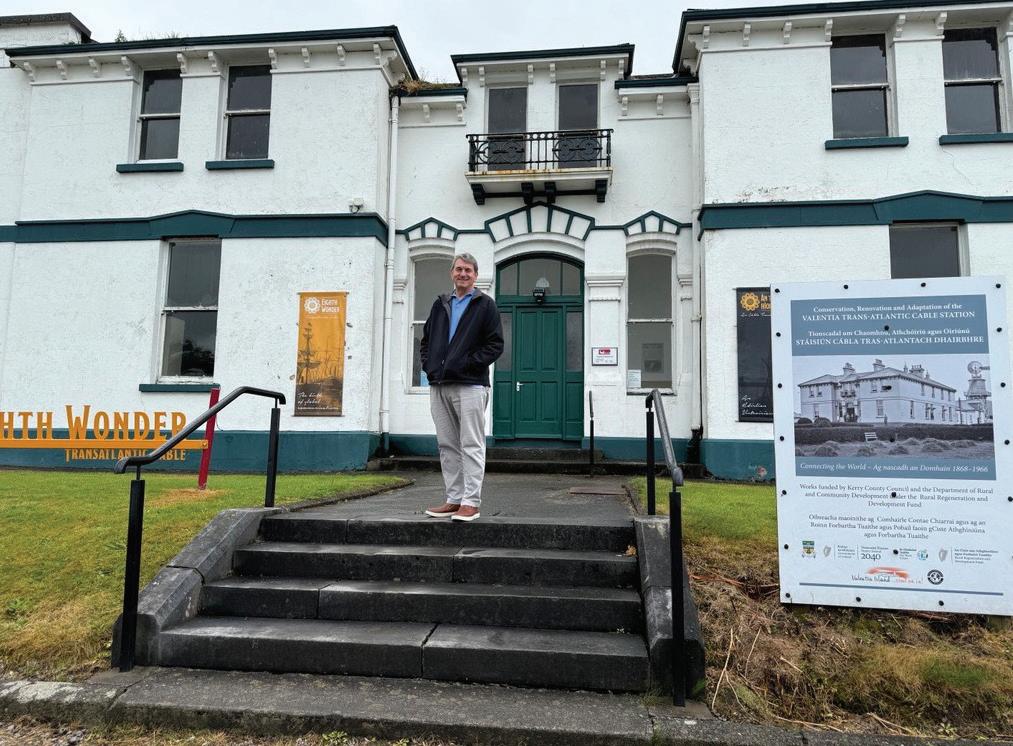
WHAT I DID ON MY SUMMER VACATION
Reconnecting with History at Valentia Island Cable Station
BY WAYNE NIELSEN
Every so often in our industry, you find yourself standing at a crossroads between past and future. That was my experience last month when I visited the Valentia Island Transatlantic Cable Station in County Kerry, Ireland, with my wife, Peg. For someone who has “grown up” in the subsea cable world, it was not just a trip down memory lane—it was a moment of grounding, a reminder of why this industry matters and where it all began.
The Valentia Cable Station is often referred to as the Eighth Wonder of the World. That description is not an exag-
geration. In the mid-19th century, this remote site became the starting point of the transatlantic telegraph cable that connected Europe and America for the first time. It was the Victorian Internet, collapsing time and distance, and forever altering the way nations, businesses, and people communicated.
A STATION THAT CHANGED THE WORLD
In 1866, the first permanent transatlantic cable linked Valentia Island, Ireland, with Heart’s Content, Newfound-
land. Messages that once took weeks by ship could now cross the ocean in minutes. Governments could act swiftly. Markets could react in real time. Families could share news almost instantly.
As I walked through the museum’s exhibits, I was struck by how this feat was both technological and human. The ship models, the diving helmets, the telegrams—they weren’t just artifacts, they were proof of vision and grit. Standing in the rooms where history was literally wired together, I could almost feel the weight of the decisions made and the risks taken.
ECHOES OF INNOVATION
Valentia doesn’t just showcase history—it reminds us that innovation is built on bold first steps. The transatlantic telegraph cable was a precursor to every subsea system we design, build, and operate today. Without Valentia, there would be no internet backbone, no cloud connectivity, no modern global economy.
The museum highlights how this single engineering achievement spurred finance, trade, and diplomacy. By shrinking communication times between London and New York, the cable laid the foundation for the globalized markets we now take for granted.
A PERSONAL PILGRIMAGE
As Publisher of SubTel Forum Magazine, I have had the privilege of reporting on nearly every corner of this industry—from new builds across the Pacific to system maintenance challenges in the Mediterranean. But Valentia was different. This was a pilgrimage.
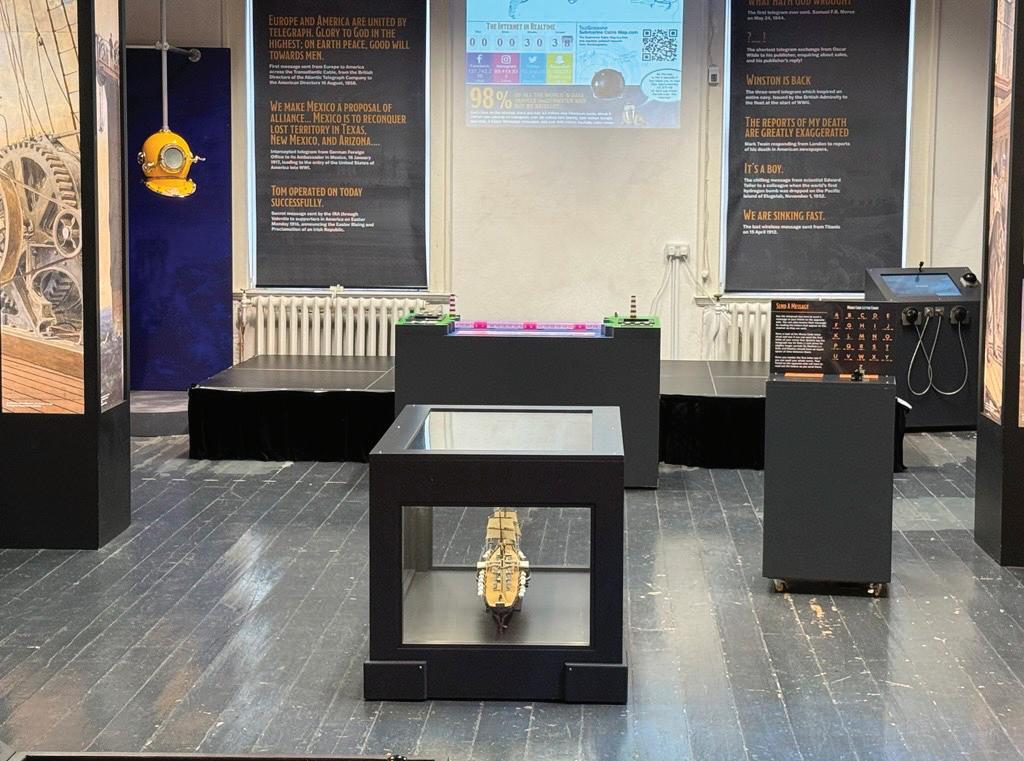
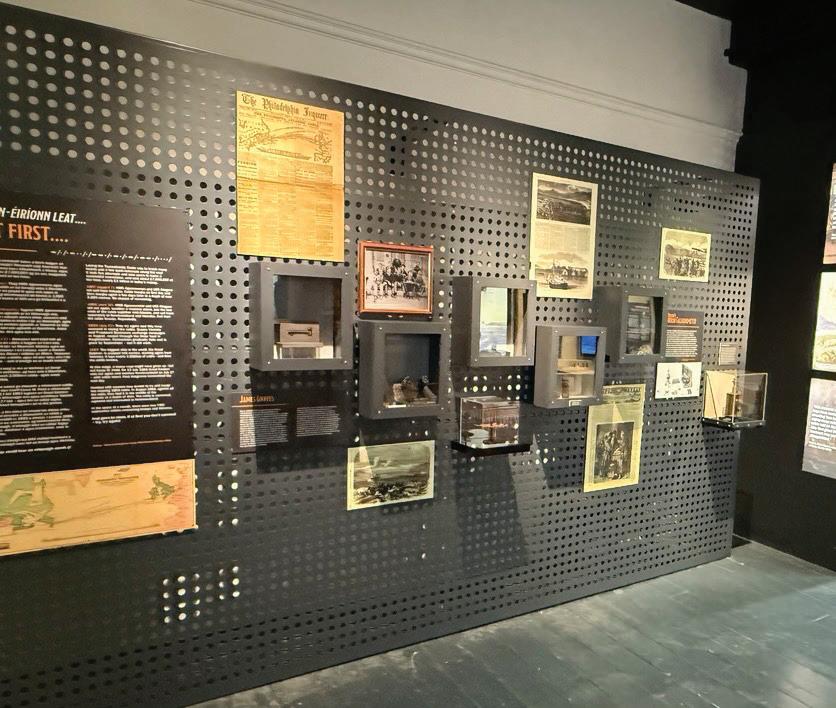
I was particularly grateful for the warm welcome from the team. Although Derek Cassidy could not be there in person, his fingerprints are everywhere— from the submarine cable samples to the lovingly curated artifacts. Lucian Horvat and Mary O’Donoghue have poured passion into preserving and interpreting this history, and it shows.
When you step into the Cable Station, you’re not just walking into a museum—you’re stepping into a story still being written.
FEATURE
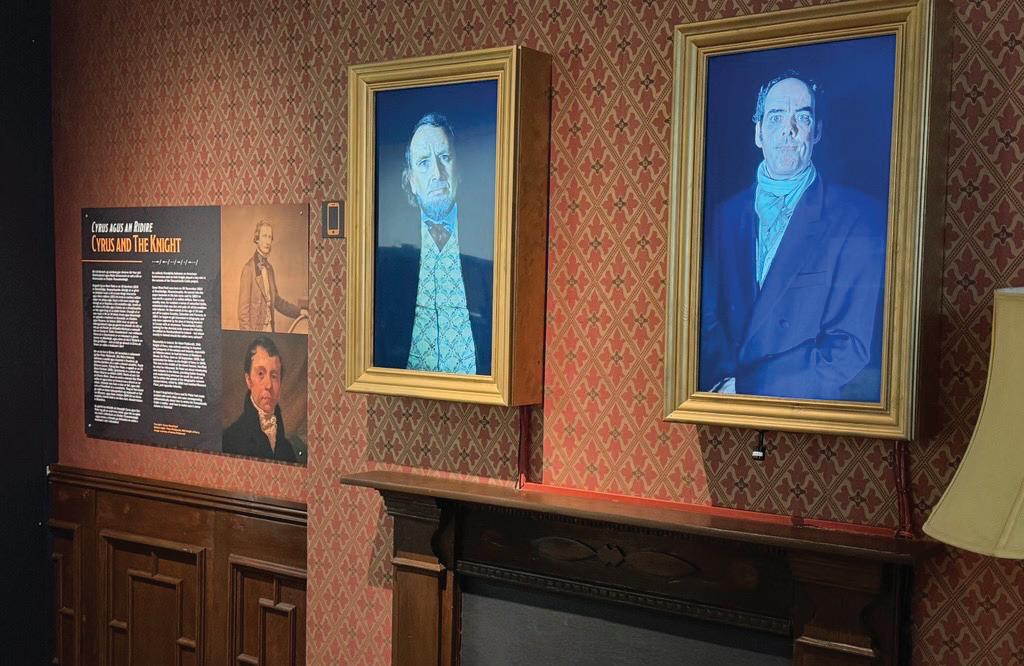
CONNECTING PAST AND PRESENT
What struck me most is how Valentia ties directly to the work we do today. Modern systems may use repeaters, coherent optics, and data-hungry landing stations, but the principles are the same: lay a robust link between distant points, connect communities, and trust in human ingenuity to overcome the odds.
As the industry prepares for another wave of massive builds—hyperscale projects, polar routes, and new regional systems—we’d do well to remember Valentia. The courage of those pioneers was not just about technology; it was about vision. They dared to imagine a world connected.
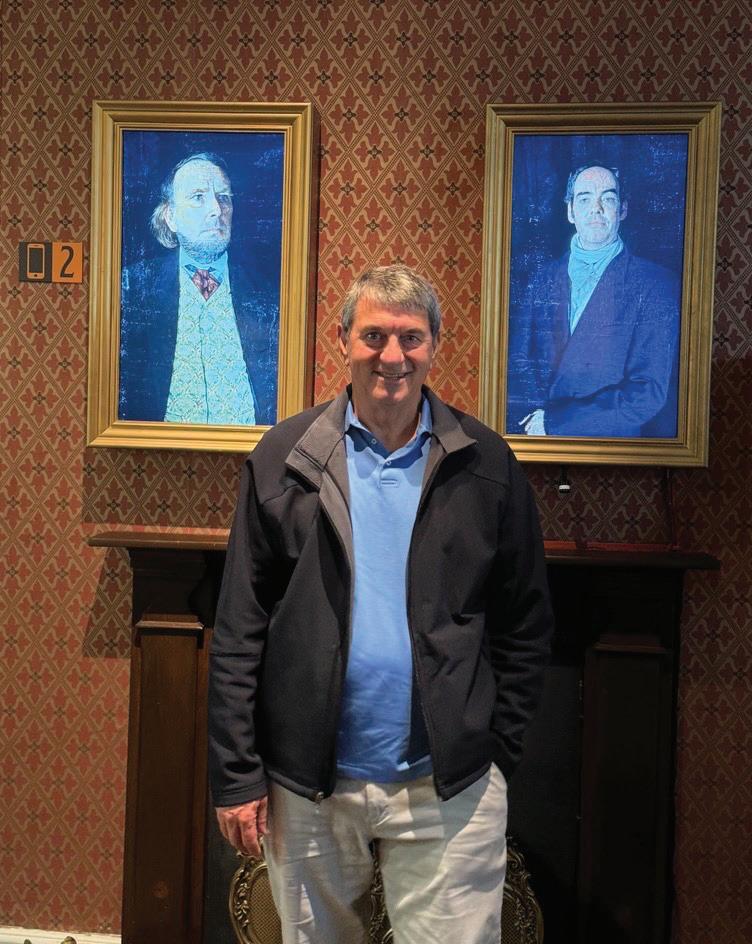
PRESERVING AND RENEWING
The team at Valentia isn’t just curating the past; they are building for the future. Plans are underway to renovate the Cable Station into a central hub for the island, with expanded exhibits and interactive experiences that will bring history, science, and innovation together.
This is more than heritage—it is an investment in education and inspiration. For Ireland, Valentia represents a global legacy. For our industry, it is a reminder that history matters, because it shapes the way forward.
REFLECTIONS
Standing outside the weathered building, I thought about how many cables I’ve walked ashore, how many projects I’ve been part of. Yet none of them would exist without this place. Valentia is more than a relic; it’s a living testament to the idea that global connection is worth striving for—even against great odds.
To visit Valentia is to be reminded that our industry is about more than bandwidth, latency, or commercial return. At its core, it’s about people—people daring to connect across distance, culture, and time.
CLOSING THOUGHTS
For those of us in the submarine cable industry, Valentia Island is hallowed ground. It is where modern connectivity began. My visit was both humbling and inspiring, and I cannot recommend strongly enough that anyone in our field make the trip.
On behalf of SubTel Forum, I extend my heartfelt thanks to Derek Cassidy, Lucian Horvat, and Mary O’Donoghue for their dedication and hospitality. The work they are doing ensures that the story of Valentia will continue to resonate—not just with tourists, but with engineers, executives, policymakers, and anyone who understands that global connection is vital.
The cable station may be rooted in the 19th century, but its legacy lives on in every subsea project launched today. And as we look toward the future of global networks, it’s good to pause, look back, and remember where it all began. STF
WAYNE NIELSEN is the Publisher of Submarine Telecoms Forum and Managing Director of WFN Strategies. He has over 40 years’ experience documenting and supporting the growth of the global submarine cable industry.
SENSING THE SEABED
How Fiber‑Optic Sensing Technologies Are Protecting Critical Submarine Infrastructure
BY ANDERS TYSDAL
The ocean floor has become busy. International telecom traffic rides the submarine fiber optic cables. Society’s productivity increasingly depends on transporting data through these cables—from AI queries and financial transactions to telemetry and remote control of critical functions. Power cables export energy from offshore wind farms and interconnect national grids. Pipelines move hydrocarbons and CO₂. These assets are extensive, exposed and widely distributed over a largely unmonitored domain under the waves.
Most damage to this kind of infrastructure is still accidental—trawls, anchors, dredging, dropped objects—yet the impact is severe: outages that ripple across countries, isolate islands and repair campaigns that cost millions and can take weeks and months to complete. Environmental hazards such as landslides, ice bergs and major storms add to the risk. Geopolitical tension raises the stakes further as critical infrastructure may become a target for malicious actions from adversaries. The need for real-time situational awareness around subsea infrastructure has never been higher.
The cable owners´ protection toolbox is evolving. Route engineering, survey, cable armouring, burial, guard vessels, rock dumping and other tools are essential, but they do not provide continuous awareness between actual in-field surveys. Regular surveys of the entire cable routes or pipeline segments are cost prohibitive most of the time. The message in this article is simple: The same optical fibers that carry data can also act as a submarine nervous system, provid-
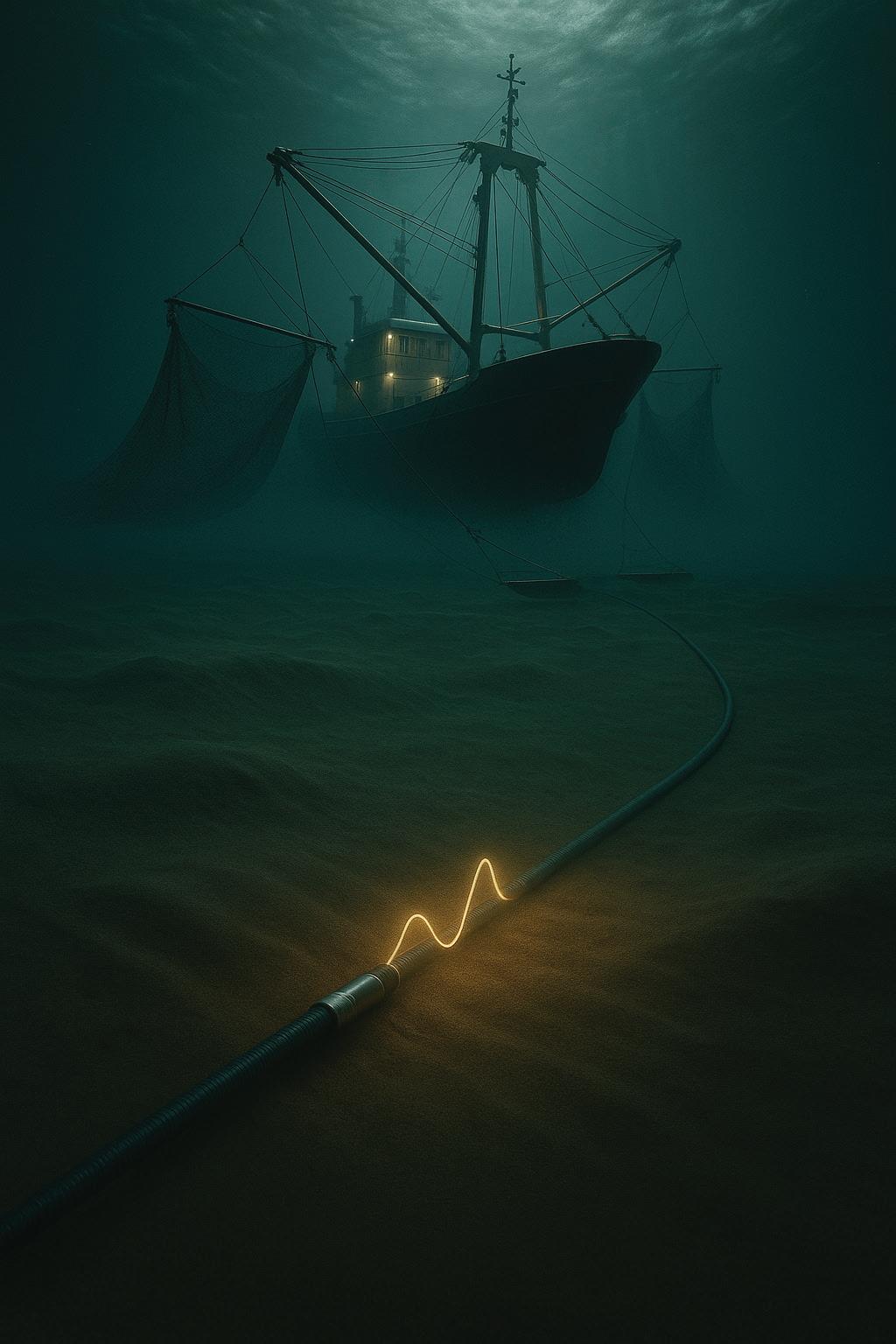
ing continuous inputs from multiple sensing technologies for real-time awareness. When combined with vessel data (AIS), radar, satellite data and marine expertise, fiber sensing gives operators a persistent sensory layer across critical cable or pipeline routes, landfalls and equipment rooms.
THE SHARED SEABED: TELECOM, ENERGY, AND PIPELINE CORRIDORS
Telecom cables (repeatered and unrepeatered), wind farm array cables, HVDC and HVAC export cables, oil & gas pipelines, umbilicals and CO₂ pipelines often share corridors and shore approaches. Pinch points—busy fishing grounds, anchorages, fairways, and crossings—create concentrated risk. A protection strategy that only sees one asset class may miss important input. Cross-sector situational awareness makes sense: telecom owners benefit when they understand wind farm designs and pipeline maintenance; energy operators benefit when they can see cable routes, joint corridors or cable hotspots nearby. The combined ability to sense and interpret activity is far greater when assets are viewed together than in isolation.
FIBER AS A SENSOR: DAS, OTDR, AND SOP IN PLAIN LANGUAGE
DISTRIBUTED ACOUSTIC SENSING (DAS)
A DAS interrogator launches coherent light and measures phase of Rayleigh backscatter light to derive strain-rate (vibration) along the fiber at meter-scale resolution. Unrepeatered fibers—common in wind farms, near-shore telecom segments, and utility fibers on pipelines—are excellent candidates. Repeatered transoceanic systems interrupt backscatter with amplifiers; however, near-shore spans and new special architectures may still be used. DAS offers strong classification capability (processing of signals may conclude if a trawl is in contact with seabed or not), good along-track localization, and response latencies of seconds. However, for strong signals, like a trawl crossing a cable, the DAS may saturate, inhibiting its ability to differentiate between a physical cable hit and a close-by passage. DAS can also act as a good detector of seismic activity, helping in geolocating the source of seismic events or explosions in the vicinity of the fibre segment being monitored.
PERMANENT OPTICAL TIME DOMAIN REFLECTOMETRY - OTDR
OTDR pinpoint faults and microbends and measure attenuation along the fibre. Traces are invaluable for finding the exact kilometer mark when a fault occurs. There may not be information about the cause of the fault, but very specific geolocation is provided. The cost of a OTDR sensor is relatively reasonable, and having permanently installed OTDR on available fibres is a good basic protection and monitoring method where vacant fibre exists. Time is of the essence when a fault occurs, and sending a tech to site with an OTDR instruments takes too long in many cases.
BRILLOUIN OPTICAL TIME DOMAIN REFLECTOMETRY - B-OTDR
B-OTDR uses the Brillouin scattering effect, where light interacting with acoustic vibrations in the fiber is scattered backward and frequency-shifted relative to the input pulse. This frequency shift, known as the Brillouin frequency shift,
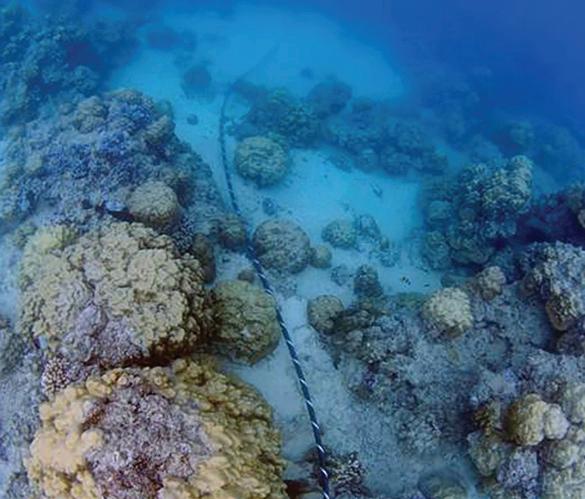
is directly linked to the local strain and temperature in the fiber. By analyzing the time delay of the backscattered signal, B-OTDR determines where along the fiber these changes occur. In this way, the system produces a spatially resolved map, typically with meter-level resolution. B-OTDR can deliver continuous profiles of temperature and strain over tens of kilometers of optical fiber.
STATE OF POLARIZATION - SOP
Optical fibers are slightly birefringent. Mechanical or thermal perturbations rotate the polarization state of light traveling in the fiber. By logging the Stokes parameters or polarization rotation rate at the receiver - or tapping of a small fraction of the light connecting using a polarimeter tap -operators can detect activity impacting the span. The advantages are that SoP works on operational fibres, fully integrated in installed transmission systems - it can use existing coherent receivers or small passive taps. SoP has long reach with minimal incremental insertion loss. SoP provides
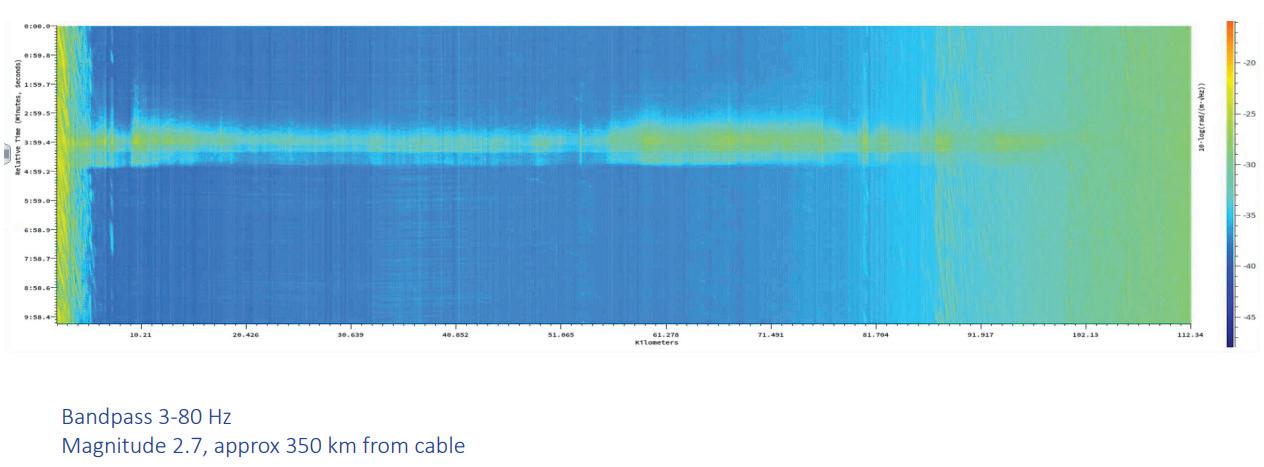
Image: DAS showing seismic activity; in this case a 2.7 magnitude earthquake about 350km from the cable segment. The full length of the cable segment is excited. X-axis shows distance along the cable, y-axis shows time (waterfall) and the colors indicate signal amplitudes, blue being the weakest.
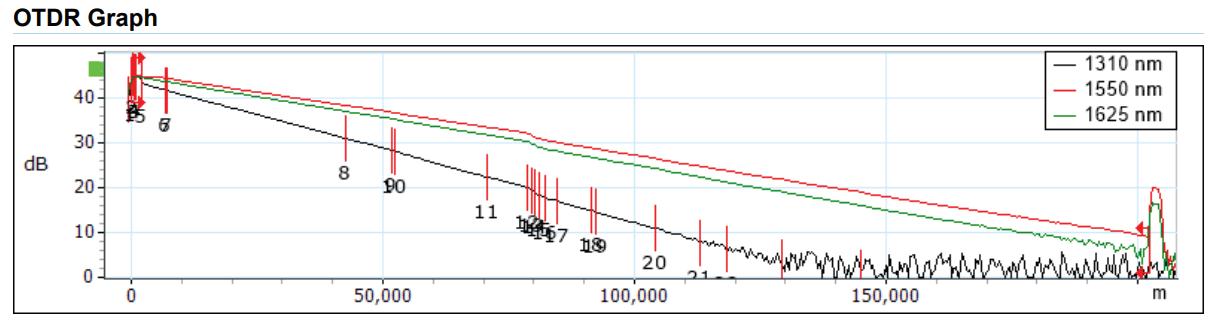
fast detection (nanoseconds to seconds), avoids any saturation effects like the DAS, and is ideal for triage of events and alarm gating and classification on active links.
The main trade-off is spatial specificity: single-ended SoP integrates effects over the span it observes, so localization is coarse unless combined with other methods (dual-ended correlation can improve matters significantly).
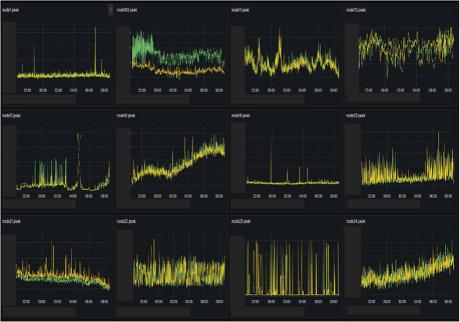
In summary, SoP is the always-on classification aid enabling separation of actual cable-hits from vibrations DAS provides loaction and early warnings, as well as monitors the area around the cable. OTDR offers diagnostics, fault location and confirmation. B-OTDR offers long term awareness of status. Together, they provide detection, localization, classification and verification in real time.
THREAT AND HAZARD MATRIX—AND WHAT EACH
“LOOKS
LIKE” TO SENSORS
WHAT DO THE VARIOUS TECHNOLOGIES PICK UP?
• DAS: DAS measures vibrating backscatter along an optical fiber, turning it into a long acoustic array. It is effective at detecting and classifying activity (anchor drag, trawls, dredging) and localizing events along the fiber. It may have a challenge distinguishing actual contact with the fibre cable vs. a close call due to high sensitivity and tendency to go into saturation when a strong signal is present. DAS can detect hazards prior to impact and
raise alarms before actual contact.
• OTDR: Reflectometry methods that reveal faults, reflectance changes. with precise distance-to-event detection. Permanent OTDR on vacant fibre means instant locational awareness that can be combined with other sensors for increased understanding.
• SoP (State of Polarization) sensing: Monitors polarization changes caused by environmental and mechanical stress and perturbations in the fiber. It excels as an in-service monitor of lit fibers, offering detection even when no dark fiber is available. SoP is especially well suited for indicating actual physical contact and actual movement (permanent and temporary) of the monitored asset. The downside is that spatial awareness is limited (but not entirely missing).
• B-OTDR, Brillouin sensing: Reflectometry method that reveal strain and temperature anomalies, with precise distance-to-event detection. Measures frequency shifts in Brillouin scattering that depends on temperature and strain. Not good at fast changes and does not pick up acoustic signals, but can be used to monitor relatively slow changes in temperature and strain on cables.
There are other fibre optic sending technologies as well, but the listed ones are technologies that are most relevant for submarine cable monitoring.
Image: State of Polarization signals from various cable segments in the Tampnet network
SoP
CATEGORY EXAMPLES
Accidental Bottom trawls, grapnels, anchor drags, dredging, excavation, dropped tools
Environmental Earthquakes, turbidity currents, slope failures, seabed mobility, scouring; thermal hotspots on power cables
Intentional Tampering inside an equipment room or deliberate interference in a BMH/CLS, tampering near landfalls, loitering small craft, diver/ROV activity close to assets, activity in equipment room at odd hours
Operational anomalies
Shunt faults, partial discharges on power cables, cable exposure/unburial, small leaks on pipelines
SIGNATURE / WHAT IT LOOKS LIKE
Abrupt strain, localized vibration, acoustic signatures of dragging or impact, polarization changes when impact.
Seismic waves, long-duration vibrations, sudden strain shifts, distributed temperature anomalies
Persistent localized acoustic/vibration signals, unusual polarization changes, vessel noise patterns
Localized strain/temperature changes, electrical noise, small but sustained acoustic emissions
+ Strain (absolute)
ΔAtt + ΔStrain, 10–50 km cm–m Medium
Disturbances (integral) Full length None (global)
TRADITIONAL PROTECTION—AND THE BLIND SPOTS IT LEAVES
Burial and armoring reduce exposure; rock dumping and mattressing adds shielding; guard vessels, aids to navigation, exclusion zones, cable corridors and liaison with fisheries all help. Periodic ROV visual or multibeam/side-scan surveys confirm asset condition. What’s missing is persistent real-time awareness between surveys at the time scale of minutes and seconds, not weeks and months. A modern plan adds a sensing layer that shrinks the interval from “something is happening” to “we know what and where, and we’re able to take action immediately”.
FROM RAW SIGNALS TO DECISIONS: A FUSED DETECTION STACK
Turning sensor data into action requires a sequential range of events:
In fused systems, DAS or SoP can typically act as the first-line detectors on lit spans. When SoP reveals unusual polarization variations, the system can wake up other sensors to trigger alarms and actions. AIS,
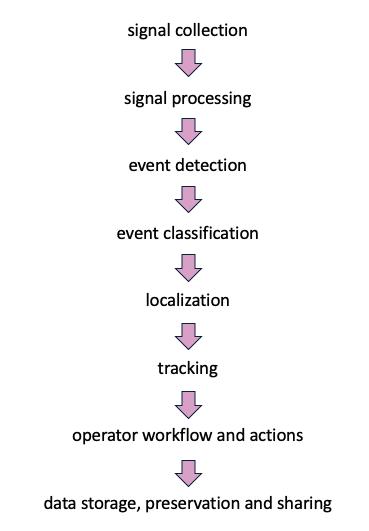
Very fast
monitoring
temp, wells
Structural integrity
Seismic, security, intrusion
Event detection and classification, alarms
Coastal radars, satellite imagery or radio signature detection can be used as secondary identification systems. Confidence improves when multiple modalities agree; irrelevant alarms are cancelled when the system knows about planned work and metocean conditions that might influence the sensors. Over time, the machine learning and AI algorithms should evolve into providing a sophisticated low cost and high awareness system reacting to relevant events.
WHAT CAN BE DETECTED TODAY—AND WHAT REMAINS CHALLENGING HIGH - CONFIDENCE DETECTIONS:
• Anchor drags and trawling gear interactions near the cable (DAS; SoP as confirmation).
• Dredging, excavation, jack-up rig moves, and large DP thruster changes near shore approaches and wind farm perimeters (DAS + SoP).
• Ground movement, scouring, and major turbulence from land slides or storms (DAS), and thermal hotspots on power cables (distributed temperature).
• Faults, sheath breaches, and discrete reflectance changes (OTDR/phase-OTDR, B-OTDR).
CHALLENGING CASES:
• Very quiet small craft or ROVs at range; subtle tampering without contact; high sea states where background
FEATURE
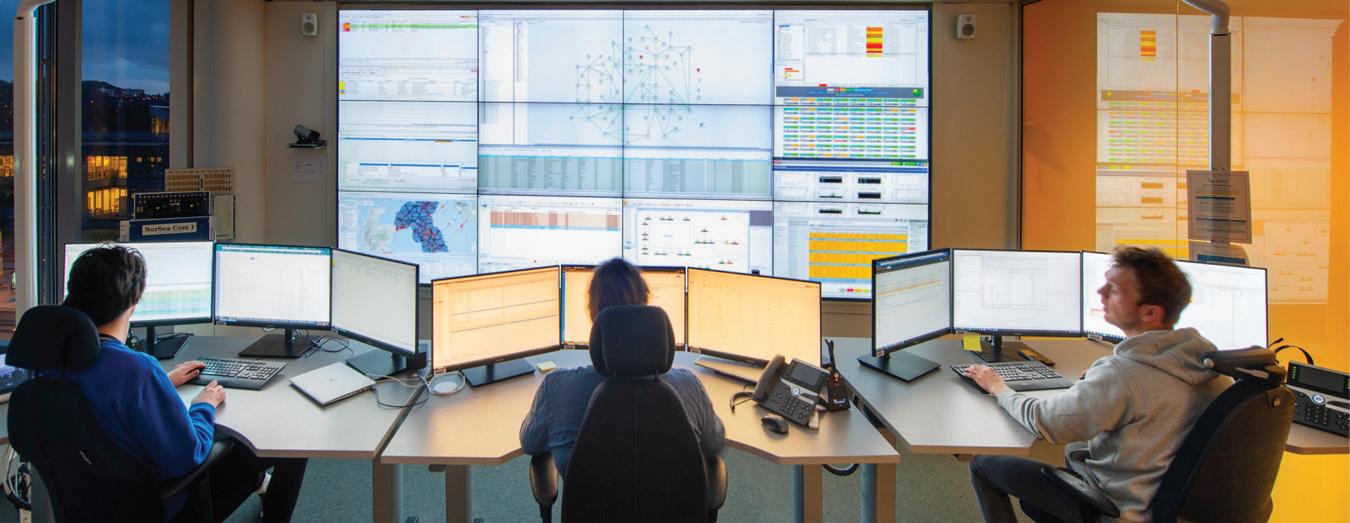
noise rises.
• SoP will usually still show “something is happening,” but DAS/OTDR (or a drone or surface vessel) are needed to localize and confirm.
• Cable unburial; unless a good reference signal has been recorded and trained on, cable unburial may be challenging to conclude confidently.
Localization reality check: expect meters-to-tens-of-meters along-track accuracy from DAS/OTDR; SoP provides segment-level awareness unless dual-ended or combined with auxiliary cues (e.g., precise timing with AIS tracks).
DEPLOYMENT PATTERNS AND REFERENCE ARCHITECTURES
What does the sensing ecosystem look like? Below is the system used by Tampnet to manage the sensors in our network. Sensor nodes (N1, N2 etc) below are feeding data to edge compute nodes and into our NOC environment. Processed (or raw) data are also fed into a central storage for future reference and further processing.
• Shore-based interrogation. Landing stations or coastal huts host DAS interrogators on dark/unlit pairs and small taps or coherent-receiver logging for SoP on lit DWDM wavelengths. OTDR ports are available for diagnostics. This
model is powerful for busy landfalls that see fishing and anchoring.
• Offshore-hosted sensing. Offshore substations and platforms can house compact interrogators to monitor pipelines, wind arrays or platform perimeters. SoP on inter-array/export fibers adds lit-span coverage; DAS on
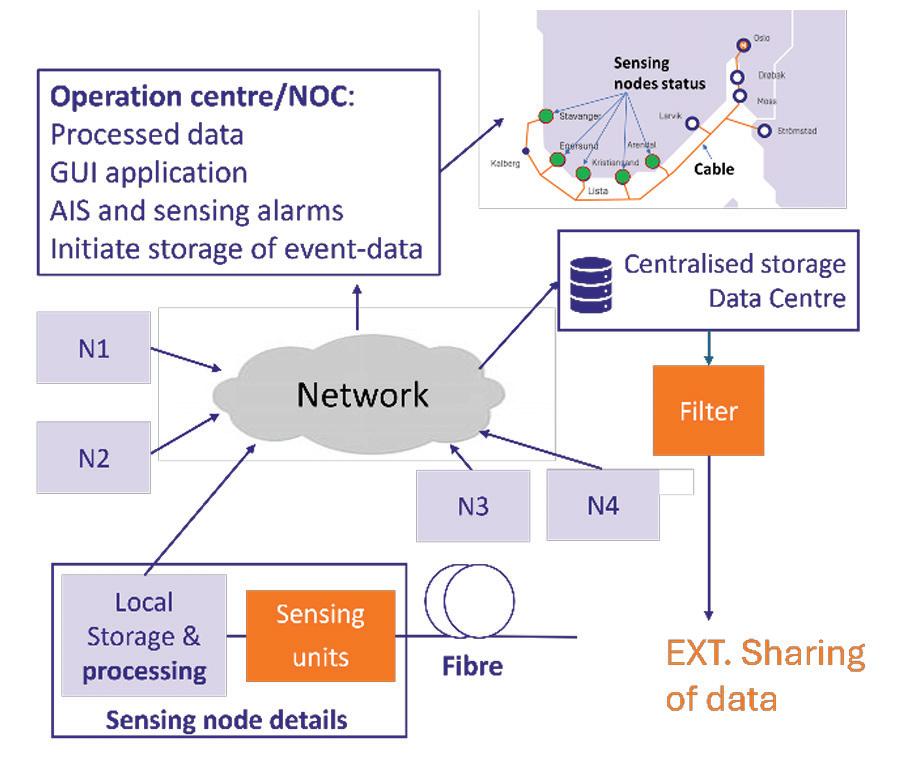
Image: Tampnet NOC
spare utility fibers gives localization. Alerts are backhauled to an on-shore NOC/SOC with simple latency requirements (seconds).
• Corridor monitoring along pipelines/export routes. Where pipelines include fiber, or a fibre cable is laid close to a pipeline, DAS can monitor third-party interference and some leak signatures; SoP on the backhaul link adds fast detection even when DAS coverage is partial.
DATA MANAGEMENT AND SECURITY
Because distributed fibre optic sensors generate massive streams of raw data over long distances, edge computing and advanced signal processing are essential to reduce bandwidth, filter unwanted data and extract features close to where the data is collected.
On top of this, machine learning and AI will be required to fuse multiple sensing sources (e.g., DAS + Brillouin + SoP) and translate complex signatures into sensible, relevant, actionable alarms. A key design challenge is managing alarm overflow: without smart classification and prioritization, operators risk being flooded with alerts, reducing trust in the system and potentially missing the critical events.
In addition to filtering and classification, data lifecycle management is critical. Raw streams should be retained only as long as necessary for training and audit purposes, with summarized features archived securely for long-term trend analysis. Access to sensing data must be governed under the same principles as critical telecom telemetry, ensuring role-based access and strict logging of queries.
Cybersecurity overlaps with operational technology: intrusion detection, anomaly monitoring and access logs help ensure the integrity of alarms and prevent spoofing attempts. Given that edge compute nodes may be deployed in harsh and sometimes remote environments, remote attestation and secure firmware update mechanisms are essential.
SECURITY, SAFETY, AND RESILIENCE
Fiber sensing should be integrated into existing safe ty management systems, ensuring that alarms trigger not only network responses but also operational safety workflows. Red-team style resilience testing—simulating both environmental, accidental and hostile events—helps operators validate detection and response processes before real incidents.
Beyond technical hardening, resilience depends on redundancy: diverse sensing paths, dual interrogation units where feasible, and fallback procedures in case of sensor
loss. Training personnel on how to interpret fused alarms and how to avoid “alarm fatigue” is equally vital to maintaining trust in the system.
LAW, POLICY, AND PARTNERSHIPS
Fiber sensing exists in a legal environment that spans territorial seas, EEZs, and the High Seas, often with overlapping jurisdictions. International frameworks such as UNCLOS provide some guidance, but practical enforcement depends on national authorities and regional agreements. Operators should establish proactive working relationships with maritime authorities, fisheries bodies, and energy regulators to enable coordinated response when suspicious activity is detected.
Data-sharing partnerships can multiply value: anonymized incident alerts shared across operators create early-warning systems that no single entity could achieve alone. Industry alliances and trusted-sharing groups are beginning to emerge in the subsea space, similar to US based ISACs (Information Sharing and Analysis Centers) in other critical infrastructure sectors. Building and maintaining such partnerships will be key to scaling protection as networks grow.
LOOKING AHEAD
The trend lines are encouraging. Sensors are getting better, edge compute and analytics are moving offshore and dual - ended or multi - channel SoP promises improved spatial inference. Integration with satellite RF/SAR tasking will tighten the loop from “detect” to “observe” to “act.” Standards and common data formats will reduce vendor lock - in and make cross - operator incident sharing easier. Most importantly, telecom and energy operators are beginning to plan jointly, because the seabed is a shared space. With fiber playing both messenger and microphone, the industry can listen to the seabed – understand what is going on - and act in time to protect what matters. STF
ANDERS TYSDAL is the Chief Technology Officer (CTO) Infrastructure at Tampnet, overseeing the company’s telecommunications networks, including 5,500 km of submarine fibre optic cables in the North Sea and the Gulf of Mexico. He has 18 years of experience protecting that infrastructure, of which marine situational awareness is a key element. Anders also serves as Chair of the Contract Management Group in the Atlantic Cable Maintenance Agreement (ACMA), which is a major cable repair agreement for the Atlantic zone.
FEATURE CROSSED PATHS
Managing Telecom Cable, Offshore Wind Energy, and Fishing Interests on the U.S. Seabed
BY SARAH HUDAK AND RON LARSEN
SETTING THE STAGE: OFFSHORE WIND ENERGY, TELECOM, AND FISHERIES IN THE UNITED STATES
Over the past decade, the United States set ambitious goals for offshore renewable energy, with federal and state programs driving lease sales, procurement mandates, and early project development. States including New Jersey, New York, Massachusetts, and Virginia established some of the nation’s most aggressive targets, envisioning tens of gigawatts of capacity by 2030 and beyond. These efforts positioned the U.S. as an emerging offshore wind market, mirroring the rapid growth seen in Europe.
At the same time, a parallel wave of growth is underway in subsea fiberoptics and digital infrastructure. The rapid expansion of artificial intelligence and cloud computing has dramatically increased global demand for data transmission capacity. To meet this demand, new subsea telecom systems are being planned and installed at an unprecedented pace, often landing in the same coastal states considering offshore wind power. As planning and construction of subsea assets continue in diverse conditions on a global scale, experience from the U.S. process may be informative for different regional settings.
The fishing community represents an important, additional stakeholder group in this complex equa-
tion. Commercial, recreational, and subsistence fisheries rely on access to fisheries resources and navigable waters.
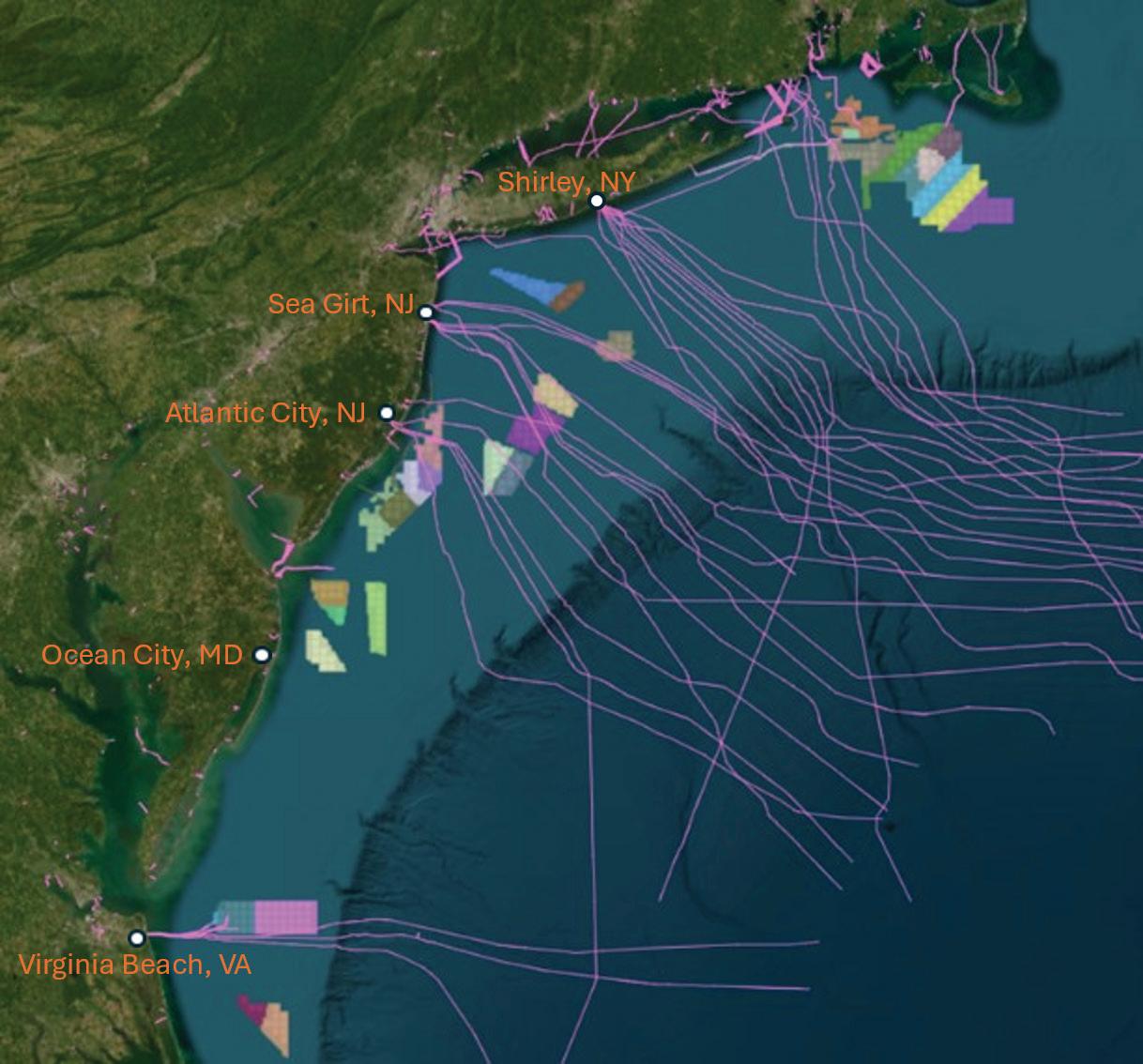
Map of existing submarine telecom cable infrastructure overlaid with offshore wind energy lease areas from southern Rhode Island to northern North Carolina (Source: Mid-Atlantic Ocean Data Portal, August 2025).
Spatial planning for critical subsea infrastructure must consider all uses of the shared ocean space in order to mitigate potential conflicts. Infrastructure planning that does not consider all seabed users may drive additional costs into a project and/or result in risk to installed assets from bottom-tending fishing gear such as trawls or dredges— potentially causing damage to cables and safety risks to fishing vessels and crews.
Despite rising costs, supply chain constraints, and shifting policy dynamics that have forced many U.S. projects to pause or be reevaluated, the seabed off the U.S. East Coast remains an arena where telecom, offshore energy, and fisheries must plan for coexistence. More than 80 active and inactive subsea telecom cables already traverse the U.S. continental shelf, and as offshore wind energy development continues to evolve, careful planning, coordination, and awareness of other seabed users is essential.
CROSSING POINTS AND CLOSE APPROACHES: RISKS, PROCEDURES, AND BEST PRACTICES
The most sensitive areas of potential interaction between offshore wind development and subsea telecom cables occur at cable crossings and/or locations of close proximity between the installed infrastructure. While offshore wind developers try to limit impacts through careful routing and thoughtful windfarm layouts, they are increasingly unavoidable. Within wind energy lease areas, the presence of an existing telecom cable will complicate the placement of Wind Turbine Generators (WTGs) as well as the routing of Inter-Array Cables (IACs) and Offshore Export Cables (OECs). The challenges being to provide enough space to safely install the new infrastructure, facilitate maintenance operations for all assets, and minimize the number of cable crossings.
and reputational impacts for the industries involved.
An often-overlooked dimension of coexistence is the treatment of out-of-service or retired telecom cables. While these assets may no longer carry traffic, owners often retain proprietary interests. Removing old cables can be costly and technically challenging, meaning many remain in place. Offshore wind developers may need to treat these cables with the same diligence applied to active systems. Ignoring out-of-service cables risks disputes, installation delays, or unanticipated hazards for future marine operations.
International best practice—most notably outlined by the International Cable Protection Committee (ICPC)— sets clear expectations for how crossings should be designed, consented, and installed to minimize operational risks. For offshore wind developers, following these procedures has become a baseline expectation in permitting and in crossing negotiations with telecom operators. Likewise, cable owners anticipate early engagement, transparent data sharing, and documented commitments to ICPCaligned protocols. For all parties involved, early engagement improves the seabed security of all assets and can prevent unnecessary operational costs that may result from a lack of spatial awareness.
Automatic Identification System (AIS) data from a clam dredge vessel showing two fishing episodes, one occurring directly over an active telecommunications cable (black line). Due to adequate burial standards, even aggressive bottom-tending fisheries such as hydraulic clam dredging have coexisted with subsea cable infrastructure. (Source: Marine and Coastal Fisheries, Volume 16, Issue 1, Drew et al. 2024)
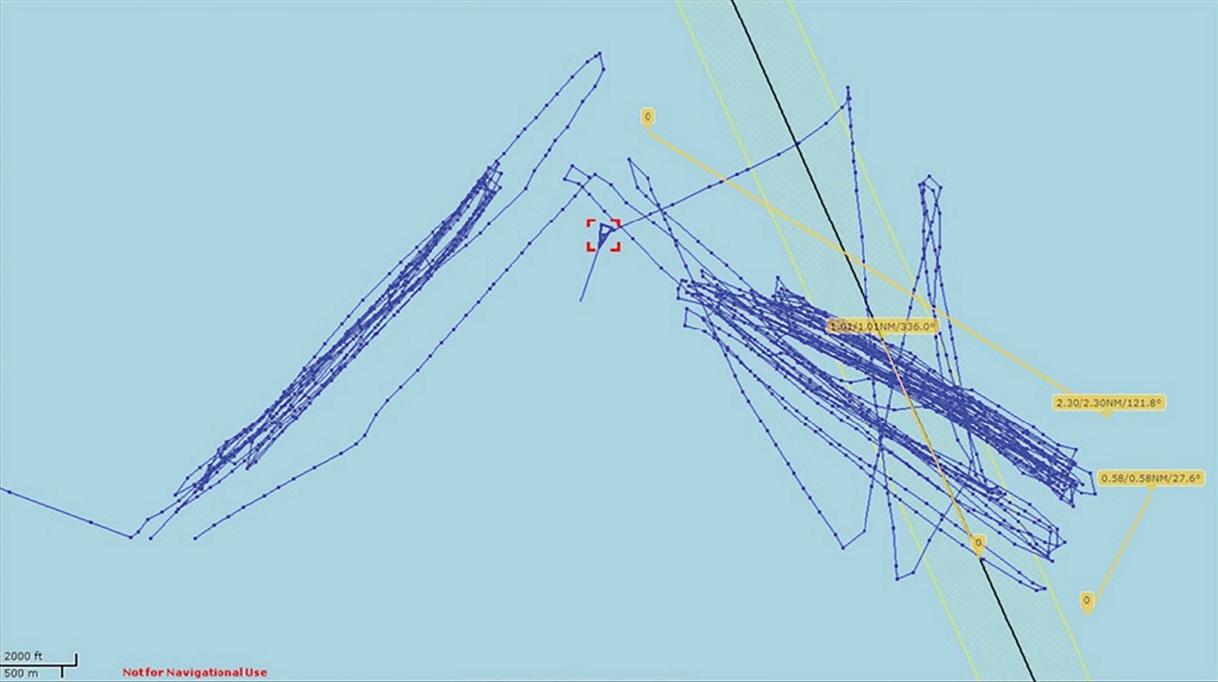
Cable crossing challenges are twofold: first, there is the risk of damaging the existing cable during the installation or maintenance activities of a new cable. Second, the presence of an existing cable often constrains burial techniques and siting for the new one, leaving the new cable more exposed to fishing gear, anchors, and other maritime activity. Both risks can result in costly repairs, service interruptions,
CABLE BURIAL & FISHING INDUSTRY PERSPECTIVES
For offshore wind and telecom cables alike, insufficient burial has historically been a leading cause of remediation and warranty claims. Cable burial is therefore fundamental in protecting the assets and operations of both industries. Adequate burial depth, often guided by Cable Burial Risk Assessments (CBRAs), reduces exposure to anchors, fishing
FEATURE
gear, and hydrodynamic forces.
The value of this approach is clear in the Mid-Atlantic region of the U.S., where New Jersey and New York have served as telecommunications hubs for more than a century. Dozens of in-service and legacy cables cross fishing grounds heavily worked by commercial fishermen, including the surfclam and ocean quahog fisheries, which use hydraulic dredges capable of penetrating as much as half a meter into the seafloor. Despite this overlap, cable fault rates in the New York Bight have been minimal since 2000, when target burial depths were increased to 1.5–2.0 meters (5-6 feet). This outcome demonstrates how fishing industry awareness, operational knowledge, and improved burial standards have materially reduced risks to subsea infrastructure and fishing gear alike.
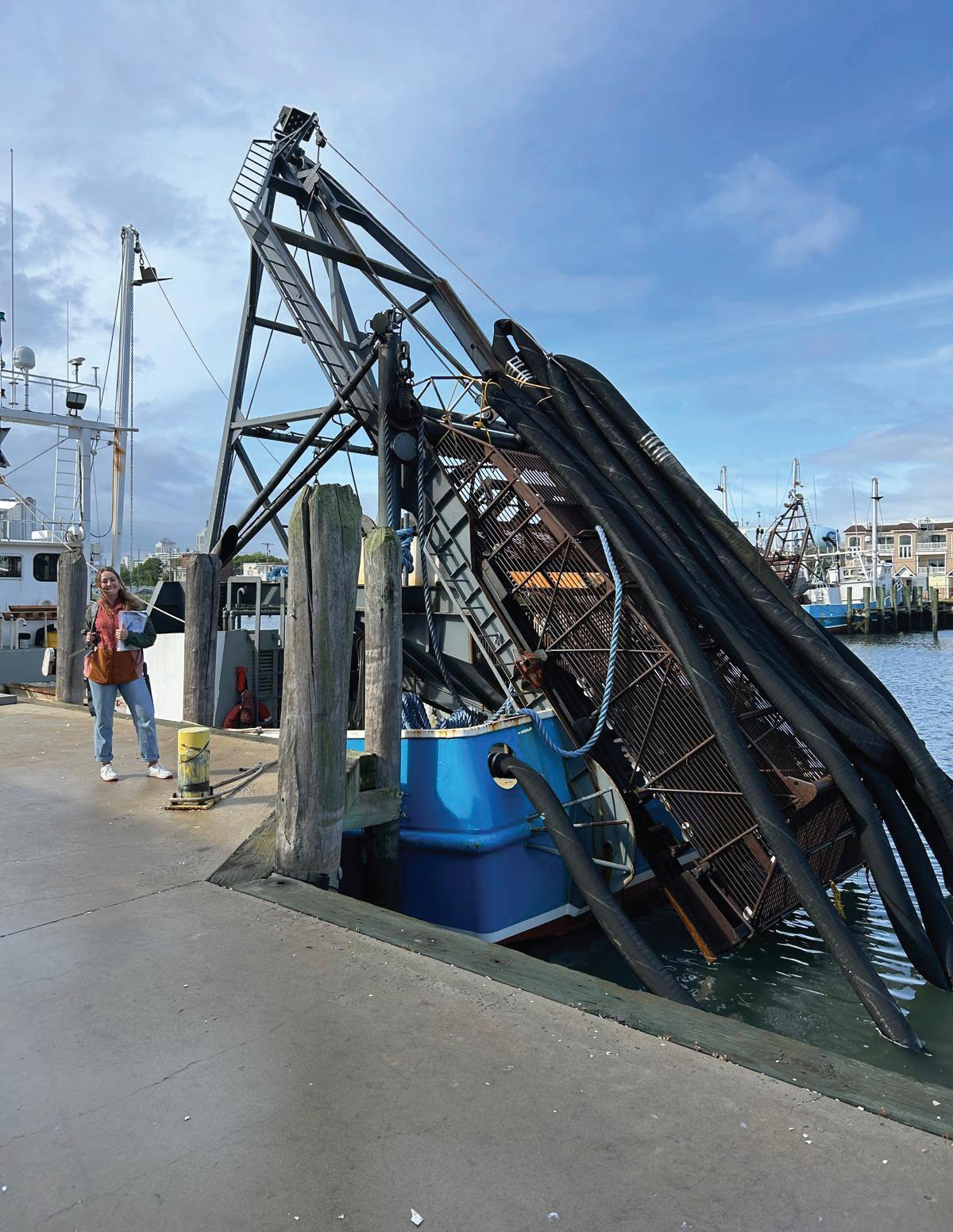
Still, achieving target burial depths is not always possible. Seabed conditions such as hard substrate, mobile sediments, or archaeological constraints can limit burial effectiveness. These challenges are especially acute at cable crossings, where the presence of an existing cable may restrict burial and necessitate additional protective measures such as increased cable armoring, installation of rock berms, and/or of the deployment of concrete mattresses.
In such cases, fishing industry inputs become invaluable. Because fishing practices and preferences differ by region and gear type, armoring techniques and mitigation strategies must be tailored rather than standardized. What may be acceptable in one area could be seen as hazardous in another. In the U.S. Atlantic, for instance, many fishermen view certain protection methods, like concrete mattresses, as more snag-prone than alternatives such as smooth rock berms or other measures that better blend with the natural seabed. Additionally, some fishermen may prefer that crossings requiring additional protection (e.g., rock berms or mattresses) be concentrated in a common area so potential mobile gear obstructions are not scattered along the seabed. Additionally, these areas may create habitat that can be exploited by fixed gear fishermen, safe from interaction with mobile gear fishermen. By incorporating fishing voices into early planning—particularly where target burial depths cannot be achieved—developers and cable operators may reduce conflict, avoid accidents, and strengthen the social license for offshore infrastructure projects.
BEYOND BURIAL: THE ROLE OF OUTREACH AND AWARENESS
Technical solutions like burial depth and armoring are only part of the equation. Equally important is the ongoing
communication between industries and communities that share the seabed. Representatives from offshore energy and telecom companies should make it a regular practice to engage directly with each other, with fishing communities, and maritime regulators to ensure that stakeholders are aware of existing and planned asset locations. Asset owners should also seek to stay updated on spatiotemporal fishery trends, new fishing gear modifications or techniques, and changes to fishing regulations or management that may result in new considerations for cable protection. Transparency around routing, construction schedules, and protection methods not only reduces the likelihood of accidental damage but also fosters shared responsibility for protecting critical infrastructure.
Experience has shown that virtual communication alone are not sufficient. In-person engagement—such as port and dockside visits, community meetings, or informal conversations on the working waterfront—has proven especially valuable and successful over the years. In fact, outreach of this kind has historically contributed to reduced fault rates and fewer disputes, highlighting that coexistence is not just about technical compatibility but also about cultivating durable relationships among all parties who depend on the ocean. These efforts build trust, demonstrate accountability, and create a feedback loop where local knowledge can be incorporated into project planning and risk management. Providing practical tools such as materials that chart cable locations, contact information for asset owners, and plotter files compatible with vessel navigation systems, further improves compliance and reduces the likelihood of accidental interactions.
Sarah Hudak of Sea Risk Solutions LLC conducting subsea telecom cable awareness outreach at commercial clam docks in New Jersey. Sharing cable locations and asset owner contacts with fishermen helps reduce the risk of gear interactions while fostering trust and open communication.
NEW JERSEY CASE STUDY: A MICROCOSM OF OFFSHORE INTERESTS
New Jersey illustrates both the importance and the difficulty of balancing offshore wind, subsea telecom cables, and fisheries. In the early 2020’s, the state positioned itself as a national leader in offshore wind procurement, with targets of 11 GW of capacity by 2040. At the same time, its coastline hosts several high-capacity international telecom cable landings, making it a strategic hub for global connectivity, further concentrating activity and infrastructure along a relatively small stretch of seabed.
Unlike in many other jurisdictions, New Jersey designated specific landing points for offshore wind export power cables, meaning developers had little flexibility in choosing where their export cables would make landfall. Some of these designated sites overlap with areas already occupied by existing telecom landings in Monmouth and Ocean Counties. While site designations helped streamline onshore planning by concentrating landfalls in pre-approved corridors, it also intensified offshore challenges by forcing multiple industries to operate in already congested seabed corridors. Without careful coordination, the constrained overlap of energy and telecom cables in these zones can lead to installation conflicts, operational risks, and escalating costs.
The recent slowdown in offshore wind energy development provides a chance to address these challenges with
greater care. Many permitting agencies are still building their understanding of the technical and operational complexities of asset coexistence. By bringing telecom operators, offshore wind developers, and regulators to the same table before routes are finalized, conflicts can be avoided and more robust, collaborative solutions can be developed. Shared data, clear protocols, and joint awareness efforts can all help to build trust and streamline decision-making when projects resume.
The slowdown also creates space to integrate applicable and actionable fishing community perspectives into asset planning. New Jersey supports some of the largest commercial and recreational fishing industries on the East Coast, with clam, scallop, and trawl fleets operating in the very same areas targeted for offshore wind energy development and already crossed by several telecom cables. Addressing spatial concerns early and adequately—particularly in areas where target burial depths may not be achievable and additional protective measures may be necessary—is critical. Through timely communication, identification of conflict areas, and incorporating stakeholder perspectives, offshore wind developers and cable operators can reduce conflict, improve safety, avoid unnecessary costs and delays, and foster the long-term relationships needed for fisheries, renewable energy and connectivity infrastructure to coexist.
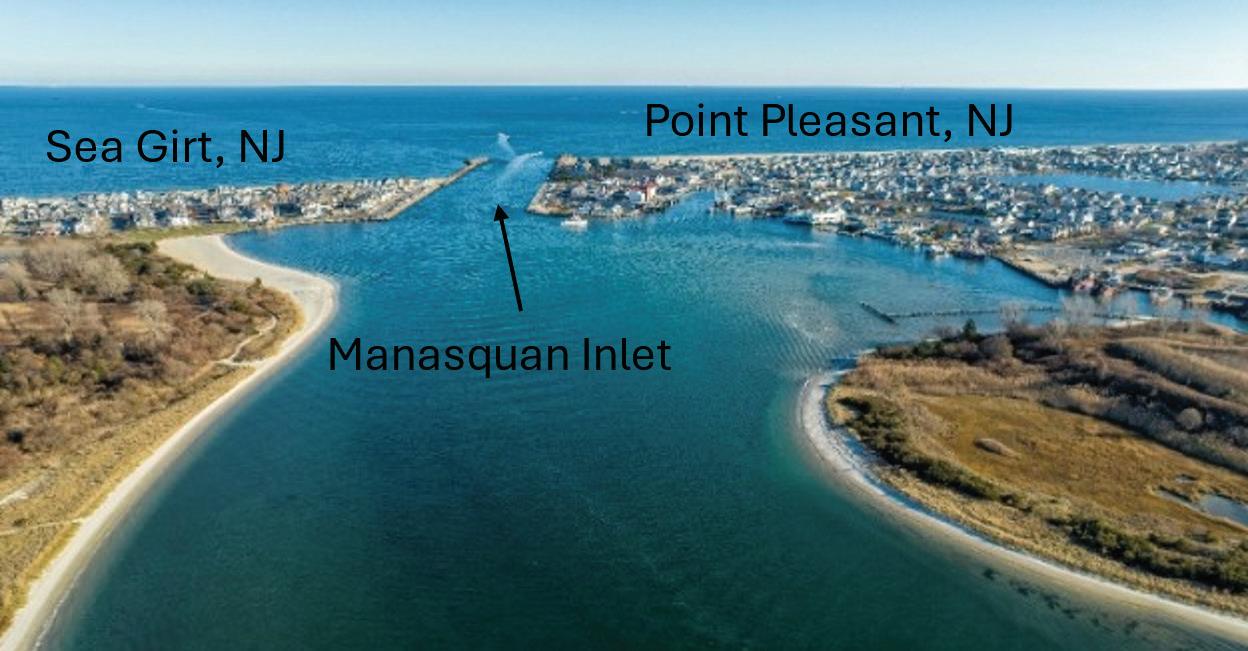
Aerial view of Manasquan Inlet in Monmouth County, New Jersey—the selected landing site for several offshore wind projects in New Jersey. (Photo by James Loesch at https://flickr.com/photos/34920192@N02/52560285356.)
FEATURE
CROSSED PATHS: CHARTING A WAY FORWARD
The coexistence of offshore wind energy, telecom cables, and fisheries is not optional—it is an operational, regulatory, economic, and social necessity. Successful strategies to achieve coexistence rely on good-faith engagement and transparent sharing of information. This needs to be done early in the planning process for any new subsea infrastructure development projects. While the developer of the new asset has the responsibility to engage existing stakeholders, existing asset owners should also promote awareness of their existing infrastructure and monitor marine activities, via Automatic Identification System (AIS) or other methods, for signs of development activities (i.e., marine surveys).
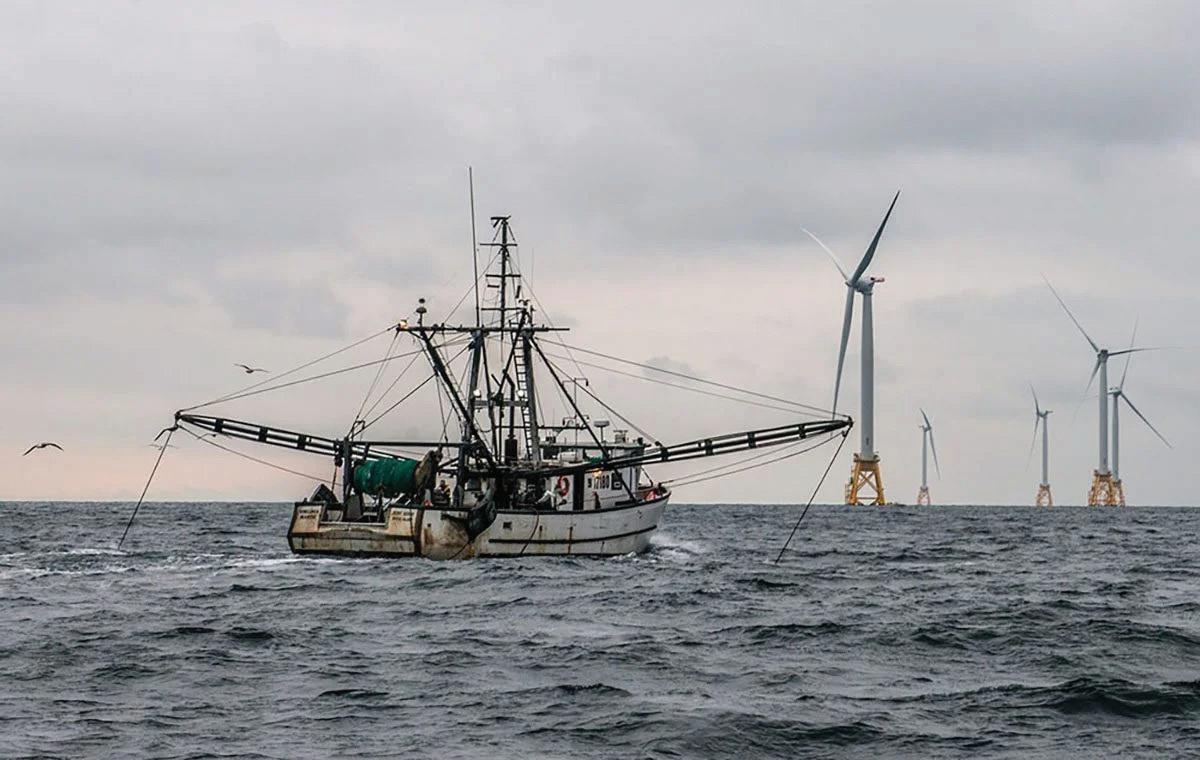
Early and transparent engagement between industries limits surprises, builds the trust needed for long-term collaboration, and reduces the risk of unnecessary costs that may result from delays and re-work. While burial is always the preferred method of protection, it is not always achievable. In these cases, protective solutions can be carefully designed in consultation with existing asset owners and the fishing community, whose practical knowledge of fishing gear and seafloor conditions is invaluable. Regulators, too, may benefit from clear communication and education on the technical realities of asset proximity, cable crossings, and cable burial, enabling more informed and consistent decision-making.
It is worth noting again at this point that this article focuses on the Atlantic region in the northeast United States. Globally, each country and region will have its own complex history and culture of interaction among maritime industries. At a minimum, a new project needs a sound technical understanding of the users in its shared space. Potential interactions, risks, opportunities, and solutions must be considered. Communications among industries may depend on technical factors as well as local regula-
tions, history, culture, and accepted practice. By respecting all seabed interests and developing appropriate solutions early in the planning process, developers and operators can reduce conflict and unlock shared benefits. With offshore wind energy development temporarily slowing down in the United States and subsea telecom activity accelerating, there is a rare window to refine these frameworks before the next wave of development. Collaboration today will ensure that tomorrow’s seabed remains a shared, productive, and sustainable space. STF

SARAH HUDAK has served as a fisheries liaison and consultant with Sea Risk Solutions since 2022, specializing in offshore wind energy and subsea telecom projects. With 4+ years of at-sea experience and 3+ years building positive relationships as a fisheries liaison for offshore energy developers, she helps bridge the gap between offshore infrastructure developers and fishing communities, ensuring that stakeholder input translates into practical solutions.
RON LARSEN is the Managing Partner at Sea Risk Solutions. After working 10-years with the commercial fishing industry in the Northeast US, he spent 20+ years with SubCom as a Cable Route Survey Engineer, Desktop Study Group Manager, and Senior Project Manager overseeing projects in 25+ countries. Working since 2019 with Sea Risk Solutions and their diverse, global portfolio of critical subsea infrastructure developers and owners, he brings a unique perspective to subsea asset risk identification and mitigation throughout a project’s lifecycle.
The fishing vessel Virginia Marise from Point Judith, RI (USA) operates near the Block Island wind farm. (Source: Deepwater Wind 2018)


HANDS OFF OUR CABLES!
Detecting Human Activities Around Submarine Cables
BY GEOFF BENNETT
OVERVIEW
As far back as September 2022, I wrote an article in Subtel Forum Magazine describing the options for seismic detection in existing and future submarine cables. In particular, differential State of Polarization (SOP) techniques using the High Loss Loopback (HLL) facility in subsea repeaters opened the door to using existing cables as seismic detectors, and these could play a part in enhancing tsunami early warning systems.
In this article, I’d like to give an update on how we could use two other important techniques to solve issues such as cable tampering detection and other man-made activities, like ship anchors and fishing nets that are dragging on the seabed near the cable. With high-profile cable cuts in the Red Sea and the Baltic, and an ongoing tension for cables around Taiwan, the need for tamper detection and early warning solutions has never been greater. Moreover, unlike the HLL approach, both techniques can be applied in terrestrial as well as submarine cables.
Note that the three fundamental properties operators
can measure in most sensing fiber techniques are amplitude, polarization and phase. Approximation polarization is about 1,000 times more sensitive than amplitude, and phase is about 1,000 times more sensitive than polarization. The integrated SOP and Coherent-Optical Frequency Domain Reflectometry (C-OFDR) techniques described below use polarization and phase, respectively. Both techniques illustrate a key message: that fiber sensing is a diverse and versatile toolbox for subsea cables. Different methods offer unique strengths depending on the use case, and together they point toward a future where cable systems are not just information pipes, but intelligent, responsive infrastructures.
STATE OF POLARIZATION (SOP)
Since their introduction, coherent transponders have used digital signal processing (DSP) to correct various impairments in optical fiber communications. Coherent transponders also make use of polarization of the signal to double the number of data bits carried by each carrier wavelength, and the DSP in the receiver circuits must con-

tinuously track the signal’s state of polarization (SOP). It does this to compensate for polarization rotations the light experiences as it travels down the fiber, ensuring the datum carried by the modulation symbols are decoded without errors. This means that coherent transponders already calculate the SOP in real-time as part of their normal operation, and by streaming this information as telemetry, operators can implement a highly effective sensing tool that requires no additional hardware.
To understand how this works, a few basic concepts need to be clarified. The polarization of light describes the orientation of the oscillations in its electromagnetic field, and these oscillations can be measured in 3 dimensions. Imagine shaking a rope: one can make waves that go up and down (vertical), side to side (horizontal), or even in a spiral (circular or elliptical). Light polarization is similar and can visualize every possible polarization state on a 3D sphere called the Poincaré sphere – shown in Figure 1-1. Any specific polarization state, i.e., SOP, can be precisely located on the sphere surface using 3 coordinates known as Stokes parameters (S1, S2, and S3). The red arrowed lines in Figure 1-1 are a basic representation of SOP, and each instance would be characterized by different Stokes parameter values. These parameters are what the transponder DSP calculates and can stream for analysis.
So, how does the measurement of these Stoke parameters relate to physical activities around the cable? The answer is birefringence, which is a difference in the refractive index experienced by different polarizations as they propagate along the cable – shown in Figure 1-2. When a subsea cable is physically disturbed by vibration from a ship’s anchor, movement of the seabed, or a tampering attempt, the fiber experiences stresses. These alter the local birefringence at that specific point, which in turn rotates the SOP of the light passing through it.
The DSP in the receiver sees this rotation as a distinct movement of the point on the Poincaré sphere. A sharp, fast event like a cable strike might cause a rapid rotation, while a slow temperature change would create a gradual drift. By monitoring the evolution of the Stokes parameters, these systems can not only detect these disturbances but also begin to build a library of unique fingerprints to classify the type of event impacting the cable.
Let’s look at some SOP use cases:
1. If a ship’s anchor is dragging across the seabed towards a submarine cable there will be an increasing signal in the SOP telemetry from the transponder, and at some point this will jump out from any background noise and exceed signal thresholds set by the operator before an actual outage occurs – allowing customers to be warned of a possible outage or precautionary rerouting of critical services to take place.
2. The section of cable between the Cable Landing Station and the beach manhole is vulnerable to construction
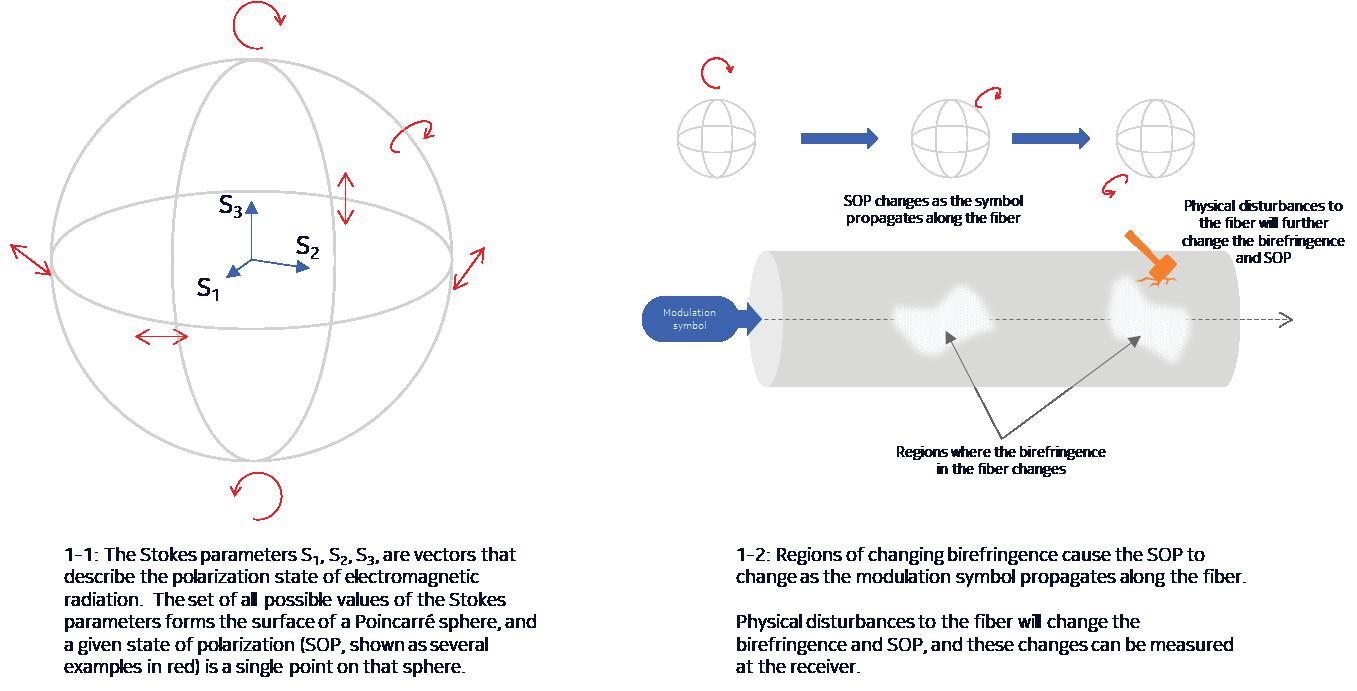
Figure 1: Representing and measuring state of polarization (SOP)
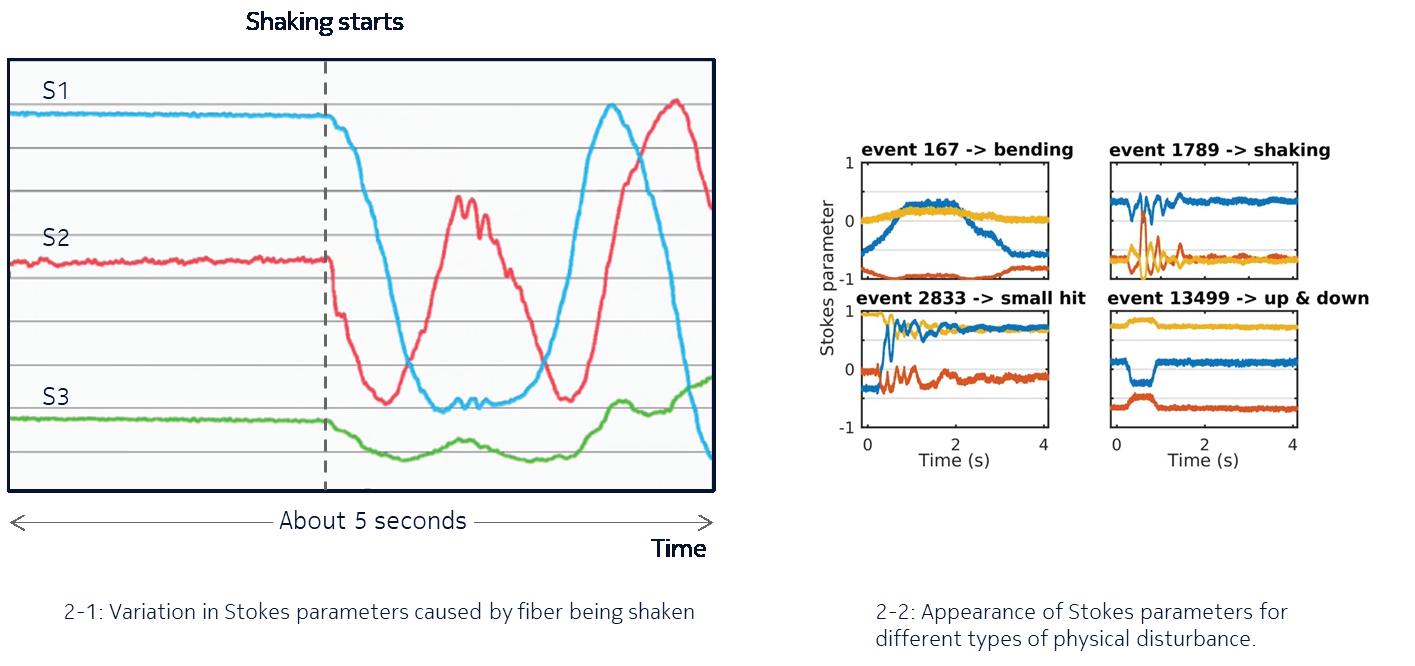
work. A recent outage on the 21,000 km long PEACE cable from Europe to Singapore was identified as unauthorized road construction outside a CLS in Egypt that damaged the cable. Subsea cable operators often implement regular patrols along the route from the CLS to the beach manhole, but how much more useful would it be if a threshold event could trigger the team to start a patrol operation, starting with the known locations of roads?
3. Another event that would almost certainly trigger a threshold breach is physical tampering with the cable. Intrusion methods usually involve cutting into the cable and shaving the fiber cladding to tap off some amount of signal, and this activity would be extremely obvious in an SOP trace.
4. In terrestrial backhaul networks, aerial fiber, while less expensive to deploy, is more vulnerable to lightning effects. When an operator leases a fiber pair along a given route, they may specify no aerial fiber, and they usually must take the word of the fiber owner that this is the case. SOP analysis is a useful and far less expensive way to assure them that there is no aerial fiber in a concatenated route. And there’s no need to wait for a lightning storm because the wind movement of the fiber in the SOP data would be obvious.
5. Engineer cable manipulation. There is a well-known phenomenon in the industry – fiber faults are often correlated with service engineer visits to the CLS or PoP. What can often happen is that, as an engineer is working on one set of fibers, they accidentally disturb another set of fibers. Fortunately, engineer visits to the CLS are
carefully controlled, so one way to reduce false alarms if a high-intensity event is seen in the SOP data is to query the booking system to determine if an engineer is present in the building.
6. Long-term fiber monitoring. SOP is a sensitive technique, and long-term monitoring of fiber pairs could reveal all sorts of useful things that are happening to the fiber over time. This may include aging effects, cable jostling during PoP or CLS service visits, for example. Long-term monitoring of cable SOP would tend to generate large volumes of telemetry data from this very noisy signal. AI-driven Machine Learning techniques have proven very useful to draw out real data from this type of signal. Let’s look at this in more detail now.
THE USE OF AI FOR EVENT FINGERPRINTS
The stream of SOP data from a fiber cable is incredibly rich, but also inherently noisy. It captures everything from major impacts to subtle shifts and background environmental noise across thousands of kilometers, and manual interpretation is impractical.
Fortunately, an AI model can be trained to understand the noisy baseline state of a fiber cable; it can then automatically flag any significant deviation in real-time, providing an immediate alerting capability for potential threats and serving as a watchdog for the fiber cable.
A more sophisticated AI model can be trained on labeled data to recognize the unique fingerprints of different events. A well-trained AI can learn to differentiate the SOP signature of a ship’s anchor dragging across the
Figure 2: Change in Stokes parameters – showing different forms of physical disturbance
seabed from that of a lightning strike on an aerial section of the terrestrial backhaul. As this library of fingerprints grows, the system moves beyond simply knowing that something happened to understand what happened, providing context for any operational response.
By analyzing data over weeks and months, the AI can move from reactive to proactive. It can identify slower-moving trends, such as increasing vibration levels that suggest construction activity is getting closer to the cable. Also, by correlating SOP data with other sources, like weather patterns or maritime traffic, it could even begin to forecast periods of heightened risk, allowing operators to take precautionary measures.
The ultimate vision for polarization sensing is to close the loop, where an event could automatically trigger a planned rerouting of critical services, dispatch a patrol, or even issue warnings to nearby maritime traffic, creating a fully autonomous system for fiber cable management and protection.
LOCALIZATION WITH SOP
Beyond detecting anomalies, polarization sensing can also be used to locate where a disturbance occurs along the cable. This is achieved through a technique known as time-of-flight-based localization, shown in Figure 3.
The principle is straightforward. When an event disturbs the fiber cable, the SOP change is detected and time-stamped in the receivers at both ends of the cable.
Several challenges remain, such as clock synchronization limits, electronic jitters in timing circuits, and the difficulty of defining the start time for gradual events like slow anchor drags. These are not roadblocks, but engineering challenges with ongoing improvements steadily reducing uncertainty. As synchronization and detection algorithms continue to improve, SOP-based localization is expected to become a powerful operational tool, enabling cable operators to pinpoint and respond to threats quickly and with confidence.
COHERENT OPTICAL FREQUENCY DOMAIN REFLECTOMETRY
A new Coherent Optical Frequency Domain Reflectometry (C-OFDR) technique pioneered by Nokia Bell Labs and presented at the Suboptic event in Lisbon earlier this year looks to be extremely promising in both terrestrial and subsea applications, and Figure 4 shows a basic
C-OTDR VS C-OFDR
Though the abbreviations look very similar, the two techniques are very different in the way they operate. C-OTDR uses nanosecond pulses into the fiber that experience some level of Rayleigh Backscatter at multiple points along the fiber to produce echoes that allow cable operators to determine the location of damaged or broken sections of a cable. Normally a C-OTDR is only switched on after a fault occurs and, because incredibly short pulses are sent, a tiny amount of return signal is received. This means that it may take several hours to generate enough return optical signal for a reliable measurement. The analogy is that a night shot on your phone will need to leave the shutter open for several seconds to get enough light into the sensor.
In contrast a C-OFDR operates at almost constant power on the fiber, alongside service wavelengths, monitoring for a wide variety of phenomena and not just fault conditions. The C-OFDR signal uses phase encoding in the frequency domain, and much more signal power is reflected back by Rayleigh Backscatter, allowing measurements in real time at very high sensitivity and spatial resolution.
Note that Rayleigh backscatter refers to light that is reflected back to its origin due to randomly distributed variations in the refractive index of the fiber. It’s an important linear effect in single mode fiber and is responsible for the majority of the attenuation in the fiber.
view of the setup. Unlike the SOP technique described above, C-OFDR will require external equipment. But the bonus is that it can replace several external sensing boxes that cable operators may be intending to deploy as discrete systems – namely seismic detection, wet plant monitoring, short-range Digital Acoustic Sensing (DAS), and C-OTDR. And C-OFDR seems to offer the ability to extend the sensitivity of short-range DAS over the entire length of the cable. So how does it work?
Referring to Figure 4, C-OFDR uses a laser that generates a constant carrier (Figure 4-1), onto which is overlaid a signal created by a Field Programmable Gate Array (FPGA) applied to the carrier using a Digital to Analog Converter (DAC) and a modulator within the Optical Module (Figure 4-2). Rather than sending discrete pulses of optical power in the time domain like a C-OTDR, a C-OFDR sends a coherent data stream that is almost constant power and uses phase changes in the frequency
FEATURE
domain to localize the return signals. Remember that phase detection is around 1,000 times more sensitive than polarization measurements. Since the probe light is both coherent and constant power, there are no detrimental effects on neighboring service wavelengths, so the method can operate 24x7x365 without the need for a dedicated fiber. The wavelength used for the probe light is 1561 nm, which is a commonly used diagnostic wavelength.
The probe light propagates along the fiber and, unlike a DAS probe, can pass through the repeater and is amplified. A High Loss Loopback (HLL) element in the repeater will specifically reflect 1% of any light at 1561 nm while allowing 99% of it to continue.
At multiple points along the fiber, the probe light will encounter regions that cause Rayleigh Backscatter, sending some of the light back in the East-West (E-W) direction. In normal circumstances, this return echo will produce a baseline signal at the receiver (Figure 4-4). But if there is a physical disturbance to the fiber, or a change in pressure or temperature, the backscattered signal will change in accordance with the external stimulus (Figure 4-5). The backscattered light will propagate back along the W-E fiber (effectively in the wrong direction) – and if this were a DAS device, this is why the range would be limited so that it could not measure beyond the first repeater. But because C-OFDR uses the 1561 nm wavelength, the HLL in the
repeater allows the backscatter light to jump over to the E-W fiber path and return to the receiver.
Inside the Optical Module, the returning light is mixed with light extracted from the transmit laser, which acts as a coherent local oscillator – effectively a very low noise amplifier that is very wavelength-selective. The Analog to Digital Converter (ADC) digitizes the signal and passes it into the FPGA for initial processing, and then on to a powerful Graphics Processing Unit for a second stage of processing. The use of the FPGA and the GPU allows for a combination of powerful, real-time hardware processing (in the FPGA) and extremely flexible, programmable software processing in the GPU. As processing algorithms evolve, the FPGA can be reprogrammed in service if necessary and, of course, the GPU software can be updated independently (Figure 4-7).
The “Further Processing” note on Figure 4 could refer to sending seismic data or potentially sensitive data for processing by an external agency that could be aligned to follow the standards and procedures set by legislation, such as the United States Communications Assistance for Law Enforcement Act (CALEA), as one example.
The Nokia Bell Labs paper indicates that spatial resolution can be as low as 10cm, but in practice, multiple reflection points are averaged to help overcome the loss of OSNR imposed by the HLL. Even so, there would be
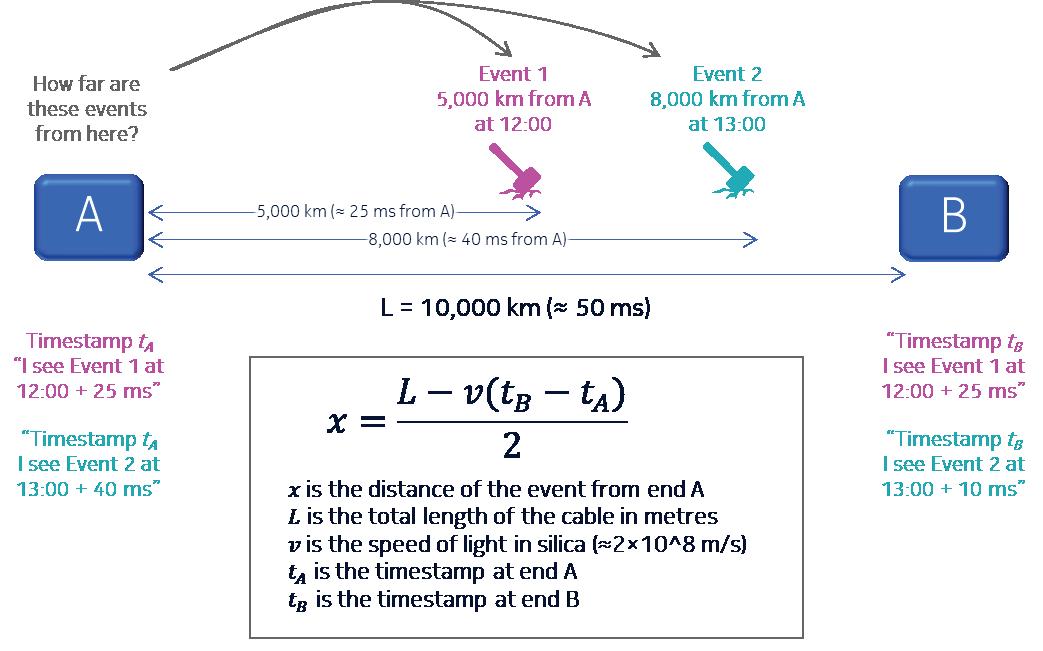
Figure 3: Time of flight event localization for SOP
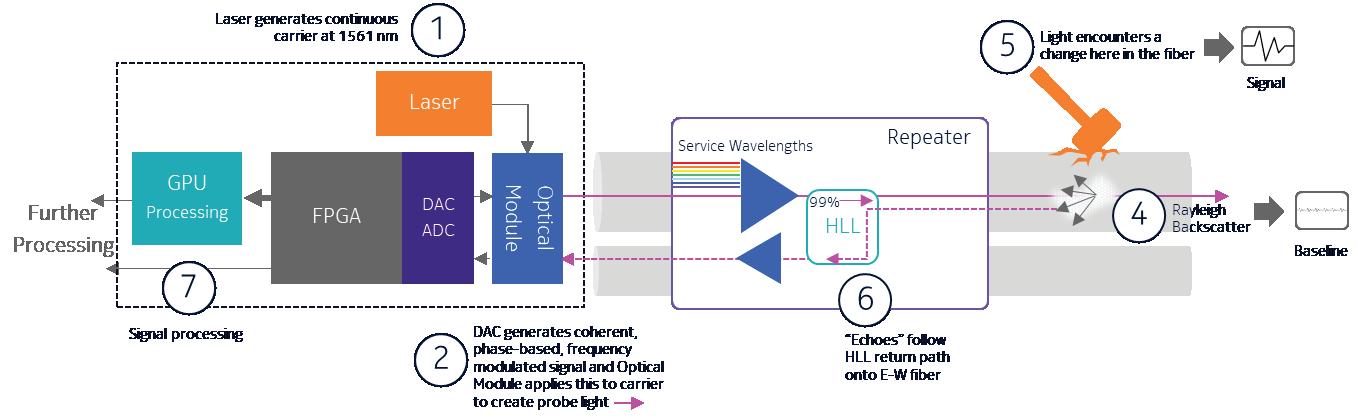
ample resolution for multiple sensing use cases:
• Cable tampering with localization
• Early warning and localization for approaching anchors or fishing nets
• Real-time localization of cable breaks (vs many hours for C-OTDR)
• Seismic data with sub-kilometer spatial resolution
In addition to these sensing use cases, C-OFDR can perform legacy wet plant monitoring and act as a real-time C-OTDR in the case of cable breaks. As we’d expect from a cable sensing unit, the C-OFDR hardware links into the cable at the Upgrade Coupler for the subsea fiber pair, so it can easily be deployed without loss of service connectivity.
Since it operates via Rayleigh backscatter, C-OFDR also works on terrestrial cables and does not rely on an HLL element in the terrestrial EDFAs. Use cases in the terrestrial network would include fiber tampering and early warning of construction work.
Feeding the C-OFDR data stream into an AI process would add further value by developing signatures for longterm fiber health monitoring and, in subsea cables, it could help monitor instances of cable chafing, changes in repeater tilt and ripple, or fiber aging.
SUMMARY
This is a time of great innovation for using submarine cables as sensor devices. Following the initial exploration of a differential SOP technique, attention is now given to the integrated SOP along with a new C-OFDR technique. Integrated SOP has a huge advantage in that it requires no additional hardware to deliver sensing value in several use cases – specifically in the form of cable tampering, and
major events approaching the cable that may cause an outage. Operators can use this data to trigger an investigation for cable tampering or, for approaching dangers, trigger a planned rerouting of high-value services. Localization of certain events using Time of Flight could be a simple upgrade in the future. And long-term cable analysis using AI techniques could also provide significant additional value as the systems develop fingerprint data on a range of phenomena.
C-OFDR is a new technique that does require external hardware but makes up for this by potentially replacing several discrete sensing devices that are commonly used on submarine cables today. However, the real advance for C-OFDR is that it extends the sensitivity and spatial resolution we’ve come to expect from short-range DAS to the full length of the submarine cable. This opens several new use cases — especially in the area of cable protection.
ACKNOWLEDGEMENTS
I would like to thank my colleagues Matteo Lonardi, Jorge Becken, Alan Hollander, Paul Momtahan and Teresa Monteiro; and the Bell Labs team of Mikael Mazur, David Neilson and Roland Ryf for their help in developing this article. STF
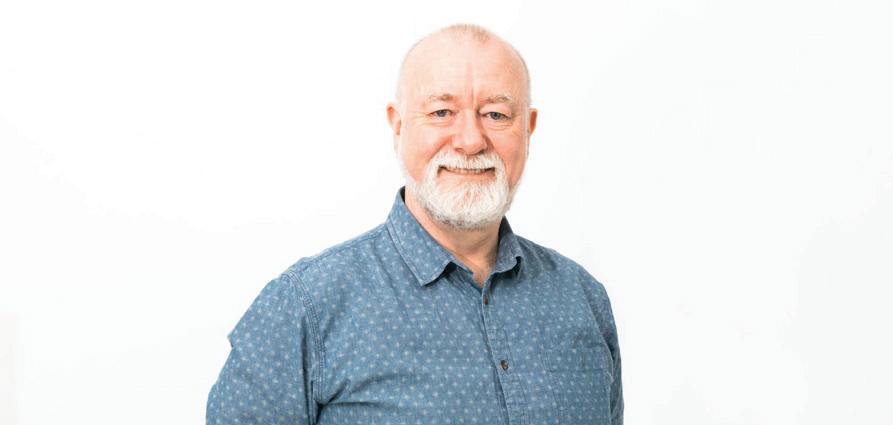
GEOFF BENNETT is the Director of Solutions & Technology for the Network Infrastructure Optical Networks Group. He has over 25 years of experience in the data communications industry, including optical networks at Infinera, IP routing with Proteon and Wellfleet, ATM and MPLS experience with FORE Systems; and optical transmission and switching experience with Marconi, where he held the position of Distinguished Engineer in the CTO Office. In his current role, he is responsible for technology evangelism in Submarine Networks.
Figure 4: Schematic of C-OFDR Technique
FEATURE HOW MOFN UNLOCK OPPORTUNITY FOR TELCOS AND HYPERSCALERS

BY MARTIN REILLY
The world’s largest cloud providers, also known as hyperscalers, are accelerating a global infrastructure build-out to meet surging demand for resilient, low-latency services. To handle this surge, these companies have invested heavily in submarine cables. A key example of this is Meta’s Project Waterworth, a $10 billion, 50,000km submarine cable system intended to link five continents and employing deep-water routing up to 7,000m.
At the same time, hyperscalers are expanding their data center footprints – moving from urban hubs to rural and strategically advantageous locations. However, the investments being made into subsea cables only deliver data to shorelines. To reach inland data centers, hyperscalers must overcome regulatory and logistical hurdles. And while hyperscalers excel at building out their undersea infrastructure, terrestrial networks present unique challenges, leaving a critical opportunity for telcos to step in and bridge the gap.
This is where telecommunications service providers (telcos) come in, partnering via Managed Optical Fiber Networks (MOFNs) to close this gap securely and at scale.
CONNECTING SHORE TO INLAND
Investment in new connectivity routes and services is booming. According to TeleGeography’s 2025 State of the Network report, content and cloud providers now account for more than 70% of all international bandwidth usage, a dramatic shift from just a few years ago when internet wholesalers still dominated most routes. Since 2019, global bandwidth demand has surged – nearly tripling – especially along core corridors connecting major North American, European, and Asian data center hubs. However, since most data centers are located well inland, sometimes by thousands of kilometers, connecting them to the heavily invested in subsea cables is no easy feat.
This becomes increasingly challenging as, in many regions, securing dark fiber – the optical fiber cables already installed but not currently in use – is difficult, if not impossible, due to regulatory or market constraints. In North America, for instance, laying a cable from Los Angeles to New York would require navigating a maze of regulatory approvals across states, municipalities, and private lands, each adding layers of bureaucracy, cost, and delays. In regions like Africa and Asia, hyperscalers face even greater
obstacles, with stringent regulations often barring them from building, owning, and operating terrestrial networks. Moreover, licensing to own or operate terrestrial networks can be a lengthy, uncertain process.
THE HYPERSCALER-TERRESTRIAL GAP
While hyperscalers are relatively new to owning their own terrestrial networks, telecommunications service providers (telcos) have decades of experience in this field. Telcos have developed the local expertise and regulatory insight needed to connect submarine cables to inland data centers, uniquely positioning them to support hyperscalers’ infrastructure build out. Telcos, with their extensive terrestrial fiber holdings, including large reserves of dark fiber, can remove many obstacles for hyperscalers – providing different options such as leased-capacity or wavelength services. While hyperscalers may face barriers to acquiring dark fiber directly, for instance, telcos already have extensive dark fiber assets that they can activate or expand to support new connections for their customers.
Moreover, telcos often maintain well-established operations for managing emergencies such as physical fiber cuts, natural disasters, or unplanned outages. This readiness not only reduces risk but accelerates deployment timelines by relying on tested procedures and relationships with local authorities. Additionally, telcos’ existing fiber networks typically span commercial, industrial, and rural regions.
That said, leasing dark fiber or basic capacity can be a slow and complex route, with long negotiations, licensing issues in certain regions, and can limit the ability to customize a network to hyperscalers’ technical needs. All of this can delay market entry and restrict hyperscalers’ ability to scale quickly. This is where Managed Optical Fiber Networks (MOFN) is emerging, enabling telcos to monetize their assets by supporting hyperscaler growth in a highly collaborative way.
A COLLABORATIVE PATH FORWARD
MOFN is a service offering whereby a service provider builds a dedicated fiber network for a customer, such as a hyperscaler and provides it to them as a managed service. MOFN has been around for a long time, but the business model is experiencing a renewed momentum and increased traction as hyperscalers expand operations and seek efficient ways to interconnect their sprawling infrastructure.
The MOFN model also allows telcos and hyperscalers to work together to secure dedicated, and often customized, high-performance connectivity. MOFN arrangements between telcos and hyperscalers typically see the telco designing, building and operating the network as a managed service. This is especially valuable in regions where regulatory restrictions make it challenging, or even impossible, for hyperscalers to build and operate networks themselves.
Crucially, MOFN is a business model that benefits both the traditional telco and the large scale cloud providers. For telcos, it provides these traditional service providers with incremental and reliable revenue, as well as allows them to form a long term partnership with a hyperscaler over time. For hyperscalers, this model gives them speed and scale at a low cost and takes away the operational burden of running a network, as telcos already have the right infrastructure and ecosystems in place. Telcos will already have an established ticket process, for instance, as well as the management of fiber cuts and potential relocations. Telcos are built to navigate changes to their networks, planned or not, and already have fully formed ecosystems in place to adapt quickly.
Telcos also have pre-established relationships with technology vendors, who act as critical facilitators in the MOFN ecosystem. In this collaborative model, hyperscalers outline their needs for performance and expansion, while telcos showcase
FEATURE
their infrastructure capabilities. Vendors then position the right technologies to bridge these objectives, creating win-win scenarios that accelerate deployment and innovation.
EVOLVING MOFN MODELS
When it comes to MOFN models, typically the telco owns and maintains the infrastructure through strict service-level agreements, and commercial terms often combine one-time fees for fiber access and installation with recurring charges for management, maintenance, and capacity upgrades.
This is not always the case, however, as the MOFN
models, generates enormous data flows across and within data centers, in turn spurring exponential Data Center Interconnect (DCI) growth. In fact, recent research found that data center experts predict at least a 6X increase in DCI bandwidth demand over the next 5 years. This is where MOFN comes in.
MOFN models leveraging the very latest network technologies and services provide reliable, secure, and scalable connectivity for Data Center Interconnection (DCI) services over vast distances, overland and undersea, in a cost-effective and sustainable manner. As MOFN can be customizable, it also allows cloud service providers and hyperscalers to purpose-build the design of the MOFN model they’re harnessing to connect their data centers and AI factories.
model is flexible, and hyperscalers are exploring the many different ways the model can serve them and their specific needs. For instance, some hyperscalers opt for dedicated, end-to-end fiber networks delivered as a managed service, and purchase the entire system all from day one. Others initially just take advantage of managed wavelength or capacity services, which allow them to scale up quickly as demand grows. Increasingly, there are also hybrid models, in which the service provider manages the underlying optical line system, but the hyperscaler retains control of certain network elements. This model offers both flexibility and future-proofing, which will be key as requirements evolve.
THE AI OPPORTUNITY
A MOFN business model allows telcos to play a critical role in the deployment of existing and new cloud services, such as artificial intelligence (AI). This is because the rising demand for AI workloads, particularly training and inference for huge
THE RISE OF INTELLIGENT NETWORKING
In parallel, AI-driven software tools will become indispensable for improving network management. These technologies enable telcos to optimize performance in real-time, anticipate and address potential issues, helping to reroute traffic, ensure redundancy and manage the complexity of expansive networks with greater intelligence.
As these networks expand in scale and complexity, telcos are increasingly relying on AIOps (Artificial Intelligence for IT Operations) to manage them efficiently. These platforms harness AI, machine learning (ML) and advanced analytics to ingest diverse data, detect anomalies in real time, and forecast outages before they happen. For hyperscalers, this means greater reliability, faster response to incidents, and networks that can adapt dynamically as business needs change.
As the demand for cloud services accelerates and new markets come online, collaboration between telcos and hyperscalers will be vital in closing global connectivity gaps, both undersea and inland. MOFN enables hyperscalers to access new markets quickly, without the burden of building terrestrial networks, while offering telcos new revenue streams and partnership potential. This model is a clear winwin, strengthening competitive positioning across an everevolving landscape. STF
MARTIN REILLY leads Ciena’s Managed Optical Fibre Networks (MOFN) business in the Asia Pacific and Europe, Middle East and Africa (EMEA). As the Head of MOFN, Martin drives Ciena’s go-to-market strategy with cloud and content providers as they expand their connectivity in the international region. With over 30 years of telecom experience, including in BT Group and Colt, Martin brings a wealth of industry expertise to Ciena. Prior to Ciena, Martin served as Vice President for Cloud & Content at AquaComms.
Deploying a submarine cable system?
Your success depends on the right team.
At WFN Strategies, we provide access to over 150 highly qualified client representatives across 25+ countries—each pre-vetted, field-proven, and supported by our industry-leading Contractor Care Program.
From technical oversight to compliance management, our experts ensure your project stays on time, on budget, and on course.
Ensure your next project has the right people in place. Contact

FEATURE OPTICAL AND SUBMARINE CABLE SENSING: A BRIEF OVERVIEW
BY DEREK CASSIDY
HISTORICAL SENSING
Sensing is not a new technology as it has been used for centuries and as far back as the Greeks when they introduced the sundial to the world, does not sound like a sensor, but it’s a primitive form. It does fulfil all the characterises of a sensor in that it helps to report some change, like the movement of the sun [1]. For many years scientists have been working with sensors to derive research, results, invent and innovate. One such sensor is the barometer which is used to measure the increase in air pressure allowing the user to determine what the weather is going to be like [2]. Another major leap in sensing was the invention of the seismograph used to detect movements in the earths crust, or earthquakes. Robert Mallet published his paper in 1848 describing his research and producing designs that would evolve into the seismometer used today [3].
But this paper looks at sensing in optical communications. Communications just like physics has a reaction to every action as invention and innovation in communications is something that is in a forever
motion it influences communications itself. Just as D Elias wrote in 1978 that the developments in telecommunications can influence the telecommunications industry are profound [4]. The telecommunications industry was always under
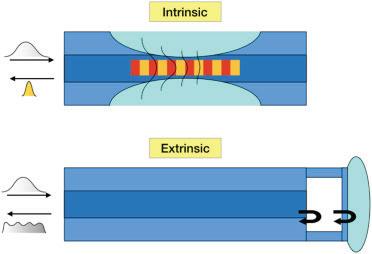
Figure 1: An example of an extrinsic and intrinsic optical sensor [13].
change, from the early days of telegraphy telecommunications experienced a constant state of innovation. But unbeknown to most of the communication world, sensing was always a proponent part of the communications infrastructure. From the early days of the telegraphic era, long distance telegraphic cables were being used for purposes of experimentation and research. However, this research led to the sensing or using the communication transmission medium as a devise to sense the wider and surrounding environment which has been in use for well over one hundred and sixty years.
The ability of a telegraph cable that is connected to a live electrical transmission network to detect signals and changes in impedance was discovered on the Channel Islands Cable. For the three years that the Channel Islands Cable was in operation it had failed thirteen times between 26th of January 1859 and 17th of June 1861 [5]. The reason was the cable was chaffing against the rocky bottom as tides as high as forty feet were often recorded in the area and this extreme movements in tidal flow caused the cable to move across the rocks. This action was like saw teeth rubbing against the cable and failure was inevitable [6]. James Graves used mathematical methods to carry out testing on the cable as it was operating noticed that changes in impedance was noticeable and calculated to be close to the shoreline of Jersey Islanding indicating the movement of the cable across the rocks. Graves began to pay particular attention to these changes and recorded them as they were an indication of imminent cable failure [7].
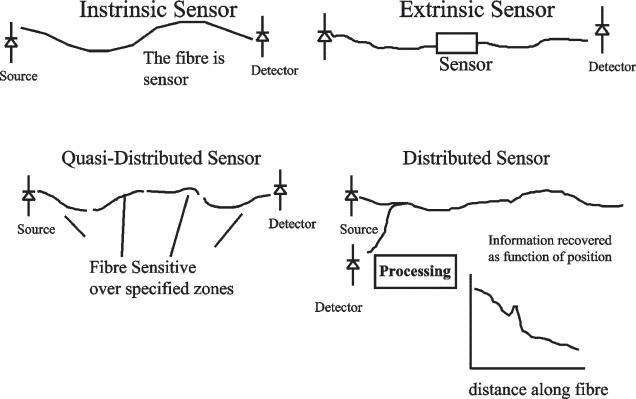
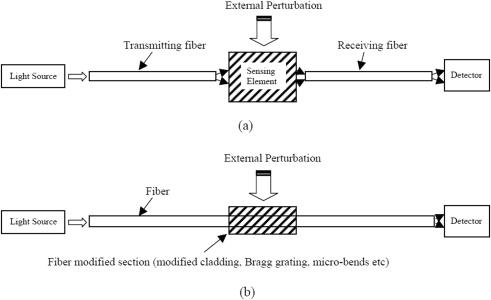
Cable chaffing was not so uncommon and had been the cause of failure of previous cables and a study was conducted off the coast of Calais to investigate the changes in seabed structure and the coastal erosion that would have affected the area. In this study it was discovered that the chalky bottom of the seabed would have not attributed to much seabed structural change as it was mostly sand on the seabed and this would have only attributed to slow moving and build-up of silt and chalk from the coastal erosion effects and this would have increased the sand seabed depth and not attributed to much seabed disturbance etc. the
seabed substructure or strata was chalk just below the sand and for some meters below before hitting Marl Chalk, that the channel tunnel goes through today [8]. It was found that structural change and coastal erosion near Calais and Wexford was different to the tidal changes around Jersey and in conjunction with the seabed being of a rocky nature, this would have attributed to high movement of seabed structure, such as rocks, which would have attributed to damage to seabed structures etc, like subsea cables. This was exactly what James Graves had encountered during his tenure as Superintendent of the Channel Islands Cable [9]. The proof that the seabed structure off Calais would not
Figure 2: Intrinsic and extrinsic sensors [14].
Figure 3: Intrinsic and extrinsic sensors [15].
FEATURE
have attributed to the 1850 cable failure is supported by this paper as it details that the seabed did not have the physical attributes to cause cable chaffing. The idea that Graves used the Channel Islands Cable impedance changes to predict failures was one of the earliest uses of telegraph cable to be used as a sensing devise to detect cable movement across the seabed due to changes in electrical impedance across the cable, localising the area of change. But other telegraphic engineers were also looking at how submarine cables could be used to detect changes in the localised environment. Cromwell F Varley used the electrical signal and the lengths of different cables to sense the electrical current and impedance of submarine cables and analyse their structural design and inefficiencies etc [10].
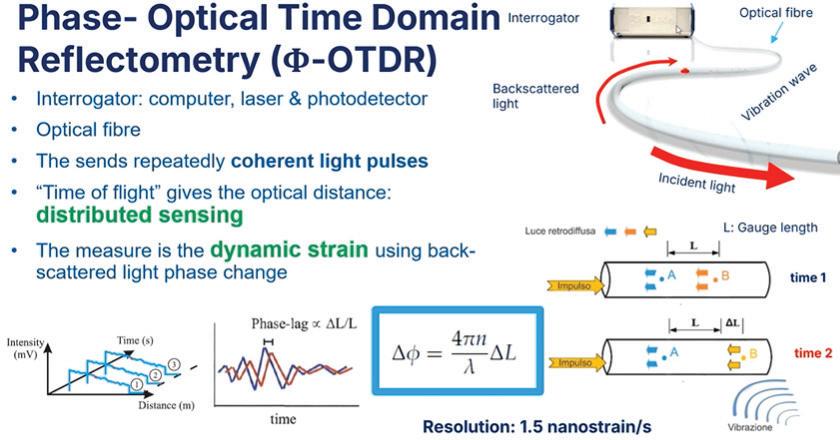
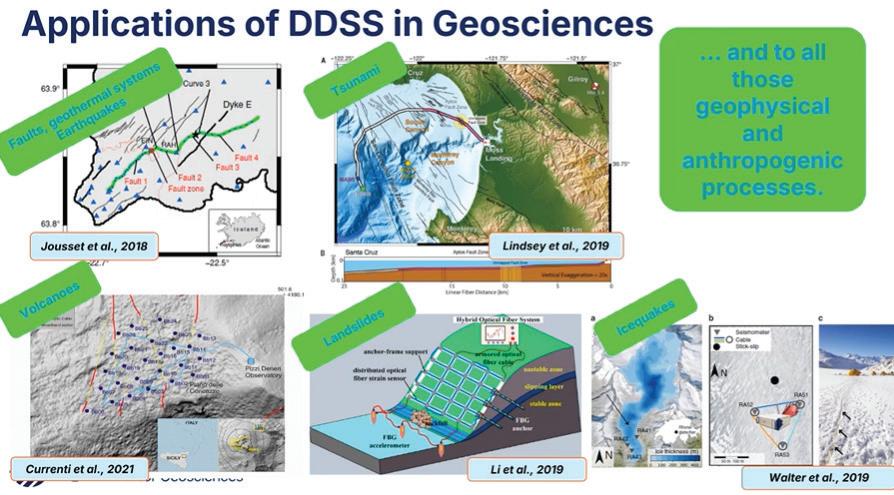
James Graves also used the telegraph submarine, especially the trans-Atlantic cables, to study earth currents, their electro-magnetic effect on the cables and their changes in polarity etc [11]. He also studied the different causes and effects of cable failures and tried, with his experience with the Channel Island Cables, to study the telegraph submarine cables that left Valentia and the Direct United States Cable [DUST] and try to predict failures due to the sudden changes in electro-magnetism and impedance etc [12]. These are great examples on how sensing was being used as far back as the early years of trans-Atlantic telegraph transmission etc.
EXTRINSIC AND INTRINSIC SENSING
But we need to look at what the present sensing designs and resultants are like. The design of a sensing system can be used across an electrical or optical system and sensing in
an optical environment comes in two forms extrinsic and intrinsic. Both offer the same results with respect to their design and use but differ in the way they are deployed.
An extrinsic sensing device uses resultants received from an electronic implement or equipment that will convert environmental changes from electrical signals to optical signals and transmit resultants back to the receiver via the optical fibre. In other words, the sensor is outside the optical fibre and uses the fibre as a transmission medium. These devices are usually used for collecting information or to measure velocity, temperature, vibration displacement or rotation and many other sensing resultants.
Figure 4: Using an OTDR as an intrinsic optical sensor [19].
Figure 5: The various applications that optical intrinsic sensing can detect [19].
An intrinsic sensor uses the optical fibre and optical wavelengths or optical frequency as the sensing mechanism. The changes in the localised environment directly affect the optical signal and this then transmits the sensor resultant back to the receiver.
As we can see the extrinsic sensor uses a device that is connected to the fibre, is localised and can only detect environmental changes at specific points where the external sensor device is located while an intrinsic uses the fibre as the sensor, can be distributed across the fibre, as it manipulates the optical signal or wavelengths within the fibre, and as a sensor can detect changes across the full length of the fibre or be distributed. This can be seen in figures 2 and 3.
OPTICAL SENSING
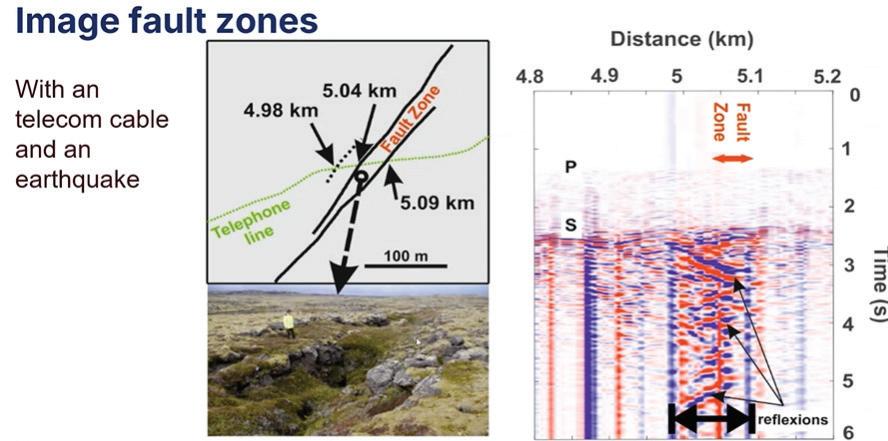
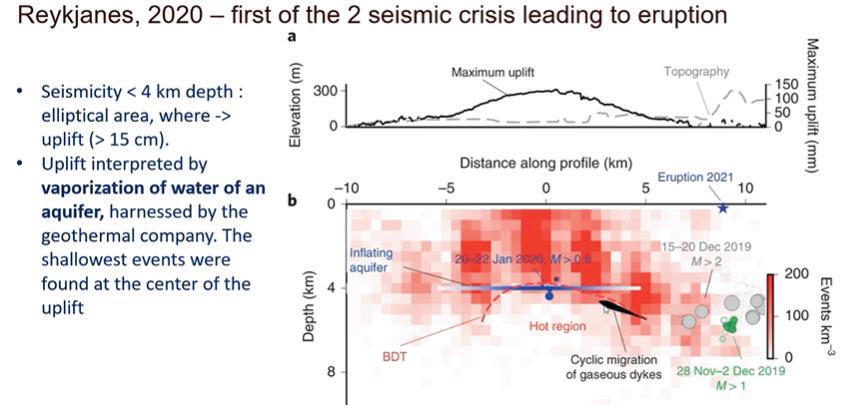
Optical sensing has now reached beyond the optical infrastructure network; it has also taken hold within other industries with sensing now become a main component in many standards. Light detection and ranging [LIDAR] systems, optical cameras and multi-sensing systems are now part of many standards that need to be adhered to, especially in critical areas such as aircraft engines, volatile environments and autonomous vehicles etc [16]. The European Union directive on vehicle safety includes major components with regards to vehicular safety sensing systems with rely heavily on Ethernet Optical systems as their sensing receiver [17]. These systems use optical fibre as the transmission conduit and Ethernet as the protocol all connected to extrinsic optical and electronic sensor devises that detect changes to the surrounding environment such as LIDAR, RADAR, Cameras and motion sensors etc [18]. These devices could work with electrical systems, but they are being deployed with optical fibre technology as the transmission systems connecting the receiver with the transmitter. Using optical fibre allows for an interference free system within a vehicle that can encounter a lot of radio and other outside and inside environmental and
electrostatic and electromagnetic interference.
Using an optical fibre as an intrinsic sensing system is something that telecommunication and academic researchers are using to help identify changes in the surrounding environment. The initial sensing design system uses the optical time domain reflectometer [OTDR] in a real time mode to detect changes as seen below. The OTDR is a tool that can easily detect changes and these detections or reflections that affect the wavelengths and the fibre itself from movements or environmental changes [19].
But the only issue with using an OTDR on real-time mode is that it can burnout the laser as it is in an always on mode. But newer specific models that are used entirely for academic and research purposes do have a long-lasting laser just like a dual feed-back laser used in communications etc which is continuously pulsing to the beat of its multiplexing protocol [20]. These new specific OTDR or sensor detection systems are used for many different environmental
Figure 6: The resultant from an optical system that is being used as an intrinsic sensor to detect movement [22].
Figure 7: An optical fibre, being used as a sensor detecting movement in the earths surface prior to eruption [23].
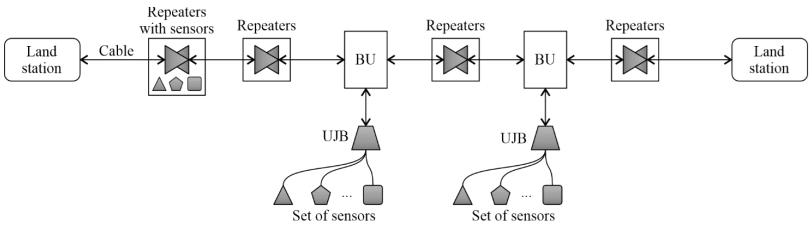
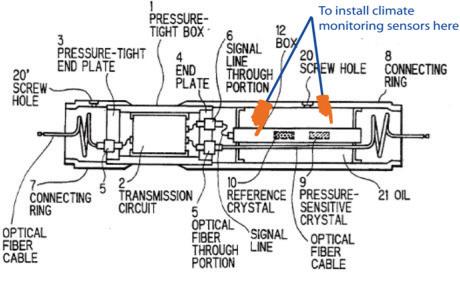
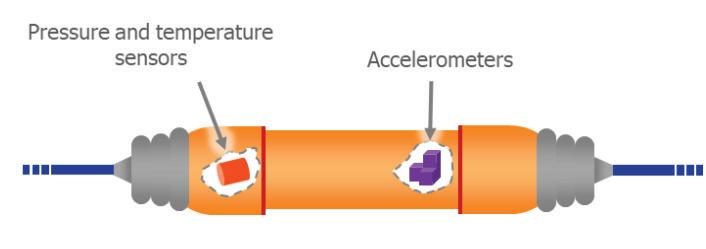
changes [19] which the use of optical fibre can provide as an intrinsic sensing device that is used for the data collection in distributed dynamic strain sensing systems using OTDRs and BOTDRs [21].
With intrinsic optical sensing systems being used for sensing purposes using existing optical networks as in figure 6, the optical fibre was used as a sensing devise to detect the earth’s movement. The movement or displacement of the earths crust can be seen or represented in the Fresnel
reflection or Rayleigh scattering resultants received by the OTDR receiver. The effects on the wavelengths and fibre are easily seen and can be used to determine the location of the shifting fault zone, which is a known fault and one that is constantly observed physically and by sensing systems such as the use of the optical system to detect these environmental changes [22].
As we can see in figure 7, the resultants or sensor detections can also indicate the movement of the fault zone in an
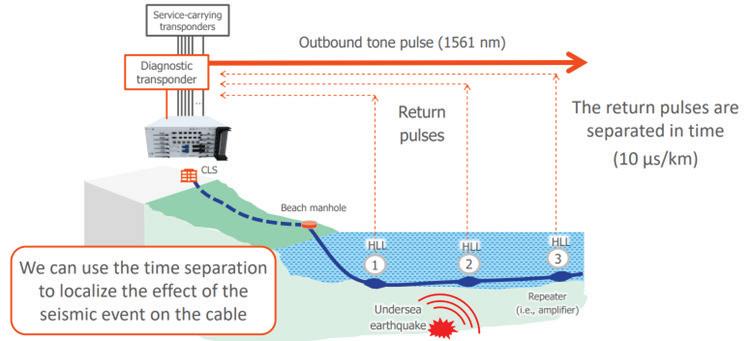
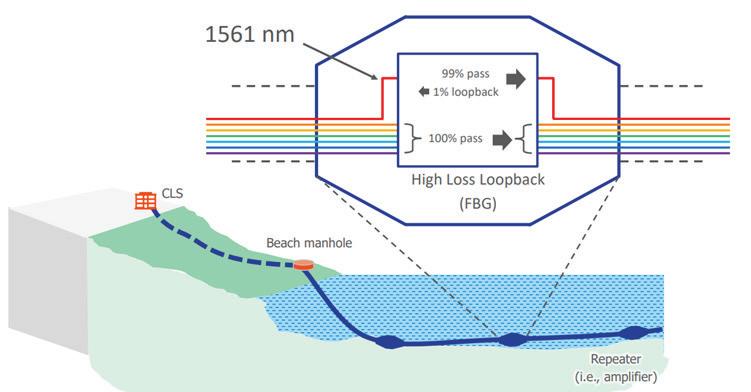
Figure 8: An example of one of the ITU-T designs from G.9730.1
Figure 11: [a] The optical subsea amplifier with probable locations of sensors with reference to ITU-T Technology watch. [b] Infinera’s locations of sensors in subsea amplifiers.
Figure 12: [a] A submarine cable sensor design with sensors housed within an optical amplifier indicating an earthquake location. [b] the sensor feed loopback with specific wavelength identified and a loopback with a 1% feedback power.
upward or downward direction, but these detections are only possible by using sensing mechanisms such as these. The sensing mechanism could be an electrical system but with effects of localised electro-magnetic interference that could affect the sensor resultant, optical fibre is the best solution as its immune to such interference etc. With the uplift in the surface associated with the seismic anomaly the optical fibre has detected that the movement is directly related to the movement or displacement of the ground in an upward direction. Even though the optical fibre sensor inputs or resultants do not show if the movement is up or down, it does exhibit a shift in horizontal plane and so records the disturbance, in real time. Actual measurement of the area will reveal the actual height up or down and also give credence and acknowledgment of the actual displacement over the three pints of measurement, time, distance and height [23].
SUBMARINE CABLE AS A SENSOR
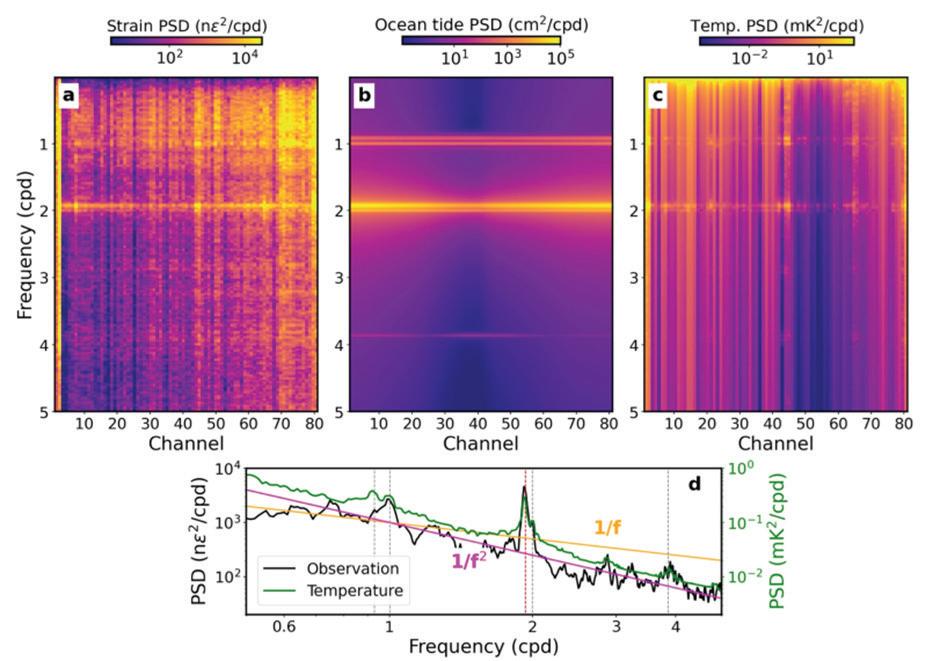
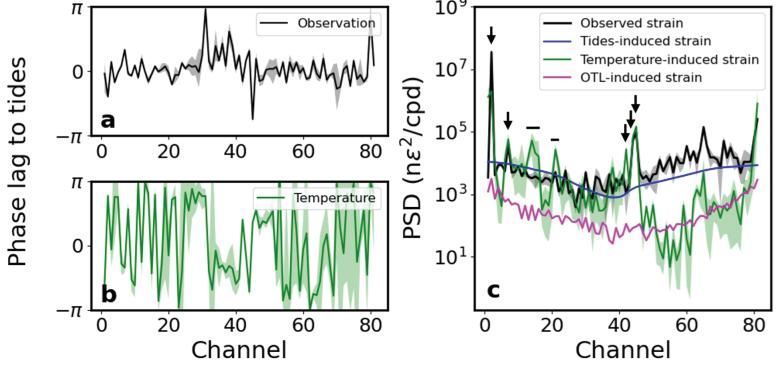
Optical submarine cables are now being used as sensors; however, the ocean floor remains one of the most unexplored or understood environments that we have knowledge of. But by using the submarine cable infrastructure we can use this as an intrinsic sensor where the environmental effects are recorded by the optical wavelengths being disturbed through interference that directly affects the fibre and it’s signalling. As the disturbance influences the submarine cable wavelengths with some sort or reflectance etc that ca be picked up by various sensing devices such as distributes acoustic sensing [DAS]. This is a type of system that uses an OTDR to detect changes in the wavelengths caused by external environmental forces. However, the DAS system only has a rough range of between 100km to 120km in detection parameters. The DAS system can detect a multitude of sensor resultants, and these can be recorded on the specific equipment use for the DAS system [24]. Another system that is in operation is the distributed temperature sensor [DTS] which works like the DAS but collecting specific sensor resultants such as temperature [25].
Because of the intrinsic sensor design that optical fibres offer, they can be used in the submarine environment to detect a lot of environmental changes. The ITU-T in 2024 issued a new document on submarine cable designs for scientific purposes and research [26]. Figure 8 is one of the designs that uses branching units in a tree and branch topology connected to multiple sensors on the seabed. The new standard G.9730.1 describes the different design topologies that could be used to install a sensor rich optical submarine cable that could be used for many different purposes.
Figure 13: From the research the above was recovered [a] observed strain on optical fibre. [b] Height of tides affecting the cable. [c] Seafloor temperature as per received sensor resultants. [d] Graph highlighting the observation of the tides and temperature as received by the sensor receiver.
Figure 14: Graphs showing the many different aspects of the received sensor resultants for tides, temperature and induced strain as seen in the two graphs.
FEATURE
Such sensors could be housed within submarine amplifiers, something that the ITU-T has envisaged in their watch report of 2010 that discussed the use of submarine cables to monitor changes in the climate that affected the seabed environment et [27]. The sensor designs for submarine cable amplifiers as seen in figure 11[a] shows the deployment of sensors with the amplifier. Infinera’s submarine cable sensor design does not differ from the ITU-T as seen in figure 11[b]. These two designs are not too dissimilar and offer a solution to how that can be deployed and how they can be housed [27,28]
Optical submarine cable systems would use a dedicated wavelength as the sensing frequency, which in the below design is 1561nm or 192.0515Thz, which would be transmitted along with the communication wavelengths but would have no effect due to wave theory [29]. To make sure that no issues with the returning wavelength the time of return has been adjusted to 10µs/km, which allow the wavelength to be reflected without any interference from the transmitted wavelength. If this was an intrinsic sensor the wavelength would be manipulated by the environmental forces acting on the fibre and could include, temperature, seafloor displacement & movement, acoustic or marine traffic. If the optical amplifier had separate sensors that injected the sensor resultant into the optical fibre as s signal with the same frequency it would be an extrinsic sensor. However, both sensor resultants would be transmitted as an optical signal along the optical fibre path. As we can see in figure 12 an impression of how the sensor would work and the frequency used as the sensor detection frequency. This type of design would be common but using the fibre
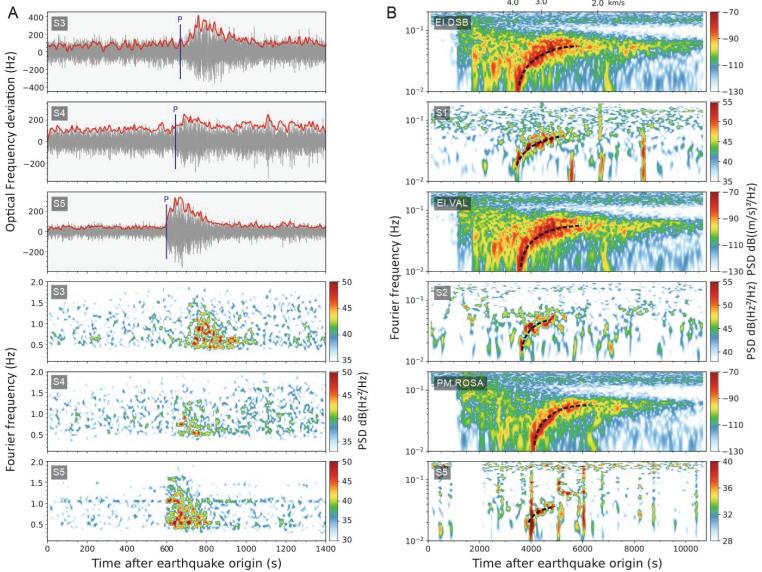
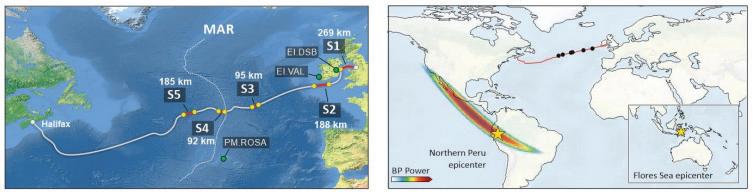
as the intrinsic sensor does also work with existing optical systems as in the below research that was carried out on the Ellalink submarine cable between Brazil and Portugal, where the submarine cable was used as sensor [30]. The sensor receiver was set up to detect three different aspects of the ocean environment such as tides, temperature and optical cable strain. They were recorded and three separate sensor resultant graphs or results for the three different environmental aspects such as tidal behaviour, optical cable strain and seafloor temperature were produced. Other results were recorded but I have only included two of the sensor resultant results and analysis to show how the optical wavelength reflections are seen and then
Figure 15: [a] The Peru earthquake depicted as vertical blue line using time series and spectrogram of the optical frequency and the P- wave arrival time. [b] Time series and spectrograms of the Flores Sea earthquake and dashed black lines depict the wave group velocity dispersion compared to land based seismic monitors.
Figure 16: [a] The map of the Dublin to Halifax cable that recorded the sensing resultants from the various optical amplifiers depicted in the impression. [b] the location of the two earthquakes.
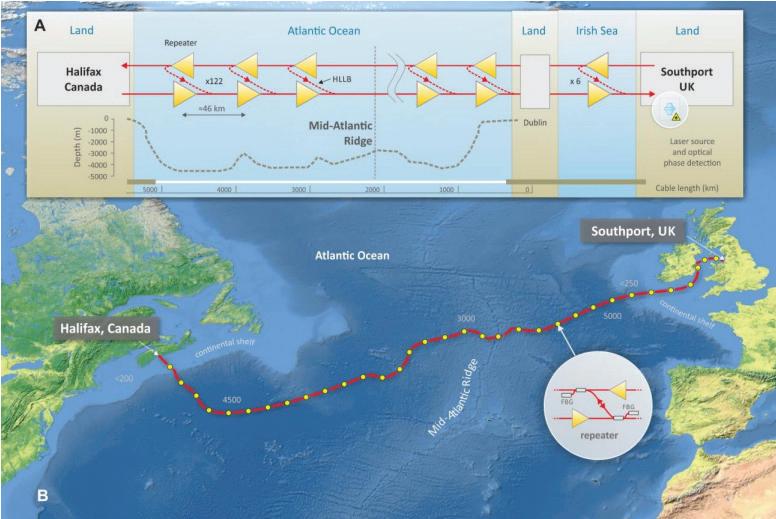
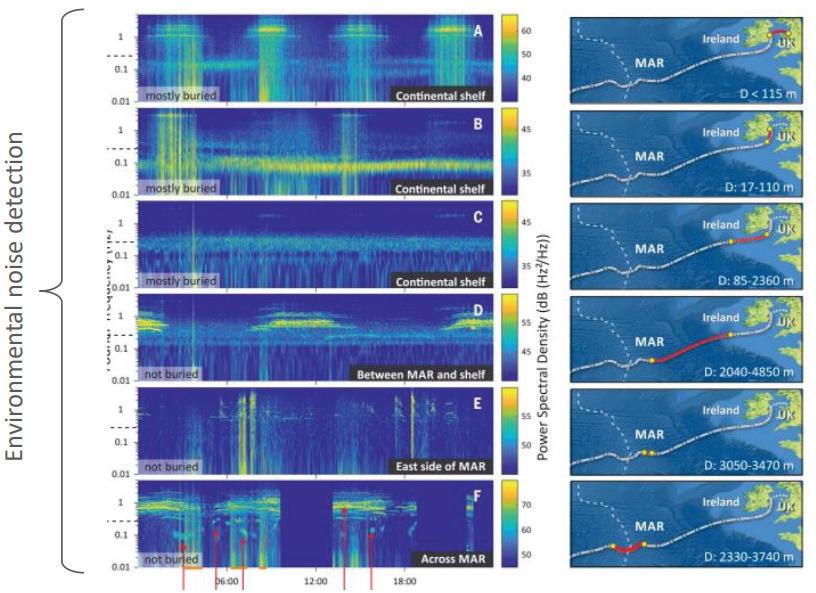
correlated into sensor information that can represent the environmental effects on the cable. The two separate set graphs [correlating the three separate sensor resultants] can be seen in figures 13 and 14. As this was the Ellalink submarine Cable it showed that the operators were willing for their cable to used as a research platform. It also used the optical amplifiers and the high loss loop-back [HLLB] that’s available in amplifiers for monitoring etc. By using existing design technology to be used as sensors it helps to push the boundary and enable real-time sensor testing and research. Another sensing project was carried out over the EXA submarine cable system between Dublin and Halifax and Dublin and Southport [31]. All this information about the cable is in the public domain and can also be seen in on the Subtel Forum site [32]. The sensing project with its capabilities could allow up to 12 optical amplifiers to be used for the sensing experiment. But this was not just an experiment., it was also an exercise to determine the ability of a long rage submarine cable to actively be used as an optical sensor. Signal to noise was a factor in using the cable as a sensor and up to half the length of the trans-Atlantic submarine cable could be tested from Dublin due to the accumulation of noise from the multiple amplifiers being used in the test. It was the SNR that set the distance parameters, but this did not cause a problem as the cable could also be tested and experimented on from the Halifax end. This enabled the whole cable to be tested from both ends, something is regularly done in OTDR testing over long cable distances etc. The full length of the Dublin to Southport cable could be tested as SNR was not a problem. During the testing period two earthquakes could be detected. Even though they were distant, their seismic waves were felt around the globe and picked up by the submarine cable as both strain and displacement of the seafloor due to the earthquake’s seismic waves. The two earthquakes, the Northern Peru Mw 7.5 earthquake (28th November 2021) and the Flores Sea Mw 7.3 (14th December 2021) showed that even though they were in opposite parts of the world, Peru and Indonesia, their effects could still be detected, these are de-
Figure 17: [a] Impression of the amplifier and high loss loop back [HLLB] and seafloor depths and [b] the illustration of the submarine cable routing that is under test.
Figure 18: the different set of sensor resultant received over the different sections of the cable depicting ocean noise or acoustic anomalies.
FEATURE
picted in figures 15 and 16 below. The power spectral density [PSD] or the power spectrum as a function of frequency components and can be analysed using Fourier theory [33]. PSD can be used to investigate sensor resultants, and to interrogate the disturbance caused by the two earthquakes that were felt over several amplifiers along the Dublin to Halifax cable length. The resulting graphs that can be seen certainly show that submarine cables can be used to detect outside environmental changes such as seafloor disturbances and seismic waves over long distances.
The team also looked at noise I the ocean and experiments and testing resulted in the system recording different acoustic signatures along various lengths of the cable. These results can be seen in figure 17 indicating the different sections of the cable that were investigated for ocean noise and their sensor resultants received and analysed.
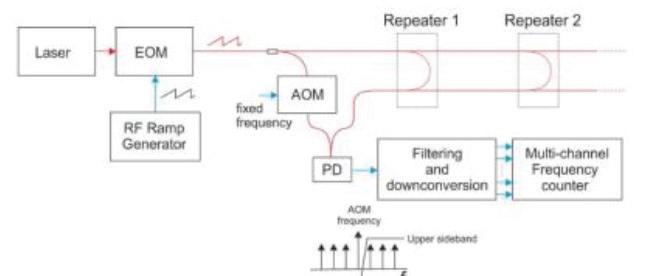
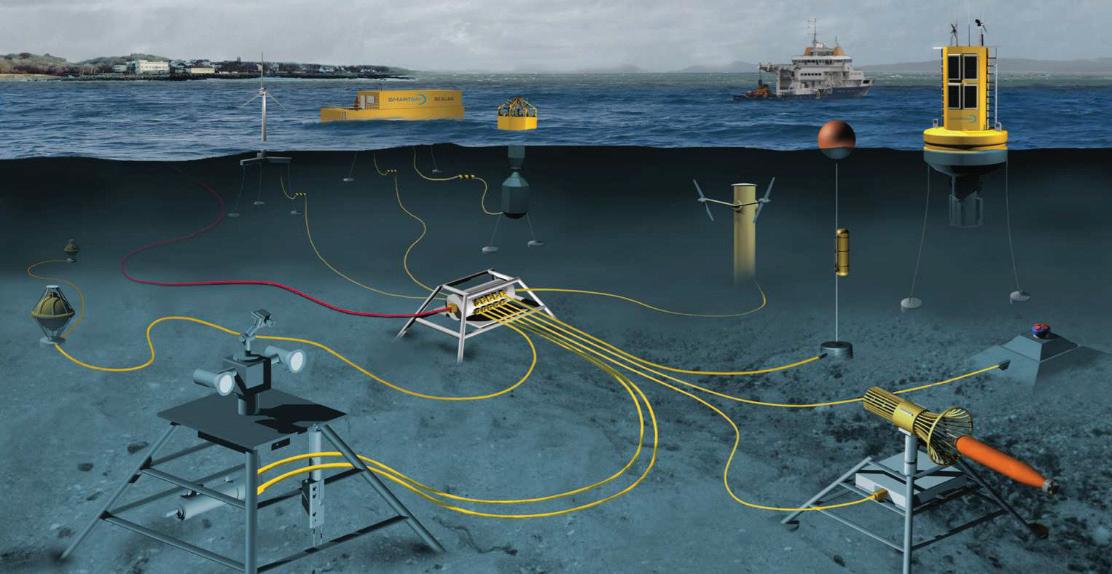
ACTIVE RESEARCH IN SUBMARINE CABLE SENSORS
Seafloor stain or ocean effects on the submarine cable were also investigated by Zumberge and his team, and a depiction of the sensor setup is seen below in their diagram showing how the sensor resultants are collected and correlated into a set of results that can determine the effect on the submarine cable [34]. As we ca see the HLLBs in each optical amplifier, note that repeater is used, but it should amplifier for correct depiction of schematic. A paper was published in Subtel Forum in 2010 discussing the nonconventional use of submarine cables as sensors to be used to detect seismic waves, temperature and many other environmental changes that can be detected in submarine cables [35].
This type of scientific research submarine cable is already in use and is actively recording many different sensor resultants from the system and the results are being analysed by the Marine Institute in Galway and across many other university and academic institutions across the globe. One such research was the study of wave power measured in Kw/m in Galway Bay for a 12-month period over 2015 [36]. The SmartBay design is set out in a way that multi-sensors are deployed to detect changes in temperature, seabed movement & displacement, tidal currents, wave energy, wave heights, dolphin & whale noises and movements and marine activity with a speciality on submarine vehicle detection etc. [37].
The Irish Marine Institute [IMI] was set up in 2006
Figure 19: A depiction or schematic of a sensor system being deployed across a submarine cable.
Figure 20: An artist impression of the sensor layout at the SmartBay site in Galway Bay.
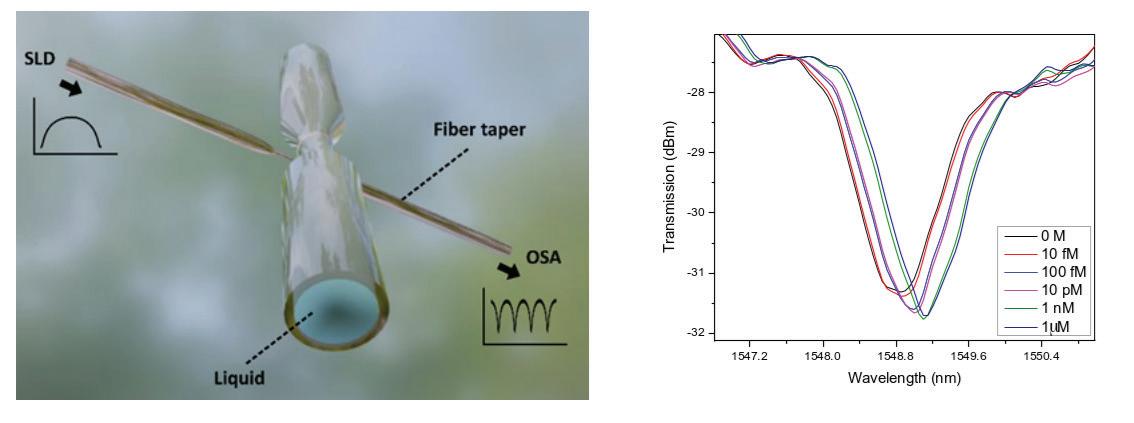
in Galway to primarily carry out research of the oceans particularly the Irish coastal zone and the EEZ. They have multiple research centres in Galway, Cork, and Dublin and they also own and deploy two Ocean going research vessels fully equipped to explore the depts of the Atlantic Abyssal Plain, the continental shelf and coastal regions. The IMI has close associations with the Marine Institutes of Great Britain, Iceland and the Scandinavian countries and regularly carries out deep bottom research on behalf of these institutions etc [38]. The IMI also works with many industry bodies, submarine cable manufacturers and operators to help design new submarine sensor system that will help with sensor collection and detections etc along with system designs etc.
Other academic research is being carried out on optical fibres being used as sensors where the fibre is tapered to expose the optical core and use it as a receiving sensor or intrinsic sensor as the optical wavelengths are manipulated by the system under test that detect anomalies etc [39]. These sensor resultants can be seen in figure 21.
Other research, in University College Dublin, is looking into the trajectories of self-written waveguides and the way that they can be manipulated in their direction and trajectory with respect to the environmental changes affecting the photopolymer [40]. This photopolymer material is photosensitized to light in the wavelength 532nm. By exposing the laser onto the photo-
polymer, self- written waveguides are created that are permanent in nature and can carry any multiple wavelengths as the waveguide that is created allows for multiple coherent light
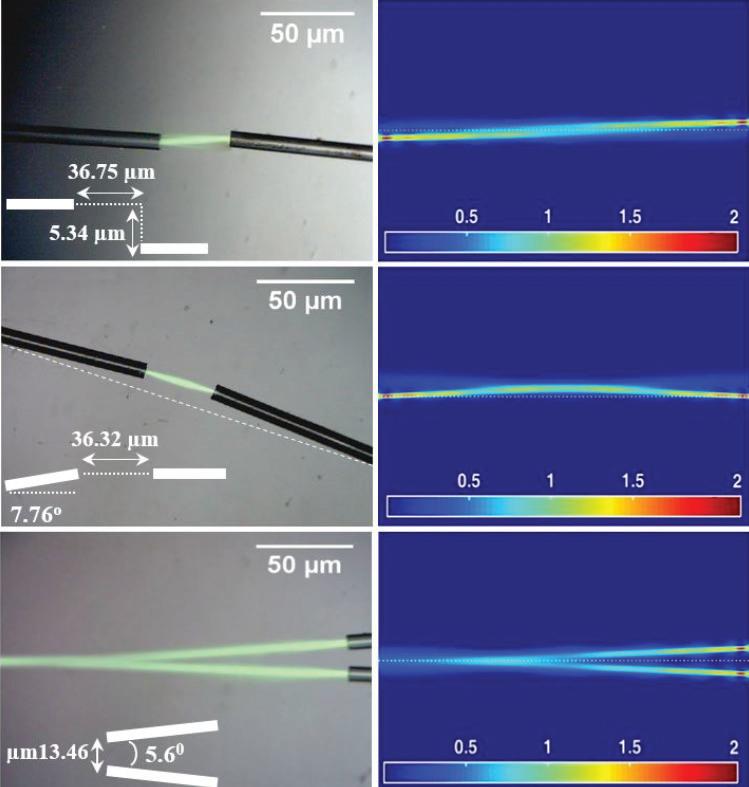
Figure 21: The fibre, exposing the optical core wrapped around a system under test and the graph showing the various sensor resultants analysed by the effect on each wavelength with optical power being used as an analysing component.
Figure 22: Three examples of light manipulation within a photopolymer material being presented alongside the simulated result.
FEATURE
beams to pass through from the visible to the infra-red spectrum. As can be seen from figure 22, various examples of light leaving a fibre and entering another fibre within a photopolymer material, The two top examples show the light bending so that the two fibres are connected as the refractive index changes within the material and the final example we can see two beams of light creating a coupler at 5.6º incidence. This proves that the photosensitive material can be used as a sensor and can detect changes in its environment. Simulations were also carried out to show that the manipulation can also be calculated, correlated, analysed and recorded.
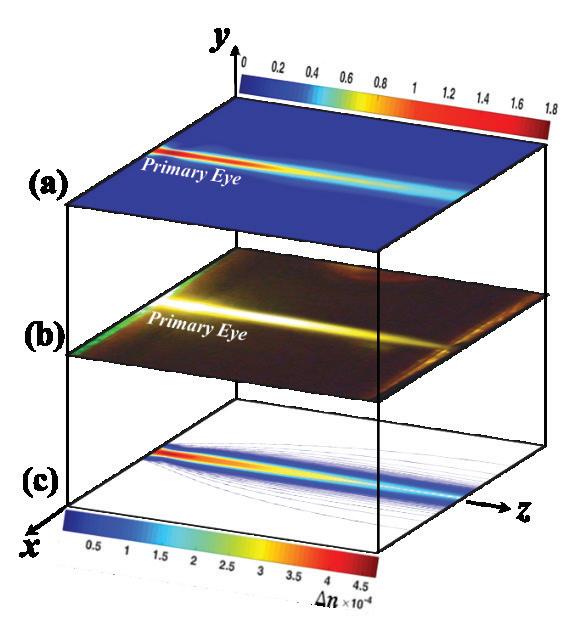
Other research being carried out in University College Dublin which is looking at using photopolymer material to collect data on seismic waves and ground displacement by recording the sensor resultant in the photopolymer material as an actual waveguide. The material is solid and is sensitive to light in the green at 532nm. This wavelength when exposed onto the photosensitive polymer material will create its own waveguide in the direction of the light [41].
This design can be used in environments where electrical components cannot be used as the only components are the photopolymer, light beam and optical fibre. This type of system can be used in area of volcanic activity, highly combustible and flammable environment such as a ATEX area [42]. These areas are strictly controlled, and all devices need to be ATEX rated. Having a non-electrical component or device is preferred to any other and using optical fibres as intrinsic sensors and adding photopolymers would be an added extra as
they can record the sensor resultant in real time.
But using the photopolymer as an actual sensor and recording the waveguides as they are written into the photosensitive material in also under ongoing research. When the photopolymer is moved due to a seismic wave or earth displacement the recorded waveguide will record the direction and force of movement [43]. This research will not only show the displacement of the surrounding area but also the direction and force used and will represent the sensor resultants in a 360º result, as seen if figure 23 and 24. The use of this device is ideal for recording displacement, as said, it can show the displacement in the actual direction and the force used in the displacement.
CONCLUSION
Just as James Graves had investigated anomalies in the impedance of telegraph cables and published a paper in 1875 on his findings of earth displacement [44] is a good benchmark showing that sensing has been used on submarine cables for a very long time. It has evolved into a new technology that SMART and sensing cables are now deploying sensing as part of their design and that wavelengths can be manipulated by outside forces and cause the different wavelengths to record these disturbances due to Fresnel reflections or Rayleigh scattering. New communication cables are now being deployed that have sensing as part of their selling point and existing cables cab used their own HLLB system to be used as sensors. STF
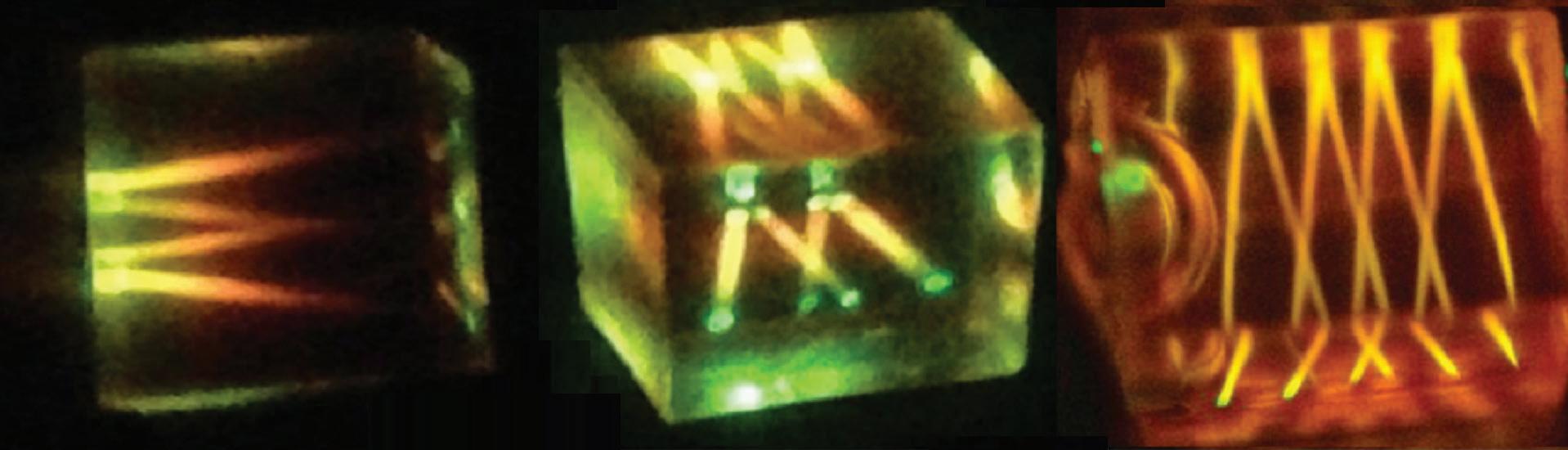
Figure 22: An example of a self-written wave guide through simulation, experimental and mathematical refractive index analysis.
Figure 22: Examples of actual recordings of self-written waveguides within photopolymer material that was moved in a way to record the waveguides.
DEREK CASSIDY is doing a part-time PhD in the field of Optical Engineering which covers Photopolymers, Self-Written Waveguides, and Wavelength manipulation/Opto-Electronics with UCD under Prof. John Healy and Prof. John Sheridan. He is a Chartered Engineer with the IET/UK Engineering Council-Engineers Ireland and Past-Chair and Committee Member of IET Ireland. He is Chair of the Irish Communications Research Group, Advisory Board Member of Submarine Networks EMEA/World and member of numerous standards committees on Optical Engineering under the umbrella of the IEEE and Future Networks. He is also currently researching the Communication History of Ireland. He is a member of SPIE, OPTICA, IET, IEEE, Engineers Ireland, ACMA, ICPC and ESCA. He holds patents in Mechanical and Design Engineering and author of over 30+ papers on Photonics, Submarine Cable Technology, Communications and Optical Engineering. He has been working in the telecommunications industry for over 30 years managing submarine networks and technical lead on optical projects, both nationally and internationally with BT. He is technical Lead for Valentia Transatlantic Cable Foundation and the Valentia Island World Heritage Bid. Derek holds the following Degrees: BSc (Physics/Optical Engineering), BSc (Engineering Design), BEng (Structural/Mechanical Engineering), MEng (Technology & Policy Development and Forensic Engineering), MSc (Optical Engineering) and Higher Diploma in Cybersecurity.
References https://www.momolithicpower.com/en/learming/mpscholar/sensors/into-to-sensors/ history-and-evolution. Accessed 28 August 2025.
Brief History of the Barometer: https://www.barometer.ws/history.html. Accessed 23 August 2025.
Mallet, R., “On the dynamics of earthquakes; being an attempt to reduce their observed phenomena to the known laws of wave motion in solids and fluids”. The Transactions of the Royal Irish Academy, 21, pp.51-105,1848.
Elias, D., “The possible development of telecommunications and its effects on the telecommunications industry” Philosophical Transactions of the Royal Society of London. Series A, Mathematical and Physical Sciences28919–28, 1978.
Marett, G., “A history of the telegraph in Jersey 1858-1940”, 2009. https://www.atlanticcable.com/Cables/1858ChannelIslands/Gramemarett.pdf. Accessed 21 August 2025. https://www.atlantic-cable.com/channel-islands-cable-1858. Accessed 21 August 2025.
Graves James, Earth currents and earthquakes, Journal of the Society of Telegraph Engineers, Volume 2, Issue 6, 1873.
Hequette, A., Aernouts, D., “The influence of nearshore sand bank dynamics on shoreline evolution in a macrotidal coastal environment, Calais, northern France”, Continental Shelf Research, Science Direct, Volume 30, Issue 12, Pages 1349-1361, 2010.
Fox, D., “James Graves [1833-1911], his descendants, the electric telegraph and Valentia”, Don Fox Family and social history, 2018.
Varley, C. F., 2On the Relative Speed of the Electric Wave through Submarine Cables of Different Lengths, and a Unit of Speed for Comparing Electric Cables by Bisecting the Electric Wave”, Proceedings of the Royal Society of London, vol. 12, pp. 211–216, 1862.
Graves, J., “Earth currents”, Journal of the Society of Telegraph Engineers, Volume 2,issue 4,Pages 102-110,1873.
Graves, J., “On the Causes of Failure of Deep Sea Cables”, Journal of the Society of Telegraph Engineers and Electricians, Volume 13, No. 51, 1884.
Tosi, D., Sypabekova, M., “Optical Fiber Biosensors, Devise Platforms, Biorecognition, Applications », Academic Press, 2022.
Kelly, A., Zweben, C., “Comprehensive Composite Materials”, Science Direct, 2000.
Cappelli, M., “Instrumentation and Control Systems for Nuclear Power Plants”, Woodhead Publishing, Elsevier, 2023.
Ignatius, H.A., Hesham, E., Khan, M., “An overview of sensors in autonomous vehicles”, Sciencedirect, SCAD, 2021.
“Regulation 2019/2144”, European Union, 2019.
“What is an autonomous car-how self-driving cards work”, Synopsys. https://www. synopsys.com/glossary/what-is-an-autonomous-car.html. Accessed 25 August 2025.
Jousset, P., et al, “Distributed Dynamic Strain Sensing and its use for the monitoring of Volcanic events in Iceland” Helmholtz Centre fir Geosciences, SENSEI, 2025.
Figure 22: A simulated result four beams of light being moved in a way that they create converged self-written waveguides.
Cheng, Z., Zhao, G., Zhang, Z., Zhao, X., Yin, R., et al, “Dual laser based optical feedback cavity enhanced absorption spectroscopy by polarization division multiplexing”, Sensors and Actuators B: Chemical, Volume 414,2024.
Wu, H., Guo, N., Zhong, Z., Guo, W., Han, L., et al, “High performance distributed dynamic strain sensing by synthesizing OTDR and BOTDR” opt, Express31, 1809818108, 2023.
Jousset, P., Reinsch, T., Ryberg, T. et al. Dynamic strain determination using fibre-optic cables allows imaging of seismological and structural features. Nat Commun 9, 2509, 2018.
Flóvenz, Ó.G., Wang, R., Hersir, G.P. et al. Cyclical geothermal unrest as a precursor to Iceland’s 2021 Fagradalsfjall eruption. National. Geoscience. 15, 397–404, 2022.
Cedilnik, G., et al., “Pushing the Reach of Fiber Distributed Acoustic Sensing to 125 km Without the Use of Amplification”. IEEE Sensors Letters. 3 (3): 1–4, 2018.
Hartog, Arthur. (2017). An Introduction to Distributed Optical Fibre Sensors. ITU-T G.9730.1 “Dedicated scientific sensing submarine cable system” Series G: Transmission systems and media, digital systems and networks, 2024.
“Using submarine cable communications networks to monitor the climate” ITU-T Technology watch report, 2010.
Bennett, G., “A review of seismic detection techniques for tsunami early warning system”, Tyndall Submarine Cable Workshop, Infinera, 2024.
Anderson, F.L. Huygens “Principle geometric derivation and elimination of the wake and backward wave”. Sci Rep 11, 20257, 2021.
Liu, M., Costa, L., Mertz, P., Varughese, S., Edirisinghe, S., Kamalov, V., & Zhan, Z. (2025). Trans-oceanic distributed sensing of tides over telecommunication cable between Portugal and Brazil. Geophysical Research Letters, 52, 2024.
Mara, G., Fairweather, D., Kamalov, V., et al. “Optical interferometry-based array of seafloor environmental sensors using a transoceanic submarine cable”. Science, 2022.
https://www.subtelforum.com. Accessed 30 August 2025.
Chaparro, L. F., “Fourier analysis of discrete time signal and systems”, Signal and Systems using MATLAB, p 571-638, 2011.
Zumberge, M. A., Hatfield, W., & Wyatt, F. K., “Measuring seafloor strain with an optical fiber interferometer”. Earth and Space Science, 5, 371–379, 2018.
Cassidy, D., The Non-Conventional use of submarine Cables: An observation, Submarine Telecom Forum, Defence and Non-Traditional Cable Systems, Vol 54, PP 18-21, 2010.
Anton, I., “Wave resource characterisation at the Galway Bay marine and renewable energy test bed-via SmartBay” MaREI, 2016.
https://www.smartbay.ie. Accessed 22 August 2025.
https://www.marine.ie. Accessed 31 August 2025.
Anand, Semenova et al, Photonics Ireland, 2025.
Malallah, R., Cassidy, D., Wan, M., Sheridan, J. et al, “Optical trajectory manipulations using self-written waveguide technique”, Polymers, 2020.
Cassidy, D., “Manipulation of optical waveguides”, AJP, 2023.
https://www.hsa.ie/guides/atex. Accessed 29 August 2025
Cassidy, D., “Self-written waveguides as an optical polymer sensor”, SPIE, 2023.
James Graves, On vibrations due to Earth-Plates, Journal of the Society of Telegraph Engineers, Vol. 4, Issue 10, pps 34-41, 1875.
EMERGING OFFSHORE WIND CABLE MARKETS
South America and Africa
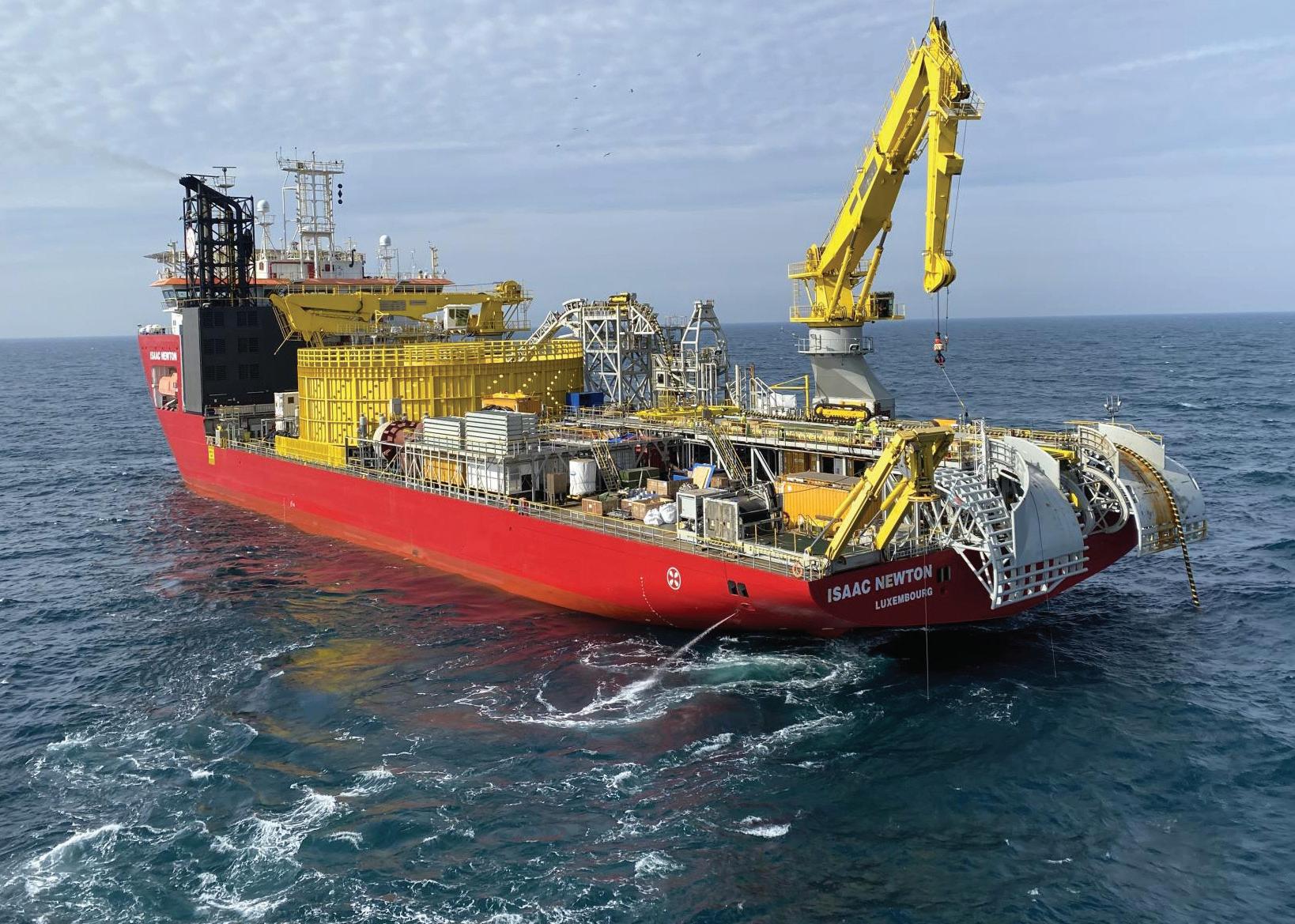
BY JOHN MANOCK
The global market for offshore wind cable is booming.
The growth that we have witnessed has been remarkable, not only with the demand for cable as wind farms are being built globally, but also in the response from suppliers in the form of new and upgraded manufacturing facilities and a surge of new cable ships to handle installation, maintenance and repair. Most of what has been written in this regard has been focused on the European market – the biggest and most vibrant in the world, as well as growing markets in Asia, particularly China, and the on-again, off-again activities in the United States.
I am not, however, going to discuss those regions in this article. Instead, I will focus on two continents that get far less press coverage – South America and Africa – and how these markets should be in the minds of companies competing, or planning to compete, in the offshore wind cable supply market in the next two decades and beyond.
As the markets in South America and Africa are still in the very preliminary stages with no turbines actually hitting the water in either continent yet, I must talk about the
potential for the growth of the overall market before I can talk about the specific offshore wind cable market.
Much has been written about the development of the global offshore wind market. For years, the market struggled to reach a point where demand was sufficient to create an economy of scale, thus making the technology commercially viable. This pattern has repeated itself many times in the high-tech world – see desktop computers.
In the case of offshore wind, it was Europe that broke the barrier and allowed for the wide-spread adoption of offshore wind technology, which, in turn, created the level of demand that brought viability to the market. This occurred in the previous decade and has resulted in widespread growth throughout northern Europe, particularly in the United Kingdon, Denmark and Germany. Now knowing the way forward, other countries soon followed and offshore wind technology expanded throughout many parts of Europe, as well as in Asia (China, Korea, Vietnam, etc.) and, in a continuing series of fits and starts, in the United States as well.
Now that the technology has reached the point of
widespread acceptance, the next step is the development of new markets. Almost every country that has a coastline and sufficient wind resources has been looked at as a potential for offshore wind development, but in this article, I will look at several countries in South America and Africa that are developing serious plans for offshore wind farms and their potential impact on the global offshore wind cable market. New offshore wind markets in these countries have dropped somewhat under the radar as far as media exposure goes, but be assured, many offshore wind developers from around the world are watching them.
Individually, these markets are small compared to the mature offshore wind markets of, for example, the United Kingdom, with its nearly 50 wind farms. None of the seven countries discussed in this article have any offshore wind farms operational, under construction or even licensed (at the time of writing this article – that may change quickly). In addition, they will likely experience all of the same growing pains – legal and regulatory frameworks, environmental challenges, technological changes, strained supply chains, etc. – that the mature markets have faced at various times during their development. In spite of this, the emerging markets in South America and Africa, especially when taken in aggregate, represent a substantial opportunity for cable suppliers. Considering this, it is important for suppliers to understand the potential these markets represent.
COUNTRY PROFILES
SOUTH AMERICA
Colombia
Colombia’s promising offshore wind market has attracted the attention of investors. The country plans to conduct its first offshore wind tender in August 2025 (the results of which were not available at the time of the writing of this article). The government, through the National Hydrocarbons Agency (ANH), received eight applications to bid on the tender and approved all eight after an evaluation process. The tender received international interest, with applicants including companies from the United Kingdom, China, Denmark and the Netherlands.
Colombia’s goal is to develop 3 Gigawatts (GW) of offshore wind capacity by 2035, and 7GW by 2040. This is certainly a reachable goal and represents an excellent first step in fulfilling Colombia’s ambitions to position itself as a regional offshore wind leader. Colombia’s total offshore wind resources are estimated at about 100GW.
Chile
Chile is well endowed with green energy resources. The country is a world leader in the production of solar, hydro-
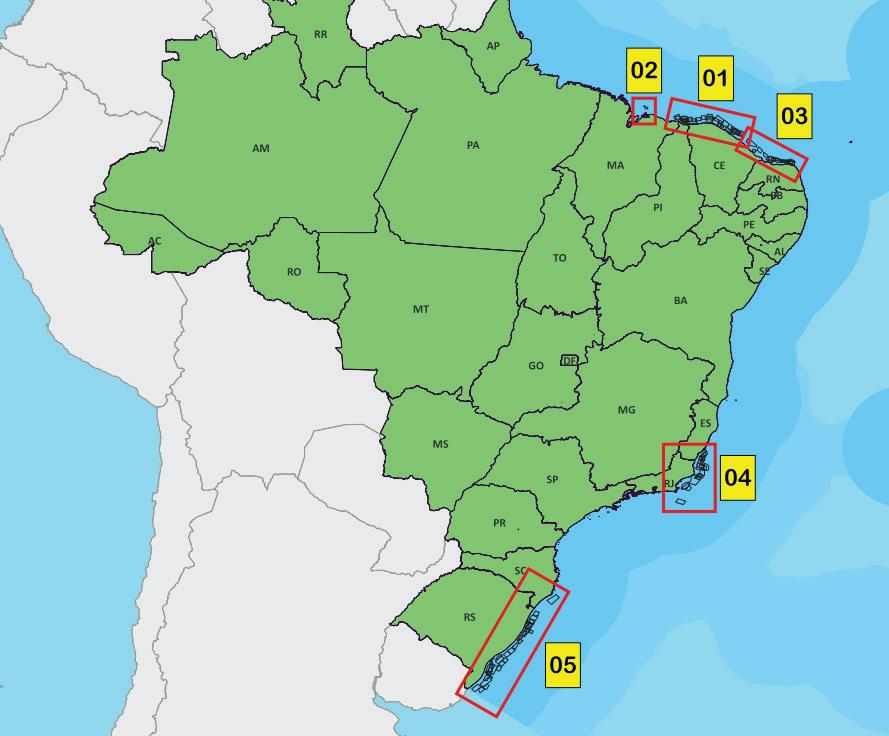
electric and onshore wind electricity generation.
Chile is still in the early stages of its offshore wind plans, but has tremendous potential. Southern Chile also has some of the best offshore wind resources in the world. According to a study by Energiamarina and Universidad Austral de Chile, Chile’s estimated technical potential of offshore wind energy is a phenomenal 957 GW.
In spite of this, Chile’s offshore wind market remains untouched. That is changing, however. In 2024, a proposal for the first offshore wind farm in Chilean waters was put forward. A U.K.-based developer, in partnership with a Chilean energy company, is behind the project and it is being supported by RenewableUK, a U.K. trade association that also supports the growth of the market in other countries. The proposal is still in the early stages, but would have a capacity of about 1GW.
This project has been joined by a Norwegian developer that has put forth plans for two offshore wind farms totaling 2.4GW. The company, known as Deep Wind Offshore, is owned by Knutsen Group, Haugaland Kraft, Sunnhordland Kraftlag and Octopus Energy Generation and is developing projects in Norway, South Korea and Estonia, in addition to Chile.
Uruguay
Uruguay plans to release a tender for up to 3GW of offshore wind capacity in four blocks in the relatively near future, although the exact timeline is not clear. The tender will be run by the Uruguayan Ministry of Industry, Energy and Mining (MIEM). This may only be the beginning of a much larger market, as Uruguay has designated more than 20 ocean blocks that could be used for offshore wind projects. Uruguay’s total projected wind resources is estimated at around 300MW.
FEATURE
Brazil
Brazil has a huge coastline and the wind resources to drive a booming offshore wind industry. It is going through the same lengthy process of agreeing on a legal framework and regulatory regime, but even with this the process is still a work in progress. The Brazilian government agency that is responsible for offshore wind development, the Brazilian Institute of Environment and Renewable Natural Resources (IBAMA), has received license proposals for more than 100 projects. If all are built, they would produce somewhere in the area of 250GW of electricity. If you think that is a huge number, also consider that Brazil’s total wind resources is a whopping 1,200GW.
In January 2025, Brazil put an offshore wind legal framework in place after a lengthy process. This greatly increased the momentum for the market. Among the proposals received by IBAMA are those from international heavyweights such as EDF, Equinor, Iberdrola, Ocean Winds and TotalEnergies. Petrobras, the Brazilian state-owned energy company, has been interested in the offshore wind market for several years and has floated the concept of a large wind farm in the Campos Basin. Meanwhile, Macquarie Group’s offshore wind unit, Corio Generation, has plans for five offshore wind farms totaling 6GW of capacity.
AFRICA
Morocco
Morocco may seem to be an unlikely place for a vibrant offshore wind market. The west coast of Africa is not known for its high winds. Morocco is an exception, however, along with Mauritania (see below). Morocco has unusually strong offshore wind resources in the region, as well as a long coastline. It is estimated that Morocco’s wind resources could support up to 200GW of offshore wind generation.
Morocco is targeting 2030 to reach a reliance of 52% on renewable sources for the country’s electricity. In alignment with this objective, a windfarm off the Atlantic coast near Essaouira is currently under development. The facility will have a capacity of 1,000MW and is expected to begin construction by 2029. This offshore wind farm could be the first on the entire continent.
Mauritania
Another exception in West Africa is Mauritania. Its coast also experiences strong winds and its potential for offshore wind has been identified as 170GW. Both Mauritania and Morocco also have the incentive of being close enough to Europe to supply that continent with electricity. In addition, the potential of green hydrogen as a major,
clean fuel source, is as attractive in Africa as it is in South America. The potential impact of green hydrogen production using offshore windfarms and how that is helping to drive some of these markets is discussed further below.
Mauritania’s plans are not as advanced as Morocco’s, but the country has the potential to be a significant player in the offshore wind market in the future. It is worth keeping an eye on it.
South Africa
South Africa has a huge potential offshore wind market. It has the largest offshore wind resources in the continent at 900GW. South Africa’s coastline slopes sharply, so all of its wind farms are likely to use floating turbine technology.
The first proposed farm is known as the Gagasi Offshore Floating Wind Farm. It will be only four to fourteen kilometers offshore and will have a capacity of 810MW. Some details are still to be hammered out, but it could also begin construction by 2029.
South Africa’s Renewable Energy Independent Power Producer Procurement Program (REIPPPP) is a public-private partnership competitive purchase program launched by the government in 2011 for renewable energy projects. It does not include offshore wind, as that was not an option at the time. Offshore wind advocates, however, are watching for changes in the REIPPPP that might include the addition of offshore wind projects. If this happens, it would greatly increase interest from developers.
WHY OFFSHORE WIND?
Before I attempt to quantify the offshore wind cable market in South America and Africa, some may question why these countries are even looking at offshore wind to begin with.
Many of the countries I have discussed already get much of the electricity from renewable sources – solar, onshore wind, hydroelectric, etc. – and do not use a lot of fossil fuels. Why add another renewable electricity source to the equation? The answer to this, is green hydrogen manufacturing. What green hydrogen is and how it fits into the equation is beyond the scope of this article. I have to note, however, that it does help to create the offshore wind cable market in these countries on the scale that we are discussing. It adds a demand driver beyond what we are familiar with in the developed markets in Europe, China and the United States.
Without going into details, suffice to say that green hydrogen can become one of the most important fuels of the future. The market for green hydrogen is still a long way off, but as offshore wind farms have very long development
cycles themselves, the linkage between the two are being identified now even though it may not reach fruition until the 2030s, or 2040s, or beyond.
Green hydrogen holds tremendous potential as a fuel source. In fact, it could be the oil and natural gas of the second half of the 21st Century. The countries that have excellent wind resources are, for the most part, not those that have large fossil fuel deposits. The ability to export green hydrogen to developed countries that want to reduce their carbon footprint could be a huge driver for economies that often have struggled due to a lack of mineral and other natural resources. This makes green hydrogen a serious driving force and one that makes the development of the markets described above likely to eventually grow, possibly to giant proportions.
QUANTIFYING THE MARKET
Determining the size of the offshore wind cable market for these countries listed above is difficult given the early stage of development of these projects and the known difficulties in getting an offshore wind market in any country up and running. We do not know the details on most of these projects – specifically, the considerations that will dictate the amount of cable that will be required, such as the number of turbines in each farm and the layout of the turbines within the farm (impacting the amount of array cable that will be needed), or the distance from shore and number of export cables (impacting the amount of export cable required).
In addition, offshore wind farms have very long development timelines. It could be 10, 15, or even 25 years before many of these farms are in service. We don’t know what the technology will even look like by then.
Lastly, we can only guess at the timeframe. Anyone who followed the development of the offshore wind market in Europe or the U.S. can tell you that, during its formative time, the market was nothing if not unpredictable. How many times were goals set, firm targets identified and assurances made that deadlines would be met, only to have them slip, and slip, and slip? How many times did we hear presentations at conferences in 2010 that the market would reach a point of critical mass within five years, then here the same presentation five years later?
It is not, however, too early to begin trying to quantify the cable market. This will be a very rough estimate given the lack of critical data, but this is the first step in evaluating a developing market.
I have discussed seven countries in this article – Brazil, Chile, Colombia, Mauritania, Morocco, South Africa and Uruguay. Their combined potential offshore wind resources are almost 4,000GW. Let’s assume that, by 2050, these
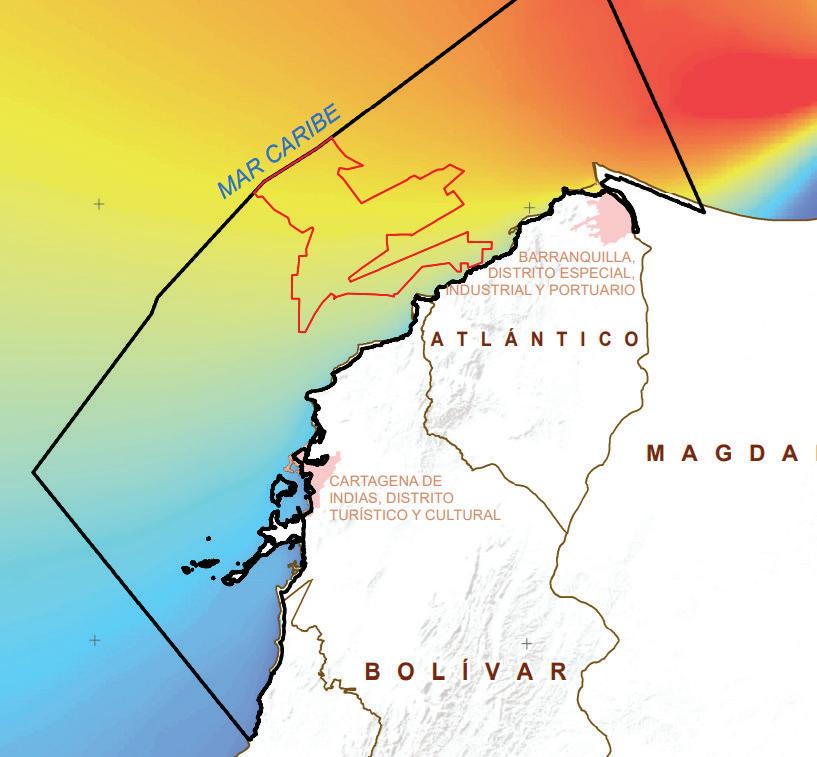
countries have established offshore wind industries that have utilized 1% of their total wind resources, which would be 40GW. Next, let’s pick a number for the amount of cable per GW. This is the trickiest part, as we do not know the details of the configurations of these windfarms up to 25 years into the future. As noted above, there is a lot of data that is still missing on this. I will make an estimate that 250 kilometers of array and export cable will be required per GW, based on rough calculations using past experiences and assuming 15MW turbines. That gives us a demand of 10,000-kilometers of cable by 2050. Spread equally over 25 years, that brings us to 400 kilometers of cable per year.
While this is a small amount of cable when compared to the developed markets, it is a significant addition to the already high demand the industry is experiencing. This is merely one possible forecast and is deliberately conservative, but it shows the potential these markets have. Besides, the real purpose of this article is not to present a market forecast, but to demonstrate that there are many countries out there that see an opportunity to build a strong and vibrant offshore wind market and are doing the difficult work to establish a legal and regulatory framework for this. Governments and developers are taking these opportunities seriously. For companies planning to play a major role in the global offshore wind market, it is important to begin tracking the developments in these locations. Some projects will succeed, some will fail, but the potential is there and the offshore wind cable industry needs to pay attention to it. STF
JOHN MANOCK has been a consultant in the submarine cable industry for more than 30 years. Mr. Manock has worked on over 100 submarine cable feasibility studies during his stints at KMI Corporation, T Soja & Associates, Inc., Ocean Systems Inc., and APTelecom. He also was in publishing for 12 years at TSC Corporation, as a writer and editor of Submarine Cable World. He currently is President and Founder of Blue Coast Consulting LLC.
FEATURE

IDECODING THE FLEET
Launching the Cableship Codex – A New Era of Cableship Intelligence
BY KIERAN CLARK, SENIOR ANALYST, SUBMARINE TELECOMS FORUM
n 2025, the submarine cable industry has reached a critical convergence point: historic levels of investment meet a limited—and increasingly constrained—fleet of cableships. Whether deploying transoceanic systems or responding to unexpected faults, the same challenges persist: asset availability, equipment compatibility, and reliable insight into who’s operating what, where, and how fast.
To meet this demand, Submarine Telecoms Forum proudly introduces its newest quarterly publication: The Cableship Codex, launching in December 2025.
A PUBLICATION FOR A NEW ERA
Purpose-built for project managers, marine coordinators, system developers, financiers, and regulators, the Cableship Codex brings structured visibility to the world’s cable installation and maintenance fleet. It is the first editorially driven platform focused solely on this critical infrastructure.
“For years, our readers have asked for a better way to track cableship activity. The Codex is our answer: focused, data-rich, and made for the real world.” — Wayne Nielsen, Publisher, SubTel Forum
WHAT IS THE CABLESHIP CODEX?
The Cableship Codex is a quarterly, digital-first publication offering a technical, data-driven reference on the global cableship fleet. Each issue delivers:
• Vessel Technical Profiles: Core specifications, build details, ownership and operator records, and high-resolution vessel imagery.
• AIS-Based Movement Data: Verified course, heading, speed, position, and timestamp entries from live AIS feeds.
• Operational Context: Analysis of vessel activity including proximity to cable depots, factories, and landing stations, enabling assessment of whether vessels are engaged in maintenance or new installation work.
• Quarterly Activity Trends: Comparative quarter-to-quarter tracking of activity levels, highlighting increases or decreases in vessel utilization.
• Fleet Metrics: Aggregated indicators such as vessel distribution, average age, and operational pressures, paired with editorial insight.
Designed in SubTel Forum’s signature format, the Codex incorporates clean, mobile-friendly layouts with high-resolution graphics, interactive infographics, and data tables linked directly to SubTel platforms—making it an indispensable resource for planners, operators, and analysts.
WHY THE NAME “CODEX”?
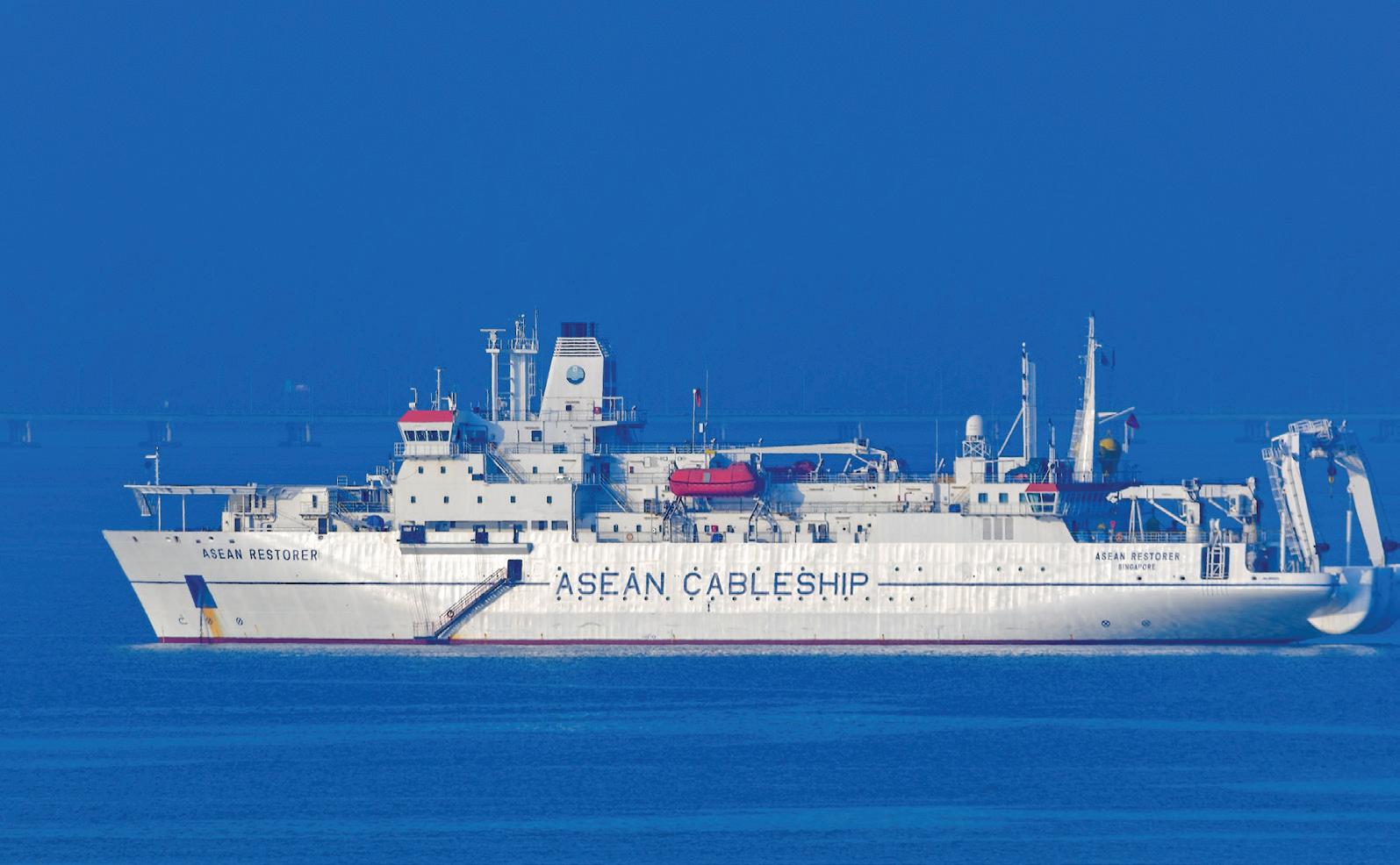
The term codex originates from the earliest form of a bound reference—a durable, navigable system of knowledge designed to replace scrolls. In the same way, the Cableship Codex delivers clarity, permanence, and continuity, offering a structured reference that grows issue by issue.
2025–2026 EDITORIAL SCHEDULE
The Codex launches with five issues across five quarters, each aligned with key subsea planning and deployment cycles. The inaugural issue in December 2025, titled Year in Review – Missions, Metrics & Standouts, will highlight 2025’s most notable fleet deployments, vessel performances, and operational milestones. In March 2026, the second issue, The Global Fleet – Capacity, Age & Coverage, will provide a complete audit of the active fleet, detailing vessel numbers, average age, and regional distribution. June 2026 will bring the third issue, Cable Ship Operators – Who Runs the Fleet?, focusing on ownership structures, operator alliances, and fleet management trends. The September 2026 issue, Tools of the Trade – Systems, Deck Gear & Innovation, will highlight operator- and OEM-provided updates on cable-handling technology, deck systems, and support gear. Finally, the December 2026 issue, Year in Review – 2026 Performance & Positioning, will recap the year’s global fleet performance and set the outlook for 2027.
All issues will be available for free download by registered users at subtelforum.com, with registration also providing access to archived editions and interactive fleet dashboards launching in 2026.
RECURRING FEATURES
Each edition of the Codex follows a consistent structure to ensure readers can quickly locate the intelligence they need. Every issue begins with a featured vessel profile that offers a deep dive into one notable ship’s design, equipment, and recent missions. A regional deployment map and comprehensive fleet table provide a snapshot of global activity, while operator dashboards summarize each quarter’s major fleet movements. A dedicated equipment spotlight highlights operator- and OEM-submitted updates on cable-handling systems, ROVs, and deck technologies. Each issue concludes with a quarterly metrics review—covering downtime, age trends, and drydock updates—paired with editorial commentary forecasting fleet dynamics in the coming months.
PRACTICAL USE, REAL IMPACT
The Codex is designed to support real-world decision-making. In early 2025, a project team preparing for a Pacific beach landing encountered a delay due to weather-related mobilization. By referencing SubTel’s pilot Codex dataset, the team identified a vessel already in the region with the right ROV capabilities and an available charter window. Acting on this data, they saved nearly two weeks and avoided significant cost overruns. This is what the Codex offers: operational foresight through reliable, structured fleet intelligence.
WHO IT’S FOR
The Cableship Codex is aimed at professionals who rely on timely, accurate vessel data. Marine coordinators and cable route engineers can plan routes and landing schedules with confidence. Project managers and systems integrators can evaluate operator reliability and equipment compatibility. Telecom and power cable developers gain insight into the fleet’s readiness for new builds, while OEM vendors can
FEATURE
benchmark equipment installations and showcase upgrades. Government telecom authorities, defense planners, investors, and underwriters also benefit from the Codex’s data-driven perspective on operational risks and fleet capacity.
Fleet Intelligence That Goes Beyond the Obvious
The Codex provides a holistic view of the entire ecosystem. It covers not only the leading telecom cable ships but also hybrid-use vessels that service both telecom and energy projects, high-latitude ships operating in polar waters, and smaller regional subcontractor vessels. Equipment upgrades, operator transitions, and fleet consolidations are tracked in detail, ensuring every edition is a living snapshot of the industry’s marine capabilities.
PART OF THE SUBTEL DATA ECOSYSTEM
The Codex integrates seamlessly with SubTel Forum’s other data products. It complements the Cable Almanac, which details system characteristics, and the Interactive Cable Map, which visualizes global infrastructure in real time. It builds on insights from the Annual Industry Report and aligns with thought leadership content in SubTel Forum Magazine. Starting in 2026, Codex data will also feed into new live dashboards within the Cable Map, allowing users to filter, compare, and forecast vessel activity alongside cable systems.
“The Cableship Codex will power the next generation of SubTel tools—where users can overlay cableship data with cable systems, projects, and landing stations.”
— Kristian Nielsen, Vice President, SubTel Forum
CONTRIBUTE, COLLABORATE, BE FEATURED
SubTel Forum invites operators, OEMs, and project teams to participate in shaping the Codex. Fleet owners are encouraged to share updates on vessel specifications, upgrades, and mission logs. OEM suppliers can submit technical information on new cable-handling systems or ROV technologies. Project teams are welcome to share field stories, case studies, or lessons learned that could inform future content. Editorial contributions and data updates can be sent to editorial@subtelforum.com.
MEET US AT SNW AND PTC
The Cableship Codex will be featured at PTC 2026 in Honolulu. SubTel Forum will host preview sessions and offer limited print samplers at these events, giving attendees an early look at the Codex’s design and insights.
SPONSORSHIP & ADVERTISING OPPORTUNITIES
The Codex offers a unique advertising opportunity,
targeting the industry’s key marine decision-makers. Each issue provides limited space for two-page spreads, sponsored callouts, and annual placement packages. Advertising positions are strategically integrated within the content for maximum visibility.
For 2026, rates are set at $2,600 per issue or $2,215 per issue with an annual four-issue commitment. For sponsorship inquiries, contact Nicola Tate at ntate@associationmediagroup.com or by phone at +1 804-469-0324.
“The Cableship Codex is where the people who choose ships, buy equipment, and award charters are going to be.
If you serve that market, you want to be here.”
— Nicola Tate, Advertising Manager
CABLESHIP CODEX – AT A GLANCE
The Codex launches in December 2025 as a quarterly publication, with four main issues each year alongside its inaugural edition. Each issue will run approximately 20–25 pages and be available as a free digital download via subtelforum. com, with archived editions accessible to registered readers. Limited print editions will be distributed at SubTel Forum’s booths at major events. At the end of 2026, a cumulative index will summarize all vessel profiles, operator updates, and equipment features from the year. All content is © SubTel Forum and may not be reused without written permission.
FINAL WORD: FLEET TRANSPARENCY STARTS HERE
For much of its history, the cableship fleet has not been an area of the industry that drew active attention or consistent transparency. While these vessels are vital to the global network, their operations have often remained out of focus, with limited data available and few structured resources to track them. In today’s economy—built on undersea infrastructure—that level of visibility is no longer sufficient. The Cableship Codex addresses this gap. It is not just a publication—it is a step forward in how the industry understands and utilizes its most essential marine assets.
The first issue launches in December 2025. Register now at www.subtelforum.com to be among the first to decode the fleet. STF
KIERAN CLARK is the Lead Analyst for SubTel Forum. He originally joined SubTel Forum in 2013 as a Broadcast Technician to provide support for live event video streaming. He has 6+ years of live production experience and has worked alongside some of the premier organizations in video web streaming. In 2014, Kieran was promoted to Analyst and is currently responsible for the research and maintenance that supports the Submarine Cable Database. In 2016, he was promoted to Lead Analyst and his analysis is featured in almost the entire array of Subtel Forum Publications.
UNDERSEA CURRENTS
How Geopolitics and Policy Are Reshaping Submarine Cables (Sep 2024–Sep 2025)
BY KRISTIAN NIELSEN
INTRODUCTION
Over the past year, submarine cable development has found itself at the crossroads of government policy and geopolitics. Once treated as neutral infrastructure, undersea fiber-optic cables – which carry about 99% of intercontinental internet traffic – are now viewed as strategic assets. National security concerns, regulatory changes, and international rivalries are increasingly dictating where cables go, who builds them, and how they’re protected. From Washington to Brussels, Moscow to Beijing, and across the Indo-Pacific, governments have introduced new rules, security reviews, and even funding initiatives that are fundamentally influencing submarine cable projects. This article takes a factual look at key developments from September 2024 to September 2025, examining how policies and geopolitics in the United States, Europe, Russia, China, Southeast Asia,
and the broader Indo-Pacific are shaping the industry’s current landscape.
UNITED STATES: SECURITY RULES TIGHTEN ON UNDERSEA LINKS
Concerns about espionage and cyber threats have prompted a significant tightening of submarine cable regulations. In August 2025, the Federal Communications Commission (FCC) approved new rules aimed at guarding U.S. submarine cables against foreign adversary ownership. These rules bar companies from connecting any cable to the U.S. that contains equipment from vendors deemed security risks. Washington’s scrutiny goes beyond cables landing on U.S. shores – it extends to the global supply chain.
The FCC’s updated licensing process introduces presumptive disqualifying conditions against any operator with ties to countries like China or Russia, effectively barring
them from owning or managing U.S.-connected cable systems. Licensees are prohibited from leasing cable capacity to any entity controlled by a foreign adversary, preventing such companies from installing or operating the critical landing station equipment on U.S. shores. This represents a sea change from a decade ago, replacing what was once a routine 25-year cable license with rigorous national security vetting.
American lawmakers have likewise thrown their weight behind safeguarding undersea networks. In September 2025, the House of Representatives passed the Undersea Cable Control Act, which calls for a comprehensive strategy to stop adversaries from obtaining sensitive cable technologies. While the bill awaits Senate approval, it aligns with ongoing U.S. diplomacy to set global norms, emphasizing international cooperation to ensure these arteries of the internet remain safe and reliable.
EUROPE: SAFEGUARDING CABLES AMID RISING TENSIONS
European governments have grown alarmed by suspicious damage to undersea cables and energy pipelines –often in proximity to Russian or Chinese vessels. A string of incidents in late 2024 served as a wake-up call. Investigators zeroed in on cases of simultaneous cable breaks in the Baltic Sea, where ships’ dragged anchors likely caused the damage. While no definitive proof of state-directed sabotage has emerged, officials openly labeled these cases as potential hybrid warfare.
In response, Europe has elevated submarine cables to a top-tier security priority. In February 2025, the EU unveiled a comprehensive Action Plan on Cable Security, marking an unprecedented commitment of resources to protect undersea infrastructure. The plan calls for new data-sharing systems to monitor cable routes, stockpiles of spare cable segments, and the creation of a standby fleet of cable-repair vessels on Europe’s coasts.
NATO has also ramped up protective measures. The Alliance is repurposing naval assets to guard critical undersea lines and has launched large-scale exercises with underwater drones focused on cable protection. A new Maritime Centre for the Security of Critical Undersea Infrastructure in the UK is tasked with mapping vulnerable cables and coordinating allies’ responses. EU member states are implementing the Critical Entities Resilience directive, which classifies telecom cables as critical infrastructure and requires operators to assess risks and bolster protections.
RUSSIA: ISOLATED NETWORKS AND ARCTIC AMBITIONS
Russia’s relationship with the global submarine cable system has been fundamentally altered by geopolitics. Since the invasion of Ukraine in 2022, Russia has been largely excluded from new international cable projects. Western governments and companies treat Russian involvement as a security risk, effectively freezing Moscow out of consortiums that link Europe, North America, or Asia.
At the same time, Russia is forging ahead with plans to reroute the global internet through its own backyard. The Kremlin has been advancing an ambitious Arctic submarine cable project known as “Polar Express,” a 12,650-km fiber-optic line along Russia’s northern coast, from Murmansk to Vladivostok. Despite sanctions and the exit of Western partners, Moscow is pressing on with an expected completion by 2026, positioning the cable as a sovereign communications corridor between Europe and Asia.
CHINA: NAVIGATING A DIGITAL SILK ROAD UNDER SCRUTINY
China’s approach to submarine cables reflects a dual
FEATURE
reality: on one hand, an assertive push to expand its global digital footprint, and on the other, intensifying resistance from Western nations wary of Beijing’s influence. Chinese telecom firms and state-backed consortia continue to invest heavily in new subsea cable projects across Asia, Africa, and the Middle East. At the same time, Chinese suppliers are finding themselves shut out of an increasing number of international cable tenders due to geopolitical pressure.
Major state-owned carriers are prioritizing regional links that connect China to friendly markets in Asia, Africa, and the Middle East without needing U.S. or European partners. Plans have been floated for cables from the mainland to the Persian Gulf, to Southeast Asian nations, and even to the South Pacific, often bundled with infrastructure loans. Beijing has also been assertive in multilateral arenas, pushing for guidelines that emphasize the neutrality of cable infrastructure and non-discrimination against suppliers.
SOUTHEAST ASIA: CAUGHT IN THE CABLE CROSSFIRE
Southeast Asia has emerged as a key arena where global rivalries are playing out in undersea cable decisions. Many nations in the region are hungry for improved connectivity but find themselves courted by both East and West, with geopolitical considerations attached to offers of partnership. Vietnam’s plan to deploy up to ten new submarine cables by 2030 immediately attracted lobbying from multiple countries. Similar stories are playing out in Indonesia, the Philippines, and Thailand, where Chinese companies historically had strong market presence but now face greater scrutiny or rival offers backed by Japan, the U.S., or Europe.
Meanwhile, Southeast Asian nations are also grappling with security of their existing cables. Some have tightened permit regimes to vet foreign vessels operating in their waters. One striking development has been the reconfiguration of cable routes to account for political sensitivities, with tech companies and consortia planning new trans-Pacific cables that avoid landing in certain jurisdictions.
INDO-PACIFIC ALLIANCES AND NEW ROUTES
Beyond Southeast Asia, the broader Indo-Pacific has seen a flurry of cooperative initiatives as nations respond to China’s growing influence and the vulnerability of far-flung islands. The Quad – an alliance of the United States, Japan, Australia, and India – has pledged to ensure every Pacific Island state is connected by a subsea cable by the end of 2025. Backing that ambitious goal, the Quad partners announced combined funding for new cable projects to Pacific islands, offering an alternative to Chinese-funded connectivity. Australia launched a Cable Connectivity and Resilience
Center to provide training and technical support for Pacific island telecom operators. New routes are also being explored to enhance resiliency against geopolitical risks, including additional paths circumventing congested chokepoints and Arctic cable corridors linking Europe and Asia more directly.
CONCLUSION
In the span of just twelve months, government policies and geopolitical maneuvering have moved submarine cables from the periphery of telecom discussions to center stage. The implications are significant. Regulatory approvals for new cables now come with more scrutiny and conditions. Financing often requires a nod from governments keen to advance their strategic aims. Delays can arise not just from supply chain issues, but from diplomatic tussles over routes and vendors.
The submarine cable sector has entered an era where politics is as important as bandwidth. Yet amid the rivalry, there is also recognition of a shared interest: keeping the internet running reliably. International efforts suggest a desire to prevent conflict from undermining the global network we all depend on. For now, telecom executives and cable engineers must pay close attention to policy shifts in Washington, Brussels, Beijing and beyond – because undersea cables are no longer just about connecting bytes, but about projecting power and securing nations in a digital age. STF
KRISTIAN NIELSEN is based in the WFN Strategies main office in Ashburn, Virginia USA. He has more than 15 years’ experience and knowledge in submarine cable systems, including Arctic and offshore Oil & Gas submarine fiber systems. As Chief Revenue Officer, he supports the Projects and Technical Directors, and reviews subcontracts and monitors the prime contractor, suppliers, and is astute with Change Order process and management. He is responsible for contract administration, as well as supports financial monitoring. He possesses Client Representative experience in submarine cable load-out, installation and landing stations, extensive project logistics and engineering support, extensive background in administrative and commercial support and is an expert in due diligence.
References
David Shepardson, “US aims to ban Chinese technology in undersea telecommunications cables,” Reuters, July 16, 2025.
Bloomberg News, “FCC adopts new submarine cable rules amid China security concerns,” SubTel Forum, 2025.
Lili Bayer and Anne Kauranen, “EU to spend nearly a billion euros to protect undersea cables,” Reuters, Feb. 21, 2025.
Francesco Guarascio et al., “Inside the US push to steer Vietnam’s subsea cable plans away from China,” Reuters, Sept. 17, 2024.
Anne Kauranen and Sabine Siebold, “As sabotage allegations swirl, NATO struggles to secure Baltic Sea,” Reuters, Dec. 3, 2024.
Submarine Networks, “SEA-ME-WE 6,” updated Feb. 2022 & July 2025.
Robert Clark, “US and Partners Call for ‘Verifiable’ Subsea Cable Suppliers,” Light Reading via SubTel Forum, Oct. 4, 2024.
Joint Research Centre, European Commission, “Subsea cables: how vulnerable are they and can we protect them?,” Feb. 2025.
PROVEN PROCESSES AND METHODOLOGIES
• Defined Processes
• Template Driven
• PMP Based Project Management Approach
• Rigorous Documentation Controls
• Quality Assurance Focused
• Secure Records Storage
• Accessible and User Friendly
INTRODUCING THE VIRTUAL REP
• In-Field Analysis Without In-Field Risk
• Remote real-time analysis and reporting without the added cost of today’s in-field representation liabilities.

Explore 20 YEARS of Subsea Knowledge
Every Author. Every Article. Instantly Searchable.

A New Era of Discoverability Has Arrived

Rewriting how we explore SubTel Forum
Total Unique Authors: 770
Total Tags: 276
TOP 5 TAGS BY ARTICLE COUNT:
Network Operations & Management –943 articles
Technology – 820 articles
Risk & Safety Management – 720 articles
Project Management – 670 articles
Regions & Countries – 508 articles
BACK REFLECTION
THE GULF CABLE OF 1856 [PART 1]
BY PHILIP PILGRIM
This two-part article describes perhaps the most important submarine telegraph cable in North America. It is a long overdue Back Reflection. Fortunately, this cable’s installation was well documented back in the day, I have been able to unearth many of these long-lost and obscure documents to assemble a complete story from its conception to its final days. I will attempt to cover all aspects of this cable including survey, route clearance, cable recycling, lay, cable ships, repairs, lawsuits, skullduggery, and its current-day status.
Although this article focuses on one cable during the year of 1856, the Atlantic Cable mega-project is well underway (started in 1854) and
interesting activities are occurring in parallel. I will include some of these that occur in 1856 to add colour. There is also additional information on the 1856 cable that, you can find in previous Back Reflections:
• SubTel Forum Magazine (#143 Jul. ‘25) covers the business case for the 1856 Gulf Cable.
• SubTel Forum Magazine (#142 May ‘25) covers repairs of the 1856 Gulf Cable.
• SubTel Forum Magazine (#120 Sep. ‘21) covers its predecessor; the unsuccessful 1855 Gulf Cable.
The 1856 Gulf of Saint Lawrence submarine cable, known as the “Gulf Cable”, was the 2nd significant cable
to be laid in North America. It connected the mainland of North America* with the island of Newfoundland. It followed the footsteps of the 1852 Northumberland Strait Cable (16km), connecting New Brunswick with Prince Edward Island [STF #119]. It also followed the unsuccessful 1855 Gulf Cable attempt, when only 76km of 120km were laid.
The 1856 Gulf Cable is significant in many ways:
1. It was the first cable design that used a more robust multistrand twisted copper core of six fine wires wrapped around a seventh. This twisted copper structure was called a “strand” at the time.
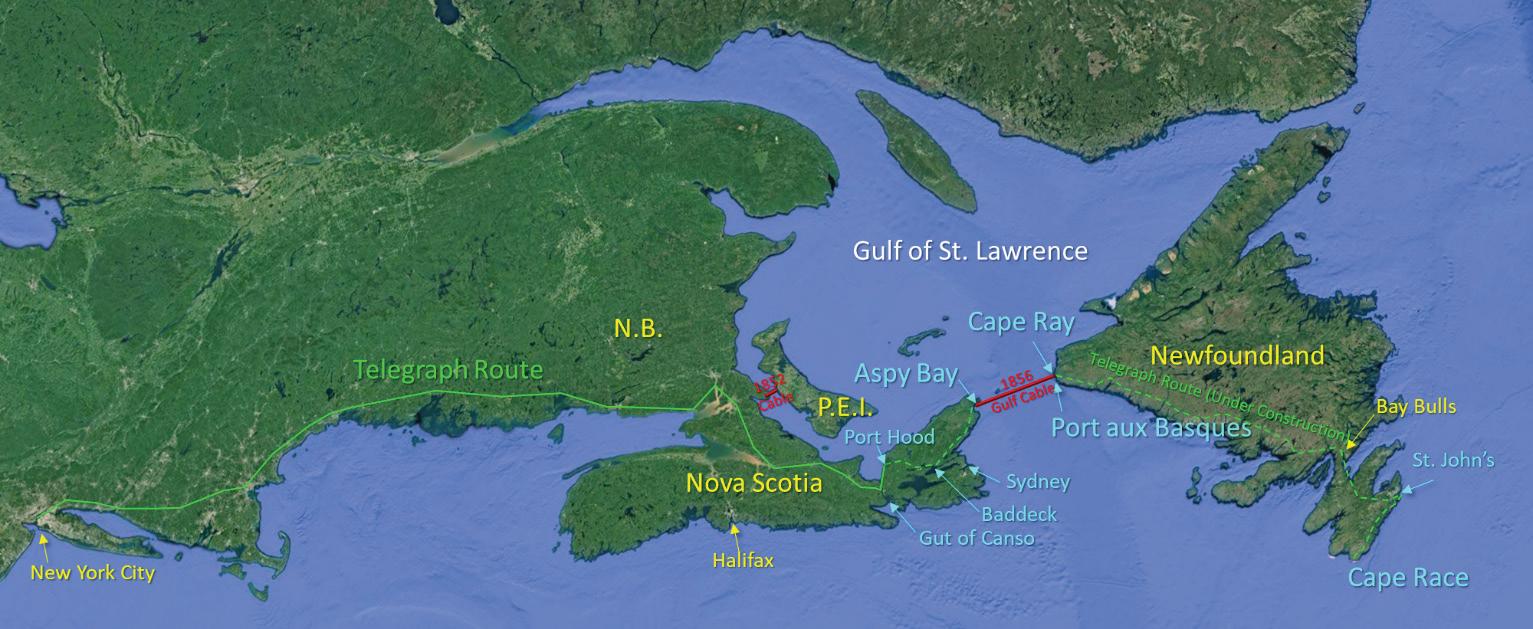
2. It was the first cable design that used different armouring types (heavier, for the shallow water shore ends and lighter, for the deep water).
3. It connected the eastern-most point in North America with NYC.
4. It was the first cable successfully laid by Cyrus Field in building his system to telegraphically connect NYC with London.
5. The first recovery and re-use of a previous submarine cable occurred before the lay.
6. With respect to point #5, this would be the first instance of “route clearance”.
IN THE BEGINNING....
In the mid-nineteenth century, the industrial revolution was well underway. Business drove technological improvements and in turn, these drove business. It was an age of discovery and its application. As with all businesses, information was king. Newspapers, other publications (books & magazines), and mail contained this essential content. The flow of this intelligence became critical. Newspapers and businesses in North America were hungry for content from Europe, and vice versa.
* Nova Scotia’s eastern region is called the Island of Cape Breton. It is separated by a body of water called the Gut of Canso (now called Strait of Canso). A short cable of a few kms was needed to cross this body of water.
THE AGE OF STEAM....
The first technological advance in international communications was the
steamship. “Steam Mail Packet” blossomed in the 1840’s across the Atlantic. This fast mail service drove communications between the New World (North America) with the Old World (UK & Europe). Ships landed on each side of the Atlantic and all were eager to learn the news from the newspapers that were conveyed on these ships.
THE AGE OF ELECTRIC TELEGRAPH...
When commercial telegraph technology began in the mid-1840’s, it opened a new era. Businesses leveraged the telegraph to beat the steamships and steam trains, where they could, but these early telegraph networks were small, and no subsea telegraphs existed. In North America, a consortium of five NYC newspapers formed the Associated Press (AP), in 1848. They immediately organized a steamship to intercept incoming vessels off NYC harbour to speedily bring the latest European news into their hands first. When telegraph networks expanded, the AP’s reach moved with these. In 1848, Daniel Craig of the AP, used a schooner to intercept incoming ships off Boston and used carrier pigeons from the schooner to send important foreign news ashore. In 1849, when the telegraph system from NYC expanded into Canada and Saint John, New Brunswick, Craig organized a Pony Express to send the news from Cunard Line ships arriving in Halifax to St. John, where it was telegraphed to NYC. In late 1849, Frederic Newton Gisborne constructed the telegraph line from Halifax to New Brunswick. He was the first to telegraph the foreign news to NYC
from Halifax for the AP, on November 15, 1849. This news arrived in Halifax on the Cunard steamship America.
THE AGE OF SUBMARINE CABLES...
In working with Craig, Gisborne conceived a plan in early 1850, to extend the telegraph line closer to Europe by building a new telegraph line across Newfoundland. In the late summer of 1850, Gisborne learned of the first international submarine cable between England and France. With this knowledge, and firsthand experience of the revenue and demand for European news to reach NYC (by Craig), he immediately refined the plan to exploit the new submarine technology and extend the telegraph lines to the most eastern point in North America, the Island of Newfoundland.
Gisborne’s initial plan, thus, was to extend the telegraph line from NYC by laying a submarine cable from Nova Scotia to Newfoundland across the Gulf of St. Lawrence and also, to build a terrestrial telegraph line across Newfoundland.
Although the first English Channel cable failed after only one day on August 29,1850, less than six months later, in February 1851, Gisborne successfully petitioned the Newfoundland government with his idea to connect Newfoundland to NYC with a terrestrial telegraph line and a submarine cable.
Gisborne’s project for NYC telegraph extension to Newfoundland had two setbacks. The first was overcome: The owners of the first Nova Scotia telegraph lines (constructed by Gisborne from 1849 to 1851, for the government, then sold by govern-
BACK REFLECTION
ment officials to themselves) refused to let international traffic pass over their lines [STF #119]. They did not want Gisborne to succeed, nor did they want AP revenue out of their hands. Gisborne solved the problem through telegraphic bypass of Nova Scotia. He used the province of PEI as the intermediary path. In early 1852, he organized a company with transatlantic steamships and funding from the USA [STF #139]. He also travelled to England to obtain information on submarine cables from the Brett brothers, builders of the first successful international cable, of Sept. 1851. He also discussed plans for a transatlantic cable at that time. He promptly purchased a cable and laid it in November of 1852 to connect New Brunswick to PEI. His next step was to complete the terrestrial cable across Newfoundland and to connect Newfoundland with PEI via a second submarine cable (260km). This would be the longest cable in world at that time. Unfortunately, the second setback for Gisborne was too much for his project. His financial backers in the USA suffered an “embarrassment” that ended the project in the summer of 1853. Gisborne was abandoned by his NYC backers, Horace B. Tebbetts and Darius B. Holbrook, and left “holding the bag”. Much money was owed to Gisborne as well as to the hundreds of unpaid fishermen in Nfld. who were constructing the telegraph line, as well as to businesses supplying the project. Gisborne liquidated all personal and company assets to help reduce the debts and avoided debtor’s prison.
With government approval, and with support from many associates, to avoid debtor’s prison, Gisborne re-started the project. In early 1854, he secured a second set of investors, that included many financial figures from NYC. Another investor was Samuel Morse. Gisborne learned telegraphy from Morse’s friend and first employee, Orrin Squire Wood, who constructed most of the telegraph lines around NYC, since 1844, and introduced the investors to Morse while in NYC in Jan/Feb 1854. Gisborne states he travelled to Washington DC from NYC to meet with Morse. Gisborne also clarified that he first met the capitalist, Chandler White, who introduced him to Cyrus Field. Cyrus became the lead investor of the group. He took over the project to complete the telegraph link from NYC to Newfoundland. After seeing Gisborne’s work with John Brett in the planning of an Atlantic submarine cable, Cyrus expanded the scope to include the construction of a transatlantic cable from Newfoundland to Ireland.
In securing new investors, Gisborne arranged for the payment of all debts of the old company (mentioned above) and in addition, the new agreement covered his losses, and the losses of Holbrook, Tebbetts and other investors. To appease the Nfld. government, Gisborne also ensured the new company agreed to insurance bonds to prevent the same fiasco from happening again. All of this was done quickly in the spring of 1854.
It is interesting to note that Field’s first network design for the new
company, published in April 1854, and developed by Gisborne, included the bypass of N.S. and the use a 3-conductor submarine cable across the Gulf of St. Lawrence.
With Field in charge, and his four other wealthy NYC backers, the owners of the telegraph lines in Nova Scotia suddenly had a change of mind and agreed to allow international traffic to pass over their network for obvious reasons, The need for a 260km cable to PEI was eliminated. A shorter, more economical, and less risky,120km cable route was planned between Cape Ray, Newfoundland and Aspy Bay, Nova Scotia. Field was also permitted to build a terrestrial telegraph line from Aspy Bay to Port Hood Nova Scotia as the route did not exist, and it offered no value to the NS government at the time. This route traversed the Cape Breton Highlands and passed through the towns of Ingonish and Baddeck. Thus, the new network would be from Port Hood, Nova Scotia, to St. John’s and Cape Race Newfoundland, a total of approximately 1,200km. (~200km terrestrial in Cape Breton, Nova Scotia; 120km subsea Gulf Cable; and ~800km terrestrial across Newfoundland). This was equal in length to the 1849 network from NYC to Halifax!
In 1855, Field attempted to lay a three-conductor telegraph cable across the Gulf of St. Lawrence, but the lay was abandoned near the midpoint due to a storm. (STF #120). The cable ship had to “cut and run”.
The next year, Field returned for a second attempt to lay the 1856 Gulf
Cable.... and our story begins:
DIGRESSIONS....
As mentioned above, there were many “balls in the air” for Cyrus Field’s Atlantic Cable project. This 1856 Gulf Cable was just one of many events happening at the same time. I will cover these other items now and then jump into the 1856 Gulf Cable.
LEGAL ITEMS:
Fortunately, these do not occur often, but with any mega-project and millionaires, there are people looking for money, or withholding money. Here are just a few associated with this project:
1. In March of 1856, the wealthy Darius Holbrook, who abandoned the similar 1853 project (to build a line across Nfld. a cable from Nfld. to N.S. and use ocean steamers to carry news across the Atlantic), learned that the Act granted to Cyrus Field would be forfeit due to his failure to construct the bridal road across Newfoundland. Although Gisborne held meetings with Field, Holbrook and Tebbets in February of 1854 to settle their company’s dissolution and the transfer to Field in the spring of 1854, in 1856, Holbrook petitioned the Nfld Govt. to not renew with Field. He was not satisfied with how the 50-year exclusivity (for landing cables in
Nfld) was transferred to Field from the company in which he was the largest shareholder (Newfoundland Electric Telegraph Association). He wanted the government to exercise a clause in the 1854 Charter to revoke the exclusivity given to Field’s New York, Newfoundland & London Telegraph Company. Holbrook also claimed that Field’s new company only offered Holbrook shares arbitrarily valued at $50,000 plus interest to settle his debt in
1854, he wanted cash at that time. The Nfld. Govt. determined that all processes in their act to transfer the Charter & exclusivity to Field were conducted appropriately, and that Holbrook would have to take the matter up in the courts of the USA if he was not satisfied with his financial remuneration agreed to in 1854.
2. Cyrus Field insured the previous year’s 1855 Gulf Cable lay with Lloyds of London for $75,000 USD. The lay failed due to a storm. The cable ship cutand-ran. Field’s claim for compensation was refused and legal wrangling with Lloyd’s ran well into 1856. By February of 1856, Field had to get on with the project and order new cable in time for a new lay weather window, so he was keen to settle quickly. He suggested three amicable terms with Lloyds:
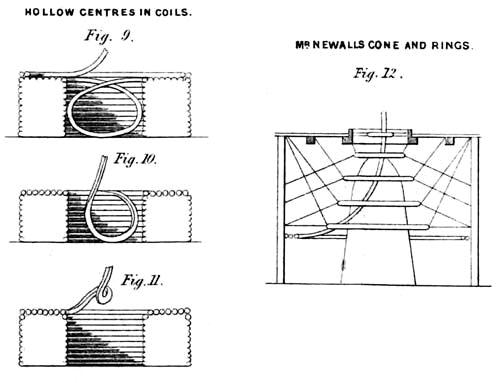
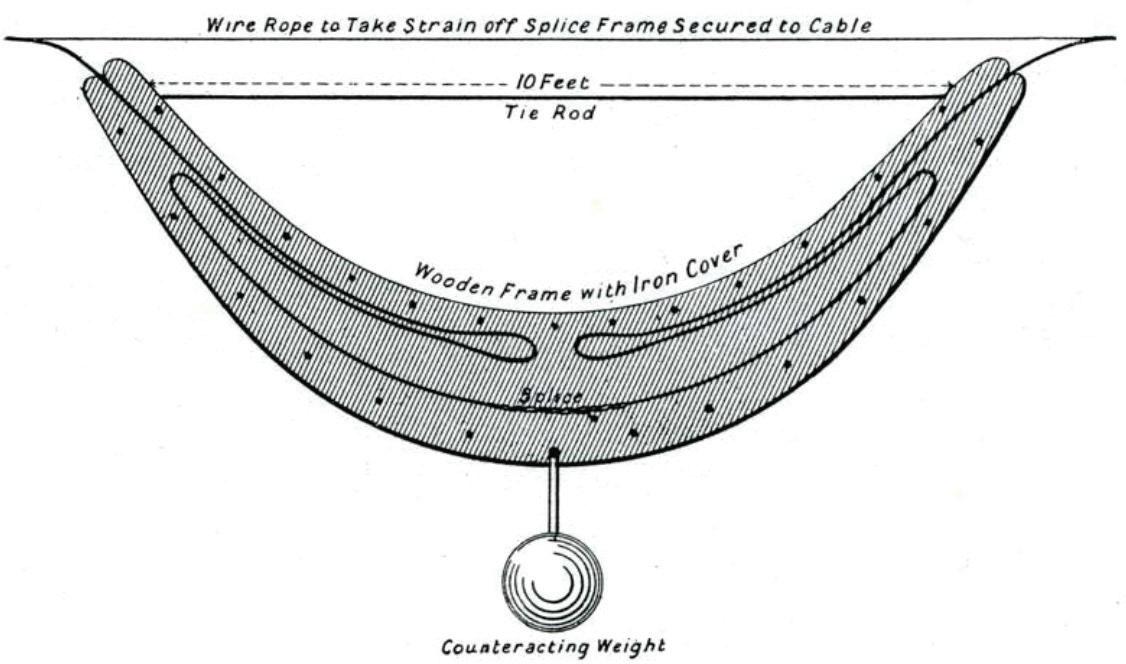
» Lloyds undertake to lay a new cable.
» Lloyds allow Field to attempt to connect to the cut cable and insure/guarantee the project, as well as cover all costs.
» Lloyds settle for the amount of cable laid on the bottom in 1855 and allow Field to have ownership of this cable and the remaining “unlaid” 1855 cable that was placed on a dockside in Sydney, Nova Scotia.
Newell’s Cable Tanks and Guides
BACK REFLECTION
Lloyd’s continued to refuse until Field took legal action. In May of 1856, Lloyds finally settled for option “c” above. Field was awarded $69,000 USD and ownership of the 1855 remains. An interesting side-story to this is that Field, for obvious reasons, did not use Lloyds for insuring the 1856 cable. Instead, we find George T. Brookings, the Newfoundland agent for the British and Foreign Life and Fire Assurance Company, was on board the cable ship Propontis during its transatlantic transit from the factory in London to St. John’s Newfoundland. At this time in history, this same company is trying to wrest Lloyd’s customers away and reduce Lloyd’s dominance in marine insurance.
3. Glass Elliot and Co. (Glass Elliot) of England were contracted by Field to supply and lay the cable. They fitted the steamship Propontis with cable machinery to lay the cable. They also used special bracing and guides to store the cable in the hold of the ship and to reduce kinks when it was pulled from the hold during laying. Some of this equipment was contested by the competitor cable supplier, R. S. Newell & Co (Newell). Newell claimed a patent infringement for the use of circular bracing of the cables in the hold, for the use of a cone in the middle of the cables in the hold, and for the use of an inverted cone in the ceiling of the hold. This claim went to court in the spring of 1858. Newell won. This dispute seems to avoid Field in 1856 however, “it’s complicated” as both Newell and Glass Elliot
were each contracted by Field to each supply a half of the Atlantic Cable (the award of this work was made in December 1856). They were each given the cable specifications, but they did not coordinate. One supplier wrapped the cable in the wrong direction (records seem to point to Newell). This made joining the two halves of the Atlantic Cable impossible until a unique solution was invented. This first “universal joint kit circa 1857” was basically large metal structure approximately the size of a minivan. Even potentially worse for Field was that an agent for Newell placed a saboteur in the Glass Elliot crew to sabotage their lay for an August 1858 cable to Holland from the UK. Digression: Gerry Brown intelligently suggested that a modern expedition be launched for the recovery of this “joint”. It was proposed to the Paul G Allen Family Foundation at SubOptic in 2025 by yours truly. Let’s see what comes of this.
4. Frederic Newton Gisborne’s brothers, Hartley and Charles, who were both telegraph construction experts, sued Cyrus Field’s company for breach of contract in 1855. They won. They were hired to help build the Nfld terrestrial section in the summer of 1854, following Frederic’s resignation, but were not paid the wages that were promised by Chandler White, a wealthy NYC businessman and director in the company who was stationed in Nfld. and managed the company affairs there in1854. This telegraph
line was planned to be constructed in 1854 in time for the 1855 submarine cable, but it was mismanaged by Chandler White and by Matthew Field (Cyrus’ brother) who were in charge. As mentioned, Frederic Gisborne resigned from the company in the summer of 1854 after witnessing the abilities of Chandler and Matthew. He could see no way forward under their leadership. He remained on good terms with Cyrus Field and the other directors and was even invited on the 1855 Gulf Cable lay though not employed by Field. In late 1855, the Nfld. terrestrial line was not completed and was in a very poor state. Chandler White “high-tailed” it out of Newfoundland after the Arctic incident where he initially refused dispatching the company’s ship Victoria to rescue survivors of the sunken Collins’ ship, Arctic. Matthew also was relieved of his duties at the same time and replaced by a Mr. Charles B. Ellis to complete the build. Ellis retreated back to NYC in November of 1855. Cyrus Field then cajoled Gisborne to have the line constructed in time for the 1856 cable completion. More on this later.
5. In early 1856, a shipwrecked telegraph construction worker, Thomas Whelan, sued Cyrus Field’s company for breach of contract for work done in in 1855. He was on board a ship filled with workers that went aground enroute to the work site [STF #131]. He claimed he was not paid for his time while
shipwrecked. The judge awarded him lost wages.
6. A clause in Field’s April 1854 Charter required a bridal road to be constructed across southern Newfoundland within the next two years. It became apparent that the time limit would be exceeded, so in March of 1856, the Nfld. Govt. was requested to amend the act. Most bridges built across rivers in the summer, and autumn of 1854 were washed away in the winter’s ice flows. The Govt. contracted experts and sent its agents involved in road construction to inspect the road in 1855. Reports to the Govt. showed the “road” to be not more that piles of brush across bogs in many areas. The Govt. had also contracted Gisborne to inspect the route. He traversed it (except for 18mi) and reported that it could be crossed on horseback.
7. In May of 1856, Tebbetts is now “at it”. He was a shipping magnate and untrustworthy NYC financier who deserted the partnership with Gisborne in 1853 and was rescued by Gisborne in 1854 with the opportunity to hand over the rights of charter to Field with the reward of all debts/losses reimbursed. Tebbetts is now petitioning governments in Canada for exclusivity landing rights to lay an alternate cable across the Atlantic with Taliaferro Preston Shaffner. This project was started by Shaffner several years earlier but could never gain the support nor funding. Schaffner’s plan was to use many shorter cables to span the Atlantic
rather than Field’s one long cable. The planned route was nearly that of CANTAT 3 (UK-Faroes-Iceland-Greenland-Canada).
CABLE RECYCLING AND ROUTE CLEARANCE ITEMS:
The partially laid 1855 cable needed to be cleared before the new1856 cable could be laid on the same route. More importantly for Field, he had plans to sell sections of the 1855 cable throughout New England for harbour and river crossings. Once Lloyd settled in May of 1856, Field quickly had the brigantine Ellen fitted with machinery to pull up the 1855 cable. This process started on June 25th when the brig left Sydney. Cable recovery began at the Cape Ray end on June 28th, and recovery ended on July 2nd, due to a storm on the night of Tuesday, July 1st. Approximately 38km of the cable was recovered and 38km remained on the bottom. The Ellen returned to Sydney on July 4th. The first recycled cable was laid across the Gut of Canso to connect mainland Nova Scotia with Cape Breton on July 11th. This short cable became another link in the Atlantic Cable System connecting NYC with London. The Gut of Canso is approximately a mile across where the cable was laid. Previously, an aerial wire was strung above the water on masts, but storms
and ships would knock it down. The cable stations for this short cable were at Auld’s Cove, on the mainland, and at Plaister’s Cove, on Cape Breton Recovered 1855 Cable
BACK REFLECTION
Island. The Ellen then proceeded to NYC, arriving on August 25th. The 1855 cable was also laid in other areas of Nova Scotia (Lennox Passage, Pictou Harbour, and Pugwash). One can see many records of the recycled 1855 3-conductor Gulf cable throughout New England [STF #120].
TERRESTRIAL VANDALISM:
Cape Breton and Newfoundland are sparsely populated. The new pole-lines routes for the Atlantic Cable system traversed a wilderness of rugged terrain. The primary dangers to transmission in these areas were windstorms, ice storms, and forest fires. Telegraph lines were in the region since ~1851. Vandalism typically occurred near populated areas mostly due to children throwing rocks at insulators or protests against the govt. In May 1856, we see a report of someone cutting and stealing the telegraph wire near Plaister’s Cove in Nova Scotia.
TERRESTRIAL BACKHAUL CONSTRUCTION:
Submarine cables run from “beach-to-beach”. Often the populated locations that use the cable are not located at these beaches so terrestrial backhauls are required to connect the beach to the populated locations.
For the Gulf Cable, the backhaul to the east was approximately 700km from the beach at Cape Ray to the port of St. John’s, where steamers will carry the information across the Atlantic and onto London via
NYC-St. John’s Open November 14, 1856
Gisborne’s Strict Instructions for Building the Nfld. Pole Line, May 1856.

telegraph systems through Ireland, across the Irish Sea, then finally across England. The backhaul to the west was approximately 1,500km to NYC. By Sept. of 1855, this backhaul to NYC reached Port Hood in Cape Breton. This site was approximately 200km away from the Aspy Bay cable landing site. This 200km route was mostly treacherous and traversed remote Appalachian mountains known as the “Highlands”.
There is little information on this terrestrial build in Nova Scotia. A few articles mention that the construction was awarded to Hiram Hyde, who was a member of government and a co-owner of the NS telegraph system. The lead engineer, Jesse Hoyt, reports that the line was only ready for service
on Nov. 17. This was over four months after the cable was laid on July 10th. There are newspaper articles in late September mentioning the running out of wire for the Nova Scotia section’s construction, and wire being shipped from Nfld. to help. We see that on October 8th, the first commercial telegraph to use the Gulf Cable was from St. John’s to Baddeck by a businessman named Mr. Pitts. He was enquiring about his shipment to Baddeck. We also see that there was vandalism west of Baddeck that prevented signals to NYC. Newly installed poles were actually cut down and taken along with the wire. Wire for their repair was received on October 18th. NYC papers report on Nov. 12 that the newly formed Atlantic Telegraph Company on 21 Wall St. is now in telegraphic communications with St. John’s and the Atlantic Cable will be completed in 1857.
The Newfoundland terrestrial build began under Gisborne in 1853 [STF #139]. following the 1851 survey [STF #129 & #130]. Work was stopped due to 1853 stock market fluctuation and restarted when Gisborne formed a new company with Cyrus Field on April 15, 1854. Gisborne marked the route in late spring of 1854 [STF #138] but had a falling out with the
NYC businessmen, Chandler White and Matthew Field, who were put in charge of the terrestrial build. Also, Gisborne had been a partner in forming the company with five other members. This is stated in Clause 1 of the charter (Act to Incorporate The New York, Newfoundland, and London Telegraph Company). In Clause 3, regarding directors of the company, the same names from Clause 1 are listed except Gisborne’s. He was effectively pushed out of a leadership roll. The manager assigned to Newfoundland was Chandler White, a NYC capitalist and company director. He had no experience in telegraph and caused many problems for the company (to be covered in a future Back Reflections). He lasted only 6 months before being recalled to NYC in October 1854. Cyrus Field’s brother, Matthew was the engineer assigned to lead the terrestrial build. He worked closely with White. He was a railroad man and experienced with bridge building but had limited telegraph construction experience. It is stated that he did not travel more than five miles along the telegraph route. The work to build the line floundered in 1854 under Matthew’s lead. Matthew was relieved in 1854 and replaced by a Charles B. Ellis. Despite these problems, Gisborne was invited by Field to attend the unsuccessful 1855 cable lay [STF #120]. Gisborne also has many thousands of dollars in company stock that would be released upon the completion of the Atlantic Cable project.
By late 1855, Gisborne had moved away from telecoms and began a trade business in St. John’s with partner D. J. Henderson. He was also involved in
Strange Story from the Telegraph Build (June 28, 1856)
Another Strange Story from the Telegraph Build (August 26, 1856)
BACK REFLECTION
mineral exploration and mining. In January of 1856, Cyrus Field dearly needed the terrestrial line to be completed in time for the 1856 Gulf Cable. He knew that Gisborne was the man for the job, so he invited him to NYC and discussed terms. Field offered a large salary and a large bonus if Gisborne completed the line by October 1856. Field also offered Gisborne to join him in traveling to England when forming the Atlantic Cable Company later in the year. Gisborne completed the line by October 6th and was awarded the bonus but was abandoned by Field and excluded from the new company being formed, The Atlantic Cable Company (ATC). This was the second time Field did this to Gisborne.
The Newfoundland line was in poor shape when Gisborne began in 1856. He travelled the line several times and led over 600 men to complete the build. Gisborne ran a tight ship but still had to deal with many challenges left by the past engineers. Gisborne’s statements and updates to the press were always positive through early 1856 but in late August, there is a distinct change in tone. Perhaps Field did something. Gisborne, having the significant personal financial investment in the line, through company shares, completed it on time then again withdrew from telecommunications while Field was promoting the ATC in England in October with Morse and Brett. In December of 1856, the government of Newfoundland, seeing this treatment of Gisborne, gave a special diner in honour of Gisborne and his contributions to Newfoundland over
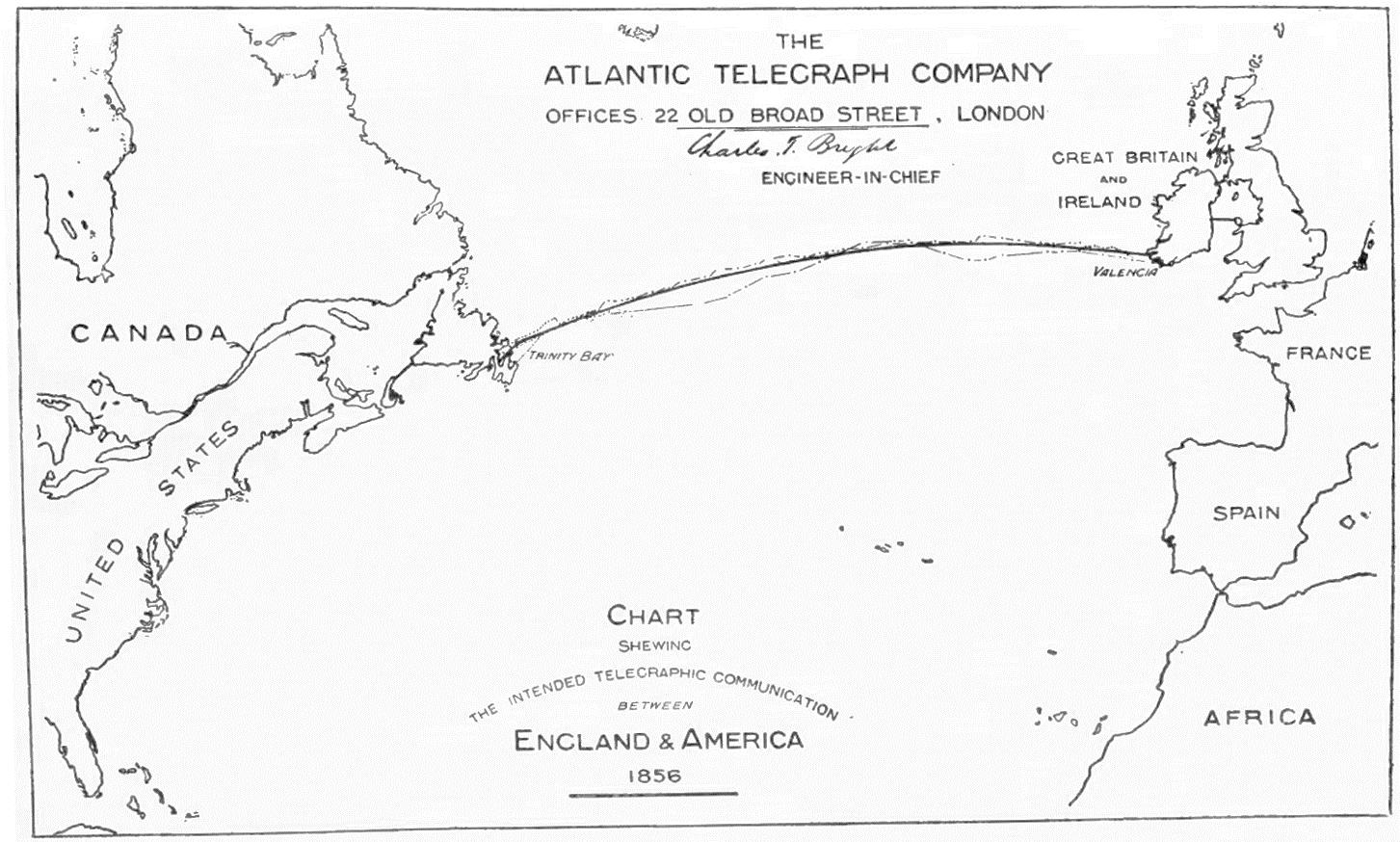
the past six years.
There are many details of the line build documented in newspapers. I have included two very unusual newspaper clippings that I stumbled across.
TRANSATLANTIC SURVEY:
Field was busy with other activities associated with the mega-project. The transatlantic route needed to be surveyed. For a survey, a ship with specialized tools traverses the route and measures the depth of water measurements (soundings) as well as takes ocean floor soil samples. Field had the USS Arctic under the command of Lieutenant Otway H. Berryman do this job. The Arctic departed St. John’s on July 31st and arrived in Cork on August 23rd. It was reported that the ship’s
propeller was tangled in rope and timber from a buoy while departing Cork and had to be repaired. The Arctic then returned to St. John’s taking more soundings on the return. She arrived back in St. John’s on Sept. 30th, 1856.
TRANSATLANTIC TEST BED:
Field had to entice new investors
1856 Atlantic Survey by USS Arctic
Gutta Percha Underground Wires from London to Manchester (1856)
and satisfy existing investors. The 1855 cable failure was a setback, but his insurance win and the successful 1856 cable regained his momentum. Just as science propelled his project, it hindered it. The magnitude of “retardation” of telegraph signals through submarine cables was finally being understood by great minds in 1855. At first, it was the subject of academic papers and lectures, but it was slowly becoming common knowledge through technology magazines. Retardation was first noted by Werner Siemens in 1849 in underground gutta percha lines in wet areas. Following the 1853 boom in regional cables to England, Faraday, Clarke, Thomson, and Stokes worked the problem. It was sorted during the years 1854 and 1855 and began to appear in the public domain. Investors certainly were made aware. On October 3rd, 1856, Samuel Morse, director in Field’s company and inventor of the telegraph, set up a test bed of over 3,300 km using 10 daisy-chained gutta percha subterranean wires connecting London with Manchester (330km each). This length exceeded that of the Atlantic Cable route. He ran the test and could attain rates of over 210 transitions per minute (~ 10 words per minute @ 5 characters per word and 4 transitions per character). He immediately published his findings and even called out Faraday’s findings and theoretical limit. Morse tried to validate the results by leveraging the term “gutta percha” and alluding that terrestrial and submarine “gutta percha” transmission was the same. His assumptions and tests were flawed as he omitted the polarized seawa-
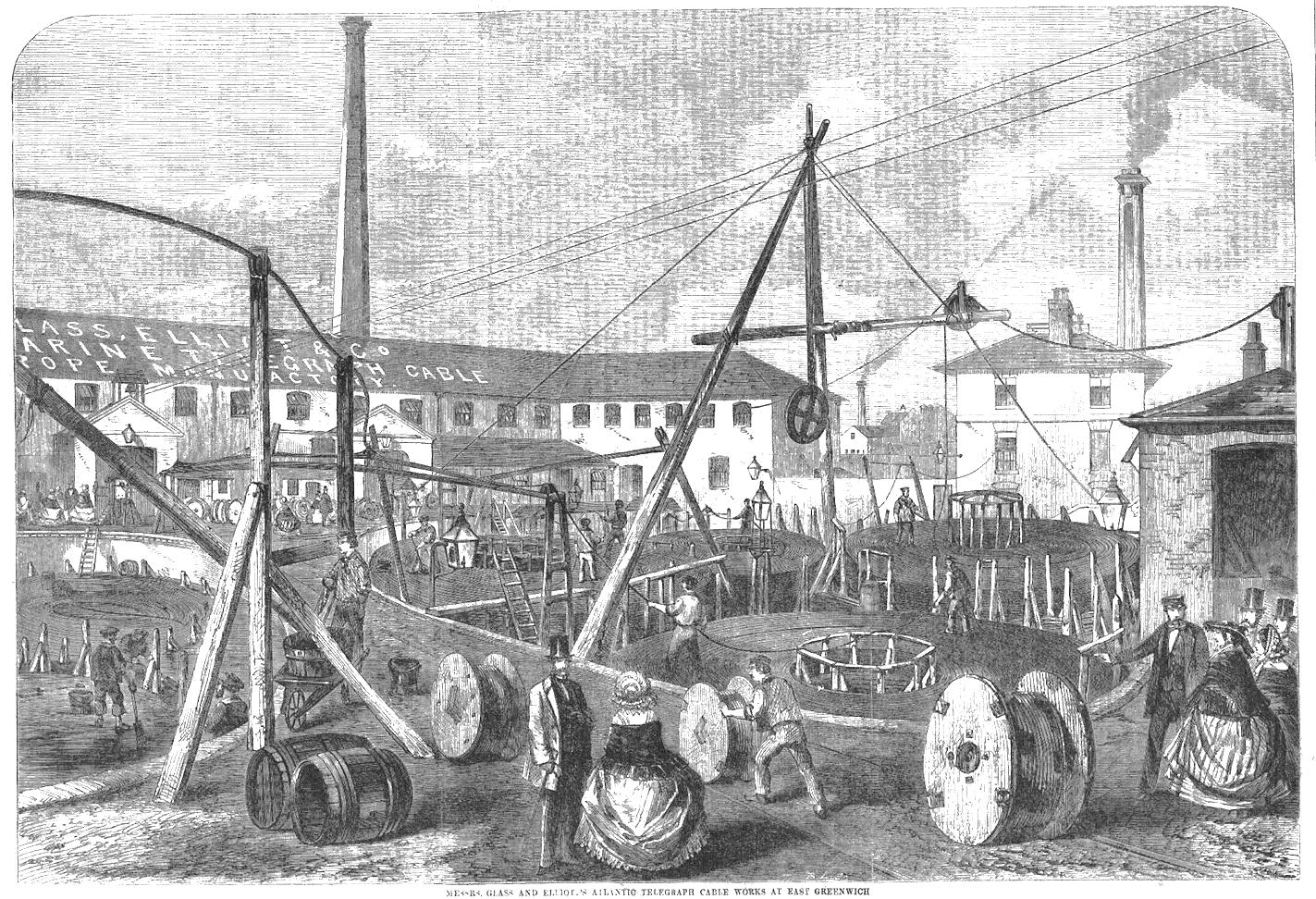

Glass Elliot Cable Factory in Greenwich, England
Propontis Passengers Travelling to Nfld.
Steam Ship Propontis
BACK REFLECTION
ter ions that increased the dielectric effect and retarded the system’s data rate. When the Atlantic Cable began operations, the transmission rate was ~ 0.25 characters per minute. This was ~ 200X lower than Morse’s experiment; and matched that as predicted by Faraday.
It is interesting that Field was in England at this time with Morse. They were promoting the Atlantic Cable project, forming the Atlantic Telegraph Company, conducting interviews and publishing their prospectus. Field was also ordering the Atlantic Cable: half from Glass Elliot & half from Newell.
CABLE TRANSIT
The cable was constructed at Glass-Elliot Factory in Morden Wharf, East Greenwich.
The mail steamer Propontis was hired by Glass Elliot to convey the cable from London to the Gulf of St. Lawrence.
It departed the factory on June 2nd.
It stopped at Cork for coal and newspapers and departed on June 6th.
It arrived in St. John’s on June 20th.
It sailed to Sydney on June 21st.
It left Sydney on July 5th.
It arrived at the cable laying site on July 8th.
The passenger list includes Elliot (owner of the cable factory), Canning (Chief Engineer), de Sauty (incorrectly printed as Santy, he later operated the Atlantic Cable in 1858 in Bay Bulls), and Brooking (Insurance Agent). Perhaps the others were also involved with the cable supplier Glass, Elliot & Co.
and Soundings
SURVEY & SOUNDINGS
The survey for the 1856 Gulf Cable was conducted five weeks before the lay. It was conducted by Commander
John Orlebar, an officer and surveyor for the royal navy. The vessel used was the HMS Columbia, a paddle steamer under the command of Commander
Admiralty Chart Showing East End of Cable and Soundings
Admiralty Chart Showing West End of Cable
Peter Frederick Shortland. Orlebar worked as assistant to Captain Henry Wolsey Bayfield. Both men charted nearly every shore and inlet in Atlantic Canada. Bayfield even worked with Gisborne in 1853 by providing soundings for the planned submarine cable route from Cape Ray to PEI. This was the original route for the Gulf Cable that bypassed NS.
Note: There is much skirting the Gulf of St. Lawrence by Orlebar at this time. The cable ship (Propontis), recovery ship (Ellen), and the survey ship (Columbia) must all do their work and synchronize their efforts. There are also reports of a ship from the UK (Argus) and another from the USA (Niagara) travelling to witness the lay. There is not much information on these, but they were also in the mix along with Field’s company ship (Victoria).
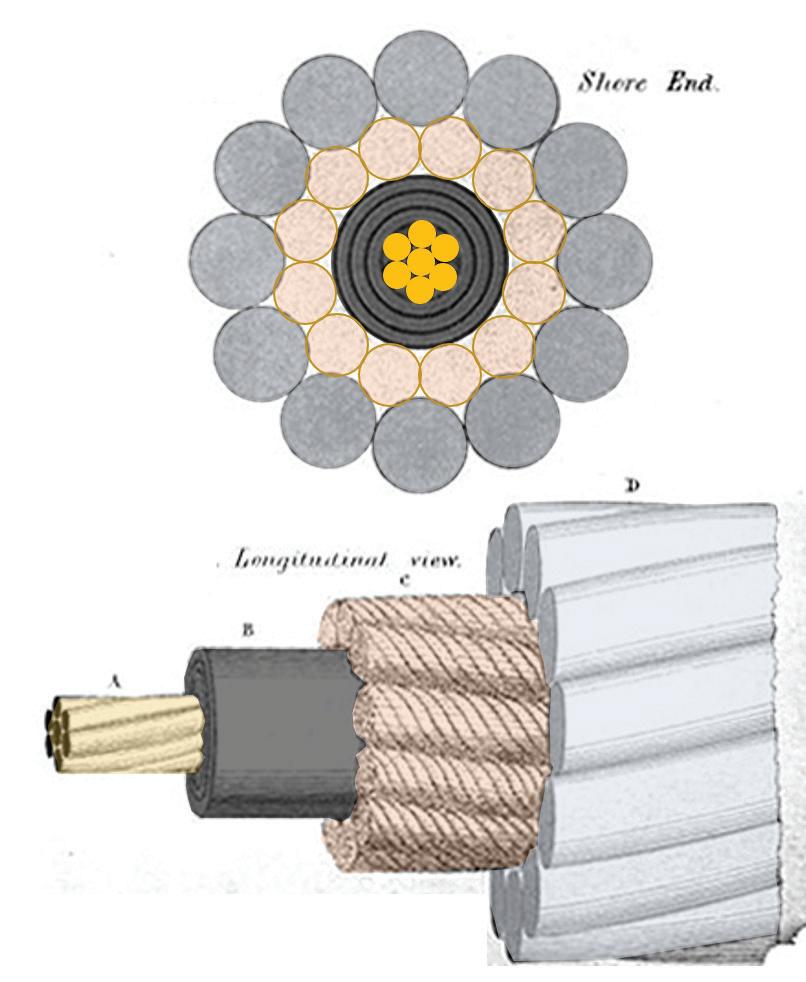
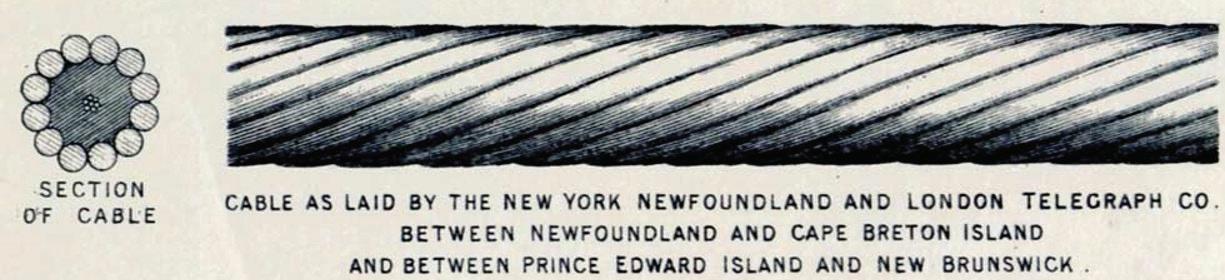
Orlebar began surveying the 1856 Gulf Cable route on June 5th in the Columbia. He departed Sydney, NS then traveled north to the western landing site called Aspy Bay (also spelled as Aspee, Ashbe, Ashby or Ashpee in many documents). He surveyed and sounded in that region. From Aspy, he sounded the cable route from west to the eastern landing site called Cape Ray. Due to poor weather
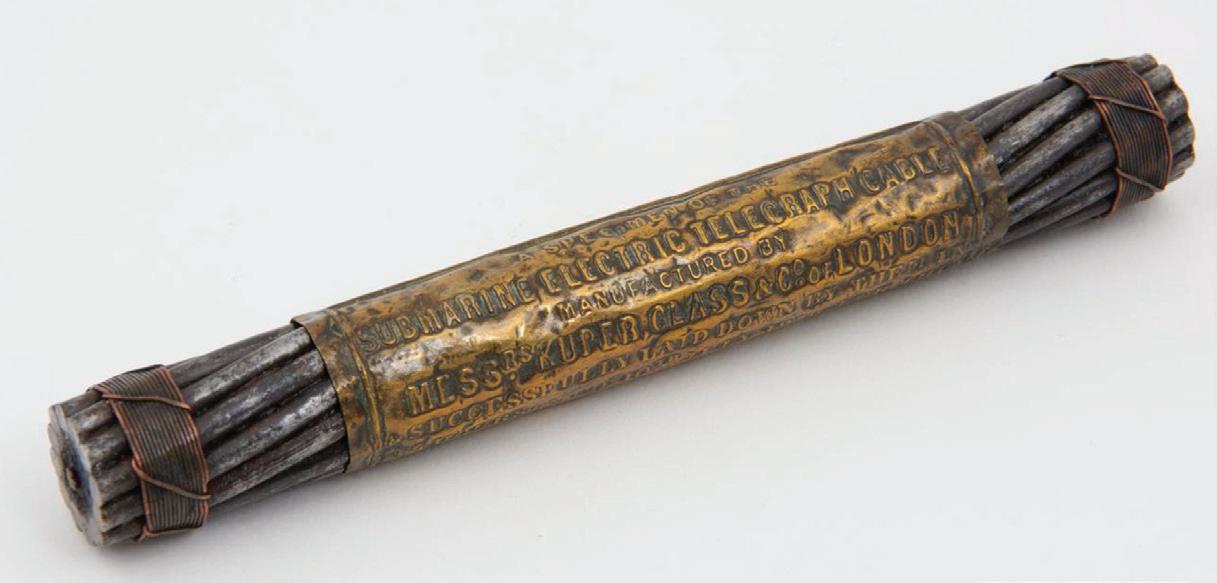
at Cape Ray, the Columbia sheltered nearby in Port au Basque’s Grand Bay. Orlebar set up stations on the shore
and calibrated his measurements. More soundings were taken then he surveyed from Grand Bay back across the gulf to Aspy Bay (a slightly southern route this time). He then returned to Sydney hoping to meet the cable ship. The cable ship Propontis had not arrived, so he released the Columbia and steamed back to Cape Ray in the tender (Ariel) for more soundings. After sixteen days, he obtained news that the Propontis had arrived in Sydney (probably through an update from the Brig Ellen that just arrived in Cape Ray from Sydney to recover the 1855 cable). The Ariel returned to Sydney on June 30th and Orlebar presented his sounding data to Mr. Canning on board the cable ship Propontis. Canning was the lead engineer assigned to the lay. Orlebar then departed again for Cape Ray in the Ariel on July 1st to continue the survey.
The cable ship Propontis awaits the Brig Ellen to return (July 4th) before steaming to Cape Ray (July 5th) to start the lay. The Propontis arrives at Cape Ray on July 8th. Mr. Canning accepts Orlebar’ s offer to join him on the Propontis for surveying and piloting the lay. Orlebar does this.
The lay starts early in the morning.
1856 Gulf Cable
1856 Gulf Cable
1856 Gulf Cable (Factory Sample)
BACK REFLECTION
The Cape Ray shore landing is completed by 2pm on July 9th. They then lay westward to Aspy Bay. Orlebar notes the current is to the north, so he pilots south. They slowed off the island of St. Paul then the lay completes at 2pm the next day (July 10th).
The direct route from landing station to landing station was 74 miles (120km). 82 miles (132 km) of cable was put down. After the lay, Orlebar returns to Sydney in the Ariel. He travels westward along the coast of Nova Scotia and sends his report to Captain Bayfield on July 17th from Sherbrooke (St. Mary’s River).
Note that the coastal surveys included using calibration references from the shore using temporary targets placed on land. Triangulation was a key method used. Geographical drawings of the region from the sea were also made. All of this data was then plotted on a detailed Admiralty Chart.
An 1860 Admiralty Chart (#2727) of the region from the Hydrographic Office, with credits to Orlebar and Bayfield, shows the soundings and drawings of Cape Ray and Aspy Bay. Bayfield’s diary indicate that he and Orlebar had previously surveyed the area in August of 1847. The 1860 chart even includes the detailed route of the 1856 submarine cable that is unusually annotated with the month of “July”. My suspicion is that Orlebar took careful measurements during the lay (July 1856) while onboard the Propontis and that the position of the cable on this chart is extremely accurate and plotted by Orlebar.
With Orlebar’s precise piloting, the 1856 lay required 10% extra cable from the point-to-point distance. It was thought that the 1855 lay would have run short of cable (US Nautical Magazine, Oct. 1855), due to the drifting off the route caused by the weather and by the captain (i.e. the 1855 lay would have failed regardless of the storm and it was lucky for Field).
CABLE DETAILS
• Conductor: One strand: seven No. 22 BWG (0.71mm) copper wires twisted together
• Insulation: Gutta Percha: 3 coats to thickness of No. 1 BWG (7.62mm)
• Filler: twelve ropes of jute
• Deep Water Armour: twelve iron wires No. 9 BWG (3.76mm)
• Weight: two and a half tons per mile (deep water cable)
• Shallow Water Armour: twelve iron wires No. 4 BWG (6.04mm)
LAY
Here are three cable lay reports. One is a report by Commander Orlebar who was the route surveyor and who also piloted the cable laying ship. Another is an interview with James Eddy, owner of the Terrestrial Network in Maine, early telegrapher going back into the 1840’s and partner in the ATC. The third report is from someone leaving only the initials X.S. Perhaps it was Charles Victor de Sauty, or Thomas Scanlan?
The cable almost ran short as there was only 1/2 mile of spare left.
Laying of the Newfoundland Submarine Cable.
Propontis, Aspec Bay, July 10, 1856.
Sir, —The work of laying a Telegraph Cable between Newfoundland having been successfully accomplished in the short space of fifteen hours, I feel it due to the public interested in the momentous question of uniting the two Continents by the Electric Telegraph, to give some account through your columns of its progress.
Perhaps you are aware that Messrs. Kuper & Co. accepted the responsibility of laying the Cable for the Telegraph Company, and early in June had secured the services of the Propontis, an efficient screw steamer of eighty horsepower, for that purpose. The whole direction of the service was very properly confided to Mr. Canning, who had been with the ground the year before, and whose ability and energy joined with great equableness and generosity of temper make him a general favorite and pointed him out as eminently fitted to carry out this, and the still greater work of spanning the Atlantic Ocean.
If mistake not eighty three miles of Cable were placed on board the Propontis, and in due time Mr. Canning and his staff of operators and workmen arrived at Sydney Cape Breton, where he embarked and tested the drums for playing out the cable, and completing with coal, sailed on the 5th July for Aspec Bay and Cape Ray. By the direction of the Admiral, soundings across the Strait between
Cape Ray and Cape North had been taken by Commander Orlebar and Shortland, in the Columbia a few weeks previously, and a chart of the soundings was given Mr. Canning by Commander Orlebar, on his arrival at Sydney. The Propontis reached Cape Ray Cove on Monday afternoon about 2 P.M., the delay in reaching there since the 5th of the two previous days having been spent in making out the land. The surveying tender Ariel, Commander Orlebar, was lying at anchor in the cove, and according to previous arrangements, the Commander and his officers and boat’s crews embarked in the Propontis and assisted in piloting her into Aspec Bay. Some stormy days were spent there to secure the service of the fishermen, but for some unexplained cause, although a promise was understood to exist, that the steamer’s boats were forced to undertake the duty of landing the end of the Cable. This was only difficult on account of the surf running so very high, but by a judicious arrangement of Mr. Canning, a manilla rope of 500 fathoms was first laid out from the stern of Propontis to the shore when the long boat and whale boat having each some cable coiled in them, hauled on shore by the rope paying out cable from the long-boat until close in to the surf when on a given signal, the rope being cut in two, the whale boat holding on was dragged through the surf by a party on shore, while the long boat being fast to the other part, was hauled on board. The Cable was landed by noon, and tested by the operators: and the 2 s found correct and
the gentleman in charge of the station having been landed, the anchor was weighed, and at a quarter past two, P. M., the Propontis steamed off to sea, paying out the Cable.
There was a long southerly swell, but the surface of the sea was unruffled, whilst a clear sky, a light westerly air, and high steady barometer gave us fair promise for the voyage. At first the rate of going hardly exceeded two knots—then it was increased to three, and at the end of the second hour a speed of six knots was attained, and continued till it was dark. Then some little delay was experienced in commencing the paying out of that part of the Cable coiled in the after part of the hold, but after that all went on smoothly until at twenty minutes past 4 on the following morning, the Propontis came to an anchor off the Telegraph station, Aspec Bay. The distance across sixty-four Geographic and seventy-four statute miles, and the depth for thirty miles of that distance was over two hundred fathoms. The deepest 265 fathoms. The Cable lies in the sand in the shoaler water, and black mud in the deep.
They could have witnessed the progress of this work, without the conviction, that in such hands the spinning of the Atlantic Ocean, would be a safe undertaking. Mr. Canning never left the deck, he was ably seconded by the ship’s officers, and by his own men who behaved admirably and attended to all parts of the work unfailingly, whether at the re-build of the series. I ought to mention that the Messrs. Gisborne, with Mr. Gisborne in a
second, came from Aspec Bay. in just as four P. M., and left company with the Propontis, and two hours after sun-light the Victoria signalized their satisfaction at the progress of the work by firing rockets and blue lights.
The morning opened with light rain, which continued till about noon, but the work of getting the end of the cable on shore, had to be done, and all hands setting to work; and being tested by Mr. Eddy, one of the directors of the Telegraph Company, was found in excellent working order, and communications were freely transmitted from shore to shore.
The two steamers will remain a day or two at Aspec Bay, whence proceeding to Northumberland Straits, the Propontis will lay down another length of ten miles cable, communicating Prince Edward Island the main, after the completion of which work, you will probably hear again from us. It is felt, however, by all engaged, that the great work of the season is accomplished, and there is a slight feeling of disappointment, that there are no more difficulties to be encountered, and dangers to be overcome. In conclusion. I must not omit to say, that the rain did not prevent a hearty expression of satisfaction at the successful termination of the work. Guns were fired from the steamers, and hearty hurras were given by all hands, whilst the hospitality of the worthy contractor was freely extended to all employed.
Let me hope. Sir, that the enterprising spirit of this Telegraph Company, will be infectious; and that the grand
BACK REFLECTION
effort the Company still contemplates, will meet with such favor from the Governments of the two great Countries, that loosing sight of the vexatious questions agitating the South, they may together, blend their energies to connect England and America by the triple cord of electricity, free trade and righteousness.
Yours, X. S.
Laying of the Newfoundland Telegraph Cable.
A few days since we had the pleasure of an interview with Mr. James Eddy, of the American Telegraph Company, who was present on board the English steamer Propontis, and was engaged in laying the telegraphic submarine cable across the Gulf of St. Lawrence. He has just returned. We are thus enabled to publish the particulars of this interesting performance,
which hitherto has been only chronicled to the public by a brief telegraphic despatch.
On the 9th of July, after having landed, and secured the end of the cable to the telegraphic station at Cape Ray, the steamship Propontis weighed anchor about 2 o’clock, and steamed across the gulf, passing out the cable at the rate of about six miles per hour, reaching Aspy Bay, (Cape North, the other terminus,) soon after five o’clock the next morning, having run fifteen and a half hours—without the slightest injury to the cable, or kink or bend of any kind. The cable was coiled in the hold with the greatest care, in such manner that each successive layer was run out from the centre to the circumference. It was not necessary to stop the engine for a moment. As the cable passed from the coil, it moved through a kind of inverted cast iron tunnel,
and over two cast iron drums, each about nine feet in diameter, weighing a ton and a half each, and over a pulley at the stern of the ship. A register attached to the drum showed the exact length of cable paid out, being regulated like a gas metre—one dial showing the fathoms—another the miles. Brakes were constantly brought to bear on the drums, so that the cable entered the water straight, and a sufficient strain was kept upon it to lay it smoothly on the bottom. While it was being laid in the deepest part of the gulf—some one hundred and fifty to one hundred fathoms—the cable descended at an angle of twenty-five degrees, showing that its great weight was more than sufficient to counterbalance the forward movement of the vessel. Communication was kept up constantly between the ship and the shore while the cable was being
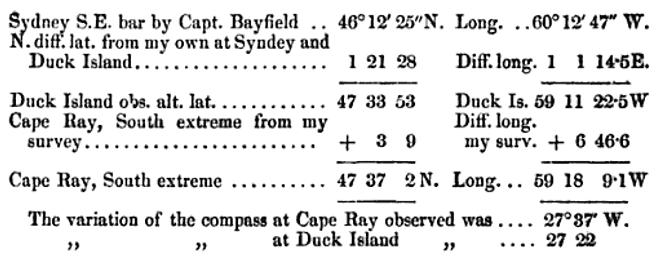
laid. After arriving at Cape North, and while the cables were being secured on shore, a temporary telegraph station was fitted up under a tent, and electric communication fully established between the two shores of the gulf—a distance of eighty-five miles. This gratifying result was announced by the firing of guns from the Propontis, and elicited the hearty cheers of all in attendance. The electric fluid had found its way among mermaids of the deep, with the same facility as when passing between poles in the open atmosphere. The manufacturers of the wire were responsible for its safety until laid in its bed and for a time subsequent.
On the 18th of July, another cable was laid from the same ship, for the same company, across the Straits of Northumberland, from Cape Tormentine, N. B., to Cape Traverse, Prince Edward’s Island, a distance of 13 miles, with the same success; and communication is now complete between Prince Edwards Island and the United States. This last cable is only a matter of local convenience; the former constitutes an important link in the great enterprise of connecting New York with London. The company expect to have the whole line complete to St. Johns, N. F., in September next; all that is now wanting being the completion of a portion of the overland line in Cape Breton and Newfoundland. In case of a steamer calling at St. John’s, the news would be received here two
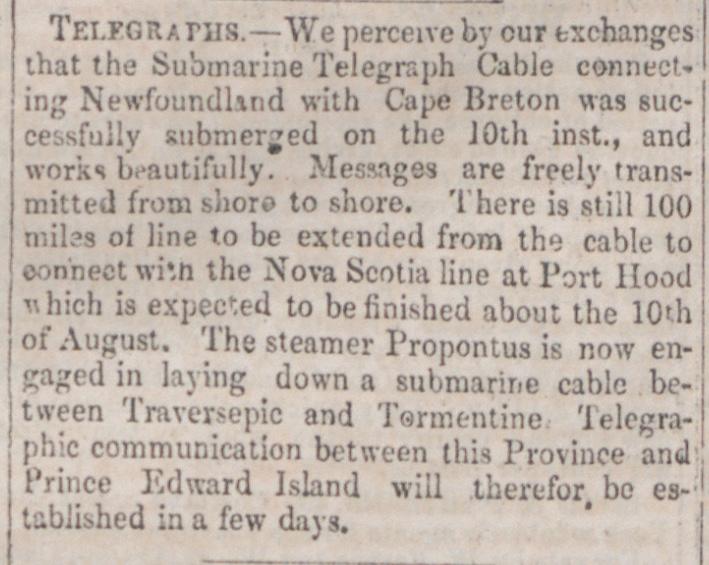
or three days sooner than by those that stop at Halifax. The cable laid by the Propontis is of the same description with that previously lost, except that the portion designed for the deepest water was somewhat lighter, and had but one conductor, composed of seven copper wires; whereas, the former had three insulated wires. —N. Y. Jour. of Com.
Surveying Tender Ariel, St. Mary’s River, July 17th, 1856.
Sir,—I have the honour to report the successful termination of the service to which by your direction I gave all the assistance and co-operation in my power. You are aware that
I met with the Colombia at Sydney on the 4th of June, and that embarking in her I proceeded to Cape North, and on Saturday the 7th sounded across to Newfoundland. The clear weather enabling us to fix with angles at every cast of the lead. Near Cape Ray the wind increased so much that we were forced to discontinue sounding, and having received a pilot, to seek an anchorage in Grand Bay, about six miles E.S.E. of the cape. As it was necessary to determine the position of the objects about Cape Ray, from whose subtended angles our soundings were connected with the coast of Newfoundland, Capt. Shortland and myself determined on a survey of the coast
BACK REFLECTION
adjacent, and a chronometrical measurement to Sydney. We remained in Grand Bay until Wednesday, the 11th inst., fog, rain, and easterly wind preventing us doing more than erecting a few stations and determining the scale of our work from careful and repeated observation of the mast-head angle.
On Wednesday we obtained good equal altitudes for time and circum-meridian altitudes of the sun for latitude; and on Thursday, the day following, starting early we ran a line of soundings from Grand Bay to Ashpee; the whole distance of 64 miles we were able to fix from either shore at every separate sounding.
At eight in the evening, having finished the soundings required, we steamed on to Sydney, where we arrived on Friday morning at eight o’clock, and the day being favourable observed for time and altitude at your station on the S.E. bar.
I have given you the result of our measurement in a paper from Capt. Shortland, it now only remains for me to give you the resulting latitude and longitude of my station near the South extreme of Cape Ray.
After the completion of the chronometrical measurement, conceiving the Colombia was no longer required, we parted company; Captain Shortland returning to his survey in the Bay of Fundy, whilst I returned to the coast of Newfoundland to await the arrival of the Propontis steamer, and to complete the soundings approaching the Newfoundland shore, and the triangulation to the Cape.
I continued in the neighbourhood of Cape Ray till the 30th, when
hearing of the arrival at Sydney of the Propontis, I sailed to that port, and put myself in communication with Mr. Canning, Messrs. Kuper & Co.’s agent for the laying down of the cable. I presented him with a chart of the soundings taken in the Colombia and told him my instructions were to assist him as far as possible as a pilot and surveyor. The following day I returned to Cape Ray and continued the survey until the arrival of the Propontis on Tuesday, July 8th at 2h. p.m.
The weather promising most favourably, we agreed to start as early as possible the following morning. The surf was very high on the beach, and the end of the cable had to be landed a distance of half a mile in the boats of the steamer; this occasioned some delay. Having myself embarked in the Propontis, by request of Mr. Canning, and all being ready at 2h. p.m., we steamed out of the bay, paying out the cable. At first our progress was slow, not exceeding three knots per hour; but finding the cable pay out well, the rate was increased gradually until a speed of six knots was attained. I found by my angles that a current was setting to the North, and we were obliged accordingly to steer Southward of the direct course. At sunset we were fifteen miles East from St. Paul Island; from this time as the night was dark the rate of going was reduced to three and four miles per hour. The weather continued fine and nearly calm throughout, and at five the following morning the Propontis anchored off the Telegraph station, Ashpee Bay. The distance across is 64 geographical or 74 statute miles, and the amount of cable paid out 82 statute
miles, leaving Mr. Canning about half a ½ mile to spare when the end was landed on the beach.
The whole was completed by 2h. p.m., and communications were transmitted freely from shore to shore. Thus, the great work of connecting Newfoundland with the American Continent was effected in about thirty hours; and no one could have witnessed its progress without the conviction that in the hands of Mr. Canning, if sufficient means were afforded, the spanning of the Atlantic would be a safe undertaking.
Having thus assisted in accordance with my instructions towards the successful completion of the undertaking, the same evening I rejoined the Ariel, and proceeded to Sydney, from whence I came on without loss of time to rejoin you at this place. I shall be able to furnish you in the autumn with a fair copy of the partial survey I was able to make whilst waiting for the steamer, and I think you will perceive that what has been done establishes the necessity of an early survey of all this important coast.
I have, &c., John Orlebar
To be continued in Part II along with a special Ghost Cable Ship article for Halloween. STF
PHILIP PILGRIM is the Subsea Business Development Leader for Nokia's North American Region. 2021 marks his is 30th year working in the subse a sector. His hobbies include "Subsea Archaeology" and locating the long lost subsea cable and telegraph routes (and infrastructure). Philip is based in Nova Scotia, Canada.

LEGAL & REGULATORY MATTERS
HOW TO RECOVER DIGITAL SOVEREIGNTY
Ten Measured Steps for Governments and Regulators
BY ANDRÉS FÍGOLI
In today’s increasingly fragmented digital landscape, governments are under pressure to reclaim control over critical infrastructure — particularly submarine cables — without triggering capital flight or regulatory retaliation. Restoring digital sovereignty is neither a rhetorical banner nor a declaration of independence from global technology giants. It must be a carefully designed roadmap rooted in facts, legal authority and market logic. Over-the-top (OTT) platforms are not traditional telecommunications operators. Their scale, business models and leverage mechanisms differ fundamentally — granting them a dominant, and at times suffocating, market share in the submarine cable industry. Addressing this imbalance demands pragmatism, not posturing. While many countries aspire to become regional or international hubs for submarine cable infrastructure, few move beyond declarations. Even fewer take concrete steps to ensure their citizens enjoy stable, secure, and affordable connectivity — which should remain the core objective.
The ten steps that follow offer a practical, evidence-based roadmap for policymakers to gradually recover digital sovereignty. Each measure is intended to be legally sound, economically viable and tailored to address both the structural asymmetries of the current market and the urgent need for resilient, inclusive connectivity.
1. BUILD THE DATA: STATISTICS AS THE FOUNDATION STONE
Before any meaningful reform can
take place, governments must first build their own independent statistical foundation. While hundreds of reports, media articles and white papers — often authored by wellknown consultants or interest-driven think tanks — circulate with strong opinions and policy suggestions, very few governments possess an internal, comprehensive database detailing the status of submarine cables within their jurisdiction.
Mapping the cables is only the beginning; understanding their operational reality is the real challenge. This internal tool should include, at a minimum, the following data from the last 20 years:
• all submarine cable outages, including shunt faults, within jurisdictional water or beyond when it affects a segment connecting to their country
• causes and duration of each event
• mobilization time and costs of repair vessels
• the extent of traffic degradation or loss
• delays caused by permits, customs, or other external constraints
• a breakdown of which users (e.g. retail) or services were affected
Without such data, policymakers risk blindly adopting international “best practices” that may be irrelevant or even counterproductive in their specific context. For example, if a country has not experienced a single cable cut caused by fishing activity in over 20 years, why impose new fishing restrictions that create unnecessary friction with local communities? Evidence
must come before action.
Similarly, decisions such as whether to support the development of a regional cable maintenance fleet, or to reform national cabotage rules, should be grounded in verifiable data: how many past repairs were delayed due to geographic distance from the cable maintenance ships’ base ports, lack of such vessels, or bureaucratic hurdles? Without this clarity, well-intentioned measures risk becoming costly bureaucratic exercises with little impact.
This is the ABC of digital sovereignty: understanding what a nation depends on — and how and where it has failed over time when submarine cables were most needed. Only with hard data can policymakers withstand pressure from corporate or public actors and implement measures that balance connectivity goals with national interests. Evidence-based policymaking is not optional — it is the only effective defence against corporate and geopolitical pressure in an already distorted submarine cable market.
Moreover, this tool must not depend on the goodwill of private actors or third-party consultants. Regulators should manage and update it regularly and control its accuracy to avoid a cable owner evading its accountability.
In a world where “data” can be curated, and “truth” outsourced, the line between analysis and influence grows dangerously thin. Scepticism is not cynicism — it’s the foundation of responsible governance. Some of the most damaging policy ideas are not outright falsehoods, but half-truths
cloaked in technical jargon and academic formatting.
Take, for instance, a region where most cable outages have been consistently attributed to merchant ships dragging anchors — all of them clearly identifiable through activated AIS systems. In such a case, why would the deployment of expensive, unmanned surface vehicles (USVs) be necessary for additional surveillance? Does the solution respond to actual evidence, or to the interests of those selling the technology?
This is why digital regulators must not outsource their judgment. They must build their own knowledge base, maintain it with integrity, and be willing to question even the most qualified voices — especially when the stakes involve national infrastructure, sovereignty, and public trust.
Above all, this is the most important input for the next steps, which involve the creation of national regulations. In most countries worldwide, there is no such specific legal framework for subsea cables, so the question of changing the status quo will be based on these statistics and, subsequently, measured in the same way, so that any adjustment is based on them as well.
2. REQUIRE OPTIMIZATION OF CABLE REPAIR VESSEL MOBILIZATION TIME
Every cable landing permit should include an enforceable contractual clause mandating minimum mobilization times for cable repair vessels. Otherwise, cables may remain inoperative for months—not due to technical constraints but because of cable own-
ers’ funding constraints or opportunistic pricing by maintenance providers. Governments must not accept repair operations contingent solely on a cable owner’s financial capacity or willingness to act during traffic degradation. Failure to address this could critically diminish rerouting capabilities during regional multi-cable outages, leaving countries vulnerable to nationwide internet blackouts.
This raises a related question directly linked to geopolitics: should “non-authorized” (primarily Chinese) repair providers be permitted to enter the market to boost competition and reduce transit delays from port to fault zones? Current exclusionary practices distort the submarine cable maintenance market, stifling incentives to modernize an aging vessel fleet that is largely over 20 years old.
Governments should recognize the challenges faced by national telecom carriers in securing competitive pricing and viable conditions for repair services amid scarce, outdated maintenance vessels. Are these carriers confronting a cartel that undermines compliance with local requirements of digital sovereignty? If so, antitrust regulators must intervene immediately to scrutinize this niche market and its adverse conditions for local players that cannot match OTTs’ overwhelming, economies-of-scale demands.
3. DIVERSIFY THE SUPPLY CHAIN WITHOUT POLITICAL PARALYSIS
Geopolitical debates over “non-authorized” suppliers dominate global reg-
ulatory agendas. Yet digital sovereignty requires not the exclusion of any single country’s suppliers but the avoidance of over-reliance on any one source.
Instead of binary exclusion policies, governments should adopt pragmatic safeguards:
• Mandate full supply chain transparency
• Enforce strict liability for technical or cybersecurity failures
• Ensure contractual clarity with robust auditing rights
• Publicly demand verifiable evidence of security breaches from accusers (e.g. Mexico’s President’s 2022 request regarding mobile networks).
Historically, security breaches often stemmed not from individual vendors but opaque subcontracting chains that diffuse accountability. True digital sovereignty hinges on a diversified, transparent, and auditable supply chain—governed by enforceable rules, not geopolitical alignment.
Even when a single nation controls a submarine cable’s entire supply chain, from manufacturing to maintenance of every cable installed in its jurisdictional waters, this monopolistic structure does not ensure efficiency, competitiveness, or innovation. A stark disparity emerges when traditional carriers receive no priority for their project quotations from the cable manufacturers, while hyperscaler-backed megaprojects have fast-track deployment through scale & volume and no financial constraints.
LEGAL & REGULATORY MATTERS HOW TO RECOVER DIGITAL SOVEREIGNTY
Ten Measured Steps for Governments and Regulators
4. PERMITS, NOT PRIVILEGES: BUILDING TRUST THROUGH FAIR AND OPEN PROCESSES
Many OTTs argue that, in order to attract data centres, countries must streamline and liberalize their submarine cable permitting processes. While procedural efficiency is important, governments must be cautious not to grant disproportionate advantages that may distort competition and contribute to the formation of de facto monopolies. Poorly calibrated concessions risk giving hyperscalers even greater leverage — often at the expense of smaller competitors (e.g. incumbent telecom operators), unable to match their scale.
Equity must be the guiding principle. All market participants — whether global giants or local companies — must be subject to the same rules, oversight, and obligations. Preferential treatment, usually granted under Memorandums of Understanding that bypass public scrutiny, not only distorts the market but also creates long-term regulatory vulnerabilities. Promises of massive investment in data centres or landing sites are often oversold. These projects may generate headlines but they rarely result in the scale of job creation or economic benefit that justifies exemptions to Environmental Assessment Studies when granting cable landing permits. Thus, permitting procedures must be transparent, accessible, and protected from informal or opaque arrangements. Secret agreements negotiated without public oversight frequently become tools of leverage against future administrations, especially when
those who signed them later join the companies that benefited. To avoid these conflicts of interest, non-solicitation clauses and post-employment cooling-off periods should be legally mandated, barring former public officials from joining regulated entities for a specified period if they were directly involved in granting cable permits. Moreover, all seabed surveys and environmental data collected during the permitting process should be mandatorily shared with the coastal state that grants such landing permits. These surveys are conducted in public waters, not private territory. The information gathered must be considered a public good — valuable for future exploration, conservation, and maritime planning efforts beyond the cable project itself.
5. MEASURE TRAFFIC QUALITY DEGRADATION
Governments should implement proactive and routine monitoring of traffic quality, especially during submarine cable outages, instead of relying solely on consumer complaints — which may never be formally submitted. The reality is that multiple contractual layers separate the end-user from the submarine cable owners, with most of them including liability waivers or limitations. As a result, in the event of a serious cable outage — even one caused by force majeure events such as seabed landslides — the compensation and remedies offered by an lnternet Service Provider to end-users are usually negligible compared to the actual harm suffered.
Frequently, submarine cable owners
issue press statements claiming that traffic has been “restored” after an outage. However, these declarations often mask poor recovery plans and significant quality degradation, with restoration capacity services insufficient to fully comply with the same service quality. In practice, traffic prioritization may be applied — with essential government or corporate services receiving stable bandwidth, while the general public is left unable to make basic voice calls or stream international events like live football matches.
Such performance gaps are not trivial — they represent failures in digital rights and infrastructure resilience. To prevent this, governments must measure and publicly report traffic quality metrics during and after cable disruptions. This oversight is essential to verify whether cable owners and operators are truly fulfilling their commitments as stipulated in landing permits and other licences.
Regulators should actively enforce corrective measures — ranging from financial penalties to, in repeated cases of non-compliance, the revocation of permits. Monitoring must include independent metrics on key operational parameters, such as optical loss, latency, bit error rate and packet loss — not just lit capacity. These metrics should be actively collected over time to verify that all these measures are correctly applied or adjusted accordingly if necessary.
Unfortunately, many governments choose to remain silent during submarine cable outages, hoping the disruption will go unnoticed and political
fallout will be avoided if neighbouring countries are similarly affected. This inaction often serves to obscure shortcomings in national digital strategies and to evade public scrutiny by ensuring the country is excluded from rankings of the most affected nations during regional multi-cable failures.
But digital sovereignty requires accountability both from the public and the private sectors. If subsea connectivity is recognized as a critical enabler of national development, then traffic quality monitoring must become a standard regulatory practice — not an afterthought triggered only during crisis.
6. REQUIRE A MINIMUM SHARE OF NATIONAL TRAFFIC
Regulators often fall into two common traps when evaluating their country’s submarine cable connectivity. The first is assuming that a dense cable landing map equates to sufficient and resilient capacity for national traffic. This is not necessarily true. Many of the cables landing on their shores may have been installed two decades ago — in 2002 or earlier — often with only four fibre pairs and ageing transmission equipment. These systems may be nearing the end of their useful life and are ill-equipped to handle growing data demands or provide adequate redundancy during a multi-cable outage.
An illustrative example was discussed in May 2025 during a session of the UK’s Joint Committee on the National Security Strategy1: nearly
1 Steventon-Barnes, Jeremy. ‘’Written evidence submitted to the Joint Committee on the National Security Strategy, UK’’, 6 March 2025. Available at: https:// committees.parliament.uk/writtenevidence/138729/pdf/
75% of the UK’s transatlantic potential capacity is currently concentrated in just two cables, both landing at Bude. Even though this news was repeated without the proper clarifications from its authors (e.g. use of alternative routes), it highlights a crucial point: evaluating resilience requires more than just counting cable landings — it requires assessing the actual design capacity and lit capacity of each system.
The second mistake is assuming that even brand-new, high-capacity cables — equipped with 16 fibre pairs — are necessarily carrying domestic traffic. In many cases, these systems are dominated by over-the-top (OTT) providers, which use them primarily to deliver their own content. A national telecom company may be a minority co-owner of the cable consortium, while the OTT holds a disproportionate share of the usable capacity. In some cases, the OTT may not even appear as a majority owner but holds the bulk of the capacity Indefeasible Rights of Use (IRUs) through confidential agreements with other consortium members.
To address this imbalance, governments should require cable landing permit holders to guarantee that a percentage of the system’s total design capacity is allocated to national traffic. It does not matter who owns the international portion of a subsea system or who holds the IRUs — the landing party, as the entity legally accountable to the coastal state, should ensure compliance with this quota.
Attempting to exert state control over the internal legal arrangements of a cable consortium or trace every
capacity IRU/lease transaction or fibre pair sale is unrealistic and resource intensive. A better approach is to place the regulatory burden on the local landing party — requiring them to demonstrate that a fair share of capacity is available for national use, whether through non-transferable ownership or capacity IRU/leasing.
7. CHOKEPOINTS: ANTICIPATING RISKS BEYOND BORDERS
The geographical location of submarine cable choke points is widely known within the industry. If a regulator is aware that a subsea system landing on its shores will traverse one of these high-risk zones — even if located in distant jurisdictions — it may not have the authority to demand a route change. However, it should at least require concrete assurances: restoration service commitments, regular stress tests, defined cable repair mobilization timelines, and mandatory reporting of any failures in those areas. These measures are essential to avoid unexpected disruptions and to ensure national preparedness.
Proactive regulatory oversight ensures that cable owners do not shift disproportionate risks onto coastal states without offering appropriate mitigation measures or transparency.
The phrase ‘it is beyond our borders’ became a common refrain among telecom regulators in distant countries during the February 2024 Red Sea multi-cable outage — a deflection that exposed the fragility of global interdependence. Too often, after a cable failure in one of these bottlenecks, governments are left with little more than
HOW TO RECOVER DIGITAL SOVEREIGNTY
Ten Measured Steps for Governments and Regulators LEGAL & REGULATORY MATTERS
force majeure explanations and vague technical justifications. But in reality, many of these outages could have been foreseen and mitigated if regulators had asked the right questions — not just within their borders but along the full routing of the system.
National sovereignty must not serve as a shield for operational negligence, especially when the consequences of inaction can spill over into regional or even global connectivity disruptions. A clear lesson emerged: several countries are now reassessing whether to approve landing permits for future systems that pass through recognized chokepoints — including the Red Sea and the Pacific side of the Panama Canal — due to the elevated risk such routes represent.
Therefore, when faced with stricter regulatory scrutiny or risk mitigation requirements based on statistics, a cable owner may find it more economical — or at least more reputationally sustainable — to reroute the cable and avoid problematic chokepoints altogether. This is precisely the objective: good regulation incentivizes better planning and protects against future cascading failures.
Failing to address chokepoint vulnerabilities before crisis strikes is not just regulatory oversight — it is regulatory negligence. A well-informed, regionally coordinated approach is necessary to hold cable operators accountable and to ensure infrastructure resilience in the face of concentrated risk.
8. REGULATORY CHARGES: ALIGNING FEES WITH CAPACITY AND NATIONAL INTEREST
How should countries charge those who benefit most from submarine cable operations — particularly in terms of national economic impact? Should a 2002 cable with 6 fibre pairs pay the same fees as a 2025 system with 24 fibre pairs and exponentially greater throughput? Clearly not. The seabed is a finite and strategic resource. When granting landing permits or operating licences, regulators must consider not just technical specifications but also how much national traffic the system actually carries, as opposed to simply transporting platform or content provider data.
The underlying objective should be to foster a competitive and diversified market. A nation strengthens its digital sovereignty not through over-reliance on a few major actors — often foreign — but by ensuring the conditions for genuine market pluralism. Regulatory charges, if calibrated properly, can become an instrument for balancing the market and preventing the formation of natural monopolies.
Of course, countries that have never implemented such charges may hesitate. A frequent concern is whether new regulatory fees will make their nations less attractive compared to neighbouring countries competing for the same high-value cable landings. That is a valid risk — but it can be mitigated. If the regulatory framework offers transparency, efficiency, and predictability, and if the country also commits to enforceable permit
timelines and seabed protection zones where statistically justified (e.g. in high-risk fishing areas), then it becomes a compelling value proposition for responsible cable owners.
9. REGULAR STRESS TESTS BASED ON REAL RISK DATA
Submarine cable systems should be subject to regular stress tests but these must be grounded in real historical data — not speculative scenarios detached from the country’s actual risk profile. Conducting exercises based on sabotage when no such incidents have ever occurred in national waters is not only inefficient — it risks fuelling an arms-race mentality encouraged by external consultants eager to sell highpriced “security solutions” with little operational relevance.
Stress testing is useful when it simulates credible threats: recurring fishing gear entanglements, cable faults caused by abrasion, or delays due to outdated repair vessels. When based on these verifiable risks, stress tests can reveal bottlenecks in coordination, capacity shortfalls, or jurisdictional overlaps between government entities. This, in turn, helps authorities develop targeted contingency plans and allocate resources more effectively.
The goal is not to dramatize threats but to build resilience where it is actually needed. Sovereignty is not strengthened by paranoia but by preparedness rooted in evidence. Blindly copying scenarios promoted by foreign defence or consulting agendas — especially when those actors bear no
responsibility for local realities — does more harm than good.
Governments should take ownership of their own risk landscape and build testing protocols accordingly. Only then will submarine cable security become an effective component of national resilience — and not a theatre for others’ geopolitical ambitions.
10. DECOMMISSIONING: STRATEGIC OVERSIGHT BEFORE RETIREMENT
Decommissioning a submarine cable should never be automatic, free of charge, or left entirely to the discretion of the cable owners. Doing so may leave a country vulnerable, with insufficient alternative routes in the event of multi-cable outages. Coastal states must retain the authority to assess whether decommissioning aligns with national and regional connectivity needs.
In practice, decisions to retire cables within consortiums are not always based on infrastructure age or excessive maintenance costs. Sometimes, they are influenced by the strategic interests of dominant stakeholders who seek to avoid competition with their own newer, neighbouring subsea systems. In such cases, decommissioning may be driven by commercial speculation rather than technical obsolescence.
Before authorizing decommissioning, landing countries should first assess the strategic importance of the cable — including its role in redundancy, national traffic and route diversity. Only after this analysis should they initiate environmental impact
assessment procedures or approve physical removal.
FINAL REMARKS
The ten measures outlined above are not exhaustive — they are a starting point. Many others can and should be explored depending on each country’s specific context. But they all share a common objective: to defend the connectivity rights of all citizens, from large-scale users to ordinary individuals. This is the true purpose behind any discussion of submarine cable governance or digital infrastructure planning.
The first step is always the same: build your own data. Understand what has happened over the past two decades, map out current market shares in subsea connectivity and identify who controls deployment and repair operations. If dominant positions have emerged — particularly from hyperscalers— then regulators must scrutinize whether such dominance results in unfair practices that distort competition or limit national autonomy.
This is not about reinventing the wheel. Other sectors, like aviation, have already confronted similar challenges. No country would tolerate a single airline monopolizing its international routes or outsourcing critical decisions on connectivity to foreign actors. The same logic must apply to subsea telecommunications infrastructure — it requires fair competition between telecom carriers and OTTs, as well as a diverse and healthy ecosystem of cable manufacturers, installers and maintenance providers.
Connectivity must be resilient, competitive and strategically balanced. To achieve this, the telecommunications regulatory entity and the national antitrust watchdog must act in close coordination, ensuring that no dominant player — domestic or foreign — distorts the market to the detriment of long-term resilience or user access.
Digital sovereignty in the subsea connectivity arena does not imply isolationism or hostility to innovation. Rather, it demands evidence-based policymaking, fair competition, transparency, and accountability — especially toward end-users. Most citizens do not see or understand this invisible wholesale market that operates several layers beyond them, yet it shapes the quality, resilience and affordability of the services they rely on daily. It remains essential that governments retain the authority to decide for themselves how their subsea digital infrastructure is built, maintained and governed. Because if they do not, others will decide for them. STF
ANDRÉS FÍGOLI is the author of the book “Legal and Regulatory Aspects of Telecommunication Submarine Cables” and is the director of Fígoli Consulting, where he provides legal and regulatory advice on all aspects of subsea cable work. Mr. Fígoli graduated in 2002 from the Law School of the University of the Republic (Uruguay), holds a Master of Laws (LLM) from Northwestern University, and has worked on submarine cable cases for more than 20 years in a major wholesale telecommunication company. He also served as Director and Member of the Executive Committee of the International Cable Protection Committee (2015-2023).
ON THE MOVE
IN THE DYNAMIC REALM OF CORPORATE ADVANCEMENTS, THIS MONTH SPOTLIGHTS A SERIES OF NOTABLE TRANSITIONS AMONG INDUSTRY LEADERS.
has joined Meta as Submarine Cable Systems Engineer, based in Dublin, Ireland. He previously served as Optical Network Lead Engineer at a stealth AI startup, and prior to that, spent over seven years at Amazon Web Services (AWS) as Senior Optical Network Engineer and Optical Network Engineer.
These transitions underscore the vibrant and ever-evolving nature of the industry, as seasoned professionals continue to explore new challenges and avenues for impactful contributions.
SUBMARINE CABLE NEWS NOW
CABLE FAULTS & MAINTENANCE
Telkom Plans Papua Submarine Cable Repair
Finland Charges Officers Of Eagle S For Cutting Undersea Cables
CURRENT SYSTEMS
Telehouse Thailand, NT Partner on Subsea Connectivity
DARE1 Subsea Cable Expansion to Boost Internet Capacity
Egypt-Jordan Coral Bridge Subsea Cable Completed
ENet Completes Submarine Cable to Bartica
SJC2 Optical Submarine Cable in Operation
Du, Omantel Activate Oman-UAE Subsea Cable
DATA CENTERS
Digital Realty & Vodafone Greece to Boost Crete Connectivity
FUTURE SYSTEMS
East Micronesia Cable Lands in Kosrae, Set for November Launch
Facebook Joins Safaricom’s Undersea Cable Dream to Kenya
Costa Rica’s Digital Leap: TAM-1 Submarine Cable for 2025
Prysmian Wins €600M Marinus Link Subsea Project
Iraq Expands Fiber Network and Signs Sixth Submarine Cable Deal
Ocean Networks Picks Prysmian, IT for HIFL Cable
Bonaire Set to Be Connected To New Submarine Data Cable
Bell Builds Newfoundland Cable; Cordova Finishes Alaska Surveys
Seabed Survey Starts for First Subsea Fiber Cable in Caspian Sea
Turkey Halts Undersea Cable Project in Eastern Mediterranean
STATE OF THE INDUSTRY
House Approves Undersea Cable Control Act
GCI Pays Fee to Settle FCC Submarine Cable License Lapse
ESCA, IMCA Warn of Subsea Cable Repair Gaps in Europe
Romania Backs Allied Submarine Cable Pact
US Adopts Submarine Cable Rules to Address China Security Risk
WFN Strategies Achieves ISO 27001 Recertification
Subsea Cable Maintenance Needs Investment
Australian Gov’t Clears Vocus-TPG Telecom Fiber Deal
SUBTEL FORUM
Submarine Cable Almanac Issue 56 – Out Now!
TECHNOLOGY & UPGRADES
ASN Sets Spectral Efficiency Record on Amitié Cable
Liberty Networks to Double Capacity of Subsea Cable MAYA-1
Alaska Comm Finishes Northstar Submarine Cable Upgrade
ADVERTISER CORNER
BY NICOLA TATE
Welcome to the latest advertising and marketing tips! I would like to dedicate this issue’s column to our sponsors and advertisers, large and small. Without the support of the industry, we would be unable to provide the content in this magazine, the Annual Report, the Quarterly Almanacs, the maps, or any of our other services!
If you enjoy reading Submarine Telecoms Forum please make sure to take a minute and note the advertisers and sponsors you see in the magazine, and online. If you are ever in the market for their products and services, give them a shot at providing a proposal or quote! Let them know you saw them here. We would certainly appreciate it.
I would like to thank a few sponsors individually for both their support of SubTel Forum and the industry.
Ocean Networks has been a longtime partner and is always available to support items in a pinch. Their team has vast experience in system design and engineering, out of service recovery and repurposing, supplier selection
and contract negotiation help, project management and many other consulting services. Do contact them if you need assistance!
Trans Americas Fiber System has been a supporter. They are building a state-of-the-art subsea fiber network with high connectivity and low latency across the Americas region. If you are seeking to upscale your networks in the region or check out their current and planned projects, make sure to give them a shout!
TPG Telecom supported a number of our properties this past year. Operating more than 7,000 KM of subsea cable systems, they are a leading wholesaler of tier-1 telecommunications infrastructure in the Australian region and allow you to create custom offerings that work for your business.
Southern Cross Cable Network is another long-time supporter you may have seen featured in the directory, Submarine Telecoms Forum, and our famous cable map. They operation 9 cable stations, 12 access points in 4 countries spanning 8 time zones and provide international capacity for car-
riers and ISPs in Australia and New Zealand.
It has been a joy working with everyone in the SubTel community. When I first began working with Wayne, Kristian, and the team at SubTel Forum a few years ago, I figured subsea cables seemed pretty simple! Who knew that I would be learning about capacity issues, ship building, undersea mapping, servicing capabilities, government and international relations, accidental (and not so accidental cuts), and the great many factors that make the industry so dynamic! Thanks again to all our advertisers and sponsors – I look forward to our continued partnership! STF

Originally hailing from the UK, NICOLA TATE moved to the US when she was just four years old. Aside from helping companies create effective advertising campaigns Nicola enjoys running (completed the Chicago marathon in 2023 and will be running in the Berlin marathon in 2024), hiking with her husband, watching her boys play soccer, cooking, and spending time with family.
DISCOVER THE OCEAN OF OPPORTUNITY
Your Premier Portal to Locate Companies for Submarine Telecoms Collaboration

Content Highlights:
• All-Encompassing Listings: Dive into a world-class directory of submarine telecom product and service providers.
• Intuitive Search: Effortlessly navigate to the services and solutions tailored to your mission.
• Spotlight on Innovation: Engage with the leaders driving the industry forward through technological advancements.
SET SAIL FOR SUCCESS
BOOKMARK THE SUBTEL FORUM INDUSTRY DIRECTORY TODAY!