FEATURE REDEFINING OFFSHORE CABLE HANDLING
The Next Level of Cable Management with the Parkburn Self-Fleeting Cable Drum Engine
Typical 18WP LCE
INTRODUCTION TO PARKBURN
Parkburn has been at the forefront of the development of marine Telecoms cable lay and repair mission equipment since the late 1960s. The company’s pivotal role began when the British Post Office sought its expertise to design and manufacture a fast, safe, and efficient system for deploying and recovering subsea telephone communication cables, including large modules (repeater nodes). Both the Linear Cable Engine (LCE) and Capstan Drum Engine (CDE) technologies have since become industry standards.
THE NEXT GENERATION OF CABLE MANAGEMENT TECHNOLOGY THE SELF-FLEETING CAPSTAN DRUM ENGINE (SFCDE)
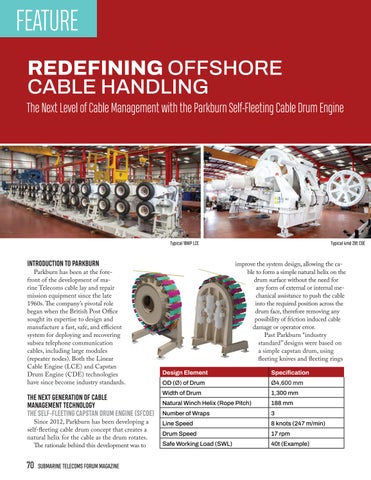
Since 2012, Parkburn has been developing a self-fleeting cable drum concept that creates a natural helix for the cable as the drum rotates. The rationale behind this development was to
70 SUBMARINE TELECOMS FORUM MAGAZINE
Typical 4mø 28t CDE
improve the system design, allowing the cable to form a simple natural helix on the drum surface without the need for any form of external or internal mechanical assistance to push the cable into the required position across the drum face, therefore removing any possibility of friction induced cable damage or operator error. Past Parkburn “industry standard” designs were based on a simple capstan drum, using fleeting knives and fleeting rings Design Element
Specification
OD (Ø) of Drum
Ø4,600 mm
Width of Drum
1,300 mm
Natural Winch Helix (Rope Pitch)
188 mm
Number of Wraps
3
Line Speed
8 knots (247 m/min)
Drum Speed
17 rpm
Safe Working Load (SWL)
40t (Example)