THE FUTURE IS WIDE OPEN!
99
# 1/2026
www.sportalm.com
EDITORIAL
IMPRESSUM
Publisher, Editorial Office, Advertising Department and Owner style in progress B2B Media GmbH Postal address Postfach 0031, 5027 Salzburg Austria
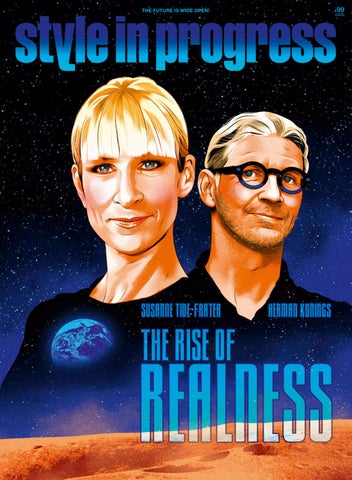
Cover Artwork: Alexander Wells
Company address Bachwinkl 2, 5081 Anif/Salzburg Austria info@style-in-progress.com www.style-in-progress.com @styleinprogress.magazine www.linkedin.com/company/style-in-progress Management Stephan Huber
Editors-in-Chief Stephan Huber stephan@style-in-progress.com Lisa Hollogschwandtner lisa@style-in-progress.com Art Direction, Design, Production Elisabeth Prock-Huber elisabeth@style-in-progress.com Managing Editor Johannes Seymann
REALNESS RULES! Welcome to these lines. I have been part of style in progress for a year now. Enough time to settle in, yet short enough to retain an outside perspective. Over the past few weeks, I have regularly reflected on what makes this magazine so special to me, and I always come to the same conclusion: it is the people involved. The genuine interaction, the conversations that have depth. In short: Realness. Realness is not a trend, not a buzzword, not a promise without substance. It is an attitude. And it is most evident where people work, think, question, and take responsibility. This magazine thrives on precisely these people – my colleagues as well as each and every one of you, all those who accompany us, entrust us with their stories, talk to us, and read us. A glance at the following chapters shows how multifaceted realn ess can be interpreted: when Janaina Engelmann-Brothánek asks about the sales model of the future in the agency focus section. When Nicoletta Schaper describes honesty, depth, and consistency as the new currency of womenswear in fashion. When Isabel Faiss notes in the deep dive chapter how vibrant brick-and-mortar retail is and how successful concepts have one thing in common above all else: lived authenticity. And when Stephan Huber observes in his zeitgeist essay and the editor’s letter a collective return to realness, to humanity – combined with courage, risk-taking, and the will to try new things. Speaking of people: I would like to conclude by saying thank you to all those people who work behind the scenes to ensure that you are holding this magazine in your hands today. For editing, translation and image editing, for graphics and design – for integrity. A new year sharpens our view of what was. But it also opens our eyes to what is possible. Here’s to a successful 2026 together – with realness as our compass. Lisa Hollogschwandtner and the team at style in progress 006 style in progress
Editorial Staff Janaina Engelmann-Brothánek Isabel Faiss Claudia Jordan Kay Alexander Plonka Nicoletta Schaper English Translation Georgmaria Prock Manfred Thurner Editor Georgmaria Prock Image Editing Johannes Hemetsberger Illustrations Alexander Wells Printing Sandler Gesellschaft m.b.H. & Co. KG, 3671 Marbach, Austria Printing Coordinator Manfred Reitenbach Advertising Director Stephan Huber stephan@style-in-progress.com Accounting Verena Wigoutschnig verena@style-in-progress.com Digital Edition www.style-in-progress.com/en/epaper/
THE FUTURE IS WIDE OPEN!
Next Issue #100 15 June 2026
SALES@FIORUCCI.COM
CONTENT
006 EDITORIAL
Realness Rules!
006 ABOUT US 014 CORE 110 CORE AGENCIES 314 EDITOR'S PICKS Quiet Quality
092
180
CORE AGENCIES 080 TRANSLATING TRUST
Sales management entails more than mere distribution. An assessment of the present state of the agency business – and a glimpse into the future.
082 SELLING REALNESS 152
The sales sector is undergoing significant change. What business model does the future hold?
LONGVIEW 152 THE RISE OF REALNESS
Herman Konings and Susanne Tide-Frater discuss “rewilding” and the longing for authenticity.
164 The New Currency of Meaning. An essay by Stephan Huber
FASHION
092 OFFENSE WINS… CHAMPIONSHIPS!
168 RIGID? RARELY.
102 Ben Botas and Mark Helegau: “We Feel and Act Like the Brand Itself”
170 SHARING GROUNDS
Henrik Soller and Florian Ranft on 25 years of Komet und Helden
104 Room with a View: Gather Around! 108 Guest commentary: Mark Grütters on “less, but better” as the new business standard.
Menswear is realigning itself. Rigid categories are consigned to the past.
Modern menswear is undergoing quiet, profound change. A conversation about attitude and participation.
180 HOW TO BE SEEN
Grant Harvey Dudson, Global Creative Director at Fever, and Gustav Emil Loft Thomsen, PR Special Project Manager at NN07, discuss the status quo of menswear.
192 Bogner: Outstanding Lifestyle 193 Sublime: Reliability Over Trend 193 Cellar Door: Contemporary Tailoring
008 style in progress
c a m pa i g n ag e n c i e s showrooms
Autumn — winter 2026
30 Years of Perfect Fit — Empowering Women with Style since 1996. Try it. Wear it. Love it. raffaello-rossi.de
CONTENT
©Dorothee Schumacher
©Studio Nicholson
170
198
210
194 Hiltl: Realness as DNA
240 FTC: Sense Made Soft
194 Dressler: Strong Spirit
227 Von&Zu founders Magdalena Cromme and Eva-wMaria Czerny: “We Create Relationships”
195 Alberto: Versatile, Never Overdressed
228 Club L’Avenir: Prudence and Consistency
196 Editor’s Picks: Menswear Must-Knows
229 Nicole Mohrmann: “Knowing Who You Are Outshines Any Dress”
198 LASTING LAYERS
Fashion as an interface between emotion and values
200 MADE TO MATTER
Womenswear under new premises
210 SPACES WE INHABIT
Jette Cathrin Hopp, Director of Acquisition and Business Development at Snøhetta, and Celine Aagaard, Creative Director at Envelope1976, on intention over impulse.
222 An interview with Roberto Collina and his daughter Chiara Collina 224 Knit-ted: Ease of Elegance 226 Luisa Cerano: Empowered Expressions
010 style in progress
241 Arzu Kaprol: Bold, Feminine, Pioneering 242 G-Lab: “We Are More Relevant Than Ever” 244 Cinque: “We Strive to Be a Credible Brand”
230 Apparis founder Lauren Nouchi on the value of risk and modern luxury
245 Malo: Rewriting Luxury
232 Skergeth X Edara: Shaped by Shared Values
246 Eterna: “We Don’t Want to Be Anything Other Than What We Are”
234 Elena Nancu: “I Never Intended to Turn It Into a USP”
248 Mac: From Blue to Green
234 Birgit Engel Fashion: That Must-Have Feeling 235 Unützer CEO Fritz Unützer: “Authenticity Cannot Be Imitated”
249 Absolut Cashmere: More Colors, Less Rules 250 Performance Days: From Human to Human 251 Got Bag: From Trash to Treasure
235 Liv Bergen: “We Are Outstanding”
252 Outhere: Function With Style
236 Raffaello Rossi: Face to Face
253 Refrigiwear: Ready for Phase Two
236 Labo.Art Creative Director Ludovica Diligu: “It Must Feel Real”
254 Humanoid: “Go for It!”
237 Mantù: Beauty Lies in the Fit 238 Editor’s Picks: Modern Muse
255 Souleway: Conscious Consumption
EDITION # 163
BE PART OF IT! ILM-OFFENBACH.DE #ILMOFFENBACH
7 | 2 - 9 | 2 | 2026
AT THE LEADING FAIR FOR LEATHER GOODS, BAGS, LUGGAGE AND ACCESSORIES
CONTENT
258
278
288
DEEP DIVE
276 Mode by Nicci: “It’s the Feeling That Counts”
313 Co’Couture: Scandi Coolness, Paris Chic
277 Reyer: “We Have a Long Tradition of Authenticity”
318 Avant Toi: Elemental Softness
256 FEEL THE REAL
ealness shapes retail: the interR play of atmosphere, product range, and human interaction gives rise to concepts that strike a chord.
277 Lemon: “We Are an Open House”
258 “IT’S TOO EASY FOR ME – I DID IT ALL” Ramdane Touhami
264 Mes Amis: Friendly Takeover 266 Moniker: Let Fashion Be Fun! 270 Grasegger: Retail Is Detail 272 Daniel Thiel: The Strawberry Tart as Entry-Level Price 273 Social House by Xintiandi: A Garden in the Middle of the City
SPACES
322 Pyrenex: Packed in the Airflow
278 TOUCH ME
323 Purschoen: Self-Cocooning
What truly moves us doesn’t have to be obvious, but it must be tangible.
288 CET AMOUR, TOUJOURS NOUVEAU A perspective of Paris – beyond the clichés.
308 Daniele Fiesoli: Urban Nomad
275 Wait and See: Pure and Genuine
309 Save The Duck: The Power of Lightness 310 Nude: Clarity and Transparency 311 Siyu: Fire and Finesse 312 Kiltie: The Charm of Contrasts
012 style in progress
324 CONTRASTS
Tendencies & Forecasts for Upcoming Seasons
336 EDITOR’S LETTER
Fashion May Be Out of Fashion – But We’re Not
274 Franz Kraler: Style, Love, Dolomites
276 Frauenschuh: Welcoming Atmosphere Meets Top Service
320 Colmar: Alpine Heritage, Modern Spirit 321 Myths: The Art of the Fit
273 The Dorf The Market: Pop-Ups at the Park
275 Di Più: Relationships Based on Trust
319 Edelle: Enfolding Harmony
Core
Schott
Endless possibilities: With new interpretations and celebrity collaborations, Schott NYC shows the versatility of its iconic jackets.
014 style in progress
Transatlantic Family Business When two families have been working together for over 50 years, they share a history. What is yours? Bruno Dauman, CEO Groupe JAJ: We have been working with Schott since the 1970s, initially as a distributor. At the beginning of the 1990s, we finally took over the license for Europe and the Middle East. Since then, we have been managing, developing and producing the collection. A blessing or a curse: How are you developing Schott beyond the iconic bomber jacket? Schott has a strong heritage with its jackets, which are characterized by an authentic military, biker and American lifestyle. Every design builds on this DNA. At the same time, we adopt trends when it comes to fabrics, cuts and finishes. We also have many collaborations with artists and brands such as Jean-Paul Gauthier, Walk in Paris or Samsøe Samsøe and stores such as BSTN, Anita Hass or LFDY. How much Paris is in the collection? A lot! Paris is our origin. We make 65 percent of our sales in France. Alongside Germany, Spain, Italy and the UK, it’s our most important market. @schottnyc_europe
CORE
The Mercer N.Y.
Premium Knitwear
The current collection from The Mercer N.Y. offers sophisticated total-look knitwear made from the finest cashmere, complemented by silk, wool or Milanoripp, as well as selected leather styles. “We stand for premium knitwear with long-term performance that is modern and remains relevant, and for partnerships that focus on fashion relevance,” explains Soran Mohammadi, who has been intensifying the selectively managed expansion of wholesale as Head of Sales since October 2025. Retail prices range from 169 to 999 euros with a 3-piece calculation. The collection will be shown during the upcoming order round in Munich and Düsseldorf. www.themercerny.com
Urban and reduced: The Mercer N.Y. is aimed at style-conscious women.
Pride to Be
Faux Fur Fun
For the new season, Pride to Be is once again proving just how versatile faux fur can be. Jackets, coats and vests come in elegant Tuscany lambskin and new mink looks. Beyond the outdoors, color-coordinated satin skirts and dresses are a delight. Two ranges in vegan leather and ready-to-wear as well as a small real leather theme with biker jackets, coats and bomber styles round off the range. A novelty is lightweight down in a wide range of colors. The commitment to independent specialist retailers remains constant. A strong price-performance ratio is also a given. It is possible to work as a private label on request. www.pridetobe.de, @pridetobe_
Matching caps, hats, scarves and faux fur bags complete the looks.
015
CORE
Cambio
Focus on Casual
Pants send statements about silhouettes. Where are you heading? David Gansbühler, CEO Cambio: Silhouettes are becoming narrower: wide O-shapes are evolving into more modern tapered carrot shapes and classic wide legs are transforming into cool baggy versions. Straight fits and wide leg flared are now an integral part of every collection. In the top segment, skinny is celebrating its comeback – reinterpreted as stirrup pants or with a slight kick, creating a fresh, feminine look. The classic wide leg remains indispensable as a contemporary basic piece. Does that mean you are continuing to pursue the new Cambio casualness? Yes, we are consistently driving forward the trend towards more sportiness and casualness. Classic business looks are becoming less important. We are focusing on the exciting break between elegance and coolness. High-quality wool fabrics are worn in a relaxed and casual way. Utility elements, reduced volume through button solutions or darts as well as new pleat and pocket solutions characterize the look and provide fresh sales impulses. Will denim remain relevant? Definitely. Denim is still a strong theme for us and is gaining in importance as part of the new casualness. New ring optics and characterful cross structures that interpret the denim look in a way that creates a balance between authenticity, comfort and fashionable appeal are particularly important. www.cambio.de
CEO David Gansbühler focuses on relaxed coolness.
Selected
Genuine Favorites
Danish bestseller label Selected has stood for high-quality, timeless style with a Nordic character since 1997. Clean lines, earthy colors and elegant layered looks characterize the collections, which work effortlessly from office to leisure: pure timelessness with a modern touch. Simplicity, quality and sustainability combine to create a sophisticated, long-lasting style for men and women that offers more than just fashion – it offers a slice of Nordic lifestyle with a history of artisanship that celebrates Scandinavian design. www.selected.com
Selected aims to set new standards in style and sustainability.
016 style in progress
www.siyu.es
CORE
Gmund Papier & Manteco offers stylish paper with a textile character, made from 100 percent cotton.
Rocco Ragni
Cashmere from Perugia “When I design a look, I never start with a drawing. I take the opposite approach: the garment is created starting with the yarn or fabric,” explains Rocco Ragni. His cashmere fashion tells stories – rooted in tradition, supported by innovation. The collection plays with soft silhouettes, an interplay of lines and varying widths. Multi-layered processing of different yarns creates volume and forms the basis of an innovative outdoor knitwear collection. The finest natural fibers form feminine pieces with openwork patterns, accentuated with shimmering sequins. From January 2026 at the Aco showroom in Salzburg. www.roccoragni.com
Gmund Paper & Manteco
Fabric to Paper
The idea: Gmund Papier produces premium paper in Austria from cotton scraps that are created during yarn production at fabric manufacturer Manteco in Italy. Both companies share a love for quality, design, sustainability and innovation. This shared conviction has resulted in a paper collection that transforms residual fibers into high-quality paper in line with the zero-waste principle. Cotton is considered the highest quality raw material for paper. The residual fibers from Italy are mixed with white cotton linters, another by-product from the textile industry. www.manteco.com
No compromise in terms of comfort and style: SoldOut.
Rocco Ragni chooses cool tones.
SoldOut
Easy Everyday
The Modeist label stands for everyday favorites that combine functionality with style. The focus is on technical jersey, which can be used to create both sporty and feminine looks. A new fabric brings a subtle, high-quality sheen. Denim with stretch serves as a multi-talented combination piece. A new knitwear range includes sweaters, pants and skirts. Cotton jersey in gray melange in various silhouettes also impresses. The collection is available in sizes XS to 2 XL. With retail prices of less than 200 Euros, the brand stands for an honest price-performance ratio and delivers attractive products for upmarket specialist retailers. www. soldout-fashion.de
018 style in progress
CORE
Penn & Ink N.Y
Powerful
“It’s difficult to improve on something that was really good”, says Mark de Lorme, Founder & Creative Director, proudly referring to his label’s successful 15th anniversary at last year’s Modefabriek in Amsterdam. He is enthusiastic about the location and emphasizes the importance of personal exchange as a key prerequisite for strengthening the fashion community. “We are all waiting for each other at the moment”, he says, explaining that a signal must be sent by actively participating. After 15 years of attending, Penn & Ink N.Y. will present a new, detailed appearance for all senses in 2026. “We challenge ourselves every time to create a completely new experience for our customers”, Mark explains, “A combination of food, furniture and fashion.” He deeply believes in the importance of looking his counterpart in the eye, touching textiles, and feeling their quality. www.pennandink-ny.com Mark de Lorme wants to strengthen the fashion community.
The founders of SALT, Petra Kogler (Gusswerk) and Hubert Stolz (Stolz Agentur) are starting the new season with lots of enthusiasm, thanks to increased available spaces and lots of interesting newcomers among their exhibitors.
SALT
More Space, More Style – Premium & Active Brands at Gusswerk
Salt is expanding its exhibition space at Gusswerk Salzburg by 300 square meters. From January 2026, a total presentation area of around 1,800 square meters will be available for exhibiting brands from the premium segment. Specifically, the extension will open up the adjacent building 3A, providing additional, flexible presentation spaces for fashion, manufacturing, accessories and sports brands. All spaces will be ready in time for SALT 01 from January 20 to 21, 2026. Parallel to ÖSFA, for the first time the format is also deliberately aimed at sports and active lifestyle brands looking for a high-quality platform at the inspiring environment of the Gusswerk. SALT 01: 20.–21. January 2026, SALT Fashion: 01.–03. February 2026 SALT 02: 20.–22. February 2026, www.salt-salzburg.at
020 style in progress
PIONEERS IN MATERIAL INNOVATION +15 YEARS OF R&D TO CREATE A SUSTAINABLE LIFESTYLE THAT IS GOOD FOR YOU AND THE PLANET.
DISCOVER FW26 AT:
BEN AND, GERMANY . ORDERLOUNGE, GERMANY . ROOM WITH A VIEW, AUSTRIA . EINS ZWEI ZWEI EINS, SWITZERLAND
CORE
Boss
Shaping the Future of Art
“Art has been an integral part of our DNA for over 30 years,” confirms Hugo Boss CEO Daniel Grieder. This underlines the company’s commitment to art sponsorship, to which an installation titled 1995–2025: 30 Jahre Kunstsponsoring (1995–2025: 30 Years of Art Sponsorship) was dedicated as part of the Art Basel Awards. The Boss Award for Outstanding Achievement was presented for the first time, Moroccan-born artist Meriem Bennani was the proud recipient. The award is accompanied by prize money totaling 100,000 US dollars: one half can be donated by the award winner to a community or cause of her choice. The other half will go towards a project developed by the artist together with Boss. www.hugoboss.com
In her work, award winner Meriem Bennani combines humor, pop-cultural aesthetics and digital language.
Aeronautica Militare
Strengthening their Presence
The sportswear brand, which emerged from an exclusive agreement between the Italian Air Force and Cristiano di Thiene S.p.A., is constantly evolving. Niko Fasthuber’s agency in Austria is ensuring a solid, high-quality foundation and further revival in the market, driving the development process forward there. Following a successful launch, Kastner & Öhler in Graz will be hosting a large pop-up store from March to August, featuring styles for men, footwear, and accessories. Highlights of the collection include leather jackets, bomber jackets, coats, overshirts, knitwear, a versatile shirt line, and pants, some of which are piece-dyed. www.aeronauticamilitareofficialstore.it Vintage-inspired functionality and casual style.
022 style in progress
CORE
Antones strengthens Latinò's presence in the DACH markets: with Andrea Friedrich and Tamara Huber from the Friedrich Fashion Agency (l.) in Salzburg for Austria and Tina Windscheid from the Picinelli Agency for Switzerland.
Latinò
Stepping Up Across D-A-CH
Antones by Sarah Freise is sharpening the positioning of Italian pants and denim specialist Latinò across the D-A-CH markets and appointed Friedrich Fashion Agency in Salzburg (Andrea Friedrich and Tamara Huber) as its new partner for Austria. In Zurich, Picinelli Agency, with Tina Windscheid now responsible for womenswear, is set to expand the brand in Switzerland. In Northern Germany, Susanne Haase continues to represent the label. Alongside this strategic rollout, Latinò presents a collection defined by modern fabrics and timeless versatility: very soft stretch denim in rhinestone washes, luxurious cashmere blends, elastic belts, animal prints and studded details. As always, the brand offers 25 flawless scaled fits up to size 44, and every fabric – from corduroy and velvet to brushed cotton and denim – comes in ten colors, reaffirming Latinò’s commitment to delivering perfectly fitting, made-in-Italy pants for every woman. @latino.brand
Vulcans
Honest Sneakers
The Dutch brand focuses on circular designs, honest artisanship and uses sustainable materials such as biodegradable suede. Vulcans donates one percent of sales to environmental initiatives. All sneakers are handmade in a European, solar-powered family workshop and impress with their comfort and anatomical insoles. The vulcanized sole made of natural rubber offers grip and durability. Retail prices for the Tide and Wave models are 139 and 149 Euros respectively. Remco Korf’s agency is responsible for European distribution. www.vulcansshoes.com Vulcans combine retro elements from the 1980s and 1990s with modern accents.
024 style in progress
CORE
Bloom
Soft and Cozy
Hanseatic, in love with detailing: Bloom.
The new collection is particularly soft and cozy and takes the preppy style further with Hanseatic practicality, for example with small, readymade cardigans, polo styles with covered buttons and boxy sweaters for layering. There is also knitwear made from pure wool with an angora look thanks to the mink-wash process and knits made from pure baby alpaca, hand-embroidered tone-in-tone. Crocheted edges and edge stitches with a basting stitch look are further details. Fine knitwear with lace and tops with gathers made from cashmere jersey are very feminine. The colors range from sand and grey flannel to mocha latte, dark chocolate, burnt olive and warm berry tones. www.bloom-fashion.com
Dstrezzed
Brotherhood
Since 2010, Dstrezzed has stood for menswear that combines comfort, character and modern nonchalance. Inspired by the motto No Stress, the brand designs clothing for men who want to enjoy life and feel comfortable in every moment. Dstrezzed brings together classic heritage with a relaxed twist and creates looks that seem familiar but are always surprising. This idea has given rise to a strong community of retailers, partners and modern gents who go beyond fashion, united by values such as authenticity, quality and coolness. Available via the agency Ben and. dstrezzed.com, @dstrezzed_official
Pure coolness.
026 style in progress
CORE
Solk
BIOCIRCULARITY
David Solk and Irmi Kreuzer have been developing sneakers for major brands for 30 years. With its own production facilities in Vietnam, the Swiss brand is committed to fair working conditions and a shoeto-compost process. The Fade 201 is the second leather model with natural rubber soles that has been independently tested for over 200 hazardous substances to guarantee compostability. www.solk.com
InJewels
CULTURAL DEPTH
InJewels stands for handmade jewelry that combines African origins with Berlin artisan culture. All pieces are made with precision and soul in the company’s own studio from recycled precious metals. Stella Owusu’s label is part of a new generation of African-European brands that are redefining contemporary luxury through heritage, authenticity and attitude. www.in-jewels.com
Maison le Super
RADIANCE
Golden pieces made from gold-plated, recycled sterling silver set the tone in Maison le Super’s second collection - only Halcyon and the large Tridacna models come in gold-plated brass due to the weight. With more focus on women, precisely defined jewelry pieces and more attitude, the brand is positioning itself even more visibly as a modern jewelry brand. www.maisonlesuper.com, @maisonlesuper
028 style in progress
CORE
New silhouettes shape a clear, functional and forward-looking design language.
Aquascutum Active
175 Years of Evolution
The British brand was founded in London in 1851 by John Emary. The name Aquascutum comes from Latin and means water shield. It underlines the brand’s mission to combine functionality with elegance. Emary is known for patenting a waterproof wool fabric. Since the 1950s, Aquascutum has been using the cotton blend fabric Wyncol, which was used in the first successful Everest expedition, among other things. This year, the brand is celebrating not only its 175th anniversary with a large booth at Pitti Uomo in Florence, but also the 50th anniversary of its unmistakable Club Check pattern. The Aquascutum Active concept was born from these roots of progressive technical development. The new head designer Alessandro Pungetti, C.P. Company and co-founder of TenC among others, stands for the combination of tradition and performance like no other. He has brought the British heritage into the present with technical sophistication and a modern attitude. Inspired by key figures in British subculture such as John Engledew, Roo Oxley, Geoff Bell, Corbin Shaw, Paul Weller and Tom Sheehan, there is a photoblog on the website and a radio channel on Spotify. The strategic positioning in the premium sportswear segment with a clear international identity is underlined in the fall/winter 2026 collection. One particular highlight is the collaboration with designer Mirko Borsche and his sportswear and design studio Societas. A newly interpreted trench coat in fleece-bonded softshell material with heat-sealed branding, a matching merino scarf and a soccer jersey inspired by the away jersey of the England national team against the USA in 1994 combine British classics with the contemporary visual language of soccer fan culture. Chusaja from Munich is responsible for sales and distribution in the D-A-CH region. www.aquascutum-active.com
Club check piping as a discreet and unmistakable trademark.
030 style in progress
CORE
Nine to 9
Easy to Wear
Nine to 9 stands for contemporary elegance, carried by innovative materials. Until now, the label has consistently relied on technical jersey, which creative director Marion Hoferer aptly describes as the Champions League of functional fabrics: shape-retaining, comfortable and timeless. A soft polyester crêpe has been added to the line for fall/winter 2026/27. With the same outstanding wear properties, it is less cooling and therefore ideal for colder days. The collection is complemented by fine knitwear made from wool and cashmere, which harmoniously rounds off the look. www.nineto9.de
One of the new faces at DMI: Cosmetics expert Hannah Waerder.
Flowing total looks, made from technical jersey or soft polyester crepe, naturally crease-resistant – typical Nine to 9.
DMI
Expanded
“It is not only in the retail ranges that we are seeing fashion and cosmetics moving ever closer together,” says Carl Tillessen, CEO of Deutsches Modeinstitut. “This is leading to a growing demand for trend analyses that have an equal focus on developments in both areas – fashion and beauty. DMI expanded its team and consulting services accordingly some time ago.” The trend office now provides fashion companies from Akris to Kik as well as cosmetics companies from La Biosthétique to DM in German-speaking countries with information and inspiration for their collections and product ranges. www.dmi.de
032 style in progress
LaMunt
A New Take
Well thought-out concepts often start with your own needs. So does the story of LaMunt: founded in winter 2019 by Ruth Oberrauch, the idea for the brand was born out of a desire to rethink functional fashion. As part of the Oberalp-Gruppe, the label combines alpine inspiration with urban lightness: clothing that works on the mountain and in the city. Sustainability, in the sense of social and ecological responsibility, is a central component of the brand philosophy. The focus is on its own community, for which regular events are organized. The first own store was opened in Munich and is also designed as a community space – for encounters, exchange, and inspiration. www.lamunt.com
CORE
White Milano
On a Path to Growth Rosner Studio
British Coolness
The fall/winter 2026/27 collection reinterprets British coolness – modern, relaxed and fresh. Classic tailoring meets casual modernity and subtle luxury. The color palette combines deep cherry, brown and olive tones with soft neutrals and a delicate rosé. Materials such as wool blends, flannel, jersey and corduroy create structure and comfort, while checks and stripes add fashionable accents. The silhouettes range from straight and flared to wide and barrel. Denim features clean and authentic washes, complemented by Japanese denim and new hemp denim. A style that looks calm, confident and contemporary. www.rosner.de
How was White Milano in 2025? Brenda Bizzi Bellei, CEO M.Seventy: It was a very successful year. All three editions delivered strong results and generated great buyer interest. Our brand selection, based on intensive research and international scouting, was particularly appreciated. At the same time, internationalization continued to gain momentum with more global brands and a growing number of international buyers. What is your goal for 2026? We want to consolidate the basis from 2025 and expand key international projects. One important step is the memorandum of understanding between M.Seventy and the Saudi Fashion Commission. We are also intensifying cooperation with China, Latin America, Spain, India, Armenia, Kazakhstan, Uzbekistan and Azerbaijan. What challenges do you see? The industry is facing digital change, increasing sustainability requirements and economic uncertainty. At the same time, our segment – New Luxury – is proving to be particularly dynamic and resilient.
The spirit of urban subculture combined with subtle luxury. Brenda Bizzi Bellei is confidently looking into the future.
Duno
Four Lines, One Vision
For fall/winter 2026/27, Duno is imagining outerwear as moving architecture. Four lines combine sharp design, function and material innovation to create a coherent overall concept. Timeless embodies the brand’s DNA: technical wool blends, precise cuts, modern details. Contemporary brings new volumes and lightness: soft silhouettes for women, high-tech fabrics or waxed cotton for men. Attic stands for urban elegance with fine fibers, double weaves and updated classics. Code marks the most experimental segment: heavy-soft microfiber, raw-cut wool blends and a feminine ladder-look bomber set new codes. Black, dark gray and brandy brown set the mood. d-duno.it
034 style in progress
CORE
Taion
Ten-Year Anniversary
Timeless classics in up to 20 colors are available in the Basic line.
The minimalist Japanese look of the Work line.
036 style in progress
Taion looks back on a decade of development from a down specialist to a comprehensive lifestyle brand that offers comfortable, lightweight and breathable functional clothing in both winter and summer. The name Taion means body temperature in Japanese. Founded in Japan in 2016, the brand initially focused on the production of down jackets. Instead of working with 600-fill-power down as is often the case, Taion relies on 800-fill-power down, which has been perfected over years of development, trapping more insulating air and thus providing significantly better warmth while being lightweight and highly compressible. In the meantime, the company has developed into an international utility brand based on modern design. Taion creates garments that combine technical performance with timeless simplicity, emphasizing durability, comfort and everyday practicality. There are four product lines: In the Basic line, timeless classics are available in over 20 colors, while the Military line impresses with its functional silhouettes. It is available with and without down filling. The Work line includes corduroy vests and jackets made from robust and durable Cordura fabric in an elegant Japanese look. Technical, sporty clothing for outdoor activities in all weathers is represented in the Mountain line. In Austria, the Room with a View agency is responsible for sales, in Germany the Wunschnaht agency. Taion’s design philosophy and brand identity prioritize functionality and clear Japanese aesthetics. Each product is deliberately designed as a timeless classic. Despite the use of high-quality and sustainable materials, the prices are designed to be extremely affordable. @taion_eu
Modular construction and practical details characterize the Military line.
The Mountain line impresses with its lightweight, sporty performance styles.
02 – 04.02.2026 PARIS LE BOURGET, FRANCE
Weaving the Future
Sourcing | Business | Solutions
texworld-paris.com
CORE
Praterinsel by Petra Esparza McAlpine
Oasis
Munich’s Praterinsel is growing. “Among the new exhibitors are Perfect Moment, presented by Bernd Schürmann,” says Petra Esparza McAlpine, “followed by Ilona von Preuschen, Alcidia da Veiga and Vittoria Gwen.” Stouls, Jérôme Dreyfuss, Rossi, Katharina Hovman and 8PM are back on board. Esparza McAlpine will be showing some new entries from her agency: minimalist womenswear by Su, Pierre-Louis Mascia, bags by Bonastre and cashmere by Arch4. “You come to Praterinsel for the collections, but you like staying for the relaxed atmosphere! The island is like an oasis in the middle of the city. At the same time, the other order addresses are easily reachable.” www. esparza-mcalpine.de
Astorflex
15 Shades of Brown
“For me, a color chart with an infinite number of shades of brown for a shoe collection is the best symbol for how much passion Astorflex puts into its products,” says Mark Grütters, explaining how the family business distinguishes itself as a specialist. Astorflex has been producing leather shoes with natural rubber soles and topstitching since 1820 and recently expanded its product range to include high-quality loafers for men and women. Around 100 employees manufacture the shoes by hand in Castel d’Ario using purely vegetable-tanned leather and solvent-free adhesives. The team around CEO Fabio Travenzoli demonstrates how expertise can be used as momentum.
Trend product at Astorflex: Loafers as a factor for success.
Initiator Petra Esparza McAlpine.
Twodays
Expansion
Twodays Edition #3 starts from January 24 to 26. The Kap.One location on Düsseldorf’s Karl-Arnold-Platz will remain the same for the showroom concept, which starts on January 23. Hall 29 will be added for a broader exhibitor portfolio with fashion, shoes and accessories. A shuttle service will connect both locations during Düsseldorf Fashion Days. Edition #4 will follow on March 1 and 2 and will focus on fashion re-ordering and the shoe business. “With the spatial expansion and the sharpening of the concept, we are sending a strong signal for Düsseldorf as a fashion location,” emphasizes Ulrike Kähler, Managing Director of Igedo Exhibitions. www.twodays-duesseldorf.com
038 style in progress
Two locations for Twodays Düsseldorf.
Meet us at Pitti Uomo bogner.com
CORE
One More
Function Made in Italy
Founded in 2018 in Neumarkt, South Tyrol, One More embodies a new generation of value-driven design. From a regional niche, the brand is now represented internationally – namely in 63 stores in 19 countries. Sustainability is not a promise, but a lived principle: 80% of the collection is produced in Italy, mostly in family-run businesses. Everything else is also manufactured in Europe. The signature material is Apple Skin, a leather alternative made out of leftovers from local juice production. With timeless carry-overs, minimalist design language and a specially developed typography, One More manifests its vision of aesthetics, responsibility and cultural identity. www.one-more.info
Minus One Jeans
One Fit
Mille Monferin is back with a new project: Minus One Jeans. After almost 40 years in the denim business with stints at Levis and Edwin, he has put together a compact collection that focuses on the fundamentals. The regular and relaxed fit silhouettes in over 20 washes impress with their fit and the 3.3 calculation. The retail prices for 15 washes and four chinos are 129 Euros, some also in the NOS range, plus six selvedge models at a price of 179 Euros. Bestsellers are available with stock service. There are also piece-dyed T-shirts for 49 Euros and sweaters for 99 Euros in six colors. Mesut Anliacik from Zero8 Zero8 is responsible for distribution in Germany. www.minusonejeans.com
CEP
Engineered in Gemany
In May, Bayreuth brand CEP is launching the optimized version of its Optaspeed Bowtech running shoe. “Our aim is to close the gap between medical-biomechanical aspects and performance-oriented products. We want to create a high-performance, comfortable and medically sound product,” says Sebastian Seiler, Head of Footwear at CEP. The combination of scientific expertise, technological innovation and real user feedback has resulted in a shoe with targeted improvements that offers a roomier forefoot, a revised heel construction and an adapted fit for more space and higher performance. www.cepsports.com CEP offers maximum energy efficiency.
040 style in progress
CORE
Mason Garment
Strong Presence at the POS How was your last season? Paul Wismeier, Brand Director: Thanks to our successful collaboration with Agentur Schwarte, we were able to strengthen our presence in the D-A-CH region and better understand what consumers respond to. Our Italian hero products are performing strongly in stores and online. The POS activities helped us to precisely identify relevant materials and details. You had many POS events. In Stuttgart, we held an Italian-inspired outdoor event with tulips, cannoli and a summer collection preview. This was followed by a pop-up in Hamburg with customization by our craftspeople. A private loft showcase in Düsseldorf presented spring/summer 2026, live customizations and new accessories. These formats have significantly increased our visibility. What will happen in 2026? We are expanding our POS activities, focusing on timeless quality and further developing our hero products. We are also integrating more sound and sports elements to deepen the exchange with retailers, creatives and consumers. www. masongarments.com
Events at the POS are a must for Mason Garment.
ILM
“We Are Truly Tangible”
ILM can be described as a rock in the trade fair scene. What is the secret? Arnd Hinrich Kappe, CEO of ILM Offenbach: As a boutique event for accessories and luggage, we have never watered down our concept. Everyone knows what they can get at our fair. To what extent is the trade fair modernizing? A lot of things are digital, the trade fair itself remains analog. You can view 300 exhibitors, each exhibitor has around 40 customer appointments. Enormously efficient! We are also bringing the halls to life with a great supporting program, the highlight being a live talk with Frauke Ludowig. For more internationality, we are cooperating with the Travel Goods Association, with 20 exhibitors from the USA. Messe Offenbach’s new project is 069 Connect in June. Competition for ILM? No, it’s a shoe convention for an exchange at decision-maker level that is very popular. At the same time, Shift will take place in Offenbach, including a party at the cult club Robert Johnson. So Offenbach can truly become a fashion metropolis! www. ilm-offenbach.de
Arnd Hinrich Kappe, CEO of ILM Offenbach.
042 style in progress
CORE
Wolkenstricker
KNITWEAR ROYALTY
Wolkenstricker stands for the exclusive art of knitting, which has been created by hand for three generations. Each jacket is a timeless one-off, characterized by precise tailoring, first-class yarns and elaborate knitting techniques. The characteristic variety of colors, the perfect fit and the iconic W-button give each creation its unmistakable character. A special feature, or as the brand itself calls it: “the queen of cardigans”, is the Regina jacket. In cherry red, made from 100% cotton with knitted-in sequins and entirely hand-knitted, it is a perfect example of the brand’s expertise. www.wolkenstricker.de
White Sand
POETRY OF MATERIALS
Superga
ALPINE LOOKS FOR THE CITY
Superga’s Montagna line will be expanded in 2026 and will strengthen the outdoor-inspired segment. New low and high tops combine nubuck, crazy-horse leather and flesh-out suede with the Alpina lug sole. Contrasting laces, metal loops and double rubber bumpers are clear differentiators and emphasize the functional approach. superga. com, @superga_official 044 style in progress
The White Sand fall/winter 2026/27 collection features wide pants with a gentle drape, structured jackets and soft knitwear. Japanese twills and brushed velour add depth, while Marlane wool creates warm, compact silhouettes. Muted tones such as fog grey, maple red and sand beige accompany fine microprints as subtle accents. white-sand.it, @whitesandofficial
Designed for life. Ready for anywhere.
Souleway stands for stylish, durable bags that fit perfectly into urban life. Our products are made for people who are always on the go – between work, leisure and spontaneous getaways. We combine minimalist design with functional everyday practicality and fair production. Scan this code to get in touch with our Director of Sales and access our B2B shop. www.souleway.com
CORE
Courage for stitches: 9AM expands its range with contemporary knitwear.
9AM by Dolores
New (Narrative) Fabric
The pants label 9AM by Agentur Modeist is adding a new product group to its range for autumn/winter 2026, sending a clear signal towards the total look. The twelve styles of pants, available in five qualities and four colors each, will be accompanied by matching knitwear. Extrafine merino wool and ribbed cotton blends are neither too chilly for outdoors nor too warm for indoors. The shapes of the pants, which are also available on request on a private label basis, range from straight pants and culottes to carrots, Bermudas, pleated pants and extra-long styles with a trim. www.modeist.com
Carl Gross
Courageous Casualness
Michael Berngruber, Division Head Carl Gross, presents the current collection as a journey through time to Berlin, a city full of contrasts. Modern silhouettes, a variety of materials and a look between tradition and innovation shape the image. Loose cuts, soft shoulders and sporty, elegant details define modern tailoring. The themes Tweed Lover with classic tweed details, The Weekender with sportswear as a key element and The Winter Wedding tell independent style stories, complemented by a shoe collection with precise artisanship. Berlin turns into an attitude: Clear, edgy, confident – a collection with substance and timeless modernity. www.carlgross.de
Value with sporty elements.
046 style in progress
CORE
Commercial Director Pepijn van Bommel.
The.Nim Standard
Softness and Patina
“We don’t design for effect, but for the experience,” says brand founder Claudio Parolini. “Every piece should stand the test of time and gain softness, patina and individuality.” The most important denim developments are aimed at warmth, feel and comfort: With soft-touch cotton, blended qualities enriched with cashmere, structured denims as well as yarn-dyed denim for color depth. In menswear, the Italian brand’s connection to Japan is reflected in the fits and authentic washes inspired by the country. Special: the Tailored Capsule, which positions flannel denim and cashmere-chevron jerseys with sophisticated details as upper sportswear. The styles quote tailored clothing with subtle sartorial references. In womenswear, straight and bootcut silhouettes take center stage. Skinny fits are making a comeback, returning as a boots-over-trousers look. www.thenimstandard.com
Flexible comfort remains the order of the day.
Floris van Bommel
Charisma and Character
What does the European expansion strategy look like? Pepijn van Bommel, Commercial Director: We are pursuing a pearl necklace strategy. We are not aiming for nationwide expansion, but are looking very specifically for retail partners that fit in with our brand identity. This has enabled us to acquire new stores in four European countries where we were previously not represented. How will Floris van Bommel be positioned in these new markets? In Benelux and the D-A-CH region, we are an established mainstream premium brand and a permanent fixture in upmarket specialist retail. In new markets, on the other hand, we are perceived more exclusively, as a brand that lends additional charisma and profile to the overall range. Which looks are particularly promising for fall/winter 2026? We expect a lot from warm brown tones, wool looks and loafers, which will remain strong in winter. At the same time, the dressed segment is making a clear comeback. We also see flatter soles and a continued strong demand for lightness, softness and flexible comfort. @florisvanbommel
Comfort and feel: The.Nim Standard. Floris van Bommel: A love for artisanship and refined designs.
style in progress 047
CORE
Circolo 1901
Modern Ease
Circolo 1901 redefines the idea of masculine nonchalance. The collection evolves with a focus on jackets and translates them into flowing silhouettes with flexible materials and modern layering pieces. Work and shirt jackets, lightweight blousons and rethought shirts formulate a contemporary alternative to classic attire. Structured wool checks, double-face qualities, corduroy and soft jersey create a material world that combines expression and comfort. The focus is on a mix-andmatch concept with harmonious color worlds that allow intuitive combinations and respond to changing needs. circolo1901.it, @circolo_1901
Confident, relaxed, functional and unmistakable.
JNBY
Railin
Private Art Collection
Whether it’s a jersey, T-shirt or hoodie, each piece of fabric is adorned with a different work of art. Munich-based Mirja Raiss and Magy Linzmeier have chosen a bold concept for their Railin brand, founded in 2023. They give each collection to a selected artist as a canvas that they can transform. Artists such as Stuart McKenzie, Jessica Durrant and Jürgen Katzenberger have already taken up this offer. In addition, the Railin Collectors community was founded, which uses the collections to build up its own private art collection. Railin is represented by Agentur Zimmermann in Munich, Modeagentur Anja Heller in Düsseldorf and Ehag Modevertrieb in Vienna. www.railin-fashion.com
Timeless yet Modern
JNBY and Less by JNBY impress for fall/winter 2026/27 with a strategic expansion of their portfolio. The knitwear and total look segments combine timeless aesthetics with a contemporary clarity. Outdoor themes are as strong as ever. In addition, several delivery dates and a wide range of non-seasonal styles underline the brands’ established expertise. The price structure remains stable and comprehensible in the future, which is also reflected visually in fashionable tops. The demand for realness leads the way: authenticity before hyping trends. This is reflected in the collections, which are up-to-date without jumping on every fad. www.jnby-shop.com
JNBY stands for collections that combine timelessness and zeitgeist.
048 style in progress
CORE
19Andrea’s47
Into the Soft
The fall/winter collection of Italian scarf specialist 19Andrea’s47 celebrates a winter full of calmness and the softness typical of cashmere. The focus is on the material: warm, light and extremely supple. Longer silhouettes, soft lines and flowing layers translate this feel into a contemporary design language. The colors follow the feeling: sand, dove and light grey stand for quiet elegance, cool blue tones and pastels for lightness, plus accents in geranium or violet for targeted energy. Capes and beanies complete the look. 19andreas47.com 19andreas47_official
Paris Golf Gallery
Hole in One
Warm scarves for cold days from 19Andrea’s47.
CG-Club of Gents
Party Crashers
Ralf Klute, Head of Design, takes the current collection back to its roots. The new CG mainline concept is more aggressive and louder, telling the story of the lives of young rebels. Hamburg offers ideal spots for the implementation of the Culinary Voyage. In the trendy restaurant Félix, rebellious creativity meets precise artisanship, reinterpreting the classics and perfectly reflecting Savile Row: classy-peppy with a masculine aura. In Karl Lagerfeld’s former villa, Your own Party’s stylish elegance and quiet excess unfolds with noble vibrancy. The architecture of Villa Jako becomes the stage for a generation that takes its place – uninvited, but fitting in. www.cg.fashion
Cool kids with a taste for life.
050 style in progress
For the fourth time, the Paris Golf Gallery will take place from January 20 to 24, 2026 during Fashion Week. It is happening in the Cadillac showroom on 600 square meters of exhibition space on Rue Meyerbeer. In the B2B section, progressive golf and fashion brands such as A.P.C., Head, Cph/Golf, Khalhon, Merrill, Lend, Left of Field and Lost Balls will be exhibiting. Last time, around 2,000 visitors came to the location right next to the Paris Opera to immerse themselves in the new golf culture. A pop-up store and an art gallery round off the event with a casual offshow character. www.parisgolfgallery.com
michaelis fashion agency MAIL@MICHAELIS-FASHION-AGENCY.COM (GERMANY – SOUTH)
neon oak JOHANNES@NEONOAK.DE (GERMANY – NORTH-EAST)
agentur rotter KAETHEROTTER@GMAIL.COM (GERMANY – WEST)
klaus modeagentur OFFICE@MODEAGENTUR-KLAUS.AT (AUSTRIA)
kamm&kamm PATRICK.KAMM@KAMMCOMPANY.CH (SWITZERLAND)
ABSOLUTCASHMERE.COM
CORE
All-day wearability: Deblon.
Deblon
What Makes Women More Beautiful
“My claim? Quality and designs that feel good physically and emotionally,” says Deblon founder Leonie Timmerman. Core products are the iconic leggings, bestsellers in the German market too, where the label already has many loyal customers after a strong start. The new collection impresses with stylish all-weather pieces, knitwear and loungewear, in feminine silhouettes and functional fabrics in natural and vibrant colors. “The collection reflects everything that is close to our hearts. Our team is made up of women who put their heart and soul into every piece and only choose what makes women more beautiful.” www.deblonsports.com
More & More
A Sensual Atmosphere
Playing with cool accents.
052 style in progress
The collection for fall/winter 2026/27 combines bourgeoisie and coziness to create feminine, casual looks. Warm shades of brown and red meet cool shades of green, blue and purple. Silhouettes play with contrasts: blazers with accentuated shoulders, belted jackets, box jackets and blousons combined with pleated skirts, Bermudas, fake fur and patent looks. Heritage checks, tweed and corduroy meet lace and ruffles. Fitted tops with wide or narrow pants, versatile denim and a wide variety of blouses characterize the line. Knitwear is a top theme. Pants range from wide leg to tapered. Outdoor shows shades of brown, wool coats, car coats and puffers with fur details for winter coziness. www.more-and-more.com
CORE
Elho
SIGNATURE STYLE
The performance bomber jacket with the striking zippers already has numerous celebrity fans, including Jeremy Scott, DJ style icon Charlotte de Witte, Bill Kaulitz, Ski Aggu, Diane Pernet and Michelle Hunziker. Elho is already available in 15 stores including Chapters in Milan, KA YO in Stockholm, Bründl in Kaprun, Titolo and Kevin in the Woods in Zurich and Breuninger in Stuttgart. @elhofreestyle
Duno
THREE IN ONE
The Duno Wago parka made of high-quality cotton impresses with its contemporary layer construction and slightly military silhouette. The rounded collar, ergonomic sleeves and large flap pockets ensure comfort. The removable inner lining creates a flexible 3-in-1 concept with cool color contrasts - a statement of quality and versatility. d-duno.it, duno__official
Collezione N_01
FINEST KNITWEAR
Collezione N_01 by Daniele Fiesoli focuses on fine but warm styles for winter, made from materials of the highest quality such as pure extra-fine merino wool. The looks feature elegant and feminine silhouettes that combine modern lightness with pleasant comfort, perfect even for unsteady winter days. danielefiesoli.com/donna
054 style in progress
CORE
Sebastian Boekholt, FWS Managing Director, is responsible for the internationalization of JJ Hats. JJ Hats – from New York icon to global brand.
JJ Hats
Born in New York, Worn Everywhere For more than 100 years, the JJ Hat Center in Manhattan has been a firm address for men who value style. A place where a hat was never just an accessory, but an expression of personality. Today, this heritage has given rise to JJ Hats – a brand that translates the clear, self-confident style of New York into contemporary collections. JJ Hats is aimed at men who go their own way, who don’t chase trends but set their own accents and consciously shape their look. With FWS – Friedrich W. Schneider, one of the leading companies for headwear in Europe – the brand has found the right partner for its international development. “JJ Hats combines New York origins with a modern, urban understanding of style,” says Sebastian Boekholt, Managing Director of FWS. “We appeal to men who know what suits them and who appreciate quality, clear designs and a strong identity.” In January, JJ Hats will be presented for the first time at Pitti Uomo in Florence. The collection includes distinctive hats and urban caps, complemented by selected capsule pieces. Each design bears the signature of New York: pared-down, self-confident, versatile and made for a target group that doesn’t rethink its style, but lives it. A flagship store has already opened in Paris on Boulevard Saint Germain, reflecting the sustainable and contemporary urban-conscious identity. With the support of FWS, JJ Hats continues to expand its presence internationally, while remaining true to its essence: clear silhouettes, high-quality materials and an attitude that is timeless. JJ Hats combines heritage with the present and brings New York style anywhere men want to wear it. www.fwshats.de
056 style in progress
myths.it
RESEARCH ATTITUDE
CORE
My White Tee
Haptic
“My White Tee is a haptic product, with T-shirts and sweatshirts that impress with their quality made in Portugal at very good prices,” says founder Frank Meyer. “It’s a real additional business for retailers.” The 30-piece collection is now being restyled in terms of color. In addition to Offwhite, Black and Navy, a Poppy Red and Shark, a light olive shade, have been added. Prices range from 39 to 139 Euros retail price, calculated at 2.8 to 3.0. Another plus point? “The wide range of repeat orders as well as samples for retail staff to wear,” says Frank Meyer. “The best way to communicate the product is to wear it yourself.” @mywhitetee.official
Specialist retail product: My White Tee.
Ecoalf
Consistent Circularity
Together with packaging specialist Smurfit Westrock, Ecoalf has opened the first mono-material store in San Sebastián. The walls are made out of kraft paper, the furniture out of corrugated cardboard made from renewable fibers. All elements are biodegradable and recyclable. The next store will open in Florence in January. Ecoalf is thus continuing its international expansion. With 20% sales growth and positive EBITDA, the brand proves that ecological action and economic success can go hand in hand. Highlights of the collection for fall/winter 2026 include the knitwear collection made from regenerative New Zealand sheep’s wool. www.ecoalf.com
058 style in progress
Store made from FSC-certified paper and cardboard.
CORE
04651/A Trip in a Bag
On the Road for Ten Years
For its tenth anniversary, 04651/A Trip in a Bag returns to where it all began: the studio. The fall/winter 2026/27 collection, inspired by the tranquil expanse of the Médoc, is created between dressmaking dummies and fabric samples. Deep blue and soft gray tones meet earthy brown and Bordeaux accents. At the center is a Parisian writer who flees to the north of France in autumn. His look: cashmere, corduroy, denim and functional travel pieces. New leather jackets, nautical stripes and prints expand the line. For its anniversary, 04651 is celebrating a journey that will keep going. 04651.com, @04651atripinabag
Ten years of travel essentials for modern nomads.
Bob focuses on color and material mixes.
Bob
More Originality
The fall/winter 2026 collection was born from the desire to further strengthen the creativity and originality of Made in Italy in an increasingly uniform market environment. Bob focuses on distinctive fabrics with characteristic imperfections and contrasts in weight, texture, and color. Reversible knitwear in finer gauges and muted earth tones are paired with dégradé dyeing techniques. Rooted in technology, artisanship, and a clear identity, the Italian brand once again presents clothing that not only dresses, but tells a story and evokes emotions. In Germany and Austria, Bob is represented by die Hinterhofagentur. @bobcompanytheoriginal
060 style in progress
SALT
01 20–21 January 2026
SALT
FASHION 01–03 February 2026
SALT
02 20–22 February 2026
GUSSWERK SALZBURG Söllheimerstraße 16, Salzburg, Austria info@salt-salzburg.at, @saltsalzburg www.salt-salzburg.at
ı Alpenherz ı Angel Alarcon ııı Antonia Zander ı Apple of Eden ıı Arzberger Hemden exklusiv ı Atie ıı aunts & uncles ı Ayasse ı BellaSusi ı Bittner-Hüte ıı Blue Fire CO. ıı Blutsgeschwister ıı Bogner ıı Bogner Fire + Ice ı Boos ıı Bulaggi ıı Catwalk Junkie ı Chrysalis England ı Coccara ı Cocovero ı Creation Bauer ı Culture ııı Daddy’s Daughters ıı Depeche ııı Dirndl & Bua ı DU4 Shirts ıı Dunkelschwarz ııı Elisabeth & Franzl ıı Farm um’s Herz ıı Fraas ı Frederic Meisner Tracht ıı Gang ı Gaudiknopf ı Glanz & Zauber ı Glücklich ıı Goiser ı Gössl ı Gottseidank ııı Grasegger Manufaktur ııı Habsburg Kleidermanufaktur ı Heidi – exklusive Strickwaren ı Heimatglück Buam ı Heimatglück Tracht ıı Hubegger Ela textile accessoires ı Kaffe ıı Laszlo Budapest ıı LederGott ı Lembert Hutmanufaktur ı Lena Hoschek ıı Linda Neiber ıı Litzlfelder ıı Loevenich ııı Luis Trenker ıı Mademoisielle YéYé ı Marianna Déri Fashion ıı Markup ı MAT:20 ıı Mauritius ı Maximilian Tyrol Austria ıı mbyM ı Me°rchen Me°dchen ıı Meindl Fashion ı Meliné ı Michaela Feyrsinger ı Mimmu ı Mirabell Strickereiwaren ııı Mothwurf ıı Münchner Lodenfabrik ı Nihal Cashmere ıı NIKKI ıı Original Haferl ı Ostwald Ledermanufaktur ı Palomitas ı Ploom ıı Rehall ıı Resi Hammerer ı Rita in Palma ıı Rose Dirndl exklusiv ıı Rosner Studio ıı Säckler Manufaktur ıı Schuhwerk Schwangau ı Seenberg ıı SOS ı Stadler – Tiroler Schuhmanufaktur ı Stajan Kunst & Mode ı Steiner 1888 ı Stetson ı super.natural ı T.ba ı Thea Mika ı TheHolyGoat ı Verbenas ı Von & Zu ııı Wallmann ı Waltl Holzschuhmanufaktur ıı Wolkenstricker ı Xaver Luis Schuhmanufaktur ı Zhrill
CORE
New tools, clear codes, immersive presentations: Fiorucci creates a visual world that works in retail as well as digitally and shows collections that can be read intuitively and experienced atmospherically.
Fiorucci
Shifting
You talk about developing into a holistic brand. What does that mean? Paula Barrera Fermin, CMO Fiorucci: We are developing Fiorucci into a fully curated ready-towear collection for women and men. The brand is becoming more complete and presents itself as a clearly defined world. What role does wholesale play? A central one. We want to empower our partners with a clear visual language, state of the art marketing support and tools that create real impact in their markets. They emphasize new forms of presentation. Our showroom is becoming more immersive as we start to collaborate with creatives. This creates the atmosphere of an art exhibition. At the same time, we are developing a digital lookbook of short videos that show how the looks move and sit. This makes the collection much more intuitive to experience. How are you approaching the German market? Germany is a key market. We want to create strong, meaningful moments. In April, we are launching our first major activation in collaboration with KaDeWe. This launch shows how seriously we take this market.
Rossi
The New Now
Consistency and innovation from Rossi.
062 style in progress
The latest Rossi collection makes an even clearer statement and is intended to encourage people to break away from conventional seasonal thinking and live their own style in the spirit of the idea of the New Now. The collection features 16 designs with styling potential, from slim silhouettes to flowing O-shape forms. Key pieces include draped pants, a pleated midi skirt and Noa pants with an extra-long belt. Raw denim is available in five variations and a matching overshirt for modern complete looks. High-quality wool blends, jersey and glencheck demonstrate the quality standards. The color palette remains neutral and timeless – with accents in cashew, rusty red, dark brown and grey. @rossi_pants
21. – 24. 4. 2026 FRANKFURT / MAIN
While designers dream, engineers stay wide awake. The apparel industry has new ideas all the time, with increasing frequency. You can meet the engineers who make these ideas a reality – come and see how their finishing in fashion brings the best out of materials with precision and elegance.
in parallel with
part of
powered by
CORE
Techtextil & Texprocess
High-Tech Materials and Manufacturing Expertise
From April 21 to 24, 2026, 1,700 exhibitors from 50 countries will be showcasing the innovative power of the global textile industry at the Techtextil and Texprocess trade fairs in Frankfurt. They will present solutions along the value chain from performance textiles and bio-based fibers to smart fashion, circular technologies and AI-supported apparel production. As a global business platform for high-performance fibers and smart textiles, Techtextil primarily showcases a growing range of performance textiles for outdoor and protective clothing with around 100 international exhibitors. Renowned companies such as Klopman, Lenzing, Noble Biomaterials, Concordia Textiles, Getzner Textil and Groz-Beckert, RTS Textiles, Sapphire Finishin Mills and YKK will be demonstrating the potential of functional apparel textiles. In the special show Performance Apparels on Stage, visitors can experience live how functional fabrics warm, cool, protect or are tracked, and which high-end materials prove their worth in extreme situations. The future topic of Nature Performance is particularly exciting: with natural materials produced from algae and hemp or from caterpillars and fungi, for example, which set new standards in terms of durability and quality. At the same time, Texprocess will be presenting a wide range of innovations that provide answers to questions about cost pressure and supply chain risks. The latest machines, digital workflows and AI-supported systems for efficient and precise garment production will be presented by numerous renowned new exhibitors, especially from the cutting sector, such as Amann & Söhne, Coats, Comelz, Cutting Edge Automation and Pathfinder Australia. As always, the highlights in Frankfurt are the Techtextil and Texprocess Innovation Awards and the lecture program curated to match the individual forums. www.techtextil.messefrankfurt.com
Techtextil is placing trade fair visitors at the center of its 2026 campaign under the title "Opportunity."
The future of the fashion industry is being shaped at Techtextil.
Texprocess shows how ideas are turned into market-ready products.
064 style in progress
CORE
Universel
Puristic
Universel Paris develops jersey and knitwear collections based on decades of experience in high-quality textile production. The brand combines a clear, calm design with fine materials – soft, durable and wearable. The pieces are functional and elegant at the same time, so that they can be effortlessly adapted to a wide range of everyday situations, from relaxed moments to a sophisticated look. They are always extremely comfortable to wear. The Parisian brand is characterized by a reduced, precise aesthetic: soft draping, calm silhouettes and a color palette that combines restraint with modern clarity. Fine details and natural movement characterize each piece. The brand uses coordinated jersey and knitting techniques to guarantee a reliable fit on one hand and a soft feel against the skin on the other. The many years of expertise are particularly evident in production: materials are carefully selected, designs are developed for lasting stability and the manufacturing process is precise. The aim is to produce clothing that will remain reliable for many years. “We want to offer fashion that accompanies people in the long term and makes their everyday lives easier,” comments Norbert Klauser. The brand’s visual identity is also geared towards clarity and calm. The visual language focuses on material, form and feel and underlines Universel Paris’ claim to create essentials with depth and modern lightness. In German-speaking countries, the brand works with selected retail partners who share this understanding. Giorgio Occhipinti puts it this way: “In the D-A-CH region, we rely on stores that recognize value and present our collection in a suitable environment.” @universel_paris
Essential: Jersey and knitwear from Universel Paris.
The Holy Goat
Like a Fairytale
Simone, what does The Holy Goat have in store for the coming season? Simone Goschler, owner of The Holy Goat: Warm winter pastels! We’re bringing soft, soothing tones from the entire color palette to woven and knits to cashmere. Our thick hand knits with cables, ribs and diamonds are incredibly beautiful, in multi-colored winter pastels such as lilac, light blue, green, smoky pink or plum. Nature runs through the collections. Because it grounds you? For me, the connection to nature is fundamental. With great respect for the animals, the environment and the people involved in the production of our collection, we create special pieces to love forever. This season, we have placed La Forestière, the female ranger, in the spotlight. She roams through nature and observes animals, which we bring to life with our usual elaborate embroidery and inlays on our cashmere. Like a fairytale! New to our range are hand-knitted traditional jackets for men and women, which we will be presenting at SALT 02 in Salzburg. www.theholygoat.com
066 style in progress
The Holy Goat presents itself close to nature.
DIEKAUFLEUTE info@diekaufleute.com
www.mantu.it
CORE
Mono
Wanderlust
The casual boots by Mono are not only reminiscent of classic hiking boots in terms of their look, but also have real outdoor features thanks to their Norwegian origin. The lightweight boots are made from high-quality leather in Portugal and come with a cozy lambskin lining and robust Vibram soles. Retail prices range from 250 to 340 Euros. Lagom is responsible for distribution in Germany, Room with a View in Austria and Eins Zwei Zwei Eins in Switzerland. Customers include Breuninger, Lodenfrey, Kastner & Öhler and Steen & Strøm. The shoes can be seen at Pitti and at Welcome in Paris and New York. @ monofoo
Mono boots impress with unusual color combinations. Sustainable products combined with an authentic American vintage look.
The Mercer Brand
Americana Evolved
For fall/winter 2026, The Mercer Brand stays true to its casual, sporty DNA and adds a clear, modern accent with the new flag logo inspired by college pennants. Since its founding in 2013, the label has combined an American vintage feel with sustainability – from vegan materials to recycled ocean plastic. Collaborations with NASA, UCLA and the Beverly Hills Hotel show the creative range and underline how strongly The Mercer Brand combines design, innovation and responsibility. The new collection carries this attitude forward. Available via Ben and. www.themercerbrand.com, @merceramsterdam
068 style in progress
dre s s l e r1 92 9. c om
THE STATEMENT AW26
CORE
Texworld is the global meeting place for fashion experts.
Texworld Apparel Sourcing Paris
Weaving the Future
Practical innovations and future-oriented industry partners can be found in Paris.
Inspiring sourcing experience for the spring/summer 2027 collections.
070 style in progress
From 2 to 4 February 2026, the 58th edition of Texworld Apparel Sourcing Paris will once again bring together all the key players in the textile and fashion industry at the Paris-Le Bourget exhibition center. For three days, visitors will be able to compare and select products ranging from ready-to-wear to luxury fashion from international fabric manufacturers and producers among 1,300 suppliers. This diversity confirms the continued importance of European markets to global demand and underlines Paris’ strategic position as the capital of fashion, sourcing and creativity. While the overall structure of the fair remains unchanged with Halls 2, 3 and 4, Messe Frankfurt France has rethought the division of the main sectors within the exhibition space. The aim is to meet buyers’ expectations and make their visit as efficient as possible. Fashion sourcing for womenswear and knitwear will move to Hall 3 next to the national pavilions. In Hall 4, the Activewear area will be combined with the Casual & Sportswear area, while Print and Jacquard will be placed closer to Silky Aspects, strengthening the womenswear offering. Hall 2 will continue to be reserved for trend forums, panel discussions and service areas and will also offer comfortable quiet zones. The Readyto-Sell area in Hall 2, close to the trend forums, will present a carefully curated selection of inspiring trend looks put together by the show’s Creative Directors Louis Gérin and Gregory Lamaud. The Econogy HUB, which focuses on sustainability initiatives and traceability in the supply chain, is also located there. The Initiatives area, which is dedicated to joint projects from various sectors and countries, will be located directly at the entrance to the trade fair. www.texworld-paris.fr.messefrankfurt.com
CORE
Love Future
Good Mood
Optimistic, uncomplicated, consistently positive – this is what Love Future stands for, with innovative knitwear in warm colors and emotional statements in the form of inlays and embroidery applications. The soft cashmere-wool blend is now supplemented with a softer wool quality that is made even fluffier by a special washing process. Preppy pullovers, college jackets and bombers with jersey stripes and small heart icons are a defining style feature. There are also oversized feel-good sweaters with block stripes and self-confident statements. On top of this, the sweatshirt range has been expanded. New additions are jerseys made from organic cotton. The fits range from slightly oversized to feminine. www.lovefuture.de
Between easy chic and urban loungewear.
Sebago
80 years of Preppiness
Sebago is celebrating its 80th anniversary in 2026 with a series of events, a new line and the third edition of the Sebago Yearbook. The Yearbook Vol. III sees itself as a cultural bookazine that goes beyond the classic product catalog and tells the authentic world of the brand: Stories and imagery from Maine, contributions from creative voices, and insights into tradition, aesthetics and contemporary style. The collection remains firmly anchored in the traditional Sebago DNA and is divided into Preppy Heritage, Fly Fishing and Ranch. It thus offers a clearly structured range of modern college looks, functional outerwear and Americana-inspired styles. sebago.com, @sebago_world
IQ Studio always has its finger on the pulse.
IQ Studio
Developed Further
The defining characteristics of IQ Studio are relaxed shapes, functional fabrics with exciting surfaces and subtle functional details. For the fall/winter 2026/27 season, the DNA will be further developed with trans-seasonal indoor and outdoor wear. Innovative leather styles in goat suede and lamb nappa will be significantly expanded. There is also an update for fake fur, thanks to soft, lightweight materials with a wool look and leather details. Voluminous coats, cabans and shirt jackets in soft, high-quality wool, whose share in the collection is growing across the seasons, are casually urban. Trench coats and parkas complete the fashionable range, as do accessories. www.iq.studio
style in progress 071
CORE
Circolo 1901
MIX AND MATCH
The women’s collection for fall/winter 2026/27 from Circolo 1901 combines a masculine structure with feminine softness. Fine wool and silk blends, checks, corduroy and contemporary jersey qualities create a versatile mix-and-match world. Clean lines meet flowing silhouettes, luxurious textures meet comfortable elasticity – a modern harmony of contrasts. circolo1901.it, @circolo_1901
Buzigahill
RETURN TO SENDER
Buzigahill is a direct response to the impact of used clothing exports on Uganda’s textile industry. The unique pieces reverse the direction of waste as a collective refusal to remain at the end of the second-hand supply chain. The project cooperates with designers, artists, second-hand traders and workshops such as the Milaya Project in the Bidi Bidi refugee camp in north-western Uganda. www.buzigahill.com
Thies
ZERO- WASTE SLIPPERS
The vegan Fluffy Puffy clogs made by Thies from partially recycled EVA are ultra-light, comfortable and extremely practical. They are washable, waterproof and ideal for all seasons, thanks to the cozy teddy lining made from recycled PES. The abrasion-resistant clogs are made in Spain and can be worn on the beach, by the pool or at home, in the sauna, gym or yoga studio. www.thies.shoes 072 style in progress
AQUASCUTUM ACTIVE
Functionality is key. Since 1851.
CORE
Parajumpers
20 years of Product Culture
The Italian label Parajumpers celebrates its 20th anniversary in 2026. The family business has developed from an outerwear specialist into an international brand. An interview with Cristina Paulon, member of the founding family who has been with the company for over 14 years, talks about growth, change and the future. Cristina, how has Parajumpers changed in 20 years? Cristina Paulon, Brand Director Parajumpers: When I started, we were just 25 people, today we are around 75. Many here work with their parents, sisters or cousins: Parajumpers really is a family business. We have also moved from 6,000 to almost 20,000 square meters, integrated our warehouse and systematically built up management skills in recent years in order to manage internationalization professionally. This mixture of family and structure is our strength. How has the product developed? We were purely an outdoor parka specialist. Today we are a complete brand world: jackets, knitwear, fleece, accessories. We no longer think in seasons, but in twelve months, because our customers interact with us all year round. Opening up to external designers was a big step. They bring new perspectives. But we don’t celebrate individuals, we work as a collective. Our product culture thinks about every piece holistically: materials, fit, function, use. Every detail has a purpose, nothing is decorative for the sake of decoration. What’s coming in the anniversary year? There will be many initiatives in 2026: pop-ups, new collaborations, reworks from the archive and several special projects that we will be unveiling soon. Last year, we already had up to 25 international activities at important POS in Europe – we’re continuing this. My wish for the future? To continue to grow without losing our family identity and at the same time strengthen our relationship with the end customer. The next 20 years should be just as bold as the first. www.parajumpers.it
One of the numerous POS activities in 2025 – seen here at Breuninger in Hamburg.
New: Private the Label. Cristina Paulon has been with the family business for over 14 years and has played a key role in its development.
Private the Label
Competitive
Private the Label is a new brand concept for premium contemporary womenswear from Essential Style in Hamburg. Styles made from high-quality lamb suede, lamb nappa, cow split, wool, faux fur and faux leather will be on display at 179 to 499 Euros retail price. Private labeling is possible from 50 pieces and is calculated at 3.0 to 4.0. In addition, support is also offered for the development of own labels. Further product groups are planned for the future. Sales will start throughout Germany via the Rolf Griesinger agency on January 19, after which the collection will be presented at Supreme Düsseldorf. www.privatethelabel.com
074 style in progress
d-duno.it
CORE
Tom Ripley
Slow Elegance
For fall/winter 2026/27, Tom Ripley continues its stylistic homage to the elegance of the 1950s and early 1960s. Timeless silhouettes and calm colors such as ecru, beige, dolomiti, espresso and barolo as well as retro details are reminiscent of the nonchalance of Alain Delon or Marcello Mastroianni. The special pieces? Checkerboard sweaters and pullovers as graphic statement looks, a hooded pullover as a hybrid and a knit overshirt with snap buttons. A knitted polo and a granny overshirt with a fake fur look add a luxurious feel. Short-sleeved styles made from merino work as layering pieces, regardless of the season. A hat and scarf made from recycled cashmere round off the collection. For Tom Ripley, the focus is on slow fashion, with natural materials such as fine merino wool, recycled cashmere and organic cotton, processed without synthetic fibers and produced in medium-sized Italian family businesses – as a commitment to artisanship, fairness and longevity. www.tom-ripley.com
Knitwear made in Italy: Tom Ripley.
White Sand
Sartoria Emotiva
“The new men’s collection from White Sand embodies exactly what I understand by sartoria emotiva - emotional tailoring: fashion that unfolds like a silent dialogue between body, fabric and feeling,” explains Giovanni Bernardi, Co-CEO of GDM Srl, the parent company of White Sand. Soft volumes open up calming spaces, Japanese fabrics create clear depth and subtle textures. Gabardine, velour and Marlane wool preserve light, warmth and memories and give the silhouettes an elegant presence. Delicate microprints add a subtle retro touch and lend the collection a gentle tension. A collection that doesn’t follow the season, but embraces it. white-sand.it, @whitesandofficial
076 style in progress
Isle of Harris, Scotland
Floris van Bommel 9th generation shoemaker since 1718
Düsseldorf: GOODIEZ, Mönchengladbach: Trend Day, München: Essenz, Milano: Micam. Mehr als 100 Modelle auf Lager, kostenloser Versand. | Customer Service (deutschsprachig): +31 13 51 36 930, vertrieb@florisvanbommel.com
alberto-pants.com
PANTS WITH ATTITUDE
Stylera Mumbai
TRANSLATING TRUST Retail is more than distribution – it thrives on presence, trust and the art of shaping relationships. Between showrooms, pop-ups and digital spaces, encounters are created that make brands tangible. Those who understand the brand and the market not only translate products, but also lay the foundations for sustainable, long-term relationships. An attempt to outline the sales model of the future – with the insight that there is not just one way, but many.
style in progress 081
SELLING REAL NESS Few areas of the fashion system are currently undergoing a transformation as profound as sales. Global markets, digital tools, new consumer needs, and fragmented retail structures are challenging agencies and brands alike. Between showroom and metaverse, between personal relationships and data-driven forecasting, the overriding question is: What will the ideal model of the future entail? Text: Janaina Engelmann-Brothánek. Photos: Agencies
082 style in progress
“I consider every brand a student. At some point, they have to graduate, after which I let them go.” Yoshi Yakushiji
S
ales used to operate within a clearly defined framework – a collection, a showroom, an order round. There were calendars and seasons, fixed processes. Sales representatives acted as intermediaries between brands and retailers, interpreting the collection to a certain extent. Orders were written on paper, conversations were conducted over an espresso, and trade fairs were considered mandatory appointments as places of exchange, encounters, and tacit competition.
Yet what remains relevant today? The concept of sales is equally difficult to define and grasp, fluctuating between digital, nomadic, spontaneous and grounded, engaging, human. Some conduct business on Instagram, others in pop-up showrooms; some still interact at trade fairs, during Fashion Weeks, or via Zoom sessions between London and Tokyo. The existing structures have dissolved, but the core essence remains unchanged: Trust and relationships. Six cities, five visions, and one common denominator: the passion to rethink sales, to forge new paths, and to survive in today’s fragmented world. Some regard sales as a process of guidance, as an education in perception. Others focus on momentum, on temporary spaces in which flexibility takes precedence over ownership. Still others shift style in progress 083
CORE Agencies
encounters to the digital realm and create proximity through dialogue instead of distance. Stability is not achieved by stagnation, but by the reliability of a presence that allows for change. Empathy is emerging as a determining factor, with experience itself representing value. Where fashion is not only presented, but also shared and felt, a new understanding of relationships arises; sales as a curated experience that reconciles emotion and economy.
SALES AS AN EDUCATION Yoshi Yakushiji, Star Gold, Kyoto and Tokyo
“I’m not really a sales agent,” says Yoshi Yakushiji softly. “I’m a teacher, a bridge builder.” His agency Star Gold, based in Kyoto, is not a traditional sales agency, but rather a school that teaches brands to think globally without compromising their own identity. Since 2012, Yakushiji has been guiding small Japanese labels out into the world – not as a sales representative, but as a mentor. “I consider every brand a student,” he explains. “I teach them how to communicate, understand, build trust. And at some point, they have to graduate, after which I let them go.” This idea runs like a thread through everything Yakushiji does. Brands remain with him for five, sometimes ten years. “Some complete a bachelor’s degree, others a doctorate,” he smiles. During this time, they learn to identify their core identity. “Many Japanese labels tend to feature too much. I help them focus on what makes them unique.” Yakushiji deliberately works slowly. He starts with small steps: five iconic products, 15 stores per region. No hype, no expansion at all costs. “If you want trust, you need time,” he argues. While many agencies rely on automation, data, and direct sales, he remains convinced that it is a people-based business. “One needs to speak two languages – that of the market and that of the brand.” This is a skill Yakushiji has learned quite literally. During the early 2000s, he worked in Hong Kong, selling Japanese denim brands to western customers and observing how two worlds misunderstood each other. It became his mission to bridge the gap. Today, he oversees around 18 brands, many of which have long since graduated, become independent, and enjoy international success. “That’s the most rewarding moment,” he says. “When they can move forward without me.” He is currently working on a newspaper as a physical medium to convey his philosophy. Offline to Online is the name he has chosen for this concept. First feel, then click. “I want people to regain the ability to experience before they make decisions. The heart still beats offline.” He firmly believes in the personal aspect, conversation, and trust. This may explain his love for The Union in Berlin: “The Union represents what trade fairs should aspire to regain,” he claims. “It’s small, authentic, and familiar – a community that requires no fireworks, no show.” He was present from the very beginning, when The Union relaunched after the pandemic. “I was so happy to meet so many old friends,” he smiles. “I’ve known some people for ten, 15 years. It felt like a family reunion.” Perhaps this is precisely what characterizes Yakushiji’s silent revolution. He does not merely sell products, he teaches relationships. He believes in communication as a currency, in trust as a strategy, and in patience as a catalyst for growth. “I mentor brands until they are ready,” he says. “Then I let them go. That’s how sales should work.”
SATELLITE SHOWROOM Kristen Abel, 4st Agency, London
Kristen Abel operates in a very different manner, albeit with the same determination. The founder of 4st Agency is no believer in fixed addresses but favors movement. “I want to be where the energy thrives,” she argues. “Anything else represents stagnation.” Her agency in London has developed a model that is as flexible as the industry in which she works – a satellite showroom principle that relies on presence rather than ownership, enabling lower fixed costs and greater mobility. “I rent space when needed. A few weeks in Paris, London, or New York – that’s all I require.” What may appear pragmatic is, in fact, conviction. Abel represents a new generation of sales agents who are departing from old structures – not out of 084 style in progress
“I want to be where the energy thrives. Anything else represents stagnation.” Kristen Abel
CORE Agencies
“If you don’t show face, you’re out.” defiance, but out of conviction. For them, sales is not a matter of managing square meters, but of creating connections. “The showroom is not a place, but a moment,” she argues. “If you utilize it correctly, it creates resonance.” Kristen collaborates with small, independent labels. “I regard myself as a curator,” she explains. “Everything that runs through me needs to make sense.” Last season, she handled 13 collections, including Palmer//Harding, Mfpen, Akyn, Liberowe, Calcaterra, and Séfr – all brands that oscillate between avant-garde and the everyday. Their approach is radically selective. “If you offer everything, you’re nobody.” She is not interested in breadth, but depth. Each brand constitutes its own universe, which she carefully develops. “I study their thinking, language, and insecurities. Only then can I adequately translate what they wish to say.” Translate – that term comes up frequently. Abel sees herself as a mediator, not a saleswoman. “I sell twice – myself to the brand and the brand to the market,” she states. What the sales representative donning a sample case used to embody, she now represents with her laptop and mindset: attentive, analytical, quick. Despite digitization, proximity remains the crucial factor. “I need to know the person sitting in front of me, not merely what they are selling.” Her consultations are not presentations, but conversations. “I ask my customers what they had for dinner,” she grins. “That often reveals more about their mood than any statistic.” This casual intimacy is her greatest asset. “At the end of the day, people buy from people,” she explains. “That fundamental rule has never changed.” Kristen senses that the industry is weary of excess. “We have too many brands, too many stores, too little meaning.” She observes that buyers are becoming more cautious and sensitive but are also hungry for authenticity. “An outstanding collection used to suffice,” she says. “Now you need a story that resonates.” That’s why she regards her work as storytelling rather than sales. “When I present a label, I don’t tell buyers what it produces, but why it exists.” Abel has shed fixed structures, a trend that is gaining momentum. Her showrooms are set up wherever there is energy and disappear as soon as the season is over. The entrepreneur operates with ease, agility, and freedom. To her, the world of sales represents movement, not a singular place.
PRESENCE AS PRINCIPLE Norbert Klauser and Giorgio Occhipinti, Diekaufleute, Munich
This is where Abel’s world intersects with that of Norbert Klauser in Munich, who many simply call the fashion dad. He has been shaping sales in German-speaking countries for four decades, training generations along the way. One of them is Giorgio Occhipinti, who joined him in 2006 – young, curious, and full of respect for the profession. They now jointly lead Diekaufleute, an agency that embodies experience, continuity, and proximity. Their mode of business differs from Kristen’s. Instead of searching for new places, they keep connections alive. The duo turns up wherever fashion is happening – in Florence at the start of the season, in Milan during Fashion Week, in Paris, and in Düsseldorf. “If you don’t show face, you’re out,” says Klauser. “It’s like a friendship. If you don’t maintain contact, it goes quiet.” While Kristen creates temporary spaces to make brands visible, Klauser and Occhipinti believe in presence as a constant. They travel to stay. “My job is still the same,” Klauser argues. “Granted, the tools are different.” Giorgio adds: “The framework may have changed, but the heart of the business remains unchanged.” They don’t regard sales as a system that needs to be reinvented, but as a craft that needs to be cultivated. “You can only sell if you understand the other person,” says Occhipinti. “And to do that, you have to know them. Really know them.” They are familiar with the habits of their customers, the atmosphere of their stores, and the people involved. This is not nostalgia; this is precision. “Fashion is a people’s business,” says Norbert Klauser. “That has always been - and always will be – true.” For them, trade fairs are not relics, but meeting places where the industry breathes freely. “In Florence you meet the people, in Milan you sense the direction, and in Düsseldorf you build up energy for the market,” says Giorgio Occhipinti. This year, they will be at Malkasten – at the new Salon Düsseldorf format. This is not a must-attend 086 style in progress
Norbert Klauser
Giorgio Occhipinti, CEO Diekaufleute and Norbert Klauser.
CORE Agencies
event but a regular fixture. “Trade shows are like seasons,” explains Klauser. “If you skip one, you lose your rhythm.” Despite all their experience, they hardly sound nostalgic, but rather curious. They are fully aware that many processes have gained in speed, complexity, and volatility. “Retailers have, in some cases, forgotten how to buy for themselves,” says Klauser. “In the past, they were curators. Today they deal in Excel spreadsheets.” Giorgio adds: “It’s our duty to encourage a return to this independence. We advise, we support, we protect.” Their showroom is not a shop window, but a resonance chamber – a place where selection begins, not ends. “We curate before the customer even arrives,” Klauser states. “We know what suits them before they do.” They travel to maintain proximity, to keep the conversation going. “People used to announce the sales rep as a warning,” Klauser laughs. “Now we’re told that our presence is appreciated. Our job has a different quality. It’s no longer about selling everywhere. It’s about being present everywhere.”
CHAT WINDOW SALES Tina Ferragamo Loch, The VII Agency, Düsseldorf
Tina Ferragamo Loch would agree – except that “being there”, in the sense of presence, is happening digitally in her case. The entrepreneur transfers sales to the online world without dehumanizing it. Ferragamo Loch founded her agency The VII Agency in the midst of a pandemic lockdown. “Objectively speaking, it was the worst possible timing. Yet it proved to be exactly the right time,” she smiles. Her agency is a counter-design to a system that has relied on routines for too long. No waiting behind open doors, no formal ticking off of appointments, but movement, reaction, and proximity. Instagram is her showroom, WhatsApp her consulting room. “E-mails are for documents that need to be signed. Everything else happens directly via messages, photos, or voice files.” More often than not, she is sitting on the sofa in the evening when buyers send screenshots and they make decisions together. “This approach initiates conversations rather than transactions,” she argues. Her feed is not a shop window, but a space for dialogue. Her most productive moment usually comes on Sunday evenings, when other places are at peace: “That’s when people have time. Instagram is my showroom, order book, and direct line.” The digital proximity turns real twice a year at order days in Düsseldorf. This is where people sample, laugh, and film. Young buyers engage their community in conversation: Do you prefer blue or green? The end customer is involved in the order. “Brands love that,” says Tina. “It’s real. What ultimately counts: the created moment.” This momentum continues in retail in small gestures, shop window campaigns, and personal experiences. Every sales assistant in the store is given a sample to wear. “No attitude! Brands that understand this notion are a perfect match for us.” Authenticity has become Ferragamo Loch’s most important currency: “I refuse to sugarcoat things. If it’s complicated, we talk about it. What do you need? Swap? Push? Support?” She believes that the sales field is all about maintaining relationships and proximity. Her motto: large agencies have reach; small agencies have loyalty. Accordingly, the agencies of the future need to build relationships, be present, and remain personal. “You simply cannot understand the D-A-CH market if you’re based in Copenhagen. You need to be here, talk to people, and understand their stores.” She is translator rather than gatekeeper – a translator between market and brand, between digital and analog. Trust is based on photos, messages, and honest exchange. “Being accessible doesn’t mean being online at all times,” she says. “It means being there when it matters.”
EMOTIONS OVER KPIS Sara Puggioni, Brandidos, Barcelona
While Tina Ferragamo Loch utilizes DMs and stories, Sara Puggioni relies on eye contact, gestures, and conversations. Both rely on proximity – one in the digital world, the other in its analog counterpart. While the showroom in Düsseldorf has been transferred to the smartphone, it remains a place you visit in Barcelona, where you linger and time passes. When Puggioni arrived 088 style in progress
"I only use email when something needs to be signed — everything else is done via DM." Tina Ferragamo Loch
MANUFACTURE OF LIGHTNESS S I N C E 18 5 9
FFBYMG.COM
PYRENEX.COM
CORE Agencies
in Spain 20 years ago, the local fashion market was largely uncharted territory. In Italy, where she first gained experience in sales, every aspect had long been ritualized: large showrooms, structured order rounds, plenty of salespeople, yet very little contact. In Spain, she encountered the opposite: small boutiques, owner-managed stores, and personal relationships in an environment in which trust was the most important asset – and remains so to this day. Brandidos, the agency she set up with her partner Denis, operates in much the same way – albeit more consciously. She travels across the country every week, from Barcelona to Madrid, Valencia, Seville and Bilbao. Mostly by car: “We spend hours on the road,” she says. “It’s the only way to really understand the market.” The journeys are part of the business; the back seat is littered with collections, samples, and notes. Every drive offers sufficient time for in-depth conversations. At the time of our meeting, she has just returned from business lunch. Such meetings are not optional, but at the heart of her work. “An excellent conversation is worth ten e-mails,” she argues. Her philosophy: sales happens when you’re on location. Sara doesn’t consider herself a salesperson, but a guide. The term she uses is consulenza, with a focus on advice. Orders are drafted together, piece by piece. She knows every product, fit, and retailer. She knows which cuts work in which location, which fabrics are in demand in the south, which colors in the north. This familiarity is not a matter of nostalgia, but methodology. She takes a pragmatic view of digitization. Here, WhatsApp is a tool, not a sales channel: “Placing an order via chat? No! Fashion calls for hands, eyes, and trust.” Puggioni believes that the sales process needs to regain a more physical approach, without thinking in terms of numbers, but in terms of presence. Her showroom in Barcelona reflects exactly that. It is not a classic salesroom, but a place of exchange, curated like a concept store that entices you to explore brands, history, and materials – new labels at the beginning, bestsellers at the end. The journey needs to be comprehensible. Small gestures can be found throughout: an Italian chocolate with your coffee, hand cream in the bathroom, and soft music. You can sense that this is someone who cares about experience over KPIs. Brandidos is a play on words involving the words brand, bandidos, and dos, reflecting exactly that attitude. Two people, two paths, and a shared understanding of authenticity. No pretense, no overacting, no “hustle”, just respect for the other. “You have to make an effort,” says Sara. “Sales don’t happen while you wait. You have to go out there, call, listen, understand.” To her, this is not a step backwards, but progress – an alternative to convenience. “It’s really quite simple,” she smiles. “If you stop visiting your customers, you lose them. If you truly understand them, you’ll win them over time after time.”
SO, WHAT WILL THE SALES MODEL OF THE FUTURE ENTAIL? There is no clear answer. There are variants, each justified in its own right. The fragmentation of the market creates spaces in which different models can coexist – and this is exactly what keeps the industry alive. Some are successful with large showrooms, international teams, and strong brand portfolios. Others rely on smaller, more agile structures, proximity, flexibility, and intuition, achieving their objectives in their own way. What successful concepts have in common is that they not only understand their customers but also understand the brand and the market in which both operate. They translate, connect, and mediate. Today, success in sales is the result of precision: knowing who you are, who you are working with, and for whom you are doing it. Ultimately, it’s not the structure that counts, but the people behind it. Norbert Klauser succinctly summarizes: “Fashion is people’s business – it always has been and always will be.”
090 style in progress
“An excellent conversation is worth ten e-mails.” Sara Puggioni
Düsseldorf SHOWROOM Cecilienallee 20 15. – 27.01.26 Munich LODENFREY Haus C 29.01. – 11.02.26 Contact ANTONES GmbH Sarah Freise +49 6174 9159566 mail@antones.de www.antones.de
CORE Agencies
092 style in progress
CORE Agencies
25 YEARS KOMET UND HELDEN
OFFENSE WINS… CHAMPIONSHIPS! Interview: Stephan Huber Artwork: Alexander Wells @alexanderwells
style in progress 093
CORE Agencies
I
Here we are, caught up in the magic of the early days. The launch of Komet und Helden is shrouded in legend. What really happened? Henrik Soller: We actually knew each other before we started out in fashion. My parents owned a small sports and fashion store. Florian’s parents ran a larger store on Lake Tegernsee, and later a Jet Set store. I was a skier, while Florian was more of a snowboarder. I later started working at Jet Set in St. Moritz, and suddenly Florian and his parents showed up in the showroom. Our paths just kept crossing. Florian Ranft: Then we eventually met up again at Norbert Klauser’s place. And that’s when we reached the decision to enter the business ourselves, together.
fancier than it was. In reality, the bus was – how shall I put it – aesthetically challenging. The seats were light gray with a yellowish mushroom pattern. Completely hideous, but still a great car. Florian Ranft: Yes, the van was a genuine eyesore, but extremely reliable. And it was our first company car. We clocked over 300,000 kilometers in it over just a few years. Henrik Soller: We were traveling from Düsseldorf to Munich after the order days when we learned that Hammond, the licensee for Bikkembergs Jeans, was filing for bankruptcy. This meant that we would lose our commissions for three whole seasons. At the time, this was a devastating blow to us as young entrepreneurs. Florian Ranft: We just sat in the car for two hours and hardly exchanged a word. We thought: “That’s it. We’re finished.” We seriously talked about dissolving everything and returning to regular employment. Henrik Soller: Then Florian turned on the radio – and the news about September 11 broke. Two planes had struck the Twin Towers. We just looked at each other and said: “Okay. There are much worse things happening in this world.” That was the moment when it became clear that giving up was not an option. Florian Ranft: And then we had an idea that was, let’s say, “almost legal”. Henrik Soller: We were on good terms with Luigi, the warehouse manager at Hammond. He called us and said: “Guys, I found a door that isn’t sealed.” It was open. It may not have been entirely legal, but after 25 years, the statute of limitations has probably expired, right? (laughs) Florian Ranft: I certainly hope so. Anyway, Henrik was on vacation – in Mauritius. Where else? Henrik Soller: What was I supposed to do? My wife was still flying for Condor at the time, so I could hardly cancel the vacation. (laughs) Florian Ranft: I drove to Perugia alone, loaded the van to the roof, drove home, picked up my brother, and we drove back down again. After two full vanloads, we had about 3,500 pairs of jeans. Henrik Soller: And then we sold them. I mean, the merchandise was there, and they owed us the money. Without that move, Komet und Helden wouldn’t exist today.
Isn’t there this incredible story about a visit to a warehouse? Henrik Soller: We were driving a white Mercedes V-Class bus at the time. That sounds
I still think the name is unusual. Florian Ranft: “Ranft Soller Fashion Agency” was simply not an option. So, we started brainstorming.
t’s been a while since you launched Bikkembergs footballs into the crowd from your trade fair booth in Berlin. When you look back on the past 25 years, what springs to mind first? Pride, amazement, gratitude? Henrik Soller, founder and owner of Komet und Helden: It was Detlef Igel who launched the footballs into the crowd back then. I just handed him the balls, and he definitely had the more powerful kick.
I beg to differ. I remember very well how seriously you took that task. You actually kicked the balls halfway across the Kabel werk hall. Florian Ranft, founder and owner of Komet und Helden: That was so long ago, and yet it’s still such a vivid memory. The response was overwhelming. It was incredible. Henrik Soller: Dirk Bikkembergs was the first to realize the potential that football stars – and sports personalities in general – had for fashion. And we were there when he turned football players into rock stars and introduced sports marketing to the fashion world. We attended Bread & Butter with him. We witnessed his collaboration with Umbro... Florian Ranft: His shows were legendary. One of them actually took place at San Siro – unbelievable.
094 style in progress
“Der Henrik und der Flo” would have worked, no? Henrik Soller: I actually wanted to call it something completely different. Something down the lines of “Enterprise Holding”. But Florian just said: “Are you crazy?” Florian Ranft: We needed a name that we could also use for something else if it didn’t work out with fashion. Henrik Soller: Exactly. Something that would also work as “Komet und Helden Records.” Or as “Kometenbräu”, “Komet und Heldenbräu” – or as a fan club in the south stand: “Komet und Helden” instead of Schickeria. It had to be flexible enough for all kinds of possibilities. Florian Ranft: The name just happened. Henrik Soller: Ultimately, it was a combination of words from the Argonaut legend. At some point, comets appeared, followed a few paragraphs later by heroes. And at some point, we just made the decision. Today it’s a brand. How steep was the learn ing curve at the beginning? Florian Ranft: I remember a particularly harsh lesson! It was our first time in Düsseldorf, and we had rented this beautiful photo studio for five days. We drove up with all our merchandise in the delivery van, spent the whole night setting up, got the showroom ready – everything was perfect. We really wanted to impress, so we prepared a huge Italian buffet. We had a wheel of Parmesan, the finest Parma ham... the whole works. And then we only had three customers in the showroom in five days, maybe four. Even though we had sent out a really fancy invitation. Henrik Soller: The buffet was awesome – everything tasted fantastic. Florian Ranft: We thought people knew us, so we figured they would show up. Yet no one came. We drove back from Düsseldorf feeling pretty depressed. Henrik Soller: Our mistake was that we didn’t schedule any actual appointments but instead trusted that people would just drop by. They didn’t. And that hasn’t changed to this day, by the way. This casual attitude already existed before online retailers came along. It’s always been an issue. Speaking of people, would you agree that the proverbial people’s business has been the main constant over the past 25 years? Henrik Soller: There is no single factor, but the people’s business angle is undoubtedly
CORE Agencies
one of the most important. If it weren’t, the fashion industry in its current form would no longer be relevant. Seriously, there’s no need to buy anything at full price these days – you can literally get discounts everywhere. Yet people still visit their favorite retailer, the one who knows them best, makes recommendations, and puts them at ease. Florian Ranft: The same applies to our business. We have relationships that have lasted for more than 20 years. We have been working with Blauer for 23 years, which is remarkable. Ultimately, that is what determines success, isn’t it? Florian Ranft: Absolutely. But that success doesn’t happen in the meeting room. It happens over dinner after a trade show, in conversations that only really begin after work has ended. Henrik Soller: And it’s not a foregone conclusion. It requires work, care, and, above all, presence. If you don’t nurture relationships, they die. But if you nurture them properly, they can survive even the most difficult times. Incidentally, I find it interesting that we have a much better relationship with companies that are owner-managed, not listed on the stock exchange, and not owned by private equity houses. Take Superdry, for example. As long as they were run by the three founders – James Holder, Theo Karpathios, and Julian Dunkerton – it was pure people’s business. Then came the managers, the stock market, the numbers – and the soul just disappeared. Florian Ranft: And then, years later, Julian Dunkerton called and said, “I’m back. Can we work together again?” We immediately agreed, because we knew that we were now on equal footing again. Speaking of genuine encounters: Bread & Butter, and thus Karl-Heinz Müller, certain ly had a big impact on you. Florian Ranft: It was certainly a real highlight when Karl-Heinz visited our showroom, completely absorbed in the idea of organizing a trade fair. We went out, enjoyed some pea soup at the market, and he explained his vision to us. Our initial thought was that he was completely delusional. And then the idea evolved into Bread & Butter. Henrik Soller: And we were involved from the very beginning, with three brands. It was the birth of Bread & Butter, and what it grew into was truly extraordinary. It represented its own universe, a spirit that didn’t exist before. 096 style in progress
Florian Ranft: That time was absolutely formative for us. I think we once featured twelve brands in just the Lock Hall. Twelve! That shows how important this trade show was to us. Henrik Soller: And it wasn’t just important for business; it was also an incredibly exciting time. A time when energy, inspiration, and community were palpable. Bread & Butter shaped the entire industry, and us personally, in a very special way. 25 years of Komet und Helden also means that you two have come a hell of a long way together. Florian Ranft: It’s almost half a lifetime. Henrik Soller: Yes, and it works because we are different and complement each other accordingly. If Florian had my negative traits – and I had his – we would have clashed long ago. Florian Ranft: We never discussed who does what. It just always worked out organically. Each of us has our role – to this day. Henrik Soller: It was equally important that we always maintained our own separate groups of friends. We spend so much time together during the day. If we had also spent our evenings together, it would have eventually caused friction. However, there has been one significant change: we now book separate bedrooms. Florian Ranft: Because you snore. You finally admit it. Henrik Soller: I’ve been snoring consistently for 25 years. You’ve just become more sensitive. Florian Ranft: We shared rooms for 20 years and now suddenly we don’t. It’s a completely new situation. (laughs) Today, you are a company with many em ployees – people who joined you and stayed for a long time. For many in the industry, finding and retaining staff is among the most challenging issues. How do you experi ence this aspect? Henrik Soller: Staffing has always been an issue. It was already an issue for my parents, and even for my grandmother, who had a butcher’s shop in Berlin. Finding people who stay, who fit in, who pull their weight – that was never easy. And you can’t please everyone. That’s simply not possible. Florian Ranft: The narrative of the good old days is a lie. It was just as difficult 20 years ago as it is today. Every company, every industry is looking for talented staff. The restaurant
industry, retail, manufacturing – everyone is discussing it. It’s one of the fundamental issues shaping entrepreneurship, not a trend. Henrik Soller: Many people underestimate how complex human resource management is today. Many brands and retailers have grown exponentially in recent years without the internal structures keeping pace. This leads to overload – not because people are incompetent, but because the underlying system isn’t stable enough. Florian Ranft: Some of our staff have been with us for many, many years. In sales, we have employees who have been working here for over 20 years. This shows that loyalty still exists, but you have to earn it – with trust, authenticity, and clarity. Henrik Soller: The two of us certainly aren’t the easiest people to work for. (laughs) But we are honest, and we are present. I think that’s the key factor: presence. If you don’t nurture relationships, they die. That applies to customers, but also to employees. Is the fashion industry still an attractive prospect for young people? Florian Ranft: Yes, it is. Yet the approach has changed completely. In the past, people aspired to remain with one company for decades. Today, many aim to have as many positions as possible on their CVs after ten years. This is not a sign of disloyalty, but simply a different perspective on career and development. What do you think makes the industry appealing to young people? Henrik Soller: Fashion is vibrant. You’re constantly working with new products, new collections, new ideas. Something new comes along two to four times a year. That keeps the job fresh, which is hugely appealing to many young people. And you meet like-minded people. That’s a factor that many people underestimate. Connections are formed through enthusiasm, which is not the case in every industry. Florian Ranft: Exactly! Our employees spend time together outside of work. They travel together and have formed friendships that go far beyond the job. That’s not something to be taken for granted. This job thrives on interaction. You have to be cut out for it: the travel, the people, the energy, the speed. If you are, it’s a dream job. Henrik Soller: All this proves that the industry is attractive. Yet young people require guidance. They need clear and fair leadership.
MARCH 18 -19, 2026 FOR TEXTILE PEOPLE BY TEXTILE PEOPLE
CORE Agencies
If you overwhelm them, or simply pressure them, they will leave. If you provide them with support, they will stay and thrive. Over the years, we have often debated intensively about the role and importance of sales agencies. You know of my conviction that their importance will increase again. Prove me wrong. Henrik Soller: We’re happy to take your word for it. (laughs) However, I don’t anticipate that agencies will regain the significance they enjoyed 20 or 25 years ago. They will attain a different kind of significance. Florian Ranft: The market has changed dramatically. It’s no longer about pure distribution, about getting goods from A to B. Today, brands need partners who can read the market, who can communicate, translate, and filter. Henrik Soller: Agencies used to be bottlenecks. Everyone had to pass through them. Today, we are navigators. We are often the only ones still able to provide honest feedback beyond corporate structures or political constraints. So, agencies are a hub where the market, product, culture, and experience converge? Henrik Soller: Yes, exactly. A platform – almost like a small trade fair, only more flexible. Since Bread & Butter disappeared, no one has stepped into that role. An increasing number of agencies are filling this gap because they are close to the people, the brands, and the trade. Florian Ranft: And because they need to create clarity. In the past, a brand had five years to prove itself. Today, you have two seasons. You have to be able to tell early on whether something will work or not. That’s also a responsibility. Henrik Soller: And that brings us back to the people business. It only works through proximity, trust, experience, and genuine exchange. So yes, agencies are gaining in importance because the industry is becoming increasingly complex. Another well-known theory of mine, and one that is very relevant to your business, is that stationary retail is regaining consider able importance. And my opinion has now been validated by KPMG and others. What is your view here? Florian Ranft: I completely agree. People are shopping more consciously these days. They want someone who knows them, advises them, and provides orientation. That’s a strong signal for retailers. 098 style in progress
Henrik Soller: Stationary retail is making a comeback, but it’s not being given a fair chance to really implement this comeback. That’s a problem that extends far beyond our industry. Is it because the underlying framework is inadequate? Henrik Soller: Precisely. The issue here isn’t consumer interest – that’s definitely there. There are three structural obstacles. Firstly, global competition isn’t playing by the same rulebook. Rules, price points, tax structures – everything is skewed. Local retailers can’t compensate for that. Secondly, store opening hours no longer reflect modern realities. This poses a significant obstacle in terms of local business development. Thirdly, there’s the rental market. We have run stores ourselves, so we know what we’re talking about. Many landlords show no flexibility whatsoever. Some see “pay up or move out” as a business model. Florian Ranft: It’s paradoxical. Everyone desires vibrant city centers. Everyone talks about interaction, culture, and diversity. But when it comes to concrete support, hardly anything happens. Henrik Soller: I’m convinced that stationary retail will make a comeback, but not on its own steam. It requires fair conditions and partners: landlords, politicians, and location developers. In other words, consumers want it, but the structures are holding it back. Henrik Soller: Exactly. You don’t really have to buy anything at regular prices anymore. You can get everything cheaper elsewhere. And yet people still visit their local retailers because they offer aspects that no algorithm can: trust, personality, and attitude. That’s an opportunity for retailers. Yet if this opportunity is constantly undermined by structural challenges, it’s not just retailers that suffer, but the entire industry. Despite all the challenges, I sense that you are particularly alert and motivated right now. Florian Ranft: I recall you mentioning you felt that way about us before, and it resonates with me. I can’t quite explain why. We’ve been traveling extensively over the past few months and have taken in a tremendous amount. We’ve been super active. And yes, that’s challenging, but that’s also what makes it exciting. If we weren’t curious anymore, it would be a bad sign.
Henrik Soller: You don’t win games by playing defensively. You need to score goals. We’ve always maintained this offensive mindset. So, the energy stems from enthusiasm? Florian Ranft: Yes, of course. Absolutely. It’s really fun again. Henrik Soller: And there are visions for the future, too. For me, for example, that’s my eldest son, who joined the business three years ago and is taking on increasing responsibility. I know exactly why I do what I do. That automatically makes you happy. There are moments in life that simply motivate you. Florian Ranft: Then there’s the opposite: moments that feel like a struggle. That’s exactly when it’s important to have someone by your side. I don’t think 25 years would have been possible without teamwork. Henrik Soller: Absolutely. That’s the beauty of collaboration. Ultimately, doors keep reopening. When we lost Woolrich back in the day, or AG more recently, it was obviously tough. And then you get a call from Julian Dunkerton and suddenly you’re back in the game, motivated again. So much is happening right now. With Blauer, we have the best figures in 23 years. BasicNet brands such as Sebago, Superga, and K-Way are also hugely successful – it’s just a perfect fit. And we now have a Scandinavian label in our portfolio for the first time. There’s a great deal of momentum building. Ultimately, the secret is to keep moving forward. Henrik Soller: Yes. Be proactive, curious, and enthusiastic – at all times. Always. And surround yourself with people you enjoy working with, both internally and externally. At the end of the day, it’s that simple.
CORE Agencies
25 YEARS KOMET UND HELDEN
FLORIAN RANFT HENRIK SOLLER
Text: Stephan Huber. Photos: Komet und Helden
�
25 years of Komet und Helden – and I’ve known Florian Ranft and Henrik Soller for almost as long. That’s close to half a lifetime. When I often say that meeting extraordinary people is one of the great privileges of my job, these two are always at the very front of my mind. Florian, the quiet aesthete. Henrik, the self-ironic Bavarian curmudgeon. Both deeply rooted and unmistakably open to the world. Each a character in his own right. Together, they have built something that goes far beyond a fashion agency that has been highly successful for many years. Komet und Helden stood at the forefront of a new generation that helped take wholesale distribution into a new era – and made it fit for the future. And not only within the D-A-CH market. Florian and Henrik have been close, formative companions to style in progress – and, even more importantly, to me personally. TO THE FUTURE! �
2
3
5
6
1 Many shared paths: (from left to right) Stephan Huber, Karl-Heinz Müller, Winnie Klenk, Florian Ranft, Henrik Soller 2 Henrik with Brazzo, FC Bayern is everywhere. 3 Florian in his dream location, the south of France. 4 The real Henrik Soller: This is how you celebrate the peak of a sextuple. 5 Life and life only: Florian with his boys 6 Absolute beginners: Florian and Henrik (with Norbert Klauser)
100 style in progress
CORE Agencies
“WE FEEL AND ACT LIKE THE BRAND ITSELF” Ben Botas, owner of Ben and, and Mark Helegau, founder of The Wants Social, on new brand logics, the end of classic agency models and why authenticity is more than just a buzzword. Interview: Janaina Engelmann-Brothánek. Photos: Companies
Ben Botas and Mark Helegau are now working together.
102 style in progress
CORE Agencies
“A brand is only strong if it tells the same story at every touchpoint.” Ben Botas
Ben, you are often referred to as a sales agency, which for you is not enough. How do you define what you do at Ben and? Ben Botas, founder and owner of Ben and: We see ourselves as a brand. Distribution is part of our job, but by no means everything. We are the brand in our markets, not an intermediary. Our job is therefore to look after brands holistically. It’s about performance, brand building and desirability. We have to generate brand heat, otherwise there will be no sustainable success. We have developed many tools for this. The focus here is sell-out, not sell-in. One of your strengths is bringing brands that have launched D2C into stationary retail. Ben Botas: That’s right. Many brands start purely D2C. However, many of them are now open to retail. We know what it takes to succeed in this transformation. Mark, you originally come from a retail back ground. How has collaboration with sales agen cies changed? Mark Helegau, Founder The Wants Social: The old agency model has outlived its usefulness. Twice a year in the showroom, a few emails in between – that’s no longer enough. Brands need partners who really become part of their system. At The Wants, our communications agency, our employees also identify with the brands they work for. They
Over 1,400 square meters: The Ben and showroom in Düsseldorf.
don’t say: I work for The Wants, but: I work for Pomdor or Copenhagen Studios. This proximity changes everything. How did the collaboration between the two of you, Ben and and The Wants, come about? Ben Botas: Many brands asked me: How can we get more brand heat in Germany? Traditional PR or influencer campaigns have never had the effect I would have liked. We need much more to generate impact. I have been observing what The Wants does for a long time and can see how strongly they are involved in the success of some brands. We share the same ambition: real influence. We want a creative solution that builds brands in a tangible and measurable way and really makes a difference. We want to combine sales and communication, i.e., bring B2B and D2C together. Mark Helegau: We call this our accelerator: a solution for brands that want to grow in the D-A-CH market. A Scandinavian brand, for example, comes to Ben and and gets distribution, communication and social commerce from a single source. Many still think in silos. We work as an integrated team with a joint strategy - with an understanding of the market, a clear story and implementation from the store to digital. A keyword in your work is authenticity. How do you define the term for yourselves? Mark Helegau: Authenticity is not a campaign or a face that you buy. If you have a new testimonial every quarter, you lose your DNA. It’s about attitude and consistency – across print, social media and retail. It’s not a construction kit, but a coherent brand experience. Ben Botas: And it’s also created on the shop floor. If a brand is presented incorrectly in the store, it loses credibility, no matter how strong it is online. That’s why we work closely with retailers, train teams and pay attention to storytelling. A brand is only strong if it tells the same story at every touchpoint.
“Twice a year in the showroom, a few emails in between – that’s no longer enough.” Mark Helegau
style in progress 103
CORE Agencies
Room with a View
GATHER AROUND!
At Room with a View, fashion, brand management and hospitality combine to form a consistent concept. The showroom in Salzburg is more than just a sales area; it is a place to come together, exchange ideas and meet people. The kitchen with its kitchen table symbolizes the agency’s attitude: Exchange takes place where people meet, not just formally, but in moments between work, everyday life and creativity.
A place for exchange: The kitchen table at Room with a View.
A place where the boundaries between business, storytelling and community become blurred - this is how the large table in the kitchen of the showroom at Room with a View can be described. This is where ideas and collaborations emerge organically during discussions, accompanied by coffee or a shared meal. In November, the agency took this approach to a new level in the first edition of its Guest Chef series: For one evening, they co-hosted a kitchen party with the Mochi Family from Vienna, where culinary delights, conversation and networking intertwined seamlessly. The attention to detail was also evident in the curated product and merch presentation: from Warm Me shirts and Mochi caps to jointly designed socks, the agency’s storytelling consistently spans from the event to the brand. Room with a View transfers this energy to its portfolio and, above all, to its close cooperation with specialist retailers: “Retailers need partners who solve problems, not just deliver collections,” emphasizes agency owner Christian Obojes. Room with a View therefore combines data-based analyses with a comprehensive service. Sales, space management, training and AI-supported content packages create a 360-degree service that combines collection, presentation and activation. For the new season, the line remains clear: Exchange, personal interaction, genuine, honest partnership are not a nice-to-have, but central, both at the kitchen table and at the order desk. www.roomwithaview.at, @welcometomyroomwithaview, @kitchentable_salzburg
104 style in progress
For Vol. 01, the Mochi concept team Cucina Itameshi transformed the agency into a kitchen party.
CORE Agencies
MORE COURAGE IN FASHION! “I would like my partners to also come by during the season, or for new agents to visit me and show me a few pieces without obligation. More courage is also vital for sales: we can’t just sell cashmere sweaters and jeans, we have to show something surprising. Of course, research involves a lot of work, but nobody should hide behind excessive travel costs. Not even us in retail.” Isabel Brodt, owner of Identità Italiana www.identita-italiana.de
THE AGENCY AS A CENTRAL MEETING POINT
“It remains super important for me to look around the agencies on site and get inspired. Although virtual appointments can be practical, they tend to be the exception for me. However, digital influence in general will become ever greater and more important. Corresponding tools can be a great relief for orders so that you can concentrate on the essentials. On the whole, however, the agency will remain a central meeting point.” Susanne Reitinger, EK DOB, Kastner & Öhler Mode GmbH www.kastner-oehler.at
DISTRIBUTION IS A FAMILY “Compared to the past, fashion agencies have become real families today. The collaboration between brands and agencies is more intensive and trusting, even when it comes to product range changes and payment issues. Agents are taking on an increasingly central role between brands and retailers. However, I am critical of the fact that distribution is less targeted and important brands are also appearing in smaller stores or secondary locations.” Tania Boccia and Sandro Verdiani, owners of Girardengo @girardengodonna, @girardengouomo
106 style in progress
CORE Agencies
PARTNERSHIP “Distribution thrives on genuine partnerships. Successful agencies combine efficiency with humanity, are sparring partners at eye level and create moments in which fashion once again becomes emotion. Digital tools are essential, but trust, understanding and shared values remain the heart of a strong collaboration. Only those who see retailers not just as a sales channel, but as equal partners, can build relationships that are sustainable, enable growth and create real relevance in the market.” Leonie Stockmann and Olivia Zirkel, Simon und Renoldi GmbH
©Lara Ingenbleek
BRINGING PRODUCTS TO LIFE “For me, partnerships with agencies and suppliers are more than ever about loyalty and service. These classic values are particularly relevant today! What I don’t need is to be introduced to a new label in the store without asking for it, because I rarely have the time at that moment, and I usually don’t have the budget either. I prefer to focus my shopping on the showrooms. What do I like? When agents present their labels in person at a store event. It’s worthwhile for both sides: for the agency, because our store is also a crowd puller, and for us, because the agency has a different level of expertise than my employees. The fact that the products are brought to life and presented by people is becoming increasingly important.” Susanne Lindner, owner of Lindner Fashion www.lindner-fashion.com
SUBSTANCE OVER SHOW “A good agency understands its product, responds quickly and remains reliable. I need partners, not salespeople – people who are honest, listen and are also there when things get difficult. Strong collections with character are important, not quantity. Two good ones a year are enough. I’m not convinced by a show, but by substance, personality and genuine interest. The product has to speak for itself and the people behind it have to be truly genuine.” Winni Klenk, owner of Abseits, Stuttgart www.abseitsgermany.com, @abseitsgermany
style in progress 107
CORE Agencies
The Future Lies in the Niche: Why Less, But Better is Becoming the New Business Standard. A commentary by Mark Grütters, founder and owner of Fashion Factory, Düsseldorf
m
y agency has been dealing with niches for 25 years - consciously, consistently and with growing conviction. Back in 1999, as a trained journalist, I decided to find brands that tell real stories: brands with tradition, artisanship, attitude and clear quality standards. Today, my agency distributes 14 such brands and we are seeing increasing demand, especially in times when many parts of the industry are stagnating. Why is that? Because the niche is no longer a marginal phenomenon. It is a countertrend, a corrective. It hits the nerve of a market that longs for orientation and authenticity. Realness: The Urgently Needed Countertrend to over-Digitalization When I spoke to Stephan Huber about the title of this issue and the concept of realness, our thoughts exploded, and we quickly found common ground. Incidentally, I have known Stephan since 1999, the year his magazine and my agency were founded, and we have been companions for many years. The current geopolitical and economic situation is creating uncertainty - both internationally and nationally. Consumer restraint, political blockades and a permanently negative mood are weighing on both retailers and consumers. But while the macro crisis cannot be overlooked, it is the micro perspective that determines whether brands and retailers stagnate or grow. In a world that is shaped daily by AI, algorithms, social media narratives and half-truths, the desire for authentic stories is growing. People want authenticity – realness. And realness has a crucial component: emotion. Something that no AI in the world can generate. True Values Instead of Turbo Capitalism The last few years have taught us what really counts, and what doesn’t. Fast consumption is becoming less important, the desire for meaningfulness is increasing. This ties in with a timeless principle formulated by Dieter Rams: “We need less, but better.” This approach is not a question of aesthetics. It is an economic principle for sustainable and resilient con108 style in progress
sumption. It is not mass that counts, but relevance. The Formula for Success: Quiet Luxury + Slow Fashion = Casual Consump tion in the Magic Niche Niche markets work - especially when mainstream markets collapse. Why? They stand for real values and attitude. They provide meaning instead of arbitrariness. They create identification instead of interchangeability. The so-called magic niche is therefore not a romantic retreat, but a highly functional, economically relevant market. It is the answer to consumer crises with agility, resilience and realness as guard rails. Case: OAS - When a Brand Shows Composure One example from our portfolio is OAS from Sweden. Launched during the pandemic, the brand brought something that people needed then and now: Lightness. Our customers came into the showroom in a bad mood and left smiling. OAS conveys vacations, color, sun, optimism. The brand is proof that emotionally relevant products not only work, but can also write international success stories. The way forward: investing in what makes sense. Money is available on the market, it is just being spent more consciously. The decisive question today is: What does a brand really stand for? What story does it tell? What emotion does it trigger? What real value does it deliver? Brands and retailers that can answer these questions will be the winners in the coming years. My conclusion: the niche is not a retreat, it is a way forward. Realness, true values, storytelling and smart, conscious consumption are shaping the new era. The niche is not small, it is focused. With a pinch of lightness, a clear understanding of values and the willingness to rethink things, it is not only possible to survive in these times, but to grow. Every brand in our agency offers realness and therefore we offer a well-curated brand portfolio for a successful and positive future. Keep Smiling! Mark Grütters
Core Agencies
Modeist
ATTITUDE AND HANDSHAKE QUALITY
When you visit Modeist, you immediately sense what Timothy Hoferer calls a sustainable partnership. For the agency founded by Marion Hoferer and now run jointly with her son Timothy, retail is not a short-term placement of goods, but a long-term interplay of trust, clarity and genuine market knowledge. The handwriting behind it comes from two perspectives that complement each other perfectly. While Marion continues to sharpen the development of the in-house labels and continuously reacts to gaps in the retail range, Timothy expands the international portfolio with great sensitivity. The duo’s aim is not just to introduce brands, but to position them in such a way that they are sustainable in the German-speaking market. “Today more than ever, it’s
110 style in progress
about responsible product range management. We want to help partners build collections that work - across seasons and with a clear identity.” This approach is having an effect. Well thought-out total look concepts, a growing range of shoes and bags and carefully selected ready-to-wear brands make the agency a relevant address for stores with different orientations - from progressive concept stores to premium department stores. The carefully curated brand mix is particularly important to Modeist. New brands are not simply added, but strategically integrated and clearly positioned on the market. With this self-image, Modeist remains not just a showroom, but a platform for brands that want to grow and for retailers who value orientation. Service is a given, so is an honest partnership. Internally as well: A duo that proves that two generations can think stronger together than one on its own. Brands: 9AM by Dorlores, Alohas, Fiorucci, JNBY, Less by JNBY, Multitudes, Nineto9, Pride to Be, SoldOut www.modeist.com
CORE Agencies
Vestitus GmbH
TWO PERFECT NEW ADDITIONS With Fabiana Filippi and Caruso, Vestitus is expanding its curated brand portfolio with two labels that are a perfect fit for the agency in terms of quality, aesthetics and standards. In a challenging market, Vestitus focuses on authenticity, material expertise and a strong sales presence in Germany. In particular those boutiques that are unable to travel to Milan for every order benefit from close communication and support that is based on genuine partnership. “This is how we create reliable structures and support our customers in securing stable sales,” says Volker Härtel. Brands: Boglioli, Caruso, C.P. Company, Doucals, Fabiana Filippi, Fedeli, Finamore, Herno, MC2 Saint Barth, Rosso35, Unützer www.vestitus.eu
Fabiana Filippi is new at Vestitus.
Grifoni: Effortlessly cool.
Unmistakable: Distretto 12.
Room Nine Agency
NEW ENTRIES Torsten, what’s new with you? Torsten Müller, owner of Room Nine Agency: We are starting with Aigle 1853, with their lifestyle outdoor and footwear collection for NRW, Hesse, Rhineland-Palatinate and Saarland. The tradition goes back to 1853, Aigle is the best rubber boot ever! Also new are fashionable sneakers by Atlantic Stars from Italy, in an extremely wide range of colors at prices between 109 and 159 Euros retail, as well as top underwear by Palm Angels. And what else? Wool & Co is very strong in winter, with contemporary knitwear and excellent value for money. Tom Ripley is the specialist for knitted polo shirts, handmade in Italy and now fashionably tapered, thanks to a new design studio from London. Distretto 12 is also celebrating its tenth anniversary at Pitti in Florence. The look is unmistakable, the prices are great, which is why the new collection also promises growth. Brands: Aigle 1853, Distretto 12, Palm Angels Underwear, Tom Ripley, Wool & Co, Zeybra Portofino www.roomninefashionagency.de
Agentur Ventrella
FRESH DROPS & NEW DIRECTIONS Gaby, what are the most exciting news of the season for you? Gaby Ventrella, co-owner of Agentur Ventrella: Bazar de Luxe is taking off with new prints, checks and modern silhouettes – much more urban and versatile. Nine in the Morning focuses on high-quality wool fabrics and sartorial finishing, progressive volumes and denim with innovative washes. Which winter topics do you see as real game changers? Clearly Novelle. New extra-fine lambskin looks are ultra-luxurious, but remain attractively priced. Cropped jackets and casual coats with modern shapes and laser looks give the collection a contemporary push. How do the rest of the brands present themselves? Caliban has a much more modern and high-quality look under its new designer. Grifoni remains effortlessly cool with minimalist looks and an urban twist. Overall, everything is more precise, modern and fashionably relevant. Brands: Avant Toi, Al Ain, Bazar de Luxe, Caliban, Grifoni, Le Sarte Pettegole, NDV, Nine in the Morning, Novelle, Tagliatore, Tintoria Mattei, Vipera www.agentur-ventrella.de
style in progress
111
CORE Agencies
For Christian Klaus, standing still means going backwards.
Modeagentur Klaus
“CHANGE IS OUR OPPORTUNITY” Christian Klaus is an agency owner with a passion for his business. He always focuses on change and works in close coordination with his clients. Forward-looking and strategically minded, in this conversation he explains his view of the industry – and why he is optimistic about the future. How do you see the current situation in the agency scene? Christian Klaus, agency owner: There is a noticeable change. The current trade fair theme plays into our hands. We are increasingly offering retailers orientation and inspiration. Showrooms are gaining in importance and we are seeing better capacity utilization. Does that mean you are the most important interface between the brand and retailers? Time is a decisive factor, and everyone is focusing on efficiency. Retailers are increasingly gathering information directly in the showroom and via social media or online channels. We score points with our many years of expertise and regular research in the fashion capitals. I will maintain this focus in order to recognize trends early on and initiate changes, even if this is sometimes painful or means short-term sales losses. But those who take risks will be rewarded in the end. Which topics will be particularly important in the future? In addition to a strong brand selection, internal processes will increasingly be supported by AI. Whether it’s goods management or limit planning: AI offers efficiency benefits here. AI also saves time on the social web and helps defining target groups more precisely. Retailers should emotionally charge their spaces and invest in shopfitting. Superficiality is a thing of the past; what counts today is a positive feeling when shopping. Concept stores are clearly on trend: They inspire, create atmosphere and combine emotion with experience. So the atmosphere on the shop floor is becoming increasingly important? Absolutely. Atmosphere and the quality of communication are decisive success factors. People who feel comfortable not only shop, they also come back. Marken: Absolut Cashmere, Maison Hotel, Penn & Ink.N.Y, JcSophie, UNIO, by-bar, Gustav, Henriette Steffensen, Milestone, Mark Aurel, Margittes, Oakwood www.modeagentur-klaus.at
New arrival: Dutch lifestyle brand by-bar.
112 style in progress
CORE Agencies
Concept Agency Nina Jo
BEYOND TRADITIONAL DISTRIBUTION
Nina Johanna Pipo founded her agency in Innsbruck in 2011, since 2013 she has been based at Gusswerk Salzburg.
Nina Jo sees itself as a concept agency. What does that mean for your work? Nina Johanna Pipo: I travel a lot and am constantly on the lookout for new brands and trends. This curated approach is an essential part of our concept. In addition, we regularly test ourselves in pop-up concept stores to see what really resonates in the market. What we learn is then passed on directly to our customers. Our aspirations go far beyond traditional sales. We support them with ideas, events and inspiration and actively advise them in their search for brands, even if we don’t have them in our portfolio ourselves. What changes are currently shaping the industry? Authenticity and commitment have become key. It is no longer enough to simply present collections. Those who work with passion and a clear concept will be successful. Which old principles have become obsolete? The principle of “customer is king” no longer applies. Today, it’s about partnership at eye level, not just turnover. Honest advice also means saying when something is not needed or not convincing. Brands: A Beautiful Story, American Dreams, Bakaree, Bianco, Blonde No. 8, Christmas Sweats, Cotopaxi, Dailysocks, Ella Agency, EMU Australia, Komono, No. 1 Como, Mr Mood, Reef, Soft Rebels, We Norwegians www.nina-jo.com Simplicity, versatility, attitude and integrity are core values of the Soft Rebels label.
Rooted in Norway: The label We Norwegians specializes in sustainable merino wool in retro-inspired, timeless designs.
Showroom Mindner
RISING STAR
Sophisticated with a twist: Liya Antwerp.
114 style in progress
Sandra, what makes your agency stand out? Sandra Mindner, owner of Showroom Mindner: Our focus is on selected, high-quality and predominantly sustainable niche products. With my design background, I also contribute to the creation of the collections and am in close contact with brands. For example? The collaboration with Liya Antwerp has been intensive since the beginning. The focus is on high-quality cashmere from Mongolia, complemented by ready-to-wear pieces made in small factories in Italy and Portugal. We also work closely with Humanoid, feminine womenswear with a cool understatement. I particularly like the fact that you have to think a little outside the box when designing. New, cool and sustainable is Neu Nomads NYC: Fashion from Women for Women. Your current up-and-comer? Scarlett Poppies. The boho style with a Scandi attitude impresses with its artisanship and great value for money. Brands: Bloom, Humanoid, Liya Antwerp, Neu Nomads NYC, Scarlett Poppies www.showroom-mindner.com
CORE Agencies
Gayk Fashion Lounge
“FASHION IS MY GREAT PASSION!”
Bettina Gayk has been building up international fashion labels from the very beginning.
Bettina, what makes your agency for premium retailers special? Bettina Gayk, owner of Gayk Fashion Lounge: With my international brand portfolio, I can serve multi-label retailers in all price ranges – from entry-level to premium. The decisive factor is that everything works perfectly for retailers. Anyone who comes to me is looking for exactly this mix. Fashion is my great passion! I have been working with many brands from the very beginning. Long-term, partnership-based relationships with my brands and retailers are the most important thing for me. Which collections in particular characterize the Gayk Fashion Lounge? Elias Rumelis is a premium denim concept with innovative washes, unusual details and slim to relaxed silhouettes that are complemented by strong tops. Ana Alcazar stands for clothing expertise and strong combinations. With feminine designs and modern silhouettes, it is a collection that has something for every woman. In the entry-level price segment, I’m relying on Freequent from Denmark: A fashionable total look provider, including knitwear and outerwear, that brings trends to retailers quickly and reliably. Which labels are new? Co’Couture from Denmark. The feminine Scandinavian look with a twist, combined with a coherent price-performance ratio, is exciting for many retailers. Also new is Alix the Label from the Netherlands, with a rock-cool attitude that delivers strong statement pieces while remaining suitable for everyday wear. What is particularly important to you for retailers today? For me, it’s crucial that retailers can provide impetus at any time. We seamlessly follow on from our pre-order collections, supplemented by new fast fashion concepts such as Marta du Château and Via delle Rose, which immediately fill gaps in the range. These delivery programs, which can be integrated at short notice, give retailers the flexibility they need today. Brands: Alix the Label, Ana Alcazar, Befamous, Co’Couture, Elias Rumelis, Smashed Lemon, Marta du Château, Via delle Rose www.gayk-fashionlounge.com
Innovative denim: Elias Rumelis.
Clothing expertise from Ana Alcazar.
116 style in progress
Freequent is fashion from Denmark at affordable prices.
CORE Agencies
Agentur Schwarte
“NOT ALL SALES ARE GOOD SALES” For Matthias Schwarte, the new season begins with his clear guiding principle: quality before quantity. “Not every sale is a good sale,” he says, adding that it is crucial that products maintain their margins and really work for retailers. This is exactly what he focuses his portfolio on. In addition to established brands such as Parajumpers and Daniele Fiesoli, Schwarte focuses on individual labels that generate profile and demand: Manifattura Ceccarelli, Wahts and newcomer Alberto Luti, an accessories concept with a clear signature and strong potential. A special highlight this year: Parajumpers is celebrating its 20th anniversary, their 40th collection, and Schwarte has been a partner since day one. For him, this is proof of how important long-term, close cooperation is and how strongly the brand has developed in the market over two decades. Such partnerships are exemplary of the demands Schwarte places on his portfolio: Brands with attitude, continuity and genuine relevance in retail. Real service remains central to him: knowing customers, managing product ranges precisely, creating desirability at the POS. For Schwarte, sales is a partnership-based business that not only presents collections, but also accompanies them with training, promotions and clean market management. Brands: Alberto Luti, Daniele Fiesoli, Fil Noir, Manifattura Ceccarelli, Mason Garments, Parajumpers, Sundek, Wahts agentur-schwarte.de
Parajumpers: The brand is celebrating its 20th anniversary and Schwarte has been there from the start.
Adventure Fashion Agency
FOCUS ON THE ESSENTIAL
Duno, mainstay of the winter season.
118 style in progress
Marc Kofler is leading his Adventure Agency into a new phase of clarity. The season is now highly condensed, and this is precisely what gives rise to a conscious focus: less distraction, more depth.This means concentrating on strong brands, clear processes and real proximity to customers. Kofler does not see the streamlining of structures as a reduction, but as a boost in quality. “If we focus, every brand gets the attention it deserves.” With collections such as Duno, Anfiny and Off-Lab, Adventure relies on a curated portfolio that has a noticeable impact on the market. Retailers are experiencing a calmer, clearer collaboration – less loud, but more effective – or as Kofler puts it: “For me, clarity means making bolder decisions: What works, what stays and where our energy can really create a future.” Brands: 120% Lino, Anfiny, Collezione N°01 Daniele Fiesoli, Duno, Kiefermann Women, Oflab, Sainte Mer, Tonno & Panna, UrbanCode, Un_artig, Wesentlich www.adventure-gmbh.de
HW 26
Vertrieb DE & AT: MODEist GmbH · +49 151 54 73 28 67 · info@b-kleidung.com · www.modeist.com ·
modeist_
Vertrieb CH: Zirlewagen Modeagentur GmbH · +41 796 31 17 18 · nathalie@zirlewagen.ch · www.zirlewagen.ch ·
zirlewagen
CORE Agencies
Shangri-Land Agency
OPTIMISM YOU CAN TOUCH The British-Finnish jewelry label Annele by Lina and Ethan was founded in London. Far removed from the Finnish seasons, they missed something surprisingly simple: the moment when spring finally breaks through the long Nordic winter. The concept reflects optimism at your fingertips with cheerful colors, playful shapes and nature-inspired jewelry that captures this mood. Each piece of jewelry is handcrafted in Finland from materials selected for their color, character and feel. The base is 18-carat gold-plated sterling silver. Retail prices for earrings, necklaces, bracelets and rings range from 100 to 180 Euros. The collection can be ordered in Düsseldorf, Munich and Paris. Brands: 3x1, House of Dagmar, Nikben, Sea Me Happy, Sleepers, Warm Me www.shangri-land.de
Annele impresses with soft, playful shades and crystals that catch the light with a little sparkle. Individual total look from Phisique Du Role.
Agentur Toepfer
LIVING ROOM Strenesse is celebrating a re-entry on the market and at Agentur Toepfer: “It’s not just the name that excites us, we’re very happy about the collaboration,” says Florian Kuhblanck. Also new are high-quality women’s coats from Apulia by Mouche. Betta Corradi has been offering more than just fake fur for 17 years. GMS75 reinterprets wool coats and lambskin. Faliero Sarti has also been around for a long time and is currently very successful with small foulards. What else speaks for the Düsseldorf agency? “Our customers always get that certain something extra from us,” answers Florian Kuhblanck. “We have once again put a lot of energy into our showroom – our living room – so that everyone feels comfortable. In addition to fantastic collections, we simply have the best team!” Brands: Aragona, Betta Corradi, Circus Hotel, Faliero Sarti, GMS75, MiLi Jo, Mouche, Phisique Du Role, PT Torino, Semi Couture, Siyu, Strenesse www.agentur-toepfer.com
Success with foulards: Faliero Sarti.
GMS75 is one of the agency’s classics.
120 style in progress
CORE Agencies
Heritage Showroom
THINKING MORE BOLDLY In conversation with Malte Kötteritz from Heritage Showroom, the strong changes in the premium market are clear to see. Together with his partner Michael Brockmann, Kötteritz, who looks after Myths (pants specialist with expansion into total look), Circolo 1901 (ladies’ wear and menswear) and Robert Friedman (blouse specialist), is experiencing a clear development: Today, it is not only the reputation of a brand that is decisive, but also its relevance on the market. “Brands now have to think more boldly,” says Kötteritz. One positive example is Circolo 1901, which is expanding its range of tops and moving away from too much tailoring without losing its well-known comfort DNA. “Even houses that haven’t ordered for a few seasons are convinced,” explains Kötteritz. Myths scores with modern advancements beyond pants, Robert Friedman with reliable blouse expertise. Kötteritz: “When labels listen, retailers react immediately.” Brands: Circolo 1901, Robert Friedman, Myths www.heritage-showroom.de, @heritageshowroom
Circolo steps it up a notch with the new collection.
Picinelli
“RELIABILITY IS THE TRUE LUXURY” For Daniel Picinelli, the new season is all about partnerships that work. “I believe in brands that work honestly in all areas.” His selection is based on his experience: collections that provide stability and perform reliably on the market. In the men’s sector, Roy Robson with its own production and strong NOS power, L.B.M. 1911 as an expression of Italian lightness and Fradi with its modern casual lifestyle are the mainstays of his portfolio. Cinzia Rocca, one of Italy’s largest coat and jacket manufacturers, is at the center of the women’s segment and is known for its precise delivery and fine materials such as cashmere, alpaca and more. Amina Rubinacci complements the range with a clear, authentic total look and distinctive knitwear DNA. A new addition is 19Andrea’s47, an accessories specialist with the finest cashmere and cashmere-silk qualities. Brands: 19Andrea’s47, AGF Marostica, Amina Rubinacci, Be You, Cinzia Rocca, Desoto, Fradi, Latino LMB 1911, Luigi Bianchi, Roy Robson, Roy Robson. picinelli.ch, @danielpicinelli_modeagentur
Elegance from Italy: Cinzia Rocca.
122 style in progress
CORE Agencies
The Dynamis Studio presents in Milan and Paris during Women Weeks.
Cashmere from Down Under by Mia Fratino.
Flessa Modeagentur
DISCOVER. MARVEL. DREAM.
“Silk95Five from sun-drenched Palm Beach is a new addition to our portfolio. The beautiful stretch silk pieces in countless color nuances are light, elegant and the ideal counterpart to our luxurious cashmere collections. The second new addition comes from Istanbul, where not only Europe and Asia merge between minarets and sea light, but where butter-soft leather, the finest silk and precious lambskin are combined by renowned designer Arzu Kaprol to create true masterpieces,” explains Claudia Flessa, who is responsible for sales in the D-A-CH region. Also new this season is the showroom location in Munich in the garden house of Nordlichtstudio. During Düsseldorf Fashion Days, Claudia Flessa will be showing her collections at Agentur Lamann in Glockenstraße 16. These include soft double-face coats by The Dynamis Studio from Milan, sensual must-haves by Nude from Modena and the family-run label Unbreak.It from Munich, which inspires season after season with unmistakable, cheeky prints. Other highlights include T-shirts by Romeo & Julieta from Padua, which are lovingly organically dyed, printed and hand-painted in small artisan workshops, denims by Anaii from Bergamo, which impress with their contemporary coolness, as well as the soft Cashmere Victim pieces by designer Konstanze Maager from Freiburg and the sustainable cashmere collection by Mia Fratino from Melbourne. Brands:Anaii, Arzu Kaprol, Cashmere Victim, Nude, Mia Fratino, Romeo & Julieta, Silk95Five, The Dynamis Studio, Unbreak.It www.flessa-modeagentur.de
Irresistibly soft: Cashmere Victim.
The detailed prints by Unbreak.It never fail to impress.
Anaii is featured at Studio Zeta during Milan Fashion Week.
124 style in progress
Silk95Five is brand new with Claudia Flessa.
CORE Agencies
Stolz Agentur
ENTREPRENEURIAL SPIRIT Hubert Stolzlechner’s Stolz Agentur is growing: from January, an additional 300 square meters of presentation space will be available, which can be used flexibly all year round. For Stolzlechner, this is a clear signal in challenging times: investments pay off, as demonstrated by fashion retail, where commitment visibly works. Setting a good example and daring to do something was therefore his own aspiration. A new addition to the portfolio is the Antonia Zander brand, which impresses with luxurious knitwear knitted in Italy and responsible production. As part of DFD, Hubert Stolzlechner is once again present with the Habsburg brand at the MAB Villa in Düsseldorf. The Habsburg presence at Pitti is new. An entrepreneur who turns courage into action. Brands: Antonia Zander, Dirndl & Bua, Habsburg Kleidermanufaktur, Manufaktur Grasegger, Wallmann www.hstolz.at
Antonia Zander is new to the Stolz agency and represents knitwear made from the finest Italian yarns, manufactured in Italy.
Knitwear is a bestseller at Des Petits Hauts.
Bob offers a lot of potential.
Die Hinterhofagentur
TOGETHER Which new materials and silhouettes are particularly promising for fall/winter 2026? Dominik Meuer, owner of Die Hinterhofagentur: Anything goes – from cashmere, alpaca, wool and cotton to functional high-tech fabrics, sometimes even in combination. Leather is back and more relaxed silhouettes are slowly making their way onto the wider market. You haven’t taken on any new brands, why? Never say never. We have recently launched a few new labels, such as Outhere, Sacrécoeur, Cashmere Company and Alessandro Lamura. We are focusing on the existing brands in order to further exploit and expand their existing potential. What requirements do brands have to fulfill for your portfolio? Of course, the product is crucial. It has to convince us. However, the framework conditions are becoming increasingly important to us and to our customers: delivery quality, punctuality, service friendliness, the ability to make subsequent deliveries. Certain basics must be in place, otherwise it will be difficult. Honest cooperation with both suppliers and customers is more important than ever before. Brands: Bob, Des Petits Hauts, Four Ten, Hartford, Original Vintage Style, Keeling, Koike, Prime Shoes, The Jacksons, The Jack & The Jackie, Wool & Co and others. style in progress 125
CORE Agencies
Fashion Factory by Mark Grütters
MAKE ROOM FOR TRUE VALUES!
The focus has always been on niche collections, which “are currently more successful than ever in an increasingly tense market environment”, says agency owner Mark Grütters. He sees this clear positioning as one of the success factors that even brought healthy growth in the 2025 financial year. “We have a homogeneous range, which always includes niche collections that develop into brands with us. Artisanship, tradition, value for money and our own history play a major role here.” Pyrenex, for example, was able to win key accounts such as Breuninger, BSTN and Daniels straight away, and that in the crowded jacket market. Fashion Factory’s brands are growing with the service: Thanks to NOS programs and stock availability, customers can start with small budgets and reorder seasonally. Brands: Astorflex, Baestmor, Coldbreaker, Edmmond Studios, Homecore, Il Bisonte, La Mariole, Le Mont Saint Michel, Oas, Pantherella, Portuguese Flannel, Pyrenex, Rivieras, Sanders, Schott NYC, Visit, Volver 1979 www.ffbymg.com
The Purple brand impresses not only Barça player Balde.
Established from a niche: Portuguese Flannel is on the road to success.
Marcona3
FAIR PRICES, CLEAR MARK-UPS How was last season? Antonio Longo, Showroom Manager: The season was challenging, but our selection of brands with fair prices and clear mark-ups proved its worth. The new arrivals by Ilkiaz and Batakovic were particularly strong. Sartoria La Torre was new and we have high hopes for the coming fall. In the menswear segment, we are pleased with the development of JG1 in the outdoor segment, and the growth of Reternity. Costumein also performed very strongly with top quality at fair prices. What do you expect for fall/winter 2026/27? There is a lot of attention on new brands, customers are on the move
126 style in progress
again - focused on relevant, saleable products. Price, mark-up and marketing remain crucial. What will be the highlights? Our new entries: Au Départ Paris, Purple Brand, Hoff, L.G.R. Sunglasses and Mirko Buffini Firenze. Brands with potential and fresh impetus for the season. Brands: Adhoconcept, Amen, Au Départ Paris, Batakovic, Chie Mihara, Costumein, GSCT, Hoff, Ih Nom Uh Nit, JG1, Latorre, L.G.R. Sunglasses, Mirko Buffini Firenze, Purple, Raxxy, Repetto, Reternity, Salvatore Santoro, Seven Gauge, The New Arrivals Ilkyaz Özel, TRC 2038, Unimatic Watches, Veja marcona3.com
AUTUMN / WINTER 2026
MAC-JEANS.COM
CORE Agencies
Contemporary: Janice.
Agentur Prins-Juric
NEW LOCATION
Fashionable: Solocascmir.
Agentur Prins-Juric can now be found at Kaiserswerther Straße 119 in Düsseldorf. “With 660 square meters, we have plenty of space to present ourselves generously,” says Damir Prins-Jurič. Solocascmir from Italy is a new addition. “I’m impressed by the level of fashion, the cashmere quality and the prices between 179 and 400 Euro/sales price.” Janice has been there for two seasons. “The contemporary total look is selling like hot cakes! Penn & Ink is also constantly reinventing itself, but remains selective in its distribution. That’s also what we stand for, with four showrooms in Germany – for multi-brand stores that are looking for cool collections between entry-level prices and luxury.” Brands: Aeon, Amaranto, Ana Alcazar, Ball, Bobi Los Angeles, Carta Libera, Deblon, Devotion Twins, Herzens, Hulken, Icon, Le Petit Pulle, Lott, Lou & Odette, My Real Identity, I’m Brian, Janice, Johnny Was, Les Hommes, Les Tricots d’O, Nebo, NiMo, Noend Denim, Outryght, Pera Lima, Penn&Ink N. Y, Pulz Jeans, Seemless Basic, Sincere, Solocascmir, Vilagallo, Voluspa, Wushu www.prins-juric.com Starlit event at Antonia in Milan.
Lomme 2018
ADDED VALUE THROUGH RETAIL ACTIVATION How did the last season go? Paulina De La Torre, co-owner of Lomme 2018: The ongoing turbulent socio-economic situation has forced our retail partners to redefine the concept of added value. 2025 was all about the question of what value actually means. In the midst of this major reset, we see an opportunity to bring authenticity, service and product quality back into clearer focus. What do you expect for the coming season? We are seeing a growing interest in physical retail. This requires brands, distributors and retailers to cooperate more closely in order to create relevant in-store experiences. At the same time, we are observing a reset in the evaluation of marketing measures – their real influence on sales is being reassessed. What will be the highlights of the season? We are planning retail activations that deliberately focus on customization and made-to-measure in order to tangibly convey the care and attention to detail of our products. Brands: Aniye Records, AniyeBy, KV Roes, Manokhhi, Sami Miro Vintage, Selia Richwood www.lomming.com
128 style in progress
SUSANNEBOMMER . SUSANNEBOMMER.COM
CORE Agencies
High-quality belts: Didamie at prices from 250 to 300 Euros.
Orderlounge
FIVE NEW ADDITIONS
“For us, the new season is all about focusing on optimization and an even closer partnership with our retailers, with more exchange and interaction at the point of sale to strengthen the brand experience. At the same time, we have further expanded our portfolio in the direction of accessories and contemporary & affordable luxury brands,” explains Daris Herges, owner of Orderlounge. Probably the best-known new addition is Filling Pieces. The brand from Amsterdam stands for inclusivity, individuality and accessible style - from footwear to ready-towear and accessories. Retail prices are between 200 and 390 Euros with a 2.5 calculation. Bag brand Nunoo from Copenhagen stands for authenticity – always as vibrant as life itself. The brand focuses on handmade bags made from leather or vegan materials that always effortlessly combine functionality and style. Retail prices range from 119 to 249 Euros with a 2.5 calculation. NNT Lab stands for genderless slow perfumery from Colombia, handmade since 2019 from high-quality raw materials and with an exceptionally high oil concentration. Each of the 22 compositions at a retail price of 160 Euros is created with great attention to detail, is vegan, sustainable and inspired by the perfume tradition in Grasse. Didamie offers luxurious belts made from Italian leather with individually selectable charms. Last but not least: Mancini’s belts, priced between 140 and 200 Euros, are made using traditional techniques and bring Italian artisanship into the present day. Brands: Bianco, Blauer, Coccinelle Shoes, Colors of California, Ecoalf, Enterprise Japan, Filling Pieces, Hibourama, LAG World, Liu Jo, No Name, Replay and others. www.orderlounge.de
Filling Pieces combines high-end design, streetwear and luxurious artisanship.
NNT Lab: Perfume that doesn’t get louder, but more real.
Mancini has been making handmade belts in Italy since 1979.
130 style in progress
Nunoo designs bags without compromise.
Just Naturally Be Yourself …
Vertrieb Europa: MODEist GmbH, München und Düsseldorf, +49 151 54 73 28 67, timothy@vahoferer.de, www.modeist.com,
modeist_
CORE Agencies
Fattore K House
FOCUS ON ACCESSORIES How did the past season go? Gianni Klemera, CEO and founder of Fattore K House: Despite slight but significant growth, it was one of the most difficult seasons. Many customers were uncertain. In the apparel segment in particular, several collections closed with a loss. We owe the positive overall result primarily to the strong performance of our footwear and accessories brands. What do you expect for the coming fall/winter season? We remain optimistic. The current season is going better than expected – also thanks to the weather. We have also added two new brands that are a perfect fit for us: Snow Peak JP and Another Aspect. At the same time, we have streamlined our portfolio in order to focus more clearly on our core business. Together with Paraboot and Red Wing, these new additions will be the highlights of the coming season. We are also seeing increasing interest in Universal Works - a positive boost for the next round of orders. Brands: Anonymous Ism, Another Aspect, East Harbour Surplus, G.H. Bass, Howlin, Merz b. Schwanen, Nobis, Norse Projects, OAS, Ordinary Fits, Paraboot, Portuguese Flannel, Red Wing Shoes, Service Works, Snow Peak JP, TheStroy, Universal Works, Wild Donkey fattorekhouse.com
New Entry: The Danish label Another Aspect.
Good News Agency
PERSONAL SIGNATURE AND BOLD STYLING
Noir’n’Bleu bietet progressive Denimlooks in Premiumqualität.
Noir’n’Bleu offers progressive denim looks in premium quality.
132 style in progress
Where do you currently see the most development potential in owner-managed specialist retail? Denis Augustin, owner of Good News Agency: Firstly, a constant, high-quality social media presence that makes your own signature visible. Secondly, bold styling that clearly stands out from the crowd and conveys expertise. Thirdly, events that create real experiences and create an emotional bond with customers. Which new silhouettes and materials are particular highlights for fall/winter 2026? Two trends are shaping the picture: bold arms and elongated waists, which make looks come across as powerful and modern, even in denim. There are also denim experiments such as new structures and two-tone effects as well as lighter fake fur variants, which work particularly well with Bomboogie. Noir’n’Bleu has been a new addition to your portfolio for a season now. What distinguishes the brand from other denim brands? Noir’n’Bleu impresses with fashionable, almost couture denim cuts and Italian manufacturing – a rare premium look in an accessible price range. Brands: Bomboogie, Flona, Niu, Noir’n’Bleu, Isabelle Blanche, Viamailbag @goodnewsagency
The Wearhouse
TWO NEW ADDITIONS New at The Wearhouse by Patrick Ebnöther is No Map Society. These are Italian sneakers with a running-inspired shape, washed or clean leather and a wide range of colors. Particularly attractive: retailers can order as few as 25 pairs. Also new is The Jack and Jackie Leather, an Italian leather collection with authentic washed looks and modern, versatile cuts. Brands: Caliban, Circolo 1901, Cruna, Daniele Fiesoli, Dea Kudibal, Duno, Edelle, FFC, Ibeliv, Le Bonnet, Mason’s, No Map Society, Sassenbach, Save The Duck, Tantä, The Jack and The Jackie Leather, Tintoria Mattei, Velvet, Via Masini www.wearhouse.ch
The Jack and Jackie Leather: New addition to The Wearhouse.
Agentur Prins-Juric GmbH Tel.: 030 60031330 E-Mail: info@prins-juric.com
CORE Agencies
Lagom Fashion Agency
NEW SHOE BRAND Dutch brand Nubikk is strengthening its distribution in Germany, Austria and Switzerland with the Lagom agency. Christian Sanders and Philipp Schlösser will support Nubikk Country Manager Stefan Meier in the entire German-speaking region. In addition to lightweight lined premium sneakers for men and women, the collection includes a range of comfortable fur-lined leather boots. Retail prices range from 200 to 330 Euros with a 2.5 starting calculation. Also new are Atelier A’s cashmere scarves made in Nepal, which are available in colorful fashionable patterns and natural or contemporary solid colors. All collections for Germany, Austria and Switzerland (Scandinavian Edition D-A-C-H & Benelux) will be shown at the showroom in the Drathaus in Düsseldorf and at the new showroom in MTC Haus 4 in Munich. Brands: Atelier A, Ay Studios, Edblad, Mono, Nubikk, Saburo Jeans, Scandinavian Edition www.lagom-fashionagency.com
Service-oriented: The team from The Noon.
A strong brand at the agency: Gabba.
The.Noon Agency
COMPETENCE Gabba is continuously expanding its core competence in pants and denim. “Relaxed fits and attractive core price points make our pants real bestsellers,” explains Oliver Braun. “At the same time, the collection continues to push the complete look. Knitwear in particular is being expanded, with prices in line with the market and an extended NOS range. At the same time, we are strengthening the brand statement with a sharper logo language.” Blue de Gênes impresses with its sophisticated premium style, high-quality fabrics and traditional know-how. “Together with Bianco, the modern brown shoe from Denmark, and Akaroa Accessoires from Hamburg, a complete contemporary look is created for retailers,” Braun continues. The experiential moment also remains part of the agency’s concept: “After our golf challenge last season, our visitors can once again look forward to a special happening in our showrooms.” Brands: Akaroa, Bianco, Blue de Gênes, Gabba, Von Jungfeld www.thenoon.agency
Made in Portugal: All Nubikk boots are light and comfortable.
134 style in progress
CORE Agencies
Antones by Sarah Freise
A SEASON SHAPED BY CLARITY Sometimes change happens in the steady refinement of what already works, quietly behind the scenes. For Sarah Freise, founder of Antones, this season is precisely about that: Thoughtful evolution and strategic focus. For the first time in the still young history of Antones, Sarah Freise is relying entirely on her own showrooms – on Düsseldorf’s Cecilienallee and in Munich’s Lodenfrey Park. A step that is both strategic and deeply personal. “I invite my partners to be my guests,” she says. What matters to her is not selling as much as possible – but elevating outcomes together. “It’s my job to understand my customers in all their individuality,” she says. “Especially in challenging times, we need space for good conversations, for listening – and even for fun. It’s on top of the business, but sometimes it’s the decisive ingredient.” Antones is entering the new season with an unchanged brand portfolio. “I want to stay focused,” Freise says. “There is so much strength in the brands we already represent.” Nous saw a successful summer launch with partners such as Nicole Mohrmann and Ruby, both in Munich, 58s Jutta Heidt in Frankfurt or even Gut Oggau, the international icons of natural wine from Austria. “The look is so special, but also incredibly wearable and versatile. That combination is powerful for retailers.” Moismont’s momentum continues to build, real, tangible, and emotional. Ready-to-wear is becoming increasingly important, supported by the brand’s successful capsules with Le Bon Marché and Cyrillus. For Latinò, Antones has secured new partner agencies in Austria and Switzerland to strengthen market presence. “They simply make brilliant pants – and the sell-through proves it,” Freise says. “Stronger visibility is the natural next step.” Antones is looking forward to a season grounded in partnership and fueled by clarity. “It’s about creating the best results together – as a team with our brands and our retailers.” Brands: Latinò, Le Daf, Moismont, Nous, O’Mer www.antones.de Moismont (l.) and Nous – two highlights at Antones by Sarah Freise, presented in the showrooms in Düsseldorf and Munich.
Modeagentur Kimpfler
PENDANT
Unio Heritage is a new addition to the agency: “Unio Hamburg is already one of the leading women’s accessory labels in the German-speaking world,” says Markus Kimpfler. “Now the scarves, caps and socks for men are being joined by cool hats made from cashmere and merino wool in more than 30 colors.” The name Ragman stands for T-shirts made from high-quality premium Pima cotton, which complete suits in a fashionable way with cuffs. “Roy Robson is the coat collection for specialist retailers, modern and casual,” says Kimpfler. The portfolio also includes casual shirts from Two Flowers and flannel loungewear and sleepwear from Novila made in Germany. The male counterpart to Mos Mosh is called Mos Mosh Gallery, another important component of the agency. “Both collections redefine luxury by harmonizing quality and affordability.” Brands: Dante, G1920, Heyanno, Monti, Mos Mosh, Mos Mosh Gallery, Novila, Pearlwood, PG3, Ragman, Roy Robson, Two Flowers, Unio Heritage, Unio Socks, Vittozzi www.modeagentur-kimpfler.de
136 style in progress
Relaxed Elegance: Mos Mosh Gallery.
GAYK Fashion Lounge Kaiserswerther Straße 37, Düsseldorf, +492114957911, office@gayk-fashion-lounge.com www.gayk-fashionlounge.com, gaykfashionlounge
CORE Agencies
Die Modeagentin – Meike Schilcher
MORE SPACE, MORE POSSIBILITIES Meike Schilcher in Salzburg is kicking off the new season with two exciting pieces of news: her agency and her own brand, Daddy’s Daughters, have moved to the fifth floor of Building 8 at Gusswerk – even more space for even more possibilities. Hence the second piece of news: the range is being expanded in a coherent manner, even beyond fashion. New for fall/winter 2026/27 is Onore Parfums from Salzburg. The young label stands for natural, unique fragrances that are bottled by hand in Italy. Being Loved rounds off the portfolio, alongside Daddy’s Daughters and Luis Trenker, with high-quality glass candles. Owner Meike Schilcher comments: “The move has given us even more space for beautiful things. Our credo remains the same: we don’t do anything we don’t stand behind 100 percent.” Marken: Being Loved, Daddy’s Daughters, Luis Trenker, Onore Parfums www.modeagentin.at, www.daddysdaughters.com
An English classic and an important theme for fall/winter 2026/27 at Daddy’s Daughters: Donegal.
Modern luxury sweaters: Yacaia.
Agency team: Samuel Schatten, Ludovico Nees and Johannes Strasser-Nunziati.
First Floor Agency
SPECIAL
Since last season, Yacaia from Norway is new at the agency. “The knitwear made from pure cashmere or cashmere blend stands for modern luxury sweaters made from the highest quality certified fabrics,” says Ludovico Nees. “The unisex shapes are Scandinavian clean and special at the same time sometimes boxy and cropped, sometimes with dropped shoulders. There are also beanies and scarves, which are already very popular.” The sweaters cost between 350 and 600 Euros retail price, with a mark-up of 2.8. Academia from Gehrardi stands for fashionable blouses, with a variety of styles in a cool aesthetic and with sartorial details. One of the agency’s earliest collections is Tenue. “Tenue continues to mature into a brand, with its own personality and progressive visual language.” Brands: Academia, Bongusta, Meyenberg, Moro, Noello, Paltò, P.F. Candle CO, Printworks, Tenue, White Sand, Yacaia, Yup in de Boom www.firstflooragency.com
138 style in progress
CORE Agencies
Gabrielli Fashion Consulting
NICHE AND HIGHLIGHTS Tela from Verona has enriched Hans-Peter Gabrielli’s agency for several seasons now. “The versatile, combinable looks work in retail in the city as well as in the countryside, and the price-performance ratio is also top.” Possery is a leather and shearling line that is produced in the Paris Marais district. “The collection can be personalized in terms of color,” says Gabrielli. “It’s great that the styles were also featured in the series Emily in Paris!” Mantero from Como is one of the most renowned silk manufacturers. “It’s worth mentioning that Chanel has taken a 30 percent stake. The company’s own Mantero 1902 line demonstrates the creative strength of the house.” The 73 stands for knitwear expertise, from the finest merino to transparent tulle. Gabrielli consistently focuses on niches and highlights. “I am passionately committed to successfully establishing collections on the market.” Brands: Armagentum, Cashmere Blues Black Label, Mantero 1902, Possery, Tela, The 73 www.gabrielli-fashion.de At Tela, versatility is key.
Diekaufleute
NEW MOMENTUM AND GOOD ENCOUNTERS
Malo is one of Diekaufleute’s pet subjects.
140 style in progress
How did your last season go? Giorgio Occhipinti, CEO Diekaufleute: Last season was really strong. The new additions Briglia and Filippo De Laurentiis in particular revitalized our portfolio. This was also directly reflected in the figures. Overall, it was a very successful season for us. How do you feel going into the new season? Above all, we want to pursue our consistent development in the womenswear segment. It is important for us to implement the same standards for women that we have established in the menswear segment. With brands such as Malo, Mantù, Universel and other strong labels, we are ideally positioned to do this. Our aim is to position our premium segment even more clearly and consolidate it in the long term. What highlights are you most looking forward to? Norbert Klauser, Creative Director Diekaufleute: Definitely the meetings on site – in Milan, Paris and of course in Düsseldorf. I think the event in Düsseldorf in particular will generate a special energy and harmonize wonderfully with the showrooms. The direct exchange with our buyers and customers during the season is always the best highlight for me. Brands: Alessandro Gilles, Apice, Be980, Bombers Original, Briglia 1949, Contrastway, Dragon Diffusion, Driza Bone, Filippo De Laurentiis, Frantic, Hyplus, Lcdr, Malo, Mantù, Massimo Alba, Mauna Kea, Not Printed, Ooon, Oosy, Pret Pour Partir, Rossi Boots, Throwback, Truzzi, Universel, Ventcouvert www.diekaufleute.com
SHOES SHOES
Showroom Showroom Kaiserswerther Str.117/118 Kaiserswerther Str.117/118 40474 Düsseldorf 40474 Düsseldorf
Headoffice Headoffice Raderberger Str. 173 -175 Raderberger 173 -175 50968Str. Köln 50968 Köln
info@orderlounge.de info@orderlounge.de 0221/34 08 00 7 0221/34 08 00 7 www.orderlounge.de www.orderlounge.de
follow us on follow us on Instagram! Instagram!
CORE Agencies
Generous cuts, raw hems and bright seams at H+Hannoh Wessel.
Agentur Marcus Schiess
SALON DÜSSELDORF
Quality and individuality: Thanks to elaborate processes, each pair of Shotos is unique.
After representing and helping to build up the Hannes Roether brand since 2011, Marcus Schiess has sought out new challenges for 2026. On the one hand, he is now responsible for the distribution of several brands as the owner of his agency. On the other hand, he is the organizer of his own new order platform Salon Düsseldorf, which will take place from 22 to 26 January 2026. The location belongs to the artists’ association Malkasten and is situated in the small historic private park Jacobinergarten not far from the old town between the harbor and Kaiserswerther Straße. The team from restaurant and bar Lido will take care of guests’ physical well-being from lunch until late in the evening. The agencies Diekaufleute, First Floor, Showroom Mindner and Cuore Tricolore will be there with a variety of brands as well as the labels and designers Transit, Shoto, Susanne Bommer, Elemente Clemente and Danielapi. Among other things, Agentur Marcus Schiess will be showing the collection of German fashion designer Hanno Wessel, who studied in Paris at the Ecole de la Chambre Syndicale de la Couture Parisienne and founded his own label there in 1994. Today he runs his own boutiques in Paris and New York. His label, known for its minimalist cuts, striking details and timeless designs, is produced in Italy and focuses on natural materials such as linen and silk. From January 2026, H+Hannoh Wessel will have a men’s collection for the first time. A new addition to Marcus Schiess’ portfolio is Italian shoe brand Shoto. He is looking after the area of northern Germany. All shoes are made entirely in Italy from high-quality leathers such as elk, buffalo, deer, horse and kangaroo leather, often using the welt-sewing method. The unmistakable vintage look is created using special techniques such as stonewashing. In addition, the leather is sometimes dyed using a dipping or dabbing process. Brands: Aequamente, Danielapi, H+Hannoh Wessel, MJ Watson, Shoto www.marcusschiess.com, @salon_duesseldorf
Salon Düsseldorf takes place in the heritage-protected Jacobihaus of the Malkasten artists’ association.
142 style in progress
Join our B2B-Shop at b2b.more-and-more.com
MORE & MORE GmbH Schorn 1, D-82319 Starnberg www.more-and-more.de
CORE Agencies
Ludwig Wall Agency
WITH HEART AND ATTITUDE With his agency based at Salzburg Fashion Mall, Ludwig Wall stands for an honest commitment to sustainable, fair fashion. Despite challenging conditions, he is convinced that collections designed with heart, innovation and responsibility touch people, and that they work. “Sustainability may be discussed less loudly, but it has become an attitude that customers consciously demand,” says the agency owner. At the same time, there is a growing desire for experiential shopping, creative concepts and authentic advice. This is precisely where Wall comes in: He has strengthened his team for the new season, setting an example for even more personal service. Brands: Givn, Kuyichi, LangerChen, Lanius, Rifo, SKFK, Thinking Mu www.ludwigwall.at
Lanius is a permanent fixture in the portfolio.
Select Studio
BUILDING BRANDS WITH HEART
2026 is your anniversary year: What does this milestone mean to you? Susann Nuru-Waage & Bernard Waage, founders and owners of Select Studio: This anniversary is a really moving moment for us. Since 2006, we have built up Select Studio as a couple and business partners with a lot of heart and passion. In a way, the agency is our first baby together. Our team has grown with it and, like us, has changed again and again over the two decades, with each individual personality leaving their mark and helping to shape Select Studio. This dynamic has kept us open, reflective, capable of learning and always on the move – and that is exactly what defines us today. Our goal remains unchanged: To make authentic brands visible and create sustainable partnerships with heart and at eye level – today, tomorrow and in the next 20 years. An anniversary is a good time to look back and also forward: What do you see as key success factors – for brands on the one hand, agencies on the other? For brands, it is crucial to have a clear positioning and to remain absolutely consistent in their product. Equally important: a good understanding of the market and retail, because success only comes about when product and reality fit together. In our opinion, what counts for agencies is the ability to curate, a feel for the market and honesty. Today, distribution clearly needs proximity, transparency and genuine partnerships. Retailers are looking for orientation, brands need strategic support. Those who combine this in both a personal and a professional way remain relevant. Your portfolio is both extensive and coherently curated. What innovations are you planning for 2026? For us, 2026 is all about selected additions. We have consciously developed our portfolio further and are very pleased about four new additions that expand our agency concept as a mini-department store in a very coherent way: Knit-ted from Amsterdam, Ivy Oak from Berlin, Cruna from Italy and P448 in the shoe sector. Each of these brands has its own signature style that fits perfectly into our curated environment. Brands: Cruna, Essentiel Antwerp, Gestuz, Gianni Chiarini, Holzweiler, Ivy Oak, John Smedley, Knit-ted, Lardini, Margaux Lonnberg, Marrea, Munthe, P448, Paul & Shark, People of Shibuya, Posa, Santaniello, Stand Studio, Suncoo, Toral www.select-studio.com
144 style in progress
A strong duo – both privately and professionally: Susann Nuru-Waage and Bernard Waage.
A M E R I C A N I CO N S Since 1913
ffbymg.com
schott-store.com
CORE Agencies
Agentur Knallgrau
NEW PRESENCES For the coming season, the Munich agency will be exhibiting at Kap One at Two Days in Düsseldorf. “The Seamless Basic label, with which we have now reached 180 customers, will of course be there,” says a delighted Harry Heinrich. “Now we’re also exhibiting at Body & Beach in Munich for the first time to attract retailers in the underwear segment.” One of the agency’s classics is Floor, which the agency distributes for Germany. “The 200-piece collection stands for innovative, yet wearable knitwear, with ever new yarns,” says Bettina Groeger. Collection of the first hour? “The Shirtaporter design collection, which surprises from season to season.” New to the portfolio for southern Germany and Austria are the certified organic ginger drinks from Poura in elegant packaging. Brands: Cute Stuff, Dawn x Dare, Floor, Liv Bergen, Noumeno Concept, Poura, Seamless Basic, Shirtaporter, Wuth Cashmere www.knallgrau-agentur.de
Premium and sustainable: Alpenhaus.
Seamless Basic
Michaelis Fashion Agency
PROMISING
Knaus oder Knaus
BETTER TOGETHER The Salzburg-based agency Knaus oder Knaus, run by Gerhard and Isabella Knaus, is starting the 2026/27 autumn/winter season with two strong new additions. Alpenhaus, which specializes in sustainable high-performance outerwear for men and women, is focusing on a transparent, certified and animal-free insulation technology made from recycled materials with Eco-Puff. Another new addition to the portfolio is Five Fellas. The Hamburg-based denim lab stands for premium denim with attitude – made from 100 percent sustainable cotton, 90 percent of which is GOTS-certified and the rest recycled. A harmonious extension of the agency’s high-quality profile. Brands: Alpenhaus, Amaya Amsterdam, Arma, Distretto 12, Five Fellas, Grace, G-Lab, Kiefermann, Juvia, Love Joy Victory, Michele & Hoven, Sustyle www.knausoderknaus.at
146 style in progress
“We mix established brands such as Absolut Cashmere, Yippie Hippie and Goldgarn with promising newcomers that also offer B2B service with repeat orders,” says René Michaelis. Since last season, Originale_OC from Blonde No.8 by Michael Boveleth has been in the agency’s portfolio: “A high-quality capsule collection for the price substructure in the premium segment, with a mark-up of up to 3.6.” Bags and sweatshirts complement the outerwear. Pepper & Pine offers unusual blouses, knitwear and dresses, sporty and feminine. Absolut Cashmere is a long player. “Now the successful collection also features chunky knits and innovative yarn mixes to complement the pure cashmere, in 30 brilliant colors. The key price point for pure cashmere between 199 and 269 Euros retail price, which the brand has maintained for years, is sensational.” Brands: Absolut Cashmere, Absurd by OP, Goldgarn Denim, My White Tee, Originale_OC, Pepper & Pine, TWNS the Label, Yippie Hippie www.michaelis-fashion-agency.com
Traditional bestseller: The Zürs model by Originale_OC.
CORE Agencies
Petra Esparza McAlpine Agency
NEW ENTRIES
The agency is launching several new collections for the new season. Among them is Pierre-Louis Mascia with extraordinary silk prints, while Su stands for minimalist contemporary womenswear that is created and produced in Italy. “Also new is Arch4, high-quality knitwear from England with typical English casualness at fair prices,” says Petra Esparza McAlpine. Bonastre are unisex wearable bags from France, produced in Spain. “The designs are simple and cool, as is the image of the bags, which are available for 400 to 900 Euros retail price.” “Harris Wharf London raises the bar in fashion,” says Petra Esparza McAlpine. “The look remains timeless and extremely high quality.” The collections will be shown together with other brands on Munich’s Praterinsel. Brands: Arch4, Ancient Greek Sandals, Ant45, Bonastre, Harris Wharf London, Jumper 1234, Labo.Art, Lapointe, Mii Collection, Pierre-Louis Mascia, Radica Studio, Rhea, Simkhai, Su, Talking Walls www.esparza-mcalpine.de
New collection: Cashmere by Arch4.
Minimalist: Su.
Casual, in entry-level price ranges: WOC.
Paul’s Selection
VALUE FOR MONEY Paul, what are you bringing for the new season? Paul Schulz, owner of Paul’s Selection: GTA remains our mainstay, with an even better price-performance ratio and an improved mark-up. It is important to us that retailers can earn money with our collections. New additions include Metrico chinos from GTA in a limited edition with the Waist Comfort band, in jersey, technical wool, gabardine cotton and velvet. Also new is WOC, which stands for World of Colors. The hoodies, sweatshirts and T-shirts made in Italy are casually oversized, with prices starting at 20 euros/stock price, calculated at 3.0. What else is important? Barmas Jeans writes service in capital letters, with extended NOS, including four Candiani denim jeans in four washes. Last but not least, knitwear from Arovescio, with an innovative vintage look, sprayed and overdyed, for sweaters that can be worn on both sides. Brands: Arovescio, Barmas, Fabiano Ricci, Ghirardelli, GTA, Metrico, Sonrisa, Studio 73, Veneta Cinture, WOC World of Colors www.paulsselection.com
148 style in progress
DoppiAA
Rosenthal Trading
QUIET LUXURY “DoppiAA is new to the agency,” says Heinz Rosenthal. “We are looking forward to collaborating with this brand for men of style and quiet luxury.” The Kiltie brand impresses with individual daily womenswear in high quality and a sophisticated fit. Jadia from Hamburg specializes in cool interpretations of lambskin and leather, with flattering looks and casual elegance. “Our agency represents brands that produce under fair conditions in workshops or workshop-like operations,” says Avischeh Rosenthal. “The high quality of the materials and their processing requires sustainability and a love for the product. Our brands are characterized by style and individuality.” For Avischeh and Heinz Rosenthal, service is particularly important at the agency. “We love working with our customers and manufacturers in a friendly and professional manner!” Brands: Crossley, DoppiAA, Felisi Bags & Belts, Jadia, Kiltie, Nasco Unico, Stella Forest Paris, Van Kukil Cashmere www.rosenthaltrading.de
Ab HW2026 Totallooks, Hosen & Strick
Vertrieb DACH: MODEist GmbH · +49 151 54 73 28 67 · info@b-kleidung.com · www.modeist.com ·
modeist_
CORE Agencies
Komet und Helden
GETTING AWAY FROM DISCOUNTS
Home Studyo Homeware from Denmark.
Florian, how did the season go? Florian Ranft, co-owner of Komet und Helden: Very well, we met all our budgets. Turnover and sales are good, but you still get the feeling that retailers are dissatisfied. The constant discounting eats into the margin. Why is this discount policy so dangerous? Because it makes people comfortable. People order too much, already thinking about the sale. But today’s customers are buying more consciously. Retailers need to do the same: Less overstocking, more iconic products without reductions. How are you responding to this? We are focusing more on long-lasting icons and developing our showroom into a small lifestyle platform with homeware, accessories and pop-ups. The mix of fashion and lifestyle really appeals to customers these days: Less just clothing, more inspiration. What’s new? Shoes from Save The Duck, produced by Febos, Anerkjendt from Denmark with cool men’s looks and, for the first time, homeware from Home Studyo. Brands: 7 for all mankind, Anerkjendt, Aspesi, Baracuta, Blauer USA, Bob Wolf, Bowery NYC, C.T. Plage, Dickies, Elite 55, Filson, Flower Mountain, Home Studyo, Icon Denim, K-Way, Le Bonnet, Nomap Society, Save The Duck, Save The Duck Shoes, Seven Gauge, Sebago, Sunspel, Superdry, Superga, Ten C, The.Nim Standard, Two Jeys, Universal Works
Unisex: HO’OP.
Connecting Peoples Agency
PERFORMANCE
New in: Wrong Friends from the Netherlands. “The collection redefines street and casual wear with unique designs, at 59.99 to 129 Euros retail price,” says Peter Nürnberger. Also new are the unisex sneakers from HO’OP, followed by lifestyle fashion from Baron Filou. “The Filou bear is the iconic symbol of a community that lives fashion with lightness and self-irony.” Refrigiwear has been there for three seasons: “The cool look stands out from other brands, with sensational value for money and high margins.” Bloom stands for knitwear made from high-quality natural fibers and Cashmere Me for handmade cashmere scarves and shawls from Nepal. IQ Studio presents feminine-cool indoor and outdoor wear, while Flowers for Friends is entering the next round with casual-feminine blouses after a successful summer order. Brands: Baron Filou, Bloom, Cashmere Me, Flowers for Friends, HO’OP, IQ Studio, Refrigiwear, Wrong Friends www.connectingpeoplesagency.de
150 style in progress
Streetwear reinterpreted: Wrong Friends.
LONGVIEW
152 style in progress
LONGVIEW
THE RISE OF REALNESS After two decades defined by digitalization, technological innovation, and phygital concepts, one of the most powerful trends of recent years emerges in the form of a countermovement. Herman Konings calls it rewilding. Susanne Tide-Frater describes it as a longing for truth. The concept of realness is about more than just returning to physical experiences or the desire to be deeply moved – it’s also about connecting with people and stories. Realness directly amplifies the advantages of physical stores, both on a rich emotional level, as brilliantly analyzed by neuropsychologist and consumer researcher Herman Konings, and also strategically, in terms of overall store planning. Retail expert and former Creative Director at Selfridges, Susanne Tide-Frater, sees realness as far more than a trend: It’s an opportunity to engage and inspire younger generations, as well. Interview: Stephan Huber, Isabel Faiss. Artwork: Alexander Wells @alexanderwells
style in progress 153
LONGVIEW
T
he experience of realness is what moves all of us the most, including in business and consumption – especially when it comes to things we don’t need, but truly desire. Realness, in the sense of the reality of an experience, is the overarching theme of this issue. It encompasses many aspects of where the market, consumers, and the retail industry are heading. What do you refer to when you talk about realness? Herman Konings, retail psychologist and managing director of Pocket Marketing: For me, realness is all about experiencing the five senses unfiltered – tactile sensations without the mediation of digits, bits, and bytes. It’s more than a physiological phenomenon; we call it the sixth sense. It’s the full experience, greater than the sum of its parts. As a neuropsychologist by training, I can tell you that when your five senses operate unfiltered, it feels like a highway to the limbic system – the emotional core of the brain – where neurotransmitters and hormones of happiness such as serotonin, endorphins, dopamine, and oxytocin are triggered. It also stimulates creativity, productivity, and immunity. Particularly among Gen Z, we see a strong longing for personal, physical interaction within their communities. They prefer physical experiences like stores more than the millennial generation. Susanne, even before and after your tenure as Creative Director at Selfridges, you have been deeply involved in the realities of fashion retail. How do you define the term? Susanne Tide-Frater, retail strategist and former creative director at Selfridges: My craft is observing and translating consumer attitudes. I define realness as the essence of what is genuine, tangible, and present – whether it’s an object, an experience, a mindset, or a person’s attitude. It’s
154 style in progress
the opposite of the imaginary, the dream, the ever-changing trends, and the cult of the new – the foundations of traditional luxury. Why is real ness particularly important for emerging generations like Gen Z, Alpha, and Beta? The answer: realness is rare, and rarity makes it aspirational. We live in a world dominated by fake news, performative politics, and curated personalities. Globalization has often failed; overconsumption has created ecological and ethical challenges. Celebrities as brand ambassadors have too often desacralized the cathedral of luxury. The younger generation, fully digitally native, is disillusioned and feels a huge social responsibility. They live in different economic and personal circumstances, seeking genuine exchange. Realness could be a new definition of luxury – one that allows brands, artisanship, objects, spontaneity, interaction, and deviation from the script. Its foundation is the pursuit of truth and emotion. Is this all driven by Gen Z and younger generations longing to be truly touched? Herman Konings: Yes. COVID-19 prevented them from socializing during a critical stage of life. This forced isolation created a longing for social interaction. For Gen Z, the complete experience of building their own youth culture was largely denied. In the last two years across Europe, when asked if they prefer working from home or returning to the office, Gen Z (ages 16-30) overwhelmingly choose the latter. Gen Z is the generation MOST: most digitally literate, most globally connected, most highly educated, and most inclusive. They are the first adult generation to grow up entirely in a digital environment. Nature shows us that scarcity increases value; as realness becomes scarce, the desire for it grows. Susanne Tide-Frater: I have a slightly different perspective. We must be careful not to let our own experiences shape our judgments. Realness is not about digital versus non-digital. It doesn’t exclude technology. Gen Z is socially responsible and disillusioned by overconsumption, but they are not anti-tech – they simply use technology differently: to find their tribe, engage in social
FALL / WINTER 2026 COLLECTION ALPINE ESSENCE
Scan for our shows & showrooms @ftc_cashmere
LONGVIEW
“TOO MUCH IS TOO MUCH. WE SEE A GROWING CRAVING FOR SOME TIME, FOR GETTING RIP, FOR TAPPING OUT.” – HERMAN KONINGS
commerce, exchange ideas and even attend immersive and interactive events, rather than simply buy and consume information. If realness is the new luxury, what role do human relationships and personality play? Susanne Tide-Frater: A very important role – but the kind of personality we’re talking about is different. Not celebrities as hired testimonials. This isn’t about opposing digital and physical. We must consider how younger generations access local experiences. They are drawn to immediate, intense experiences and personalities. People and emerging brands shape these experiences. For example, in the South of France, several young brands are emerging, such as Natif – a local brand rooted in surf culture, with good vibes as its DNA. They sell clothing, brew their own beer, and host a summer music festival. Their local identity is bringing forth a more global resonance. The personalities who validate a product or an experience for GenZ are part of their community, not traditional global influencers. If we want consumption to become more meaningful, Claus Sendlinger’s quote resonates with me: “In the future, there will be no retail without hospitality.” I believe consumption is the heart of society, even the engine of civilization. When consumption shifts from fulfilling daily needs to seeking emotional connection, retail becomes more than offering products. Susanne Tide-Frater: Hospitality is fascinating. It’s often thought of as providing food or drinks to linger in a store, but it’s more than that. It’s about how a customer is welcomed, guided through the journey, and granted access to personal service. I’ve always believed in what I call the store for one – a place where a client feels like the only client, with everything tailored to them. Hospitality is the key to the future. Herman Konings: This aligns perfectly with the new four Es of retail: ethereal, enriching, emotional, and exclusive. Hospitality is also 156 style in progress
about empathy. For example, when Amazon rose, Barnes & Noble stores declined until 2020. But by 2024, they reopened 62 stores, and 65 in 2025 – because they understand empathy, exclusivity, and connecting to the real world. It’s a phygital experience: You enjoy the store atmosphere while using your smartphone and AI to locate a book. In recent years, online-only luxury retailers like Matches, SSENSE, and Farfetch have struggled. Was it a misunderstanding of human nature, and therefore a lack of realness? Susanne Tide-Frater: More than that. Farfetch started as a marketplace for independent boutiques, aiming to save independent retail. Its success made it omnivorous, and the original vision was lost – a common story for stores and online retailers. Economic pressure and the pursuit of fast growth often make them forget that they’re dealing with real customers. Department stores, adding more and more brands, lost the experimental aspect of retail. Realness is a brilliant opportunity for independent retailers – they can craft meaningful experiences on a small scale and grow sustainably. That’s where the key lies. We are the product of hundreds of thousands of years of evolution. Sometimes I feel digitalization is trying to override this evolution in just one or two generations. That cannot work. Our connection between tactile experience and the brain, as well as our social nature, cannot be extinguished in such a short time. Do you agree that we’re not made for a digital-only world? Herman Konings: Absolutely. Psychologists and sociologists advocate for rewilding our brains. Constant exposure to bits and bytes harms our brains and emotional well-being. Neurotransmitters like serotonin, dopamine, endorphins, and oxytocin – essential for feeling alive – are depleted. We become more like zombies. I have some figures from Euromonitor, one of the leading research platforms. Every year, they ask 20,000 people in Western Europe how they feel about AI in two scenarios: first, helping them make a
LONGVIEW
“HOSPITALITY IS KEY. IT DESCRIBES HOW A CUSTOMER IS WELCOMED AT A STORE.” – SUSANNE TIDE-FRATER
purchase, and second, driving an autonomous car. How comfortable do they feel in these situations? Among Baby Boomers (age 61+), 30% say they feel extremely comfortable. For Gen X (age 46-60), 40% agree. Millennials (age 31-45) are more comfortable, at 52%. Interestingly, Gen Z (age 16-30) falls back to 40%, the same level as their parents. The closer you get to the most digitalnative generation, the less comfortable they feel with AI applications. They even prefer physical stores over online shopping. Psychologically, this makes sense: young people are overwhelmed by constant digital stimuli – not just neurologically, but in a broader cognitive and emotional sense. What does this mean for the future of retail? Herman Konings: It’s all about hospitality as the most human trade ever. I mentioned our social rewilding, and I would like to add retail rewilding – bringing retail back to human connection and to experiencing the four Es. Even if you are not in the luxury segment, you have to provide this enrichment to your customers without overstimulating or overwhelming them. American psychologist Prof. Dr. Dacher Keltner has written a book titled Awe. It is an old English word describing someone who is completely emotionally overwhelmed. A retail store has to provide awe to people every day, defined by these nine wonders: moral beauty, nature, collective excitement, visual art or design, music, spirituality, humor, big ideas, and my favorite, epiphanies. Epiphanies are experiences with a certain wow-factor. Epiphanies are the opposite of algorithms. An algorithm gives you the straight path from A to B. Retail must be the complete opposite - like searching for a needle in a haystack but instead encountering the beautiful farmer’s offspring, and falling totally in love. Susanne Tide-Frater: In my perception of the business, innovation will always be part of physical retail and I don’t want to distinguish between physical and digital retail. They are two aspects of the same customer or brand experience and should be seamless. Innovation and technology are tools. AI and technology will never replace 158 style in progress
human connection or service, but they can facilitate many things, such as the selection process, fittings, make-over simulations, communication, or preparation of a store visit. What technology cannot provide is the soulfulness of a real experience… realness. This will be the domain of physical retail. There are a lot of exciting things yet to come. Let me finish with an experience I recently had: I visited the Fondation Carmignac on the island of Porquerolles. You take a boat, arrive, and walk to the foundation to see the art exhibition. You take off your shoes, and it is completely quiet. You feel the flooring beneath your feet. The architecture is designed to interact with the local nature and the artworks through cutouts and reflections. After the exhibition, you can visit the sculpture park or go to the small restaurant, where the chef prepares only four dishes, all cooked outdoors. You sit under the trees, whether it rains or shines. You enjoy wonderful food full of local flavor and spend hours there. But the cherry on top is the store. It is completely curated around the experience of the place. Everything is functional and connected to the story of the foundation. It was an incredible, transformative experience, touching all nine wonders Herman just mentioned. It shows that the things we aspire to are more important than the things we merely need.
LONGVIEW
SUSANNE TIDE-FRATER �
There is probably no one in the industry who hears the name Susanne Tide-Frater without immediately bringing up the very elegant, charismatic image of the influential and successful strategist. Her career reads like a textbook for the applied creative industry. For this reason, here is just a rough outline: after her studies in Paris, she started as Head of International Relations at the Institut Francais de la Mode. She then went straight into the industry as Creative Director at Selfridges and made a name for herself with experimental retail concepts. Her next position was as Creative Director at Harrods, where she was instrumental in the innovative development of the traditional company. Her flair for building brands and their strategic development made her Fashion Director at Victoria Beckham’s label, which was a relatively small celebrity brand at the time. She established it as an international luxury brand. Susanne Tide-Frater also joined Farfetch as Brand and Strategy Director in 2010, where she was dedicated to the seamless implementation of phygital innovations, including at Browns East, until 2023.
2
�
�
1 Susanne Tide-Frater is one of the most sought-after strategists and consultants for the retail and luxury segment. 2 “Living by the sea is a childhood dream come true,” she says of her new home in the south of France. 3 My little vegetable patch is what she affectionately calls her small garden, where she grows fresh vegetables. Cooking is yet another of her passions. 4 This book is a must-have on Susanne’s living room table, because “it grounds me when chaos breaks loose around me”.
160 style in progress
LONGVIEW
HERMAN KONINGS �
“I am the Shrink” is how Herman Konings describes himself, using his engaging laugh. Listening to him in depth is a real pleasure. Like no other, the stand-up psychologist not only manages to convey in-depth, scientific data analyses and research findings in an easily digestible way, but also allows his own enthusiasm for consumer research to infect his audience. From Gen Beta to Baby Boomers, he covers the entire spectrum of consumer research based on data. He finds his audience at international panels and as a speaker at congresses and events. His expertise is in demand; born in 1964, he holds a master’s degree in theoretical and experimental psychology. He specializes in neuropsychology and has made a name for himself internationally in consumer and trend research. He is also Managing Director at the Antwerp-based trend research agency Pocket Marketing.
2
3
1 Herman Koning’s main thesis is: the younger generations in particular are returning to analog worlds of experience. He is famous for his analytical, critical view of the times, which always includes a touch of humor. 2 Like the Poket Marketing office, his own co-working space in Antwerp focuses on interpersonal encounters that regularly take place in the auditorium 3.
162 style in progress
THE NEW CURRENCY OF MEANING IN A WORLD THAT CAN SIMULATE ALMOST EVERYTHING, THE TRULY IRREPLACEABLE BECOMES THE TRULY VALUABLE. REALNESS MAY WELL BE THE NEW LUXURY. An essay by Stephan Huber
164 style in progress
The New Currency of Meaning
REALNESS
is a word I use deliberately. It describes the incomparable value of direct, personal, and ideally personalized experiences – the moments that touch us emotionally and stay with us. These moments can be as simple as a shared meal or as transformative as a work of art, a kiss, or a conversation that shifts our worldview. Realness is not nostalgia for the analogue. It is a new currency of meaning in a hyper-digital, post-authentic world. And it speaks to something deeply human: our desire to be touched, recognized, and inspired. In a time when nearly everything can be digitized, optimized, or simulated, genuine experience has become one of the rarest luxuries of all.
FROM ABUNDANCE TO MEANING
For decades, fashion – and much of the lifestyle industry – has been driven by novelty, speed, and abundance. But abundance has lost its magic. The endless scroll of trends and images has left us overstimulated and underwhelmed. Fashion, ironically, has been complicit in eroding what was once its most powerful asset: longing. Micro-trends are squeezed dry within weeks. Newness has become a machine, not a moment. Perpetual sales cycles and marketing-driven urgency have made even luxury feel transactional. The aura has thinned. When everything is available everywhere, all the time, even desire becomes exhausted. This fatigue has triggered a cultural correction. The pendulum is swinging from more to meaning. From hype to honesty. Realness has become a longing and a sensibility: • the quiet café that feels like a refuge, • the atelier scented with materials and craft, • the restaurant where you know the producer, • the skincare ritual that celebrates slowness. It is the feeling of truth made visible – imperfect, sensual, human. This renewed appreciation for the honest and the unfiltered is not an isolated mood. It reflects a broader cultural shift that has been building quietly for years.
THE CULTURAL ARC
This shift toward realness did not appear out of nowhere. It was preceded by a decade of small, almost humble cultural movements that now read as early signals: the rise of specialty coffee, the rebirth of artisanship, running and yoga communities, the rediscovery of nature as a sanctuary, the desire to bake bread at home or grow herbs on a balcony. Design Hotels founder Carl Sendlinger calls his latest venture Slowness, rooted literally in regenerative agriculture. Ramdane Touhami, driver and provocateur of luxury, now cultivates organic land in southern Italy. These gestures reflect a broader yearning for connection, depth, and truth.
ESSAY
And this longing crosses disciplines – from fashion to cuisine, from art to beauty, from design to health. Everywhere, we see the same impulse: To rediscover what is grounded and alive.
THE AESTHETICS OF THE REAL
Here lies a paradox: Realness is not only an emotion – it has also become an aesthetic. And a highly shareable one. Morning light through imperfect glass. The patina of age. Textures shaped by a human hand. Unfiltered faces. The beauty of the unpolished. Some might dismiss this as performative, but perhaps it is simply the visual language of our longing – our attempt to represent truth in a world of simulation. Digital and physical are no longer opposites; they form a continuum. The art lies in maintaining the balance.
THE ECONOMICS OF EMOTION
In fashion – and in any industry built on desire rather than necessity – realness is becoming the decisive factor in consumer choice. People no longer buy products, not even distinction in the old sense; they buy an omni-sensorial experience. The democratization of digital access has flattened emotional depth. When everything looks the same, nothing means anything. Realness becomes the differentiator – the spark that gives products and brands emotional gravity again. Retailers sense this intuitively. Stores increasingly function as places of encounter, not inventory. Independent boutiques, curated concept stores, ateliers, and local pop-ups thrive because they offer what digital cannot: Atmosphere, conversation, discovery, recognition.
THE END OF INFINITE LUXURY: A CASE STUDY IN LOST REALNESS
For years, major luxury platforms – Farfetch, Matches, Ssense, Yoox Net-a-Porter – appeared to define the future. They offered endless choice, global access, and frictionless logistics. Yet nearly all have collapsed or been forced into radical reinvention. Their failure is not simply economic. It is philosophical. They scaled luxury – and in doing so, dissolved it. Luxury has never been about availability. It has been about longing, aura, anticipation, context. Infinite access destroys scarcity. Infinite choice kills longing. Infinite convenience flattens emotion. These platforms optimized efficiency but forgot enchantment. Even their attempts to curate culture at scale ran into structural limits. What remained was everything – except meaning. The deeper failure was relational. Luxury is a human economy: an economy of emotion, conversation, intuition, and, above all, trust. Independent retailers have always understood this. Their value lies not only in what they sell, but how they sell it – with style in progress 165
ESSAY
The New Currency of Meaning
atmosphere, honesty, presence, personality. A platform can deliver speed, but not soul. The fall of the online luxury giants is a cultural signal: people are turning away from infinite abundance and back toward meaningful experience. They didn’t lose to competition. They lost to the human desire for realness.
THE REBIRTH OF LUXURY – AND THE NEW RELEVANCE OF RETAIL
Realness may be what pulls luxury out of its identity crisis. Traditional markers – exclusivity, price, digital gloss – have lost relevance in an era of algorithmic sameness. The new luxury is not about owning more; it is about feeling more. Luxury becomes not a status, but a state of being. If meaning is returning to the center of culture, then this moment holds a rare opportunity for fashion retail – not only for luxury, but for the entire spectrum of independent multi-brand stores, concept shops, and small creative retailers across Europe. At first glance, optimism about physical retail may sound like whistling in the dark. It isn’t. Reimagined as hospitality, as a cultural space, a place of presence and connection, its future is not threatened but promising. For years, the narrative around brick-and-mortar has been dominated by decline: falling footfall, rising rents, the dominance of e-commerce. But what if the paradigm is shifting? What if physical retail is not a relic of the past, but one of fashion’s most vital anchors? If our thesis is correct – and every indicator suggests it is – then real-world retail becomes more meaningful, not less. And especially for younger generations. Multiple international studies, including research by KPMG, show a clear pattern: Gen Z is not turning away from stores, but turning back towards them. They see retail as cultural space – a place of discovery, connection, experience. The more digital their lives become, the more they seek what only the physical world can offer. Stores can become places where emotion is created, not consumed. Where discovery is curated, not predicted. Where atmosphere, texture, scent, and conversation matter again. Where clothing feels like culture, not content. None of this is new. It is a rediscovery of retail’s original essence: a relationship, not a transaction. A genuine expression of hospitality in the true meaning of the word. And crucially, this shift is not about luxury defined by price. It is about luxury defined by connection, care, presence, and relevance. A small independent store 166 style in progress
can feel more like luxury than a global flagship when its selection has a point of view and its conversations have sincerity. The opportunity now is to reclaim what digital cannot replicate: • Atmosphere – the sensory world of a store. • Perspective – the intuition and taste of a buyer. • Curation – not more, but better. • Community – the feeling of being welcomed, seen, understood. • Discovery – the unexpected encounter algorithms cannot anticipate. • Continuity – relationships built with people, not interfaces. This moment invites retailers to step into their cultural role again – as hosts, editors, interpreters. To offer not just products, but depth. To be places where fashion is experienced as something alive… real. The future of retail will not belong to the biggest. It will belong to the most human. And in this shift lies not only survival – but renewed relevance.
THE VALUE OF THE IRREPLACEABLE
So – I’m not talking about a trend. We are facing a cultural shift reshaping far more than fashion. In cuisine – and in many ways it started there – we witnessed a return to simplicity, locality, provenance, and emotional storytelling. Hospitality and travel followed the same arc: The shift from grandiosity to groundedness, from generic luxury to places that feel intimate, rooted, and human. We see the rise of Clear Beauty and Longevity, movements that counter overpromised perfection with honesty, ritual, and care. In art, too, the movement is unmistakable: away from spectacle and towards materiality, process, community, resonance. The works that stay with us are not the loudest, but the ones that touch us. Realness has become a shared language across disciplines – a way of reconnecting creativity with humanity. And at its core, this shift is about the value of the irreplaceable. Value is not created by supply chains or marketing cycles, but by the depth and uniqueness of an experience. As entrepreneurs, creators, and decision-makers, we shape how realness comes to life – in the spaces we design, the products we craft, and the stories we tell. Because in a world that can simulate almost everything, the truly irreplaceable becomes the truly valuable. And that, more than ever, is the essence of luxury.
NN07
Shared Grounds
RIGID? RARELY.
Menswear is undergoing a realignment. The rigid categories of the past have faded in significance as men define their identity through clothing in a more conscious, communal, and multi-layered manner. Individual style and a desire to belong are creating a new field of tension. Under these circumstances, answers are increasingly found in dialogue rather than monologue – communication at eye level, from brand to individual.
FASHION
FASHION
Text: Lisa Hollogschwandtner. Photos: Brands
170 style in progress
SHARED GROUNDS
Modern menswear is undergoing a subtle yet profound transformation process. The message is no longer entirely about clothing. Rather, it is part of a narrative, nonetheless remaining at its core. Its desirability and cultural appeal are still the gravitational center around which everything else revolves. It is the medium through which communication takes place that is changing. Brands are amplifying their influence through experiences, hospitality, sports, and other cultural interfaces that strengthen product resonance. A new standard is emerging between individuality and community. This is a discourse about attitude and participation.
FASHION
Studio Nicholson
style in progress 171
FASHION
Shared Grounds
F
or a long time, menswear was organized in clear categories: formalwear for business, casual for all activities that take place afterwards, and sportswear exclusively for sport. Purchases were made from core departments and modular systems. Even typing these very lines feels somewhat outdated. The past few years have blurred boundaries and rendered rigid rules obsolete. The central marker: name any occasion on which white sneakers did not make an appearance. The answers are few and far between.
PAST FORWARD Let’s start with a brief look back. Every decade had its silhouette, every generation its style. For almost the entire 20th century, trends reappeared every two decades – a sufficiently long interval for one generation to discard them and the next to rediscover them. Trying to trace such a timeline today is impossible. The internet has compressed the aforementioned cycle into months, blurring the boundaries between then and now into a diffuse present. This backdrop poses questions. What defines the moment, the here and now? What comes after anything goes? “The reality of the last few years is that there were no rules. Some found that funny, but it was less so for aesthetically minded people,” smiles Thorsten Stiebing, Managing Brand Director at Joop. He senses a countermovement: “Not least because of our heritage, we maintain a strong presence in the formalwear sector alongside casualwear. In this area in particular, you can tell that modern menswear customers have a renewed appetite for fashion. Excellent For fall/winter 2026/27, Joop is intensifying its focus on tailoring. quality is appreciated. Customers are looking for a suit that really fits, even if it costs a little more. The feeling that these products convey is gaining in popularity beyond the occasion. For fall/winter 2026/27, we are deliberately increasing our focus on tailoring, reflecting on our heritage and interpreting it in a contemporary light. I personally welcome this commitment to classics, even in leisure time.” Santaniello has dedicated itself entirely to the reinterpretation of classics. Creative Director Antonio Santaniello explains: “A balance between modernity and memory is what we need. The idea is not to reproduce the past, but to reinterpret it with contemporary sensibility and a deep sense of authenticity. Today, this is reflected in softer, more natural silhouettes, materials with a lively feel, and an interesting touch that exudes quality and authenticity. In my mind, New Classic entails creating things that endure – contemporary in style, timeless in essence.” Christoph Weller, CEO Lacoste D-A-CH & Scandinavia, also refers to zeitgeist and timelessness: “We strongly believe in applying classic silhouettes to new materials, the keyword being light-tech. We come from the world of sports, so this is an obvious progression for us. I am convinced that it is more important than ever for a brand to be authentic – both in terms of products and communication.” Clarity of brand identity is consequently a key success factor. The simultaneous presence of multiple trends provides brands with a sense of freedom as well as complexity. Where there is room for experimentation, the absence of dominant trends complicates the communication of relevance. The effects are equally ambivalent for consumers: personal style actually becomes more personal, more individual, less tied to age or rigid categories. This results in yet more freedom, but it also presents the challenge of deciding what really represents you in a multitude of options. 172 style in progress
SERIOUSLY SEXY UNDERWEAR. mey.com
FASHION
Shared Grounds
“Contemporary in language, timeless in essence,” is how Antonio Santaniello describes his design philosophy.
Lacoste showcased fashionable looks with strong references to its own tennis history at its recent fashion show in Paris.
Chung Wai Cheung, founder of Danish brand Woodbird, confirms the breakdown of conventional boundaries: “I have the feeling that fashion is becoming a little more formal again, but I still believe strongly in streetwear. The cool kids from the block have aged and are looking for streetwear that matches their lifestyle. In other words, it’s all about identifying new interfaces.” New approaches, possibilities, and means to inspire are required: “When it comes to fashion, modern men display a different level of self-confidence than in the past. Trends are diminishing, while personality is all the more important.” In these circumstances, menswear is emerging as a dynamic field that mirrors cultural upheaval, reflecting the growing influence of social media. There’s a balanced need for comfort on the one hand, style on the other. The fact that classic role models served their purpose opens the stage for new role models. Personalities such as Timothée Chalamet, Colman Domingo, and A$AP Rocky are more than mere style icons – they are catalysts of a new era that combines intelligence, courage, and cultural sensitivity. So, does this constitute a challenging balancing act in design? “Not so much in our case, as our brand DNA acts as a compass of sorts,” explains Chung Wai Cheung. “We have established our own culture. We don’t follow trends; we follow our intuition. This makes our brand a safe space and our collection a reflection of our values.” What is therefore beyond doubt is that the notion of the male customer as a uniform entity is now obsolete. Today’s menswear consumers are diverse, heterogeneous, and individual. They really enjoy fashion, too. “Modern men derive more pleasure from experimenting with their personal style, and that makes menswear more versatile and interesting than in the past,” explains Antonio Santaniello. Christoph Weller adds: “These days, men are definitely more conscious of what they wear. Conversely, this also means that they make more informed decisions and shop more deliberately.” 174 style in progress
FASHION
Shared Grounds
SENSE-MAKING The search for meaning has thus also arrived in fashion and is often clarified through dialogue – the keyword being cooperation. For example, Studio Nicholson, a label founded by Nick Wakeman in 2010, onboarded an external creative partner for the first time in 2025 in the form of Aaron Levine. He is a menswear designer and consultant who has worked for Abercrombie & Fitch, Club Monaco, Madewell, and Vince in the past, subsequently launching his own label in 2024. Together, the two creatives developed a 26-piece capsule collection within the label’s seasonal Module line. Commenting on the collaboration, Levine says they share a common philosophy. His aim is to create pieces that are as practical as tools. Wakeman adds: “I have no desire to create something pointless. Clothing must serve a purpose and be beautiful at the same time. My approach is to modernize classics. I have no interest in the superfluous or decoration for decoration’s sake.” This approach is another indication of a renewed focus on the essentials. Expertise requires prioritization. If you wish to engage your customers honestly, you can’t dilute your own credibility in an attempt to be everything for everyone. “The pressure within the individual categories has intensified enormously,” says Florian WortRadiance and expertise beyond individual product groups: Bugatti. mann, Chief Brand Officer at Bugatti. “Many are attempting to compensate for the resulting loss of sales by tapping into new product groups and then calling it a total look. While this approach is understandable, it takes an extremely strong brand for it to be successful.” Florian Wortmann is convinced that Bugatti possesses this strength, as well as the necessary expertise: “We have history and expertise in many product areas, something that the majority of people in the D-A-CH region are still unaware of. Outerwear, for example, accounts for a third of our sales. We enjoy a strong presence in shirts, knitwear, pants, and – since summer 2025 – also in suits. My current task involves consolidating all these strengths in one space and bringing the entire Bugatti world to life.” Emotions are crucial in order to achieve genuine brand loyalty: “Modern consumers buy for an individual moment in life, from the brand they feel most connected to,” the CBO explains. “The classic occasion-driven logic – formal by brand X, casual by brand Y – is fading in importance. Brands need to engage with consumers within the reality of their lives. Our 14 product licenses put us in a strong position to do so.” His hope for menswear? “More courage.” The answer comes swiftly. “In the D-A-CH region in particular, we often only dare to explore new avenues when we find ourselves with our backs to the wall, and then it feels forced. I wish for the courage to break new ground, even when things are going well.” Christoph Weller also advocates courage: “To convince the end consumer of today’s products, you need that unexpected moment. Communication is essential, as is a deep understanding of your own community. We recently launched a new membership program that allows us to respond to our customers in a much more personalized manner than in the past. Money-can’t-buy experiences are playing an ever more central role in this context. Discount codes no longer inspire sufficiently. What really leaves a lasting impression is when you succeed in giving people the feeling that they are special.” Last year, for example, the brand launched a tennis community in Zurich. Exclusive experiences are made possible through a collaboration with Dolder Grand in Zurich. A recent study by EY confirmed that investing in experiences is worthwhile from a brand perspective: shared experiences significantly increase customer loyalty. According to the authors, 83 percent of those surveyed said they would be very likely to make a purchase if a brand offered exceptional experiences. 176 style in progress
FASHION
Shared Grounds
SERVING CULTURE Danish brand Woodbird, which has announced the opening of its first Noodleshop in 2026, is also breaking new ground, albeit in an area other than sports. This concept is no traditional store; it’s a hybrid of restaurant, streetwear store, and community hub. Scandinavian design meets Asian street culture – a blend shaped by founder Chung Wai Cheung’s roots in Hong Kong and his many years of fashion experience. The menu features signature dishes, complemented by Woodbird merch and selected pieces from the collection. “In a world where everything is available at any given moment, people are craving participation more than ever. That’s why running and cycling clubs are such a hot topic right now, and why cool coffee concepts are booming. I’ve been toying with the idea of opening my own restaurant for around ten years, so this feels like a very natural step for us.” And one that further underlines the brand’s guiding principle: “People before product.” The spotlight shines on the community, the people. Chung Wai Cheung: “Especially in menswear, it matters more where you buy than from whom. I also perceive this keenly among my friends who don’t work in fashion. Knowing a single person in a store is enough to make them feel part of a bigger picture.”
WHERE ARE WE ALL RUNNING TO? The prospect of being part of a larger collective is something that community concepts such as the aforementioned running clubs promise. The objective of participants in such events is rarely to run ten kilometers. Rather, the purpose lies in joining a Woodbird’s own brand DNA serves as a style compass. community and finding people who share the same passions and values. Sports and hospitality serve as bridges and connectors. With this in mind, it is hardly surprising that merchandise is currently experiencing an enormous boom as both a lifestyle marker and cultural currency. Every running and cycling club, every sports studio, and almost every coffee shop offers its own community t-shirts, caps and the like as a symbol of affiliation. Fashion retailers are following suit. For stores like Stoy in Copenhagen, merchandise acts as a low-threshold access point – a door opener into their universe. From a critical perspective, this raises two questions. Does the growing merch culture run the risk of replacing authenticity with marketing logic? Does the ubiquitous presence of merchandise cause communities to degenerate into pure marketing spaces? Business of Fashion correspondent Lei Takanashi is convinced that this is not the case when communities are built on one of the following pillars: activities, personality, or values. In essence, the central thesis that runs through the previous paragraphs applies. The focus lies on people and their individual realities. The image of the typical man as a homogeneous consumer is a thing of the past. How men interact with fashion no longer follows a fixed formula or linear pattern. Core departments or modular systems fall short when the target group consists of people with very different backgrounds, lifestyles, and expectations. Today, modern menswear is no longer simply consumed, it is actively embraced, enriched by inspiration from sports, hospitality, art, and culture. The answer to the question of the new currency is probably: “Everything money can’t buy.” What cannot be bought is priceless.
178 style in progress
FASHION
180 style in progress
Shared Grounds
Shared Grounds
FASHION
HOW TO BE SEEN Menswear used to be simple — or at least, it pretended to be. A suit for work, jeans for the weekend, sportswear for the gym. But somewhere along the way, those categories stopped making sense. Today, silhouettes bleed across categories, garments migrate freely between menswear and womenswear, and self-expression has replaced conformity as the guiding force. “If we were painters, no one would question what medium we chose,” says Grant Harvey Dudson, Global Creative Director at Fever. “Clothing functions the same way – it’s an artistic tool, not a gendered one.” In this interview, Dudson and NN07’s PR Special Project Manager Gustav Emil Loft Thomsen reflect on a cultural moment where style is less about rules and more about identity – shaped by new role models, the search for community, and the growing idea that what we wear is not just clothing, but communication. Interview: Lisa Hollogschwandtner. Artwork: Alexander Wells @alexanderwells
style in progress 181
FASHION
Shared Grounds
L
et’s start by looking back: menswear once operated within rigid categories – formal, casual, sports. In recent years, those boundaries have largely dissolved. What major shifts in menswear have stood out to you during this evolution? And do you think we may have underestimated men by keeping them confined to such strict categories for so long? Grant Harvey Dudson: I’ve watched a lot of cycles come and go – I’m older than Gustav, after all. What’s funny is that much of what Gen Z finds exciting now, like oversized silhouettes, existed 20 years ago. I was in a hip-hop band wearing jeans with a 40-inch waist cinched in by a belt. I look back and think: What was I doing? But that’s the point – fashion evolves, circles back, reinvents itself. To me, fashion rests on two foundations: how you want to be seen, and how you want to express yourself. Some people only wear black. I’ve always been very colorful, because I see the body as a canvas. Clothing speaks before you do. What’s fascinating today is that we’re experiencing a total amalgamation of styles. Seasonality, genders, categories – everything is bleeding into everything else. Why shouldn’t I walk into the women’s section, fall in love with a cardigan, and make it work? No one cares anymore. Those old boundaries just don’t hold up. And thank God – self-expression has never been freer or more accepted. Gustav Emil Loft Thomsen: I agree. I look at menswear from two perspectives: as someone who works for a menswear brand and sees endless new fabrics, silhouettes, and ideas on a daily basis – and as someone who personally gravitates to a more uniform kind of dressing. I wear a lot of black; I stick to silhouettes that work for me. That’s why construction fascinates me. And when it comes to those so-called gender rules Grant mentioned, I’ve felt that shift myself. A few years ago, I started buying pieces from women’s collections, simply because the silhouettes suited my taste better. The pants had the volume I wanted; menswear tailoring at the time didn’t. Today that line is becoming increasingly blurred. At NN07, we are also talking about how to include women in our menswear campaigns, because clothing is becoming genuinely genderless. It’s ultimately about how a garment looks and feels – not which side of the store it comes from. That shift is incredibly healthy. Grant Harvey Dudson: Exactly. If we were painters, no one would question what medium we chose. Clothing functions the same way – it’s an artistic tool, not a gendered one. With the dissolution of old boundaries, our understanding of menswear role models has also evolved. In a world where anything goes, who embodies modern style for you?
182 style in progress
Gustav Emil Loft Thomsen: This is fun because older generations often reference icons like Steve McQueen – black-and-white photos on a boat, the timeless masculine ideal. My generation grew up with different influences. When I became obsessed with fashion at 14 or 15, A$AP Rocky was the guy. He was one of the first artists I saw wearing a skirt and truly owning it. If I could swap wardrobes with anyone, it would probably be him. He creates space for people to be themselves and speaks openly about his love for fashion. More recently, we have also seen people like Harry Styles and Jacob Elordi really pushing boundaries when it comes to gender fluidity in their choice of clothing, and I definitely think that they are style icons for many. It’s less about trend and more about freedom. Grant Harvey Dudson: What’s interesting is how experimental we are in our teens and twenties. When I was young, aspiration wasn’t accessible. If you loved Ralph Lauren, you simply couldn’t get it. There was no eBay, no second-hand platforms, no resale culture. Now everything is available to everyone. You can buy a unique blazer second-hand and wear something truly special. When it comes to being a role model or owning one’s style, David Beckham comes to my mind; he normalized risk-taking in menswear. A personal inspiration for me still is and has always been Steve Edge. He was art director of Star Wars at age 18, didn’t go to school until he was 14, was wildly dyslexic, and has lived an extraordinary life. His motto is: Dress for the party and the party will come to you. His flamboyance is authentic, and he’s taught me how powerful clothing can be in attracting your tribe. When you dress like yourself, you divide the room quickly – and that’s good. You stop wasting time with the wrong people. As style becomes more personal, do you find that men are starting to choose brands not only for their aesthetics, but also for how strongly they align with their personal values? Gustav Emil Loft Thomsen: It’s complicated. There are brands I love where I know very little about what happens behind the scenes. When values show up, they usually show up in connection with artisanship or community – not politics. So I would put it like this: I don’t choose brands because of their values, but I do refrain from choosing them if their values are off. If a brand behaves in discriminatory or harmful ways, I won’t support it. But for the general public, I think people attach to brands through product, not ideology. Grant Harvey Dudson: I agree. Brands often don’t communicate their values clearly enough for consumers to use them as a deciding factor. At the end of the day, it’s still instinctual: if something empowers you, you wear it. But you do stay aware of what your clothes signal. For example, some pieces with big American flags from Ralph Lauren can be read differently depending on the environment. Clothing carries perception.
PREMIUM FASHION MODEAGENTUR
13 - 16 JANUARY 2026 PITTI IMMAGINE UOMO FLORENCE
AGENCY FOR AUSTRIA & GERMANY: DIE HINTERHOFAGENTUR
WWW.PREMIUM-FASHION.CH
- PADIGLIONE CENTRALE -
WWW.DIEHINTERHOFAGENTUR.DE
AGENCY FOR SWITZERLAND:
STAND J/2-4 WWW.BOBCOMPANY.IT
FASHION
Shared Grounds
Gustav Emil Loft Thomsen: Exactly. At NN07, our values are tied to product, story, and community. And I think that’s true for most menswear brands. People choose pieces because they connect with the universe around the product, not because they’ve studied the company’s manifesto. Speaking of community, there’s a phenomenon I want to talk to you about: the rise of running and cycling clubs, which seem to be everywhere right now. What’s driving this trend in your opinion? Grant Harvey Dudson: I think it’s a great way for brands to show what they stand for without it feeling like traditional marketing. Nike’s Stéphane Ashpool collaboration in Paris, where they built a basketball court in a derelict area, is another great example. No logos, just a space for people to come together. It wasn’t about selling a product; it was about creating connection. And when a brand does that, you start to see it differently – it becomes a world you want to be part of. Gustav Emil Loft Thomsen: Yes, exactly. Living in a city with so many running and cycling clubs, I see how people attach to brands through these kind of experiences. They make friends, meet like-minded people, and discover a sense of community. There’s also a networking element – you could almost call these clubs the new golf courses. Brands create the entry point, and people create the culture around it. But why do you think the desire for belonging is stronger now than it has been in the past? Gustav Emil Loft Thomsen: I think it’s because we’re so saturated with content. There’s endless scrolling, endless videos, and so many brands competing for attention online. That can make people feel detached. Physical touchpoints – actually being somewhere, interacting with people – become critical. For consumers, it’s a way to reconnect with the real world. And for brands, it’s an opportunity to create meaningful experiences that go beyond just showcasing products. Grant Harvey Dudson: I agree. There’s also the neutrality factor in these groups. Politics, ideology, and background fall away – you’re just there to run or cycle. It’s human connection, stripped back. And in this context, the brand becomes a bridge, pulling people together when digital saturation can otherwise feel isolating. Grant, since you work with large-scale experiences at Fever, do you think experiences are becoming more important than products, or is it the combination that matters? Grant Harvey Dudson: It’s an interesting question, because the product will always matter – it’s ultimately the core of any business. But what’s changing is how brands position those products. Increasingly, people are buying into a broader experiential world rather than a single item. That’s why retail, which many thought was dying, is evolving into immersive brand spaces. When you step into a world that ex184 style in progress
presses a brand’s DNA, you begin to understand and connect with it – and that connection naturally leads you to explore the products. Before my time at Fever, I worked on an immersive project for Johnnie Walker Blue Label that showed how powerful this approach can be. Young consumers often think they don’t like whisky because of one harsh early experience, so we created a multisensory introduction to the brand. We even developed a bespoke fragrance with Bogue Profumo to communicate the “one in 10,000” story before anyone took a sip. By engaging people emotionally and experientially first, the product suddenly carried new meaning. So yes, experiences are becoming crucial, but it’s really the combination of experience and product that creates the strongest connection today. Speaking of retail, what should the future of menswear stores look like? Grant Harvey Dudson: A few years ago, I worked on a project for a brand called Ufos, a recovery sneaker brand. They had a presence at the Boston Marathon and wanted to drive more traffic into their store. I’m a big advocate of art-led design: if you think about galleries, they always draw a steady flow of people because visitors are curious, want to be inspired, and experience something creative. Translating a brand’s DNA through an art-led lens can be incredibly powerful. So, for Ufos we built a giant installation made of tiny sneakers with lights, positioned in the middle of their store. The curiosity it generated was incredible – people thought it was a new Apple Store. Experiential moments like that allow brands to invite customers into their world, encouraging them to explore and form their own stories. When people engage in this way, they become advocates – they tell the story of the brand from their perspective. The dynamic then has shifted: brands no longer dictate identity; they empower people to interpret and inhabit it. Gustav Emil Loft Thomsen: I completely agree with Grant: the future of retail is increasingly experiential. Walking into a store with no real greeting, clothes packed tightly on rails, and endless options feels unnecessary when you can get all of that online. As e-commerce becomes even more advanced, physical spaces need to offer something different – a reason to show up. That’s why it’s more important than ever for brands to think about the full journey: what people feel the moment they walk through the door, how they move through the space, and what stays with them when they leave. That experience is what will define the future of how we shop. At NN07 we definitely believe strongly in retail. Our own stores are performing incredibly well, and we’re continuing to open shops in key markets like New York, London, Copenhagen. We’re working with an amazing architecture firm to create spaces that truly express our world. When people walk into our stores, they don’t just see the clothes – they feel the atmosphere, the identity, the energy of the brand. That physical
thenimstandard
MÜNCHEN Showroom
KOMET UND HELDEN GmbH Severin Soller
Ph.: +49 151 16 89 8506 severin.soller@kometundhelden.de
DÜSSELDORF Showroom
KOMET UND HELDEN GmbH Niklas Rill
Ph.: +49 176 62869911 niklas.rill@kometundhelden.de
FASHION
Shared Grounds
experience is something online spaces can’t replicate. One more thing I’d like to say is that I think it’s more and more about awareness and creating reasons for people to visit a store beyond just making a purchase. We often focus too much on conversion rates, but even visitors who don’t buy immediately may form a connection that leads them to the brand later, online or offline. Grant Harvey Dudson: Exactly. The Ufos installation, for example, inspired massive curiosity, and ultimately sales increased by over 1,200%. People came in because something exciting was happening – the products were secondary. In my opinion retail works best when it’s about world-building, giving visitors a reason to explore, connect, and engage with the brand. Grant, speaking of experiences: Does creating real impact in a store actually require a large budget? Grant Harvey Dudson: If you’re Louis Vuitton or Dior and you’re building these monumental spaces let’s say in Shanghai – yes, that requires massive budgets. But do you need that kind of money to create something show-stopping in your own store? Not at all. You can be clever. The Ufos installation we created was not expensive. We used their own product – their shoes – as the building blocks of the installation. It became visually striking without breaking the bank. So no, you don’t necessarily need a huge budget; you need a smart idea. I know that both of you travel quite frequently. Are there any tendencies you notice in other parts of the world that Europe hasn’t yet adopted – but that might shape the future of fashion, and menswear in particular? Gustav Emil Loft Thomsen: In terms of fashion, I’d say that – Japan aside – Europe is still the epicenter of where things originate. When I travel, especially to the US, I see how influential the Scandinavian style code has become: minimalism, attention to detail, this effortless clarity. Every time I’m in New York during fashion week, I notice how strongly people draw from that aesthetic. Even during my recent two weeks in Japan, people were genuinely excited to talk about Scandinavian fashion and what we’re doing in Copenhagen. So from Europe to the world, a lot of strong influence is being pushed out – especially within menswear. Maybe I’m biased, but I still believe Europe remains the center of fashion. Grant Harvey Dudson: I agree. When I was in Stockholm last year, I was blown away. One of the stores – basically the Harrods of Stockholm – offered some of the most elevated fashion I’ve ever seen. The colors, the creativity, the boundary-pushing silhouettes, the tactility of the garments… it was incredible. This aesthetic is not going anywhere. And to riff on your question, Lisa – if we look at what’s happening in Shanghai, Seoul, and similar cities from an experiential retail perspective, they’re leading by far. The budgets, the ambition, the execution – it’s 186 style in progress
on another level. From a physical retail standpoint, they’re leaps and bounds ahead of Europe right now. But product-wise, I’m completely aligned with what Gustav said. Gustav Emil Loft Thomsen: Absolutely. I would almost say, that even from a product perspective, South Korea and Japan are light years ahead in terms of experimentation and innovation. But when we talk about timeless fashion, good taste, good product, Europe still has a strong position that people value. One final question – I think it’s a fun one: imagine the two of you are throwing a dinner party. You can invite anyone – but purely based on what they’d be wearing. Who gets an invitation, and why? Gustav Emil Loft Thomsen: Is it also based on who we’d want to sit next to – or strictly on style? Purely on style – and ideally menswear. Grant Harvey Dudson: The menswear part threw me off. I was going to say Lady Gaga in her meat dress – but Gustav could be wearing it instead. (laughs) But when it comes to menswear, I’d definitely invite Steve Edge, David Beckham, and Brad Pitt. Brad is having a real style moment right now – the colors, the silhouettes, the experimentation. I haven’t seen him dress like that before. Gustav Emil Loft Thomsen: I agree. Brad Pitt and also Andrew Garfield – both have had major style renaissances lately. I’d add A$AP Rocky, and let him bring Riri as his plus one. Those two would absolutely make the party.
FASHION
Shared Grounds
GUSTAV EMIL LOFT THOMSEN 1
Gustav Emil Loft Thomsen, 26, is PR Special Project Manager at NN07. With him, he brings already ten years of experience in the fashion industry. From the very beginning, he has been fascinated by how brands tell stories and communicate identity – an interest that continues to shape his work today. Born and raised in Copenhagen, Gustav draws inspiration from the city’s vibrant urban landscape. He explores the local restaurant scene, spends time with friends, and continuously broadens his cultural horizons. His interests extend far beyond fashion: Art, film, and cultural movements all inform his work and influence his perspective on brand communication and style. For Gustav, fashion is more than product presentation. It’s an expression of personality and part of a larger dialogue between identity, creativity, and community. In his role, he combines strategic communication with a keen eye for narrative and aesthetics, creating perspectives that engage people and invite them to see themselves reflected in the brand. @gustavemilloft
2
3
1 At just 26, he is already an important figure in the fashion industry: Gustav Emil Loft Thomsen shapes the narrative and identity of NN07. 2 Always on the move, always in conversation – here at Copenhagen Fashion Week. 3 Iconic design and thoughtful collaboration: Gustav Emil Loft Thomsen reimagines partnerships – as seen with the NN07 + SEBAGO Docksides. 4 Tradition in a modern context: The Fracap + NN07 collaboration reflects Gustav’s eye for artisanship and aesthetics.
188 style in progress
4
FASHION
Shared Grounds
GRANT HARVEY DUDSON 1
Grant Harvey Dudson is the Global Creative Director at Fever, where he oversees the creative coming out of Fever Originals, the company’s experiential division. His background spans experience-driven campaigns and immersive art installations. He began his career working on large-scale projection-mapping shows for brands like Ralph Lauren and Ferrari, then started landing ideas like The Deezer Bandwagon and a bespoke interactive dancefloor for HP’s Bending the Rules Campaign. This was followed by designing immersive art installations for companies including Ford, Tudor and Macallan. Technology and innovation are central to his work, always with the ambition to create something the world hasn’t seen before. For five years, he led the global creative execution of experiential campaigns for Johnnie Walker Blue Label and Black Label whilst at creative agency Chorus. Today, his projects include Dopamine Land — a multisensory world — as well as festivals and drone shows, all live, and all designed to deliver the greatest possible experience. Outside of work, he actively seeks challenges and unique opportunities: Two years ago, he even participated in a cage fight, won the Yahoo short story competition and played a small role called Hugo in The Crown season 3. His guiding mantra is simple: “Life is really defined by the stories you have to tell at the end of it.” Quickly making mistakes, embracing imperfection, and consistently stepping outside his comfort zone are the principles he lives by. @grantedaccess
2
3
1 In Dopamine Land 2.0, Grant Harvey Dudson guides visitors on a multisensory journey beyond the everyday with the Cave of Tactility. 2 The creative views fashion as a powerful, personal form of expression: “There has never been a better time to showcase individuality through clothing.” 3 Grant Harvey Dudson is convinced that it is the stories we experience that define a life. 4 For the artist and Creative Director, art is both a creative outlet and a source of endless inspiration. 5 Grant Harvey Dudson has built his extensive expertise over the course of his career through global projects and immersive installations. Today, he shares that knowledge – here at the APCC Summit 2025 in Portugal.
190 style in progress
5
4
Less, but bet ter. Dieter Rams
FA L L I N T O W I N T E R 2 0 2 6 Astorflex Bæstmor Coldbreaker Edmmond Homecore Il Bisonte La Mariole Le Mont Saint Michel OAS Pantherella Portuguese Flannel Pyrenex Rivieras Sanders Schott NYC Visit Vo l v e r 1 9 7 9
ffbymg.com • backoffice@ffbymg.com • +49 170 98 90 720
FASHION
Shared Grounds
Kristof Risse is fully focused on growing the Bogner brand.
Bogner
OUTSTANDING LIFESTYLE
Bogner is returning to the Pitti Uomo menswear trade fair in Florence. What are your aspirations?
Kristof Risse, chief commercial & marketing officer at Bogner: By returning to Pitti Uomo, we are underlining our ambition to further consolidate the Bogner brand internationally. Back in August, we announced plans to further invest in internationalization together with our partner Katjes International. As an iconic trade fair for men’s fashion, Pitti Uomo is the ideal platform for this and sends a clear message to the international fashion scene.
Bogner is currently generating sustainable sales growth. What sets the brand apart?
At its core, Bogner embodies athletic elegance at the interface of sport and fashion. The brand merges its strong heritage in skiing with high-quality ready-to-wear, creating a unique blend of tradition, performance, and modern luxury. This combination of functional expertise and style-defining fashion makes Bogner so distinctive.
How is Bogner’s menswear for 2026 being presented at Pitti Uomo?
Pre-collection fall/winter 2026: Sporty silhouettes that exude quality and timelessness.
192 style in progress
Bogner is showcasing the most important menswear looks from both lines, ready-to-wear and active sports, thus bringing the entire Bogner universe to life. The ready-to-wear menswear collection pays close attention to fabrics. It focuses on unusual finishes, special textures and material combinations that are both technically and emotionally compelling. The silhouettes remain deliberately minimalist and sports inspired. At the same time, the materials lend the looks a new depth. They offer subtle performance features, are functional and convey a confident, timeless attitude. Structured materials, both woven and knitted, are a central theme. The chevron structure, which ranges from classic herringbone to striking twill, is particularly important in this context, bringing the fabrics into focus both visually and haptically. Together, these materials convey a narrative of quality, precision, and impressive material innovation. www.bogner.com
FASHION
Shared Grounds
Sublime
RELIABILITY OVER TREND
Sublime in Bolzano, created by Lukas Höller and Karin Egger, is synonymous with all things excellent.
What makes Sublime special? Lukas Höller, owner of Sublime: Sublime was never really planned, rather the store was born out of our own interests. My wife Karin and I created the concept together, and we deliberately focused on small labels with heritage and products of genuine value right from the start. Our passion for excellent quality is what bonds us with the brands we collaborate with. How does one inspire modern-day menswear customers? Those who discover us are primarily inspired by our store – and word gets around. We appeal to people who appreciate selected, high-quality clothing and accessories, and we win them over with a carefully curated range. Despite our strong online presence (note: over 35,000 followers on Instagram), I firmly believe that stationary retail presence still makes all the difference. What trends do you anticipate for 2026 and beyond? We often say that we don’t do fashion “properly”. We focus on high-quality classics: fine jeans, welted shoes, beautiful knitwear. The brands we offer epitomize reliability rather than short-lived trends. We are observing more generous volumes in menswear and customers are developing a new taste for classics. More young people than ever are flocking to us in search of the perfect penny loafer. @sublime_bolzano
Cellar Door
CONTEMPORARY TAILORING Cellar Door was founded
in 2015 by Filippo Bettanin. Being part of Vetta Srl, the family business established by Bettanin’s grandfather in the early 1970s, product expertise is deeply embedded in the brand’s DNA. Vetta Srl manufactures high-quality trousers in Italy for numerous luxury labels. Cellar Door specializes in the use of the finest materials, which are processed using innovative techniques in a minimalist Japanese style. A women’s line was unveiled for the first time in the summer. In Germany and Austria, sales are handled by Jeremey McAlpine’s agency. Customers include Andreas Murkudis, Apropos, Bungalow, Macondo, Calico, United Arrows, Isetan, Takashimaya, and Rendez Vous. www.cellardoorofficial.com
The perfect fusion of Italian tailoring and Japanese simplicity.
style in progress 193
FASHION
Shared Grounds
Hiltl
REALNESS AS DNA
Mr. Grönlund, how do you feel about the upcoming order round? Thorsten Grönlund, CEO of Hiltl: Confident. Over the past few months, we have initiated numerous strategic measures that have proven successful. Now it’s a matter of consistently advancing these approaches and rolling them out even more broadly in the new order round.
Our current issue focuses on realness. What thoughts do you associate with this term?
I believe realness is becoming a fundamental need, especially in times of perfected and staged imagery. The younger generations desire authenticity: genuine experiences, credible images, and stories that also allow for imperfection. Perfection creates distance, while authenticity fosters identification. For us as a traditional company with a 70-year history, this attitude has always been embedded in our DNA.
What can your customers look forward to next season?
The change in silhouettes is palpable. Relaxed fits, pleats, and an overall more tailored look are becoming prevalent. Color is making a comeback – initially in earthy tones, but with the prospect of bolder shades to come. And there’s no way around brown! www.hiltl.de
Relaxed silhouette with a refined touch: Hiltl.
Dressler
STRONG SPIRIT
The Golden Twenties are a key part of Dressler’s story. How does this heritage shape the present?
Thomas Jaeger, managing director of Dressler: 1929 was a year of new beginnings – internationally, culturally, and energetically. It is precisely this spirit that we are channeling into the present. Our roots provide clarity, honesty, and courage. We translate the entrepreneurial spirit of that era into modern menswear: premium, elegant, and uncomplicated.
What does this attitude concretely imply for the coming season?
Men can look forward to authentic, high-quality pieces: strong fits, hybrid jacket styles, new trouser designs, wool looks. Our total looks are complemented by outerwear, in which leather is a powerful stylistic element that shapes the overall impression. We remain true to our core while opening up space for new ideas.
How would you describe the mood at Dressler at the start of the new season?
Premium yet uncomplicated: Dressler.
194 style in progress
We are a small team with enormous spirit. Our customers sense this energy. Despite a challenging market, we are receiving great feedback. This motivates us and confirms that we are on the right track. www.dressler1929.com
Shared Grounds
FASHION
Width remains – reinterpreted in color.
Alberto
VERSATILE, NEVER OVERDRESSED
Marco Lanowy has been managing director for retail, sales, and marketing since 2005.
Marco, what style trends are currently influencing men over 35? Marco Lanowy, managing director of Alberto: Many are realizing that they may have been somewhat overdressed in the past. We are experiencing a return to authentic favorite pieces, to casualness with sophistication. Against this backdrop, materials are telling stories again. A pair of wide-leg trousers made of a French wool blend conveys elegance and party spirit, while the same model in washed cotton tells a completely different story. What is your focus for the fall/winter collection? We are honing our profile on materiality, not price ranges. We continue to offer wool-mix qualities in new colors and silhouettes, retaining the preppy concept but making it more wearable. The key is balance: versatile but never overdressed. Where does this increased focus on material stem from? There is a tremendous desire for quality. Our Touchable Pants concept has always reflected this with materials you want to feel, that you enjoy wearing. This also has an impact on the life cycle. Our aim is to create favorite pieces that retain their relevance long-term. www.alberto-pants.com style in progress 195
EDITOR'S PICKS
Shared Grounds
Be My Friend
IN SOAP WE TRUST! Be My Friend was founded in 2015 by Austrian Petra Schröckeneder in Salzburg with the mission of offering high-quality, purely plant-based skincare products that can be used for different purposes and combined. Candles, soaps and lotions are now among the bestsellers in the (fashion) trade. But the range goes further: care products such as beard and face oil demonstrate the label’s cosmetic expertise. With almond, grapeseed and sweet almond oil, it combines protection, intensive nutrients and a purist approach, fully in line with Be My Friend’s mission: To offer simple, honest products that provide maximum skin care with minimum impact. @besoapmyfriend
J∞quality Julian Schock
PRECISION AND FORM Julian Schock is one of the most exciting young voices in the Austrian fashion scene. In his new collection, the Viennese designer, pattern maker and costume designer for film and theater further develops the conceptual approaches of his graduation project: a precise examination of form, craft and construction. Awarded the Austrian Fashion Association’s Fashion Start-up Scholarship, Schock was able to further hone his detail-oriented, experimental aesthetic. The current collection was presented at the AFA showroom and shows a position that combines technical precision with modern, performative lightness. @schockito
196 style in progress
IT’S “JAPAN QUALITY” The J∞quality project, initiated by the Japan Apparel Fashion Industry Council, has set itself the task of strengthening the demand for Japanese clothing and supporting the revival of traditional textile regions. It stands for the pursuit of so-called infinite quality, transparent production and artisanship. As a joint project, J∞quality brings together twelve certified factories throughout Japan, each of which contributes its own special expertise. Under the creative direction of Masato Koyama and with Hirofumi Kurino as consultant, a platform is being created based on a uniform design line that makes Japanese manufacturing expertise and quality visible together. www.jqfactorybrand.com
EDITOR'S PICKS
Shared Grounds
Norse Projects
GOOD FOR ALL SEASONS
Hed Mayner
Created for life – good for all seasons. This is the claim of the label from Copenhagen, founded in 2004, which stands for functional and minimalist menswear in true Scandinavian form. For products with lasting relevance, the company relies on a project-based approach, often in collaboration with brands such as Omnium, New Balance or Adidas. “In addition to the quality of our own garments, it is the collaboration with partners that characterizes the uniqueness of Norse Projects,” says Wholesale Area Manager Jonas Kjær. “The best example is our long-standing collaboration with the Paraboot brand, with whom we will be launching three new models in the next twelve months.” www.norseprojects.com
OVERSIZED ELEGANCE Growing up in a creative family - his mother a painter, his father a metalworker - Hed Mayner developed a keen sense of materials and form at an early age. At 16, he began experimenting with leather, jewelry and sewing by hand and discovered his passion for cutting and tailoring. At the Institut Français de la Mode, he refined his technique and formed an aesthetic that combines precise tailoring, formal freedom and authenticity. His label is characterized by generous volumes, flowing fabrics and special constructions, classic masculine silhouettes in dialogue with contemporary sensuality. He is a guest designer at Pitti Uomo No. 109. @hedmayner
Atie
FOUNDED BY FRIENDS The reinterpretation of the silk scarf has a name: Atie. Founded by Laura Engelmann, Cornelia Moser and Franziska Reisetbauer in 2024, the label gives the classic a contemporary update, driven by creativity and a desire for innovation. “We are convinced that fashion should be fun, give self-confidence and make everyday life more colorful,” say the three Upper Austrians. Each scarf is an expression of the founders’ friendship, tells of their bond, shared experiences or daily adventures and is of course intended to be unisex. They are designed in Austria and produced in Italy – exclusively from pure silk. www.wear-atie.com, @wear.atie
style in progress 197
LASTING LAYERS
The creative world is in a phase of quiet realignment and so is womenswear. Loud staging is giving way to a focus on the essentials; a longing for authenticity and tangible substance characterizes designs that will endure when trends have faded. Under these circumstances, fashion becomes a dialogue between emotion and values, characterized by longevity and honesty.
Made to Matter
FASHION
Dorothee Schumacher
style in progress 199
FASHION
Christian Wijnants views the material as a sensual experience that harbors moments of surprise.
200 style in progress
Made to Matter
FASHION
MADE TO MATTER Fashion long provided the most direct route to self-presentation. But the game has changed. Women who previously invested in IT bags now prefer to treat themselves to a spa weekend or a reservation at their favorite restaurant. So, has fashion lost its place in life? How can we reposition ourselves in this new context? Text: Nicoletta Schaper. Photos: Brands
style in progress 201
FASHION
Clean statements, visible quality: Kiltie of Italy.
Made to Matter
W
hich is more important? Wool coat or wellness? Change has crept in slowly and steadily. “Women’s interests have definitely shifted; away from mere products towards lifestyle,” observes Andrea Gallieri, Head of Design at Aspesi. “Even women who can afford expensive things are reprioritizing by seeking out the extraordinary.” Modern female consumers prefer to invest in experiences rather than clothing. “City trips to shopping destinations are being replaced by yoga retreats in the mountains,” says Theresa Steinbacher, co-founder of cashmere label Warm Me. “The focus lies on self-optimization. The ‘Best possible version of myself ’ mindset now shapes many consumer decisions. We need genuine added value – for ourselves.” Today, moments are staged on Instagram. This reflects a new self-image that is all the more relatable in a world of constant digital input and artificial intelligence. The more communication takes place via screens, the more valuable the genuine experience becomes. Travel, wellness, sport, clean eating, clean beauty – all these have challenged fashion for the top spot in consumer rankings. The available budget is allocated differently today, underpinned by a desire for essence, for something genuine, and the deeply personal need to treat oneself. “The way we consume has changed fundamentally,” confirms Warren Guetta, CEO of Margaux Lonnberg. “Personal well-being has become essential for the modern woman.”
END OF THE BUBBLE The reality that fashion no longer automatically comes first in terms of spending money is partly homemade. Excessive prices, fluctuating quality, and constant sales have eroded trust. Andrea Gallieri argues that exclusivity and identity have somewhat diminished, particularly in the luxury segment. “Let’s avoid repeating the mistakes of the luxury sector, which have created a bubble, in the premium segment. Granted, we have reached the end of this bubble. Fashion is still being bought, but with a different mindset. The growing demand for second-hand and pre-loved fashion indicates that consumers desire something special and individual that represents them. As a brand, we therefore need to offer real added value and provide reasons why our product remains relevant.” Quality is the most obvious lever in this context. “Women tend to look for timeless clothing that is of high quality, comfortable, and durable,” explains Warren Guetta. “That is the motivation behind the Margaux Lonnberg collection, and our success speaks for itself.” Carlo Soffiantini, CEO of womenswear brand Kiltie, also regards quality, durability, and timeless design as essential factors. “Fashion 202 style in progress
www.latinobrand.it
ANTONES GmbH. Sarah Freise, mail@antones.de Düsseldorf. Cecilienallee 20, 15. – 27. Januar München. LODENFREY Haus C, 29. Januar – 11. Februar
Hamburg. Susanne Haase, haase-susanne@gmx.de Salzburg. Agentur Friedrich, office@friedrich-fashion.at Zürich. Agentur Picinelli, t.windscheid@picinelli.ch 19. Januar – 27. Februar
FASHION
Made to Matter
Margaux Lonnberg’s artisanship delivers style with authenticity.
has evolved into a mere component of modern women’s lifestyles; it is no longer A vision of a detached or overriding aspect. It is now self-development a natural part of everyday life.” This has and attitude to inverted relationships. “The consumer life: Ganni from Copenhagen. no longer adapts to fashion, but fashion adapts to the consumer’s life,” Theresa Steinbacher is convinced. “As a brand, we have to question ourselves: What values do we convey? How do we appeal to our customers? Warm Me stands for 100% cashmere from Mongolia, processed entirely in Nepal. We refuse to use mixed qualities. As in clean eating, fewer ingredients mean higher quality.” Theresa Steinbacher believes that a brand’s greatest chance of survival lies in its ability to remain true to itself. “Given the multitude of external influences today, that represents the greatest challenge.”
MOMENTS MADE MEMORABLE How can fashion regain its emotional appeal? By providing substance. Many still fondly remember the magic of last fall’s Chanel show; its wonder was even tangible on social media because Matthieu Blazy succeeded in preserving Chanel’s DNA while simultaneously infusing it with coolness and fresh energy. “It represented pure joie de vivre,” enthuses Ela van Afferden, owner of the Tuxedo store. “It was genuine, and everyone could sense that.” For Ditte Reffstrup, Creative Director of Ganni, her spring/summer 2026 collection reflected a childhood memory from spending her childhood in the Danish fishing village of Hirtshals. She was keen to convey this emotion at the presentation at the Bastille Design Center in Paris: deliberately not 204 style in progress
FASHION
Made to Matter
A playful soul: The Aspesi collection reflects culture and vibrant substance.
presented as a classic fashion show, but as a memory. “We sought to transform fleeting moments into something lasting, with a wardrobe that honors the past while giving the Ganni woman space to express herself freely,” describes Reffstrup.
SENSORY SURPRISES Christian Wijnants is driven by the idea that experience is paramount, that artisanship should be tangible in his fashion. “Precisely because everything is available so readily and easily, the tactile aspect is gaining in importance,” the Belgian designer says. “For me, the design process begins with the material, with the sensual feeling that it triggers even before it is processed. I love working with materials that hold an element of surprise. A cold-dyed viscose can look like suede from a distance, yet it feels smooth and light. Our prints originate as hand-painted works of art and undergo many processing steps until the final print barely resembles its origins.” Andrea Gallieri is not concerned with creating exclusivity. “The classic understanding of luxury has waned in importance. Today, people desire a personal, intimate connection to the product. That is why our approach is less about changing it and more about the way we communicate it. We aim to engage people by showing them something they can identify with.” The element of surprise is key to Aspesi, too. “Alberto Aspesi already operated a concept store in Milan before the term even existed, featuring high-quality products from other brands, art, and games,” he explains. “Our aim with the new Bazaar project is to reconnect with these roots. Our stores are to evolve into cultural hubs, in cooperation with curators and bookshops, with art exhibitions and workshops. Our flagship store in Milan marked 206 style in progress
FASHION
Made to Matter
Warm Me is universally renowned for hand-knitted cashmere, pure and genuine.
the beginning in November, with Rome, Florence, Madrid, Munich, and Tokyo to follow this year.” Creating new touchpoints is also a matter of course for Warm Me. “The focus lies on our community – with ambassadors from all walks of life, from hotels to beauty, from sports to natural wine,” explains Theresa Steinbacher. Hospitality provides a stage for the label: “In hotels like Forsthofgut, guests are more receptive to new discoveries, and we reach an international audience.” For the Oggau winery, for example, Warm Me commissioned scarves to be printed with the iconic wine labels. “I love surprising people where they least expect it!”
WHERE FASHION MEETS FATE Making fashion tangible holds enormous potential for the stationary retail sector. Liz Jefferson initially drew inspiration from the small boutiques of Notting Hill and Battersea. The culture shock came when she relocated to Sussex and resolved to bring a piece of London along with her. Today, she runs two Doodie Stark stores, including a converted barn in Lindfield, featuring brands such as American Vintage, Rails, and Mos Mosh. So, what about her clientele? “It is quite diverse. We attract women in their 50s and 60s, young mothers with baby strollers, and younger women who are delighted by hair bands or jewelry. Many customers consider the store a popular daytrip destination, a place where they can browse, shop, and chat. First-time visitors often express their surprise at how much they love the place,” says Jefferson. “One customer had spent the whole day shopping in London without finding what she wanted. She found it at our store, after benefitting from our advice. Validation does not get better than that!” “Our customers are extremely well informed due to social media, but they still enjoy visiting our store,” says Ela van Afferden. Her Tuxedo store, located in Düsseldorf-Oberkassel, acts as a second living room for many customers. “They appreciate the fact that we take care of them, make suggestions, and compile looks.” Her product range reflects her love of artisanship, featuring Sofie D’Hoore, Odeeh, and Mii Collection, among others. “I love collections that are unrestricted in their creativity, that also have something crazy about them. Consequently, a customer comes in looking for a dark blue turtleneck but leaves with a quilted velvet blouson by Pierre-Louis Mascia – simply because it triggers an emotional connection. That is not a purchase decision, that is destiny!” Ela van Afferden is convinced that many of fashion’s old deities have reached the end of their tenure. “This is why now is a wonderful time to implement something new, with real value, quality, and individuality. The times are more exciting now than they have been for ages.” 208 style in progress
GESUND IST BESSER Dr. Susanna Huber
HEALTH MADE PERSONAL A Signature 1-to-1 Health Coaching Program for High Performers
UNLOCK YOUR FREE INTRO SESSION
www.gesundistbesser.com
FASHION
210 style in progress
Made to Matter
Made to Matter
FASHION
SPACES WE INHABIT
Across the creative world, a quiet recalibration is underway. The hunger for the loud, the lavish, the instantly impressive is giving way to something more grounded: the desire for objects and environments that feel real, unforced, and connected to the rhythm of everyday life. At the heart of this shift stand two women whose work shapes both how we move through the world and how we move within ourselves. Jette Cathrin Hopp, Director of Acquisition and Business Development at Snøhetta, and Celine Aagaard, the guiding mind behind the Oslo-based womenswear brand Envelope1976, explore a shared philosophy that transcends their disciplines. They speak of clarity, honesty, and restraint – and of the surprising creativity that emerges when you choose to build with intention rather than impulse. Interview: Lisa Hollogschwandtner & Stephan Huber. Artwork: Alexander Wells, @alexanderwells
style in progress 211
FASHION
Made to Matter
T
here is a specific moment we are currently observing in the fashion industry – and undeniably in architecture as well – a movement we referred to as Substance over Status in our last issue. It marks a clear shift in values: the what and how of a product, its intrinsic substance, are becoming far more important than the logo on the outside. We are searching for authenticity, for realness. Jette, Celine, you both work in disciplines that define our immediate reality – the spaces we inhabit and the garments that touch our skin. When you look at your respective industries today, do you observe this shift as well?
212 style in progress
distinct edge, clothes that can be worn in different ways. I was born in the 70s, and my parents had a rather unconventional, almost bohemian lifestyle. We shared clothes, we wore them out, we reused them. This consciousness that things have an inherent value and a long life cycle is deeply embedded in my DNA. In that sense: Yes, the status of a logo is irrelevant if the product itself has no soul and no function. This concept of functionality creates a fascinating bridge between your worlds. Jette, in architecture, the principle of form follows function is a classic dogma. Celine, you once said you begin every collection with the idea that form and function must meet. But how do you actually achieve longevity in a world that is programmed for constant novelty?
Jette Cathrin Hopp: Absolutely, and I believe it is a fundamental shift, not just a fleeting trend. However, to understand our perspective on this, I perhaps need to take a step back and explain our basic attitude at Snøhetta. For us, architecture has always been primarily a social tool. There is no such thing as architecture for the sake of architecture in our world. It is always about people. Architecture is an instrument for the betterment of societies, for improving the quality of life. It shapes the conditions for life rather than existing as an isolated object of value. When we speak about realness, we observe this particularly intensely in the hospitality sector. There, the genuine experience, the immediate encounter, is moving back to the center. We design physical spaces to facilitate exactly this quality of coming together. It is almost a counter-movement to a world that is becoming increasingly digital and perhaps superficial. People are longing for places that reconnect them with themselves and with others, and that requires an honesty in materials and design that you simply cannot fake. You cannot simulate atmosphere; you have to build it with substance.
Celine Aagaard: By refusing to play by the old rules, even if that is sometimes painful or creates friction. At Envelope1976, we do not think in traditional seasons. That was a hard battle in the beginning. Buyers would ask me: “Celine, where is the new season? Where are the new colors for spring? Why does this look similar to last autumn?” There were moments where that really made me insecure. You start to question yourself: Am I doing something wrong? Am I losing touch with the market? But we stuck to our core. We have been working with the same producers and often the exact same fabrics since 2018. If you bought a pair of pants from us five years ago, you can buy the matching blazer today, in 2025, and it will work perfectly. I like to compare it to Lego. You build your wardrobe piece by piece, like a construction system. The pieces don’t replace each other; they expand upon each other. A new collection should not make the previous one obsolete, but rather enhance it. That requires a new approach for the industry – away from fast consumption towards long-term building. It is about trusting that a good design does not expire just because the calendar page has turned.
Celine Aagaard: I agree completely with Jette. For me, this honesty she speaks of is the only way I can function as a creative director and founder. I am a terrible liar. I could never design or sell clothes that I don’t stand behind one hundred percent or that I wouldn’t wear myself. When I launched Envelope1976 in 2018, the market was in a completely different place. It was flooded with floral dresses, rapid micro-trends, too much of everything. Even the brands that were starting to talk about sustainability were often producing items that you would get tired of after one season. My approach was a direct reaction to that. I come from a background in journalism; I spent decades reporting on fashion, seeing the cycles, the waste, and the noise around them. I wanted to create something that was the opposite: minimalist, clean, but with a
Jette Cathrin Hopp: That is fascinating because it mirrors exactly how I act as a consumer myself. My own behavior has changed drastically over the years. I never buy anything without a plan anymore. It used to be perhaps more impulsive, but today, every purchase is a conscious decision. I have coats in my closet that I have been wearing for 15 years – for example a beautiful piece from Isabel Marant. I still get compliments on it today. Why? Because the quality is there, and the design possesses a relevance that transcends the trend of the moment. When I buy today, I frequently ask myself: Can I pass this down to my daughter? In architecture, this longevity is, of course, even more existential. When we build, it is a slow process. A design we conceive today might not be finished for ten years, and then it has to persevere for 50, 100,
Who’s Next Paris 17.01. – 19.01.2026 Supreme Düsseldorf 23.01. – 26.01.2026 Prisco Haus München 05.02. – 10.02.2026 SALT Salzburg 20.02. – 22.02.2026 Claudia Kröhnert claudia@theholygoat.com www.theholygoat.com
FASHION
Made to Matter
or 200 years. Internally, we often don’t use the word timeless because that can imply generic. We prefer the term evergreen. A building must remain relevant even as the society around it changes. How do you achieve this evergreen status in the actual design process? How do you prevent designing something that feels dated in five years? Jette Cathrin Hopp: By not starting to draw immediately. That might sound paradoxical for a design studio, but it is essential. At Snøhetta, we have developed a methodology over many years which we call Idea Work. Before we draw a single line on paper, we sit down together – the team, the clients, sometimes critics or experts from completely different fields. We discuss the content, not the form. We try to drill down to the very essence of the task, to what we call the Conceptual Springboard. If you pick up the pen too early, you run the risk of repeating yourself or reproducing common images you have in your head. Take the Opera House in Oslo as an example. If we had immediately started drawing an opera house, it might have become a beautiful building. But we challenged the typology: What is a cultural monument today? It must be a social monument. It must belong to the people. That is how the idea emerged that you can walk on the roof – the public space continues over the building. The design followed the content. You have to challenge pre-accepted solutions to create something that endures. Celine, you mentioned resources earlier. There is a wonderful anecdote about your first store in Oslo, which happens to be located right next to a flagship store designed by Snøhetta… Celine Aagaard: Oh yes, that opening was a defining moment for us. We wanted to have our store in the Bjørvika district, right next to a flagship store that was designed by Jette and her team – it was beautiful, perfect, high-end architecture. And then there was us. We simply didn’t have that kind of budget for a grand build-out. We stood in the space, looking at bare concrete floors and rough walls and thought: Okay, what’s the right move for our brand right now? What do we want to tell people about us with the way the store looks. It became pretty clear that we wanted to keep it as real and authentic as possible. We didn’t go to expensive interior showrooms. Instead, I went to industrial companies that manufacture stone kitchen countertops. I asked them: “What do you have in terms of waste? What are the scraps that nobody wants?” We took these broken stones, this surplus material, and built our racks and tables from them. We added vintage furniture. In the end, we created a space that was minimalist, clean, and deeply connected to nature – simply because we used what was already there. I firmly believe that limited resources sharpen creativity. When you can 214 style in progress
buy everything, you sometimes become lazy. When you have nothing, you have to be innovative. Jette Cathrin Hopp: That is a point that strongly connects our disciplines. In architecture, too, sustainability – or let’s better say: the necessity to reduce the CO2 footprint – is forcing us to rethink aesthetics. Suddenly, a building has to look different because the materials we use come from a cycle, or because energy efficiency informs the form – form follows environment. We have to say goodbye to the idea that architecture must always be new and flawless in the sense of untouched. We are currently seeing a certain vintage approach entering the construction sector, something we know quite well from fashion. It is about transformation, about building within the existing, building on the built. This is much more demanding than building on a green field. We have to view building is a storage depot for resources that can be reused later. This requires a completely new systematic approach and logistics. But it also leads to a new beauty, an aesthetic of the existing, which goes much deeper than the smooth surface of a pure real estate asset. It challenges society’s perception of what is beautiful. This sounds like a departure from the definition of luxury we’ve seen in recent decades, often characterized by excess. Do you believe that consumers are ready for this shift towards a form of luxury that relies less on status and more on intrinsic value? Jette Cathrin Hopp: I think yes, but it is a nuanced development. In the hospitality and retail design sectors where we are quite active – for example, for Aesop or Polène – we see that customers no longer just want to be impressed visually. They are, to put it somewhat proactively, almost bored by decadence, for they have seen it all before. There was a time when every experience had to top the previous one – more exclusive, louder, more expensive. That leads to a certain fatigue. The answer to that is what we earlier called realness. It is actually a return to the human element. We got so decadent in some ways, that real luxury in the future might be the opposite – the mindfulness of the moment, not the gold leaf on the wall. Celine Aagaard: I totally agree, and I really see that with our customers too. I often stand in the store myself, talking to the women that ultimately buy our clothes. And I notice: they no longer want to be dressed up, as if wearing a costume. They want clothes that support them in their daily lives, that give them strength but aren’t complicated. A garment has to function – whether I’m going to a meeting, picking up the kids, or going to an event in the evening. There is a longing for things that are real. That’s why I tell so many stories about the origin of our materials
SALZBURG – SALT 01: 20. – 21.01. MUNICH – SUPREME: 06. – 09.02. Contact: eva.czerny@von-zu.de
DÜSSELDORF – Agentur Rudnick, Sternhaus: 12.01. – 30.01. & 16.02. – 28.02. HAMBURG – Agentur Rudnick, Skyloft: 01.02. – 11.02. Contact: info@agentur-rudnick.com
FASHION
Made to Matter
or why we do things the way we do. Our bestsellers are often the pieces that have this Envelope twist – minimalist, but with a detail that shows someone really thought about this. That is the new luxury in my opinion: Owning things that have a story and that live with you. Let’s talk about the future. If we think this idea of longevity and reuse through to its logical conclusion: what does the future of design look like? Will we even produce new things anymore? Celine Aagaard: We live in a divided world. On one side, the young generation still consumes at high speed, driven by platforms like Shein and the logic of ultra-fast fashion. That’s a reality we can’t ignore. On the other side, however, the awareness for vintage and second-hand is growing rapidly. For Envelope1976, the future may mean producing even less and curating even more deliberately. Rethinking – the process of reimagining what already exists – will move to the core of our practice. Jette Cathrin Hopp: In architecture, circularity will become the defining principle. We are facing enormous challenges from climate change and resource scarcity, and the only responsible answer is to honor what is already there. Don’t tear it down – that’s the new mantra. Every existing building carries embodied energy. Demolishing it wastes that value. The future lies in intelligent transformation. How can we turn office buildings into living spaces? How do we design materials so that they can be separated by type decades from now? This demands a tremendous amount of creativity. Working within the constraints of an existing structure is far more challenging than starting from scratch – but it is exactly where innovation emerges. With all this rationality, responsibility, and the seriousness of the situation: Is there still room for fun in design? Celine Aagaard: Absolutely. If we lose the fun, we lose everything. The moment we start preaching, the moment everything becomes heavy and joyless, people turn away. Fashion is emotion. And it is energy. This is also why we love collaborations so much: they inject new energy into our work. If my team and I aren’t genuinely enjoying what we do, if we feel uninspired, customers sense it instantly. I am convinced that the energy of a designer lives on in the product. Jette Cathrin Hopp: I agree. Joy is the beginning of everything. Without it, creativity fades. Innovation often emerges from a playful moment – from laughter in a workshop or from an idea that sounds absurd at first. We work hard and we take our responsibility seriously, of course. But the process itself – the exchange with artists, scientists, craftspeople – needs to be enjoyable. Without that spark, you end up with 216 style in progress
lifeless shells. A building conceived without joy will never radiate joy. Fun is the fuel that allows us to tackle heavy topics without being crushed by them. To conclude, let’s return to the idea of Realness one more time. If you had to name a single object – a building, a garment, or something else entirely – that embodies timelessness and authenticity for you, what would it be? Celine Aagaard: The first thing that comes to my mind is a cliff. I live in Norway and spend a lot of time outdoors. A rock on the coast endures everything: weather, tides, time itself. It’s raw, it has edges, you can climb on it or lean against it. It changes slowly, almost invisibly, yet its essence stays the same. That natural rawness, that unfiltered state, is for me the purest form of design – something we humans can only strive to echo. Jette Cathrin Hopp: Funny enough, I was going to say almost the same: the landscape. Architecture, at its core, is a response to nature. So at Snøhetta, nature always is our starting point. We don’t try to conquer it; we aim to enter into a dialogue with it. A landscape is never finished. It is always shifting and yet eternal. It’s the only real reference point we have.
NEW YORK
FLORENCE
AUSTRIA Room with a view christopher@roomwithaview.at
GERMANY Lagom fashion agency philipp@lagom-fashionagency.com
PARIS
SWITZERLAND Eins Zwei Zwei Eins severin@einszweizweieins.ch
Head office Oslo / hello@monofoo.com / www.monofoo.com
FASHION
Made to Matter
JETTE CATHRIN HOPP 1
Growing up in an environment characterized by linguistic and cultural diversity, Jette Cathrin Hopp speaks Norwegian, German and Danish. This multilingualism shaped her view of the world from an early age and taught her to look at things from different perspectives. Today, as a director on Snøhetta’s executive board, she channels that openness into architecture that is thoughtful, inclusive, and deeply human. For Hopp, buildings are never just objects; they are tools to shape lives and communities. “We see architecture as a social tool first and foremost,” she says. “It’s not architecture for the sake of architecture — it’s about improving quality of life. Especially when working with public projects, we believe in giving back and creating real value for society.” Beyond her practice, Hopp is a sought-after speaker at architecture symposia, international conferences, and universities. She serves as a juror for numerous architecture competitions and awards, and in 2021, she was appointed president of the jury for an Italian architecture prize. She is a member of the board of the Schelling Architecture Foundation and teaches at the University of Technology and Design in Wismar. In Norway, she contributes her expertise to Oslo’s Architecture Advisory Board, and in May 2023, she was appointed chair of the City Design Advisory Board for the state capital Kiel.
2
3
5
1 “Architecture is about improving the quality of life,” says Jette Cathrin Hopp with conviction. © Pepe Lange 2 Her workspace at Snøhetta – where the magic happens. 3 The creative has a true passion for art and design. Here: A piece by Jean Prouvé. 4 When asked about realness and timelessness, she returns to nature – her endless source of inspiration. � As a speaker, Jette Cathrin Hopp shares her expertise frequently. © mKunze
218 style in progress
4
Norden / Mitte: Christoph Schneider Christoph.Schneider@unifafashion.com
Süden: André Rosenhahn Andre@tradingpool.net
FASHION
Made to Matter
CELINE IRGENS AAGAARD 1
When talking to Celine Irgens Aagaard, you quickly realize: this woman is absolutely multi-talented. Beginning her career in journalism, today she is a designer whose aesthetic clarity is rooted in decades of observing, documenting, and shaping style. Born in the late ’70s and raised in a household where clothes were shared, repaired, and worn for years, she absorbed early lessons about longevity and resourcefulness that would later define her design philosophy. After more than 30 years as a journalist, she launched Envelope1976 in 2018. Still an intentionally small and focused brand, Envelope is built around minimalism with an edge. Today, Celine is not only a creative director but one of Norway’s most recognized fashion voices, a trend expert, and a three-time author whose work has been featured in numerous international publications. Her career may span photography dreams, editorial leadership, and design, but the through line is unmistakable: A commitment to authenticity, versatility, and a quieter, more considered form of luxury. 2
�
�
� Celine Irgens Aagaards' passion for fashion is also reflected in her personal style. 2 Finding beauty in simplicity is one of Celine’s true strengths. � Meet the founders: Celine Aagaard and Pia Nordskaug, who combined their extensive experience in fashion and design to create Envelope1976 in Oslo. � A shoot for Envelope1976 – always with close attention to detail. � Her designs blend minimalism with a love for detail.
220 style in progress
3
VISIT US: 18 & 19 JANUARY 2026 AT MODEFABRIEK FOR MORE INFO: MODEFABRIEK.NL
GERMANY
AUSTRIA
SWITZERLAND
Prins-Juric GmbH
Modeagentur Klaus
Puro Fashion GmbH
Showrooms: Berlin, Hamburg, Düsseldorf & Munich info@eyegasm-fashion.com
Fashionpalais Salzburg / Bergheim office@modeagentur-klaus.at
Industriestrasse 42 | 8152 Glattbrugg info@purofashion.ch
FASHION
Made to Matter
Roberto Collina
"CON I PIEDI PER TERRA"
Let others be loud. Roberto Collina’s collections never impose themselves; they are more subtle, convincing with thoughtful innovation and consistent quality. How does the Bologna-based family business achieve this in times of constant sensory overload? By staying true to its principles, as Roberto Collina and his daughter Chiara Collina explain in our interview. Text: Nicoletta Schaper. Photos: Roberto Collina
222 style in progress
Made to Matter
FASHION
Roberto Collina and Chiara Collina strive to convey lasting values through their collections.
Many modern consumers prefer to invest in retreats or travel rather than fashion. Does this shift affect you? Chiara Collina, Marketing and Communication: Absolutely. Fashion no longer tops the list of consumption priorities. Nevertheless, it retains relevance because it accompanies us every day, is a means of expression, and conveys values. This is precisely why we prioritize quality and in-depth research in menswear and womenswear. Our collections are not created in two weeks, but over a period of six months, because they are the result of an extensive exploration of our own heritage. Roberto Collina, CEO of Roberto Collina: When someone buys from us, they purchase an experience, not merely an item of clothing. Our merino, cashmere, or silk sweaters last 20 to 30 years. We strive to convey the same impression as a great hotel or a perfect meal: something you want to experience and share. Our primary target group is aged between 40 and 60, but our appeal to younger customers is on the rise. Their interests extend to vintage fashion and clothes with history. Chiara Collina: We are currently in the process of developing the Roberto Collina Archive, which recounts our history through the garments that have shaped it. It features more than 22,000 pieces from five decades, including original designs for famous fashion houses and rare vintage pieces from all over the world – from Tokyo to New York City. Each piece has been catalogued digitally and can be researched by year of creation, designer, or contextual relevance. In the medium term, the archive offers an exclusive source of inspiration for Roberto Collina as a foundation for future collections and creative journeys of discovery. At the same time, it is a testimony to our roots and the timelessness of our craftsmanship. How do you make your values tangible in retail? Roberto Collina: Brick-and-mortar retailers are our most important partners. That is why we not only offer them flawless after-sales service but will place even greater emphasis on proximity in the future. In winter, we are launching Meet the Designer events at selected retail partners, accompanied by specialties from our region. That is another way of expressing ourselves. If our knitwear is high quality, the food and wine must be equally excellent! It is all about the overall experience. What is particularly relevant for you today? Chiara Collina: Authenticity. We remain firmly grounded – con i piedi per terra, as we say in Italy. Today is all about likes, the perfect outfit, and trendy restaurants. We prefer not to make promises we cannot keep. Instead, we embrace quality, time, and values. Perhaps it seems old-fashioned that we are not as fast as others, but that is where our strength lies. www.robertocollina.com
A niche product manufactured in Italy, with an international standing: Roberto Collina embodies classicism and modernity.
style in progress 223
FASHION
Made to Matter
Meet the Founder: Petra Stapper.
Knit-ted
EASE OF ELEGANCE
Crafted to last: Knit-ted.
224 style in progress
What steps are you currently working on? Petra Stapper, Founder at Knit-ted: We are building on the strong and successful foundation we have created in our home market so far. Now we are ready to expand our presence internationally. Our goal is to bring our ease of elegance to even more women, especially in markets like Germany, Belgium, and France. We are observing a growing demand for affordable luxury with more consumers seeking high-quality and long-lasting pieces. Our collections are evolving to meet this shift. Our future plan is simple and ambitious, while staying true to the quality and authenticity that defines Knit-ted. Looking ahead, we are excited to continue our journey. What characterizes the upcoming collection für A/W 2026/27? This season we are taking a more spiritual approach to fashion. For our A/W26 collection we have searched for a balance between scale and harmonious shapes to create modern clothes that embrace you. Designing our collection, we have been inspired by the work of architect Dom Hans van der Laan. He was deeply influenced by the concept of proportionality, which he believed would lead to an environment experienced as balanced and harmonious. We even chose one of his buildings for our campaign shoot. Our color palette of sand, white, grey and brown tones reflect a search for the experience of serene peace. Cobalt, rose and moss bring joy. We prioritize soft, high-quality, fluid fabrics that feel pleasant against the skin to create comfortable, elegant clothes. When it comes to knitwear, we offer yarn blends in natural fibers, such as merino wool, alpaca, yak, and cotton. The collection is completed with feminine blouses in satin structures, sturdy faux leather trousers, soft flannels and denim. Beautiful coats and teddy jackets will complete your Knit-ted look. The main topic of our upcoming issue is realness. What’s the first thing that comes to your mind when you hear this term? When we think of realness, we think of clarity and trust. In a world shaped by digital noise, realness means being transparent and approachable as a company and as a brand. It’s visible in everything we do – and it also guides our creative process. We don’t chase trends; we focus on intentional design. This is how we help women build a premium, long-lasting wardrobe while staying true to who they are. @knittedessentials
STEPPING OUT 2026 grasegger/order.de
FASHION
Made to Matter
Luisa Cerano
EMPOWERED EXPRESSIONS For Jürgen Leuthe, CEO of Luisa Cerano, realness is an attitude rather than a trend. He is convinced: “It isn’t perfection that creates connection, but humanity.” A conversation about affinity and new luxury. Text: Lisa Hollogschwandtner. Photos: Luisa Cerano
Substance, sensuality, and quality – fall/winter 2026/27 at Luisa Cerano.
226 style in progress
There are few things as moving as art. Luisa Cerano is stepping up its commitment to promoting female art. Why is this dedication so important to you? Jürgen Leuthe, CEO of Luisa Cerano: To us, art is not a decorative accessory; it is embedded in our DNA. Why do we specifically promote female art? Because women in art are often somewhat underrated, yet they are exceptionally influential. Their perspective is bold, sensitive, and powerful, and it is precisely these perspectives that enrich our own creative work. Our objective is to create visibility and open up spaces for inspirational voices, for talents that push boundaries, and for expression that demonstrates attitude. In short, we support what inspires us and what we ourselves want to embody: Strength, freedom, and genuine artistic expression. How do you feel about the upcoming season? I’m looking ahead to the coming season with a sense of confidence, but also great vigilance. Our industry is undoubtedly undergoing profound change – economically, socially, and culturally. This presents us with daily challenges but also offers new opportunities. Right now, we are experiencing the value of a brand built on tradition, quality, and a clear aesthetic vision. This foundation is a source of guidance and strength. We are witnessing a progressive shift away from classic symbols of luxury in womenswear. Would you agree? Yes, we perceive this shift very clearly, and it plays into our brand positioning. The market is moving away from status-driven luxury codes toward genuine quality, modern aesthetics, and credible brand identity. Luisa Cerano rests precisely on these pillars. For our retail partners, this translates to greater relevance, clearer differentiation, and robust value perception at the point of sale. We are not only benefiting from this development, but we are also a reliable catalyst in this very segment. www.luisacerano.com, @luisacerano
Made to Matter
FASHION
Lived sustainability: Every product by Von&Zu comes with a limited label, because only what is ordered, will also be produced.
Von&Zu
“WE CREATE RELATIONSHIPS” They are literally the driving force behind the charming, high-quality complete collection that is Von&Zu: Magdalena Cromme and Eva-Maria Czerny. The sister duo has not only woven their own high standards of creativity and quality into the fabric, but they also exemplify something that our industry is currently rediscovering on a daily basis: Realness. Text: Isabel Faiss. Photos: Von&Zu
"We want to create connections with value that spread a good feeling on top of that. Our customers not only buy a product, but the memory of a good time," is how Eva-Maria Czerny (left) and Magdalena Cromme describe their philosophy.
The two sisters are the third generation to run the family brand in Gemünden, Lower Franconia. Founded 85 years ago by their grandmother, Von&Zu continues to translate its claim to fashion relevance into combinable products with a keen sense of luxury. They design for a style-conscious customer who wishes to be perfectly dressed for every occasion without having to reinvent herself every day. “The fact that we no longer differentiate target groups by age, but by style groups, poses a wonderful challenge. “Granted, it doesn’t make the design process any easier, but it does make it more exciting,” Magdalena smiles. Magdalena and Eva-Maria’s profound understanding of their market and client base is not a form of marketing; it rather arises from a reliable source: Their personal relationship with local partners and customers. “We primarily collaborate with owner-managed stores, where the store itself is the brand. That’s where we envision the future. They are our preferred partners, because it represents immeasurable added value for the customer to find a finely curated mix of labels in a store that appeals to them,” says Eva-Maria, who is in constant contact with her clientele and attends every trade fair in her capacity as head of sales. They only produce what is actually ordered. Their understanding of sustainability is underlined by a focus on around 60 cutting edge fashion products, without basics or a stock program. Among the stores with which the close partnership is particularly successful are GA Selected Women in Detmold, Grasegger in Garmisch, the Isolde boutiques in Koblenz, and Bader in Obermaiselstein. “We have developed a separate program available exclusively to them. This form of collaboration offers valuable input for us as a label, as it promotes even greater proximity to our customers, our local partners, and their individual product ranges,” is how both describe the successful cooperation. www.von-zu.de style in progress 227
FASHION
Made to Matter
Nicole Mohrmann
“KNOWING WHO YOU ARE OUTSHINES ANY DRESS”
Nicole Mohrmann (left) runs two boutiques in Munich. She has designed a capsule collection together with Lori Wilhelm. “There is already a waiting list for this boho jacket,” they both explain.
228 style in progress
Nicole, you have been observing how women experience fashion for years. To what extent has consumer behavior changed? Nicole Mohrmann, owner of Nicole Mohrmann: The desire to consume has certainly leveled off, and the shopping mentality has slackened. Customers often approach me and say things like: I own these pants, what new combination can I try? In other words, it is less about the total look and more about refining the existing wardrobe. What I find great is that modern women know who they are – and that outshines any dress. In the past, fashion was often considered a reward. Today, women treat themselves to wellness or travel. Does that affect your business? Absolutely. Munich is, of course, a world of its own. Here, people still invest in bags, no question. Generally speaking, however, fashion has lost first place. Women spend money on experiences, little escapes, beauty – chasing a good feeling. Lipstick from major maisons, for example, is now often a small moment of luxury. A symbol that says: I treat myself to beauty without having to explain why. You are very present on social media and incredibly approachable. How so? I think it is authenticity. I only feature looks that I would actually wear. And I view my stores as places to recharge my batteries. Everyday life is loud; the world is stressful. Women who visit us should be able to breathe, experience, and laugh. That half hour – that is her little break, that is luxury. Your live sessions with Lori (note: Lorraine Wilhelm, Digital Creator @lifelovewife) are legendary. 250 jackets sold just because you wore them. How do you explain that? Lori is genuine. We do not stage anything. We are just two women who love fashion and get along. When we go live, the orders come flooding in. Women feel seen, understood, and that is the only true currency today. Macro- or micro-influencers? How do you feel about regional voices? I always prefer small and genuine. Micro-influencers have soul. They believe in what they show, just like I believe in my stores. I have no need for half a million followers. I need resonance, emotion, credibility. Considering all this, what does style represent to you today? Style and fashion are no longer a protective shield, but an expression of awareness. I believe that is the best aspect of this new era: women no longer want to be perfect; they want to be real. @nicolemohrmann
Made to Matter
FASHION
Effortless comfort, feminine shapes: Club L’Avenir.
Club L’Avenir
PRUDENCE AND CONSISTENCY With subtly refined designs and a clear profile, Club L’Avenir has struck a chord in the market. Creative Director Eef Voeten explains why consistency pays off. Text: Nicoletta Schaper. Photos: Club L’Avenir Eef, would you agree that Club L’Avenir’s style can be categorized as Nouvelle Vague Française? Eef Voeten, Creative Director Club L’Avenir: I would argue that our aesthetic is characterized by refined Scandinavian simplicity and Japanese attention to detail. Our clothing is minimalist, carefully conceived, with a focus on quality and everyday wearability. It’s designed to last beyond seasons. Is fashion still relevant to women’s self-image? Fashion has always been a form of self-expression. What has changed is how women use it. Today is more about feeling in tune with yourself, which is a positive development. Club L’Avenir pieces must be meaningful in design, comfort, fit, and durability. Could you provide an example? This new season’s collection is infused with an androgynous, boyish charm with a feminine touch: pieces featuring subtle details and shapes, Italian-made knitwear, wool teddy jackets, and winter-ready tailoring. The collection presents new sculptural silhouettes that emphasize feminine curves, as well as wool capes and sophisticated denim styles. Club L’Avenir is well received in the market, correct? Yes, we are experiencing a significant increase in interest in Club L’Avenir, and the collections are very positively received. This confirms our commitment to consistently pursuing our core values: sophisticated design, limited production, and a clear brand profile. Our collections are available in selected multi-brand boutiques in the Netherlands, Belgium, Germany, and Switzerland. We are now keen to expand into Austria and Spain. We grow organically, alongside partners who share our values. We also limit our stock levels and strive to avoid waste, striving for thoughtfulness and consistency in everything we do. www.clublavenir.com
Eef Voeten, Creative Director Club L’Avenir.
style in progress 229
FASHION
Made to Matter
Apparis
(AH-PAH-REE) What began as a bold experiment between two French entrepreneurs has evolved into a compelling voice in contemporary women’s outerwear. A conversation with Lauren Nouchi, co-founder of Apparis, about the power of risk-taking and a modern redefinition of luxury.
230 style in progress
Made to Matter
Since 2018, Apparis has championed a new kind of luxury.
Lauren, take us back to the beginning. How did Apparis come to life? Lauren Nouchi, co-founder of Apparis: Amélie and I first met in 2016, both with roots in retail. My parents owned some small boutiques in the South of France, so fashion was always part of my world. And I got quite creative, business-wise: in college, I would bring clothes from home to my dorm in Boston and sell them to friends. When we first launched Apparis, the mission was simple: make French fashion accessible in the U.S. We started online, with almost no investment and barely any sales, so we went old-school – fairs, pop-ups, any opportunity to meet people face-to-face. In 2017, during a pop-up in Williamsburg, we carried a single faux-fur coat sourced from a supplier in Paris. It kept selling out, and customers couldn’t get enough of it. One of them happened to be the Fashion Director of Bloomingdale’s. She reached out asking to see a full faux-fur line for Winter 2018 – and that moment changed everything. That moment pushed you toward a full rebrand. What guided that shift? We realized there was a real need for high-quality, animal-free outerwear. I flew
back to Paris, asked our supplier to take a chance on us, and we rebuilt Apparis as a 100% vegan outerwear brand. I didn’t have a design degree, but I had a vision – and boldness. Those early risks became part of our DNA. Today, Apparis stands on four pillars, that are a mirror of your values: bold, playful, conscious and elevated. What do these mean to you? Bold is at the core of who we are. It’s reflected in our colors, silhouettes and even our price point, which opened doors for us early on. Playful is our way of keeping fashion grounded – we love luxury, but we don’t take ourselves too seriously. Conscious captures our approach to materials, production and inventory. We prefer it over sustainable, which can feel vague. And elevated speaks to our French sensibility: Refined palettes, thoughtful styling and an insistence on quality in every detail. There’s a shift in how people perceive luxury. How do you define the term? For us, luxury is rooted in values – integrity, quality and honesty. I never want to feel hesitant when stating the price of one of our products, and I don’t, because the price is fair. At the same time, we’re com-
FASHION
Rooted in France, now living in New York, Lauren Nouchi brings the best of both worlds to her designs for Apparis.
mitted to delivering beautiful campaigns and strong storytelling. Those elements shouldn’t belong exclusively to high luxury; they should also elevate accessible brands that genuinely stand behind what they create. What can customers look forward to next season? We’re launching our first off-season collection – lighter outerwear in vegan leather, nylon and organza – a step toward becoming less seasonal. And we’re expanding ready-to-wear with faux-fur elements, offering special, one-of-a-kind pieces that feel elevated yet attainable. www.apparis.com, @apparis
style in progress 231
FASHION
Skergeth X Edara
SHAPED BY SHARED VALUES
Some collaborations represent more than a mere fashion experiment – they articulate an attitude. This certainly applies to the creative partnership between Julia Skergeth, founder of the eponymous Viennese handbag label, and Angelina Gergenreder, designer of Munich-based womenswear label Edara. Their first joint hat collection, manufactured by traditional Viennese milliner Mühlbauer, is a statement of authenticity, quality, and relevance.
232 style in progress
Made to Matter
At a time when luxury is constantly being redefined, Skergeth and Edara’s collections reflect the values of a new type of customer – sophisticated and discerning yet unfettered by old status codes. For their collaboration, the two creatives have committed to a special product group: hats. The capsule collection comprises two specific shapes: a toque silhouette and a brimmed hat, manufactured by traditional milliner Mühlbauer directly in the company’s studio in Vienna. The range is complemented by a woolen headscarf. Why hats? “I believe they exude a very special form of elegance. They are capable of completely transforming a look, which has always fascinated me,” explains Julia Skergeth. The collection draws inspiration from vintage hats, including one worn by Julia Skergeth’s grandmother – a symbol of continuity and emotion. “I am convinced that we are living through a period of transformation. Customers are looking for something genuine – real emotions, real experiences, honesty in terms of product.” This attitude was evident in the pop-up
store in Vienna, which redefined interaction. The one-month concept served as a living mood board for the two designers – a curated environment that changed on a weekly basis. Selected pieces from the Edara collection, Skergeth accessories, and the joint capsule collection were complemented by art, books, furniture, design, and lifestyle objects. A café provided a central meeting place. Every Thursday, the Creators Thursdays format invited people to get-togethers, tastings, and discussions with artists as a bridge between creativity and community. This collaboration is emblematic of a new era of womenswear: reduced, conscious, with substance. It symbolizes a return to craftsmanship as an attitude – for products with meaning. @skergeth_official, @edarastudios
FASHION
Made to Matter
Elena Nancu
“I NEVER INTENDED TO TURN IT INTO A USP”
Was a tailoring concept for women long overdue? Elena Nancu, designer and founder Elena Nancu: My commitment to tailoring stems from my demands in terms of design, fit, and silhouettes. The fact that a men’s tailor manufactures my blazers and that I predominantly use men’s fabrics also results from this desire for quality and artisanship. I never intended to turn it into a USP, but it has become one, nonetheless. Many retailers claim that the market lacks a strong ready-to-wear brand for women. Do you share that view? I hear that too, yes. At the same time, you have to be realistic about the fact that tailoring quality is simply not feasible in commercial price ranges. If, like me, you manufacture in small quantities, the retail mark-up renders you a niche product. Elena Nancu thrives in retail where owners share your values. Please share an example with us! Raimar Bradt’s store in Fürth specializes in quality products that are preferably manufactured in Germany. Elena Nancu perfectly suits his philosophy, and his personal conviction enables our products to be successful there. www.elenanancu.com
A name that customers share with their peers like an insider tip: Elena Nancu.
Birgit Engel Fashion
THAT MUST-HAVE FEELING Over the course of 13 years, Birgit Engel has amassed a large fan base, with followers and customers from Grünwald, Austria, the Netherlands, and even Australia. “Our reels are not rehearsed, they are spontaneous creations based on instinct,” says the retailer, explaining her success. “When we present new pieces and provide styling tips, errors occasionally happen, but that is why we are perceived as approachable. We have evolved into an entertainment program!” Many purchases originate via social media, but customers prefer to visit the small store in Munich Grünwald to buy fashion by, among others, Citizen of Humanity, R13, Lisa Yang, or Anna v. Berg. “We pull out all the stops, running to the warehouse in the basement 20 times for each piece. This level of service is just as appreciated as our honesty in sales.” Are customers allocating their budgets differently? “Yes, dining out, sports, wellness, and art are gaining in importance. Yet visiting us is an experience, for which many women are willing to drive an hour out of Munich.” As a retailer, it is equally important to Birgit Engel to genuinely immerse herself in fashion. “For that goosebump moment, I head to the showrooms in Paris or Milan, where the collections are beautifully staged. It is all about that must-have feeling! After all, if the presentation in the showrooms fails to captivate us, it will be difficult to win over our customers.” #birgitengelfashion_gruenwald
234 style in progress
Birgit Engel, owner of the multi-brand boutique of the same name in Grünwald near Munich.
FASHION
Made to Matter
Unützer
“AUTHENTICITY CANNOT BE IMITATED”
Fritz Unützer is the third generation to run the family business. The company’s values have never changed.
The overarching topic of our current issue is realness. How do you define the term for Unützer? Fritz Unützer, CEO Unützer: At Unützer, we define realness as authenticity in terms of materials, craftsmanship, and attitude. Each pair of our shoes is handcrafted in Italy, and this authenticity cannot be imitated. We also understand realness to mean individuality: no two pairs are exactly the same, just like the people who wear them. The objective is to preserve authenticity in a world that often merely scratches the surface. This is precisely why we attach great importance to a stationary presence. Direct contact, a personal conversation, and advice are all part of our understanding of luxury. In a digital world, we strive to deliberately create moments in which you can slow down, touch, try on, and feel the difference. To us, this is the most honest form of brand experience. Although this issue focuses on the fall/winter 2026/27 season, I would like to look back for a moment. We saw a great deal of very flat soles at past Fashion Weeks. It seems womenswear is trying to get its feet back on the ground. We are definitely experiencing a return to authenticity – in terms of form, feel, and function. Customers are turning to footwear that is beautiful and wearable, that will see them through the day without compromising on style or comfort. Flat or block soles, natural materials, and handcrafted details are gaining in importance. Simultaneously, sustainability has become a key aspect: durable products, repairable designs, and conscious consumption. www.unuetzer.com
Liv Bergen
“WE ARE OUTSTANDING”
Liv Bergen impresses retailers and customers with a signature style.
Today, women identify with experiences rather than fashion. How does Liv Bergen remain so successful? Sybille Mezger, owner of Liv Bergen: We remain resolutely true to the brand’s DNA – that’s the key! Our collection bears a distinct signature, and it is perceived and understood as such. The proof that we are outstanding is reflected in our sales: up 60 percent for summer 2026. What can we expect from the new collection? Casualwear remains at the heart of what we do. Highlights such as colored denim, flared pants with a touch of the 70s, and Aladdin pants with a tie-dye effect also play a major role. Other eye-catchers include crochet styles, fake fur, and lurex knitwear. Our jogging trousers with sewn-on boxer shorts represent a cool statement, as do strong outdoor pieces such as a workwear jacket with a corduroy collar. And in terms of color? We combine natural tones such as camel, hazelnut, or khaki with fresh accents in neon coral, pink, or deep sea. That injects radiance into the winter! www.livbergen.de style in progress 235
FASHION
Made to Matter
Raffaello Rossi
FACE TO FACE
Fashion no longer ranks first in consumer spending. Experiences matter more. How can fashion still inspire? Tobias Schellenberger, owner of Raffaello Rossi: I perceive this development as the continuation of a trend. An experience is created by many factors, including personal advice. End customers often remark: “I always visit my favorite consultant, she knows what suits me.” This face-to-face experience is a clear advantage of stationary retail. Raffaello Rossi creates experiences through events and close collaboration with retail partners, especially in our anniversary year 2026. Our Heritage collection celebrates “30 Years of Perfect Fit – Empowering Women with Style”. This attitude defines us. What does realness represent for you? Authenticity. Customers want to know who is behind a brand, what it stands for, and whether it is the right fit. Our answer: We are a German family business with climate-neutral headquarters and an empathetic brand that empowers women in their everyday lives. www.raffaello-rossi.com
Contemporary, strong fits: Raffaello Rossi.
Labo. Art
“IT MUST FEEL REAL”
Ludo, how would you describe the consumer environment women inhabit today, and how can we engage with them? Ludovica Diligu, founder and creative director of Labo.Art: They live in a world that demands speed yet values mindfulness. They consciously choose experiences. Wellbeing and personal relevance often take precedence over fashion. So, they spend money on things that align with their self-image. To engage with them, you have to respect their intellect and rhythm of life. And they buy clothes that feel like companions: Uncomplicated, well-designed, and suitable for everyday wear. How can fashion evoke emotions again? A garment stirs emotions when it feels authentic in its texture, balance, and quiet confidence it conveys. On social media, emotion arises from the sincerity of genuine stories and portraying materials as they are. When communication is honest, fashion can once again evoke emotions. www.laboart.com 236 style in progress
Thoughtful approach, dialogue between form and individuality: Labo.Art.
FASHION
Made to Matter
Angela Picozzi is the soul of Mantù.
Flowing fabrics, delicate nuances, and a fit that comes naturally.
Mantù
BEAUTY LIES IN THE FIT
Everything at Mantù begins with a clear credo: “A piece of clothing needs to make a woman more beautiful, otherwise it has missed its purpose,” says founder Angela Picozzi. The daughter of a Neapolitan tailor and modeler founded Castor Srl in Castellucchio near Mantua in 2003; the brand Mantù subsequently emerged in 2008. A conversation about the perfect fit and her plans for the DACH region. Text: Janaina Engelmann-Brothánek. Photos: Mantù
“The fit lies at our core. Be it trousers, jackets, or blazers – everything needs to fit right from the very first moment,” Angela Picozzi makes clear straight away. Mantù develops cuts for months, tests proportions on actual bodies, and readjusts lines repeatedly. “We are 70 women with very different builds. We try on everything ourselves. If a piece suits us all, we know it has the right balance.” This care is evident, not least in the way the pieces move. “A well-placed shoulder, a finely placed drape – that can change a figure without it even being perceptible,” says Picozzi. Her father always refers to “little secrets”, the hidden touches that make a garment look more natural. “We keep working until we achieve that lightness that can’t be explained yet is felt immediately.” The materials, too, are sourced in close collaboration with Italian
weaving mills. “I love nuances that are not overly loud but have personality,” she says. Even classic themes such as Shetland are reimagined – soft, light, modern. In Italy, Mantù is available exclusively in the boutiques of selected Belmond hotels – the Cipriani in Venice, in Portofino, and at other group properties. “That’s where we find customers who intuitively understand quality.” The brand also enjoys international acclaim. Even Queen Letizia has already been spotted wearing a Mantù dress. Within the DACH region, Mantù relies on the sales agency Diekaufleute – Giorgio Occhipinti and Norbert Klauser. “Norbert has an exceptional instinct for fashion and understands the German market like no other. He instantly understood our product,” says Picozzi. “With partners like that, you know you’re in safe hands.” style in progress 237
EDITOR'S PICKS
Made to Matter
Farm Rio
DRESS IN HAPPINESS Today, Farm Rio is one of the most internationally distinctive Brazilian lifestyle and fashion brands. Since its foundation in 1997, it has stood for an unmistakable combination of colorful aesthetics, quality artisanship and cultural roots. From a small market stall run by friends Kátia Barros and Marcello Bastos, a company has developed that translates Brazilian lightness and borogodó – the typical effortless charm – into modern designs. Each piece is an expression of joie de vivre. With over 100 stores in Brazil and a growing global presence, today Farm Rio shapes a brand image that consistently combines lifestyle, identity and creative self-expression. @farmrio
Soft Rebels Jana Wieland
RESPONSIBLE GARMENTS & GOWNS Founded in 2016, Jana Wieland’s eponymous label stands for fashion that is minimalist, sustainable and deeply personal. The creative believes in a deep connection between fashion and psychology and is convinced: “No garment can create realness, but every garment can testify to realness. If you know what you need, you will choose clothes in which you are completely yourself.” For contemporary womenswear, the Austrian focuses on reduction – less volume, more conscious decisions, limited quantities. Quality instead of quantity creates space for true appreciation. With Jana Wieland Weds, Wieland added a made-to-order wedding collection to her range in 2024. www.janawieland.at
238 style in progress
A CONTEMPORARY MOVEMENT Soft Rebels offers modern womenswear that combines everyday practicality and style. The collections focus on durable materials and timeless cuts that can be worn across seasons. They are aimed at women who want to express their individual style without compromising on quality or sustainability. The label recognizes the responsibility of the fashion industry and focuses on thoughtful design and high quality, with the aim of creating garments that respect both people and the planet. GOTS and GRS certifications underpin this claim and characterize all areas of work. Women support women – but make it fashion! www.soft-rebels.com
EDITOR'S PICKS
Liya Antwerp
CONSCIOUS LUXURY “We create timeless pieces for life, produced to a very high standard,” says Claudia Jaspers, founder of Liya Antwerp. Her compact collection of knitwear, classic pieces with a twist and fine jewelry stands for conscious luxury that combines timeless design with sustainability. The season-independent essentials follow a quality over quantity approach and are handmade in Europe from certified materials such as GOTS-certified cotton, Oekotex-certified silk or Mongolian cashmere, with yarns from Italy, Switzerland and Mongolia. Liya Antwerp is developing into a sophisticated lifestyle brand with a quiet, self-confident elegance. @liya_antwerp
Masai Copenhagen
INSPIRED BY WOMEN
Since 1992, Masai Copenhagen has been designing fashion for women with character. The collections combine effortless style with comfort and are inspired by the diversity of real women – regardless of age, culture or body shape. With its signature casual, loose silhouettes, the brand focuses on lightness, elegance and wearability. Sustainability, mindfulness and conscious production decisions are firmly anchored in the brand’s DNA. The recognition as the world’s first FSC-certified (FSC C152037) fashion brand further underlines these efforts. www.masai.de
AGL
FAMILY (SHOE) GANG Vera Giusti is one of those personalities you want to talk to for hours. She tells the story of Italian shoe brand AGL from the heart, because it is the story of her family. Founded in 1958 in Montegranaro near Ancona in the Italian region of Marche by her grandfather Piero Giusti, AGL has been taken to a new level since 2003 by the three sisters Vera, Sara and Marianna Giusti. The brand combines its own tradition with innovative designs and the collection embodies what the three entrepreneurs stand for: variety, a breath of fresh air and the courage to express themselves; a very grounded, feminine style with an avant-garde touch. www.agl.com
style in progress 239
FASHION
FTC
SENSE MADE SOFT
FTC represents a new form of luxury: soft in expression, clear in attitude. An invitation to not merely wear fashion, but to experience it fully – with genuine awareness, sensuality and responsibility. Text: Lisa Hollogschwandtner. Photos: FTC The story of FTC began in the early 2000s, at a time when fashion was often more vocal than its values. Yet FTC started quietly, purposefully, and with a clear understanding of what quality truly means. Over the past 25 years, the Knezovic family has shaped a company that views responsibility as a fundamental principle rather than a trend. In that time, they have established a transparent supply chain, production processes that respect the human aspect, and collections that demonstrate conscious consumption and emotive fashion are not mutually exclusive in the context of genuine luxury – quite the contrary. Jana and Adrian Knezovic explain that, in essence, what matters is meaning and sensuality in all their dimensions. The quality of cashmere used by FTC not only impacts the skin but also the consciousness. Its feel conveys care, affinity with nature, and respect for the animals whose wool forms the basis of the fabric. Clothing that inspires because it feels great – aesthetically, ethically, and emotionally. Siblings Jana and Adrian, the second generation at the helm, are continuing the legacy of their parents Jutta and Andreas, always with an eye on the present. Fashion should seduce, not blind. They believe that fashion relevance is not an end in itself. “We don’t do anything crazy just for the sake of doing it,” says Jana. The point is to create pieces that remain true to the brand, do justice to the materials, and tell an authentic story. Adrian adds: “Fashion only endures if it remains genuine – far removed from artificial pricing logic, off-price strategies, or the idea that value is defined by reduction.” In a world of saturated markets and restless trends, this creates something rare: fashion with attitude. Collections that express themselves through colors, textures, and fine details, yet without taking more than necessary. Cashmere is a limited resource, after all. The siblings emphasize that this scarcity is why it’s all the more important not to source the material for disposable goods but rather focus on creating lasting favorites. FTC thus embodies a new understanding of luxury, a direct response to fast-paced times: Clothing that both stimulates the senses and preserves meaning, created by a family that refuses to separate the two. www.ftc-cashmere.com
Jana and Adrian Knezovic represent the second generation in the family business.
The name reflects the concept: Fair trade cashmere by FTC.
240 style in progress
FASHION
Arzu Kaprol is available for the first time in the D-A-CH region through Claudia Flessa’s sales agency.
Arzu Kaprol
BOLD, FEMININE, PIONEERING Turkish designer Arzu Kaprol crafts leather, lambskin, and silk into true masterpieces. Her collections blend traditional artisanship and technological innovation to create a modern, feminine take on luxury. Text: Kay Alexander Plonka. Photos: Arzu Kaprol
Arzu Kaprol continues the family tradition in the third generation, reinterpreting leather as couture for a new era.
Kaprol is among the most famous designers in Turkey. Her international clients include Bergdorf Goodman, Neiman Marcus, Harrods, and Les Suites in Paris. She is currently collaborating with Printemps, Beymen, Gizia, and Brandroom, among others. Arzu Kaprol’s creative DNA is deeply rooted in her family history. Her mother’s tailoring and her father’s leather artisanship provide the foundation for her unmistakable style. Utilizing unique techniques, she combines the tried and tested with the contemporary, pushing boundaries and innovating. Each piece made of ethically sourced leather is cut with architectural precision, finished with handcrafted details, and designed to last. “We should change the way we perceive clothing. Fashion is not about blindly following trends, but rather about making our personality visible through what we wear,” explains Arzu Kaprol, founder and creative director of the eponymous couture house from Istanbul. “Characteristic features such as two-tone leather, sculptural silhouettes, and artful piping techniques lend her collections a timeless strength. Finest silk, chiffon, or lambskin are expressions of pure elegance. They transform the items into a second skin that both accentuates the body and emphasizes its individuality. The collection has never been available in this country before,” explains Claudia Flessa, whose agency is responsible for sales in the D-A-CH region. In addition to Düsseldorf and Munich, she also presents Arzu Kaprol in showrooms in Paris and Milan. Sizes range from XS to XXL, with retail prices ranging from 1,000 to 3,000 Euros at a 2.7 mark-up. The items are imported, invoiced, and delivered to the EU by Ghiselli in Milan. www.arzukaprol.com style in progress 241
FASHION
Everyday elegance that works from morning to night: G-Lab.
They pursue high standards for G-Lab: Björn Gericke and Barbara Kühne.
242 style in progress
FASHION
G-Lab
“WE ARE MORE RELEVANT THAN EVER”
G-Lab has been synonymous with jackets that combine design, functionality, and quality for more than 15 years. In this interview, Björn Gericke and Barbara Kühne talk about why genuine brand identity has never been more important and what accounts for G-Lab’s mounting success. Text: Nicoletta Schaper. Photos: G-Lab
G-Lab appears to be a brand that keeps to itself. Is that so from your perspective? Björn Gericke, founder and CEO: Absolutely. We create products that we ourselves identify with. Our attitude to style and lifestyle can be sensed in every collection. Barbara Kühne, Head of Marketing: We don’t stage-manage, but rather express an extremely clear and honest opinion on style, materiality, and the realities of life. That is evident in every piece. Design is a key differentiator, and our signature fabrics are unique in both look and feel. You can’t immediately identify their functional benefits – yet you can feel them straight away. Björn Gericke: Design, function, and materiality are inseparable. We don’t employ standard sports fabrics; we take the opposite approach. The design comes first, then we develop the suitable outer material and refine it with our functionalities such as waterproofness, windproofness, and breathability. We primarily work with recycled or natural materials. We simply love high-end design and are clearly purpose driven. Could you expand on that? Barbara Kühne: We design out of genuine needs. That’s how the brand initially came about. Björn couldn’t find a jacket that combined design and
function. This approach still shapes us today. What do you wear when you’re sitting on a playground bench for hours, cycling frequently, or traveling through different climate zones and want to be more than just functionally dressed? Our women’s collection now also features day-to-night pieces, as in more elegant jackets that can also be worn to go out in the evening. What makes G-Lab a brand for specialized retailers? Björn Gericke: First and foremost, of course, the success that retailers are currently enjoying with us. Our product fulfills today’s lifestyle needs more than ever. Barbara Kühne: And the fact that we maintain very close ties with our partners. We provide regular training. The best way to understand our product is to touch and wear it. What has changed in terms of sales? Björn Gericke: A few years ago, we deliberately consolidated and divested ourselves of some markets in order to concentrate on D-A-CH and France. This strategy has paid off: France is developing very strongly, while D-A-CH is growing in the mid double-digit range. We are now opening up new markets again on a very selective basis. Barbara Kühne: We are also increasing brand visibility. Last year we hosted our first pop-up on Sylt with Michael Meyer, which was a great success! We want to build on that and are currently preparing further concepts with retailers. The overarching theme of this issue is realness. What does it signify to you? Björn Gericke: That’s our core competence: an honest product – timeless, functional, high-quality. We are all about favorite pieces with functional elegance and understatement. For us, realness means substance instead of show. We don’t pretend. What you see is what you get, and our partners appreciate that. www.g-lab.com
style in progress 243
FASHION
Italian identity: Cinque.
Cinque
“WE STRIVE TO BE A CREDIBLE BRAND”
To this day, Cinque embodies Italian-inspired tailoring. Denis Kulms, Claudia Kessler, and Jörg Krause explain how to stay relevant as a brand. Text: Nicoletta Schaper. Photos: Cinque
Team players (from left): Claudia Kessler, Denis Kulms, Jörg Krause.
244 style in progress
Many competitors in the Cinque environment no longer exist. How does one maintain relevance after 42 years? Denis Kulms, Managing Director of Cinque: We have always safeguarded our identity and evolved as a total look brand for men and women. Cinque was never purely readyto-wear, but more faceted: Knitwear instead of classic shirts, wider pants, more relaxed looks and styling. Jörg Krause, Head of Menswear: Customers expect a new interpretation of business wear, be it overshirts, blousons, or knitwear. Based on our DNA, we translate classic ready-to-wear into something more casual and versatile. That’s our strength: Silhouettes for a broad target group. What about womenswear? Claudia Kessler, Head of Womenswear: In recent years, we have firmly established Cinque Women in the modern premium segment. Our expertise has allowed us to further perfect finishing and fit, adding a great deal of modernity to the styles. The clear positioning as a bridge between premium and upper mainstream means we are in tune with the zeitgeist and a key partner for retailers. Modern brands need to be approachable. Does that apply to Cinque? Denis Kulms: Absolutely! People are tired of slick, filtered images. We strive to be credible. Our next summer campaign is less idealized, more authentic. It toys with Italian lifestyle and our occasionally self-deprecating visual language. Claudia Kessler: This approach extends to retail. One example is the Bar Italiana popup, featuring southern Italian flair and a matching capsule collection with attractive mark-ups. This is how we create a brand world that evokes emotions. Denis Kulms: We are currently growing in Eastern Europe, for instance in Poland and the Baltic states, and aim to expand in the Netherlands. In the D-A-CH market, we are looking to join forces with our retail partners to increase productivity. We succeed in doing so by maintaining our brand identity and being a reliable partner. www.cinque.de
FASHION
Finest cashmere for men and women.
Malo
REWRITING LUXURY
Malo captured by star photographer Nikolai von Bismarck.
Malo is entering the fall/winter 2026/27 season with a new alignment that emphasizes the core of the brand even more explicitly: knitwear as a discipline, cashmere as an attitude. Since 1972, Malo has embodied Tuscan artisanship, high-purity yarns, and a knitting culture that focuses on perfection in every stitch, rather than effects. The relaunch reformulates this identity – more concise, modern, and self-confident. The silhouettes are clean yet not austere, the proportions serene yet precise. Cashmere remains the centerpiece: soft, dense, structured. The styles look as if they have been drawn from the thread itself – artisanship over staging. This fashion follows the body while simultaneously maintaining a close connection to the company’s origins. The revised visual identity reflects this attitude. A collaboration with David Lipman resulted in a clear, graphically honed visual language. Photography by Nikolai von Bismarck portrays the brand free of pathos: intimate, quiet moments in which the quality of the material is almost self-explanatory. The images allow the textures to speak for themselves, and thus what has defined Malo for five decades. Simultaneously, the company is reorganizing its international structure. The change is particularly significant for the German-speaking market, with Diekaufleute taking over as the exclusive sales partner in the D-A-CH region. “This partnership signifies selective placement at retailers who can not only present knitwear but also categorize it accordingly. This creates a presence that reflects the brand’s claim: quality over quantity, depth over breadth,” explains sales manager Barbara Signori. Fall/winter 2026/27 isn’t a radical reboot, rather a precise focus. Malo proves that modern luxury doesn’t have to be loud to make an impact. It is created in yarn, in construction, in attitude. This is exactly where the brand’s new chapter begins – reduced, contemporary, and quietly consistent. style in progress 245
FASHION
A traditional brand with a twist: Eterna.
246 style in progress
FASHION
Dirk B. Heper and Ekaterina Maximova are forging ahead with the modernization of Eterna.
Eterna
“WE DON’T WANT TO BE ANYTHING OTHER THAN WHAT WE ARE” As a shirt and blouse specialist, Eterna is honing its brand profile with a modern twist. The strategy? Product innovations with recyclable qualities and smart marketing that appeals to young professionals. A conversation about the product as the hero, international markets, and opportunities in retail. Text: Nicoletta Schaper. Photos: Eterna
How do you move a brand with strong DNA forward without reinventing too much? Dirk B. Heper, chief sales officer at Eterna: We are extremely focused on product and quality. Eterna introduced the non-iron shirt to the market. Building on this, we continue to develop product innovations that embody our brand. A prime example is Dynamic Cotton™: 100 percent cotton, mechanically refined natural stretch, greater freedom of movement, and recyclable because we don’t use any external fibers. At our core, we offer two successful performance qualities: a cotton-poly-elastane fabric with four-way stretch and noniron properties. Coolflex 360° is at the other end of the spectrum – temperature-regulating, elastic, ideal for travel shirts or blouses, which are very popular with modern professionals. How do you convey this modernity? Ekaterina Maximova, head of marketing at Eterna: With contemporary, authentic imagery. We are also entering new bubbles through collaborations: with Forbes and the women’s network The Her Klub. We promote awareness via the topic of entrepreneurship. In principle, we consider ourselves more at home in the business press than in lifestyle media. We aspire to engage with people who make a difference in their careers.
Eterna and 1863 – how do you delineate the two lines? Dirk B. Heper: Eterna is our mid-range mainstream brand with a focus on retail prices between 59 and 69 Euros. 1863 represents our premium line with a core retail price range of around 89 to 99 Euros. In the formal segment, we exclusively employ two-ply yarns, 100% full-twisted yarns – this quality is not available at these prices anywhere else in Germany. As 1863, we offer innovations such as Japanese Knitted or a woven shirt made of pure merino wool, which is temperature-regulating, high-quality, and can be retailed for 149 Euros if the product is explained adequately to customers in-store. How is the brand performing internationally? Where do you currently stand? Ekaterina Maximova: We launched 1863 in the US a year ago, deliberately focusing on independent men’s shops rather than the big players. Today, we have over 200 points of sale there. Our strongest export market is Denmark. What’s fascinating is that everyone looks to Scandinavia for fashion, yet we sell just as many shirts there. This proves that the problem isn’t the shirt itself, but how consistently it is developed. We would love to see this perception reflected in the retail sector in our home market. We need retailers who bring innovation to the sales floor, not simply rely on NOS. Fashionable items need to be pre-ordered six months in advance. To stage them stylishly on the sales floor, we offer slipovers and cardigans. We strive to provide specialist retailers with everything they need to inspire Eterna customers. www.eterna.de
style in progress 247
FASHION
Mac
FROM BLUE TO GREEN
Mac has been synonymous with expertise in trousers for more than 50 years. Responsible manufacturing and a conscious materials strategy form the core of the company’s daily business – sustainable in economic, ecological, and social terms. This results in innovative strength that extends far beyond the region. Text: Lisa Hollogschwandtner. Photos: Mac, Naomi Baumgartl
A narrow, winding path winds its way from the parking lot to Mac’s headquarters in Wald/Roßbach. Embedded in the rolling hills of the Upper Palatinate, the architectural concept of the company headquarters feels like a deep breath of fresh air. The building is characterized by just three materials: untreated wood, marble, and glass. This is a façade that has nothing to hide. The building serves as a physical manifestation of the company’s values: transparency, credibility, and responsibility. Inside, around 500 people from twelve countries have been working on the perfect pair of pants since 1973. What is particularly remarkable is that 90 percent of the workforce is female. It is a close-knit, steadily growing team that operates independently of banks. While the creative heart beats in Wald/Roßbach – from design to the first prototype in the in-house sewing workshop – another 5,000 employees in production facilities in Europe and neighboring countries breathe life into the collections. Over 1,000 designs are developed here every year, divided into six women’s, six men’s, and two Daydream collections. Yet Mac does not consider quantity to be a value in itself. The focus lies on the process. The company takes a holistic approach to sustainability: economic, social, and ecological. The latest proof of this pioneering spirit is the German Sustainability Award Products 2026. Mac was recognized for Mac Circular Nettle Denim, the first industrially developed jeans made of nettle fibers. “With Mac Circular Nettle Denim, we are proving that true innovation is only relevant if it links nature and technology in a meaningful manner,” explains managing partner Eveline Schönleber. She believes the award is more than just a trophy. It represents geopolitical independence in terms of resources and serves as confirmation for the team, which “works tirelessly to make textile innovations marketable.” The award is a milestone in the “From Blue to Green” strategy. Be it hemp, linen, or now nettles, Mac has been experimenting with alternative, fiber-based raw materials for some time. While 20 bee colonies go about their work outside on the company’s own flowering meadows, the team inside is shaping the future of the clothing industry – quietly, methodically, and at their own pace. www.mac-jeans.com
The award-winning design of the company headquarters reflects transparency as a corporate value.
248 style in progress
For fall/winter 2026/27, Mac Menswear is returning to the power of origins.
An interplay of sensual austerity and gentle strength: the Mac Womenswear collection for fall/ winter 2026/27.
FASHION
Absolut Cashmere
MORE COLORS, LESS RULES
The USP of Absolut Cashmere of France is being a premium brand offering colorful cashmere at affordable prices. In this interview, brand manager Laurence Vignot explains how Absolut Cashmere distinguishes itself from the competition. Text: Nicoletta Schaper. Photos: Absolut Cashmere
Color is deeply embedded in the DNA of Absolut Cashmere.
Laurence, how does Absolut Cashmere set itself apart from other cashmere brands? Laurence Vignot, brand manager at Absolut Cashmere: By offering an exceptional product that is affordable, cool, and wonderfully colorful! More colors, less rules is our motto, and we maintain a strong personality through vibrant colors, relaxed silhouettes, and a playful spirit. When we launched in 2015, we were true pioneers, featuring oversized designs in bold, fluorescent colors. Today, our color palette comprises around 30 shades. Other collections have followed suit, so how do you continue to distinguish yourselves? By constantly evolving. For the new season, feminine, ultra-soft shapes meet fine fibers such as brushed cashmere, cashmere-cotton blends, and lyocell. We are reinterpreting oversized styles while remaining colorful, but also introducing deeper, timeless tones for a modern look. Our knitted down jackets are a new addition, featuring our signature softness and contemporary design. Which markets are you focusing on? We enjoy a strong international presence in several countries, including strategically important markets such as Germany, Austria, and Switzerland. Since our launch, Absolut Cashmere has been very well received in these countries, where people appreciate adaptability, elegance, and an effortless, cool attitude that perfectly aligns with our brand: Versatile and stylish, but not formal. What are the next steps? We wish to develop capsule collections, special editions and collaborations to expand our expertise. Our entire vision is geared toward sustainability. Growth should be achieved responsibly and remain consistent with our values. We aim to create emotional must-haves that truly connect with our customers. www.absolutcashmere.com style in progress 249
FASHION
Performance Days
FROM HUMAN TO HUMAN
Anna Schuster, head of sustainability at Performance Days, harbors a burning passion for textiles.
250 style in progress
What topics are you currently focusing on? Anna Schuster, head of sustainability at Performance Days: Our mission is to make sustainability tangible and practical. Each trade fair has a specific theme – currently textile-to-textile recycling with a focus on sorting and collection – embedded in a broad spectrum of solutions with clear recommendations for action, tools, and best cases. We offer guidance in various formats: the Sustainability Lounge covering topics such as certification, social sustainability, and regulations; the Innovation Area featuring early developments and market-ready technologies, as well as material and theme specials such as wool, footwear, and bodywear. Solution Provider with AI approaches and workshops for practical knowledge are also part of the package. We attach particular importance to providing a platform for start-ups, because this is where we can see what’s coming up next. This makes Performance Days a central meeting place for product development, design, sourcing, and sustainability – where tomorrow’s solutions and trends are created. Why are you consciously prioritizing the beginning of the cycle? Because that’s where the foundations are laid. Many people talk about recycling technologies, but long before that stage, people sort materials by hand, remove zippers, or identify fibers based on touch and experience. Despite innovative AI and RFID solutions, the process still remains largely manual. At the same time, the EU is introducing precise regulations. We are required to use recycled textiles. In order for our industry to scale, we need to understand what happens at the beginning of the chain and how we can strengthen these structures. However, our focus is not limited to recycling. Many key questions arise much earlier – in understanding material flows, establishing functional structures, and creating an infrastructure that facilitates innovation. That’s why Performance Days not only
showcases market-ready solutions, but also early approaches: from university-sponsored material developments and pilot programs to new process and technology concepts with future potential. These early insights ultimately provide helpful guidance, creating a shared understanding of how innovation can be scaled and what infrastructure we as an industry need to develop. People are your focal point, and you can feel that at the trade fair. We care deeply about cooperation – genuine exchange, targeted networking, and moving forward together. Through tours, workshops, and direct dialogue, we listen, identify needs, and connect brands with suitable suppliers. This results in conversations that drive solutions forward. Sustainable innovation is our central motivator. Performance Days brings together developments that would otherwise be spread out over time and continents. Many innovations are debuted here because this is where product development, sourcing, and design come together, identifying trends early and translating them into decisions. For visitors, this creates a moment of clear orientation: the concentration of knowledge and interaction transforms the trade show into a space where the direction of the industry becomes visible, and the future is actively shaped. www.performancedays.com
Focused key themes are used to convey content in a tangible and practical manner.
FASHION
Benny Mandos pursues a clear vision.
Got Bag
FROM TRASH TO TREASURE
Benny Mandos created Got Bag with the idea of transforming marine plastic waste into something meaningful. The bags still hit a nerve today, not solely because of the concept. Text: Nicoletta Schaper. Photos: Got Bag
Design, function, recycled materials: Got Bag.
Benny, how did Got Bag come about? Benny Mandos, founder and CEO of Got Bag: The idea was born out of my passion for water sports. I experienced first-hand how much our oceans are suffering from plastic waste. In 2018, I founded Got Bag to tackle exactly that issue: To transform waste into something meaningful by creating minimalist bags and backpacks made of recycled plastic. How did the collection evolve? It all began with our roll-top backpack. Today, we operate as a comprehensive travel and lifestyle brand, featuring retail prices between 39 and 119 Euros for bags and between 69 and 189 Euros for backpacks. The fall/winter 2026/27 collection places a stronger focus on handbags, introducing new shapes, vibrant colors, and technical sophistication. We are particularly proud of our Moon Bag Ruffle, a shoulder and cross-body bag that can be worn in both a minimalist, functional and a playful, sophisticated manner. What makes your products unique? We combine timeless design with genuine impact. Our clean-up program in Indonesia is at the heart of everything we do. Plastic is gathered in coastal regions with the help of local communities, establishing an effective waste management system. We develop our materials such as Re:Pet and Re:Nynet ourselves. The design remains clean to allow scope for our attitude and innovation. What about sales? Through massive success, Got Bag has established itself in direct sales in the D-A-CH region and has also expanded its international presence by setting up second headquarters in the USA. In other key European markets such as Spain, Italy, France, Belgium, Poland, and Finland, we are collaborating effectively with sales agencies. Our clear strategic goal is to consistently expand our sales network throughout Europe and, in the long term, on a global scale. Our community is loyal and engaged, which also makes our brand interesting for stationary retailers. www.gotbag.com style in progress 251
FASHION
Outhere
FUNCTION WITH STYLE The Italian jacket specialist excels with independent, creative designs and constant evolution. Outhere is part of family-owned company Facib, which has championed high-quality sportswear since 1959 and is the licensee of renowned brands available in more than 2,000 stores worldwide. Today, company founder Luigi Cortesi enjoys the support of his children Massimo, in his role as CEO, and Patrizia, who is head of the communications and marketing department. They are flanked by an experienced team with many long-standing and loyal employees. “At a time when functional clothing appeared cold and artificial, we opted for more natural, tactile, warming materials that combine high performance with a contemporary, authentic aesthetic,” explains Cortesi. The outerwear collection has been repositioned via a new producer. After a successful debut in its home market of Italy, including a pop-up store at 10 Corso Como in Milan, the brand is now expanding in France via the Color My Dream showroom in Paris and in Spain via the Gerardini showroom in Barcelona. Hinterhofagentur of Munich has been appointed as the new sales partner for the D-A-CH region. The upcoming fall/winter 2026 collection includes numerous exciting new outer fabrics: jackets with piece-dyed character in earthy shades, two-in-one models with separately wearable inner jackets, as well as extremely lightweight puffer models in ripstop nylon or scuba shell, featuring real or eco down. Special finishes that glow or reflect in the dark, as well as thermochromic and photochromic materials that dynamically change color when exposed to heat, are also part of the collection. The functions are detailed in the inner lining of each jacket. In terms of color, forest green, burgundy, chocolate, or blue-grey complement classics such as navy, military, or nero. Retail prices range from 229 to 499 Euros, at a mark-up of 3. www.outhereofficial.com
Reactive materials, high quality standards, and innovative designs: Outhere. Outhere jackets impress with a balance of function, aesthetics, and technology.
252 style in progress
FASHION
On the road to becoming a lifestyle brand: Refrigiwear.
Refrigiwear
READY FOR PHASE TWO
Refrigiwear is a household name in Italy. Now the brand is setting its sights on the German-speaking market. What does it bring to the table? Genuine workwear heritage, a promise of value for money, and a young, ambitious team. Text: Nicoletta Schaper. Photos: Refrigiwear
What accounts for Refrigiwear’s success in its home market of Italy? Tommaso Rossi, general manager of Refrigiwear: When we acquired the brand in 2018, our focus was squarely on offering excellent value for money for a collection with genuine workwear heritage, designed with fashion and urban living in mind. As we control the entire value chain, we are in a position to offer premium quality at competitive prices. Core retail prices for jackets range from 200 to 390 Euros, supplemented by smaller, higher-priced capsules featuring Korean or Italian fabrics. Our margins of up to 3.0 are currently a strong selling point in retail. Refrigiwear is still something of an insider tip in the D-A-CH region. How do you intend to change that? Visibility is primarily achieved through effective distribution; shop windows and pieces worn by real people are essential. We rely on strong multi-brand partners, our own mono-brand stores, and pop-ups. In Italy, collaborations with Sky, X-Factor and MotoGP have been extremely effective. We are also pursuing similar collaborations for the German-speaking market. Refrigiwear aspires to evolve into a lifestyle brand. How does this align with your DNA? Everything we do is rooted in workwear. Be it pants, knitwear, or accessories, we transfer the details of the jackets, such as reinforced seams, functional pockets, and technical fabrics, to the collection for a harmonious total look with urban-functional appeal. Why else is Refrigiwear attractive for premium multi-brand retailers? Because we introduce new products to ranges that surprise consumers instore and cannot be found online. We offer a focused collection of around 150 styles, which streamlines delivery and reorder processes and also ensures reliable delivery. Yet, with 30 million Euros in sales, we are already very well established. That is why we are ready for phase two: International expansion. www.refrigiwear1954.com style in progress 253
FASHION
Humanoid
“IF YOU’RE SUFFICIENTLY CRAZY, GO FOR IT!”
Daan Berkhoff discusses the revival of a brand that was essentially on its last legs, and the courage to not do more, but to do it more mindfully. Text: Nicoletta Schaper. Photos: Humanoid Daan, Humanoid has experienced a rebirth of sorts. How did that come about? Daan Berkhoff, co-owner and COO Humanoid: The brand was founded in 1981. When it became clear in 2021 that the company was insolvent, Charlotte Verdegaal and I sat there and thought: Surely, this can’t be it. Humanoid is such a special brand, with heritage and substance! We had no idea how a relaunch actually works but were determined to give it a try. We informed the insolvency administrator of our intentions and also spoke to co-founder Sandra Harmsen. She said: “If you’re sufficiently crazy, that’s exactly the spirit in which we launched Humanoid.” She gave us her blessing – that was the moment. We gathered all our money and our people and acquired the brand. What was your underlying strategy? To revert to the core of the brand, with only two collections per year. Eight people who do everything in-house again: design, cut, stock. We need to see, feel, and understand what we do. We manufacture in Europe and rely on long-term relationships, having collaborated with many suppliers for 30 years. Does this make Humanoid a sustainable brand? Let’s rather say: Humanoid is mindful. 30 percent of the collection is made of deadstock fabrics from our archive. We base every decision on what makes sense, both ecologically and economically. Your aesthetics are particularly special. It is not really our intention to rebel against anything, even though our womenswear has a certain rebellious edge, which we call Punk Sophistication. Our origin lies in punk, elegantly translated. We reconcile opposites: femininity and masculinity, muted colors with strong color accents. We invite you to reflect. How is your retail business developing? France is doing very well, and Spain is growing. In German-speaking countries, we partner with stores that prefer to be small and distinctive rather than large and interchangeable – stores that understand us. We don’t create womenswear for everyone. But if you feel it – that’s wonderful! www.shophumanoid.com
254 style in progress
Punk sophistication: Humanoid.
FASHION
Urban design, resource-saving: Souleway.
Souleway
“CONSCIOUS CONSUMPTION IS IMPORTANT TO US”
Yoga and Pilates events, DIY formats, and conscious fashion coffees: Hamburg-based bag brand Souleway is conceived with the community in mind. The next step involves expanding into stationary retail, with transparency and durable products. Interview: Nicoletta Schaper. Photos: Souleway
Flemming Kühl (left) and Hagen Streit launched Souleway as a D2C brand in 2017; now they intend to expand their presence in stationary retail.
Today, community is crucial to making a brand approachable. Does this ring especially true for Souleway? Flemming Kühl, co-founder of Souleway: Yes, absolutely. In 2024, we started to genuinely engage with our community, not merely connect digitally. Bringing the faces behind Souleway to life and pairing products with a lifestyle creates more familiarity than any reel. With which touchpoints? We invite customers to after-work sports, creative bag charm events, conscious fashion coffees, and city walks. Souleway bags are made for people who alternate between work, leisure, and short trips, who appreciate design and quality. At our events, they experience precisely the urban lifestyle we aspire to. What does the term realness mean to you? Transparency and participation. Until 2024, we manufactured at a partner facility in Hamburg. Before relocating to other European countries, we consulted our newsletter community to find out how important Made in Germany is and what fair production criteria they feel strongly about. We want our community to comprehend decisions and help shape them. You introduced a full leather collection alongside bags made of sustainable materials. What prompted that decision? Hagen Streit, co-founder of Souleway: Many retailers appreciate our designs, but desire leather due to its durability and natural quality. That’s why we’re rolling out top-selling handbags and a new line made of full-grain leather sourced from LWG-certified tanneries. We manufacture our core collection in small batches in Europe and Turkey, adding to it only on a seasonal basis. We firmly believe in conscious consumption, with bags and accessories that are long-lasting companions. www.souleway.com style in progress 255
FEEL THE REAL Realness as a new luxury proposition – authentic, tangible, and emotional – is a key characteristic of the contemporary understanding of stationary retail. In this context, what transforms a store into an experience? Digital tools can reinforce but never replace.
256 style in progress
Feel the real
DEEP DIVE
Moniker © Hinda Fahre
style in progress 257
DEEP DIVE
258 style in progress
Feel the real
Feel the real
DEEP DIVE
"IT’S TOO EASY FOR ME – I DID IT ALL" His career unfolds like a restless voyage across every realm of the creative industry – a reflection of Ramdane Touhami’s defining trait: an insatiable urge to reinvent, a disdain for the mainstream, and an utter refusal to compromise. Since the early 1990s, he has moved fluidly between roles as an artist, creative director, and entrepreneur. In 1997, he opened L’Épicerie, his first concept store in Paris. This venture would go on to define not only his professional trajectory, but his entire creative ethos. Over the years, he has been directly or indirectly involved in shaping nearly 400 stores worldwide. In 2021, he and his wife, Victoire de Taillac, sold their luxury perfume house, Officine Universelle Buly, to the LVMH Group. You might assume that Ramdane has since slowed down, taking time to indulge in his passions – and he has, though in ways no one quite expected. Interview: Stephan Huber. Text: Isabel Faiss. Photos: Officine Universelle Buly, Pierluigi Macor
L
et’s jump in: realness seems to be the driving force of your career – as a creative, as an entrepreneur, as a human being. What does realness mean to you? Ramdane Touhami: There’s a word in Japanese called honmono. It means this is real, it’s the real deal. And it benefits many people, not only one select group for a specific purpose. For me, realness is when you do something because you like it and you believe in it, not because there’s a market for it. That is my personal path. I create my own product and then I see where it takes me. Did realness become the ultimate form of luxury? First – and I hope I am not too provocative for your magazine – to be very honest, I don’t give a shit about the word luxury and everything that is close to this word. This word is nonsense. It has lost its meaning. The only way to explain luxury today is about heavy, crazy margins. It’s a cost of good, between 15 to 20%. Realness has nothing to do with luxury, for me, it is quite the opposite of it. But I feel there’s something changing in the perception of consumers towards that? By style in progress 259
DEEP DIVE
Feel the real
the meaning of rather investing in your own wellbeing and healthcare, for example, than in a handbag. It depends on your perspective, but in my opinion it didn’t dramatically change. Yes, there are people who aren’t buying luxury brands and their stories anymore. But that’s just a few. For the majority, status symbols are still relevant. If you’re not rich, luxury is something to yearn for. At the moment, I can’t find a clear path of where the market and the consumer is heading towards. For me, it’s a period of nihilism, in a way. No one really cares about anything; these are kind of dark times. It kind of scares me. Who believes in the future right now?
Not for its own sake. I see no reason for adding more and more new things and products to the market without a real vision. That’s not want I to do any longer. Fast turnovers and seasons are product killers. Why don’t we all revamp and resell vintage stuff ? Or if we create something new, why don’t we do it without the seasonal limitation? The market is simply too crowded. I receive five to ten calls a day of new fashion brands or cosmetic brands asking me for an art collaboration. Too many brands and creatives try to uplift their product with this kind of interaction – and most of the time it fails. We should all get a little bit more relaxed. There is still a lot of potential in good concepts, good products and passionate people.
I believe in the future! And can you tell me what the future will bring? I can’t, actually. Things are changing so quickly that I have no big picture of what is coming. That kind of scares me.
And how we can change the show? By waiting, by being patient. Let me give you an example: I’ve been passionate about collecting vintage furniture for the last three years. Now we will open a concept store with super well researched and curated things like that. We are constantly collecting old and good things to offer a real experience to our
Isn’t constant change exactly what your career is all about?
clients. Because I think shopping isn’t fun anymore with stores all looking the same and all having the same products. Today, we all have to ask ourselves: Why are we still buying things if it is a good option in terms of ecology to buy less? Is this the reason why retail is struggling today? Good stores are not struggling. Anything I do is growing in big numbers. Take the Words, Sounds, Colors & Shapes store in Paris, we made 2 million Euros in the first year without any public relation activities. Because I know this job. It became too easy for me. I think the source of success is still to have an outstanding, unique offer. To be brave in a way. I was always testing the boundaries of retail concepts and doing it my way. Or maybe you are very good at storytelling? No, stop it with storytelling! It’s not about storytelling, it’s all about the product and the price. A story has to be told but a good product speaks for itself, it has no need for a story behind it. For example, we are posting
“It was a real war – with a lot of humoristic movement and fun,” recalls Ramdane, describing how he and his wife first met – he, the owner of the boutique L’Épicerie, and she, Head of PR at Colette. Together, they revived the heritage perfume brand Officine Universelle Buly in 2014, later selling it to LVMH in 2021. For the Tokyo store that opened in 2024, they created the entire design concept themselves.
260 style in progress
DEEP DIVE
very rarely on social media. We don’t have a story to tell. But we have an awesome product here. That’s it. You say you’re not so much into retail anymore? It’s a tough moment for retail – but also a necessary one. Change always starts with discomfort. Limited-minded people from business schools think they have a recipe. Like having a DJ turning tables in a boulangerie on Sunday mornings when clients are buying their bread. That is bullshit. Everywhere I see this growing demand for innovative concepts, they go viral in a second and then they just crash. It’s like a sugar high. Going up, going down, crash. I don’t want to be part of this show. But I am still into concepts that have depth, combining different perspectives of creativity and inviting people to have an authentic experience. What would be your advice for someone who wants to open their own shop? Good luck, my friend! I used to be the most enthusiastic entrepreneur, but at the moment, the majority of what I see when I look around
Feel the real
is destroying the city more than helping it. My advice would be to leave your business school script at home, burn it, and let your creativity and your instinct form the concept. This business is not all about big margins, about marketing. It has to be real. Don’t calculate everything, do it! This natural thing that we had in retail is like the heart and soul of independent retail, and it kind of disappeared. In 2003 you showed your heart and soul when you reloaded Liberty. What excited you most? First, I loved working with Lucille Lewin, the creative director of Liberty at that time. When I first arrived at Liberty’s, I thought it is one of the oldest stores in London because of its middle age style, but it was one of the newest in town. I liked this hyper realism Umberto Eco style of redoing old things. I was hired to do the men’s section of the department store, and they gave me a lot of freedom to do whatever I had to do. First thing I did was to launch 62 new brands that no store in London had at this time. That was a huge move for Liberty, an economical risk, but they took it.
So, your advice would be: Don’t do what the others do? To be more precisely: don’t do a concept that has no market! We had this experience with A Young Hiker in Paris, because we had to find out that there’s no mountain clientele in Paris. Our concept was simply not made for Paris. Mountain clothes are super technical or super fashionable. With our product mix in between these two poles, the concept didn't work. But it works in Japan! At our new A Young Hiker store in Tokio we are selling incredibly well. This experience showed me once again that a good idea needs the right time and and the right place to grow. Today, human interaction is the most crucial part of physical retail. Isn’t this the counter reaction to digital loneliness? Stores are very important for this reason. Everyone who doesn’t long for a world where your only social interaction is your Uber Eats or Amazon delivery at the front door understands how important it is to have a place where you go and meet others. We all have this daily need for human interaction, be it in a
“I’ve realized almost 400 stores in my life”, says Ramdane. His passion for Japan’s capital brought a new Words, Sounds, Colors and Shapes store to Tokio. It was opened in May 2025 in the Nakameguro district. Alongside fashion, it features the bookshop The Radical Media Archives and the publishing label Permanent Files.
262 style in progress
Feel the real
bakery in the morning or at the bookshop for a coffee. Therefore, in a good fashion store, the head of the creative team shouldn’t be a sales person, but a stylist – a personal stylist who is taking care of their client and takes their wishes seriously. That is the main purpose of this business. Your clients may come with a doubt or a problem, and you must have the answer or the right product to fix the problem. When you give your client the feeling that they are at the right place and you take the responsibility to solve their problem or request, you create more than an experience: you create trust. If you create trust, you’re on top of the world. What’s your view of Paris today? Paris is a bubble of the super-rich. This is actually killing London, and even Milan cannot follow, because the business is here. The decisions are made here, and even the money. I see a lot of potential for Paris. Is Paris also a place where new things can come up? It’s very funny. Paris is not a place for creativity in small scales, it’s all about business creativity.
Global companies engineer their business here. Back in the days, there was a store in Paris, who was picking all the new stuff and the innovations: it was Colette. With our store L’Épicerie, we were the counterpart to Colette, we were the punks, and they were the posh guys. And we were competing hard. It was fun. My wife Victoire de Taillac was the head of communication of Colette at that time. We met because we hated each other. Really? Or was it just a nice competition? It was not nice. We didn’t love them, and they didn’t like us. It was a real war, with a lot of humoristic movement and fun. And of course, we had a lot of respect for what Colette was building up in Paris. After everything you’ve done so far, let me ask you one final question: What’s next for you? I am now looking for projects that are more my thing, slowing down a little bit. You know, I’ve done nearly every kind of store and most of them became very successful. Now I am searching for new things in my life and
DEEP DIVE
ironically, they bring me back to my very own roots: me and my family bought a farm of 58,000 acres in the south of Italy, near Salerno. I will be a farmer like my father. I grew up on a farm. And we will sell vegetables from our farm here at the store in Paris – a full circle experience for me. This project is really all about me, myself and I. I love the idea of returning things back to their roots. Especially in the South of Europe, people don’t care about efficiency. They care about beauty. They care about nature, about humans and about good products. It’s the inner calm and the realness of things that excite me. I like to see where this cultural fight between northern Europe’s push for efficiency and Southern Europe’s sense for beauty will take us. For me the center of all of this is Paris! We live in a creative world managed by bankers. They don’t like the risk. But: In its best sense, that’s exactly what creativity is all about – risk.
“Me, myself and I” has become Ramdane Touhami’s new life motto. After decades at the forefront of the creative industry, he’s ready to turn his back on it – to trade it in for a quieter life on a farm. Yet as he speaks, his phone keeps lighting up with calls from industry heavyweights, eager for his ideas and collaborations. Here is the cooperation with Hotel Drei Berge in Mürren, Switzerland.
style in progress 263
DEEP DIVE
Feel the real
FRIENDLY TAKEOVER With its Mes Amis concept stores, the family business Mey embarked on a completely new path back in 2019. This approach could solve many problems within the industry: the loss of specialized expertise in retail, often caused by generational changes. Yet that is just one aspect of the economic ingenuity of this concept. Text: Isabel Faiss. Photos: Mey
264 style in progress
“O
ne key motivator was the fact that we were increasingly confronted with business closures by long-standing, established specialist retailers who had to close due to succession issues when they reached retirement age. Rather than merely closing these gaps, we wanted to seize the opportunity to further develop our understanding of modern specialized retail. This is how Mes Amis came about,” says Matthias Mey, describing the story that began with initial investments in 2019. The grand opening following the takeover of the first Mes Amis store in Heidelberg took place in January 2022. The company now operates ten stores in Germany, Austria, and the Netherlands, in cities such as Salzburg, Mainz, and Aschaffenburg. “We consciously focus on mid-sized
cities with a stable retail structure and strong customer loyalty. Many of our locations have arisen from existing specialized stores. We continue to run them with respect for their history and a clear view of the future.” With this in mind, Mey is always open to further partnerships, as long as they are compatible with the philosophy of the concept. Matthias Mey made this entrepreneurial decision with strategic foresight, since, in addition to securing Mey’s own market, it also offers other valuable aspects. Mey has established itself not only as an equal partner to renowned specialized retailers in the lingerie segment, but also as a company that harnesses the opportunity to present its brand in a high-quality environment with carefully curated product ranges. In addition to the synergy effects in
Feel the real
purchasing, the expertise and experience that this exceptional market and customer proximity provides represents an ingenious move. Alongside the Mey collections, Mes Amis showcases other European brands in lingerie, swimwear, jewelry, home and sleepwear, accessories, and beauty as part of a holistic lifestyle concept. Matthias Mey believes this plethora of product range options, combined with the expertise of the experienced teams and employees, some of whom have been with the company for years and decades, constitutes the USP: “We are often approached by owners who are passionate retailers but cannot find a successor. We preserve such businesses with the aim of maintaining quality and trust, while simultaneously providing new impetus. The key difference is the depth of advice we provide. The expertise of our staff is crucial,
especially in the lingerie sector. Our teams can address individual needs, from the perfect fit to the right brand. This knowledge and customer proximity clearly set us apart from many vertically integrated providers.” Mes Amis subsequently launched its own online store in December 2025. www.mes-amis.com
DEEP DIVE
“Mes Amis is about more than underwear. It is about a new, contemporary shopping experience.” Matthias Mey
Every Mes Amis store is unique. This allows Mey to honor the history of the stores and maintain the recognition value for the local regular customers.
style in progress 265
DEEP DIVE
Feel the real
Moniker
LET FASHION BE FUN! More than retail, Moniker is a living universe – playful, daring, and rooted in character. It’s a reminder that fashion should never feel serious, but always sincere. A conversation with Anett Ringstad Jalland and Jørgen Jalland on authenticity, creative vision and the chuzpe to redefine retail. Interview: Lisa Hollogschwandtner. Photos: Hinda Fahre, Moniker
I
came across Moniker just recently and was immediately fascinated by its concept. There’s something incredibly distinctive about it – it feels thoughtful, yet spontaneous. You’ve both had long careers in fashion; what made you take the leap and create your own universe, as you call it? Anett Ringstad Jalland & Jørgen Jalland, Founders of Moniker: Both of us have been in fashion for many years. In addition to running a fashion agency, we helped Ganni establish his retail presence in Norway. Over time, we felt a strong desire to create something entirely our own – a space where we could freely express our ideas, a universe that truly reflects our personal taste and values. When a developer in Oslo approached us about a potential new location, everything simply clicked. The timing was perfect, the space was ideal, and the energy felt right. You opened in 2020, at one of the most turbulent moments for fashion retail… We were supposed to open in early April – exactly when Norway went into lockdown. It was surreal. What followed were months of opening and closing again. But in a strange way, it became an opportunity. People couldn’t travel, dine out, or attend events. They had time – and they wanted to experience something meaningful, something tactile. We saw that people were craving connection and inspiration. And because Moniker was designed as an experience rather than just a place to shop, it resonated with that mood. Speaking of experience – the interior design of Moniker is extraordinary. Each area has its own personality, yet everything feels connected. How did you develop this concept?
266 style in progress
We wanted to move away from the idea of a store as a neutral space for products. For us, Moniker needed to be a brand, not just host brands. We worked closely with the Norwegian architecture and design studio Snøhetta to create a concept that felt emotional, layered, and meaningful. The starting point was the chameleon – a creature that can adapt, transform, and yet remain entirely itself. We loved that idea because it speaks to how we see fashion: it gives you the opportunity to express different sides of yourself, depending on the mood, context, or moment. From there, we began to shape five rooms for our womenswear universe, each inspired by an extraordinary woman who embodied a distinct personality trait. Grace Jones represents distinctiveness – fearless, bold, geometric, unapologetically herself. Hedy Lamarr stands for ambition – intelligent, elegant, and visionary, both a Hollywood icon and an inventor. Jane Birkin embodies sensitivity – effortless, bohemian, understated. Peggy Guggenheim brings eccentricity – extravagant, maximalist, and delightfully unpredictable. And Isabella Bird, the 19th-century explorer, symbolizes curiosity – the courage to discover new worlds. Each of these women became the soul of a room. The interiors interpret their essence through material, form, and color – without showing a single portrait or name. You feel Grace Jones in the sharp silhouettes and bright contrasts; you sense Jane Birkin in the natural textures and quiet light. Moving through the store is like a journey through different personalities, yet they all belong to one universe. That’s a beautifully layered approach that shows how interconnected design and storytelling are. Did you always intend Moniker to have such a strong narrative?
DEEP DIVE
Feel the real
Fashion insiders Anett Ringstad Jalland and Jørgen Jalland are no newcomers to the industry. With Moniker, they have realized their vision of creating something that is truly their own.
The spatial concept was conceived by renowned Norwegian architecture and design studio Snøhetta.
“Our strong concept allows us to evolve without losing our soul.” style in progress 267
DEEP DIVE
Absolutely. We believe a physical space should tell a story, otherwise it’s just a display. From the very beginning, we wanted Moniker to have its own identity and voice. Every choice – from color palette to lighting to the brands we offer – had to express who we are. We didn’t want to create a gallery or a cold, minimal concept store. We are into warmth and discovery – the opportunity to explore. So we designed the space as a journey. You can wander, hide, pause, and re-emerge. There’s movement, emotion, and a sense of intimacy. You started with womenswear and sportswear, later expanded to menswear. How did the concept evolve? From the beginning on it was important to us to show that activewear can have the same emotional depth as fashion. The menswear store came later, about two years afterwards, because customers kept asking for it. For Moniker Man, we applied the same design philosophy but with fewer spaces – and got inspired by great figures like Alain Delon and Paul Newman.
Feel the real
What do you think defines Moniker as a brand rather than just a curated retailer? Consistency, depth, and conviction. Our buying process is very deliberate. We select brands and pieces that fit into our world – not just based on trends or what’s hot that season. Fashion moves incredibly fast, but we believe the real luxury today is continuity. Our strong concept allows us to evolve without losing our soul. After almost six years, what have been your biggest lessons? The past years have been a masterclass in resilience. Opening during a pandemic, navigating financial uncertainty, adapting to new consumer habits – it’s been challenging but transformative. We’ve learned that identity must be stronger than circumstance. For a while, we tried to accommodate everyone, to expand in too many directions. Now we’re returning to the core to trust our intuition, to stay true to the Moniker DNA. We’ve also seen how differently men and women approach fashion. Women are curious,
Inspired by the chameleon, Moniker in Oslo invites visitors to experience fashion in all its diversity.
268 style in progress
eager to explore. Men often need more reassurance; they take their time to adopt newness. But once they trust us, they become loyal – and that’s incredibly rewarding. I’m coming to my final question: If you had to express Moniker’s philosophy in a single sentence, what would it be? Let fashion be fun. Fashion is self-expression, a way to play, to transform, to connect. Somewhere along the way, the industry became too serious, too polished. We wanted to bring back that spark – the joy of dressing up, of experimenting, of being unapologetically yourself. That’s what Moniker stands for. @monikeroslo
FIORUCCI
MODEist
JNBY
ALOHAS
PRIDE TO BE
BY JNBY
LESS
SOLDOUT
NINE TO 9
9AM
BY DOLORES
ALOHAS
WIR BRINGEN EUCH DIE MODE; AUF DEN PUNKT.
PRIDE TO BE
9AM
BY DOLORES
MULTITUDES
NINE TO 9
MODEist GmbH, München und Düsseldorf, +49 151 54 73 28 67, info@b-kleidung.com, w w w.modeist.com,
modeist_
DEEP DIVE
Feel the real
Grasegger
RETAIL IS DETAIL When heritage provides stability rather than constraints, it forms the foundation for a future built on authenticity and interaction. A look at Grasegger in Garmisch-Partenkirchen – between tradition and vision. Text: Lisa Hollogschwandtner. Photos: Grasegger
270 style in progress
“K
now where you come from. Know who you are. Keep in mind who you aspire to be.” For Franz Grasegger, these three questions – or rather their answers – form the foundation on which he is building the future of the family business in Garmisch-Partenkirchen. This ensures that the manufactory, with its lines for men and women and the Zugspitze-inspired 2964Grasegger collection, and the store in the center of Garmisch embody realness. But let’s return to the beginning. The Grasegger family’s flagship store has been in the same location since 1984. First opened by Annemie Grasegger and her son Thomas, it initially offered a wide range of traditional clothing on an area of just under 1,000 square meters. Little has changed in terms of depth and breadth of the product range, which is now showcased across 1,650 square meters. Nevertheless, as soon as you enter the building, it becomes palpable that this space is not primarily about products. The store is one of those places that is infused with history and sustained by attitude, and it is currently immersed in a transformation that extends far beyond the company itself. Perhaps it is the Lüftlmalerei frescoes on the facade that reflect the cultural heritage of the Alpine region. Perhaps it is the modern extension that reinterprets an archetypal barn. But anyone who speaks to Franz Grasegger quickly realizes that the architectural design is merely the outer layer. The real transformation takes place inside. After more than four decades of history, Franz is assuming full responsibility for the family business in 2026. It is a phase of
reflection, during which he is guided by the following insight: “We must not serve customers. We must welcome guests.” Genuine hospitality becomes key and necessitates thinking beyond traditional retail concepts. The now sole managing director draws inspiration not only from industry colleagues, but above all from the hotel and restaurant industry – places where people are willing to invest in special moments. With a clear attitude and great attention to detail, he applies this mindset to the family business. One of many examples? A cash register makes way for a coffee bar serving homemade cake on Saturdays. This forms the gateway to a shopping experience that feels more like arriving at a destination than making a necessary purchase. Retail is detail is a motto his father Thomas imparted to him early on, thus becoming his guiding principle. To mark the generational transition, the Graseggers are not resorting to loud marketing or growth at all costs; they remain true to themselves by adopting a reflective approach. Processes are being streamlined, structures refined, and resources consciously shifted to focus on the human aspect. Heart or mind? At Grasegger, these are not opposites. Here, analytical thinking meets passion and hospitality. Visitors to the manufactory are not entering a traditional showroom; visitors to the store are not entering a traditional shop. They are welcomed by a family who understand that time, attention, and authenticity are the new business currency.www.grasegger.com
DEEP DIVE
Feel the real
Franz Grasegger’s firm conviction: people don’t want to be served; they want to be welcomed.
The flagship store in Garmisch-Partenkirchen.
A glimpse into the manufactory: The in-house collections for women and men are designed and sewn in Farchant.
style in progress 271
DEEP DIVE
Feel the real
Daniel Thiel, Wiesbaden
THE STRAWBERRY TART AS ENTRY-LEVEL PRICE Talking to Daniel Thiel, you immediately sense that he strives to do more than simply sell fashion. He curates his concept store with the attitude of a host, not a salesman. His credo: “Every visitor is a guest.” That mindset is evident everywhere – in the style and service, as well as the smell of fresh croissants and espresso.
As early as 2018, Daniel Thiel decided to move on from his career in retail at Windsor and Armani to realize his own vision. He launched Daniel Thiel Wiesbaden, a concept store that combines fashion, beauty, and interiors to create a stylish overall experience, just a few meters down the street from his former employers in Wilhelmstrasse. “I soon realized that my private passions were falling short due to self-employment,” says Thiel. “So, I simply incorporated them into the store.” Thus, in late summer 2025, a new facet was added: fine patisserie supplied by a hand-picked partner manufactory. “Patisserie is not only my favorite hobby, but also literally a door opener. Many people who might not dare to step into a luxury boutique come in for a croissant or a tart – and then realize that everyone is welcome here. This has evolved into a wonderful communication platform for us,” the entrepreneur says, describing the positive effects of his concept. It not only lowers the inhibition threshold and appeals to new customers but also increases the length of time spent in the store. Thiel also sets high standards for himself and his team when it comes to shaping the product range. The store has recently made a name for itself with a selection of fine cashmere knitwear designs – another passion of the owner that benefits both his concept and customers. www.danielthiel-wiesbaden.de
“We have attracted new customers with our patisserie. It is a door opener.” Daniel Thiel
Daniel Thiel Dolci has been part of the concept store in Wiesbaden since 2025.
272 style in progress
Time to discover, indulge, and enjoy a casual chat: Daniel Thiel constantly expands his concept store, always game for a surprise.
Feel the real
DEEP DIVE
Social House by Xintiandi, Shanghai
A GARDEN IN THE MIDDLE OF THE CITY A house as a multifunctional, holistically conceived space of experience: enter the Social House, a construct of changing pop-up stores, gastronomy areas and meeting zones. Based on the idea of the four seasons, it was created on Xintiandi Plaza, located in the middle of the car-free and culturally significant historic district of Shanghai. The Social House is designed to literally whisk its visitors away into a world of experience made up of constant development and movement, encounters and change. This is achieved through four themed worlds from spring to winter, all designed like gardens and complemented by seven themed pavilions with cyclical displays. While changing pop-up stores present fashion and beauty products in the Spring Garden, the Summer Garden focuses on body, health and mind with a tea house, a cooking school and an art gallery. The Autumn Garden brings peace and quiet with a café, bakery and library. The Winter Garden houses a gym and an open venue kitchen for events. The multifunctional, lifestyle-oriented Social House provides a multi-layered response to the rapidly changing Chinese retail landscape, which increasingly combines online shopping with physical experiences.
An all-in-one destination for shopping, experiences, meeting, wellness, co-working and enjoyment. Kokaistudios’ Social House consists of spaces that reflect a lifestyle: inner development. This is the DIY and co-working space.
Personal encounters with the people behind the brand. The visitor experience at The Market focuses on a taste of local flavors.
The Dorf The Market, Düsseldorf
POP-UPS AT THE PARK In July 2025, the open-air event The Market, curated by the Düsseldorf lifestyle magazine, took place for the second time in Düsseldorf ’s Hofgarten. A date has already been set for 2026, as the temporary shopping event is a success: local companies and creatives have the opportunity to present themselves live to their community at one of the white tent stands. The Market is more than just a sidekick of the Düsseldorf Fashion Days that are taking place at the same time.
style in progress 273
DEEP DIVE
Franz Kraler, South Tyrol
STYLE, LOVE, DOLOMITES
Franz Kraler does not define luxury via a brand, but via a feeling. That special warmth can be sensed as soon as you enter the stores. “It feels like stepping into the living room of a friend who combines style with warmth and wants you to shine,” Daniela Kraler explains in our interview. That sentiment is nurtured by the family: Daniela, Franz, and their son Alexander Kraler lead by example. While others focus on managerial structures and expansion, the Kraler family relies on intimacy and humanity. “Owners must always be physically present,” Daniela Kraler says with conviction.
Feel the real
The result is a concept that is both regionally rooted and internationally accessible. From Cortina d’Ampezzo to Dobbiaco and Bolzano, the boutiques convey the theme Style, Love, Dolomites – a leitmotif that, as Daniela Kraler herself describes it, is “tattooed into the soul” of the owners. The intimacy of physical shopping is extended to the digital world. Daniela Kraler maintains a daily presence on social media – without a support team to back her up. She shares everyday moments from the boutiques with the same openness she extends to customers. Her approach inspires trust and familiarity. Those who follow Franz Kraler on Instagram feel like they know the family, meaning they enter the stores as if visiting friends. “We live for our customers, not for the maisons,” explains Daniela Kraler. “Anyone who works here represents Franz Kraler, not
Dior or Gucci.” The training courses and staff seminars focus on humility, friendliness, and genuine attentiveness. The result: people who welcome rather than serve customers. The family’s latest venture is the Chalet Ria de Saco in Cortina d’Ampezzo, which opened at the end of November 2025. It does not reflect a trendy concept, but a place that radiates the soul of the mountains. “Whatever you make of it, preserve the spirit of the families, mothers, and children who were happy here,” former owner Daniela Kraler implored. Her request was honored. Built from regional wood and flooded with light, the chalet remains a haven for families. The Moritz family of Club Moritzino, together with Alexander Kraler, is responsible for the restoration. Daniela Kraler: “This creates scope for fashion, design, and encounters – because one does not exclude the other.”
The Chalet Ria de Saco in Cortina d’Ampezzo opened at the end of November 2025.
“We live for our customers, not for the maisons.”
In their store, Daniela, Franz and their son Alexander Kraler combine a sense of local heritage with an international outlook.
274 style in progress
DEEP DIVE
Feel the real
Wait and See has been the go-to boutique for vibrant fashion for more than 15 years.
Uberta Zambeletti loves color and originality.
Wait and See, Mailand
PURE AND GENUINE
How do you retain Wait and See’s identity while allowing it to evolve? Uberta Zambeletti, founder and owner of Wait and See: By maintaining inner clarity. Wait and See has adhered to clear principles from the outset: fashion for every woman, carried by color, lightness, and openness. The prices have also remained stable since day one – honest and accessible. Consistency builds trust. At the same time, I observe how styles and desires change. Each season, I carefully handpick the brands that suit us in terms of quality, fit, and spirit. What is your approach to making customers feel welcome? It all starts with listening. Every woman has her own unique narrative. We ask what she is looking for, and how she wants to
feel. This is not about selling, but about rediscovering certain aspects, or even making new discoveries. With the right advice, many customers are willing to be more daring in terms of fashion. If the customer leaves smiling, then we consider it a success. How do you envision the retail world of tomorrow? The future is built on genuine interaction. Places like Wait and See thrive on relationships, not numbers. Our aim has always been to inspire joy through fashion, atmosphere, and humanity. Just when someone walks past our store and smiles briefly, that is enough. These small pleasures have guided us day after day for 15 years – pure and genuine. www.waitandsee.it
Di Più, Dülmen
RELATIONSHIPS BASED ON TRUST
The customers of Ute Thüner-Peters (o.t.r.) rely on her advice and expertise.
Anyone looking around Di Più will at first be overwhelmed by the wide range of products on offer. The concept is based on individuality and personal consultations. “My customers don’t just want to try on fashion, they want to experience it,” says owner Ute Thüner-Peters. Her range reflects Thüner-Peters’ style: knitwear from FTC Cashmere, pants from Raffaello Rossi, Latinò Denim and blouses from 0039 Italy. There is also her own brand, which has what Thüner-Peters was missing in other collections, from coats and blouses to shoes. “I choose what underlines the customer’s personality and fits perfectly. If you’re looking to buy, you’ll be given our time and feel at home with us.” Many friendships have developed from these trusting relationships. “The selection of my products is unique and certainly doesn’t suit everyone’s taste. But I believe that niche concepts like mine will become even more important. When everything is available everywhere, the individual wins.” www.di-piu.de style in progress 275
DEEP DIVE
Feel the real
Reyer in Hallein – an institution for more than a century.
Karla Reyer, representing the fourth generation of the family business.
Reyer, Hallein
“WE HAVE A LONG TRADITION OF AUTHENTICITY”
How does Reyer manage to foster genuine customer contact? Karla Reyer, Reyer Hallein: We always focus on the individual. Relationships are created through genuine interest, by taking the necessary time, and by engaging in conversations beyond the obvious. This house has served many customers for years, forging relationships characterized by trust and mutual understanding. Advice evolves into an exchange on equal terms. What does authenticity imply today, especially in dealing with a new, more conscious generation?
The younger generation seeks out brands that are transparent, responsible, and embody their values. Reyer meets this demand with an open mind. Carefully curated labels, quality that endures, and fashion that speaks clearly rather than loudly create genuine credibility – quietly yet systematically. How do you maintain your authenticity? We have a long tradition of authenticity. We allow ourselves to be inspired without losing sight of who we are. Our core values include a sense of style and individuality – qualities that transcend trends. Change is embraced, but never for the sake of it. For 100 years, Reyer has maintained its tradition of personal fashion with tangible authenticity. @reyerlooks
“We allow ourselves to be inspired without losing sight of who we are.” Karla Reyer
Lemon, Lugo
LEMON IS AN OPEN HOUSE
How do you maintain such a high degree of customer loyalty at Lemon? Valentina Rivalta, owner of Lemon: Lemon is an open house, where customers essentially become part of the store. Social media, events and spontaneous out-of-hours sales create a sense of intimacy that goes beyond a traditional store experience. Our service ranges from repeat orders, tailoring, and styling support to small gestures that create trust. What trends have you identified among the new generations? We are witnessing a distinct “back to reality” movement. After the streetwear hype, young customers are returning to authenticity, expertise, and personality. They show more interest in the product and its origin. Our team responds to this demand with expertise, empathy, and genuine passion. What makes Lemon unique? Lemon remains unconventional. We do not copy trends, we interpret them. Purchasing, visual merchandising, and communication all bear Marco’s and my personal signature – an antithesis to the uniformity of many other stores. www.lemonshop.it, @lemonlugo 276 style in progress
Valentina Rivalta and Marco Ghetti with fashion specialist and content creator Federico Galli (@federicogalli) in their Lemon store in Lugo.
DEEP DIVE
Feel the real
Frauenschuh, Kitzbühel
A WELCOMING ATMOSPHERE MEETS TOP SERVICE
What distinguishes your branches? Simon Frauenschuh, Managing Director: Frauenschuh offers customers an unforgettable experience by immersing them in a unique brand world that appeals to all senses: inviting architecture, appealing product presentation, purposeful lighting design, and an atmosphere characterized by aromatic scents and personal interaction. What does personal interaction entail? We offer a consistent service experience while simultaneously allowing the personality of our sales assistants to shine through. Authenticity and honesty are more valued by us than generic phrases. That is why we focus on a balanced lifestyle. Only those who are self-aware and well-balanced can project genuine authenticity. Everything else comes across as contrived. How do you create genuine, tangible moments? Many locals and guests stop by after spending a day in the great outdoors. They meet friends, enjoy the atmosphere, and draw inspiration from our enthusiasm for the mountains. Shopping is not the priority here; the focus lies on socializing and exchanging ideas with like-minded people. www.frauenschuh.com
Simon Frauenschuh represents the third generation to manage the venerable Kitzbühel-based company.
Mode by Nicci, Bad Tölz
“IT’S THE FEELING THAT COUNTS.” “I want a new look – go for it!” This is how many conversations start at the Mode by Nicci store. “Customers go straight into the dressing room and look forward to our suggestions,” says Nicole Deissenberger. “That allows us to hit top form.” The retailer has built up trust over the years, and the industry is in her blood anyway. Her grandfather still worked with knitting machines, and in 1979, her mother Angela Kampp took over her parents’ fashion business in Bad Tölz. It is now run by Nicole Deissenberger, the third generation of the family to do so and is newly named after her. Has the business changed over the years? “Sure, you have to do a lot more than before, but we love it. Our many regular customers, also from the Munich area, feel very comfortable with us. The fact that we work as a team without hierarchy certainly contributes to the good atmosphere.” But something else is essential: “I think that the feeling we convey when buying fashion is more important than ever. People used to come into the store to buy a pair of red pants. Today, people want to take the feeling with them.”www.mode-kampp.de
Retailer with passion and warmth: Nicole Deissenberger.
style in progress 277
SPACES
TOUCH ME! An unusually conceived space, a special product range or the people you meet: what physically and emotionally touches customers about a store concept does not have to be immediately apparent, but it definitely has to be tangible. It is the unique selling point that brick-and-mortar retail can play off against virtual spaces. The near-complete shift of user experiences to digital spaces and worlds has not yet happened, and it will not happen. Quite the opposite. When it comes to inspiring your community with a deliberately staged or naturally created user experience, digital tools can provide professional support, scale and boost, but they cannot replace the real experience. Realness is an attitude that everyone can define for themselves and that holds enormous potential because it neither excludes nor restricts. Text: Isabel Faiss. Photos: Stores
278 style in progress
SPACES
A portal to inner peace and mindfulness. Together with Breath Lab at the Nike House of Innovation, Random Studio has created a small wellness and mindfulness oasis in the middle of the turbulent city life of Paris. The center of the store literally became part of a living organism: in the Breath Lab, visitors could take part in guided breathing exercises while a thermal imaging camera measured their breathing rate. At the same time, a colorful aura portrait was created on the inner walls of the bubble. It colored the entire room in blue to pale pink light, depending on the breathing rate.
style in progress 279
SPACES
Touch me!
Never at a loss for a slogan: “Adversity quells the fearful but fortifies the brave.” Each lamp contains a message for guests on Level 5 of Deji Plaza Phase II.
Deji Plaza Phase II, Nanjing
A RESTROOM GOES VIRAL It is impossible to describe the multi-purpose surfaces of Deji Plaza and Deji Plaza II in a nutshell. With mega projects of this kind, it is equally impossible to take in the lavish excess of experiences with just a passing glance. It is not for nothing that Deji Plaza in Nanjing is considered China’s most successful mall. Its experience design is an essential part of the viral marketing campaign, an incubator for the worldwide fame of the two neighboring malls and the main driver of their rising sales figures. It all started with a restroom. Anyone looking for creative development without being limited by the question of its feasibility will find their Eldorado in the arsenal of the Shanghai design office X-Living. They are behind the overall creative concept of the Deji Plaza malls, which have been redefining experimental retail since 2023. Their trademark is to transform commercial spaces into theme parks. However, the fact that their projects are trending on WeChat and social media is down to a rest room that was completed in 2023 and went viral as a selfie hotspot. Each floor now has its own theme and corresponding restroom area. www.xl-muse.com
X-Living designed the multi-brand area of Deji Plaza Phase II in the style of a different theme park on every floor. Here: A movie set that captures the nostalgia of a traditional Chinese street market and turns it into an immersive art bazaar.
280 style in progress
SPACES
Touch me!
Krume Bäcker, Panama City
AUSTRIAN BREAD CULTURE An open kitchen that provides a view of the handmade sourdough breads and baked goods and their production techniques: with her Krume bakery, Austrian entrepreneur Natalie Salzmann has not only transplanted a piece of Austrian culture to Panama City in culinary terms; she has also put her unique product and the people who make it by hand center-stage. With the opening in December 2020, Natalie Salzmann presented the Central American country with the first and to date only Austrian bakery. Along with the bread came Austrian hospitality as a cultural asset, which characterizes the Krume store concept. Direct encounters, personal advice and friendly chats at the counter are intentional, which is conveyed by the store design with the large, open kitchen in the center. All breads are pure sourdough breads and are baked according to a traditional recipe. The know-how for this runs in the family of Tyrolean Natalie Salzmann, as her uncle Jakob Schmid is the owner of largescale bakery Ötztal Bäck. Her project in Panama City proves that a good piece of bread conveys so much more than just nutritional value. @krumebacker
Added value with nutritional value: With Krume Bäcker in Panama City, Natalie Salzmann presents Austrian baked goods as a cultural asset.
style in progress 281
SPACES
Klozet, Moncton
TOP 20 UNDER 40! Janique Brun has quickly made a name for herself in Moncton. At just 23 years old, she opened her own fashion boutique Klozet in 2013 and brought top international labels and progressive contemporary fashion to the small Canadian town. In 2023, she relocated and tripled the space. What she does better than many others: she herself is the concept! This begins with her very personal social media posts, in which she lets her customers delve deep into the world of her style and thoughts, and ends with intimate invitations to soirees, brunches and other store events. In 2025, the Chamber of Commerce Greater Moncton presented her with the Top 20 under 40 award. @klozetboutique
Behind Klozet stands a simple and effective concept: Owner Janique Brun herself.
La Maison by Paper Republic, Vienna
THE URBAN LIVING ROOM
Anyone keen to understand the depth of La Maison’s concept merely needs to translate the name Paper Republic correctly. Owner Jérôme Bacquias derives Republic from the Latin term res publica, which, in this case, refers to the common good in the sense of a shared platform where people can meet, exchange ideas, and enjoy each other’s company. Founded in 2012, the company launched its first store in Vienna in October, just a stone’s throw from St Stephen’s Cathedral – true to its philosophy as a harmonious overall concept of store, studio, and café. Surrounded by regional drinks and food, the team presents its notebooks, made exclusively by hand in its Viennese workshop, and customizable on request. La Maison strives to combine craftsmanship, creativity, and conviviality in a shared space, filling it with genuine experiences and unmistakable Viennese flair. @paper_republic
With La Maison, Paper Republic owner Jérôme Bacquias provides his brand with a home that conveys the flair of the Viennese manufactory.
282 style in progress
SPACES
Touch me!
Presented by, Abu Dhabi
SURREAL UNDERWATER WORLDS Presented by showcases its exquisite brands and limited editions in an environment that translates luxury in a very subtle way: in the form of water as the world’s most precious resource - especially in the United Arab Emirates. The collaboration with design studio External References has been so successful that the store in Abu Dhabi also bears the expressionist signature of Carmelo Zappulla, who describes his concept as follows: “A place of peace and relaxation, a counterpoint to the hectic pace of travel, where water transforms into different forms and unfolds its calming and soothing power.” At the entrance to the store, guests are greeted by digitally played waterfalls. @presentedby An oasis in-midst the hectic world of travel: The first 24-hour store from Presented by opened at Zayed International Airport, Abu Dhabi.
Club 21, Bangkok
WHERE THE CUSTOMER IS A GUEST
As a contrast to the corporate design roll-out of international luxury brands, Christina Ong designs her own boutiques personally, authentically and distinctively.
Club 21 is a success story. Started in 1972 by hotel owner Christina Ong as the first small multi-label boutique in Singapore, it initially grew mainly in the form of luxury hotel boutiques. Today, Club 21, the fashion branch of the Como Group, manages more than 400 stores worldwide, most of them as licensees for major international luxury brands. Christina Ong always chose only the most exclusive destinations in Malaysia and Singapore for her passion project, the multi-label Club 21 boutiques. The first store in Thailand opened in November 2024. Her keen sense of how to welcome customers as guests and inspire them with local attractions has also given the entrepreneur a characteristic face in Bangkok. The entire store is set amidst quotes from historical Thai cultural sites and buildings. @club21thailand style in progress 283
SPACES
Touch me!
Monthly live podcast: Marc Sasserath and Christine Plues were joined on the couch “Le Black Sofa” by personalities such as Yasin Müjdeci, CEO Voo Store, Berlin, Roger Brandts, CEO Fynch-Hatton and Philipp Bree from PB 0110.
284 style in progress
Touch me!
SPACES
A store in Berlin, a pop-up in Switzerland, their own talk series, a podcast and the whole thing as a mobile format, too – there is still no label for what Marc Sasserath is doing with Supermarque and “Le Black Sofa”.
Supermarque, Berlin
GET ON THE COUCH
The Supermarque store opened in Berlin in November 2024 and quickly became the creative core of a small ecosystem that Marc Sasserath and Christine Plues have built around their products and their store. The name evokes various associations – what does it actually mean? Marc Sasserath, co-founder Supermarque: If we stick to the literal translation, it refers to our super brands, of course, but we’re always amused when people confuse us with a supermarket. After all, with our highly curated selection, we’re the exact opposite. Or Super Marc, because your whole concept actually has one pivotal point: You. (laughs) Of course, it would be terribly pretentious of me to say that! Admittedly, Supermarque is certainly my Takka-Tukka land. I’m the world’s oldest seven-year-old. In my opinion, that’s exactly how you have to approach a concept. We want to give the world something that it actually still needs: a combination of impact and happiness. We definitely don’t want to stand for luxury, but offer a long-lasting countervalue to the transience of trends. Seriously, how much Marc Sasserath is in the concept? Very, very much. My own entrepreneurial roots go back to 1871, when my great-greatgreat-grandfather started scaling larger quantities of products on the first machine-operated looms. This heritage has fueled my love for fashion and style. The foundation stone for the store was actually the product, namely a men’s shirt made in Germany with an uncompromising focus on quality. That’s where it all began, and it took us five years to finalize it. That’s actually how Supermarque came about, where we now present very finely curated products for men who dress in black, hand-picked by myself and Christine. The centerpiece of your concept is the talk format “Le Black Sofa”. Every month, you invite exciting guests from the industry. Who makes it onto your sofa? If you look at why brands are developing well today, there are three reasons for me: good partnerships, an understanding of how to build your own little ecosystem with a loyal community, and the art of creating content that is unique. This was followed by a clear realization: if we give people a reason to come to our store, we sell more. When we extend an invitation, introduce our customers to a new place, a new topic or new personalities, it has a big impact on our community. That’s how the idea for the in-store live podcast on the black couch “Le Black Sofa” came about. We are specifically looking for entrepreneurs who present a new and interesting perspective from the intersection of style, fashion and responsibility. In summer 2025, the format traveled for the first time: first to Paris to my favorite hotel Pigalle, then to Zurich, where we spoke with Philipp Bree. New York, Marrakesh and Dubai are on the agenda for 2026. @supermarque.official style in progress 285
SPACES
Touch me!
Anta Basketball Arena, Shenzhen
COMMUNITY SPACE Anta stands for superlatives. The now third-largest sportswear brand after Nike and Adidas has developed from a ridiculed low-cost provider to a serious competitor in record time. Its stores show why: Anta scores particularly well in the basketball sector, with well-known athlete collaborations such as Kyrie Irving, Klay Thompson and Caris LeVert. Last but not least, the Basketball Arena in its flagship store, which opened in Shenzhen in July 2025, has been a great success. Directly approaching the community could hardly be taken more seriously. @antasportsofficial Experience welcomed: the basketball arena in the Anta flagship store in Shenzhen is not just a backdrop. It is as real as the invitation to the community to use it.
The first Zara Café Zara by Castro appeals to both local and international guests.
Zara by Castro, Lisbon
DEEP INSIGHTS In September 2024, Zara opened a 5,000 square meter flagship store in a historic building in Lisbon’s Rossio district. In-midst all the architectural and conceptual superlatives of this new store, the really decisive factor that brought local acceptance and global awareness was almost overlooked. For the first time, the Inditex Group installed a small café serving the famous Portuguese vanilla pastries pastéis de nata by the traditional Castro bakery on the ground floor. 286 style in progress
SPACES
Touch me!
Whether for a day or for several weeks: Maison SOKO is a third space in Sherbrooke, providing a home for the creative community.
Maison SOKO, Sherbrooke
ALL UNDER ONE ROOF Maison SOKO is a project that combines many different aspects into one big whole. In a historic furniture warehouse over 100 years old in Sherbrooke, a city in the Canadian province of Quebec, the architecture firm Mark + Vivi built this multi-purpose house as a third place. A place to meet, work, live and meet like-minded people. Designers Mark Fekete and Viviana De Loera were initially unaware that they were striking gold with Maison. “The reactions from the neighborhood were overwhelming,” says Viviane De Loera, describing how quickly their Maison SOKO was accepted. Like all university towns in Canada, Sherbrooke has a shortage of affordable housing. With a total of five rooms in co-living shared housing and a co-working café on the ground floor, the designer duo hit the nerve of the times. They gave their young, international and creative target group an opportunity to find affordable temporary living spaces, work together, network and make connections. Maison SOKO quickly became a community center. @maisonsoko
style in progress 287
SPACES
Paris
CET AMOUR, TOUJOURS NOUVEAU 288 style in progress
Paris
SPACES
Hasn’t everything already been said, written, or sung about Paris? Fashion capital, food capital, even the capital of love – the clichés practically write themselves. So why bother looking again? Because a new narrative is emerging. Still unmistakably Parisian, yet freer from the myths that defined it. More grounded, more lived-in, more real. And it comes to life through the people who give the city its pulse today: Designers, photographers, artists, each offering a view of Paris that doesn’t fit the postcard, but the present. Text: Stephan Huber. Photos: Lou Filippini style in progress 289
SPACES
Paris
ADRIEN TESTARD Designer & Visual Artist
I am a Paris-based designer and visual artist exploring the emotional space between tradition and contemporary artisanship. My work is rooted in rural memories, travel, and traditional techniques studied in France and Japan – from natural dyeing to handwoven structures. After graduating from ENSAD, I began collaborating with houses such as Lemaire, Jacquemus, and Moismont. I’m drawn to materials that carry stories – landscapes, gestures, and traces. From these, I shape a language in which artisanship becomes the narrative and memory turns into a modern design tool. @adrientestard, adrientestard.com
1
2
1| Puces de Saint-Ouen I live in Saint-Ouen, and visiting the famous flea market is my Sunday ritual. A place to breathe: coffee in a small alley, wandering around old stalls, always in search of inspiration. I often find antique rural textiles I love, vintage clothing, or old paper books that I frequently draw on. @lespucesdesaintouen, www.pucesdesaintouen.com
2| Saint-Pearl I teach color design at the École des Arts Décoratifs, and Saint-Pearl is my favorite stop along the way. An open kitchen where every gesture and ingredient is celebrated. The harmony of dark wood and black lacquer creates a subtle, calm atmosphere that enhances light and space. @saintpearlparis, www.saintpearl.fr
3| Topographie de l’art This gallery was one of the first places I visited when I moved to Paris for my design studies. The exhibitions are always enriching and surprising, often devoted to contemporary art across all media. The space itself speaks volumes about the Marais’ industrial and artisanal past – a place full of history and artistic energy. @topographiedelart, www.topographiedelart.fr 290 style in progress
Paris
SPACES
3
style in progress 291
SPACES
1| Strada Café
Paris
1
My meeting spot. Great coffee, warm atmosphere, always full of quiet, creative energy. @stradacafe, www.stradacafe.fr
2| Arènes de Lutèce A place slightly out of time, hidden in the 5th. I go there when Paris feels too loud — to sit, watch, read, or just drift.
3| Good Morning Kiss My office, my atelier, my spaceship. Ideas, photos, clothes – everything comes together here. A place of movement and connection, as honest and free as the brand itself. 3
2
292 style in progress
SPACES
Paris
JULIEN AUSSEL
Founder & Creative Director, Good Morning Keith
I was born in Montmorency, in the northern suburbs of Paris, and grew up close to my grandmother, Paulette Amar, whose artisanship and stories of the 60s and 70s shaped my creative universe – and still do so now. The idea for Good Morning Keith came to me while I was still in high school. After completing a Master’s in digital marketing – a deal I made with my parents – I launched the brand in 2018. As a self-taught designer, photographer, and musician, I build my collections around the cultural and musical movements of the 60s and 70s. Upcycled couture fabrics, gender-fluid silhouettes, and a made-to-order approach define my work and my commitment to responsible creation. Good Morning Keith brings together everything that moves me and brings together my greatest passions – clothing, photography, music – translated into a contemporary and sustainable vision. @goodmorningkeith, www.goodmorningkeith.com
1
style in progress 293
SPACES
Paris
MARGAUX CIRÉ Founder & Creative Director, KATZ
I grew up in Monaco and later studied at EDHEC Business School, moving to Paris for a double degree – my first real step into the fashion world. I joined Dresscode, a PR and influence agency, and quickly fell in love with the industry: Fashion Week, inspiring people, and a pace that taught me a lot. Six months after graduating, I launched Katz as a tribute to my mother Natacha, whom everyone called Chat. With her Austrian roots, the name felt natural. My grandmother, who I am deeply connected to both through my mother and fashion, still guides me through her stories and the Viennese elegance in our family. Katz began with a small test collection and a pop-up in Saint-Tropez that exceeded all expectations. Since then, I’ve been shaping the next chapter: Sewing each piece myself, working with noble materials, and creating slow, timeless silhouettes inspired by the Austrian imperial era – reimagined with a modern, feminine touch. @katz.paris, www.katzparis.com
1
1| Copains
2
Located right next to Dresscode, where I used to work. My go-to spot: coffee and something sweet (truly the best). A small ritual before wandering through the Marais and soaking up the city’s energy. I recharge and find inspiration here – nowhere else captures the pulse of Paris quite like this place. @copains.paris, www.copains.paris
2| Parc Monceau Part of my everyday life: jogging, walking the dog, meeting friends. A calm, green place full of light (except at 4 p.m., when all the parents show up with their kids, haha). Having grown up by the sea and surrounded by nature, this park right around the corner means a lot to me.
3| Jean Jacques
My Parisian place of comfort – a lively bistro with the clatter of cutlery, the scent of coffee, and light reflecting off old mirrors. I come here all the time, for lunch or dinner with friends or my family. It’s a place of effortless elegance. @jeanjacques_paris 294 style in progress
Paris
SPACES
3
style in progress 295
SPACES
1
296 style in progress
Paris
SPACES
Paris
LOU FILIPPINI Photographer
I was born in a small provincial town in France and moved to Paris straight after high school in search of freedom, creativity, and a richer cultural environment. The city immediately became a catalyst – a place where I could grow, experiment, and surround myself with strong, inspiring women from the creative scene. I recently completed my master’s degree in Fashion Image, while deepening my passion for fashion photography. I originally intended to pursue art direction and graphic design, but photography found me quite naturally. For the past three years, I’ve been working freelance at the intersection of imagemaking, art direction, and visual storytelling. @lou.filippini
2
1| The dog park in the Marais, near Place des Vosges
3
A small retreat in the heart of the city. I come here to clear my head. Calm, charming, yet only minutes away from friends and favorite spots.
2| Rue de Turenne Constantly evolving. Rather than choosing a single boutique, I choose the entire street – a mix of vintage pop-ups, young designers, and temporary spaces. Especially during Fashion Week, it becomes a stage for what’s new.
3| Partisan Café My everyday spot – coffee in the morning, a short break in the afternoon. The benches at the entrance are a meeting point for fashion people. For me, it’s a living Pinterest board: A moodboard of looks, silhouettes, and attitudes. www.parispartisancafe.com, @parispartisancafe style in progress 297
SPACES
Paris
HELENA DE TROIE
Fashion Office Manager, Le Bon Marché Rive Gauche
298 style in progress
Swiss-Italian by origin, I felt the pull of a bigger city early on. I moved to London to study at the London College of Fashion, where my long-standing obsession with department stores truly began. My career led from Harrods to the Bergdorf Goodman buying office, and now, I’m part of the Fashion Office at Le Bon Marché Rive Gauche, sourcing new brands and concepts. My Paris favorites naturally lead me to the Rive Gauche. @helenadetroie
SPACES
Paris
2
1| Deyrolle A Parisian institution since 1831: half boutique, half cabinet of curiosities, with a magical upper floor filled with taxidermy and natural wonders – all from regulated, ethical sources. Like an intimate natural history museum. I suggest visiting with children! @deyrolle_officiel, www.deyrolle.com
2| La Gentiane A true Rive Gauche bistro: warm, unpretentious, French classics with character. Pierre, the owner, turns every dinner into a small celebration. There’s also a hidden costume room in the basement for a change of outfit, should the evening call for it.
3| Conservatoire des Hémisphères
1
A beautifully designed tea shop on Rue du Bac. Founder Alice curates rare teas with a dedication you can taste and see. Perfect for special Parisian gifts. @conservatoiredeshemispheres, www.conservatoiredeshemispheres.com
3
style in progress 299
SPACES
Paris
1
2
1| OFR Just a few steps from my office: a bookstore and gallery filled with fashion stories and visual worlds. For me, a place to nourish the senses.
2| Nice Piece – Rue Charlot A small vintage museum full of character: aged leather, a jacket from the 1970s, a forgotten pattern. I often go just to browse – and rarely leave without a find. @nicepiece_paris 300 style in progress
SPACES
Paris
CAROLE PETIT Founder & Creative Director of Diega
I grew up with a father who was a tailor, trained in bespoke artisanship and fine techniques. As a child, I spent days in his workshop, learning about noble fabrics, precise cuts, and the beauty of detail. The rustle of textiles, chalk lines, the rhythm of artisanship – that was my first language. Diega was born from a simple, almost instinctive desire to design women’s shirts inspired by my father’s men’s shirts. A brand that carries my personality, my memories, and all the influences that have shaped me. @diega_paris, www.diega.fr
1
style in progress 301
SPACES
Paris
SAMUEL ECKERT
Artist & Creative Director
I grew up in Paris and now live in Pantin. While studying graphic design, I worked as a bookseller at Palais de Tokyo. My first exhibition came about rather by chance during an internship in Quebec, shortly before completing my master’s degree. Back in France, I received my first illustration commissions before becoming self-employed as an art director after a short time at TBWA. Since then, I’ve combined personal projects with commissioned work that bridges illustration and art direction. I love experimenting with new materials and surfaces – it keeps my visual language alive. Today, writing and drawing are equally important to me. I work across fashion, advertising, press, and cultural institutions, and I lead workshops for children and adults. In parallel, I continue to develop exhibitions and tattoo projects. @samueleckert, www.samueleckert.fr
1
2
1| Parc de la Villette I lived nearby for six years. The park was my enormous playground, and it still evokes the same emotions for me today. I’m especially drawn to Bernard Tschumi’s architecture and the Folies, as well as the sculpture The Buried Bicycle. www.lavillette.com, @la_villette
2| Aujourd’hui Demain An inclusive space dedicated to vegan culture: art, fashion, books, food, and great dining. I created their visual identity and illustrated the walls with my drawings. @ajddemain 302 style in progress
Paris
SPACES
style in progress 303
SPACES
Paris
CASSIA HALABICARTER Fashion journalist and social media manager for Fashion Network
304 style in progress
Working in fashion was a given for me. Growing up in Paris – my mother being an American Vogue editor – I was swiping through glossies, playing the game of “Is this a Patrick Demarchelier or an Annie Leibovitz editorial?” when most kids were still guessing “Where is Charlie?” My first memories from the fashionsphere are blurred visions of trying on oversized designer shoes at my mother’s photoshoots (I could be an Olympic heel-strutter at this point) and sitting on my mentor’s – aka mom’s – lap, front row at all the glitzy and glamorous shows. It would’ve been rude, and honestly inevitable, for me not to get swept into the industry. So I did. I studied fashion business at EIML in Paris and the London College of Fashion, but what truly hooked me was the thrill of shows: the sway of a beautifully tailored dress, the rush backstage, the spark in a designer’s eyes as they spoke about their inspiration. From my mom’s path, I stepped into my own high-heeled footsteps. I began as a digital editor for Grazia.fr, then moved into a full-time role at FashionNetwork.com, where I shaped not only my voice as a writer, but also my presence as a digital persona – learning to express my love for fashion onscreen and share it with those who adore it just as much. @cassiacarter
SPACES
Paris
2
1| My mom’s dressing room I chose my mom’s closet as an emblematic place because it is rooted in the wonderland that nourished my love for fashion. From trying on clothes and shoes to getting lost in its kaleidoscopic racks of shapes, colors, and patterns, it remains just as magical today as it was when I was a kid.
2| Le Petit Lutetia Growing up in the 7th arrondissement, I was always attracted to traditional bistros with a sophisticated twist. And Le Petit Lutetia is exactly that – and more. A perfect spot for a date night or, even better, heading out on the town with my girls, it is my quintessential chicand-sassy Parisian rendezvous must. @lepetitlutetia, www.lepetitlutetia.com
1
3| The square facing Le Bon Marché
3
Whenever I’m feeling distraught, my anxious subconscious seems to pull me automatically toward Le Bon Marché – and thus to the little park tucked between its impressive structure and Rue de Sèvres. I love journaling, and for some reason, come rain or snow, there always seems to be a perfect beam of light shining on me as I write, cross-legged on a bench. My perfect secret garden.
style in progress 305
SPACES
Paris
LANCELOT
Musician
I’m a singer-songwriter exploring a new kind of masculinity – one that is tender, quiet, and slightly out of step with expectations. My second EP, Pas assez, dives into vulnerability, longing, and the constant pressure to be good enough. With my soft, deep voice and androgynous presence, I try to blur borders – between strength and fragility, between who we are and who we’re told to be. My songs are a space for anyone who feels too much or not enough, yet deeply human. I’ll be touring festivals this summer and playing La Cigale on April 14, 2026. @lancelot_atx
1
2
1| La Fourche Royale I love hanging out at La Fourche Royale. The noise, the warmth, the waiters who pretend not to notice me – it all makes me feel strangely at home. Sometimes I just sit the and watch life unfold. @lafourcheroyale
2| Thrift Stores on Rue Saint-Denis I often wander around the thrift stores on Rue Saint-Denis. They feel chaotic in the best way. Racks full of stories, textures, forgotten colors. I like getting lost there for a while. It reminds me that inspiration is everywhere, especially where you least expect it.
3| My Bedroom My favorite place is my bedroom. It’s where I write my songs, usually late at night when the world feels quiet and my thoughts finally speak. There’s something comforting about the soft chaos of notebooks, instruments, and unfinished lines. In this room, I don’t have to be anything – I can just feel, listen, and let the music arrive. 306 style in progress
Paris
SPACES
style in progress 307
FASHION
URBAN NOMAD With the pre-collection for fall/winter 2026, DANIELE FIESOLI is expanding its cashmere chronicles to include the image of the contemporary nomad – a man who travels between cities, cultures and climate zones and seeks clothing that combines movement, tranquility and nature. The focus is on cashmere in all its facets. Upcycling becomes the central theme, selected cashmere remnants are processed into luxurious, long-lasting knitted pieces. The salt-aging process gives individual models an organic vintage flair with individual shades. Carded powder cashmere impresses in powdery melanges, with soft depth and a tactile presence. The capsule is complemented by natural mineral tones – from Caramello to Caffè, Storm and Deep Sea. The result is a collection that combines artisanship, nature and modern motion to create a clear cashmere statement. danielefiesoli.com, @danielefiesoliitalia Circular neck in 100 percent cashmere.
Half-zip in cashmere rib – easy, essential.
Cashmere polo in Naturale with a fine structure.
Waffle knit in Caramello – modern, warm, full of character.
308 style in progress
FASHION
ONE JACKET, FIVE COMBINATIONS – THANKS TO THE INNOVATIVE 5-WAY DUCK SYSTEM.
Not only lightweight, but also warm and stylish.
THE POWER OF LIGHTNESS The fall/winter collection from SAVE THE DUCK, the Italian brand for high-quality, consistently animal-free outerwear, focuses on two key innovations: LightAir Plumtech® and the 5-Way Duck System. LightAir Plumtech® stands for a new lightness. The fully recycled insulation is around 30 percent lighter than classic buffers, yet offers the same protection and impresses with a soft, flexible structure that adapts to increasingly changeable climatic conditions – warmth without weight, performance without compromise. This development is complemented by the 5-Way Duck System, a modular three-part concept that can be combined into five functional combinations using a special zipper. Shell, Warmer and Puffer work individually or together and react intuitively to temperature changes and urban dynamics. www.savetheduck.com
Light as a feather: Jacket with LightAir Plumtech® technology.
309
FASHION
NUDE, SENSUAL MUST-HAVES FOR EVERY SEASON.
CLARITY AND TRANSPARENCY The label NUDE from Modena in northern Italy reflects the style, attitude and vision of its two designers and owners, Luana Rivi and Marinella Sighinolfi. Together, the creative minds create extraordinary models with a personal identity. Fashion that many have sought but never found: a harmonious balance between sensual femininity and contemporary simplicity. The designers firmly believe in an honest Made in Italy, in sustainability and innovation; every single piece embodies these values. It is not only the fabric that is sustainable, but also the soul of the collection, because Nude reinvents the old: motifs, patterns, cuts and materials are reimagined and combined by returning to the history and tradition of the fashion world. Distribution for the D-A-CH region is handled by Agentur Claudia Flessa. The collection will be shown in the showrooms in Düsseldorf, Munich and Paris. www.nude.it
310 style in progress
FASHION
FIRE AND FINESSE “Ex nihilo nihil fit – nothing comes from nothing,” brand founder Pilar Ortí quotes Parmenides. “Our story is not the worship of the ashes, but the cultivation of the fire.” With warm earth tones, fresh pastels and deep shades of blue, green and yellow, SIYU brings brightness to the autumn/winter 2026 season. The Spanish brand remains true to its signature style, with expressive prints on silk, velvet, viscose and wool, including 100% soft merino wool for fine and chunky knits. Baroque opulence meets clean lines: gold, sequins and corduroy provide a festive twist, while coats, wide pants and skirts work for everyday wear as well as the occasion. The signature material remains FSC-certified viscose crêpe, which is easy-care and crease-resistant. “The collection inspires us anew every season,” enthuses Sonja Degenhard from Agentur Toepfer, which has been distributing Siyu for 13 years. “As do the people behind Siyu, for whom fairness towards all partners is paramount.” www.siyu.es
WINTER LOOKS WITH RADIANCE: SIYU.
Fair conditions: The collection is manufactured in small Spanish factories.
style in progress
311
FASHION
THE CHARM OF CONTRASTS For the autumn/winter 2026/27 season, color becomes a striking feature. The Italian collection KILTIE plays with bold, bright and unexpected tones that inject energy and modernity into every look. Contrasts form the leitmotif, strong colors meet masculine-inspired materials, sartorial rigor meets creative lightness, structure meets softness. In this way, Kiltie’s identity is renewed by redefining the codes of Italian femininity in a new and self-confident way. The focus is on high-quality wool types. Tweeds, flannels and pinstripe made in Italy are presented in a feminine and slightly ironic way. The silhouettes alternate between clear lines and soft volumes, bringing even more sophistication and versatility to the collection. In addition to the Milan showroom, Kiltie is presented by the Rosenthal Trading agency for the German and Austrian markets and by the Löw AG Fashion Agency for Switzerland. www.kiltie.it, www.rosenthaltrading.de, www.lowfashionagency.com
PREMIUM CONTEMPORARY WITH INTERNATIONAL APPEAL: KILTIE.
The collection brings sophistication and versatility to its looks. 312 style in progress
FASHION
FASHIONABLE: CO’COUTURE.
The focus of the Danish brand: The German-speaking market.
SCANDI COOLNESS, PARISIAN CHIC The strength of the Danish CO’COUTURE collection? A fashionable total look, cool and feminine – at premium entry-level prices. Scandinavian minimalism meets Parisian chic: clean, classic silhouettes get a fashion update thanks to sophisticated details. Relaxed tailored sets, structured fabrics, soft checks and knitwear in sophisticated yarns create versatile looks that work from the office to dinner. Luxurious faux-fur styles and woolly jackets with smart, modern accents are strong statement pieces. In terms of color, intense browns, beiges and creamy whites form the basis. Green is added, from deep olive to fresh, energetic nuances, a feminine touch of pink, elegant blue and denim. Co’Couture is successfully positioned in Scandinavia and the Netherlands, with customers including De Bijenkorf and Breuninger. The next step is the D-ACH region, with six new showrooms in Germany and one each in Austria and Switzerland. In May, Co’Couture will also be exhibiting at the Unitex Fashion Festival in Ulm. www.cocouture.com style in progress 313
EDITOR'S PICKS Unifrom
PERFUME ON THE GO From the skyscrapers of Stockholm to the world: Haisam Mohammed’s label Unifrom sees perfume not as an accessory, but as a medium to make identity and origin tangible to the senses. “I have always been looking for new forms of expression to bring cultural messages to life. One medium never let go of me: fragrance,” says Mohammed about the founding of his label, which sees perfume as a cultural statement. Instead of classic bottles, Unifrom uses handy roll-ons.The fragrances are oil-based and therefore also suitable for sensitive skin, 100 percent vegan and produced entirely without alcohol. They are conceptualized in Stockholm, developed in Paris and manufactured in Grasse. @unifrom
Oriens
UPCYCLED MEMORIES
Azzedine Alaïa and Cristóbal Balenciaga
SCULPTORS OF SHAPE For its 50th anniversary, the Museo del Tessuto in Prato is celebrating two masters of form. Until May 3, 2026, the exhibition curated by Olivier Saillard is showing around 50 models from the Azzedine Alaïa Foundation in Paris alongside original drawings from the Balenciaga Archives. Alaïa admired Balenciaga so much that he acquired original creations by the Spaniard in order to study their construction. But the deeper he looked, the greater his awe became. “He never took them apart,” says Carla Sozzani, President of the Alaïa Foundation. “Perfection was untouchable.” A silent dialog between two couturiers, united by precision, line and artisanship. @museodeltessuto
314 style in progress
Founded by couple Valentina Taglioli and Francesco Paulillo in Apulia, the label Oriens transforms old, often artistically embroidered household fabrics from southern Italy such as tablecloths, bed linen, and napkins into timeless fashion. Each piece is created from existing materials, carefully cut and sewn, giving it a second life. Dresses, shirts and overalls tell stories of light, memory and artisanship. “The brand stands for sustainability, upcycling and the poetic idea that beauty cannot be created anew, but can rather be rediscovered – layer by layer, thread by thread,” says Valentina Taglioli. @__oriens
15 YEARS & 60TH EVENT
MARCH 18, 2026
EMOTIONAL BRANDING. EXTENDED BY THE TOPIC OF LONGEVITY Branding only matters if it moves people. And it only lasts if it’s healthy — for humans and for brands. Insights into emotional branding, identity, longevity and health KPIs, contemporary communication, and the power of retail and space. With Paula Bründl, Dr. med. Susanna Huber, Maks Giordano, Sven Wedig, among others. Moderated by Stephan Huber, Publisher & Editor-in-Chief of style in progress.
ALPHA TAURI I RED BULL BASE SALZBURG - ELSBETHEN 9:00 AM - 5:00 PM I DAY EVENT
For more information, visit www.dachmarkenforum.com
SAVE THE DATE
CO-HOSTS
EDITOR'S PICKS
Berling Bucher
GRAPHIC DECONSTRUCTION
Lore
ALPINE SHEEP WOOL Newcomer brand Lore has dedicated itself to the use of regional wool. The aim of the label is to combine sophisticated design with locality and thus focus on origin, material and artisanship. Founder Inga Nemirovskaia has ten years of experience at international fashion houses, including Haider Ackermann, Ann Demeulemeester and Alber Elbaz. After working in London and Paris, she returned to Austria to focus on sustainable materials and regional supply chains. “It is a wonderful task to pay respect to artisanship and to once again make its importance visible in our products,” says Nemirovskaia, who lives and works in Vienna. @ lore.europe
Founded in 2023, with its unmistakable visual language ready-to-wear and leather accessories brand Berling Bucher stands for the graphic deconstruction of classic elegance and traditional luxury fashion codes. Historical imagery is translated into minimalist, contemporary forms, while typographic elements act as recurring components of the brand identity. The focus is on the highest level of artisanship. Production takes place exclusively in carefully selected family-run traditional businesses in Poland, Austria and Italy. www.berlingbucher.com
We Norwegians
MERINO AT HEART
Norwegian label We Norwegians stands for the fusion of functionality and timeless aesthetics. Founder Tove Grane and husband Øyvind Lauritzen bring complementary expertise: Øyvind from technical sportswear, Tove from fashion. She has a particularly strong passion for merino wool. The knitwear collection uses traditional Norwegian knitting techniques, which is also reflected in the logo. The skiwear reinterprets retro designs from the 1960s to 1980s and is designed for both the mountains and the city. Minimalism, quality and closeness to nature characterize the collections and reflect the Scandinavian approach to lifestyle and functionality. @wenorwegians
316 style in progress
RUN FOR THOSE WHO CAN’T MAY 10 , 2026 TH
FASHION
Cashmere coat in smoky tones – pure luxury.
Blazer in intense shades of red – strong femininity, clearly presented. Oversized cashmere coat in a bronze gradient with a textured knit and jacquard skirt – the perfect total look from Avant Toi.
ELEMENTAL SOFTNESS With Rooted Ritual Paths, AVANT TOI has designed a collection that is like taking a deep breath – a reminder of the earth, warmth, the language of hands. The collection description is correspondingly picturesque: the colors carry the calm of minerals and moss, of yak tones and muted gray, with Tibetan red accents in between. Metallic shimmers, reminiscent of stone veins, are powerful and grounding at the same time. The materials used also speak for themselves: furry elements, plush and fleece effects, wool that takes on an unexpected depth through abrasion, erosion, color or salting. Nothing seems loud, rather the styles tell a story of connection. Knitwear is organically inspired and its exciting volumes are reminiscent of creatures between animal and plant. Handcrafted details and echoes of amulets become small signs of protection and closeness. Avant Toi thus tells of a concept of luxury based on mindfulness: slower, more durable, closer to the materials. The collection is an invitation to perceive the quality of fibers and the power of softness in a new way. 318 style in progress
FASHION
ENFOLDING HARMONY For fall/winter 2026/27, EDELLE combines the need for harmony, closeness and traditional values. Soft, enveloping materials and familiar patterns create a calming yet contemporary atmosphere. In the blouse line, the range of signature styles is expanded with new cropped models, a wider variety of colors and additional feminine shapes. Delicate boho details, fine ruffles and bows speak of understated elegance. Tone-on-tone embroidered poplin and voile convey a wintery feel, while glen checks, houndstooth and tartans on silk or super-soft flannels are interpreted in a feminine way with ruffles. Pencil skirts, wrap dresses and a new punto roma fabric for skirts, dresses and casual pants expand the collection in the accessories area. Overshirts and cropped jackets serve as modern alternatives to blazers. A capsule of cashmere pieces, perfectly color-coordinated with the blouses, rounds off the harmonious overall look. The color palette ranges from diplomat blue to brun blush and patinated rosé to avocado. www.edelle.de
Edelle has stood for zeitgeisty feminine designs since 2017. style in progress 319
FASHION
ALPINE HERITAGE, MODERN SPIRIT COLMAR Originals presents the fall/winter 2026/27 collection as a return to alpine heritage combined with a modern urban style. Outerwear remains at the heart of the brand and is expanded with complementary categories that combine comfort, function and contemporary aesthetics. Inspired by the 1970s, 1980s and 1990s, the collection translates the imagery of historic mountain magazines into a clean, contemporary look. Après-ski inspirations are translated into urban pieces. Tactile materials such as corduroy, flannel, eco-fur and eco-shearling meet soft knitwear. The color palette ranges from snow white and natural tones to deep nuances such as marrakech and merlot. Thematic lines such as The Elsewhere, Heritage and Alpine Glow create different moods between retreat, authenticity and warmth. Accessories made from teddy and faux shearling, plus functional elements such as quilted scarves, mittens and bags round off the collection. www.colmar.com Eco-fur and flannel are a highlight of the collection.
MATERIAL MIX ON POINT: DOWN AND BOUCLÉ.
Down jackets remain the centerpiece at Colmar. 320 style in progress
FASHION
From the Abito series: A suit made of pure wool. A LOOK MADE OF ELASTIC WOOL-CASHMERE QUALITY, REFINED USING AN EXCLUSIVE MYTHS DYEING TECHNIQUE.
THE ART OF THE FIT Pants specialist MYTHS remains true to its Made-inItaly DNA and is expanding its silhouettes for fall/winter 2026/27. New loose-fit styles bring more volume, while the Carrot pant with a wide leg and precise hem returns as a modern bestseller. The centerpiece of the season is the Capsule Abito: a modular system of five overshirts and five pants in the same fabric universe. A flexible total look that works as a complete suit or can be worn individually, combined and mixed freely. A modular system that offers retailers and customers maximum freedom, from clean tailoring to relaxed oversize looks. The focus remains on material research. Cashmere flannel, washable premium wool, herringbone with silk and cashmere and the iconic Combat Wool combine elegance and function. The season is complemented by frosted-finished corduroy qualities for the first time and new denim structures in warm mélanges and cool neutrals. myths.it
Myths can also be sporty – here with a corduroy version.
style in progress 321
FASHION
ALL-YEAR-ROUND: PYRENEX LIGHT DOWN.
PACKED IN THE AIRFLOW The word down opens up a wide playing field. Especially in the case of PYRENEX, which has been preparing, refining and processing down feathers for 160 years. The process is so complex that it is easy to understand why the company from the Pyrenees is considered the highest quality down producer in Europe. Using an airflow process, the cleaned down is sorted into different quality classes according to its weight. Only the lightest and therefore best down makes it into the high-quality collection. “Down jackets are a particularly demanding product because the market is saturated with established brands. At the same time, this is a great opportunity for new brands to excite this market,” says Mark Grütters about his positive experiences with the progressive design collection, which immediately impressed numerous key accounts such as Breuninger, BSTN and Daniels with its quality and fresh look and continues to perform successfully. With light down and new outer fabrics, Pyrenex presents itself as a sophisticated year-round collection. www.pyrenex.com 322 style in progress
Upcycling since 1859: The finest French goose down with Downpass certification.
FASHION
SELFCOCOONING The name PURSCHOEN has always stood for light, soft cashmere scarves. Now the collection is growing to include innovative knitwear. High-quality natural fibers form the basis and promise softness, lightness and warmth. The design language is modern and clear: with oversized and cropped styles, knitwear with polo collars or in newly interpreted striped designs. Cashmere for pullovers and jackets takes center stage – coarsely twisted for generous silhouettes or as a brushed version for striped polo jackets and V-neck pullovers. A chevron pullover and a capesweater in a pearl pattern with slit sleeves make a statement. Yak wool with delicate sequins and underwear made from fine cashmere silk are particularly luxurious. Cashmere pants round off the feel-good look. The color palette is warm and harmonious, characterized by shades of brown, taupe, beige and bordeaux and accentuated by pink and ruby red. In the German-speaking market, Purschoen is distributed by Modeagentur Anja Heller, Agentur Stöckler and the Silvano Rose agency. www.purschoen.de
Soft, light, high-quality: The Purschoen collection now includes knitwear as well as scarves and shawls.
style in progress 323
CON
URBAN MOUNTAINEER Daniele Fiesoli
SHARP SHOULDER Ganni
STAY OUTSIDE! Nude Project
324
FASHION
Tendencies & Forecasts for Upcoming Seasons Fashion is refocusing on its interplay of contrasts: strong and gentle, minimalist and overly decorated, sustainable and exuberant – all at once. Clean lines and experimental materials on the one hand, natural fibers and romantic silhouettes on the other. The single greatest common denominator is specialization. Collections are less committed to complete looks, instead turning to their core competencies. This shift in focus is reflected in areas where fashion plays a particularly important role in warming the soul: functional details inspired by an idyllic mountain climbing aesthetic add a touch of romanticism to everyday city life. At the same time, the overall look feels grounded and rooted in the here and now. Editor: Isabel Faiss. Photos: Brands
HIGH CLASS LEATHER Mac
REDEFINED PREPPY Marcel Ostertag
style in progress 325
URBAN MOUNTAINEER Functional aesthetics translate references from the world of trappers and mountaineering into urban looks. Technical materials such as softshell, ripstop, and fleece combine with warm cashmere qualities, high-quality natural materials, alpine knit patterns, and earthy colors. Details such as drawstrings, carabiners, and rustic layering lend the outfits a sporty alpine touch without appearing overloaded. Classics like cargo pants and flannel shirts, checks, and corduroy are also a must.
Superga
VON&ZU
Circolo 1901
Des Petits Hauts Portuguese Flannel Bæstmor
Coldbreaker
Vanessa Bruno
Pierre Cardin
FASHION Sebago
Le Mont Saint Michel
Cashmere Company
Never Enough
Brax
The.Nim
Rosner Vivobarefoot
Liv Bergen
Daddy’s Daughters
Cinque
style in progress 327
STAY OUTSIDE! Statement coats, oversized cuts, and large down volumes in new looks remain fashionable revenue boosters. Innovation is not only evident in finishes ranging from high-gloss lacquer to super-soft and matte quilted fabrics, but above all in the materials themselves. In addition to faux fur and vegan leathers, vegan and recycled down and recycled outer fabrics are also featured.
Peak Performance Elho
Ecoalf
Duno
Schott NYC
Arianna Roda Bugatti
Carl Gross
Deblon
328
FASHION
Upper Hights
Blonde No.8
Bogner
Homecore
Pyrenex Souleway
G-Lab
Taion
Humanoid
style in progress 329
HIGH CLASS LEATHER Besides the classic biker jacket, leather is proving particularly versatile: with new silhouettes featuring oversized bomber and blouson cuts, but also in shorter cropped styles. The color palette is particularly fresh, replacing classic black with earthy and berry tones such as cognac, burgundy, and toffee. Vegan alternatives and vegetable-tanned materials are used both inside and out.
Cambio
Daydream by Mac
mbyM
Alberto
Windsor
Fuchs Schmitt
Hey Marly
Luisa Cerano
330 style in progress
FASHION
Milestone
Eterna
Rosner
Marcel Ostertag
Schott NYC Ganni
19Andrea’s47
More & More
Seductive
331
SHARP SHOULDER Touches of couture opulence and gender-fluid tailoring are currently merging in ready-to-wear fashion, where everything revolves around structured, strongly accentuated shoulders. Unisex suits with wide, flowing silhouettes, low waistlines, dramatic draping, volume, and XXL shoulder pads celebrate theatrical elegance. The twist of flowing, soft fabrics and sharp cuts creates drama.
Anaii Drykorn
MM6 Maison Margiela
Rossi
Co’Couture
Sportalm
332 style in progress
Inwear
FASHION
Raffaello Rossi
Sportalm
Christian Wijnants
Mantù
Penn & Ink N.Y
Mac
The Dynamis Studio
style in progress 333
REDEFINED PREPPY A calm, grounded color palette evokes the authentic understatement that is characteristic of the stylish aesthetics of the preppy look. The focus lies on the feel and qualitative depth of the materials rather than on outward appearances. A harmonious sense of balance: Plenty of texture with relief knit, 3D embellishments, and broken patterns, yet minimal decoration featuring a maximum of one statement piece.
Love Future
Faliero Sarti
Club L’Avenir
FTC Cashmere
Academia
Floris van Bommel Sebago
Nineto9
DoppiAA
Absolut Cashmere Bloom
Astorflex
334 style in progress
FASHION
Cambio Hiltl Kings of Indigo Drykorn
Brax CG – Club of Gents
Carl Gross
Dressler
Circolo 1901
Siyu
Stetson
style in progress
EDITOR'S LETTER
FASHION MAY BE OUT OF FASHION – BUT WE'RE NOT
A
lmost thirty years ago, in the summer of 1996, I published my first magazine. X-RAY was a child of its time: bold, futuristic, driven by a visual language that felt new. A small, not entirely modest statement. Back then, it took minutes to convert a single image from four-color to black and white – even on the fastest Mac. No wonder all graphic designers were smokers. But this is not a nostalgic detour. What interests me is the energy behind it: The entrepreneurial impulse to do something yourself, to do it better, to do it differently. Maybe it’s because so many people around me are celebrating anniversaries these days – twenty years, ten, five. I admire them all. And just as much, I admire those who are celebrating their first year. Entrepreneurship lives from curiosity, from belief in the future, from a very specific inner fire. Preserving this fire over time is difficult. Renewing it again and again – that is the real art. Resilience is as essential as creativity. Knowing what you can’t do is sometimes even more important than knowing what you can. Our industry, perhaps more than any other, is built on this entrepreneurial courage. On the willingness to simply try, to take a risk, to make a mark. That’s us. But this entrepreneurial courage also shapes how we look at our present moment. Because we are all sensing something in our daily work: this quiet but unmistakable shift. The feeling that fashion is out of fashion. Not as a provocation, but as a sober observation. Fashion is no longer perceived as a must. For many, it is not even a ‘nice to have’ anymore. And that stings – because it questions everything our industry once stood for. People are buying less fashion, not simply because of economic pressures – those have always existed – but because the desire has faded. The spark isn’t strong enough to tip the balance between price and value. Even spontaneous purchases now come with an internal audit. And that is precisely where our leverage lies. Yet the paradox is this: fashion, or even more so style, has not lost its cultural significance. Far from it. Style remains one of the most powerful expressions of personality, identity, attitude. It is woven into pop culture, into music, into street
336 style in progress
life, into how generations signal who they are and what they believe in. The world still cares about style – but it no longer accepts empty formulas. And again: That is precisely where our leverage lies. If fashion risks slipping into irrelevance, then we must be the ones who pull it back into the center. Not by chasing faster cycles or louder trends, but by giving fashion what it currently struggles with: credibility. Something real enough that people actually lean in again. This is the moment when entrepreneurial spirit turns from attitude into obligation. The courage to rethink, to sharpen, to raise the bar – mostly because nobody else will do it for us. If fashion is out of fashion, then who better than us to change that? Who else understands its potential? Who else has the creativity, the resilience, the drive? Our industry has never moved forward through compliance, but through conviction – through people who believe in something enough to build it. And rebuild it. And start again when necessary. Perhaps that is the real reason anniversaries matter: they remind us that everything worth having began with someone who simply started. That same impulse is what will carry us through now. So: my heartfelt congratulations to everyone celebrating a milestone, big or small. To everyone who feels like shaping the future. IT’S WIDE OPEN!
Your Stephan Huber stephan@style-in-progress.com
AMELIA GRAY #BEYOUROWNBOSS
HUGO BOSS AG PHONE +49 7123 940 BOSS.COM