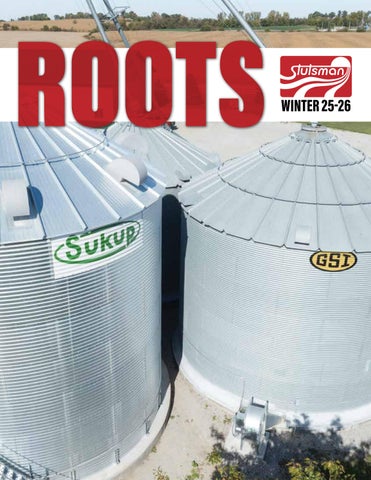
WINTER 25-26
WHAT’S INSIDE 2 4 6 9
FROM PART-TIME TO PRESIDENT
CELEBRATING ROGER SLAUGHTER’S 50-YEAR JOURNEY
ARTEX PULL-TYPE SPREADER MODELS 2025 SEED PLOT DATA GETTING THE MOST BANG FOR YOUR BUCK OUT OF YOUR EQUIPMENT HERE COMES THE BOOM
10 NEW TOPCON UC7 PLUS BOOM HEIGHT CONTROL
FROM “AMERICAN GOTHIC” 12 FAR THE 170-YEAR-OLD STORY OF AMANA FARMS 16 WELCOME TOM BERKLAND 17 STAYING AHEAD OF SOUTHERN RUST CONTROL TROUBLESHOOTING 18 FLOW THE TWO MOST COMMON ISSUES THE FIELD 20 FROM TEST PLOT RESULTS TO STOP GRAIN SPILLS 21 HOW FROM WORN AIR SYSTEM ELBOWS CHEMICAL INDUCTOR 22 WHICH SETUP IS BEST FOR YOU? NITROGEN INITIATIVE’S 25 IOWA NITROGEN RECOMMENDATION TOOL
IN CASE YOU MISSED IT OUR 2026 TRADE SHOW SCHEDULE
12
Iowa Pork Congress | January 21-22 Iowa Ag Expo | February 3-5 AAI Showcase & Conference | February 10-11 Missouri Pork Expo | February 18-19 World Pork Expo | June 3-4
WINTER SAVINGS ON GRAIN HANDLING
Ask our grain handling equipment division about winter discounts from Sukup, GSI and Shivvers.
NEW ROLL TARP KITS & PARTS
We now sell Agri-Cover systems for grain trailers and dry spreaders, plus replacement parts for repairs and updates.
UPCOMING BECK’S CASH DISCOUNT SCHEDULE 15% | November 16 - December 15 14% | December 16 - January 15 10% | January 16 - February 15 8% | February 16 - March 15
FEATURED EQUIPMENT 2025 HitchDoc HFC9900 $27,250
Used Meridian BST220 $6,950
2025 Mid-State Tank 8755 $9,100
2022 GEA 6300 $92,500
2015 Nuhn 8’ Header Pump $11,875
New Artex SB500 $58,500
FROM PART-TIME TO PRESIDENT CELEBRATING ROGER SLAUGHTER’S 50-YEAR JOURNEY
1
969 … the year the Archies dropped “Sugar, Sugar,” Apollo 11 landed on the moon, the Woodstock music festival was born and a young Roger Slaughter joined the Stutsman team. Working toward his degree in recreation at the University of Iowa, Roger began searching for part-time work during the school year and to keep him busy in the summer. With the help of his mother-in-law, who knew Eldon Stutsman, Roger landed at Stutsmans, and the “on-the-job training” quickly began. Growing up the oldest of seven kids in Lone Tree, Roger spent his high school summers baling hay and detasseling corn. Even so, the tasks he would find himself doing in his new part-time gig were a whole new ball game. As is a common story for many of Stutsman's early employees, he was quickly immersed in just about every job there was to be done around Hills — loading and delivering feed with one of the three 12-ton straight trucks; hauling lime, livestock and grain bins to sites; painting; unloading rail cars of products like salt, bran, peat moss and peanut hulls; and fixing augers, to name a few. “Back then, you had to wear a lot of hats,” Roger Slaughter, Special Project Lead, said. All good things come to an end … or do they? Roger’s time at Stutsmans came to a close when he graduated and started working at Clinton Park and Recreation for a couple of years. However, it wasn’t long before Roger and his wife, Sue, found themselves returning home about every weekend to be back around family. “Ron had told me when I left … he says, ‘If you decide you ever want to come back, get ahold of me.’ So, I got ahold of him. We met one Saturday afternoon 50 years ago, and that was it,” Roger said. Even though he didn’t expect his career to head in this direction, upon his return, Roger began selling grain handling equipment, such as augers, and livestock equipment, such as hog feeders and waterers, alongside Ralph Troyer, Stutsman’s first livestock equipment specialist. As the years progressed, Roger became a Swiss Army Knife across the company. “There’s hardly any area of this company that he hasn’t physically worked in in some capacity in the many years that he’s been here,” Ron Stutsman, Chairman of the Board, said. Roger found himself routing feed trucks and ordering feed to help out Clarke Meer, leader of the feed division, when Clarke was traveling. “Somewhere in that period, I ran one of the feed sales routes for several years,” Roger said. As the feed department began to grow, Roger once again focused on the grain bin and equipment side, along with the other seasonal tasks that came his way. Proving himself to be an asset, Ron Stutsman tasked Roger with partaking in a Lotus 1,2,3 spreadsheet program class in the late ’70s. While there was a slight learning curve involved, including figuring out how to fire up the computer in the first place (picture a large, boxy computer with a big switch on the back that required floppy disks to operate), Roger found himself enjoying working in the program. Learning how to use Lotus 1,2,3 and getting more involved with hiring decision-making introduced Roger to a whole new side of Stutsmans. Roger earned his first true management title in the ’90s when he served as the president of the recently acquired Bazooka Farmstar for roughly seven years.
TOR ETUPSETUP IS BEST IS BEST FOR YOU? FOR YOU? “Roger is an extremely fair person,” Ron said. “He is fair with employees, customers, suppliers and the [Stutsman] family. That is a very important trait of leadership of any company.”
It was his fair, level-headed, detail-oriented and all-in mindset, along with his diverse company experience, that made Roger a natural fit for the first non-family president of Stutsmans, a role he stepped into in 2012.
“Somewhere along the line, they thought I ought to be president here for a while,” Roger said. During the seven years he served in this role, Roger helped usher in an era of significant facility improvements, including the land purchase and building of the retail center to better serve retail customers. Roger said he also strived to provide a positive working environment for employees, so they had the right tools to do their jobs well while maintaining good business practices for the overall well-being of the company. “Roger has served his career as a mentor for both new and long-term employees,” Scott Stutsman, CEO, said. “People always feel comfortable walking into his office and talking through a situation with him because he weighs both sides and remains grounded. He has helped a lot of people navigate through different situations.” All roads lead back to the grain handling equipment division … or at least they do for Roger. Even after stepping down from the role of president, Roger’s impact on the company continued as he returned to focusing on the grain handling equipment division while being the go-to man for any facility or special projects. “He was the lead on a lot of decisions on the buildings built in the last 15 years,” Ron said. One of those projects was the new dry fertilizer shed completed in 2022, which Roger says is one of his favorite recent memories due to the improved efficiency it has brought to agronomy operations. His other top highlights throughout the years have been working with fair customers and coworkers, seeing the retail center completion, and watching Mark and Scott Stutsman grow into the positions they hold today. “I’m pretty happy with my life, and a lot of it has to do with the people I’ve associated with,” Roger said. After 50 years, Roger will officially be hanging up his hat on his career at Stutsmans and welcoming a new adventure. While he’s not sure what retirement will look like yet, he plans on keeping himself busy. In addition to traveling a little bit more, Roger plans on volunteering to stay active. It is with extreme gratitude that the team at Stutsmans reflects on Roger’s remarkable career. While his retirement is bittersweet, the memories to look back on certainly are not. We won the lottery when Roger decided to look for a part-time role in college, and we would not be where we are today without him. “Thank you for 50 years of service, Roger,” Scott said. “Not only have you sat in many seats, but you’ve also helped each and every one of us be successful.”
S SERIES S SERIES
SMALLEST SPREADER SMALLEST LINE WITH SPREADER ECONOMICAL LINE WITH ENTRY ECONOMICAL FOR ENTRY FOR SMALLER OPERATIONS SMALLER OPERATIONS
ARTEX ARTEX PULL-TYPE PULL-TYPE SPREADER SPREADER MODELS MODELS
S200
S200 S350
S350
5’ 5 BOX WIDTH (FT) 3’ 3 BOX HEIGHT BOX HEIGHT (FT) BOX LENGTH BOX LENGTH 16’ 20 1620’ (FT) CUBIC FEET STRUCK CUBIC FT STRUCK 240 300 240 300 400 400 320 320 CUBIC FEET HEAPED** CUBIC FT HEAPED** Single Single FLOOR CHAINS FLOOR CHAINS BOX WALL THICKNESS BOX WALL THICKNESS12 Gauge 12 Gauge No Yes Yes SINGLE AXLE SINGLE AXLE No Yes No -Yes TANDEM AXLE TANDEM AXLE 31.2” VERTICAL BEATER DIAMETERTRIPLE AXLE VERTICAL BEATER THICKNESS STEERING AXLE 3/8” -No SCALE READY HYDRAULIC BRAKES No Optional on all models; used for 31.2” DIAM litter and lime applications; up to CYCLONE BEATERSVERT BEATER 60' wide spread 3/8” VERT BEATER THICK AXLE CAPACITY 50,000 lbs SCALE25,000 READY lbs BOX WIDTH
S200 S2
SB500SB
425/65R-22.5 Optional on all models; used for
TIRE OPTIONS
litter and lime applications; up to 560/45R-22.5 CYCLONE BEATERS 60' wide spread
**Approximate
AXLE CAPACITY (LBS.) TIRE OPTIONS
25,000
50,000
425/65R-22.5 560/45R-22.5
**Approximate
SB SERIES SB SERIES
SBX SBX700
EASY TO LOAD WITH LOADER MANEUVER NARROW ALLEYSNARROW OR GATESALLEYS WITH LARGER CAPACITIES EASYA SKID TO LOAD WITHAND A SKID LOADER THROUGH AND MANEUVER THROUGH OR GATES WITH LARGER CAPACITIES SB300
SB300 SB450
SB450 SB500
SB500 SB550
SB550 SB600
SB600 SB700
SB700
5.5 5.5 5.5’ BOX WIDTH 5.5’ (FT) 3’ 3 4’ 4 3 BOX HEIGHT BOX HEIGHT (FT) BOX LENGTH BOX LENGTH 14’ 26 18 2226’ 18’ 22’ 16 16’ 20’ 20 14 (FT) CUBIC FEET STRUCK CUBIC FT STRUCK 231 300 484 572 231 300 352 396 440 484 300 572 352 396 440 300 715 495 400 715 495 400 400 400 605 605 440 440 550 550 308 308 CUBIC FEET HEAPED** CUBIC FT HEAPED** Dual Dual FLOOR CHAINS FLOOR CHAINS 10 Gauge 10 Gauge BOX WALL THICKNESS BOX WALL THICKNESS Yes -No -No No -No -No Yes Yes SINGLE AXLE SINGLE AXLE Yes Yes YYes Y YYes Y Yes Yes Yes Yes Yes -Yes No TANDEM AXLE TANDEM AXLE TRIPLE AXLE Optional -No Optional -No -No -No No TRIPLE AXLE Optional Optional Optional Optional Optional Optional HYDRAULIC BRAKES STEERING AXLE Optional Optional Optional Optional Optional Optional 34.5” VERTICAL BEATER DIAMETER HYDRAULIC BRAKES 34.5” 5/8” VERTICAL BEATER THICKNESS VERT BEATER DIAM Optional No No No Optional5/8” Optional SCALE READY VERT BEATER THICK upOptional to 60' wide spreadOptional CYCLONE BEATERS SCALE READY Optional on all Optional - models; used for-litter and lime applications; Optional on all models; used for litter and AXLE CAPACITY CYCLONE25,000 BEATERSlbs 50,000 lbslime applications; up to 60' wide spread AXLE CAPACITY (LBS.) 425/65R-22.5 50,000 25,000 BOX WIDTH
TIRE OPTIONS
**Approximate
TIRE OPTIONS **Approximate
560/45R-22.5425/65R-22.5 600/50R-22.5560/45R-22.5
600/50R-22.5
560 600
560 600
600/50R-22.5
600/50R-22.5
CB12 CB1200
SBX SERIESSBX SERIES
CAPACITY CAPABILITIES DESIGNED FOR LARGER WITH HIGHER LARGE CAPACITY LARGE CAPABILITIES DESIGNED FOR LARGER OPERATIONS WITHOPERATIONS HIGHER LOADING ABILITIESLOADING ABILITIES SBX500
SBX500 SBX550
SBX550 SBX600
SBX600 SBX700
SBX700 SBX800
SBX800 SBX950
SBX950
6.5 6.5’ BOX WIDTH (FT) BOX WIDTH 3 4’ 4 BOX HEIGHT (FT) BOX HEIGHT3 18 18’ 20’22 26 26’ 30’ 16’20 2020 22’20 2030 BOX LENGTH (FT) BOX LENGTH16 416 416 300 468 300 520 572 300 676 780 468 520 676 780 572 300 CUBIC FT STRUCK CUBIC FEET STRUCK 650 975 400 400 585 585 650 845 845 975 520 400 715 400 520 715 CUBIC FEET HEAPED** CUBIC FT HEAPED** Dual Dual FLOOR CHAINS FLOOR CHAINS 10 Gauge 10 Gauge BOX WALL THICKNESS BOX WALL THICKNESS YNo YesYYesYes YesYes SINGLE AXLE TANDEM AXLEY Y Yes Yes Yes -Yes No -Yes No No Optional Optional TANDEM AXLE TRIPLE AXLEYes -Yes Optional No -NoNo NoNo Optional Optional TRIPLE AXLE STEERING AXLEOptional Yes Optional -Optional Optional Optional Optional STEERING AXLE HYDRAULIC BRAKES Optional Yes Optional Optional Optional Optional 38.75” VERTICAL BEATER DIAMETER HYDRAULIC BRAKES 38.75” 5/8” VERTICAL BEATER THICKNESS VERT BEATER DIAM 5/8”Optional Optional Optional No No Optional VERT BEATER THICK SCALE READY Optional on all models; used for litter and lime applications; up to 60' wide spread CYCLONE BEATERS Optional Optional Optional Optional SCALE READY applications; 75,000 lbs CYCLONE BEATERS AXLE CAPACITY Optional on all models; used for litter and lime 50,000 lbs up to 60' wide spread AXLE CAPACITY (LBS.) 75,000 50,000 425
TIRE OPTIONS
TIRE OPTIONS 425
560
**Approximate 600
560 560 600 600
560 600
560 600/50R-22.5 600 560 600/50R-22.5 600
**Approximate
CB SERIES CB SERIES
DESIGNED FOR THEDESIGNED BIGGESTFOR ANDTHE TOUGHEST JOBSTOUGHEST OF JOBS BIGGESTOFAND CB700
CB700 CB800
CB800 CB900
CB900 CB1000
CB1000 CB1200
CB1200
7.5 7.5’ BOX WIDTH (FT) BOX WIDTH 3 4 4’ BOX HEIGHT (FT) BOX HEIGHT3 BOX LENGTH 24 20 22 22’ 24’26 30’ 20 20’20 20 26’30 20 BOX LENGTH (FT) 600 300 600 660 300 720 780 900 300 660 720 900 780 300 CUBIC FT STRUCK CUBIC FEET STRUCK 900 400 400 825 825 900 1125 1125 750 750 400 975 975 400 CUBIC FEET HEAPED** CUBIC FT HEAPED** Dual Dual FLOOR CHAINS FLOOR CHAINS 10 Gauge 10 Gauge BOX WALL THICKNESS BOX WALL THICKNESS YesY YesYes YYesNo SINGLE AXLE TANDEM AXLEYYes Y Yes No No No -Yes Optional Yes TANDEM AXLE TRIPLE AXLEYes Yes YesYes -Yes Yes Yes Optional TRIPLE AXLE STEERING AXLEYes Yes Yes Yes Yes Yes Yes Yes Yes Yes STEERING AXLE HYDRAULIC BRAKES Yes Yes Yes Yes Yes VERTICAL BEATER DIAMETER 42” HYDRAULIC BRAKES 42” 5/8” VERTICAL BEATER THICKNESS VERT BEATER DIAM SCALE READY 5/8” Optional Optional Optional Optional Optional VERT BEATER THICK Optional used for litter Optional and lime applications; up BEATERS Optional - on all models; Optional Optional - to 60' wide spread SCALE READY CYCLONEOptional Optional on all models; used for litter and60,000 lime applications; up to 60' wide spread CYCLONE BEATERS AXLE CAPACITY 90,000 lbs lbs AXLE CAPACITY (LBS.) TIRE OPTIONS 90,000 60,000 600/50R-22.5 or 750/45R-22.5 **Approximate 600/50R-22.5 or 750/45R-22.5 TIRE OPTIONS **Approximate
LONE TREE FFA CORN PLOT BRAND
HYBRID
% MOISTURE
ACTUAL YIELD
RANK
BECK’S BECK’S AGRIGOLD BECK’S BECK’S BECK’S BECK’S BECK’S BECK’S BECK’S BECK’S BECK’S
6133V 6216PCE A642-18 6233PCE 6258V4P 6280TCV2P 6297V 6374V2P 6469V2P 6492TCV2P 5824AM 5864PCE
15.0 15.4 15.8 15.3 14.6 14.3 14.7 14.7 15.3 15.4 14.4 14.9
210.8 234.5 213.8 218.9 232.4 219.9 236.4 236.1 235.6 237.2 229.5 246.4
12 6 11 10 7 9 3 4 5 2 8 1
WELLMAN SOYBEAN PLOT BRAND
VARIETY
% MOISTURE
ACTUAL YIELD
RANK
BECK’S BECK’S BECK’S XL XL BECK’S BECK’S BECK’S
2370E3 2470E3 2660E3 2770E3 ™ * 2970E ™ * 3170E3 3270E3 3300E3
12.8 12.9 12.6 13.0 12.9 12.9 13.1 12.7
72.5 69.1 74.3 66.5 73.2 70.7 69.8 70.1
3 7 1 8 2 4 6 5
*®XL IS A REGISTERED TRADEMARK OF PIONEER. XL® BRAND SEED IS DISTRIBUTED BY BECK’S SUPERIOR HYBRIDS, INC.
OUR 2026 TOP PICKS CORN BECK’S 5864PCE
A proven performer for medium to highly productive soils with good standability, green snap tolerance and a strong disease package.
BECK’S 6075PCE
The go-anywhere hybrid that’s suitable for a wide range of soils and conditions due to its standability, green snap tolerance, vigorous plant health and dependable yields.
BECK’S 6233PCE
HILLS SOYBEAN PLOT
Emerges quickly, has excellent early growth and maintains superior root strength for season-long stability in medium to highly productive acres.
BECK’S 6297V
BRAND
VARIETY
% MOISTURE
ACTUAL YIELD
RANK
BECK’S BECK’S BECK’S BECK’S AGRIGOLD BECK’S BECK’S BECK’S XL BECK’S XL BECK’S BECK’S BECK’S AGRIGOLD BECK’S BECK’S BECK’S BECK’S BECK’S XL BECK’S
2950E3 2370E3 2470E3 2550E3 G2601E3 2660E3 9494EE 2773XF 2770E3 ™ * 7492EE 2970E3 ™ * 2997XF 3140E3 3170E3 G3255E3 3270E3 3223XF 3300E3 3460E3 3441XF 3570E3 ™ * 3670E3
13.8 13.3 13.1 12.4 12.8 12.2 12.4 12.1 12.5 12.4 12.4 12.3 12.5 12.5 12.4 12.7 12.1 12.4 12.9 13.2 13.3 12.2
76.7 82.0 79.2 68.0 69.4 76.8 76.6 73.5 73.9 77.9 79.5 76.3 79.1 72.2 79.2 81.2 80.8 73.0 72.6 66.4 72.2 76.1
10 1 6 21 20 9 11 15 14 8 4 12 7 18 5 2 3 16 17 22 19 13
*®XL IS A REGISTERED TRADEMARK OF PIONEER. XL® BRAND SEED IS DISTRIBUTED BY BECK’S SUPERIOR HYBRIDS, INC.
Our recommendation for corn-on-corn acres due to its strong stalks and roots, high yield potential on productive soils and consistency from year to year.
SOYBEAN BECK’S 2370E3
A big-yielding, early-maturity variety that has good white mold tolerance, adapts to different soil types and has early harvest flexibility.
BECK’S 2660E3
A Peking Cyst variety with great SDS tolerance and pest protection that performs well on all soil types.
XL 2970E3
A top-yielder for late Group 2 soybeans due to its excellent emergence, durable standability and strong SDS tolerance.
BECK’S 3270E3
An early Group 3 variety with proven stress and drought tolerance and excellent emergence and standability which allows it to yield in the top-end consistently.
Boost your crop’s performance without a new sprayer Maximize your old sprayer | Norac U7C Plus System Forget investing in a new sprayer next season. Upgrade to advanced ultrasonic sensing technology. Maintain optimal spray boom height automatically. Reduce waste. Improve coverage. Achieve faster field speeds. And increase cost savings and productivity. Focus on the right height, for optimal performance from Topcon.
Get precision spraying with a seamless retrofit.
Learn more at topconpositioning.com/us/en/campaigns/focus-the-spray
OUR TOP TIPS
Inspect and replace damaged sprayer tips and nozzles annually. » Nozzles with irregular patterns may cause inaccurate application, leading to over- or under-application of your chemicals. For any equipment that has a flowmeter, check your flowmeter’s condition and calibration to ensure its rate accuracy. Investing in a boom height control system for your sprayer, if you don’t already have one, can decrease operator fatigue and increase productivity. » If you currently have a Topcon Norac system, consider upgrading to the Norac UC7 Plus because older system components are no longer available from Topcon if something needs to be replaced.
I
n today’s ag economy, maximizing productivity and equipment longevity is more important than ever. From calibration checks that prevent costly input waste to targeted upgrades that boost efficiency, there are improvements to be made without major capital spend. Here are some of our team’s top tips for the season, no matter if you are focused on optimizing what you have or prioritizing equipment upgrades.
Examine monitors and rate controllers for implement section widths and offsets. This confirms they are accurate and shut off properly with overlap. Test section control on and off times, which can save money by not overlapping or leaving skips. For a more precise application rate, look at increasing your number of sections or adding an individual nozzle system like Raven’s Hawkeye or Capstan Ag’s PinPoint.
If you have a dry fertilizer spreader, pan testing is a great way to confirm correct spread patterns and widths to maximize fertilizer application. If upgrading or investing in a dry fertilizer spreader is in the cards for you, take a look at the Salford Sniper. Larger operations, especially with irregularly shaped fields, find the fertilizer savings can quickly make up for the initial equipment purchase with the Sniper’s more precise swath control — especially if you currently don’t have section turnoffs. The Sniper offers wider application widths (up to 120 feet) and the ability to adjust your spread pattern width on the go. Upgrade older tillage equipment that isn’t as efficient or misses the mark on seed bed preparation to avoid any losses due to poor germination and seed stands. Keep an eye on manufacturer financing promotions to minimize your interest expense, especially if you’re at the crossroads of making significant repairs or replacing. » A few upcoming examples are Ag Leader’s special financing (as low as 1.99%) through December 31 and Krone’s sales program (0% for 60 months financing or cash discounts), which was recently extended through December 31.
HERE COMES THE BOOM
NEW TOPCON UC7 PLUS BOOM HEIGHT CONTROL BY: DEREK BONTRAGER | PRECISION & EQUIPMENT SALES
Late this summer, Topcon introduced its newest version of the long-running Norac boom height control
WHAT’S NEW
platform, UC7 Plus. UC7 Plus continues to utilize some familiar Topcon components while adding newly developed ultrasonic sensors and an optional dynamic chassis sensor. Topcon’s in-field testing data has shown a 30% improvement in boom stability and height accuracy in challenging terrain over UC7 systems. To start, Topcon has developed a new ultrasonic sensor, the MS-1. The MS-1 offers improved inertial tracking, faster processing, corrosion-resistant nylon housing and a new protective screen for the transducer. This allows for improved performance in rough conditions, less maintenance and improved longevity. Secondly, in rough terrain, the new optional dynamic chassis sensor (DCS-1) improves boom stability and boom response times. Thirdly, Topcon is now offering a new 7” touchscreen display called the ID1. The ID1 offers larger icons, a brighter screen and improved response.
UC7 Plus still utilizes the proven HCM1 controller, proportional valves and cabling as the UC7 system. In fact, those with UC7 systems can easily turn their systems into a UC7 Plus with a software upgrade, MS-1 sensors and the optional DCS-1. The MS-1 sensor is designed to be backwards compatible with UC7 systems and will replace the UC7 Max sensor.
ULTRASONIC SENSOR
WHAT’S THE SAME
ID1 TOUCHSCREEN DISPLAY
CHASSIS SENSOR
FREQUENTLY ASKED QUESTIONS
With the help of the rest of the precision ag team and our reps at Topcon, I’ve compiled a list of questions we’ve already received or think you might want to know about the new system.
Q IS THERE AN UPGRADE KIT AVAILABLE FOR UC7 PLUS, AND SHOULD I REPLACE MY WHOLE SYSTEM IF I HAVE A UC4, 4+, 4.5, OR 5? A Yes, and yes. Topcon has developed UC7 Plus upgrade kits for most self-propelled and pull-type
sprayers that previously had Norac kits available. As with previous upgrade kits, the customer keeps their Norac hydraulic block and replaces all the other components in the system. Topcon's Trade-in Program allows up to $2,500 credit for older UC trades. UC7 Plus kits must be ordered by January 2, 2026, to qualify for trade-in credit. Contact our precision ag team for more information about using Topcon’s Trade-In Program to upgrade your system. We expect the Trade-in Program to conclude in early spring of 2026. Most components for the above systems are no longer available from Topcon — including all sensors.
Q I DO NOT CURRENTLY HAVE A BOOM HEIGHT CONTROL SYSTEM ON MY SPRAYER. CAN I BUY A FULL UC7 PLUS KIT? A Yes. Topcon offers full UC7 Plus kits for most makes and models of sprayers. Any member of our precision ag team can provide you with current pricing information.
Q DOES STUTSMANS OFFER INSTALLATION OF UC7 PLUS KITS? A Yes. Please get in touch with a member of our precision ag team for more information. Q HOW MANY MS-1 HEIGHT SENSORS ARE IN A UC7 PLUS KIT? A This will vary based on the make and model of the sprayer. Most kits are three-sensor systems, and the severe terrain kit (4th and 5th sensors) can be added for an additional cost. Some kits are standard with five sensors.
Q I HAVE AN ACTIVE ROLL SYSTEM ON MY SPRAYER; CAN I UPGRADE IT? A Yes. UC7 Plus kits are available for Active Roll and Active Wing Roll machines. Q I HAVE A PULSE DISPLAY (OR SMALL HAGIE TOUCHSCREEN) IN MY SPRAYER. CAN I KEEP USING IT, OR DO I HAVE TO REPLACE IT WITH THE ID1 DISPLAY?
A The Pulse display will still work with UC7 Plus. ID1 is replacing the Pulse display going forward
and is a larger, more responsive touchscreen with additional functionality the Pulse does not offer.
Q I HAVE A PULSE DISPLAY FOR MY CURRENT UC7 SYSTEM AND WOULD LIKE A LARGER DISPLAY, BUT I DON’T WANT TO UPGRADE RIGHT NOW. CAN I PURCHASE AN ID1 DISPLAY BY ITSELF?
A Yes. You will also need an adapter cable for the ID1.
Q MY NORAC SYSTEM IS CURRENTLY SHOWN ON THE IN-CAB (OEM) DISPLAY OF MY SPRAYER, AND I DO NOT LIKE FLIPPING BETWEEN PAGES/TABS TO FIND THE NORAC. CAN I MOVE THE NORAC TO AN ID1 DISPLAY?
A Yes. We need to know what display you are currently using. Additional cables will be required.
Q I RECENTLY PURCHASED A UC7 SYSTEM AND WOULD LIKE THE ADDITIONAL FEATURES OF THE UC7 PLUS. WHAT ARE MY OPTIONS? A You will need to add the DCS-1 with a firmware upgrade and update to the MS-1 sensors. The combination of the latest sensors, firmware and DCS-1 delivers the highest performance.
Q I CURRENTLY HAVE A UC5 SYSTEM IN MY SPRAYER. HOW DIFFICULT IS THE LEARNING CURVE FOR USING UC7 PLUS? A UC7 Plus uses very similar icons and menu structures as the UC5 and will be very easy to learn for a current user. A new operator guide is included with the purchase of the UC7 Plus system to further assist with modified menu structures.
Q DO BOOM HEIGHT CONTROL SYSTEMS REALLY MAKE A DIFFERENCE? I’M PERFECTLY CAPABLE OF RUNNING MY BOOM HEIGHT MANUALLY. A Customers with boom height control systems report they can cover more acres in a day, apply inputs more accurately and generally experience less fatigue. Most, if not all, customers who have used boom height control systems cringe at the thought of operating the booms manually.
FAR FROM
AMERICAN GOTHIC
THE 170-YEAR-OLD STORY OF AMANA FARMS
The soil of Amana Farms has witnessed decades of changes. It
has held the slim furrows left by wagon wheels. It’s felt the steady clip of plowing horses’ hooves, and it has been dotted with the footprints of growers hand-harvesting corn. It has also watched modernization carry the farm to new triumphs. In the northeast corner of Iowa County, Amana Farms rests quietly on 26,000 acres of working ground. The land houses cattle, sprouts crops and generates enough energy to power a town of 2,000. Now, 170 years after its founding, the farm balances commitment to its heritage and modern innovation.
SETTLING IN IOWA Searching for religious freedom, a small group of German settlers stepped off a ship and settled near Buffalo, New York, unaware of the path they were pioneering. Years later, after deciding to bring more of their families to America, they traveled west in search of land to build a community. Their journey led them to the rolling hills of eastern Iowa. In 1855, they established seven villages across a nine-by-five-mile stretch. Unlike most of Iowa, which was divided into neat one-mile squares, the Amana Colonies took a communal shape. Each village centered around a church, with homes, workshops and farmland surrounding it. For decades, the Colonies operated as a self-sustaining society. Then, in 1932, Amana Farms transitioned to a shareholder-owned corporation.
ONE LIVING SYSTEM Amana Farms, the largest contiguous farm in Iowa, is the opposite of an archaic farm. Instead, it follows a forward-looking approach to agriculture.
WE’RE PROBABLY ABOUT AS FAR AWAY FROM THE AMERICAN GOTHIC VERSION OF AGRICULTURE AS YOU CAN GET. - JOHN MCGRATH | GENERAL MANAGER Like most Iowa farms, Amana Farms grows corn and soybeans. Unlike most, it grows several kinds of each. Its fields host white, waxy, non-GMO waxy, and yellow dent corn, along with two variations of soybeans: non-GMO and traited. That crop mix makes both opportunity and extra work. Instead of planting one crop type in a concentrated area, the team changes varieties as they plant across their nine-mile farm, matching crops to the land’s productivity and reducing risk.
CONTINUED ON PAGE 14
If all their dent corn grew in one stretch and a hailstorm swept through, the farm could lose an entire product harvest in one night. Each crop switch requires a full planter or combine clean-out to prevent any contamination. Spraying plans also shift from field to field, since not every product works for every crop. Amana Farms raises beef cattle, maintaining a 2,000-head cow herd and a 4,000-head feedlot. Together, they produce more than 75 tons of manure daily, which is never wasted. Manure leaves the feedlot and mixes with local manufacturers’ biodegradable byproducts, before entering one of the farm’s most innovative systems: the manure digester. Inside, bacteria break the mixture down into methane gas, which is burned to generate enough electricity to power the colonies. The remaining manure and substrate combination is collected and applied back to the fields as fertilizer.
EVERYTHING IS FULL CIRCLE. THE CROPS FEED THE CATTLE, THE CATTLE FEED THE DIGESTER, THE DIGESTER FEEDS THE CROPS AND POWERS THE VILLAGES. - JOHN MCGRATH FAILING (AND THEN SUCCEEDING) In 2006, John convinced the board of Amana Farms to invest more than six million dollars in a manure digester. At the time, it would be one of only three in the state.
GENERATOR ROOM AT ANAEROBIC DIGESTER SITE
ANAEROBIC DIGESTER
By 2008, the 1.6-million-gallon digester was complete. By 2009, it was plugged up and not working. The digester is an open vat heated to 101 degrees, creating the ideal environment for bacteria to break down biodegradable material, generating methane gas. For the process to work, the waste inside must stay at a cake-batter-like consistency, a density the team struggled to maintain. “Those were scary times,” John admitted. “I had to stand in front of the board and say, ‘This thing is losing all kinds of money, and it was my idea.’” How did the digester go from a costly failure to one of the most productive parts of the Amana Farms operation? Farmers. “I was in engineering school. Two of my children are engineers,” John said. “But I often tell people we only made the digester work when I fired all the engineers involved and got the smartest farmers I know together and asked, ‘How are we going to make this thing work?’” Even without “a bunch of letters behind their names,” that group of farmers, including Stutsman’s VP of Manure Equipment John Yoder and former salesman Mike Strait, figured out how to prevent the digester’s waste from separating. Today, the gas produced by the anaerobic digester powers all the homes within the Amana Colonies, and the remaining liquid slurry fertilizes thousands of acres of farmland.
UNHARVESTED WHITE CORN ALONG THE WOODS PROVIDES WINTER FEED FOR WILDLIFE Nearly 700 people own a piece of the farm. Their parents lived there. Their grandparents lived there. Sometimes even their great-great-grandparents were part of the Amana Colonies. Their voices, carried by today’s shareholders, keep the farm rooted in the values of generosity, growth and respect. The sprawling farm runs like a corporation. Yet, John sees the same kind of attachment here that you’d find on any family farm. Shareholders still call it “our farm,” he said. They want their children and grandchildren to call it that, too.
“OUR FARM”
That desire shapes every decision. Modern equipment hums in the fields, but the heart of the farm remains human. Its success isn’t measured by pure profits. It’s measured in the care that grows every acre.
Amana Farms operates without forgetting the people and practices that established it. Tradition and innovation live side by side at the farm, and one of the strongest ties to the past comes from its shareholders.
“At the end of the day, it’s not all about the money,” John said. “It’s about being good neighbors and good stewards of the land. I’m proud to work for an organization rooted in that mindset.”
WELCOME
TOM BERKLAND SEED SALES REPRESENTATIVE O
ur new seed sales representative, Tom Berkland, joined our team just in time for the harvest season. While it is his first fall working in Hills, Tom is not a rookie in the seed industry. He is a Certified Crop Advisor with over 15 years in the trade. A north-central Iowa native, Tom grew up on a small grain and livestock farm in Fenton, Iowa. That experience pushed him toward earning an agronomy degree at Iowa State University. What is Tom’s proudest accomplishment? His children. His son lives near Tom and his wife’s Davenport residence, and his daughter is 3.5 hours away in Mason City, Iowa. Tom foresees some engagements in their near futures. Read on to find out a little more about Tom:
WHO HAS INFLUENCED YOUR CAREER THE MOST? My dad. From an early age, he instilled a strong work ethic in me and my siblings, which has carried through my career.
WHAT IS THE BEST ADVICE YOU’VE EVER BEEN GIVEN?
A boss from an early job told me to invest in retirement. If you save a little each month, you won’t miss it day-to-day, but you’ll be glad you saved that money when retirement comes.
WHAT ARE YOU MOST EXCITED ABOUT IN YOUR NEW ROLE?
I’m excited to get to know the team and our customers.
WHICH STUTSMAN CORE VALUE MEANS THE MOST TO YOU?
Value Collaboration. I believe that when you work as a team, your chances of reaching your goals are much higher.
WHAT’S ON YOUR BUCKET LIST?
I’d like to visit all 50 states — I have nine left.
This summer, southern rust hit many Iowa fields. A warm, wet July helped it spread, leaving orange spores across cornfields in the Midwest. Even when treated, it led to lower grain yields.
Southern rust shows up somewhere in the Corn Belt every year, but how far north it travels depends on the weather. The Puccinia polysora fungus can’t survive an Iowa winter; it dies off when cold temperatures freeze plant tissue. Each season, it has to work its way back north on storm systems that carry spores from the southern states. The more summer storms we get from the south, the higher our risk of southern rust inoculation. This year, those storms brought rust earlier and farther north than usual. Warm, humid weather helps those spores infect corn leaves, creating orange spots that damage the plant. When leaves die early, the plant loses its ability to photosynthesize, so corn kernels don’t fill out. This is an automatic loss in yield. Understanding its biology, symptoms and management is key to controlling it.
MANAGING SOUTHERN RUST IN IOWA
Effective management of southern corn rust involves the following practices:
1. SCOUT EARLY AND OFTEN
Monitor fields weekly, especially during warm, wet spells. Look for orange pustules on upper leaf surfaces.
2. RESISTANT HYBRIDS
Planting corn varieties with genetic resistance to southern rust is the most cost-effective and sustainable strategy.
3. FUNGICIDE APPLICATIONS
Early fungicide applications can help control southern rust. Products with SDHI chemistry work best on active infections. We use Miravis Neo to protect corn from this disease.
4. CROP ROTATION AND RESIDUE MANAGEMENT
While southern rust does not overwinter in crop residue, rotating crops and managing field debris can help reduce other disease pressures and improve overall plant health.
Southern rust is more aggressive than many growers realize, but it can be managed. Keep an eye on storms coming up from the south, plan your fungicide strategy early and ask your agronomist for local advice.
FLOW FLOW CONTROL CONTROL TROUTR
THETHE TWOTWO MOST MOST COMC Our manure team gets the same two questions every season: WHY ISN’T MY RAVEN CONSOLE SHOWING A RATE?
WHY IS MY RATE OFF?
In most cases, the system itself is working just fine. It’s usually a setup or connection issue. Here’s how our team troubleshoots these problems:
COMMON PROBLEM 1: NO RATE ON RAVEN CONSOLE
The Raven console calculates rate using width, speed and flow. If one input is missing, the rate will read as zero.
STEP 1 CHECK SPEED
» Look at the speed on the Raven console, not the tractor display. » If it’s blank, check your speed calibration number and make sure the unit is on "SP2 Radar." » Inspect the radar cable for damage or loose connectors at both ends. » If the cable looks good, but the Raven console still doesn’t show speed, replace the radar.
STEP 2 CHECK FLOW
» While applying, watch the volume per minute on the Raven console. » If it reads as zero, check the meter calibration. » If the calibration is correct, confirm the flowmeter is powered on. » With power on, watch the meter while pumping to see if it displays volume per minute. » If the meter doesn’t show flow, it needs to be checked out. » If it does show flow, perform a short/no-short test. » If the test works at the meter, the output is likely bad. » If it fails, test each cable until you find and replace the bad section.
STEP 3 CHECK POWER AT THE FLOWMETER
» If the meter isn’t powered on, check voltage at the back: newer IFC 100 and IFC 300 should have at least 12 volts; older IFC 090 should have around 18 to 24 volts (the IFC 090 requires a voltage booster to jump the voltage). » If there is power, ensure meter connections are good; if they are, the converter must be replaced. » If there’s no power at the meter, check the next cable in line and continue forward until the issue is found.
STEP 4 CONFIRM BOOM SETTINGS AND SWITCHES
» Boom calibration: Under “Boom 1” only, enter in inches. » Boom switches: Make sure “Boom 1” is on and all others are off. » Master switch: Must be on for acres and gallons to tally. » Toolbar flow: Confirm manure is flowing and shear bolts are intact.
UBLESHOOTING ESHOOTING
MMON ON ISSUES ISSUES COMMON PROBLEM 2: WRONG RATE ON RAVEN
Incorrect rates are usually caused by one of four things: speed, meter calibration, boom width or valve function.
STEP 1 CHECK SPEED READING
» Compare the speed on your Raven console to the tractor display. » If they don’t match, recalibrate your speed calibration.
STEP 2 CONFIRM METER CALIBRATION
Make sure the meter calibration is entered correctly: RAVEN CONSOLE
PRODUCT TYPE
SETTING
Raven 660
Granular-Single Bed Belt
GRI = 10
Raven 660
Liquid Sprayer
100 for rates ≤ 9,999/1,000 for ≥ 10,000
Raven 440/450
Liquid Sprayer
100 for rates ≤ 9,999/1,000 for ≥ 10,000
A wrong meter calibration can make the on-screen rate look fine but be wrong in the field.
STEP 3 DOUBLE-CHECK BOOM WIDTH AND RATE
» Boom width (width of toolbar) must be entered in inches. » Verify the target rate is entered correctly in “Rate 1 Calibration” or “Rate 2 Calibration.” » Confirm the “Rate 1,” “Rate 2” and master toggle switch are in the correct positions.
STEP 4 COMPARE GALLONS PER MINUTE
When the valve is wide open, most tanks should output around 1,200 gallons per minute. If your rate seems off, compare the gallons per minute reading on the Raven with the flowmeter. SITUATION
WHAT IT MEANS
WHAT TO CHECK
Both show the same gallons per minute, but rate is still wrong
Possible restriction
Inspect manifold, diverter box or lines for plugging
Flowmeter shows correct gallons per minute, but Raven does not
Bad cable
Likely a bad cable between meter and console
» If flow oscillates on the Raven, check all connections and apply dielectric grease.
STEP 5 CHECK THE 5-INCH PLUG
Make sure the 5-inch plug is installed in the return hose on the passenger side of the manifold. Leaving it open can cause rate errors.
NEED MORE HELP?
The Raven system is one of the most reliable flow controllers in the field. Like any smart piece of equipment, it only performs as well as its inputs. Most “no rate” or “wrong rate” issues trace back to calibration, power or wiring. Our manure equipment team is always here to help. If you run into a tough issue or want a second set of eyes, give us a call.
19
FROM THE FIELD TEST PLOT RESULTS BY: ADAM GUY | AGRONOMY SALES
CORN PRODUCT PLOT APPLICATION TIMING
TREATMENT
RATE
% MOISTURE
BU/A
BU/A INCREASE
Untreated Check
N/A
N/A
17.5
230.8
N/A
Endo-Fight
Pre-Emergence
Per Label
17.3
238.5
+7.7
BioWake
Pre-Emergence
Per Label
17.1
227.9
-2.9
Network
Pre-Emergence
2 Qt/A
17.3
229.8
-1.0
Relay
In-Furrow
1 Gal/A
17.0
231.4
+0.6
Relay BAMB Terramar
In-Furrow Pre-Emergence Post-Emergence
1 Gal/A 1 Gal/A 1 Qt/A
17.1
236.4
+5.6
17.1
233.3
+2.5
Network
Post-Emergence
1 Qt/A
17.6
238.9
+8.1 *
Radiate
Post-Emergence
2.6 FL Oz/A
17.3
228.7
-2.1
Network Radiate
Post-Emergence Post-Emergence
1 Qt/A 2.6 FL Oz/A
17.4
237.1
+6.3
Network NanoPro
Post-Emergence Post-Emergence
1 Qt/A 4 FL Oz/A
18.0
225.1
-5.7
Relay Network
In-Furrow Post-Emergence
1 Gal/A 1 Qt/A
17.3
231.0
+0.2
Relay BAMB Network
In-Furrow Pre-Emergence Post-Emergence
1 Gal/A 1 Gal/A 1 Qt/A
17.1
233.8
+3.0
SOYBEAN PRODUCT PLOT TREATMENT
APPLICATION TIMING
RATE
% MOISTURE
BU/A
BU/A INCREASE N/A
Untreated Check
N/A
N/A
12.3
73.3
Endo-Fight
Pre-Emergence
2 Oz/A
12.3
75.3
+2.0
Network
Post-Emergence
1 Qt/A
12.3
74.0
+0.7
AF5-Plus
Post-Emergence
1 Qt/A
12.3
74.9
+1.6
AF5-Plus
Post-Emergence
2 Qt/A
12.2
75.5
+2.2 *
Radiate
Post-Emergence
2.6 Fl Oz/A
12.2
75.6
+2.3 *
BU/A
BU/A INCREASE
SULFUR ON SOYBEANS RATE (LBS)
APPLICATION TIMING
% MOISTURE
0
Pre-Plant
12.3
72.6
N/A
10
Pre-Plant
12.3
74.0
+1.4 *
30
Pre-Plant
12.5
73.6
+1.0 *
50
Pre-Plant
12.3
74.0
+1.4
* These products have been tested for two years and have shown a positive bushel increase both years. Not all products or rates have been tested for two years.
HOW TO STOP GRAIN SPILLS
FROM WORN AIR SYSTEM ELBOWS I
f you have ever shoveled a pile of corn from under a worn-out elbow, you know it’s not a job anyone fights over. Grain elbows wear out, and it always seems to happen when you are short on time. The ConveyGuard helps stop that mess before it starts.
WHAT THE CONVEYGUARD DOES
The ConveyGuard is a preventative maintenance device for pneumatic conveying systems. It is a reusable rubber sleeve installed over conveying elbows. When an elbow wears through, escaping air pressure inflates the ConveyGuard enough to push out an indicator flag, warning you to replace that section before it leaks grain. In the meantime, the ConveyGuard sleeve contains the grain, preventing spillage.
WHY EVERY AIR SYSTEM NEEDS ONE
Tom Miller, grain bin and equipment sales, has seen what happens when a grain elbow perforation goes unnoticed. “As the kernels keep hitting a tiny hole, they make it bigger and bigger. Before you know it, it’s just spitting corn out for hours. If you don’t catch it, you can end up with 500 to 1,000 bushels on the ground a year.”
CONVEYGUARD OPTIONS
There are also advanced versions of the ConveyGuard that use a wired sensor instead of a flag. These can tie into your existing automation, alert lights or alarm systems. We can install ConveyGuards for you (which is handy for elbows above bin eaves) or guide you on how to do it yourself. Reach out to our grain handling equipment division to learn if the ConveyGuard is a good fit for your grain storage setup.
WHICHWHICH CHEMICAL CHEMICAL INDUCTOR INDUCTSE A good day in the sprayer starts with smooth chemical batching. Not every chemical mixing setup works the same, though. While the right chemical inductor helps you measure and blend products quickly, the wrong inductor can slow you down and cause flow issues.
Finding the right system comes down to three main questions:
HOW MANY CHEMICALS DO I MIX PER LOAD?
When you’re selecting a chemical induction setup, start by thinking about how many products you usually mix at once. Are you just adding one or two? Or do you mix batches of four or more products? Some systems make it easy to load several chemicals at a time, while others take more patience. It’s also worth thinking ahead. If you plan to eventually acquire more acres, your batching needs will probably grow with your operation.
DO I USE DRY PRODUCTS?
It’s important to know if you’ll be mixing any dry products, like powders or granules. These can be a little stubborn in a standard inductor and have a tendency to clump together. A system with stronger mixing power, like a Chembine, can help blend them smoothly.
HOW FAST DO I NEED TO APPLY?
You’ll also want to consider how much product you handle on a typical day. Smaller operations can get by with a simple inductor, which can mix multiple chemicals with a little more time and attention. For larger operations that move products quickly, a system built for faster mixing can make a major difference in efficiency. The chart below helps you match your operation to the right chemical induction setup. Start by noting how many chemicals you mix per batch, then follow the path that best fits your needs.
WHAT IS THE MAXIMUM AMOUNT OF CHEMICALS I WILL MIX IN A BATCH? 1 CHEMICAL
2-3 CHEMICALS
4-5 CHEMICALS
DO I EVER MIX DRY PRODUCTS?
DO I EVER MIX DRY PRODUCTS?
DO I EVER MIX DRY PRODUCTS?
NO
YES
NO
YES
NO
YES
AUTO-DISPENSES
USES VENTURI
REQUIRES INDUCTOR
REQUIRES METER CALIBRATION
FAST BATCH VENTURI KIT
REQUIRES METER CALIBRATION
(GEAR METER)
YES
NO
YES
NO
YES
NO
YES
NO
YES
NO
AUTOMATED CHEMICAL BATCHING
3” CHEMBINE 5 PRODUCT EXPANSION KIT
(BASIC INDUCTOR)
AUTO BATCH NORWESCO 3” CHEMBINE TRU-KLEEN EASY CADDY INDUCTOR BASE MODEL DOUBLE (NO METER) (DURA PRODUCTS) MASTER OR TRU-KLEEN INDUCTOR
TRU-KLEEN AUTO BATCH CHEMBINE - 3 3” CHEMBINE 3 PRODUCT DOUBLE OR DIRECT INJECT PRODUCT TRIPLE SYSTEM EXPANSION KIT EXPANSION KIT (GEAR METER) INJECTOR (DURA PRODUCTS) (DURA METER) OR SYSTEM AUTO BATCH OR FAST BATCH EASY CADDY VENTURI KIT (DURA PRODUCTS)
YES
(GEAR METER)
NO
(DURA PRODUCTS)
FAST BATCH 3” CHEMBINE MULTIJET KIT 5 PRODUCT (DURA PRODUCTS) EXPANSION KIT (DURA METER)
ETUP IS BEST IS BEST FOR YOU? FOR YOU? UPGRADING YOUR CHEMICAL MIXING SETUP THE CHEMBINE
3" CHEMBINE BASE MODEL
If you’re working with thicker chemicals and bigger batches, it might be time to elevate your chemical mixing setup to a system like the Chembine. It does everything a standard chemical mix tank can do, but with a few helpful extras. Its added agitation and recirculation give it the ability to fully mix and dissolve dry products, so by the time the blend reaches your sprayer, everything flows smoothly.
ADD-ONS
Are you wondering how to make your chemical inductor tank work even harder for you? Add-ons might be your answer. One popular upgrade is adding a Venturi system, which uses suction, not a motor, to draw chemicals from mini bulks. By removing the need for pumps and motors, a Venturi system can save a lot of money.
TRU-KLEEN INDUCTOR
You can also customize your setup with one of our custom expansion kits. These kits let you meter and pull multiple chemicals straight from mini bulk tanks, and they require a Venturi system to run. We offer two meter options in our expansion kits. The Dura Flowmeter is the more budget-friendly choice, though it needs to be calibrated for each chemical. The Macnaught geared meter is the higher-end option that handles different viscosities without recalibration and gives faster readings. The calibration-free Macnaught geared meter is handy if you’re switching products often. Even a basic chemical mix tank can be upgraded with features like agitation, rinse systems, and a jug knife, depending on what products you’re using.
YOU DON'T HAVE TO DECIDE ALONE Getting your new inductor system up and running doesn’t have to be intimidating. Our team offers an optional in-person setup tutorial where we’ll lay everything out, walk you through each step and let you take photos along the way. Some people even bring their trailer in, and we’ll install the system for them. If you're unsure which chemical mixing setup is best for your operation or want guidance customizing a system to fit your needs, we’re happy to answer questions and help you find the best setup.
23
GUARANTEED TO DO THE JOB Since 1886, John Blue Company has been a trusted partner for farmers, delivering pumps known for their accuracy, reliability, durability, and value.
CENTRIFUGAL SPRAY PUMPS
Efficient and versatile pumps for Hydraulic, Gas Engine, and Shaft Drives.
VISAGAGE ORIFICE SELECTOR, FLOW MONITORS AND LBMS Proper application equals increased yields. Know your flow!
HYDRAULIC DRIVE NGP PISTON PUMPS
Manifold kits and variable rate hydraulic kits make pumps more versatile.
SMSS4 W/ SMPT-OSA4
CS-150-HYR
CS-150-HA12 & CS-200-HA12 (NOT PICTURED)
WIRELESS OR WIRED
CONTACT US
800-253-2583
info@johnblue.com
NGP-6055-HY WITH PWM MANIFOLD
johnblue.com
LA CROSSE SEED HAS YOUR SEED SOLUTIONS
• Alfalfa • Forage Grasses & Legumes • Cover Crops • Natives and Wildlife
• Spring & Winter Cereals • Turf Grasses & Erosion Control • Inoculants
800.356.SEED | lacrosseseed.com
BY: ADAM MILLIKIN | PROVANTAGE SPECIALIST
T he Iowa Nitrogen Initiative (INI) isn’t developing your typical nitrogen recommendation tool. Unlike older systems, this program focuses on providing practical recommendations tailored specifically to your farm. Backed by hundreds of on-farm nitrogen research trials across the state, it factors in soil types, weather patterns and hybrid differences. The result? A tool that helps determine both agronomic and economic optimum nitrogen rates to help your bottom line while reducing your environmental impact.
Nitrogen has been studied for decades. We all know it’s essential for growing corn, but the real question has always been: how much do we need, and when should it be applied? Thanks to growers across Iowa, we’re getting closer to answering these questions. One of INI’s main objectives is to improve a nitrogen recommendation tool called N-FACT, found at n-fact.ag. N-FACT takes a variety of factors into account when generating a recommendation, including: » Location: You can select your region or county. » Previous crop: Choose between “corn following corn” or “corn following soybeans.” » Weather and growing conditions: Use a 40-year average or customize for a wet or dry season. » Residual nitrogen: Input a range to account for leftover nitrogen from the previous year. » Planting date: Enter your planting date for a more accurate estimate. » Nitrogen and cost prices: Helps the tool calculate both agronomic and economic recommendations. Using this information, N-FACT estimates your optimal nitrogen rate. It also gives you access to the previous trial results that guided those numbers, allowing you to see the data behind the suggestions. Good recommendations start with good data. That is why Stutsmans partners with local growers to set up trials to add to the INI’s information database. The better data (trials) we can capture, the better the output we will receive. This means grower participation is essential. Time is of the essence; regulatory limits on nitrogen application could be legislated soon, and agriculture continues to face scrutiny in the court of public opinion. In 2025, we helped growers set up 30 on-farm trials across southeast Iowa. These trials are easy to run and can be customized based on your equipment. Depending on your setup, a trial can be as small as three acres, with very low cost and minimal risk for you. To run a trial, you’ll need two key pieces of equipment: » A system capable of varying nitrogen application rates. » A yield monitor that allows raw data to be extracted. If you or someone you know is interested in running an INI nitrogen trial in 2026, reach out to your Stutsman agronomy salesperson and let them know you’d like to participate. The INI is all about taking the guesswork out of nitrogen management. By combining grower participation, strong data and smart technology, the program helps Iowa growers make informed decisions that benefit both their bottom line and the environment. Tools like N-FACT make it easier than ever to fine-tune your nitrogen strategy, and, with your trial participation, we can ensure the research stays grounded in real-world farming. At the end of the day, if we work together as growers, researchers, and industry partners, we can help keep Iowa agriculture productive, profitable and sustainable for years to come.
PRST STD US Postage Paid Iowa City, IA Permit No. 200
stutsmans.com | 319.679.2281 | shopstutsmans.com