Prof.Exams
TEST BANK
2022
Prof.Exams
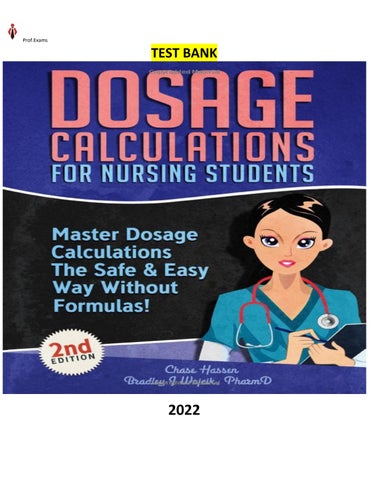
COMPLETE Elaborated Test Bank for Dosage Calculations for Nursing Students by Chase Hassen and Bradley J. Wojcik 2022
Prof.Exams
Dosage Calculations for Nursing Students-by Chase Hassen and Bradley J. Wojcik ISBN-10 1096128748 ISBN-13 978-1096128748 Test bank for Dosage Calculations for Nursing Students-by Chase Hassen and Bradley J. Wojcik
ISBN-10 1096128748 ISBN-13 978-1096128748 THIS IS NOT THE ACTUAL BOOK. YOU ARE BUYING it is the Official Test Bank in e-version INSTANT DOWNLOAD >The test bank is what most professors use as a template when making exams for their students, which means there’s a very high chance that you will see the exact questions in the tests! >The file is either in.pdf, excel, or zipped in the package and can easily be read on PCs and Macs. >Delivery is INSTANT. You can download the files IMMEDIATELY once payment is done. If you have any questions, please feel free to contact us. Our response is the fastest. All questions will alwaysbe answered in 6 hours, most of the time within 30mins. We also faced similar difficulties when we were students, and we understand how you feel. But now, with the Official Test Bank, you will be able to
* * * * * *
Anticipate the type of the questions that will appear in your exam. Know the correct answers to those questions. Reduce the hassle and stress of your student life. Improve your studying and get a better grade! Get prepared for examination questions. Save you time and help you understand the material.
Prof.Exams
TABLE OF CONTENTS Unit 1: Essential Skills:
You can't learn to drive a car if you don't understand the function of the steering wheel. The same applies to the following subjects when learning dosage calculations.
The Metric System Apothecary/Avoirdupois/Household Systems Ratios Dimensional Analysis (DA) and Ratio Proportion (RP) Rounding Numbers Military Time
Unit 2: Auxiliary Subjects:
Roman Numerals Scientific Notation
Unit 3: Unit Conversions
Unit 3 covers converting between and within the various systems of measurement using dimensional analysis and ratio proportion.
Prof.Exams
Unit conversions Within the Metric System Unit Conversions Within the Household System Unit Conversions Between Metric, Household and Apothecary Systems Unit Conversions Involving Pounds and Ounces Unit Conversions Involving Hours and Minutes
Unit 4: Dosage Calculations
Unit 4 builds on the knowledge gained in the previous units and covers dosage calculations, starting with the terminology and set up of problems, then progressing from easy, one-step, problems through multi-step problems.
Dosage Calculations-The Basics Dosage Calculations Levels 1-3 Body Surface Area Dosing Calculations Pediatric Dosage Calculations Pediatric Maintenance Fluid Replacement Calculations
Unit 5: IV Flow Rate Calculations
Unit 5 starts with the basic terminology and set up of IV flow rate problems, then moves on to:
Simple and Advanced Problems IV Flow Rate Adjustment Calculations Heparin Infusion and Adjustment Calculations
Unit 6: Percent and Ratio Strength Calculations
Percent, percent strength, percent change and ratio strength are important topics covered in Unit 6. These topics are not difficult if a few basic concepts are understood.
Unit 7: Miscellaneous Subjects The following subjects are covered in unit 7: Reconstitution Calculations Concentrations and Dilutions Milliequivalent Calculations Dosage Calculations Puzzles Self-Assessment Exam General Terminology Used in this Book: Number: Includes integers, decimal numbers, and fractions. Integer: All positive and negative whole numbers and zero. ü Examples: -4, -3, 0, 2, 25 Decimal Number: A number which includes a decimal point. ü Examples: 25.3, 0.05 Fraction: A number represented as a/b where a and b are both integers, with the exception that b cannot be 0. ü Examples: 1/2, 3/4, 7/8, -1/2 Unit: Unit of measurement. Examples: mg, mL, kg, L. A Few Important Notes: Always include all units of measurement (mg, g, L, mL, etc.) in the calculations. The units are the most important part of the calculation. The numbers only go along for the ride. Set the calculations up mathematically correct. 0.25 X 100% = 25% not 0.25 X 100 = 25% Use a space between the number and the unit. 5 mL not 5mL Always use leading zeros on decimal numbers which are less than 1. 0.5 mg not .5 mg. It is easy to misread .5 mg as 5 mg. Always avoid trailing zeros after whole numbers. 5 mg not 5.0 mg. It is easy to misread 5.0 mg as 50 mg. Single quantities in equations can be expressed by themselves or as a
ratio with 1 in the denominator. written
can be .
Use mcg for microgram, not µg, as µg can be mistaken for mg.
Rounding rules for this book, unless otherwise stated: In general, round calculations at the end. All drops/minute calculations are to be rounded to the nearest full drop. All mL/h calculations are to be rounded to the nearest tenth mL/h unless otherwise stated. mL doses less than 1 mL are rounded to the nearest hundredth mL. mL doses greater than or equal to 1 mL are rounded to the nearest tenth mL. When rounding the final answer to the nearest tenth or hundredth, if the final digit after the decimal point is zero, omit it. This is done to avoid trailing zeros. Enjoy the book! -Brad Wojcik & Chase Hassen
Unit 1: Essential Skills As with any subject, certain basic skills are required before delving into the actual subject matter. The following subjects are covered in Unit 1. Chapter 1: The Metric System Summary: An overview of the metric system as it relates to nursing. Importance: 10/10. Chapter 2: Apothecary/Avoirdupois/Household Systems Summary: An overview of other systems of measurement encountered in nursing. Importance: 10/10 Chapter 3: Ratios Summary: An explanation of ratios and their role in dosage calculations. Virtually every dosage calculation, IV flow rate calculation and unit conversion will involve use of one or more ratios, and it is vitally important that you fully understand them. Importance: 10/10 Chapter 4: Dimensional Analysis and Ratio Proportion Summary: A basic explanation of dimensional analysis and ratio proportion. It is important to understand the math behind dosage calculations and why these methods work. Importance: 10/10 Chapter 5: Rounding Numbers Summary: An explanation of rounding numbers. As most dosage calculations involve rounding, a thorough understanding of this subject is vital. Importance: 10/10 Chapter 6: Military Time Summary: An explanation of military time (24-hour clock).