Room 2
©Erik en Petra Hesmerg
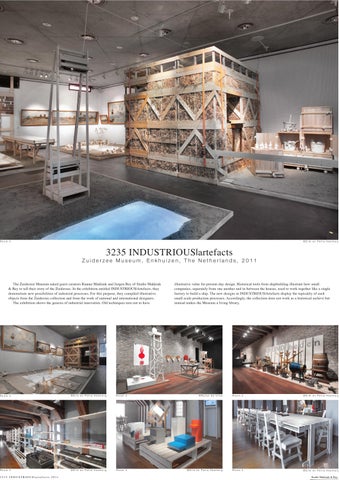
3235 INDUSTRIOUS|artefacts
Zuiderzee Museum, Enkhuizen, The Netherlands, 2011
The Zuiderzee Museum asked guest curators Rianne Makkink and Jurgen Bey of Studio Makkink & Bey to tell their story of the Zuiderzee. In the exhibition entitled INDUSTRIOUS|Artefacts, they demonstrate new possibilities of industrial processes. For this purpose, they compiled illustrative objects from the Zuiderzee collection and from the work of national and international designers. The exhibition shows the genesis of industrial innovation. Old techniques turn out to have
illustrative value for present-day design. Historical tools from shipbuilding illustrate how small companies, separately from one another and in-between the houses, used to work together like a single factory to build a ship. The new designs in INDUSTRIOUS|Artefacts display the topicality of such small-scale production processes. Accordingly, the collection does not work as a historical archive but instead makes the Museum a living library.
Room 2
©Erik en Petra Hesmerg
Room 3
©Rufus de Vries
Room 3
©Erik en Petra Hesmerg
Room 4
©Erik en Petra Hesmerg
Room 4
©Erik en Petra Hesmerg
Room 4
©Erik en Petra Hesmerg
3235 INDUSTRIOUS|artefacts 2011
Studio Makkink & Bey
Room 5
©Rufus de Vries
With to the closure of the Zuiderzee, the local economy and culture of the Zuiderzee region FKDQJHG UDGLFDOO\ 6DOW ZDWHU EHFDPH IUHVK ZDWHU ÀVKHUPHQ ZHQW WR ZRUN LQ IDFWRULHV DQG SURGXFWLRQ became mechanical and large-scale. Fingers operated buttons instead of weaving rope or nets. The machines in the factories were so large that they disappeared from the cities. To a greater extent than previously, living and working occurred next to one another. The boiler of the laundry heated the dwelling house and the miller lived in his mill. Nowadays another industrial period seems to be on the
horizon, in which living and working are again approaching one another more closely. With this, the GXDO XVH RI IXQFWLRQV LV DJDLQ RQ WKH LQFUHDVH DQG WKLV ZLOO VWURQJO\ LQÁXHQFH WKH IRUP RI WKH KRXVH Here, the designers present the evolution of crafts in installations and machines that make their own special products. By supplying made-to-measure products, this way of designing and producing has the potential to solve various social issues.
Room 7
©Erik en Petra Hesmerg
Room 7
©Rufus de Vries
Room 2
©Rufus de Vries
Room 6
©Erik en Petra Hesmerg
Room 8
©Erik en Petra Hesmerg
Room 8
©Erik en Petra Hesmerg
3235 INDUSTRIOUS|artefacts 2011
Studio Makkink & Bey
Zuiderzee Timeline Collage
GRONDheden
GRONDheden
3235 INDUSTRIOUS|artefacts 2011
©Studio Makkink & Bey
The exhibition is centred on three themes that are linkedto the polder, the industry and the history of the Zuiderzee. GROUND|Artefacts is about the processing and double use of raw materials. INDUSTRIOUS|Artefacts shows the way in which raw materials and techniques encourage smallscale industries. Finally, WONDROUS|Artefacts displays the interaction between cultures, with innovation as the result.
©Studio Makkink & Bey
NIJVERheden
©Studio Makkink & Bey
80
WONDERheden
©Studio Makkink & Bey
WONDERheden
©Studio Makkink & Bey
81 85
82
86
83 84
88
89
87
79
96
93
95 94
91
92
68
71 60 79
72
73
01
50 67
51 56
55
53
52
54
03
09
04
05
06
08 07
02
01
10
19
22
23
21 17
18 24 25
26
16
11 26
12
13 14
25
24
29 33
31
32
36
35
11
30
25 45 34
©Studio Makkink & Bey
NIJVERheden
38
42
43 41
39
40
©Studio Makkink & Bey
Studio Makkink & Bey
Exhibition Installation
©Johannes Schwartz
3364 Temporary Fashion Museum Collected By... Het Nieuwe Instituut, Rotterdam, The Netherlands, 2016
There can be no museum without a collection. For this reason the largest gallery in the Temporary Fashion Museum is devoted to a series of unique collections, from the private and professional to the public and commercial. From the private haute couture collection of Eva Maria Hatschek to a public, commercial archive in the form of a vintage store, assembled by Ferry van der Nat, with iconic pieces
from the history of Dutch and international fashion. Visitors can choose how they wish to experience these displays. Depending on thie condition and status, some of the pieces can be touched, tried on and purchased.
Design Overview
©Studio Makkink & Bey
In Exhbition
©Johannes Schwartz
In Exhbition
©Johannes Schwartz
Design Overview
©Studio Makkink & Bey
In Exhbition
©Johannes Schwartz
Close Up
©Johannes Schwartz
3 3 6 4 Te m p o r a r y F a s h i o n M u s e u m C o l l e c t e d B y. . . 2 0 1 6
Studio Makkink & Bey
In Exhibition
©MAK/Katrin Wißkirchen
3295 WerkStadt Vienna in Engaging the City World Design Capital, Helsinki, Finland, 2012 MAK, Vienna, Austria, 2012 Het Nieuwe Instituut, Rotterdam, The Netherlands, 2013
Initiators of Vienna Design Week; Neigungsgruppe Design, curated Passionswege within the framework of their annual design event in Vienna. The Passionswege exhibition shows local production workshops based on a 19th century tradition of passionate cooperation between the Viennese applied arts industry. Together with Studio Makkink & Bey (i.c.w. Hansje van Halem), curator Sophie Lovell combines the know-how and expertise of quality business enterprises and the vision of designers together in a display showing a high street with shop windows on panels. In this
high street however, the products are experiments and are not to be consumed as an artifact, but as an idea. Through the themes ‘Showcasing Collaboration’, ‘Meeting of Worlds’. ‘Design Communicating with Commerce’ the experimental approaches of designers interact with traditional businesses such as J. & L. Lobmeyr, the Neue Wiener Porzellanmanufaktur Augarten and the Wiener Silber Manufactur. Together they explored the innovative potential of material science and technologymanufacturing in Vienna.
Exhibition Design Collage
©Studio Makkink & Bey
In Exhibition
©MAK/Katrin Wißkirchen
Close Up
©MAK/Katrin Wißkirchen
Exhibition Design Collage
©Studio Makkink & Bey
In Exhibition
©MAK/Katrin Wißkirchen
Close Up
©MAK/Katrin Wißkirchen
3 2 9 5 We r k S t a d t Vi e n n a i n E n g a g i n g t h e C i t y 2 0 1 2
Studio Makkink & Bey
Sketch Design // Room Pride
©Studio Makkink & Bey
3298 The Seven Sins
Centraal Museum Utrecht, Utrecht, The Netherlands, 2014
In the exhibition The Seven Sins, Studio Makkink & Bey takes the famous painting by Hieronymus Bosch, bearing the same name, as a starting point and makes connections between art, design and everyday objects from the past and present. In seven scenes, mostly interiors, Bosch depicts what
The Seven Deadly Sins and the Four Last Things
Rage
3298 The Seven Sins 2014
Hieronymus Bosch
©Studio Makkink & Bey
EHKDYLRU WKHVH VLQV OHDG WR DQG KRZ WKH\ DUH UHÁHFWHG LQ WKH WKH VLQQHUV· VXUURXQGLQJV ,Q 6WXGLR 0DNNLQN %H\·V YLHZ LQQHU PRWLYHV RI SHRSOH FDQ EH UHDG IURP WKHLU VXUURXQGLQJV DQG LQWHULRU ,Q this respect vices lead to activity and creativity rather than virtuousness.
Pride
©Studio Makkink & Bey
Greed
©Studio Makkink & Bey
Gluttony
©Studio Makkink & Bey
Lust
©Studio Makkink & Bey
Studio Makkink & Bey
Self-Production
Capture FoodScape
FarmScape Body as Farm
by Studio Makkink & Bey
When every thing about food is under control, we, as the end consumer, are losing it all. The embedded complexity is too great that blurs our focus of reality and would not able to capture the shape of truth. ,Q )RRG 5HYROXWLRQ ([KLELWLRQ ZLWK LWV VSHFXODWLYH GHVLJQ DV D YLHZ¿QGer, Studio Makkink & Bey invites visitors to capture different perspective on what future landscapes of food will be.
Zero Distance energy City Hive Rooftop
Alternative
Vertical
forage
Cohabit
Farm Landscape
©Studio Makkink & Bey
3388 Food Revolution 5.0
M u s e u m f ü r K u n s t u n d G e w e r b e ( M K & G ) , H a m b u r g , G e r m a n y, 2 0 1 7
The exhibition Food Revolution 5.0 sheds light on one of the most pressing issues of the 21st century: What will we eat in the future? The exhibition takes a critical look at the global food industry and presents pioneering visions, ideas and designs contributed by over 30 international designers, architects, and scientists. The exhibition design and co-curating was entrusted to the renowned Dutch design studio Makkink & Bey. Studio Makkink & Bey designed the entire scenography and co-curated the exhibition in close
Anthony Dunne & Fiona Raby | Foragers
In Exhibition
3388 Food Revolution 5.0 2017
©Jason Evans
©Studio Makkink & Bey
Paul Gong | The cow of tomorrow
In Exhibition
cooperation with head curator Design of the museum, Dr. Claudia Banz. The studio also exhibits a design for an innovative cattle farm ‘FreeRangeShelter’. The roof of the compost stable contains a volume in which the cattle keeper resides. Next to her co-curatorship, Rianne Makkink and her team designed the entire scenography of the exhibition; from lay-out to designing all exhibition elements, including the designs of the tutorial backgrounds. All projects are put ‘in a bigger picture’ to give them a context.
©Paul Gong
©Studio Makkink & Bey
Chloé Rutzerveld | In Vitro Me
In Exhibition
©Chloé Rutzerveld
©Studio Makkink & Bey
Studio Makkink & Bey
Growing Kitchen Lab KitchenScape Syntetic engeneering Recycle
Nutrition Circulation
Bio Fuel
Kitchen as Laboratory Fungi Cultivation
Algae Cultivation Growing Lab
Decompose Biomass
Kitchen Landscape
©Studio Makkink & Bey
3388 Food Revolution 5.0
M u s e u m f ü r K u n s t u n d G e w e r b e ( M K & G ) , H a m b u r g , G e r m a n y, 2 0 1 7
The exhibition Food Revolution 5.0 sheds light on one of the most pressing issues of the 21st century: What will we eat in the future? The exhibition takes a critical look at the global food industry and presents pioneering visions, ideas and designs contributed by over 30 international designers, architects, and scientists. The exhibition design and co-curating was entrusted to the renowned Dutch design studio Makkink & Bey. Studio Makkink & Bey designed the entire scenography and co-curated the exhibition in close
Maurizio Montalti | System Synthetics
In Exhibition
3388 Food Revolution 5.0 2017
©Maurizio Montalti
©Studio Makkink & Bey
Chloé Rutzerveld | Edible Growth
In Exhibition
cooperation with head curator Design of the museum, Dr. Claudia Banz. The studio also exhibits a design for an innovative cattle farm ‘FreeRangeShelter’. The roof of the compost stable contains a volume in which the cattle keeper resides. Next to her co-curatorship, Rianne Makkink and her team designed the entire scenography of the exhibition; from lay-out to designing all exhibition elements, including the designs of the tutorial backgrounds. All projects are put ‘in a bigger picture’ to give them a context.
©Edible Growth
©Studio Makkink & Bey
Carolin Schulze | Hase aus einer Mehlwurmpaste
Werner Aisslinger | Cooking Landscape
© Carolin Schulze
©Studio Makkink & Bey
Studio Makkink & Bey
Non-Fiction Cooking Landscape KitchenScape Lava Ground Heat Technological Intervention
Solar Cooking
Outdoor Dining
Kitchen Landscape
©Studio Makkink & Bey
3388 Food Revolution 5.0
M u s e u m f ü r K u n s t u n d G e w e r b e ( M K & G ) , H a m b u r g , G e r m a n y, 2 0 1 7
The exhibition Food Revolution 5.0 sheds light on one of the most pressing issues of the 21st century: What will we eat in the future? The exhibition takes a critical look at the global food industry and presents pioneering visions, ideas and designs contributed by over 30 international designers, architects, and scientists. The exhibition design and co-curating was entrusted to the renowned Dutch design studio Makkink & Bey. Studio Makkink & Bey designed the entire scenography and co-curated the exhibition in close
Hanan Alkouh | Sea-Meat Seeweed
In Exhibition
3388 Food Revolution 5.0 2017
© To m M a n n i o n
©Studio Makkink & Bey
cooperation with head curator Design of the museum, Dr. Claudia Banz. The studio also exhibits a design for an innovative cattle farm ‘FreeRangeShelter’. The roof of the compost stable contains a volume in which the cattle keeper resides. Next to her co-curatorship, Rianne Makkink and her team designed the entire scenography of the exhibition; from lay-out to designing all exhibition elements, including the designs of the tutorial backgrounds. All projects are put ‘in a bigger picture’ to give them a context.
A n d r e a S t a u d a c h e r | A n d r e a ’s F u t u r e F o o d L a b
In Exhibition
©Simon Staehli
©Studio Makkink & Bey
To n M a t t o n | F r i d g e o n I c e
In Exhibition
© To n M a t t o n
©Studio Makkink & Bey
Studio Makkink & Bey
©Studio Makkink & Bey
Living Bridge with pond
3377 Ontworteld / Uproot Rotterdam CBK Rotterdam The Netherlands, 2016
The destruction of Rotterdam city center in 1940 was the prelude to the creation of a great collection of art that is unprecedented in the Netherlands. Since 1940, the city offered two thousand works of art to the public. However, much work proved temporary, disappeared by demolition and new FRQVWUXFWLRQ ZHUH UHORFDWHG RU PRYHG WR GHSRWV 8SURRW 5RWWHUGDP VKRZV IRU WKH ÀUVW WLPH D VHULHV of forgotten, stored in depots or roaming sculptures to the public. This presentation shows a crucial aspect of the genesis of Rotterdam since 1940: the desire to tell the story of Rotterdam by showing public art to the audience. Uproot Rotterdam: resilience, future demand and celebrating the public cause. Just like Rotterdam.
Uproot Rotterdam
G r a d u a t e W o o d y ’s
3377 Uproot Rotterdam
Uproot Rotterdam is commissioned by BKOR and Sculpture International Rotterdam (CBK Rotterdam), and curated by Studio Makkink & Bey. BKOR manages the city collection of public art in collaboration with involved people of Rotterdam, private companies and institutions. Sculpture International Rotterdam (SIR) manages the city’s international collection of public art works and develops art projects, thereby supporting Rotterdam in the achievement of its international and cultural objectives. Uproot Rotterdam is organized in the framework of CBK Rotterdam Celebrates the Arts and the City, as part of Rotterdam celebrates the city! The project is kindly supported by the city of Rotterdam and foundation de Loodsen.
©Studio Makkink & Bey
©Studio Makkink & Bey
Floorplan Museumpark
©Studio Makkink & Bey
J o r i e k e Te n b e r g e n
©Studio Makkink & Bey
Salsa Dancing
©Studio Makkink & Bey
Studio Makkink & Bey