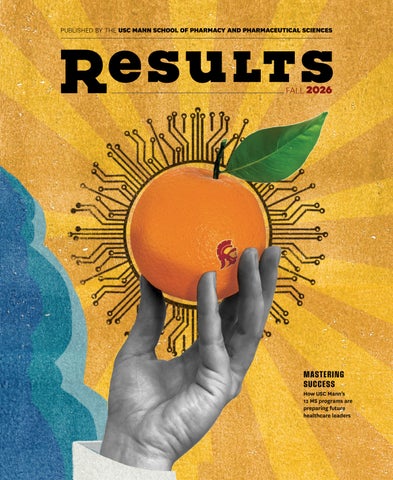
PUBLISHED BY THE USC MANN SCHOOL OF PHARMACY AND PHARMACEUTICAL SCIENCES
FALL 2026
MASTERING SUCCESS How USC Mann’s 12 MS programs are preparing future healthcare leaders
EDITOR IN CHIEF
Michele Keller MANAGING EDITOR
Susan L. Wampler CONTRIBUTING WRITERS
Dora Dalton Stephanie Hedt Jason Millman Stan Wedeking David Zong DESIGN
Warren Group | Studio Deluxe PHOTOGRAPHY
David Ahntholz Tracy Boulian Mark Christensen Isaac Mora Glen Tao David Zong COVER ILLUSTRATION
Hadley Hooper © 2026 BY THE UNIVERSITY OF SOUTHERN CALIFORNIA MANN SCHOOL
Letters to the editor, questions, comments, address changes, requests to be added/ removed from the mailing list and all other inquiries should be addressed to:
Michele Keller
Chief Communications Officer USC Mann School of Pharmacy and Pharmaceutical Sciences 1985 Zonal Avenue – PSC 700 Los Angeles CA 90033 kellermi@usc.edu 323-442-3497 MANN.USC.EDU
DEAN
Vassilios Papadopoulos, DPharm, PhD, DSc (hon) BOARD OF COUNCILORS
Robert Popovian, Chair Edward Abrahamian Anil “Neil” Badlani Melvin F. Baron Gale Bensussen Penny Cai Danielle C. Colayco Daniel Gil Peggy Han Dong Koo (D. K.) Kim Dianne Kwock Vinson Lee Sohail Masood David Meek Kimberly Moore Shushma Patel Chao Peng William Pih Raymond Risman Jacque J. Sokolov Khanh-Long (Ken) Thai Brandon Tom David Neu, Chair Emeritus William A. Heeres, Chair Emeritus
ABOUT THE USC MANN SCHOOL OF PHARMACY AND PHARMACEUTICAL SCIENCES One of the top pharmacy schools nationwide and the highest-ranked private school, the USC Mann School continues its century-long reputation for innovative programming, practice and collaboration. Founded in 1905 as the USC College of Pharmacy, the school was known as the USC School of Pharmacy from the mid-20th century until 2022, when it received a $50 million endowment and was renamed on behalf of inventor and entrepreneur Alfred E. Mann. The school created the nation’s first Doctor of Pharmacy program, the first clinical pharmacy program, the first clinical clerkships, the first doctorates in pharmaceutical economics and regulatory science, and the first PharmD/ MBA dual-degree program, among other innovations in education, research and practice. The USC Mann School is the only private pharmacy school on a major health sciences campus, which facilitates partnerships with other health professionals as well as new breakthroughs in care. Uniquely, it owns and operates several community pharmacies.
The school is home to the D. K. Kim International Center for Regulatory Science at USC, the Titus Center for Medication Safety and Population Health, and the Center for Quantitative Drug and Disease Modeling, and is a partner in the USC Leonard D. Schaeffer Center for Health Policy & Economics, the USC Institute for Addiction Science, the USC Ginsburg Institute for Biomedical Therapeutics, the Southern California Clinical and Translational Science Institute, the USC Center for Neuronal Longevity, and the USC Center for Drug Discovery, Delivery and Development. The Mann School pioneered a national model of clinical pharmacy care through work in safety-net clinics throughout Southern California and is a leader in comprehensive medication management. Results magazine, published semi-annually, highlights some of the school’s latest advances and achievements, as well as the faculty, students, alumni and donors who make this work possible.
Bearing Blossoms and Fruit ACROSS CULTURES, the orange symbolizes health, energy and growth. It also evokes the sunshine, warmth and hospitality of Southern California, which has long attracted people from around the world to the region’s pioneering spirit and melting pot of inclusivity. Fittingly, the color orange is created by blending USC’s hues of cardinal and gold.
My own journey to California began exactly 10 years ago, when I became dean of the Mann School in October 2016. Like many, I was drawn by Los Angeles’ history of pace-setting innovation and emphasis on well-being, as well as the university’s unique interdisciplinary environment and focus on creative and collaborative problem-solving. The Mann School has grown significantly over the past decade, preparing ever-greater numbers of thoughtful and talented experts to lead the healthcare and biopharmaceutical sectors so crucial to U.S. economic expansion. This momentum shows no signs of slowing. Industry priorities continue to shift, creating demand for new specializations along with the adaptability to pivot as new opportunities arise. To address these needs, our academic offerings extend from undergraduate degrees to master’s and doctoral degrees. Our cover story highlights our dozen master’s degree programs and a few of the inspiring students taking advantage of the opportunities they provide to broaden their expertise and interdisciplinary knowledge. From laboratory research and drug discovery to clinical development, regulatory science and commercial strategy, Mann MS programs provide the specialized expertise to excel in these dynamic fields. In this issue, we also explore a few of the competitive internships that took Mann undergrads across the country this past summer. We shine a spotlight on some of our generous alumni, including Ken Thai and Ammie Hwang, both PharmD ’02, and Patricia “Pat” Gonzales, PharmD ’82. And in our faculty profile, Department of Regulatory and Quality Sciences Chair Eunjoo Pacifici—who earned her PharmD and PhD at USC Mann—discusses the importance of regulatory science, the program’s focus on training future leaders and how her yoga practice keeps her balanced. Like our home in Los Angeles, the orange represents vitality and nourishment. The orange tree bears both blossoms and fruit, just as your support helps ensure our students flourish and fulfill their potential to improve human health around the globe. Thank you for your partnership and for being part of this fruitful and vibrant community.
Vassilios Papadopoulos, DPharm, PhD, DSc (hon) Dean, USC Mann School John Stauffer Decanal Chair in Pharmaceutical Sciences
Interaction between virus and dendritic cell, computer illustration. Dendritic cells play a crucial role in initiating immune responses against viruses.
1
RESULTS FALL 2026
contents ↑ Incoming members of the USC Mann PharmD Class of 2030 at Bovard Auditorium for their white coat ceremony in August
2
USC
MANN SCHOOL
12 COVER STORY 12 / How USC Mann’s 12 MS Programs Are Preparing Future Healthcare Leaders
22 04 BROAD SPECTRUM 04 / Honoring Science in Service:
Dean Papadopoulos Elected to National Academy of Medicine 06 / Eunjoo Pacifici:
Finding Balance 08 / Uncovering Dementia’s
Hidden Costs 09 / Mann Study Highlights
Medication Risks During Pregnancy 09 / Enhancing Digital Twins 10
/ In the News
11
/ Prescription for Community Service: Gayle Butler
11
/ Inaugural Advisory Board to Support USC Pharmacy and Wellness Center
GIVING 22 / Giving Gratefully: Patricia “Pat” Gonzales, PharmD ’82
24 ALUMNI 24 / Room for the Future: Ken Thai, PharmD ’02, and Ammie Hwang, PharmD ’02, Name PSC Conference Room 25 / Remembering Raymond Poon and Craig Stern
28 STUDENTS 28 / New Minor Takes Biomedical Innovation From Molecule to Market 29 / PhD Student and Krown Fellow Rini Arun Honored at PAGE 29 / USC Scholars Take Top Prizes at SMDM Annual Meeting 30 / Applying Classroom Knowledge Coast to Coast—and Overseas
32 POST SCRIPT 32 / Cultivating Connection and Well-Being
26 FACULTY 26 / Lights, Camera, Accuracy 26 / Appointments and Promotions 27 / Grants 27 / New Faces 27 / Awards and Honors
3
RESULTS FALL 2026
broad spectrum
HONORING SCIENCE IN SERVICE VASSILIOS PAPADOPOULOS’ ELECTION to the National Academy
of Medicine recognizes his discoveries in hormone biology and his leadership in advancing science and higher education.
400+ Papers
33 Patents
3 Commercialized products
35K+ Citations
4
USC
MANN SCHOOL
As a scientist, Vassilios Papadopoulos welcomes the unexpected. “What I love about research is that all results have a meaning,” he says. “Sometimes we do not understand the data, but we should never dismiss it.” Papadopoulos’ curiosity and its resulting innovations have now been recognized by his election to the National Academy of Medicine (NAM), one of the highest tributes in health and medicine. He is one of just 100 chosen this year for outstanding achievement and service. His membership adds to a distinguished list of titles, including dean of the USC Mann School of Pharmacy and Pharmaceutical Sciences and interim dean of the Keck School of Medicine of USC. The NAM membership honors his research revealing how steroid hormones are produced throughout the body and brain. Papadopoulos’ achievements in the field include publishing more than 400 papers, earning 33 patents, and garnering honors from scientific organizations in France, the United States and Canada. “Dean Papadopoulos’ election to the National Academy of Medicine is a deeply deserved honor for an extraordinary scholar, educator and leader,” said Beong-Soo Kim, president
of the University of Southern California. “It is also a proud moment for USC, which is delighted to see another of its leading researchers enter the National Academies—a singular achievement reflecting the highest level of academic excellence.” As a young pharmacy student, Papadopoulos says he “became curious about how small changes in a chemical structure could result in specialized structures and change a chemical from a building block to a drug. This inspiration has driven my life’s quest, to understand these building blocks—steroids.” Steroid hormones help regulate reproduction, metabolism and the stress response. Papadopoulos’ research explores the cellular machinery that turns cholesterol into these hormones, including processes within mitochondria. He also investigates neurosteroids, which are produced in the nervous system. NAM cited his work that has advanced the development of new therapies for endocrine, neurological and psychiatric diseases. These investigations are opening possibilities for treating disorders including male infertility, nonalcoholic fatty liver disease and Alzheimer’s. His team has also generated testosterone-producing Leydig-like cells from human induced pluripotent stem
“
Dean Papadopoulos’ election to the National Academy of Medicine is a deeply deserved honor for an extraordinary scholar, educator and leader.” BEONG-SOO KIM PRESIDENT, UNIVERSITY OF SOUTHERN CALIFORNIA
cells, an early step toward a possible regenerative treatment for testosterone deficiency. His election also recognizes an equally influential record of leadership that has contributed to the success of multiple universities. After conducting postdoctoral work in Australia, Papadopoulos joined the faculty at Georgetown University School of Medicine, rising to become chair of the department of biochemistry and molecular biology. In 2007, he moved to McGill University, where he served as the executive director and chief scientific officer of the Research Institute of the McGill University Health Centre.
and medical expertise,” said Steven D. Shapiro, executive vice president of health affairs at USC and president and CEO of Keck Medicine of USC. “His collaborative academic leadership has significantly advanced the missions of three USC health sciences schools: the USC Mann School, the USC Suzanne Dworak-Peck School of Social Work and, most recently, the Keck School of Medicine of USC. I can think of no one more deserving of this prestigious honor.”
Since becoming USC’s pharmacy dean in 2016, he has expanded degree offerings, grown the faculty and enhanced key facilities. His support for students earned the American Pharmacists Association Academy of Student Pharmacists’ Outstanding Dean Award in 2025. Additionally, he served as interim dean of the Suzanne Dworak-Peck School of Social Work from 2022 to 2026. “Dean Papadopoulos’ remarkable career and international recognition reflect the depth of his clinical, scholarly
5
RESULTS FALL 2026
broad spectrum
FINDING BALANCE Eunjoo Pacifici on how regulatory science bridges scientific discovery and patient impact—and how yoga strengthens personal and professional success
6
USC
MANN SCHOOL
A
AS CHAIR OF USC MANN’S Department of Regulatory and Quality Sciences, Eunjoo Pacifici helps prepare new generations of professionals to bring innovative therapies safely from the laboratory to patients. As a longtime yoga practitioner, she also believes that cultivating focus, balance and resilience can strengthen both personal and professional success. Here, she discusses regulatory science, training tomorrow’s pharmacy leaders, and yoga’s relevance to her life and work.
That’s where I was first exposed to regulatory science and international product development, gaining familiarity with regulatory frameworks in Asia and Latin America. I loved that the field combined science, healthcare, and collaboration across disciplines and countries, and I wondered why nobody had told me about this career path. When USC began developing the nation’s first academic program in regulatory science, I knew I wanted to help build it. I’ve been here ever since.
YOU’RE A FIRST-GENERATION COLLEGE GRADUATE FROM AN IMMIGRANT FAMILY. HOW DID THAT INFLUENCE YOU?
WHAT EXCITES YOU MOST ABOUT LEADING THE DEPARTMENT OF REGULATORY AND QUALITY SCIENCES?
My father was admitted to Seoul National University, one of Korea’s top universities. But because of the Korean War and family financial struggles after fleeing North Korea, he was unable to finish his education. He came to the United States in the 1970s to pursue the American dream, and one of his biggest goals was making sure I had the opportunity to earn an education.
USC Mann has the most comprehensive program and extensive alumni network in regulatory science. That gives us both credibility and the responsibility to continue leading the field’s evolution.
Looking back, I think my parents’ sacrifices taught me to value education and to keep looking for opportunities to learn and grow. That’s really shaped the path I’ve taken throughout my career. WHAT LED YOU TO REGULATORY SCIENCE?
I was always drawn to science and mathematics and studied biochemistry as an undergrad. After completing my PharmD and PhD at USC, I wanted to learn more about how the work we do as scientists becomes therapies that end up in hospitals and community pharmacies. So I went into industry to learn how new drugs are developed.
I love helping students discover opportunities they never knew existed—and that enable them to improve global health while building rewarding careers. As the global market continues to expand, we want to position our students to be ready to take on those roles as regulatory professionals and leaders. People sometimes think regulations are there to slow things down, but regulatory science is really an enabler of innovation. Every breakthrough in healthcare depends on public trust in regulatory institutions, and that trust is built through sound science, rigorous evaluation and a commitment to patient safety. Regulatory science is the bridge between scientific discovery and patient impact. YOU TEACH YOGA TO STUDENTS THROUGH THE USC MANN OFFICE OF ORGANIZATIONAL SUCCESS AND WELL-BEING. HOW HAS YOGA SHAPED YOUR APPROACH TO LEADERSHIP AND TEACHING?
Yoga is built on three pillars: strength, flexibility and balance. I find that those same principles have shaped how I live my life. Yoga helps me stay present, remain calm under pressure and approach life’s challenges with intention rather than simply reacting. Students today have access to an incredible amount of information, but I think in many ways it’s overwhelming. We have to teach them how to think critically, make decisions and understand how those decisions affect outcomes. One lesson I often share comes directly from yoga: We practice so that we can practice again tomorrow. This isn’t a sprint; it’s a marathon.
7
RESULTS FALL 2026
broad spectrum
Uncovering Dementia’s Hidden Costs ALZHEIMER’S DISEASE and related dementias
“
Remarkable innovations can alter the trajectory of dementia in the United States if they are used effectively.˝ –DANA GOLDMAN Founding Director, USC Schaeffer Institute
will cost the United States an estimated $818 billion in 2026, according to a multidisciplinary team including researchers from the USC Mann School. Published in Alzheimer’s & Dementia, the federally funded study estimates that 5.7 million Americans currently live with dementia. Researchers found that reduced quality of life accounts for $320 billion in annual costs, with 5.2 million unpaid providers contributing an estimated 6.8 billion hours of care valued at $237 billion. Medical and long-term care account for another $222 billion. The findings come from the U.S. Cost of Dementia Project, a collaboration that also includes USC experts from the Schaeffer Center for Health Policy & Economics, Price School of Public Policy, Davis School of Gerontology and Viterbi School of Engineering. The project’s cost model is informed by public health leaders, healthcare providers and personal experiences shared through the Alzheimer’s Association.
decision-makers better understand the growing economic burden of dementias as they evaluate future treatments, care models and policies. The project provides annual, comprehensive and transparent estimates of total cost—research that will help guide decisions about resource allocation as the population with dementia continues to grow substantially. Science and dementia care are rapidly evolving: New therapies are slowing Alzheimer’s, FDA-approved blood tests can detect Alzheimer’s before symptoms appear and new care models are helping people with dementia stay at home longer while supporting families. “Remarkable innovations can alter the trajectory of dementia in the United States if they are used effectively,” says Dana Goldman, founding director of the USC Schaeffer Institute. “The evidence we are building on dementia costs will provide the healthcare system with a clearer understanding of these and future innovations.” The U.S. Cost of Dementia Project is supported by the National Institute on Aging.
By capturing costs overlooked in previous estimates, the comprehensive model can help
ILLUSTRATION: LUISA JUNG
8
USC
MANN SCHOOL
Irving Steinberg
↙
↗
Dima Qato
Mann Study Highlights Medication Risks During Pregnancy NEW USC MANN RESEARCH reveals that prescription
medications with potential fetal risks remain commonly used by women of reproductive age—including those who are pregnant. Published in Reproductive Health, the study analyzed data from the National Health and Nutrition Examination Survey from 2009 to 2020. The research was led by Dima M. Qato, Hygeia Centennial Chair at USC Mann. Irving Steinberg, professor of clinical pharmacy and pediatrics at USC Mann and the Keck School of Medicine of USC, served as senior author. The team found that overall prescription medication use increased among pregnant women during the study period and use of at least one medication with potential fetal risks remained consistently high. In addition, they noted a significant increase in pregnant women taking two or more potentially harmful medications. The study was also the first to analyze potentially harmful medication use among nonpregnant women grouped by hormonal contraceptive use. Antidepressants were the most frequently used medications with potential fetal or newborn risks for women of reproductive age. Among pregnant women, antidepressant use, particularly sertraline (Zoloft), nearly tripled—from 2.6% to 7.1%. Researchers also found that the proportion of women using hormonal birth control while taking medications that could be harmful during pregnancy increased from 1.6% to 5.3%. This could be because some mistakenly believe that birth control is 100% effective and don’t consider the possibility of an unintended pregnancy. Qato and Steinberg say their findings underscore the importance of balancing maternal mental health needs with medication safety during pregnancy. They also highlight the need for continued monitoring and greater awareness of pregnancy-related safety risks, particularly involving antidepressants, to support informed treatment decisions for women of reproductive age.
↑ Prashant Dogra
NSF-Funded Project to Enhance Digital Twins AN INTERDISCIPLINARY USC TEAM
led by Prashant Dogra of the USC Mann School has received a three-year, $700,000 National Science Foundation (NSF) grant to improve the reliability and versatility of digital twins for biomedical research and healthcare. Digital twins are computer-based models designed to simulate realworld systems. In healthcare, they help researchers predict patient treatment responses, disease progression and medical device performance. However, many existing digital twins are developed for a single purpose and can be difficult to apply in other settings—especially when clinical data is limited. Dogra, associate director of the Center for Quantitative Drug and Disease Modeling at USC Mann, is principal investigator for the project; Krishna Garikipati of the USC Viterbi School of Engineering is co-principal investigator. The team will develop mathematical and computational tools intended to make
biomedical digital twins more reliable, easier to combine across systems and better able to apply knowledge from one biological setting to another. They will use the human immune system as a test case for the new approach, with the aim of creating a framework that can be applied across biomedical systems. The project team also includes Associate Dean for Research Affairs Annie Wong-Beringer, Gopal Mohanty of USC Mann and Saul Priceman of the Keck School of Medicine of USC. The award comes through Foundations for Digital Twins as Catalyzers of Biomedical Technological Innovation, a competitive interdisciplinary program jointly sponsored by the NSF, National Institutes of Health, and Food and Drug Administration. Software and other resources created through the project will be made publicly available to encourage broad use by the scientific community.
9
RESULTS FALL 2026
broad spectrum
In the News Recent media coverage spotlighting Mann School experts and their research
> On CNN, Julio A. Camarero, professor of pharmacology and pharmaceutical sciences, discussed how the applications of peptide-based medicines could extend far beyond weight loss. “I think cancer is going to be the main revolution,” he said, adding that peptide molecules could potentially be used for a wide range of disease-targeting therapies. > The Los Angeles Times interviewed Terry David Church—associate professor of regulatory and quality sciences and director of education and training at the USC Institute for Addiction Science— about the increasing threat of cheaply produced P2P meth, often called “super meth,” and how it differs from regular methamphetamine. “Unfortunately, it’s much more addictive because it’s about 97% pure,” Church said. “There is a lot more brain damage, liver damage and cardiovascular damage that occurs because it’s so potent.” > Dana Goldman, Schaeffer Institute founding director and university professor of public policy, pharmacy and economics, co-authored a piece in The Hill about the pros and cons of retiring at age 62—the earliest age for Social Security eligibility. “After 40 years on the job, no one should feel obligated to continue,” Goldman observed, noting that those in physically demanding jobs may have no choice. “At the same time, Americans approaching retirement today are healthier and more capable than any generation before them.”
Julio A. Camarero
Terry David Church
Dana Goldman
Geoffrey Joyce
William Padula
> In The New York Times, Geoffrey Joyce, chair of the Mann School’s Department of Pharmaceutical and Health Economics
Eunjoo Pacifici
10
USC
MANN SCHOOL
and director of health policy at the USC Schaeffer Center for Health Policy & Economics, discussed the potential link between benzodiazepine use and dementia. To help disentangle the relationship, he analyzed patients prescribed the medication for back pain—a condition not associated with dementia—and found no connection. However, Joyce cautioned, “All we would conclude is: We don’t see that. It needs further study.” > A STAT op-ed written by William Padula, associate professor of pharmaceutical and health economics, contended that the U.S. needs a new financing model to ensure eligible patients can access potentially curative gene therapies. “America’s healthcare system is not built to pay for cures,” he suggested. Padula also appeared on CBS News Los Angeles to discuss the Trump administration’s agreements with pharmaceutical companies to lower some prescription drug prices. He noted that if drug prices decline, it will become harder to justify the role of middlemen in the pharmaceutical supply chain. > E unjoo Pacifici, chair of the Department of Regulatory and Quality Sciences, was interviewed in Moneywise about an FDA advisory committee’s vote to include several peptides on a list of drugs that compounding pharmacies may dispense. Pacifici noted that the purpose of compounding pharmacies is to address unmet medical needs, such as getting a medicine crushed and put into liquid form for a patient who cannot swallow pills. “Allowing compounding of these peptides … is not really based on an unmet medical need,” she said. “It’s not based on sound clinical science.”
Prescription for Community Service OPENING THE USC PHARMACY AND WELLNESS CENTER in April 2026
helped transform a pharmacy desert into a community healthcare destination. Operated by USC Mann, the center offers an integrated model enabling patients to both fill prescriptions and receive medical care at one convenient location. Here Director of Pharmacy Services Gayle Butler discusses her vision for the center and the community it serves. YOU GREW UP IN SOUTH L.A. HOW HAS YOUR JOURNEY SHAPED WHO YOU ARE TODAY?
As a View Park native who grew up attending church in the West Adams area, I have a lifelong connection to South Los Angeles. That has given me a firsthand understanding of the community’s strengths, challenges and healthcare needs. It has also shaped my belief that every person deserves to be treated with compassion, dignity and respect. When you understand a community, you can build trust, provide better care and create lasting positive change. WHAT ARE YOUR RESPONSIBILITIES AS DIRECTOR?
My primary responsibility is ensuring the USC Pharmacy and Wellness Center delivers the highest quality of care. I oversee pharmacy operations to ensure medications are dispensed safely and accurately while working closely with physicians, healthcare providers and community partners to support positive health outcomes. Beyond the pharmacy, I build relationships throughout the community by partnering with local organizations, participating in health fairs and connecting residents with healthcare resources. These outreach efforts help us better understand the community’s needs and strengthen trust.
It is an honor to help shape the culture and standard of care for this new community resource. With more than 20 years of experience in community pharmacy, hospital pharmacy and health plan pharmacy, I bring a well-rounded perspective to pharmaceutical care and a deep commitment to improving patient health outcomes. WHAT MAKES THIS PHARMACY DIFFERENT?
We take time to meet one on one with patients to review medications, answer questions and help them better understand their treatment plans. By providing individualized support, we help improve medication safety, adherence and overall health outcomes. The wellness component is equally important. In addition to pharmacy services, we are developing programs focused on nutrition, mindfulness, stress management and overall well-being. Another unique feature is our community room, which is available for neighborhood organizations, community groups and
↑ Gayle Butler
partners to reserve for meetings, educational programs and special events. Our goal is to be more than just a pharmacy—we want to be a trusted healthcare partner that listens, cares, and helps improve the health and wellness of our community for years to come.
300K
$
grant from the Centene Foundation and Health Net to support the new USC Pharmacy and Wellness Center
Inaugural Advisory Board to Support USC Pharmacy and Wellness Center A DIVERSE GROUP OF COMMUNITY RESIDENTS, healthcare providers, social service partners, faith and public health leaders, and USC faculty and staff has joined the inaugural advisory board of the USC Pharmacy and Wellness Center. The group will help expand the center’s impact and ensure it remains responsive to local needs and priorities. “We are thrilled to welcome these exceptional leaders,” says Steven Chen, associate dean for clinical affairs and the William A. Heeres and Josephine H. Heeres Chair in Community Pharmacy. “Their diverse perspectives will be invaluable as we scale our programs and deepen our roots in the community.” The center, which opened in spring 2026, was established to serve as a community-rooted health and wellness hub that improves access to care and advances health equity in South Los Angeles.
View the full list of advisory board members
11
RESULTS FALL 2026
12
USC
MANN SCHOOL
"
I realized I didn’t have to be a physician to make an impact in patients’ lives and became fascinated by how science, patient care and regulatory affairs came together in clinical trials.”
MEHEK JOSHI PROGRAM
–MEHEK JOSHI
MS in Clinical Trial Management FROM
Mumbai, India GOAL
Understand how the U.S. Food and Drug Administration works and explore opportunities in India, Australia and Europe TURNING POINT
While she originally dreamed of becoming a doctor, Joshi became interested in how new medications are discovered, developed, tested and approved. HANDS-ON LEARNING
Through the USC Team-Based Regulatory and Quality Sciences Experiential Projects, she was able to collaborate on industrysponsored projects and apply classroom learning to a realworld setting. MOTIVATION
Joshi really wanted to be in Los Angeles for her master’s program for the networking and career opportunities—and the weather. INTERESTS
She loves exploring L.A., going to the beach and playing badminton. As program coordinator for USC Mann’s International Summer Program, she’s taken foreign visitors to local cultural sights as well as pharmaceutical companies.
mastering success How USC Mann’s 12 MS programs are preparing future healthcare leaders
w
WHETHER ADVANCING NEW THERAPIES, shaping health policy or
improving how medicines reach patients, the USC Mann School’s dozen master of science programs span a wide array of disciplines. Their depth and scope draw students from around the world, instilling the skills to help them thrive across science, industry and public service. “Our focus is to provide students at every stage of their career with a broad range of master’s programs that prepare them to lead and succeed across the spectrum of opportunities in the pharmaceutical and health sciences, health economics and policy, and regulatory and quality sciences,” says Terrence Graham, associate dean for graduate education and postdoctoral studies.
13
ILLUSTRATIONS: HADLEY HOOPER
RESULTS FALL 2026
"
The fundamental knowledge that the program gives me sets me up for success where I can go in and, day one, know how products move through the healthcare ecosystem and how access works in the United States and in other countries.” –BEN ERTL
BEN ERTL PROGRAM
BS in Biopharmaceutical Sciences, MS in Healthcare Decision Analysis, Minor in Management Consulting (USC Marshall) FROM
Minneapolis, Minnesota GOAL
Enter the biopharmaceutical or healthcare management
The MS programs include offerings from each of the school’s four academic departments and range from laboratoryfocused to data-driven and businesscentric degrees. Students are encouraged to take courses across the various programs to customize their degree and build interdisciplinary expertise. For a competitive edge, numerous students combine a PharmD with one of the MS degrees or earn a master’s before applying to medical school or a PhD program. A growing number of undergraduates are pursuing progressive master’s degrees, which allow them to complete a master’s in a related field in as little as one additional year. The longest-standing master’s degree is Pharmaceutical Sciences, offered since 1981, while the most recent addition is Pharmacoepidemiology and Drug Safety, launched in 2025. The MS in Regulatory Science is the largest program, with
78 current enrollees. A core value of each program is addressing industry priorities and opportunities as they continue to shift, creating demand for new specializations. In addition to newly graduated bachelor’s degree holders, the various degrees attract both early-career and experienced professionals who want to broaden their expertise. For instance, many scientists become interested in leveraging their experience and knowledge and applying it in product development or clinical research. Shu Inamura, a student in the MS in Clinical and Experimental Therapeutics program, describes the degree as teaching how laboratory bench work translates into applicable therapies. “It’s an excellent starting point for someone trying to break into the biopharma industry,” he says. “It’s been a phenomenal learning experience.”
industry in product development, market access strategy and commercialization TURNING POINT
He originally planned to go to med school but felt a stronger draw to population-level decision-making where he could have a broader impact. HANDS-ON LEARNING
Ertl interned at Eli Lilly in Indianapolis on the value and access team. MOTIVATION
He was attracted to studying on the West Coast and by the broad range of opportunities at USC Mann. INTERESTS
He won Minnesota’s statewide award for academics, athletics and the arts, is bilingual (English and Spanish) and is a USC Presidential Scholar. He heads the Trojan climbing team, golfs, and loves the beach and exploring L.A. restaurants.
14
USC
MANN SCHOOL
15
RESULTS FALL 2026
16
USC
MANN SCHOOL
"
Every day, I’m learning something new in the lab.” –ALY CASTELLANOS
ALY CASTELLANOS PROGRAM
MS in Molecular Pharmacology and Toxicology FROM
Simi Valley, California GOAL
Earn her PhD and conduct research on big diseases such as ocular conditions, cancer and Alzheimer’s TURNING POINT
Castellanos volunteered at a hospital as an undergrad and decided that hands-on patient care wasn’t for her. She’s interested in translating basic science from the lab into therapies that reach patients and improve their lives. HANDS-ON LEARNING
She’s a graduate student researcher in the laboratory of Stan Louie, whose work focuses on drug development for inflammatory diseases. MOTIVATION
She takes the hourlong train from Ventura County then the USC shuttle bus from Union Station to campus. An only child from a close-knit family, she’s the first in her family to pursue an advanced degree. INTERESTS
While most of her time these days is dedicated to the lab, she loves going to
The MS in Clinical Trial Management, added to the roster of offerings in 2024, helped Kyla Jose ’26 transition from the biotech industry, where she worked as a research associate at Verily Life Sciences for five years, to clinical trial management— connecting her scientific background with clinical operations and trial oversight in her new role at Johnson & Johnson MedTech. “USC’s strong focus on real-world application and regulatory science really stood out to me,” she notes. Current Clinical Trial Management student Mehek Joshi appreciates the opportunity to learn from faculty who have extensive experience in the field as well as the breadth of topics covered in the program. “When I graduate, I’ll have this wellrounded understanding of the field, which is amazing,” she says. Ruiwei Guo, a 2022 graduate of the Pharmaceutical Sciences MS and now an associate researcher at Mount Sinai Hospital, was inspired by the many
accomplished USC alumni who have gone on to make meaningful contributions in both academia and the pharmaceutical and biotechnology industries. “Seeing the diverse career paths of USC graduates made me feel that USC was a place where I could build a strong scientific foundation while also preparing for a broad range of opportunities,” she says. Biotech engineer Pratika Jagdish, a 2026 graduate of the MS in Pharmaceutical Sciences, similarly values how well-rounded her program was. “I wanted to integrate my interdisciplinary interests rather than limit myself to a single silo,” she says. “This program stands out for its strong translational focus and close collaborations across pharmacy, engineering and medicine.” Students throughout the degree programs emphasize the relevance of what they’re learning to actual challenges faced in the workplace.
concerts, Disneyland and new coffee shops. In high school, Castellanos ran track and field and played the piano.
17
RESULTS FALL 2026
"
Developing drugs to treat and cure patients has been my dream career for a long time.” –KHANT SI THU
KHANT SI THU PROGRAM
MS in Clinical and Experimental Therapeutics FROM
Yangon, Myanmar GOAL
Become a scientist and healthcare provider, especially to pediatric patients TURNING POINT
Just six months away from
“Few programs offer faculty and lecturers with this level of real-world experience, bringing practical insight from industry and regulation directly into the classroom,” says Michelle Zhang, who earned her MS in Regulatory Management in 2025 and is now an associate director of market access strategy and payer marketing at Bristol Myers Squibb. Samantha Skinner, a 2026 graduate of the MS in Management of Drug Development and now a Mann PhD candidate, says that program “uniquely prepares students to operate at the intersection of science, policy and strategy.” Scientists interested in real-world clinical applications are attracted to the Molecular Pharmacology and Toxicology degree. “I was motivated to join a lab working on translational research with direct relevance to human disease,” says Emma Stockton, a 2026 graduate and now a PhD student at Rutgers University. “This program felt like the right place to build strong research skills while working on meaningful projects,” she says. At USC Mann, “you’re surrounded by people invested in your success.”
18
USC
MANN SCHOOL
Among the most popular Mann master’s programs are those bridging science to the business realm, including the Health Care Decision Analysis (HCDA) and Biopharmaceutical Marketing (BPMK) degrees. HCDA helps students gain expertise in strategic management tools to improve value, access, reimbursement and health outcomes, while BPMK emphasizes project-based learning that trains students for careers in consulting and commercialization of biotech and pharmaceutical products.
completing a seven-year BS in
A progressive degree student earning his BS in Biopharmaceutical Sciences and MS in HCDA simultaneously, Ben Ertl values the diversity of students in the HCDA program, who range from undergrads like himself to those with significant industry experience. “That variety of perspectives offers advantages in group projects,” he says. “Plus, the HCDA guest lecturers are some of the most fascinating that I’ve had in my time at USC. We’re learning about highly relevant topics that haven’t made it into a textbook yet.”
Martine Culty’s lab, he now
medicine and surgery, political turmoil led him to flee his home country, necessitating a complete academic reset and learning a new language. MOTIVATION
After moving to the U.S., he worked as a medical scribe to earn money and gain experience. He wants to make his hard-working parents proud. HANDS-ON LEARNING
A research assistant in gets to explore a scientific question he first encountered as an undergraduate half a world away in Myanmar—disruption of hormone regulation of the developing reproductive system. INTERESTS
He helps train the next generation through the USC Science, Technology and Research Program, which mentors high school students at nearby Francisco Bravo Medical Magnet High School.
19
RESULTS FALL 2026
"
I knew I wanted to do my master’s from one of the best universities in the nation. I did not want to compromise on that.”
ESHA PHALKE PROGRAM
–ESHA PHALKE
MS in Pharmaceutical Sciences FROM
Mumbai, India GOAL
Earn her PhD and work in industry TURNING POINT
USC Mann encourages students to take courses across its different MS programs and Phalke has found the regulatory science offerings particularly useful and exciting. HANDS-ON LEARNING
The only master’s student in a lab with several PhD candidates, she was drawn to Andrew MacKay’s lab because of his work on proteins—increasingly relevant in areas like antibody drug conjugates. MOTIVATION
Phalke says she is following in the footsteps of her father, who has worked in the pharmaceuticals industry for 30 years. She wants to develop new therapies to help patients who are suffering. INTERESTS
While she spends most of her time in class or in the lab, she enjoys cooking pasta and Indian dishes and spending time with friends in various sporting activities.
Some of the school’s MS programs engage smaller cohorts by design. The longstanding MS in Pharmaceutical Economics and Policy—offered since 1994—is one such degree. Yingwei Huang—who graduated from the program in 2026—wanted to shift from a traditional economics background into a specialization in health economics and is now a PhD candidate at USC Mann. Attracted by the program’s small size and increased opportunities for mentorship and professional development, Huang also praises the faculty’s breadth of research interests. “There’s a lot of room to explore different directions,” she notes. Whether students want to achieve the next pharmaceutical breakthrough or improve regulatory policies, USC Mann’s master’s programs enable them to chart paths as diverse and far-reaching as the healthcare fields they plan to enter. Whether they are preparing for new careers in research, industry or the public sector—or building on careers already underway—they gain interdisciplinary knowledge, practical experience and connections that can help them take the next step.
USC MANN MASTER’S PROGRAMS Clinical Pharmacy
MS, Clinical and Experimental Therapeutics MS, Pharmacoepidemiology and Drug Safety Pharmaceutical and Health Economics
MS, Biopharmaceutical Marketing MS, Healthcare Decision Analysis MS, Pharmaceutical Economics and Policy Pharmaceutical and Translational Sciences
MS, Molecular Pharmacology and Toxicology MS, Pharmaceutical Sciences Regulatory and Quality Sciences
MS, Clinical Trial Management MS, Management of Drug Development MS, Medical Product Quality MS, Regulatory Management MS, Regulatory Science
21
RESULTS FALL 2026
giving
GIVING GRATEFULLY
f
FOR PATRICIA “PAT” GONZALES, PharmD ’82, a scholarship meant more than completing her
degree without financial burden—it was also a lasting act of generosity she never forgot. Decades after receiving support, Gonzales will help ensure that future students have the same opportunity through a significant bequest to the USC Mann School.
GONZALES’ PLANNED GIFT will invest in the school
“
I always thought, someday, I want to do this for somebody.” PAT GONZALES
22
USC
MANN SCHOOL
and the students it serves, while her husband will support his alma mater. “I’ve always felt education is the reason we’re where we are today,” Gonzales says of herself and her husband, Tom Freeman, a fellow pharmacist who studied at UC San Francisco (UCSF). Through their estate planning, they want to give to the schools that launched their careers. “I feel very blessed to actually have been given money that I didn’t have to return,” she says. Surprisingly, pharmacy was not her original goal. Growing up in Whittier, California, Gonzales always enjoyed science, but she imagined becoming a dietitian or even a home economics teacher. Then an older cousin, Carmen Negrete Matthis, already enrolled at USC’s pharmacy school, introduced her to another option. Gonzales headed to the library to do her own research because there was no internet at that time. “I looked at salaries,” she says with a chuckle. “Pharmacists make a little bit more money, so I thought I’d try that.” But that practicality was far from her only interest in the field. In addition to her longstanding love of science, Gonzales wanted a profession where she could make a meaningful difference in people’s lives. Pharmacy offered both. Gonzales completed her bachelor’s degree in biological sciences at USC before earning her PharmD. Quickly becoming part of the close-knit Trojan community of classmates, she joined Lambda Kappa Sigma. Decades later, one classmate remains among her closest friends, and Gonzales still feels a bond with many others. “To me, the connections and camaraderie are so important,” Gonzales says. She loves following Trojan football as well. “It still gives me the same feeling as when I was in my 20s.” USC also challenged her to keep learning—a habit that would define her career.
After graduation, Gonzales pursued clinical and administrative residencies at UCSF, exploring different directions before settling into hospital pharmacy. Throughout the years that followed, she welcomed every opportunity—and challenge—to improve care for patients. At Scripps Health, Gonzales helped establish one of San Diego’s earliest pharmacist-managed anticoagulation clinics. Before launching the program, she visited other clinics around the region to learn how they operated, gathering ideas and best practices she could adapt for Scripps. What began with only a handful of patients eventually grew to serve more than 1,000 people. For Gonzales, however, the clinic’s greatest success was the relationships she built with patients. She observed that physicians often lacked the time to closely monitor people taking anticoagulants, creating an opportunity for pharmacists to provide ongoing guidance, adjust medications when needed and simply check in. “Nobody else called them to actually find out how they were doing,” Gonzales recalls of working to close that breach. “It was very fulfilling.” Gonzales later embraced another challenge when she joined MedImpact. At the time, pharmacy benefits management was still a relatively new and rapidly evolving area of pharmacy practice. Although the move from hospital pharmacy to a corporate setting was a significant change, she was intrigued by the opportunity to apply her clinical knowledge in new ways. Over the next 20 years, she helped develop clinical programs, built expertise in data analytics, and eventually became director of the company’s clinical programs and analytics team. Looking back, Gonzales sees each transition not as a departure from patient care but as another way to contribute to better healthcare. Whether consulting directly with patients, collaborating with physicians or helping health plans make thoughtful, evidencebased decisions about medications, she remained
↑ Pat Gonzales
Support USC Mann scholarships and research #FightOnForResearch
guided by the same purpose: improving people’s lives through pharmacy. “It kind of kept my brain going,” she says modestly. Along the way, Gonzales also found an ideal partner. She met Freeman while both were pharmacists at Kaiser Permanente in Northern California. Friends first, they eventually married before settling in San Diego, where they continued their careers while building a life together. Today, they share a love of travel, exploring destinations from Egypt and Jordan to New Zealand, while remaining deeply connected to the profession that first brought them together. The couple also shares a belief that education changes lives. Gonzales and her husband considered the legacy they hoped to leave and rather than directing their entire estate to extended family members, they decided to support the institutions that made their own careers possible. Each will leave 30% of their combined estate to their respective pharmacy schools, while the remainder will go to nieces and nephews. The decision was rooted in personal experience. Like Gonzales, Freeman also received scholarship aid as a student, and together they chose to invest in the futures of people they may never meet—just as others once invested in theirs. “I always thought, someday, I want to do this for somebody,” Gonzales says. Her planned gift to USC Mann will establish an endowment, with scholarship support among its highest priorities. She hopes it will help students pursue careers in a profession that has evolved dramatically since she graduated. “When I was there, it was PharmD, and that was it,” she says. “I’m just really impressed” by the breadth of today’s programs. She knows current and future students will enter a profession filled with possibilities she could scarcely have imagined as a young woman walking onto campus in 1973. From clinical practice and research to analytics, policy and emerging healthcare technologies, pharmacists have more opportunities than ever to make a difference. Her advice to fellow alumni is simple. If you have the ability to help, consider what your education has made possible. “I feel very grateful that I’m in a position that I can do it,” she says of her philanthropy. “It just feels good.” 23
RESULTS FALL 2026
alumni
Room for the Future
f
FOR KEN THAI, PharmD ’02, and
Ammie Hwang, PharmD ’02, it’s a priority to offer future generations the opportunities that helped shape their own lives and careers. That dedication recently inspired the couple to make a gift to USC Mann naming the 104 Conference Room in the John Stauffer Pharmaceutical Sciences Center (PSC). The space will now be known as the Thai Family Foundation 986 Pharmacy Conference Room. Thai serves as CEO of 986 Degrees Corporation, a network of independent pharmacies spanning California, Nevada and Texas. A former president of the California Pharmacists Association, he currently serves on the USC Mann Board of Councilors and is president of QSAD Centurion, the school’s premier support group. He is also a prominent advocate for independent community pharmacies in a world of corporate consolidation. That sense of community drives his and Hwang’s philanthropy and inspired this donation. “We want to pay it forward,” he says. “We have benefited so much from the school, and are blessed in many ways.” After graduating from USC Mann, Hwang completed a residency in geriatrics and then oversaw the long-term-care program at 986 Degrees before taking time off to raise the couple’s three daughters. She regularly volunteers with USC Mann’s
24
USC
MANN SCHOOL
high school outreach and research programs designed to introduce diverse and underrepresented students to careers in pharmacy and the pharmaceutical sciences. Thai serves as an adjunct assistant professor of pharmacy practice at the Mann School, precepting and mentoring students interested in pharmacy entrepreneurship. “I’m involved in many aspects of USC Mann, because the school has done a lot for me on my professional development journey,” he says. “I always wanted to do something meaningful and impactful.” The room formerly known as PSC 104 holds special memories for Thai. It was where he received the Wendell M. Chow Memorial Award—named after a USC student who died in a car accident—which recognizes a firstyear PharmD student for being at the top of the class. Naming a room that played a formative role in their own USC education gives Hwang and Thai an opportunity to make that commitment tangible—and to connect their family with a space where future pharmacists will learn, exchange ideas and begin imagining their own careers. “We want to provide a longer legacy,” Thai says. “When you have the ability to give back, why wait? This is another one of our commitments to the school.”
In Memoriam RAYMOND POON, PharmD ’71—former vice chair of the USC Mann Board of Councilors, lead donor for the school’s Hygeia Centennial Chair and longtime preceptor—has passed away. He owned Botica del Sol Pharmacy in Boyle Heights, which hosted PharmSC clinics, was known for innovative pharmacy practices and was named Good Neighbor Pharmacy of the Year in 2010. Among Botica del Sol’s pioneering practices is a weekly clinic organized by USC Mann students. Poon received the Outstanding Alumnus Award from USC Mann in 2008.
“This school gave me direction that I’ve been proud to follow,” Poon said in 2013. “I was honored to help pioneer and transform the pharmacist’s role from a traditional dispenser of medicines to a direct provider of patient care, with an emphasis on health, wellness and prevention of disease.” His daughter, Christine, followed in his footsteps and earned her PharmD from USC Mann in 2008.
CRAIG STERN, PharmD ’76, died in August.
An accomplished pharmacist with an academic background in astrophysics, he went on to earn an MBA at USC in 1994.
↑K en Thai, Ammie Hwang (center), and their daughters Genevieve, Charlotte and Amelie
As president of Pro Pharma Pharmaceutical Consultants Inc., which he founded in 1986, he utilized his diverse background to develop innovative data analytics services, working with managed care organizations to optimize medication management. He was an adjunct professor at numerous pharmacy schools including USC Mann and active in his business until his passing.
25
RESULTS FALL 2026
faculty
LIGHTS, CAMERA, ACCURACY USC MANN ASSISTANT PROFESSOR Tony Succar answered the call when the
writers of ABC’s Grey’s Anatomy needed to ensure a storyline’s accuracy. Succar, director of the school’s MS in Clinical Trial Management program, consulted on a four-episode arc concerning the ethics and regulation of experimental care. The request for his expertise came through Hollywood, Health & Society, a program of the USC Annenberg Norman Lear Center that connects entertainment professionals with subject-matter experts. Succar met virtually with the show’s writers to answer questions about Food and Drug Administration approval processes, expanded access and the safeguards governing clinical research.
↑ (above) Scene from Grey’s Anatomy; (below) Tony Succar
“It was my first time consulting for a TV show,” Succar says. “I was very excited because of the impact we can have. We’re there to educate the public about research, clinical trials and regulations.” Succar’s knowledge added to the storyline’s drama. The writers asked about the consequences a physician might face for using an unapproved treatment—a central
Michelle Chu
David Dadiomov
Brian Ma
Emi Minejima
element of the plot. He also filled a crucial gap in the writers’ knowledge by pointing out that doctors need approval from institutional review boards that oversee research ethics. “That opened up whole new possibilities for the writers,” he notes. For Succar, helping shape a storyline on one of television’s most enduring medical dramas provided an opportunity to help viewers better understand how clinical research works and the safeguards designed to protect patients. He sees storytelling as a way to repair confidence in the field. “In the past in clinical trials, there have been some catastrophes with human health, and because of that, there was a lot of mistrust within the general community,” he says. “Thankfully, now, because of our very stringent regulations, much less mistrust is happening.” Succar emphasizes, “I want to continue to build on that trust—to say that, yes, clinical trials are done under rigorous regulations, which are safe and ethical.”
Ying Wang
Maryann Wu
Appointments and Promotions Michelle Chu has been promoted to associate professor
Emi Minejima has been named assistant director of USC Mann
of clinical pharmacy.
residency programs.
David Dadiomov has been promoted to associate professor
Ying Wang was appointed senior director of USC Mann
of clinical pharmacy.
residency programs.
Brian Ma has been appointed interim director of Professional
Maryann Wu has been promoted to associate professor
Experiential Programs.
of clinical pharmacy.
26
USC
MANN SCHOOL
Grants
Tiger Zhang
Raffi Svadjian
David Dadiomov
Associate Professor Yong (Tiger) Zhang has received a $50,000 USC Stevens Translation Catalyst Award for research using tiny biological vesicles known as exosomes to target metastatic cancer. His project engineers exosomes to deliver immune-activating signals directly to bone tumors, helping the body fight cancer that has spread to the skeleton. Zhang’s approach has shown early promise and could ultimately be applied to multiple cancer types. The funding will support studies generating the proof-ofconcept data needed to attract industry partners and advance the technology toward human clinical trials. T hree efforts overseen by USC faculty members garnered 2026–28 awards from the USC Good Neighbors Grant Program: > USC Pharmacy and Wellness Center, led by Raffi Svadjian, executive director of community pharmacies, in partnership with To Help Everyone (T.H.E.) Health and Wellness Center > The Ramona Gardens Boys & Girls Club project, led by Associate Professor of Clinical Pharmacy David Dadiomov in partnership with the Boys & Girls Clubs of West San Gabriel Valley and Eastside > Southern California Outreach for Pharmacy Education, led by Melissa Durham, associate dean of organizational success and well-being
Melissa Durham
New Faces Danielle Kruse, PharmD ’23, joined the USC Mann
faculty in August as assistant professor of clinical pharmacy. She completed postgraduate residency training in pharmacy practice at VA Greater Los Angeles and in infectious diseases at Huntington Health. She has taught and mentored learners through didactic lectures, small-group facilitation, clinical service and research training. Her scholarly interests include microbial pathogenesis, evolution and genomics, with a focus on their impact on antimicrobial resistance and patient outcomes.
Awards and Honors The USC Mann International Student Summer Program—led by Associate Professor of Clinical Pharmacy Rory E. Kim, Chief International Officer Terrence Graham, and Vice Chair of Pharmacology and Pharmaceutical Sciences Ian Haworth—received the 2026 Global Education Outstanding Service Award from the American Association of Colleges of Pharmacy (AACP) Global Education Special Interest Group at the AACP annual meeting. Gauri Rao, associate professor of clinical pharmacy and director of the Quantitative Drug and Disease Modeling Center, received the Tanabe Young Investigator Award at the 2026 American College of Clinical Pharmacology annual meeting in September. The honor, given annually and funded by a grant from Tanabe Research Labs USA, recognizes the significant contributions of an investigator who has made unusual strides in research related to clinical pharmacology and whose career shows promise of outstanding achievements at a relatively early stage.
Assistant Professor of Clinical Pharmacy Winter Roth received two teacher-of-the-year awards from the Los Angeles General Medical Center/ Keck School of Medicine of USC Psychiatry Residency Program—honored for general psychiatry and by the PGY2 psychiatry resident Class of 2025–2026.
Rory E. Kim
Terrence Graham
Ian Haworth
Gauri Rao
Winter Roth
27
RESULTS FALL 2026
students
New Minor Takes Biomedical Innovation From Molecule to Market USC UNDERGRADUATES can now
’26 official launch of minor in Biopharmaceutical Management and Marketing, fall 2026
pursue an interdisciplinary minor in Biopharmaceutical Management and Marketing. Offered through a collaboration between the Mann School and the USC Marshall School of Business, the 24-unit minor covers the entire “molecule-tomarket” journey. The program blends the process of translating discoveries into medicines with the fundamentals of business, marketing and healthcare commercialization.
Students learn how biomedical products are developed, regulated and brought to market while gaining the skills to communicate their therapeutic value and safety to physicians, patients, regulators and payers. “It also gives students interested in business, marketing and entrepreneurship valuable insight into the scientific and healthcare dimensions of the biopharmaceutical industry,” says Daryl Davies, USC Mann associate dean for undergraduate education.
The minor is open to all USC undergraduates who have declared a major. Required courses cover biopharmaceutical product development and marketing fundamentals, while electives explore topics including clinical trials, drug safety, health economics, consumer behavior and digital marketing. “The program is designed to help students combine perspectives across disciplines and prepare for careers in the rapidly growing healthcare and biopharmaceutical fields,” Davies adds.
ILLUSTRATION: LUISA JUNG
28
USC
MANN SCHOOL
“
It was inspiring to interact with world leaders in quantitative pharmacology and systems modeling.
↑ Gauri Rao and Bhavatharini Arun
The discussions gave me new
PhD Student Rini Arun Honored at PAGE
perspectives that will shape my research
BHAVATHARINI “RINI” ARUN, a
PhD student in Gauri Rao’s lab, was selected to present in the Lewis Sheiner Student Session at the Population Approach Group Europe 2026 meeting in Croatia in June. The Sheiner Student Session honors outstanding earlycareer researchers in quantitative pharmacology and model-informed drug development. “Being selected was an incredible honor and one of the highlights of my PhD journey,” Arun says. “It reaffirmed my commitment to developing quantitative tools that improve patient outcomes.” Arun also has been named recipient of the 2026–2027 Charles and Charlotte
Krown Fellowship, the top honor awarded to graduate students at USC Mann. Arun’s research addresses one of the biggest challenges in treating severe brain infections: ensuring antibiotics reach the infection site. She develops mathematical models that function as a “virtual brain,” predicting how antibiotics move through brain tissues and fluids. Her work aims to help clinicians make safer, more effective treatment decisions for patients. “It was inspiring to interact with world leaders in quantitative pharmacology and systems modeling,” she says. “The discussions gave me new perspectives that will shape my research moving forward.”
Arun credits much of her success to the mentorship and collaborative environment of the Rao Lab. “Dr. Gauri Rao’s mentorship has been the foundation of my growth as a scientist,” Arun notes. “She has challenged me to think critically while giving me the confidence to develop my own scientific identity.” “[This] is one of the highest honors for emerging scientists in our field,” Rao says. “Bhavatharini’s research demonstrates both scientific rigor and creativity in addressing critical data gaps and generating the evidence needed to support robust model development.”
moving forward.” RINI ARUN
USC Scholars Take Top Prizes at SMDM Annual Meeting
Jonathan Cloughesy
Rahul Mudumba
MEMBERS OF THE USC MANN health economics community were honored at the 48th annual meeting of the Society for Medical Decision Making last summer at the University of Oslo, Norway. Two USC scholars received the Lee B. Lusted Prizes, which recognize outstanding presentations by early-career researchers and rank among the highest honors in health decision science. PhD student Jonathan Cloughesy received the Margaret Holmes-Rovner Award for Outstanding Presentation in Decision Psychology and Shared Decision Making. Rahul Mudumba, who graduated in May 2026 with a PhD in health economics, received the Anne Stiggelbout Award for Outstanding Presentation in Patient and Stakeholder Preferences and Engagement. “The Lusted Prize is one of the most prestigious awards for early-career researchers in health decision science, and these awards reflect the exceptional talent of our students and researchers,” says Geoffrey Joyce, chair of the USC Mann Department of Pharmaceutical and Health Economics. “Both Jon and Rahul worked hard, had great mentoring (from Jason Doctor and Darius Lakdawalla, respectively), and wrote strong dissertations. Their awards were well-deserved.” USC was well-represented among the competition’s finalists, who included Yingwei Huang and Fanghong (Francie) Huang, both Mann School PhD students, and Felipe Montano-Campos, postdoctoral research scholar at the USC Schaeffer Institute.
29
RESULTS FALL 2026
students ––
Applying Classroom Knowledge Coast to Coast—and Overseas USC Mann undergraduates gained firsthand experience in pharmaceutical development, biotechnology, analytics, marketing and community pharmacy through internships across the country and beyond.
“
I was able to be
immersed in each position, from processing prescriptions and navigating insurance rejections to filling prescriptions.” –AMBER VALLES
FROM INDEPENDENT PHARMACY OPERATIONS to oncology research and pharmaceutical strategy, USC Mann undergraduates spent summer 2026 applying their classroom knowledge in a wide range of professional settings. “USC Mann undergraduates are strong candidates for competitive internships because they combine ambition and broad-based scientific knowledge with practical experience gained through laboratory research, student organizations and community engagement,” says Daryl Davies, associate dean for undergraduate education. “These opportunities allow them to explore the many ways they can contribute to healthcare and the development and delivery of medicines.” Sumer Hiremath, a Pharmacology and Drug Development student, served as a regulatory affairs intern with Genetix Biotherapeutics in Somerville, Massachusetts. Hiremath, who previously worked in two USC Mann laboratories and interned at life sciences accelerator Nordicus Partners, credits USC connections with helping him explore career opportunities. “The Trojan network has been instrumental in helping me get a lot of opportunities,” he says. At Agilent Technologies in Wilmington, Delaware, Biopharmaceutical Sciences student Ellie Froslan worked as a
30
USC
MANN SCHOOL
marketing communications intern focused on biopharma market intelligence. “It was really exciting to see how the work I was doing could support higher-level business decisions and contribute to the type of market intelligence used in quarterly earnings discussions,” she says. Two students applied data and analytics skills at MannKind Corporation in Westlake Village, California. Sahara Melinauskas, a Pharmacology and Drug Development student also pursuing a progressive master’s degree in Biopharmaceutical Marketing, developed a dashboard to track patient-service and specialtypharmacy metrics. Mei Visconti, a Biopharmaceutical Sciences major pursuing a progressive master’s degree in Healthcare Decision Analysis, worked with MannKind’s Strategy, Insights and Analytics team. She strengthened her skills in Power BI, DAX and SQL Server while developing a project based on her interests. Both students are continuing their work with MannKind in the fall. On opposite coasts, Taye McCord-Amasis and Grace Huang explored different areas of Pfizer. Both are Pharmacology and Drug Development majors also pursuing progressive master’s degrees in Biopharmaceutical Marketing.
In Bothell, Washington, McCord-Amasis supported a complex project to migrate clinical studies from one payment platform to another. He says the experience strengthened his ability to navigate ambiguity and contribute to an initiative already underway. At Pfizer’s New York headquarters, Huang served as a portfolio strategy and pipeline operations intern. The role offered what she describes as “a front-row seat” to drug development and affirmed her interest in pharmaceutical research and development strategy. Camryn Lounsbery participated in the Global Oncology Summer Internship Program at Johnson & Johnson Innovative Medicine in Spring House, Pennsylvania. Lounsbery, an undergrad who is also pursuing a progressive master’s degree in Biopharmaceutical Marketing, evaluated factors affecting the efficiency of platform trials in solid-tumor drug development. She co-led the company’s Summer Intern Research Symposium and will continue with Johnson & Johnson in a co-op position. Salman Khan and Antonio Ramirez, Pharmacology and Drug Development majors, spent eight weeks interning at Hikal Ltd., a Mumbai-based global life sciences company. Ramirez is now a PharmD student at USC Mann. Closer to home, Amber Valles, Kayla Lam and Elizabeth Zuniga completed full-time internships at 986 Pharmacy, an
independent pharmacy organization owned by USC Mann alumnus Ken Thai, PharmD ’02. The students gained firsthand experience in the day-to-day operations of community pharmacy while sharpening their clinical knowledge and learning how pharmacists respond to patients’ needs. Zuniga has since entered USC Mann’s PharmD program. Valles says the experience helped bridge the clinical concepts learned in class to a real-world setting. “I was able to be immersed in each position, from processing prescriptions and navigating insurance rejections to filling prescriptions,” she adds. “A key takeaway is the comprehensive and individualized care that pharmacists provide to ensure all patient needs are thoroughly addressed.” Across these varied experiences, students connected their academic studies with potential career paths and gained a broader understanding of how science, business, data and patient care intersect. “It has shown me how interconnected the science, data and business sides of the pharmaceutical industry are,” Froslan says. “I hope to build a career where I can bring those ideas together to help advance innovative therapies for patients.”
31
RESULTS FALL 2026
post script
9
Affinity Groups
Armenian Affinity Association Black Pharmacy Society Iranian Pharmacy Affinity Group Latinx Advancing in Pharmacy/ National Hispanic Pharmacists Association Middle Eastern Pharmacists Association Parmasya RxPride South Asian Pharmacy Networking Association USC Mann Christian Fellowship
4
Well-Being Groups
aRtx RxBallers RxLifters RxRunners
3
Cultivating Connection and Well-Being
PHirst-Gen Success Committee Southern CA Outreach for Pharmacy Education Student Committee for Success and Well-Being
IN 2023, THE MANN SCHOOL consolidated its longstanding diversity and wellness initiatives into the Office of Organizational Success and Well-Being, led by Associate Dean Melissa Durham. With nine affinity and four well-being groups, the program aims to cultivate a thriving culture of connection, wellness and belonging while shaping future leaders who champion organizational excellence, compassion and inclusive community.
Committees
130
Annual Events
Among its community-building and wellness offerings are a wide range of fitness and artistic activities as well as pet therapy, stress management, and celebrations of and spaces for culture and inclusivity. The program garnered an Insight Into Academia 2026 Excellence in Mental Health and Well-Being Award and was featured in the September 2026 issue of Insight Into Academia magazine. “These initiatives contribute to the success and excellence of the entire USC Mann community,” Durham notes, “and our faculty, students and staff share a commitment to the values of community, well-being and belonging in all of the spaces in which we work, teach, learn and serve.”
32
USC
MANN SCHOOL
enhancing students’ futures Providing scholarship support to USC Mann students helps the school attract and train new generations of leaders who will change the face of pharmacy and pharmaceutical sciences.
“
This scholarship allows me to focus more on my studies and fully engage in my academic pursuits. Moreover, the scholarship fosters a sense of community and belonging, which encourages collaboration and networking with my peers. This invaluable support … empowers me to reach my full potential and make a positive contribution to my community.” MORGAN TSE, PHARMD ’28 Alumni Association Endowed Scholarship
Support USC Mann students and invest in their future. Make a gift online at mann.usc.edu/alumni.
C
RESULTS FALL 2026
USC Mann School of Pharmacy and Pharmaceutical Sciences Health Sciences Campus University of Southern California 1985 Zonal Avenue Los Angeles, CA 90033
Nonprofit Organization US Postage Paid University of Southern California
mann.usc.edu
STAY IN TOUCH! Share news, update contact info and follow us on social media
↑F irst-year pharmacy student Haley Laca practicing injection technique during P1 immunization lab