IIT’S MY PLEASURE to welcome you to Boundless, the annual magazine of Mirman School.
Long-time readers will notice that we’ve changed our name. After much deliberation and many suggestions (some hits, and some misses! Dr. Kheel was nice enough to let me down easy when she saw “Stories” on my list of ideas), we landed on a new moniker that pays direct homage to our mission to cultivate the boundless potential of highly gifted children.
Boundless is the perfect word to encapsulate life at Mirman. Here, we talk about our “no ceilings” approach to learning; how we make space for every student to pursue their passions and find pathways in the curriculum that meet them at their level. In an ideal world, it should also be the perfect word to describe this stage of childhood — growth, change, and possibility are happening at a nearly Cambrian pace.
It also speaks to the layers and variations of the Mirman experience. As our students and community come together on campus each day, no two moments are ever alike. Rather, the school year unfolds in delightful variety as each student, Staffulty, and family member adds enriching perspectives, experiences, and ideas, providing the perfect crucible for these highly gifted (and highly diverse) minds and bodies. Mirman School is a place that doesn’t shy away from big ideas, multiple perspectives, or unanswered questions. Our thoughtfully designed educational program prepares the next generation to inherit the complicated world they’ll be tasked with shaping.
That’s why we’re dedicating this issue of Boundless to exploring the foundational framework of depth and complexity, developed in the ’90s by educators Dr. Sandra Kaplan, Bette Gould, and Sheila Madsen. A cornerstone of highly gifted education, the Depth and Complexity Framework encapsulates and enhances Mirman’s mission every day in ways large and small. Within this magazine, you’ll find stories of how this framework undergirds life in the classroom, in relationships, and even on the flag football pitch.
Thank you for joining us on this journey.
HAPPY
READING, Jenn Salcido Director of External Relations
Dear Mirman Community,
AAS AN EDUCATOR, I frequently think about the world our students will inherit. The current unprecedented pace of change requires a clearly articulated approach to the skills and mindsets students will need in the future. The narrative that social media has stripped our attention spans and polarized our thinking through the narrow scope of algorithms dominates the news. The rise of AI compels us to seek quick answers and generate surface ideas in an instant. College professors bemoan that their students don’t read anymore and are uninterested in deep thinking. While we grapple with these challenges, our community remains optimistic that a Mirman education will provide our students with the experiences they need to meet the future with depth of thought and the ability to solve complex issues.
In the pages of this magazine, you will read about one of the signature ways we approach learning: the Depth and Complexity Framework. Depth refers to studying topics with greater detail while observing patterns, rules, and ethics. Complexity focuses on analyzing, connecting, and comparing concepts over time or across disciplines. This approach itself is an antidote to surface thinking. Fourth Graders study the concept of power across multiple disciplines, interrogating who holds power and how that power is maintained. Young entrepreneurs in MirmanX gain an understanding of business ethics, contemplate corporate responsibility, learn to source materials for their prototypes, and consider environmental impact.
We also immerse students in social-emotional learning, delving into empathy and emotion. This includes understanding and practicing what a meaningful apology looks like and identifying complex feelings, especially frustration and embarrassment, and learning strategies for regulating them. Students answer questions such as: “Why is it important to feel feelings?” and “What are ways to rebuild trust after making a mistake?” Our approach builds a reflective intelligence that engages students in being their best selves in a way that unearths the nuances and complexities of humanity.
Being in the Mirman community means living our commitment to an inclusivity focused on diversity of thought, experiences, and identities. Assemblies showcasing cultural celebrations and changemakers, affinity groups affirming joys and navigating challenges, and Service Learning initiatives that put Core Values into practice maximize students’ depth of understanding.
In speaking with students about how our world is changing, what one Eighth Grader said resonated with me: “AI will make you ordinary.” To me, these words showcased a commitment to our mission of cultivating students’ boundless potential and underscored a pride in work that is original and exceptional. Our students strive to connect complex ideas, make connections, and understand different points of view. Just as there is no question that the world will change, there is no question that our students will be prepared to think deeply about how to adapt and thrive, whatever may come.
WARMLY,
Dr. Marina Kheel Head of School
At a time when facile answers leap off the screen ready for consumption, a Mirman School education celebrates the intrinsic joy of authentic learning.”
Dear Friends,
WWHEN I THINK ABOUT WHAT STANDS OUT to me about the Mirman School and its community, as hard as it is to settle on just one thing, I keep coming back to the central importance of curiosity. It is something I immediately noticed about Mirman students when my daughter started her educational journey here, and I’m privileged to continue seeing it during my work as chair of the Board of Trustees. Looking at what awaits this next generation in the larger world, that curiosity, nurtured by the philosophy of depth and complexity at work (and at play) at Mirman, remains essential.
It’s an interesting paradox: As technology advances and we lean further into artificial intelligence, we have access to more knowledge than ever with less friction than ever, but the dangers of misinformation, amplified bias, and the inertia of our own assumptions increase. To survive and thrive in the world of today, to say nothing of the world of tomorrow, our children must continue to develop and be vigilant in preserving their natural drive to be curious, to engage in critical thinking, to go deeper. At a time when facile answers leap off the screen ready for consumption, a Mirman School education celebrates the intrinsic joy of authentic learning.
And finding this joy is important because, as all parents and guardians in this community know, the days can feel long, and struggles arise. A highly gifted child’s talents may not always have them at the top of their class, or, driven by their perfectionist tendencies, they might shy away from difficult tasks out of some misguided fear that they “just can’t do it.” But here, just as there are challenges, there are the endless rewards of deeper learning, making discoveries, making mistakes, and making progress. These are all important aspects of a healthy childhood. What better place than Mirman’s campus to indulge in these experiments, these experiences?
IN
COMMUNITY,
Jackie Hayes Chair, Board of Trustees
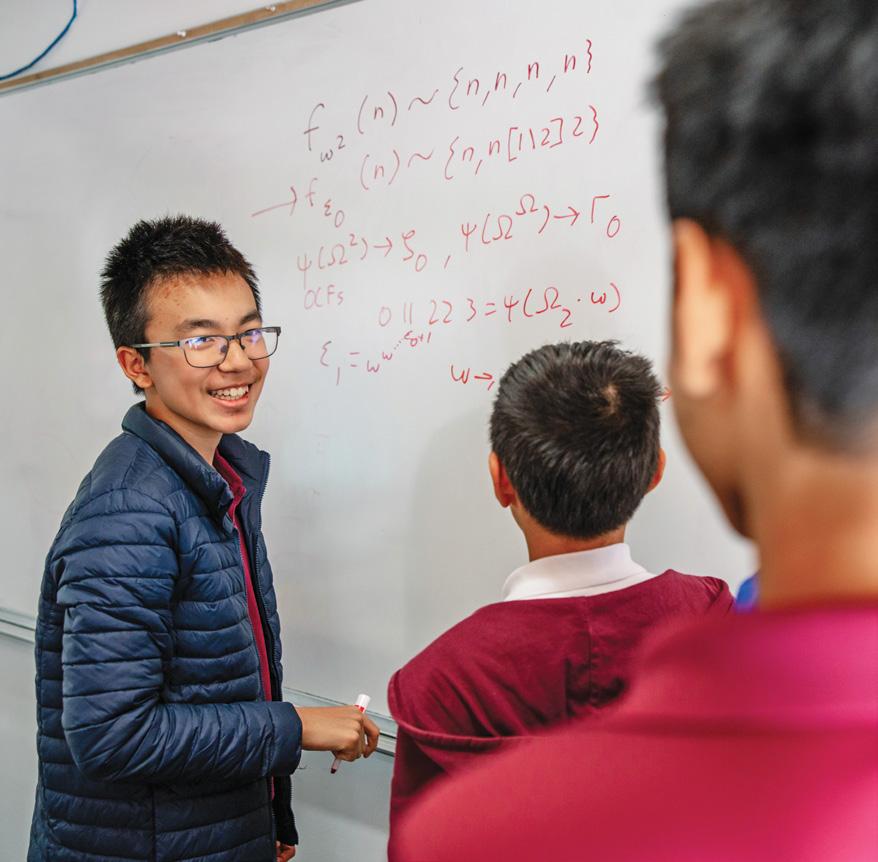
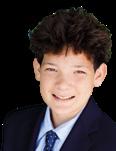
» Mirman School students are encouraged to push learning past limits. Eighth Grader Daniel S. has been leading a class on “googology” (the study of inconceivably large numbers), an interest of his that falls well beyond the math curriculum you’d find in a college classroom, let alone a middle school.
depth and complexity
academics
From big ideas to the tiniest details, icons encapsulate a world of possibilities
TTHERE ARE CERTAIN TOUCHSTONES found in each Mirman School classroom, no matter the grade level or subject. The school’s core values, mission, and statement of inclusivity are prominently positioned on classroom walls, referenced in student work, and celebrated onstage at all-school assemblies. Less familiar to the wider community but equally important are a set of 11 colorful cards displaying high-contrast icons. These are the building blocks of the Depth and Complexity Framework, and they are part of what makes Mirman’s curriculum for highly gifted students exceptional.
ORIGIN STORY
According to the Center for Depth and Complexity, the framework was originally developed in the mid-90s by educators Dr. Sandra Kaplan, Bette Gould, and Sheila Madsen. If any of these names sound familiar to you, it’s because their work in highly gifted education has informed Mirman School’s pedagogy and practice since Dr. Norman Mirman and Beverly Mirman began the school in their living room in 1962.
Dr. Kaplan and colleagues sought to push students’ level of inquiry well beyond the surface level. To do this, they analyzed how experts understand and practice their craft and operate like disciplinarians. “Thinking
→ multiple perspectives
like a disciplinarian means that you’re not a science student, you’re a scientist. You’re not writing a paper in English class, you’re a writer,” said Director of Curriculum and Instruction Tri Vo Huynh.
Researchers noted that despite their deep knowledge of a subject, experts aren’t overly certain about things. They don’t shy away from unanswered questions. In fact, they welcome them. This innate and insatiable curiosity is something that Huynh says Mirman tries to impart to its students, many of whom have extensive background knowledge and a resulting rigidity that this work ultimately aims to disrupt. The Depth and Complexity Framework also encourages accounting for multiple perspectives, shifting students from fixation on the idea that there’s always only one right answer, and instead moving them to an openness to multiple possibilities. “We’re really trying to move them from certainty to curiosity,” said Huynh.
WHY IS THIS BEST PRACTICE FOR HIGHLY GIFTED LEARNERS?
Though highly gifted programs are not the only place one can find the Depth and Complexity Framework, it’s been a perfect fit for Mirman’s mission. Sparking student passions, providing space for the curriculum
the iconic eleven
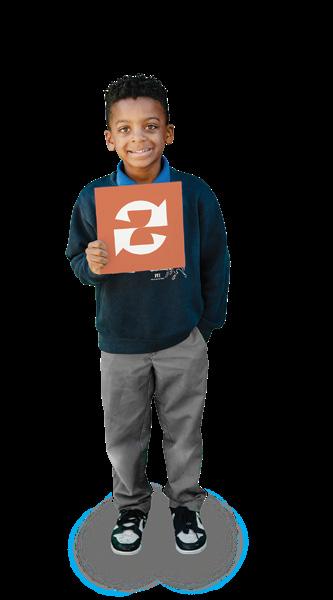
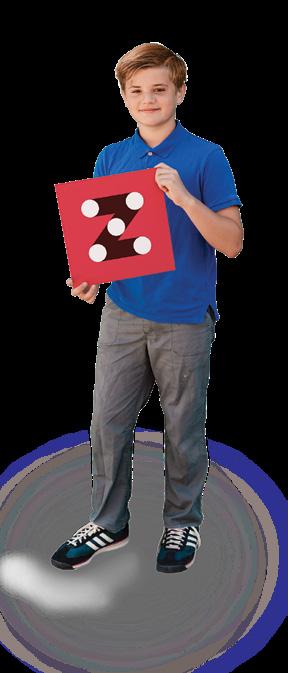
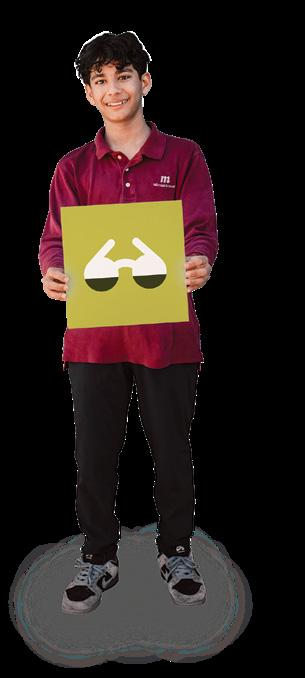
Kaplan, Gould, and Madsen grouped the findings of their analysis into 11 pathways or lenses, matching them with icons for quick recognition.
language of the discipline understand the vocabulary or terminology of a topic details determine key facts or points patterns look for repetition and cycles rules examine structural or organizational elements trends look for tendencies unanswered questions seek out puzzles, paradoxes, conundrums ethics analyze controversies, biases, prejudices big idea generalize a key theory or principle
multiple perspectives contemplate different points of view across disciplines make connections between different subject areas
over time identify how things have changed or shifted in the past, or how they may change in the future
to flex and grow with those interests, and differentiating in all subjects to “meet students where they are” are hallmarks of the Mirman experience.
“By the very nature of these students being highly gifted children, they’re critical thinkers. We need a curriculum that can extend and grow with them,” said Head of Upper School Ray Cunningham. “We do have an accelerated curriculum at Mirman, but beyond just advancing to higher levels, we also ask students to think more deeply, ask questions, look at the larger societal impact of the issues they’re discussing, and more.”
For teaching faculty, the Depth and Complexity Framework provides a readymade system of orientation that can be adapted to any level, any assignment, any project, and, most importantly, any subject. This is a boon for faculty, said Huynh, who need not overhaul their lesson plans to make room for depth and complexity. Instead, this is seen as a refocusing of the excellent work they already have in place, using the icons as signposts and common references for each class as they move through the year’s curriculum.
“This is how our students naturally think,” said Assistant Head of School/Head of Lower School Stephanie Leung. “It codifies the way they are already thinking, and how they naturally organize their thoughts.”
The faculty are, unsurprisingly, on a similar wavelength. Whether they’ve been referring to the specific icons or not, Mirman faculty are seasoned practitioners of this work, which ultimately empowers students. Any visit to a Mirman classroom will bear this out; animated discussions, project-based learning, and students leading lessons are the norm. As the school seeks to build a more consistent vocabulary around the system,
faculty took part in an all-day training on the framework during a recent in-service. They walked away with a palpable sense of inspiration and direction, excited to integrate some of the projects and concepts they’d been discussing into their classrooms. Following late-start Wednesdays, meetings have had time dedicated to faculty members sharing what they’ve tried in their classrooms, inspiring each other to tap into their own passions and talents.
CASE STUDY: UPPER SCHOOL MATH
Upper School Math Teacher and Math Department Chair Kara Luna said that the DNA of Mirman’s Upper School math curriculum (The Art of Problem Solving and Math Innovations) is inherently well-suited to the Depth and Complexity Framework. “Our approach isn’t about memorizing algorithms and doing practice problems. It’s about integrating different ideas to figure out what’s going on in a problem,” she said. “And the fact that it’s very text-heavy emphasizes the vocabulary of the discipline, while being good for students who may identify more as readers and writers than mathematicians.”
The joy that Luna’s students feel when they unlock a problem, testing out different
methodologies and making logical leaps, is a delight to behold. She recalled one class group being so excited that they had extrapolated a complex formula (Heron’s formula) from a set of examples that they insisted on having her take a photo of them, triumphant if exhausted, in front of the whiteboard, and send it to a classmate who was out sick and had missed out on the fun. “I think most students, if they learn this formula at all, are just given the formula, told how to use it, and that’s it. They have no idea where it comes from. The fact that our students can do this while they’re here is incredible to me,” she said.
To be clear, not all students approach math with the same level of skill (or interest). All gifted children are different, just as all children are different. Mirman makes room for that differentiation, in all its complexity. “Especially because of the asynchronous development of gifted children, we need to understand that not everybody is ready for the same math at the same age. I want every kid to get the most out of every math class that they possibly can,” Luna said. Every so often, there comes a student who is ready for even more. This is where the school’s “no ceilings” approach is put
to work. In Upper School LEAP (Learning Enhancement and Achievement Program), students are able to design and teach classes with the help of a faculty sponsor. Luna has been facilitating such a space for Eighth Grader Daniel S., who has been hosting a LEAP on googology (the study of nearly inconceivably large numbers) since he was in Fifth Grade.
“Ms. Luna has been a huge supporter of mine,” said Daniel. “All the math teachers at Mirman have been supportive of me going beyond the curriculum. They’re perfectly willing to answer questions that may not be covered in class or in the book.”
CASE STUDY: LOWER SCHOOL ART
Deep and complex subjects need not look like a googolplex (a one followed by so many zeroes it can’t actually be written out). Sometimes, they look more like a still life: quiet, understated, and teeming with the little details that make up a person. In Lower School Art Teacher Lorraine Cleary Dale’s class, Fourth Graders were recently given the task of rendering a painted still life from a digital photograph. First, the students studied artists hailing from different eras, such as Cézanne and Audrey
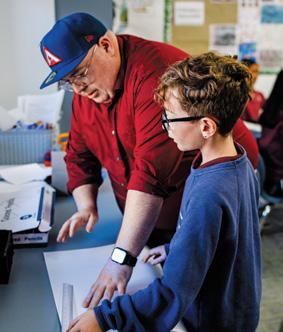
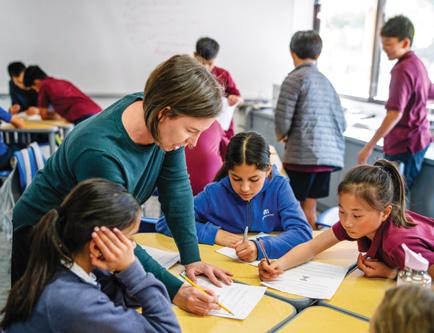
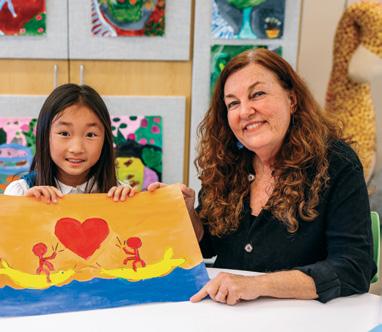
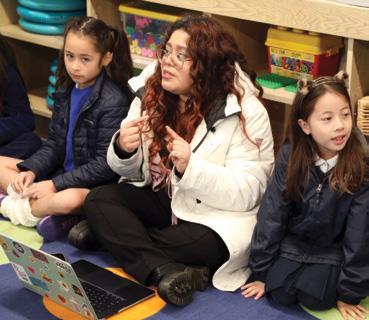
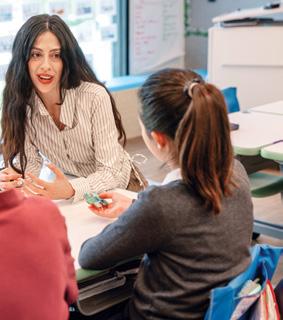
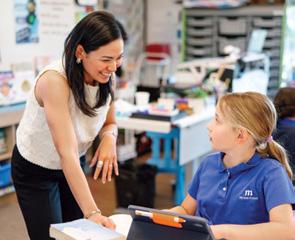
» From left: Upper School History Teacher John Schmitt advises a student on an assignment, Upper School Math Teacher Kara Luna works with a small math group on a problem set, and Lower School Art Teacher Lorraine Cleary Dale and a student review a Keith Haring-inspired project.
Flack, examining how styles and materials changed over time. Then they arranged meaningful objects for a photo, which they were asked to paint. “We talked about how objects can represent who you are in time,” said Cleary Dale. “How might your painting have been different a hundred years ago, or a hundred years in the future?”
The results were as individual and varied as the students themselves. So were the reflection sheets the students filled out after the exercise, thinking and writing about the rules (or steps) of their process, the language of their discipline that they put into practice as painters, and the details that made up their paintings. Similarly, a unit on the muralist Keith Haring gave occasion for rich discussions and reflections on the ethics of graffiti and the conundrum of one party seeing beautiful art where another sees destruction of property.
“I find that these reflections are a much richer way to evaluate student
understanding,” said Cleary Dale of the application of the Depth and Complexity Framework in her classroom. “You’re not just circling criteria on an evaluation rubric. And I found that some of the students were working on the reflections together, making it more of an active conversation.”
CASE STUDY: UPPER SCHOOL HISTORY
For Upper School History Teacher John Schmitt, the Depth and Complexity Framework is the perfect tool to mitigate what he calls “rainforest mind.” The term comes from a book, “Your Rainforest Mind: A Guide to the Well-Being of Gifted Adults and Youth” by Paula Prober. Schmitt said that when an administrator gave him the book to consider, the term rang true immediately.
“It helped me understand that a gifted child’s mind is this intense place. From the outside, it might look idyllic. But when you get inside, there’s a tumult of activity,” said Schmitt. “They might feel everything at once. So when students are grappling with something particularly complex, they sometimes struggle to find the appropriate language or parameters for discussion.”
This is especially useful in Schmitt’s class, where students must learn to navigate lively yet civil debates (this is easier said than done; just ask any adult). By breaking each issue down into its components (big ideas, rules, change over time, etc.), the exploration of any topic has a familiar structure. “Research shows that gifted learners can struggle with scale, especially when it comes to both size and time. These icons allow them to focus and, for me, it helps me make sure that the students have a very complete understanding about what they’re learning.”
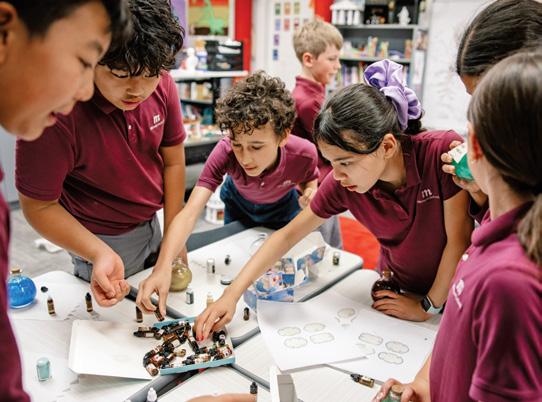
» Students in Upper School Latin explore the creation of potions and poisons in a lesson that layers complexity through historical trends, multiple perspectives, and more.
TTHE DEPTH AND COMPLEXITY
Framework may have been designed by academics for an academic setting, but it’s by no means locked into classroom lesson plans. Mirman seeks to nurture its students in all their dimensions, and there is perhaps no aspect of a person that is deeper or more complex than identity.
As part of its integrated curricular approach, Mirman practices the work of diversity, equity, inclusion, justice, and belonging (DEIJB) in concert with academics. History classes discuss the power of crafting historical narratives and the implications of who has traditionally been excluded from that power. Math and science classes celebrate seminal thinkers whose influence and importance typically go unsung. The work of affirmation, allyship, and understanding continues to have a place in exercises like cross-cultural dialogues for Staffulty during in-service, celebratory assemblies and events open to the entire community, and in cornerstones of student life, such as the Student Diversity Leadership Council (SDLC).
MODELING CHALLENGE AND INQUIRY THROUGH A DEIJB LENS
SDLC is a group of 13 Upper School students, all of whom have to apply with support from a member of Mirman’s Staffulty. Each year, the group is a melting pot of different
Feeling a sense of community with a group of people was really impactful in my life.”
- IMANI JACKSON
genders and sexualities; racial, ethnic, or religious backgrounds; and socioeconomic backgrounds, all of whom are committed to sharing space with one another in a vulnerable journey of discovery and dialogue. They play an important role in guiding student life by leading all-school assemblies, designing and executing the annual Peace and Social Justice Day conference on campus, and participating in off-campus opportunities such as the Pollyanna Conference at Harvard-Westlake.
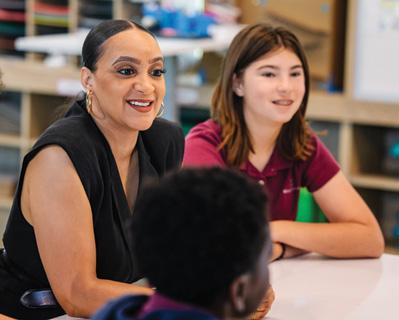
“SDLC is a poignant example of where depth, complexity, equity, and inclusion intersect in the classroom. The discussions are similar to an advisory, and there’s a curricular component where we are challenging students to think very critically about issues of equity and inclusion,” said Director of Equity, Inclusion, and Community Ericka Dean, who leads the group alongside Upper School History Teacher John Schmitt and Associate Director of Admission/Director of Extended Programs Rita Anne Smith
“One of the things we’re focusing on this year is allyship and solidarity: what allyship is, what solidarity means, and why these are important. We then apply those concepts
First Grade Teacher and Black Joy at Mirman Affinity Group leader
and themes at Mirman — and examine ways in which they don’t quite show up at Mirman — and think about how we can be better at facilitating belonging for everyone,” she said.
Through their retreats, meetings, and their visible presence on campus as living examples of the power of connection across cultures, SDLC practices allyship in action. As students learn about others’ identities and their own in a truly deep way, they learn to lead with curiosity, lean into discomfort, and move from a passive experience of allyship to a more active, justice-oriented approach. “If you don’t celebrate diversity, which starts with celebrating yourself for who you are and being able to celebrate others — or if you don’t truly understand the concept of justice and all that entails, you cannot be an ally,” said Dean. “In order to be a good ally, you have to have the critical thinking skills and the cultural lens that comes with learning and understanding identity, diversity, equity, and justice.”
AFFINITY GROUPS AND IDENTITY WORK CONTINUE TO BLOSSOM
Representation, allyship, and solidarity are important, but they are only a fraction of the intentional work in the DEIJB space that Mirman has built up over time. It’s one thing to see someone who looks like you in
a workbook; it’s another entirely to find a space designed to deeply connect with living, breathing people — your classmates and colleagues.
Mirman has 14 affinity groups for students, seven for Staffulty, and five for families. Each of these groups offers an affirming space for connection and celebration. For First Grade Teacher Imani Jackson, who is in her fourth year leading the Lower School Black Joy at Mirman (BJAM) group, these groups have been important long before there was a name for them. When the opportunity came to lead one of the groups at Mirman, where her children are also students, the answer was easy. “Feeling a sense of community with a group of people was really impactful in my life,” she said.
Jackson noted that, over the years, one of the things she’s seen happen with the affinity groups isn’t so much growth (though that’s happened, too) as strengthening. The connectivity between groups has grown, and within each affinity group, beloved traditions are taking root. The Asian Pacific Islander (AAPI) and South Asian (SAAG) family groups now join forces to host a community fair each year, and the SAAG group hosts a Chaat and Chai event. Year after year, the FAAMily
» From left: Director of Equity, Inclusion, and Community Ericka Dean leads a discussion with the Student Diversity Leadership Council; Kindergarten Associate Teacher Irma Morales leads a ¡UNIDOS! affinity group meeting; and Fourth Grade Associate Teacher Lucy Patrikian spends time with students from the Middle Eastern North African (MENA) affinity group.
Reunion all-community event boasts one of the highest attendance counts of any campus gathering. Family affinity groups across the board collaborate with Dr. B’s Breakfast to feature culturally-inspired menus during heritage and history months. The rich cross-section of attendance at these events stands as a testament to the exponentially positive effects of a connected community.
“What we’ve been learning in these groups is how we all share a commonality, but we also have differences. I think this strengthens students’ outlook on the world,” said Jackson, sharing a moving story of a Black/Latinx student who said he felt, for the first time, “at home” when attending a joint affinity group meeting with ¡UNIDOS!.
“I think having curiosity for yourself, and understanding of yourself, helps you extend that to other groups,” said Jackson. “You know how you feel in your affinity space, and you have the empathy and wherewithal to say, ‘I want other people to have this same feeling.’”
Jackson’s sentiment is shared with campus leaders like Dean, who have heard the call of other groups in need of affinity spaces and have embraced those needs with characteristic cultural responsiveness.
An Upper School affinity group for maleidentifying students was started this year as well. The school’s Middle Eastern North African (MENA) affinity group, which started last year in Lower School, has continued into Upper School this year. It has made a world of difference for the students in MENA, said advisor and Fourth Grade Associate Teacher Lucy Patrikian. “Whenever I meet with the Lower Schoolers, they’re very excited to have a space they can call their own to learn about their culture and share about their culture. There are so many different cultures within our group, and it’s amazing to see the throughlines — I’m Armenian, you might be Iranian, you might be Syrian, but we have all these things in common,” she said, adding that the Upper School expansion has been a welcome change for MENA students who previously didn’t have an affinity group.
“They know they don’t have to hide, and being able to bring this part of themselves to school and have it be celebrated is extremely validating,” she said.
Affinity groups are not the only way the school is growing and practicing cultural responsiveness. Dean and Huynh announced a series of partnerships in line with the school’s strategic plan earlier this year. The relationships are not new. The school has been intentional about establishing them over recent years, said Dean. Whether working with groups like Pollyanna, an organization whose mission is to help independent schools build stronger and kinder communities through professional development and community engagement, or ConnectED, which provides resources and programs on engaging in civil discourse around the Israeli-Palestinian story, antisemitism, the Holocaust, and Jewish history, or any number of these partnerships, the overarching message is clear: We’re better together.
Growing up in LA, I saw people who looked like me, but I didn’t know there were so many possibilities for people who looked like me. I didn’t know: we could be lawyers, we could be doctors. The kids in our affinity group are so excited to learn about role models who look like them.”
– IRMA MORALES
Kindergarten Associate Teacher and ¡UNIDOS! Affinity Group co-leader
depth and complexity
social-emotional learning
From friendship groups to Service Learning projects, students make connections
OON SCHOOL COUNSELOR KARISSA
ROYSTER’S wall, proudly on display next to a bookshelf with titles about managing conflict and feeling big feelings, there’s a row of photos. Each one features a different group of smiling students, and written under it is the group’s name — “The Lightning Tigers,” “The Mirman Trailblazers” — and a credo of commitment to one another. “Listen to the speaker without interrupting,” says one. “You can choose whether or not you want to answer a question,” says another.
These are friendship groups — small assemblages of students who want to explore together the thorny, human work of coexisting in a structured, safe environment. Identified by their parents/guardians, teachers, or themselves as potential participants, group members come up with their name and credo together. Though not explicitly rooted in the Depth and Complexity Framework, Royster points to the friendship groups as one example of how this flexible reference point can help students with diverse viewpoints gel into a common purpose.
“They first come to an understanding of what these agreements mean for each person,” said Royster. “They think critically about what it means to share space with one another, to think outside of themselves and expand their viewpoints of what it means to exist harmoniously. What parameters do we need
to create so that everybody in this system, despite our differences, can do that?”
Royster used the example of the oft-cited “golden rule” as a platitude that, on its face, seems universal, but that doesn’t work as an “off-ramp” to the same destination for every person. “I could easily see some of these groups disagreeing about what the golden rule means,” she said. “Because, developmentally, it’s appropriate for children to be self-centered to a certain extent. And highly gifted kids are out-ofthe-box thinkers. So rather than memorizing a certain set of standards, this practice lets them explore — and linking to our core values, really discovering that there’s more to the world than what’s in your own head and heart.”
The shift from the individual experience to global reality is equally embedded in Mirman’s Service Learning program. Led by Director of Equity, Inclusion, and Community Ericka Dean and Director of Curriculum and Instruction Tri Vo Huynh, the Service Learning program was recently retooled to align with the Learning for Justice Anti-Bias Education Framework, which
is built on four primary domains — identity, diversity, justice, and action. Within each of these domains exist grade-level social justice standards that weave in depth and complexity.
“When you drill down into the standards, it’s really activating students’ critical thinking, which is what depth and complexity really boil down to,” explained Dean.
These areas of focus are then broken down into actionable outward-facing projects within the community. For example, Fifth Grade partners with Aidan’s Place, an inclusive playground for children with physical or developmental disabilities. They go to the playground, experience the equipment themselves, and take notes on how various structures support accessibility. Students think like engineers and designers, using the language of those disciplines. A representative from Inclusion Matters by Shane’s Inspiration then comes to Mirman to give students a lesson about children with disabilities, teaching them the appropriate ways to interact with students who are non-verbal or may need mobile support. Following the lesson, they then meet at another inclusive playground with a partner school from Inclusion Matters, deepening their understanding of social inclusion and making real connections with peers with disabilities.
“These are the children who are likely going to be leading the charge in some way in the future, and we’re trying to orient their ethics to help them understand how to utilize their gifts in service of others, to do right in the world, to be the problem solvers and the change makers,” said Dean.
» Above: Dean of Students Allen Foster is one of a team of educators who work across grade levels to integrate social-emotional learning frameworks in all aspects of classroom and campus life at Mirman. Below left: Fourth Grade Teacher Monica Sone discusses lessons learned from a book on healthy boundaries in friendships as part of her class’s social-emotional curriculum.
For Huynh, ethics looms large in Service Learning, but he notes that the socialemotional skills necessary to navigate complex local, national, and global events are also well-served by the scaffolding of the Depth and Complexity Framework. “There’s a structure here that we can tap into to help our students become more adept at navigating very, very complex situations that often come with an emotional charge,” he said. “When we think of a paradox — how to grapple with completely contradictory truths — we need to teach them to hold that tension.”
Gifted learners often hold deeply felt moral absolutes, particularly around the concepts of fairness and justice, observed Huynh. Giving these learners the tools to think about and approach discussions and topics like climate change, freedom of speech, and racial inequities (which can have even the most eloquent adults pointing fingers as they collapse into angry puddles) is crucial to their success as collaborative, cooperative, and truly compassionate members of society. In a world reckoning with so much darkness, this is the hope; this is the light.
The Learning for Justice Anti-Bias Education Framework asks students to explore and consider
» Identity: Self-awareness
» Diversity: An understanding of human differences and human connections
» Justice: An understanding of unfairness, the language to describe unfairness, and an understanding that unfairness is harmful
» Action: Empowerment and the skills and language to act (with others or alone) against unfairness
→ rules
→ across disciplines
Keynote by barrier-breaking Latina astronaut headlines day full of workshops, inspiration
women
IN
steam
RETURNS TO CAMPUS
TThanks to the support of Staffulty, parent volunteers, and donors to the PSL Inspiration Fund at the 2025 Grand Supper Club Gala, it was full steam ahead for Women in STEAM (science, technology, engineering, arts, mathematics). The signature Mirman event returned to campus on March 13, bringing a day of meaningful workshops, speakers, and activities. The PSL Inspiration Fund made a keynote speech by astronaut Dr. Ellen Ochoa a true highlight for the hundreds of students who gathered in the Jacquelyn Michelle Ross Auditorium to hear about her accomplishments.
If it weren’t for my younger sister sharing her interest in nursing, I would have never followed her lead (ironic because it’s usually the other way around!). Once I dove into this field, I knew I was meant for it. Being able to help, advocate, and show compassion was something I connected with. It took me some time to gain confidence in my field, so my advice to young girls is this: Go for it! Never think you can’t.
CLAUDIA
GALVEZ, RN, BSN School Nurse
I had a childhood friend whose mom was an accountant. I didn’t even know what that meant — or how to spell it — so I looked it up in the dictionary. When I discovered it involved working with numbers, I was immediately intrigued. From that moment on, I said accounting was what I wanted to do when I grew up. It truly became my dream job. Although I was too shy at the time to talk to my friend’s mom about her career, she was the only female accountant I knew growing up. Even without direct mentorship, just knowing a woman could succeed in that field quietly expanded what I believed was possible for me.
TONI Controller
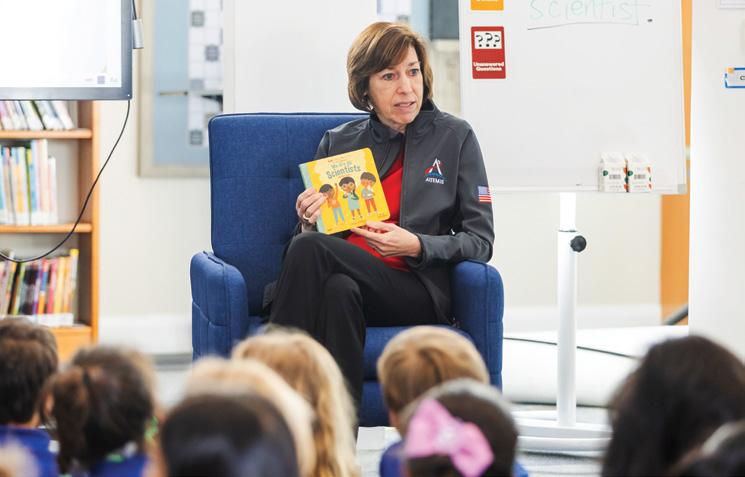
» Dr. Ellen Ochoa, four-time space flight veteran and former director of NASA’s Johnson Space Center, gave the keynote speech at Women in STEAM 2026. After, she spent time reading to Kindergarteners, visiting classes to observe space-related design thinking challenges, and had lunch with the ¡UNIDOS! affinity group.
DR. OCHOA IS A VETERAN of four space flights, the first Hispanic and second female director of NASA’s Johnson Space Center, and made history in 1993 as the first Latina to go to space. She is also an engineer, a co-inventor on three patents, and an advocate for STEM education.
It’s a common stereotype in mathematics that men are inherently better at math than women. This simply isn’t true. Mathematical ability isn’t determined by gender — it’s shaped by opportunity, encouragement, practice, and confidence. When girls and women are given the same support and belief in their abilities, they thrive just as much as anyone else.
ALYSSA WRAY Director of Lower School Math/Instructional Data Coordinator
The biennial event began in 2011 under the leadership of Jocelyn Balaban, a longstanding former member of the Mirman faculty and administration. Balaban would recruit guest speakers from within and beyond Mirman’s community, and students could rotate through various workshops. Upper School students had the chance to lead workshops for the Lower School, allowing older girls to provide leadership and mentorship to their younger peers. Due to staffing changes such as Balaban’s retirement, the COVID-19 pandemic, and the school’s focus on the construction of the Guerin Family Learning Center and the resulting campus expansion, the event went quiet after 2019.
One stereotype people have about working in tech is the idea that technology careers are only for a certain type of person. In reality, technology needs people who think creatively, communicate clearly, and understand how tools impact real people. There is no single “right” way to look, act, or think to belong in tech.
AMY BROWNLEE Director of Innovation and Technology
Growing up, there was a persistent belief that girls weren’t as strong as boys in math or physics — that we were better suited for language arts, art, or history. I never accepted that limit. My parents told me again and again: any subject can be mastered through effort. Gender does not define ability. So whenever someone said a subject was “too hard for girls,” I leaned in. I fell in love with mathematics and physics, captivated by their logic and beauty. That passion ultimately led me to study electrical engineering in college. What began as curiosity became a calling.
HELENA ZHANG Innovation and Technology Teacher
Now, with a committee of 18 members of the Mirman Staffulty, there is no shortage of energy to pour into the project of resurrecting the day-long event. “When we had our first meeting, we asked everyone why they were there,” said Assistant Head of School/Head of Lower School Stephanie Leung. “Many of the women in that meeting said that when they were younger, or even later in life, they’d been told they couldn’t be in certain spaces, or wouldn’t get support in those spaces. And for many of us, being mothers of girls, we see how important it is to show our girls that they can dream and do whatever they want to do. And it’s important for the boys, as allies, to recognize the contributions of women to the STEAM fields and to support their classmates.”
Although Women in STEAM was on hiatus for a time, the imperative to encourage female-identifying students to participate in STEAM fields remained on the minds of Mirman educators. Girls Engaged in Mathematics and Science (GEMS) was launched by Third Grade Teacher Marlene Ortega, inspired by the
discrepancies she witnessed in her then-First Grade class between girls’ and boys’ engagement with math. Ortega notified parents of female-identifying students that she’d be holding weekly sessions of GEMS, where girls could partake in activities incorporating math and making. “The sessions and projects were really collaborative,” said Leung, “and the girls could really feel comfortable together and realized that they were practicing and honing mathematical skills.”
In partnership with Director of Curriculum and Instruction Tri Vo Huynh and Director of Lower School Math/Instructional Data Coordinator Alyssa Wray, Leung said that the program scaled up to Third and Fourth Grades, incorporating mentorship opportunities for Upper School. “Student feedback was overwhelmingly positive,” said Huynh, who hopes to continue an iteration of the GEMS program after Women in STEAM to keep the momentum and amplification of women in STEAM fields all year long.
mustangs! lights, camera,
wWHILE THE WORLD’S MEDIA LANDSCAPE continues to change daily with the advancement of social media, citizen journalism, and artificial intelligence, two groups of young reporters are betting on the basics of broadcast. And as much as they have in common, they each have a style all their own, with a talented team of Upper Schoolers anchoring the programs.
I remember distinctly when I was growing up and in school, the morning news was a bright spot for me.”
–MATT WEINBERGER
Third Grade Associate Teacher and advisor for “Mustang
News”
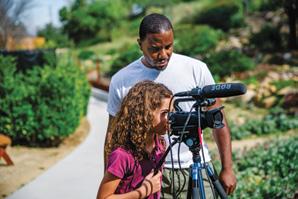
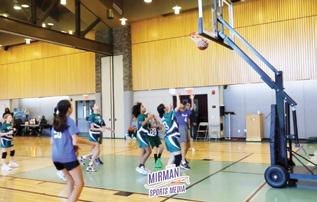
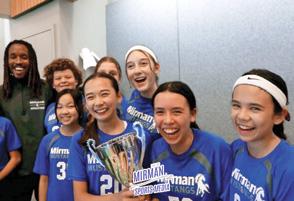
Both “The Mustang News” and “Mirman Sports Media” were born of faculty and student passion projects. “Mirman Sports Media” is a LEAP (Learning Enhancement Achievement Project) offering that was initially started three years ago by Physical Education Specialist Raekwon Leftwich-Hall, who holds a B.A. in mass communications with a minor in TV/video and multimedia from Methodist University in North Carolina. “The Mustang News” was a spinoff of a print journalism elective, The Mirman Messenger, started by Eighth Grade student Oliver H. when he’d just begun Upper School (Oliver is now one of the co-anchors of news production) under faculty advisors (first former Upper School English Teacher Matt Lewis and then Upper School English Teacher Simon Darcy). The production is now a twice-weekly elective taught by
Third Grade Associate Teacher Matt Weinberger, who has a video production background and whose family publishes The Claremont Courier, one of the last longstanding local weeklies in the country. For both Leftwich-Hall and Weinberger, as for their students, there’s no question that these efforts are a labor of love.
“I remember distinctly when I was growing up and in school, the morning news was a bright spot for me. I really looked forward to it every morning,” said Weinberger of his own experience. The programs are periodically broadcast to students via morning meeting and in advisory, as well as to the larger community through the Mirman Minutes, and they have become a rallying point for all students, not just those taking the courses.
“All the kids are pretty excited about it,” said LeftwichHall. “Now, when kids are in PE class, even our youngest in Lower School, they look forward to playing for the school.”
FROM PODCAST TO BROADCAST
When Leftwich-Hall started it in the 2022-23 school year, the first iteration of “Mirman Sports Media” was a podcast. Leftwich-Hall would make highlight reels with students helping with interviews and narration, but he’d write the pieces and handle most production elements. In the 2024-25 school year, Leftwich-Hall officially started the LEAP offering with the aim of making the production more student-driven.
Interest in the program was quick to pick up, with as many as 20 students taking the class — a mix of athletes, non-athletes, media mavens, and sports fans all looking to get experience in video production. Students rotate through jobs based on their interests and abilities, penning scripts, interviewing athletes and coaches, editing the segments, and recording the intro and outro bumpers. The broad range of opportunities to shine helps students get out of their comfort zone in gradual steps, said Leftwich-Hall. “There were students who started out and really did not want to be on camera. I respected that, but as time went on, we nudged them a bit,” he said. “Once they started doing it, they saw that they had a talent for it. And we get into a vulnerable space: We talk about how we’re a team, how we’re not going to joke on each other, and we’re going to push each other to be better. It builds camaraderie.”
Head of Upper School Ray Cunningham, confirms, “It is the passion of Coach Rae and all of our committed educators to give that little extra so our kids can shine.”
There’s no doubt that one of Leftwich-Hall’s students, Eighth Grader Evan A., had no such qualms about appearing on camera. The gregarious student council president, who has been at Mirman since Fifth Grade, has not only been with “Mirman Sports Media” since the beginning — he’s also found other ways to shine as a presenter and emcee, leading assemblies, interviewing special guests on stage at events, and performing in Theatre Department productions. Evan said that one of the things he’s enjoyed most about his time at Mirman is connecting with a network of mentors who have given him a chance to explore his interests. “There are so many people in different fields at Mirman who will support you and help you learn about what you want to learn about,” he said. “The teachers are really here to help us grow in our talents.”
Evan’s interpersonal gift has made him a natural for front-of-camera work such as interviewing and commentating. “Sharing my perspective with a wide audience is exciting. I love sharing my perspective and getting other people’s perspectives back,” he said, adding that he hoped he could continue his broadcasting experience when he moves on to high school in the fall.
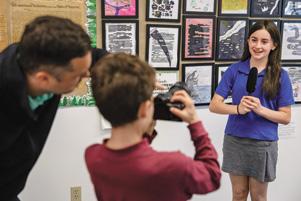
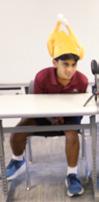
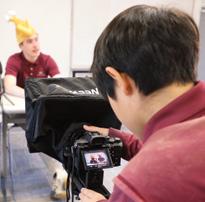
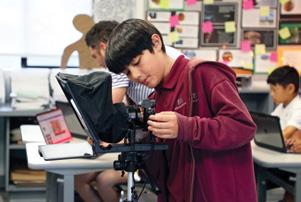
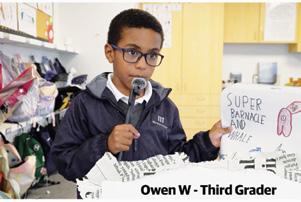
» “The Mustang News” crew is comprised of Upper School students and led by a faculty advisor, Third Grade Associate Teacher Matt Weinberger. They release periodic broadcasts covering important school and world events, which are then viewed by all classes.
IN THE NEWSROOM
Making the move from the printed Mirman Messenger to the fully digital video production was a fairly simple process, with most of the reporters moving out from behind the keyboards to in front of the camera. Messenger editor Oliver H. was joined by Eighth Grade classmate Raj C. on the anchor desk, while reporters Bobby S., also in Eighth Grade, and Seventh Grader Grey M., took on filming and scriptwriting duties. More students have joined the production to write, edit, and film interviews. And in an echo of newsrooms all over the country, the team huddles together at the start of each production period to brainstorm stories and plan features. Recently, they added a snappy intro bumper set to a catchy theme song, and a hilarious black-andwhite PSA to remind their fellow students to keep lunch and recess areas clean.
“What’s really great about ‘The Mustang News’ is that it’s a K-8 experience,” said Cunningham “Not just because they get to see it in morning meeting, but they’re interviewed and featured on the broadcast. This and ‘Mirman Sports Media’ are remarkable because they are productions that would be completely at home in a middle or high school
classroom, but it’s something that our whole student body is still able to enjoy.”
The production’s high quality comes as no surprise when speaking to one of its editors, Grey M., who noted that she is a fan of The Economist. “I’m mostly interested in writing articles, but I enjoy going out and interviewing people and getting information, listening to people and hearing their ideas,” she said. “My hope for ‘The Mustang News’ is to make people aware of things that are going on right now in an unbiased way, because the news is very biased right now. And those who fail to learn history are doomed to repeat it.”
Beyond his own passion for the art form, Weinberger said that watching the production come together has been all that he’d hoped for and more. He noted that participating in ‘The Mustang News’ encourages a unique slice of giftedness, one that holds analytical skills and creativity in equal measure. Like LeftwichHall, he sees how the group dynamics and teamwork of a newsroom foster meaningful experiences for student-to-student connections.
“For some kids, it can be life-changing to find your place and find your people,” he said.
» At top right, Physical Education Specialist Raekwon Leftwich-Hall leads the “Mirman Sports Media” LEAP class, which covers the school’s Fourth through Eighth Grade Athletics program.
language of the discipline
writing (and living )
TRECAPPING THE CAIS-WASC ACCREDITATION PROCESS by the numbers
10 MONTHS
17
THIS SPRING, MIRMAN SCHOOL hosted a visiting team from the joint California Association of Independent Schools and Western Association of Schools and Colleges (CAIS-WASC) accreditation, capping a long and thorough self-study process. The associations accredit schools on a sevenyear cycle, assessing standards in the following areas: institutional purpose and core values, teaching and learning, financial sustainability, operations, institutional stewardship and leadership, and institutional improvement and sustainability. The process begins with a 10-month journey of introspection and inquiry, culminating in a self-study report. The visiting committee reviews that self-study as well as a bevy of supporting documentation, classroom and campus observations, and personal interviews to get a 360-degree overview of everything, ranging from the nuts and bolts of facilities to the scope and sequence of curricular programming.
“The amount of work that goes on behind the scenes in every department is amazing,” observed Fourth Grade Teacher/Lower School DEI Coordinator Monica Sone, who partnered with Director of External Relations Jenn Salcido to co-coordinate the self-study process, including the final writing and editing passes on the document itself.
Overseeing 17 subcommittee chairs composed of teaching faculty and administrators, Sone and Salcido led in-service activities and common faculty work time during latestart Wednesdays over the course of the self-study. Subcommittee chairs were given creative control over how their subcommittees collaborated best. Some used surveys, some used one-on-one interviews, and some used group work to collect the narrative. In the end, every full-time employee of the school — no matter their role — had input into the self-study.
“It’s truly valuable to have the authentic voices of everyone in this document. The reflection activities were sometimes vulnerable, but we offered space for our Staffulty to be raw and real. And I think that comes through in our study, and it comes through in our recommendations and reflections,” said Sone.
SUBCOMMITTEE CHAIRS
14 CHAPTERS
48
BASELINE REQUIREMENTS MET
103 VOICES
200 PAGES
5 MAJOR RECOMMENDATIONS
1 SE LF STUDY by the chapters
01. Mission, Purpose, and Values
02. Educational Program
03. The Student Learning Experience
04. Faculty and Pedagogy
05. Culture, Climate, and Community
06. Admission and Enrollment
07. Finance
08. Advancement
09. Human Resources
10. Facilities: Buildings and Grounds
11. Health, Safety, and Wellness
12. Governance
13. Administration
14. Self-Assessment, DecisionMaking, and Change
A peek into the process of designing Mirman’s future
so you want to write a strategic plan…
TTO THE
UNINITIATED,
the idea of a strategic plan can sound equal parts daunting and lacking clarity. We make plans all the time, don’t we? We’ve all had the experience of roaring into a new year with a steely resolve to do X, Y, or Z — and better than ever before! But then, life gets in the way, and Robert Burns already told us what happens to the best laid schemes of mice and men.
But this is not that.
The strategic planning process turns a thorough 360-degree evaluation of an institution’s past and present into a specific, actionable roadmap to the future. It’s idealistic, sure, but it’s also practical. It looks at what a place believes it is and what it wants to be, and plots out the points between here and there. Mirman’s next Strategic Plan is in the midst of being created. Leadership hopes to finalize it this spring and release it over the summer, starting the 2026–27 school year on a celebratory note of intentional alignment. And much like the CAIS-WASC accreditation process explored in “Writing (and Living) Our Story” on page 23, the path towards a strategic plan is long, winding, and paved with the hard work of many, many people.
INGREDIENTS FOR A SUCCESSFUL STRATEGIC PLAN
Though preparation for the endeavor began long before it was publicly announced, work on Mirman’s 2026–31 Strategic Plan officially commenced in September 2025, when Head of School Dr. Marina Kheel sent a message priming the community for the year-long journey ahead. Led by Board of Trustees member and alumni parent Anna Beloff and facilitated by Leadership and Design Consultant Greg Bamford, who has helped craft similar guiding documents for many independent schools, the Strategic Planning Committee is made up of 19 Board members, administrators, faculty, current parents, alumni, and alumni parents.
To call the operation thorough is an understatement. Working in groups, individually, and in concert with other community members through interviews, surveys, think tanks, and an open community design day, the committee spent countless hours listening, synthesizing, and prioritizing the information they gathered. The committee tackled exciting questions like:
» What makes Mirman unique?
» What aspects of our identity and program will be most important in our next chapter?
» What skills will our students need to thrive and contribute over the next 30 years?
» What is our vision for Mirman in 2036?
Beloff explained that the team followed a slightly different process this year than in years past. She’s thrilled about how broad the representation of voices was this time around. “I’ve truly appreciated how devoted this group has been. It’s been a wonderful experience being able to think about the future of the school and imagine what it could be with this passionate group of people.”
Beloff said that discussions have been supportive and collegial, and while there’s plenty to celebrate about how far Mirman has come, all participants have left room for open and honest discussion about what stands to improve and evolve. A mathematician who is no stranger to strategic thinking (having been previously a partner at McKinsey), Beloff said she also appreciated that a so-called qualitative process turned out to be quite a quantitative one, partially owing to the breadth of interviews conducted.
Ultimately, no matter what the final plan holds, Beloff confirmed that the end product will certainly honor the school’s founding principles. “We’ve always believed students are in the center, that there should be no boundaries to learning, and that these students require a highly specialized education,” said Beloff. “With this long-range planning, we’re thinking about how technology and society are shifting, but still maintaining that strong identity we’ve always had.”
September 29
Design Consultant
Greg Bamford tours the campus and classrooms, meets with the Board of Trustees to kick off the process.
October 28
Bamford conducts two 90-minute think tank sessions open to the entire school community, and one all-Staffulty think tank session.
December 2
Process update to Board of Trustees.
February 5
Steering committees meet to refine inquiry areas and draft early strategic priorities.
September 30
The full Strategic Planning Committee meets to assign interview assignments to each member; more classroom visits by Bamford and SPC.
October 29
Full SPC meets to share and discuss insights gleaned from interviews with a wide swath of the Mirman community, including student voices.
January 29
Inquiry area teams present Mirman’s strengths and areas of growth to the full SPC.
February 9
SPC meets to synthesize strategic priorities and initiative ideas.
May and June
Board of Trustees will discuss and provide feedback on the plan at the May meeting, and vote to finalize in the June meeting.
February 7
On Community Strategic Design Day, community members review summaries of inquiry areas, needs, and opportunities, brainstorm potential initiatives, collaborate, and prototype ideas for consideration in the final plan.
March and April SPC meets to draft, revise, and refine the Strategic Plan.
Girls’ Flag Football Makes Promising Start
a league
OF THEIR
own
» Athletics Coach Kim Cade-Henry, who co-leads the Mirman’s first girls’ flag football squad, is herself a decorated professional tackle football player.
SSO MANY GREAT, UNEXPECTED THINGS start with someone asking, “What if?”
Like the day when, somewhere in Southern California, a young female athlete watching tackle football wanted to step out onto the pitch herself and asked this question, and then another: “Why not?”
“I needed something new to do,” recalled Athletics Coach Kim Cade-Henry, who grew up first playing basketball and later bowling, about stumbling into what would become her athletic career for 18 years. A chance encounter online with another football player opened the door to signing up with a women’s professional tackle team in Palmdale.
The rest, as they say, is herstory. Last year, Cade-Henry wrapped up her final season of women’s tackle football playing for the San Diego Rebellion, leading the team to league championship contention twice and garnering accolades, including All-Pro and Woman of the Year. But while that chapter of Cade-Henry’s life was coming to a close, another was just beginning, and Director of Athletics Angela Brown had her own “What if?” to answer.
“Girls’ flag football has been on my hopes and dreams page for a couple of years,” recalled Brown. “We were worried about diluting our athletics program to build something new with all the offerings we already had. As we saw other schools beginning to move the pieces to make it happen, it encouraged us to say, ‘How can we try this out?’”
So Brown and Cade-Henry did what coaches do: They turned pockets of time and interest into opportunity, building their team piece
by piece. They looked to in-season athletes on another team (girls’ soccer) and students who were not on any particular roster. They worked on skills such as chasing and fleeing — basic feats of athleticism common to most games. They tapped cross-country runners for their endurance. They found students with gifts from club sports, including footwork from fencing and tennis. They familiarized recruits with a new ball and a new set of equipment, and soon they saw the girls begin to take on a new mindset.
“As they started to learn different skills, their confidence and cohesion built. There was a curiosity and excitement around this big unknown thing, and everyone bonded around figuring this out together,” said Brown.
...THEY WILL COME
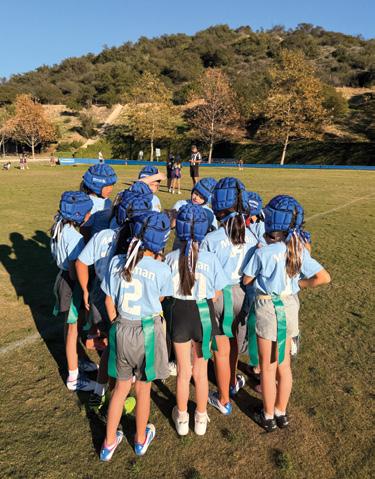
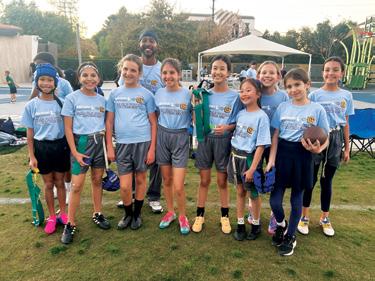
They’d managed to do it — they’d reached critical mass. Eking out 15-minute blocks here and there during class and athletics practice, they had 22 girls coalescing into a real flag football squad. Students started pickup games at recess to get more practice time, knocking down the coaches’ door to get their flags and ball. Staffed by CadeHenry and Physical Education Specialist Eric Pringle, who had recently stepped out of his own comfort zone to help build a cross-country program with Brown, the girls put their skills and the school’s core values to work, practicing discovery and resilience. “This was like speaking a whole different language for me,” admitted Pringle.
It wasn’t always comfortable for the athletes either, said Brown. She shared a story about an athlete who approached her with fears of playing the game without understanding all the new terminology. “Highly gifted kids love to have all the information,” she said. “And they didn’t have that. But you know what? They ended up okay with that. They were excited to learn, excited to try. And by the end of their time, they had the vernacular. They were like: ‘Nice job, way to block!’”
Even though there was not an official season in the cards for this year, seeing how committed the athletes were,
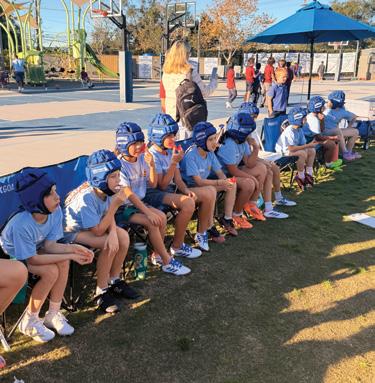
Brown worked with the coach at Campbell Hall, one of the few schools that had gotten a squad together, to schedule back-to-back exhibition games for two teams, one for Fourth Grade and another comprising Fifth and Sixth Graders. The experience was initially a nailbiting one for Brown and Pringle, who were preparing themselves to comfort a gaggle of stressed-out kids. But as the best “What ifs?” often are, this was nothing like what they’d expected.
That afternoon out on Kotzubei Family Athletics Field, the Fourth Grade team handily won their contest, and the Fifth and Sixth Grade team put up a valiant effort in theirs. The girls were all smiles, Pringle said, coming up to the coaches and thanking them for their belief in them. The most touching thing for Pringle was watching the teams come together to acknowledge and share their successes, regardless of what the scoreboard said. “They didn’t know what they were getting into,” he said. “They trusted me to coach them. And it’s such a pleasure to see them want to celebrate that together as a team.”
As to the future of the fledgling program, Brown said that it depends on schedules and logistics, but she’s hopeful. After the exhibition games, many girls asked the coaches if there would be a full team to play on next year. This was music to Cade-Henry’s ears. She’ll occasionally have a girl who wants to make the boys’ team co-ed, and when that happens, Brown said, you can catch the normally stoic Cade-Henry “jumping up and down like a kid in a candy store.” No doubt based on her own experience as a professional female athlete, and bolstered by the stillrising tide of interest in women’s sports, Cade-Henry has her own hopes and dreams for what’s next for girls’ flag football at Mirman.
“There’s a core memory for these girls now,” she said, her face lighting up, her eyes expressing the memory of that young athlete who had not yet felt the joy of hearing the roar of the crowd from her own helmet. “I was so excited to see that happen.”
» From top: students huddle before their exhibition game with Campbell Hall, and students gather afterward to celebrate a job well done. At bottom, athletes have their game faces on along the sidelines.
senior
Casey L. Harvard-Westlake School
Alex A. Brentwood School
James L. Geffen Academy
Ellis C. The Bay School of San Francisco
Asher L. Geffen Academy
Evan A. St. John Bosco
Kylee N. Valley International Preparatory High School
Miguel A. Harvard-Westlake School
Jake D. Windward School
William S. Pacifica Christian High School
Oliver H. Harvard-Westlake School
Daniel S. Geffen Academy
Jacob S. Crossroads School for Arts and Sciences
CONGRATULATIONS TO THE CLASS OF 2026!
We could not be prouder of this mighty Mustang herd. They’ve brought so much joy, learning, and leadership to our campus (and beyond) over the years. They’ve been in front of the camera and behind the scenes in shaping two new signature media programs (read about them on page 18!), bringing down the house during a rollicking musical rendition of “Freaky Friday,” and passing on their depth of knowledge to our youngest students as part of Senior Service. We know that they’re moving on to other pastures after graduation, but we hope that they’ll trot back to visit us often — we miss them already!
Grace P. Oakwood School
Anthony T. New Roads School
Leon B. Crossroads School for Arts and Sciences
Bradley H. Highly Gifted Magnet North Hollywood
Juney J. Brentwood School
Arastoo R. Brentwood School
Emery T. Marlborough School
Nova R. Geffen Academy
Raj C. Loyola High School
Violet W. Geffen Academy
Bobby S. Geffen Academy
alumni profile
watson damon christian
No matter what happens in your life, no matter how bad things get, no matter how crappy things seem, don’t ever stop believing in yourself, don’t ever give up, and don’t be afraid to ask for help.”
aALTHOUGH DAMON CHRISTIAN WATSON’S time at Mirman was long before the school had codified its RIDER Core Values (responsibility, integrity, discovery, empathy, resilience), his story is a perfect encapsulation of those same values, and the importance of an education that emphasizes service, generosity of spirit, and the drive to change the world for the better. Watson’s career and life were, at one point, both derailed by depression and addiction. After the Harvard and Princeton grad found himself unable to practice law, he alternated between living on the streets and in the correctional system. Now the senior director of legal services and corporate development at the New Jersey Reentry Corporation (NJRC), a nonprofit dedicated to helping formerly incarcerated individuals, Watson’s life stands as an example of two important truths: One, no one is immune to the fact that our realities can change in an instant, and not always for the better. Two, you have to be humble, you have to be prepared, and above all else, you have to believe in yourself. For Watson, every moment presented a chance for him to turn things around.
BOUNDLESS: You were at Mirman for nine years. You’ve been to some pretty impressive places since then — Harvard-Westlake, Princeton, Harvard Law. We’re curious to know what stands out in your mind about Mirman after all this time?
DAMON WATSON : I was an athlete and a speech and debate guy. Three of my best friends today are friends from Mirman — Ara Lovitt ’81-86, Michael Stern ’78-’82, and Jack Li ’82-’86. [Faculty members] Paul Mastin and Lynn Cohen believed in me. They were the ones who got me over my fear of public speaking to join speech and debate. I
The
work that we do is absolutely necessary to ensure people coming out of jail are the best versions of themselves.”
recently did a TED talk, so I can trace that all the way back to Mirman.
B: You ran track and field for Mirman, and that’s still a big part of your life today, isn’t it?
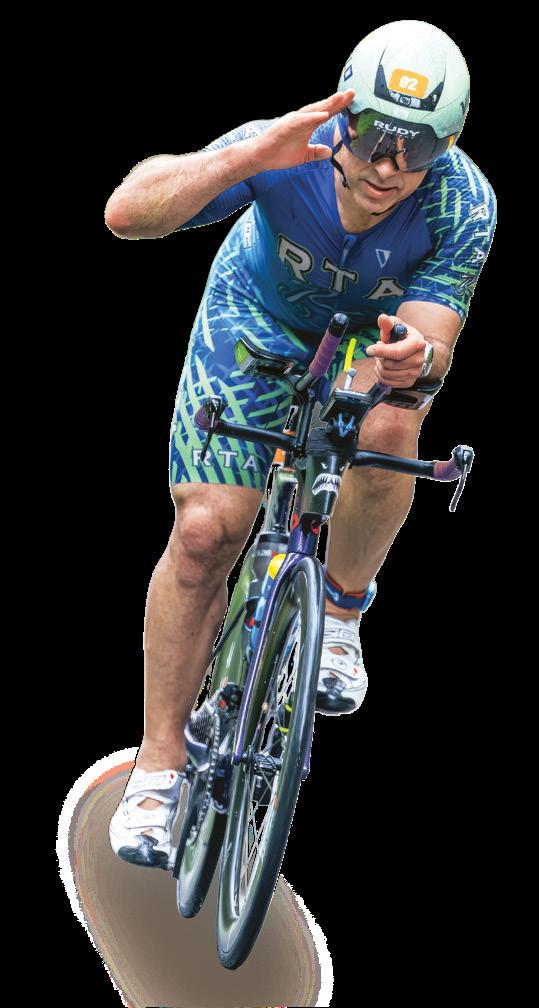
DW: I’ve been focusing on aquabike, which is triathlon minus the running. I competed in the Aquabike National Championships last summer, taking sixth place in my age group [55-59] and qualifying for Team USA and the World Championships this September in Spain.
B: Is this the farthest you’ve gone in your athletic career so far?
DW: Every kid who runs track wants to be in the Olympics. I didn’t turn out to be an Olympian. But the opportunity now to put on a red, white, and blue triathlon kit with my name on it and be part of Team USA? That’s the biggest thing I can do.
B: Did your time at Mirman help shape your trajectory as an athlete?
DW: I think that when you start realizing what you’re proficient in, there are people at Mirman who are there to encourage you and help you thrive. Darrel Lee was my PE instructor and track and field coach, and I always felt like he believed in me. If you had a talent or a skill and it was identified, there was always somebody there who would try to help you harness it, develop it, and
» Mirman alum Damon Christian Watson ‘76-’85 has persevered through considerable personal challenges only to come out stronger, working to help others in his community and competing for Team USA at the international level in the World Aquabike Championships.
DW: When someone gets out of prison, they’re free, but they’re not free. They have problems that were there when they went in that didn’t get handled. When they’re out, they’ve probably gotten worse — for example, fines from municipal courts that have now gotten bigger. Child support problems turned into a child support warrant, maybe. That’s why we’re here. Since I started in 2020, NJRC Legal Services has gotten rid of more than $6 million in financial burdens alone.
B: These are realities you know from your experience.
I feel like I have a responsibility to help the folks who are going through the things that I went through.”
capitalize on it. That’s always stuck with me. I kept trying to “find my thing,” and I think I found my thing. And Mirman gave me that.
B: Turning to your career now, what kind of work do you do?
DW: At NJRC, we provide access to legal services, help people take care of outstanding debts and fines, mentor, and help people gain proper identification and transitional housing. The work that we do is absolutely necessary to ensure people coming out of jail are the best versions of themselves possible when they get back into the world. Jail or prison doesn’t prepare you for that. When you go there, most of your life there is just trying to survive. The prison system has two aims: punishment and rehabilitation. They’re quite terrible at rehabilitating. And there are reasons for that, there are systematic failures.
B: On the NJRC website, it states that clients served by your programs have a much lower re-arrest rate (19.7 percent vs. 51.4 percent) as compared to the general population, and a third of the reincarceration rate. What are some of the struggles your clients are facing?
DW: When I was released from LA County Jail in 2017, they dropped me on Skid Row. And it’s hard to get off Skid Row; it’s hard to fight for your life on Skid Row. It’s hard to stop using drugs. It’s hard to do any of that. But I managed to make it out. I’m not saying I did it alone. I have my education and an able body. And that’s why I do the work I do now. I feel like I have a responsibility to help the folks who are going through the things that I went through. I have tools that they don’t have, and I can help.
B: If you were to encounter a Mirman-age Damon Watson, what would you say to him? Not to change the course of the future, but to make the best of what lies ahead?
DW: Well, it’s pretty simple. No matter what happens in your life, no matter how bad things get, no matter how crappy things seem, don’t ever stop believing in yourself, don’t ever give up, and don’t be afraid to ask for help. And always try to be of service when other people need your help. If you do those four things, no matter what happens, ultimately, you’ll be okay.
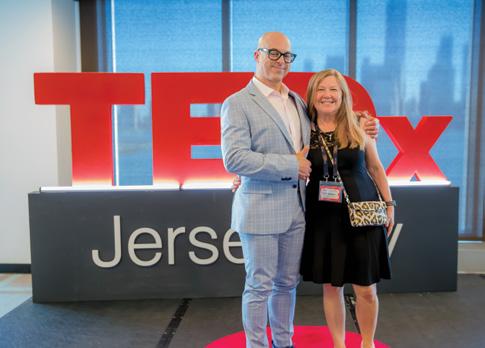
» Recently, Watson gave a TEDx talk titled “Believe in Second Chances,” describing his re-entry into society after experiencing incarceration and addiction.
alumni news
Thanks to all of our alumni and alumni families who have written in with updates this year! If you have news to share or want to get in touch, please email Director of Annual Giving and Alumni Relations Sanam K. Smith ’87-’91 at ssmith@mirman.org.
Jason Karpf ’68-’73 is a finalist for two book awards: the Realm Award for his novella “Through a Glass Darkly” and the Selah Award for his novella “Sinflowers.” The stories are found in his Christian sci-fi anthology “HONOR System” from Elk Lake Publishing, and examine the trope of sinister AI from a faith-based perspective.
Mel Powell ‘71-’78 started at Mirman when the school was located on Pico Blvd. and continues to live in the Los Angeles area. He has had a satisfying career in law after attending Yale and UCLA, and still does estate planning. Inspired by his father’s writing, he’s now writing very short Jewish humor stories and compiling them into a book and podcast, “Tales of the Wise Fools of Chelm.”
Sarah Kaufman ‘94-’03 recently presented at the 2025 Annual Meeting of the American Psychiatric Association, presenting her poster, “Hope for the Hopeless.” Her work explores the stigma surrounding substance use disorders (SUDs), drawing parallels to the evolving public perception of HIV/AIDS, and advocates for better outcomes for individuals with SUDs and improved support for their providers. Sarah has started a fellowship in addiction psychiatry at the University of California, San Francisco.
Raya Yarbrough ‘85-’92 continues to shine in both the literary and performance worlds, including the launch of her new album. One of her recent poems, “I Untangle the Chimes,” was published in Third Wednesday Magazine, and she recently had a month-long installation at TAG Gallery in West Los Angeles in collaboration with her mother, accomplished visual artist Pam Douglas. Raya lives in Los Angeles with her husband and daughter, Sonatine McCreary ’19-’22
Lauren Moy ‘94-’01 currently resides in Los Angeles with her husband and son. She is a practicing dermatologic and facial cosmetic surgeon in Beverly Hills, working with her father, Ron Moy.
Emily Rosenthal ‘94-’01 and her husband, Michael Reich, recently welcomed their second child, Caroline Reich, who proudly joined big sister
Margot. Emily is a retired family law attorney and currently serves on the board of directors of All for Kids, a nonprofit focused on child abuse prevention.
Chloe Korban ‘97-’06 attended Northwestern Law School and graduated cum laude in May 2018. Her legal career led her to the Los Angeles County District Attorney’s Office in October 2022. In her capacity as a deputy district attorney, Chloe prosecutes both misdemeanor and felony cases and has handled a number of jury trials. She currently lives in Sherman Oaks with her rescue dog, Rocco, and enjoys baking nostalgic sweets, participating in trivia nights, and following the NBA.
Harry Tenenbaum ‘01-’10 recently participated in the New York Five Boro Bike Tour, representing the Marty Lyons Foundation, riding 40 miles through New York City and raising money to grant wishes for children diagnosed with a terminal or life-threatening illness. Harry is a graduate of the University of Alabama and resides in Nashville, Tennessee, with his wife, Katie, and their dog, Mollie. Harry is an event producer at One More Time VIP, creating VIP experiences for touring artists and their global fan bases.
Jake Futterman ‘10-’17 is pursuing his M.S. in aerospace engineering at USC after graduating magna cum laude in mechanical engineering. He received the Viterbi Student Achievement Award for his NASA-funded research on robotic proprioception for Mars exploration. As part of Boeing’s Accelerated Leadership Program, Jake contributes to the X-66 Eco-Demonstrator and has worked on the C-17 and at Phantom Works, Boeing’s advanced defense R&D division. A former robotics program mentor at Mirman and several K-12 schools, Jake also founded GEM Robotics to bring STEM education to hundreds of underserved students worldwide.
Alumni parent Karen Newman wrote in to share a recent development for her daughter Charlotte Newman ‘11-’18. Charlotte joined the women’s swim and dive team as a walk-on at Harvard University, where she is a sophomore. She also
received the Alice McCabe Award for being the most improved team member.
Andy Powell ‘73-’77 recently wrote in to reconnect with classmates and former teachers from his time at Mirman. Since being identified by doctors as having Asperger’s Syndrome/ Autism Spectrum Disorder in his 40s, he has been reflecting on his early school experiences, gaining much insight from his diagnosis. He is a writer, critic, and proofreader.
Michael Warren ‘94-’02 earned an A.B. in philosophy from the University of Chicago and an M.A. in economics from New York University. He has lived in the D.C. Metro Area since 2016 with his wife, and currently works as a cybersecurity analyst in government.
Jessica Ross ‘95-’99 has been an actress and writer in Los Angeles for more than a decade. Career highlights include “Straight Outta Compton,” NBC’s “Superstore,” and performing sketch comedy at iO West and Second City. She recently moved to Auburn, California, to be closer to family. She now volunteers at a nonprofit used bookstore and enjoys spending time with her fluffy orange cat, Oliver.
Marissa Rosenthal Hotchkiss ‘97-’04 has been happily married to Andrew Hotchkiss for three years. They currently live in Los Angeles near West Hollywood. She works remotely as a user experience research manager at Meta, leading research on their AI and Facebook search products. When Marissa isn’t working, she spends time with her family, including her adorable baby nieces, Margot and Coco, and her pomapoo, Buffy, and goes to Dodgers games, travels the world, or tries out new restaurants around the city.
Juan-Salvador Carrasco ‘01-’08 lives in Los Angeles. He composed and co-produced the original soundtrack for the short film “Ends and Means,” which premiered at the LA Shorts International Film Festival in July. His awardwinning alternative classical band, Astral Mixtape, released its second album of original music, “Biolumy,” last April.
Josh Lappen ‘02-’07 moved back to California after completing a doctorate in history at the University of Oxford in the United Kingdom. He is currently a postdoctoral researcher at the University of Notre Dame and lives in the Bay Area. His dissertation, which focuses on electrification and energy politics in greater Los Angeles, won the Society of American Historians’ Nevins Prize and is under consideration for a book contract. In addition to his academic work, he writes regularly on climate and energy policy for outlets such as Heatmap, The Nation, and the Los Angeles Times
Ella Watkins ‘09-’18 went to Harvard-Westlake after Mirman, graduating in 2022. She is now in her final year at Amherst College, where she plays soccer and majors in psychology on the pre-med track.
Olivia Gubel ‘10-’17 recently graduated from Williams College in Williamstown, Massachusetts, with a double major in economics and English. She moved back to Los Angeles to launch her alcohol spritzer brand called Maison Maxine and helped spearhead Mirman’s August 2025 young alumni reunion. When she’s not working or volunteering, she enjoys songwriting, running with her dog, and hosting Shabbat with friends from Mirman.
Viraj Sahi ‘14-’18 and Shreeya Sahi ‘16-’18 now live in Chandigarh, in northern India. Shreeya is a passionate writer and artist whose piece “Dear Little Prince” was named Junior Winner in the 2023 Queen’s Commonwealth Essay Competition, which drew over 54,000 entries from around the world. She credits her love of writing to her former Mirman teachers, Dan Gibbs and Tessa McKeown
Atticus Stewart ‘15-’24 is a sophomore at Geffen Academy at UCLA. He participates in track and field, math competitions, and composes music for piano.
Evans Knight ‘99-’02 went from Mirman to the Buckley School, graduating in 2006. He earned a B.A. in anthropology and history from USC in 2011. In 2018, he returned to his hometown of Shreveport, Louisiana, to care for his grandmother, who is now approaching her 100th birthday. This personal commitment unexpectedly opened the door to a deeply fulfilling career in nonprofit development. He currently serves as director of development for the LSU Health Sciences Center
in Shreveport. In his spare time, he serves on the boards of the Highland Neighborhood Association, the Oakland Cemetery Preservation Society, and P.A.C.E. Louisiana, which advances equality for LGBTQ+ people in the community.
Tessa Kremerman ‘17-’24 is a sophomore at Buckley School. She’s pursuing digital art and is part of the Improv Club.
Shuntao Zhang ‘22-’24 is a sophomore at Viewpoint School. He is part of the school robotics team and spent the summer coding at an internship in Shanghai.
Jessica Dunne ‘63-’64 lives in the Bay Area and has exhibited her art both internationally and locally over the past year. She participated in Artestudio Ginestrelle’s Assisi International Contemporary Art Exhibition 2025, held at Art Gallery Le Logge in Palazzo dei Priori, Assisi, Italy. Also in 2025, she had a solo show at Santa Clara University’s Art and History Gallery, which ran from February 18 through April 17. As part of that exhibition, she gave a lecture and spoke about her time at Mirman School and the Dante illustration project her class created. Following her international show, Jessica presented a solo exhibition at Commonweal in Bolinas, California.
Devin Sidell ‘85-’92 acted in “Brooklyn NineNine” and “Mayans M.C.,” stars in and co-wrote the award-winning dramedy “Love, Danielle,” inspired by her real-life experience with a BRCA gene mutation. “Love, Danielle” has earned national recognition, with Sidell featured in People Magazine, Newsweek, on KTLA, and more.
Andrew Arnold ‘87-’93 came back to town to visit Mirman School’s campus when visiting Los Angeles with his wife, Michelle, and son, Henry, who was at debate camp. The family lives in New York City, and Andrew works in machine learning at Shopify.
Ben Bram ‘95-’02 is a vocal arranger, producer, and engineer specializing in a cappella music. He is a two-time Grammy Award recipient for his work with Pentatonix and is the co-founder and director of the summer vocal program A Cappella Academy, which has been operating since 2014. Recently, he moved to Brooklyn, where he’s launching a new ensemble this fall, the New York Vocal Collective. Ben is a proud uncle of Ezra and Lyla and comes back to Los Angeles frequently to see them.
Emma Kragen ‘95-’02 and her husband purchased a home in Tarzana, where they now live with their grey cat, Seamus Grimsby, and run their co-owned production company, Zemma Productions. They recently released their first “scrollable sitcom,” “HOA” (featuring alumni parent Stephen Tobolowsky, father of Robert Tobolowsky ’95-’03). They are also currently in production on several documentary projects and some exciting upcoming video collaborations with Mirman School.
Esther Zuckerman ‘95-’04 has built a career as an entertainment journalist and film critic, with her work appearing in The New York Times, The Los Angeles Times, GQ, and Bloomberg, among other publications. She is also a member of the New York Film Critics Circle. In addition to her journalism, Zuckerman is the author of three books: “A Guide to Internet Boyfriends” (2020), a fun dive into celebrity crush culture; “Beyond the Best Dressed” (2022), a look at the history and meaning of Oscar fashion; and “Falling in Love at the Movies” (2024), which celebrates the magic of romantic comedies from screwball classics to today. She is currently working on a book about the television show “Girls.”
Sarah (Lyons) Adivi ‘97-’04 recently launched Hatch Kitchen, a West Los Angeles eatery and catering enterprise focused on fresh, ethicallysourced fare. Sarah lives in Los Angeles with her husband and young children.
Alina Johnson ‘01-’09 majored in classical studies at Connecticut College, where she graduated in 2019. She is currently at home with her grandparents, playing lots of trivia, and studying for the LSAT.
Carly Miron ‘02-’11 recently celebrated her wedding to husband Reid and honeymooned in France. A 2019 graduate of the University of Pennsylvania, she now lives in New York City and is pursuing her Ph.D. in clinical psychology, focusing on supporting young people diagnosed with cancer.
Aidan Deshong ‘12-’20 wrote five of The New York Times crosswords in 2025. He is currently a sophomore at Harvey Mudd College.
Jordan Adeyeba ’16-’19 makes waves as an aspiring filmmaker. His film trailer, “The Diary,” was selected for the prestigious Black Hollywood
Education and Resource Center’s Youth Diversity Film Festival and screened at Regal LA Live in 2024. Adding to his growing list of accolades, Jordan received a Gold Key regional award in film and animation at the 2025 Scholastic Art and Writing Awards for his short documentary “The Move.” He is currently a ninth grader at Hamilton High School of Advanced Studies.
Julian Freeman ‘16-’25 is a freshman at Brentwood, where he occasionally sees fellow Mirman alumni Luka Bolton ‘18-’25 Nat Simonds ‘16-’25, and Ethan Moon ‘13-’22 Julian plays baseball and is part of the Rooted Futures club, which provides resources to unhoused people.
Director of Music Nicolás Kello shared the exciting news that Jasper Hughes ‘17-’23 was nominated as the 2026 All-State Jazz Band Drummer by the California Alliance for Jazz, a statewide organization dedicated to promoting jazz education and performance. Mr. Kello also shared that upright bassist and Advanced Combo Band alum Forest Ranade ‘20-’23 and the Agoura High School Studio Jazz Band have been selected to perform at Jazz at Lincoln Center’s prestigious Essentially Ellington High School Jazz Band Competition and Festival in New York City this spring.
Sam Wang ‘20-’24 is a sophomore at HarvardWestlake, where he fences and participates in robotics competitions.
Michael Zhao ‘22-’24 is a sophomore at Harvard-Westlake. He enjoys playing beach and indoor volleyball and is a recent alum of the UCLA COSMOS program.
Chloe Farag ‘20-’25 is a freshman at Marymount High School. She has participated in the school play and the basketball team and was elected freshman class president. Last summer, she traveled to Europe with her family, including brother Isaac ‘17-’25, where she studied at Cambridge University for two weeks. She has also joined a choir and recently competed in a high school competitive theater competition.
Boon Goetsch ‘15-’24 is a proud member of UCLA’s Teen Advisory Council, a youth leadership program affiliated with UCLA Semel Institute for Neuroscience and Human Behavior, and helped
organize this year’s Third Annual Gen Z Wellness Summit, a student-centered conference focused on teen mental health and well-being. Boon first attended the summit as an Eighth Grader through Mirman’s Student Diversity Leadership Council.
Maribelle Ganelis ‘19-’24 is an author and aspiring scientist who blends storytelling and science to help young audiences better understand health and medical topics. At age ten (she is now 12), she published her debut fantasy novel, “Door to Fairy Forest,” and is releasing its sequel, “Return to Fairy Forest,” later this spring. Her short story “A Bloody Fang” appears in Writopia’s 2025 Halloween Story Contest Anthology. In March, she gave a TEDx Talk in Del Mar, where she challenged myths and misconceptions about homeschooling and shared how it can uniquely benefit students.
Ellie Diamant ‘00-’08 completed a Ph.D. at UCLA in ecology and evolutionary biology, traveled to the Negev, a desert region in southern Israel, for a postdoc, and landed a visiting assistant professorship at Bard College in the Hudson Valley, New York, where she will be starting a tenure-track position this fall. Her work at UCLA on the evolution of darkeyed juncos, a common songbird, in response to urbanization and the lack of human activity during the COVID-19 pandemic was recently published in the Proceedings of the National Academy of Sciences and featured on the front page of The New York Times
Stuart von Firley-Butler ’14-’23 has continued his passion for paleontology at Webb Schools in Claremont, where he has participated in five paleontological expeditions in the Mesaverde, Frontier, Barstow, Niobrara, and Ash Hollow formations. Last summer, Stuart made an exciting discovery of fossilized caudal vertebrae that have been tentatively identified as Xiphactinus, a giant and fearsome Late Cretaceous predatory ray-finned fish that grew up to 20 feet long. In addition to serving as president of the school’s Peccary Club, a student paleontology group, Stuart has been working on an independent study to determine if decreases in forelimb size are proportional to increases in total body length in ceratosaurian dinosaurs.
Marianne (Aberbook) Amsel ‘94-’01 spent three years in Santiago, Chile, teaching English and Spanish before moving back to Los Angeles, where
she joined the faculty of the Brentwood School in 2019. She is now the middle school PE department chair. Marianne lives in Westwood with her husband, son, and infant daughter.
Gabi Flam ‘00-’02 is currently living in Paris with her husband, Alfie, their four-year-old son, Calder, their toddler, Daphne, and their dog, Murphy. For the past seven years, she has taught at the Lab School Paris, an international bilingual school modeled after John Dewey’s Laboratory Schools at the University of Chicago. As a founding member, Gabi helped build the school, starting in the primary grades, then helped expand to the secondary level and earned accreditation to offer the IB diploma.
Omegar Chavolla-Zacarias ‘03-’09 is now living in Los Angeles and nearing a decade at Google, where he works on content policy for generative AI products. Over the past year, he’s spent his free time hiking in the mountains of Taiwan, tracking gorillas and visiting coffee farms in Uganda and Rwanda, and mastering the art of French pastry at Le Cordon Bleu in Paris.
Jeffrey Hartsough ‘94-’03 lives in Boulder, Colorado with his wife and two children. He works in product management for energy analytics software.
Lindsey Gordon Rey ‘91-’94 is an unscripted television executive and executive producer who has developed, sold, and overseen multiple broadcast and cable series. She lives in Los Angeles with her husband and their two children.
Danelle Fisher, MD ‘78-’83 is a pediatrician in the Playa Vista area of Los Angeles. She is also the chair of the pediatrics department at Providence Saint John’s Health Center in Santa Monica. Danelle is married with a 14-year-old son and a 10-year-old dog. She recently returned to campus to participate in the all-day Women in STEAM conference (see page 14).
16180 Mulholland Drive
Los Angeles, CA 90049
A gift in any amount ensures that a Mirman School education remains accessible to the next generation of highly gifted learners. Scan the QR code to learn more about how you can make an impact!