angelenos rise together stories of impact 2026
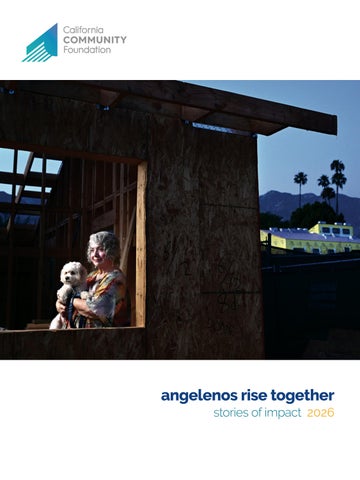
on the cover: Rosa Fernandez, 72, received help from SGV Habitat for Humanity after the Eaton Fire took her home of 24 years. She hopes to be back in her newly built home in Altadena by the 2026 holidays.
A
AS ROSA FERNANDEZ looked at the framing going up for her new Altadena
home, she could already picture the way the Christmas tree would glow in the living room, the smell of the dinners she’d share with friends and family around the dining table, and how her beloved Donut would enjoy running through the new tree-lined yard. The relief of almost being back home is palpable for her, nearly two years since the 2025 Los Angeles wildfires took everything she treasured. However, with support from Habitat for Humanity of San Gabriel Valley and CCF’s wildfire recovery fund, she will soon be back home. Rosa’s story is about more than rebuilding a house. It is about finding the strength, resilience and help she needed to return home. (Read her full story on page 6; and take in the beautiful cover photo of her and Donut). In this second annual edition of Angelenos Rise Together, the stories bring to life our five priorities: meeting basic needs; building economic opportunity; creating safe, resilient and connected communities; ensuring communities have a voice; and supporting healing and renewal. These priorities, informed by the input of 2,000 Angelenos, show what is possible when we listen actively, invest in trusted organizations and stay for the long haul. In this publication, you’ll meet young Angelenos pursuing meaningful work, organizations helping residents access health care and essentials, and neighbors using creativity to connect and heal. You’ll see communities supporting immigrant families, groups responding to crises and residents shaping their neighborhoods. Los Angeles is a place of extraordinary diversity, possibility and resilience. Angelenos build stronger communities and open doors so every family can live a good life. Meaningful change happens when residents, nonprofits, philanthropy, government and business bring their strengths together. That is CCF’s role as the community’s foundation—and it is the North Star that guides our work. We are here to connect people to the opportunities available to them to build stronger communities. And we measure our work by what changes in people’s lives—not simply by what we grant. We are grateful to everyone who makes this work possible: the Angelenos who lead, the organizations and partners who carry it forward, and donors whose generosity supports it. We are proud to share these stories with you. Turn the page to meet the people behind this work and see what becomes possible when we rise together to build a Los Angeles where a good life is within reach for all.
MIGUEL A. SANTANA
President & CEO California Community Foundation
CALFU ND.O RG
1
2
CALIFO RNIA CO MMU NIT Y FOU NDATI O N
table of contents These stories reflect how your support is making a difference for neighbors facing challenges across Los Angeles County, from housing instability to accessing health care to immigration raids. Thank you for investing in solutions that strengthen lives, expand opportunity and help our community achieve a good life. 6. f raming tomorrow Devastation gives way to dreams thanks to Habitat for Humanity.
28. h ooves, hope and healing Fire survivors and rescued animals come together at Big Heart Ranch.
52. a business lifeline Vendors and shop owners reeling from ICE raids get vital assistance.
8. r ebuilding memories Fire cannot destroy history and heritage.
30. h ealing in community Culturally grounded mental health matters for Asian Americans and Pacific Islanders.
54. c ultivating healing Alma Backyard Farms offers second chances.
10. t ogether again ADUs reunite residents of an Altadena neighborhood as they rebuild. 12. grounds for growth Coffee With a Cause brews economic opportunity. 14. nature, heal thyself Fungi and plants are cleaning ash-ridden soil after the Palisades Fire. 16. from internship to impact A student journalist answers the call to help her immigrant community. 18. shaping the future Ceramics classes offer creativity and hope after devastating loss. 20. o ut of breath Nonprofits reach out to residents reeling from the Lineage warehouse fire.
32. bound by spirit A scholarship celebrates devotion to service. 34. a home of its own Artists celebrate as their theater takes a big step toward financial stability.
56. e nsuring communities have a voice Immigration enforcement spurs resilience, courage and collective action. 58. r ethinking recovery EFSN is mobilizing wildfire survivors.
36. a long way home Pressures are mounting on wildfire survivors, according to a survey.
60. forged by flames Jewish families in Pasadena strengthen their bonds after wildfire.
38. s tarting over Cash aid is a lifeline for older adults recovering from the Eaton Fire.
62. f aith after fire Altadena’s Black church members find solace in belief.
40. l ocal lifesavers Health care is a fundamental human right at St. John’s Community Health. 42. ending exploitation A nonprofit stands up for the rights of Pilipino workers.
22. c ommitted to serve Charles Drew University students stand up for the health of underserved Angelenos.
44. w alking through fire A remembrance procession provides ways to process Altadena’s grief.
24. c reative confidence LA Commons empowers young people to find their voices through art.
46. v oices from pomona Community organizations band together to support the east San Gabriel Valley.
26. a m I next? Stories of immigrants arrested by ICE go public in a visual arts campaign.
48. c harting a comeback Fire survivors find validation and unity in a map of the Palisades and Eaton fires. 50. t he unkindest cuts As government aid drops, St. Joseph Center steps up.
Chief Philanthropy Officer Celina Santiago Executive Editor Gilien Silsby Production Editor Ronnie Schinker Senior Writer Teresa Watanabe Photographer Wally Skalij Designer Studio Deluxe Contributors Jeremy Deutchman Alicia Di Rado Larry Gordon Brennan Klein Ben Poston
Read Online! Enjoy the digital version of the CCF magazine on our website.
Over the past year, Alma Backyard Farms has distributed more than 125,000 pounds of fresh organic produce to the community.
3
T
THE CALIFORNIA COMMUNITY FOUNDATION believes everyone deserves the
opportunity to live a good life. Guided by that mission for all in Los Angeles County, we invest in people, organizations and ideas that make communities stronger, healthier and more resilient. Our five institutional priorities serve as the North Star for this work, directing where we focus our resources to create the greatest impact. The stories that follow bring these priorities to life through the voices of our nonprofit partners, community leaders and Angelenos. Together, they illustrate how CCF is helping meet basic needs, expand economic opportunity, strengthen neighborhoods, elevate community voices and support healing and renewal — advancing lasting change for all Angelenos. Our initiatives supporting these priorities are the embodiment of our philanthropic approach.
4
CALIFO RNIA CO MMU NIT Y FOU NDATI O N
Five priorities. One vision: A good life for all
1 . 1.
Meeting Basic Needs HOUSING
Expand access to safe, affordable and quality housing. HEALTH
Champion efforts that improve health, well-being and access to care. SUPPORT SERVICES
Strengthen systems that provide essential services to individuals and families in need.
2.
Ensuring Communities Have a Voice CIVIC ENGAGEMENT
Provide tools and resources that help communities organize, speak up and work across groups in solidarity for change. TRANSPARENCY AND ACCOUNTABILITY
Support trusted local institutions and media that hold leaders accountable and make sure community voices are heard.
Building Economic Opportunity EDUCATION
Expand access to education and job training that supports people at every stage of life. LOCAL ECONOMIES
Help local businesses and entrepreneurs grow by activating resources, funding and investments that create quality jobs and build community wealth.
3.
4. 5.
Supporting Healing and Renewal LAND AND RESOURCE STEWARDSHIP
Collaborate with communities to increase access to land and encourage its responsible use. RESTORATION AND RENEWAL
Creating Safe, Resilient and Connected Communities SUSTAINABLE COMMUNITIES
Partner with neighborhoods to protect the environment and ensure access to clean air and water, healthy food and outdoor spaces.
Create opportunities for communities to take part in decisions that shape their future. COMMUNITY HEALING
Invest in programs that help communities heal from trauma, strengthen relationships and build resilience.
PUBLIC SAFETY
Support community-led strategies to reduce violence and increase safety. COMMUNITY CONNECTION
Strengthen community bonds by supporting schools, cultural programs, shared spaces and storytelling.
CALFU ND.O RG
TO GIVE TO TO ONE OF OUR PRIORITIES, SCAN THE QR CODE OR CONTACT: DonorRelations@Calfund.org
5
MEETING BASIC NEEDS
THREE ALTADENA FAMILIES REBUILD AFTER THE FIRE
three families rebuilding 1
framing tomorrow DEVASTATION GIVES WAY TO HOPE FOR ROSA FERNANDEZ
F
FOR ROSA FERNANDEZ, home has always been
more than four walls.
“
THE DECISIONS MADE IN THIS MOMENT WILL SHAPE THE PACE AND THE OUTCOMES OF RECOVERY.”
It was the place where her family gathered — where her granddaughters played beneath their magnolia tree and cherished flower gardens brought beauty to life. For 24 years, Altadena was where Fernandez put down roots and envisioned her family’s future. Then the Eaton Fire destroyed it all. At 72, Fernandez wondered how she would begin again. The fire took her house, the garden she loved and the five trees that had provided shade for her dog, Donut, and a place for family parties. But Fernandez knew one thing: Altadena was home, and she needed to return. At an event for fire survivors, Fernandez learned about Habitat for Humanity of San Gabriel Valley and its work rebuilding homes. She applied, and within months, she learned she had been selected to receive assistance. The California Community Foundation’s Los Angeles Wildfire Rebuilding and Renewal Fund (LAWRRF) supports San Gabriel Valley Habitat for Humanity program. The LAWRRF helps families and communities move from emergency response to long-term rebuilding through affordable financing, philanthropic capital and cross-sector partnerships. Currently, Habitat has 20 homes under active construction in post-fire Altadena with plans to help at least 100 households rebuild.
6
For Fernandez, that support is becoming tangible. As the framing of her new home takes shape, Fernandez can once again see a future in her quiet Altadena neighborhood. She pictures family dinners around the table, Easter egg hunts in the yard and new traditions taking shape alongside the old ones. As she walked through the framed rooms recently, Fernandez pointed to one spot. “That’s where the Christmas tree will go,” she said. All of the homes in the program use designs from The Foothill Catalog, a collection created for post-wildfire rebuilding. Fernandez chose the Classic Craftsman Bungalow design, which most closely resembles her old home while giving her daughter and grandchildren more space with a large accessory dwelling unit, or ADU. “Our goal is to see fire survivors who want to return home to Altadena have a safe affordable place to go home to,” said Bryan Wong, CEO of SGV Habitat for Humanity. “We have been listening to the community and our program is designed to fill the rebuilding gaps that are keeping households from being able to rebuild.” The rebuilding effort is also bringing neighbors back together. Fernandez’s next-door neighbor met the Habitat crew working on her house and asked how he could apply for the program. Now his home is also in the framing stages, with completion projected for 2027.
CALIFO RNIA CO MMU NIT Y FOU NDATI O N
» Rosa Fernandez, 72, never questioned whether she would rebuild her Altadena home after the Eaton Fire. Support from SGV Habitat for Humanity is helping bring her family home.
Fernandez hopes to be home by Christmas and see her neighbor move back a few months later. “I love my neighbors,” she said. “We’re like family. We all understand what we’re going through.” For survivors like Fernandez, the path home still comes with challenges. Nearly two years after the fires, many survivors are still displaced and living in temporary housing, according to the Department of Angels, a nonprofit that helps Los Angeles County residents recover from the 2025 fires. The typical homeowner also faces a $500,000 gap between insurance payouts and rebuilding costs. “This is a fragile moment for survivors,” said CCF President Miguel A. Santana. “As gaps in family budgets widen, confidence is wavering, raising important questions about
CALFU ND.O RG
who will recover and under what conditions. ... The decisions made in this moment will shape the pace and the outcomes of recovery.” Fernandez is currently living with her family in a small apartment in Old Pasadena. She is looking forward to leaving city life behind and heading home. “It’s been a long, tough road,” she said. Looking toward the San Gabriel Mountains, Fernandez said she hopes to once again find peace. She misses hearing parrots squawk overhead and seeing neighborhood peacocks roam her block. “In Altadena,” she said, “everyone belongs — people, nature and animals.” –GILIEN SILSBY
To learn more about SGV Habitat for Humanity, please visit https://sgvhabitat.org
7
MEETING BASIC NEEDS
» For the Wood family, rebuilding is about more than new construction — it’s about creating a place for the next generation..
2
rebuilding memories FIRE CANNOT DESTROY THE WOOD FAMILY’S LEGACY
F
FOR GENERATIONS, the Wood family called Altadena home. Their lives were woven into their hilltop neighborhood where they celebrated school parties, played basketball, hosted the holidays and forged friendships.
It was the kind of house where visitors knew they could show up unannounced. At Christmastime, old friends drove by just to say hello and reminisce; during the summer, neighbors ran into the family on their way to Loma Alta Park. Then, in January 2025, the Eaton Fire took it all away. Ken Wood and his wife, Lara, lost the ADU they shared behind the home of Ken’s sister, Jenine, and her two children, Gianna, 6, and Westley, 7. Just down the street, Ken and Jenine’s parents lost the family home where generations of Woods had gathered. In one night, all of their family heirlooms, photographs, keepsakes and precious
8
objects connecting the Woods to their history were gone. “Every day I think about something else that was lost,” Jenine said. “Our beautiful memories were all in that house,” Ken said. The siblings’ home — where Ken and Jenine grew up — is one of hundreds of Altadena homes where generations of Black families have lived, built wealth and put down roots. In 1970, 70% of Black households in Altadena owned their homes — nearly twice the rate across Los Angeles County. Nearly 75% of Black Altadena residents were homeowners in 2020 — nearly double the Black homeownership rate nationally, according to UCLA’s Ralph J. Bunche Center for African American Studies / UCLA Neighborhood Knowledge. The Eaton Fire has made the path back home anything but straightforward for many Altadeneans, including the Woods. Rebuilding
CALIFO RNIA CO MMU NIT Y FOU NDATI O N
a house and rebuilding financial stability have proven to be two different challenges. In the first year after the fire, the siblings focused on rebuilding their parents’ home. At ages 86 and 87, their parents moved into their new house in May with help from SGV Habitat for Humanity, a California Community Foundation partner. Now, Ken, Lara and Jenine are rebuilding their own home while navigating insurance payments, mortgages, escrow accounts and loans as construction bills come due. The family has struggled to negotiate forbearance terms and worried about foreclosure. “We’re trying to keep moving forward, but every step comes with another question about how we’ll pay for it,” Ken said. Amid the uncertainty, the Woods have found support from the Greenline Housing Foundation, which works with wildfire survivors facing barriers to rebuilding. Greenline — a partner supported by CCF — has helped 14 Altadena families, including the Woods, with more than $2.5 million in rebuilding assistance. The Woods received a $200,000 no-strings-attached grant from Greenline, meaning they do not need to pay it back, said Jasmin Shupper, founder and president of Greenline. Greenline’s goal is to support at least 50 families. “We launched our Eaton Fire relief plan and fund just days after the fire,” Shupper said. “It’s designed to help those most disproportionately impacted by the fire to rebuild, restore and remain in Altadena.” Greenline received funding from CCF’s Los Angeles Wildfire Rebuilding and Renewal Fund, a public-private recovery initiative that helps families and communities move from emergency response to long-term rebuilding. “The Wood family was not unlike many other longtime families in Altadena who lost multiple family homes in the fire, saw decades of equity and wealth lost in minutes, and had significant gaps in actual costs to rebuild,” Shupper said.
CALFU ND.O RG
» From left: Jenine, Westley, Lara, Gianna and Ken Wood stand in front of their framed Altadena home.
As they near the second anniversary of the fire, the Woods see glimmers of hope. Their new home is being framed. They purposely designed it differently from the single-story house and backyard ADU they lost. The new main home and ADU are two stories, providing more living space and views of downtown Los Angeles. Jenine and her children will live in the main house, and Ken and Lara will live in the backyard ADU. The arrangement will keep the family close while giving them separate living spaces. “I want my children to have a home that is truly theirs again,” Jenine said.
“
I WANT MY CHILDREN TO HAVE A HOME THAT IS TRULY THEIRS AGAIN.”
There will be a new kitchen. New bedrooms. New walls. A new yard. But what makes it home will be familiar: family gathered around a table, children growing up together, neighbors stopping by and old friends returning to a street that once seemed lost. Perhaps, one day, friends will once again drive by at Christmastime, stopping to say hello and reminisce. Only this time, they will add new memories to the old ones. “We’re not just rebuilding a house,” Lara said. “We’re rebuilding a place for our family to stay connected and for the children to grow up knowing where they come from.” –GILIEN SILSBY
To learn more about Greenline Housing Foun- dation, please visit https://greenlinehousing.org/
9
MEETING BASIC NEEDS
3
together again TWO ALTADENA NEIGHBORS RETURN HOME, REUNITE AND REBUILD
“I’m going to quote my favorite philosopher: as Dorothy says, ‘There’s no place like home,’” said Carolyn Smith, who takes care of her elderly, disabled aunt. “This is the best day I’ve experienced in more than a year. I am beyond excited.” Ana Robles, a single mother and teacher, teared up as she spoke joyfully about returning to her property. “I just want to thank everyone from the bottom of my heart,” she said.
» “There’s no place like home,” Carolyn Smith said as she entered her newly built ADU in Altadena.
F
FOR MORE THAN 30 YEARS, the two women were neighbors on a quiet cul-de-sac beneath the foothills of Altadena, sharing not just a street but also a community. Then the Eaton Fire came, scattering them miles away to separate lives in temporary housing.
And yet, in a twist that felt almost too unlikely to be coincidence, they found each other again — this time in the same apartment complex in Monrovia. Both had begun the long, uncertain journey of rebuilding after the fires. Then came another unexpected turn: each, on her own, was selected to receive a prefabricated ADU that would be erected on their burned-out lots. At a recent block party filled with old neighbors, new allies and the many nonprofits and foundations that helped carry them through, they stood together again — not just as survivors, but as next-door neighbors.
10
The California Community Foundation provided The SoLa Foundation with grantwriting services to apply for ADU funding, a $50,000 investment. The SoLa Foundation has worked with Gary Bess Associates to raise $100,000 in additional grant support for the Together We Rebuild initiative, which aims to deploy fully furnished ADUs at no cost to Altadena families impacted by the Eaton Fire. Among The SoLa Foundation’s partners is Greenline Housing, a California Community Foundation Wildfire Recovery Fund grantee that provides interim housing and case management for families displaced by the Altadena wildfire, including Smith and Robles. Additional partners supporting these families include JFEDLA, Better Angels, Assemblymember Tina McKinnor and the Los Angeles County Legislative Delegation, Shared Harvest Foundation, the Southern California chapter of the National Organization of Minority Architects (SoCal NOMA) and Model/Z. “When the fires hit, we thought, what can we do? We’re an affordable housing developer, but we’re also a manufacturing company, so what if we provided our modular units at no cost, for free, to folks in Altadena so that they can live on their property while they
CALIFO RNIA CO MMU NIT Y FOU NDATI O N
rebuild?” said Sherri Francois, executive director of The SoLa Foundation. “We’ve learned from our partners and in the community that there’s so much hurt because folks had to leave their community where they’ve been for so, so long.” The steel-framed ADUs were built off-site at Model/Z Factory in Watts, delivered to Altadena and lifted into position by crane. The ADUs were fully furnished and ready for move-in at the celebration. When Smith first walked through the doors of her new ADU, she gasped. “This is so beautiful,” she said. “Everything I need is here, and it’s all so fresh and new.”
Smith is looking forward to watching, day by day, as her home is built just steps from the ADU where she now lives. She has envisioned every detail: a three-bedroom, two-bath home wrapped in warm tones and a sense of comfort, a space meant not just to be lived in, but to feel like home again. Robles had a similar reaction when she opened the door of her new ADU. “I am beyond words. It’s a true miracle to be home.”
“
THIS IS THE BEST DAY I’VE EXPERIENCED IN MORE THAN A YEAR. I AM BEYOND EXCITED.”
–GILIEN SILSBY
To learn more about The SoLa Foundation:, please visit https://www.thesolafoundation.org
» Carolyn Smith and longtime neighbor Ana Robles, second from right, celebrate the unveiling of their new ADUs. Both plan to live in their ADUs while their homes are being rebuilt.
CALFU ND.O RG
11
BUILDING ECONOMIC OPPORTUNITY
grounds for
growth A CAFE BREWS UP OPPORTUNITY FOR LOS ANGELES YOUTH
H
HE WAS JUST A TODDLER when he was taken
from his home and placed in foster care.
In sixth grade, he got pulled into street life. Then came high school — five different ones, as academic hardships and campus conflicts kept him on the move. But Alex Diaz, now 18, never gave up on a better future. He also never let go of his love for coffee or his dream to one day work as a barista or maybe even own his own cafe.
“
NOW I GOT WHAT I REALLY WANTED, WHICH WAS A CERTIFICATE SO I CAN PURSUE WORKING AT COFFEE SHOPS.”
And now that belief in himself has paid off. He is on his way to leaving his hardships behind and brewing up the good life he always hoped for. Diaz recently completed a paid internship at the Rosebud Cafe. This Highland Park coffee shop was opened in January by Coffee with a Cause, a nonprofit that provides job training, employer connections and mentoring for young people who have struggled through homelessness, foster care or the justice system. The cafe was supported by a one-year, $363,000 state grant distributed by the California Community Foundation under the California Jobs First regional investment initiative. The “Catalyst” grants aim to develop high-quality jobs and economic opportunities in underserved communities. “Cal Jobs First understands that investing in under-resourced communities is an economic strategy, not charity,” said Dan Davidson, Coffee with a Cause’s founder and executive director. “When we create real job pathways for young people who’ve been overlooked,
12
we strengthen our regional workforce and local economy at the same time. This support allows Coffee With A Cause to expand training and employment opportunities in Highland Park, helping ensure growth in our region is more inclusive and sustainable.” Davidson first started training young people in barista skills in 2013, when he was a pastor at Rose City Church in Pasadena and noticed young people sleeping in the parking lot. The church used an old coffee cart to launch a job training program taught by volunteers with barista skills. In 2017, the enterprise expanded to a brick-and-mortar cafe in Pasadena. The nonprofit has served more than 100 youth and offers training in coffee and other career paths, including doggie day care, personal training, retail, construction and landscaping. Coffee with a Cause’s 170-hour internship includes training in customer service, teamwork, communication and punctuality. Interns can earn industry skills certificates, and nine out of 10 graduates go on to jobs or full-time school or vocational training, Davidson said. Interns are also paired with mentors, while a job specialist helps them look for work after completing the program. For Diaz, the Rosebud cafe job — his first ever — was both a career and financial lifeline. He learned how to grind roasted coffee beans, froth milk and make latte art. He also used his earnings to support his mother after she was laid off.
CALIFO RNIA CO MMU NIT Y FOU NDATI O N
His mother had learned about the program from a TV news feature and urged him to apply, knowing how much he loved coffee. On a recent afternoon at the cafe, Diaz faced his final challenge: the test for his barista skills certificate. First came an online exam covering coffees, equipment, flavors and espresso drinks. Then Diaz demonstrated his coffee-making skills with Eric Dengler, the cafe operations manager and Specialty Coffee Association’s authorized trainer. He ground beans, tamped them down, pulled an espresso shot and discussed its taste with Dengler. “We’re looking for that balance,” Dengler said. “Is it too sour? Is it too bitter? Is it nice and balanced?” Diaz steamed the milk, poured it into the espresso, cleaned each piece of equipment and waited for his results. Pass! The team cheered. Diaz broke into a big smile. “I was nervous at first, but now I’m happy,” he said. “Now I got what I really wanted, which was a certificate so I can pursue working at coffee shops. It’s an amazing feeling.” –TERESA WATANABE
To learn more about Coffee with a Cause, please visit https://www.coffeewithacause.org
» Coffee with a Cause provides job training and mentoring for young people who have struggled with homelessness and other challenges.
CALFU ND.O RG
13
CREATING SAFE, RESILIENT & CONNECTED COMMUNITIES
» Resilient Palisades hosted a bioremediation workshop to demonstrate how fungal mycelium can help restore soil following the Palisades Fire. Dozens of fire survivors attended.
PALISADES RESIDENTS TURN TO PLANTS AND FUNGI TO CLEANSE THE SOIL
nature heal
thyself
N
NEARLY TWO YEARS AFTER the devastation of the Palisades Fire, green shoots are emerging from the ash thanks to Resilient Palisades, a group of resident-activists dedicated to helping the local community recover and thrive.
The group hosted a hands-on bioremediation workshop near Will Rogers Beach this year to teach fellow residents how they can restore the soil. Bioremediation is a way to use living organisms, like fungi and plants, to break down, detoxify or remove pollutants from the environment. The event drew about 30 volunteers, who learned from leading environmental scientists
14
how fungal mycelium can keep contaminants in the soil from spreading. “As a result of the fire, multiple organic and inorganic contaminants may leach into the soil, including PFAs, dioxins, lead, arsenic and asbestos,” said Maya Elson, a research scientist whose specialty in mycology — the study of fungi — has made her a soughtafter authority on effective approaches to post-fire recovery. “Fungi can act as a biological filter, capturing these contaminants, as well as harmful bacteria, which can restore the soil and prevent toxic runoff into the water supply.” Elson and her colleague Danielle Stevenson, executive and scientific director of the Centre CALIFO RNIA CO MMU NIT Y FOU NDATI O N
for Applied Ecological Remediation (CAER), highlighted bioremediation as an instrumental tool in mitigating the damage. “The fire was a tragedy, but immediately after there was a secondary disaster, which was the movement of contaminants from ash into soil, water and through air,” Stevenson explained. “This expanded the area of contamination exponentially and made even more urgent our focus on how we can harness the power of nature to heal itself.” With funding from the California Community Foundation and in collaboration with its partners in the Fire-Resilient Bioremediation and Landscape Recovery Consortium, Resilient Palisades gave community volunteers a crash course in mycology for post-fire bioremediation. Volunteers at the workshop gathered on the corner of Pacific Coast Highway and Temescal Canyon Road to stuff tubes known as mycowattles, or filter socks, with fungi and straw. Donning gloves, masks and disposable shoe covers to protect themselves from contaminants, the volunteers then carried the mycowattles up the hillside and placed them on the ground as barriers against soil erosion. “The Palisades is part of the Santa Monica Bay Watershed. Our canyons, hillsides and stormwater systems ultimately drain into the ocean and contribute to the overall health of Santa Monica Bay,” said Valeria Serna, a board member of Resilient Palisades and a co-lead of the group’s bioremediation efforts. These mycowattles will help keep the bay safer and cleaner.” Among the volunteers at the workshop were Palisades resident Kate Santoro and two of her five children, whose house sustained serious damage during the fire. “We moved here from Boston in 2022, and I immediately felt drawn to the land; it gave me so much joy to learn about things like composting and using organic materials in the garden,” Santoro said. “Being displaced from our property by the fire, and seeing how badly scarred the landscape became, was incredibly traumatic, so doing things like this — literally planting the seeds that will
create new growth — has been healing and inspiring.” Sara Marti, a Resilient Palisades board member and the group’s communications director, and her husband, Jordan Corral, helped staff the workshop, answering volunteers’ questions about Resilient Palisades and its ongoing initiatives. “The organization was actually founded in 2019, but we pivoted after the fire to meet the immediate needs of our community,” Marti said. “There’s so much that has to be done for the Palisades to flourish again, and workshops like this one are instrumental in making it happen.” Corral has spearheaded efforts to pull up non-native invasive vegetation like black mustard and pampas grass — efforts essential for bioremediation to succeed.
“
IT’S WONDERFUL TO KNOW THAT WE’RE MAKING A DIFFERENCE, AND CCF IS MAKING IT POSSIBLE.”
“Many invasive plants outcompete native species, reduce biodiversity, contribute to erosion and create dense fuel loads that can increase wildfire risk,” he said. “Removing them gives native ecosystems a chance to recover while creating better conditions for long-term soil restoration.” Investment from CCF supports Korrin Davis, Resilient Palisades’ bioremediation program coordinator. “Whether we’re putting on workshops, leading webinars or fielding community surveys, I feel privileged to be part of bringing people together to do good and important work,” Davis said. “It’s wonderful to know that we’re making a difference, and CCF is making it possible.” –JEREMY DEUTCHMAN
To learn more about Resilient Palisades, please visit https://www.resilientpalisades.org CALFU ND.O RG
15
ENSURING COMMUNITIES HAVE A VOICE
A STUDENT JOURNALIST’S GUIDE HELPS IMMIGRANTS NAVIGATE ICE
from internship to
impact
K
KARINA SORIANO SPENT HER SUMMER
internship at Los Angeles Public Press doing something her community desperately needed: creating a bilingual guide for L.A. County immigrant families that explained what to do if ICE agents knock on their door. Soriano, of Norwalk, started the internship in 2025 just as Immigration and Customs Enforcement (ICE) agents were ramping up efforts in nearby neighborhoods like Paramount. She quickly grew alarmed at the lack of clear, Spanish-language information available to her community. Soriano, whose first language is Spanish, helped create the bilingual zine “How to Navigate Living in an ICE-Occupied Neighborhood in L.A. County” to help people stay safe, informed and prepared. The pocket-sized zine includes know-yourrights information, digital security tips, guidance on avoiding high-risk areas and phone numbers for assistance organizations. It also includes role-playing scripts for what to say and do if stopped by immigration officers — an element drawn directly from Soriano’s own family experience. Her internship was made possible through a newsroom partnership with Cerritos College’s Journalism and Media Studies department.
» Karina Soriano, who interned at LA Public Press, helped create the bilingual zine “How to Navigate Living in an ICE-Occupied Neighborhood in L.A. County.”
LA Public Press CEO and founder Matt Tinoco said partnering with local colleges is central to the nonprofit outlet’s mission of developing diverse local talent and staying close to the communities it covers. Funding from the California Community Foundation helps make these internships and publicservice projects possible. CCF’s financial support has been “integral” to sustaining newsroom operations and
16
CALIFO RNIA CO MMU NIT Y FOU NDATI O N
community-centered journalism projects, Tinoco said. The investment gave Soriano an opportunity to enter the newsroom at a critical moment and work on a project that blended lived experience with rigorous reporting, delivering life-saving information into the hands of those who need it most, Tinoco said. For Soriano, a central inspiration for the project was her mother’s encounter with federal agents at a gas station in Paramount. Her mother, a green card holder and nurse at a convalescent hospital, was stopped by officers as she pumped gas. They questioned her in English about where she lived, where she was coming from and how long she had been in the country.
“
I NEED YOU TO BE THE PERSON THAT RAISES YOUR HAND AND SAYS SOMETHING.”
Soriano had already role-played such scenarios with her, practicing how to answer questions and assert her rights. Soriano believes that preparation helped her mother navigate the encounter and ultimately be allowed to leave. But the experience left her mother rattled; she stayed home from work for about a week, fearful for her safety. Not long after, Soriano said, she was followed by unmarked vehicles for more than 30 minutes while driving her mother’s car along the 105 Freeway. Shaken, she called her editor, Mariah Castañeda, audience director and co-founder of LA Public Press. The newsroom arranged free therapy sessions to help her process the anxiety and fear. That support reshaped Soriano’s understanding of a healthy newsroom. “It was life-changing for me,” Soriano said. “Mariah really made me feel like I had a family there, and I had a group of people who cared for me.” Publishing the zine took about two months of reporting, drafting and editing. The first print run was 4,000 copies, all of which were quickly distributed. Libraries and community centers requested more, prompting additional printings.
CALFU ND.O RG
Soriano focused distribution on the people she felt were most vulnerable — Spanishspeaking workers such as flower vendors, fruit sellers and day laborers. Beyond the project, Soriano said the internship has had a lasting impact on her career trajectory. She serves as editor-in-chief of Talon Marks, the student publication at Cerritos College. Encouraged by mentors at LA Public Press, she is applying to transfer to USC’s journalism program. The newsroom’s partnership with Cerritos College grew out of conversations between newsroom leaders and faculty, said Christian Brown, department chair of Journalism and Media Studies. Cerritos College has been working for several years to develop an internship pipeline that channels underserved student journalists into local newsrooms through hyperlocal journalism grants, he said. Brown has pressed his students to tell stories that center vulnerable regions such as Southeast L.A. County. “I’ve told them: ‘You’re going to be in the newsroom and you’re going to know in your core and your gut that somebody’s story is not being told here and we are not covering this equitably enough,’” Brown said. “I need you to be the person that raises your hand and says something.” –BEN POSTON
To learn more about Los Angeles Public Press, please visit https://lapublicpress.org
17
SUPPORTING HEALING & RENEWAL
shaping the
future A SURVIVOR FINDS HEALING THROUGH CERAMICS
Working with clay gave Nishio something she didn’t expect: a way to rebuild. “Now we can recreate what we lost. And it’s with my own hands. I’m more excited to recreate it even though it doesn’t look perfect,” she said. “By taking these classes, I can transform the narrative from ‘I lost everything’ to ‘I can create something new.’” Nishio is one of more than 250 students who have participated in the Armory’s wildfire survivor scholarship program, supported by a grant from the California Community Foundation.
A
AKIKO NISHIO’S HEALING STARTED when she
put her hands in clay at the Armory Center for the Arts.
“
BY TAKING THESE CLASSES, I CAN TRANSFORM THE NARRATIVE FROM ‘I LOST EVERYTHING’ TO ‘I CAN CREATE SOMETHING NEW.’”
After losing their home of seven years to the Eaton Fire, Nishio and her family escaped with only a few sets of clothes, a stuffed animal and a laptop. Among the belongings she missed most were the ceramics she had spent years collecting. “We lost all the plates and cups. I used to love collecting ceramics. We lost everything,” she said. A turning point came when a friend who had also lost a home told Nishio about free art classes for wildfire survivors offered through the Armory’s scholarship program. “I always wanted to try ceramics,” Nishio said. “But I just put it away. I’m a busy mom and I work. But I thought this was the best opportunity for me to start as a beginner, and I couldn’t afford it without the scholarship.”
18
A Pasadena institution since 1989, the Armory responded quickly after the Eaton Fire. Support from CCF helped the Armory launch several recovery programs, including its Community Creativity and Care Room, which offers snacks, drop-in art activities and meeting space for survivor and recovery organizations. The Armory also provided classroom and studio space to eight schools impacted by the fire, hosted exhibitions featuring work by survivors and created full scholarships for its 10-week studio courses. The program is expected to continue through 2027. “Grants from the California Community Foundation have been pivotal in enabling the Armory to respond both immediately and over the long term to the needs of wildfire survivors,” said Andrew Gould, the Armory’s vice president of external relations. “By ensuring consistent access to artist-led programming and communal spaces, these grants have helped survivors regain a sense of agency, supported mental health and emotional processing and rebuilt
CALIFO RNIA CO MMU NIT Y FOU NDATI O N
social connections in the aftermath of devastating loss.”
younger daughter is taking painting classes through the Armory.
Nishio agreed. “Losing a home in a fire is more than losing a physical place to live. It’s losing your sense of safety, your memories and routines,” she said.
The fire took all the art the children had created in school, and that hurt, Nishio said. “I’d been collecting all their art and letters, and we can’t recreate those,” she said. “But I’ve been telling them, hey, you can create more and share it with us. Now, she’s been coming home saying, ‘look what I made, look what I made!’”
But art can become a powerful way to heal and create a sense of control. “The fire was sudden and uncontrollable, but when I make something, I can choose the color, I can choose the shape, I can choose the texture and I can make whatever I want to make,” she said. “I feel like I’m in charge. I feel good. Through art, you can recreate memories.” Today, the family’s living space is filled with Nishio’s handmade ceramics, and her
Nishio’s collection of family artwork is growing once again. –BRENNAN KLEIN
To learn more about the Armory Center for the Arts, please visit https://www.armoryarts.org
» Working with clay has helped Akiko Nishio heal after losing her home in the Altadena Fire. “Now we can recreate what we lost,” she said.
CALFU ND.O RG
19
MEETING BASIC NEEDS
SUPPORTERS RUSH TO AID RESIDENTS AFTER AN UNPRECEDENTED WAREHOUSE FIRE
out of
breath
C
CHARLES LEONARD SAW A BILLOWING CLOUD of
smoke rising in the air and stepped outside the Boyle Heights home where he works as a caregiver. He caught a sharp, acrid smell. He saw soot on the house and black splotches all over his white car. He wondered: What is in the air? Anneisha Neal saw the afternoon sky turn dark, then received an alarming text from the Los Angeles Fire Department: Shelter in place due to “Toxic Smoke.” “I thought I was going to die,” Neal said. Leonard and Neal were among hundreds of residents in the Los Angeles Boyle Heights and Eastside neighborhoods who recently flocked to a Los Angeles city resource center after a massive fire erupted at a nearby cold-storage warehouse in June. The most sought-after items: air purifiers.
“Not knowing what’s in the air, having to keep yourself locked up like you’re in quarantine, has been tough,” Leonard said. The fire triggered the release of toxic ammonia and other chemicals into the air, prompting an emergency alert to stay inside, close all windows and doors and shut off all air conditioning. As apartments and homes turned into cauldrons of muggy summer heat, residents scrambled to find air purifiers to filter out potentially harmful substances. Leonard said he fruitlessly called several places trying to secure one for his 72-year-old, wheelchair-bound client — and finally landed one at the resource center five days after the fire broke out, filling him with gratitude and relief. The center, set up at the Lou Costello Jr. Recreation Center on Olympic Boulevard, provided more than 1,000 air purifiers to neighbors who waited hours in line. Residents also received bottled water, food boxes and information about mental health support, emergency rent relief and other assistance. The California Community Foundation supported the purchase of air purifiers distributed at the city-organized event and also provided grants to more than 20 community organizations working with affected residents. CCF deployed $1.5 million from its newly launched Impact Fund, which is designed for quick and flexible grantmaking in response to urgent needs like the warehouse fire. A second round of grants will support longer-term recovery efforts.
» A worker prepares food and water supplies for residents affected by the warehouse fire in Boyle Heights.
20
“As the community’s foundation, we are committed to stepping up when a crisis strikes,” said CCF President and CEO Miguel A. Santana. “Our Impact Fund was designed to give us the flexibility to deliver resources
CALIFO RNIA CO MMU NIT Y FOU NDATI O N
» Neighbors affected by the Boyle Heights warehouse fire receive food, air purifiers, masks and other assistance.
where they are needed most, in collaboration with our trusted community partners. We are grateful to all of our partners and donors, and encourage others to join us and support our neighbors during this difficult time.” St. John’s Community Health immediately dispatched its five mobile clinics to Boyle Heights. President and CEO Jim Mangia said patients arrived with swollen throats, persistent coughs, breathing problems and anxiety. With CCF support, the organization distributed 41,000 masks and 2,800 air purifiers, as well as inhalers. Staff also collected data on the fire’s long-term health effects. Proyecto Pastoral at Dolores Mission, a nonprofit community organization based in Boyle Heights, has provided masks, air purifiers and food to those in need. A CCF grant will provide emergency aid for rent payments, said Raquel Roman, the nonprofit’s executive director. She said some residents have gotten sick from the fumes and are unable to work; others are bracing for high electricity bills from constantly running air purifiers.
CALFU ND.O RG
The pandemic, Eaton and Palisades fires, federal immigration raids and now the Boyle Heights warehouse disaster have delivered one blow after another to the financial stability of local entrepreneurs, said Marco Covarrubias, associate director for development at Inclusive Action for the City. The nonprofit launched an emergency cash assistance program, offering grants of $3,000 for brick-and-mortar businesses and $1,000 for street vendors. Organizers hope to provide at least 150 grants. Covarrubias said Inclusive Action is still running its grant program for vendors hurt by the ICE raids, marking a grim milestone of running two emergency assistance efforts simultaneously for the first time.
“
NOT KNOWING WHAT’S IN THE AIR, HAVING TO KEEP YOURSELF LOCKED UP LIKE YOU’RE IN QUARANTINE, HAS BEEN TOUGH.”
“Since COVID, we’ve had back-to-back crises,” he said. “It’s been such a difficult time for small businesses in our city.” –TERESA WATANABE
To learn more about the CCF Impact Fund’s Boyle Heights grantee partners, please visit https://www.calfund.org/funds/the-ccf-impactfund-activated-in-support-of-boyle-heights-andeast-la
21
BUILDING ECONOMIC OPPORTUNITY
» Nursing students at Charles R. Drew University of Medicine and Science prepare to bring quality health care to underserved neighborhoods, using mannequins that reflect diverse races, genders and ages.
STUDENTS STAND UP FOR THE HEALTH OF THE UNDERSERVED
committed to
serve
J
JOSH VIVAS, SIERRA PAYNE AND SHARON VIVIAN
grew up in low-income Los Angeles communities and left home to attend respected universities — but they never forgot their neighbors.
Now, the three students have returned to pursue master’s degrees in nursing at Charles R. Drew University of Medicine and Science (CDU), which is celebrating its 60th year of educating health professionals committed to social justice and health equity. Through their work, the students hope to improve access to care in communities like their own.
22
“Even though we are one of the most diverse populations in the country,” Vivas said of Los Angeles, “we are also one of the most segregated by class and by race. So the work that we do is just so important, and there’s no better campus than CDU to get an education that focuses on the underserved populations.” Founded in South Los Angeles after the 1965 Watts Uprising, CDU is the only one of the nation’s four Historically Black medical colleges located in the Western United States. The university serves a region facing
CALIFO RNIA CO MMU NIT Y FOU NDATI O N
high levels of poverty, health disparities and housing insecurity. The need is significant. A shortage of primary care doctors contributes to untreated chronic diseases like diabetes, and their complications, CDU President David M. Carlisle said. “It’s a very unfortunate situation that should not be occurring,” he said. CDU is expanding to meet those challenges. A new Health Professions Education Building will soon house the four-year medical degree program, classrooms, anatomy labs and collaboration spaces. The medical degree program, launched in 2023 with support from CCF and other foundations, will graduate its first class of physicians in 2027. Several CCF grants over the years have helped CDU expand educational opportunities, strengthen workforce development and improve health care access. Recent support has helped revive the physician assistant program and advanced plans to expand the campus to accommodate affordable housing, a biomedical hub and community amenities. At the same time, university leaders are navigating uncertainty as federal funding for research and student aid might be cut. “We don’t know if the threats will actually become a reality, but it’s enough to scare us into a situation where we’re constantly looking over our shoulder, wondering what’s going to hit us next,” said Angela L. Minniefield, CDU’s COO and senior vice president of advancement and operations. More than 80% of CDU’s 7,000-plus graduates provide care in underserved communities. Payne’s journey began in kindergarten at the CDU Saturday Science Academy, which nurtured her interest in science and health care. After earning her bachelor’s degree from Xavier University, she returned to Los Angeles and to CDU. “A lot of our [alumni] come back and serve, and that creates the cycle of mentorship and leadership,” Payne said. CALFU ND.O RG
» CDU educates diverse classes of medical students to serve multicultural communities across the region.
Vivian, a UCLA graduate, volunteers through CDU community programs. She recently attended a Black History Month cultural festival to educate visitors about diabetes, hypertension and stroke. Students like Vivas noted CDU’s supportive environment and diverse student body. He said he found a sense of belonging at CDU after feeling isolated as an undergraduate elsewhere. “Every student feels they need to have a place,” he said. “You are home here. You are family here.”
“
EVERY STUDENT FEELS THEY NEED TO HAVE A PLACE. YOU ARE HOME HERE. YOU ARE FAMILY HERE.”
–TERESA WATANABE
To learn more about CDU, please visit https://www.cdrewu.edu
23
CREATING SAFE, RESILIENT & CONNECTED COMMUNITIES
creative
confidence FINDING THEIR VOICES THROUGH ART
C
CARMEN GUATZOZON HAS ALWAYS LOVED ART,
“
ART IS A REALLY POWERFUL STRATEGY TO BRING PEOPLE TOGETHER AND GET EXCITED ABOUT BEING IN COMMUNITY.”
from doodling to painting. But as a self-described antisocial youth, she never imagined she would develop the confidence and skills to help create a major mural in Los Angeles. She credits LA Commons for her transformation. The nonprofit helps diverse communities tell their stories through public art, and youth empowerment is its key focus. The California Community Foundation supports LA Commons through several grants consistent with its mission to advance a better life for Angelenos. CCF helps sustain the organization’s youth leadership council, where Carmen found her voice, and supported planning for a creative youth workforce development program that combines artistic training with work experience. Carmen saw herself grow through the program. “I started getting along with more people, trying to put myself out there because at the end of the day we’re a team,” she said. “Those are really important people skills.”
24
The skills helped Carmen navigate the college application process. Now studying radiology at Cal State Northridge, she is the first in her family to attend college. Her parents, immigrants who never had the opportunity to finish high school, always emphasized education as a pathway to success. LA Commons expects to place more than 200 young people in paid roles as artists, leaders, apprentices and interns. Founder Karen Mack said the program will provide training in art, storytelling and event planning while helping participants create and publicly present community-based projects. Mack’s vision is rooted in the idea that art can strengthen social connections and foster belonging. “Art is a really powerful strategy to bring people together and get excited about being in community,” Mack said. “They develop those bonds that then are the foundation for everything else.” That philosophy shaped a recent mural project in partnership with the UCLA Labor Center. Carmen and 19 other youth artists
CALIFO RNIA CO MMU NIT Y FOU NDATI O N
» LA Commons empowers communities to tell their own stories while helping young people develop artistic and leadership skills.
spent months learning about MacArthur Park, interviewing residents and gathering stories about the neighborhood. Enrique Fernandez, a senior at Alliance Ted K. Tajima High School and member of the CCF-supported youth leadership council, said residents shared concerns about trash, crime, homelessness and drug abuse. Others shared memories of a cleaner, safer park and described concerns about immigration raids and discrimination. Carmen said residents also emphasized the need for greater unity, with some recounting experiences of being told to “go back to your country.” The youth shared that feedback with mural artists Shakir Manners and Luis Mateo, who guided the design process. The finished mural features street vendors, farm workers, children of different races and a tree trunk formed by many hands. A monarch butterfly symbolizes the freedom to migrate. As the students painted, Manners taught spray-painting techniques and lessons about collaboration.
CALFU ND.O RG
“There’s no substituting for hard work,” he said. “And it’s definitely important to work with other artists so you can build community and grow and keep on inspiring. It’s important to put your ego aside.” Community-building extends beyond murals. LA Commons recently gathered residents in Leimert Park to begin collecting stories for its Festival of Masks, an annual celebration honoring ancestors and the African diaspora. Youth artists will help create masks, costumes and signage for the event. For participants such as Enrique, the experience has provided artistic skills, historical knowledge and a deeper understanding of community. His biggest takeaway? Solidarity and hope. “The strongest tools that we have, especially as oppressed individuals or communities, are unity and our voices to push for what we deserve,” he said. –TERESA WATANABE
To learn more about LA Commons, please visit https://www.lacommons.org
25
ENSURING COMMUNITIES HAVE A VOICE
» The California Community Foundation launched a public campaign to stand with neighbors affected by federal immigration raids.
26
CALIFO RNIA CO MMU NIT Y FOU NDATI O N
A PUBLIC CAMPAIGN SHINES A LIGHT ON THREATS TO CIVIL LIBERTIES
am I
next?
J
JUAN, ON A LUNCH BREAK from a construction job. Rosalina, at home with her children. Miriam, appearing in court. Edwin, seeking work at Home Depot.
“
TOGETHER, WE REMIND LOS ANGELES AND THE NATION THAT SILENCE IS NOT AN OPTION AT A TIME WHEN DIVERSITY IS UNDER ATTACK.”
The four Angelenos were wrenched from their jobs, homes and families by federal immigration agents and disappeared into detention facilities. But in a mass public campaign to stand with them and hundreds of other neighbors taken in immigration raids, the California Community Foundation and other prominent institutions are projecting their stories and photographs of Angelenos who support them onto their buildings in billboard-sized, illuminated images. The images appear nightly at CCF, LA Plaza de Cultura y Artes, The Music Center and the Japanese American National Museum in downtown Los Angeles, with other institutions soon to follow. The community campaign raises the urgent question: If people are arrested without regard to constitutional rights, who is safe? “This is a call to action,” said CCF President and CEO Miguel A. Santana.“It is a declaration of courage, a stand for justice and a defense of our most sacred American values, because until justice returns, none of us is free, none of us is safe.” The “Am I Next?” campaign confronts attacks on civil liberties and the undermining of democratic norms that weaken civic life. The 20-by-30-foot portraits feature a cross section of Angelenos united in protest over recent U.S. Immigration and Customs Enforcement raids that have swept up hundreds of residents — most with no criminal record — and placed them in detention.
CALFU ND.O RG
The campaign harnesses the power of art and collaborative action to highlight the threat to everyone when immigrants are targeted. In addition, a dedicated campaign website will allows Angelenos to send in their own photos to show their support. The “Am I Next?” content is also available to download from the website. At LA Plaza de Cultura y Artes, in addition to the “Am I Next?” content, the installation includes more than 30 large-scale digital illustrations created by nine Los Angeles-based artists: Brandy González, Ernesto Yerena Montejano, Joel García, John Fleissner, Lalo Alcaráz, Las Chicas Peligrosas, Lilia Ramírez “Liliflor,” Man One and Mario Hernández. The project at LA Plaza, “We Belong Here,” features a display of 13 neon artworks by Los Angeles-based artist Patrick Martinez and will be displayed indefinitely. Leticia Rhi Buckley, CEO of LA Plaza de Cultura y Artes, spoke about the powerful role art plays in building bridges, fostering dialogue, nurturing empathy, strengthening the community’s social fabric and building resistance to injustice. The artists’ work, she said, isn’t merely visual — it also shares voices speaking truth about migration, struggle, resilience and unity. “We must make visible what has been ignored. We must stand shoulder to shoulder with communities,” she said. “Together, we remind Los Angeles and the nation that silence is not an option at a time when diversity is under attack.” –TERESA WATANABE
To learn more about “Am I Next?,” please visit https://www.aminextla.org
27
SUPPORTING HEALING & RENEWAL
FIRE SURVIVORS FIND FURRY FRIENDS AT BIG HEART RANCH
hooves, hope and
healing
T
THE BOY WAS OVERWHELMED BY STRESS
after terrifying wildfires raced down the hills of Pacific Palisades and Malibu, incinerating homes and closing his middle school for weeks. But on a sunny March day, David found comfort among fellow wildfire survivors — bunnies, goats and other rescued animals — at Big Heart Ranch in Malibu. As he cradled a black chicken at the wellness center and animal sanctuary, he focused on the bird’s soft feathers, warm body and calm energy. “I feel really, really happy,” he said. “The happiest I’ve felt in a long time.” David was among more than 50 wildfire survivors and recovery volunteers who attended a daylong healing event offered by Big Heart Ranch and the Boys and Girls Club of Malibu. Supported by the California Community Foundation through a grant program promoting healing and recovery, the event included animal interactions, an outdoor sound bath and lunch. The gathering drew on the comforting powers of animals. Corey Cardenas, the ranch’s animal specialist, said animals help people stay present. “This is the special part: Our animals that are healing, that are finding a forever home, get to heal us,” Cardenas said.
» Big Heart Ranch offers wildfire survivors, veterans and others a space to experience the comforting power of animals.
For one survivor, Maggie, the event offered respite after fire took the home she had designed and built. Spending the day at the ranch with her husband, Tyler, and son, Cooper, was a highlight for her family after a stressful year. Watching Cooper explore pigs and donkeys was “magical,” she said. She grew up around
28
CALIFO RNIA CO MMU NIT Y FOU NDATI O N
» A family who lost their home in the Palisades Fire said a day with the animals at Big Heart Ranch was “magical.”
horses, so the animals’ calm presence brought her comfort.
“
BIG HEART RANCH CREATED A SPACE WHERE FAMILIES LIKE OURS COULD RECONNECT WITH NATURE, ANIMALS AND EACH OTHER.”
CALFU ND.O RG
“Big Heart Ranch created a space where families like ours could reconnect with nature, animals and each other,” Maggie said. “The kindness and care that went into creating that experience was deeply felt, and it meant more to our family than we can adequately express.” For event attendees Marta and Estele, the fire brought financial distress. Marta became homeless for six months when the home she was caring for burned down. She now juggles work as a live-in caregiver and house cleaner. Estele’s husband has struggled to find construction work, so he works as a handyman while Estele cleans homes. Both women said jobs are scarce. They credited Suigen Constanza, director of community engagement at the Boys and Girls Club, for her support.
Unable to stay with her family while they rebuild, she became withdrawn after arriving at the sanctuary, executive director Denise deGarmo said. Even though her family visits regularly, it’s not the same as home. But Miss Piggy experienced a breakthrough during the event. When deGarmo greeted her, the pig emerged from her hut, trotted over for a belly rub and, for the first time, accepted affection from Ruby, a baby pig. “I almost cried,” deGarmo said. “In that moment it was a breakthrough healing for these two animals. That’s what I love about Big Heart Ranch — it provides the place for that to happen.” Big Heart Ranch cares for about 85 rescued animals. Maintenance is expensive, deGarmo said, making support from CCF critical. By the end of the event, guests had filled a giant blackboard with their reflections.
“Everyone is under a lot of stress and worry about how we are going to make it through the day,” Estele said. “But today feels like a self-care day, a day for myself.”
David’s words captured the day’s spirit:
It was also a special day for Miss Piggy, a 200-pound pig displaced by the Palisades Fire.
To learn more about Big Heart Ranch, please visit https://bigheartranch.org/
Connected. Safe. –TERESA WATANABE
29
MEETING BASIC NEEDS
healing in
community AAPI CENTERS PROVIDE A MENTAL HEALTH LIFELINE
“For the AAPI community, mental health is a huge stigma,” Cheng said. Nonprofits supported by the California Community Foundation, including the Chinatown Service Center and the Little Tokyo Service Center, address those barriers.
» Chinatown Service Center staff bring smiles to senior clients.
“
WE NEED THIS. IT GETS YOUR MIND OUT OF YOUR HOUSE. WE ALL
GET TOGETHER AND TALK. YOU WANT TO STAY AND INTERACT.”
M
MENA LIU FLED her Pasadena apartment building as the Eaton Fire bore down in 2025. Now, more than a year later, she knows she’s not fully recovered. She’s sad. She’s anxious. She still avoids driving past burned out lots in her neighborhood.
And when Liu heard cries of “Fire!” after the apartment unit above hers filled with smoke, she raced outside in pajamas, her heart racing and skin tingling with fear. “The fire in my mind is deep. I’m so scared,” Liu said. Yet Liu has not sought therapy, reflecting a trend among Asian Americans and Pacific Islanders (AAPI), who have the lowest rates of help-seeking behavior among demographic groups. Experts cite cultural values emphasizing endurance and a tendency to avoid burdening others. “The literal translation of mental health in Chinese is ‘a disease in the head,’” said Jack Cheng, chief operating officer of the Chinatown Service Center.
30
The Little Tokyo Service Center found that community meals, workshops and art projects often created opportunities for survivors to discuss trauma. People were willing to attend practical workshops, such as navigating the insurance process, and then opened up about their mental health. With help from a 2025 CCF wildfire recovery grant, the Little Tokyo Service Center served more than 1,000 people, said co-executive director Peter Gee. Yet the needs remain even as the funding has run out, and many community members minimize their grief and need for help. Liu, for one, said she considers herself lucky compared to others who lost homes in the fire. The Chinatown Service Center also played a critical role in AAPI health during the Eaton Fire. One of its staff members called Liu in Cantonese and urged her to evacuate, showing the importance of language access. In a UCLA research project, the Chinatown Service Center found Chinese immigrants face barriers in wildfire preparedness and recovery, including limited alerts and a shortage of culturally appropriate mental health providers. The organization served about 450 wildfire survivors through its CCF grant and plans to expand support with new funding. It often incorporates culturally familiar practices such
CALIFO RNIA CO MMU NIT Y FOU NDATI O N
“
WE’RE FAMILY HERE. WE TAKE CARE OF EACH OTHER.”
as Qigong and tai chi alongside traditional counseling approaches. Founded in 1971, the center now serves 30,000 people annually through health, behavioral health, immigration, youth and economic development programs. Its expertise also proved vital after the 2023 Monterey Park mass shooting, and staff continue supporting 37 survivors. Community connection is another path to healing. At the Chinatown Service Center’s new senior center in Alhambra, older adults gather for meals, medical care and companionship. On a recent day, the center was filled with seniors enjoying ping pong, bingo, karaoke, English lessons and conversations in different languages. Most of the program’s 149 participants are Chinese, but there also are tables for speakers of English and Vietnamese. Cheng said social isolation is a major concern for seniors, but participants often become happier through the program. They include Adeline Gaw, from Myanmar, and Annie Medina, who is Mexican American. They chatted away in English over eggs and fruit, then dove into a bingo game. “We need this,” said Gaw, who lives alone. “It gets your mind out of your house. We all get together and talk. You want to stay and interact.” As Medina put it: “We’re family here. We take care of each other.” –TERESA WATANABE
» Clients, largely Asian American and Pacific Islander, learn ways to care for their mental health at the Chinatown Service Center.
CALFU ND.O RG
To learn more about the Chinatown Service Center, please visit https://www.cscla.org or Little Tokyo Service Center: https://www.ltsc.org
31
BUILDING ECONOMIC OPPORTUNITY
» A scholarship established in memory of Kevin Pobjoy, left, will allow Megan Ramos, right, to attend UC Santa Cruz.
KEVIN POBJOY’S KINDNESS LIVES ON THROUGH A SCHOLARSHIP
bound by
spirit
K
KEVIN POBJOY AND MEGAN RAMOS never knew each other. Yet their lives echo each other in remarkable ways:
A devotion to service — he served in the U.S. Marine Corps and California Army National Guard, she in her high school Junior Reserve Officers’ Training Corps. Immigrant roots — his parents are from Ireland and the Philippines, hers from Mexico. A fascination with human behavior and a compassionate desire to help others. A love of music — saxophone for him, drums for her.
32
Now they are bound together by a gift. Four years after Kevin passed, his parents, Peter and Violeta Pobjoy, established a scholarship fund in his name at the California Community Foundation, and Megan is the first recipient. The $25,000 annual scholarship, renewable for four years, will help Megan attend UC Santa Cruz. She will be the first in her family to attend college. “What I’m receiving today is much more than just financial aid,” Megan, 18, told the Pobjoys at a recent scholarship lunch at CCF. “It’s a symbol that somebody believes in me.” CALIFO RNIA CO MMU NIT Y FOU NDATI O N
Violeta Pobjoy told her that they were simply “sharing the blessing that we got here in America,’ while Peter added that she gave them hope in the future. “Our main intent was to have a big impact on somebody’s life,” he told her. “What really, for me, made you stand out was your passion for helping give back to the community through education, compassion and understanding.” Kevin was 30 when he died of an accidental overdose of antidepressant medication in November 2022. He had been serving in the National Guard’s medical detachment and worked at a Torrance hospital, helping patients cope with mental health issues. He enlisted in the U.S. Marine Corps after graduating from Palos Verdes Peninsula High School in 2010, serving in the 3rd Civil Affairs Group in the Reserve. During his service, he attended USC, earning a bachelor’s degree in anthropology and a master’s degree in visual anthropology. An internship with the USC Shoah Foundation ignited his passion for social justice and caring for others. He later worked for the Los Angeles Unified School District, assisting students with learning disabilities. After receiving a Marine Corps honorable discharge at the rank of sergeant in 2019, he trained and qualified as a licensed California emergency medical technician, working for PRN Ambulance. “All he wanted to do was help people … to do good in the world,” said Army Maj. Cassandra Meredith, Kevin’s National Guard commander. The Pobjoys turned to CCF to establish a scholarship celebrating Kevin’s life by helping a student in need with similar interests — specifically, an L.A. Unified JROTC student planning to study behavioral science. They found those qualities in Megan. A Franklin High School JROTC leader, Megan is fascinated, like Kevin, by what makes people behave the way they do. Her goal is to earn a master’s degree in forensic psychology and explore the root causes of criminal behavior.
CALFU ND.O RG
» Peter and Violeta Pobjoy wanted to have a “big impact” on someone’s life by creating a scholarship in memory of their son, Kevin.
“If we can understand why people think the way that they do, I think that’s the most powerful thing that we can do to help,” she said. Megan’s path to college has not been easy. Her father was deported to Mexico when she was in third grade, forcing her mother to work three jobs. Her mother later underwent surgery for a brain tumor, and Megan struggled with caring for her and a younger sibling while managing depression. School mentors helped her through the difficult period, and her mother gradually regained her health. Now Megan is thrilled to begin her next chapter at UC Santa Cruz, where she hopes to revive the campus rock band and create a musical instrument lending library while continuing her interests in art, theater and film.
“
WHAT I’M RECEIVING TODAY IS MUCH MORE THAN JUST FINANCIAL AID. IT’S A SYMBOL THAT SOMEBODY BELIEVES IN ME.”
And she is determined to honor Kevin by seeding goodness wherever she goes. “You have to think about who you can be and what you can do,” Megan said, “and just try to leave a good, lasting impact on all the places you inhabit.” –TERESA WATANABE
To learn more about how to open a scholarship fund, please visit https://www.calfund.org/ funds/?fund_types=scholarship_fund
33
CREATING SAFE, RESILIENT & CONNECTED COMMUNITIES
ARTISTS CELEBRATE CASA 0101’S PLANS TO BUY ITS ARTS COMPLEX
a home of
its own
F
FOR PLAYWRIGHT CONSUELO FLORES, having
her autobiographical drama “Soul Sacrifice” produced at the Casa 0101 theater in Los Angeles’ Boyle Heights neighborhood felt like a homecoming. She grew up just a few miles from the Casa 0101 complex, which has nurtured Latino writers, actors, directors and technicians since its founding in 2000 by Josefina Lopez, whose groundbreaking play “Real Women Have Curves” often has been performed there. Flores and other authors and artists are delighted that Casa 0101 plans to purchase its East 1st Street building after decades of renting it. The purchase is expected to be supported in part by a long-term, low-interest loan from the California Community Foundation, along with help from other philanthropies.
The purchase would mark financial stability for the arts complex, which includes a 99-seat theater, a classroom and an art gallery. It nearly closed eight years ago amid money woes. Still, it survived and now produces about five major shows a year, such as “Fernandomania” and “The Prince of Egypt.” Casa 0101 nurtures storytellers in Los Angeles, offering low-cost or free classes in acting, singing and dancing to young people. Some have gone on to careers in entertainment. Flores said owning its home would allow Casa 0101 to avoid possible displacement and gentrification and help the theater “lay down roots in the ground and absorb all the nutrients of that community and tell the stories that will help the theater blossom and bear fruit.” Executive Director Emmanuel Deleage said buying the building would bring a sense of permanence and support the theater’s mission “to develop Latino stories that usually have been shut out at other places.” As COVID and artificial intelligence have upended arts organizations, it is important to ensure stability for the in-person interaction the theater provides, Deleage said. Lopez founded Casa 0101 after other theaters rejected her early work. Her “Real Women Have Curves” became a popular 2002 film she co-wrote and a 2025 Broadway musical scheduled to be performed next year at the Pasadena Playhouse.
» A mural celebrating Boyle Heights life and culture lines
“Real Women” sold out for much of its recent run. After more than a year of immigration raids, Deleage said, it took on even greater relevance.
the side entrance to Casa 0101 Theater.
34
CALIFO RNIA CO MMU NIT Y FOU NDATI O N
» Consuelo Flores, author of the autobiographical play Soul Sacrifice, stands on the set at Casa 0101 Theater.
Ticket sales make up only about a fifth of Casa 0101’s annual budget, with much of the rest coming from government and foundation grants and donations. While the organization is on a more solid financial footing than it once was, “it’s always precarious. It’s a constant challenge to raise money,” Deleage said. Álvaro Daniel Márquez, CCF senior arts and culture officer, said Casa 0101’s mission aligns with the foundation’s efforts to boost equity in education, housing, health and the arts. The loan from CCF supports nonprofit organizations that bring creativity and selfexpression to underserved communities but struggle for financing, Márquez explained. But even with the loan from CCF and other support, the theater will still urgently need long-term financial stability, Márquez acknowledged. Located across from the Los Angeles Police Department Hollenbeck station, the building once housed a boxing gym and a Japanese Buddhist temple. Its gallery recently exhibited paintings by the late Bonnie Lambert in the show “Corazon y Alma. (Heart and Soul).” It also has displayed the photography of Luis J. Rodriguez, whose memoir “Always Running: La Vida Loca: Gang Days in L.A.” was adapted as a play at Casa 0101.
CALFU ND.O RG
Other works have included “Brown and Out,” festivals of Latino LGBTQ writing, and a mostly Latino production of “Death of a Salesman.” Readings, dance recitals and film screenings also continue. The theater’s name — pronounced Casa Zero One Zero One — combines the Spanish word for home with computer numbers reflecting Lopez’s original intent to produce digital video. For Flores, it was the ideal place to stage “Soul Sacrifice” in May and June. Her brother fought in the Vietnam War and returned home with trauma that tore the family apart. Another brother joined the Chicano protest movement. The six-actor play was directed by Kenneth Castillo, who called Casa 0101 his “dream place” for the production.
“
TELLING THE STORY OF THE COMMUNITY IN THE COMMUNITY IS INCREDIBLY POWERFUL.”
“Telling the story of the community in the community is incredibly powerful,” Castillo said. Recounting Chicano protests of the 1960s and 1970s, he said, shows the community the value of unity. “I hope it reminds people of the resolve we used to have, and we so desperately need again today.” –LARRY GORDON
To learn more about Casa 0101, please visit https://casa0101.org
35
ENSURING COMMUNITIES HAVE A VOICE
SURVIVORS ARE INCHING TOWARD RECOVERY AFTER WILDFIRES
a long way
home
» The Los Angeles Times interviewed Miguel A. Santana, CCF president and CEO, left, and Andrew King, a wildfire survivor and Department of Angels director. “People have been living with uncertainty now for about 500 days,” Santana said.
N
NEARLY TWO YEARS AFTER the Eaton and Palisades fires, recovery remains out of reach for many survivors.
The Community Voices: LA Fire Recovery Report, based on responses from more than 2,000 survivors, found that most survivors remain displaced while insurance support and savings dwindle. According to the survey, two-thirds of former residents of Altadena and Pacific Palisades have not returned home. Nearly half of all survivors have lost or will soon lose insurance
36
coverage for temporary housing. Among those who suffered a total loss of their home, fewer than 1% have returned, and many who have left temporary housing have done so by purchasing homes outside the burn areas. “Two out of three survivors are still not home, and this is no longer about short-term disruption,” said Miguel A. Santana, president and CEO of the California Community Foundation and co-founder of the Department of Angels. “This is actually prolonged displacement. So, that’s really the
CALIFO RNIA CO MMU NIT Y FOU NDATI O N
fundamental issue — people have been living with uncertainty now for about 500 days.” Financial pressures are mounting. More than one in five survivors have already exhausted their insurance displacement coverage, while another 16% have less than a year remaining. Among households earning under $500,000 annually, fewer than one-third believe they can continue paying for housing for more than a year after coverage ends. For those earning less than $50,000 annually, only 23% said they could afford temporary housing for more than three months once assistance runs out. A major obstacle is the gap between insurance payouts and rebuilding costs. Homeowners estimate they need an average of $660,000 beyond what insurance will provide, with total-loss survivors facing average shortfalls of about $850,000. Renters also face significant challenges, needing nearly $250,000 on average beyond insurance payouts to replace belongings and cover housing costs.
receiving little meaningful government assistance, while nonprofits and philanthropic organizations receive the highest marks for support. “There are so many people, and the data clearly shows us, that are literally struggling to survive,” Santana said. “There are people today who are unhoused as a result of the fire, and that number is going to grow.” The Department of Angels is urging policymakers to prioritize housing solutions, federal disaster funding, insurance reform and environmental cleanup. Survivors most frequently identified tax relief, rebuilding grants and mortgage or rent assistance as the forms of support that would have the greatest impact on their recovery.
“
TWO OUT OF THREE SURVIVORS ARE STILL NOT HOME, AND THIS IS NO LONGER ABOUT SHORT-TERM DISRUPTION.”
–BEN POSTON
To learn more about the Department of Angels, please visit https://www.deptofangels.org
Nearly half of survivors have depleted substantial savings, and more than four in 10 have taken on new debt. The median debt among borrowers exceeds $100,000. One Altadena survivor, a single mother of twins with special needs, described her struggle: “I have maxed out all of my credit cards and borrowed money from my friends. I have gone through every bit of savings that I ever had.” Despite these hardships, some recovery indicators have improved. Soil testing and remediation rates have increased, and mental health measures, while still concerning, have improved since late 2025. The survey also highlights significant racial disparities. Latino and Black survivors report higher rates of food insecurity, homelessness and missed payments than white survivors. Meanwhile, satisfaction with government response remains low. Most survivors report
CALFU ND.O RG
» Wildfire survivors place flowers on their lawn after losing their home in the Eaton Fire.
37
SUPPORTING HEALING & RENEWAL
starting
over OLDER ADULTS GET A BOOST TOWARD FIRE RECOVERY
while nine are still waiting to return to homes severely damaged by smoke and ash. “Pasadena Village is deeply grateful to the California Community Foundation for standing with our community in this moment of need,” said Katie Brandon, executive director of Pasadena Village. “Many older adults affected by the wildfires lost not only their homes, but their stability. This funding is helping older survivors move forward and know that they are supported, and not forgotten, as they rebuild their lives.”
O
OLDER ADULTS WHO LOST HOMES, posses-
“
THIS FUNDING IS HELPING OLDER SURVIVORS MOVE FORWARD AND KNOW THAT THEY ARE SUPPORTED, AND NOT FORGOTTEN, AS THEY REBUILD THEIR LIVES.”
38
sions and stability in the 2025 Eaton Fire are receiving critical support through a partnership between the California Community Foundation and Pasadena Village. Pasadena Village is a network of people over age 55 who support each other and nurture friendships as they age in place. When the organization received a CCF grant to share direct cash assistance with wildfire survivors, it assembled a team of nine older adults to design and carry out an equitable process to distribute the funds. In February, the team finalized awards for 61 senior residents displaced by the Eaton Fire, with grants ranging from $5,000 to $8,175. The effort focused on helping older adults recover from devastating losses and begin rebuilding their lives. More than 40 recipients identify as Black or African American. Fifty-two lost their primary residence entirely,
For many recipients, the grants are helping replace essential items, secure temporary housing and begin the long process of recovery. The funding also reflects a broader commitment to ensuring that older adults, who often face unique challenges after disasters, receive targeted support as they rebuild. Among the recipients is John Jackson, an 80-year-old Altadena resident who lost his home of 50 years in the Eaton Fire. The blaze destroyed the outdoor kitchen where he gathered with friends, furniture he crafted by hand and a workshop filled with woodworking tools, none of which were insured. “The Village has offered me unbelievable support,” Jackson said. “While most people needed computers and electronics, I needed saws and hand and power tools to rebuild my storage shed.” For Jackson, woodworking is more than a hobby. It provides a sense of purpose and allows him to rebuild items that insurance cannot replace, from shelving and drawers to furniture. The loss of his tools
CALIFO RNIA CO MMU NIT Y FOU NDATI O N
represented not only a financial setback but also the loss of a craft that has been central to his daily life. With assistance from Pasadena Village, Jackson plans to rebuild his home and workshop and replace essential tools such as a table saw, router and planer. He also hopes to rebuild fencing and his patio, restoring some of the spaces that made his property a gathering place for family and friends. His story reflects the challenges many older adults continue to face months after the fire. While immediate emergency needs may have passed, survivors are still coping
with displacement, property loss and the emotional toll of rebuilding. Beyond financial assistance, Pasadena Village continues to connect older adults with one another and with resources as they navigate the long road to recovery. Through community support, practical assistance and programs designed to address the needs of aging residents, the organization is helping ensure that survivors are not facing the aftermath of the Eaton Fire alone. –GILIEN SILSBY
To learn more about Pasadena Village, please visit https://www.pasadenavillage.org
» John Jackson, 80, received support from Pasadena Village to replace some of the workshop tools he lost in the Eaton Fire.
CALFU ND.O RG
39
MEETING BASIC NEEDS
ST. JOHN’S COMMUNITY HEALTH MAKES COMPASSION ITS CALLING
local
lifesavers
“
WHEN YOU WALK THROUGH THE DOOR, THEY WELCOME YOU AND WORK WITH YOU.”
C
CAROL JAMES WAS DIZZY and breaking out in painful spots on her skin. Uninsured, she went to a hospital emergency room but walked out after two hours of fruitless waiting. Then she went to a St. John’s Community Health clinic in South Los Angeles — and her life changed.
The St. John’s staff attended to her promptly, and her tests showed dangerously high blood pressure and blood sugar. With the staff’s encouragement, James learned about healthy eating and began taking regular walks. Today, she has cut her blood sugar levels in half — reaching the normal range — and dropped 123 pounds. St. John’s has been with her all the way, she said, with constant caring and support. “They put me in their hands,” James said. “I’m a newborn person.” In six decades, St. John’s Community Health has grown from a volunteer-run pediatric clinic in South Los Angeles to one
of Southern California’s largest nonprofit community health systems. Supported by the California Community Foundation, it provides comprehensive care to underserved communities in Los Angeles, Riverside and San Bernardino counties at 23 health centers and five mobile clinics, serving 150,000 patients annually. Services include primary care, chronic disease management, mental health, optometry, podiatry, a lab and pharmacy, and genderaffirming care. St. John’s also offers help accessing health insurance, housing, food and legal and social services. St. John’s President and CEO Jim Mangia said he is especially proud of the organization’s ability to respond quickly to public health crises. After a Boyle Heights warehouse fire in June spewed clouds of black smoke, St. John’s worked with CCF and other partners to distribute 41,000 masks and 2,800 air purifiers within five days and sent five mobile units to treat residents for respiratory and eye problems. “People were very, very sick,” Mangia said. “I just thank God we were able to be there and deploy all those resources.” The health system also spearheaded a successful Los Angeles County ballot measure campaign that aimed to preserve health care threatened by government budget cuts. “We weren’t going to go down without a fight,” he said. “We weren’t going to just let the feds and the state destroy the safety net in L.A. County.”
» St. John’s Community Health provides medical, dental and other health services to more than 150,000 largely low-income residents each year.
40
Fortunately, a state budget compromise reached a few weeks later helped avert
CALIFO RNIA CO MMU NIT Y FOU NDATI O N
much of the potential damage from cuts. Mangia said the $1 billion raised through the ballot measure’s five-year, half-cent sales tax increase could preserve health care for about 150,000 Angelenos who would otherwise lose it due to the federal changes. The organization’s commitment to care extends to patients regardless of their ability to pay or their immigration status. Brandi Higgins went to St. John’s for treatment for hepatitis C after receiving what she called perfunctory care elsewhere. Her St. John’s doctor thoroughly explained her condition and, after learning she had lost her job and faced eviction, connected her with a resource team that helped her find housing. “He said they were going to help me get stable,” Higgins said. “I actually felt like I mattered after so many years of not mattering.” Nurse practitioner Justin Amador recently helped a patient experiencing memory loss and prostate cancer reconnect with his son, who was unaware of his father’s conditions. St. John’s has also helped the patient access in-home support services, meal delivery and transportation to his appointments. James has become a major evangelist for St. John’s and the organization’s compassionate approach, telling countless relatives, friends and acquaintances about the center over the years. Said James: “When you walk through the door, they welcome you and work with you.” –TERESA WATANABE
To learn more about St. John’s Community Health, please visit https://www.sjch.org
CALFU ND.O RG
» Clients say St. John’s Community Health providers offer compassionate care that makes them feel seen and valued.
41
BUILDING ECONOMIC OPPORTUNITY
THE PILIPINO WORKERS CENTER STANDS UP FOR BETTER PAY AND LABOR CONDITIONS
ending
exploitation
S
SUNSHINE LIMBO ARRIVED IN LOS ANGELES
via the Philippines and Saudi Arabia and was grateful to find a job caring for elderly residents at a six-bed facility. She had no idea that earning a total of $53 a day for her 24-hour shift was illegal. But after she met organizers at the Pilipino Workers Center (PWC) of Southern California, she learned her paltry pay amounted to wage theft, and she was entitled to overtime pay and breaks. So she joined the center’s labor complaint — along with 147 other workers — and won part of a $5.5 million settlement reached in 2023 between the state Labor Commissioner’s Office and Adat Shalom Board and Care Inc. in West Hills. “At the time, I didn’t know the law,” Limbo said. “The Pilipino Workers Center really helped widen my mind.”
For nearly 30 years, PWC has organized low-wage and immigrant Pilipino communities to demand better pay and working conditions in Los Angeles and beyond. The nonprofit membership organization, which is supported by the California Community Foundation, has taken on wage theft, labor trafficking, immigrant rights, worker training, policy advocacy, voter education, leadership training and more. PWC was founded in 1997 by executive director Aquilina Soriano Versoza to organize low-wage Pilipino workers in urban communities. “We knew the important role of workers in movements, the importance of their perspectives in overall social change,” Soriano Versoza said. “And we were really feeling that was missing from the Pilipino community.” PWC discovered many Pilipino home-care workers were underpaid and undocumented, leaving many afraid to report abuse. The group organized workers in boardand-care facilities and private homes, building membership through meetings, training and social gatherings while tackling labor abuses head-on. “We really saw that home care workers were a huge population experiencing some of the greatest exploitation,” she said. The Adat Shalom case represented the biggest settlement reached so far. But PWC has brought more than 100 wage theft cases overall, with more than $10 million in settlements awarded to workers.
» Community members register to vote.
42
Soriano Versoza expects wage theft cases to increase after the L.A. County Board of Supervisors approved a motion in May, pushed by PWC, to reframe enforcement strategy in what it called “the wage theft capital of the United States,” where low-wage workers lose more than $25
CALIFO RNIA CO MMU NIT Y FOU NDATI O N
» Aquilina Soriano Versoza leads the Pilipino Workers Center in addressing wage theft, immigrant rights, worker training, voter education and more.
million a week. Now, rather than waiting for complaints, the county will work with organizations such as PWC to build cases in industries with high rates of exploitation.
Soriano Versoza called PWC “a vehicle for the Pilipino American community to come together to improve their lives and make change.”
Most recently, the center referred another labor exploitation case to San Diego County prosecutors, who have charged the Rose Garden Care Facility with human trafficking and wage theft.
Limbo said that’s exactly what the organization has done for her. She will receive a six-figure payout from Adat Shalom, which has since shut down. She is a member of a PWC worker-owned cooperative that features profit-sharing and democratic governance. She attended a national domestic workers conference in Washington, D.C. And she has found a job she loves caring for elderly residents in a Chatsworth board-and-care facility, with a supportive owner who has helped bring Limbo’s family to Los Angeles legally.
PWC has partnered with CCF for more than 15 years on immigrant rights, Census outreach and economic opportunity initiatives. The organization supported workers displaced by the pandemic and Southern California wildfires with CCF-funded emergency cash assistance and workforce training. “A lot of the things that we do are about building long-lasting infrastructure for workers to build more power for a goal, like the government actually functioning better in its job and being more effective in enforcing the labor laws,” Soriano Versoza said. “That can really change the landscape.”
CALFU ND.O RG
“
I CAN SAY 100% THAT PWC GAVE ME STRENGTH TO FIGHT FOR EVERYTHING. I’M IN HEAVEN.”
“PWC gave me life,” Limbo said. “You learn a lot of things. You make friends. I can say 100% that PWC gave me strength to fight for everything. I’m in heaven.” –TERESA WATANABE
To learn more about the Pilipino Workers Center, please visit https://www.pwcsc.org
43
CREATING SAFE, RESILIENT & CONNECTED COMMUNITIES
walking
through fire A REMEMBRANCE WALK TAKES WILDFIRE SURVIVORS FROM GRIEF TO RENEWAL
A
AT A RECENT EATON FIRE REMEMBRANCE
“
THE PROCESSION INTEGRATED SPIRITUALITY AND A DEEP CONNECTION AND RELATIONSHIP WITH THE LAND.”
procession in Altadena, one attendee told organizers it was the first time they had been able to cry since losing their house. Another described the gathering as a rare source of joy and hope in a recovery landscape with few spaces for collective grief. Those moments captured the spirit of the “Through the Fire” event organized by the nonprofit Hands in the Soil (HITS), which helps survivors of the Eaton Fire process trauma and reconnect with their community. The event drew nearly 200 people for a slow, ceremonial walk through west Altadena in February. HITS co-founders Yancy Comins and Audrey Capilla designed a route that moved through neighborhoods directly impacted by the fire, with stops to honor people, places and the land. At one point, participants approached a “fire threshold” framed by two small ceremonial fires tended by an elder firekeeper.
Attendees were invited to walk between the flames, reflecting on the anger, fear and grief they still carried and symbolically leaving some of it behind. “We wanted to reintroduce ourselves to fire so that folks could restart a fresh relationship and not be mad at the element of fire itself,” Comins said. The California Community Foundation supported HITS with a grant from its Wildfire Recovery Fund. The nonprofit also received a grant from the Community Healing and Restoration Initiative, a consortium of funders, including CCF, that awarded more than $8 million to over 60 programs strengthening community bonds. Fire survivor Nicole Yazquez said the event stood out among recovery efforts. “The procession integrated spirituality and a deep connection and relationship with the land,” Yazquez said. “I think it started to sow the seeds of a deeper connection between us, but also to the land and our relationship to the land and soil.” Yazquez lost her west Altadena home in the Eaton Fire. Now living in Glendale, she works as program coordinator for My Tribe Rise, a grassroots nonprofit focused on fire recovery and advocacy. CCF supported My Tribe Rise with a grant from its Wildfire Recovery Fund last year. The procession reflects HITS’ mission of community wellness and environmental programming. In the months after the wildfire, the organization saw an opportunity to move into the “in-between spaces” of recovery — after the flames are out but long before life feels settled, Comins said.
44
CALIFO RNIA CO MMU NIT Y FOU NDATI O N
To fill those gaps, HITS runs weekly trauma-informed yoga classes that blend traditional yoga with intuitive movement, calming practices and Qigong. The sessions focus on breath and emotional regulation that participants can use to cope with daily stresses. The goal is for people to “leave here lighter and stronger than when they came in the doors,” Comins said. Classes are led with “trauma-informed care, so that folks can feel the love in the space and not just feel like they’re coming to a movement class.” The group also holds men’s and women’s healing circles, where participants process grief and anger related to the fire and other losses. Financial support from CCF has allowed HITS to deepen this work by compensating musicians, ceremonial leaders, healers and naturalists. Looking ahead, HITS hopes to make the fire procession an annual event for at least the next five years, giving the community a recurring space to witness regrowth and healing while expanding ecological programs and virtual offerings for Altadena residents. For Yazquez, the procession represents a model of recovery that blends grief, healing and a renewed relationship to the land. She described Comins as a humble but powerful community catalyst. “He’s what some people call a servant leader, in that he’s centering other people,” she said. –BEN POSTON
» A fire procession organized by Hands in the Soil helped Eaton Fire survivors process trauma and reconnect with their community.
CALFU ND.O RG
To learn more about Hands in the Soil, please visit https://www.handsinthesoil.com
45
ENSURING COMMUNITIES HAVE A VOICE
» Community members from the Pomona area shared urgent concerns at a listening session hosted by the California Community Foundation.
ECONOMIC PRESSURES AND IMMIGRATION ARE TOP ISSUES
voices from
pomona
C
COMMUNITY LEADERS AND SERVICE PROVIDERS
in Pomona are seeing two especially urgent concerns among the people of their region: the rising cost of living and the toll of intensified federal immigration enforcement on local families.
That was the message from a recent California Community Foundation listening session, where representatives from more than 50 health, social service, education, arts and community organizations from Pomona and the eastern San Gabriel Valley discussed urgent challenges facing residents and the support needed to address them.
46
CCF President and CEO Miguel A. Santana emphasized the foundation’s commitment to finding solutions to crises that have hit Los Angeles County: the Eaton and Palisades wildfires, immigration raids and unprecedented cutbacks in access to health care, food assistance and housing. CCF is stepping in not only with grants but also with advocacy through supportive ballot measures. “Our goal is to be a genuine, authentic partner, so that we’re rolling up our sleeves with you to improve the quality of life for everyone in this community,” Santana told attendees. “We’re here for the long term
CALIFO RNIA CO MMU NIT Y FOU NDATI O N
to respond to the issues that are most important.” Pomona, a city of about 150,000 residents in eastern Los Angeles County, faces affordability pressures, air pollution and pockets of poverty, but it is recognized for strong community engagement. The city is also known for its successful public/private partnerships in early childhood development work, which have been recognized by the National League of Cities and the city of Los Angeles. To continue this work, the Conrad N. Hilton Foundation in partnership with CCF has funded a three-year commitment to the Pomona Early Childhood Community Initiative to build coordinated support systems driven by families to improve child well-being and expand economic opportunity. The UCLA Center for Healthier Children, Families & Communities is serving as its data, evaluation and technical assistance partner. A top issue discussed at the session was the impact of federal immigration enforcement on families. Participants described students leaving school after family breadwinners were detained, parents avoiding prenatal care out of fear of encountering immigration agents, and families reluctant to leave home for work, shopping or youth programs. Organizations also shared how they are adapting to support residents. Many have expanded virtual services and home visits to ensure families can continue accessing essential resources, while increasing security precautions at their sites and events. Even so, participants expressed ongoing concern about the well-being of both clients and staff. Beyond immigration issues, attendees pointed to the growing cost of basic necessities as a major challenge. Community organizations reported longer lines at food pantries and increasing difficulty among residents in paying for housing, food and other everyday expenses. Participants also highlighted public safety concerns, including vandalism at community CALFU ND.O RG
» Immigration enforcement, public safety, affordable housing and access to food topped the concerns expressed by community members.
centers and support organizations, and discussed the need for stronger community-led safety efforts. Another recurring theme was the need for better coordination among service providers, including affordable housing, youth and family services, and homelessness programs, so residents can more easily access available resources. The Pomona session was part of CCF’s broader listening effort launched in 2024 to help shape the foundation’s strategic priorities around housing, health care and economic stability. Through sessions held across Los Angeles County, CCF has sought to hear directly from residents and community organizations about local needs and opportunities for collaboration.
“
OUR GOAL IS TO BE A GENUINE, AUTHENTIC PARTNER, SO THAT WE’RE ROLLING UP OUR SLEEVES WITH YOU TO IMPROVE THE QUALITY OF LIFE FOR EVERYONE IN THIS COMMUNITY.”
–TERESA WATANABE
To learn more about how our listening sessions have shaped CCF’s work, please visit https://www.calfund.org/what-we-fund
47
SUPPORTING HEALING & RENEWAL
HOW A PALISADES FIRE MAP GALVANIZED RECOVERY EFFORTS IN MALIBU
charting a
comeback
T
THE MASSIVE FIRE MAP fills an entire wall of the Malibu Community Long Term Recovery Group (LTRG).
At 20 feet long and 8 feet tall, the map tells the story of the sprawling 2025 Palisades Fire in a way that is both visceral and clear, said Gus Peterson, executive director of the Malibu LTRG. “When I walk in, I am presented with the reality and the vastness and scope of what we are dealing with,” Peterson said. “When I see survivors walk in, they walk right toward the map, and they point to where their house is or was, and they start telling their story right away. It’s an immediate invitation that allows people to share what they want to share.” The map installation was made possible by production designer Noel McCarthy, who also created an iconic, large-scale Eaton Fire map in Altadena. The California Community Foundation supports the Malibu LTRG as a fiscal sponsor. Rosemary Veniegas, senior vice president of impact and outcomes at CCF, said the map has become a powerful tool for community healing after the Palisades Fire. “Folks touch these maps and tell the story of their loss,” Veniegas said. “It gives people a chance to be seen and heard in their own words.”
» Top: Noel McCarthy created maps documenting the burn areas in Altadena and the Palisades. Bottom: Gus Peterson, executive director of Malibu LTRG.
48
Last year, CCF launched the Community Healing and Restoration Initiative with a consortium of funders and awarded more than $8 million in grants to over 60 programs that strengthen community bonds. The Malibu LTRG is part of a coalition of organizations coordinating long-term recovery for survivors of the Palisades and
CALIFO RNIA CO MMU NIT Y FOU NDATI O N
“
FOLKS TOUCH THESE MAPS AND TELL THE STORY OF THEIR LOSS. IT GIVES PEOPLE A CHANCE TO BE SEEN AND HEARD IN THEIR OWN WORDS.”
Franklin fires. It’s designed to take over after the Federal Emergency Management Agency, state agencies and insurers have finished their work, Peterson said. “The structure and the intent of a long-term recovery group is ultimately so that the local community can own the local recovery,” he said. Based at the Boys & Girls Club of Malibu, the organization has hired case managers and is identifying the unmet needs of fire survivors. These are often fixed-income seniors and longtime residents facing major rebuilding gaps after limited insurance payouts. Some of those cases will eventually be presented to philanthropic organizations that might cover the remaining costs. Peterson’s own family sheltered at Pepperdine University in December 2024 as the Franklin Fire came within 50 yards of their campus home. After the Palisades Fire, he volunteered at the Boys & Girls Club’s disaster relief center and later helped build the formal long-term recovery organization before becoming executive director. But the map almost didn’t make it to Malibu. McCarthy, a production designer from Highland Park, remembers when a colleague asked him about the fires’ impact last year. He pulled up the county’s recovery map online to explain the damage, but it failed to capture the scope. Zoomed out, the map was just a featureless red mass. Zoomed in, it was too disjointed to tell the broader story. “I’m a designer, and visual communication — it’s how my brain works. To me, information visually expressed is a really high form of communication,” McCarthy said.
CALFU ND.O RG
He and a graphic designer stitched together screenshots from the L.A. County Recovers website to create a large map of structures destroyed by the Eaton Fire. Installed at Good Neighbor Bar in Altadena, it quickly became a gathering place where residents could process their losses. Survivors found acknowledgment and validation in it, while visitors better understood the scale of the disaster. “It helps people tell their stories,” McCarthy said. “Literally, not a day goes by that somebody is not saying how important it has been in their processing of this whole thing and their recovery.” McCarthy’s sister, a longtime leader at Heal the Bay, urged him to create a similar map for the Palisades Fire, and funding came from L.A. County Supervisor Lindsey Horvath’s office. The Palisades map was displayed at Heal the Bay’s aquarium and beach cleanups, but it never found a permanent public home. It languished in storage at Heal the Bay until Malibu LTRG asked to use it. Now the map serves as both a planning tool and a reminder that the Palisades Fire affected a much larger region than many people realize, Peterson said. “One primary part of my role as executive director honestly is to remind people that Malibu was impacted,” Peterson said. “And this map very clearly shows that.” –BEN POSTON
To learn more about the Malibu Community Long Term Recovery Group, please visit https://malibucommunityltrg.org
49
MEETING BASIC NEEDS
ST. JOSEPH CENTER MENDS A SLASHED SAFETY NET
the unkindest
cuts
I
“
WE ARE AT THE MOMENT WHERE PEOPLE ARE REALLY CHOOSING WHETHER THERE IS A ROOF OVER THEIR HEAD OR FOOD ON THEIR TABLES.”
IN A CHEERY CAFE IN VENICE, Melissa Iles comes off the streets weary and hungry after another night trying to find somewhere safe to lay her head. She is greeted by smiling servers, hot coffee and a meal of pancakes, eggs, home fries and watermelon — a “soothing” experience, she says.
A few blocks away, April Jackson learns French culinary practices of organizing ingredients — the art of “mise en place” — as she prepares a quiche. She has fought through depression, alcoholism, unemployment and homelessness to get to this culinary training program — and hopes to transform her life by starting a cafe based on her mother’s Southern cooking. Across the courtyard, Rana Kim gratefully receives two bags filled with rice, canned beans, red peppers, pears, apples and other staples from the largest food pantry on the Los Angeles Westside. A UCLA economics graduate who has been unable to find a job for five years, Kim says she would be hard-pressed to survive without the weekly food supplement.
50
The Bread and Roses cafe, food pantry and culinary training program are all operated by St. Joseph Center in Venice. Founded 50 years ago by two Catholic nuns as a small food and clothing program, the nonprofit has since helped more than 400,000 people through services that include housing, homeless outreach, mental health and job training. The work is supported by the California Community Foundation’s Impact Fund, which provides grants for urgent needs. Now, St. Joseph is sounding the alarm about federal and state budget cuts and policy changes that are weakening the social safety net just as demand is growing. Congressional legislation signed into law last July — H.R. 1, or the “One Big Beautiful Bill” — enacted the largest cuts ever to the federal food assistance program known as CalFresh in California. The law eliminated eligibility for some legal immigrants and imposed new work, training or volunteer requirements on many adults. In Los Angeles County, officials estimate more than 108,000 residents have already
CALIFO RNIA CO MMU NIT Y FOU NDATI O N
» St. Joseph Center offers free meals, job training and supplies through the largest food pantries on the Los Angeles Westside.
lost CalFresh. Nearly 260,000 more could lose benefits if they don’t qualify for an exemption or meet new requirements. Statewide, more than 900,000 CalFresh recipients will be affected, according to the California State Association of Counties. “We’re in an unprecedented moment as we see resources diminishing from federal and local dollars, while we see needs really increasing,” said Ryan J. Smith, St. Joseph Center president and CEO. “We are at the moment where people are really choosing whether there is a roof over their head or food on their tables.” Smith said lines at the center’s food pantry have grown significantly, with more seniors on fixed incomes and some people traveling long distances for services. St. Joseph plans a major education campaign, backed by the CCF grant, to help people navigate the new CalFresh eligibility rules. The nonprofit also helps people find and remain in permanent housing. Overall, 90% of its clients remain housed at least 12 months.
CALFU ND.O RG
Others are rebuilding their lives through job training. Ricardo Ordaz, who became homeless after his parents died and later struggled with drugs, enrolled in St. Joseph’s culinary program after cycling through shelters. He hopes the eight-week training and four-week internship will lead to a new career. The nonprofit says its work is grounded in three promises — nourish, house and empower — with an emphasis on dignity. That spirit is apparent at Bread and Roses, where fresh flowers top the tables and volunteers greet and serve nearly 200 guests a day. “It’s all pretty heartbreaking,” Smith said. “But it’s also a call to action that we have to do everything possible to ensure that folks are fed and they keep their roofs over their heads.” –TERESA WATANABE
To learn more about St. Joseph Center, please visit https://stjosephctr.org
51
BUILDING ECONOMIC OPPORTUNITY
a business
lifeline INCLUSIVE ACTION FOR THE CITY STEPS UP FOR UNDERSERVED ENTREPRENEURS
F
FOR YEARS, YEDIT SOLD TAMALES out of the
trunk of her car near a freeway off-ramp in the Santa Clarita area, bringing in essential cash to support her family of five.
“
I CAN SAY IT’S BEEN A TURNING POINT TO REVIVE MY BUSINESS.”
Then her business collapsed. Federal immigration agents appeared “everywhere,” she said, taking her colleagues in aggressive raids. She stopped working for five months, cutting off her financial lifeline. She and her husband, a construction worker, stressed over losing the house they had just bought as debt piled up. The family survived on rice, beans and canned tuna — forgoing chicken and most fresh fruits and vegetables. They stayed home, too scared to risk family outings. Then a friend told her about Inclusive Action for the City, a nonprofit supported by the California Community Foundation that promotes economic justice and opportunities for immigrant entrepreneurs and communities of color. Miraculously, Yedit said, the nonprofit’s training and support have helped her make more money now than before the raids. “I can say it’s been a turning point to revive my business,” she said. The nonprofit helped Yedit secure a professional food cart and a legal vending permit from L.A. County. Trainers taught her sound financial practices. Two critical supports were courses in how to set up a catering business — allowing her to sell food in protected spaces such as private parties or events — and a food management training process that has enabled her to sell from home.
52
Before the raids, she was making $200 to $300 a week by working every day selling tamales for $2 each. But with her legal vending license, she now charges $3.50 per tamale, and catering and home sales bring in far more in monthly income. Empowering workers is at the heart of Inclusive Action’s mission. In the early months of the raids, the nonprofit used a grant from CCF’s Los Angeles Neighbors Support Fund to distribute $500 emergency cash cards. Inclusive Action also expanded its “Hire a Vendor” program, offering training in catering along with courses on tax preparation, financial practices, home kitchen management and other skills. “Despite all of the threats from the federal government, our team is really committed to the work we’re doing because it’s the right thing to do,” said Rudy Espinoza, Inclusive Action’s president and CEO. “The call to action for me is that we have to put our foot down and say we’re going to keep going. We can’t be afraid. We have to overcome our fear. That’s what our vendors are relying on us for.” Small businesses are a cornerstone of the Los Angeles economy, and immigrants own a disproportionately large share of them. Although immigrants make up only about 36% of the L.A. economy, they account for more than 51% of all business owners — numbering about 168,400 entrepreneurs who generate $4.3 billion in business income, according to the UCLA Latino Policy & Politics Institute.
CALIFO RNIA CO MMU NIT Y FOU NDATI O N
But U.S. Immigration and Customs Enforcement raids have devastated immigrant entrepreneurs, according to a report by the UCLA institute and Inclusive Action. In interviews with 84 small business owners in food, furniture and other enterprises, 82% reported a “major” impact, with nearly two-thirds forced to shorten hours, lay off staff, close down entirely or take other steps to survive. Compounding the crisis, both federal and philanthropic funding to Inclusive Action has declined in the last year, Espinoza said. The nonprofit has been waiting for 18 months to receive an expected $500,000 federal grant to support its small-business loan program. Such low-interest loans have been critical for entrepreneurs like Gonzalo Monti. Monti started his Inglewood furniture store, X-elence, with an Inclusive Action loan, which helped him buy inventory and ready his store with new paint, lighting and other improvements. The Argentine immigrant worked three jobs, seven days a week — and lived in a garage with no windows or bathrooms — to save money to realize his dream. He survived the pandemic, but is not sure he’ll be able to weather the drop in business since the ICE raids began. About 80% of his customers are Latine, he said, and they’ve disappeared. He laid off most of his employees, and if business doesn’t pick up within a year, he may have to liquidate. Monti and Yedit said that Inclusive Action has been invaluable in supporting them during this fraught time. Yedit feels more secure and empowered now than ever. “If I have any doubts or fears,” Yedit said, “I know Inclusive Action will be here for me.” –TERESA WATANABE
To learn more about Inclusive Action for the City, please visit https://inclusiveaction.org » Yedit saw her tamale business collapse following federal immigration raids, but support from Inclusive Action for the City has helped her business recover and thrive.
CALFU ND.O RG
53
CREATING SAFE, RESILIENT & CONNECTED COMMUNITIES
ALMA BACKYARD FARMS OFFERS SECOND CHANCES
cultivating
healing
“
I CAN’T BELIEVE I’M PLANTING NEW LIFE WHERE I WAS GOING TO TAKE IT.”
I
IN THE URBAN LANDSCAPE of Compton,
tucked among warehouses and auto repair shops, a lush and leafy oasis appears. This is Alma Backyard Farms, where Dennis Meman tends vegetables and flowers and thinks about how the seeds he plants grow into food which feeds families. He thinks about how nurturing life through farming can’t possibly make full amends for the life he took in a gang-related slaying. But it’s what he can do now, after serving 27 years in prison for the crime. It’s how he can use his hands to heal rather than harm. “Taking someone’s life is something you can never redo,” Meman said on a recent Sunday at the farm. “So how are you going to repay that? It has to be a lifetime of doing something good and sending something
to the community, your family, the people around you.” This is the work of transformation that unfolds every day at the farm — whose name, Alma, means “soul” in Spanish. Since the farm opened in 2013 with a mission to “reclaim lives, repurpose land and reimagine community,” Alma has trained more than 500 formerly incarcerated people in farming, construction, landscaping and entrepreneurship. It now has a second site in San Pedro and has purchased land in Carson. But Alma, which is supported by the California Community Foundation, is far more than a job training program. “A lot of the work is more like soul work,” said Erika L. Cuellar, co-founder along with her husband, Richard Garcia. “Seeing
» Alma Backyard Farms has trained more than 500 formerly incarcerated people in farming, construction, landscape and entrepreneurship.
54
CALIFO RNIA CO MMU NIT Y FOU NDATI O N
yourself as a different person is at the core of our programming…that they understand they belong to a community and have a responsibility to help build it and feed it.” Over the past year, the nonprofit has distributed more than 125,000 pounds of fresh organic produce to the community. On a recent visit, the Compton site was bursting with tall stalks of corn, vines of tomatoes, beds of lettuce, stalks of okra, even burro banana trees. The farmer’s market, with a pay-what-you-can model, drew a long line of visitors. Overall, more than 12,000 people visit annually; Alma also hosts four food giveaways each year. “We grow food to satisfy the deeper hunger the soul has for connection,” Garcia said. Alma’s roots reach back more than two decades to Garcia’s years as a Catholic seminary student living and working at Dolores Mission Church in Boyle Heights with Jesuit priests Greg Boyle and Michael Kennedy. Through them, he began working with formerly incarcerated people. Garcia began mini-farms in the area to increase fresh
food supplies and saw new awakenings about caring for life among some of the homies who helped out. “That’s where I noticed that touching dirt had its magic,” Garcia said. The pivotal moment came when one homegirl brought new seedlings to the Dolores Mission mini-farm located on the same street where she had once planned a drive-by shooting. “I can’t believe I’m planting new life where I was going to take it,” she told Garcia. Those words stayed in Garcia’s heart like scripture, he said, forming his vision for Alma. The journey hasn’t always been easy. The farm staff deal with break-ins and thefts. Negotiations with landlords can be tricky. Not all trainees work out. And there is always a scramble for funds. But the farm continues to offer repair and restoration, grounded in the belief that no life is wasted. Richard Soriano says the Alma community has wrapped him in care as he struggles to recover from PTSD after witnessing terrible violence during 19 years in prison. Small miracles of nature, like seeing new squash nestled beneath broad leaves, amaze him. He feels he belongs. It’s a space of healing. “This place has kept me grounded,” he said. “They make you feel like family. I just love it here.” –TERESA WATANABE
To learn more about Alma Backyard Farms, please visit https://almabackyardfarms.com
CALFU ND.O RG
55
ENSURING COMMUNITIES HAVE A VOICE
A PUBLIC HEARING SPOTLIGHTS THE PAIN AND UNCERTAINTY IN IMMIGRANTS’ LIVES
ensuring communities
have a voice
A
A YEAR AFTER FEDERAL IMMIGRATION AGENTS
“
WE NEED THIS. IT GETS YOUR MIND OUT OF YOUR HOUSE. WE ALL
GET TOGETHER AND TALK. YOU WANT TO STAY AND INTERACT.”
launched massive raids in Los Angeles, a daylong hearing documenting their impact drew shattering testimony of migrants brutalized, families ripped apart and entrepreneurs crushed amid pervasive anxiety and fear. But the People’s Hearing on Immigration Enforcement also highlighted a broader story of resilience, courage and collective action. Hosted at the California Community Foundation in downtown L.A. in June, the hearing brought together immigrants, families, attorneys, advocates and community leaders to discuss enforcement actions and the networks that formed in response. “There are two stories here, the stories of the pain and suffering that still continues in L.A., but there’s also a story of tremendous resilience,” CCF President and CEO Miguel A. Santana said. “And so the story that we’re sharing to the rest of the country is not just the inhumanity of what we experienced, but also the way to push forward, the way to fight back, the way to insist that our story be told.” The hearing was organized by civil rights, immigrant advocacy and community organizations, including CCF, to document the impact of large-scale immigration raids that began June 6, 2025. Organizers said the public record created through testimony could help demand accountability and support future investigations into possible civil rights abuses. The stories shared during the five-hour hearing put human faces on the numbers: tens of thousands of immigrants detained nationwide, thousands of calls for legal assistance and families struggling with food, housing and financial insecurity.
56
A speaker named Christopher told the story of his uncle Daniel, a migrant with mental disabilities who was detained while collecting recyclables in his neighborhood. Christopher, an Ivy League college graduate, spent 50 hours a week researching immigration law and trying to locate his uncle — all while working full time. He logged 10 hours trying to find where Daniel had been taken and made 44 calls in one day before reaching someone who refused to help. Eight days after the detention, Daniel’s name disappeared from the online database. The family eventually learned that U.S. Immigration and Customs Enforcement had deported him. Christopher said Daniel was later found in a hospital in Mexico and finally came home in March through Immigrant Defenders’ legal work. “What happened to my Uncle Daniel is systemic,” Christopher testified. “If this nightmare has taught me anything, it’s that the silence is exactly what this horrific system depends on to survive. And today, I commit on speaking out loud, proudly and without apology. I encourage everyone here to do the same, so this cruelty is never normalized and together our uproar will bring change.” The Rev. Jennifer Gutierrez testified about José, a car wash worker with a pathway to citizenship due to his U.S. citizen wife’s successful family petition. However, he was picked up and detained for several months in Adelanto, where his health deteriorated amid inadequate food and medical care. His son, a UC Riverside student, began struggling with school. His wife had to take a second job to make ends meet, said Gutierrez, executive director of Clergy and Laity United for Economic Justice.
CALIFO RNIA CO MMU NIT Y FOU NDATI O N
Advocates said the effects of immigration enforcement extend beyond people in detention. Small business owners, workers and families face economic hardship as fear keeps some people from working or seeking services. Angelica Salas, executive director of the Coalition for Humane Immigrant Rights of Los Angeles, said communities have responded by organizing legal support, rapid response networks and public demonstrations. “Even in the face of fear, our people continue to resist, to organize and to demand that their humanity be recognized,” she said in remarks at a news conference. Legal advocates also described ongoing challenges to immigration enforcement practices, including lawsuits involving alleged constitutional violations, arrests without warrants and detention conditions. Community groups have provided direct support as well. Clergy and Laity United for Economic Justice partnered with Immigrant Defenders and others to raise money for detainees’ bond payments, while CCF’s Los Angeles Neighbors Support Fund raised and distributed nearly $4 million to more than 6,000 families affected by the raids as of June, 2026. Santana said the issues go beyond immigrants. “This is about core American values, and the deterioration of those values to one community impacts everyone,” he said. But after hearing stories of resilience, courage and solidarity at the hearing, he left inspired. Said Santana: “As a Chicano from East L.A, I’ve got to say, I’ve never been prouder to be an Angeleno.” –TERESA WATANABE
» Community members testify about the devastating impact of federal immigration raids at a hearing hosted at the California Community Foundation.
CALFU ND.O RG
To learn more about CCF’s Los Angeles Neighbors Support Fund, please visit https://www.calfund.org/funds/los-angelesneighbors-support-fund/
57
ENSURING COMMUNITIES HAVE A VOICE
EFSN IS MOBILIZING WILDFIRE SURVIVORS
rethinking
recovery
J
JOY CHEN ALREADY SURVIVED one devastating
“
LEGISLATORS HEARD US, STOOD UP TO ENORMOUS PRESSURE FROM THE GOVERNOR AND THE UTILITIES, AND REJECTED THE BIGGEST BAILOUT PROTECTIONS THEY DEMANDED.”
wildfire. This year, as executive director of the Every Fire Survivor’s Network (EFSN), she got the chance to help shape who pays for the next one. EFSN was the first to sound the alarm about a sweeping wildfire proposal being planned behind closed doors for the final weeks of California’s legislative session. The proposal would have shifted billions in liability away from for-profit utilities and severely limited wildfire victims’ rights. EFSN then mobilized survivors across California to expose the proposal and fight back. They held a press conference, testified in Sacramento and rallied at the state Capitol. In a fearless show of solidarity, wildfire survivors also staged a peaceful protest outside Gov. Gavin Newsom’s mansion as he hosted a reception for state lawmakers. Their presence captured the media spotlight and sent a powerful message to lawmakers: survivors were organized, determined and would not be ignored. Lawmakers ultimately rejected the liability shifts and every proposed limitation on victims’ rights. News media across the state credited EFSN and wildfire survivors with helping defeat the plan.
58
“Legislators heard us, stood up to enormous pressure from the governor and the utilities, and rejected the biggest bailout protections they demanded,” Chen said in a joint statement with Consumer Watchdog President Jamie Court. The episode marked the growth of an organization that began as a WhatsApp pickleball group connecting local pickleball players before the Eaton Fire. After the fire erupted, the group became an emergency evacuation network.EFSN has now grown into something far more significant — a vast community of survivors who have taken on utilities, insurance companies and mobilized support for policy changes. Formerly known as the Eaton Fire Survivor’s Network, the nonprofit rebranded itself this year to reflect its inclusive mission, which has evolved from immediate relief efforts to rewriting the rules of recovery for everyone, said Chen, a former deputy mayor of L.A. The California Community Foundation (CCF) awarded EFSN a critical grant in summer 2025, allowing the organization to formalize operations, obtain a fiscal sponsor, launch a weekly newsletter and pay Chen for her leadership. Without it, EFSN would have shut down, she said. This year, CCF made a second major grant to fund EFSN’s second year through its Wildfire Recovery Fund.
CALIFO RNIA CO MMU NIT Y FOU NDATI O N
» From left to right: Fire survivors led by EFSN greeted legislators arriving at a party at the Governor’s Mansion in Sacramento in late August; EFSN founder Joy Chen in Malibu burn zone; Miguel A. Santana, CCF president and CEO, played in a pickleball tournament to support wildfire survivors.
“Every dollar that CCF invested in EFSN has helped unlock over $1,000 directly into survivor bank accounts,” Chen said. “Together, CCF and EFSN are building a future where recovery is not reserved for the wealthy.” EFSN held a Rally for Recovery Pickleball Festival in August that paired games with a fundraiser at iPickle Arcadia, bringing survivors, families, public leaders and supporters together to raise funds for EFSN’s recovery work. An exhibition match pitted state Sen. Sasha Renée Pérez and Chen against CCF President and CEO Miguel A. Santana and Altadena Town Council Chair Nic Arnzen. The tireless efforts by Chen and her network of more than 10,000 survivors have produced tangible results for survivors trying to get home. The FedEx envelopes began arriving last fall. Inside were insurance checks — some totaling as much as $2 million — issued just days after EFSN forced a reckoning with one of the state’s largest insurers, Chen said. EFSN compiled nearly 500 firsthand accounts of alleged insurance misconduct and brought the evidence to L.A. County Supervisor Kathryn Barger. Barger directed County
CALFU ND.O RG
Counsel to investigate State Farm. The results were swift and life-changing for many families. Eaton Fire survivor Andrew Wessels got a call from State Farm shortly after the investigation was opened in November that the company was declaring all of his home’s soft, porous materials and electronics items a total loss. “I felt a huge sense of relief,” Wessels said. “Just a huge sense of relief to be able to protect our children.” After the wildfire swept through Altadena, his home was still standing in the middle of the burn zone. The payout for contents by the insurance company went well into the low six figures. It’s that kind of a return on investment that marks a shift in how philanthropic organizations view disaster recovery, Chen said. “These systems owe Los Angeles families tens of billions of dollars. Until that money moves, this recovery will be reserved for the wealthy. I don’t think any of us wants to live in that world. Every family deserves a real chance to get home, and that is exactly the future we are building,” Chen said. -BEN POSTON
To learn more about Every Fire Survivor’s Network, please visit https://www.efsurvivors.net
59
SUPPORTING HEALING & RENEWAL
ADVERSITY BRINGS A PASADENA JEWISH CONGREGATION TOGETHER
forged by
flames who might have waited years to join the temple enrolled their children early, Levy said. PJTC’s recovery journey has unfolded in temporary spaces. The first Shabbat after the fire was held in a Catholic girls’ school auditorium. And now, the First United Methodist Church of Pasadena hosts PJTC’s prayer services and a sukkah in its courtyard. Church leaders rearranged their own programming for a large shiva. The religious school meets at a separate Pasadena location, and administrative offices sit a block from the church.
» PJTC congregation members Heather Sandoval Feng and her husband, Oscar, leaned on their faith community after their Altadena home was destroyed by the Eaton Fire.
T
THE PASADENA JEWISH TEMPLE & CENTER
“
THAT’S WHAT LIFE IS ABOUT — BEING THERE FOR OTHERS BOTH IN THE GOOD TIMES AND IN THE REALLY HARD TIMES.”
(PJTC) has operated without a permanent home since the Eaton Fire destroyed its historic campus. Yet from a network of temporary locations, the congregation is thriving. Membership has grown slightly to more than 430 families since the fire, a fact that PJTC Executive Director Melissa Levy still finds impressive for a congregation that lost its sanctuary, religious school and offices. “We assumed we don’t have a campus. How are we possibly going to attract new families?” Levy said. Instead, congregation members who had drifted to the margins of synagogue life re-engaged, making calls and delivering necessities to displaced neighbors. Grandparents moved to town to help raise grandchildren while parents searched for new jobs. Prompted by a sudden awareness of how quickly things can be lost, some families
60
Sustaining operations without a campus has come at a cost. A recent grant from the California Community Foundation has helped cover a variety of expenses, including catering, musicians and room rentals to allow the congregation to observe sacred rituals, Levy said. Instead of worrying about the cost of kosher catering, the temple can use the funds to focus on healing through food, music, ritual and storytelling. The grant ensures that every event is a recovery event, Levy said. “Food makes people come together,” she said. The CCF grant allows PJTC to elevate their gatherings, making them “feel much more like home.” For PJTC member Heather Sandoval Feng and her family, the 18-month journey has been a test of faith. She recalled the night of the wildfire, making split-second decisions on what to take from her home. When the news came that PJTC was gone, she was devastated. “I remember thinking this night couldn’t possibly get any worse,” she said. That was before she found out her family’s Altadena home was also destroyed that night. The PJTC community rallied to support her family, she said. Just three weeks after CALIFO RNIA CO MMU NIT Y FOU NDATI O N
losing everything, her daughter Hannah’s Bat Mitzvah went forward as scheduled in a Christian chapel. “You’re not off the hook,” Hannah’s teacher told the girl. “We’re still doing this thing.” Congregation members donated clothing for Hannah and Noah. Hannah also received a tallit rescued from the education director’s office before the fire, and Noah later received one for his future Bar Mitzvah. “That had a lot of meaning because it’s something that came from our community — from the kindness of people’s hearts,” she said. “That’s what life is about — being there for others both in the good times and in the really hard times.” The wildfire displaced 70 member families, and many are now seeing insurance coverage for rent and mortgages expire, Levy said. PJTC’s Congregant Relief Fund has become a lifeline as members struggle with high rent, she added. Even as they gather in borrowed spaces, the congregation remains committed to returning to its historic location on Altadena Drive by Rosh Hashanah in September 2028, Levy said. For Sandoval Feng, that timeline aligns with her son’s Bar Mitzvah. Fittingly, Noah’s Torah portion is the story of his namesake, the biblical Noah. The story, he has discovered, is about rebuilding and recovering. “The whole idea behind it is, how do you rebuild something when you’ve lost everything?” Sandoval Feng said. “How do you come back after such a huge loss in so many parts of your life?” -BEN POSTON
» PJTC has held prayer services at the First United Methodist Church of Pasadena since the Eaton Fire destroyed the temple’s historic campus.
To learn more about the Pasadena Jewish Temple & Center, please visit https://www.pjtc.net
CALFU ND.O RG
61
SUPPORTING HEALING & RENEWAL
ALTADENA’S BLACK CHURCHES SHEPHERD THEIR FLOCKS
faith after
fire
W
WHEN FEROCIOUS FLAMES demolished their Altadena home last year and took all they held dear — his professional work tools, her beloved horse and a lifetime’s worth of riding equipment — Thomas and Mary Coleman turned to the place that has always sustained them: their church.
The Altadena Fountain of Life Church of the Nazarene — one of the oldest Black churches in the area — had also been destroyed by the Eaton Fire in January 2025. But while only rubble remained at the site, the heart of the church — faithful people led by Jesus — wrapped the Colemans in love and support. They offered food and clothes. Embraced them with warm hugs. Called to check in. Most uplifting, the Colemans said, were their prayers. “We couldn’t have gotten through this without the church,” Mary Coleman said. “It’s our lifeline.” Church Pastor Jonathan A. Lewis expressed gratitude to the California Community Foundation for a grant his church used to provide essentials to members. The grant was part of CCF’s Wildfire Recovery Fund, which
distributed $30 million within 30 days to nonprofit partners to help fire survivors. Fountain of Life’s experience reflects the vital role that churches have played in the Black community for centuries. The church has gathered people to grieve, rallied them to organize, supported them with aid, led them to rebuild — and lifted them up with spiritual teachings, soulful song, hope and joy. But the Eaton Fire, which displaced thousands of people and destroyed more than 9,000 buildings, has placed tremendous strain on Altadena’s Black churches. Among at least 15 houses of worship severely damaged or destroyed by the fire, six were Black churches, according to Lena Louise Kennedy and Pastor G. LaKeith Kenebrew, executive board members of the Black Clergy & Civic Alliance. One of the damaged churches was Kenebrew’s Hillside Tabernacle City of Faith — which he sought to save even as his own home burned down less than a mile away. Other historically Black churches hit by the fire were the Altadena Church of Christ, Altadena Fountain of Life Church of the Nazarene, Lifeline Fellowship, Abounding Grace Ministries and Metropolitan Baptist Church, Kennedy and Kenebrew said. They said the catastrophic damage to so many churches — some of them, like Metropolitan Baptist and Fountain of Life, are more than a century old — has jeopardized the very future of Altadena’s historic Black community.
» Pastor Jonathan A. Lewis leads services in a temporary sanctuary while his Altadena Fountain of Life Church of the Nazarene is rebuilt.
62
The community blossomed during the 1960s and 1970s, growing from 4% of Altadena’s population in 1960 to 28% in 1970, according to L.A. County research. Many Black families moved from Pasadena to Altadena, and they built intergenerational wealth as they passed their properties on to their children. Alice Walker’s house of 46 years, which served as the gathering spot for family and CALIFO RNIA CO MMU NIT Y FOU NDATI O N
» Altadena’s historic Black churches have long provided a lifeline for members such as Thomas and Mary Coleman, who lost their home in the Eaton Fire.
“
WE COULDN’T HAVE GOTTEN THROUGH THIS WITHOUT THE CHURCH. IT’S OUR LIFELINE.”
friends, was destroyed by fire. Walker still mourns the loss of her mother’s handmade quilts and her collection of hummingbird keepsakes.
effort to purchase 50 RVs to help bring people home. The grant has helped develop a resource guide for survivors and other services.
“I was just at a loss, but everyone is praying for me,” she said. “If I didn’t have prayer, if I didn’t have God in my life, I wouldn’t have made it.”
The Fountain of Life congregation is temporarily worshipping at Montrose Church’s Pasadena Bresee campus. Insurance covered nearly $3.5 million toward rebuilding, said Lewis, but rising building costs left the church about $1.2 million short. Lewis said a settlement from Southern California Edison Company covered the gap.
Like Walker and the Colemans, many congregants have had to grieve the loss of both their home and their church. The crisis filled Fountain of Life Church Pastor Lewis and his wife, Sandra, with a sense of urgency to help their shell-shocked members — some of whom began to doubt God, they said, questioning why their church burned and others did not. “We wanted to bring as much stability as fast as we could because we knew they were walking around like zombies, basically without a church or home,” Lewis said. Kennedy said a key community concern is to reverse the displacement of Black residents from Altadena. The Black Clergy & Civic Alliance, which also received a CCF grant, plans to launch a $5 million fundraising
CALFU ND.O RG
The congregation expects to move back into its rebuilt church next Easter — a perfect time to celebrate renewal and new life, Lewis said. “It’s been a long ride, but here we are,” he said. “We believe God has something better for us … a more modern church that will last another 100 years.” –TERESA WATANABE
To learn more about the Altadena Fountain of Life Church, please visit https://www.facebook. com/altadenalifechurch or to learn more about Black Clergy & Civic Alliance, please visit https://blackclergycivicalliance.com
63
a good life is built together
O
OUR WORK CONTINUES. Recovery from the 2025 wildfires remains far from complete.
Recent Department of Angels research found that 85% of survivors who lost their homes are still displaced. Homeowners reported a median $500,000 gap between insurance payouts and the cost to rebuild, while three out of four survivors said their mental health has remained worse than before the fires. Across Los Angeles County, housing and other basic needs remain out of reach for too many families. Immigrant communities remain under threat, and residents continue fighting for a voice in decisions that shape their lives.
In 2027, CCF will continue to connect generosity with community-led change. Alongside our donors and grantee partners, we will respond to urgent needs while investing in economic opportunity and safer, more connected communities. We will help ensure all Angelenos have a voice, and we will support the long work of healing. Together, we will keep moving Los Angeles closer to a good life for all. BOARD OF DIRECTORS
SENIOR LEADERSHIP
David Wheeler Newman Chair
Miguel A. Santana President & Chief Executive Officer
Silvia R. Argueta Kristin J. Ceva
Cielo V. Castro Chief Impact Officer
Elyssa Elbaz
Robin Engel Chief of Staff
Robert A. Cherry Carol Parry Fox Jeffrey Garcia
Ebe Puplampu Chief Officer, People, Culture and Place
Tony Hoang
Celina Santiago Chief Officer, Philanthropy
Malcolm Johnson
Erin Watkins Chief Financial Officer
Alfred Fraijo Jr.
Xavier A. Gutierrez Jihee Huh
Tamara Keller
Crystal Nix-Hines » CCF and the Black Freedom Fund co-sponsored the “Rising Together” float in the 137th Rose Parade on Jan. 1, honoring wildfire survivors impacted by the Eaton and Palisades fires.
Darline P. Robles
Carol Bradford Worley General Counsel & Assistant Board Secretary
Miguel A. Santana Ian Schapiro
Arturo Sneider
Daniel G. Weiss
64
CALIFO RNIA CO MMU NIT Y FOU NDATI O N
DIVERSIFY YOUR GIVING.
EXPAND YOUR REACH. The CCF Impact Fund THE CAUSES YOU SUPPORT REFLECT WHAT MATTERS MOST TO YOU. The CCF Impact Fund offers a strategic way to build on that commitment: one grant that leverages CCF’s deep knowledge of Los Angeles County, so your giving can move fast when urgent needs arise and reach communities and causes beyond the ones you already know. A Broader View of Los Angeles CCF’s vision is simple: a good life for all in Los Angeles County. For 110 years, we’ve worked at the intersections of housing, health, economic opportunity and community voice — because the challenges families face rarely stand alone, and neither should the solutions. When a local crisis hits, CCF puts the Impact Fund to work fast — directing resources to nonprofit partners that communities trust. Because those relationships are already in place, help reaches where it’s most needed without delay. That same flexibility enables CCF to invest in community-led solutions — pairing donor generosity with community insight, and putting it to work to address the issues that stand between an Angeleno and a good life. One Grant. More Diversified Impact. Your generosity can make a lasting impact. Recommend a grant through your donor- advised fund; include the CCF Impact Fund in your estate plans; or simply make a contribution. However you choose to give, your gift joins flexible support from a community of donors — extending your reach across Los Angeles and helping CCF move closer to a good life for all. Ready to diversify your giving and expand your impact? Contact the Office of Philanthropy today.
TO GIVE TO THE IMPACT FUND SCAN QR CODE OR CONTACT: DonorRelations@Calfund.org
717 West Temple Street Los Angeles, CA 90012 tel 213.413.4130 fax 213.383.2046