CLARKSON’S FARM Harriet Cowan on working with Cheerful Charlie p6
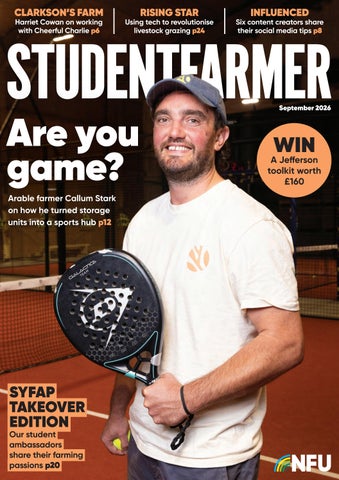
Are you game? Arable farmer Callum Stark on how he turned storage units into a sports hub p12
SYFAP TAKEOVER EDITION
Our student ambassadors share their farming passions p20
RISING STAR
Using tech to revolutionise livestock grazing p24
INFLUENCED
Six content creators share their social media tips p8
September 2026
WIN
A Jefferson toolkit worth £160
Animal & Equine Degrees Designed for Your Future Why Study at WCUC? Hands-on, Practical Learning
Specialist Facilities
Strong Industry Connections
Career-Focused Pathways
Degree Courses Available for September 2027 Entry: • Animal Behaviour & Training • Canine Rehabilitation & Hydrotherapy • Equine Performance Coaching • Equine Therapy & Rehabilitation • Veterinary Nursing • Veterinary Physiotherapy
Visit our Open Event to find out more: Moreton Morrell College Saturday 17th October 2026 10am – 2pm
To book your place at our next Open Event visit:
wcuc.ac.uk/degreeopenevents 2
September 2026
Scan QR code to apply
Contents
CONTENTS PUBLISHED BY:
NFU, Agriculture House, Stoneleigh Park, Stoneleigh, Warwickshire, CV8 2TZ
04
FROM THE FIELD
06
FROM FARM TO (SOCIAL) FEED
EDITOR:
WORDS BY:
DESIGNED BY:
John Cottle
12
FARM FITNESS
18
THINGS TO DO...
20
COVER IMAGE BY:
John Cottle
TO ADVERTISE, CONTACT:
Farming news, stories and opinion we think you’ll love
Harriet Cowan from Clarkson's Farm and six content creators share their top tips for posting online
Joanna Thomson joanna.thomson @nfu.org.uk
Amy Browne, Georgina Milne, Beth Moore, Jess Madge, Nikita Fineran, Lydia Gardner, Nat Watkins, Jacks Weaver, Mike Greenwood-Wilkins, Magnus Brown, Joanna Thomson
06
Unused potato sheds are now padel courts; fitness influencer Tom York talks mental health
What’s on near you this autumn/winter
NEURODIVERSITY
Jess Madge sits down with a Nuffield scholar to discuss the latest research
24
RISING STAR
27
COMPETITION
Scott Keyes scott.keyes@nfu.org.uk
29
One young farmer is using tech to look after his cattle
31
34
Win a £160 toolset from Jefferson Tools
STOCKJUDGING
Why taking up this activity could have a lasting impact
OPINION
Is more action needed to support people coming into the sector; or are we focusing on the wrong issue?
AGRI-CULTURE EDIT
Shed Talks’ Mike GreenwoodWilkins and Jacks Weaver choose their content obsessions
Fit for purpose
Read all past editions of Student Farmer at: issuu.com/studentfarmer
This summer has been an exceptionally challenging one. One of the hottest on record placed crops, livestock and their farmers under enormous pressure, while wildfires spread across the country. For many businesses, harvest brought further disappointment, with yields affected by the prolonged extreme weather. It is safe to say that the summer of 2026 will not be forgotten anytime soon. Therefore, with Back British Farming Day this September, it was the perfect opportunity to reflect not only on the tough season just gone and farming’s contribution to the country, but also on the wellbeing of the people keeping the industry moving. In this edition of Student Farmer, we explore the growing trend of ‘farm fitness’ and meet some of the people leading the way. Yorkshire farmer Callum Stark tells us how he transformed unused potato sheds into padel courts, while farmer and fitness influencer Tom York chats to Georgina Milne about what it really means to be strong within the industry. They say there is strength in numbers, and the sizeable followings of farming’s biggest social media stars certainly proves that point. We speak to six content creators about how they got started online and hear from Clarkson’s Farm star Harriet Cowan in an exclusive interview about life on the farm, her new book and working alongside 'Cheerful Charlie'. There is also plenty to enjoy from our student ambassadors in their annual SYFAP Takeover. We say it every year, but you really are in for a treat. Look out for the Agri-culture Edit, your guide to what is on this autumn and winter, and much more inside. Joanna Thomson, Editor September 2026
3
From the field
From the field Farming news, stories and opinion we think you'll love
Farmer raises £50k running length of the UK
W
illiam Sercombe, a young farmer from Leicestershire, has raised over £50,000 as part of a run which took him 870 miles from John O’Groats to Land’s End in just 14 days. The 22-year-old raised the money for Cancer Research UK in memory of his dad, Charles Sercombe, completing his mammoth challenge in June this year. Will began raising money when he learned of his dad’s diagnosis with stomach cancer in May 2024. To process this news, he started running five kilometres every day for a year and this culminated with an epic endurance run when he completed seven marathons in seven days. His final marathon finished at the Leicestershire Young Farmers’ Rally
on 10 May last year, where he raised more than £20,000 for charity. Alongside preparing for his latest challenge – a gruelling run from Scotland to Cornwall – the young farmer completed his final year at Bath University where he studied mathematics. Will chose Cancer Research UK as he said it resonated with him as the charity aims to try to find a cure for the dreadful disease. He said he wanted to play his part to prevent as many families as possible, going through a similar experience. Speaking ahead of his run, Will said: “I want to represent and symbolise how hard farmers work and hopefully give them the credit they deserve, as without the hours they put into their produce I and the rest of the country would not be sufficiently fuelled to meet our daily challenges.”
WIN A JEFFERSON TOOLKIT WORTH £160
Jefferson Tools is giving away an impact socket set retailing at £160. More details on how to enter our competition on p27.
4
September 2026
READY TO GROW:
UNLOCKING BRITI SH ECONOMIC POTENT FARMING’S IAL
GOVERNMENT MUST BACK BRITISH FARMERS, SAYS NFU
As part of its Back British Farming Day campaign, the NFU has called on government to set ambitious targets for homegrown food. This comes as a new report by the trade association revealed that the UK’s self-sufficiency in 10 out of 11 everyday foods, such as wheat, vegetables, beef, poultry meat and eggs have fallen in the last 30 years. At the same time, the country's reliance on imported food continues to grow, with agri-food import volumes up 70% during the same period, while export volumes have stalled. Keep up with the To turn the tide and latest developments secure a future for British in farming policy food production, the NFU and campaigns at believes that more action nfuonline.com is needed by government in this area. NFU President Tom Bradshaw said: “Our report paints a stark picture of falling production and an increasing reliance on imported food while at the same time the world is becoming more unstable. We can’t rely on the rest of the world to feed us. “Successive governments have sleepwalked into making it harder to produce food at home, leaving Britain increasingly reliant on imports produced to standards that would be illegal here. “Despite these pressures, British farmers continue to deliver jobs, growth and food. With the right backing, they can do even more.” Read the full Ready to Grow report at NFUonline.com
From the field
BECOME A FARMERS FOR SCHOOLS AMBASSADOR Fancy sharing your passion for farming with the next gen of consumers?
GOT A STORY FOR STUDENT FARMER? Let us know what you are getting up to on farm by emailing the editor at: Joanna.Thomson@nfu.org.uk.
The NFU is on the lookout for the next cohort of Farmers for Schools ambassadors, who will promote the sector to secondary school children and bust some myths along the way. The programme aims to help children understand farming and agriculture better. As tomorrow’s consumers, it’s vital that they learn about the work Applications for the 2027 cohort of farmers do. Nuffield Next-Gen Scholarships open Ambassadors deliver a 20 to in November. 30-minute assembly in local secondary Aimed at young people aged schools about day-to-day life on 18-24, the 30-day study programme their farm, and more than 400 farmers takes place over the summer each have been fully trained as part of the year and aims to give participants programme to date. the opportunity to develop their If selected, the expectation is that you will work with another ambassador and understanding of their industry. deliver at least two assemblies over the course of an academic year. The scholarship is Everyone selected will undertake a training session covering everything you fully funded and will The scholarship need to deliver an engaging school visit that addresses misconceptions about include all travel is fully funded and UK farming, introduces young people to role models from the sector and starts and subsistence will include all travel an open conversation with the consumers of the future. and attendance and subsistence Ideally, interested members will be aged 18 or older as there is a DBS/ at the Nuffield and attendance background check involved. However, this is not an absolute requirement and so Conference. It also at the Nuffield younger members, 16 or over, who are interested, should also feel free to apply. includes Nuffield Conference Our next Farmers for Schools training day is Monday 12 October at NFU Farming Associate Agriculture House at Stoneleigh Park, Kenilworth. membership.
Nuffield NextGen Scholarship back for 2027
INTERESTED?
Contact a member of the NFU Education team about the programme at education@nfu.org.uk. Visit NFUonline.com for more information, or scan the QR code.
Those interested in learning more about this year's programme can contact charlotte@nuffieldscholar. org, or visit nuffieldscholar.org/ scholarships/nuffield-farming-nextgen-scholarships
HARNESSING A MORE DIVERSE SECTOR The route to a more ethnically diverse, inclusive UK agriculture sector will get a thought-provoking spotlight at the AgriFuture Forum in East London on 22 October. The event is organised in association with the British Veterinary Ethnicity and Diversity Society and the Culture Roots Collective and is part of the NFU’s commitment to creating a thriving agricultural sector that represents the national population, fosters belonging, and harnesses the power of diverse thought and experience. Following the success of last year’s sold-out event, attendees will hear powerful lived insights, and look at new opportunities and bold solutions. The British Veterinary Ethnicity and Diversity Society will be also celebrating its tenth anniversary with a reception and networking event after the forum. It will be hosting the inaugural AgriFuture Awards to celebrate amazing Global Majority individuals who have led the way and continue to inspire and make a positive difference to our sectors. Full NFU members can grab a free ticket to this event. More information can be found NFUonline.com September 2026
5
From farm to (social) feed
Writing her own story After winning over viewers on Clarkson’s Farm, Harriet Cowan reflects on her busy life so far in her debut book. She tells Student Farmer why she’s still happiest on a tractor.
B
est known for her stint on Clarkson’s Farm, Harriet Cowan has packed a lot into her 25 years. After gaining a degree and working full time as a nurse, the Derbyshire native couldn’t resist the pull to the industry she grew up in. Raised on a small beef farm, which belonged to her grandad, Harriet always had one eye on the prospect of working there. “But my mum wanted me to have something to fall back on and the farm couldn’t employ us all, so it wasn’t an option unless we got a farming job elsewhere,” she says. Not wanting to turn her back on the industry, Harriet began working with a farming contractor after clocking off from her nursing shifts. “I’d go straight from work to sitting on a tractor until the early hours of the morning. But I loved it, so it didn’t matter what time we finished.” Frustrated at having to turn down farming opportunities due to her nursing commitments, Harriet decided to follow her heart. “I knew if I was happier farming, I would have regretted not doing it, but it was
6
September 2026
Life on the Farm is published by Seven Dials and is available now in hardback at £20, ebook £10.99, and audio £24.99.
terrifying making that decision,” she reflects. After starting to document her days on TikTok and Instagram, Harriet’s profile began to grow and she’d already chalked up 40,000 followers when the Clarkson’s Farm opportunity arose. “Charlie Ireland [aka the show’s ‘Cheerful Charlie’] got in touch with a local contracting group to ask if they knew anyone who might be interested in doing some work [on the show]. “I knew being in the Cotswolds meant a lot of arable work, so when I spoke to Charlie I was honest about the fact that I’m not experienced in arable – but I can put my hand to anything and have a go.”
“I didn’t really have time to think about it being filmed. A lot of the time I was doing things around the farm and the cameras were already set up, so I didn't notice them.” With Charlie convinced Harriet was the right fit, she signed up and began filming in 2024. “The first day I was drilling barley, which was terrifying because people are so reliant on how their barley crop grows. But Kaleb’s brother showed me how to use the drill and that was it – we just got on with it. “I didn’t really have time to think about it being filmed. A lot of the time I was doing things around the farm and the cameras were already set up, so I didn’t notice them.” Harriet’s dry sense of humour and natural farming ability made her a hit with viewers and saw her social media following grow to half a million, overnight. “It was crazy,” says Harriet, who describes Clarkson as “lovely”, but says she’s not the type to get starstruck. “My farming passion outweighs being bothered about who someone is. I get opportunities now to go to London, or an awards show, but I’d rather be on a tractor.” One opportunity Harriet didn’t want to pass up was releasing her debut book. In Life on the Farm she shares the realities of farming in her warm and witty style. “There’s lots in there about being a female in the industry, growing up in farming and then how I got onto Clarkson’s and lots of behind the scenes details,” she adds, admitting she’s “excited but apprehensive” about its release. “It’s strange for me – being born into farming, going into nursing and now releasing a book – it’s like my life has been flipped.” As well as sharing her story on the bookshelves, Harriet continues to use her social media platforms to inspire others. For young farmers wanting to do the same, she advises finding a ‘niche’. “I’m trying to inspire the younger generation to go into farming and make people see it’s a cool thing to do. I want people to think ‘if she’s done it, why can’t I’.”
From farm to (social) feed
COVER STORY
September 2026
7
From farm to (social) feed
Growing a following Amy Browne chats to six content creators inspiring the next generation of farmers one post at a time
L
ove or loathe it, everyone’s got an opinion on social media and in recent years many farmers have turned to TikTok, Instagram and more to share their daily reality of working in the industry. But while it has the potential to become a profitable diversification, building a loyal following doesn’t happen overnight. Student Farmer caught up with six successful ‘farming influencers’ to find out what it takes to stand out from the crowd.
EM DRINKALL Describing herself as a ‘professional cowgirl’, Em Drinkall, 24, injects her TikTok and Instagram content with a dash of humour and showcases being a woman in farming. “I want people to realise it’s ok to make mistakes and have a joke. Everyone knows someone in the industry who has suffered with mental health and it can be lonely. Social media gives farmers the opportunity to relate to someone doing the same job,” she says. Born onto a Cheshire dairy farm, Em recently moved to York to work on a large farm where she specialises in genetics. She spends 90 minutes a day filming and editing.
“You’ve got to keep the audience’s attention, which isn’t easy on TikTok – it takes a second to flick to the next video" “You’ve got to keep the audience’s attention, which isn’t easy on TikTok – it takes a second to flick to the next video. But the multitude of messages I’ve had from people saying I’ve inspired them, fuels me to keep going.” Em’s message to young farmers thinking of creating content is to be aware of the ‘negative side’. “When you make social media a big part of your life, it takes over. When the followers and views go up it’s fantastic, but with that comes negative comments. “People scrutinise what you say and disagree with it. When I was new to it, it got to me. You have to decide if you want to deal with that.”
8
September 2026
From farm to (social) feed FARMER BEN Describing himself as a farmer of organic veg, arable, beef and facial hair, Ben Andrews uses Instagram to answer questions, discuss farm policy and talk LGBTQ+ issues. The 44-year-old works with dad Colin, on a 600-acre mixed farm in Herefordshire. Ben admits he finds himself “getting too serious on farm policy, or environmental biodiversity” but tries to be a “voice in the middle”.
“Being yourself and showing people what you’re doing is one of the best ways to showcase British agriculture” “I’ve also been involved with Agrespect [the rural LGBTQ+ network] and it’s amazing the number of people who have gotten in touch to say they didn’t have anyone to talk to.” For young farmers keen to explore social media, Ben’s advice is simple: “Being yourself and showing people what you’re doing is one of the best ways to showcase British agriculture. Don’t sugar coat things and if you’re making claims, back it up with facts. “Don’t put too much emphasis on your appearance. You might get good engagement from a shirtless selfie on a tractor, but it can leave you feeling hollow. If you post something that helps inform people, that’s when it can be at its best.”
JOE SEELS
“It’s given Having started posting videos me lots of on a whim from his South Yorkshire farm, Joe Seels’ opportunities ‘day-in-the-life’ content has I wouldn’t have become a hobby he ‘never knew’ he wanted. found if I was “It’s given me lots of opportunities I wouldn’t have just farming” found if I was just farming,” says the beef and arable farmer. In the past year, the 38-year-old has been invited to various European cities to attend agricultural events, and become chair of Future Farmers in Yorkshire. “I don’t pay myself a lot from the farm, so my main income is from YouTube. But people should go into it [creating content] because they enjoy it – it can be difficult to succeed.” Joe spends an hour a day filming and editing. “If you’re doing short-form the first few seconds need to be intriguing. Long-form allows you to tell more of a story. “If as farmers we don’t tell our own story, someone will tell it for us. With social media we can show how different things impact us, whether that be inheritance tax, or new legislation. Having a say as real people within farming can hit home harder than a corporate voice.”
RED SHEPHERDESS First-generation farmer Hannah Jackson uses her social platforms to give followers a glimpse into her family life and farming. She lives on a 180-acre hill farm in the Eden Valley, with husband Daniel Gallagher, a farrier, and their children Blake, three, and Jesse, 15 months – plus 400 north country cheviots, goats, ponies, alpacas and more. Having not grown up in farming, Hannah, 33, joined Twitter when she was new to the industry, “to have conversations, get my name out and learn”. These days, she posts on Instagram, TikTok, Facebook and ‘a bit of YouTube’. “My content evolved as life changed – people loved seeing
“When I’ve farmed all day and got the kids to bed, that’s when the editing starts” what I was learning, now they love seeing me and Dan raising our family. Blake lambed her first sheep this year.” Rather than pushing agendas, Hannah has enjoyed building a community of followers. She says: “They’re completely invested – it’s like an online family.” But growing a loyal following hasn’t come without effort. “Being a mum is the best job ever, but it doesn’t mean you have to be removed from the farm. “But [creating content] is like a full-time job, on top of work and being a mummy. I need to capture what’s happening but also want to be in the moment as a parent. When I’ve farmed all day and got the kids to bed, that’s when the editing starts – it’s never ending.” September 2026
9
From farm to (social) feed REBECCA WILSON FARMING Before social media was a commonplace for farmers, Rebecca Wilson started posting online as an NFU Student and Young Farmer Ambassador “to show the everyday reality”. “I was amazed that people were interested in trimming sheep feet, or vaccinations,” says the 31-year-old, fifthgeneration farmer. Rebecca, from North Yorkshire, now enjoys the ‘two-way conversation’ it has become. “I’ll learn from someone else who’s doing things differently,” she says. She doesn’t shy away from difficult subjects. “A couple of years ago we had Schmallenberg in the sheep after the experts said it shouldn’t come as far north as here. “There was a massive stigma – people thought it was bad farming. I created a video and the amount of messages I had was unbelievable. “Highlighting it encouraged people to contact their vet and meant we could build a picture to push for a vaccine.” Before posting sensitive content, Rebecca says she’s meticulous about research. “There’s a danger of spreading misinformation. As farmers we have the power to tell our own story, but a lot of responsibility comes with that. “You don’t want to show something that’s not in line with regulations. “Don’t open yourself up to criticism, for your own sanity.”
“I was amazed that people were interested in trimming sheep feet, or vaccinations”
HOW TO BE A SOCIAL MEDIA SUCCESS Find your niche Social media platforms are a crowded place – think about how you can stand out from the crowd. Be consistent Growing a following takes time and commitment. Those who are successful post regularly. Are you prepared to give the energy it needs, alongside your existing work? Get involved in the conversation The most successful accounts don’t just post their own content, they engage with others, reply to comments and respond to trends. Mix it up Depending on which platforms you use, you might need to think about capturing short- and long-form video, sharing pictures and creating graphics, to have a varied profile. Do your research You’re representing an industry so trust is crucial. If you’re tackling a complex subject, be sure of what you’re presenting before you hit publish.
OLLY BLOGS AGRICONTRACT After spotting his early social media posts about farming, Olly Harrison was approached by the BBC to film some regular content. “It ended up being the first day of lockdown so I got footage on my phone,” he says. “I called it Cab Isolation.” That was the start of Olly, 45, uploading a new video every day and he’s now across YouTube, Instagram, TikTok and Facebook in what has become a profitable diversification for his Merseyside farm. “It helps fund my machinery obsession,” he says. “I show everything and sometimes people will be negative, but the content gives young farmers an understanding that a lot can go wrong.” Olly’s got followers all over the world and his authenticity has an impact. “One of the most humbling things was when a guy came up to me at a show, who was really emotional. He said his son was never interested in the family farm but after watching my videos he now wants to work there when he leaves school.” Olly credits his dyslexia for helping to create compelling content. “I’ve got a visual mind so I know what’s going to look good and what people will want to watch. The hardest bit is getting used to the sound of your own voice.”
10
September 2026
“I’ve got a visual mind so I know what’s going to look good and what people will want to watch. The hardest bit is getting used to the sound of your own voice.”
September 2026
11
Farm fitness
COVER STORY
SERVING SOMETHING NEW Arable farmer Callum Stark tells Student Farmer how he took the
plunge and turned modest storage units into a trendy sports hub John Cottle
12
September 2026
“A few of my mates in London said how much padel is flying down there and I worked out you could get two courts in one potato shed”
F
or many farms, diversification has become a crucial way to build financial stability. From creating glamping sites and farm stays, to opening cafes, play centres, producing renewable energy and letting commercial property, the options to branch out and attract new revenue are endless. In North Yorkshire, farm manager Callum Stark decided to tap into a rising trend by converting his potato storage units into something quite unique. Last year, Callum, who runs Fridlington Farms, with his dad Stuart, opened the UK’s first farm-based padel court. The concept has proved so successful, he’s now expanding further and franchising. “I had other ideas for diversification, but we never really had to because of the size of the farm,” explains Callum, who lives on the 1,300-hectare estate with wife El and their two young children. But changes to inheritance tax laws now mean the farm will face a £6 million tax bill if Callum’s 93-year-old grandmother – who owns major shares in the company – was to pass away in the next seven years. “We’d have to sell off nearly everything and it wouldn’t be the same farm,” he says. In order to future-proof the business, Callum began considering what aspects of the farm could be monetised in a different way. “I looked at things like wedding venues – but there’s already loads around North Yorkshire. And I’ve seen so many farm shops fail. “A few of my mates in London said how much padel is flying down there and I worked out you could get two courts in one potato shed. I thought I’ve got nothing to lose, because if it doesn’t work I’ll rip it out and return it to what it was before. “So I had a go and hey presto, we’re now ‘padelers’,” laughs Callum. “I was lucky because I got it going at
Farm fitness the right time – I was the first insulated, indoor court in the York area. I’d played at a local gym where there’s an outdoor court and a bit on holiday, but I’m more of a rugby and cricket man so never really took to it myself. But I thought if I’m the only one with a court in the area there must be something in it.” Callum admits it took more work to set up than he expected and after announcing the launch date in March 2025, he discovered some last-minute changes to the floor were needed, resulting in a tense race to get everything finished on time. “The person I got the court from said it would be plug and play, all very easy, with an automated booking system. When I got into setting it up there was a lot more hard work than I expected. If people diversify they need to realise that. I’m lucky because of the scale of our farm and the other people we have working here – it meant I could work on setting up the padel business in the mornings, then farm in the afternoon. Starting a new business takes over.” Despite its rural location, once open the padel courts attracted a steady stream of customers and Callum credits taking on a coach with helping to make it a success. “I don’t have a clue about how to coach padel, or the time to do that. Because it’s a new sport not everyone knows how to play it, so we needed a coach in place and thankfully we have Andy who works on a self-employed basis with a revenue share.” Callum is certainly not alone when it comes to diversifying. Government figures show 72% of farm businesses in England had some form of diversified activity in 2024-25. Half of those diversifying have chosen to do so by letting out buildings or land for activities not connected to the farm (and not including income from tourist accommodation). Offering something different has paid off for Callum. “At the start we were about 60% capacity and by the end of the year we
September 2026
13
Farm fitness
“Farming had started to become a drain – you put all the hard work in and then look at the figures at the end and you’re scraping the tiniest bit of cream off the top” were at 90% – that’s why having the insulation was so important, to maximise use all year round. We’ve got the height in the potato stores as well, because in padel doing a ‘lob shot’ is a huge thing and you need height for that. “To get the word out I did a bit of advertising in the local area, hammered the socials and got onto TalkSport and in some of the newspapers. The interest was there because we’re one of the first farms to do it.” Having started with two courts, Callum has expanded to five and his plans don’t end there. “I’m creating a seven-court facility with a HYROX gym, spin class, ice bath, sauna and hot tubs. Somewhere I can hide basically,” he laughs. “If you’re going to do this, I’d recommend opening at least two courts to begin with because with just one you don’t get a social hub around it. You need to build a community.” Callum’s new business venture has also given him a renewed sense of purpose in his professional life. “For me, farming had started to become a drain – you put all the hard work in and then look at the figures at
14
September 2026
the end and you’re scraping the tiniest bit of cream off the top. “This is exciting to me because it’s bringing people together and it’s fantastic seeing your idea come to life. But it’s busy running two businesses and sometimes I have to work at night, but I’ve got two young kids as well. Nothing comes easy though and it will calm down.” For farmers who are considering diversification, it’s important to strike a balance between taking a chance and making an informed decision. “Unfortunately, it’s a sign of the times in the farming industry that we have to diversify,” says Callum. “Farmers know their area, so look around and think what would I, or my friends, want around here – it might be yoga, pilates, a nice café. I think after Clarkson’s Farm people feel more connected
with farming, so it’s a good time to have a go. The worst thing that could happen is you shut it down and sell off the assets. “Some farmers don’t like dealing with the public, so look at an aspect of the farm you really love and put your heart and soul into that. You need to do something you’re interested in and just have a go – you’ve only got one life.”
FROM POTATO SHED TO PADEL COURT Callum reveals his top tips for young farmers looking to diversify their farming businesses. Learn more about The Padel Farm and farming diversifications at nfuonline.com.
WE
R
YOU E R A
Visit our Open Events: Lackham Campus: Saturday 3 October | 10am-12pm Saturday 14 November | 10am-12pm
Chippenham Campus: Tuesday 6 October | 5pm-7pm Saturday 14 November | 10am-12pm
T ST E
P
N
EX
Salisbury Campus: Thursday 8 October | 5pm-7pm Saturday 21 November | 10am-12pm
Trowbridge Campus: Wednesday 30 September | 5pm-7pm Saturday 7 November | 10am-12pm
Register now at wiltshire.ac.uk September 2026
15
Farm fitness
B
ritain’s Fittest Farmer was launched in 2018 to spark a conversation around the physical and mental health of Britain’s farmers. On the surface it’s exactly what you’d expect: mud, ropes, impossible obstacles, people dragging machinery that really shouldn’t be dragged. Underneath the spectacle sits a broader question about how the industry understands strength itself. While the course tests physical strength, the competition also asks entrants to reflect on their mental wellbeing, prompting a broader conversation about what it really means to be strong. Farming does not suffer from a lack of strength. If anything, the challenge lies in how strength is understood and valued. For generations, the industry has celebrated endurance, self-reliance and the ability to carry on regardless of circumstances. Yet these qualities are not always the same as resilience. Endurance asks people to persist in the face of difficulty; resilience includes the capacity to recognise when something is wrong, adapt to changing circumstances and to seek support when it is needed.
ENDURANCE ISN’T RESILIENCE
I put this distinction to Tom York, agricultural consultant, mental health advocate and 2026 Britain’s Fittest Farmer competitor. Few industries place a higher value on perseverance than farming. Long hours, unpredictable
16
September 2026
Another kind of strong Georgina Milne speaks to agricultural consultant and health influencer Tom York about why keeping fit is about more than just building physical strength VW Commercial
conditions and financial pressures have helped to create a culture that rightly admires determination. However, the qualities that make someone effective in difficult circumstances are not always the same qualities that protect their wellbeing. The ability to endure should not be confused with the ability to adapt. Yet the two are often treated as synonymous, creating a risk that resilience becomes defined not by recovery and growth, but simply by
Farm fitness how much hardship a person can absorb before something gives way. Maybe resilience isn’t the ability to absorb hardship, but the ability to look at yourself honestly and change course. “Resilience is being able to adapt,” Tom told me, “It’s being able to look inwards at yourself and think: ‘Okay, how am I going to better equip myself to come out of this situation better off than I went into it?’” That’s not gritting your teeth, it’s often the opposite. “It means accepting the thing you’ve always done might not be working. It means changing your mindset, asking for help, taking a different path, communicating, none of which comes naturally in a culture that prizes endurance above all else.” Resilience isn’t about how much someone can carry before they break; it’s about recognising when the load needs shifting. Suicide remains a serious concern across farming and rural communities, with agricultural occupations carrying an elevated risk. Mental health is consistently identified by young farmers as one of the biggest hidden pressures they face. It sits alongside the relentless challenges of weather, financial uncertainty, isolation, and sometimes, the weight of stewardship on a farm that’s supposed to outlive you. Yet, you cannot build a culture where saying “I’m struggling” is seen as weakness and then expect people to speak up when they need help. Instead, people go quiet. In part, that reflects a culture which has sometimes rewarded stoicism more readily than it rewarded openness, making it even harder to acknowledge difficulties before they become overwhelming.
THE FITNESS TRAP
I began writing this piece assuming it would end up as a case for exercise: get more farmers fitter, and the rest follows. And that’s partly true. Mental and physical health are deeply connected. But the more I spoke to Tom, the clearer it became that fitness alone isn’t the answer. Tom had seen people pursue a marathon or a competition because of ‘external noise’ rather than because the
goal genuinely mattered to them. The achievement may still be real, but without a personal reason behind it, it does not necessarily create the confidence or purpose they had hoped for. A physical challenge may be the right goal for some people. More important, however, is finding something that carries genuine personal meaning. Goals are most powerful when they are pursued for reasons that matter to the individual rather than to satisfy external expectations. Without that sense of purpose, personal development can become performative: focused more on projecting an image of strength than on building the self-awareness, confidence and resilience that underpin lasting wellbeing.
WHY CONNECTION MATTERS
This is where Britain’s Fittest Farmer earns its place: not only for the fitness itself, but what the fitness creates around it – direction, and the connection that comes from sharing something hard with another person. Tom spent the day competing alongside a farmer from Mid Wales, someone he’d never otherwise have met. By the end, they’d covered a lot more than fitness. “We spent the whole day chatting about life, about mental health, about how valuable it was to step away from the farm for a while,” he said. “When you’re putting yourself through something physical together, the barriers come down. You stop worrying about being judged.” Shared discomfort strips away the performance. “You never walk away thinking, ‘I’ve just talked about my mental health,’ he added. “You walk away thinking, ‘I’ve just shared something with that bloke that I’ve never told anyone before.” I’m not suggesting that everyone enters Britain’s Fittest Farmer. Rather, the lesson is that everyone benefits from having something meaningful to invest in beyond the daily demands of work, and ideally people they can share that journey with. For Tom, that happened to be physical fitness. The principle is not about sport, nor does it require stepping away from farming altogether. It might be making time for yourself,
strengthening existing relationships, or pursuing a goal that provides a sense of progress and purpose. Britain’s Fittest Farmer is simply one route to a broader realisation: resilience is rarely built in isolation.
A DIFFERENT MEASURE OF STRENGTH
Tom believes strength isn’t keeping going when things aren’t okay. Real strength is built by voluntarily doing hard things within your control, so you’re better prepared for the things that aren’t. That hard thing doesn’t have to be physical. It can be anything where the reward comes from figuring something out, in a world that keeps getting better at offering you a shortcut instead. Tom told me: “Once you repeatedly feel pride from doing something uncomfortable on your own terms, you start rebuilding confidence in yourself. Step outside the walls you’ve built up on the farm, prove you can do something difficult, and the same courage that got you through it starts to feel available elsewhere, including in the conversation you’ve been avoiding.” So, while I could be writing about the well-established benefits of exercise, I’d rather stop treating “get farmers into the gym” as the finish line. Treat it as one path on a longer journey, because strength doesn’t have one metric.
SHARING THE LOAD
Sometimes strength begins with letting someone know that things are not quite right, before six months have passed carrying it alone. It can be as simple as admitting you’re tired, acknowledging that things could be better, or allowing someone else to see the pressures you’re carrying. Pride may tell us that vulnerability is a risk, but isolation often carries a far greater one. “Asking for help isn’t the opposite of resilience,” Tom told me. “Sometimes asking for help is the thing that allows resilience to continue.” Farming has never lacked strong people. What it may need is a broader understanding of strength: one that values connection as much as self-reliance, and honesty as much as endurance. The challenge is not to abandon the qualities that have sustained farming communities for generations, but to recognise that resilience is rarely built alone. Perhaps the more important question is not who can drag a pickup across a field, but what happens when the challenge cannot be overcome through determination alone. September 2026
17
Things to do...
31 DEC
London New Year’s Eve Fireworks
As the festive season approaches, NFU Graduate Beth Moore shares her pick of events happening this winter SEPTEMBER 17-20 September Blenheim Palace International Horse Trials Woodstock, Oxfordshire Tickets from £30.60 bpiht.co.uk
7-8 OCT
Horse of the Year Show
18-20 September Goodwood Revival Goodwood, West Sussex Tickets from £84 goodwood.com/motorsport/ goodwood-revival/
NOVEMBER
25-27 September Malvern Autumn Show Three Counties Showground, Worcestershire Tickets from £22 malvernautumn.co.uk
OCTOBER
November 2026-January 2027 Winter Wonderland Hyde Park hydeparkwinterwonderland.com
4-5 November Farm Business Innovation Show NEC Birmingham Tickets free, registration required farmbusinessshow.co.uk
4 November National Fruit Show Kent County Agricultural Society, Kent Showground Tickets free, registration required nationalfruitshow.org.uk
7-8 November The Newark Vintage Tractor & Heritage Show Newark Showground, Lincolnshire Tickets from £17 newarkvintagetractorshow.com
6 October England v Czechia: UEFA Nations League Wembley Stadium, London Tickets from £25 ticketmaster.co.uk/england-v-czechialondon-06-10-2026/event/ 7 October The Royal Bath and West – Dairy Show Bath & West Showground, Somerset Tickets from £19 bathandwestshowground.com/events/ the-dairy-show-2026 7-11 October Horse of the Year Show NEC Birmingham Tickets from £42.10 hoys.co.uk 17-26 October Film Bath Festival Locations across Bath Tickets from £22 filmbath.org.uk
18
September 2026
7 NOV
Lord Mayor's Show
Photos: Getty images, Peter Nixon, Mikal Ludlow, Richard Hodgson, Dare & Hier Media
18-27 September York Food and Drink Festival Parliament Street and citywide yorkfoodfestival.com
Things to do... 17-20 SEPT
Blenheim Palace International Horse Trials
11 November South of England Farming Conference South of England Showground, Haywards Heath Tickets free seas.org.uk/professionaldevelopment/farming-conference/ 14 November Lord Mayor’s Show City of London lordmayorsshow.london/ 28 November Blossoms Co-op Live, Manchester Tickets from £44.50 ticketmaster.co.uk/blossomsmanchester-28-11-2026/event/
DECEMBER 11-12 December Pete Tong Presents Ibiza Classics The O2 Arena, London Tickets from £50.35 ticketmaster.co.uk/pete-tongpresents-ibiza-classics-tickets
7 OCT
Malvern Autumn Show
17-21 December London International Horse Show Excel London Tickets from £42.95 londonhorseshow.com 18-19 December Howden Christmas Racing Weekend Ascot Racecourse, Berkshire Tickets from £19 ascot.com/racedays/christmasweekend?date=2026-12-18
The Royal Bath and West – Dairy Show
25-27 SEPT
26 December Boxing Day Racing Aintree Racecourse, Merseyside Tickets from £30 thejockeyclub.co.uk/aintree/eventstickets/boxing-day/tickets 31 December London New Year’s Eve Fireworks Events across London
JANUARY 20-21 January LAMMA NEC Birmingham lammashow.com 20-21 January Low Carbon Agriculture NEC Birmingham (co-locates with LAMMA) lowcarbonagricultureshow.co.uk
Neurodiversity
Thinking differently about farming Student & Young Farmer Ambassador Jess Madge sits down with Nuffield Scholar Liz Haines to discuss why agriculture must become more neuro-inclusive
SYFAP TAKEOVER
N
eurodiversity is a broad term, and for many people, me included, it can sometimes be difficult to fully understand. At its simplest, it describes the broad range of ways people think, learn, communicate and process information. As someone with dyslexia, I know what it feels like to find everyday tasks challenging, especially in environments that are not always designed for the way your brain works. I also know that different ways of thinking can bring different strengths. That is why the conversation around neurodiversity in agriculture matters: a recent industry survey found that 36% of respondents identified as neurodivergent. Liz Haines, a dairy farmer based in Staffordshire, conducted a Nuffield report on neurodiversity in agriculture, examining
20
September 2026
“The conversation around neurodiversity in agriculture matters: a recent industry survey found that 36% of respondents identified as neurodivergent” the unique skills neurodivergent thinkers bring to the industry and how we can make the industry more inclusive. For Liz, the figure tells an important story about the people who are drawn to farming. “Globally, around 15–20% of people are thought to be neurodivergent, but higher levels are not unique to farming. Other
sectors, including construction, building and veterinary work, have also found increased levels of neurodivergence,” she says. “It suggests that people with particular ways of thinking and working often choose industries that suit them best.” Farming is not a simple career; it is not just about producing food, it is also about being a businessperson, entrepreneur, manager, problem solver, and so much more. For many neurodivergent people, the structure and environment of farming can be a good fit. “Some enjoy the farm working environment because it means being part of a small team, spending time alone, doing practical work, being outdoors or working with animals. All these factors suggest people choose agriculture because it suits the way they think and work.”
Neurodiversity get stuck in.” While that attitude may come from a good place, Liz explains that labels can sometimes help people access understanding and support. For employers, there can also be fear around getting things wrong or having to make major changes. “When employers hear about [neurodiversity], they panic and think they are going to have to do loads to accommodate; it’s going to be difficult, costly or trouble, when it really is not anywhere near as complicated. It’s just about treating people as humans, understanding their needs, because most people know what they need. They possibly haven’t been in an environment in the past where they’ve been able to express it, where they’ve not felt safe to say. And it’s just about creating those environments where people can talk about what they need.”
Nuffield Scholar Liz Haines
This challenges the assumption that some young people were encouraged to enter agriculture because they were seen as less academically able. That shift in attitude matters, especially for students and young people entering
“The conversation is starting to move at pace. (People) are starting to recognise the importance.” the industry. Farming should not be a fallback option but seen as a skilled, varied and valuable career opportunity where different kinds of intelligence are needed. Since publishing her research, Liz says she has noticed an uptake in awareness: “I don’t know about attitudes changing, but I think I’ve tapped into something that we were just on the cusp of starting to recognise and understand. “I feel like the conversation is starting to move at a pace and other organisations are starting to recognise the importance.” Campaigns such as Farmers Weekly’s Level the Field have also helped open the discussion and reduce stigma. “Over time, our knowledge and understanding have evolved, and we’ve moved away from some stereotypes and outdated perceptions of neurodiversity, which has led to better conversations.”
FOCUSING ON STRENGTHS
One of the biggest challenges in talking about neurodiversity is striking the right balance. It’s important to recognise strengths but not ignore the difficulties an individual may face. Liz explains that while some people find the idea of neurodivergent ‘superpowers’ positive, others may feel it doesn’t reflect their full experience. While everyone has different strengths and weaknesses, neurodivergent personalities are sometimes described as ‘spiky profiles’. This means the gap between their abilities and areas of difficulty is more pronounced, so they tend to excel in certain areas but face deeper challenges in others. “The key thing is how to get people to focus on the spikes and maximise those spikes; once you find out what someone’s talents are, give them the environment or job role that enables them to focus on those,” she explains. “It’s about understanding people as individuals and working out what their strengths and talents and passions are and how we can make space for that within our farms and businesses.”
BARRIERS REMAIN
Despite growing awareness, barriers remain. Liz says that these include systems, stigma, lack of awareness and confidence. “Many people said they dislike labels; they simply want to accept people as they are if they are hardworking and willing to
SMALL CHANGES CAN MAKE A BIG DIFFERENCE
Liz is keen to stress that making farms more neuro-inclusive does not have to be expensive or complicated. In many cases, small changes can make a big difference. The main priority is clarity of communication or expectations. That means talking to people, asking what they need, listening properly and avoiding making assumptions. The second is making information more visual: “For a very large proportion of neurodivergent people, visual information is easier to process. If you can use whiteboards, pictorial instructions or even videos to show things.” On farm, this could mean clear visual protocols in calf sheds, machinery areas, and workshops. For example, colostrum protocols in calf pens could be presented using clear bullet points, pictures, and instructions that stand out. The third is consistency: “Let people know in advance about changes. I understand that farming can be unpredictable, but if you can communicate as early and consistently as possible, it’s going to help people feel more in control.” These changes are not only helpful for neurodivergent workers but could also benefit everyone on a busy farm.
FINDING CASE STUDIES ABROAD
As part of her Nuffield research, Liz travelled overseas to understand how neurodiversity is being approached in agriculture elsewhere. She found that many examples focused on care farms, which provide important therapeutic and social benefits. September 2026
21
Neurodiversity began as a WhatsApp group and is set to grow. The group offers a space for people in the agricultural industry to connect, share experiences and feel less alone.
Student & Young Farmer Ambassador Jess Madge
PRACTICAL TIPS FOR FARM BUSINESSES
“Don’t get me wrong, care farms have got a really important place to play for people with higher support needs who might not be looking to enter the workplace but want to have the kind of therapeutic and social benefit of spending time on a farm, and I think that’s wonderful and fantastic,” she explains. However, Liz also wanted to look at commercial farm businesses employing neurodivergent people in paid roles. One example was SunPork Farms in Australia, one of the country’s largest pig producers, which piloted an ‘autism hiring’ programme. “This showed how it can be done, by showing you can roll out autism awareness training in a business in the outback in Australia and for all the staff to engage and be supportive. “It shows that neurodivergent people do want to work in the industry and want to be outdoors to work with animals, and there’s an opportunity for all kinds of different minds within farming.”
TAKING ACTION
Although things seem to be ‘getting better’, Liz says specific support for neurodivergent people in agriculture remains limited. She acknowledges the important work of farming mental health charities such as RABI and FCN, but says that neurodiversity-specific support in rural
22
September 2026
“It’s about having that understanding of what neurodiversity actually is and how it impacts people, how neurodivergent people experience the world, and then it’s meeting them from a place of acceptance” areas is still not there. “None of them yet have a specific focus on support for neurodivergent people; I hope that is an area that will change in the future.” In Scotland, there have been some targeted initiatives, including a dyslexiarelated project through NFUS and RABI Scotland with Dyslexia Scotland, but there is currently little rural-specific support in England. To help fill that gap, Liz has co-founded the Rural Neurodivergent Network, which
For agricultural colleges, training providers, and young farmers, Liz believes the first step is to understand what neurodiversity is and how it affects people. “It’s about having that understanding of what neurodiversity actually is and how it impacts people, how neurodivergent people experience the world, and then it’s meeting them from a place of acceptance.” She says organisations should not always expect neurodivergent people to explain themselves or ask for help. Instead, inclusive design should be built from the start. This could mean shorter sessions, more interactive training, quiet breakout spaces, closed captions and visual materials. This is particularly important for young people entering agriculture, who may still be learning how to advocate for themselves. Creating more inclusive spaces can help students feel they belong before they begin their careers.
LOOKING TO THE FUTURE
When asked what progress she would like to see in five years’ time, Liz hopes the stigma around neurodiversity will have reduced even further. Most importantly, she wants younger people entering agriculture to see that neurodivergent people can succeed in the sector. For anyone in agriculture who feels unsupported or misunderstood, Liz’s message is direct: “There are lots of us out there who feel like this; please come and talk about it and join the network. The best thing about getting a diagnosis is you realising you’re not alone and that it’s not just you; it opens that doorway to understanding, acceptance and meeting people who have experienced the same things that you do.” Agriculture has always relied on people who can think differently, solve problems and adapt to change. As the industry faces new challenges, recognising neurodiversity is not just the right thing to do. It may also be one of farming’s greatest strengths.
JOIN THE NETWORK Anyone interested in joining, or even just finding out more about, the Rural Neurodivergent Network can contact Liz on LinkedIn by searching 'Liz Haines, Director at Wells Farming Ltd'.
MAXIMISE YOUR
EXPERIENCE
The Stoney Creek Tempest Range is purpose-built to maximise your experience in the toughest rural conditions. Designed for farmers and outdoor workers, every detail is built around keeping you dry, warm and comfortable so you can focus on the job at hand. From dawn till dusk, Tempest gear gives you the confidence to be prepared for whatever the weather throws your way. BECOME A STONEY CREEK STOCKIST
If you have a retail premises and want to offer your customers our purpose-built outdoor gear, we’d love to hear from you. Open a Trade Account today and join our network of trusted retailers. *Retail premises required.
PH: (+44) 01642 712211
EMAIL: ADMIN@STONEYCREEKOUTDOORS.CO.UK
WEB: WWW.STONEYCREEKOUTDOORS.CO.UK
September 2026
23
Rising star
Breaking boundaries Editor Joanna Thomson speaks to a young farmer using tech to look after his beef herd and revolutionise the way they graze John Cottle
“P
eople were concerned about the economics of it all, whether the numbers actually stacked up and the investment was worth it. It’s my bank account the money is coming out of, so I had to sit down, work it through and really weigh it up. I concluded it was worth investing in. I’m still grappling with the economics, to be fair, but I’m already seeing results.” Self-proclaimed guinea pig Harvey Dunn, 25, is one of the first farmers in his area to embrace a new digital alternative to physical fencing. Managing a pasture-based beef enterprise near Milton Keynes in Buckinghamshire, Harvey looks after a herd of 120 mixedbreed beef cattle, 30 of which are his own breeding cows, with the other 80 finishing cattle coming under his watch through contract work for neighbouring farmers. Agri-tech has always been a keen interest of his, so when a contact in the US spoke to Harvey about giving virtual fencing a try, he was all ears. As part of the system, cattle
24
September 2026
COVER STORY
Rising star wear collars digitally linked to an app, which, using GPS tracking software, allows the farmer to set boundaries for their cattle to roam. His friend in the US had been using the software under even more challenging conditions and at a larger scale, which gave Harvey the confidence to give it a go. He’s started by trialling 40 collars on a third of his cattle using a system called MONIL. It comes with both an upfront cost for the collars and an ongoing software subscription, but Harvey compared several products and felt MONIL was the best fit for his business. When I visited Harvey at the end of July, he was only three months into his trial. We meet in a field round the back of the village church, and looking around, it’s clear to see why it’s not the easiest patch of land to manage. It has ridge-and-furrow terrain, is prone to flooding, and contains several public footpaths, primarily used by dog walkers and sometimes by those on horseback. We have only been standing in the field for 10 minutes and already pups of varying sizes, from Dachshund to Labrador, have scampered past pursued by their owners. The field is also really difficult to divide using permanent physical fencing, Harvey tells me. That’s why he’s turned to virtual fencing for a solution. It allows him to manage grazing more precisely without obstructing public access or installing extensive infrastructure. Also, the boundaries of the fence can be changed through the app in around a minute, including very small adjustments that
would not be worthwhile making with physical fencing. “It’s nice to have people riding through here,” he says. “Permanent electric fencing would be quite prohibitive, especially for horses. “If it wasn’t for the collars, this place would be really hard to fence physically.” I know what you are thinking, ‘if there isn’t a physical fence in the field, how do the cows know there is a barrier in front of them?’. Harvey sets grazing boundaries through the MONIL app. As his cattle approach the boundary, the collar emits an audio warning that increases in volume, and if an animal continues beyond the warning, it receives a light electrical pulse. He’s only had the latter happen a handful of times, as the cattle seem to adapt quite quickly; they generally learn to respect the boundary within two or three days. He says: “I haven’t had an animal outsmart the software yet. If I do, that will be quite impressive. Some animals test the boundary more often than others, but you trust the software and it keeps working. It hasn’t failed on me… not yet anyway.” In October 2022, the UK Government’s Animal Welfare Committee (AWC) published an independent report on the use of virtual fencing systems and found that, with appropriate provider safeguards and operator use, these systems have several potential welfare advantages for livestock over conventional electric fencing. It noted that among its benefits is the ability of the system to deliver a known level of electrical pulse. “I’ve noticed an improvement in temperament since starting the project. They’re calmer, they herd up well together and they’re not too scatty,” he says. Looking over at the cattle, I see them huddled together, happily munching away on the grass; and I am about to nod in agreement with Harvey’s comment when I spot something unusual in the distance.
HARVEY’S ADVICE: HOW YOUNG FARMERS CAN INTEGRATE NEW TECH INTO THEIR BUSINESSES Learn from other farmers who are already doing what you want to do: “Hearing from people who are really pushing the limits makes me think: ‘Do you know what? I can handle this.’ Speak to a lot of people and gain as many perspectives as possible. You can learn something from everybody.” Choose the technology you are using very carefully: “Not all technology is useful to every farm. You might make more money and be a better farmer by not using technology. Don’t presume all tech is good in all places at all times.” Just go for it: “Being young gives you the advantage of naivety and being willing to jump in. We’ve grown up with technology. You might not know how to use the tech in front of you, but you can trust your ability to log on and figure it out.”
September 2026
25
Rising star
“Within a minute, I can change a boundary by a very small amount. With physical fencing, it wouldn’t be worth the time.” “What are those two doing over there?” I say, pointing at two cows at the other end of the field. Harvey laughs. “Any teething issues I’ve had with the software has been mainly user error to be honest. Two collars fell off, but that was because of the user: me,” he holds his hands up. “I put their collars on too loosely and a couple on too tightly. Once that was corrected, there were really no problems. The only annoying thing is that I now have 38 cows in my test group rather than the 40 I started with.” Harvey manages his herd over multiple sites, which he rents, and that means that ensuring his cattle are grazing the fields more efficiently is at the top of his priorities. His aim is to expand the
pasture-management side of the business while maintaining a low-input system. “You can see the immediate management effects of the system in the time it saves and the impact you can have on the land,” he explains. “Within a minute, I can change a boundary by a very small amount. With physical fencing, it wouldn’t be worth the time. I’m moving the boundary every two or three days, and I’m looking to increase that to once a day. “I might not see increased animal performance, but I might be able to keep 10 more cows than I would otherwise. That’s where it shows up on the bottom line.” Ever the entrepreneur, Harvey is also testing the technology with a view to using it in future projects with a local arable farmer. He’s looking to introduce livestock grazing into their arable rotation. “There are good prospects for integrating cattle into arable systems in the future,” he says. “Virtual fencing is going to help us do that. I could do it without the technology, but it’s going to be easier and, hopefully, more efficient with it. I’m looking at getting the herd grazing cover crops, stubble or dedicated SFI leys. We’ll see what happens, but I’m excited about it.” When he’s not thinking up new ideas for his farm, Harvey can be found posting content on his YouTube and Instagram (@ thebeeffedfarmer). He started a YouTube channel to share farming life and give the public more insight into his work. He believes content creation is only sustainable if he enjoys and feels genuinely interested in the subject. Forced or inauthentic filming and editing quickly becomes draining: “The only sustainable way to make content is to enjoy speaking about your subject matter.” He is clearly passionate about his virtual fencing project, so I’m sure it is only a matter of time before we see him on our screens talking about the success of his trial period. We’ll have to wait and see.
GETTING FUNDING FOR YOUR PROJECT National farming charity Addington Fund was instrumental in helping Harvey get his trial up and running. Harvey applied to Addington Fund via its New Entrant Small Grant Scheme and received a grant that meant he could purchase his virtual fencing equipment. “The funding I received covered a significant portion of the cost of the equipment, and it is also going to be vital in scaling up the project,” Harvey told Student Farmer magazine. Jo Webb, business development manager for Addington Fund, said: “Supporting young people into agriculture is one of the most rewarding aspects of our charity’s work. We want to encourage the best new talent to bring fresh ideas and progressive thinking to UK agriculture. “Addington Fund is unique among UK charities in providing grant support specifically aimed at helping new entrants take their first steps in farming. A grant for something as simple but valuable as head collars can have a real impact, giving young farmers such as Harvey the tools and confidence they need to progress their enterprises and build sustainable futures in the industry.”
APPLICATIONS OPEN NOW
The New Entrant Small Grant Scheme is currently open for applications. Through the scheme, the charity looks to support innovative individuals aged between 18-40 who are entering the agricultural industry in England and Wales for the first time, or who have been farming on their own for no more than five years with initiatives that deliver real benefits to their farming business: • healthy livestock management • sustainable soil care • preventing future issues that could affect long-term viability • exceptional project or innovative ideas. More details on how to apply for the grant can be found at www. addingtonfund.org. uk/new-entrantscheme, or by scanning this QR code.
26
September 2026
Competition
Ten tools every farmer should own
COVER STORY
Building a workshop from scratch on a fresh-out-of-uni budget? Darren Binns from Jefferson Tools picks the kit that will keep you farming when things break.
H
ere’s a truth nobody tells you at college: machinery only ever breaks when you need it most. Silage weather, lambing time, the morning of the inspection. A dealer call-out will cost you the best part of a day and a painful invoice – but a well-chosen toolkit means most repairs never leave the yard. The golden rule when money is tight? Buy the tools that fix the widest range of problems first and buy quality once.
For more information about any of the tools mentioned, visit jeffersontools.com.
150-PIECE TOOL SET The foundation. Sockets, screwdrivers, pliers, hex keys and spanners in one case – enough to tackle 90% of everyday jobs before you’ve bought anything else.
40-PIECE UNIVERSAL EXTRACTOR SET
The rescue kit for rounded nuts and sheared bolts, and the difference between a ten-minute fix and a scrapped part.
WIN A TOOLKIT WORTH £160
Jefferson Tools is giving one Student Farmer reader the chance to win the Tundra 32-piece ½” drive impact socket set, which is worth more than £160 and comes complete with a lifetime warranty. For your chance to win, email competitions@nfu.org.uk with the subject 'WIN Jefferson Tools' by Friday 27th November. The winner will be contacted shortly afterwards and announced officially in the January edition of Student Farmer magazine.
25-PIECE COMBINATION SPANNER SET
TUNDRA 32-PIECE ½” DRIVE IMPACT SOCKET SET
16-PIECE CHISEL AND PUNCH SET
Standard and deep sockets in forged chrome molybdenum, built for the seized, rusted fasteners farm kit specialises in.
For drifting out pins, splitting seized joints and persuading stubborn metal to move. Cheap, nearindestructible and endlessly useful.
3-PIECE WRECKING BAR SET
110-PIECE TAP AND DIE SET
18V CORDLESS GREASE GUN
7.5HP PETROL PRESSURE WASHER
450-LUMEN PEN LIGHT
From 6mm up to a chunky 32mm, this covers everything from fiddly electrical clamps to trailer wheel nuts. The workhorse.
Damaged threads are a fact of farming life. Re-cut them yourself and save components that you’d otherwise be replacing.
Daily greasing is the cheapest insurance a machine can get. A cordless gun with an LED light makes it painless, so it actually gets done.
Clean kit lasts longer, faults show up sooner, and a good washdown is the backbone of biosecurity. Petrol power means no hunting for a socket.
Leverage solves what strength can’t. Three lengths up to 36” for lifting, prying and shifting anything that refuses to budge.
Because faults never occur in daylight. Magnetic, pocket-sized, USBrechargeable, it’s the tool you’ll reach for more than any other. September 2026
27
DERBYSHIRE LANDSKILLS
(INCORPORATING DERBYSHIRE LAND-BASED TRAINING AND ASSESSMENT COMMITTEE & OCKBROOK TRAINING SERVICES) Registered Charity No 505745 NPTC City & Guilds Centre No 741174
Next edition of
Student Farmer out January 2027
Telephone or Text 01623 812641/07970415211 Email jackie.twilley@btinternet.com Website www.ockbrooktraining.net & www.derbyshirelandskills.org.uk
Please contact Scott Keyes
PROVIDER OF QUALITY LANDBASED TRAINING SINCE 1975 CITY & GUILDS NPTC CERTIFICATES OF COMPETENCE AND LANTRA AWARDS SAFE USE OF PESTICIDES SAFE USE OF CHAINSAWS TRANSPORT OF ANIMALS TRACTOR DRIVING, SHEEP DIPS, VETERINARY MEDICINES, FORKLIFT TRUCK & TELESCOPIC HANDLER, ATV’S. BRUSHCUTTERS/TRIMMERS, BRUSHWOOD CHIPPERS, MOWERS, MOLE CONTROL AND MANY MORE AGRICULTURAL & BUSINESS MANAGEMENT CONSERVATION LEGISLATION AND TECHNICAL SUBJECTS
on 07917 909 530 or email
Scott.keyes@nfu.org.uk for advertising opportunities
Enterprise Groups for Arable Crops and Vegetables also available FOR FURTHER INFORMATION CONTACT JACKIE TWILLEY REGISTERED WITH LANTRA, CITY & GUILDS, UK RURAL SKILLS, and MEMBERS OF C.D.S. TRAINING
ENROL NOW SEPTEMBER DATES AVAILABLE
28
September 2026
Stockjudging
Why you should give stockjudging a go
SYFAP TAKEOVER
Nikita Fineran missed out on this year’s national stockjudging championship because of a lack of available competitors – she says something must be done to save the tradition
S
tockjudging is one of the best ways to develop strong stockmanship skills; but from what I have seen in recent years, fewer people are taking part. That decline should concern us all. If fewer people get involved in these competitions, the future of these events, and the skills they help develop, could be at risk. For those not in the know, stockjudging is a competitive pursuit that involves carefully examining a group of animals and ranking them on a few key characteristics. We look at everything from the animal’s breeding to its movement, muscle and body condition. Competitions cover a wide range of categories, including beef, dairy, sheep and pigs; and strong performances at local level can open doors to much larger competitions. Competitors can progress to events such as the South of England Show, National Finals, and the Romsey Show, and there is even a Stockjudge of the Year competition you can enter. Judging is about far more than winning rosettes. It teaches valuable skills that can save money and improve livestock management back on the farm. By studying and assessing animals, you learn exactly what a healthy, properly puttogether animal should look like. Over time, you develop an eye for detail. You become better at spotting subtle changes in body condition and recognising early signs of illness before they become costly problems. These are practical skills that can be used every day, and that’s why it is sad to see these skills becoming discarded before my very eyes. Recently, I got a glimpse of what could be a very bleak future for
livestock judging. This year, I qualified for the national finals competition in July at the Great Yorkshire Show, but I was unable to attend. It was not because I failed to qualify or could not commit the time. Instead, I missed out because there were simply not enough qualified competitors in my county division available to compete. Sadly, the situation has not improved since then. If I cannot find a partner for a sheep judging competition this November, I could miss out on another major opportunity. It seems to me that judging is seen as something you do when you are younger – something you eventually grow out of when you learn the skills. Although it remains popular among younger children, participation seems to fall away as they enter their teenage years. I discovered judging later than most, which may explain why my enthusiasm for it is still going strong. My experience may be just one example, but it points to a growing problem that the industry cannot afford to ignore. We need to do something about this. That’s why I am challenging you, reader, to give stockjudging a try! Getting involved is easier than many people think. Your local Young Farmers Club is the perfect place to start. Club leaders can point you towards training days and competitions where beginners are always welcome. In Hampshire, the local judging competition takes place each April at Sparsholt College, but every county has its own events and training opportunities. These competitions provide a fantastic introduction to livestock judging and are open to anyone willing to give it a try. The Sparsholt competition, in particular, offers a relaxed environment where newcomers can gain experience, and build confidence
“I missed out because there were simply not enough qualified competitors in my age division available to compete” without feeling under pressure. I’ve only been judging for a few years now and this year I was awarded first place in senior sheep, pig and dairy linear judging, respectively, and among other awards, highest individual sheep judge senior at the South of England Show. I think that shows you what you can achieve by just giving it a go. So, speak to your local Young Farmers Club, put on a white coat, and have a go. You might surprise yourself with what you can achieve, and you’ll be helping to keep a valuable farming tradition alive for the next generation.
September 2026
29
Discover your potential with our Agriculture college courses & apprenticeships...
Apply now for 2027! College courses for 16-18 year olds and 19+ adult learners. Get industry-ready with rewarding career development opportunities.
Benefit from 130 hectares of arable land and livestock on our very own farm in the middle of the Essex countryside!
Find out more and apply: aru.ac.uk/writtle-college Why not come to one of our Open Days and see everything that Writtle College has to offer! 30
September 2026
10th October & 21st November
Opinion
More work needed
Young people looking to get on the career ladder face 'a dire situation' – so what more can be done to place farming as a viable career? Lydia Gardner reports.
‘Y
ou have to be a available at the RAU, which are always developing to meet farmer to work the needs of the industry. An example of this is the use of AI in agriculture.’ and how the university is developing their courses regularly ‘Farming is only to incorporate the safe use of technology and how students driving tractors and working can better use it to enhance their problem solving and with livestock.’ ‘You make no decision making. money farming.’ ‘You can’t But the solution doesn’t solely sit in the hands of higher farm; you’re a girl.’ education, it also sits much lower down in the educational These are just four of system. Louisa Dines, course manager for agriculture at the many, deeply incorrect Harper Adams University believes schools have more to do. misconceptions that we She added: “Young people aren’t getting a full picture of the hear today when it comes opportunities available in agriculture. There is more [work] to starting a career needed in schools, including a more positive portrayal of in agriculture. agriculture in the curriculum – and this is across the board, in As it stands, the UK is currently facing subjects such as geography, biology, food tech, and business SYFAP one of the largest jobs crises in recent studies, not just through a careers service in schools.” TAKEOVER history: we have a surplus amount of When it comes to educating younger minds about the jobs job seekers without the jobs “available”, available, there is a lack of understanding of the industry and graduates are exiting degrees with limited what there is to offer; therefore, in some cases, the subject is experience, and unskilled jobs are being taken being avoided altogether. Although larger organisations are by those who are, on paper, overqualified. campaigning, there are few joined-up initiatives that get into It’s a dire situation, with a large amount of uncertainty for schools and really show the broad range of careers and jobs those trying to get on a career ladder. available without having to get your hands dirty. However, it is quite a different picture in UK agriculture. Suzie Burley, of the RAU, has a background in modern The sector is in the middle of its biggest drive to careers and specialises in recruitment and employment. She introduce younger generations to the said: “There needs to industry and encourage them to take on new, be more focus on how LYDIA’S TIPS FOR GETTING developing roles. we find out what gets STARTED IN FARMING Lisa McWilliams, head of careers and people ticking, and get employability at Harper Adams University, them to think of the • Sit down and think about what really said: “Farming is changing – and is increasingly solutions that gets you excited. Look at your skills, technology-driven. There’s still work to do to are available.” how can these help you? All skills are make the wider public realise how modern an Agriculture is not transferable. industry farming can be. just shovelling muck • Search Google/AI: We live in the 21st “Traditional skills and practical experience or working long century where everything is at the tip with crops, livestock and machinery will hours in all weathers. of our fingers. • continue to be vital – but working in modern From a policy analyst Look at courses: Degrees, farming demands so much more. Skills such as to farm hand, plant apprenticeships, T-levels, skills bootcamps, diplomas, HN data analysis, an understanding of tech such breeder to food safety Ds or HNCs and so on. as apps, sensors and drones, an awareness of inspector, sustainability • Don’t be afraid to write to sustainability and the environment, and the consultant to the local farm er and ask to help out on ability to adapt to a changing climate, veterinarian, mechanic the weekends. Ask the local lan are vital.” to sales representative, d agent whether you can follow the Christopher Brough, head of international ecologist to forestry m for the day. agriculture at the Royal Agricultural adviser – and those • Create connections: Join University (RAU), agrees; there is plentiful are only a few of the organisations such as the opportunity within the agricultural industry opportunities out there Society of Agriculture, with members and jobs are becoming a lot more specialised – the careers available who work across farming and est ate and skilled across the sector. are so varied that anyone management, consultanc y, research, When I spoke to Mr Brough, he drew from anywhere can get government and much mo re. my attention to the wide range of degrees stuck in.
September 2026
31
Opinion
Where are we going wrong? Farming’s inability to keep hold of young staff is concerning – but this is not an unfixable problem, writes Nat Watkins
A
ttracting fresh talent into farming is a big challenge for the industry – but is recruitment only half the problem we currently face? It feels like we pay far less attention to retaining those who choose to become farmers or farmworkers. Recruiting and training a new employee, particularly someone who is new to agriculture, is generally more expensive than retaining an existing member of staff. If a simple ‘cost-benefit’ analysis shows that retention is crucial to running a successful farm business, then why aren’t we paying more attention to the numbers? The short answer: the system has worked fine (until now). Farming has always relied on seasonal and temporary labour, so for many businesses, a regular turnover of workers, from field pickers to extra hands in the milking parlour, is simply business as usual. This way of running things seems to have worked for many years, but times have changed and the latest figures on youth retention in the sector are concerning. Research into agricultural workforce in Australia, which was published in the Journal of Rural Studies earlier this year,
32
September 2026
estimates that more than half of young people leave agricultural employment within ten years, with very few returning to the sector. Yes, I know, this is Australia we are talking about – but farming is farming after all. We’re both facing similar challenges; we’re a sector of largely family-owned businesses, operating in rural areas, relying on hard physical labour and dealing with an aging workforce – I could go on. “All staff care about is money and when they aren’t getting enough, that’s why they leave.” This is an easy cop-out to the debate I’ve heard many times before. While this is generally true, this isn’t always the case – and it certainly doesn’t represent the full picture of what’s going on. Problems with management are also a reason why people leave. LIC consultant Piers Badnell found, through interviews of 20 dairy farms, that people would accept £10,000 less a year to work as a herd manager if it guaranteed them a good boss – rather than a bad one. As is often the case, valuable lessons can be drawn from the work of Nuffield Scholars, particularly Christopher Padfield and John Millington, who have done extensive research in this area.
Padfield’s GREAT Farmers study emphasised that training and career progression are closely connected. Agricultural employees are widely understood to receive less training than workers in many other sectors, yet he found that successful businesses tended to view their employees as an investment rather than a cost. Some employers may ask: “Why should I invest in training someone if they are going to leave next year?” Padfield’s response neatly captures the risk of failing to develop people: “If you train staff, they might leave. If you don’t train them, they might stay.” Alongside clear opportunities for progression, good communication is essential. John Millington’s study, It’s Time to Talk, placed communication with employees at the heart of managing a growing farming business. Farm teams are often small, with individual employees carrying considerable responsibility. Poor communication can therefore quickly lead to disengagement, frustration and disillusionment. Millington’s study found that clarity and transparency are particularly important when setting goals, defining expectations and allocating responsibilities. Although the demands of farm life can make regular communication difficult, he recommends holding whole-farm meetings and ensuring that every team member has a clearly defined role. Retaining skilled and committed employees is vital to the long-term success of individual farm businesses and the wider agricultural industry. Competitive pay will always matter, but it is only part of the solution. Agriculture will retain people by offering good leadership, meaningful training, clear opportunities for progression and workplaces in which employees feel informed, supported and valued. We’ve done a lot of research in this area, it’s now up to us to pay attention to problem and address it. It’s not just about recruitment; it’s also about retention.
SYFAP TAKEOVER
BBZ 9000 WITH METATARSAL PROTECTION
WHEN DAISY PUTS HER FOOT DOWN
Buckbootz BBZ 9000 with METZ™ metatarsal protection gets between you, Daisy’s foot and a really sore one. And it’s not just the metatarsal areas which are protected: BBZ 9000 has safety toecaps, NAIL STOP midsoles, real rubber outsoles which are slip resistance certified, fitted with ladder grips and are heat (300°C) and fuel oil resistant. That’s all before you get to antistatic, electrostatic discharge, lightweight, 360° reflective, heat and cold insulation, pull on levers and cracking good looks. BBZ 9000 provides metatarsal protection in a host of outdoor working environments - even ones where Daisy wouldn’t dare to tread.
METZ PROTECTZ
See the full range of Buckbootz safety wellies at www.buckbootz.com To find your nearest Agricultural Merchant stockist call 01382 82 82 00 or email info@buckbootz.com September 2026
33
Agri-culture edit
THE AGRI-CULTURE EDIT What’s got Shed Talks presenters
Mike Greenwood-Wilkins and Jacks Weaver talking? They share their current media obsessions.
FLEABAG
34
September 2026
TRACTOR-OKE!
Mike: My tractor cab listening during harvest has mainly been the Spotify ‘Belter Mix’ – songs specifically tailored to me for singing (badly) at the top of my lungs to get me through the long hours. You just can’t beat tractor-oke! I highly recommend it. (For better or worse, a few examples may have ended up on my Instagram feed…)
HEARTSTOPPER
Mike: For years I have been head-overheels in love with Heartstopper. (See my week one showstopper on The Great British Bake Off). A comingof-age romance centred around two secondary school boys and their group of LGBTQ+ friends. It is a story that I didn’t know how much I needed until it came into my life, broke me, and then healed emotional scars I had previously been too scared to acknowledge. First I loved the books, then the TV series, and now the film has affirmed my lifelong love for Nick and Charlie.
Photos: Getty images, BBC Pictures, 20th Century Fox
ZACH BRYAN
Jacks: Zach Bryan has been my main listen recently — steady, thoughtful and full of great storytelling. His songs have that easy mix of grit and melody that works whether I’m driving between meetings or winding down in the evening. I like how honest and unfussy his music is; it feels real without trying too hard. A reliable soundtrack for busy summer weeks.
Mike: I know everyone else obsessed about its brilliance years ago, but I have only just watched series two of Fleabag and it is PERFECT! Sensationally hilarious, deeply moving and scandalously naughty, it jumps from the most impeccably written and delivered comedy scenes to equally glorious, but emotionally devastating, personal/family drama.
THE ARCHERS
Mike: If you don’t already listen to The Archers, I implore you, please give it a listen for a couple of weeks and I guarantee that you won’t know how you ever managed without the latest updates from Ambridge! The recent storyline about a horrific dog attack on Brookfield Farm’s sheep brought me to tears remembering an equally devastating attack that we went through a few years ago. Yes, the show is for entertainment, but it also passively and respectfully educates its listenership on crucial rural issues such as this. As a farmer, I consequently love to champion and recommend it far and wide!
Agri-culture edit
THE FINAL FURLONG
Jacks: My current podcast obsession (outside The Rest is Politics) is racing — especially The Final Furlong and Off The Ball Racing. They’re fast paced, funny and full of behind the scenes drama, which makes them brilliant company on long drives. I love the mix of sharp analysis, big personalities and the occasional chaotic debate. It’s ruraladjacent entertainment with more horsepower and fewer policy papers.
SHED TALKS: FARMING STORIES FRESH FROM THE FIELD Join Mike, Jacks and the team as they take listeners behind the scenes of farming and growing in Britain. Each episode brings together farmers, growers and industry voices to share experiences, ideas and perspectives. Whether it is national lobbying wins, regional priorities or the everyday realities of life on farm, Shed Talks is about real people and real stories.
Listen now on the NFU App, Spotify, Apple Podcasts or wherever you get your podcasts.
THE DEVIL WEARS PRADA 2
Jacks: My current film obsession is The Devil Wears Prada 2 – pure, unapologetic comfort viewing. It’s glossy, dramatic and full of the kind of fashion world chaos that makes you briefly consider reorganising your entire wardrobe. After long days zig zagging across the South West, it’s the perfect switch off. Sometimes you just need a film that feels like a warm hug… with better outfits. September 2026
35
In a rising market, British Wool auctions deliver more. 2025 Direct from the Farm
2025 British Wool
75p
2026 British Wool
109p
British Wool prices are
still rising
(April 2026)
48p The demand and competition for British wool have strengthened considerably over the past year, with prices the highest this year for a decade. As a co-operative, British Wool creates that competition, helping deliver value back to members and supporting the long-term future of the industry. British Wool pays the annual average, not just today’s price – meaning you benefit as the market rises. Supporting British Wool auctions means fairer returns and a stronger future for all. Choose British Wool, share in the industry’s success, and receive the true value for your wool. For more information, scan the QR code opposite. *Prices quoted per kilo.
WORK WITH US FIND OUT MORE ABOUT CAREERS AT AVIAGEN
SCAN TO VISIT OUR CAREERS PAGE
FOLLOW US ON LINKEDIN FOR NEWS, JOBS AND MORE /aviagen
SCAN TO FIND OUT MORE HERE
Field notes
We need a change of mindset Young farmers need to have the skills and ambition to advocate for the future of agriculture; if we don't, our industry will suffer, Magnus Brown argues Toby Lea
E
ducation, and the value of it, cannot be underestimated. It is crucial to personal development, the future of farming and the future of our entire planet. Frankly, I look among my fellow young farmers and notice a concerning trend. There is widening educational inequality, between those that do the bare minimum at school or college, and those that progress onto higher education and partake in industry development schemes. I often wonder where the future leaders of our industry will come from, with a significant portion of our farming community only looking inwardly at their own farm or business, with no care or desire to put their head above the parapet and help the industry more broadly. I recognise that everyone has diverse knowledge and skillsets, and not everyone enjoys sitting in classrooms or lecture theatres. In reality, not many of us do. One of the biggest strengths of our industry is the sheer number of routes in – whether they be apprenticeships, university degrees or a mixture of education and employment. Indeed, one the best things anyone can do from any background is to be employed in businesses elsewhere. It is an important way of expanding your horizons, learning how others do things and building industry connections and friendships elsewhere. However, I observe many young farmers spending the minimum amount of time in education and returning home to do things simply how they have always been done. This is not increasing the resiliency for them personally, their family business or the industry as a whole. The UK agricultural industry will face a huge amount of significant and complex challenges in the future, whether they be economic, environmental or political. We, as young farmers, need to possess the skills, understanding and ambition to advocate and articulate the future of our industry. If we do not, our industry will suffer. To be clear, this article is not advocating for everyone to go to university – far from it. In fact, I believe too many people society-wide have historically, and incorrectly, been told to go as the only option. Education does not only mean sitting in a classroom.
“Education for me is a mindset. One that is constantly curious. One that is constantly seeking to better itself. One that is constantly evolving and everchanging.”
Education, for me, is a mindset. One that is constantly curious. One that is constantly seeking to better itself. One that is constantly evolving and ever-changing. A prime example is the many industry programmes I have been lucky to partake in. Whether it be the NFU Student and Young Farmer Ambassador scheme, Tesco Future Farmer Programme and many more, these schemes are educational, practical and – importantly – social. The people I have met and the ideas I have learned will always stick with me, just as much as my university and master’s degrees. Plus, you never know where they may take you. We cannot leave things to other people or take the opinion that we ourselves are too busy. The future of our industry needs all our input and strength, for we are quite frankly under attack from a number of fronts and will only continue to be so. Our role as farmers is arguably among the most complex and important in all of society, so how we equip ourselves as young farmers and rural people is important not just for us, but all of society and the whole world. We must be good, educated people with strong will power to do what is right and not what is easy. September 2026
37
IT’S FREE YOU SAY?
NFU Student & Young Farmer membership is free to students and young farmers. It allows you to have a say and to contribute towards the future of agriculture, and you will benefit from access to experts in food and farming policy, plus bonus perks.
Join the largest and most influential farming association and receive: • Student Farmer magazine and British Farmer & Grower or Farming Wales magazine delivered to your door • The latest news and briefings from our policy experts in NFU Bulletin and sector-specific and regional e-newsletters • Be the first to find out about and register for our online NFU Live events • Welfare of Animals in Transport test for £75 (+VAT) • Save an exclusive 20% online with Sophie Allport • Access Lantra’s agricultural health and safety e-learning for FREE • Huge savings on Merlin Entertainment (Alton Towers, Thorpe Park and more) • 25% off ATV helmets and safety clothing from Spada • Free debt advice from PayPlan • NEW! 15% discount on Ridgeline Clothing – access the discount code at NFUonline.com/ridgeline
MACHINE LEARNING job
Joe Bramall on landing a in agri-robotics p12
BEE FARMING
FOOD FOR THOUGHT
Making honey for a living, and more p14
We report back from Oxford Farming Conference p21
Driving innovation George Elliott looks after farming’s iconic mustard giants p06
CONNEC TION ISSU A lack of ES internet ac ces isolating farmers p3 s is 0
January 2026
THINGS TO DO
Events to attend this spring
UP FOR
DEBA Five key takeawa TE NFU2026 ys from p16
STYLING
IT OUT How one yo from haird ung person went resser to farmer p12
WHAT'S GOT EVERYONE TALKING?
Fresh start
ShedTalks presenters share their current media obsessions p24
Jess Tilley -M first lambin oore on the g season with her own flock p06
May 202
6
County sh ow special edition
HITTING GROUNDTHE
RUNNING Our stude nt amba ssa have had a busy sta dors the year rt to p28
SIX REASONS TO JOIN It’s open to all students and young farmers, 30 years old and under
Student Farmer and British Farmer & Grower or Farming Wales magazines delivered to your door
Be the first to find out about NFU Live events – and don’t miss your opportunity to watch our conference stream
Keep up to date with a unique login to NFUonline.com and NFU newsletters
Discounts on WATO test, Spada, Merlin Entertainment, Ridgeline Clothing and more
Have your say and contribute towards the future of British farming!
SCAN THE QR CODE TO JOIN
or visit NFUonline.com/student or call 0370 428 1401 38
September 2026
THINGS TO DO
LOOK UP IT’S LIVE!
AVOID OVERHEAD
POWER LINES Download free safety information: northernpowergrid.com/safety or scan QR code to find out more
September 2026
39
40
September 2026