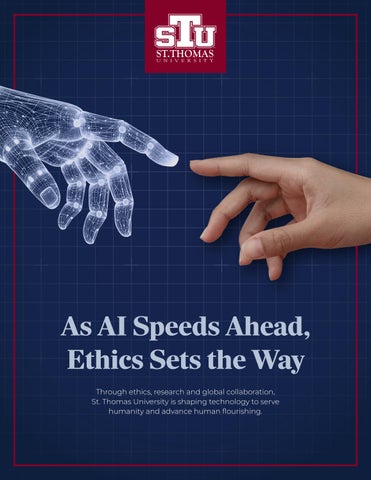
As AI Speeds Ahead, Ethics Sets the Way Through ethics, research and global collaboration, St. Thomas University is shaping technology to serve humanity and advance human flourishing.
ST. THOMAS UNIVERSITY
Overview As Artificial Intelligence (AI) transforms every sector of society, who will lead the conversation on how it should be governed or used? The answer lies with those who can merge ethics with the power to influence real-world outcomes. Through education, research, and tools such as a collaborative labeling program, St. Thomas University is shaping how technology can serve humanity rather than overshadow it.
AI will shape every corner of society. At STU, we’re making sure it does so ethically, equitably, and in service to humanity. DAVID A . ARMSTRONG, J.D. PRESIDENT
Why STU? In a race where AI’s influence is outpacing public understanding, STU is doing what few institutions can: leading with both moral authority and practical expertise. Rooted in its Catholic intellectual tradition, STU elevates virtue and ethical inquiry from a single discipline to a shared aim embedded across its entire curriculum and campus culture. From its home in Miami, Florida, at the epicenter of one of the fastestgrowing tech and innovation hubs, STU reflects the global reality of AI’s reach, with students as diverse as the communities it will impact. Every program, from business and law to healthcare, public policy, 2
With its unique combination of moral authority, academic rigor, and real-world impact, STU is a trusted authority for those seeking credible guidance in an AI-driven future. and the sciences, integrates ethical considerations into professional training. Emerging as a national leader in AI ethics, STU is anchored by the academic weight of its Institute for Ethical Leadership, one of the few in the nation to offer undergraduate, graduate, and doctoral degrees in the field. That expertise fuels initiatives like the Artificial Intelligence Research & Ethics Network (AiREN), driving
collaboration for the responsible use of AI, keeping humans at the center of technological development, and the creation of Ethical AI Standards, a practical and universal framework for evaluating and using AI systems. But STU’s leadership extends beyond AI. While higher education nationwide faces enrollment declines, STU has posted seven consecutive years of record enrollment growth, a rare marker of momentum and relevance.
Fast Facts U N M ATC H E D EN R OLL M E N T M O M E N TU M Defying national declines in higher education, STU has achieved seven consecutive years of record enrollment growth, a clear marker of relevance and rising demand
HI G HEST-E A R N IN G G RA D UAT E S A MO N G F LO R IDA’ S I ND EPE N D E N T CO L L E G E S STU undergraduates earn an average salary of $73k+, outpacing all peers in Florida’s independent sector and surpassing the State University System average (Florida Dept. of Education)
M OST ACT IVE LY E N G AG E D I N PU BLI C E T H ICS STAN DARD S STU’s Institute for Ethical Leadership partners with the Miami-Dade Commission on Ethics & Public Trust, City of Naples Commission on Ethics and Governmental Integrity, City of Miami Beach, and Palm Beach County OIG
SMA LLE R CL A SSE S THAN MO ST PUB LI C UNIVE RSI TIES With a 17:1 student-to-faculty ratio, STU provides students with more direct access to faculty and personalized mentorship compared to large public institutions
O NLY CATHO LI C UNIVE RS ITY WI TH CO MPRE HE NSIVE E THICAL LE A DE RSHI P DE G RE E S STU is the only Catholic university in the nation offering undergraduate through doctoral degrees in Ethical Leadership, uniquely positioning it to define ethical standards in the age of AI
NATI O NA LLY RE CO G NI Z E D FOR O PP O RTUNI TY & O UTCO MES Designated an Opportunity College and University by the Carnegie Classification system for combining broad access with strong graduate success, STU holds an honor earned by only 16% of U.S. colleges and universities
EXPA NDI NG FO OTPRI NT IN CIVI C A ND CO MMUNI TY LE A DER S H IP The Institute for Ethical Leadership engages hundreds of students annually through courses and lecture series
3
ST. THOMAS UNIVERSITY
AiREN
What is it? The Artificial Intelligence Research & Ethics Network (AiREN), launched by STU’s Institute for Ethical Leadership, aims to keep humans at the center of applied AI. It aims to build the research infrastructure for virtue and ethical inquiry to always inform AI adoption and use. It serves two audiences: • Users seeking trusted, high-quality resources to navigate AI responsibly • Contributors ready to shape policy, research, and standards on a global scale For users, AiREN will be the world’s first searchable intelligence hub for AI ethics, connecting decision-makers with vetted evidence, case studies, and governance frameworks from around the globe. For contributors, it’s a highimpact platform to influence the future of AI through research, peer review, and policy leadership. Its flagship innovation, the Ethical AI Labeling Program, will bring radical transparency to a fast-moving landscape to help governments, companies, and everyday users understand exactly what’s powering the algorithms they rely on.
4
AI is a remarkable tool that frees our time to think more deeply and act more wisely. Its true power emerges when guided by ethical standards that elevate our work and our humanity. PROVOST MICHELLE JOHNSON-BARNES
Visit the AiREN Network to learn how contributors from academia and industry are joining forces to advance ethical AI. AIETHICS.NETWORK
HOW IT WORKS
Core Pillars Catholic Social Teaching as a Compass Seven guiding principles ensure AI serves human dignity and the common good, with experts selected for proven value alignment.
Global Expert Engagement A vetted network of ethicists, policymakers, and practitioners (65% academia, 35% industry) evaluated through the Catholic Alignment Propensity (CAP) framework are at the core. Contributors gain both publication credit and policy influence.
Ethical AI Labeling Program A transparent, standardized rubric rates algorithms for ethical performance, strengthened by partnerships with leading academic, policy, and industry partners.
Searchable Intelligence Hub Curated, peer-reviewed resources and frameworks deliver fast, actionable guidance for decision-makers.
Scalable, Secure Infrastructure Google Cloud architecture ensures global reliability, security, and speed.
5
ST. THOMAS UNIVERSITY
The Seven Standards for Ethical AI Ethics are the foundation for trust, accountability, and human dignity. Yet, in moments of rapid change, they are easy to overlook. Without clear ethical guardrails, innovation can quickly outpace responsibility, and trust is easily lost.
More than a checklist, these standards are a shared language for working across sectors, ensuring technology delivers on its promise while protecting the people it serves.
STU’s Seven Standards for Ethical AI and governance are universal and give companies, institutions, and public agencies a ready-to-use framework for responsible AI use. By integrating these standards into the curriculum, STU equips future leaders with the skills to recognize and navigate emerging ethical challenges.
AI systems must honor a person’s dignity by safeguarding their privacy, ensuring informed consent, and preventing exploitation.
Whether evaluating new AI solutions before adoption, writing internal policies and procurement guidelines, training teams to spot risks and apply best practices, or auditing existing systems for compliance and bias, the Seven Standards provide a clear path forward.
I Respect for Human Dignity
II Promotion of the Common Good
AI should be oriented toward the welfare of all, especially the vulnerable, and designed to reduce inequalities and foster human development.
III Transparency and Accountability
AI must be developed with mechanisms for transparency and clear accountability with ethical oversight.
IV Enhancement of Human Capabilities AI should augment human intelligence and creativity.
V Stewardship of Creation and Peace
AI development must align with ecological ethics and reject any use that threatens human life, dignity or the environment. To learn more about how to apply the Seven Standards for Ethical AI within your organization, contact: Jaime Franco, PhD jfranco2@stu.edu Begin building AI solutions that are as principled as they are powerful.
6
VI Formation in Solidarity and Participation AI should offer all – especially the technologically marginalized – the opportunity to actively participate in its development.
VII The Primacy of Human Judgement & Control AI should always be directed toward human flourishing and safeguard human judgment and decision making.
Development Process President David A. Armstrong, J.D. shares a strong commitment to educating students in both the rich history of the American Republic and empowering them with the technical knowledge necessary for them to be successful in their respective fields. Part of graduating informed citizens requires them to also be ethical actors. With the advent of AI, the President believed it critical that we establish clear guidelines for the use of AI, generally speaking. STU then convened a handful of faculty– experts in information technology, AI, ethics and theology– to draft standards. These standards can then be used to develop specific policies and procedures for each area of society (e.g., healthcare, business, logistics, and education, etc.). They were developed over the course of a year with feedback from community members, industry, and the advisory board of the Institute for Ethical Leadership.
A PPLI CATI O NS I N PRACTI CE & CA SE STUDI E S At STU, we recognize that AI is not a passing trend but a transformational force reshaping every industry. To ensure our students are prepared, we are embedding AI education across disciplines, not just in computer science. We’ve recently created an Introduction to AI course that will be part of our General Education Requirements offering, and we have integrated foundational AI concepts into our first-year University Prep class. This ensures that every student, regardless of major, is equipped to understand and responsibly engage with AI tools.
7
ST. THOMAS UNIVERSITY
Programs & Academic Leadership For decades, STU has shaped leaders grounded in moral responsibility, virtue, and the appreciation of the dignity of every human person. As one of the few universities in the nation and the only Catholic institution offering the full spectrum of undergraduate, graduate, and doctoral degrees in Ethical Leadership, STU is committed to defining the global standard for ethical leadership in the age of AI.
IN STI TUTE FO R E THI CA L LE A DE RSHI P D E GRE E S I NCLUDE: • BA in Ethical Leadership: Integrates ethical decision-making and leadership theory with real-world applications across business, public service, and technology • MA in Ethical Leadership (online): Offers specialization options in verticals such as Higher Education and Sports Administration • PhD in Ethical Leadership (online): Includes tracks in General Ethical Leadership, Criminal Justice, and Higher Education Leadership
IN STI TUTI O NA L CO MMI TME NT TO E T HI CA L PRACTI CE S I NCLUDE S: • AI and ethics are embedded across all degrees including Business, Law, Healthcare, Public Policy, and Science programs • Courses in computer science and business address ethical computing, responsible innovation, and AI policy • Ethical frameworks for emerging technologies are integrated into professional and applied learning contexts
S PE CI A L I NI TI ATIVE S I NCLUDE: • Artificial Intelligence Research & Ethics Network (AiREN): Drives faculty and student research on responsible AI use and governance • Ethical AI Standards Development: Offers students applied learning through real-world AI assessment projects
INST I TUT E LEA DE R S H IP David A. Armstrong, J.D. President Jaime Franco, PhD Director of the Institute for Ethical Leadership Katherine Videra, PhD Assistant Professor, Ethical Leadership
8
AI is not avoidable anymore. We should be learning as students about its ethical use as a tool, a tool that can aid but not replace critical thinking. MAG DA LE NA B I A NCHI P O LI TI CA L SCI E NCE , CL A SS O F ‘ 27
URGENCY & RELEVANCE
Why Now? Artificial intelligence is advancing faster than society’s ability to regulate or even understand it. The consequences speak for themselves. As AI systems shape decisions in healthcare, finance, education, and criminal justice, the lack of clear ethical guardrails risks amplifying bias, eroding privacy, and enabling large-scale misuse. Without shared standards, AI trained on misguided input can perpetuate discrimination in hiring, lending, or policing deepening inequities that disproportionately affect vulnerable communities. That’s why St. Thomas University’s Artificial Intelligence Research & Ethics Network (AIREN) and its Seven Standards for Ethical AI are so vital now, with even more resources and tools to come. By grounding technological progress in transparency, fairness, inclusivity, and sustainability, AIREN provides the blueprint developers, policymakers, and institutions need to innovate responsibly.
What stands out most is STU’s approach to AI. It’s based on Christian values, but with a vision and principles widely shared by any secular audience. ETHICS IN AI PANEL AT TENDEE
Because the question is no longer whether AI will transform society— it’s how we ensure that transformation protects the people it touches.
Across sectors and continents, real-world cases have underscored the stakes:
Generative AI tools have been used to create non-consensual deepfake images of public figures and private individuals, leading to lawsuits, platform bans, and global outrage over the lack of safeguards.
Major tech companies have faced legal action for secretly collecting sensitive health and location data through AI-powered apps, sparking renewed calls for stronger data privacy laws.
Students at a major university were wrongly accused of cheating after AI-detection software flagged thousands of innocent essays, exposing the dangers of overreliance on untested technologies.
Economists and global agencies now warn that most countries still lack a regulatory and ethical foundation to manage AI responsibly—leaving gaps that could widen social and economic divides.
These aren’t isolated incidents; they reveal a pattern of innovation outpacing oversight. Without proactive ethical standards, AI risks undermining human rights, eroding public trust, and inviting heavyhanded regulation that could stifle innovation itself. 9
ST. THOMAS UNIVERSITY
THE TEAM
Expert Voices DAVID A . A RMSTRO NG , J.D. President President Armstrong, J.D. is a visionary higher education leader and the architect of St. Thomas University’s rise as a hub for ethical innovation. Under his leadership, STU has achieved record enrollment, expanded its academic footprint, and launched pioneering initiatives like the Artificial Intelligence Research & Ethics Network (AiREN). A thought leader on the moral and societal implications of AI, David A. Armstrong, J.D is a frequent voice on how faith-based institutions can help shape technology for the common good.
JAIM E FRA NCO, P hD Director of the Institute for Ethical Leadership Dr. Franco brings a multidisciplinary perspective shaped by experience across higher education, corporate leadership, and public service. As Director of the Institute for Ethical Leadership, he oversees programs and research advancing moral development, ethical decision-making, and minority leadership formation—including the university’s ethics in AI initiative. Fluent in both English and Spanish, as well as holding leadership positions at several Fortune 500 companies, all while being a longtime educator, Dr. Franco is frequently called on to speak about ethics in leadership, organizational culture, and the responsible integration of emerging technologies.
F R . H IL A RY O. NWA I NYA , P hD Associate Dean Fr. Hilary O. Nwainya brings a global perspective to the intersection of ethics, leadership, and technology in higher education. As Associate Dean of STU’s School of Theology and Ministry, he bridges Catholic moral philosophy with modern questions of AI and social responsibility. He is a sought-after voice on values-based leadership, ethical technology adoption, and the role of faith-informed ethics in shaping equitable futures. His expertise offers context and insight at a time when moral clarity around AI and social systems is urgently needed.
M IC H ELLE JO HNSO N- B A RNE S , Ed .D Provost and Chief Academic Officer Dr. Michelle Johnson-Barnes, Provost and Chief Academic Officer of St. Thomas University, offers perspective on the evolving role of higher education in developing ethical leaders and future-ready talent. A respected academic leader recognized among South Florida’s top educators, she led STU through major accreditation wins and elevated its nursing program to a 100% licensure pass rate. She is a resource on academic innovation, and workforce-aligned learning.
10
STU Perspectives That Shape Progress S AM UE L A . DA RKO, P hD Associate Provost Dr. Samuel A. Darko is a leading voice on the future of STEM education and ethical technology growth. With a proven record securing more than $30M in grants to expand STEM and workforce development, he speaks to national issues around innovation access, student opportunity, and AI’s role in learning. He offers clear explanation of complex tech trends and a pragmatic view on how responsible AI, when supported by institutional investment and student mentorship, can clear the way for scientific and economic opportunity.
S AI C H A I THRA A LL A L A , P hD Assistant Professor Dr. Sai Chaithra Allala speaks to how AI is reshaping the next generation of engineering talent and how institutions must teach ethics alongside technical skills to prepare responsible innovators. As an assistant professor of computer science, she brings both research expertise and classroom-level visibility into how students are engaging with AI tools. Her commentary focuses on applied AI in software engineering, the impact of emerging tech on learning, and the importance of ethical and inclusive frameworks in education.
T IM OT HY M. STA FFO RD, P hD Associate Professor A nationally recognized expert on ethical AI in education and workforce development, Dr. Timothy M. Stafford provides clear, practical guidance on responsible tech adoption. He leads STU’s graduate programs in instructional technology and helped establish the University’s AI ethics framework and certificate program. Author of AI Ethics Unboxed (2025), he is frequently asked to comment on the guardrails institutions need to balance innovation with equity, credibility, and academic integrity in a rapidly changing AI landscape.
ST EVE N B I RMI NG HA M Chief Information Officer As Chief Information Officer at St. Thomas University, Steven Birmingham offers firsthand insight on implementing AI across a university system, including admissions outreach, student support, curriculum planning, and academic operations. He is a resource for stories on the real-world impact of AI in higher education, the future of data-driven campus systems, and the practical challenges institutions face in equipping faculty and students with modern digital fluency. His background includes senior technology roles at Ellucian, a leading higher-ed tech provider.
11
For Interviews & Inquiries Belkis A. Mejia pr@stu.edu | 305.474.6949 St. Thomas University 16401 NW 37th Ave Miami Gardens, FL 33054
To learn more about the Institute for Ethical Leadership, please visit: stu.edu/biscayne/ethical-leadership