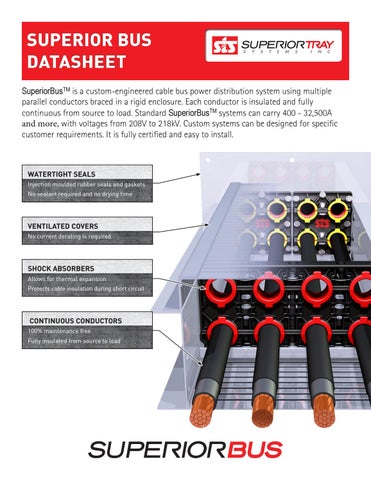
SUPERIOR BUS DATASHEET SuperiorBusTM is a custom-engineered cable bus power distribution system using multiple parallel conductors braced in a rigid enclosure. Each conductor is insulated and fully continuous from source to load. Standard SuperiorBusTM systems can carry 400 - 32,500A and more, with voltages from 208V to 218kV. Custom systems can be designed for specific customer requirements. It is fully certified and easy to install.
WATERTIGHT SEALS Injection moulded rubber seals and gaskets No sealant required and no drying time
VENTILATED COVERS No current derating is required
SHOCK ABSORBERS Allows for thermal expansion Protects cable insulation during short circuit
CONTINUOUS CONDUCTORS 100% maintenance free Fully insulated from source to load
BUS DUCT vs. SUPERIOR BUS A COMPARISON Bus duct and cable bus are both power distribution systems. That, however, is where the similarities end. This data sheet classifies the differences between bus duct and SuperiorBusTM with regards to financial/time cost, system adaptability, and system performance. Bus Duct Financial / Time Cost Different bus duct system types required for specific application needs, increasing design complexity and costs Entire bus duct must be replaced if the system gets wet from sprinklers or rain Increased copper/aluminum content in bus duct increases cost of the system Parts needed to install bus duct need to be individually sourced and made to fit High installation costs – heavy lifting equipment usually required Annual/semi-annual maintenance increases ownership costs
Wet-dry rated system can be used indoors or outdoors, in almost all applications Zero replacement costs of water damaged systems during installation and service life as system is impervious to water Superior Bus uses up to 40% less copper/aluminum due to balancing, which reduces costs All-in-one package includes everything needed for installation Low installation costs – can be installed with 2 workers No maintenance requirements decreases ownership costs
System Adaptability Complete system makes field adjustments difficult System must be aligned precisely System expansion requires complete system replacement or an expensive cooling system expansion
Easy-to-assemble segments can be modified/adjusted to fit on site No need for precise alignment; system allows for some misalignment System can be expanded by adding more conductors or using additional cable bus sections
System Performance Limited analysis conducted before system is built
FEA analysis, heat rise testing, short circuit testing, fire testing, load testing, and impact testing conducted on Superior Bus High volt drop and high temperature due to inefficient phase Balanced system reduces voltage drop and system runs arrangements cooler due to phase arrangement Bus duct joins via bolted connections, copper welding or Fully continuous conductors, which eliminates joint clamped joints that may provide inadequate conductor resistance, simplifies installation and drastically reduces contact area, increase joint resistance and increase the cost maintenance and operating costs of installation System fails if heaters or forced air coolers fail No heaters or coolers required Short circuit situations can result from condensation within System is wet-dry rated and not affected by moisture the bus duct enclosure Multiple intermediate connections in elbows, fittings and at the No intermediate splices or connections end of each bus section – multiple points of potential failure Integrity, Ingenuity, Innovation
CABLE TRAY vs. SUPERIOR BUS A COMPARISON Cable tray and cable bus can both be used as power distribution systems. Cable tray is a general purpose support system, which may be adapted to suit power distribution. SuperiorBusTM is purpose-built and optimized for power distribution as detailed below. Cable Tray Financial / Time Cost Parts, fittings, and conductors need to be individually purchased and modified to fit Derating increases the number of conductors and lugs required, which increases the cost of the system Higher operating costs due to high impedance from lack of system balance Lack of balancing can result in overloaded and overheated conductors which degrade the cable jacket, shortens conductor life, and results in increased replacement costs and downtime Short circuit events can damage the conductors’ insulation, requiring conductor replacement Cable tray needs to be de-energized and the tray and conductors inspected for damage after short circuit events, creating costly downtime
All-in-one package includes everything needed for installation, saving money and time SuperiorBusTM uses up to 40% fewer copper/aluminum conductors and lugs due to system balancing Balanced system reduces voltage drop and system runs cooler due to phase arrangement Fully balanced system with 99 year design life with 40-50 years of no maintenance, reducing ownership costs
Cables are fully supported and braced, preventing damage to cables in the event of a short circuit After a short circuit event, the Superior Bus does not need to be de-energized or inspected
System Performance No analysis conducted because cable tray is not an engineered system Cables are tied down with zap straps that may break or damage the cable’s insulation in a short circuit event No short circuit rating, meaning cables can whip around inside the tray causing damage to the conductors and tray during a short circuit. Lack of balancing results in large forces interacting between conductors, which can cause cable movement and damage to cable insulation during load fluctuation Cable tray is not fully enclosed, which allows conductors to be exposed to potential damage and creates a hazard for workers and other personnel
FEA analysis, heat rise testing, short circuit testing, fire testing, load testing, and impact testing conducted on SuperiorBusTM Support blocks hold cables snugly in case of a short circuit; shock absorbers protect cable insulation by absorbing the forces from the cables. Fully engineered system that has been short circuit tested up to 200 KAIC with no damage to cables or enclosures Balanced system ensures that electromagnetic forces in the cables are cancelled out by forces from adjacent conductors SuperiorBusTM is a fully enclosed system made of aluminum, stainless steel, or polymer to protect cables from environmental or rodent damage and to protect workers and personnel from the dangers of high voltage
S u p e r io rTra y.com | + 1 - 6 0 4 - 5 7 2 - 4 4 1 9
Superior Bus System Parameter
Specification
Power Configuration Ampacity Voltage Certification Free Air Rating Grounding
3-Phase 3-Wire (Delta), 3-Phase 4-Wire (Wye) Unlimited ampacities; standard systems range from 400-32,500A and higher. All systems are CEC, NEC and NOM compliant 208V to 1kV CSA certified cable bus, UL certified grounding conductor, NOM Yes Per UL/CSA requirements
Short Circuit
Up to 200 KAIC
Enclosure Parameter
Specification
Material Size (WxH) Fitting radius Cover types
6063-T6 Aluminum, Stainless Steel Minimum 9” x 4.5”, Maximum 48” x 16”, and up 12”, 18”, 24”, 36”, and up Ventilated, Solid, Peaked, Louvered
Support Blocks Parameter
Specification
Material Spacing
Glass Fibre Reinforced Polymer, UHMW PE 18” (vertical sections), 36” (horizontal sections)
Cables Parameter
Specification
Material Insulation Certification Lugs Termination
Copper, Aluminum EPR/XLPE standard; custom variations available FT1 or FT4 Fire Rating Two-hole long-barrel compression lugs 600V terminated with heat shrink; 5kV and up terminated with cold shrink termination kit (available with or without sheds)
Superior Tray Systems Inc. #1-7331 Vantage Way Delta BC, V4G 1C9 Canada Tel: +1-604-572-4419 Email: info@superiortray.com
9001:201 5 ISO
C
ER
T I F I C AT I O
N
TM
Web: www.superiortray.com Copyright 2020 Superior Tray Systems Inc.