
Donna Signori

BY SUE AMUNDRUD
WELCOME TO OUR summer issue! This issue brings back some not-so-great memories of wildfires from last summer, but we have much to learn from the personal stories shared by those impacted; and, as someone with breathing issues, I appreciate the article with suggestions on how to protect myself. It appears major fires have become far more prevalent in our country.

While this is a theme, there are other informational and important articles. The Canadian Dental Care Plan has become an issue for many of our members who believed they were eligible and were even accepted, only to find out this year that CRA has deemed them ineligible and that they may have to pay money back. As an organization we are working with ACERCART to raise concerns with the federal government in terms of the criteria being used. We would also suggest that, if you are one of those impacted, you share your story and your concerns with your Member of Parliament. This can ultimately only be addressed at the federal level, but we know that hearing stories with a common theme from
ISSN 2817-1721 (Print)
2817-173X (Digital)
All articles in Outreach represent the information and opinions of the authors and not necessarily those of the STS. Reminders STS Group Benefit Plan holders who are eligible for the Saskatchewan Seniors’ Drug Plan may be eligible for a reduced premium by providing the STS Office with a copy of the Seniors’ Drug Plan confirmation letter. For information on the Saskatchewan Seniors’ Drug Plan, please speak with your pharmacist or contact the Seniors’ Drug Plan office at 1-800-667-7581. If you live in Regina please call 306-787-3317.
For any changes to your address and/or Group Benefits coverage, please contact the STS Office directly at 306-373-3879 or email sts@sts.sk.ca
Do you have a story idea, topic or image you would like us to consider? Email us at sts@sts.sk.ca
Content Curator
Kevin Schmidt
Executive Director
Murray Wall
www.sts.sk.ca
many constituents also helps raise awareness among individual politicians – it can’t hurt and might help.
To return to what our organization has accomplished this year, we are pleased to let you know that we have developed the first strategic plan for the STS which will guide us through to 2030. An overview is provided in this issue; copies of the plan were provided to delegates at our AGM in May, and you can find the complete plan on our website.
My term as President will end as of June 30 this year. I want to thank all the chapters who invited me to join them at one or more meetings – I have really enjoyed meeting so many of our members. I look forward to working with the new Executive as Past-President in 2026-27. ●
BY STS STAFF
ALTHOUGH THE CANADIAN Dental Care Plan (CDCP), implemented in May 2024 by the Canadian government, was designed to assist uninsured, low-to-mid-income Canadian residents, the implementation and rules surrounding eligibility for the plan remain challenging. Recently, many retired teachers who had initially been told they were eligible for the CDCP are now being told they are not eligible.
According to the CDCP, in order to qualify for the plan, you must meet all four of the following eligibility requirements:
1 You do not have access to private dental insurance or coverage through any of the following:
• your employer benefits or a family member’s employer benefits, including health and wellness accounts;
• your pension plan or a family member’s pension plan, including federal, provincial and territorial government employer pension plans;
• a professional or student organization; or
• insurance purchased by you, a family member or through a group plan from an insurance or benefits company.
This applies even if you decide not to take it, have to pay a premium for it, or do not use it.
2 You and your spouse or common-lawpartner (if applicable) must have filed your tax returns in Canada so that your family income can be assessed for the previous year.
3 Your adjusted family net income is less than $90,000.
4 You are a Canadian resident for tax purposes.
A key part of the eligibility for the CDCP is that you must NOT have access to dental insurance. This means that you are unable to utilize or purchase a group plan through an insurance or benefits company. You are still considered to have access to dental insurance even if you decided to opt out of the available STS dental benefits.
Since the inception of the STS Group Benefits Plan, individuals who are receiving a teacher pension in any form are eligible to join the STS Plan at any time and access dental benefits. This means that individuals who are receiving a pension from the Teachers’ Superannuation Commission (TSC) or the Saskatchewan Teachers’ Retirement Plan (STRP) are ineligible for the Canadian Dental Care Plan according to CDCP eligibility requirements. If you have concerns about these eligibility guidelines or are having challenges navigating the plan, please contact your Member of Parliament. For further information about the STS Group Benefits Plan or to join the plan, please see www.sts.sk.ca or phone the STS Office at 306-373-3879. ●


BY JILL HUBICK AND JAIMIE PETERS
WILDFIRES (including grass fires and forest fires) are an ongoing concern, especially during dry, hot weather. The health effects of wildfire smoke can range from mild to severe and can even be life-threatening. When wildfires are in effect, we advise everyone to take measures to avoid the smoke as much as possible. Smoke can affect everyone’s health and breathing.
SOME COMMON SYMPTOMS FROM SMOKE EXPOSURE MAY INCLUDE:
• irritated eyes
• runny nose
• headaches
• worsening of allergies
Those with Asthma or Chronic Obstructive Pulmonary Disease (COPD), are especially at risk. Worsening asthma or COPD symptoms that are not managed can lead to an asthma emergency or a COPD lung attack. A COPD lung attack (COPD flare-up) can be just as deadly as a heart attack. Both a COPD lung attack and an asthma emergency may result in the need for hospitalization or even death.
THOSE WITH ASTHMA OR COPD MAY EXPERIENCE WORSENING OF SYMPTOMS SUCH AS:
• shortness of breath
• cough
• wheeze
• chest tightness
• increased mucous production
If asthma or COPD symptoms worsen, refer to a personalized COPD Action Plan/Asthma Action Plan or call a health care provider. These two diseases are common, but serious. As many as one in five Canadian children have asthma and it is the leading cause of hospital admissions for youth. COPD is the fourth leading cause of death in our country and results in more
hospitalizations than other major chronic diseases such as heart failure, angina, and diabetes. Know the warning signs of an asthma emergency and a COPD lung attack.
WARNING SIGNS OF: ASTHMA EMERGENCY
• Struggling for breath
• Very rapid breathing
• Fast activating (rescue) inhaler doesn’t help or is required more than every 4 hours
• Sucking in skin above breastbone and between ribs
COPD LUNG ATTACK
• Chest pain
• Blue lips or fingers
• Confusion
• Being really tired/ lethargic (because of the work of breathing)
• Finding it hard to speak (can’t finish a sentence)
• Nostrils flaring out
• Pale, grey, sweating
• Blue lips or nail beds
• Drowsiness
• Extreme shortness of breath
If you or someone you love experiences an asthma emergency or a COPD lung attack, call 911 and go to the nearest emergency department right away. Do not drive yourself. Take your fast-acting (rescue) inhaler as necessary on your way to the hospital.
COPD lung attack (COPD flare-up) can be just as deadly as a heart attack.
GENERAL RECOMMENDATIONS FOR EVERYONE TO AVOID FOREST FIRE SMOKE:
• Stay indoors.
• Keep doors, windows and fireplace dampers shut.
• Use air conditioners on the recirculation setting so outside air will not be moved inside.
• Avoid exercising outdoors.
• Take extra precautions with children, who are more susceptible to smoke because they breathe at a faster rate, and their lungs are still developing.
• Children, older adults, and anyone with a heart or lung disease, are more susceptible to smoke and should take extra precautions.
• Keep your windows and vents closed while driving. Again, only use air conditioning in the recirculate setting.
• Use a HEPA filter air cleaner in your home or workspace if you have one.
• Do not have campfires or use backyard fire pits. This adds to the poor air quality.
• Make sure your medications are up-to-date and filled. Everyone with Asthma or COPD should always have a fast acting (rescue) inhaler with them.
• Pay attention to air quality reports on your local news channel or websites
• Air Quality Health Index
• Firesmoke.ca
• SaskAlert
• Government of Saskatchewan Forest Fire Smoke Fact Sheet
• Government of Saskatchewan Wild Fire Reports
• Government of Saskatchewa n Fire Bans
• Do not rely on medical or dust masks for protection from wildfire smoke. Wearing a mask should only be used if there is no way to not be outside in the smoke. No mask can fully prevent smoke from getting to your lungs.
• An N95 face mask can trap the larger particles in the air that irritate your nose and throat. However, these masks will not protect your lungs from the small, dangerous particles found in smoke. Read more about how to fit your N95 mask properly.
If you live in an area that might need to be evacuated due to wildfires, be prepared. Pack an emergency kit which includes prescriptions and medications.
Tune into our Let’s Talk Lungs Podcast “I Smell Smoke” to learn more! Inspired Breathing hosts, Lori and Trent, are joined by Lung Saskatchewan nurses and certified respiratory educators Jill and Jaimie to talk about wildfires. Listen in to find out who is most at risk when air quality is poor due to wildfires, and what to do to stay well both indoors and outdoors.
For more information or questions about lung health concerns, contact one of our Certified Respiratory Educators (CRE), Monday - Friday 8:30 a.m. - 4:30 p.m. @ 1-833-385-LUNG (5864), or email to info@lungsask.ca. ●

Jill Hubick is the Manager of Community Care and Education for Lung Saskatchewan. Among her roles, Jill provides patient support and education and is an advocate for stronger provincial services and resources for patients with lung disease, and in her work strives to make the patient journey an easier one.
Jaimie Peters is the Manager of Community Care and Home Oxygen for Lung Saskatchewan. Besides providing patient education, Jaimie also manages the Saskatchewan Aids to Independent Living (SAIL) home oxygen tester training program, provides tester support and manages the nocturnal oxygen testing program for rural parts of the province.

BY KEITH REED
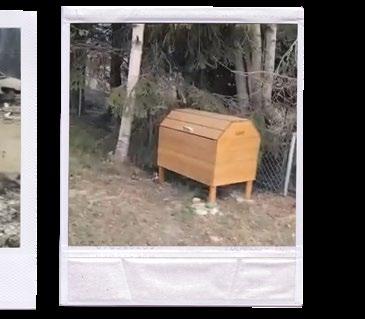
Returning to Denare Beach, Saskatchewan, after being evacuated last summer, we discovered the only thing left untouched by the wildfires was our wooden garbage stand. True story.
I often tell the curious that our return was like coming home to our Hiroshima. I say that to emphasize the sense of absolute and widespread destruction. We arrived back after driving three hours through a landscape of blackened forests and bare rocks. Like radiation, there were long-lasting after-effects.
Strange to think of it now, but before fleeing the fires, our home was never in danger. Even when we were told to evacuate, we felt secure in the belief that our house was at no real risk of burning. Most of our neighbours shared that same feeling.
whole lot was full of trees and bushes, mostly pine, some birch and poplar. All were completely burned except for this outpost near the front of our lot. You can see the base of the telephone pole is singed. Proud to say the garbage stand was built by a local carpenter who never even mentioned to us it was Wolf-proof.


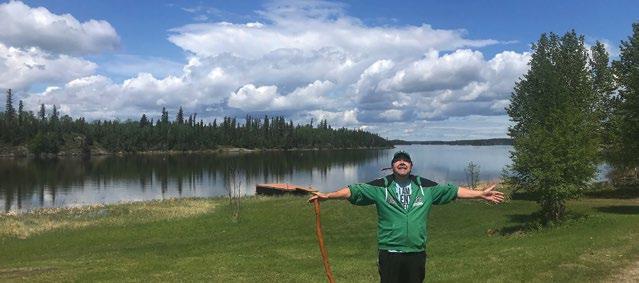
the original part of denare Beach containing mostly older properties is to my left, many of them left untouched. our home, with the newer houses and the reserve, were to my right. Behind me, across the bay, is the peninsula with its many beautiful woodland trails. now only charred trees and burnt foundations remain on my right side.
There were lots of logical reasons for us all thinking that way.
We lived on the shore of a very large body of water. Crossing Amisk Lake always reminded me of an ocean voyage. Our village also held an important firefighting station complete with helicopter landing pad and crews who were regularly dispersed throughout the northern part of the province. In addition to that, when we left, the closest fire was over 20 kms away threatening Flin Flon, Manitoba – not us. Besides, Flin Flon was east of us, and we are normally under the influence of prevailing westerly winds. I’m sure you’d agree that Spock would have been proud of our reasoning, but looking back on it all now, logic was never a factor.
Even when we were told to evacuate, we felt secure in the belief that our house was at no real risk of burning.

My wife, June, and I had dutifully packed two precautionary pieces of luggage as directed by the local radio station, and we kept them ready in the back of our SUV. But of course, we were thinking we were only leaving for a few days because our highway escape routes were being closed. It never occurred to us that all our possessions and all our memories from the past 35 years would also need saving.
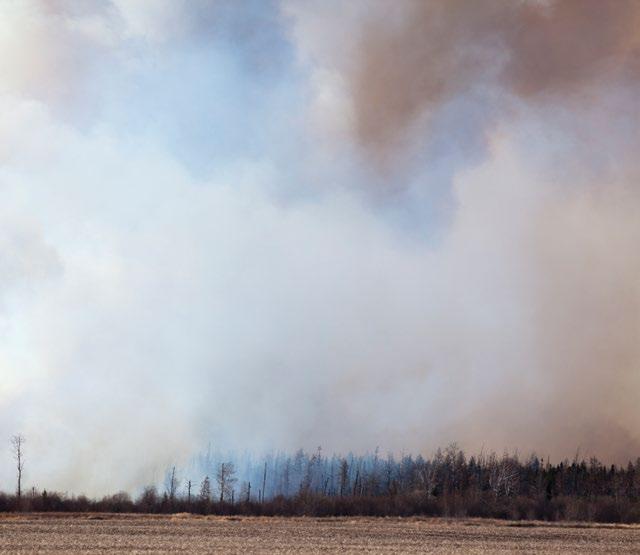
When we first heard the police sirens, we were nearby in Flin Flon. We had been observing the massive clouds of billowing smoke from just beyond the perimeter highway trying to estimate how close the fire was to the city’s industrial park. We knew the Co-op’s huge gas storage tanks were there. Not spoken, but we both thought, “God forbid.”
The sirens and the notice of evacuation over the radio convinced me there was no time like the present to head south, out of town. A trip out to Denare Beach and back was another 40 kms we didn’t need to make. I told my sister, Sheena, she might as well travel with us and leave her car behind. That way we’d be together and not have to worry about one another.
It was a scary time, and anyone who tells you differently or that they weren’t worried about a million other things is either trying to project a false sense of bravado or was in disbelief. There were many family members to be concerned about, pets too, and our brains were flooded with silly questions like what about all that food in the
fridge or all that lovely unused quilting material? The latter concern was my wife’s. My main concern was time.
I wanted to get out, ahead of the rush. With only one highway open, I correctly predicted traffic would be bumper to bumper, and the wait at the gas pumps a couple of hours south in the Pas would be horrendous. As it turned out, leaving quickly was the one thing I did right. We experienced little traffic and no lineups, unlike all those who followed us. Unfortunately, it seems I
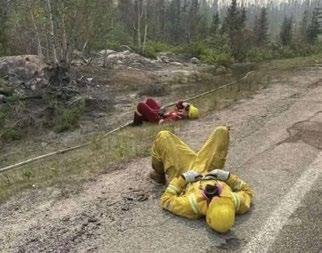
Despite pleas to the province, the only real opposition in its path were the 11 valiant voluntary firemen from our village. Exhausted, with insufficient hoses or equipment, at great risk and with no help in sight, they rested whenever and wherever they were able. They managed to save roughly one-third of the community including the water treatment plant, sewage disposal facility, the principal marina, and the main beach recreational area.
did miscalculate on practically everything else. Our destination was Saskatoon where we could stay with our son or daughter. Normally that’s under a six-hour trip, but of course we had to head east before turning west to avoid the fires. Plus, we were leaving much later than we normally would. By the time we got to Melfort, it was dark, and, no doubt partly because of the stress, we were dogtired. And speaking of dogs, we had two riding with us which made finding a hotel difficult. I had not thought to phone ahead. We lucked out, though, and literally got the last remaining room. I heard hard-luck stories afterwards of friends behind us who were forced to keep driving, or sleep roadside in their vehicles. I couldn’t imagine having to do that with kids. It was hard enough trying to explain everything to the dogs.
Our time in Saskatoon, in one sense, really wasn’t much of a hardship. We had our grandkids to entertain us, and although the longer the evacuation lasted the more anxious we became to return, we knew there were many other good friends and neighbours who weren’t nearly as fortunate.
To our great relief, we learned early on that, contrary to our expectations, the fire near Flin Flon was fought successfully.
It was a different story for Denare Beach – a horror story for our community.
Overwhelming neglect was felt due to the lack of response by the Saskatchewan government. Just across the border, the Manitoba government requested federal assistance which helped to coordinate evacuations and provide financial support to evacuees. We were not afforded such support. Local firefighters were left to battle the huge and ever-growing Wolf Wildfire.
The raging fire had swept in amazingly quickly from the west near Smeaton. Shockingly, it had leapt island to island over our lake, then down our peninsula, right into our neighbourhood.
Consequently, our home was one of the very first to be devoured by the flames.
It was burned to the ground along with about twothirds of the houses in the village and many others in outlying wilderness areas. The other third of our village remained intact mainly due to the incredible bravery and dedication of our eleven volunteer firefighters. They are heroes to us all.
In reality, I now look upon every single person in Denare Beach as a hero, partly because I have learned it is not only the fires they have had to fight. As mentioned earlier, like invisible radiation, many are battling depression over the loss of not just property but of connection, combatting insurance companies, government red tape, and the worrisome threat of yet another fire season on the horizon, plus dealing with all the innumerable ways their lives have been impacted daily.
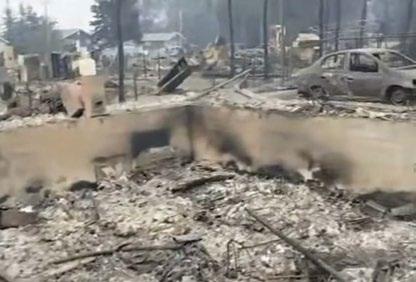
When we returned home, our toyota echo was where we had left it in our back yard on the other side of our house, which was now only a foundation. It and our propane barbeque were the only two things slightly recognizable. other than our practically pristine garbage stand, I mean. most of our neighbourhood looked much the same.
Everyone near and far has been so very generous and kind to one another.
Foremost is the fact that not a single life was lost.
Yet, despite everything, there is some good news.
Foremost is the fact that not a single life was lost. Against my expectations, Flin Flon still stands completely intact. The burned remnants in Denare Beach were quickly and efficiently cleared and the lots levelled, which helped in many ways. Remaining individuals are also mightily maintaining a sense of community despite all odds. The rebuild began over the winter with the likelihood of much more taking place during this upcoming summer. Always a tightly knit community, people are united as never before.
There are innumerable examples of that last statement, but here I want to write about just one to illustrate.
Returning was unimaginable, and yet, just down the road overlooking the lake was a beautiful cabin unconditionally lent to us by close friends, to be used as our summer home.
No hyperbole, that huge act of kindness saved our souls.
Our old garbage stand now sits on their property. True story. ●
Keith Reed has lived in Denare Beach since 1991. Now retired, he taught for 25 years in nearby Creighton and grew up in neighbouring Flin Flon, MB. Proudly indigenous and fiercely northern, this past Christmas he gifted his wife, June, a Phoenix brooch, to begin replacing her jewelry lost in the wildfires. In the firm belief they will rise again from last summer’s ashes.

The following is part 4 of a 4-part series.

BY PUBLIC LEGAL EDUCATION ASSOCIATION OF SASKATCHEWAN (PLEA)
THIS ARTICLE IS the fourth and final article in PLEA’s Planning for the Future series. Previous articles focussed on preparing documents to ensure your wishes were known and followed regarding your health care decisions (Health Care Directives), your personal and property matters (Power of Attorney), as well as estate matters following your death (Wills). All of these documents are designed to let you control matters for yourself. None of them are mandatory – it’s up to you to decide how you want to handle these matters and what documents you choose to prepare.
Just as it is important for individuals to understand how and why they may choose to prepare a health care directive, a power of attorney or a Will, it’s equally important to understand what happens when you don’t prepare these documents.
If you are unable to make or communicate your health care decisions and you do not have a health care directive, your nearest family member can make these decisions. The law sets out the order of priority: your spouse, followed by your adult child, your parent, your sibling and so on. If there is more than one person in the same category, the decision of the eldest is generally preferred. If your wishes are known, the decision-maker must follow your wishes. Otherwise, decisions must be made with your best interests in mind.
If your wishes are known, the decisionmaker must follow your wishes.
If you lose your capacity to make your own decisions regarding your personal affairs or finances, and you have not prepared an enduring power of attorney, another individual can make a court application to deal with your affairs. These types of applications are considered a last resort as they may take away your ability to decide things for yourself altogether. A medical assessment is required along with the application. The court will consider the information in the application, as well as any objection that has been filed. The court can hold a hearing with the parties present if more evidence is needed. However, the court can also decide based only on written evidence, such as affidavits and medical reports.
In deciding whether to make an order, the court will consider your physical, psychological, emotional, social, health, residential, vocational and economic needs. Less intrusive ways of support or assistance must be tried or at least fully considered. If the court determines that you need help making decisions, they can appoint a co-decision-maker. If they determine you are not capable to make decisions even with assistance, they can appoint a guardian.
If you die without a Will, your next of kin must generally apply to the court for Letters of Administration. The law sets out a priority for who can become the administrator of your estate starting with your spouse and then children, if any. The law also establishes the priority of beneficiaries. The administrator must distribute your estate in accordance with the law. They will pay taxes, debts and funeral expenses first. The rest of your estate is then distributed according to The Intestate Succession Act, 2019.
Under the Act your entire estate goes to your spouse if you have no children or all children who are children of both you and your spouse. If your estate is of a value less than $200,000, the entire estate will also go to your spouse. If you do not have a spouse or the value of your estate is $200,000 or more, different rules apply.
While previous articles in this series provide an overview of these documents and the role they play in planning for your future, more complete information is available free of charge at PLEA.org under the topic heading “Planning for the Future.” ●
This article was prepared and written by the Public Legal Education Association of Saskatchewan (PLEA). PLEA is a non-profit, non-government organization providing free legal information across a variety of platforms. They offer programs and services to the general public and school communities across Saskatchewan through dedicated websites, print resources, presentations and more.
The legal information that PLEA provides is intended as general information only and should not form the basis of legal advice of any kind. Individuals seeking specific legal advice should consult a lawyer.

BY CAROL MCPHEE
AFEW YEARS AGO, a plan to move to Saskatoon inspired some research into where to live. Interest piqued while learning about Hector Trout Manor including philosophy, history, structure, and function. My husband, Ken, and I decided to further investigate.
“Apartment Geared for Retired Teachers” was the headline that appeared in the Saskatoon Star Phoenix on Saturday, February 28, 1987. The article went on to state that a $3.7 million senior citizens housing development would be built on Pinehouse Drive.
The five-story, 50-unit apartment was the culmination of more than three years of planning by a group of retired teachers who formed the Hector Trout Manor Co-operative. Karen Rongve, a member of the co-operative’s board of directors, said that eight to ten people were involved “because of service to teachers”. “None of us has a cent invested, only time and energy,” he said in an interview.
The Official Sod Turning Ceremony was held in 1986 and it opened for occupancy in 1987. Present at the sod turning ceremony were the board of directors consisting of Hector Trout, President Harry Costello, Vice-President Walter Derkach, Secretary Lorne Dignean, Treasurer Karen Rongve, and Sylvia Birnie, Stan Fowler, Esther Mackey, and Robert Strobel. Also in attendance were honorable community participants such as Mayor Cliff Wright, Minister of Science and Technology MLA Ray Meiklejohn, President of the Co-operative Housing Association of Saskatchewan Robert Dumont, and Minister of Justice and MP The Honorable Ray Hnatyshyn.
Hector Trout Manor is presently described as a housing co-operative developed and incorporated by the Superannuated Teachers of Saskatchewan for retired persons and/or their spouses. The five-story steel and concrete residence offers 50 suites for self-sufficient retired seniors. It has a

Membership in this co-operative was originally for persons who had been engaged in general or professional education programs. The first application read that membership in the housing co-operative may be extended to retired persons not from the teaching profession or teachers approaching retirement, only at the discretion of the board of directors. It soon became apparent that there were not enough applications from educators to fill the building and applications were extended to other retired persons.
The membership controls the co-operative. For example, by monitoring costs, the co-operative is able to keep its housing charges down. Because there is no landlord, any housing charge increases are voted on by the membership as opposed to having a landlord arbitrarily raise the rent.
A housing co-operative is managed by the members who live in it. The members control the
co-operative through a management structure that consists of a board of directors and committees.
Members of a housing co-operative pay a one-time $500.00 share capital which is refunded when they leave the co-operative. There is no landlordtenant agreement. Rather, members occupy a unit in the building of which they are part owner. In essence, members lease their units from themselves by paying monthly housing charges.
Members do not own their units. Rather, they are part “owners” of the whole co-operative. When they move in, members do not “buy” their unit, they simply pay monthly housing charges. When they leave, they do not “sell” their unit, they just discontinue their membership in the co-operative. New members can then move in and take the place of the vacating members. There is currently a waiting list for both single (one-bedroom) units and double (two-bedroom) units.
The location of Hector Trout Manor is three blocks from the South Saskatchewan River and


the Meewasin Valley Park, a five-minute drive from Lawson Heights Mall, adjacent to the Lawson Aquatic Centre with a pool and the Rusty Macdonald Branch Library, and the Soccer Centre. It is a wonderful location. It is a far cry from the vacant, bare riverbank that the “founders” saw when they broke ground and completed the rigorous process required to form a cooperative project. They might even have dreamed of something like the present day with every tree and shrub they donated creating beautiful, shady grounds.
I feel so fortunate that a move to Saskatoon brought us to first explore and then to become residents of Hector Trout Manor, a wonderful home. ●
Carol (Whitby) McPhee grew up in Estevan. She received a BA and BEd (Chemistry major) from the University of Saskatchewan. Teaching in the 1960s, she experienced the onset of equal pay for women, payment for interns, birth of Jr. High schools, and teachers’ dreams such as HT Manor. Carol began and ended her teaching career in Melfort but taught in Saskatoon Public and Yukon Territory Divisions in between. Carol and her husband, Ken, have three children, seven grandchildren, and three great grandchildren.

BY STS EXECUTIVE
Since its inauguration in October 1973,
the STS has endeavored to ensure that programs and services are responsive and relevant to the evolving needs of its members.
Within this evolution has been growth in the area of governance which saw the formation of the Governance and Handbook Review Committee (GAHR) to address policy and procedure in an ongoing and strategic manner informed by input from members. The need for a published strategic plan was initially identified during an analysis of data collected in a comprehensive member survey conducted in early 2022. In the fall of 2024, the Executive, through the GAHR Committee, began a deliberate series of data collection and discussion opportunities engaging Chapter Presidents, the Provincial Executive, members of the GAHR Committee, and Office Staff all intended to inform the development of a Strategic Plan. Input was organized into to six Strategic Priorities including Chapter/Membership, Governance, Financial/ Operational, Communications, Advocacy, and Member Well-Being. Goals and potential actions for working toward those goals were identified. In the summer of 2025, the initial writing of the document occurred. It was further discussed, refined and ultimately approved by the Executive in fall 2025 as our Strategic Plan for 2025-2030. We are pleased to share the goals portion of the Strategic Plan and invite you to visit www.sts.sk.ca to view the full document.

GOALS:
• Recruit all teachers to join the STS upon retirement and to become members of a chapter
• Encourage and support chapter sustainability
GOALS:
• Uphold a Group Benefits Plan that is comprehensive, affordable, sustainable, and effectively meets the needs of both current and prospective members
• Support provincial social/ recreational events that allow a wide range of participants
• Provide relevant learning opportunities for our membership
GOALS:
• Advocate for issues that matter most to our membership
• Build on and leverage the credibility we have with other organizations
• Develop criteria for resolutions to include format, content and scope
GOALS:
• Engage in communication and communication processes relevant to members
GOALS:
• Ensure all members are fairly and effectively represented through governance processes
• Ensure that all policies, procedures and guidelines are aligned with STS Aims and are easily accessible by members
• Educate members regarding governance processes such as division of responsibilities and scope of influence of resolutions
• Create an environment where internal and external relationships are valued and supported
• Explore our collective and individual responsibilities to Truth and Reconciliation with Indigenous peoples
GOALS:
• Ensure long term financial sustainability, as well as financial and informational security, for the organization and Group Benefits Plan
• Enhance understanding among members of financial operations
• Operate the organization efficiently, transparently and with accountability
• Encourage a growth mentality that is receptive to creative approaches (such as Special Projects grants, outreach initiatives, digital communication, etc.)
• Maintain strong relationships with the Executive Director, office staff and Provincial Executive and continue to encourage the office’s current high-performance level ●
Provincial Stitch ‘N Quilt – Swift Current (Swift Current Chapter)
Are you interested in Provincial Executive discussions? Executive Notes is available after every Provincial Executive meeting on the STS website or through your Chapter President!