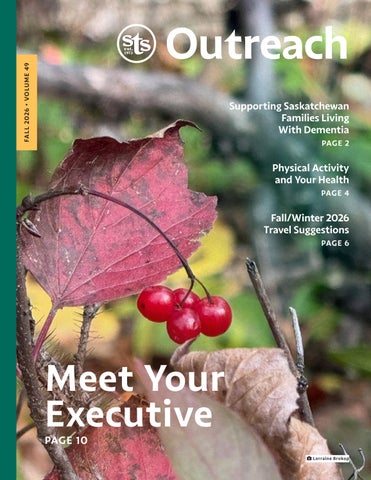
FA LL 2026 • VO LUME 49
Outreach Supporting Saskatchewan Families Living With Dementia PAGE 2
Physical Activity and Your Health PAGE 4
Fall/Winter 2026 Travel Suggestions PAGE 6
Meet Your Executive PAGE 10
Lorraine Brokop
Message from the President BY THERESA L. (TERRI) MITCHELL
W
ELCOME TO A new STS year, and a special welcome to those newly retired! I hope you had a relaxing and enjoyable summer, and that you are ready to celebrate a new season without backto-school jitters and impending lesson plans. For retired teachers, the end of summer signals a season of ultimate freedom to embrace well-earned new adventures. I trust you will enjoy connecting with colleagues and friends at the traditional “Brunch Without the Crunch” and “To Hell with the Bell” gatherings, and that plans are under way for chapter events and new personal adventures for the new season.
With the passing of the budget at the 2026 AGM, funds for a new Special Learning Grant for Chapters were made available. I hope that chapters embrace
Outreach ISSN 2817-1721 (Print)
For any changes to your address
ISSN 2817-173X (Digital)
and/or Group Benefits coverage,
All articles in Outreach represent the information and opinions of the authors and not necessarily those of the STS. Reminders STS Group Benefit Plan holders who are eligible for the
please contact the STS Office directly at 306-373-3879 or email sts@sts.sk.ca. Do you have a story idea, topic or image you would like us to consider? Email us at sts@sts.sk.ca.
Saskatchewan Seniors’ Drug Plan
Content Curator
may be eligible for a reduced
Kevin Schmidt
premium by providing the STS Office with a copy of the Seniors’ Drug Plan confirmation letter. For
Executive Director Murray Wall
information on the Saskatchewan Seniors’ Drug Plan, please speak
this opportunity to create timely and relevant learning experiences on a variety of topics. One such topic is the work of the Alzheimer Society of Saskatchewan. Having lived family experiences with Alzheimer’s and dementia, I know firsthand the value of information regarding services, resources and supports for loved ones and caregivers in challenging times. Your new learning adventures may also include travel or a commitment to staying active. We know from research that both physical and social engagement are essential to the well-being of older adults. I hope that you include in your plans adventures that are offered both at the chapter and the provincial level, and I look forward to seeing you at STS activities in the coming year! ●
In this Issue
This fall definitely marks a new adventure for me as I assume the role of STS President. Our 2026-27 Executive is featured in this publication, and I am honoured to be working with this team to best serve our members. I am especially excited about opportunities to engage with members and to visit all chapters—large and small. I have already accepted a number of invitations, and I would be happy to work with you to find a date that would facilitate a visit with your chapter.
Member Photos
1
Supporting Saskatchewan Families Living with Dementia
2
Physical Activity and Your Health
4
Fall/Winter 2026 Travel Suggestions
6
Mysteries of Life: Reading During Retirement
8
What the STS is About
9
Meet Your Executive
10
2026 Annual General Meeting
13
Honorary Life Member Inductees
13
with your pharmacist or contact the Seniors’ Drug Plan office at 1-800-667-7581. If you live in Regina please call 306-787-3317.
www.sts.sk.ca
Upcoming Events
Back Cover
Fall 2026 • Volume 49 MEMBER PHOTOS
B
ELOW IS A selection of photos by members of the STS. Do you have a photograph, idea or a topic you would like us to consider? Email us at sts@sts.sk.ca.
Kathy Bradshaw
Murray Wall
Les Hurlburt
Wendy Stromberg
Please send photos by choosing “Actual Size” when prompted by your phone or computer. This will ensure your photo has a resolution sufficient to be considered for publication. Outreach
1
Information
Fall 2026 • Volume 49
Information
The following is part 1 of a 4-part series of articles on dementia care.
Supporting Saskatchewan Families Living with Dementia BY THE ALZHEIMER SOCIETY OF SASKATCHEWAN
Across Saskatchewan, thousands of individuals and families are navigating the realities of Alzheimer’s disease and other types of dementias. The Alzheimer Society of Saskatchewan offers a community of support for people living with dementia and their care partners. As the province’s leading dementia care and research charity, the Society provides Help for Today through accessible programs and services, and Hope for Tomorrow by funding research that improves care and moves us closer to a cure.
HERE FOR THE JOURNEY
With Resource Centres located throughout the province, support is never far away. Last year alone, the Society connected with more than 3,600 clients in over 380 communities.
In fact, 91% of clients report that Alzheimer Society staff are knowledgeable and able to answer their questions about dementia.
A dementia diagnosis can feel overwhelming, but no one has to face it alone. Alzheimer Society staff meet clients and families where they’re at and provide individualized support and services.
2 Outreach
Fall 2026 • Volume 49
CONNECTING EARLY THROUGH FIRST LINK® One of the most important ways the Alzheimer Society supports individuals and families is through our First Link® program. First Link® connects people living with dementia and those who care for them to evidencebacked information and services as early as possible and throughout their journey.
Information
REFERRING TO FIRST LINK® Individuals and families can be referred as soon as a diagnosis is made and/or at any other time in the dementia journey (e.g. before a diagnosis/no diagnosis made). Referrals can be made by health care professionals, community organizations or by individuals and families themselves. •
Through First Link®, clients: •
Learn about the diagnosis, dementia progression, strategies for daily living and planning for the future.
•
Access services, both through the Alzheimer Society and within their community.
•
Receive ongoing support through group programs and one-to-one connections.
Research shows that individuals who are referred directly to the Alzheimer Society receive support nine to eleven months sooner than those who reach out on their own. Early connection can make a meaningful difference, helping families feel more prepared, confident, and supported.
•
People with dementia and/ or their caregivers, family members or support persons can call us at 1-877-949-4141 to be referred to the First Link® program. Physicians, other health care professionals and community organizations can refer individuals and families affected by dementia by completing a First Link Agency Referral Form.
Once connected, participants receive personalized follow-up, helpful resources, and ongoing regular check-ins to ensure their needs continue to be met. First Link® staff send a confirmation to each referring provider after contact has been made.
DEMENTIA HELPLINE In addition to ongoing programs, immediate help is available through the Alzheimer Society of Saskatchewan’s Dementia Helpline. Whether someone has a question, needs guidance, or is simply looking for someone who understands, the Helpline offers a direct connection to knowledgeable and compassionate staff. Available Monday through Friday, the service provides: Reliable information about dementia • Practical caregiving advice • Emotional support and reassurance • Connections to local programs and services •
It’s a simple call, but one that can make a profound difference. The Dementia Helpline is available Monday through Friday, 8:30 a.m. to 4:30 p.m. Call 1-877-949-4141 or email helpline@alzheimer.sk.ca. For more information, please visit the Alzheimer Society of Saskatchewan’s website at: https://alzheimer.ca/sk/en. ●
First Link® is available to: •
Individuals diagnosed with Alzheimer’s disease or another type of dementia.
•
Those experiencing memory concerns or undergoing assessment.
•
Care partners, family members and friends.
Outreach
3
Self-Care
The following article is part 1 of a 3-part series on physical activity and your health .
Physical Activity and Your Health BY SCOTT PRINTZ
N
OW RETIRED AFTER devoting a huge part of our lives to students and the institutions that supported them, many of us have pursued hobbies or continue to educate in other ways, work in other fields, travel, enjoy family and friends and/or just live life to the fullest. Some are caregivers to aging parents/loved ones or find themselves challenged due to illness. No matter how we spend our much-deserved retirement, it is important that we take care of our health as we engage in our new adventures and continue to be effective and positive contributors to society. According to Statistics Canada (2024), life expectancy increased to 82 years, with females reaching 84 and males 80. The leading cause of death (at 25%) was cancer (and has been since the early 1990s), followed by diseases of the heart, accidents (injuries), stroke, and chronic lower respiratory disease. Influenza/pneumonia, diabetes, Alzheimer’s disease, COVID-19 and liver disease complete the top 10. Statistics Canada suggests that while dementia is not ranked as a cause of death, if it were included, it would place third on the list. According to the Alzheimer Society, global research has found that physical inactivity in later life raises dementia risk by an average of 40 per cent. Parachute, Canada’s national charity dedicated to injury prevention, identifies falls as the leading cause of injury-related hospitalizations among older adults; 20 to 30% fall each year and 30% who are hospitalized for a fall end up in long-term care.
Chronic disease can affect activities of daily living, reduce quality of life and increase the risk of mortality. The Public Health Agency of Canada (2024) identified that approximately 44% of adults in Canada have at least one chronic disease while 1 in 12 Canadians experience multimorbidity. Chronic conditions account for nearly threequarters of all deaths in Canada and this translates into massive health system costs. BENEFITS OF PHYSICAL ACTIVITY AND EXERCISE Lower mortality and morbidity rates • Lower incidence of many chronic diseases • Improves blood sugar control • Improves cholesterol and triglyceride levels • Reduces the risk of developing complications from diabetes • Reduces the risk of developing cardiovascular disease •
4 Outreach
Fall 2026 • Volume 49
Self-Care
Reduces high blood pressure • Helps with weight control/ weight loss • Improves overall fitness, flexibility and strength • Prevents or minimizes functional limitations in older adults • Slows or partially reverses muscle loss due to sarcopenia • Slows or partially reverses muscle power loss due to powerpenia • Increases bone mass (to prevent/manage osteoporosis) • Reduces pain and disability due to osteoarthritis • Effective therapy for joint replacement (pre-surgery and post-rehab) • Reduces inflammation • Effective in the treatment of chronic back pain • Improves cognitive function • Effective for reducing and managing stress • Improves sleep/ reduces fatigue •
Improves balance; reduces risk of falls and injuries from falls • Improves feelings of well-being • Decreases anxiety and depression • Effective therapy used in cardiac rehab, stroke/other neurological disorders, Parkinson’s disease, and pulmonary programming •
– Live Well First Step Handbook – ACSM Guidelines for Exercise Testing and Prescription, 11th Edition MOVEMENT GUIDELINES The Canadian 24-Hour Movement Guidelines is a resource developed in partnership with the Canadian Society for Exercise Physiology, Public Health Agency of Canada, Queen’s University and ParticipACTION. These guidelines integrate recommendations for physical activity, sedentary behaviour and sleep.
Following the 24-Hour Movement Guidelines is associated with many health benefits. You can find the Guidelines at csepguidelines.ca. The best exercise is the one you will do! Talk with your doctor before starting any exercise program. The second article in this series will focus on effective strategies for physical activity and clinical exercise and discuss how to access the professionals who can help you achieve your goals. ● Scott Printz is a retired teacher and Kinesiologist/Clinical Exercise Physiologist who works as an Exercise and Conditioning Therapist with SHA and is a First Step instructor with the City of Saskatoon. Scott recently completed a 6-year term as the Saskatchewan representative on the Canadian Kinesiology Alliance Board of Directors. In his spare time, Scott is an avid pickleball player and Level 2 NCCP pickleball coach.
CLINICAL EXERCISE CAN HELP PREVENT AND/OR MANAGE MORE THAN 25 OF THE MOST COMMON CHRONIC CONDITIONS INCLUDING: Stress Hypertension • Heart Failure and Stroke • Anxiety • Cystic Fibrosis • Polyendocrine Metabolic Ovarian Syndrome • Depression • COPD
Metabolic Syndrome • Multiple Sclerosis Schizophrenia • Type I and II Diabetes • Osteoarthritis • Colon, Prostate • Rheumatoid Arthritis and Breast Cancer • Back Pain • Dementia • Osteoporosis • Parkinsons Disease • Obesity/BMI • Asthma • Coronary – Canadian Kinesiology Alliance Heart Disease
•
•
•
•
Outreach
5
Fall 2026 • Volume 49
Travel
Travel
Fall/Winter 2026 Travel Suggestions A
BY JAMIE MILTON
S CANADIANS BEGIN planning their fall and winter getaways, travel trends continue to evolve, with more travellers seeking longer stays, meaningful experiences, and exceptional value. Whether escaping the cold for several weeks or embarking on a once-in-a-lifetime cruise, there are more opportunities than ever to explore the world while making the most of your travel budget. One of the fastest-growing trends is the popularity of extended stays in destinations such as Portugal, Spain, Italy, and Australia’s Gold Coast. Rather than taking a traditional one- or two-week vacation, many travellers are choosing to spend a month or more immersed in local culture, history, and daily life. Long-stay travel offers tremendous value. Accommodations often become more affordable on a monthly basis, allowing travellers to enjoy comfortable apartments, villas, or resort-style accommodations at a fraction of the nightly cost. This helps travellers’ vacation dollars
stretch further, allowing them to enjoy dining, entertainment, transportation, and sightseeing while staying within budget. Beyond the financial advantages, long stays provide the opportunity to truly experience a destination. Wander through centuries-old villages in Portugal, savour authentic cuisine in Spain, explore Italy’s incredible art and architecture, or enjoy the beaches, wildlife, and relaxed lifestyle of Australia’s Gold Coast. These extended journeys allow travellers to slow down, connect with local communities, and discover hidden gems that are often missed on shorter vacations.
6 Outreach
Fall 2026 • Volume 49
No matter where your travel dreams take you, this season presents countless opportunities to explore the world. For many Canadians, long stays also offer the perfect escape from winter. Instead of enduring months of snow and cold temperatures, travellers can enjoy mild climates, outdoor activities, and sunshine while exploring new countries, fascinating history, unique ecosystems, and unforgettable adventures. Cruising is another travel trend that continues to gain popularity. Cruise vacations appeal to travellers of all ages and interests, offering convenience, value, and access to multiple destinations in a single trip. Whether you prefer a large cruise line with endless amenities, entertainment, and activities, or a smaller luxury vessel focussed on personalized service and unique itineraries, there are options to suit every travel style. A cruise ship is essentially a floating luxury hotel, transporting guests from one remarkable destination to another. One of the greatest advantages is the simplicity of unpacking only once while visiting multiple ports and countries. Instead of coordinating transportation, accommodations, and meals in each destination, travellers can relax and enjoy a seamless experience. Cruises provide excellent value. Accommodations, meals, entertainment, and many onboard activities are included in one upfront cost, making it easier to budget and avoid unexpected costs. From exploring the Mediterranean Sea, to sailing through the Caribbean, Alaska, Asia, or Australia, cruise vacations continue to offer memorable experiences with outstanding convenience. Some of the destinations rising in popularity are Asia, including South East Asia and Japan, as well as Australia, New Zealand and even the Arctic!
Outreach
Travel
Of course, all-inclusive vacations to Mexico and the Caribbean remain among the most popular choices for Canadians seeking a warmweather escape. Direct flights from many Canadian cities make these destinations easy and accessible, reducing travel time and maximizing vacation enjoyment. Mexico and the Caribbean continue to attract travellers with their beautiful beaches, warm temperatures, welcoming hospitality, and excellent value. The wide variety of resorts available means there is truly something for everyone – from budget-friendly options and family-focussed properties to luxury adults-only resorts and boutique beachfront retreats. Whether travellers are seeking relaxation, adventure, golf, wellness experiences, or family fun, these destinations offer countless possibilities. As we look ahead to the fall and winter travel season, safety, value, and meaningful experiences remain top priorities for Canadian travellers. Extended stays in Europe and Australia, exciting cruise adventures, and convenient sun destinations in Mexico and the Caribbean all offer unique ways to escape the Canadian winter while creating unforgettable memories. No matter where your travel dreams take you, this season presents countless opportunities to explore the world, discover new cultures, and enjoy experiences that enrich and inspire. The only question is: where will your next adventure begin? ● Jamie has been in the Travel industry since 1997 and spent most of that time with Uniglobe Carefree Travel. She started as a travel consultant and transitioned to agency owner and operator 17 years ago and now spends most of her time making sure her team is offering clients the best travel products, with unbeatable customer service. Jamie has been on the ACTA Saskatchewan board for 12 years, and participates on the Saskatoon Air Service Advisory Committee, in conjunction with the Saskatoon Airport authority. While working in the travel industry, Jamie has enjoyed taking every opportunity to travel and learn about the tourism industries around the world. She has been to over 25 different countries, with her favourite places being South Africa and Hawaii.
7
Book Reviews
Book Reviews
Fall 2026 • Volume 49
Mysteries of Life: Reading During Retirement
A
BY MAGI MCFADDEN
N active mind is a healthy mind. Your brain needs exercise as much as your body. Whereas physical exercise may become challenging as years pass, reading sustains you. Reading leisure fiction is crucial for mental well-being, offering stress relief and escape from the din of daily living while immersing you in new perspectives and complex scenarios. Reading mystery novels in retirement keeps your brain sharp by engaging problem-solving and critical thinking, by offering a thrilling escape, entertainment, suspense, and by giving a sense of accomplishment as you solve the puzzle while exploring dark themes of life and mortality in a safe, fictional context. This teacher-turnedauthor offers readers a powerful means of staying mentally sharp, learning new perspectives, reducing stress, and boosting health span. A DEATH AT THE PARTY BY AMY STUART Those looking for an exhilarating read that features a murder and uncovers long-held family secrets are treated to a fast-paced thriller in A Death at the Party, written by high school teacher turned author, Amy Stuart. The first chapter of this book sets a startling scene and establishes Nadine as the hostess of the party and narrator of the story. The author then takes us back to the morning of that same day when Nadine has woken up early with a long list of things to do as she wants tonight’s birthday party for her mother, Marilyn, to go perfectly. Marilyn is turning 60, and she’s a millionaire murder mystery novelist who became renowned when Nadine was a teenager. Nadine is recovering following a few months of hospitalization and is on certain medications, which introduces the potential of her being an unreliable narrator. Her secrets alone are many. As the day progresses and the party plans come together, readers are urgently trying to determine the identity of the victim and motive for the murder. In addition to the death at the beginning, there is a continuous thread of darkness running throughout the novel. With shorter chapters ending on cliffhangers, the pacing is flawless,
providing a rapid read. As we near the end of the story, every character embodies elements of threat; even Nadine’s beloved teenage daughter and son seem to be harbouring secrets that could bring their extended family crashing down. It’s easy to dismiss Nadine as paranoid, and there is always the question of how her medication affects her judgement, but these darker sides of each character fodder intense suspense that keeps the pages turning. It is no wonder A Death at the Party is on the Canadian bestseller list. ● Magi McFadden is currently a member of the Regina Chapter of the STS and the STF professional growth network, LEARN. Magi served on the local executive of the Regina Chapter of the STS. She also served at the provincial and local council levels of the STF professional growth network LEARN as president, vice president, and editor of their official publication “Query”.
To borrow this book, please email esrc@stf.sk.ca or call 1-800-667-7762. A free mailout service is provided by the Emma Stewart Resources Centre.
8 Outreach
Fall 2026 • Volume 49
Information
S
Information
What the STS is About BY SUE AMUNDRUD
INCE ITS INCEPTION in 1973, the Superannuated Teachers of Saskatchewan (STS) has focussed on promoting the interests and welfare of all superannuated teachers. The original commitment had two main aims: to address the (then) existing inequity of teachers’ pensions, and to improve the lot of pensioners, past, present, and future. Now the formal aims of the STS include the statement: “To advocate, within the scope of influence of the STS, for the collective interests of superannuated teachers, retired teachers, members and older adults.” HOW DOES THE STS MEET ITS OBJECTIVES?
with provincial MLAs to raise concerns of the membership.
The STS, as a democratic organization, invites feedback and new ideas from its members. The formal mechanism is for an individual or a chapter to bring forth a resolution to the Annual General Meeting (AGM). Resolutions may focus on any type of challenge facing retirees, or on the work of the organization itself, or on the relationship of the STS to partner organizations. The AGM is attended by delegates from the 40 chapters who represent more than 12,000 members of the STS to bring forward a “voice” and ways to pursue representation at the provincial or even federal level.
Locally, the STS encourages chapters to host presentations about seniors’ issues and to open the presentations to the public at large if appropriate. Funding from the STS has supported and continues to support initiatives like dealing with fraud and scam prevention, wills and estates planning, supporting reconciliation, or making intergenerational connections. Some chapters are addressing the very real health concerns of social isolation by structuring weekly calls to just talk to members of their community. Many members are involved in establishing ‘AgeFriendly’ communities to meet the needs of their community.
The STS sends resolutions to ACER-CART, the national organization representing retired teacher organizations across Canada, regarding items like a national pharmacare program or dental program as they have access to the federal government. The STS is represented on the Saskatchewan Seniors Mechanism (SSM), an organization representing seniors’ organizations within Saskatchewan, to seek items like a Seniors’ Advocate so that seniors’ issues can be addressed outside the framework of whichever political party has formed government. The STS Executive can seek opportunities to meet
Outreach
Seniors are a potentially vulnerable group that needs someone to speak on their behalf as policies and practices change. STS Executive, chapters, and individual members can be involved in addressing inevitable challenges that face superannuated teachers. ● Sue Amundrud is currently the Past-President of the STS. More about Sue is provided in Meet Your Executive.
9
Meet Your Executive
Fall 2026 • Volume 49
Meet Your Executive
Meet Your Executive Terri Mitchell PRESIDENT/COUNCILLOR • career of teaching English Language Arts at the Yorkton Regional High School led to superannuation in 2012 •
8th year on the STS Provincial Executive
•
I value providing leadership, connecting with colleagues, making new friends, honouring the work of those who created this organization, and helping to carry the vision of the STS into the future.
Sue Amundrud PAST-PRESIDENT/ COUNCILLOR • 10 years as a high school teacher in rural schools in Major and Big River; 3 years in Parkland School Division office; 17 years in various roles in curriculum and technology/e-learning in the Ministry of Education •
11th year on the STS Provincial Executive
•
Remaining connected to education overall and paying attention to the needs of retired teachers as well as to the importance of public education in our province are all important to me.
Owen Sebastian VICE-PRESIDENT/ COUNCILLOR • 35-year career teaching in rural Saskatchewan •
4th year on the STS Provincial Executive
•
I’m looking forward to serving our members and advocating for their interests with many great people across our province and from other parts of Canada.
Beverly Magel ACER-CART REPRESENTATIVE • 33-year career with roles in teaching and consulting •
3rd year on the STS Provincial Executive
•
It is energizing to be collaborating with colleagues in Saskatchewan and across Canada to support and advocate for our members.
10 Outreach
Meet Your Executive
Chris Atkinson
Devona Putland
COUNCILLOR • 14-year K-12 teaching career, 23-year career at the Ministry of Education, and an 8-year career ongoing with SUNTEP
COUNCILLOR • 30-year teaching career plus a second 12-year career as a substitute teacher
•
2nd year on the STS Provincial Executive
•
It is important to add my voice to the advocacy for a high quality of life for older adults and for the well-being of our provincial education system.
Martin Berg COUNCILLOR • 31-year career teaching including Kamsack, Mayfair, and 26 years at Unity Composite High School •
4th year on the STS Provincial Executive
•
Focussing developed governance skills to enhance the lifestyles of current and future STS members is a key responsibility.
Sunil Pandila COUNCILLOR • 33-year career in teaching and administration in Moose Jaw Public
Outreach
Fall 2026 • Volume 49
•
15th year on the STS Provincial Executive (former STS President)
•
Serving superannuated teachers by building support to enhance the welfare of retired teachers through the work of our wonderful organization motivates me.
•
8th year on the STS Provincial Executive
•
Important aspects of my work are connecting with colleagues and contributing to the wellbeing of retired teachers.
Anna Wehrkamp COUNCILLOR • 30-year career teaching primarily in Gronlid •
12th year on the STS Provincial Executive
•
Representing retired teachers in our province and working with members who care about public education and supporting both active and superannuated teachers gives me joy.
Barry Hollick MEMBER-AT-LARGE • 30-year teaching career in Prince Albert •
1st year on the STS Provincial Executive
•
I’m looking forward to utilizing my various experiences in the school system and outside of it for the good of retired teachers.
Gail Huber MEMBER-AT-LARGE • 35-year career teaching in the Wakaw/Horizon School Division and 9-year career as a substitute teacher
11
Meet Your Executive
Fall 2026 • Volume 49
•
2nd year on the STS Provincial Executive
Bonnie Semenoff
•
I’m looking forward to continuing to increase my knowledge of the work of the provincial organization and contributing to the success of local chapters and their endeavours.
•
1st year on the STS Provincial Executive
•
I have appreciated the work of the STS Executive and will contribute my leadership and organizational skills to the Executive team.
MEMBER-AT-LARGE • 36-year teaching career in Grade 1 and Kindergarten
Jane Isinger MEMBER-AT-LARGE • 35-year career as a K-9 classroom teacher, Principal, and Consultant. Assistant Director in Prince Albert Catholic S.D. and Saskatoon West S.D., and a Superintendent in Prairie Spirit S.D. •
12th year on the STS Provincial Executive
•
I believe in giving back to my profession and supporting retired and active teachers at both the chapter and provincial levels.
Helen Sukovieff MEMBER-AT-LARGE 32-year career teaching primarily in Regina
•
•
14th year on the STS Provincial Executive (currently also a Western Regional Officer for ACER-CART)
•
Working with the STS Provincial Executive and ACER-CART to make improvements for seniors and focussing on the “big picture” with our partners across Canada is a motivation for me.
Huguette Kitchen MEMBER-AT-LARGE • teaching career began in 1977 in New Brunswick, then continued in Ontario and Saskatchewan in both French Immersion and English programs •
6th year on the STS Provincial Executive
•
Collaborating with and representing our membership as well as assisting fellow Provincial Executive members to advocate for and support our members to achieve the Aims of the STS is key.
Sonja Susut MEMBER-AT-LARGE • 38-year career teaching in the Yukon, Northwest Territories, Moose Jaw and at the University of Regina •
2nd year on the STS Provincial Executive
•
I’m looking forward to focussing on enhancing the welfare of superannuated teachers and promoting the value of connections through membership in local chapters. ●
12 Outreach
Fall 2026 • Volume 49
Governance
2026 Annual General Meeting Governance
Honorary Life Member Inductees This award recognizes an individual’s contributions at the provincial, chapter and community levels since retiring. Left to right: Alan Laughlin – The Battlefords and District Chapter Wally Oucharek – Melville Chapter
Outreach
13
SEPTEMBER
NOVEMBER
7 8-9 16
Office Closed (Labour Day)
3-4 5 11
21-24
Provincial Stitch ‘N Quilt – Swift Current (Swift Current Chapter)
30
National Day of Truth and Reconciliation
Provincial Executive Meeting Provincial Pickleball – Elbow (Midlakes Chapter)
OCTOBER National Day of Older Persons
Chapter Presidents Day Office Closed (Remembrance Day)
DECEMBER
25 26
Christmas Day Boxing Day
Note: The office will be closed from December 21 to January 1
World Teachers’ Day
SASKATOON SK S7J 2H8
PUBLICATIONS MAIL AGREEMENT # 40017216
2311 ARLINGTON AVENUE
Regina Chapter Drumheller Trip
Are you interested in Provincial Executive discussions? Executive Notes is available after every Provincial Executive meeting on the STS website or through your Chapter President!
STS OFFICE
Office Closed (Thanksgiving Day)
SUPERANNUATED TEACHERS OF SASKATCHEWAN
1 5 12
Provincial Executive Meeting
RETURN UNDELIVERABLE CANADIAN ADDRESSES TO:
Provincial Mah Jongg Tournament
Visit the STS website at www.sts.sk.ca for more details and registration forms for our events.
EXT-00247 / 20260728
FA LL 202 3 • VO LUME 1
Upcoming Events