
3.2. Through the Amazon Store, consumers can browse, select, and purchase a wide variety of products and services.
3.3. Amazon’s business is unique in that it sells goods directly to buyers and also provides an online platform where third parties can sell their goods to buyers.
3.4. Originally, Amazon followed a traditional retail model: it purchased products directly from wholesale suppliers (or “vendors”) at a wholesale price and resold them to consumers through its online store at a retail price.
3.5. This business model is known as “first-party sales” Amazon, the retailer, selling products on its own platform.
3.6. Amazon earns profits on these first-party sales by (1) generally selling products for a higher retail price than Amazon paid for them wholesale and (2) collecting from its wholesale partners various fees.
3.7. By 2024, more than 60% of sales on the Amazon Store came from third-party sales. 2 Amazon takes a commission on third-party sales.
3.8. All items sold on the Amazon Store are assigned a unique product identifier.
3.9. This unique product identifier is called an Amazon Standard Identification Number (“ASIN”). The ASIN is a product-oriented system, meaning that the ASIN is not necessarily exclusive to a specific seller.
3.10. As such, every seller offering a specific product for sale on the Amazon Store will share that product’s ASIN and the Product Page.
2 Dharmesh Mehta, New Amazon Report Shows Small Businesses Have Created Millions of US Jobs and Built Thriving Communities: Independent Sellers Achieve A Historical Milestone, Transforming Retail And Generating $2.5 Trillion In Sales In Amazon’s Store, Amazon News (May 20, 2025) https://www.aboutamazon.com/news/small-business/amazon-2024-small-business-empowerment-report
Pricing Products on Amazon’s Store
3.11. Amazon acknowledges that “people have many options for where to shop, and consistently low prices earn customer trust and keep them coming back.” 3
3.12. Amazon recognizes that “low prices matter to customers they always have and they always will.” 4
3.13. Amazon advertises that by offering consumers a wide selection from both Amazon retail and independent sellers, Amazon “increase[s] selection and price competition for customers.” 5
3.14. Amazon states that it “work[s] to compare and match Amazon’s retail prices to competing physical and online competitors’ stores to keep our prices low.”
3.15. Specifically, Amazon “evaluate[s] all competing Amazon retail and independent seller offers on a specific product and strive[s] to highlight the offer that we think customers would choose if they compared all offers in detail including those with low, competitive prices.” 6
3.16. A product’s List Price is the suggested retail price of a product as provided by a manufacturer, supplier, or seller. In the United States, a List Price is also known as the Manufacturer’s Suggested Retail Price. 7
3 Amazon’s Approach To Providing Customers Low Prices Every Day: Amazon Aims To Provide The Best Shopping Experience By Offering The Lowest Prices Across Earth’s Largest Selection, Amazon News (last updated Jan. 17, 2025), https://www.aboutamazon.com/news/retail/amazon-pricing
4 Id.
5 Id.
6 Id. (emphasis added).
7 Show A Reference Price On Your Products By Providing A List Price, Amazon Seller Central (last accessed Jan. 14, 2025), https://sellercentral.amazon.com/help/hub/reference/external/G27XM55CQM3SBMD2?locale=en-US
3.17. According to Amazon “providing a List Price can help customers understand the value of your offer when the List Price is displayed as a strikethrough price with discount messaging; this may increase your sales on Amazon.” 8
3.18. Sellers may list items in the Amazon Store at any price the seller feels is fair, regardless of Amazon’s price or the List Price. 9
3.19. However, Amazon utilizes anticompetitive tactics to ensure that products sold by third-party sellers are offered at a higher price than those of products sold by Amazon.
Amazon Manipulates Market Prices to Boost Its Own Profits Through Anticompetitive Tactics and Subscription Traps
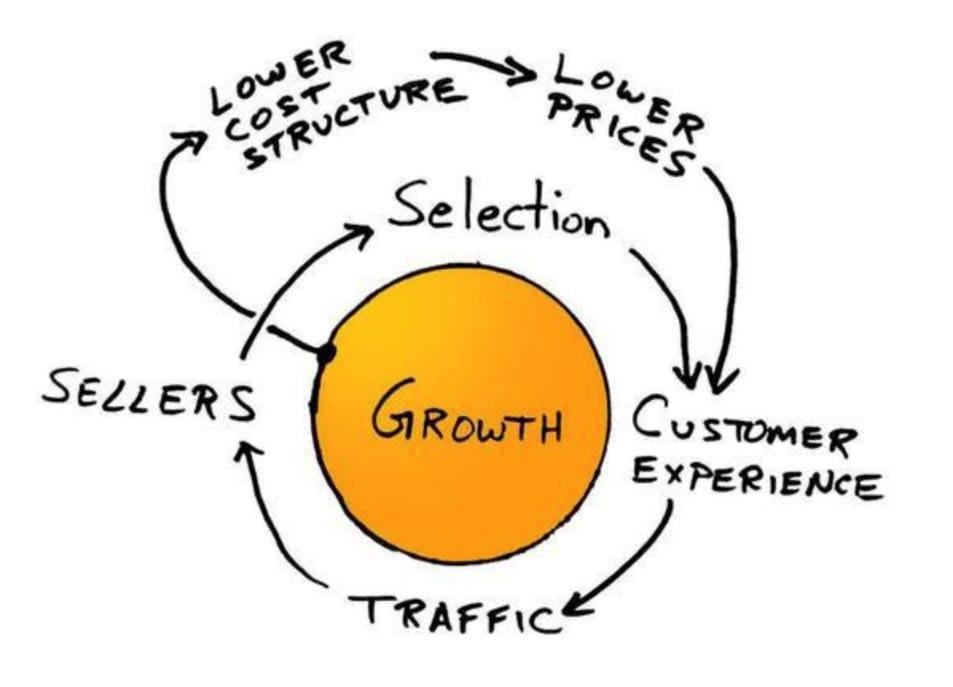
3.20. Amazon famously started with the idea of the “flywheel,” a “virtuous cycle” that would benefit consumers and sellers alike.
8 Id.
9 Price Your Item, Amazon Seller Central (last accessed Jan. 14, 2025), https://sellercentral.amazon.com/help/hub/reference/external/G62551?locale=en-US
3.21. Now, the “Growth” circle has snowballed to over 100 million Amazon Prime members in the United States alone, with many millions more customers on Amazon without a Prime membership. Because Amazon has caught so many customers in its “flywheel,” for many businesses, saying “no” to Amazon is not an option. As a result, Amazon reaps the benefit of a lower (online) cost structure but instead of lowering prices, exerts its influence over customers and sellers to increase them.
3.22. To start, Amazon retains significant control over the Amazon Store and third-party sellers through its Amazon Business Solutions Agreement (hereinafter “BSA”), which all thirdparty sellers must agree to before selling any product on the Amazon Store, to ensure Amazon’s products have a competitive advantage, including, but not limited to, securing the Buy Box, discussed more below.
3.23. For example, from 2012 to March 2019, third-party sellers were bound by the BSA codified “Price Parity Provision.” The Price Parity Provision required pricing parity, where the third-party seller’s price for a product in the Amazon Store is “at least as favorable to Amazon Site uses as the most favorable terms” offered by the seller elsewhere.
3.24. Despite removing the “Price Parity Provision” from the BSA, Amazon continues to interpret and apply other provisions of its BSA to mandate the same price parity agreement from third-party sellers.
3.25. Specifically, Amazon utilizes Amazon’s Seller Code of Conduct, 10 Amazon Marketplace Fair Pricing Policy, 11 and its Standards for Brands selling in the Amazon Store, all of
10 Selling Policies and Seller Code of Conduct, Amazon Seller Central (last accessed Jan. 20, 2026), https://sellercentral.amazon.com/help/hub/reference/external/G1801
11 Amazon Marketplace Fair Pricing Policy, Amazon Seller Central (last accessed Apr. 22, 2026), https://sellercentral.amazon.com/help/hub/reference/external/G5TUVJKZHUVMN77V?locale=en-US (“Amazon regularly monitors the prices of items on our stores, including shipping costs, and compares them with other prices
which are incorporated into the BSA.
3.26. Pursuant to the Seller Code of Conduct, sellers may not engage in conduct that violates price fixing laws, circumvents Amazon’s sales process, or diverts Amazon customers to another website.
3.27. Specifically, Amazon states that sellers “may not provide links or messages that prompt users to visit any external website or complete a transaction elsewhere.” 12
3.28. Importantly, Amazon makes it abundantly clear that “violating the code of conduct or any other Amazon policies may result in actions against your account, such as cancellation of listings, suspension or forfeiture of payments, and removal of selling privileges.” 13
3.29. Under Amazon’s Amazon Marketplace Fair Pricing Policy, Amazon has the unilateral authority to remove a third-party seller’s offer, disqualify the third-party seller from favorable advertising such as the “Featured Offer,” and/or terminate a third-party seller’s selling privileges if Amazon, at its sole discretion, sees pricing practices on an offer that harm customer trust. This achieves the same goal as the original “Price Party Provision” Amazon has attempted to convince regulators it removed.
3.30. Amazon defines “pricing practice that harm customer trust” to include, but not limited to, setting “a reference price on a product or service that misleads customers” and “[s]etting a price on a product or service that is significantly higher than recent prices offered on or off available to our customers. If we see pricing practices on a store offer that harms customer trust, Amazon can remove the Featured Offer, remove the offer, suspend the ship option, or in serious or repeated cases suspend or terminate selling privileges.”).
12 Selling Policies and Seller Code of Conduct, Amazon Seller Central (last accessed Jan. 20, 2026), https://sellercentral.amazon.com/help/hub/reference/external/G1801 13 Id. (emphasis added).
3.31. Amazon’s interpretation of its Amazon Marketplace Fair Pricing Policy prohibits offering prices below the Listing Price of the same product sold by Amazon on the Amazon Store, as well as offering prices for the same product below any offering price sold by the seller on nonAmazon Store online marketplaces.
3.32. Amazon’s weaponization of its BSA ensures that Amazon can gain a competitive advantage against other third-party sellers when Amazon acts as a first-party seller.
3.33. Specifically, Amazon has used data gained by monitoring the sale of third-party goods while enforcing the BSA to its own advantage as a retailer. As found by the Subcommittee on Antitrust, Commercial, and Administrative Law of the Committee on the Judiciary of the House of Representatives, “contrary to [Amazon’s] own internal policy and testimony before Congress, Amazon routinely appropriates seller data to benefit its own private-label and retail business.” 15
3.34. Moreover, Amazon’s pricing enforcement practices have recently come under scrutiny by regulators.
3.35. On June 2, 2025, a German regulatory authority sent Amazon a preliminary legal assessment of Amazon’s influence on the prices charged by sellers on the Amazon Store and of the Amazon Marketplace Fair Pricing Policy. 16
3.36. The German regulatory authority found:
In accordance with its Marketplace Fair Pricing Policy, Amazon regularly reviews the sellers’ prices on Amazon Marketplace. For this purpose, Amazon uses various algorithms and statistical
14 Amazon Marketplace Fair Pricing Policy, Amazon Seller Central (last accessed Apr. 22, 2026), https://sellercentral.amazon.com/help/hub/reference/external/G5TUVJKZHUVMN77V?locale=en-US.
15 Investigation of Competition in Digital Markets Majority Staff Report and Recommendations (“House Report”), at 232 (2020), https://www.govinfo.gov/content/pkg/CPRT-117HPRT47832/pdf/CPRT-117HPRT47832.pdf
16 Annie Palmer, Amazon’s Pricing Controls May Be Anticompetitive, German Regulator Warns, CNBC (June 2, 2025), https://www.cnbc.com/2025/06/02/amazon-antitrust-germany.html
models, drawing on different prices and price components of current or previous offers on Amazon, as well as those of external competitors, in order to calculate dynamic, changing price caps for the sellers’ offers. In this context, Amazon distinguishes between three different categories. Offers categorised as “pricing errors” are removed from the Marketplace. Offers classified as “significantly high prices” or “uncompetitive prices” are excluded from appearing in the Buy Box; their display in the search results list is also restricted, and they may be excluded from advertising on Amazon. It is possible that the Buy Box is not displayed at all for a certain product because none of the sellers comply with Amazon’s price caps. When such restrictions are imposed, the sellers affected are requested to adjust their prices to the reference prices deemed appropriate by Amazon. 17
3.37. As a result of Amazon’s pricing enforcement practices, the German regulatory authority found:
[T]he price control mechanisms used by Amazon, which competes with the Marketplace sellers, could serve to coordinate Marketplace prices based on Amazon’s own pricing principles and ideas, which are difficult for other online sellers to match, and may result in a uniform pricing strategy on the trading platform at the expense of other online sellers. In particular, Amazon’s practice of systematically matching the lowest price found in other online shops across its entire trading platform could pose a significant barrier to switching and deter other online retailers from engaging in price competition and offering lower prices. 18
3.38. Similarly, the State of California discovered substantial evidence in a price fixing lawsuit against Amazon that the company coerces its vendors to manipulate prices outside the Amazon Store, allowing Amazon to “match” artificially high prices. Amazon instructs its vendors to increase retail prices at other stores, make the product temporarily unavailable to drive up prices, or remove a product from competing retailers altogether. Examples include:
17 Bundeskartellamt Has Concerns About Amazon’s Use of So-called Price Control Mechanisms, Bundeskartellamt (June 2, 2025), https://web.archive.org/web/20250606221828/https://www.bundeskartellamt.de/SharedDocs/Meldung/EN/Pressemit teilungen/2025/2025_06_02_Amazon.html [archived].
18 Id.
3.38.1. Amazon, Levi’s (jeans), and Walmart agreed to increase prices on khakis;
3.38.2. Amazon, GlobalOne (a vendor), and Chewy agreed to increase prices on pet treats;
3.38.3. Amazon and its vendor All the Rages agreed to increase pricing at Walmart and Home Depot;
3.38.4. After Amazon’s threat, vendor Armen Living removed products from competing retailers to increase the products’ prices;
3.38.5. Amazon directed Scotts (lawn/garden products) to reach out to another retailer that Amazon was price matching and have them raise prices, “even if it is just for the 3 days leading up to [Prime Day].”
3.38.6. Amazon worked with vendors Hanes and Babyvision to increase prices on other sites;
3.38.7. Amazon temporarily suppressed Allergan eye drops due to a price match with Walmart;
3.38.8. Amazon suppressed sales of vendor Maxi-Matic (small kitchen appliances) due to lower prices at Best Buy, which caused Maxi-Matic to “put Best Buy out of stock;”
3.38.9. Amazon caused vendor Skullcandy to make products unavailable at a lower price at Walmart.
3.39. Amazon’s enormous power in the retail economy allows it to employ Guaranteed Minimum Margin Agreements and a Matching Compensation Program, which penalize vendors if products are offered at a competing retailer’s site for less.
3.40. Amazon also threatens to remove products through suppression, long-term shut off of purchase orders known as CRaP for “Can’t Realize a Profit” or permanent de-listing. Amazon can block promotions like Prime Day, remove access to advertising and other favorable placement such as the “Featured Offer” title, and can impose unfavorable terms for shipping and returns.
Buy Box Eligibility
3.41. One of the primary ways Amazon manipulates sellers and sales in its store is through the Buy Box. If multiple sellers offer the same product in the Amazon Store , these sellers will be competing for the Buy Box.
3.42. The Buy Box is a section on a Product’s Page that allows the consumer to add the product to their cart or to purchase it. The Buy Box identifies who the product’s seller is and who is fulfilling the order.
3.43. When multiple sellers offer a single product, Amazon uses the “Featured Merchant Algorithm” to choose one offer to display in the Buy Box. Amazon calls this display offer the “Featured Offer.” Being chosen as the Featured Offer is commonly known as “winning” the Buy Box.
3.44. According to Amazon, “Amazon selects the Featured Offer for a product by evaluating all eligible offers to determine which is the most attractive for the customer.” 19
3.45. Eligibility for the Buy Box depends on a number of factors, including a product’s price and its shipping price.
3.46. If a seller is not in control of the Buy Box, its listing will appear under “other sellers on Amazon” section on the Product’s Page.
3.47. Nearly 98% of Amazon sales are made through the Buy Box, because consumers reasonably believe that the price offered in the Buy Box is the lowest available price.
19 Becoming the Featured Offer, Amazon Seller Central (last accessed Apr. 22, 2026), https://sellercentral.amazon.com/help/hub/reference/external/G201687550?locale=en-US
The Subscription Trap
3.48. Consumers associate subscriptions with savings particularly when they are advertised as such. For example, Amazon markets Prime membership to include “exclusive deals & savings” on “thousands of items,” savings on groceries, savings on fuel, and savings on pharmacy orders. Amazon also offers discounted prices on year-long subscriptions compared to monthly renewal. 20
3.49. Subscriptions are especially potent consumer traps because of their effect on consumer behavior in what the business community labels “consumer inertia.” As explained in Advances in Consumer Research:
[T]he decision to remain subscribed is rarely a purely rational cost–benefit analysis. Instead, psychological biases such as “loss aversion” (the reluctance to lose access to a service once acquired), “status quo bias” (the preference for maintaining existing arrangements), and the “sunk-cost effect” (the tendency to persist because of past payments) play critical roles in extending customer tenure. Simultaneously, design features like free trials, tiered pricing, and auto-renewal exploit these biases, nudging consumers to commit even when perceived value begins to decline. 21
3.50. Regulatory agencies have begun to take action. In 2023, the Consumer Financial Protection Bureau released a new circular to address “dark patterns and other tricks” of consumer subscription models. 22
3.51. The circular warns, “[d]ark patterns can be particularly harmful when paired with negative option programs [subscriptions that automatically renew], causing consumers to be
20 https://www.amazon.com/amazonprime#ChooseYourPlan (last accessed May 7, 2026).
21 Anand Rajaram Gore et al, Understanding Subscription Models: How Psychology Shapes Customer Loyalty, Value Perception, and Cancellation Patterns, 4 Advances in Consumer Research 3794, 3794-95 (2025)
22 CFPB Issues Guidance to Root Out Tactics Which Charge People Fees for Subscriptions They Don’t Want, Consumer Fin. Protection Bureau (Jan. 19, 2023), https://www.consumerfinance.gov/about-us/newsroom/cfpbissues-guidance-to-root-out-tactics-which-charge-people-fees-for-subscriptions-they-dont-want/
3.56. The FTC explained, “[i]n any communication using an interactive electronic medium, such as the Internet or software, the disclosure should be unavoidable. A disclosure is not clear and conspicuous if a consumer needs to take any action, such as clicking on a hyperlink or hovering over an icon, to see it.” 28
3.57. Further, “[t]he disclosure should not be contradicted or mitigated by, or inconsistent with, anything else in the communication.” 29 It should “appear immediately adjacent to the means of recording the consumer’s consent for the negative option feature” or “before consumers make a decision to buy.” 30
Amazon’s “Subscribe & Save” Program
3.58. Amazon’s “Subscribe & Save” Program lets Amazon customers sign up for recurring deliveries of products they use on a regular basis. By subscribing, Amazon advertises that consumers can get up to a 15% discount compared to a single purchase. Amazon determines what products are eligible for the Subscribe & Save Program. Eligible products include products that are sold by Amazon, as a first-party seller, as well as by third-party sellers.
3.59. When a consumer decides to shop at Amazon’s Subscribe & Save Store, the customer is directed to all eligible products.
3.60. After selecting an eligible product, Amazon shows the consumer two prices on the Product’s Page.
3.61. The first price the consumer sees is the “One-Time Purchase,” and the second price is the price after the Subscribe & Save discount is applied, which Amazon shows in the form of a
28 Id. at 11.
29 Id. at 12.
30 Id.
“Strike-Through Price.” 31
3.62. Below is an example for Maxwell House Coffee, ASIN B0CXYYWL6G:
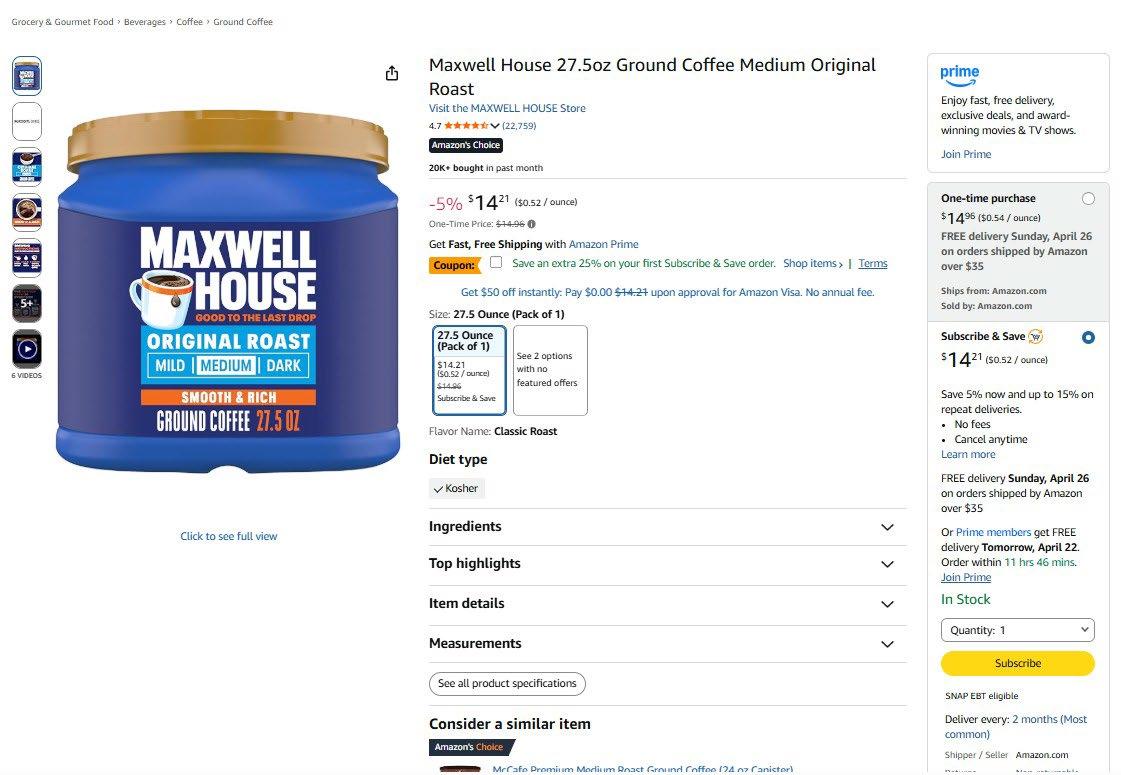
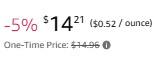
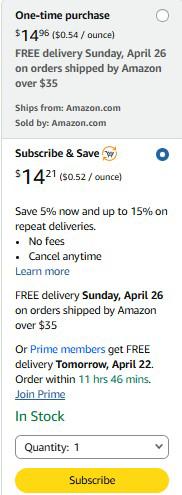
3.63. According to the fine print at a different link and notice disclosed on the product page, the Strike-Through Price is a “One-Time Price” which “refers to the current Featured Offer price for a one-time purchase of the item.” 32 Thus, contrary to Amazon’s labeling, consumers are effectively presented with two “One-Time Purchase” prices for the same product.
3.64. Through data gained by monitoring the sale of third-party goods and enforcing the BSA, including Amazon Marketplace Fair Pricing Policy, Amazon can offer below-cost prices on
31 Strike-Through Pricing And Savings, Amazon.com (last accessed Jan. 14, 2025), https://www.amazon.com/gp/help/customer/display.html?nodeId=GQ6B6RH72AX8D2TD
products that are sold by other third-party sellers. Below is an example for Maxwell House Coffee,
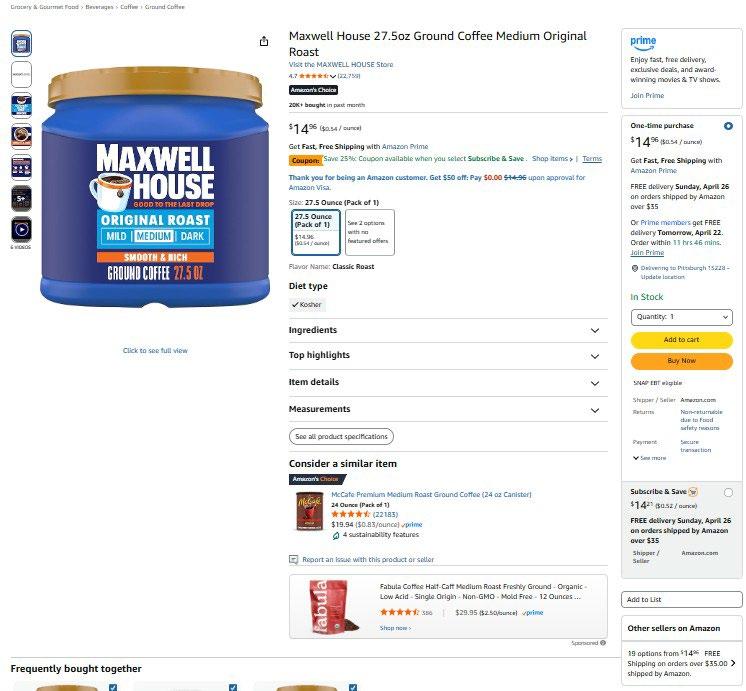
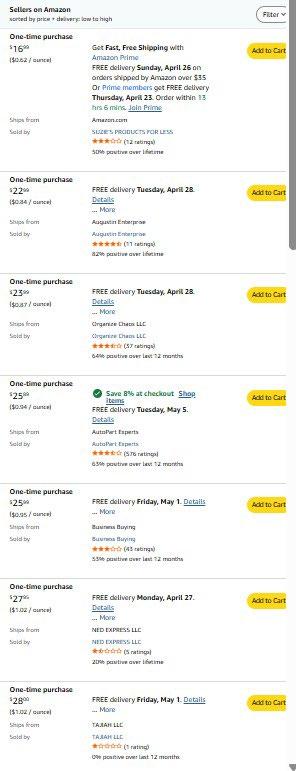
3.65. In this example, the page identifies Amazon as the Buy Box Seller. Amazon offers a One-Time Purchase price of $14.96 and a Subscribe & Save Offer of $14.21. Additionally, Amazon’s listing identifies 18 third-party sellers selling this product. If a consumer were to click on the “Other Sellers on Amazon” page, the consumer would be presented with the following third-party offers:
3.66. Amazon deliberately offers its items at a substantially lower price than that of thirdparty sellers. Thus, Amazon labels its own product as the Featured Offer and chooses itself as the “winner” of the Buy Box. Amazon Deceptively
Changes Its Prices After Consumers Sign Up for the Subscribe & Save Program
3.67. Amazon offers lower prices on its initial sale of products that are eligible for Amazon’s Subscribe & Save Program to induce consumers to rely on Amazon to select the best product and pricing rather than consumers relying on their own free choice. They are then locked into consumer inertia of the subscription model.
3.68. Amazon misleads consumers into purchasing Subscribe & Save items sold by Amazon through its deceptive acts and omissions by enticing consumers to purchase
at a substantially lower price than those offered by third-party competitors on a subscription basis, and then immediately or soon thereafter raising the price of the product for subsequent purchases, such that then third-party sellers are selling the product on the Amazon Store for a cheaper price.
3.69. When a consumer selects the Subscribe & Save option they simply click on a Subscribe button. The only disclosures on that screen are those below.
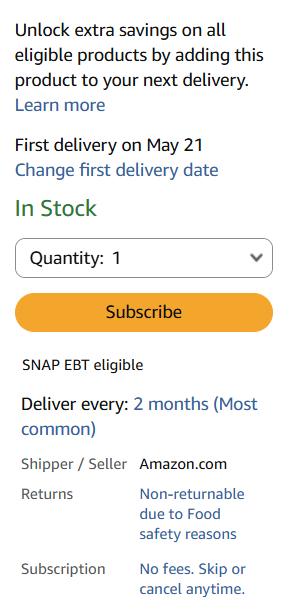
3.70. Importantly, if a Subscribe & Save discount is available, “that will be based on the One-Time price for the same item from the same seller. It may also change with future Subscribe & Save orders of that item.” 33 This disclosure is in the fine print at a separate link and not prominently displayed to consumers in violation of the above-referenced FTC and CFPB standards.
3.71. Amazon, in its sole discretion, reserves the right to change the Subscribe & Save benefits, including the discount amounts and eligibility used to determine discount amounts, at
33 Strike-Through Pricing and Savings, Amazon.com, https://www.amazon.com/gp/help/customer/display.html?nodeId=GQ6B6RH72AX8D2TD. (emphasis added).
any time. 34 This disclosure is in the fine print at a separate link and not prominently displayed to customers in violation of the above-referenced FTC and CFPB standards.
3.72. The first time a customer purchases an item through Amazon’s Subscribe & Save Program, the subsequent, recurrent purchases of the item will be allocated at Amazon’s discretion to one or more sellers. 35
3.73. If Amazon, in its sole discretion, allocates a Subscribe & Save order to a different seller, Amazon may pause subsequent, recurrent purchases of the item when “there is a lower priced offer available for the ASIN.” 36
3.74. Moreover, Amazon can “change the price for a Subscribe & Save subscription at any time for any reason.” 37 This disclosure is in the fine print at a separate link and not prominently displayed to consumers in violation of the above-referenced FTC and CFPB standards.
3.75. Even with these linked disclosures, the “net impression” conveyed to consumers is that they are getting a special, discounted price by signing up for a subscription, and that Amazon will continuously monitor prices to assign Subscribe & Save orders to the best-priced sellers.
3.76. Unlike brick-and-mortar retail shelves or consumer-selected purchases on Amazon, the Subscribe & Save customer cedes control and selection to Amazon with the reasonable expectation that they will save money by doing so.
34 Subscribe & Save Terms & Conditions, Amazon.com (last updated Jan. 23, 2024), https://www.amazon.com/gp/help/customer/display.html/?nodeId=GWFU7NECYFLW6M6U&ref_=cct_cg_SnSL M_12a1&ie=UTF8 (emphasis added).
35 Subscribe & Save for Sellers, Amazon.com, https://sellercentral.amazon.com/help/hub/reference/external/G201620110.
36 Id
37 Subscribe & Save Terms & Conditions, Amazon.com (last updated Jan. 23, 2024), https://www.amazon.com/gp/help/customer/display.html/?nodeId=GWFU7NECYFLW6M6U&ref_=cct_cg_SnSL M_12a1&ie=UTF8 (emphasis added).
3.77. Amazon sends emails to consumers before each Subscribe & Save order is fulfilled, notifying consumers of their upcoming delivery and the price they are to pay. In these emails, Amazon continues to deceive consumers by creating the impression that the price the consumer is paying is the current market price i.e., the price that would win the Buy Box even though the price is Amazon’s own inflated price.
3.78. Customers enrolled in Subscribe & Save for a product often pay more for subsequent purchases than the then-current Subscribe & Save price including transactions with the same seller. In other words, they would pay less if they cancelled Subscribe & Save and then started a new one for the exact same product even if they did not change the seller.
3.79. Thus, while Amazon markets it as a savings opportunity where consumers can expect at or near the best price available on a consistent basis, Subscribe & Save is frequently not even the lowest price available on Amazon Subscribe & Save (from the same seller) at the time subsequent orders are filled. And unlike one-time purchases, with Subscribe & Save recurring orders weeks or months after the initial subscription, speed of delivery is not a customer consideration that might justify paying more than the lowest price on Amazon.
3.80. Increases in the prices of items sold by Amazon for subsequent purchases, similar to the above example, are not uncommon for eligible items being offered in the Subscribe & Save Program and other programs and services offered by Amazon.
3.81. The Subcommittee on Antitrust, Commercial, and Administrative Law of the Committee on the Judiciary of the House of Representatives found that “Amazon has adopted a predatory-pricing strategy across multiple business lines at various stages in the company’s history. Because of the nature of its marketplace business, Amazon’s below-cost prices on products
and services tend to lock customers into Amazon’s full marketplace ecosystem.” 38
3.82. Additionally, the House Report noted that “once a customer is locked in, they are less likely to change their behavior even when Amazon’s pricing is not competitive.” 39
3.83. The House Report also found that “once Amazon succeeds in trapping enough customers in its ‘flywheel’ to secure dominant position across varied markets, it can then raise prices or remove incentives or allowances for Marketplace sellers to sell products at favorable prices for consumers.” 40
3.84. The term “flywheel” is apt though not as Amazon intended or portrays. It refers to “a heavy wheel for opposing and moderating by its inertia any fluctuation of speed in the machinery with which it revolves,” and sometimes stores kinetic energy. 41 It is a mechanism not to foster variability and competition, but regulation and control through sheer physical force and then keeping what is left over. That is precisely what Amazon does.
3.85. Amazon’s “Subscribe & Save” bait and switch tactic is just one of many examples of Amazon’s control over pricing.
3.86. The Amazon Mom Program was a similar predatory pricing strategy. The Amazon Mom Program offered discounts on diapers and other products associated with parenthood. Amazon’s internal documents, outlining the lead-up to the official launch of the Amazon Mom Program, included a plan to discount diapers and wipes at a rate that would “put [its] product below cost.” 42
38 House Report at 249-50.
39 Id. at 250.
40 Id. at 252
41 Merriam-Webster Online Dictionary, “Flywheel,” last accessed April 29, 2026: https://www.merriamwebster.com/dictionary/flywheel
42 Id. at 251 (citing Submission from Amazon to H. Comm. on the Judiciary, AMAZON–HJC–00159560 (Apr. 2010))
3.87. The goal of this program was not to sell diapers; rather Amazon “recognized that a ‘long-lasting, sticky relationship’ with Amazon Mom members was the source of its true value.” 43
3.88. Amazon’s Subscribe & Save Program lures consumers into the false belief that they are getting discounts on merchandise that will save them money.
3.89. Amazon induces consumers to rely on Amazon to select subsequent, automatic purchases, the prices of which Amazon controls and raises over time. Thus, Plaintiffs and members of the Class are, in reality, paying higher prices than non-members pay through Amazon.
3.90. Amazon intentionally and deceptively designed the Subscribe & Save Program to lock in consumer inertia and then cause consumers to spend more, not less, while misrepresenting and concealing material information about its price change practices.
4. PLAINTIFFS’ ALLEGATIONS
4.1. Plaintiffs and Class members are subscribers to the Subscribe & Save Program.
4.2. Plaintiffs purchased and elected to receive automatic, recurring purchases and deliveries on Lavazza Espresso Ground Coffee (ASIN B001EQ5ERI) (“Product”) every two months.
4.3. Plaintiffs selected the Subscribe & Save Program because, based on the product listing and his understanding of the Subscribe & Save Program, it appeared to offer a discounted price that was and would remain at or near the lowest price on Amazon.
4.4. The Product is sold on the Amazon Store by Amazon and by multiple third-party sellers. On February 11, 2024, Plaintiffs purchased the Product due to the price of the Product that Amazon had set as well as the Subscribe & Save discount that Amazon offered. The Price of the
43 Id. at 251 (AMAZON–HJC–00159560 (Apr. 2010)).
Product was $19.53, and then the 15% subscribe and save discount made the final price $16.60.
4.5. By signing up for a recurring subscription at a discount price, Plaintiffs reasonably expected that the original price was reasonably consistent with anticipated future prices and was not artificially reduced to induce subscription.
4.6. By signing up for a recurring subscription at a discount price, Plaintiffs relinquished the “free and informed choice” and apparent incentive to consistently seek and obtain the lowest prices for the product. Amazon’s deceptions created the reasonable expectation and induced reliance on Amazon to continuously secure a price for the product at or near the lowest available on Amazon, especially because the speed of delivery (e.g. 2-Day Prime shipping versus one week), which Amazon factors into product placement like the Buy Box, is irrelevant to most periodic purchases in the Subscribe & Save program.
4.7. The first time Plaintiffs purchased the Product through the Subscribe & Save Program, the Product was sold by Amazon because Amazon had won the Buy Box.
4.8. As a result, all subsequent recurring sales of the Product through the Subscribe & Save Program to Plaintiffs would be sold by Amazon. On April 11, 2024, Amazon sold and fulfilled Plaintiffs’ automatic, subsequent purchase of the Product. The price of the Product was $20.05, and then the 15% subscribe and save discount made the final price $17.04.
4.9. On July 26, 2024, Amazon sold and fulfilled Plaintiffs’ automatic, subsequent purchase of the Product. The price of the Product was $25.00, and then the 15% subscribe and save discount made the final price $21.25.
4.10. Upon information and belief, at all relevant times, the Product was also offered for sale on Amazon by multiple third-party sellers through the Subscribe & Save Program.
4.11. On October 20, 2024, Plaintiffs received an email from Amazon at 8:54 p.m. regarding Plaintiffs’ upcoming Subscribe & Save delivery. The subject of the email was “Price changes: review your upcoming delivery.”
4.12. Amazon’s email identified that Plaintiffs’ previous purchase price of the Product was $21.25, which represented the price of the Product after application of a 15% discount. The email identified that the new price of the Product was $28.69, which represented the price of the Product after application of a 15% discount.
4.13. Amazon’s email also identified that the last day to manage Plaintiffs’ automatic, recurring purchases and deliveries on the Product was that same day, October 20, 2024.
4.14. This email failed to provide Plaintiffs with any genuine opportunity to seek better prices on Amazon or elsewhere.
4.15. On October 20, 2024, the Product was automatically purchased through Amazon’s Subscribe & Save Program. The Product was sold by Amazon with a supplier marked “Other.” The price of the Product was $33.75, and then the 15% discount made the final price $28.69.
4.16. Amazon increased the One-Time Purchase Price of the Product by approximately 38% before applying its Subscribe & Save Program discount. The Subscribe & Save Program Price was increased by Amazon by approximately 33%.
4.17. Additionally, on October 20, 2024, Plaintiffs purchased the Product through a thirdparty supplier and seller in the Amazon store by the name of “Wiki Deals.” Plaintiffs paid $25.90 for the Product.
4.18. At no time did Amazon adequately inform Plaintiffs that they could purchase the same product for less from other sellers on Amazon.
4.19. Because of Amazon’s misrepresentation, concealment, and omission of material information regarding the prices of the Product, Plaintiffs paid more than they should have or would have otherwise and sustained injury and damages under Washington’s Consumer Protection Act.
5. CLASS ACTION ALLEGATIONS
5.1. Plaintiffs bring this action pursuant to Rule 23 of the Federal Rules of Civil Procedure. Plaintiffs intend to seek certification of a Nationwide Class consisting of:
All individuals in the United States who enrolled in Amazon’s Subscribe & Save Program and purchased eligible items within the relevant limitations period.
5.2. The Class definition may be amended if further information and discovery indicate that the definition of the Class should be narrowed, expanded, or otherwise modified.
5.3. Excluded from the Class are Defendant; any affiliate, parent, or subsidiary of Defendant; any entity in which Defendant has a controlling interest; any officer, director, or employee of Defendant; any successor or assign of Defendant; anyone employed by counsel for Plaintiffs in this action; any judge to whom this case is assigned, his or her spouse, and all persons within the third degree of relationship to either of them and the spouses of such persons.
5.4. Numerosity: The Class members are so numerous that joinder of all members is impracticable. While the exact number of Class members is unknown and such information is in the exclusive control of Defendant, Plaintiffs believe that the Class encompasses thousands of individuals who are geographically dispersed throughout the nation; therefore, the number of persons who are Class members are so numerous that joinder of all members in one action is impracticable.
5.5. Commonality and Predominance: There are questions of law and fact common to all Class members: specifically, Plaintiffs’ claims arise from the same practice or course of conduct by the Defendant giving rise to those claims of the Class, and Plaintiffs’ claims are based upon the same legal theories as those of the Class. The Defendant has engaged in a pattern and practice, in violation of the law, of artificially lowering the initial purchase price of eligible Subscribe & Save items to secure consumers and subsequent purchases and then subsequently raising the prices of eligible Subscribe & Save items. The resolution of this issue to wit, whether Defendant knowingly sold the eligible Subscribe & Save items with artificially lowered prices to secure subsequent sales after Defendant substantially increased the prices and did not inform Plaintiffs and Class members that there were cheaper identical items for sale is a common question of fact and law that will affect all Class members in the same manner.
5.6. Other questions of law and fact common to the Class members that predominate over questions that may affect individual members include:
5.6.1. Whether Defendant made false or misleading statements of fact in advertising its Subscribe & Save Program and prices;
5.6.2. Whether Defendant made misleading omissions of fact in advertising its Subscribe & Save Program and prices;
5.6.3. Whether Defendant made false or misleading statements of fact, or misleading omissions of fact, in communications to consumers enrolled in the Subscribe & Save Program;
5.6.4. Whether Defendant’s representations and omissions in relation to the Subscribe & Save Program violated the above-referenced standards established by the FTC and CFPB and applicable federal law as part of claims under the Consumer Protection Act;
5.6.5. Whether reasonable/ordinary consumers would expect that the original purchase price in Amazon’s Subscribe & Save Program was under cost or otherwise substantially lower than a reasonable and sustainable market price;
5.6.6. Whether reasonable/ordinary consumers would expect that the original purchase price in Amazon’s Subscribe & Save Program would substantially increase soon after their enrollment;
5.6.7. Whether reasonable/ordinary consumers would expect that by enrolling in Amazon’s Subscribe & Save Program, they would ultimately pay more than they would have for the same product sold by Amazon or third-party sellers in the Amazon Store and elsewhere, including Subscribe & Save prices available for the same product on subsequent orders;
5.6.8. Competitive prices on Amazon and elsewhere for the same or similar products as those sold in the Subscribe & Save Program, and the difference between the prices paid in the Subscribe & Save program compared to competitive prices in the Amazon Store and elsewhere;
5.6.9. Whether Defendant’s conduct was unfair or deceptive;
5.6.10. Whether Defendant’s conduct was injurious to the public interest, including whether Defendant’s conduct injured other persons, had the capacity to injure other persons, or had the capacity to injure other persons;
5.6.11. Whether Defendant violated Washington’s Consumer Protection Act;
5.6.12. Whether Defendant is liable to Plaintiffs and Class members under the causes of action alleged in this Complaint; and
5.6.13. Whether Plaintiffs and Class members are entitled to any of the forms of relief they seek in this action.
5.7. Typicality: Plaintiffs’ claims and defenses are representative of the claims and defenses of the Class members they seek to represent and typical of the claims and defenses of the Class because the Plaintiffs and the Class members all subscribed to Amazon’s Subscribe & Save Program and purchased eligible Subscribe & Save items. Plaintiffs, like all Class members, purchased eligible items through Amazon’s Subscribe & Save Program when they were presented by Amazon, through its representations of eligible Subscribe & Save items and through Amazon’s marketing and advertising of the eligible Subscribe & Save items, that Plaintiff, like all Class members, would save money on eligible Subscribe & Save items.
5.8. Adequacy of Representation: Plaintiffs will fairly and adequately assert and protect the interests of the proposed Class because:
5.8.1. Plaintiffs have hired attorneys who are experienced in prosecuting class action claims and will adequately represent the interests of the Class;
5.8.2. Plaintiffs have no conflict of interest that will interfere with the maintenance of this class action; and
5.8.3. Plaintiffs intend to vigorously prosecute this action on behalf of the Class.
5.9. Superiority: A class action provides a fair and efficient method for the adjudication of the instant controversy for the following reasons:
5.9.1. The common questions of law and fact set forth above predominate over questions affecting only individual Class members;
5.9.2. The proposed Class is so numerous that joinder would be impracticable. The proposed Class, however, is not so numerous as to create manageability problems. Moreover, no unusual legal or factual issues render the Class unmanageable;
5.9.3. Prosecution of separate actions by individual members of the Class would risk inconsistent and varying adjudications against Defendant;
5.9.4. The claims of the individual Class members are small in relation to the expenses of litigation, making a class action the only procedure through which Class members can, as a practical matter, recover for the damages done to them by Defendant; and
5.9.5. A class action would be superior to, and more efficient than, adjudicating thousands of individual lawsuits.
6. VIOLATIONS OF THE WASHINGTON CONSUMER PROTECTION ACT
Wash. Rev. Code Ann. ch. 19.86
6.1. Plaintiffs incorporate by reference all preceding paragraphs as if fully set forth herein.
6.2. Plaintiffs bring this cause of action individually and on behalf of the Class.
6.3. The Washington Consumer Protection Act (“CPA”) provides: “Unfair methods of competition and unfair or deceptive acts or Practices in the conduct of any trade or commerce are hereby declared unlawful.” Wash. Rev. Code Ann. § 19.86.020.
6.4. The CPA also provides that its purpose is to “complement the body of federal law governing restraints of trade, unfair competition and unfair, deceptive, and fraudulent acts or practices in order to protect the public and foster fair and honest competition.” RCW 19.86.920. The statute states that courts should “be guided by final decisions of the federal courts and final orders of the federal trade commission interpreting the various federal statutes dealing with the same or similar matters.” Id. The CPA must be “liberally construed that its beneficial purposes may be served.” Id. Plaintiffs incorporate by reference the standards applied under the FTC Act and ROSCA, as well as the circulars and statements of the CFPB and FTC cited above.
6.5. The above-described conduct by Defendant constitutes unfair and deceptive practices in trade or commerce, affecting the public interest, and causing injury to Plaintiffs’ and Class members’ business and property.
6.6. Defendant has engaged in the conduct of trade or commerce within the meaning of the CPA. As described above, Defendant does this through their pricing scheme on their marketplace, which is an unfair and deceptive practice.
6.7. As alleged above, Defendant initially priced eligible Subscribe & Save items at lower prices than third-party sellers to secure subsequent, automated, recurring purchases of the item and then raised the price of eligible Subscribe & Save items after the initial purchase.
6.8. Plaintiffs and the Class reasonably expected that when they enrolled in a subscription that expressly advertised savings in lieu of and below the price of individual purchases, the original price would be reasonably consistent with the expected recurring prices.
6.9. Plaintiffs and the Class reasonably expected that when they enrolled in a subscription that expressly advertised savings in lieu of and below the price of individual purchases, they would at a minimum pay at or near the lowest price available on Amazon, rather than a subsequently increased price that exceeds other available offers, including Subscribe & Save prices available for the same product on subsequent orders.
6.10. Here, the artificially low prices that induce consumers to sign up for the Subscribe & Save Program violate those expectations and deprive consumers of the opportunity to purchase products at more competitive prices on the Amazon Store and elsewhere.
6.11. By inducing consumers to enroll in a subscription model, Amazon causes consumers to forego the opportunity and normal consumer behavior to obtain the lowest price available at the time of purchase. This reduces competition and allows Amazon to more easily dictate prices, influence and leverage vendors and sellers, and fix prices across the market, as described above. This in turn makes it easier for Amazon to control and increase Subscribe & Save prices. Amazon’s “flywheel” powers Amazon’s control and profitability not consumer savings.
6.12. Defendant further misrepresents, conceals, and omits material information about the market price of the products, including whether Defendant’s price is the lowest available price. This caused Plaintiffs and Class members to make purchases they otherwise would not have made, pay more for their purchases, and deprived them of their expectancy in receiving “Savings” as advertised.
6.13. Defendant’s conduct was likely to deceive, and did in fact deceive, Plaintiffs and other reasonable consumers, including Class members. Defendant knew, or should have known through the exercise of reasonable care, that its Subscribe & Save Program prices and advertisements were inaccurate and misleading.
6.14. Defendant’s Subscribe & Save Program prices and advertisements were intended to induce reliance, and Plaintiffs and Class members saw, read, and reasonably relied on Defendant’s Subscribe & Save Program prices and advertisements when purchasing Subscribe & Save items. Defendant’s misrepresentations were a proximate cause of Plaintiffs’ and Class members’ enrollments in the Subscribe & Save Program and purchase decisions.
6.15. Defendant’s conduct was unfair in that it is likely to cause substantial injury to Plaintiffs and the Class that is not reasonably avoidable by consumers and not outweighed by countervailing benefits to consumers or to competition. As described above, Amazon induced consumers to rely on Amazon to secure the best available prices consistent with the initial subscription price and failed to sufficiently inform consumers to monitor prices. Properly disclosing the Subscribe & Save Program would not reduce any benefit of subscriptions to consumers and would advance rather than impede competition. Consumers did not make free and informed choices. Rather, Amazon induced them to cede selection to Amazon with artificially low initial prices.
6.16. Plaintiffs and Class members reasonably and justifiably relied on Defendant’s representations and advertisements when purchasing products at Defendant’s inflated prices.
6.17. Defendant’s conduct, as alleged herein, caused injury, damages and losses to Plaintiffs and Class members.
6.18. Plaintiffs and Class members were injured as a direct and proximate result of Defendant’s conduct because:
6.18.1. Plaintiffs, and Class members, would not have purchased the Subscribe & Save items if they had known the truth;
6.18.2. Plaintiffs, and Class members, overpaid for Subscribe & Save items because Defendant raised those items’ prices after securing the first sale of the items in excess of competitive prices on the Amazon store and elsewhere;
6.18.3. Plaintiffs, and Class members, overpaid for Subscribe & Save items because Defendant used the “Subscribe & Save” subscription model and anticompetitive practices to fix prices; and
6.18.4. Plaintiffs, and Class members, expended time and resources investigating, clarifying, correcting and/or remedying the consequences of Defendant’s unfair and deceptive representations.
6.19. Defendant’s conduct is also injurious to the public interest because it has injured multiple people and has/had the capacity to injury many others. Moreover, Defendant’s conduct was committed in the course of Defendant’s business and was committed repeatedly before and after Plaintiffs enrolled in Defendant’s Subscribe & Save Program and purchased Subscribe & Save items. Defendant’s conduct is part of a pattern of unfair and deceptive advertising and business practices.
6.20. Plaintiffs and Class members request treble damages as authorized by RCW 19.86 as well as attorneys’ fees and costs.
6.21. Pursuant to RCW 19.86, Defendant should be enjoined from further violations of the statute.
6.22. Plaintiffs and Class members request all other relief available under these chapters necessary to protect the public and prevent Defendant’s unlawful business practices.
7. PRAYER FOR RELIEF
WHEREFORE, Plaintiffs pray for judgment as follows:
1. For an order certifying the proposed Class and appointing Plaintiffs and Plaintiffs’ counsel to represent the Class;
2. For an order awarding Plaintiffs and Class Members actual, statutory, punitive, and/or any other form of damages provided by and pursuant to the statutes cited above;
3. For an order awarding Plaintiffs and Class Members injunctive relief provided by and pursuant to the statutes cited above or as the Court deems proper;
4. For an order awarding Plaintiffs and Class Members pre-judgment and postjudgment interest;
5. For an order awarding Plaintiffs and Class Members reasonable attorney fees and costs of suit, including expert witness fees; and,
6. For an order awarding such other and further relief as this Court may deem just and proper.
8. DEMAND FOR JURY TRIAL
Plaintiffs, individually and on behalf of the members of the Class, hereby respectfully demand trial by jury of all issues triable by right.
DATED this 15th day of May, 2026.
STRITMATTER LAW
s/ Andrew Ackley
Andrew Ackley, WSBA #41752
s/ Brad J. Moore
Brad J. Moore, WSBA #
3600 15th Ave West, Suite 300 Seattle, WA 98119
Phone: 206.448.1777
Fax: 206.728.2131
Email: andrew@stritmatter.com brad@stritmatter.com
LEVIN SEDRAN & BERMAN LLP
s/ Daniel C. Levin
Daniel C. Levin, Esq.*
s/ Nicolas J. Elia
Nicholas J. Elia, Esq.*
510 Walnut Street, Suite 500 Philadelphia, PA 19106
Tel. (215) 592-1500 dlevin@lfsblaw.com nelia@lfsblaw.com
ROBERT PEIRCE & ASSOCIATES, P.C.
s/ D. Aaron Rihn
D. Aaron Rihn, Esq.*
s/ Sara J. Watkins
Sara J. Watkins, Esq.*
s/ Stanley D. Ference IV
Stanley D. Ference IV, Esq.*
707 Grant Street, Suite 125
Pittsburgh, PA 15219
Tel. (412) 281-7229
arihn@peircelaw.com swatkins@peircelaw.com mference@peircelaw.com
*Pro hac vice application forthcoming.
Attorneys for Plaintiffs and Putative Class